
Showing 66 items matching "dairy manufacturing"
-
 Cheese World Museum
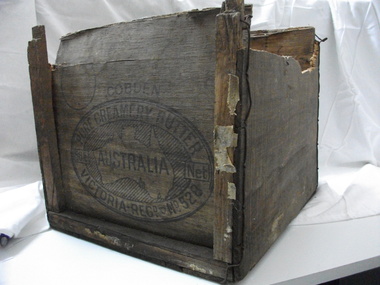
Box, butter
... ...dairy manufacturing industry...Not many of these exist. butter dairying dairy manufacturing industry butter boxes cobden COBDEN/PURE CREAMERY BUTTER/56lb Net/VICTORIA/REGD No.528 Wooden butter box with broken ends and a hole in the bottom.Constructed using thin ply ends, sides and base with square wooden struts tied with wire to strengthen the box. ...This butter box belonged to Jack Gore of Warrnambool who used it in his garage to store car parts. It is connected to Warrnambool Cheese and Butter Factory Company Limited through the box manufacturer, Peter John McGennan, who was one of the instigators of the factory. Cobden and Warrnambool factories were the first two co-operative factories to produce butter in Victoria, both commencing in 1888. Warrnambool Cheese and Butter Factory Company Ltd is the only remaining independent butter factory still using its original name. It is an example of the manner in which butter was packed for export from the late 19th century until well into the 20th century. Its innovative design is light but strong, using plywood for the box body and struts 'stitched' to the body with wire. The ply was originally pine imported from New Zealand which did not taint the butter. Following the exclusion of the timber from NZ, plantations of local pine were planted and used. McGennan's box factory supplied butter boxes to the majority of butter factories in Victoria, producing up to half a million boxes per year by 1917.This Cobden butter box is historically significant relating to the butter industry and a rare item. Not many of these exist. Wooden butter box with broken ends and a hole in the bottom.Constructed using thin ply ends, sides and base with square wooden struts tied with wire to strengthen the box. The trade mark on the end of the box is an oval with text around a map of Australia with the word AUSTRALIA printing across the map.COBDEN/PURE CREAMERY BUTTER/56lb Net/VICTORIA/REGD No.528butter, dairying, dairy manufacturing industry, butter boxes, cobden -
 Cheese World Museum
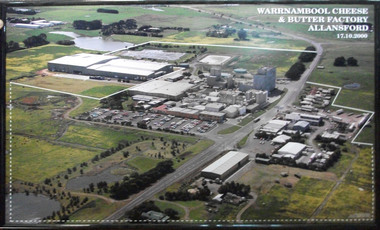
Photograph, Warrnambool Cheese and Butter Factory Co Ltd site 2000 -aerial view, 2000
... ...dairy manufacturing...Cheese World Museum operates under the Cheese World umbrella. allansford warrnambool cheese and butter factory company saputo dairyiing dairy manufacturing diary manufacturers cheese butter 17.10.2000 Aerial colour photograph of Warrnambool Cheese and Butter Factory in wooden frame. ...Warrnambool Cheese and Butter Factory Company was formed by a group of Warrnambool business men. The company was registered in May 1888 and commenced commercial production in November 1888. The company retained its independence for more than 125 years until acquired by Canadian firm Saputo. It has operated from the same site since its inception and also has an office in Japan. Milk processing is undertaken by Sungold. Milk powder for export is also produced on-site. Cheese World is a retail arm of the company operates on a connected site selling company products, local food products, wine and cheese tasting. Cheese World Museum operates under the Cheese World umbrella.Aerial colour photograph of Warrnambool Cheese and Butter Factory in wooden frame. Shows buildings and surrounds. Lines indicate factory boundaries, dotted lines indicate property extension. Date is recorded on the image.17.10.2000allansford, warrnambool cheese and butter factory company, saputo, dairyiing, dairy manufacturing, diary manufacturers, cheese, butter -
 Cheese World Museum
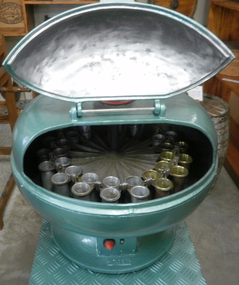
Centrifuge, electric
... ...dairy manufacturing...(Babcock Test http://www.en.wikipedia.org/wki/Babcock_test 31 March 2009) allansford dairy manufacturing milk testing Babcock test Babcock, Stephen Moulton butter warrnambool cheese and butter factory company 7173 BABCOCKTESTER 190 Round green metal container with opening lid. ...This Babcock tester was used in the laboratory at the Kraft cheese factory, Allansford. When it was superseded it was passed to one of the users of the machine, Les O'Callaghan, president of the Warrnambool & District Historical Society who placed it in the historical society collection. In 2009 when the historical society premises were upgraded there was insufficient room to store the tester so it was donated to Cheese World Museum. The machine was used to test the butterfat content of milk. Prior to dairy factories coming into existence farmers made butter individually on farms. There was no need for milk testing until farmers supplied factories for payment. Payment was based on a gallon of milk weighing 10lbs (pounds) and this led to richer milk, containing a high degree of butterfat for use in buttermaking, being paid at the same rate as lesser quality milk. In 1890 Stephen Moulton Babcock, an American professor at the University of Wisconsin-Madison, developed a method of determining the amount of butterfat in milk, thus providing a standardised and fairer system for payment. Babcock Test Process 1. 18 grams of milk (17.6ml) was put into a test tube 2. The same amount of sulphuric acid was added 3. A centrifuge at 50ºC was rotated at more than 900 revs per minute 4. The fat floating on top of the liquid in the test tube was measured The Babcock Test provided fairer compensation to farmers and also helped produce a consistent product for consumers. It also allowed for selective breeding when dairy herd testing evolved. ‘The Babcock Test is so simple that it can be used by any careful person, and it is inexpensive to operate. From the very beginning it was so complete in every detail that no change has had to be made in it.’ (Babcock Test http://www.en.wikipedia.org/wki/Babcock_test 31 March 2009) Round green metal container with opening lid. Inside houses a spinning rotor with 20 test tube holders around the outside in two circular rows.7173 BABCOCKTESTER 190allansford, dairy manufacturing, milk testing, babcock test, babcock, stephen moulton, butter, warrnambool cheese and butter factory company -
 Cheese World Museum
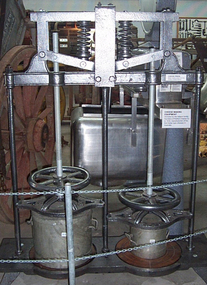
Cheese press, Perfect Cheese company
... ...cheese manufacturing...dairy...This cheese press is significant as it represents the machinery used by an early cheese production company. allansford Perfect Cheese Company Avery cheese manufacturing dairy industry J & T YOUNG AYR UK Stainless cheese press machine with three steel supports and two threaded rods will spring tension wheels to screw down to pressurise the hoops containing cheese. ...Perfect Cheese Company was founded in 1930 by newly-arrived Italian migrant Natale Paquale Italiano. The company specialised in traditional Italian-style cheese but also produced Greek, Cypriot and Maltese origin cheeses. The cheeses were sold in Australia and Italy with all products being matured and non-processed. The company remained in operation until the early 2000s.This cheese press is significant as it represents the machinery used by an early cheese production company.Stainless cheese press machine with three steel supports and two threaded rods will spring tension wheels to screw down to pressurise the hoops containing cheese.J & T YOUNG AYR UKallansford, perfect cheese company, avery, cheese manufacturing, dairy industry -
 Cheese World Museum
Milk weighing machine, Perfect Cheese company weighing machine
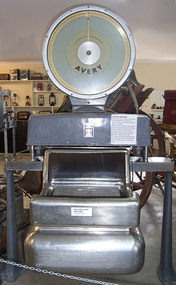
... ...cheese manufacturing...dairy...This weighing machine is significant as it represents the machinery used by an early cheese production company. allansford perfect cheese company avery cheese manufacturing dairy industry Made in England Birmingham - AVERY SOLE AGENTS Large metal machine with cast iron with a cast iron frame and a stainless steel rectangular bowl in a cradle. ...Perfect Cheese Company was founded in 1930 by newly-arrived Italian migrant Natale Paquale Italiano. The company specialised in traditional Italian-style cheese but also produced Greek, Cypriot and Maltese origin cheeses. The cheeses were sold in Australia and Italy with all products being matured and non-processed. The company remained in operation until the early 2000s.This weighing machine is significant as it represents the machinery used by an early cheese production company.Large metal machine with cast iron with a cast iron frame and a stainless steel rectangular bowl in a cradle. The round weighing scale at the top shows a weight scale up to 1100 pounds. A mesh stainless steel baffle strains the milk.Made in England Birmingham - AVERY SOLE AGENTSallansford, perfect cheese company, avery, cheese manufacturing, dairy industry -
 Federation University Historical Collection
Book, Robert S. Brain, Government Printer, Victorian Year Book 1895-8, 1901
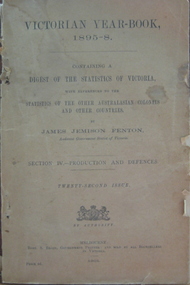
... Topics include the land system of Victoria, Crown lands, Agricultural statistics, cultivation, industry, livestock, wool, dairy farms, cattle, rabbits, manufactures, alcohol production, mining, defense. ...Topics include the land system of Victoria, Crown lands, Agricultural statistics, cultivation, industry, livestock, wool, dairy farms, cattle, rabbits, manufactures, alcohol production, mining, defense. ...This year book was published in the year of Australian Federation. It was the 22nd issue of the Victorian Year BookBrown soft covered book of 1000 page. The book contains a digest of the statistics of Victoria with reference to the other Australasian Colonies and other countries. Topics include the land system of Victoria, Crown lands, Agricultural statistics, cultivation, industry, livestock, wool, dairy farms, cattle, rabbits, manufactures, alcohol production, mining, defense. Statistics were provided by J.J. Fenton, Assistant Government Statist. -
 Kew Historical Society Inc
Card - Model Dairy Coy: Belmont Avenue, Kew, c.1907
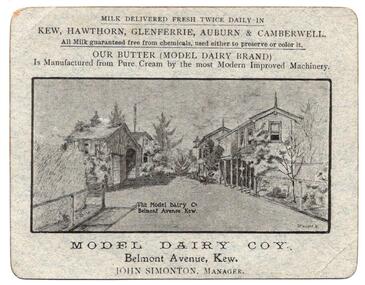
... "Milk delivered fresh twice daily in / Kew, Hawthorn & Camberwell / All Milk guaranteed free from chemicals, used either to preserve or colour it / Our butter (Model Dairy Brand) / I Manufactured from Pure Cream by the most improved Machinery / [DRAWING] The Model Dairy Co Belmont Avenue Kew / Model Dairy Co / Belmont Avenue, Kew / John Simonton, Manager"..."Milk delivered fresh twice daily in / Kew, Hawthorn & Camberwell / All Milk guaranteed free from chemicals, used either to preserve or colour it / Our butter (Model Dairy Brand) / I Manufactured from Pure Cream by the most improved Machinery / [DRAWING] The Model Dairy Co Belmont Avenue Kew / Model Dairy Co / Belmont Avenue, Kew / John Simonton, Manager" Digital copy of a business card advertising the Model Dairy in Belmont Avenue, Kew, managed by John Simonton. ...This well-known Kew business, which would become known as The Model Dairy, was founded in 1863 by James Venn Morgan. Morgan sold the company in the 1890s to John Simonton who renamed the business The Model Dairy Co. Simonton had experience in the local dairying industry having previously leased the Willsmere Park Dairy. He moved the business to Belmont Avenue in c.1899. In 1924, following his retirement, the company expanded to become The Model Dairy Pty Ltd with Arnold Thompson Simonton and John Tanner as its owner/directors. With new techniques and processes such a pasteurisation, the Belmont Avenue site no longer met required standards for processing and bottling, so its operations moved to 191 Cotham Road. The company celebrated its centenary in 1963. A new factory, built in 1959 to a design by Bates, Smart & McCutcheon, was purchased by Bib Stillwell Motors after the dairy closed. The entire site has since been redeveloped.Digital copy of a business card advertising the Model Dairy in Belmont Avenue, Kew, managed by John Simonton. (The card was donated by John Harvey Simonton in 2021,)"Milk delivered fresh twice daily in / Kew, Hawthorn & Camberwell / All Milk guaranteed free from chemicals, used either to preserve or colour it / Our butter (Model Dairy Brand) / I Manufactured from Pure Cream by the most improved Machinery / [DRAWING] The Model Dairy Co Belmont Avenue Kew / Model Dairy Co / Belmont Avenue, Kew / John Simonton, Manager"model dairy -- kew (vic.), john simonton, belmont avenue -- kew (vic.), dairies -- kew (vic.) -
 Flagstaff Hill Maritime Museum and Village
Domestic object - Boiling Copper, Newberry & Walker, Boiling Tub, Circa1900
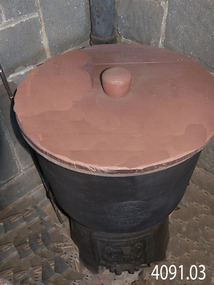
... A significant item made in Geelong giving a snapshot into the early beginnings of Victoria's industrial manufacturing of products that helped to replace previously imported items from England or America. flagstaff hill warrnambool flagstaff-hill-maritime-museum maritime-museum shipwreck-coast flagstaff-hill-maritime-village copper cast iron Newberry & Walker Washing Copper Frame Laundry Dairy Butchering Newberry & Walker Copper boiling tub, cast iron frame copper bowl inside of 14 gallon capacity Boiling Tub Domestic object Boiling Copper Newberry & Walker ...Francis John Newberry founded the Victoria Foundry and Enameling Works in 1890 with a workmate from the Humbles iron foundry in Lupton Street Geelong where he worked. Newberry & Walker Foundry & Enameling Works was built adjoining a cottage that was to be the home of the Newberry family during the ensuing years. Although Walker soon relocated to New Zealand, the Newberry and Walker foundry had become a local success. The foundry produced numerous cast iron products such as washing copper frames, and friezes, balustrades and verandah columns. Verandah posts are to be found in declining numbers, but the Newberry and Walker mark can sometimes be seen on the few which remain. A certain number of iron culvert posts were also made; some of them were still in place on the road to Cressy as late as 1961. Perhaps half the iron friezes on Geelong West verandahs came from the local firm’s foundry. A significant item made in Geelong giving a snapshot into the early beginnings of Victoria's industrial manufacturing of products that helped to replace previously imported items from England or America.Copper boiling tub, cast iron frame copper bowl inside of 14 gallon capacity Newberry & Walkerflagstaff hill, warrnambool, flagstaff-hill-maritime-museum, maritime-museum, shipwreck-coast, flagstaff-hill-maritime-village, copper, cast iron, newberry & walker, washing copper frame, laundry, dairy, butchering -
 Flagstaff Hill Maritime Museum and Village
Machine - Steam Engine, Tangyes engineering, Mid-1880s
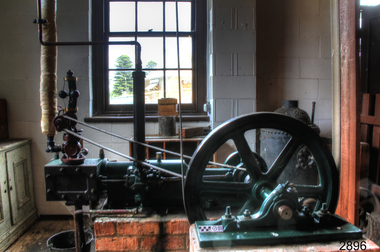
... manufacture. It was an important development in machinery because it helped improve productivity. Engines of this type are still used in some parts of the world today. This engine is a good example of a late 19th-century steam engine used in industry and agriculture and adapted for many different purposes. It is also important locally because it was connected to a local cheese making business and part of the thriving western district dairy ...This Tangye B-size, single-cylinder, horizontal steam engine was likely manufactured in England around the mid-1880s. It was distributed by Melbourne machinery merchants Cameron & Sutherland, which also operated in Bendigo and Ballarat. A local cheese maker once used the engine to drive factory equipment. It was later donated to the Warrnambool Technical School, which then donated it to Flagstaff Hill to add to its historical steam engine collection. Between its manufacture and its donation to Flagstaff Hill, the governor had been replaced by the current Pickering governor. This engine design was very popular in the late 19th and early 20th centuries. When connected and powered up, the engine could drive an overhead line shaft via a flat belt off its flywheel. The line shaft would then drive the machinery via flat belts. It could drive virtually any type of machinery, such as water and sewerage pumps, mine elevators, winches, cranes, metal forges, air blowers, and marine machinery. This engine features a mechanical governor, which controls the speed of the engine regardless of whether it is under load. It also has a water pump built into the valve rod, which is used to supply the boiler with water. Steam enters the cylinder via a slide valve and applies pressure to the piston; it is like a modern internal combustion engine, but in the case of the steam engine, the pressure is exerted in turn on either side of the piston. In other words, the connecting rod is pushed by steam via the piston and piston rod and then pulled back again by steam pushing on the opposite side of the piston. Thus, power is exerted almost continuously, except at the end of each piston stroke, when it reverses direction. In the 1880s, many local butter and cheese manufacturers installed Tangye steam engines to power their machinery. A comprehensive article in the Gippsland Mercury in September 1889 extolled the magnificence of the Farnham Butter Factory in Dennington, Warrnambool, and described how one Tangye engine was used to drive several machines in the cheese- and butter-making processes. A report in the Warragul Guardian in December 1890 notes that the newly opened Warrnambool Butter Factory used a Tangye steam engine to pump water from a 60-foot well. Tangye: Richard Tangye (1833–1906) and four of his brothers—James, Joseph, Edward, and George—were the sons of Joseph Tangye, a Quaker Cornish miner. In 1857, they founded the engineering firm Richard Tangye & Brothers in Birmingham, UK. In 1860, the firm became Tangye Brothers and moved to Cornwall Works in Birmingham. The business encouraged inventors to join the company and develop their patents there, as happened with Weston’s differential pulley block, invented by the Englishman Thomas Aldridge Weston in 1854. Tangye bought the patent in 1858, giving the firm the sole right to manufacture it. The design received a medal for “original application, practical utility and success” at the 1862 International Exhibition in London. Also in 1858, the Tangye firm was commissioned by Brunel’s shipping company to manufacture hydraulic lifting jacks, or rams, to launch the steamship SS Great Eastern. The success of this project brought favourable attention to the firm, and it became involved in other notable projects, including the erection of Cleopatra’s Needle in London in 1878 and work on the Forth Road Bridge in Scotland. The firm underwent several name changes over the years, including James Tangye and Brothers (1857), Tangye Brothers and Price (1859), Tangye Brothers (1860), Tangye Brothers & Holman (1876), Tangye Brothers (by 1878), Tangye Ltd. (1881), and then simply Tangye. Its machinery and equipment were exported worldwide. In 1884, a branch with showrooms, offices, and a warehouse was opened in Melbourne at Cornwall House, Collins Street West. The firm was well known for producing high-quality machinery for agriculture and industry. Even today, new Tangye machinery is available for a subsidiary of Allspeeds. An extensive account of the firm’s history, names, inventions, and further references is available in Grace’s Guide, which also includes references to and diagrams of the Tangye horizontal steam engine. The horizontal steam engine was made by the well-known engineering firm Tangye, known for its high quality of manufacture. It was an important development in machinery because it helped improve productivity. Engines of this type are still used in some parts of the world today. This engine is a good example of a late 19th-century steam engine used in industry and agriculture and adapted for many different purposes. It is also important locally because it was connected to a local cheese making business and part of the thriving western district dairy industry. It may have been one of the Tangyes engines used at the Farnham butter factory or the Warrnambool Butter Factory, which was reported to be one of the most important in the Colony. It is also connected to the Warrnambool Technical School, established in 1968. Steam engine: stationary Tangye Size B, single-cylinder, horizontal Mill type steam engine. It has a 4-inch diameter cylinder with an 8-inch stroke. The body is painted green, and the Pickering governor is red. It was manufactured in Birmingham, England, in accordance with Tangye's Patent 238930, and distributed by Cameron and Sunderland, Melbourne, in the mid-1880s. TANGEYS PATENT BIRMINGHAM B SIZE 238930 CAMERON & SUTHERLAND MELBOURNE THE PICKERING PORTLAND . GOVERNOR . CONN. U.S.A.flagstaff hill, warrnambool, maritime village, maritime museum, flagstaff hill maritime museum and village, shipwreck coast, great ocean road, machine, invention, engine, steam, steam engine, horizontal steam engine, tangyes horizontal steam engine, stationary steam engine, single cylinder steam engine, manufacturing, farming, pumps, lifting equipment, engines, machine tools, hydraulic rams, hydraulic pumps, steam pumps, differential pulleys, mill type steam engine, 4 inch cylinder, weston’s differential pulley, thomas aldridge weston, 1862 international exhibition in london, brunel, ss great eastern, cleopatra’s needle, forth road bridge, cornwall house, collins street melbourne, agricultural machinery, industrial machinery, allspeeds, dairy, pump, richard tangye & brothers, james tangye and brothers, tangye brothers and price, tangye brothers, tangye brothers & holman, tangyes ltd., tangye, richard tangye, james tangye, joseph tangye, edward tangye, george tangye, cornwall works, birmingham, pickering governor, pickering portland connecticut usa, 19th century, dairy plant, steam power, tangye's patent 238930, tangye b size engine, cameron & sutherland, machine merchants, 1880s, mid-1880s, cheese manufacturer, butter manufacturer, diary industry, warrnambool technical school, belt driven machinery, agriculture, mechanical governor, farnham butter factory, warrnambool butter factory -
 Flagstaff Hill Maritime Museum and Village
Separator
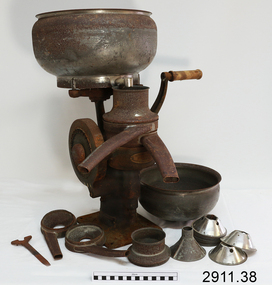
... flagstaff hill warrnambool shipwrecked-coast flagstaff-hill flagstaff-hill-maritime-museum maritime-museum shipwreck-coast flagstaff-hill-maritime-village milk separator farm machinery dairy machinery dairy industry crown spearator co cream Manufacture's plate "MADE IN SWEDEN" , "CROWN SEPARATOR / HEAD OFFICE 547 FLINDERS ST MELBOURNE". ."42D022" stamped on 2x separator chutes. ...Separator machine. Hand-crank operated milk separator, Crown Separator Co Pty Ltd. Multi-part separator stand with bowls (2) and attachments including a spanner small cone shaped objects on homemade stand. ."42D022" stamped on 2x separator chutes.Manufacture's plate "MADE IN SWEDEN" , "CROWN SEPARATOR / HEAD OFFICE 547 FLINDERS ST MELBOURNE". ."42D022" stamped on 2x separator chutes. flagstaff hill, warrnambool, shipwrecked-coast, flagstaff-hill, flagstaff-hill-maritime-museum, maritime-museum, shipwreck-coast, flagstaff-hill-maritime-village, milk separator, farm machinery, dairy machinery, dairy industry, crown spearator co, cream -
 Flagstaff Hill Maritime Museum and Village
Domestic object - Butter Churn, Malleys Ltd, 1930-1950
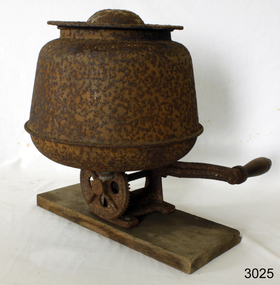
... They manufactured items for use in the dairy industry, as well as for hardware related to building and plumbing. ...They manufactured items for use in the dairy industry, as well as for hardware related to building and plumbing. ...This is a steel, bench-mounted, hand-operated (60 rpm) butter churn for making small amounts of butter from cream in the home. It was made by the Sydney firm of Malleys Ltd from the 1930s until the 1950s and came in 3 and 5 quart sizes. Malleys Ltd was established in about 1890 by Francis Malley (1863-1932). This firm was located in the Sydney suburb of Alexandria, in McEvoy Street. They manufactured items for use in the dairy industry, as well as for hardware related to building and plumbing. Many of the Malley dairy products were sold under the "Sunrise" name. Malley retired in 1912. In 1931 there were branches at Parramatta, Hurstville & North Sydney. Butter churns were machines used to produce butter by the violent agitation of separated cream. Depending on the design of the churn, the agitation would be variously achieved by a repetitive thrashing, centrifugal motion or internal paddles. Churns were typically constructed from wood, glass and cast-iron; with tin or steel commonly used for some fixtures. The subject item gives an insight into domestic life where butter was made in the home.Heavy red cast iron base, with a long handle, wooden grip, connected to a shaft along the base, thence, to a cog wheel, and gear, to a second shaft and paddle in a metal basin. Basin has lid, and hole in base with a screw cap to allow the draining of the butter milk. Designed to be placed on a bench, with the handle over the edge. Malleys is written in raised letters on the base, and on the handle, '60 rev. pr. min.'warrnambool, flagstaff-hill, flagstaff-hill-maritime-museum, shipwreck-coast, flagstaff-hill-maritime-village, malleys, butter churn, domestic object, dairy machine -
 Flagstaff Hill Maritime Museum and Village
Domestic object - Milk Churn, Malleys Ltd, 1870-1932
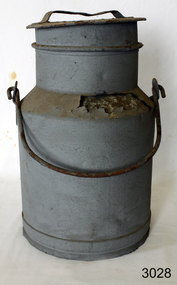
... They manufactured items for use in the dairy industry, as well as for hardware related to building and plumbing. ...They manufactured items for use in the dairy industry, as well as for hardware related to building and plumbing. ...Malleys Ltd was established in about 1890 by Francis Malley (1863-1932). This firm was located in the Sydney suburb of Alexandria, in McEvoy Street. They manufactured items for use in the dairy industry, as well as for hardware related to building and plumbing. Many of the Malley dairy products were sold under the "Sunrise" name. Malley retired in 1912. In 1931 there were branches at Parramatta, Hurstville & North Sydney. An early item made by an Australian manufacturer of dairy equipment in Australia specifically for the local market. The item gives an insight into early Australian manufacturing processes and is a significant part of Australian early social history.Milk Churn or Milk Can, Medium sized galvanised container to hold milk Malleysflagstaff hill, warrnambool, shipwrecked-coast, flagstaff-hill-maritime-museum, shipwreck-coast, flagstaff-hill-maritime-village, milk container, malleys ltd, dairy equipment -
 Flagstaff Hill Maritime Museum and Village
Container - Tin, Fred Walker Cresco Foods, 1910
... manufacturing a cheese known as Red Coon around 1931, which later became known as Coon cheese. He founded the Fred Walker Company at 54 William Street and later moving to Flinders Street in 1911. This company specialised in canned foods, especially dairy...manufacturing a cheese known as Red Coon around 1931, which later became known as Coon cheese. He founded the Fred Walker Company at 54 William Street and later moving to Flinders Street in 1911. This company specialised in canned foods, especially dairy ...Fred Walker 1884 – 1935 was an Australian businessman and founder of Fred Walker & Co. first in Hong Kong, then in Melbourne as the Fred Walker Company. He also set up Kraft Walker Cheese Co. in partnership with American businessman James L. Kraft in 1926, to market Kraft's patented method of processing cheese in Australia. Fred Walker & Co. is best known for creating Vegemite, a yeast extract-based food spread and Australian cultural icon. Kraft Walker Cheese Co. Is best known for manufacturing a cheese known as Red Coon around 1931, which later became known as Coon cheese. He founded the Fred Walker Company at 54 William Street and later moving to Flinders Street in 1911. This company specialised in canned foods, especially dairy products, exporting them to Asia. It manufactured Red Feather canned foods including butter and cheese from around 1910. He also went on to created Cresco Food Co. for his younger brother, which was the first factory to manufacture "flaked food" or dehydrated food products in Australia.A significant item that catalogues the start of dehydrated food production and sale in Australia was initiated by an Australian businessman and well-known entrepreneur. The history of Fred Walker gives insight into how many food brands in Australia now that we take for granted had his involvement in their early beginnings. Large cylindrical tin with push on lid, painted label on the sides in maroon, black gold and dark fawn colours with text.Palm Flaked Rice manufactured by the Cresco Co. Limited Melbourne Australiaflagstaff hill, warrnambool, shipwrecked coast, flagstaff hill maritime museum, flagstaff hill maritime village, great ocean road, container, food container, kitchen ware, flaked rice, cresco, palm flaked rice, tin, fred walker, dehydrated food -
 Flagstaff Hill Maritime Museum and Village
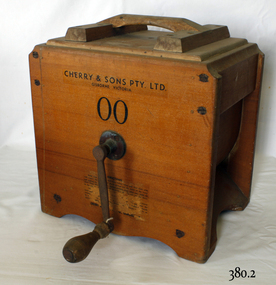
Domestic object - Butter Churn, Cherry and Sons, Circa 1890-1920
... A significant giving an snapshot into how early rural and industrial manufacturing became established in Australia. warrnambool shipwrecked-coast flagstaff-hill flagstaff-hill-maritime-museum flagstaff-hill-maritime-village butter churn gisborne edward cherry george cherry thomas cherry ann appleby dairy equipment Lettering in black on a transfer "CHERRY & SONS PTY LTD. ...The subject item is a good example of a large, hand-operated Bentwood box butter churn used to make up to 14 pounds of butter. It was made in Gisborne, Victoria, by the famous manufacturer, E. Cherry, and is known as an Improved Patent No.2 model probably dating from the late 1800s. The Cherry works specialised in making all types of butter churns and equipment for both domestic use on farms and small butter factories during the late nineteenth and early to mid. twentieth centuries. Milk was "separated" to retrieve the cream which was then beaten to make butter. E Cherry began making various models of Cherry butter churns in 1858, Edward Cherry migrated from Herefordshire England to Australia in 1855 with his wife Ann Appleby, nee Davis, and established a joinery workshop at Gisborne, Victoria. He began by making butter churns in his spare time and his product soon became popular allowing him to establish a viable business. A factory was established in 1875 and he started to make churns of all sizes including up to industrial scale. He exported his products to many countries around the world, Edward Cherry died in 1909 and the business was then run by his son George until he died in 1917. E Cherry's other son Thomas (1861-1945) was also involved in the firm maintaining an interest for several years. He had been born in Gisborne and became a senior house medical surgeon at the Melbourne Hospital in 1890. He continued his studies at Kings College London, eventually becoming a renowned bacteriologist and agricultural scientist. A significant giving an snapshot into how early rural and industrial manufacturing became established in Australia.Rectangular butter churn, a footed wooden box containing an X-shaped wooden interior rack, which is joined to an exterior metal hand crank with turned wood handle, through a hole in the box. Beneath the hand crank is a hole from the interior lined with metal. The lid has a carry handle affixed to the lid on two cross pieces attached to the lid by brass screws.Lettering in black on a transfer "CHERRY & SONS PTY LTD. GISBORNE VICTORIA". Model 00warrnambool, shipwrecked-coast, flagstaff-hill, flagstaff-hill-maritime-museum, flagstaff-hill-maritime-village, butter churn, gisborne, edward cherry, george cherry, thomas cherry, ann appleby, dairy equipment -
 Flagstaff Hill Maritime Museum and Village
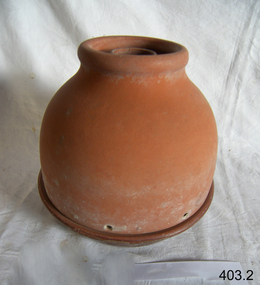
Domestic object - Cooler
... manufacture items for keeping foods and liquids cool. When water is added to the base, the terra cotta body absorbs it and the subsequent evaporation creates a cooling effect for the contents. It is particularly effective when used to keep milk, cheese, butter and bottles of wine cool. Terra cotta was one of the first ceramic materials to be used. Flagstaff Hill Warrnambool Shipwrecked-coast Flagstaff-Hill Flagstaff-Hill-Maritime-Museum Maritime-Museum Shipwreck-coast Flagstaff-Hill-Maritime-Village Terra cotta Ceramics Coolers Dairy ...Terra cotta is the perfect medium to manufacture items for keeping foods and liquids cool. When water is added to the base, the terra cotta body absorbs it and the subsequent evaporation creates a cooling effect for the contents. It is particularly effective when used to keep milk, cheese, butter and bottles of wine cool.Terra cotta was one of the first ceramic materials to be used.Terra cotta cooler, with bell shaped lid that is open at the top, but with a rim for holding water. There are ventilation holes around the base of the lid. The top stands inside the base. When water is added to the rim at the top, the terra cotta body absorbs it and creates a cooling effect for the contents. Probably used to keep butter or cheese cool. flagstaff hill, warrnambool, shipwrecked-coast, flagstaff-hill, flagstaff-hill-maritime-museum, maritime-museum, shipwreck-coast, flagstaff-hill-maritime-village, terra cotta, ceramics, coolers, dairy products -
 Flagstaff Hill Maritime Museum and Village
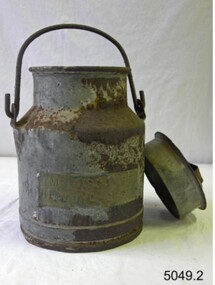
Domestic object - Cream Can, Malleys Ltd, 1920-1950
... They manufactured items for use in the dairy industry, as well as for hardware related to building and plumbing. ...They manufactured items for use in the dairy industry, as well as for hardware related to building and plumbing. ...This small cream can was made by the Sydney firm of Malleys Ltd from the 1930s until the 1950s and came in various sizes. Malleys Ltd was established in about 1890 by Francis Malley (1863-1932). This firm was located in the Sydney suburb of Alexandria, in McEvoy Street. They manufactured items for use in the dairy industry, as well as for hardware related to building and plumbing. Many of the Malley dairy products were sold under the "Sunrise" name. Malley retired in 1912. In 1931 there were branches at Parramatta, Hurstville & North Sydney. This cream can was designed for domestic home use and was used to fetch cream from a dairy or retailer of dairy products between 1920 to 1950s. M Luscombe Diamond Creek on the nameplate suggests this is the farm dairy that supplied the cream the can would hold and that they were the owners of the can. This dairy no longer exists as the area is now a housing estate.Cream can, round metal container with fitted lid and carrying handle. Can has a short wide neck. Body has embossed letters and an attached metal nameplate that has been soldered. Made by Malleys. Embossed raised letters "MALLEYS". Text on nameplate ""M LUSCOMBE / DIAMOND CREEK " warrnambool, flagstaff-hill, flagstaff-hill-maritime-museum, shipwreck-coast, flagstaff-hill-maritime-village, malleys, domestic object, cream can, dairy container, diamond creek, m luscombe -
 Flagstaff Hill Maritime Museum and Village
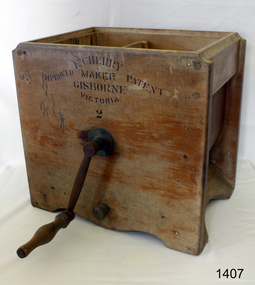
Domestic object - Butter Churn, Cherry and Sons, 1890-1920
... A significant item giving an snapshot into how early industrial manufacturing became established in Australia in the production of domestic and industrial dairy equipment. warrnambool shipwrecked-coast flagstaff-hill flagstaff-hill-maritime-museum maritime-museum shipwreck-coast flagstaff-hill-maritime-village butter churn wooden butter churn e cherry & sons dairy equipment gisborne food preparation Label in block transfer "E CHERRY / MAKER / GISBORN / VICTORIA / 2" "IMPROVED PATENT" Butter churn wooden manually operated made by Cherry and Sons with rotating lever curved plywood basin and parallel cross beamed horizontally spoken churning apparatus inside with wooden plug at lower side of churn. ...The subject item is a good example of a large, hand-operated Bentwood box butter churn used to make up to 14 pounds of butter. It was made in Gisborne, Victoria, by the famous manufacturer, E. Cherry, and is known as an Improved Patent No.2 model probably dating from the late 1800s. The Cherry works specialised in making all types of butter churns and equipment for both domestic use on farms and small butter factories during the late nineteenth and early to mid. twentieth centuries. Milk was "separated" to retrieve the cream which was then beaten to make butter. E Cherry began making various models of Cherry butter churns in 1858, Edward Cherry migrated from Herefordshire England to Australia in 1855 with his wife Ann Appleby, nee Davis, and established a joinery workshop at Gisborne, Victoria. He began by making butter churns in his spare time and his product soon became popular allowing him to establish a viable business. A factory was established in 1875 and he started to make churns of all sizes including up to industrial scale. He exported his products to many countries around the world, Edward Cherry died in 1909 and the business was then run by his son George until he died in 1917. E Cherry's other son Thomas (1861-1945) was also involved in the firm maintaining an interest for several years. He had been born in Gisborne and became a senior house medical surgeon at the Melbourne Hospital in 1890. He continued his studies at Kings College London, eventually becoming a renowned bacteriologist and agricultural scientist. A significant item giving an snapshot into how early industrial manufacturing became established in Australia in the production of domestic and industrial dairy equipment.Butter churn wooden manually operated made by Cherry and Sons with rotating lever curved plywood basin and parallel cross beamed horizontally spoken churning apparatus inside with wooden plug at lower side of churn. Label in block transfer "E CHERRY / MAKER / GISBORN / VICTORIA / 2" "IMPROVED PATENT"warrnambool, shipwrecked-coast, flagstaff-hill, flagstaff-hill-maritime-museum, maritime-museum, shipwreck-coast, flagstaff-hill-maritime-village, butter churn, wooden butter churn, e cherry & sons, dairy equipment, gisborne, food preparation -
 City of Moorabbin Historical Society (Operating the Box Cottage Museum)
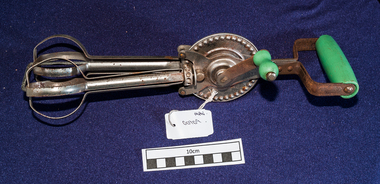
Kitchen Equipment, mechanical hand whisk c1940, c1940
... The Hobart Manufacturing Company was an early manufacturer of large commercial mixers. cooking kitchen equipment dairy cakes housework early settlers pioneers baking nutrition blacksmiths market gardeners cake mixers moorabbin cheltenham bentleigh brighton monroe e.p. monroe j.f. egg beaters williams turner dover stamping compant ltd. hobart manufacturing company ltd. ...An eggbeater is a hand-held device with a crank on the side geared to one or more beaters. The user grips the handle with one hand and operates the crank with the other, creating the rotary action. A hand-turned rotary egg beater was patented by J.F. and E.P. Monroe in 1859 in the US. This egg beater patent was one of the earliest bought up by the Dover Stamping Company, whose Dover egg beaters became a classic American brand. The Monroe design was also manufactured in England. In 1870, Turner Williams of Providence, R.I., invented another Dover egg beater model. The Hobart Manufacturing Company was an early manufacturer of large commercial mixers. A mechanical egg beater with a wooden handle and steel gears and crank c1940cooking, kitchen equipment, dairy, cakes, housework, early settlers, pioneers, baking, nutrition, blacksmiths, market gardeners, cake mixers, moorabbin, cheltenham, bentleigh, brighton, monroe e.p., monroe j.f., egg beaters, williams turner, dover stamping compant ltd., hobart manufacturing company ltd. -
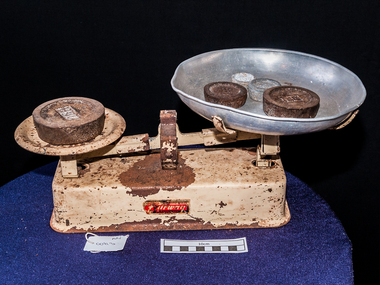 City of Moorabbin Historical Society (Operating the Box Cottage Museum)
Scales, Domestic Imperial, ‘Fairway Melbourne’, c1930
... Fairway Company Melbourne manufactured this pair of domestic scales with a dish / pan in which objects to be weighed and the weights / masses against which to weigh them are placed. These common kitchen / dairy...Fairway Company Melbourne manufactured this pair of domestic scales with a dish / pan in which objects to be weighed and the weights / masses against which to weigh them are placed. These common kitchen / dairy ...Fairway Company Melbourne manufactured this pair of domestic scales with a dish / pan in which objects to be weighed and the weights / masses against which to weigh them are placed. These common kitchen / dairy scales would be used by the householder to weigh flour, sugar, cereal, vegetables, fruit, meats, butter, cheese etc. prior to cooking or storing . Its parts include a fulcrum, a beam that balances on it, two pans at the ends of the beam to hold the materials to be weighed, and counter-balancing weights. A set of domestic scales made by ‘Fairway’ Melbourne c1930. Painted cream steel with 1 metal bowl / pan and Imperial measure weights 2LB, 1LB, 4OZ, 2OZ, 1OZScales ; MADE BY / DOMESTIC SCALES / FAIRWAY / MELBOURNE AUST. Weights ; 2LB, 1LB, 4OZ, 2OZ, 1OZ market gardeners, early settlers, fruit vegetables, farmers, cooking, recipes, scales, weights, measures, brass, balance beam, moorabbin, cheltenham, bentleigh, kitchen scales, dairy products, cereals, wheat flour -
 City of Moorabbin Historical Society (Operating the Box Cottage Museum)
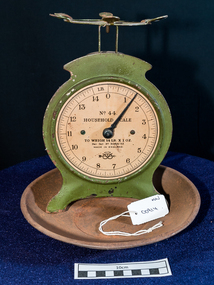
Scales,Spring Balnce Imperial ‘Household’ Salter, 20thC
... manufacturing site in the town of West Bromwich. The business thrived throughout the 1900s, and in 1972 the company was purchased by Staveley Industries Plc. In 2002, the management team at Salter Housewares Ltd, backed by Barclays Private Equity, bought the company out from the group, to concentrate on its consumer businesses. In 2004 was sold to the US-based HoMedics company, and in 2006, Salter Housewares USA and Taylor Precision Products Inc (also owned by HoMedics) merged. market gardeners early settlers fruit vegetables farmers cooking recipes scales weights measures brass balance beam moorabbin cheltenham bentleigh kitchen scales dairy products cereals wheat flour salter housewares pty ltd west bromwich england On Clock face ; NO. 44 / HOUSEHOLD SCALE / TO WEIGH 14LB X 1OZ / Pro. ...In the 18th century, spring scales appeared. To produce these scales, a manufacturer would use the resistance of a spring to calculate weights, which could be read automatically on the scale’s face. The ease of use of spring scales over balance scales is what led most post offices to outfit their clerks with spring postal scales. One of the most common types of spring scales was the kitchen scale—also known as a family or dial scale. Designed for horizontal surfaces, these scales used the weight of goods in a pan at the top of the scale to force the spring down. Such scales were common in early-20th-century households and were sold by Sears and Montgomery Ward. Many had flat weighing surfaces but some were topped by shallow pans. Companies such as Salters, Chatillon, and Fairbanks made both. SALTER HOUSEWARES began in the late 1760 in the village of Bilston, England. At this time Richard Salter, a spring maker, began making 'pocket steelyards', a scale similar to the fisherman's scale of today. By 1825 his nephew George had taken over the company, which became known as George Salter & Co. and later established a large, well equipped manufacturing site in the town of West Bromwich. The business thrived throughout the 1900s, and in 1972 the company was purchased by Staveley Industries Plc. In 2002, the management team at Salter Housewares Ltd, backed by Barclays Private Equity, bought the company out from the group, to concentrate on its consumer businesses. In 2004 was sold to the US-based HoMedics company, and in 2006, Salter Housewares USA and Taylor Precision Products Inc (also owned by HoMedics) merged. Salter Brand No. 44 Household Spring Balance Kitchen Scales made of green painted metal with a large clock face dial marked in 1oz graduations and with a shallow metal bowl placed on the flat top connected to the mechanism. An adjustable screw tightened or loosened the spring to bring the pointer to zero, prior to adding the material to be weighed.. A common piece of kitchen equipment as most families used this type of scale when measuring goods for cooking or storing.On Clock face ; NO. 44 / HOUSEHOLD SCALE / TO WEIGH 14LB X 1OZ / Pro. Pat. No. 30819 / 32 / MADE IN ENGLAND / SALTER / S in trademark rope with arrow market gardeners, early settlers, fruit, vegetables, farmers, cooking, recipes, scales, weights, measures, brass, balance beam, moorabbin, cheltenham, bentleigh, kitchen scales, dairy products, cereals, wheat flour, salter housewares pty ltd, west bromwich england -
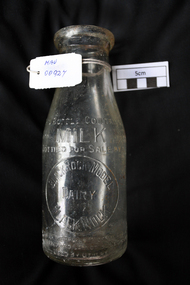 City of Moorabbin Historical Society (Operating the Box Cottage Museum)
Manufactured Glass, milk bottle 'Black Rock Dairy', 20thC
... dairy farmers...bottles...glass manufacture...The produce was taken to feed the population of Melbourne and local residents. market gardeners early settlers farmers dairies milk production moorabbin shire moorabbin cheltenham black rock brighton dairy farmers bottles glass manufacture varcoe alfred r; black rock dairy, dairy farmer, dairy products sales and deliveries, THIS BOTTLE CONTAINS/ MILK / BOTTLED FOR SALE BY / BLACK ROCK MODEL / DAIRY / BLACK ROCK / BOTTLE IS THE PROPERTY OF THE ABOVE / IT IS OWNED AND CANNOT BE LEGALLY USED BY OTHERS/ ONE IMPERIAL PINT on base 440 A clear glass ,1 pint , milk bottle used by Black Rock Dairy, Melbourne Manufactured Glass, milk bottle 'Black Rock Dairy' Australian Glass Bottle Manufacturing Co. ...Alfred R Varcoe was a dairyman with stables, cart shed and his house in Eliza Street, Black Rock, Victoria. Dairy farming was established early in the settlement of the Brighton / Moorabbin area following the Dendy's Special Survey 1841 and subsequent land sales c1850. The produce was taken to feed the population of Melbourne and local residents.A clear glass ,1 pint , milk bottle used by Black Rock Dairy, MelbourneTHIS BOTTLE CONTAINS/ MILK / BOTTLED FOR SALE BY / BLACK ROCK MODEL / DAIRY / BLACK ROCK / BOTTLE IS THE PROPERTY OF THE ABOVE / IT IS OWNED AND CANNOT BE LEGALLY USED BY OTHERS/ ONE IMPERIAL PINT on base 440market gardeners, early settlers, farmers, dairies, milk production, moorabbin shire, moorabbin, cheltenham, black rock, brighton, dairy farmers, bottles, glass manufacture, varcoe alfred r; black rock dairy, dairy farmer, dairy products sales and deliveries, -
 City of Moorabbin Historical Society (Operating the Box Cottage Museum)
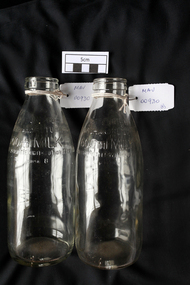
Manufactured Glass, milk bottles 600ml, c1970
... Metric measures were introduced throughout Australia with Decimalisation 14/2/1966. melbourne glass bottle works spotswood melbourne milk dairy dairy produce dairy farmers market gardeners pioneers early settlers moorabbin cheltenham pasteur louis pasteurization PASTEURISED / 600 ML MILK 3 x clear glass milk bottles c 1970 600ml ( 2 shown in photograph) Manufactured Glass, milk bottles 600ml Melbourne Glass Bottle Works ...There are two distinct types of milk consumption: a natural source of nutrition for all infant mammals and a food product for humans of all ages that is derived from other animals. Milk is a key contributor to improving nutrition and food security particularly in developing countries. Improvements in livestock and dairy technology offer significant promise in reducing poverty and malnutrition in the world. Pasteurization is used to kill harmful micro-organisms by heating the milk for a short time and then immediately cooling it. In the past, milk was always packaged in glass milk bottles The first glass bottle packaging for milk was used in the 1870s. The first company to do so may have been the New York Dairy Company in 1877 with a small glass lid and a tin clip. Lewis P. Whiteman holds the first patent for a glass milk bottle c1884,which was sealed with a waxed paper disk. The Express Dairy Company in England began glass bottle production in 1880. Melbourne Glass Bottle Works Spotswood 1880 - 1990. Milk cartons first came to Australia in 1958, when the Model Dairy in Melbourne began packaging milk in 150 ml and 500 ml cartons. At the time, 160,000 new glass bottles were needed in Melbourne alone every week to keep up the delivery of 1.3 million bottles of milk a day c1970, the blow-moulded disposable plastic milk bottle was introduced. In 1987, only about 2% of milk was still being sold in glass bottles. Glass milk bottles are now rare. Metric measures were introduced throughout Australia with Decimalisation 14/2/1966.3 x clear glass milk bottles c 1970 600ml ( 2 shown in photograph)PASTEURISED / 600 ML MILKmelbourne glass bottle works, spotswood melbourne, milk, dairy, dairy produce, dairy farmers, market gardeners, pioneers, early settlers, moorabbin, cheltenham, pasteur louis, pasteurization -
 City of Moorabbin Historical Society (Operating the Box Cottage Museum)
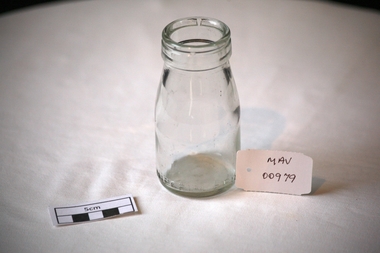
Manufactured Glass, bottle cream 1/4 pint, 20thC
... glass milk bottles dairy farmers dairies around base : IMPERIAL 1/4 PINT A clear glass milk or cream bottle 'Imperial' 1/4 Pint Manufactured Glass, bottle cream 1/4 pint Imperial Pty Ltd ...General use of milk bottles is usually associated with the 20th century , with occasional late 19th century. Initially, milk was delivered in cans stacked upright in a wagon At each stop, someone, usually the wife of the house, would bring a pitcher or a pail to the wagon, and the milk man would ladle out the desired amount of milk. Needless to say, this practice was hazardous and unhealthy. The New York State Tuberculosis Association condemned the practice of selling “loose milk,” still being conducted in New York City in 1922, as a major cause for the spread of tuberculosis (Glass Container1922:8). It is probable that the delivery of milk in glass containers became universal shortly thereafter. General use of milk bottles is usually associated with the 20th century , with occasional late 19th century. Initially, milk was delivered in cans stacked upright in a wagon. At each stop, someone, usually the wife of the house, would bring a pitcher or a pail to the wagon, and the milk man would ladle out the desired amount of milk. Needless to say, this practice was hazardous and unhealthy. The New York State Tuberculosis Association condemned the practice of selling “loose milk,” still being conducted in New York City in 1922, as a major cause for the spread of tuberculosis (Glass Container1922:8). It is probable that the delivery of milk in glass containers became universal shortly thereafter. Melbourne Glass Bottle Works Spotswood 1880 - 1990. made bottles for various companies. Milk cartons first came to Australia in 1958, when the Model Dairy in Melbourne began packaging milk in 150 ml and 500 ml cartons. At the time, 160,000 new glass bottles were needed in Melbourne alone every week to keep up the delivery of 1.3 million bottles of milk a day. In 1970, the blow-moulded disposable plastic milk bottle was introduced. In 1987, only about 2% of milk was still being sold in glass bottles. Glass milk bottles are now rare. A clear glass milk or cream bottle 'Imperial' 1/4 Pintaround base : IMPERIAL 1/4 PINTmelbourne, early settlers, market gardeners, moorabbin, bentleigh, cheltenham, manufactured glass, milk bottles, dairy farmers, dairies -
 City of Moorabbin Historical Society (Operating the Box Cottage Museum)
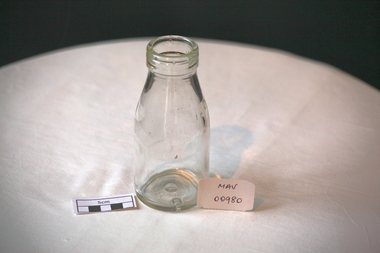
Manufactured Glass, bottle milk 'Imperial' 1/2 pint, early 20thC
... glass milk bottles dairy farmers dairies Around centre : IMPERIAL HALF PINT Base: M / 'scar' / 824 ( enclosed in a circle) / 8 / 760 A clear glass milk bottle ‘Imperial’ half pint. Manufactured ...General use of milk bottles is usually associated with the 20th century , with occasional late 19th century. Initially, milk was delivered in cans stacked upright in a wagon. At each stop, someone, usually the wife of the house, would bring a pitcher or a pail to the wagon, and the milk man would ladle out the desired amount of milk. Needless to say, this practice was hazardous and unhealthy. The New York State Tuberculosis Association condemned the practice of selling “loose milk,” still being conducted in New York City in 1922, as a major cause for the spread of tuberculosis (Glass Container1922:8). It is probable that the delivery of milk in glass containers became universal shortly thereafter. Melbourne Glass Bottle Works Spotswood 1880 - 1990. made bottles for various companies. Milk cartons first came to Australia in 1958, when the Model Dairy in Melbourne began packaging milk in 150 ml and 500 ml cartons. At the time, 160,000 new glass bottles were needed in Melbourne alone every week to keep up the delivery of 1.3 million bottles of milk a day. In 1970, the blow-moulded disposable plastic milk bottle was introduced. In 1987, only about 2% of milk was still being sold in glass bottles. Glass milk bottles are now rare After Decimalization 14/2/1966 Metric measure glass bottles were used A clear glass milk bottle ‘Imperial’ half pint. Around centre : IMPERIAL HALF PINT Base: M / 'scar' / 824 ( enclosed in a circle) / 8 / 760melbourne, early settlers, market gardeners, moorabbin, bentleigh, cheltenham, manufactured glass, milk bottles, dairy farmers, dairies -
 City of Moorabbin Historical Society (Operating the Box Cottage Museum)
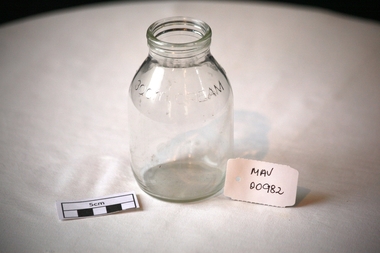
Manufactured Glass, bottle cream 300ml, post 1966
... Metric Measure was introduced in Australia 14/2/1966 melbourne early settlers market gardeners moorabbin bentleigh cheltenham manufactured glass milk bottles dairy farmers dairies decimalisation in australia 1966 metric measures melbourne glass bottle works, spotswood, felton grimwade pty ltd, pharmacists, Around Shoulder : NO DEPOSIT NO RETURN 300ML CREAM Around Base: (makers stamp) M 10116 38 A clear glass, cream bottle 300ml Manufactured Glass, bottle cream 300ml unknown ...General use of milk bottles is usually associated with the 20th century , with occasional late 19th century. Initially, milk was delivered in cans stacked upright in a wagon. At each stop, someone, usually the wife of the house, would bring a pitcher or a pail to the wagon, and the milk man would ladle out the desired amount of milk. Needless to say, this practice was hazardous and unhealthy. The New York State Tuberculosis Association condemned the practice of selling “loose milk,” still being conducted in New York City in 1922, as a major cause for the spread of tuberculosis (Glass Container1922:8). It is probable that the delivery of milk in glass containers became universal shortly thereafter Melbourne Glass Bottle Works Co Pty Ltd (1903 - 1915) Registered in Victoria in 1903 the company amalgamated with the Waterloo Glass Bottle Works Ltd in 1915 to form Australian Glass Manufacturers Company, Limited. Melbourne Glass Bottle Works Spotswood 1872- 1915 The Melbourne Glass Bottle Works (former), comprising a complex of buildings constructed between 1880 and 1940, at Booker Street, Douglas Parade, 2-38 Hudson Road, Raleigh Street and Simcock Avenue, Spotswood. The former glassworks was established in 1890 and originally made bottles for pharmacists Felton Grimwade before it was sold to the State Government by US multinational, OI glass manufacturers Australian Consolidated Industries Ltd was formed in 1939 when Australian Glass Manufacturers Co Ltd changed it's name to reflect diversification into building products. 1982 a new holding company was formed and the company's name was changed to A.C.I. International Ltd. Metric Measure was introduced in Australia 14/2/1966 A clear glass, cream bottle 300ml Around Shoulder : NO DEPOSIT NO RETURN 300ML CREAM Around Base: (makers stamp) M 10116 38 melbourne, early settlers, market gardeners, moorabbin, bentleigh, cheltenham, manufactured glass, milk bottles, dairy farmers, dairies, decimalisation in australia 1966, metric measures, melbourne glass bottle works, spotswood, felton grimwade pty ltd, pharmacists, -
 City of Moorabbin Historical Society (Operating the Box Cottage Museum)
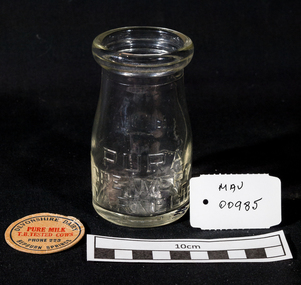
Manufactured Glass, bottle PURA Cream 4oz, 20thC
... A waxed cardboard disc lid from Devonshire Dairy Hepburn Springs is not related to this bottle but is an example of the typical lid used during this period Manufactured Glass, bottle PURA Cream 4oz Melbourne Glass Bottle Works Pty Ltd ...There are two distinct types of milk consumption: a natural source of nutrition for all infant mammals and a food product for humans of all ages that is derived from other animals. Milk is a key contributor to improving nutrition and food security particularly in developing countries. Improvements in livestock and dairy technology offer significant promise in reducing poverty and malnutrition in the world. Pasteurization is used to kill harmful micro-organisms by heating the milk for a short time and then immediately cooling it. In the past, milk was always packaged in glass milk bottles The first glass bottle packaging for milk was used in the 1870s. The first company to do so may have been the New York Dairy Company in 1877 with a small glass lid and a tin clip. Lewis P. Whiteman holds the first patent for a glass milk bottle c1884,which was sealed with a waxed paper disk. The Express Dairy Company in England began glass bottle production in 1880. Melbourne Glass Bottle Works Spotswood 1880 - 1990. Milk cartons first came to Australia in 1958, when the Model Dairy in Melbourne began packaging milk in 150 ml and 500 ml cartons. At the time, 160,000 new glass bottles were needed in Melbourne alone every week to keep up the delivery of 1.3 million bottles of milk a day. n 1970, the blow-moulded disposable plastic milk bottle was introduced. In 1987, only about 2% of milk was still being sold in glass bottles. Glass milk bottles are now rare .Melbourne Glass Bottle Works Co Pty Ltd (1903 - 1915) Registered in Victoria in 1903 the company amalgamated with the Waterloo Glass Bottle Works Ltd in 1915 to form Australian Glass Manufacturers Company, Limited. Melbourne Glass bottle works Spotswood 1872- 1915 The Melbourne Glass Bottle Works (former), comprising a complex of buildings constructed between 1880 and 1940, at Booker Street, Douglas Parade, 2-38 Hudson Road, Raleigh Street and Simcock Avenue, Spotswood. The former glassworks was established in 1890 and originally made bottles for pharmacists Felton Grimwade before it was sold to the state government by US multinational, OI glass manufacturers A clear glass 4 oz bottle for PURA Creamery Carnegie. . A waxed cardboard disc lid from Devonshire Dairy Hepburn Springs is not related to this bottle but is an example of the typical lid used during this period Bottle : PURA / CREAMERY / CARNEGIE / CONTENTS 4 OZS Base : 120 Lid circumference : DEVONSHIRE DAIRY HEPBURN SPRINGS:/ Lid centre: PURE MILK/ T.B. TESTED COWS / PHONE 223 melbourne glass bottle works, spotswood melbourne, milk, dairy, dairy produce, dairy farmers, market gardeners, pioneers, early settlers, moorabbin, cheltenham, pasteur louis, pasteurization, pura creamery carnegie, devonshire dairy, hepburn springs, waxed paper milk bottle lids, felton grimwade co ltd, -
 City of Moorabbin Historical Society (Operating the Box Cottage Museum)
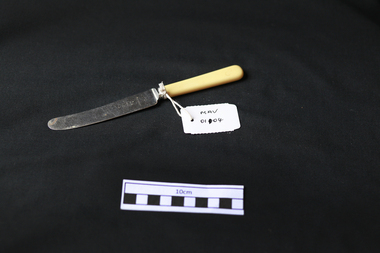
Kitchen Equipment, cutlery butter knife, c1930
... Mytton’s were heavy manufacturing engineers producing a large range of stainless steel products including: kitchen sinks of various design, beer barrels [9 and 18 gallon kegs] for the breweries, milk vats for cooling and storing milk on dairy farms, a large range of dairy and industrial vessels, road transport tanks, LPG tanks, low pressure pre-mix vessels for the soft drink industry. ...Mytton’s were heavy manufacturing engineers producing a large range of stainless steel products including: kitchen sinks of various design, beer barrels [9 and 18 gallon kegs] for the breweries, milk vats for cooling and storing milk on dairy farms, a large range of dairy and industrial vessels, road transport tanks, LPG tanks, low pressure pre-mix vessels for the soft drink industry. ...Rodd's was established by George & Ernest Rodd in Melbourne in 1919.They were manufacturers and wholesalers of precious metal jewellery. Later they began to manufacture high quality silver plated cutlery under the brand name “Rodd”. They then expanded into holloware when they took over Platers Pty. Ltd. who produced a very high quality range of silver plated Sheffield Reproduction Silverware, under the brand name “Hecworth”. Rodd’s established a large factory at 150 Barkly St., St. Kilda, Melbourne. During WW2 with a staff some 200, the factory produced ordnance components to help with the war effort. Rodd’s established sales offices in the main city centres of all States. The company prospered. In December, 1960, Rodd [Australia] Ltd. was merged with Mytton’s Ltd., Melbourne, and became part of the newly formed company Mytton Rodd [Australia] Ltd. Mytton’s were also producers of silver plated cutlery under the brand name “Grosvenor” and were strong competitors to the Rodd brand of cutlery Australia wide. It was a friendly take over and the Directors of Rodd [Aust.] Ltd. were appointed to the board of Mytton Rodd [Aust.] Ltd., and some to the Holding Company Mytton’s Ltd. Mytton’s were heavy manufacturing engineers producing a large range of stainless steel products including: kitchen sinks of various design, beer barrels [9 and 18 gallon kegs] for the breweries, milk vats for cooling and storing milk on dairy farms, a large range of dairy and industrial vessels, road transport tanks, LPG tanks, low pressure pre-mix vessels for the soft drink industry. They also produced a range of domestic bathes, steel railway sleepers, using their 3000 ton hydraulic presses. Mytton’s also had their own non ferrous foundry and rolling mill which produced nickel silver sheet used in the manufacturer of their silver plated cutlery. They also produced copper sheet for their own and industrial use. Mytton’s had factories in York St., South Melbourne and Port Melbourne. Rodd [Aust.] Ltd. set up a manufacturing, distribution plant in Auckland, New Zealand, circa 1960. This company began producing precious metal jewellery in a rented space in the premises of Matthey Garret Ltd., Bullion Merchants, in Drake St., Auckland. Later they moved into their own building in Sale St., Auckland. The company prospered and purchased land and built a factory at 121 Apirana Ave. Glen Innes, Auckland, circa 1964. ( B. McCulloch Rodd Pty Ltd)A butter knife with stainless steel blade and bone handle c1930on blade; RODD / STAINLESScutlery, stainless steel, cheltenham, moorabbin, bentleigh, early settlers, rodd aust ltd, mytton rodd pty ltd, aukland, port melbourne -
 City of Moorabbin Historical Society (Operating the Box Cottage Museum)
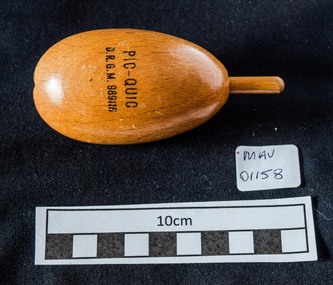
Sewing Equipment , wooden 'Pic-Quic', 20thC
... manufactured in Germany might have been stamped with this D.R.G.M. designation. This Quic Pic was used by the family of Ailsa Hunt in mid 20thC The women of the post World War 11 estates made clothes and furnishings as their families settled in Bentleigh, McKinnon, Moorabbin ,Ormond in City of Moorabbin c1950s clothing, haberdashery, crochet, doilies, brighton, moorabbin, pioneers, dressmaking, market gardeners, early settlers, craftwork , bentleigh, lacework, moorabbin shire, hunt ailsa, dairy farms, fruit orchards 'PIC - QUIC' DRGM 989116 A wooden egg shaped tool with enclosed steel hook for darning stockings c1950 Sewing Equipment , wooden 'Pic-Quic' DRGM ...The wooden egg has a tiny metal latch hook inserted in the middle (same design as rug making tools). There is a groove down one side. A stocking or knitted fabric is stretched around the egg with the "ladder" in line with the groove. The latch hook is used to pick up the loops in knitted fabric to repair the fault. D.R.G.M., is not a German patent but was instead a way for inventors to register a product’s design or function in all states within Germany. From 1891 to 1952, products manufactured in Germany might have been stamped with this D.R.G.M. designation. This Quic Pic was used by the family of Ailsa Hunt in mid 20thCThe women of the post World War 11 estates made clothes and furnishings as their families settled in Bentleigh, McKinnon, Moorabbin ,Ormond in City of Moorabbin c1950s A wooden egg shaped tool with enclosed steel hook for darning stockings c1950'PIC - QUIC' DRGM 989116clothing, haberdashery, crochet, doilies, brighton, moorabbin, pioneers, dressmaking, market gardeners, early settlers, craftwork , bentleigh, lacework, moorabbin shire, hunt ailsa, dairy farms, fruit orchards -
 City of Moorabbin Historical Society (Operating the Box Cottage Museum)
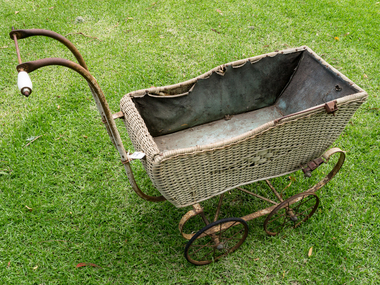
Functional object - Manufactured Objects, Perambulator, c1914
... The youngest Dorothy, who remembered sitting in this pram and later using it to carry papers, wood, vegetable etc., lived on the property in Jasper Road until her passing in 2016. ( Ronald Alexander Higgins, descendant , Helen Stanley CMHS 2017) The family of Dorothy Higgins 1928-2016, were early settlers in Moorabbin Shire establishing a dairy farm c 1873 in East Brighton ( now Bentleigh) dairy farms higgins james joseph simmonds ruth higgins dorothy poultry farms jasper road bentleigh City of Moorabbin Historical Society 1961 sheehy t.a. newsletters ashley r neville f blackman n moorabbin city council moorabbin roads board toll gates pioneers moorabin cheltenham bentleigh highett Wicker Perambulator, baby carriage, c. 1914, with a lined, painted wicker body, iron spring scrolled frame with leather straps and 4 steel wheels with rubber tyres. The push handle is broken and hood is missing. Functional object Manufactured ...JAMES JOSEPH HIGGINS, was born in Dublin in 1821 and, at age twenty, emigrated via Liverpool in 1841 with his wife Ellen and baby daughter Margarete, on board the 'Intrinsic'. They lived in Little Lonsdale Street, Melbourne, for some years, where their son James John Clarke Higgins was born in 1850. JAMES JOHN CLARKE HIGGINS moved to Brighton East when he married Ruth Simmonds in 1873. The couple lived on Jasper Rd near the corner of Centre Rd for the rest of their lives, and produced eight children HERBERT JOHN HIGGINS was the sixth child born in 1886, to James John Clarke Higgins and Ruth Simmonds, and grew up in Centre Rd, Brighton East, now Bentleigh. He was renting and working a property on Jasper Rd from the time he was married in 1913 to Victoria Matilda Long, daughter of Charles John Long and Annie Matilda Allnutt. Herbert John bought his property on Jasper Rd in 1921. [Metropolitan Board of works plan 3220, Municipality of Moorabbin, shows that in 1928, Higgins Rd was planned (and probably built soon after). Herbert was a dairyman and market gardener. He bred and milked cows and sold milk, cream, butter and eggs to the locals. He supplied hay/corn to be made into chaff to J L Smith’s produce store. He also leased land from other farmers in the area and helped work their land. c1950 he sold the property in lots, some privately, others to the Municipality. Some lots became part of Hodgson Reserve, Higgins Road, Bentleigh, and another lot, the Bentleigh Bowling Club. Herbert and Victoria, known as Queenie, had five children between 1914 and 1928. The youngest Dorothy, who remembered sitting in this pram and later using it to carry papers, wood, vegetable etc., lived on the property in Jasper Road until her passing in 2016. ( Ronald Alexander Higgins, descendant , Helen Stanley CMHS 2017) The family of Dorothy Higgins 1928-2016, were early settlers in Moorabbin Shire establishing a dairy farm c 1873 in East Brighton ( now Bentleigh)Wicker Perambulator, baby carriage, c. 1914, with a lined, painted wicker body, iron spring scrolled frame with leather straps and 4 steel wheels with rubber tyres. The push handle is broken and hood is missing. dairy farms, higgins james joseph, simmonds ruth, higgins dorothy, poultry farms, jasper road bentleigh, city of moorabbin historical society 1961, sheehy t.a., newsletters, ashley r, neville f, blackman n, moorabbin city council, moorabbin roads board toll gates, pioneers moorabin cheltenham, bentleigh, highett -
 City of Moorabbin Historical Society (Operating the Box Cottage Museum)
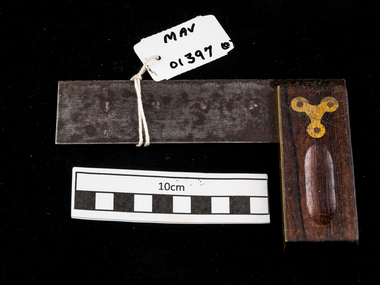
Tools, Set Square steel x2, Stanley c1900, c1900
... manufacture bolts, hinges, and other hardware from wrought iron. Among the early settlers in Moorabbin Shire were blacksmiths who made tools for the other settlers who were establishing the homes, market gardens, farms, orchards and various businesses. Early settlers were self reliant and repaired their own equipment for kitchen,dairy...manufacture bolts, hinges, and other hardware from wrought iron. Among the early settlers in Moorabbin Shire were blacksmiths who made tools for the other settlers who were establishing the homes, market gardens, farms, orchards and various businesses. Early settlers were self reliant and repaired their own equipment for kitchen,dairy ...In 1843, Frederick Stanley, started a small shop in New Britain, USA, to manufacture bolts, hinges, and other hardware from wrought iron. Among the early settlers in Moorabbin Shire were blacksmiths who made tools for the other settlers who were establishing the homes, market gardens, farms, orchards and various businesses. Early settlers were self reliant and repaired their own equipment for kitchen,dairy, farm, horses, carts using various tools . As manufacturing developed late 19thC high quality tools were imported from UK, USA and EuropeThese set squares are typical of the type used by early settlers in Moorabbin Shire c19002x Steel Set Squares a) 15cm (6") with wood handle b) 19cm (7") with a slotted steel handle. a) STANLEY Pat 12-29-96set squares, rulers, builders, trigonometry, mathematics, stanley tools pty ltd., bolts, hinges, hardware, early settlers, market gardeners, blacksmiths, tools, building equipment, hammers, moorabbin shire, bentleigh, mckinnon, highett, cheltenham,mcewan james pty ltd, melbourne, bunnings pty ltd,
