
Showing 32 items matching "deceased persons"
-
 Emerald Museum & Nobelius Heritage Park
Photograph - Cross - Uniting Church, Upper Beaconsfield, Unknown photographer, 1980s
... ...deceased persons...Ash Wednesday 1983 bushfires churches st john's anglican church uniting church Upper Beaconsfield Victoria Australia Cockatoo Victoria Australia cross deceased persons natural disasters ash wednesday bushfire education centre paul reid Cardinia Shire Council Black and white rectangular photograph printed on photographic paper. ...The cross depicted in the photograph is stated to be from the Uniting Church in Upper Beaconsfield in the Museum's registration records but may instead be from St John's Anglican Church which burned down in the Ash Wednesday bushfires as no Uniting Church site is recorded in Upper Beaconsfield. Forty-seven people were killed in the Ash Wednesday fires in Victoria, including twenty-seven from the Cardinia Shire area. Twenty-one of the people killed were located in Upper Beaconsfield; twelve of the people killed in the area were fire-fighters, along with nine residents. 186 homes and countless livestock were also lost in the fires which ranged through Victoria and into South Australia due to a combination of dry, hot and windy weather. The date of the fires corresponds with the the date of the Christian religious festival of the same name that year. St John's Anglican Church was rebuilt on the same site within the next three years. The design, by local architect Paul Reid, combined elements of the previous building with the style of village churches Reid had observed in Austria and Bavaria after his graduation from Melbourne University. The cross, which buckled in the heat generated by the fires, is believed to be on display at the Ash Wednesday Bushfire Education Centre in Cockatoo, which was itself constructed as a memorial on the site of a kindergarten in which 300 Cockatoo residents sheltered from the fire. The specific occasion on which this photograph was taken is not known.This item is significant because of its association with the Ash Wednesday bushfires, one of the worst natural disasters in Victoria's history. The Ash Wednesday fires occurred on 16th February 1983. Twenty-seven people from the Cardinia Shire area were killed in the fires, including twenty-one who died within a kilometre of the church in which the cross depicted resided.Black and white rectangular photograph printed on photographic paper. The photograph depicts a plain dark-coloured metal cross on a stand. The cross has buckled forwards. The item is resting on a table covered with a pale-coloured table-cloth. A bouquet of flowers is visible to the left-hand side of the image. Chairs and three women in special occasion-style clothing are visible at the rear of the image. The cross featured in the photograph is from a church in Upper Beaconsfield which was damaged in the Ash Wednesday bushfires in February 1983. The specific occasion on which this photograph was taken is not known.ash wednesday 1983, bushfires, churches, st john's anglican church, uniting church, upper beaconsfield victoria australia, cockatoo victoria australia, cross, deceased persons, natural disasters, ash wednesday bushfire education centre, paul reid, cardinia shire council -
 National Vietnam Veterans Museum (NVVM)
Photograph
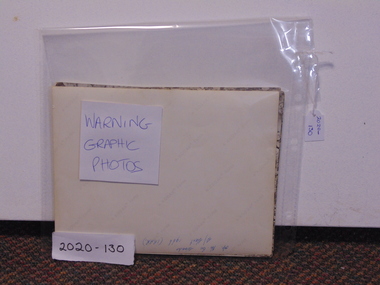
... A collection of seven graphic Photograph of deceased persons in South Vietnam 1966 (1 RAR)...Photograph 1 RAR South Vietnam A collection of seven graphic Photograph of deceased persons in South Vietnam 1966 (1 RAR) Photograph Photograph ...A collection of seven graphic Photograph of deceased persons in South Vietnam 1966 (1 RAR)photograph, 1 rar, south vietnam -
 Bendigo Historical Society Inc.
Document - COHN BROTHERS COLLECTION: LETTER
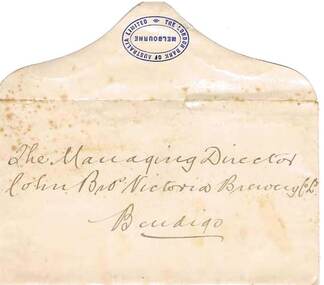
... Envelope containing letter re. shares of a deceased person. Letter from The London Bank of Australia Limited. ...Envelope containing letter re. shares of a deceased person. Letter from The London Bank of Australia Limited. ...Document. Cohn Bros. Collection. Envelope containing letter re. shares of a deceased person. Letter from The London Bank of Australia Limited. The London Bank of Australia Limited Melbourne in an oval shape stamped on the flap of the envelope.organization, business, cohn bros, cohn bros. collection, brewers, brewers, cordial & aerated water manufacturers. -
 Bendigo Military Museum
Memorabilia - CARD, WHERE THE AUSTRALIANS REST WW1, c. post WWI
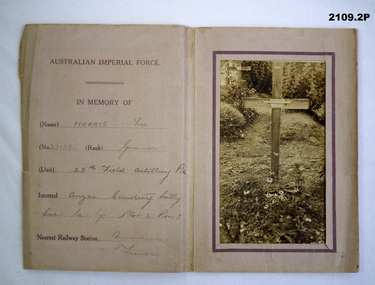
... Inside cover has details of the deceased person. Next to that is a cut out space for a photo of the grave of the deceased. ...Inside cover has details of the deceased person. Next to that is a cut out space for a photo of the grave of the deceased. ...“Where the Australians Lie” This item came to a family / widow etc with The Commemorative plaque & Commemorative scroll as package. Leo Harris No 3132. Refer 2478 for service history also 2476, 2477P, 2479.3..1) Small folder folds in 2, light brown colour. Front has Rising Sun at top under 'Australian Imperial Force'. Inside cover has details of the deceased person. Next to that is a cut out space for a photo of the grave of the deceased. Rear has name & address of person who received the folder. .2) Sepia colour photo of grave of the above .1).“In memory of HARRIS LEO No 3132 - Gunner - 25th Field Artillery Brigade - ANZAC Cemetery Sailly SUR LA LYS Plot 2 Row 3 - Armentieres, France”documents, military, remembrance. -
 City of Greater Bendigo - Civic Collection
Manual, Post Master General's Department, Postmen's Manual, 1964
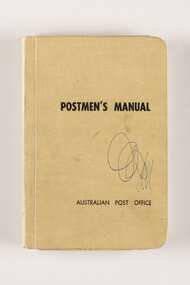
... Topics include 'Behaviour', 'Deceased Persons' and 'Bicycles' amongst many others. ...Topics include 'Behaviour', 'Deceased Persons' and 'Bicycles' amongst many others. ...When the Commonwealth Post and Telegraph Act was passed in June 1902, and a national Postmaster General's Department (the PMG) was established the responsibility for the nation's mail and telephone services fell on Post Offices. The Bendigo Post Office, built in 1887 and situated on Pall Mall was the central distribution centre for receiving and delivering telegrams and continued to deliver communication and postal services until 1997. Now a Visitor Centre, dedicated volunteers at the Post Office continued to demonstrate and educate the public about the daily workings of the Post Office up until 2019 when Covid 19 disrupted every day life and Ted Rankins, the last Post Master and a long term telegraph volunteer at the Post Office, died. Manuals were issued to postmen to guide them in the delivery of letters and parcels and were small enough to be carried with them. This manual was used by the Bendigo Post Office postmen and is part of the postal collection donated by the Rankins family in memory of Ted Rankins,. Small, creamed coloured cloth covered manual. Contains forty four printed pages and two blank end pages covering all aspects of how to correctly deliver the post. Topics include 'Behaviour', 'Deceased Persons' and 'Bicycles' amongst many others. Book is bound and contains many extra additional paragraphs stuck in on appropriate pages noting changes and amendments. Additional amendments in handwritten red pen also occur on pages 28, 29 and 36.Front cover; Postmen's Manual / Australian Post Office Various annotations and updates throughout. ted rankins collection, bendigo post office, bendigo tourism, city of greater bendigo tourism, post office collection -
 Warrnambool and District Historical Society Inc.
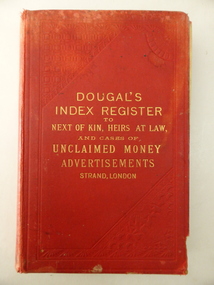
Book, Dougal's Index Register to Next of Kin, Heirs at Law, Early 20th century
... The book contains names of those deceased persons and/or their heirs who have appeared in advertisements regarding unclaimed money. ...The book contains names of those deceased persons and/or their heirs who have appeared in advertisements regarding unclaimed money. ...This book belonged to James and Catherine McGinness (both names are in the book). James McGinness (1842-1905) came to the Framlingham area in the 1870s and married Catherine Taafe in 1880. Members of the McGinness families had been involved in hotelkeeping in the Purnim district. James and Catherine McGinness had a farm at Framlingham (including the breeding of horses) with the property known as Riverview. The farm and derelict remnants of the house still exist in 2017. The youngest son of James and Catherine was Paul McGinness, a hero of two World Wars and the founder of the airline Qantas. The original spelling of the surname was ‘McGuinness’ but James altered the spelling to avoid confusion over names with his brother John. This book is of interest because it belonged to the McGinness family of Riverview, Framlingham. Several of the names in the book are marked, especially those of ‘McGuinness’ showing that perhaps the McGinness family of Framlingham had expectations of claiming some of the money listed as unclaimed. This is a hard cover book of 472 pages. At the back of the book are several pages giving addresses of lawyers and opinions of the Press. The cover is red with an embedded pattern on the front cover and gold lettering on the front cover and the spine. The inscriptions are handwritten in blue and black ink. The book contains names of those deceased persons and/or their heirs who have appeared in advertisements regarding unclaimed money. There are several coloured insert sheets in the book with copies of letters of thanks sent by grateful readers. The cover is very stained and torn at the edges. ‘C. McGinness Framlingham’ ‘James McGinness Framlingham’ james and catherine mcginness, paul mcginness, history of framlingham, history of warrnambool -
 City of Greater Bendigo - Civic Collection
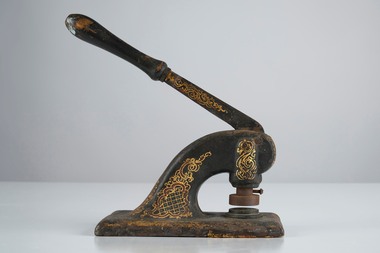
Ceremonial object - Common Seal, Public Trustees Kangaroo Flat
... The Public Trustee was the successor in law of the Curator of the Estates of Deceased Persons The Public Trustee was empowered to act as administrator, trustee, executor and attorney. ...The Public Trustee was the successor in law of the Curator of the Estates of Deceased Persons The Public Trustee was empowered to act as administrator, trustee, executor and attorney. ...The office of the Public Trustee was constituted and incorporated by the Public Trustee Act 1939 which was amended by the Public Trustee Act 1940. The Public Trustee was the successor in law of the Curator of the Estates of Deceased Persons The Public Trustee was empowered to act as administrator, trustee, executor and attorney. On 1 July 1994, State Trustees succeeded the Office of the Public Trustee as Victoria's first State owned company under the State Trustees (State Owned Company) Act 1994. (https://prov.vic.gov.au/archive/VF50). Decorated hand operated cast iron embosser with 35mm stamp head still attached. Gold and maroon painted decorations extend from top edge of handle including scrolls and cross hatching. Well used showing all over signs of wear. Stamp head is for the Public Trustees Kangaroo Flat.Public / Trustees / Kangaroo / Flat -
 Bendigo Military Museum
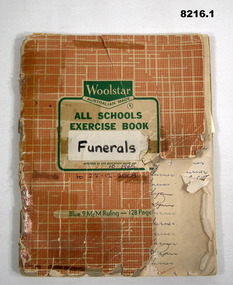
Administrative record - FUNERALS LIST BENDIGO RSL, C.1965 to 2008
... .1) Exercise book, cover red & white with green text central of front, section of front page missing, pages are blue ruled lines, columns added in red or blue pen, 3 columns per page with year at the top, columns have the deceased persons name, funeral date, person who conducted the RSL funeral, some pages the persons unit served with has been added. all entries are hand written on red or blue pen. .2) Sheet of paper with hand written names in blue pen with month and date, some have a red tick beside....84" .1) Exercise book, cover red & white with green text central of front, section of front page missing, pages are blue ruled lines, columns added in red or blue pen, 3 columns per page with year at the top, columns have the deceased persons name, funeral date, person who conducted the RSL funeral, some pages the persons unit served with has been added. all entries are hand written on red or blue pen. .2) Sheet of paper with hand written names in blue pen with month and date, some have a red tick beside. ...RSL Funeral services conducted by the Bendigo RSL Sub Branch and Bendigo District RSL Sub Branch for their departed members. .1) The first entry in the book is 27.10.1965 and the last on 27.12.2008. A large amount of the entries were written by Jack Barnes OAM during his 43 years as Secretary of the Sub Branch. (Refer Cat No 8040). The vast majority of the funerals were conducted by the President at the time, Committee members or members who were heavily involved with the Sub Branch. It's virtual who's who of Presidents, Life members and notables. 1988 saw the most funerals conducted during that year being 60, other figures varied from mid 20's to mid 50's per year. One notable funeral Volunteer was John Balsillie MBE. (Refer Cat No 118.5) Between 2.1.2007 - 27.12.2008 there was 80 funerals with John conducting 78 of them. There is an interesting addition of one funeral by Jack Barnes on 31.1.1968 was that it was (111 degrees). .2) The list on the sheet with a note, "For Cindy" who was the BDRSL Office Person at the time. these were for 2007, there was 19 on the sheet with only 9 in the book, 7 of the names have a red tick beside. The sheet was written by John Balsillie. John had conducted funerals for many years pre 2007 and for more years after. .1) Exercise book, cover red & white with green text central of front, section of front page missing, pages are blue ruled lines, columns added in red or blue pen, 3 columns per page with year at the top, columns have the deceased persons name, funeral date, person who conducted the RSL funeral, some pages the persons unit served with has been added. all entries are hand written on red or blue pen. .2) Sheet of paper with hand written names in blue pen with month and date, some have a red tick beside.On front on a white sticker "Funerals" in black texta pen. Hand written in blue pen, "27.10.1965 to 27.12.2008". Inside front cover in blue pen by Jack Barnes, "Bugler as from Sept 84 - Les Warren 40 Story St Bgo phone 43007". In red pen, "Took Bugle to polish etc 5 ? 84"brsl, smirsl, bdrslinc, funerals -
 Returned Nurses RSL Sub-branch
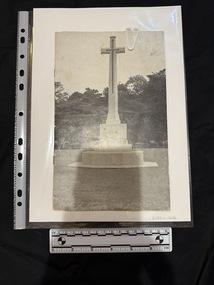
Memorabilia - Letter & booklet, Anzac Agency, [post 1945, pre 1966]
... There would have been a photograph of the grave of the deceased person included in a pocket inside the back cover of the booklet, this is no longer present. ...There would have been a photograph of the grave of the deceased person included in a pocket inside the back cover of the booklet, this is no longer present. ...Booklet and letter sent to next-of-kin of deceased Australian Servicemen [and women?] at some point after WWII to inform them of how the war graves & cemeteries around the world were being cared for by the Imperial War Graves Commission. There would have been a photograph of the grave of the deceased person included in a pocket inside the back cover of the booklet, this is no longer present. Letter is signed by A E Brown Secretary-General of the Anzac Agency of the Imperial War Graves Commission. There is also a message from R[obert] G[ordon] Menzies, then Australian Prime Minister.Black and white booklet containing photographs and text. Cover image is of a large stone cross atop a multi-tiered base, with an embossed sword shaped cross on its face. The memorial is on a lawn with shrubs and dense trees in the background. It is known as the Cross of Sacrifice. Inside the booklet there is an accompanying letter.war graves, imperial war graves commission, war cemeteries, robert menzies -
 City of Stonnington
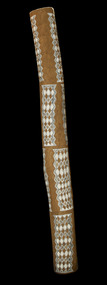
Gunybi Ganambarr, Gangan, 2012
... The logs can also represent the deceased person, as the designs applied are the same as those painted on the body during the burial rites. ...The logs can also represent the deceased person, as the designs applied are the same as those painted on the body during the burial rites. ...Gunybi Ganambarr has built a reputation for his innovative techniques, incising and shaping barks and adding materials to traditional art forms. He attributes his confidence in using new materials to his twelve year stint as a part of a building team in remote homelands. Ganambarr primarily lives in his mother’s community at Gangan, which lies north-west of Blue Mud Bay in eastern Arnhem Land, Northern Territory. Ganambarr has absorbed the minutiae and spirituality of place; his paintings can be read as meditations on the specific tracts of land for which he is entitled to speak; in this case, a sacred expanse of water behind the Gangan outstation where this work was produced, referred to as Gulutji. Ganambarr’s designs recount the ancestral formation of the land, the beings that reside within its borders and the seasonal events that nourish its ecosystem. His work exemplifies the confidence and cultural assertion of a new, experimental Yolngu art, while remaining firmly influenced by elders and senior artists. Ceremonial hollow log poles Arnhem Land, Northern Territory The people of Central and Eastern Arnhem Land refer to themselves collectively as Yolngu, meaning human beings. The Yolngu traditionally use logs naturally hollowed out by termites in a funerary and ceremonial functions, principally as an ossuary. In an Australian contemporary art context however hollow log sculptures are purely memorial in function and made explicitly for public display. In Arnhem Land hollow logs are known as larrakitj; hollow logs known by other names are used in burial practices by a number of Aboriginal peoples in the north of Australia. The logs can also represent the deceased person, as the designs applied are the same as those painted on the body during the burial rites. All Yolngu clans belong to a moiety, one of two complementary halves of society: Dhuwa and Yirritja. All such affiliations play a part in Aboriginal artists' inherited right to paint an established set of designs belonging to their social group; this inheritance is, in fact, the artist's copyright over imagery. stonnington contemporary art collection, first peoples, first nations, indigenous, aboriginal torres strait islander, painting, gunybi ganambarr, natural environment, cultural heritage, cultural identity, cultural knowledge, landscape -
 City of Stonnington
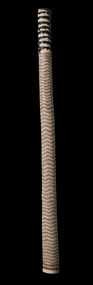
Nawurapu Wunungmurra, Garraparra, 2013
... The logs can also represent the deceased person, as the designs applied are the same as those painted on the body during the burial rites. ...The logs can also represent the deceased person, as the designs applied are the same as those painted on the body during the burial rites. ...Nawurapu Wunungmurra is the eldest son of the late Yaggarriny Wunungmurra, the first Aboriginal artist to have his copyright recognised in an Australian court. From an early age he was trained by his father and assisted him with this painting. Later, as his own spiritual authority increased, he painted in his own right. This pole depicts the sea at Garraparra, a coastal headland and bay area within Mungurru, or Blue Mud Bay. Garraparra has been rendered by the wavy design for Yirritja (deep saltwater) that has many states and connects with the sacred waters coming from the land estates by currents and tidal flow. Garraparra marks the spot of a sacred burial area for the Dhalwangu clan to which Wunungmurra belongs. Sacred songs and dance narrate the heroic adventures of two ancestral hunters who left the shores of Garraparra hunting for turtle. On their journey they passed sacred places and ancestral totems before they came to grief when their canoe capsized. The hunters’ bodies washed back to the shores of Garraparra with the currents and the tides, as the Wangupini, cloud rising from the north, followed with its rain and wind. In the songs, the terns (Gitkit) reel in the breeze around these statuesque clouds on the horizon, and this stylised rendition of clouds seen at the top of this work is the latest motif in Wunungmurra’s ouvre.Ceremonial hollow log poles Arnhem Land, Northern Territory The people of Central and Eastern Arnhem Land refer to themselves collectively as Yolngu, meaning human beings. The Yolngu traditionally use logs naturally hollowed out by termites in a funerary and ceremonial functions, principally as an ossuary. In an Australian contemporary art context however hollow log sculptures are purely memorial in function and made explicitly for public display. In Arnhem Land hollow logs are known as larrakitj; hollow logs known by other names are used in burial practices by a number of Aboriginal peoples in the north of Australia. The logs can also represent the deceased person, as the designs applied are the same as those painted on the body during the burial rites. All Yolngu clans belong to a moiety, one of two complementary halves of society: Dhuwa and Yirritja. All such affiliations play a part in Aboriginal artists' inherited right to paint an established set of designs belonging to their social group; this inheritance is, in fact, the artist's copyright over imagery.stonnington contemporary art collection, first peoples, first nations, indigenous, aboriginal torres strait islander, painting, nawurapu wunungmurra, garraparra, coastal, yirritja, saltwater, sacred burial, cultural heritage, cultural identity -
 City of Stonnington
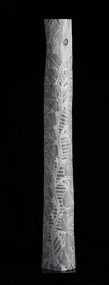
Malaluba Gumana, Garrimala, 2014
... The logs can also represent the deceased person, as the designs applied are the same as those painted on the body during the burial rites. ...The logs can also represent the deceased person, as the designs applied are the same as those painted on the body during the burial rites. ...Malaluba Gumana dedicates most of her artworks to portraying her mother Marratj Gurruwiwi’s Gälpu clan designs of dhatam (waterlilly), djari (rainbow), djaykun (filesnake) and wititj (olive python or rainbow serpent). Gumana demonstrates a very fine ‘marwat’, a cross hatching technique that utilises a fine brush of human hair, applied to bark and memorial poles. The title 'Garrimala' refers to a billabong close to Malaluba’s homeland of Gängan. Dominating this work are realistic representations of dhatam, the waterlily plant. The Gälpu clan miny’tji – the sacred clan design behind the lillies – represents djari (rainbows) and the power of the lightning within them. It also refers to the force of the storm created by the python Wititj, living amongst the waterlilies causing ripples and rainbows on the surface of the water. The dynamic diagonal lines symbolise trees that have been knocked down as Wititj moves from place to place. Ceremonial hollow log poles Arnhem Land, Northern Territory The people of Central and Eastern Arnhem Land refer to themselves collectively as Yolngu, meaning human beings. The Yolngu traditionally use logs naturally hollowed out by termites in a funerary and ceremonial functions, principally as an ossuary. In an Australian contemporary art context however hollow log sculptures are purely memorial in function and made explicitly for public display. In Arnhem Land hollow logs are known as larrakitj; hollow logs known by other names are used in burial practices by a number of Aboriginal peoples in the north of Australia. The logs can also represent the deceased person, as the designs applied are the same as those painted on the body during the burial rites. All Yolngu clans belong to a moiety, one of two complementary halves of society: Dhuwa and Yirritja. All such affiliations play a part in Aboriginal artists' inherited right to paint an established set of designs belonging to their social group; this inheritance is, in fact, the artist's copyright over imagery. stonnington contemporary art collection, first peoples, first nations, indigenous, aboriginal torres strait islander, painting, malaluba gumana, waterlily, rainbow, filesnake, olive python, rainbow serpent, natural environment, cultural heritage -
Glen Eira Historical Society
Newspaper - DUNERA BOYS’ PORTRAITS
... The portraits were done by Theodore Engel at the Tatura internment camp and found by Shelley in a Caulfield person’s deceased estate....The portraits were done by Theodore Engel at the Tatura internment camp and found by Shelley in a Caulfield person’s deceased estate. Dunera Boys World War 1939-1945 Caulfield North internment Engel Theodore Artists Ling Jenny Caulfield/ Port Phillip Press Cohney Shelley portraits drawing death and dying Newspaper DUNERA BOYS’ PORTRAITS ...One item about these unidentified drawings 1/ Jenny Ling wrote ‘Dunera Boys Hunt’ article in Caulfield Port Phillip Leader of 08/09/2011. Melbourne Tour guide Shelley Cohney (of Caulfield North) is trying to track down the subjects of a series of 28 pencil portraits of ‘Dunera Boys’ and asks for assistance. The portraits were done by Theodore Engel at the Tatura internment camp and found by Shelley in a Caulfield person’s deceased estate.dunera boys, world war 1939-1945, caulfield north, internment, engel theodore, artists, ling jenny, caulfield/ port phillip press, cohney shelley, portraits, drawing, death and dying -
 Federation University Art Collection
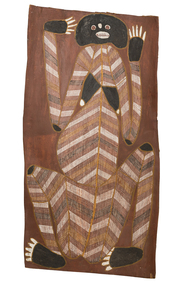
Painting - Natural pigment on bark, Mawurndjul, John, 'Female Wayarra Spirit' by John Mawurndjul, 1995
...
The artist has painted 'Wayarra', a generic term which can include both malevolent spirit beings which continually inhabit certain sites or objects but can also mean the Spirit of a recently deceased person. These spirits are one of two spirits of the dead, the other being the 'Kun-malng' soul. ...
The artist has painted 'Wayarra', a generic term which can include both malevolent spirit beings which continually inhabit certain sites or objects but can also mean the Spirit of a recently deceased person. These spirits are one of two spirits of the dead, the other being the 'Kun-malng' soul. ...Balang [John MAWURNDJUL] (1952 - ) Born Mumeka, Northern Territory Country: Milmilngkan, West Arnham Land, Northern Territory Clan: Na-Kurulk Language Group: Kunwinjku Location: Milmilngkan John Mawurndjul is an Australian indigenous artist. He is a member of the Kuninjku people of West Arnhem Land, Northern Territory. Growing up John had only occasional contact with non-indigenous people and culture. He was tutored in rarrk, a traditional painting technique using fine cross hatching and infill, working on small barks. During the 1980s he started producing larger and more complex works. The artist has painted 'Wayarra', a generic term which can include both malevolent spirit beings which continually inhabit certain sites or objects but can also mean the Spirit of a recently deceased person. These spirits are one of two spirits of the dead, the other being the 'Kun-malng' soul. The 'Wayarra' is the shadow or 'shade' of the dead and may take on the form of the deceased and haunt areas where the deceased recently inhabited. In order to prevent Wayarra spirits from harassing relative of the recently deceased, a smoking ceremont is performed where Ironwood leaves are burnt around the camp of the recently deceased and ochre is rubbed on all objects belonging to the deceased. Ochre may also be rubbed on vehicles, houses and trees. Some Wayarra are a particular Dreaming totem for people of certain clans. This is why many artists depict Wayarra in their bark paintings and sculptures. They are depicting clan totems particular to their lineage and which are celebrated in major regional patrimoiety ceremonies. In 1989 the work of John Mawurndjul was included in the landmark exhibition "Magiciens de la Terra' at the Centre Pompidou and Grande Halle de la Vilette in Paris, France. His works have also been exhibited in numerous solo and group exhibitions in Australia, New York, Paris and Japan. Mawurndjul is one of eight artists whose work in part of the largest inernational commission of contemporary Indigenous art from Australia at the Musee du Quai Branly, Paris. The work was exhibited in the Australian survey "John Mawurndjul: I Am The Old And The New", at the Museum of Contemporary Art, one of the 160-odd works all chosen by Mawurndjul for inclusion in the exhibition. This item is part of the Federation University Art Collection. The Art Collection features over 1000 works and was listed as a 'Ballarat Treasure' in 2007.This artwork was chosen by John Murwurndjul as on of around 160 works for exhibition in the 2018 Australian Survey of his work at the Museum of Contemporary Art. The artist is known for his rarrk work, which is evident in 'Female Wayarra Spirit'.Aboriginal bark painting featurung rarrk. The artwork is associated with Dilebang, a duwa moiety place that belongs to the Kurulk clan. This work is currently on loan for exhibition in 'John Mawurndjul: I am the old and the new'. The exhibition will be shown at the Museum of Contemporary Art Australia (Sydney) from 6 July – 23 September 2018, and the Art Gallery of South Australia, Adelaide from 26 October 2018 – 28 January 2019.art, artwork, john mawurndjul, aboriginal, bark painting, rarrk, wayarra, kuninjku, maningrida, loan -
 Ballarat Clarendon College
Memorial plaque
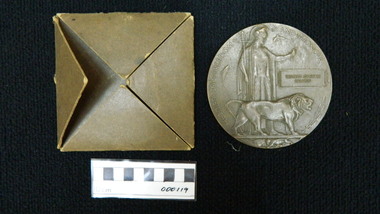
... deceased's commanding officer. They would not usually arrive as a single package, but as a series of separate mailings. In this case we have the letter from Buckingham Palace. Wilfred (Wiff) Graham Salmon attended Ballarat College 1902 - 1910. He enlisted in 1915 and embarked as a driver with the 4th Field Artillery Brigade. He transferred to the Royal Flusing Corps in 1916. He was killed fighting raiders over the Thames Valley near London on 7 July 1917. 'Wiff' was reputedly the first person ...The WWI Death Plaque (Death Penny) was issued to the next of kin of servicemen/women who fell in the Great War 1914 -1918.The memorial plaque would be accompanied by a Memorial Scroll, a letter from Buckingham Palace and often a letter from the deceased's commanding officer. They would not usually arrive as a single package, but as a series of separate mailings. In this case we have the letter from Buckingham Palace. Wilfred (Wiff) Graham Salmon attended Ballarat College 1902 - 1910. He enlisted in 1915 and embarked as a driver with the 4th Field Artillery Brigade. He transferred to the Royal Flusing Corps in 1916. He was killed fighting raiders over the Thames Valley near London on 7 July 1917. 'Wiff' was reputedly the first person to die defending London from a foreign invader since the time of the Norman Conquest. His brother Robert Arthur Salmon was also an old collegian. Other possible family members who are old collegians include Nellie Florence Salmon (ent CPLC 1907; DB 1.8.1899), John Walter Salmon (ent BC 1898; DB 22.11.1889), Geoffrey Salmon (ent BC 1910; DB 3/11/1896). Wilfred's brother Robert (Bob) Salmon is mentioned in the school's 1964 history by Gordon Meins p.68..."Captain (then Lieut) Bob Salmon M.C. on one occasion worked for 7 nights straight in No Man's Land and is credited with rescuing nearly 300 of our wounded." Round disk cast in bronze gunmetal, which incorporates the following; an image of Britannia holding an oak spray with leaves and acorns, an imperial lion, two dolphins representing Britain's sea power, the emblem of Imperial Germany's eagle being torn to pieces by another lion. The medallion is incased in a heavy card envelope and is accompanied by a letter signed by King George Inscribed around face of medallion: He died for freedom and honour A rectangular tablet cast on front of medallion inscribed 'Wilfred Graham Salmon'.wiff-salmon, world-war-one, death-penny, king-george, war-memorabilia, ballarat-college, royal-flying-corps, 1912, wilfred-graham-salmon -
 Orbost & District Historical Society
memorial card, 1912
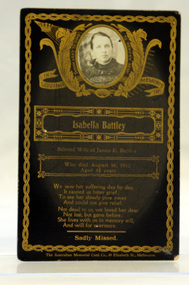
... person who commissioned the card Isabella Battley (nee Goad) was born in 1867, in Smythesdale, Victoria, Australia. She was married to James E. Battley when she died aged 45. James E. Battley was a director of the butter Factory in Orbost in 1915. Their son Ernest Albert Battley enlisted in the AIF from Orbost in 1916. His father is listed as Next of Kin and his mother as deceased...person who commissioned the card Isabella Battley (nee Goad) was born in 1867, in Smythesdale, Victoria, Australia. She was married to James E. Battley when she died aged 45. James E. Battley was a director of the butter Factory in Orbost in 1915. Their son Ernest Albert Battley enlisted in the AIF from Orbost in 1916. His father is listed as Next of Kin and his mother as deceased ...This memorial card follows a style that was commonly used in the 1890s. The size of the card make it useful for presentation and handing out. There was a remarkably large production of memorial and funeral cards in Australia during the latter 19th and early 20th centuries and the style did not change (and many of the styles are still in effect today). Many of the card companies, in this case ‘The Memorial Card Co.,’ located at 143 King St, Sydney, published standardised plates which had areas for customisation. The card has the area for name, photograph, date of death and age. Poetry was often standardised, but could be requested at the behest of the person who commissioned the card Isabella Battley (nee Goad) was born in 1867, in Smythesdale, Victoria, Australia. She was married to James E. Battley when she died aged 45. James E. Battley was a director of the butter Factory in Orbost in 1915. Their son Ernest Albert Battley enlisted in the AIF from Orbost in 1916. His father is listed as Next of Kin and his mother as deceased. James was remarried to Eda May Battley (born Sargent) in 1914. He passed away in 1925, at age 57 Memorial cards are often treasured for a long time, and often become part of family history. The Battley family was an earlyn Orbost family.A black memorial card printed in memory of Isabella Battley. It has gold printed writing, a gold etched border and wreath. There is a photo of Isabella Battley and a memorial poem.memorial battley mourning -
 Eltham District Historical Society Inc
Photograph - Digital Photograph, Alan King, Cameron family graves, Kangaroo Ground Cemetery, Eltham-Yarra Glen Road, Kangaroo Ground, 28 January 2008
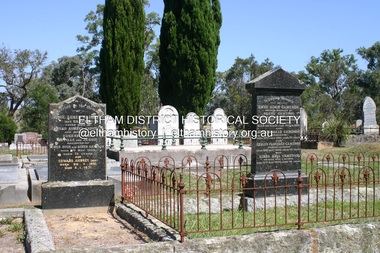
... person known to have been buried at Kangaroo Ground Cemetery in May 1851. The cemetery is situated on an ancient river bed with exposed Nillumbik sands. The rest of the district is formed from black volcanic soil which was hard to dig. According to local historian Mick Woiwod (deceased...person known to have been buried at Kangaroo Ground Cemetery in May 1851. The cemetery is situated on an ancient river bed with exposed Nillumbik sands. The rest of the district is formed from black volcanic soil which was hard to dig. According to local historian Mick Woiwod (deceased ...Six year old Judith Furphy was the first person known to have been buried at Kangaroo Ground Cemetery in May 1851. The cemetery is situated on an ancient river bed with exposed Nillumbik sands. The rest of the district is formed from black volcanic soil which was hard to dig. According to local historian Mick Woiwod (deceased) the site may have been a burial ground for the local Wurundjeri people as the exposed softer sands were always their prefered camping sites. The Hon. Ewen Hugh Cameron who lived at Pigeon Bank and was the Member for Evelyn for 40 years (1874-1914) was buried here in 1915. Published: Nillumbik Now and Then / Marguerite Marshall 2008; photographs Alan King with Marguerite Marshall.; p39 The Wurundjeri people might have buried their dead on the site of the Kangaroo Ground Cemetery, according to local historian Mick Woiwod. Kangaroo Ground was a premier hunting ground, but camping on the black volcanic soil would have been uncomfortable. Unlike most of Kangaroo Ground, its cemetery, on an ancient river bed, comprises a rare exposure of Nillumbik sands – always the preferred campsite for Aboriginal people. The cemetery area is the only place where the soil was soft enough to dig a grave easily.1 Six-year-old Judith Furphy was the first person known to have been laid to rest at the Kangaroo Ground Cemetery. She died on May 17, 1851, from a chill caught by resting on wet grass. Local Andrew Ross wrote ‘..no public burying place existed nearer than Melbourne. The case being considered urgent, a general meeting of the settlers took place on the evening of the 17th……. The result was the selection of unoccupied crown land …….which was subsequently granted by Government for a public cemetery.’2 Judith was buried the next day on May 18. Her grave was marked by the trustees with a plaque, which unfortunately states nine years old, when she was probably only six. Judith came from an illustrious family. Her brother, Joseph, was the author of Such is Life and other works. Another brother, John, developed and manufactured the famous Furphy water cart, which distributed water to World War One soldiers along with the latest rumours. Hence the name Furphy entered the Australian idiom, as synonymous with ‘rumour’. Judith’s father Samuel helped build the first Kangaroo Ground church school. Inside, near the entrance of the cemetery, on Yarra Glen Road, stand a rotunda and a water tank. Occasional benches invite mourners to pause and remember. The gate with wrought iron and brick supports, bears the inscription ‘Erected by Sir Ewen and Lady Cameron in memory of their daughter, Flora Margaret’. These are only two of the famous people connected with this cemetery. The Hon. Ewen Hugh Cameron JP and MLA from 1874 to1914, who lived at Pigeon Bank, Warrandyte Road, was buried here in 1915. Unrelated, but with the same name, was Sir Ewen Cameron who had been Minister for Health and was laid to rest there in 1964. Sir Herbert Gepp, a leading industrialist and the former owner of Garden Hill, at Yarra Glen Road, was buried there in 1954.3 Many of the more imposing tombstones belong to the earlier graves. Unfortunately bushfires have cracked several. But this adds to the melancholy attractiveness of the cemetery, graced by some beautiful eucalypts, cypress and pines. Early pioneering families represented at the cemetery include Armstrong, Barr, Bell, Harkness, Jardine, Johnston, Rogerson, Stevenson, Thomson and Walters. Armstrong and Bell were among the first families to come to the district and Stevenson owned the district’s first sheep station. It took in much of present day Christmas Hills, which was the name he gave his sheep station. Harkness was the first to suggest a Kangaroo Ground school be built, and one of the first to suggest establishing the Eltham District Road Board. Many of these families leased pastoral land before the mid-century and bought land when it came on sale in 1849. In the cemetery’s early days sections were devoted to the major Christian denominations (mainly the Protestant) and one section was set aside for ‘other’ or ‘non-believers’. However in modern times burial plots have not been placed in areas according to religious beliefs.This collection of almost 130 photos about places and people within the Shire of Nillumbik, an urban and rural municipality in Melbourne's north, contributes to an understanding of the history of the Shire. Published in 2008 immediately prior to the Black Saturday bushfires of February 7, 2009, it documents sites that were impacted, and in some cases destroyed by the fires. It includes photographs taken especially for the publication, creating a unique time capsule representing the Shire in the early 21st century. It remains the most recent comprehenesive publication devoted to the Shire's history connecting local residents to the past. nillumbik now and then (marshall-king) collection, kangaroo ground, eltham-yarra glen road, agnes bell cameron, agnes cameron (nee bell), cameron family, edward aubrey haughton, eugene cameron, evelyn florence cameron, ewen hugh cameron, gravestones, jane armstrong, jane bell, jessie agnes haughton (nee cameron), jessie cameron, john donald cameron, kangaroo ground cemetery, neville cameron, simon armstrong, vera cameron, william bell armstrong, wurundjeri -
 Waverley RSL Sub Branch
Identification Tags (Dog Tags)
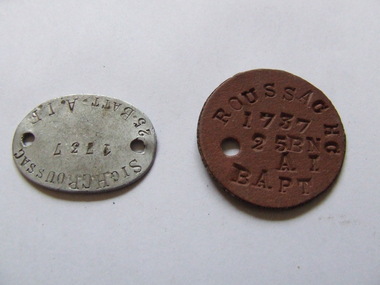
... deceased soldiers. All soldiers were issued two tags: one to stay with the body and the other to go to the person in charge of the burial for record-keeping purposes...deceased soldiers. All soldiers were issued two tags: one to stay with the body and the other to go to the person in charge of the burial for record-keeping purposes Rossac Henry Claude 1737 25 Btn....Left Aus 20 08 15 Born India Patna 14 7 1892 Enlisted Queensland Sent to Alexandria Landed Gallipoli 12 10 1915 France Marseille 19 3 16 wia 9 10 17 (France) returned to Aus for discharge (medical) 21 04 18 Awards1914-15 star British War MedalVictory Medal WWII V18817 Enlisted Royal Park served 1939-45 His daughter Mena Roussac also enlisted roussac henry id tags dog tags wwi gallipoli 25 bn. 1st a i f Fibre tag Roussac H C 1737 25 BN AI Bapt The other aluminium Sig. ...Tags were used to identify wounded or deceased soldiers. All soldiers were issued two tags: one to stay with the body and the other to go to the person in charge of the burial for record-keeping purposesRossac Henry Claude 1737 25 Btn....Left Aus 20 08 15 Born India Patna 14 7 1892 Enlisted Queensland Sent to Alexandria Landed Gallipoli 12 10 1915 France Marseille 19 3 16 wia 9 10 17 (France) returned to Aus for discharge (medical) 21 04 18 Awards1914-15 star British War MedalVictory Medal WWII V18817 Enlisted Royal Park served 1939-45 His daughter Mena Roussac also enlisted 2 tID tags for Henry Claude Roussac 1737 Signaller 25 Bn Ist AIF one is round made of brownish fibre board and the other is oval made of aluminiumFibre tag Roussac H C 1737 25 BN AI Bapt The other aluminium Sig. Roussac1737 25 Batt A.I.F.roussac henry, id tags, dog tags wwi, gallipoli, 25 bn. 1st a i f -
 Eltham District Historical Society Inc
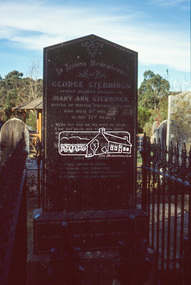
Slide - Photograph, Nillumbik Cemetery, 35 Main Street, Diamond Creek, 27 May 1990
... person of Mrs Mary Ann Stebbings. Her residence here covered a period of some-what over 50 years. She had been a widow for some time, her husband, the late Mr. Geo. Stebbings, having pre-deceased...person of Mrs Mary Ann Stebbings. Her residence here covered a period of some-what over 50 years. She had been a widow for some time, her husband, the late Mr. Geo. Stebbings, having pre-deceased ...George Stebbing arrived from England in 1857 and settled at Eltham after a short period at Kangaroo Ground. His occupation is often listed as a farmer but he built a number of important buildings between the late 1860’s and the 1880’s. Those remaining include Shillinglaw Cottage, St. Margaret’s Church, Uniting church (formerly Methodist Church) and House at 84 Pitt Street, Eltham. From 1871 to 1875 he was a member of the Eltham Shire Council. Evelyn Observer and Bourke East Record (Vic. : 1902 - 1917), Friday 12 March 1909, page 2 ELTHAM. (FROM OUR OWN CORRESPONDENT.) One of the oldest inhabitants of Eltham passed away during the early hours of Saturday last in the person of Mrs Mary Ann Stebbings. Her residence here covered a period of some-what over 50 years. She had been a widow for some time, her husband, the late Mr. Geo. Stebbings, having pre-deceased her some fourteen or fifteen years. During the later years of her life, she had resided with her niece, Mrs. Wm. Williams. She lived a very retired life and is said to have owned a considerable amount of property, local and suburban, at the time of her death, at the age of 82 years. She was interred at Diamond Creek on Sunday, 7th inst. Local Cemetery Excursion Sunday 27 May 1990 departed Eltham Shire Office at 9.30am and finish mid afternoon. Visits to Eltham , Kangaroo Ground, Queenstown (Smiths Gully), Nillumbik (Diamond Creek), St Katherines (St Helena) Hurst family graves at Hurstbridge and a little known early cemetery at Greensborough. Attended by 20 members. In each case we were introduced to the cemetery with a brief talk. At Eltham, Frank Burgoyne gave us the benefit of his knowledge as a member of the cemetery trust and at Kangaroo Ground, Bruce Ness spoke in a similar capacity. The lunch stop was at Hurstbridge where we visited the Hurst family graves. The President of Nillumbik Historical Society, Jock Ryan, joined us at the Nillumbik (Diamond Creek) cemetery. He travelled on to St Katherines, St Helena, where he talked on the history of the church and cemetery. 35mm colour positive transparency (1 of 23) Mount - Agfachrome Agfa CS System black 8 dotsshire of eltham historical society, cemetery excursion, graves, activities, cemeteries, george stebbing, george stebbings, mary ann stebbing, mary ann stebbings, nillumbik cemetery -
 Eltham District Historical Society Inc
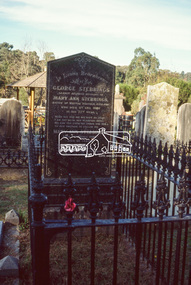
Slide - Photograph, Nillumbik Cemetery, 35 Main Street, Diamond Creek, 27 May 1990
... person of Mrs Mary Ann Stebbings. Her residence here covered a period of some-what over 50 years. She had been a widow for some time, her husband, the late Mr. Geo. Stebbings, having pre-deceased...person of Mrs Mary Ann Stebbings. Her residence here covered a period of some-what over 50 years. She had been a widow for some time, her husband, the late Mr. Geo. Stebbings, having pre-deceased ...George Stebbing arrived from England in 1857 and settled at Eltham after a short period at Kangaroo Ground. His occupation is often listed as a farmer but he built a number of important buildings between the late 1860’s and the 1880’s. Those remaining include Shillinglaw Cottage, St. Margaret’s Church, Uniting church (formerly Methodist Church) and House at 84 Pitt Street, Eltham. From 1871 to 1875 he was a member of the Eltham Shire Council. Evelyn Observer and Bourke East Record (Vic. : 1902 - 1917), Friday 12 March 1909, page 2 ELTHAM. (FROM OUR OWN CORRESPONDENT.) One of the oldest inhabitants of Eltham passed away during the early hours of Saturday last in the person of Mrs Mary Ann Stebbings. Her residence here covered a period of some-what over 50 years. She had been a widow for some time, her husband, the late Mr. Geo. Stebbings, having pre-deceased her some fourteen or fifteen years. During the later years of her life, she had resided with her niece, Mrs. Wm. Williams. She lived a very retired life and is said to have owned a considerable amount of property, local and suburban, at the time of her death, at the age of 82 years. She was interred at Diamond Creek on Sunday, 7th inst. Local Cemetery Excursion Sunday 27 May 1990 departed Eltham Shire Office at 9.30am and finish mid afternoon. Visits to Eltham , Kangaroo Ground, Queenstown (Smiths Gully), Nillumbik (Diamond Creek), St Katherines (St Helena) Hurst family graves at Hurstbridge and a little known early cemetery at Greensborough. Attended by 20 members. In each case we were introduced to the cemetery with a brief talk. At Eltham, Frank Burgoyne gave us the benefit of his knowledge as a member of the cemetery trust and at Kangaroo Ground, Bruce Ness spoke in a similar capacity. The lunch stop was at Hurstbridge where we visited the Hurst family graves. The President of Nillumbik Historical Society, Jock Ryan, joined us at the Nillumbik (Diamond Creek) cemetery. He travelled on to St Katherines, St Helena, where he talked on the history of the church and cemetery. 35mm colour positive transparency (1 of 23) Mount - Agfachrome Agfa CS System black 8 dotsshire of eltham historical society, cemetery excursion, graves, activities, cemeteries, george stebbing, george stebbings, mary ann stebbing, mary ann stebbings, nillumbik cemetery -
 Warrnambool and District Historical Society Inc.
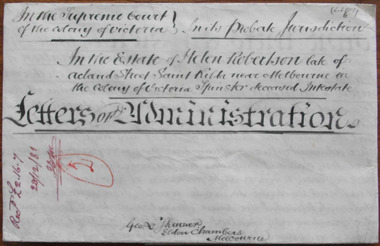
Document - Helen Robertson Letters of Administration 1881, 1889
... This document is of minor interest as one located in former legal premises in Warrnambool but no other connection has been found between Warrnambool and the person whose details are in the document, Helen Robertson helen robertson george skinner In the Supreme Court of the colony of Victoria in its Probate Jurisdiction in the Estate of Helen Robertson late of Acland Street Saint Kilda near Melbourne in the Colony of Victoria Spinster deceased intestate Letters of Administration This is a cream-coloured piece of parchment paper folded at the bottom edge and containing hand written material on both sides of the paper. ...Tait collection: item 34 of 62 This is a document giving the details of the Letters of Administration following the death of Helen Robertson, a spinster from St. Kilda, Melbourne. She died intestate in November 1881 and left property to the value of £363. This property reverted to her sister Agnes Thomson in 1889. No other details have been found on Helen Robertson. The lawyer in the case was George Skinner of Melbourne but the document was one of several stored in legal premises in Kepler Street, Warrnambool and passed on to successive lawyers occupying these premises. It was located in the same building, the former premises of the legal firm, Mackay Taylor, in 2014 and handed over to the Warrnambool and District Historical Society.This document is of minor interest as one located in former legal premises in Warrnambool but no other connection has been found between Warrnambool and the person whose details are in the document, Helen RobertsonThis is a cream-coloured piece of parchment paper folded at the bottom edge and containing hand written material on both sides of the paper. The contents give details of the Letters of Administration following the death of Helen Robertson in 1881. A seal of the Supreme Court of Victoria is attached with green ribbon. The document is somewhat stained.In the Supreme Court of the colony of Victoria in its Probate Jurisdiction in the Estate of Helen Robertson late of Acland Street Saint Kilda near Melbourne in the Colony of Victoria Spinster deceased intestate Letters of Administrationhelen robertson, george skinner -
 Bendigo Historical Society Inc.
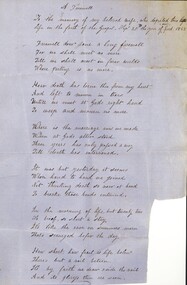
Document - JAMES TAYLOR COLLECTION: TAYLOR POEM, 1868
... PERSON Individual female James Taylor Taylor collection - Poem written in 1868 titled ' A Farewell ' written by James Taylor in memory of his deceased wife Jane, handwritten on blue paper. ...Taylor collection - Poem written in 1868 titled ' A Farewell ' written by James Taylor in memory of his deceased wife Jane, handwritten on blue paper.James Taylorperson, individual, female -
 Bendigo Historical Society Inc.
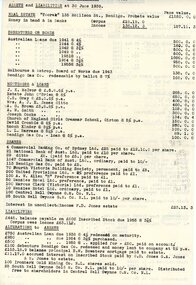
Document - G. ALICE JONES COLLECTION: ESTATE A.E. JONES ASSET AND LIABILITIES
... PERSON Individual g.alice jones Estate A. E. jones deceased. Assets and liabilities at 30th June 1939. ...Estate A. E. jones deceased. Assets and liabilities at 30th June 1939. Receipt of income from 21st Feb.1938 to 30th June 1939 and expenditure from income from 21st Feb.1938 to 30th June 1939person, individual, g.alice jones -
 Bendigo Historical Society Inc.
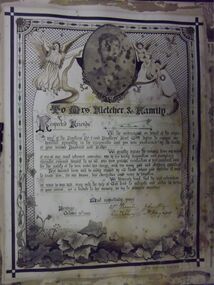
Document - CERTIFICATE TO FLETCHER FAMILY - JOHN FLETCHER, 1903
... PERSON Individual john fletcher Elizabeth Hinchcliff Job's Gully mining accident Paper certificate mounted on card presented to Mrs Fletcher and family from Hustlers No. 1 mine, upon the death of John Fletcher in a mine accident. Printed in black with a photograph of deceased ...John Fletcher (1857-19/10/1903) was a shift boss at the Hustler's Mine. Formerly from Sebastian, he came to Bendigo in 1899. He married Eliz. Hinchcliff in 1881 and they lived in Job's Gully. He was a member of the Bendigo Miner's Association and often subscribed to the Bendigo Independent newspaper, which sent Mrs Fletcher a gift of 25 pounds in appreciation. He was killed in a mining accident at Hustler's Mine.Paper certificate mounted on card presented to Mrs Fletcher and family from Hustlers No. 1 mine, upon the death of John Fletcher in a mine accident. Printed in black with a photograph of deceased inset at top surrounded by angels and all bordered with vine leaves. Markings - J. H. B. Gribble, Long Gully.person, individual, john fletcher, elizabeth hinchcliff, job's gully, mining accident -
 Australian Multicultural Community Services
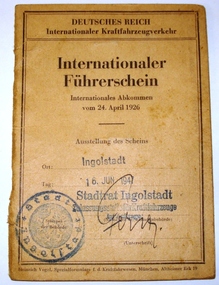
internationaler führerschein (international license)
... It was issued according to international agreement from 24 April 1926; this document belonged to deceased Marian Dabrowski, ex-soldier, migrant from Poland who came to Australia as a refugee after II World War one of a few items of this kind which has survived to present days international license migration Germany document front cover: stamp and signature of authorised person page 3: stamp, photo of holder Marian Dabrowski and handwritten info about holder of license page 38; 2 stamps which identify the category of license (A&B), handwritten info about holder brownish paper, 42 pages, back cover blank, page 37&38 folded page 2 contains list of countries where this license could be used page 4 - internationaler führerschein (international license) ...international license (internationaler führerschein) was issued on 16 June 1947 in Ingolstadt. It was issued according to international agreement from 24 April 1926; this document belonged to deceased Marian Dabrowski, ex-soldier, migrant from Poland who came to Australia as a refugee after II World Warone of a few items of this kind which has survived to present daysbrownish paper, 42 pages, back cover blank, page 37&38 folded page 2 contains list of countries where this license could be used page 4 - front cover: stamp and signature of authorised person page 3: stamp, photo of holder Marian Dabrowski and handwritten info about holder of license page 38; 2 stamps which identify the category of license (A&B), handwritten info about holderinternational license, migration, germany, document -
 Ballarat Tramway Museum
Album - Photo Album, c1970
... person. Trams tramways Ballarat Albert St Sebastopol Victoria St Sturt St Lydiard St Nth Railway Crossing Photo album containing 16 colour prints. Photo album has heavy card covers, covered in black textured plastic containing 12 clear plastic photo sleeves held with a white comb binder. Photos of Ballarat prior to closure, c1970. Photographer unknown. Donated by Peter Hyde of Brisbane Tramway Museum to BTM 3/2/2010, from a deceased ...Set of 16 photos of Ballarat tram system taken 1970c on a tour by an unknown Qld based person.Photo album containing 16 colour prints. Photo album has heavy card covers, covered in black textured plastic containing 12 clear plastic photo sleeves held with a white comb binder. Photos of Ballarat prior to closure, c1970. Photographer unknown. Donated by Peter Hyde of Brisbane Tramway Museum to BTM 3/2/2010, from a deceased estate. Photos apparently taken on a tram tour. .1 - No. 42 and a single trucker inbound in Sturt St. .2 - taken from tram ascending Bakery St hill in Victoria St. .3 - End of No. 42, with the destination "Haddon St via Drummond Nth" .4 - No. 11 and 42 in Lydiard St Nth, near the railway station. No. 11 showing special. .5 - photo of three people on the tour. .6 - Trams reversing at the Victoria St terminus .7 - ditto .8 - 11, 42 and 12? in Lydiard St North by railway station. .9 - Three trams at Sebastopol terminus. .10 - View in Albert St Sebastopol looking north along the track on the side of the road. .11 - View of the tram crossing in Albert St. .12 - 27 and 42 crossing Albert St Sebastopol. .13 - View of Albert St from the tram, north of the crossing looking at the reserved track 14. - Lydiard St North looking south .15 - 42 at the railway level crossing. .16 - View south of the railway level crossing, three trams, with passengers alighting.trams, tramways, ballarat, albert st, sebastopol, victoria st, sturt st, lydiard st nth, railway crossing -
Lakes Entrance Historical Society
Book, Cable Kenneth J and Marchant Jane C, Australian Biographical and Genealogical record 1842 - 1899 Volume 2, 1985
... Biographies of persons who lived on mainland Australia compiled from information submitted by individuals. The subject must have arrived or born in Australia 1842 -1899, and must be deceased. ...Genealogy Settlers Biographies of persons who lived on mainland Australia compiled from information submitted by individuals. The subject must have arrived or born in Australia 1842 -1899, and must be deceased. ...Biographies of persons who lived on mainland Australia compiled from information submitted by individuals. The subject must have arrived or born in Australia 1842 -1899, and must be deceased. Contains some photographs.genealogy, settlers -
 Melbourne Legacy
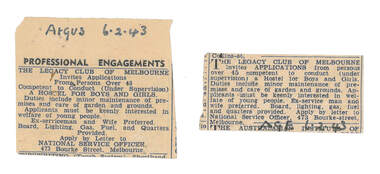
Newspaper - Document, article, Professional engagements, 06/02/1943
... persons over 45 to run a hostel for Legacy. Applicants must be keenly interested in welfare of young people and were preferably an ex-serviceman and his wife. Legacy was in the process of setting up Holmbush as a hostel to care for the children of deceased servicemen and these are an indication of the type of skills and attributes they required. ...persons over 45 to run a hostel for Legacy. Applicants must be keenly interested in welfare of young people and were preferably an ex-serviceman and his wife. Legacy was in the process of setting up Holmbush as a hostel to care for the children of deceased servicemen and these are an indication of the type of skills and attributes they required. ...Two advertisements that invites applications from persons over 45 to run a hostel for Legacy. Applicants must be keenly interested in welfare of young people and were preferably an ex-serviceman and his wife. Legacy was in the process of setting up Holmbush as a hostel to care for the children of deceased servicemen and these are an indication of the type of skills and attributes they required. Holmbush was the first hostel for children that Legacy started and operated from April 1943. It was later renamed Blamey House after another hostel called Blamey House was closed. Melbourne Legacy ran three residences: Blamey House (purchased 1947) , Stanhope (purchased 1945) and Harelands (purchased 1950), to take care of children whose fathers were servicemen, and who may have been left orphans, or whose mother may have been unable to care for them herself. Harelands accommodated boys and girls under the age of 14, Blamey House looked after boys over 14, and Stanhope looked after girls over 14. The children were cared for until they were old enough to become independent.Shows the duties and preferred attributes required to run Holmbush as a residence for children.Newspaper cuttings of advertisement for the manager position at Holmbush, black type, handwritten dates.00349.1 Argus 6.2.43 00349.2 AGE 6.2.43residences, holmbush, staff -
 Melbourne Legacy
Pamphlet, Legacy - Caring for the families of incapacitated and deceased veterans, 2011
... person al effort to chive Legacy ideals. Believed to be from 2011 as Legatee Chris Spence is in the photos and he was President from 2010 to 2011. An example of promotional material issued by Legacy legacy promotion marketing Colour brochure outlining the work of Legacy, A4 folded in 3 sections, with three children in ADF hats. Legacy - Caring for the families of incapacitated and deceased ...This is an example of Melbourne Legacy promotional material that was issued to inform the public on the work of Legacy and encourage anyone with similar ideals to join as a Legatee. Originally only e-servicemen who had overseas experience were able to become Legatees. In 2001 it was changed to include people that were willing and able to make the person al effort to chive Legacy ideals. Believed to be from 2011 as Legatee Chris Spence is in the photos and he was President from 2010 to 2011.An example of promotional material issued by LegacyColour brochure outlining the work of Legacy, A4 folded in 3 sections, with three children in ADF hats.legacy promotion, marketing -
 8th/13th Victorian Mounted Rifles Regimental Collection
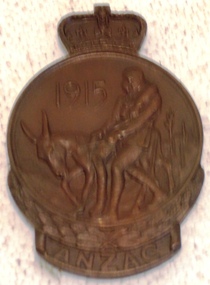
Memorabilia - Medal, Anzac Commemorative Medalion, 1967
... Issued in 1967 to surviving persons who had served at Gallipoli and NOK of deceased servicemen. ...Issued in 1967 to surviving persons who had served at Gallipoli and NOK of deceased servicemen. ...Medallion was issued to Miss Edna Huf of Albury, sister of No 533 Sergeant Carl Wilhelm Huf, 7th Battalion AIF who died at sea on HMT "Royal George" on 13 May 1915 of wounds received at Gallipoli and buried in Chatly Cemetery Egypt. Huf was aged 20. Miss Edna Huf donated the medallion together with other items to 8/13th Victorian Mounted Rifles Collection prior to her death at Albury.Part of a collection of items relating to the service and death of a single Australian soldier in WWI which was kept by his sister and passed to a local military collection for keeping shortly before her death in Albury.Bronze medallion featuring Simpson and donkey on obverse and map of Australia and New Zealand on reverse. Issued in 1967 to surviving persons who had served at Gallipoli and NOK of deceased servicemen. Inscribed on lower portion of reverse "CW Huf"huf, gallipoli, anzac commemorative medalion, anzac day, wwi, world war one, anniversaries, medals, numismatics, donkeys, simpson
