
Showing 51 items matching "desk furniture"
-
 Coal Creek Community Park & Museum
Furniture - Desk
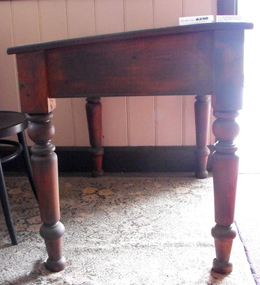
... Furniture - Desk...Desk with slanted top and one draw in original condition stained brown, 4 legs. Furniture - Desk ...Desk with slanted top and one draw in original condition stained brown, 4 legs. -
 Flagstaff Hill Maritime Museum and Village
Desk
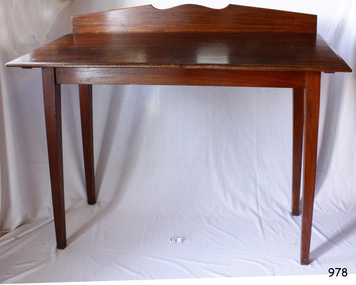
... desk...furniture...flagstaff hill warrnambool shipwrecked-coast flagstaff-hill flagstaff-hill-maritime-museum maritime-museum shipwreck-coast flagstaff-hill-maritime-village writing desk sloped desk standing desk bank desk furniture office furniture Desk, varnished wooden writing desk designed to be stood at. ...Desk, varnished wooden writing desk designed to be stood at. Has sloping top, 4 plain straight legs and curved back piece.flagstaff hill, warrnambool, shipwrecked-coast, flagstaff-hill, flagstaff-hill-maritime-museum, maritime-museum, shipwreck-coast, flagstaff-hill-maritime-village, writing desk, sloped desk, standing desk, bank desk, furniture, office furniture -
 Kiewa Valley Historical Society
Calendar Desk Perpetual, circa mid 1950s
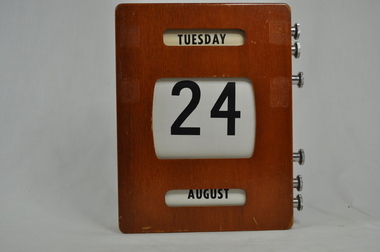
... ...desk furniture...This item was in a period before mass produced automated date and time pieces were available and hand operated date and time pieces were both in a social and commercial sphere a necessity. perpetual calendar office calendars desk calendars desk furniture Wooden box (varnished) with three openings (on the front) detailing ,the day(Monday to Sunday), the date (1st to 31st) and the month (January to December). ...This item appears to be a calendar which was in use for a multiple clientele office e.g. post office, commercial office or bank, school or educational administration area, small government office or hospital administration in the Kiewa Valley or its region. The time this item was first used, electrical or battery powered desk and office calendars did not exist for semi isolated rural regions. These type of perpetual calendars not only looked impressive but were not affected by power shortages. This was a time when not all of Victoria was adequately supplied by power. This item is quite relevant to the Kiewa Valley as it demonstrates that the time before the Hydro electricity generators where built (Mount Beauty to Falls Creek), power supplies were not keeping up to the ever increasing demand from city and rural customers. This item was in a period before mass produced automated date and time pieces were available and hand operated date and time pieces were both in a social and commercial sphere a necessity.Wooden box (varnished) with three openings (on the front) detailing ,the day(Monday to Sunday), the date (1st to 31st) and the month (January to December). On the right side of the calendar box are two winding screws (RHS 6 steel) for each opening. These permit the scrolling of the information i.e. day, number and month. This ability results in a desk calendar which is perpetual. On the back there is a steel (screwed on) hanger with a slot for wall screw.perpetual calendar, office calendars, desk calendars, desk furniture -
 Flagstaff Hill Maritime Museum and Village
Furniture - Prayer Desk, Circa 1890
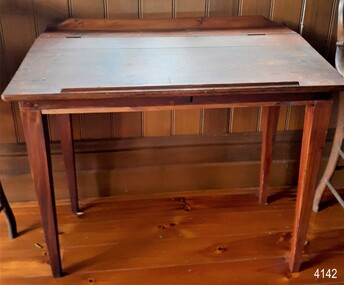
... desk...office furniture...This desk is part of the St. Nicholas Seamen's Church Collection. Furniture Prayer Desk ...This small desk was donated to the St. Nicholas' Mission to Seamen's Church by Mrs R Hidgekiss. It was used as a prayer desk or missal desk and was part of the original furnishings of the church at 139 Nelson Place, Williamstown, Victoria. Previously, it was used on the Australian Hospital Ship, H.M.A.S. Centaur. A reference to the desk's association is mentioned on the Framed Document that lists those who donated items to the St Nicholas Missions to Cemen church in Williamstown. An note quotes: "from HMHS Centaur "- the original missal, which was donated to the church as a memorial to those who lost their lives when the HS Centaur was sunk. (Of the 368 onboard, only two crew members survived.)" THE MISSIONS TO SEAMEN (Brief History): - The Missions to Seamen was an Anglican charity that has served seafarers of the world since 1856 in Great Britain. Its symbol is a Flying Angel, inspired by a Bible verse. Today, there are centres in over 200 ports worldwide where seamen of all backgrounds are offered a warm welcome and provided with a wide range of facilities. In Victoria, the organisation began in Williamstown in 1857 as a Sailors’ Church, also known as ‘Bethel’ or the ‘Floating Church’ in an old hulk floating in Hobson’s Bay, Port of Melbourne. It soon became part of the Missions to Seamen, Victoria. In the year 2000, the organisation, now named Mission to Seafarers, still operated locally in Melbourne, Portland, Geelong and Hastings. The Ladies’ Harbour Lights Guild was formed in 1906 to support the Missions to Seamen in Melbourne and other centres, such as Williamstown. Two of the most significant ladies of the Guild were founder Ethel Augusta Godfrey and foundation member Alice Sibthorpe Tracy (who established a branch of the Guild in Warrnambool in 1920). The Guild continued its work until the 1960s. In 1943, a former Williamstown bank was purchased for the Missions to Seaman Club. The chapel was named St Nicholas’ Seamen’s Church and was supported by the Ladies’ Harbour Lights Guild, the Williamstown Lightkeepers’ Auxiliary and the League of Soldiers’ and Sailors’ Friends. It ceased operation in 1966. A Missions to Seamen Chapel and Recreation Room was a significant feature of ports during the late 1800s and into the 1900s. It seemed appropriate for Flagstaff Hill to include such a representation within the new Maritime Village, so the Melbourne Board of Management of Missions to Seamen Victoria gave its permission on 21st May 1979 for the entire furnishings of the Williamstown chapel to be transferred to Flagstaff Hill. The St Nicholas Seamen’s Church was officially opened on October 11, 1981, and closely resembles the Williamstown chapel. This prayer disk is significant historically for its origin in the St. Nicholas Mission to Seamen's Church in Williamstown, established in 1857 to cater for the physical, social, and spiritual needs of seafarers. The organisation originated in Bristol, England when a Seamen's Mission was formed in 1837. The desk is also significant as a memorial to the many who lost their lives at sea for their country.Desk: Cedar wood desk of plain design with a sloped top. It has plain tapered legs, a hinged lid, a keyhole at the front, and raised edges at the front and back. Storage space under the lid has a tongue and groove wooden base. It has been referred to as a prayer desk, missal desk or writing desk and was previously used on the Australian ship, HMHS Centaur. This desk is part of the St. Nicholas Seamen's Church Collection. flagstaff hill, warrnambool, shipwrecked-coast, flagstaff-hill, flagstaff-hill-maritime-museum, maritime-museum, shipwreck-coast, flagstaff-hill-maritime-village, desk, writing desk, office furniture, domestic furniture, writing slope, clerk's desk, flagstaff hill maritime museum and village, maritime museum, maritime village, shipwreck coast, great ocean road, religion, religious service, religious worship, worship service, st nicholas seamen’s church, williamstown, missions to seamen victoria, mission to seafarers, st nicholas missions to seamen’s church williamstown, missions to seamen, st nicholas missions to seamen’s church flagstaff hill, 139 nelson place williamstown, anglican church, prayer accessory, church furniture, religious furniture, prayer desk, missal desk, mrs r hidgekiss, centaur, hmhs centaur, h.m.h.s. centaur, hospital ship, missal -
 Flagstaff Hill Maritime Museum and Village
Furniture - Desk, Foy & Gibson, Circa 1880s
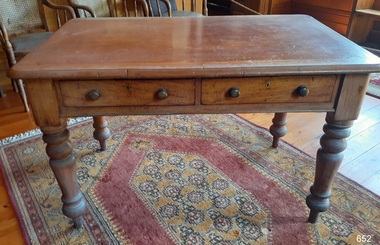
... desk...australian colonial furniture.... – Public Works Department, Victoria The desk is stamped “P.W.D,” signifying that it is from the Public Works Department in Victoria, which operated from 1855-1987. The department was responsible for, among other things, the design and supply of office furniture and equipment for public buildings and organisations. ...desk leg and lock. Made in Australia circa 1880 by Foy & Gibson, lock made by Hobbs & Co, London. Furniture ...The design of this small disc is from the Australian Colonial period. The cedar wood desk was made in Australian by Foy & Gibson in the 1880s, most probably in the business’s works in Collingwood, Victoria. The heavy brass locks fitted into the desk drawers were made by the famous Hobbs & Co of London, mid-late 19th century. In 1860 the business changed hands but the locks were still branded Hobbs & Co. The desk is branded with the symbol of Victoria’s Public Works Department. There is currently no information on when, where and by whom this desk was used. However, a very similar desk with Hobbs & Co. locks is on site at the Point Hicks Lightstation in Victoria and was formerly used by the Point Hicks head light keeper there. Other light stations also have similar desks from the P.W.D. (see also ‘Desk, Parks Victoria – Point Hicks Lightstation, Victorian Collections’.) HOBBS & CO., LONDON Alfred Charles Hobbs, 1812-1891, was American born. He became an executive salesman in 1840 for renowned lock manufacturer Day & Newell. His technique of exposing the weaknesses of people’s current locks was very successful in generating sales. He represented Day & Newell at London’s Great Exhibition of 1851, competing with other lock makers. Through the Exhibition he became famous for picking the best trusted Bramah and Chubb locks. Hobbs’ fame led him to found his own company in 1851 then register it in 1852 as Hobbs & Co., London. Hobbs was awarded the Telford Medal by the British Institution of Civil Engineers in 1854 for his paper 'On the Principles and Construction of Locks'. In 1855 the very successful company added partners and became Hobbs, Ashley and Co. In 1860, it traded under the name of Hobbs, Hart & Co. and was based in Cheapside London, where the business remained. Hobbs then returned to America, having sold the complete company to John Mathias Hart. He briefly returned to attend the 21st anniversary celebrations of the successful business in 1872. Hobbs kept himself busy in America, inventing and manufacturing firearm ammunition, for which he held several patents. He passed away there in 1891, a month after his 70th birthday. FOY & GIBSON Mark Foy wan an Irish draper who migrated to Bendigo, Victoria in 1858, attracted by the gold rush. He lived and worked in the area, establishing a drapery business. In the 1870s he moved to Melbourne where there were better prospects for expansion. He chose a place in Smith Street, Collingwood, a suburb of Melbourne, and started his business at the rear. In 1883 Foy retired, bringing in William Gibson as a partner, and then transferred his own share of the company to his son Francis Foy. Not long afterwards Francis sold his half share to Gibson, and the business continued under the name of Foy & Gibson. Francis Foy and he and his brother Mark Foy (junior) moved to Sydney. They established a business there in 1885, named after their father, Mark Foy. Gibson added to his business by starting his own manufacturing works from 1887, producing clothing, millinery, furniture, bedding and hardware for his stores. The factories, warehouses and stores complex became one of Victoria’s largest employers. He set up branches of his stores in Perth, Brisbane and Adelaide and two more branches in Melbourne. Foy & Gibson (usually referred to as Foys) became one of Australia’s largest retail department stores. In 1931 Foy’s little house in Collingwood was still part of the entrance to Foy & Gibson Emporium. In 1955 the company was bought out by Cox Brothers. Later on the stores were sold to various businesses such as David Jones, Woolworths and Harris Scarfe. In 1968 Cox Brothers went into receivership, ending almost 100 years of the business known as Foy’s. The former Foy & Gibson Complex is registered by Heritage Council Victoria. “Designed by William Pitt, this magnificent 19th and early 20th century complex of factories, warehouses and showrooms saw the production of a remarkable range of goods for Foy & Gibson, Melbourne’s earliest department store chain”. (Quoted from the Plaque erected by the Collingwood Historical Society 2007) P.W.D. – Public Works Department, Victoria The desk is stamped “P.W.D,” signifying that it is from the Public Works Department in Victoria, which operated from 1855-1987. The department was responsible for, among other things, the design and supply of office furniture and equipment for public buildings and organisations. This desk is significant historically as it originated from Foy & Gibson, a colonial Australian company that had a positive and strong impact on employment, manufacturing and retailing in Melbourne, Victoria and Australia. The significance of Foy & Gibson to Victoria’s and Australia’s history is marked by the Collingwood Complex being registered in both Heritage Victoria Register (H0755, H0897 and H0896) and National Trust Register (B2668). This locks on this desk are significant for their connection with their manufacturer, Hobbs & Co, who invented a lock that surpassed the security of any other locks produced in the mid-19th century. Desk; Australian Colonial cedar desk, honey coloured. Desktop has a wooden border with a rolled edge and a fitted timber centrepiece. The four tapered legs are tulip turned. Two half-width drawers fit side by side and extend the full depth of the desk. The drawers have dovetail joints. Each drawer has two round wooden knob handles, a keyhole and a fitted, heavy brass lever lock. Inscriptions are on the desktop, drawers, desk leg and lock. Made in Australia circa 1880 by Foy & Gibson, lock made by Hobbs & Co, London.Impressed into timber frame of one drawer “FOY & GIBSON” Impressed into lock “HOBBS & CO / LONDON”, “MACHINE MADE”, “LEVER” Impressed along the front edge of the desktop [indecipherable] text. Impressed into the timber of right front leg “P. W. D.” below a ‘crown’ symbol Handwritten in white chalk under a drawer “206” flagstaff hill, warrnambool, shipwrecked coast, flagstaff hill maritime museum, maritime museum, shipwreck coast, flagstaff hill maritime village, great ocean road, desk, cedar desk, colonial desk, 1880s desk, australian colonial furniture, furniture, office furniture, office equipment, australian made furniture, colonial furniture, colonial hardware, foy & gibson, alfred charles hobbs, hobbs & co london, hobs & co lever lock, cabinetry lock, machine made lever lock, p.w.d., public works department victoria, day & newell, great exhibition of 1851, bramah lock, chubb lock, telford medal 1854, cheapside london, mark foy, mark foy – bendigo draper, smith street collingwood, william gibson, foy & gibson emporium, foy & gibson complex, cox brothers -
 Kiewa Valley Historical Society
Desk - S.E.C.V
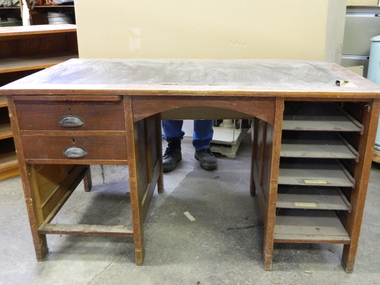
... state electricity commission of victoria; office furniture; desk;...state electricity commission of victoria; office furniture; desk; Desk - S.E.C.V. ...state electricity commission of victoria; office furniture; desk; -
 Kiewa Valley Historical Society
Desk - S.E.C.V
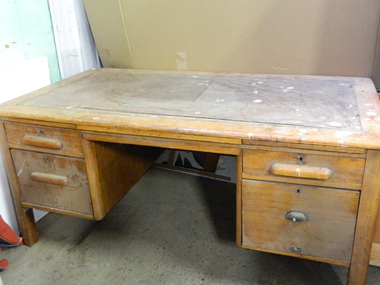
... state electricity commission of victoria; office furniture; desk...state electricity commission of victoria; office furniture; desk Desk - S.E.C.V. ...state electricity commission of victoria; office furniture; desk -
 Warrnambool and District Historical Society Inc.
Drawing, Working Drawing House & Furniture Making
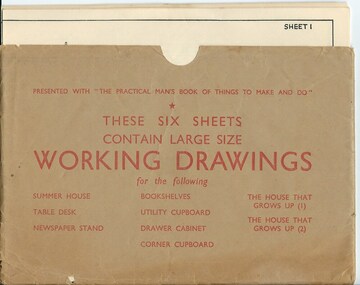
... The sheets provide simple drawings as a guide to making house additions (Summer House etc) and furniture (table desk, newspaper stand, book shelves, utility cupboard, drawer cabinet, corner cupboard). ...The sheets provide simple drawings as a guide to making house additions (Summer House etc) and furniture (table desk, newspaper stand, book shelves, utility cupboard, drawer cabinet, corner cupboard). ...These sheets were issued with the book ‘The Practical Man’s Book of Things to Make and Do’ published in the 1950s by the Sun News-Pictorial newspaper. The authors were James Wheeler and W. Shum. The sheets provide simple drawings as a guide to making house additions (Summer House etc) and furniture (table desk, newspaper stand, book shelves, utility cupboard, drawer cabinet, corner cupboard). They were intended to be used by the home handyman. These sheets are of no particular historicalinterest but may be useful for display. They are a good example of the plans and information available to home handymen in the 1950s.These are six cream-coloured sheets of paper containing working drawings for making furniture and house additions. The drawings are printed in black and the headings and measurements are also in black print. The six sheets are enclosed in a brown paper folder which is somewhat creased and a little torn. the practical man’s book of things to make and do, home carpentry, warrnambool, history -
 Flagstaff Hill Maritime Museum and Village
Functional object - Table-top Missal stand, after 1938
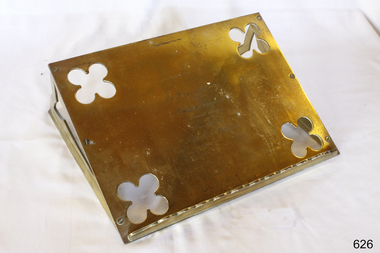
... furniture...religious worship...bible rest...tabletop lectern...bible reading...preaching accessory...book rest...memorial object...M A Hodgkiss...Richard Hodgkiss...Missel table book stand...book stand...Bible stand...table-top stand...table-top book rest...table-top Missal stand...Missal desk...Nicholas Seamen's church as it was dedicated to a family member. flagstaff hill warrnambool shipwrecked coast flagstaff hill maritime museum maritime museum shipwreck coast flagstaff hill maritime village great ocean road religious service missions to seamen victoria st nicholas seaman’s church williamstown church furniture religious worship bible rest tabletop lectern bible reading preaching accessory book rest memorial object M A Hodgkiss Richard Hodgkiss Missel table book stand book stand Bible stand table-top stand table-top book rest table-top Missal stand Missal desk "In Loving Memory of Richard Hodgkiss - passed away 14 12 38. ...This decorative brass table-top Missal stand was presented to the Missions to Seamen in Williamstown in memory of Richard Hodgkiss, after his death on December 14th 1938, by Mrs M A Hodgkiss. Decorative book rests like this one were used to support the Bible during services at the Williamstown Missions to Seamen and is now part of the St. Nicholas Seamen's Church Collection. THE MISSIONS TO SEAMEN (Brief History): - The Missions to Seamen was an Anglican charity in Great Britain that has served the world's seafarers since 1856. Its symbol is a Flying Angel, inspired by a Bible verse. Today, there are centres in over 200 ports worldwide where seamen of all backgrounds are offered a warm welcome and provided with a wide range of facilities. In Victoria, the organisation began in Williamstown in 1857 as a Sailors’ Church, also known as ‘Bethel’ or the ‘Floating Church’ in an old hulk floating in Hobson’s Bay, Port of Melbourne. It soon became part of the Missions to Seamen, Victoria. In the year 2000, the organisation, now named Mission to Seafarers, still operated locally in Melbourne, Portland, Geelong and Hastings. The Ladies’ Harbour Lights Guild was formed in 1906 to support the Missions to Seamen in Melbourne and other centres, such as Williamstown. Two of the most significant ladies of the Guild were founder Ethel Augusta Godfrey and foundation member Alice Sibthorpe Tracy (who established a branch of the Guild in Warrnambool in 1920). The Guild continued its work until the 1960s. In 1943, a former Williamstown bank was purchased for the Missions to Seaman Club. The chapel was named St Nicholas’ Seamen’s Church and was supported by the Ladies’ Harbour Lights Guild, the Williamstown Lightkeepers’ Auxiliary and the League of Soldiers’ and Sailors’ Friends. It ceased operation in 1966. A Missions to Seamen Chapel and Recreation Room was a significant feature of ports during the late 1800s and into the 1900s. It seemed appropriate for Flagstaff Hill to include such a representation within the new Maritime Village, so the Melbourne Board of Management of Missions to Seamen Victoria gave its permission on 21st May 1979 for the entire furnishings of the Williamstown chapel to be transferred to Flagstaff Hill. The St Nicholas Seamen’s Church was officially opened on October 11, 1981, and closely resembles the Williamstown chapel.This table-top Missal stand is historically significant for its origin in the St Nicholas Mission to Seamen's Church in Williamstown, established in 1857 to cater for the physical, social, and spiritual needs of seafarers. It originated in Bristol, England, when a Seamen's Mission was formed in 1837. It is socially important for its connection to the Williamstown St. Nicholas Seamen's church as it was dedicated to a family member.Table-top Missal stand, also called a Bible rest, book rest or table top stand: brass, rectangular surface with clover motifs holes in each corner. The triangular leg frames are screwed beneath the short sides to create a slope. The lower edge has a vertical, decorative shelf. The inscription on the top surface dedicates the book stand to Richard Hodgkiss, 1938. This book stand is part of the St. Nicholas Seamen's Church Collection. "In Loving Memory of Richard Hodgkiss - passed away 14 12 38. Presented by Mrs M A Hodgkiss."flagstaff hill, warrnambool, shipwrecked coast, flagstaff hill maritime museum, maritime museum, shipwreck coast, flagstaff hill maritime village, great ocean road, religious service, missions to seamen victoria, st nicholas seaman’s church williamstown, church furniture, religious worship, bible rest, tabletop lectern, bible reading, preaching accessory, book rest, memorial object, m a hodgkiss, richard hodgkiss, missel table book stand, book stand, bible stand, table-top stand, table-top book rest, table-top missal stand, missal desk -
 Flagstaff Hill Maritime Museum and Village
Furniture - Desk
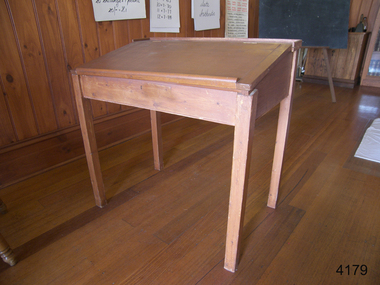
... flagstaff hill warrnambool shipwrecked-coast flagstaff-hill flagstaff-hill-maritime-museum maritime-museum shipwreck-coast flagstaff-hill-maritime-village Desk wooden with slanting top & hinged lid-has a piece along front to stop items rolling off. Has been estapoled Furniture Desk ...Desk wooden with slanting top & hinged lid-has a piece along front to stop items rolling off. Has been estapoledflagstaff hill, warrnambool, shipwrecked-coast, flagstaff-hill, flagstaff-hill-maritime-museum, maritime-museum, shipwreck-coast, flagstaff-hill-maritime-village -
 Mission to Seafarers Victoria
Postcard, A Real Photograph, The Chapel, Missions to Seamen Melbourne, Vic, c. 1917
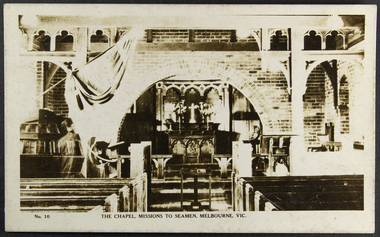
... furniture gifted by suppoerters. Early photograph of the St Peter Chapel. st peter chapel seamen mission mission to seamen mission to seafarers flinders street melbourne pulpit prayer desk altar lectern cross credence alm's dish Printed on verso: Postcard / A Real Photograph / Produced in Australia Glossy sepia tone postcard depicting the interior of the St Peter chapel. ...The postcard depicts the St Peter chapel with its furnitshing and furniture gifted by suppoerters.Early photograph of the St Peter Chapel.Glossy sepia tone postcard depicting the interior of the St Peter chapel.Printed on verso: Postcard / A Real Photograph / Produced in Australiast peter chapel, seamen mission, mission to seamen, mission to seafarers, flinders street, melbourne, pulpit, prayer desk, altar, lectern, cross, credence, alm's dish -
 Flagstaff Hill Maritime Museum and Village
Furniture - Set of desks & benches, Unknown
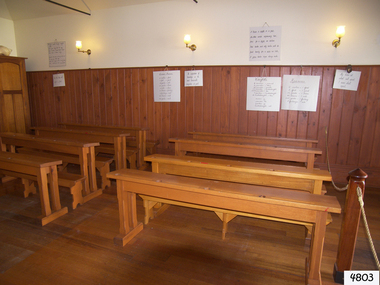
... Each desk and bench accommodates four children. Furniture Set of desks & benches ...The following are the recollections of John Elkins, who started school in February, 1945 at Maryborough in Queensland, Australia. 'I think in Prep 1 that we had some paper to write on with pencils, but my memory of the routine use of slates is much more vivid. Each slate was framed in wood and one side was inscribed with lines to guide the limits for the upper and lower extremities of letters. The slate "pencils" were made of some pale gray mineral softer than slate which had been milled into cylinders some one-eighth of an inch in diameter and inserted into metal holders so that about an inch protruded. Each student was equipped with a small tobacco tin in which was kept a damp sponge or cloth to erase the marks. Sharpening slate pencils was a regular task. We rubbed them on any suitable brick or concrete surface in the school yard. Teachers also kept a good supply of spares, all writing materials and books being provided by the school. It is possible that the retention of slates stemmed from the political imperative that public education should be free. I do recall being given a Copy Book for home practice of letter formation, a typical practice until Grade 6. The tables at which we used to sit in the Infant School were replaced in the primary Grades by long desks seating five or six pupils. These had slots into which the slates could be inserted vertically. When the teacher asked the class to clear their desks, the command issued was "slates away!" This was an occasion for a noisy expression of relief as we dropped the slates producing a sound not unlike a volley of rifle shots, and usually brought a request from the teacher to repeat the process with no noise by holding the frames throughout. Thus, I suspect we may still have used slates in Grade Three, though by then paper, which may have been scarce during the War, seemed to be used more routinely.' The full context of John's account of writing during his primary school days can be found at: https://www.readinghalloffame.org/sites/default/files/history_of_literacy_22slates_away22_penmanship_in_queensland_australia.pdfSchool desks and benches/chairs have been in use in schools since formal group education started.Eight long school desks (five higher three lower), each with four inkwells and groove along length. eight school benches (five higher three lower). Each desk and bench accommodates four children.None.flagstaff hill, warrnambool, shipwrecked-coast, flagstaff-hill, flagstaff-hill-maritime-museum, maritime-museum, shipwreck-coast, flagstaff-hill-maritime-village -
 Flagstaff Hill Maritime Museum and Village
Furniture - Decorative Mount, ca. 1873
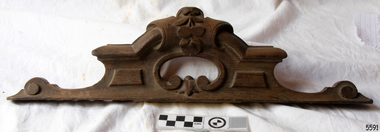
... This hand carved wooden pediment may have originated from a mirror, cabinet, desk or similar piece of furniture. The LOCH ARD: - The Loch Ard got its name from ”Loch Ard” a loch which lies to the west of Aberfoyle, and the east of Loch Lomond. ...This hand carved wooden pediment may have originated from a mirror, cabinet, desk or similar piece of furniture. The LOCH ARD: - The Loch Ard got its name from ”Loch Ard” a loch which lies to the west of Aberfoyle, and the east of Loch Lomond. ...This hand carved wooden pediment may have originated from a mirror, cabinet, desk or similar piece of furniture. The LOCH ARD: - The Loch Ard got its name from ”Loch Ard” a loch which lies to the west of Aberfoyle, and the east of Loch Lomond. It means "high lake" in Scottish Gaelic. The vessel belonged to the famous Loch Line which sailed many vessels from England to Australia. The Loch Ard was built in Glasgow by Barclay, Curdle and Co. in 1873, the vessel was a three-masted square-rigged iron sailing ship that measured 79.87 meters in length, 11.58 m in width, and 7 m in depth with a gross tonnage of 1693 tons with a mainmast that measured a massive 45.7 m in height. Loch Ard made three trips to Australia and one trip to Calcutta before its fateful voyage. Loch Ard left England on March 2, 1878, under the command of 29-year-old Captain Gibbs, who was newly married. The ship was bound for Melbourne with a crew of 37, plus 17 passengers. The general cargo reflected the affluence of Melbourne at the time. Onboard were straw hats, umbrella, perfumes, clay pipes, pianos, clocks, confectionery, linen and candles, as well as a heavier load of railway irons, cement, lead and copper. There were other items included that were intended for display in the Melbourne International Exhibition of 1880. The voyage to Port Phillip was long but uneventful. Then at 3 am on June 1, 1878, Captain Gibbs was expecting to see land. But the Loch Ard was running into a fog which greatly reduced visibility. Captain Gibbs was becoming anxious as there was no sign of land or the Cape Otway lighthouse. At 4 am the fog lifted and a lookout aloft announced that he could see breakers. The sheer cliffs of Victoria's west coast came into view, and Captain Gibbs realised that the ship was much closer to them than expected. He ordered as much sail to be set as time would permit and then attempted to steer the vessel out to sea. On coming head-on into the wind, the ship lost momentum, the sails fell limp and Loch Ard's bow swung back towards land. Gibbs then ordered the anchors to be released in an attempt to hold its position. The anchors sank some 50 fathoms - but did not hold. By this time the ship was among the breakers and the tall cliffs of Mutton Bird Island rose behind. Just half a mile from the coast, the ship's bow was suddenly pulled around by the anchor. The captain tried to tack out to sea, but the ship struck a reef at the base of Mutton Bird Island, near Port Campbell. Waves subsequently broke over the ship and the top deck became loosened from the hull. The masts and rigging came crashing down knocking passengers and crew overboard. When a lifeboat was finally launched, it crashed into the side of Loch Ard and capsized. Tom Pearce, who had launched the boat, managed to cling to its overturned hull and shelter beneath it. He drifted out to sea and then on the flood tide came into what is now known as Loch Ard Gorge. He swam to shore, bruised and dazed, and found a cave in which to shelter. Some of the crew stayed below deck to shelter from the falling rigging but drowned when the ship slipped off the reef into deeper water. Eva Carmichael a passenger had raced onto the deck to find out what was happening only to be confronted by towering cliffs looming above the stricken ship. In all the chaos, Captain Gibbs grabbed Eva and said, "If you are saved Eva, let my dear wife know that I died like a sailor". That was the last Eva Carmichael saw of the captain. She was swept off the ship by a huge wave. Eva saw Tom Pearce on a small rocky beach and yelled to attract his attention. He dived in and swam to the exhausted woman and dragged her to shore. He took her to the cave and broke the open case of brandy which had washed up on the beach. He opened a bottle to revive the unconscious woman. A few hours later Tom scaled a cliff in search of help. He followed hoof prints and came by chance upon two men from nearby Glenample Station three and a half miles away. In a complete state of exhaustion, he told the men of the tragedy. Tom then returned to the gorge while the two men rode back to the station to get help. By the time they reached Loch Ard Gorge, it was cold and dark. The two shipwreck survivors were taken to Glenample Station to recover. Eva stayed at the station for six weeks before returning to Ireland by steamship. In Melbourne, Tom Pearce received a hero's welcome. He was presented with the first gold medal of the Royal Humane Society of Victoria and a £1000 cheque from the Victorian Government. Concerts were performed to honour the young man's bravery and to raise money for those who lost family in the disaster. Of the 54 crew members and passengers on board, only two survived: the apprentice, Tom Pearce and the young woman passenger, Eva Carmichael, who lost her family in the tragedy. Ten days after the Loch Ard tragedy, salvage rights to the wreck were sold at auction for £2,120. Cargo valued at £3,000 was salvaged and placed on the beach, but most washed back into the sea when another storm developed. The wreck of Loch Ard still lies at the base of Mutton Bird Island. Much of the cargo has now been salvaged and some items were washed up into Loch Ard Gorge. Cargo and artefacts have also been illegally salvaged over many years before protective legislation was introduced in March 1982. One of the most unlikely pieces of cargo to have survived the shipwreck was a Minton majolica peacock- one of only nine in the world. The peacock was destined for the Melbourne 1880 International Exhibition in. It had been well packed, which gave it adequate protection during the violent storm. Today the Minton peacock can be seen at the Flagstaff Hill Maritime Museum in Warrnambool. From Australia's most dramatic shipwreck, it has now become Australia's most valuable shipwreck artifact and is one of very few 'objects' on the Victorian State Heritage Register. Ref: LA 6 64 264 The shipwreck of the Loch Ard is of significance for Victoria and is registered on the Victorian Heritage Register ( S 417). Flagstaff Hill has a varied collection of artefacts from Loch Ard and its collection is significant for being one of the largest accumulation of artefacts from this notable Victorian shipwreck. The collections object is to also give us a snapshot into history so we can interpret the story of this tragic event. The collection is also archaeologically significant as it represents aspects of Victoria's shipping history that allows us to interpret Victoria's social and historical themes of the time. The collections historically significance is that it is associated unfortunately with the worst and best-known shipwreck in Victoria's history. Carved wooden furniture pediment or mount, recovered from the wreck of the Loch Ard. Inscribed plaque on underside. Handwriting on round sticker on edge.Plaque inscription "From Loch Ard wreck Port Campbell 1878 given by Haworth Bros to James Martin Snr Scarsdale" Diagonally on round sticker in pen "R 222A" flagstaff hill, warrnambool, shipwrecked coast, flagstaff hill maritime museum, maritime museum, shipwreck coast, flagstaff hill maritime village, great ocean road, loch line, loch ard, captain gibbs, eva carmichael, tom pearce, glenample station, mutton bird island, loch ard gorge, carved headpiece, furniture, haworth bros, james martin snr, scarsdale, pediment, decorative mount -
 Mission to Seafarers Victoria
Furniture - Desk, ship, 1800-1880
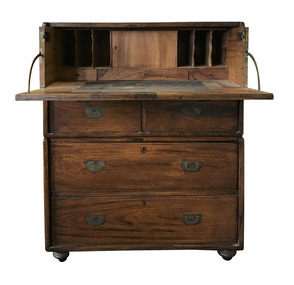
... The top part is fitted with a secretary drawer. Furniture Desk, ship ...Because of the initials JV on the bottom part this portable desk possibly belonged to James Volum (1803-1884) The volum family originally from Peterhead, Scotland, had a long seafaring history. Several members of the family were mates, ship captains in the whaling industry and the merchant navy. James Volum settled in Geelong with his brothers, Andrew Volum and William Volum. He purchased brewery there (Volum Brewery) and the Barwon paper mill at Fyansford.This set is a rare example of campaign furniture, a type of portable furniture an officer or ship captain would take with him to bring his personal belongings. This type of secretary would have been used by Volum to write in the ship log.2 sets of drawers setting one on top of each other. The top part is fitted with a secretary drawer.On top of the bottom set of drawers: initials "J.V" and "# 3"volum collection, captain, ship, seafaring, campaign furniture, james volum (1803-1884), brewery, paper mill, geelong, peterhead, scotland, fyansford, teak -
 Mission to Seafarers Victoria
Furniture - Desk Lectern, Mid 20th Century
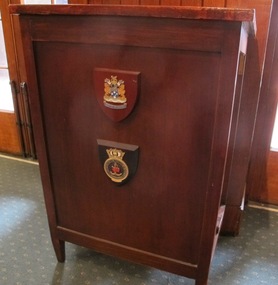
... desk lectern with sloped reading surface and bearing two wooden shield mounted insignia, one above the other. Uppermost Insignia a) features a crest supported by 2 flanking seahorses and shield with victorian flag and 2 enamelled ribbons with inscription. Insignia B features circular crest with a 'coronet' of sail and galleon surmounting a ropework crest with an Anchor and chain at the centre. Furniture ...The Port of Melbourne was leased to private operators post 2015, State Govt remains landowner and regulatory authority. The Company of Master Mariners continues a regular association with the Mission to Seafarers regularly holding events and meetings on the premises.The Port of Melbourne insignia on this desk lectern may well be replaced in subsequent decades. The desk is used for presentations at many events.Wood cabinetry desk lectern with sloped reading surface and bearing two wooden shield mounted insignia, one above the other. Uppermost Insignia a) features a crest supported by 2 flanking seahorses and shield with victorian flag and 2 enamelled ribbons with inscription. Insignia B features circular crest with a 'coronet' of sail and galleon surmounting a ropework crest with an Anchor and chain at the centre.Insignia a) "PROSPERITY THROUGH SERVICE" / PORT OF MELBOURNE Insignia b) COMPANY OF MASTER MARINERS On inner panel of lectern in gilt lettering "Company of / Master Mariners "master mariners, the port of melbourne, mission to seafarers -
 Mission to Seafarers Victoria
Furniture - Desk, unknown
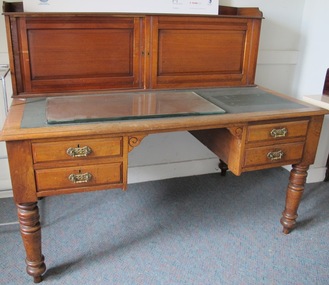
... desk appears to be of a different wood with green leather inset to top surface and heavy legs. Drawers with heavily decorated brass handles. The top cabinet features finer cabinetry and darker colour wood or stain which could be cedar.with simple narrow reeded decoration. Furniture ...This desk was donated to the MTSV in 2017 by a descendant of Padre Oliver, Chaplain from 1930-1960.This desk belonged to Rodney Oliver and is believed to have been used by Padre Oliver and his wife while Chaplain, and the family resided at the MTS and thereafter in subsequent parish postings. The desk makes a link with one of the longest serving Chaplains who had a significant influence through the intense period of operations early - mid 20th C. The Padre's influence was substantial. The desk is also believed to have been used by son Rodney Oliver who also served the Mission as Chairman in the later 20th C.A four drawer leather topped desk with detachable unit comprising double sliding door lockable cabinet with small bookshelf backed with shallow pediment. Sorting / sectioned pigeonhole interiors to the top cabinets see images. The main table desk appears to be of a different wood with green leather inset to top surface and heavy legs. Drawers with heavily decorated brass handles. The top cabinet features finer cabinetry and darker colour wood or stain which could be cedar.with simple narrow reeded decoration. interior two pigeon holes with labelsfrank leslie oliver, padre oliver, chaplain, desk, mission to seafarers, melbourne, seamen's mission, flinders street, padre frank leslie oliver -
 Mission to Seafarers Victoria
Furniture - Writing Desk, 1928
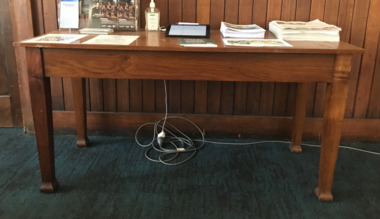
... James Breaks was Engineedr-Commander on the HMS Cerberus and Mrs Breaks and their daughters (Maud and Louise) were all volunteering at the Williamstown Mission. maude breaks louise (lulu) amy breaks alice breaks nee jobson ladies harbour lights guild williamstown hms cerberus james l. breaks On the plaque: In memory of / Alice Breaks / Mother to many a sailor lad / Far from his native home / Whose praise is in the seven seas Wooden table with two drawers and plaque on the top. Furniture Writing Desk ...In the Jottings Midwinter 1928: " We have had a splendidement addition in the Apprentices' Room (Level 1) - a beautiful polistes oak writing table with a glass top. It is large enough for two people to write letters at the same time, and is the lift of the Misses Breaks, in memory of their mother." Alice Jobson was born in 1856 Alice, born at St. John’s Westminster, England. On the 23rd. May, 1876 she married James Lennox Breaks at Holy Trinity Church of England at Williamstown, Victoria. James Breaks was born c.1848 in Portsmouth, England. At age 22, he sailed on the maidden voyage of the HMVS Cerberus from England to Australia via the Suez Canal. He was one of the 3 junior engineers. James and Alice Breaks had two daughters – Louise Amy born at Williamstown in 1877 and Alice Maud born at Williamstown in 1879. James remained associated with the Cerberus until his death. On the 6th. February, 1919, James Lenox Breaks, “Engineer Commander R.A.N.”, died at 34 The Strand, Williamstown from Chronic nephritis and Cardiac failure. James, aged 70 years at the time of his death, was buried in the Williamstown Cemetery. In 1920, Alice donated the model of the Cerberus made by James, to the Melbourne Museum. Alice Breaks passed away on the 31st of May 1927 in her 71st year.The Breaks were a locals of Williamstown. James Breaks was Engineedr-Commander on the HMS Cerberus and Mrs Breaks and their daughters (Maud and Louise) were all volunteering at the Williamstown Mission.Wooden table with two drawers and plaque on the top.On the plaque: In memory of / Alice Breaks / Mother to many a sailor lad / Far from his native home / Whose praise is in the seven seasmaude breaks, louise (lulu) amy breaks, alice breaks nee jobson, ladies harbour lights guild, williamstown, hms cerberus, james l. breaks -
 Mission to Seafarers Victoria
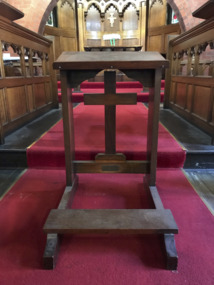
Furniture - Prayer desk, c. 1917
... The plaque to Cecil De la mare Goldsmith who died in 1917 may have been added at a later date. st peter chapel beatrice elizabeth higgins (nee shuter) george higgins (c.1860-1943) orchard house cecil de la mare goldsmith (1862-1917) gifts-1917 Furniture Prayer desk ...Mrs Geo Higgins was Beatrice Elizabeth Shuter, the daughter of Mr and Mrs Charles Shuter. The plaque to Cecil De la mare Goldsmith who died in 1917 may have been added at a later date.st peter chapel, beatrice elizabeth higgins (nee shuter), george higgins (c.1860-1943), orchard house, cecil de la mare goldsmith (1862-1917), gifts-1917 -
 Cheese World Museum
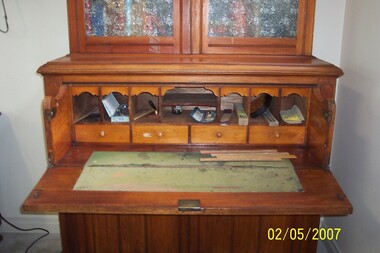
Writing Desk and Bookcase
... furniture...uebergang...allansford...bookcase...desk...furniture uebergang allansford bookcase desk Wooden bookcase mounted on top of a desk. ...Wooden bookcase mounted on top of a desk. The bookcase has two glass panelled doors and three shelves. the right side door has a keyhole. Pediment overhang of 7 cm. the desk has a locking drawer and two cupboards underneath. The drawer has two recessed brass handles.furniture, uebergang, allansford, bookcase, desk -
 Bendigo Military Museum
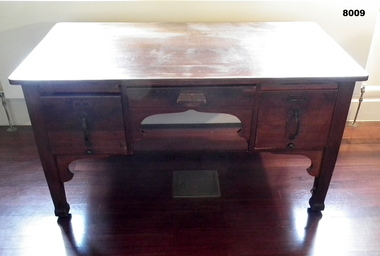
Furniture - OFFICE DESK, c.1921
... After the renovations to SMI in 2016 - 18 it was installed in what is now called the "Building and RSL History Room" brsl smirsl Comforts Office desk, heavy timber construction rectangular shape, has two pull out side drawer's that originally had a filing system in, one pullout drawer central in the sit position. Side drawers have steel handles, central one timber. Furniture ...This table was installed originally in the front office of the Soldiers Memorial Institute Bendigo 1921 funded by the "Australian Mining Comforts Fund". It was still in use up till approx 2012 when the office was renovated. After the renovations to SMI in 2016 - 18 it was installed in what is now called the "Building and RSL History Room"Office desk, heavy timber construction rectangular shape, has two pull out side drawer's that originally had a filing system in, one pullout drawer central in the sit position. Side drawers have steel handles, central one timber.brsl, smirsl, comforts -
 Queenscliffe Maritime Museum
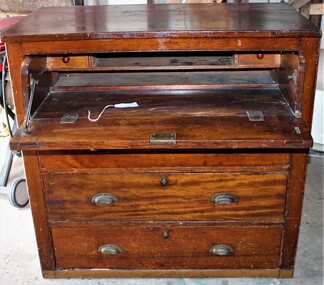
Furniture - Captain's Desk
... 57395 The remnants of the Time remained as a landmark for over 10 years before a storm sent her remains to the bottom. http://home.vicnet.net.au/~maav/diary3.htm ss tme shipwrecks salvage furniture Captain's desk from the SSW Time Furniture Captain's Desk ...On August 23rd, 1949, S. S. TIME was on voyage from Sydney to Melbourne with a cargo of sugar (3,000 tons), timber, general cargo and coal, when she was wrecked on Corsair Rock, entrance of Port Philip Bay. Read more at wreck site: https://wrecksite.eu/wreck.aspx?57395The remnants of the Time remained as a landmark for over 10 years before a storm sent her remains to the bottom. http://home.vicnet.net.au/~maav/diary3.htmCaptain's desk from the SSW Timess tme, shipwrecks, salvage, furniture -
 Queenscliffe Maritime Museum
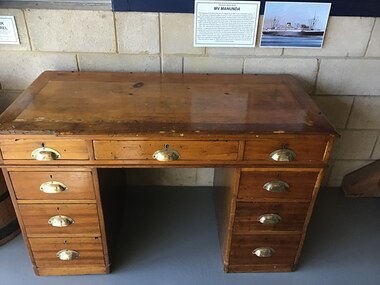
Furniture - Doctor's desk from 'Manunda'
... furniture...manunda...doctor'sdesk...desk...Several stamps on the inside of top middle draw - 'Radio Maintenance Store, Transmitting Station Essendon' and 'Paul.J.Barton, 33 Bellbird Cres, Vermont 3133' Furniture Doctor's desk from 'Manunda' ...Adelaide Steamship Co. MV 'Manunda' built Glasgow 1927, commenced coastal passenger service in Australia 1929, converted to 2/1 Australian Hospital Ship (AHS) in 1940 for service to Middle East, New Guinea and New Zealand. Returned to coastal trade in 1948, sold to Japan 1956, broken up in 1957. 9 drawer timber desk with brass drawer pull handles. Several stamps on the inside of top middle draw - 'Radio Maintenance Store, Transmitting Station Essendon' and 'Paul.J.Barton, 33 Bellbird Cres, Vermont 3133''Manunda' stamped on back of deskship, furniture, manunda, doctor'sdesk, desk, steamship, ahs -
 Queenscliffe Maritime Museum
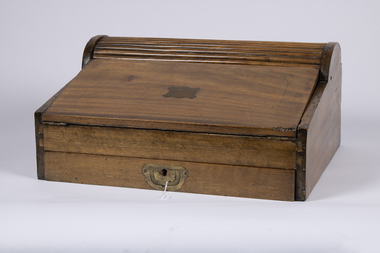
Furniture - Lap Writing Desk
... Mahogany lap writing desk with roll top, ink wells, writing slope, drawer and other compartments. Furniture Lap Writing Desk ...Brought to Australia by English Captain William Parsons during the 1830s.Donated by Robert Nissen in memory of Gaye Marie Nissen, daughter of Robert Nissen and Mary Wentworth, a descendant of William Charles Wentworth.Mahogany lap writing desk with roll top, ink wells, writing slope, drawer and other compartments.Copper plate on top panel is inscribed with "M.A."writing desks, william charles wentworth -
 Stratford and District Historical Society
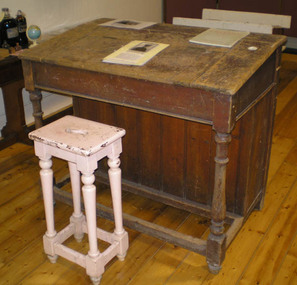
Desk
... At its closure the furniture was transferred to Munro, and teachers there signed the desk lid after that time. ...At its closure the furniture was transferred to Munro, and teachers there signed the desk lid after that time. ...A succession of teachers has signed their names under the lid, and the notation "Killed in Action, March 1917" has been added after the 1913 signature of Edward Jones. These were originally at State School 1589 Invermichie, which operated from 1875 to 1917 near Munro. At its closure the furniture was transferred to Munro, and teachers there signed the desk lid after that time. A tall, unpainted teacher's wooden desk with a single hinged flap as a lid. A ceramic inkwell is set into the top right-hand side. Names have been inscribed under the lid. It is accompanied by its stool (00802VSFH)Names that are legible include: R.Costello 1925 [?], 1928 Hector Connaught / Semper Fideles J.A. Cullinan, 96 BW 94 Maude Rack June '91 J.Bux Howqua Dale Barry J. Buxton 19.12.52/son of the above. Edw. H. Jones August 1913. Killed in Action March 1917 Enter Irene Hannan 1st May 1916 Exit 19 Sept 1919 Ella K. Fletcher 31.8.20 Monga [?] Duggan 1922 S.M.Kerr 7/1/27 J.A.Mullin Jan 1930-Sept 34 Robert J ...... Sept 34-Dec34 G.A.Faux Jan 5 to Aug 55 Mrs Mary M.Costello HT Sept 1955 Heather A ..... Assistant Feb 1969-Dec 1970 Emma Dronieika [?] Assistant Feb 1971 - Dec 1971 Pamela Golden (Draffin) Feb 1972-Dec 1972 AnneCargeeg Feb 1973 Scratched on lid is B.W.Butcher born 1912, killed 1959 aged 47 Vision and Realisation gives dates for the school as 1875 to 1917, so names after that time would appear to be for teachers from Munro.schools, world war 1914-1918 -
 Kiewa Valley Historical Society
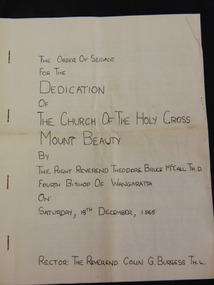
Booklet - The Church of the Holy Cross Mount Beauty, The Order of Service for the Dedication of the Church of the Holy Cross Mount Beauty, December 1965
... The book includes the Order of Service, The Procession to the Altar, The dedication of the Church, The dedication of the Furniture, At the Prayer Desk, At the Lectern At the Pulpit, At the Chancel Step, At the Altar, The Dedication Mass, The Collect, The Epistle, The Gospel, Proper Preface and is written by the Right Reverend Theodore Bruce McCall, Fourth Bishop Of Wangaratta on Saturday, 18th Dec., 1965...The book includes the Order of Service, The Procession to the Altar, The dedication of the Church, The dedication of the Furniture, At the Prayer Desk, At the Lectern At the Pulpit, At the Chancel Step, At the Altar, The Dedication Mass, The Collect, The Epistle, The Gospel, Proper Preface and is written by the Right Reverend Theodore Bruce McCall, Fourth Bishop Of Wangaratta on Saturday, 18th Dec., 1965 The Order of Service for the Dedication of the Church of the Holy Cross Mount Beauty Booklet - The Church of the Holy Cross Mount Beauty ...The Anglican Church of the Holy Cross was situated in Maddison St., Mt Beauty. It was dedicated on Saturday 18th December 1965. The Rector was The Reverend Colin G. Burgess Th.L.Mt Beauty was created by the State Electricity Commission of Victoria during the construction of the Kiewa Hydro Electric Scheme. During the late 1960's the town was handed over to the Bright Shire and its building sold. A plaque was unveiled in the porch to commemorate the Dedication of the Church by Mr H. H .Williams, the chief engineer of the Kiewa Scheme.5 page hand made book with white pages and black typing stapled together with 4 staples. The book includes the Order of Service, The Procession to the Altar, The dedication of the Church, The dedication of the Furniture, At the Prayer Desk, At the Lectern At the Pulpit, At the Chancel Step, At the Altar, The Dedication Mass, The Collect, The Epistle, The Gospel, Proper Preface and is written by the Right Reverend Theodore Bruce McCall, Fourth Bishop Of Wangaratta on Saturday, 18th Dec., 1965mt beauty; anglican church; religion; -
 Warrnambool and District Historical Society Inc.
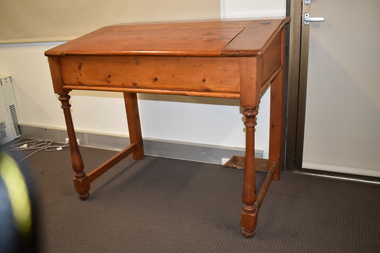
Furniture - School Teacher's Desk, Early 20th century
... desk seems to be made of a different wood. There are signs of old borer on the left hand front and the curved part on that side is missing. Furniture ...This is a teacher's desk which came from Woodford State School. The school began in 1854 in a private dwelling with a new building constructed in 1874. The school still operates today.This is a very fine example of an early 20th century school teacher's desk. As it comes from one of the earliest schools in the district, it is of considerable significance.This is a wooden desk, now varnished, with a lift up, slanted lid with brass hinges and a brass key hole. On the top right hand side is a brass insert with a porcelain ink well. The desk has four turned legs with end struts. The desk lid may be made of pine but the rest of the desk seems to be made of a different wood. There are signs of old borer on the left hand front and the curved part on that side is missing.woodford state school, teachers desk, wooden teachers desk -
 Stanley Athenaeum & Public Room
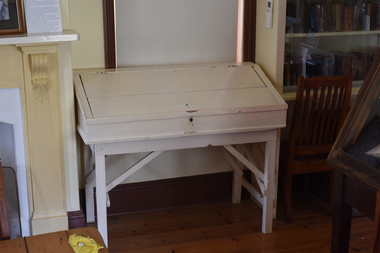
Furniture - Desk - librarian, Librarians desk
... Desk top sitting on separate stand with cross bracing. Librarians desk Furniture Desk - librarian ...Part of original furniture - used by librarian since thenWhite painted wooden desk with sloping top. Top lifts up with storage space underneath. Desk top sitting on separate stand with cross bracing. -
 Robin Boyd Foundation
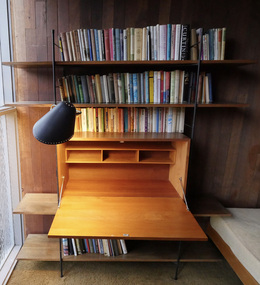
Furniture - Ladder-frame bookcase, Bruce Anderson
... desk is located in Penleigh's bedroom (item F085). They were both designed by Bruce Anderson - in the past they have been incorrectly attributed to Clement Meadmore. This type of furniture...desk. Shiny metal feet, rubber covering top of metal frame. Furniture Ladder-frame bookcase Bruce Anderson ...This wrought iron "ladder-frame" bookcase, which includes a drop-down table, is located in Suzy's bedroom. A second "ladder-frame" bookcase with desk is located in Penleigh's bedroom (item F085). They were both designed by Bruce Anderson - in the past they have been incorrectly attributed to Clement Meadmore. This type of furniture was featured in 'The Age' Small Homes Service and a similar one was featured in 'The Age' Dream Home Exhibition in 1955. From 1947 to 1953, Robin Boyd was the director of The Small Homes Service, set up by the Royal Victorian Institute of Architects in conjunction with 'The Age' and he produced a weekly article for 'The Age'.Wrought iron black frame with 10 ladder slots, and 3 cross brace frames, with 4 timber shelves. In the centre, there is a drop down table to use as a desk. Shiny metal feet, rubber covering top of metal frame. bruce anderson, robin boyd, dream home, small homes service, walsh st furnishings, ohm2022, ohm2022_39 -
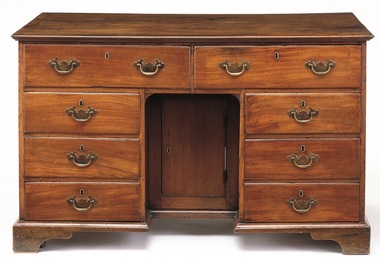 Bendigo Art Gallery
Furniture, UNKNOWN, Partners Desk, circa 1740
... Partners Desk Furniture UNKNOWN ... -
 Clunes Museum
Furniture - WRITING DESK & BOOKCASE
... Furniture WRITING DESK & BOOKCASE ...THE DESK WAS ORIGINALLY BUILT INTO THE WALL OF THE STUDY INTHE CLUNES WESLEYAN PARSONAGE, SERVICE STREET, AND WAS REMOVED WHEN THE BUILDING WAS DEMOLISHED IN 1991. GIFT OF THE CLUNES UNITING CHURCH PROPERTY COMMITTEE.POLISHED WOOD, BUILT-IN BOOKCASE AND WRITING DESK, DROP -DOWN SHELF WRITING AREA.local history, furniture, office, furniture, office
