
Showing 24 items matching "emerald tourist railway"
-
 Puffing Billy Railway
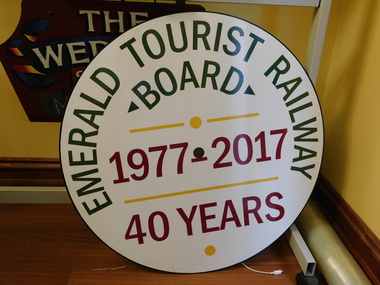
Emerald Tourist Railway Board 1977 - 2017 40 Years - Locomotive Head Board, 2017
... Emerald Tourist Railway Board 1977 - 2017 40 Years - Locomotive Head Board......emerald tourist railway board...Locomotive Head Board - Emerald Tourist Railway Board 1977 - 2017 40 Years Historic - Puffing Billy Railway Locomotive Head Board used in the Celebration of Emerald Tourist Railway Board 1977 - 2017 40 Years EMERALD TOURIST RAILWAY BOARD 1st October 1977 - 1st October 2017 Today marks the 40th anniversary of when the Emerald Tourist Railway Board took over the ownership of Puffing Billy from the Victorian Railways. ...Locomotive Head Board - Emerald Tourist Railway Board 1977 - 2017 40 Years Circular steel sheet with vinyl stickers....Emerald Tourist Railway Board 1977 - 2017 40 Years...Locomotive Head Board - Emerald Tourist Railway Board 1977 - 2017 40 Years Historic - Puffing Billy Railway Locomotive Head Board used in the Celebration of Emerald Tourist Railway Board 1977 - 2017 40 Years EMERALD TOURIST RAILWAY BOARD 1st October 1977 - 1st October 2017 Today marks the 40th anniversary of when the Emerald Tourist Railway Board took over the ownership of Puffing Billy from the Victorian Railways. ...Locomotive Head Board - Emerald Tourist Railway Board 1977 - 2017 40 Years Historic - Puffing Billy Railway Locomotive Head Board used in the Celebration of Emerald Tourist Railway Board 1977 - 2017 40 Years EMERALD TOURIST RAILWAY BOARD 1st October 1977 - 1st October 2017 Today marks the 40th anniversary of when the Emerald Tourist Railway Board took over the ownership of Puffing Billy from the Victorian Railways. Since then Puffing Billy has gone from strength to strength with the last few years seeing a huge increase in passenger numbers. A major investment over the next ten years will see a number of infrastructure projects being completed. A new (restored) locomotive and extra carriages will come into play and hopefully soon, the reopening of Puffing Billy's museum at Menzies Creek. Puffing Billy has been around since 1900. With a minor hiccup in the 1950s and the rebuilding of the railway from Belgrave from the late 1950s to the early 1960s and onwards, the preserved heritage steam railway will hopefully continue to operate for many generations to come. This photo was taken early this morning. The required loco's for the day were still being prepared and all shunting movements had been completed. The first of many passengers were just starting to arrive. Photo & Info : Robert Smith : Past 2 Present A gleaming NA locomotive 14A had the honour of hauling the first E.T.R.B. train while 7A had the last train by the Victorian Railways, both on the 1st October 1977. 7A left Belgrave at 11.10am for Lakeside and 14A left Belgrave at 2.10pm.This train also to Lakeside included the ex Mt Lyell carriage NBL1 for the conveyance of the official party. Both loco's are still operating today. Photo: John E. Thompson (NG #67) Historic - Puffing Billy Railway Locomotive Head Board used in the Celebration of Emerald Tourist Railway Board 1977 - 2017 40 YearsLocomotive Head Board - Emerald Tourist Railway Board 1977 - 2017 40 Years Circular steel sheet with vinyl stickers.Emerald Tourist Railway Board 1977 - 2017 40 Yearspuffing billy, head board, emerald tourist railway board, emerald, 40 years -
 Victorian Railway History Library
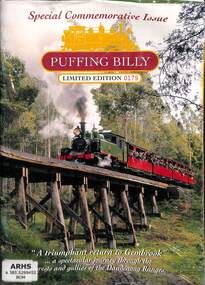
Book, Emerald Tourist Railway Board, Puffing Billy: Special Commemorative Issue: A Triumphant Return to Gembrook, 1998
... Emerald Tourist Railway Board...Puffing Billy: Special Commemorative Issue: A Triumphant Return to Gembrook Book Emerald Tourist Railway Board ...A brief history of the Puffing Billy railway from Upper Fern Tree Gully to Gembrook in Victoria, to commemorate the reopening of the railway from Lakeside to Gembrook in 1998.ill. maps, p.32.non-fictionA brief history of the Puffing Billy railway from Upper Fern Tree Gully to Gembrook in Victoria, to commemorate the reopening of the railway from Lakeside to Gembrook in 1998.preserved locomotives - victoria - history, puffing billy - victoria - history -
 Victorian Railway History Library
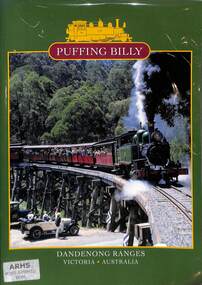
Book, Emerald Tourist Railway Board, Puffing Billy Dandenong Ranges Victoria Australia, 1998
... Emerald Tourist Railway Board...Puffing Billy Dandenong Ranges Victoria Australia Book Emerald Tourist Railway Board ...A brief illustrated history of the 2'6" Puffing Billy railway from Upper Fern Tree Gully to Gembrook in Victoriaill, maps, p.32.non-fictionA brief illustrated history of the 2'6" Puffing Billy railway from Upper Fern Tree Gully to Gembrook in Victoriavr narrow gauge railways - victoria - history, puffing billy - victoria - history -
 Puffing Billy Railway
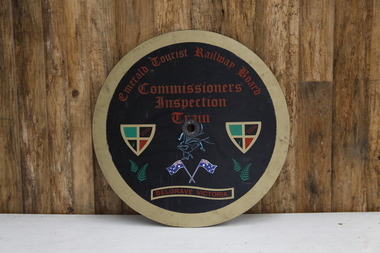
Locomotive Head Board - Commissioners Inspection Train, 1989
... Emerald Tourist Railway Board Commissioners Inspection Train Belgrave Victoria...Climax, Puffing Billy, Commissioners Inspection Train, commissioners special, head board When Made - 1989 Historic - Puffing Billy Railway Locomotive Head Board - use on the Climax Locomotive - Commissioners Inspection Train climax puffing billy commissioners inspection train commissioners special head board Emerald Tourist Railway Board Commissioners Inspection Train Belgrave Victoria Locomotive Head Board - Commissioners Inspection Train Tin head board with gold, black and red vinyl. ...Locomotive Head Board - Commissioners Inspection Train Tin head board with gold, black and red vinyl. Climax, Puffing Billy, Commissioners Inspection Train, commissioners special, head board When Made - 1989 Historic - Puffing Billy Railway Locomotive Head Board - use on the Climax Locomotive - Commissioners Inspection TrainLocomotive Head Board - Commissioners Inspection Train Tin head board with gold, black and red vinyl. Emerald Tourist Railway Board Commissioners Inspection Train Belgrave Victoriaclimax, puffing billy, commissioners inspection train, commissioners special, head board -
 Southern Sherbrooke Historical Society Inc.
Information folder - Puffing Billy Tourist Railway
... emerald tourist railway...emerald tourist railway Information folder containing items pertaining to Puffing Billy. ...Information folder containing items pertaining to Puffing Billy. Contents: -article, 'Behind closed doors', the(melbourne)magazine, undated -article, 'Billy running out of puff, in need of more folding stuff', The Age, 14th Sep 2011 -article, 'Chinese delighted to ride rails on a slow train to Gembrook', The Age, 15th Sep 2011 -article, 'New pal for Puffing Billy', Mail, 27th Mar 2012 -article, 'Train trucked in and on track', Mail, 27th Mar 2012 -article, 'New engine on track for museum', 28th Mar 2012 -article, 'All steamed up over great race', Mail, 2nd May 2-12 -article, 'Billy welcomes funding boost,' Mail, 8th May 2012 -article, 'Photo that fired interest full steam ahead', Free Press, 11th Jul 2012 -article, 'Plenty of puff left,' Mail, 17th Jul 2012 -article, 'Back to the track', Mail, 24th Jul 2012 -letters to editor, Free Press, 12th Sep 2012 -article, 'Billy's best mate', Mail, 29th Jan 2013 -article, 'Thousands run out of puff', Free Press, 8th May 2013 -article, 'Fun run has plenty of puff', Mail, 7th May 2013 -article, 'Puffed up by win', Mail, 14th May 2013emerald tourist railway -
Emerald Museum & Nobelius Heritage Park
Booklet - Souvenir booklet about Puffing Billy, Quest Travel Publishing, 1986
... Emerald... Victoria... Australia...rail services...railway stations...tourism...puffing billy...Puffing Billy Preservation Society...Emerald Lake Park...Emerald Tourist...Emerald Victoria Australia rail services railway stations tourism puffing billy Puffing Billy Preservation Society Emerald Lake Park Emerald Tourist Railway Board Small cardboard souvenir booklet, 12 leaves plus cover, coloured photographs and text -some surface damage and soiling Booklet Souvenir booklet about Puffing Billy Quest Travel Publishing ...Produced as a souvenir for the Puffing Billy Preservation Society. A useful 'potted history'.Small cardboard souvenir booklet, 12 leaves plus cover, coloured photographs and text -some surface damage and soilingemerald, victoria, australia, rail services, railway stations, tourism, puffing billy, puffing billy preservation society, emerald lake park, emerald tourist railway board -
 Puffing Billy Railway
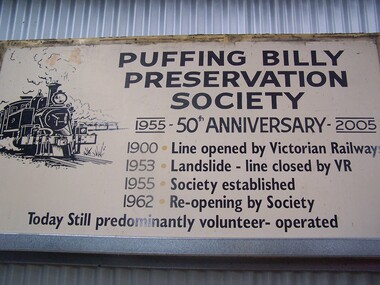
Puffing Billy Preservation Society 50th Anniversary Station Sign, 2005
... With the conversion of the Upper Fern Tree Gully to Belgrave line to broad gauge track, the Puffing Billy Preservation Society was the instigator of restoring the Puffing Billy Railway from Belgrave to Menzies Creek in 1962, Menzies Creek to Emerald in 1965 and Emerald to Lakeside in 1975 and in association with the Emerald Tourist Railway Board, Lakeside to Gembrook in 1998. ...With the conversion of the Upper Fern Tree Gully to Belgrave line to broad gauge track, the Puffing Billy Preservation Society was the instigator of restoring the Puffing Billy Railway from Belgrave to Menzies Creek in 1962, Menzies Creek to Emerald in 1965 and Emerald to Lakeside in 1975 and in association with the Emerald Tourist Railway Board, Lakeside to Gembrook in 1998. ...Puffing Billy Preservation Society 50th Anniversary sign This is the large poster board that was erected at Lakeside to celebrate the 50th Anniversary of the Puffing Billy Preservation Society in 2005. Established in 1955, the Puffing Billy Preservation Society was formed to operate the narrow gauge trains between Upper Fern Tree Gully and Belgrave following the successful Young Sun specials. With the conversion of the Upper Fern Tree Gully to Belgrave line to broad gauge track, the Puffing Billy Preservation Society was the instigator of restoring the Puffing Billy Railway from Belgrave to Menzies Creek in 1962, Menzies Creek to Emerald in 1965 and Emerald to Lakeside in 1975 and in association with the Emerald Tourist Railway Board, Lakeside to Gembrook in 1998. Historic - Puffing Billy Preservation Society - Station Sign - for the 50th Anniversary of the Preservation SocietyPuffing Billy Preservation Society 50th Anniversary sign Large rectangle metal sign - off white back ground with black lettering Puffing Billy Preservation Society 1955 - 50th Anniversary - 2005 1900 . Line opened by Victorian Railways 1953 . Landslide - Line closed by V.R 1955 . Society established 1962 . Re-opened by Society Today still predominantly volunteer - operated puffing billy, preservation society, station sign, 50th anniversary, lakeside station -
 Puffing Billy Railway
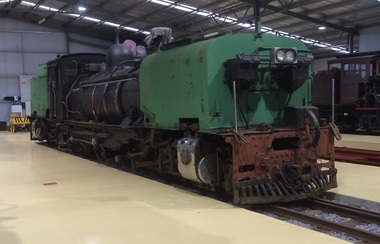
NGG16 No.127 - Garratt Steam Locomotive, 1951
... The Beyer, Peacock locomotives ordered by the SAR, numbers NG109 to NG116 and NG125 to NG131, were shared more or less equally between the Natal and Avontuur lines No. 127 was purchased from the South African Railways by the Emerald Tourist Railway Board for the Puffing Billy Railway in late 2011 / early 2012, together with a container load of spare parts stripped from a derelict NGG16, and prepared for transport to Australia. ...The Beyer, Peacock locomotives ordered by the SAR, numbers NG109 to NG116 and NG125 to NG131, were shared more or less equally between the Natal and Avontuur lines No. 127 was purchased from the South African Railways by the Emerald Tourist Railway Board for the Puffing Billy Railway in late 2011 / early 2012, together with a container load of spare parts stripped from a derelict NGG16, and prepared for transport to Australia. ...No. 127 is a 2'-gauge ex-South African Railways 'NGG16' class Beyer-Garratt locomotive. It was built by Beyer Peacock & Co of Manchester (builder's No.7428 of 1951) to their "Beyer Garratt" patented design of articulated steam locomotive. The South African Railways Class NG G16 2-6-2+2-6-2 of 1937 is a narrow gauge steam locomotive. Between 1937 and 1968, the South African Railways placed 34 Class NG G16 Garratt articulated steam locomotives with a 2-6-2+2-6-2 Double Prairie type wheel arrangement in service on the Avontuur Railway and on the Natal narrow gauge lines - The third order was for a further seven locomotives in 1951, numbered in the range from NG125 to NG131, once again from Beyer, Peacock. These and the subsequent locomotives had welded water and coal bunkers and flat-topped water tanks with rounded top side edges. The Beyer, Peacock locomotives ordered by the SAR, numbers NG109 to NG116 and NG125 to NG131, were shared more or less equally between the Natal and Avontuur lines No. 127 was purchased from the South African Railways by the Emerald Tourist Railway Board for the Puffing Billy Railway in late 2011 / early 2012, together with a container load of spare parts stripped from a derelict NGG16, and prepared for transport to Australia. The spare parts will assist in the restoration of sister NGG16 No.129 in the short term, while No.127 will provide the PBR with the option of restoring a second NGG16 at some future stage, if required. details from http://www.australiansteam.com/BP7428.htmHistoric - Overseas - South African - Narrow Gauge Railways - Steam Locomotive Garratt Steam Locomotive - 2-6-2+2-6-2 Beyer Peacock & Co NGG16 No.127 build No.7428puffing billy, ngg16, sar, beyer peacock & co garratt ngg16 no.127 build no7428, narrow gauge, steam locomotive, garratt -
 Southern Sherbrooke Historical Society Inc.
Information folder - Glen Park
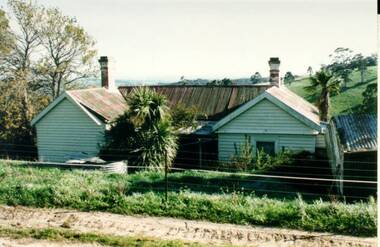
... -Letter, dated 19 June 1996, from Emerald Tourist Railway, re. appeal for restoration of Garratt engine. ...-Letter, dated 19 June 1996, from Emerald Tourist Railway, re. appeal for restoration of Garratt engine. ...Folder containing information pertaining to the history of Glen Park homestead, Menzies Creek. Contents: -two pages photocopied from "That Little Train" by Peter Cuffley, showing four photos of Glen Park homestead and a short history of Edwin Johns at Glen Park (2 copies of each) -articles, "No. 861's full steam ahead again", photo shows Col Rees with Coonara Community School students, and "Living the dream" re. engine no. 861. On verso, "A Family Reunited", article by Emerald Tourist Railway re. locomotives, and "Colin just loves steam locomotion" re. engine no. 861. -4 letters, from Puffing Billy Railway, in support of Col Rees. -Letter, dated 19 June 1996, from Emerald Tourist Railway, re. appeal for restoration of Garratt engine. On verso, copy of certificate awarded to Col Rees for donation to appeal. -Letter, 1 June 1998, re. Garrett appeal. On verso, certificate awarded to Col & Kellie Rees for donation to appeal. -Aerial photo showing proposed property boundaries of Glen Park subdivision. -Aerial photo showing existing property boundaries of Glen Park. NB. last four items provided to society by Col Rees in support of subdivision. -Memorandum dated 2 May 2000 from Graham Whitt, Shire of Yarra Ranges, to Shire Service Centres, re proposed division of Glen Park land. -Fax, dated 13 June 2000, from Southern Sherbrooke Historical Society to Shire of Yarra Ranges, re. intention to make submission. -Letter, dated 14 June 2000, acknowledging receipt of above fax. -Submission, dated 18 June 2000, from Southern Sherbrooke HS, expressing concern re. proposed subdivision of Glen Park. -Fax, dated 27 June 2000, from Dianne Kueffer to Susan Heywood-Downard, Agenda Item 2 of the Yarra Ranges Planning Committee Agenda 14 March 2000, including detailed description of proposed subdivision and map. -Letter, dated 7 July 2000, Shire to Society, re. discussion of Glen Park subdivision by council. -Letter, dated 7 July 2000, Society to Shire, re. withdrawal of objection subject to certain conditions. -Letter, dated 14 July 2000, Shire to Society, re. council resolution to allow subdivision of Glen Park. -Letter, dated 24 October 2000, Shire to Society, stating that amendment to Planning Scheme allowing subdivision was approved by council and gazetted on 19 October 2000. -seven A3 sheets, showing house and property plans for new constructions proposed for Lot 1 of Glen Park subdivision. -diagram, hand-drawn (by Col Rees?) on lined A4 sheet, showing proposed development. -A1 sheet, Plan of feature survey of Lot 2 Blackhill Rd, Selby, dated 12 April 2000, showing contours, vegetation, proposed location of buildings, etc. -Glen Park Homestead and Cyprus Avenue, document prepared for the Shire Of Yarra Ranges by Helen Lardner Conservation & Design P/L, June 2003edwin johns, breen family, col & kellie rees, puffing billy -
 Puffing Billy Railway
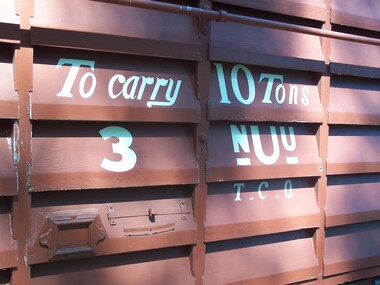
3 NUU - Louvred Truck, 3/12/1900
... In 1977, the remaining vans 3, 10 and 14 were handed over to the Emerald Tourist Railway Board, and removed from Victorian Railways records. ...In 1977, the remaining vans 3, 10 and 14 were handed over to the Emerald Tourist Railway Board, and removed from Victorian Railways records. ...Van 3 NUU - Louvred Truck (11) VR Service History 3/12/1900 NWS Built new Vehicle Length 25 feet 2 inches ( 7671 mm) Coupled Length 27 feet 4 inches (8330 mm) Width 6 feet 3 inches (1905 mm) Weight 7 tons Capacity 10 tons Built 1898 - 1911 Number Built 14 In use 5 To be restored None *NUU 3.VA - 3/12/1900 NWS Built new - / /1926 - To NU 3.VA - NU 3.VA - circa 1926 - Modified AC Malco 1/10/1977 - Off Register To ETRB Sec76/3630 RS77/4223 NUU The standard louvre van design for the Victorian narrow-gauge lines, the NUU vehicles were constructed in three batches; the first seven from 1899 to 1901, an eighth in 1906 and the last six in 1911, for a total class of fourteen. They looked very similar to the U vans of the Broad Gauge, although two photographs[1][2] of NUU 1 show that its body may have been white for some time. NU In 1926 the class was relettered to simply NU, with no changes to numbers. NU 4 was scrapped in 1938, but otherwise the class remained intact until 1954, when seven members (2, 5, 7, 8, 9, 11 and 12) were sold to Coulston & Hyder, who dispersed the wagons among locations on the Wangarrata to Whitfield line. As of 1996, vans 7 and 12 were at Moyhu, while van 11 was destroyed by fire in 1978. Wagons 6 and 1 were scrapped in 1957 and 1958 respectively, while in 1954 van 13 was recorded as being sold to the Puffing Billy Preservation Society. In 1977, the remaining vans 3, 10 and 14 were handed over to the Emerald Tourist Railway Board, and removed from Victorian Railways records. The Puffing Billy Railway now posesses vans 3, 8, 10, 13 and 14. Historic - Victorian Railways Narrow Gauge - Rolling Stock - Louvered VanWooden Louvered Van - Made of Timber on a Wrought iron frame3 NUUpuffing billy, 3 nuu, louvered van, 2'6" guage, victorian railways, narrow gauge rolling stock -
 Puffing Billy Railway
Climax - Geared Steam Locomotive No. 1694, 1928
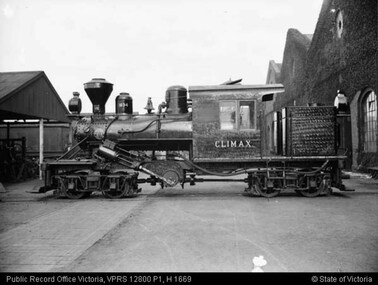
... Loaned to the Puffing Billy Preservation Society for its Steam Museum, it was taken to Menzies Creek in 1965 where it remained until 1982 when the Emerald Tourist Railway Board bought it and transferred it to Belgrave for restoration. ...Loaned to the Puffing Billy Preservation Society for its Steam Museum, it was taken to Menzies Creek in 1965 where it remained until 1982 when the Emerald Tourist Railway Board bought it and transferred it to Belgrave for restoration. ...Climax geared locomotive No. 1694 in active service on special occasions - stored at Emerald Station A Miraculous Survivor Climax locomotive No.1694 is a miraculous survivor of a rare breed of steam locomotive. For about 100 years from the mid-1850s sawn timber was carted from Victorian sawmills to the nearest railway station by timber tramway. These tramways were generally very rough, steeply graded, sharply curved, and of narrow gauge. Many had wooden rails, and horses provided haulage. The better ones used steam locomotives. In all about fifty steam locomotives are known to have worked on Victorian timber tramways. These locomotives were usually somewhat peculiar - made to cope with arduous, rough conditions, rather than speed. Climax locomotive No.1694 is the only one of these locomotives to survive intact. It was built in 1928 by the Climax Manufacturing Company, Corry, Pennsylvania, USA, for the Forests Commission of Victoria. The distinctive feature of the Climax locomotive is that the cylinders do not directly connect to the driving wheels. Instead they drive a cross shaft near the centre of the locomotive. From there the drive is transmitted to the small driving wheels through rotating shafts, universal joints, and bevel gears. The driving wheels are mounted in two four-wheel bogies so that they can easily follow sharp curves in the track. None of these features are found in normal steam locomotives. The result is a locomotive that is extremely powerful for its size, and that will cope with sharp curves and steep grades with ease. But this is at the cost of speed, Climax locomotive No.1694 is just about flat-out at 13 km/h (8 mph). Climax Locomotive Built in 1928 for the Forests Commission of Victoria and painted all-over black with the name CLIMAX painted on the sides of the cab in white block letters, this locomotive was issued to the Tyers Valley tramway which branched off the Moe to Walhalla line at Collins Siding. This locomotive was withdrawn from service in 1949 following the closure of the tramway and in 1950 it travelled from Tyers Junction to Collins Siding to Erica where it remained stored until 1965. Loaned to the Puffing Billy Preservation Society for its Steam Museum, it was taken to Menzies Creek in 1965 where it remained until 1982 when the Emerald Tourist Railway Board bought it and transferred it to Belgrave for restoration. It was returned to service for special use on the Belgrave to Gembrook line in 1988 painted in its original all-over black livery, except that the word “Climax” on the sides of the cab was now painted in the style of the Climax Manufacturing Co., a style that this locomotive had never carried.Historical - Industrial railway - Forests Commission of Victoria, Timber Logging Climax Locomotive Climax geared Steam locomotive made of steel and wrought iron Climax 1694climax locomotive works, climax, geared steam locomotive, puffing billy, climax locomotive no. 1694, steam locomotive -
 Narre Warren and District Family History Group
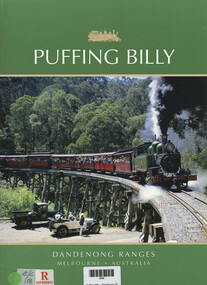
Book, Janette M Bomford, Puffing Billy - Dandenong Ranges, 2005
... Emerald Tourist Board / Puffing Billy Railway...Belgrave Gembrook Lakeside Steam Musuem History of Puffing Billy and its stations with lovely colour photos 31 cm Puffing Billy - Dandenong Ranges Book Janette M Bomford Emerald Tourist Board / Puffing Billy Railway ...History of Puffing Billy and its stations with lovely colour photos31 cmnon-fictionHistory of Puffing Billy and its stations with lovely colour photosbelgrave, gembrook, lakeside, steam musuem -
 Emerald Museum & Nobelius Heritage Park
Postcard, Victoria Stamp Market, Homestead, Emerald near Gembrook, c. 1907
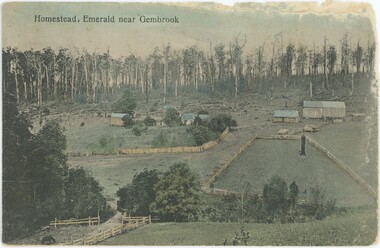
... Brookdale Guest House was one of the first in Emerald, opening in 1901 between Charman and Brookdale Avenues as the railway opened the region for tourists. ...Brookdale Guest House was one of the first in Emerald, opening in 1901 between Charman and Brookdale Avenues as the railway opened the region for tourists. ...This postcard has a hand-coloured image of the Charman family's Brookdale Guest House in Emerald. The original photograph was black and white, and a copy of that version is in the State Library of Victoria. Brookdale Guest House was one of the first in Emerald, opening in 1901 between Charman and Brookdale Avenues as the railway opened the region for tourists. This postcard was created c. 1907, using the colourful view as advertising to draw more tourists to the region. The guesthouse remained open until 1920. V.S.M. (Victorian Stamp Market) produced a number of series of postcards in the early 1910s.This hand-coloured postcard is a rare colourful view of a major site of 1900s-10s Emerald.This postcard holds a hand-coloured photograph taken from the top of a hill, looking at a homestead with a series of buildings and fields. The background recedes into a forest, with other trees in the foreground and around the centre of the homestead. There is a fence-enclosed field in the centre-right with a dead tree in the centre, and a field in the front-left with a grazing horse. There is a caption printed in the top-left, and the reverse is bisected by a vertical line and prepared for writing on but has no message or stamp. There is a brief handwritten annotation on the reverse, alongside an accession number.Obverse, Caption: "Homestead, Emerald near Gembrook" Reverse: Annotation: "Charman's Brookdale Guest House + Farm" Printed, Left: "Printed in Prussia" Printed, Bottom: "V. S. M. Series, Melbourne"emerald, tourism, photography -
Emerald Museum & Nobelius Heritage Park
Photograph - Budding at Gembrook Nurseries, Unknown photographer, 1910s
... Emerald, as local farmers were able to earn funds during the winter by working at the nursery which gave them financial resources while waiting for their own farms to become productive. The need to transport plants and trees to port quickly also contributed to the development of rail infrastructure in the region; C.A. Nobelius was one of thirteen witnesses to the Parliamentary Standing Committee on Railways in 1898 debating a rail connection between Gembrook and Ferntree Gully, which became today's Puffing Billy tourist...Emerald, as local farmers were able to earn funds during the winter by working at the nursery which gave them financial resources while waiting for their own farms to become productive. The need to transport plants and trees to port quickly also contributed to the development of rail infrastructure in the region; C.A. Nobelius was one of thirteen witnesses to the Parliamentary Standing Committee on Railways in 1898 debating a rail connection between Gembrook and Ferntree Gully, which became today's Puffing Billy tourist ...Carl Axel Nobelius established the Gembrook Nurseries in 1886 on sixty-three acres purchased from an original selector after the area's gold rush started to diminish. It was called the Gembrook Nurseries as it was located in the Parish of Gembrook, but it was commonly referred to as the Nobelius nurseries after its founder; especially as control of the remaining portions of the nurseries remained with the Nobelius family until 1955. The Nobelius Nurseries had a substantial impact on the development of the township of Emerald, as local farmers were able to earn funds during the winter by working at the nursery which gave them financial resources while waiting for their own farms to become productive. The need to transport plants and trees to port quickly also contributed to the development of rail infrastructure in the region; C.A. Nobelius was one of thirteen witnesses to the Parliamentary Standing Committee on Railways in 1898 debating a rail connection between Gembrook and Ferntree Gully, which became today's Puffing Billy tourist service. The nurseries occupied 280 acres at their peak in 1905, with more than one million trees available for sale at that time. The nursery focused on exotic fruit and ornamental species which were supplied to public parks and gardens all over the world. In several cases the nurseries were the first suppliers of the trees in Australia. Sales records show that trees were supplied to clients in Europe, Asia, the United States, Africa and New Zealand, as well as to many Councils and Government organisations around Australia, such as Melbourne's Fitzroy Gardens and Royal Botanic Gardens. Portions of the Gembrook Nurseries were sold at different times throughout the Twentieth Century, with the Emerald Country Club and Emerald Lake Park both occupying portions of the original land. In 1981 the final twelve acres were purchased by the Shire of Sherbrooke in recognition to be used as a heritage landmark in recognition of the site's significance.The photograph is significant because it depicts work processes at the Gembrook Nurseries during the early decades of the Twentieth Century; a period in which the nurseries were the leading Southern-hemisphere supplier of plants and trees to public gardens around the world. The photograph may also depict Carl Axel Nobelius overseeing his workers, which gives insights into work practices and social dynamics of the time.Black and white rectangular photograph printed on photographic paper. The photograph of a postcard or newspaper clipping depicts twelve men in clothes associated with the first decades of the Twentieth Century undertaking planting or other field work under the gaze of a man in a suit and top hat. The item is captioned 'Budding at Gembrook Nurseries.'Obverse: BUDDING AT GEMBROOK NURSERIES. /1910s, 1900s, 1890s, 1880s, 1886, 1905, carl axel nobelius, nobelius nursery, gembrook nurseries, emerald country club, emerald lake park, fruit growing, trees, farming -
Emerald Museum & Nobelius Heritage Park
Photograph - Gembrook Nurseries, 1908-1912, Unknown photographer, 1908-1912
... Emerald, as local farmers were able to earn funds during the winter by working at the nursery which gave them financial resources while waiting for their own farms to become productive. The need to transport plants and trees to port quickly also contributed to the development of rail infrastructure in the region; C.A. Nobelius was one of thirteen witnesses to the Parliamentary Standing Committee on Railways in 1898 debating a rail connection between Gembrook and Ferntree Gully, which became today's Puffing Billy tourist...Emerald, as local farmers were able to earn funds during the winter by working at the nursery which gave them financial resources while waiting for their own farms to become productive. The need to transport plants and trees to port quickly also contributed to the development of rail infrastructure in the region; C.A. Nobelius was one of thirteen witnesses to the Parliamentary Standing Committee on Railways in 1898 debating a rail connection between Gembrook and Ferntree Gully, which became today's Puffing Billy tourist ...Carl Axel Nobelius established the Gembrook Nurseries in 1886 on sixty-three acres purchased from an original selector after the area's gold rush started to diminish. It was called the Gembrook Nurseries as it was located in the Parish of Gembrook, but it was commonly referred to as the Nobelius nurseries after its founder; especially as control of the remaining portions of the nurseries remained with the Nobelius family until 1955. The Nobelius Nurseries had a substantial impact on the development of the township of Emerald, as local farmers were able to earn funds during the winter by working at the nursery which gave them financial resources while waiting for their own farms to become productive. The need to transport plants and trees to port quickly also contributed to the development of rail infrastructure in the region; C.A. Nobelius was one of thirteen witnesses to the Parliamentary Standing Committee on Railways in 1898 debating a rail connection between Gembrook and Ferntree Gully, which became today's Puffing Billy tourist service. The nurseries occupied 280 acres at their peak in 1905, with more than one million trees available for sale at that time. The nursery focused on exotic fruit and ornamental species which were supplied to public parks and gardens all over the world. In several cases the nurseries were the first suppliers of the trees in Australia. Sales records show that trees were supplied to clients in Europe, Asia, the United States, Africa and New Zealand, as well as to many Councils and Government organisations around Australia, such as Melbourne's Fitzroy Gardens and Royal Botanic Gardens. Portions of the Gembrook Nurseries were sold at different times throughout the Twentieth Century, with the Emerald Country Club and Emerald Lake Park both occupying portions of the original land. In 1981 the final twelve acres were purchased by the Shire of Sherbrooke in recognition to be used as a heritage landmark in recognition of the site's significance.The photograph is significant because it demonstrates the extent of stock cultivation at the Gembrook Nurseries during the early decades of the Twentieth Century; a period in which the nurseries were the leading Southern-hemisphere supplier of plants and trees to public gardens around the world. Museum acquisition records indicate this photograph was taken in the period 1908-1912.Black and white rectangular photograph printed on photographic paper. The photograph depicts a central view of cultivated fields and trees along the skyline at the Gembrook Nurseries in approximately 1908-1912.Obverse: Gembrook Nurseries - Central View /1900s, 1910s, farming, agriculture, trees, gembrook nurseries, carl axel nobelius, emerald park lake, emerald country club, parish of gembrook, fitzroy gardens, royal botanic gardens, melbourne, shire of sherbrooke -
Emerald Museum & Nobelius Heritage Park
Photograph - Nobelius Nursery Packing Shed, Unknown photographer, 1970s
... The photograph is significant because it depicts infrastructure associated with the Gembrook or Nobelius Nurseries, a business which was instrumental to the development of Emerald as a settlement in the 19th and 20th Centuries and also influenced the development of public and private gardens and the farming of several species in Australia and internationally. The Nobelius Nursery is listed on the Victorian Heritage Register. The image appears to show the Packing Shed building prior to its restoration as a tourist facility. 1970s Gembrook Nurseries Puffing Billy Railway ...The Gembrook Nurseries, informally known as the Nobelius Nurseries after the founder Carl Axel Nobelius, began with the purchase of sixty-three acres in 1886 and boomed in the 1890s due to opportunities provided by employment-promoting schemes to develop public parks and gardens and street shade by local and State Governments around Australia. Trees were sold to more than forty councils and Government organisations in the 1890s, including the Department of Agriculture, Lands Department and Victorian Railways. The need to transport nursery products by train via Ferntree Gully rather than by bullock dray to Narre Warren was a factor in the successful petition to develop what is now known as the Puffing Billy Railway. Railway developments in 1900 included the creation of a siding and Packing Shed, known as Nobelius Station, which is featured in this photograph. The Packing Shed was able to handle 250,000 cases of fruit each year at the height of the nurseries' activities. The image shows the Packing Shed with boarded-up windows, suggesting it was taken prior to the purchase of the facility for use in the Puffing Billy Railway service. Gembrook Nurseries had an indirect influence on the development of other farms and industries in the region. As a wholesale nursery with high sales volumes it was an important employer of local people. Peak season for employees was during the cooler months, during most farmers' off-season. This provided local farmers with a source of income while their own farms were becoming established.The photograph is significant because it depicts infrastructure associated with the Gembrook or Nobelius Nurseries, a business which was instrumental to the development of Emerald as a settlement in the 19th and 20th Centuries and also influenced the development of public and private gardens and the farming of several species in Australia and internationally. The Nobelius Nursery is listed on the Victorian Heritage Register. The image appears to show the Packing Shed building prior to its restoration as a tourist facility.Black and white rectangular photograph printed on print media paper. The image depicts the Gembrook Nurseries Packing Shed building with boarded up windows.Obverse: NOBELIUS NURSERIES / . WEEKEND TRADING . /1970s, gembrook nurseries, puffing billy railway, carl axel nobelius, packing shed, railway stations, farming, agriculture -
Emerald Museum & Nobelius Heritage Park
Photograph - Nobelius Packing Shed, Unknown photographer
... The photograph is significant because it depicts infrastructure associated with the Gembrook or Nobelius Nurseries, a business which was instrumental to the development of Emerald as a settlement in the 19th and 20th Centuries and also influenced the development of public and private gardens and the farming of several species in Australia and internationally. The Nobelius Nursery is listed on the Victorian Heritage Register. The image appears to show the Packing Shed building prior to its restoration as a tourist facility. Gembrook Nurseries Puffing Billy Railway ...The Gembrook Nurseries, informally known as the Nobelius Nurseries after the founder Carl Axel Nobelius, began with the purchase of sixty-three acres in 1886 and boomed in the 1890s due to opportunities provided by employment-promoting schemes to develop public parks and gardens and street shade by local and State Governments around Australia. Trees were sold to more than forty councils and Government organisations in the 1890s, including the Department of Agriculture, Lands Department and Victorian Railways. The need to transport nursery products by train via Ferntree Gully rather than by bullock dray to Narre Warren was a factor in the successful petition to develop what is now known as the Puffing Billy Railway. Railway developments in 1900 included the creation of a siding and Packing Shed, known as Nobelius Station, which is featured in this photograph. The Packing Shed was able to handle 250,000 cases of fruit each year at the height of the nurseries' activities. The image shows the Packing Shed prior to the purchase of the facility for use in the Puffing Billy Railway service. Gembrook Nurseries had an indirect influence on the development of other farms and industries in the region. As a wholesale nursery with high sales volumes it was an important employer of local people. Peak season for employees was during the cooler months, during most farmers' off-season. This provided local farmers with a source of income while their own farms were becoming established.The photograph is significant because it depicts infrastructure associated with the Gembrook or Nobelius Nurseries, a business which was instrumental to the development of Emerald as a settlement in the 19th and 20th Centuries and also influenced the development of public and private gardens and the farming of several species in Australia and internationally. The Nobelius Nursery is listed on the Victorian Heritage Register. The image appears to show the Packing Shed building prior to its restoration as a tourist facility.Black and white rectangular photograph printed on print media paper. The image depicts the Gembrook Nurseries Packing Shed building. The building is made from weatherboard and features a brick chimney. There is also a tall tree standing next to the chimney.Obverse: IUS NURSERIES / TRADING ... /gembrook nurseries, puffing billy railway, carl axel nobelius, packing shed, railway stations, farming, agriculture -
Emerald Museum & Nobelius Heritage Park
Photograph - Shell Service Station, Unknown photographer, 1990s
... Emerald is the history of the Gembrook or Nobelius Nurseries, which transported trees and other plants to parks and private gardens in Melbourne, in other Australian locations and in many other countries. Impassable roads to transport goods in Winter, and the difficulty of transporting goods by bullock team or horse and cart over a route that at that time went via the railway station at Narre Warren led to Carl Axel Nobelius and other local business owners successfully lobbying the Victorian Government to build the narrow gauge railway to the Ferntree Gully line that is now operated as the tourist attraction 'Puffing Billy.' ...Emerald is the history of the Gembrook or Nobelius Nurseries, which transported trees and other plants to parks and private gardens in Melbourne, in other Australian locations and in many other countries. Impassable roads to transport goods in Winter, and the difficulty of transporting goods by bullock team or horse and cart over a route that at that time went via the railway station at Narre Warren led to Carl Axel Nobelius and other local business owners successfully lobbying the Victorian Government to build the narrow gauge railway to the Ferntree Gully line that is now operated as the tourist attraction 'Puffing Billy.' ...The township of Emerald was settled after gold was discovered in the area in 1858. Emerald's 'square mile' was established and roads between the township, other towns in the region and Melbourne were established (with alterations to the original layout in the intervening years). From these first years of the settlement roads and services to support the transport of goods (from businesses making and repairing carts and drays to mechanics' workshops to service cars and industrial vehicles) were integral to the economic survival and development of the township. Closely associated with the history of Emerald is the history of the Gembrook or Nobelius Nurseries, which transported trees and other plants to parks and private gardens in Melbourne, in other Australian locations and in many other countries. Impassable roads to transport goods in Winter, and the difficulty of transporting goods by bullock team or horse and cart over a route that at that time went via the railway station at Narre Warren led to Carl Axel Nobelius and other local business owners successfully lobbying the Victorian Government to build the narrow gauge railway to the Ferntree Gully line that is now operated as the tourist attraction 'Puffing Billy.' Puffing Billy was primarily a goods transport service, but did transport passengers in both directions of travel for both everyday needs and recreational purposes. The Puffing Billy service did not remove the need for local families and businesses to provide their own transport options, however, whenever they needed to move smaller loads or to access places not served by the railway lines or stations. In the late Nineteenth and early Twentieth Centuries transport options included carts of various sizes pulled by horses, oxen or bullocks. In the 1920s and 1930s cars (which had existed in Australia in early forms from approximately 1896) began to replace horses as the primary mode of transportation across Australia. By the end of the Second World War cars dominated transport options in rural areas as well as urban. Correspondingly, businesses to service vehicles shifted from focusing on repairs and maintenance of harnesses and cart structures to the repair and servicing of cars and other vehicles. Museum records indicate that the image was taken in the Shell Service Station in Emerald in approximately 1990. There is still a Shell Service Station in Emerald, located at 336-338 Belgrave-Gembrook Road, though it is now part of the Coles Express network.This image is significant because it provides insights into the development of automotive and engineering workshop businesses in the region, part of the progression from wheelwright and cartwright businesses in the days of oxen drays to businesses servicing cars and other vehicles. As part of this, it also provides insight into the equipment available at the time the photograph was taken, which is speculated to be the late 1980s or early 1990s. Identification of the two men pictured may also help ascertain the significance of the image.Black and white rectangular photograph printed on print media paper. The image depicts two men standing in front of a piece of mechanic's workshop equipment on which a Bridgestone tyre has been loaded. One of the men is wearing long-sleeved overalls, the other is wearing dark trousers and a polo-neck T-shirt. Museum records indicate the photograph may have been taken at the Shell Service Station.Obverse: BRIDGESTONE / SF-340 EAGER /emerald, victoria, australia, transport, automotive services, shell service station, cars, motor vehicles, puffing billy, businesses, local business -
Emerald Museum & Nobelius Heritage Park
Map - Visitor Guide Map, Blue Dandenongs Visitor Location Guide Map, 1979-1980
... Emerald Victoria Australia Dandenong Ranges Victoria Australia tourism Puffing Billy Railway Bimbimbie Wildlife Park Macclesfield Trout Farm Emerald Lake Park Folded black and white tourist map. ...Document is labelled 'Draft'. Future status unknown.Folded black and white tourist map. Includes descriptive text and advertising. Draft.emerald, victoria, australia, dandenong ranges, victoria, australia, tourism, puffing billy railway, bimbimbie wildlife park, macclesfield trout farm, emerald lake park -
Emerald Museum & Nobelius Heritage Park
Photograph - Nursery below 'Carramar', Unknown photographer, 1910s
... Emerald, as local farmers were able to earn funds during the winter by working at the nursery which gave them financial resources while waiting for their own farms to become productive. The need to transport plants and trees to port quickly also contributed to the development of rail infrastructure in the region; C.A. Nobelius was one of thirteen witnesses to the Parliamentary Standing Committee on Railways in 1898 debating a rail connection between Gembrook and Ferntree Gully, which became today's Puffing Billy tourist...Emerald, as local farmers were able to earn funds during the winter by working at the nursery which gave them financial resources while waiting for their own farms to become productive. The need to transport plants and trees to port quickly also contributed to the development of rail infrastructure in the region; C.A. Nobelius was one of thirteen witnesses to the Parliamentary Standing Committee on Railways in 1898 debating a rail connection between Gembrook and Ferntree Gully, which became today's Puffing Billy tourist ...Carl Axel Nobelius established the Gembrook Nurseries in 1886 on sixty-three acres purchased from an original selector after the area's gold rush started to diminish. It was called the Gembrook Nurseries as it was located in the Parish of Gembrook, but it was commonly referred to as the Nobelius nurseries after its founder; especially as control of the remaining portions of the nurseries remained with the Nobelius family until 1955. The Nobelius Nurseries had a substantial impact on the development of the township of Emerald, as local farmers were able to earn funds during the winter by working at the nursery which gave them financial resources while waiting for their own farms to become productive. The need to transport plants and trees to port quickly also contributed to the development of rail infrastructure in the region; C.A. Nobelius was one of thirteen witnesses to the Parliamentary Standing Committee on Railways in 1898 debating a rail connection between Gembrook and Ferntree Gully, which became today's Puffing Billy tourist service. The nurseries occupied 280 acres at their peak in 1905, with more than one million trees available for sale at that time. The nursery focused on exotic fruit and ornamental species which were supplied to public parks and gardens all over the world. In several cases the nurseries were the first suppliers of the trees in Australia. Sales records show that trees were supplied to clients in Europe, Asia, the United States, Africa and New Zealand, as well as to many Councils and Government organisations around Australia, such as Melbourne's Fitzroy Gardens and Royal Botanic Gardens. Emerald Museum records indicate that this photograph of the Gembrook Nursery was taken in the vicinity of Carramar, the family home built by Carl Axel Nobelius. The sixteen-room mansion was one of the premier estates in the region and was visited by guests including Dame Nellie Melba and the Governor of Victoria, Sir Reginald Talbot. The building still stands amongst gardens that feature original Gembrook Nurseries plantings. Portions of the Gembrook Nurseries (and the Carramar estate) were sold at different times throughout the Twentieth Century, with the Emerald Country Club and Emerald Lake Park both occupying portions of the original land. In 1981 the final twelve acres were purchased by the Shire of Sherbrooke in recognition to be used as a heritage landmark in recognition of the site's significance.The photograph is significant because it depicts the built environment and stock cultivation at the Gembrook Nurseries during the early decades of the Twentieth Century; a period in which the nurseries were the leading Southern-hemisphere supplier of plants and trees to public gardens around the world. Museum acquisition records indicate this photograph was taken in the vicinity of the 'Carramar' estate, the home of the Nobelius family.Black and white rectangular photograph printed on photographic paper. The photograph depicts cultivated fields, roads, fencing and buildings at the Gembrook Nurseries; in the vicinity of the 'Carramar' estate.Obverse: 70 / (?) nt /1910s, 1890s, 1900s, carl axel nobelius, gembrook nurseries, nobelius nursery, carramar, farming, buildings, agriculture, dame nellie melba, reginald talbot, emerald country club, emerald lake park, shire of sherbrooke -
 Emerald Museum & Nobelius Heritage Park
Postcard, Nursery, Emerald, c. 1909
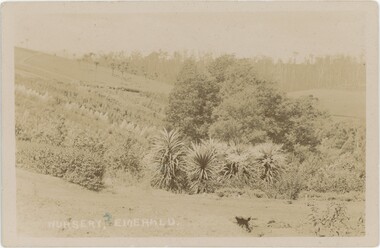
... Emerald in 1908 and then sent on from Beaconsfield in 1909. This postcard captures a view of Nobelius' nursery in full operation, taken from a perspective of tourist appeal as a symbol of the town. Emerald Nobelius Nursery Agriculture 1900s Address: "ADDRESS / Miss h [illegible] / Beaconsfield / Railway ...Based on the 1901-issued stamp, this postcard most likely originates from the 1900s. The featuring of the nursery - almost certainly Carl Axel Nobelius' nursery - in a postcard indicates its importance to the identity of Emerald in this time, becoming a recognisable major feature of the town. Dates written on the postcard suggest it could have been sent on the 27th of February, 1909, but given its message is wishing the recipient a merry Christmas this may not be accurate unless it was sent from Emerald in 1908 and then sent on from Beaconsfield in 1909.This postcard captures a view of Nobelius' nursery in full operation, taken from a perspective of tourist appeal as a symbol of the town.This item is a faded sepia postcard depicting a view from a hill over a sprawling orchard in the valley. Tall natural trees grow in the background, behind the extensive landscape of ordered fruit trees. There is a patch of bare earth and small plants in the foreground. On the reverse, there is a handwritten Christmas and New Years message.Address: "ADDRESS / Miss h [illegible] / Beaconsfield / Railway Station / Vic" Message: "CORRESPONDENCE / Dear Mary / From Aunt [illegible] / Best wishes for / a merry xmas & / a bright happy / new year / J & M.J. Craig[?] / Emerald" Caption: "NURSERY, EMERALD"emerald, nobelius nursery, agriculture, 1900s -
 Emerald Museum & Nobelius Heritage Park
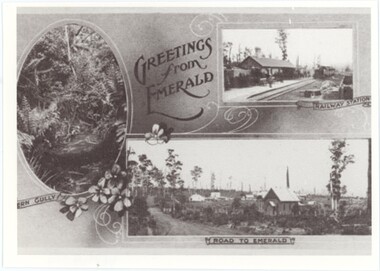
Postcard, Greetings from Emerald, 1913-1920
... Emerald' dates this postcard to after 1913, but otherwise sparse Main Street mean it's unlikely to be much later; specifically, the absence of a post office next to the church means this photograph was almost certainly taken in the 1910s. There is another copy of this postcard in our collection: VEMUP1014.1 This postcard is an example of tourist advertising in early Emerald, highlighting what was seen as valuable or attractive about the town in the 1910s. Emerald 1910s Obverse: Centre: "GREETINGS from EMERALD" Left, cut-off: "ERN GULLY" Top-Right: "RAILWAY ...We were unable to find any other copies of this postcard, or any information about it, with our surface-level search. The presence of the Church of Christ in 'Road to Emerald' dates this postcard to after 1913, but otherwise sparse Main Street mean it's unlikely to be much later; specifically, the absence of a post office next to the church means this photograph was almost certainly taken in the 1910s. There is another copy of this postcard in our collection: VEMUP1014.1This postcard is an example of tourist advertising in early Emerald, highlighting what was seen as valuable or attractive about the town in the 1910s.This black and white postcard copy centres on a greeting, surrounded by three images framed by decorations including a number of flowers. Each image includes a a caption in a scroll text display. One image (o the left) depicts ferns and other plants around a waterway. The image in the bottom-right shows a road with several buildings along its right side and trees in the background. The image in the top-right depicts a railway station with a steam train arriving.Obverse: Centre: "GREETINGS from EMERALD" Left, cut-off: "ERN GULLY" Top-Right: "RAILWAY STATION" Bottom-Right: "ROAD TO EMERALD"emerald, 1910s -
 Emerald Museum & Nobelius Heritage Park
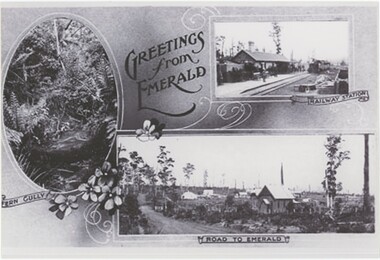
Photograph, Greetings from Emerald, 1913-1920
... Emerald' dates this postcard to after 1913, but otherwise sparse Main Street mean it's unlikely to be much later; specifically, the absence of a post office next to the church means this photograph was almost certainly taken in the 1910s. There is another copy of this postcard in our collection: VEMUP1014 This postcard is an example of tourist advertising in early Emerald, highlighting what was seen as valuable or attractive about the town in the 1910s. Emerald 1910s Obverse: Centre: "GREETINGS from EMERALD" Left: "FERN GULLY" Top-Right: "RAILWAY ...We were unable to find any other copies of this postcard, or any information about it, with our surface-level search. The presence of the Church of Christ in 'Road to Emerald' dates this postcard to after 1913, but otherwise sparse Main Street mean it's unlikely to be much later; specifically, the absence of a post office next to the church means this photograph was almost certainly taken in the 1910s. There is another copy of this postcard in our collection: VEMUP1014This postcard is an example of tourist advertising in early Emerald, highlighting what was seen as valuable or attractive about the town in the 1910s.This black and white postcard copy centres on a greeting, surrounded by three images framed by decorations including a number of flowers. Each image includes a a caption in a scroll text display. One image (o the left) depicts ferns and other plants around a waterway. The image in the bottom-right shows a road with several buildings along its right side and trees in the background. The image in the top-right depicts a railway station with a steam train arriving.Obverse: Centre: "GREETINGS from EMERALD" Left: "FERN GULLY" Top-Right: "RAILWAY STATION" Bottom-Right: "ROAD TO EMERALD" Reverse: "10 27 EM8180~1.JPG 9 16.12.06 18.12.06"emerald, 1910s -
 Emerald Museum & Nobelius Heritage Park
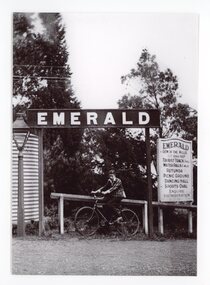
Photograph - Photographic prints of Emerald Railway Station and Selby Trestle Bridge, John Charles Rees, 1930s
... These photos taken in the 1930s show the Emerald Station with a list of Emerald tourist sites of the period and the trestle bridge with almost no residential development evident. 1930s Selby Trestle Bridge John Charles Rees Emerald Railway Station 1. ...Photos were taken in 1930s. John Charles Rees (17/12/1914-27/3/1969) was the photographer - except presumably for the photograph in which he is featured sitting on the trestle bridge. He used to cycle from Oakleigh to the Dandenong Ranges at weekends. Donated by his daughter in law, Val Rees.These photos taken in the 1930s show the Emerald Station with a list of Emerald tourist sites of the period and the trestle bridge with almost no residential development evident.1. Black and white prints of an unnamed cyclist at Emerald Railway Station. An 'Emerald' sign and a sign detailing local attractions are visible. (Two different sized copies) 2. Black and white print of John Charles Rees sitting on Selby Trestle Bridge 3. Black and white print of Selby Trestle Bridge taken from the bridge. 1930s, selby trestle bridge, john charles rees, emerald railway station
