
Showing 91 items matching "fire station (first)"
-
 Buninyong & District Historical Society
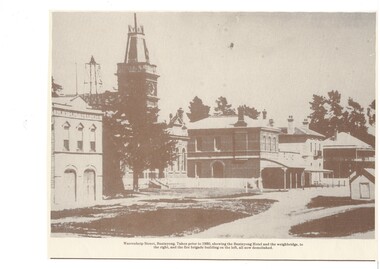
Print - Sepia print for calendar, Town Hall precinct, 1890's, Town Hall Precinct, Learmonth St. 1890's
... ...Fire Station (first)...Town Hall Precinct Fire Station (first) Whykes Butchers Buninyong Hotel weighbridge National Bank Inscription "Warrenheip Street, Buninyong. ...buildingsPrint of Town Hall Precinct, Learmonth St. 1890's. Printed for calendar, mis-lInscription "Warrenheip Street, Buninyong. Taken prior to 1930, showing the Buninyong Hotel and the weighbridge, to the right, and the fire brigade building on the left, all now demolished." Inscription is inaccurate, it is Learmonth St. the brick building centre is Whyke's Butchers, built 1893, and the fire station burnt down in 1989, dating photo more accurately to 1890's.learmonth st., town hall precinct, fire station (first), whykes butchers, buninyong hotel, weighbridge, national bank -
 Buninyong & District Historical Society
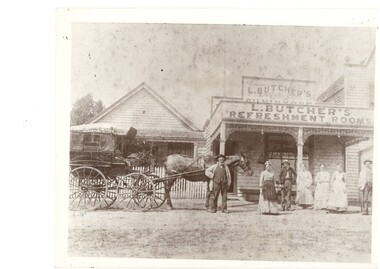
Photograph - Black and white photograph streetscape and people, Horse drawn cab and several residents outside Butcher's Refreshment Rooms 1890's
... This photograph shows Butcher's Refreshment Rooms and part of the First Fire Station in Learmonth Street circa 1890...This photograph shows Butcher's Refreshment Rooms and part of the First Fire Station in Learmonth Street circa 1890 This photograph shows a prominent early business and part of the first Fire Station in Learmonth Street 1890s Butcher's Refreshment Rooms Learmonth Street Old Fire Station Horse drawn Cab Transport L. ...This photograph shows Butcher's Refreshment Rooms and part of the First Fire Station in Learmonth Street circa 1890This photograph shows a prominent early business and part of the first Fire Station in Learmonth Street 1890sHorse drawn cab and several residents outside Butcher's Refreshment Rooms and residence in Learmonth Street Buninyong 1890'sL. Butcher's Refreshment Roomsbutcher's refreshment rooms, learmonth street old fire station, horse drawn cab, transport -
 Buninyong & District Historical Society
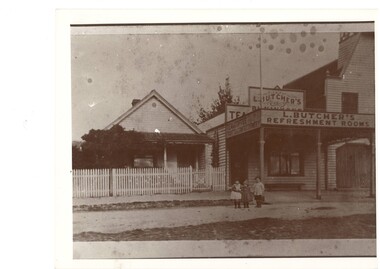
Photograph - Black and white photograph streetscape, Butcher's Refreshment Rooms and residence 1890's
... This photograph shows Butcher's Refreshment Rooms and part of the First Fire Station in Learmonth Street circa 1890...This photograph shows Butcher's Refreshment Rooms and part of the First Fire Station in Learmonth Street circa 1890 This photograph shows a prominent early business and part of the first Fire Station in Learmonth Street 1890s Butcher's Refreshment Rooms Learmonth Street Old Fire Station L. ...This photograph shows Butcher's Refreshment Rooms and part of the First Fire Station in Learmonth Street circa 1890This photograph shows a prominent early business and part of the first Fire Station in Learmonth Street 1890sButcher's Refreshment Rooms and residence in Learmonth Street Buninyong 1890'sL. Butcher's Refreshment Rooms, Tea & Coffee, Fruits and Confectionerybutcher's refreshment rooms, learmonth street old fire station -
 Tatura Irrigation & Wartime Camps Museum
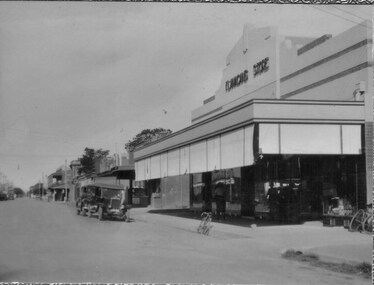
Photos, Hogan Street Tatura
... |Flanagans Store c.1935, showing shop on corner and possibly the first fire station on N.E. corner of Ross & Hogan Streets....|Flanagans Store c.1935, showing shop on corner and possibly the first fire station on N.E. corner of Ross & Hogan Streets. ...Early Tatura photos emailed.|Hogan Street looking east from railway line, c.1910.|Flanagans Store c.1935, showing shop on corner and possibly the first fire station on N.E. corner of Ross & Hogan Streets.|Hogan Street looking west from railway line c.1910(2).|Flanagans' Store on cnr. Ross and Hogan Streets, c.1910.tatura, hogan street, flanagans store, local, history -
 Charlton Golden Grains Museum Inc
Photograph, c.1890
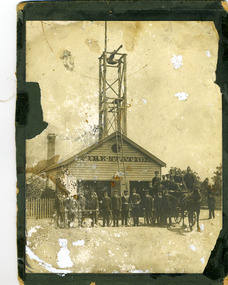
... Sepia photo taken c.1890 of Charlton's first fire station. Fire station replaced in c.1930 with a £1200 Fire Station after inspection by Chief Officer Chellew. ...Sepia photo taken c.1890 of Charlton's first fire station. Fire station replaced in c.1930 with a £1200 Fire Station after inspection by Chief Officer Chellew. ...Sepia photo taken c.1890 of Charlton's first fire station. Fire station replaced in c.1930 with a £1200 Fire Station after inspection by Chief Officer Chellew. A wooden fire station with a tall bell tower. In front are 19 brigade members. There is also a horse drawn fire cart in front with 6 members on. 4 members have two hand drawn fire carts which are ready to roll out. Firemen are dressed in uniform.The sepia portrait photo is mounted on green card. Both the card an photo show extensive damage."Fire Station" across the front of buildingcharlton fire station, charlton, fire, charlton fire brigade -
 Charlton Golden Grains Museum Inc
Photograph, c.1890
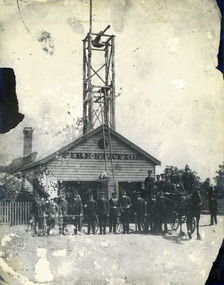
... Sepia photo taken c.1890 of Charlton's first fire station. Fire station replaced in c.1930 with a £1200 Fire Station after inspection by Chief Officer Chellew. ...Sepia photo taken c.1890 of Charlton's first fire station. Fire station replaced in c.1930 with a £1200 Fire Station after inspection by Chief Officer Chellew. ...Sepia photo taken c.1890 of Charlton's first fire station. Fire station replaced in c.1930 with a £1200 Fire Station after inspection by Chief Officer Chellew. A wooden fire station with a tall bell tower. In front are 19 brigade members. There is also a horse drawn fire cart in front with 6 members on. 4 members have two hand drawn fire carts which are ready to roll out. Firemen are dressed in uniform.The b/w portrait photo is a close up of the original photo. The photo shows extensive damage."Fire Station" across the front of buildingcharlton fire station, charlton, fire, charlton fire brigade -
 Emerald Museum & Nobelius Heritage Park
Equipment - Air-Viva Resuscitator, c.1950s - 1960s
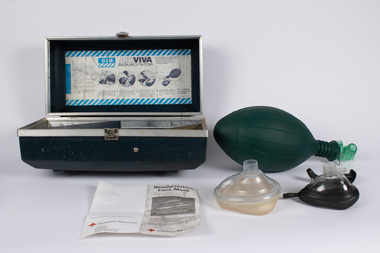
... Fire Brigade which was established on 14 March 1941 as the Emerald Bush Brigade. Originally its equipment was stored at Madigan's butcher's shop near the corner of Monbulk Road. The Brigade's first fire station...Fire Brigade which was established on 14 March 1941 as the Emerald Bush Brigade. Originally its equipment was stored at Madigan's butcher's shop near the corner of Monbulk Road. The Brigade's first fire station ...This resuscitation kit was donated by the Emerald Fire Brigade which was established on 14 March 1941 as the Emerald Bush Brigade. Originally its equipment was stored at Madigan's butcher's shop near the corner of Monbulk Road. The Brigade's first fire station was built around 1945. In 1966, this station was recorded as containing the fire truck and a Land rover pumper, three radio sets, 40 knapsacks, six lengths of hose, helmets, rake hoes and other hand tools. In 2010, the Brigade moved into a new purpose-built building in Monbulk Road. This resuscitation kit dates from the 1960s to 1970s.This resuscitation kit was used by members of a crucial volunteer fire fighting service operating in the Emerald district since 1941.A resuscitator kit made by Air-Viva, contained in a blue box and consisting of two face shield masks, a manual squeeze pump and throat opening device. Also contains Australian Red Cross instructions and CIG Air-Viva Resuscitator instructions Air Viva Resuscitator 'Made in Australia' on the outside of the box. Printed instructions from Australian Red Cross and CIG contained withinfire fighting, emerald fire brigade, cfa -
 Emerald Museum & Nobelius Heritage Park
Tool - Fire Fighters Beaters, c.1950s - 1960s
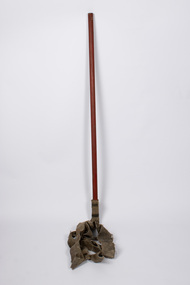
... Fire Brigade which was established on 14 March 1941 as the Emerald Bush Brigade. Originally its equipment was stored at Madigan's butcher's shop near the corner of Monbulk Road. The Brigade's first fire station...Fire Brigade which was established on 14 March 1941 as the Emerald Bush Brigade. Originally its equipment was stored at Madigan's butcher's shop near the corner of Monbulk Road. The Brigade's first fire station ...This pair of fire fighters beaters were donated by the Emerald Fire Brigade which was established on 14 March 1941 as the Emerald Bush Brigade. Originally its equipment was stored at Madigan's butcher's shop near the corner of Monbulk Road. The Brigade's first fire station was built around 1945. In 1966, this station was recorded as containing the fire truck and a Land rover pumper, three radio sets, 40 knapsacks, six lengths of hose, helmets, rake hoes and other hand tools. In 2010, the Brigade moved into a new purpose-built building in Monbulk Road. These beaters date from the 1950s to 1960s.These fire fighters beaters were used by members of a crucial volunteer fire fighting service operating in the Emerald district since 1941.Two Firefighter Beaters each consisting of a long round, red wooden pole with wide heavy-duty textile straps attached to the bottom of the pole. One has wire attached at the top of the pole for hanging purposes. Nonefire fighting, emerald fire brigade, cfa -
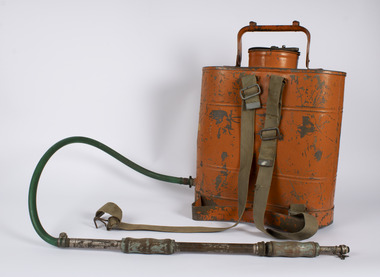 Emerald Museum & Nobelius Heritage Park
Tool - Fire Extinguisher, c. 1960s
... Fire Brigade which was established on 14 March 1941 as the Emerald Bush Brigade. Originally its equipment was stored at Madigan's butcher's shop near the corner of Monbulk Road. The Brigade's first fire station...Fire Brigade which was established on 14 March 1941 as the Emerald Bush Brigade. Originally its equipment was stored at Madigan's butcher's shop near the corner of Monbulk Road. The Brigade's first fire station ...This Fire Fighting Backpack was donated by the Emerald Fire Brigade which was established on 14 March 1941 as the Emerald Bush Brigade. Originally its equipment was stored at Madigan's butcher's shop near the corner of Monbulk Road. The Brigade's first fire station was built around 1945. In 1966, this station was recorded as containing the fire truck and a Land Rover pumper, three radio sets, 40 knapsacks, six lengths of hose, helmets, rake hoes and other hand tools. In 2010, the Brigade moved into a new purpose-built building in Monbulk Road. This Fire Fighting Backpack dates from around c.1960s.This Fire Fighting Backpack Extinguisher was used for mopping-up and combating small fires by members of a crucial volunteer fire fighting service operating in the Emerald district since 1941.This galvanised metal Rega Fire Fighting Backpack Sprayer was used by Emerald CFA (formerly RFB) from 1960's. The main body of the spray tank is orange and has woven canvas shoulder straps with buckles for carrying on your back. On top of the oval tank is a lid with a chain which has "REGA SPRAYER" embossed onto it. It has a metal handle over the top of the lid, which is hinged and has two clips for docking the wooden handle of the sprayer hose when not in use. The wooden sprayer handle with a brass pump assembly is attached to the tank with a piece of hosing allowing for pressurized spraying. The backpack tank has the brand name "REGA" and "CFA" embossed on the front of the tank's well worn patina from many years of use. "Emerald RFB" on the side of the tank. "OK 1/97" on the top near the lidfire fighting, emerald fire brigade, cfa, rega firefighting brand -
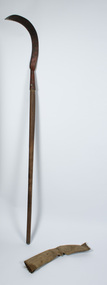 Emerald Museum & Nobelius Heritage Park
Tool - Fire Fighters Scythe (Fern hook), c.1950s - 1960s
... Fire Brigade which was established on 14 March 1941 as the Emerald Bush Brigade. Originally its equipment was stored at Madigan's butcher's shop near the corner of Monbulk Road. The Brigade's first fire station...Fire Brigade which was established on 14 March 1941 as the Emerald Bush Brigade. Originally its equipment was stored at Madigan's butcher's shop near the corner of Monbulk Road. The Brigade's first fire station ...This fire fighter's scythe was donated by the Emerald Fire Brigade which was established on 14 March 1941 as the Emerald Bush Brigade. Originally its equipment was stored at Madigan's butcher's shop near the corner of Monbulk Road. The Brigade's first fire station was built around 1945. In 1966, this station was recorded as containing the fire truck and a Land rover pumper, three radio sets, 40 knapsacks, six lengths of hose, helmets, rake hoes and other hand tools. In 2010, the Brigade moved into a new purpose-built building in Monbulk Road. This scythe, also known as a fern hook, dates from the 1950s to 1960s.This fire fighter's scythe was used by members of a crucial volunteer fire fighting service operating in the Emerald district since 1941.One Firefighter scythe (Fern Hook) consisting of a long wooden pole with curved blade attached at the end. The blade has a canvas protective sleeve.Nonefire fighting, emerald fire brigade, cfa -
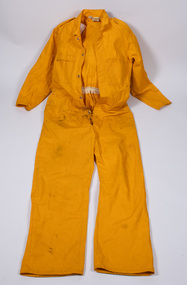 Emerald Museum & Nobelius Heritage Park
Clothing - Fire Fighter's Overalls (CFA), c.1960s - 1970s
... Fire Brigade which was established on 14 March 1941 as the Emerald Bush Brigade. Originally its equipment was stored at Madigan's butcher's shop near the corner of Monbulk Road. The Brigade's first fire station...Fire Brigade which was established on 14 March 1941 as the Emerald Bush Brigade. Originally its equipment was stored at Madigan's butcher's shop near the corner of Monbulk Road. The Brigade's first fire station ...This pair of CFA fire fighter's overalls were donated by the Emerald Fire Brigade which was established on 14 March 1941 as the Emerald Bush Brigade. Originally its equipment was stored at Madigan's butcher's shop near the corner of Monbulk Road. The Brigade's first fire station was built around 1945. In 1966, this station was recorded as containing the fire truck and a Land rover pumper, three radio sets, 40 knapsacks, six lengths of hose, helmets, rake hoes and other hand tools. In 2010, the Brigade moved into a new purpose-built building in Monbulk Road. These beaters date from the 1960s to 1970s.These CFA fire fighter's overalls were used by members of a crucial volunteer fire fighting service operating in the Emerald district since 1941.A Pair of CFA Firefighter overalls, yellow in colour, Size 97R CFA, Stewart and Heaton Clothing manufacturer. Size 97 Regularfire fighting, emerald fire brigade, cfa -
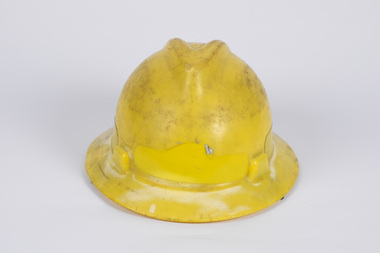 Emerald Museum & Nobelius Heritage Park
Headwear - Fire Fighters Helmet, MSA, c.1970s
... Fire Brigade which was established on 14 March 1941 as the Emerald Bush Brigade. Originally its equipment was stored at Madigan's butcher's shop near the corner of Monbulk Road. The Brigade's first fire station...Fire Brigade which was established on 14 March 1941 as the Emerald Bush Brigade. Originally its equipment was stored at Madigan's butcher's shop near the corner of Monbulk Road. The Brigade's first fire station ...During the 1960s in Australia, helmets evolved from metal construction to that of polymer and other plastics. This helmet was donated by the Emerald Fire Brigade which was established on 14 March 1941 as the Emerald Bush Brigade. Originally its equipment was stored at Madigan's butcher's shop near the corner of Monbulk Road. The Brigade's first fire station was built around 1945. In 1966, this station was recorded as containing the fire truck and a Land rover pumper, three radio sets, 40 knapsacks, six lengths of hose, helmets, rake hoes and other hand tools. In 2010, the Brigade moved into a new purpose-built building in Monbulk Road. The manufacturer of this helmet, MSA, was founded in 1914 in the USA. MSA began as a mine safety company but since expanded into more general worker protection and safety products. This helmet is an historical artifact worn by members of a crucial volunteer fire fighting service operating in the Emerald district since 1941.Yellow, lightweight, hard plastic or polymer helmet with black leather detachable chin strap with Velcro fastening. inside the helmet is an adjustable head harnessInside helmet on a partly torn label: 'MSA / VGARD / Type 2 ...? / STANDARDS AUSTRALIA' Inside the brim black pen writing EMERALD SPARE 5 EMERALD at one end engraved: 'MSA'' and at the other end: '1801-1881 On the outside of the helmet there is a yellow reflector on each side and at the front and the back there is evidence of labels that have been removed.helmets, fire fighting, msa, emerald fire brigade, cfa -
 Emerald Museum & Nobelius Heritage Park
Headwear - Fire Fighters Helmet, MSA, c.1970s
... Fire Brigade was established on 14 March 1941 as the Emerald Bush Brigade. Originally its equipment was stored at Madigan's butcher's shop near the corner of Monbulk Road. The Brigade's first fire station...Fire Brigade was established on 14 March 1941 as the Emerald Bush Brigade. Originally its equipment was stored at Madigan's butcher's shop near the corner of Monbulk Road. The Brigade's first fire station ...Helmets protect firefighters from heat, falling objects and cinders. During the 1960s in Australia, helmets evolved from metal construction to that of polymer and other plastics. The manufacturer of this helmet, MSA, was founded in 1914 in the USA. It began as a mine safety company but since expanded into more general worker protection and safety products. The Emerald Fire Brigade was established on 14 March 1941 as the Emerald Bush Brigade. Originally its equipment was stored at Madigan's butcher's shop near the corner of Monbulk Road. The Brigade's first fire station was built around 1945. In 1966, this station was recorded as containing the fire truck and a Land rover pumper, three radio sets, 40 knapsacks, six lengths of hose, helmets, rake hoes and other hand tools. In 2010, the Brigade moved into a new purpose-built building in Monbulk Road.This helmet is an historical artifact worn by members of a crucial volunteer fire fighting service operating in the Emerald district since 1941.Yellow, lightweight, hard plastic or polymer helmet with black leather detachable chin strap with velcro fastening.Inside helmet on a partly torn label: 'MSA / VGARD / Type 2 ...? / STANDARDS AUSTRALIA' Inside the brim at one end engraved: 'MSA'' and at the other end: '1801-1881 / LN70' On front of helmet a label with logo and red lettering: 'CFA' helmets, fire fighting, msa, emerald fire brigade, cfa -
 Ballarat Heritage Services
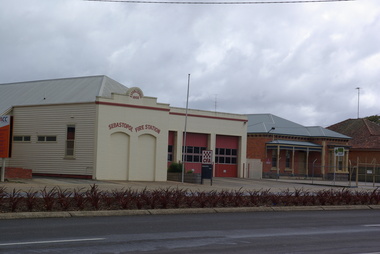
Photograph - Photograph - Colour, Clare Gervasoni, Former Sebastopol Fire Station, Albert Street, Sebastopol, 2012, 09/04/2012
... The Sebastopol Fire Brigade was establised in 1868. The first fire station in Sebastopol was housed in a shed at the Red Jacket Mine in 1868, where an alarm bell was hung. ...The Sebastopol Fire Brigade was establised in 1868. The first fire station in Sebastopol was housed in a shed at the Red Jacket Mine in 1868, where an alarm bell was hung. ...The Sebastopol Fire Brigade was establised in 1868. The first fire station in Sebastopol was housed in a shed at the Red Jacket Mine in 1868, where an alarm bell was hung. With the decline in mining and Sebastopol’s population, the need for a fire brigade diminished and the brigade went into recess in 1875. Sebastopol was then serviced by a ‘satellite’ unit from the Ballarat City Fire Brigade. In 1891, with financial support from the Sebastopol Borough Council, the Sebastopol Fire Brigade re-formed. It had hand-drawn hose reels and hydrants in sheds at the north and south ends of Albert St. A shed to be used as a Fire Station was built beside the Town Hall in 1886. In 1929 the Fire Station was physically moved across Albert Street to its current site. It was expanded by the addition of a meeting room/hall and workroom and in the 1990s had the ‘Engine Room’ added to the north side. The first motorised appliance was a 1916 Maxwell hose carriage issued in 1934.Colour photograph of the Sebastopol Fire Brigade.sebastopol, sebastopol fire brigade -
 Eltham District Historical Society Inc
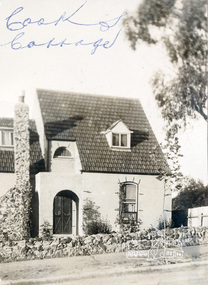
Photograph, Cook's Cottage; Mr. Ernie Andrew's home
... It would appear that this brick building was built on Andrew's land upon which he had loaned for use of Eltham's first Fire Station (Sep 1928 to June 1931) and based on aerial photos of Nov 1931, Dec 1945 and July 1951 was erected prior to Cook's Cottage....It would appear that this brick building was built on Andrew's land upon which he had loaned for use of Eltham's first Fire Station (Sep 1928 to June 1931) and based on aerial photos of Nov 1931, Dec 1945 and July 1951 was erected prior to Cook's Cottage. ...Ernest James Andrew was born in Eltham on 6 July 1873 and died at his home shown here in Arthur Street Eltham on 29 March 1950 aged 76. His father was William Bravery Andrew who ran corn store in Eltham at the corner of Franklin Street and Main Road and was a member of the Eltham Shire Council. Ernest also became a councillor and Shire President. His brother was also named William Bravery Andrew. The house was known locally as "Cook's Cottage" because of its resemblance to Captain Cook's Cottage in Fitzroy Gardens, Melbourne. Pages from a scrapbook belonging to Heather Jenkins (nee Cone) who lived as a child in the Police Residence at 728 Main Road, Eltham in the 1920s. See also 00183 Home to Cr. Ernie Andrew, newsagent and his wife Ellen. Known locally as Cook's Cottage due to its resemblance to Captain Cook's cottage in Fitzroy Gardens. Erected after Nov 1931 and before Dec 1945. The cottage was situated immediately adjacent to the east of the undergound carpark entrance off Arthur Street which used to be Commercial Place. Ernie Andrew's wife, Ellen, died 13 July 1946 and Ernie died 29 March 1950. Aerial photos show the cottage was still present in April 1963 but it had been demolished by April 1972 with a carpark extending from behind the new Eltham Village built on the former Shire Office site opposite through to Luck Street. ELTHAM SHIRE OFFICES (1934, November 9). Advertiser (Hurstbridge, Vic. : 1922 - 1939), p. 1. Retrieved May 23, 2026, from http://nla.gov.au/nla.news-article56746996 ELTHAM SHIRE OFFICES The offices of the Eltham Shire Council are now at Arthur street, Eltham. The shire secretary (Mr. P J. McMahon) had a busy time during the week transferring all the books, documents, etc. of the council from the temporary offices (the shire secretary's residence at Kangaroo Ground) to the new offices. The new premises are owned by Mrs. E. J. Andrew, from whom the council has leased them, and consist of a five roomed brick villa which has been completed to meet the council's requirements. It would appear that this brick building was built on Andrew's land upon which he had loaned for use of Eltham's first Fire Station (Sep 1928 to June 1931) and based on aerial photos of Nov 1931, Dec 1945 and July 1951 was erected prior to Cook's Cottage.Heather Jenkins was the daughter of Constable John Thomas Cone, Badge #3935 served at Eltham Police Station 1 May 1911 to 9 July 1922.Glued on a brown paper scrapbook page (torn from scrapbook) with 8 black and white/sepia photos of varying sizes, 1 newspaper clipping and one greeting card with printed sketch and handwritten captions in ink. On back of page is 1 black and white photo and a large newspaper clipping.eltham, cooks cottage, ernie andrew, ellen andrew -
 Eltham District Historical Society Inc
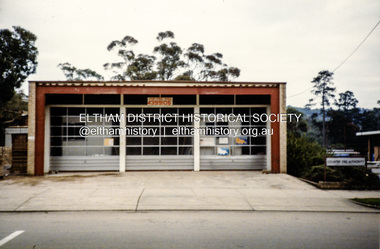
Photograph, Eltham Fire Station, 909 Main Road, Eltham, July 1986
... Opened 7 October 1966 Eltham's Fire Stations by Peter Pidgeon Article published EDHS Newsletter No.287 April 2026 Where was Eltham’s first fire station and how many have there been? ...Opened 7 October 1966 Eltham's Fire Stations by Peter Pidgeon Article published EDHS Newsletter No.287 April 2026 Where was Eltham’s first fire station and how many have there been? ...Located at 909 Main Road, Eltham. Opened 7 October 1966 Eltham's Fire Stations by Peter Pidgeon Article published EDHS Newsletter No.287 April 2026 Where was Eltham’s first fire station and how many have there been? Following the formation of the Eltham Volunteer Fire Brigade in March 1926, firefighting equipment was initially housed in a shed on Captain H. Warren’s property. A more permanent solution was required. In May 1927 a proposal was made to build a fire station and meeting hall at the corner of Luck Street and Main Road where the present railway station carpark is located. An application was approved by Council in September to build the fire station consisting of a galvanised iron shed on the land in Luck Street, However, in April 1928 when E.O. Egan, Secretary, Eltham Volunteer Fire Brigade sought permission to erect a fire station on the continuation of Luck Street, Council advised they had no power to act on this as they did not own the land. Cr. Ernie Andrew offered to loan a site on his own land in Arthur Street (where the entrance to the carpark under Woolworths is situated) and by September 1928 the new fire station was being erected consisting of a building to house the reel and other equipment as well as a meeting room. It was constructed with a concrete floor and painted. A purpose-built cupboard had been constructed for the hose by local carpenter, Mr. Fraser and Mr. Frank Jones arranged for electric lighting to be installed. Many donations were made by the community to assist in paying off the debt on the station. The first meeting in the new fire station was held November 12, 1928, with a large attendance of members. The official opening was to be held in the New Year on January 8, 1929. In February 1930, Eltham Council agreed to place the Eltham Volunteer Fire Brigade under the control of the Country Fire Brigades’ Board. Further discussions were held in May regarding their area of responsibility to cover as well as questions about a suitable block of land and relocation of the brigade’s buildings. In August 1930, the Chief Officer of Country Fire Board visited Council to select a suitable site. He did not approve of any that Council suggested but encouraged Council to buy land for the purpose. Enquiries were made about a block in Henry Street adjacent to the Public Hall which the Chief Officer favoured. Cr Price investigated and learned the block could be purchased, £10 would secure it if the people of Eltham were willing to raise a further £30-40. All were in favour of proceeding. By February 1931, £40 had been raised by the community, in addition to £20 added by Council and £20 by the Fire Brigades’ Board making £80 total to purchase the site. Several working bees were held between May and July 1931 to level the ground in preparation for relocation of the station building from Arthur Street to the new site in Henry Street. It was not long before the Henry Street site had proven to be not all that was desired. Access to the Henry Street site from Main Road was steep and not suited for man handling a heavy hose reel. By November 1933 the Country Fire Brigades’ Board advised it was considering the matter of a new cation and fire station for Eltham. On February 23, 1934, the Advertiser reported a new Fire Station was to be built on an alternate site at a cost of £600. In August, the Country Fire Brigades’ Board notified it intended to build a new fire station at no cost to Eltham if the brigade could purchase a block of land. An appeal was established by the brigade to raise funds for the purchase of the new site between the residence and confectionery shop owned by Mr. G.H. Browne and Ryan Bros. butchers on the eastern side of Main Road between Arthur and Dudley streets. An inspection of the site by the Chief Officer of Country Fire Brigades' Board was undertaken September 28. It was directed that tenders for the erection of the building were to be called immediately and construction to start the next month. By New Year 1935 the erection of the third station building was well in progress and was completed by mid-February. The station was officially opened April 26, 1935, and a new 35 feet high bell tower was erected in December 1935. This fire station, the third erected in six years, served the community for the next thirty years. In 1962, land for a new (fourth) Eltham Fire Station on the opposite (western) side of Main Road was acquired from the Eltham War Memorial Trust. The new station was opened October 7, 1966. In 1970 the former fire station building on the eastern side of Main Road was relocated to Research Park for use by the 1st Research Scout group. The site is now part of the current Coles supermarket and Eltham Village complex. A new fifth fire station was erected in Brougham Street at a cost of $9.6m and officially opened December 2015. It was intended for use by both career and volunteer firefighters. The former site was to be made available for community access. However, the mixed functional role presented operational difficulties at the new station and after three years, the Eltham CFA volunteers moved back to the former site towards the end of 2018 following a $500,000 upgrade to the facility. So nowadays the career Fire Rescue Victoria members of Eltham Fire Brigade operate out of Eltham’s fifth fire station in Brougham Street and the volunteer Eltham CFA Brigade operate out of Eltham’s fourth station, or could it be considered the sixth?Colour photograph of Eltham Fire Station, Main Road, July 1986eltham fire brigade, eltham fire station, eltham shops, main road eltham -
 Royal Melbourne Yacht Squadron
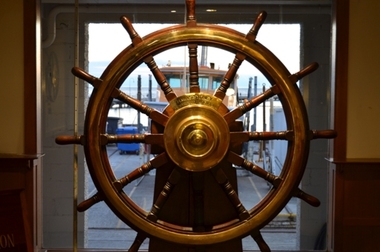
Memorabilia - Wheel of HMAS Sydney, Early 20th Century
... station, steamed out to intercept the intruder. Captain Glossop decided to close in to 9,500 yards ( 8686.8m) before delivering his first salvo. Emden on the other hand, opened fire...station, steamed out to intercept the intruder. Captain Glossop decided to close in to 9,500 yards ( 8686.8m) before delivering his first salvo. Emden on the other hand, opened fire ...THE WHEEL OF HMAS SYDNEY COMMEMORATING AUSTRALIA’S FIRST NAVAL ENGAGEMENT The historic wheel of HMAS Sydney commemorates the Royal Australian Navy’s first ship- to- ship naval engagement. It was purchased early in 1930 and later presented to the Royal St Kilda Yacht Club (now Royal Melbourne Yacht Squadron) by then Commodore Joe White, following HMAS Sydney being broken up at Cockatoo Dock, Sydney. On 1 November 1914, led by the flagship SS Orvieto, a large convoy of 28 Australian and 10 New Zealand transports escorted by the Light Cruisers HMAS Melbourne, HMAS Sydney, HMS Minotaur and the Japanese ship Ibuki, departed King George Sound, Albany Western Australia with a large contingent of Australian and New Zealand troops bound for Egypt, to become the original Anzac’s. As the convoy steamed northwest across the Indian Ocean, leaving Cocos-Keeling Islands well to the westward, Captain Karl von Muller in the German Light Cruiser Emden of 3,600 tons, after having wrought much havoc to allied shipping in the Indian Ocean, ignorant of the convoys presence, had in mind to destroy the Cocos Island Cable Station on Direction Island. In the early hours of the morning of Monday the 9 November, he anchored “Emden” off Direction Island to send a landing party ashore, In the meantime the Cable Station had sent out a Morse Code message ‘Strange ship approaching’, this was followed soon after by a ‘S.O.S.’ These messages were picked up by ships in the convoy and at 7.00 a.m., Captain J.C. Glossop of the 5,400 ton HMAS Sydney was directed to leave the convoy and proceed at full speed for Cocos Islands. Two hours later Cocos Island was on the horizon. Captain von Muller, with the boarding party ashore to destroy the Cable station, steamed out to intercept the intruder. Captain Glossop decided to close in to 9,500 yards ( 8686.8m) before delivering his first salvo. Emden on the other hand, opened fire at 10,500 yards (9601m), its ten, 4.1 inch (104mm) guns firing 38 pound (17.24 kg ) shells, some of which scored near misses. Emden was hit repeatedly by HMAS Sydney’s eight, 6 inch (152.4mm) guns firing 100 pound (45.36kg ) shells. Within two hours Captain von Muller had decided to run the badly damaged Emden aground on North Keeling Island. Captain Glossop then broke off the engagement to speed off to intercept Emden’s collier, “Buresk”, seen lurking in the distance, soon to overtake her. A boarding party from HMAS Sydney was too late to prevent Buresk from being scuttled but able to rescue her crew. Returning to finish off Emden, HMAS Sydney was again met by heavy gunfire. Sydney scored a number of direct hits to Emden and only after having suffered 134 killed and 65 wounded, did Captain von Muller finally decide to lower his Naval Ensign. He was among those captured and was allowed to retain his Naval sword. In the engagements HMAS Sydney only suffered four direct hits, 4 killed and 12 wounded. J.H.(Bert) Ferris Extremely significant as part of Australia's Naval and Military history.Ships wheel, timber, mounted on a timber plinth, wheel of ship first HMAS Sydney.Plaque notifying that wheel donated by Commodore Joe White 1930ww1, sydney, german, hmas, raider, emden, cocos keeling, islands, hmas sydney, wheel -
Marysville & District Historical Society
THE TRIANGLE NEWS-VOL 40 NO 21-JUNE 7 2013
... first dinner meeting...the committee of management of the gallipoli park precinct...marysville community market...creative triangle...narbethong public hall committee...movie nights...cooinda music festival...currently seeking land in marysville for festival...honour rolls to return to former glory...church notices...marysville golf report...mayor's chair...two day class for quilters only...dene cain of kenya...advertisements...councillor comment...two in a row for villains...marysville football club...real estate...vicses marysville unit update...alexandra quilters annual exhibition...marysville community golf & bowls club...casual position vacant...triangle junior fire brigade...marysville fire station...marysville victoria australia annual alexandra truck ute and roadshow alexandra rotary park victorian truck drivers memorial service what's on when in june men's shed first dinner meeting the committee of management of the gallipoli park precinct marysville community market creative triangle narbethong public hall committee movie nights cooinda music festival currently seeking land in marysville for festival honour rolls to return to former glory church notices marysville golf report mayor's chair two day class for quilters only dene cain of kenya advertisements councillor comment two in a row for villains marysville football club real estate vicses marysville unit update alexandra quilters annual exhibition marysville community golf & bowls club casual position vacant triangle junior fire brigade marysville fire station junior volunteer development program murrindindi shire council notice of an application for planning permit melbourne international comedy festival marysville police news an evaluation of the pathways bushfire recovery program lake mountain alpine resort marysville & district lions club THE TRIANGLE NEWS-VOL 40 NO 21-JUNE 7 2013 ...marysville, victoria, australia, annual alexandra truck ute and roadshow, alexandra rotary park, victorian truck drivers memorial service, what's on when in june, men's shed first dinner meeting, the committee of management of the gallipoli park precinct, marysville community market, creative triangle, narbethong public hall committee, movie nights, cooinda music festival, currently seeking land in marysville for festival, honour rolls to return to former glory, church notices, marysville golf report, mayor's chair, two day class for quilters only, dene cain of kenya, advertisements, councillor comment, two in a row for villains, marysville football club, real estate, vicses marysville unit update, alexandra quilters annual exhibition, marysville community golf & bowls club, casual position vacant, triangle junior fire brigade, marysville fire station, junior volunteer development program, murrindindi shire council, notice of an application for planning permit, melbourne international comedy festival, marysville police news, an evaluation of the pathways bushfire recovery program, lake mountain alpine resort, marysville & district lions club -
Federation University Historical Collection
Book - Book - Scrapbook, Ballarat School of MInes: Scrapbook of Newspaper Cuttings, Book 36, July 1988 to September 1988
... station relocates in tippett hall smb...training for goldminers...training emphasisin new era...james oddie and development of ballarat...growing awareness on adult illiteracy...conference in ballarat...careers expo ballarat...smb course to aid disabled...awards to top apprentices...karen willison vacc first...fire...The papers concerned are The Courier, Ballarat, The Australian, The Age over the period of 8 July 1988 to 14 September 1988. teaching positions advertised pre-employment courses courses available enrolment for smb courses funding for targeted apprenticeship access program education minister caroline hogg small business resource centre manager gerardine christou cultivator for farming course radio station relocates in tippett hall smb training for goldminers training emphasisin new era james oddie and development of ballarat growing awareness on adult illiteracy conference in ballarat careers expo ballarat smb course to aid disabled awards to top apprentices karen willison vacc first fire tech diploma course smb open day affirmative action plans being developed at smb and bcae rachel herreen wins logo competition richard sutton henry sutton fuel miser event work skill competition ceramic tiles to form mural motor mechanic awards panel beating awards local four in line for skill graduation farming apprentice damian everard percussionist peter cobb Book with yellow cover, front, spiral bound. ...Collection of newspaper articles related to Ballarat School Of Mines.They cover activities and advertisements for staff. The papers concerned are The Courier, Ballarat, The Australian, The Age over the period of 8 July 1988 to 14 September 1988.Book with yellow cover, front, spiral bound. teaching positions advertised, pre-employment courses, courses available, enrolment for smb courses, funding for targeted apprenticeship access program, education minister caroline hogg, small business resource centre, manager gerardine christou, cultivator for farming course, radio station relocates in tippett hall smb, training for goldminers, training emphasisin new era, james oddie and development of ballarat, growing awareness on adult illiteracy, conference in ballarat, careers expo ballarat, smb course to aid disabled, awards to top apprentices, karen willison vacc first, fire tech diploma course, smb open day, affirmative action plans being developed at smb and bcae, rachel herreen wins logo competition, richard sutton, henry sutton, fuel miser event, work skill competition, ceramic tiles to form mural, motor mechanic awards, panel beating awards, local four in line for skill graduation, farming apprentice damian everard, percussionist peter cobb -
 Ballarat Fire Brigade
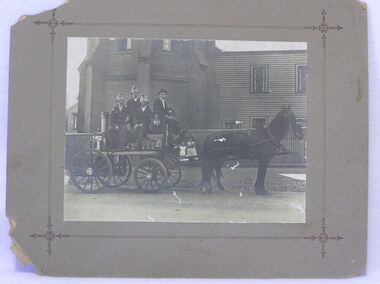
Photograph, around 1881
... first of its kind in Victoria. Picture shows side view of original station and corrugated iron fence B&W photograph of Shand Mason steam pumper taken beside Ballarat Fire Station in Barkly street. ...Shand Mason steam pumper was purchased by the brigade in 1881 and was the first of its kind in Victoria. Picture shows side view of original station and corrugated iron fenceB&W photograph of Shand Mason steam pumper taken beside Ballarat Fire Station in Barkly street. Pumper is being drawn by 2 dark coloured horses. Pumper has 3 firemen and a driver on board. 3 children are standing against the fence in the rear of the picture. Photo is mounted on an brown coloured card with dcorative scrolls. -
 Ballarat Fire Brigade
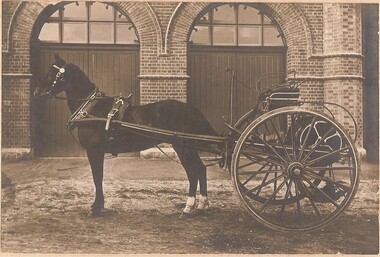
Photograph, G.Maas, 'Tommy', C.1916
... As the brigade received it first motorised appliance in 1917 and second appliance in 1918 the brigade would not have kept horses after this date. Shows the original facade of the current station with the pillar and wooden doors intact (now removed) Ballarat Fire Brigade Tommy Hose Carriage Nil B&W photograph of Ballarat Fire Brigades horse 'Tommy' harnessed to a hose carriage. ...Photograph shows Tommy standing outside a very new brick engine house. This would date the photograph as being 1916 or later. As the brigade received it first motorised appliance in 1917 and second appliance in 1918 the brigade would not have kept horses after this date. Shows the original facade of the current station with the pillar and wooden doors intact (now removed)B&W photograph of Ballarat Fire Brigades horse 'Tommy' harnessed to a hose carriage. Photgraph was taken at the front of the current station. Photograph is mounted on a beige coloured cardNilballarat fire brigade, tommy, hose carriage -
Ringwood and District Historical Society
Piece of concrete, City of Ringwood, Concrete from the facade of the old Ringwood Town Hall demolished in 1971, 1927
... As the need for space grew, the first Ringwood fire station, the baby health centre and council's health department squeezed onto the site. ...As the need for space grew, the first Ringwood fire station, the baby health centre and council's health department squeezed onto the site. ...The two storey facade of the Ringwood Town Hall was built in 1927 at a cost of 6,000 pounds. Behind it the council worked out of the old mechanics institute. As the need for space grew, the first Ringwood fire station, the baby health centre and council's health department squeezed onto the site. A free library and cinema also operated from the town hall for many years.Two lumps of concrete from the facade of the old Ringwood Town Hall. Red at the centre, soot and dirt marked on the outside.; This was the first debris from the demolition of the old Ringwood Town Hall, knocked off the front western pillar by the mayor Cr Jack McRae at the invitation of the purchaser Hanover Holdings Ltd, on Thursday 22-Apr-1971. +Additional Keywords: McRae, Cr J.M. / Carter, RichardFirst debris from the demolition of the old Ringwood Town Hall, knocked off the front western pillar by the mayor Cr Jack McRae at the invitation of the purchaser Hanover Holdings Ltd, on Thursday 22-Apr-1971. -
 Orbost & District Historical Society
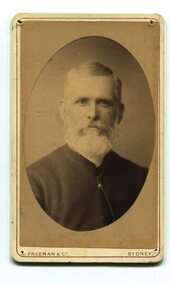
black and white photograph, Freeman & Co, second half 19th century
... First Church of England was a clergyman stationed at Orbost - 1884-1891. Mr Martin, who was appointed by Bishop Moorhouse of Melbourne, to be Stipendiary Reader in charge of the district in 1885. Prior to that, Mr Martin, a retired sea captain, had unofficially conducted services in all sorts of places, where a congregation could be gathered together, though his business officially was that of a fire insurance argent. ...First Church of England was a clergyman stationed at Orbost - 1884-1891. Mr Martin, who was appointed by Bishop Moorhouse of Melbourne, to be Stipendiary Reader in charge of the district in 1885. Prior to that, Mr Martin, a retired sea captain, had unofficially conducted services in all sorts of places, where a congregation could be gathered together, though his business officially was that of a fire insurance argent. ...Mr. Robert Martin - First Church of England was a clergyman stationed at Orbost - 1884-1891. Mr Martin, who was appointed by Bishop Moorhouse of Melbourne, to be Stipendiary Reader in charge of the district in 1885. Prior to that, Mr Martin, a retired sea captain, had unofficially conducted services in all sorts of places, where a congregation could be gathered together, though his business officially was that of a fire insurance argent. (more information in October 2007 Newsletter)This item is associated with churches in Orbost.A black / white portrait photograph, head and shoulders, of a middle - aged man with a white beard.It is an oval shaped photograph set in a cream cardboard mount.on front at bottom - Freeman & Co Sydneymartin-robert church-of-england-orbost church-orbost -
 Orbost & District Historical Society
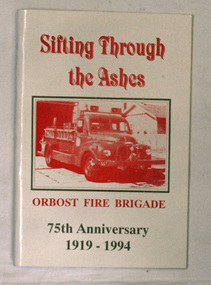
books, Sifting Through The Ashes, 1994
... Fire brigade was founded in 1919. The first captain was George Hodgson, assisted by Lieutenant Reg Macalister, Secretary J.F.McCoy and fifteen members. .As there was no fire station the ree l ( a cast off fro m the Bairnsdale Brigade ) w as kep t in the shed at the back of the Council Chambers until the present Station was built in 1922 in its present location in Gladstone Street, Orbost. ...Fire brigade was founded in 1919. The first captain was George Hodgson, assisted by Lieutenant Reg Macalister, Secretary J.F.McCoy and fifteen members. .As there was no fire station the ree l ( a cast off fro m the Bairnsdale Brigade ) w as kep t in the shed at the back of the Council Chambers until the present Station was built in 1922 in its present location in Gladstone Street, Orbost. ...The book was collated by Debbie Hall. Orbost Fire brigade was founded in 1919. The first captain was George Hodgson, assisted by Lieutenant Reg Macalister, Secretary J.F.McCoy and fifteen members. .As there was no fire station the ree l ( a cast off fro m the Bairnsdale Brigade ) w as kep t in the shed at the back of the Council Chambers until the present Station was built in 1922 in its present location in Gladstone Street, Orbost. This book is a written record of the first one hundred years of the Orbost Fire Brigade.Two copies of a paperback book with a white cover and red print. On the cover is a photo of a fire truck in a rectangular frame. The book was produced for the 75th Anniversary of Orbost Fire Brigade 1919-1994. The book contains black and white photographs of Fire brigade activities and extracts from the "Snowy River Mail".In blue pen - "Presented to the Orbost Historical Society from Orbost Fire Brigade - November 12th 1994"book orbost-fire-brigade -
 Ringwood and District Historical Society
Photograph, Ringwood Football Club- Centenary Premiers, R.D.F.A., 1934
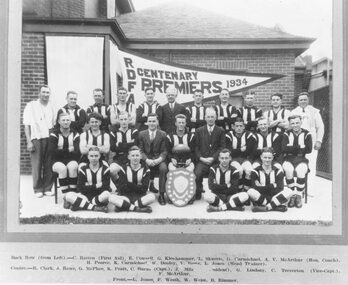
... First Aid), E. Connell, G. Kleehammer, L. Skurrie, G. Carmichael, A.V. McArthur (Hon. Coach), H. Pearce, K. Carmichael, W. Dooley, V. Rowe, L. Jones (Head Trainer). Centre - R. Clark, J. Rowe, G. McPhee, K. Pratt, C. Burns (Capt.), J. Miller (President), G. Lindsay, C. Treverton (Vice-Capt.), F. McArthur. Front - L. Jones, F. Westh, W. Weist, B. Rimmer." Image taken at rear of Fire Station...First Aid), E. Connell, G. Kleehammer, L. Skurrie, G. Carmichael, A.V. McArthur (Hon. Coach), H. Pearce, K. Carmichael, W. Dooley, V. Rowe, L. Jones (Head Trainer). Centre - R. Clark, J. Rowe, G. McPhee, K. Pratt, C. Burns (Capt.), J. Miller (President), G. Lindsay, C. Treverton (Vice-Capt.), F. McArthur. Front - L. Jones, F. Westh, W. Weist, B. Rimmer." Image taken at rear of Fire Station ...Black and white photograph (2 originals mounted on lightly embossed cardboard, 1 copy)Printed below photograph: "Back Row (from Left) - C. Ratten (First Aid), E. Connell, G. Kleehammer, L. Skurrie, G. Carmichael, A.V. McArthur (Hon. Coach), H. Pearce, K. Carmichael, W. Dooley, V. Rowe, L. Jones (Head Trainer). Centre - R. Clark, J. Rowe, G. McPhee, K. Pratt, C. Burns (Capt.), J. Miller (President), G. Lindsay, C. Treverton (Vice-Capt.), F. McArthur. Front - L. Jones, F. Westh, W. Weist, B. Rimmer." Image taken at rear of Fire Station- some firemen on the team. -
 Eltham District Historical Society Inc
Document - Photograph, Ian McDonald (Shire of Eltham), Main Road, between Arthur Street and Dudley Street, Eltham, 1968-1970
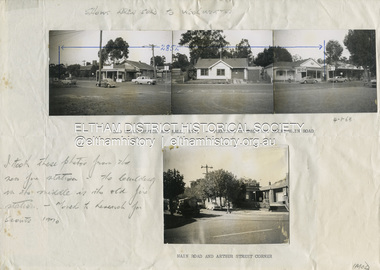
... The panorama (SEPP_0744) was captioned in typewritten text "Old Shire Office and Hall, etc - Frontage of 285 feet along Main Road" and in pencil the date "4-1-68" The single image of the shire offices (SEPP_0737) was captioned in typewritten text "Main Road and Arthur Street Corner" In addition, the following handwritten notes in pencil: " I took these photos from the new fire station - the building in the middle is the old fire station - Moved to Research for the Scouts 1970" and signed "IMcD" This photo forms part of a collection of photographs gathered by the Shire of Eltham for their centenary project book,"Pioneers and Painters: 100 years of the Shire of Eltham" by Alan Marshall (1971). The collection of over 500 images is held in partnership between Eltham District Historical Society and Yarra Plenty Regional Library (Eltham Library) and is now formally known as the 'The Shire of Eltham Pioneers Photograph Collection.' It is significant in being the first ...Original document produced by Ian McDonald (Eltham Shire Council) 1970. During the period 1969-1971 photos were being collected for a proposed publication on the history of the Shire of Eltham as part of its centenary celebrations in 1971 (managed by the Shire of Eltham Historical Society and Alan Marshall). The publication was Pioneers & Painters (1971), edited by Alan Marshall. The document titled "Shows area sold to Woolworths" consisted of a panorama of three B&W photo prints creating a panorama of the frontage along Main Road (SEPP_0744) and a single B&W photo print of the Shire of Eltham offices and Hall on the corner of Arthur Street and Main Road (SEPP_0737) along with typed and hand written notes by Ian McDonald. The panorama (SEPP_0744) was captioned in typewritten text "Old Shire Office and Hall, etc - Frontage of 285 feet along Main Road" and in pencil the date "4-1-68" The single image of the shire offices (SEPP_0737) was captioned in typewritten text "Main Road and Arthur Street Corner" In addition, the following handwritten notes in pencil: " I took these photos from the new fire station - the building in the middle is the old fire station - Moved to Research for the Scouts 1970" and signed "IMcD"This photo forms part of a collection of photographs gathered by the Shire of Eltham for their centenary project book,"Pioneers and Painters: 100 years of the Shire of Eltham" by Alan Marshall (1971). The collection of over 500 images is held in partnership between Eltham District Historical Society and Yarra Plenty Regional Library (Eltham Library) and is now formally known as the 'The Shire of Eltham Pioneers Photograph Collection.' It is significant in being the first community sourced collection representing the places and people of the Shire's first one hundred years.Paper with four photos adhered in two groups with notes in typewritten text and handwritten in pencilsepp, shire of eltham pioneers photograph collection, eltham, main road, arthur street, dudley street, barber shop, cinema, commercial bank of australia, eltham fire brigade, eltham hall, eltham shire hall, eltham shire office, fire station, hardware shop, municipal offices, photographer shop, pph, produce paint and hardware centre, shire hall, shire offices, woolworths -
 Eltham District Historical Society Inc
Work on paper - Folio, Register of Significant Trees, Shire of Eltham, c.1993
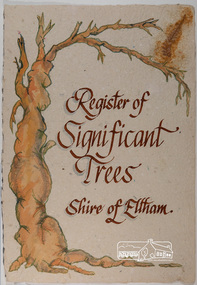
... Fire Station. Its origins may have been similar to Donaldson's Oak, and as a young tree it apparently slipped from higher up the hill during wet weather. Both oaks are of local historical importance. 3. Eucalyptus globulus (Blue Gum). A large mature specimen at the corner of the Kangaroo Ground-St. Andrews Road and Bakehouse Road, Panton Hill. 4. Plantanas acerifolia (Plane tree) A number of trees forming the Avenue of Honour to Eltham's First...Fire Station. Its origins may have been similar to Donaldson's Oak, and as a young tree it apparently slipped from higher up the hill during wet weather. Both oaks are of local historical importance. 3. Eucalyptus globulus (Blue Gum). A large mature specimen at the corner of the Kangaroo Ground-St. Andrews Road and Bakehouse Road, Panton Hill. 4. Plantanas acerifolia (Plane tree) A number of trees forming the Avenue of Honour to Eltham's First ...In 1983, the National Trust advised the Shire of Eltham that it was investigating a number of trees within the shire which had been nominated for recording the Register of Significant Trees of Victoria. The trees involved were described in the Shire of Eltham Historical Society Newsletter No. 29, March 1983 as follows:- 1. Eucalyptus melliadora (Yellow box) . a) An outstanding mature specimen 42 metres high in Laughing Waters Road, Eltham. b) Another mature specimen in Arthurs Creek road, Hurstbridge is reported to be the tree under which the bushranger Robert Bourke was tied after he shot and killed Henry Hurst in 1866 . 2. Quercus robur (English Oak). a) "Donaldson's Oak", Donaldsons Road, Kangaroo Ground was planted by John Donaldson from seed collected from Windsor Great Park in 1878. b) "Wippells Oak". This now misshapen tree is located on the St. Andrews Road near the Kangaroo Ground Fire Station. Its origins may have been similar to Donaldson's Oak, and as a young tree it apparently slipped from higher up the hill during wet weather. Both oaks are of local historical importance. 3. Eucalyptus globulus (Blue Gum). A large mature specimen at the corner of the Kangaroo Ground-St. Andrews Road and Bakehouse Road, Panton Hill. 4. Plantanas acerifolia (Plane tree) A number of trees forming the Avenue of Honour to Eltham's First World War soldiers along Main Road between Dalton and Pitt Streets, Eltham. 5. Pinus canariensis (Canary Island Pine), Pinus pinea, (Stone pine) and Cedras altlantica, (Cedar) These trees are located at the Hurst family graves in the grounds of the Hurstbridge Pre-school Centre. In 1991 the Shire of Eltham introduced controls into its planning scheme to protect sites of architectural, historic or conservation interest and significant trees. The controls were approved by the Minister for Planning and Housing. As advised in the Shire of Eltham Historical Society Newsletter No. 78, May 1991, a planning permit is required to demolish or alter any listed building or to destroy, lop or remove any listed tree. Provision is made for comments to be obtained from the National Trust or Historic Buildings Council in considering any applications. The buildings and trees listed were: Buildings: 250 Bolton Street Eltham (former Walter Withers home) "Rosehill" - Bonds Road Lower Plenty St Andrews Church of England - St Andrews "Montsalvat" - Hillcrest Avenue Eltham St Margarets Church and former vicarage - Pitt Street Eltham Presbyterian Church - Kangaroo Ground Parks and Environment Office (former police quarters) Main Road Eltham Former Court House - Main Road Eltham "Shillinglaw Cottage" - Main Road Eltham "The Robins" - Kangaroo Ground Road Warrandyte Trees: "Donaldsons Oak" - Donaldsons Road Kangaroo Ground Yellow Box - Laughing Waters Road Eltham Yellow Box - Arthurs Creek Road Hurstbridge Wippells Oak - St Andrews Road Kanqaroo Road Pines and Cedar - Hurst family cemetery Greysharps Road Hurstbridge Yellow Box - Parsons Road Eltham A large Blue Gum at Panton Hill has been listed but has recently died (1991). In 1993 work by Council Parks and Environment staff and volunteers resulted in the preparation of a Significant Tree Register listing forty-one trees or groups of trees. According to Shire of Eltham Historical Society Newsletter No. 91, March 1993, a similar number remained to be assessed for inclusion in the register. There is a wide range of indigenous and planted trees on private and public land and extending through the Shire of Eltham from Lower Plenty to Kinglake. Most can be viewed from publicly accessible locations. The Significant Tree Register lists 41 trees or groups of trees throughout the Shire. It contains a wide range of naturally occurring and planted trees. They have been assessed according to eleven criteria including size, age, rarity, historical value and the like. The list includes large old Red Gums at Lower Plenty, historic Oaks at Kangaroo Ground and Mountain Ash at Kinglake. The register includes a set of slides showing each tree. Garry Bartlett of the Council's Parks and Environment Section and Faye Shepherd were extensively involved in establishment of the register (Newsletter No. 93, November 1993). In 1999 Niliumbik planners prepared an amendment to the Planning Scheme to provide protection for approximately 200 of the places listed in the heritage studies and also in the Significant Tree Register commenced by the Eltham Council (Eltham District Historical Society Newsletter No. 127, July 1999. In 2004, The Register of Significant Trees was presented to the Eltham District Historical Society by Nillumbik Shire Council as part of a wider collection of of its memorabilia of the former Eltham Shire Council (EDHS Newsletter No. 159, July 2004. Album of loose handmade paper sheets contained within a handmade slip cover constructed of handcrafted card with encapsulated flora material (flowers, vines, ferns) and tinted. Each page also contains an embedded/adhered fern leaf also tinted with lacqueur or similar, text as appropriate in ink by hand calligraphy. Each page also has a white protective sheet cut to size and adhered to back surface with sticky tape and folded over face of page. Pages variously have photographs and coloured masks adhered with a gum resin. Over time much of this resin has let go and photos/masks have been reattached using acid free archival safe adhesive. 15 pages 41 x 29 cm inclusive of 3 blank pages. Slip case 42 x 30 x 1 cm; face cover of slip case has broken off at left hand margin as insufficient depth/flexibility for contents.arthurs creek road, blue gum (eucalyptus globulus), canary island pine (pinus canariensis), couties road, donaldsons oak, donaldsons road, eltham, english oak (quercus robur), eucalyptus melliodora, graysharps road, hurst tree, hurstbridge, ironbark (eucalyptus tricarpa), ironbark hill, kangaroo ground, kangaroo ground-kinglake road, laughing waters road, panton hill hotel, panton hill, parsons road, significant trees register, sonia van bodegraven, sonjart, stone pine (pinus pinea). atlantic cedar (cedrus atlantica), wippells oak, yellow box gum (eucalyptus melliodora), yellow box gum -
 Eltham District Historical Society Inc
Journal - Newsletter, Newsletter, No. 287 April 2026
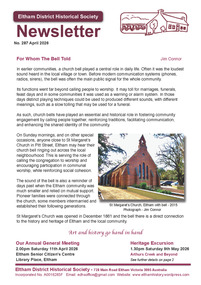
... Contents: • For Whom The Bell Told by Jim Connor • Next meeting – Annual General Meeting - 2:00pm Saturday 11th April 2026 • Heritage Excursion - Saturday 9th May – Arthurs Creek • Eltham’s Fire Stations by Peter Pidgeon • A Milko in Monty by Jim Connor • Geoffrey Teacher Grant by Jim Connor • Eltham Scouts (Evelyn Observer and Bourke East Record - Victoria - 1902 - 1917 - Friday 4th February 1916) • Wattle Glen Residents’ Association by Richard Pinn • Annual General Meeting – Saturday 11th April 2026 The Shire of Eltham Historical Society was formed in October 1967. The first ...Contents: • For Whom The Bell Told by Jim Connor • Next meeting – Annual General Meeting - 2:00pm Saturday 11th April 2026 • Heritage Excursion - Saturday 9th May – Arthurs Creek • Eltham’s Fire Stations by Peter Pidgeon • A Milko in Monty by Jim Connor • Geoffrey Teacher Grant by Jim Connor • Eltham Scouts (Evelyn Observer and Bourke East Record - Victoria - 1902 - 1917 - Friday 4th February 1916) • Wattle Glen Residents’ Association by Richard Pinn • Annual General Meeting – Saturday 11th April 2026The Shire of Eltham Historical Society was formed in October 1967. The first newsletter of the Society was issued May 1978 and has been published continuously ever since on a bi-monthly basis. With the cessation of the Shire of Eltham in late 1994, the Society's name was revised to Eltham District Historical Society and this name first appeared with issue No. 103, July 1995. The collection of the Society's newsletters provides a valuable resource on the history of the Society's activities, office bearers and committee members, guest speakers and subjects of historical interest pertinent to the former Shire of Eltham and the Eltham District.A4 newsletter distributed to members (Digital and A4 photocopy)newsletter, eltham district historical society -
 Eltham District Historical Society Inc
Photograph, Dedication of Everard Memorial, Mt Everard, Kinglake National Park, 22 April, 2004, 22/04/2004
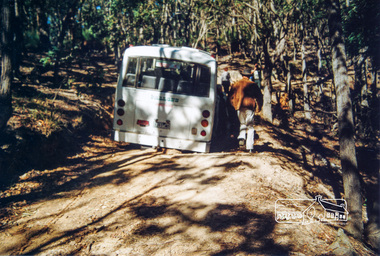
... We all travelled to Kinglake and met near the Fire Station where we were picked up by two buses provided by Parks Victoria to take us to the top of Mt Everard. There we enjoyed morning tea (needed to as we from·the first bus had to walk the last hill when the bus broke down) while we waited for the official party to arrive. ...We all travelled to Kinglake and met near the Fire Station where we were picked up by two buses provided by Parks Victoria to take us to the top of Mt Everard. There we enjoyed morning tea (needed to as we from·the first bus had to walk the last hill when the bus broke down) while we waited for the official party to arrive. ...The Everard Memorial was officially dedicated on 22 April 2004 by Betty Lynch OAM, daughter of William Everard and sister of Blanche Shallard. Newsletter No. 156 May 2004 THE MT. EVERARD CONNECTION Mt Everard in the Kinglake National Park commemorates William Hugh Everard, State Member for Evelyn and father of our member Blanche Shallard who died some eighteen months ago. Doug and Gwen Orford represented the Society at the unveiling of an interpretive sign at Mt Everard. Doug has written this account of the event on 22nd April. We all travelled to Kinglake and met near the Fire Station where we were picked up by two buses provided by Parks Victoria to take us to the top of Mt Everard. There we enjoyed morning tea (needed to as we from·the first bus had to walk the last hill when the bus broke down) while we waited for the official party to arrive. While waiting we had a look at the open four sided interpretive feature donated by Mrs Betty Lynch OAM (sister of Blanche) in memory of their father Bill Everard who was the State Member for the area for many years and in recognition of Kinglake National Park's 75th birthday. The information display describes the Blue Ant Butterfly, the Coconut Ant and the Swamp Pea, all of which are indigenous to the area. The Chief Executive of Parks Victoria welcomed everyone on this warm windy day after which Betty explained how the blue ant butterfly cohabited with the ants and survived. The swamp pea is described as a rare indigenous plant to the area. She also spoke of her father's interest in the area. The Governor, John Landy, then spoke before he and Betty moved up to the display board and cut the red ribbon from around it.10 colour photographsbetty lynch, everard memorial, mt everard, kinglake national park, dedication, blanche shallard -
 Eltham District Historical Society Inc
Photograph - Digital Photograph, Marguerite Marshall, Stations of the Cross, Clifton Pugh (1961); Our Lady Help of Christian's Church, Henry Street, Eltham, 11 October 2006
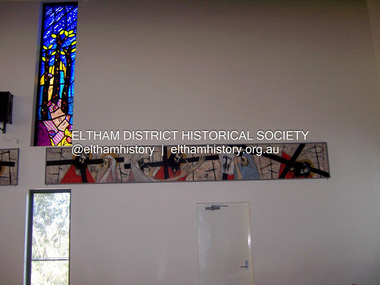
... Not long after in 1961, a fire destroyed the church and huge working bees under the prominent Catholic builders, the Sibbel brothers, rebuilt and extended it, using the original altar from the first church. It was then that builder and parishioner Herman Sibbel asked his friend, artist Clifton Pugh, to paint the Stations of the Cross for the church. ...Not long after in 1961, a fire destroyed the church and huge working bees under the prominent Catholic builders, the Sibbel brothers, rebuilt and extended it, using the original altar from the first church. It was then that builder and parishioner Herman Sibbel asked his friend, artist Clifton Pugh, to paint the Stations of the Cross for the church. ...Stations of the Cross by Clifton Pugh is a contempooray art piece in four sections making up 11 stations of the cross. It was commissioned by the Catholic parish in Eltham (Our Lady Help of Christians) in 1961 Published: Nillumbik Now and Then / Marguerite Marshall 2008; photographs Alan King with Marguerite Marshall.; p81 Art is an important means of nurturing faith at Our Lady Help of Christians Church, Henry Street, Eltham. The Stations of the Cross by Clifton Pugh and The Crucifix with the Ascending Jesus by sculptor Charles Rocco are two of the fine works that enhance the parishioners’ worship. These two inspiring works of art were added in 2001 – long after Roman Catholics began worshipping in Eltham around 1864. This beautiful worship centre was built following hardship and change – for parishioners have endured their church being destroyed by fire and have built four churches since they first worshipped together. Before 1864, according to local legend, a visiting priest administered sacraments in the parlour of former convict-turned-respected citizen Thomas Sweeney at Sweeneys Lane, Eltham.1 The first church was blessed in September, 1865, by the Archbishop of Melbourne, Dr Goold. It stood on an acre (0.4ha) of land in Little Eltham as that area was known then, near the present Fordhams and Main Roads and was part of the Heidelberg Church Parish. In 1912 the church was relocated to a new building on the present primary school site at 1 Henry Street. This was closer to the town centre, which had moved from Little Eltham after the railway line was extended to Eltham in 1902.2 In 1958 the church split from the Sacred Heart parish, Diamond Creek, to become a parish in its own right, with Father Tom Curran as inaugural priest. Not long after in 1961, a fire destroyed the church and huge working bees under the prominent Catholic builders, the Sibbel brothers, rebuilt and extended it, using the original altar from the first church. It was then that builder and parishioner Herman Sibbel asked his friend, artist Clifton Pugh, to paint the Stations of the Cross for the church. But the priest, Father Curran, neither approved of Pugh’s bohemian reputation nor liked the paintings, so they were hung in the corridor of Our Lady’s Primary School instead. The parishioners almost sold the paintings in 1989 to pay for major school renovations. However the paintings remained there for about 40 years, until 2001, when the church was extensively renovated by Father Barry Caldwell. Another change awaited the church, as it outgrew its building, later to be used as the school hall. So, in 1976, the present church was built across the road. Three beautiful stained-glass windows depicting the Passion, Death, Resurrection and the presence of Christ’s Spirit, link these with the church’s experiences. The first depicts a bushfire in Eltham, referring to their church damaged by fire. Another represents the Resurrection of Christ with new growth on a blackened stump and the Holy Spirit is represented by the Southern Cross. A window depicting Our Lady Help of Christians by parishioner Bill Peperkamp, was donated by parishioners to commemorate the Silver Jubilee of Father Desmond G Jenkins’ ordination to the priesthood on July 27, 1977. This, with the statue of Mary, creates a Marian shrine. In the 14 Stations of the Cross painted on four masonite panels Pugh captures the pathos of the suffering Christ and his disciples.3 The figures are stylised, except intriguingly, that of Pontias Pilate, who looks like Clifton Pugh. Charles Rocco’s sculpture is an extraordinary Jesus figure being raised from the Cross. The delicate stainless steel mesh of the figure creates a sense of the power of God over death. The organ, built in 1868 by George Fincham and Sons, was first installed in the All Saints’ Anglican Church, East St Kilda, then in the St Andrews Church, Clifton Hill. It was rebuilt into a modern instrument with a donation from parishioner Jim Murray, in memory of his wife Gwendolene Mary.4 Church members created their own work of art in front of the entrance, by painting designs and messages on 700 tiles. This work indicates the strong church family and faith expressed in art, that awaits the worshipper inside.This collection of almost 130 photos about places and people within the Shire of Nillumbik, an urban and rural municipality in Melbourne's north, contributes to an understanding of the history of the Shire. Published in 2008 immediately prior to the Black Saturday bushfires of February 7, 2009, it documents sites that were impacted, and in some cases destroyed by the fires. It includes photographs taken especially for the publication, creating a unique time capsule representing the Shire in the early 21st century. It remains the most recent comprehenesive publication devoted to the Shire's history connecting local residents to the past. nillumbik now and then (marshall-king) collection, art, clifton pugh, stations of the cross, our lady help of christans, installation
