
Showing 871 items matching "first-institution"
-
 Vision Australia
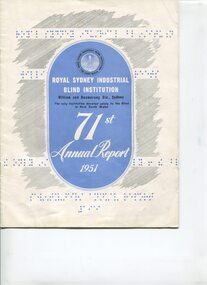
Administrative record - Text, Royal Sydney Industrial Blind Institution: Seventy-First Report 1951, 1951
... Royal Sydney Industrial Blind Institution: Seventy-First Report 1951...Toll Pty Ltd Roy Kippax Graeme Dark Sandra Dark Parramatta Gaol 1 volume of text and images Royal Sydney Industrial Blind Institution: Seventy-First Report 1951 Administrative record Text ...Articles in the annual report include: opening of the only nursery for blind babies and children at Victor Maxwell House, a new Braille shorthand class, the erection of an Occupational Therapy Department building, the development of a new switchboard operation course, a trial of long-term prisoners producing Braille has resulted in 83 being created, a profile on the late Jean Currie and appointment of Coral Cook in that position, awarding of an MBE to R.W. Kippax (who has occupied many positions at the Institution), thanks to A.F Toll for the free transport of Braille volumes and the Black and White Committee on another outstanding Ball, and the success of the NSW Blind Cricket Club and the young women at Helen Keller hostel forming the Amazons Blind Girls Sports Club. 1 volume of text and images corporation records, royal sydney industrial blind institution, jean currie, black and white committee, nsw blind cricket, coral cook, victor maxwell kindergarten, cricket, braille writers association of new south wales, a.f. toll pty ltd, roy kippax, graeme dark, sandra dark, parramatta gaol -
 Vision Australia
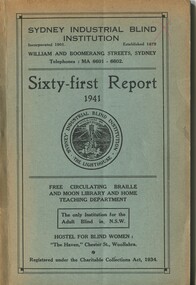
Administrative record - Text, Sydney Industrial Blind Institution: Sixty-First Report 1941, 1942
... Sydney Industrial Blind Institution: Sixty-First Report 1941...Harris Roy Kippax L E Hudson Alan Green Robert McDonald Auxiliaries 1 printed volume with black and white illustrations Sydney Industrial Blind Institution: Sixty-First Report 1941 Administrative record Text ...Articles in the annual report include: members of Marcus Clark's Ex-Service Men's Association have dug trenches for air-raid shelters, thanks to the blind artists who performed at the Annual General meeting: soprano Nita Bowman, flautist W Kirkbride-Smith and accompanist Marcus Burkitt, the library now has over 18,000 volumes in Braille and Moon, the passing of L.E. Hudson who edited the Woman's Magazine for over 20 years, 441 Talking books (consisting of 5914 records), appointment of Superintendent A J Harris and Welfare Office Roy Kippax to the NSW War Blinded Welfare Committee, a thoughtful donation of 50 cigarettes to be distributed amongst the blind, the annual Picnic at Clifton Gardens with Alan Green winning the A Consett Stephen Cup, a change in time to 3.45pm for the Glow Worm sessions, and the sad death of R McDonald who read to blind workers during lunch hour for 37 years - the victim of an accident upon his return home from the Institution. 1 printed volume with black and white illustrations annual report, sydney industrial blind institution, nita bowman, marcus burkitt, w kirkbride-smith, a.j. harris, roy kippax, l e hudson, alan green, robert mcdonald, auxiliaries -
 Mentone Grammar School
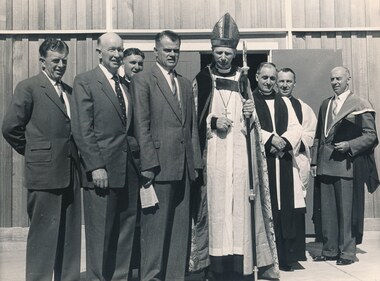
Institution of first School Chaplain, 11 February 1958, as Mentone becomes a Church of England Grammar School
... Institution of first School Chaplain, 11 February 1958, as Mentone becomes a Church of England Grammar School...Large (Headmaster). Institution of first School Chaplain, 11 February 1958, as Mentone becomes a Church of England Grammar School ...Mentone becomes a Church of England Grammar School. Institution of School Chaplain, 11 February 1958. members of The Board of Management, L to R: Col. C.G. Weir, J Finlay Anderson (Chairman), Revd. S. Moss (at rear) and J.J. Thorold (Principal, Registrar and Secretary to The Board), Archbishop Dr F. Woods (President of The Board), Revd. F. Cuttriss (Board Member), Revd. A. V. Maddick (Chaplain) and L.A. Large (Headmaster). -
 Healesville Sanctuary Heritage Centre
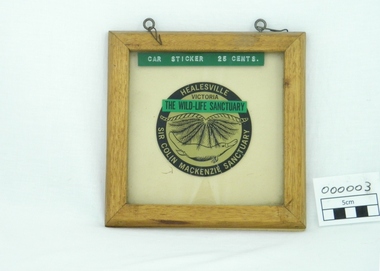
framed car sticker, Lynette Kennedy
... ...first-institution...Healesville Sanctuary was the first institution to breed platypus in a total captive situation.and is also the only institution in the world to breed Lyrebirds Healesville-Sanctuary first-institution breeding platypus lyrebird Inscription on car sticker is "Sir Colin MacKenzie Sanctuary" on the bottom half of the perimeter circle. ...A promotional car sticker of Healesville Sanctuary specialising in Australian Fauna and Flora. This item was displayed at the front entrance to encourage visitors to purchase and promote the Sanctuary. This car sticker was a very popular and sought after souvenir selling for 25 cents contributing to the Sanctuary's income. Healesville Sanctuary was the first institution to breed platypus in a total captive situation.and is also the only institution in the world to breed Lyrebirds A promotional circular car sticker depicting a lyrebird tail in full display above a platypus side on. Has dark green border at ouside edge of sticker; colours are black, gold and green. Sticker is in a wooden glass frame and has a dynamo label glued to upper edge of glass. There are 2 eye hooks screwed into the upper edge of frame. Inscription on car sticker is "Sir Colin MacKenzie Sanctuary" on the bottom half of the perimeter circle. With "Healesville" at top of perimeter of circle. At the top of the inner circle the word "Victoria" is placed above a green horizontal band which reads "The Wild-life Sanctuary". healesville-sanctuary, first-institution, breeding, platypus, lyrebird -
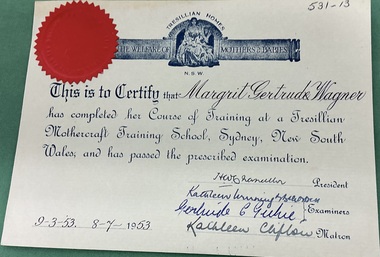 Alfred Hospital Nurses League - Nursing History Collection
Certificate - Infant Welfare Certificate, Tresillian Homes, Tresillian Homes Mothercraft Training School Certificate, [ca.1953]
... In 1921 Tresillian Homes established a course in Infant wealfare, the first institution in Australia to do so. This certificate was awared to Margrit Wagner [AH grad 1952] who completed her course in 1953. ...In 1921 Tresillian Homes established a course in Infant wealfare, the first institution in Australia to do so. This certificate was awared to Margrit Wagner [AH grad 1952] who completed her course in 1953. ...In 1921 Tresillian Homes established a course in Infant wealfare, the first institution in Australia to do so. This certificate was awared to Margrit Wagner [AH grad 1952] who completed her course in 1953. Infant welfare was recognized as the 'triple certificate' the first being general nursing and the 'double' midwifery. This course was of four months duration A post graduate qualification obtained by an Alfred Hospital trainee Blue print on paler blue background with embossed red sticker at top left. The certificate has the letterhead of Tresillian Homes, Royal Society for the welfare of mothers and babies. The certificate reads "This is to Certify that...../has completed her course of Training at a Tresillian/Mothercraft Training School, Sydney, New South/ Wales and has passed the Prescribed examination. Dated and signed by society president, examiners and matron. Handwritten annotations Margrit Gertrude Wagner [recipient] 9-3-53 . 9-7-53 [dates of training], signatures of? [ president of society] ?? /?? [examiners] and Kathleen Clifton [matron] [all in blue ink} Previous catalogue number hanwritten at top right [blue ink] infant welfare, infant welfare certificate, tresillian homes, post graduate nursing qualification, margrit wagner -
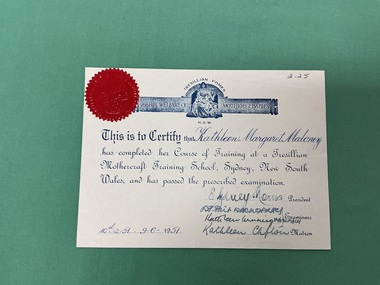 Alfred Hospital Nurses League - Nursing History Collection
Certificate - Infant Welfare Certificate, Tresillian Homes, Tresillian Homes Mothercraft training School Certificate, [ca.1951]
... In 1921 Tresillian Homes established a course in Infant welfare, the first institution in Australia to do so. This certificate was awared to Kathleen Moloney [AH grad 1931] who completed her course in 1951. ...In 1921 Tresillian Homes established a course in Infant welfare, the first institution in Australia to do so. This certificate was awared to Kathleen Moloney [AH grad 1931] who completed her course in 1951. ...In 1921 Tresillian Homes established a course in Infant welfare, the first institution in Australia to do so. This certificate was awared to Kathleen Moloney [AH grad 1931] who completed her course in 1951. Infant welfare was recognized as the 'triple certificate' the first being general nursing and the 'double' midwifery. This course was of four months duration A post graduate qualification obtained by an Alfred Hospital trainee Blue print on paler blue background with embossed red sticker at top left. The certificate has the letterhead of Tresillian Homes, Royal Society for the welfare of mothers and babies. The certificate reads "This is to Certify that...../has completed her course of Training at a Tresillian/Mothercraft Training School, Sydney, New South/ Wales and has passed the Prescribed examination. Dated and signed by society president, examiners and matron. Handwritten annotations Kathleen Margaret Maloney [recipient] 10th-2-51 . 9-6-51, signatures of E Sydney Morris [vice president of society] ?? /?? [examiners] and Kathleen Clifton [matron] [all in blue ink} Previous cataloggue number hanwritten at top right [blue ink] infant welfare, infant welfare certificate, tresillian homes, post graduate nursing qualification, kathleen moloney -
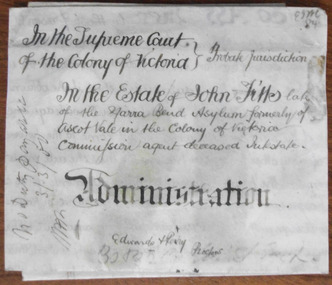 Warrnambool and District Historical Society Inc.
Document - John Fitts Letters of Administration 1879, 1879
... Yarra Bend Asylum, near the junction of the Yarra River and the Merri Creek was the first institution for the mentally ill in Victoria and operated from 1848 to 1925. ...Yarra Bend Asylum, near the junction of the Yarra River and the Merri Creek was the first institution for the mentally ill in Victoria and operated from 1848 to 1925. ...No information has been found on the Commission Agent John Fitts except that he died at the Yarra Bend Asylum at the age of 51 and was formerly a resident of Ascot Vale, a suburb of Melbourne. His estate was valued at £600. Yarra Bend Asylum, near the junction of the Yarra River and the Merri Creek was the first institution for the mentally ill in Victoria and operated from 1848 to 1925. Tait collection: item 5 of 62 This document is only of interest in that it came from the former legal offices of Mackay Taylor in Kepler Street, Warrnambool. It originally came from Thomas Goodall, a legal clerk in the office of the lawyer Ernest Chambers who passed it on to George Mackay, the lawyer in the forerunner firm of Mackay Taylor where it remained until the firm of Mackay Taylor ceased to exist and the buildings were cleaned out. This is a piece of parchment paper with printed black lines and handwritten material in black ink. There is a fold at the bottom of the document with a seal of the Supreme Court of the Colony of Victoria attached by a green ribbon. The document is slightly discoloured but is otherwise in good condition. ‘In the Supreme Court of the Colony of Victoria, Probate jurisdiction, In the Estate of John Fitts, late of the Yarra Bend Asylum, formerly of Ascot Vale in the Colony of Victoria, commission agent, deceased intestate, Administration, Edwards and Perry, Proctors’ yarra bend asylum, john fitts, warrnambool -
 Federation University Historical Collection
Annual Report, Ballarat School of Mines Annual Report, 1970
... The Ballarat School of Mines was founded in 1970 and was the first institution of formal technical education in Australia. 1970 marked the centenary of the School and that of technical Education in Australia. ...The Ballarat School of Mines was founded in 1970 and was the first institution of formal technical education in Australia. 1970 marked the centenary of the School and that of technical Education in Australia. ...The Ballarat School of Mines was founded in 1970 and was the first institution of formal technical education in Australia. 1970 marked the centenary of the School and that of technical Education in Australia. A centenary commitee was established to plan activities and projecty sot celebrate the occasion. These included five centenary lectures fro secondary school students, a film of the School to be made and shown on National Television, a centenary medallion centenary posters, a dinner for local organisations with Council and staff as hosts, an historical notebook on the school, a plaque mounted to mark the site of the original school, opening of the Mt Helen Campus, Relocating the Old SMB battery ot mt Helen, student reunion, Art display of present and former students, Mt Helen Open Days and distribution of car stickers. A Centenary Appeal was established to finance a Great Hall and Sports Centre at the Mt Helen Campus. The Appeal President was Cr W.J.C. North. The materials testing laboratory secured and retained registration by the National Association of Testing Authorities for a range of tests on concrete and metals. The student accommodation at Mt Helen 23 Page report (with supplementary finances) in a soft cover showing a picture of the Former Ballarat Circuit Courthouse which was used as the first building of the Ballarat School of Mines. The report includes a page of stamps produced to commemorate the centenary of Technical Education in Australia through the Ballarat School of Mines. The report was presented by Council President Morgan Bevan John. The report includes information on the new campus for the Tertiary Division at Mt Helen, including information on the buildings being constructed by local builders. The site plan was developed by G.J. Harrison and L.H. Vernon and Associates. The following staff resigned: E.R. McGrath (deceased), E.W. Ryan, I.L. Hunter. The following new appointments were made: R.l. Martin, G.K. Tampi, T.F. Norwood, K.M. Llewellyn, M.J. Evans, J.F. Clark, K.G. Millar, B.R. Rollins, L.G. Shome, C.I. Dowling, M.H. Pitfield, G.M. Pearson, J.P. Murray, J.R. Thyer. Page 10 lists diplomas awarded and page 11 lists scholarships and prizes including the Ballarat has Company Scholarship, the Josephine Brelaz Scholarship, The Frank Pinkerton Scholarship, The Mica Smith/Serjeant/Ironworkers Scholarship, Martha Pinkerton Scholarship, Ballarat City Council Scholarship, Junior Art Scholarship, C.R.A. Scholarship, B.H.P. Scholarship, S.E.C. Scholarship, Alexander Rushal Scholarship, Russell and Shirley Evans Scholarship. The R.W. Richards Medal for 1969 was awarded to Peter Hensley. A new I.C.L. 1901A computer and associated equipment was purchased for the Computer Centre. Page 15 has information on the Victorian Institute of Colleges (VIC). Governor of Victoria, Sir Rohan Delacombe, with VIC's Dr Philip Law visited the Ballarat School of Mines and inspected both the old and new facilities. ballarat school of mines, m.b. john, centenary, anniversary -
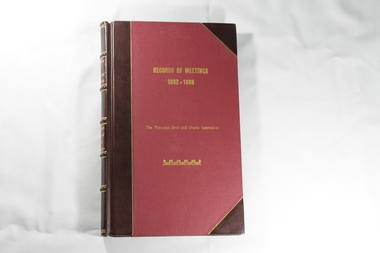 Deaf Children Australia
Book, Records of Meetings 1862-1869
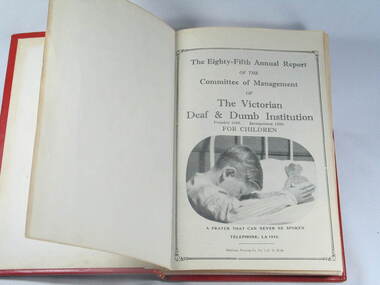
... Red and Dark red leather bound volume with gold lettering containing the records of meetings of the Victorian Deaf and Dumb Institution. The first meeting being reported in 'The Age' and 'Argus', held on the 28th August, 1862. ...Spine: "Records of meetings 18622-1869" " Victorian Deaf and Dumb Institution" in gold lettering Red and Dark red leather bound volume with gold lettering containing the records of meetings of the Victorian Deaf and Dumb Institution. The first meeting being reported in 'The Age' and 'Argus', held on the 28th August, 1862. ...The minutes of each meeting of the Board of Management of the Victorian Deaf & Dumb Institution, the Victorian School for Deaf Children and Deaf Children Australia has been retained from 1862 to 2010. The minutes of the meetings provide an insight into the day to day running of the School, from Wages and Salaries, student issues to broader educational topics, building works and finances. Red and Dark red leather bound volume with gold lettering containing the records of meetings of the Victorian Deaf and Dumb Institution. The first meeting being reported in 'The Age' and 'Argus', held on the 28th August, 1862. Minutes from the 3rd meeting held on 9th Sep 18662 in handwriting and all subsequent meetings. Also contains records of the meetings of the 'House Committee' including accounts. Front Cover: "RECORDS OF MEETINGS 1862-1869" "The Victorian Deaf and Dumb Institution" in gold lettering. Spine: "Records of meetings 18622-1869" " Victorian Deaf and Dumb Institution" in gold lettering deaf children australia, deaf education, records of meeting, minutes of meeting -
 Deaf Children Australia
Book, Reports V.S.D.C. 1947 to 1954
... Red Leather bound volume with gold stamping containing Annual Reports of the Victorian School for Deaf Children ( previously Victorian Deaf and Dumb Institution) (V.S.D.C) First report: 85th Annual report presented at the Annual Meeting held on 19th August 1947. ...Red Leather bound volume with gold stamping containing Annual Reports of the Victorian School for Deaf Children ( previously Victorian Deaf and Dumb Institution) (V.S.D.C) First report: 85th Annual report presented at the Annual Meeting held on 19th August 1947. ...Deaf Children Australia have a complete set of Annual reports from 1863 to the present date. Annual reports document the activities of the organisation, including educational issues, finance, staffing and students. Annual Reports are created each year. This represents part of the complete official history of Deaf Children Australia from 1863 to the present date, covering the subject of deaf education and related issues. Red Leather bound volume with gold stamping containing Annual Reports of the Victorian School for Deaf Children ( previously Victorian Deaf and Dumb Institution) (V.S.D.C) First report: 85th Annual report presented at the Annual Meeting held on 19th August 1947. Last report: 92nd Annual report presented at Annual Meeting held on 23rd August 1954. Includes Annual Reports, abstract of Acccounts, and photographs Front Cover: "VICTORIAN SCHOOL FOR DEAF CHILDREN" in gold stamping. Spine "REPORTS V.S.D.C." "1947 to 1954" in gold stamping. Decorative stamping around edges of back and front covers. deaf children australia, deaf education, deaf and dumb institution, annual report -
Broadmeadows Historical Society & Museum
Photograph - School Photograph, Classic Studios Victoria, Jacana Primary School - Students and Staff 2005, 2005
... It reflects the community spirit and educational environment of a long-standing local institution that first opened in 1960....It reflects the community spirit and educational environment of a long-standing local institution that first opened in 1960. This photograph of the students and staff of Jacana Primary School holds enduring historical and emotional value as a visual record of early childhood education in a now closed institution. ...This photograph captures the students and staff of Jacana Primary School in 2005, during the final years of the school’s operation before its transition to the Northern School for Autism. It reflects the community spirit and educational environment of a long-standing local institution that first opened in 1960. This photograph of the students and staff of Jacana Primary School holds enduring historical and emotional value as a visual record of early childhood education in a now closed institution. It captures a moment in time that reflects the community spirit, diversity and educational environment of Jacana during its operational years. As the school has since closed, the image swerves as a poignant reminder of the role Jacana Primary played in shaping young lives and fostering local identity. It is a valuable artefact for former students, staff and the broader community, preserving the legacy of a place that once stood as a cornerstone of learning and connection. Colour photograph on matte paper jacana primary school, education, school photograph, students and staff, 2005 -
 Flagstaff Hill Maritime Museum and Village
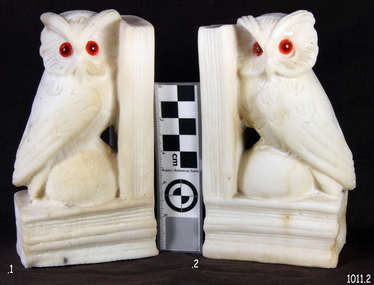
Decorative object - Bookends, ca. 1930s
... institutions and banks. Bookends hold a row of upright books in place by supporting the beginning and end of the row. The books are more likely to keep their integrity when stored vertically. The first...institutions and banks. Bookends hold a row of upright books in place by supporting the beginning and end of the row. The books are more likely to keep their integrity when stored vertically. The first ...The pair of ornamental white resin owl bookends was likely made around the 1930s when epoxy resin became available. Bookends modelled on owls have been a popular ornament for many years, possibly because of the association between owls, books and wisdom. They are used and displayed in places where books are appreciated and valued, such as homes, libraries, educational buildings, business offices, legal institutions and banks. Bookends hold a row of upright books in place by supporting the beginning and end of the row. The books are more likely to keep their integrity when stored vertically. The first patent for a metal bookend was placed by William Stebbins Barnard in 1877. Bookends became useful and decorative items around the middle of the sixteenth century after printed books became available. At that time books were expensive and treasured possessions, treated with much respect. Even in the early nineteenth century, a Bible was often the only book in the home. It was included among the limited items brought by many immigrants to Australia. Books became more available and affordable to the public by the end of the nineteenth century and households and businesses were able to build their own libraries. Bookends were used then, and are still used now, to keep books organised, cared for, and readily accessible. Bookends, a pair of two (2) small white resin owls with clear bright red eyes standing on a stack of books, their bodies facing towards each other, chests on an upright book, heads turned towards the viewer. The ends are left and right-handed. flagstaff hill, flagstaff hill maritime museum and village, warrnambool, maritime museum, maritime village, great ocean road, shipwreck coast, ornament, bookend, bookends, pair of bookends, library, book storage, book display, room decoration, resin ornament, white bookends, owl bookends, owl ornament, white owls, resin owls, book support, bookend patent, william stebbins barnard -
 Flagstaff Hill Maritime Museum and Village
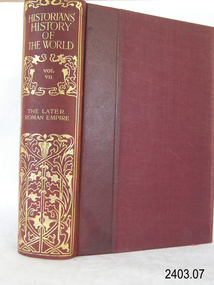
Book - Reference Book/History, Henry Smith Williams, The Historians History of the World Vol 7 set 1 - Edited by Henry Smith Williams L.L.D, 1908
... institutions vs. the external pressure of "Barbarian" migrations. This volume is notable for its heavy reliance on the works of Edward Gibbon (filtered through Williams' 1908 perspective), as well as Byzantine chroniclers like Procopius. The set is of historiographical value and significant because it captures the state of historical knowledge in 1908. In addition it reflects the "Great Man" theory of history and Western-centric perspectives common to that era. The volumes also had great editorial innovation as it was one of the first ...The 1908 edition of The Historians' History of the World is a monumental work of Edwardian scholarship, representing a specific era of "universal history" where the goal was to synthesise all human knowledge into a single narrative. Volume 7 shifts the narrative from the fall of the Roman Republic and the early Empire (covered in Vol. 5 and 6) into the complex era of the later Roman Empire and the rise of the Early Byzantine Empire.Book is part of a 25 volume set with red cloth bindings and gold filigree design to rib. non-fiction The 1908 edition of The Historians' History of the World is a monumental work of Edwardian scholarship, representing a specific era of "universal history" where the goal was to synthesise all human knowledge into a single narrative. Volume 7 shifts the narrative from the fall of the Roman Republic and the early Empire (covered in Vol. 5 and 6) into the complex era of the later Roman Empire and the rise of the Early Byzantine Empire. flagstaff hill, warrnambool, shipwrecked-coast, flagstaff-hill, flagstaff-hill-maritime-museum, maritime-museum, shipwreck-coast, flagstaff-hill-maritime-village, the historians history of the world, henry smith williams l.l.d. -
 Flagstaff Hill Maritime Museum and Village
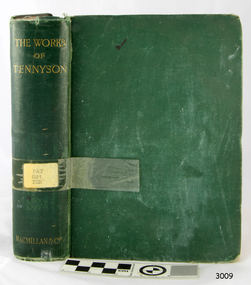
Book, The Works of Alfred Lord Tennyson
... Institution as it was sometimes called) was one of the earliest in Victoria. On 17th October 1853, a meeting was held where it was resolved to request the Lieutenant Governor of the Colony to grant land for the erection of a Mechanics' Institutes building. A committee was formed at the meeting and Richard Osburne chaired the first...Institution as it was sometimes called) was one of the earliest in Victoria. On 17th October 1853, a meeting was held where it was resolved to request the Lieutenant Governor of the Colony to grant land for the erection of a Mechanics' Institutes building. A committee was formed at the meeting and Richard Osburne chaired the first ...This item is from the ‘Pattison Collection’, a collection of books and records that was originally owned by the Warrnambool Mechanics’ Institute, which was founded in Warrnambool in 1853. By 1886 the Warrnambool Mechanics’ Institute (WMI) had grown to have a Library, Museum and Fine Arts Gallery, with a collection of “… choice productions of art and valuable specimens in almost every branch and many wonderful national curiosities are now to be seen there, including historic relics of the town and district.” It later included a School of Design. Although it was very well patronised, the lack of financial support led the WMI in 1911 to ask the City Council to take it over. In 1935 Ralph Pattison was appointed as City Librarian to establish and organise the Warrnambool Library as it was then called. When the WMI building was pulled down in 1963 a new civic building was erected on the site and the new Warrnambool Library, on behalf of the City Council, took over all the holdings of the WMI. At this time some of the items were separated and identified as the ‘Pattison Collection’, named after Ralph Pattison. Eventually, the components of the WMI were distributed from the Warrnambool Library to various places, including the Art Gallery, Historical Society and Flagstaff Hill. Later some were even distributed to other regional branches of Corangamite Regional Library and passed to and fro. It is difficult now to trace just where all of the items have ended up. The books at Flagstaff Hill Maritime Village generally display stamps and markings from Pattison as well as a variety of other institutions including the Mechanics’ Institute itself. RALPH ERIC PATTISON Ralph Eric Pattison was born in Rockhampton, Queensland, in 1891. He married Maude Swan from Warrnambool in 1920 and they set up home in Warrnambool. In 1935 Pattison accepted a position as City Librarian for the Warrnambool City Council. His huge challenge was to make a functional library within two rooms of the Mechanics’ Institute. He tirelessly cleaned, cleared and sorted a disarrayed collection of old books, jars of preserved specimens and other items reserved for exhibition in the city’s museum. He developed and updated the library with a wide variety of books for all tastes, including reference books for students; a difficult task to fulfil during the years following the Depression. He converted all of the lower areas of the building into a library, reference room and reading room for members and the public. The books were sorted and stored using a cataloguing and card index system that he had developed himself. He also prepared the upper floor of the building and established the Art Gallery and later the Museum, a place to exhibit the many old relics that had been stored for years for this purpose. One of the treasures he found was a beautiful ancient clock, which he repaired, restored and enjoyed using in his office during the years of his service there. Ralph Pattison was described as “a meticulous gentleman whose punctuality, floorless courtesy and distinctive neat dress were hallmarks of his character, and ‘his’ clock controlled his daily routine and his opening and closing of the library’s large heavy doors to the minute.” Pattison took leave from 1942 to 1945 to serve in the Royal Australian Navy, Volunteer Reserve as Lieutenant. A few years later he converted one of the Museum’s rooms into a Children’s Library, stocking it with suitable books for the younger generation. This was an instant success. In the 1950’s he had the honour of being appointed to the Victorian Library Board and received more inspiration from the monthly conferences in Melbourne. He was sadly retired in 1959 after over 23 years of service, due to the fact that he had gone over the working age of council officers. However, he continued to take a very keen interest in the continual development of the Library until his death in 1969. WARRNAMBOOL MECHANICS’ INSTITUTE Warrnambool's Mechanics' Institute (or Institution as it was sometimes called) was one of the earliest in Victoria. On 17th October 1853, a meeting was held where it was resolved to request the Lieutenant Governor of the Colony to grant land for the erection of a Mechanics' Institutes building. A committee was formed at the meeting and Richard Osburne chaired the first meeting of this committee. The land on the North West corner of Banyan and Merri Streets was granted but there were no funds to erect the building. The Formal Rights of the Warrnambool Mechanics' Institute's encompassed its aims and these were officially adopted in1859; "This Institution has for its object the diffusion of literary, scientific, and other useful knowledge amongst its members, excluding all controversial subjects, religious or political. These objects are sought to be obtained by means of a circulating library, a reading room, the establishment of classes, debates, and the occasional delivery of lectures on natural and experimental philosophy, mechanics, astronomy, chemistry, natural history, literature, and the useful and ornamental arts, particularly those which have a more immediate reference to the colony." The Warrnambool Mechanics' Institute opened its first reading room in November 1884 in the National School building at the corner of Banyan and Timor Streets. The Institute was funded by member subscription, payable on a quarterly, half-yearly or yearly basis. Samuel Hannaford, the Manager of the Warrnambool Bank of Australasia, was the first Honorary Secretary of the Mechanics' Institutes, and an early President and Vice-President. He also gave several of the early lectures in the Reading Room. Another early Secretary, Librarian and lecturer was Marmaduke Fisher, the teacher at the National School. Lecture topics included The Poets and Poetry of Ireland', 'The Birth and Development of the Earth', 'The Vertebrae - with Remarks on the pleasures resulting from the study of Natural History' and 'Architecture'. In 1856 the Reading Room was moved to James Hider's shop in Timor Street, and by 1864 it was located in the bookshop of Davies and Read. In the 1860's the Mechanics' Institute struggled as membership waned but in 1866, after a series of fundraising efforts, the committee was able to purchase land in Liebig Street, on a site then called Market Square, between the weighbridge and the fire station. A Mechanics' Institute building was opened at this site in August 1871. The following year four more rooms were added to the main Reading Room and in 1873 the Artisan School of Design was incorporated into the Institute. The same year Joseph Archibald established a Museum; however, it deteriorated when he was transferred to Bendigo in 1877. In 1880, with Archibald's return to Warrnambool, the Museum was re-established, and in 1885 a new building was built at the back of the Institute to accommodate the re-created School of Design, the Art Gallery and the Museum. In 1887 the Museum section was moved to the former courthouse in Timor Street (for some time the walls of the building formed part of the TAFE cafeteria but all is now demolished)). In 1911 the Museum was transferred back to the original building and the management of the Mechanics' Institute was handed over to the Warrnambool City Council. The Museum and Art Gallery became one and housed many fine works of art, and the Library continued to grow. The building was well patronised, with records showing that at the beginning of the 20th century there were between 500 and 800 visitors. During World War One the monthly figures were in the thousands, with 3,400 people visiting in January 1915. The Museum was a much-loved Institution in Warrnambool until the contents of the Museum and Art Gallery were removed to make room for the Warrnambool City Council Engineers' Department. The contents were stored but many of the items were scattered or lost. When the original building was demolished the site became occupied by the Civic Centre, which included the new City Library. (The library was temporarily located in the old Palais building in Koroit Street.) In the process of reorganisation the Collection was distributed amongst the community groups: -The new City Library took some of the historical books and some important documents, historic photographs and newspapers. -The Art Gallery kept the 19th Century art collection and some of the artefacts from the museum. -The Historical Society has some items -The State Museum has some items -Some items were destroyed -Flagstaff Hill Maritime Village has old newspapers, Government Gazettes, most of the Mechanics' Institute Library, ledgers and documents connected to the Mechanics' Institute Library, some framed and unframed artworks and some photographs. The Warrnambool Mechanics' Institute Library book collection is deemed to be of great importance because it is one of the few collections in an almost intact state, and many of the books are now very rare and of great value. The Pattison Collection, along with other items at Flagstaff Hill Maritime Village, was originally part of the Warrnambool Mechanics' Institute’s collection. The Warrnambool Mechanics’ Institute Collection is primarily significant in its totality, rather than for the individual objects it contains. Its contents are highly representative of the development of Mechanics' Institute libraries across Australia, particularly Victoria. A diversity of publications and themes has been amassed, and these provide clues to our understanding of the nature of and changes in the reading habits of Victorians from the 1850s to the middle of the 20th century. The collection also highlights the Warrnambool community’s commitment to the Mechanics’ Institute, reading, literacy and learning in the regions, and proves that access to knowledge was not impeded by distance. These items help to provide a more complete picture of our community’s ideals and aspirations. The Warrnambool Mechanics Institute book collection has historical and social significance for its strong association with the Mechanics Institute movement and the important role it played in the intellectual, cultural and social development of people throughout the latter part of the nineteenth century and the early twentieth century. The collection of books is a rare example of an early lending library and its significance is enhanced by the survival of an original collection of many volumes. The Warrnambool Mechanics' Institute’s publication collection is of both local and state significance. The Works of Alfred Lord Tennyson Author: Alfred, Lord Tennyson - Poet Laureate Publisher: Macmillan And Co Date: 1892 The label on spine cover has typed text PAT 821 TEN Pastedown front endpaper has a sticker from Warrnambool Mechanics Institute and Free Library Front loose endpaper has a sticker from Corangamite Regional Library Service Front loose endpaper has a stamp from Corangamite Regional Library Service Flyleaf has a stamp from Warrnambool Public Museum shipwrecked-coast, flagstaff-hill, flagstaff-hill-maritime-museum, warrnambool, maritime-museum, shipwreck-coast, flagstaff-hill-maritime-village, shipwrecked-artefact, book, pattison collection, warrnambool library, warrnambool mechanics’ institute, ralph eric pattison, corangamite regional library service, warrnambool city librarian, mechanics’ institute library, victorian library board, warrnambool books and records, warrnambool children’s library, the works of alfred lord tennyson, alfred, lord tennyson, poet laureate, alfred tennyson -
Federation University Historical Collection
Programme, Programme for the Official Opening of the Mt Helen Campus, 10/1970
... A master plan has been produced to develop this beautiful and spacious site as a tertiary institution enrolling, in due course, some 3000 full time students. the first sod was turned, to initiate this development, by the then Governor General of Australia, The Right Honourable Lord Casey, on 19th October, 1967. ...A master plan has been produced to develop this beautiful and spacious site as a tertiary institution enrolling, in due course, some 3000 full time students. the first sod was turned, to initiate this development, by the then Governor General of Australia, The Right Honourable Lord Casey, on 19th October, 1967. ...The first building at the Mt Helen Campus was opened in October 1970. Students first starting using the campus in the same year. The programme includes the following historical information: "On 26th October, 1870, Sir Redmond Barry officially opened the first venture into formal technical education in Australia - the Ballarat School of Mines. Over the preceding year a small group of Ballarat citizens interested in mining had conceived and brought into being the idea of creating such a school. They leased a derelict Court House next to the Ballarat Gaol in Lydiard St., at a nominal rental for15 years, and started classes with 4 students and an honorary lecturer. The School developed its courses beyond the initially intended range of studies related to mining, increased in enrolments, took over neighbouring properties and buildings and developed three levels of education - tertiary, trade and secondary. From the latter part of the 19th Century, even though remaining under the control of its own autonomous Council, it developed close links with the State Education Department. From the earliest times the School achieved widespread recognition and a particularly high reputation, and its graduates spread across Australia and the world. For several years it was affiliated with Melbourne University. In the last decade its scope has been further broadened by the introduction of new tertiary courses. During 1965 the State Government created the Victoria Institute of Colleges - a non-teaching body empowered to award degrees and directed towards the task of co-ordinating and developing tertiary education in Victorian in institutions other than universities. the tertiary division of the School became affiliated with the V.I.C. at the end of that same year. Subsequently the Council of the School decided that, whilst retaining for the whole establishment the time honoured title - The School of Mines and Industries, Ballarat - it should more distinctly sub-title the three divisions. the tertiary division then became known as the Ballarat Institute of Advanced Education. On receipt of substantial Commonwealth-State Grants, made to it as a college of advanced education, the Council was enabled at the start of 1967, to purchase for the Institute the 20 acre campus at Mt Helen. A master plan has been produced to develop this beautiful and spacious site as a tertiary institution enrolling, in due course, some 3000 full time students. the first sod was turned, to initiate this development, by the then Governor General of Australia, The Right Honourable Lord Casey, on 19th October, 1967. The first building group, now completed and occupied, has involved an expenditure approaching $1,000,000. It contains the departments of Mechanical, Civil and Mining Engineering, Metallurgy and Geology. it also contains the Computer Centre, a temporary Library and temporary student amenities. Over the next two years a further four buildings, costing about $2,500,000, will be erected, and a further major portion of the Institute will move to Mt Helen. these buildings, in addition to one for direct teaching work, will include a Library, a Union and the first stage of a Hall of Residence." White, folded, paper programme printed on the occasion of the official opening of the Ballarat Institute of Advanced Education (BIAE) Mount Helen Campus on the occasion of the centenary of the Ballarat School of Mines university of ballarat, ballarat school of mines, biae, mount helen, mt helen campus, mb john, jack barker, e.j. barker, rolly parfenovics, parfenovics, nigel bown, campus. victorian institute of colleges, m.b. john -
 Federation University Historical Collection
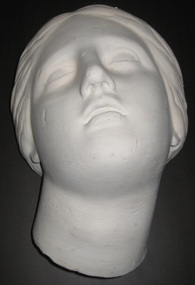
Sculpture - Plaster Drawing Prop, Cast of Woman's Head
... The school inherited some casts from its predecessor institutions, and further consignments were purchased during the 1920s, including full length, bust and relief figures, as well as dozens of ornamental and architectural casts. Unfortunately, much of the collection was lost or destroyed in the late 1950s. This is one of the few surviving pieces, with TAFE students reportedly drawing from it into the twenty-first...The school inherited some casts from its predecessor institutions, and further consignments were purchased during the 1920s, including full length, bust and relief figures, as well as dozens of ornamental and architectural casts. Unfortunately, much of the collection was lost or destroyed in the late 1950s. This is one of the few surviving pieces, with TAFE students reportedly drawing from it into the twenty-first ...The Ballarat Technical Art School boasted a well-stocked Antique Room replete with plaster copies of classical, Renaissance and Gothic sculptural examples, which were used as drawing props by students. The school inherited some casts from its predecessor institutions, and further consignments were purchased during the 1920s, including full length, bust and relief figures, as well as dozens of ornamental and architectural casts. Unfortunately, much of the collection was lost or destroyed in the late 1950s. This is one of the few surviving pieces, with TAFE students reportedly drawing from it into the twenty-first century. It was removed to the University's Historical Collection in 2012. White plaster cast of a woman with closed eyes. The cast is hollow, with an opening at the back. There is a metal wire at the back so it can hang on the wall. ballarat technical art school, ballarat school of mines, art, drawing, plaster, drawing the human figure from cast, drawing from the antique -
 Federation University Historical Collection
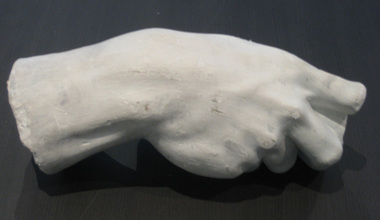
Equipment - Object, Otto Waschatz, Cast of Hand, Plaster Cast Drawing Prop
... The school inherited some casts from its predecessor institutions, and further consignments were purchased during the 1920s, including full length, bust and relief figures, as well as dozens of ornamental and architectural casts. Unfortunately, much of the collection was lost or destroyed in the late 1950s. This is one of the few surviving pieces, with TAFE students reportedly drawing from it into the twenty-first...The school inherited some casts from its predecessor institutions, and further consignments were purchased during the 1920s, including full length, bust and relief figures, as well as dozens of ornamental and architectural casts. Unfortunately, much of the collection was lost or destroyed in the late 1950s. This is one of the few surviving pieces, with TAFE students reportedly drawing from it into the twenty-first ...The Ballarat Technical Art School boasted a well-stocked Antique Room replete with plaster copies of classical, Renaissance and Gothic sculptural examples, which were used as drawing props by students. The school inherited some casts from its predecessor institutions, and further consignments were purchased during the 1920s, including full length, bust and relief figures, as well as dozens of ornamental and architectural casts. Unfortunately, much of the collection was lost or destroyed in the late 1950s. This is one of the few surviving pieces, with TAFE students reportedly drawing from it into the twenty-first century. This plaster hand is inscribed “Waschatz, Modeller, Melbourne.” Otto Waschatz was a German plasterer who opened a plaster business in the Melbourne suburb of Richmond, and was responsible for the invention of the first true fibrous plaster - using a layer of hemp laid between plaster to create light and strong panels. By 1912 Waschatz's Lottoid Pty Ltd was a thriving and creative business, and possessed over 5,000 moulds for all kinds of plasterwork. The business closed in 1915, as the result of anti-German sentiment during World War One. Plaster cast of a hand used as a teaching aid at the Ballarat Technical Art School. The Victorian Education Department courses required art students to create studies based on ancient sculptures so copies of famous works were purchased as teaching aids. Among these courses were 'Drawing the Human Figure from Cast' and ‘Drawing from the Antique’. Waschatz, Modeller, Melbourne ballarat school of mines, art, arts academy, ballarat technical art school, vikki nash, plaster cast, otto waschatz, lattoid pty ltd, school of mines, plaster copy, drawing from the antique, drawing the human figure from cast -
 Federation University Historical Collection
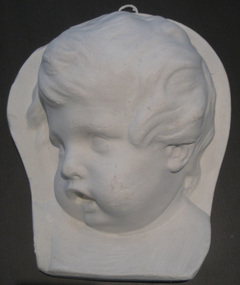
Sculpture - Plaster Drawing Prop, Cast of Child’s Head
... The school inherited some casts from its predecessor institutions, and further consignments were purchased during the 1920s, including full length, bust and relief figures, as well as dozens of ornamental and architectural casts. Unfortunately, much of the collection was lost or destroyed in the late 1950s. This is one of the few surviving pieces, with TAFE students reportedly drawing from it into the twenty-first...The school inherited some casts from its predecessor institutions, and further consignments were purchased during the 1920s, including full length, bust and relief figures, as well as dozens of ornamental and architectural casts. Unfortunately, much of the collection was lost or destroyed in the late 1950s. This is one of the few surviving pieces, with TAFE students reportedly drawing from it into the twenty-first ...The Ballarat Technical Art School boasted a well-stocked Antique Room replete with plaster copies of classical, Renaissance and Gothic sculptural examples, which were used as drawing props by students. The school inherited some casts from its predecessor institutions, and further consignments were purchased during the 1920s, including full length, bust and relief figures, as well as dozens of ornamental and architectural casts. Unfortunately, much of the collection was lost or destroyed in the late 1950s. This is one of the few surviving pieces, with TAFE students reportedly drawing from it into the twenty-first century. It was removed to the University's Historical Collection in 2012. White plaster cast showing the side profile of a child's face. ballarat technical art school, ballarat school of mines, art, drawing, plaster, drawing from the antique, drawing the human figure from cast, copy, replica -
 Federation University Historical Collection
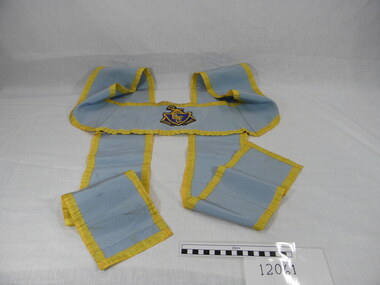
Ballarat Teachers' College Ceremonial Collar, Unknown
... first Graduation Ceremony, with its own Graduation Hymn, the words of which were written by Miss C.M. (Mavis) Canty of the staff. Lord remained as principal until 1951 when he transferred to establish a teachers' college at Toorak. Tom William Turner was Lord's successor. A highlight of his term was the construction of new college buildings at Gillies Street with the students commencing their lessons there in February 1958. Turner retired in 1970, having overseen a period of substantial growth in the institution...first Graduation Ceremony, with its own Graduation Hymn, the words of which were written by Miss C.M. (Mavis) Canty of the staff. Lord remained as principal until 1951 when he transferred to establish a teachers' college at Toorak. Tom William Turner was Lord's successor. A highlight of his term was the construction of new college buildings at Gillies Street with the students commencing their lessons there in February 1958. Turner retired in 1970, having overseen a period of substantial growth in the institution ...Worn by the principal of Ballarat Teachers' College over black academic gown at formal assemblies. Ellwood was the Principal of the Ballarat Teachers' College. Ballarat Teachers’ College was opened on 04 May 1926, at S.S. 33 Dana Street, with an enrolment of 61 students. Its original staff consisted of the Principal, Mr W.H. Ellwood, M.A., M.Ed. (Chairman of the Teachers’ Tribunal from its inception in 1946 until 1954), Miss A. Bouchier, B.A., and Mr A.B. Jones, BA., (lecturers). In 1927 Miss P.A. Hamano joined the staff. In 1927 the college moved to the old Ballarat East Town Hall (remodelled for their use) in Barkly Street. During 1927 the numbers in the College were augmented by 26 Manual Arts students, who had formerly received their training at Ballarat High School. Manual Art students continued till 1930 when, on grounds of economy, their training was concentrated at Melbourne Teachers’ College. During the four succeeding years, approximately 60 students annually entered the primary course. Inclusive of Manual Arts students, and private fee-paying students, exactly 400 trainees passed through the College in its brief span of life (1926-1931). Five per cent of each year’s students were granted an extension of their studentship to enable them to proceed to Melbourne Teachers’ College, and to take the first year’s course for a University degree. With the advent of the economic depression of the ‘thirties, Ballarat Teachers' College closed its doors in December, 1931. Fourteen years were to pass before the College opened again on February 2nd, 1946. The college re-commenced at SS Dana Street, under the guidance of Mr W.F. Lord, M.C., M.M., B.A., Dip. Ed., (acting, later Principal 1946-1950) and a staff consisting of Miss E.B. Hughes, B.A., Dip. Ed., Mr C.B. Bryan, B.A., B. Com., Dip. Ed., Miss Monica H. Miller, L.Mus.A., and Miss G. Kentish, Dip. Phys. Ed. The opening ceremony was performed by the Minister of Education at that time, the Hon. F. Field, M.L.A., accompanied by the Hon. T.T. Hollway, M.L.A., and the then Director of Education, Mr J.A. Seitz. It was originally intended to cater for women students only but, at the last moment, men resident in Ballarat were also accepted. A co-educational college was thus set up instead, and it has continued as such. 1951 saw the introduction of the two-year course, successful students being presented with the Trained Primary Teacher’s Certificate at the final College Assembly each year. In December 1955, College held its first Graduation Ceremony, with its own Graduation Hymn, the words of which were written by Miss C.M. (Mavis) Canty of the staff. Lord remained as principal until 1951 when he transferred to establish a teachers' college at Toorak. Tom William Turner was Lord's successor. A highlight of his term was the construction of new college buildings at Gillies Street with the students commencing their lessons there in February 1958. Turner retired in 1970, having overseen a period of substantial growth in the institution. In that year alone more than one hundred and forty students completed their primary teaching qualification to meet a severe shortage of teachers. Doug Watson commenced as principal in 1971. In 1973 Ballarat Teachers' College became the State College of Victoria at Ballarat. Three years later Ballarat College of Advanced Education was formed and the teacher education students moved to the Mount Helen Campus. In 1990 Ballarat College of Advanced Education became Ballarat University College, an affiliated college with the University of Melbourne. The University of Ballarat was formed in January 1994. Light blue grosgrain sash, bound in yellow taffeta, sewn by machine. Two mitred seams, one at each shoulder, hand sewn and two seams machine stitched on straight part of sash. A BTC insignia is placed in the centre back. The insignia is stitched in yellow, royal blue and dark blue cotton. This sash is hand sewn at the end of one side length, in order to shorten it. Extra Muros (Beyond the Wall) on insignia BTC (Ballarat Teachers' college) education, teaching, assembly, btc, ballarat teachers college, university of ballarat, regalia, ceremony, graduation, stoll, balalrat teachers' college -
 Federation University Historical Collection
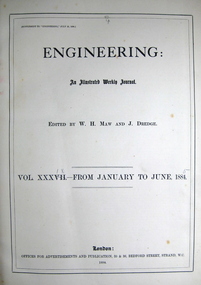
Book, Engineering: an illustrated weekly journal, 1884 (exact)
... first outside cylinder locomotive for use in India. In 1865 he founded the journal Engineering and continued to be an editor for the rest of his life. Maw became a consulting engineer. He was president of the Civil and Mechanical Engineers' Society, the Institution...first outside cylinder locomotive for use in India. In 1865 he founded the journal Engineering and continued to be an editor for the rest of his life. Maw became a consulting engineer. He was president of the Civil and Mechanical Engineers' Society, the Institution ...William Henry Maw was a British civil engineer and astronomer. He was born in 1838 and died in 1924 at eighty-five years. Maw worked as an assistant at the workshops of the Eastern Counties Railway before he became a draughtsman in the design office. He designed the first outside cylinder locomotive for use in India. In 1865 he founded the journal Engineering and continued to be an editor for the rest of his life. Maw became a consulting engineer. He was president of the Civil and Mechanical Engineers' Society, the Institution of Mechanical Engineers and the Institution of Civil Engineers. This book contains a wide range of articles and reviews related to industrial developments such as rail mill engines at the Dowlais iron works (constructed by Messrs. Kitson and Co., engineers, Leeds), cable tramway, Clay-street, San Francisco, U.S.A., road and railway bridge over the river Dnieper, at Jekaterinoslow, Russia (constructed from the designs of Professor N. Belelubsky, St. Petersburg, by the Brjonsk iron works) etc. A book with blue large hard cover. Title and publication date are written on spine in gold. Illustrations (fig., plates, plans, diagrams) in B/W. Includes collection of the engineering weekly journal vol. xxxix-from January to June 1885. This book contains a wide range of articles and reviews related to industrial developments. Page no.712. machinery, tools, engines, engineering, railroad, w h maw, rail, mill engines, cable tramway, clay street, dowlais iron works, twin screw engines, royal italian torpedo ram vessel, messrs r and, w hawthorn engineers, electro plated carriage, the tehuantepec ship railway, otis elevator -
 Federation University Historical Collection
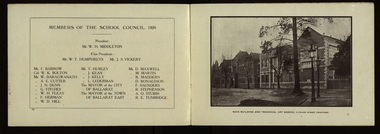
Booklet, The Ballarat School of Mines and Industries 1870-1920 Jubilee Booklet, 1920 (estimated)
... first place as a mining state. On the other hand there was a great advance in manufacturing, and the demand for technicaly trained men became a great and as insistent as ever it had been for trained mining men. The Council was quick to adapt the school to the new conditions, and the result is seen in the institution...first place as a mining state. On the other hand there was a great advance in manufacturing, and the demand for technicaly trained men became a great and as insistent as ever it had been for trained mining men. The Council was quick to adapt the school to the new conditions, and the result is seen in the institution ...The first school of Mines in Australia was established at Ballarat in 1870. At the time of its jubilee (1930) the following people were members of the School Council: W.H. Middleton (President), W.T. Humphreys (VP), J.S. Vickery (VP), F. Barrow, Col. W.K. Bolton, William Baragwanath, A.E. Cutter, J.N. Dunn, G. Fitches, W.H. Fleay, F. Herman. W.D. Hill, T. Hurley, K. Kean. J. Kelly, L. Lederman, Mayor of Ballarat, Mayour of Ballarat East, D. Maxwell, M. Martin, R. Maddern, D. Ronaldson, F. Saunders, R. Stephenson, A.O. Stubbs, R.E. Tunbridge. The School Staff in 1920 comprised: Herbert H. Smith, Walter Rowbotham, Reginald L. Cutter, M.C. Young, Hilda Wardle, M. Wiliamson, P.S. Richards, L.H. Archibald, J. Woods, Ken Moss, W. Kenneth, Mrs McIlvena. B. Robinson, S. Rowe, E. Hope-Jones, Miss Abrams, L.St.G.P. Austin, Alfred Mica Smith, J.R. Pound, Herbert R. Murphy, N.H. Junner, Maurice Copland, L.H. Archibald, E.J.A. McConnon, Newton King, D.m. Hull, T.R. Gordon, John M. Sutherland, T.K. Jebb, Dick Richards, C. Tonkin, A.W. Steane, J. Paterson, H.W. Malin, R.V. Maddison, S.M. Mayo, F.A. King, W.H. Steane, T.R. Gordon, T.A. Williams, H. Waldron, G. Black, E.J. McConnon, R.V. Duncan. R. Cutter, E.G. Vawdrey, Hilda Wardle White stapled booklet - landscape format - 20pp + soft covers with blue writing. Includes an historical sketch of the Ballarat School of Mines. Contains images of the school from around 1920. The history outlined in the booklet follows: 'Ballarat has helped to influence the life and destinies of Australia in many ways, the recital of which would perhaps prove tedious to the citizens of less favoured localities! However, it can be said, without much fear of contradiction, that only less known thought Australia than its fame as a gold field is the reputation won for it by its school of Mines, ... Ballarat was still quite a new place when the School was founded, but a very propserous and popular place all the same, with a go-ahead lot of citizens brim full of the spirit of enterprise which seemsto animate mining populations generally. Money was plentiful, and they launched out into ventures, which later, were to develop and take the place of the gold mines, while what is more to the point, they understood the value of education. the old digging days were passing away. So far as Ballarat itself was concerned the day of the cradle and tin dish had already passed into an antiquity "as dead and distant as the age of the Tubal Caon," said dir redmond Barry on declaring the School open. Mining had become a serious business, and the mining engineer, the metallurgist, and the geologist had become a power in the land. In these circumstances the suggestions to found a School of Mines met with ready acceptance. The late Mr James M. Bickett had the honor of bringing forward the proposition at a meeting of the Ballarat Mining Board in October, 1869. it was agreed to, and the Government, having been approached for assistance, granted a lease of the old Supreme Court buildings at a nominal reantal. A modest sum, including 100 pounds from the Borough Council of Ballarat West, was subscribed by a number of sympathisers, and on the 26th October, 1870, the inaugural address was delivered by Sir Redmond Barry, the first President of the School. Classes were commenced on the 23rd January, 1871. The students at first were mostly adults. They were chiefly men emloyed at the mines, who had the wisdom and energy to devote their spare time to study, and, though their attendance was somewhat irregular, they made very good progress. Old prints which have been preserved show them at work at furnaces, big bearded men of the old-fashioned type of miner. It is interesting to note that among those who gave evidence and encouragement was Sir Roderick Murchison, who many years before had advised Cornish miners to emigrate to Australia to search for gold, and who in 1848 was in possession of gold ore sent from this country. Sir Roderick sent a parcel of books for the library, and gave useful advice as to the curriculum which should be adopted. The Museum, which now contains a most valuable collection of minerals, was one of the first things attended to, and the reports presented to the Council from time to time speak of additions being made from all parts of the world. New equipment was constantly being added to the School, a good deal of assay work was done, and some specimens were sent from the East Indies for examination as far back as 1873. By this time there was a difficulty in providing accomodation for the students who wished to enrol, and the number of instructors had grown from two to four. In 1882 the first building was being erected on what was then part of the gaol reserve. A little more than ten years afterwards a buildnig formerly serving as a Methodist Church was absorbed, while later on, the demand for accomodation increasing, the attack upon the gaol was renewed. The School continued to grow in reputation and size, and became the science centre of the district, and in 1889 a learge new building was opened by Sir Alexander Peacock. Students came from over seas as well as from all the States of Australia, and after going through their courses they took with them the name and fame of the old School to all parts of the globe. School of Mines boys have played a great part in developing the mining fields of Western Australia, South Australia, and africa, while old students who have made a name in their profession are constantly dropping in to see how the old place is getting along. It was not to be expected, however, that the Ballarat School would be left without rivals, its very success inspiring competition. Mining Schools were started in other parts of Australia, and, at the same time, Victoria ceased to hold first place as a mining state. On the other hand there was a great advance in manufacturing, and the demand for technicaly trained men became a great and as insistent as ever it had been for trained mining men. The Council was quick to adapt the school to the new conditions, and the result is seen in the institution, which is one of Ballarat's proudest possession. Instruction is given in all branches of technical work, and the classes are filled with students who are building up for Ballarat a reputation as an industrial centre, which promises to equal that which it formerly held as a mining town. Owing to its bracing climate, its abundant opportunities for recreations, and its accessibilty, Ballarat as a city is an ideal place for educational purposed, and is yearly becoming more and more appreciated throughout the State. The chairman of one of Ballarat's biggests industries claims that the workman can do twice the day's work here that he can do in Melbourne. he was a little enthusiastic over it, perhaps, but it is a well-known fact that the healthy and invigourating Ballarat climate is conducive to both physical and mental activity, and the records of the School provide ample proof of it. One of the most interesting and successful branches of the School of Mines and Industries - if the name be enlarged with the enlargement of its scope - is the Technical Art School. "The City of Statues" has from its earliest days been a stronghold of art. Art schools have flourised here, and in 1905 the Education Department came to the conclusion that the best thing to do with them was to place them under the management of the School of Mines Council. A magnificent new Technical Art School was built at a cost of some 12,000 pounds on the site of the old Supreme Court building, and was formally opened on the 23rd July, 1915. The results have not only been justified but surpassed all anticipations. The most comprehensive list of subjects is taught, and this list is constantly added to. Students have flocked to the art School, which may be said to occupy a unique position in Australia, and its record of success is really astonishing. Its students supply art teachers for the newer schools that are being built, and many occupy leading positinos in important business houses. So well is its reputation known that orders are constantly being received, not only from Victoria, but from other States, for honor boards and challenge shields to be designed and made. The most recent addition to the School of Mines and Industries is the Junior Technical School, for which a new building is now being erected on a portion of the gaol site, transferred to the School of Mines Counci by the Government. At the present moment temporary quarters are being occupied. Some students after passing through the Junior School go straight to employment, continuing perhaps to attend the evening trade classes, while others move on to the senior School. In a review of the work of the School of Mines mention must be made of a series of industrial research carried out under supervision of the Principal. One in particular, regarding the suitability of the local ores for the manufacture of pigments attracted much attention, while the experiemtns on the manufacture of white potery from Victorian clayes were considered of sufficient importance by the Federal Advisory Council of Science and Industry to warrant the appointment of a special investigator. The results of these have been most encouraging, and may have far-reaching consequences. The vocational training of returned soldiers also should not be overlooked. The work was taken in hand from the first, before the Repatriation Department gave assistance, and now with the help of the department of the School has become one of the largest vocational training centres in Victoria outside of Melbourne. The soldiers, trained in a variety of occupations, have made remarkable progress, and already considerable numbers have found employment in local workshops and factories. To sum up, the School is divided into the following departments, each well staffed and equipped: - The School of Mines, science, and Engineering; the Techncial Art School, the Boys' Junior Technical School, the Girl's Preparatory Technical Classes, Trade Classes, and the Commercial School. The school of Mines, science and Engineering, comprises the following branches: - Mining, Metallurgy, Geology, Electrical Engineering, Civil Engineering, Mechanical Engineering, Applied Chemistry, and Pharmacy. Battery treatments, Cyanide Testing, Smelting, Assays, and Clay Testing from a regular part of the School's work. Students gaining qualifications obtain concession in their courses at the university, should they proceed there to continue their studies. The technical Art school curriculum includes training in all branches of pictorial and applied art, an Architectural Diploma Course, a Draughtman's Course, technical Art teachers' Course, Photography,Ticket Writing, Art Metal Work, Woodcarving, Needlework, and Leather work. The Trade Classes give instruction in Telephone Mechanics, telegraphy, Carpentry, Cabinet Making, Plumbing, Blacksmithing, Fitting, Electric Wiring, and Printing. Numerous Scholarships are offered every year, and altogether students will find few places to equal the Ballarat School of Mines and Industries as a training place for their life's work. One of the first in the continent to be established, its Jubilee finds it still in the front rank, keeping pace with the times, and offering to the youths of this country the means of taking advantage of Australia's teeming opportunities. william, battery, smith, herbert, drawing from the antique, ballarat school of mines botanical gardens, ballarat school of mines, redmond barry, alfred mica smith, james bickett, museum, dick richards, ballarat junior technical school, s m b, ballarat school of mines and industries, ballarat technical art school, model mine, james m bickett, j m bickett, roderick murchison, vocational training rooms, wesley church, methodist church, alexander peacock, lathes, repatriation, repatriatin department, war service, school council, baragwanath, gold mining, mining laboratory, plaster cast, r.w. richards, anniversary, jubilee -
Federation University Historical Collection
Document, Ken Clements (BCAE Registrar), Ballarat College of Advanced Education Development, 1989
... institutions forming the Ballarat College of Advanced Education had a unique history of Development. The parent body of the Ballarat Institute of Advanced Education was the School of Mines and Industries, Ballarat. The original school was founded in 1870 by the Ballarat Mining Board with the support of local residents interested in assisting the then flourishing gold mining industry by training personnel for all levels of mining activities. The first...institutions forming the Ballarat College of Advanced Education had a unique history of Development. The parent body of the Ballarat Institute of Advanced Education was the School of Mines and Industries, Ballarat. The original school was founded in 1870 by the Ballarat Mining Board with the support of local residents interested in assisting the then flourishing gold mining industry by training personnel for all levels of mining activities. The first ...The history starts with the following: The Ballarat College of Advanced Education was formed in 1976 by the merging of the State College of Victoria at Ballarat and the Ballarat Institute of Advanced Education. Each of the two institutions forming the Ballarat College of Advanced Education had a unique history of Development. The parent body of the Ballarat Institute of Advanced Education was the School of Mines and Industries, Ballarat. The original school was founded in 1870 by the Ballarat Mining Board with the support of local residents interested in assisting the then flourishing gold mining industry by training personnel for all levels of mining activities. The first awards were at the professional diploma level leading to Associateship of the School of Mines were made in 1896 to various branches of Engineering, Metallurgy and geology. ... Two pages of printed text concerning the history and development of the Ballarat College of Advanced Education, taken from the 1889 Ballarat College of Advanced Education Handbook. ballarat teachers college, mt helen, bcae, biae, scvb, tertiary education, ballarat college of advanced education, state college of victoria at ballarat, ballarat institute of advanced education, ballarat school of mines -
 Federation University Historical Collection
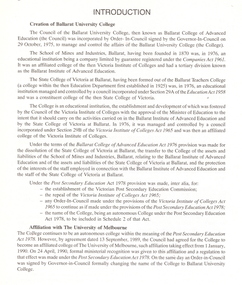
Document, Creation of Ballarat University College, c1993
... Although formally created as a University in 1994, the University of Ballarat had a lineage back to 1870 with the establishment of the School of Mines Ballarat, making it the third institution of higher learning to be established in Australia and the first to be established in regional Australia. ...Although formally created as a University in 1994, the University of Ballarat had a lineage back to 1870 with the establishment of the School of Mines Ballarat, making it the third institution of higher learning to be established in Australia and the first to be established in regional Australia. ...Ballarat University College was a predecessor institution of Federation University Australia. Federation University Australia was established on 1 January 2014. Formerly known as the University of Ballarat, its enabling legislation was the University of Ballarat Amendment (Federation University Australia) Act 2013. Although formally created as a University in 1994, the University of Ballarat had a lineage back to 1870 with the establishment of the School of Mines Ballarat, making it the third institution of higher learning to be established in Australia and the first to be established in regional Australia. On 1 January 1994, Ballarat University College became the University of Ballarat and in 1998 the University merged with three TAFE Institutes to become a dual sector institution with multiple campuses. On 1 January 2014, the University of Ballarat amalgamated with the Monash University Gippsland Campus to form Federation University Australia. The Gippsland Campus also had a long lineage dating back to 1928 with the establishment of the Yallourn Technical School which became a predecessor institution to the Gippsland College of Advanced Education formed in 1968. In 1990, it was renamed the Monash University College and in 1993 became the Gippsland Campus of Monash University. Federation University Australia, or FedUni, is Australia’s newest public University. Headquartered in Ballarat, Victoria, the University offers programs in Higher Education and Vocational Education and Training to regional Victoria and beyond. The University’s commitment to educational and social equity, teaching excellence, research distinction, environmental sustainability and regional capacity building has enabled it to develop in a way that draws on its proud heritage to inform its future. Its regional character sets a framework for the University’s priorities but does not constrain it from serving wider community interests, nationally and internationally. With campuses from Horsham in the west of the state, to Churchill in the east, the name Federation University Australia was chosen to convey the scope and capacity of an expanded regional university with a federated network of campuses contributing to a new and different Australian university. A printed page from the 1993 Ballarat University College Handbook outlining the history and creation of the Ballarat University College ballarat university college, history, ballarat school of mines, establishment -
 Federation University Historical Collection
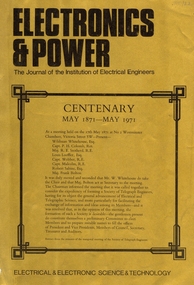
Magazine, Institution of Electrical Engineers, Electronics & Power: The Journal of the Institution of Electrical Engineers (Centenary Edition), April/May 1971
... The Institution of Electrical Engineers (IEE) was established on 17 May 1871. The first meeting took place at 2 Westminster Chambers, Victoria Street SW. ...The Institution of Electrical Engineers (IEE) was established on 17 May 1871. The first meeting took place at 2 Westminster Chambers, Victoria Street SW. ...The Institution of Electrical Engineers (IEE) was established on 17 May 1871. The first meeting took place at 2 Westminster Chambers, Victoria Street SW. Those present were Wildman Whitehouse, Capt P.H. Colomb, Maj. R.E. Stotherd, Louis Loeffler, Capt Weber, Capt Malcolm, Robert Sabine, Frank Bolton. Gold paper covered magazine with black print. 239 pages including numerous advertisements. Articles of this centenary edition include: A Human Entity (Lord Nelson of Stafford), Yesterday's Men - providing for tomorrow ((A.G. Woodruff), A century of Development in the Supply Industry (Stanley Brown), British Broadcasting and the IEE (J. Redmond), Telecommunications - the grassroots of the IEE (R.J. Halsey), Engineers, physicists and mathematicians (J.A. Ratcliffe), The IEE Wiring regulations (E.E. Hutchings). The IEE and education (John Brown), Electrical Engineering today and tomorrow. Images include Oliver Lodge, James Maxwell, Crookes shadow tube, Deptford Power Station, John Hopkinson, Marconi, William Thomson, Oliver Heaviside, experimental 3-phase, Belling Modernette, Savoy Hill, power lines, Brighton Power Station, BBC Television Centre London, mobile telegraph office. generators, institution of electrical engineers, iee, wildman whitehouse, ph colomb, re stotherd, louis loeffler, robert sabine, frank bolton, multimeter, power units, oscilloscope, bell and howell -
 Federation University Historical Collection
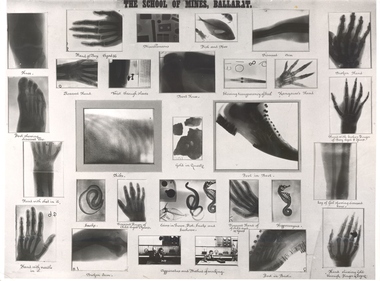
Photograph - Original x-rays, X-rays from pioneering Ballarat Demonstrations, 1896, 1896
... institution." Martell was an ardent amateur photographer, and Duncan McDougall's experience as an electrician has enabled the two gentlemen to carry their experiments on to a perfectly successful issue. At first...institution." Martell was an ardent amateur photographer, and Duncan McDougall's experience as an electrician has enabled the two gentlemen to carry their experiments on to a perfectly successful issue. At first ...X-Rays were first discovered on 08 November 1895. By 18 July 1896 staff members of the Ballarat School of Mines (SMB), were experimenting with the exciting new discovery. The history of x-rays began on 08 November 1895 at the University of Wurzburg in Bavaria. The discovery was officially announced on 25 December 1895. The first radiographs in Ballarat were taken at the School of Mines in July 1896 according to the Ballarat School of Mines (SMB) Annual Report. Frederick J. Martell, the Registrar of SMB arranged for the importation of tubes, while John M. Sutherland, an electrician, conducted most of the experiments giving 6 inch, 12 inch and 16 inch sparks respectively. In a short time brilliantly successful results were obtained, with some SMB Roentgen negatives taken at this time still in existence today. Samuel Ernest Figgis, H. R. W. Murphy, D. McDougall, and Frederick J. Martell carried out experiments at the SMB on Saturday evening 18 July 1896, producing 'perfect' negatives of a hand and wrist. A Roentgen Tube and an induction coil giving a two inch spark, the coil being sparked by the SMB's dynamo, were used to obtain these results. The Courier reported that 'the exposure of five minutes was ample' but concluded that 'the length of the exposure will be shortened as experiments proceed.' The Ballarat Courier reported on 20 July 1896 that: "Thanks to the energy of the staff of The School of Mines, Ballarat, and particularly to Messers F.J. Martell and D. McDougall, the assistance of Rontgen X-rays will soon be available, for the relief of suffering humanity, at this institution." Martell was an ardent amateur photographer, and Duncan McDougall's experience as an electrician has enabled the two gentlemen to carry their experiments on to a perfectly successful issue. At first these gentlemen, together with Professor Purdie and Mr W. Huey Steele, conducted a series of experiments by the aid of a Bonetti glass-plate induction machine which had been constructed by Mr McDougall. The results were very good, the various bones of the hand being distinctly visible. The following people were among those who witnessed the first X-ray experiments to be carried out in Ballarat. Andrew Anderson, President of the School of Mines, a large number of ladies and gentlemen, the medical profession Dr Edward Champion (1867-1929) Dr Gerald Eugene Cussen (1888-1943) Dr William Edward Davies (1868-1928) Dr Charles William Henry hardy (1861-1941) Dr Edward Kenneth Herring(1864-1922) Dr Joseph Lalor (1859-1907) Dr James Thomas Mitchell (1856-1945) Dr Edward Graham Ochiltree (1857-1896) Dr Robert Denham Pinnock (1849-1902) Dr Joseph Francis Usher (c1832-1909) Dr Grace Vale (nk-1933). The staff of SMB Professor Alfred Mica Smith Professor D. J. Dawbarn Mr. F. J. Martell. (http://guerin.ballarat.edu.au/aasp/is/library/collections/art_history/honour-roll/honourroll_X-Ray_pioneers.shtml) "Seven patients of the doctors who were present were treated. In each case the patient was suffering from the effects of an old wound or some other injury to other a hand or foot. One patient, a boy had a finger broken some years earlier and when xray plate of the injury was developed it indicated plainly the fracture on one of the joints of the third finger. In another case a woman had a foot had a foot X-rayed and the photograph revealed the seat of an earlier imjury to it. Likewise an injury to the bones of a hand of an elderly man was revealed by an x-ray photograph. Every X-ray photograph that evening showed the importance of this new development in electrical science and the doctors present agreed the "the results of the experiments on their patients, by showing the exact seat of the injury and its present condittion, would materially assist them iin supporting cures." (Warren Perry, The Ballarat School of Mines and Industries Ballarat, p 146.) A number of photographic xrays as taken by the Ballarat School of Mines in 1896. The xrays include bones, hands, feet, shoes and more. ballarat school of mines, scientific equipment, x-ray, xray, photography, foto, roentgen tube -
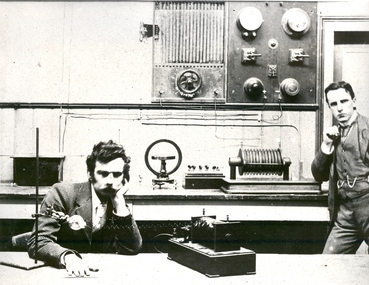 Federation University Historical Collection
Photograph - Photograph - Black and White, X-Ray demonstration at the Ballarat School of Mines, 1896, 1896
... institution." Martell was an ardent amateur photographer, and Duncan McDougall's experience as an electrician has enabled the two gentlemen to carry their experiments on to a perfectly successful issue. At first...institution." Martell was an ardent amateur photographer, and Duncan McDougall's experience as an electrician has enabled the two gentlemen to carry their experiments on to a perfectly successful issue. At first ...X-Rays were first discovered on 8 November 1895. By 18 July 1896 staff members of the Ballarat School of Mines (SMB), were experimenting with the exciting new discovery. The history of x-rays began on 8 November 1895 at the University of Wurzburg in Bavaria. The discovery was officially announced on 25 December 1895. The first radiographs in Ballarat were taken at the School of Mines in July 1896 according to the Ballarat School of Mines (SMB) Annual Report. Frederick J. Martell, the Registrar of SMB arranged for the importation of tubes, while John M. Sutherland, an electrician, conducted most of the experiments giving 6 inch, 12 inch and 16 inch sparks respectively. In a short time brilliantly successful results were obtained, with some SMB Roentgen negatives taken at this time still in existence today. Samuel Ernest Figgis, H. R. W. Murphy, D. McDougall, and Frederick J. Martell carried out experiments at the SMB on Saturday evening 18 July 1896, producing 'perfect' negatives of a hand and wrist. A Roentgen Tube and an induction coil giving a two inch spark, the coil being sparked by the SMB's dynamo, were used to obtain these results. The Courier reported that 'the exposure of five minutes was ample' but concluded that 'the length of the exposure will be shortened as experiments proceed.' The Ballarat Courier reported on 20 July 1896 that: "Thanks to the energy of the staff of The School of Mines, Ballarat, and particularly to Messers F.J. Martell and D. McDougall, the assistance of Rontgen X-rays will soon be available, for the relief of suffering humanity, at this institution." Martell was an ardent amateur photographer, and Duncan McDougall's experience as an electrician has enabled the two gentlemen to carry their experiments on to a perfectly successful issue. At first these gentlemen, together with Professor Purdie and Mr W. Huey Steele, conducted a series of experiments by the aid of a Bonetti glass-plate induction machine which had been constructed by Mr McDougall. The results were very good, the various bones of the hand being distinctly visible. The following people were among those who witnessed the first X-ray experiments to be carried out in Ballarat. Andrew Anderson, President of the School of Mines, a large number of ladies and gentlemen, the medical profession Dr Edward Champion (1867-1929) Dr Gerald Eugene Cussen (1888-1943) Dr William Edward Davies (1868-1928) Dr Charles William Henry hardy (1861-1941) Dr Edward Kenneth Herring(1864-1922) Dr Joseph Lalor (1859-1907) Dr James Thomas Mitchell (1856-1945) Dr Edward Graham Ochiltree (1857-1896) Dr Robert Denham Pinnock (1849-1902) Dr Joseph Francis Usher (c1832-1909) Dr Grace Vale (nk-1933). The staff of SMB Professor Alfred Mica Smith Professor D. J. Dawbarn Mr. F. J. Martell. (http://guerin.ballarat.edu.au/aasp/is/library/collections/art_history/honour-roll/honourroll_X-Ray_pioneers.shtml) Two men, one seated, one standing standing in a room with early electrical equipment. They are conducting pioneer X-rays at the Ballarat School of Mines in 1896. Seated on the left is John Waters Sutherland. A bromide of this images states "Experimenting with X-rays, 1896" ballarat school of mines, x-ray, xray, john sutherland, sutherland, electricity, photography, foto, roentgen tube, medical -
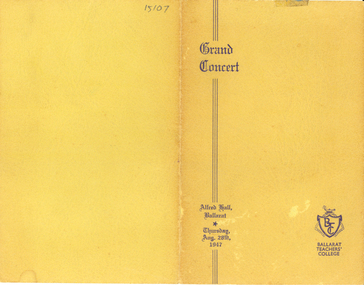 Federation University Historical Collection
Programme, Ballarat Teachers' College, Ballarat Teachers' College Grand Concert, 1947, 1947
... first Graduation Ceremony, with its own Graduation Hymn, the words of which were written by Miss C.M. (Mavis) Canty of the staff. Lord remained as principal until 1951 when he transferred to establish a teachers' college at Toorak. Tom William Turner was Lord's successor. A highlight of his term was the construction of new college buildings at Gillies Street with the students commencing their lessons there in February 1958. Turner retired in 1970, having overseen a period of substantial growth in the institution...first Graduation Ceremony, with its own Graduation Hymn, the words of which were written by Miss C.M. (Mavis) Canty of the staff. Lord remained as principal until 1951 when he transferred to establish a teachers' college at Toorak. Tom William Turner was Lord's successor. A highlight of his term was the construction of new college buildings at Gillies Street with the students commencing their lessons there in February 1958. Turner retired in 1970, having overseen a period of substantial growth in the institution ...Ellwood was the Principal of the Ballarat Teachers' College. Ballarat Teachers’ College was opened on 04 May 1926, at S.S. 33 Dana Street, with an enrolment of 61 students. Its original staff consisted of the Principal, Mr W.H. Ellwood, M.A., M.Ed. (Chairman of the Teachers’ Tribunal from its inception in 1946 until 1954), Miss A. Bouchier, B.A., and Mr A.B. Jones, BA., (lecturers). In 1927 Miss P.A. Hamano joined the staff. In 1927 the college moved to the old Ballarat East Town Hall (remodelled for their use) in Barkly Street. During 1927 the numbers in the College were augmented by 26 Manual Arts students, who had formerly received their training at Ballarat High School. Manual Art students continued till 1930 when, on grounds of economy, their training was concentrated at Melbourne Teachers’ College. During the four succeeding years, approximately 60 students annually entered the primary course. Inclusive of Manual Arts students, and private fee-paying students, exactly 400 trainees passed through the College in its brief span of life (1926-1931). Five per cent of each year’s students were granted an extension of their studentship to enable them to proceed to Melbourne Teachers’ College, and to take the first year’s course for a University degree. With the advent of the economic depression of the ‘thirties, Ballarat Teachers' College closed its doors in December, 1931. Fourteen years were to pass before the College opened again on February 2nd, 1946. The college re-commenced at SS Dana Street, under the guidance of Mr W.F. Lord, M.C., M.M., B.A., Dip. Ed., (acting, later Principal 1946-1950) and a staff consisting of Miss E.B. Hughes, B.A., Dip. Ed., Mr C.B. Bryan, B.A., B. Com., Dip. Ed., Miss Monica H. Miller, L.Mus.A., and Miss G. Kentish, Dip. Phys. Ed. The opening ceremony was performed by the Minister of Education at that time, the Hon. F. Field, M.L.A., accompanied by the Hon. T.T. Hollway, M.L.A., and the then Director of Education, Mr J.A. Seitz. It was originally intended to cater for women students only but, at the last moment, men resident in Ballarat were also accepted. A co-educational college was thus set up instead, and it has continued as such. 1951 saw the introduction of the two-year course, successful students being presented with the Trained Primary Teacher’s Certificate at the final College Assembly each year. In December 1955, College held its first Graduation Ceremony, with its own Graduation Hymn, the words of which were written by Miss C.M. (Mavis) Canty of the staff. Lord remained as principal until 1951 when he transferred to establish a teachers' college at Toorak. Tom William Turner was Lord's successor. A highlight of his term was the construction of new college buildings at Gillies Street with the students commencing their lessons there in February 1958. Turner retired in 1970, having overseen a period of substantial growth in the institution. In that year alone more than one hundred and forty students completed their primary teaching qualification to meet a severe shortage of teachers. Doug Watson commenced as principal in 1971. In 1973 Ballarat Teachers' College became the State College of Victoria at Ballarat. Three years later Ballarat College of Advanced Education was formed and the teacher education students moved to the Mount Helen Campus. In 1990 Ballarat College of Advanced Education became Ballarat University College, an affiliated college with the University of Melbourne. The University of Ballarat was formed in January 1994. Yellow folded card programme for the Ballarat Teachers' College Grand Concert held at Alfred Hall Ballarat on Thursday 28 August 1947. Student Teachers from the 1947 class performed, including Jessie Batson, Ruth Tozer, Joy Love, N. Kerr, Arthur Lelean, D. Cooper, John Collins, Ann McKinnnon, Peg Purdue, Lindsay Harley. ballarat teachers' college, education, alfred hall -
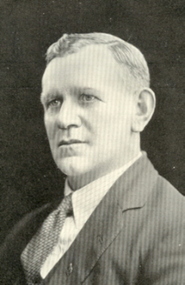 Federation University Historical Collection
Programme, Ballarat Teachers' College Reunion Programme, 1934, 1934
... first Graduation Ceremony, with its own Graduation Hymn, the words of which were written by Miss C.M. (Mavis) Canty of the staff. Lord remained as principal until 1951 when he transferred to establish a teachers' college at Toorak. Tom William Turner was Lord's successor. A highlight of his term was the construction of new college buildings at Gillies Street with the students commencing their lessons there in February 1958. Turner retired in 1970, having overseen a period of substantial growth in the institution...first Graduation Ceremony, with its own Graduation Hymn, the words of which were written by Miss C.M. (Mavis) Canty of the staff. Lord remained as principal until 1951 when he transferred to establish a teachers' college at Toorak. Tom William Turner was Lord's successor. A highlight of his term was the construction of new college buildings at Gillies Street with the students commencing their lessons there in February 1958. Turner retired in 1970, having overseen a period of substantial growth in the institution ...Ellwood was the Principal of the Ballarat Teachers' College. Ballarat Teachers’ College was opened on 04 May 1926, at S.S. 33 Dana Street, with an enrolment of 61 students. Its original staff consisted of the Principal, Mr W.H. Ellwood, M.A., M.Ed. (Chairman of the Teachers’ Tribunal from its inception in 1946 until 1954), Miss A. Bouchier, B.A., and Mr A.B. Jones, BA., (lecturers). In 1927 Miss P.A. Hamano joined the staff. In 1927 the college moved to the old Ballarat East Town Hall (remodelled for their use) in Barkly Street. During 1927 the numbers in the College were augmented by 26 Manual Arts students, who had formerly received their training at Ballarat High School. Manual Art students continued till 1930 when, on grounds of economy, their training was concentrated at Melbourne Teachers’ College. During the four succeeding years, approximately 60 students annually entered the primary course. Inclusive of Manual Arts students, and private fee-paying students, exactly 400 trainees passed through the College in its brief span of life (1926-1931). Five per cent of each year’s students were granted an extension of their studentship to enable them to proceed to Melbourne Teachers’ College, and to take the first year’s course for a University degree. With the advent of the economic depression of the ‘thirties, Ballarat Teachers' College closed its doors in December, 1931. Fourteen years were to pass before the College opened again on February 2nd, 1946. The college re-commenced at SS Dana Street, under the guidance of Mr W.F. Lord, M.C., M.M., B.A., Dip. Ed., (acting, later Principal 1946-1950) and a staff consisting of Miss E.B. Hughes, B.A., Dip. Ed., Mr C.B. Bryan, B.A., B. Com., Dip. Ed., Miss Monica H. Miller, L.Mus.A., and Miss G. Kentish, Dip. Phys. Ed. The opening ceremony was performed by the Minister of Education at that time, the Hon. F. Field, M.L.A., accompanied by the Hon. T.T. Hollway, M.L.A., and the then Director of Education, Mr J.A. Seitz. It was originally intended to cater for women students only but, at the last moment, men resident in Ballarat were also accepted. A co-educational college was thus set up instead, and it has continued as such. 1951 saw the introduction of the two-year course, successful students being presented with the Trained Primary Teacher’s Certificate at the final College Assembly each year. In December 1955, College held its first Graduation Ceremony, with its own Graduation Hymn, the words of which were written by Miss C.M. (Mavis) Canty of the staff. Lord remained as principal until 1951 when he transferred to establish a teachers' college at Toorak. Tom William Turner was Lord's successor. A highlight of his term was the construction of new college buildings at Gillies Street with the students commencing their lessons there in February 1958. Turner retired in 1970, having overseen a period of substantial growth in the institution. In that year alone more than one hundred and forty students completed their primary teaching qualification to meet a severe shortage of teachers. Doug Watson commenced as principal in 1971. In 1973 Ballarat Teachers' College became the State College of Victoria at Ballarat. Three years later Ballarat College of Advanced Education was formed and the teacher education students moved to the Mount Helen Campus. In 1990 Ballarat College of Advanced Education became Ballarat University College, an affiliated college with the University of Melbourne. The University of Ballarat was formed in January 1994. Programme for the 1934 Ballarat Teachers' College Reunion run by the Ballarat teachers' College ex- Students Association. Inside the programme is an image of W.H. Ellwood and copy of his 14 points. ballarat teachers' college, ellwood, reunion, w.h. elwood, elwood's fourteen points -
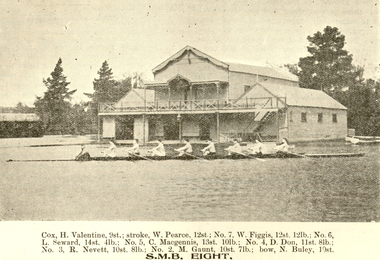 Federation University Historical Collection
Booklet, Ballarat School of Mines Students' Magazine, Term 4, 1905, 1905
... Hawthorne; Maryborough Excursion; Prof Alexander Purdie; School Dirge; Compound Engines; Sister Institutions; Trafalgar, Acrobates Pymgaeus, Pigmy Flying Phalangerobituary for Alexander Purdie, Electric traction, Estimation of Fat in Milk by the Babcock Machine, first Ballarat School of Mines Annual Dinner; Crytallography Images include; Electrical Laboratory; Professor Dawbarn; James W. ...Hawthorne; Maryborough Excursion; Prof Alexander Purdie; School Dirge; Compound Engines; Sister Institutions; Trafalgar, Acrobates Pymgaeus, Pigmy Flying Phalangerobituary for Alexander Purdie, Electric traction, Estimation of Fat in Milk by the Babcock Machine, first Ballarat School of Mines Annual Dinner; Crytallography Images include; Electrical Laboratory; Professor Dawbarn; James W. ...The Ballarat School of Mines Students' Magazine in 1905 was an unofficial journal edited by the students. Twenty-eight page booklet known as the Ballarat School of Mines Student's Magazine. Contents include: A jaunt to South Australia; Tests for the Assay Lab; Huntingdon-Heberlein Process; Slag Calculation; Electrical Laboratory; Hydrochoric Acod-Phenolph-thalein; Ballarat scientific Society; James W. Hawthorne; Maryborough Excursion; Prof Alexander Purdie; School Dirge; Compound Engines; Sister Institutions; Trafalgar, Acrobates Pymgaeus, Pigmy Flying Phalangerobituary for Alexander Purdie, Electric traction, Estimation of Fat in Milk by the Babcock Machine, first Ballarat School of Mines Annual Dinner; Crytallography Images include; Electrical Laboratory; Professor Dawbarn; James W. Hawthorne; Ballarat Rowing Eight on Lake Wendouree (H. Valentine, W. Pearce, W. Figgis, L. Seward, C. McGennis, D. Don, R. Nevett, M. Gaunt, N. Buley). Advertisements: Craig, Williamson Pty Ltd; Ballarat Baths (B. McCausland); W. Gribble & Co., H.B. Silberberg & Co; F. Jago - Ballarat Boot Palace; John Slater & Co., Kiels Motor & Cycle Stores; Alex Miller & Sons; Thomas McPherson & Son; W. Cornell; Brush Electrical Engineering Co; Ballarat School of Mines; Harry Davies & Co; Stansfield & Smith; Craig's Royal Hotel. ballarat school of mines, south australia; adelaide, valentine, pearce, figgis, seward, mcgennis, don, nevett, gaunt, buley, adelaide school of mines, kerr grant, arizona, jack adam, adam, j.a. reid, reid, jager, rowing, h. valentine, w. pearce, w. figgis, l. seward, c. mcgennis, d. don, r. nevett, m. gaunt, n. buley, cycling -
 Federation University Historical Collection
Book, University of Ballarat Annual Report, 2011, 2011
... Although formally created as a University in 1994, the University of Ballarat had a lineage back to 1870 with the establishment of the School of Mines Ballarat, making it the third institution of higher learning to be established in Australia and the first to be established in regional Australia. ...Although formally created as a University in 1994, the University of Ballarat had a lineage back to 1870 with the establishment of the School of Mines Ballarat, making it the third institution of higher learning to be established in Australia and the first to be established in regional Australia. ...Federation University Australia was established on 1 January 2014. Formerly known as the University of Ballarat, its enabling legislation was the University of Ballarat Amendment (Federation University Australia) Act 2013. Although formally created as a University in 1994, the University of Ballarat had a lineage back to 1870 with the establishment of the School of Mines Ballarat, making it the third institution of higher learning to be established in Australia and the first to be established in regional Australia. On 1 January 1994, Ballarat University College became the University of Ballarat and in 1998 the University merged with three TAFE Institutes to become a dual sector institution with multiple campuses. On 1 January 2014, the University of Ballarat amalgamated with the Monash University Gippsland Campus to form Federation University Australia. The Gippsland Campus also had a long lineage dating back to 1928 with the establishment of the Yallourn Technical School which became a predecessor institution to the Gippsland College of Advanced Education formed in 1968. In 1990, it was renamed the Monash University College and in 1993 became the Gippsland Campus of Monash University. Federation University Australia, or FedUni, is Australia’s newest public University. Headquartered in Ballarat, Victoria, the University offers programs in Higher Education and Vocational Education and Training to regional Victoria and beyond. The University’s commitment to educational and social equity, teaching excellence, research distinction, environmental sustainability and regional capacity building has enabled it to develop in a way that draws on its proud heritage to inform its future. Its regional character sets a framework for the University’s priorities but does not constrain it from serving wider community interests, nationally and internationally. With campuses from Horsham in the west of the state, to Churchill in the east, the name Federation University Australia was chosen to convey the scope and capacity of an expanded regional university with a federated network of campuses contributing to a new and different Australian university. Soft covered annual report of 152 pages with a photo of a building under construction on the cover. Photographs include Y Building (Science) under construction, University of Ballarat Pipe Band, Ted Ballieu, Julia Gillard, Honorary Doctorate to Jeremy Johnson; Grant Petch, Khoa Do, Sonia Tuner, Lisa Marshall, Danielle Button, Rana Stollery, Christopher Schliefort Inscriptions and Markings peter hall, robert smith, ebony place, michael thurston, roger donaldson, heather ridout, petch, khoa do, sonia turner, colin marshall, university of ballarat act, sizer, quigley, walker, wilson, mcquilton, simmons, doig, hobday, douglas, hemming, paul hemming, coutts, holmes, battersby, david battersby, reconciliation, reconciliation action plan, atkinson, fagan, balliue, gillard, prime minister, premier, pipe band, university of ballarat pipe band, pipe band championships, jeremy johnson, sovereign hill scholarships, foundation. chancellor's circle, robert h.t. smith, bonnie fagan, bonnie chew, ashlee rodgers, shanaya sheridan, alinta edwards, deanne gilson, ben atkinson, ted ballieu, julia gillard, nick maxwell, e.j. barker, jeanetta kerr-grant, grant petch, sonia tuner, lisa marshall, danielle button, rana stollery, mt rowan equine centre, christopher schliefort, honorary doctorate, university of ballarat
