
Showing 8 items matching "fletcher jones man’s shop warrnambool"
-
 Warrnambool and District Historical Society Inc.
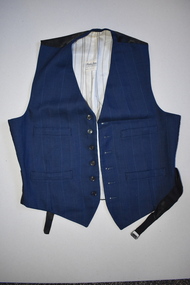
Textile, Fletcher Jones Man’s Shop, Waistcoat Fletcher Jones, 1946
... fletcher jones man’s shop warrnambool...The Fletcher Jones Man’s Shop was located at the corner of Liebig and Koroit Streets in Warrnambool. ...‘Fletcher Jones The Man’s Shop Warrnambool Mr A. Vinnell Date 15/2/46’...Warrnambool in the mid 1940s. The Fletcher Jones business became one of the most important ones in Warrnambool in the 20th century and the early 21st century. fletcher jones man’s shop warrnambool history of warrnambool Albert Vinnell Vinnell ‘Fletcher Jones The Man’s Shop Warrnambool Mr A. ...This waistcoat was made for Mr Alan Vinnell by the Fletcher Jones Man’s Shop in 1946 and was worn by Mr Vinnell at his wedding in Lang Lang on 27/4/1946 to Miss Madge Ridgway. Alan was the son of Albert Vinnell and Ada Rose Wood. He attended school in Macarthur about 40 kilometres northwest of Warrnambool. The Fletcher Jones Man’s Shop was located at the corner of Liebig and Koroit Streets in Warrnambool. David Fletcher Jones (1895-1977) served in World War One and in the 1920s set up as a travelling hawker selling drapery in Western Victoria. In 1924 he leased three shops in Liebig Street and in 1928 he moved to the Koroit/Liebig Streets intersection with his Man’s Shop. He manufactured men’s clothing on site. In 1931 a new set of two-storeyed buildings was erected on the site and Fletcher Jones moved into the building. In 1946 a Fletcher Jones shop was opened in Melbourne and in 1948 a factory was established in Raglan Parade, Warrnambool with a new company, Fletcher Jones and Staff established in 1951. This company became known Australia-wide, firstly for the production of men’s trousers, and later men’s and women’s clothing. By 2011 the Warrnambool factory was sold and the company dissolved. This waistcoat is of historical interest as an example of the high quality work produced at the Fletcher Jones Man’s Shop in Warrnambool in the mid 1940s. The Fletcher Jones business became one of the most important ones in Warrnambool in the 20th century and the early 21st century.This is a sleeveless woollen waistcoat made of blue striped material with a black cotton backing. The back has two black cotton flaps with a metal buckle to allow for the tightening of the coat across the back. The inside is lined with a cream, yellow and grey striped cotton material. The waistcoat has one inside pocket with a button enclosure and four outside pockets. The waistcoat has six black buttons on the outside and a maker’s label stitched on the inside. ‘Fletcher Jones The Man’s Shop Warrnambool Mr A. Vinnell Date 15/2/46’fletcher jones man’s shop warrnambool, history of warrnambool, albert vinnell, vinnell -
 Warrnambool and District Historical Society Inc.
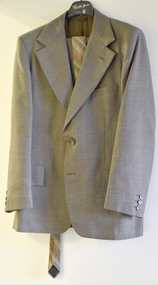
Clothing - Man's suit, tie, carry bag, coat hanger, Fletcher Jones and Staff Company, 1975
... Fletcher Jones factory, probably the one in Warrnambool. The other items were obtained at the same time. David Fletcher Jones began his business by opening shops in Liebig Street Warrnambool in the 1920s. His Man's...Fletcher Jones factory, probably the one in Warrnambool. The other items were obtained at the same time. David Fletcher Jones began his business by opening shops in Liebig Street Warrnambool in the 1920s. His Man's ...This suit was made to order in 1975 for Ted Henry at a Fletcher Jones factory, probably the one in Warrnambool. The other items were obtained at the same time. David Fletcher Jones began his business by opening shops in Liebig Street Warrnambool in the 1920s. His Man's Shop sold suits and overcoats and manufactured men's clothing on site. In 1946 a Fletcher Jones shop was opened in Melbourne and a factory was opened in Warrnambool in 1948. The Fletcher Jones and Staff Company expanded and became well known throughout Australia for the quality of its men's and women's clothing. The Company ceased business in 2011. The surname "Henry" is well known in Warrnambool and district. These items are important mementoes of Fletcher Jones and Staff one of the most significant Australian businesses originating in Warrnambool..1 Carry bag, oblong shaped made of pale orange cloth with full length white zip and dark brown edging and stitching It has a maker's label on the interior. .2 Black plastic clothes hanger with suit maker's name and logo .3 Silk and cotton tie in black, beige and tan broad stripes. It has two labels attached. .4 Man's trousers. The trousers are made of wool and polyester woven pattern in brown. grey and tan. There is a metal zip, The pockets have cream cloth lining . There are two labels. There are loops for a belt. .5 Man's suit coat made of the same material as the trousers (above). It has three butttons on each sleeve and two on the front. It is fully lined with brown cloth and cream lining on the sleeves. It has a maker's label. There is some padding in the shoulders. There are two internal pockets and three on the exterior.Celsius 30 A woolblendmark fabric developed for summer 80% new wool 20% polyester Henry L. 30.6.75 654 silk 35% cotton MADE IN ENGLAND.ted henry, fletcher jones and staff company, fletcher jones factory warrnambool, men's clothing -
 Warrnambool and District Historical Society Inc.
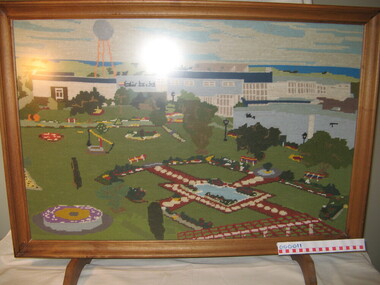
Textile - Fire screen, Tapestry, Post 1967
... David Fletcher Jones (1895-1977) was a travelling hawker who opened a business in Liebig Street, Warrnambool in 1924. In 1931 he opened The Man's Shop at the corner of Liebig Street and Koroit Street. ...David Fletcher Jones (1895-1977) was a travelling hawker who opened a business in Liebig Street, Warrnambool in 1924. In 1931 he opened The Man's Shop at the corner of Liebig Street and Koroit Street. ...David Fletcher Jones (1895-1977) was a travelling hawker who opened a business in Liebig Street, Warrnambool in 1924. In 1931 he opened The Man's Shop at the corner of Liebig Street and Koroit Street. He sold suits and overcoats tailored in the work rooms upstairs. In 1948 his factory known as Pleasant Hill was opened in Flaxman Street in Warrnambool, the site of an old quarry. In 1951 the company Fletcher Jones and Staff was formed with the staff owning 51% of the shares, By the 1970s Fletcher Jones and Staff had become one of the largest clothing companies in Australia with 55 shops and 3000 employees. In 1992 the Warrnambool City Council bought the factory and gardens with the site now a tourist attraction. Although the name is retained today for trading purposes the original Fletcher Jones company has been dissolved. The screen is a representation of the Fletcher Jones factory post 1967. It a wool tapestry by Martin Prider who was a painter and caretaker what the Fletcher Jones factory. He lived in one of the Fletcher Jones cottages on site. (Robin Boyd Age Small Homes Scheme, today Heritage listed.)This is an interesting memento of the Fletcher Jones company and the factory. It was done by a local resident and features the famous Fletcher Jones gardensTapestry fire screen in a rectangular light timber frame depicting the Fletcher Jones Factory Gardens. The screen has two timber feet, non relective glass and appears to be a wool tapestry. The image of the gardens is after 1967 as the silver ball is included and that was erected in 1967. Nilfletcher jones company and warrnambool factory, pleasant hill warrnambool, martin prider, fletcher jones, tapestry of fletcher jones factory -
 Warrnambool and District Historical Society Inc.
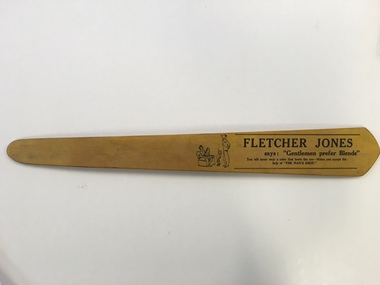
Artefact, Wood-Necktie shaper, Mid 20th century
... Fletcher Jones brand and factory expand to become one of the largest employers in the town. Ownership was based on a co-operative model with employees owning shares in the company. As well as manufacturing he had a number of retail stores across Australia. This item is likely to be a prop from one such store. A minor item which is linked to an important part of Warrnambool’s past. sir fletcher jones david fletcher jones fletcher jones warrnambool Fletcher Jones says “Gentlemen prefer Blends” You will never wear a colour that hurts your eyes_ When you accept the help of “The Man’s Shop” Piece of wood shaped like a necktie with advertising slogan and small diagram in black text. ...David Fletcher Jones was born in Bendigo in 1895. He served in World War 1 and returned in 1917 and with a war repatriation loan bought a hawkers wagon and commenced working a circuit around the Western District. In 1924 he bought a business in Warrnambool and after an initial shaky start he started to build his business. He was well regarded and involved in the town and the 1960-70’s saw the Fletcher Jones brand and factory expand to become one of the largest employers in the town. Ownership was based on a co-operative model with employees owning shares in the company. As well as manufacturing he had a number of retail stores across Australia. This item is likely to be a prop from one such store. A minor item which is linked to an important part of Warrnambool’s past.Piece of wood shaped like a necktie with advertising slogan and small diagram in black text.Fletcher Jones says “Gentlemen prefer Blends” You will never wear a colour that hurts your eyes_ When you accept the help of “The Man’s Shop”sir fletcher jones, david fletcher jones, fletcher jones warrnambool -
 Warrnambool and District Historical Society Inc.
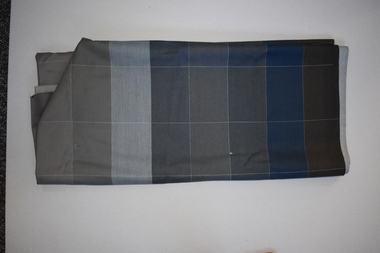
Textile, Fletcher Jones, Mid 20th century
... Fletcher Jones factory in Warrnambool. David Fletcher Jones (1895-1977) served in the First World War and in the 1920s set up as a travelling hawker selling drapery in the Western District of Victoria. In 1924 he leased three shops in Liebig Street, Warrnambool and in 1928 he moved to the Koroit/Liebig Streets intersection with his Man’s Shop. ...Fletcher Jones factory in Warrnambool. David Fletcher Jones (1895-1977) served in the First World War and in the 1920s set up as a travelling hawker selling drapery in the Western District of Victoria. In 1924 he leased three shops in Liebig Street, Warrnambool and in 1928 he moved to the Koroit/Liebig Streets intersection with his Man’s Shop. ...This piece of cloth came from the Fletcher Jones factory in Warrnambool. David Fletcher Jones (1895-1977) served in the First World War and in the 1920s set up as a travelling hawker selling drapery in the Western District of Victoria. In 1924 he leased three shops in Liebig Street, Warrnambool and in 1928 he moved to the Koroit/Liebig Streets intersection with his Man’s Shop. He manufactured men’s clothing on site. In 1931 he moved the business into a new two-storeyed building on the site. He opened a Fletcher Jones shop in Melbourne in 1946 and in 1948 a factory was established in Warrnambool. In 1951 the business of Fletcher Jones and Staff was established. The company expanded and became known Australia- wide, firstly for the production of men’s trousers and later both men’s and women’s clothing. By 2011 the Warrnambool factory was sold and the company was dissolved. This piece of material is of interest as an example of the cloth used in the Fletcher Jones factory in Warrnambool. The Fletcher Jones clothing company, known Australia-wide, was one of the important industries based in Warrnambool in the 20th and early 21st centuryThis is piece of check material in grey and blue tonings. It is stained in various places.fletcher jones clothing stores, warrnambool, history of warrnambool -
 Warrnambool and District Historical Society Inc.
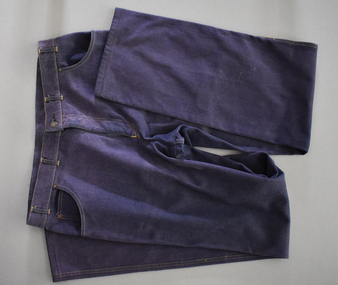
Textile, Fletcher Jones, Men's Fletcher Jones Jeans, Early 21st century
... Fletcher Jones factory in Warrnambool. David Fletcher Jones (1895-1977) served in World War One and in the 1920s set up as a travelling hawker selling drapery in the Western District of Victoria. In 1924 he leased three shops in Liebig Street Warrnambool and in 1928 he moved the business to the corner of Koroit and Liebig Streets with his Man’s Shop. ...Fletcher Jones factory in Warrnambool. David Fletcher Jones (1895-1977) served in World War One and in the 1920s set up as a travelling hawker selling drapery in the Western District of Victoria. In 1924 he leased three shops in Liebig Street Warrnambool and in 1928 he moved the business to the corner of Koroit and Liebig Streets with his Man’s Shop. ...This pair of jeans comes from the Fletcher Jones factory in Warrnambool. David Fletcher Jones (1895-1977) served in World War One and in the 1920s set up as a travelling hawker selling drapery in the Western District of Victoria. In 1924 he leased three shops in Liebig Street Warrnambool and in 1928 he moved the business to the corner of Koroit and Liebig Streets with his Man’s Shop. He manufactured men’s clothing on site. In 1931 a new set of buildings was erected on the site and Fletcher Jones moved into the new building. In 1946 a Fletcher Jones shop was opened in Melbourne and in 1948 a factory was opened in Warrnambool with a new company Fletcher Jones and Staff established in 1951. This company became known Australia-wide, firstly for the production of men’s trousers and later for both men’s and women’s clothing. By 2011 the factory was sold and the company dissolved. These jeans are retained as an example of the clothing made at the Warrnambool Fletcher Jones factory. The Fletcher Jones clothing company was one of the most important businesses in Warrnambool in the 20th century. This is a pair of blue cotton jeans pants with yellow stitching and a metal zip The garment has four pockets. The back pocket has the maker’s label and there are two labels attached to the inside. The front inside top section is lined with white material. ‘Fletcher Jones Australia’fletcher jones clothing company, history of warrnambool -
 Warrnambool and District Historical Society Inc.
Functional object - Wrapping Paper (2 sheets), Fletcher Jones and Staff, Warrnambool, c. 1970
... Fletcher Jones (Warrnambool). One sheet has been produced for the After Sales Department. David Fletcher Jones (1895-1977) served in World War One and in the 1920s set up as a travelling hawker selling drapery in Western Victoria. In 1924 he leased three shops in Liebig Street, Warrnambool and in 1928 he moved to the Koroit/Liebig Streets intersection with his Man's...Fletcher Jones (Warrnambool). One sheet has been produced for the After Sales Department. David Fletcher Jones (1895-1977) served in World War One and in the 1920s set up as a travelling hawker selling drapery in Western Victoria. In 1924 he leased three shops in Liebig Street, Warrnambool and in 1928 he moved to the Koroit/Liebig Streets intersection with his Man's ...These sheets of wrapping paper come from the clothing company of Fletcher Jones (Warrnambool). One sheet has been produced for the After Sales Department. David Fletcher Jones (1895-1977) served in World War One and in the 1920s set up as a travelling hawker selling drapery in Western Victoria. In 1924 he leased three shops in Liebig Street, Warrnambool and in 1928 he moved to the Koroit/Liebig Streets intersection with his Man's Shop. He manufactured men's clothing on site. In 1931 he moved into a new set of two-storeyed buildings on the site. In 1946 he opened a men's store in Melbourne and in 1948 he opened a factory in Warrnambool with a new company called Fletcher Jones and Staff (1951). This company extended to other parts of Australia and became well-known throughout Australia for the production of men's trousers and later men's and women's clothing. By 2011 the Warrnambool factory was sold and the company dissolved.These wrapping papers are of interest as a memento of the Fletcher Jones Clothing Company, a major industry in Warrnambool and Australia for many years.These are two sheets of wrapping paper from the Fletcher Jones clothing company. .1 A sheet of grey paper over-printed with a blue logo (shield and needle and thread) and blue printing .2 A sheet of buff-coloured paper (tissue quality) over-printed with a blue logo (shield and needle and thread) and red printing.1 Fletcher Jones Says Compare .2 Fletcher Jones, After Sales Service, F.J. Plus 8, Dry Cleaning, Lock Pressing, Form Setting, Adjustments and Repairsfletcher jones warrnambool, warrnambool businesses -
 Warrnambool and District Historical Society Inc.
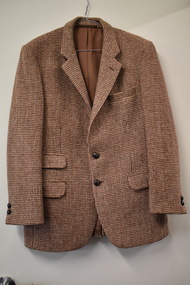
Clothing - Fletcher Jones Man's Sports Coat, 1970s
... Fletcher Jones factory about the 1970s. David Fletcher Jones (1895-1977) served in World War One and in the 1920s set up as a travelling hawker selling drapery in Western Victoria. In 1924 he leased three shops in Liebig Street, Warrnambool and in 1928 opened his Man's...Fletcher Jones factory about the 1970s. David Fletcher Jones (1895-1977) served in World War One and in the 1920s set up as a travelling hawker selling drapery in Western Victoria. In 1924 he leased three shops in Liebig Street, Warrnambool and in 1928 opened his Man's ...This sports coat was made at a Fletcher Jones factory about the 1970s. David Fletcher Jones (1895-1977) served in World War One and in the 1920s set up as a travelling hawker selling drapery in Western Victoria. In 1924 he leased three shops in Liebig Street, Warrnambool and in 1928 opened his Man's Shop at the intersection of Koroit/Liebig Streets. He manufactured men's clothing on site in a new building erected in 1931. In 1946 a Fletcher Jones shop was opened in Melbourne and in 1948 a factory was established in Warrnambool with a new company Fletcher Jones and Staff established in 1951.This company then operated in other States and known Australia-wide firstly for its production of men's trousers and later for men's and women's clothing. By 2011 the Warrnambool factory was closed and the company dissolved. This coat was bought by Lew Officer, a member of a family with pastoral interests in the Western District.This item is of considerable historical interest as an example of the high quality work produced by the Fletcher Jones and Staff Clothing Stores. This company was a key industry in Warrnambool in the 20th centuryThis is a man's sports coat made of Harris tweed hand woven in the Outer Hebrides made from Scottish-grown wool. The checked material is in brown tonings. The coat has a brown material lining and there are two brown buttons down the front and two on each sleeve. The collar has a grey felt lining.fletcher jones clothing stores, warrnambool, harris tweed jacket, lew officer
