
Showing 26 items matching "flour tin"
-
 Friends of Westgarthtown
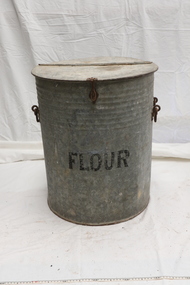
Domestic object - Metal flour tin, c. 1920-1950
... Metal flour tin...Flour tin...This metal flour storage tin belonged to the Ziebell family and was originally used at their farm at Westgarthtown, Thomastown, Victoria. ...Large metal storage tin with hand-painted black lettering reading 'Flour'. Used for storing bulk quantities of flour, the tin provided a practical means of keeping dry goods contained and protected from moisture, pests and contamination....Domestic object Metal flour tin ...This metal flour storage tin belonged to the Ziebell family and was originally used at their farm at Westgarthtown, Thomastown, Victoria. Henry Ziebell recalled the tin being used by the family during his childhood and its continued presence in the family home in Thomastown. He explained that flour was traditionally purchased in large 70-pound (approximately 32 kg) bags and transferred into the tin for everyday domestic use. Large storage tins such as this were commonly used in rural households throughout the nineteenth and twentieth centuries, particularly when staple ingredients were purchased in bulk. These containers were an essential part of household management, allowing families to store substantial quantities of food for regular use. The tin provides a tangible connection to the domestic routines, food preparation and household practices of successive generations of the Ziebell family, reflecting the practical nature of everyday life at Westgarthtown. The tin was donated to Ziebell's Farmhouse Museum by Lyn and James Ziebell.Large metal storage tin with hand-painted black lettering reading 'Flour'. Used for storing bulk quantities of flour, the tin provided a practical means of keeping dry goods contained and protected from moisture, pests and contamination.flour tin, food storage, kitchen equipment, domestic life, household management, bulk food storage, farming households, westgarthtown, ziebell family. -
 City of Moorabbin Historical Society (Operating the Box Cottage Museum)
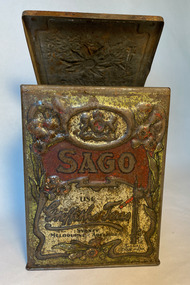
Container - Griffiths Tea Canister, 1900-1940
... The tins, when emptied, became useful kitchen canisters and helped promote the brand. Example of the names include Flour, Rice, Sugar, Sago, Candied Peel, Tapioca, Spices, Starch, Biscuits, Currants, Barley, String and of course Tea ....The tins, when emptied, became useful kitchen canisters and helped promote the brand. Example of the names include Flour, Rice, Sugar, Sago, Candied Peel, Tapioca, Spices, Starch, Biscuits, Currants, Barley, String and of course Tea . tea James Griffiths canisters city of moorabbin cheltenham melbourne moorabbin grocery stores kitchen equipment Printed on the front 'SAGO', also printed on the front and repeated on the top 'USE / GRIFFITHS' Teas / SYDNEY / MELBOURNE. ...In 1873 James Griffiths migrated to Melbourne in order to start a tea Business. James lived in the Dandenongs at The Basin where he experimented with growing tea. Griffiths made tin canisters in the 2lbs size for their tea with common kitchen consumables listed on the front . The tins, when emptied, became useful kitchen canisters and helped promote the brand. Example of the names include Flour, Rice, Sugar, Sago, Candied Peel, Tapioca, Spices, Starch, Biscuits, Currants, Barley, String and of course Tea .Food storage rectangular tin, with a hinged lid. The outside is printed in cream and red with the name 'Griffith's Teas' and the word 'SAGO'. The text is set against a cream panel which is bordered with a decorative border of Australian native flora. The whole is set against a dark green background.On each other side of the tin is a different native Australian flower. The lid is impressed with a flannel flower.Printed on the front 'SAGO', also printed on the front and repeated on the top 'USE / GRIFFITHS' Teas / SYDNEY / MELBOURNE. ADELAIDE. BRISBANE'. On the front is the image of a train signal with the words 'SIGNAL / TRADE MARK'tea, james griffiths, canisters, city of moorabbin, cheltenham, melbourne, moorabbin, grocery stores, kitchen equipment -
 City of Moorabbin Historical Society (Operating the Box Cottage Museum)
McKenzie's Excelsior Baking Powder
... (flour and a half cups) of Plain Flour, and sift several times through your fFour Sifter. USE A DRY SPOON - KEEP THE TIN CLOSED - Clifford Love McKenzie Pty. ...(flour and a half cups) of Plain Flour, and sift several times through your fFour Sifter. USE A DRY SPOON - KEEP THE TIN CLOSED - Clifford Love McKenzie Pty. ...Tin printed in gold and blue text and with a white lid.FRONT: Phosphate Aerator - McKenzie's Excelsior - Baking Powder - 4 ozs. Net - Clifford, Love McKenzie Pty. Ltd. DIRECTIONS FOR USE - McKenzie's "EXCELSIOR" Baking Powder is produced under careful laboratory control to ensure reliable results. It may, for this reason, be used with complete confidence in all climates. Use this Making Powder as required by your Recipe. The great advantage, however, of using Baking Powder and Plain Flour instead of Self-Raising Flour, is that you can vary the amount of rising if you wish to do so. To make your own Self-Raising Flour, thoroughly mix together 1-ozs (two level dessertspoons) of "EXCELSIOR" Baking Powder and 1-lb. (flour and a half cups) of Plain Flour, and sift several times through your fFour Sifter. USE A DRY SPOON - KEEP THE TIN CLOSED - Clifford Love McKenzie Pty. Ltd. Australia -
 Flagstaff Hill Maritime Museum and Village
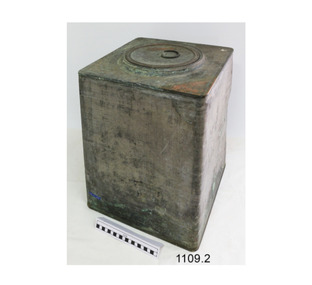
Container - Copper Drum, 1903
... tin container was used for the storage and transport of cordite that replaced black powder in 1889 as a military propellant. The stamped of a government broad arrow and date 1903 show the item was made for the war department and not for commercial use. The container once empty of explosives was used for many years as a flour...tin container was used for the storage and transport of cordite that replaced black powder in 1889 as a military propellant. The stamped of a government broad arrow and date 1903 show the item was made for the war department and not for commercial use. The container once empty of explosives was used for many years as a flour ...This copper and tin container was used for the storage and transport of cordite that replaced black powder in 1889 as a military propellant. The stamped of a government broad arrow and date 1903 show the item was made for the war department and not for commercial use. The container once empty of explosives was used for many years as a flour bin on board the crayfish ketch "Lady Brassey" by Mr Charlie Washbourne, Crib Point, Australia (on the Mornington Peninsula in Victoria). The ketch Lady Brassey was probably named after Anna or "Annie" Brassey (née Allnutt), Baroness Brassey (7 October 1839 – 14 September 1887) who was an English traveller and writer. Her bestselling book A Voyage in the Sunbeam, Our Home on the Ocean for Eleven Months (1878) describes a voyage around the world including a visit to Australia.The explosives container is an example of how explosive compounds were stored and transported at the turn of the 20th century. It is significate as it is in very good condition and an artefact from Australia's colonial history around the Federation, just as the country was gaining independence from Britain.Metal box with tin sides, copper top and base and round, double layered lid that has a folding, D shaped handle. Referred to as a cordite container or copper drum. Inscriptions are stamped onto the drum and are on a sticker under the lid.Handle stamped "S & Co. 1900" on lid. Base is stamped "R.G.D. 1903" (meaning the container seals are resistant to Rapid Gas Decompression (RGD)") Logo: triangular "(vertical arrow) / A T " between letters and date. Base also has blue plastic label "N.T. 55" Sticker: "B55". flagstaff hill, warrnambool, flagstaff hill maritime museum, maritime museum, shipwreck coast, flagstaff hill maritime village, great ocean road, copper container, gunpowder container, government issue container, r.g.d. 1903, lady brassey, charlie washbourne, crib point, baroness brassey, cordite container, copper drum, gun powder container, gun powder, black powder, black powder container, explosives storage, crayfish ketch -
 Kiewa Valley Historical Society
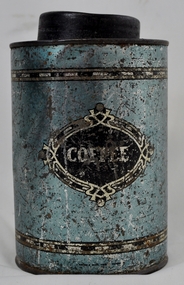
Tin Coffee Cylindrical, circa mid to late 1900's
... This "insignificant" coffee tin is very significant as it demonstrates that the Kiewa Valley was becoming more accessible to reliable coffee supplies and general food items.The container was part of a "set" of containers that included tea, sugar,biscuits,flour, rice and other family condiments. ...This "coffee" tin has by the "art deco" appearance its origins in the late 1950's to 1960's. This time period was one of accelerated growth both in the physical (housing) sense and the mental (new ideas and inventions) changes in "attitudes". These occurred more rapidly in cities but had its effects on the rural environment. The drinking of coffee was spurred on by easier distribution of imported food and drinks. Advertising by stronger radio links and then by television brought the variety of foods and drinks to semi isolated rural regions. The accessibility through greater information channels becoming available brought with it unbelievable ranges of goods and foodstuffs. Rural regions still relied on bulk supplies and relatively larger storage containers than those in cities. This "bulk" buying and storage "syndrome" was a lingering result of many years of "drought" periods when road transports met delays from flooded roadways in supplying population centres in the Kiewa Valley. The construction phases in building the SEC Vic Hydro electricity Scheme in the eastern sections of the Victorian Alps brought many changes to the quiet rural regions in the Kiewa Valley. Changes in population and social mores. The influx of a varied , mostly temporary, and "European flavoured cuisine" changes the "cuppa tea only" flavour to the have a "coffee break". The subliminal influence of the "American" films changed those children growing up in the post 1950s from the "English tea" to the "American coffee". This "Americanisation process has influenced not only rural Australia but also other areas throughout the world.This "insignificant" coffee tin is very significant as it demonstrates that the Kiewa Valley was becoming more accessible to reliable coffee supplies and general food items.The container was part of a "set" of containers that included tea, sugar,biscuits,flour, rice and other family condiments. This type of kitchen storage containers was brought about through changing patterns in tea and coffee useage and overall consumption. Household demands for faster "self help" cooking especially beveridges and the greater choice of kitchen "utensils" was brought on by easier access to products due to a lessening of the area's "isolation" by having a reliable (all weather) road system and an ever increasing population growth. The need for travelling goods/merchant supply caravans to service the area became a diminishing factor, as a result of the establishment of grocery stores in Tawonga and Mount Beauty in the supply of previously "hard to get" groceries. This transition was precipitated by the SEC Vic Hydro Scheme of the 1940's to 1960's which increased the valley's population level three fold.This cylindrical tin has a pull/push lid(for easy access to the contents). The container is labelled for "coffee" however it has no commercial manufacturer's label to establish that it was bought with coffee ingredients in it. The majority of the container's external surface has a "metallic" light blue colour with two sets of silver rings confining black (horizontal spotted) rectangles. "COFFEE" within an elongated spherical "art deco" four pointed banner of silver and black colouringkitchen containers, domestic food storage, bulk stocks of dried condiments -
 Bendigo Historical Society Inc.
Furniture - HARRIS COLLECTION: SMALL WOODEN CHEST OF DRAWERS
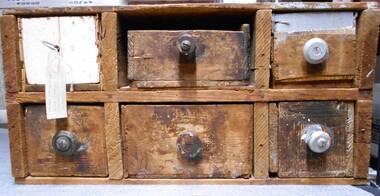
... One drawer has label of box on side ' Leggo's of Bendigo, Self Raising Roller Flour', parts of label missing 'Good cheap cake' recipe partly visible. On top of drawers, white paint tin stain....One drawer has label of box on side ' Leggo's of Bendigo, Self Raising Roller Flour', parts of label missing 'Good cheap cake' recipe partly visible. On top of drawers, white paint tin stain. ...Small wooden handcrafted set of drawers; drawers enclosed in a 'Shell oil' box. On ends of box, printed in black 'Shell' and 'The British Imperial Oil Company Limited' ' 8 Imperial gallons, motor spirit' Small handcrafted drawers are set in the box. Six small drawers, with four wooden knobs, one metal and one loop of wire acting as a drawer pull. Drawers are made from repurposed boxes. One drawer has label of box on side ' Leggo's of Bendigo, Self Raising Roller Flour', parts of label missing 'Good cheap cake' recipe partly visible. On top of drawers, white paint tin stain.harris collection, axedale -
 Bendigo Historical Society Inc.
Domestic Object - ASSORTED BISCUIT CUTTERS
... Assortment of tin biscuit cutters, moulds, in various shapes and sizes plus a double ended measuring spoon & a scone cutter marked Invicta Self Raising Flour on handle....DOMESTIC EQUIPMENT Food preparation kitchen K197 K185.2 Invicta Self Raising Flour Assortment of tin biscuit cutters, moulds, in various shapes and sizes plus a double ended measuring spoon & a scone cutter marked Invicta Self Raising Flour on handle. ...Assortment of tin biscuit cutters, moulds, in various shapes and sizes plus a double ended measuring spoon & a scone cutter marked Invicta Self Raising Flour on handle.Invicta Self Raising Flourdomestic equipment, food preparation, kitchen, k197 k185.2 -
 Kiewa Valley Historical Society
Sieve - Flour
... Tin cylinder covered with white, ingrained flour. Top rim is sloped with a handle coming out on the lower side. ...flour. Top rim is sloped with a handle coming out on the lower side. On one side is a handle for winding two tin rings at right angles to each other. ...Manual appliance for sifting flour used in the kitchen.Tin cylinder covered with white, ingrained flour. Top rim is sloped with a handle coming out on the lower side. On one side is a handle for winding two tin rings at right angles to each other. These rings turn and touch a wire net to push the flour through. Both handles are wooden.Embossed in a shield near the top is a shield shaped logo on the side "Kande (within a shape of Australia) / Reg.d 3996 / Made in Australia."kitchen, flour sieve, manual appliance -
 Tatura Irrigation & Wartime Camps Museum
Scales, H. L. Becker Fils & Co
... scales flour mill scales Scientific Apparatus 2 tins with weights with appropriate numbers Scales H. ...Scientific Apparatus 2 tins with weights with appropriate numbersscales, flour mill scales -
Tatura Irrigation & Wartime Camps Museum
Tin box, First Aid Kit
... Used as a first aid tin for Reilly's Flour Mill. Contents still inside (3 unknown measuring devises, Zain Buk ointment, APC Bottle, Rexona ointment, tin of Zonas adhesive plaster (small roll inside), 2 small rolls of gauze bandage, piece of wadding, 3 different size finger stalls, temperature gauge, tweezers)....Used as a first aid tin for Reilly's Flour Mill. Contents still inside (3 unknown measuring devises, Zain Buk ointment, APC Bottle, Rexona ointment, tin of Zonas adhesive plaster (small roll inside), 2 small rolls of gauze bandage, piece of wadding, 3 different size finger stalls, temperature gauge, tweezers). first aid kits reilly's flour mill Black tin box with catch and oval handle, hinged lid. ...Used as a first aid tin for Reilly's Flour Mill. Contents still inside (3 unknown measuring devises, Zain Buk ointment, APC Bottle, Rexona ointment, tin of Zonas adhesive plaster (small roll inside), 2 small rolls of gauze bandage, piece of wadding, 3 different size finger stalls, temperature gauge, tweezers).Black tin box with catch and oval handle, hinged lid.first aid kits, reilly's flour mill -
 Numurkah & District Historical Society
Container - Tin Container (Glen Valley)
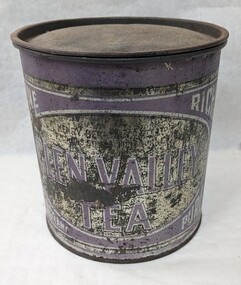
... flour, sugar and other commodities. He founded Henry Berry and Company (Australasia) Ltd1 which became one of the largest importers and distributors in Australia. Glen Valley Tea Tin ...Henry Berry was a British-born merchant who came to Melbourne in 1856 and established a successful business in salt and general goods. He later expanded into tea, flour, sugar and other commodities. He founded Henry Berry and Company (Australasia) Ltd1 which became one of the largest importers and distributors in Australia.Round tin container with purple and sliver coloured background, and purple writing. has round pull-off lidGlen Valley Tea glen valley, tea, tin container, henry berry -
 Puffing Billy Railway
V. R. Krupp 1888. IV. Rail, 1888
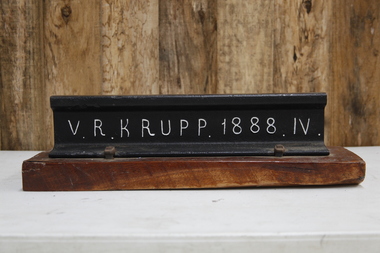
... flour. Also the company played a substantial part in the development of Australia's mineral resources, starting with lead in 1895, and later venturing into tin, gold, copper, cement and super phosphates. ...flour. Also the company played a substantial part in the development of Australia's mineral resources, starting with lead in 1895, and later venturing into tin, gold, copper, cement and super phosphates. ...60lbs rail that was used throughout the Victorian rail network. In 1887 Gibbs, Bright and Co. had a contract with Victorian Railways for railway and canal construction and supply of Krupp Rails. Gibbs, Bright and Co were merchant bankers and shipping agents and merchants who where also Directors of the GWR ( Great Western Railway ) and the Ship The "Great Britain" in England Gibbs, Bright and Company had principally been involved in shipping and trading, mainly in the West Indies, but following the discovery of gold in Victoria they established an office in Melbourne and soon became one of the leading shipping agents and merchants in the Colony. They expanded into passenger shipping and soon established offices in Brisbane, Sydney, Newcastle, Adelaide and Perth as well as launching passenger services between England, Mauritius and New Zealand. Gibbs, Bright also held a number of financial agencies from British mortgage, finance and investment companies as well as representing several British insurance companies in Australia. In addition they conducted a growing import business as well as an export business that included livestock, dairy produce, wool and flour. Also the company played a substantial part in the development of Australia's mineral resources, starting with lead in 1895, and later venturing into tin, gold, copper, cement and super phosphates. In Australia, after WWI, many of the larger companies were managing their own import and export so Gibbs, Bright and Company tended to focus its Agency business on smaller companies while expanding their interest into other markets such as timber, wire netting, zinc, stevedoring, road transport, marine salvage, gold mining as well as mechanical, structural, electrical and marine engineering. The Company's shipping interests continued to grow as well and still formed a major part of its business. In 1948 the parent company in England took the major step from tradition when they changed the business from a partnership into a private limited company. The name was the same, Antony Gibbs and Sons Limited, and in practice the effect of the change was very little. Some of the firm's branches and departments had already become limited companies and the formation of a parent company simplified the structure. The Australian operation was in time changed to Gibbs Bright & Co Pty Ltd in 1963. In 1848 Alfred Krupp becomes the sole proprietor of the company which from 1850 experiences its first major growth surge. In 1849 his equally talented brother Hermann (1814 - 1879) takes over the hardware factory Metallwarenfabrik in Berndorf near Vienna, which Krupp had established together with Alexander Schöller six years earlier. The factory manufactures cutlery in a rolling process developed by the brothers. Krupp's main products are machinery and machine components made of high-quality cast steel, especially equipment for the railroads, most notably the seamless wheel tire, and from 1859 to an increased extent artillery. To secure raw materials and feedstock for his production, Krupp acquires ore deposits, coal mines and iron works. On Alfred Krupp's death in 1887 the company employs 20,200 people. His great business success is based on the quality of the products, systematic measures to secure sales, the use of new cost-effective steel-making techniques, good organization within the company, and the cultivation of a loyal and highly qualified workforce among other things through an extensive company welfare system. From 1878 August Thyssen starts to get involved in processing the products manufactured by Thyssen & Co., including the fabrication of pipes for gas lines. In 1882 he starts rolling sheet at Styrum, for which two years later he sets up a galvanizing shop. The foundation stone for Maschinenfabrik Thyssen & Co. is laid in 1883 with the purchase of a neighboring mechanical engineering company. In 1891 August Thyssen takes the first step toward creating a vertical company at the Gewerkschaft Deutscher Kaiser coal mine in [Duisburg-]Hamborn, which he expands to an integrated iron and steelmaking plant on the River Rhine. Just before the First World War he starts to expand his group internationally (Netherlands, UK, France, Russia, Mediterranean region, Argentina). info from The company thyssenkrupp - History https://www.thyssenkrupp.com/en/company/history/the-founding-families/alfred-krupp.htmlHistoric - Victorian Railways - Track Rail - made by Krupp in 1888Section of VR Krupp 1888 Rail mounted on a piece of varnished wood. Rail made of ironpuffing billy, krupp, rail, victorian railways -
 Chelsea & District Historical Society Inc
Photograph - Mordialloc Carrum High School, Form D2, 1925
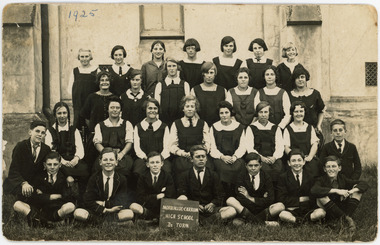
... Cream butter & sugar, add eggs, fruit, spice, almonds, sifted flour. Mix well, put in tin lined with paper. Place on scone tray, cook from 3-4 hours, very low oven.Cover with paper. ...Cream butter & sugar, add eggs, fruit, spice, almonds, sifted flour. Mix well, put in tin lined with paper. Place on scone tray, cook from 3-4 hours, very low oven.Cover with paper. ...Mordialloc Carrum High SchoolPhoto depicts students at high school in 1925 Form D2Black and White Postcard depicting secondary school students in 1925 Mordialloc Carrum SchoolMordialloc - Carrum / Mordialloc Chelsea High School. Group of secondary school children in 1925. Form D2 Recipe of fruit cake on back. Fruit Cake- Rich Fruit Cake. 1/2 lb butter, 5 eggs, pinch salt, 1/2 lb sugar, ? sultanas, 2 almonds, 2 oz SR Flour, 1/2 nutmeg grated, 1 dst ground cinnamon, 1 dst. ground alspice, 1 tsp vanilla. Cream butter & sugar, add eggs, fruit, spice, almonds, sifted flour. Mix well, put in tin lined with paper. Place on scone tray, cook from 3-4 hours, very low oven.Cover with paper. Brush with egg white.education, school, morialloc, carrum -
 Hume City Civic Collection
Scoop
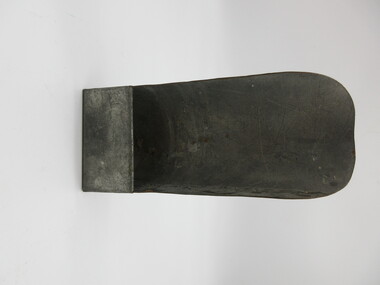
... This tin scoop would have been used in the kitchen at the Sunbury Asylum to distribute bulk food such as sugar, flour etc from larger containers....A tin scoop used to distribute sugar, flour etc from storage containers....This tin scoop would have been used in the kitchen at the Sunbury Asylum to distribute bulk food such as sugar, flour etc from larger containers. sunbury asylum george evans collection A tin scoop used to distribute sugar, flour etc from storage containers. ...This tin scoop would have been used in the kitchen at the Sunbury Asylum to distribute bulk food such as sugar, flour etc from larger containers.A tin scoop used to distribute sugar, flour etc from storage containers.sunbury asylum, george evans collection -
 Hume City Civic Collection
Container - Tin, McKenzies Baking Powder
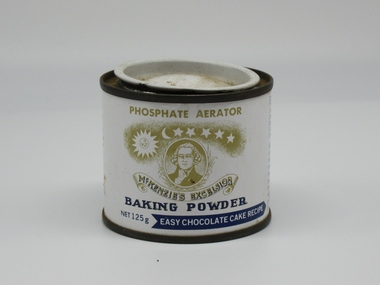
... tin would have been used in cooking. Baking powder is a raising agent and in cake recipes can be added to plain flour when self raising flour may not be available. ...tin would have been used in cooking. Baking powder is a raising agent and in cake recipes can be added to plain flour when self raising flour may not be available. ...The baking powder contents of this tin would have been used in cooking. Baking powder is a raising agent and in cake recipes can be added to plain flour when self raising flour may not be available. McKenzies Baking Powder was a well known product used in the home.Small tin with white and gold printing and with a white lid. It has a recipe printed on the back.McKENZIES EXCELSIOR/BAKING POWDER/NET 125g EASY CHOCOLATE CAKE RECIPEsocial history, cooking, food -
 Melton City Libraries
Photograph, Mrs Knox and Beryl Gillespie at the First Hundred Years Celebration of Melton State School 430, 1970
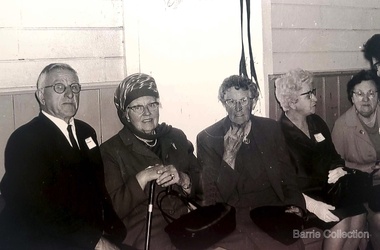
... flour etc over the fence. Mavis and Jack Butler lived there before the Coopers. Bernie and Iris Trethowan lived two doors up. Neighbours were invited into their home to view the first black and white television in Melton Sth. Bill Exell was one of the first Melton Sth farmers to sell his land to developers, the land was idle for years before housing developed. I joined the Melton Valley Golf Club in 1960. The Gun Club as our Club House, an old tin...flour etc over the fence. Mavis and Jack Butler lived there before the Coopers. Bernie and Iris Trethowan lived two doors up. Neighbours were invited into their home to view the first black and white television in Melton Sth. Bill Exell was one of the first Melton Sth farmers to sell his land to developers, the land was idle for years before housing developed. I joined the Melton Valley Golf Club in 1960. The Gun Club as our Club House, an old tin ...Beryl Knox speaking about early life in Melton. Page 1 1949 – 64 years ago. We began our married life at Melton Sth. The house on the corner of the Exford Rd and Staughton St-- dusty gravel roads, box thorns and noxious weeds everywhere and a sprinkling of houses and vacant land. It was a friendly community consisting of old family names. McDonalds, Blacks, Dodemaide, Cahill, Coopers, Minns, Tinklers, Nesbitts, Cochranes, Wickhams, Exells. Mavis Butler. The home owned by Mr. Robinson and Miss Robinson had been shifted in two parts transported from Diggers Rest and it is still standing 2013. Bruce’s father purchased the house and two adjoining blocks, the Conways built on one and the Rawlinson family on the other block. Eileen still resides there, she was only a baby in a pram and the family had not long arrived from England. The railway line was close to the house and the contents would rattle when heavy steams trains went through, and on a clear frosty night the 1am paper train would echo roar through very loudly when labouring towards the Exford Bridge. Then the two carriage motor train was introduced, this was great for the workers and schoolies who travelled to Melbourne. The train pulled up at the crossing or riding to pick up or drop off. Melva Gillespie (nee Hirt) Bill Cahill delivered the milk by the billy and then in bottles. Len Kennedy (Paul Kennedy’s father, Norma Murrays son) delivered Jongebloeds bread, he always had a sweep going for the Melbourne Cup and raffles for the footy club. Mr. Woodgate owned an old bus and pick up point was the Post Office when there was a Saturday film on a Melton. There were no doctors or dentists in the district. If we need a Doctor we had to travel to Bacchus Marsh or discuss problems over the phone. In later years a Bacchus Marsh Doctor rented the Bluestone building in McKenzie St a couple of days a week. If we needed the Dentist we had to travel to West Footscray or Footscray. We did our banking at “State Savings” then the Miss Minns had the agency and then Bardsleys Store. We travelled to Bacchus Marsh to the National and Commercial banks. Station Rd to Western Highway, now (High Street) was a narrow stretch of bitumen and gravel farmland either side and a couple of farm houses and large gum trees on the properties. Page 2 North of the Railway line Mrs Bessie Jones, mother of Chas and Betty Jones managed the Post Office, next door to her Chas and Betty had the Shell Centre, and later moved the business to Melton. Hughie Nesbitt and mother owned the grocery and hardware store, and I bought my first set of saucepans there. On the opposite side of Station road Mr Coombe owned the fruit shop, and also provided soft drinks and lollies for children. The Chaff Mill was on the corner of Station Rd and Brooklyn Rd. Mr Lumsden was manager and later years Bernie Trethowan and Jack Butler were partners. It finally burnt down and is a Service Station now. Along Brooklyn Rd there were a few houses and Victoria Hall, not a very big hall, but catered for lots of functions, Balls, Fancy Dress, Bazaars, Square Dancing and meetings. The Bacchus Marsh Baptists held Sunday School in the hall. A group of shops were built south of the railway line Molly and Len Skinner managed the Post Office and handled a few essential groceries. Tom McDonald and Ron Lunsberg were the butchers. Mary and Syd Cooper lived next door to us and often in turn would run out of something when we had a baking spree we would borrow or exchange, sugar flour etc over the fence. Mavis and Jack Butler lived there before the Coopers. Bernie and Iris Trethowan lived two doors up. Neighbours were invited into their home to view the first black and white television in Melton Sth. Bill Exell was one of the first Melton Sth farmers to sell his land to developers, the land was idle for years before housing developed. I joined the Melton Valley Golf Club in 1960. The Gun Club as our Club House, an old tin shed consisting a water tank, trestle table and forms and dirt floor. It was a 9 hole course with sand scraps and landscape putting before greens. The Common or parkland was part of the Golf Course. It was open for every ones recreation. Roy Norton an old identity trained his trotters on the Common and wouldn’t clear the track for the golfers. The golfers had to avoid him to continue to play. We had to keep clear when the young youths came in their paddock cars and motorbikes. Over the years the Toolern Creek flooded its banks, water and debri covered the course on one year our first Club house was flooded out. It took several working bees to clean it up. We lived at Melton Sth for 15 years and moved to Melton on the farm “Croxton Park.” The Nixon family farm “Mowbray” adjoined the farm. Bruce worked the land cropping the farm when Mrs Nixon died. Page 3 (page 4 on the handwritten script) Bruce had the first offer to buy, in those days it wasn’t easy to get good bank loans. Part of the land is the Golf Course now and Mr O’Shea purchased the bulk. Moving to Melton was totally different – I became involved with Committees, Scouts, Guides, Mothers Clubs, CWA, Church Op shop (8 years). Melton Amateurs players produced and tutored by Mabel Rogers exerts from Pyjama Game, South Pacific, Carousel - later years a group of ladies did gentle water exercise at Essendon and Station Road swimming pool. I was 20 or so years in Probus. The local followed the football, there was always a Gymkhana on the long weekend in June. The tennis always created a lot of interest during the finals. It didn’t matter which team played the supporters were treated to a cup of tea and leftovers from their afternoon tea. In 1978 were the first residents to move into the Jennings Estate Kurunjang and lived there 31 years and retired 4 years ago into Unit. The amazing changes I have experienced. Merrimu supplied our water, after depending on tanks. The landscape changed completely when developers came in, no more dusty plains \ typed web Sept 2013 McFarlane, Mrs Knox and Beryl Gillespie at the First Hundred Years Celebration of Melton State School 430. The event was held at Mechanics Hall, Melton.local identities, local significant events, education -
 Surrey Hills Historical Society Collection
Container - Biscuit tin, Mac's Butter Shortbread tin
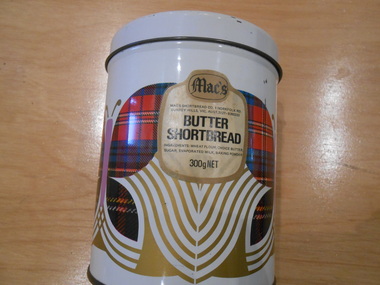
... Flour. This business was sold in 1960 and the family then purchased a cake shop, leading to building a biscuit factory. (This is thought to have been the Surrey Hills site). The company outgrew this and moved to 5 Tate Drive, Kerang. (Further research required.) Australia adopted metric units of measurement in July 1974, so this object was manufactured after 1974. This tin ...Mac's Shortbread Co dates its history back to a family bakery in Abbotsford opened in the 1860's producing bread for the goldfields. This eventually became McAlpine's Flour. This business was sold in 1960 and the family then purchased a cake shop, leading to building a biscuit factory. (This is thought to have been the Surrey Hills site). The company outgrew this and moved to 5 Tate Drive, Kerang. (Further research required.) Australia adopted metric units of measurement in July 1974, so this object was manufactured after 1974.This tin is material evidence of the small area of industrial activities that once existed in Surrey Hills.A cylindrical tin with a silvered interior and the outside finished in a white enamel paint, on which there is a geometric design incorporating a butterfly.On a label incorporated in the design: "Mac's / MAC'S SHORTBREAD CO. 1 NORFOLK RD./ SURREY HILLS, VIC. AUST. 3127 - 8360333 / BUTTER / SHORTBREAD / INGREDIENTS: WHEAT FLOUR, CHOICE BUTTER, / SUGAR, EVAPORATED MILK, BAKING POWDER / 300 g NET"bakeries, surrey hills, mac's shortbread, norfolk road -
 Surrey Hills Historical Society Collection
Container - Biscuit tin, Mac's Butter Shortbread tin
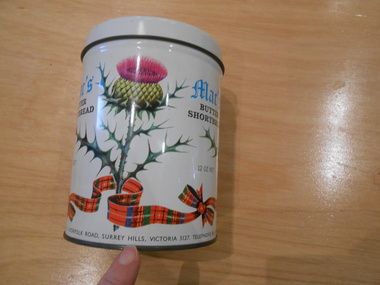
... Flour. This business was sold in 1960 and the family then purchased a cake shop, leading to building a biscuit factory. (This is thought to have been the Surrey Hills site). The company outgrew this and moved to 5 Tate Drive, Kerang. (Further research required.) Australia adopted metric units of measurement in July 1974, so this object predates 1974. This tin ...Mac's Shortbread Co dates its history back to a family bakery in Abbotsford opened in the 1860's producing bread for the goldfields. This eventually became McAlpine's Flour. This business was sold in 1960 and the family then purchased a cake shop, leading to building a biscuit factory. (This is thought to have been the Surrey Hills site). The company outgrew this and moved to 5 Tate Drive, Kerang. (Further research required.) Australia adopted metric units of measurement in July 1974, so this object predates 1974.This tin is material evidence of the small area of industrial activities that once existed in Surrey Hills.A cylindrical tin with a silvered interior and the outside finished in a white enamel paint, on which are 3 thistles and a tartan ribbon. 1. Mac's / BUTTER SHORTBREAD / 12 OZ NET 2. MAC'S SHORTBREAD CO., 1 NORFOLK ROAD, SURREY HILLS, VICTORIA 3127. TELEPHONE 836 0333bakeries, surrey hills, mac's shortbread, norfolk road -
Surrey Hills Historical Society Collection
Domestic object - Biscuit tin, Mac's Butter Shortbread tin
... Flour. This business was sold in 1960 and the family then purchased a cake shop, leading to building a biscuit factory. (This is thought to have been the Surrey Hills site). The company outgrew this and moved to Kerang. (Further research required.) This tin ...Mac's Shortbread Co dates its history back to a family bakery in Abbotsford opened in the 1860's producing bread for the goldfields. This eventually became McAlpine's Flour. This business was sold in 1960 and the family then purchased a cake shop, leading to building a biscuit factory. (This is thought to have been the Surrey Hills site). The company outgrew this and moved to Kerang. (Further research required.)This tin is material evidence of the small area of industrial activities that once existed in Surrey Hills.A cylindrical tin with a silvered interior and the outside finished in a white enamel paint, on which are a pattern with 3 butterflies with tartan wings. there is a small printed paper label1. Mac's / MAC'S SHORTBREAD CO. 1 NORFOLK ROAD, SURREY HILLS, VIC. AUST 3127. 836 0333 BUTTER SHORTBREAD INGREDIENTS WHEAT FLOUR, CHOICE BUTTER, SUGAR< EVAPORATED MILK, BAKING POWDER 300g NETbakeries, surrey hills, mac's shortbread, norfolk road -
Surrey Hills Historical Society Collection
Container - Biscuit tin, Mac's Butter Shortbread tin
... Flour. This business was sold in 1960 and the family then purchased a cake shop, leading to building a biscuit factory. (This is thought to have been the Surrey Hills site). The company outgrew this and moved to Kerang. (Further research required.) This tin ...Mac's Shortbread Co dates its history back to a family bakery in Abbotsford opened in the 1860's producing bread for the goldfields. This eventually became McAlpine's Flour. This business was sold in 1960 and the family then purchased a cake shop, leading to building a biscuit factory. (This is thought to have been the Surrey Hills site). The company outgrew this and moved to Kerang. (Further research required.)This tin is material evidence of the small area of industrial activities that once existed in Surrey Hills.A cylindrical tin with a silvered interior and the outside finished in a white enamel paint, on which are a pattern of gold lions and tartan structures1. Mac's / BUTTER SHORTBREAD 300g NET./ PRODUCT OF AUSTRALIA MADE BY MAC'S SHORTBREAD CO., 1 NORFOLK ROAD, SURREY HILLS, VICTORA INGREDIENTS WHEAT FLOUR, CHOICE BUTTER, SUGAR, LEAVENING, YOLKINE / Bar code 9 310034 305318bakeries, surrey hills, mac's shortbread, norfolk road -
 Surrey Hills Historical Society Collection
Container - Biscuit tin, Mac's Petticoat Tail Butter Shortbread tin
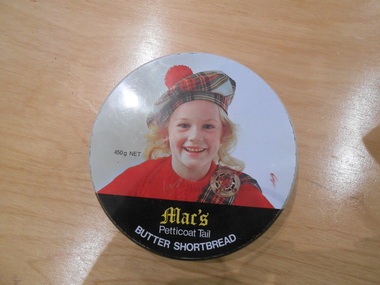
... Flour. This business was sold in 1960 and the family then purchased a cake shop, leading to building a biscuit factory. (This is thought to have been the Surrey Hills site). The company outgrew this and moved to Kerang. (Further research required.) This tin ...Mac's Shortbread Co dates its history back to a family bakery in Abbotsford opened in the 1860's producing bread for the goldfields. This eventually became McAlpine's Flour. This business was sold in 1960 and the family then purchased a cake shop, leading to building a biscuit factory. (This is thought to have been the Surrey Hills site). The company outgrew this and moved to Kerang. (Further research required.)This tin is material evidence of the small area of industrial activities that once existed in Surrey Hills.A round tin with a silvered interior and the outside finished in a white enamel paint with the head and shoulders of a blond girl in red jumper, tartan sash and brooch and a tartan tam o'shanter hat.1. Mac's / Petticoat Tail BUTTER SHORTBREAD 450g NET./ BAKED IN AUSTRALIA BY MAC"S SHORTBREAD CO., 1 NORFOLK ROAD, SURREY HILLS, VICTORA AUSTRALIA PHONE 8360333 INGREDIENTS WHEAT FLOUR, CHOICE BUTTER, SUGAR, EVAPORATED MILK BAKING POWDERbakeries, surrey hills, mac's shortbread, norfolk road -
 Mont De Lancey
Domestic object - Flour Sifter, Magpie, Unknown
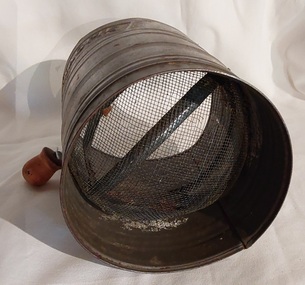
... A vintage tin MAGPIE brand flour sifter with a shaped handle and a wooden knob. ...Kitchenware Kitchen equipment Flour sifters Sieves 'MAGPIE' is indented inside a rectangular shape at the top. A vintage tin MAGPIE brand flour sifter with a shaped handle and a wooden knob. ...Modern flour sifters, as we know them, gained popularity in the 19th century, with patents awarded for flour sifters and sieve holders. They were used in the kitchen to aerate and remove lumps from flour.A vintage tin MAGPIE brand flour sifter with a shaped handle and a wooden knob. There are horizontal bands or lines indented around the sifter as well as the brand near the top. Wire mesh inside sifts the flour as the handle is turned.'MAGPIE' is indented inside a rectangular shape at the top.kitchenware, kitchen equipment, flour sifters, sieves -
 Mont De Lancey
Tin, Swallow & Ariell, Ltd
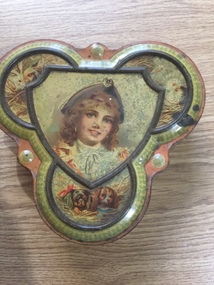
... tin: late 19th century Swallow & Ariell operated continuously in Port Melbourne from 1858 to 1991. The former Swallow & Ariell’s factory buildings, now The Anchorage, continue to add interest and pleasure along Stokes, Rouse and Princes Streets. Thomas Swallow, born in Reading, travelled to California and Ballarat before setting up a business making ships biscuits in Port Melbourne. His business partner Ariell died in 1877. He then went into partnership with Frederick Derham, his son in law. Company farms around Shepparton provided much of its wheat, and after 1889 most was ground into flour...tin: late 19th century Swallow & Ariell operated continuously in Port Melbourne from 1858 to 1991. The former Swallow & Ariell’s factory buildings, now The Anchorage, continue to add interest and pleasure along Stokes, Rouse and Princes Streets. Thomas Swallow, born in Reading, travelled to California and Ballarat before setting up a business making ships biscuits in Port Melbourne. His business partner Ariell died in 1877. He then went into partnership with Frederick Derham, his son in law. Company farms around Shepparton provided much of its wheat, and after 1889 most was ground into flour ...Biscuit tin: late 19th century Swallow & Ariell operated continuously in Port Melbourne from 1858 to 1991. The former Swallow & Ariell’s factory buildings, now The Anchorage, continue to add interest and pleasure along Stokes, Rouse and Princes Streets. Thomas Swallow, born in Reading, travelled to California and Ballarat before setting up a business making ships biscuits in Port Melbourne. His business partner Ariell died in 1877. He then went into partnership with Frederick Derham, his son in law. Company farms around Shepparton provided much of its wheat, and after 1889 most was ground into flour on the Port Melbourne premises. For the year ending 1 May 1920, the factory used 51 tons of butter, 2,740 eggs and produced more than 66 lines of biscuits. They also made puddings, elaborate cakes and ice cream. S & A was a significant employer – locally referred to as S & A College. At the height of the South African war it employed 1900 workers but even in 1991 it employed 450 people.Pink and brown clover-shaped ornamental biscuit tin decorated with pictures of a girl (central panel), 2 dogs (lower section), 2 rabbits (upper left-side panel) and 2 birds (upper right-hand panel. It has floral designs around the outer edges of both the tin and the lid which is hinged at the top of the tin.Inside the lid: "Swallow & Ariell, Ltd. Biscuit Manufacturers, Port Melbourne. Prizes received at all international & inter-colonial exhibitions"biscuit tins, tins -
 Mont De Lancey
Food Canisters/Tins
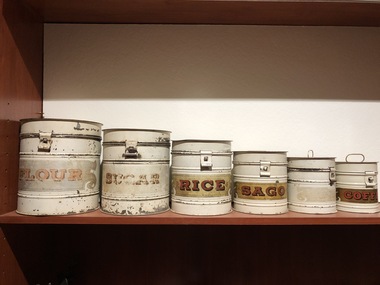
... Flour 2. Sugar 3. Rice 4. Sago 5. 'illegible' 6. Coffee Set of 6 food canisters, with hinged lids and a metal carry handle. Food Canisters/Tins ...Set of 6 food canisters, with hinged lids and a metal carry handle.1. Flour 2. Sugar 3. Rice 4. Sago 5. 'illegible' 6. Coffeecanisters, food storage containers -
 Wodonga & District Historical Society Inc
Domestic object - Flour Sifter made by KANDE Australia, Kande Kitchenware Ltd, 1920 - 1960
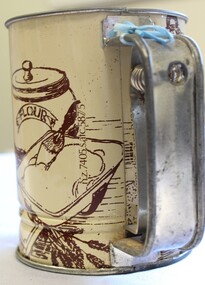
... tins, pastry cutters, pans and baking dishes. They managed to survive the difficulties of the Depression and were listed as a public company in 1949. Kande Kitchenware Ltd were taken over by Hackshalls Limited 6 July 1960. An appliance made by an early and successful Australian company which manufactured metal kitchen items during the first half of the 20th century. Th.ese utensils were widely used throughout Australia Australian business Kande Kitchenware kitchen utensils Kitchenware early 20th century At botton of illustrations on one side "Kande AUSTRALIA" Flour ...Kande Kitchenware was established by Patrick Kavanagh and William English in 1922. The name Kande was formed from their initials, K and E. It had its Sydney factory in Little Collins Street, Surrey Hills. Kavanagh and English, a subsidiary of Kande Kitchenware, became a limited company in 1924, with both founders as directors. Another director was Test cricketer Jack Gregory, an all-rounder who slipped easily into the role of businessman. Gregory enjoyed success in business as on the cricket field, helping the company grow from a tiny operation to a major manufacturer and exporter that employed 80 people in 1931. They produced a wide range of utensils including cake tins, pastry cutters, pans and baking dishes. They managed to survive the difficulties of the Depression and were listed as a public company in 1949. Kande Kitchenware Ltd were taken over by Hackshalls Limited 6 July 1960.An appliance made by an early and successful Australian company which manufactured metal kitchen items during the first half of the 20th century. Th.ese utensils were widely used throughout AustraliaFlour sifter manufactured by KANDE Australia. The sifter / sieve is made of metal with a wire mesh and is decororated with images of other kitchen utensils and ingredients. It has a spring-loaded handle to which would be squeezed to operate the internal sifting mechanism.At botton of illustrations on one side "Kande AUSTRALIA"australian business, kande kitchenware, kitchen utensils, kitchenware early 20th century -
Sunshine and District Historical Society Incorporated
Film - Albion Railway Station Video, John Alchin, 2026
... These videos shows the Albion Railway Station North Car Park and former Tin Pin Bowling Centre prior to the redevelopment of the station as part of the Melbourne Airport Railway works and the John Darling Flour Mill on the South side of the Railway Station. ...These video is taken from the train as it pulls into or out of the Albion Railway Station.These videos shows the Albion Railway Station North Car Park and former Tin Pin Bowling Centre prior to the redevelopment of the station as part of the Melbourne Airport Railway works and the John Darling Flour Mill on the South side of the Railway Station.albion railway station, albion, john darling flour mill
