
Showing 216 items matching "food tins"
-
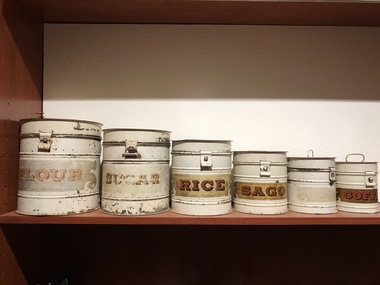 Mont De Lancey
Food Canisters/Tins
... Food Canisters/Tins...Coffee Set of 6 food canisters, with hinged lids and a metal carry handle. Food Canisters/Tins ...Set of 6 food canisters, with hinged lids and a metal carry handle.1. Flour 2. Sugar 3. Rice 4. Sago 5. 'illegible' 6. Coffeecanisters, food storage containers -
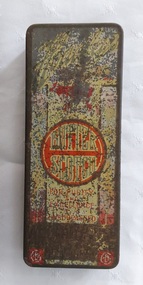 Mont De Lancey
Functional object - Lidded Tin, Early 1900's
... ...Food tins...Containers Confectionary containers Food tins Tins Illegible brand printed at the top. ...The name itself tells a story. “Butter” obviously refers to the rich dairy fat that gives the candy its distinctive flavor, while “scotch” likely derives from the verb meaning “to cut” or “to score,” referring to how the candy was traditionally marked into squares while cooling.Butter Scotch sweets were enjoyed by many as they are today. A rusty empty vintage small rectangular metal red and gold tin with faded branding on the lid. It contained Butter Scotch sweets. The brand printed at the top of the lid is illegible. Butter Scotch is written inside a red circle in the middle of the lid in grey lettering. There is a quality statement printed in red below. The base of the tin is gold coloured. Inside is a white piece of paper folded in half vertically printed in black lettering with a Christmas and New Year greeting and a small star at the bottom.Illegible brand printed at the top. 'Butter Scotch' is printed inside a red circle. 'For Quality and Excellence it is Unurpassed' is printed in red lettering at the front of the bottom of the lid. The white vertically folded piece of paper inside the tin has: 'Sincere Good Wishes for Christmas and New Year' and a star printed in black lettering. containers, confectionary containers, food tins, tins -
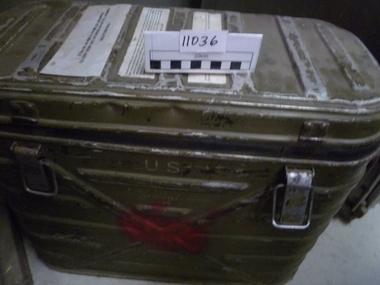 National Vietnam Veterans Museum (NVVM)
Equipment - Equipment, Army, 1968
... Insulated steel box containing two lidded food tins and five hexamine stoves...US Knapp Monarch Co Insulated steel box containing two lidded food tins and five hexamine stoves Equipment Equipment, Army Knapp Monarch Co ...Insulated steel box containing two lidded food tins and five hexamine stovesFood Container Insulated With Inserts. US Knapp Monarch Cohot box, hexamine stove -
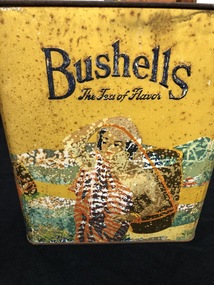 Mont De Lancey
Functional object - Tea Tin, Bushells Tea, Unknown
... Food storage cans...Tins...Food storage cans Tins Food containers 'Bushells The Tea of Flavour". ...Bushells tea tin with lid, yellow painted scenery and people carrying tea in India.'Bushells The Tea of Flavour". 'Young, tender leaves, picked fresh and cured slowly, give Bushells Tea that enticing flavour' 'Slow, careful curing imprisons the fragrant sap-juice within the young tender leaves of Bushells Tea'food storage cans, tins, food containers -
 Kiewa Valley Historical Society
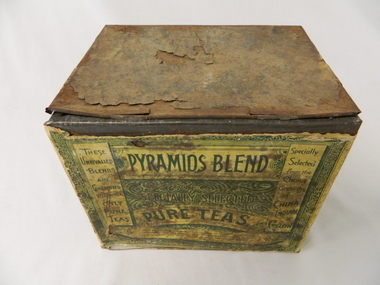
Tin Tea Pyramids Blend, early 1900's
... ...food storage tins...Bulk storage tins such as this item were not only a requirement but also offered storage for other household items. This usefulness was not overlooked by the "canny" rural family. loose leaf tea containers food storage tins kitchen tidies On the front side and in the background, there are three sketches of Egyptian pyramids(increasing in size from left to right). ...This early 1900's tin which contained loose leaf blended tea was imported into Australia by those tea merchants who wanted to provide the Australian tea drinkers with quality tea. It could well be early Lipton distributors to both city and rural clients and consumers. This was in a period when most rural families were heavy tea drinkers. It was well before the introduction of coffee as a drink (especially instant) for the early morning, after meals and general "drink any time" pick me up beverage.This relatively large tea tin marks a period in time when loose leaf tea was in great demand and large quantities were not only used by families but also restaurants, workers mess halls and remote large rural families. The ability to obtain a quick tea supply in semi remote rural areas such as the Kiewa Valley was not possible due to the factors of all weather road access and the economics of traders going out of their way. Stocking up with important beverages, such as tea, was a "one of those things" that early rural communities had to endure with. Bulk storage tins such as this item were not only a requirement but also offered storage for other household items. This usefulness was not overlooked by the "canny" rural family.This large metal tin container was specifically manufactured for the kitchens requiring a bulk storage "bin" type of loose leaf tea content. When emptied, it could also be used as a general kitchen storage container for other bulk consumables.On the front side and in the background, there are three sketches of Egyptian pyramids(increasing in size from left to right). At the forefront there is a camel "train" loaded with supplies and handlers, making their way over the sandy desert going towards a large sign(in a freehand script) "PYRAMIDS BLEND". The left side "Specially Selected" and underneath "PURE TEAS" below this and within a circle is the figure of a Geisha clad of Asian appearance (with a fan in a raised hand with boxes(of varying sizes) around her. All these are in (off white design and wording on a green background. On the back in green print on off white background "PYRAMIDS BLEND" and underneath "OF SPECIALLY SELECTED PURE TEAS". On either side are columns of similar print. To the left "THESE UNRIVALLED BLENDS ARE GUARANTEED TO CONTAIN ONLY PURE TEAS".To the right "SPECIALLY SELECTED FROM THE CHOICE GROWTHS OF CHINA INDIAN & CEYLON". Below both columns is "for delicacy & fragrance of flavor, combined with great strength, and are confidently recommended to the public as the best values in teas obtainable" On the last side is a sketch of an " Indian encircled, holding a staph with palm trees in the background and four tea containers on his left, with "PYRAMID BLEND" as a subject heading. There are two Oxen pulling a two wheeled cart with a load of six large boxes. On lid and barely readable "FIVE POUNDS NET"loose leaf tea containers, food storage tins, kitchen tidies -
 Mont De Lancey
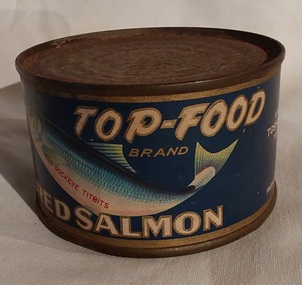
Domestic object, Top-Food, Tin of Red Salmon, Unknown
... ...Food containers...Tins...An old unopened tin of Top-Food brand red salmon. It has a blue paper label around it with an illustration of a red salmon. ...Containers Food containers Tins Foodstuffs Canned food 'Red Sockeye Tidbits' is in red small print on the body of the salmon on the label. ...Sockeye salmon is a rich, flavorful choice known for its deep red color, and can be eaten as is or used in various recipes. The success in North America led to the establishment of salmon canning in other parts of the world, including Japan (northern Japan, 1890) and Siberia (around 1906). The global production of canned salmon reached its peak in 1936. This brand was manufactured in Japan.An old unopened tin of Top-Food brand red salmon. It has a blue paper label around it with an illustration of a red salmon. Net weight 220GMS (7 3/4 oz. Avoir)'Red Sockeye Tidbits' is in red small print on the body of the salmon on the label.containers, food containers, tins, foodstuffs, canned food -
 Mont De Lancey
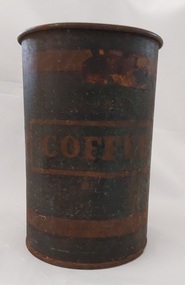
Domestic object - Coffee Tin, Unknown
... Tins...Food...Tins like this were used for storage in the 1900's Tins Food containers Food storage cans Coffee containers Coffee tins 'COFFEE' is printed on the front of the can inside a rectangular border. ...Tins like this were used for storage in the 1900'sA medium sized green coffee tin with no lid It has tan 'COFFEE' printed inside a rectangular tan border and two bands around the top and bottom of the tin. Due to its age and use it is rusted and faded.'COFFEE' is printed on the front of the can inside a rectangular border.tins, food containers, food storage cans, coffee containers, coffee tins -
 Mont De Lancey
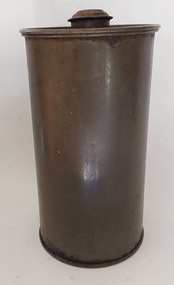
Container - Food Canister, 1900's - 1970's
... ...Food storage containers...Tins...Vintage unbranded lidded round tin canisters are enduring pieces of kitchen storage history, with many common examples dating from the 1930s through the 1970s. These items, ranging from plain steel to colorful lithographed patterns, were once ubiquitous in households for storing bulk foods, biscuits, or sewing supplies. ...Containers Food storage containers Tins A tall vintage brown metal canister with a well-fitted lift off lid. ...Vintage unbranded lidded round tin canisters are enduring pieces of kitchen storage history, with many common examples dating from the 1930s through the 1970s. These items, ranging from plain steel to colorful lithographed patterns, were once ubiquitous in households for storing bulk foods, biscuits, or sewing supplies. A tall vintage brown metal canister with a well-fitted lift off lid. The lid has a round knob attached with a rivet. The tin has a small rim at the top and bottom and is clamp sealed at one side. containers, food storage containers, tins -
 National Vietnam Veterans Museum (NVVM)
Functional Object, Ration pack (x2) gold plated tin
... 1) metal tin with the following contents - curry powder pouch, matches, instant coffee, several unidentified pouches. 2) closed tin 2x food ration tins...Ration pack 1) metal tin with the following contents - curry powder pouch, matches, instant coffee, several unidentified pouches. 2) closed tin 2x food ration tins Ration pack (x2) gold plated tin Functional Object Functional Object ...1) metal tin with the following contents - curry powder pouch, matches, instant coffee, several unidentified pouches. 2) closed tin 2x food ration tinsration pack -
 Mont De Lancey
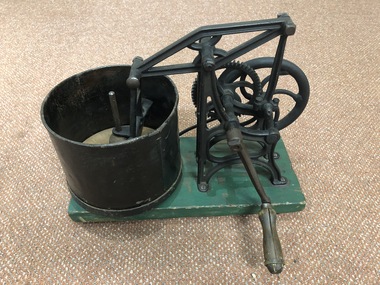
Food chopper, c1886
... Starrett cast iron mechanical food chopper with tin barrel, on green wooden base. ...Mechanical food choppers or hashers (commonly called in the U.S.A.) were used around the 1880's to chop up food. kitchenware slicers kitchen equipment Starrett cast iron mechanical food chopper with tin barrel, on green wooden base. ...Mechanical food choppers or hashers (commonly called in the U.S.A.) were used around the 1880's to chop up food.Starrett cast iron mechanical food chopper with tin barrel, on green wooden base. With booklet. kitchenware, slicers, kitchen equipment -
 National Wool Museum
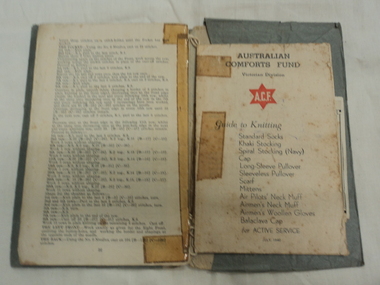
WWI and WWII Knitting books, Australian red Cross, Australian Red Cross Society Knitting Book and Australian Comforts Fund Guide to Knitting, Early 20th Century
... Second booklet also contains a list of donations accepted such as tinned food....Second booklet also contains a list of donations accepted such as tinned food. wwi wwii australian red cross red cross society australian comforts fund knitting knitting patterns victoria On outside green folder " L.A Anderson, Sutherland's Creek." ...Knitting Books provided by The Red Cross for women to contribute to the war effort by knitting garments for soldiers to stay warm. Second booklet also contains a list of donations accepted such as tinned food.Green Folder containing three knitting books. Knitting pattern for wounded soldiers or soldiers currently serving eg air pilots neck muff, airmens wollen gloves and bed socks. Newspaper clipping about knitting.On outside green folder " L.A Anderson, Sutherland's Creek." First Booklet. " Australian Red Cross Society Knitting Book" Second Booklet. " Australian Comforts Fund Victorian Division Guide to Knitting" Index of knitting patterns. Third Booklet. "Red Cross Society Australian Branch"wwi, wwii, australian red cross, red cross society, australian comforts fund, knitting, knitting patterns, victoria -
 Orbost & District Historical Society
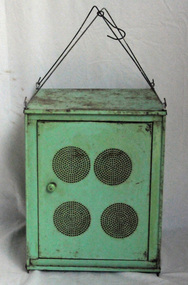
food safe, from the 1890s until the mid 20th century
... A rectangular tin food safe. It is painted green and has thin wire bent into a triangular shape for hanging.Inside is a cream coloured painted shelf. ...A food safe was a common domestic item widely used in rural Victoria before cheap refrigeration was available. domestic food-preservation food-safe A rectangular tin food safe. It is painted green and has thin wire bent into a triangular shape for hanging.Inside is a cream coloured painted shelf. ...A food safe was a piece of domestic equipment widely used in Australia before refrigeration to preserve perishable food in summer. A food safe was a common domestic item widely used in rural Victoria before cheap refrigeration was available.A rectangular tin food safe. It is painted green and has thin wire bent into a triangular shape for hanging.Inside is a cream coloured painted shelf. It has six circular air vents on three sides and four on the door.domestic food-preservation food-safe -
Mission to Seafarers Victoria
Letter - Correspondence, 14/06/1951
... Alette is writing to thank Mrs Hayes for a parcel of tinned foods and dried fruit that Allan asked his mother to send. ...Alette is writing to thank Mrs Hayes for a parcel of tinned foods and dried fruit that Allan asked his mother to send. ...Alette is writing to thank Mrs Hayes for a parcel of tinned foods and dried fruit that Allan asked his mother to send. She writes "... we have not not very much fruit in Norway at this time of the year."Quinn CollectionA self-folding letter written in green ink (0874.a) headed Oslo and dated 14/06/51. It is from Alette Andersen to Mrs K Hayes, 14 Fitzroy Street, St Kilda, Victoria, Australia. The return address is C/- Fru Strom, Neuberg gt. GB.,Oslo, Norway. letters-from-abroad, allan quinn, norway, oslo, alette andersen -
 City of Moorabbin Historical Society (Operating the Box Cottage Museum)
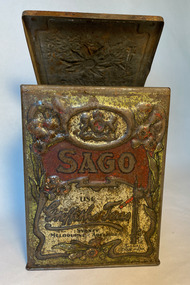
Container - Griffiths Tea Canister, 1900-1940
... Food storage rectangular tin, with a hinged lid. The outside is printed in cream and red with the name 'Griffith's Teas' and the word 'SAGO'. ...tins, when emptied, became useful kitchen canisters and helped promote the brand. Example of the names include Flour, Rice, Sugar, Sago, Candied Peel, Tapioca, Spices, Starch, Biscuits, Currants, Barley, String and of course Tea . tea James Griffiths canisters city of moorabbin cheltenham melbourne moorabbin grocery stores kitchen equipment Printed on the front 'SAGO', also printed on the front and repeated on the top 'USE / GRIFFITHS' Teas / SYDNEY / MELBOURNE. ADELAIDE. BRISBANE'. On the front is the image of a train signal with the words 'SIGNAL / TRADE MARK' Food ...In 1873 James Griffiths migrated to Melbourne in order to start a tea Business. James lived in the Dandenongs at The Basin where he experimented with growing tea. Griffiths made tin canisters in the 2lbs size for their tea with common kitchen consumables listed on the front . The tins, when emptied, became useful kitchen canisters and helped promote the brand. Example of the names include Flour, Rice, Sugar, Sago, Candied Peel, Tapioca, Spices, Starch, Biscuits, Currants, Barley, String and of course Tea .Food storage rectangular tin, with a hinged lid. The outside is printed in cream and red with the name 'Griffith's Teas' and the word 'SAGO'. The text is set against a cream panel which is bordered with a decorative border of Australian native flora. The whole is set against a dark green background.On each other side of the tin is a different native Australian flower. The lid is impressed with a flannel flower.Printed on the front 'SAGO', also printed on the front and repeated on the top 'USE / GRIFFITHS' Teas / SYDNEY / MELBOURNE. ADELAIDE. BRISBANE'. On the front is the image of a train signal with the words 'SIGNAL / TRADE MARK'tea, james griffiths, canisters, city of moorabbin, cheltenham, melbourne, moorabbin, grocery stores, kitchen equipment -
 The Beechworth Burke Museum
Geological specimen - Cassiterite
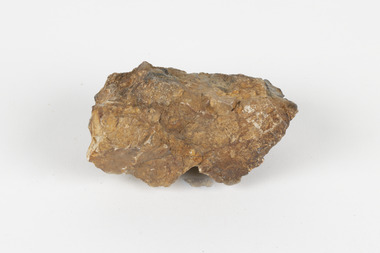
... Tinned food first reached Australia in 1815 with early settlers, and it began to be manufactured here in the 1840s. ...Tinned food first reached Australia in 1815 with early settlers, and it began to be manufactured here in the 1840s. ...This specimen is Cassiterite in Quartz. Cassiterite is a tin oxide metal that forms in thin crystals which can have a beautiful lustre. Quartz is made of silicon dioxide, also known as silica, and is one of the most common minerals on earth. Cassiterite has been a fundamental source of tin ore for humans throughout history, including today. Tin is an important metal that has a wide variety of human uses in different areas, from dying fabric, to making mirrors, and their most well-known use ‘tin’ cans. Tin cans are primarily made of steel and are coated with tin in order to take advantage of tin’s property of being non-corroding. This is a massive step in the history of food preservation. Tinned food first reached Australia in 1815 with early settlers, and it began to be manufactured here in the 1840s. It was incredibly popular, and was a highly exported product, which would be a contributing factor to the ‘tin mining boom’ of the early 1880s. This specimen was collected at Jingellic, New South Wales, in about 1852. Although the Goldfields of the 1800s are much more well-known, tin mines existed alongside the gold mines which began in the mid 19th century and extended almost one hundred years, to the mid 20th century. Specimens like this would have been used as evidence to justify tin mining operations in the region as an investment. This specimen is part of a larger collection of geological and mineral specimens collected from around Australia (and some parts of the world) and donated to the Burke Museum between 1868-1880. A large percentage of these specimens were collected in Victoria as part of the Geological Survey of Victoria that begun in 1852 (in response to the Gold Rush) to study and map the geology of Victoria. Collecting geological specimens was an important part of mapping and understanding the scientific makeup of the earth. Many of these specimens were sent to research and collecting organisations across Australia, including the Burke Museum, to educate and encourage further study. The Geological Survey of Victoria was headed by British geologist, Alfred Richard Cecil Selwyn (1824-1902), who was responsible for issuing over 60 geological maps during his 17 years as director. These maps were all hand-drawn and coloured and became the benchmark for accuracy for geological mapping. Collecting geological specimens was an important part of mapping and understanding the scientific makeup of the earth. Many of these specimens were sent to research and collecting organisations across Australia, including the Burke Museum, to educate and encourage further study. A fist-sized solid geological specimen made on one half of tin oxide, which is dark grey, and on the other side of silica, which is brown and cream.burke museum, beechworth, geological, geological specimen -
![Photograph - Photo, [Dick Richards with Antarctic Memorabilia], 1982 (exact)](/media/collectors/4f729f6797f83e0308601707/items/4f72a5c497f83e03086027e0/item-media/589d0be9d0cdf4227c92feee/item-fit-380x285.jpg?cb=6) Federation University Historical Collection
Federation University Historical CollectionPhotograph - Photo, [Dick Richards with Antarctic Memorabilia], 1982 (exact)
... The image includes Dick Richards holding a pipe, the book 'The Ross Sea Shore Party', an opened tin of food, globe of the world, a fur lines coat, and papers on a desk. ...The image includes Dick Richards holding a pipe, the book 'The Ross Sea Shore Party', an opened tin of food, globe of the world, a fur lines coat, and papers on a desk. ...Dick Richards was a member of the Shackleton Antartic Expedition and was marooned on the Ross Sea shelf. He was also a former principal of the Ballarat School of Mines.Framed colour photographic portrait of Richard W. Richards, in a gold aluminium frame with cream mount. The image includes Dick Richards holding a pipe, the book 'The Ross Sea Shore Party', an opened tin of food, globe of the world, a fur lines coat, and papers on a desk. dick richards, r w richards, antarctic exploration, ross sea shore party, richard w richards, ballarat school, mines, antarctica, available -
 Bendigo Military Museum
Photograph - MILITARY PHOTOGRAPHS, 1959 - 1961
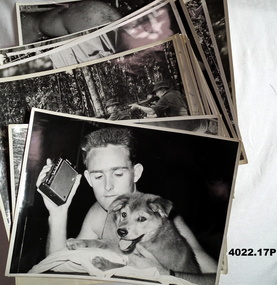
... (.13) Soldier kneeling with a small black dog. (.14) Soldier holding an SLR rifle. (.15) Two soldiers leaning out of an aircraft. (.16) Soldier playing a guitar. (.17) Two soldiers kneeling holding a tin of food. ... (.13) Soldier kneeling with a small black dog. (.14) Soldier holding an SLR rifle. (.15) Two soldiers leaning out of an aircraft. (.16) Soldier playing a guitar. (.17) Two soldiers kneeling holding a tin of food. Photograph MILITARY PHOTOGRAPHS ...(.1) The men are from C Coy 1 RAR firing SLR rifles at the Battalions jungle training area KOTA TINGI in south Malaya. (.2) Pte John GILES at LASAH north Malaya, operational camp for A Coy 1 RAR. (.3) Pte Victor ALLEN A Coy 1 RAR in north Malaya base camp with “FEARLESS” a 3 month old mascot who wandered into the camp and stayed. While ever music was on FEARLESS would listen. (.4) The soldier in forefront is Max (Dad) KELLY. Served 2nd AIF, BCOF, Korea, Malaya and Vietnam. The photos relate to the collection of William Francis (Dinky DEAN BEM, VX93960 2nd AIF, 3742 1 RAR 1943 - 1975. Refer Cat No 124.2 for his service details. All photos are B & W. (.1) Five men on a range shot, four men shooting, a typed sheet attached with details. (2) A soldier kneeling aiming an SLR, a typed sheet attached with details. (.3) Soldier and small dog listening to a radio, atypical sheet attached with details. (.4) Two soldiers patrolling with rifles. (.5) Soldier splashing water over himself. (.6) Soldiers on parade right dressing. (.7) Two soldiers patrolling walking on a log. (.8) Two soldiers reading a book on Malaya. (.9) Two soldiers adjusting slings on their SLR’s. (.10) Two Officers seated having a cup of tea. (.11) Soldier kneeling aiming a shotgun. (.12) Soldier drinking from a water bottle. (.13) Soldier kneeling with a small black dog. (.14) Soldier holding an SLR rifle. (.15) Two soldiers leaning out of an aircraft. (.16) Soldier playing a guitar. (.17) Two soldiers kneeling holding a tin of food. All photos are stamped on the rear in purple. “Public Relations Australian Army Force, GHQ FARELF” (then either) “ELL & a number” or GUN & a Number MC”photography, military, malaya -
 Flagstaff Hill Maritime Museum and Village
Domestic object - Saucepan
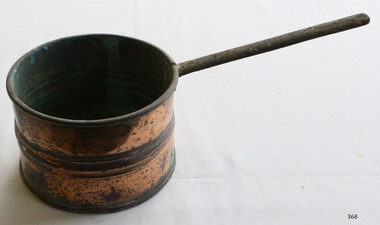
... It was this knowledge that gave rise to lining cookware with tin, a technique used for hundreds of years to prevent copper leaching in to food. ...It was this knowledge that gave rise to lining cookware with tin, a technique used for hundreds of years to prevent copper leaching in to food. ...It is no secret that copper is currently experiencing a huge upsurge in popularity. This is mainly thanks to its beautiful colour featuring heavily in the ranges of countless homeware retailers. There is, however, far more to this lustrous metal than just its appearance. For example, it has a greater level of thermal conductivity than any other metal (except silver); roughly 60% higher than aluminium and 3000% higher than stainless steel. This means copper is capable of heating up very quickly when compared to other metals. Perhaps a less commonly known property of copper is it being inherently antimicrobial. A wide range of harmful microbes are unable to survive for more than a couple of hours when in contact with a surface made of copper or one of its alloys (brass and bronze). This has led to it often being used for frequently touched surfaces such as door knobs, push plates and taps. A seemingly perfect material for cooking, it is therefore no surprise that it has been used in kitchens for millennia. But exactly when did we learn to utilise copper and its valuable assets? Origins It is hard to pin down an exact date when copper cookware was first introduced. Pieces discovered in regions of the middle east were dated as far back as 9000BC, suggesting cooking with copper began during the Neolithic period (≈10000-2000BC). As civilisations became increasingly capable in metallurgical techniques, metals such as copper became more widely used. It would have been around this time that copper replaced stone as the material used for making tools and cooking vessels. The use of copper is also well documented in Ancient Egypt. Not only was it used to produce water and oil containers, but it was also used to in medical practices. The antimicrobial nature of copper was exploited long before the concept of microorganisms was fully understood. The Smith Papyrus, a medical text written between 2600 and 2200BC records the use of copper in sterilising wounds and drinking water. Tin Lining Although copper is essential to many processes within the human body, it can become toxic if consumed in excess. It was this knowledge that gave rise to lining cookware with tin, a technique used for hundreds of years to prevent copper leaching in to food. These tin linings would eventually wear out and during the 18th and 19th century, it was common for people to send pans away to be re-tinned. This practice is becoming increasingly rare, as are the craftsmen who perform it. Despite this, there are still manufactures producing tin-lined copper cookware who also offer a re-lining service. Perhaps the best known of these is Mauviel, a French manufacturer who have been making this type of cookware since 1830. Tin has now largely been replaced by stainless steel as an interior cooking surface. Not only is it more cost effective, but the high grade of stainless steel used in premium cookware (typically 18/10) is highly resistant to corrosion and more durable than tin.Copper saucepans are still used in many kitchens.Small copper saucepan with long handle and three ridges around the circumference. Extensive corrosion.None.flagstaff hill, warrnambool, shipwrecked-coast, flagstaff-hill, flagstaff-hill-maritime-museum, maritime-museum, shipwreck-coast, flagstaff-hill-maritime-village, copper, saucepans, kitchen equipment -
 Bendigo Historical Society Inc.
Newspaper - Newspaper articles by Leighton Rawlings, Collectors' Corner, 2000 - 2003
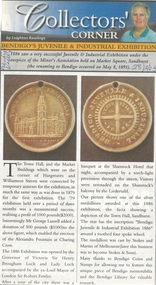
... Collectors” Corner Number Article Name Date 1. Miner’s Food Tins 21/2/2003 2. Bendigo Girls High School Jubilee Magazine 28/03/2003 3. ...Collectors” Corner Number Article Name Date 1. Miner’s Food Tins 21/2/2003 2. Bendigo Girls High School Jubilee Magazine 28/03/2003 3. ...A series of sixty one articles written by Leighton Rawlings and published in the Bendigo Weekly between 2000 and 2003. Each article details a collectable item and its history. Each article includes a photograph. The articles are stored in a white vinyl covered two ring A5 folder. Index below. Collectors” Corner Number Article Name Date 1. Miner’s Food Tins 21/2/2003 2. Bendigo Girls High School Jubilee Magazine 28/03/2003 3. Bendigo’s Juvenile & Industrial Exhibition 28/02/2003 4. Bendigo’s 59TH Grand Spring Show Program 7/03/2003 5. Bendigo’s Mayfair Distributors 9/08/2002 6. Celebration of Bendigo’s 1951 Gold Centenary 31/01/2003 7. Souvenir of American Naval Visit to Bendigo 6/09/2002 8. Back Seat Driver’s Licence 4/04/2003 9. Antique Shearing Documents 19/07/2002 10. Angus Mackay’s Top Hat and Exquisite Hat Case 2/08/2002 11. Early Morse Code Key Set 9/02/2001 12. Antique Produce Weighing Scales 16/02/2001 13. Bendigo Aerated Water Containers 14. Bendigo’s “Poppet Head” Bottle 14/12/2001 15. 1901 Federal Parliament Medallion 18/05/2001 16. Queen Victoria Diamond Jubilee Medallion 1/06/2001 17. Prince of Wales Visit to Eaglehawk 8/06/2001 18. The Beehive Store Sales Docket 15/06/2001 19. Australia’s First Newspaper 22/06/2001 20. Australia’s First Newspaper 29/06/2001 21. Bendigo City Jubilee Ball 6/07/2001 22. Bendigo’s Busy Red Emporium 1 3/07/2001 23. “Saintly” Memorabillia (sic) of a Bygone Era 20/07/2002 24. Historical Bendigo Lodge Certificate 28/09/2001 25. Bendigo Agricultural Show 19/10/2001 26. Victorian Railway’s Smoke Social Invitation 5/10/2001 27. Early Award Medallions 6/03/1998 28. Home Delivery Grocer 26/10/2001 29. Swimming Proficiency Medallion 9/11/2001 30. 1950’s Road Travel Ticket Collection 27/07/2001 31. Glover’s Soft Drink Bottle 3/08/2001 32. Antique Leggo’s Bottles 10/08/2001 33. Collectable Documents 17/08/2001 34. Broadcast Listener’s Licence 31/08/2001 35. Antique Board Game 7/09/2001 36. Century Old Memorabilia Returns to Sacred Heart Cathedral 30/11/2001 37. California Hill Methodist Church Memorabilia 21/12/2001 38. Goldfield Wax Matched Tin Box 4/01/2002 39. Memorabilia of a Bendigo Lodge Member Nov 2001 40. Eaglehawk General Store Memorabilia Nov 2001 41. Bendigo’s Rescue Home Memorabilia 18/01/2002 42. Automobile Parts House Memorabilia 11/01/2002 43. Antique Insurance Certificates 1/02/2002 44. The Universal Self Instructor 8/02/2002 45. Automobile Parts House Memorabilia – Part 2 15/02/2002 46. Miner’s Hard Hat 1/03/2002 47. Antique Bendigo Medicine Bottle 8/03/2002 48. British Prime Ministers Visit Memorabilia 22/03/02 49. Bendigo’s Sun Newspaper 28/3/2002 50. Bendigo Grocer’s Memorabilia 5/04/2002 51. The Universal Self Instructor 52. Gold Mining Company Documents 31/05/2002 53. Bendigo Motoring Memorabilia 17/05/2002 54. Bendigo Carriage to Motoring Memorabilia 24/05/2002 55. Bendigo Easter Fair and Grand National Show Medals 13/09/2002 56. Official Trades Union Directory 1949 27/09/2002 57. The 1889 Pickles & Sons Challenge Cup 4/10/2002 58. Chico Roll goes “Gold” 21/12/2001 59. What’s It Worth by Ken Arnold. Money Box 28/09/2001 60. What’s It Worth by Ken Arnold. Bottle 5/10/2001 61. What’s It Worth by Ken Arnold. Jar 10/01/2003collectables, leighton rawlings -
 Flagstaff Hill Maritime Museum and Village
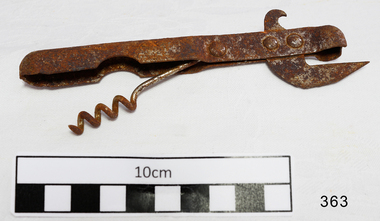
Domestic object - Can Opener, Bottle Opener & Corkscrew
... Cans of milk, which didn't need to be completely opened, came with puncture devices. As tinned food became more common, its containers became more regular. ...Cans of milk, which didn't need to be completely opened, came with puncture devices. As tinned food became more common, its containers became more regular. ...It took 15 years to invent the can. It took 100 more to invent a standard way to open it. In the 19th century, decades after the invention of canning, there were virtually no can openers. Canned food, such as sardines, came with its own "key" to peel back the tin lid. Birth of the can One of the oddest things about the can opener is that the can predates it by almost 150 years. Though common today, cans were once military-grade technology. In 1795, Napoleon, to whom the phrase "an army marches on its stomach" is attributed, offered 12,000 francs to anyone who could find a way to preserve food. Without any knowledge of bacteria or their role in food spoilage, scientists didn't even know where to begin. It took 15 years before a chef named Nicholas Appert claimed the prize after successfully jarring food. Soon after that, his countryman Philippe de Girard came up with a variant on Appert's method—metal tins—and sold the idea to the British. Spoiled food, and the sickness it caused, was a widespread problem. The public would have benefited from canned food, but for decades cans were almost exclusively for the army and the navy. The canning process, with its hours of boiling and steaming, its scrupulous cleanliness, its heated metal, and its need for a great deal of disposable material, made canned food far too expensive for anyone but the military. No can openers were needed or even possible. The metal of early cans was too thick to make openers practical. Soldiers and sailors had plenty of sharp objects on hand and made ample use of them when they wanted to eat. During the 19th century, the process of canning was refined and mechanised, and the metal wall of the average can slimmed down enough that a civilian could get it open—if that civilian had the right tool. No one had that tool yet, so early cans had to open themselves. In other words, they came with built-in openers. The result was a confusing but pleasing free-for-all, in terms of product engineering. Each type of food came with its own kind of can, and each kind of can came with its own kind of opener. Tinned fish and meat were often sold in rectangular cans. These cans were fitted with a "key" that would roll down the top of the can. Coffee, beans, and other types of meat were packaged in cylinders with metal strips that could be peeled back with their own kinds of built-in keys. Cans of milk, which didn't need to be completely opened, came with puncture devices. As tinned food became more common, its containers became more regular. A nice cylindrical can became the norm, and, as these cans filled kitchens, more engineers put their minds to finding a convenient way to open all of them. The first standalone can opener worked on a simple principle: point, stab, and pull. From the mid-19th century to the end of World War I, the typical can opener looked roughly like a wrench, if the lower 'jaw' of the wrench were replaced with a blade. People used the blade to puncture the top of the can near its edge, push the upper jaw against the side of the can, and drag the blade through the metal along the rim. Because meat was the first and most popular canned substance, these can openers were often shaped to look like cows and given the nickname 'bully beef can openers'. The bully beef can opener, popular in the mid-19th century, resulted in many lost fingers. Later, a corkscrew was added that was seated in the handle, and could be pulled out for use. Bully beef can openers were so common, effective, and sturdy that they are still frequently available on collectors' sites. Some are advertised as “still working,” and every last one of them is, without a doubt, soaked in the blood of our ancestors. Dragging a sharp blade along the edge of a can is certain to cause injury sooner or later. So once people got a reliable can shape and a reliable way to get the can open, the search was on for a reliable way to get a can open without the possibility of losing a finger. The answer came in 1925, from the Star Can Opener Company of San Francisco. This is probably the first can opener that resembles the one people have in their kitchens today. Instead of using a blade to pry open a metal can, buyers could clamp the edge of the can between two wheels and twist the handle of one of the wheels to move the blade around the lip. The Star can openers weren't perfect. Compared to the bully beef model, they were flimsy and breakable, but they probably prevented a few injuries. Six short years after the Star model came to market, the first electric can opener was invented. It was patented in 1931 by the Bunker Clancey Company of Kansas City, who had already been sued by the Star Can Opener Company for trying sell a double-wheeled can opener like the Star model (the case was dismissed). The electric can opener must have seemed like the wave of the future and a sure-fire seller, but it proved to be too far ahead of its time. In 1931 not that many households had electricity, and those that did weren't interested in buying can openers. The Bunker Clancey Company was subsequently bought by the Rival Company, which still makes small appliances like can openers today. It took another 25 years for electrically powered can openers to become practical. In the 1950s, Walter Hess Bodle and his daughter, Elizabeth Bodle, developed an electric can opener in the family garage. Walter came up with the opener's blades and motor, and Elizabeth sculpted the outside. Their can opener was a free-standing unit that could sit on the kitchen counter. The Udico brand of the Union Die Casting Company put it on the market in time for Christmas in 1956 and had great success with it. Over the next few years it came out in different styles and colours, and, like the bully beef can opener, has become a collector's item. Also like the bully beef model, Udico can openers often still work. They don't make 'em like they used to. Although there have been some design changes and refinements over the last sixty years, there have yet to be any more leaps forward in can opener technology. If you're resentfully opening a can, you are almost certainly doing it using the Star design, manually forcing the can between two wheels, or the Bodle design, clamping the can into a free-standing electrical opener. Whether or not you enjoy your holiday meals, at least you can be happy that you are not getting poisoned by your own food or cutting open your hand with the blade you use to get at it. That's something, right?The can opener, Bottle opener and the corkscrew are still very important and essential items in most kitchens.Metal can opener, chromed, with bottle opener, and a corkscrew seated in the handle.None.flagstaff hill, warrnambool, shipwrecked-coast, flagstaff-hill, flagstaff-hill-maritime-museum, maritime-museum, shipwreck-coast, flagstaff-hill-maritime-village, canning, can opener, corkscrew, bottle opener, kitchen equipment -
 Flagstaff Hill Maritime Museum and Village
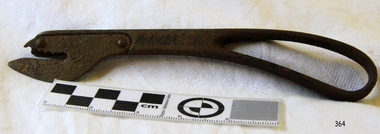
Domestic object - Can Opener
... Cans of milk, which didn't need to be completely opened, came with puncture devices. As tinned food became more common, its containers became more regular. ...Cans of milk, which didn't need to be completely opened, came with puncture devices. As tinned food became more common, its containers became more regular. ...It took 15 years to invent the can. It took 100 more to invent a standard way to open it. In the 19th century, decades after the invention of canning, there were virtually no can openers. Canned food, such as sardines, came with its own "key" to peel back the tin lid. Birth of the can One of the oddest things about the can opener is that the can predates it by almost 150 years. Though common today, cans were once military-grade technology. In 1795, Napoleon, to whom the phrase "an army marches on its stomach" is attributed, offered 12,000 francs to anyone who could find a way to preserve food. Without any knowledge of bacteria or their role in food spoilage, scientists didn't even know where to begin. It took 15 years before a chef named Nicholas Appert claimed the prize after successfully jarring food. Soon after that, his countryman Philippe de Girard came up with a variant on Appert's method—metal tins—and sold the idea to the British. Spoiled food, and the sickness it caused, was a widespread problem. The public would have benefited from canned food, but for decades cans were almost exclusively for the army and the navy. The canning process, with its hours of boiling and steaming, its scrupulous cleanliness, its heated metal, and its need for a great deal of disposable material, made canned food far too expensive for anyone but the military. No can openers were needed or even possible. The metal of early cans was too thick to make openers practical. Soldiers and sailors had plenty of sharp objects on hand and made ample use of them when they wanted to eat. During the 19th century, the process of canning was refined and mechanised, and the metal wall of the average can slimmed down enough that a civilian could get it open—if that civilian had the right tool. No one had that tool yet, so early cans had to open themselves. In other words, they came with built-in openers. The result was a confusing but pleasing free-for-all, in terms of product engineering. Each type of food came with its own kind of can, and each kind of can came with its own kind of opener. Tinned fish and meat were often sold in rectangular cans. These cans were fitted with a "key" that would roll down the top of the can. Coffee, beans, and other types of meat were packaged in cylinders with metal strips that could be peeled back with their own kinds of built-in keys. Cans of milk, which didn't need to be completely opened, came with puncture devices. As tinned food became more common, its containers became more regular. A nice cylindrical can became the norm, and, as these cans filled kitchens, more engineers put their minds to finding a convenient way to open all of them. The first standalone can opener worked on a simple principle: point, stab, and pull. From the mid-19th century to the end of World War I, the typical can opener looked roughly like a wrench, if the lower 'jaw' of the wrench were replaced with a blade. People used the blade to puncture the top of the can near its edge, push the upper jaw against the side of the can, and drag the blade through the metal along the rim. Because meat was the first and most popular canned substance, these can openers were often shaped to look like cows and given the nickname 'bully beef can openers'. The bully beef can opener, popular in the mid-19th century, resulted in many lost fingers. Bully beef can openers were so common, effective, and sturdy that they are still frequently available on collectors' sites. Some are advertised as “still working,” and every last one of them is, without a doubt, soaked in the blood of our ancestors. Dragging a sharp blade along the edge of a can is certain to cause injury sooner or later. So once people got a reliable can shape and a reliable way to get the can open, the search was on for a reliable way to get a can open without the possibility of losing a finger. The answer came in 1925, from the Star Can Opener Company of San Francisco. This is probably the first can opener that resembles the one people have in their kitchens today. Instead of using a blade to pry open a metal can, buyers could clamp the edge of the can between two wheels and twist the handle of one of the wheels to move the blade around the lip. The Star can openers weren't perfect. Compared to the bully beef model, they were flimsy and breakable, but they probably prevented a few injuries. Six short years after the Star model came to market, the first electric can opener was invented. It was patented in 1931 by the Bunker Clancey Company of Kansas City, who had already been sued by the Star Can Opener Company for trying sell a double-wheeled can opener like the Star model (the case was dismissed). The electric can opener must have seemed like the wave of the future and a sure-fire seller, but it proved to be too far ahead of its time. In 1931 not that many households had electricity, and those that did weren't interested in buying can openers. The Bunker Clancey Company was subsequently bought by the Rival Company, which still makes small appliances like can openers today. It took another 25 years for electrically powered can openers to become practical. In the 1950s, Walter Hess Bodle and his daughter, Elizabeth Bodle, developed an electric can opener in the family garage. Walter came up with the opener's blades and motor, and Elizabeth sculpted the outside. Their can opener was a free-standing unit that could sit on the kitchen counter. The Udico brand of the Union Die Casting Company put it on the market in time for Christmas in 1956 and had great success with it. Over the next few years it came out in different styles and colours, and, like the bully beef can opener, has become a collector's item. Also like the bully beef model, Udico can openers often still work. They don't make 'em like they used to. Although there have been some design changes and refinements over the last sixty years, there have yet to be any more leaps forward in can opener technology. If you're resentfully opening a can, you are almost certainly doing it using the Star design, manually forcing the can between two wheels, or the Bodle design, clamping the can into a free-standing electrical opener. Whether or not you enjoy your holiday meals, at least you can be happy that you are not getting poisoned by your own food or cutting open your hand with the blade you use to get at it. That's something, right?The can opener is still a very important and essential item in most kitchens.Can opener, right handed, metal, upper blade section serrated, inscription 'Peerless Pat.Feb 11-90'.Peerless Pat.Feb 11-90flagstaff hill, warrnambool, shipwrecked-coast, flagstaff-hill, flagstaff-hill-maritime-museum, maritime-museum, shipwreck-coast, flagstaff-hill-maritime-village, cannning, can opener, kitchen equipment -
 Flagstaff Hill Maritime Museum and Village
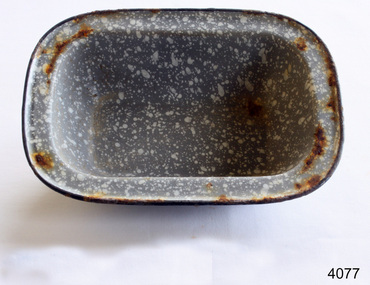
Domestic object - Dish
... Enamel cookware became very popular because people wanted a way of coating iron to stop metallic tastes or rust getting into food: something acid-resistant and easy to clean without laborious scouring, something more durable than the tin linings used inside copper. ...Enamel cookware became very popular because people wanted a way of coating iron to stop metallic tastes or rust getting into food: something acid-resistant and easy to clean without laborious scouring, something more durable than the tin linings used inside copper. ...Enamel cookware became very popular because people wanted a way of coating iron to stop metallic tastes or rust getting into food: something acid-resistant and easy to clean without laborious scouring, something more durable than the tin linings used inside copper. Enamelware dates back to 1760 in Germany.This object is significant as an example of an item in common use in the 19th and early 20th centuries.Oblong grey enamel dish. White speckles.None.flagstaff hill, warrnambool, shipwrecked-coast, flagstaff-hill, flagstaff-hill-maritime-museum, maritime-museum, shipwreck-coast, flagstaff-hill-maritime-village, enamel, kitchenware, baking -
 Flagstaff Hill Maritime Museum and Village
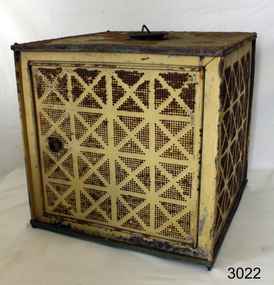
Domestic object - Food Safe, Willow Ware Pty Ltd, 1920-1950
... tin plating industry of more than 50 years. In 1965, the company name changed to Willow Ware Pty Ltd, to be more closely linked to its Willow brand. Willow Ware is still in business today. A food ...Willow started business in 1887 as a metal working company based in Melbourne Australia, making tinned biscuit and tea canisters. The outbreak of the First World War saw their manufacturing change to making armaments and essential packaging for the war effort. In the early 1920’s, the Willow brand was established. Making tin plated canisters and baking pans with the well-known Willow pattern, imprinted on them. Some other items in production at this time include billies, boilers, basins and Coolgardie safes. In the late 1950’s, the company ventured into plastics production. Stepping away from its very successful tin plating industry of more than 50 years. In 1965, the company name changed to Willow Ware Pty Ltd, to be more closely linked to its Willow brand. Willow Ware is still in business today. A food safe known as a “Coolgardie” meat storage made by an emerging Australian company no longer in bushiness. This item gives a snapshot into early Australian manufacturing specifically aimed at the Australian market. Safe metal kitchen safe with two shelves, a hinged door and latch and a small swivel wire handle at the top. cream colour . "Made in Australia" "Willow" warrnambool, shipwrecked-coast, flagstaff-hill, flagstaff-hill-maritime-museum, shipwreck-coast, flagstaff-hill-maritime-village, willow ware, domestic item, coolgardie meat safe, meat safe, food safe, food preservation -
 Flagstaff Hill Maritime Museum and Village
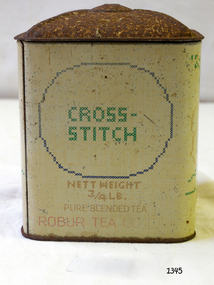
Container - Tea Tin, First half of 20th Century
... ...Tin plating...Food...https://www.shilohplastics.com.au/history-of-metal-packaging/ The use of tin to protect and store food and other items, revolutionised the world. flagstaff hill warrnambool shipwrecked-coast flagstaff-hill flagstaff-hill-maritime-museum maritime-museum shipwreck-coast flagstaff-hill-maritime-village Robur Tea Co Ltd tea tea caddy Tin Tin plating Food Containers ‘Cross – Stitch’ (printed green in small crosses and circles) followed by ‘Nett Weight ¾ lb. ...The history of metal packaging began in Bohemia in the 1200s. Metal has been produced for a very long time. But the first metal used for packaging was tin. In particular, it was the process of tin plating that was invented in Bohemia. Before this no other metal was economically able to be used for packaging. Later, in 1667 Andrew Yarranton, and English engineer, and Ambrose Crowley brought the method to England. Here it was improved by ironmasters including Philip Foley. Then by 1697, John Hanbury had a rolling mill at Pontypool in South Wales. The method they developed involved rolling iron plates using cylinders. This process enabled more uniform blank plates to be produced than was possible by just hammering the tin. https://www.shilohplastics.com.au/history-of-metal-packaging/The use of tin to protect and store food and other items, revolutionised the world.Tin container painted yellow with printed crosses and circles,. The lid is labelled "Robur Cross Stitch Company" and "R" imprinted in the centre although the lid is badly corroded. ‘Cross – Stitch’ (printed green in small crosses and circles) followed by ‘Nett Weight ¾ lb. (printed beige in crosses and circles). Pure Blended Tea. Robur Tea Co Ltd’ flagstaff hill, warrnambool, shipwrecked-coast, flagstaff-hill, flagstaff-hill-maritime-museum, maritime-museum, shipwreck-coast, flagstaff-hill-maritime-village, robur tea co ltd, tea, tea caddy, tin, tin plating, food containers -
 Flagstaff Hill Maritime Museum and Village
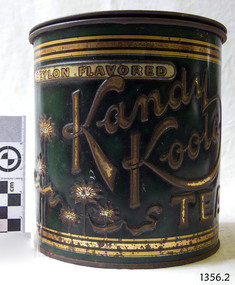
Container - Tin, C. 1910 - 1930
... tin...food and beverages...The tin and the tea that was in the container are significant for their association with the Australian and Victorian food industry, being blended and packed by John Connell and Co, Proprietary Limited Melbourne. flagstaff hill warrnambool shipwrecked-coast flagstaff-hill flagstaff-hill-maritime-museum maritime-museum shipwreck-coast flagstaff-hill-maritime-village giles family 19th century domestic items tea tea merchant tea tin food and beverages giles collection henry giles tower hill warrnambool breakwater mailor’s flat wangoom 19th century household goods metalcraft tinware kandy koola tea “Kandy Koola Tea” and “Ceylon Flavoured”and and “Blended and packed by John Connell & Co Pty Ltd Melbourne”. ...This Kandy Koola Tea tin dates to the early 20th century and was made and sold in Melbourne, Victoria. It once belonged to the Giles family. About Kandy Koola Kandy Koola ran an advertisement in the West Gippsland Gazette on 2 May 1911 promoting its tea as perfect for a picnic. The text reads “Picnicing. All as hungry as hunters – made a fire of small twigs – put on our billy of fresh spring water – and waited. Soon bubble, bubble, bubble and the billy boiled. In goes the pure Kandy-Koola Tea. Tea! Tea is not the word – it tasted like nectar! One cup, two cups, three cups – then had to make a fresh billy full. Lazed away the rest of the day sipping our Kandy Koola and chatting. How good indeed! “All grocers sell Kandy Koola Tea. It is pure leaf, selected and blended with the greatest care and skill. Ask your grocer for Kandy Koola. Sold in three grades, i.e. red, blue and green packets” About the Giles Family There are many 19th century items of furniture, linen and crockery donated to Flagstaff Hill Maritime Village by Vera and Aurelin Giles. The items are associated with the Giles Family and are known as the “Giles Collection”. These items mostly came from the simple home of Vera’s parents-in-law, Henry Giles and his wife Mary Jane (nee Freckleton), whose photos are in the parlour. They married in 1880. Henry Giles was born at Tower Hill in 1858. He was a labourer on the construction of the Breakwater before leaving in 1895 to build bridges in N.S.W. for about seven years. Mary Jane was born in 1860 at Cooramook. She attended Mailor’s Flat State School where she was also a student teacher before, as family legend has it, she became a governess at “Injemiara” where her grandfather, Francis Freckleton, once owned land. Henry and Mary’s family of six, some of whom were born at Mailor’s Flat and later children at Wangoom, lived with their parents at Wangoom and Purnim west, where Henry died in 1933 and Mary Jane in 1940. The Giles family collection has social significance at a local level, because it illustrates the level of material support the Warrnambool community gave to Flagstaff Hill when the Museum was established. The tin and the tea that was in the container are significant for their association with the Australian and Victorian food industry, being blended and packed by John Connell and Co, Proprietary Limited Melbourne.Container; tin, for Kandy Koola Tea, part of the Giles Collection. Round tin, green background, gold band on top and bottom, printed on gold background. Ceylon flavoured tea. Also five gold flowers of various sizes with scalloped band, large golden inscription “Kandy Koola Tea” and “Ceylon Flavoured” and “Blended and packed by John Connell & Co Pty Ltd Melbourne” “Kandy Koola Tea” and “Ceylon Flavoured”and and “Blended and packed by John Connell & Co Pty Ltd Melbourne”. Printed on lower band “MADE AND PRINTED BY WILSON BROS. NORTH MELB.” “1LBS NETT”flagstaff hill, warrnambool, shipwrecked-coast, flagstaff-hill, flagstaff-hill-maritime-museum, maritime-museum, shipwreck-coast, flagstaff-hill-maritime-village, giles family, 19th century domestic items, tea, tea merchant, tea tin, food and beverages, giles collection, henry giles, tower hill, warrnambool breakwater, mailor’s flat, wangoom, 19th century household goods, metalcraft, tinware, kandy koola tea -
 Flagstaff Hill Maritime Museum and Village
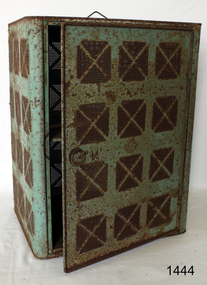
Domestic object - Food Safe, Willow Ware Pty Ltd, 1920s -1950
... tin plating industry of more than 50 years. In 1965, the company name changed to Willow Ware Pty Ltd, to be more closely linked to its Willow brand. Willow Ware is still in business today. A food ...Willow started business in 1887 as a metal working company based in Melbourne Australia, making tinned biscuit and tea canisters. The outbreak of the First World War saw their manufacturing change to making armaments and essential packaging for the war effort. In the early 1920’s, the Willow brand was established. Making tin plated canisters and baking pans with the well-known Willow pattern, imprinted on them. Some other items in production at this time include billies, boilers, basins and Coolgardie safes. In the late 1950’s, the company ventured into plastics production. Stepping away from its very successful tin plating industry of more than 50 years. In 1965, the company name changed to Willow Ware Pty Ltd, to be more closely linked to its Willow brand. Willow Ware is still in business today. A food safe known as a “Coolgardie” meat storage made by an emerging Australian company no longer in bushiness. This item gives a snapshot into early Australian manufacturing specifically aimed at the Australian market.Safe metal kitchen food safe with 2 shelves, a hinged door and latch and a small swivel wire handle at the top. Painted light green, rusting.Willowwarrnambool, shipwrecked-coast, flagstaff-hill, flagstaff-hill-maritime-museum, maritime-museum, shipwreck-coast, flagstaff-hill-maritime-village, safe, food safe, meat safe, coolgardie safe, domestic object, kitchen object, willow ware, food preservation, kitchen safe -
 Flagstaff Hill Maritime Museum and Village
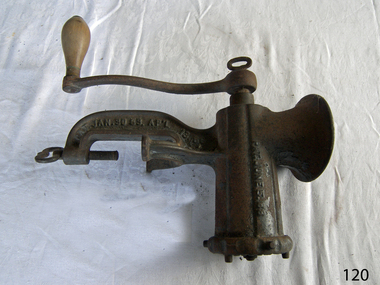
Domestic object - Food Mincer, Enterprise Manufacturing Company, circa 1911
... Food mincers of the subject items design are still being produced today under the brand name of "Universal" made by Universal Trading Inc USA. flagstaff hill warrnambool flagstaff hill maritime museum flagstaff hill maritime village great ocean road mincer food mincer meat mincer food preparation kitchen utensil domestic object enterprise manufacturing company kitchen appliance Marked "Enterprise tinned Meat Chopper" "No. 10" "Enterprise MF'G Co. ...This particular food mincer was manufactured by Enterprise Manufacturing Company. Located in Philadelphia, this company specialized in making hardware products. The company was especially known for its cherry pitters, apple peelers, and coffee mills. The company was founded in 1864 and was located on the corner of Dauphin, 3rd, and American Streets. Enterprise Manufacturing Co. remained in business until 1956 when it was bought by Silex Co.A mass produced early domestic item made for home food preparation this item's first patent design was approved in 1897. Manufactured by a well known company in the USA the "Enterprise Manufacturing Company” up until 1956. They specialised in making kitchen appliances of various types for domestic use and for export. Food mincers of the subject items design are still being produced today under the brand name of "Universal" made by Universal Trading Inc USA.Food mincer, metal, clamp on bench style, with rotating wooden handle. Inscriptions stamped on metal.Marked "Enterprise tinned Meat Chopper" "No. 10" "Enterprise MF'G Co. PHILA. USA" "PAT. JAN.30.83" flagstaff hill, warrnambool, flagstaff hill maritime museum, flagstaff hill maritime village, great ocean road, mincer, food mincer, meat mincer, food preparation, kitchen utensil, domestic object, enterprise manufacturing company, kitchen appliance -
 Flagstaff Hill Maritime Museum and Village
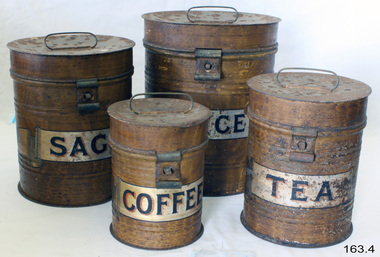
Container - Kitchen Canister set, 1850-1870
... Items such as coffee, tea, rice and sago were stable food types and needed longer term storage and a higher degree of protection from vermin and the elements, a common material used during this time was sheet metal or tin such as is used today in a common form of storage the biscuit tin. ...Items such as coffee, tea, rice and sago were stable food types and needed longer term storage and a higher degree of protection from vermin and the elements, a common material used during this time was sheet metal or tin such as is used today in a common form of storage the biscuit tin. ...In early civilization's cereal grains such as maize, wheat, barley etc. were stored in large airy buildings, often raised up from the ground to reduce infestation by pests and vermin. Ancient Egyptian and early Hebrew writings include reference to such buildings. Smaller quantities of food were stored in baskets made from woven grasses or leaves. In more recent times but prior to the invention of the refrigerator many food products were stored in the home as preserves or pickles, often in heat sealed jars. Dry food items were stored in vermin proof metal containers and could be found in any early colonial kitchen. Items such as coffee, tea, rice and sago were stable food types and needed longer term storage and a higher degree of protection from vermin and the elements, a common material used during this time was sheet metal or tin such as is used today in a common form of storage the biscuit tin. An early example of colonial food storage used in a domestic setting, it is interesting to note the subject items have provision to be locked. This indicates the value early colonial settlers placed on the contents and used to prevent pilfering. The subject items are now sought by collectors. Canister set; set of four canisters. Cylindrical matching kitchen storage tins with hinge lid that has a latch closure, and a folding handle on top of lid. Canisters are painted brown and the body has a graphic of a scroll in gold with printed label of contents. The canisters range from small to large, "COFFEE", "TEA" , "SAGO", " RICE" (respective RNs 163.1, 163.2, 163.3, 163.4)Respectively labelled "COFFEE," "TEA," "SAGO," "RICE" flagstaff hill, warrnambool, shipwrecked coast, flagstaff hill maritime museum, flagstaff hill maritime village, great ocean road, canister, canister set, rice canister, kitchen canister, food storage, domestic item -
 Flagstaff Hill Maritime Museum and Village
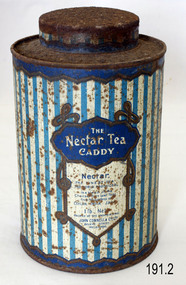
Container - Tea Container, J Marsh & Sons (Tin Container Fabricators), 1900-1940
... tin...container...kitchen storage...food...Tin, "Choicest Nectar Tea" is an example of retail packaging, for domestic goods, the tin was made by J Marsh and Sons, Melbourne, for John Connell & Co Ltd, Melbourne, Victoria, Australia, 1900-1940 Item at this time cannot be associated with an historical event, person or place, provenance is unknown, item assessed as a collection asset. flagstaff hill warrnambool flagstaff hill maritime museum maritime museum shipwreck coast flagstaff hill maritime village great ocean road tea canister tea caddy tea tin container kitchen storage food storage food nectar tea john connell melbourne J March & Sons John Connell & Co Ltd On label "The Nectar Tea Caddy" and "Nectar, the finest tea the world produces, is a blend of the Choicest Pure Leafed Teas from the Gardens of Ceylon, India, Java" Container; tea caddy for "Nectar Tea" brand, 1 lb. ...Tin, "Choicest Nectar Tea" is an example of retail packaging, for domestic goods, the tin was made by J Marsh and Sons, Melbourne, for John Connell & Co Ltd, Melbourne, Victoria, Australia, 1900-1940Item at this time cannot be associated with an historical event, person or place, provenance is unknown, item assessed as a collection asset.Container; tea caddy for "Nectar Tea" brand, 1 lb. Packed by John Connell and Co Ltd, Melbourne. Blue and white vertical stripe decoration. On label "The Nectar Tea Caddy" and "Nectar, the finest tea the world produces, is a blend of the Choicest Pure Leafed Teas from the Gardens of Ceylon, India, Java"flagstaff hill, warrnambool, flagstaff hill maritime museum, maritime museum, shipwreck coast, flagstaff hill maritime village, great ocean road, tea canister, tea caddy, tea tin, container, kitchen storage, food storage, food, nectar tea, john connell, melbourne, j march & sons, john connell & co ltd -
 Flagstaff Hill Maritime Museum and Village
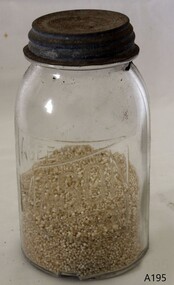
Container - Preserving Jar, 1932-1948
... tin cans and plastic containers). Item at this time cannot be associated with an historical event, person or place, provenance is unknown, item assessed as a collection asset. flagstaff hill warrnambool flagstaff hill maritime museum shipwreck coast flagstaff hill maritime village great ocean road jar glass jar preserving jar food preserving food storage agee mason agee mason jar John Landis Mason "AGEE / MASON / JAR" imprinted into side of glass Clear glass preserving jar with metal screw lid grooved base for lid clip. ...The Mason jar, named after American tinsmith John Landis Mason, who patented it in 1858, is a molded glass jar used in home canning to preserve food. The jar's mouth has a screw thread on its outer perimeter to accept a metal ring or "band". The band, when screwed down, presses a separate stamped steel disc-shaped lid against the jar's rim. An integral rubber ring on the underside of the lid creates a hermetic seal. The bands and lids usually come with new jars, but they are also sold separately. While the bands are reusable, the lids are intended for single-use when canning. Glass jars and metal lids are still commonly used in home canning while they have been largely supplanted by other methods for commercial canning (such as tin cans and plastic containers). Item at this time cannot be associated with an historical event, person or place, provenance is unknown, item assessed as a collection asset.Clear glass preserving jar with metal screw lid grooved base for lid clip."AGEE / MASON / JAR" imprinted into side of glassflagstaff hill, warrnambool, flagstaff hill maritime museum, shipwreck coast, flagstaff hill maritime village, great ocean road, jar, glass jar, preserving jar, food preserving, food storage, agee mason, agee mason jar, john landis mason
