
Showing 104 items matching "foundry work"
-
 Flagstaff Hill Maritime Museum and Village
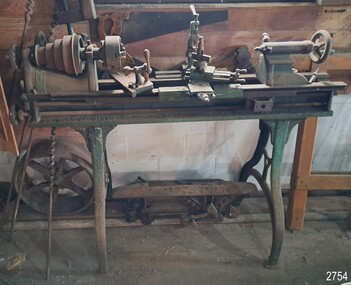
Machine - Lathe, W F & John Barnes, early 1900s
... ...foundry work...Foundry’s commitment to preserving craftsmanship and maritime heritage. Flagstaff Hill Flagstaff Hill Maritime Museum and Village Warrnambool Maritime Museum Maritime Village Great Ocean Road Shipwreck Coast Lathe steam-operated lathe steam-operated pulley steam power steam engine machine steam operated machine metal work foundry work metal working trade tool pulley driven metalworking woodworking Barnes lathe Briggs Marine belt driven wordworking lathe free standing lathe bench lathe steam powered vintage lathe woodturning lathe W. ...This woodworking lathe, connected to both a pulley and a flywheel, demonstrates its historical operation with a steam engine. Such a configuration reflects manufacturing practices from the late 1800s and early 1900s, when steam power was the predominant source for driving workshop and factory machinery. Large machine shops often utilised a single power source, distributing power via roof-mounted belts and pulleys to operate several machines simultaneously. Over time, petrol-driven motors were introduced, and eventually, electricity became the standard power source. Conversion kits were made available in the late 19th and early 20th centuries to adapt older lathes to these newer, cleaner fuels. Manufacturer's History: W.F. & J. Barnes was a renowned maker of hand- and foot-powered treadle woodworking and metalworking machinery, established in 1869. The partnership between William F. Barnes and John Barnes was formalised in 1872, and the firm was incorporated in 1884. Their machines were used for both ‘farm’ applications and professional engineering. By 1881, the company began producing electrically powered machinery. By 1937, W.F. & J. Barnes expanded into manufacturing machinery for automotive assembly. The business closed in 1983, and in 1998, LeBlond Ltd. of Ohio acquired the firm. The lathe was donated by Briggs Marine, Melbourne: In Flagstaff Hill’s formative years, 1972-1975, Briggs Marine, Melbourne (Briggs Brass Foundry), donated equipment and objects used or made at their premises. The foundry was established in 1912 by Herbert Harrison Briggs. In 1965, the firm was owned by partners Cyril Briggs and Frank Lee: Cyril died in 1967, and Frank died in 1971, so the foundry was then run by his son and daughter-in-law, Les and Eva Lee. Briggs Marine’s Warrnambool Branch closed in 1972 after the death of Frank Lee in 1971. Flagstaff Hill’s founding director, John Lindsay, recalled that Briggs Marine’s family members gave personal assistance in setting up the displays in the original village shops, particularly the ‘Brass Foundry’ building, around the time the Maritime Museum opened in 1975. Briggs Marine still exists today, but the Briggs family is no longer involved. This early 1900s lathe marks a significant stage in the evolution of machinery, positioned between the era of hand-operated machines and the advent of electrically powered equipment. Its presence exemplifies the progression of industrial technology and craftsmanship during this period. The lathe is particularly notable for its association with the Briggs Brass Foundry. The foundry was known for developing a specialised brass alloy composed of non-ferrous metals, a formulation that resulted in durable products built to withstand the demanding conditions of marine environments. This focus on resilience and longevity made Briggs Brass Foundry’s goods highly sought after within the maritime sector. Briggs Maine, a long-established business, utilised the foundry’s capabilities to create cast goods tailored to the needs of the marine industry. The facility was equipped to deliver both custom-designed and mass-produced items, ensuring versatility in meeting various requirements. Many of Briggs Foundry’s products found their place on sailing and steam vessels throughout Victoria’s coastline, including in the port town of Warrnambool, where there was once a brancy of Briggs Marine. In addition to general marine fittings, Briggs Marine earned recognition for its expertise in bell-founding. The foundry’s reputation is closely linked to the restoration of the Schomberg Bell at Flagstaff Hill, a small but historically significant bell from a luxury migrant vessel dating back to the mid-19th century. The successful restoration of the Schomberg Bell demonstrates Briggs Brass Foundry’s commitment to preserving craftsmanship and maritime heritage.The lathe is a green, bench-type, steam-powered woodworking machine. Its bench is supported by decorative posts at each end, with each post dividing into arched legs. The lathe is mechanically connected to both a pulley and a flywheel, designed to be operated in conjunction with a steam engine. Included with the lathe is a range of accessories. Across the front of the machine, an inscription is cast, and a stamped, metal lathe pulley guide is attached to the drive mechanism. The lathe was manufactured by W. F. and J. Barnes, Rockford, Illinois, USA, during the 1900s.“W F and J Barnes, Rockford, USA” "1820" "1887"flagstaff hill, flagstaff hill maritime museum and village, warrnambool, maritime museum, maritime village, great ocean road, shipwreck coast, lathe, steam-operated lathe, steam-operated pulley, steam power, steam engine, machine, steam operated machine, metal work, foundry work, metal working trade, tool, pulley driven, metalworking, woodworking, barnes lathe, briggs marine, belt driven, wordworking lathe, free standing lathe, bench lathe, steam powered, vintage lathe, woodturning lathe, w. f. and j. barnes, illanois, early 20th century, briggs, briggs brass foundry, briggs marine foundry, briggs marine products, herbert harrison briggs, george edward briggs, cyril falkiner mckinnon briggs, collingwood, moorabbin, frank lee, les lee, eva lee, briggs marine warrnambool, non-ferrous founders, bell specialists, ship bell specialists, sand cast, marine equipment, marine fittings, foundry, brass foundry, founders -
 Bendigo Historical Society Inc.
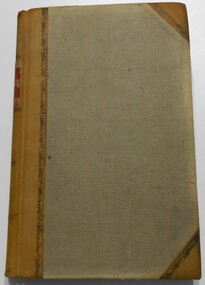
Document - MCCOLL, RANKIN AND STANISTREET COLLECTION: BELLEVUE TRIBUTE COMPANY LEDGER
... Ledger entries include dividends, wages, crushing, carting, stores and materials, firewood, mining materials, foundry work, management, contractors, treating pyrites, auditors' fees, bullion, drainage, and share calls accounts. ...Ledger entries include dividends, wages, crushing, carting, stores and materials, firewood, mining materials, foundry work, management, contractors, treating pyrites, auditors' fees, bullion, drainage, and share calls accounts. ...a. Hard cover ledger, 242 pages, dark buff colour, paler buff spine and corners. Bellevue Tribute Company ledger 1871 - 1873. Written on spine, on red label 'Ledger". Affixed inside front cover account from Charles C. White, auctioneer, dated September 21, 1872, listing sale of 900 shares, signed by Chas White, agent for the legal manager. Receipt affixed on next page, blue paper, outlining receipts from sale of shares forfeited from the Bellevue Tribute Co. Alphabetical index with details of individual ledger entries. Ledger entries include dividends, wages, crushing, carting, stores and materials, firewood, mining materials, foundry work, management, contractors, treating pyrites, auditors' fees, bullion, drainage, and share calls accounts. Individual share holders' accounts listed: W. Brooks W.J. Scott, W.V. Gilbert, H. Boyd, J.B.Loudan, A.B. Shaw, J. Taylor W. Bentley, J. Cole, Antonio Damiana, Thomas Francis, Peter Strickland, W.J. Dalzell, Arthur O'Neill L. Robertson, J. Wallen, A. Raynor, I.H. Simpson, William Brookes, William Barclay, H Crow, C. Keen, J.B. Loridan, M. Leeds, Arthur O'Neill, M. Sullivan, William Scott, I Britten, J. Cohn, J. Cox, C. Franklyn, E. Fry, I.L. Morley, A. Lennox, J. Penistan W. Smith. b. Brief typed account of some entries in ledger. business, mining, bellevue tribute, mccoll rankin & stanistreet -
 Bendigo Historical Society Inc.
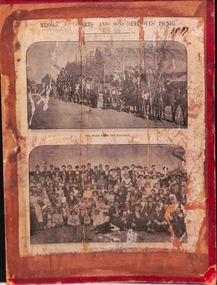
Photograph - Messrs A. Roberts and Sons Employees Picnic 1897, 1897
... Though the requirements of the mining industry maintained the firm, no class of foundry work was ignored. Roberts secured orders for machinery for the two major Broken Hill mines and built steam winding engines for several Western Australian mines, as well as undertaking orders for machinery in South Africa and New Zealand. ...Though the requirements of the mining industry maintained the firm, no class of foundry work was ignored. Roberts secured orders for machinery for the two major Broken Hill mines and built steam winding engines for several Western Australian mines, as well as undertaking orders for machinery in South Africa and New Zealand. ...Abraham Roberts (1819-1897), ironfounder, was born on 13 July 1819 in Cornwall, England, son of Abraham Roberts, blacksmith, and his wife Mary, née Pentreath. Nothing is known of his education and early training but it is likely that he served an engineering apprenticeship and worked in engineering workshops in Cornwall. Undoubtedly he observed much machinery among the tin mines of Cornwall and absorbed the principles of sound engineering design and high-grade workmanship, which bore fruit in his later years in Sandhurst (Bendigo). On 19 August 1841 he married Elizabeth Tonkin at the parish church at Paul, Cornwall. Roberts arrived on Bendigo in 1853 with his family and engaged in gold-prospecting, then about 1861 opened the United Iron Works, a small engineering shop in Williamson Street, making forge and hand tools. With expansion the business moved to Mitchell Street, until by 1880 it absorbed an entire block covering three acres (1.2 ha) in the heart of the town and employed nearly two hundred men. Three of his sons, William, Abraham and Arthur, helped to run A. Roberts & Sons. As well as being a skilful and enterprising engineer, Roberts was a shrewd businessman, who anticipated that the market for machinery on the local goldfields would diminish, and widened the sphere of his activities accordingly. Though the requirements of the mining industry maintained the firm, no class of foundry work was ignored. Roberts secured orders for machinery for the two major Broken Hill mines and built steam winding engines for several Western Australian mines, as well as undertaking orders for machinery in South Africa and New Zealand. He introduced poppet-heads constructed of steel to the Bendigo goldfield and the 105-head stamp battery for Lansell's Big Blue mine was the largest quartz-crushing battery in Australia at that time. The pair of steam winding engines built by his works for the Hustler's Royal Reserve Co. were the largest on the Bendigo field. The company also carried out steamship repairs, bridgework and many important railway contracts and in 1891 supplied the largest outlet valves in Victoria at Laanecoorie weir.Two photographs in black and white of the picnic for employees of Messrs A. Roberts and Sons in 1897. Photographs are mounted on piece of red cardboard. A. Roberts and Sons owned a foundry that was established in 1865. The event was noted in the Bendigo Advertiser on 18 March 1901.'1897' in ink top right hand corner.bendigo, foundry, roberts and sons, picnic, 1897 -
 Bendigo Historical Society Inc.
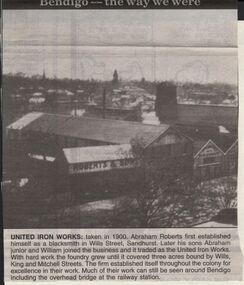
Newspaper - JENNY FOLEY COLLECTION: UNITED IRON WORKS
... Later his sons Abraham junior and William joined the business and it traded as the United Iron Works. With hard work the foundry grew until it covered three acres bound by Wills , King and Mitchell Streets. ...Later his sons Abraham junior and William joined the business and it traded as the United Iron Works. With hard work the foundry grew until it covered three acres bound by Wills , King and Mitchell Streets. ...Bendigo Advertiser "The way we were" from 1999. United iron works: taken in 1900. Abraham Roberts first established himself as a blacksmith in Wills Street, Sandhurst. Later his sons Abraham junior and William joined the business and it traded as the United Iron Works. With hard work the foundry grew until it covered three acres bound by Wills , King and Mitchell Streets. The firm established itself throughout the colony for excellence in their work. Much of their work can still be seen around Bendigo including the overhead bridge at the railway station.newspaper, bendigo advertiser, the way we were -
 City of Greater Bendigo - Civic Collection
Plaque - Commemorative
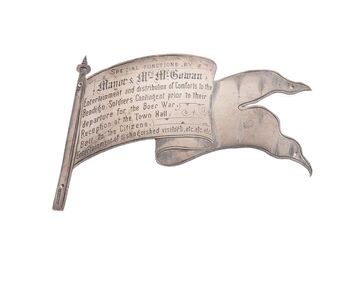
... He arrived in Bendigo 1871 and having worked in a large engineering works at home was quickly able to find management work in foundries, later opening a legal manager's office growing this into one of the largest of its type in Bendigo. ...He arrived in Bendigo 1871 and having worked in a large engineering works at home was quickly able to find management work in foundries, later opening a legal manager's office growing this into one of the largest of its type in Bendigo. ...The Boer War took place from 11 October 1899 – 31 May 1902. Also known as the Anglo–Boer War, or the South African War, the conflict was fought between the British Empire and the two Boer Republics (the South African Republic and the Orange Free State) over the Empire's influence in Southern Africa. As part of the British Empire, the Australian colonies offered troops for the war. Samuel McGowan was born in North Ireland in 1845, immigrating to Australia in 1870. He arrived in Bendigo 1871 and having worked in a large engineering works at home was quickly able to find management work in foundries, later opening a legal manager's office growing this into one of the largest of its type in Bendigo. Samuel McGowan was elected a member of the City Council in 1883 and was elected Mayor in 1885 and again in 1899, resigning as a councillor in 1901. He was the treasurer of the Bendigo Hospital, a senior member of the Zenith Lodge and president of the Bendigo Agricultural and Horticultural Society. Samuel McGowan and Kate Goyne from Epsom married on 29th August 1874. Samuel died in 1921 aged 76 and Kate in 1930 aged 78. This plaque was probably attached to a commemorative board such as an honour board, however its whereabout are unknown. Engraved plaque in the shape of a flag and flag pole. Four small holes indicate that it was previously attached to a larger commemorative board.Flag; Special functions by / Mayor & Mrs McGowan / entertainment and distribution of Comforts to the / Bendigo Soldiers Contingent prior to their / departure for the Boer War. / Reception at the Town Hall / Ball to the Citizens. / Entertainment of distinguished visitors, etc.etc.etc / Flag pole; F. Prescottmayor mcgowan, councillor s h mc gowan, mayoress mcgowan -
 Flagstaff Hill Maritime Museum and Village
Accessory - Badge, Before 1855
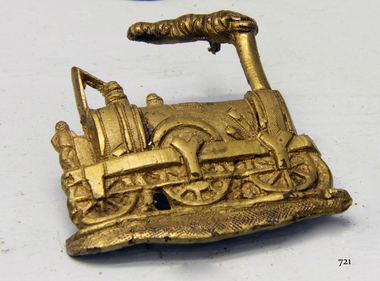
... (Although a supposition, it is possible that the owner was a passenger on the ill-fated Schomberg and that they worked either for the Great Western Railway or the Vulcan Foundry that made the engine in the 1830s.) ...(Although a supposition, it is possible that the owner was a passenger on the ill-fated Schomberg and that they worked either for the Great Western Railway or the Vulcan Foundry that made the engine in the 1830s.) ...The badge recovered from the Schomberg wreck is believed to depict one of the first steam engines. The engine's design by Charles Tayleur & Co. was to be produced for the Great Western Railway in England. The first nineteen of these locomotives were ordered by Isambard Kingdom Brunel for the Great Western Railway including six 2-2-2 Charles Tayleur locomotives. They were built by Charles Tayleur and Company, which later the Vulcan Foundry. The locomotives were unsuccessful and were rapidly supplemented by the Star Class locomotives ordered by Daniel Gooch once he had been appointed as the Locomotive Engineer. As built, they comprised two groups of three, the first group, was delivered in 1837. This locomotive was the first to run on the Great Western Railway when it was tested on 28 December 1837 from its shed at West Drayton. It was withdrawn in 1843 but was rebuilt as a 2-2-2T tank locomotive and returned to service in 1846, running in this form until 1868. It survived for two more years at Reading as a stationary boiler. It is named after the workshops where it was built, which themselves were named after the Roman god of fire. (Although a supposition, it is possible that the owner was a passenger on the ill-fated Schomberg and that they worked either for the Great Western Railway or the Vulcan Foundry that made the engine in the 1830s.) Wreck of the Schomberg: Schomberg was a large three-masted full-ship rigged wooden ship built in 1855 by Alexander Hall and Co in Aberdeen, Scotland for James Baines' famous Black Ball Line at £43,103. The vessel was 288 feet (88 meters) in length, with a beam of 45 feet (14 meters), a depth of 29.5 feet (8.99 meters) of 2,284 tons. The mainmast was 210 feet (64 meters) high and she carried 3.3 acres of sail. The vessel was constructed with three skins. One planked fore and aft, and two diagonally planked, fastened together with screw-threaded trunnels (wooden rails). The Schomberg is one of only three clipper wrecks in Victorian waters that operated the England to Australia run. While the other two, Empress of the Sea and Lightning, were built by the famous American shipbuilder, Donald Mac Kay. Schomberg was an attempt to build a faster ship than Mac Kay and a vessel fast enough to break the sailing record to Australia. The Schomberg sailed on her maiden voyage from Liverpool on 6 October 1855, under the command of Captain James Forbes, on its maiden voyage to Australia with a general cargo, jewellery, spirits, machinery, and 2,000 tons of iron rails and equipment intended to build the Melbourne to Geelong Railway and a bridge over the Yarra from Melbourne to Hawthorn. She also carried a cow for fresh milk, pens for fowls and pigs, plus 90,000 gallons of water for washing and drinking. She also carried 17,000 letters and 31,800 newspapers. There were approximately 473 passengers and a crew of 105. It was hoped that Schomberg would make Melbourne in sixty days, setting a record for the voyage, but light winds at the equator dashed those expectations. The ship sighted Moonlight Head in southwest Victoria on Christmas Day but through a deadly combination of wind, currents, and unmarked sand spits, the vessel gently ran aground on 26 December 1855 on a spit that juts into Newfield Bay, just east of Curdies Inlet, and the present town of Peterborough. Fortunately, the SS Queen was nearby and managed to save all passengers and crew. The steamers Keera and Maitland were dispatched to salvage the passenger's baggage and the more valuable cargo. Other salvage attempts were made, but deteriorating weather made the work impossible, and within two weeks the Schomberg's hull was broken up and the vessel abandoned. The wrecking of the Schomberg caused quite a public stir, particularly in light of the fact the vessel was supposed to be, the most perfect clipper ship ever built. Captain Forbes was charged in the Supreme Court under suspicion that he was playing cards with two female passengers below decks when his ship ran aground. Despite a protest meeting, two inquiries, and the court proceedings, he was found not guilty and cleared of all charges. In 1975, divers from Flagstaff Hill, including Peter Ronald, found an ornate communion set at the wreck. The set comprised a jug, two chalices, a plate, and a lid. The lid did not fit any of the other objects and in 1978 a piece of the lid broke off, revealing a glint of gold. As museum staff carefully examined the lid and removed marine growth, they found a diamond ring, which is currently on display in the Great Circle Gallery at the Flagstaff Hill Maritime Museum that also displays ship fittings and equipment, and personal effects. Most of the artefacts were salvaged from the wreck by Peter Ronald, former director of Flagstaff Hill.The Schomberg has historical significance as one of the first luxurious ships built to bring emigrants to Australia to cash in on the gold rush era. And is included on the Victorian Heritage Register (VHR S612). The collection of Schomberg artefacts held at Flagstaff Hill Museum is primarily significant because of the relationship between these recovered items having a high potential to interpret the story of the Schomberg and its foundering during a storm. The shipwreck is of additional historical significance for representing aspects of Victoria’s shipping history and for its association with the first passenger ship, which was designed not only to be the fastest and most luxurious of its day but foundered on its maiden voyage to Australia.Gold coloured brass badge depicting an 1840's steam engine or locomotive with the figure of a fireman standing on the back. Smoke is coming from the smokestack. The reverse has three holes, possible where a mounting pin or fastener was attached. The badge was recovered from the wreck of the Schomberg.warrnambool, flagstaff-hill, flagstaff-hill-maritime-museum, shipwreck-coast, flagstaff-hill-maritime-village, schomberg, shipwrecked-artefact, clipper ship, black ball line, 1855 shipwreck, captain forbes, ss queen, badge, charles tayleur, great western railway, vulcan foundry, isambard kingdom brunel, locomoive, brooch -
 Flagstaff Hill Maritime Museum and Village
Domestic object - Boiling Copper, Newberry & Walker, Boiling Tub, Circa1900
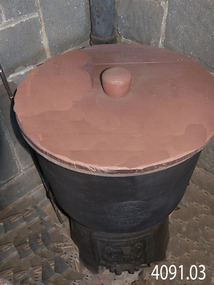
... Francis John Newberry founded the Victoria Foundry and Enameling Works in 1890 with a workmate from the Humbles iron foundry in Lupton Street Geelong where he worked. Newberry & Walker Foundry & Enameling Works was built adjoining a cottage that was to be the home of the Newberry family during the ensuing years. ...Francis John Newberry founded the Victoria Foundry and Enameling Works in 1890 with a workmate from the Humbles iron foundry in Lupton Street Geelong where he worked. Newberry & Walker Foundry & Enameling Works was built adjoining a cottage that was to be the home of the Newberry family during the ensuing years. ...Francis John Newberry founded the Victoria Foundry and Enameling Works in 1890 with a workmate from the Humbles iron foundry in Lupton Street Geelong where he worked. Newberry & Walker Foundry & Enameling Works was built adjoining a cottage that was to be the home of the Newberry family during the ensuing years. Although Walker soon relocated to New Zealand, the Newberry and Walker foundry had become a local success. The foundry produced numerous cast iron products such as washing copper frames, and friezes, balustrades and verandah columns. Verandah posts are to be found in declining numbers, but the Newberry and Walker mark can sometimes be seen on the few which remain. A certain number of iron culvert posts were also made; some of them were still in place on the road to Cressy as late as 1961. Perhaps half the iron friezes on Geelong West verandahs came from the local firm’s foundry. A significant item made in Geelong giving a snapshot into the early beginnings of Victoria's industrial manufacturing of products that helped to replace previously imported items from England or America.Copper boiling tub, cast iron frame copper bowl inside of 14 gallon capacity Newberry & Walkerflagstaff hill, warrnambool, flagstaff-hill-maritime-museum, maritime-museum, shipwreck-coast, flagstaff-hill-maritime-village, copper, cast iron, newberry & walker, washing copper frame, laundry, dairy, butchering -
 Flagstaff Hill Maritime Museum and Village
Tyre Bender, 1884
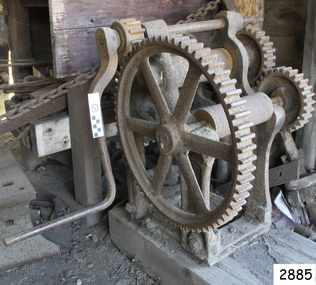
... The Day Bros foundry, makers of this tyre bender, was operating as the manufacture of wheel right and blacksmith tools and general machinery in the 19th century in the USA and successfully exported their goods all over the world. Wagon tyre benders would have been very common circa 1850-1920, so there were probably many makers over the years. Early on, it would have become clear to the blacksmiths about which designs worked...The Day Bros foundry, makers of this tyre bender, was operating as the manufacture of wheel right and blacksmith tools and general machinery in the 19th century in the USA and successfully exported their goods all over the world. Wagon tyre benders would have been very common circa 1850-1920, so there were probably many makers over the years. Early on, it would have become clear to the blacksmiths about which designs worked ...A tyre bender is used to bend and shape metal rims for wooden wagon wheels. This tyre bender’s model first appeared in the Day Bros catalogue in 1884 as the “Giant” model. The catalogue of 1883 only showed a lighter duty model called the “Lion”. It can be assumed that this later “Giant” model was a heavy duty improvement over the 1883 "Lion" and other smaller models which were still being advertised for sale in 1884. The Day Bros foundry, makers of this tyre bender, was operating as the manufacture of wheel right and blacksmith tools and general machinery in the 19th century in the USA and successfully exported their goods all over the world. Wagon tyre benders would have been very common circa 1850-1920, so there were probably many makers over the years. Early on, it would have become clear to the blacksmiths about which designs worked best so, eventually, the various makers would have made similar products to each other. This tyre bender was once used by Harry Goodall of H. Goodall & Sons Pty. Ltd. corner of McKinnon and High Streets, Terang. Victoria. Henry Goodall & Sons Henry Goodall (1870-1936) was proprietor of garages as H. Goodall & Sons Pty. Ltd., at both Terang (McKinnon and High Streets) and Mortlake (Dunlop Street). His business was in operation in at least in 1916 and perhaps well before, considering the date of the tyre bender and its use for wagons with wooden wheels. It was still in operation in 1953, chasing up debtors in Mount Gambier Court. Amongst the employees of H. Goodall & Sons Pty. Ltd. was Ernie Entwistle, a blacksmith (a soldier who died in 1916 ) and Alfred Hodgetts, radio expert (killed in a fatal accident in 1943, when he was in his early 30s ). Henry Goodall was involved in the community as a Justice of Peace, a deputy coroner, President of the Mortlake Hospital, trustee of the Soldiers’ Memorial Hall, and as a prominent Freemason. He and his wife had two sons (Charles and John) and one daughter (Mrs. Chas. Newton, of Skipton). The tyre bender is significant as it demonstrates how blacksmiths or wheelwrights could make new metal rims for wagon wheels for carts, wagons, stage coaches and carriages over a 135 years ago. The machine is a part of our social history as it demonstrates part of the process of making wagon wheels, which played an important part in aiding the continuation of daily transport needs that people had at the time, such as farming, personal transport and commercial activities. The machine or tool is locally significant as it was used by a local company in Terang and Mortlake in their blacksmith, wheelwright and garage business. Steel tyre bender mounted on timber base, used for wagon wheel steel rims. Made from cast iron and steel, double geared with four cogs to unite the upper and lower steel rollers. There are adjustable guide collars to keep the iron in line while it is being bent. It can also be used with two cranks for heavy duty work utilising the use to two operators. It is the Giant model, made in 1884 by Day Bros. of Philadelphia. This tyre bender once belonged to Harry Goodall & Sons, blacksmith's of Terang. Victoria. “DAY BROS. PHILAP. PA” cast into the side of machineflagstaff hill, warrnambool, shipwrecked coast, flagstaff hill maritime museum, maritime museum, shipwreck coast, flagstaff hill maritime village, great ocean road, machinery, wagon wheel, wheelwrights, blacksmith, steel rim wheels, tyre bender, tire bender, the giant tyre bender, henry goodall (1870-1936), terang, wheelwright tool, blacksmith trade, blacksmithing equipment and supplies, wagon tyre bender, day bros. philadelphia pennsylvania, h. goodall & sons of terang, terang blacksmith, h. goodall & sons pty ltd, mortlake, ernie entwistle blacksmith, alfred hodgetts radio expert, charles goodall, john goodall, mrs. chas. newton nee goodall -
 Flagstaff Hill Maritime Museum and Village
Container - Box for seeds, ca. 1880s
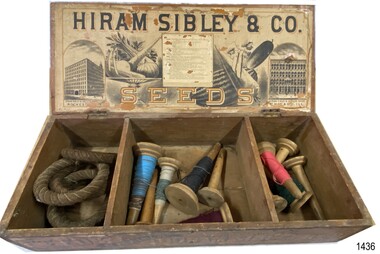
... foundry. He became involved with Alfred Vale and Samuel Morse and their work on the telegraph. ...foundry. He became involved with Alfred Vale and Samuel Morse and their work on the telegraph. ...This seed box was made for Hiram Sibley for his seed house business. He sold seeds priced by the weight or the space they took up e.g. bushel. This box allowed for seeds to be divided by type, size or even date. The box was strong and easy to cart and store. It was also a handy item to 'recycle' as a storage container for other items. The Sibley seed box is a desirable collectors' item. A large variety of sizes and shapes are still available today in various stages of condition. Hiram Sibley developed seeds that were strong and the plants that grew from these seeds produced many seeds. Varieties of Sibley seeds and plants are still advertised for sale in modern times. HIRAM SIBLEY (1807-1888) - Hiram Sibley was born in America. He had a natural mechanical ability and became skilled in many trades. He and his partner Don Watson opened a sawmill then a machine shop and foundry. He became involved with Alfred Vale and Samuel Morse and their work on the telegraph. Eventually he became the first president of the Western Union Telegraph Company. Later, after leaving Western Union in the early 1860s, Sibley bought and sold railroads, manufactured sold, ran timber mills, and became involved in farming and seed supply. In this area he used his skills to engineer seeds that were stronger and develop plants that produced more seeds. The production of seeds became his main business. He bought land cheaply and improved to soil so that he could produce seed and grain, and graze herds of cattle. He became the owner of 14 large farms. Hiram Sibley earned the reputation "as the most extensive farmer and seedsman in this country". The business of Hiram Sibley & Co. was conducted his warehouse in Rochester and his seed house in Chicago. One department of the business sold farming equipment, another department imported ornamental plants from overseas countries Sibley went on to invest a large amount of money in a bank, and to be financially involved in the community by making large donations to public services such as a library and a school of music. At one point he was the richest man in Monroe county.This box is significant for its historic connection with Hiram Sibley, who is famous for many reasons, among which is his very profitable business of seed engineering to improve the production of crops. This box also represents the value of containers used for selling products in the 1880s, being re-used for other useful purposes. The box is an example of goods imported for use in Australia. The text and images of the box are an example of 1880s advertisingBox, wooden, with two brass hinges joining lid to base. Base has two wooden partitions, divided into three unequal sized compartments. Lid's underside has label with drawings of buildings and produce, text with maker's name and description of vegetables. Front edge of box has stencilled text and diagrams. Outside lid, and the other three sides, have no inscriptions. Made by Hiram Sibley & Co., USA. (Box is currently used to store quoits 1436.2 and cones of cotton thread 1436.3.)Marked "HIRAM SIBLEY & CO / SEEDS", "WAREHOUSE - "ROCHESTER N.Y. ", "SEED HOUSE - CHICARGO, ILL.", "SEEDS BY WEIGHT & MEASURE", "PUT UP BY / HIRAM SIBLEY & CO. / ROCHESTER, N.Y. AND CHICARGO, ILL."flagstaff hill, warrnambool, maritime village, maritime museum, flagstaff hill maritime museum & village, hiram sibley & co, rochester n.y., seeds, wooden seed box, seed box, seedsmen, arable farming, chicargo illinois, seed house, seed engineering, seed distribution, seeds by weight and measure -
 Federation University Historical Collection
Plan, Mild Steel Boiler for Yarrawee Suction Dredge, 16 January 1907
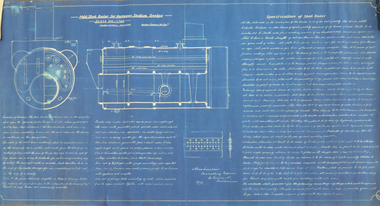
... Alex Sinclair Jnr told the story of how his father worked as a labourer in Malaya for two years, while his mother took in washing and ironing during the same period, until together they had assembled enough money to pay for his father’s return Anyone who talks about “the good old days” is talking nonsense!" blueprint designs and plans yarrawee suction dredge conditions of contract thompsons foundry ...George Milford, a long term staff member of Thompsons Foundry Castlemaine, remembers discussing Alexander Sinclair with this son, Alex Sinclair Jnr. "When Alex Jnr was a boy, his father, a senior design engineer, was sent to Malaya to oversee the erection on site of a suction cutter dredge for Thompsons. This was an adaptation of the idea of a bucket-dredge, where gold is won from alluvial gravels. In the 1915-1920 era, the Thompsons Engineering Department designed a suction-cutter dredge, by which hydraulic suction with a revolving cutter at the end of a long proboscis would collect the alluvial soil and deliver it into the dredge for recovery of the precious metals. Export marketing was then ‘all the go’, and the tin dredges were ordered from Thompsons, using the new cutter design. The dredges were, of course, shipped to Malaya in pieces, ready to be assembled on site. A number of Thompsons employees were selected to travel to Malaya to assemble the dredges. There were fourteen men in the gang. These men sailed on 1st July 1925, their number including Delmenico, McKay and Charles Albert Hauser, an engine driver. C A Hauser died of malaria in Malaya shortly after arrival. Components for a further three of these dredges were in transit or on site when the first suction-cutter dredge was assembled and tested. The designers had failed to take into account the fact that, in the jungle floor in Malaya, many trees grow up, and fall down, in tropical conditions, and become submerged still waterlogged in the floor of the jungle, and in the tin-bearing gravels. The suction-cutter dredge was found to be inefficient in these circumstances, the price of tin had fallen and the Malayan client reneged on the contract. Faced with an outlay of over £4,000 on which no money would be received, the company went bankrupt on 25th August 1925. Alex Sinclair Snr was at that stage in Malaya, and received the news of the bankruptcy by telegram. Upon telegraphing his employers for funds to return home, he received the reply that there were no such funds available. Alex Sinclair Jnr told the story of how his father worked as a labourer in Malaya for two years, while his mother took in washing and ironing during the same period, until together they had assembled enough money to pay for his father’s return Anyone who talks about “the good old days” is talking nonsense!"Large blue printed paper plan outlining the conditions of contract for the making of a steel boiler. The Blueprint includes design drawings and written contract specifying materials, time frame and costs. Signed on front 'Alec Sinclair Consulting Engineer, 31 Queen Street, Melbourne'. Stamped on verso 'Printed by Paterson & Co, Colonial Mutual Chambers, Collins St, Melbourne'. blueprint, designs and plans, yarrawee suction dredge, conditions of contract, thompsons foundry castlemaine, george milford -
 Federation University Historical Collection
Book - Ledger, Ballarat School of Mines Assay Reports, 1873-1887, 1873-1887
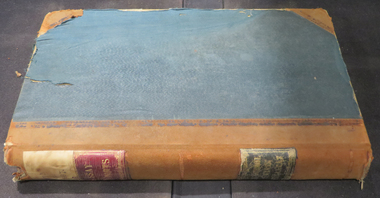
... work was undertaken for a fee, supervised by laboratory superintendents. Copies of assays undertaken are compiled together in this book. ballarat school of mines assaying mining phoenix foundry a.e. anderson john andrew, greendale john anderson black horse quartz mining company rivett henry bland band and albion consols john barbour broadbent brothers dalton blakely union bank w.j. butcher john m. bickett j.p. brophy j. barnett j.j. blundell george bailey w.r. bechervaise bateman and co. captain baker j. chew g.j. carroll r. coad c. collyer w. corbould david david cameron c. crisp, bacchus marsh c. clark james cotter h. cherry john ditchburn james donaldson george davey c.e. dudley geirge davidson a. doepel john holmes w. hayden g. hatfield s. horsley j. howard dr holthouse a.e. hawson thomas james e. jordon j.h. jago james johns john kelsall charles klug c. eagle d.e. kingr.h. cock lal lal iron co. john letcher rev. j. love c.w. langtree william moss j. mcgrath p. marquand south clunes mine david merton fred masters e. morey william mercer b. mason, freemantle spring leads co, smeaton diamond drill co, ballarat east star of the east h.g. neill william nicholls new kohrinor co charles ogilvy james oddie james orr james ord, stawell frank parrington port phillip gold mining company, clunes w. patrick phoneix foundry john quayle e. rowlands rowlands and lewis charles reeves stanley copper mines charles sargeant sergeant's freehold scotchman's united company, stawell i. sharpe james selby william spargo w.h. shaw try again comany r. timms d.c. urquhart w.p. white white horse range e. wissel w.c. wilson george wyatt mining laboratory Large green hard covered ledger with brown leather binding. ...The Ballarat School of Mines had a 'Model Mine' that was used to teach students. Practical work was undertaken for a fee, supervised by laboratory superintendents. Copies of assays undertaken are compiled together in this book. Large green hard covered ledger with brown leather binding. An alphabetical listing of names of those who requested assays from the Ballarat School of Mines is found in the front. 713 of the 994 pages are used. The pages are transfer copies of original correspondence prepared by the Ballarat School of Mines.ballarat school of mines, assaying, mining, phoenix foundry, a.e. anderson, john andrew, greendale, john anderson, black horse quartz mining company, rivett henry bland, band and albion consols, john barbour, broadbent brothers, dalton blakely, union bank, w.j. butcher, john m. bickett, j.p. brophy, j. barnett, j.j. blundell, george bailey, w.r. bechervaise, bateman and co., captain baker, j. chew, g.j. carroll, r. coad, c. collyer, w. corbould, david, david cameron, c. crisp, bacchus marsh, c. clark, james cotter, h. cherry, john ditchburn, james donaldson, george davey, c.e. dudley, geirge davidson, a. doepel, john holmes, w. hayden, g. hatfield, s. horsley, j. howard, dr holthouse, a.e. hawson, thomas james, e. jordon, j.h. jago, james johns, john kelsall, charles klug, c. eagle, d.e. kingr.h. cock, lal lal iron co., john letcher, rev. j. love, c.w. langtree, william moss, j. mcgrath, p. marquand, south clunes mine, david merton, fred masters, e. morey, william mercer, b. mason, freemantle, spring leads co, smeaton, diamond drill co, ballarat east, star of the east, h.g. neill, william nicholls, new kohrinor co, charles ogilvy, james oddie, james orr, james ord, stawell, frank parrington, port phillip gold mining company, clunes, w. patrick, phoneix foundry, john quayle, e. rowlands, rowlands and lewis, charles reeves, stanley copper mines, charles sargeant, sergeant's freehold, scotchman's united company, stawell, i. sharpe, james selby, william spargo, w.h. shaw, try again comany, r. timms, d.c. urquhart, w.p. white, white horse range, e. wissel, w.c. wilson, george wyatt, mining laboratory -
 Flagstaff Hill Maritime Museum and Village
Equipment - Pattern, Briggs Brass Foundry, 1912-1972
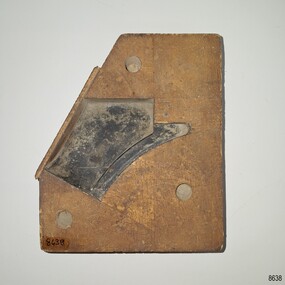
... work. A wooden slat is fixed across the diagonal side. The back of the pattern has a handwritten inscription, possibly by two writers. The pattern is part of a set of foundry...Flagstaff Hill Flagstaff Hill Maritime Museum and Village Warrnambool Maritime Museum Maritime Village Great Ocean Road Shipwreck Coast Briggs' Bronze traditional method trade sand cast cast brass alloy copper alloy pattern mould foundry brass foundry metal foundry casting sand mould sand casting marine equipment Marine Tools marine fittings copper tin zinc lead non-ferrous non-corrosive brassware metalware foundering metalwork maritime bell founders Ship chandlers marine products Biggs Briggs family Herbert Harrison Briggs H H Briggs George Edward Briggs Cyril Falkiner McKinnon Briggs Cyril Briggs Briggs & Son Brass Foundry H H Briggs & Sons Foundry Briggs Marine Alliance Casting & Engineering Solutions Grassmere Cheese Factory Cornish chimney curved bricks Collingwood Moorabbin Collingwood Foundry Moorabbin Foundry 1912 Craftman Marine Craftsman Marine Briggs Briggs Brass Foundry Briggs Marine Foundry Briggs Marine Products Frank Lee Les Lee Eva Lee Briggs Marine Warrnambool non-ferrous founders bell specialists ship bell specialists founders metalworking traditional sand casting casting pattern foundry pattern In black handwriting: "1 # H AL" Handwritten in a different hand: "CRAFTMAN MARINE" Written the the first hand: BRIGGS" (or "BRICK") Pattern; rectangular wooden block with a corner cut diagonally. A five-sided shape has been carved into the centre, with one side curved inwards and slightly shallower than the other sides. The cut-out area is painted black. Three holes are drilled in the cut-out side to align the pattern with another piece of work ...The wooden pattern was possibly made for casting a part for Craftman Marine, makers of engines for boats and other applications. It is part of a larger collection; some of them were secured within a durable wooden crate. The cast pattern was an essential tool at Briggs Brass Foundry, specifically designed for creating sand casts. Sand casting is a time-honoured technique, with a history exceeding 2,000 years. The handcrafted nature of this process produces brass and copper alloy items particularly suitable for maritime applications. Typical products include bells, boat hooks, cowls, propellers, handles, lids, rowlocks, hooks, letters, bolts, rail holders, brackets, deck plates, flanges, rudder guides, portholes and covers. The distinctive bronze mixture used at Briggs’ Foundry is copper based. It is composed of local ingots of copper, tin, zinc and lead, blended in precisely measured quantities. The resulting alloy is non-ferrous, known for its exceptional durability and longevity. HISTORY OF BRIGGS MARINE: The Briggs Brass Foundry, trading as Briggs & Son Foundry, was established in 1912 by Herbert Harrison Briggs (1863-1931) with his son George Edward Briggs. In 1922, the youngest son, Cyril Falkiner McKinnon Briggs, joined the foundry. After Herbert died in 1931, his sons George and Cyril ran the foundry. The business became known as Briggs Marine Foundry, the “non-ferrous founders” and “bell specialists”. The foundry products were made using the traditional sand-casting method, which is now over two thousand years old and is becoming a dying art. The foundry operated at 70 Wellington St, Collingwood, and specialised in casting ship bells and other marine equipment and fittings. It also made decorative items such as miniature ship propellers. The great-granddaughter of Herbert Briggs inherited a Briggs brass bell, similar to one at Flagstaff Hill Maritime Village. In 1965, Cyril was the only remaining family member involved in Briggs Marine Products. The firm relocated to Chesterville Rd, Moorabbin and Cyril went into partnership with Frank Lee. In the same year, the firm exhibited its products at the 1965 Boat Show. When Cyril passed away in 1967, Frank took over the business with two new partners. After Frank Lee died in 1971, the foundry was run by his son and daughter-in-law, Les and Eva Lee. Briggs Marine still exists today, but the Briggs family is no longer involved. Briggs Foundry had a community-minded retail branch in Warrnambool, selling cast boat fittings and equipment to fishermen and others in the regional marine industry. The branch closed in 1972. In Flagstaff Hill’s formative years, 1972-1975, many Briggs Marine brassware products were generously donated from its Melbourne foundry, along with casting patterns, tools, machinery and a cupboard. EXHIBITION and LEGACY: The donated items were displayed in a simulated Brass Foundry within the Village, where visitors could view them and gain insight into the foundering and metalwork trades that supported maritime industries, including shipwrights and boatbuilders. The castings produced at the foundry were also vital for farmers, manufacturers and other local industries. This exhibit was part of a broader showcase of working crafts, trades and services typical of a Maritime town. The display was available to the public from the completion of the building in 1986 until 1994, when the space was repurposed. It is believed that Briggs Marine’s family members gave personal assistance in setting up the displays in the original village shops, particularly the ‘Brass Foundry’ building. A notable feature of the Village Brass Foundry was the historic Cornish chimney, presented as a working model. This chimney visually demonstrated the process of smelting metal in furnaces and pouring it into sand moulds. Constructed from specially curved bricks, the chimney now stands at about two-thirds of its original height, having been relocated from the Grassmere Cheese factory. The hand-cast sand patterns hold considerable significance due to their association with Briggs Brass Founders, a firm established in the early 20th century and widely recognised for its expertise in producing, repairing, and restoring ship bells and marine equipment. Known for their specialisation in non-ferrous metal casting, Briggs Brass Founders supplied high-quality fittings and equipment for maritime use. The company extended its operations by opening a branch in Warrnambool, where it actively supported the local community. The foundry’s ability to cast essential products was important to local and regional industries, like fishing, farming, manufacturing and commercial businesses. Through its presence, its reputation was reinforced as both a skilled manufacturer and a community-minded enterprise. The foundry is notably associated with the Schomberg Bell at Flagstaff Hill, having restored this small, historic bell to its original condition. The Schomberg Bell is a fine example from a luxury migrant vessel dating back to the mid-19th century, reflecting the craftsmanship and heritage preserved by Briggs Brass Foundry. Pattern; rectangular wooden block with a corner cut diagonally. A five-sided shape has been carved into the centre, with one side curved inwards and slightly shallower than the other sides. The cut-out area is painted black. Three holes are drilled in the cut-out side to align the pattern with another piece of work. A wooden slat is fixed across the diagonal side. The back of the pattern has a handwritten inscription, possibly by two writers. The pattern is part of a set of foundry patterns from Briggs Brass Foundry and is connected to Craftman Marine.In black handwriting: "1 # H AL" Handwritten in a different hand: "CRAFTMAN MARINE" Written the the first hand: BRIGGS" (or "BRICK")flagstaff hill, flagstaff hill maritime museum and village, warrnambool, maritime museum, maritime village, great ocean road, shipwreck coast, briggs' bronze, traditional method, trade, sand cast, cast, brass alloy, copper alloy, pattern, mould, foundry, brass foundry, metal foundry, casting, sand mould, sand casting, marine equipment, marine tools, marine fittings, copper tin zinc lead, non-ferrous, non-corrosive, brassware, metalware, foundering, metalwork, maritime, bell founders, ship chandlers, marine products, biggs, briggs family, herbert harrison briggs, h h briggs, george edward briggs, cyril falkiner mckinnon briggs, cyril briggs, briggs & son brass foundry, h h briggs & sons foundry, briggs marine, alliance casting & engineering solutions, grassmere cheese factory, cornish chimney, curved bricks, collingwood, moorabbin, collingwood foundry, moorabbin foundry, 1912, craftman marine, craftsman marine, briggs, briggs brass foundry, briggs marine foundry, briggs marine products, frank lee, les lee, eva lee, briggs marine warrnambool, non-ferrous founders, bell specialists, ship bell specialists, founders, metalworking, traditional sand casting, casting pattern, foundry pattern -
 Glenelg Shire Council Cultural Collection
Tool - Anvil, Bradford and Kendall, n.d
... foundry in Alexandria, Sydney to take advantage of what they saw as an untapped potential for industrial growth. Bradford Kendall Ltd was incorporated on 20th March 1922. Port of Portland anvil blacksmith industry BK anvil Bradken Brandford and Kendall Front: 'BK SYDNEY AUST. 5CWT' Back: - Metal blacksmiths anvil. An anvil is used by blacksmiths to forge and shape his work ...Port of Portland Collection Bradken, originally Bradford and Kendall, began as a steel foundry in Sydney in 1920 and produced BK anvils at its factories in Alexandria and Mascot NSW. Leslie Bradford (General Manager) and Jim Kendall (Chief Mechanical Engineer), two BHP steelworks employees, got lucky at the races one day in 1920 and pledged their £15,000 winnings to start a steel foundry business. The horse they backed, ‘Jack Findlay’ completed a remarkable sequence of five wins during 1919 and 1920. With each win Leslie Bradford, Jim Kendall and a group of friends rolled-over their bets. By January 24, 1920 they had won a small fortune. On April 28 1920, the group used their winnings to establish the Alloy Steel Syndicate and build a steel foundry in Alexandria, Sydney to take advantage of what they saw as an untapped potential for industrial growth. Bradford Kendall Ltd was incorporated on 20th March 1922.Metal blacksmiths anvil. An anvil is used by blacksmiths to forge and shape his work pieces. The conical horn is used for hammering curved work pieces. The anvil is a common tool of the blacksmiths (‘smithies’) and other metalworkers. There has been very little change in the basic design of the anvil since Greek and Roman times. Blacksmith anvil, 5CWT, iron BK Sydney Australia.Front: 'BK SYDNEY AUST. 5CWT' Back: -port of portland, anvil, blacksmith, industry, bk anvil, bradken, brandford and kendall -
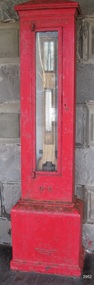 Flagstaff Hill Maritime Museum and Village
Instrument - Barometer, 1867
... Langlands Foundry was an incubator for several engineers including Herbert Austin (1866–1941) who worked as a fitter at Langlands and went on to work on the Wolesely Shearing machine. ...Langlands Foundry was an incubator for several engineers including Herbert Austin (1866–1941) who worked as a fitter at Langlands and went on to work on the Wolesely Shearing machine. ...Langlands Company History: Langlands foundry was Melbourne's first foundry and iron shipbuilder established in 1842, only 8 years after the founding of the Victorian colony by two Scottish immigrants, Robert Langlands and Thomas Fulton, who had formed a partnership before emigrating (1813–1859). The business was known as the 'Langlands Foundry Co'. Henry Langlands (1794-1863), left Scotland in 1846 with his wife Christian, née Thoms, and five surviving children to join his brother Robert. By the time he arrived in early January of 1847 the partnership of Robert Langlands and Fulton had dissolved as Fulton had gone off to establish his own works. It was at this time that the two brothers took over ownership of Langlands foundry. Several years later Robert retired and Henry became sole the proprietor. The foundry was originally located on Flinders Lane between King and Spencer streets. Their sole machine tool, when they commenced as a business, was a small slide rest lathe turned by foot. In about 1865 they moved to the south side of the Yarra River, to the Yarra bank near the Spencer Street Bridge and then in about 1886 they moved to Grant Street, South Melbourne. The works employed as many as 350 workers manufacturing a wide range of marine, mining, civil engineering, railway and general manufacturing components including engines and boilers. The foundry prospered despite high wages and the lack of raw materials. It became known for high-quality products that competed successfully with any imported articles. By the time Henry retired, the foundry was one of the largest employers in Victoria and was responsible for casting the first bell and lamp-posts in the colony. The business was carried on by his sons after Henry's death. The company was responsible for fabricating the boiler for the first railway locomotive to operate in Australia, built-in 1854 by Robertson, Martin & Smith for the Melbourne and Hobson's Bay Railway Company. Also in the 1860s, they commenced manufacture of cast iron pipes for the Board of Works, which was then laying the first reticulated water supply system in Melbourne. Langlands was well known for its gold mining equipment, being the first company in Victoria to take up the manufacture of mining machinery, and it played an important role in equipping Victoria's and Australia's first mineral boom in the 1850s and 1860s. Langlands Foundry was an incubator for several engineers including Herbert Austin (1866–1941) who worked as a fitter at Langlands and went on to work on the Wolesely Shearing machine. He also founded the Austin Motor Company in 1905. Around the 1890s Langlands Foundry Co. declined and was bought up by the Austral Otis Co. in about 1893. History for Grimoldi: John Baptist Grimoldi was born in London UK. His Father was Domeneck Grimoldi, who was born in Amsterdam with an Italian Father and Dutch mother. Domeneck was also a scientific instrument maker. John B Grimoldi had served his apprenticeship to his older brother Henry Grimoldi in Brooke Street, Holburn, London and had emigrated from England to Australia to start his own meteorological and scientific instrument makers business at 81 Queens St Melbourne. He operated his business in 1862 until 1883 when it was brought by William Samuel and Charles Frederick, also well known scientific instrument makers who had emigrated to Melbourne in 1875. John Grimoldi became successful and made a number of high quality measuring instruments for the Meteorological Observatory in Melbourne. The barometer was installed at Warrnambool's old jetty and then the Breakwater as part of the Victorian Government's insistence that barometers be placed at all major Victorian ports. This coastal barometer is representative of barometers that were installed through this government scheme that began in 1866. The collecting of meteorological data was an important aspect of the Melbourne Observatory's work from its inception. Just as astronomy had an important practical role to play in navigation, timekeeping and surveying, so the meteorological service provided up to date weather information and forecasts that were essential for shipping and agriculture. As a result, instruments made by the early instrument makers of Australia was of significant importance to the development and safe trading of companies operating during the Victorian colonies early days. The provenance of this artefact is well documented and demonstrates, in particular, the importance of the barometer to the local fishermen and mariners of Warrnambool. This barometer is historically significant for its association with Langlands’ Foundry which pioneered technology in the developing colony by establishing the first ironworks in Melbourne founded in 1842. Also, it is significant for its connection to John B Grimoldi who made the barometer and thermometer housed in the cast iron case. Grimoldi, a successful meteorological and scientific instrument maker, arrived in the colony from England and established his business in 1862 becoming an instrument maker to the Melbourne Observatory. Additional significance is its completeness and for its rarity, as it is believed to be one of only two extant barometers of this type and in 1986 it was moved to Flagstaff Hill Maritime Village as part of its museum collection. Coast Barometer No. 8 is a tall, red painted cast iron pillar containing a vertical combined barometer and thermometer. Half way down in the cast iron framed glass door is a keyhole. Inside is a wooden case containing a mercury barometer at the top with a thermometer attached underneath, each with a separate glass window and a silver coloured metal backing plate. Just below the barometer, on the right-hand side, is a brass disc with a hole for a gauge key in the centre. The barometer has a silvered tin backing plate with a scale, in inches, of "27 to 31" on the right side and includes a Vernier with finer markings, which is set by turning the gauge key. The thermometer has a silvered tin backing plate with a scale on the left side of "30 to 140". Each of the scales has markings showing the units between the numbers.Inscription at the top front of the pillar reads "COAST BAROMETER" Inscribed on the bottom of the pillar is "No 8". and "LANGLANDS BROS & CO ENGINEERS MELBOURNE " The barometer backing plate is inscribed "COAST BAROMETER NO. 8, VICTORIA" and printed on the left of the scale, has "J GRIMOLDI" on the top and left of the scale, inscribed "Maker, MELBOURNE". There is an inscription on the bottom right-hand side of the thermometer scale, just above the 30 mark "FREEZING" Etched into the timber inside the case are the Roman numerals "VIII" (the number 8)flagstaff hill, warrnambool, maritime village, maritime museum, flagstaff hill maritime museum & village, shipwreck coast, great ocean road, warrnambool breakwater, coast barometer, coastal barometer, barometer, weather warning, ports and harbours, fishery barometer, sea coast barometer, austral otis co, coast barometer no. 8, henry grimoldi, henry langlands, john baptist grimoldi, langlands foundry co, meteorological instrument maker, robert langlands, scientific instrument maker, thermometer, thomas fulton -
Eltham District Historical Society Inc
Document - Folder, Masefield, Bert and Ethel
... work at an orchard at Hastings. When his father list his job as a cabinet maker, he bought an orchard at Cottlesbridge and Bert joined them, ploughing with a horse. He met and married Ethel Smith who had grown up at Panton Hill; her great grandparents Sarah and Samuel Smith came from Lancashire where they had a cotton mill and iron foundry, settling at Smith Gully between Panton Hill and St Andrews. ...work at an orchard at Hastings. When his father list his job as a cabinet maker, he bought an orchard at Cottlesbridge and Bert joined them, ploughing with a horse. He met and married Ethel Smith who had grown up at Panton Hill; her great grandparents Sarah and Samuel Smith came from Lancashire where they had a cotton mill and iron foundry, settling at Smith Gully between Panton Hill and St Andrews. ...Bert Masefield's parents came from Lancashire to Surrey Hills, his education ending because of the depression when he went to work at an orchard at Hastings. When his father list his job as a cabinet maker, he bought an orchard at Cottlesbridge and Bert joined them, ploughing with a horse. He met and married Ethel Smith who had grown up at Panton Hill; her great grandparents Sarah and Samuel Smith came from Lancashire where they had a cotton mill and iron foundry, settling at Smith Gully between Panton Hill and St Andrews. Their son Edwin married Louisa Purcell whose parents owned the Caledonie Hotel at Smiths Gully; they had 12 children and settled on a property in Cherrytree Road. Son Edwin left Panton Hill school aged 11 in 1885 and worked with his father and uncle fencing the family property. Edwin had nine children, Ethel being the seventh. Aged 14, she gained a scholarship to Stotts Business College. Berth and Ethel, when they married, bough a property in Cherrytree Road. In 1941 Bert, a ham radio enthusiast, joined the RAAF as a radio mechanic, serving in Townsville and New Guinea until 1945. Over time, they subdivided their property. Bert worked for ten years as property officer for Eltham Shire Council; his work included coverting Three Chain Road (or Gumtree Road) into a huge firebreak. Now retired, Bert spends time speaking with radio operators around the world and the couple are involved with sports including the Montmorency Bowling Club; they were foundation members of the Hurstbridge Bowling Club. Marjorie North (nee Cooper) was 14 when her family moved from the city to Montmorency when the railway station was first built in 1923. Marjorie described her memories of Montmorency at that time. She and sister Connie were keen tennis players, playing at Greensborough. By 1927, they had arranged, though shire engineer Ben Johnson, to rent land from the Council for 10 pounds a year; Mr Paragreen levelled the land. The club held a dance every three weeks in a school room with piano for music. She won the singles, doubles and mixed doubles championships in 1929 at the first championship. Contents Newspaper article: "Round the world on radio waves," Diamond Valley News, 30 September 1986, outlines Bert and Ethel Masefield's lives. Newspaper article: "Stalwart recalls the early days," Diamond Valley News, 30 September 1986, outlines Bert and Ethel Masefield's lives.Newspaper clippings, A4 photocopies, etcbert masefield, elthel masefield, ethel smith, cherrytree road panton hill, samuel smith, sarah smith, smith gully victoria, caledonie hotel smiths gully, stotts business college, montmorency bowling club, hurstbridge bowling club, eltham shire council, edwin smith, louisa purcell, parragreen of para road, ben johnson, montmorency tennis club -
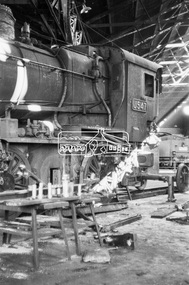 Eltham District Historical Society Inc
Photograph, Steam locomotives J-547 and J-512 in the locomotive shed, Bendigo Railway Station, 1962
... work on the regularor valve. November 1962" - Newsrail bendigo, bendigo railway station, george coop collection, j-512, j-547, j-class steam locomotive (vulcan foundry), railway turntable, railway workshop Digital TIFF file Scan of 35mm Ilford FP3 black and white negative transparency Steam locomotives J-547 and J-512 in the locomotive shed, Bendigo Railway Station Photograph Photograph George Coop George Coop ..."J547 undergoes maintenance that required removal of its motion gear, axle box and wheel set. The dome cover has also been removed to facilitate a boiler inspection and/or work on the regularor valve. November 1962" - NewsrailDigital TIFF file Scan of 35mm Ilford FP3 black and white negative transparencybendigo, bendigo railway station, george coop collection, j-512, j-547, j-class steam locomotive (vulcan foundry), railway turntable, railway workshop -
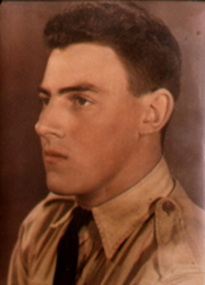 Waverley RSL Sub Branch
Photograph, L.A.C. Leonard John Hudson 156990 7ACS R.A.A.F
... Leonard John Hudson was born in Prahran and moved to Castlemaine in his early years At the beginning of the war was refused entry to the services due to his "reserved occupation" as a motor mechanic working on farm machinery At night he worked as a machinist for Thompson's Foundry machining breech blocks for 25 pound field guns. ...Leonard John Hudson was born in Prahran and moved to Castlemaine in his early years At the beginning of the war was refused entry to the services due to his "reserved occupation" as a motor mechanic working on farm machinery At night he worked as a machinist for Thompson's Foundry machining breech blocks for 25 pound field guns. ...Leonard John Hudson was born in Prahran and moved to Castlemaine in his early years At the beginning of the war was refused entry to the services due to his "reserved occupation" as a motor mechanic working on farm machinery At night he worked as a machinist for Thompson's Foundry machining breech blocks for 25 pound field guns. (image) Eventually he was granted enlistment into the R.A.A.F. into 7 Airfield Construction Squadron as a Leading Aircraftsman 156990 and was sent to Milne Bay with the unit to build the air strip.As one of few diesel mechanics he was often required to assist the US troops with their maintenance problems at various sites in or near New Guinea. Rare surviving images of 7 ACS newsletter Hand coloured photograph of L. J. Hudson in RAAF tropical uniform 1944 Copies of the "Spruiker" Magazine illustrations from August 1945 published at Milne Bay by 7ACS (7th Airfield Construction Squadron) Photograph of 25lb. Field Gun at Thompsons Foundry Pages from Photo Album showing L. J. Hudson in uniform at Castlemaine (one with his wife R. J. Hudson ) and at Milne Bay7 acs, 7 a.c.s., milne bay, thompsons foundry, field gun, l. hudson, len hudson, castlemaine, 25 pound field gun, hudson, spruiker, 7th airfield construction squadron -
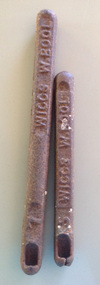 Warrnambool and District Historical Society Inc.
Functional object - Window weights, Circa 1890
... Mr Dutton was a mechanical engineer and Mr C Wiggs was an experienced foundry worker. They were innovative in their work and also manufactured a large number of everyday items such as verandah posts, brackets and milk aerators....Mr Dutton was a mechanical engineer and Mr C Wiggs was an experienced foundry worker. They were innovative in their work and also manufactured a large number of everyday items such as verandah posts, brackets and milk aerators. ...Dutton and Wiggs operated a brass and iron foundry known as the Warrnambool Brass and iron Foundry situated in Timor St. Mr Dutton was a mechanical engineer and Mr C Wiggs was an experienced foundry worker. They were innovative in their work and also manufactured a large number of everyday items such as verandah posts, brackets and milk aerators.The significance lies in the fact that the items were manufactured in Warrnambool by a well- established local business. Two solid cast iron rods of cylindrical shape with one flattened edge with name imprinted. Hollowed out section on one end. S. Wiggs W,bool. One has the number 7 and the other 5 cast into the metal. warrnambool, wiggs, dutton & wiggs, window weights -
 Bendigo Historical Society Inc.
Document - National Trust Collection: Golden City Implements Foundry, Ironbark, Bendigo, 1960-1980s
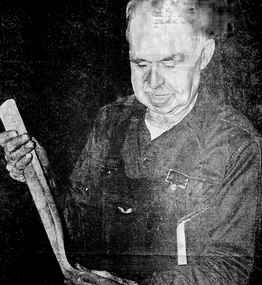
... Much of their work comes from Adelaide, and they maintain a steady demand for their specialized services. T he foundry and machine shop are considered landmarks in Bendigo, located on Eaglehawk Road opposite the Marong turn-off.The business was deeply embedded in the local community and history, with the Osborne name still prominent in the district....Much of their work comes from Adelaide, and they maintain a steady demand for their specialized services. T he foundry and machine shop are considered landmarks in Bendigo, located on Eaglehawk Road opposite the Marong turn-off.The business was deeply embedded in the local community and history, with the Osborne name still prominent in the district. history National Trust Bendigo Collection bendigo foundary iron bark bendigo National Trust Survey Data Sheet and article from the Bendigo Advertiser November 4th 1981. ...This foundry had been a landmark in Mt Korong Road for many years. It began with an Osborne and Mitchell. After 1914 when mining declined, it became the Golden City Implement boundary and the name can still be seen painted on on the façade which faces the intersection of Marong Road (Calder highway) and Eaglehawk Road. The interior is a mass of used and un-used machinery scattered amongst modern lathes and more modern apparatus. The yard was a fascinating graveyard of past times, with old mining and agricultural scrap everywhere mixed up with coke and slag from the smelting sheds at the rear. A feature of the foundry was the manufacturer of cast iron lace. This document provides a historical and contemporary overview of the Osborne family's blacksmith and metalworking business in Bendigo, highlighting its longevity, operations, and significance: The business dates back to at least 1855, originally starting as a general store before evolving into a metalworking factory. The original founders were Osborne and Mitchell; Mitchell left early on, and the business changed hands several times before being acquired by Oscar Osborne (not related to the original Osborne founder). Oscar Osborne managed the machine shop and foundry, eventually acquiring it. His sons, Charles and Walter, now run the business with Stan, a descendant of the original founder. The current operators are Charles and Walter Osborne (brothers) and Stan (a descendant of the original founder but not directly related to the brothers). The business is known for its continuity and resilience, surviving as one of the oldest in Bendigo while others have disappeared or are newcomers. The workshop covers about a third of an acre and houses a large array of machinery and tools (nearly 200 between the three operators). The Osbornes pride themselves on traditional skills and methods, many of which are being lost in modern times. They are renowned for repairing a wide range of metal items, especially for antique dealers, and for producing high-quality crowbars and decorative iron lace for both restoration and new construction. Much of their work comes from Adelaide, and they maintain a steady demand for their specialized services. T he foundry and machine shop are considered landmarks in Bendigo, located on Eaglehawk Road opposite the Marong turn-off.The business was deeply embedded in the local community and history, with the Osborne name still prominent in the district.National Trust Survey Data Sheet and article from the Bendigo Advertiser November 4th 1981. Osbornes Ironbark Foundry This items contains the following documents 3084.47a Bendigo advertiser Article 4th November 1981 "Bendigo Firm is Still Going Strong" 3084.47b National Trust Data Survey Sheet July 9th 1977 3084.47c Black and White photo of Charles Osbornehistory, national trust bendigo collection, bendigo, foundary, iron bark bendigo -
 Bendigo Historical Society Inc.
Ephemera - V/Line Bendigo workshops 'Open Day' leaflet
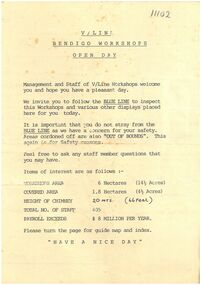
... work carried out was repairs and maintenance of existing wagons and locomotives, however during 1919-22 thirteen new steam locomotives were also built - eight DD class (1033 - 1037, 1047 - 1049) and five A2 class (1078 - 1082). From the 1950s onwards, numerous steam locomotives were scrapped at the workshops. During the years immediately following nominal dieselisation in 1968, they were, at times, cutting up locomotives at the rate of one every two to three weeks. The workshops were also the site of the first VR brass foundry...work carried out was repairs and maintenance of existing wagons and locomotives, however during 1919-22 thirteen new steam locomotives were also built - eight DD class (1033 - 1037, 1047 - 1049) and five A2 class (1078 - 1082). From the 1950s onwards, numerous steam locomotives were scrapped at the workshops. During the years immediately following nominal dieselisation in 1968, they were, at times, cutting up locomotives at the rate of one every two to three weeks. The workshops were also the site of the first VR brass foundry ...The workshops were opened in November 1917 by the Victorian Railways. It opened in response to political pressures from provincial groups for decentralisation, with the Victorian Railways preferring the cheaper option of expanding the existing Newport Workshops in suburban Melbourne. Furthermore, unemployment had risen in both Bendigo and Ballarat due to a decline in mining operations. The main work carried out was repairs and maintenance of existing wagons and locomotives, however during 1919-22 thirteen new steam locomotives were also built - eight DD class (1033 - 1037, 1047 - 1049) and five A2 class (1078 - 1082). From the 1950s onwards, numerous steam locomotives were scrapped at the workshops. During the years immediately following nominal dieselisation in 1968, they were, at times, cutting up locomotives at the rate of one every two to three weeks. The workshops were also the site of the first VR brass foundry, which was transferred to Newport by the 1960s. Also, throughout 1965, VLX louvred vans were constructed at the workshops, at a rate of one a week. Other tasks included spring manufacture, construction of stainless steel footwarmers, and assembly of pantographs for electric trains, with a staff of 720 employed during 1966. By the 1980s, refurbishment work was also being carried out on Melbourne suburban electric multiple units. The 1980s were also a time of restructuring, and on the breakup of the Victorian Railways the workshops passed to the State Transport Authority and then the Public Transport Corporation. With privatisation the workshops were closed, with the loss of 262 jobs. In February 1996, the workshops were taken over by A Goninan & Co. In October 1999 the workshops were purchased by Great Northern Rail Services, with A Goninan & Co remaining as a tenant. In February 2001 A Goninan & Co vacated the site. The workshops were redeveloped in 2002 at a cost of $6.5 million - $4 million from VicTrack, $2 million from the State Government Regional Infrastructure Development Fund and $500,000 by the City of Greater Bendigo. The Bendigo Rail Workshops at North Bendigo are currently used by Southern Shorthaul Railroad to maintain broad gauge rolling stock for Pacific National, V/Line, Metro Trains Melbourne and CFCLA.Typed document. A4 page folded in half. On tan paper. Document pertaining to Bendigo V/Line workshops open day. Map on inside of folded page. Undated document.train, v/line, workshops, open day -
 Bendigo Historical Society Inc.
Photograph - DEBORAH GOLD MINE, GOLDEN SQUARE
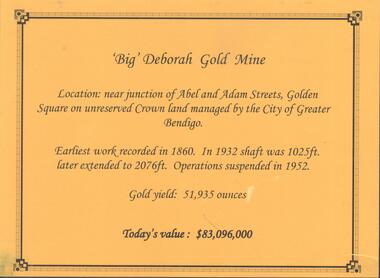
... work recorded 1860. Shaft 2076 feet. Operations suspended in 1952. Gold yield 51,935 ounces. Battery shed still on site containing a 5 head stamper which was originally a 20 head stamper. The battery was manufactured by Horwood's Foundry...work recorded 1860. Shaft 2076 feet. Operations suspended in 1952. Gold yield 51,935 ounces. Battery shed still on site containing a 5 head stamper which was originally a 20 head stamper. The battery was manufactured by Horwood's Foundry ...Information display card regarding the 'Big' Deborah Gold Mine, located near the junction of Abel and Adam Street, Golden Square. Earliest work recorded 1860. Shaft 2076 feet. Operations suspended in 1952. Gold yield 51,935 ounces. Battery shed still on site containing a 5 head stamper which was originally a 20 head stamper. The battery was manufactured by Horwood's Foundry, Bendigo. Photos of mine site taken in 2012: a.Engine room concrete footings, iron work visible. Pepper corn trees in background. Pampas grass in foreground. Steel mesh fence on RH side, enclosing the poppet head site. b. Concrete footings, peppercorn tree in background. c. Corrugated iron shed constructed over the stampers. Steel mesh front. d. Steel poppet head, no winding wheel at top. Pampas grass in foreground. e.. Stamper shed and steel poppet legs in background enclosing dilapidated wooden poppet head legs. f. Close up image of weights in stamper room g.Winding wheel on stampers h.Looking upwards to top of stampersbendigo, mining, deborah gold mine -
 Bendigo Historical Society Inc.
Newspaper - LONG GULLY HISTORY GROUP COLLECTION: OLD BATTERY TO CHARGE-UP TUNNEL TOURISM
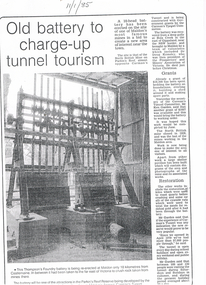
... Foundry battery and it was being re-erected at Maldon, near Castlemaine. It has been in far of Victoria to crush rock taken from mines there. The battery will be one of the attractions in the Parkin's Reef Reserve being developed by the Conservation, Forests and Lands. Also mentioned is the work...Foundry battery and it was being re-erected at Maldon, near Castlemaine. It has been in far of Victoria to crush rock taken from mines there. The battery will be one of the attractions in the Parkin's Reef Reserve being developed by the Conservation, Forests and Lands. Also mentioned is the work ...BHS CollectionThree photocopies of a newspaper article titled Old Battery to charge-up tunnel tourism. The date 11/1/85 is written at the top of the article. There is a photo of the battery mentioning it was the Thompson's Foundry battery and it was being re-erected at Maldon, near Castlemaine. It has been in far of Victoria to crush rock taken from mines there. The battery will be one of the attractions in the Parkin's Reef Reserve being developed by the Conservation, Forests and Lands. Also mentioned is the work of volunteers, grants they received, restoration and tourism.bendigo, history, long gully history group, the long gully history group - old battery to charge-up tunnel tourism, thompson's foundry, parkin's reef reserve, conservation forests and lands department, carman's tunnel, north british mine, parkin's reef, carman's tunnel committee, dr doug kemsley, prospectors' and miners' association of victoria, ken garden, north british mine, george ellis -
 Bendigo Historical Society Inc.
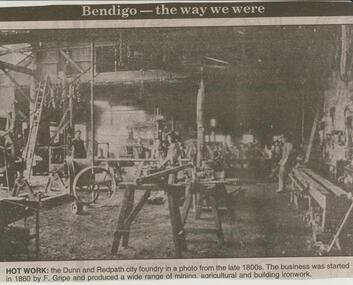
Newspaper - JENNY FOLEY COLLECTION: HOT WORK
... Hot work: the Dunn and Redpath city foundry in a photo from the late 1800s. ...Hot work: the Dunn and Redpath city foundry in a photo from the late 1800s. ...Bendigo Advertiser ''The way we were'' from 2000. Hot work: the Dunn and Redpath city foundry in a photo from the late 1800s. The business was started in 1860 by F. Gripe and produced a wide range of mining, agricultural and building ironwork. The clip is in a folder.newspaper, bendigo advertiser, the way we were -
 Bendigo Historical Society Inc.
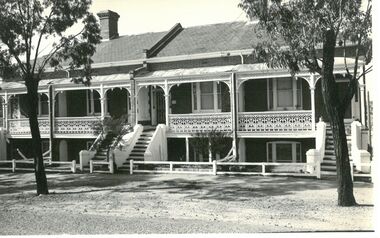
Photograph - Corner McKenzie Short
... foundries in Melbourne alone. It was cheaper to make than wrought iron. "Pig iron", iron ore, was melted in a blast furnace, mixed with alloys and then poured into moulds usually made of sand. The alloys needed a minimum of 2% carbon. Iron Lace Work ...Cast iron lace was made in foundries in most cities. There were 42 such foundries in Melbourne alone. It was cheaper to make than wrought iron. "Pig iron", iron ore, was melted in a blast furnace, mixed with alloys and then poured into moulds usually made of sand. The alloys needed a minimum of 2% carbon.Black and White photos by A Doney of House on corner of Mc Kenzie and Short Street Bendigo showing lace ironwork on the balustrade.Photo A Doneyiron lace work, a doney, historical home bendigo -
 Bendigo Historical Society Inc.
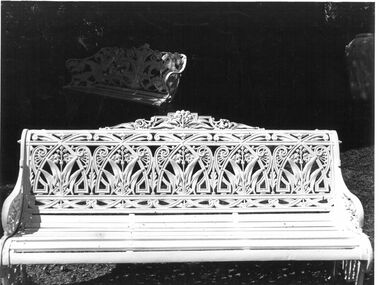
Photograph - Bench Seat Iron Lacework
... foundries in most cities. There were 42 such factories in Melbourne alone. It was cheaper to make than wrought iron. "Pig iron", iron ore was melted in a blast furnace, mixed with alloys and then poured into moulds usually made of sand. The alloys needed a minimum of 2% carbon. Iron Lace Work ...Cast iron lace was made in foundries in most cities. There were 42 such factories in Melbourne alone. It was cheaper to make than wrought iron. "Pig iron", iron ore was melted in a blast furnace, mixed with alloys and then poured into moulds usually made of sand. The alloys needed a minimum of 2% carbon.Black and White photos by A Doney of bench seats one showing fern detail and the other leaves and flowers.Photo A Doneyiron lace work, a doney, bench seats -
 Bendigo Historical Society Inc.
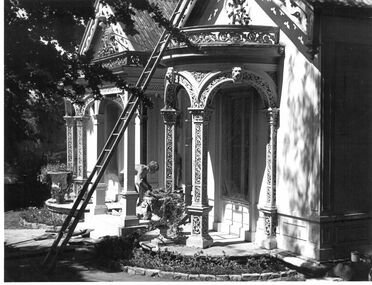
Photograph - Lace Iron Work
... foundries in Melbourne alone. It was cheaper to make than wrought iron. "Pig iron", iron ore, was melted in a blast furnace, mixed with alloys and poured into moulds usually med from sand. The alloys needed a minimum of 2% carbon. Bendigo Wrought iron Allan Doney A Doney Bendigo Black and White photo by A Doney of sandblasting iron lace work ...Cast iron lace was made in foundries in most cities. There were 42 such foundries in Melbourne alone. It was cheaper to make than wrought iron. "Pig iron", iron ore, was melted in a blast furnace, mixed with alloys and poured into moulds usually med from sand. The alloys needed a minimum of 2% carbon.Black and White photo by A Doney of sandblasting iron lace work on unknown property in Bendigo. Two internal photos of door and arch ways. Larger photo of balustrade with verandah pillars in backgroundA Doney Bendigobendigo, wrought iron, allan doney -
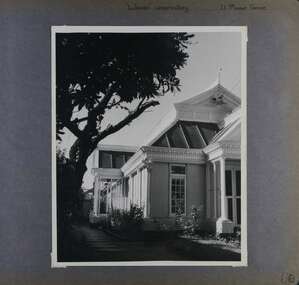 Glen Eira Historical Society
Album - Album page, Labassa Conservatory, 21 Manor Grove, Circa 1972
... foundry...brick...cast iron work...This building is unusual as an example converted to residential use. bracketed eaves caulfield north labassa balaclava road orrong road sylliott hill alexander william robertson ontario john a. b. koch john boyd watson mouldings 1920's la bassa manor grove st kilda east architects john koch greenhouses gardens plants land subdivisions gates macfarlane foundry brick cast iron work hipped roofs gables 1890's Handwritten: "Labassa" conservatory 21 Manor Grove [top right] /130 [bottom right] Page 130 of Photograph Album with one portrait photograph of Labassa's conservatory. ...This photograph is part of the Caulfield Historical Album 1972. This album was created in approximately 1972 as part of a project by the Caulfield Historical Society to assist in identifying buildings worthy of preservation. The album is related to a Survey the Caulfield Historical Society developed in collaboration with the National Trust of Australia (Victoria) and Caulfield City Council to identify historic buildings within the City of Caulfield that warranted the protection of a National Trust Classification. Principal photographer thought to be Trevor Hart, member of Caulfield Historical Society. Most photographs were taken between 1966-1972 with a small number of photographs being older and from unknown sources. All photographs are black and white except where stated, with 386 photographs over 198 pages. WHAT IS SIGNIFICANT? [From Victorian Heritage Database citation for Former Labassa Conservatory - H2005 Victorian Heritage Register http://vhd.heritage.vic.gov.au/places/result_detail/12504 (25/01/2021)] The former Labassa Conservatory is believed to have been built as part of the extensive reworking of the Labassa estate in c1890 for the new owner Alexander Robertson, proprietor of the Cobb and Co line. Robertson commissioned the architect JAB Koch to remodel the house, and Koch may have been responsible for the conservatory as well. Alternatively, the conservatory may have been imported. The gates installed at Labassa in 1890 were manufactured by the MacFarlane foundry of Glasgow, Scotland, a firm known to have manufactured conservatories. Around 1917 the glass house from 'Labassa', Caulfield was offered for sale to Malvern Council for its own gardens but the offer was declined. Following subdivision of the Labassa estate in the 1920s the conservatory was converted into a residence. The structure has a simple rectangular plan, with a brick base and superstructure of cast iron columns and roof trusses. The hipped roof is surmounted by an elaborately decorated gable structure. Most of the original glass has been replaced by metal sheeting. The decoration comprises pressed metal fascias including an egg and dart style cornice moulding, mullion mouldings and gable end panels with a rising sun motif. Cast iron ridgework and finials add to the lively roof form. Internally the floor appears to have been raised as part of the conversion work to a residence, and stained timber panelling introduced to provide room spaces. Boilers probably heated the conservatory in the colder months, but these do not survive.From Victorian Heritage Database citation for Former Labassa Conservatory - H2005 http://vhd.heritage.vic.gov.au/places/result_detail/12504 (25/01/2021) HOW IS IT SIGNIFICANT? The former Labassa Conservatory is of historical and architectural significance to the State of Victoria. WHY IS IT SIGNIFICANT? The former Labassa Conservatory is historically significant for its associations with the Labassa estate. Subdivision of the estate separated a number of outbuildings from the mansion. The former conservatory is significant as part of the large scale improvements carried out to the estate in the 1890s. The nineteenth century was the great age of conservatory designs, enabled by technological developments in heating, glazing and iron. Whilst conservatories were common in botanical gardens and universities, where they were primarily used for cultivating, studying, and experimenting with plants, they had also become an accessory of the wealthy on private estates. The former Labassa conservatory is architecturally significant as a rare example of a building type. Many Victorian mansion houses had attached conservatories, but detached conservatories were much less common. The only other detached example associated with a residence known to survive on its original site in Victoria is an earlier example at Warrock homestead, near Casterton. Conservatories attached to nineteenth century mansions are far more numerous. The Labassa example is very ornate, and its decoration draws on the versatility of pressed metal and cast iron. This highlights the dual purpose of the conservatory, as both a functional structure and a picturesque building on the Labassa estate. This building is unusual as an example converted to residential use. Page 130 of Photograph Album with one portrait photograph of Labassa's conservatory.Handwritten: "Labassa" conservatory 21 Manor Grove [top right] /130 [bottom right]bracketed eaves, caulfield north, labassa, balaclava road, orrong road, sylliott hill, alexander william robertson, ontario, john a. b. koch, john boyd watson, mouldings, 1920's, la bassa, manor grove, st kilda east, architects, john koch, greenhouses, gardens, plants, land subdivisions, gates, macfarlane foundry, brick, cast iron work, hipped roofs, gables, 1890's -
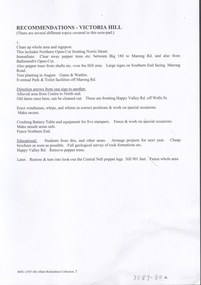 Bendigo Historical Society Inc.
Document - VICTORIA HILL - RECOMMENDATIONS FOR VICTORIA HILL
... Ballerstedt's Crushing Battery at Victoria Hill, Thompson's Foundry at Castlemaine, Machinery made for Bendigo Mines, Air Compressor at Shenandoah Mine, Winding Engine at Koch's Pioneer Mine, Poppet Legs at Koch's Pioneer Mine, Air Compressor at New Chum Railway Mine, Fortune Hustlers G M Co Bendigo View of Mine, Winding Plant and Afternoon Shift and Underground Work in the New Chum Railway. ...Ballerstedt's Crushing Battery at Victoria Hill, Thompson's Foundry at Castlemaine, Machinery made for Bendigo Mines, Air Compressor at Shenandoah Mine, Winding Engine at Koch's Pioneer Mine, Poppet Legs at Koch's Pioneer Mine, Air Compressor at New Chum Railway Mine, Fortune Hustlers G M Co Bendigo View of Mine, Winding Plant and Afternoon Shift and Underground Work in the New Chum Railway. ...BHS CollectionHandwritten notes on recommendations for cleaning up and signposting Victoria Hill. Also contains list of photos from the Bendigonian of 1899. List of photos: Shamrock Mine, Undershot Water Wheel at Diamond Hill for Phillips Crushing Battery. Mr. Ballerstedt's Crushing Battery at Victoria Hill, Thompson's Foundry at Castlemaine, Machinery made for Bendigo Mines, Air Compressor at Shenandoah Mine, Winding Engine at Koch's Pioneer Mine, Poppet Legs at Koch's Pioneer Mine, Air Compressor at New Chum Railway Mine, Fortune Hustlers G M Co Bendigo View of Mine, Winding Plant and Afternoon Shift and Underground Work in the New Chum Railway. Also mentioned are notes on Machinery made by Thompsons. Also, a carbon copy of Annual Report to Bendigo Branch Royal Historical Society, Victoria 1/7/71. Mentioned in the Report are: Historical Ball, The Central Deborah, Victoria Hill, Tours and Society Business. Albert Richardson document?document, victoria hill, recommendations for victoria hill, north old chum, ballerstedt's rich 24 yard claim, floyds battery lansell's big 180, the bendigonian 26/1/1899, 2/2/1899, 20/4/1899, 11/5/1899, 10/8/1899, 14/9/1899, shamrock mine, undershot waterwheel at diamond hill, phillips crushing battery, mr ballerstedt's crushing battery, thompson's foundry, shenandoah mine, koch's pioneer mine, new chum railway mine, fortuna hustlers g m co bendigo, new chum railway, st mungo lady barkly, catherine reef, new moon, rae's open cut, old court house eaglehawk, police barracks, vic wodetzki, joss house, central deborah, central nell gwynne, mr harold curnow, bendigo branch royal historical society victoria, mrs kingerlee, felicity kingerlee, mr h biggs, city council, rotary club of bendigo south, white hills cemetry, chinese joss house, bendigo pottery, mr derham, reservoir high, princess theatre, a n a hall, mr hattam, col. sprenger, survey corps, a richardson -
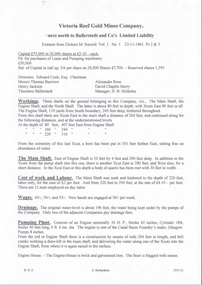 Bendigo Historical Society Inc.
Document - NEW CHUM & VICTORIA LINES OF REEF - VICTORIA REEF GOLD MINES COMPANY
... Foundry Glasgow Photocopied handwritten notes about the Victoria Reef Gold Mines Company. Extracts from Dickers M. Record Vol. 1 23/11/1861 Ps 2 &3. Extracts include Capital, Shares, Names of Directors and Manager, Workings, Main shaft size and depth, Cost of work and labour, Drainage, Pumping Plant and Engine House. ...Photocopied handwritten notes about the Victoria Reef Gold Mines Company. Extracts from Dickers M. Record Vol. 1 23/11/1861 Ps 2 &3. Extracts include Capital, Shares, Names of Directors and Manager, Workings, Main shaft size and depth, Cost of work and labour, Drainage, Pumping Plant and Engine House.document, gold, new chum & victoria lines of reef, victoria reef gold mines company, ballerstedt & co l l, edward cook esq, thomas burrows, henry jackson, alexander rose, david chaplin sterry, theodore ballerstedt, h b nicholas, canal basin foundry glasgow -
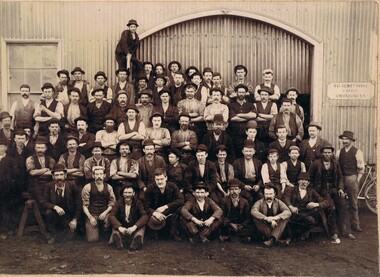 Bendigo Historical Society Inc.
Photograph - GROUP OF SIXTY FOUR MEN (FOUNDRY WORKERS?)
... work group of blue collar workers. All have hats or caps of various kinds. Standing in front of an iron wall with a doorway and one window. Eight have pipes, most are mature men but there are some young boys (apprentices?). Inscriptions: in image - sign of RH side of doorway 'no admittance except on business'. On back - stamp 'WH Robinson, Photographer, Bendigo. Handwritten 'cannot identify', '?foundry...work group of blue collar workers. All have hats or caps of various kinds. Standing in front of an iron wall with a doorway and one window. Eight have pipes, most are mature men but there are some young boys (apprentices?). Inscriptions: in image - sign of RH side of doorway 'no admittance except on business'. On back - stamp 'WH Robinson, Photographer, Bendigo. Handwritten 'cannot identify', '?foundry ...Black and white photograph, mounted on brown board. Group of sixty four men in six rows, with one young man standing, straddled over a post, above the rest of the group. One Aborigine? On the RH side of picture. They are a work group of blue collar workers. All have hats or caps of various kinds. Standing in front of an iron wall with a doorway and one window. Eight have pipes, most are mature men but there are some young boys (apprentices?). Inscriptions: in image - sign of RH side of doorway 'no admittance except on business'. On back - stamp 'WH Robinson, Photographer, Bendigo. Handwritten 'cannot identify', '?foundry staff?'.WH Robinsonperson, group, male group of workers
