
Showing 22 items matching "great ocean road trust"
-
 Lorne Historical Society
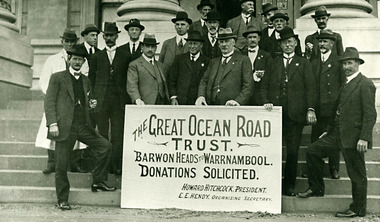
Photograph, Great Ocean Road Trust, taken at Geelong Town Hall 1918
... Great Ocean Road Trust, taken at Geelong Town Hall 1918...Group photography Great Ocean Road Trust, taken at Geelong Town Hall 1918...Great Ocean Road. Geelong Town Hall Group photography Great Ocean Road Trust, taken at Geelong Town Hall 1918 Great Ocean Road Trust, taken at Geelong Town Hall 1918 Photograph Photograph ...Group photography Great Ocean Road Trust, taken at Geelong Town Hall 1918great ocean road. geelong town hall -
 Warrnambool and District Historical Society Inc.
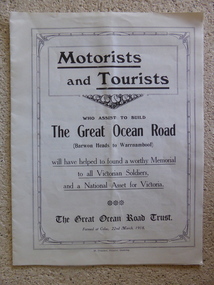
Leaflet, Motorists and Tourists
... great ocean road...great ocean road trust 1918...This leaflet published by The Great Ocean Road Trust in 1918 gives information about the proposed building of the Great Ocean Road from Barwon Heads to Warrnambool as a memorial to Victorian soldiers in World War One. ...It has 10 photographs of views along the Great Ocean Road and typed information on the Great Ocean Road Trust and its Building Appeal. ...This leaflet published by The Great Ocean Road Trust in 1918 gives information about the proposed building of the Great Ocean Road from Barwon Heads to Warrnambool as a memorial to Victorian soldiers in World War One. ...This leaflet published by The Great Ocean Road Trust in 1918 gives information about the proposed building of the Great Ocean Road from Barwon Heads to Warrnambool as a memorial to Victorian soldiers in World War One. The President of the Trust, which was a private company seeking donations from the public, was Howard Hitchcock, the Mayor of Geelong. The Memorial Great Ocean Road commenced in 1919 with 3000 ex-servicemen employed to build the road. In 1932 the road was completed to Apollo Bay and in 1936 the road was officially handed into the care of the State Government. This leaflet is of some significance as it shows the initial efforts by Howard Hitchcock of Geelong and a private trust to build the Great Ocean Road in Victoria. This road is today of international significance This is an unbound leaflet of 8 pages (almost A4 size) folded into two insert pages. It has 10 photographs of views along the Great Ocean Road and typed information on the Great Ocean Road Trust and its Building Appeal. It was produced in 1918.great ocean road, great ocean road trust 1918, warrnambool history, memorial great ocean road -
 Anglesea and District Historical Society
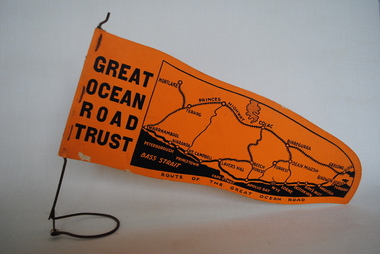
Pennant, Unknown
... great ocean road trust...GREAT/ OCEAN/ ROAD/ TRUST. Map of Area/ Route of the Great Ocean. ...great ocean road trust GREAT/ OCEAN/ ROAD/ TRUST. Map of Area/ Route of the Great Ocean. ...Orange pennant flag listing towns on and near the Great Ocean Road. List of town names on pennant - (west to east) Mortlake, Warrnambool, Nirranda, Terang, Port Campbell, Lavers Hill, Colac, Beech Forest, Apollo Bay, Wye, Birregurra, Forrest, Deans Marsh, Peterborough, Princetown, Lorne, Eastern View, Airy's Inlet, Anglesea, Torquay, Geelong, Barwon Heads.GREAT/ OCEAN/ ROAD/ TRUST. Map of Area/ Route of the Great Ocean. (Orange - on wire stand. Printed on both sides.) great ocean road trust -
 Lorne Historical Society
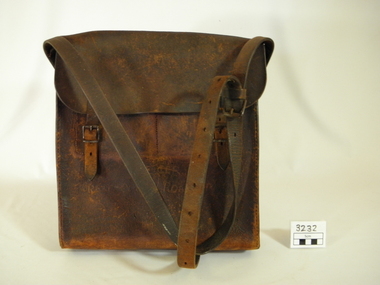
Functional object - Bag, circa1925
... Hand scratched on front of bag:-"GREAT OCEAN ROAD TRUST"....Great Ocean Road. First "Toll Gate" at Sunnymeade Estate as the road went through land owned by Mr C J Lane. Toll gates followed at "Stradbroke Point",later changed to "Stradbroke Knoll" named after the Govenor of Victoria, Lord Stradbroke, Grassy Creek and "The Springs". Mr W D McKay first toll keeper, then Mr & Mrs Wright. Toll commenced circa 1925 and ended 2nd October 1936. Cars were charged at 2/6 for car and driver and 1/- for each passenger. Motor cycles 2/-. leather bag toll gates toll keepers Great Ocen Road Hand scratched on front of bag:-"GREAT OCEAN ROAD TRUST ...One of the toll bags used to collect tolls on the Great Ocean Road. First "Toll Gate" at Sunnymeade Estate as the road went through land owned by Mr C J Lane. Toll gates followed at "Stradbroke Point",later changed to "Stradbroke Knoll" named after the Govenor of Victoria, Lord Stradbroke, Grassy Creek and "The Springs". Mr W D McKay first toll keeper, then Mr & Mrs Wright. Toll commenced circa 1925 and ended 2nd October 1936. Cars were charged at 2/6 for car and driver and 1/- for each passenger. Motor cycles 2/-. Brown leather bag, with adjustable shoulder strap for carrying. Enclosed with a flap done up by 2 buckles.Hand scratched on front of bag:-"GREAT OCEAN ROAD TRUST".leather bag, toll gates, toll keepers, great ocen road -
 Lorne Historical Society
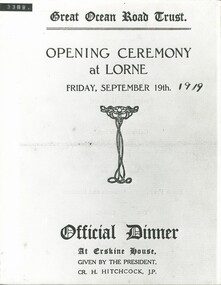
Photograph, G.O.R. Trust Opening Ceremony Announcement
... Photograph showing advertisement of Official Opening Ceremony Dinner for the Great Ocean Road Trust held at Erskine House September 19 1919...G.O.R-Trust; Opening-Ceremony-Official-Dinner: Sep-19-1919; Erskine-House-Lorne Photograph showing advertisement of Official Opening Ceremony Dinner for the Great Ocean Road Trust held at Erskine House September 19 1919 G.O.R. ...Photograph showing advertisement of Official Opening Ceremony Dinner for the Great Ocean Road Trust held at Erskine House September 19 1919g.o.r-trust; opening-ceremony-official-dinner: sep-19-1919; erskine-house-lorne -
 Lorne Historical Society
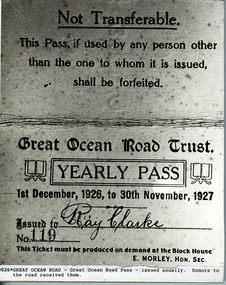
Photograph, Great Ocean Road Yearly Travel Pass
... Great Ocean Road. Trust. Yearly travel pass...Trust, Yearly Pass Great Ocean Road. Trust. Yearly travel pass Photo of Annual Yearly Pass. ...Dated 1 December 1926 to 30 November 1927. G.O.R. Trust, Yearly PassPhoto of Annual Yearly Pass. Dated 1st December 1926 to 30th November 1927. Donors to Road received them.great ocean road. trust. yearly travel pass -
 Lorne Historical Society
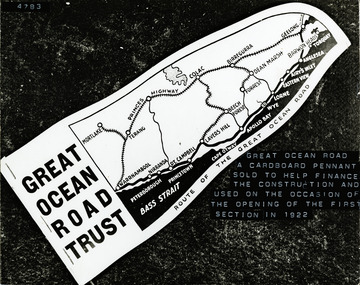
Photograph, Cardboard Souvenir Pendant sold to finance G.O.R constuction
... Great Ocean Road Trust; Financing of Great Ocean Road; Cardboard Pendant...Great Ocean Road Trust; Financing of Great Ocean Road; Cardboard Pendant Photograph of a cardboard pendant sold by the G.O.R. ...Photograph of a cardboard pendant sold by the G.O.R. Trust to help finance the construction of the road. and used on the occasion of the opening of the first section in 1922great ocean road trust; financing of great ocean road; cardboard pendant -
 Peterborough History Group
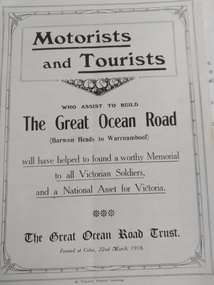
Booklet, Motorists and Tourists who assist to build The Great Ocean Road (Barwon Heads to Warrnambool)
... great ocean road...peterborough...the arch...loch ard gorge...tourism...the great ocean road trust...Great Ocean Road which, upon completion, would then be a Memorial to soldiers and, during construction, provide employment for returned soldiers. The GOR was added to and improved to encourage tourism and has had a direct and lasting impact on the development of the towns, including Peterborough. great ocean road peterborough the arch loch ard gorge tourism the great ocean road trust Facsimile copy of an A4 size leaflet issued in 1918, 4 pages including photographs Motorists and Tourists who assist to build The Great Ocean Road (Barwon Heads to Warrnambool)..... ...The booklet's full title is 'Motorists and Tourists who assist to build The Great Ocean Road (Barwon Heads to Warrnambool) will have helped to found a worthy Memorial to all Victorian Soldiers and a National Asset for Victoria.' Date of the copy is unknown. The booklet is an appeal for donations toward the construction of the Great Ocean Road which, upon completion, would then be a Memorial to soldiers and, during construction, provide employment for returned soldiers. The GOR was added to and improved to encourage tourism and has had a direct and lasting impact on the development of the towns, including Peterborough.Facsimile copy of an A4 size leaflet issued in 1918, 4 pages including photographsgreat ocean road, peterborough, the arch, loch ard gorge, tourism, the great ocean road trust -
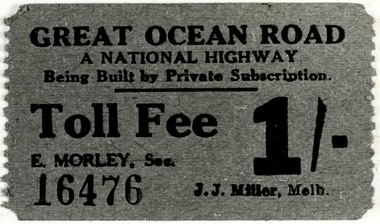 Lorne Historical Society
Photograph - Great Ocean Road Toll pass
... Great Ocean Road Passenger Service/Annual Pass/For the year ending November 30th 1936 No 2/Issued to K Quicks Sedan Motors/Subject to compliance with Government Trust Regulations/For Passenger Vehicle Registered No 220529/For the Great Ocean Road Trust PTY LTD/ Date of Issued 3/12/35/ signature unclear/ Secretary/ This pass, which is for Driver and Vehicle only, must be carried by/ Driver, and produced to Toll Gate- keeper on demand, otherwise ordinary / Toll Fees are chargeable....Great Ocean Road was built largely by returned serviceman from the First World . The road was built to link the coastal towns, provide better access, to foster tourism and employ the returned servicemen. Fewer private vehicles travelled the road then, most tourists came on coaches and buses. Tourists stayed in guesthouses and hotels. great ocean road great ocean road tolls Great Ocean Road Passenger Service/Annual Pass/For the year ending November 30th 1936 No 2/Issued to K Quicks Sedan Motors/Subject to compliance with Government Trust Regulations/For Passenger Vehicle Registered No 220529/For the Great Ocean Road Trust PTY LTD/ Date of Issued 3/12/35/ signature unclear/ Secretary/ This pass, which is for Driver and Vehicle only, must be carried by/ Driver, and produced to Toll Gate- keeper on demand, otherwise ordinary / Toll Fees are chargeable. ...Tolls were used on the Great Ocean Road from 192 until 19. . Toll gates were at Eastern View and Lorne. Money collected was used to help pay for the construction and maintenance of the road.The Great Ocean Road was built largely by returned serviceman from the First World . The road was built to link the coastal towns, provide better access, to foster tourism and employ the returned servicemen. Fewer private vehicles travelled the road then, most tourists came on coaches and buses. Tourists stayed in guesthouses and hotels. A laminated rectangular , beige , cardboard Great Ocean Road Passenger Service Annual Pass for 1936. Printing is in red lettering with black ink handwritingGreat Ocean Road Passenger Service/Annual Pass/For the year ending November 30th 1936 No 2/Issued to K Quicks Sedan Motors/Subject to compliance with Government Trust Regulations/For Passenger Vehicle Registered No 220529/For the Great Ocean Road Trust PTY LTD/ Date of Issued 3/12/35/ signature unclear/ Secretary/ This pass, which is for Driver and Vehicle only, must be carried by/ Driver, and produced to Toll Gate- keeper on demand, otherwise ordinary / Toll Fees are chargeable.great ocean road, great ocean road tolls -
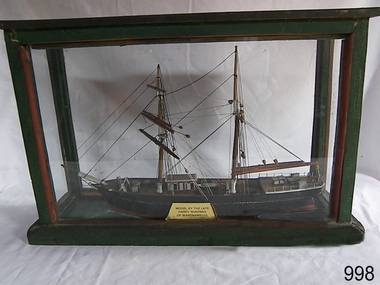 Flagstaff Hill Maritime Museum and Village
Craft - Ship Model, Mary Campbell, circa 1940
... The model is also significant for its association with the brigantine MARY CAMPBELL, a trading vessel that brought railway girders to the Melbourne Harbour Trust. flagstaff hill warrnambool shipwrecked coast flagstaff hill maritime museum maritime museum shipwreck coast flagstaff hill maritime village great ocean road marine artwork model making captain james arthur robilliard j.a. robilliard vessel mary campbell ship mary campbell melbourne sailors home vessels harry mckenna Mary Campbell Painted on the bow in white “MARY CAMPBELL” Gold label with black print attached to display case “MODEL BY THE LATE HARRY McKENNA OF WARRNAMBOOL” Ship model "Mary Campbell": a two-masted vessel with black hull, brown masts and black rigging, displayed in a glass case with a timber frame painted green. ...This ship model is of the sailing brigantine MARY CAMPBELL, which once belonged to Captain James Arthur Robilliard. The model was made by Harry McKenna, a well-known ship model maker and Warrnambool resident. CAPTAIN ROBILLIARD James Arthur Robilliard, sea captain and tent maker, was born in 19th April 1843 in St. Helier, Jersey, Channel Islands. He trained there in his father’s sail loft as a sailmaker. He later became a skipper. His first job was as a sailor in Liverpool, England. In 1875, James Robilliard migrated to Australia as a mate on the “E.M. Young”. Captain Robilliard and his family were amongst the early settlers along the Curdies River in the Heytesbury district. In 1877, he became a Captain. On 14th November 1879, Captain Robilliard married Helen Beckett. James and Helen had ten children: James Arthur (Jnr), Henry William, Nellie Jessie, Alfred Albert, Rubena Nellie, De Jersy Norman, Clifford Beckett, Olive Ida, Frances Ridley Havergal and Nellie Elvie, all born in Victoria. THE MARY CAMPBELL The ship “Mary Campbell” was built by Alexander Newton Jr. She was carvel-planked, of iron bark and blue gum timber. The family shipyard was at Pelican, on the Manning River, NSW, and “Mary Campbell” was first launched by her builder in 1869 as “The Son”. Three months later, she was renamed “Mary Campbell’ by her purchaser J. Campbell in Sydney. She was used to carry equipment for the Sydney Sugar Refinery’s Mill in Southgate, NSW. She then traded for the next 20 years between Australian ports and rivers along the east coast, as well as regular ports in New Zealand. She was “recognised as one of the best carrying little vessels in the timber trade” (Sydney Morning Herald). She had several owners over this time, the last one being Captain James A. Robilliard. On 29th April 1889, “Mary Campbell”, in the charge of her owner, Captain James A Robilliard, was on her way from Clarence River, NSW to Melbourne, Victoria with a cargo of railway girders for the Melbourne Harbour Trust. Captain Robilliard encountered a storm off Port Macquarie. He sailed the vessel south to 25 miles (about 40km) east of Cape Hawke, near Tuncurry and Forster. At 7 pm, he discovered that the cargo had shifted during the stormy seas and the heavy girders had damaged the hull, causing a leak. The pumps were inadequate to stem the fast-flowing leak, and over a meter of water filled the hull during the next 2 hours. Some of the crew began throwing the cargo overboard to lighten the vessel, hoping to keep it afloat until daylight. When the water reached over 2 meters in the hull, they realised their efforts were in vain. At 1:30 am on 30th April 1889, the crew left the vessel. They stood by in the lifeboat until 3 am. The ship was sinking fast, so they left for the shore, looking for a safe place to beach their boat. While still miles off Cape Hawke, all 7 crew members, including the Captain, were rescued by the Government Tug “Rhea” and taken to Port Macquarie hospital, then returned to Sydney in the “Wellington”. Captain Robilliard managed to rescue his ship’s compass, but no cargo was saved from the vessel. It had been under-insured, only covered for half its value, due to a lack of funds. Many years later, in 1976, an anchor was caught up in the net of a trawler south of Forster and thought to be from the “Mary Campbell”. It was donated and installed in the Great Lakes Museum, Tuncurry, NSW. (The same museum also has a half-model of the hull of “Mary Campbell”.) The name of the last ship Captain Robilliard sailed is currently unknown; however, he sailed that ship from the port of Marlborough, Queensland, carting steel railway girders for the Geelong-to-Camperdown line. On one trip, it hit a storm, the cargo shifted, and the ship was wrecked along the NSW coast. After this, Captain Robilliard exchanged sea life for farming in Peterborough. In about 1897, verging on retirement, Capt. Robiilliard superintended the Melbourne Sailors’ Home in Spencer Street, Melbourne, before being asked to leave this position in 1902 for trying to shut down the local hotel! At this time, the Melbourne Sailors’ Home was about to change its location. On 6th May 191,7, Captain James Arthur Robilliard J.P. died at Blackwood Park, in the Cobden district of Brucknell, which is now considered the first official Robilliard family homestead in Australia. He was buried in the Melbourne General Cemetery, Victoria. His wife, Helen, passed away in 1947. The Becket and Robilliard family names continue to be well known in the Western District. Flagstaff Hill Maritime Village also has a ship’s compass in the collection that was owned by Capt. J. Robilliard and used on the ship Mary Campbell.This ship model of the MARY CAMPBELL is of local significance for its association with well well-known Warrnambool resident and ship model maker. The model is also significant for its association with the brigantine MARY CAMPBELL, a trading vessel that brought railway girders to the Melbourne Harbour Trust.Ship model "Mary Campbell": a two-masted vessel with black hull, brown masts and black rigging, displayed in a glass case with a timber frame painted green. Made by Harry McKenna.Painted on the bow in white “MARY CAMPBELL” Gold label with black print attached to display case “MODEL BY THE LATE HARRY McKENNA OF WARRNAMBOOL”flagstaff hill, warrnambool, shipwrecked coast, flagstaff hill maritime museum, maritime museum, shipwreck coast, flagstaff hill maritime village, great ocean road, marine artwork, model making, captain james arthur robilliard, j.a. robilliard, vessel mary campbell, ship mary campbell, melbourne sailors home, vessels, harry mckenna, mary campbell -
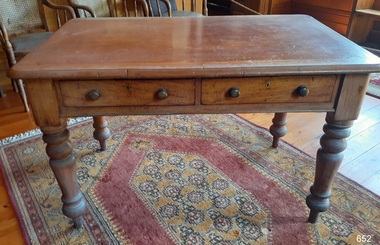 Flagstaff Hill Maritime Museum and Village
Furniture - Desk, Foy & Gibson, Circa 1880s
... Trust Register (B2668). This locks on this desk are significant for their connection with their manufacturer, Hobbs & Co, who invented a lock that surpassed the security of any other locks produced in the mid-19th century. flagstaff hill warrnambool shipwrecked coast flagstaff hill maritime museum maritime museum shipwreck coast flagstaff hill maritime village great ocean road desk cedar desk colonial desk 1880s desk australian colonial furniture furniture office furniture office equipment australian made furniture colonial furniture colonial hardware foy & gibson alfred charles hobbs hobbs & co london hobs & co lever lock cabinetry lock machine made lever lock p.w.d. public works department victoria day & newell great exhibition of 1851 bramah lock chubb lock telford medal 1854 cheapside london mark foy mark foy – bendigo draper smith street collingwood william gibson foy & gibson emporium foy & gibson complex cox brothers Impressed into timber frame of one drawer “FOY & GIBSON” Impressed into lock “HOBBS & CO / LONDON”, “MACHINE MADE”, “LEVER” Impressed along the front edge of the desktop [indecipherable] text. ...The design of this small disc is from the Australian Colonial period. The cedar wood desk was made in Australian by Foy & Gibson in the 1880s, most probably in the business’s works in Collingwood, Victoria. The heavy brass locks fitted into the desk drawers were made by the famous Hobbs & Co of London, mid-late 19th century. In 1860 the business changed hands but the locks were still branded Hobbs & Co. The desk is branded with the symbol of Victoria’s Public Works Department. There is currently no information on when, where and by whom this desk was used. However, a very similar desk with Hobbs & Co. locks is on site at the Point Hicks Lightstation in Victoria and was formerly used by the Point Hicks head light keeper there. Other light stations also have similar desks from the P.W.D. (see also ‘Desk, Parks Victoria – Point Hicks Lightstation, Victorian Collections’.) HOBBS & CO., LONDON Alfred Charles Hobbs, 1812-1891, was American born. He became an executive salesman in 1840 for renowned lock manufacturer Day & Newell. His technique of exposing the weaknesses of people’s current locks was very successful in generating sales. He represented Day & Newell at London’s Great Exhibition of 1851, competing with other lock makers. Through the Exhibition he became famous for picking the best trusted Bramah and Chubb locks. Hobbs’ fame led him to found his own company in 1851 then register it in 1852 as Hobbs & Co., London. Hobbs was awarded the Telford Medal by the British Institution of Civil Engineers in 1854 for his paper 'On the Principles and Construction of Locks'. In 1855 the very successful company added partners and became Hobbs, Ashley and Co. In 1860, it traded under the name of Hobbs, Hart & Co. and was based in Cheapside London, where the business remained. Hobbs then returned to America, having sold the complete company to John Mathias Hart. He briefly returned to attend the 21st anniversary celebrations of the successful business in 1872. Hobbs kept himself busy in America, inventing and manufacturing firearm ammunition, for which he held several patents. He passed away there in 1891, a month after his 70th birthday. FOY & GIBSON Mark Foy wan an Irish draper who migrated to Bendigo, Victoria in 1858, attracted by the gold rush. He lived and worked in the area, establishing a drapery business. In the 1870s he moved to Melbourne where there were better prospects for expansion. He chose a place in Smith Street, Collingwood, a suburb of Melbourne, and started his business at the rear. In 1883 Foy retired, bringing in William Gibson as a partner, and then transferred his own share of the company to his son Francis Foy. Not long afterwards Francis sold his half share to Gibson, and the business continued under the name of Foy & Gibson. Francis Foy and he and his brother Mark Foy (junior) moved to Sydney. They established a business there in 1885, named after their father, Mark Foy. Gibson added to his business by starting his own manufacturing works from 1887, producing clothing, millinery, furniture, bedding and hardware for his stores. The factories, warehouses and stores complex became one of Victoria’s largest employers. He set up branches of his stores in Perth, Brisbane and Adelaide and two more branches in Melbourne. Foy & Gibson (usually referred to as Foys) became one of Australia’s largest retail department stores. In 1931 Foy’s little house in Collingwood was still part of the entrance to Foy & Gibson Emporium. In 1955 the company was bought out by Cox Brothers. Later on the stores were sold to various businesses such as David Jones, Woolworths and Harris Scarfe. In 1968 Cox Brothers went into receivership, ending almost 100 years of the business known as Foy’s. The former Foy & Gibson Complex is registered by Heritage Council Victoria. “Designed by William Pitt, this magnificent 19th and early 20th century complex of factories, warehouses and showrooms saw the production of a remarkable range of goods for Foy & Gibson, Melbourne’s earliest department store chain”. (Quoted from the Plaque erected by the Collingwood Historical Society 2007) P.W.D. – Public Works Department, Victoria The desk is stamped “P.W.D,” signifying that it is from the Public Works Department in Victoria, which operated from 1855-1987. The department was responsible for, among other things, the design and supply of office furniture and equipment for public buildings and organisations. This desk is significant historically as it originated from Foy & Gibson, a colonial Australian company that had a positive and strong impact on employment, manufacturing and retailing in Melbourne, Victoria and Australia. The significance of Foy & Gibson to Victoria’s and Australia’s history is marked by the Collingwood Complex being registered in both Heritage Victoria Register (H0755, H0897 and H0896) and National Trust Register (B2668). This locks on this desk are significant for their connection with their manufacturer, Hobbs & Co, who invented a lock that surpassed the security of any other locks produced in the mid-19th century. Desk; Australian Colonial cedar desk, honey coloured. Desktop has a wooden border with a rolled edge and a fitted timber centrepiece. The four tapered legs are tulip turned. Two half-width drawers fit side by side and extend the full depth of the desk. The drawers have dovetail joints. Each drawer has two round wooden knob handles, a keyhole and a fitted, heavy brass lever lock. Inscriptions are on the desktop, drawers, desk leg and lock. Made in Australia circa 1880 by Foy & Gibson, lock made by Hobbs & Co, London.Impressed into timber frame of one drawer “FOY & GIBSON” Impressed into lock “HOBBS & CO / LONDON”, “MACHINE MADE”, “LEVER” Impressed along the front edge of the desktop [indecipherable] text. Impressed into the timber of right front leg “P. W. D.” below a ‘crown’ symbol Handwritten in white chalk under a drawer “206” flagstaff hill, warrnambool, shipwrecked coast, flagstaff hill maritime museum, maritime museum, shipwreck coast, flagstaff hill maritime village, great ocean road, desk, cedar desk, colonial desk, 1880s desk, australian colonial furniture, furniture, office furniture, office equipment, australian made furniture, colonial furniture, colonial hardware, foy & gibson, alfred charles hobbs, hobbs & co london, hobs & co lever lock, cabinetry lock, machine made lever lock, p.w.d., public works department victoria, day & newell, great exhibition of 1851, bramah lock, chubb lock, telford medal 1854, cheapside london, mark foy, mark foy – bendigo draper, smith street collingwood, william gibson, foy & gibson emporium, foy & gibson complex, cox brothers -
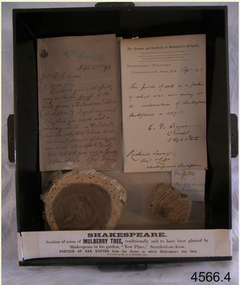 Flagstaff Hill Maritime Museum and Village
Wood Samples, 1891
... great ocean road...shakespeare display case...wood samples...oak from shakespeare's birthplace...mulberry from shakespeare's home "new place"...stratford-upon-avon...shakespeare's birthplace...the trustees and guardians of shakespeare's birthplace &c....shakespeare trust...Trust. This scion was then established at Shakespeare's garden at "New Home" that had been demolished by Rev Francis Gastrell in 1759. flagstaff hill warrnambool shipwrecked coast flagstaff hill maritime museum maritime museum shipwreck coast flagstaff hill maritime village great ocean road shakespeare display case wood samples oak from shakespeare's birthplace mulberry from shakespeare's home "new place" stratford-upon-avon shakespeare's birthplace the trustees and guardians of shakespeare's birthplace &c. shakespeare trust shakespeare birthday committee r.s. harris, brunswick, victoria richard s harris, brunswick, victoria c.f. loggins, chemist, 3 high street stratford-on-avon richard savage warrnambool museum and art gallery thomas court pt barnum charles dickins anne hathaway black mulberry tree reverend francis gastrell Cardboard label inside the glass case “Shakespeare Section of Mulberry Tree, traditionally said to have been planted by Shakespeare in his garden, “New Place,” Stratford-on-Avon. ...The timber display case was presented to Mr Richard Standcombe Harris of Warrnambool (1831-1923). He was a councillor (1875-1891) and predominant businessman. Mr C F Loggin had met Mr Harris while on a trip to Stratford upon Avon in the United Kingdom. Upon his return to Warrnambool, Mr Harris donated the item to the Warrnambool Museum and Art Gallery, (established 1886) where Joseph Archibald was Curator: he catalogued the case in 1894. THE LETTERS IN THE CASE The two letters contained within the display case confirm the authenticity of the oak wood sample. The first letter in the case includes the text; "[Stamped Header on banner] High Street, Stratford on Avon [Hand written] Sept. 22nd / 91. Mr. R. S. Harris, Dear Sir, Enclosed you will find [underlined next 3 words] every authentic proof of the Oak from Shakespeare's House (Birth place). I regret very much Sir, that you made a short-day at S. on A. I should have been delighted to have had the honour, & pleasure, of showing you around our Beautiful Country. You did not give [next 3 words underlined] me or yourself a fair chance. But however I hope that we may again some day have more time to go quietly around. With kind regards, and wishing you, Sir, a pleasant voyage, I remain, Dear Sir, Yours very truly, C.F. Loggin. P.S. A paper will be always acceptable to be as how you Jolly Warrnamboolites are desporting yourselves. “ The second letter includes text; “[Printed Letterhead with stamped impression] The Trustees and Guardians of Shakespeare’s Birthplace Incorporated by Act of 54 and 55, Vict. 1891 Secretary and Librarian - Richard Savage Shakespeare’s Birthplace Stratford-upon-Avon [handwritten] 22 Sept 1891 This piece of oak is a portion of what was cut away at at the restoration of Shakespeare’s Birthplace in 1857-58. C. F. Loggins Chemist 3 High Street Richard Savage Sec. – Shakespeare’s Birthplace Mr C F Loggin was connected with the Shakespeare Trust as the person who had originally donated a scion of Shakespeare's mulberry tree to the "Shakespearean Birthday Committee" in 1842. (The scion that was given to the Shakespearean Birthday Committee, from which the Mulberry sample is derived, still grows today in "New Place" garden.) Mr Richard Savage was the Secretary and Liberian of the then renamed “Trustees and Guardians of Shakespeare’s Birthplace when the display case was given to Mr Harris in 1891 by Mr Loggin. WILLIAM SHAKESPEARE Shakespeare was born in 1564 in Stratford-upon-Avon, where he also grew up. He married at 18 years and he and his wife, Anne Hathaway, had three children: They moved to London where he became successful as an actor, writer, and part-owner of a playing company. He later returned to Stratford and purchased his last home, which he called "New Place" in 1602 where he later died in 1616. For the next 150 years, it was known that there existed a black mulberry tree in the garden. At the time there was a fashion for planting mulberry trees. It was the early 17th century after King James had come to the throne, and he imported tens of thousands of saplings in an attempt to get landowners to start a silk industry in England. Unfortunately for posterity, Shakespeare's mulberry was felled around 1756, by the then owner of “New Place" the Reverend Francis Gastrell, who was apparently tired of continual visits by pilgrims asking to see the tree, so he chopped it down. Gastrell had applied for local permission to extend the garden but the application was rejected and his tax was increased. Gastrell retaliated by demolishing the house in 1759, this greatly outraged the local inhabitants. Gastrell was eventually forced to leave town having provoked the wrath of Stratford residents for committing such an act. Today only the garden remains where “New House" used to stand with a scion from the original mulberry tree still growing there. The wood from the felled mulberry tree at “New House" was purchased by an enterprising local clock-maker Thomas Sharp and he spent the next 40 years or so years making souvenirs from the wood. These became early tourist souvenirs and subsequently developed into a profitable sideline for various other makers, including George Cooper and John Marshall. These objects range from relatively small domestic wooden objects, such as snuff boxes and weight scales to large tea caddies and even tables. C. F. Loggin donated a scion or cutting from Shakespeare's mulberry tree to the Shakespeare Birthplace Trust in 1862, he was a chemist who lived and worked in Stratford. There is a note on the frame of the donation that the mulberry sample is from this scion, research shows that from Richard Savage's diary notes that there must have been a lot of wood taken from that scion over the years which was planted in the garden of “New Place” and is still growing there today. The "Trustees and Guardians of Shakespeare’s Birthplace" (1847 -1964) was formed after the house where Shakespeare is believed to have been born fell into disrepair. Subsequently in 1846 after the death of Thomas Court's widow the last owner. Interest in the house was revived when PT Barnum, the American showman, wanted to buy it and ship the house back to America. In response to this, the Shakespeare Birthday Committee was established (by a private Act of Parliament) with the help of such luminaries as Charles Dickens, the Committee of Trustees raised the necessary £3,000 and purchased the house the following year. Once the Committee had acquired the building, restoration work began. Originally the Birthplace formed part of a terrace with later houses built either side. The first stage in its conservation was their destruction. At the time it was thought necessary to avoid the risk of fire spreading to Shakespeare's birthplace. Reconstruction was carried out by the Shakespeare Trust between 1857 and 1864 that restored the outside of the building to its original 16th-century state. It is from this restoration that the donated piece of oak is derived, originally from a beam that was in the house. Communication from The Shakespeare Birthplace Trust, dated April 11th, 2019, confirms that the pieces displayed in this case have good provenance. The wood samples are significant for their association with the history of William Shakespeare. The display case and its content is significant to Warrnambool local history for its association with the establishment in 1886 of the Warrnambool Museum and Art Gallery. However, it should be noted that the letters of authentication that accompany the wood samples are only applicable to the oak sample. None the less, all the pieces have very good provenance, with Richard Savage's certificate of authenticity for the oak, and the mulberry sample with the letter to Mr Harris from Mr CF Loggin having also been the donor of the scion of mulberry in 1862 to the Shakespeare Birthplace Trust. This scion was then established at Shakespeare's garden at "New Home" that had been demolished by Rev Francis Gastrell in 1759. Two wood samples associated with William Shakespeare, presented in a hanging, timber and glass display case with metal trim around the frame. The case also contains two letters and a label printed on a card that refers to the contents, their origins and the donor. A card label with a printed number and a round adhesive label are attached on the back of the case. The left round section of wood is from a donated scion (or shoot) derived from the original mulberry tree planted by William Shakespeare at his last home "New Place", Stratford-upon-Avon. The outer section is light brown coloured while the centre is dark grain. The right wood sample in the case is a section of oak rafter from the house where Shakespeare was born in 1564. The wood is mid brown with a distinct grain. The included letters, each dated 22/9/1891, refer to only the oak sample. - The letter on the left comprises two handwritten pages from Mr CF Loggin to Mr Richard Standcombe Harris. The paper has the printed letterhead address of High Street, Stratford on Avon. - The letter on the right is a handwritten certificate of authenticity signed by Mr CF Loggin and counter signed by Mr Richard Savage, Secretary and Liberian of the Shakespeare Trust. It is on the printed letterhead of The Trustees and Guardians of Shakespeare’s Birthplace Cardboard label inside the glass case “Shakespeare Section of Mulberry Tree, traditionally said to have been planted by Shakespeare in his garden, “New Place,” Stratford-on-Avon. PORTION OF OAK RAFTER from the house in which Shakespeare was born. (Presented by R S Harris 1891.) Printed label on the back of the case “3 2 “ The handwritten adhesive label “0566” flagstaff hill, warrnambool, shipwrecked coast, flagstaff hill maritime museum, maritime museum, shipwreck coast, flagstaff hill maritime village, great ocean road, shakespeare display case, wood samples, oak from shakespeare's birthplace, mulberry from shakespeare's home "new place", stratford-upon-avon, shakespeare's birthplace, the trustees and guardians of shakespeare's birthplace &c., shakespeare trust, shakespeare birthday committee, r.s. harris, brunswick, victoria, richard s harris, brunswick, victoria, c.f. loggins, chemist, 3 high street stratford-on-avon, richard savage, warrnambool museum and art gallery, thomas court, pt barnum, charles dickins, anne hathaway, black mulberry tree, reverend francis gastrell -
 Flagstaff Hill Maritime Museum and Village
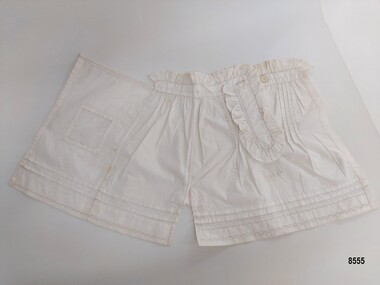
Textile - Plain Sewing Sampler, 1897
... Great Ocean Road...Susan Henry OAM...Vedmore Trust...Flagstaff Hill Maritime Museum and Village Warrnambool Shipwreck Coast needlework textiles plain sewing sampler darning sampler handwork sewing Great Ocean Road Susan Henry OAM Vedmore Trust hand sewing sewing techniques L L/1897 A cream cotton sampler made from three smaller rectangular shapes, displaying a wide variety of plain sewing techniques including hand stitched seams (french, bound and herringboned), inserted patch, buttonhole, button, gathering, a gusset, frills, pintucks, a placket, cross stitch initials and date (L L and 1897) and decorative embroidery. ...A "Plain Sewing Sampler" or "Darning Sampler" was intended to showcase the wide range of sewing techniques and skills a girl or woman had. These skills might include hand sewing techniques such as darning, patching, hemming, mending, structural sewing (making pleats, inserting gussets, joining fabric with seams) making buttonholes and embroidery. Samplers could also be intended for practicing a particular technique. There were several articles printed in Australian newspapers around 1889 referring to the "Plain Sewing Movement". In 1889 a Melbourne branch of the "London Institute for the Advancement of Plain Needlework" was formed by a group of ladies led by Lady Loch and Lady Clarke with the purpose of teaching "plain needlework' to women and girls. "Plain Sewing" included fundamental stitches and techniques that were essential for practical clothing construction and maintenance. Several years later in 1891, another meeting was held at Clivedon (the residence of Lady Clarke) to look into the possibility of improving the teaching of sewing in the state schools. This meeting was attended by several school inspectors and the committee of "the Melbourne Institute for the Advancement of Plain Needlework". This "Plain Sewing Sampler" was donated from the estate of Susan Henry OAM nee Vedmore (1944 - 2021). Susan's family (Harold and Gladys Vedmore) immigrated to Australia from Wales in 1955 and settled in Warrnambool. Susan was well known in the Warrnambool community for her work supporting children and families across the district - particular those with disabilities, or those who were homeless, unemployed or isolated. Susan was the founding trustee of the "Vedmore Foundation" - a Warrnambool philanthropic trust set up to support a range of charitable and not-for-profit causes by providing grant assistance. In 2021, she was awarded a Medal of the Order of Australia for services to the community. It has not been possible to identify the lady (with the initials L. L.) who made this item in 1897 but it was thought to possibly be a female relation in her maternal (or possibly, paternal) grandmother's family. It has many of the same elements and techniques that were taught by the "Plain Sewing Movement" that originated in England at the end of the nineteenth century.This item is a rare example of the handcraft skills learnt by women and girls in the late 1890's to construct and maintain practical clothing for their families.A cream cotton sampler made from three smaller rectangular shapes, displaying a wide variety of plain sewing techniques including hand stitched seams (french, bound and herringboned), inserted patch, buttonhole, button, gathering, a gusset, frills, pintucks, a placket, cross stitch initials and date (L L and 1897) and decorative embroidery.L L/1897flagstaff hill maritime museum and village, warrnambool, shipwreck coast, needlework, textiles, plain sewing sampler, darning sampler, handwork, sewing, great ocean road, susan henry oam, vedmore trust, hand sewing, sewing techniques -
 Flagstaff Hill Maritime Museum and Village
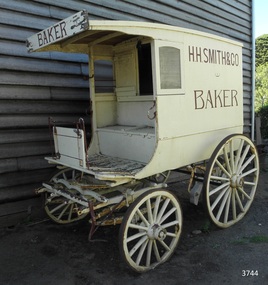
Vehicle - Wagon, H.H. Smith & Co. Baker, Circa 1930s - 1940s
... great ocean road...baker’s wagon...h.h. smith baker, warrnambool...henry h smith...jeannie samson-goodman...frank crossley...mayor of city of warrnambool...vice president of warrnambool and district historical society...stephenson’s bakery warrnambool...harold stephenson...warrnambool surf life saving club...road race committee...national trust...Trust, August 1979. Smith Street Warrnambool was named after Henry Huntington Smith, who was a Warrnambool Councillor 1913 – 1937 and Mayor 1919 – 1921. warrnambool shipwrecked-coast flagstaff-hill flagstaff-hill-maritime-museum maritime-museum shipwreck-coast flagstaff-hill-maritime-village shipwrecked-artefact great ocean road baker’s wagon h.h. smith baker, warrnambool henry h smith jeannie samson-goodman frank crossley mayor of city of warrnambool vice president of warrnambool and district historical society stephenson’s bakery warrnambool harold stephenson warrnambool surf life saving club road race committee national trust building stan lake bill lake ali dean 19th and 20th century bakers davies steam biscuit factory warrnambool james mcleod building designer jobbins and mcleod william cust h h smith & co, pastry cooks and confectioners bakery trade bread delivery wagon Brown signwriting on sides of wagon “H.R. ...This baker’s wagon or cart transported and delivered bread and other baked goods in the Warrnambool area. It currently has advertising for H.H. Smith & Co. Henry Huntington Smith (1857-1941) owned and operated his Warrnambool bakery in the late 19th and early 20th century. However, the design of the wagon is similar to those used by local bakers in the 1930s and 1940s and probably originated from Stephenson’s Bakery in Warrnambool, which operated around that time. The wagon’s original internal shelves were removed in the early days of Flagstaff Hill so that children could have rides around the village in a horse-driven cart. BAKERS’ HISTORY There were many bakeries in Warrnambool in the 19th to mid-20th century. Each bread bakery made horse and cart deliveries in its allocated zone. SMITH’S BAKERY; – as shown on the wagon’s signage. Henry Huntington Smith (1857-1941) was born and educated in Warrnambool. He worked at Davis’ steam biscuit factory in Timor Street before he began his own bakery business in 1885 near the corner of Fairy and Koroit Streets. A few years later Smith built a new bakery on the corner of Fairy and Lava Street where it still stands today (2025) as Monaghan’s Pharmacy. The building was designed by James McLeod in 1892 as a bakehouse, shop and residence for Smith The address was known locally as Smith’s Corner. Next door to the bakery, at 136 Fairy Street, were stables built by Jobbins and McLeod in 1886 for William Cust. A photograph in the archives of the Warrnambool and District Historical Society shows the 1892 building with four fancy horse-drawn wagons on the street with white-clad drivers and a promotional stand erected with 5 bakers in uniform and the signage “H H Smith & Co, Pastry Cooks and Confectioners”. One of the wagons appears to have “H H Smith” painted on the side. H.H. Smith & Co. placed an Advertisement in the Weekly Times in December 1896 promoting its business as bakers, confectioners and pastry cooks, praising their shop as an ‘ornament to the town’ with ‘neat appointments’ and ‘dainty decorations’. It also boasted of supplying a large number of customers within a twelve-mile radius of Warrnambool. In November 1919 The Warrnambool Standard announced the marriage of Henry H Smith, Mayor of Warrnambool, to Jeannie Samson-Goodman in East Adelaide. In the same newspaper was a notice that Frank Crossley was to open as baker and pastry cook in H.H. Smith’s premises. As well as being the proprietor of the H.H. Smith Bakery, Henry Huntington Smith was a Councillor for the Warrnambool Municipality from 1913 to 1937 and Mayer for two terms. In December 1919 during his first term as Mayor, he was honoured for the work he had done with returning soldiers after World War I, receiving a document in recognition of this work, presented by the Mothers, Wives and Sisters of returned soldiers. Smith was very interested and involved in the community in many roles, including being the Vice President of the first Warrnambool and District Historical Society. STEPHENSON’S BAKERY: – believed to be the past owner of the wagon. The last owner of the bakery was Harold Stephenson. Stephenson was enlisted in the A.I.F. and was invalided home in 1943 before the end of the Second World War. He also served as a Councillor from 1958 to 1976, during which time he served six terms as Mayor for the City of Warrnambool (1966-1973) while he had the bakery. He was very involved in many local organisations including the Warrnambool Surf Life Saving Club and the Road Race Committee. He died in 1985, lauded as being one of Warrnambool’s “most distinguished civic leaders”. It has been said that the baker injured in World War II invented a special contraption to enable him to get up into the wagon and that he alerted his customers that he was in their vicinity by blowing a whistle. The customers would come out and choose their bread from the back of his wagon then pay him for it. However, another account is given by a man who once earned pocket money by helping the baker on his rounds. He says that it was Stephenson, the owner and manager of the bakery, and not the delivery baker who received a significant injury during the war, making him unable to climb the stairs of his upstairs accommodation at the bakery, therefore causing him to sleep downstairs. At this time in the early to late 1940 Stephenson’s bakery had three wagons, one for each of the delivery rounds. The wagons were painted black and yellow. Two of the drivers were Stan Lake and Ali (Alec) Dean who both had wagons with the covered cabin design. The third driver was Bill Lake who had a flat wagon. Stan Lake delivered in the area around Lava and Koroit Streets, Ali Dean had another round and Bill Lake had the Dennington area. Bread continued to be delivered into the 1960s but by this time the delivery vehicles were motorised. The goods produced at Stephenson’s bakery included bread baked in different shaped tins such as High Tin, Sandwich and Vienna. Some shapes were easily divided into half by breaking them apart, therefore the baker could make two-quarter loaves from a half loaf, satisfying different needs. There was the option of white or brown bread, sweet buns, fruit buns and Boston buns. The baker’s assistant was known to take great delight in ‘trimming’ the broken halves of excess bread and crust, enjoying his treat. THE BAKERY PREMISES: – Southeast corner of Fairy and Lava Streets, Warrnambool. The building retains the original cast iron veranda. Above the veranda, a motif of a wheat sheaf in ornamental plaster can be seen. Inside the building, there are still some of the original fittings. The building was classified by the National Trust in August 1979. After the Second World War, an official system of zoning was introduced as a fair way for the baking industry to operate. In 1949 different pricing was introduced by the Government for either delivered or retail purchased bread. Many of the small local bakeries went out of business after the Government banned zoning. The way was made open for the larger bread manufacturers to enter the local market with cheaper prices. Some of those companies were Mc Queens, Tip Top, Twisties, and Sunicrust, (Mc Queens ‘new’ bakery building was where the current Toyworld shop now stands, is, in the Ozone carpark.) O’Grady’s Bakery, later changing hands and known as Burkes Bakery, was on Fairy Street near the Timor Street intersection, on the North West side. There was also a bakery named Almay. The baker’s wagon is significant because of its association with H.H. Smith’s Bakery in Warrnambool.. The H.H. Smith’s Bakery building on the corner of Fairy and Lava Streets, built in 1892, is classified by the National Trust, August 1979. Smith Street Warrnambool was named after Henry Huntington Smith, who was a Warrnambool Councillor 1913 – 1937 and Mayor 1919 – 1921. Baker’s wagon, often referred to as a baker’s cart. Four wheeled horse-drawn delivery wagon, front wheels smaller than rear wheels. Wagon is clad with metal sheets and lined with varnished timber panels. Wheels have metal rims, wooden spokes and rear wheels have wooden brake pads. Horse shaft is timber with metal fittings. Front has a metal lamp holder, brake lever, metal hand grips and decorative metal foot plates. The wagon has suspension leaves on back and sides and double suspension leaves on the front. Driver’s area at front has a roof, glass side windows and wooden box seat with hinged compartment accessing wagon storage area. Door above back of seat has buckled leather handgrip strap attached, door slides open for access to wagon area. Back of wagon has a wooden step and a split door; top door has ventilation louvers, both doors have metal latches. Wagon is painted cream with brown trim and signage and green step. Remnants of red and green paint are visible; underside of seat panel is painted grey. Wagon advertises H.H. Smith & Co. Baker, a Warrnambool business established in 1885, but is of a more modern design seen around 1930’s and 1940’s and most likely belonging to Stephenson's bakery. Brown signwriting on sides of wagon “H.R. SMITH & CO. / BAKER” Brown signwriting across front of wagon “BAKER” warrnambool, shipwrecked-coast, flagstaff-hill, flagstaff-hill-maritime-museum, maritime-museum, shipwreck-coast, flagstaff-hill-maritime-village, shipwrecked-artefact, great ocean road, baker’s wagon, h.h. smith baker, warrnambool, henry h smith, jeannie samson-goodman, frank crossley, mayor of city of warrnambool, vice president of warrnambool and district historical society, stephenson’s bakery warrnambool, harold stephenson, warrnambool surf life saving club, road race committee, national trust building, stan lake, bill lake, ali dean, 19th and 20th century bakers, davies steam biscuit factory warrnambool, james mcleod building designer, jobbins and mcleod, william cust, h h smith & co, pastry cooks and confectioners, bakery trade, bread delivery wagon -
 Flagstaff Hill Maritime Museum and Village
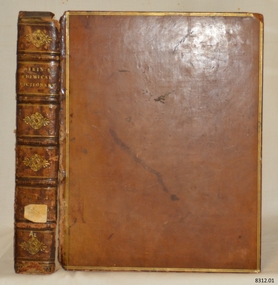
Book - Reference Book /Science, Charles Rochemont Aikin et al, A Dictionary of Chemistry and Mineralogy Vol 1, 1807
... trusted, highly accurate, and cited across Europe as a premier reference guide. For more information on the Pattison Collection see item 3678 Flagstaff Hill collections) https://victoriancollections.net.au/items/5580c7e72162f114d8b758db flagstaff hill warrnambool shipwrecked coast flagstaff hill maritime museum maritime museum shipwreck coast flagstaff hill maritime village great ocean road book pattison collection warrnambool library warrnambool mechanics’ institute ralph eric pattison corangamite regional library service warrnambool city librarian mechanics’ institute library victorian library board warrnambool books and records warrnambool children’s library a dictionary of chemistry and mineralogy vol 1 a & c r aikin This work serves as a comprehensive snapshot of science right at the dawn of the Industrial Revolution. ...This work serves as a comprehensive snapshot of science right at the dawn of the Industrial Revolution. Rather than just being an abstract list of definitions, it heavily emphasises the practical and industrial applications of science, covering detailed manufacturing processes for commercial chemical production. Also included are the identification, classification, and chemical composition of various minerals, alongside descriptions and structural engravings of early laboratory apparatus and chemical instruments. Furthermore, it features comparative conversion tables for weights and measures used by early 19th-century scientists.Hard cover book,A Dictionary of Chemistry and Mineralogy Vol 1. Author: A & C R Aikin Publisher: W Phillips, London. W1. Date: 1807 Further Information: Brown embossed spine with plane hardcover edged with gilt lines lettering in gilt. The spine has a Library label with an inscription.non-fictionThis work serves as a comprehensive snapshot of science right at the dawn of the Industrial Revolution. Rather than just being an abstract list of definitions, it heavily emphasises the practical and industrial applications of science, covering detailed manufacturing processes for commercial chemical production. Also included are the identification, classification, and chemical composition of various minerals, alongside descriptions and structural engravings of early laboratory apparatus and chemical instruments. Furthermore, it features comparative conversion tables for weights and measures used by early 19th-century scientists.flagstaff hill, warrnambool, shipwrecked coast, flagstaff hill maritime museum, maritime museum, shipwreck coast, flagstaff hill maritime village, great ocean road, book, pattison collection, warrnambool library, warrnambool mechanics’ institute, ralph eric pattison, corangamite regional library service, warrnambool city librarian, mechanics’ institute library, victorian library board, warrnambool books and records, warrnambool children’s library, a dictionary of chemistry and mineralogy vol 1, a & c r aikin -
 Flagstaff Hill Maritime Museum and Village
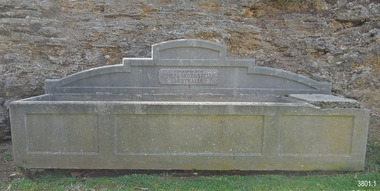
Container - Horse trough, Annis & George Bills, circa Dec. 1932
... great ocean road...annis and george bills...bills trust...It is morally significant as a generous gift from a couple concerned with the welfare of animals. flagstaff hill warrnambool shipwrecked coast flagstaff hill maritime museum maritime museum shipwreck coast flagstaff hill maritime village great ocean road annis and george bills bills trust j h phillips rocla concrete pipes ltd hawthorn water trough watering trough horse trough animal welfare bills horse trough “DONATED BY / ANNIS & GEORGE BILLS / AUSTRALIA” Horse trough; a long narrow rectangular container used for storing water. ...This horse trough is the only survivor of the two troughs originally installed in Raglan Parade, Warrnambool, in 1932. It was later moved to the Pony Club at Albert Part, near the north corner of Coulstock and Craig Streets. Over the time there its purpose was changed from a horse watering trough to a colourful garden bed of agapanthus plants. By February 2013 the horse trough had been transferred to Flagstaff Hill for display in the Maritime Village’s grounds. This trough is one of hundreds provided by the Annis and George Bills Estate Trust since 1927 for the welfare of working horses and dogs. The original concrete cap over the small compartment is still retained. There are also markings on the right side of the trough where it probably had a birdbath, tap or a dish for the horseman’s dog, similar to other troughs donated elsewhere by the Trust. Less than half of the troughs produced for the Annis and George Bills Trust still survive. In 2017 Felicity Watson, National Trust Victoria’s advocacy manager, said that the troughs were treasures and becoming rare, with more than a dozen across Victoria now being heritage protected. ABOUT ANNIS AND GEORGE BILLS The 1927 Will of George Bills included setting up the Annis and George Bills Estate Trust, which provided for hundreds of horse troughs to be supplied and installed throughout Australia, Britain, USA and other parts of the world for the welfare of horses. Town and city councils could apply to the Trustees for a horse trough for their communities. George “Joe” Bills was born in Brighton, England, in 1859. The family migrated first to New Zealand then to Australia in 1873, settling in the Echuca-Moama district. George moved to Brisbane in 1882 where he met Annis Swann, formerly from Sheffield. Both were animal lovers. George and Annis married 1885 and moved to Sydney to join George’s brother Henry in his mattress wire weaving business, later known as the Bills Brothers. They patented their own machine in 1893 and the business became very profitable. George was able to donate to charities that supported his passion to improve animal welfare. He and Annis joined the Victorian Society for the Protection of Animals and in 1924 George received a Life Membership with the RSPCA. George retired in 1908. The couple moved to Hawthorn, Victoria, in 1910, where they donated troughs for the work horses of Melbourne. During a visit to England Annis passed away. In 1927 George moved from Hawthorn to Camberwell, where he passed away at the end of that year. George had requested in his Will that a trust fund be set up from his estate "…construct and erect and pay for horse troughs wherever they may be of the opinion that such horse troughs are desirable for the relief of horses and other dumb animals either in Australasia, in the British Islands or in any other part of the world subject to the consent of the proper authorities being obtained." The troughs were to bear a plaque inscribed “Donated by Annis and George Bills, Australia”. In 1927 the cost to make a trough was about £13 (which converts to about $1079 in 2020 ), plus transport and installation costs. Most of the troughs were installed between 1930 and 1939 in Victoria and New South Wales. It is estimated that over that time around 500-700 Bills Horse Troughs were installed in Australia and another 50 overseas. Most of the troughs made in Victoria had three moulded front panels like this trough, and no panels moulded on the rear, whereas troughs made in NSW had four panels on the front and five on the back. Victorian troughs were made by a Bills’ relative, J H Phillips. Later, other manufactures for the Trust’s troughs included Rocla Concrete Pipes Ltd, in Auburn Road, Hawthorn, Victoria, who produced to the same original design. No further troughs produced after the end of World War II. A memorial to Annis and George Bills was first erected in Hawthorn in 1929. It included a drinking fountain and a dog dish. Its current location is unknown. In 1964 the George Bills RSPCA Resource Centre opened in Burwood East. This Bills horse trough is nationally significant as one of the surviving examples of the standard Bills memorial horse troughs that still has its compartment cap and evidence of it once having had attached fittings, possibly for a birdbath or dog dish. This trough has State historical significance for being produced in the early 1930s by a business in Hawthorn, Victoria. This example of a Bills horse trough is significant for being in comparatively good condition. The trough is locally significant for being the sole survivor of the two Bills horse troughs installed in the City of Warrnambool in 1932, originally installed on Raglan Parade and continued to be used in the community at the Pony Club, then finally transferred to its current location at Flagstaff Hill by early 2013. It is culturally significant as it represents the community’s dependence on horses for travel and transportation previous to motorised vehicles. It is morally significant as a generous gift from a couple concerned with the welfare of animals.Horse trough; a long narrow rectangular container used for storing water. Trough is made from pre-cast concrete with one large open compartment and a small covered compartment. The base of the small compartment is raised slightly above the base of the trough and is covered by a removable concrete cap. The design of the front of the trough includes three panels moulded into it that align with the shape of the back pediment (panel). The pediment is shaped with side arcs that step up to a wide centre arc. A rectangular concrete plaque is cast into the centre of the pediment and is engraved with the names of the original donors, Annis and George Bills. The trough was made in Hawthorn, Victoria, by J H Phillips circa 1932. “DONATED BY / ANNIS & GEORGE BILLS / AUSTRALIA”flagstaff hill, warrnambool, shipwrecked coast, flagstaff hill maritime museum, maritime museum, shipwreck coast, flagstaff hill maritime village, great ocean road, annis and george bills, bills trust, j h phillips, rocla concrete pipes ltd, hawthorn, water trough, watering trough, horse trough, animal welfare, bills horse trough -
 Flagstaff Hill Maritime Museum and Village
Book - Trade Union Rules, Shipwrights' Provident Union of the Port of London, Rules of the Shipwrights' Provident Union of the Port of London, 28-09-1895
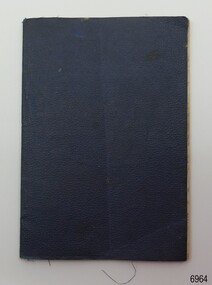
... Trust. They married in Melbourne in 1953 and went on to have a family of five children. In 2003 Norman and Daphne moved to Warrnambool and then years later they celebrated their 60th wedding anniversary. Norman passed away on July 28th 2015 at Warrnambool’s South West Healthcare hospital. SUBJECTS Flagstaff Hill, Warrnambool, Maritime Village, Maritime Museum, Shipwreck coast, Great Ocean Road...Trust. They married in Melbourne in 1953 and went on to have a family of five children. In 2003 Norman and Daphne moved to Warrnambool and then years later they celebrated their 60th wedding anniversary. Norman passed away on July 28th 2015 at Warrnambool’s South West Healthcare hospital. SUBJECTS Flagstaff Hill, Warrnambool, Maritime Village, Maritime Museum, Shipwreck coast, Great Ocean Road ...A number of items once belonging to shipwright Norman McKenzie were donated to Flagstaff Hill Maritime Museum and Village. They are related to Norman’s apprenticeship and certification as a Shipwright in Belfast, his Union membership and his employment as a shipwright in Melbourne. One of the items, a union Rules Book inscribed with the name H.B. Thomas and dated 1902, had within its pages Norman’s Indenture of Apprenticeship, dated 1941, Norman Desmond McKenzie was born in Belfast in 1925 and lived at 10 Pansy Street Belfast, Northern Ireland. At the age of 16 years, he began a 5-year Shipwright’s apprenticeship with Harland & Wolff Limited, Shipbuilding & Engineering Works, Belfast. He became a member of the Ship Constructors’ and Shipwrights’ Association, Belfast (B) Branch 20. His Registration Number was 38748. He completed his apprenticeship on December 16th, 1946, aged 21 years, his address was 26 Connsbrook Drive, Sydenham, N. Belfast. In October 1949 Norman received Clearance from his Union as a financial member to move to another branch. He completed his Apprenticeship on December 16th 1946. Two months later he migrated to Australia, and he arrived in Victoria, and he became a Financial Member of the Victorian branch of the Federated Shipwrights, Ship constructors, Naval Architects, Ships’ Draughtsmen and Boat Builders’ Association of Australia, Victoria branch. One of Norman’s donated books is the Rules of the Shipwrights' Provident Union of the Port of London. It is inscribed on several pages with the name H.B. Thomas and includes the year 1902 and the address of 29 Brickwood Street, Gardenvale. This is a location in Victoria, Australia. The Victoria Government Gazette, February 1959, in the section “Removal from Registration on The Architects Registration Board of Victoria, during the year ended 31st December 1956” lists “Deceased – Thomas, H.B., 29 Brickwood Street, Gardenvale”. The Architects Union includes Naval Architects and Shipwrights and other related trades came under the same union. It seems likely that when he was in Melbourne, Norman worked as a Shipwright for H.B. Thomas and was given the Rules book by Thomas, perhaps as a reference book or maybe as a gift. Around that same time, December 1949, Norman met his wife-to-be, Daphne, in Melbourne. Daphne had migrated from London with her family and her father found work with the Melbourne Harbour Trust. They married in Melbourne in 1953 and went on to have a family of five children. In 2003 Norman and Daphne moved to Warrnambool and then years later they celebrated their 60th wedding anniversary. Norman passed away on July 28th 2015 at Warrnambool’s South West Healthcare hospital. SUBJECTS Flagstaff Hill, Warrnambool, Maritime Village, Maritime Museum, Shipwreck coast, Great Ocean Road, Norman McKenzie, Norman Desmond McKenzie, Belfast shipwright, Shipwright's apprenticeship, Harland & Wolff Limited, Shipbuilding & Engineering Works, the Ship Constructors’ and Shipwrights’ Association, Registered Shipwright, Victorian branch of the Federated Shipwrights, Ship constructors, Naval Architects, Ships’ Draughtsmen and Boat Builders’ Association of Australia, Victoria branch, Shipwrights' Provident Union, H.B. Thomas, Architects Registration Board of Victoria, Naval Architect, Daphne, Norman and Daphne McKenzie, Indenture of Apprenticeship SIGNIFICANCE Norman McKenzie's Rules Book, Union Cards, Indenture of Apprenticeship, and other documents tell the story of a young Irish lad's work and qualifications to become a shipwright and his migration to Australia. The young man found a job and a wife who had also migrated, and they raised a family in Melbourne. He and his wife then retired to Warrnambool to enjoy their later years. The collection of documents relating to Norman McKenzie is significant for its connection with the shipping industry of the early 1900s, the migration of qualified tradesmen to Victoria, and their contribution to the development of Victoria. The collection also shows the role of the Union in the shipping industry. The documents link shipwright Norman McKenzie to the Shipwright's Union in London and in Australia, and to shipbuilder H B Thomas in Melbourne, most likely his employer.Norman McKenzie's Rules Book, Union Cards, Indenture of Apprenticeship, and other documents tell the story of a young Irish lad's work and qualifications to become a shipwright and his migration to Australia. The young man found a job and a wife who had also migrated, and they raised a family in Melbourne. He and his wife then retired to Warrnambool to enjoy their later years. The collection of documents relating to Norman McKenzie is significant for its connection with the shipping industry of the early 1900s, the migration of qualified tradesmen to Victoria, and their contribution to the development of Victoria. The collection also shows the role of the Union in the shipping industry. The documents link shipwright Norman McKenzie to the Shipwright's Union in London and in Australia, and to shipbuilder H B Thomas in Melbourne, most likely his employer. Book, small handbook. Rules of the Shipwrights' Provident Union of the Port of London. Rules were Registered with the Shipwrights' Provident Union of the Port of London, Register No. 527, September 28th 1895. A small book with dark blue textured fabric covers. Pages, 56, are bound with staples. The book has handwritten inscriptions dated 1902.Handwritten in black pen: Inside cover, "H.B. Thomas, 1902" Page 45 "H B Thomas, 29 Brickwood Street, Gardenvale" Page 49, handwritten in blue ink "H B Thomas, 1902"flagstaff hill, warrnambool, maritime village, maritime museum, shipwreck coast, great ocean road, norman mckenzie, norman desmond mckenzie, belfast shipwright, shipwright's apprenticeship, harland & wolff limited, shipbuilding & engineering works, the ship constructors’ and shipwrights’ association, registered shipwright, victorian branch of the federated shipwrights, ship constructors, naval architects, ships’ draughtsmen and boat builders’ association of australia, victoria branch, shipwrights' provident union, h.b. thomas, architects registration board of victoria, naval architect, daphne, norman and daphne mckenzie -
 Flagstaff Hill Maritime Museum and Village
Book - Reference Book /Science, Charles Rochemont Aikin et al, A Dictionary of Chemistry and Mineralogy Vol 2, 1807
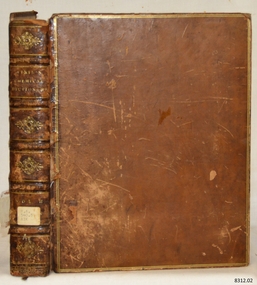
... trusted, highly accurate, and cited across Europe as a premier reference guide. For more information on the Pattison Collection see item 3678 Flagstaff Hill collections) https://victoriancollections.net.au/items/5580c7e72162f114d8b758db flagstaff hill warrnambool shipwrecked coast flagstaff hill maritime museum maritime museum shipwreck coast flagstaff hill maritime village great ocean road book pattison collection warrnambool library warrnambool mechanics’ institute ralph eric pattison corangamite regional library service warrnambool city librarian mechanics’ institute library victorian library board warrnambool books and records warrnambool children’s library a dictionary of chemistry and mineralogy vol 1 a & c r aikin This work serves as a comprehensive snapshot of science right at the dawn of the Industrial Revolution. ...This work serves as a comprehensive snapshot of science right at the dawn of the Industrial Revolution. Rather than just being an abstract list of definitions, it heavily emphasises the practical and industrial applications of science, covering detailed manufacturing processes for commercial chemical production. Also included are the identification, classification, and chemical composition of various minerals, alongside descriptions and structural engravings of early laboratory apparatus and chemical instruments. Furthermore, it features comparative conversion tables for weights and measures used by early 19th-century scientists.Hard cover book,A Dictionary of Chemistry and Mineralogy Vol 2. Author: A & C R Aikin Publisher: W Phillips, London. W1. Date: 1807 Further Information: Brown embossed spine with plane hardcover edged with gilt lines lettering in gilt. The spine has a Library label with an inscription.non-fictionThis work serves as a comprehensive snapshot of science right at the dawn of the Industrial Revolution. Rather than just being an abstract list of definitions, it heavily emphasises the practical and industrial applications of science, covering detailed manufacturing processes for commercial chemical production. Also included are the identification, classification, and chemical composition of various minerals, alongside descriptions and structural engravings of early laboratory apparatus and chemical instruments. Furthermore, it features comparative conversion tables for weights and measures used by early 19th-century scientists.flagstaff hill, warrnambool, shipwrecked coast, flagstaff hill maritime museum, maritime museum, shipwreck coast, flagstaff hill maritime village, great ocean road, book, pattison collection, warrnambool library, warrnambool mechanics’ institute, ralph eric pattison, corangamite regional library service, warrnambool city librarian, mechanics’ institute library, victorian library board, warrnambool books and records, warrnambool children’s library, a dictionary of chemistry and mineralogy vol 1, a & c r aikin -
 Flagstaff Hill Maritime Museum and Village
Clothing - Apron, circa late19th to early 20th Century
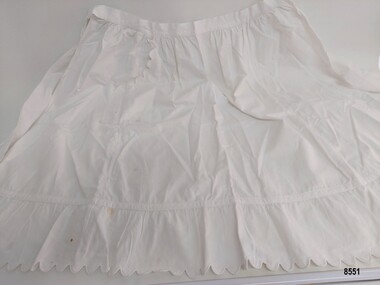
... trust set up in 2010 to support a range of charitable and not-for-profit causes by providing grant assistance. In 2021, she was awarded a Medal of the Order of Australia for services to the community. This item is an example of clothing worn by working women in the late 19th and early 20th century Warrnambool Great Ocean Road textiles lady's garment apron parlour apron waitress apron half apron waist apron handmade domestic clothing domestic work Vedmore Foundation Susan Henry OAM Short white cotton apron featuring gathering along the waist band and a gathered frill with scalloped edging along the bottom. ...An apron is an outer protective garment worn over clothes to cover the front of the body. In Victorian and Edwardian times, women were using aprons for both utility (they were easier to wash than dresses) and fashion and women's magazines and pattern companies were offering patterns to allow women to be to sew their own aprons at home. There are different styles of aprons including bib aprons, waist or half aprons, pinafores, tabards and pinner aprons. The word "apron" comes from the old French word "naperon" which means a napkin or small tablecloth. This apron is one of two similar aprons that were donated from the estate of Susan Henry nee Vedmore (1944 - 2021). It is in very good condition and appears to be more decorative (and possibly used only on special occasions) rather than everyday wear. Susan's family (Harold and Gladys Vedmore) immigrated to Australia from Wales in 1955 and settled in Warrnambool. Susan was well known in the Warrnambool community for her work supporting children and families across the district - particular those with disabilities, or those who were homeless, unemployed or isolated. Susan was the founding trustee of the "Vedmore Foundation" - a Warrnambool philanthropic trust set up in 2010 to support a range of charitable and not-for-profit causes by providing grant assistance. In 2021, she was awarded a Medal of the Order of Australia for services to the community.This item is an example of clothing worn by working women in the late 19th and early 20th centuryShort white cotton apron featuring gathering along the waist band and a gathered frill with scalloped edging along the bottom. The scalloped trim is repeated on the edge of a single pocket on the right hand side. It has ties attached to both ends of the waist band and the main body of the apron is made of of three rectangular pieces of cotton joined with french seams.warrnambool, great ocean road, textiles, lady's garment, apron, parlour apron, waitress apron, half apron, waist apron, handmade, domestic clothing, domestic work, vedmore foundation, susan henry oam -
 Flagstaff Hill Maritime Museum and Village
Clothing - Apron, circa late19th to early 20th Century
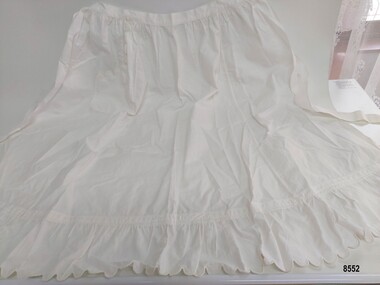
... trust set up in 2010 to support a range of charitable and not-for-profit causes by providing grant assistance. In 2021, she was awarded a Medal of the Order of Australia for services to the community. This item is an example of clothing worn by working women in the late 19th and early 20th century Warrnambool Great Ocean Road ladies' garment apron half apron waist apron domestic clothing domestic work parlour apron waitress apron handmade sewing Vedmore Foundation Susan Henry OAM Long white cotton apron featuring gathering along the waist band and a gathered frill with scalloped edging along the bottom. ...An apron is an outer protective garment worn over clothes to cover the front of the body. In Victorian and Edwardian times, women were using aprons for both utility (they were easier to wash than dresses) and fashion and women's magazines and pattern companies were offering patterns to allow women to be to sew their own aprons at home. There are different styles of aprons including bib aprons, waist or half aprons, pinafores, tabards and pinner aprons. The word "apron" comes from the old French word "naperon" which means a napkin or small tablecloth. This apron is one of two similar aprons that were donated from the estate of Susan Henry nee Vedmore (1944 - 2021). It is in very good condition and appears to be more decorative (and possibly used only on special occasions) rather than everyday wear. Susan's family (Harold and Gladys Vedmore) immigrated to Australia from Wales in 1955 and settled in Warrnambool. Susan was well known in the Warrnambool community for her work supporting children and families across the district - particular those with disabilities, or those who were homeless, unemployed or isolated. Susan was the founding trustee of the "Vedmore Foundation" - a Warrnambool philanthropic trust set up in 2010 to support a range of charitable and not-for-profit causes by providing grant assistance. In 2021, she was awarded a Medal of the Order of Australia for services to the community.This item is an example of clothing worn by working women in the late 19th and early 20th century Long white cotton apron featuring gathering along the waist band and a gathered frill with scalloped edging along the bottom. The scalloped trim is repeated on the edge of a single pocket on the right hand side. It has ties attached to both ends of the waist band and the main body of the apron is made of of three rectangular pieces of cotton joined with french seams.warrnambool, great ocean road, ladies' garment, apron, half apron, waist apron, domestic clothing, domestic work, parlour apron, waitress apron, handmade, sewing, vedmore foundation, susan henry oam -
 Flagstaff Hill Maritime Museum and Village
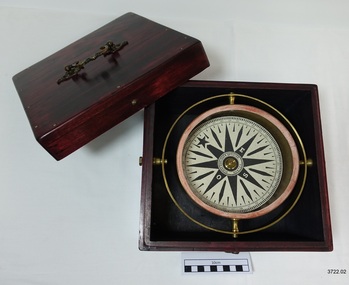
Functional object - Compass, mid-19th Century
... Trust. He also used this compass on the "Hannah Thompson", listed on the Victorian Heritage Register and known as being the first coastal trader to operate between Melbourne and Port Campbell. The compass is also a very fine example of maritime navigational instruments manufactured and used in the mid-19th century. flagstaff hill warrnambool shipwrecked coast flagstaff hill maritime museum maritime museum shipwreck coast flagstaff hill maritime village great ocean road marine compass navigation instrument 19th century marine instruments dubas mantes captain james arthur robilliard j.a. robilliard helen beckett ship young australian ship young australia(n) ship hannah thompson ship mary campbell melbourne sailors home david evans evan evans curdies inlet brucknell church curdies railway great lakes museum DUBAS HORLOGER OPTICIEN. ...Captain Robilliard: James Arthur Robilliard was a sea captain and tentmaker, born on the 19th April 1843 at Saint Helier, Jersey. He trained there in his father's sail loft as a sailmaker. His first job as a sailor was in Liverpool, England, and in 1875, James Robilliard migrated to Australia as a mate on the "E.M. Young". James Robilliard and his family were amongst the early settlers who arrived along the Curdies River in the Heytesbury district of Western Victoria. In 1877, he became a Captain and would have used his compass from ship to ship. On 28th May 1877, in that same district, a small 3-masted schooner, the "Young Australian", was wrecked. This schooner had been built in 1864 at Jervis Bay, NSW. It had been on her way from Maryborough, Queensland, to Adelaide, under the command of Captain Whitfield, when it lost its mainmast in a heavy gale. It was beached at Curdies Inlet in Peterborough, Victoria. Captain Robilliard was placed in charge of the salvaging operation and recovered a good portion of the cargo. Not long after this incident, a Warrnambool shop owner, David Evans, found employment for James Robilliard with Evan Evans, who produced tents, sails, tarpaulins and similar goods; James already had the necessary skills for this work. Evan Evans was the same sailor rescued from the “Young Australian”. Soon after his rescue, Evan recalled he had a relative in Australia in a town called Warrnambool, and while walking in Timor Street, Warrnambool, he saw a sign over a shop that said “David Evans,” and once the two men met, Evan was warmly welcomed. David then helped his relative establish a tent and tarpaulin-making business there. Evan later transferred his successful business to a shop in Elizabeth St, Melbourne, under the name Evan Evans Pty. Ltd.) James Robilliard was a committed Christian and accredited Lay Preacher with the Methodist Church. He travelled around the local district leading the settlers in worship. On 14th November 1879, Captain Robilliard married Helen Beckett. Alfred and Selina Beckett and their family all attended the church at Brucknell, where Captain Robilliard preached. He was said to have been taken by their young daughter, Helen. James and Helen had ten children: James Arthur (Jnr), Henry William, Nellie Jessie, Alfred Albert, Rubena Nellie, De Jersy Norman, Clifford Beckett, Olive Ida, Frances Ridley Havergal and Nellie Elvie, all born in Victoria. In the 1880s, James Robilliard captained the cutter "Hannah Thompson" into Port Campbell, Victoria. This vessel was the first coastal trader to operate between Melbourne and Port Campbell. At one time, Captain Robilliard had to beach the "Hannah Thompson" for repairs. In 1923, the vessel was blown ashore in a gale and wrecked at Oberon Bay, at Wilson's Promontory. In 1889, the compass was saved by Captain James Arthur Robilliard from his sinking brigantine "Mary Campbell". This vessel was used to carry equipment for the Sydney Sugar Refinery's Mill in Southgate, NSW. The ship had been built in 1869 and traded for the next 20 years between Australian ports and rivers along the east coast, as well as regular ports in New Zealand. It was recognised by the Sydney Morning Herald as one of the best "carrying vessels in the timber trade". It had several owners over this time, the last one being Captain James A. Robilliard. On 29th April 1889, the "Mary Campbell", with Captain James A Robilliard as captain and owner, was on its way from Clarence River, NSW to Melbourne, Victoria with a cargo of railway girders for the Melbourne Harbour Trust. Captain Robilliard encountered a storm off Port Macquarie. He sailed the vessel south to about 40km east of Cape Hawke, near Tuncurry. At around 7 pm, he discovered that the cargo had shifted during the storm and the heavy girders had damaged the hull, causing a leak. The pumps were inadequate to stem the fast-flowing leak, and water soon filled the hull during the next two hours. Some of the crew began throwing the cargo overboard to lighten the vessel, hoping to keep it afloat until daylight. When the water reached over 2 meters in the hull, they realised their efforts were in vain. On the 30th April 1889, the crew left the vessel the ship was sinking fast, so they made for the shore. While still miles off Cape Hawke, all seven crew members, including the Captain, were rescued by the Government Tug "Rhea" and taken to Port Macquarie Hospital and later returned to Sydney in the vessel "Wellington". No cargo had been saved, and the consignment had been under-insured, only covered for half its value. The name of the last ship Captain Robilliard sailed is currently unknown; however, he sailed that ship from the port of Marlborough, Queensland, carting steel railway girders for the Geelong-to-Camperdown railway line. On this trip, the ship hit a storm, the cargo shifted, and the ship was wrecked along the NSW coast. After this, Captain Robilliard retired from the sea and began farming in Peterborough. In about 1897, verging on retirement, Capt. Robilliard superintended the Melbourne Sailors’ Home in Spencer Street, Melbourne, before being asked to leave this position in 1902 for trying to shut down a local hotel. On 6th May 1917, Captain James Arthur Robilliard J.P. died at Blackwood Park, in the Cobden district of Brucknell, the first Robilliard family homestead in Australia. He was buried in the Melbourne General Cemetery, Victoria. His wife Helen, passed away in 1947. This compass, once belonging to Captain James Arthur Robilliard, is of local and state historical significance for its use by the Captain with his vessel, the "Mary Campbell", a trading vessel that was bringing railway girders to the Melbourne Harbour Trust. He also used this compass on the "Hannah Thompson", listed on the Victorian Heritage Register and known as being the first coastal trader to operate between Melbourne and Port Campbell. The compass is also a very fine example of maritime navigational instruments manufactured and used in the mid-19th century. Marine compass, brass, in a wooden box with a separate, fitted lid. The compass card has sixteen points. The four principal points are marked: North with a star-shape, South with an “S”, East with an “E” and West with an “O” (French word OUEST). Each quadrant of the circle is numbered from 0 – 90 degrees. The card is floating in a liquid. The compass gimbal is attached to the sides of the box and to the front and back of the compass’ cylindrical brass frame. The mahogany coloured timber storage case is joined with brass nails. The centre of the lid has a folding decorative brass handle. The lid fits over the base and closes with a brass screw and hook on both front and back. Maker: Dubas Watchmaker Optician, Nantes, France, c 1860-1870. Compass came from the ship “Mary Campbell”, which sank off the NSW coast in 1889, near Forster. The compass, as well as the ship, belonged to Captain James Arthur Robilliard and was donated by his family. “DUBAS MANTES” stamped into the side of the gimbal. “DUBAS HORLOGER OPTICIEN. NANTES.” printed around the centre of the card. flagstaff hill, warrnambool, shipwrecked coast, flagstaff hill maritime museum, maritime museum, shipwreck coast, flagstaff hill maritime village, great ocean road, marine compass, navigation instrument 19th century, marine instruments, dubas mantes, captain james arthur robilliard, j.a. robilliard, helen beckett, ship young australian, ship young australia(n), ship hannah thompson, ship mary campbell, melbourne sailors home, david evans, evan evans, curdies inlet, brucknell church, curdies railway, great lakes museum, dubas horloger opticien. nantes -
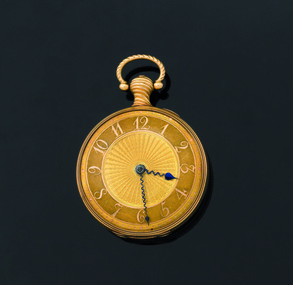 Flagstaff Hill Maritime Museum and Village
Instrument - Fob watch, 1814
... great social significance to not only local people but the wider Australian community. Funding for the watches purchase came from six local trusts and one anonymous citizen and is now on permanent display. Both these artefacts symbolise and helps to interpret the stories of survival along the Shipwreck Coast. warrnambool shipwrecked coast shipwreck coast flagstaff hill flagstaff hill maritime museum flagstaff hill maritime village maritime museum shipwrecked artefact shipwreck artefact carmichael townshend townsend carmichael watch loch ard watch pocket watch loch ard 1st june 1878 james mccabe thomas walker robert townshend loch ard gorge great ocean road victoria. memorial headstone On the silver inner workings cover “Thomas Achilles Townshend” is engraved, underscored by a thin, delicately decorated line. ...Watchmaker History: James McCabe was born in 1748. He was the son of Patrick McCabe, a notable watchmaker from Lurgan in County Armagh, Ireland. James McCabe immigrated to London in 1775 and established his business in Bells Building, Fleet Street, on 2nd April 1781. He was made an Honorary Freeman of the Clockmakers Company. The House of McCabe was renowned for the sheer variety of its designs, and the creativity and prestige of its manufacture were celebrated and revered by owners worldwide. These pieces remain highly collectable today and fetch increasingly higher prices at auction houses worldwide. Watch association with the Loch Ard: The watch was saved from the sea when discovered on the body of Mrs Rebecca Carmichael from Dublin and handed to Eva Carmichael, the only family member to survive the fatal wreck of the Loch Ard on 1st June 1878. Eva gifted the watch to her husband, Thomas Achilles Townsend when they married in 1884; his name is engraved on the rear movement cover. The watch was held by the family until 2011 when they decided to bring the watch, to Australia for auction. At this time the watch was in the possession of Eva Carmichael's grandson, Robert Townsend. Given its connection with the Loch Ard shipwreck, it was purchased at auction by Flagstaff Hill Maritime Village on 25th October 2011 to add to its Loch Ard collection and is currently referred to as the Carmichael watch. It is now on display alongside the Minton Peacock, which also survived the Loch Ard shipwreck, and other artefacts from the collection. James McCabe was originally a Belfast watchmaker who had moved his business to London. At the time James McCabe was much esteemed for producing fine watches and clocks, especially for export to India. Only the best watches were inscribed “James McCabe” and many with highly decorated cases were intended for the Indian market. Contemporary newspaper accounts of the watch's discovery echoed a Carmichael family tradition that the watch had been intended as a gift from the City of Dublin to King George IV to mark his planned visit to the city in 1821, however, there is no evidence to support this theory. Dr Evory Carmichael, according to some accounts, bought this watch from a nobleman for about £100 at some point and so it travelled with him on his final fateful journey to Australia. Today we can only guess at the actions of Mrs Carmichael in the chaos and darkness of the pre-dawn shipwreck. Perhaps the two items that were found on her body, the watch and a locket, were items that reminded her of those she held most dear, her husband and her family. When Mrs Carmichael's body was washed ashore the watch was found secreted in the waistband of her dress. In its own right the watch is of artistic and monetary value and is a rare and beautiful object depicting watch making in the early 19th century. It is a historically significant object in it’s own right and there is additional importance, surviving a significant event in the maritime history of Victoria. The wreck of the Loch Ard, Victoria's greatest maritime disaster has also been declared an event of National Significance because of its strong connection to Australia's immigration and maritime history. The watch, together with the Loch Ard Peacock, make up the two most significant shipwreck artefacts in Australia. Both of these items are of great social significance to not only local people but the wider Australian community. Funding for the watches purchase came from six local trusts and one anonymous citizen and is now on permanent display. Both these artefacts symbolise and helps to interpret the stories of survival along the Shipwreck Coast. Fob Watch, known as the "Carmichael Watch" or the "Loch Ard Watch". 1814 fob pocket watch belonging to the Carmichael family, recovered from the wreck of the Loch Ard. Fob watch (or pocket watch)and winding key, made by James McCabe and Son, of Cornhill, London. The watch is in excellent condition and its design is decorative and intricate. The gold face is covered by glass. The gold rear cover is hinged over a silver inner cover that includes the winding hole. The watch has a knob with a swinging ring from which it can be hung. The dial of the gold watch face is textured and has raised Arabic numerals and every minute is marked around the perimeter by a dot, with the 5-minute dots slightly larger. The numerals and dots are a different coloured gold than the rest of the face. The centre of the face has a wavy pattern fanning out to the base of the numerals. The hour and minute hands are of a dark colour. The stems of the hands are a wavy shape and finish with spade shaped tips; the tip of the hour hand is larger than that of the minute hand. The hour hand reaches to the base of the numerals and the minute hand is long enough to rest between the minute dots. The back of the watch is decorated with a detailed design on a textured gold background. The design is embossed in coloured metals; gold, silver, greenish-gold and pink. In the centre is a dove resting on leaves of a pot plant that sits on a silver circular base. Another dove is flying above it, and their beaks touch together. On the right of the base of the pot plant is a dog resting on its hind legs, body facing away from the plant and head twisted around to look at the birds. On the sides of this design and meeting at the base are sprigs of leaves and buds. Around this central design is a rope-like border. Around the perimeter of the case is a border of leaves and budding stems. The inside of this cover has embossed hallmarks, numbers and etched markings indicating that the watch is 18 carat gold, made by James McCabe, assayed in London in 1814 and the case may have been made by Daniel Willmott, case maker. The silver inner workings cover has a full name beautifully engraved on it. There is a winding hole that accesses a square-ended lever for the key to fit over. The handle of the watch is a twisted gold knob with a hollow ‘D’-shaped swinging ring attached to the end of it. This knob also has a hallmark.On the silver inner workings cover “Thomas Achilles Townshend” is engraved, underscored by a thin, delicately decorated line. On the gold handle is the logo of a crown with “18”’ next to it. Inside the gold rear case is stamped “DW’. Under that is etched “JAN 77 II”. Underneath this are 3 logos; a logo “leopard, crowned”’, a logo “ crown on top of 18”, and a logo “T”. Under these 3 symbols is part of a stamp that could possibly be “IMC”. Under this is “ ’ 5 9 4 ”. Other numbers, symbols and letters are etched into this case including “15001”, “2/5/19”. Others are difficult to read.warrnambool, shipwrecked coast, shipwreck coast, flagstaff hill, flagstaff hill maritime museum, flagstaff hill maritime village, maritime museum, shipwrecked artefact, shipwreck artefact, carmichael, townshend, townsend, carmichael watch, loch ard watch, pocket watch, loch ard, 1st june 1878, james mccabe, thomas walker, robert townshend, loch ard gorge, great ocean road, victoria., memorial headstone
