
Showing 55 items matching "ground defence"
-
 Lara RSL Sub Branch
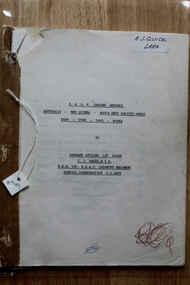
Manual - Raaf Ground Defence - Australia, New Guinea, South West Pacific Areas 1939 - 1940 - 1945 - Korea
... Raaf Ground Defence - Australia, New Guinea, South West Pacific Areas 1939 - 1940 - 1945 - Korea...Raaf Ground Defence - Australia, New Guinea, South West Pacific Areas 1939 - 1940 - 1945 - Korea...Quick A instruction Manual Compiled by Warrant Officer , M.I.D. Raaf Ground Defence - Australia, New Guinea, South West Pacific Areas 1939 - 1940 - 1945 - Korea Manual Raaf Ground Defence - Australia, New Guinea, South West Pacific Areas 1939 - 1940 - 1945 - Korea ...R.A.A. F. Instructional ManualCovers WW2 and Korea WarsA instruction Manual Compiled by Warrant Officer , M.I.D. Owned by A, J. Quickr.a.a.f. manual -
 National Vietnam Veterans Museum (NVVM)
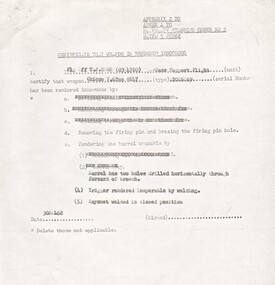
Memorabilia - A Copy of a Certificate That Weapon is Rendered Innocuous, 1968
... ...Ground Defence...This item was donated by Flight Lieutenant Terence John Howe (0314780) who was with Ground Defence with the Royal Australian Air Force. ...This item was donated by Flight Lieutenant Terence John Howe (0314780) who was with Ground Defence with the Royal Australian Air Force. ...This item was donated by Flight Lieutenant Terence John Howe (0314780) who was with Ground Defence with the Royal Australian Air Force. He served in Vietnam with Base Support Flight from January 1968 to September 1968. A Copy of a Certificate That Weapon is Rendered Innocuous belonging to Flg Off T.J. Howe (0314780) the weapon, Chicom 7.62mm AK47, serial number (hard to read) has been rendered innocuous by removing the firing pin and brazing the firing pin hole. Rendering the barrel unusable by the barrel has two holes drilled horizontally through forward of breach, trigger rendered inoperable by welding and bayonet welded in closed position. This was dated 30 Jul 68flight lieutenant terence john howe, 0314780, royal australian air force, raaf, ground defence, special duties, base support flight, weapons, chicom 7.62mm ak47, rendered innocuous, certificate -
 Bendigo Military Museum
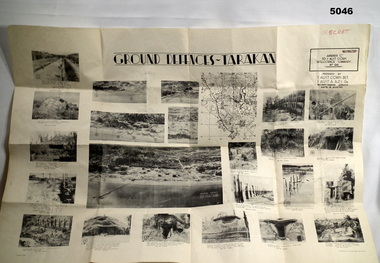
Poster - POSTER, GROUND DEFENCES "TARAKAN", 1 Aust Corps Det. A.A.P.I. Gn, Ref map Tarakan 1/25000, 8 August 1945
... Ground Defences Tarakan...Poster POSTER, GROUND DEFENCES "TARAKAN" 1 Aust Corps Det. A.A.P.I. ...Francis Hansen VX85668 2/3rd Infantry Battalion.Cream coloured Paper, Black Printed map with 23 photographs on it.Ground Defences Tarakanposter, photographs, tarakan -
 Lara RSL Sub Branch
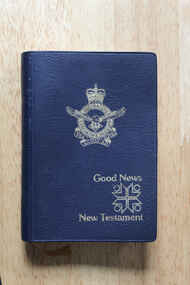
Book - Bible, Royal Australian air Force Pocket Bible, fourth edition 1976
... RAAF Ground Defence - Australia - New Guinea - South West Pacific Areas 1939- 1940 -1945...Good News Testament English Version religion bible Royal Australian Air Force Bible RAAF Ground Defence - Australia - New Guinea - South West Pacific Areas 1939- 1940 -1945 Royal Australian air Force Pocket Bible Book Bible ...Good News Testament English VersionRAAF Ground Defence - Australia - New Guinea - South West Pacific Areas 1939- 1940 -1945Royal Australian Air Force Biblereligion, bible -
 Bendigo Historical Society Inc.
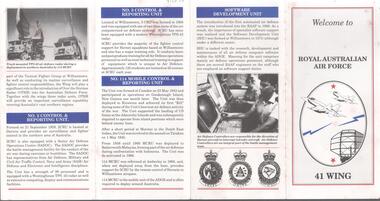
Document - RAAF RADAR REUNION COLLECTION: WELCOME TO ROYAL AUSTRALIAN AIR FORCE 41 WING
... Small information booklet titled: Welcome to Royal Australian Air Force 41 Wing, Chapters are The air defence ground environment - No.41 Wing, a brief history - No.2 control and reporting unit - No.3 control and reporting unit - No.114 mobile control and reporting unit - software development unit....MILITARY Airforce raaf radar Small information booklet titled: Welcome to Royal Australian Air Force 41 Wing, Chapters are The air defence ground environment - No.41 Wing, a brief history - No.2 control and reporting unit - No.3 control and reporting unit - No.114 mobile control and reporting unit - software development unit. ...Small information booklet titled: Welcome to Royal Australian Air Force 41 Wing, Chapters are The air defence ground environment - No.41 Wing, a brief history - No.2 control and reporting unit - No.3 control and reporting unit - No.114 mobile control and reporting unit - software development unit.military, airforce, raaf radar -
 Frankston RSL Sub Branch
Helmet, Australian M1, circa 1960's
... Defence Force. In the 1990s they were replaced by the Kevlar based Personnel Armour System-Ground Troop (PASGT) type helmet. ...Defence Force. In the 1990s they were replaced by the Kevlar based Personnel Armour System-Ground Troop (PASGT) type helmet. ...Standard issue United States M1 pattern steel helmet, olive drab in colou, stretch cotton cargo type net, with fibreglass liner. On the inside of a strap in the liner '8415-153-6671' is printed in black ink. This number would appear to be the "Federal Stock Number (FSN)" which was used 1949 to 1975 when ti was replaced by "National Stock Number (NSN)' by additional of 00 after the first 4 numbers. this would indicate that it was made in USA. The chin strap and liner are both complete and fully operable. These helmets were first issued in 1941 to the United States Armed Forces. They were adopted after the Korean War by the Australian Defence Force. In the 1990s they were replaced by the Kevlar based Personnel Armour System-Ground Troop (PASGT) type helmet. However, as evidenced by this helmet, some M1 Steel helmets were not replaced in-service by the PASGT helmet and survived into the early 21st Century. Used by Royal Australian Army in Vietnam in areas where mines were significnat, such as Long Hai's mountains (together with US flak jackets), and also by Royal Australain Navy.An example of an Australian Army issue M1 steel battle helmet complete with fibreglass liner. This helmet type was issued to Australian defence personnel during the Vietnam conflict. The inner line has a transfer on the front " Australian Military Forces" with rising sun badge. The steel outer has an olive green elastic cover (similiar to cargo net) to hold camouflage material. The M1 is two "one-size-fits-all" helmets: an outer shell made of metal and a hard hat-type liner that is nestled inside the shell and contains the suspension system that would be adjusted to fit the wearer's head. Helmet covers and netting would be applied by covering the steel shell with the extra material tucked inside the shell and secured by inserting the liner. The helmet is 7 inches in height, width is 9.5 inches and length is 11 inches. The weight of a World War II era M1 is approximately 2.85 pounds including the liner and chinstrap. (From Wikipepedia) the inner line has a transfer on the front " Australian Military Forces" with rising sun badge.steel helmet -
 Lara RSL Sub Branch
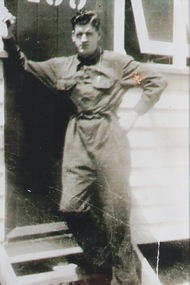
Photograph, Colin Arthur Goldberg, A37084
... Personal Story A willingness to put oneself in readiness for the call to arm oneself in the defence of family and Nation . sepia photograph korea 1951 laverton ballarat raaf reserves A37084 Telegraphist Colin Arthu Goldberg. 1st National Service Intake. RAAF. 1932-2013. Sepia image of Telegraphist A37084 Colin A Goldberg Cream Mount Black Frame. Colin is standing on the steps of hut number 199 at Ground ...Colin A Goldberg b 13 November 1932 - D 2February 2013. Colin attended several primary schools in Victoria leaving school aged 13 years. Working hard at various jobs Colin studied at RMIT qualifying as builder /carpenter in 1961. Colin was called up for National Service on 30 July, 1951. He was allotted to the RAAF, and underwent recruit training at Laverton. From there he went to the ground and air radio school in Ballarat. After his training Colin was placed in the RAAF reserve. Colin was on the list for Korea for 9 years although did not serve. Colin said of his training: "My National Service Training showed me purpose & a discipline that turned my life somewhat around for the good & for all time". Colin first joined the family of R S L at WARRAGUL in 1992 transferring to Lara in 1996. Elizabeth, Colin's wife, says that he was probably working with members of the RSL and that talk at work about the branch made him think that it was a good place to connect and make friends, and this was part of the reason why they continued at Lara. Colin. And wife Elizabeth came to live in Lara in 1994 there being a warm welcome for us both by the members of Lara RSL in 1996. Colin & Elizabeth found friendship & a whole wide window to the consequence of warfare. Indeed history written through the suffering of so many . Colin & Elizabeth were married for 57 years when Colin died. Colin and Elizabeth had two daughters, three grandchildren, and three great grandchildren however he never met them. Personal Story A willingness to put oneself in readiness for the call to arm oneself in the defence of family and Nation .Sepia image of Telegraphist A37084 Colin A Goldberg Cream Mount Black Frame. Colin is standing on the steps of hut number 199 at Ground and Air Radio School RAAF Ballarat A37084 Telegraphist Colin Arthu Goldberg. 1st National Service Intake. RAAF. 1932-2013.sepia photograph, korea, 1951, laverton, ballarat, raaf reserves -
 Flagstaff Hill Maritime Museum and Village
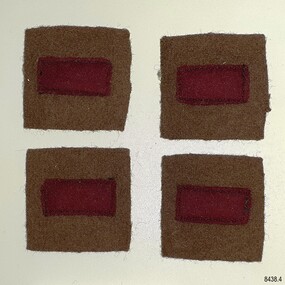
Badge - Australian Military cloth patch, Army Medical Corps, 108 Australian General Hospital, 1939-1945
... Defence Forces in the Army Medical Corps, 108 Australian General Hospital and 106 Australian General Hospital, stationed in Ballarat, Victoria, and in Bonegilla, N.S.W. He completed his service just before the end of the war due to suffering from a heart attack. In World War I the troops of the Australian Military Forces staked coloured flags of various shapes and colours in the ground...Defence Forces in the Army Medical Corps, 108 Australian General Hospital and 106 Australian General Hospital, stationed in Ballarat, Victoria, and in Bonegilla, N.S.W. He completed his service just before the end of the war due to suffering from a heart attack. In World War I the troops of the Australian Military Forces staked coloured flags of various shapes and colours in the ground ...The four cloth patches belonged to Dr William Roy Angus and are now part of Flagstaff Hill’s comprehensive W.R. Angus Collection, donated by the family of Dr W R Angus (1901-1970), surgeon and oculist. The badges date to the Second World War era, when Dr Angus was a Surgeon Captain for the Australian Defence Forces in the Army Medical Corps, 108 Australian General Hospital and 106 Australian General Hospital, stationed in Ballarat, Victoria, and in Bonegilla, N.S.W. He completed his service just before the end of the war due to suffering from a heart attack. In World War I the troops of the Australian Military Forces staked coloured flags of various shapes and colours in the ground where they camped to identify their units. These flag codes were quickly recognised. The system worked so well that miniature flags were called colour patches. They became part of the uniform, to be worn on both sleeves just below the shoulder. The system was slightly modified for use in the Second World War. The W.R. Angus Collection: - The W.R. Angus Collection includes historical medical equipment, surgical instruments and material belonging to Dr Edward Ryan and Dr Thomas Francis Ryan, (both of Nhill, Victoria) and Dr Angus’ own belongings. The Collection’s history spans the medical practices of the two Doctors Ryan, from 1885-1926 plus that of Dr Angus, up until 1969. It includes historical medical and surgical equipment and instruments from the doctors Edward and Thomas Ryan of Nhill, Victoria. Dr Angus married Gladys in 1927 at Ballarat, the nearest big city to Nhill where he began as a Medical Assistant. He was also Acting House surgeon at the Nhill hospital where their two daughters were born. During World War II He served as a Military Doctor in the Australian Defence Forces. Dr Angus and his family moved to Warrnambool in 1939, where Dr Angus operated his own medical practice. He later added the part-time Port Medical Officer responsibility and was the last person appointed to that position. Both Dr Angus and his wife were very involved in the local community, including the planning stages of the new Flagstaff Hill and the layout of the gardens there. Dr Angus passed away in March 1970.Dr W R Angus (1901-1970), surgeon and oculist, collected a range of military objects including those he personally used during his time as Surgeon Captain in the Australian Defence Forces in World War II. The objects allow insight into military life in the early-to-mid 20th century. The W.R. Angus Collection is significant for still being located at the site it is connected with, Doctor Angus being the last Port Medical Officer in Warrnambool. The Collection includes historical medical objects that date back to the late 1800s.Badges; set of four cloth patches, red rectangles on brown squares. Insignia of the Australian Defence Forces, Army Medical Corps, 108 Australian General Hospital, WWII era. Dr W R Angus owned the cloth patches that are now part of the W. R. Angus Collection.flagstaff hill, warrnambool, maritime village, maritime museum, shipwreck coast, great ocean road, flagstaff hill maritime museum and village, dr w r angus, w.r. angus collection, australian army, surgeon captain, ballarat, bonegilla, badge, insignia, badge collection, world war 2, second world war, australian defence forces, army medical corps, 108 australian general hospital, great war, military uniform, 106 australian general hospital, 1939-1945 -
 Flagstaff Hill Maritime Museum and Village
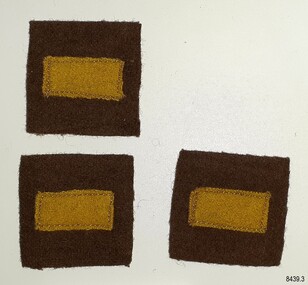
Badge - Australian Military cloth patch, Army Medical Corps, 106 Australian General Hospital, 1939-1945
... Defence Forces in the Army Medical Corps, 108 Australian General Hospital and 106 Australian General Hospital, stationed in Ballarat, Victoria, and in Bonegilla, N.S.W. He completed his service just before the end of the war due to suffering from a heart attack. In World War I the troops of the Australian Military Forces staked coloured flags of various shapes and colours in the ground...Defence Forces in the Army Medical Corps, 108 Australian General Hospital and 106 Australian General Hospital, stationed in Ballarat, Victoria, and in Bonegilla, N.S.W. He completed his service just before the end of the war due to suffering from a heart attack. In World War I the troops of the Australian Military Forces staked coloured flags of various shapes and colours in the ground ...The three cloth patches belonged to Dr William Roy Angus and are now part of Flagstaff Hill’s comprehensive W.R. Angus Collection, donated by the family of Dr W R Angus (1901-1970), surgeon and oculist. The badges date to the Second World War era, when Dr Angus was a Surgeon Captain for the Australian Defence Forces in the Army Medical Corps, 108 Australian General Hospital and 106 Australian General Hospital, stationed in Ballarat, Victoria, and in Bonegilla, N.S.W. He completed his service just before the end of the war due to suffering from a heart attack. In World War I the troops of the Australian Military Forces staked coloured flags of various shapes and colours in the ground where they camped to identify their units. These flag codes were quickly recognised. The system worked so well that miniature flags were called colour patches. They became part of the uniform, to be worn on both sleeves just below the shoulder. The system was slightly modified for use in the Second World War. The W.R. Angus Collection: - The W.R. Angus Collection includes historical medical equipment, surgical instruments and material belonging to Dr Edward Ryan and Dr Thomas Francis Ryan, (both of Nhill, Victoria) and Dr Angus’ own belongings. The Collection’s history spans the medical practices of the two Doctors Ryan, from 1885-1926 plus that of Dr Angus, up until 1969. It includes historical medical and surgical equipment and instruments from the doctors Edward and Thomas Ryan of Nhill, Victoria. Dr Angus married Gladys in 1927 at Ballarat, the nearest big city to Nhill where he began as a Medical Assistant. He was also Acting House surgeon at the Nhill hospital where their two daughters were born. During World War II He served as a Military Doctor in the Australian Defence Forces. Dr Angus and his family moved to Warrnambool in 1939, where Dr Angus operated his own medical practice. He later added the part-time Port Medical Officer responsibility and was the last person appointed to that position. Both Dr Angus and his wife were very involved in the local community, including the planning stages of the new Flagstaff Hill and the layout of the gardens there. Dr Angus passed away in March 1970.Dr W R Angus (1901-1970), surgeon and oculist, collected a range of military objects including those he personally used during his time as Surgeon Captain in the Australian Defence Forces in World War II. The objects allow insight into military life in the early-to-mid 20th century. The W.R. Angus Collection is significant for still being located at the site it is connected with, Doctor Angus being the last Port Medical Officer in Warrnambool. The Collection includes historical medical objects that date back to the late 1800s.Badges; set of three cloth patches, yellow rectangles on brown squares. Insignia of the Australian Defence Forces, Army Medical Corps, 106 Australian General Hospital, WII era. Dr W R Angus owned the cloth patches that are now part of the W. R. Angus Collection.flagstaff hill, warrnambool, maritime village, maritime museum, shipwreck coast, great ocean road, flagstaff hill maritime museum and village, dr w r angus, w.r. angus collection, australian army, surgeon captain, ballarat, bonegilla, badge, insignia, world war 1, 1914-1918, badge collection, world war 2, second world war, australian defence forces, army medical corps, 108 australian general hospital, great war, military uniform, 106 australian general hospital -
 Flagstaff Hill Maritime Museum and Village
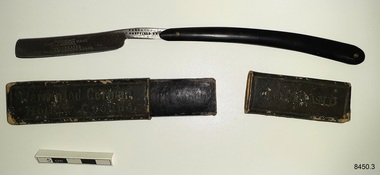
Domestic object - Razor and case, Ford & Medley (F & M), ca 1900-1928
... Defence Forces in World War II. The W.R. Angus Collection is significant for still being located at the site it is connected with, Doctor Angus being the last Port Medical Officer in Warrnambool. The Collection includes historical medical objects that date back to the late 1800s. Flagstaff Hill Warrnambool Maritime Village Maritime Museum Shipwreck coast Great Ocean Road Flagstaff Hill Maritime Museum and Village Dr W R Angus W.R. Angus Collection personal grooming accessory razor shaving accessory The Wake The F & M Wake Hollow Ground ...This straight edge razor, The F & M Wake, was made by Ford & Medley in Sheffield, England. This style or razor was a popular choice for men's shaving in the late 19th and early 20th centuries. Ford & Medley were cutlers by trade and registered their first silver mark in 1900. The firm were also did electroplating. The firm was contracted to the government during World War I. The company was using the trademarks EMU and WIZARD as well as the logo of 'knotted ropes' with the letters "F M"by the end of that war at their factory called Emu Works. The firm's most popular razor was The Arrow. In 1928 the firm closed down. The Ford & Medley razor is now part of Flagstaff Hill’s comprehensive W.R. Angus Collection, donated by the family of Dr W R Angus (1901-1970), surgeon and oculist. The W.R. Angus Collection: - The W.R. Angus Collection includes historical medical equipment, surgical instruments and material belonging to Dr Edward Ryan and Dr Thomas Francis Ryan, (both of Nhill, Victoria) and Dr Angus’ own belongings. The Collection’s history spans the medical practices of the two Doctors Ryan, from 1885-1926 plus that of Dr Angus, up until 1969. It includes historical medical and surgical equipment and instruments from the doctors Edward and Thomas Ryan of Nhill, Victoria. Dr Angus married Gladys in 1927 at Ballarat, the nearest big city to Nhill where he began as a Medical Assistant. He was also Acting House surgeon at the Nhill hospital where their two daughters were born. During World War II Dr Angus served as a Military Doctor. He was a Surgeon Captain for the Australian Defence Forces, Army Medical Corps, stationed in Ballarat, Victoria, and in Bonegilla, N.S.W. He completed his service just before the end of the war due to suffering from a heart attack. Dr Angus and his family moved to Warrnambool in 1939, where Dr Angus operated his own medical practice. He later added the part-time Port Medical Officer responsibility and was the last person appointed to that position. Both Dr Angus and his wife were very involved in the local community, including the planning stages of the new Flagstaff Hill and the layout of the gardens there. Dr Angus passed away in March 1970.This razor is an example of men's shaving equipment used in the early 20th century. It is significant for its association with the local doctor, W.R. Angus. Dr W R Angus (1901-1970), surgeon and oculist, collected a range of military objects including those he personally used during his time as Surgeon Captain in the Australian Defence Forces in World War II. The W.R. Angus Collection is significant for still being located at the site it is connected with, Doctor Angus being the last Port Medical Officer in Warrnambool. The Collection includes historical medical objects that date back to the late 1800s.Razor, cut-throat straight blade razor, in black cardboard box with slide-off lid. Black composition arc shaped handle with pin to attach blade that folds inside the handle. Inscriptions are on handle, blade and case. "The Wake" razor, made by Ford & Medley, Sheffield, England. The pouch belonged to Dr W R Angus and is now part of the W. R. Angus Collection.On razor; "THE F & M WAKE" "CELEBRATED HOLLOW GROUND RAZOR" "FORD & MEDLEY / SHEFFIELD ENGLAND" On case; "WARRANTED GORMAN" "HOLLOW GROUND" Logo on razor [""F" "M" either side of entwined rope symbolflagstaff hill, warrnambool, maritime village, maritime museum, shipwreck coast, great ocean road, flagstaff hill maritime museum and village, dr w r angus, w.r. angus collection, personal grooming accessory, razor, shaving accessory, the wake, the f & m wake, hollow ground razor, ford & medley, sheffield, cutler, electroplater, emu works -
 Montmorency–Eltham RSL Sub Branch
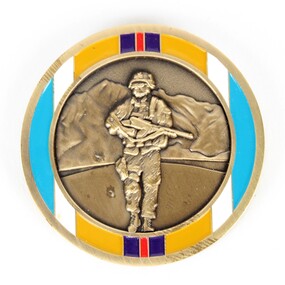
Medal - Commemorative Medallion
... According to the Department of Defence, "the ribbon is khaki representing the dominant ground colour of the terrain, edged with light blue and white stripes representing the sky above the mountains and the snow on the mountain peaks with central stripes of purple and red representing the ADF and the conflict in Afghanistan." ...According to the Department of Defence, "the ribbon is khaki representing the dominant ground colour of the terrain, edged with light blue and white stripes representing the sky above the mountains and the snow on the mountain peaks with central stripes of purple and red representing the ADF and the conflict in Afghanistan." commemoration operation slipper afghanistan australian army middle east international security assistance force This commemorative medallion features the Afghanistan Medal ribbon colours encircling the figure of an ADF member holding a weapon. ...In November 2001 Australian SAS troops joined the war in Afghanistan under the operation name "Operation Slipper." Australia's military contribution to the International Security Assistance Force mission in Afghanistan ended in 2014, making Operation Slipper Australia's longest running operation. According to the Department of Defence, "the ribbon is khaki representing the dominant ground colour of the terrain, edged with light blue and white stripes representing the sky above the mountains and the snow on the mountain peaks with central stripes of purple and red representing the ADF and the conflict in Afghanistan." This commemorative medallion features the Afghanistan Medal ribbon colours encircling the figure of an ADF member holding a weapon. The image is in relief. The reverse features a number of service personnel pictured in front of a vehicle, encircled by the motif of the Australian national flag.commemoration, operation slipper, afghanistan, australian army, middle east, international security assistance force -
 Rye RSL Sub Branch
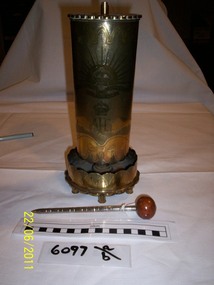
Dinner Gong
... Defence Force. A commemorative Dinner Gong construted from Artillery Shell Casings of various sizes. The largest cut short at the bottom, mounted on rifle or machine gun casings cut short as 'feet'. A slightly smaller diameter inverted as the 'gong' with decorative engravings depicting, a Rising Sun emblem on a decorated back ground, 'AFC' (Australian Flying Corps) crowned wings, on the same decorated back ground. ...Hand theatre made "trench art", utilising used artillery brass shell casings, of various calibres, hand made with such "tools" as were available at the time. They have been decoratively trimmed at the mouth of each with a "scalloped" pattern, the shallowest casing mounted on small arms casings as "feet" and the large casing inverted engraved and embossed with a depiction of the Australian Commonwealth Military Forces "Rising Sun" badge.This "Dinner Gong" and "Striker" are significant Historically and Socially, as it is believed to be the only example of a dinner gong and striker made in theatre as contemporary "trench art" by serving members of this group. Around the top of the main part of the Gong are stamped the initials of the Australian members of the Royal Flying Corps at the time, it is of possible National historical significance, as they were such a small group at best, and a highly vulnerable group, quite likely to not survive the conflict. This group and their desendants went on to be a part of the formation of the Australian Flying Corps, the beginings of the Royal Australian Air Force. It relates to the embrionic stages of a part of the now Australian Defence Force.A commemorative Dinner Gong construted from Artillery Shell Casings of various sizes. The largest cut short at the bottom, mounted on rifle or machine gun casings cut short as 'feet'. A slightly smaller diameter inverted as the 'gong' with decorative engravings depicting, a Rising Sun emblem on a decorated back ground, 'AFC' (Australian Flying Corps) crowned wings, on the same decorated back ground. The open ends of these larger casings is 'scalloped' and decorated beautifully, while the closed ends have a 'pie crust effect around the flanged edge. There is a biforcated mount at the top to hold the 'striker' made from white metal ballastered rod with a wooden eliptical knob. On the top around the striker mount are stamped the initials of those believed to be the first Australian Aviators in the then AFC. -
 Bendigo Military Museum
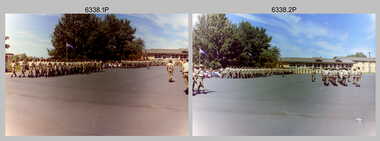
Photograph - Army Survey Regiment – CO’s Parade and Defence Force Service Medal Presentations, c1987
... Defence Force Service Medal, at the Army Survey Regiment, Bendigo in c1987. The colour photographs are on 35mm negative film and are part of the Army Survey Regiment’s Collection. The photographs were scanned at 96 dpi. .1) to 2) - Photo, colour, c1987. Squadrons marching on parade ground...Defence Force Service Medal, at the Army Survey Regiment, Bendigo in c1987. The colour photographs are on 35mm negative film and are part of the Army Survey Regiment’s Collection. The photographs were scanned at 96 dpi. .1) to 2) - Photo, colour, c1987. Squadrons marching on parade ground ...These 34 photographs were taken at a CO’s parade at the Army Survey Regiment, Bendigo in c1987. The Colonel Commandant (honorary appointment) of the Survey Corps - COL Clem Sargent (Retd), presented the Defence Force Service Medal to four personnel in recognition of 15 years of efficient remunerated service, or the Clasp for 5 years of additional service. Recipients were WO1 Neville Stone and three unidentified support staff from the Australian Army Catering Corps, Royal Australian Electrical and Mechanical Engineers and the Royal Australian Corps of Transport. This is a set of 34 photographs of a CO’s parade and the presentation of the Defence Force Service Medal, at the Army Survey Regiment, Bendigo in c1987. The colour photographs are on 35mm negative film and are part of the Army Survey Regiment’s Collection. The photographs were scanned at 96 dpi. .1) to 2) - Photo, colour, c1987. Squadrons marching on parade ground. .3) to .4) - Photo, colour, c1987. Squadrons formed up on parade ground. RSM WO1 Jeff Lynch delivering orders. .5) - Photo, colour, c1987. Officers at ease in readiness to take posts. .6) - Photo, colour, c1987. Squadrons formed up on parade ground. RSM WO1 Jeff Lynch delivering orders. .7) - Photo, colour, c1987. RSM WO1 Jeff Lynch handing over to 2IC MAJ Terry Edwards. .8) - Photo, colour, c1987. Officers marching on to take posts. .9) - Photo, colour, c1987. L to R: CPL Paul Richards, SPR Todd Reynolds, SPR Eric Nicholson, MAJ Roger Rix, CPL Steve Hill, unidentified, CPL Russ Mollenhauer, remainder. .10) - Photo, colour, c1987. Guest of Honour - COL COMDT COL Clem Sargent arrives on parade ground, remainder unidentified. .11) - Photo, colour, c1987. Army Survey Regiment ready to salute Guest of Honour - COL COMDT COL Clem Sargent. .12) - Photo, colour, c1987, Guest of Honour - COL COMDT COL Clem Sargent returns salute. .13) - Photo, colour, c1987, L to R: 2IC MAJ Terry Edwards, SPR Eric Nicholson, COL COMDT COL Clem Sargent, SGT John ‘Stormy’ Tempest, unidentified (x2), SGT Mal Paterson, SGT Kevin Boehm, SSGT Peter Mustart, CPL Trevor Poll, SGT Terry Danger. .14) - Photo, colour, c1987, In left foreground MAJ Bob McHenry, unidentified personnel, unidentified officer, 2IC MAJ Terry Edwards, COL COMDT COL Clem Sargent, 3rd from right CAPT Graeme Wastell, CPL John Martin, SGT Martin Evans. .15) - Photo, colour, c1987, L to R: unidentified personnel, unidentified officer, 2IC MAJ Terry Edwards, COL COMDT COL Clem Sargent, SSGT Rick Van der Bom, CPL Paul Hunter, unidentified personnel, CAPT Graeme Wastell, SGT Paul Leskovec CSM, CPL John Martin, SGT Paul Cheater, SGT Martin Evans. .16) - Photo, colour, c1987, L to R: SGT Martin Evans. 2IC MAJ Terry Edwards, unidentified officer, COL COMDT COL Clem Sargent, unidentified personnel, SGT Paul Leskovec CSM, SGT Paul Cheater, SSGT Brian Collings, SSGT Ian ‘Rock’ Thistleton, WO1 Stevo Hinic. .17) - Photo, colour, c1987, L to R: unidentified personnel, 2IC MAJ Terry Edwards, COL COMDT COL Clem Sargent, SGT Roger Rees, unidentified female officer, SGT Phil Smalley, CPL Steve Coulsen, SPR Toni Wright, SGT Steve Gloster, SSGT Ken Talbot-Smith, CPL Darren Wilkinson, unidentified, SGT Paul Hopes. .18) - Photo, colour, c1987, L to R: unidentified female officer, COL COMDT COL Clem Sargent, unidentified, SGT Phil Smalley, CPL Steve Coulsen, SPR Toni Wright, CPL Steve Gloster, SSGT Ken Talbot-Smith, CPL Darren Wilkinson, SGT Paul Hopes. .19) - Photo, colour, c1987, L to R: unidentified personnel, CPL Peter ‘Jack’ Elverd, 2IC MAJ Terry Edwards, COL COMDT COL Clem Sargent, unidentified, SGT Stuart Hibbert, unidentified, Ted Burgess. .20) - Photo, colour, c1987, L to R: unidentified officer, COL COMDT COL Clem Sargent, 2IC MAJ Terry Edwards. .21) - Photo, colour, c1987, L to R: unidentified (x3), WO1 Neville Stone, COL COMDT COL Clem Sargent, SSGT Greg Anderson, unidentified officer, CAPT Graeme Wastell. .22) to .24) - Photo, colour, c1987, L to R: unidentified (x3), WO1 Neville Stone, COL COMDT COL Clem Sargent, SSGT Greg Anderson, unidentified officer. .25) to .26) - Photo, colour, c1987, L to R: unidentified, WO1 Neville Stone, unidentified, COL COMDT COL Clem Sargent, SSGT Greg Anderson, unidentified officer. .26) to 30) - Photo, colour, c1987, L to R: unidentified (x2), WO1 Neville Stone, COL COMDT COL Clem Sargent, SSGT Greg Anderson, unidentified officer. .31) to .34) - Photo, colour, c1987, L to R: unidentified, WO1 Neville Stone, COL COMDT COL Clem Sargent, unidentified officer..1P to .34P – There are no personnel identified.royal australian survey corps, rasvy, army survey regiment, army svy regt, fortuna, asr -
 Bendigo Military Museum
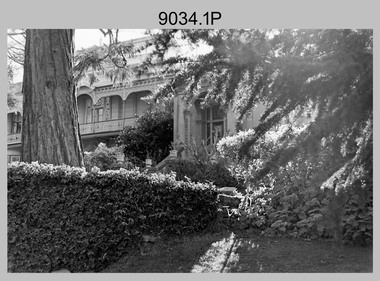
Photograph - Army Survey Regiment - Fortuna & Surrounds, Bendigo, Army Survey Regiment - Fortuna Interior, Bendigo, c1987-1989
... After Defence took possession of Fortuna in 1942, the Q-store and engineering workshops were added during the wartime period. Soldiers were accommodated in tents during WW2 for 20 years next to the parade ground before the construction of accommodation buildings in 1962. ...After Defence took possession of Fortuna in 1942, the Q-store and engineering workshops were added during the wartime period. Soldiers were accommodated in tents during WW2 for 20 years next to the parade ground before the construction of accommodation buildings in 1962. ...This set of 12 photographs of the Army Survey Regiment’s Fortuna Villa and surrounding facilities was taken circa 1987 to 1989. The photos feature much of Fortuna’s exterior and most of the out-buildings spread over the property’s fifteen acres of grounds. After Defence took possession of Fortuna in 1942, the Q-store and engineering workshops were added during the wartime period. Soldiers were accommodated in tents during WW2 for 20 years next to the parade ground before the construction of accommodation buildings in 1962. In 1990 most of the weatherboard buildings in the Q-store area were replaced. A climate-controlled building was also constructed to house a map library and digital data media. This photo set also includes the exterior of Air Survey Squadron’s Building 16 and two modular buildings -16A and 16B that were added in the early 1980s to accommodate map production and technical services. See item 6456.30P for more photos of Fortuna Villa and its surrounding facilities. This set of 12 photographs of the Army Survey Regiment’s Fortuna Villa and surrounding facilities was taken circa 1987 to 1989. The photographs are on 35mm negative film and scanned at 96 dpi. They are part of the Army Survey Regiment’s Collection. .1) - Photo, black & white, c1987-1989. Fortuna Villa – front view. .2) - Photo, black & white, c1987-1989. Fortuna Villa – view of lake towards tennis courts. .3) - Photo, black & white, c1987-1989. Fortuna Villa – view of lake towards OR’s Barracks. .4) - Photo, black & white, c1987-1989. Fortuna Villa – back view. .5) - Photo, black & white, c1987-1989. View of Fortuna Villa from Air Survey Squadron’s Building. Technical Services, Building 16B at right. .6) - Photo, black & white, c1987-1989. Fortuna Villa – view of lake towards tennis courts. .7) - Photo, black & white, c1987-1989. Fortuna Villa – Pompeii Fountain in front garden. .8) - Photo, black & white, c1987-1989. Fortuna Villa – statue on top of the Pompeii Fountain’s pillar. .9) - Photo, black & white, c1987-1989. Fortuna Villa – view of Litho buildings and newly constructed Wayzgoose Hall Print Building from rooftop. .10) - Photo, black & white, c1987-1989. Fortuna Villa – view of sequoia trees and lake from rooftop. .11) - Photo, black & white, c1987-1989. Fortuna Villa – balcony view of Q-store and transport compound from rooftop. .12) - Photo, black & white, c1987-1989. Fortuna Villa – playground with tennis courts in background.There are no annotations.royal australian survey corps, rasvy, fortuna, army survey regiment -
 Bendigo Military Museum
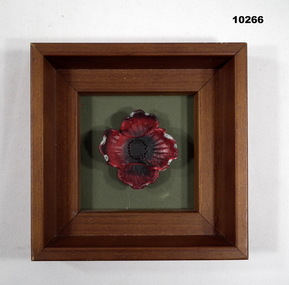
Souvenir - FRAMED ITEM, POPPY, Ron Davis
... Defence Corps dating back to 1906. Part of the collection of Kevin John Herdman, No. 397661. See Cat No. 5942P for details of his service. Framed Item Poppy Souvenir Kevin John HERDMAN Text on back in black type: "Fired from a rifle or gun, they sound, Fly through the air, some fall to the ground, covered in soil and grass they lay, 100 years we remember our heroes this day, Now rise the bullet recycled from the past, A beautiful poppy that will ever last" by Ron Davis, www leadastray.com.au 3D red poppy in a brown wooden frame. ...Poppy was made from lead bullets collected from historical Rifle Range used by Light Horse Brigade and Voluntary Defence Corps dating back to 1906. Part of the collection of Kevin John Herdman, No. 397661. See Cat No. 5942P for details of his service.3D red poppy in a brown wooden frame. Poppy sits in a khaki coloured background. Poppy fabricated from lead. Provenance details on back with text in black type.Text on back in black type: "Fired from a rifle or gun, they sound, Fly through the air, some fall to the ground, covered in soil and grass they lay, 100 years we remember our heroes this day, Now rise the bullet recycled from the past, A beautiful poppy that will ever last" by Ron Davis, www leadastray.com.auframed item, poppy, souvenir, kevin john herdman -
 Bendigo Military Museum
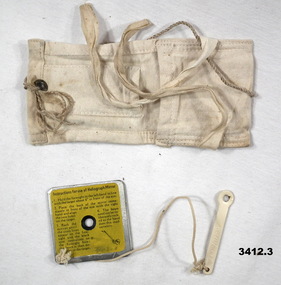
Equipment - HELIOGRAPH MIRROR, Department of Defence, possibly WW2 era
... Ground to Air .1) Bright polished steel. Cross hairs engraved on reflective surface. Rear face has instructions for use, yellow sticker with black print. .2) Sight. Long piece with viewing hole at end, painted white. .3) White cotton container with tie straps. Equipment HELIOGRAPH MIRROR Department of Defence ...Emergency signaling mirror - Ground to Air .1) Bright polished steel. Cross hairs engraved on reflective surface. Rear face has instructions for use, yellow sticker with black print. .2) Sight. Long piece with viewing hole at end, painted white. .3) White cotton container with tie straps..1) On rear yellow sticker / black print: "Instructions for use of Heliograph Mirror & illustration" .2) Site stamped one side: "27H / 2107" .3) Faded stencil on flap: "Heliograph" heliograph, mirror, ground to air -
 Bendigo Military Museum
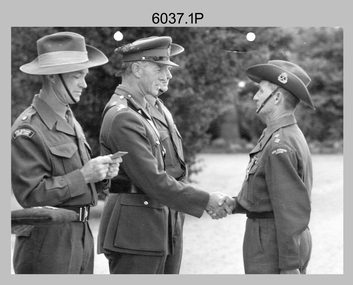
Photograph - Army Survey Regiment – Defence Force Service Medal Presentations, c1967, c1976-1980
... In photos .1P to .8P, the Defence Force Service Medal was presented to personnel in recognition of 15 years of efficient remunerated service, or the Clasp for each further 5-year period of service. The photos were taken on four separate occasions. Photos .1P to .3P were taken on the parade ground...In photos .1P to .8P, the Defence Force Service Medal was presented to personnel in recognition of 15 years of efficient remunerated service, or the Clasp for each further 5-year period of service. The photos were taken on four separate occasions. Photos .1P to .3P were taken on the parade ground ...This is a set of nine photographs of medal presentations at the Army Survey Regiment, Fortuna, Bendigo. In photos .1P to .8P, the Defence Force Service Medal was presented to personnel in recognition of 15 years of efficient remunerated service, or the Clasp for each further 5-year period of service. The photos were taken on four separate occasions. Photos .1P to .3P were taken on the parade ground. LTCOL John Nolan was the CO of the Army Headquarters Survey Regiment from 1965 to 1969. He was subsequently promoted to COL and was the Director of Military Survey from 1972 to 1975. MAJ Lionel ‘Bill’ Sprenger MBE, MID was subsequently promoted to LTCOL and was the CO of the unit from 1969 to 1970. Photos .4P to .7P were taken in circa mid-1970s and Photo .8P was taken on Friday 21 October 1976. Photos .4P to .8P were taken next to the flagpole in Fortuna Villa’s front garden. This is a set of nine photographs of medal presentations at the Army Survey Regiment, Bendigo circa 1960s-1970s. The photographs were printed on photographic paper and are part of the Army Survey Regiment’s Collection. The photographs were scanned at 300 dpi. .1) - Photo, black & white, 1965. L to R: MAJ Lionel ‘Bill’ Sprenger MBE, MID; Major General Thomas Sydney Taylor, CBE, LVO, MC GOC Southern Command, CO LTCOL John Nolan, LT Jack McNeale. .2) - Photo, black & white, 1965. L to R: MAJ Lionel ‘Bill’ Sprenger MBE, MID; Major General Thomas Sydney Taylor, CBE, LVO, MC GOC Southern Command, CO LTCOL John Nolan, WO1 Jack Gore. .3) - Photo, black & white, 1965. L to R: MAJ Lionel ‘Bill’ Sprenger MBE, MID; Major General Thomas Sydney Taylor, CBE, LVO, MC GOC Southern Command, CO LTCOL John Nolan, WO2 Bob McGaritty. .4) & .5) - Photo, black & white, c1976. L to R: WO1 Don Taylor, BRIG Jim SHELTON DSO, MC, MID. .6) & .7) - Photo, black & white, c1976. L to R: SGT Syd Davis, Brigadier Jim SHELTON DSO, MC, MID. .8) - Photo, black & white, 1976. L to R: SSGT Gordon Haswell, WO1 Marj Knight, MAJGEN John Williamson AO, OBE GOC FF COMD. .9) - Photo, black & white, c1976-1980. L to R: unidentified (x2), WO2 John McCulloch, unidentified, WO1 Darby Munro, CO LTCOL Bob Skitch, unidentified visiting General..1P to .9P – no annotationsroyal australian survey corps, rasvy, army survey regiment, army svy regt, fortuna, asr -
4th/19th Prince of Wales's Light Horse Regiment Unit History Room
Flag, 173rd Airborne Brigade (US)
... This was in fact the first operational ground force formed under the ANZUS Defence Treaty. ANZUS was a mutual defence treaty signed in 1951 between Australia, New Zealand and the United States of America. ...This was in fact the first operational ground force formed under the ANZUS Defence Treaty. ANZUS was a mutual defence treaty signed in 1951 between Australia, New Zealand and the United States of America. ...173 AIRBORNE BRIGADE (SEPARATE) US ARMY 1 RAR BATTLE GROUP BIEN HOA 1965-1966 On May 5, 1965, the Brigade deployed to South Viet Nam as the first US Army ground combat unit in that war. Upon arrival, the 1st Battalion of the Royal Australian Regiment (1 RAR) and a battery from New Zealand (161Royal NZ Artillery) were attached to the Brigade -- making the 173d Airborne the only multi-national combat unit in the war. Initially headquartered in Bien Hoa, the Brigade operated in the four provinces around Saigon. (Xuan Loc, Long Khanh, Phuoc Long & Phuoc Tuy), but (in its roll as a "Fire Brigade") also went to the Central Highlands (Pleiku / Kontum) to fight Viet Cong. The 173d also conducted constant operations against the southern stronghold of the VC Main Force in the legendary Iron Triangle in War Zone D. The brigade was organized as a balanced airborne combat force consisting of two infantry battalions, an artillery battalion, a support battalion, an engineer company, a cavalry troop, an armour company, and a headquarters company. Upon activation, it became the first and only separate airborne brigade in the United States Army. This was the beginning of a long series of "Firsts" for the Brigade. On 5 May 1965, it became the first US Army ground combat unit committed to the war in South Vietnam, where further organizational changes were to take place. Australians attached to the Brigade were: 1st Battalion, of the Royal Australian Regiment (I RAR) and support troops of the 4/19th Prince of Wales Light Horse Regiment (1Troop), 105 Field Battery Royal Australian Artillery, 161 Field Battery Royal New Zealand Artillery, 3 Field Troop Royal Australian Engineers, 161 Reconnaissance Flight, Royal Australian Army Air Corps, 1st Australian Logistical Support Company. The Brigade's two infantry battalions, the First Battalion of the 503' Infantry (1/503`d) and the Second Battalion, of the 503`d Infantry (2/503`) and the attached Australians of 1 RAR constituted the infantrymen available to the Brigade. Their mission was to protect the Bien Hoa Air Base and to close with and destroy or capture the enemy. This was in fact the first operational ground force formed under the ANZUS Defence Treaty. ANZUS was a mutual defence treaty signed in 1951 between Australia, New Zealand and the United States of America. In 1965 the spirit of this treaty appeared as 173d Airborne Brigade (Sep) a tri-national brigade. The only such tri-national fighting force formed during the Vietnam War. On deployment to South Vietnam in 1965, 1 Troop A Squadron, 4th/19th Prince of Wales's Light Horse Regiment was part of the US 173rd Airborne Brigade combat group. Flag, two colours divided vertically, hoist half mid blue, fly half red. Badge of 173rd Airborne Brigade (730 x 490 mm) in centreflag, 173rd airborne, south vietnam -
4th/19th Prince of Wales's Light Horse Regiment Unit History Room
Magazine Publication, W J Morgans, Parade, March 1977
... A soft covered publication covering a variety of subjects, including "The Juggernauts" - the story of the development of the tank, "First Victory" - Cambrai proving ground of tank warfare, "Makeshift Army" - the story of Churchill's chocolate soldiers and the defence of Antwerp in 1914, and an article about General Lettow-Vorbeck in Africa....magazine publication Parade A soft covered publication covering a variety of subjects, including "The Juggernauts" - the story of the development of the tank, "First Victory" - Cambrai proving ground of tank warfare, "Makeshift Army" - the story of Churchill's chocolate soldiers and the defence of Antwerp in 1914, and an article about General Lettow-Vorbeck in Africa. ...A soft covered publication covering a variety of subjects, including "The Juggernauts" - the story of the development of the tank, "First Victory" - Cambrai proving ground of tank warfare, "Makeshift Army" - the story of Churchill's chocolate soldiers and the defence of Antwerp in 1914, and an article about General Lettow-Vorbeck in Africa.magazine publication, parade, -
 Eltham District Historical Society Inc
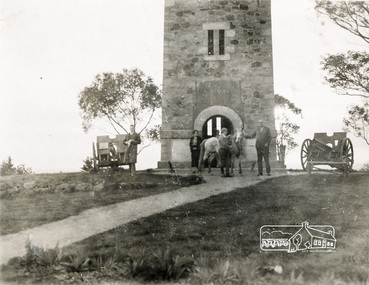
Photograph, Memorial Tower, Kangaroo Ground c.1934, 1934c
... The work has been undertaken by the people of the Shire a a tribute of love and admiration for those who were known and dear to use in the days of their youth and early manhood, who went out from amongst us, never to return, and whose self-sacrifice has made us, each and all, thier ever-lasting debtors" Harry Gilham, Eltham District Historical Society Kangaroo Ground Tower of Remembrance, A Journey in Time: a column about Nillumbik's history, Nillumbik Mail, 9th August, 2000 Since that research the following has been sourced from Eltham and Whittlesea Shires Advertiser and Diamond Creek Valley Advocate, April 8, 1921, p. 3 Retrieved April 25, 2020, from http://nla.gov.au/nla.news-article57639687 Eltham Shire Council From Town Clerk, Melbourne, stating that a light machine-gun captured by the 22nd battalion, A.I.F. at La Motte Farm, near Beaurvoir, on Oct. 3rd, 1918, during the operations which won the Beauvoir line and completed the smashing of the great Hindenburg defence-system, has been alloted to the Shire of Eltham. - On the motion of Crs Hubbard and Smedley, it was decided to have the gun placed in the Memorial Park. ...The work has been undertaken by the people of the Shire a a tribute of love and admiration for those who were known and dear to use in the days of their youth and early manhood, who went out from amongst us, never to return, and whose self-sacrifice has made us, each and all, thier ever-lasting debtors" Harry Gilham, Eltham District Historical Society Kangaroo Ground Tower of Remembrance, A Journey in Time: a column about Nillumbik's history, Nillumbik Mail, 9th August, 2000 Since that research the following has been sourced from Eltham and Whittlesea Shires Advertiser and Diamond Creek Valley Advocate, April 8, 1921, p. 3 Retrieved April 25, 2020, from http://nla.gov.au/nla.news-article57639687 Eltham Shire Council From Town Clerk, Melbourne, stating that a light machine-gun captured by the 22nd battalion, A.I.F. at La Motte Farm, near Beaurvoir, on Oct. 3rd, 1918, during the operations which won the Beauvoir line and completed the smashing of the great Hindenburg defence-system, has been alloted to the Shire of Eltham. - On the motion of Crs Hubbard and Smedley, it was decided to have the gun placed in the Memorial Park. ...Sepia photograph of Joyce McMahon and 'Tiny' Carroll at the War Memorial Tower, Kangaroo Ground c.1934. The guns were installed in 1934 and removed in 1942. Taken in the early 1930s, the photograph ... shows the Kangaroo Ground Tower of Remembance with Joyce McMahon, daughter-in-law of Mr. P. J.McMahon, the then Shire of Eltham Secretary, her horse and a very tall person patting the horse. He is ex-serviceman W. "Tiny" Caroll who was the council's caretaker of the surrounding War Memorial Park. He lived in the stone cottage which still stands in the park. "Tiny" is seen as the fictional character "Tiny Bourke" who, in author Alan Marshall's book "This is the Grass", "was a giant of a man, well over six feet high, with huge hands that completely encircled the cup of tea". The bronze casting, which shows the 79 names of those who paid the "supremen sacrifice" in World War 1 (1914-1918), was erecfed above the entrance to the Tower in September, 1930. The Monterey cypress trees which now form the windbreak around the park's fenceline, were just knee high in this photograph. They were planted in August 1926, with all the plantings paid for, and done, by the public as the Tower was being erected. The two field guns have been identified as of German origin, Krupp 77 mm calibre captured on October 4, 1918 at Geneve, France. They were removed in 1943/44 as a wartime requirement of the Australian Govenment. A public notice dated October 16, 1926 by Cr. H Rutter, Chairman of the Eltham Soldiers War Memorial League stated: "On the summit of that central and conspicuous landmark, Garden Hill, there is being erected a massive memorial tower which will, for all time, remind every passerby of the part played by the men of the Shire of Eltham in the Great War. The work has been undertaken by the people of the Shire a a tribute of love and admiration for those who were known and dear to use in the days of their youth and early manhood, who went out from amongst us, never to return, and whose self-sacrifice has made us, each and all, thier ever-lasting debtors" Harry Gilham, Eltham District Historical Society Kangaroo Ground Tower of Remembrance, A Journey in Time: a column about Nillumbik's history, Nillumbik Mail, 9th August, 2000 Since that research the following has been sourced from Eltham and Whittlesea Shires Advertiser and Diamond Creek Valley Advocate, April 8, 1921, p. 3 Retrieved April 25, 2020, from http://nla.gov.au/nla.news-article57639687 Eltham Shire Council From Town Clerk, Melbourne, stating that a light machine-gun captured by the 22nd battalion, A.I.F. at La Motte Farm, near Beaurvoir, on Oct. 3rd, 1918, during the operations which won the Beauvoir line and completed the smashing of the great Hindenburg defence-system, has been alloted to the Shire of Eltham. - On the motion of Crs Hubbard and Smedley, it was decided to have the gun placed in the Memorial Park. Sepia Photographgarden hill, gun, joyce mcmahon, kangaroo ground, memorial tower, shire of eltham war memorial tower, tiny carroll, war memorials, war trophy, william carroll -
 Warrnambool RSL Sub Branch
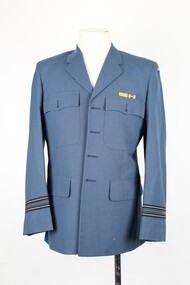
TUNIC - RAAF (Blue Grey) Service Dress Uniform Jacket, Military Uniform, 1998
... He undertook officer cadet training at the Army Officer Cadet School in 1978 and was commissioned into the Ground Defence Category on the 09 December 1978, where he served for 18 years and rose to the rank of SQNLDR. ...This item of military uniform was worn by Squadron Leader (SQNLDR) Bernard Farley during his period of Full Time service in the Royal Australian Air Force (RAAF) between 27 January 1976 and 02 March 1997. Bernard joined the RAAF as an Airmen was trained and employed as a Clerk Supply (CLKSPL) between 1996 - 1977. He undertook officer cadet training at the Army Officer Cadet School in 1978 and was commissioned into the Ground Defence Category on the 09 December 1978, where he served for 18 years and rose to the rank of SQNLDR. Royal Australian Air Force (RAAF) 1A Service Dress Uniform 1A - Tunic (Jacket - Blue Grey). This uniform was in the period 1966 - 2001 as the primary uniform. Service Dress is approved for wear as either ceremonial dress or working dress when employed in office or business type environments. The Tunic consists of a jacket has a lapel collar, with two external chest pockets and exposed pocket flaps, two side jacket pockets with external flaps and two internal jacket pockets positioned just below the external chest pockets. There is a crescent shaped cloth badge 'AUSTRALIA' sown at the side/top of each sleeve and Squadron Leader - rank stripes sown around each sleeve on the upper wrist area. The Tunic is closed with four gold buttons down the front. Each button is inserted through a small round hole sewn into the right side of the tunic front and held in place at the rear with a safety pin. There are four corresponding button holes sewn into the left front of the tunic to fasten the jacket in the normal closed position when worn. Maker: Australian Government Clothing Factory (A.G.C.F.) - Coburg Victoria The Tunic has two military decorations attached above the exterior left chest pocket. The decoration are: 1. Conspicuous Service Medal - Yellow and Green right sloping diagonal strips 2.. Defence Service Medal (with one clasp) - Blue and Gold upright stripes and round metal clasp positioned centrally. The DSM is awarded for 15 years service and a clasp is awarded for each additional 5 years service. -
 Warrnambool RSL Sub Branch
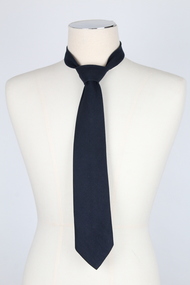
TIE - RAAF (Blue Grey) Service Dress Uniform Jacket, Military Uniform, unknown
... He undertook officer cadet training at the Army Officer Cadet School in 1978 and was commissioned into the Ground Defence Category on the 09 December 1978, where he served for 18 years and rose to the rank of SQNLDR. ...This item of military uniform was worn by Squadron Leader (SQNLDR) Bernard Farley during his period of Full Time service in the Royal Australian Air Force (RAAF) between 27 January 1976 and 02 March 1997. Bernard joined the RAAF as an Airmen was trained and employed as a Clerk Supply (CLKSPL) between 1996 - 1977. He undertook officer cadet training at the Army Officer Cadet School in 1978 and was commissioned into the Ground Defence Category on the 09 December 1978, where he served for 18 years and rose to the rank of SQNLDR. Royal Australian Air Force (RAAF) 1A Service Dress Uniform 1A - Tie (Blue blue). This uniform tie was worn in the period 1966 - 2001 as the primary uniform. Service Dress was approved for wear as either ceremonial dress or working dress when employed in office or business type environments. The tie was dark blue of medium width and has a tetron lining inside the wide end and no lining at the narrow end. Maker: Austal -
 Warrnambool RSL Sub Branch
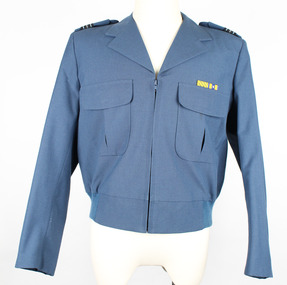
JACKET - WORKING DRESS - RAAF (Blue Grey) Uniform Jacket, Military Uniform, 1990
... He undertook officer cadet training at the Army Officer Cadet School in 1978 and was commissioned into the Ground Defence Category on the 09 December 1978, where he served for 18 years and rose to the rank of SQNLDR. ...This item of military uniform was worn by Squadron Leader (SQNLDR) Bernard Farley during his period of Full Time service in the Royal Australian Air Force (RAAF) between 27 January 1976 and 02 March 1997. Bernard joined the RAAF as an Airmen was trained and employed as a Clerk Supply (CLKSPL) between 1996 - 1977. He undertook officer cadet training at the Army Officer Cadet School in 1978 and was commissioned into the Ground Defence Category on the 09 December 1978, where he served for 18 years and rose to the rank of SQNLDR. Royal Australian Air Force (RAAF) Working Dress (Jacket - Blue Grey). This uniform was in the period 1966 - 2001 as the primary daily uniform in the office environment. Polyester working dress is approved for wear employed in office or business type environments. The short waist length jacket consists of a jacket has a lapel collar and zip front, with two external chest pockets and exposed pocket flaps, There are portlets on each shoulder that are fastened with a black plastic button. This button has a crown over eagle in flight on the front. Rank slides are slid onto these portlets and this jacket has Squadron Leader rank slides on the portlets. is closed with four gold buttons down the front. Each button is inserted through a small round hole sewn into the right side of the tunic front and held in place at the rear with a safety pin. There are four corresponding button holes sewn into the left front of the tunic to fasten the jacket in the normal closed position when worn. The waist belt is part knitted on the sides and cloth on the front and rear. There is also one interior pocket on the right side below the exterior breast pocket. Maker: Australian Defence Industries The Tunic has two military decorations attached above the exterior left chest pocket. The decoration are: 1. Conspicuous Service Medal - Yellow and Green right sloping diagonal strips 2.. Defence Service Medal (with one clasp) - Blue and Gold upright stripes and round metal clasp positioned centrally. The DSM is awarded for 15 years service and a clasp is awarded for each additional 5 years service. -
Warrnambool RSL Sub Branch
TROUSERS - RAAF (Blue Grey) Uniform, Military Uniform, 1988
... He undertook officer cadet training at the Army Officer Cadet School in 1978 and was commissioned into the Ground Defence Category on the 09 December 1978, where he served for 18 years and rose to the rank of SQNLDR. ...This item of military uniform was worn by Squadron Leader (SQNLDR) Bernard Farley during his period of Full Time service in the Royal Australian Air Force (RAAF) between 27 January 1976 and 02 March 1997. Bernard joined the RAAF as an Airmen was trained and employed as a Clerk Supply (CLKSPL) between 1996 - 1977. He undertook officer cadet training at the Army Officer Cadet School in 1978 and was commissioned into the Ground Defence Category on the 09 December 1978, where he served for 18 years and rose to the rank of SQNLDR. Royal Australian Air Force (RAAF) trousers- Blue Grey. This uniform was in the period 1966 - 2001 as the primary daily uniform in the office environment. Polyester working dress is approved for wear employed in office or business type environments. The trousers have a belted waist and zip front, with two slant side pockets, money fob pocket below the waist on right side and two rear slit pockets. The trouser leg is pleated at the waist belt in the front. Maker: Australian Government Clothing Factory -
 Warrnambool RSL Sub Branch
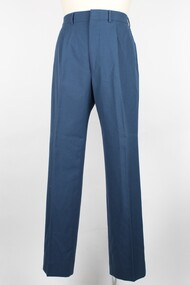
TROUSERS - RAAF (Blue Grey) Uniform, Military Uniform, 1995
... He undertook officer cadet training at the Army Officer Cadet School in 1978 and was commissioned into the Ground Defence Category on the 09 December 1978, where he served for 18 years and rose to the rank of SQNLDR. ...This item of military uniform was worn by Squadron Leader (SQNLDR) Bernard Farley during his period of Full Time service in the Royal Australian Air Force (RAAF) between 27 January 1976 and 02 March 1997. Bernard joined the RAAF as an Airmen was trained and employed as a Clerk Supply (CLKSPL) between 1996 - 1977. He undertook officer cadet training at the Army Officer Cadet School in 1978 and was commissioned into the Ground Defence Category on the 09 December 1978, where he served for 18 years and rose to the rank of SQNLDR. Royal Australian Air Force (RAAF) trousers- Blue Grey. This uniform was in the period 1966 - 2001 as the primary daily uniform in the office environment. Polyester working dress is approved for wear employed in office or business type environments. The trousers have a belted waist and zip front, with two slant side pockets, money fob pocket below the waist on right side and two rear slit pockets. The trouser leg is pleated at the waist belt in the front. Maker: Australian Defence Industries -
 Warrnambool RSL Sub Branch
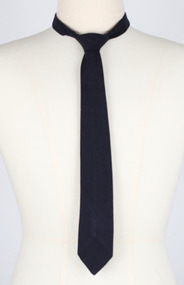
TIE - RAAF (Blue Grey) Service Dress Uniform Jacket, Military Uniform, unknown
... He undertook officer cadet training at the Army Officer Cadet School in 1978 and was commissioned into the Ground Defence Category on the 09 December 1978, where he served for 18 years and rose to the rank of SQNLDR. ...This item of military uniform was worn by Squadron Leader (SQNLDR) Bernard Farley during his period of Full Time service in the Royal Australian Air Force (RAAF) between 27 January 1976 and 02 March 1997. Bernard joined the RAAF as an Airmen was trained and employed as a Clerk Supply (CLKSPL) between 1996 - 1977. He undertook officer cadet training at the Army Officer Cadet School in 1978 and was commissioned into the Ground Defence Category on the 09 December 1978, where he served for 18 years and rose to the rank of SQNLDR. Royal Australian Air Force (RAAF) 1A Service Dress Uniform - Tie (Blue blue). This uniform tie was worn in the period 1966 - 2001 as the primary uniform. Service Dress was approved for wear as either ceremonial dress or working dress when employed in office or business type environments. The tie was dark blue of medium width and has a tetron lining inside the wide end and no lining at the narrow end. Maker: unknown -
 Warrnambool RSL Sub Branch
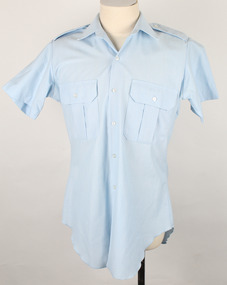
Shirt (short sleeve) - RAAF (Blue Grey) Service Dress and Working Dress Uniform, Military Uniform, 1992
... He undertook officer cadet training at the Army Officer Cadet School in 1978 and was commissioned into the Ground Defence Category on the 09 December 1978, where he served for 18 years and rose to the rank of SQNLDR. ...This item of military uniform was worn by Squadron Leader (SQNLDR) Bernard Farley during his period of Full Time service in the Royal Australian Air Force (RAAF) between 27 January 1976 and 02 March 1997. Bernard joined the RAAF as an Airmen was trained and employed as a Clerk Supply (CLKSPL) between 1996 - 1977. He undertook officer cadet training at the Army Officer Cadet School in 1978 and was commissioned into the Ground Defence Category on the 09 December 1978, where he served for 18 years and rose to the rank of SQNLDR. Royal Australian Air Force (RAAF) Service Dress Uniform - Shirt (Blue blue). This uniform tie was worn in the period 1966 - 2001 as the primary uniform. Service Dress was approved for wear as either ceremonial dress or working dress when employed in office or business type environments. The tie was dark blue of medium width and has a tetron lining inside the wide end and no lining at the narrow end. Maker: Australian Defence Industies -
 Warrnambool RSL Sub Branch
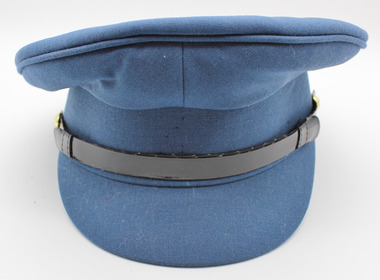
Peaked Hat - RAAF (Blue Grey) Uniform, Military Uniform, Estimated early 1970's
... He undertook officer cadet training at the Army Officer Cadet School in 1978 and was commissioned into the Ground Defence Category on the 09 December 1978, where he served for 18 years and rose to the rank of SQNLDR. ...Issued to Aircraftsman Bernard Farley in 1976 as part of his initial issue of uniform on joining the Permanent Air ForceThis item of military uniform was worn by Squadron Leader (SQNLDR) Bernard Farley during his period of Full Time service in the Royal Australian Air Force (RAAF) between 27 January 1976 and 02 March 1997. Bernard joined the RAAF as an Airmen was trained and employed as a Clerk Supply (CLKSPL) between 1996 - 1977. He undertook officer cadet training at the Army Officer Cadet School in 1978 and was commissioned into the Ground Defence Category on the 09 December 1978, where he served for 18 years and rose to the rank of SQNLDR. Royal Australian Air Force (RAAF) Peaked Hat - Blue Grey. This uniform was in the period 1966 - 2001 as the primary daily uniform in the office environment. Polyester working dress is approved for wear employed in office or business type environments. The trousers have a belted waist and zip front, with two slant side pockets, money fob pocket below the waist on right side and two rear slit pockets. The trouser leg is pleated at the waist belt in the front. Maker: Australian Government Clothing Factory -
 Warrnambool RSL Sub Branch
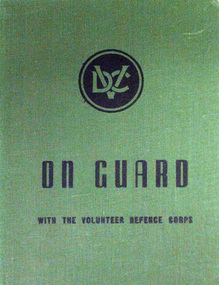
Book, ON GUARD. With the Volunteer Defence Corps
... Volunteers Home Defence Published for the Volunteer Defence Corps by Australian War Memorial, Canberra, ACT. 1944. Hard Cover. Title printed in Black on Green ground ON GUARD. ...Hard Cover. Title printed in Black on Green ground Published for the Volunteer Defence Corps by Australian War Memorial, Canberra, ACT. 1944.ww2. volunteers home defence -
 Frankston RSL Sub Branch
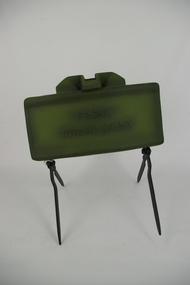
Claymore Mine
... defences at, for example Fire Support Base or for use in ambush situations. The convex side is faced toward the enemy and the mine is configured to be electrically detonated from a remote location, (these mines can be connected by white "det cord" & detonators from the detonator wells show to link a series of mines)). It is raised off the ground...defences at, for example Fire Support Base or for use in ambush situations. The convex side is faced toward the enemy and the mine is configured to be electrically detonated from a remote location, (these mines can be connected by white "det cord" & detonators from the detonator wells show to link a series of mines)). It is raised off the ground ...The M18A1 'Claymore' Directional Fragmentation Mine which is used as part of the perimeter defences at, for example Fire Support Base or for use in ambush situations. The convex side is faced toward the enemy and the mine is configured to be electrically detonated from a remote location, (these mines can be connected by white "det cord" & detonators from the detonator wells show to link a series of mines)). It is raised off the ground by a small stand to maximise the blast radius. Claymore mines contain 700 steel ball bearings impressed into 650 grams of plastic explosive. The M18A1 has a lethal range of up to 100 metresA replica of the M18A1 'Claymore' Directional Fragmentation Mine. The convex side is faced toward the enemy and the mine is configured to be electrically detonated from a remote location. In practice this mine type is raised above the ground slightly by a small legs designed to maximise the blast radius. These mines contain approximately 700 small steel ball bearings impressed into 650 grams of plastic explosive. The M18A1 has a lethal range of up to 100 metresOn the front"Front Toward Enemy" on the reverse "Back M18A1 Apers Mine"
