
Showing 88 items matching "hand made nail"
-
 Port Melbourne Historical & Preservation Society
Functional object - Nail, hand-made
... Nail, hand-made...One hand made nail...Dug out of donor's garden at 246 Stokes Street business and traders domestic life building materials One hand made nail Functional object Nail, hand-made ...Dug out of donor's garden at 246 Stokes StreetOne hand made nailbusiness and traders, domestic life, building materials -
 Bendigo Historical Society Inc.
Functional object - Harris Collection: Tin of nails
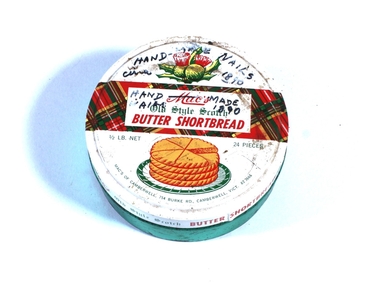
... A tin containing a collection of 20 old handmade nails and small note stating- Hand made nails 100 years old. The tin is green with a white lid. ...HAND MADE NAILS MADE 1890...Harris Collection handmade nails Macs old style scotch butter shortbread HAND MADE NAILS MADE 1890 A tin containing a collection of 20 old handmade nails and small note stating- Hand made nails 100 years old. ...Jonathan Harris operated a winery on the banks of the Axe Creek, Axedale in the 1850s.A tin containing a collection of 20 old handmade nails and small note stating- Hand made nails 100 years old. The tin is green with a white lid. On the lid is - a floral image, a tartan ribbon with Mac's Old Style Scotch BUTTER SHORTBREAD. 1/2 LB. NET 24 pieces. An image of shortbread pieces on a plate. MACS OF CAMBERWELL, 754 BURKE RD CAMBERWELL, VICT. 823666. Part of the Harris Collection.HAND MADE NAILS MADE 1890harris collection, handmade nails, macs old style scotch butter shortbread -
 Orbost & District Historical Society
nails, 1890's
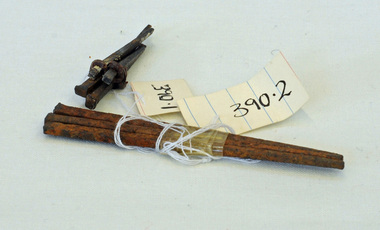
... These hand-made nails were used in what was Temple's Store built in 1889. ...Two lots of hand-made nails. .1 is a set of five small nails tied together with string. .2 is a set of three longer nails which are very rusty....These hand-made nails were used in what was Temple's Store built in 1889. ...These hand-made nails were used in what was Temple's Store built in 1889. It later became Herbert's - now demolished. It was located near the corner of Nicholson Street and Ruskin Street, Orbost. Temple's store was on the corner of Ruskin Street and Nicholson Street. George Temple (1832-1918) established the store in about 1888. He packed stores to the Bendoc area gold fields.Two lots of hand-made nails. .1 is a set of five small nails tied together with string. .2 is a set of three longer nails which are very rusty.nails metal-working temples-store -
Clunes Museum
Tool - NAILS
... ...HAND MADE NAIL...nail HAND MADE NAIL Nil THE ITEMS ARE Handmade metal nails Tool NAILS ...THE ITEMS ARE Handmade metal nails Nilnail, hand made nail -
Clunes Museum
Tool - NAIL
... HAND MADE NAIL...HAND MADE NAIL FORGED NAIL A HAND FORGED METAL NAIL (FIXING) Tool NAIL ...A HAND FORGED METAL NAIL (FIXING)hand made nail, forged nail -
 Mont De Lancey
Nail
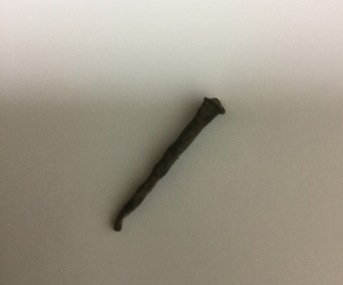
... 1 hand made nail...nails 1 hand made nail Nail ...1 hand made nailnails -
 Whitehorse Historical Society Inc.
Tool - Nails
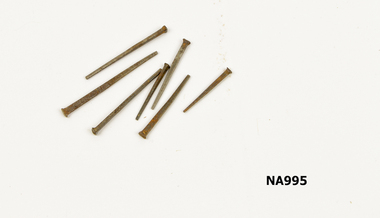
... 8 hand made nails in various sizes...Part of collection of carpenters' tools used on sailing ships from England to Australia trades carpentry 8 hand made nails in various sizes Tool Nails ...Part of collection of carpenters' tools used on sailing ships from England to Australia8 hand made nails in various sizestrades, carpentry -
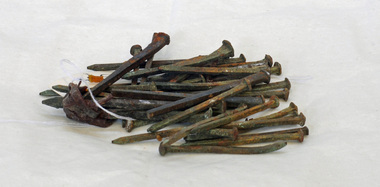 Orbost & District Historical Society
nails
... Three bunches of hand-made nails in assorted lengths....nails metal-working Three bunches of hand-made nails in assorted lengths. nails ...Three bunches of hand-made nails in assorted lengths.nails metal-working -
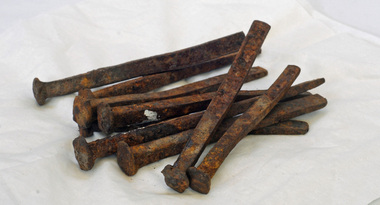 Orbost & District Historical Society
nails
... Nine long hand-made nails with square edges. The ends are blunt....As a young girl Grace Jennings Carmichael (poet) lived at the Orbost station homestead with her family. nails metal Nine long hand-made nails with square edges. The ends are blunt. nails ...These handmade nails came from the Orbost Station homestead. this was built in Forest Road around 1882. the homestead had large rooms, French windows and a verandah all the way around. As a young girl Grace Jennings Carmichael (poet) lived at the Orbost station homestead with her family.Nine long hand-made nails with square edges. The ends are blunt.nails metal -
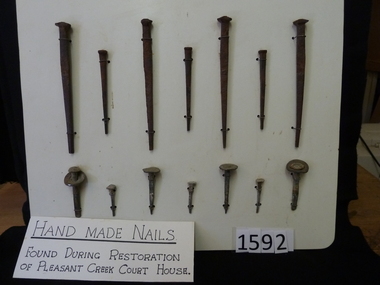 Stawell Historical Society Inc
Memorabilia - Realia, c1860
... Assorted Hand Made Nails (From Court House) Iron and Copper...Stawell Assorted Hand Made Nails (From Court House) Iron and Copper Memorabilia Realia ...Assorted Hand Made Nails (From Court House) Iron and Copperstawell -
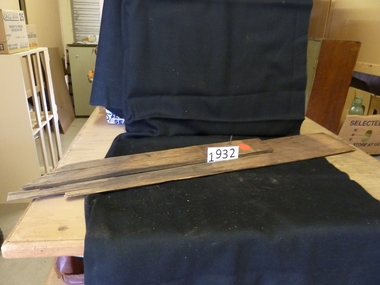 Stawell Historical Society Inc
Memorabilia - Realia, c1860's
... 2 Hand Made Split Wood Roofing Shingles with Hand made nail. Old Post Telegraph Office ...Stawell 2 Hand Made Split Wood Roofing Shingles with Hand made nail. Old Post Telegraph Office Memorabilia Realia ...2 Hand Made Split Wood Roofing Shingles with Hand made nail. Old Post Telegraph Office stawell -
Federation University Historical Collection
Tool, Handmade tools
... Square hand made nails, possibly horse shoe nails/ Cut floor brad for use on tongue and groove floors....nails tools Square hand made nails, possibly horse shoe nails/ Cut floor brad for use on tongue and groove floors. ...Square hand made nails, possibly horse shoe nails/ Cut floor brad for use on tongue and groove floors.nails, tools -
Clunes Museum
Equipment - NAIL
... Square hand made metal nail...Nail Fastener Nil Square hand made metal nail Equipment NAIL ...Square hand made metal nailNilnail, fastener -
 Bendigo Historical Society Inc.
Tool - OX SHOE
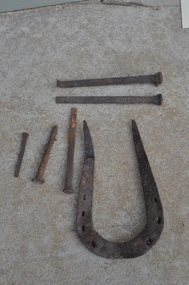
... cast Iron Ox shoe approx 150mm with 4 hand made nails. 1 50mm, 1 100mm, 1 130 mm...Farming Ox shoes cast Iron Ox shoe approx 150mm with 4 hand made nails. 1 50mm, 1 100mm, 1 130 mm Tool OX SHOE ...cast Iron Ox shoe approx 150mm with 4 hand made nails. 1 50mm, 1 100mm, 1 130 mmfarming, ox shoes -
 Orbost & District Historical Society
nails on board, 1885
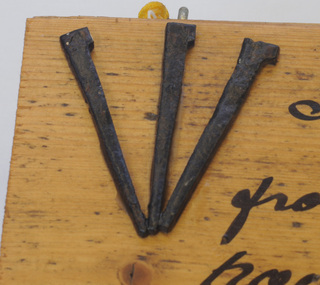
... board with three hand-made nails glued in fan design to top left corner of section of floorboard. ... made by an early Orbost settler or blacksmith in the 1880's, using iron, forge and anvil. They are examples of the types of nails used in the 19th century. Mundy-Walter hand ...These nails were made for Walter John Mundy (1868-1944). Often imported nails made for the softer English and North American timbers bent when hammered against the harder colonial woods and so The Mundy family were farmers / settlers in the Snowy River area since c. 1880s. The original Mundy family moved to a land "selection" at Betebolong in the early 1880's from Buchan. It's only over the past century or so that the mass-produced nail has become an inexpensive and common way to join materials. These three iron nails were hand made by an early Orbost settler or blacksmith in the 1880's, using iron, forge and anvil. They are examples of the types of nails used in the 19th century. A rectangular, wooden(athel pine?) board with three hand-made nails glued in fan design to top left corner of section of floorboard. There is a short length of yellow cord attached for hanging. To the right of the nails is hand-written text in black. the nails have irregular shanks and hammer marks on both shanks and heads.right of nails - " Flooring & nails from Walter Mundy's house at Jarrahmond built C.1885. Still in use to this day."mundy-walter hand-made-nails -
 City of Moorabbin Historical Society (Operating the Box Cottage Museum)
Building Equipment, original hand made nails Box Cottage c 1850, c1850
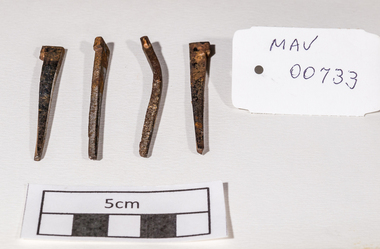
... hand-made. Convict marks can be seen on two bricks.There is a small display of external cladding shingles from the original pioneer cottage. These shingles were hand-split, and most likely made from locally collected timber The nails included in this display were used to fasten the shingles on the original cottage, and are also hand-made. ...4 hand made iron nails c1850 used in building the original pioneer cottage now known as Box Cottage Museum...Theses 4 iron nails were hand made by an early settler c1850, using iron, forge and anvil, for the construction of the original Box Cottage box william box elizabeth brighton henry dendy special survey 1841 early settlers pioneers moorabbin box cottage museum nails building equuipment forges anvils blacksmiths 4 hand made iron nails c1850 used in building the original pioneer cottage now known as Box Cottage Museum Building Equipment, original hand made nails Box Cottage c 1850 Pioneer ...The original small, pioneer cottage was built in the late 1840s to early1850s, by an unknown pioneer. It was located on part of a 30 Acre allotment that was originally part of Henry Dendy’s Special Survey granted in 1841. The doors and window sashes, (made of red deal joinery timber), as well as the brass locks and fittings, are from the original cottage, and were imported from England.The fire-place bricks are from the original cottage, and are sun-dried, (not kiln fired), and are hand-made. Convict marks can be seen on two bricks.There is a small display of external cladding shingles from the original pioneer cottage. These shingles were hand-split, and most likely made from locally collected timber The nails included in this display were used to fasten the shingles on the original cottage, and are also hand-made. The enamel nameplate, “Colonial”, on the wall of the cottage, was the name chosen for the original pioneer cottage when a later owner, Mr August Rietman and wife Frieda leased the property in around 1917. August purchased the property 1935 for 1200 Pounds approximately and resided there until 1953. In 1974 Mr Lewis, a timber specialist, found the dilapidated building on property he had recently purchased in Jasper Rd and suggested it be reconstructed and relocated. Moorabbin Council agreed and the Cottage was rebuilt just about 250 metres from its original site. The cost of the rebuild was met by 'Victoria's 150th Committee', plus a small grant from the City of Moorabbin, and Mr Laurie Lewis donated much of the timber for the reconstruction. Theses 4 iron nails were hand made by an early settler c1850, using iron, forge and anvil, for the construction of the original Box Cottage 4 hand made iron nails c1850 used in building the original pioneer cottage now known as Box Cottage Museumbox william, box elizabeth, brighton, henry dendy special survey 1841, early settlers, pioneers, moorabbin, box cottage museum, nails, building equuipment, forges, anvils, blacksmiths -
 Bendigo Historical Society Inc.
Functional object - SLATE, Mid to late 19th C
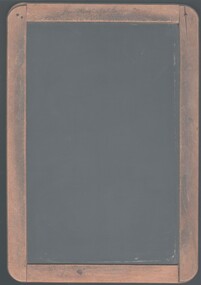
... Wooden frame has rounded edges held together by five metal hand made nails which have caused the timber to split. ...Wooden frame has rounded edges held together by five metal hand made nails which have caused the timber to split. ...Object. Rectangular school slate contained within wooden frame. Wooden frame has rounded edges held together by five metal hand made nails which have caused the timber to split. Unreadable writing on a long side and a short side of the wooden edging. Looks like 'Macy Ackla'. Other unreadable writing.toys, general, slate, slate -
Yarrawonga and Mulwala Pioneer Museum
Nails
... 4 inch Hand made iron nails. Used in a cabin trunk which came to Australia on the "Cluthe" with Mrs J Mc Luchie in October 1860...4 inch Hand made iron nails. Used in a cabin trunk which came to Australia on the "Cluthe" with Mrs J Mc Luchie in October 1860 Nails ...4 inch Hand made iron nails. Used in a cabin trunk which came to Australia on the "Cluthe" with Mrs J Mc Luchie in October 1860 -
Clunes Museum
Equipment - NAILS
... HAND MADE CAST IRON / METAL NAILS. DIFFERENT LENGTHS...local history metal craft hand made nails HAND MADE CAST IRON / METAL NAILS. ...HAND MADE CAST IRON / METAL NAILS. DIFFERENT LENGTHSlocal history, metal craft, hand made nails -
 Light Horse & Field Artillery Museum
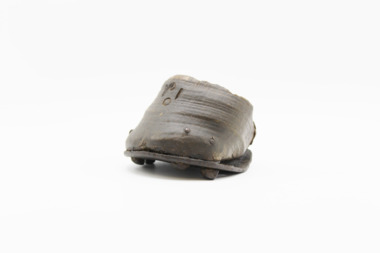
Mules hoof, World War One
... Mules hoof with hand made shoe and nails souvenired from Gallipoli. Item could be from either Turkish or British forces....Mules hoof with hand made shoe and nails souvenired from Gallipoli. Item could be from either Turkish or British forces. ...Souvenired from Gallipoli.This item’s history is linked to the Gallipoli campaign and is deemed rare due to the uniqueness of the item and lack other comparitive examples.Mules hoof with hand made shoe and nails souvenired from Gallipoli. Item could be from either Turkish or British forces.Stamps at centre front near coronet band.dardanelles, hoof, horse shoe, gallipoli, great war, mule, pack transport, the great war, world war 1, world war one, ww1, wwi -
 Bendigo Military Museum
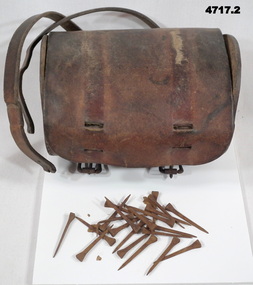
Accessory - BAG, LIGHT HORSEMAN, LEATHER, C1914-1919
... Iron nails- these appear to be hand made square shafted nails....Iron nails- these appear to be hand made square shafted nails. ...1.) Leather bag cylindrical shape with fixed ends and opening flap on side. There are two straps that hold the bag close. 2 brass rings on the rear side of the bag. Function- to be used to carry spare horse shoes. .2). Iron nails- these appear to be hand made square shafted nails.australian light horse, leather bag, horse shoe nails -
 Federation University Historical Collection
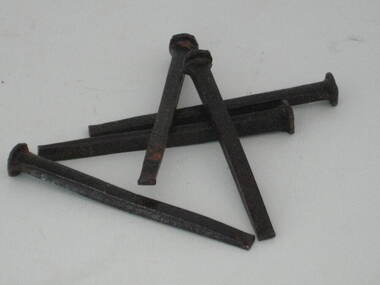
nails, Hand-made nails
... Hand forged nails salvaged from the former Ballarat School of Mines Model Mine Building Hand-made nails nails ...Hand forged nails salvaged from the former Ballarat School of Mines Model Mine Building -
 Federation University Historical Collection
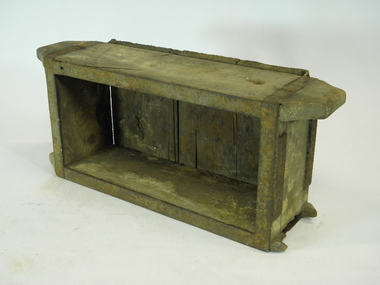
Tool, Brick mould and brick, 1) UNKNOWN .2) c.1888
... The base piece of timber is made from two different width weatherboard-style timbers. The nails in the base piece appear to be hand-made. ...The base piece of timber is made from two different width weatherboard-style timbers. The nails in the base piece appear to be hand-made. ...John Nunn was one of the earliest brickmakers on record in Ballarat and has a road named for him - Nunn Street - where he resided..1) An oblong-shaped timber box open at top. Only butt joints are used. Iron strapping wraps around the vertical pieces of timber and across the top edge of the box. The longest pieces of vertical timber protrude past the end and are shaped like solid handles - one is broken. On each end piece there are small, blank iron plates held with screws. The base piece of timber is made from two different width weatherboard-style timbers. The nails in the base piece appear to be hand-made. Remnants of clay still line the interior. .2) Light brown brick. Please note: Brick mould and brick may be from different sources..1) Handwritten (possibly in ink) on one long side: MR H. G. SMITH ...(illegible) Ballarat .2) Imprinted: J. NUNNjohn nunn, j nunn, brick, mould, brick mould, industrial mould, brickmaker, ballarat, clay, ceramics -
 Upper Yarra Museum
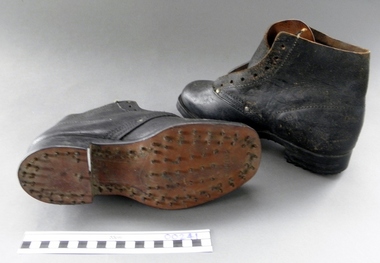
Footwear - men, Oliver & Stevens
... Pair Hob Nail boots, hand made by Oliver & Stevens...footware feet protection hobnail boots Pair Hob Nail boots, hand made by Oliver & Stevens Footwear - men Oliver & Stevens ...Pair Hob Nail boots, hand made by Oliver & Stevensfootware, feet, protection, hobnail boots -
 Flagstaff Hill Maritime Museum and Village
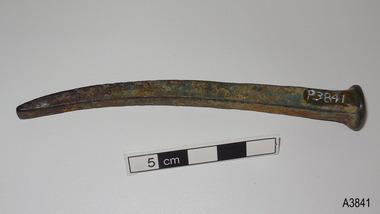
Functional object - Nail
... This nail was made at a time when the shanks of nails were usually machine cut but the heads were hand formed by blacksmiths. ...This nail was made at a time when the shanks of nails were usually machine cut but the heads were hand formed by blacksmiths. ...This historic bronze nail dates back to 1790ss to 1890s. Nails such as this one were used for ship building, as deck fasteners and many other uses. This nail was made at a time when the shanks of nails were usually machine cut but the heads were hand formed by blacksmiths. The nail was recovered from a shipwreck along the coast of Victoria in around 1968 and is part of the John Chance Collection. The nail is significant historically as an example of hardware used when building wooden ships in the early to mid-19th century. The nail is historically significant as an example of the work and trade of blacksmith. The nail is also significant as it was recovered by John Chance, a diver in Victoria’s coastal waters in the late 1960s to early 1970s. Items that come from several wrecks have since been donated to the Flagstaff Hill Maritime Village’s museum collection by his family, illustrating this item’s level of historical value.Nail; bronze, deck nail. Rounded rectangular head, rectangular shank cross-section, tip flattened to a rounded wedge shape but cut straight down at the end instead of a point. The surface is pitted and rough and has yellow and orange concretion and degradation on the nail's surface. Recovered from an unspecified shipwreck along the coast of Victoria. Part of the John Chance Collection. flagstaff hill, warrnambool, flagstaff hill maritime museum, maritime museum, shipwreck coast, flagstaff hill maritime village, great ocean road, john chance, fastener, nail, square nail, machine cut mail, blacksmith, historic nail, bronze nail, hand forged, coastal shipwreck, victorian shipwreck -
 Flagstaff Hill Maritime Museum and Village
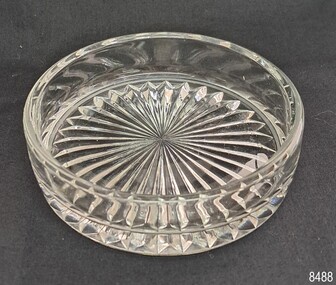
Domestic object - Pin Dish, Mid 20th century
... Dressing tables often featured a variety of objects such as combs, brushes, hand mirrors, perfume bottles, cosmetics, nail buffers, ring holders, jewellery trinket boxes, trays and pin bowls or pin trays. The latter were small shallow containers used for storing hat pins, hair pins, safety pins, and perhaps earrings. They were made...Dressing tables often featured a variety of objects such as combs, brushes, hand mirrors, perfume bottles, cosmetics, nail buffers, ring holders, jewellery trinket boxes, trays and pin bowls or pin trays. The latter were small shallow containers used for storing hat pins, hair pins, safety pins, and perhaps earrings. They were made ...Dressing tables have been around since the beginning of the seventeenth century. However, it wasn't until the early to mid-20th century that middle-class homes included them in their furniture. They were often a matching part of a bedroom suite. Dressing tables often featured a variety of objects such as combs, brushes, hand mirrors, perfume bottles, cosmetics, nail buffers, ring holders, jewellery trinket boxes, trays and pin bowls or pin trays. The latter were small shallow containers used for storing hat pins, hair pins, safety pins, and perhaps earrings. They were made of various materials including glass, metal and ceramic.This pin bowl represents an era in the early-to-mid 20th century when matching dressing table accessories were popular and affordable to middle-class women. They were marketed as gifts and sometimes included perfumed soap and powder.Pin dish, round, cut glass, slightly convex sides without a pattern. Thick heavy, concave base with a concertina fold pattern.flagstaff hill maritime village, shipwreck coast, flagstaff hill, warrnambool, flagstaff hill museum and village, domestic object, dressing table, dressing table tray, glass tray, pin tray, pin bowl, dressing table accessory -
 Flagstaff Hill Maritime Museum and Village
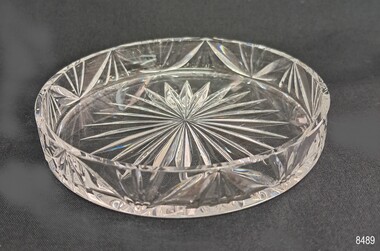
Domestic object - Pin Bowl, Mid 20th century
... Dressing tables often featured a variety of objects such as combs, brushes, hand mirrors, perfume bottles, cosmetics, nail buffers, ring holders, jewellery trinket boxes, trays and pin bowls or pin trays. The latter were small shallow containers used for storing hat pins, hair pins, safety pins, and perhaps earrings. They were made...Dressing tables often featured a variety of objects such as combs, brushes, hand mirrors, perfume bottles, cosmetics, nail buffers, ring holders, jewellery trinket boxes, trays and pin bowls or pin trays. The latter were small shallow containers used for storing hat pins, hair pins, safety pins, and perhaps earrings. They were made ...Dressing tables have been around since the beginning of the seventeenth century. However, it wasn't until the early to mid-20th century that middle-class homes included them in their furniture. They were often a matching part of a bedroom suite. Dressing tables often featured a variety of objects such as combs, brushes, hand mirrors, perfume bottles, cosmetics, nail buffers, ring holders, jewellery trinket boxes, trays and pin bowls or pin trays. The latter were small shallow containers used for storing hat pins, hair pins, safety pins, and perhaps earrings. They were made of various materials including glass, metal and ceramic.This pin bowl represents an era in the early-to-mid 20th century when matching dressing table accessories were popular and affordable to middle-class women. They were marketed as gifts and sometimes included perfumed soap and powder.Pin bowl; a light weight, round bowl with straight sides featuring a cut glass pattern, and a flat base with a star design.flagstaff hill maritime village, shipwreck coast, flagstaff hill, warrnambool, flagstaff hill museum and village, domestic object, dressing table, dressing table tray, glass tray, pin tray, pin bowl, dressing table accessory -
 Flagstaff Hill Maritime Museum and Village
Functional object - Nail
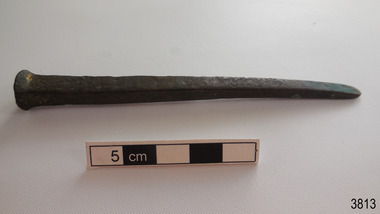
... This nail was made at a time when the shanks of nails were usually machine cut but the heads were hand formed by blacksmiths. ...This nail was made at a time when the shanks of nails were usually machine cut but the heads were hand formed by blacksmiths. ...This historic bronze nail dates back to 1840s when the ship Grange was built. Nails such as this one were used for boat building, as deck fasteners and many other uses. This nail was made at a time when the shanks of nails were usually machine cut but the heads were hand formed by blacksmiths. The nail was recovered from the shipwreck of the Grange in around 1968, 110 years after the Grange was wrecked (see below for further details on the Grange). It is part of the John Chance Collection. THE GRANGE, 1840-1858- The wooden barque ’Grange’ was a three-masted ship built in Scotland in 1840 for international and coastal trade. On March 22, 1858, the Grange set sail from Melbourne under Captain A. Alexander, carrying a cargo of ballast. The barque had left the Heads of Phillip Bay and was heading west along the Victorian coast towards Cape Otway. The ship struck Little Haley’s Reef at Apollo Bay due to a navigational error and was stuck on the rocks. The crew left the ship carrying whatever they could onto the beach. Eventually, the remains of the hull, sails and fittings were salvaged before the wreck of the Grange broke up about a month later. About 110 years later, in 1968, the wreck of the Grange was found by divers from the Underwater Explorers Club of Victoria. They were amazed to find a unique, six to nine pound carronade (type of small cannon) and a cannonball on the site. There have been no other similar carronades recorded. In that same year the anchor of the Grange was recovered by diver John Chance and Mal Brown.The nail is significant historically as an example of hardware used when building wooden ships in the early to mid-19th century. The nail is historically significant as an example of the work and trade of blacksmith. The nail also has significant as it was recovered by John Chance, a diver from the wreck of the Grange in the 1968. Items that come from several wrecks along Victoria's coast have since been donated to the Flagstaff Hill Maritime Village’s museum collection by his family, illustrating this item’s level of historical value. The nail is historically significant for its association with the 1840s wooden barque, the Grange. The Grange is an historical example of a Scottish built vessel used for international and coastal trader of both cargo and passengers in the mid-19th century. The Grange is an example of an early ship, designed with a wooden hull. It is significant as a ship still available to divers along the south coast of Victoria, for research and education purposes. The Grange is an example of a mid-19th century vessel that carried a weapon of defence onboard.Nail, bronze, round head, four-sided shank, tip flattened to a rounded wedge shape. The surface is pitted and rough. There is orange and blue concretion on the shank. The nail is bent. flagstaff hill, warrnambool, flagstaff hill maritime museum, maritime museum, shipwreck coast, flagstaff hill maritime village, great ocean road, west coast trader, apollo bay, mid-19th century shipwreck, the grange, scottish barque, little henty reef, captain a alexander, underwater explorers club of victoria, 1840s carronade, vhr 5297, coastal trader, wooden shipwreck, john chance, fastener, nail, square nail, machine cut mail, blacksmith, historic nail, bronze nail, carronade, mal brown -
 Flagstaff Hill Maritime Museum and Village
Functional object - Nail
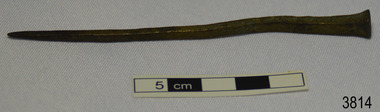
... This nail was made at a time when the shanks of nails were usually machine cut but the heads were hand formed by blacksmiths. ...This nail was made at a time when the shanks of nails were usually machine cut but the heads were hand formed by blacksmiths. ...This historic bronze nail dates back to 1840s when the ship Grange was built. Nails such as this one were used for boat building, as deck fasteners and many other uses. This nail was made at a time when the shanks of nails were usually machine cut but the heads were hand formed by blacksmiths. The nail was recovered from the shipwreck of the Grange in around 1968, 110 years after the Grange was wrecked (see below for further details on the Grange). It is part of the John Chance Collection. THE GRANGE, 1840-1858- The wooden barque ’Grange’ was a three-masted ship built in Scotland in 1840 for international and coastal trade. On March 22, 1858, the Grange set sail from Melbourne under Captain A. Alexander, carrying a cargo of ballast. The barque had left the Heads of Phillip Bay and was heading west along the Victorian coast towards Cape Otway. The ship struck Little Haley’s Reef at Apollo Bay due to a navigational error and was stuck on the rocks. The crew left the ship carrying whatever they could onto the beach. Eventually, the remains of the hull, sails and fittings were salvaged before the wreck of the Grange broke up about a month later. About 110 years later, in 1968, the wreck of the Grange was found by divers from the Underwater Explorers Club of Victoria. They were amazed to find a unique, six to nine pound carronade (type of small cannon) and a cannonball on the site. There have been no other similar carronades recorded. In that same year the anchor of the Grange was recovered by diver John Chance and Mal Brown. The nail is significant historically as an example of hardware used when building wooden ships in the early to mid-19th century. The nail is historically significant as an example of the work and trade of blacksmith. The nail also has significant as it was recovered by John Chance, a diver from the wreck of the Grange in the 1968. Items that come from several wrecks along Victoria's coast have since been donated to the Flagstaff Hill Maritime Village’s museum collection by his family, illustrating this item’s level of historical value. The nail is historically significant for its association with the 1840s wooden barque, the Grange. The Grange is an historical example of a Scottish built vessel used for international and coastal trader of both cargo and passengers in the mid-19th century. The Grange is an example of an early ship, designed with a wooden hull. It is significant as a ship still available to divers along the south coast of Victoria, for research and education purposes. The Grange is an example of a mid-19th century vessel that carried a weapon of defence onboard.Nail, bronze, oval head, four-sided shank, tip flattened to a rounded wedge shape. The surface is pitted and rough. There is orange and blue concretion on the shank. The nail is bent. flagstaff hill, warrnambool, flagstaff hill maritime museum, maritime museum, shipwreck coast, flagstaff hill maritime village, great ocean road, west coast trader, apollo bay, mid-19th century shipwreck, the grange, scottish barque, little henty reef, captain a alexander, underwater explorers club of victoria, 1840s carronade, vhr 5297, coastal trader, wooden shipwreck, john chance, fastener, nail, square nail, machine cut mail, blacksmith, historic nail, bronze nail, carronade, mal brown -
 Flagstaff Hill Maritime Museum and Village
Functional object - Nail
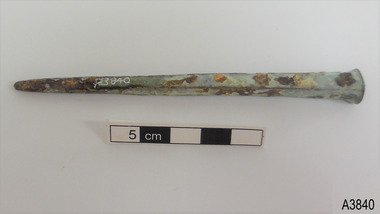
... This nail was made at a time when the shanks of nails were usually machine cut but the heads were hand formed by blacksmiths. ...This nail was made at a time when the shanks of nails were usually machine cut but the heads were hand formed by blacksmiths. ...This historic bronze nail dates back to 1790s to 1890s. Nails such as this one were used for ship building, as deck fasteners and many other uses. This nail was made at a time when the shanks of nails were usually machine cut but the heads were hand formed by blacksmiths. The nail was recovered from a shipwreck along the coast of Victoria in around 1968 and is part of the John Chance Collection. The nail is significant historically as an example of hardware used when building wooden ships in the early to mid-19th century. The nail is historically significant as an example of the work and trade of blacksmith. The nail is also significant as it was recovered by John Chance, a diver in Victoria’s coastal waters in the late 1960s to early 1970s. Items that come from several wrecks have since been donated to the Flagstaff Hill Maritime Village’s museum collection by his family, illustrating this item’s level of historical value.Nail; bronze, deck nail. Rounded rectangular head, rectangular shank cross-section, tip flattened to a rounded wedge shape. The surface is pitted and rough and has blue-grey, green and orange concretion and degradation on the nail's surface. Recovered from an unspecified shipwreck along the coast of Victoria. Part of the John Chance Collection. flagstaff hill, warrnambool, flagstaff hill maritime museum, maritime museum, shipwreck coast, flagstaff hill maritime village, great ocean road, john chance, fastener, nail, square nail, machine cut mail, blacksmith, historic nail, bronze nail, hand forged, coastal shipwreck, victorian shipwreck
