
Showing 38 items matching "heavy maintenance "
-
 Moorabbin Air Museum
Book - Gas turbine engines, Gas Turbine Powerplants and their Maintenance on Aircraft
... ...Heavy maintenance & repair...Gas turbine powerplant performance Line maintenance Heavy maintenance & repair Ground running Troubleshooting Text for gas turbine engine maintainers , circa 1987 Gas Turbine Powerplants and their Maintenance on Aircraft Book Gas turbine engines ...Text for gas turbine engine maintainers , circa 1987non-fictionText for gas turbine engine maintainers , circa 1987fundamental principles, general constructional & operating features, performance parameters, compressors, combustion chambers, turbines, fuel control, water injection, starting & ignition, indicating systems, lubrication system, bleed air system, turbojet & turbofan powerplants, turboprop & turboshaft powerplants, auxiliary power units., gas turbine powerplant performance, line maintenance, heavy maintenance & repair, ground running, troubleshooting -
 Puffing Billy Railway
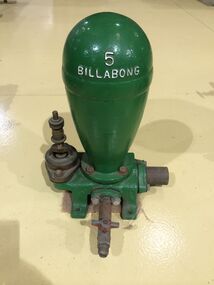
Functional object - Billabong Ram Pump Size #5, Unknown
... • Require very minimal or almost no maintenance. • Heavy duty cast Iron base and Dome. ... • Require very minimal or almost no maintenance. • Heavy duty cast Iron base and Dome. ...Pump - Billabong Ram Pump Size #5 Based on available historical data, the Australian-made Billabong Hydraulic Ram is one of the oldest rams produced anywhere in the world The Billabong Hydraulic Ram was first introduced into Australia in 1855 by John Danks and Son Limited, John Danks & Son Pty Ltd began as a plumbing business in 1859, established by brothers John and Samuel. It occupied a prominent site in Bourke Street, Melbourne, for 100 years. The business quickly grew to include factories in Melbourne and Sydney which manufactured and supplied a variety of plumbing and engineering products such as brassware, pumps, windmills and bells. The company was registered in Victoria on 25 January 1889 to continue the hardware manufacturing and supply business founded by brothers John and Samuel Danks in 1859. The head office was based in Bourke Street, Melbourne while another branch was established in Sydney in the 1880s. The company had factories in Melbourne and Sydney. The John Danks and Son Limited catalogue published in 1890, listing Billabong Hydraulic Rams as one of its major machinery products. The catalogue also provides reference to the company’s ram experience and manufacture, beginning by stating that in 1890 they already had 35 years of experience with Billabong Hydraulic Rams. The Hydraulic Ram has stood the test of time and it remains one of the few really practical and efficient uses of natural energy today. It operates without almost any cost, will last indefinitely and, with only two moving parts, is simplicity itself. It requires minimum maintenance and minimum replacement of parts. It is not uncommon to find rams working continuously for many years without any attention. • The Rams do not require electricity, fuel or steam to operate. • They possess simplicity of construction and operation – only 2 moving parts. • Powered only by running water. • Require very minimal or almost no maintenance. • Heavy duty cast Iron base and Dome. This Pump recovered from the Clematis Creek in the Mid 1970's Used to pump water from the creek to the Paradise (Clematis) Hotel. Historic - Farm Equipment - Used to pump water from the creek to the Paradise (Clematis) Hotel.Cast Iron Bronze valveBillabong 5billabong, puffing billy, ram pump -
 Flagstaff Hill Maritime Museum and Village
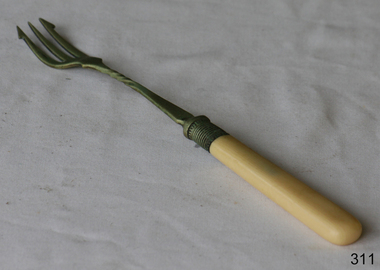
Domestic object - Fork
... Before the arrival of gas and electric cook stoves, households relied on heavy duty wood and coal fired cookers, or simply open fireplaces. Such stoves required a great deal of energy and maintenance to run, so when someone wanted a quick snack, toasting something over an open fire could be much more appealing than wrestling with the cooker. ...Before the arrival of gas and electric cook stoves, households relied on heavy duty wood and coal fired cookers, or simply open fireplaces. Such stoves required a great deal of energy and maintenance to run, so when someone wanted a quick snack, toasting something over an open fire could be much more appealing than wrestling with the cooker. ...A toasting fork is a three pronged fork designed to be used to toast things over an open fireplace. Classically, a toasting fork could be stuck into a piece of bread and used to hold the bread in the fire, with a periodic rotation for even browning. For advanced players, it's possible to use a toasting fork to make toasted cheese sandwiches and other hot sandwiches. A typical toasting fork is made of wire, and many modern ones are telescopic, allowing people to fold the fork up or slide the handle in when not in use. This makes toasting forks easier to store and transport, while allowing people to keep their hands well clear of the fire when the fork is in use. The three slender prongs can be of varying length, depending on the design; prongs which are too long will mangle the bread, while short prongs will allow the bread to slide off, so most designers try to strike a happy medium. Before the arrival of gas and electric cook stoves, households relied on heavy duty wood and coal fired cookers, or simply open fireplaces. Such stoves required a great deal of energy and maintenance to run, so when someone wanted a quick snack, toasting something over an open fire could be much more appealing than wrestling with the cooker. Some people also undoubtedly found the experience of toasting something over an open fire to be enjoyable. https://www.delightedcooking.com/what-is-a-toasting-fork.htmIn the old days, there were no electric toasters, so the toasting fork used near an open flame proved extremely effective.Fork with three prongs with hook design on the two outside prongs. Neck features decorative twisted design and there is more decorative work in the metal near the bone handle.None. flagstaff hill, warrnambool, shipwrecked-coast, flagstaff-hill, flagstaff-hill-maritime-museum, maritime-museum, shipwreck-coast, flagstaff-hill-maritime-village -
 Flagstaff Hill Maritime Museum and Village
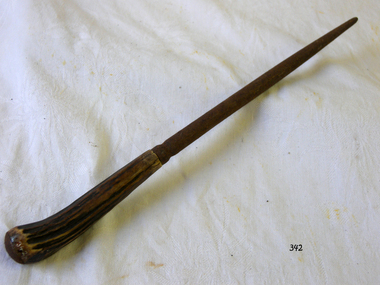
Domestic object - Sharpening Steel
... There has long been speculation about the efficacy of steeling (re-aligning the edge) vs honing (removing minor deformation with abrasives); studies tend to favour abrasives for daily maintenance, especially in high-carbide-volume "stainless" steels (such as the popular CPM S30V steel, which tends to "tear out" when steeled rather than re-forming an edge.) Small honing steel for outdoor activities Usage trends Steels have traditionally been used in the West, especially in heavy-use scenarios (e.g. butchering, where the edge deforms due to forceful contact with bone). ...There has long been speculation about the efficacy of steeling (re-aligning the edge) vs honing (removing minor deformation with abrasives); studies tend to favour abrasives for daily maintenance, especially in high-carbide-volume "stainless" steels (such as the popular CPM S30V steel, which tends to "tear out" when steeled rather than re-forming an edge.) Small honing steel for outdoor activities Usage trends Steels have traditionally been used in the West, especially in heavy-use scenarios (e.g. butchering, where the edge deforms due to forceful contact with bone). ...A honing steel, sometimes referred to as a sharpening steel, whet steel, sharpening stick, sharpening rod, butcher's steel, and chef's steel, is a rod of steel, ceramic or diamond-coated steel used to restore keenness to dulled blade edges. They are flat, oval, or round in cross-section and up to 30 centimetres (1 ft) long. The steel and ceramic honing steels may have longitudinal ridges, whereas the diamond-coated steels are smooth but embedded with abrasive diamond particles. Non-abrasive honing rods such as smooth ceramic or ribbed steel are able to remove small amounts of metal via adhesive wear. In normal use, the rod is applied to the blade at a slightly higher angle than that of the bevel, resulting in the formation of a micro-bevel. The term "hone" is associated with light maintenance performed on a blade without the effort and precision normally associated with sharpening, so the name "hone" was borrowed. In the 1980s, ceramic abrasives became increasingly popular and proved an equal, if not superior, method for accomplishing the same daily maintenance tasks; manufacturers replaced steels with ceramic (and later, manufactured diamond abrasive) sharpening "steels" that were actually hones. Use Honing steels are used by lightly placing the near edge of the blade against the base of the steel, then sliding the blade away from yourself along the steel while moving it down – the blade moves diagonally, while the steel remains stationary. This should be done with the blade held at an angle to the steel, usually about 20°, and repeating on the opposite side at the same angle. This is repeated five to ten times per side. Steeling It is often recommended that steeling be performed immediately before or after using a knife and can be done daily. By contrast, knives are generally sharpened much less frequently. A traditional smooth honing steel is of no use if the edge is blunt, because it removes no material; instead it fixes deformations along the edge of a sharp blade, technically known as burnishing. There has long been speculation about the efficacy of steeling (re-aligning the edge) vs honing (removing minor deformation with abrasives); studies tend to favour abrasives for daily maintenance, especially in high-carbide-volume "stainless" steels (such as the popular CPM S30V steel, which tends to "tear out" when steeled rather than re-forming an edge.) Small honing steel for outdoor activities Usage trends Steels have traditionally been used in the West, especially in heavy-use scenarios (e.g. butchering, where the edge deforms due to forceful contact with bone). These scenarios also lead Western trends toward blades tempered to a lower level of hardness (and thus lower brittleness). In East Asia, notably Japan, harder knives are preferred, so there is little need for steeling intra-day, as the edge does not deform as much. Instead, the blade is honed as needed on a waterstone. While tradition has kept the practice of steeling alive in Western kitchens, the majority of honing steels sold are abrasive rather than smooth, and knives are harder and more frequently made of stainless steel, which does not respond to traditional steeling techniques as well as high-carbon/low alloy tool steels.The sharpening steel is essential to maintain the sharpness of carving and other knives.Steel knife sharpener with bone handle. Part of a carving set.None.flagstaff hill, warrnambool, shipwrecked-coast, flagstaff-hill, flagstaff-hill-maritime-museum, maritime-museum, shipwreck-coast, flagstaff-hill-maritime-village, sharpening steel, carving set, kitchen equipment -
 Mission to Seafarers Victoria
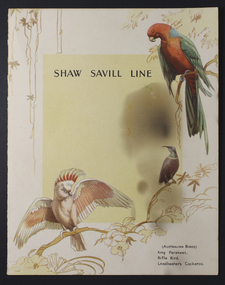
Souvenir - Menu, Shaw Savill Line SS Athenic, Christmas 1948, 25/12/1948
... The memorabilia relates to his career at sea and in particular the role of an engineer, including a handwritten manual of notes and references relating to the mechanical and engineering aspects and areas of responsibility for maintenance. menu birds, australian christmas ss athenic shaw savill line george winfield duncan (1922-2017) ship engineer see images Single fold heavy card menu with colour cover featuring birds of Australia: King parrot, Rifle bird, Leadbetter's cockatoo. ...Included in the G W Duncan collection this item of memorabilia from 1948 may have been acquired quite early in the donor's career as a ship's engineer. The menu provides a glimpse of shipboard diet and especially celebratory food.Mariner Duncan had a particular regard for the Mission to Seafarers. This plate for display on a commissioned new table at the MTSV chapel acknowledges his bequest and the material donated. Collectively the G W Duncan material includes: photographs, professional data memorabilia and written and commercially printed resources. The memorabilia relates to his career at sea and in particular the role of an engineer, including a handwritten manual of notes and references relating to the mechanical and engineering aspects and areas of responsibility for maintenance. Single fold heavy card menu with colour cover featuring birds of Australia: King parrot, Rifle bird, Leadbetter's cockatoo. Inside cover typed sheet of paper with menu listing adhered to card.see imagesmenu, birds, australian, christmas, ss athenic, shaw savill line, george winfield duncan (1922-2017), ship engineer -
 Flagstaff Hill Maritime Museum and Village
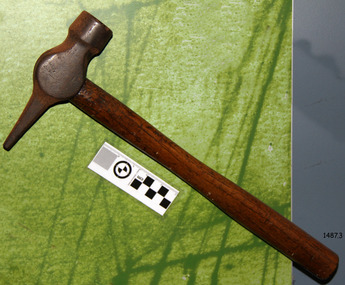
Tool - Pin hammer, Mid-to-late 20th century
... Laurie began his career as a shipwright at Ports and Harbours in Melbourne in the mid-1900s, following in the wake of the skilled carpenters who have over many centuries used their craft to build and maintain marine vessels and their fittings. flagstaff hill warrnambool great ocean road shipwreck coast maritime museum maritime village Shipwright carpenter shipbuilding ship repairs hand tool equipment ship maintenance cooper tool marine technology hammer shipwright's hammer pin hammer Laurie Dilks L Dilks Port and Harbours Melbourne Pin hammer; Wooden handle and steel head, thick heavy rounded end on one side, tapered wedge shape end on the other side. ...One end of the peg hammer’s head had a wedge-shaped tapered end, which was referred to as the peg poll and was used for hammering in pegs or bolts. The shipwright’s tools on display in the Great Circle Gallery are connected to the maritime history of Victoria through their past owner, user and donor, Laurie Dilks. Laurie began his career as a shipwright in the mid-1900s, following in the wake of the skilled carpenters who have over many centuries used their craft to build and maintain marine vessels and their fittings. You can see Laurie’s inscription on the tool called a ‘bevel’. Laurie worked for Ports and Harbours, Melbourne, for over 50 years, beginning in the early 1960s. He and a fellow shipwright inscribed their names on a wheelhouse they built in 1965; the inscription was discovered many decades later during a repair of the plumbing. Many decades later Laurie worked on the Yarra moving barges up and down the river and was fondly given the title ‘Riverboat Man’ His interest in maritime history led him to volunteer with the Maritime Trust of Australia’s project to restore and preserve the historic WWII 1942 Corvette, the minesweeper HMAS Castlemaine, which is a sister ship to the HMAS Warrnambool J202. Laurie Dilks donated two handmade displays of some of his tools in the late 1970s to early-1980s. The varnished timber boards displayed the tools below together with brass plaques. During the upgrade of the Great Circle Gallery Laurie’s tools were transferred to the new display you see there today. He also donated tools to Queenscliffe Maritime Museum and Clunes Museum.The shipwright’s tools on display in the Great Circle Gallery are connected to the maritime history of Victoria through their past owner, user and donor, Laurie Dilks. Laurie began his career as a shipwright at Ports and Harbours in Melbourne in the mid-1900s, following in the wake of the skilled carpenters who have over many centuries used their craft to build and maintain marine vessels and their fittings.Pin hammer; Wooden handle and steel head, thick heavy rounded end on one side, tapered wedge shape end on the other side. It once belonged to shipwright Laurie Dinks.flagstaff hill, warrnambool, great ocean road, shipwreck coast, maritime museum, maritime village, shipwright, carpenter, shipbuilding, ship repairs, hand tool, equipment, ship maintenance, cooper, tool, marine technology, hammer, shipwright's hammer, pin hammer, laurie dilks, l dilks, port and harbours melbourne -
 Orbost & District Historical Society
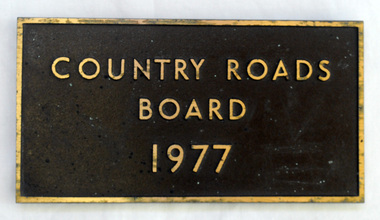
plaque, 1977
... maintenance of main roads in Victoria between 1913 and 1983. It was succeeded by the Road Construction authority on 1 July 1983 and later merged with the Road Traffic Authority on July 1 1989 to form the Roads Corporation. James Cameron, an Orbost farming pioneer and Member of the Legislative Assembly, fathered the Country Roads Board. This plaque was possibly removed from a bridge(?) when the name was changed. Country-Roads-Board Cameron-James COUNTRY ROADS BOARD 1977 A heavy ...The Country Roads Board was the government authority for the construction and maintenance of main roads in Victoria between 1913 and 1983. It was succeeded by the Road Construction authority on 1 July 1983 and later merged with the Road Traffic Authority on July 1 1989 to form the Roads Corporation. James Cameron, an Orbost farming pioneer and Member of the Legislative Assembly, fathered the Country Roads Board. This plaque was possibly removed from a bridge(?) when the name was changed.A heavy rectangular shaped bronze plaque. the background is dark brown and the print and frame bronze coloured. On the back are two round recesses for screwing and attaching the plaque.COUNTRY ROADS BOARD 1977country-roads-board cameron-james -
 Red Cliffs Military Museum
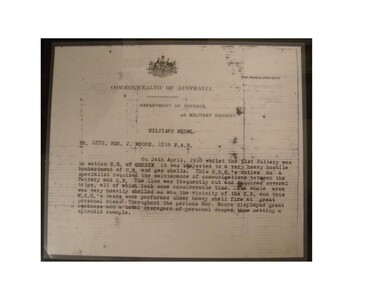
Certificate, Commendation notice for Military Medal, 1918 (estimated)
... ./ On 24th April, 1918 whilst the 51st Battery was/ in acrion N.E. of Cordie it was subjected to a very heavy hostile/ bombardment of H.E. and gas shells. This N.C.O.'s duries as a/ specialist required the maintenance of communications between the/ Battery an C.P. ..../ On 24th April, 1918 whilst the 51st Battery was/ in acrion N.E. of Cordie it was subjected to a very heavy hostile/ bombardment of H.E. and gas shells. This N.C.O.'s duries as a/ specialist required the maintenance of communications between the/ Battery an C.P. ...Associated with BDR. Joseph Moore grouped framed certificatesPhotocopy of original dispatch notice for Military Medal to No 1272 BDR J. Moore, 13th F.A.B.No 1272, BDR. J. Moore, 13th F.A.B./ On 24th April, 1918 whilst the 51st Battery was/ in acrion N.E. of Cordie it was subjected to a very heavy hostile/ bombardment of H.E. and gas shells. This N.C.O.'s duries as a/ specialist required the maintenance of communications between the/ Battery an C.P. The line was frequently cut and required several/ trips, all of which took some considerable time. The whole area/ was very heavily shelled as was the vicinity of the C.P. and this/ N.C.O.'s tasks were performed under heavy shell fire ar great/ personel risk. Throughout the periods Bdr. Moore displayed great/ coolness and total disregard of personal danger thus setting a/ splendid examplemedal, 1918, military, moore, joseph, world, war, 1, corbie, 51st, battery, 4th, district -
 Orbost & District Historical Society
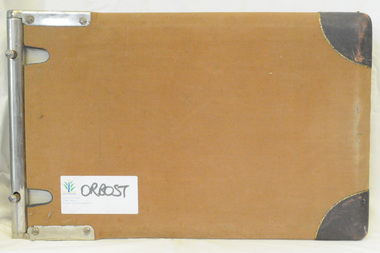
ledger, 1950's ; 1960's
... maintenance of main roads in Victoria between 1913 and 1983. It was succeeded by the Road Construction authority on 1 July 1983 and later merged with the Road Traffic Authority on July 1 1989 to form the Roads Corporation. James Cameron, an Orbost farming pioneer and Member of the Legislative Assembly, fathered the Country Roads Board. This item is a hand-written record of accounts of the Orbost Shire local Government. It pre-dates computer records,The Shire of Orbost Council no longer exists having been absorbed into th East Gippsland Shire council. A heavy ...This ledger was used by the Shire of Orbost to record transactions with the Country Roads board in 1950's and 1960's. The item was donated to Orbost & District Historical society from P.R.O.V. as a Place of Deposit (POD) item for safe keeping by a local history group or museum. The shire covered an area of 9,347 square kilometres and existed from 1892 until 1994 when it became part of the East Gippsland Shire Council. Orbost was at first included in the Bairnsdale Shire from 1882 and was later part of the Tambo Shire. Because of travelling distances the Croajingalong Shire was created in 1892 (name changed to Orbost Shire 17.2.1893 with James Cameron as the first Shire President. In 1994 it amalgamated to become part of East Gippsland Shire Council. The Country Roads Board was the government authority for the construction and maintenance of main roads in Victoria between 1913 and 1983. It was succeeded by the Road Construction authority on 1 July 1983 and later merged with the Road Traffic Authority on July 1 1989 to form the Roads Corporation. James Cameron, an Orbost farming pioneer and Member of the Legislative Assembly, fathered the Country Roads Board. This item is a hand-written record of accounts of the Orbost Shire local Government. It pre-dates computer records,The Shire of Orbost Council no longer exists having been absorbed into th East Gippsland Shire council.A heavy brown coloured ledger with steel bindings. Covers are probably wooden. It contains hand-written records of transactions the Country Roads Board. -
 Bendigo Military Museum
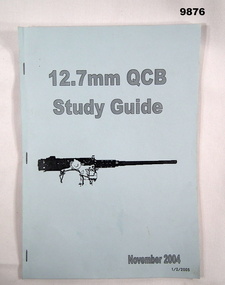
Manual - 12.7 MM STUDY GUIDE, Nov 2004
... Stapled assembly A4 sheets with green cover and with 42 pages of the use, description and maintenance of a Browning 12.7mm M2 Heavy Quick Change Barrel (QCB) machine gun....heavy Browning Machine Gun. This manual set up for training course on it's use and function. Royal Navy Gunnery Book Training Course Date, "November 2004" then "1/2/2005". Stapled assembly A4 sheets with green cover and with 42 pages of the use, description and maintenance of a Browning 12.7mm M2 Heavy Quick Change Barrel (QCB) machine gun. ...QCB stands for quick change barrel and relates to a heavy Browning Machine Gun. This manual set up for training course on it's use and function.Stapled assembly A4 sheets with green cover and with 42 pages of the use, description and maintenance of a Browning 12.7mm M2 Heavy Quick Change Barrel (QCB) machine gun.Date, "November 2004" then "1/2/2005".royal navy, gunnery, book, training course -
 Warrnambool and District Historical Society Inc.
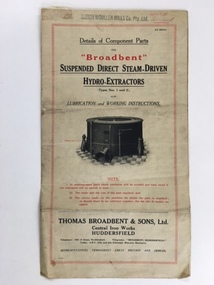
Document - Instruction manual, Details of component parts for Broadbent suspended steam driven Hydro Extractors, C 1926
... heavy duty engineering products. By 1893 Broadbent had progressed to steam powered engines for the textile industry. Some of these machines operated for upwards of 50 years Today Broadbent is a leading world designer in the manufacture and maintenance of advanced centrifuges. ...heavy duty engineering products. By 1893 Broadbent had progressed to steam powered engines for the textile industry. Some of these machines operated for upwards of 50 years Today Broadbent is a leading world designer in the manufacture and maintenance of advanced centrifuges. ...Thomas Broadbent $ sons Ltd was established in 1864 in Huddersfield England. They are an engineering firm , specialists in heavy duty engineering products. By 1893 Broadbent had progressed to steam powered engines for the textile industry. Some of these machines operated for upwards of 50 years Today Broadbent is a leading world designer in the manufacture and maintenance of advanced centrifuges. This document is a manual for a suspended direct steam driven hydro extractor. It shows the various parts , maintenance instructions and erection and working instructions. While it is stamped as Albion Woollen mills which were situated at Geelong, it is likely to have connections to the Warrnambool Woollen Mills.This document is a good example of machinery manual. It is possibly linked to the Warrnambool Woollen Mill. The fact that the company which manufactured these items is still in existence today after 150 years is testament to the quality of the items produced.Cream coloured document with mainly black text with some red text for headings contained in the document. It is printed front and back and is folded in three sections.Stamp at top "Albion Woollen mills Pty Ltd" .4H x 4 in red pencil in top RHC. Printed on front page. Thomas Broadbent & Sons Ltd Central Iron Works Huddersfield. warrnambool, warrnambool woollen mill, broadbent direct steam driven hydo extractors,, broadbent centrifuge -
 Bendigo Military Museum
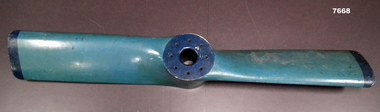
Equipment - PROPELLER, Test Propeller for Aircraft engine
... Aircraft Maintenance Propeller This is a heavy wooden propeller for an aircraft. ...This was used as a dummy propeller when test running aircraft engines.This is a heavy wooden propeller for an aircraft. It is painted blue with birch tips. It has a large centre hole of 8 cm diameter. It has 8 bolt holes of 18 mm diameter. The propeller tips are squared (ie not tapered). One side of the blades have an aeronautical curved form.aircraft maintenance, propeller -
 Kiewa Valley Historical Society
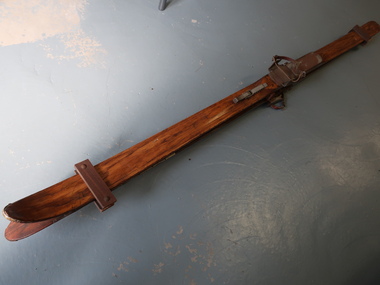
Skis, Boots, Stocks
... heavy. Owned and used by Wally Deans. Used by SECV employee, Wally Deans who worked on the Kiewa Hydro Electric Scheme. Wally married Margaret. He worked for the SEC at Rocky Valley Dam.Wally's son, Rex was born and married Meryn. The family lived at mt beauty and at Bogong Village. Wally used the skis for work for the SEC during winter, checking the equipment an general maintenance ...Hickory wood is hard and heavy. Owned and used by Wally Deans.Used by SECV employee, Wally Deans who worked on the Kiewa Hydro Electric Scheme. Wally married Margaret. He worked for the SEC at Rocky Valley Dam.Wally's son, Rex was born and married Meryn. The family lived at mt beauty and at Bogong Village. Wally used the skis for work for the SEC during winter, checking the equipment an general maintenance.Wooden skis made of hickory wood with metal binding and leather straps. Cane stocks with wide baskets. Ski boots are black, lace up with a steel plate screwed onto the front of the sole. The boots are in a steel hanging device for storage and transportation. Skis: "S.E.C. -3" inscribed on side. "66 / Hickory / 1742" on front of ski. Binding: 'Northland'. "Kanadar". Steel Carrier: "Tyrol / Can.Pat.1962 / U.S.Pat. 3074085 / Made in Canada"wally deans, ski equipment, skis, ski boots, ski stocks -
 Kiewa Valley Historical Society
Tape Measure 33ft, Early to mid 1900's
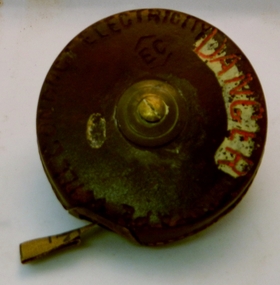
... It provides evidence that small measuring equipment used in the construction and the continuing maintenance of the scheme was of the imperial measure and used by construction workers who remained and settled in the town of Mount Beauty and Kiewa Valley long after the construction period. imperial tape measure distance measures imperial tools Embossed in the leather casing"MADE IN ENGLAND" and around the inner circle "HOCKLEY ABBEY" and "JOHN RABONE & SONS" This flexible metallic measuring tape (33 ft in length) is contained in a round circular leather bound container. It has brass fittings (winder and tape guide) and is stitched with heavy ...This flexible measuring tape was used by the SEC Victoria in the mid to late 1900's. It was in a period before digital measuring instruments were in use. This is a 33ft long tape measure and would have been used by the construction workers when building the Kiewa Valley Hydro System. The warning details (embossed into the leather covering) was to warn users to be careful not to use the tape near live electricity terminals or linkages. This tape was produced mainly for wooden structures and not electricity conductive material. This was during the 1950's to 1960's.This imperial tape measure is very significant to the Kiewa Valley as it was used in the construction of the Kiewa Valley Hydro Scheme of the 1950's-1960's. It provides evidence that small measuring equipment used in the construction and the continuing maintenance of the scheme was of the imperial measure and used by construction workers who remained and settled in the town of Mount Beauty and Kiewa Valley long after the construction period. This flexible metallic measuring tape (33 ft in length) is contained in a round circular leather bound container. It has brass fittings (winder and tape guide) and is stitched with heavy grade twine. The tape measure is graduated in feet and inches on one side and yards on the other. Embossed in the leather casing"MADE IN ENGLAND" and around the inner circle "HOCKLEY ABBEY" and "JOHN RABONE & SONS"imperial tape measure, distance measures, imperial tools -
 Kiewa Valley Historical Society
Case Volt Meter Recorder, Circa 1950 to 1977
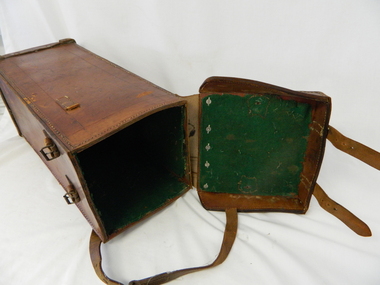
... maintenance an ultimately at a higher cost. The testing of the SEC Vic supplied electricity to rural properties,those who had previously run on generators, had to be quick and unassuming with certainty of correct supply levels. sec vic kiewa hydro scheme alternate energy supplies alpine growth in electricity consumption Nil This heavy and thick all leather case for the "easy" transportation of the Volt meter recorder has a opening top which pop riveted to the main body(rivets are aluminium). ...This case is for a testing voltmeter recorder. The last time it was certified by SEC Vic laboratories on the 17/4/77. It was used extensively in the transportation of the mobile recorder which was sometimes placed for periods of one month at locations experiencing unacceptable fluctuations of power. These locations would cover the North East regions of Victoria. They cover voltage drops at domestic and business properties especially those that were experiencing regular fluctuations(daily) at approximately the same time of the day. As the electrical network is required to operate within a set level of voltage, fluctuations outside of this has to be investigated and necessary remedial action taken. This is especially so for rural properties where power "drainage" can occur through animal/bird and tree interference. See KVHS 0302 (A) for the instrument.This case for a mobile voltage recorder is very significant to the Kiewa Valley because it highlights the difficulties that can occur in maintaining a power supply that experiences fluctuating power demands by the rural industries that it supplies. The requirement of a mobile testing apparatus to cover the various sections in the Kiewa Valley and other rural areas in the northeast region is one of necessity as electricity once connected to a rural property is a labour saving supply as generators on rural properties require a higher degree of maintenance an ultimately at a higher cost. The testing of the SEC Vic supplied electricity to rural properties,those who had previously run on generators, had to be quick and unassuming with certainty of correct supply levels.This heavy and thick all leather case for the "easy" transportation of the Volt meter recorder has a opening top which pop riveted to the main body(rivets are aluminium). The all leather top has a shaped carrying handle which is also riveted on. There are two straps on the side of the top which can be fastened to the main body by metal "shoe" buckles. The bottom end is secured to the main bag by large rivets.Tick grade stitching is on all corners.Nilsec vic kiewa hydro scheme, alternate energy supplies, alpine growth in electricity consumption -
 Kiewa Valley Historical Society
Belt Linesman Pole, circa mid to late 1900's
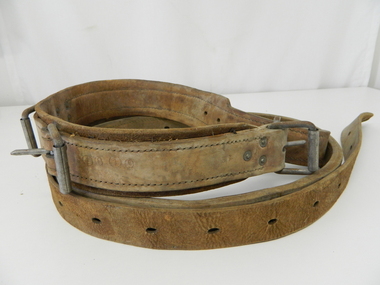
... Climbing pegs were installed on higher poles that extended beyond the reach of ladders. kiewa hydro electricity scheme victorian state electricity commission relays generators electrical pole maintenance This thick leather linesman belt is made from two lengths of heavy lengths of leather straps sewn together to make up 80% of the belt. ...This linesman belt was used under the 1947 Electricity Regulations and before tighter Occupation and Health regulations (late 1990's early 2000's) were introduced that mechanical lifting platforms(wherever possible) replaced the belt up the pole method.The safety concern was that it required that tools needed by the linesman had to be placed in a large canvas bag and attached to the belt (extra weight) then the linesman had to climb the ladder. Ladders had to be at the correct angle and not able to "slip" from their initial footings. A full harness and a secondary fall belt is now mandatory for pole linesmen. The safety of fellow workers could be compromised if they were required to assist or recover the first linesman if needed. In 2006 an additional 269 registered lineworkers were employed. Please note that the terminology of linesman has become unisex. The linesman's belt enabled the linesman to place his feet against the pole adjust the belt (if needed) and lean back securely allowing both hands to be free to work with. This linesman belt is very significant to the Kiewa Valley due to the numerous poles and high voltage overhead power structures that needed maintenance for the extensive "mushroom" installation of electrical power polls(wood and metal). On high poles (steel) climbing pegs were welded on, however in the Alpine areas snow in winter caused an OH&S problem which were hard to overcome. The safety of a linesman when maintenance of electricity line on poles can be highlighted by the New Zealand linesman who survived an 11,000 volt shock when carrying out maintenance. For the record 11,000 volts is four times more powerful than execution by "the electric chair". The maintenance of the linesman's belt was his responsibility (keeping it clean and in "good" condition). Labour laws change this initial responsibility, from the linesman, to the employer. Climbing pegs were installed on higher poles that extended beyond the reach of ladders.This thick leather linesman belt is made from two lengths of heavy lengths of leather straps sewn together to make up 80% of the belt. The remaining 20% is "the belt tonge" which has eleven holes for three (solid steel tang) buckle connections.kiewa hydro electricity scheme, victorian state electricity commission, relays, generators, electrical pole maintenance -
4th/19th Prince of Wales's Light Horse Regiment Unit History Room
Book, Maintenance Manual Canadian Military Pattern Vehicles, Apr 1942
... Soft covered maintenance manual for the 15 cwt 4x2, the 15 cwt, 30 cwt, Heavy Duty and Field Artillery Tractor 4x4 Chevrolet ...Maintenance manual Canadian military vehicles MB-C1, The logo of General Motors Canada Soft covered maintenance manual for the 15 cwt 4x2, the 15 cwt, 30 cwt, Heavy Duty and Field Artillery Tractor 4x4 Chevrolet Maintenance Manual Canadian Military Pattern Vehicles Book ...Soft covered maintenance manual for the 15 cwt 4x2, the 15 cwt, 30 cwt, Heavy Duty and Field Artillery Tractor 4x4 Chevrolet MB-C1, The logo of General Motors Canadamaintenance manual, canadian military vehicles -
 Bendigo Military Museum
Legal record - INDENTURE 1920, SOLDIERS MEMORIAL INSTITUTE, 22.4.1920
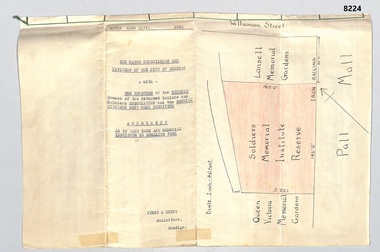
... Some of the hand written notes in left hand column are; Rental, Maintenance, Trustees, Right to hold meetings, Conduct, Control of grounds and portico. brsl smirsl legal indenture 1920 Main point, as per "Cat No 8222" Legal document heavy paper light brown colour, basically a copy of Cat No 8222 without the hand written signatures and red seals. ...This document relating to the Agreement between the Bendigo Council and the Bendigo Returned Sailors and Soldiers Association re the use of the Soldiers Memorial Institute Pall Mall Bendigo is a day to day working copy of Cat No 8222 dated 22.4.1920 pre the opening of the building in 1921. Some of the hand written notes in left hand column are; Rental, Maintenance, Trustees, Right to hold meetings, Conduct, Control of grounds and portico.Legal document heavy paper light brown colour, basically a copy of Cat No 8222 without the hand written signatures and red seals. They are held together via a green cord sewn through the papers. In the space column notes have been hand written in pencil to make easier to find a paragraph on subjects relating to the use of the Building.Main point, as per "Cat No 8222"brsl, smirsl, legal, indenture 1920 -
 Warrnambool and District Historical Society Inc.
Typewriter accessories, Early 20th century
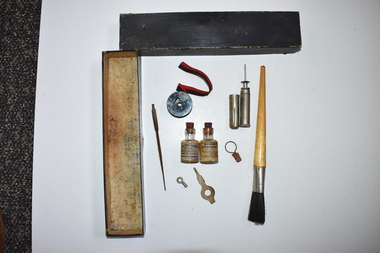
... heavily stained inside. The box contains nine objects, most identified as relevant to typewriter maintenance and cleaning:- a paint brush with a wooden handle and bristles – perhaps used for dusting the typewriter keys, two glass bottles which once contained typewriter oil but which are now empty, a red and black typewriter ribbon in a metal container, another metal container with a plunge mechanism for ejecting oil, a metal stick with a sharp end, possibly for cleaning the typewriter keys and three other unidentified small metal objects....heavily stained inside. The box contains nine objects, most identified as relevant to typewriter maintenance and cleaning:- a paint brush with a wooden handle and bristles – perhaps used for dusting the typewriter keys, two glass bottles which once contained typewriter oil but which are now empty, a red and black typewriter ribbon in a metal container, another metal container with a plunge mechanism for ejecting oil, a metal stick with a sharp end, possibly for cleaning the typewriter keys and three other unidentified small metal objects. ...This box contains typewriter equipment for a Remington typewriter. The Remington company was founded in U.S.A. and it produced the first typewriter for commercial use in 1873. In 1886 the Remington family business was sold but the name was retained and typewriters with the Remington Rand brand name were sold from 1927 on. Typewriters have now been replaced by computers. This box of equipment belonged to Dr Horace Holmes who would have used a typewriter in his medical practice in Warrnambool in the first half of the 20th century and perhaps would also have used a typewriter in the activities of the many community groups with which he was associated. Horace Iles Holmes (1877-1959) was born and educated in Tasmania and completed a medical degree at the University of Melbourne. He commenced a practice at Warrnambool in 1906 and was the honorary Medical Officer at the Warrnambool Hospital and Warrnambool’s Health Officer. His practice was at ‘Ierne’, at the corner of Spence and Kepler Streets. He was an early member of the Royal Australian College of Surgeons and was prominent in community affairs (foundation President of the Warrnambool Rotary Club, a member of the Warrnambool Masonic Lodge for over 50 years, a Warrnambool Hospital Committee member, a long-term Trustee of the Warrnambool Methodist Church and President of the Lyndoch Hostel for the Aged Committee. Dr Holmes also had agricultural interests and enjoyed fishing, bowls and golf. This box of typewriter equipment is of interest as an item in the collection of Horace Iles Holmes, a doctor who was prominently associated with the professional and community life of Warrnambool for over 50 years. This is a rectangular-shaped black cardboard box with the name ‘Remington’ on it. It is heavily stained inside. The box contains nine objects, most identified as relevant to typewriter maintenance and cleaning:- a paint brush with a wooden handle and bristles – perhaps used for dusting the typewriter keys, two glass bottles which once contained typewriter oil but which are now empty, a red and black typewriter ribbon in a metal container, another metal container with a plunge mechanism for ejecting oil, a metal stick with a sharp end, possibly for cleaning the typewriter keys and three other unidentified small metal objects.Remingtonremington, typewriters, office equipment, dr horace holmes, warrnambool, warrnambool history, typewriter accessories -
 Ballarat Tramway Museum
Administrative record - fininacial, Melbourne Electric Supply Co. (MESCo), Geelong Tramways 1 month - Statement of Accounts, 1918 to 1926
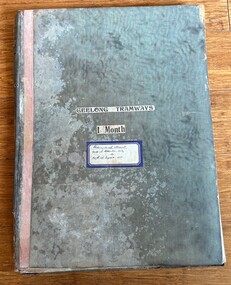
... Details the traffic expenses, general repairs and maintenance, power costs, management costs and details revenue, ticket sales, and has a summary of operational statistics. Demonstrates the production of accounting records for Geelong tramways between 1918 and 1926 tramways trams geelong Financial Statements Accounting Records Heavy green cardboard folder, metal retaining clips with printed accounting sheets with handwritten and/or typed entries. ...Provides details of the financial expenses, income and performance of Geelong Tramways that were operated by MESCo from Sept. 1918 to August 1926. Details the traffic expenses, general repairs and maintenance, power costs, management costs and details revenue, ticket sales, and has a summary of operational statistics.Demonstrates the production of accounting records for Geelong tramways between 1918 and 1926Heavy green cardboard folder, metal retaining clips with printed accounting sheets with handwritten and/or typed entries.tramways, trams, geelong, financial statements, accounting, records -
 Ballarat Tramway Museum
Administrative record - SEC Tramcar records folder, State Electricity Commission of Victoria (SECV), 1936 to 1970
... Contains the following tramcars and their related item numbers: 9136 - tram 11 9137 - tram 12 9138 - tram 13 9139 - tram 14 9140 - tram 16 (tram 15 was renumbered as tram 36) 9141 - tram 17 9142 - tram 18 9143 - tram 19 9144 - tram 20 9145 - tram 21 9146 - tram 23 (tram 22 was renumbered as tram 37) 9147 - tram 24 9148 - tram 25 9149 - tram 26 9150 - tram 27 9151 - tram 28 9152 - tram 31 (trams 29 and 30 sheets are missing) 9153 - tram 32 9154 - tram 33 9155 - tram 34 9156 - tram 35 9157 - tram 36 9158 - tram 37 (there were two trams that carried this number, both on the same sheet) 9159 - tram 38 9160 - tram 39 9161 - tram 40 9162 - tram 42 (tram 41 sheet is missing) 9163 - tram 43 Demonstrates the SECV practice of maintaining records for the work on the tramcars in Ballarat. tramways tramcars Ballarat SEC tramcar maintenance records Has manufactures lable on the inside of the cover. Folder, Firmfast springback file folder, heavy card covers, pseudo leather printed. ...Contains lists of work carried out on each SEC tramcar from the time of acquisition in Ballarat to 1970, though records for trams 29, 30, and 41 are missing. To be read in conjunction with the tramcar record cards and Wal Jack notes - see item 5507 and the BTM record sheets. Contains the following tramcars and their related item numbers: 9136 - tram 11 9137 - tram 12 9138 - tram 13 9139 - tram 14 9140 - tram 16 (tram 15 was renumbered as tram 36) 9141 - tram 17 9142 - tram 18 9143 - tram 19 9144 - tram 20 9145 - tram 21 9146 - tram 23 (tram 22 was renumbered as tram 37) 9147 - tram 24 9148 - tram 25 9149 - tram 26 9150 - tram 27 9151 - tram 28 9152 - tram 31 (trams 29 and 30 sheets are missing) 9153 - tram 32 9154 - tram 33 9155 - tram 34 9156 - tram 35 9157 - tram 36 9158 - tram 37 (there were two trams that carried this number, both on the same sheet) 9159 - tram 38 9160 - tram 39 9161 - tram 40 9162 - tram 42 (tram 41 sheet is missing) 9163 - tram 43 Demonstrates the SECV practice of maintaining records for the work on the tramcars in Ballarat.Folder, Firmfast springback file folder, heavy card covers, pseudo leather printed.Has manufactures lable on the inside of the cover.tramways, tramcars, ballarat, sec, tramcar maintenance, records -
 Ballarat Tramway Museum
Administrative record - SEC Ballarat Depot monthly report, State Electricity Commission of Victoria (SECV), 1971
... Ballarat tramcars Workshop Records Workshops maintenance Memo reporting book, with sheets headed "Departmental State Electricity Commission of Victoria" - ruled, carbon copy with heavy card covers with green tape binding. ...Record of the monthly reports from April 1965 to July 1971, signed by the Depot Foreman S Lakey, D Irwin or acting F. Minns. Lists the number of brake blocks replaced and summarises the principal work done on the tramcars and special jobs eg replacing the destination rolls. image i2 - April 1965 to December 1966 image i3 - Jan. 1967 to December 1968 - including an entry dated 10-9-1968 with a list of depot staff, addresses and phone numbers, 17 in all. image i4 - Jan. 1969 to December 1970 image i5 - Jan 1971 to July 1971Yields information about the Ballarat Workshop activities, tramcars maintained and events on a monthly basis.Memo reporting book, with sheets headed "Departmental State Electricity Commission of Victoria" - ruled, carbon copy with heavy card covers with green tape binding. Form SF-466-12-0254. A sheet of carbon paper remains in the book as if for the next entry.ballarat, tramcars, workshop records, workshops, maintenance -
 Ballarat Tramway Museum
Administrative record - SEC Ballarat Depot accident repairs, State Electricity Commission of Victoria (SECV), 1960 to 1971
... Ballarat tramcars Workshop Records Workshops maintenance accidents Insurance Memo reporting book, with sheets headed "Departmental State Electricity Commission of Victoria Electricity Supply Department" - ruled, carbon copy with heavy card covers stapled. ...The book is a record of work carried out in accident repairs on Ballarat trams from 20/12/1960 to 23/3/1971. Gives the tramcar number, accident report number, dates, labour, materials, date completed, and whether the work is claimable.Yields information about the Ballarat Workshops accident repairs.Memo reporting book, with sheets headed "Departmental State Electricity Commission of Victoria Electricity Supply Department" - ruled, carbon copy with heavy card covers stapled. A sheet of carbon paper remains in the book as if for the next entry.ballarat, tramcars, workshop records, workshops, maintenance, accidents, insurance -
 Sunshine and District Historical Society Incorporated
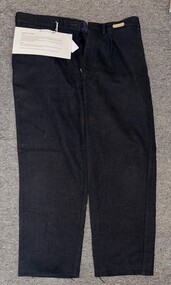
Uniform - Albion Explosive Factory Clothing
... maintenance personl wore these pants when work in the acid areas. To break acid lines for repairs the procedure was to put on PVC pants, coat, safety glasses and hard hat with face shield.|2/ Dark Beret - The heavier and darker beret is of pure wool and was used in the acid section at all times and other sections where acids were used ie RDX & TNT.|3. ...maintenance personl wore these pants when work in the acid areas. To break acid lines for repairs the procedure was to put on PVC pants, coat, safety glasses and hard hat with face shield.|2/ Dark Beret - The heavier and darker beret is of pure wool and was used in the acid section at all times and other sections where acids were used ie RDX & TNT.|3. ...These items were used in the Albion Explosive Factory1/ Pants - The pants are pure wool, They were used in the acid section at all times and other sections where acids were used ie RDX & TNT. A lot of maintenance personl wore these pants when work in the acid areas. To break acid lines for repairs the procedure was to put on PVC pants, coat, safety glasses and hard hat with face shield.|2/ Dark Beret - The heavier and darker beret is of pure wool and was used in the acid section at all times and other sections where acids were used ie RDX & TNT.|3. Light Beret - Is wool and cotton blend and was in all other production sections.1/ Pants - A.G.C.F. 1980 Size 7albion explosive factory, clothing -
 Sunshine and District Historical Society Incorporated
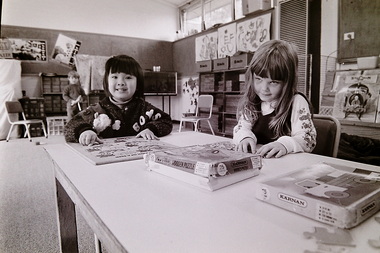
Photograph - Dobson Kindergarten Rogers Reserve 23 - 25 Burns Street Maidstone 1993 Photographs, Sharon Cavanagh, 24th June 1993
... The issue emerged during a period when many early‑childhood centres across Melbourne’s west were struggling with rising operational costs, ageing buildings requiring maintenance, changes in state funding formulas, and increased demand for services from young migrant families. Dobson Kindergarten was particularly affected because it relied heavily on a combination of council support, parent fundraising, and state early‑childhood grants. ...The issue emerged during a period when many early‑childhood centres across Melbourne’s west were struggling with rising operational costs, ageing buildings requiring maintenance, changes in state funding formulas, and increased demand for services from young migrant families. Dobson Kindergarten was particularly affected because it relied heavily on a combination of council support, parent fundraising, and state early‑childhood grants. ...In 1993, Dobson Kindergarten in Maidstone faced a significant funding shortfall that threatened its ability to operate at normal capacity. The issue emerged during a period when many early‑childhood centres across Melbourne’s west were struggling with rising operational costs, ageing buildings requiring maintenance, changes in state funding formulas, and increased demand for services from young migrant families. Dobson Kindergarten was particularly affected because it relied heavily on a combination of council support, parent fundraising, and state early‑childhood grants. When expected funding did not arrive in full, the kindergarten was left unable to cover essential expenses such as staffing, materials, and building upkeep. These photographs, taken by The Advocate in 1993, were published after parents and staff organised a campaign calling for increased government funding.Dobson Kindergarten Burns Street Maidstone Mothers who could be affected by cuts in State funding 267.3dobson kindergarten, rogers reserve, burns street, maidstone -
 Melbourne Tram Museum
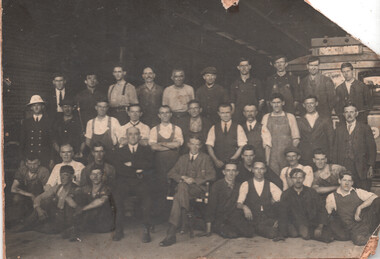
Photograph - Group photo - Malvern or Kew Depot - runningsheds et al staff, R E Witt, 30/3/1921
... maintenance worker clothes, others in suits. Yields information about either the Kew Depot or Malvern depot running shed staff and others 1921. tramways trackwork running sheds staff Malvern depot Kew depot in ink "30/3/21" and "R E Witt, photographers, ? Melbourne" stamp. Black and white image mounted onto heavy ...The photo shows a group of 35 men with either a B or H class car on the left at either Malvern or Kew depot. Note the range of clothing, dirty faces, an inspector? wearing a pith helmet, some in tramway maintenance worker clothes, others in suits. Yields information about either the Kew Depot or Malvern depot running shed staff and others 1921.Black and white image mounted onto heavy card - with the photographers stamp on the rear and hand written date. Part of top right hand corner missing.in ink "30/3/21" and "R E Witt, photographers, ? Melbourne" stamp.tramways, trackwork, running sheds, staff, malvern depot, kew depot -
 Melbourne Tram Museum
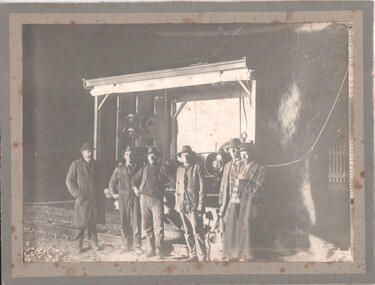
Photograph - PMTT Arc Welding plant & Crew, c1916
... Yields information about the arc welding plant of the PMTT c1916. tramways pmtt welding track maintenance One rear in ink "The first arc-welding plant Prahran & Malvern Tramways Trust about 1916. W E ? 3rd from the left" Black and white photo mounted on heavy grey card with notes on the rear. ...The photo shows a group of six men standing in front of a rail mounted arc-welding plant at night. The tracks are open ballasted, possibly Dandenong Road.Yields information about the arc welding plant of the PMTT c1916.Black and white photo mounted on heavy grey card with notes on the rear.One rear in ink "The first arc-welding plant Prahran & Malvern Tramways Trust about 1916. W E ? 3rd from the left"tramways, pmtt, welding, track maintenance -
 Melbourne Tram Museum
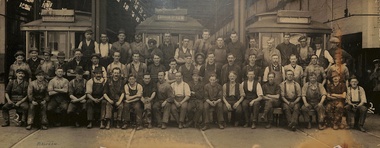
Photograph - Group - Malvern depot running sheds staff, c1920
... Yields information about the Malvern Depot workshop staff and the mode of dress. tramways pmtt malvern depot staff tramcar maintenance staff Black and white photo mounted on heavy brown card. ...The photo shows a group of some 55 men in work clothes standing in front of three trams at Malvern depot. There are no "suits" or "managers" in the photo. Trams have the destinations of Glenferrie Rd, Cotham Rd Kew and Special. Photo c1920? On the far right is a traffic employee peeking into the scene.Yields information about the Malvern Depot workshop staff and the mode of dress.Black and white photo mounted on heavy brown card. Two copies held.tramways, pmtt, malvern depot, staff, tramcar maintenance staff -
 8th/13th Victorian Mounted Rifles Regimental Collection
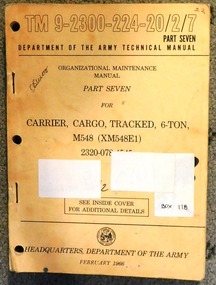
Manual
... Buff coloured soft covered manual bound with heavy metal staples, 353 pages being Organisational Maintenance Manual Part Seven for Carrier Cargo Tracked 6 Ton M 548.Published by Headquarters Department of the Army ( USA ) February 1966....maintenance of a nature beyond the expertise of AFV crewmen and just short of major rebuilds undertaken by Base Workshop detachments. Part of a collection of workshop manuals and user handbooks relating to equipment on issue to 8th/13th Victorian Mounted Rifles during the latter half of the twentieth century. Ink stamp on title page " 8/13 VMR Regimental collection " and ink notation on cover " Obsolete " and ink on spine " 21 " Buff coloured soft covered manual bound with heavy ...Tracked cargo carrier is part of M113 family of armoured vehicles used by 8/13 VMR in 1970s and 1990s. Technical manuals and User Handbooks were essential equipment for Royal Australian Electrical and Mechanical Engineers (RAEME) tradesmen permanently attached to Armoured Corps regiments as Light Aid Detachments (LAD) or Tech Support Troop (TST) and were responsible for repairs and maintenance of a nature beyond the expertise of AFV crewmen and just short of major rebuilds undertaken by Base Workshop detachments.Part of a collection of workshop manuals and user handbooks relating to equipment on issue to 8th/13th Victorian Mounted Rifles during the latter half of the twentieth century.Buff coloured soft covered manual bound with heavy metal staples, 353 pages being Organisational Maintenance Manual Part Seven for Carrier Cargo Tracked 6 Ton M 548.Published by Headquarters Department of the Army ( USA ) February 1966.Ink stamp on title page " 8/13 VMR Regimental collection " and ink notation on cover " Obsolete " and ink on spine " 21 " -
 8th/13th Victorian Mounted Rifles Regimental Collection
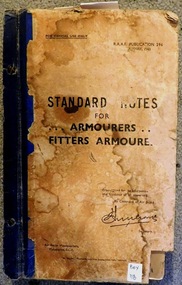
Manual
... maintenance of a nature beyond the expertise of AFV crewmen and just short of major rebuilds undertaken by Base Workshop detachments. Part of a collection of workshop manuals and user handbooks relating to equipment on issue to 8th/13th Victorian Mounted Rifles during the latter half of the twentieth century. Ink stamp on title page " 8/13 VMR Regimental Collection " Heavy ...Contains information about .30 and .50 Browning Machine Guns which were common to aircraft and armoured fighting vehicles used by 8/13 VMR. Technical manuals and User Handbooks were essential equipment for Royal Australian Electrical and Mechanical Engineers (RAEME) tradesmen permanently attached to Armoured Corps regiments as Light Aid Detachments (LAD) or Tech Support Troop (TST) and were responsible for repairs and maintenance of a nature beyond the expertise of AFV crewmen and just short of major rebuilds undertaken by Base Workshop detachments.Part of a collection of workshop manuals and user handbooks relating to equipment on issue to 8th/13th Victorian Mounted Rifles during the latter half of the twentieth century.Heavy card covered manual with fabric spine, screw bound being Standard Notes for Armourers and Fitters Armourer. Published by Airforce Headquarters Melbourne August 1943.Ink stamp on title page " 8/13 VMR Regimental Collection "
