
Showing 410 items matching "household objects"
-
 The Beechworth Burke Museum
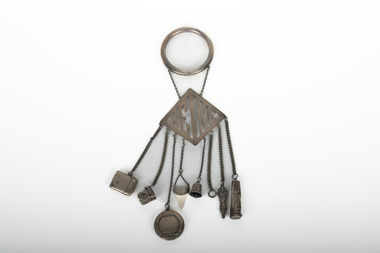
Accessory - Chatelaine, C. 1890
... Chatelaines where used by both men and women, usually fastened to a belt or pocket, and small household objects were attached to the main body of the chatelaine by chains. ...A decorative silver belt hook with small household object attached by chains to a suspended name plate. ...Chatelaines where used by both men and women, usually fastened to a belt or pocket, and small household objects were attached to the main body of the chatelaine by chains. ...The exact creation date of this chatelaine is unknown, however the hallmarks and engravings on some of the attached objects indicate that this chatelaine was made in the late 1890s. The shark tooth and the liberty bell attached to the chatelaine suggest that the item once belonged to an Australian who had connections to America. The compact, scent bottle lid, and feminine design of the other objects suggest that this wasowned by a woman. The name on the plate indicates that this object may have belonged to someone with the surname Heine. The hallmarks on the scent bottle lid and the compact indicate that they were made in Birmingham, England in the late 1890s, and that the compact was made by H. Matthews. Chatelaines where used by both men and women, usually fastened to a belt or pocket, and small household objects were attached to the main body of the chatelaine by chains. They were only worn by the heads of the household as a display of position and power.The social history objects held in the Burke Museum's collection help to tell the stories of Beechworth's past by showing the social, cultural, and economic aspects of the town's history.A decorative silver belt hook with small household object attached by chains to a suspended name plate. There are 8 chains and 7 objects; a vesta case, scent bottle lid, compact, shark tooth, bell, button hook handle, container.HEINE/ [plate] CHERRY./ from/ LEO/ May 12th 1899/ [inscription on vesta case] L??S/ Anchor symbol/ x symbol/ lion symbol/ [Hallmark on scent bottle lid] R/ HM/ Anchor symbol/ Lion symbol/ m symbol/ [Hallmark on back of the compact] SYDNEY/ [inscription on shark tooth] Proclaim liberty throughout all the land unto all inhabitants thereof/ By order of the Assembly of the Province of Pensylvania for the State House in Philada/ [inscription on bell] A01176/ burke museum, silverware, social history, heine -
 Warrnambool and District Historical Society Inc.
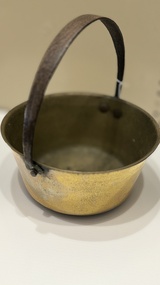
Functional object - Metal Pot, c. 1900
... vintage household objects...This object has no known local provenance and is held because of its quality and its potential as a display item vintage household objects vintage pots This is a brass open pan or pot, circular in shape, tapering to a larger shape at the top. ...This pan or pot is a heavy, but small object and does not seem to have been used in a kitchen or for cooking. It is more likely to have been used for decorative purposes, holding artificial flowers or a pot plant or it may have had some commercial use. This object has no known local provenance and is held because of its quality and its potential as a display itemThis is a brass open pan or pot, circular in shape, tapering to a larger shape at the top. A metal handle (copper?) is attached with metal studs and soldering to both ends of the top opening. The inside of the pan is discoloured and stained.vintage household objects, vintage pots -
 Warrnambool and District Historical Society Inc.
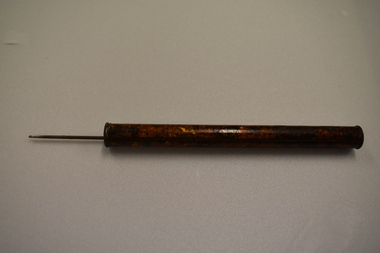
Needle case, The Crescent Manufacturing Company, Early 20th century
... Antiquarian Household Objects...Antiquarian Household Objects History of Warrnambool The Crescent Case Best English Knitting Instructions …. ...This needle case, probably dating from early in the 20th century, contained knitting needles of various sizes and those needles were probably used in sets of four to knit such items as socks. In the early to mid 20th century many items of clothing and furnishings were hand knitted with the yarn mostly favoured being wool. Today knitting is a hobby taken up by a few and clothes that were once knitted are now bought ready-made. This needle case is of antiquarian interest and is retained for display purposes. This is a cylindrical metal case with a gold-coloured marbled pattern around the case and closed metal ends. One metal end swivels around to reveal four compartments that once contained metal knitting needles. One of these needles remains. The case has printing on both metal ends and on the case body but much of this is now indecipherable. The Crescent Case Best English Knitting Instructions …. antiquarian household objects, history of warrnambool -
 Warrnambool and District Historical Society Inc.
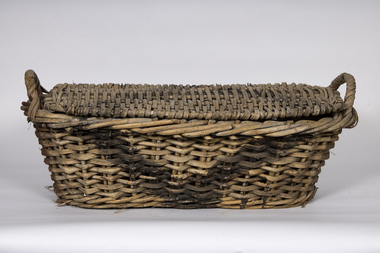
Functional object - Basket, Early 20th Century
... ...Household objects...Basket Cane Weaving Household objects This basket is woven with cane. ...It is not clear what this basket was used for; however the shape and the position of the handles suggests it was used for carrying washing. Cane baskets are commonly used in domestic situations. This basket has no known provenance but is retained for display purposes. This basket is woven with cane. It is oval in shape with a lid attached with wire hinges. The base is concave. There are handles at two ends. basket, cane weaving, household objects -
 Mont De Lancey
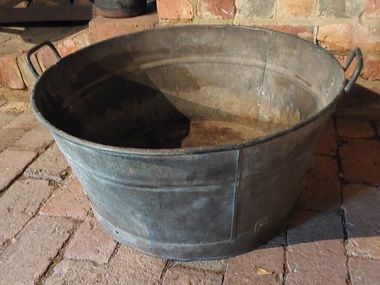
Functional object - Wash Tub, early 1900's
... ...Household objects...Laundry equipment Wash tubs Household objects A large vintage round galvanised iron tub tapering slightly to the flat base. ...These large tubs had multiple uses including washing clothes or bathing infants or children when water was not connected to the laundry or home in the early 1900's. The water was recycled by pouring it on the garden or fruit trees. It was used for containing crop harvesting too.A large vintage round galvanised iron tub tapering slightly to the flat base. It is seamed on both sides, made from two sheets of iron. It has two handles riveted on the sides and an overhanging rim at the top. It has been painted cream coloured on the inside. There is a wide steel band around the base which has been soldered on.laundry equipment, wash tubs, household objects -
 Kew Historical Society Inc
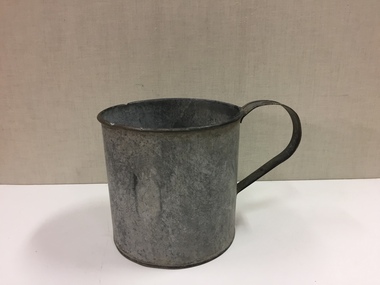
Equipment, Galvanised Iron Laundry Dipper, 20th Century
... ...household objects...A dipper was used to transfer clean water to the wash tub laundry dipper household objects Cylindrical galvanised iron laundry dipper with handle. ...A dipper was used to transfer clean water to the wash tubCylindrical galvanised iron laundry dipper with handle.laundry dipper, household objects -
 Kew Historical Society Inc
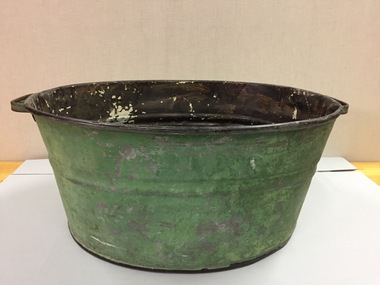
Domestic object, Galvanised Iron Wash Tub, 20th Century
... galvanised iron household objects...Item of portable laundry equipment that might have multiple purposes including washing infants. laundry equipment wash tubs galvanised iron household objects Painted (exterior) galvanised iron oval wash tub. ...Item of portable laundry equipment that might have multiple purposes including washing infants.Painted (exterior) galvanised iron oval wash tub. The portable tub has two handles and an overhanging rim.laundry equipment, wash tubs, galvanised iron household objects -
 Kew Historical Society Inc
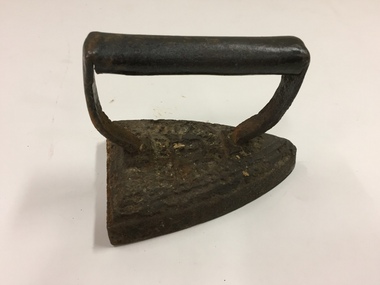
Equipment, Flat Iron, 1900-1930
... ...household objects...Sad irons were heavier than flat irons, as they had a solid block of metal as a base. flat irons household objects Flat iron with metal handle Flat Iron Equipment Equipment ...Before the introduction of electric irons, various irons were used including flat irons, sad irons, and box irons. These irons were heated on a pre-existing hot surface such as a stove (flat irons, sad irons) or heated internally with a metal slug or hot coals (box irons). Sad irons were heavier than flat irons, as they had a solid block of metal as a base.Flat iron with metal handleflat irons, household objects -
 Kew Historical Society Inc
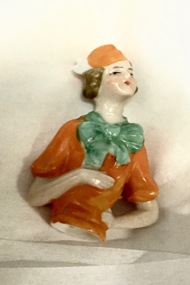
Domestic object - Tea Cosy Top
... ...household objects...tea cosy top household objects Nil Small ceramic tea cosy top Domestic object Tea Cosy Top ...Small ceramic tea cosy top Nil tea cosy top, household objects -
 Bendigo Military Museum
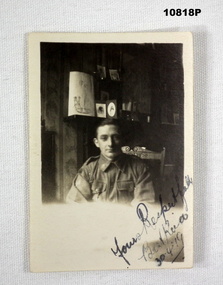
Photograph - PORTRAIT PHOTOGRAPH, WW1 SOLDIER, Bert Reid, 30 April 1919
... Black and white photograph of an Australian WW1 soldier seated. Household objects in background. Bottom third of photograph overexposed. ...Black and white photograph of an Australian WW1 soldier seated. Household objects in background. Bottom third of photograph overexposed. ...Part of the Meade Collection. See Cat No. 10785P for details of service for Ernest James Meade's (No. 2112). Postcard sent by a Bert Reed.Black and white photograph of an Australian WW1 soldier seated. Household objects in background. Bottom third of photograph overexposed. Handwritten message across bottom RH corner.Handwritten on front in black ink: “Yours Respectfully. Bert Reed, 30.4.19”.meade collection, ww1, photograph, bert reed, ernest james meade -
 Kew Historical Society Inc
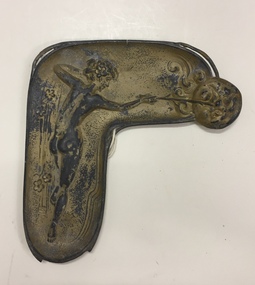
Decorative object - Figurative boomerang-shaped metal dish, c.1890
... Nineteenth century household object employing an Aboriginal shape with art nouveau figurative design...Nineteenth century household object employing an Aboriginal shape with art nouveau figurative design metal dish art nouveau - australia Diecast metal plate. ...Nineteenth century household object employing an Aboriginal shape with art nouveau figurative designDiecast metal plate. Impressed with the figure of a naked figure with a wand in his or her hand touching the nose of a head (the moon?), causing it to sneeze. Lady lying on a bed of flowers. Three stoppers on the reverse to hold the plate above the surface.metal dish, art nouveau - australia -
 Mont De Lancey
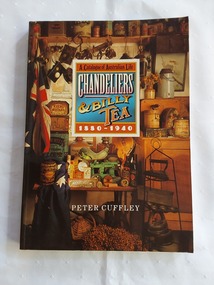
Book, Peter Cuffley, Chandeliers and Billy Tea: a Catalogue of Australian Life 1880 - 1940, 1984 (1995 reprint)
... The front cover has brown tonings and shows a full page photograph of many kitchen and household objects from the past. The title is written in different elaborate lettering inside a square shape towards the top of the cover. ...The front cover has brown tonings and shows a full page photograph of many kitchen and household objects from the past. The title is written in different elaborate lettering inside a square shape towards the top of the cover. ...A comprehensive historical catalogue of the life and times between 1880 and 1940 in Australia of household items, the people, favourite pastimes, life outdoors, travel and adventure, packaging, down on the farm, tools of trade and much more.A comprehensive catalogue book: Chandeliers and Billy Tea 1880 - 1940. The front cover has brown tonings and shows a full page photograph of many kitchen and household objects from the past. The title is written in different elaborate lettering inside a square shape towards the top of the cover. The author's name, Peter Cuffley, is printed in white lettering at the bottom. Inside is a Contents page with Catalogue references, a Selected Bibliography, Acknowledgements and an Introduction. There are hundreds of black and white drawings and photographs of household items and general life of the times.non-fictionA comprehensive historical catalogue of the life and times between 1880 and 1940 in Australia of household items, the people, favourite pastimes, life outdoors, travel and adventure, packaging, down on the farm, tools of trade and much more.social history, australian history, family history, history -
 Warrnambool and District Historical Society Inc.
Functional object - Metal Tub, c. 1950
... This tub, a common household object in the 19th and 20th centuries, would have been used in a household or other places for washing small items or even a small child. ...This tub, a common household object in the 19th and 20th centuries, would have been used in a household or other places for washing small items or even a small child. ...This tub, a common household object in the 19th and 20th centuries, would have been used in a household or other places for washing small items or even a small child. As it has handles it could also have been used for carrying liquids or other items. Item such as this can still be found in use today but in the main have been replaced by plastic tubs.This item has no known provenance and is retained for display purposes. This is an oval galvanised wash tub. The oval base has a strengthening metal band around the edge. There are two metal handles attached to metal loops on the side. There is some rusting on the inside base.household items, vintage containers -
 Nhill and District Historical Society Inc.
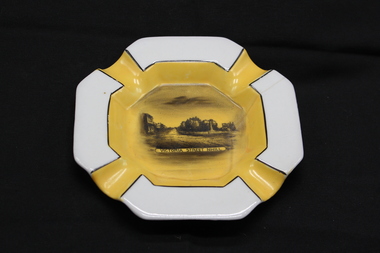
Ceramic - c 1920-1935 Souvenir Ashtray, Victoria Street, Nhill, c 1920 - 1935
... Its use as an ashtray also reflects the domestic and social culture of the period, when smoking accessories were commonplace household objects. ...Its use as an ashtray also reflects the domestic and social culture of the period, when smoking accessories were commonplace household objects. The dish depicts Victoria Street, Nhill, a significant regional street in the Wimmera township of Nhill, Victoria. ...The dish is an example of the early 20th-century international souvenir trade, in which German porcelain manufacturers produced inexpensive objects depicting Australian towns and tourist destinations. Such objects were intended to be purchased as tangible reminders of travel or locality. Its use as an ashtray also reflects the domestic and social culture of the period, when smoking accessories were commonplace household objects. The dish depicts Victoria Street, Nhill, a significant regional street in the Wimmera township of Nhill, Victoria. The survival of the street name and pictorial representation makes this more than a generic souvenir: it is a small piece of Nhill local-history material culture.Small octagonal/scalloped porcelain dish with a white ground, broad mustard-yellow decorative band and fine black outlining. The recessed central panel contains a sepia transfer-printed view of a country street, with buildings, trees, fencing and roadway. The image is identified beneath by the printed inscription “VICTORIA STREET NHILL.” The form, with raised sections around the perimeter suitable for resting cigarettes, indicates that it was manufactured as a souvenir ashtray, although it could also have been used as a small decorative dish. On the base - Red circular manufacturer's mark, incorporating the words “Bavaria” and “Germany.” image is identified beneath by the printed inscription “VICTORIA STREET NHILL.” on base - Red circular manufacturer's mark to reverse, apparently incorporating the words “Bavaria” and “Germany.” c 1920-1935 souvenir ashtray, victoria street--nhill, manufactured in germany, ceramics -
 Williamstown Historical Society Inc
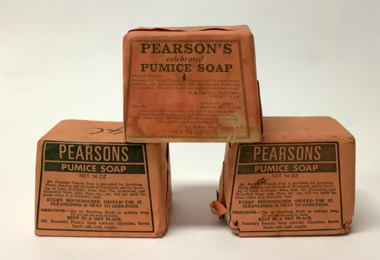
Domestic object - Pearson's Pumice Soap
... Pumice soap, which contained powdered pumice stone to add abrasiveness to soap, was used as a hand cleaning agent and to clean household objects. On the underside of the wrapping is a line drawn cartoon in two panels about those who do and those who don't use Pearson's pumice soap: the gist seems to be that if items used to serve or store meat are cleaned with pumice soap consumers will remain healthy!" ...Pumice soap, which contained powdered pumice stone to add abrasiveness to soap, was used as a hand cleaning agent and to clean household objects. On the underside of the wrapping is a line drawn cartoon in two panels about those who do and those who don't use Pearson's pumice soap: the gist seems to be that if items used to serve or store meat are cleaned with pumice soap consumers will remain healthy!" ...Pumice soap, which contained powdered pumice stone to add abrasiveness to soap, was used as a hand cleaning agent and to clean household objects. On the underside of the wrapping is a line drawn cartoon in two panels about those who do and those who don't use Pearson's pumice soap: the gist seems to be that if items used to serve or store meat are cleaned with pumice soap consumers will remain healthy!" Three large rhomboid shaped cakes of pumice soap, wrapped in original orange paper packaging. Two packages with black text and one package with dark green text.On one side, detailed recommendations for benfits of the soap. The opposite side shows weight of soap (14 oz) with instructions and an explanation of soap's multipurpose use. "PEARSON'S/celebrated/PUMICE SOAP" "EVERY HOUSEHOLDER SHPULD USE IT./CLEANLINESS IS NEXT TO GODLINESS." -
 Flagstaff Hill Maritime Museum and Village
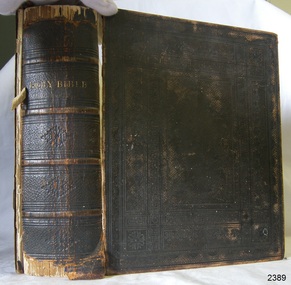
Book - Religious Book/Bilble, Oxford University Press, The Holy Bible, 1866
... household registry. As this book contains handwritten inscriptions, signatures, and a family tree tracking a lineage through the 1850s, '60s, and '70s, it transforms from a mass-produced industrial object into a completely unique, priceless historical archive of a family's pioneering journey. ...household registry. As this book contains handwritten inscriptions, signatures, and a family tree tracking a lineage through the 1850s, '60s, and '70s, it transforms from a mass-produced industrial object into a completely unique, priceless historical archive of a family's pioneering journey. ...To understand the nature of your 1866 Oxford University Press (OUP) Bible, it helps to look at how Bibles were produced in the 19th century and the massive historical scale of the publisher. The context of the King James Version Bible is indicated by the standard phrase on the flyleaf: "Translated out of the Original Tongues... By His Majesty's Special Command." This work is a historical 1866 reprint of the original version published in 1611. This particular volume served as the family Bible for Joseph and Elizabeth Bell, documenting their family history through the births and deaths noted on its end papers.Book, black hard cover with embossed pattern and gold test, metal locking clasp. King James Version of the Holy Bible, containing the Old and New Testaments. It was published by Oxford University Press in 1866. Inscriptions on the loose endpaper list the marriage of Joseph and Elizabeth Bell in 1854 at St Paul's, Bristol, England, and their ten children born from 1856 to 1878.non-fictionTo understand the nature of your 1866 Oxford University Press (OUP) Bible, it helps to look at how Bibles were produced in the 19th century and the massive historical scale of the publisher. The context of the King James Version Bible is indicated by the standard phrase on the flyleaf: "Translated out of the Original Tongues... By His Majesty's Special Command." This work is a historical 1866 reprint of the original version published in 1611. This particular volume served as the family Bible for Joseph and Elizabeth Bell, documenting their family history through the births and deaths noted on its end papers.flagstaff hill, flagstaff hill maritime museum and village, warrnambool, maritime museum, maritime village, great ocean road, shipwreck coast, holy bible, book, religious book, bell family, bell family bible, elizabeth bell, joseph bell, 1826, 1833, 1854, st paul's bristol -
 Flagstaff Hill Maritime Museum and Village
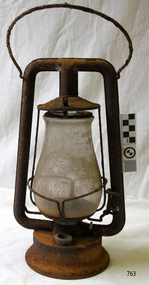
Domestic object - Lamp, Bradley & Hubbard, Early 20th century
... households and on rural properties before the introduction of electricity and is an early example of a promotional. The lamp was given away to customers of Kerosene oil as a means of increasing the Standard Oil Company sales of Kerosene during the late19th to early 20th century. flagstaff hill warrnambool shipwrecked-coast flagstaff-hill-maritime-museum shipwreck-coast flagstaff-hill-maritime-village Kerosene Lamp Lighting Hurricane Lamp Storm Lamp Rayo Ltd Inscribed "Rayo" and "Made in the USA" Kerosene Lamp, side lifting arm to light. Domestic object ...One of the most common centre draft kerosene lamps one can find in the USA and Canada is the Rayo. Large and sturdy, simple to use, but also notorious for being a fuel hog. This lamp was made by Bradley and Hubbard Metalworks in Chicago also Bradley and Hubbard made the “Perfection” brand lamps that look like the Rayo and are pretty much the same lamp with all parts interchangeable. The Rayo was given away to customers for free as a promotional item by the Standard Oil Company. The lamp’s huge appetite for fuel meant a hefty increase in sales of kerosene for the company and increased profits. The Rayo is a classic centre draft lamp that uses a widely available tubular wick that measures 62mm flat. It employs a simple and reliable mechanism for securing wicks in the burner along with a brass tube with many small teeth at its end. The tube is attached to the toothed rack that’s moved up and down by the adjuster knob. This type of lamp was used in most households and on rural properties before the introduction of electricity and is an early example of a promotional. The lamp was given away to customers of Kerosene oil as a means of increasing the Standard Oil Company sales of Kerosene during the late19th to early 20th century.Kerosene Lamp, side lifting arm to light.Inscribed "Rayo" and "Made in the USA"flagstaff hill, warrnambool, shipwrecked-coast, flagstaff-hill-maritime-museum, shipwreck-coast, flagstaff-hill-maritime-village, kerosene lamp, lighting, hurricane lamp, storm lamp, rayo ltd -
 Flagstaff Hill Maritime Museum and Village
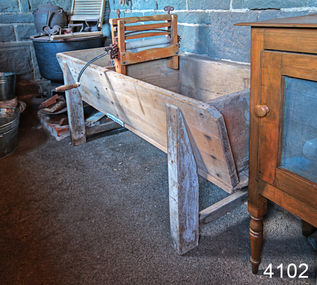
Domestic object - Wash trough, Melvin Newton Lovell, Mangle was Patented June 10, 1898 by Lovell Trough is possibly of later manufacture by a local unknown cabinet maker between 1900-1920
... household items. Lovell was granted numerous patents for various devices during his career including several patents for adding machines (cash registers). This item is now sought by collectors and is even rarer due to it's combination with a Lovell clothes wringer. flagstaff hill warrnambool shipwrecked-coast flagstaff-hill-maritime-museum flagstaff-hill-maritime-village wash trough wringer mangle laundry cleaning washing housework domestic melvin newton lovell wooden was trough Hard to make out as worn off with use Wooden wash trough with 2 troughs & attached a Lovell wringer (or mangle Anchor Brand) Domestic object Wash trough Melvin Newton Lovell ...Melvin Newton Lovell was born in Allegheny, Venango county, Pennsylvania, on 31 August 1844, to Darius T. Lovell (1815-1855) and Susan B. (Conover) Lovell (1827-1883). When Melvin Lovell was a boy, the family removed to Kerrtown, a village located in the vicinity of Titusville, PA. There Melvin served an apprenticeship at the carpenter's trade, and his natural mechanical talent enabled him to become a skilled workman. He followed his trade during the major portion of his term of residence in Kerrtown. In 1861, at seventeen years of age, Melvin Lovell left his home and, without parental authority, and entered the Union army soon after the outbreak of the Civil war. In August 1862, he was enlisted as a private in the 127th Pennsylvania Volunteer Infantry and saw active service until receiving his discharge at the end of May 1863. In 1865 he took up his residence in Erie, where he worked at the carpenter's trade for several years thereafter. In 1869 Melvin Lovell invented and patented several useful articles for household use, and in that year he began the manufacturing of certain of these inventions, in partnership with Franklin Farrar Adams, another inventor. Among the principal products of the original factory were washing machines and step-ladders. In 1881 Lovell individually began manufacturing other of his patents, including spring beds, and from modest inception, his Lovell Manufacturing Company grew to be one of the largest industrial concerns of its kind in the country and was recognized as being the most extensive manufacture of clothes-wringers in the entire world. In connection with his manufacture of domestic items, Lovell established sales agencies for his products in all parts of the country, and these branches were known as the Lovell stores. These goods were sold on the instalment plan and after his business had already been established becoming a substantial concern Lovell invented and patented the famous wringer which bears his name under the “Anchor” brand, and in later years he confined his operations largely to the manufacture of this very superior household invention. Lovell was also one of the organizers and stockholders of the Combination Roll & Rubber Manufacturing Co, of New York, which was formed to manufacture his patents, with headquarters in New York and a factory at Bloomfield, New Jersey.A significant household item used in the process of washing clothes by a man who had started in 1869, as a young carpenter and later he became a successful businessman and manufacturer of household items. Lovell was granted numerous patents for various devices during his career including several patents for adding machines (cash registers). This item is now sought by collectors and is even rarer due to it's combination with a Lovell clothes wringer. Wooden wash trough with 2 troughs & attached a Lovell wringer (or mangle Anchor Brand) Hard to make out as worn off with useflagstaff hill, warrnambool, shipwrecked-coast, flagstaff-hill-maritime-museum, flagstaff-hill-maritime-village, wash trough, wringer, mangle, laundry, cleaning, washing, housework, domestic, melvin newton lovell, wooden was trough -
 Flagstaff Hill Maritime Museum and Village
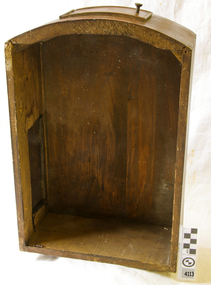
Domestic object - Clock case, Late 19th to early 20th centuries
... households could afford at least one clock for their furnishings. Warrnambool Shipwreck Coast Flagstaff Hill Flagstaff Hill Maritime Museum Flagstaff Hill Maritime Village clock case clock case with two doors pendulum clock case vintage horology time keeping clock maker domestic clock furnishing Wooden clock case with open front and arched top, which may be the bottom of the case. It has a hinged door on the side and another door on the top with a small brass knob. This case is ready to be fitted with a clock mechanism. Domestic object ...This vintage-era clock case has a curved top and two doors, one at the side, and the other at the top. It could have had another frame for the front with a window or fitted space for the clock mechanism. The doors may have given access for winding the clock with a key and to set the time or perhaps an alarm or chime. It is possible that the arched shape was the bottom of the clock case and not the top, in which case, there would be more space for a pendulum to swing. The wooden case would amplify the sound of the tick of the clock.The wooden clock case is connected to domestic life in the late 19th and early 20th centuries when households could afford at least one clock for their furnishings.Wooden clock case with open front and arched top, which may be the bottom of the case. It has a hinged door on the side and another door on the top with a small brass knob. This case is ready to be fitted with a clock mechanism.warrnambool, shipwreck coast, flagstaff hill, flagstaff hill maritime museum, flagstaff hill maritime village, clock case, clock case with two doors, pendulum clock case, vintage, horology, time keeping, clock maker, domestic clock, furnishing -
 Flagstaff Hill Maritime Museum and Village
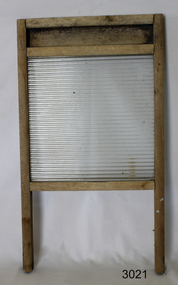
Domestic object - Washboard, 1900
... It is also locally significant for being manufactured in Warrnambool Flagstaff Hill Flagstaff Hill Maritime Museum and Village Warrnambool Maritime Museum Maritime Village Great Ocean Road Shipwreck Coast washboard laundry clothes washing clothes cleaning washing household item washing equipment laundering equipment laundering domestic laundry scrub board 19th century washing appliance glass ripples glass washboard Washboard with wooden frame, ribbed glass centre and two legs. Domestic object ...A washboard is designed for hand washing clothing soaked in hot, soapy water in a wash tub or sink. The fabric is squeezed and rubbed against the ridged surface of the washboard to force the cleaning fluid through the cloth to carry away dirt. With the invention of mechanised cleaning, which became more common with washing machines by the end of the 20th century, the washboard became redundant. The traditional washboard is constructed with a rectangular wooden frame around a series of ridges or corrugations; for 19th-century washboards, the ridges were often of wood, sometimes glass, and by the 20th century, ridges of metal became common. In 1833, Stephen Rust obtained a United States patent for the first "fluted" metal washboard. Zinc washboards were predominantly manufactured in the United States from the middle of the 19th century.The washboard is a significant item used for cleaning clothes. It is the forerunner of labour-saving mechanical and electrical laundry equipment. It is still in use today in many countries and helps to understand the domestic life in the 19th and early 20th centuries. It is also locally significant for being manufactured in WarrnamboolWashboard with wooden frame, ribbed glass centre and two legs.flagstaff hill, flagstaff hill maritime museum and village, warrnambool, maritime museum, maritime village, great ocean road, shipwreck coast, washboard, laundry, clothes washing, clothes cleaning, washing, household item, washing equipment, laundering equipment, laundering, domestic laundry, scrub board, 19th century washing appliance, glass ripples, glass washboard -
 Flagstaff Hill Maritime Museum and Village
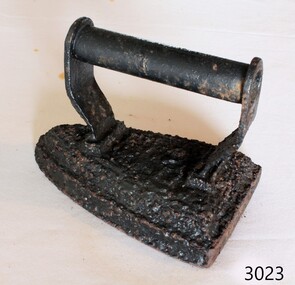
Domestic object - Flat Iron, circa 1900
... Large households with servants had a special ironing-stove for this purpose. Some were fitted with slots for several irons, and a water-jug on top. An early domestic object ...Blacksmiths started forging simple flat irons in the late Middle Ages. Plain metal irons were heated by a fire or on a stove. Some were made of stone. Earthenware and terracotta were also used, from the Middle East to France and the Netherlands. Flat irons were also called sad irons or smoothing irons. Metal handles had to be gripped in a pad or thick rag. Some irons had cool wooden handles and in 1870 a detachable handle was patented in the US. This stayed cool while the metal bases were heated and the idea was widely imitated. Cool handles stayed even cooler in "asbestos sad irons". The sad in sad iron (or sadiron) is an old word for solid, and in some contexts this name suggests something bigger and heavier than a flat iron. Goose or tailor's goose was another iron name, and this came from the goose-neck curve in some handles. In Scotland people spoke of gusing (goosing) irons. At least two irons were needed on the go together for an effective system, one would be in use, and the other re-heating. Large households with servants had a special ironing-stove for this purpose. Some were fitted with slots for several irons, and a water-jug on top. An early domestic object that gives an insight into how the ironing of clothes was done before the electric type irons we use and take for granted today. Iron; small flat domestic iron.Noneflagstaff hill, warrnambool, shipwrecked-coast, flagstaff-hill, flagstaff-hill-maritime-museum, maritime-museum, shipwreck-coast, flagstaff-hill-maritime-village, iron, flat iron, domestic iron, laundery, ironing equipment, sad iron -
 Flagstaff Hill Maritime Museum and Village
Domestic object - Washboard, 1900s-1930s
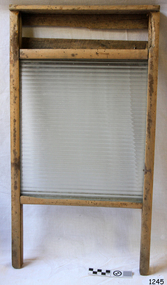
... Flagstaff Hill Flagstaff Hill Maritime Museum and Village Warrnambool Maritime Museum Maritime Village Great Ocean Road Shipwreck Coast washboard laundry clothes washing clothes cleaning washing household item washing equipment laundering equipment laundering domestic laundry scrub board 19th century washing appliance glass ripples glass washboard Washboard: wooden rectangular frame with two legs and ribbed glass grid. Domestic object ...A washboard is designed for hand washing clothing soaked in hot, soapy water in a wash tub or sink. The fabric is squeezed and rubbed against the ridged surface of the washboard to force the cleaning fluid through the cloth to carry away dirt. With the invention of mechanised cleaning, which became more common with washing machines by the end of the 20th century, the washboard became redundant. The traditional washboard is constructed with a rectangular wooden frame around a series of ridges or corrugations; for 19th-century washboards, the ridges were often of wood, sometimes glass, and by the 20th century, ridges of metal became common. In 1833, Stephen Rust obtained a United States patent for the first "fluted" metal washboard. Zinc washboards were predominantly manufactured in the United States from the middle of the 19th century.The washboard is a significant item used for cleaning clothes. It is the forerunner of labour-saving mechanical and electrical laundry equipment. It is still in use today in many countries and helps to understand the domestic life in the 19th and early 20th centuries.Washboard: wooden rectangular frame with two legs and ribbed glass grid.flagstaff hill, flagstaff hill maritime museum and village, warrnambool, maritime museum, maritime village, great ocean road, shipwreck coast, washboard, laundry, clothes washing, clothes cleaning, washing, household item, washing equipment, laundering equipment, laundering, domestic laundry, scrub board, 19th century washing appliance, glass ripples, glass washboard -
 Flagstaff Hill Maritime Museum and Village
Functional object - Cow Bell, Circa 1878
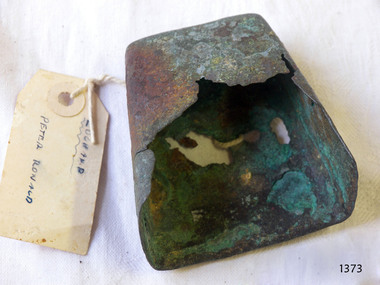
... objects on the ocean floor emerged the humble brass cow bell. Cow bells were common to colonial agriculture and transport, used wherever animals were turned out to graze overnight and had to be rounded up again next morning. Bells were fastened around the necks of household...objects on the ocean floor emerged the humble brass cow bell. Cow bells were common to colonial agriculture and transport, used wherever animals were turned out to graze overnight and had to be rounded up again next morning. Bells were fastened around the necks of household ...The artefact is a damaged brass cow bell recovered from the 1878 shipwreck of the LOCH ARD near Port Campbell. It was raised by Flagstaff Hill divers in 1973 and is in storage at the Maritime Village. The LOCH ARD was constructed on the Clyde in 1873 for the prestigious Loch Line of colonial clipper ships, designed for the Australian run. She sailed from England on 1 March 1878 carrying 37 crew, 17 passengers and a diverse general cargo ranging from luxury items to bulk railway iron. On 1 June 1878, emerging from fog and hearing too late the sound of breakers against the tall limestone cliffs, the vessel struck the southern foot of Mutton Bird Island and sank in 23 metres of water. Of the fifty-four people on board only two survived, one young male crewman and one young female passenger. A century later, despite the pounding seas and the efforts of looters, the wreck site continued to provide ample evidence of the extraordinary range of goods being imported into the Colony of Victoria in the post-Gold Rush era. Flagstaff Hill divers in the 1970s reported finds of “Bottles of champagne, window panes, rolls of zinc, barrels of cement, iron rails, clocks, lead shot, corrugated iron, lead, marble, salad oil bottles, ink bottles, copper wire, gin bottles, rolls of carpet, floor tiles, copper rivets, gas light fittings, pocket knives, toys, crystal chandeliers, beer mugs, cutlery, candles sticks, wick scissors, cow bells, and sauce bottles.” From this array of objects on the ocean floor emerged the humble brass cow bell. Cow bells were common to colonial agriculture and transport, used wherever animals were turned out to graze overnight and had to be rounded up again next morning. Bells were fastened around the necks of household milking cows, domestic goats, bullock teams, horse teams, and camel teams, to help find them in the pre-dawn light. Station shepherds and cattle drovers also used them to warn of any disturbances to their flocks and herds overnight. The bells were a necessary item in a largely unfenced continent. So important, that Anthony Mongon began making his pot-bells at Yackandandah from 1861, August Menneke produced the “Wagga Pot” from 1867, and Samuel Jones started manufacturing his distinctively shaped “Condamine Bell” in 1868. However, these deeply resonant Australian bells were made from iron — Mongon and Jones were blacksmiths who simply beat old pitsaw blades into shape. Few genuinely brass cow bells were made here, the vast majority being imported from Britain where the industry of brass founding was already well established. (Some bells were also imported from the United States, but these too were nearly all of iron).This bell is historically significant as typical of a cow bell used by farmers and herdsmen in Colonial Victoria. Its significance is increased by being one of a collection of artefact recovered by the Flagstaff Hill Divers from the wreck of the Loch Ard in the early 1970s. Items that come from several wrecks along Victoria's coast have also been recovered for Flagstaff Hill Maritime Village’s museum collection under Government permit, illustrating this item’s level of historical value. The cow bell is also significant for being part of Flagstaff Hill’s collection of artefacts from LOCH ARD, which is significant for being one of the largest collections of artefacts from this shipwreck in Victoria. It is significant for its association with the shipwreck, which is on the Victorian Heritage Register (VHR S417). The collection is significant because of the relationship between the objects, as together they have a high potential to interpret the story of the LOCH ARD. The LOCH ARD collection is archaeologically significant as the remains of a large international passenger and cargo ship. The LOCH ARD collection is historically significant for representing aspects of Victoria’s shipping history and its potential to interpret sub-theme 1.5 of Victoria’s Framework of Historical Themes (living with natural processes). The collection is also historically significant for its association with the LOCH ARD, which was one of the worst and best known shipwrecks in Victoria’s history.A small brass cow bell, in poor condition. It is blunt-wedge shaped. The sides expand outwards from the smaller rectangular roof of the bell to a larger open rectangle or bell mouth. A handwritten label is attached to the bel. Recovered from the wreck of the Loch Ard.Label text "["10/6/73, Brass Cow Bell, LOCH ARD, Found in the sandy hole in the centre of the wreck site. Cow bells were part of the cargo" - "10/6/73, LOCH ARD, small brass cow bell salvaged by FHMV divers"]. "LOCH ARD / PETER RONALD"flagstaff hill, warrnambool, shipwrecked coast, flagstaff hill maritime museum, maritime museum, shipwreck coast, flagstaff hill maritime village, great ocean road, loch line, loch ard, eva carmichael, mutton bird island, loch ard gorge, brass cow bell, colonial cow bells, 1878 shipwreck, shipwreck artefact, flagstaff hill divers -
 Flagstaff Hill Maritime Museum and Village
Decorative object - Wall Decoration, Late 19th to early 20th centuries
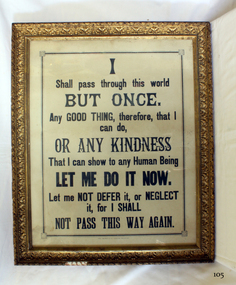
... The Giles family collection has social significance at a local level, because it illustrates the level of material support the Warrnambool community gave to Flagstaff Hill when the Museum was established. warrnambool shipwrecked coast flagstaff hill maritime museum wall decoration print of proverb scripture decoration giles collection henry giles tower hill cooramook warrnambool breakwater mailor’s flat wangoom 19th century household goods Printed proverb+ with Varied type face each line. Wall decoration gilded gold ornate frame under glass Decorative object Wall Decoration ...There are many 19th century items of furniture, linen and crockery donated to Flagstaff Hill Maritime Village by Vera and Aurelin Giles. The items are associated with the Giles Family and are known as the “Giles Collection”. These items mostly came from the simple home of Vera’s parents-in-law, Henry Giles and his wife Mary Jane (nee Freckleton), whose photos are in the parlour. They married in 1880. Henry Giles was born at Tower Hill in 1858. He was a labourer on the construction of the Breakwater before leaving in 1895 to build bridges in N.S.W. for about seven years. Mary Jane was born in 1860 at Cooramook. She attended Mailor’s Flat State School where she was also a student teacher before, as family legend has it, she became a governess at “Injemiara” where her grandfather, Francis Freckleton, once owned land. Henry and Mary’s family of six, some of whom were born at Mailor’s Flat and later children at Wangoom, lived with their parents at Wangoom and Purnim west, where Henry died in 1933 and Mary Jane in 1940. The Giles family collection has social significance at a local level, because it illustrates the level of material support the Warrnambool community gave to Flagstaff Hill when the Museum was established.Wall decoration gilded gold ornate frame under glassPrinted proverb+ with Varied type face each line.warrnambool, shipwrecked coast, flagstaff hill maritime museum, wall decoration, print of proverb, scripture decoration, giles collection, henry giles, tower hill, cooramook, warrnambool breakwater, mailor’s flat, wangoom, 19th century household goods -
 Flagstaff Hill Maritime Museum and Village
Decorative object - Wall Decoration, Late 19th to early 20th centuries
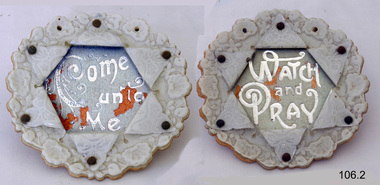
... households. These items of decoration were very popular at this time and the subject item is significant as it gives a snapshot into the social norms of past generations. flagstaff hill warrnambool shipwrecked coast flagstaff hill maritime museum shipwreck coast great ocean road paper wall decoration Watch and Pray and Come Unto Me Wall decoration white china with relief circular hanging pieces, paper folds pinned back to reveal words Paper is pinned by metal studs. Paper folds create star shape. (set of 2) Decorative object ...During the Victorian era, the period (1837-1901) in which Queen Victoria ruled England. The queen’s influence was felt throughout the world, including in the United States and Australia where Victorian values shaped society and style, especially in home décor. This period’s distinct style presents an eclectic mix of highly ornamented furniture, wallpaper, and knick-knacks. Particularly in terms of furniture, and the characteristic floral patterns and rich, contrasting colours, wall hanging that enjoyed the height of its popularity during the Victorian era were of the spiritual type with an either embroidered or punched paper religious motto or bible quote. Mottoes were commonly hung high up on the wall or in an area of prominence, to remind the viewer of their important message, such as “He Leadeth Me” and “Honesty, Industry, and Sobriety.” Short and pithy, they embodied the ideals of Victorian society. Technological advances contributed to the boom of religious mottoes whereas before the Industrial Revolution home décor of this sort was handmade and therefore minimal, now consumers could purchase and fill their homes with all sorts of mass-produced ephemera goods similar to the subject item. Many of these mass-produced period pieces still exist today, often in their original frames, ceramic, or paper formats. Flagstaff maritime museum has many examples of mottoes on display that serve to reflect the period in which values of home, faith, and Christianity were very prominent in everyday Victorian society.An item that reflects the social values and attitudes of the late Victorian era that was used to promote good Christian and moral values in many households. These items of decoration were very popular at this time and the subject item is significant as it gives a snapshot into the social norms of past generations. Wall decoration white china with relief circular hanging pieces, paper folds pinned back to reveal words Paper is pinned by metal studs. Paper folds create star shape. (set of 2)Watch and Pray and Come Unto Meflagstaff hill, warrnambool, shipwrecked coast, flagstaff hill maritime museum, shipwreck coast, great ocean road, paper wall decoration -
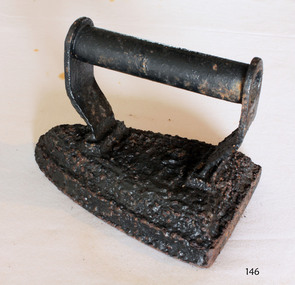 Flagstaff Hill Maritime Museum and Village
Domestic object - Clothes Iron, last quarter of the 19th century
... Large households with servants had a special ironing-stove for this purpose. Some were fitted with slots for several irons, and a water-jug on top. An early domestic object ...Blacksmiths started forging simple flat irons in the late Middle Ages. Plain metal irons were heated by a fire or on a stove. Some were made of stone. Earthenware and terracotta were also used, from the Middle East to France and the Netherlands. Flat irons were also called sad irons or smoothing irons. Metal handles had to be gripped in a pad or thick rag. Some irons had cool wooden handles and in 1870 a detachable handle was patented in the US. This stayed cool while the metal bases were heated and the idea was widely imitated. Cool handles stayed even cooler in "asbestos sad irons". The sad in sad iron (or sadiron) is an old word for solid, and in some contexts this name suggests something bigger and heavier than a flat iron. Goose or tailor's goose was another iron name, and this came from the goose-neck curve in some handles. In Scotland people spoke of gusing (goosing) irons. At least two irons were needed on the go together for an effective system, one would be in use, and the other re-heating. Large households with servants had a special ironing-stove for this purpose. Some were fitted with slots for several irons, and a water-jug on top.An early domestic object that gives an insight into how the ironing of clothes was done before the electric type irons we use and take for granted today.Clothes Iron, wedge shaped, cast iron painted black with cylindrical handle small funnel through centre of handle.Noneflagstaff hill, warrnambool, shipwrecked coast, flagstaff hill maritime museum, flagstaff hill maritime village, great ocean road, iron, flat iron, laundry equipment, sad iron, domestic object -
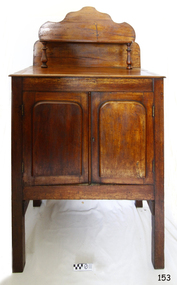 Flagstaff Hill Maritime Museum and Village
Functional object - Food Safe, 1920s
... households had replaced their food storage cupboards or safes with refrigerators. The subject item gives a snapshot of domestic life from this time. flagstaff hill warrnambool flagstaff hill maritime museum maritime museum shipwreck coast flagstaff hill maritime village great ocean road food safe kitchen safe kitchen furniture Food Storage None Wooden kitchen food safe, 2 door with wire mesh at sides. Raised back panel has shaped edges and includes a shelf above bench area that has turned legs. The safe has 4 plain legs. Functional object ...The first commercially available, Australian-made domestic refrigerator to operate without ice was produced by Edward Hallstrom in 1923. It used kerosene as a power source and was promoted as ideal for outback stations where ice was not available. According to Museum Victoria, Hallstrom introduced the 'Silent Night' which ran on electricity or gas in 1935. However, Hailstorm's great-grandson, stated that the Silent Night refrigerator was introduced in 1928. Although Australians were among the pioneers of refrigeration in the 1850s, the technology wasn't adapted for domestic use until many decades later. The first domestic electric refrigerator was sold in America in 1913. It had an air-cooled refrigeration unit mounted on top of an ice box. The Frigidaire and Kelvinator brands date from 1918 when the first self-contained fridges were sold. Before this food safes were used as well to keep food away from flies and to keep items cool.A significant item used from the late Victorian era until around 1940 when people were beginning to be able to afford domestic refrigerators. After the second world war, most households had replaced their food storage cupboards or safes with refrigerators. The subject item gives a snapshot of domestic life from this time.Wooden kitchen food safe, 2 door with wire mesh at sides. Raised back panel has shaped edges and includes a shelf above bench area that has turned legs. The safe has 4 plain legs.Noneflagstaff hill, warrnambool, flagstaff hill maritime museum, maritime museum, shipwreck coast, flagstaff hill maritime village, great ocean road, food safe, kitchen safe, kitchen furniture, food storage -
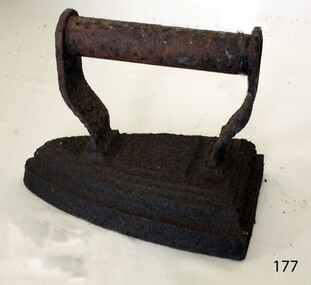 Flagstaff Hill Maritime Museum and Village
Domestic object - Flat Iron, 1890-1935
... Large households with servants had a special ironing-stove for this purpose. Some were fitted with slots for several irons, and a water-jug on top. An early domestic object ...Blacksmiths started forging simple flat irons in the late Middle Ages. Plain metal irons were heated by a fire or on a stove. Some were made of stone. Earthenware and terracotta were also used, from the Middle East to France and the Netherlands. Flat irons were also called sad irons or smoothing irons. Metal handles had to be gripped in a pad or thick rag. Some irons had cool wooden handles and in 1870 a detachable handle was patented in the US. This stayed cool while the metal bases were heated and the idea was widely imitated. Cool handles stayed even cooler in "asbestos sad irons". The sad in sad iron (or sadiron) is an old word for solid, and in some contexts this name suggests something bigger and heavier than a flat iron. Goose or tailor's goose was another iron name, and this came from the goose-neck curve in some handles. In Scotland people spoke of gusing (goosing) irons. At least two irons were needed on the go together for an effective system, one would be in use, and the other re-heating. Large households with servants had a special ironing-stove for this purpose. Some were fitted with slots for several irons, and a water-jug on top.An early domestic object that gives an insight into how the ironing of clothes was done before the electric type irons we use and take for granted today. Flat iron cast iron with traces of original black finish on handle. Noneflagstaff hill, warrnambool, flagstaff hill maritime museum, shipwreck coast, flagstaff hill maritime village, great ocean road, iron, flat iron, laundry, clothes ironing, sad iron, tailors goose -
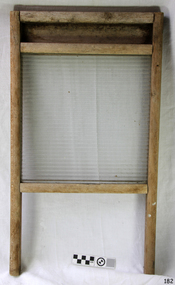 Flagstaff Hill Maritime Museum and Village
Domestic object - Washboard, 1900-1930
... Flagstaff Hill Flagstaff Hill Maritime Museum and Village Warrnambool Maritime Museum Maritime Village Great Ocean Road Shipwreck Coast washboard glass washboard laundry clothes washing glass ripples clothes cleaning washing household item washing equipment laundering equipment laundering Washboard: a wooden frame, with two legs, around a ribbed clear glass panel. Metal nails join the frame. Domestic object ...A washboard is designed for hand washing clothing soaked in hot, soapy water in a wash tub or sink. The fabric is squeezed and rubbed against the ridged surface of the washboard to force the cleaning fluid through the cloth to carry away dirt. With the invention of mechanised cleaning, which became more common with washing machines by the end of the 20th century, the washboard became redundant. The traditional washboard is constructed with a rectangular wooden frame around a series of ridges or corrugations; for 19th-century washboards, the ridges were often of wood, sometimes glass, and by the 20th century, ridges of metal became common. In 1833, Stephen Rust obtained a United States patent for the first "fluted" metal washboard. Zinc washboards were predominantly manufactured in the United States from the middle of the 19th century.The washboard is a significant item used for cleaning clothes. It is the forerunner of labour-saving mechanical and electrical laundry equipment. It is still in use today in many countries and helps to understand the domestic life in the 19th and early 20th centuries.Washboard: a wooden frame, with two legs, around a ribbed clear glass panel. Metal nails join the frame.flagstaff hill, flagstaff hill maritime museum and village, warrnambool, maritime museum, maritime village, great ocean road, shipwreck coast, washboard, glass washboard, laundry, clothes washing, glass ripples, clothes cleaning, washing, household item, washing equipment, laundering equipment, laundering -
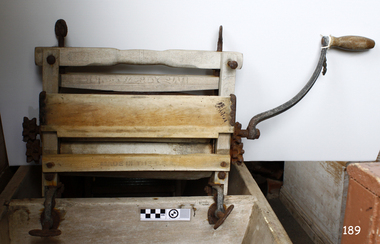 Flagstaff Hill Maritime Museum and Village
Domestic object - Wringer/Mangle, Melvin Newton Lovell, 1898 -1900
... household items. Lovell was granted numerous patents for various devices during his career including several patents for adding machines (cash registers). flagstaff hill warrnambool shipwrecked coast flagstaff hill maritime museum flagstaff hill maritime village great ocean road mangle clothes wringer washing equipment laundry wringer domestic washing mangle Marked on frame "382", "12 x 1 3/4" Anchor Brand "Made in USA" Wringer (or mangle); portable wooden washing wringer with rubber rollers, manually driven by iron set of gears and handle. Includes iron clamps and adjusting screws for attaching. Domestic object ...Melvin Newton Lovell was born in Allegheny, Venango county, Pennsylvania, on 31 August 1844, to Darius T. Lovell (1815-1855) and Susan B. (Conover) Lovell (1827-1883). When Melvin Lovell was a boy, the family removed to Kerrtown, a village located in the vicinity of Titusville, PA. There Melvin served an apprenticeship at the carpenter's trade, and his natural mechanical talent enabled him to become a skilled workman. He followed his trade during the major portion of his term of residence in Kerrtown. In 1861, at seventeen years of age, Melvin Lovell left his home and, without parental authority, and entered the Union army soon after the outbreak of the Civil war. In August 1862, he was enlisted as a private in the 127th Pennsylvania Volunteer Infantry and saw active service until receiving his discharge at the end of May 1863. In 1865 he took up his residence in Erie, where he worked at the carpenter's trade for several years thereafter. In 1869 Melvin Lovell invented and patented several useful articles for household use, and in that year he began the manufacturing of certain of these inventions, in partnership with Franklin Farrar Adams, another inventor. Among the principal products of the original factory were washing machines and step-ladders. In 1881 Lovell individually began manufacturing other of his patents, including spring beds, and from modest inception, his Lovell Manufacturing Company grew to be one of the largest industrial concerns of its kind in the country and was recognized as being the most extensive manufacture of clothes-wringers in the entire world. In connection with his manufacture of domestic items, Lovell established sales agencies for his products in all parts of the country, and these branches were known as the Lovell stores. These goods were sold on the instalment plan and after his business had already been established becoming a substantial concern Lovell invented and patented the famous wringer which bears his name under the “Anchor” brand, and in later years he confined his operations largely to the manufacture of this very superior household invention. Lovell was also one of the organizers and stockholders of the Combination Roll & Rubber Manufacturing Co, of New York, which was formed to manufacture his patents, with headquarters in New York and a factory at Bloomfield, New Jersey.A significant household item used in the process of washing clothes by a man who had started in 1869, as a young carpenter and later he became a successful businessman and manufacturer of household items. Lovell was granted numerous patents for various devices during his career including several patents for adding machines (cash registers).Wringer (or mangle); portable wooden washing wringer with rubber rollers, manually driven by iron set of gears and handle. Includes iron clamps and adjusting screws for attaching. Marked on frame "382", "12 x 1 3/4" Anchor Brand "Made in USA" flagstaff hill, warrnambool, shipwrecked coast, flagstaff hill maritime museum, flagstaff hill maritime village, great ocean road, mangle, clothes wringer, washing equipment, laundry, wringer, domestic, washing mangle
