
Showing 141 items matching "i. presser"
-
 Kadimah Jewish Cultural Centre and National Library
Programme, דער חשובֿער גאַסט "Der Choshever Gast" The Distinguished Guest; 1984
... ...I. Presser...Lustig R. Rothstein I. Presser M. Pfau R. Turkow I. Lustig M. Szmerling T. ...Yiddish Theatre Production by the Dovid (David) Herman Theatre at Kadimah in 1984dovid herman theatre, israel sher, b. lustig, r. rothstein, i. presser, m. pfau, r. turkow, i. lustig, m. szmerling, t. rosenblum, l. morocki, a. wiguszyn, roza turkow, z. turkow, a. gurvich, l. koltiniuk -
Kadimah Jewish Cultural Centre and National Library
Programme, Der Choshever Gast (The Distinguished Guest) ; 1984
... ...I. Presser...Lustig R. Rothstein I. Presser M.Szmerling L. Mrocki Der Choshever Gast (The Distinguished Guest) ; 1984 Programme ...Z. Kalmanovich's folk comedy directed by Roza Turkowdovid herman theatre, j. sher, m.pfau, m. szmerling, r. turkow, i. lustig, a. wiguszyn, b. lustig, r. rothstein, i. presser, m.szmerling, l. mrocki -
 Lara RSL Sub Branch
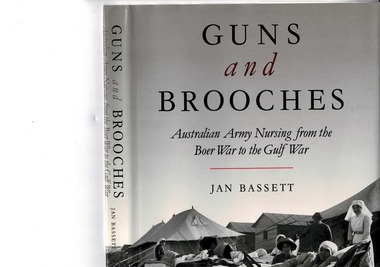
Hard Cover book, 'Guns and Brooches' Australian Army Nursing from the Boer War to the Gulf War by Jan Bassett 1992, 1992
... ISBN 0 19 553380 I. OXFORD University Press...It is a reference book with archive material. nurses army boer war gulf war women ISBN 0 19 553380 I. OXFORD University Press Hard Cover Book with Plastic Sleeve, 8" x 10" 'Guns and Brooches' Australian Army Nursing from the Boer War to the Gulf War by Jan Bassett 1992 Hard Cover book, ...Army Nurses from Boer War to the Gulf War. It is a reference book with archive material.Hard Cover Book with Plastic Sleeve, 8" x 10"ISBN 0 19 553380 I. OXFORD University Pressnurses, army, boer war, gulf war, women -
 Bendigo Historical Society Inc.
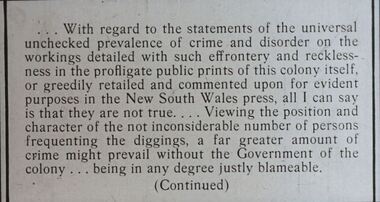
Slide - DIGGERS & MINING. THE DIGGING - THE DIGGERS, c1800s
... Slide: With regard to the statements of the universal unchecked prevalence of crime and disorder on the workings detailed with such effrontery and recklessness in the profligate public prints of this colony itself, or greedily retailed and commented upon for evident purposes in the New South Wales press, all I can say is that they are not true. . . ...Slide: With regard to the statements of the universal unchecked prevalence of crime and disorder on the workings detailed with such effrontery and recklessness in the profligate public prints of this colony itself, or greedily retailed and commented upon for evident purposes in the New South Wales press, all I can say is that they are not true. . . ...Diggers & Mining. The Digging - The Diggers. Slide: With regard to the statements of the universal unchecked prevalence of crime and disorder on the workings detailed with such effrontery and recklessness in the profligate public prints of this colony itself, or greedily retailed and commented upon for evident purposes in the New South Wales press, all I can say is that they are not true. . . Viewing the position and character of the not inconsiderable number of persons frequenting the diggings, a far greater amount of crime might prevail without the Government of the colony . . . Being in any degree justly blameable. (Continued) Markings: 61 994.LIF:6. Used as a teaching aid.hanimounteducation, tertiary, goldfields -
 Melbourne Legacy
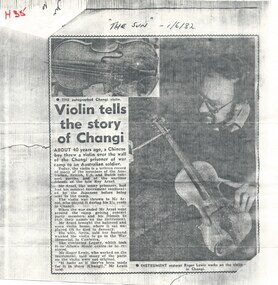
Newspaper - Article, Violin tells the story of Changi 'The Sun' 1/6/82 (H35), 1982
... The text of the letter to President E J Larkin says: Dear Ed, I attach a press cutting which is self explanatory except that the violin has been given to me on behalf of Legacy by one of many widows - Mrs Arnel. ...The text of the letter to President E J Larkin says: Dear Ed, I attach a press cutting which is self explanatory except that the violin has been given to me on behalf of Legacy by one of many widows - Mrs Arnel. ...An article in the Sun about the donation of the Changi violin to Legacy in 1982. It mentions that the violin was thrown over the fence at Changi prison and Mr Roy Arnel played it for the 3 and half years he was in Changi. When the war ended he went around the camp getting concert party members and friends to sign it. He died in January 1982 and his wife Netta contacted Legacy who had it restored by Roger Lewis. He said many of the parts were not original but had been made for it in prison. The notation H35 in red pen shows that it was part of the archive project that was trying to capture the history of Legacy. The text of the letter to President E J Larkin says: Dear Ed, I attach a press cutting which is self explanatory except that the violin has been given to me on behalf of Legacy by one of many widows - Mrs Arnel. I have discussed with 'Kem' Kemsley and others what we should do with this interesting relic. Kem has endorsed my fear that if it is sent to Canberra no-one will ever see it. The prospective War Museum in Victoria will not be ready for some years and could not handle it. I suggest that is be displayed 'pro?' at Legacy House until it could be passed to the Victorian War Museum. Both Mrs Arnel and Kem agree with this suggestion. I should be glad to make a display cabinet if Legacy agrees to the above suggestion. I shall be glad if you will return the cutting to me in due course. Yours sincerely Roger Westerback (?) 581.A record of the donation of the Changi violin to Legacy in 1982.White A4 photocopy of an article about the Changi violin published in the Sun in 1982 and a copy of a two page letter.Handwritten H35 in red pen. history, changi violin -
 Flagstaff Hill Maritime Museum and Village
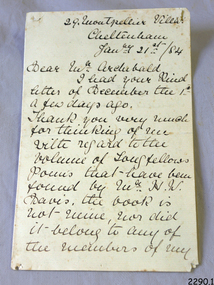
Letter
... I do not know the young lady.” Tom Pearce was the young, male, able seaman who had risked his life to save her. In the months after the shipwreck, an excited public press speculated of a romantic connection between the two survivors, but this was clearly not the case. ...I do not know the young lady.” Tom Pearce was the young, male, able seaman who had risked his life to save her. In the months after the shipwreck, an excited public press speculated of a romantic connection between the two survivors, but this was clearly not the case. ...This original letter was handwritten and dated 21 January 1884. The author is Eveline V. Carmichael, of 29 Montpellier Villa, Cheltenham. Eva Carmichael was the only woman survivor of the iron clipper LOCH ARD, which was wrecked on 1 June 1878, at the subsequently named Loch Ard Gorge near Port Campbell. The letter was written to Mr J Archibald, first curator of the Warrnambool Mechanics Institute Museum, and was in response to a letter he wrote to Miss Carmichael on 1 December 1883. A complete transcript of Eva’s letter is attached as a Hard Copy Supplementary File. The letter first addressed the subject of her reply. She writes, “Thank you very much for thinking of me with regard to the volume of Longfellows Poems that have been found by Mr HW Davis [at Loch Ard Gorge], the book is not mine, nor did it belong to any members of my family. We had a ‘Longfellows’, but our book had a green cover.” The rescued book is on display at Flagstaff Hill (541) and has a blue cover. Another interesting aspect to her letter is its reference to the only other survivor from the LOCH ARD. As a postscript she writes, “You will be glad to hear that Tom Pearce is now on board the HMS Solvent. I heard from him last month he wrote from the West-Indies and seemed well and in good spirits. I have not seen him since we parted in Melbourne. I believe he is to be married next year, or perhaps this, but I do not know the young lady.” Tom Pearce was the young, male, able seaman who had risked his life to save her. In the months after the shipwreck, an excited public press speculated of a romantic connection between the two survivors, but this was clearly not the case. HISTORY OF THE LOCH ARD The LOCH ARD belonged to the famous Loch Line which sailed many ships from England to Australia. Built in Glasgow by Barclay, Curdle and Co. in 1873, the LOCH ARD was a three-masted square rigged iron sailing ship. The ship measured 262ft 7" (79.87m) in length, 38ft (11.58m) in width, 23ft (7m) in depth and had a gross tonnage of 1693 tons. The LOCH ARD's main mast measured a massive 150ft (45.7m) in height. LOCH ARD made three trips to Australia and one trip to Calcutta before its final voyage. LOCH ARD left England on March 2, 1878, under the command of Captain Gibbs, a newly married, 29 year old. She was bound for Melbourne with a crew of 37, plus 17 passengers and a load of cargo. The general cargo reflected the affluence of Melbourne at the time. On board were straw hats, umbrella, perfumes, clay pipes, pianos, clocks, confectionary, linen and candles, as well as a heavier load of railway irons, cement, lead and copper. There were items included that intended for display in the Melbourne International Exhibition in 1880. The voyage to Port Phillip was long but uneventful. At 3am on June 1, 1878, Captain Gibbs was expecting to see land and the passengers were becoming excited as they prepared to view their new homeland in the early morning. But LOCH ARD was running into a fog which greatly reduced visibility. Captain Gibbs was becoming anxious as there was no sign of land or the Cape Otway lighthouse. At 4am the fog lifted. A man aloft announced that he could see breakers. The sheer cliffs of Victoria's west coast came into view, and Captain Gibbs realised that the ship was much closer to them than expected. He ordered as much sail to be set as time would permit and then attempted to steer the vessel out to sea. On coming head on into the wind, the ship lost momentum, the sails fell limp and LOCH ARD's bow swung back. Gibbs then ordered the anchors to be released in an attempt to hold its position. The anchors sank some 50 fathoms - but did not hold. By this time LOCH ARD was among the breakers and the tall cliffs of Mutton Bird Island rose behind the ship. Just half a mile from the coast, the ship's bow was suddenly pulled around by the anchor. The captain tried to tack out to sea, but the ship struck a reef at the base of Mutton Bird Island, near Port Campbell. Waves broke over the ship and the top deck was loosened from the hull. The masts and rigging came crashing down knocking passengers and crew overboard. When a lifeboat was finally launched, it crashed into the side of LOCH ARD and capsized. Tom Pearce, who had launched the boat, managed to cling to its overturned hull and shelter beneath it. He drifted out to sea and then on the flood tide came into what is now known as LOCH ARD Gorge. He swam to shore, bruised and dazed, and found a cave in which to shelter. Some of the crew stayed below deck to shelter from the falling rigging but drowned when the ship slipped off the reef into deeper water. Eva Carmichael had raced onto deck to find out what was happening only to be confronted by towering cliffs looming above the stricken ship. In all the chaos, Captain Gibbs grabbed Eva and said, "If you are saved Eva, let my dear wife know that I died like a sailor". That was the last Eva Carmichael saw of the captain. She was swept off the ship by a huge wave. Eva saw Tom Pearce on a small rocky beach and yelled to attract his attention. He dived in and swam to the exhausted woman and dragged her to shore. He took her to the cave and broke open case of brandy which had washed up on the beach. He opened a bottle to revive the unconscious woman. A few hours later Tom scaled a cliff in search of help. He followed hoof prints and came by chance upon two men from nearby Glenample Station three and a half miles away. In a state of exhaustion, he told the men of the tragedy. Tom returned to the gorge while the two men rode back to the station to get help. By the time they reached LOCH ARD Gorge, it was cold and dark. The two shipwreck survivors were taken to Glenample Station to recover. Eva stayed at the station for six weeks before returning to Ireland, this time by steamship. In Melbourne, Tom Pearce received a hero's welcome. He was presented with the first gold medal of the Royal Humane Society of Victoria and a £1000 cheque from the Victorian Government. Concerts were performed to honour the young man's bravery and to raise money for those who lost family in the LOCH ARD disaster. Of the 54 crew members and passengers on board, only two survived: the apprentice, Tom Pearce and the young woman passenger, Eva Carmichael, who lost all of her family in the tragedy. Ten days after the LOCH ARD tragedy, salvage rights to the wreck were sold at auction for £2,120. Cargo valued at £3,000 was salvaged and placed on the beach, but most washed back into the sea when another storm developed. The wreck of LOCH ARD still lies at the base of Mutton Bird Island. Much of the cargo has now been salvaged and some was washed up into what is now known as LOCH ARD Gorge. Cargo and artefacts have also been illegally salvaged over many years before protective legislation was introduced. One of the most unlikely pieces of cargo to have survived the shipwreck was a Minton porcelain peacock - one of only nine in the world. The peacock was destined for the Melbourne International Exhibition in 1880. It had been well packed, which gave it adequate protection during the violent storm. Today, the Minton peacock can be seen at the Flagstaff Hill Maritime Museum in Warrnambool. From Australia's most dramatic shipwreck it has now become Australia's most valuable shipwreck artefact and is one of very few 'objects' on the Victorian State Heritage Register. The LOCH ARD shipwreck is of State significance – Victorian Heritage Number S417 Flagstaff Hill’s collection of artefacts from LOCH ARD is significant for being one of the largest collections of artefacts from this shipwreck in Victoria. It is significant for its association with the shipwreck, which is on the Victorian Heritage Register (VHR S417). The collection is significant because of the relationship between the objects, as together they have a high potential to interpret the story of the LOCH ARD. The LOCH ARD collection is archaeologically significant as the remains of a large international passenger and cargo ship. The LOCH ARD collection is historically significant for representing aspects of Victoria’s shipping history and its potential to interpret sub-theme 1.5 of Victoria’s Framework of Historical Themes (living with natural processes). The collection is also historically significant for its association with the LOCH ARD, which was one of the worst and best known shipwrecks in Victoria’s history. A photocopy of a letter, handwritten in ink on both sides of 4 small sheets of thick, light blue paper. The letter is in neat cursive script. The writing originally covered 7 sides of the note paper and has been reproduced as 7 separate pages. It is dated 21 January 1884, five and a half years after the LOCH ARD shipwreck. The letter is from Eva Carmichael, one of only 2 survivors from that disaster, and is addressed to J. Archibald, first curator of the Warrnambool Mechanics Institute Museum. The copies include the reproduction of a typed index card which accompanies the original letter. The card states: “Photographic copy of the letter written by Eva Carmichael to Mr J Archibald, first Curator of the Warrnambool Museum. The original letter is kept with other documents, but the writing being on both sides of the note-paper it was not possible to read in its entireity when on display”.flagstaff hill, warrnambool, shipwrecked coast, flagstaff hill maritime museum, maritime museum, shipwreck coast, flagstaff hill maritime village, great ocean road, loch line, loch ard, captain gibbs, eva carmichael, tom pearce, glenample station, mutton bird island, loch ard gorge, loch ard, survivor’s letter, eva carmichael, longfellow’s poems, warrnambool mechanics institute museum, joseph archibald, henry davis -
 Federation University Historical Collection
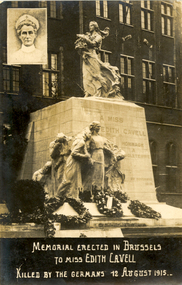
Photograph - Postcard, Edith Cavell Memorial, Brussells
... I, for which she was arrested. She was subsequently court-martialled, found guilty of treason and sentenced to death. Despite international pressure for mercy, she was shot by a German firing squad. Her execution received worldwide condemnation and extensive press...I, for which she was arrested. She was subsequently court-martialled, found guilty of treason and sentenced to death. Despite international pressure for mercy, she was shot by a German firing squad. Her execution received worldwide condemnation and extensive press ...Edith Louisa Cavell (4 December 1865 – 12 October 1915) was a British nurse and patriot. She is celebrated for saving the lives of soldiers from all sides without distinction and in helping some 200 Allied soldiers escape from German-occupied Belgium during World War I, for which she was arrested. She was subsequently court-martialled, found guilty of treason and sentenced to death. Despite international pressure for mercy, she was shot by a German firing squad. Her execution received worldwide condemnation and extensive press coverage. (http://en.wikipedia.org/wiki/Edith_Cavell)Black and White postcard showing the memorial erected in Brussels to Edith Cavell. A portrait of Edith Cavell in nurses uniform is inset. This card was purchased by an Australian soldier, probably Henry Smerdon Holmes, during World War One. edith cavell, chatham-holmes family collection, nurse, world war one, world war, sculpture -
 Marysville & District Historical Society
Book, Alan Mickle, Of Many Things, 1941
... I owe so very much. Signature (Illegible) / August 1941 Stamp of the Marysville & District / Historical Society Inc. / P.O. Box 22 / Marysville 3779 Blue cover with title and author on the spine. Of Many Things Book Book Alan Mickle Australasian Publishing Co Pty Ltd New Century Press ...Autobiography of the author Alan Mickle.Blue cover with title and author on the spine.non-fictionAutobiography of the author Alan Mickle.alan mickle, autobiography -
 Federation University Historical Collection
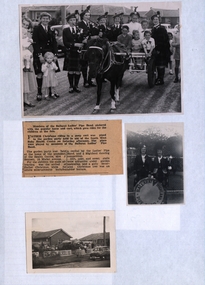
Photograph - Photograph - Black and White, Ballarat Ladies Highland Pipe Band Photographs and Newspaper Article
... Press Photograph. A3 - Ballarat - Margaret Smith - Base drummer and Margaret Bennett - Drum Major, outside I & R Morley Doveton Street. ...Press Photograph. A3 - Ballarat - Margaret Smith - Base drummer and Margaret Bennett - Drum Major, outside I & R Morley Doveton Street. ..."After the war Pipe-Major Duncan McLennan, moved to Ballarat and took up a position as cadet instructor and leader of the Ballarat Highland Pipe Band and the Ballarat Ladies Pipe Band. " (Victorian Historical Journal Vol. 85, No. 1, June 2014)A1 - Black and white photograph of band members with children in horse and cart. A2 - Newspaper article relating to the above mentioned photograph. A3 - Black and White photograph of Drum major and member of band. A4 - Black and White photograph of Ballarat Ladies Highland Pipe Band Bazaar B1 - Black and White photograph of piper in uniform B2 - Black and White photograph of Drum Major in uniform B3 - Black and White photograph of Drum Major in uniform on stairs B4 - List of Members. C1 - Black and White photograph of pipe band marching. C2 - Black and white photograph of Ladies Drum Major with Lew Zilles and Mrs Zilles C3 - Black and white photograph of Mr & Mrs Zilles, Mr and Mrs Bennett and Joan Bolden Gift of Margaret Bennett, 2019A1 - Outside 19 Waller Avenue where the ladies pipe band held a fair to raise money for new drums. The horse and cart was hired to give children rides around the "island". Trevor in the cart - striped shirt. M. Bennett. Ballarat Courier Press Photograph. A3 - Ballarat - Margaret Smith - Base drummer and Margaret Bennett - Drum Major, outside I & R Morley Doveton Street. A4 - Ballarat Ladies Highland Pipe Band Bazaar 1959. 19 Waller Ave, Ballarat B1 - 183 B2 - Margaret Bennett the Drum Major of Ballarat Ladies Pipe Band. Taken on front porch of 19 Waller Avenue B3 - Ballarat City Oval. Drum Major Margaret Bennett nee Reynolds. C1 - Copyright The Ballarat Courier Proprietary Limited C2 - Mrs Zilles, Lew Zilles, and Margaret Bennett. Progress Photos, Midway Arcade, 256 Collins St, Melbourne C3 - Mr & Mrs Zilles, Margaret and John Bennett, Joan Bolden (Parker) ladies pipe band, members, members list, ladies highland pipe band, photograph, black and white photograph -
 Federation University Historical Collection
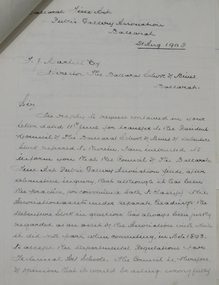
Letter - Correspondence, Inwards correspondence to the Ballarat School of Mines, 1908, 1908
... i. coulter...lease...miller and co...g.h. warner...h.c. taylor...teroscia...port kembla...w.s. macartney...alumni...john britain...department of woods and forests western australia...rutherglen...john harris...a.d. gilchrist...scottsdale, tasmania...r.c. elliott...tocomwal...kites...john byatt...greta pryar...pennsylvania women's press...The Ballarat School of Mines was established in 1870 and was the first site of technical education in Australasia. ballarat school of mines frederick martell jumbunna coal south gippsland gippsland j.s. wittkowski ballarat fine art gallery j.a. powell art gallery of ballarat gallery association egerton and gordons mining company a.h. walsh dressmaking c.h. james jubilee extended quartz mining company letterhead depatment of public instruction p. board eduducation department melbourne i. coulter lease miller and co g.h. warner h.c. taylor teroscia port kembla w.s. macartney alumni john britain department of woods and forests western australia rutherglen john harris a.d. gilchrist scottsdale, tasmania r.c. elliott tocomwal kites john byatt greta pryar pennsylvania women's press association kalgoorlie melville g. gray tasmanian consols limited jumnanna coal mine borough of creswick john wallace glen forbes ponsonby carew-smyth huddart, parker and co ballarat fine art public gallery association ballarat greenmont mines no liability i.d. cameron a. pearson alber j. robin Correspondence to the Ballarat School of Mines for the month of August 1908. ...The Ballarat School of Mines was established in 1870 and was the first site of technical education in Australasia.Correspondence to the Ballarat School of Mines for the month of August 1908. Includes correspondence from: *Jumbunna Coal Mine, South Gippsland * Ballarat Fine Art Public Gallery Association Letter 289 Ballarat Dine Art Public Gallery Association Ballarat 21 August 1908 F.J. Martell Esq Director The Ballarat School of Mines Ballarat Sir The reply to request contained in your letter dated 11 June for transfer to the President Council of the Ballrat School of Mines of Debenture Stock referred to therein, I am instructed to inform you that the Council of the Ballarat Fine Art Public Gallery Associaiton finds, after exhaustive inquiry, that although it has been the practice, for convenience sake, to classify the Association assets under seperate headings, the Debenture Stock in question has always been justlu regarded as all assets of the Association with which it did not parch when consenting , in late 1893, to accept the Deparmental Regulations for Technical Art Schools. The Council is, therefore, of opnion that it would be acting wrongfully to make the desired transfer. I have the honor to be, Sir, Your obedient Servant, J.A. Powell Secy ballarat school of mines, frederick martell, jumbunna, coal, south gippsland, gippsland, j.s. wittkowski, ballarat fine art gallery, j.a. powell, art gallery of ballarat, gallery association, egerton and gordons mining company, a.h. walsh, dressmaking, c.h. james, jubilee extended quartz mining company, letterhead, depatment of public instruction, p. board, eduducation department melbourne, i. coulter, lease, miller and co, g.h. warner, h.c. taylor, teroscia, port kembla, w.s. macartney, alumni, john britain, department of woods and forests western australia, rutherglen, john harris, a.d. gilchrist, scottsdale, tasmania, r.c. elliott, tocomwal, kites, john byatt, greta pryar, pennsylvania women's press association, kalgoorlie, melville g. gray, tasmanian consols limited, jumnanna coal mine, borough of creswick, john wallace, glen forbes, ponsonby carew-smyth, huddart, parker and co, ballarat fine art public gallery association ballarat, greenmont mines no liability, i.d. cameron, a. pearson, alber j. robin -
 Federation University Historical Collection
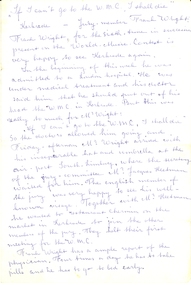
Document, "If I can't go to the W.M.C., I shall die", early 1970s
... The Frank Wright Medal at the Royal South Street competition is awarded to an individual recognized as making an outstanding contribution to brass music in Australia. frank wright kerkrade world music contest adjudicator bands Hand written document Blue pen written on paper - perhaps this is a press release - written about the lengths that Frank Wright, although ill and in hospital earlier in the week, went to, to honour his commitment to be a part of the jury to judge the World Music Contest at Kerkrade. "If I ...Frank Wright was a renown resident of Smeaton, where he was born. He lived at Laura Villa, and attended Smeaton State School. His father William was a gold miner and his mother's name was Sarah. Their family won many singing and instrumental awards. Frank was tutored by Percy Code and was awarded a gold medal for the highest marks in the ALCM examinations in the British Colonies at the age of seventeen years. He became the Australian Open Cornet Champion by the age of eighteen. A year later, Frank conducted the City of Ballarat Band, and later the Ballarat Soldiers’ Memorial Band. He formed the Frank Wright Frisco Band and Frank Wright and his Coliseum Orchestra. These bands won many South Street awards, and Frank as conductor won many awards in the Australian Band Championship contest. In 1933 Frank Wright sailed to England to conduct the famous St Hilda’s Band and was later appointed Musical Director of the London County Council (the GLC or Greater London Council), where he organized many amazing concerts in most of the 150 parks, in and around the London district. He was also responsible for some of London’s major concerts at Kenwood, the Crystal Palace and Holland Park. He was made Professor of Brass and Military Band Scoring and conducted at the Guildhall of Music and Drama. Frank was often invited to adjudicate Brass Band Championships around Europe, in Australia, including South Street and in New Zealand. The Frank Wright Medal at the Royal South Street competition is awarded to an individual recognized as making an outstanding contribution to brass music in Australia.Blue pen written on paper - perhaps this is a press release - written about the lengths that Frank Wright, although ill and in hospital earlier in the week, went to, to honour his commitment to be a part of the jury to judge the World Music Contest at Kerkrade.Hand written documentfrank wright, kerkrade, world music contest, adjudicator, bands -
 Federation University Historical Collection
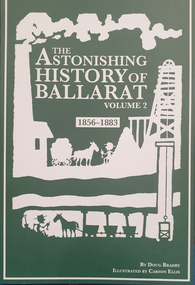
Book - Booklet, Seriously History Press et al, The Astonishing History of Ballarat Volume 2: 1856-1883, 2018
... ballarat sebastopol hill lydiard street powder magazine deep leads james oddie mortality statistics shares stock market alexander dewar old gravel pits koh-i-noor cobb corner wesleyan church henry richards caselli band of hope mine sir william don mine sites Book with greenand white cover. The Astonishing History of Ballarat Volume 2: 1856-1883 Book Booklet Seriously History Press Carson Ellis Doug Bradby ...Book with greenand white cover.non-fictionballarat, sebastopol hill, lydiard street, powder magazine, deep leads, james oddie, mortality, statistics, shares, stock market, alexander dewar, old gravel pits, koh-i-noor, cobb corner, wesleyan church, henry richards caselli, band of hope mine, sir william don, mine sites -
 City of Moorabbin Historical Society (Operating the Box Cottage Museum)
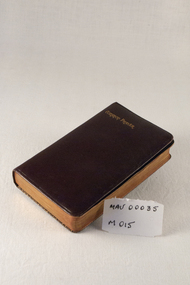
Book - Rites, Prayer Book, c1880
... Since its introduction in the sixteenth century, it has gone through many revisions, both in England and in the other countries of the Anglican Communion, but the original text is still comprehensible and relevant. churches anglican church prayer book brighton moorabbin pioneers early settlers rites erskine i h naughton robina THE BOOK OF / COMMON PRAYER/ and administration of the Sacrament and other / Rites and Ceremonies of The Church/ according to the use of / THE CHURCH OF ENGLAND / Together with / THE PSALTER OR PSALMS OF DAVID/ ‘I.H. Erskine’ written A small, prayer book c1880 Book Rites, Prayer Book University Press ...THE BOOK OF COMMON PRAYER is one of the major works of English Literature. Since its introduction in the sixteenth century, it has gone through many revisions, both in England and in the other countries of the Anglican Communion, but the original text is still comprehensible and relevant. A small, prayer book c1880THE BOOK OF / COMMON PRAYER/ and administration of the Sacrament and other / Rites and Ceremonies of The Church/ according to the use of / THE CHURCH OF ENGLAND / Together with / THE PSALTER OR PSALMS OF DAVID/ ‘I.H. Erskine’ written churches, anglican church, prayer book, brighton, moorabbin, pioneers, early settlers, rites, erskine i h, naughton robina -
 Greensborough Historical Society
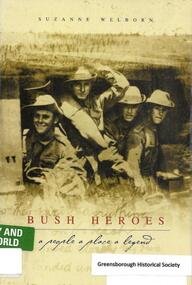
Book, Fremantle Arts Centre Press, Bush heroes: a people, a place, a legend / Suzanne Welborn, 2002_
... i western australia anzac 240 pages, illus. Paperback. Bush heroes: a people, a place, a legend / Suzanne Welborn Book Book Fremantle Arts Centre Press ...Tells the story of ANZAC volunteers from Western Australia and makes a connection between the difficulties of Australian outback life and the legend of Anzac.240 pages, illus. Paperback.world war i, western australia, anzac -
 City of Moorabbin Historical Society (Operating the Box Cottage Museum)
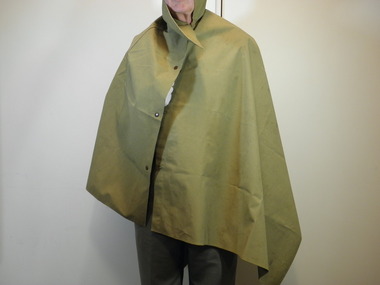
Uniform - Armed Services, Cape/groundsheet, 20th century
... Historic significance; representative of the type believed to have been issued to Australian servicemen in World War II, possibly in World War I. uniforms australian army world war ii army surplus scouts australia bentleigh moorabbin world war 1 hooded ponchos borneo auscam nylon material hootchies malayan emergency vietnam war groundsheets NIL Waterproofed Canvas rain cape, also used as a groundsheet in the Australian Army, press studs to close as a cape, collar to cover neck. ...Rain cape, also used as a groundsheet, issued Australian servicemen. Purchased for the donor from an "Army Surplus" store and re-purposed for camps as a Scout in the late 1960s. The MK VII Groundsheet (Rain Cape / Poncho) was introduced in October 1917 during WW1. They were made from dyed cotton, proofed with a rubber compound, "well vulcanized" on one side. Weight 3lb. 8oz;. 78 inches long by 36 inches wide and made by the Victoria Rubber Co. Edinburgh. They were used again during WWII 1939-45 Today the Army uses the hootchie - a sheet of 70D nylon or PU-coated cotton with various press snaps and webbing tape loops attached around the outside which allow it to be used in a variety of configuration. During WWII Australian forces fighting the Japanese in the Islands had an urgent requirement for a decent individual shelter. The rubberized canvas groundsheets and rain capes continued to be used, but these were less than effective in the tropics. Towards the end of the war in the Pacific Australia began issuing its troops a lighter weight version of the groundsheet manufactured from polyurethane-coated cotton – During the Malayan Emergency of the 1950s, Australian troops were issued with hooded ponchos. Unlike the WWII US pattern ponchos which always had a hole in the dead centre of the poncho sheet, the Australian-issue hooded ponchos made an effective shelter – especially when two where clipped together. The problem of course is that the rubberized canvas ponchos were far too heavy for jungle use. 1960s Australian units in Borneo were issued with the first pattern lightweight hootchies. 1 Kg. 1970 the Vietnam War, a second pattern lightweight hootchie was issued made from nylon, but retaining the hardware and loops. This lightweight hootchie weighed a mere 680 grams, still heavy, but suitable for tropical use. Currently the hootchie is made from AUSCAM nylon material . Historic significance; representative of the type believed to have been issued to Australian servicemen in World War II, possibly in World War I.Waterproofed Canvas rain cape, also used as a groundsheet in the Australian Army, press studs to close as a cape, collar to cover neck.NILuniforms, australian army, world war ii, army surplus, scouts australia, bentleigh, moorabbin, world war 1, hooded ponchos, borneo, auscam nylon material, hootchies, malayan emergency, vietnam war, groundsheets -
 City of Moorabbin Historical Society (Operating the Box Cottage Museum)
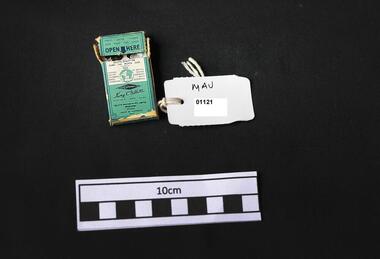
Personal Effects, safety razor blade 'King Gillette'', 20thc
... I, the company provided all American soldiers with a field razor set, paid for by the government, and as they were allowed to take them at discharge they continued their use of this product thus ensuring future sales. The company continues in the present day as the Gillette brand of Procter & Gamble, USA. Throughout the 20thC most men used this type of safety razor with disposable stainless steel razor blades to shave their beards prior to the introduction of affordable electric razors in 1960's shaving equipment, safety razors, Gillette king, proctor & gamble, Moorabbin, Bentleigh, Cheltenham, on top of packet; Press with thumb / and snap end open / GILLETTE QUALITY THE / SAME THE WORLD OVER / FACTORIES IN / USA / CANADA , GREAT BRITAIN / MEXICO , FRANCE / COLUMBIA, GERMANY / BRAZIL, SPAIN / ARGENTINA, AUSTRALIA / GILLETTE TRADE MARK / KING C GILLETTE / RED. ...King Camp Gillette observed in 1902 that as existing, relatively expensive, razor blades dulled quickly and needed continuous sharpening, a razor whose blade could be thrown away when it dulled would meet a real need and likely be profitable. Safety razors had been developed in the mid-19th century, but still used a forged blade that dulled and rusted. In the 1870s, the Kampfe Brothers ( Germany) introduced a type of safety razor Gillette improved these earlier safety-razor designs, and introduced the high-profit-margin stamped razor blade steel blade. Gillette's innovation was the thin, inexpensive, disposable blade of stamped steel. Gillette's safety razor retailed for a substantial $5 half the average working man's weekly pay — yet sold by the millions. The most difficult part of development was engineering the blades, as thin, cheap steel was difficult to work and sharpen. This accounts for the delay between the initial idea and the product's introduction. To sell the product, Gillette founded the American Safety Razor Company on September 28, 1901 (changing the company's name to Gillette Safety Razor Company in July 1902). Gillette obtained a trademark registration (0056921) for his portrait and signature on the packaging. Production began in 1903, when he sold a total of 51 razors and 168 blades. The following year, he sold 90,884 razors and 123,648 blades, thanks in part to Gillette's low prices, automated manufacturing techniques and good advertising. By 1908, the corporation had established manufacturing facilities in the United States, Canada, England, France and Germany. Razor sales reached 450,000 units and blade sales exceeded 70 million units in 1915. In 1918, when the U.S. entered World War I, the company provided all American soldiers with a field razor set, paid for by the government, and as they were allowed to take them at discharge they continued their use of this product thus ensuring future sales. The company continues in the present day as the Gillette brand of Procter & Gamble, USA. Throughout the 20thC most men used this type of safety razor with disposable stainless steel razor blades to shave their beards prior to the introduction of affordable electric razors in 1960'sA blue packet of unused 'King Gillette' safety razor blades.on top of packet; Press with thumb / and snap end open / GILLETTE QUALITY THE / SAME THE WORLD OVER / FACTORIES IN / USA / CANADA , GREAT BRITAIN / MEXICO , FRANCE / COLUMBIA, GERMANY / BRAZIL, SPAIN / ARGENTINA, AUSTRALIA / GILLETTE TRADE MARK / KING C GILLETTE / RED. TRADE MARKS / GILLETTE (AUST.) PTY. LIMITED / MELBOURNE / DE 2023 / MADE IN AUSTRALIA / shaving equipment, safety razors, gillette king, proctor & gamble, moorabbin, bentleigh, cheltenham, -
Glenelg Shire Council Cultural Collection
Administrative record - Ticket - souvenir of Edward Henty, 1934
... I trust that you will soon be well ?.S. Photo of Edward Henty on cover in decorative edging. Pioneer Breakfast and Picnic. Sketch of Bronze wing pigeon. Poem. Golden Wattle tree - photo. Folds into 4 sections. Administrative record Ticket - souvenir of Edward Henty Stockland Press ...Portland CentenaryPhoto of Edward Henty on cover in decorative edging. Pioneer Breakfast and Picnic. Sketch of Bronze wing pigeon. Poem. Golden Wattle tree - photo. Folds into 4 sections.Front: Souvenir Ticket 1934-1935 Centenary. Hand written on top - I trust that you will soon be well ?.S. -
 Orbost & District Historical Society
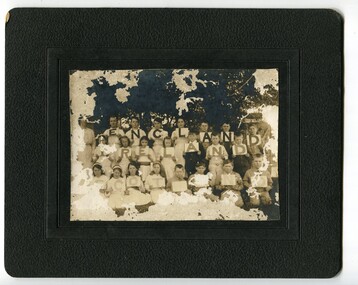
black and white photograph, Warren, Mrs H, C1900- 1910
... I Daisy or Katie McLeod Front row - L -Jack Stephenson; A Lindsay Trewin ; N-Frank Richardson Helena Warren was a self-taught photographer who became both the local press correspondent and a producer of humorous trompe l'oeil postcard images. ...I Daisy or Katie McLeod Front row - L -Jack Stephenson; A Lindsay Trewin ; N-Frank Richardson Helena Warren was a self-taught photographer who became both the local press correspondent and a producer of humorous trompe l'oeil postcard images. ...This photograph was found in the Orbost Historical Society's cupboard. School is unknown. A copy of this photograph has been donated by Gil and Heather Richardson via the Mary Gilbert Collection. It is probably of students of Jarrahmond school where Miss Cope was the head teacher C 1916. This photograph could be associated with a celebration of Empire Day. The celebration of Queen Victoria's birthday on May 24 was renamed Empire Day in 1903 after her death in 1901. It was celebrated throughout the British Empire culminating in fireworks and bonfires in the evening. Empire Day was first introduced in 1905 to promote loyalty among the dominion countries of the British Empire. (from https://dictionaryofsydney.org/event/empire_day) Celebrated on 24 May, Queen Victoria's birthday, it was directed especially at school children. Teachers were encouraged to promote special steps to develop a feeling of pride in the British Empire and the achievements of the British race. Often a morning of short addresses, recitations and patriotic songs such as 'Rule Britannia' and 'Advance Australia' was followed by a half-day holiday to mark the celebration of Australia's strong ties to the British Empire. (from MuseumsVictoria) Some identified are; Top row -E- Eva Trewin; N-Rita Mundy; G-Elva Trewin; N- Jack Mundy D-Jack Trewin Middle row - Miss Cope, teacher. I Daisy or Katie McLeod Front row - L -Jack Stephenson; A Lindsay Trewin ; N-Frank Richardson Helena Warren was a self-taught photographer who became both the local press correspondent and a producer of humorous trompe l'oeil postcard images. The photographer, was a thirty-two year old settler living on a small mixed farm with her husband, William, at Newmerella, near Orbost in Gippsland, Victoria, when she bought her first camera, an Austral Box quarter-plate. Her family says she was entirely self-taught. Although not clearly dentified the photograph has significance in its association with Helen Frances Warren, a popular Orbost identity who was well known as an accomplished photographer and needleworker, It is associated with education in Orbost.A very old and damaged photograph of students an a teacher under a tree. The students are holding up cards that read "England, Ireland, Scotland". The photo is on a black card frame. a woman is standing on the left. Children are posed into three rows. There is also a copy of this photograph.photograph-helena-warren education-jarrahmond -
 Greensborough Historical Society
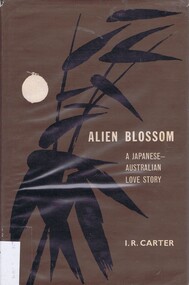
Book, Alien Blossom: a Japanese-Australian love story. By I. R. Carter, 1965_
... By I. R. Carter Book Book Lansdowne Press ...Tells te story of the first Japanese 'war bride' to be admitted entry to Australia after World War II. This book was owned by Ruby Fort.161 pages. b&w photographs. Brown dust jacket with drawing of bamboo.On fly leaf: "Ruby Fort Emily Rough"world war ii, japanese war brides, cherry parker -
Glenelg Shire Council Cultural Collection
Book - Collection of reference texts on shells, 1964-2004
... Press, 1972 (4111.9); "Sea Shells", London: Orbis Books, 1971 (4111.10); Dance, S. Peter, "Shells and shell collecting", London: Hamlyn, 1972 (4111.11); Clayton, JM, "All colour book of Seashells:, London: Octopus Books, 1974 (4111.12); "Exploring the Secrets of Nature", London: Reader's Digest, 1994 (4111.13); Habe, Tadashige, "Shells of the Western Pacific in colour: Vol I", Osaka: Hoikusha, 1964 (4111.14); Habe, Tadashige, "Shells of the Western Pacific in colour: Vol II", Osaka: Hoikusha, 1964 (4111.15); Dance, Peter S. ...Press, 1972 (4111.9); "Sea Shells", London: Orbis Books, 1971 (4111.10); Dance, S. Peter, "Shells and shell collecting", London: Hamlyn, 1972 (4111.11); Clayton, JM, "All colour book of Seashells:, London: Octopus Books, 1974 (4111.12); "Exploring the Secrets of Nature", London: Reader's Digest, 1994 (4111.13); Habe, Tadashige, "Shells of the Western Pacific in colour: Vol I", Osaka: Hoikusha, 1964 (4111.14); Habe, Tadashige, "Shells of the Western Pacific in colour: Vol II", Osaka: Hoikusha, 1964 (4111.15); Dance, Peter S. ...Collection of reference texts on seashells. Includes: Dance, Peter S., "Seashells", London: Treasure Press, 1971 (4111.1); "Handy Pocket Guide to Tropical Seashelss of Indonesia, 2004 (4111.2); Dance, Peter S., "Shells", Pymble: Harper Collins, 1992 (4111.3); Linder, Gert, "Seahshells of the world", Sydney: Australia & New Zealand Book Company, 1977 (4111.4); Wilson, B. R. & K. Gillett, "Australian Shells", Sydney: Reed, 1971 (4111.5); Harasewych, M.G., "Shells: Jewels from the Sea", New York: Rizzoli, 1989 (4111.6); "The Golden Stamp Book of Seashells", Wisonsin: Golden Books, 1975 (4111.7); Taylor, John & Jerry G. Walls, "Cowries", Neputune City: T.F.H. Pblications, 1975 (4111.8); Child, John & John Currey, "Shells and the Seashore", Melbourne: Landsdowne Press, 1972 (4111.9); "Sea Shells", London: Orbis Books, 1971 (4111.10); Dance, S. Peter, "Shells and shell collecting", London: Hamlyn, 1972 (4111.11); Clayton, JM, "All colour book of Seashells:, London: Octopus Books, 1974 (4111.12); "Exploring the Secrets of Nature", London: Reader's Digest, 1994 (4111.13); Habe, Tadashige, "Shells of the Western Pacific in colour: Vol I", Osaka: Hoikusha, 1964 (4111.14); Habe, Tadashige, "Shells of the Western Pacific in colour: Vol II", Osaka: Hoikusha, 1964 (4111.15); Dance, Peter S. (ed.), "The Encyclopedia of Shells", Sydney: Australia & New Zealand Book Company, 1977 (4111.16); Hinton, Alan, "Guide to Shells of Papua New Guinea", Port Moseby: Robert Brown and Associates, nd (4111.17); Hinton, Alan, "Guide to Australian Shells", Port Moseby: Robert Brown and Associates, nd (4111.18); "The How and Why wonder book of seashells", New York: Grosset & Dunlap, 1972 (4111.19); Child, J., "Australian Golden Stamp Book: Australian Seashells",Sydney: Golden Press, 1971 (4111.20); Hinton, Alan, "Shells of New Guinea and the Central Indo-Pacific", Port Morsby; Milton: Robert Brown and Associates Pty Ltd; The Jacaranda Press, 1975 (4111.21); Coleman, Neville, "Shells in Australia", Sydney: Reed, 1978 (4111.22); Coleman, Neville, "What Shell is That?", Sydney: Ure Smith Press, 1988 (4111.23); Coleman, Neville, "Shells Alive!", Adelaide: Rigby Publishers, 1981 (4111.24); Deas, Walter, "Seashells of Australia", Adelaide: Rigby Ltd, 1974 (4111.25).maritime, marine ecology, sea shells, reference, natural history -
 Mission to Seafarers Victoria
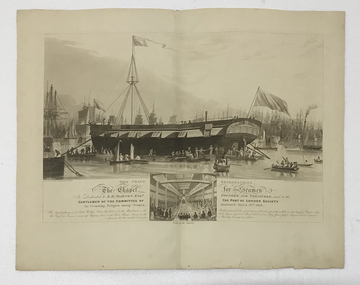
Print - Engraving, The Chapel For Seamen, c. 1818
... He was a Dissenter (non-conformist), active in his church and in many charitable works, as overseer of the poor for his parish, raising money for families in Germany impoverished by the Napoleonic wars, was a member of the Royal Humane Society and so it is not altogether surprising to find him in 1817 taking up the cause of sailors discharged from warships living on the streets: --- The Autobiography of R H Marten Esq of Plaistow Essex (1763-1839) “The deplorable condition of sailors discharged from the ships of war and now wanted for commerce – (trade being most woefully dull) attracted towards the close of the Year the notice and began to press upon the feelings of the Public. To relieve their urgent and personal distress I proposed a Public meeting – This was agreed to and Mr. ...The text reads: "This Print Represents The Chapel for Seamen... Port of London Society... Instituted March 18th 1818... Chapel for Seamen is moored off Wapping Stairs in the River Thames. View of the Interior (inset)"Excerpt from the autobiography of Robert Humphrey Marten (1763-1839) which he wrote at the request of his children on his 60th birthday. (As far as the donor's knowledge it only circulates within the family, so some of these details may not be recorded elsewhere about how the Mission to the Seafarers began. --------- Robert Humphrey Marten (1763-1839) left school at the age of about 14 to be employed in a “Counting House” in the City of London. Unfortunately, before the five years of his apprenticeship expired, the merchant ceased trading as he had lost a lot of money gambling. Marten made his way however and took opportunities which offered and eventually set up his own business with two of his sons, Robert and Charles. He was a Dissenter (non-conformist), active in his church and in many charitable works, as overseer of the poor for his parish, raising money for families in Germany impoverished by the Napoleonic wars, was a member of the Royal Humane Society and so it is not altogether surprising to find him in 1817 taking up the cause of sailors discharged from warships living on the streets: --- The Autobiography of R H Marten Esq of Plaistow Essex (1763-1839) “The deplorable condition of sailors discharged from the ships of war and now wanted for commerce – (trade being most woefully dull) attracted towards the close of the Year the notice and began to press upon the feelings of the Public. To relieve their urgent and personal distress I proposed a Public meeting – This was agreed to and Mr. Wilberforce was voted into the chair – A committee was formed and a noble subscription was most voluntarily supplied – Navy Captains and others gave most efficient assistance and Govt. lent some large ships to which the sailors were sent from the streets – were clothed and fed and the sick attended to and on the Sabbath Public Worship was performed on board. I was on this Committee which fully accomplish’d its humane purpose – and out of the Surplus fund sprang the present seaman’s floating Hospital where a sick or diseased seaman is received only on his presenting himself alongside and without any ticket or recommendation. For the greater benefit of seamen was sketched the present excellent establishment of the Merchant Seaman’s Auxiliary Bible Society of which Admiral Lord Viscount Exmouth is President. This was more formally instituted on the ---[space left to add date later]. I drew the outline of the address to the Public which was afterwards much improved by the Revd. Mr. Draltry and I had the honour to chalk out the plan which has been so well executed by the pious Lieut. Cox at Gravesend – to whose zealous and judicious activity the success of the institution is much indebted, and in December I published my ideas on the necessity and advantage of making some permanent accommodation for preaching the Gospel to the numerous sailors always to be found in the Port of London. This led ultimately to a public meeting on the 5 Feb. 1818 and to the formation of the Port of London Society for promoting Religion among seaman [sic]. As the Founder of the Society I became its Chairman and Treasurer and on its formal Institution on the 18 March 1818 the public appeared much gratified with the attempt about to be made to raise the moral character of a class of men who had been unaccountably and far too long in this respect overlooked. The large ship fitted by the Society most commodiously as a Chapel was in May following moored nearly on the spot where in October 1803 I was run down by a Gravesend Hoy and narrowly escaped with life – Churchmen and Dissenters contributed cheerfully to the cost – Officers of the Navy became subscribers, Noblemen visited this strange and converted ship – the Admiral Lord Gambier became the avowed President and the Chairman of the public Meetings, and what is of far more importance – sailors came to it on the Sabbath by hundreds willingly to worship their maker, and listen to instruction – until the Language in common use on the Thames was divested of its Blasphemy – and the voice of Prayer was heard from the mouths of Seamen; and the outposts and many Foreign ports imitated and thus honored the example of the Port of London in her society for promoting Religion among Seamen. The Floating Chapel was solemnly dedicated for divine worship on the 4 May 1818 when the morning sermon was preached by the Revd. Rowland Hill to a very crowded auditory. “[see illustration in separate email] Autobiography of R H Marten esq pp 33-34 (privately published monograph) Note: The incident (c 1803) he refers to in which he “was run down by a Gravesend Hoy…” is graphically described earlier in his memoir. The donor's family has a connection with R.H. Marten. through his sister Mary, who married Cornelius Berry on 9 February 1793. The donor's father, Hugh William Berry (1905-?) reprinted the autobiography of R.H. Marten. And, she has herself a connection with the Mission as she used to collect money for the Mission at school. Large print depicting a floating church in Londonfloating church, seamen, sailors, religion, london, r.h. marten esq, wapping stairs, river thames, port, robert humphrey marten (1763-1839), cate lewis, seamen's hospital, welfare, napoleonic wars, royal navy, merchant navy -
Mission to Seafarers Victoria
Book - Autobiography, The Autobiography of R. H. Marten Esq. of Plaistow, Essex. (1763 - 1839)
... He was a Dissenter (non-conformist), active in his church and in many charitable works, as overseer of the poor for his parish, raising money for families in Germany impoverished by the Napoleonic wars, was a member of the Royal Humane Society and so it is not altogether surprising to find him in 1817 taking up the cause of sailors discharged from warships living on the streets: --- The Autobiography of R H Marten Esq of Plaistow Essex (1763-1839) “The deplorable condition of sailors discharged from the ships of war and now wanted for commerce – (trade being most woefully dull) attracted towards the close of the Year the notice and began to press upon the feelings of the Public. To relieve their urgent and personal distress I proposed a Public meeting – This was agreed to and Mr. ...He was a Dissenter (non-conformist), active in his church and in many charitable works, as overseer of the poor for his parish, raising money for families in Germany impoverished by the Napoleonic wars, was a member of the Royal Humane Society and so it is not altogether surprising to find him in 1817 taking up the cause of sailors discharged from warships living on the streets: --- The Autobiography of R H Marten Esq of Plaistow Essex (1763-1839) “The deplorable condition of sailors discharged from the ships of war and now wanted for commerce – (trade being most woefully dull) attracted towards the close of the Year the notice and began to press upon the feelings of the Public. To relieve their urgent and personal distress I proposed a Public meeting – This was agreed to and Mr. ...Small size book with light blue front and back covers and a darker blue spinenon-fictionrobert humphrey marten, robert humphrey marten (1763-1839), cate lewis, seamen, welfare, napoleonic wars, london, plaistow, essex, autobiography -
Phillip Island and District Historical Society Inc.
Book, LEEK, Bob, Sail traders of Port Phillip and Victoria, 2008-2010
... Four Volumes - Vol I & II under Registration No. 2056 donated by Peter Taylor on the 2/9/2009 Vol III & IV under Registration No. 3016 donated by Peter Taylor on the 2/2/2011 coasters victoria ships port phillip bay history sailing ships Sail traders of Port Phillip and Victoria Book LEEK, Bob Scuttlebutt Press ...Four Volumes - Vol I & II under Registration No. 2056 donated by Peter Taylor on the 2/9/2009 Vol III & IV under Registration No. 3016 donated by Peter Taylor on the 2/2/2011coasters, victoria, ships, port phillip bay, history, sailing ships -
 Flagstaff Hill Maritime Museum and Village
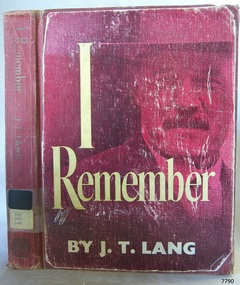
Book, I Remember
... I Remember Author: J T Lang Publisher: Invicible Press ...Warrnambool Shipwrecked-coast Flagstaff-Hill Flagstaff-Hill-Maritime-Museum Maritime-Museum Shipwreck-coast Flagstaff-Hill-Maritime-Village Shipwrecked-artefact Book Pattison Collection Warrnambool Library Warrnambool Mechanics’ Institute Ralph Eric Pattison Corangamite Regional Library Service Warrnambool City Librarian Mechanics’ Institute Library Victorian Library Board Warrnambool books and records Warrnambool Children’s Library Great Ocean Road I Remember J T Lang Label on spine cover with typed text PAT 920 LAN Pastedown front endpaper has sticker from Warrnambool Public Library covered by a sticker from Corangamite Regional Library Service Front loose endpaper has a stamp from Corangamite Regional Library Service I Remember Author: J T Lang Publisher: Invicible Press I Remember Book ...This item is from the ‘Pattison Collection’, a collection of books and records that was originally owned by the Warrnambool Mechanics’ Institute, which was founded in Warrnambool in 1853. By 1886 the Warrnambool Mechanics’ Institute (WMI) had grown to have a Library, Museum and Fine Arts Gallery, with a collection of “… choice productions of art, and valuable specimens in almost every branch and many wonderful national curiosities are now to be seen there, including historic relics of the town and district.” It later included a School of Design. Although it was very well patronised, the lack of financial support led the WMI in 1911 to ask the City Council to take it over. In 1935 Ralph Pattison was appointed as City Librarian to establish and organise the Warrnambool Library as it was then called. When the WMI building was pulled down in 1963 a new civic building was erected on the site and the new Warrnambool Library, on behalf of the City Council, took over all the holdings of the WMI. At this time some of the items were separated and identified as the ‘Pattison Collection’, named after Ralph Pattison. Eventually the components of the WMI were distributed from the Warrnambool Library to various places, including the Art Gallery, Historical Society and Flagstaff Hill. Later some were even distributed to other regional branches of Corangamite Regional Library and passed to and fro. It is difficult now to trace just where all of the items have ended up. The books at Flagstaff Hill Maritime Village generally display stamps and markings from Pattison as well as a variety of other institutions including the Mechanics’ Institute itself. RALPH ERIC PATTISON Ralph Eric Pattison was born in Rockhampton, Queensland, in 1891. He married Maude Swan from Warrnambool in 1920 and they set up home in Warrnambool. In 1935 Pattison accepted a position as City Librarian for the Warrnambool City Council. His huge challenge was to make a functional library within two rooms of the Mechanics’ Institute. He tirelessly cleaned, cleared and sorted a disarrayed collection of old books, jars of preserved specimens and other items reserved for exhibition in the city’s museum. He developed and updated the library with a wide variety of books for all tastes, including reference books for students; a difficult task to fulfil during the years following the Depression. He converted all of the lower area of the building into a library, reference room and reading room for members and the public. The books were sorted and stored using a cataloguing and card index system that he had developed himself. He also prepared the upper floor of the building and established the Art Gallery and later the Museum, a place to exhibit the many old relics that had been stored for years for this purpose. One of the treasures he found was a beautiful ancient clock, which he repaired, restored and enjoyed using in his office during the years of his service there. Ralph Pattison was described as “a meticulous gentleman whose punctuality, floorless courtesy and distinctive neat dress were hallmarks of his character, and ‘his’ clock controlled his daily routine, and his opening and closing of the library’s large heavy doors to the minute.” Pattison took leave during 1942 to 1945 to serve in the Royal Australian Navy, Volunteer Reserve as Lieutenant. A few years later he converted one of the Museum’s rooms into a Children’s Library, stocking it with suitable books for the younger generation. This was an instant success. In the 1950’s he had the honour of being appointed to the Victorian Library Board and received more inspiration from the monthly conferences in Melbourne. He was sadly retired in 1959 after over 23 years of service, due to the fact that he had gone over the working age of council officers. However he continued to take a very keen interest in the continual development of the Library until his death in 1969. The Pattison Collection, along with other items at Flagstaff Hill Maritime Village, was originally part of the Warrnambool Mechanics' Institute’s collection. The Warrnambool Mechanics’ Institute Collection is primarily significant in its totality, rather than for the individual objects it contains. Its contents are highly representative of the development of Mechanics' Institute libraries across Australia, particularly Victoria. A diversity of publications and themes has been amassed, and these provide clues to our understanding of the nature of and changes in the reading habits of Victorians from the 1850s to the middle of the 20th century. The collection also highlights the Warrnambool community’s commitment to the Mechanics’ Institute, reading, literacy and learning in the regions, and proves that access to knowledge was not impeded by distance. These items help to provide a more complete picture of our community’s ideals and aspirations. The Warrnambool Mechanics Institute book collection has historical and social significance for its strong association with the Mechanics Institute movement and the important role it played in the intellectual, cultural and social development of people throughout the latter part of the nineteenth century and the early twentieth century. The collection of books is a rare example of an early lending library and its significance is enhanced by the survival of an original collection of many volumes. The Warrnambool Mechanics' Institute’s publication collection is of both local and state significance. I Remember Author: J T Lang Publisher: Invicible Press Label on spine cover with typed text PAT 920 LAN Pastedown front endpaper has sticker from Warrnambool Public Library covered by a sticker from Corangamite Regional Library Service Front loose endpaper has a stamp from Corangamite Regional Library Servicewarrnambool, shipwrecked-coast, flagstaff-hill, flagstaff-hill-maritime-museum, maritime-museum, shipwreck-coast, flagstaff-hill-maritime-village, shipwrecked-artefact, book, pattison collection, warrnambool library, warrnambool mechanics’ institute, ralph eric pattison, corangamite regional library service, warrnambool city librarian, mechanics’ institute library, victorian library board, warrnambool books and records, warrnambool children’s library, great ocean road, i remember, j t lang -
 Orbost & District Historical Society
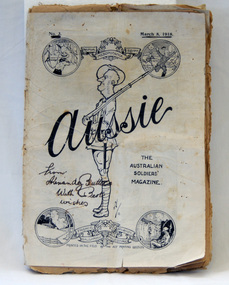
magazine, Aussie, March 18, 1918
... press that Harris brought with him to France. Initially the print run was only 10,000 copies, but soon it reached 60,000 and later 100,000. The magazine celebrated a distinctive 'Aussie' identity through language, humour and imagery. It distributed news, provided light-hearted ways of seeing the war experience and gave soldiers an outlet to express dissent or dissatisfaction. It also provided a voice for Australian authors such as Banjo Paterson, C.J. Dennis and Bernard O'Dowd. (Ref Museum Victoria) This magazine provides an Australian soldiers' view of the political and world climate during World War I ...Alexander Butters enlisted on 12 November 1914 as a gunner. He was awarded a Meritorious Service medal for his "determination and courage .....setting a splendid example to his men..." on the SOMME. 'Aussie' (1918- circa 1929) was a commercial magazine of opinion, review and entertainment. It was edited by Phillip Harris and published in France 1918 - 1919 on a small printing press that Harris brought with him to France. Initially the print run was only 10,000 copies, but soon it reached 60,000 and later 100,000. The magazine celebrated a distinctive 'Aussie' identity through language, humour and imagery. It distributed news, provided light-hearted ways of seeing the war experience and gave soldiers an outlet to express dissent or dissatisfaction. It also provided a voice for Australian authors such as Banjo Paterson, C.J. Dennis and Bernard O'Dowd. (Ref Museum Victoria)This magazine provides an Australian soldiers' view of the political and world climate during World War I, and also represents the bond between Australian soldiers. The magazine celebrated a distinctive ?Aussie? identity, through language, humour and their assertion of what it meant to be an Australian. It allowed news to be distributed, gave the soldiers an outlet to express any dissent or dissatisfaction, thus preventing any greater form of rebellion and promoted Australian authors like Banjo Paterson, C.J. Dennis and Bernard O'Dowd. (Ref. Museum Victoria)A thin black and white paper magazine called "Aussie". This is Volume 3. The magazine contains stories, illustrations, songs and poetry from the First World War. On the front cover the title is printed across the centre, with a drawing of a soldier in uniform standing sideways, and holding a gun. Four drawings within circles are positioned in each corner, joined by a wreath and ribbons bearing the names of the war fields. His head is in the shape of the map of Australia. On front cover - From Alexandy Butters with best wishesmagazine ww1 aussie military -
 Ringwood and District Historical Society
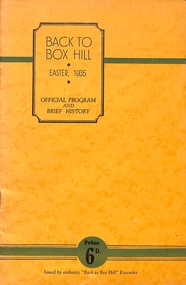
Book, Back to Box Hill, Easter, 1935 - Official Program and Brief History, 1935
... I. Coutts, Esq., M.G. Tweedie, Esq., J.P. Organiser: D. Macdougall. Soft covered booklet with text and pictorial summary of historic events in the Box Hill area from first European settlement in 1854 issued by "Back to Box Hill" Executive Back to Box Hill, Easter, 1935 - Official Program and Brief History Book T and S Press Pty Ltd ...Soft covered booklet with text and pictorial summary of historic events in the Box Hill area from first European settlement in 1854 issued by "Back to Box Hill" ExecutiveBack to Box Hill Executive - Chairman: Cr. W.J. BOYLAND, J.P., M.L.A. Vice-Chairman: Cr. W. Young Hon. Treasurer: F. Jamieson, Esq., J.P. Joint Hon. Secretaries: R.J. Gray, Esq., F.W. Kerr, Esq. Committee: W.H.G. Ellingworth, Esq., J.P., J. Patterson, Esq., F.G. Newbury, Esq., G. Evans, Esq., J.E. Payne, Esq., I. Coutts, Esq., M.G. Tweedie, Esq., J.P. Organiser: D. Macdougall. -
 Bendigo Military Museum
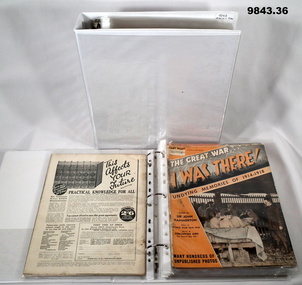
Magazine - PICTORIAL COLLECTION, 1914-18, The Amalgamated Press Ltd, "THE GREAT WAR...I WAS THERE!", 1938 -1939
... I WAS THERE!" Magazine PICTORIAL COLLECTION, 1914-18 The Amalgamated Press Ltd Messrs Golden ...Information from Magazine front cover; "Part Five to complete in about 40 Parts/ THE GREAT WAR/ I WAS THERE/ UNDYING MEMORIES OF 1914-1918/ edited by Sir John HAMMERTON/ Editor of WORLD WAR 1914-1918/ Writer of FORGOTTEN MEN/ The Famous War Film/ MANY HUNDREDS OF/ UNPUBLISHED PHOTOS". Part of the William (Bill) THOMASON Collection. Refer Cat No. 4136P for more items.Magazine Collection stored in clear plastic A4 pockets in two folders. Folder One; 1. to 17. Folder Two; 18. to 36. Folders - 3 metal ring, cardboard and plastic cover. A4 clear plastic binder pockets. 1. to 36. Cover, heavy paper with black and orange colour print on front. Illustrated on front sepia toned photographs of soldiers in various battle locations. Back - advertisements in black and white print. 40 pages approx, cut, plain, off white paper. Illustrated black and white and sepia photographs with related articles in black print. BINDER ONE 1. Part Five October 31st 1938. 2. Part Six November 8th 1938. 3. Part Seven November 15th 1938. 4. Part Eight November 22nd 1938. 5. Part Nine November 29th 1938. 6. Part Twelve December 20th 1938. 7. Part 13 December 27th 1938. 8. Part 14 January 3rd 1939. 9. Part 15 January 10th 1939. 10. Part 16 January 17th 1939. 11. Part 17 January 24th 1939. 12. Part 18 January 31st 1939. 13. Part 19 February 7th 1939. 14. Part 20 February 14th 1939. 15. Part 22 February 29th 1939. 16. Part 23. Cover missing. 17. Part 24 March 14th 1939. BINDER TWO 18. Part 25 March 21st 1939. 19. Part 26 March 28th 1939. 20. & 21. Part 27 April 4th 1939. 22. Part 29 April 18th 1939. 23. Part 30 April 25th 1939. 24. Part 34 May 23rd 1939. 25. Part 35 May 30th 1939. 26. Part 37 June 13th 1939. 27. Part 38 June 20th 1939. 28. Part 40 July 4th 1939 29. Part 41 July 11th 1939. 30. Part 44 August 1st 1939. 31. Part 45 August 8th 1939. 32. Part 47 August 22nd 1939. 33. Part 48. August 29th 1939. 34. Part 49 September 5th 1939. 35. Part 50 September 12th 1939. 36. Part 24 March 14th 1939. Adhesive white label - black ink print - price label "Price in Australia/ and New Zealand 1/-".publications, magazines, pictorial, ww1, william (bill) thomason collection -
 Bendigo Military Museum
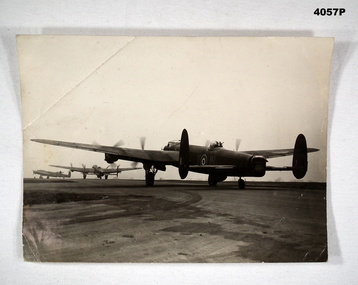
Photograph - PHOTOGRAPH, LANCASTER, Central Press Photos Ltd, c. WWII
... I. Davey Pres. Strathdale CWA. Lancasters ready for take-off. On back, - two stamps in purple ink: 1 "Certified by Central Press Photos Ltd. ...I. Davey Pres. Strathdale CWA. Lancasters ready for take-off. On back, - two stamps in purple ink: 1 "Certified by Central Press Photos Ltd. ...Three R.A.F Lancaster bombers preparing for take-off from an airfield during WWII. Part of Frederick Gardner Davey DFC No.460533 RAAF Collection. See Cat. No. 3536P for his service record.Photo, black & white, of three aircraft on a runway preparing to take-off.On back, hand written in blue ink: "Mrs I. Davey Pres. Strathdale CWA. Lancasters ready for take-off. On back, - two stamps in purple ink: 1 "Certified by Central Press Photos Ltd. As passed by censor. Press and Censorship Bureau". 2 "Exclusive Central Press Photo. Made in England".lancasters, bombers, raaf -
 Bendigo Military Museum
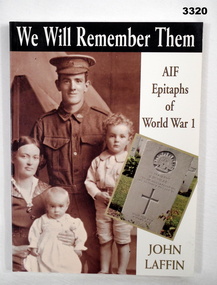
Book - BOOK, EPITAPHS WW1, We Will Remember Them, AIF Epitaphs of World War I
... We Will Remember Them, AIF Epitaphs of World War I Book BOOK, EPITAPHS WW1. John Laffin Kangaroo Press Pty Ltd Southwood Press Pty Ltd John Laffin Kangaroo Press Pty Ltd Southwood Press Pty Ltd ...We Will Remember Them, AIF Epitaphs of World War I. From back cover: No consolidated list of epitaphs exists but John and Hazelle Laffin have been collecting them from the graves themselves for decades. These inscriptions, in their great variety, present a picture of Australians of the period.Soft cardboard cover. Black, white & gold print on front, spine & back. On front cover background is a sepia photo of a soldier in uniform with his wife & 2 children. Smaller colour photo in foreground of a headstone. On back cover is a small colour photo of John & Hazelle Laffin. 158 pages, cut, plain, white. Illustrated black & white photos & hand drawn maps. Hand written notes in grey lead pencil on numerous pages.books-military-history, epitaphs ww1 -
 Bendigo Military Museum
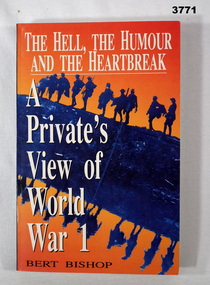
Book - BOOK WW1, Bert Bishop, The Hell, The Humour & The Heartbreak, 1991
... I. Book humour heartbreak Soft cardboard cover. White / black / gold print on front, spine & back. Orange background illustrated dark blue in silhouette showing Australian troops at Ypres. 268 cut, plain, white pages. No illustrations. The Hell, The Humour & The Heartbreak Book BOOK WW1 Bert Bishop Southwood Press ...The Hell, The Humour & The Heartbreak - A Private's view of World War I.Soft cardboard cover. White / black / gold print on front, spine & back. Orange background illustrated dark blue in silhouette showing Australian troops at Ypres. 268 cut, plain, white pages. No illustrations.book, humour, heartbreak
