
Showing 40 items matching "john cramond warrnambool"
-
 Warrnambool and District Historical Society Inc.
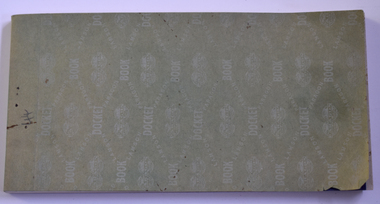
Administrative record - Sales Docket Book, Cramond & Dickson Store, Warrnambool, 1960s
... Cramond & Dickson Warrnambool...John...This docket book has been used to enter sales from the Cramond and Dickson department store in Warrnambool and to provide the customer with a copy of the invoice. It dates from about the 1960s. John...Cramond and Dickson store, a most important business in Warrnambool, operated until 1973. The docket book was printed by Lamson Paragon, a British firm that was established in Australia in 1897 and specialized in printing sales docket books with a carbon paper insert. This docket book is of interest as a memento of the Cramond and Dickson Store, one of the most significant businesses ever to have operated in Warrnambool Cramond & Dickson Warrnambool John Cramond Warrnambool James Dickson Warrnambool Warrnambool businesses Lamson Paragon Printing Firm Cramond & Dickson General Drapers and Importers Warrnambool 3280 Lamson Paragon This is a docket book containing 46 pages of white printed sheets bound with green tape and enclosed in a green patterned paper cover on the front and a piece of cardboard on the back. ...This docket book has been used to enter sales from the Cramond and Dickson department store in Warrnambool and to provide the customer with a copy of the invoice. It dates from about the 1960s. John Cramond and James Dickson, two pioneer settlers in Warrnambool, established the Carmond and Dickson store in Warrnambool in 1855, initially selling groceries, drapery and ironmongery but later, at the corner of Liebig and Timor Streets, this department store sold mainly clothing and drapery. In the 1860s a Cramond and Dickson store was opened in London. The Cramond and Dickson store, a most important business in Warrnambool, operated until 1973. The docket book was printed by Lamson Paragon, a British firm that was established in Australia in 1897 and specialized in printing sales docket books with a carbon paper insert.This docket book is of interest as a memento of the Cramond and Dickson Store, one of the most significant businesses ever to have operated in WarrnamboolThis is a docket book containing 46 pages of white printed sheets bound with green tape and enclosed in a green patterned paper cover on the front and a piece of cardboard on the back. The pages have ruled black lines, red and black print and an image in red of a building. Some of the pages have been used and removed. At the front of the pages are two sheets of carbon paper and tissue paper for copying purposes.Cramond & Dickson General Drapers and Importers Warrnambool 3280 Lamson Paragoncramond & dickson warrnambool, john cramond warrnambool, james dickson warrnambool, warrnambool businesses, lamson paragon printing firm -
 Warrnambool and District Historical Society Inc.
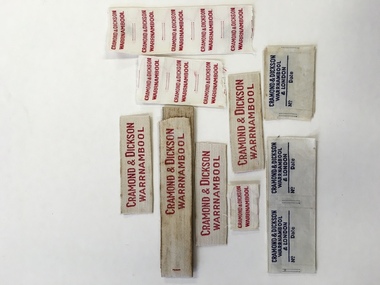
Label, Name labels Cramond & Dickson
... Cramond & Dickson...John Glass Cramond...Warrnambool...John Glass Cramond 1829 and James Dickson 1831-1910 were founders of a large drapery store. Both were Scots and both came separately to Australia in 1852. Cramond initially came for gold but soon opened a store in St Kilda with a post Office attached and he was the first post master there. Dickson was a farmer’s son but became a draper and while he was unsuccessful on the Bendigo diggings and then returned to Melbourne where he met Cramond and soon after they opened a store on Lonsdale Street. They opened their business in Warrnambool...Warrnambool Base Hospital. These labels would have been used to sew to garments sold by Cramond & Dickson. A common item for many decades with which many people would identify. Cramond & Dickson John ...John Glass Cramond 1829 and James Dickson 1831-1910 were founders of a large drapery store. Both were Scots and both came separately to Australia in 1852. Cramond initially came for gold but soon opened a store in St Kilda with a post Office attached and he was the first post master there. Dickson was a farmer’s son but became a draper and while he was unsuccessful on the Bendigo diggings and then returned to Melbourne where he met Cramond and soon after they opened a store on Lonsdale Street. They opened their business in Warrnambool in 1855 as a general store with groceries, drapery and ironmongery. Both partners were involved with the community and James Dickson was an original director of the Warrnambool Woollen Mill 1909 and the Warrnambool Cheese and butter factory. He also served on the committee of management of Warrnambool Base Hospital. These labels would have been used to sew to garments sold by Cramond & Dickson. A common item for many decades with which many people would identify.Eleven cloth name tag labels. White cotton fabric. Some are embroidered in navy blue and others in red.Those embroidered in red state Cramond & Dickson Warrnambool and the ones embroidered in navy blue state Cramond & Dickson Warrnambool & London.cramond & dickson, john glass cramond, warrnambool, james dickson -
 Warrnambool and District Historical Society Inc.
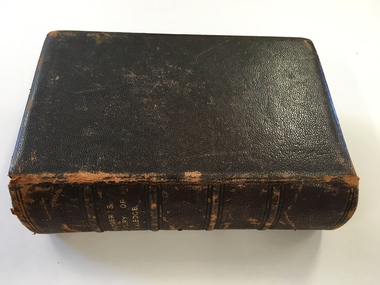
Book, Maunder's Treasury of Knowledge, 1893
... John Cramond was Mayor of Warrnambool from 1876 to 1877 and from 1881 to 1882....John Cramond was Mayor of Warrnambool from 1876 to 1877 and from 1881 to 1882. ...This book was a present from James Dickson to John Glass Cramond in 1897. These two men were business partners and friends. They established the drapery, ironmongery and clothing business of Cramond and Dickson in Warrnambool in 1855 and this business remained as an important store in Warrnambool until 1973. John Cramond was Mayor of Warrnambool from 1876 to 1877 and from 1881 to 1882.This is a most significant item as it belonged to a prominent Warrnambool man and was given to him by another prominent Warrnambool citizen. The store of Cramond and Dickson was one of the best-known and most important shop in Warrnambool for nearly 120 years. This is a brown leather-bound book with a red lining on the inside cover. The book has 900 pages and was printed in 1893. The contents include an English Grammar, an English Dictionary, the population of European Capitals, a list of Cities and Towns in Britain, a list of Animal, Vegetable and Mineral productions, a list of Proverbs, a Law Dictionary, a Compendium of Modern History and the Coronets of Princes of the Blood and of the Peerage. The printed material has two columns per page. The cover is somewhat scuffed and the red lined-page is ragged (silverfish damage?).‘Mr J.G. Cramond from James Dickson, 5 May 1897’ Warrnambool and District Historical Society stamp , W.B. 124 john glass, cramond james dickson -
 Flagstaff Hill Maritime Museum and Village
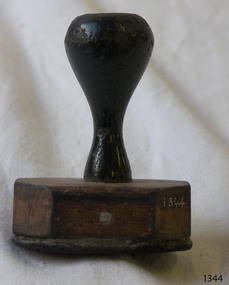
Equipment - Stamp, Cramond and Dickson, Mid-19th century
... This stamp was made for and used by Cramond and Dickson, a large clothing store on the corner of Liebig and Timor Streets, Warrnambool. They traded from 185 – 1974. John...This stamp was made for and used by Cramond and Dickson, a large clothing store on the corner of Liebig and Timor Streets, Warrnambool. They traded from 185 – 1974. John ...This stamp was made for and used by Cramond and Dickson, a large clothing store on the corner of Liebig and Timor Streets, Warrnambool. They traded from 185 – 1974. John Glass Cramond and James Dickson migrated from Scotland to Melbourne where they opened a Cramond and Dickson store in St Kilda. They were inspired by the growth in Warrnambool after a visit and opened a second store there in 1855. The Cramond and Dickson store, grocers – drapery – ironmongery - chemist, was located on the corner of Liebig and Timor Streets, Warrnambool (now the site of a Mexican restaurant). Both Cramond and Dickson were involved in the business and social aspects of Warrnambool’s community. Cramond and Dickson closed in 1974. An advertisement placed by Cramond and Dickson in The Camperdown Chronicle, Saturday 6th April 1895, states them “showing the latest novelties for the coming winter season” … “import directly from English and Continental manufacturers” … “representatives in London … always in touch with the Newest Continental Fashions” ... “having been established for so many years we know the requirements of the Western District”… “allow 5 percent discount on goods paid for at the time of purchase”.The rubber stamp is significant for its association with Cramond and Dickson, a large retail store established in Warrnambool and operating from 1855 to 1974. Both partners were prominent figures in the community.Rubber stamp, octagonal-sided, with wooden handle. The stamp was owned and used by Warrnambool's department store, Cramond & Dickson."Warrnambool" "Outfitters and Drapers" "Cramond and Dickson"flagstaff hill maritime museum and village, flagstaff hill, maritime village, maritime museum, shipwreck coast, great ocean road, warrnambool, cramond and dickson, warrnambool business, department store, commerce, timor street, liebig street, sales, retail equipment, office equipment, stamp, rubber stamp, business stamp -
 Flagstaff Hill Maritime Museum and Village
Container - Boot Polish Tin, Cramond and Dickson, 1855-1974
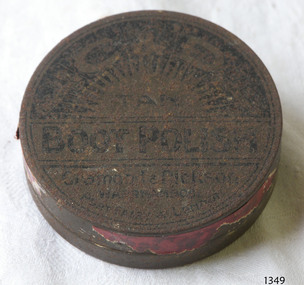
... This tin of boot polish was a product sold be Cramond and Dickson store, which traded in Warrnambool from 1855 - 1974. John Glass Cramond and James Dickson migrated from Scotland to Melbourne, where they opened a Cramond and Dickson store in St Kilda. ...This tin of boot polish was a product sold be Cramond and Dickson store, which traded in Warrnambool from 1855 - 1974. John Glass Cramond and James Dickson migrated from Scotland to Melbourne, where they opened a Cramond and Dickson store in St Kilda. ...This tin of boot polish was a product sold be Cramond and Dickson store, which traded in Warrnambool from 1855 - 1974. John Glass Cramond and James Dickson migrated from Scotland to Melbourne, where they opened a Cramond and Dickson store in St Kilda. They were inspired by the growth in Warrnambool after a visit and opened a second store there in 1855. The Cramond and Dickson store, grocers – drapery – ironmongery - chemist, was located on the corner of Liebig and Timor Streets, Warrnambool. Both Cramond and Dickson were involved in the business and social aspects of Warrnambool’s community. Cramond and Dickson closed in 1974. An advertisement placed by Cramond and Dickson in The Camperdown Chronicle, Saturday 6th April 1895, states them “showing the latest novelties for the coming winter season” … “import directly from English and Continental manufacturers” … “representatives in London … always in touch with the Newest Continental Fashions” ... “having been established for so many years we know the requirements of the Western District”… “allow 5 percent discount on goods paid for at the time of purchase”.The tin of boot polish is an example of the goods sold in Warrnambool in the 19th and early 20th century. It s significant for its association with Cramond and Dickson, a large retail store established in Warrnambool and operating from 1855 to 1974. Both partners were prominent figures in the community.Container: a tin of boot polish, with a small amount of light tan polish inside. Inscribed for the makers, Cramond and Dickson, Warrnambool, Port Fairy & Londo. Labelling is partly obscured by corrosion. Instructions for use are on the base of the tin. "C and D Tan Boot Polish" and "Cramond and Dickson, Warrnambool, Port Fairy & London" and "For best results, remove all dust and apply a little C and D Dressing, Brush Briskly" "Weight when packed 1 1/2 ozs net"flagstaff hill maritime museum and village, flagstaff hill, maritime village, maritime museum, shipwreck coast, great ocean road, warrnambool, boot polish, shoe cleaning, grooming, cramond and dickson, warrnambool business, department store, commerce, timor street, liebig street, port fairy business, metal craft, tinware -
 Flagstaff Hill Maritime Museum and Village
Functional object - String Dispenser, Cramond and Dickson, mid-19th century
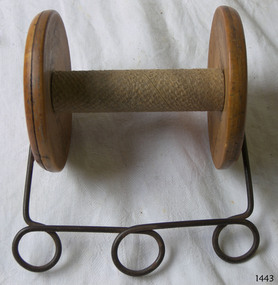
... It was used in the Cramond and Dickson store, which operated in Warrnambool from 1855 + 1974. John Glass Cramond and James Dickson migrated from Scotland to Melbourne where they opened a Cramond and Dickson store in St Kilda. ...It was used in the Cramond and Dickson store, which operated in Warrnambool from 1855 + 1974. John Glass Cramond and James Dickson migrated from Scotland to Melbourne where they opened a Cramond and Dickson store in St Kilda. ...This dispenser was most likely used for holding and dispensing string. It was used in the Cramond and Dickson store, which operated in Warrnambool from 1855 + 1974. John Glass Cramond and James Dickson migrated from Scotland to Melbourne where they opened a Cramond and Dickson store in St Kilda. They were inspired by the growth in Warrnambool after a visit and opened a second store there in 1855. The Cramond and Dickson store, grocers – drapery – ironmongery - chemist, was located on the corner of Liebig and Timor Streets, Warrnambool (now the site of a Mexican restaurant). Both Cramond and Dickson were involved in the business and social aspects of Warrnambool’s community. Cramond and Dickson closed in 1974. An advertisement placed by Cramond and Dickson in The Camperdown Chronicle, Saturday 6th April 1895, states them “showing the latest novelties for the coming winter season” … “import directly from English and Continental manufacturers” … “representatives in London … always in touch with the Newest Continental Fashions” ... “having been established for so many years we know the requirements of the Western District”… “allow 5 percent discount on goods paid for at the time of purchase”.The string dispenser is significant for being used at the local historical Cramond and Dickson department store in Warrnambool It is also of significance as it is an example of office equipment used in many stores for the wrapping and securing of parcels.Dispenser for string; spindle, reel or spool with cylindrical axle in centre, a wooden disc at each end. A length of wire is attached to each end and bend into a 'U' shape, with three loops formed across the base of the 'U'. Item came from Cramond and Dickson store in Warrnambool and was possibly used for dispensing string, with the wire being used as a handle or for mounting.flagstaff hill maritime museum and village, flagstaff hill, maritime village, maritime museum, shipwreck coast, great ocean road, warrnambool, cramond and dickson, warrnambool business, department store, commerce, timor street, liebig street, sales, retail equipment, office equipment, string dispenser, string reel, packaging, parcelling -
 Flagstaff Hill Maritime Museum and Village
Equipment - Cash Ball, Cramond and Dickson, 1855 - 1974
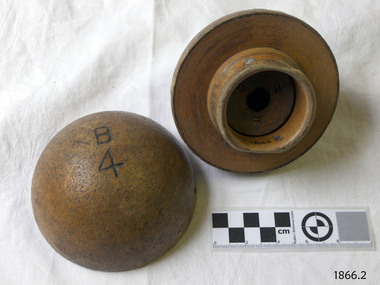
... John Glass Cramond and James Dickson migrated from Scotland to Melbourne, where they opened a Cramond and Dickson store in St Kilda. They were inspired by the growth in Warrnambool...John Glass Cramond and James Dickson migrated from Scotland to Melbourne, where they opened a Cramond and Dickson store in St Kilda. They were inspired by the growth in Warrnambool ...This cash ball was used by Cramond and Dickson, a large clothing store on the corner of Liebig and Timor Streets, Warrnambool. The Cash Ball system serviced the ground floor, which measured about 30 metres by 25 metres. An overhead pipe connected each service point in the store, with the pipes connected to the upstairs office. The ball would be filled with a note of details of the sale, and the cash payment; a vacuum system would be activated that would transport the ball upstairs to the office, where details were recorded and the change assembled. Change was placed in the ball, and the vacuum system was activated to return the ball to the correct sales point. A frequent customer has reported that she never remembered the system not working efficiently, and the service was probably quicker than having a cash register at each sales location. John Glass Cramond and James Dickson migrated from Scotland to Melbourne, where they opened a Cramond and Dickson store in St Kilda. They were inspired by the growth in Warrnambool after a visit and opened a second store there in 1855. The Cramond and Dickson store, grocers – drapery – ironmongery - chemist, was located on the corner of Liebig and Timor Streets, Warrnambool (now the site of a Mexican restaurant). Both Cramond and Dickson were involved in the business and social aspects of Warrnambool’s community. Cramond and Dickson closed in 1974. An advertisement placed by Cramond and Dickson in The Camperdown Chronicle, Saturday 6th April 1895, states them “showing the latest novelties for the coming winter season” … “import directly from English and Continental manufacturers” … “representatives in London … always in touch with the Newest Continental Fashions” ... “having been established for so many years we know the requirements of the Western District”… “allow 5 percent discount on goods paid for at the time of purchase”.The cash ball represents an efficient retail system used in the late 19th to mid 20th century to securely transfer cash from one part of the store to another. It is significant for its association with Cramond and Dickson, a large retail store established in Warrnambool and operating from 1855 to 1974. Both partners were prominent figures in the community.Cash ball: a wooden, round, hollow ball in two pieces. Two half spheres that fit into each other securely. Both are marked with carved characters. "B4" and one has "Fancy" marked on it. It was used by Warrnambool's Cramond and Dickson clothing store. "B4" "Fancy"flagstaff hill, warrnambool, shipwrecked-coast, flagstaff-hill, flagstaff-hill-maritime-museum, maritime-museum, shipwreck-coast, flagstaff-hill-maritime-village, cash ball, cramond and dickson, office equipment, retail equipment, cash handling, sales, warrnambool business, department store, commerce, timor street, liebig street -
 Warrnambool and District Historical Society Inc.
Functional object - Two Tailors' Buttons
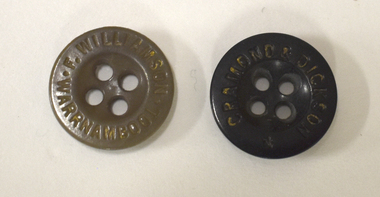
... The black button came from the Liebig Street, Warrnambool clothing and haberdashery store of Cramond and Dickson who employed tailors and dressmakers to make clothing to order. John...The black button came from the Liebig Street, Warrnambool clothing and haberdashery store of Cramond and Dickson who employed tailors and dressmakers to make clothing to order. John ...These two buttons are tailors' buttons for clothing made in Warrnambool. The brown one is from the firm of Frederick Williamson who had a tailoring business at 157-159 Liebig Street, Warrnambool. His father Edward had started the tailoring business with a shop in Timor Street in the second half of the 19th century. Frederick Williamson was a Warrnambool City Councillor on three occasions (1924-1930; 1934-1939; 1942 -1945) and Mayor 1942-1943. The black button came from the Liebig Street, Warrnambool clothing and haberdashery store of Cramond and Dickson who employed tailors and dressmakers to make clothing to order. John Cramond and James Dickson opened their Warrnambool store in 1855 and it was a dominant business in Warrnambool for 119 years, closing in 1974. It was common practice in the first half of the 20th century for tailors and large clothing stores to have their own buttons for their suits etc.These two buttons are of some interest as examples of buttons made specifically for two local Warrnambool businesses. .1 Round button, light-brown in colour with four holes in the centre, a curved back and imprinted letters around the edge. .2 Round black button with four holes in the centre, a curved back and imprinted letters around the edge..1 F. Williamson Warrnambool 2. Cramond & Dicksonfrederick williamson warrnambool tailor, cramond & dickson warrnambool -
 Warrnambool and District Historical Society Inc.
Shoes, Shoe stand
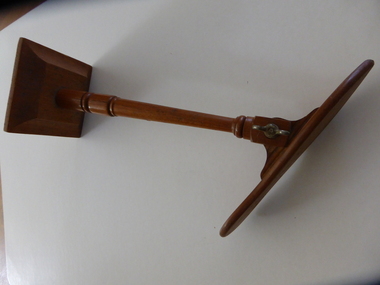
... As this item was donated to the Warrnambool and District Historical Society by a member of the Dickson family some years ago, it is highly likely that the stand was used for display purposes in the Warrnambool department store of Cramond and Dickson. This store, selling mainly men’s and ladies’ wear, was established by John Cramond and James Dickson in Warrnambool in 1853 in Timor Street and it later moved to Liebig Street, closing in 1973. ...As this item was donated to the Warrnambool and District Historical Society by a member of the Dickson family some years ago, it is highly likely that the stand was used for display purposes in the Warrnambool department store of Cramond and Dickson. This store, selling mainly men’s and ladies’ wear, was established by John Cramond and James Dickson in Warrnambool in 1853 in Timor Street and it later moved to Liebig Street, closing in 1973. ...This item would have been made as a stand to display shoes in a shop. It may have been made locally in Warrnambool. As this item was donated to the Warrnambool and District Historical Society by a member of the Dickson family some years ago, it is highly likely that the stand was used for display purposes in the Warrnambool department store of Cramond and Dickson. This store, selling mainly men’s and ladies’ wear, was established by John Cramond and James Dickson in Warrnambool in 1853 in Timor Street and it later moved to Liebig Street, closing in 1973. This stand is of interest as an example of the type of stand used for display in shops early to mid 20th century. It is also significant as a possible memento of the Cramond and Dickson shop which was so important in Warrnambool’s history.This is a shoe stand with a wooden stick or pole tapering slightly to the top and ridged in three places. The pole is mounted on a wooden pedestal which is rectangular-shaped and which is indented to form a smaller rectangular base. A small wooden piece in the shape of a flat bottom of a shoe is attached to the pole with a metal bolt and nut. This enables the shoe piece to remain flat or to be tilted at various angles. cramond and dickson store, warrnambool, history of warrnambool, shoe display -
 Warrnambool and District Historical Society Inc.
Artefact, Cardboard tie preserver. Cramond & Dickson, Circa 1930's
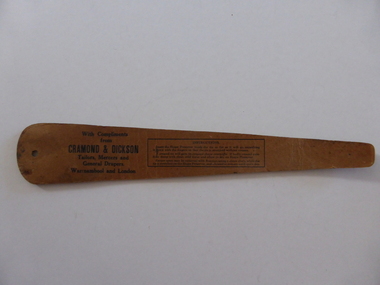
... John Glass Cramond 1829 and James Dickson 1831-1910 were founders of a large drapery store. Both were Scots and both came separately to Australia in 1852. Cramond initially came for gold but soon opened a store in St Kilda with a post Office attached and he was the first post master there. Dickson was a farmer’s son but became a draper and while he was unsuccessful on the Bendigo diggings and then returned to Melbourne where he met Cramond and soon after they opened a store on Lonsdale Street. They opened their business in Warrnambool...John Glass Cramond 1829 and James Dickson 1831-1910 were founders of a large drapery store. Both were Scots and both came separately to Australia in 1852. Cramond initially came for gold but soon opened a store in St Kilda with a post Office attached and he was the first post master there. Dickson was a farmer’s son but became a draper and while he was unsuccessful on the Bendigo diggings and then returned to Melbourne where he met Cramond and soon after they opened a store on Lonsdale Street. They opened their business in Warrnambool ...John Glass Cramond 1829 and James Dickson 1831-1910 were founders of a large drapery store. Both were Scots and both came separately to Australia in 1852. Cramond initially came for gold but soon opened a store in St Kilda with a post Office attached and he was the first post master there. Dickson was a farmer’s son but became a draper and while he was unsuccessful on the Bendigo diggings and then returned to Melbourne where he met Cramond and soon after they opened a store on Lonsdale Street. They opened their business in Warrnambool in 1855 as a general store with groceries, drapery and ironmongery. Both partners were involved with the community and James Dickson was an original director of the Warrnambool Woollen Mill 1909 and the Warrnambool Cheese and Butter Factory. He also served on the committee of management of Warrnambool Base Hospital. The business in the late 1970's. This shape preserver would have been an item given to customers to maintain their tie in good condition. The shape would indicate that it would have been used around mid 20th century.A common object from one of Warrnambool's longest established businesses.Brown cardboard in the shape of a gentleman's tie with a hanging hole on one end and black text with company details and instructions for use. front surface is smooth while the back is coarse.With Compliments from Cramond & Dickson Tailors, Mercers and general Drapers. Warrnambool and London. warrnambool, cramond & dickson -
 Warrnambool and District Historical Society Inc.
Coat Hanger, Cramond & Dickson, Early 20th century
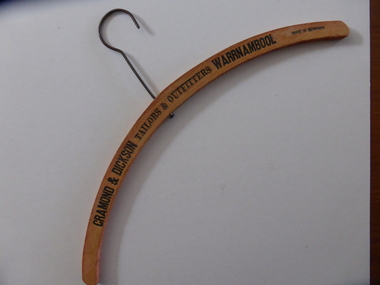
... This is a coat hanger made in Germany for the Warrnambool firm of Cramond and Dickson. John Cramond and James Dickson opened a general store in Warrnambool in 1856, selling men’s and women’s clothing, drapery and manchester and it had its own tailoring and millinery business. ...This is a coat hanger made in Germany for the Warrnambool firm of Cramond and Dickson. John Cramond and James Dickson opened a general store in Warrnambool in 1856, selling men’s and women’s clothing, drapery and manchester and it had its own tailoring and millinery business. ...This is a coat hanger made in Germany for the Warrnambool firm of Cramond and Dickson. John Cramond and James Dickson opened a general store in Warrnambool in 1856, selling men’s and women’s clothing, drapery and manchester and it had its own tailoring and millinery business. This store became a prominent one in Warrnambool for over 100 years, closing in 1973. The business operated for most of this time at the corner of Timor and Liebig Streets. This coat hanger is of great interest as a memento of the business of Cramond and Dickson, one of the most important businesses in Warrnambool’s history.This is a wooden coat hanger with a metal hook inserted in the centre of the hanger. The wood has been smoothed and stained to a light brown colour. The wood is curved and the ends are slightly tapered. The hook has a round stud at the bottom to prevent the hook from coming out of the hole. The hook is somewhat rusted. The printing on the hanger is in black.‘Cramond & Dickson Tailors & Outfitters Warrnambool Made in Germany’.cramond and dickson,, warrnambool, history of warrnambool -
 Warrnambool and District Historical Society Inc.
Domestic object - Dressing bag, Mary Glass Dickson, Circa1885
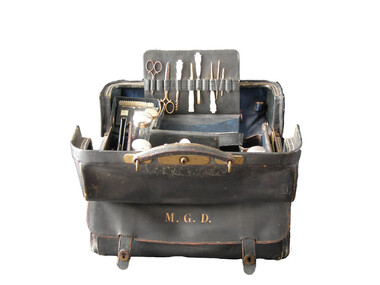
... John Glass Cramond 1829 and James Dickson 1831-1910 were founders of a large drapery store. Both were Scots and both came separately to Australia in 1852. Cramond initially came for gold but soon opened a store in St Kilda with a post Office attached and he was the first post master there. Dickson was a farmer’s son but became a draper and while he was unsuccessful on the Bendigo diggings and then returned to Melbourne where he met Cramond and soon after they opened a store on Lonsdale Street. They opened their business in Warrnambool...John Glass Cramond 1829 and James Dickson 1831-1910 were founders of a large drapery store. Both were Scots and both came separately to Australia in 1852. Cramond initially came for gold but soon opened a store in St Kilda with a post Office attached and he was the first post master there. Dickson was a farmer’s son but became a draper and while he was unsuccessful on the Bendigo diggings and then returned to Melbourne where he met Cramond and soon after they opened a store on Lonsdale Street. They opened their business in Warrnambool ...John Glass Cramond 1829 and James Dickson 1831-1910 were founders of a large drapery store. Both were Scots and both came separately to Australia in 1852. Cramond initially came for gold but soon opened a store in St Kilda with a post Office attached and he was the first post master there. Dickson was a farmer’s son but became a draper and while he was unsuccessful on the Bendigo diggings and then returned to Melbourne where he met Cramond and soon after they opened a store on Lonsdale Street. They opened their business in Warrnambool in 1855 as a general store with groceries, drapery and ironmongery. Both partners were involved with the community and James Dickson was an original director of the Warrnambool Woollen Mill 1909 and the Warrnambool Cheese and butter factory. He also served on the committee of management of Warrnambool Base Hospital. This case was a wedding gift from James Dickson Jnr to his wife Mary Glass Cramond on the occasion of their wedding. This item has significance on a number of levels. It belonged to a member of one of Warrnambool’s earliest pioneering families and it marks the occasion when the two families of Cramond and Dickson were linked through the marriage of James Dickson jnr and Mary Glass Cramond. The firm played a significant part in the development of the city and traded for nearly 150 years. It therefore has social significance to Warrnambool. The item is well provenance with the case initialed and items within the case monogrammed. The case and its items are aesthetically quite beautiful as well as being typical of travelling or dressing cases of the more well to do, of the time. Mappin & Webb were manufacturers of some standing with the Mappin name appearing in manufacturing as early as 1775.The company has held a royal warrant as silversmiths since 1897 to the present day and as crown jeweler since 2012. Throughout this time, they have manufactured quality items for the luxury market. It provides an insight into the way ladies travelled and the items which they considered essential. This consists of a black leather with leather handle attached with brass fittings. Middle opening with side pocket on one side with metal catches. Inside has removable sections for holding the numerous containers and items belonging to the case. Interior of the case is dark blue satin. The items contained within the case are as follows: 321.1 Luggage case 321.2 Glass bottle rectangular, silver monogrammed lid, empty. 321.3 Tall round glass bottle, silver monogrammed lid, empty. 321.4 Small glass bottle with pink powder, silver monogrammed lid. 321.5 Small multi sided bottle with stopper and brass hinged lid. 321.6 Tall round bottle with silver monogrammed lid. 321.7 Tall thin multi sided bottle with brass lid. 321.8 Cream coloured monogrammed jar cotton wool inside. 321.9 Clothes brush rectangular cream back. 321.10.1Glove stretcher bone coloured .10.2 Case black leather. 321.11.1 hair comb cream with silver edge .11.2 Case black leather 321.12 Hair brush cream handle 321.13Spatula cream monogrammed 321.14 Mirror, silver round with handle. 321.15 Writing compendium .1 Case black leather .2 Pen with nib .3 Lead pencil .4 Navy satin covered blotting book 321.16 Inkwell glass bottle in small black leather case. 321.17 Match striker in leather case. 321.18 Mirror in black leather case rectangular 321.19 Small case for visiting cards. 321.20Sewing kit rectangular, contains threads and needles pkts x 3 321.21Container, small, hinged tortoise shell patterned. 321.22.1 Manicure set .2 Scissors small .3 Scissors large .4Corkscrew with Mother of pearl handle .5 Pocket knife with Mother of pearl handle .6Tweezers with Mother of pearl handle .7 File with Mother of pearl handle .8 Fine hook Mother of pearl handle .9 Bodkin .10 Bodkin 321.23 Hairbrush oval silver backed 321.24 Mirror silver handled hand mirror. 321.25 Hairbrush wooden handled with Mother of pearl inlay. 321.26 Cylinder, silver with removable lid and small phial of iodine labelled Felton’s pocket iodine. 321.27 Phial small glass with gold decorations. 321.28 Inhaler with insert 321.29 Thimble, metal. 321.30 Silver backed hair brush 321.31 silver backed clothes brushEngraved on side pocket: M.G.D. Mappin and Webb Sheffield and London. Some of the items are monogrammed as per the list above. A number of the glass bottles have lids hallmarked Mappin & Webb London and Sheffield makers stamped inside lid with hall marks history of warrnambool, cramond and dickson, mary glass cramond, dressing bag, woman's toiletry bag 1880, mappin and webb -
 Warrnambool and District Historical Society Inc.
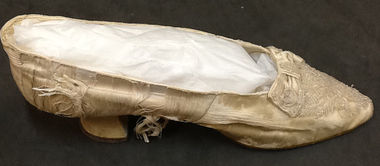
Footwear - Beaded evening shoes, 1888
... Cramond was the daughter of John Glass Cramond and his wife Frances. Her Scottish born father formed a partnership with James Dickson, also a Scotsman and founded the Cramond and Dickson store on the corner of Timor and Liebig streets Warrnambool which opened on 21st August 1865. ...Cramond was the daughter of John Glass Cramond and his wife Frances. Her Scottish born father formed a partnership with James Dickson, also a Scotsman and founded the Cramond and Dickson store on the corner of Timor and Liebig streets Warrnambool which opened on 21st August 1865. ...These shoes were worn by Mary Glass Cramond when she married James Dickson Jnr. in 1888 in the Presbyterian church in South Yarra Melbourne. Mary Cramond was the daughter of John Glass Cramond and his wife Frances. Her Scottish born father formed a partnership with James Dickson, also a Scotsman and founded the Cramond and Dickson store on the corner of Timor and Liebig streets Warrnambool which opened on 21st August 1865. The store closed in 1974. . James Dickson's parents were James and Susan. James Dickson was an original director of the Warrnambool Woollen Mill, an original guarantor and director of the Warrnambool Cheese and Butter Factory. He also served on the committee of the Warrnambool Base Hospital for nearly fifty years and was a town councillor. The Store of Cramond and Dickson was one of the most important businesses ever to have been in Warrnambool. The marriage of the daughter and son of each of the founders was an important social and romantic event.A pair of cream satin covered lady's shoes with medium height heels. The toes are gently pointed and decorated with a bow and intricate glass,clear beading.The soles are leather. Both shoes are damaged as the satin is torn and shredded.6D small twelve pointed starshoes, cramond and dickson, warrnambool, cramond -
 Warrnambool and District Historical Society Inc.
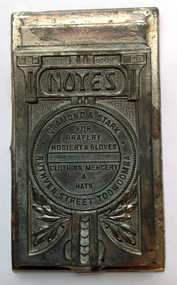
Functional object - Notepad: Cramond & Stark, 1910
... John Cramond and James Dickson established a drapery, clothing and general store in Warrnambool in 1855 and this business was a dominant one in Warrnambool until its closure in 1973. ...John Cramond and James Dickson established a drapery, clothing and general store in Warrnambool in 1855 and this business was a dominant one in Warrnambool until its closure in 1973. ...This notebook was produced for the business of Cramond and Stark of Toowoomba. John Cramond and James Dickson established a drapery, clothing and general store in Warrnambool in 1855 and this business was a dominant one in Warrnambool until its closure in 1973. A relative of John Cramond opened the drapery store of Cramond and Stark in Toowoomba, Queensland later in the 19th century and this was also a large and long-running business.This notebook is of some interest as it is connected to a business in Queensland which had its origins in Warrnambool as one of the founding partners of this business came from Warrnambool (Cramond). It is also of interest as an example of the rather elaborate advertising ploys used in the early 20th century times – the metal notebook would have been rather expensive to produce and would probably have been given away to regular customers. This is a notebook with a pad of white paper and a cardboard backing attached to a metal container. There are a silver-coloured metal back and a metal front with a hinged lid and a 1911 calendar on the back of the lid. The inscription on the front is set in an embossed edging with a circular pattern in the middle of the lid. Front of lid: ‘Notes, Cramond & Stark for Drapery Hosiery & Gloves, Clothing, Mercery & Hats, Ruthven Street, Toowoomba’cramond & dickson, cramond & stark, warrnambool -
 Warrnambool and District Historical Society Inc.
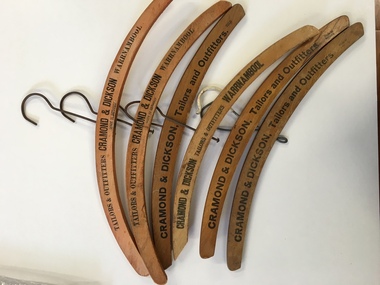
Coat Hanger, Cramond & Dickson Coat Hangers
... John Glass Cramond 1829 and James Dickson 1831-1910 were founders of a large drapery store. Both were Scots and both came separately to Australia in 1852. Cramond initially came for gold but soon opened a store in St Kilda with a post Office attached and he was the first post master there. Dickson was a farmer’s son but became a draper and while he was unsuccessful on the Bendigo diggings and then returned to Melbourne where he met Cramond and soon after they opened a store on Lonsdale Street. They opened their business in Warrnambool...John Glass Cramond 1829 and James Dickson 1831-1910 were founders of a large drapery store. Both were Scots and both came separately to Australia in 1852. Cramond initially came for gold but soon opened a store in St Kilda with a post Office attached and he was the first post master there. Dickson was a farmer’s son but became a draper and while he was unsuccessful on the Bendigo diggings and then returned to Melbourne where he met Cramond and soon after they opened a store on Lonsdale Street. They opened their business in Warrnambool ...John Glass Cramond 1829 and James Dickson 1831-1910 were founders of a large drapery store. Both were Scots and both came separately to Australia in 1852. Cramond initially came for gold but soon opened a store in St Kilda with a post Office attached and he was the first post master there. Dickson was a farmer’s son but became a draper and while he was unsuccessful on the Bendigo diggings and then returned to Melbourne where he met Cramond and soon after they opened a store on Lonsdale Street. They opened their business in Warrnambool in 1855 as a general store with groceries, drapery and ironmongery. Both partners were involved with the community and James Dickson was an original director of the Warrnambool Woollen Mill 1909 and the Warrnambool Cheese and butter factory. He also served on the committee of management of Warrnambool Base Hospital. These coathangers were an everyday item from their store. A common item which provides a link to one of Warrnambool’s largest and longest running businesses.Wooden hangers with rounded corners and metal hooks, one plastic coated. Printed names engraved and painted in black with business name.Cramond & Dickson Tailors & Outfitters Warrnambool. 2 made on America and 3 made in Germany. 1 unmarkedcramond and dickson store, warrnambool -
 Warrnambool and District Historical Society Inc.
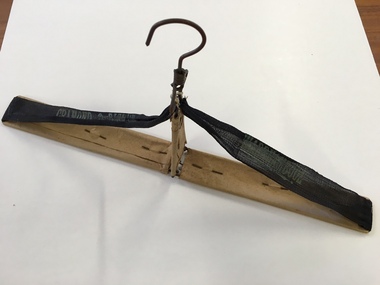
Coat Hanger, Cramond & Dickson Folding
... John Glass Cramond 1829 and James Dickson 1831-1910 were founders of a large drapery store. Both were Scots and both came separately to Australia in 1852. Cramond initially came for gold but soon opened a store in St Kilda with a post Office attached and he was the first post master there. Dickson was a farmer’s son but became a draper and while he was unsuccessful on the Bendigo diggings and then returned to Melbourne where he met Cramond and soon after they opened a store on Lonsdale Street. They opened their business in Warrnambool...John Glass Cramond 1829 and James Dickson 1831-1910 were founders of a large drapery store. Both were Scots and both came separately to Australia in 1852. Cramond initially came for gold but soon opened a store in St Kilda with a post Office attached and he was the first post master there. Dickson was a farmer’s son but became a draper and while he was unsuccessful on the Bendigo diggings and then returned to Melbourne where he met Cramond and soon after they opened a store on Lonsdale Street. They opened their business in Warrnambool ...John Glass Cramond 1829 and James Dickson 1831-1910 were founders of a large drapery store. Both were Scots and both came separately to Australia in 1852. Cramond initially came for gold but soon opened a store in St Kilda with a post Office attached and he was the first post master there. Dickson was a farmer’s son but became a draper and while he was unsuccessful on the Bendigo diggings and then returned to Melbourne where he met Cramond and soon after they opened a store on Lonsdale Street. They opened their business in Warrnambool in 1855 as a general store with groceries, drapery and ironmongery. Both partners were involved with the community and James Dickson was an original director of the Warrnambool Woollen Mill 1909 and the Warrnambool Cheese and butter factory. He also served on the committee of management of Warrnambool Base Hospital. This coathanger would have been used in their store. An everyday item linked to one of Warrnambool’s earliest and longest running businesses.Folding coathanger with metal frame covered in brown paper with black cotton tape. Cramond & Dickson Warrnambool stamped on the cotton tape.cramond and dickson, warrnambool -
 Warrnambool and District Historical Society Inc.
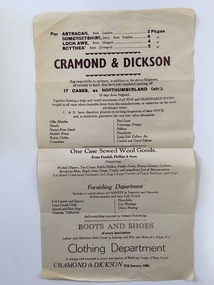
Work on paper - Document, Advertising flyer 1888 Cramond & Dickson, 1888
... These posters advertised goods available at the Cramond and Dickson store in Warrnambool in 1888. John Cramond and James Dickson came from Scotland and established a clothing and drapery store in Timor Street in Warrnambool in 1855. ...These posters advertised goods available at the Cramond and Dickson store in Warrnambool in 1888. John Cramond and James Dickson came from Scotland and established a clothing and drapery store in Timor Street in Warrnambool in 1855. ...These posters advertised goods available at the Cramond and Dickson store in Warrnambool in 1888. John Cramond and James Dickson came from Scotland and established a clothing and drapery store in Timor Street in Warrnambool in 1855. In 1865 the store moved to the corner of Liebig and Timor Streets and was a large and well known establishment until 1974 .These posters are of considerable interest as they give details of the goods available in 1888 in the Cramond and Dicksons store, one of the most important stores in Warrnambool for nearly 120 years..1 A piece of yellow paper with brown printing. .2 A piece of yellow paper with green printing. Both include details of goods for inspection..1,.2 Cramond & Dickson 27th January 1888 -
 Warrnambool and District Historical Society Inc.
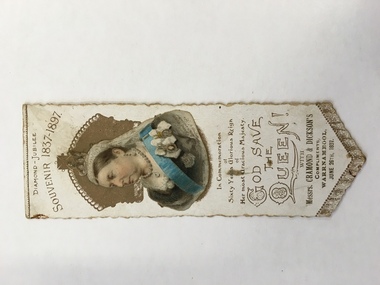
Document, Advertising bookmark 1897, 1897
... This book mark was issued by Cramond & Dickson's store Warrnambool to honour Queen Victoria's Diamond Jubilee in 1897. The Cramond & Dickson's store was established by John Cramond and James Dickson in 1855 and closed in 1974. ...This book mark was issued by Cramond & Dickson's store Warrnambool to honour Queen Victoria's Diamond Jubilee in 1897. The Cramond & Dickson's store was established by John Cramond and James Dickson in 1855 and closed in 1974. ...This book mark was issued by Cramond & Dickson's store Warrnambool to honour Queen Victoria's Diamond Jubilee in 1897. The Cramond & Dickson's store was established by John Cramond and James Dickson in 1855 and closed in 1974. The first store was in Timor Street and later moved to the corner of Liebig Street and Timor Street in 1865 . They opened a branch store in Poultry Lane in London in the 1880s. Queen Victoria ruled from 1837 to 1901. This card has social significance showing the deep ties that Warrnambool people in the 19th century felt they had with Queen Victoria and the British Empire.A sheet of cream coloured paper in the shape of a book mark with scrolled edges, gold coloured writing and a coloured image of Queen Victoria on one side and the words of God Save the Queen and some musical notation on the other side . DIAMOND JUBILEE SOUVENIR 1837- 1897 With Messrs. Cramond & Dickson's Compliments cramond and dickson's store warrnambool -
 Warrnambool and District Historical Society Inc.
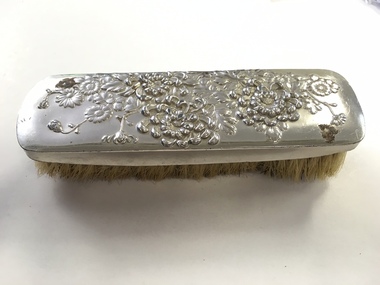
Clothes Brush
... It was given to her on the occasion of her wedding to James Dickson in 1888 The case was present from her future husband..Mary Dickson's father John Cramond was a partner with her father in law James Dickson Snr. when they established a general store in Warrnambool in 1856. ...It was given to her on the occasion of her wedding to James Dickson in 1888 The case was present from her future husband..Mary Dickson's father John Cramond was a partner with her father in law James Dickson Snr. when they established a general store in Warrnambool in 1856. ...This item is one of many items in a travelling case that belonged to Mary Glass Dickson nee Cramond 1865- 1959. It was given to her on the occasion of her wedding to James Dickson in 1888 The case was present from her future husband..Mary Dickson's father John Cramond was a partner with her father in law James Dickson Snr. when they established a general store in Warrnambool in 1856. This store known as Cramond and Dickson was a prominent and elegant one in Warrnambool until it closed in 1973. This item is of considerable significance as it is part of an important artifact, a travelling case belonging to Mary Dickson an early member of the Warrnambool pioneering Cramond and Dickson families This is a silver backed clothes brush with horse hair bristles. The silver section is embossed on the top with floral decorations. It is slightly stained. mary dickson nee cramond -
 Warrnambool and District Historical Society Inc.
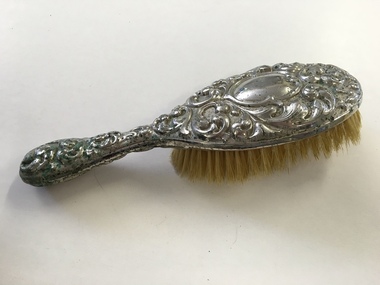
Hair Brush, 1880s
... Mary Dickson's father John Cramond was a partner with her father in law. James Dickson snr. when they established a general store in Warrnambool in 1856. ...Mary Dickson's father John Cramond was a partner with her father in law. James Dickson snr. when they established a general store in Warrnambool in 1856. ...This is one of many items in a travelling case that belonged to Mary Glass Dickson Nee Cramond !865 - 1959. It was given to her on the occasion of her wedding to James Dickson in 188 The case was a present from her future husband. Mary Dickson's father John Cramond was a partner with her father in law. James Dickson snr. when they established a general store in Warrnambool in 1856. The store known as Cramond and Dickson was a prominent and elegant one in Warrnambool until it closed in 1973 This item is of considerable interest as it is part of an important artifact, a travelling case belonging to Mary Dickson an early member of the Warrnambool pioneering Cramond and Dickson families.This is a oval shaped hair brush with an embossed silver- coloured back and handle and horse hair bristles. Some of the horse hair is missing from the right side. The metal back and handle are somewhat tarnished cramond and dickson, warrnambool -
 Warrnambool and District Historical Society Inc.
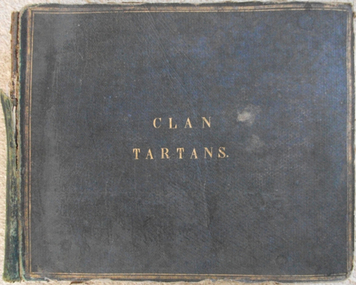
Book - Clan Tartans, Mid 19th Century
... This book containing tartan fabric samples belonged to the Warrnambool firm of Cramond and Dickson. It is presumed to have been brought from Scotland to Warrnambool by either John Glass Cramond or James Dickson Snr. for use in their Department Store where customers could choose which tartan they preferred. ...This book containing tartan fabric samples belonged to the Warrnambool firm of Cramond and Dickson. It is presumed to have been brought from Scotland to Warrnambool by either John Glass Cramond or James Dickson Snr. for use in their Department Store where customers could choose which tartan they preferred. ...This book containing tartan fabric samples belonged to the Warrnambool firm of Cramond and Dickson. It is presumed to have been brought from Scotland to Warrnambool by either John Glass Cramond or James Dickson Snr. for use in their Department Store where customers could choose which tartan they preferred. It is obvious that it has been well used as pieces have been cut from some samples. Tartan clothing has been a favourite over many years used for fashion garments and children's clothing in addition to its use in traditional Highland dress. The firm of Cramond and Dickson was established as a general store in 1855 and closed in 1974.This book is of considerable significance as it is our earliest memento (1850) of the prominent Warrnambool firm of Cramond and Dickson, a business that operated for 119 years.This is a hard cover book with a dark coloured leather cover with gold printing and a much damaged spine. Inside the cover is a mottled pattern. The pages contain some hand written information and swatches of tartan fabric pasted on separate pages. Some of the tartan samples have had pieces cut off. The pages have the name of the tartan and other annotations. There is one loose page.cramond and dickson warrnambool, tartan -
 Warrnambool and District Historical Society Inc.
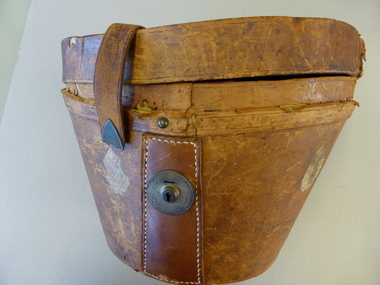
Textile - Clothing, Top Hat and Box, Early 20th Century
... Cramond’ is misspelt on the hat itself). John Glass Cramond and James Dickson established their clothing and drapery and ironmongery business in Warrnambool in 1855 and it continued to operate in Liebig Street until 1974. ...Cramond’ is misspelt on the hat itself). John Glass Cramond and James Dickson established their clothing and drapery and ironmongery business in Warrnambool in 1855 and it continued to operate in Liebig Street until 1974. ...This hat belonged to a Warrnambool undertaking firm, Beattie and Phillips. This firm was established by Christopher Beattie and Henry Phillips in 1865 and was originally situated in Koroit Street. Beattie’s son, James, took over the business in 1916 and moved to new premises at 82 Fairy Street about 1928. In 1945 the business management was transferred to James Leahy and the firm continued until 2000. The top hat was used by both James Beattie and James Leahy and would have been one of several used by the employees in this undertaking business. The suppliers of the hat were Cramond and Dickson (note that the name ‘Cramond’ is misspelt on the hat itself). John Glass Cramond and James Dickson established their clothing and drapery and ironmongery business in Warrnambool in 1855 and it continued to operate in Liebig Street until 1974. This is a highly significant item for three reasons: 1. It belonged to, and was used by, two directors of the undertaking firm of Beattie and Phillips, a most prominent business in Warrnambool for 135 years 2. It was supplied by the firm of Cramond and Dickson, a dominant retail shop in Warrnambool for 119 years 3. It is an important example of a social custom of the past – the wearing of formal wear, including a top hat, by funeral employees (even to the extent of taking the hat by rail for funerals etc outside of Warrnambool) This is a black top hat with paper and silk inserts in the inside crown and a brown leather lining stitched on to the inside of the brim. There is black corded ribbon around the brim and around the outside of the hat. The brim is made of felt with the crown showing a shiny pile. There is a small round metal insert on the top of the crown. A piece of a newspaper dated 1st January 1931 is stitched into the inside of the brimInside the hat on the bottom of the crown – ‘Extra Quality’; ‘Crammond (sic) & Dickson Warrnambool’ with a stamp logo on the silk – a British logo with a lion and a unicorn with the words – ‘Honi Soit Qui Mal Y Pense’ and ‘Dieu et Mon Droit’ In biro on inside crown are the letters ‘J.L.’ undertaker's hat, beattie and phillips, christopher beattie, henry phillips, warrnambool history -
 Warrnambool and District Historical Society Inc.
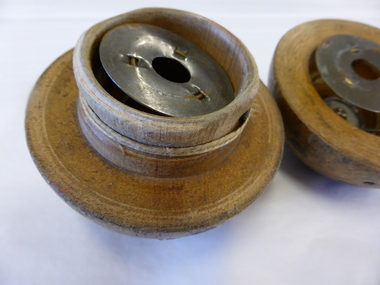
Equipment - money ball, Wooden Money Ball Cramond & Dickson, Late 19th century/Early 20th century
... John Cramond and James Dickson, both from Scotland, established a general store in Warrnambool in 1855 in Timor Street. ...John Cramond and James Dickson, both from Scotland, established a general store in Warrnambool in 1855 in Timor Street. ...This wooden cash ball came from the retail business of Cramond and Dickson. It was part of the mechanism for sending money and change to and from the customer to a shop assistant dealing with the finances. The ball ran along sloping rails in the shop. John Cramond and James Dickson, both from Scotland, established a general store in Warrnambool in 1855 in Timor Street. The business was later transferred to the corner of Liebig and Timor Streets and became a well-known landmark in Warrnambool, closing in 1973. This item is significant as it came from one of the most important businesses in Warrnambool’s retail history – that of Cramond and Dickson. It also is an important example of retail store practice in the late 19th century and early 20th century. This is a cylindrical wooden ball which separates into two parts to allow the insertion of money in the middle. There is a round metal disc which is housed in the centre of the wooden ball.It has a circle marked on the outer surface of both semi circles of the ball. It is brown in colour. On both halves of the ball on the outside – ‘D 4’cramond and dickson, warrnambool, money ball -
 Warrnambool and District Historical Society Inc.
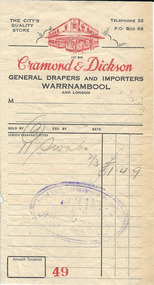
Document, Docket Cramond & Dickson, Mid 20th century
... This is a docket issued by the firm of Cramond and Dickson, probably to the Warrnambool Club. John Cramond and James Dickson established their general store in Warrnambool in 1855 and was a major business in Warrnambool (firstly in Timor Street and then in Liebig Street) until 1973. ...This is a docket issued by the firm of Cramond and Dickson, probably to the Warrnambool Club. John Cramond and James Dickson established their general store in Warrnambool in 1855 and was a major business in Warrnambool (firstly in Timor Street and then in Liebig Street) until 1973. ...This is a docket issued by the firm of Cramond and Dickson, probably to the Warrnambool Club. John Cramond and James Dickson established their general store in Warrnambool in 1855 and was a major business in Warrnambool (firstly in Timor Street and then in Liebig Street) until 1973. A branch of the business was opened in London about 1868. This docket is of interest as an example of the business dealings of the Liebig Street store of Cramond and Dickson, an important business in Warrnambool for over 100 years, This is a docket from a pad or book, sent by Cramond and Dickson to an unknown customer. It probably was duplicated using carbon paper. The paper is yellowing with black printed ruled lines, other red and black printing, a ‘paid’ stamp that is illegible and an image in red printing of the Cramond and Dickson store. The items sold and the cost have been written in pencil‘The city’s quality store, Telephone 32, P.O. Box 69, est. 1854, Cramond & Dickson, General Drapers and Importers, Warrnambool and London, M……. sold by 9, 11 swabs, 2/3, £1-4-9, Amount Tendered, 49’. cramond and dickson store, warrnambool -
 Warrnambool and District Historical Society Inc.
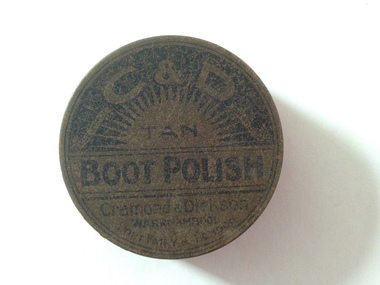
Tin, Boot polish Cramond & Dickson, Early 20th century
... This tan boot polish was sold under the brand name of ‘C & D’ at the general store of Cramond and Dickson in Liebig Street, Warrnambool. John Glass Cramond and James Dickson established their business in Warrnambool in 1855 and this general store operated (firstly in Timor Street and later in Liebig Street) until 1973, making it one of the longest-running and one of the most important businesses in Warrnambool’s history. ...This tan boot polish was sold under the brand name of ‘C & D’ at the general store of Cramond and Dickson in Liebig Street, Warrnambool. John Glass Cramond and James Dickson established their business in Warrnambool in 1855 and this general store operated (firstly in Timor Street and later in Liebig Street) until 1973, making it one of the longest-running and one of the most important businesses in Warrnambool’s history. ...This tin of boot polish was a common household item in the 20th century (and is still used to a lesser extent today). This tan boot polish was sold under the brand name of ‘C & D’ at the general store of Cramond and Dickson in Liebig Street, Warrnambool. John Glass Cramond and James Dickson established their business in Warrnambool in 1855 and this general store operated (firstly in Timor Street and later in Liebig Street) until 1973, making it one of the longest-running and one of the most important businesses in Warrnambool’s history. By 1868 a London agency had been established and direct imports from England began on a large scale. Many of the articles they sold, including the boot polish, were made expressly for the Cramond and Dickson store. This tin of boot polish is of great interest as an example of the goods sold by Cramond and Dickson that were made expressly for the Warrnambool store. Cramond and Dickson were one of the most important stores ever to operate in Warrnambool.This is a round metal tin originally gold-coloured and with a red tape binding to prevent its opening. The front of the tin has printing and the image of a stylized rising sun and the bottom has more printing. The bottom of the tin is indented to allow the tin to rest on the rim only. The printing is legible but much faded. The tin contains the original polish. Top: ‘Use only C & D brand of Tan Boot Polish, Cramond & Dickson, Warrnambool. Port Fairy and London’ Bottom: ‘For best results remove all dust, apply a little C & D dressing, brush briskly. Rubbing finally with a soft cloth produces a brilliant surface. Weight when packed 1½ ozs. net’ cramond and dickson store -
 Warrnambool and District Historical Society Inc.
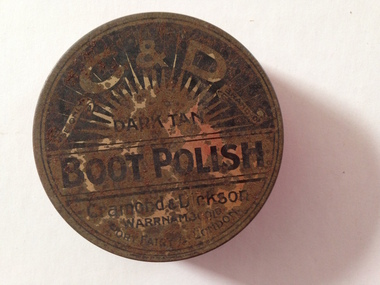
Tin, Boot polish Cramond & Dickson
... This dark tan boot polish was sold under the brand name of ‘C & D’ at the general store of Cramond and Dickson in Liebig Street, Warrnambool. John Glass Cramond and James Dickson established their business in Warrnambool in 1855 and this general store operated (firstly in Timor Street and later in Liebig Street) until 1973, making it one of the longest-running and one of the most important businesses in Warrnambool’s history. ...This dark tan boot polish was sold under the brand name of ‘C & D’ at the general store of Cramond and Dickson in Liebig Street, Warrnambool. John Glass Cramond and James Dickson established their business in Warrnambool in 1855 and this general store operated (firstly in Timor Street and later in Liebig Street) until 1973, making it one of the longest-running and one of the most important businesses in Warrnambool’s history. ...A tin of boot polish was a common household item in the 20th century (and is still in use to a lesser extent today). This dark tan boot polish was sold under the brand name of ‘C & D’ at the general store of Cramond and Dickson in Liebig Street, Warrnambool. John Glass Cramond and James Dickson established their business in Warrnambool in 1855 and this general store operated (firstly in Timor Street and later in Liebig Street) until 1973, making it one of the longest-running and one of the most important businesses in Warrnambool’s history. By 1868 a London agency had been established and direct imports from England began on a large scale. Many of the articles they sold, including the boot polish, were made expressly for the Cramond and Dickson store.This tin of boot polish is of great interest as an example of the goods sold by Cramond and Dickson that were made expressly for the Warrnambool store. Cramond and Dickson were one of the most important stores ever to operate in Warrnambool. This is a round metal tin, originally gold-coloured and with a red tape binding to prevent its opening. The front of the tin has printing and the image of a stylized rising sun and the bottom has more printing. The bottom of the tin is indented to allow the tin to rest on the rim only. The printing is legible but much faded. The tin contains the original polish. Top: ‘Use only C & D brand of Dark Tan Boot Polish, Cramond & Dickson, Warrnambool, Port Fairy and London’ Bottom: ‘For best results remove all dust, apply a little C & D dressing, brush briskly. Rubbing finally with a soft cloth produces a brilliant surface. Weight when packed 1½ ozs. net’ cramond and dickson store, warrnambool -
 Warrnambool and District Historical Society Inc.
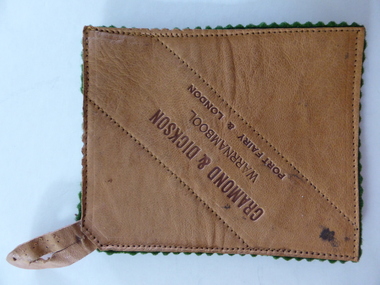
Souvenir, Oven Mitt, Early 20th century
... cramond & dickson stores, warrnambool, port fairy, london...history of warrnambool...john... This is a product that was sold in the general store of Cramond and Dickson in Warrnambool early in the 20th century and produced for this store at the time. It may also have been given to customers as an advertising feature. John...Warrnambool, including Port Fairy. It also opened a branch store in London, enabling it to import materials and other items direct from London. The Cramond and Dickson store in Warrnambool closed in 1973. This mitt is of considerable interest as it is a sample of the wares and advertising articles coming from the general store of Cramond and Dickson of Warrnambool. This store was of great importance in Warrnambool as a dominant business in the town/city for over 100 years. cramond & dickson stores, warrnambool, port fairy, london history of warrnambool john ...This is a product that was sold in the general store of Cramond and Dickson in Warrnambool early in the 20th century and produced for this store at the time. It may also have been given to customers as an advertising feature. John Glass Cramond and James Dickson established a drapery store in Warrnambool in 1855, firstly in Timor Street and then in Liebig Street. It specialized in men’s and women’s clothing and drapery and had a tailoring and millinery business. The store opened branches in several towns in the vicinity of Warrnambool, including Port Fairy. It also opened a branch store in London, enabling it to import materials and other items direct from London. The Cramond and Dickson store in Warrnambool closed in 1973. This mitt is of considerable interest as it is a sample of the wares and advertising articles coming from the general store of Cramond and Dickson of Warrnambool. This store was of great importance in Warrnambool as a dominant business in the town/city for over 100 years. This is a rectangular-shaped oven mitt with light brown leather on one side and a green-coloured felt-like material with a fluted edge on the other side. The mitt has machine stitching diagonally across both sides and machine stitching around the edges. A leather looped tag is attached at one corner so that the mitt can be hung up. The reddish-brown printing on the leather side of the mitt is stamped into the leather. The leather side is a little stained. ‘Cramond & Dickson. Warrnambool, Port Fairy & London’ cramond & dickson stores, warrnambool, port fairy, london, history of warrnambool, john glass cramond, james dickson -
 Warrnambool and District Historical Society Inc.
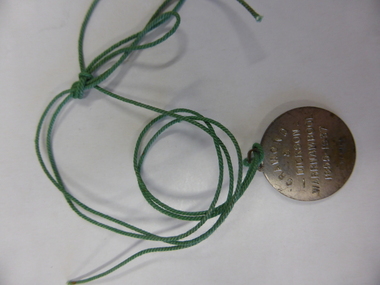
Medal, Medal (George VI Coronation), 1937
... It was issued by a department store in Warrnambool, that of Cramond and Dickson. This business was established by John Glass Cramond and James Dickson in Timor Street, Warrnambool in 1855. ...It was issued by a department store in Warrnambool, that of Cramond and Dickson. This business was established by John Glass Cramond and James Dickson in Timor Street, Warrnambool in 1855. ...This medal has been issued to commemorate the Coronation of King George VI of England in 1937. It was issued by a department store in Warrnambool, that of Cramond and Dickson. This business was established by John Glass Cramond and James Dickson in Timor Street, Warrnambool in 1855. It moved to Liebig Street at the corner of Timor Street and sold mens and ladies wear. It had its own tailors and milliners and the building was a landmark one in Warrnambool for over 100 years. It closed in 1973. In 1937 the business of Cramond and Dickson was 82 years old. This medal is of great interest as it shows the level of fervor for British Royalty and all things British that was prevalent in Warrnambool in the 1930s. The Cramond and Dickson business was one of the most important ones in Warrnambool’s history as it operated for over 100 years. This is a silver-coloured medal commemorating the Coronation of King George VI of England. One side has the heads of King George and Queen Elizabeth surrounded by wording and the other side has the name of the Warrnambool store issuing the medal. The medal is tarnished. A piece of green string is attached to the hook at the top of the medal. ‘King George VI Queen Elizabeth Coronation 1937’ ‘Cramond & Dickson Warrnambool 1855-1937’ ‘P.J.King’ cramond and dickson, king george vi coronation, history of warrnambool -
 Warrnambool and District Historical Society Inc.
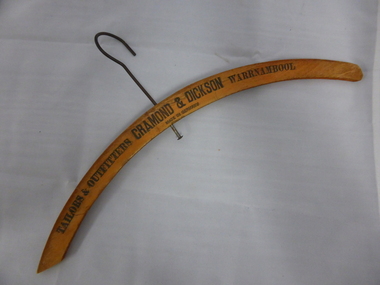
Artefact, Coat Hanger Cramond & Dickson, Mid 20th century
... This coat hanger has been used in the Warrnambool department store of Cramond and Dickson. John Glass Cramond and James Dickson established a shop in Warrnambool in 1855 in Timor Street and moved to Liebig Street a few years later. ...This coat hanger has been used in the Warrnambool department store of Cramond and Dickson. John Glass Cramond and James Dickson established a shop in Warrnambool in 1855 in Timor Street and moved to Liebig Street a few years later. ...This coat hanger has been used in the Warrnambool department store of Cramond and Dickson. John Glass Cramond and James Dickson established a shop in Warrnambool in 1855 in Timor Street and moved to Liebig Street a few years later. New premises were erected in 1878 and the department store selling mens and ladies wear on the corner of Liebig and Timor Streets was a landmark building in Warrnambool until the business closed in 1973. Cramond and Dickson had their own tailors and milliners. This coat hanger is of interest as a memento of the store of Cramond and Dickson, a business that operated in Warrnambool for over 100 years. This is a wooden coat hanger in a curved shape with a part of the wood at one end missing. The centre of the hanger has a hole pierced through with a metal hook inserted for hanging on to a rod. The hook is somewhat rusted. The maker’s name is printed on the hanger in black lettering. ‘Tailors & Outfitters Cramond & Dickson Warrnambool Made in Germany’ cramond and dickson, history of warrnambool -
 Warrnambool and District Historical Society Inc.
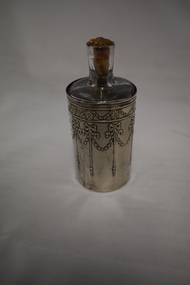
Perfume bottle, Glass & silver
... Warrnambool family. She was the daughter of Mary Glass Cramond and James Dickson. Her grandfathers, John Cramond and James Dickson, established a clothing and drapery store in Warrnambool in the 1850s and it continued as a major business in Liebig Street, Warrnambool until 1973. ...Warrnambool family. She was the daughter of Mary Glass Cramond and James Dickson. Her grandfathers, John Cramond and James Dickson, established a clothing and drapery store in Warrnambool in the 1850s and it continued as a major business in Liebig Street, Warrnambool until 1973. ...This item is an attractive one and has belonged to someone who was a more affluent member of society. It is an item that would have been kept in a bedroom on a dresser or table. It is surmised that the ‘H.D’ stands for Hope Dickson, a member of a prominent Warrnambool family. She was the daughter of Mary Glass Cramond and James Dickson. Her grandfathers, John Cramond and James Dickson, established a clothing and drapery store in Warrnambool in the 1850s and it continued as a major business in Liebig Street, Warrnambool until 1973. As an elderly woman in the 1970s, Hope Dickson donated many household and personal items to the Warrnambool and District Historical Society and this perfume bottle may be one of them. This item is significant because it is a high-quality household item that dates back 100 years. If it belonged to Hope Dickson then this local provenance gives it added importance. This is a glass bottle with a covering silver holder. The bottle body is round with two straight pieces on either side. The neck is rounded and short and the opening has a cork stopper that extends down the neck. The silver folder, which is cylindrical, covers the entire base of the bottle and is open at both ends. The silver holder has impressed silver patterns (chains, bows and discs).The bottle slides into the folder which is slightly rusted inside.‘H.D.’women’s boudoir items, perfume bottle, history of warrnambool
