
Showing 35 items matching "john gellibrand"
-
 Melbourne Legacy
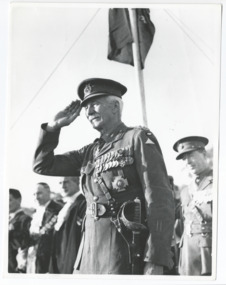
Photograph, Major-General Sir John Gellibrand K.C.B.,D.S.O. & Bar, 194
... Major-General Sir John Gellibrand K.C.B.,D.S.O. & Bar....sir john gellibrand...Photograph of General Sir John Gellibrand and L/- Stan Savige (at far right) at an unknown event that appears to be also attended by a mayor. ...Black and white photo of General Sir John Gellibrand....Handwritten on the reverse: 'General Sir John Gellibrand. SGS at rear' in blue pen. Also '545' in pencil. ...Black and white photo of General Sir John Gellibrand. Major-General Sir John Gellibrand K.C.B.,D.S.O. & Bar. ...Photograph of General Sir John Gellibrand and L/- Stan Savige (at far right) at an unknown event that appears to be also attended by a mayor. From Wikipedia: Major General Sir John Gellibrand, KCB, DSO & Bar (5 December 1872 – 3 June 1945) was a senior Australian Army officer in the First World War, Chief Commissioner of the Victoria Police from 1920 to 1922, and a member of the Australian House of Representatives, representing the Tasmanian Division of Denison for the Nationalist Party from 1925 to 1928. Concerned about the plight of fellow ex-servicemen, whose businesses were often failing, Gellibrand banded together with like-minded individuals to form the Hobart Remembrance Club. This organisation aimed to support ex-servicemen by providing employment and support for their businesses. The Hobart Club inspired the formation of Legacy Australia in Melbourne, which over time became a national movement, expanding its scope to the care of ex-servicemen's widows and their families. Sir John Gellibrand is considered to have influenced Stanley Savige to commence the process to form Legacy in September 1923. Melbourne was the first Legacy club to form.Black and white photo of General Sir John Gellibrand.Handwritten on the reverse: 'General Sir John Gellibrand. SGS at rear' in blue pen. Also '545' in pencil. Stamped with copyright of The Leader in red ink, and 'Property of Melbourne Legacy. Please return this correspondence to Executive Officer' in purple ink.sir john gellibrand, remembrance club -
 Melbourne Legacy
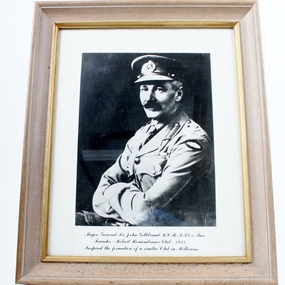
Photograph - Portrait, Major-General Sir John Gellibrand K.C.B.,D.S.O. & Bar
... Major-General Sir John Gellibrand K.C.B.,D.S.O. & Bar....john gellibrand...Photo of Major-General Sir John Gellibrand taken in uniform. He established the Hobart Remembrance Club in 1923, which was an instant success. ...Major-General Sir John Gellibrand K.C.B.,D.S.O. & Bar. Founder - Hobart Remembrance Club - 1923 Inspired the formation of a similar Club in Melbourne...The first Legacy Club formed in Australia. john gellibrand portrait Major-General Sir John Gellibrand K.C.B.,D.S.O. & Bar. ...Photo of Major-General Sir John Gellibrand taken in uniform. He established the Hobart Remembrance Club in 1923, which was an instant success. Gellibrand wrote to Stanley Savige who had been Gellibrand’s Staff Captain and suggested he should do something similar in Melbourne.Of national significance as Gellibrand is considered to have influenced Stanley Savige to commence the process to form Melbourne Legacy in September 1923. The first Legacy Club formed in Australia.Wooden framed black and white photograph of Major-General Gellibrand in uniform.Major-General Sir John Gellibrand K.C.B.,D.S.O. & Bar. Founder - Hobart Remembrance Club - 1923 Inspired the formation of a similar Club in Melbournejohn gellibrand, portrait -
 Melbourne Legacy
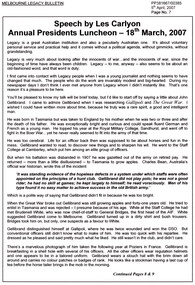
Article - Speech, Past Presidents' Lunch - Les Carlyon, 2007
... Sir John Gellibrand...He chose to talk about Sir John Gellibrand and his war service and personality. ...He chose to talk about Sir John Gellibrand and his war service and personality. ...A copy of an article from the Bulletin recounting the speech by Les Carlyon at the Past Presidents' lunch on 18th March 2007. He chose to talk about Sir John Gellibrand and his war service and personality. He quoted Charles Bean in 1944 "There was a time when some of us thought that the best monument to John Gellibrand might be the story of Second Bullecourt. Now I feel there will be an event better monument - the record of Legacy." Document was from a folder of documents donated to the archive by Legatee Bill Rogers that related to his time as President (March 2006 - March 2008).A record of John Gellibrand's war service in WW1.Three A4 page photocopy of an article published in the Bulletin 5 April 2007 of a speech by Les Carlyon at the Past Presidents' lunch on 18 March 2007.sir john gellibrand, charles bean -
 Bendigo Historical Society Inc.
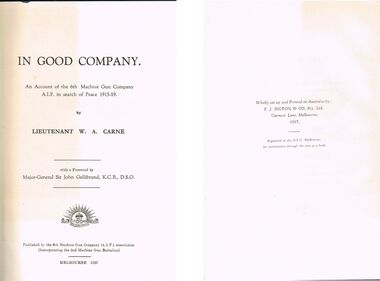
Book - LYDIA CHANCELLOR COLLECTION: IN GOOD COMPANY BY W.A. CARNE
... Carne / the 6th Machine Gun Company A.I.F / Major - General Sir John Gellibrand / F J Hilton & Co Melbourne 1937...In search of Peace 1915-19 / forward by Major - General Sir John Gellibrand , published by the 6th Machine Gun Company A.I.F association Melbourne 1937 / Published by F J Hilton & Co Melbourne 1937 / includes newspaper clipping dated 14.8.1937 'Another War Book'....Carne / the 6th Machine Gun Company A.I.F / Major - General Sir John Gellibrand / F J Hilton & Co Melbourne 1937 military war Machine Gun Company 'Lydia Chancellor Collection ' signed copy of a -Book -'In Good Company ' by W.A. ...'Lydia Chancellor Collection ' signed copy of a -Book -'In Good Company ' by W.A. Carne Hard bound blue covered book with gold lettering - plain brown paper dust cover / 'an account of the 6th Machine Gun Company A.I.F. In search of Peace 1915-19 / forward by Major - General Sir John Gellibrand , published by the 6th Machine Gun Company A.I.F association Melbourne 1937 / Published by F J Hilton & Co Melbourne 1937 / includes newspaper clipping dated 14.8.1937 'Another War Book'.books, military, world war 2, lydia chancellor collection, collection, -book -'in good company ' by w.a. carne / the 6th machine gun company a.i.f / major - general sir john gellibrand / f j hilton & co melbourne 1937, military, war, machine gun company -
 Melbourne Legacy
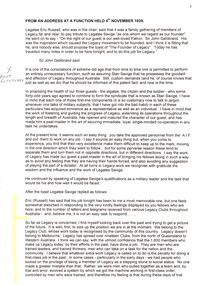
Document, From an address at a function held 4th November 1939, 2006
... ...Sir John Gellibrand...It shows Sir John Gellibrand as patron of Legacy giving a toast to Stan Savige, as the Founder of Legacy. ...It shows Sir John Gellibrand as patron of Legacy giving a toast to Stan Savige, as the Founder of Legacy. ...A typed copy of the speeches given on 4th November 1939 to farewell Stan Savige as he returned to the Army. It shows Sir John Gellibrand as patron of Legacy giving a toast to Stan Savige, as the Founder of Legacy. It includes Stan Savige's response which encompassed his views for the future of Legacy and the challenges coming during the war. Other copies in original documents are in the archive. Legatee Bill Rogers may have used parts of the speeches in his time as President. Document was from a folder of documents donated to the archive by Legatee Bill Rogers that related to his time as President (March 2006 - March 2008).An important link to Legatee Stan Savige, the founder of Legacy as well as the famous soldier, at a watershed moment in his life.Print out x 4 pages of a speech to toast Stan Savige as he returned to the Army in 1939.stan savige, sir john gellibrand, toast, speeches -
 Melbourne Legacy
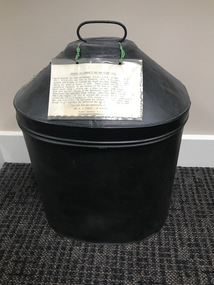
Container - Case, Major-General Gellibrand's Cap and Helmet Case
... ...john gellibrand...Major-General Sir John Gellibrand KCB, DSO and Bar, D. de G(Fr), DSM (US), was born in Tasmania in 1874. ...Major-General Sir John Gellibrand KCB, DSO and Bar, D. de G(Fr), DSM (US), was born in Tasmania in 1874. ...The black tin helmet case is an object owned by Major-General Gellibrand who motivated Legatee Stan Savige to found Legacy. Major-General Sir John Gellibrand KCB, DSO and Bar, D. de G(Fr), DSM (US), was born in Tasmania in 1874. After schooling in England and Germany he entered then Royal Military College, Sandhurst, taking the Sword of Honour in 1893. Commissioned into the South Lancashire Regiment, he saw service in the Boer War, 1900. This case which would carry a service cap, a dress cap and a pith helmet dates from that period. Moving to the Manchester Regiment in 1902, Captain Gellibrand then attended Staff College, Camberley 1906-7 and was posted DAA and QMG Ceylon. In 1912 he retired and returned to Tasmania. He joined the AIF as a Captain in 1914, served in 24th Battalion and commanded 6th Brigade and then 3rd Division. He motivated his erstwhile Staff Captain Stan Savige to get together the Melbourne men who founded Legacy in 1923. This Hat Box was generously donated by Mr W C Steele of Wangaratta. Former Captain AIF. Melbourne Legacy keeps the case on display in the main reception foyer.The helmet case being on prominent display at Melbourne Legacy shows the respect Legacy holds for Major-General Gellibrand.Black tin case that contained Major-General Gellibrand's Cap and Helmet. Has two compartments separated by a flap that can lift.Typed label in plastic sleeve attached by green twine.helmet, case, john gellibrand -
 Victorian Aboriginal Corporation for Languages
Book, James Bonwick, Discovery and settlement of Port Phillip : being a history of the country now called Victoria, up to the arrival of Mr. Superintendent Latrobe, in October, 1839, 1999
... John Batman...Joseph Gellibrand...William Buckley John Batman Joseph Gellibrand John Pascoe Fawkner Victorian history Melbourne history Port Phillip religion Merri Creek James Bonwick Maps, b&w illustrations Contains a general history of the early Port Phillip district, including many references to Aboriginal peoples. ...Contains a general history of the early Port Phillip district, including many references to Aboriginal peoples. Edited version of original 19th century notes by James Bonwick.Maps, b&w illustrationswilliam buckley, john batman, joseph gellibrand, john pascoe fawkner, victorian history, melbourne history, port phillip, religion, merri creek, james bonwick -
 Melbourne Legacy
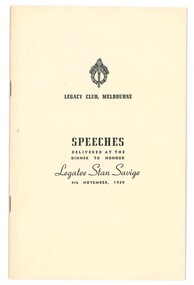
Document, Speeches delivered at the dinner to honour Legatee Stan Savige, 1939
... The speeches were given by Legatee Eric Russell as Legacy President in 1939, Sir John Gellibrand and a response by Stan Savige. The introduction by Legatee Russell mentions that Legacy Patron, Sir John Gellibrand 'had the inspiration which caused the Legacy movement' and Stan Savige was revered as the Founder of Legacy. ...The speeches were given by Legatee Eric Russell as Legacy President in 1939, Sir John Gellibrand and a response by Stan Savige. The introduction by Legatee Russell mentions that Legacy Patron, Sir John Gellibrand 'had the inspiration which caused the Legacy movement' and Stan Savige was revered as the Founder of Legacy. ...Speeches printed after a dinner to honour Legatee Stan Savige. The dinner on Saturday 4 November 1939 was held to celebrate Brigadier Savige's appointment to Command the 17th Infantry Brigade, 6th Division, 2nd AIF. The speeches were given by Legatee Eric Russell as Legacy President in 1939, Sir John Gellibrand and a response by Stan Savige. The introduction by Legatee Russell mentions that Legacy Patron, Sir John Gellibrand 'had the inspiration which caused the Legacy movement' and Stan Savige was revered as the Founder of Legacy. Savige's response includes that he received the inspiration from Gellibrand in a letter (not as is commonly related that he visited Hobart). Savige's subsequent exploits in WWII are detailed in Chapter 4 of 'There goes a man' by W.B. Russell, which chronicles not only battles fought but also the politics which blighted his command until the end of the war.An important link to Legatee Stan Savige, the founder of Legacy as well as the famous soldier, at a watershed moment in his life.Cream booklet x 2 copies of speeches at a dinner held for Stan Savige in 1939.stan savige, speeches, legatee function, dinner -
 Melbourne Legacy
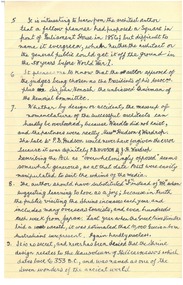
Document, Legatee Frank Doolan notes on the Shrine of Remembrance
... Note No. 10 refers to the founding of Melbourne Legacy being erroneously attributed to Sir John Gellibrand. The pages are undated but refute in detail many of claims made by the 'architect author'. ...Note No. 10 refers to the founding of Melbourne Legacy being erroneously attributed to Sir John Gellibrand. The pages are undated but refute in detail many of claims made by the 'architect author'. ...Handwritten notes signed by Frank Doolan in response to an unnamed article on the building of the Shrine of Remembrance. A first page of notes is missing, indicated by the notes being numbered 5-14. Note No. 10 refers to the founding of Melbourne Legacy being erroneously attributed to Sir John Gellibrand. The pages are undated but refute in detail many of claims made by the 'architect author'. Doolan clearly feels passionate about the Shrine and Legacy's links to it and has very detailed knowledge about the building as he was a surveyor who worked on the building. An item from Legatee Frank Doolan, who was on the archive committee and made attempts to collate the history of Legacy. Illustrates the activities of Melbourne Legacy in the wider community, particularly in relation to the Shrine of Remembrance.3 handwritten sheets, blue/black ink on white lined note paper.history, shrine of remembrance -
 Melbourne Legacy
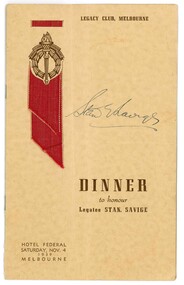
Document - Menu card, Dinner to honour Legatee Stan Savige, 1939
... The menu is included and the order of service with speeches by Sir John Gellibrand and a response by Stan Savige. ...The menu is included and the order of service with speeches by Sir John Gellibrand and a response by Stan Savige. A copy of both are also in the archive. ...The dinner on Saturday 4 November 1939 was held to celebrate Brigadier Savige's appointment to Command the 17th Infantry Brigade, 6th Division, 2nd AIF. The menu is included and the order of service with speeches by Sir John Gellibrand and a response by Stan Savige. A copy of both are also in the archive. There are five quotes through menu that sum up common sentiments of Stan Savige. Including 'Leave it to me and my little playmate'; 'This is the tamest fight I've seen - let's liven it up'; 'The only "experience" is trust in God then trial and error.' Savige's subsequent exploits in WWII are detailed in Chapter 4 of 'There goes a man' by W.B. Russell, which chronicles not only battles fought but also the politics which blighted his command until the end of the war. An important link to Legatee Stan Savige, the founder of Legacy as well as the famous soldier, at a watershed moment in his life.Cream card with red medal ribbon insert, brown print of a menu and programme to farewell Stan Savige in 1939.Signed in pencil by Stan Savige.stan savige, legatee function, dinner -
 Melbourne Legacy
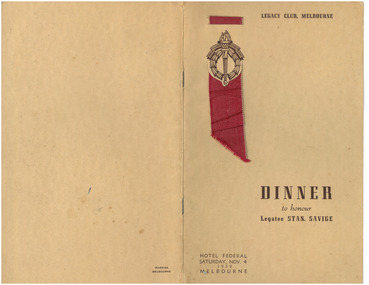
Document - Menu card, Dinner to honour Legatee Stan Savige, 1939
... The menu is included and the order of service with speeches by Sir John Gellibrand and a response by Stan Savige. ...The menu is included and the order of service with speeches by Sir John Gellibrand and a response by Stan Savige. A copy of both are also in the archive. ...The dinner on Saturday 4 November 1939 was held to celebrate Brigadier Savige's appointment to Command the 17th Infantry Brigade, 6th Division, 2nd AIF. The menu is included and the order of service with speeches by Sir John Gellibrand and a response by Stan Savige. A copy of both are also in the archive. There are five quotes through menu that sum up common sentiments of Stan Savige. Including 'Leave it to me and my little playmate'; 'This is the tamest fight I've seen - let's liven it up'; 'The only "experience" is trust in God then trial and error.' Savige's subsequent exploits in WWII are detailed in Chapter 4 of 'There goes a man' by W.B. Russell, which chronicles not only battles fought but also the politics which blighted his command until the end of the war. An important link to Legatee Stan Savige, the founder of Legacy as well as the famous soldier, at a watershed moment in his life.Cream card with red medal ribbon insert, brown print of a menu and programme to farewell Stan Savige in 1939.Signed in pencil by Stan Savige.stan savige, legatee function, dinner -
 Melbourne Legacy
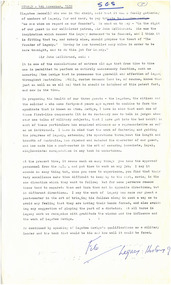
Document - Speech, Dinner - 4th November, 1939. SGS, 1939
... Legatee Russell (President) introduced their patron, Sir John Gellibrand, who proposed the toast to Sir Stanley Savige. ...Legatee Russell (President) introduced their patron, Sir John Gellibrand, who proposed the toast to Sir Stanley Savige. ...Report of a dinner held just after the beginning of WWII to celebrate the work of Sir Stanley Savige in establishing Legacy. Legatee Russell (President) introduced their patron, Sir John Gellibrand, who proposed the toast to Sir Stanley Savige. In his response Sir Stanley Savige outlined the history of Legacy to that date and how he was able to bring together so many Legatees with a common purpose to look after the dependants of WWI veterans. He said that although this need would disappear due to natural causes by the 1950s, the present war would ensure that the work of Legacy would continue. He highlighted the opposition of the Board of Management to affording the same opportunities to girls as those given to boys, and how it was got past. He also noted that the average age of Legatees was about 48, and "in another ten years we will all be stymied."This is a lengthy speech by the founder of Legacy not only giving details of Legacy's history, but also revealing the personality of the speaker.White foolscap photocopied pages x 6 with black type of original typed report.On first sheet in blue ink 'S G S', 'File Legacy: History of' On reverse of last sheet in blue ink 'from Don S.'speech, history, stan savige, founding legatee -
 Melbourne Legacy
Letter, Letter to Legatee Brian Armstrong from Legatee Des Breheny, 1963
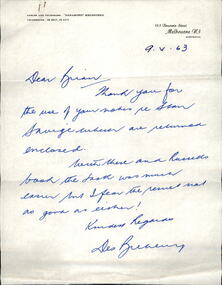
... The moving address described General Savige's life and service career, and how he formed Legacy in 1923 at the suggestion of his former Commander, Major General Sir John Gellibrand. There are copies of the oration in the archive. ...The moving address described General Savige's life and service career, and how he formed Legacy in 1923 at the suggestion of his former Commander, Major General Sir John Gellibrand. There are copies of the oration in the archive. ...A letter dated 9 May 1963 from Legatee Desmond Breheny to Legatee Brian Armstrong to return material he borrowed about the life of Stan Savige. It probably included a copy of Legatee Armstrong's memorial oration he gave about Savige at the 1954 Legacy Conference in Canberra. The oration is a full account of Savige's life, his war service and his role in Legacy. Legatee Armstrong was a good friend of Savige. The moving address described General Savige's life and service career, and how he formed Legacy in 1923 at the suggestion of his former Commander, Major General Sir John Gellibrand. There are copies of the oration in the archive. This letter says 'Thank you for the use of your notes re Stan Savige which are returned enclosed. With these and Russell's book the task was much easier but I fear the results not as good as either! Kindest regards, Des Breheny.'A record of the life and service of Legatee Stan Savige being shared at other Legacy Clubs after his death in 1954.White quarto letter from Legatee Dreheny to Legatee Armstrong on 9 May 1963.Printed with his address in black on top right. Letter is handwritten in blue pen.stan savige, desmond breheny -
 Melbourne Legacy
Document - Speech, Savige Memorial Oration, 1954
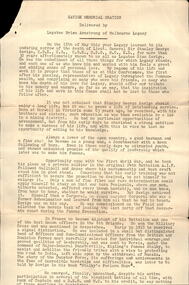
... The moving address described General Savige's life and service career, and how he formed Legacy in 1923 at the suggestion of his former Commander, Major General Sir John Gellibrand. He said at the time of his death the late General had been a member of Legacy for 30 years, and had been chosen to represent Legacy at the Coronation of Queen Elizabeth. ...The moving address described General Savige's life and service career, and how he formed Legacy in 1923 at the suggestion of his former Commander, Major General Sir John Gellibrand. He said at the time of his death the late General had been a member of Legacy for 30 years, and had been chosen to represent Legacy at the Coronation of Queen Elizabeth. ...A typed copy of a speech by Legatee Brian Armstrong delivered as the Savige Memorial Oration at the Federal Conference of Legacy Clubs in Canberra on 22 October 1954. It is an account of Savige's life, his war service and his role in Legacy. Legatee Armstrong was a good friend of Savige. The moving address described General Savige's life and service career, and how he formed Legacy in 1923 at the suggestion of his former Commander, Major General Sir John Gellibrand. He said at the time of his death the late General had been a member of Legacy for 30 years, and had been chosen to represent Legacy at the Coronation of Queen Elizabeth. Following the Second World War he held many important posts, one of the most notable being Co-ordinator of Demobilisation. Legatee Armstrong told the conference that if a memorial to the founder of Legacy was required, they only had to look around themselves.A record of the life and service of Legatee Stan Savige.White foolscap paper with black type x 3 pages of a speech about Legatee Savige.Handwritten on the reverse of the final page is 'Brian Armstrong Oration. Stanley Savige' in blue penvale, stan savige, conference -
 Melbourne Legacy
Document - Speech, Savige Memorial Oration, 1954
... The moving address described General Savige's life and service career, and how he formed Legacy in 1923 at the suggestion of his former Commander, Major General Sir John Gellibrand. He said at the time of his death the late General had been a member of Legacy for 30 years, and had been chosen to represent Legacy at the Coronation of Queen Elizabeth. ...The moving address described General Savige's life and service career, and how he formed Legacy in 1923 at the suggestion of his former Commander, Major General Sir John Gellibrand. He said at the time of his death the late General had been a member of Legacy for 30 years, and had been chosen to represent Legacy at the Coronation of Queen Elizabeth. ...A typed copy of a speech by Legatee Brian Armstrong delivered as the Savige Memorial Oration at the Federal Conference of Legacy Clubs in Canberra on 22 October 1954. It is an account of Savige's life, his war service and his role in Legacy. Legatee Armstrong was a good friend of Savige. The moving address described General Savige's life and service career, and how he formed Legacy in 1923 at the suggestion of his former Commander, Major General Sir John Gellibrand. He said at the time of his death the late General had been a member of Legacy for 30 years, and had been chosen to represent Legacy at the Coronation of Queen Elizabeth. Following the Second World War he held many important posts, one of the most notable being Co-ordinator of Demobilisation. Legatee Armstrong told the conference that if a memorial to the founder of Legacy was required, they only had to look around themselves. This is an original typed copy with two other copies in the archive.A record of the life and service of Legatee Stan Savige.White quarto paper with black type x 11 pages of a speech about Legatee Savige.Handwritten on top of first page 'Savige Memorial Oration delivered by Legatee Brian Armstrong of Melbourne Legacy.'vale, stan savige, conference -
 Melbourne Legacy
Document - Speech, Savige Memorial Oration, 1954
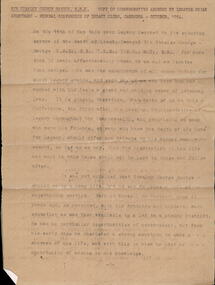
... The moving address described General Savige's life and service career, and how he formed Legacy in 1923 at the suggestion of his former Commander, Major General Sir John Gellibrand. He said at the time of his death the late General had been a member of Legacy for 30 years, and had been chosen to represent Legacy at the Coronation of Queen Elizabeth. ...The moving address described General Savige's life and service career, and how he formed Legacy in 1923 at the suggestion of his former Commander, Major General Sir John Gellibrand. He said at the time of his death the late General had been a member of Legacy for 30 years, and had been chosen to represent Legacy at the Coronation of Queen Elizabeth. ...A typed copy of a speech by Legatee Brian Armstrong delivered as the Savige Memorial Oration at the Federal Conference of Legacy Clubs in Canberra on 22 October 1954. It is an account of Savige's life, his war service and his role in Legacy. Legatee Armstrong was a good friend of Savige. The moving address described General Savige's life and service career, and how he formed Legacy in 1923 at the suggestion of his former Commander, Major General Sir John Gellibrand. He said at the time of his death the late General had been a member of Legacy for 30 years, and had been chosen to represent Legacy at the Coronation of Queen Elizabeth. Following the Second World War he held many important posts, one of the most notable being Co-ordinator of Demobilisation. Legatee Armstrong told the conference that if a memorial to the founder of Legacy was required, they only had to look around themselves. This is a photocopy on flimsy brown paper, two other copies are in the archive.A record of the life and service of Legatee Stan Savige.Brown quarto paper with black type x 11 pages of a speech about Legatee Savige.Typed on top of first page 'Sir Stanley George Savige KBE. Copy of Commemorative address by Legatee Brian Armstrong - Federal Conference of Legacy Clubs, Canberra, October 1954.'vale, stan savige, conference -
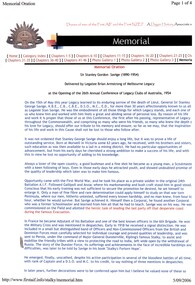 Melbourne Legacy
Article, Internet article: Memorial Oration of Stan Savige, 2006
... The moving address described General Savige's life and service career, and how he formed Legacy in 1923 at the suggestion of his former Commander, Major General Sir John Gellibrand. He said at the time of his death the late General had been a member of Legacy for 30 years, and had been chosen to represent Legacy at the Coronation of Queen Elizabeth. ...The moving address described General Savige's life and service career, and how he formed Legacy in 1923 at the suggestion of his former Commander, Major General Sir John Gellibrand. He said at the time of his death the late General had been a member of Legacy for 30 years, and had been chosen to represent Legacy at the Coronation of Queen Elizabeth. ...Legatee Rogers collected information about Stan Savige after attending an unveiling of a statue of Savige and this print out was the Memorial Oration given t a Legacy Conference in 1954. Other copies are in the archive. The speech by Legatee Brian Armstrong is an account of Savige's life, his war service and his role in Legacy. Legatee Armstrong was a good friend of Savige. The moving address described General Savige's life and service career, and how he formed Legacy in 1923 at the suggestion of his former Commander, Major General Sir John Gellibrand. He said at the time of his death the late General had been a member of Legacy for 30 years, and had been chosen to represent Legacy at the Coronation of Queen Elizabeth. Following the Second World War he held many important posts, one of the most notable being Co-ordinator of Demobilisation. Legatee Armstrong told the conference that if a memorial to the founder of Legacy was required, they only had to look around themselves. Document was from a folder of documents donated to the archive by Legatee Bill Rogers that related to his time as President (March 2006 - March 2008).A record of the life and service of Legatee Stan Savige, founder of Legacy.Print out x 4 pages of an article on the website of www.firstAIF.info which was a copy of the Memorial Oration for Stan Savige.stan savige, assyrians -
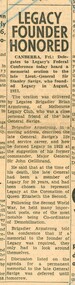 Melbourne Legacy
Newspaper - Article, Legacy Founder Honored, 1954
... The moving address described General Savige's life and service career, and how he formed Legacy in 1923 at the suggestion of his former Commander, Major General Sir John Gellibrand, He said at the time of his death the late General had been a member of Legacy for 30 years, and had been chosen to represent Legacy at the Coronation of Queen Elizabeth. ...The moving address described General Savige's life and service career, and how he formed Legacy in 1923 at the suggestion of his former Commander, Major General Sir John Gellibrand, He said at the time of his death the late General had been a member of Legacy for 30 years, and had been chosen to represent Legacy at the Coronation of Queen Elizabeth. ...An article titled 'Legacy Founder Honored', that mentions the speech by Legatee Brian Armstrong delivered as the Savige Memorial Oration at the Federal Conference of Legacy Clubs in Canberra on 22 October 1954. The speech is a full account of Savige's life, his war service and his role in Legacy. Legatee Armstrong was a good friend of Savige. The moving address described General Savige's life and service career, and how he formed Legacy in 1923 at the suggestion of his former Commander, Major General Sir John Gellibrand, He said at the time of his death the late General had been a member of Legacy for 30 years, and had been chosen to represent Legacy at the Coronation of Queen Elizabeth. Following the Second World War he held many important posts, one of the most notable being Co-ordinator of Demobilisation. Legatee Armstrong told the conference that if a memorial to the founder of Legacy was required, they only had to look around themselves. The second article on the same page is titled 'Legacy Conference Opened' and mentions the Governor General Sir William Slim, opening the conference in Canberra and some of the topics he spoke on. There are three copies of the Savige Memorial speech in the archive.A record of the life and service of Legatee Stan Savige.Front page of the Daily Advertiser on 23 October 1954 with two articles about the Legacy conference, one of which was about the memorial oration for Stan Savige given by Brian Armstrong.stan savige, conference -
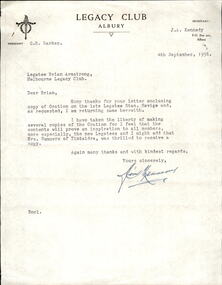 Melbourne Legacy
Letter, Copy of the Oration on the late Legatee Stan Savige, 1956
... The moving address described General Savige's life and service career, and how he formed Legacy in 1923 at the suggestion of his former Commander, Major General Sir John Gellibrand. He said at the time of his death the late General had been a member of Legacy for 30 years, and had been chosen to represent Legacy at the Coronation of Queen Elizabeth. ...The moving address described General Savige's life and service career, and how he formed Legacy in 1923 at the suggestion of his former Commander, Major General Sir John Gellibrand. He said at the time of his death the late General had been a member of Legacy for 30 years, and had been chosen to represent Legacy at the Coronation of Queen Elizabeth. ...A letter dated 4 September 1956 from Legatee Jim Kennedy of Albury Legacy Club to Legatee Brian Armstrong to return a typed copy of the speech he delivered as the Savige Memorial Oration at the Federal Conference of Legacy Clubs in Canberra on 22 October 1954. Legatee Kennedy had borrowed it to make copies for Albury Legatees and other interested people. The speech is an account of Savige's life, his war service and his role in Legacy. Legatee Armstrong was a good friend of Savige. The moving address described General Savige's life and service career, and how he formed Legacy in 1923 at the suggestion of his former Commander, Major General Sir John Gellibrand. He said at the time of his death the late General had been a member of Legacy for 30 years, and had been chosen to represent Legacy at the Coronation of Queen Elizabeth. Following the Second World War he held many important posts, one of the most notable being Co-ordinator of Demobilisation. Legatee Armstrong told the conference that if a memorial to the founder of Legacy was required, they only had to look around themselves. This is an original typed copy with two other copies in the archive.A record of the life and service of Legatee Stan Savige being shared at other Legacy Clubs after his death in 1954.White quarto letter of Albury Legacy Club with white foolscap paper with black type x 4 pages of a speech about Legatee Savige.Signature in blue ink says Jim Kennedy.stan savige, jim kennedy, albury legacy -
 Melbourne Legacy
Document, Branch Chairman's Guide 1991, 1991
... The guide contains: Section A Operations Council and Branches : The Relationship Operations Council Section B Group, Liaison Committee and Groups : The Relationship Group Liaison Committee Section C Internal Changes of Communication and Sources of Information for the Legatee Section D An outline of responsibilities and procedural guidelines for branch chairmen Section E Financial Authority of Branches Section F Guidelines for the Format and Content of Branch Minutes Section G Selection and Appointment of Branch Chairmen Section H Enrolment, Contact and Reporting Procedures Section I Procedure and Notes for Proposers of Prospective Members Section J Duty Legatee Scheme Section K Education (including Sir John Gellibrand Memorial Scholarship and the Macrae Trust) Section L Section M Welfare Section N Pensions, Benefits and Allowances Section O Widows' Committee and Widows' Clubs Section P Widows' Clubs Rules Section Q Current Rates of Social Security and Repatriation Pensions Section R Recommended List of Contractors Available for Home Maintenance (including a list of contractors that can provide services to Widows, such as plumbers, bricklayers, electricians and blind supplies and repairs) 31 yellow pages - not scanned due to it being names and addresses and phone numbers. ...The guide contains: Section A Operations Council and Branches : The Relationship Operations Council Section B Group, Liaison Committee and Groups : The Relationship Group Liaison Committee Section C Internal Changes of Communication and Sources of Information for the Legatee Section D An outline of responsibilities and procedural guidelines for branch chairmen Section E Financial Authority of Branches Section F Guidelines for the Format and Content of Branch Minutes Section G Selection and Appointment of Branch Chairmen Section H Enrolment, Contact and Reporting Procedures Section I Procedure and Notes for Proposers of Prospective Members Section J Duty Legatee Scheme Section K Education (including Sir John Gellibrand Memorial Scholarship and the Macrae Trust) Section L Section M Welfare Section N Pensions, Benefits and Allowances Section O Widows' Committee and Widows' Clubs Section P Widows' Clubs Rules Section Q Current Rates of Social Security and Repatriation Pensions Section R Recommended List of Contractors Available for Home Maintenance (including a list of contractors that can provide services to Widows, such as plumbers, bricklayers, electricians and blind supplies and repairs) 31 yellow pages - not scanned due to it being names and addresses and phone numbers. ...A guide for Chairmen of Melbourne Legacy. This copy was owned by Graham Riches. The guide contains: Section A Operations Council and Branches : The Relationship Operations Council Section B Group, Liaison Committee and Groups : The Relationship Group Liaison Committee Section C Internal Changes of Communication and Sources of Information for the Legatee Section D An outline of responsibilities and procedural guidelines for branch chairmen Section E Financial Authority of Branches Section F Guidelines for the Format and Content of Branch Minutes Section G Selection and Appointment of Branch Chairmen Section H Enrolment, Contact and Reporting Procedures Section I Procedure and Notes for Proposers of Prospective Members Section J Duty Legatee Scheme Section K Education (including Sir John Gellibrand Memorial Scholarship and the Macrae Trust) Section L Section M Welfare Section N Pensions, Benefits and Allowances Section O Widows' Committee and Widows' Clubs Section P Widows' Clubs Rules Section Q Current Rates of Social Security and Repatriation Pensions Section R Recommended List of Contractors Available for Home Maintenance (including a list of contractors that can provide services to Widows, such as plumbers, bricklayers, electricians and blind supplies and repairs) 31 yellow pages - not scanned due to it being names and addresses and phone numbers. Section S Administration Instructions An Organisation Chart of Legacy and A Table of Organisation of StaffA living document that was regularly updated for the Chairman of Melbourne Legacy to use in his duties.A4 pages x 64 bound together with split pins.L/GPA Riches in pencil on top edge.regulations, rules, objectives -
 Warrnambool and District Historical Society Inc.
Work on paper - Booklet, This is Legacy, 1947
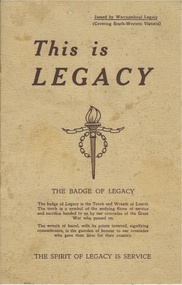
... Legacy had its origins in the aftermath of the first World War. General Sir John Gellibrand in 1923 in Hobart established the Remembrance Club which was to assist returned soldiers. ...Legacy had its origins in the aftermath of the first World War. General Sir John Gellibrand in 1923 in Hobart established the Remembrance Club which was to assist returned soldiers. ...Dark cream coloured soft card cover with brown text. Title is in larger text with the Legacy emblem in the centre of the front cover. The back cover has the poem, Flanders Field and the legacy response. Eight pages which has text and some photographs. A list of Warrnambool office bearers is on the inside back cover. non-fictionlegacy 1947, warrnambool history, warrnambool legacy -
 Melbourne Legacy
Photograph - Portrait, Lieutenant-General Sir Stanley Savige
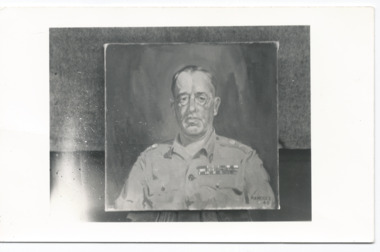
... He is widely remembered for his efforts between the wars in founding the Legacy Clubs (which he modelled on the 'Remembrance Club' formed in Hobart by his friend and former commander Sir John Gellibrand in 1923) to care for the dependants of deceased servicemen and ex-servicemen. ...He is widely remembered for his efforts between the wars in founding the Legacy Clubs (which he modelled on the 'Remembrance Club' formed in Hobart by his friend and former commander Sir John Gellibrand in 1923) to care for the dependants of deceased servicemen and ex-servicemen. ...Photograph of a painted portrait of L/- Stan Savige. The signature appears to be 'Manders '45'. He appears to be in uniform and could be from his service in World War 2. Stanley Savige is seen as the founder of Legacy when it was founded in Melbourne in September 1923. He was born in Morwell Victoria on 26/6/1890. He served in the Australian Army between 1915 and 1946, including service in both World Wars. Stanley Savige was awarded a KBE, CB, DSO, MC,ED. Stanley George Savige was born in Victoria in 1890, and enlisted in the AIF (Private 577) in March 1915. He served with 24 Battalion at Gallipoli, and was commissioned as a 2nd lieutenant prior to the evacuation, at which he was part of the final holding party at Lone Pine. In France he saw service with 6 Brigade Headquarters as well as with his battalion, and was awarded the Military Cross for his gallantry at the second battle of Bullecourt. In 1918, he became one of a small number of Australians selected for service with 'Dunsterforce' in Persia, commanding 'Urmia Force', and was awarded the Distinguished Service Order. Between the wars, Savige continued his military career with the Militia, and by 1939 he held the rank of colonel. When the 2nd AIF was raised, he was placed in command of 17 Brigade, which he led through the campaigns in Libya, Greece and Syria, before being promoted to command 3 Division (Militia) in New Guinea. In 1944, he was appointed GOC 2 Corps, in command of forces engaged in the campaign on Bougainville, and accepted the Japanese surrender there in September 1945. Lieutenant General Savige was knighted (KBE) in 1950, and died in 1954. He is widely remembered for his efforts between the wars in founding the Legacy Clubs (which he modelled on the 'Remembrance Club' formed in Hobart by his friend and former commander Sir John Gellibrand in 1923) to care for the dependants of deceased servicemen and ex-servicemen. These clubs grew into a nation wide organisation which, by the time of Savige's death, was supporting over 80 000 widows and children.This is a photographic portrait of the founder of the first Legacy Club in Australia, Sir Stanley Savige.Black and white photo of a painting of Sir Stan Savige printed onto a postcard.Stamped with 'Photograph No. MH 91859 Supplied by Military History Section (S.D.9,) General Staff L.H.Q. For official purposes ONLY, NOT TO BE PUBLISHED' in purple ink.savige, portrait, stan savige, founding legatees -
 Melbourne Legacy
Document - Speech, Foundation Day Address 1977. Legacy It's Beginnings. Past President Legatee Kem Kemsley
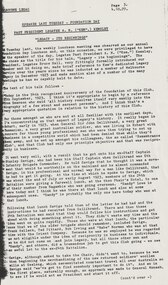
... He starts with Legatee Savige's tip to Hobart and Sir John Gellibrand's Remembrance Club. Then a meeting of the 24th Battalion at Phair's Hotel in 1923 and the men there agreeing to start a similar club, he mentions Sandy Lowe as a member at the meeting in 1977 that was at the initial meeting in 1923. ...He starts with Legatee Savige's tip to Hobart and Sir John Gellibrand's Remembrance Club. Then a meeting of the 24th Battalion at Phair's Hotel in 1923 and the men there agreeing to start a similar club, he mentions Sandy Lowe as a member at the meeting in 1977 that was at the initial meeting in 1923. ...An article from the Bulletin including the text an address by Legatee Kem Kemsley at a Legacy event on 4 October 1977. He discusses the beginnings of Legacy. He starts with Legatee Savige's tip to Hobart and Sir John Gellibrand's Remembrance Club. Then a meeting of the 24th Battalion at Phair's Hotel in 1923 and the men there agreeing to start a similar club, he mentions Sandy Lowe as a member at the meeting in 1977 that was at the initial meeting in 1923. He also mentions other at that initial meeting were Savige, Frank Selleck, Ted Pittard, Bob Irving, and 'Babe' Norman. He relates the approach made to Sir John Monash to be the first president. It was when Savige was in Frank Meldrum's dentist chair that the plan was hatched for Meldrum, (who was playing tennis with Monash's son-in-law, Gershon Bennett), to approach Monash to be president. It shows the nature of relations between high ranking ex servicemen. Instead Monash suggested Colonel Harold Cohen. Initially Legacy was founded with 'one person from each profession or business who will represent that profession until such time as the Club has established itself on a wider basis.' For example there were 'two solicitors - Downing and Armstrong, Meldrum as dentist, George Worboys as plumber, Dr Gardener as the eye specialist, Doolan and Goodchild as Surveyors, Fred Wickham of the Premier's department who was regarded as very important, Baker from Myer's Emporium, Joynt from the printing world and Blackett the architect.' He also mentions a Police Strike and General Monash set up a special constabulary force. Cohen, Kemsley and many of the early legatees answered the call to help keep peace. By December 1923 there were 54 members of the new Legacy club. The name was under consideration as the Tasmanian club was called Remembrance Club. Pip Powell nominated the name of Legacy to be submitted for consideration, but it was Frank Selleck who moved the formal resolution. The speech mentions that Sir Gellibrand was appointed Patron of Legacy and later Monash and Sir Harry Chauvel were chosen. Frank Doolan posed the question 'what does Legacy really mean?' and focus changed toward widows and children. Citing some slightly different dates to those in a later speech about the start of Legacy (at 02029) he says it was July 1926 that they met with widows and a couple of weeks later 142 boys were to attend Anzac House for a Literary and Debating class. Ballarat and Geelong had formed clubs by 1925 and Legatee Hilmer Smith was transferred with his work to Sydney and started a Legacy Club there in 1926. The first Conference was held in November 1926. The first Government House Christmas party for children was held in 1926, when the Governor General of Australia was still residing there. His final words were about his war experiences and relates a speech made by Legatee Brian Armstrong on 28th February 1961 (02502) that also spoke of the area around the Pozieres Windmill that was part of the battle of the Somme in July/August 1916, where so many of the early legatees fought.. The article was part of an album of past presidents from 1965 to 1989. The folder included biographical details and obituaries, eulogies and death notices of prominent Legatees. The items have been catalogued separately.A record of a speech made by Legatee Kem Kemsley a past president of Legacy about events in the early days of Legacy. The information was collected to record the lives of prominent legatees in a folder.Photocopy of 5 pages from Bulletin on an address by Legatee Kem Kemsley in 1977.Bulletin 4.10.77. Page No 3, 4, 5, 6 and 7.past presidents, speech, foundation day, kem kemsley, sir john monash, pozieres, somme -
 Melbourne Legacy
Document - Speech, Commemorative Address - Sir Stanley Savige K.B.E. Federal Conference of Legacy Clubs, Canberra, 10/1954
... Such was the man who in August 1923, at the instance of his former Commander, Major-General Sir John Gellibrand, gathered around him a handful of men who had fought and laughed with him over four well remembered years. ...Such was the man who in August 1923, at the instance of his former Commander, Major-General Sir John Gellibrand, gathered around him a handful of men who had fought and laughed with him over four well remembered years. ...After the death of Stan Savige this address was given at the Canberra Conference in October 1954. It is tribute to his life. Sir Stanley Savige KBE : Commemorative Address Federal Conference of Legacy Clubs, Canberra : October 1954. On the 15th of May this year Legacy learned to its enduring sorrow of the death of its Founder, Lieut. General Stanley George Savige KBE, CB, CBE, DSO, MC, ED, for more than 30 years affectionately known to us all as Legatee Stan Savige. He was the embodiment of all those things for which Legacy stands, and each one of us who knew him and worked with him feels a great and abiding sense of personal loss. It is proper, therefore, that those of us at this Conference, the first after his passing, representative of Legacy throughout the Commonwealth, and comprising so many who were his friends, so many who knew the depth of his love for Legacy, should acknowledge our debt to our Founder and ensure, so far as we may, that the inspiration of his life and work in this Cause shall not be lost to those who follow after. It was not ordained that Stanley George Savige - should enjoy a long life, but it was to prove a life of outstanding service. Born at Morwell in Victoria some 63 years ago, he received with his brothers and sisters such education as was then available to a lad in a mining district. He had no particular opportunities of advancement, but from his early days he cherished a strong ambition to make a success of his life, and with this in view he lost no opportunity of adding to his knowledge. Always a lover of the open country, a good bushman and a fine shot, he became as a young man, a Scoutmaster with a keen following of boys. Even in those early days he attracted youth and showed undoubted promise of the quality of leadership which later was to make him famous. Opportunity came with the first World War, and he took his place as a private soldier in the original 24th Battalion AIF. Followed Gallipoli and Anzac where his marksmanship and bush craft stood him in good stead. Conscious that his early training was not sufficient to secure the promotion he desired, he set himself to enlarge it. Only a man of fine fibre and rare determination could apply himself to study on that war torn Peninsula, where our men, hitherto untested, suffered every known hardship and no man knew, from hour to hour, whether he would survive. But Savige achieved it. Himself then a Corporal he found another Corporal who was a former Schoolmaster and learned from him all that he had to teach. Savige was on his way. He was commissioned on the Field and allotted the heroic task of leading the last party off that desperate coast during the famous evacuation. In France he became the Adjutant of his Battalion and one of the best known officers in the 6th Brigade. He won the Military Cross and was mentioned in despatches. Early in 1918 he received a signal distinction, He was included in a small but distinguished band of Officers and Non-Commissioned Officers from the British and Dominion Forces most carefully selected for individual courage and proved qualities of leadership, and was sent to Persia, under the command of Major-General Dunsterville, Kipling’s famous Stalky, to assist and mobilise the friendly tribes with a view to protecting the road to India, left wide open by the withdrawal of Russia. The story of the Dunsterforce, its suffering and achievements in the face of incredible hardships and difficulties, was later to be told by Savige in his book “Stalky’s Forlorn Hope”. He emerged, finally, unscathed, despite his active participation in several of the bloodiest battles of all time, with the rank of Captain and a DSO and MC to his credit, to say nothing of three mentions in despatches. In later years, further decorations were to be conferred upon him, but I believe he valued none of these so highly as his awards for outstanding personal bravery won in the Field when he was an Officer of comparatively junior rank. Such was the man who in August 1923, at the instance of his former Commander, Major-General Sir John Gellibrand, gathered around him a handful of men who had fought and laughed with him over four well remembered years. This small band adopted the name of “Legacy”, but its purpose then was, in the main, to assist in safeguarding the interests of ex-servicemen in this country. Worthy although the case undoubtedly was, the conception and ideal which was to distinguish Legacy from all kindred post-war movements did not emerge until two years later. The torch had not been lit. Legacy had not yet found its soul. What has been achieved since then is known to you all. The Legacy ideal, unique in its conception, with no known counterpart elsewhere, is now accepted, welcomed and honoured throughout the Commonwealth and abroad. But in those early days the achievements of our Founder in the face of all manner of difficulties and frustrations are worthy of our lasting memory and thankfulness. As the source of every river lies in the hills, so must the inspiration from which stems a great conceptions of service to one’s fellow men be lofty and above reproach. Savige was the embodiment of this new expression of comradeship, as he was the central figure and driving force of the little group that sponsored it. But for his zeal, his faith and determination, it is likely that the flame, newly kindled, might have flickered and died. The idea of men returned from active service pledging for the sake of their former comradeship, their personal assistance to the widows, and above all, to the children of those who had fought beside them and paid the full price of War, was so completely new and unexpected that it was by no means readily accepted. There were no funds, no precedents to guide the new adventurers, only the clear bright flame of an ideal just envisaged, and the conviction that the Cause was unassailable. Nor were there lacking many who said that the community held no place for Legacy, that it was born of sentiment only, and would quickly pass. The scoffers are gone and one since forgotten, but the torch remains and burns brighter than ever. Down the years of Legacy there are many names deserving of honour, men from all States and all stations of life, but no name stands out in such clear and bold relief as does the name of our Founder. By his works you shall know him. He was, in truth, the Soul of Legacy. He sought no office and preferred to work as one of the team. Six years went by before he accepted the Presidency of Melbourne Club, and then only because his fellows would book no further delay. “The Spirit of Legacy is Service” - so runs the Charter, and that was Savige’s Creed. By virtue of his attainments he was called upon to take a leading part in the administration of Legacy, first within his own club and later, as Chairman of the Co-ordinating Council of Legacy in Australia. But always it was the essentially human character of the work which enthralled and upheld him, and the tasks which gave him most joy were those which brought him into close personal contact with the youngsters and their home life. Like their elders they recognised his goodwill and his leadership and responded to it. It was Savige who made possible the first camps held for the boys and girls by Melbourne Club. These were erected on his own seaside property, and were originally conducted under his personal direction and largely with the aid of funds he had collected. There was hardly an important post in his own Club that Savige did not at some time occupy and adorn. He was happiest in the company of those men with whom he had served in the field, and cherished always the comradeship born of active service which is of the essence of Legacy. He was a man of strong convictions but attentive always to another’s point of view. As a Legatee he played a leading part in bringing hope and encouragement to many a mother on whom the whole responsibility of a young family had been suddenly and tragically laid; in the attainment of the ambitions of many an orphan child, which not so long since had seemed to him or her to be mere dreams, impossible of realisation. Comfort for the bereaved, new hope for the children’s physical and educational welfare, assistance with the home, aid for the sick, money for the needy and a new courage to face a future that hitherto had held no promise, all these facets of Legacy endeavour combine to present a living and enduring memorial to the man we honour as our Founder today. Between the two World Wars in addition to establishing himself successfully in civilian life and answering the constant calls of Legacy on his energy and time, Savige maintained an active association with the Army. He was convinced that a Second AIF would one day be urgently called upon, and as a Battalion Commander he spared no effort to train the Officers under his charge during the uneasy years of peace for the trial that he felt must come. These men have all subsequently had distinguished military careers, their names are well known and many of the serve in Legacy today. When the second crisis came, Savige himself was one of the first to offer, and although his youth was spent, he proudly carried the number VX13 throughout the terrible years that followed. This time he was to command, first the 17th Australian Infantry Brigade in the first action of the Second AIF against the enemy at Barida, and subsequently at Tobruk and Derna - all famous names now. It was his patrols which gave the warning - unheeded at the time - that Rommel’s reinforcements were reaching North Africa far earlier than was expected. Then followed the grim days of Greece and Crete when the fine qualities of his leadership were put to the utmost test. I have been told by those who were closest to him it was typical of Savige that when his convoys were on the move back and were being blasted from the air by the unopposed Luftwaffe, he should sit by the side of the open road, wearing his red banded cap, to steady the morale of men who had then no chance of hitting back at the enemy. Unorthodox no doubt, but here was a man indeed. Throughout the whole campaign and later when he commended the 3rd division in New Guinea and later still when with the rank of Lieutenant-General he became a Corps Commander in New Guinea and Bouganville, it was at all times characteristic of him that he should see for himself the situation in the forward areas. He dealt personally with his subordinate commanders whenever it was possible to do so. No one says his G.S.O. 1. understood better than he did the importance of front line troops seeing their G.O.C. frequently, and knowing that he was aware of and prepared to share their hardships and dangers. He took many risks that he should not have taken, exhausted himself physically and mentally times without number, and considered himself not at all in order to secure the success of his operations. Finally, in Bouganville, he brought his campaign to a victorious conclusion and accepted the personal surrender of the Japanese Commander. Savige is known as one of Australia’s most human military leaders, but let no one believe that he did not ask and receive the utmost of his men. He trained them in a hard school but he was ever conscious of their needs and observant and thoughtful of their welfare. Fearless and untiring under conditions which brought younger men down, he asked nothing that he was not himself prepared to give and do. The close of the Second World War left him with the same brave heart; but a vitality greatly impaired. He was called up again and again to perform important national tasks, notably that of Co-ordinator of Demobilisation and Dispersal. But his interest in Legacy never flagged it was in fact more personal than ever, for under his command many junior legatees, sons of former comrades had proved themselves worthy of their Fathers in war and in peace. In the bearing and achievements of the young men of the Second A.I.F. he took a particular and justifiable pride. He applied himself to the Extension of Legacy to areas where it had not previously been practicable to operate. His record of service and close personal contact with the men of both wars made him a most welcome pioneer and many new Clubs and Groups resulted from his efforts. He founded, and I doubt whether any one else could have done so, the Club in the great Capital of our Empire. His reputation and obvious sincerity surmounted obstacles that might well have daunted lesser man. Legacy’s debt to him visibly increased. But he was ever a simple man, with a great love and understanding of his fellow men and a true Legatee at heart. Much that he did will never be known or recognised, save by those who benefitted. His service in Legacy ranged from the humble kitchen of cottage and farm to our representation in Westminster Abbey itself. A knighthood set the seal upon an outstanding career. None the less when upon the death of Field Marshall Sir Thomas Blamey, Lieut. General Sir Stanley Savige became the Patron of the Melbourne Club, he retained at his own express desire, the title of Legatee Savige, and when on that final day we bade him farewell, when the Flags he had served so well were lowered and the guns which had formed a grim final salute, it was apparent to all who had eyes to see that this great and simple man had won such a place in the hearts and affection of his fellow country men as is given to few men indeed. From the packed Cathedral, escorted by his fellow Generals, followed by men of his own Units, by Legatees and a great company of others who had cause to honour and esteem him, he made his last journey. But that is not the end. His voice and presence are lost to us but his memory and inspiration must ever remain. As he has bequeathed to the National War Memorial yonder his diaries, records and battle plans, so he has bequeathed to us his fellow Legatees his greatest achievement and his trust, Legacy itself. Never was the Torch passed by worthier hands. Now it is ours to hold it high. Whatever material memorial the future many hold for him, Legacy owes its Founder a livelier recompense. It is within our power to implement what I believe to be his greatest wish, that Legacy and its ideal of comradeship and service shall flourish and endure. Let each one of us then resolve that we shall, within our Clubs, in all tasks to which we are assigned, both great and small, keep in our minds the life and spirit of Stanley George Savige, so that we may be proud at all times to say of Legacy to those who follow after - “If you would see his memorial - Look around you”.The tribute to Stanley Savige shows how greatly he was regarded by the Legatees.Off white quarto paper with black type, address given about Stan Savige to the Canberra Conference, x 12 pages.savige, speech, obituary -
 Flagstaff Hill Maritime Museum and Village
Photograph - Vessel, Steam tug, circa 1920's
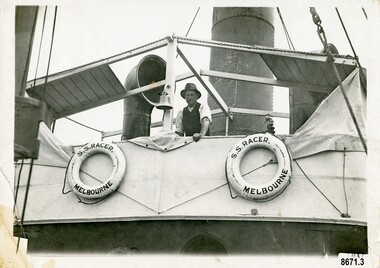
... Gellibrand Pile Light at the entrance to Hobsons Bay. George Cunningham died in 1978. This photograph was one of ten photographs donated to Flagstaff Hill Maritime Museum and Village by Fred Trewartha. Frederick John...Gellibrand Pile Light at the entrance to Hobsons Bay. George Cunningham died in 1978. This photograph was one of ten photographs donated to Flagstaff Hill Maritime Museum and Village by Fred Trewartha. Frederick John ...The ocean Steamtug "Racer" was built in 1886 in Sunderland by "Boolds, Sharer and Company" for the "Queenstown Tug and Shipping Company". It is mentioned in several newspapers that soon afterwards it sank in Queenstown Harbour, Ireland and remained submerged for six months before being raised. It was a steel screw boat with a sluice keel, was 185 tons and 420 feet long. It was purchased around 1889 by the "Melbourne Coal, Shipping and Engineering Company Ltd" as it had sufficient power to work with the huge iron clippers that the company were dealing with. It survived several dangerous incidents on its voyage out to Melbourne. On May 28th in the middle of the night in a heavy gale, the tug was swamped by heavy seas and then several hours later was almost run down by a very large ship (the clipper Loch Vennachar) in full sail. The "Racer" (later owned by the "Melbourne Steamship Company") became one of the fastest and best-known tugs in the Port of Melbourne - working in the port until 1935. The "Racer" was involved in many rescues and dangerous incidents during its 45 years including the attempted rescue of the "Craigburn" near Cape Schanck, the rescue of the "Edina" from a reef near Williamstown and the rescue of the "Netherby" from heavy seas near Inverloch. In March 1930 she was caught by a strong wind when turning in the Yarra River and crashed into the Spencer Street Bridge - resulting in some damage to the scaffolding on the bridge and slight damage to the tug. In 1906 the "Racer" created a record for the fastest tow when it towed the 900-ton barque "Elizabeth Graham" from Sydney to Melbourne in 73 hours. In 1934 it was withdrawn from commission with plans for it to be broken up for scrap metal but was bought by a Melbourne businessman to be converted into a three masted schooner trading between Tasmania and Melbourne. George (Joe) Cunningham was born in 1892 in Geelong. His father, Alexander Cunningham was a ship builder and carpenter. George worked on oceangoing ships as a young man but after his marriage, had a twenty-six year career on Tugboats. He worked as a deckhand on the "Racer" and then worked his way up as a mate and then master on the "Maitland" and "Tooronga". Later he was in charge of two larger boats - the "Alvina" and "Helen Moore" and was engaged in salvaging the Union Steamship vessel "Karkariki" near Gellibrand Pile Light at the entrance to Hobsons Bay. George Cunningham died in 1978. This photograph was one of ten photographs donated to Flagstaff Hill Maritime Museum and Village by Fred Trewartha. Frederick John Fox Trewartha (Fred) was a well-known Warrnambool businessman. He was born in Beeac near Geelong in 1920 and came to Warrnambool with his family as a very young child. He was apprenticed to his father John, as a saddler and later opened his own shop on Raglan Parade. He then moved into working with tarpaulins and canvases for the trucking industry. Fred was keenly interested in photography (and was a member of the Warrnambool Cine Club), yachting and boat building. He kept his yacht moored at Port Fairy for many years and participated in sailing events locally and interstate. He also built boats with his sons. He had the opportunity to meet many older sailors and it's thought this photo (and others in the set) may have been given to him by one of these men. Fred Trewartha died in 2016 in Warrnambool.This item is significant as a reminder of the important role tugboats and their crews played in the maritime history of Melbourne and the surrounding seas. This is a close-up view of a tugboat showing a man leaning against the upper deck. Two lifebuoys (with the words S. S. Racer Melbourne) are attached to the side of the deck and a funnel and an airvent are in the background. A handwritten note in pencil saying "Geo Cunningham on board Racer "is on the back of the photograph.Back - "Geo Cunningham on board Racer" Front (on lifebuoys) - "S. S. RACER MELBOURNE"flagstaff hill maritime museum and village, great ocean road, tugboats, steamtug boats, racer, george cunningham, port of melbourne, melbourne steamship company, rescues, craigburn, steamtug, edina, elizabeth graham, netherby, yarra river, ships, historic maritime photographs, boolds sharer and company, queenstown tug and shipping company, melbourne coal shipping and engineering company limited -
 Orbost & District Historical Society
framed document, Batman's Melbourne Deed, 1966
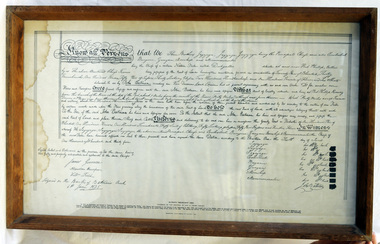
... The deeds had been drafted by JT Gellibrand, a leading lawyer in the colony. Batman's Treaty was a document signed on 6 June 1835 by John Batman, an Australian grazier, businessman and explorer, and a group of Wurundjeri elders, for the purchase of land around Port Phillip, near the present site of the city of Melbourne. ...The deeds had been drafted by JT Gellibrand, a leading lawyer in the colony. Batman's Treaty was a document signed on 6 June 1835 by John Batman, an Australian grazier, businessman and explorer, and a group of Wurundjeri elders, for the purchase of land around Port Phillip, near the present site of the city of Melbourne. ...The Batman Deed is sometimes called the Batman Treaty, the Dutigullar Deed, the Dutigullar Treaty or the Melbourne Deed. The deeds had been drafted by JT Gellibrand, a leading lawyer in the colony. Batman's Treaty was a document signed on 6 June 1835 by John Batman, an Australian grazier, businessman and explorer, and a group of Wurundjeri elders, for the purchase of land around Port Phillip, near the present site of the city of Melbourne. The document came to be known as Batman's Treaty and is considered significant as it was the first and only documented time when Europeans negotiated their presence and occupation of Aboriginal lands directly with the traditional owners. The so-called treaty was implicitly declared void on 26 August 1835 by the Governor of New South Wales, Richard Bourke. The original Batman Deed is of enormous significance to the history of the European settlement of Victoria. Framed print of the Batman Deed, dated 1835. This is a printed copy of the Batman Deed, made in 1966 from the 'original' by the State Library of Victoria. The frame is wood. The document consists of handwritten text in black ink with eight signatures in the lower right hand side and three signatures in the lower left hand corner. It has been signed by John Batman beneath the eight signatures.document batman-deed melbourne -
 Eltham District Historical Society Inc
Folder, Pioneers & Painters; Shire of Eltham Historical Society research notes, background information, etc, 1969-1986, 1969-1986
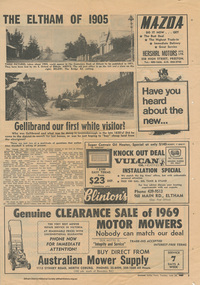
... john thomson...joseph tice gellibrand...The public campaign received generous response and the material collected became the genesis for the Shire of Eltham Pioneers Photograph collection now held in partnership between Eltham District Historical Society and Yarra Plenty Regional Library (Eltham Library). a.g. thomas a.r. thomas alan marshall bridge road charles joseph latrobe council members d.w. lachlan eltham district road board eltham shire council ernie orford f. barrett francis rogerson g. bransprone james donaldson james johnston john bell john thomson joseph tice gellibrand lower plenty bridge m.b. watson main road map patrick turnbull peter morris pioneers and painters post office rev. longfield sepp shire of eltham pioneers photograph collection shire secretary st margaret's church thomas armstrong thomas bell thomas sweeney william bell (1796-1870) Centenary Celebrations Christmas Hills Clifton Pugh David Newbury Dudley Street Eltham gareth jones roberts Hurstbridge John Perceval Joy Peck Kangaroo Ground Kinglake Lower Plenty Luther Haley General Store Montmorency Neil Douglas Panton Hill Peter Glass Research (Vic.) ...Material pertaining to the production of a history of the Shire of Eltham, "Pioneers & Painters: One Hundred Years of Eltham and its Shire" in recognition of the shire's centenary in 1971 Item Title Caption 04768-1 Newspaper clipping - The Eltham of 1905; Gellibrand our first white visitor? Diamond Valley News, 24 June 1969, p5 04768-2 Newspaper clipping - The Eltham of 1905; Gellibrand our first white visitor? Heidelberger, 25 June 1969 04768-3 Notes on Eltham District Road Board Members 1866-1871 04768-4 Notes on Eltham District Road Board Members 1866-1871 04768-5 Map showing Gellibrand's likely route through district 12-13 February 1836 and Hoddles's route of Febrary 1838 04768-6 Notes by Shire Secretary, M.B. Watson regarding meeting with Reverend Longfield regarding history of St Margaret's Church 04768-7 Alan Marshall's notes from discussion with Mr. F. Barrett regarding SEPP images 611, 635 and 636 SEPP_0611 SEPP_0635 SEPP_0636 04768-8 Transcripts of letter from local residents to Charles Joseph Latrobe requesting a bridge over the Plenty River dated 10 April 1849 and his reply dated 5 May 1849; from Latrobe Library Archives - Land Branch Records 04768-9 Notes on history of Eltham Shire, Centenary events and publication of Pioneers & Painters for release in conjunction of opening of new Library 04768-10 Newspaper clipping - Glossy record of shire's romantic past and the people who made it by Fab Calafuri, Diamond Valley News, Tuesday, December 16, 1986, p18 SEPP_0755-3 Letter: Acknowledgement from Colin J. Bock, Eltham Shire Secretary to A.R. Thomas of Bendigo for copy of 1913 photograph of Shire of Eltham Councilors, 21 May 1973 A.R. Thomas' father Mr. A.G. Thomas, C.E., was the Shire Secretary at the time in 1913. Cross Ref: SEPP_0755 The idea to develop a book on the history of the Shire of Eltham to be edited by noted author, Alan Marshall in celebration of the shire's centenary was initiated in 1969. The Shire of Eltham Historical Society undertook significant research in conjunction with Alan Marshall locating material at various institutions and other societies; interviewing longer term residents and a public campaign through the local press to acquire photographic material for duplication and use in the book. The public campaign received generous response and the material collected became the genesis for the Shire of Eltham Pioneers Photograph collection now held in partnership between Eltham District Historical Society and Yarra Plenty Regional Library (Eltham Library).Paper documents of various sizes and newspaper clippingsa.g. thomas, a.r. thomas, alan marshall, bridge road, charles joseph latrobe, council members, d.w. lachlan, eltham district road board, eltham shire council, ernie orford, f. barrett, francis rogerson, g. bransprone, james donaldson, james johnston, john bell, john thomson, joseph tice gellibrand, lower plenty bridge, m.b. watson, main road, map, patrick turnbull, peter morris, pioneers and painters, post office, rev. longfield, sepp, shire of eltham pioneers photograph collection, shire secretary, st margaret's church, thomas armstrong, thomas bell, thomas sweeney, william bell (1796-1870), centenary celebrations, christmas hills, clifton pugh, david newbury, dudley street, eltham, gareth jones roberts, hurstbridge, john perceval, joy peck, kangaroo ground, kinglake, lower plenty, luther haley general store, montmorency, neil douglas, panton hill, peter glass, research (vic.), sheila ferguson, shire of eltham, st andrews, yarra glen -
 Port Melbourne Historical & Preservation Society
Plan - Sandridge and adjacent suburbs, 1860
... town planning transport - railways On back in pencil 'From Alex St John 4/1998' Photocopy of plan of Sandridge c1860 and adjacent suburbs from Pt Ormond to Pt Gellibrand at Williamstown on the bay and Melbourne to Hawthorn to the north. ...Photocopy of plan of Sandridge c1860 and adjacent suburbs from Pt Ormond to Pt Gellibrand at Williamstown on the bay and Melbourne to Hawthorn to the north. Shows the loop railway line which connected the St Kilda line to that at Windsor.On back in pencil 'From Alex St John 4/1998'town planning, transport - railways -
Koorie Heritage Trust
Book, Bonwick, James, Port Phillip settlement, 1883
... John Batman; Batman's journal and report; The wild white man; The surveyor's note-book and report; Life of Mr. Fawkner before 1835; Fawkner on the Yarra Yarra; Official correspondence; The Port Phillip Association; Official recognition of trespassers; First Government of Port Phillip; Mr Gellibrand lost in the bush; The Governor's visit to the Yarra; Melbourne and its land sale; The stock question; Mr Mackillop's narrative; Progress of the settlement; The early Melbourne press; Discovery of Gipps Land; The Black Question; Narratives of Old Hands; Causes of emigration in 1835; An Overland journey x, 537 pages, [36] leaves of plates (some folded.) illustrations (1 colour), facsimiles, portraits ; 23 cm. ...Contents: Discovery; Mr. Grimes round the Bay, 1803; Settlement of 1803; The settlement of 1826; Hume and Hovell's overland journey; The Western Port settlement; Captain Sturt on the Murray; Portland Bay settlement in 1834; Major Mitchell's discoveries in Australia Felix; Life of John Batman; Batman's journal and report; The wild white man; The surveyor's note-book and report; Life of Mr. Fawkner before 1835; Fawkner on the Yarra Yarra; Official correspondence; The Port Phillip Association; Official recognition of trespassers; First Government of Port Phillip; Mr Gellibrand lost in the bush; The Governor's visit to the Yarra; Melbourne and its land sale; The stock question; Mr Mackillop's narrative; Progress of the settlement; The early Melbourne press; Discovery of Gipps Land; The Black Question; Narratives of Old Hands; Causes of emigration in 1835; An Overland journeyx, 537 pages, [36] leaves of plates (some folded.) illustrations (1 colour), facsimiles, portraits ; 23 cm.Contents: Discovery; Mr. Grimes round the Bay, 1803; Settlement of 1803; The settlement of 1826; Hume and Hovell's overland journey; The Western Port settlement; Captain Sturt on the Murray; Portland Bay settlement in 1834; Major Mitchell's discoveries in Australia Felix; Life of John Batman; Batman's journal and report; The wild white man; The surveyor's note-book and report; Life of Mr. Fawkner before 1835; Fawkner on the Yarra Yarra; Official correspondence; The Port Phillip Association; Official recognition of trespassers; First Government of Port Phillip; Mr Gellibrand lost in the bush; The Governor's visit to the Yarra; Melbourne and its land sale; The stock question; Mr Mackillop's narrative; Progress of the settlement; The early Melbourne press; Discovery of Gipps Land; The Black Question; Narratives of Old Hands; Causes of emigration in 1835; An Overland journeymelbourne (vic.) -- history -- to 1834. | melbourne (vic.) -- history -- 1834-1851. | port phillip bay region (vic.) -- history. -
Koorie Heritage Trust
Book, Batman, John, The settlement of John Batman in Port Phillip : from his own journal, 1985
... John Batmn's journey to Port Phillip and his first impressions with the land and its indigenous inhabitantsreprinted from his journal. Batman's crucial first expedition to Port Phillip in May-June 1835. Based on historical events rather than on Batman's actual journal and written to reinforce his claim to be the founder of Melbourne, this embellished account of the expedition has been attributed by Henry Gyles Turner to Joseph Tice Gellibrand and a prominent member of the Port Phillip Association. 24 pages ; 22 cm. ...An extract of John Batmn's journey to Port Phillip and his first impressions with the land and its indigenous inhabitants reprinted from his journal. Batman's crucial first expedition to Port Phillip in May-June 1835. Based on historical events rather than on Batman's actual journal and written to reinforce his claim to be the founder of Melbourne, this embellished account of the expedition has been attributed by Henry Gyles Turner to Joseph Tice Gellibrand and a prominent member of the Port Phillip Association.24 pages ; 22 cm.An extract of John Batmn's journey to Port Phillip and his first impressions with the land and its indigenous inhabitants reprinted from his journal. Batman's crucial first expedition to Port Phillip in May-June 1835. Based on historical events rather than on Batman's actual journal and written to reinforce his claim to be the founder of Melbourne, this embellished account of the expedition has been attributed by Henry Gyles Turner to Joseph Tice Gellibrand and a prominent member of the Port Phillip Association.batman, john, 1801-1839 -- diaries. | pioneers -- victoria -- port phillip bay region -- diaries. | port phillip bay region (vic.) -- history -- diaries.
