
Showing 182 items matching "l. sher"
-
 Kadimah Jewish Cultural Centre and National Library
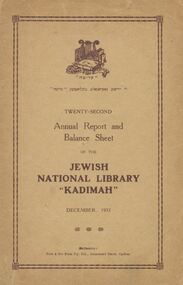
Document - Annual Report, Annual Report and Balance Sheet 1933, 1933
... ...L. Sher...Kadimah Jewish Cultural Centre and National Library 7 Selwyn St Elsternwick melbourne The 22nd annual report produced by Kadimah President S. Wynn L. Sher R. Rothberg E. Wynn A. Barkohn J. Bercove S. ...The 22nd annual report produced by Kadimah18 pagespresident s. wynn, l. sher, r. rothberg, e. wynn, a. barkohn, j. bercove, s. brilliant, b. gross, h. housey, i. hurwitz, p. lederman, s. mendelson, a. mushin, a. newmark, a. patkin, i. rose, m. schechter, m. zacharin, ms. zweibaum -
 Kadimah Jewish Cultural Centre and National Library
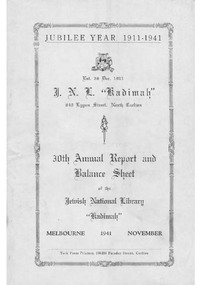
Document - Annual Report, 30th Annual Report and Balance Sheet of the Kadimah National Library 1941
... ...I. Sher...L...L. Duckett M. Ehrlich H. Gurt H. Housey M. Hiller J. Lederman S. Maranz I. Rothman I. Sher ...Annual report produced by Kadimah28 pagesalick mushin, j. okno, j. pushet, h. munz, s. brilliant, m. zacharin, c. brezniak, l. duckett, m. ehrlich, h. gurt, h. housey, m. hiller, j. lederman, s. maranz, i. rothman, i. sher, l. shapiro, s. wynn -
 Kadimah Jewish Cultural Centre and National Library
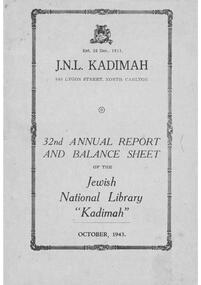
Document - Annual Report, 32st Annual Report and Balance Sheet of the Kadimah National Library 1943
... L. Fink...I. Sher...Kadimah Jewish Cultural Centre and National Library 7 Selwyn St Elsternwick melbourne Annual report produced by Kadimah L. Fink I. Sher J. Rymer J. Pushett M. Zacharin Alick Mushin S. ...Annual report produced by Kadimah34 pagesl. fink, i. sher, j. rymer, j. pushett, m. zacharin, alick mushin, s. brilliant, m. bram, a. bratzblatt, w. fink, i. s. goldstein, m. erlich, m. hiller, aaron mushin, i. rothman, i. segal, a. warhaft -
 Kadimah Jewish Cultural Centre and National Library
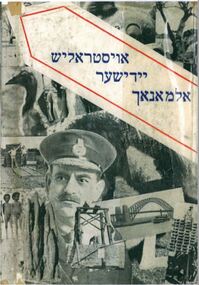
Document - Digitised book, Kadimah Jewish Cultural Centre and National Library, Australian Jewish Almanac 1937, 2023
... ...L. Zabinsky...Israel Sher...Jewish immigrants Yiddish Melbourne Melekh Ravitsh Pinchas Goldhar Hirsch Munz Newman Rosenthal Peretz Hirshbein Bezalel Stavarowsky Jacob Trevaks Nathan Spielfogel Aron Patkin Yosef Laftvitch Jean Campbell Henry Lawson Shimon Zander L. Zabinsky Israel Sher Solomon Wynn Shmuel Weissberg Yiddish Literature The Australian Jewish Almanac was published in Melbourne in 1937. ...The Australian Jewish Almanac was published in Melbourne in 1937. It was the first Yiddish book published in Australia and brings together works from Yiddish writers both in Australia and from overseas. Edited by the renowned Yiddish writer Melech Ravitch (or Melekh Ravitsh) it provides a unique survey of the views and concerns of Jewish immigrants in Australia in the 1930s. The Almanac contains short fiction and non-fiction pieces including histories of Jewish communities in Australia, political commentary and translations into Yiddish of works by Australian authors. Digitisation of the Almanacs was funded by Martin Munz in honour of his parents Hirsch & Estera Munz.349 page PDF - contains bookmarked table of contentsnon-fictionThe Australian Jewish Almanac was published in Melbourne in 1937. It was the first Yiddish book published in Australia and brings together works from Yiddish writers both in Australia and from overseas. Edited by the renowned Yiddish writer Melech Ravitch (or Melekh Ravitsh) it provides a unique survey of the views and concerns of Jewish immigrants in Australia in the 1930s. The Almanac contains short fiction and non-fiction pieces including histories of Jewish communities in Australia, political commentary and translations into Yiddish of works by Australian authors. Digitisation of the Almanacs was funded by Martin Munz in honour of his parents Hirsch & Estera Munz.jewish immigrants, yiddish melbourne, melekh ravitsh, pinchas goldhar, hirsch munz, newman rosenthal, peretz hirshbein, bezalel stavarowsky, jacob trevaks, nathan spielfogel, aron patkin, yosef laftvitch, jean campbell, henry lawson, shimon zander, l. zabinsky, israel sher, solomon wynn, shmuel weissberg, yiddish literature -
 Kadimah Jewish Cultural Centre and National Library
Programme, The Marriage Licence (Di Ketuba); 1967
... ...Y. Sher...L...Kadimah Jewish Cultural Centre and National Library 7 Selwyn St Elsternwick melbourne By Efraim Kishon comedy in 2 acts Dovid Herman Theatre Y. Sher L. Zuker R. Gawenda M. Szmerling S. Migdalek B. ...By Efraim Kishon comedy in 2 actsdovid herman theatre, y. sher, l. zuker, r. gawenda, m. szmerling, s. migdalek, b. schenkel -
 Whitehorse Historical Society Inc.
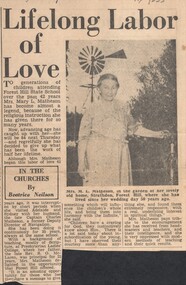
Book, Lifelong Labor of Love
... Five small books of the Gospels and Acts transcribed into current English by Mrs Mary L. Matheson which she used for religious instruction at Forest Hill State School and a Christmas card to Elsie Payne....Matheson Five small books of the Gospels and Acts transcribed into current English by Mrs Mary L. Matheson which she used for religious instruction at Forest Hill State School and a Christmas card to Elsie Payne. ...Five small books of the Gospels and Acts transcribed into current English by Mrs Mary L. MathesonFive small books of the Gospels and Acts transcribed into current English by Mrs Mary L. Matheson which she used for religious instruction at Forest Hill State School and a Christmas card to Elsie Payne.Five small books of the Gospels and Acts transcribed into current English by Mrs Mary L. Matheson matheson, mary, payne, elsie, forest hill state school no. 4251 -
 Warrnambool and District Historical Society Inc.
Book, Book Reflection - In Jamaica, 1932
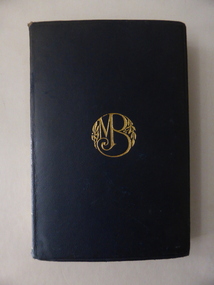
... She was an Australian author who gained international recognition for her novels, travel books, magazine articles and short stories. The wife of Dr H. L...She was an Australian author who gained international recognition for her novels, travel books, magazine articles and short stories. The wife of Dr H. L ...This is a travel book written by Mary Gaunt (1861-1942). She was an Australian author who gained international recognition for her novels, travel books, magazine articles and short stories. The wife of Dr H. L. Miller, she lived in Warrnambool from 1894 to 1900 and wrote some of her novels whilst in the town, using local scenes and situations for some of her writings. Her travel books are important as she wrote about her adventures in countries such as Africa and China where she was often touring places not previously visited by a white woman unaccompanied by other Europeans. This original copy of Mary Gaunt’s book about her travels in Jamaica is significant. Not only was Mary Gaunt a noted Australian writer but she was also a resident of Warrnambool for some time and thus has her place in Warrnambool’s history. This book was sent by Mary Gaunt to her brother Clive, resident in Rangoon at the time of the book’s publication. This is a hard cover book of 258 pages. The book has a dark green cover with gold lettering on the spine. The cover is very mottled and stained. There are four black and white photographs scattered throughout the text. A signature on the first page is in black ink and a small book plate is printed on a piece of paper which is pasted into the first page. ‘Clive Gaunt Rangoon’ ‘With the Author’s Compliments’mary gaunt, history of warrnambool, australian literature -
 Warrnambool and District Historical Society Inc.
Book, Barnes Notes on the Four Gospels, 1857
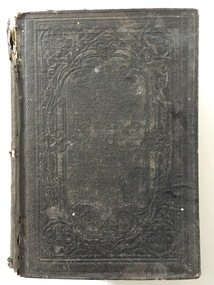
... Davidson would most likely be Margaret Milne Davidson (1839-1928) who was born in Kirremuir, Scotland and was the daughter of James and Isabella Davidson of Woodend near Cassadys Bridge on the outskirts of Warrnambool. She never married. The identity of ‘L. H. R.’ is unknown. ...Davidson would most likely be Margaret Milne Davidson (1839-1928) who was born in Kirremuir, Scotland and was the daughter of James and Isabella Davidson of Woodend near Cassadys Bridge on the outskirts of Warrnambool. She never married. The identity of ‘L. H. R.’ is unknown. This book is significant firstly because of its antiquarian interest (an 1857 publication) and secondly because of its connection to Margaret Davidson. ...This is a book given in 1860 to Miss M. Davidson by L.H.R Miss M. Davidson would most likely be Margaret Milne Davidson (1839-1928) who was born in Kirremuir, Scotland and was the daughter of James and Isabella Davidson of Woodend near Cassadys Bridge on the outskirts of Warrnambool. She never married. The identity of ‘L. H. R.’ is unknown. This book is significant firstly because of its antiquarian interest (an 1857 publication) and secondly because of its connection to Margaret Davidson. Her father and uncle and their families were pioneer settlers in Warrnambool and thus of great importance in our history. This is a hard cover book of 53 pages. The cover is brown with an ornamental pattern impressed into the front cover and gold lettering on the spine. The book has a Preface, an Introduction, 21 chapters of text by Rev. Albert Barnes and an Index. It has a colour fold-up map of Palestine. There is a stamp of the Warrnambool & District Historical Society on the first page and an inscription in black ink. The cover is partly broken away and torn. ‘Miss M. Davidson from L.H.R. Warrnambool 4 May 1860’. margaret davidson, history of warrnambool -
 Warrnambool and District Historical Society Inc.
Book, The Forbidden Town, 1926
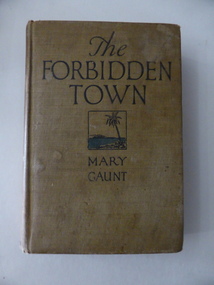
... From 1894 to 1900 she lived in Warrnambool (she was married to Dr H. L. Miller) and continued to write while she was resident in the town, using local places and situations in some of her writings. ...From 1894 to 1900 she lived in Warrnambool (she was married to Dr H. L. Miller) and continued to write while she was resident in the town, using local places and situations in some of her writings. ...This is a novel written by Mary Gaunt (1861-1942). She was an Australian writer who published over 20 novels, many travel books, short stories and magazine articles and achieved an international reputation as an author and intrepid traveller, especially in Africa and China. From 1894 to 1900 she lived in Warrnambool (she was married to Dr H. L. Miller) and continued to write while she was resident in the town, using local places and situations in some of her writings. This is a significant book as it is an original copy of one of Mary Gaunt’s novels. As a resident of Warrnambool for some time and as a significant Australia author she has her place in Warrnambool’s history. The inscription in the book does not have any known significance. This is a hard cover book of 314 pages. The cover is light brown with black printing on the front cover and spine and an image of a tropical island scene on the front cover. There are a signature in black ink and an inscription in pencil on the first page. The cover is very stained and the spine has a number ‘46’ on white paper glued on. ‘Charles R. Boucher’ ‘Dec. 25 1928, Charley from Ethel and Forest’. ‘46’ mary gaunt, history of warrnambool, australian literature -
 Warrnambool and District Historical Society Inc.
Plaque - Nameplate, marble, Ozone Hotel, C 1900
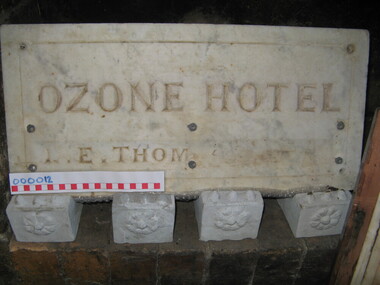
... she was given permission to rebuild. The new hotel named Hotel Warrnambool was opened in March 1931. The name plate is visible in photographs of the original Directors of the Grand Ozone. Mrs Lilias Euphemia Thom was a licensee of the Ozone hotel from 1907-1910. A link to a significant part of Warrnambool's streetscape and grand buildings. grand ozone coffee palace warrnambool history hotel warrnambool hotel mansions warrnambool l ...The Ozone Hotel was formerly the Grand Ozone Coffee Palace which was erected in 1890 at a cost of around ten thousand pounds. Coffee Palaces were temperance hotels which were popular in the latter part of the 19th century which offered recreation and superior accommodation. The coffee palace operated until 1915 and was then closed before re-opening in 1920 as Hotels Mansions. It had major renovations including a large theatre area. February 23rd 1929 saw the most spectacular fire in Warrnambool's history when the Hotel mansions was burnt to the ground. Evelyn O'Brien was granted a temporary licence and in September 1930 she was given permission to rebuild. The new hotel named Hotel Warrnambool was opened in March 1931. The name plate is visible in photographs of the original Directors of the Grand Ozone. Mrs Lilias Euphemia Thom was a licensee of the Ozone hotel from 1907-1910.A link to a significant part of Warrnambool's streetscape and grand buildings.Marble name plate Ozone Hotel, with a shallow decorative groove 30mm in from edge, 4 mounting holes in each corner, an inscription L E Thom has 6 holes in lower portion perhaps used to attach the name of subsequent licensees. Ozone Hotel L E Thom grand ozone coffee palace, warrnambool history, hotel warrnambool, hotel mansions warrnambool, l thom -
 Warrnambool and District Historical Society Inc.
Book, Lillian Jane Duncan (nom de plum El Jady), The Sailor of the Istar, 1893
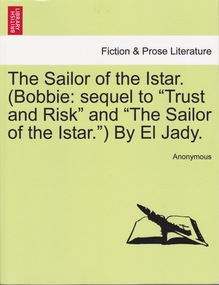
... L Duncan wrote three novels Bobbie, Trust and Risk and The sailor of the Istar. Her nom de plume is her initials of her actual name , Lillian Jane Duncan, hence El Ja Dy. Lillian Jane Duncan was the daughter of George and Emily Duncan who lived for some time in Lenzie in Hopetoun Road Warrnambool. She ...Novel written by El Ja Dy (nom de plume for Lillian Jane Duncan)Green paperback with white band with black text fictionNovel written by El Ja Dy (nom de plume for Lillian Jane Duncan) warrnambool, l duncan author, lillian duncan, royal chambers warrnambool, el jady -
 Warrnambool and District Historical Society Inc.
Book, A Southern Voice, 1941
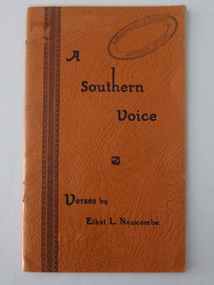
... She died in 1971. The identity of Arthur, the recipient of the book, is not known. This book is of considerable interest because it was written by Ethel Newcombe who was born and educated in Warrnambool and the book is thus is associated with both the Forrester and the Newcombe families in Warrnambool early in the 20th century Newcombe family, Warrnambool Forrester family. Warrnambool St. John’s Hall School, Warrnambool Ethel Newcombe History of Warrnambool Australian Literature ‘To Arthur, with the writer’s best wishes, Xmas 1941, Ethel L ...This book of verses has been written by Ethel Lucy Newcombe (nee Forrester) The daughter of Lucy Sorrell and James William Forrester, she was born in 1874 in Warrnambool. As a Matriculated student she taught at the Warrnambool St. John’s Hall Private School for Girls in the 1890s. The proprietor of this school was her friend, Grace Newcombe and Ethel Forrester, especially talented in literature and music, composed a Cantata, ‘Austral’s Sunny Year’ for the annual school concert in 1898. In 1902 Ethel Forrester married Dr Frederick Newcombe (Grace’s brother), a medical missionary in India. His father Ebenezer Newcombe was well-known in Warrnambool as a timber and hardware businessman. Dr Frederick Newcombe died in India in 1905 and Ethel Newcombe spent the greater part of her later life in Melbourne. She died in 1971. The identity of Arthur, the recipient of the book, is not known. This book is of considerable interest because it was written by Ethel Newcombe who was born and educated in Warrnambool and the book is thus is associated with both the Forrester and the Newcombe families in Warrnambool early in the 20th century This is a soft cover book of 32 pages. The cover is dark orange in colour and has dark blue lettering on the front cover with ornamental scroll work on the left margin of the front cover. The book has three blue stamps of the Warrnambool & District Historical Society and the inscription on the first page is handwritten in black ink. The book has been stapled with metal staples but the staples have been removed. ‘To Arthur, with the writer’s best wishes, Xmas 1941, Ethel L. Newcombe’ newcombe family, warrnambool, forrester family. warrnambool, st. john’s hall school, warrnambool, ethel newcombe, history of warrnambool, australian literature -
 Warrnambool and District Historical Society Inc.
Photograph, Warrnambool High School, Early 20th century
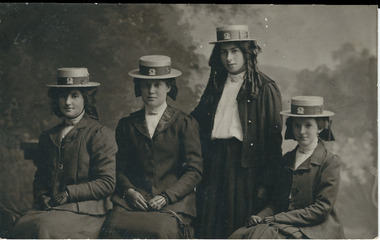
... The identity of Jessie is known – she is Jessie Browne who later married John Bennett, the first Manager of the Warrnambool Woollen Mill and there is a Jessie L. ...The identity of Jessie is known – she is Jessie Browne who later married John Bennett, the first Manager of the Warrnambool Woollen Mill and there is a Jessie L. ...The girls in this photograph have not been identified, though the sender of the card, ‘Emmie’, may be one and the other may be the recipient, ‘Jessie’. The identity of Jessie is known – she is Jessie Browne who later married John Bennett, the first Manager of the Warrnambool Woollen Mill and there is a Jessie L. Brown listed as a pupil of Warrnambool High School which commenced in 1907. This is an important and interesting photograph with more research needed on its subjects. This is a post card with a black and white photograph of four school girls from the late 19th or early 20th centuries on one side. Three are seated and one is standing and all are wearing skirts and fitted tops with white blouses and straw boater hats. The clothes are not identical. The hats are identical with a badge attached to each. One girl has longer curled hair. All are wearing gloves. On back of photo: ‘To dear Jessie, With all best wishes for a joyous New Year, Loving friend, Emmie’ In different writing: ‘W’bool High School’ jessie brown(e), warrnambool high school -
 Kiewa Valley Historical Society
Photo - Skiers 1946, August 1946
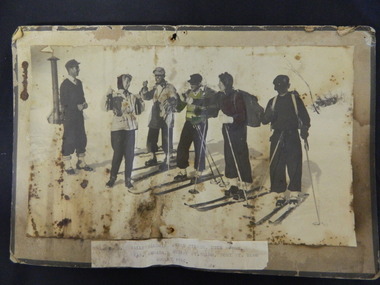
... she and her husband lived. Her husband worked for the S.E.C.V.. Employees of the State Electricity Commission of Victoria were early skiers on the Bogong High Plains. The area is a well known tourist centre for skiers, bush walkers and bike riders. Snow skiers; Bogong High Plains; State Electricity Commission of Victoria; Kiewa Hydro Electric Scheme; Skippy St Elmo L ...During winter skiers skied on the Bogong High Plains. During the 1940's the State Electricity Commission of Victoria was constructing the Kiewa Hydro Electric Scheme and skiing was part of their employees recreation. Skippy St Elmo won ski races during the 1940's practising on the High Plains where she and her husband lived. Her husband worked for the S.E.C.V..Employees of the State Electricity Commission of Victoria were early skiers on the Bogong High Plains. The area is a well known tourist centre for skiers, bush walkers and bike riders.Black and cream photo glued onto thick cardboard with a label glued on at the bottom.L to R Wally Baldwin, Joyce Fisher, Dick Moore, / Chas Armada, Skippy St Elmo, Toni St Elmo / August 1946snow skiers; bogong high plains; state electricity commission of victoria; kiewa hydro electric scheme; skippy st elmo -
 Bendigo Military Museum
Flag - UNITED STATES OF AMERICA FLAG
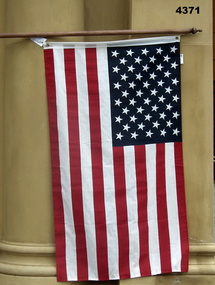
... Bendigo Military Museum 37 - 39 Pall Mall Bendigo goldfields The flag was donated by a visitor to SMIMM from Texas USA and when she returned home sent the Museum a flag Flags USA Flag, cloth, top L H corner has the white stars of the combined states of America, main section has red and white bars across, the spine has a brass eyelet top and bottom Flag UNITED STATES OF AMERICA FLAG ...The flag was donated by a visitor to SMIMM from Texas USA and when she returned home sent the Museum a flagFlag, cloth, top L H corner has the white stars of the combined states of America, main section has red and white bars across, the spine has a brass eyelet top and bottomflags, usa, -
 Federation University Historical Collection
Photograph, Happy Valley State School No.376 Honor Roll, c1920
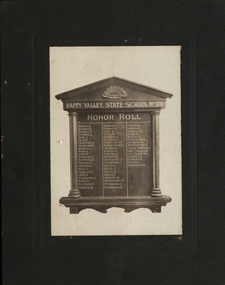
... she was unable to attend due to ill health. Happy Valley Happy Valley State School Honor Roll Honour roll O. Brough E. Daniels G. Daniels philately J. Dial G. Dial A. Gradnor w. gradnor g. kiely a. kerr w. lowe L ...World War One honor roll of former students of the Happy Valley State School No 376 who enlisted. The original honor roll no longer exists. There is a framed photograph of it in the current Happy Valley School building now used for community events. This honor roll would appear to be made before the end of WW1 as Ernest Alfred Yung died in September 1917 at Ypres. His brother George Alfred Yung returned who was also in the same battle returned to Australia. Honour rolls were also made to encourage more men to enlist. Margaret Young studied at Ballarat West Art School in 1894. This was one of Ballarat's Art schools. In 1907 they merged and became Ballarat Technical Art School (BTAS). Margaret became a teacher and taught for many years at BTAS, specialising in woodcarving. At the end of the First World War, Honour Boards were requested to be made to honour the men who had served. Ballarat was the main provider of these boards. Margaret Young was one of the people responsible for the carvings and specially mentioned for her work by the Caulfield School in Melbourne. On her resignation, Margaret moved to Adelaide. At the past students Reunion Celebrations in 1930, Margaret Young was to be the Guest of Honour. Unfortunately she was unable to attend due to ill health. Sepia photograph of honor roll board for World War One with white background mounted on grey cardboardReverse lhs upper - inked words 'Photo only'; centre - 'Mrs J Garvey, Happy Valley'; rhs upper - two stamps, 1 penny and a half penny franked with Ballarat; pencilled writing 'Mrs Garvey Happy Valleyhappy valley, happy valley state school, honor roll, honour roll, o. brough, e. daniels, g. daniels, philately, j. dial, g. dial, a. gradnor, w. gradnor, g. kiely, a. kerr, w. lowe, l. martinez, h. martinez, j. milburn, c. milburn, a. may, e. morgan, f. opie, a. paterson, n. reid, f. rankin, h. smith, t. thomas, l. thomas, e. yung, a. yung, a. bromley, j. blundell, h. barraclough, j. crommie, g. darling, j. darling, w. w. groves, j. gardiner, a. keys, j. keys, p. kelly, s. kelly, m. morgan, w. montgomery, j. rutherford, r. rutherford, p. smith, w. wishart, h. wark, s. ronald, k.n. mcnamee, p. bennington, sister m.j. thomas, d.l. thomas, w.e. thomas, j.s. gower, f.h. gower, s. gower, s.t.m. gower, happy valley school honor roll, a.a. louden -
Federation University Historical Collection
Document - Document - Letter, Ballarat Junior Technical School: Reference letter for Kyra Sandra Trotter for her new school, 1958
... she would be attending when the family move to the West. Subjects covered in her first year of secondary school and courses available in the girl's section of the Junior Technical School outlined. ballarat junior technical school head master l garner kyra sandra trotter character highly regarded ability excellent first year english social studies arithmetic science art craft decorative needlework dressmaking home management music Cream page, typed. ...Letter from Mr Garner outlining the character and academic ability of Kyra Sandra Trotter. This provided for school she would be attending when the family move to the West. Subjects covered in her first year of secondary school and courses available in the girl's section of the Junior Technical School outlined. Cream page, typed. ballarat junior technical school, head master, l garner, kyra sandra trotter, character highly regarded, ability excellent, first year, english, social studies, arithmetic, science, art, craft, decorative needlework, dressmaking, home management, music -
Federation University Historical Collection
Document - Document - Letter, Ballarat Junior Technical School: Letter to Mrs Miller re transfer of children to Footscray Junior Technical School, 1952
... Suggests she contacts the school informing the Head Master of her intention of enrolling the boys at the beginning of Term 2. Statement showing each boy has paid money for activities - sport, material, library, magazine. ballarat junior technical school head master l garner mrs m miller bruce miller robin miller transfer footscray junior technical school. activities fees paid sport materials library magazine 2 Cream pages, typed Ballarat Junior Technical School: Letter to Mrs Miller re transfer of children to Footscray Junior Technical School, 1952 Document Document - Letter ...Letter from Mr Garner to Mrs Miller assuring her that there would be no difficulty in transferring her sons Bruce and Robin to Footscray Junior Technical School. Suggests she contacts the school informing the Head Master of her intention of enrolling the boys at the beginning of Term 2. Statement showing each boy has paid money for activities - sport, material, library, magazine.2 Cream pages, typed ballarat junior technical school, head master, l garner, mrs m miller, bruce miller, robin miller, transfer, footscray junior technical school., activities fees paid, sport, materials, library, magazine -
Ballarat Clarendon College
Trophy
... She received a H V McKay Scholarship and was Vice Captain on Cairns House. Faye trained in nursing after school. Archives also holds Faye's 1956 Junior championship trophy, 1958 Intermediate Championship trophy, 1960 Senior championship trophy, blazer pocket with insignia and house colour. delia-faye-cowie clarendon-presbyterian-ladies-college sports-trophy athletics Inscribed on face of cup: C P L C / 1960 / Senior Champion / F Cowie Small plain, double-handle silver cup on melamine stand Trophy ...Delia Faye (Cowie) Mansell (BD 19/09/1943) attended CPLC 1956-1960. She received a H V McKay Scholarship and was Vice Captain on Cairns House. Faye trained in nursing after school. Archives also holds Faye's 1956 Junior championship trophy, 1958 Intermediate Championship trophy, 1960 Senior championship trophy, blazer pocket with insignia and house colour. Small plain, double-handle silver cup on melamine standInscribed on face of cup: C P L C / 1960 / Senior Champion / F Cowiedelia-faye-cowie, clarendon-presbyterian-ladies-college, sports-trophy, athletics -
 Ballarat Clarendon College
Trophy, Junior tennis champion
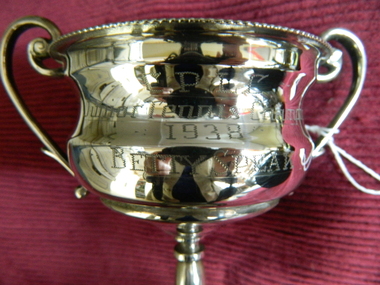
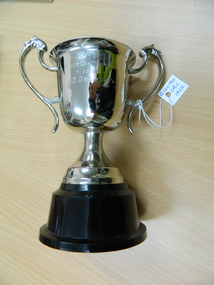
... she instilled her love of the game into both my sister Margaret and myself. Mum was always too humble to acknowledge her amazing abilities - both on and off the tennis court. But this is an early public acknowledgement of her skills.' betty-speak sports tennis trophy 1930s Engraved on face of cup: C P L C / Junior Tennis Champion / 1938 / BETTY SPEAK Medium silver cup with double handles and silver base and stem on melamine stand Junior tennis champion Trophy ...Elizabeth (Betty) Ann Speak attended Clarendon Presbyterian Ladies College 1937 - 1938. She won the Junior Tennis Champion in 1938. Betty worked as a telephonist at Coleraine Post Office after leaving CPLC in 1938. In 1949, she married Leslie James Steff from Konongwootong. They had two daughters. In 1967 Betty returned to work at the Coleraine Post Office and worked for 17 years, moving to the Hamilton PO after the Coleraine PO closed around 1980. She continued to play tennis throughout her adult years. Daughter Gwenda Steff, who donated the trophy to the school in 2016, says 'Mum was passionate about her tennis. She had a formidable backhand shot that few could return. She played Saturday afternoon competition tennis up until her late 40's and she instilled her love of the game into both my sister Margaret and myself. Mum was always too humble to acknowledge her amazing abilities - both on and off the tennis court. But this is an early public acknowledgement of her skills.'Medium silver cup with double handles and silver base and stem on melamine standEngraved on face of cup: C P L C / Junior Tennis Champion / 1938 / BETTY SPEAKbetty-speak, sports, tennis, trophy, 1930s -
 Ballarat Clarendon College
Trophy, Intermediate Athletic Champion
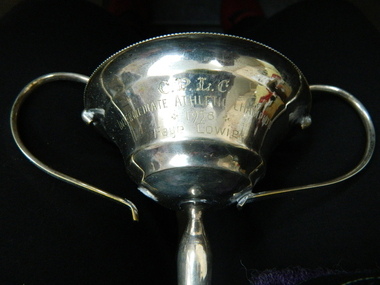
... She was Vice House Captain of Cairns in her final year. A keen sportswoman Faye won this trophy at the Annual Athletics Day. Faye gained her Intermediate School certificate in 7 subjects and studied nursing after leaving the school. Faye also won 1960 Senior Championship and 1956 Junior Championship. faye-cowie sports Engraved on face: C. P. L ...Delia Faye Cowie boarded at Clarendon Presbyterian Ladies College 1956 - 1960. She was Vice House Captain of Cairns in her final year. A keen sportswoman Faye won this trophy at the Annual Athletics Day. Faye gained her Intermediate School certificate in 7 subjects and studied nursing after leaving the school. Faye also won 1960 Senior Championship and 1956 Junior Championship.Small silver cup with double handles with silver stem and melamine base; engraving on face of cup.Engraved on face: C. P. L. C. / INTERMEDIATE ATHLETICS CHAMPION / 1958 / Faye Cowiefaye-cowie, sports -
 Ballarat Clarendon College
Trophy
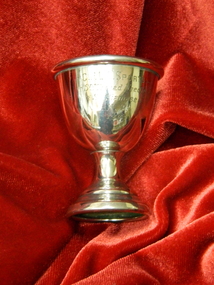
... L, Elvina Coltman & E Morris. Nell was President of the CPLC Old Collegians Association 1941-42 and Secretary 1955-57. She...L, Elvina Coltman & E Morris. Nell was President of the CPLC Old Collegians Association 1941-42 and Secretary 1955-57. She ...Nellie Price entered Clarendon Presbyterian Ladies College in 1920. Daughter of Mr E H Price of 'Dumbarton' Sturt St W; sister of John L, Elvina Coltman & E Morris. Nell was President of the CPLC Old Collegians Association 1941-42 and Secretary 1955-57. She married Robert Smail, uncle of Andrew Smail (1954). Robert's father built the original Enderly house in Sturt St. This trophy provides a significant glimpse of both the nature and importance of sports amongst school students in the 1920s. There is a comprehensive report of the 1924 Sports Day in The Touchstone December 1924 pp.11-14Tiny silver egg cup and stem with rolled top edge and engraving on face of cupEngraved on cup:C.P.L.C. SPORTS / Snr Thread Needle / Snr Siamese / N.P. / 1924nellie-price, nell-smail, sports, 1924, clarendon-presbyterian-ladies-college -
Ballarat Clarendon College
Trophy, Pascoe Cup
... She was Head Prefect 1952, House Captain, Boarding Prefect, tennis champion, hockey, softball and basketball team member and received school colours for her sporting prowess. pascoe tennis clarendon-presbyterian-ladies-college Engraved on face: The Pascoe Tennis Cup / Senior Singles Championship Engraved on verso of cup: Won by / 1957 A P Price / 1958 R Crawford / 1959 R Crawford / 1961 C Coulson / 1962 E Symons / 1963 J Forbes / 1964 J Forbes / 1965 J Forbes / 1966 J Forbes / 1967 L Rimmongton / 1968 P Symons / 1969 J Penrose / 1970 R Hamilton / 1971 R Hamilton / 1972 R Llewellyn / 1973 A Chisolm Tall silver cup with decorated double handles and lid, silver stem and base fixed to a melamine stand; engraving on face and verso of cup. ...The Pascoe Cup was awarded to the Senior Singles Tennis Cha,pion. Origin yet to be confirmed. Barbara Pascoe attended CPLC as a boarder 1958 - 1962. An H V McKay Scholarship recipient Barbara achieved Dux of School 1952. She was Head Prefect 1952, House Captain, Boarding Prefect, tennis champion, hockey, softball and basketball team member and received school colours for her sporting prowess. Tall silver cup with decorated double handles and lid, silver stem and base fixed to a melamine stand; engraving on face and verso of cup.Engraved on face: The Pascoe Tennis Cup / Senior Singles Championship Engraved on verso of cup: Won by / 1957 A P Price / 1958 R Crawford / 1959 R Crawford / 1961 C Coulson / 1962 E Symons / 1963 J Forbes / 1964 J Forbes / 1965 J Forbes / 1966 J Forbes / 1967 L Rimmongton / 1968 P Symons / 1969 J Penrose / 1970 R Hamilton / 1971 R Hamilton / 1972 R Llewellyn / 1973 A Chisolmpascoe, tennis, clarendon-presbyterian-ladies-college -
 Ballarat Clarendon College
Trophy
... She won the Senior Siamese, ran second in the senior 75 yards and first in the senior 175 yards. Held on 5 April in1952 with the Ballarat City Highland pipe Band in attendance the annual sports day was a highlight of the school calendar. elizabeth - gregory elizabeth-bailey senior-championship Face of cup: C P L C / SENIOR CHAMPIONSHIP / 1952 / E. ...Elizabeth Gregory boarded at Clarendon PLC 1951-1952. The senior champion was the fastest runner. Elizabeth remembers running laps of the CPLC oval in bare feet to compete for this title. She won the Senior Siamese, ran second in the senior 75 yards and first in the senior 175 yards. Held on 5 April in1952 with the Ballarat City Highland pipe Band in attendance the annual sports day was a highlight of the school calendar. Medium silver cup with double handles on melamine stand; engraved on face of cup; beaded edge to lip of cup; Face of cup: C P L C / SENIOR CHAMPIONSHIP / 1952 / E. GREGORYelizabeth - gregory, elizabeth-bailey, senior-championship -
Eltham District Historical Society Inc
Document - Folder, Osborne, William Alexander and Ethel Elizabeth
... She was a foundation member of the Catalysts, The Lyceum and the British Ex-service Womens Clubs and was interested in the arts, knowing many local artists. Contents Photocopy page of book: Paragraph about Professor William Alexander Osborne. William Alexander Osborne Clement Byrne Christensen William Longstaff Sir John Longstaff T L ...William Alexander Osborne married Ethel Elizabeth Osborne in 1903; they came to Australia when he became Professor of Physiology at the University of Melbourne, later Dean, Faculty of Medicine, retiring in 1938. In 1904 they lived in Warrandyte at "Lowestoft", later moving to "The Hall" at Kangaroo Ground. Their children were Audrey, Gerard, Yrsa and Charis. Ethel, born in Leeds U.K., graduated in medicine in the 1920s and was active in social issues.She represented Australia at international conferences of The League of Nations and the Pan Pacific Womens Conference; during World War ; she was appointed by the British Ministry of Munitions on working conditions of women and played a major role in the establishment of The Emily McPherson College of Domestic Economy..Locally she was involved with the construction of Evarard Drive, the War Memorial at Warrandyte, the War Memorial Tower at Kangaroo Ground, and the Warrandyte Womens Hospital Auxiliary. She was a foundation member of the Catalysts, The Lyceum and the British Ex-service Womens Clubs and was interested in the arts, knowing many local artists. Contents Photocopy page of book: Paragraph about Professor William Alexander Osborne.Newspaper clippings, A4 photocopies, etcwilliam alexander osborne, clement byrne christensen, william longstaff, sir john longstaff, t l handfield, bishop reginald stephen, nin christensen, ethel elizabeth osborne nee goodson, audrey osborne, gerard osborne, yrsa osborne, charis osborne, "lowestoft" at warrandyte, "the hall" at kangaroo ground, "woodlands" at kangaroo ground, p j mcmahon, faculty of medicine university of melbourne, the league of nations, pan pacific womens conference, everard drive, war memorial warrandyte, war memorial tower kangaroo ground, warrandyte womens hospital auxiliary, catalysts club, the lyceum, british ex-service womens clubs, penleigh boyd, clara southern, jo sweatman, commonwealth court of conciliation and arbitration, st vincent's hospital shool of dietetics -
 Eltham District Historical Society Inc
Photograph - Digital Photograph, Marguerite Marshall, Art Gallery at Clifton Pugh's Artists' Colony, Dunmoochin, Barreenong Road, Cottles Bridge, 5 February 2008
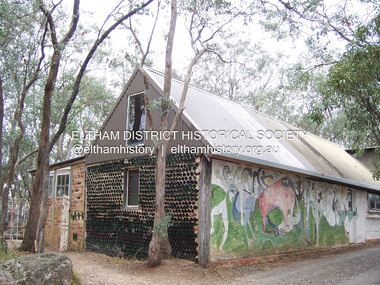
... L-shaped house is single-storey but two-storey in parts with a corrugated-iron pitched roof. The waterhole used by the Werthers for their water supply is thought to be a former goldmining shaft.4 Alma Shanahan at Barreenong Road was the first to join Pugh around 1953. They also met at the National Gallery Art School and Shanahan at first visited each weekend to work, mainly making mud-bricks. She...L-shaped house is single-storey but two-storey in parts with a corrugated-iron pitched roof. The waterhole used by the Werthers for their water supply is thought to be a former goldmining shaft.4 Alma Shanahan at Barreenong Road was the first to join Pugh around 1953. They also met at the National Gallery Art School and Shanahan at first visited each weekend to work, mainly making mud-bricks. She ...Art Gallery with mural painted by Clifton Pugh (1924-1990) at his Artists' Colony, Dunmoochin, Barreenong Road, Cottles Bridge. Following military service in the second world war, Clifton Pugh studied under artist Sir William Dargie at the National Gallery School in Melbourne as well as Justus Jorgensen, founder of Montsalvat. For a while he lived on the dole but also worked packing eggs for the Belot family saving sufficient to purchase six acres (2.4 ha) of land at Barreenong Road, Cottles Bridge. He accumulated more land and persuaded several other artists and friends to buy land nearby, resulting in a property of approximately 200 acres, stablishing it as one of the first artistic communes in Australia alongside Montsalvat in Eltham. It was around 1951 that Pugh felt he had '"done moochin' around" and so the name of the property evolved. He bought timber from Alistair Knox to build his house on the crest of a hill. Inspired by local goldminer's huts, it was a one room wattle-and-daub structure with dirt floor. Over the years it expanded with thick adobe walls made from local clay, high ceilings and stone floors. All materials other than the local earth were sourced from second hand materials, most found at wreckers' yards. Artists from across the nation were drawn to Dunmoochin, with several setting up houses and shacks on the property, maintaining their independence but sharing their artistic zeal. Artists who worked or resided at Dunmoochin included Mirka Mora, John Perceval, Albert Tucker, Fred Williams, Charles Blackman, Arthur Boyd and John Olsen. In 2002, Pugh's house along with its treasure trove of art and a library of some 20,000 books was destroyed by fire. Traces of Pugh's home remain with the presence of the Victorian doorframe archway with leadlight of intricate design, procured from a demolished Melbourne mansion; and two bronze life-sized female statues created by Pugh and cast by Matcham Skipper. In place of Pugh's house rose two double-storey mud-brick artists' studios topped with corrugated iron rooves curved like the wings of a bird with accommodation for seven. The original studios, gallery and other buildings survived the fire. Covered under Heritage Overlay, Nillumbik Planning Scheme. Published: Nillumbik Now and Then / Marguerite Marshall 2008; photographs Alan King with Marguerite Marshall.; p153 It’s not surprising that artist Clifton Pugh was drawn to Cottles Bridge to establish his artists’ colony Dunmoochin. Undisturbed by the clamour of modern life at Barreenong Road, Pugh was surrounded by the Australian bush he loved, and where his ashes were later scattered. The 200 acres (81ha) of bushland, broken by glimpses of rolling hills, has more than 50 species of orchids and Pugh shared his property with native animals including kangaroos, emus, phascogales, wombats, and diverse bird life. Pugh encouraged these creatures to join him in the bush by creating, with Monash University, a holding station where the animals were raised. Dunmoochin inspired Pugh for such paintings as in a book on orchids and the Death of a Wombat series.1 But his love for the bush was accompanied by the fear that Europeans were destroying it and much of his painting illustrated this fear and his plea for its conservation.2 However it was his house rather than the surrounding bush that was to be destroyed. Tragically in 2002 Pugh’s house, with its treasure of art and library of 20,000 art books, was destroyed by fire. Traces of the beauty of Pugh’s home still remain, however, in the magnificent Victorian doorframe archway with leadlight of intricate design procured from a demolished Melbourne mansion; and two bronze life-sized female statues created by Pugh and cast by Matcham Skipper. Now in place of Pugh’s house, are two double-storey mud-brick artists’ studios topped with corrugated roofs curved like birds’ wings, with accommodation for seven. The original studios, gallery and other buildings remain.3 Pugh grew up on his parents’ hobby farm at Briar Hill and attended the Briar Hill Primary School, then Eltham High School and later Ivanhoe Grammar. At 15 he became a copy boy for the Radio Times newspaper, then worked as a junior in a drafting office. Pugh was to have three wives and two sons. After serving in World War Two in New Guinea and Japan, Pugh studied under artist Sir William Dargie, at the National Gallery School in Melbourne.4 Another of his teachers was Justus Jörgensen, founder of Montsalvat the Eltham Artists’ Colony. Pugh lived on the dole for a while and paid for his first six acres (2.4ha) at Barreenong Road by working as an egg packer for the Belot family. Pugh accumulated more land and persuaded several other artists and friends to buy land nearby, resulting in the 200 acre property. They, too, purchased their land from the Belot family by working with their chickens. Around 1951 Pugh felt he had ‘Done moochin’ around’ and so the name of his property was born. Pugh bought some used timber from architect Alistair Knox to build his house on the crest of a hill. Inspired by local goldminers’ huts it was a one-room wattle-and-daub structure with a dirt floor. It was so small that the only room he could find for his telephone was on the fork of a tree nearby.5 Over the years the mud-brick house grew to 120 squares in the style now synonymous with Eltham. It had thick adobe walls (sun-dried bricks) made from local clay, high ceilings and stone floors with the entire structure made of second-hand materials – most found at wreckers’ yards. Pugh’s first major show in Melbourne in 1957, established him as a distinctive new painter, breaking away from the European tradition ‘yet not closely allied to any particular school of Australian painting’.6 Pugh became internationally known and was awarded the Order of Australia. He won the Archibald Prize for portraiture three times, although he preferred painting the bush and native animals. In 1990 not long before he died, Pugh was named the Australian War Memorial’s official artist at the 75th anniversary of the landing at Gallipoli. Today one of Pugh’s legacies is the Dunmoochin Foundation, which gives seven individual artists or couples and environmental researchers the chance to work in beautiful and peaceful surroundings, usually for a year. By November 2007, more than 80 people had taken part, and the first disabled artist had been chosen to reside in a new studio with disabled access.1 In 1989, not long before Pugh died in 1990 of a heart attack at age 65, he established the Foundation with La Trobe University and the Victorian Conservation Trust now the Trust for Nature. Pugh’s gift to the Australian people – of around 14 hectares of bushland and buildings and about 550 art works – is run by a voluntary board of directors, headed by one of his sons, Shane Pugh. La Trobe University in Victoria stores and curates the art collection and organises its exhibition around Australia.2 The Foundation aims to protect and foster the natural environment and to provide residences, studios and community art facilities at a minimal cost for artists and environmental researchers. They reside at the non-profit organisation for a year at minimal cost. The buildings, some decorated with murals painted by Pugh and including a gallery, were constructed by Pugh, family and friends, with recycled as well as new materials and mud-bricks. The Foundation is inspired by the tradition begun by the Dunmoochin Artists’ Cooperative which formed in the late 1950s as one of the first artistic communes in Australia. Members bought the land collaboratively and built the seven dwellings so that none could overlook another. But, in the late 1960s, the land was split into private land holdings, which ended the cooperative. Dunmoochin attracted visits from the famous artists of the day including guitarists John Williams and Segovia; singer and comedian Rolf Harris; comedian Barry Humphries; and artists Charles Blackman, Arthur Boyd and Mirka Mora. A potters’ community, started by Peter and Helen Laycock with Alma Shanahan, held monthly exhibitions in the 1960s, attracting local, interstate and international visitors – with up to 500 attending at a time.3 Most artists sold their properties and moved away. But two of the original artists remained into the new millennium as did relative newcomer Heja Chong who built on Pugh’s property (now owned by the Dunmoochin Foundation). In 1984 Chong brought the 1000-year-old Japanese Bizan pottery method to Dunmoochin. She helped build (with potters from all over Australia) the distinctive Bizan-style kiln, which fires pottery from eight to 14 days in pine timber, to produce the Bizan unglazed and simple subdued style. The kiln, which is rare in Australia, is very large with adjoining interconnected ovens of different sizes, providing different temperatures and firing conditions. Frank Werther, who befriended Pugh as a fellow student at the National Gallery Art School in Melbourne, built his house off Barreenong Road in 1954. Werther is a painter of the abstract and colourist style and taught art for about 30 years. Like so many in the post-war years in Eltham Shire, as it was called then, Werther built his home in stages using mud-brick and second-hand materials. The L-shaped house is single-storey but two-storey in parts with a corrugated-iron pitched roof. The waterhole used by the Werthers for their water supply is thought to be a former goldmining shaft.4 Alma Shanahan at Barreenong Road was the first to join Pugh around 1953. They also met at the National Gallery Art School and Shanahan at first visited each weekend to work, mainly making mud-bricks. She shared Pugh’s love for the bush, but when their love affair ended, she designed and built her own house a few hundred yards (metres) away. The mud-brick and timber residence, made in stages with local materials, is rectangular, single-storey with a corrugated-iron roof. As a potter, Shanahan did not originally qualify as an official Cooperative member.This collection of almost 130 photos about places and people within the Shire of Nillumbik, an urban and rural municipality in Melbourne's north, contributes to an understanding of the history of the Shire. Published in 2008 immediately prior to the Black Saturday bushfires of February 7, 2009, it documents sites that were impacted, and in some cases destroyed by the fires. It includes photographs taken especially for the publication, creating a unique time capsule representing the Shire in the early 21st century. It remains the most recent comprehenesive publication devoted to the Shire's history connecting local residents to the past. nillumbik now and then (marshall-king) collection, art gallery, clifton pugh, dunmoochin, cottlesbridge, cottles bridge, barreenong road -
 Eltham District Historical Society Inc
Photograph - Digital Photograph, Marguerite Marshall, Doorway of Clifton Pugh's former house at Dunmoochin, Barreenong Road, Cottles Bridge, 5 February 2008
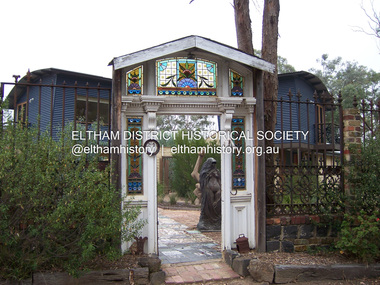
... L-shaped house is single-storey but two-storey in parts with a corrugated-iron pitched roof. The waterhole used by the Werthers for their water supply is thought to be a former goldmining shaft.4 Alma Shanahan at Barreenong Road was the first to join Pugh around 1953. They also met at the National Gallery Art School and Shanahan at first visited each weekend to work, mainly making mud-bricks. She...L-shaped house is single-storey but two-storey in parts with a corrugated-iron pitched roof. The waterhole used by the Werthers for their water supply is thought to be a former goldmining shaft.4 Alma Shanahan at Barreenong Road was the first to join Pugh around 1953. They also met at the National Gallery Art School and Shanahan at first visited each weekend to work, mainly making mud-bricks. She ...Following military service in the second world war, Clifton Pugh studied under artist Sir William Dargie at the National Gallery School in Melbourne as well as Justus Jorgensen, founder of Montsalvat. For a while he lived on the dole but also worked packing eggs for the Belot family saving sufficient to purchase six acres (2.4 ha) of land at Barreenong Road, Cottles Bridge. He accumulated more land and persuaded several other artists and friends to buy land nearby, resulting in a property of approximately 200 acres, stablishing it as one of the first artistic communes in Australia alongside Montsalvat in Eltham. It was around 1951 that Pugh felt he had '"done moochin' around" and so the name of the property evolved. He bought timber from Alistair Knox to build his house on the crest of a hill. Inspired by local goldminer's huts, it was a one room wattle-and-daub structure with dirt floor. Over the years it expanded with thick adobe walls made from local clay, high ceilings and stone floors. All materials other than the local earth were sourced from second hand materials, most found at wreckers' yards. Artists from across the nation were drawn to Dunmoochin, with several setting up houses and shacks on the property, maintaining their independence but sharing their artistic zeal. Artists who worked or resided at Dunmoochin included Mirka Mora, John Perceval, Albert Tucker, Fred Williams, Charles Blackman, Arthur Boyd and John Olsen. In 2002, Pugh's house along with its treasure trove of art and a library of some 20,000 books was destroyed by fire. Traces of Pugh's home remain with the presence of the Victorian doorframe archway with leadlight of intricate design, procured from a demolished Melbourne mansion; and two bronze life-sized female statues created by Pugh and cast by Matcham Skipper. In place of Pugh's house rose two double-storey mud-brick artists' studios topped with corrugated iron rooves curved like the wings of a bird with accommodation for seven. The original studios, gallery and other buildings survived the fire. Covered under Heritage Overlay, Nillumbik Planning Scheme. Published: Nillumbik Now and Then / Marguerite Marshall 2008; photographs Alan King with Marguerite Marshall.; p155 It’s not surprising that artist Clifton Pugh was drawn to Cottles Bridge to establish his artists’ colony Dunmoochin. Undisturbed by the clamour of modern life at Barreenong Road, Pugh was surrounded by the Australian bush he loved, and where his ashes were later scattered. The 200 acres (81ha) of bushland, broken by glimpses of rolling hills, has more than 50 species of orchids and Pugh shared his property with native animals including kangaroos, emus, phascogales, wombats, and diverse bird life. Pugh encouraged these creatures to join him in the bush by creating, with Monash University, a holding station where the animals were raised. Dunmoochin inspired Pugh for such paintings as in a book on orchids and the Death of a Wombat series.1 But his love for the bush was accompanied by the fear that Europeans were destroying it and much of his painting illustrated this fear and his plea for its conservation.2 However it was his house rather than the surrounding bush that was to be destroyed. Tragically in 2002 Pugh’s house, with its treasure of art and library of 20,000 art books, was destroyed by fire. Traces of the beauty of Pugh’s home still remain, however, in the magnificent Victorian doorframe archway with leadlight of intricate design procured from a demolished Melbourne mansion; and two bronze life-sized female statues created by Pugh and cast by Matcham Skipper. Now in place of Pugh’s house, are two double-storey mud-brick artists’ studios topped with corrugated roofs curved like birds’ wings, with accommodation for seven. The original studios, gallery and other buildings remain.3 Pugh grew up on his parents’ hobby farm at Briar Hill and attended the Briar Hill Primary School, then Eltham High School and later Ivanhoe Grammar. At 15 he became a copy boy for the Radio Times newspaper, then worked as a junior in a drafting office. Pugh was to have three wives and two sons. After serving in World War Two in New Guinea and Japan, Pugh studied under artist Sir William Dargie, at the National Gallery School in Melbourne.4 Another of his teachers was Justus Jörgensen, founder of Montsalvat the Eltham Artists’ Colony. Pugh lived on the dole for a while and paid for his first six acres (2.4ha) at Barreenong Road by working as an egg packer for the Belot family. Pugh accumulated more land and persuaded several other artists and friends to buy land nearby, resulting in the 200 acre property. They, too, purchased their land from the Belot family by working with their chickens. Around 1951 Pugh felt he had ‘Done moochin’ around’ and so the name of his property was born. Pugh bought some used timber from architect Alistair Knox to build his house on the crest of a hill. Inspired by local goldminers’ huts it was a one-room wattle-and-daub structure with a dirt floor. It was so small that the only room he could find for his telephone was on the fork of a tree nearby.5 Over the years the mud-brick house grew to 120 squares in the style now synonymous with Eltham. It had thick adobe walls (sun-dried bricks) made from local clay, high ceilings and stone floors with the entire structure made of second-hand materials – most found at wreckers’ yards. Pugh’s first major show in Melbourne in 1957, established him as a distinctive new painter, breaking away from the European tradition ‘yet not closely allied to any particular school of Australian painting’.6 Pugh became internationally known and was awarded the Order of Australia. He won the Archibald Prize for portraiture three times, although he preferred painting the bush and native animals. In 1990 not long before he died, Pugh was named the Australian War Memorial’s official artist at the 75th anniversary of the landing at Gallipoli. Today one of Pugh’s legacies is the Dunmoochin Foundation, which gives seven individual artists or couples and environmental researchers the chance to work in beautiful and peaceful surroundings, usually for a year. By November 2007, more than 80 people had taken part, and the first disabled artist had been chosen to reside in a new studio with disabled access.1 In 1989, not long before Pugh died in 1990 of a heart attack at age 65, he established the Foundation with La Trobe University and the Victorian Conservation Trust now the Trust for Nature. Pugh’s gift to the Australian people – of around 14 hectares of bushland and buildings and about 550 art works – is run by a voluntary board of directors, headed by one of his sons, Shane Pugh. La Trobe University in Victoria stores and curates the art collection and organises its exhibition around Australia.2 The Foundation aims to protect and foster the natural environment and to provide residences, studios and community art facilities at a minimal cost for artists and environmental researchers. They reside at the non-profit organisation for a year at minimal cost. The buildings, some decorated with murals painted by Pugh and including a gallery, were constructed by Pugh, family and friends, with recycled as well as new materials and mud-bricks. The Foundation is inspired by the tradition begun by the Dunmoochin Artists’ Cooperative which formed in the late 1950s as one of the first artistic communes in Australia. Members bought the land collaboratively and built the seven dwellings so that none could overlook another. But, in the late 1960s, the land was split into private land holdings, which ended the cooperative. Dunmoochin attracted visits from the famous artists of the day including guitarists John Williams and Segovia; singer and comedian Rolf Harris; comedian Barry Humphries; and artists Charles Blackman, Arthur Boyd and Mirka Mora. A potters’ community, started by Peter and Helen Laycock with Alma Shanahan, held monthly exhibitions in the 1960s, attracting local, interstate and international visitors – with up to 500 attending at a time.3 Most artists sold their properties and moved away. But two of the original artists remained into the new millennium as did relative newcomer Heja Chong who built on Pugh’s property (now owned by the Dunmoochin Foundation). In 1984 Chong brought the 1000-year-old Japanese Bizan pottery method to Dunmoochin. She helped build (with potters from all over Australia) the distinctive Bizan-style kiln, which fires pottery from eight to 14 days in pine timber, to produce the Bizan unglazed and simple subdued style. The kiln, which is rare in Australia, is very large with adjoining interconnected ovens of different sizes, providing different temperatures and firing conditions. Frank Werther, who befriended Pugh as a fellow student at the National Gallery Art School in Melbourne, built his house off Barreenong Road in 1954. Werther is a painter of the abstract and colourist style and taught art for about 30 years. Like so many in the post-war years in Eltham Shire, as it was called then, Werther built his home in stages using mud-brick and second-hand materials. The L-shaped house is single-storey but two-storey in parts with a corrugated-iron pitched roof. The waterhole used by the Werthers for their water supply is thought to be a former goldmining shaft.4 Alma Shanahan at Barreenong Road was the first to join Pugh around 1953. They also met at the National Gallery Art School and Shanahan at first visited each weekend to work, mainly making mud-bricks. She shared Pugh’s love for the bush, but when their love affair ended, she designed and built her own house a few hundred yards (metres) away. The mud-brick and timber residence, made in stages with local materials, is rectangular, single-storey with a corrugated-iron roof. As a potter, Shanahan did not originally qualify as an official Cooperative member.This collection of almost 130 photos about places and people within the Shire of Nillumbik, an urban and rural municipality in Melbourne's north, contributes to an understanding of the history of the Shire. Published in 2008 immediately prior to the Black Saturday bushfires of February 7, 2009, it documents sites that were impacted, and in some cases destroyed by the fires. It includes photographs taken especially for the publication, creating a unique time capsule representing the Shire in the early 21st century. It remains the most recent comprehenesive publication devoted to the Shire's history connecting local residents to the past. nillumbik now and then (marshall-king) collection, art gallery, clifton pugh, dunmoochin, cottlesbridge, cottles bridge, barreenong road -
 Eltham District Historical Society Inc
Photograph, Rose Fielding's birthday celebration at Bentleigh Public Hall, Centre Road, East Bentleigh, 1973
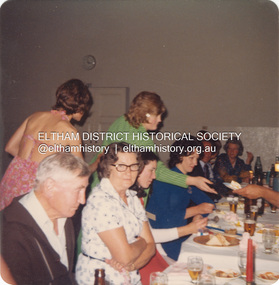
... It is understood that this photo was taken shortly before she became ill. L-R: Leslie John Teagle (never married), Julie Ingram (bare back, daughter of Kenneth Albert Ingram), Edwin 'Ted' Layfield (nee Teagle), ? ...It is understood that this photo was taken shortly before she became ill. L-R: Leslie John Teagle (never married), Julie Ingram (bare back, daughter of Kenneth Albert Ingram), Edwin 'Ted' Layfield (nee Teagle), ? ...Margaret Rose Teagle was born 8 June, 1912 at Sandringham, Victoria. She married Kenneth Douglas Ingram in 1935 but the mariage ended in divorce in 1944. She subsequently married Richard Fielding in 1948. Rose was diagnosed with cancer and died 30 November 1978. It is understood that this photo was taken shortly before she became ill. L-R: Leslie John Teagle (never married), Julie Ingram (bare back, daughter of Kenneth Albert Ingram), Edwin 'Ted' Layfield (nee Teagle), ? , Vicki Weeks (standing green top), Lorraine Layfield, rest unidentified except Rose Fielding at end of table on far right. Vicki Weeks is 1st cousin one removed to Pam Thoonen.Processed Nov 1973pam thoonen (nee ingram) collection, bentleigh public hall, birthday celebration, edwina (ted) layfield (nee teagle), julie ingram, leslie john teagle, lorraine layfield, margaret rose fielding, vicki weeks, margaret rose fielding (nee teagle) -
 Bendigo Historical Society Inc.
Accessory - BROOCH: ELIZABETH LANSELL'S DEATH BROOCH
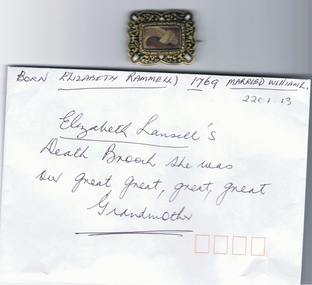
... Written on front of envelope in pen: Born Elizabeth Rammell 1769 Married William L. Elizabeth Lansell's death brooch she was our great, great, great, great, grandmother....Written on front of envelope in pen: Born Elizabeth Rammell 1769 Married William L. Elizabeth Lansell's death brooch she was our great, great, great, great, grandmother. ...Object: Enclosed in envelope: Death brooch of Elizabeth Lansell. Rectangular brooch, black enamel engraved with gold scroll work. Brooch has lock of hair enclosed in clear rectangle in centre of brooch. Engraved on back : E. Lansell, died Feb. 26th. Aged 88 yrs. Written on front of envelope in pen: Born Elizabeth Rammell 1769 Married William L. Elizabeth Lansell's death brooch she was our great, great, great, great, grandmother.E. Lansell, died Feb 26th. Aged 88 yrs.personal effects, fortuna, family history, bendigo, fortuna, lansell, elizabeth lansell -
Bendigo Historical Society Inc.
Document - LANSELL COLLECTION: CONFIRMATION CERTIFICATE: ELLEN L. BUDD, COUSIN OF GEORGE LANSELL, 1873
... L. Budd from St. Paul's Church Sandhurst August 31st. 1873. Ellen was aged 16 years. Card states that she was examined and presented by me: H. ...L. Budd from St. Paul's Church Sandhurst August 31st. 1873. Ellen was aged 16 years. Card states that she was examined and presented by me: H. ...Document: enclosed within envelope, confirmation certificate issued to Ellen L. Budd from St. Paul's Church Sandhurst August 31st. 1873. Ellen was aged 16 years. Card states that she was examined and presented by me: H. MacCullagh, confirmed by me C. Melb ?. Written on envelope in pencil : for Bendigo Historical Society or St. Pauls, Bendigo.St. Paul's Church, Sandhurstplace, fortuna, family history, lansell, fortuna, bendigo, ellen l. budd
