
Showing 50 items matching "large water tank"
-
 Ballarat Tramway Museum
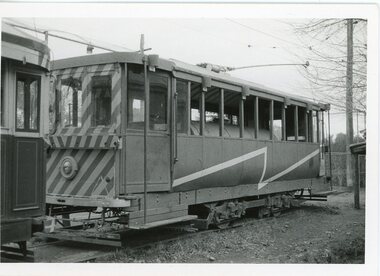
Photograph - "Scrubber" initially Tram 23, Scrubber outside the tennis courts near the Depot in Wendouree - side view
... ...large water tank...This meant the inside of the centre section was removed and a large water tank and cleaning equipment fitted. It was used to clean the tracks and also used to clean drains when necessary. ...This meant the inside of the centre section was removed and a large water tank and cleaning equipment fitted. It was used to clean the tracks and also used to clean drains when necessary. ...This tram was initially a straight sill car known as a Sebastopol type. It was No.23. It was one of three trams built specifically for Ballarat in 1913. In mid 1930s it was converted to be a scrubber. This meant the inside of the centre section was removed and a large water tank and cleaning equipment fitted. It was used to clean the tracks and also used to clean drains when necessary. This was done at night and there were complaints about the noise it made. When the trams ceased to run in Ballarat it was given to the Tramways Museum Society of Victoria, Bylands.Black and white photographtram 23, scrubber, sebastopol type, built 1913, large water tank, cleaning tracks, drains, tramways museum society of victoria, bylands, campbell duncan, photographer, built for ballarat tramways -
 Ballarat Tramway Museum
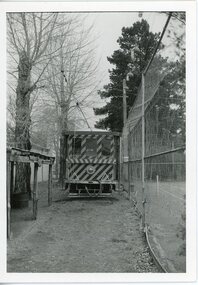
Photograph - "Scrubber" initially Tram 23, Scrubber outside the tennis courts near the Depot in Wendouree - Front view
... ...large water tank...This meant the inside of the centre section was removed and a large water tank and cleaning equipment fitted. It was used to clean the tracks and also used to clean drains when necessary. ...This meant the inside of the centre section was removed and a large water tank and cleaning equipment fitted. It was used to clean the tracks and also used to clean drains when necessary. ...This tram was initially a straight sill car known as a Sebastopol type. It was No.23. It was one of three trams built specifically for Ballarat in 1913. In mid 1930s it was converted to be a scrubber. This meant the inside of the centre section was removed and a large water tank and cleaning equipment fitted. It was used to clean the tracks and also used to clean drains when necessary. This was done at night and there were complaints about the noise it made. When the trams ceased to run in Ballarat it was given to the Tramways Museum Society of Victoria, Bylands.Black and white photographtram 23, scrubber, sebastopol type, built 1913, large water tank, cleaning tracks, drains, tramways museum society of victoria, bylands, campbell duncan, photographer, built for ballarat tramways -
 Bendigo Historical Society Inc.
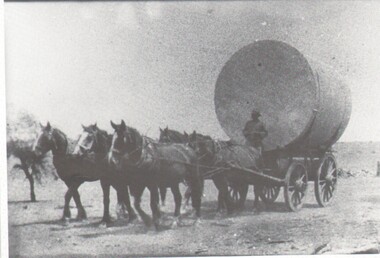
Photograph - HARRY BIGGS COLLECTION: TEAM OF HORSES
... Photograph (proof 49) of a team of five horses hitched to a wagon, on the wagon there is a large water tank. A man is seated on the wagon driving the team....TOPIC Farming drought Team of Horses wagon water tank Photograph (proof 49) of a team of five horses hitched to a wagon, on the wagon there is a large water tank. ...Photograph (proof 49) of a team of five horses hitched to a wagon, on the wagon there is a large water tank. A man is seated on the wagon driving the team.topic, farming, drought, team of horses, wagon, water tank -
 Lakes Entrance Historical Society
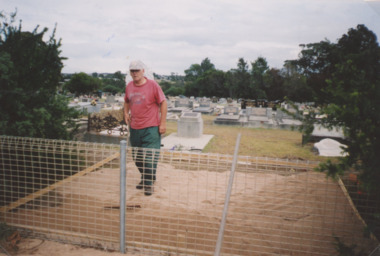
Photograph - Garden Cemetery Palmers Road Lakes Entrance Victoria, Lakes Post Newspaper, Don Brady, 2003
... Colour photograph showing Don Brady in the area cleared for a large water tank to be filled by the Fire Brigade as a water supply for the Lakes Entrance Garden Cemetery Palmers Road Lakes Entrance Victoria...Cemeteries Water supply Colour photograph showing Don Brady in the area cleared for a large water tank to be filled by the Fire Brigade as a water supply for the Lakes Entrance Garden Cemetery Palmers Road Lakes Entrance Victoria Don Brady Photograph Garden Cemetery Palmers Road Lakes Entrance Victoria Lakes Post Newspaper ...Colour photograph showing Don Brady in the area cleared for a large water tank to be filled by the Fire Brigade as a water supply for the Lakes Entrance Garden Cemetery Palmers Road Lakes Entrance Victoriacemeteries, water supply -
 Bendigo Historical Society Inc.
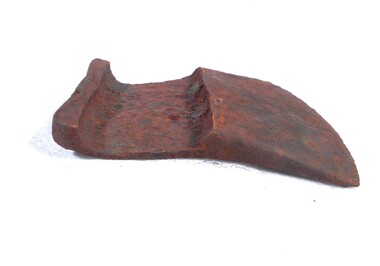
Functional object - Horse Shoe and Axe Head
... Found in Bendigo One Tree Hill early 2020 near a sandstone mine cutting outcrop near the large water tank....Found in Bendigo One Tree Hill early 2020 near a sandstone mine cutting outcrop near the large water tank. horseshoe axe head fossicking finds One tree hill Bendigo One complete rusted horseshoe and one broken rusted axe head. ...Found in Bendigo One Tree Hill early 2020 near a sandstone mine cutting outcrop near the large water tank.One complete rusted horseshoe and one broken rusted axe head.horseshoe, axe head, fossicking finds, one tree hill bendigo -
 Southern Sherbrooke Historical Society Inc.
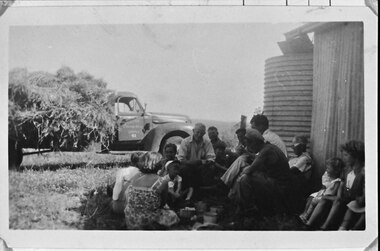
Photograph - Morning tea during hay carting at the Hermon farm
... There are five men, one woman wearing a floral summer dress, and five children.They are sitting beside a corrugated iron shed with a large water tank behind it. A piece of guttering from the shed feeds into a broad piece of sheeting and then into the tank. ...There are five men, one woman wearing a floral summer dress, and five children.They are sitting beside a corrugated iron shed with a large water tank behind it. A piece of guttering from the shed feeds into a broad piece of sheeting and then into the tank. ...B&W photo of a group of adults and children having morning tea during hay carting on the Hermon farm. There are five men, one woman wearing a floral summer dress, and five children.They are sitting beside a corrugated iron shed with a large water tank behind it. A piece of guttering from the shed feeds into a broad piece of sheeting and then into the tank. Beyond the group is a truck laden with hay. The driver's door is ajar. Hills are visible in the background. Dated c.1950s. -
 Tatura Irrigation & Wartime Camps Museum
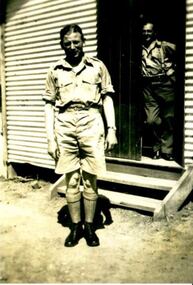
Photos, Arthur Severino, Garrison at Dhurringile, a garrison member at Dhurringile, 1939-1940
... View of fenceline, paddocks, possibly Waranga Basin in background 7. Large water tank...View of fenceline, paddocks, possibly Waranga Basin in background 7. Large water tank dhurringile Arthur Severino William Severino Dhurringile Mansion garrison members Puckapunyal 2nd AIF 3. ...Photos in possession of Arthur Severino, a garrison member at Dhurringile, who also helped maintain the powerplant?. Passed on to his son, William (Bill) on his death, along with a sketch of Dhurringile (cat. C0906). The only information known about the photos is what was written on or beside them & that they were from Arthur's time served as a garrison member at Dhurringile. Arthur also apparently helped to maintain the powerplant whilst at Dhurringile. (Some photos of barracks may have been taken at Puckapunyal instead, where he went immediately after Dhurringile, to enlist in 2nd AIF). 1. Arthur in front of barracks doorway 2. Barracks? building 3. View of camp?? 4. Dhurringile mansion, unknown civilians in entrance (caretakers??) 5. Three people seated, Arthur on left 6. View of fenceline, paddocks, possibly Waranga Basin in background 7. Large water tankSeven photos in possession of Arthur Severino, garrison member at Dhurringile November 1939 - June 1940. 3. "March 1940" 4. "November 1939" 5. "Lance Sergeant Arthur James Severino (on left) V82052, 5th Workshop and Park COY. ; Later VX25922 HQ 21st Aust Infantry Brigade 2nd AIF; Tatura 1939" 6. "March 1940" 7. "March 1940"dhurringile, arthur severino, william severino, dhurringile mansion garrison members, puckapunyal, 2nd aif -
 Linton and District Historical Society Inc
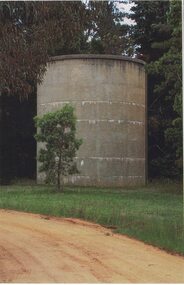
Photograph, Linton Water Tower, 2014
... The photograph shows a large concrete water storage tank - Linton's "water tower", located on high ground in Hamilton Street North....Linton water tower Waterworks One of three colour photographs printed on a single sheet of photographic paper. The photograph shows a large concrete water storage tank - Linton's "water tower", located on high ground in Hamilton Street North. ...One of three colour photographs printed on a single sheet of photographic paper. The photograph shows a large concrete water storage tank - Linton's "water tower", located on high ground in Hamilton Street North.linton water tower, waterworks -
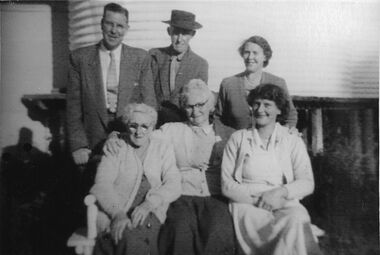 Southern Sherbrooke Historical Society Inc.
Photograph - Black and white photo of six people
... The photo is taken outside. There is a large water tank on a stand in the background. The three women in the front row are seated and Mrs Clements has her arms around Mrs Rosewarne and Mrs Berry....The photo is taken outside. There is a large water tank on a stand in the background. The three women in the front row are seated and Mrs Clements has her arms around Mrs Rosewarne and Mrs Berry. ...Black and white photo of six people. Back row: Syd Rosewarne, Reg Cambridge, Nancy Gullick (sister of Reg Cambridge) Front row: Mrs Rosewarne Snr, Mrs Eva Clements Snr, Mrs Iris Berry Photo taken in Mills Rd, (now Belgrave-Hallam Rd), Belgrave South in 1958. Mr & Mrs Rosewarne purchased the house next to Wahroonga (cnr Mills Rd & Cambridge St) from Mr & Mrs Palethorpe. The property was originally owned by Mr & Mrs Arthur Clement. Cambridge St is named after Reg Cambridge. The photo is taken outside. There is a large water tank on a stand in the background. The three women in the front row are seated and Mrs Clements has her arms around Mrs Rosewarne and Mrs Berry. -
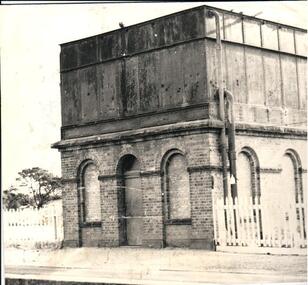 Hume City Civic Collection
Photograph, c 1974
... water tower at Sunbury Railway Station. The base of the tower is a brick construction with an arched doorway and two bricked in arched windows at either side of the doorway and a further two bricked in arched windows on the side. Above the base is a large square iron water storage tank...water tower at Sunbury Railway Station. The base of the tower is a brick construction with an arched doorway and two bricked in arched windows at either side of the doorway and a further two bricked in arched windows on the side. Above the base is a large square iron water storage tank ...The mounted photograph is one of a series used for display purposes. The water tower at Sunbury Station was built in 1861 by J. Bett. it is of state significance and is an indicator of the importance of the railway to Sunbury's expansion in the Nineteenth Century. Steam trains needed sufficient steam power to climb the steep gradients over the Great Dividing Range and the water tower at Sunbury was used to replenish the trains' water supply for the remainder of the journey.A black and white photograph of the water tower at Sunbury Railway Station. The base of the tower is a brick construction with an arched doorway and two bricked in arched windows at either side of the doorway and a further two bricked in arched windows on the side. Above the base is a large square iron water storage tank with two downpipes at the side. There is a picket fence either side of the building. Mounted on board.sunbury railway station, water towers, victorian railways, bett, j., george evans collection -
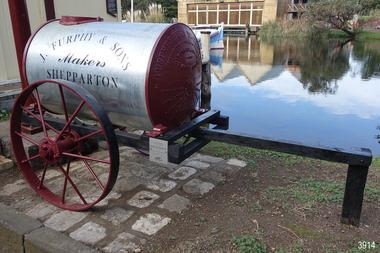 Flagstaff Hill Maritime Museum and Village
Vehicle - Furphy Water Cart, J. Furphy & Sons, c. 1942
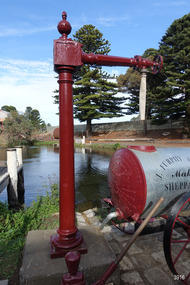
... water cart has had a number of words cast into its ends over many years. References to the foundry’s location in Shepparton, as well as advertising of other products also manufactured by J. Furphy & Sons were present on the ends. However, the most significant set of words to feature on the tank, was a poem encouraging continual improvement: ‘Good Better Best, Never Let it Rest, Until your Good is Better, And your Better Best’. During The Great War (1914-1918), the water cart was used by the Australian militarily at a large...water cart has had a number of words cast into its ends over many years. References to the foundry’s location in Shepparton, as well as advertising of other products also manufactured by J. Furphy & Sons were present on the ends. However, the most significant set of words to feature on the tank, was a poem encouraging continual improvement: ‘Good Better Best, Never Let it Rest, Until your Good is Better, And your Better Best’. During The Great War (1914-1918), the water cart was used by the Australian militarily at a large ...This horse-drawn, two-wheeled cart with a tank, is known as a Furphy Farm Water Cart that was made in Shepparton, northern Victoria, c. 1942. John Furphy (1842-1920) was born in Moonee Ponds, in 1842 to Irish immigrant parents and subsequently raised in the Yarra Valley before the family moved to Kyneton in central Victoria, where he completed an apprenticeship with the firm Hutcheson and Walker. Murphy began operations of his own at a site on Piper Street in Kyneton in 1864. He relocated for a business opportunity and founded the first blacksmiths and wheelwrights shop in the newly surveyed town of Shepparton in 1873. Furphy invented many farming tools and machines including a patented grain-stripper, and won awards at the 1888-89 Melbourne International Exhibition. His most famous invention is the Furphy Farm Water Cart, designed in the 1880s, at a time when water for most households and farms was carted on wagons in wooden barrels. The Furphy’s water cart is a single item that combines a water metal tank and a cart. The design of the cart was simple yet effective, and became popular very quickly and established itself as a vital piece of farming equipment. The water cart has had a number of words cast into its ends over many years. References to the foundry’s location in Shepparton, as well as advertising of other products also manufactured by J. Furphy & Sons were present on the ends. However, the most significant set of words to feature on the tank, was a poem encouraging continual improvement: ‘Good Better Best, Never Let it Rest, Until your Good is Better, And your Better Best’. During The Great War (1914-1918), the water cart was used by the Australian militarily at a large AIF (Australian Imperial Force) camp in Broadmeadows (Melbourne) where thousands of men were camped for months, before being transported aboard. Furphy Water Carts provided water to the troops, and were usually placed near the camp latrines, which was one of the few places the troops could share gossip and tall tales away from the prying eyes and ears of their officers. The water cart drivers were also notorious sources of information, despite most of their news being hearsay, or totally unreliable. By the time the men of the AIF were in engaged in combat on the Gallipoli Peninsula and the Western Front, the carts used for water supply had no markings and became simply referred to as Furphys. This owed as much to the coining of the term ‘Furphy’, Australian slang for suspect information or rumour. After a number of decades as principally a soldier’s word, 'Furphy' entered the broader Australian vernacular and was used mainly by the political class until recently when the term was taken up by a Australian brewer as a beer brand. This Furphy Water Cart was purchased by Friends of Flagstaff Hill in 2014. The support of local individuals, organisations and businesses enabled its restoration and later its installation alongside the existing late-19th century water pipe stand and 1940s hand pump The Furphy Farm Water Cart is of historical significance as it represents a famous Australian time-saving and energy-saving invention of the 1880s, replacing the labour intensive activity of collecting and dispensing water from barrels and casks on the back of carts. The water cart’s connection with manufacturing companies J. Furphy & Sons and Furphy Foundry are significant for being early Australian businesses that are still in operation today. Furphy carts are of military significance for the role they played during The Great War (1914-1918) in Australian army camps, and theatres of war in Europe and the Middle East, to supply the AIF troops with fresh water. A wooden framed, two-wheeled, horse-drawn cart, fitted with a horizontally mounted, cylindrical metal tank. The tank is made of rolled, sheet steel with a riveted seam, and cast iron ends with cast iron ends. The spoked metal wheels have fitted flat iron tyres and metal hubs. A metal pipe is joined to the outlet. The tank is silver coloured, the ends, wheels and trims are crimson, and the script lettering on tank sides is black. There are inscriptions on the tank, ends, and hubs. The water tank was made in 1942 in Shepparton, Australia, by J. Furphy & Sons and has a capacity of 180 gallons (848 litres). Hub perimeter, embossed “J. FURPHY & SONS” “KEEP THE / BOLTS TIGHT” Hub centre embossed [indecipherable] Tank, each side, painted “J. FURPHY & SONS / Makers / SHEPPARTON” Tank ends, embossed – “FURPHY’S FARM WATER CART” “BORN ABOUT 1880 – STILL ‘GOING STRONG’ 1942” “j. FURPHY & SONS / MAKERS / SHEPPARTON - VIC “ “S - - - - - L MANUFACTURERS” [SPECIAL] “SPIKE ROLLERS” “SINGLE TREES” “PLOUGH WHEELS” “IRON CASTINGS” “LAND GRADERS” “STEEL DELVERS” “CAST IRON PIG” “CHAIN YOKES” “GOOD – BETTER – BEST / NEVER LET IT REST / TILL YOUR GOOD IS BETTER / AND YOUR BETTER – BEST” Image [Stork carrying a baby] above shorthand, transcribed "Produce and populate or perish" Image [Furphy Pig Feeder] beside ‘Cast Iron Pig’ Shorthand, transcribed “"Water is the gift of God but beer and whiskey are concoctions of the Devil, come and have a drink of water"warrnambool, flagstaff hill maritime museum, water cart, furphy cart, furphy tank, furphy farm water cart, furphy, john furphy, john furphy & sons, furphy foundry, kyneton, shepparton, mobile water tank, jinker, hutchinson & walker, blacksmith, farm equipment, implement maker, tool maker, horse drawn, stork and baby, good, better, best, barrel, tank, first world war, wwi, eastern front, gallipoli, j furphy & sons -
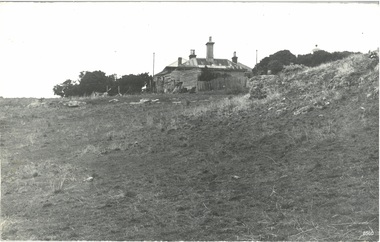 Flagstaff Hill Maritime Museum and Village
Photograph - Historical, Port Fairy, Late 19th to early 20th centuries
... large metal milk can. The photograph shows a typical late 19th to early 20th century cottage, abandoned at dilapidated for many years. Flagstaff Hill Maritime Museum and Village Warrnambool Great Ocean Road Shipwreck Coast cottage lighthouse iron roof stone building picket fence water tank weatherboard building 19th century cottage early 20th century cottage abandoned cottage antenna chimneys milk can Pencil on board: " D9 / 200 x 150" Pen on sticker: "52" Black and white rectangular photograph mounted on card. ...The late 19th to early 20th century stone cottage with weatherboard extensions. From research, it has been determined that the cottage was the Port Fairy (Belfast) Lighthouse Keepers cottage. The dome roof in the background indicates a lighthouse, in which case the cottage would have been the living quarters for a lighthouse keeper and assistant keeper. The narrow poles could have been for signals and antennae. The object on the rock stack looks like a large metal milk can.The photograph shows a typical late 19th to early 20th century cottage, abandoned at dilapidated for many years. Black and white rectangular photograph mounted on card. The image shows a dilapidated stone cottage with an old picket fence. Extending behind the stone cottage are gabled roofs above weatherboard walls. The cottage has corrugated roof sheets of different colours, and four chimneys, three with chimney pots. From research, it has been determined that the cottage was the Port Fairy (Belfast) Lighthouse Keepers cottage. Near the fenceline on the left, a corrugated water tank is positioned below a pipe joined to the roof gutter. Nearby are a timber shed and timber walls or screens. In the background are two tall narrow poles with spheres on top, higher than the cottage, with one pole on each side, the left one attached to the building. A domed roof with a knob on top is on the right behind trees. Several angular shapes appear on the horizon on the left, one almost hidden by the trees. The foreground is rocky and slopes uphill on the right. At the foot of the slope is a stack of closely fitted rocks with an object shaped like a milk can on top and an object to its left that is like an open grid. Handwritten Inscriptions are on the reverse side of the photograph.Pencil on board: " D9 / 200 x 150" Pen on sticker: "52"flagstaff hill maritime museum and village, warrnambool, great ocean road, shipwreck coast, cottage, lighthouse, iron roof, stone building, picket fence, water tank, weatherboard building, 19th century cottage, early 20th century cottage, abandoned cottage, antenna, chimneys, milk can -
 Flagstaff Hill Maritime Museum and Village
Container - Ship Tank, Early 20th century
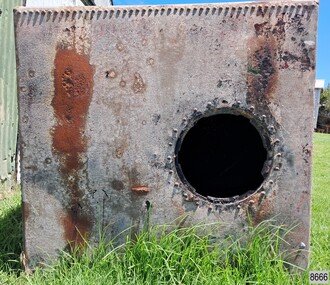
... tanks were made from sheets of iron, and later mild steel sheets, with double riveted edges and corners. A round cast iron lid with handle grips was fitted snugly into the top opening, providing an air-tight and water-tight seal. Brass taps were often fitted into the base, which could have been the case with this tank, but it now has a wooden bung in the hole. Sailing ships began using the new ship tanks on Australian voyages from around the 1830s, storing food and water for those on board, and filling them with other cargo. A large...The ship tanks’ advantages were that they could store more content, lasted longer, were waterproof and airtight, stackable and could be repurposed for many uses other than water, such as fuel, dry goods and domestic cargo. They have even been used aa dog kennels and cookers. Ship tanks were part of the evolving methos to transport water, food and cargo, which changed in 1956 when Malcolm McLean invented the large ...Cubed iron ship tanks were invented by Richard Trevithich in 1808, in partnership with Robert Dickson, and the design was patented that year. The invention eventually replaced the wooden casks or barrels used at the time, as the ship tanks were more secure and their shape was much more economical in storage space. The robust metal tanks were originally made to transport water, but their preserving quality enabled them to transport perishable dry goods such as grain on long voyages, as well as other forms of liquid and solid cargo. The first ship tanks were made from sheets of iron, and later mild steel sheets, with double riveted edges and corners. A round cast iron lid with handle grips was fitted snugly into the top opening, providing an air-tight and water-tight seal. Brass taps were often fitted into the base, which could have been the case with this tank, but it now has a wooden bung in the hole. Sailing ships began using the new ship tanks on Australian voyages from around the 1830s, storing food and water for those on board, and filling them with other cargo. A large number of the ship tanks were repurposed in 1838 for the Victoria Settlement at Port Essington, N.T., as they were able to protect the food, clothing and other stores from termite and insect damage. Other ‘recycled’ ship tanks were cut in half and used as washing tubs or cookers. A 1929 catalogue from Hudson’s Tank Stores advertised square tanks that contained around 600 litres – 160 gallons – which equals an internal measurement of 33.25 inches – 84.5 centimetres – per side ship tanks are still made and sold in 1952 by the Globe Tank and Foundry in Wolverhampton, England, which was incorporated in 1922. Today, ship tanks can be seen around Australia. Wilsonson’s Promontory Lightstation has the lid from a ship tank that was used on site for the storage of water. Some have been repurposed as domestic water tanks and dog kennels, others for eucalyptus distilleries. Flagstaff Hill has two ship tanks. The Campaspe Port at Echuca, once a bustling river port, has a ship tank beside the locomotive yard. The lids of ship tanks are collectible items. Richard Trevithick (1771-1833): - Trevithick was born in 1771 in Cornwall, England. He was a famous British engineer and inventor during the Industrial Revolution, known for his invention of the first full-scale working railway, the high-pressure steam locomotive, which he demonstrated hauling a railway train in 1804. He set up a small workshop in 1808 at 72 Fore Street, Limehouse, London, to make iron ship tanks, and this invention was instrumental in replacing the wooden casks formerly used for storage on ships. He was involved with mining technology, iron foundry and ship equipment. Ship tanks changed the way that cargo was transported on ships and other vehicles from the 1830s and were used into the mid-20th century. The ship tanks’ advantages were that they could store more content, lasted longer, were waterproof and airtight, stackable and could be repurposed for many uses other than water, such as fuel, dry goods and domestic cargo. They have even been used aa dog kennels and cookers. Ship tanks were part of the evolving methos to transport water, food and cargo, which changed in 1956 when Malcolm McLean invented the large, rectangular shipping containers that are in use today; they speed up the process of loading on and off the ships, saving time and money. Ship tank: a cubed iron container with an offset hole on one side. The hole has cutouts for securely attaching a lid. This tank is on its side on the ground with the opening facing sideways. The side facing upwards has a wooden bung in a round hole. The ship tank is made from six square, thick iron sheets, rolled and riveted along the edges. The inside has a black sticky coating, possibly bitumen, and a strong creosote odour. There are small remnants of green paint on the outer surface.flagstaff hill, flagstaff hill maritime museum and village, warrnambool, maritime museum, maritime village, great ocean road, shipwreck coast, iron cube, water tank, shipping container, ship tank, ship's tank, ship tanks, marine container, richard trevithich, 1808, robert dickson, water transport, water storage, iron foundry, steel sheets, iron sheets, revets, victoria settlement, port essington, globe tank and foundry, wolverhampton, british engineer, british inventor, wooden casks -
 Flagstaff Hill Maritime Museum and Village
Functional object - Water standpipe, Langlands Bros. & Co, 1880-1893
... water tanks, domestic wells and springs. The town experienced a huge, destructive fire in William Bateman Jnr. & Co.’s large produce store in November 1856, which highlighted the need for both a fire brigade and a good supply of water. ...water tanks, domestic wells and springs. The town experienced a huge, destructive fire in William Bateman Jnr. & Co.’s large produce store in November 1856, which highlighted the need for both a fire brigade and a good supply of water. ...This water standpipe is believed to be the only one of its kind in working order. It was originally located in Warrnambool, on the hillside at the corner of Mickle Crescent and Banyan Street, providing water for the Chinese Market Gardens below, on the flats. It was removed from this location on May 2nd, 1979, with the intention to relocate it at the new Flagstaff Hill Maritime Museum & Village. The standpipe lay in storage for years until the Warrnambool Company, Chemblast, offered to restore it for use as a working display. The display was officially opened on March 31, 2014. The water from the adjacent lake is drawn out with a hand operated water pump, and goes up into the standpipe, where flows through the canvas hose and into the top of the Furphy Farm Water Cart. The display is a visual acknowledgement of the years served by Flagstaff Hill volunteer and Friends of Flagstaff Hill Chairperson, Bob Crossman. Warrnambool’s early settlers had no water supply prior to the mid-1850s. They relied on rain water tanks, domestic wells and springs. The town experienced a huge, destructive fire in William Bateman Jnr. & Co.’s large produce store in November 1856, which highlighted the need for both a fire brigade and a good supply of water. In 1863 a volunteer fire brigade was established. In August 1880 the town celebrated the installation of its first water standpipe on the corner of Liebig and Timor streets. The water was pumped from springs at Cannon Hill through the connected pipeline to the standpipe, then distributed to households via horse and cart. Each of the licenced cart drivers were compelled by Council regulations to keep their carts full from sunset to sunrise, ready to cart water to outbreaks of fire. They received a fee for this service. In 1893 the town installed a water supply, sourced from the Merri River, stored in a reservoir basin and tower in north Liebig Street, and distributed throughout the town in a system of pipes. By late 1939 a reticulated supply was installed, with the water piped in under the Otway Scheme. Standpipes are still used in modern times in rural and remote areas for homes, farms, stock, agriculture and firefighting. Many commercial or government owned standpipes are metered, charging a fee for the quantities of water supplied. This water standpipe was made by Langlands Foundry Co. Limited, Melbourne, which was establish in 1842. It was Melbourne’s first foundry and iron shipbuilder, and one of the largest employers in Victoria at the time. Langlands was known for its high quality workmanship and wide range of goods for mining, engineering, marine, railway and other industrial uses. The company made the first cast bell, the first lamp posts in the colony, and the boiler for the first Australian train. In the 1860s it produced cast iron pipes for the Board of Works, which laid the pipes for Melbourne’s first reticulated water supply. The firm was bought by Austral Otis Co. in 1897.This water standpipe is significant historically as it is believed to be the only one of its type in working condition. The standpipe is significant for being manufactured by early colonial firm Langlands Foundry of Melbourne, which was known for high quality, cast iron products. The firm made the boiler for the first Australian train, assembled the first Australian paddle steamer and made the first Australian cast bell and lamp posts. Langlands was one of the largest employers in Victoria at the time. The standpipe is significant historically as it represents the evolution of water supply services in Australia. Standpipe; vertical cast iron water pipe, painted crimson, fixed in position, tapering inward from the round base to the rectangular joint near the finial on top. A hexagonal pipe extends at right angles from the joint, with an outlet fitting and flow-controlling wheel on the end. A length of canvas hose hangs from the outlet fitting. Inscriptions are on one face of the joint. The standpipe was made by Langlands Foundry Company of Melbourne. Embossed “LANGLANDS FOUNDRY CO. / LIMITED / ENGINEERS / MELBOURNE”warrnambool, flagstaff hill maritime museum, maritime museum, shipwreck coast, flagstaff hill maritime village, great ocean road, flagstaff hill, standpipe, stand-pipe, water standpipe, fire standpipe, firefighting equipment, water supply equipment, chinese market gardens, banyan street, liebig street, water tower, bateman’s fire, working display, water supply, town water, rural water, reticulated water, cannon hill spring, merri river, otway water, water carters, horse and cart water supply, volunteer fire brigade, langlands foundry, early melbourne, iron works, bob crossman, late 19th century water supply -
 Glenelg Shire Council Cultural Collection
Photograph - Photograph - Portland Knitting Mills, n.d
... Wooden fence and water tank on right. Knitting mill on left, large shed with fibro fascia....Wooden fence and water tank on right. Knitting mill on left, large shed with fibro fascia. ...Black and white photo of front of Portland Knitting Mills. Wooden fence and water tank on right. Knitting mill on left, large shed with fibro fascia.Back: 'Knitting Mills Portland' - handwritten, black ink. Round purple stamp 'PRINTED BY M.E. ANDREWS PORTLAND'portland knitting mills, craft, will, textiles -
 Orbost & District Historical Society
iron wheel rim
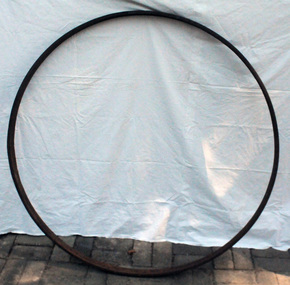
... tank of water. Horse-drawn wagons are an important part of Orbost’s agricultural history. Light buggies were popular with farmers for trips into town before the common use of motorised vehicles. wheel-rim wagon transport agriculture A large iron rim for a wagon wheel. iron wheel rim ...This was probably for a light buggy. Heavy farm, and lumber wagons had wider tires. It would have been made by a blacksmith. The blacksmith fitted steel rims onto wooden wagon wheels. The red hot metal rim expands when hot, so it can be fitted to the wagon wheel. Then it contracts to create a tight fit as it cools after being dropped into a tank of water.Horse-drawn wagons are an important part of Orbost’s agricultural history. Light buggies were popular with farmers for trips into town before the common use of motorised vehicles.A large iron rim for a wagon wheel.wheel-rim wagon transport agriculture -
 City of Moorabbin Historical Society (Operating the Box Cottage Museum)
Photograph, 2 B&W, 1898 The O'Maras', Sandringham Fishermen : Date Unknown, Mud Brick House, 1898 The O'Maras', Sandringham Fishermen Date Unknown, Mud Brick House, 1898
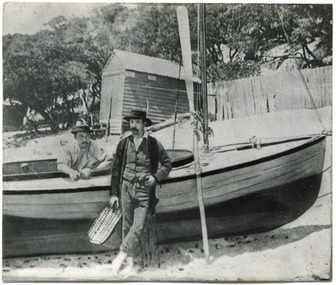
... (ii) A large early mud brick house with a tin roof, chimney and a water tank sitting on a block of grassed land...(ii) A large early mud brick house with a tin roof, chimney and a water tank sitting on a block of grassed land 1898 The O'Maras', Sandringham Fishermen Date Unknown, Mud Brick House Photograph, 2 B&W, 1898 The O'Maras', Sandringham Fishermen : Date Unknown, Mud Brick House Unrecorded amateur photographer ...The O'Maras, of Sandringham fishermen. Early mud brick house. Located in Moorabbin and was still there in 1940. The house was situated in Reserve Road, almost opposite Wangara Road, (formerly Cemetery Road). About twelve years ago, (* the writer states no year), there was a vacant block where the house used to be - it was next to a electrical factory. 2x Black and White Photographs. (i) An 1898 photograph showing two men with a fishing boat on the beach. A beach house / shed , paling fence and tall tea-trees are seen in the background. (ii) A large early mud brick house with a tin roof, chimney and a water tank sitting on a block of grassed landWritten on back (i) The O'Maras / Sandringham / fishermen 1898 (ii) Mud brick house at Moorabbin ( house was there in 1940) / Situated in Reserve Road almost opposite Wangara Road / ( formerly Cemetery Road ). About 12 years ago there was a vacant block where the house used to be and it was next to an electrical factory. unsigned undatedthe o'maras, sandringham fisherman, 1898, mud brick house, moorabbin, wangara road, reserve road, electrical factory, early settlers, pioneers, shire of moorabbin, sandringham, beaumaris, mentone, fishermen, dairy farmaers, poultry farmers, market gardeners, -
 Phillip Island and District Historical Society Inc.
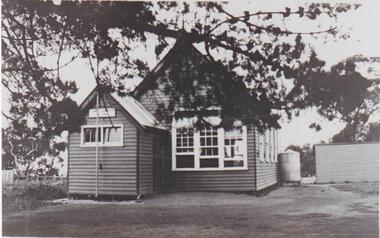
Photograph, Cowes State School Phillip Island, 1920
... The larger recessed section of school building has triple-joined long windows. four single long windows, a small water tank is on left side back of building adjacent to a low wooden shed. ...The larger recessed section of school building has triple-joined long windows. four single long windows, a small water tank is on left side back of building adjacent to a low wooden shed. ...Cowes School, wooden, name on front section of wooden building above high wide small window. The larger recessed section of school building has triple-joined long windows. four single long windows, a small water tank is on left side back of building adjacent to a low wooden shed. A Flag pole is attached to front of building. Large overhanging branch of tree across all of photograph.Cowes School, Thompson Avenue, Coweslocal history, photographs, buildings - historic, schools, black & white photograph, mary robb -
 Flagstaff Hill Maritime Museum and Village
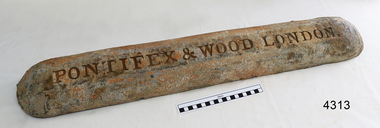
Functional object - Lead Ingot, circa 1878
... It was used for pipes and water tanks, roof flashing and guttering, window sealing and internal plumbing. Many large private residences and new public buildings were at planning or construction stage in the colony during this period. ...It was used for pipes and water tanks, roof flashing and guttering, window sealing and internal plumbing. Many large private residences and new public buildings were at planning or construction stage in the colony during this period. ...This lead ingot was donated to Flagstaff Hill Maritime Village in January 2015 by local residents who discovered the ingot in their garden after they purchased the property about 12 months ago The LOCH ARD cargo manifest lists “Pig lead 50 tons” comprising “944 pig and 37 rolls”. Subsequent classification has rendered this section of cargo as “Lead Ballast”. This could be true. The international price per ton of lead ore plunged from a high point of £17 in 1853 to a low of £8 in 1882. The cheaper price of lead at the time of the vessel’s loading in early 1878 may have meant it was considered as an alternative to other ballast material (traditionally stone) for the journey to Melbourne. Loch Line ships generally returned to Britain laden with Australian wool. Even though wool bales were “screwed in” to the hold to less than half their “pressed weight”, they still made an awkwardly light cargo for the passage around the Horn. The concentrated weight of lead pigs along the keel line would help steady and centre the ship, and perhaps the artefacts in this case were to be retained for this purpose, rather than being sold on to the ready colonial market. However this is conjecture. Demand for building materials in the gold and wool rich Colony of Victoria was high in the 1870s, and much of the LOCH ARD cargo was intended for the Melbourne International Exhibition in 1880, which was another example of buoyant economic conditions. In the nineteenth century lead was valued for its density (high ratio of weight to volume), flexibility (relative softness for working into shape), and durability (corrosion resistant and waterproofing properties). It was used for pipes and water tanks, roof flashing and guttering, window sealing and internal plumbing. Many large private residences and new public buildings were at planning or construction stage in the colony during this period. The LOCH ARD lead ingots could equally have been destined for this ready market. HISTORY OF THE LOCH ARD The LOCH ARD belonged to the famous Loch Line which sailed many ships from England to Australia. Built in Glasgow by Barclay, Curdle and Co. in 1873, the LOCH ARD was a three-masted square rigged iron sailing ship. The ship measured 262ft 7" (79.87m) in length, 38ft (11.58m) in width, 23ft (7m) in depth and had a gross tonnage of 1693 tons. The LOCH ARD's main mast measured a massive 150ft (45.7m) in height. LOCH ARD made three trips to Australia and one trip to Calcutta before its final voyage. LOCH ARD left England on March 2, 1878, under the command of Captain Gibbs, a newly married, 29 year old. She was bound for Melbourne with a crew of 37, plus 17 passengers and a load of cargo. The general cargo reflected the affluence of Melbourne at the time. On board were straw hats, umbrella, perfumes, clay pipes, pianos, clocks, confectionary, linen and candles, as well as a heavier load of railway irons, cement, lead and copper. There were items included that intended for display in the Melbourne International Exhibition in 1880. The voyage to Port Phillip was long but uneventful. At 3am on June 1, 1878, Captain Gibbs was expecting to see land and the passengers were becoming excited as they prepared to view their new homeland in the early morning. But LOCH ARD was running into a fog which greatly reduced visibility. Captain Gibbs was becoming anxious as there was no sign of land or the Cape Otway lighthouse. At 4am the fog lifted. A man aloft announced that he could see breakers. The sheer cliffs of Victoria's west coast came into view, and Captain Gibbs realised that the ship was much closer to them than expected. He ordered as much sail to be set as time would permit and then attempted to steer the vessel out to sea. On coming head on into the wind, the ship lost momentum, the sails fell limp and LOCH ARD's bow swung back. Gibbs then ordered the anchors to be released in an attempt to hold its position. The anchors sank some 50 fathoms - but did not hold. By this time LOCH ARD was among the breakers and the tall cliffs of Mutton Bird Island rose behind the ship. Just half a mile from the coast, the ship's bow was suddenly pulled around by the anchor. The captain tried to tack out to sea, but the ship struck a reef at the base of Mutton Bird Island, near Port Campbell. Waves broke over the ship and the top deck was loosened from the hull. The masts and rigging came crashing down knocking passengers and crew overboard. When a lifeboat was finally launched, it crashed into the side of LOCH ARD and capsized. Tom Pearce, who had launched the boat, managed to cling to its overturned hull and shelter beneath it. He drifted out to sea and then on the flood tide came into what is now known as LOCH ARD Gorge. He swam to shore, bruised and dazed, and found a cave in which to shelter. Some of the crew stayed below deck to shelter from the falling rigging but drowned when the ship slipped off the reef into deeper water. Eva Carmichael had raced onto deck to find out what was happening only to be confronted by towering cliffs looming above the stricken ship. In all the chaos, Captain Gibbs grabbed Eva and said, "If you are saved Eva, let my dear wife know that I died like a sailor". That was the last Eva Carmichael saw of the captain. She was swept off the ship by a huge wave. Eva saw Tom Pearce on a small rocky beach and yelled to attract his attention. He dived in and swam to the exhausted woman and dragged her to shore. He took her to the cave and broke open case of brandy which had washed up on the beach. He opened a bottle to revive the unconscious woman. A few hours later Tom scaled a cliff in search of help. He followed hoof prints and came by chance upon two men from nearby Glenample Station three and a half miles away. In a state of exhaustion, he told the men of the tragedy. Tom returned to the gorge while the two men rode back to the station to get help. By the time they reached LOCH ARD Gorge, it was cold and dark. The two shipwreck survivors were taken to Glenample Station to recover. Eva stayed at the station for six weeks before returning to Ireland, this time by steamship. In Melbourne, Tom Pearce received a hero's welcome. He was presented with the first gold medal of the Royal Humane Society of Victoria and a £1000 cheque from the Victorian Government. Concerts were performed to honour the young man's bravery and to raise money for those who lost family in the LOCH ARD disaster. Of the 54 crew members and passengers on board, only two survived: the apprentice, Tom Pearce and the young woman passenger, Eva Carmichael, who lost all of her family in the tragedy. Ten days after the LOCH ARD tragedy, salvage rights to the wreck were sold at auction for £2,120. Cargo valued at £3,000 was salvaged and placed on the beach, but most washed back into the sea when another storm developed. The wreck of LOCH ARD still lies at the base of Mutton Bird Island. Much of the cargo has now been salvaged and some was washed up into what is now known as LOCH ARD Gorge. Cargo and artefacts have also been illegally salvaged over many years before protective legislation was introduced. One of the most unlikely pieces of cargo to have survived the shipwreck was a Minton porcelain peacock - one of only nine in the world. The peacock was destined for the Melbourne International Exhibition in 1880. It had been well packed, which gave it adequate protection during the violent storm. Today, the Minton peacock can be seen at the Flagstaff Hill Maritime Museum in Warrnambool. From Australia's most dramatic shipwreck it has now become Australia's most valuable shipwreck artefact and is one of very few 'objects' on the Victorian State Heritage Register. The shipwreck of the LOCH ARD is of State significance ― Victorian Heritage Register S417 Flagstaff Hill’s collection of artefacts from LOCH ARD is significant for being one of the largest collections of artefacts from this shipwreck in Victoria. It is significant for its association with the shipwreck, which is on the Victorian Heritage Register (VHR S417). The collection is significant because of the relationship between the objects, as together they have a high potential to interpret the story of the LOCH ARD. The LOCH ARD collection is archaeologically significant as the remains of a large international passenger and cargo ship. The LOCH ARD collection is historically significant for representing aspects of Victoria’s shipping history and its potential to interpret sub-theme 1.5 of Victoria’s Framework of Historical Themes (living with natural processes). The collection is also historically significant for its association with the LOCH ARD, which was one of the worst and best known shipwrecks in Victoria’s history. Lead ingots (sometimes referred to as ‘lead ballast’ or ‘lead pigs), salvaged from the wreck of the LOCH ARD. Grey metal bars with flat base, rising in a curved moulded shape to form a smooth rounded upper face. The imprint of the maker runs along the upper surface in clearly legible capital lettering (height 3cm). Durable and heavy, with some marine staining, but in good condition. Stamped along curved surface, within oval border, "PONTIFEX & WOOD LONDON."flagstaff hill, warrnambool, shipwrecked coast, flagstaff hill maritime museum, maritime museum, shipwreck coast, flagstaff hill maritime village, great ocean road, loch line, loch ard, captain gibbs, eva carmichael, tom pearce, glenample station, mutton bird island, loch ard gorge, lead pigs, lead ingots, lead ballast, pontifex and wood, london, lead smelters -
 Phillip Island and District Historical Society Inc.
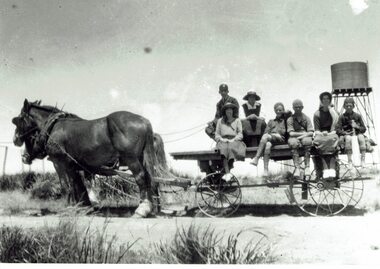
Photograph, Picnic at Nobbies, 1917
... Large black and white photograph of a flat topped cart with no sides, pulled by 2 draught horses. Water tank...Large black and white photograph of a flat topped cart with no sides, pulled by 2 draught horses. Water tank ...The double-storey homestead with 1920s Arts and Crafts styling was built by A.K.T. (Albert Keaston Trenavin) Sambell, the the island’s first shire president. It sits just above the original site of the homestead of the pioneering McHaffie brothers, the Island’s first settlers.HistoricalLarge black and white photograph of a flat topped cart with no sides, pulled by 2 draught horses. Water tank on stand in rural background & people sitting on the cart. 3 women wearing hats and 4 boys, one holding a cricket bat.Off to the Nobbies for a day's picnic - 1917 from "Trenavin Park". Keaston Sambell driving. Sitting behind him - Betty Parker and on side of vehicle from left.-May Lambert, Jim Patterson, Jim Blake, Carmen Sambell, Bill Sambell.trenavin park phillip island, a.k. t. sampbell, betty parker, jim patterson, jim blake, carmen sambell, bill sambell, may lambert -
 Phillip Island and District Historical Society Inc.
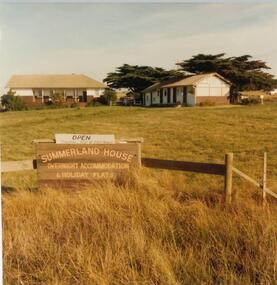
Photograph, John Cook, 1978-79
... It attracted large numbers of professional people from Melbourne. coloured photograph Summerland Guesthouse Phillip Island AKT Sambell Three photographs of Summerland Guesthouse, one of the first Guesthouses on the Island, situated above the site of the Penguin Parade. 81-87 Note sign: Open - overnight accommodation and holiday flats. 81-88 View of Summerland Guesthouse. Probably back view. Note elevated water tank ...In 1927 Mr A. K. T. Sambell built a pier, planned and subdivided a residential estate, designed and built Summerland House, where ardent golfers after an enjoyable day on the course, could relax. Summerland House was built by local builder Mr Vic McRae. It attracted large numbers of professional people from Melbourne.Three photographs of Summerland Guesthouse, one of the first Guesthouses on the Island, situated above the site of the Penguin Parade. 81-87 Note sign: Open - overnight accommodation and holiday flats. 81-88 View of Summerland Guesthouse. Probably back view. Note elevated water tank. Car parked behind. 81-89 Another view of Summerland Guesthouse.coloured photograph, summerland guesthouse phillip island, akt sambell -
 Halls Gap & Grampians Historical Society
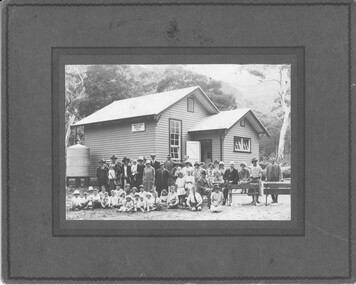
Photograph - B/W, C 1927
... water tank on the left side. The four adults on the right are sitting/leaning on two benches. A sign on the side of the building reads "Halls Gap School 3058". There are large...water tank on the left side. The four adults on the right are sitting/leaning on two benches. A sign on the side of the building reads "Halls Gap School 3058". There are large ...This is a photo of the opening of the new Halls Gap School in 1927. The man on the chair with a walking stick is Dr. Fox.The photo shows a group of ten men, fifteen women, twenty two children (including one toddler) and one toddler in arms, posing outside a wooden building with a water tank on the left side. The four adults on the right are sitting/leaning on two benches. A sign on the side of the building reads "Halls Gap School 3058". There are large trees and a mountain range in the background.education, halls gap -
 Orbost & District Historical Society
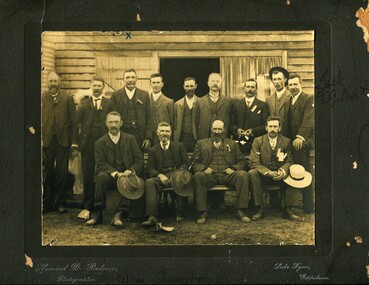
black and white photograph, Howard D. Bulmer, early 20th century 1920s?
... large Black / white photograph on grey card. It shows two rows of men. The back row is standing and the front sitting. They are posed in front of a wooden building with an open door. On the left is a water tank...large Black / white photograph on grey card. It shows two rows of men. The back row is standing and the front sitting. They are posed in front of a wooden building with an open door. On the left is a water tank ...This is a photograph of An Orbost Agricultural Show Committe. The first meeting to form an Agricultural society in Orbost was convened by the then Orbost Progress Association and held in the Mechanics Hall on Saturday, 10th October 1891. Its first show was held on 3rd March 1904...on a site alongside the Bonang Road where the present Golf Club stands. It is currently held at the Recreation Reserve at Newmerella. (Ref: In Times Gone By-Deborah Hall) This photographs is associated with the Orbost Agricultural Society 's Annual Show which has been a major event in Orbost for over a century. Agricultural shows are an important part of cultural life in small country towns and the Orbost Show is an integral part of Orbost 's agricultural history. A large Black / white photograph on grey card. It shows two rows of men. The back row is standing and the front sitting. They are posed in front of a wooden building with an open door. On the left is a water tankon front - Howard D. Bulmer Photographer on right - hand-written < Jack Gilbert X on back - hand-written - L_R Arthur Rodwell, Mat Lynch, Rupert Mosely, S. Lynn, A. Pardew, John Gilbert, John Bird on sticker - "Take off man marked X Mr Matthew Lynch of Orbost"photograph-orbost-agricultural-society -
 Bendigo Historical Society Inc.
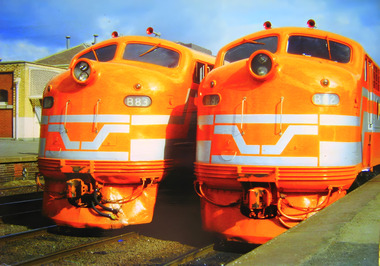
Photograph - David Bernoth Rail Photographs - Korong Vale, March 2012
... large inland wheat storage facility. It had two signalboxes, (A box controlled 2 sets of interlocked gates), loco depot and 8 track marshalling yard as well as the usual goods shed, livestock loading facilities and weighbridge. Perusal of the signal diagrams (link above) will show the extent of the yard tracks. It all ended in 1983 when practically everything you see in the following photos was demolished. About the only structure now remaining is the water tank...large inland wheat storage facility. It had two signalboxes, (A box controlled 2 sets of interlocked gates), loco depot and 8 track marshalling yard as well as the usual goods shed, livestock loading facilities and weighbridge. Perusal of the signal diagrams (link above) will show the extent of the yard tracks. It all ended in 1983 when practically everything you see in the following photos was demolished. About the only structure now remaining is the water tank ...Korong Vale was a speck of a town with a population of just 238 people in 1981 and most of them would have been railway employees. It was the junction for the Sea Lake and Robinvale lines, during wheat season it was common to send relieving crews there to cope with the heavy traffic. Loaded wheat could be dispatched to either Bendigo where it would travel on to Melbourne and Geelong or it could go to Dunnoly, a large inland wheat storage facility. It had two signalboxes, (A box controlled 2 sets of interlocked gates), loco depot and 8 track marshalling yard as well as the usual goods shed, livestock loading facilities and weighbridge. Perusal of the signal diagrams (link above) will show the extent of the yard tracks. It all ended in 1983 when practically everything you see in the following photos was demolished. About the only structure now remaining is the water tank on the down side of the Vernon street level crossing.DVD. David Bernoth Rail photographs - Six Photos This item contains the following photos: 6847.2a Colour photo of two diesels Nos. 883 and 882 at a station 6847.2b Black and white photo of a sign at Korong Vale railway station. 6847.c Colour photo of Korong Vale A Signal Box and the level crossing gates 6847.2d Black and white photo of a loco van at Korong Vale 6847.2e Black and white photo of Workman's Vehicle at Korong Vale 6847.2f Black and white photo of the top front view of Engine 761bendigo, railways, david bernoth collection, korong vale -
 Bendigo Historical Society Inc.
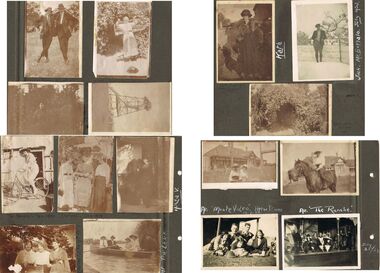
Photograph - HILDA HILL COLLECTION: BLACK AND WHITE PHOTO, 1919-1924
... Two ladies holding tennis racquets, dressed in white blouses with one dark dress and the other a lighter shade sitting on stool inside a netted tennis court, both ladies are wearing large brimmed hats, background is a house with a water tank on the left end, three decorative chimneys, tiled roof, decorative panelling below the guttering, 'Kilmuir' October 1919. ...Two ladies holding tennis racquets, dressed in white blouses with one dark dress and the other a lighter shade sitting on stool inside a netted tennis court, both ladies are wearing large brimmed hats, background is a house with a water tank on the left end, three decorative chimneys, tiled roof, decorative panelling below the guttering, 'Kilmuir' October 1919. ...Hilda Hill Collection. Combination of Sepia and Black & White Photos. (Total 16.) two men with arms on each others shoulders, both with legs crossed, background shows large group of people and large trees, Hibernian Picnic November 19th 1919. Elderly lady holding two bird cages with birds therein standing in front of large flowering bush, the lady is dressed in all white and her hat lies on the ground in front of her, the hat appears to have flowers on the brim. Mrs Mc'Rosebower' October 1919. Hilda V. Standing with a background of shrubbery, wearing a dark dress, photo not very clear, 'The Ranche' March 1921. The Pinnacle One Tree Hill, people on the top lookout area and the wooden staircase for access, note the iron roof at the first level to provide shelter at ground level, April 1920. Lady on a ladies bicycle, dressed in geometric patterned dress, in front of an old shed with a corrugated iron roof. The bicycle has a front and rear mudguard, 'The Ranche' January 1920. Three ladies, the lady on the left is wearing a white dress with a black belt and holding in her right hand a small bag with a handle, the middle lady is wearing a dress of another colour with three strips of material at different levels on the front and holding her hands at her waist, also wearing lace up boots, lady to the right is wearing a white blouse and a dark skirt and her hands behind her back, background is garden, 'Durvol' December 1919. Photo of young girl dressed in black standing next to a small bush with her back to a house exterior wall, to the left is a white wall, NO Details.Three ladies standing beneath a large tree arm in arm, left girl is wearing a white top with a black belt and dark skirt, Centre girl is wearing a white top and dark skirt, girl at right wearing coloured? Dress with matching sash belt,'Durvol' December 19th 1919. Two men and three ladies in a rowing boat on lake Weeroona, both men are wearing dark suits and hats, the ladies are all in light coloured clothing and also wearing large brimmed hats. Kath wearing a black dress with a fox skin stole and holding a large bag in her right hand in garden setting, left background is a corrugated iron fence with wooden top rail, to the right is the wall of a building, September 1919 'the Ranche'. Jack wearing a black coat and jodhpurs with a white high neck jumper leaning on a wire and netting farm type fence, Mt. Buffalo July 1923. Photo of a 'Rosebower' in a garden corner, right shows part of a picket fence, wear and tear indicates that a gate may be in the fence accessible through the bower, October 1919. Two ladies holding tennis racquets, dressed in white blouses with one dark dress and the other a lighter shade sitting on stool inside a netted tennis court, both ladies are wearing large brimmed hats, background is a house with a water tank on the left end, three decorative chimneys, tiled roof, decorative panelling below the guttering, 'Kilmuir' October 1919. Lady on dark coloured horse, the lady is wearing a white blouse and jodhpurs and a large brimmed hat, background is house showing a bow window three chimneys and a small portion of the decorative fretwork below the gutter line of the verandah, 'Kilmuir' October 1919. Two young men dressing collar and tie one wearing a coat and three young ladies reclining on the ground, girl on the left is wearing a light coloured dress white blouse and cardigan, middle girl wearing a short sleeved top, right lady is wearing white blouse and dark coat, in foreground there appears to be a pudding meat and a wine bottle, left edge another male can be partially seen lying on the ground with a bottle in his left hand, at 'Monte Video' after dinner 18 July 1924. Ten people sitting and standing on a veranda, 'The Ranche', celebrating an event, small 4 wheel table with food, person front left holding a white cup and saucer, July 1924.australia, history, victoria post war touring boom, http://www.yourbrisbanepastandpresent.com/2012_02_01_archive.html -
 Bendigo Historical Society Inc.
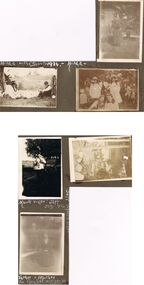
Photograph - HILDA HILL COLLECTION: BLACK AND WHITE PHOTOS, 1917-1924
... large wheel, white sheet on ground between them and indistinguishable articles on sheet, Hibernian Picnic Axedale November 13th 1918. Group of young girls and boys all dressed in light coloured clothing gathering Botanical gardens January 1917, Miss N. Linnane reclining on cane lounge chair on verandah, weatherboard wall of house, verandah post, rock garden edging in foreground, May 1918. Monte Video Property Queensland Jeff, dressed in dark trousers and white shirt, holding a skinned rabbit, water tank...large wheel, white sheet on ground between them and indistinguishable articles on sheet, Hibernian Picnic Axedale November 13th 1918. Group of young girls and boys all dressed in light coloured clothing gathering Botanical gardens January 1917, Miss N. Linnane reclining on cane lounge chair on verandah, weatherboard wall of house, verandah post, rock garden edging in foreground, May 1918. Monte Video Property Queensland Jeff, dressed in dark trousers and white shirt, holding a skinned rabbit, water tank ...Series of Black & White Photos Total 6 Hill Family & Friends During the First World War and after. Rita, wearing a dark dress with white collar and holding a dark coloured hat, background is large brick structure with windows to right and small section of veranda, pal tree, Railway Reserve Kyneton 1918. Man and two women wearing white dresses and dark hats, man wears dark suit white shirt and dark tie with his back against a large wheel, white sheet on ground between them and indistinguishable articles on sheet, Hibernian Picnic Axedale November 13th 1918. Group of young girls and boys all dressed in light coloured clothing gathering Botanical gardens January 1917, Miss N. Linnane reclining on cane lounge chair on verandah, weatherboard wall of house, verandah post, rock garden edging in foreground, May 1918. Monte Video Property Queensland Jeff, dressed in dark trousers and white shirt, holding a skinned rabbit, water tank in background, wire fence, July 1924. Father & Mother, Father wears a grey suit with white shirt and dark tie, Mother seated is wearing a dark dress with striped collar and white blouse, 'The Ranche' Mollison Street Eppalock.Hilda Hill Personal Collectionaustralia, history, post war life -
 Bendigo Historical Society Inc.
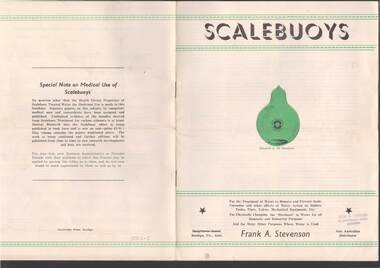
Document - BILL ASHMAN COLLECTION: SCALEBUOYS BROCHURE
... Water Treatment by the Creator R. H. S. Abbott, Jnr. Other topics are How Scalebuoys Function, Not a 'Watersoftener', Special Features, First Cost is the Last Cost. Scalebuoy Units are for Domestic Household Tank Unit, Hydraulic-Nozzle Tank Unit and Scalebuoy Tap Unit. Practical Applications of Scalebuoy for Domestic Uses are listed. There is also a Scalebuoy hand Unit, Vest Pocket Unit, Large...Water Treatment by the Creator R. H. S. Abbott, Jnr. Other topics are How Scalebuoys Function, Not a 'Watersoftener', Special Features, First Cost is the Last Cost. Scalebuoy Units are for Domestic Household Tank Unit, Hydraulic-Nozzle Tank Unit and Scalebuoy Tap Unit. Practical Applications of Scalebuoy for Domestic Uses are listed. There is also a Scalebuoy hand Unit, Vest Pocket Unit, Large ...Eight page brochure printed by Cambridge Press titled Scalebuoys. Sole Australian Distributor Frank A. Stevenson, 62 Honeysuckle Street, Bendigo. Pages have green horizontal lines. Brochure mentions the Scientific Treatise of Scalebuoy Process of Water Treatment by the Creator R. H. S. Abbott, Jnr. Other topics are How Scalebuoys Function, Not a 'Watersoftener', Special Features, First Cost is the Last Cost. Scalebuoy Units are for Domestic Household Tank Unit, Hydraulic-Nozzle Tank Unit and Scalebuoy Tap Unit. Practical Applications of Scalebuoy for Domestic Uses are listed. There is also a Scalebuoy hand Unit, Vest Pocket Unit, Large Hydraulic-Nozzle Tank Unit and a Motorized Tank Unit. There are illustrations of the Units. There are also a list of A Few of the Many Industrial and Processing Applications. On the back page is a Special Note on Medical use of Scalebuoys.sciences, instruments - general, scalebuoy, bill ashman collection, scalebuoys, the scalebuoy company, frank a stevenson, r h s abbott jnr, bendigo electronic coy of australia, cambridge press -
 Bendigo Historical Society Inc.
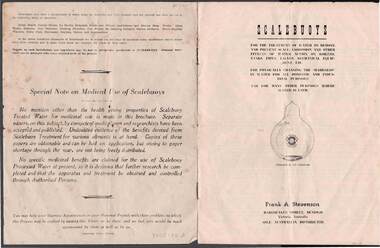
Document - BILL ASHMAN COLLECTION: CORRESPONDENCE
... Water-Softener', Special Features and First Cost is the Last Cost. Scalebuoys Units includes Domestic Household Tank Unit, Hydraulic-Nozzle Tank Unit, Scalebuoy Tap Unit, Practical Applications of Scalebuoy for Domestic Uses, Scalebuoy Hand Unit, Vest Pocket Unit, Large Hydraulic-Nozzle Agitation Tank Unit, Motorized Tank Unit, A Few of the Many Industrial & Processing Applications, Motor Car Unit and a Special Note on Medical Use of Scalebuoys....Water-Softener', Special Features and First Cost is the Last Cost. Scalebuoys Units includes Domestic Household Tank Unit, Hydraulic-Nozzle Tank Unit, Scalebuoy Tap Unit, Practical Applications of Scalebuoy for Domestic Uses, Scalebuoy Hand Unit, Vest Pocket Unit, Large Hydraulic-Nozzle Agitation Tank Unit, Motorized Tank Unit, A Few of the Many Industrial & Processing Applications, Motor Car Unit and a Special Note on Medical Use of Scalebuoys. ...Brochure titled Scalebuoys. Contains Scientific Treatise of Scalebuoy . . . Process of Water Treatment (By the Creator R. H. S. Abbott, Jnr.)Also mentions How Scalebuoys Function, Not a 'Water-Softener', Special Features and First Cost is the Last Cost. Scalebuoys Units includes Domestic Household Tank Unit, Hydraulic-Nozzle Tank Unit, Scalebuoy Tap Unit, Practical Applications of Scalebuoy for Domestic Uses, Scalebuoy Hand Unit, Vest Pocket Unit, Large Hydraulic-Nozzle Agitation Tank Unit, Motorized Tank Unit, A Few of the Many Industrial & Processing Applications, Motor Car Unit and a Special Note on Medical Use of Scalebuoys.sciences, instruments - general, scalebuoy, bill ashman collection - correspondence, frank a stevenson, r h s abbott jnr, bendigo electronic coy of australia, cambridge press -
 Bendigo Historical Society Inc.
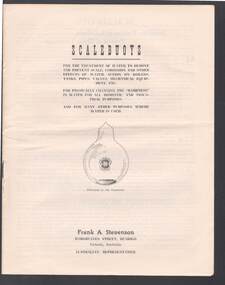
Document - BILL ASHMAN COLLECTION: SCALEBUOYS BROCHURE
... Water-Softener', Special Features, First Cost is the Last Cost. Scalebuoy Units for Domestic Household Tanks, Hydraulic-Nozzle Tank Unit, Scalebuoy Tap Unit, Practical Applications of Scalebuoy for Domestic Uses, Scalebuoy Hand Unit, Vest Pocket Unit, Large Hydraulic-Nozzle Agitation Tank Unit, Motorised Tank Unit. ...Water-Softener', Special Features, First Cost is the Last Cost. Scalebuoy Units for Domestic Household Tanks, Hydraulic-Nozzle Tank Unit, Scalebuoy Tap Unit, Practical Applications of Scalebuoy for Domestic Uses, Scalebuoy Hand Unit, Vest Pocket Unit, Large Hydraulic-Nozzle Agitation Tank Unit, Motorised Tank Unit. ...Six copies of an eight page brochure titled 'Scalebuoys'. Printed by Cambridge Press, Bendigo. Items mentioned are: Scientific Treatise of Scalebuoy - Process of Water Treatment, How Scalebuoys Function, Not a 'Water-Softener', Special Features, First Cost is the Last Cost. Scalebuoy Units for Domestic Household Tanks, Hydraulic-Nozzle Tank Unit, Scalebuoy Tap Unit, Practical Applications of Scalebuoy for Domestic Uses, Scalebuoy Hand Unit, Vest Pocket Unit, Large Hydraulic-Nozzle Agitation Tank Unit, Motorised Tank Unit. Also A Few of the Many Industrial & Processing Applications, Motor Car Unit. On the back page is a list of where Scalebuoy Units have been installed.sciences, instruments - general, scalebuoy, bill ashman collection - correspondence, frank a stevenson, r h s abbott, jnr, bendigo electronic coy of australia, civic square bendigo, cambridge press -
 Bendigo Historical Society Inc.
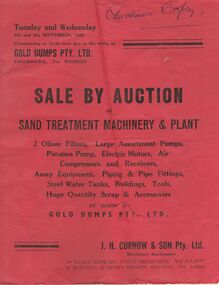
Document - IAN DYETT COLLECTION: AUCTION CATALOGUE - GOLD DUMPS PTY LTD
... Included in the sale were 2 Oliver Filters, Large Assortment of Pumps, Pomona Pump, Electric Motors, Air Compressors and Receivers, Assay Equipment, Piping & Pipe Fittings, Steel Water Tanks, Buildings, Tools, Huge Quantity Scrap & Accessories. ...Included in the sale were 2 Oliver Filters, Large Assortment of Pumps, Pomona Pump, Electric Motors, Air Compressors and Receivers, Assay Equipment, Piping & Pipe Fittings, Steel Water Tanks, Buildings, Tools, Huge Quantity Scrap & Accessories. ...Red covered auction catalogue for a sale held at the works of Gold Dumps Pty. Ltd., Eaglehawk on the 8th and 9th September, 1959 of Sand Treatment Machinery & Plant. Sale held at the Devonshire Sands Site and the New Moon Site. Included in the sale were 2 Oliver Filters, Large Assortment of Pumps, Pomona Pump, Electric Motors, Air Compressors and Receivers, Assay Equipment, Piping & Pipe Fittings, Steel Water Tanks, Buildings, Tools, Huge Quantity Scrap & Accessories. J. H. Curnow & Son Pty. Ltd. Were the Auctioneers. Catalogue, a Bolton Bros. Print. Auctioneers Copy written on the top of the front cover. Prices of lots have been written near the lots.business, auctioneers, j h curnow & son pty ltd, ian dyett collection - auction catalogue - gold dumps pty ltd, j h curnow & son pty ltd, devonshire sands site, new moon site, bolton bros print
