
Showing 78 items matching "lawrence family"
-
 Mont De Lancey
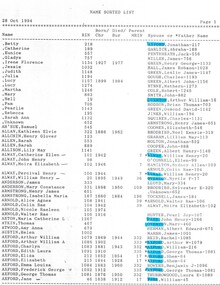
Document - Genealogy Index, 28.10.1994
... ...Lawrence Family...Index of Wandin family history names including their birth, death and marriage information and their spouse/parents, spanning 1807-1983 - only includes pages A-C and M-O Family trees Family History Clegg Family Overton Family Axford Family Ah'Sue Family Allan Family Allchin Family Allen Family Allison Family Alway Family Anderson Family Armstrong Family Arnold Family Aston Family Atkin Family Atwood Family Austin Family Bailey Family Baker Family Balle Family Barker Family Barkway Family Barr Family Bartlett Family Bawdon Benson Family Berry Family Berryman Family Bews Family Binding Family Bird Family Bishop Family Blood Family Blanksby Family Bolding Family Bonola Family Bosser Family Bott Family Bourke Family Bowers Family Brailsford Family Brandt Family Bray Family Brockenshire Family Brodribb Family Brown Family Bryant Family Burgess Family Burrell Family Burrett Family Burton Family Burwill Family Butterworth Family Byers Family Callaghan Family Carlson Family Carter Family Case Family Chamberlain Family Cherry Family Clarke Family Cocks Family Cole Family Collins Family Conder Family Connor Family Cook Family Coomes Family Cooper Family Cornell Family Cottee Family McKenna Family Meacham Family Mill Family Miller Family Mitchell Family Mits Family Montgomery Family Moodie Family Murray Family Musgrave Family Nagle Family Nall Family Nash Family Neely Family Neville Family Newport Family Norman Family Norton Family Notley Family O'Connell Family O'Mara Family Odgers Family Oliver Family Oneyes Family Orams Family Owen Family Pain Family Papworth Family Garlick Family Penthreath Family Green Family Hall Family Gough Family Byrne Family Smith Family Hodson Family Jinks Family Squires Family Graham Family Holton Family Hamilton Family Lloyd Family Tocknell Family Hunter Family Parr Family Herman Family Marsh Family Read Family Thurrowgood Family Hughes Family Wilson Family Rains Family Hurley Family Farqhuar Family Robinson Family Dennis Family Turner Family Rule Family Vine Family Whittaker Family Stevens Family Heywood Family Jones Family Styles Family Rouget Family Sargeant Family Withers Family Larking Family Keen Family White Family Francis Family Teague Family Fisher Family Winbanks Family Knight Family Vernon Family Wood Family Kennedy Family Crossland Family Upton Family McFarline Family Denman Family Elliot Family Thomas Family Davis Family Parker Family Sies Family Dohrmann Family Heffernan Family Duncan Family Foreman Family Saunders Family Wilmont Family Furphey Family Rawson Family Evans Family Field Family Ellis Family Laing Family Ezart Family Hoare Family Heritage Family Quirk Family Griffin Family Lowry Family Johnstone Family Grundy Family Stock Family Patterson Family Ralph Family Pilbrick Family Ussnig Family Leighman Family Underwood Family Lawrence Family Dawson Family Crossdale Family Shoo Family Lomax Family Paten Family 1800s 1810s 1820s 1830s 1840s 1850s 1860s 1870s 1880s 1890s 1900s 1910s 1920s 1930s 1940s 1950s 1960s 1970s 1980s 8 one sided A4 pages typed in black ink with yellow highlighter Document Genealogy Index ...Index of Wandin family history names including their birth, death and marriage information and their spouse/parents, spanning 1807-1983 - only includes pages A-C and M-O8 one sided A4 pages typed in black ink with yellow highlighterfamily trees, family history, clegg family, overton family, axford family, ah'sue family, allan family, allchin family, allen family, allison family, alway family, anderson family, armstrong family, arnold family, aston family, atkin family, atwood family, austin family, bailey family, baker family, balle family, barker family, barkway family, barr family, bartlett family, bawdon, benson family, berry family, berryman family, bews family, binding family, bird family, bishop family, blood family, blanksby family, bolding family, bonola family, bosser family, bott family, bourke family, bowers family, brailsford family, brandt family, bray family, brockenshire family, brodribb family, brown family, bryant family, burgess family, burrell family, burrett family, burton family, burwill family, butterworth family, byers family, callaghan family, carlson family, carter family, case family, chamberlain family, cherry family, clarke family, cocks family, cole family, collins family, conder family, connor family, cook family, coomes family, cooper family, cornell family, cottee family, mckenna family, meacham family, mill family, miller family, mitchell family, mits family, montgomery family, moodie family, murray family, musgrave family, nagle family, nall family, nash family, neely family, neville family, newport family, norman family, norton family, notley family, o'connell family, o'mara family, odgers family, oliver family, oneyes family, orams family, owen family, pain family, papworth family, garlick family, penthreath family, green family, hall family, gough family, byrne family, smith family, hodson family, jinks family, squires family, graham family, holton family, hamilton family, lloyd family, tocknell family, hunter family, parr family, herman family, marsh family, read family, thurrowgood family, hughes family, wilson family, rains family, hurley family, farqhuar family, robinson family, dennis family, turner family, rule family, vine family, whittaker family, stevens family, heywood family, jones family, styles family, rouget family, sargeant family, withers family, larking family, keen family, white family, francis family, teague family, fisher family, winbanks family, knight family, vernon family, wood family, kennedy family, crossland family, upton family, mcfarline family, denman family, elliot family, thomas family, davis family, parker family, sies family, dohrmann family, heffernan family, duncan family, foreman family, saunders family, wilmont family, furphey family, rawson family, evans family, field family, ellis family, laing family, ezart family, hoare family, heritage family, quirk family, griffin family, lowry family, johnstone family, grundy family, stock family, patterson family, ralph family, pilbrick family, ussnig family, leighman family, underwood family, lawrence family, dawson family, crossdale family, shoo family, lomax family, paten family, 1800s, 1810s, 1820s, 1830s, 1840s, 1850s, 1860s, 1870s, 1880s, 1890s, 1900s, 1910s, 1920s, 1930s, 1940s, 1950s, 1960s, 1970s, 1980s -
 Surrey Hills Historical Society Collection
Photograph, Group of children playing in the backyard, 11 York Street, Mont Albert
... Her sister Barbara is at the back. The Lawrence family lived next door at 15 York Street (there was no 13 York Street). ...Her sister Barbara is at the back. The Lawrence family lived next door at 15 York Street (there was no 13 York Street). laurie young ken young children barbara young, york street, back yards, mont albert On rear: Photographer's processing stamp "4938" A black & white photo of 3 girls and 2 boys in imaginative play in a canoe positioned against a timber paling fence. ...The photo probably includes Barbara, Ken and Laurie Young, the children of Ernest Lance (Lance) Young and his wife Beryl Mair who married in 1939 and came to 11 York Street during the WW2 years. The donor does not recognise all of the children. Linda Lawrence is the tallest girl; her brother Ken is largely obscured. Laurie is the youngest girl with the pigtails. Her sister Barbara is at the back. The Lawrence family lived next door at 15 York Street (there was no 13 York Street). A black & white photo of 3 girls and 2 boys in imaginative play in a canoe positioned against a timber paling fence.On rear: Photographer's processing stamp "4938"laurie young, ken young, children, barbara young, york street, back yards, mont albert -
 Flagstaff Hill Maritime Museum and Village
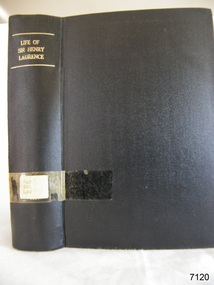
Book - Biographical/Military History, Smith, Elder & Co. et al, Life of Sir Henry Lawrence, 1873
... The preface mentions Lady Lawrence and members of Lawrence's family assisting with the materials. The publisher was Smith, Elder & Co., 15 Waterloo Place, London. ...The preface mentions Lady Lawrence and members of Lawrence's family assisting with the materials. The publisher was Smith, Elder & Co., 15 Waterloo Place, London. ...The subject book is not by Merivale alone. It was begun by Sir Herbert Edwardes, who died in 1868, and finished by Herman Merivale. The work is a biography of Sir Henry Lawrence (1806–1857), a Bengal Army officer and administrator. Lawrence was born in Ceylon (now Sri Lanka). There he led the group of officials in the Punjab known as his 'Young Men', he also founded the Lawrence Military Asylums, and died at the siege of Lucknow in 1857. The book follows his career through the Sikh wars, the Punjab Board of Administration, his clash with Lord Dalhousie, his time in Rajputana and his final posting in Oudh.Hard cover book. Life of Sir Henry Lawrence Author: Sir Herbert Edwardes & Herman Merivale Publisher: Smith, Elder & Co Date: 1873 Further Information: Black Cloth hardcover with lettering and patterning to spine in Gilt. The spine has a Library label with an inscription.non-fictionThe subject book is not by Merivale alone. It was begun by Sir Herbert Edwardes, who died in 1868, and finished by Herman Merivale. The work is a biography of Sir Henry Lawrence (1806–1857), a Bengal Army officer and administrator. Lawrence was born in Ceylon (now Sri Lanka). There he led the group of officials in the Punjab known as his 'Young Men', he also founded the Lawrence Military Asylums, and died at the siege of Lucknow in 1857. The book follows his career through the Sikh wars, the Punjab Board of Administration, his clash with Lord Dalhousie, his time in Rajputana and his final posting in Oudh.book, life of sir henry lawrence, h merivale, herman merivale, shipwrecked-coast, flagstaff-hill, flagstaff-hill-maritime-museum, warrnambool, maritime-museum, shipwreck-coast, flagstaff-hill-maritime-village, shipwrecked-artefact, pattison collection, warrnambool library, warrnambool mechanics’ institute, ralph eric pattison, corangamite regional library service, warrnambool city librarian, mechanics’ institute library, victorian library board, warrnambool books and records, warrnambool children’s library, great ocean road -
 Warrnambool and District Historical Society Inc.
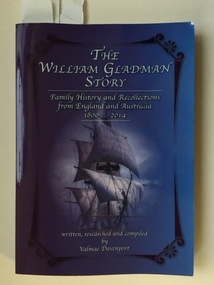
Book, Valmae Davenport, William Gladman Story, May 2016
... In 2012 there were over 7000 family members connected in some way with the Gladman families. The noted Australia singer Marjorie Lawrence was a family member. ...In 2012 there were over 7000 family members connected in some way with the Gladman families. The noted Australia singer Marjorie Lawrence was a family member. ...This is a history of the family and descendants of William Gladman.This is a soft cover book of 374 pages. The cover is coloured mauve with an image of a sailing ship enclosed by an ornamental border on the front cover and an image of William Gladman on the back cover. The book has a Disclaimer page, an Acknowledgements page, Contents pages, a List of Illustrations, 21 Chapters and a Bibliography. There are many black and white photographs, maps and family trees. The inscription on the inside title page is handwritten in blue biro. non-fictionThis is a history of the family and descendants of William Gladman.william and rhoda gladman, gladman families, winchelsea, history of warrnambool -
 Federation University Historical Collection
Photograph, Solomon and bardwell, Holmes Family
... family archive...coghill...ballarat...william carter holmes...edward carter holmes...lawrence...Lawrence Carter Holmes (1829 - 1935). .2) A man sits in a studio photograph taken in Ballarat. The man is Robert Reid who married Adelaide Helen Holmes in 1857. Adelaide was the sister of Catherine Dorothy Holmes who married William Coghill and lived at Coghill's Creek near Ballarat. Holmes Family ...The Coghills were early settlers in the Ballarat district, with Coghill's Creek being named after them. .1) Three men pose for a studio photograph taken in Melbourne. From left to right the men are: Willie [Lawrence's son William Henry Carter Holmes (1867 - 1928)]; Edward Carter Holmes (1822 -1886); Lawrence Carter Holmes (1829 - 1935). .2) A man sits in a studio photograph taken in Ballarat. The man is Robert Reid who married Adelaide Helen Holmes in 1857. Adelaide was the sister of Catherine Dorothy Holmes who married William Coghill and lived at Coghill's Creek near Ballarat. .1) Verso: "Willie, Uncle Teddy and Father" .2) "I think this could be the same person as the one designated "Uncle Teddy" on the other photo. What do you think?" Photographer: Solomon and Bardwell. No.4938.holmes family archive, coghill, ballarat, william carter holmes, edward carter holmes, lawrence carter holmes, robert reid -
 Federation University Historical Collection
Newsclip, Herald Sun, Baptism of Blood (World War One), 1993, 28/08/1993
... lawrence mccarthy...robert mactier...c.e.w. bean...keith murdoch...chatham family...world war one western front 24th battallion mont sr quentin fromelles pozieres mouquet messines bullecourt villers-bretonneux ypres hamel quentin hindenburg anniversary john poulton may tilton louis nitchie monty nitchie clara payne jean howard jim nitchie hector nitchie victoria cross albert jacka william jackson rupert moon patrick bugden walter peeler william ruthven walter brown percy statton lawrence mccarthy robert mactier c.e.w. bean keith murdoch chatham family archive chatham-holmes family collection Eight page newspaper magazine, Herald Sun Weekend Magazine August 28, 1993, recounting the story of the Australian Diggers who fought on the Western Front. ...Eight page newspaper magazine, Herald Sun Weekend Magazine August 28, 1993, recounting the story of the Australian Diggers who fought on the Western Front. world war one, western front, 24th battallion, mont sr quentin, fromelles, pozieres, mouquet, messines, bullecourt, villers-bretonneux, ypres, hamel, quentin, hindenburg, anniversary, john poulton, may tilton, louis nitchie, monty nitchie, clara payne, jean howard, jim nitchie, hector nitchie, victoria cross, albert jacka, william jackson, rupert moon, patrick bugden, walter peeler, william ruthven, walter brown, percy statton, lawrence mccarthy, robert mactier, c.e.w. bean, keith murdoch, chatham family archive, chatham-holmes family collection -
 City of Moorabbin Historical Society (Operating the Box Cottage Museum)
Book - Family History, Cohn, Alexander et al, Tablets of memory : the Bendigo Cohns and their descendants, 1853-1989, 1990
... Tablets of memory : the Bendigo Cohns and their descendants, 1853-1989 Book Family History Cohn, Alexander Cohn, Jack Magnus Cohn, Lawrence Julius Antelope Press ...xxii, 270 p. : ill., facsims., geneal. tables, map, ports.non-fictionbendigo, cohn family -
 Orbost & District Historical Society
newspaper supplement, The Coronation of Her Majesty Queen Elizabeth 11, 1953
... Saving an item dedicated to the royal family is typical of the general feeling of respect and admiration felt by the rural communities towards the British Royal Family, especially towards Queen Elizabeth II. newspaper-supplement-Sun-News-Pictorial media-print A broadsheet sized newspaper supplement designed to be folded into four - 8 pp. It is titled The Sun News Pictorial - Coronation Service. The Coronation of Her Majesty Queen Elizabeth 11 newspaper supplement Lawrence ...The Sun News-Pictorial, also known as The Sun, was a morning daily tabloid newspaper in Melbourne, Australia, established in 1922 and closed in 1990. It was part of The Herald and Weekly Times stable of Melbourne newspapers. For more than fifty years it was the Australian newspaper with the largest circulation. This special edition was issued as a souvenir of the coronation of Queen Elizabeth 11. The coronation of Queen Elizabeth II as monarch of the United Kingdom, Canada, Australia, New Zealand, the Union of South Africa, Pakistan, and Ceylon took place on 2 June 1953 at westminster Abbey. On the 2nd June 1953, the coronation of Queen Elizabeth II took place and the commonwealth countries, including Australia joined in the celebration. Saving an item dedicated to the royal family is typical of the general feeling of respect and admiration felt by the rural communities towards the British Royal Family, especially towards Queen Elizabeth II.A broadsheet sized newspaper supplement designed to be folded into four - 8 pp. It is titled The Sun News Pictorial - Coronation Service.newspaper-supplement-sun-news-pictorial media-print -
 Orbost & District Historical Society
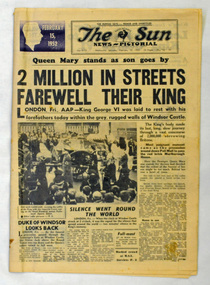
newspaper, The Sun News-Pictorial, February 16 1952
... Saving an item dedicated to the royal family is typical of the general feeling of respect and admiration felt by the rural communities towards the British Royal Family. newspaper-Sun-News-Pictorial media-print George-V1 royal-family A newspaper - middle pages missing, containing articles relating to the death of King George V1. It is dated Saturday February 1952.. The Sun News-Pictorial newspaper Lawrence ...The Sun News-Pictorial, also known as The Sun, was a morning daily tabloid newspaper in Melbourne, Australia, established in 1922 and closed in 1990. It was part of The Herald and Weekly Times stable of Melbourne newspapers. For more than fifty years it was the Australian newspaper with the largest circulation George VI (Albert Frederick Arthur George; 14 December 1895 – 6 February 1952) was King of the United Kingdom and the Dominions of the British Commonwealth from 11 December 1936 until his death.Newspapers reflect contemporary society. Saving an item dedicated to the royal family is typical of the general feeling of respect and admiration felt by the rural communities towards the British Royal Family.A newspaper - middle pages missing, containing articles relating to the death of King George V1. It is dated Saturday February 1952..newspaper-sun-news-pictorial media-print george-v1 royal-family -
 Ringwood and District Historical Society
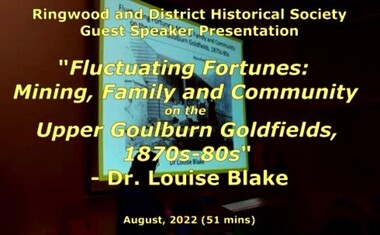
Mixed media - Video, RDHS Guest Speaker Presentation - "Fluctuating Fortunes on the Upper Goulburn Goldfields 1870s-1880s" - Dr. Louise Blake
... In a series of letters Lawrence wrote to his family in England, and now held by the State Library of Victoria, Lawrence shared his early struggles as an independent miner on the central Victorian goldfields, his protracted courtship with Esther, the ordinary intimacies of their life at Gaffneys Creek, the work that Esther did to support the family in this remote mining region, as well as the material and emotional support provided by and to family, friends and neighbours. ...In a series of letters Lawrence wrote to his family in England, and now held by the State Library of Victoria, Lawrence shared his early struggles as an independent miner on the central Victorian goldfields, his protracted courtship with Esther, the ordinary intimacies of their life at Gaffneys Creek, the work that Esther did to support the family in this remote mining region, as well as the material and emotional support provided by and to family, friends and neighbours. ...Digitised video (2.66GB) Duration: 51 minutes. Recorded August, 2022 (Video is available for viewing at Ringwood & District Historical Society Archives by appointment)Presenter: Louise Blake is a writer and historian with an interest in the stories of women, families, and communities on the nineteenth-century goldfields in Australia and New Zealand. Inspired by her family connection to the gold mining settlement of Woods Point, Louise completed a PhD on Women and Community on the Upper Goulburn Goldfields in north-east Victoria in 2019. In this talk Louise will share her research on Lawrence and Esther Chubb, who lived and worked at Gaffneys Creek on the Upper Goulburn Goldfields in the 1870s and 80s. In a series of letters Lawrence wrote to his family in England, and now held by the State Library of Victoria, Lawrence shared his early struggles as an independent miner on the central Victorian goldfields, his protracted courtship with Esther, the ordinary intimacies of their life at Gaffneys Creek, the work that Esther did to support the family in this remote mining region, as well as the material and emotional support provided by and to family, friends and neighbours. A rare and revealing source, these letters help to expand our understanding of the lived experience of mining families, particularly the work that women did to sustain families and communities, in this period of waged labour and tribute mining in Victoria. -
 Ringwood and District Historical Society
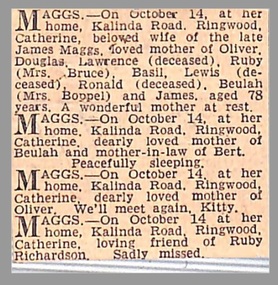
Newspaper, "Age" Newspaper cutting announcing the death of Catherine Maggs on 14th. October 1960
... family in the Ringwood area. They had nine children. James died in July 1940. (From the book "Ringwood Place of Many Eagles by Hugh Anderson) MAGGS.—On October 14, at her home, Kalinda Road, Ringwood, Catherine, beloved wife of the late James Maggs, loved mother of Oliver, Douglas, Lawrence (deceased), Ruby (Mrs. ...Catherine Maggs was married to James Maggs who belonged to a large pioneer family in the Ringwood area. They had nine children. James died in July 1940. (From the book "Ringwood Place of Many Eagles by Hugh Anderson)Small newpaper cutting.MAGGS.—On October 14, at her home, Kalinda Road, Ringwood, Catherine, beloved wife of the late James Maggs, loved mother of Oliver, Douglas, Lawrence (deceased), Ruby (Mrs. Bruce), Basil, Lewis (deceased), Ronald (deceased), Beulah (Mrs. Boppel) and James, aged 78 years. A wonderful mother at rest. MAGGS.—On October 14, at her home, Kalinda Road, Ringwood, Catherine, dearly loved mother of Beulah and mother-in-law of Bert. Peacefully sleeping. MAGGS.—on October 14, at her home, Kalinda Road, Ringwood, Catherine, dearly loved mother of Oliver. We'll meet again, Kitty. MAGGS.—on October 14, at her home, Kalinda Road, Ringwocd, Catherine, loving friend of Ruby Richardson. Sadly missed. -
 Flagstaff Hill Maritime Museum and Village
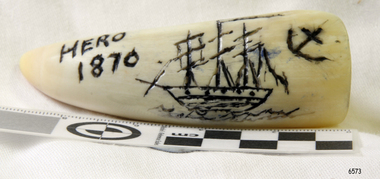
Craft - Scrimshaw, Hero 1870, Late 20th Century
... family to visit North America. In 1860 the Queen had intended to pay a visit to Canada however stress prevented her from travelling. The then Prime Minister Lord Palmerston suggested that “Bertie” the prince of Wales could represent the Queen and on July 10th 1860, Bertie boarded HMS Hero for a tour of Canada and the USA. On July 23rd the ship arrived at Terranova. By the second week of August, the HMS Hero had sailed up the St. Lawrence...family to visit North America. In 1860 the Queen had intended to pay a visit to Canada however stress prevented her from travelling. The then Prime Minister Lord Palmerston suggested that “Bertie” the prince of Wales could represent the Queen and on July 10th 1860, Bertie boarded HMS Hero for a tour of Canada and the USA. On July 23rd the ship arrived at Terranova. By the second week of August, the HMS Hero had sailed up the St. Lawrence ...Scrimshaw is regarded as early folk art and is associated primarily with whaling that was opened up in the Pacific at the end of the eighteenth century by sailors mainly from American, English and French vessels. As a result, some of the best scrimshaw from Pacific whales can be found in collections in these countries. Even though sailors must have had plenty of spare time between periods of whaling scrimshaw on whale teeth seems a rarity before the 1830s. One reason may have been the high price paid for whale teeth ivory in this period making scrimshaw on teeth popular only after the market was saturated and the price dropped. The earliest identified engraver of whale teeth is the English whaling master Captain J. S. King who was active between 1817 and 1823. There have been six ships called the Hero in the Royal Navy and this ship was the fourth named Hero, it was a screw-propelled 91-gun and second-rate. In the rating system of the British Royal Navy, this term is used to categorise sailing warships, a second-rate was a ship of the line which by the start of the 18th century mounted 90 to 98 guns on three gun decks. Earlier 17th-century second rates had fewer guns and were originally two-deckers or had only partially armed third gun decks. The Hero was launched in 1858 and sold in 1971. On July 1860 the Prince of Wales embarked onboard HMS Hero, Albert Edward Prince of Wales, was the eldest son of Queen Victoria, and the future King Edward VII, at the time he was then nineteen years of age, and on route to Newfoundland, Canada and the United States on his first state tour. He was the first member of the British royal family to visit North America. In 1860 the Queen had intended to pay a visit to Canada however stress prevented her from travelling. The then Prime Minister Lord Palmerston suggested that “Bertie” the prince of Wales could represent the Queen and on July 10th 1860, Bertie boarded HMS Hero for a tour of Canada and the USA. On July 23rd the ship arrived at Terranova. By the second week of August, the HMS Hero had sailed up the St. Lawrence River and anchored at Quebec. The Prince was successful with Canadian society visiting Quebec and Montreal during his stay. He went on to visit the United States following an invitation by President James Buchanan. His American journey was regarded as a great success. President Buchanan wrote to Queen Victoria: "He “Bertie” has faced a very difficult task for a person his age and his behaviour in all this has been that of his age and position. He has shown himself honourable, Frank and affable and he won the respect of the sensible and wise people". The scrimshaw is believed to be a modern reproduction of a typical scrimshaw scene and engraved very crudely onto a synthetic substance. Scrimshaw art carved into non-natural material in the shape of a whale tooth. The line artwork images of a three-masted, fully rigged ship and an anchor are coloured black. Inscription is engraved into tooth.Engraved "Hero 1870"warrnambool, flagstaff-hill, flagstaff-hill-maritime-museum, maritime-museum, shipwreck-coast, flagstaff-hill-maritime-village, scrimshaw, plastic, resin, replica, prince of wales, british navy vessel, whaling, hms hero, reproduction, carving, engraving -
 Flagstaff Hill Maritime Museum and Village
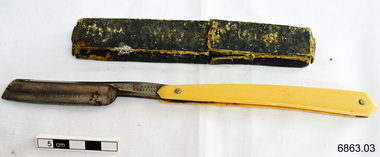
Razor, Early 1900's
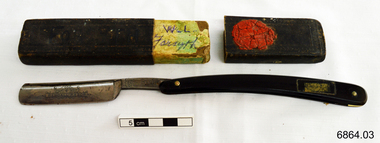
... Lawrence Forsyth. The razor was inherited by Gladys and is now part of the W.R. Angus Collection, which was donated to Flagstaff Hill Maritime Village by the family of Doctor William Roy Angus, Surgeon and Oculist. ...Lawrence Forsyth. The razor was inherited by Gladys and is now part of the W.R. Angus Collection, which was donated to Flagstaff Hill Maritime Village by the family of Doctor William Roy Angus, Surgeon and Oculist. ...This cut-throat razor was originally owned by the father of Dr. W.R. Angus' wife Gladys. Her ,maternal father's name was William Lawrence Forsyth. The razor was inherited by Gladys and is now part of the W.R. Angus Collection, which was donated to Flagstaff Hill Maritime Village by the family of Doctor William Roy Angus, Surgeon and Oculist. The “W.R. Angus Collection” includes historical medical equipment, surgical instruments and material once belonging to Dr Edward Ryan and Dr Thomas Francis Ryan, (both of Nhill, Victoria) as well as Dr Angus’ own belongings. The Collection’s history spans the medical practices of the two Doctors Ryan, from 1885-1926 plus that of Dr Angus, up until 1969. ABOUT THE “W.R.ANGUS COLLECTION” Doctor William Roy Angus M.B., B.S., Adel., 1923, F.R.C.S. Edin.,1928 (also known as Dr Roy Angus) was born in Murrumbeena, Victoria in 1901 and lived until 1970. He qualified as a doctor in 1923 at University of Adelaide, was Resident Medical Officer at the Royal Adelaide Hospital in 1924 and for a period was house surgeon to Sir (then Mr.) Henry Simpson Newland. Dr Angus was briefly an Assistant to Dr Riddell of Kapunda, then commenced private practice at Curramulka, Yorke Peninsula, SA, where he was physician, surgeon and chemist. In 1926, he was appointed as new Medical Assistant to Dr Thomas Francis Ryan (T.F. Ryan, or Tom), in Nhill, Victoria, where his experiences included radiology and pharmacy. In 1927 he was Acting House Surgeon in Dr Tom Ryan’s absence. Dr Angus had become engaged to Gladys Forsyth and they decided he further his studies overseas in the UK in 1927. He studied at London University College Hospital and at Edinburgh Royal Infirmary and in 1928, was awarded FRCS (Fellow from the Royal College of Surgeons), Edinburgh. He worked his passage back to Australia as a Ship’s Surgeon on the on the Australian Commonwealth Line’s T.S.S. Largs Bay. Dr Angus married Gladys in 1929, in Ballarat. (They went on to have one son (Graham 1932, born in SA) and two daughters (Helen (died 12/07/1996) and Berenice (Berry), both born at Mira, Nhill ) According to Berry, her mother Gladys made a lot of their clothes. She was very talented and did some lovely embroidery including lingerie for her trousseau and beautifully handmade baby clothes. Dr Angus was a ‘flying doctor’ for the A.I.M. (Australian Inland Ministry) Aerial Medical Service in 1928 . Its first station was in the remote town of Oodnadatta, where Dr Angus was stationed. He was locum tenens there on North-South Railway at 21 Mile Camp. He took up this ‘flying doctor’ position in response to a call from Dr John Flynn; the organisation was later known as the Flying Doctor Service, then the Royal Flying Doctor Service. A lot of his work during this time involved dental surgery also. Between 1928-1932 he was surgeon at the Curramulka Hospital, Yorke Peninsula, South Australia. In 1933 Dr Angus returned to Nhill and purchased a share of the Nelson Street practice and Mira hospital (a 2 bed ward at the Nelson Street Practice) from Dr Les Middleton one of the Middleton Brothers, the current owners of what previously once Dr Tom Ryan’s practice. Dr Tom and his brother had worked as surgeons included eye surgery. Dr Tom Ryan performed many of his operations in the Mira private hospital on his premises. He had been House Surgeon at the Nhill Hospital 1902-1926. Dr Tom Ryan had one of the only two pieces of radiology equipment in Victoria during his practicing years – The Royal Melbourne Hospital had the other one. Over the years Dr Tom Ryan had gradually set up what was effectively a training school for country general-practitioner-surgeons. Each patient was carefully examined, including using the X-ray machine, and any surgery was discussed and planned with Dr Ryan’s assistants several days in advance. Dr Angus gained experience in using the X-ray machine there during his time as assistant to Dr Ryan. When Dr Angus bought into the Nelson Street premises in Nhill he was also appointed as the Nhill Hospital’s Honorary House Surgeon 1933-1938. His practitioner’s plate from his Nhill surgery is now mounted on the doorway to the Port Medical Office at Flagstaff Hill Maritime Village, Warrnambool. When Dr Angus took up practice in the Dr Edward and Dr Tom Ryan’s old premises he obtained their extensive collection of historical medical equipment and materials spanning 1884-1926. A large part of this collection is now on display at the Port Medical Office at Flagstaff Hill Maritime Village in Warrnambool. In 1939 Dr Angus and his family moved to Warrnambool where he purchased “Birchwood,” the 1852 home and medical practice of Dr John Hunter Henderson, at 214 Koroit Street. (This property was sold in1965 to the State Government and is now the site of the Warrnambool Police Station. and an ALDI sore is on the land that was once their tennis court). The Angus family was able to afford gardeners, cooks and maids; their home was a popular place for visiting dignitaries to stay whilst visiting Warrnambool. Dr Angus had his own silk worm farm at home in a Mulberry tree. His young daughter used his centrifuge for spinning the silk. Dr Angus was appointed on a part-time basis as Port Medical Officer (Health Officer) in Warrnambool and held this position until the 1940’s when the government no longer required the service of a Port Medical Officer in Warrnambool; he was thus Warrnambool’s last serving Port Medical Officer. (Masters of immigrant ships arriving in port reported incidents of diseases, illness and death and the Port Medical Officer made a decision on whether the ship required Quarantine and for how long, in this way preventing contagious illness from spreading from new immigrants to the residents already in the colony.) Dr Angus was a member of the Australian Medical Association, for 35 years and surgeon at the Warrnambool Base Hospital 1939-1942, He served as a Surgeon Captain during WWII1942-45, in Ballarat, Victoria, and in Bonegilla, N.S.W., completing his service just before the end of the war due to suffering from a heart attack. During his convalescence he carved an intricate and ‘most artistic’ chess set from the material that dentures were made from. He then studied ophthalmology at the Royal Melbourne Eye and Ear Hospital and created cosmetically superior artificial eyes by pioneering using the intrascleral cartilage. Angus received accolades from the Ophthalmological Society of Australasia for this work. He returned to Warrnambool to commence practice as an ophthalmologist, pioneering in artificial eye improvements. He was Honorary Consultant Ophthalmologist to Warrnambool Base Hospital for 31 years. He made monthly visits to Portland as a visiting surgeon, to perform eye surgery. He represented the Victorian South-West subdivision of the Australian Medical Association as its secretary between 1949 and 1956 and as chairman from 1956 to 1958. In 1968 Dr Angus was elected member of Spain’s Barraquer Institute of Barcelona after his research work in Intrasclearal cartilage grafting, becoming one of the few Australian ophthalmologists to receive this honour, and in the following year presented his final paper on Living Intrasclearal Cartilage Implants at the Inaugural Meeting of the Australian College of Ophthalmologists in Melbourne In his personal life Dr Angus was a Presbyterian and treated Sunday as a Sabbath, a day of rest. He would visit 3 or 4 country patients on a Sunday, taking his children along ‘for the ride’ and to visit with him. Sunday evenings he would play the pianola and sing Scottish songs to his family. One of Dr Angus’ patients was Margaret MacKenzie, author of a book on local shipwrecks that she’d seen as an eye witness from the late 1880’s in Peterborough, Victoria. In the early 1950’s Dr Angus, painted a picture of a shipwreck for the cover jacket of Margaret’s book, Shipwrecks and More Shipwrecks. She was blind in later life and her daughter wrote the actual book for her. Dr Angus and his wife Gladys were very involved in Warrnambool’s society with a strong interest in civic affairs. He had an interest in people and the community They were both involved in the creation of Flagstaff Hill, including the layout of the gardens. After his death (28th March 1970) his family requested his practitioner’s plate, medical instruments and some personal belongings be displayed in the Port Medical Office surgery at Flagstaff Hill Maritime Village, and be called the “W. R. Angus Collection”. The W.R. Angus Collection is significant for still being located at the site it is connected with, Doctor Angus being the last Port Medical Officer in Warrnambool. The collection of medical instruments and other equipment is culturally significant, being an historical example of medicine from late 19th to mid-20th century. Dr Angus assisted Dr Tom Ryan, a pioneer in the use of X-rays and in ocular surgery. Cut-throat razor, part of the W.R. Angus Collection. Razor in dark green cardboard box. Razor has bone handle with arrow-head shaped end; blade swings inside the handle. The razor is a design called The Abbott and was made by J & J Maxfield of Sheffield in the early 1900's. It once belonged to William Lawrence Forsyth. Written in pencil script on lid: "W. L. Forsyth". Stamped into box and on steel blade "The Abbott". Blade also inscribed "J & J MAXFIELD / SHEFFIELD" flagstaff hill, warrnambool, shipwrecked coast, flagstaff hill maritime museum, maritime museum, shipwreck coast, flagstaff hill maritime village, great ocean road, dr w r angus, william lawrence forsyth, j and j maxfield sheffield, cut-throat razor 1900's, personal effects 1900's, grooming equipment 1900's, hair cutting equipment 1900's -
 Flagstaff Hill Maritime Museum and Village
Razor, early 1900's
... Lawrence Forsyth. The razor was inherited by Gladys and is now part of the W.R. Angus Collection, which was donated to Flagstaff Hill Maritime Village by the family of Doctor William Roy Angus, Surgeon and Oculist. ...Lawrence Forsyth. The razor was inherited by Gladys and is now part of the W.R. Angus Collection, which was donated to Flagstaff Hill Maritime Village by the family of Doctor William Roy Angus, Surgeon and Oculist. ...This cut-throat razor was originally owned by the father of Dr. W.R. Angus' wife Gladys. Her maternal father's name was William Lawrence Forsyth. The razor was inherited by Gladys and is now part of the W.R. Angus Collection, which was donated to Flagstaff Hill Maritime Village by the family of Doctor William Roy Angus, Surgeon and Oculist. The “W.R. Angus Collection” includes historical medical equipment, surgical instruments and material once belonging to Dr Edward Ryan and Dr Thomas Francis Ryan, (both of Nhill, Victoria) as well as Dr Angus’ own belongings. The Collection’s history spans the medical practices of the two Doctors Ryan, from 1885-1926 plus that of Dr Angus, up until 1969. ABOUT THE “W.R.ANGUS COLLECTION” Doctor William Roy Angus M.B., B.S., Adel., 1923, F.R.C.S. Edin.,1928 (also known as Dr Roy Angus) was born in Murrumbeena, Victoria in 1901 and lived until 1970. He qualified as a doctor in 1923 at University of Adelaide, was Resident Medical Officer at the Royal Adelaide Hospital in 1924 and for a period was house surgeon to Sir (then Mr.) Henry Simpson Newland. Dr Angus was briefly an Assistant to Dr Riddell of Kapunda, then commenced private practice at Curramulka, Yorke Peninsula, SA, where he was physician, surgeon and chemist. In 1926, he was appointed as new Medical Assistant to Dr Thomas Francis Ryan (T.F. Ryan, or Tom), in Nhill, Victoria, where his experiences included radiology and pharmacy. In 1927 he was Acting House Surgeon in Dr Tom Ryan’s absence. Dr Angus had become engaged to Gladys Forsyth and they decided he further his studies overseas in the UK in 1927. He studied at London University College Hospital and at Edinburgh Royal Infirmary and in 1928, was awarded FRCS (Fellow from the Royal College of Surgeons), Edinburgh. He worked his passage back to Australia as a Ship’s Surgeon on the on the Australian Commonwealth Line’s T.S.S. Largs Bay. Dr Angus married Gladys in 1929, in Ballarat. (They went on to have one son (Graham 1932, born in SA) and two daughters (Helen (died 12/07/1996) and Berenice (Berry), both born at Mira, Nhill ) According to Berry, her mother Gladys made a lot of their clothes. She was very talented and did some lovely embroidery including lingerie for her trousseau and beautifully handmade baby clothes. Dr Angus was a ‘flying doctor’ for the A.I.M. (Australian Inland Ministry) Aerial Medical Service in 1928 . Its first station was in the remote town of Oodnadatta, where Dr Angus was stationed. He was locum tenens there on North-South Railway at 21 Mile Camp. He took up this ‘flying doctor’ position in response to a call from Dr John Flynn; the organisation was later known as the Flying Doctor Service, then the Royal Flying Doctor Service. A lot of his work during this time involved dental surgery also. Between 1928-1932 he was surgeon at the Curramulka Hospital, Yorke Peninsula, South Australia. In 1933 Dr Angus returned to Nhill and purchased a share of the Nelson Street practice and Mira hospital (a 2 bed ward at the Nelson Street Practice) from Dr Les Middleton one of the Middleton Brothers, the current owners of what previously once Dr Tom Ryan’s practice. Dr Tom and his brother had worked as surgeons included eye surgery. Dr Tom Ryan performed many of his operations in the Mira private hospital on his premises. He had been House Surgeon at the Nhill Hospital 1902-1926. Dr Tom Ryan had one of the only two pieces of radiology equipment in Victoria during his practicing years – The Royal Melbourne Hospital had the other one. Over the years Dr Tom Ryan had gradually set up what was effectively a training school for country general-practitioner-surgeons. Each patient was carefully examined, including using the X-ray machine, and any surgery was discussed and planned with Dr Ryan’s assistants several days in advance. Dr Angus gained experience in using the X-ray machine there during his time as assistant to Dr Ryan. When Dr Angus bought into the Nelson Street premises in Nhill he was also appointed as the Nhill Hospital’s Honorary House Surgeon 1933-1938. His practitioner’s plate from his Nhill surgery is now mounted on the doorway to the Port Medical Office at Flagstaff Hill Maritime Village, Warrnambool. When Dr Angus took up practice in the Dr Edward and Dr Tom Ryan’s old premises he obtained their extensive collection of historical medical equipment and materials spanning 1884-1926. A large part of this collection is now on display at the Port Medical Office at Flagstaff Hill Maritime Village in Warrnambool. In 1939 Dr Angus and his family moved to Warrnambool where he purchased “Birchwood,” the 1852 home and medical practice of Dr John Hunter Henderson, at 214 Koroit Street. (This property was sold in1965 to the State Government and is now the site of the Warrnambool Police Station. and an ALDI sore is on the land that was once their tennis court). The Angus family was able to afford gardeners, cooks and maids; their home was a popular place for visiting dignitaries to stay whilst visiting Warrnambool. Dr Angus had his own silk worm farm at home in a Mulberry tree. His young daughter used his centrifuge for spinning the silk. Dr Angus was appointed on a part-time basis as Port Medical Officer (Health Officer) in Warrnambool and held this position until the 1940’s when the government no longer required the service of a Port Medical Officer in Warrnambool; he was thus Warrnambool’s last serving Port Medical Officer. (Masters of immigrant ships arriving in port reported incidents of diseases, illness and death and the Port Medical Officer made a decision on whether the ship required Quarantine and for how long, in this way preventing contagious illness from spreading from new immigrants to the residents already in the colony.) Dr Angus was a member of the Australian Medical Association, for 35 years and surgeon at the Warrnambool Base Hospital 1939-1942, He served as a Surgeon Captain during WWII1942-45, in Ballarat, Victoria, and in Bonegilla, N.S.W., completing his service just before the end of the war due to suffering from a heart attack. During his convalescence he carved an intricate and ‘most artistic’ chess set from the material that dentures were made from. He then studied ophthalmology at the Royal Melbourne Eye and Ear Hospital and created cosmetically superior artificial eyes by pioneering using the intrascleral cartilage. Angus received accolades from the Ophthalmological Society of Australasia for this work. He returned to Warrnambool to commence practice as an ophthalmologist, pioneering in artificial eye improvements. He was Honorary Consultant Ophthalmologist to Warrnambool Base Hospital for 31 years. He made monthly visits to Portland as a visiting surgeon, to perform eye surgery. He represented the Victorian South-West subdivision of the Australian Medical Association as its secretary between 1949 and 1956 and as chairman from 1956 to 1958. In 1968 Dr Angus was elected member of Spain’s Barraquer Institute of Barcelona after his research work in Intrasclearal cartilage grafting, becoming one of the few Australian ophthalmologists to receive this honour, and in the following year presented his final paper on Living Intrasclearal Cartilage Implants at the Inaugural Meeting of the Australian College of Ophthalmologists in Melbourne In his personal life Dr Angus was a Presbyterian and treated Sunday as a Sabbath, a day of rest. He would visit 3 or 4 country patients on a Sunday, taking his children along ‘for the ride’ and to visit with him. Sunday evenings he would play the pianola and sing Scottish songs to his family. One of Dr Angus’ patients was Margaret MacKenzie, author of a book on local shipwrecks that she’d seen as an eye witness from the late 1880’s in Peterborough, Victoria. In the early 1950’s Dr Angus, painted a picture of a shipwreck for the cover jacket of Margaret’s book, Shipwrecks and More Shipwrecks. She was blind in later life and her daughter wrote the actual book for her. Dr Angus and his wife Gladys were very involved in Warrnambool’s society with a strong interest in civic affairs. He had an interest in people and the community They were both involved in the creation of Flagstaff Hill, including the layout of the gardens. After his death (28th March 1970) his family requested his practitioner’s plate, medical instruments and some personal belongings be displayed in the Port Medical Office surgery at Flagstaff Hill Maritime Village, and be called the “W. R. Angus Collection”. The W.R. Angus Collection is significant for still being located at the site it is connected with, Doctor Angus being the last Port Medical Officer in Warrnambool. The collection of medical instruments and other equipment is culturally significant, being an historical example of medicine from late 19th to mid-20th century. Dr Angus assisted Dr Tom Ryan, a pioneer in the use of X-rays and in ocular surgery. Cut-throat razor, part of the W.R. Angus Collection. Razor in dark coloured cardboard box, has dark brown Bakelite handle with rounded end; blade swings inside the handle. The razor is a Full Concave Bengal design, made by Cadman & Sons Ltd. of Sheffield in the early 1900's.Written in pen on the lid: "W. L. Forsyth", written along front of box and on tape on the handle 'FORSYTH". Impressed on steel blade "Full Concave / BENGALL RAZOR" and "CADMAN & SONS LTD. / SHEFFIELD"flagstaff hill, warrnambool, shipwrecked coast, flagstaff hill maritime museum, maritime museum, shipwreck coast, flagstaff hill maritime village, great ocean road, dr w r angus, william lawrence forsyth, cadman and sons ltd sheffield, cut-throat razor, personal effects 1900's, grooming equipment 1900's, hair cutting equipment 1900's -
 Ringwood and District Historical Society
Photograph, Murfet's House, New Street, Ringwood. 1910
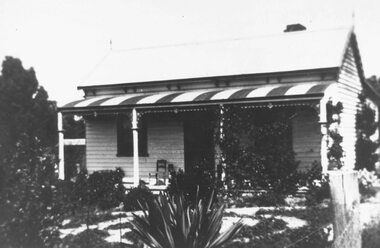
... Later became Lawrence and Hansen (no date)". The Murfet family had a flower farm and berry gardens in New Street in the early 1900's....Later became Lawrence and Hansen (no date)". The Murfet family had a flower farm and berry gardens in New Street in the early 1900's. ...Black and white photograph of weatherboard house and front garden.Written on rear of backing sheet: "Murfet's House, New Street. 1910. Later became Lawrence and Hansen (no date)". The Murfet family had a flower farm and berry gardens in New Street in the early 1900's. -
 Eltham District Historical Society Inc
Newspaper - News Clipping, Herald, He died at Eltham. Herald, March 4, p3, 4 Mar 1965
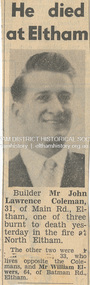
... Emphasis of the tragic loss of a member of a pioneering family who died whilst helping others in his community Bushfire cfa country fire authority Fire Brigrade Glen Park Road Heroes John Lawrence Coleman North Eltham Victorian Bushfires - 1965 Volunteers William John Elwers Fire Fighter Frank Martin George John Crowe Ken Gaston Orchard Avenue Newsprint He died at Eltham. ...John Lawrence Coleman (1934-1965) born January 10, was the son of Raymond John Coleman and Hanna May (Gillet) Coleman. He married Margaret Frances Dare in 1955 and was the father of two children. He died whilst attempting to rescue an older man trapped in the bushfire at North Eltham on March 3, 1965 He died at Eltham (Herald, 4 March 1965, p3) [Picture of John Lawrence Coleman] Builder Mr John Lawrence Coleman, 31, of Main Rd., Eltham, one of three men burnt to death yesterday in the fire at North Eltham. The other two were XXXXX, 33 who lives opposite the Colemans and Mr William Elwers, 64 of Batman Rd., Eltham. * * * Frank Martin was a volunteer with the Eltham rural fire brigade at the time of the 1965 bushfires which burnt Eltham North and Research. Frank was asked to assist with the removal of three bodies from the back gully (now Orchard Avenue). They were badly burnt and one was found stuck under a fence as though trying to escape. Volunteers John Coleman Jnr, William Elwers and George Crowe were killed trying to protect Eltham from bushfire – they were local heroes. At the time, John Coleman Jnr was survived by his wife Margaret and two young children – John 11 and Vicky 2. Margaret Coleman lived in the family home until 1992 when she sold it and moved to Tasmania to be close to her son. She died in 1997 aged 65 years. 75 yr old Ken Gaston grew up on Edendale farm, which was originally a poultry farm but is now owned and run by the Shire of Nillumbik as an educational farm for schools and visitors. He was Captain of the Eltham rural fire brigade in 1965 when John Coleman Jnr was burnt to death in the Eltham North bushfires serving as an unofficial volunteer. He was able to draw where the original Wattletree Road was and at the time was verified with the location of some remaining bitumen and a post from the original bridge over the Diamond Creek located near the junction of the Diamond Creek and another small creek which is further down from Research or Christmas Creek as locals refer to it. The original Main Road ran behind Colemans before the railway line was built beyond Eltham in 1912. (Information recorded by Harry Gilham, President EDHS c.2011) * * * Bushfires rage in Victoria, Snowy: Three dead (1965, March 4). The Canberra Times (ACT : 1926 - 1995), p. 1. Retrieved May 19, 2022, from http://nla.gov.au/nla.news-article131758981 Includes two photos of the fire in North Eltham “Firemen make for safety as fire rages in Upper Glen Park Road, North Eltham, Victoria. The smoke hides a house.” and “A house explodes into flames at North Eltham, Victoria. Firemen said bottled gas went up.” Canberra Times (ACT : 1926 - 1995), Thursday 4 March 1965, page 1 ________________________________________ Firemen make for safety as fire rages in Upper Glen Park Road. North Eltham. Victoria. The smoke hides a house. A house explodes into flames at North Eltham. Victoria. Firemen said bottled gas went up. Bushfires rage in Victoria, Snowy: Three dead MELBOURNE, Wednesday.—Three people died today in a bush» fire which raged through North Eltham, about 15 miles from Melbourne. The victims were three men. A fourth man is feared to be dead. Another bushfire. sparked off by the heatwave sizzling over south-eastern Australia, is burning out of control in the Kosciusko State Park, in the Snowy Mountains. Firefighters fear that if it reaches pine forests up the Yarrangobilly River, they will be powerless to stop it. The three victims of the North Eltbam fire were trapped by flames in a valley. Their bodies were found only a few yards apart. They were named by police tonight as Mr. George Crowe, 78, of North Eltham, William John Ewers, 64, and John Laurence Coleman, 31, both of Eltham. The other two have not been identified. They are believed to be a man aged about 40 and an 18-year-old youth. At least 12 homes were destroyed by the fire, the worst in Victoria since 1962, when eight lives were lost and hundreds of homes burnt down at Warrandyte. At one time the township of Eltham was threatened, but a cool change swept in from the south and held back the wall of flames. More than 100 dogs, worth about £4,000, died when the fire raced through two kennels in Short Street, Eltham. and Upper Glen Park Road, North Eltham. A trickle of water Residents ran into the streets as the blaze raced towards their houses. Others frantically dug firebreaks around their homes. Mrs. Sue Recourt wept when firemen arrived while she was vainly trying to stop the flames with a trickle of water from the garden hose. A stack of firewood was blazing, but the firemen managed to save the house and rescue four goats. Many homes in Eltham were saved after flames had crept to within feet of their fences. Students at North Eltham State School had to be evacuated when the blaze threatened the building. Fire fighters were severely hampered by lack of water and narrow roads. The blaze, which began in above century heat, turned toward Wattle Glen, where two houses were gutted. Then the flames raced towards Hurstbridge to the north. Firemen battling desperately, controlled the fire late this afternoon. Five forest fires were still burning in Victoria tonight. IN VICTORIA THIS WEEK Tragic lack of central fire authority (1965, March 9). The Canberra Times (ACT : 1926 - 1995), p. 2. Retrieved May 19, 2022, from http://nla.gov.au/nla.news-article131759928 Canberra Times (ACT : 1926 - 1995), Tuesday 9 March 1965, page 2 ________________________________________ IN VICTORIA THIS WEEK Tragic lack of central fire authority From Rohan Rivett It was the worst week for Victorian fire fighters since Black Friday 27 years ago. On that day one pilot up in a spotter plane said afterwards: "It seemed at times that half the State was on fire." This time, for three days on end, Gippsland men, women and children had moments of conviction that their towns would have blackened into anonymity before the weekend was out. The week began with horror at Eltham on the North-eastern edge of Melbourne. Eltham today is something of an artists' colony. Oil painters, water colourists, potters and sculptors proliferate. A number of University folk have emulated the example of Professor MacMahon Ball who pioneered the way by moving to Eltham and carving a home out of the bush in the thirties. Innermost Eltham is barely 14 miles from the G.P.O. Farthest Eltham stretches miles beyond. It served to illustrate the tragi-ludicrous truncation of Victoria's fire control. Part of Eltham is under the protection of the Melbourne Fire Brigade. But this responsibility ceases at some invisible and incomprehensible line — apparently determined by the meanderings of the water mains. At this point everybody's property throughout the rest of Eltham is dependent on the Country Fire Authority. Half an hour before midday on Wednesday, a fire suddenly started on the West side of Upper Glen road on the edge of Eltham. Before the fire brigade could arrive, it was burning on a widening front through timber and high grass north of Eltham. Two wind changes in rapid succession saw the fire leaping Diamond Creek. With a freshening wind it struck home after home in three streets. More than one of them exploded suddenly as if hit by an incendiary bomb. There is no piped gas in the Eltham area, hence many housewives use bottle gas. The flames outside caused the bottles to explode. Altogether twelve homes were completely incinerated and four more were badly damaged. Thirty prize dogs perished. About three hours after the fire started it raced suddenly down a gully hillside trapping an elderly man. Two other men apparently raced to the rescue. Flames caught the three men within yards of each other, not 200 yards off the Upper Glen Park Road where safety lay. They were burned to death. Next evening an angry and convincing secretary of the Fire Brigade Union, Mr. W. M. Webber, came on television and appealed to the people of Victoria to end the ridiculous and dangerous dualism in fire-fighting control. The Eltham fire, he said, had precisely illustrated the situation. The Metropolitan Fire Brigade area touched Eltham, but where the fire had gutted and killed, was just outside its area. Mr. Webber said his union had constantly urged one authority for the State with a complete reorganisation of fire protection. On Wednesday the union had repeated its call for an inquiry into fire protection in Victoria to the Chief Secretary, Mr Rylah. "No matter how close the liaison between the two organisations, there are always divided sections of thinking," Mr. Webber told viewers. "I don't know how much tragedy the com-munity can take before it demands that it is properly protected." Rumours that differences in gauge between taps and hose nozzles (as between the two authorities) accentuated the damage were denied by fire chiefs who said that all appliances were now carrying adaptors so that hoses could be linked to mains everywhere. But there is grave concern in the Metropolitan Fire Brigade's higher councils at the action of several Federal authorities with projects in and around Melbourne. They are installing non-standard equipment without reference to the State authorities or any dovetailing of appliances and equipment. Public alarm was not diminished by the publication on Friday and Saturday of a heart tearing letter from the young widow of John Lawrence Coleman, 31 year old father of two, who had died in the flames apparently trying to rescue the old man trapped in the gully. By that time, a Vast area of Gippsland was in flames and the troops had been sent in to back up the overworked and often helpless fire-fighters. By Saturday, the Leader of the Opposition, Mr. Stoneham, who has previously demanded a Royal Commission into fire-fighting arrangements, repeated his demand. To add to the Chief Secretary's worries he was publicly rebuked for allegedly implying on television that lives had been lost at Eltham because people went to the wrong place at the wrong time. In a letter to the Press, Professor MacMahon Ball pointed out that two of the men involved were experienced bushmen who had gone "to help an old man in great danger fully aware of the danger to themselves". As Victoria faced its sixth day of total State-wide fire ban, it looked likely that even official resistance was not going to silence the demand for one central authority to control the fire fiend. At the moment, the 400 square miles where two million Victorians live in Greater Melbourne are divorced from the rest of the State in planning, communications, equipment and control of personnel. No one doubts the whole-hearted co-operation and willingness to back each other up of the M.F.B. and the C.F.A., both at top-level and among the firemen themselves. However, when a city straggles so deeply into the country side, the absence of a single authority, to oversee and analyse the fire threat as a whole, suggests suicidal policy of divide and fuel. Emphasis of the tragic loss of a member of a pioneering family who died whilst helping others in his communitybushfire, cfa, country fire authority, fire brigrade, glen park road, heroes, john lawrence coleman, north eltham, victorian bushfires - 1965, volunteers, william john elwers, fire fighter, frank martin, george john crowe, ken gaston, orchard avenue -
 Eltham District Historical Society Inc
Photograph, Coleman family and home, Main Road, Eltham, c.1909
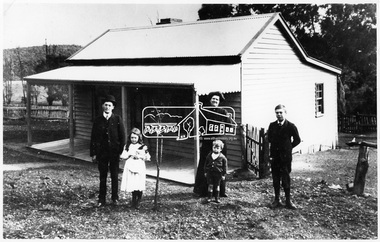
... family...Coleman's corner...Eltham...George Lawrence...Coleman family and home, Coleman’s Corner, Eltham, c.1909 L-R: Tom Newton (school teacher and nephew of Mrs Coleman), Mary Agnes Coleman (later Mrs Dawes 1904-1957), Mrs Mary Ann Coleman nee Bourke (1877-1927); mother of Jack (John Lawrence 1895-1969), George Lawrence (1906-1953) and Mary Agnes (1904-1957). ...It is significant in being the first community sourced collection representing the places and people of the Shire's first one hundred years. shire of eltham pioneers photograph collection Coleman Cottage Coleman Crescent Coleman family Coleman's corner Eltham George Lawrence Coleman Jack Coleman John Lawrence Coleman Main Road Mary Agnes Dawes (nee Coleman) Mary Ann Coleman (nee Bourke) Tom Newton Wattletree Road 1909 Digital image 4 x 5 inch B&W Neg Print 16.5 x 25 cm Coleman family and home, Main Road, Eltham Photograph Photograph ...Coleman family and home, Coleman’s Corner, Eltham, c.1909 L-R: Tom Newton (school teacher and nephew of Mrs Coleman), Mary Agnes Coleman (later Mrs Dawes 1904-1957), Mrs Mary Ann Coleman nee Bourke (1877-1927); mother of Jack (John Lawrence 1895-1969), George Lawrence (1906-1953) and Mary Agnes (1904-1957). John (Jack) Coleman was father of John Jnr and father in law to Margaret (nee Dare). The cottage was located on a bend of Wattletree Rd near Main Road. Built about 1905 and later extended. Demolished c.2000 for development of units. Main Road before it was realigned used to take in the current Coleman Crescent. Same as 1678A. Not in register. Source: Mrs. M. Coleman, Coleman's Corner, Eltham This photo forms part of a collection of photographs gathered by the Shire of Eltham for their centenary project book,"Pioneers and Painters: 100 years of the Shire of Eltham" by Alan Marshall (1971). The collection of over 500 images is held in partnership between Eltham District Historical Society and Yarra Plenty Regional Library (Eltham Library) and is now formally known as the 'The Shire of Eltham Pioneers Photograph Collection.' It is significant in being the first community sourced collection representing the places and people of the Shire's first one hundred years.Digital image 4 x 5 inch B&W Neg Print 16.5 x 25 cmshire of eltham pioneers photograph collection, coleman cottage, coleman crescent, coleman family, coleman's corner, eltham, george lawrence coleman, jack coleman, john lawrence coleman, main road, mary agnes dawes (nee coleman), mary ann coleman (nee bourke), tom newton, wattletree road, 1909 -
 Eltham District Historical Society Inc
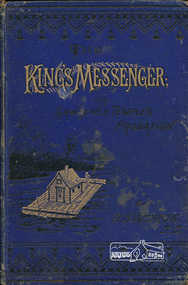
Book, The King's Messenger: or Lawrence Temple's Probation. A story of Canadian Life by W.H. Withrow, D.D, 1883
... This family were pioneer settlers in the Eltham area. shillinglaw family collection religious stories [written on loose flyleaf] Eltham Primitive Methodist Sabbath School - Presented to William Shillinglaw Sept 26th / 87 Philip Shillinglaw Supt. Hardcover The King's Messenger: or Lawrence ...2nd Edition. Preface: "The following story is an attempt to depict, from personal observation, phases of Canadian life with which the writer is somewhat familiar - with what success others must decide. If it shall inspire in our readers a stronger love of that noble country, and a desire to live for its moral and religious progress, it will not have been written in vain. It is especially hoped that the religious lessons which it is designed to teach may lead its readers to a fuller consecration of all their powers and faculties to the glory of God and the welfare of their fellow-men". The book was presented in 1887 to William Shillinglaw, by Phillip Shillinglaw. This family were pioneer settlers in the Eltham area. William was born 4 October 1877 at Bundoora and died 3 July 1891 in Eltham from rheumatic fever aged 13 years. One of five items relating to the Shillinglaw Family collectionThe book was presented in 1887 to William Shillinglaw, by Phillip Shillinglaw. This family were pioneer settlers in the Eltham area.Hardcover[written on loose flyleaf] Eltham Primitive Methodist Sabbath School - Presented to William Shillinglaw Sept 26th / 87 Philip Shillinglaw Supt.shillinglaw family collection, religious stories -
 Eltham District Historical Society Inc
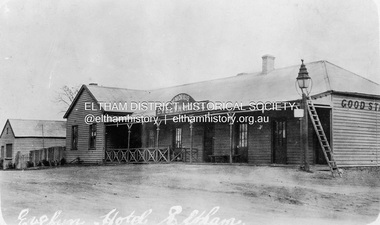
Photograph, Evelyn Hotel, Eltham, c.1892
... Lawrence Brennan, reasons unknown. In December 1889, James Purcell ownership of the Evelyn hotel throughout the 1880s comes to an end when William Morris purchases the property and the license is transferred to him. Ownership of the property remains within the Morris family...Lawrence Brennan, reasons unknown. In December 1889, James Purcell ownership of the Evelyn hotel throughout the 1880s comes to an end when William Morris purchases the property and the license is transferred to him. Ownership of the property remains within the Morris family ...Postcard image of W. Morris Evelyn Hotel, cnr. Main Road and Pitt Street, Eltham, opposite present hotel. Built in 1852 as the Fountain of Friendship Hotel, later named the Fountain Hotel it was located on the southwest corner of Maria (Main) and Pitt streets. Also later known as the Evelyn Hotel, it was de-licensed in 1919. The hotel was totally destroyed by fire on Wednesday, February 18, 1931 Sometime between June 1851 and 1854, the property at the top of the hill of Little Eltham described as Lot 235 of plan of subdivision, of portion number 12, of section number 4, of the parish of Nillumbik, on the county of Evelyn was purchased from J.M. Holloway and the Fountain of Friendship Hotel was built using prefabricated sections constructed from cedar timber, imported from Singapore. By 1854, John O’Brien, a somewhat shady character was the proprietor of the hotel when he put it up for sale in November 1854. It is not clear whether he was the original owner / builder. John O’Brien purchased several other lots in Little Eltham from a Robert Wells but did not pay the balance for these lots and skipped town as soon as he sold the Fountain Hotel to Charles Roberts. Following the somewhat dodgy business practices of John O’Brien, little is known of Charles Roberts but it is possible he enjoyed several years of ownership. It was put up for sale again in 1858 but no outcome of that sale is known, and it was advertised to let in 1863, again possibly to no avail. James Trew took it over in July 1864 but his association was short lived with his premature death in December of that year leaving his widow Mary to take over and run the enterprise. No other details regarding ownership or issuances of licenses to run a public house have been identified so it is possible that Mary Trew managed the business until it was eventually advertised To Let in December 1870. George Merrick took over the hotel and was granted a license at the end of March 1871 but he too was destined to follow in the footsteps of James Trew and died prematurely at age 40 just six months later, in September 1871. John Treloar then took over the hotel but sometime between 1872 and 1873 the license was transferred to Bejamin Gane. Gane it seems held the license for the majority of the 1870s At some point between December 1874 and September 1878 the name of the hotel is changed from the Fountain Hotel to the Evelyn Hotel. In March 1880, ownership is transferred to James Purcell, a former Councillor of the Shire of Eltham’s North Riding. Purcell’s ownership of the hotel is associated with the 1880s though there is a brief period in 1887 where the license is granted to a Lawrence Brennan, reasons unknown. In December 1889, James Purcell ownership of the Evelyn hotel throughout the 1880s comes to an end when William Morris purchases the property and the license is transferred to him. Ownership of the property remains within the Morris family for the next 40 plus years and it is the Morris name that is most associated with its history. William Morris was a Councillor with the Shire of Eltham for a continuous 24 year period. He served as Shire President for three terms. It appears he did very well with the Evelyn Hotel and his entertainment and dining experiences are well regarded. Morris is also closely asspotaieted with local horse racing events and often provided the hospitality for the Diamond Creek races and various races held at Eltham Park (Eltham Lower Park). It is during Morris’ stewardship that major changes occurred to the hotel. On June 2, 1892 a fire broke out in one of the lodger’s rooms from a candle that had been left burning. The hotel is constructed of timber and three rooms are destroyed. Christopher Watson, proprietor of the Eltham Hotel across the road comes to Morris’ assistance and the hotel is saved but there is significant damage. It is suspected that the lodgers rooms were at the southern end of the building in the two-story section. It is further suspected that it is a result of this fire that the building was modified and the two story section rebuilt as single story and the shingle roof converted to tin. From this point on, Morris appears to enjoy a relatively long and quiet period of ownership. He signs a 5 year lease to let the hotel out in 1903 and the license is transferred to an Ann Evans. Morris intended to live in a house near the railway station but the license ris renewed in his name just two years later in December 1905. Morris is charged with illegal Sunday trading in August 1917. The case is dismissed through lack of evidence. It seems that this was fairly commonplace amongst the various hostelries of the countryside. In June 1919 the Evelyn Hotel is de-licensed. Though considered clean and well maintained, the Licensing Board did not believe having two hotels directly opposite each other was warranted for the existing trade. The case for the Eltham Hotel to remain in business was stronger. Morris was subsequently awarded £480 in November of that year as compensation. The property then was used for various businesses such as hairdressing and dining rooms as well as lodging. William Morris died in December 1922 and his wife Mary inherited the property. She had listed it for sale in August 1929 but nothing eventuated from that. In February 1931, whilst occupied by Hector and Louise McLean and their young family, the old building caught fire. Ashes from one of the fires had fallen through the cracks in the floorboards and took hold in the basement. A firsthand account of that harrowing experience was recorded by Mrs Edith Jones (nee McLean) in 1998, who was six years old at the time, and held by Eltham District Historical Society (04749). It was published in EDHS Newsletter No. 226, October 2022. On July 3, 1931 the Advertiser published the following endnote to the Evelyn Hotel. Last Traces of Fire The traces of Eltham's largest fire are being obliterated by the removal of debris from the site of the old Evelyn Hotel, which was destroyed a few months ago, and all that now remains is a blackened spot and fire colored bricks and stones. The site is one of the most imposing in the district, being in the heart of the old township. The township is really in two sections, old and new, the latter is situated round the station. The passing of the old hotel was regretted by all, as it was so closely associated with the pioneering, days. - Research by Peter Pidgeon, EDHS, June 2026Postcard photoRetun to Garnet Burges c/o Judge Bookhotels, evelyn hotel, eltham, main road, pitt street, fountain hotel, william morris -
 Eltham District Historical Society Inc
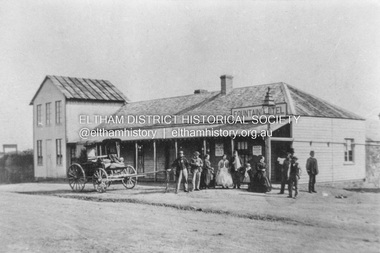
Photograph, Fountain Hotel, Main Road, Eltham, c.1870
... Lawrence Brennan, reasons unknown. In December 1889, James Purcell ownership of the Evelyn hotel throughout the 1880s comes to an end when William Morris purchases the property and the license is transferred to him. Ownership of the property remains within the Morris family...Lawrence Brennan, reasons unknown. In December 1889, James Purcell ownership of the Evelyn hotel throughout the 1880s comes to an end when William Morris purchases the property and the license is transferred to him. Ownership of the property remains within the Morris family ...Digitised from scanned print of original postcard of Fountain Hotel, Main Road Eltham (later Evelyn Hotel) early view showing two storey section. Built in 1852 as the Fountain of Friendship Hotel, later named the Fountain Hotel it was located on the southwest corner of Maria (Main) and Pitt streets. Also later known as the Evelyn Hotel, it was de-licensed in 1919. The hotel was totally destroyed by fire on Wednesday, February 18, 1931 Sometime between June 1851 and 1854, the property at the top of the hill of Little Eltham described as Lot 235 of plan of subdivision, of portion number 12, of section number 4, of the parish of Nillumbik, on the county of Evelyn was purchased from J.M. Holloway and the Fountain of Friendship Hotel was built using prefabricated sections constructed from cedar timber, imported from Singapore. By 1854, John O’Brien, a somewhat shady character was the proprietor of the hotel when he put it up for sale in November 1854. It is not clear whether he was the original owner / builder. John O’Brien purchased several other lots in Little Eltham from a Robert Wells but did not pay the balance for these lots and skipped town as soon as he sold the Fountain Hotel to Charles Roberts. Following the somewhat dodgy business practices of John O’Brien, little is known of Charles Roberts but it is possible he enjoyed several years of ownership. It was put up for sale again in 1858 but no outcome of that sale is known, and it was advertised to let in 1863, again possibly to no avail. James Trew took it over in July 1864 but his association was short lived with his premature death in December of that year leaving his widow Mary to take over and run the enterprise. No other details regarding ownership or issuances of licenses to run a public house have been identified so it is possible that Mary Trew managed the business until it was eventually advertised To Let in December 1870. George Merrick took over the hotel and was granted a license at the end of March 1871 but he too was destined to follow in the footsteps of James Trew and died prematurely at age 40 just six months later, in September 1871. John Treloar then took over the hotel but sometime between 1872 and 1873 the license was transferred to Bejamin Gane. Gane it seems held the license for the majority of the 1870s At some point between December 1874 and September 1878 the name of the hotel is changed from the Fountain Hotel to the Evelyn Hotel. In March 1880, ownership is transferred to James Purcell, a former Councillor of the Shire of Eltham’s North Riding. Purcell’s ownership of the hotel is associated with the 1880s though there is a brief period in 1887 where the license is granted to a Lawrence Brennan, reasons unknown. In December 1889, James Purcell ownership of the Evelyn hotel throughout the 1880s comes to an end when William Morris purchases the property and the license is transferred to him. Ownership of the property remains within the Morris family for the next 40 plus years and it is the Morris name that is most associated with its history. William Morris was a Councillor with the Shire of Eltham for a continuous 24 year period. He served as Shire President for three terms. It appears he did very well with the Evelyn Hotel and his entertainment and dining experiences are well regarded. Morris is also closely asspotaieted with local horse racing events and often provided the hospitality for the Diamond Creek races and various races held at Eltham Park (Eltham Lower Park). It is during Morris’ stewardship that major changes occurred to the hotel. On June 2, 1892 a fire broke out in one of the lodger’s rooms from a candle that had been left burning. The hotel is constructed of timber and three rooms are destroyed. Christopher Watson, proprietor of the Eltham Hotel across the road comes to Morris’ assistance and the hotel is saved but there is significant damage. It is suspected that the lodgers rooms were at the southern end of the building in the two-story section. It is further suspected that it is a result of this fire that the building was modified and the two story section rebuilt as single story and the shingle roof converted to tin. From this point on, Morris appears to enjoy a relatively long and quiet period of ownership. He signs a 5 year lease to let the hotel out in 1903 and the license is transferred to an Ann Evans. Morris intended to live in a house near the railway station but the license ris renewed in his name just two years later in December 1905. Morris is charged with illegal Sunday trading in August 1917. The case is dismissed through lack of evidence. It seems that this was fairly commonplace amongst the various hostelries of the countryside. In June 1919 the Evelyn Hotel is de-licensed. Though considered clean and well maintained, the Licensing Board did not believe having two hotels directly opposite each other was warranted for the existing trade. The case for the Eltham Hotel to remain in business was stronger. Morris was subsequently awarded £480 in November of that year as compensation. The property then was used for various businesses such as hairdressing and dining rooms as well as lodging. William Morris died in December 1922 and his wife Mary inherited the property. She had listed it for sale in August 1929 but nothing eventuated from that. In February 1931, whilst occupied by Hector and Louise McLean and their young family, the old building caught fire. Ashes from one of the fires had fallen through the cracks in the floorboards and took hold in the basement. A firsthand account of that harrowing experience was recorded by Mrs Edith Jones (nee McLean) in 1998, who was six years old at the time, and held by Eltham District Historical Society (04749). It was published in EDHS Newsletter No. 226, October 2022. On July 3, 1931 the Advertiser published the following endnote to the Evelyn Hotel. Last Traces of Fire The traces of Eltham's largest fire are being obliterated by the removal of debris from the site of the old Evelyn Hotel, which was destroyed a few months ago, and all that now remains is a blackened spot and fire colored bricks and stones. The site is one of the most imposing in the district, being in the heart of the old township. The township is really in two sections, old and new, the latter is situated round the station. The passing of the old hotel was regretted by all, as it was so closely associated with the pioneering, days. - Research by Peter Pidgeon, EDHS, June 2026Digital file scan of photo print copy and photocopy of original image of Fountain Hotel, Main Road Eltham (later Evelyn Hotel) early view showing two storey section Also 9 x 12.5 cm print copy (with more scratches)hotels, eltham, fountain hotel, evelyn hotel, main road, pitt street -
 Bendigo Historical Society Inc.
Photograph - SANDHURST BOYS CENTRE COLLECTION: OFFICIAL OCCASION
... One of the officials may be Lawrence Clyde Higgins and another William Joseph Sertori, manager of the Centre. About 30 people seated may be the families of residents....One of the officials may be Lawrence Clyde Higgins and another William Joseph Sertori, manager of the Centre. About 30 people seated may be the families of residents. ...Black and white photograph of official occasion held in the grandstand [may be an opening of the Centre] during the 1950's-1960's[?] One of the officials may be Lawrence Clyde Higgins and another William Joseph Sertori, manager of the Centre. About 30 people seated may be the families of residents.bendigo, institutions, sandhurst boys centre, higgins, lawrence clyde; sertori, william joseph; sandhurst boys centre -
 Bendigo Historical Society Inc.
Photograph - SANDHURST BOYS CENTRE COLLECTION: OFFICIAL OPENING OF OVAL AND GRANDSTAND
... One of the officials may be Lawrence Clyde Higgins, Secretary of the Centre and another William Joseph Sertori, Manager. About 30 people seated may be the families of residents....One of the officials may be Lawrence Clyde Higgins, Secretary of the Centre and another William Joseph Sertori, Manager. About 30 people seated may be the families of residents. ...Black and white photograph of an official occasion held in the grandstand, the official opening of the Centre's oval and grandstand in September 1960. One of the officials may be Lawrence Clyde Higgins, Secretary of the Centre and another William Joseph Sertori, Manager. About 30 people seated may be the families of residents.Bendigo Advertiserbendigo, institutions, sandhurst boys centre, sandhurst boys centre; higgins, lawrence clyde; sertori, william joseph; -
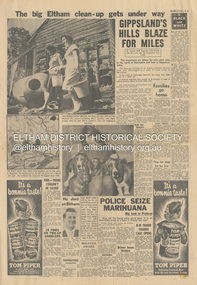 Eltham District Historical Society Inc
Newspaper - News Clipping, Herald, The big Eltham clean-up gets under way, Herald, 4 March, p3, 1965
... Emphasis of the tragic loss of a member of a pioneering family who died whilst helping others in his community Bushfire cfa country fire authority Fire Brigrade Glen Park Road Heroes John Lawrence Coleman North Eltham Victorian Bushfires - 1965 Volunteers William John Elwers Fire Fighter Frank Martin George John Crowe Ken Gaston Orchard Avenue Doug Mummery Helen Oliver Mrs Henry Marsden Mrs Moureen Ellis Newsprint The big Eltham clean-up gets under way, Herald, 4 March, p3 Newspaper News Clipping Herald ...Full page newspaper clipping featuring the March 1965 Victorian bushfires. Items include: Photograph - TWO-WOMAN BUCKET BRIGADE, Mrs Henry Marsden (left) and Mrs Moureen Ellis, whose fire-fighting efforts yesterday were highly praised today by their Eltham neighbours, carry out mopping-up operations Photograph - DOGS MADE HOMELESS by the fire in North Eltham yesterday are being cared for at First-Constable Doug. Mummery's kennels at Eltham and here is kennel maid Helen Oliver, 17, with some of them today. The two basset hounds are owned by Mr Bill Guy who lost about 100 daschund and basset hound puppies and dogs in the fire. Photograph - He died at Eltham [Picture of John Lawrence Coleman] Builder Mr John Lawrence Coleman, 31, of Main Rd., Eltham, one of three men burnt to death yesterday in the fire at North Eltham. The other two were XXXXX, 33 who lives opposite the Colemans and Mr William Elwers, 64 of Batman Rd., Eltham. John Lawrence Coleman (1934-1965) born January 10, was the son of Raymond John Coleman and Hanna May (Gillet) Coleman. He married Margaret Frances Dare in 1955 and was the father of two children. He died whilst attempting to rescue an older man trapped in the bushfire at North Eltham on March 3, 1965 Other news stories of the day: Bushfires rage in Victoria, Snowy: Three dead (1965, March 4). The Canberra Times (ACT : 1926 - 1995), p. 1. Retrieved May 19, 2022, from http://nla.gov.au/nla.news-article131758981 Includes two photos of the fire in North Eltham “Firemen make for safety as fire rages in Upper Glen Park Road, North Eltham, Victoria. The smoke hides a house.” and “A house explodes into flames at North Eltham, Victoria. Firemen said bottled gas went up.” Canberra Times (ACT : 1926 - 1995), Thursday 4 March 1965, page 1 ________________________________________ Firemen make for safety as fire rages in Upper Glen Park Road. North Eltham. Victoria. The smoke hides a house. A house explodes into flames at North Eltham. Victoria. Firemen said bottled gas went up. Bushfires rage in Victoria, Snowy: Three dead MELBOURNE, Wednesday.—Three people died today in a bush» fire which raged through North Eltham, about 15 miles from Melbourne. The victims were three men. A fourth man is feared to be dead. Another bushfire. sparked off by the heatwave sizzling over south-eastern Australia, is burning out of control in the Kosciusko State Park, in the Snowy Mountains. Firefighters fear that if it reaches pine forests up the Yarrangobilly River, they will be powerless to stop it. The three victims of the North Eltbam fire were trapped by flames in a valley. Their bodies were found only a few yards apart. They were named by police tonight as Mr. George Crowe, 78, of North Eltham, William John Ewers, 64, and John Laurence Coleman, 31, both of Eltham. The other two have not been identified. They are believed to be a man aged about 40 and an 18-year-old youth. At least 12 homes were destroyed by the fire, the worst in Victoria since 1962, when eight lives were lost and hundreds of homes burnt down at Warrandyte. At one time the township of Eltham was threatened, but a cool change swept in from the south and held back the wall of flames. More than 100 dogs, worth about £4,000, died when the fire raced through two kennels in Short Street, Eltham. and Upper Glen Park Road, North Eltham. A trickle of water Residents ran into the streets as the blaze raced towards their houses. Others frantically dug firebreaks around their homes. Mrs. Sue Recourt wept when firemen arrived while she was vainly trying to stop the flames with a trickle of water from the garden hose. A stack of firewood was blazing, but the firemen managed to save the house and rescue four goats. Many homes in Eltham were saved after flames had crept to within feet of their fences. Students at North Eltham State School had to be evacuated when the blaze threatened the building. Fire fighters were severely hampered by lack of water and narrow roads. The blaze, which began in above century heat, turned toward Wattle Glen, where two houses were gutted. Then the flames raced towards Hurstbridge to the north. Firemen battling desperately, controlled the fire late this afternoon. Five forest fires were still burning in Victoria tonight. IN VICTORIA THIS WEEK Tragic lack of central fire authority (1965, March 9). The Canberra Times (ACT : 1926 - 1995), p. 2. Retrieved May 19, 2022, from http://nla.gov.au/nla.news-article131759928 Canberra Times (ACT : 1926 - 1995), Tuesday 9 March 1965, page 2 ________________________________________ IN VICTORIA THIS WEEK Tragic lack of central fire authority From Rohan Rivett It was the worst week for Victorian fire fighters since Black Friday 27 years ago. On that day one pilot up in a spotter plane said afterwards: "It seemed at times that half the State was on fire." This time, for three days on end, Gippsland men, women and children had moments of conviction that their towns would have blackened into anonymity before the weekend was out. The week began with horror at Eltham on the North-eastern edge of Melbourne. Eltham today is something of an artists' colony. Oil painters, water colourists, potters and sculptors proliferate. A number of University folk have emulated the example of Professor MacMahon Ball who pioneered the way by moving to Eltham and carving a home out of the bush in the thirties. Innermost Eltham is barely 14 miles from the G.P.O. Farthest Eltham stretches miles beyond. It served to illustrate the tragi-ludicrous truncation of Victoria's fire control. Part of Eltham is under the protection of the Melbourne Fire Brigade. But this responsibility ceases at some invisible and incomprehensible line — apparently determined by the meanderings of the water mains. At this point everybody's property throughout the rest of Eltham is dependent on the Country Fire Authority. Half an hour before midday on Wednesday, a fire suddenly started on the West side of Upper Glen road on the edge of Eltham. Before the fire brigade could arrive, it was burning on a widening front through timber and high grass north of Eltham. Two wind changes in rapid succession saw the fire leaping Diamond Creek. With a freshening wind it struck home after home in three streets. More than one of them exploded suddenly as if hit by an incendiary bomb. There is no piped gas in the Eltham area, hence many housewives use bottle gas. The flames outside caused the bottles to explode. Altogether twelve homes were completely incinerated and four more were badly damaged. Thirty prize dogs perished. About three hours after the fire started it raced suddenly down a gully hillside trapping an elderly man. Two other men apparently raced to the rescue. Flames caught the three men within yards of each other, not 200 yards off the Upper Glen Park Road where safety lay. They were burned to death. Next evening an angry and convincing secretary of the Fire Brigade Union, Mr. W. M. Webber, came on television and appealed to the people of Victoria to end the ridiculous and dangerous dualism in fire-fighting control. The Eltham fire, he said, had precisely illustrated the situation. The Metropolitan Fire Brigade area touched Eltham, but where the fire had gutted and killed, was just outside its area. Mr. Webber said his union had constantly urged one authority for the State with a complete reorganisation of fire protection. On Wednesday the union had repeated its call for an inquiry into fire protection in Victoria to the Chief Secretary, Mr Rylah. "No matter how close the liaison between the two organisations, there are always divided sections of thinking," Mr. Webber told viewers. "I don't know how much tragedy the com-munity can take before it demands that it is properly protected." Rumours that differences in gauge between taps and hose nozzles (as between the two authorities) accentuated the damage were denied by fire chiefs who said that all appliances were now carrying adaptors so that hoses could be linked to mains everywhere. But there is grave concern in the Metropolitan Fire Brigade's higher councils at the action of several Federal authorities with projects in and around Melbourne. They are installing non-standard equipment without reference to the State authorities or any dovetailing of appliances and equipment. Public alarm was not diminished by the publication on Friday and Saturday of a heart tearing letter from the young widow of John Lawrence Coleman, 31 year old father of two, who had died in the flames apparently trying to rescue the old man trapped in the gully. By that time, a Vast area of Gippsland was in flames and the troops had been sent in to back up the overworked and often helpless fire-fighters. By Saturday, the Leader of the Opposition, Mr. Stoneham, who has previously demanded a Royal Commission into fire-fighting arrangements, repeated his demand. To add to the Chief Secretary's worries he was publicly rebuked for allegedly implying on television that lives had been lost at Eltham because people went to the wrong place at the wrong time. In a letter to the Press, Professor MacMahon Ball pointed out that two of the men involved were experienced bushmen who had gone "to help an old man in great danger fully aware of the danger to themselves". As Victoria faced its sixth day of total State-wide fire ban, it looked likely that even official resistance was not going to silence the demand for one central authority to control the fire fiend. At the moment, the 400 square miles where two million Victorians live in Greater Melbourne are divorced from the rest of the State in planning, communications, equipment and control of personnel. No one doubts the whole-hearted co-operation and willingness to back each other up of the M.F.B. and the C.F.A., both at top-level and among the firemen themselves. However, when a city straggles so deeply into the country side, the absence of a single authority, to oversee and analyse the fire threat as a whole, suggests suicidal policy of divide and fuel. Emphasis of the tragic loss of a member of a pioneering family who died whilst helping others in his communitybushfire, cfa, country fire authority, fire brigrade, glen park road, heroes, john lawrence coleman, north eltham, victorian bushfires - 1965, volunteers, william john elwers, fire fighter, frank martin, george john crowe, ken gaston, orchard avenue, doug mummery, helen oliver, mrs henry marsden, mrs moureen ellis -
 Eltham District Historical Society Inc
Photograph, Rita Teagle with baby at Thomas Street house, Eltham, c.1938
... Lawrence Maclaughin...Eltham...house...Ingram family...Brian Lawrence Maclaughin Eltham house Ingram family Rita Agnes MacLaughlin (nee Teagle) Teagle family Thomas Street Pam Thoonen (nee Ingram) Collection On reverse "Rita Teagle" Sepia photo print Rita Teagle with baby at Thomas Street house, Eltham Photograph Photograph ...Rita Teagle House belonged to Tom Fielding's grandparents (Margaret Teagle and Richard Fielding). It was at top of the hill on right hand side (no. 10 Thomas Street, Eltham) Pictured is a bungalow behind the main house. These were added on every time more children came along. Rita was born 1910 and married Horace Maclaughlin in 1935. They had a son, Brian Lawrence Maclaughin (1937). It is presumed that Brian is sitting on Rita's lap and that the date of the photo is c.1938.On reverse "Rita Teagle"brian lawrence maclaughin, eltham, house, ingram family, rita agnes maclaughlin (nee teagle), teagle family, thomas street, pam thoonen (nee ingram) collection -
 Bendigo Historical Society Inc.
Book - TAMING THE WILDERNESS, 1985
... AUSTRALIA History water supplies Water supply irrigation Australian history Davies family. A E Lawrence Taming The Wilderness, One family's contribution to irrigation in Australia.Primarily the story of the senior partner of the firm of Davies Brothers, John Herbert, and his family, it is a tribute to the many early contractors who were so largely responsible for Australia's development as a prosperous country. 94 pages with black and white photographs. ...Taming The Wilderness, One family's contribution to irrigation in Australia.Primarily the story of the senior partner of the firm of Davies Brothers, John Herbert, and his family, it is a tribute to the many early contractors who were so largely responsible for Australia's development as a prosperous country. 94 pages with black and white photographs.A E Lawrenceaustralia, history, water supplies, water supply, irrigation, australian history, davies family. -
 Bendigo Historical Society Inc.
Book - TABLETS OF MEMORY, 1990
... BIOGRAPHY cohn family Alan A. Cohn, Jack N.Cohn, and Lawrence J. Cohn. Tablets of Memory. ...Tablets of Memory. The Bendigo Cohns and their Descendants 1853 - 1989. Biography of, and geneaological history of the Cohn family in Bendigo.Alan A. Cohn, Jack N.Cohn, and Lawrence J. Cohn.biography, cohn family -
 National Vietnam Veterans Museum (NVVM)
Book, Tregoning-Lawrence, Heather, We'll meet again: Australian stories of love in war
... War and society - Australia Australia - Armed Forces - Social life and customs Sociology Military - Australia It involves strategies, operation, and technology, but it affects individuals, families, communities , and nations and brings out many emotions in those caught up in it. We'll meet again: Australian stories of love in war Book Book Tregoning-Lawrence, Heather ...It involves strategies, operation, and technology, but it affects individuals, families, communities , and nations and brings out many emotions in those caught up in it.It involves strategies, operation, and technology, but it affects individuals, families, communities , and nations and brings out many emotions in those caught up in it. war and society - australia, australia - armed forces - social life and customs, sociology, military - australia -
 National Vietnam Veterans Museum (NVVM)
Medal, Roll of Honour - Anniversary of national Service Medal
... Lawrence (Director). Minister For Veterans Affairs - Danna Vale Roll of Honour Memorial information accuracy request Official (copy) letter from Minister For Veterans Affairs notifying issue in 2002 of a Medal for National Servicemen who served between 1951 - 1972 to the family of Pte Douglas Brian Plain Roll of Honour - Anniversary of national Service Medal Medal Medal ...Roll of Honour Memorial information accuracy request Official (copy) letter from Minister For Veterans Affairs notifying issue in 2002 of a Medal for National Servicemen who served between 1951 - 1972 to the family of Pte Douglas Brian PlainAustralian War Memorial - W.R. Lawrence (Director). Minister For Veterans Affairs - Danna Valemedals, pte plain, veterans affairs, australian war memorial -
 Port Melbourne Historical & Preservation Society
Photograph - Earle family portrait
... built environment engineering - roads streets lanes and footpaths local government - city of port melbourne walter reynold earle william (bill) earle reg 'ox' earle ellen kate earle ivy earle lawrence earle doris earle lorna earle ray earle margaret heriot diaper Black and white photocopies of the Earle family (not related to Earl hardware) Family portrait, boy in wicker chair is William Earle; Older woman is Margaret Diaper; younger woman with child on lap is Ellen Kate Earle. ...Black and white photocopies of the Earle family (not related to Earl hardware) Family portrait, boy in wicker chair is William Earle; Older woman is Margaret Diaper; younger woman with child on lap is Ellen Kate Earle. One of the twins is Reg Earle, the other twin died of summer diarrhoea; young girl on right is Ivy. No other names known.built environment, engineering - roads streets lanes and footpaths, local government - city of port melbourne, walter reynold earle, william (bill) earle, reg 'ox' earle, ellen kate earle, ivy earle, lawrence earle, doris earle, lorna earle, ray earle, margaret heriot diaper -
 Port Melbourne Historical & Preservation Society
Photograph - Earle Children
... built environment engineering - roads streets lanes and footpaths local government - city of port melbourne walter reynold earle william (bill) earle reg 'ox' earle ellen kate earle ivy earle lawrence earle doris earle lorna earle ray earle margaret heriot diaper Black and white photocopies of the Earle family (not related to Earl hardware) Earle children, circa 1927, Bill with hands on Lawrie's shoulders, Tall boy is Ray, then Doris and Reggie, with little Lorna in the front. ...Black and white photocopies of the Earle family (not related to Earl hardware) Earle children, circa 1927, Bill with hands on Lawrie's shoulders, Tall boy is Ray, then Doris and Reggie, with little Lorna in the front.built environment, engineering - roads streets lanes and footpaths, local government - city of port melbourne, walter reynold earle, william (bill) earle, reg 'ox' earle, ellen kate earle, ivy earle, lawrence earle, doris earle, lorna earle, ray earle, margaret heriot diaper
