
Showing 255 items matching "living city"
-
 University of Melbourne, Burnley Campus Archives
Magazine, Living City, 1968
... Living City...living city...University of Melbourne, Burnley Campus Archives 500 Yarra Boulevard Richmond melbourne living city mmbw No.4, Spring-Summer 1968, MMBW Living City Magazine ...No.4, Spring-Summer 1968, MMBWliving city, mmbw -
University of Melbourne, Burnley Campus Archives
Document, The Living City, 2014
... The Living City......the living city...University of Melbourne, Burnley Campus Archives 500 Yarra Boulevard Richmond melbourne university of melbourne the living city Postcard - The University of Melbourne The Living City Document ...Postcard - The University of Melbourneuniversity of melbourne, the living city -
 Hume City Civic Collection
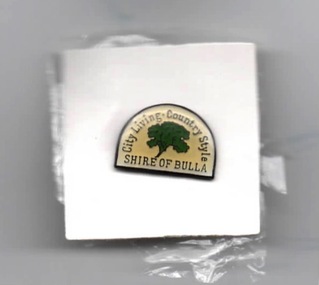
Badge, City Living Country Style Shire of Bulla, 1980s
... City Living Country Style Shire of Bulla......City Living Country Style...Around the edge are the words CITY LIVING COUNTRY STYLE SHIRE OF BULLA. ...Around the edge are the words CITY LIVING COUNTRY STYLE SHIRE OF BULLA. City Living Country Style Shire of Bulla Badge ...The badges were distributed by the former Shire of Bulla council in the 1980s to promote Sunbury as desirable rural place to live with all the benefits of the city.A metal lapel badge in a semicircular shape in green and yellow. Around the edge are the words CITY LIVING COUNTRY STYLE SHIRE OF BULLA. sunbury, badges, city living country style -
 Robin Boyd Foundation
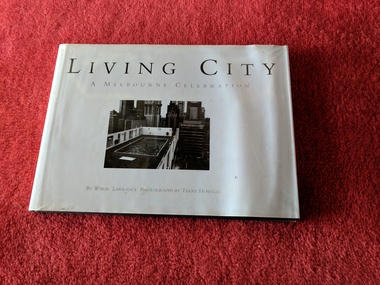
Book, Warwick Lawrence, Living City, 1995
... Living City...Robin Boyd Foundation 290 Walsh Street South Yarra melbourne Walsh St library Signed "To Patricia - The Life and Form of the City - Noel" Hardcover w/ Dust Jacket Living City Book Warwick Lawrence ...Hardcover w/ Dust JacketSigned "To Patricia - The Life and Form of the City - Noel"walsh st library -
 Glen Eira City Council History and Heritage Collection
DVD, Caulfield Film Society, "Caulfield a living City", 1963
... "Caulfield a living City"...Produced in 1963. "Caulfield a living City" DVD Caulfield Film Society Ewart Wade John Freney-Mills ...Film was commissioned by the Caulfield City Council and produced in 1963 by the Caulfield Film Society. DVD copy of original rare film held by the Australian Centre of the Moving Image (ACMI). Colour; Sound; 21 min. Produced in 1963. -
Melbourne Athenaeum Archives
Booklet, The Colours of Melbourne / City Living Guide 2016, 2016
... The Colours of Melbourne / City Living Guide 2016...The Colours of Melbourne / City Living Guide 2016 Booklet ...athenaem is mentions as a theartere and the new add is shownBooklet, Article page 21,26. -
Hume City Civic Collection
Sticker, Shire of Bulla
... This adhesive sticker with Shire of Bulla Sunbury printed on it along with City Living/Country Style a slogan used by the Shire in the 1980's to early 1990's. ...Shire of Bulla/City Living/Country Style...Hume City Civic Collection 44 Macedon Street Sunbury melbourne This adhesive sticker with Shire of Bulla Sunbury printed on it along with City Living/Country Style a slogan used by the Shire in the 1980's to early 1990's. ...This adhesive sticker with Shire of Bulla Sunbury printed on it along with City Living/Country Style a slogan used by the Shire in the 1980's to early 1990's. They were used to stick on any type of flat surface to help promote the area within the Shire of Bulla especially Sunbury.This is a rectangle shape adhesive sticker promoting the Shire of Bulla.Shire of Bulla/City Living/Country Styleshire of bulla, councils, advertising -
 Hume City Civic Collection
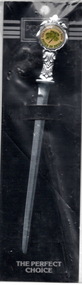
Functional object, c1980s
... The skewer was a promotional item which the former Shire of Bulla had used in the 1980s for the CITY LIVING COUNTRY STYLE campaign at a time when further housing development was taking place in Sunbury....A silver food skewer with a 'City Living Country Style' emblem on the top. ...The skewer was a promotional item which the former Shire of Bulla had used in the 1980s for the CITY LIVING COUNTRY STYLE campaign at a time when further housing development was taking place in Sunbury. skewers A silver food skewer with a 'City Living Country Style' emblem on the top. ...The skewer was a promotional item which the former Shire of Bulla had used in the 1980s for the CITY LIVING COUNTRY STYLE campaign at a time when further housing development was taking place in Sunbury.A silver food skewer with a 'City Living Country Style' emblem on the top. The item is attached to strip of black cardboard for support with the words PERFECTION SOUVENIR at the top and THE PERFECT CHOICE across the bottom.skewers -
 Melbourne Tram Museum
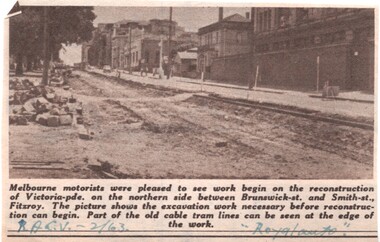
Newspaper, Royal Automobile club of Victoria (RACv), removal of the cable tram track in Victoria Parade, 1963 to 1971
... shows the shopping centre. .7 - Royal auto - 9/64 - Johnston St Collingwood and buses. .8 - MMBW Living City Winter 1971 of Kew Junction, peak hour inbound noting the new Eastern Freeway will reduce congestion....Photo includes SW6 934 (Route 7 Camberwell) .5 - Royal auto - 8/67 - Swanston St near Collins St. .6 - View of Toorak Road, Hartwell, W2 641 (Spencer St, route 74) photo 8/68 by John Shingler. shows the shopping centre. .7 - Royal auto - 9/64 - Johnston St Collingwood and buses. .8 - MMBW Living City Winter 1971 of Kew Junction, peak hour inbound noting the new Eastern Freeway will reduce congestion. removal of the cable tram track in Victoria Parade Newspaper Royal Automobile club of Victoria (RACv) ...Set of 8 newspaper clippings, mid 1960's concerning traffic control and congestion issues. .1 - Royal auto - 2/1963 - reporting on the removal of the cable tram track in Victoria Parade between Brunswick and Smith St, noting the old cable tram lines. .2 - Royal auto - 1/65 - Photo of Toorak Road Toorak with a tram and parked cars. .3 - Royal auto - 8/64 on Chapel St with W2 324 (route 77, City) showing the impact of parked cars at 8.45am and a motor car trying to squeeze past. .4 - Royal auto - 9/64, Burke Road Camberwell, showing the impact of parked cars and trams. Photo includes SW6 934 (Route 7 Camberwell) .5 - Royal auto - 8/67 - Swanston St near Collins St. .6 - View of Toorak Road, Hartwell, W2 641 (Spencer St, route 74) photo 8/68 by John Shingler. shows the shopping centre. .7 - Royal auto - 9/64 - Johnston St Collingwood and buses. .8 - MMBW Living City Winter 1971 of Kew Junction, peak hour inbound noting the new Eastern Freeway will reduce congestion.Extensive notes on the rear of the photo, see image i2trams, tramways, congestion, traffic control, racv, chapel st, toorak road, victoria parade, cable trams, w2 class, sw6 class, burke road, camberwell, route 77, route 7, swanston st, kew junction, route 74, hartwell, johnston st, buses, tram 324, tram 641, tram 934 -
 Hume City Civic Collection
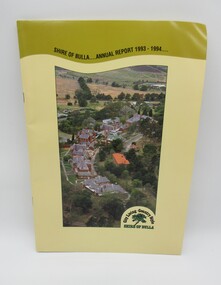
Annual Report, Shire of Bulla: Annual Report, 1993 - 1994
... The former Shire of Bulla logo which featured 'City Living - Country Style' is in the bottom RH corner of the photograph. ...The former Shire of Bulla logo which featured 'City Living - Country Style' is in the bottom RH corner of the photograph. ...The 1993 - 1994 Annual Report was published by the Shire of Bulla and distributed to the residents of the shire.A 24 paged publication with a yellow cardboard cover which has an aerial photograph which features the former Sunbury Asylum buildings and surroundings before the area was developed for housing. The former Shire of Bulla logo which featured 'City Living - Country Style' is in the bottom RH corner of the photograph. Details of the administration officxes of the Shire of Bulla are printed on the back cover.shire of bulla, annual reports, councillors, george evans collection -
 Hume City Civic Collection
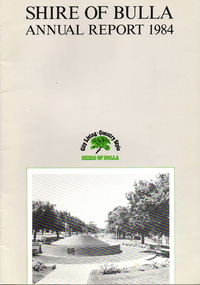
Booklet, Shire of Bulla, Shire of Bulla: Annual Report 1984, 1984
... The logo was promoted that year and saw the Shire of Bulla as a place for City Living Country Style. The fountain was erected in thew Village Green in Sunbury....The logo was promoted that year and saw the Shire of Bulla as a place for City Living Country Style. The fountain was erected in thew Village Green in Sunbury. ...The booklet is the 1984 Shire of Bulla Annual Report and is a summary of the council's achievements for that year along with the councillors, employees and the community. The logo was promoted that year and saw the Shire of Bulla as a place for City Living Country Style. The fountain was erected in thew Village Green in Sunbury.The booklet gives an insight into a time when the former Shire of Bulla was still a rural area on Melbourne's urban fringe.An A4 sized booklet with a grey cover and black printing and a logo and photograph of a fountain in a park added. Shire of Bulla/Annual Report 1984.shire of bulla, annual reports, sunbury -
 Hume City Civic Collection
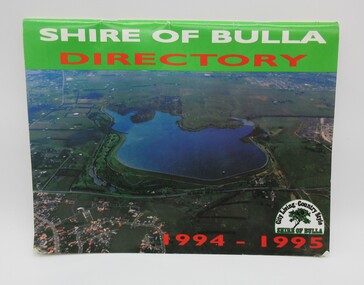
Directory, Shire of Bulla Directory, 1994 - 1995
... A green strip is along the spine of the booklet with the words 'Shire of Bulla' printed in white and 'Directory' printed in red. '1994 - 1995' is printed in red across the bottom of the front cover and the Shire of Bulla - 'City Living . Country Style' logo is in the bottom RH corner. ...A green strip is along the spine of the booklet with the words 'Shire of Bulla' printed in white and 'Directory' printed in red. '1994 - 1995' is printed in red across the bottom of the front cover and the Shire of Bulla - 'City Living . Country Style' logo is in the bottom RH corner. ...The Directory was published by the former Shire of Bulla in 1994 - 1995 and was issued to residentsa living withing the Shire. It features details of public services which were available within the area at the time as well as maps of the settlements and some private advewrtisements.A 20 page booklet with an aerial photograph of the Greenvale Dam and surrounding area on the front cover. A green strip is along the spine of the booklet with the words 'Shire of Bulla' printed in white and 'Directory' printed in red. '1994 - 1995' is printed in red across the bottom of the front cover and the Shire of Bulla - 'City Living . Country Style' logo is in the bottom RH corner. The back cover features an advertisement for the Roxburgh housing development.shire of bulla, directory, sunbury, bulla, attwood hill, craigieburn, george evans collection -
 Glen Eira Historical Society
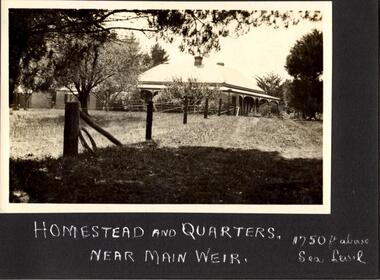
Document - Melbourne and Metropolitan Board of Works
... The report contains information about water supply, sewerage and drainage infrastructure completed or in progress during this period including infrastructure in Caulfield, Ormond, Carnegie and Bentleigh. 3/ A periodical feature from the MMBW titled ‘Living City’, issue no. 16, Spring/Summer 1974. ...The report contains information about water supply, sewerage and drainage infrastructure completed or in progress during this period including infrastructure in Caulfield, Ormond, Carnegie and Bentleigh. 3/ A periodical feature from the MMBW titled ‘Living City’, issue no. 16, Spring/Summer 1974. ...This file contains five items relating to Caulfield Council Visits with the Melbourne & Metropolitan Board of Works (MMBW) from 1919 to circa 1974: 1/ A photo album containing photos from the MMBW ‘visit to the Headworks, Yan Yean Water Supply, Wallaby and Silvery Creeks’ from 28/02/1919 to 03/03/1919, attended by members of the Caulfield City Council. The album contains 13 original black-and-white photographs, 3 of which are of the council members. The album is accompanied by a report by Felicitie Campbell, written 11/2008, about these visits. 2/ A publication from the MMBW documenting its review of operations for 1973-1974. The report contains information about water supply, sewerage and drainage infrastructure completed or in progress during this period including infrastructure in Caulfield, Ormond, Carnegie and Bentleigh. 3/ A periodical feature from the MMBW titled ‘Living City’, issue no. 16, Spring/Summer 1974. Included in the article titled ‘Program’ is a notice that construction will continue on the Elster Creek drain from Thomas St. to Wheatley Road, McKinnon. The periodical also includes the names of commissioners W. R. Walters from Caulfield and G. R. Bricker from Moorabbin (back cover). 4/ 2 maps and 1 information booklet from the Thomson Project Open Day attended by Felicite and John Campbell as representatives of the Caulfield City Council. This was an annual MMBW open date. Date unknown. 5/ Research notes by Kate Aldred about the photo album and Thomson Project Open Day booklet and their links to Felicitie Campbell 01/04/2014.koornang road, draper street, hall street, centre road, brewers road, caulfield intercepting sewer, byron street, caulfield park, elster creek, caulfield, carnegie, ormond, bentleigh, thomas street, brighton east, wheatley road, mckinnon, city of caulfield, bricker g. r., walters w. r., caulfield city council, melbourne and metropolitan board of works, hall councillor, murray councillor, murphy councillor, wharington councillor, phillips councillor, blyth councillor, best robert sir, reid doctor, jowett mr., wooley mr., hindle mr., annual reports, water supply structures and establishments, sewerage and sanitation, sewerage establishments, drainage, town planning, business and finance, councillors, mayors, acqueducts, dams and reservoirs, creeks, waterfalls, rivers, construction sites, north road, north road pumping station, cities and towns, campbell felicitie -
 Surrey Hills Historical Society Collection
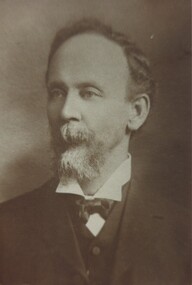
Photograph, Thomas Henry Deakin
... In 1903 the family were living at 437 City Road, Emerald Hill and both Thomas and his son John Henry are listed as bootmakers. ...In 1903 the family were living at 437 City Road, Emerald Hill and both Thomas and his son John Henry are listed as bootmakers. ...Thomas Henry Deakin (1845-1915), born in Monmouthshire, Wales married Janet (Jessie) Longmore (1851-1939), born in Morayshire, Scotland on 17 April 1878 in Emerald Hill. It is not known when Thomas migrated. His father William also came as he is buried in Melbourne General. His mother Augusta Amelia Phillips may have died in Wales. The couple has 2 sons and 4 surviving daughters, most of whom were born in Emerald Hill. In 1903 the family were living at 437 City Road, Emerald Hill and both Thomas and his son John Henry are listed as bootmakers. By 1914 they have moved to Station Street, Alphington. Thomas is listed as Independent Means; daughter Elsie as a nurse; daughter Jessie as a music teacher and daughter Minnie as a bookbinder. Buried in Melbourne General Cemetery, Section D (Baptist): Transcription "Sacred to the memory of William DEAKIN died 29 Nov 1885 also his son Thomas Henry beloved husband of Jessie DEAKIN died 3 Jul 1915, 70 years also Jessie DEAKIN wife of Thomas Henry DEAKIN died 21 Mar 1939, 87 years."This is part of a large collection of material related to the Deakin, Mair and Young families.A sepia copy of a formal portrait of Thomas Henry Deakin. Taken part in profile, he is formally dressed and has a moustache and beard and a slightly receding hairline.REAR: In blue biro "Grandpa Deakin / (John Henry)" Research and other photos indicate that this is Thomas Henry Deakin not his son John Henry.thomas henry deakin -
 City of Moorabbin Historical Society (Operating the Box Cottage Museum)
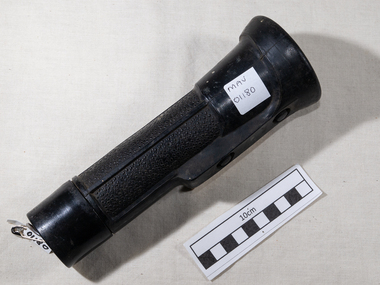
Manufactured Object, Torch 'Eveready' c1950, c1950
... George Reed was a draftsman living in the City of Moorabbin c 1950 1899, David Misell, invented this "electric device" ( torch / flashlight) powered by "D" batteries laid front-to-back in a paper tube with the light bulb and a rough brass reflector at the end. ...City of Moorabbin Historical Society (Operating the Box Cottage Museum) Joyce Park Jasper Road Ormond melbourne George Reed was a draftsman living in the City of Moorabbin c 1950 1899, David Misell, invented this "electric device" ( torch / flashlight) powered by "D" batteries laid front-to-back in a paper tube with the light bulb and a rough brass reflector at the end. ...George Reed was a draftsman living in the City of Moorabbin c 1950 1899, David Misell, invented this "electric device" ( torch / flashlight) powered by "D" batteries laid front-to-back in a paper tube with the light bulb and a rough brass reflector at the end. Misell assigned his invention over to the American Electrical Novelty and Manufacturing Company owned by Conrad Hubert. In 1905, Hubert changed the name again to The American Ever Ready Company, selling torches / flashlights and batteries under the trademark Ever Ready. In 1906 the British Ever Ready Electrical Company was formed for export of batteries; it became independent in 1914. The American Ever Ready Company became part of National Carbon Company in 1914. The trademark was shortened to Eveready. In 1986, Union Carbide sold its Battery Products Division to Ralston Purina Company becoming the Eveready Battery Company, Inc. and in 1992, it bought the British Ever Ready Electrical Company. Prior to March 1, 1980, the company's alkaline battery had been called the Eveready Alkaline Battery (1959–1968), Eveready Alkaline Energizer (1968–1974) and Eveready Alkaline Power Cell (1974–February 29, 1980). On March 1, 1980, it was rebadged under its current name, Energizer. 2019 production plant in Portage, Wisconsin, but the majority of batteries are made in China and there are also numerous production facilities outside the US. This is an industrial strength Eveready Torch made in England and was used by George Reed, a draftsman, who lived in Bentleigh , City of Moorabbin in mid 20th CLarge 'Eveready' industrial hand torch/ flashlight with rubber protective coverEVEREADY /MADE IN ENGLAND clothing, manufactured lace, dressmaking, blouses, theatrical props, lights, torches, lighting, early settlers, moorabbin shire, mechanics institute cheltenham, postworld war 11 settlers, housing estates moorabbin 1950, bentleigh, ormond, moorabbin, cheltenham, , clark judy, reed gladys, reed george -
 Warrnambool and District Historical Society Inc.
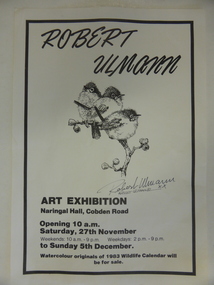
Poster, Poster for Robert Ulman exhibition, 1982
... living in Canada for some time he came to Australia in 1969. From 1970 to 1972 he was employed by the Northern Territory Administration as a manual arts instructor to the aboriginal people of Docker River west of Uluru. He exhibited extensively in city...living in Canada for some time he came to Australia in 1969. From 1970 to 1972 he was employed by the Northern Territory Administration as a manual arts instructor to the aboriginal people of Docker River west of Uluru. He exhibited extensively in city ...This is a poster advertising an art exhibition by the Warrnambool artist, Robert Ulmann. The exhibition was held in the Naringal Hall in November/December 1982. Robert Ulmann (1927-1999) was born in Zurich, Switzerland where he studied sculpture and painting. After living in Canada for some time he came to Australia in 1969. From 1970 to 1972 he was employed by the Northern Territory Administration as a manual arts instructor to the aboriginal people of Docker River west of Uluru. He exhibited extensively in city and regional galleries and won numerous awards for his artistic works. His love of wildlife extended to his interest in the Southern Right Whale and he was greatly responsible for publicizing the annual appearance of the whales at Logans Beach in Warrnambool and protecting their environment. His studio in Warrnambool is still visited by many tourists. This poster is of interest as it concerns an art exhibition of the work of Robert Ulmann, a well-known Warrnambool artist of the 20th century. This is a sheet of white paper with black edging. It is an advertisement for a Robert Ulmann Art Exhibition. The page has a sketch of three birds with Robert Ulmann’s signature underneath. robert ulmann, history of warrnambool -
 Warrnambool and District Historical Society Inc.
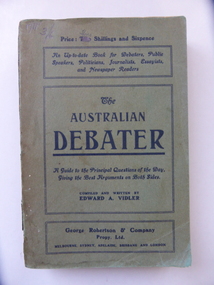
Book, George Robertson & Company Pty. Ltd, The Australian Debater, Early 20th century
... He was born in England and was in Geelong in the 1880s where he produced a commemorative volume on that city. He was living in Warrnambool in the early years of the 20th century and was the Secretary of the Warrnambool and District Progress League and the Warrnambool Chamber of Commerce and Industry. ...He was born in England and was in Geelong in the 1880s where he produced a commemorative volume on that city. He was living in Warrnambool in the early years of the 20th century and was the Secretary of the Warrnambool and District Progress League and the Warrnambool Chamber of Commerce and Industry. ...This book has been written by Edward Vidler (1863-1942), a publisher, editor, writer and journalist. He was born in England and was in Geelong in the 1880s where he produced a commemorative volume on that city. He was living in Warrnambool in the early years of the 20th century and was the Secretary of the Warrnambool and District Progress League and the Warrnambool Chamber of Commerce and Industry. He later lived in Melbourne where he edited magazines and published his own and other writings. He was especially interested in the promotion of the arts and was a keen naturalist. He was a foundation member of the group that established the Maranoa Native Gardens in Balwyn, Melbourne. The writer of this book, Edward Vidler, was important in the history of Warrnambool for two main reasons:- 1. In 1907 he initiated and organized the establishment of the Warrnambool Pioneer Honour Board featuring portraits of 204 pioneer men. This board still exists. 2. In 1907 he produced a publication called ‘Warrnambool Past and Present – Sixty Years of Progress’. It celebrated the 60th anniversary of the founding of Warrnambool and contained 88 pages, 120 illustrations and photographs and many advertisements. The publication is noted for its historical accuracy, the way it complements and adds to Richard Osburne’s 1887 history of Warrnambool and its presentation of historical material that may otherwise have been lost. Both of Vidler’s initiatives described above are of the utmost importance in Warrnambool’s history. This is a soft cover book of 270 pages. The cover is green with black printed material on the covers and the spine. The book has a Preface, 24 chapters of text and a Bibliography. There are advertisements for other books on the last page and the back cover. The cover is stained and faded and partly torn in places and some of the inside pages are stained. The Australian Debateredward vidler, history of warrnambool -
 Kiewa Valley Historical Society
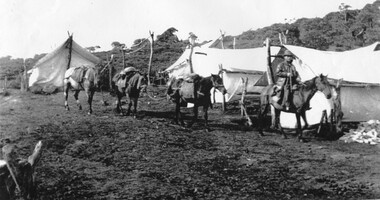
Photographs and copies of photographs of the pack horses and early horsemen who transported supplies to outposts in the Bogong High Plains, via cattle tracks before access roads were made
... The trip up the mountain was long and hard and dangerous for both horse and man Most of the men of the survey teams were not bush-men and were often ill equipped for the harsh weather and living conditions of bush camping, often arriving in their city clothes ready for work. ...The trip up the mountain was long and hard and dangerous for both horse and man Most of the men of the survey teams were not bush-men and were often ill equipped for the harsh weather and living conditions of bush camping, often arriving in their city clothes ready for work. ...In the mid to late 1930’s survey outposts were established to plot the early stages of the Kiewa Hydro Electric System for the SECV in the Bogong High Plains. Before any roads were built, the old cattleman’s tracks were used with packhorses to deliver supplies, wages and mail and collect timesheets and correspondence from the workmen and dam builders living in canvas tents and at the outlying survey posts. The trip up the mountain was long and hard and dangerous for both horse and man Most of the men of the survey teams were not bush-men and were often ill equipped for the harsh weather and living conditions of bush camping, often arriving in their city clothes ready for work. The tent city at Bogong was destroyed by bush fires in 1939 after which an access road was built from Mt Beauty to transport building materials for more permanent dwellings for workmen. Pack horses continued to be used for transporting goods etc. to workers further up the mountain.Without the work of horsemen and their pack horses providing supplies and communications for outlying outposts, surveying and early planning for the Kiewa Valley Hydro Electric scheme could not have gone ahead and the dams and power stations which support the system could not have been constructed. The Hydro-electric scheme, and the workers who planned and built it play a major part in the early history of the Kiewa Valley and many original families still remain living, or have ties with the local area.: Set of 21 black and white photographs and copies of photographs depicting the pack horses and the men who handled them, transporting supplies and correspondence to the outlying camps and survey posts in the Bogong High Plains, via the rough cattlemen’s tracks. Photographs also show the early tent camps of the workers. Some photos mounted on A4 white paper. Some photos enlarged to A3 poster size for display1. Handwritten on back – Max Lawrence 2. -8 No inscriptions 9. Handwritten on back- Packing in supplies for early workers of the Kiewa Hydro scheme. There were no roads in the early days of the scheme 10. Printed on bottom of photo- Roper’s cattle on road below Howman’s Gap 11. Handwritten on back – Roper’s et al about to leave for the high plains 12. Printed under photo- Syd Ryder at the Pretty Valley Cut-Out (JBR) 13-16. No markings 17. Printed under photo- Gwen Talbot visits the Camp area. 1937 18. Handwritten on back- 14/1 Barbara Talbot 19. No markings 20-21. No markings 22. Printed under photo- STATE ELECTRICITY COMMISSION OF VICTORIA. Date: 15-3-45 Time: 8.0pm No: K 1838 Kiewa Hydro-Electric Works, Investigations 1944-1945 – Survey Camp at Young’s Hut pack horses; bogong high plains; survey posts; supplies delivery -
 Kiewa Valley Historical Society
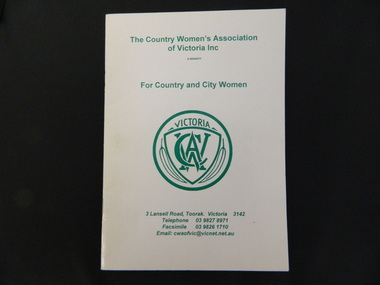
Book - Country Women's Association of Victoria, Victoria C.W.A. / For Country and City Women
... Women living in Tawonga were mostly on farms and, in 1946, when the branch commenced, would have been feeling more remote with WW11 having had an effect on available workers and the well being of the women and children. country women's association of victoria. c.w.a.. tawonga. Cover: "The Country Women's Association / of Victoria Inc. / For Country and City ...Historical: This book covers all aspects of the C.W.A. including its history. The Tawonga branch of the C.W.A. commenced on the 7th Feb. 1946 and often combined activities with the other branches in the Kiewa Valley. The C.W.A. aimed to improve health, welfare and education for women and children in the country .Women living in Tawonga were mostly on farms and, in 1946, when the branch commenced, would have been feeling more remote with WW11 having had an effect on available workers and the well being of the women and children.Small 17 page book with white cardboard cover and green writing. Pages are held together with 2 staples. Cover: "The Country Women's Association / of Victoria Inc. / For Country and City Women / Victoria (with logo underneath) Address and contact details beneathcountry women's association of victoria. c.w.a.. tawonga. -
 Kiewa Valley Historical Society
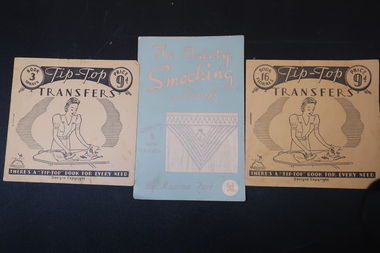
Booklets - Women's Handiwork
... Many women living in the Kiewa Valley had limited opportunity to travel to the cities to buy clothes. ...Women sewed the family's clothes as they had limited opportunity to travel to towns where clothing shops were available. These booklets enabled them to add interest to their sewing. Many women living in the Kiewa Valley had limited opportunity to travel to the cities to buy clothes.x2 Tip-Top Transfers and x1 The Dainty Smocking Book. The Tip-Top transfer books include 'Book 3 Sprays' and 'Book 16 Florals' and have 6 transfer pages in each book.They are cream with brown print on the front & back covers. The Dainty Smocking Book by Rosina Forl has 16 pages. It is also 9d.and is a pale grey/blue with pale pink print. It gives instructions for different stitches and designs.smocking, transfers for clothing -
Kiewa Valley Historical Society
Camera Case for Box Brownie, Circa mid to late 1900s
... living in the Kiewa Valley. It is significant to this region because it underlines the slow transition from a purely farming, grazing, mining and tourist region to an area opening up to a specific socio-economical structure for retirees. This social and demographic shift by retirees will produce a greater need for changes in facilities required by an increasing aged population. Though it may take more time for cities ...When this leather case was made it was the only material available that not only looked fashionable but also was able to absorb any small knocks or scratches which may happen to the mobile but still delicate camera. Digitalisation of photographic equipment for non professional use brought with it a reduction in camera size (pocket), increased portability and the dispensing of thick leather cases. With the increase of camera functions on mobile telephones, the need by tourists and the general public for a dedicated camera is rapidly diminishing. The protective leather wrapping for expensive, professional goods, especially electronics is very rare and foam padded aluminium bags and containers are the preferred mode for travel.This particular leather case has travelled to and from England via an ocean cruise by a now retired couple living in the Kiewa Valley. It is significant to this region because it underlines the slow transition from a purely farming, grazing, mining and tourist region to an area opening up to a specific socio-economical structure for retirees. This social and demographic shift by retirees will produce a greater need for changes in facilities required by an increasing aged population. Though it may take more time for cities and larger towns to come to grips with a growing aged population, rural areas(because these will define more clearly any imbalance of population) present the first demonstrative change to Australia, and world wide, a population based phenomenon.This item is a brown coloured leather camera case (Box Brownie Six-20) with an adjustable strap and associated buckle. The leather has been moulded to the shape of the camera and is slightly tapered as a closing flap fastened at the front with a lockable clasp. The end of the leather flap has a metal(tin) with a semi circular ring formed to allow it to be held as part of the clasp. Pressed into the underbelly of the semicircular closing mechanism is"PAT. APPLIED FOR" and underneath this"MADE IN ENGLAND" camera, case photography, hobby, personal equipment -
 Kiewa Valley Historical Society
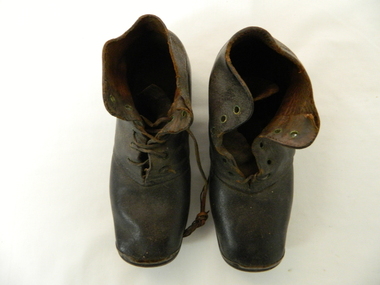
Boots, circa 1940s to 1950s
... Durability and no fashion infiltration from larger cities resulted in a spartan attitude to basic living requirements. ...The construction of these boots suggests that it was not purchased locally or from any large town. It may have been introduced by a wandering caravan trader in clothes and shoes. In this era of rural development shoes, especially children footwear, were regarded as a longer term requirement that only required the soles and heels to be replaced. Multiple shoe types were not common only basics that could be handed down. The policy of one main work/play shoe and one church shoe (special occasion) was the norm at this point in history.Worn by Everil Fisher (girl) at Dederang in 1880. They have 'copper toes' and are 'Hob Nail' These items although very basic were what the region required and was applicable to all levels of society at this time. Durability and no fashion infiltration from larger cities resulted in a spartan attitude to basic living requirements. The rural regions of this area were more in focus to the character of the person rather than what was worn. The personal interactions of everyone in the region were more "true blue" than that of the cities. The concept of "mate-ship' far outweighed the type of fashion being wornBrown/Black ankle high boot for child age 4 (approx). Tongue and six eyelets with broken leather laces. Hob Nail visible on soles and heel. Copper Toes. costume, children's footwear, boots, anklets -
 Kiewa Valley Historical Society
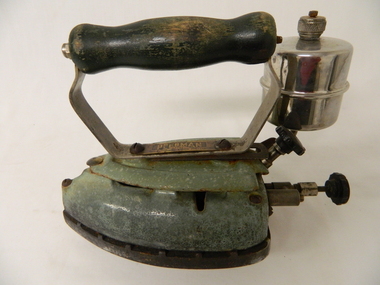
Iron Hand Kerosene, circa 1948
... cities. Social and religious mores and values demanded that the personal appearance be clean and crisp no matter where a person was living or working. ...This item was in use before electricity and was manufactured after the flat stove irons.The weight of the iron base, is heavy, helping in smoothing out crinkly material being ironed. This item permitted ironing of clothes to be separate and away from heating stoves. It permitted greater flexibility for ironing clothes and permitted more control (consistency) of the temperature of the iron.Historically and significantly this item enforces the relative isolation of the Kiewa Valley and period when and where this domestic item was in use(manufactured circa 1950). A rural setting with mining, beef , milk and tobacco production in the early 1900s. Even though the community was in a rural setting, the standards of dress was the same as in the bigger towns and cities. Social and religious mores and values demanded that the personal appearance be clean and crisp no matter where a person was living or working. Heavy laborious work was considered by some religions as virtuous, therefore the heavy and tiring work of ironing during this period had its rewards. Rural areas where the last to be connected to electricity and therefore this item was a domestic necessity far into the 1950's.This iron has a steel base and a metal body coated with green coloured enamel. The wooden hand grip is painted dark green. The kerosene (spirit) container is a chrome metal cylinder with a flat bottom and top. The top has a small filler/air plug is located on the top side. There are two control knobs located next to and under the metal cylinder. The close to the cylinder is a lock which locks the top lid of the iron and the other knob controls the airflow to the heater rodOn the base of the handle "PEERMAN" and below this P/46, C.I. Thomas & Son Pty Ltd household, ironing, domestic kerosene, dry cleaning -
 Kiewa Valley Historical Society
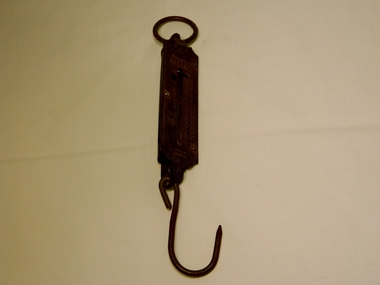
Scales Balance Pocket, Circa 1900
... city/ large country town environment. The Australian "fair go" ethical approach to life and commerce was very much ingrained in those living in country regions, like Kiewa Valley as is demonstrated by the not so accurate hand balance, spring loaded scales. antique pocket balance scales mobile weights vintage appliances Front plate marked: at top "Not legal for use in trade", below this in larger print "Pocket Balance", under and to the right in smaller print "lbs" under this graded marks, first marked with a Zero, then every second mark in ascending order up to 25. ...Historically this item would have been used by gold miners, rabbit shooters, mobile "Rag and Bone" traders and other mobile(in caravans and/or horse drawn cart) traders of various small goods and haberdashery. Although marked as not to be used as trade, the isolation and sometimes difficult terrain rules out using larger and more delicate scales. In the early 1900s rough roads and severe weather conditions forced traders to be more flexible in trading with weights and measures. The "close enough is good enough" doctrine was the Australian outback rule of thumb. The significance of this item in the Kiewa Valley during this period demonstrates the slower acceptance of accurate trading measure using the country side principle "my hand shake is my bond". In the Kiewa Valley small quantity commercial undertakings e.g. gold mining, fur pelts and rabbit meat trade did not require bulk weight type scales. Commerce in rural production e.g. fruit and vegetables involved more farmers and their staff in a barter and/or "in kind" payments. This was more so in the depression years 1929 to late 1930s. Self sufficiency was to a large extent more attainable in this region than in the city/ large country town environment. The Australian "fair go" ethical approach to life and commerce was very much ingrained in those living in country regions, like Kiewa Valley as is demonstrated by the not so accurate hand balance, spring loaded scales. Portable Pocket Balance with front plate made from brass. Spring mechanism enclosed by black painted medium gauge steel cover( three quarters cylindrical). Front scale face and rear spring casing fastened by three rivets. Spring loaded marker blade is located in the centre of the front plate. See item KVHS 0224 for a similar scales.Front plate marked: at top "Not legal for use in trade", below this in larger print "Pocket Balance", under and to the right in smaller print "lbs" under this graded marks, first marked with a Zero, then every second mark in ascending order up to 25. At the bottom of the front plate is marked "Made in Germany"antique pocket balance, scales, mobile weights, vintage appliances -
 Kiewa Valley Historical Society
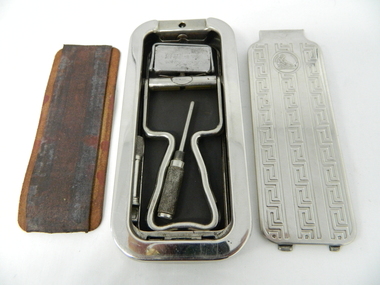
Razor Personal Vintage, circa 1940s to 1950s
... This historical item presents that, even though the Kiewa Region was an inland rural settlement which in the 1920's was not as close to "modern" fashions and "gadgets", the basic living conditions where still maintained at city levels. This particular razor was in its heyday a sophisticated safety razor and brought down the demand for the services of the "professional" barber(shaver). ...This item(razor) was used by men, only before fashion dictated that women should shave their legs and underarms. There is information that this razor was first used circa 1922 and it lasted up until circa 1958. It permitted the user to have a compact shaving apparatus at hand in any environment. It provided a safe and easy way of sharpening the more permanent blade. This type of razor replaced the straight, open, or cut-throat razors. The mobility of this item was further enhanced by Gillette with their double bladed disposable razor. Time taken(shaving) and costs involved where crucial factors in the ever growing pace of domestic lifestyle in the post 1920s.This historical item presents that, even though the Kiewa Region was an inland rural settlement which in the 1920's was not as close to "modern" fashions and "gadgets", the basic living conditions where still maintained at city levels. This particular razor was in its heyday a sophisticated safety razor and brought down the demand for the services of the "professional" barber(shaver). One of the problems of the superseded straight razor was the high levels of cuts and nicks to the face. As this particular razor was fairly expensive it would have been used by men who were in the middle to upper socio-economical position in Kiewa Valley before the late 1950'sThis item is a Sheffield steel(stamped inside) metal box(Viscount model) containing a red leather fine shaving strap and in its lid a grey honing stone. Both bottom and top lids are removable to allow for replacements of strap and stone. On the bottom lid appears "The Whetter" trade mark, registered in the U.S.A. in 1950.Three bands of a Greek key pattern has been pressed on the lid. A circled identification inscription. " ROLLS RAZOR Ltd, MADE IN ENGLAND" and patented information appears within this inscription. "Patented in England and Abroad. English patents numbers 467383. 284428. 242718. 242717" On the outside of the base lid within a circle are "ROLLS RAZOR" and the sketch of a long haired naked man (side view), crouched, with both hands stretched forward operating the razor. On a slab underneath are the words "The Whetter"safety razor, non disposable, men's shaving implement -
 Kiewa Valley Historical Society
Mantle for Gas Lantern
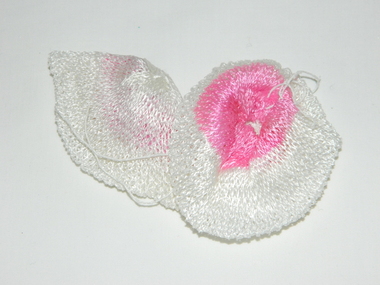
... The numerous camping facilities in the Kiewa Valley and the upper alpine region is testament that those living in the cities need a break from the day to day grind and go to a quieter and more spiritual environment. ...Originally these mantles where produced to be used in gas street lights in Europe and North America cities.There use started in 1891. These mantles were used before electrical power street lighting was installed. They have been used ever since until safety concerns regarding radiation from their thorium infused particles made alternate mobile lamps more attractive. The age of open flame recreational lighting is fast coming to a close. The greater use of battery and generator powered lighting(ease of operation) has brought the costing of these alternative lighting to an acceptable level. The age of miniaturisation and volatility of the open flame has seen a greater swing to smaller and more stable lighting. These incandescent gas mantles were initially used in the Coleman White Gas LanternsThe Kiewa Valley, with its closeness to the Victorian Alps, allows greater opportunity for the "happy" campers to enjoy the outdoors. The lighting provided by the incandescent gas lamps allow the adventurer at heart to enjoy an alternative lifestyle and still having the comforts of "home" at their finger tips. The numerous camping facilities in the Kiewa Valley and the upper alpine region is testament that those living in the cities need a break from the day to day grind and go to a quieter and more spiritual environment. Artificial lighting, as provided by mobile apparatus, is highly valued by the urban gypsy. The outdoor recreational industry has significantly provided for, if only at holiday time, an industry that has a relatively high employment rate and beneficial to local communities.The gas mantle is in a fabric, pear shaped, of rayon fabric impregnated with cerium. It's appearance is similar to a very small fishing net. The fabric is very ply-able until it is heated by an open flame then it becomes more rigid and lets out an incandescent white light. Its colour is white to off white. It has a draw string fastened a t the bottom (to wrap around the flame source)lighting, gas, heating, camping, outdoor equipment lamp -
 Kiewa Valley Historical Society
Book - Reference Melbourne Directory, Melbourne and Suburban Directory for 1889, Circa 1889
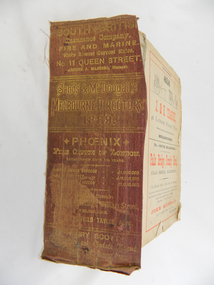
... The directory details a cross section of a developing city with a splattering of advertisements opening up an in depth look of all aspects of living in the late 1800s. ...The directory details a cross section of a developing city with a splattering of advertisements opening up an in depth look of all aspects of living in the late 1800s. ...This Directory of 1889 covers the location of Melbourne based trade and professional offices by street and in Alphabetical order. It covers all of Melbourne and its suburbs. It also covers government and official, ecclesiastic, legal, municipal and miscellaneous information. The directory details a cross section of a developing city with a splattering of advertisements opening up an in depth look of all aspects of living in the late 1800s. It is interesting to see that all the advertisements do not have any telecommunication numbers listed (personal shoppers or mail orders only). This was a period of high moral standing within the community and hotels advertised rooms " suites of rooms for families and single rooms for Ladies and Gentlemen" also "electric bells throughout the house. Telephone, night porter and hot and cold baths."This directory would be used by the majority of families and businesses working and living within the Kiewa Valley and the surrounding area. Melbourne was the only place where every aspect of living requirement was catered for. Although the delivery of services and goods were not at a high rate, certain items or transactions would require a visit to "the big smoke". Business information are listed both by suburb and alphabetically. There is also a section for British and Foreign Trade. This directory covered nearly everything to do with commerce, an example pay days for principle firms. Greater evolution of trade locations started to balloon out after the mid 1950's. Increased populations and greater levels of communication and safe fast transport facilities permitted greater devolution of commercial enterprises into rural communities, such as the Kiewa Valley.This directory has no front or back cover and is held together by its cloth spine. It contains over 1300 pages, however there may be some pages missing front and back of the directory which would have contained advertisements of some unknown shops. All the sides of this directory (except the spine) have advertisements and content information stamped on. The spine cover has been placed in the directory until further conservation work is carried out. It has gold coloured printing and in the central section, a gold coloured background with the words "Sands & McDougall's Melbourne Directory 1889." The spine has three adverts on the spine.On the spine in gold colour "South * British insurance Company Fire and Marine. Risks Lowest Current Rates No. 11 Queen Street, Arthur J Masters, Manager" and half way down " *Phoenix* Fire Office of London established over 100 years Annual Income exceeds (pound sign) 1,000,000" underneath "Losses Paid Over (pound sign) 16,000,000" underneath "Reserve Fund Exceeds (pound sign) 1,000,000" underneath "9 Market Buildings William Street, Melbourne " underneath " R. Manfield Taylor, Agent" and at the bottom section" Henry Scott Auctioneer and Estate Agent 49 Bridport St., Albert Park" stamped on the bottom side across the page endings "The Wonderful Wertheim Sewing Machines Swanston Street opposite Town Hall", stamped on the top side across the page endings " The Sweet Hapsburg Pianos & Organs Swanston Street Opposite Town Hall"state government listings, names and location of early melbourne population business names, 1889 members of the victorian executive council -
 Kiewa Valley Historical Society
Book - Reference Cooking, Mount Beauty Souvenir Cookery Book x2, Circa 1962
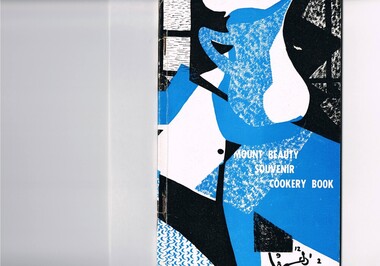
... living in rural areas. The specialisation and redefined development of the local produce store (previously provided everything the rural shopper needed) was a forced move due to larger and cheaper city born fresh food supermarkets. ...living in rural areas. The specialisation and redefined development of the local produce store (previously provided everything the rural shopper needed) was a forced move due to larger and cheaper city born fresh food supermarkets. ...This cookery book was printed in the early 1960s for the purpose of obtaining the necessary funds for the construction of the Mount Beauty swimming pool. The advertisements within this book covers local traders of this time frame, for example, the Bogong Hotel which is no longer operational. the culinary measurements are in Imperial measures(pounds and ounces). The book has sections for continental dishes and sweets (Australian flavour), special dishes for Lent, cakes (farmhouse fruit cake), jams, marmalades (home made), marrow and apple chutney. Some of these recipes are early 20th Century related and in the 2000s are not sought after. The food "take away" lifestyle has been responsible for the demise of a lot of the recipes in this book. The swing away from home grown produce has been not only a lifestyle change but also the faster pace of living in rural areas. The specialisation and redefined development of the local produce store (previously provided everything the rural shopper needed) was a forced move due to larger and cheaper city born fresh food supermarkets. Although there are still some local produce store within the region these will in time vanish. This cookery book was produced just after Mount Beauty was released from an SEC "closed" community in 1961(see KVHS 0134) and the town then had to fend for itself. This book was compiled and produced because the town needed a swimming pool (which possible would have been provided had the SEC still been responsible). The book demonstrates the strong rural psyche of rallying together for the good of all and united for something which would be of benefit to all. The period 1961 to the 1970s was one of great change for Mount Beauty. The SEC protective cage was a blessing for some but a goal for others. The independence that was gained after the SEC left provided for a drastic "make over" in regards to the facilities provided for the "locals" and that for the tourists. An increase in tourist related industries such as snow skiing in winter, hang gliding and gliding, mountain bike rallies, bush walking and horse riding, all of which have supply outlets in the town, has provided a more cosmopolitan atmosphere. These activities and the greater interaction with populations outside of the region has reduced the "hermit" type feel of the town psyche.This recipe book consists of eighty nine pages in black and white print. It contains black and white sketches, recipes of local domestic cooks and advertisements covering local traders. The cover is approximately 280 g/m2 in weight and the pages are at 90 g/m2 in weight. The cover has a design in the style of Abstract Expressionism (period 1950-1960s) of identifiable (clock,jug,fruit,window) and abstract objects in tints of blue and shades of black. This was designed by Cheryl Ryder of the Mount Beauty High School, under supervision of Mr I Baker (Art Teacher)On the foreword(page two and page three) "Mt. Beauty Souvenir Cookery Book First Edition" . This foreword was presented by Rosa Kinnear, President, Ladies' Auxiliary 2nd copy - no inscriptionrecipe, cooking, food, domestic, kitchen, local history, comfort food, pioneer cleaning methods -
 Kiewa Valley Historical Society
Book - Non Fiction Australian Mammals, Furred Animals of Australia, 1946
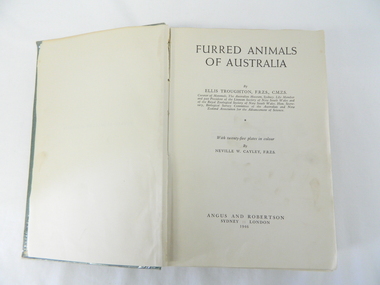
... However the rural based pupils would find the chapters and coloured prints more "real" than city located students because they are living day to day in the Australian bush, home to all the various mammals and marsupials presented in this book. australian mammals and marsupials nature books australia wild life On the spine "FURRED ANIMALS OF AUSTRALIA" and underneath "BROUGHTON" and at the bottom "ANGUS & ROBERTSON" This green coloured hard covered book has 178 double sided printed pages and twenty five plate detailing the appearances of native mammals. ...This book was written before the "preservation of Australian Flora and Fauna" movement became a household edict. The book covers all the "known" marsupials of the time and coloured prints are provided where required to show physical and other distinguishing features. Time and extensive searches of hard to reach places in Australia has uncovered a greater range of marsupials than presented in this book. Rural Australia (1940s) had not been as developed and altered as the 1980s onward. This book was used in Primary schools as reference material. Although rural school children would have come across many "real life" encounters with some of the mammals referred to, the diversity and range of mammals presented in this book is quite extensive. Most "city" born children would have only seen the mammals presented in this book at animal zoos in the larger cities.This book details the Australian wide range of mammals, and not just those which school children in the Kiewa Valley could meet "face to face". However the rural based pupils would find the chapters and coloured prints more "real" than city located students because they are living day to day in the Australian bush, home to all the various mammals and marsupials presented in this book.This green coloured hard covered book has 178 double sided printed pages and twenty five plate detailing the appearances of native mammals. The first two pages are frayed and all pages show colouration (yellow) of age. The book has a clear plastic cover as protection placed at a later dateOn the spine "FURRED ANIMALS OF AUSTRALIA" and underneath "BROUGHTON" and at the bottom "ANGUS & ROBERTSON"australian mammals and marsupials, nature books, australia wild life -
 Kiewa Valley Historical Society
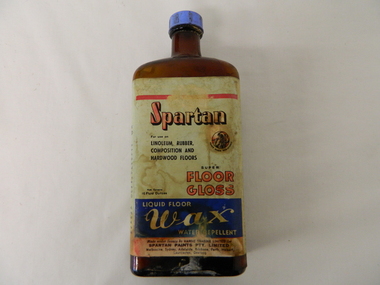
Bottle - Liquid Wax, mid 1900's
... This bottle of liquid floor polish is very significant to the Kiewa Valley, not only that it covers the floors of every home and residential barracks of the first major development of a "town" now known as Mount Beauty but also it demonstrates that the "cleanliness" approach of early Australians living areas in the rural regions was "on par" with its city cousins. It is the smaller types of mores that underlie the "mushrooming" cultural and psyche "wholeness" of an ever expanding Australian culture. floor cleaners liquid polish "hygienic" clean floors. ...This bottle of liquid floor polish was manufactured before 1960(taken over by Wattyl) in a period when most of the floors in high traffic areas were covered in linoleum. Most of the floors using this product during this period would have been kitchens and laundries. During this period the cleanliness of the kitchen, hallways and eateries had to appear clean (cleanliness was a sign of a bacteria free area). This was a priority for kitchens, mess areas(SEC Hydro Scheme facilities) and connecting walkways. The cleanliness attitude was enhanced in the rural areas due to the "dirty" farm work not impinging upon the residential home.When Mount Beauty was first inhabited all the residential and worker's facilities were a prime area for linoleum floor surfaces. The liquid floor polish was in great demand, "a polished floor is a clean floor".This bottle of liquid floor polish is very significant to the Kiewa Valley, not only that it covers the floors of every home and residential barracks of the first major development of a "town" now known as Mount Beauty but also it demonstrates that the "cleanliness" approach of early Australians living areas in the rural regions was "on par" with its city cousins. It is the smaller types of mores that underlie the "mushrooming" cultural and psyche "wholeness" of an ever expanding Australian culture.This brown opaque glass bottle with an oblong shape has a blue coloured "screw on" cap. It has a "wrap around" label glued firmly on the bottle and covers the front and sides.On the front main label under a red line, "SPARTAN" underneath in smaller print "For use on" below this, "LINOLEUM, RUBBER, COMPOSITION AND HARDWOOD FLOORS" besides this is an encircled Trade Mark of a "Spartan Warrior holding a spear and shield" these word follow the curviture of the circle and are below it "TRADE MARK REGISTERED" Below this are "SUPER FLOOR GLOSS" to the left in very small print "Nett Contents 16 Fluid Ounces". Below this on a blue background and in white print"LIQUID FLOOR WAX WATER REPELLENT". On the bottom of the label "Made under licence by HARDIE TRADING LIMITED for SPARTAN PAINTS PTY, LIMITED" below this in small print "Melbourne, Sydney, Adelaide, Brisbane, Perth, Hobart, Launceston, Geelong. Embossed on the bootm of the glass is" G/Mfloor cleaners, liquid polish, "hygienic" clean floors.
