
Showing 70 items matching "loading systems "
-
 Federation University Historical Collection
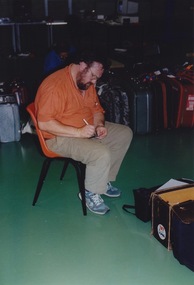
Photograph - Photographs - colour, VIOSH: Postgraduate Student, Geoffrey Dell's PhD, 1996, c1996
... ...loading systems...Three different loading systems were tested. Qantas baggage handlers travelled to Ballarat University to fill the human frame of the investigation. ...Three different loading systems were tested. Qantas baggage handlers travelled to Ballarat University to fill the human frame of the investigation. ...Victorian Institute of Occupational Safety and Health (VIOSH) Australia is the Asia-Pacific centre for teaching and research in occupational health and safety (OHS) and is known as one of Australia's leaders on the field. VIOSH has a global reputation for its innovative approach within the field of OHS management. VIOSH Australia enrolled its first PhD candidate in 1995 and during 1996 focused on attracting increasing numbers of students. In 1996, three candidates were enrolled through VIOSH Australia.They were John Culvenor, Geoffrey Dell and Thomas Mitchell. All had Prof Dennis Else as their supervisor. Previously, Geoffrey Dell was in Intake 7, 1985, Occupational Hazard Management. Geoffrey Dell's topic was "Airline Baggage Handler Back Injuries - Causes and Prevention." "The aim of this study is to investigate the work practises and operational systems used by baggage handlers in a range of airlines, worldwide. Where possible the investigation will include an epidemiological study of baggage handler back injury occurrence in those airlines. The information gathered will provide an understanding of back injury causation modes, and will focus attention on the specific tasks for which engineering solutions should be sought. Engineering solutions identified will be subject to controlled trial, to confirm their validity." This led to the construction of a full scale plywood baggage compartment model and a partnership with Ballarat University's School of Human Movement and Sports Science. Three different loading systems were tested. Qantas baggage handlers travelled to Ballarat University to fill the human frame of the investigation. The photographs show this aspect of the research. In 1997, Geoffrey Dell was awarded the Eric Wigglesworth Prize. The prize acknowledges publication of an article which constitutes a significant contribution to the body of occupational health and safety knowledge in an approved OH&S journal.32 co;our photographs showing procedure of baggage handlers.viosh, victorian institute of occupational safety and health, geoffrey dell, john culvenor, thomas mitchell, phd, airline baggage handler back injuries, work practises, operational systems, engineering solutions, causes of injury, qantas baggage handlers, prof dennis else, eric wiggles worth prize, oh&s journal, ballarate university, school of human movement and sports science, plywood compartment model, loading systems -
 Moorabbin Air Museum
Manual - Boeing 767 operating manuals, Boeing 767 Operating Manual Volume 1 Chapter 6 Weights and Balances November 1993
... ...Loading systems...Boeing 767 operating manuals Maximum allowable number of passengers Compartment capacities Loading limitations Configuration layout Galley provisions Fuel management Standard passenger & baggage weights Loading systems Overview of weight & balance requirements/limitations for Boeing 767, circa 1993 Spiral bound book type manual Boeing 767 Operating Manual Volume 1 Chapter 6 Weights and Balances November 1993 Manual Boeing 767 operating manuals ...Overview of weight & balance requirements/limitations for Boeing 767, circa 1993Spiral bound book type manualnon-fictionOverview of weight & balance requirements/limitations for Boeing 767, circa 1993maximum allowable number of passengers, compartment capacities, loading limitations, configuration layout, galley provisions, fuel management, standard passenger & baggage weights, loading systems -
Moorabbin Air Museum
Manual - Ansett Boeing 727 operating manuals, Boeing 727 Operating Manual Section 6 Weight & Balance May 1988
... ...Loading systems & guide...Ansett Boeing 727 operating manuals Structural limiting weights Maximum allowable number of passengers Compartment capacities Loading limitations Variations Special configurations for passenger & palletised freighters Seat loading Fuel management Loading systems & guide Overview of weight & balance requirements for Boeing 727, circa 1988 Spiral bound book type manual Boeing 727 Operating Manual Section 6 Weight & Balance May 1988 Manual Ansett Boeing 727 operating manuals ...Overview of weight & balance requirements for Boeing 727, circa 1988Spiral bound book type manualnon-fictionOverview of weight & balance requirements for Boeing 727, circa 1988structural limiting weights, maximum allowable number of passengers, compartment capacities, loading limitations, variations, special configurations for passenger & palletised freighters, seat loading, fuel management, loading systems & guide -
Moorabbin Air Museum
Manual - Trans Australia Airlines Airbus A300, TAA Training Manual A300 Loading Fire Navigation Communications AFCS Pilots Book No..4
... Loading...Fire systems...TAA Airbus A300 Loading Fire systems Navigation Communications AFCS Summary and graphic overview of Airbus A300 loading, fire, navigation , communications systems & AFCS, circa 1982 Spiral bound manual TAA Training Manual A300 Loading Fire Navigation Communications AFCS Pilots Book No..4 Manual Trans Australia Airlines Airbus A300 ...Summary and graphic overview of Airbus A300 loading, fire, navigation , communications systems & AFCS, circa 1982Spiral bound manualnon-fictionSummary and graphic overview of Airbus A300 loading, fire, navigation , communications systems & AFCS, circa 1982loading, fire systems, navigation, communications, afcs -
 Melbourne Tram Museum
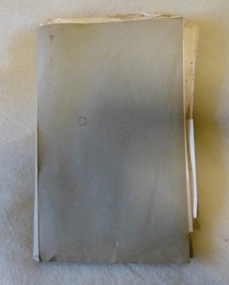
Document - Folder with papers, Melbourne & Metropolitan Tramways Board (MMTB), "Notices to Staff", 1924 - 1944
... Other documents include (Sample only): Camberwell extra for December 1944 Shopping Week Memos re traffic arrangements and shunting of trams for the 8 hour day procession Tables for Cable car operations from Port Melbourne depot 5/7/1925 Handwritten car timetables Costs associated with the royal visit Proposed service arrangements for Coburg Lines Christmas and New Year 1929 Cuttings regarding shopping hours for 1929-1930 Football posters - special trams - 1931 and 1932 All Night services - destination rolls to specific bogie trams Memos regarding cancelling of leave in Dec. 1941 Memos regarding services to Fisherman's bend and factory hours - 1941 - 42 Holiday loading returns for Southern System - 1941 Memo re timing of trams from city terminus account 3KZ Christmas Eve Choral festival...Other documents include (Sample only): Camberwell extra for December 1944 Shopping Week Memos re traffic arrangements and shunting of trams for the 8 hour day procession Tables for Cable car operations from Port Melbourne depot 5/7/1925 Handwritten car timetables Costs associated with the royal visit Proposed service arrangements for Coburg Lines Christmas and New Year 1929 Cuttings regarding shopping hours for 1929-1930 Football posters - special trams - 1931 and 1932 All Night services - destination rolls to specific bogie trams Memos regarding cancelling of leave in Dec. 1941 Memos regarding services to Fisherman's bend and factory hours - 1941 - 42 Holiday loading returns for Southern System - 1941 Memo re timing of trams from city terminus account 3KZ Christmas Eve Choral festival "Notices to Staff" Document Folder with papers Melbourne & Metropolitan Tramways Board (MMTB) ...Light grey card folder manufactured by the Roneo Printing Works of Rumford England with the file title "Fire Switches, glued to the top of the folder on the inside back cover. Contains many memos from the MMTB Traffic Managers, Depot Managers about the arrangements for the visit of the Royal Highnesses the Duke and Duchess of York in April 1927. Also contains memo re cable tram arrangements for this event from Port Melbourne depot, arrangements for Christmas holidays and other holidays from about 1924 to 1944, including a map of the procession and printed programs by the Government Printer. Documents either typed or hand written. Other documents include (Sample only): Camberwell extra for December 1944 Shopping Week Memos re traffic arrangements and shunting of trams for the 8 hour day procession Tables for Cable car operations from Port Melbourne depot 5/7/1925 Handwritten car timetables Costs associated with the royal visit Proposed service arrangements for Coburg Lines Christmas and New Year 1929 Cuttings regarding shopping hours for 1929-1930 Football posters - special trams - 1931 and 1932 All Night services - destination rolls to specific bogie trams Memos regarding cancelling of leave in Dec. 1941 Memos regarding services to Fisherman's bend and factory hours - 1941 - 42 Holiday loading returns for Southern System - 1941 Memo re timing of trams from city terminus account 3KZ Christmas Eve Choral festivaltrams, tramways, mmtb, port melbourne depot, notices and information, cable trams, holiday arrangements, royal visit, timetables, world war 2, football, all night services -
 Flagstaff Hill Maritime Museum and Village
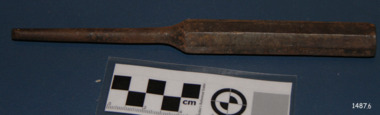
Tool - Shackle punch, Mid-to-late 20th century
... They have many uses on sailing vessels, such as part of anchoring systems or loading cargo onboard the ships. A link called a shackle is used as a quick and flexible way to join two pieces of chain. ...They have many uses on sailing vessels, such as part of anchoring systems or loading cargo onboard the ships. A link called a shackle is used as a quick and flexible way to join two pieces of chain. ...Chains are available in a variety of link shapes and sizes. They have many uses on sailing vessels, such as part of anchoring systems or loading cargo onboard the ships. A link called a shackle is used as a quick and flexible way to join two pieces of chain. Sometimes the shackle needs a tool to remove it. A shackle punch like this one will do the job. A modern term for a similar tool, that also has a handle, is a ‘breakdown’ tool. It is designed for aligning and driving pins in and for removing bolts, rivets and pins. This shackle punch has a handle with six flat sides that prevent it from rolling around when stored. It has a fine shank that tapers down to the end. The tool is placed on the join of the shackle, and then the end of that handle is hit with a hammer until the join breaks apart. The shipwright’s tools on display in the Great Circle Gallery are connected to the maritime history of Victoria through their past owner, user and donor, Laurie Dilks. Laurie began his career as a shipwright in the mid-1900s, following in the wake of the skilled carpenters who have over many centuries used their craft to build and maintain marine vessels and their fittings. You can see Laurie’s inscription on the tool called a ‘bevel’. Laurie worked for Ports and Harbours, Melbourne, for over 50 years, beginning in the early 1960s. He and a fellow shipwright inscribed their names on a wheelhouse they built in 1965; the inscription was discovered many decades later during a repair of the plumbing. Many decades later Laurie worked on the Yarra moving barges up and down the river and was fondly given the title ‘Riverboat Man’ His interest in maritime history led him to volunteer with the Maritime Trust of Australia’s project to restore and preserve the historic WWII 1942 Corvette, the minesweeper HMAS Castlemaine, which is a sister ship to the HMAS Warrnambool J202. Laurie Dilks donated two handmade displays of some of his tools in the late 1970s to early-1980s. The varnished timber boards displayed the tools below together with brass plaques. During the upgrade of the Great Circle Gallery Laurie’s tools were transferred to the new display you see there today. He also donated tools to Queenscliffe Maritime Museum and Clunes Museum.The shipwright’s tools on display in the Great Circle Gallery are connected to the maritime history of Victoria through their past owner, user and donor, Laurie Dilks. Laurie began his career as a shipwright at Ports and Harbours in Melbourne in the mid-1900s, following in the wake of the skilled carpenters who have over many centuries used their craft to build and maintain marine vessels and their fittings.A shackle punch; a metal tool with six flat sides on the handle and the shank tapers inwards to a rouded point. It once belonged to shipwright Laurie Dinks.flagstaff hill, warrnambool, great ocean road, shipwreck coast, maritime museum, maritime village, shipwright, carpenter, shipbuilding, ship repairs, hand tool, equipment, ship maintenance, cooper, tool, marine technology, shackle punch, breakdown tool, chains, links, laurie dilks, l dilks, port and harbours melbourne -
 Nhill Aviation Heritage Centre
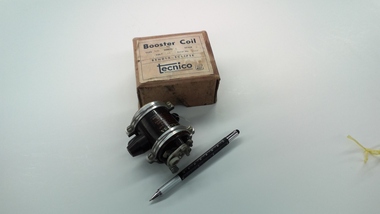
Memorabilia - Ignition coil / shower of sparks, 26/2/45
... D-5271BA Adjust to 2.5 volts with standard secondary load for use on 12 volt system. On Box 'Booster Coil Type 512 Model 1 Style E' serial number 1552 ...The type of ignition coil fitted to the Cheetah engine fitted to an Avro Anson, Parts stock unused. ignition coil, shower of sparks, ignition garth rohdes D-5271BA Adjust to 2.5 volts with standard secondary load for use on 12 volt system. On Box 'Booster Coil Type 512 Model 1 Style E' serial number 1552 electronic ignition coil with high tension outlet and set of adjustable breaker points and connectors. ...commonly known as 'shower of sparks' this buzzer type ignition coil is connected via the distributor and spark plug leads to generate a continuous spark while crank starting the Cheetah aero engine. The type of ignition coil fitted to the Cheetah engine fitted to an Avro Anson, Parts stock unused.electronic ignition coil with high tension outlet and set of adjustable breaker points and connectors. New in original box.D-5271BA Adjust to 2.5 volts with standard secondary load for use on 12 volt system. On Box 'Booster Coil Type 512 Model 1 Style E' serial number 1552 ignition coil, shower of sparks, ignition, garth rohdes -
 Flagstaff Hill Maritime Museum and Village
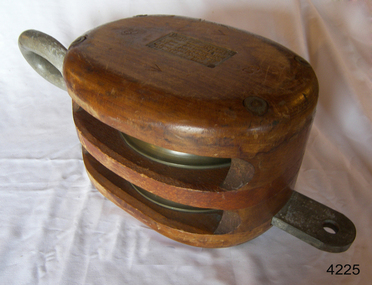
Equipment - Rope Block, After 1950
... systems are highly useful. A basic block and tackle includes a single fixed pulley or block, and at least one additional pulley, linked with rope, to form a complete set. Depending on the size of the load...systems are highly useful. A basic block and tackle includes a single fixed pulley or block, and at least one additional pulley, linked with rope, to form a complete set. Depending on the size of the load ...A block and tackle is a simple but highly effective lifting device, thought to have been invented by Archimedes. These systems were used extensively for construction in the ancient world, and continue to be used today for various applications, especially at sea, where non-motorised lifting systems are highly useful. A basic block and tackle includes a single fixed pulley or block, and at least one additional pulley, linked with rope, to form a complete set. Depending on the size of the load being lifted, additional sets may be used to further distribute the weight.A mid-twentieth example of a wooden block that shows advances in the design of the marine block compared to late 19th century blocks, with hook and pin and its compliance plate meeting the marine standards of the time.Two sheave rope block; two metal sheaves in polished wooden block with a metal inner pin with a ring on top and a bucket on the bottom. Rectangle carved into one cheek with inscriptions on the attached compliance plate with inscriptions. Stamped within a lozenge: "2 ↑ CS"flagstaff hill museum, flagstaff hill village, shipwreck coast, flagstaff hill, block & tackle, rope, lifting heavy weights, ship rigging, cargo lifiting, two sheave block, compliance plate, marine technology -
 Flagstaff Hill Maritime Museum and Village
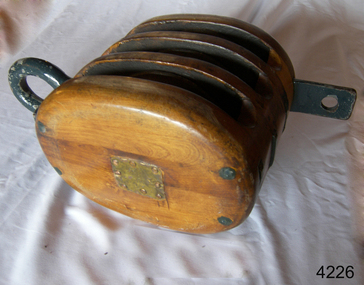
Equipment - Block, After 1950
... systems are highly useful. A basic block and tackle includes a single fixed pulley or block, and at least one additional pulley, linked with rope, to form a complete set. Depending on the size of the load...systems are highly useful. A basic block and tackle includes a single fixed pulley or block, and at least one additional pulley, linked with rope, to form a complete set. Depending on the size of the load ...A block and tackle is a simple but highly effective lifting device, thought to have been invented by Archimedes. These systems were used extensively for construction in the ancient world, and continue to be used today for various applications, especially at sea, where non-motorized lifting systems are highly useful. A basic block and tackle includes a single fixed pulley or block, and at least one additional pulley, linked with rope, to form a complete set. Depending on the size of the load being lifted, additional sets may be used to further distribute the weight.A mid-twentieth example of a wooden block that shows advances in the design of the marine block compared to late 19th century blocks, with hook and pin and its compliance plate meeting the marine standards of the time.Block, three-sheave rope block, wooden with metal sheaves. Metal ring and connecting tab, painted blue-grey. A brass compliance plate is on one cheek. One one side there are eight nails. flagstaff hill museum, flagstaff hill village, shipwreck coast, flagstaff hill, block & tackle, rope, lifting heavy weights, ship rigging, cargo lifiting, marine technology, marine block, three sheave block -
 Flagstaff Hill Maritime Museum and Village
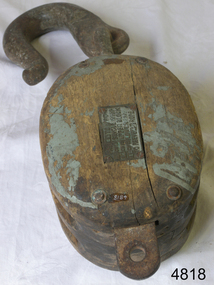
Equipment - Rope Block, Early-to-mid 20th century
... systems are highly useful. A basic block and tackle includes a single fixed pulley or block, and at least one additional pulley, linked with rope, to form a complete set. Depending on the size of the load...systems are highly useful. A basic block and tackle includes a single fixed pulley or block, and at least one additional pulley, linked with rope, to form a complete set. Depending on the size of the load ...A block and tackle is a simple but highly effective lifting device, thought to have been invented by Archimedes. These systems were used extensively for construction in the ancient world, and continue to be used today for a variety of applications, especially at sea, where non-motorized lifting systems are highly useful. A basic block and tackle includes a single fixed pulley or block, and at least one additional pulley, linked with rope, to form a complete set. Depending on the size of the load being lifted, additional sets may be used to further distribute the weight.This wooden two-sheave block is part of a ship's rigging. Its an example of rigging equipment in use from the early-to-mid 20th century and an example of the evolution of rigging equipment since the 17th century.Block; two sheave wooden tackle block with metal rollers and a large metal hook. It has a compliance plate on the side with an inscription. Stamped inside a lozenge; "2 ↑ CS" flagstaff hill museum, flagstaff hill village, shipwreck coast, flagstaff hill, block & tackle, rope, lifting heavy weights, ship rigging, cargo lifiting, rope block, marine technology, ship equipment, rigging, two sheave block -
 City of Moorabbin Historical Society (Operating the Box Cottage Museum)
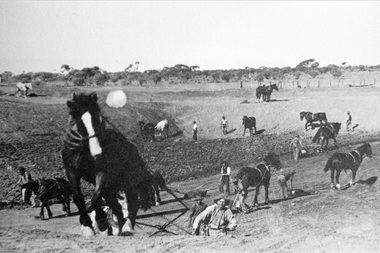
Photograph, Black & White Horse drawn scoops earthwork in Moorabbin Shire c1900, c1900
... Later as the heavy wagon loads continually caused ruts and general degradation of the roadways a Plateway system was installed so that the wagon wheels could roll along the rails thus protecting the roadways. ...Later as the heavy wagon loads continually caused ruts and general degradation of the roadways a Plateway system was installed so that the wagon wheels could roll along the rails thus protecting the roadways. ...The, horse drawn metal scoop ,guided by a man, was used to clear earth for road making. Well before the introduction of motorised, mechanical graders and trucks the painstaking, labour-intensive work was undertaken by large teams of sturdy men using strong horses such as the draught horse. Roads were needed by the market gardeners to transport their produce to market. Later as the heavy wagon loads continually caused ruts and general degradation of the roadways a Plateway system was installed so that the wagon wheels could roll along the rails thus protecting the roadways. August 31st 2021 Ron Nash, from WA, informs us "The men and horses pulling earth scoops in the photo are not moving earth for road making - they are excavating an "earth tank", or dam, as described in common nomenclature today. This skill was known as "tank sinking", and tank sinkers were active in many rural and remote areas in the 1800's and early 1900's, establishing sizeable dams for important water reserves for community and farm and railway use. With the advent of mechanised equipment such as bulldozers, the trade of tank sinking was still carried out, but on a faster basis. I am a former tank sinker and earth moving contractor, now long retired." Early settlers in Moorabbin Shire had to build the roads, plateways, drains, as the settlement of the land, in Dendy's Special Survey 1841 Brighton, spread and market gardeners need to transport their produce to market. Their most valuable possession was the draught horse that was used for ploughing, drawing carts and these scoops.Black & White photograph showing many horses pulling metal scoops guided by men to move earth for road making in Moorabbin Shire c 1900Back Handwritten Informationplateway, roadworks moorabbin shire, draught horses, metal scoops, paviers, box alonzo, smith j l; chaff cutter, horse drawn carts, toll gates brighton, motor cars 1900, steam engines, early settlers, bentleigh, mckinnon, parish of moorabbin, city of moorabbin, county of bourke, moorabbin roads board, shire of moorabbin, henry dendy's special survey 1841, were j.b.; bent thomas, o'shannassy john, king richard, charman stephen, highett william, ormond francis, maynard dennis, market gardeners, vineyards, orchards -
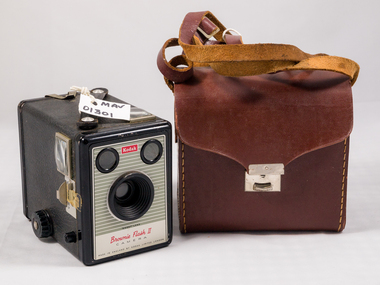 City of Moorabbin Historical Society (Operating the Box Cottage Museum)
Photography, Camera Kodak Flash 11 with leather case c1940, c1940
... The first films had to be loaded into the camera and unloaded in the dark room, but the film cartridge system with its protecting strip of opaque paper made it possible to load and unload the camera in ordinary light. ...The first films had to be loaded into the camera and unloaded in the dark room, but the film cartridge system with its protecting strip of opaque paper made it possible to load and unload the camera in ordinary light. ...Kodak was founded by George Eastman and Henry A. Strong on September 4, 1888 in New York USA. During most of the 20th century, Kodak held a dominant position in photographic film. Kodak began to struggle financially in the late 1990s, as a result of the decline in sales of photographic film and its slowness in transitioning to digital photography, despite developing the first self-contained digital camera. The first model of the Kodak camera appeared in 1888. It took round pictures 6.4 cm (2.5 in) in diameter, was of the fixed focus type, and carried a roll of film enough for 100 exposures. Its invention practically marked the advent of amateur photography, as before that time both apparatus and processes were too burdensome to classify photography as recreation. The first films had to be loaded into the camera and unloaded in the dark room, but the film cartridge system with its protecting strip of opaque paper made it possible to load and unload the camera in ordinary light. The Brownie camera was introduced in 1900, creating a new mass market for photography. This Kodak Brownie Box Camera is typical of the cameras used by amateur photographers c 1940A metal Kodak Brownie Box camera with a leather case, and an empty folder for negatives and prints Front ; KODAK / 'KODET' LENS / Brownie Flash 11 / CAMERA / MADE IN ENGLAND BY KODAK LTD LONDON Folder The Pleasures of PHOTOGRAPHY / Make Photography Your Hobby kodak ltd, eastman george, strong henry, photography. brownie box camera, digital photography, -
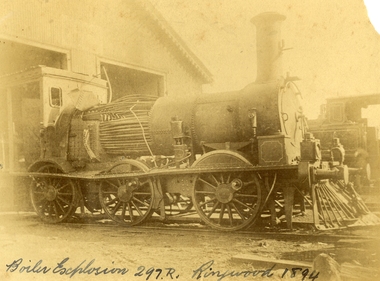 Ringwood and District Historical Society
Photograph, Boiler explosion at Ringwood station 20th June 1894 for engine 297R. "Heard in Box Hill"
... system. He states that he was fireman on the engine attached to the train which left Healesville on Saturday evening, at ten minutes to 8. Everything went all right until Ringwood was reached, when, .just as the train was about to continue its journey, a load explosion took place and Miles remembers nothing more until he was picked np on the platform ; and found himself suffering from a pain in the back, and an injury to his arm. ...system. He states that he was fireman on the engine attached to the train which left Healesville on Saturday evening, at ten minutes to 8. Everything went all right until Ringwood was reached, when, .just as the train was about to continue its journey, a load explosion took place and Miles remembers nothing more until he was picked np on the platform ; and found himself suffering from a pain in the back, and an injury to his arm. ...Black and white photographs - 2 copiesTyped below photograph, "Boiler explosion at Ringwood station 20/6/1894. Heard in Box Hill". Article from newspapers:- Weekly Times (Melbourne, Vic. : 1869 - 1954), Saturday 27 January 1894, page 21 Official enquiry. The Board of Enquiry appointed by the Railway Commissioners to enquire into the causes of the boiler explosion which shattered the locomotive at Ringwood on Saturday night, assembled at the Railway department on Wednesday to commence its deliberations, The board consisted of Mr R. Fulton, engineer, C. W. McLean; engineer to the Marine Board, and Mr Mephan Ferguson, iron-founder. There is some difficulty at the outset about the constitution of the board; It was suggested that the Apt of Parliament contemplated that boards of experts, after the manner of the present one, needed, to have their appointments confirmed by the Governor-in-Council. The point, however, was not considered sufficiently important to prevent the board from proceeding with evidence. Robert Greyford, stationmaster at Ringwood, was the first witness. He said he saw the explosion on Saturday night at about twenty minutes to 8. There was a rush to the engine to see what had happened, and the driver and fireman were both found on the platform of the engine. The driver seemed badly hurt, but the fireman, to all appearances, was not so badly injured. They were both attended to and sent up to Melbourne by the last suburban train. Witness had a look at the engine and found the dome and all the plates round the boiler blown clean, away. The springs were also blown clean away. The Chairman (Mr Fulton) : Did you measure the distance ? Witness: Yes; one of the plates was 209 yards away. A piece from the top of the boiler 15 pounds in weight he found driven into the hard beaten track 410 yards away. Several pieces of boiler plate were found scattered at various distances. The buildings roundabout were injured. The Chairman; Did you notice anything peculiar about either of the driver or the fireman ? — No ; nothing wrong, with either of them. If the engine was blowing off at all, it must have been very light. In your opinion, were they perfectly sober ? — Perfectly. In approaching the station, is there a down or an up grade? — A very slight down grade. How is the road from Healesville ? — Up and down all the way. It is down, grade for about 200 yards coming into Ringwood station. They shut off ; steam about a quarter of a mile away, and come in at a good pace. They generally put on 15 pounds of steam while they are in the station. Mr Ferguson : Had the driver the usual load on ? — Yes ; about the usual load. Witness added that he had known the driver personally for about 10 years, and he had always been a careful, steady, sober man. He did not know the fireman so well. John Palmer, porter at Ringwood station, also saw the explosion. He was attending to the train on its arrival. He was knocked down by the force of the explosion. When he got up he saw the engine driver being carried into the office covered in blood. He noticed nothing peculiar about the driver and fireman, nor about the engine. Mr McLean : How far were you from the engine when you were knocked down ? — From ten to fifteen yards. William Paul, the guard of the train to which the injured locomotive Was attached, said he was looking at the engine at the very moment the explosion occurred. It seemed to come from exactly under the dome. The force of it took him off his feet. He was about 15 yards from the tender. When he rose he tried to reach the engine, but could not do so on account of the steam and coal dust. He called out to know whether any of the passengers were injured, and got no response, so that he concluded they were all right. All the lamps but about half dozen were extinguished by the force of the explosion, although the glass was not broken. He could testify most distinctly that the driver and fireman were both sober. The driver was a man who never drank. The steam started to blow off about a minute and a half before the explosion took place. The last place at which the engine took water was Healesville. The Chairman : Do yon know anything of the quality of the water there ? Is it creek water ? — Yes ; it comes from the Graceburn River. You never heard of its quality ?— No. How long have you known this engine on the road— About 13 months. Hew long have you known the driver on this line ? — About six weeks. I have known the fireman several years. The driver was a strict teetotaller, and I never saw the fireman take anything to drink in his life. Mr T. H, Woodroffe, chief mechanical engineer of the Victorian Railways, produced a report he had written to the secretary, about this explosion. The document gave facts concerning the engine and the explosion. It stated that the rapture seemed to have occurred at the rim of the plates adjoining the fire box. The engine was built at the Phoenix Foundry, Ballarat, in 1883. It was repaired at various times, the last time being in July of last year when it was sent to the Port Melbourne shops, and was then tested to a cold water pressure of 195 and found all right. It was the custom to overhaul all locomotives about every five years. The Chairman : There were no very heavy repairs in July, 1893; were there? — Not to the boilers. The shop manager's report says that the plug and safety tap holes were repaired, five new copper studs put in firebox, ash-pan door repaired, tender cleaned and overhauled, and studs re-rivetted, and boiler tested to pressure of 195, cold water. Mr Woodroffe read the report of the repairs effected to the boiler in December, 1888. That would be the time the plate was put in the boiler. On that occasion three new plates were put in the bottom and the boiler tested up to 195. The Chairman: Do you keep a record of the water used ?— Yes, the water in this case, I think, came from the Maroondah scheme. Mr Woodroffe said boilers were examined front time to time in the running sheds. In his opinion every possible care had been taken to keep the engine in proper care. There might, however, be lessons learnt from this. The Chairman: No doubt. From his examination of the plates [the] witness did not think the state of them could have been detected from the outside. There were no signs of leakage or sweating or anything of that sort. The next witness- was Walter Stinton, workshop manager at Newport and he said that the injured engine had been repeatedly repaired under his charge. He gave a technical account of the repairs effected on various occasions. The testing of locomotives was under his special notice. They had a high pressure pipe running; round the works, and a pump set at 2001b. When the boiler was pumped full of water the pressure when applied up to 1951b. The board appointed by the department to inquire into the Ringwood locomotive boiler explosion sat again at Spencer street on 25th inst. Mr R. Fulton presided and the other members of the board were. Mr Mephan Ferguson and Mr C. W. McLean. Charles Grubb, foreman of the boiler-makers at the Newport workshops, said he had inspected the pieces of plate that had been blown out of the engine, and after examining them, pointed out to the Chief Mechanical Engineer the portion where the plate had started to burst. It was under the lap, on the right hand side of the boiler. The grooving might be accounted for by bad water. During the past twenty years he had examined all the boilers that came into the Williamstown workshops, and while some were hardly marked at all, others were very badly eaten away. The practice was to cut out the defective portions. In this case the boiler was repaired in a similar manner. The Chairman : Can you suggest any other way of repairing so as to prevent accident ? — No, unless by taking out a plate on one side from the joint, and carrying it further up so as to avoid the joints meeting, or by taking out the plate altogether. What would.be the cost .of putting in a new " plate I—Perhaps about double the price; but I wouldn't recommend that course. It would be putting a new plate against plates that have been in use ten years or so and that would not be advisable. I think the present system better. I consider the present system of repairing the best. This is the first we have had so bad like that, to my knowledge. You attributed this to bad water. Is there no other probable cause ? — Well; unless the iron be bad. This was Lowmoor iron. I think this accident was caused by the eating away of plates. This one was the worst I have seen, for the short time it had been running. We use three classes of iron — Lowmoor, Monkbridge and Bowling. By Mr Woodroffe (Chief Mechanical Engineer) ; There are engines still running that were repaired at the same time as this one, in 1888, and. in the same way. These are engines 339 and 333. They have been recently examined and are in splendid order. What in your experience, is the age of a boiler on the Victorian railways? — From 17 to 20 years our earlier boilers stood. The later boilers don't stand so well. How is that? — There is difference in construction, and the material is lighter. The old boilers had thicker plates. Have you been asked in any way to curtail boiler affairs? — No, sir; nor in any way. You have never hesitated to carry out any necessary repairs? — Never. Our orders have been to exercise every care in examining, repairing and renewing boilers. Witness said that his practice was when an engine came into the workshop to find out how long she had been running. If over five years, he informed the workshop manager, and they thought it necessary the tubes were taken nut. If everything was in good order witness reported to the manager. The cost of taking out the tubes and putting them in again was about L20. Mr Woodroffe : Have you ever hesitated to repair a boiler on the score of expense ? — No, never. Mr McLean : Hew do yon ascertain whether a boiler requires repairs?— I keep a record of every boiler examined. From every boiler that comes in I have the dome covers taken off, and when it is practical I get inside. l can almost tell from the top of a boiler what the bottom is like. If there is any doubt about it I have the tubes taken out. If I have suspicion of defective plate I cause to have bored a triangle in the plate at the point where there is the most wear. There is a travelling inspector who visits all the running sheds of the colony except Port Melbourne and tests the boilers. He reports to us and we note what he points out. Alfred Thompson, locomotive inspector of the eastern section, said he knew this engine, 297R. He read a list of her repairs. He heard of the accident on Saturday night and went up to Ringwood. The Chairman : Did you ever notice anything peculiar about the engine? — No, I considered her A1 and would not have hesitated to have put on 140lb pressure owing to the repairs she had undergone. Witness considered that the explosion was caused by the expansion and contraction of the plates ; and, no doubt, the plate had been eaten away through bad water. The other side of the boiler showed: signs of corrosion: By Mr Woodroffe ; Is every care taken with the boilers ? — Yes, every possible care is taken for the safety of boilers, Weekly Times (Melbourne, Vic. : 1869 - 1954), Saturday 27 January 1894, page 7 EXPLOSION OF A LOCOMOTIVE BOILER, NARROW ESACPE FROM FATALITIES. THE DAMAGED ENGINE. [See drawing of loco – saved in “Railways” folder] The explosion of a locomotive boiler at Ringwood on Saturday evening, formed the subject of much discussion in railway circles on Monday. The Minister arrived at the office at an unusually early hour and immediately entered into a consultation with the acting chairman, Mr Kibble, and Mr Commissioner Murray. As the result of the interview it was resolved to ask three gentlemen of acknowledged engineering experience to sib as a board with the . object of inquiring into the cause of the accident and furnishing a report. Mr Richardson and the Commissioners are tally seized of the importance of having a searching investigation into the accident, and, with Mr Murray, the former went to Ringwood to inspect the scene of the disaster. They will he accompanied by Mr Woodroffe. During the morning no official report had come to hand from the driver or fireman of the engine in reference to the accident, but that is thought to be due to the circumstance that they have not sufficiently recovered to be able to give a circumstantial account of what occurred. The engine was one of the old R's, and, Mr Kibble pronounced them to be about the best class of engines used. So far nothing can be said as to the probable cause of the accident, as the broken plating of the engine has not been submitted to the inspection of experts. Weekly Times (Melbourne, Vic. : 1869 - 1954), Saturday 27 January 1894, page 7 STATEMENT BY THE FIREMAN. This morning Thomas Miles, fireman on the engine the boiler of which exploded on Saturday night, is suffering from an injury to the spine, as well as a very severe shaking to the system. He states that he was fireman on the engine attached to the train which left Healesville on Saturday evening, at ten minutes to 8. Everything went all right until Ringwood was reached, when, .just as the train was about to continue its journey, a load explosion took place and Miles remembers nothing more until he was picked np on the platform ; and found himself suffering from a pain in the back, and an injury to his arm. He cannot think of any reason which could have caused the explosion, as there was plenty of water in the boiler, and everything seemed working all right. Mr R. Fulton, consulting engineer, of Queen street; Mr McLean, a member of the Marine Board ; and Mr Mephan Ferguson, engineer, have consented to act as a board to inquire into the cause of the engine boiler explosion at Ringwood on Saturday evening. The board has been appointed under section 117 of Act 1135, which provides that the Governor-in-Council may direct the taking of a such a step. Mr1 Fulton will act as chairman of the board, which met for the first time at the railway offices, Spencer street, this forenoon. Before separating the members of the Board paid a visit to the Prince's Bridge locomotive sheds in company with Mr Woodroffe, the chief mechanical engineer, for the purpose of inspecting the shattered boiler. It has been stated that the explosion is known to have been caused by a flaw in a plate which was put on the boiler about four years ago, but enquiries have tailed to elicit anything in support of that view. The engineers connected with the department are not inclined to say anything on the subject. Weekly Times (Melbourne, Vic. : 1869 - 1954), Saturday 14 April 1894, page 20 The Ringwood Boiler Explosion, The Minister of Railways has received the supplementary report of the board appointed by him to investigate the circumstances connected with the explosion of a locomotive boiler at Ringwood. In their first report the board did not attach blame to anyone. Mr Richardson felt satisfied that the responsibility of having the engines properly inspected and overhauled periodically could be fixed if the inquiry were extended. He therefore referred the matter again to the Board, who took further evidence. In the report now furnished, the Board hold Loco. Inspector Thompson blameable, but point out as a mitigating circumstance that he had not received "written instructions" respecting inspections and overhauls. Weekly Times (Melbourne, Vic. : 1869 - 1954), Saturday 7 July 1894, page 32 The Ringwood Boiler Explosion. The Minister of Railways takes exception to the tone of a paragraph appearing in a morning contemporary respecting the Ringwood boiler explosion. It makes it appear that Mr Richardson has referred the report of the board which considered the facts connected with the explosion to the Crown solicitor simply because he differed from the finding of the board. The Minister explains that when he received the report he found that the responsibility for having boilers properly inspected and overhauled had not been clearly fixed. He personally obtained farther evidence on that point, and arrived at a conclusion, from which the commissioners differed. As he did not like to take upon himself the responsibility of deciding upon the effect of the evidence, he submitted the matter to the Crown Solicitor, but that officer did not furnish him with the information sought. He has, therefore, referred the question to the Attorney-General, together with the draft of a regulation respecting boiler inspections and overhauls in the future. Mr Richardson says that his whole aim is to have the responsibility positively fixed. Weekly Times (Melbourne, Vic. : 1869 - 1954), Saturday 28 April 1894, page 23 The Minister of Railways has completed his consideration of the supplementary report received by him from the Ringwood Boiler Explosion Board. The report, it will be remembered, held Loco-Inspector Thompson blameable for the non-inspection of the boiler, but considered there was extenuating circumstances. There was a certain amount of doubt as to the absolute instructions given for overhauling engines periodically. Mr. Richardson is sending the report on to the Commissioners with instructions that the responsibility respecting inspection of boilers shall be made clear for the future. -
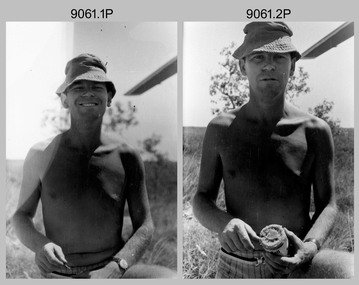 Bendigo Military Museum
Photograph - RA Svy Project C4 Aerodist Operation, Eastern & Western Arnhem Land, NT, 1967, 1968
... load carrying capacity of up to about 500 pounds. By comparison, one Aerodist team including two people weighed up to 1,500 pounds. In 1968, after completion of the Kimberley Aerodist Operation project, the Aerodist system in VH-EXX was immediately deployed to western-Arnhem Land NT for Central Comd Fd Svy Unit (Adelaide - Major Don Ridge) to complete the mapping control across northern NT from mid-July to October. ...load carrying capacity of up to about 500 pounds. By comparison, one Aerodist team including two people weighed up to 1,500 pounds. In 1968, after completion of the Kimberley Aerodist Operation project, the Aerodist system in VH-EXX was immediately deployed to western-Arnhem Land NT for Central Comd Fd Svy Unit (Adelaide - Major Don Ridge) to complete the mapping control across northern NT from mid-July to October. ...This is a set of 26 photographs of Royal Australian Survey Corps (RA Svy) personnel from Central Comd Fd Svy Unit (Adelaide) on Aerodist survey operation - Project C4 in Eastern Arnhem Land, Northern Territory in 1967 (photos .4P to .26P) and in Western Arnhem Land, Northern Territory in 1968 (photos .1P to .3P). Photos of personnel were taken either at the operations base at Numbulwar or the main base at Gove (Nhulunbuy). RA Svy conducted nineteen Aerodist operations for 12 years from 1964 to 1975. Aerodist MRC2 was a tellurometer-based system adapted for aircraft to accurately measure distances between non-intervisible ground survey stations, using the aircraft as an intermediate station. Lower order geodetic results could be achieved by survey network trilateration. The measured distances between stations formed survey networks from which each station’s latitude and longitude was computed. Aerodist MRC2 was RA Svy’s major horizontal control survey tool for mainly medium scale topographic mapping (scale 1:100,000 Class A being spatially accurate to within 50 metres) in PNG, northern NT, north-west WA, Kalimantan Barat (West) Indonesia, Sumatra Indonesia, Gulf of Carpentaria and Cape York, QLD. In 1967, the Aerodist MRC2 Master equipment was installed in the aircraft featured in this set of photos, Executive Air Services’ (Essendon VIC) Grand Aero Commander VH-EXX. It was the same aircraft type and company contracted to Division of National Mapping for Aerodist MRC2 surveys. From July to October 1967 the aircraft was attached to Central Comd Fd Svy Unit (Adelaide - Major Don Ridge) on Project C4 eastern-Arnhem Land NT, where 317 Aerodist lines measuring 17,300 line miles were successfully completed. This was the most productive Aerodist project thus far. The most common helicopter used by RA Svy up to 1972 was the civilian Bell 47G-2 and the Sioux Light Observation Helicopters (LOH), the Australian Army’s equivalent featured in this photo set. These light observation helicopters had a limiting load carrying capacity of up to about 500 pounds. By comparison, one Aerodist team including two people weighed up to 1,500 pounds. In 1968, after completion of the Kimberley Aerodist Operation project, the Aerodist system in VH-EXX was immediately deployed to western-Arnhem Land NT for Central Comd Fd Svy Unit (Adelaide - Major Don Ridge) to complete the mapping control across northern NT from mid-July to October. The Aerodist MRC2 Remote antenna seen in Photos .24P to .26P is mounted on a 20 foot pole tower. The antenna direction was controlled by wires/ropes to the two arms under the dish at right angles. The antenna elevation could be changed to the vertical for aircraft height checks as seen in photo .25P. Source: Royal Australian Survey Corps – Aerodist Years 1964-1975 by Peter Jensen. Refer to Item 6449.30P for more photos taken during these Aerodist survey operations.This is a set of 26 photographs of Royal Australian Survey Corps (RA Svy) personnel on Aerodist survey operations in Eastern Arnhem Land, Northern Territory in 1967 and Western Arnhem Land, Northern Territory in 1968. The photographs are on 35mm negative film and scanned at 96 dpi. They are part of the Army Survey Regiment’s Collection. .1) to .2) – Photo, black & white, 1968, unidentified soldier with an opened can of food, possibly bully beef. .3) – Photo, black & white, 15 Aug 1968, aerial view of terrain taken from a helicopter in vicinity of MILINGIMBI SIERRA. .4) – Photo, black & white, 1967, aerial view of an island taken from a helicopter. .5) & .6) – Photo, black & white, 1967, unidentified soldier driving a Haflinger 4x4 Light utility vehicle with trailer. .7) – Photo, black & white, 1967, unidentified surveyors taking vertical measurements with a leveling instrument and staff. .8) – Photo, black & white, 1967, Australian Army Sioux Light Observation Helicopter (LOH) with float removed. .9) to .11) – Photo, black & white, 1967, Australian Army Sioux Light Observation Helicopter (LOH) with floats. .12) – Photo, black & white, 1967, civilian Bell 47G-2 helicopter (Australian Army Sioux LOH equivalent) refuelled. .13) – Photo, black & white, 1967, survey station on coastline surrounded by white plastic aerial photographic identification panels lined with rocks. .14) & .15) – Photo, black & white, 1967, soldier (possibly a signaller from RA Sigs) operating a radio. .16) – Photo, black & white, 1967, Central Comd Fd Svy Unit Operations Section tent, Main Base Gove (Nhulunbuy) L to R: SPR Harry Dunn, WO1 Pat Wood BEM. .17) – Photo, black & white, 1967, Central Comd Fd Svy Unit Operations Section tent, Main Base Gove (Nhulunbuy) L to R: unidentified, WO1 Pat Wood BEM. .18) – Photo, black & white, 1967, Central Comd Fd Svy Unit Operations Section, Main Base Gove (Nhulunbuy), unidentified Australian Army Catering Corps cook preparing meals. .19) – Photo, black & white, 1967, Central Comd Fd Svy Unit Operations Section, Main Base Gove (Nhulunbuy) mess tent in readiness for meals. .20) – Photo, black & white, 1967, Bank of batteries in transit boxes undergoing recharging using generators. .21) – Photo, black & white, 1967, A topographic survey identification plaque set in a concrete block being weighed using a set of scales hanging from slaughtering gallows. .22) – Photo, black & white, 1967, CPL (Geoff or Gary) Larkin operating the remote Aerodist MRC2 ground instrument at Veronica Island, located north of Nhulunbuy. .23) – Photo, black & white, 1967, L to R: CPL (Geoff or Gary) Larkin with unidentified surveyor operate the remote Aerodist MRC2 ground instrument at Venica Island, located north of Nhulunbuy. .24) & .25 – Photo, black & white, 1967, The Aerodist MRC2 Remote antenna. .26) – Photo, black & white, 1967, The Aerodist MRC2 Remote antenna.The following photos are annotated in black ink on edge of film negative: .3P – ’15 Aug ’68, 2000’, 1-C18 ’68 MILINGIMBI SIERRA’ .4P – ’U462’ .8P – ‘1-C3/67 Float Removed’ .13P – ‘U477 10-C3/67 .20P - ‘2-C3/67 Bank of Chargers’ .21P - ‘3-C3/67 Gallows & Scales’ .22P - ‘0462 VERONICA ISLAND NT, CPL Larkin’ .23P - ‘0462 VERONICA ISLAND NT’ .24P - ‘4-C3/67 20’ Aerodist Tower’ .25P - ‘5-C3/67 20’ Aerodist Tower’ .26P - ‘6-C3/67 20’ Aerodist Tower’royal australian survey corps, rasvy, army survey regiment, army svy regt, fortuna, asr, aerodist, surveying, central comd fd svy unit -
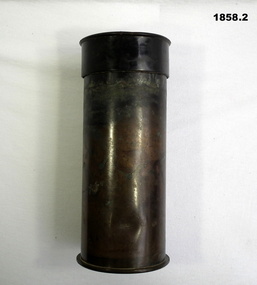 Bendigo Military Museum
Accessory - CASING, est 1979
... machinery-engines military history-raaf .1 Base has "Cart Elec Eng Start MF 79/3 84 ME 7-79" .2 "Remove cap before loading EFM 79" .1 Rimmed brass case for "shotgun" type aircraft engine starting system. .2 Plastic end cap. ....1 Rimmed brass case for "shotgun" type aircraft engine starting system. .2 Plastic end cap..1 Base has "Cart Elec Eng Start MF 79/3 84 ME 7-79" .2 "Remove cap before loading EFM 79"machinery-engines, military history-raaf -
 Tramway Heritage Centre
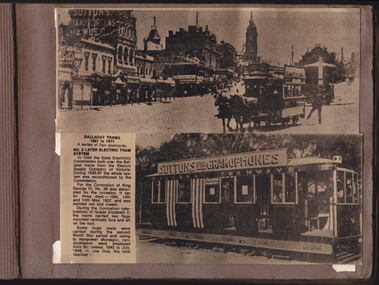
Photograph Album (part of), Ray Pearson's Photo Album - Trams of Victorian Railways, Ballarat, Bendigo, Geelong
... SYSTEM / In 1934 the State Electricity / Commission took over the Bal- / larat trams from the Electric / Supply Company of Victoria. / During 1935-37 the whole sys- / tem was reconditioned by the / Commission. / For the Coronation of King / George VI, No. 28 was decor- / ated for the occasion. It ran / for three days – 12th, 13th / and 14th May, 1937, and was / painted red and cream. / During the Coronation cele- / brations of Queen Elizabeth II, / the trams carried two flags / mounted vertically fore and aft / on the roof. / Some huge loads were / carried during the second / World War period and owing / to man power shortages, con- / doctresses were employed / from September, 1942 to July, 1946. ...SYSTEM / In 1934 the State Electricity / Commission took over the Bal- / larat trams from the Electric / Supply Company of Victoria. / During 1935-37 the whole sys- / tem was reconditioned by the / Commission. / For the Coronation of King / George VI, No. 28 was decor- / ated for the occasion. It ran / for three days – 12th, 13th / and 14th May, 1937, and was / painted red and cream. / During the Coronation cele- / brations of Queen Elizabeth II, / the trams carried two flags / mounted vertically fore and aft / on the roof. / Some huge loads were / carried during the second / World War period and owing / to man power shortages, con- / doctresses were employed / from September, 1942 to July, 1946. ...Page 3 of Ray Pearson's Photo Album. Brown card page with two metallic look postcards (landscape format) placed on page using clear plastic photo corners. Both postcard images depict trams in Ballarat. The bottom postcard has come loose of two of it's photo corners (top and bottom on the right) and is not secure on the page. A hand written inscription is written in pencil behind the bottom photograph.Hand written inscription in pencil behind postcard at base of page: W.4. Printed text to left of image on bottom postcard: BALLARAT TRAMS / 1887 to 1971 / A series of four postcards. / NO. 3 LATER ELECTRIC TRAM SYSTEM / In 1934 the State Electricity / Commission took over the Bal- / larat trams from the Electric / Supply Company of Victoria. / During 1935-37 the whole sys- / tem was reconditioned by the / Commission. / For the Coronation of King / George VI, No. 28 was decor- / ated for the occasion. It ran / for three days – 12th, 13th / and 14th May, 1937, and was / painted red and cream. / During the Coronation cele- / brations of Queen Elizabeth II, / the trams carried two flags / mounted vertically fore and aft / on the roof. / Some huge loads were / carried during the second / World War period and owing / to man power shortages, con- / doctresses were employed / from September, 1942 to July, 1946. At one time, the total / reached 23. Printed text to back of bottom postcard: BALLARAT TRAMS / 1887 to 1971 / A series of four postcards. / In the early fifties, loading / on the trams was heavy. When / the lag in housing was over- / taken, however, breadwinners / started to leave the trams and / travel to work in cars. Increas- / ing affluence in the sixties ac- / centuated the trend. Soon the / trams were running with mount- / ing annual losses. Most of the / passengers travelling in these / times were concession holders: / students, pensioners, deserted / wives and T.P.I.'s A fine printed vertical line runs down the centre of the blank writing space to the left of the body text. Above is written: POSTCARD postcard, coronation, ray pearson, vintage trams, ballarat tramway, tram postcard, female conductors, suttons, ballarat tram -
 Victoria Police Museum
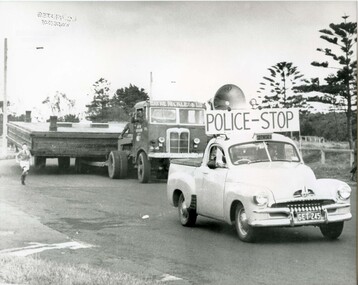
Photograph (police car)
... GET 245, with police insignia on door, police light on top of vehicle and PA system in tray of vehicle, escorting Mayne Nickless trick with wide load. Young boy running on the road alongside the truck. ...GET 245, with police insignia on door, police light on top of vehicle and PA system in tray of vehicle, escorting Mayne Nickless trick with wide load. Young boy running on the road alongside the truck. ...FJ Holden utility, registration no. GET 245, with police insignia on door, police light on top of vehicle and PA system in tray of vehicle, escorting Mayne Nickless trick with wide load. Young boy running on the road alongside the truck. Sign on top of vehicle says "Police - Stop". Circa 1956police vehicles; motor transport branch; wireless patrol; fj holden ute -
 Bendigo Historical Society Inc.
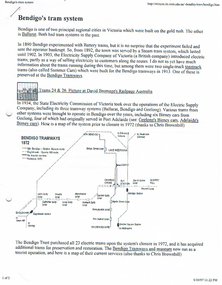
Document - LONG GULLY HISTORY GROUP COLLECTION: BENDIGO'S TRAM SYSTEM
... Load. (8 pages). Document LONG GULLY HISTORY GROUP COLLECTION: BENDIGO'S TRAM SYSTEM ...Information on trams. Includes small photo of Trams 24 & 26, Map of Bendigo Tram routes 1972and 1996, Ballarat No 26 tram, S 164 tram, and No 38 tram. Mentioned is the individual history and where they can be found, operating and non operating trams, different classes of trams. Geelong's Birney Cars, two of which came to Bendigo and the Type G (Birney Safety Cars). Other information includes Nos, First introduced, Last withdrawn, Electrics (motors), Size and Seating/Crush Load. (8 pages).bendigo, history, long gully history group, the long gully history group - bendigo's tram system, battery trams, steam trams, electricity supply company of victoria, toastrack trams, david bromage, bendigo tramways, state electricity commission of victoria, the bendigo trust, chris brownbill, bendigo talking tram, david hoadley, prahran and malvern tramways trust, hawthorn tramways trust, fitzroy northcote and preston tramways trust, melbourne brunswick and coburg tramways trust, north melbourne electric tramway and lighting co, sydney tramway museum, tramway museum of victoria, railpage australia, ballarat vintage tramway, andrew cox, russell jones, australian electric transport museum, birney cars, j g brill & co, bob hawke, adelaide municipal tramways trust, tim blythman, bill winn, john radcliffe -
 Moorabbin Air Museum
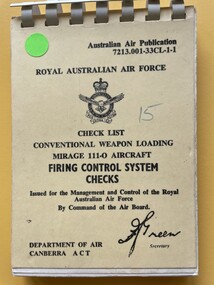
Manual (Item) - (SP) AAP 7213.001-33CL-1-1 Firing control system checks conventional weapon loading on Mirage 111-0 aircraft
... Manual (SP) AAP 7213.001-33CL-1-1 Firing control system checks conventional weapon loading on Mirage 111-0 aircraft ... -
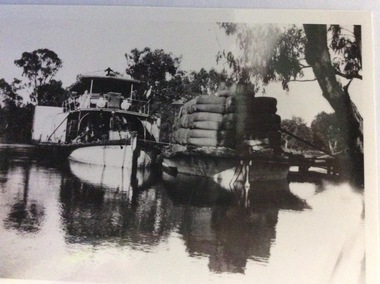 Port of Echuca
Photograph, Early 20th Century
... loads of wool which a barge could carry. The two vessels are tied together and appear to be moored at a small pier. The P.S Australien is one of the oldest paddle steamers built at Echuca. It was a working vessel during the construction of the Yarrawonga weir in the 1930s which was the beginning of the irrigation system which enabled the Agriculture Industry to become such a prominent part of the Murray-Darling River Basin social history. p.s australien yarrawonga weir echuca paddlesteamers murray river paddle steamers wilson, richard Wool industry A paddle steamer and a barge, loaded with wool, are seen docked together on a river. ...The P.S Australien was built in 1897 by Richard Wilson, of Moama. In 1937 the vessel was used to tow boilers, winches and derricks to the banks of the Murray River to aide in the construction of Locks 6,7,9 and Yarrawonga Weir. The barge is viewed from the rear, as the rudder can be seen, and shows the enormity of the loads of wool which a barge could carry. The two vessels are tied together and appear to be moored at a small pier.The P.S Australien is one of the oldest paddle steamers built at Echuca. It was a working vessel during the construction of the Yarrawonga weir in the 1930s which was the beginning of the irrigation system which enabled the Agriculture Industry to become such a prominent part of the Murray-Darling River Basin social history. A paddle steamer and a barge, loaded with wool, are seen docked together on a river. There is a small wooden jetty leading to the bank where gum trees are growing.p.s australien, yarrawonga weir, echuca paddlesteamers, murray river paddle steamers, wilson, richard, wool industry -
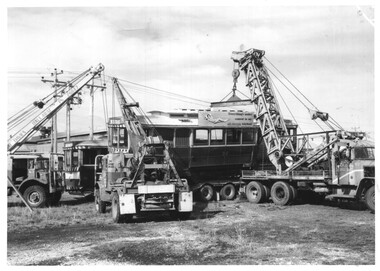 Ballarat Tramway Museum
Photograph - Tram 30 being loaded for Kaniva, The Courier Ballarat, 10/2/1972
... Photo shows three cranes loading the tram onto the truck at the SEC's Ballarat North yard where it had been stored. Yields information about tram 30 and its stay at Kaniva following the closure of the SEC operated Ballarat Tram system. tramcars Kaniva transporting trams disposal tram 30 Black and White photograph with The Courier Ballarat stamp on the rear. ...Photograph of former SECV tram 30 being loaded at Ballarat B Power station for Kaniva on 10/2/1972 - see item 2177 for the published photograph. Photo shows three cranes loading the tram onto the truck at the SEC's Ballarat North yard where it had been stored. Yields information about tram 30 and its stay at Kaniva following the closure of the SEC operated Ballarat Tram system.Black and White photograph with The Courier Ballarat stamp on the rear.tramcars, kaniva, transporting trams, disposal, tram 30 -
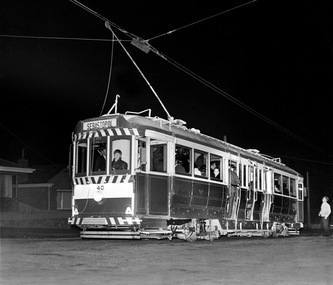 Ballarat Tramway Museum
Photograph - Digital Image, Greg Triplett, No 40 just arrived at Lydiard St Nth terminus, 19-9-1971
... Tram has a full load of passengers traveling for the last time. Taken on the last day of operation of the SEC Ballarat tramway system - 19-9-1971. ...Tram has a full load of passengers traveling for the last time. Taken on the last day of operation of the SEC Ballarat tramway system - 19-9-1971. ...Image of Ballarat No 40 just arrived at Lydiard St Nth terminus. Tram has a full load of passengers traveling for the last time. Taken on the last day of operation of the SEC Ballarat tramway system - 19-9-1971. Yields information about the last day of operation of the Ballarat SEC tramways.Digital image - 120 negative tramways, tramcars, ballarat, last day, closure, tram 40, lydiard st north -
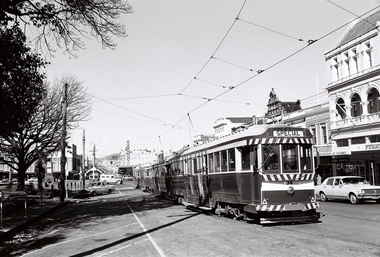 Ballarat Tramway Museum
Negative - SECV Ballarat operations the last day - set of 6, Robert Green, 19/9/1971
... Set of 6 photographs by Robert Green 19/9/1971, showing the tramcar operations of the SECV system on the last day of SECV Operations in Ballarat. 1 -Tram 34 et al at the City Parking Loop without a horde of people 2 -Tram 40 Arriving at the Sebastopol terminus 3 -Tram 40 at the terminus with driver 48 (M Cahill) and conductor 64 (R Courtney) stand alongside the tram - based on item 3626. 4 -Tram 42 in Skipton St with a large load of passengers 5 -Tram 42 ditto 6 -Trams 42, 40 Crossing at the Bell St loop ...Set of 6 photographs by Robert Green 19/9/1971, showing the tramcar operations of the SECV system on the last day of SECV Operations in Ballarat. 1 -Tram 34 et al at the City Parking Loop without a horde of people 2 -Tram 40 Arriving at the Sebastopol terminus 3 -Tram 40 at the terminus with driver 48 (M Cahill) and conductor 64 (R Courtney) stand alongside the tram - based on item 3626. 4 -Tram 42 in Skipton St with a large load of passengers 5 -Tram 42 ditto 6 -Trams 42, 40 Crossing at the Bell St loop Yields information about the SECV Ballarat tramways last day of operations on 19/9/1971. ...Set of 6 photographs by Robert Green 19/9/1971, showing the tramcar operations of the SECV system on the last day of SECV Operations in Ballarat. 1 -Tram 34 et al at the City Parking Loop without a horde of people 2 -Tram 40 Arriving at the Sebastopol terminus 3 -Tram 40 at the terminus with driver 48 (M Cahill) and conductor 64 (R Courtney) stand alongside the tram - based on item 3626. 4 -Tram 42 in Skipton St with a large load of passengers 5 -Tram 42 ditto 6 -Trams 42, 40 Crossing at the Bell St loop Yields information about the SECV Ballarat tramways last day of operations on 19/9/1971.35mm negative in a film strip - set of 6tramways, last day, closure, tram 42, sturt st, tram 34, lydiard st, city loop, sebastopol, tram 40, skipton st, bell st loop -
 Ballarat Tramway Museum
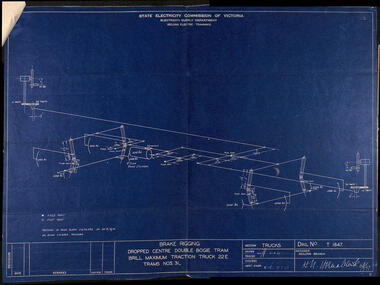
Drawing, State Electricity Commission of Victoria (SECV), "Brake rigging dropped centre double bogie tram Brill maximum traction truck 22E, Trams Nos. 31,", Aug. 1947
... Dated 4/8/1947, prepared by the SEC Geelong branch, signed by H N Hornabrook 6/8/47 showing the layout and loads on each part of the brake system, drawing No. T1647. ...Dated 4/8/1947, prepared by the SEC Geelong branch, signed by H N Hornabrook 6/8/47 showing the layout and loads on each part of the brake system, drawing No. T1647. See item 9025 and 9857 for other versions. ...Drawing details brake rigging and dimensions for a Brill 22E truck. Dated 4/8/1947, prepared by the SEC Geelong branch, signed by H N Hornabrook 6/8/47 showing the layout and loads on each part of the brake system, drawing No. T1647. See item 9025 and 9857 for other versions.Yields information about the brake rigging for Brill 22E trams and demonstrates the activities of the SEC Geelong office.Drawing - blueprint, titled "Brake rigging dropped centre double bogie tram Brill maximum traction truck 22E, Trams Nos. 31,""D1775" in ink on top sheet right hand corner.brill 22e, drawings, brake rigging, geelong -
 Ballarat Tramway Museum
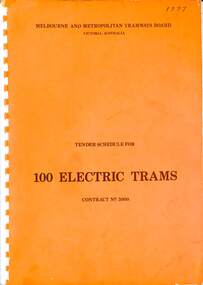
Document, Melbourne and Metropolitan Tramways Board (MMTB), "Tender Schedule for 100 Electric Trams Contract No. 3000", 1977
... The drawings give a map of the system, typical city route, Glenferrie Road route (grade diagram), concrete track construction, min. radius curves, loading gauge, all-electric tram and mounting details for the trolley base, schedule of prices, tender form, form of contract, and schedule of information to be provided by the tenderer. ...The drawings give a map of the system, typical city route, Glenferrie Road route (grade diagram), concrete track construction, min. radius curves, loading gauge, all-electric tram and mounting details for the trolley base, schedule of prices, tender form, form of contract, and schedule of information to be provided by the tenderer. ...Compiled and published by the Melbourne and Metropolitan Tramways Board, closing Monday 10 May 1977. Details the conditions of tender, conditions of contract, notes, specifications, gives background information about Melbourne, dimensions, performance, drivers and conductors, trucks, wheels, brakes, electrical equipment, control panels and drawings. The drawings give a map of the system, typical city route, Glenferrie Road route (grade diagram), concrete track construction, min. radius curves, loading gauge, all-electric tram and mounting details for the trolley base, schedule of prices, tender form, form of contract, and schedule of information to be provided by the tenderer. Includes an Alphabetical Index. Includes a drawing for a single-ended version of the tramcar. Became the Z3 class following the addition of a rear or 3rd door. Yields information about the 1977 tender for 100 electric tramcars that became the Melbourne Z3 class tram.Comb bound (white plastic) specification or tender document, approx 180 pages, with glossy card orange covers, titled "Tender Schedule for Electric Trams" and "Contract 3000". "1977" on front cover in ink.tramways, tramcars, z3 class, specification, tenders, mmtb, melbourne, single ended tramcars -
 Ballarat Tramway Museum
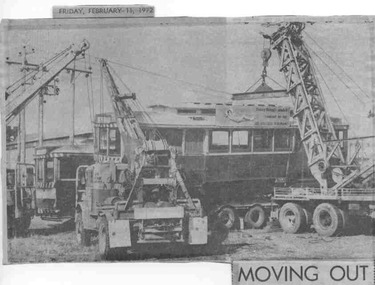
Newspaper, The Courier Ballarat, "Moving Out", 11/02/1972
... Yields information about tram 30 and its stay at Kaniva following the closure of the SEC operated Ballarat Tram system. Kaniva Loading Trams Transporting Trams Disposal tram 30 Newspaper clipping from The Courier, Ballarat, dated 11/2/1972. ...Clipping titled "Moving Out" about the loading of Ballarat Tram No. 30 to go to Kaniva. Acquired by the Kaniva Lions Club. Photo shows three cranes loading the tram onto the truck at the SEC's Ballarat North yard where it had been stored. Cutting date Secured to the top of the cutting with adhesive tape. One of large group of newspaper cuttings from John Bainbridge, 7/4/02. Item has been folded for inclusion within a scrapbook. Has a piece of plain paper Secured to the back of the portion that was not Secured to the scrap book itself. See item 10036 for the actual Courier photograph. See Reg Item 6615 for photographs at Kaniva.Yields information about tram 30 and its stay at Kaniva following the closure of the SEC operated Ballarat Tram system.Newspaper clipping from The Courier, Ballarat, dated 11/2/1972.kaniva, loading trams, transporting trams, disposal, tram 30 -
 Ballarat Tramway Museum
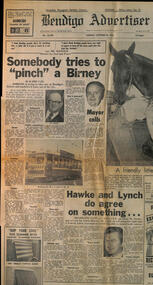
Newspaper, Bendigo Advertiser, "Somebody tries to "pinch" a Birney", 24/10/1972
... system. The Adelaide-based tramway museum (AETM) was allocated Birney No. 29 by the SEC and agreed to by the Minister for Fuel and Power Mr Balfour. When they tried to collect it, the loading...system. The Adelaide-based tramway museum (AETM) was allocated Birney No. 29 by the SEC and agreed to by the Minister for Fuel and Power Mr Balfour. When they tried to collect it, the loading ...Newspaper report on the issue of the disposal of former SEC Bendigo trams following the closure of the system. The Adelaide-based tramway museum (AETM) was allocated Birney No. 29 by the SEC and agreed to by the Minister for Fuel and Power Mr Balfour. When they tried to collect it, the loading was stopped, with the agreement of the City of Bendigo, quoting Mayor Cr J P Pearce. The newspaper gives the background to the issue of the retention by Bendigo of the former SEC fleet. Following this action, no other tramcars that had been allocated at the time left Bendigo. In 1975, the Government paid the Bendigo Trust to reconstruct a Birney that had been scrapped before the closure of the Bendigo system which was given to the AETM. See the AETM website for further details - tram 303. Story by Barry Cail. See item 8779 for the Herald Sun report of the same date. On the bottom left-hand corner of page 2, (see second image) is an item titled "Question on Tourist Trams", outlining several questions that Mr Floyd (Labour, Williamstown) will ask the Minister of Transport Mr Wilcox about the operation of Tourist trams, safety and insurance, and whether tourist trams will run in Ballarat.Yields information about the Bendigo system following closure and the retention of tramcars.Newspaper - page 1 of The Bendigo Advertiser 24/10/1972 - newsprintbendigo, tramcars, aetm, birney tramcars, tram 29, tram 303, adelaide, tramcar disposals, ballarat, tourist trams, safety -
 Ballarat Tramway Museum
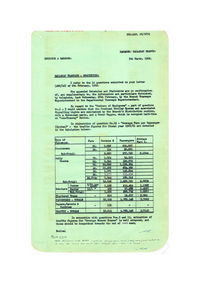
Document - Report, State Electricity Commission of Victoria (SECV), "Ballarat Tramways - Statistics", Mar. 1962
... Yields detailed information about the statistics of the Ballarat Tramway system during the 1960/61 Financial year, passenger loadings, finances and tramcar operation. ...Yields detailed information about the statistics of the Ballarat Tramway system during the 1960/61 Financial year, passenger loadings, finances and tramcar operation..1 - Report titled "Ballarat Tramways - Statistics", carbon copy, dated 5/3/1962, responding to a head office letter of 6/3/1962. Compiled in association with Schedules and Statements required, in response to specific questions for compilation of reports by the SEC. Details types of passengers (Pensions, Adults, Scholars, chartered trams, passenger totals including parcels) for 1960/61. .2 - Four foolscap sheets giving details of fares and charges, route length, services, fare sections, length of fare sections, employees, trams in service, tram usage, area and population served, expenditure, revenue, loss, average fare per passenger and extra trams needed for events. Also refers to Reg Item 7932 and 7951 for the original request. All sheets have rounded corners.trams, tramways, reports, passengers, employees, fares, tramcars, routes, revenue, finances, tickets -
 Ballarat Tramway Museum
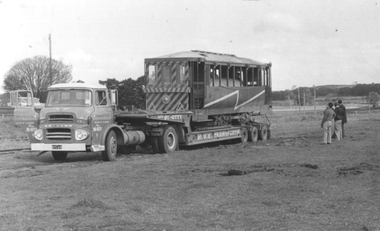
Photograph - Ballarat Scrubber arrives at Bylands, 21/9/1971
... loading of the tram. Yields information about the transport of the Ballarat Scrubber tram to Bylands following closure of the SEC Operated tram system. ...Photograph shows the Ballarat scrubber tram on an MVC transport low loader after arriving at TMSV Bylands site on 21/9/1971. Not known who took the photo. See item 3776 for a photo of the loading of the tram.Yields information about the transport of the Ballarat Scrubber tram to Bylands following closure of the SEC Operated tram system.Black and white photograph on plain papertramcars, trams, scrubber, bylands, tmsv, transporting trams -
 Ballarat Tramway Museum
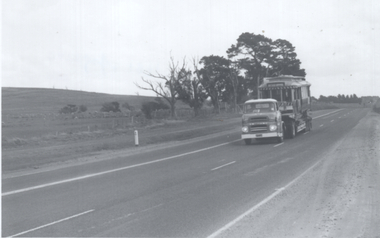
Photograph - Ballarat tram 17 on a low loader, A G Culpeffer Cooke, 20/9/1971
... Black and white photograph of tram 17 on a low loader being transported to the TMSV site at Bylands on 20/9/1971, following the closure of the SEC System. ...Black and white photograph of tram 17 on a low loader being transported to the TMSV site at Bylands on 20/9/1971, following the closure of the SEC System. ...Black and white photograph of tram 17 on a low loader being transported to the TMSV site at Bylands on 20/9/1971, following the closure of the SEC System. A similar photograph appears in the Oct. 1971 issue of the TMSV Running Journal.Yields information about the move of Ballarat 17 to Bylands in Sept. 1971.Black and white photograph with photographers details on the rearStamp on the rear "WELT Collection, A G Culpeffer Cooke Victoria Australia, Ref... Date Sep 1971"trams, tramways, tram 17, tmsv, transporting trams, ballarat tramway
