
Showing 44 items matching "magazine stand"
-
 Flagstaff Hill Maritime Museum and Village
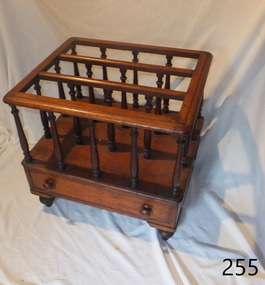
Functional object - Music stand, Early 19th Century before 1860
... ...magazine stand...Thomas Sheraton (1751-1806) appears to have been the first to record the written term “Canterbury” music or magazine stand. In his Cabinet Dictionary of 1803 he refers to “a small music stand” with divisions for holding loose sheet or bound volumes of music. ...Thomas Sheraton (1751-1806) appears to have been the first to record the written term “Canterbury” music or magazine stand. In his Cabinet Dictionary of 1803 he refers to “a small music stand” with divisions for holding loose sheet or bound volumes of music. ...Thomas Sheraton (1751-1806) appears to have been the first to record the written term “Canterbury” music or magazine stand. In his Cabinet Dictionary of 1803 he refers to “a small music stand” with divisions for holding loose sheet or bound volumes of music. The music stand designed to hold sheet music came into fashion in the late 18th Century in England and was often crafted from mahogany, rosewood or walnut. They were seen as status symbols since music was practiced exclusively by the upper classes of society. In a period when printed music was more widely available and disseminated due to more affordable printing techniques, modern sheet music was very popular and therefore storage for such favoured tunes became a luxury and an opportunity for innovative design by cabinet makers. The Classical period of music, from about 1750 to 1820 and the Romantic Period from around 1815-1910 was the golden age of classical music. And it was at this time that The Canterbury often accompanied the piano in the parlour with styles ranging from Georgian simplicity to Victorian exuberance. Social activities of colonial Victoria would have included evening gatherings of family and friends around the piano to enjoy performances or sing along together with from old and up-to-date music sheets. The Canterbury would also be an elegant and practical place to also store newspapers, magazines, posters and drawings from overseas. The news from ‘home’ would be enjoyed by all. THE INSCRIPTION “Jack Morse” Morse. In 2010 Mr Jack Morse was recognised as one of the “people who have contributed to the long term development of Flagstaff Hill Maritime Village”. He was a member of the Flagstaff hill Planning board and a Current Life Member and had been awarded a Certificate of Service and the provision of an Annual Family Membership for life by Flagstaff Hill. The Morse’s family business, Morse’s Engineering, closed in 2010. It was considered “One of Warrnambool’s longest operating businesses with roots dating to 1883 with the design and manufacture of coaches and buggies, progressing to automotive repairs and later specialising in under-vehicle work” The Canterbury appears to have been handmade prior to 1860 as the dovetails are handmade and there are no saw marks on the drawer sides or back as well the sides. Also the back has small nicks indicating a hand plane or drawer knife was used rather than a saw blade to size the material. Additional indications are that the spindles are slightly different in size meaning they were handmade individually not mass produced. From these indicators the writer believes that the item was made before 1860 as machinery was only used after this date to produce furniture. As yet no individual maker can be attributed to this item, however it is a significant piece historically and is quite valuable if a known maker can be associated with the Canterbury. The item highlights a time in our social history when music played an everyday part in people’s lives as the only entertainment families could enjoy together in their own homes. A Canterbury music stand, having three compartments consisting of twenty turned spindles supporting the slat dividers. A drawer, with two turned wooden handles, is fitted below. The music stand has turnip style turned feet. The drawer front and carcass of the stand are veneered rosewood over a mahogany carcass. The underlined words "Jack Morse" are handwritten underneath the drawer bottom.Hand written inscription on underneath the drawer bottom "Jack Morse".flagstaff hill, warrnambool, shipwrecked-coast, flagstaff-hill, flagstaff-hill-maritime-museum, maritime-museum, shipwreck-coast, flagstaff-hill-maritime-village, canterbury, music rack, magazine rack, music stand, magazine stand, 19th century furniture, occasional furniture, frederick cornwallis, jack morse, morse’s undercar, music, thomas sheraton, regency furniture, music canterbury -
 Clunes Museum
Domestic object - CANE STAND
... CANE STAND, TWO SHELVES, TOP SHELF HAS RACK FOR MAGAZINES TO STAND UP IN...CAME FROM LAURA HUDSONS HOUSE BOOKSTAND LAURA HUDSON NIL CANE STAND, TWO SHELVES, TOP SHELF HAS RACK FOR MAGAZINES TO STAND UP IN Domestic object CANE STAND ...CAME FROM LAURA HUDSONS HOUSECANE STAND, TWO SHELVES, TOP SHELF HAS RACK FOR MAGAZINES TO STAND UP INNILbookstand, laura hudson -
 Melbourne Tram Museum
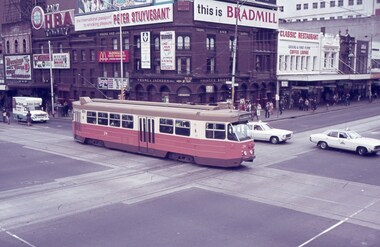
Slide - Set of 2, Keith Caldwell, 1/11/1978 12:00:00 AM
... Also in the photo is a policeman on point duty, cars doing a hook turn and a large paper / magazine stand on the wall of Young and Jacksons....Also in the photo is a policeman on point duty, cars doing a hook turn and a large paper / magazine stand on the wall of Young and Jacksons. ...Set of 2 Agfa colour slide, blue and white plastic mount, photo by Keith Caldwell 1/11/1978 of : .1 - Z24 in Flinders St, crossing Swanston St. The tram is bound for Burwood Middleborough Road, route 75. Note the two taxis doing hook turns. .2 - Z65, Route 74, Burwood and W2 629? route 48, North Balwyn. In the background is the Young and Jacksons Princes Bridge Hotel, Portmans, Classic Restaurant Coffee Lounge, and many advertisements including HBA, Peter Stuyvesant, McDonalds, Bradmill, Tattslotto, and Mocopan Coffee. Also in the photo is a policeman on point duty, cars doing a hook turn and a large paper / magazine stand on the wall of Young and Jacksons..1 - has "1-11-78" written in red ink.trams, tramways, flinders st, swanston st, z class, route 48, route 74, burwood, tram 24, tram 65, tram 629? -
 Musculoskeletal Health Australia (now held by the Glen Eira Historical Society)
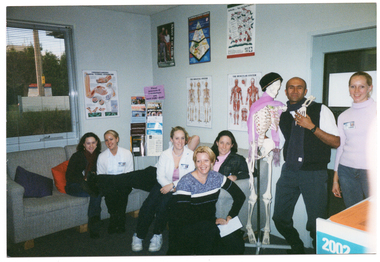
Photograph - Group photo, 2002
... In the corner, there is a display stand with magazines and information sheets on it. ...In the corner, there is a display stand with magazines and information sheets on it. ...In 2002, a group of nursing students from Holmesglen TAFE visited the Resource Centre at the Arthritis Foundation of Victoria. In this photo, the group is depicted posing for a photo with AFV's mascot, Bridget Bones, (a plastic skeleton). A slightly cropped version of this photo appears on page 2 of the Vol 15 Issue 3, Spring 2002 edition of the Arthritis Foundation of Victoria's quarterly magazine, Update. It is captioned: "TAFE Nurses Course at the Resource Centre."COL photo of a group of people posing for a photo with a plastic skeleton on a stand. Some people are seated on two grey sofas, while two others are standing near the skeleton. On the walls are several posters, with headings such as 'Understanding carpel tunnel syndrome', 'The skeletal system', and 'The muscular system'. In the corner, there is a display stand with magazines and information sheets on it. Attached to the display stand is a sign which says "These journals and newsletters are NOT FOR LOAN".arthritis foundation of victoria, afv, resource centre, holmesglen tafe, nurses, study visit, students, skeleton, bridget bones, update, 2002 -
 Musculoskeletal Health Australia (now held by the Glen Eira Historical Society)
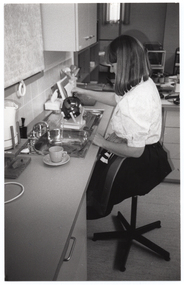
Photograph - Solo photo, Circa November 1989
... The photo in the magazine is captioned: " 'Sit-Stand Chair' in use at a pull-out workbench. ...The photo in the magazine is captioned: " 'Sit-Stand Chair' in use at a pull-out workbench. ...Through its quarterly newsletters, the Arthritis Foundation of Victoria (AFV), formerly the Rheumatism and Arthritis Association of Victoria (RAAV), was able to inform its members about the latest arthritis-friendly kitchen appliances and aids, and how to use them. In this photo, a woman demonstrates how to use a kettle pourer. She is sitting on a swivel chair on castors, at the kitchen sink. A similar photo appears in the Vol 3 No 1, Autumn 1990 issue of the Arthritis Foundation of Victoria's quarterly magazine, Arthritis Update. The photo in the magazine is captioned: " 'Sit-Stand Chair' in use at a pull-out workbench. It's [sic] adjustable height makes it a useful piece of household equipment." In the published photo, the woman is depicted sitting on the sit-stand chair, about to cut an apple on a small chopping board. The photo accompanies an article titled, 'Living with Arthritis', with the subtitle 'Independent Living Centre', 'A service of the Yooralla Society of Victoria'. According to an earlier article appearing on page 3 of the No 33, August 1984 edition of RAAV's quarterly newsletter, News Review, the Independent Living Centre was the venue for the launch of Arthritis Week in May 1984.B&W photo of a woman sitting on a swivel chair on castors, at a kitchen sink. She is pouring water from a kettle into the sink. The kettle is sitting on a device which enables her to pour from the kettle without having to lift it. The sink is recessed into an L-shaped kitchen bench, upon which a cup and saucer can be seen sitting near the edge of the sink. There are several miscellaneous kitchen appliances on the bench. There are cupboards and drawers beneath the bench, and one set of cupboards above the sink.[On a yellow sticky note, in blue ink] November - December, 1989 Independent Living Centre?arthritis foundation of victoria, afv, rheumatism and arthritis association of victoria, raav, independent living centre, demonstration kitchen, arthritic aids, kitchen aids, kitchen gadgets, kitchen appliances, kitchen sink, kettle pourer, tea, coffee, hot drinks, swivel chair, sit-stand chair, pull-out workbench, retractable bench top, sliding bench top, adaptive kitchens, accessible kitchens, disability-friendly kitchens, modified kitchens, yooralla society of victoria, living with arthritis, pain management, 1989, arthritis update, 1990, news review, 1984 -
 Bendigo Historical Society Inc.
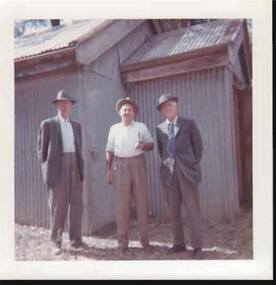
Photograph - MAGAZINE - BETWEEN BOTANICAL GARDENS AND SIMPSON'S ROAD
... Eaglehawk's first golf course is said to be in this area. Magazine keepers house still stands next to McLelland ( water bailiff )...Eaglehawk's first golf course is said to be in this area. Magazine keepers house still stands next to McLelland ( water bailiff ) Photograph MAGAZINE - BETWEEN BOTANICAL GARDENS AND SIMPSON'S ROAD ...Photo: Note on back of photo states Öutside the Magazine '- coloured photo of three men standing in front of corrugated iron shed. Description attached reads' all the explosives for the mines in this area were stored here. A formed track runs to the door with earthworks all around to guard against blast. A trolley ran from each building on a wooden track. Wheels were copper. Two buildings formed the magazine, one in front of the other. This was to store caps and other explosives. Inside the magazine are numerous racks. Externally buildings were provided with copper lighting arrestors, later removed by vandals. Still to be seen are tracks in asphalt where woollen ( wooden ? ) rails ran. A good metal road ran right to magazine ( gravel) In front of the magazine building is botanical gardens area ( between it and Simpsons Road ). A cricket pitch also in the area more to the rear of Fitzpatrick's Hotel. Eaglehawk's first golf course is said to be in this area. Magazine keepers house still stands next to McLelland ( water bailiff )eaglehawk, powder magazine, eaglehawk, powder magazine, magazine, simpsons road, botanical gardens. -
 City of Melbourne Libraries
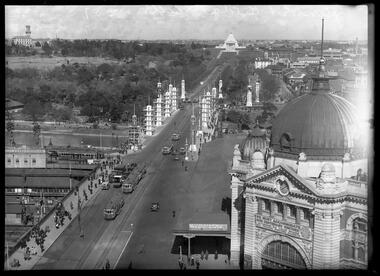
Photograph, Bull, Hugh Jones, 1897-1993, Princes Bridge Centenary pylons under construction
... There is a square newspaper/magazine stand on the eastern side footpath. And also a “Ferry” sign. ...There is a square newspaper/magazine stand on the eastern side footpath. And also a “Ferry” sign. ...Princes Bridge Centenary pylons under construction Possibly taken from Young and Jacksons Hotel (formerly Princes Bridge Hotel) on the corner of Flinders and Swanston streets, Flinders Street Station’s clocks and main entrance dominate, along with its distinctive copper dome and decorative façade. The time on the main clock is 1.40pm, and the sign underneath, reflecting Melbourne’s upcoming Centenary reads, “We must accommodate our Centenary visitors! Citizens! Do your share by taking paying guests.” At left is the original Princes Bridge Station, today the site of Federation Square. The riverside tram terminus advertises a Café/Tobacconist/Refreshment Room selling cigars & cigarettes, fountain drinks & confectionery, and in smaller text: “Leave your boot repairs here”. Nearly everyone is dressed in dark suits, coats and hats. The footpaths are wide and there are no traffic lights. The roadway stretches towards the Shrine of Remembrance, not yet dedicated but very dominant on the skyline. Government House is clearly visible across the wide parkland that would come to be known as Kings Domain and that is an area of deep importance to the people of the Eastern Kulin. Originally, Birrarung was part of a network of swamps and lagoons linked to the course of the river. From 1896, Public Works Department engineer Carlo Catani, oversaw a new channel to straighten the river and the swamps and lagoons were filled with spoil from the channel works. From the same vantage point today, only the top of the tower of Government House would be visible. The photo captures the pylons along Princes Bridge, mid-construction and being installed to mark Melbourne’s Centenary. The pylons were not without controversy. Both The Argus and The Age bemoaned them for being “made almost entirely of imported softwood timber”, denying work to native hardwood timber workers and sawmillers, and leading visitors to think Australia did not have its own exceptional native hardwoods. The pylons were also variously described in their incomplete state, as unimaginative and resembling an oilfield. Published: The Age 5 September 1934 Featured in "Newsworthy: Melbourne in photographs 1933-1936" exhibition at East Melbourne Library, October to December 2023. Exhibition caption by project volunteer, Louise McKenzie Photographer notations on slide: "Pylons + St Kilda Rd C57" Published: Age (Melbourne, Vic. : 1854 - 1954), Wednesday 5 September 1934, page 11 Published title: DECORATIONS -- THEN AND NOW. Published caption: "Although not completed yet, some impression of the effect of the decorations on Princes-bridge may be obtained from the first picture which shows the majestic sweep of St Kilda road with the Shrine of Remembrance and Government House dominating the horizon. The area to the left of St. Kilda-road and in front of Government House is portion of the area which it is proposed to call the King's Domain, which extends to Domain-road and Anderson-street..." Description: East-facing, elevated view of Flinders Street Station and Princes Bridge, featuring partially completed pylons erected for Melbourne's Centenary celebrations. The Shrine of Remembrance and Government House can be seen in the distance. In the foreground are trams, cars and trucks, pedestrians, Batman Avenue tram terminus and refreshment rooms. Signage on Flinders Street Station encourages citizens to accommodate Centenary visitors. The Melbourne Centenary was held 1934-35 in celebration John Batman's proclamation that Melbourne "the place for a village". Centenary events included a visit by Prince Henry, Duke of Gloucester. A Centenary Cake measuring 50 feet in height and ten tons in weight was cut into 250,000 pieces and sold at 1 shilling per piece for charity. Spectacular floodlighting of city landmarks, the creation of the Pioneer Women's Memorial Garden, and the MacRobertson Air Race from London, were other notable activities. Research by project volunteer, Louise McKenzie: The photo in The Age collage of 5 September 1934 has a slightly cropped foreground. The original photo has been taken from an elevated vantage point, most probably the roof of the Nicholas Building on the corner of Flinders and Swanston streets. The right foreground is dominated by the main “clocks” entrance to Flinders Street Station, showing its distinctive copper dome and decorative façade. The time on the main clock is 1.40 pm. The main sign on the front of the Station reads, "We Must Accommodate our Centenary Visitors! Citizens! Do your share by taking paying guests. Write to The Official Centenary Accommodation Bureau, 436 Collins St. City. Tel M 4671”. Another sign at eye level at the main entrance says: “Cheap Trips on Sundays”. The sign on the end of the roof along the eastern side of the station reads, “The Babies Need Your Help! Support Broadmeadows Foundling Hospital Appeal. July and August”. Run by the Sisters of St Joseph of the Sacred Heart, St Joseph’s Foundling Hospital was a purpose built infants’ home for up to 300 babies, plus accommodation for expectant mothers, mainly single women. In the early 1930s, the department (Victorian Children’s Welfare Department) contracted St Joseph’s Foundling Hospital to care for an additional 60 infant state wards, and up to 175 non wards at any given time. In 1931 it also operated a mothercraft training school. The centre foreground shows the commencement of Princes Bridge. Beneath the left side of the bridge was the site of the original Princes Bridge Station, by this time incorporated into Flinders Street Station, and today the area is the site of Federation Square. It was linked to Flinders Street station by the railway tracks that ran underneath the northern approach to the bridge. This photo shows a tram terminus which has a Café/Tobacconist/Refreshment Room, selling cigars & cigarettes, fountain drinks & confectionary, and a sign: Leave your boot repairs here. In the foreground is a wide roadway running south/north, comprising two vehicle lanes each heading north/south, and a central section containing two sets of tram tracks. There are cars, buses and delivery vans on the roadway. The trams visible are Glen Iris (Route No. 6; tram no. 448), Toorak (Route No. 8, tram no. 333), ? (No. 7), ? (No. 1), and ? (No. 2A). The footpaths are extremely wide. There is a square newspaper/magazine stand on the eastern side footpath. And also a “Ferry” sign. There are no traffic lights, but a policeman is visible on the roadway. There are pedestrians – men, women, children, a porter with trolley, women with prams. Clothing comprises dark suits, coats and hats for nearly everyone. There are double headed “Collins Street” lights along the side of the roadway, and along the northern riverbank. The roadway in the foreground is an extension of Swanston Street, which becomes Princes Bridge, then St Kilda Road, stretching towards the Shrine of Remembrance, and diverting past it. The Shrine had not yet been officially dedicated, and looks very white and dominant on the skyline. On the LHS of St Kilda Road, Government House is clearly visible across the wide parkland to be known as Kings Domain. The Kings Domain area is important to the people of the Eastern Kulin nation, and also has historical importance for its association with the early settlement of Melbourne and the foundation of British colonial administration in Victoria. On the southern side of the Yarra River (Birrarung) an historic rowing boathouse is visible, located adjacent to the Alexandra Gardens. Originally Birrarung was part of a network of swamps and lagoons linked to the course of the river. From 1896, under the guidance of engineer Carlo Catani* a new channel to straighten the river was created and the swamps and lagoons were filled with spoil from the channel works. The gardens were then created and completed in time for a Royal visit by the Duke of York in May 1901. The gardens are named after Alexandra of Denmark, the wife of King Edward VII. Both these areas, plus the Royal Botanic Gardens Victoria, Shrine of Remembrance Reserve, Sidney Myer Music Bowl, Government House, and the Queen Victoria Gardens together form the Domain Parklands. The extent of the subsequent plantings is evident today, where from the same vantage point only the top of the tower of Government House would be visible. *Catani was born in Florence in 1852, but after arriving in Melbourne worked as a civil engineer for the Victorian Government. His last major project was the reclamation of the foreshore of St Kilda, envisaged in the style of a European resort, complete with a split level esplanade, bathing pavilions, dance halls, amusements and a French-Italian style of landscape complete with palms. The gardens at the end of Fitzroy Street, St Kilda, now bear his name. The historic boathouse visible across the Yarra is another glimpse into Melbourne’s past. “Boathouse Row” comprises 7 amateur rowing clubs, the first established in 1859 (Melbourne University Boat Club). Other Clubs were Richmond, Melbourne, Banks, Melbourne Grammar School, Yarra Yarra and Mercantile. South of the river and west of the bridge is an area today developed into the Melbourne arts precinct of Hamer Hall and the Arts Centre. But at this time it was the home of Wirths Olympia Circus, which comprised Wirths Pleasure Park (an amusement park), a 5,000 seat auditorium – Hippodrome, a roller skating rink, a glaciarium, a cinema, and the Green Mill Dance Hall. Dog shows were also held at Olympia. The Green Mill Dance Hall closed in 1950, and the remainder of the Wirth buildings on site were destroyed by fire in December 1953. The feature of the photo is the pylons erected along Princes Bridge to mark Melbourne’s Centenary in 1934. The sixteen plastered pylons were designed by Roy Prentice, the second person to qualify as an architect at The University of Melbourne’s Bachelor of Architecture degree, in 1933, aged 27. Simon Reeves in his article marking the 100th birthday of Roy Prentice on 20 June 2006 reports that the State Electricity Commission sponsored this work, and the Argus reported that “… the pylons were “illuminated from within to give the effect of soft radiance”. Australia Home Beautiful 1 Oct 1934 reports in a very detailed and comprehensive article: The 10 taller pylons, including flagpole, were 48 ft, with a base of 8 ft. Timber-framed and faced with fibrous plaster and galvanised sheet iron, each structure was securely bolted to a concrete foundation three feet in depth. Panels of glass let into the shaft of each pylon were indirectly lit by 40, 100 watt lamps, and the upper bank of internal lamps were dyed so as to flood the panels with a deep red light. The decorative painted shields and flagpoles/pennants were illuminated by three 200 watt projectors concealed in the roof of each pylon, and were part of an electric night light decoration scheme involving 28 miles of wire to supply more than 20,000 lights. An article in the Argus on 18 October 1934 provided minute detail of the lighting erected in Melbourne for the Centenary, converting it “… into a coloured fairyland by night.” The estimated cost of 10 pounds per hour the lights were on. The display included 800 standard light poles 30 feet high which were tiered with electric bulbs concealed in inverted cones, 138 specially designed “Venetian poles” draped in flags trophies and streamers. The streets included in the electric night light decoration scheme were Bourke Street from Spring to William, the entire length of Collins Street, Flinders Street from Elizabeth to Spring, Lonsdale Street from Elizabeth to Swanston, Swanston and Elizabeth Streets from Flinders to Lonsdale, and parts of Springs and Spencer Streets. Together with the Princes Bridge pylons, approximately 28 miles of wire was required to supply power to the more than 20,000 lights. And that is just in the city of Melbourne. It was estimated the same amount of lighting was duplicated among other local councils. The pylons were not without controversy. The Argus on 28 August 1934 in an article headed “Imported Timber in Pylons” reported that the Princes Bridge pylons are “made almost entirely of imported softwood timber”, and have therefore denied work to native hardwood timber workers and sawmillers. The same day the Melbourne Age ran a similar story, bemoaning the fact that foreign oregon had been used which may lead tourists to think Australia did not have its own exceptional native hardwoods. A Camberwell City Councillor described the pylons as unimaginative, and the Herald reported that skeletons of pylons for the Centenary decorations in their present form led the area to resemble an oilfield! The Yarra River and Princes Bridge have long been a focal point of Melbourne life. In the early days of European settlement in Melbourne a rope-hauled punt carried people across the Yarra River. A surge in population and increased shipping traffic created a need for a bridge. There was difficulty in agreeing on a suitable site for the bridge (options were crossing at Elizabeth, Swanston, Queen or Market Streets), but the NSW Government favoured Swanston Street and the Melbourne Town Council decided on a temporary bridge across the Yarra spanning from the foot of Swanston Street. This first bridge was a single span timber toll bridge designed by Scottish born bridge designer David Lennox, and completed in 1845. It was 120 feet long, had a roadway of 17 feet wide, and a footpath on one side of 4 feet. It was leased to the Melbourne Bridge Company in the name of Robert A Balbirnie. The tollhouse was on the north side of the river and the toll keeper, Patrick Doherty, was credited with saving nine lives during the four years he was in charge of the toll station. The second bridge was stone (completed 1850), and named Prince’s Bridge after the HRH Prince of Wales, later Edward VII. It was designed with an elliptical single arc and an exceedingly small rise in proportion to the span. However, this design created an obstacle for flood waters, and together with Melbourne’s increasing population it was quickly apparent that a new bridge was required. At its opening on 15 November 1850 coincided with the imminent declaration of Victoria as a separate colony, it provided a moment of great celebration for Melbournians and “The opening ceremony was described as the grandest processional display witnessed in the colony.” (ToMelbourne.com.au) Princes Bridge in its present form, as depicted in this photograph, was designed by Jenkins, D’Ebro and Grainger, and constructed in 1886-88 by David Munro. John Grainger (father of Australian composer Percy Grainger) did the majority of the design work for the bridge. The structure was to have three arches each 96 feet wide measured across the river, and the banks on both sides were raised to allow more space for floodwater to flow. St Kilda Road was originally many feet below the current level. The bridge is of architectural significance for its substantial size, giant half columns, extensive use of wrought and cast iron, decorative elements (cast-iron lamps) and the skilled stonemasonry in the construction of the abutments and piers. Its main design features are similar to those of Blackfriars Bridge in London (1870). The bluestones were quarried from Footscray, the Malmsbury stones were from quarries at Kyneton, and the granite from Harcourt. The cost was met by the State of Victoria, City of Melbourne, and six out of seven of its municipalities, and their coats of arms feature on the bridge. The building of the bridge reflected the boom period of Melbourne, including the Victorian gold rush 1851- late 1860s, and its contractor, David Munro, was also responsible for the construction of Queens Bridge and Sandridge Railway Bridge. The Centenary pylons are no longer in place, but today this intersection still plays a major part in Melbourne’s daily life: people still meet “under the clocks” at Flinders Street station, and the route in and out of the city along St Kilda Road is often a feature of parades such as Moomba, the Grand Final Parade, and of course the Anzac Day Parade which commences at the Princes Bridge intersection and finishes at the Shrine of Remembrance. There are many tram routes, which cross the Bridge, and it directs pedestrians towards the Arts Precinct, the various components of Domain Park, plus the Southbank restaurant and rowing precincts. Even though this is a street scene, it feels very intimate; the viewer is instantly immersed in the activity of a Melbourne afternoon, looking down St Kilda Road from a viewpoint near today’s Federation Square. References: DECORATIONS -- THEN AND NOW. (1934, September 5). The Age (Melbourne, Vic. : 1854 - 1954), p. 11. Retrieved September 21, 2023, from http://nla.gov.au/nla.news-article205880269 'Flinders Street railway station', Wikipedia, https://en.wikipedia.org/wiki/Flinders_Street_railway_station 'St Joseph’s Foundling Hospital (1901-75)', Finding Records, Department of Health and Human Services, State of Victoria, https://www.findingrecords.dhhs.vic.gov.au/collectionresultspage/St-JosephsFoundling-Hospital-Babies-Home#departmental-administration 'Alexandra Gardens', City of Melbourne, https://www.melbourne.vic.gov.au/community/parks-open-spaces/major-parks-gardens/Pages/alexandra-gardens.aspx 'Wirths Circus', Wikipedia, https://en.wikipedia.org/wiki/Wirth's_Circus 'Roy Prentice: Centenary Architect', Built Heritage Pty Ltd, Simon Reeves, https://www.builtheritage.com.au/downloads/prentice.pdf 'Princes Bridge', Heritage Council Victoria, https://vhd.heritagecouncil.vic.gov.au/places/817 PORT PHILLIP. (1846, April 1). The Sydney Morning Herald (NSW : 1842 - 1954), p. 3. Retrieved September 21, 2023, from http://nla.gov.au/nla.news-article12886251 'Edward VII', Wikipedia, https://en.wikipedia.org/wiki/Edward_VII 'Princes Bridge', ToMelbourne.com, https://tomelbourne.com.au/princes-bridge/ 'Princes Bridge', eMelbourne, https://www.emelbourne.net.au/biogs/EM01189b.htm 'Princes Bridge', Australia for everyone, http://australiaforeveryone.com.au/files/melbourne/princes-bridge.html 'Victorian gold rush', Wikipedia, https://en.wikipedia.org/wiki/Victorian_gold_rush IMPORTED TIMBER IN PYLONS (1934, August 28). The Argus (Melbourne, Vic. : 1848 - 1957), p. 9. Retrieved September 21, 2023, from http://nla.gov.au/nla.news-article10952507 Princes-Bridge Pylons. (1934, August 28). The Age (Melbourne, Vic. : 1854 - 1954), p. 7. Retrieved September 21, 2023, from http://nla.gov.au/nla.news-article205532235 Pylons Appear Near Princes Bridge (1934, August 18). The Herald (Melbourne, Vic. : 1861 - 1954), p. 1. Retrieved September 21, 2023, from http://nla.gov.au/nla.news-article243104375 PRINCES-BRIDGE PYLONS. (1934, September 20). The Age (Melbourne, Vic. : 1854 - 1954), p. 10. Retrieved September 21, 2023, from http://nla.gov.au/nla.news-article205873535 28 Miles of Wire (1934, October 18). The Argus (Melbourne, Vic. : 1848 - 1957), p. 1 (The Junior Argus). Retrieved September 21, 2023, from http://nla.gov.au/nla.news-article10977836 'Historical references for Boathouse Row, Melbourne', http://boathouserowmelbourne.com.au/history/ 'ITALIAN DELEGATION TO HONOUR CARLO CATANI, DESIGNER OF THE ST KILDA FORESHORE, St Kilda Historical Society, 2001, https://web.archive.org/web/20070928061938/http://www.skhs.org.au/~SKHSarticles/articles/Carlo_Catani.html# HISTORY IN LIGHTS (1934, July 12). The Herald (Melbourne, Vic. : 1861 - 1954), p. 16. Retrieved September 21, 2023, from http://nla.gov.au/nla.news-article243172436 'Dressing Melbourne for the Duke', The Australian home beautiful: a journal for the home builder. Vol 12 No. 10 (1 October 1934), page 21, 58. Retrieved September 14, 2023, from http://nla.gov.au/nla.obj-2950922209Photographer notations on slide: "Pylons + St Kilda Rd C57".centenaries, bridges, lighting, flinders street railway station -
 Federation University Historical Collection
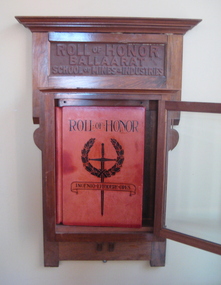
Book - Honour Board (hanging bookcase), Ballarat School of Mines Honor Book and Bookcase, c1920
... The 1920 SMb Students' Magazine said' 'Many students left Australia with the first Contingent, and since then, the School has been represented on every field where Australians have fought, from the first landing at Gallipoli to the decisive victory on the 8 August 1918.' The influence of the school was appropriately shown in the fact that at least 13 of its students were officers in the Australian Mining Corps. The title page has the initials 'D.J.' which most probably stands...The 1920 SMb Students' Magazine said' 'Many students left Australia with the first Contingent, and since then, the School has been represented on every field where Australians have fought, from the first landing at Gallipoli to the decisive victory on the 8 August 1918.' The influence of the school was appropriately shown in the fact that at least 13 of its students were officers in the Australian Mining Corps. The title page has the initials 'D.J.' which most probably stands ...The Ballarat Technical Art School made many honour boards for schools and organisation in Victoria and interstate. Their own was made, but the names were not listed. The Ballarat School of Mines Annual Report for 1921 states: 'It has been decided, for the present, to record the names of our students who served in the warm, in an Honor Book, and to defer the erection of an Honor Board until we can feel assured that the Roll is complete. the wide spread occupations of our students has rendered it very difficult for us to secure detailed information of their service. A handsome Honor Book and Case has been designed and executed by the staff and students of the Technical Art School, and the engrossing of the names and military records will be proceeded with as soon as possible. The Technical Art School was quite busy with commissions. The SMB Annual Report of 1918 states: 'under the direction of the Art principal (Mr H.H. Smith), the work of the Art School continues to receive wide public recognition. Handsome Honor Boars have been designed and executed for the Sydney Sports' Club, the St Arnaud High School, the Birregurra State School, the Wendouree State School and the Ballarat Old Colonists' Club. The School also designed the certificates for the Young Workers' Patriotic Guild, the 'Herald" Shield for perpetual competition at the technical Schools' athletic meetings, the "Hansen" Shield for competition among the Northern District High Schools, two metal tablets for the Castlemaine high School, and a certificate for the Grampians Secondary Schools' Association. Numerous Honor Books and Mural cases have also been designed for State Schools.' Over 400 former students and staff of the Ballarat School of Mines served during World War One. The 1920 SMb Students' Magazine said' 'Many students left Australia with the first Contingent, and since then, the School has been represented on every field where Australians have fought, from the first landing at Gallipoli to the decisive victory on the 8 August 1918.' The influence of the school was appropriately shown in the fact that at least 13 of its students were officers in the Australian Mining Corps. The title page has the initials 'D.J.' which most probably stands for Donald I. Johnston, a teacher with the Ballarat Technical Art school from 1920 to 1949. The Ballarat School of Mines World War 1 Honor Book remained uncompleted for more than 90 years. The names of over 400 SMB staff and students who served their country were not inscribed until 2012, despite names, ranks and service records being compiled. A restoration project was instigated as part of the 140th anniversary of the Ballarat School of Mines in 2010. Names were inscribed into the book by Calligrapher Lyn Forrester. The University of Ballarat believed this project is important not only to SMB's history, but the families and descendants of those who served while studying or teaching at SMB. The restoration project involved names being hand written in calligraphy into the Honor Book and was funded with the assistance of the 'Restoring Community War Memorial Grant'. The memorial was designed and made by the staff and students of the Ballarat School of Mines Technical Art School under the direction of Principal Herbert H. Smith. In 1921 the Ballarat School of Mines Annual Report recorded: "It has been decided, for the present, to record the names of our students who served in the war, in an Honor Book, and to defer the erection of an Honor Board until we can feel assured that the roll is complete. The wide spread occupations of our students has rended it very difficult for us to secure detailed information of their service. A handsome Honor Book and case has been designed and executed by the staff and students of the Technical Art School, and the engrossing of the names and miliatary records will proceed with as soon as possible. The Ballarat Technical Art School and was involved with the design and manufacture of numerous WW1 memorials. When it came time to complete their own memorial, the Principal died, and the Honor Roll must have been overlooked in the confusion that ensued. There have been numerous theories about why the Honor Roll was never completed, one being that it was because the SMB Principal, Maurice Copland, literally worked himself to death organising repatriation classes for ex-soldiers who attended SMB. The Courier of 18 November 1922 said of Maurice Copland: “He put his very best into the work for the welfare of the soldiers; in fact, he did too much for the good of his physique, for he wore himself out in the services of the returned men. If ever there was a war victim the late Mr Copland was one. But for the stress of work entailed by those repatriation classes and the amount of general war work which he performed Mr Copland would probably have been with them today." Understandably, SMB was thrown into some disarray by their Principal's death and the Honor Book was not completed. The University of Ballarat would like to finally honor its SMB war veterans by completing the Honor Book and as a further mark of respect, dedicate the project to Maurice Copland. The Ballarat Technical Art School undertook many honor boards. The Ballarat School of Mines Annual Report 1918 states: "Under the direction of the Art Principal (Mr H.H. Smith), the work of the Art School continues to receive a wide public recognition. handsome Honor Boards have been designed and executed for the Sydney Sports' Club, the St Arnaud High School, the Birregurra State School, the wendouree State School and the Ballarat Old Colonists' Club. The School also designed certificates for the Young Workers' patriotic Guild, the "Herald" Shield for perpetual Competition at the Technical schools athletics meetings, the "Hansen" Shield for competition in the northern District High Schools, two metal tablets for the Castlemaine High School, and a certificate for the Grampians Secondary Schools' Association. Numerous Honor Gooks and mural cases have also been designed for State Schools." The 1920 Ballarat School of Mines Annual Report stated: Public appreciation of the High standard of design and artistic craft work produced by the students of the Art School, under the direction of the Principal (Mr Herbert H. Smith), continues to be demonstrated by the lage number of important commissions entrusted to the school, not only by the public bodies and business firms by the Education Department and public bodies all over the State." "Amongst the important local commissions received during the year was the designing and supplying of the Municipal Council's Address of Welcome Casket for presentation to His Royal Highness the Prince of Wales, the designing and supervising of a large four-light stained glass window for the Lydiard Street Methodist Church, ... and supply numerous honor books, honor boards, etc., for public institutions and school." "The School has been honored by, and has acceded to the request of the Education Department to supply designs for the title page, chapter headings and initial letters for the War Service Book which it is about to publish, Mr F. Tate, director of Education, recognising the students' work in this direction by an appreciative letter of thanks. The Education Department has also been instrumental in directing to the School applications from all parts of the State, including Melbourne, for the School to supply competitive sports shields, honor boards, books and designs for certificates, and various decorative objects. The School has therefor been responsible for much work coming to local Ballarat firms which would otherwise have found its way to Melbourne or other centres. In 2011, as the result of a 'Restoring Community War Memorials Grant' calligrapher Lynton Forrester was commissioned to record over 400 names into the honor book. A Victorian Blackwood World War I Honor Board holds a red leatherbound Ballarat School of Mines Honor Book. The book includes a title page relating to the Ballarat School of Mines and Industries. The Ballarat School of Mines Honor Book and case was not finally inscribed with names until 2012. world war one, ww1, ballarat school of mines, world war 1, world war i, honour roll, calligraphy, don johnston, honor book, honor roll, copeland, maurice copeland, honour book, roll of honour, percy coltman, arthur e. tandy, leslie coulter -
 Federation University Historical Collection
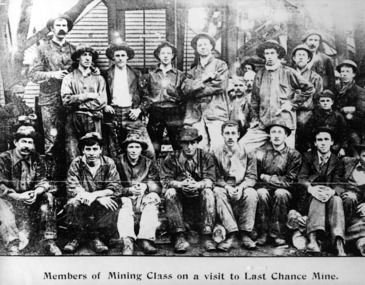
Photograph (black & white), Ballarat School of Mines Students visit the Last Chance Mine, c 1898
... (Ballarat School of Mines Students' Magazine, July 1899, p.2.) ballarat school of mines last chance thomas hart john rowe hart mining mining alumni rowe charles campbell Verso: Copied from Annual report 1898, Thomas Hart - back Row, 2nd from right with beard. Over 24 men pose for a photograph outside the Last Chance mine. Some of the men are members of the visiting Ballarat School of Mines mining class. Thomas Hart (beard) stands ...The mining class visited the Last Chance on the afternoon of Thursday, 8th June, under the guidance of Mr Kirby, the mine manager. Mr Campbell, the photographic instructor, also dared the perils of the deep in order to take some flashlight photos. As this was Mr Campbell's first visit below, several difficulties which he did not now existed prevented success. The students all ranged themselves in poetic and heroic attitudes for the first flashlight, but the development of the plate showed only the light from the candles and the moisture on the lens. The next two tries were better, but were under-exposed, and of no value, except as experience. Two gentlemen from England also went below with the students, but history repeated itself and Australia won the "test." The Englishmen left early. Mr Hart secured a fine specimen of arsenopyrite and indicator slate; also a bootlace, the property of a much-vexed miner, whose boots Mr Hart had borrowed. Horrors! Mr Hart steal a bootlace! Impossible! However, a tragedy was averted by the miner securing a new lace, and he was at once all smiles - so were the students. Mr Campbell took a photo of the students dressed for the occasion, and some were flattered, and some looked very like the universal "Weary Willie". (Ballarat School of Mines Students' Magazine, July 1899, p.2.)Over 24 men pose for a photograph outside the Last Chance mine. Some of the men are members of the visiting Ballarat School of Mines mining class. Thomas Hart (beard) stands at the back right. Verso: Copied from Annual report 1898, Thomas Hart - back Row, 2nd from right with beard.ballarat school of mines, last chance, thomas hart, john rowe, hart, mining, mining alumni, rowe, charles campbell -
 Federation University Historical Collection
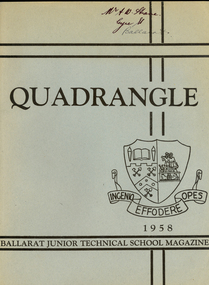
Magazine - Booklet, J.A. Hoskin & Son, Quadrangle: Magazine of the Girls and Boys of the Junior Technical School Ballarat, 1958, 1958
... magazine of 54 pages. Contents include: Past staff/students (Mr Whitla, Mr Hewitt, Mr Cowan, Mr Reeve, Mr Wilcock, Bullarto Camp Report, Bright Camp, Windmill Ruin (B. McLennan), Phelan Homes Competition, Baseball, Basketball, softball, Athletics, Cricket, Open Age Football, Cross Country, Your Badge, Mr Steane Recalls. An explanation of the Ballarat School of Mines Coat of Arms is given, and the first Ballara Junior Technical School Principal, Albert W. Steane recalls the early days of the school. Images include: Prefects, Dick Richards, Tank Stand...magazine of 54 pages. Contents include: Past staff/students (Mr Whitla, Mr Hewitt, Mr Cowan, Mr Reeve, Mr Wilcock, Bullarto Camp Report, Bright Camp, Windmill Ruin (B. McLennan), Phelan Homes Competition, Baseball, Basketball, softball, Athletics, Cricket, Open Age Football, Cross Country, Your Badge, Mr Steane Recalls. An explanation of the Ballarat School of Mines Coat of Arms is given, and the first Ballara Junior Technical School Principal, Albert W. Steane recalls the early days of the school. Images include: Prefects, Dick Richards, Tank Stand ...The 1958 edition of 'Quadrangle' was the first published as the new magazine of the Ballarat Junior Technical School. Formerly the Ballarat Junior Technical School occupied a few pages at the back of the Ballarat School of Mines Students' Magazine. In this year the Ballarat Junior Technical School's 'brother' school, Ballarat North Technical School, was publishing its own magazine called 'Green Acres'. Articles includeGrey/Blue soft covered magazine of 54 pages. Contents include: Past staff/students (Mr Whitla, Mr Hewitt, Mr Cowan, Mr Reeve, Mr Wilcock, Bullarto Camp Report, Bright Camp, Windmill Ruin (B. McLennan), Phelan Homes Competition, Baseball, Basketball, softball, Athletics, Cricket, Open Age Football, Cross Country, Your Badge, Mr Steane Recalls. An explanation of the Ballarat School of Mines Coat of Arms is given, and the first Ballara Junior Technical School Principal, Albert W. Steane recalls the early days of the school. Images include: Prefects, Dick Richards, Tank Stand Bullarto (linocut), cadets, Under 14 Football Team; Girls forms 1,2, and 4, Softball, Basketball, netball, hockey; Craig's Royal Hotel.2) cover "Mr A.W. Steane. Eyre St Ballarat"ballarat school of mines, ballarat junior technical school, ballarat north technical school, dick richards, steane, ron kirner, history, badge, crest, heraldry, garner, bullarto camp -
 Federation University Historical Collection
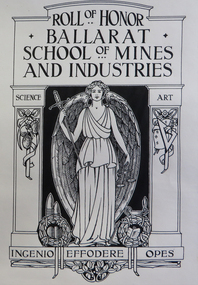
Book - Roll of Honor, Ballarat School of Mines Honor Book, c1920
... The 1920 SMb Students' Magazine said' 'Many students left Australia with the first Contingent, and since then, the School has been represented on every field where Australians have fought, from the first landing at Gallipoli to the decisive victory on the 8 August 1918.' The influence of the school was appropriately shown in the fact that at least 13 of its students were officers in the Australian Mining Corps. The title page has the initials 'D.J.' which most probably stands...The 1920 SMb Students' Magazine said' 'Many students left Australia with the first Contingent, and since then, the School has been represented on every field where Australians have fought, from the first landing at Gallipoli to the decisive victory on the 8 August 1918.' The influence of the school was appropriately shown in the fact that at least 13 of its students were officers in the Australian Mining Corps. The title page has the initials 'D.J.' which most probably stands ...The Ballarat Technical Art School made many honour boards for schools and organisation in Victoria and interstate. Their own was made, but the names were not listed. The Ballarat School of Mines Annual Report for 1921 states: 'It has been decided, for the present, to record the names of our students who served in the warm, in an Honor Book, and to defer the erectin of an Honor Board until we can feel ssured that the Roll is complete. the wide spread occupations of our students has rendered it very difficult for us to secure detailed information of their service. A handsome Honor Book and Case has been designed and executed by the staff ad students of the technical Art School, and the engrossing of the names and military records will be proceeded with as soon as possible. The Technical Art School was quite busy with commissions. The SMB Annual Report of 1918 states: 'under the direction of the Art principal (Mr H.H. Smith), the work of the Art School continues to receive wide public recognition. Handsome Honor Boars have been designed and executed for the Sydney Sports' Club, the St Arnaud High School, the Birregurra State School, the Wendouree State School and the Ballarat Old Colonists' Club. The School also designed the certificates for the Young Workers' Patriotic Guild, the 'Herald" Shield for perpetual competition at the technical Schools' athletic meetings, the "Hansen" Shield for competition among the Northern District High Schools, two metal tablets for the Castlemaine high School, and a certificate for the Grampians Secondary Schools' Association. Numerous Honor Books and Mural cases have also been designed for State Schools.' Over 400 former students and staff of the Ballarat School of Mines served during World War One. The 1920 SMb Students' Magazine said' 'Many students left Australia with the first Contingent, and since then, the School has been represented on every field where Australians have fought, from the first landing at Gallipoli to the decisive victory on the 8 August 1918.' The influence of the school was appropriately shown in the fact that at least 13 of its students were officers in the Australian Mining Corps. The title page has the initials 'D.J.' which most probably stands for Donald I. Johnston, a teacher with the Ballarat Technical Art school from 1920 to 1949. The Ballarat School of Mines World War 1 Honor Book remained uncompleted for more than 90 years. The names of over 400 SMB staff and students who served their country were not inscribed until 2012, despite names, ranks and service records being compiled. A restoration project was instigated as part of the 140th anniversary of the Ballarat School of Mines in 2010. Names were inscribed into the book by Calligrapher Lyn Forrester. The University of Ballarat believed this project is important not only to SMB's history, but the families and descendants of those who served while studying or teaching at SMB. The restoration project involved names being hand written in calligraphy into the Honor Book and was funded with the assistance of the 'Restoring Community War Memorial Grant'. The memorial was designed and made by the staff and students of the Ballarat School of Mines Technical Art School under the direction of Principal Herbert H. Smith. In 1921 the Ballarat School of Mines Annual Report recorded: "It has been decided, for the present, to record the names of our students who served in the war, in an Honor Book, and to defer the erection of an Honor Board until we can feel assured that the roll is complete. The wide spread occupations of our students has rended it very difficult for us to secure detailed information of their service. A handsome Honor Book and case has been designed and executed by the staff and students of the Technical Art School, and the engrossing of the names and miliatary records will proceed with as soon as possible. The Ballarat Technical Art School and was involved with the design and manufacture of numerous WW1 memorials. When it came time to complete their own memorial, the Principal died, and the Honor Roll must have been overlooked in the confusion that ensued. There have been numerous theories about why the Honor Roll was never completed, one being that it was because the SMB Principal, Maurice Copland, literally worked himself to death organising repatriation classes for ex-soldiers who attended SMB. The Courier of 18 November 1922 said of Maurice Copland: “He put his very best into the work for the welfare of the soldiers; in fact, he did too much for the good of his physique, for he wore himself out in the services of the returned men. If ever there was a war victim the late Mr Copland was one. But for the stress of work entailed by those repatriation classes and the amount of general war work which he performed Mr Copland would probably have been with them today." Understandably, SMB was thrown into some disarray by their Principal's death and the Honor Book was not completed. The University of Ballarat would like to finally honor its SMB war veterans by completing the Honor Book and as a further mark of respect, dedicate the project to Maurice Copland. The Ballarat Technical Art School undertook many honor boards. The Ballarat School of Mines Annual Report 1918 states: "Under the direction of the Art Principal (Mr H.H. Smith), the work of the Art School continues to receive a wide public recognition. handsome Honor Boards have been designed and executed for the Sydney Sports' Club, the St Arnaud High School, the Birregurra State School, the wendouree State School and the Ballarat Old Colonists' Club. The School also designed certificates for the Young Workers' patriotic Guild, the "Herald" Shield for perpetual Competition at the Technical schools athletics meetings, the "Hansen" Shield for competition in the northern District High Schools, two metal tablets for the Castlemaine High School, and a certificate for the Grampians Secondary Schools' Association. Numerous Honor Gooks and mural cases have also been designed for State Schools." The 1920 Ballarat School of Mines Annual Report stated: Public appreciation of the High standard of design and artistic craft work produced by the students of the Art School, under the direction of the Principal (Mr Herbert H. Smith), continues to be demonstrated by the lage number of important commissions entrusted to the school, not only by the public bodies and business firms by the Education Department and public bodies all over the State." "Amongst the important local commissions received during the year was the designing and supplying of the Municipal Council's Address of Welcome Casket for presentation to His Royal Highness the Prince of Wales, the designing and supervising of a large four-light stained glass window for the Lydiard Street Methodist Church, ... and supply numerous honor books, honor boards, etc., for public institutions and school." "The School has been honored by, and has acceded to the request of the Education Department to supply designs for the title page, chapter headings and initial letters for the War Service Book which it is about to publish, Mr F. Tate, director of Education, recognising the students' work in this direction by an appreciative letter of thanks. The Education Department has also been instrumental in directing to the School applications from all parts of the State, including Melbourne, for the School to supply competitive sports shields, honor boards, books and designs for certificates, and various decorative objects. The School has therefor been responsible for much work coming to local Ballarat firms which would otherwise have found its way to Melbourne or other centres. In 2011, as the result of a 'Restoring Community War Memorials Grant' calligrapher Lynton Forrester was commissioned to record over 400 names into the honor book. A red leatherbound Ballarat School of Mines Honor Book. The book includes a title page relating to the Ballarat School of Mines and Industries. The Ballarat School of Mines Honor Book was not finally inscribed with names until 2011-2012. world war one, ww1, ballarat school of mines, world war 1, world war i, honour roll, calligraphy, don johnston, honor book, honor roll, copeland, maurice copeland, honour book, roll of honour, percy coltman, arthur e. tandy, leslie coulter -
 Federation University Historical Collection
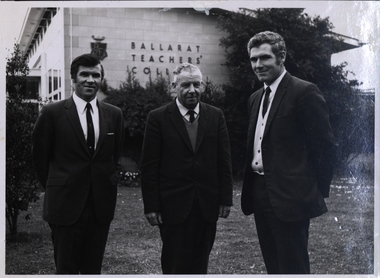
Photograph - Photograph - Black and White, Ballarat Teachers' College Science Lecturers, 1970, 1970
... stand in front of Ballarat Teachers' College Gillies St Campus. From left to right, Mr. Oldham, Mr. Alan Sonsee, Mr. Gribble. Reproduced in the 1970 Ballarat Teachers' College Magazine 'Extra Muros'....stand in front of Ballarat Teachers' College Gillies St Campus. From left to right, Mr. Oldham, Mr. Alan Sonsee, Mr. Gribble. Reproduced in the 1970 Ballarat Teachers' College Magazine 'Extra Muros'. ...Black and White photograph. Three men stand in front of Ballarat Teachers' College Gillies St Campus. From left to right, Mr. Oldham, Mr. Alan Sonsee, Mr. Gribble. Reproduced in the 1970 Ballarat Teachers' College Magazine 'Extra Muros'.photograph, ballarat teachers' college, photography, alan sonsee, gribble, oldham -
Federation University Historical Collection
Magazine, J.A. Hoskin & Son, Quadrangle: Magazine of the Ballarat Technical School, 1964, 1964
... magazine of 20 pages. Contents include: Past staff/students (Mr Whitla, Mr Hewitt, Mr Cowan, Mr Reeve, Mr Wilcock, Bullarto Camp Report, Bright Camp, Windmill Ruin (B. McLennan), Phelan Homes Competition, Baseball, Basketball, softball, Athletics, Cricket, Open Age Football, Cross Country, Your Badge, Mr Steane Recalls. An explanation of the Ballarat School of Mines Coat of Arms is given, and the first Ballarat Junior Technical School Principal, Albert W. Steane recalls the early days of the school. .2) Jeff Stewart has collected autographs of R. Irwin, J. Skewes, D. Dimsey and 1 illegible. Images include: Prefects, Dick Richards, Tank Stand...magazine of 20 pages. Contents include: Past staff/students (Mr Whitla, Mr Hewitt, Mr Cowan, Mr Reeve, Mr Wilcock, Bullarto Camp Report, Bright Camp, Windmill Ruin (B. McLennan), Phelan Homes Competition, Baseball, Basketball, softball, Athletics, Cricket, Open Age Football, Cross Country, Your Badge, Mr Steane Recalls. An explanation of the Ballarat School of Mines Coat of Arms is given, and the first Ballarat Junior Technical School Principal, Albert W. Steane recalls the early days of the school. .2) Jeff Stewart has collected autographs of R. Irwin, J. Skewes, D. Dimsey and 1 illegible. Images include: Prefects, Dick Richards, Tank Stand ...The Ballarat Technical School a division of the Ballarat School of Mines, and a predecessor institution of Federation University Australia.green soft covered magazine of 20 pages. Contents include: Past staff/students (Mr Whitla, Mr Hewitt, Mr Cowan, Mr Reeve, Mr Wilcock, Bullarto Camp Report, Bright Camp, Windmill Ruin (B. McLennan), Phelan Homes Competition, Baseball, Basketball, softball, Athletics, Cricket, Open Age Football, Cross Country, Your Badge, Mr Steane Recalls. An explanation of the Ballarat School of Mines Coat of Arms is given, and the first Ballarat Junior Technical School Principal, Albert W. Steane recalls the early days of the school. .2) Jeff Stewart has collected autographs of R. Irwin, J. Skewes, D. Dimsey and 1 illegible. Images include: Prefects, Dick Richards, Tank Stand Bullarto (linocut), cadets, Under 14 Football Team; Girls forms 1,2, and 4, Softball, Basketball, netball, hockey; Craig's Royal Hotelballarat school of mines, ballarat junior technical school, ballarat technical school, r.r. watson, r.l. whitla, b. bogicevic, j.v. robertson, a.e. stohr, e.j. barker, walter bampton, wayne butler, jeff stewart, library monitors, r. kennedy, n. o'donnell, joyce lewis, j. andrejczuk, a. steinhuis, g. turnbull, neville cartledge, bruce mcivor, barry mccullum, sculpture, australian air training corps, bruce cook, jim brown, peter carrigg, jim breen, trevor kay, keith jeffs, peter pittard -
 Federation University Historical Collection
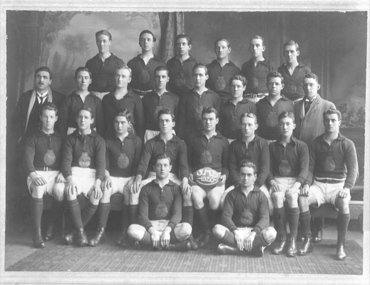
Photograph, Richards & Co, Ballarat School of Mines Football Team, 1920, 1920
... Magazine, 1920 1920 was the inaugural year of the Senior Technical Schools' Football Association. The idea of forming an association originated from the Sports Master at the Bendigo School of Mines. ballarat school of mines football team sport douglas rex evans peter evans dick richards r.w. richards richard w. richards Richards and Co. Inter-Technical Football Team Senior Technical Schools' Football Association Twenty two members of the Ballarat School of Mines Football team pose for a photograph. The sports master, Dick Richards, stands ...This photograph was reproduced in the Ballarat School of Mines Students' Magazine, 1920 1920 was the inaugural year of the Senior Technical Schools' Football Association. The idea of forming an association originated from the Sports Master at the Bendigo School of Mines. Twenty two members of the Ballarat School of Mines Football team pose for a photograph. The sports master, Dick Richards, stands on the left side. Seated third from left: Douglas Rex (Peter) Evans The Ballarat School of Mines Football jumper features a logo on the centre of the front. ballarat school of mines football team, sport, douglas rex evans, peter evans, dick richards, r.w. richards, richard w. richards, richards and co., inter-technical football team, senior technical schools' football association -
 Flagstaff Hill Maritime Museum and Village
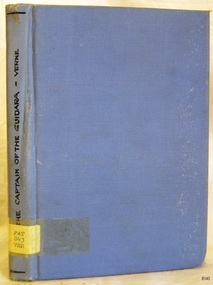
Book - A Fictional Adventure Story, Jules Verne et al, Keraban The Inflexible (part 1) The Captain of The Guidara, 1887
... magazine writing instead. In 1862 he met publisher Pierre Jules Hetzel, who launched the “Voyages extraordinaire” novel with “Five Weeks in a Balloon” after that, Verne became one of the most successful writers of the 19th century. His works later helped define science fiction as a genre. His career has often been divided into a productive early “positivist” phase, a later more pessimistic phase, and a posthumous phase in which his son Michel heavily altered some unfinished works. Within the broader Voyages Extraordinaire series, this first feature of the two part novel stands...magazine writing instead. In 1862 he met publisher Pierre Jules Hetzel, who launched the “Voyages extraordinaire” novel with “Five Weeks in a Balloon” after that, Verne became one of the most successful writers of the 19th century. His works later helped define science fiction as a genre. His career has often been divided into a productive early “positivist” phase, a later more pessimistic phase, and a posthumous phase in which his son Michel heavily altered some unfinished works. Within the broader Voyages Extraordinaire series, this first feature of the two part novel stands ..."The Captain of the Guidara" refers to the English title of the first volume of Jules Verne's 1883 novel Kéraban le Têtu, part of his Voyages Extraordinaire series. The second novel features “Scarpante the Spy” to complete the two part volume of “Kéraban the Inflexible”.In the English edition, the story is following The Captain of the Guidara. Originally published in French in 1883 and in Britain with two volumes in 1887. The story follows a stubborn Turkish merchant, Keraban, who refuses to pay a new tax on crossing the Bosporus and instead embarks on a lengthy journey around the Black Sea. The "Guidara" refers to the ship central to this Ottoman era adventure. It features two Dutchmen and the obstinate Keraban navigating political, cultural, and geographical challenges. The novel is richly illustrated and reflects Verne’s signature blend of travel, exploration, and historical detail.Hard cover book, Keraban The Inflexible (part 1)The Captain of The Guidara. Author: Jules Verne Publisher: Sampson Low Marston Searle and Rivington, Crown Buildings 188 Fleet Street, London. W1. Date: 1887 Light blue hardcover with the title on the spine having lettering to spine in black hand written text pen. fiction"The Captain of the Guidara" refers to the English title of the first volume of Jules Verne's 1883 novel Kéraban le Têtu, part of his Voyages Extraordinaire series. The second novel features “Scarpante the Spy” to complete the two part volume of “Kéraban the Inflexible”.In the English edition, the story is following The Captain of the Guidara. Originally published in French in 1883 and in Britain with two volumes in 1887. The story follows a stubborn Turkish merchant, Keraban, who refuses to pay a new tax on crossing the Bosporus and instead embarks on a lengthy journey around the Black Sea. The "Guidara" refers to the ship central to this Ottoman era adventure. It features two Dutchmen and the obstinate Keraban navigating political, cultural, and geographical challenges. The novel is richly illustrated and reflects Verne’s signature blend of travel, exploration, and historical detail. warrnambool, shipwrecked-coast, flagstaff-hill, flagstaff-hill-maritime-museum, maritime-museum, shipwreck-coast, flagstaff-hill-maritime-village, shipwrecked-artefact, book, pattison collection, warrnambool library, warrnambool mechanics’ institute, ralph eric pattison, corangamite regional library service, warrnambool city librarian, mechanics’ institute library, victorian library board, warrnambool books and records, warrnambool children’s library, great ocean road, keraban the inflexible (part 1) the captain of the guidara, jules verne -
 Flagstaff Hill Maritime Museum and Village
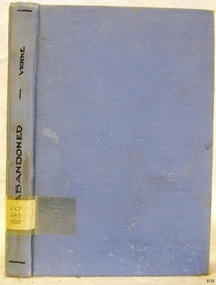
Book - A Fictional Adventure Story, Jules Verne, Abandoned, 1892
... magazine writing instead. In 1862 he met publisher Pierre Jules Hetzel, who launched the “Voyages extraordinaire” novel with “Five Weeks in a Balloon” after that, Verne became one of the most successful writers of the 19th century. His works later helped define science fiction as a genre. His career has often been divided into a productive early “positivist” phase, a later more pessimistic phase, and a posthumous phase in which his son Michel heavily altered some unfinished works. Within the broader Voyages Extraordinaire series, this first feature of the two part novel stands...magazine writing instead. In 1862 he met publisher Pierre Jules Hetzel, who launched the “Voyages extraordinaire” novel with “Five Weeks in a Balloon” after that, Verne became one of the most successful writers of the 19th century. His works later helped define science fiction as a genre. His career has often been divided into a productive early “positivist” phase, a later more pessimistic phase, and a posthumous phase in which his son Michel heavily altered some unfinished works. Within the broader Voyages Extraordinaire series, this first feature of the two part novel stands ..."Abandoned" is the second part of Jules Verne’s “The Mysterious Island trilogy”, continuing the story of a group of castaways testing their ingenuity and courage on a remote Pacific island. The 1892 Sampson Low, Marston, Searle & Rivington edition is an early English language reprint of this work.This novel is not among Verne’s absolute core masterpieces like “Twenty Thousand Leagues Under the Seas” or “Around the World in Eighty Days”. Abandoned (also known as its original French title, "L’Île mystérieuse: Deuxième partie L’Abandonné" picks up the narrative of five or six men (including the engineer Cyrus Harding and the sailor Pencroff) who have already survived a balloon crash and built a rudimentary civilisation on a seemingly uninhabited island. As they explore the island further, they discover signs of a mysterious benefactor and eventually meet the “abandoned” character Ayrton, a former convict who has lived in isolation while the island itself faces natural and human threats that test their survival and moral choices. The story blends adventure, technology, and social Utopian themes, showing how rational cooperation can triumph over hardship and moral degeneration.Hard cover book, Abandoned. Author: Jules Verne Publisher: Sampson Low Marston Searle and Rivington, St. Dunstans House, Fetter Lane Fleet Street, London. EC. Date: 1892 Light blue hardcover with the title on the spine having lettering to spine in black hand written text pen. fiction"Abandoned" is the second part of Jules Verne’s “The Mysterious Island trilogy”, continuing the story of a group of castaways testing their ingenuity and courage on a remote Pacific island. The 1892 Sampson Low, Marston, Searle & Rivington edition is an early English language reprint of this work.This novel is not among Verne’s absolute core masterpieces like “Twenty Thousand Leagues Under the Seas” or “Around the World in Eighty Days”. Abandoned (also known as its original French title, "L’Île mystérieuse: Deuxième partie L’Abandonné" picks up the narrative of five or six men (including the engineer Cyrus Harding and the sailor Pencroff) who have already survived a balloon crash and built a rudimentary civilisation on a seemingly uninhabited island. As they explore the island further, they discover signs of a mysterious benefactor and eventually meet the “abandoned” character Ayrton, a former convict who has lived in isolation while the island itself faces natural and human threats that test their survival and moral choices. The story blends adventure, technology, and social Utopian themes, showing how rational cooperation can triumph over hardship and moral degeneration.warrnambool, shipwrecked-coast, flagstaff-hill, flagstaff-hill-maritime-museum, maritime-museum, flagstaff-hill-maritime-village, shipwrecked-artefact, book, warrnambool mechanics’ institute, pattison collection, warrnambool library, corangamite regional library service, warrnambool city librarian, mechanics’ institute library, victorian library board, warrnambool books and records, warrnambool children’s library, ralph eric pattison, jules verne, voyages extraordinaire series, l’école des robinson's -
 Flagstaff Hill Maritime Museum and Village
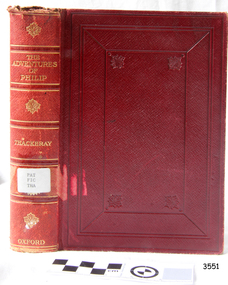
Book - A Fictional Story, William Makepeace Thackeray et al, The Adventures of Philip, 1908
... Magazine from 1861 to 1863 and is Thackeray's final completed novel. The story is heavily semi autobiographical, reflecting Thackeray's own youth, early struggles, and financial losses. The narrative follows Philip Firmin, a passionate, blustering, but fundamentally good hearted young man. He stands ...The Adventures of Philip on His Way Through the World was originally serialised in The Cornhill Magazine from 1861 to 1863 and is Thackeray's final completed novel. The story is heavily semi autobiographical, reflecting Thackeray's own youth, early struggles, and financial losses. The narrative follows Philip Firmin, a passionate, blustering, but fundamentally good hearted young man. He stands to inherit a comfortable fortune from his late mother. However, Philip is completely betrayed by his own father, the aristocratic and deceitful Dr Brandon Firmin. The doctor secretly squanders, swindles, and speculates away his son's entire inheritance, leaving Philip financially ruined. Forced to make his own way in the world, Philip moves to Paris to work as a struggling journalist. He falls in love and marries Charlotte Baynes, despite having almost no income. The novel becomes an intense critique of Victorian societal expectations, exploring the crushing anxiety of genteel poverty, the snobbery of wealthy relatives, and Philip's struggle to maintain his pride and integrity while desperately trying to support his growing family.The Adventures of Philip Author: William Makepeace Thackeray Publisher: Henry Frowde Oxford University Press Date: 1908fictionThe Adventures of Philip on His Way Through the World was originally serialised in The Cornhill Magazine from 1861 to 1863 and is Thackeray's final completed novel. The story is heavily semi autobiographical, reflecting Thackeray's own youth, early struggles, and financial losses. The narrative follows Philip Firmin, a passionate, blustering, but fundamentally good hearted young man. He stands to inherit a comfortable fortune from his late mother. However, Philip is completely betrayed by his own father, the aristocratic and deceitful Dr Brandon Firmin. The doctor secretly squanders, swindles, and speculates away his son's entire inheritance, leaving Philip financially ruined. Forced to make his own way in the world, Philip moves to Paris to work as a struggling journalist. He falls in love and marries Charlotte Baynes, despite having almost no income. The novel becomes an intense critique of Victorian societal expectations, exploring the crushing anxiety of genteel poverty, the snobbery of wealthy relatives, and Philip's struggle to maintain his pride and integrity while desperately trying to support his growing family.shipwrecked-coast, flagstaff-hill, flagstaff-hill-maritime-museum, warrnambool, maritime-museum, shipwreck-coast, flagstaff-hill-maritime-village, shipwrecked-artefact, book, pattison collection, warrnambool library, warrnambool mechanics’ institute, ralph eric pattison, corangamite regional library service, warrnambool city librarian, mechanics’ institute library, victorian library board, warrnambool books and records, warrnambool children’s library, great ocean road, the virginians-, william makepeace thackeray -
 Ringwood and District Historical Society
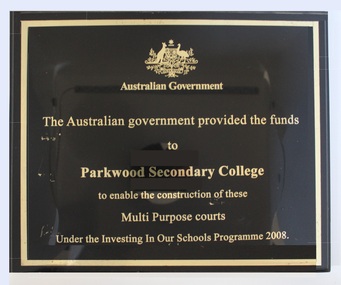
Plaque, Australian Government "Our Schools Programme 2008" - Parkwood Secondary College, Ringwood North, Victoria
... Magazine Extract - Principal's Report, 2008: "Completing and commissioning our new outdoor courts was a major undertaking both in 2007 and 2008. It is wonderful to see they are now operating as an integral part of the school's overall P.E. and sport program as well as offering opportunities for informal recreation for both our students and the wider community. The contribution of $137,000 from the Commonwealth Government in funding this program is appreciated and acknowledged." Dark timber-backed metalic display stand ...School Magazine Extract - Principal's Report, 2008: "Completing and commissioning our new outdoor courts was a major undertaking both in 2007 and 2008. It is wonderful to see they are now operating as an integral part of the school's overall P.E. and sport program as well as offering opportunities for informal recreation for both our students and the wider community. The contribution of $137,000 from the Commonwealth Government in funding this program is appreciated and acknowledged."Dark timber-backed metalic display stand with gold lettering marking "Australian Government - The Australian Government provided the funds to Parkwood Secondary College to enable the construction of these Multi Purpose courts under the Investing In Our Schools Programme 2008" -
 Mission to Seafarers Victoria
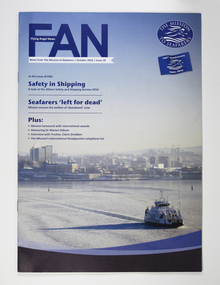
Magazine, Mission to Seafarers, Flying Angel News (FAN), October 2016
... Published in the 160th Anniversary Year of Mission work. flying angel club flying angel league magazine 160th anniversary edition mtsuk The short title is FAN which stands for Flying Angel News. ...A 16 page full cover magazine. 160th Anniversary issue No 18 October 2016. Features anniversary logo and the Mission to Seafarers oval logo on the front cover.flying angel club, flying angel league, magazine, 160th anniversary edition, mtsuk -
 Mission to Seafarers Victoria
Photograph - Photograph, Black and white, 1950s
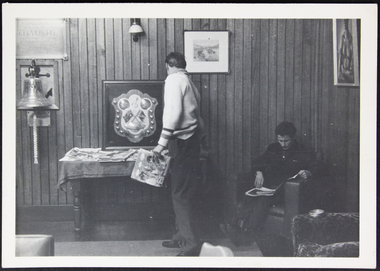
... The image also shows the style of dress and style of magazine covers of the time. On the table stands the shield for the annual competition by crew of merchant ships presented by Wally Nancarrow, Sydney. ...The image also shows the style of dress and style of magazine covers of the time. On the table stands the shield for the annual competition by crew of merchant ships presented by Wally Nancarrow, Sydney. ...The image portrays how the Celia Little room (Celia Little plaque on the wall) was used mid 20th C. and date of similar image (see record 0221) The inclusion of the bell from the 'Moreton Bay' vessel dates the image to post 1957 when the bell was presented to the Mission. Used as a sitting room or lounge area at the Mission to Seafarers Melbourne. The image also shows the style of dress and style of magazine covers of the time. On the table stands the shield for the annual competition by crew of merchant ships presented by Wally Nancarrow, Sydney. (see item 0608)The photograph is significant in that it captures the essence of the Mission to Seafarers mid-20th century. It identifies the main use of the Celia Little room as a reading area. It also helps date and track locations of other objects in the heritage collection. A black and white photograph of two men in the Celia Little room at the Mission to Seafarers Melbourne. The top left of the photograph is a bell fixed to the wall that has a bell pull with a long piece of decorative knot-work attached to the clapper. The room is set up as a lounge area with at table left of the centre against the wall. The table is laden with magazines and papers on top of a tablecloth. A picture frame is sitting on the table and leaning against the wall that has a 'shield' or 'coat of arms' displayed. (see also VC records 221 and 0608) One of the men is standing central in the photograph, in a white jumper holding a magazine and half turned towards the wall.The second man is sitting in a chair in the bottom right side of the photograph and appears to be reading. A few tops of chairs are seen at the very bottom of the photo and on the wall are a plaque to the left, a framed picture to the right of the first man's head and another in the far right top corner. The room appears to be lit from the left.melbourne, bell, men, magazine, chairs, wains coting, papers, mission-to-seafarers, celia-little-room, bell-pull, picture-frame, 1940s, celia little, plaque, shield, soccer, football -
 Halls Gap & Grampians Historical Society
Photograph - Photocopy
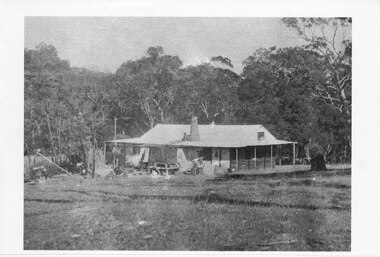
... magazine article, Victoria's Heritage (see item 637) BUILDINGS Houses House Burnt 1938. Walter Zumstein's house. Photo by Stan Parfett. written on back. A house with veranda. A chimney (stone?) protrudes from roof at front. cleared land in foreground with old style wooden fence visible. A tank and stand ...This house belonged to Walter Zumstein of the Zumsteins area. The house was burnt down in 1938. Photo was taken by Stan Parfett whose own family camped in the Zumstein area and knew Mr and Mrs Zumstein personally. c1920's This is an photocopied enlargement from a photocopied magazine article, Victoria's Heritage (see item 637)A house with veranda. A chimney (stone?) protrudes from roof at front. cleared land in foreground with old style wooden fence visible. A tank and stand situated beside house at front. Thick trees /Bush behind house.House Burnt 1938. Walter Zumstein's house. Photo by Stan Parfett. written on back.buildings, houses -
 Orbost & District Historical Society
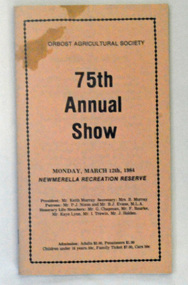
book, 75th Annual Show, prior to March 1984
... magazine was produced as a program for the 75th Annual Show at Newmerella Recreation Reserve. The first meeting to form an Agricultural society in Orbost was convened by the then Orbost Progress Association and held in the Mechanics Hall on Saturday, 10th October 1891. Its first show was held on 3rd March 1904...on a site alongside the Bonang Road where the present Golf Club stands...magazine was produced as a program for the 75th Annual Show at Newmerella Recreation Reserve. The first meeting to form an Agricultural society in Orbost was convened by the then Orbost Progress Association and held in the Mechanics Hall on Saturday, 10th October 1891. Its first show was held on 3rd March 1904...on a site alongside the Bonang Road where the present Golf Club stands ...This magazine was produced as a program for the 75th Annual Show at Newmerella Recreation Reserve. The first meeting to form an Agricultural society in Orbost was convened by the then Orbost Progress Association and held in the Mechanics Hall on Saturday, 10th October 1891. Its first show was held on 3rd March 1904...on a site alongside the Bonang Road where the present Golf Club stands. It is currently held at the Recreation Reserve at Newmerella. Ref: In Times Gone By-Deborah HallThis item is associated with the Orbost Agricultural Society 's Annual Show which has been a major event in Orbost for over a century. Agricultural shows are an important part of cultural life in small country towns and the Orbost Show is an integral part of Orbost 's agricultural history. A small thin 40 pp paper booklet with a buff coloured cover. On the cover is the title, "75th Annual Show in black print. It is inside a black border with "Orbost Agricultural Show" at the top. There is the date of the event, details of the committee members and costs of admission beneath the title.orbost-annual-show -
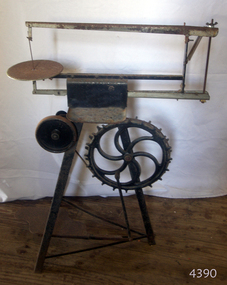 Flagstaff Hill Maritime Museum and Village
Tool - Treadle Scroll Saw, Hobbies Ltd, Manufactured by Hobbies in England from 1928- 1965
... stand advertising their products as "The All-British Firm with a World reputation". Fretwork Outfits. Fretwork Machines. Carpentry Outfits. Strip work Outfits. Also manufactures of Fretwork Tools and Benches, Wood, Circular Saws, Lathes, Picture Framing Outfits, Tools, etc. In 1947 the company had expanded and was still making tools and materials for the amateur craftsman in wood. They had acquired a reputation as manufacturers of quality Fretwork Outfits, Tools, Treadle Machines, Model Maker's Tool Kits. The company also publishers of ‘Hobbies Weekly magazine...stand advertising their products as "The All-British Firm with a World reputation". Fretwork Outfits. Fretwork Machines. Carpentry Outfits. Strip work Outfits. Also manufactures of Fretwork Tools and Benches, Wood, Circular Saws, Lathes, Picture Framing Outfits, Tools, etc. In 1947 the company had expanded and was still making tools and materials for the amateur craftsman in wood. They had acquired a reputation as manufacturers of quality Fretwork Outfits, Tools, Treadle Machines, Model Maker's Tool Kits. The company also publishers of ‘Hobbies Weekly magazine ...Since 1895, Hobbies Ltd have been supplying model makers and enthusiasts throughout the world with a wide range of quality model kits, accessories, tools, components and handbooks. The Hobbies Company began life in Dereham, Norfolk in 1881 with a London Office opened later (1922) at 65 New Oxford Street, WC1. In 1895 Hobbies began supplying model makers with their products and in 1897 were incorporated into a Public company. In 1922 at a British Industries Fair the company had a stand advertising their products as "The All-British Firm with a World reputation". Fretwork Outfits. Fretwork Machines. Carpentry Outfits. Strip work Outfits. Also manufactures of Fretwork Tools and Benches, Wood, Circular Saws, Lathes, Picture Framing Outfits, Tools, etc. In 1947 the company had expanded and was still making tools and materials for the amateur craftsman in wood. They had acquired a reputation as manufacturers of quality Fretwork Outfits, Tools, Treadle Machines, Model Maker's Tool Kits. The company also publishers of ‘Hobbies Weekly magazine’ and also sold plans for fretwork, model making and wooden toys. In 1961 they were still manufacturers and retailers of craft tools and materials, timber merchants, light engineers and Government contractors with around 500 employees. A vintage tool made for hobbyists and distributed throughout the world by a British company that is still in existence today. The item is significant as it catalogues the manufactures history at a specific time in the company's development.Foot operated treadle Fret saw called "GEM" subject item is a short saw , the stand in the background is the base for a Delta Q3 model scroll saw. Gem inscription cast into the cast iron frameworkflagstaff hill, warrnambool, flagstaff hill maritime museum, maritime museum, shipwreck coast, flagstaff hill maritime village, great ocean road, saw, treadle saw, fret saw, pedal saw, the gem, tool, hobbies ltd, treadle, foot operated -
Eltham District Historical Society Inc
Document - Folder, Sweeney
... stands. Contents Typed notes, no author, no date, biography of Thomas Sweeney with copy of parish plan showing Sweeney's original and later land purchases. Typed timeline Thomas Sweeney and typed transcriptions of letters to and from La Trobe archives to Thomas Sweeney. Handwritten notes: Biography of Thomas Sweeney and his descendants, also transcription of letter 10 April 1849 wanting a bridge over the Plenty River, and transcription of C J La Trobe's reply. Photocopy magazine...stands. Contents Typed notes, no author, no date, biography of Thomas Sweeney with copy of parish plan showing Sweeney's original and later land purchases. Typed timeline Thomas Sweeney and typed transcriptions of letters to and from La Trobe archives to Thomas Sweeney. Handwritten notes: Biography of Thomas Sweeney and his descendants, also transcription of letter 10 April 1849 wanting a bridge over the Plenty River, and transcription of C J La Trobe's reply. Photocopy magazine ...Thomas Sweeney (1802-1867) was transported in 1823 and granted a conditional pardon in 1838. He married and moved to the Port Phillip District, buying land at Eltham. His house, "Culla Hill" (renamed "Sweeneys") still stands. Contents Typed notes, no author, no date, biography of Thomas Sweeney with copy of parish plan showing Sweeney's original and later land purchases. Typed timeline Thomas Sweeney and typed transcriptions of letters to and from La Trobe archives to Thomas Sweeney. Handwritten notes: Biography of Thomas Sweeney and his descendants, also transcription of letter 10 April 1849 wanting a bridge over the Plenty River, and transcription of C J La Trobe's reply. Photocopy magazine article: "Sweeneys: A home with a hisitory", Australian Home Beautiful, 1 February 1940. Story of Thomas Sweeney and his house, with photographs. Newspaper article: "Capt. Sweeney, Eltham's first Irish settler", Associated Newspapers Eltham Cenenary Supplement, 30 March 1971. Notes on Thomas Sweeney and his house. Photocopy of p.30, "Diamond Valley Sketchbook", Brian McKinlay, 1973. "Sweeney's Cottage, Eltham. Notes and drawing of Sweeneys. Newspaper article: "A convict's cottage", Diamond Valley News, 6 October 1981. Notes on Thomas Sweeney and his house. Newspaper article: "Talented cartoonist depicts story of an Eltham pioneer", Diamond Valley News, 18 February 1986. Judith Russell had drawn cartoons of Thomas Sweeney's life called "Sweeney". Prospectus "Historic Sweeneys Culla Hill, Auction 27 Noveber 1993, 3.00 pm": Photographs and history of property, with map of lots and vegetation.. Newspaper article: "A pioneer's cottage, new-age apartments and a leafy city retreat", The Age Real Estate, 21 June 1997. Photograph and details of "Sweeneys" Newspaper article: "Legacy of convict's success", Diamond Valley News, 2 July 1997. Notes on Thomas Sweeney and his house (for sale), photograph of John Sweeney and family. Printout, National Trust register: Sweeney's. History and description of Sweeneys. Letter Mary Nelson to Eltham District Historical Society, 14 October 2004, enclosing photocopies of material on "Culla Hill" and Mary Sweeney and Michael Carrucan.Newspaper clippings, A4 photocopies, etcthomas sweeney, mary sweeney, patrick sweeney, ship isabella, mary sweeney nee meehan, "culla hill" eltham, "sweeneys" eltham, sweeneys lane eltham, michael connors, patrick guyder, george brown of illawarra district, margaret sweeney nee meehan, paddy sweeney, john sweeney, kate sweene, margaret sweeney, ellen sweeney, annie sweeney], johanna sweeney, annie sweeney, caroline sweeney, mary carrucan nee sweeney, agatha sweeney, agnes sweeney, arthur sweeney, cassie sweeney, frank sweeney, victor burston, peter cuffley, jim murray, bridget sweeney nee coleman, graham caulfield, mccorlick real estate eltham, mary nelson, betty erickson nee carrucan, michael carrucan -
Eltham District Historical Society Inc
Document - Folder, Thomson, Donald
... Newspaper article: "Museum and Aboriginies to meet in stand-off over heritage items", The Age, 29 July 2004. Bark paintings on loan from British Museum in dispute. Magazine...Newspaper article: "Museum and Aboriginies to meet in stand-off over heritage items", The Age, 29 July 2004. Bark paintings on loan from British Museum in dispute. Magazine ...Anthropologist and Aboriginal activist Donald Thomson later lived in Eltham with wife Dorita. Contents Photocopy of photograph of Thomson family at "The Oaks", Kinglate 11 November 1891. Photocopy of old photograph of "Worlingworth", home of Donald Thomson. Booklet: "N.T.S.R.U. 1941-1943: text and photographs from the report of Sqn Leader Donald Thomson." Yirrkale Literature Production Centre, 1992. Photocopy of Australian Dictionary of Biography (Vol.16, pp385-386), entry for Thomson, Donald Finlay Fergusson. Newspaper article: "Drought close to city", no source, no date. Donald Thomson wants South Riding of Eltham declared a drought area, photograph of Elaine Thomson. Newspaper article: "Professor dies", The Post, 27 1970. Obituary of Donald Thomson. Photocopy of extracts from "Donald Thomson in Arnhem Land" 1983: Chapter "Donald Thomson: A biographical Sketch". pp1-15; Map; Notes on sources pp141-142. Newspaper article: "Memoirs of an advocate for Aboriginal rights", Diamond Valley News, 8 March 1983. Interview of Dorita Thomson, widow of Donald Thomson, about him and house "Worlingworth". Newspaper article: "Australia's secret Aboriginal 'army". Herald, 2 June 1983. Donald Thomson's life and work, and the book about it, "Donald Thomson of Arnhem Land". Invitation to exhibition of photographs by Donald Thomson, Brighton City Library, 22 July 1983. Publicity for film "Thomson of Arnhem Land" with note from Bruce Nixon, 8 June 2000. Newspaper article: "A crusader before his time", Diamond Valley News, 9 August 2000. Details of life and work of Donald Thomson. Newspaper article: "Outback part. of his life", Diamond Valley News, 9 August 2000. Interview of Dorita Thomson about Donald Thomson's life and work. Newspaper article: "Museum and Aboriginies to meet in stand-off over heritage items", The Age, 29 July 2004. Bark paintings on loan from British Museum in dispute. Magazine article: "Keeping time with Rolf", Time, 20 March 2006. Mentions of Donald Thomson. Newspaper advertisement: "The Thomson House" Templestowe, Emerson Oliver Estate Agent. The Weekly Review, no date (possibly 2017). Flier: "The Thomson House" Templestowe, Emerson Oliver Estate Agent. Newspaper article: "Once upon a time an anthropolgist watched men hunt in 10 canoes", The Age, 16 December 2006. Donald Thomson's work and a new film "Ten Canoes". Newspaper article: "A life's work offers forgotten link to the cultural wealth of nation's first people", The Age, 23 December 2024. The Donald Thomson Ethnohistory Collection. Newspaper clippings, A4 photocopies, etcdonald thomson, northern territory special reconnaissance unit, donald finlay fergusson thomson, "the oaks" kinglake, "worlingworth" eltham, elaine thomson, louise thomson, rosemary thomson, dorita thomson, st margaret's church of england eltham, australian institute of aboriginal studies, brandy creek gippsland, ."donald tomson in arnhem land"., "n.t.s.r.u. 1941-1943", "thomson of arnhem land", victorian aborigines welfare board, thomson collection museum victoria, mia mia aboriginal art gallery, louise thomson-officer, marcia langton, su baker, lake tyers victorian aboriginal reserve gippsland, robert macklin, yintjingga people, 29 edwin road templestowe, royal geographic society, nicholas peterson, mapoon mission, wongo aboriginal man, wuluwirr aboriiginal man, mattuwa aboriginal man, mauwunbol aboriginal man, munguyuma aboriginal man, dja dja wurrung people, gavin jennings, gary murray, film "ten canoes", galanbingu people, mandallpuy people, djinba people, rolf de heer, arnhem land, arafura swamp, ramingining, caledon bay, lindy allen, bunjilaka centre -
 Warrnambool and District Historical Society Inc.
Book - Chambers Journal 1874, Chambers’s Journal 1874, 1874
... magazine and was priced at one penny. Topics included history, religion, language, and science. Publication moved to London around 1856. Some articles were stand...magazine and was priced at one penny. Topics included history, religion, language, and science. Publication moved to London around 1856. Some articles were stand ...Chambers's Journal was published weekly from 1832 through to 1956 in Edinburgh. It was a popular magazine and was priced at one penny. Topics included history, religion, language, and science. Publication moved to London around 1856. Some articles were stand alone while others were serialised. This is a bound copy of a years collection of the weekly publication. This is a book given to Margaret Davidson in 1875 by her aunt, Mrs J. Davidson. Margaret Milne Davidson (1839-1928) was the eldest child of James and Isabella Davidson and she was born in Kirriemuir, Scotland. She came to the Warrnambool area in 1850. The property, ‘Woodend’, was near Cassadys Bridge (Caramut Road today). The aunt, Mrs J. Davidson would be the wife of John Davidson, the brother of James and a farmer at ‘Rosebank’, Woodford. The portraits of John and James Davidson are on the Warrnambool Pioneer Honour Board. This book is of interest because of its inscription. The book is connected to the Davidson families, prominent in Warrnambool’s pioneer history.This is a hard cover book of 832 pages. The book has a dark green cover with dark green and gold lettering with ornamental gold surrounds. The book has an index, short stories, poems, essays and articles on science and the arts. The book contains monthly journals for 1874 combined in one volume. The cover is stained and blotched. There are several stamps of the Warrnambool & District Historical Society. The inscription on the first page is handwritten in black ink. ‘Margaret M. Davidson, Woodend, from her aunt, Mrs J. Davidson, 30/9/75’.margaret davidson, james and john davidson, history of warrnambool, chambers journal, chambers journal 1874 -
 Warrnambool and District Historical Society Inc.
Administrative record (Collection) - Grasmere cheese and Butter Factory Company Records, Grasmere Cheese and Butter Factory administrative employees, Records: Grasmere Cheese and Butter Factory, 1890-1959
... stands today at the Flagstaff Hill Maritime Museum in Warrnambool. This collection is of considerable historical importance as the records cover almost the entire existence of the Grasmere Cheese and Butter Factory and there are photographs as well as written material. Grasmere Cheese and Butter Factory Pty Ltd Dairying in the Warrnambool district Four ledgers containing Minutes, two unbound packets of Minutes and one photographic supplement from a magazine Records: Grasmere Cheese and Butter Factory. ...Administrative Records of Grasmere Cheese and Butter Factory - source of collection unknown This collection of administrative records has been created for historical reasons and archival purposes.Items kept in two A2 size archival boxes in the Archives Room and stored in this way some years after the acquisition of these items at an unknown date.Four ledgers containing Minutes, two unbound packets of Minutes and one photographic supplement from a magazinegrasmere cheese and butter factory pty ltd, dairying in the warrnambool districtgrasmere cheese and butter factory pty ltd, dairying in the warrnambool district -
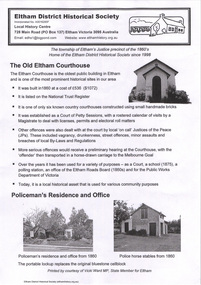 Eltham District Historical Society Inc
Document - Binder, Eltham Justice Precinct, 1969-2020
... Stand (Witness Box) 19. Article: There’s still order in this stately court house, Eltham Shire (magazine), date unk., p22-23 20. ...Stand (Witness Box) 19. Article: There’s still order in this stately court house, Eltham Shire (magazine), date unk., p22-23 20. ...EDHS_04863 - Binder: Eltham Justice Precinct Report: Conservation Management Plan (draft) for Justice Precinct Eltham, 5 August 2005; prepared for Nillumbik Shire by Ivar Nelsen and Janette Hodgson, Land Stewardship and Biodiversity - Historic Places, Department of Sustainability and Environment 1. Courthouse 1. Eltham Courthouse interesting facts i. Photocopy (2 pages) of extract from Petty Sessions at Eltham before C.S. Strutt Esq., Chairman; and (indecipherable) on the 12th day of September 1871; Case numbers 117 to 127. Details listed include Complainant, Defendant, Fees, Cause, Decision, Remarks. Defendants listed include Edward Bettison and John McCall, N.J. Keylock [Kaylock], Patrick Clark, Michael Keenan, Ann Hayden, Henry Edelman, Alexander Falkiner, Charles Long, Joseph Morris, Daniel Ryan ii. Photocopy (2 pages) of list of Convictions for surnames commencing with ‘B’ from 23 December 1890 to December 1905. 2. Plan and elevation drawings 3. Other courthouse plans and fittings 1880s – Brunswick, Maffra, Dunolly , Sunbury, Landsborough and Wodonga 4. Newspaper articles: i. ELTHAM POLICE COURT. (1892, April 1). Evelyn Observer, and South and East Bourke Record (Vic. : 1882 - 1902), p. 2 (MORNING.). Retrieved July 5, 2022, from http://nla.gov.au/nla.news-article60667022 ii. BREAKING A PUBLICAN'S LEG. (1900, July 13). Evelyn Observer, and South and East Bourke Record (Vic. : 1882 - 1902), p. 2 (MORNING.). Retrieved July 5, 2022, from http://nla.gov.au/nla.news-article60688367 iii. ELTHAM COURT. (1901, March 1). Mercury and Weekly Courier (Vic. : 1878 - 1903), p. 3. Retrieved July 5, 2022, from http://nla.gov.au/nla.news-article58578953 iv. ANNIE CHASES A TINKER. (1902, October 3). Evelyn Observer, and South and East Bourke Record (Vic. : 1882 - 1902), p. 2 (MORNING.). Retrieved July 5, 2022, from http://nla.gov.au/nla.news-article64029968 v. ELTHAM POLICE COURT. (1927, May 6). Advertiser (Hurstbridge, Vic. : 1922 - 1939), p. 4 (AFTERNOON). Retrieved July 5, 2022, from http://nla.gov.au/nla.news-article57754748 vi. ELTHAM POLICE COURT. (1927, May 20). Advertiser (Hurstbridge, Vic. : 1922 - 1939), p. 3 (AFTERNOON). Retrieved July 5, 2022, from http://nla.gov.au/nla.news-article57754814 vii. Eltham Police Court (1931, January 9). Advertiser (Hurstbridge, Vic. : 1922 - 1939), p. 4. Retrieved July 5, 2022, from http://nla.gov.au/nla.news-article56734073 viii. Repairs to Eltham Police Station, The Advertiser (1929, May 24). Advertiser (Hurstbridge, Vic. : 1922 - 1939), p. 2 (AFTERNOON.). Retrieved July 5, 2022, from http://nla.gov.au/nla.news-article57759907 ix. ELTHAM COURT. (1929, August 2). Advertiser (Hurstbridge, Vic. : 1922 - 1939), p. 4 (AFTERNOON.). Retrieved July 5, 2022, from http://nla.gov.au/nla.news-article57760345 x. See also Trove list https://trove.nla.gov.au/list/116634 5. Letter: Shire of Eltham Historical Society to Shire of Eltham, 1 July 1969 regarding potential replacement of Eltham Courthouse and the building’s historical significance and acknowledgement 10 July 1969 6. Letter: Shire of Eltham Historical Society to Law Department, 26 May 1972, re preservation of Eltham Courthouse and potential classification and acknowledgement 7 June 1972 7. Newspaper article: Strangers around, so Eltham sought protection by Marguerite Marshall, Diamond Valley News, Tuesday, April 6, 1982, p2 (On reverse side, Top job for our Pauline, p1) 8. Eltham Courthouse Colour Scheme, Public Works Department, 10 September 1983 9. Newspaper article: Eltham Courthouse under threat of closure by Helen Gillman, Diamond Valley News, October 16, 1984 10. Newspaper article: Courthouse to close by Helen Gillman, Diamond Valley News, Tuesday, November 20, 1984, p1 (also on p2 an article about Diamond Valley Shire festivities for the State’s 150th) 11. We will keep your court – Kennett, Diamond Valley News (probable), c.Dec. 1984 12. Letter: Shire of Eltham to Shire of Eltham Historical Society, 15 March 1985, regarding potential for use of building as a museum and reply dated 17 April 1985 regarding Society’s interest in use of the building 13. Letter: Department of Conservation Forests & Lands to Shire of Eltham, August 1987, regarding expressions of interest in the building and letter from Shire (18 August 1987) to Society advising of same 14. Letter: Department of Conservation Forests & Lands to Shire of Eltham, 30 March 1988, advising Courthouse to be used by Eltham Youth Resources Centre and the rear section by other community groups. Noted that the historical society was suggested by Council as a future user of the adjoining police residence when Council first sought management of the building and that should be investigated. Includes Schedule of Repair and Maintenance Work (4 pages), Existing Conditions Survey 30/7/1987 (6 pages) and 1 page plan view diagram 15. Memo: Historic Places Section to Eltham Youth Resource Centre re paint analysis of Courthouse, 17/5/1988, (6 pages) 16. Newspaper article: Courthouse renovation by Jodie Haythorne, Diamond Valley News, November 23, 1992 17. National Trust of Australia Registration (classified 20 Oct 1977), printed March 2000 18. Letter: Heritage Victoria 28 Feb 2002 regarding the replacement of the Courthouse Stand (Witness Box) 19. Article: There’s still order in this stately court house, Eltham Shire (magazine), date unk., p22-23 20. Eltham Court House, Statement of Significance, Heritage Victoria Register, printed Nov 2004 21. Eltham 1860 Former Court House 730 Main Road Eltham, collated by Eltham District Historical Society Incorporated 2005 (4 pages) 22. Book Extract: Eltham, Historical Court Houses of Victoria by Michael Challinger, Palisade Press, 2001 23. Newspaper article: Courthouse rich with history by Harry Gilham, Nillumbik Mail, c.2001 (see also EDHS_03333) 24. Notes on history of site from Crown Reserve File Rs 12128, Municipal Buildings (Local Community Welfare Reserve) at Eltham, Department of Sustainability and Environment, April 2005 (4 pages) 25. Newspaper article: Historic building upgrade, Diamond Valley Leader, August 3, 2005, p17 26. Newspaper article: Courthouse regeneration secures boost, Valley Weekly, August 10, 2005 with picture of Harry Gilham, Steve Herbert and Greg Johnson 27. Newspaper article: Poets are summonsed, Diamond Valley Leader February 22, 2006, p37 features picture of Helen Lucas at the Eltham Courthouse 28. Newspaper article: Sharing a love of legalities, Diamond Valley Leader, March 1, 2006, p7 features a picture of Rob Hulls and Steve Herbert talking to students in the courthouse 29. Newspaper advertisement: Nillumbik Tender No. 2021-33, Building Restoration Works, Old Eltham Courthouse, The Age, November 7, 2020 30. Form: Police Officer’s Return To A Warrant Of Distress 31. Handwritten notes: three pages listing all 48 of the pigeon hole form listings in the cabinet in the courthouse 32. Newspaper article: Historic Eltham Courthouse reopens, Manningham and Nillumbik Bulletin, April 2022, p22 33. Expression of Interest, Eltham Courthouse, 730 Main Road, Eltham; Nillumbik Shire Council Living and Learning Centres Eltham & Panton Hill, 8 May 2000 (Committee of Management) 2. Police Quarters 1. 1971 Surveyors Plan of 728 Main Road and the Adjoining Courthouse. Also includes notes (1963) on Lots 4 and 5 southeast corner of Main Road and Brougham Street owned by James Wallace Graham, Contractor, and Elsie May Graham. 2. Letter: Shire of Eltham to Shire of Eltham Historical Society, 5 June 1981, requesting the society give consideration to the suitability of the existing buildings (former Vermin and Noxious Weeds Office, Department of Crown Lands and Survey) for historical purposes such as a museum 3. Minutes: Shire of Eltham Historical Society Committee Meeting, 10 June 1981 (2 pages) includes reference to possible use of building as a museum (also reference to Bills Horse trough to be retained) 4. Extract from Victoria Police Gazette 1930 with details of building and site 5. Newspaper article: Cubby haven, Diamond Valley News, October 28, 1991 about replica Police Station with picture of replica along with Monika Roitinger and Garry Bartlett outside the Police Station 6. Environment office up for sale? Mountain Views, Monday, June 12, 1995 (Nillumbik Shire Council proposing to sell property. Did not proceed as ownership held by the State of Victoria) 7. Extract from National Trust February 1998 edition, “Police Rescue” which states Heidelberg and Eltham Police Residences are the oldest known Police Residences in the Melbourne Metropolitan district 8. Newspaper article: The first police office by Harry Gilham, Nillumbik Mail, December 13, 2000 (also photocopy with notations on picture identifying buildings and Harry’s typed draft) 9. Fax Memo: Victoria Police List of Officers in Charge, Eltham Police Station, 1857-1991 onward, 21 Jan 2003 10. Former Police Quarters, Statement of Significance, Heritage Victoria Register, printed Nov 2004 11. Eltham 1860 Former Police Quarters 728 Main Road Eltham, collated by Eltham District Historical Society Incorporated 2005 (5 pages) 12. Report: Eltham District Historical Society to Living and Learning Nillumbik, 14 April 2010 regarding the poor state of condition of the former Police Residence 13. Photocopy of three photos of the former Police Residence, former Police Station (relocated to rear of site) and Stables, October 18, 1991 3. Lockup 1. Newspaper article: Heritage permit bid, Diamond Valley News, January 17, 2001 (also article “Eltham library tops”) includes picture of lockup located in Youth Road 2. Newspaper article: Old lockup in new site, Diamond Valley Leader, March 21, 2001, p15. Includes picture of Harry Gilham with lockup at justice Precinct 3. Letter: Victoria Police to Eltham District Historical Society, 20 March 1991 including laser print photo of lockup in 1963 at 23 Pryor Street 4. Fax: Graham Clark, Associated Crane Trucks Pty Ltd, 833 Main Road Hurstbridge; Quote 26.2.99 for $1,080 to move lockup from Youth Road to 728 Main Road 4. Local History Centre 1. Victoria Government Gazette: Photocopy, No. 165, Tuesday, December 7, 1858, establishment of a Court of Petty Sessions at Eltham, 7 December 1858 2. Victoria Government Gazette: Photocopy, September 16, 1859, contract issued for Police buildings at Eltham to Langridge and Co., McCarter, Baillie, Nicol and Co, Chadley, Amos and Co., Cameron, Payne, £1,150.7.0 3. Victoria Government Gazette: Photocopy, October 2, 1860, contract issued for Court of Petty Sessions at Eltham to James Duncan, £600 4. President’s Report, Eltham District Historical Society, Annual General Meeting, Wednesday, March 11, 1998 – covers the establishment of the Local History Centre and new home for the Society 5. Extract for EDHS Newsletter July 1998 – Eltham Local History Centre – Official Opening 6. Unveiling of 728 Street Sign, Speech notes by Cr Dianne Bullen, December 2000, includes invoice from John Sharp Signs Pty Ltd, 24/10/2000 and planning approval drawing dated 24/3/1999 reproduced in Newsletter No. 135 November 2000 7. Letter: Eltham District Historical Society to Living and Learning Centre, undated draft regarding being a member of the committee reviewing the development of the site 8. Notes from Rod Grant re funding of site development under the Community Jobs Program 9. Letter: Eltham District Historical Society to Nillumbik Living and Learning, 28 October 2004 re inclusion of the Society in enhancing the site under the Community Jobs Program 10. Letter: Department of Sustainability and Environment to Eltham District Historical Society, 28 February 2005 re preparing draft Conservation Plan and copy of cover letter in response 2 April 2005 11. Levels and Layout Plan, Nillumbik Shire Council, September 2005, AO copy 12. Letter: Department of Sustainability and Environment to Eltham District Historical Society, 12 September 2005 re Eltham Justice Precinct Conservation Management Plan 13. Letter: Living and Learning Nillumbik, 2 February 2006 to Eltham District Historical Society re forming a Committee to advise on the use, maintenance, management and preservation of the Justice Precinct 14. Minutes: Meeting of a Task group to explore the establishment of a Committee to manage the Eltham Justice Precinct, 20 December 2005 (with hand written notes) 15. President’s notes (EDHS), General Meeting item, 11 May 2006 pertaining to use and condition of the Eltham Justice Precinct 16. Paint estimates, Old Eltham Court House, undated 17. Notes from meeting 26 September (2006), Eltham Justice Precinct Committee 18. Notes from meeting 27 November (2006), Eltham Justice Precinct Committee 19. Terms of Reference for the Eltham Justice Precinct Committee, Draft for Living and Learning Committee Meeting 24 Jan 2007 (4 pages) 20. Newspaper article: Panel set up, Diamond Valley Leader, 7 March 2007 21. Minutes: Meeting of Eltham Justice Precinct Subcommittee, 10 May 2007 22. Minutes: Meeting of Eltham Justice Precinct Subcommittee, 5 July 2007 23. Minutes: Meeting of Eltham Justice Precinct Subcommittee, 11 October 2007 24. Minutes: Meeting of Eltham Justice Precinct Subcommittee, 7 February 2008 25. Minutes: Meeting of Eltham Justice Precinct Subcommittee, 10 April 2008 26. Minutes: Meeting of Eltham Justice Precinct Subcommittee, 14 August 2008 27. Letter: EDHS (Sue Law) to Living and Learning, 6 September 2008 re proposed signage 28. Agenda: Meeting of Eltham Justice Precinct Subcommittee, 16 October 2008 29. Suggested guidelines for use of the Court House for exhibitions 30. Handwritten note re Ken Eckersal and Uniting Church of possible donation of church organ for sale, proceeds to be used for activities at the Justice precinct 31. One page typed notes on each of the buildings in the Eltham Justice Precinct 32. Newspaper article: Historic Eltham Courthouse reopens, Manningham and Nillumbik Bulletin, April 2022, p22 5. Miscellaneous 1. Photocopy from Pioneers & Painters (2 pages) covering the establishment of Police and Court of Petty Sessions at Eltham 2. Photocopy of photo looking northeast across Little Eltham buildings c.1910 with notes 3. Photocopy of J.H Clarke photo looking up Maria Street from near Dalton Street with notes identifying precinct buildings 4. Photocopy of photo of Court House and Police Quarters with cow outside from Heather Jenkins scrapbook with notes identifying buildings 5. Sketch and notes with dimensions for blue stone lockup including other miscellaneous handwritten notes 6. Unidentified heritage review details of Justice Precinct (c.2004) 7. Hand written notes of telephone conversation held with Dennis McKay (6 May 1997) re Council use of site 8. Flyer: Victoria Police Historical Unit 9. Photocopy of thumbnail images of various Justice Precincts (not identified) 10. Email correspondence, 4 and 10 January 2008; J. Connor to Council and Councillors pertaining to proposed new toilet facilities at rear of Courthouse annexe. Two ring lever arch binder, white with various photocopies, printouts, newspaper clippingsHG Folders 15/52/59 integratedharry gilham collection, eltham courthouse, eltham justice precinct, eltham police residence, lockup, eltham community festival, eltham festival, eltham, heritage assessment, police residence, conservation, alexander falkiner, ann hayden, charles long, court of petty sessions, daniel ryan, edward bettison and john mccall, eltham court house, henry edelman, joseph morris, michael keenan, n.j. kaylock, patrick clark, elsie may graham, franco and co, james wallace graham, surveyor field notes -
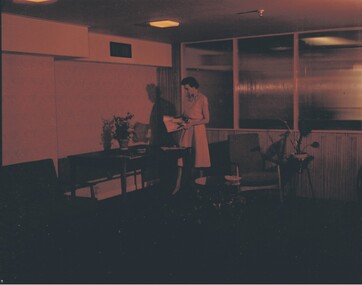 Bendigo Historical Society Inc.
Negative - OLIVE PELL COLLECTION: NEGATIVE, 1950
... magazine next to a table with a vase with flowers. She is wearing a light coloured dress, dark shoes and a necklace. Behind her a large opaque window, to the left there is a seat and a pot stand. ...magazine next to a table with a vase with flowers. She is wearing a light coloured dress, dark shoes and a necklace. Behind her a large opaque window, to the left there is a seat and a pot stand. to the right a setee, in the foreground a coffee table. ...A negative of a lady standing holding a magazine next to a table with a vase with flowers. She is wearing a light coloured dress, dark shoes and a necklace. Behind her a large opaque window, to the left there is a seat and a pot stand. to the right a setee, in the foreground a coffee table.person, individual, female -
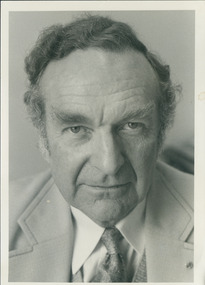 Uniting Church Archives - Synod of Victoria
Photograph, David Jamieson, editor of Ringwood Parish quarterly magazine "Insight", 06/1984
... stands. But we should look at both sides before making up our minds. Only then should we be vocal in a political sense, no matter how one-sided." jamieson, david church union 7th anniversary social justice C&N identification. Full face, looking intently at the camera. David Jamieson, editor of Ringwood Parish quarterly magazine ...Jamieson's comments appear in an article surveying the Uniting Church, 7 years after union. "One member who disagrees with the church presents social justice issues is David Jamieson, who has been editor of the Ringwood parish quarterly magazine "Insight" since union. Mr Jamieson says he knows scores of people who find it very hard to accept what he considers is a bias in the presentation of social justice issues. 'I know a lot of people who are becoming alienated because they feel their side of the story is not being presented by the church. They feel only the radical side of justice issues is being hammered. I think the more conservative side has validity. My main concern is the flood of study booklets and material on social justice issues which look at them from only one angle. The bias is on greed, excessive profits and most unworthy aspects of the multi-nationals compared with the most humanitarian concerns of the left. No mention is made of humanitarian concern by big business or the extremes of the left — such as unwarranted industrial action and the effect that this has on the poor and unemployed. No mention is made of excessive wage demands by highly paid people who are pressuring for bigger flow-ons. ….. I do not believe the church should be neutral on political issues. In fact I agree with nearly all of its stands. But we should look at both sides before making up our minds. Only then should we be vocal in a political sense, no matter how one-sided."Full face, looking intently at the camera.C&N identification.jamieson, david, church union 7th anniversary, social justice
