
Showing 129 items matching "map cases"
-
 Bendigo Military Museum
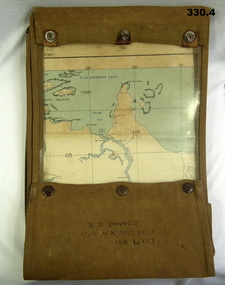
Map - MAP CASE & MAPS, Hec Robinson, C.1939-45
... MAP CASE & MAPS......Map Cases....1) Map case, canvas khaki. .2) Map of Darwin, NT. ...Scale 4 miles to 1 inch. .3) Map, folded, New Guinea made by Hec Robinson Sydney .4) Map Pine Creek N.T. Map MAP CASE & MAPS Hec Robinson ...John James Davies No VX35280 enlisted in the 2nd AIF on 1.8.40 age 31 years. At discharge on 30.11.45 he held the rank of WO 2nd class in 2/108th Aust Light Anti Aircraft detachment..1) Map case, canvas khaki. .2) Map of Darwin, NT. Scale 4 miles to 1 inch. .3) Map, folded, New Guinea made by Hec Robinson Sydney .4) Map Pine Creek N.T.zippered section marked "J. J. Davies VX35280 108 LAD”maps, wwii, world war two, second world war, map cases, darwin, northern territory, pine creek, papua new guinea, navigation, pouches -
 Running Rabbits Military Museum operated by the Upwey Belgrave RSL Sub Branch
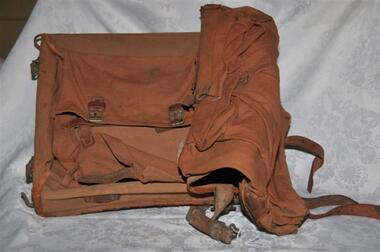
Pack
... Map case, Australian, Pat.15....Equipment WW1 Army Map case, Australian, Pat.15. Pack ...Map case, Australian, Pat.15.equipment, ww1, army -
 Wangaratta High School
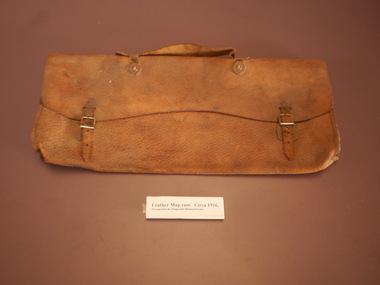
WHS Leather Map Case, Circa 1916
... WHS Leather Map Case...Orange-brown leather map case with metal buckles. ...Orange-brown leather map case with metal buckles. WHS Leather Map Case ...Orange-brown leather map case with metal buckles. -
 Lilydale RSL Sub Branch
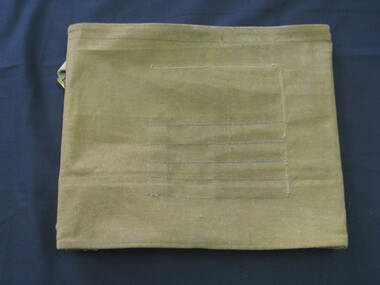
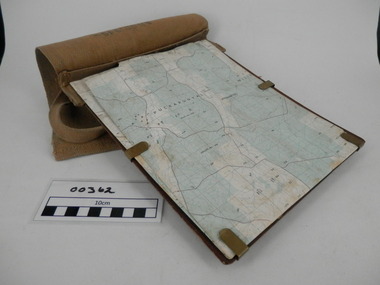
map - WWII Australian map, C. G. Hartley & Co 1943, 1943
... WWII Australian Issue Map Case/ Plotting Board - with map...WWII Australian Issue Map Case/ Plotting Board - with map map WWII Australian map C. ...WWII Australian Issue Map Case/ Plotting Board - with map -
 Frankston RSL Sub Branch
Map Case
... Map Case...Standard Australian Army webbing map case with shoulder strap. This map case is complete with a folded Australian Survey map of Puckapunyal, Victoria produced in 1988. ...Inscription BHG Ltd 1945 Map Case ...Standard Australian Army webbing map case with shoulder strap. This map case is complete with a folded Australian Survey map of Puckapunyal, Victoria produced in 1988. Inscription BHG Ltd 1945 -
 Running Rabbits Military Museum operated by the Upwey Belgrave RSL Sub Branch
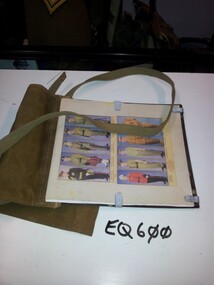
Map Case
... Map Case...Map Case with carry strap containing computer print of various uniforms...Equipment 1943 Army Map Case with carry strap containing computer print of various uniforms Map Case ...Map Case with carry strap containing computer print of various uniformsequipment, 1943, army -
 Stawell Historical Society Inc
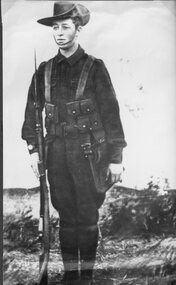
Photograph, Mr Sydney Davidson as a Soldier in WW1 in uniform with rifle, webbing, & map case 1914-1918 -- Studio Portrait
... Mr Sydney Davidson as a Soldier in WW1 in uniform with rifle, webbing, & map case 1914-1918 -- Studio Portrait...Portrait Sydney Davidson 1914-18 Soldier WW1 in uniform with rifle webbing and map case...Portrait Sydney Davidson 1914-18 Soldier WW1 in uniform with rifle webbing and map case Stawell War Mr Sydney Davidson as a Soldier in WW1 in uniform with rifle, webbing, & map case 1914-1918 -- Studio Portrait Photograph ...Portrait Sydney Davidson 1914-18 Soldier WW1 in uniform with rifle webbing and map casestawell war -
 Creswick Campus Historical Collection - University of Melbourne
Equipment, Curvimeter
... For measuring distance of irregular line on maps. Cased in blue box with clear lid...For measuring distance of irregular line on maps. Cased in blue box with clear lid Equipment Curvimeter Equipment ...Steel tool with moving wheel attached to measurement dial. For measuring distance of irregular line on maps. Cased in blue box with clear lidEquipment -
 Bendigo Military Museum
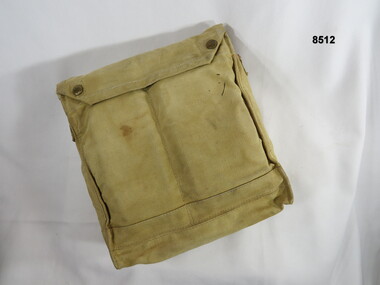
Equipment - CARRY PACK, TWO POUCH, Unknown
... ...Map case...This carry pack was possibly used as a map case, The over the shoulder strap is missing. ...This carry pack was possibly used as a map case, The over the shoulder strap is missing. ...The faded possible Regt number TX1823 there is no match found.Medium size khaki over the shoulder, carry pack with two rear compartments. This carry pack was possibly used as a map case, The over the shoulder strap is missing. There are three brass ventilators on the base of the pack.On the inside of the main flap, “TX1823” (open for interpretation). Very faded “B.M/ ??? TORAL”passchendaele barracks trust, equipment, bag, map case -
 Bendigo Military Museum
Equipment - MAP CASE, Army Issue, Post WW2 possibly
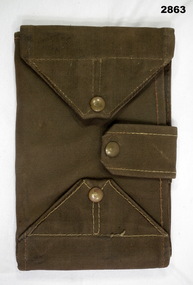
... MAP CASE...Map Case, khaki canvas outer, tri-fold with clear perspex sections for securing map inside. ...Small pocket on outside. Equipment MAP CASE Army Issue ...Map Case, khaki canvas outer, tri-fold with clear perspex sections for securing map inside. Fastens with two canvas flaps & brass press studs & a canvas strap. Small pocket on outside. military equipment, containers, map, passchendaele barracks trust -
 Montmorency–Eltham RSL Sub Branch
Equipment - Map Case No. 2, 1942
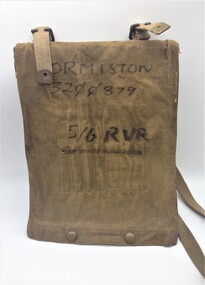
... Map Case No. 2...This 1942-dated Map Case was still in use post-1982 when it was used by a member of the 5/6 Royal Victoria Regiment. ...This 1942-dated Map Case was still in use post-1982 when it was used by a member of the 5/6 Royal Victoria Regiment. ...This 1942-dated Map Case was still in use post-1982 when it was used by a member of the 5/6 Royal Victoria Regiment. This new Melbourne-based battalion was created on the 17 August 1982. Open-sided with a khaki canvas flap attached to a resin-impregnated board.. Hinged to the top edge is a celluloid cover. Four clips holds the cover (and any map) to the backing board. The flap is secured by a pair of Carr Australia press studs on the back. The underside of the flap has four loops for chinagraph pencils and a wider pocket and loop for a Protractor. Two brass buckles are provided for a web shoulder sling. C. G. Hartley & Co. 1942 ORMISTON 3200879 5/6 RVR -
 Bendigo Military Museum
Equipment - MAP CASE, C.G. Hartley & Co, 1942
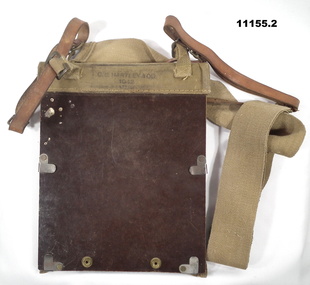
... MAP CASE...Map Case...1. Map case - WW2 pattern case (Pattern 37). There is a Bakelite backing clipped on it is a clear cellulose cover. ...Map case - WW2 pattern case (Pattern 37). There is a Bakelite backing clipped on it is a clear cellulose cover. ...1. Map case - WW2 pattern case (Pattern 37). There is a Bakelite backing clipped on it is a clear cellulose cover. There is a canvas (Khaki) cover for it. Under the canvas cover are little slots for pencils, pens, protractors etc. The canvas cover is held shut over the map by means of two press studs. 2. Shoulder strap is from a different vintage. It is 1/2 leather and 1/2 canvas. It is mounted to the map case buckles in an as hoc manner. Canvas width - 5 cm. Leather width - 1.6 cm.On strap written - "G.H. Simpson 49".map case, ww2, -
 Flagstaff Hill Maritime Museum and Village
Document - Navigation Chart, British Admiralty, Otago Harbour, 1928
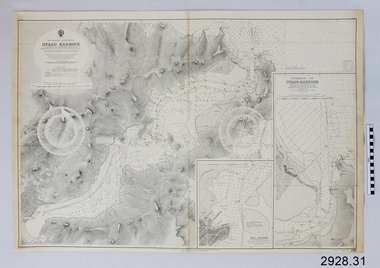
... The chart was originally stored in a wooden map case with over 60 other charts. ...The chart was originally stored in a wooden map case with over 60 other charts. Otago Harbour Document Navigation Chart British Admiralty ...Navigation charts are used by mariners around the world for navigating waterways. This chart was created for Otago Harbour in New Zealand. A ship, "Otago", was named after this harbour and was once commanded by the renowned maritime author Joseph Conrad. That ship now lies wrecked in Otago Bay, in the Derwent River, Tasmania. The Otago 1869-1931 The iron-hulled 3-masted barque Otago was built in Glasgow by Alexander Stephen & Sons Ltd, Kelvinhaugh, as a merchant ship and launched in 1869. The vessel changed hands several times in the late 19th century after being sold to an Australian firm in 1871. During one of its voyages, the captain died while the ship was in port at Bangkok. The renowned marine fiction author, Joseph Conrad (1857-1927), was on board and being a qualified captain, he took command and continued the journey to Sydney and Mauritius. It was the only ship he ever commanded. In 1903, the Melbourne shipping company Huddart, Parko & Co., purchased the Otago and converted it to serve as a coal hulk for use in Sydney. The Otago was later sent to Hobart, Tasmania, where it continued as a hulk until 1931. It was sold for scrap and eventually abandoned on the banks of the Derwent River at a place now known as Otago Bay, opposite Conrad Drive, Otago. The outline of the hull is still visible, and a nearby plaque tells the story. There are other vessels also named Otago, one of them in the same year. This navigation chart was published by the British Admiralty cartographer, to aid mariners to navigate the world's water bodies. Navigation charts are still used today, along with other navigational instruments.British Admiralty Navigation Chart - Otago Harbour, South Island, New Zealand. Chart shows insets with finer detail of important sections. The chart was originally stored in a wooden map case with over 60 other charts. Published in London, 1928, by the British Admiralty. Printed in Melbourne.warrnambool, shipwrecked-coast, flagstaff-hill, flagstaff-hill-maritime-museum, maritime-museum, shipwreck-coast, flagstaff-hill-maritime-village, shipwrecked-artefact, british admiralty navigation chart, navigation chart, british admiralty, otago harbour, south island, new zealand, otago bay, derwent river, tasmania, joseph conrad -
 Flagstaff Hill Maritime Museum and Village
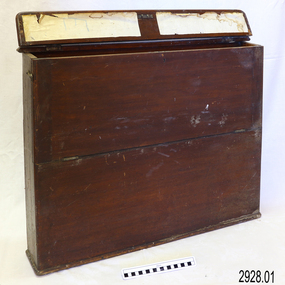
Container - Chart Case, Late 19th to early 20th centuries
... ...map case...Chart case (or map case), wooden, has hinged opening at top. ...Chart case (or map case), wooden, has hinged opening at top. ...This case was donated along with the contents of over 60 navigational charts for locations all over the world. The narrow box is built to keep the charts in order and easily accessible on board a vessel. The chart case is a rare example of a container used on board a vessel for the storage and protection of navigational charts. It represents the type of equipment used by the navigator of a seafaring vessel. The charts within the case represent the places to which the vessel travelled.Chart case (or map case), wooden, has hinged opening at top. Front of case folds down and has a hook closure. It contained 65 British Admiralty navigational charts, which are listed and stored separately. (See separate items 2928.2 to 2928.66)There is a hand written name on the back of the case.flagstaff hill, warrnambool, shipwrecked coast, flagstaff hill maritime museum, maritime museum, shipwreck coast, flagstaff hill maritime village, great ocean road, map case, chart case, map box, chart box, british admiralty charts, navigational charts, hydrographer charts, navigation, ship equipment -
 Bendigo Military Museum
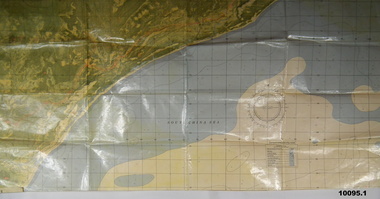
Map - AIR PHOTO MAP & HOLDER, 1962 - 1972
... ...Map Case...The map has a waterproof cover. 2. Map case, canvas khaki, it also has a Bakelite sheet backboard and a celluloid cover sheet. ...Vietnam War Map Map Case 1. The number “12” is written in numerous places. 2. ...The Phuoc Tuy Border is about 58 kms E,S,E, from Ving Tau.1. Air photo of part of Phuoc Tuy Province, Sun. Overlaid on the air photo is - Principal height contours, Highway marked in red, names of villages and waterways and coastal depth soundings in fathoms. The map has a waterproof cover. 2. Map case, canvas khaki, it also has a Bakelite sheet backboard and a celluloid cover sheet. on the back board are 4 steel clips to hold the folded map. The case is held shut with brass press studs. The case has a khaki webbing strap affixed with brass fittings. 3. China graph pencil, yellow. Made by Staedtler and it is also embossed Commonwealth of Australia.1. The number “12” is written in numerous places. 2. On rear of case is some letters “O.C. HART .........? 1942” On the celluloid are some blue markings - looks like a house layout.vietnam war, map, map case -
 Ringwood RSL Sub-Branch
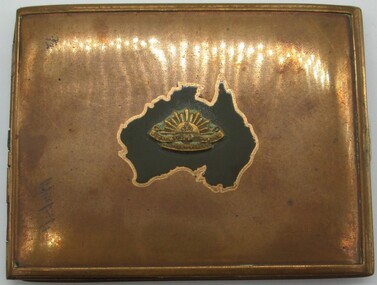
Card - Souvenir card holder
... Gold coloured metal case with map of Australia on outside...Gold coloured metal case with map of Australia on outside Card Souvenir card holder ...Gold coloured metal case with map of Australia on outside -
 Running Rabbits Military Museum operated by the Upwey Belgrave RSL Sub Branch
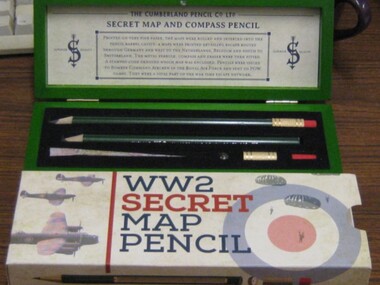
Secret Map and Compass Pencils
... Two pencils in green wooden case, with map. Given to Lancaster airmen WW2....Equipment WW2 RAF Two pencils in green wooden case, with map. Given to Lancaster airmen WW2. Secret Map and Compass Pencils ...Two pencils in green wooden case, with map. Given to Lancaster airmen WW2.equipment, ww2, raf -
 Whitehorse Historical Society Inc.
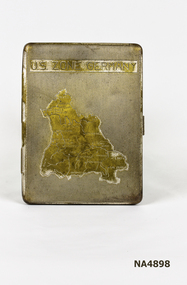
Container - Cigarette Case, 1940's
... Metal cigarette case. Map on front shows the U.S. Occupied Zone of Germany in the post war years....Zone of Germany Metal cigarette case. Map on front shows the U.S. Occupied Zone of Germany in the post war years. ...Metal cigarette case. Map on front shows the U.S. Occupied Zone of Germany in the post war years.|Perhaps issued or sold to the U.S. Forces. There is a clip inside to hold cigarettes.U.S. Zone of Germanypersonal effects, smoking accessories -
 Bendigo Military Museum
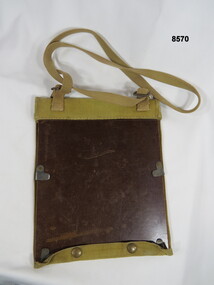
Equipment - FIELD CASE, MAP, Unknown
... FIELD CASE, MAP...Khaki over the shoulder field case for maps or documents. The backing base is covered in cotton khaki material with bottom press stud closure buttons. ...Passchendaele Barracks Trust Field case Maps and documents Khaki over the shoulder field case for maps or documents. ...Khaki over the shoulder field case for maps or documents. The backing base is covered in cotton khaki material with bottom press stud closure buttons. Maps or documents are held in place by adjustable slide over clips. On the inside of the cover there are six sewn in narrow pockets for pens, pencils and relevant recording items.passchendaele barracks trust, field case, maps and documents -
 Flagstaff Hill Maritime Museum and Village
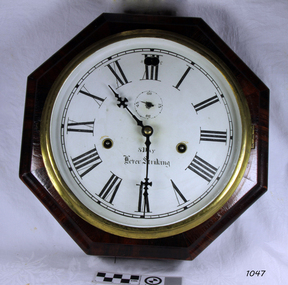
Clock, 1867-1870
... A one-day wood-cased clock, which sold for six dollars had helped put the company on the map. ...A one-day wood-cased clock, which sold for six dollars had helped put the company on the map. ...Chauncey Jerome (1793–1868) was an American clock maker in the early to mid 19th century. He made a fortune selling his clocks, and his business grew quickly. Jerome was born in Canaan USA in 1793 son of a blacksmith and nail-maker. He began his career in Plymouth, making dials for long-case clocks where he learned all he could about clocks, particularly clock cases, and then went to New Jersey to make seven-foot cases for clocks mechanisms. In 1816 he went to work for Eli Terry making "Patent Shelf Clocks," learning how to make previously handmade cases using machinery. Deciding to go into business for himself, Jerome began to make cases, trading them to Terry for wooden movements. In 1822 Jerome moved his business to Bristol New Haven, opening a small shop with his brother Noble and began to produce a 30-hour and eight-day wooden clocks. By 1837 Jerome's company was selling more clocks than any of his competitors. A one-day wood-cased clock, which sold for six dollars had helped put the company on the map. A year later his company was selling that same clock for four dollars. The company also sold one line of clocks at a wholesale price of 75 cents and by 1841 the company was showing an annual profit of a whopping $35,000, primarily from the sale of its brass movements. In 1842 Jerome moved his clock-case manufacturing operation to St. John Street in New Haven. Three years later, following a fire that destroyed the Bristol plant, Jerome relocated the entire operation to Elm City factory. Enlarging the plant, the company soon became the largest industrial employer in the city, producing 150,000 clocks annually. In 1850 Jerome formed the Jerome Manufacturing Co. as a joint-stock company with Benedict & Burnham, brass manufacturers of Waterbury. In 1853 the company then became known as the New Haven Clock Co, producing 444,000 clocks and timepieces annually, then the largest clock maker in the world. Jerome's future should have been secure but in 1855 he bought out a failed Bridgeport clock company controlled by P.T. Barnum, which wiped him out financially, leaving the Jerome Manufacturing Co. bankrupt. Jerome never recovered from the loss. By his admission, he was a better inventor than a businessman. When Jerome went bankrupt in 1856 the New Haven Clock Company purchased the company. One of the primary benefits of Jerome purchasing New Haven in the first place was the good reputation of the Jerome brand and the network of companies that remained interested in selling its clocks. In England, Jerome & Co. Ltd. sold Jerome clocks for the New Haven company until 1904, when New Haven purchased the English firm outright. After his involvement with the New Haven Company in 1856, Jerome traveled from town to town, taking jobs where he could, often working for clock companies that had learned the business of clock making using Jerome's inventions. On returning to New Haven near the end of his life, he died, penniless, in 1868 at the age of 74. The company struggled on after Jerome's bankruptcy until after World War II, when the company endeavored to continue through disruptions caused by a takeover along with poor sales, finally having to fold its operations in 1960 a little more than 100 years after it had been founded. The item is significant as it is associated with Chauncey Jerome who had made a historic contribution to the clock making industry during the 19th century when he began to substitute brass mechanisms for wooden mechanisms in his clocks. This was said to be the greatest and most far-reaching contribution to the clock industry. Because of his discovery of stamping out clockwork gears rather than using castings, Jerome was producing the lowest-priced clocks in the world. That can only add to his significance as the major clock manufacture of the 19th century. Jerome may have made and lost, a fortune selling his clocks but was perhaps the most influential and creative person associated with the American clock business during the mid-19th century. Also, he had served his community as a legislator in 1834, a Presidential elector in 1852 and mayor of New Haven, Connecticut from 1854 to 1855.Clock, marine, in octagonal rosewood veneer case. Roman numerals to dial, has a seconds dial. 2 key-winding holes slow-to-Fast adjustment pin through dial. Small lever in lower edge of case activates a chime. "8 day, 8 inch, Lever Striking escarpment " Paper label on the back of the clock "Jerome & Co, New Haven, Conn" "Manufacturers of every variety of Office and Home Clocks and Time Pieces".flagstaff hill, warrnambool, shipwrecked-coast, flagstaff-hill, flagstaff-hill-maritime-museum, maritime-museum, shipwreck-coast, flagstaff-hill-maritime-village, clock, jerome & co, new haven, clock maker, chauncey jerome -
 Flagstaff Hill Maritime Museum and Village
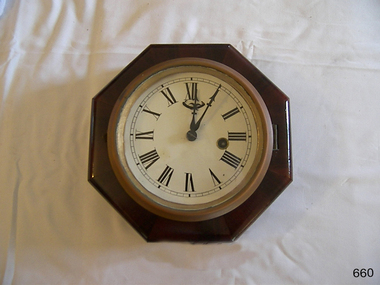
Clock, 1867-1870
... A one-day wood-cased clock, which sold for six dollars had helped put the company on the map. ...A one-day wood-cased clock, which sold for six dollars had helped put the company on the map. ...Chauncey Jerome (1793–1868) was an American clock maker in the early to mid 19th century. He made a fortune selling his clocks, and his business grew quickly. Jerome was born in Canaan USA in 1793 son of a blacksmith and nail-maker. He began his career in Plymouth, making dials for long-case clocks where he learned all he could about clocks, particularly clock cases, and then went to New Jersey to make seven-foot cases for clocks mechanisms. In 1816 he went to work for Eli Terry making "Patent Shelf Clocks," learning how to make previously handmade cases using machinery. Deciding to go into business for himself, Jerome began to make cases, trading them to Terry for wooden movements. In 1822 Jerome moved his business to Bristol New Haven, opening a small shop with his brother Noble and began to produce a 30-hour and eight-day wooden clocks. By 1837 Jerome's company was selling more clocks than any of his competitors. A one-day wood-cased clock, which sold for six dollars had helped put the company on the map. A year later his company was selling that same clock for four dollars. The company also sold one line of clocks at a wholesale price of 75 cents and by 1841 the company was showing an annual profit of a whopping $35,000, primarily from the sale of its brass movements. In 1842 Jerome moved his clock-case manufacturing operation to St. John Street in New Haven. Three years later, following a fire that destroyed the Bristol plant, Jerome relocated the entire operation to Elm City factory. Enlarging the plant, the company soon became the largest industrial employer in the city, producing 150,000 clocks annually. In 1850 Jerome formed the Jerome Manufacturing Co. as a joint-stock company with Benedict & Burnham, brass manufacturers of Waterbury. In 1853 the company then became known as the New Haven Clock Co, producing 444,000 clocks and timepieces annually, then the largest clock maker in the world. Jerome's future should have been secure but in 1855 he bought out a failed Bridgeport clock company controlled by P.T. Barnum, which wiped him out financially, leaving the Jerome Manufacturing Co. bankrupt. Jerome never recovered from the loss. By his admission, he was a better inventor than a businessman. When Jerome went bankrupt in 1856 the New Haven Clock Company purchased the company. One of the primary benefits of Jerome purchasing New Haven in the first place was the good reputation of the Jerome brand and the network of companies that remained interested in selling its clocks. In England, Jerome & Co. Ltd. sold Jerome clocks for the New Haven company until 1904, when New Haven purchased the English firm outright. After his involvement with the New Haven Company in 1856, Jerome traveled from town to town, taking jobs where he could, often working for clock companies that had learned the business of clock making using Jerome's inventions. On returning to New Haven near the end of his life, he died, penniless, in 1868 at the age of 74. The company struggled on after Jerome's bankruptcy until after World War II, when the company endeavored to continue through disruptions caused by a takeover along with poor sales, finally having to fold its operations in 1960 a little more than 100 years after it had been founded. The item is significant as it is associated with Chauncey Jerome who had made a historic contribution to the clock making industry during the 19th century when he began to substitute brass mechanisms for wooden mechanisms in his clocks. This was said to be the greatest and most far-reaching contribution to the clock industry. Because of his discovery of stamping out clockwork gears rather than using castings, Jerome was producing the lowest-priced clocks in the world. That can only add to his significance as the major clock manufacture of the 19th century. Jerome may have made and lost, a fortune selling his clocks but was perhaps the most influential and creative person associated with the American clock business during the mid-19th century. Also, he had served his community as a legislator in 1834, a Presidential elector in 1852 and mayor of New Haven, Connecticut from 1854 to 1855.Eight day movement wall clock with Roman numerals, octagonal shaped rosewood veneered casing, hinged face with locking clip. Wound from front. Face has adjustment for Fast-to-Slow.Part paper label on back of case can just make out "Jerome" and "ight and One" probable meaning is "Eight and One Day" describing the movements operational time between winding the mechanism.flagstaff hill, warrnambool, shipwrecked-coast, flagstaff-hill, flagstaff-hill-maritime-museum, maritime-museum, shipwreck-coast, flagstaff-hill-maritime-village, clock maker, jerome & co, new haven, chauncey jerome, canaan -
Federation University Historical Collection
Book, Bedford McNeill, Mining and General Telegraphic Code, 1899, 1899
... Contents include: General suggestions for using code; Morse signals, alphabet and figures; Timetable west of Greenwich; Timetable east of Greenwich; map; Alphabetical Code; Survey of Mineral Properties; Numbers; English Money; American money; Lineal measurement; Weights; Letters; Cables; banks; Finance Companies; Substitutions; Extra Code. The book includes the following advertisements: Nobel's Explosives Company; Otto Aerial Ropeways; Tabloid Medicine cases & Chests; Charleton's Report Book for Mining Engineers; Bornhardt's Electrical Firing Machine; ...Contents include: General suggestions for using code; Morse signals, alphabet and figures; Timetable west of Greenwich; Timetable east of Greenwich; map; Alphabetical Code; Survey of Mineral Properties; Numbers; English Money; American money; Lineal measurement; Weights; Letters; Cables; banks; Finance Companies; Substitutions; Extra Code. The book includes the following advertisements: Nobel's Explosives Company; Otto Aerial Ropeways; Tabloid Medicine cases & Chests; Charleton's Report Book for Mining Engineers; Bornhardt's Electrical Firing Machine; Mining and General Telegraphic Code, 1899 Book Book Bedford McNeill Whitehead, Morrris & Co. ...McNeill's Code was arranged to meet the requirements of mining, metallurgical and civil engineers, Directors of Mining, Smelting companies; bankers; stock and share brokers, solicitors, accountants, financiers and general merchants. Bedford McNeil )Assoc. M. Inst. C.E.) was an Associate of the Royal School of Mines; Member of the Institution of Mining and metallurgy and of the north of England Institute of Mining and Mechanical Engineers; and a Fellow of the Geological Society. "OBITUARY - Mr. Bedford McNeill IT is with regret that we announce the death on September 18, due to cerebral hemorrhage, of Mr. Bedford McNeill, the well-known mining engineer, at fifty-five years of age. Apart from his high reputation as a mining engineer, Mr. McNeill’s name was almost a household word in connection with the telegraphic code compiled by him, which was issued originally in 1893, and in an enlarged and revised form in 1908. This code is employed almost without exception by mining-companies and engineers, to whose use it was specially dedicated, and other business men have found it extremely practical for cable communications. [Nature 98, 94-94 (05 October 1916)] Black hard covered book of 807 pages by Bedford McNeil. Contents include: General suggestions for using code; Morse signals, alphabet and figures; Timetable west of Greenwich; Timetable east of Greenwich; map; Alphabetical Code; Survey of Mineral Properties; Numbers; English Money; American money; Lineal measurement; Weights; Letters; Cables; banks; Finance Companies; Substitutions; Extra Code. The book includes the following advertisements: Nobel's Explosives Company; Otto Aerial Ropeways; Tabloid Medicine cases & Chests; Charleton's Report Book for Mining Engineers; Bornhardt's Electrical Firing Machine; On a page towards the front "R. Brook"morse code, mcneill, bedford mcneill, mining, noble's explosives company, otto, charleton, tabloid, bornhadt, brook, r. brook, telegraphy, morse -
 Flagstaff Hill Maritime Museum and Village
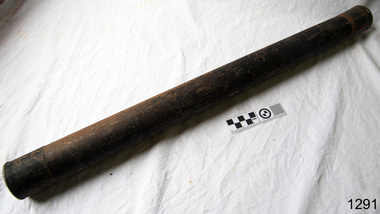
Container - Chart Case, ca 19th century
... "Flagstaff Hill c/ J Lindsay" This chart case is an example of maritime chart storage used in colonial times to protect charts and maps from the weather and to store them is an easily accessible was. flagstaff hill warrnambool shipwrecked-coast flagstaff-hill flagstaff-hill-maritime-museum maritime-museum shipwreck-coast flagstaff-hill-maritime-village chart case navigation chart storage Chart case, black painted metal cylindrical container with caps on both ends. ...Black painted metal cylindrical container. Label attached at one end with inscription. "Flagstaff Hill c/ J Lindsay"This chart case is an example of maritime chart storage used in colonial times to protect charts and maps from the weather and to store them is an easily accessible was. Chart case, black painted metal cylindrical container with caps on both ends.flagstaff hill, warrnambool, shipwrecked-coast, flagstaff-hill, flagstaff-hill-maritime-museum, maritime-museum, shipwreck-coast, flagstaff-hill-maritime-village, chart case, navigation, chart storage -
 Flagstaff Hill Maritime Museum and Village
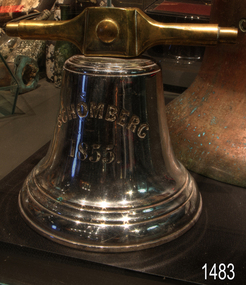
Functional object - Bell, Schomberg 1855, Before 1855
... map. During the night, the crew launched a lifeboat to search for a safe landing spot for the passengers. The scouting party advised Forbes to wait until morning, as rough seas posed a danger to the lifeboats. At dawn, the ship’s Chief Officer spotted the SS Queen and signalled for help. The master of the Queen brought his vessel alongside, and all passengers and crew disembarked safely. The Black Ball Line’s Melbourne agent sent another steamer to collect the passengers’ baggage, and other steamers assisted with cargo salvage until worsening weather forced operations to cease. Notably, a plunderer later recovered a case...map. During the night, the crew launched a lifeboat to search for a safe landing spot for the passengers. The scouting party advised Forbes to wait until morning, as rough seas posed a danger to the lifeboats. At dawn, the ship’s Chief Officer spotted the SS Queen and signalled for help. The master of the Queen brought his vessel alongside, and all passengers and crew disembarked safely. The Black Ball Line’s Melbourne agent sent another steamer to collect the passengers’ baggage, and other steamers assisted with cargo salvage until worsening weather forced operations to cease. Notably, a plunderer later recovered a case ...The Rescue and Journey of the Schomberg Bells: This bell was the smaller of two rescued by the crew of the Schomberg following the ship’s wreck in 1855. While the specific purpose of the smaller bell is unknown, it may have served to assemble the crew or signal mealtimes on board. After surviving the shipwreck, the crew carried both bells as they made their way along the coastline. Their journey eventually led them to the home of settler John Manning, located at Hopkins Point near Warrnambool. Manning took possession of the bells and subsequently presented them to two churches in Warrnambool. The smaller bell went to St Joseph’s Catholic Church, while the larger bell went to St John’s Presbyterian Church. After around a year, the small bell at St Joseph’s developed a crack and became unusable. Thomas Manifold imported a replacement bell for the church, and the damaged bell was stored at his farm. Years later, when the property was sold to John Logan, the discarded bell was donated to the old Warrnambool Museum upon its opening in 1886. The Curator, Joseph Archibald, placed the bell on display in the entry. In 1975, it was transferred from the Warrnambool Art Gallery to Flagstaff Hill. The ’Mystery’ of the small bell solved: Despite numerous attempts by the staff at Flagstaff Hill to restore the bell’s lustre, the bell remained dull and tarnished. In October 1986, Director Peter Ronald decided to send the bell for professional advice. The bell was entrusted to Briggs Marine Products, a renowned brass founder established in 1912. Upon examination, the specialists at Briggs discovered the reason behind the bell’s persistent lack of shine: it had originally been silver-plated, but most of the plating had worn away over time. The experts at Briggs then undertook the task of restoring the bell, successfully returning it to a gleaming silver surface. The Sailing Ship Schomberg: Launched in 1855, the Schomberg was regarded as the “Noblest” ship afloat at the time. Owned by the Black Ball Line, it was built for their passenger fleet by Alexander Hall of Aberdeen at a cost of £43,103. The construction featured three skins: one planked fore and aft and two diagonally planked, all fastened with screw-threaded trunnels (wooden rails). The ship’s First Class accommodation was luxurious, boasting velvet pile carpets, large mirrors, rosewood, birds-eye maple and mahogany timbers, satin damask soft furnishings, and an oak-lined library with a piano. Schomberg had a capacity for 1,000 passengers. The ship’s master, Captain James Nicol Forbes—also known as ‘Bully’ Forbes—was only 34 years old at the launch. He had a reputation for setting and breaking speed records on the Black Ball Line’s Marco Polo and Lightning. In 1852, Forbes completed the London to Melbourne journey on the Marco Polo in 68 days, a record at the time, though 53 passengers died during the voyage. In 1854, he sailed the Lightning to Melbourne in 76 days and returned in only 63 days—a record that stood among sailing ships. Forbes was known for driving his ship and crew to their limits, often prioritising speed over passenger comfort. Determined to set new records, he promised to reach Melbourne in sixty days, declaring he would do so “with or without the help of God.” The Maiden Voyage and the Wreck: Schomberg departed Liverpool on 6th October 1855, flying a banner that read “Sixty Days to Melbourne”. The vessel carried 430 passengers and 3,000 tons of cargo, including materials to build the Melbourne to Geelong Railway and a bridge over the Yarra River. Among the cargo were a cow for fresh milk, pens for fowls and pigs, and 90,000 gallons of water for drinking and washing. Additionally, it transported 17,000 letters and 31,800 newspapers. The ship and cargo were insured for $300,000, a considerable sum for the era. Poor winds while crossing the equator delayed Schomberg’s progress. Land was first sighted on Christmas Day at Cape Bridgewater near Portland. Captain Forbes followed the coastline towards Melbourne, but was reportedly playing cards when the third mate, Henry Keen, reported land only three miles away. The ship ran aground on a sand spit near Curdie’s Inlet (approximately 56 km west of Cape Otway) on 26th December 1855, after 78 days at sea. The sand spit and nearby currents were not marked on Forbes’s map. During the night, the crew launched a lifeboat to search for a safe landing spot for the passengers. The scouting party advised Forbes to wait until morning, as rough seas posed a danger to the lifeboats. At dawn, the ship’s Chief Officer spotted the SS Queen and signalled for help. The master of the Queen brought his vessel alongside, and all passengers and crew disembarked safely. The Black Ball Line’s Melbourne agent sent another steamer to collect the passengers’ baggage, and other steamers assisted with cargo salvage until worsening weather forced operations to cease. Notably, a plunderer later recovered a case of Wellington boots, but all were for the left foot. The wreck and its cargo were sold to local merchants Manifold & Bostock, who did not attempt further salvage. They later sold their interest to a Melbourne businessman and two seafarers. In 1864, after two men drowned in their attempt to reach the Schomberg, salvage efforts were abandoned. By 1870, parts of the ship had washed ashore on New Zealand’s South Island. Today, the wreck is about nine metres below the surface. Although most woodwork has disintegrated, the vessel’s shape remains discernible due to the railway irons, girders, and framework. Various goods and materials from the ship are scattered nearby. The bell is particularly significant in that along with other items from the wreck helped in part to having the legislation changed to protect shipwrecks, with far tighter controls being employed to oversee the salvaging of wreck sites. This bell forms part of the Schomberg collection at Flagstaff Hill maritime museum. The collection as a whole is of historical and archaeological significance at a State level. Flagstaff Hill’s collection of artefacts from the Schomberg is also significant for its association with the Victorian Heritage Registered Schomberg shipwreck (VHR S 612). The collection is of additional significance because of the relationship between the objects salvaged, as together they help us to interpret the story of the Schomberg. The collection as a whole is historically significant for representing aspects of Victoria's maritime history and its potential to interpret social and historical themes from society at the time of the wreck. A small ship’s bell. The silver-plated metal bell bears the ship’s name and year of construction on one side and the name and address of the ship’s builders on the other. These details are deeply engraved into the metal and formed in bold, upper-case lettering. The bell has two bell stands: the left and the right. Both stands have an Iron pipe bent into an inverted ‘Y’ shape, with a hole along its length and feet attached to a rectangular metal plate at the other two ends. Feet are bolted to a timber base that has a hole drilled through the centre for mounting. Bell's front; “SCHOMBERG” with “1855” below. Bell's back “HALL & SONS (crack splits letter “N”) / BUILDERS (in italics) / ABERDEEN” (crack splits letter “B”).flagstaff hill, flagstaff hill maritime museum and village, warrnambool, maritime museum, maritime village, great ocean road, shipwreck coast, schomberg, silver plated bell, mess bell, bell stands, captain ‘bully’ forbes, alexander hall and son, james baines and company, liverpool’s black ball line, bell, schomberg bell, ship's bell, small bell, st joseph's church, briggs marine, john manning, john logan, warrnambool museum, briggs foundry, silver bell -
 Greensborough Historical Society
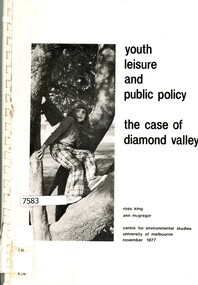
Book - Report, Ross King et al, Youth, leisure and public policy: the case of Diamond Valley, 1977, 1977_11
... map. White plastic binding. Youth, leisure and public policy: the case of Diamond Valley, 1977 Book Report Shire of Diamond Valley Ross King Ann McGregor ...119 pages text and black and white line drawings and tables. One colour fold out map. White plastic binding. non-fictionshire of diamond valley, leisure activities, sport -
 Frankston RSL Sub Branch
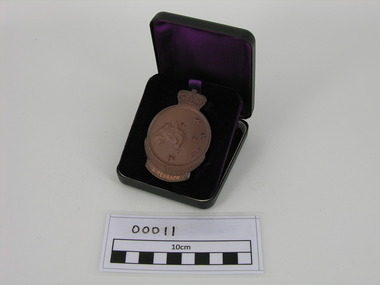
Medallion, ANZAC, Government issue, 50th Anniversary of Gallipoli Medallion
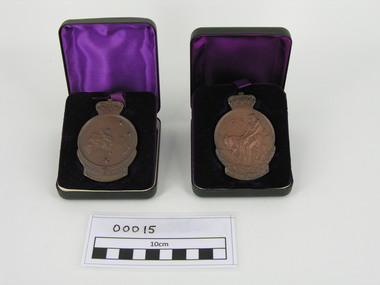
... Reverse depicts a map of Australia and New Zealand with the Southern Cross superimposed, fern fronds and the engraved name of the recipient 'A. PEARSON'. This medallion is in its original presentation case...Reverse depicts a map of Australia and New Zealand with the Southern Cross superimposed, fern fronds and the engraved name of the recipient 'A. PEARSON'. This medallion is in its original presentation case ...Circular bronze medallion surmounted by the Queen's crown. Obverse depicts Simpson and his donkey assisting a wounded man, a laurel wreath, the date '1915' and the word 'ANZAC'. Reverse depicts a map of Australia and New Zealand with the Southern Cross superimposed, fern fronds and the engraved name of the recipient 'A. PEARSON'. This medallion is in its original presentation case. The Anzac Medallion was issued by the Australian government in 1967 to commemorate the 1965 50th anniversary of the Gallipoli landings. The medallion was issued to surviving veterans of the campaign or their next of kin. Refer to AWM item for further information < http://www.awm.gov.au/collection/RELAWM16790.001/ >The name of the recipient, A. Pearson, is engraved on the reverse of this medallion. -
 Frankston RSL Sub Branch
Medallion, ANZAC, Government issue, 50th Anniversary of Gallipoli Medallion
... Reverse depicts a map of Australia and New Zealand with the Southern Cross superimposed, fern fronds and the engraved name of the recipient 'G. R. GRIFFITH'. This medallion is in its original presentation case...Reverse depicts a map of Australia and New Zealand with the Southern Cross superimposed, fern fronds and the engraved name of the recipient 'G. R. GRIFFITH'. This medallion is in its original presentation case ...Circular bronze medallion surmounted by the Queen's crown. Obverse depicts Simpson and his donkey assisting a wounded man, a laurel wreath, the date '1915' and the word 'ANZAC'. Reverse depicts a map of Australia and New Zealand with the Southern Cross superimposed, fern fronds and the engraved name of the recipient 'G. R. GRIFFITH'. This medallion is in its original presentation case. The Anzac Medallion was issued by the Australian government in 1967 to commemorate the 1965 50th anniversary of the Gallipoli landings. The medallion was issued to surviving veterans of the campaign or their next of kin. Refer to AWM item for further information < http://www.awm.gov.au/collection/RELAWM16790.001/ >The recipients name, G.R. Griffith, is engraved on the reverse of the medallion.ww1, gallipoli, medallion, g r, griffith -
 The Beechworth Burke Museum
Geological specimen - Gold-Sulphide Ore
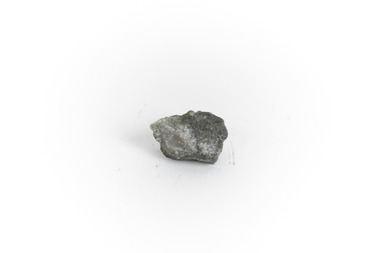
... case, sulphur. Therefore, this specimen is a rare example of gold naturally forming into a compound mineral with sulphur. This specimen is part of a larger collection of geological and mineral specimens collected from around Australia (and some parts of the world) and donated to the Burke Museum between 1868-1880. A large percentage of these specimens were collected in Victoria as part of the Geological Survey of Victoria that begun in 1852 (in response to the Gold Rush) to study and map ...This particular specimen was recovered from two hundred feet down in the Golden Mile in Kalgoorlie, Western Australia. The Golden Mile, named after the estimated sixty million ounces of gold worth around one hundred billion dollars, was the birthplace of the largest gold rush in Australia almost one hundred and thirty years ago when William Brookman and Samuel Pearce leased the Great Boulder mine. The Golden Mile is also the home of the Super Pit, Australia's most well-known mine.The majority of gold deposits will form as a native metal, however, on occasion, it can form a compound with another element, in this case, sulphur. Therefore, this specimen is a rare example of gold naturally forming into a compound mineral with sulphur. This specimen is part of a larger collection of geological and mineral specimens collected from around Australia (and some parts of the world) and donated to the Burke Museum between 1868-1880. A large percentage of these specimens were collected in Victoria as part of the Geological Survey of Victoria that begun in 1852 (in response to the Gold Rush) to study and map the geology of Victoria. Collecting geological specimens was an important part of mapping and understanding the scientific makeup of the earth. Many of these specimens were sent to research and collecting organisations across Australia, including the Burke Museum, to educate and encourage further study.A small gold-sulphide ore mineral specimen in shades of silver and grey with flecks of gold. Precious metals are often found in Sulphide Ores, as sulphides usually bind to these metals. They are also extremely symmetrical in crystaline form. Gold-Sulphide Ore occurs when gold forms a natural compound with other elements. In this form, gold can be present in one of two ways. It can be fully immersed in the sulphide, or a portion may be partially free. This specimen has minimal gold visible, with only a few flecks being partially visible.burke museum, beechworth, indigo shire, beechworth museum, geological, geological specimen, mineralogy, gold-sulphide ore -
 Lara RSL Sub Branch
Medallion, W.H.Mathews, 1967
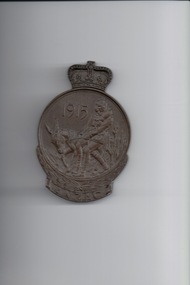
... case with a moulded velvet base to receive the medallion, with a silk lined hinged lid. Medallion presented to all army personnel serving at Gallipoli medallion army anzacs australian army world war 1 ww1 gallipoli The obverse of the medallion depicts Simpson and his donkey carrying a wounded soldier to safety. It is bordered on the lower half by a laurel wreath above the word ANZAC and the date 1915 above the donkey. The reverse shows a map ...Every Anzac soldier who served on the Gallipoli Peninsula, or in direct support of operations there - or his family if he did not survive until into the late 1960s - was entitled to be issued with the Anzac Commemorative Medallion. The Medallion was issued in 1967. The medallion was sent by registered post and comes in a presentation case with a moulded velvet base to receive the medallion, with a silk lined hinged lid.Medallion presented to all army personnel serving at GallipoliANZAC Medallion Badge issued in memory of W.H. MathewsThe obverse of the medallion depicts Simpson and his donkey carrying a wounded soldier to safety. It is bordered on the lower half by a laurel wreath above the word ANZAC and the date 1915 above the donkey. The reverse shows a map in relief of Australia and New Zealand superimposed by the Southern Cross. The lower half is bordered by New Zealand fern leaves and the name W.M. Mathewsmedallion, army, anzacs, australian army, world war 1, ww1, gallipoli -
 Federation University Historical Collection
Instrument - Scientific Instruments, Universal Stereoscope
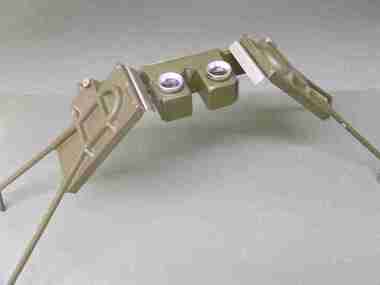
... Used in Surveying classes. scientific instruments surveying ballarat school of mines stereoscope map reading A stereoscope arranged for positioning over a horizontal surface stored in a sturdy grey wood carry case. ...Initially made for and used by the military forces. Subsequently acquired (as army surplus equipment?) by the Ballarat School of Mines. Used in Surveying classes.A stereoscope arranged for positioning over a horizontal surface stored in a sturdy grey wood carry case. Spare set of mirrors attached to inside of box lid.scientific instruments, surveying, ballarat school of mines, stereoscope, map reading
