
Showing 100 items matching "military badges and buttons"
-
 Wangaratta RSL Sub Branch
Uniform - Buttons - Australian Military Forces, C1914
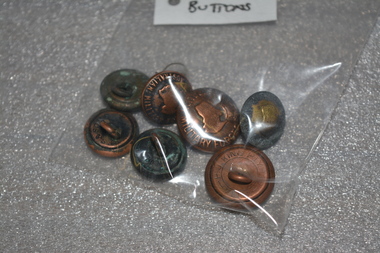
... ...buttons...Worn on the Australian Uniform during the First and Second World Wars australian army australia military badges buttons australian buttons australian military forces buttons On front: Australian Military Forces. ...Worn on the Australian Uniform during the First and Second World WarsLarge and small domed shaped buttons of brass colour with Australian Military Forces written around the outside, a map of Australia in the middle with a crown on top.On front: Australian Military Forces. Also has the map of Australia with a crown on top, On back: P.J.King Pty Ltd, Melb. australian army, australia military badges, buttons, australian buttons, australian military forces buttons -
 Wangaratta RSL Sub Branch
Badge - Badges and button
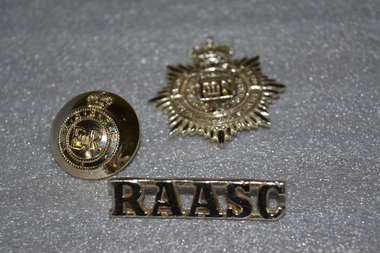
... australian buttons...australian buttons australian army australia military badges buttons army corps royal army corps australian royal army corps Button has RAASC, ER on front. ...Large plastic silver button. Plastic silver seven point star shaped badge with crown on top. Plastic silver RAASC badge.Button has RAASC, ER on front. Stokes Melb on back Star has Royal Australian Army Services Corps, ER, Honu Soit Qui Mal Y Pense on front. S. Wann & Hudson on back. RAASC has nil. australian buttons, australian army, australia military badges, buttons, army corps, royal army corps, australian royal army corps -
 Wangaratta RSL Sub Branch
Badge - Collection of Buttons, Badges and Patches
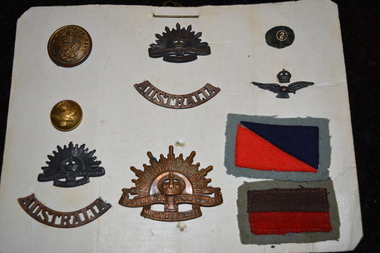
... Collection of Australian Military Forces badges, buttons and patches....Collection of Australian Military Forces badges, buttons and patches. amf badges unit colour patches Australia Commonwealth Military Forces Mounted on white cardboard 7 badges - three rising sun badges, two Australia badges, a crown above wings, star with the number 2 in the centre, two patches - red/black and red/brown - two gold coloured different sized buttons - large button with crown and anchor and small button crown and wings. ...Collection of Australian Military Forces badges, buttons and patches.Mounted on white cardboard 7 badges - three rising sun badges, two Australia badges, a crown above wings, star with the number 2 in the centre, two patches - red/black and red/brown - two gold coloured different sized buttons - large button with crown and anchor and small button crown and wings. Australia Commonwealth Military Forcesamf badges, unit colour patches -
 Ringwood RSL Sub-Branch
Uniform - money belt, insignia, medal, Equipment, Circa 1940's
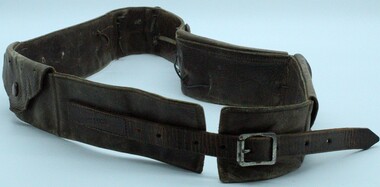
... Attached are 2 British/Australian military badges, 7 buttons and one officers pip.00607.2 Assorted badges and coins.00607.3 Lapel badge Naval Assn of Australia engraved 561 on reverse. ...Attached are 2 British/Australian military badges, 7 buttons and one officers pip.00607.2 Assorted badges and coins.00607.3 Lapel badge Naval Assn of Australia engraved 561 on reverse. ...00607.1 Brown leather belt. Attached are 2 British/Australian military badges, 7 buttons and one officers pip.00607.2 Assorted badges and coins.00607.3 Lapel badge Naval Assn of Australia engraved 561 on reverse. ASM 1939-1945 engraved PA2095 EJ Cope. Royal British Nursing Assn medal Wilhelmina Crosby 00607.4 12 Australian Army Medical Corps buttons Queens Crown124world war two, ww2, wwii, badges, coins, royal british nursing association, naval association of australia, australian army medical corps -
 Bendigo Military Museum
Manual - GOLD COLOUR SAMPLE BOX, c. 1993
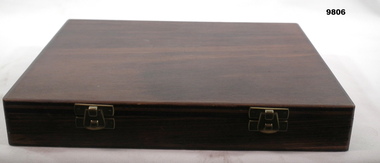
... This box of sampled is typical of those issued to official manufacturers of military badges, insignia, and buttons to ensure the gold colour remained consistent. ...This box of sampled is typical of those issued to official manufacturers of military badges, insignia, and buttons to ensure the gold colour remained consistent. ...This box of sampled is typical of those issued to official manufacturers of military badges, insignia, and buttons to ensure the gold colour remained consistent. These badges were held by the Third Army Quality Assurance Unit (3AQAU). The manufacturers were often local companies, where an example of a typical supplier is KG Luke who also manufactured the Brownlow Medal, the award given annnually to the Australlian Football League's best and fairest player.A rectangular wooden box with a black velvet-like cushion in one side. cushion has 10 examples - 2 of each kind - of military insignia and buttons of two different shades of gold colour. Box opens on one long side and is hinged (4cm brass hinges with 3 screws in each side). Clasps on opposite long side, also of brass. Wood has been stained a dark brown. Base off box shows 14 brass staples. Corners of base show 2 nails, possibly brass. A typed sheet of paper is attached to the inside of lid, dating from 1993, explaining usage of samples. Paper tag affixed to cushion between samples - Department of Defence authenticating samples in box. Tag attached with fabric tape and secured using a lead seal.Paper taped to inside lid - title 'SEALED SAMPLE 8455-03311' - a lengthy description of contents and box follows. Please refer ot photograoph for further details. Typed tag on cushion - 'Department of Defence/SEALED SAMPLE/Sealed sample Number 03311/Stock Number 8455/Description STANDARD OF GOLD COLOUR FOR INSIGNIA, BUTTONS AND BADGES (ANODISED) ALUMINIUM ALLOY 1150/APPROVED. The supply is not to differ from this sealed sample except as endorsed on the back hereof./D Darby [signature] 29/06/1993 /EDE VFE SCDDG [stamped].' Reverse of tag (stamped in red within a thin lined border) - 'SEALED SAMPLE/NOT TO BE/DESTROYED OR/MUTILATED' badges, military insignia, button -
 Mont De Lancey
Accessory - Military Uniform Buttons, 1939
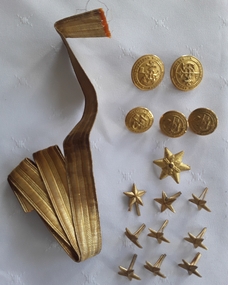
... ...military badges...A set of 1st World War German Military Uniform badges (10 star pins) and buttons (5) with a shank on the back made of rolled gold and a piece of ribbon made of pure gold thread. 3 buttons are smaller than the other two and all have engraving and military insignia which is difficult to read on the front and the back of each. ...Written by hand in blue ink on a small piece of paper - Ribbon is pure gold thread. The buttons and stars are rolled gold. They were all brought from Germany by Auntie Hilda - made in her cousin's factory who supplied these for the German Army, (1st World War). war military badges world war 1 military buttons military decorations gold The 5 buttons have an insignia on the front with a key and other markings. ...Written by hand in blue ink on a small piece of paper - Ribbon is pure gold thread. The buttons and stars are rolled gold. They were all brought from Germany by Auntie Hilda - made in her cousin's factory who supplied these for the German Army, (1st World War).A set of 1st World War German Military Uniform badges (10 star pins) and buttons (5) with a shank on the back made of rolled gold and a piece of ribbon made of pure gold thread. 3 buttons are smaller than the other two and all have engraving and military insignia which is difficult to read on the front and the back of each. One star is bigger than the other 9 and all have 5 points and lines on each point. They have a pin on the back. The 5 buttons have an insignia on the front with a key and other markings. German writing is around the edges and back.war, military badges, world war 1, military buttons, military decorations, gold -
 Bendigo Military Museum
Headwear - CAP, PEAKED, WW2 onwards
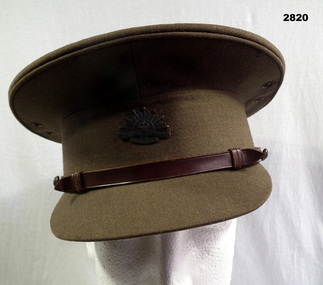
... Khaki felt outer covering, flat top with peaked front, tan leather front strap attached at sizes with black buttons. Black "Australian Commonwealth Military Force" badge on front, light tan lining inside with light tan leather inside band, Two ventilation holes each side under top....uniforms - army costume - male - headwear Passchendaele barracks trust peak cap In gold print on inside band: "Wilkes Todhunter Pty Ltd Military Outfitters Melbourne Victoria" Khaki felt outer covering, flat top with peaked front, tan leather front strap attached at sizes with black buttons. Black "Australian Commonwealth Military Force" badge on front, light tan lining inside with light tan leather inside band, Two ventilation holes each side under top. ...Khaki felt outer covering, flat top with peaked front, tan leather front strap attached at sizes with black buttons. Black "Australian Commonwealth Military Force" badge on front, light tan lining inside with light tan leather inside band, Two ventilation holes each side under top.In gold print on inside band: "Wilkes Todhunter Pty Ltd Military Outfitters Melbourne Victoria" uniforms - army, costume - male - headwear, passchendaele barracks trust, peak cap -
 Frankston RSL Sub Branch
Collection, Badges
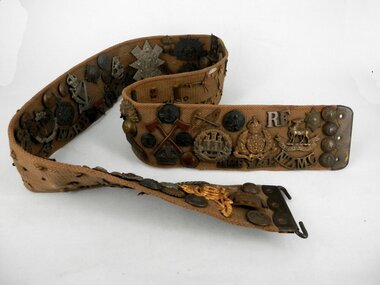
... badges and buttons which are attached to the belt. The belt has brass fittings however the original buckle is missing. There are a total of 83 various allied military insignia, badges and uniform buttons from the World War 1 era, 56 metal insignia and badges and 27 metal buttons which are mostly of Australian, New Zealand, Canadian or British origin. ...badges and buttons which are attached to the belt. The belt has brass fittings however the original buckle is missing. There are a total of 83 various allied military insignia, badges and uniform buttons from the World War 1 era, 56 metal insignia and badges and 27 metal buttons which are mostly of Australian, New Zealand, Canadian or British origin. ...United States Army standard issue infantry heavyweight webbing waist belt as worn in World War 1. This is an example of a 'trophy' belt, complete with a souvenir collection of metal insignia, badges and buttons which are attached to the belt. The belt has brass fittings however the original buckle is missing. There are a total of 83 various allied military insignia, badges and uniform buttons from the World War 1 era, 56 metal insignia and badges and 27 metal buttons which are mostly of Australian, New Zealand, Canadian or British origin. Belt manufactured by M W & S Limited of England in 1915.The reverse side of the belt is stamped "M W & S LTD., 1915" and has an "L" stamp and the Defence Department "/|\". The belt reverse also has the following name in black handwriting "A Paxino 9781 2211". Note A Paxino was associated with Frankston RSL Sub Branch for many years. -
 Warrnambool and District Historical Society Inc.
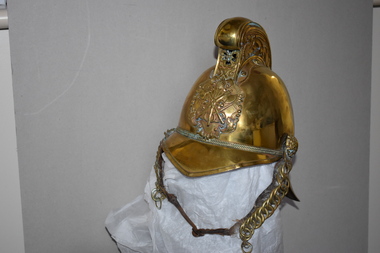
Helmet, Firmin & Sons, Fireman's helmet, Early 20th century
... It supplies military ceremonial buttons, badges and uniforms and brass and pith helmets of various kinds. ...It supplies military ceremonial buttons, badges and uniforms and brass and pith helmets of various kinds. ...This fire helmet may have been one used in England or one used in the late 19th century and early 20th century in Australia. It was made by Firmin & Sons of England, a firm which was founded in 1655. It supplies military ceremonial buttons, badges and uniforms and brass and pith helmets of various kinds. It is regarded as the oldest manufacturing business operating in England today. The Warrnambool Fire Brigade was established in the early 1860s and today has both paid and volunteer firefighters.This helmet has no known local provenance but is retained for display purposes.This is a brass helmet with an oval crown with an ornate scrolled curved piece coming over the crown. There is a decoration of a winged dragon breathing fire and on the front side a torch, an axe and a hose with decorative surrounds. There is a breathing hole at the top of the crown in a petal shape. On the sides are metal medallions holding a chin strap which is adjustable. The edge of the crown has a scrolled band. The front peak is angled with a folded metal edge and the rear peak is a concave shape with a brass screw in the middle. Inside the helmet are 8 screws holding the upper decorative arching piece and a black leather band with eyelets tied together to fir the individual head. There is an oval plaque with wording contained within a decorative belt.Firmin & Sons Ltd 108 & 109 St Martins Lane W.C. Late of 153 & 154 Strandwarrnambool fire brigade, history of warrnambool -
 Montmorency–Eltham RSL Sub Branch
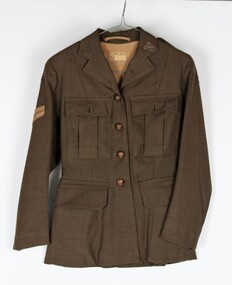
Uniform - Jacket, Khaki, Service Dress WW2 (Womens), 1943
... Australian Military Forces badge on the upper left lapel Two epaulets on the left and right shoulders with two small buttons inscribed Australian Military Forces with a map of Australia in the center with a crown at the top of the map. ...Australian Military Forces badge on the upper left lapel Two epaulets on the left and right shoulders with two small buttons inscribed Australian Military Forces with a map of Australia in the center with a crown at the top of the map. ...Dress jacket worn by Corporal Kathleen Phyllis Gill from Toorak Hill, Casterton. Army No. VF345716 Unit LHQ (Mil. Sec)Lined women's khaki dress jacket. Long sleeved. Wool polyester. Four metal buttons down the front with the inscription Australian Military Forces with a map of Australia in the center with a crown at the top of the map. Two hip pockets on the left and right with a flap on each. Two pleated pockets over the left and right breasts with flaps and small metal buttons inscribed Australian Military Forces with a map of Australia in the center with a crown at the top of the map. Australian Military Forces badge on the upper left lapel Two epaulets on the left and right shoulders with two small buttons inscribed Australian Military Forces with a map of Australia in the center with a crown at the top of the map. AWAS (Australian Women's Army Service) badges at the base of each epaulet. Corporal's stripes 6 cm down the right sleeve. Unit patch red over black - LHQ (Mill Sec). Two vertical belt loops at the back on the left and right. Pleat opening at the back. Horizontal strip of material inside the collar at the back of the neck to hang jacket. Tag sewn onto the lining at the back 2.5 cm down from the top stating - V 579 Made in Australia D. broad arrow D. 1943 Size kathleen gill, wool polyester, women's dress jacket -
 Nhill Aviation Heritage Centre
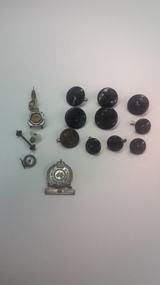
Buttons, Variety of airforce buttons
... RSL lapel badge , and RSL pin badge. Brown Australian Military Forces button 20 mm diameter, with crown and map of Australia inscribed on it 2 smaller slightly damaged buttons. ...Variety of airforce buttons Buttons ...These buttons and badges belonged to Frank Seddon, an airforce pilot during World War 11, father of Nhill resident Pat Beacom.5 black 25 mm diameter buttons and 4 black 17mm diameter buttons with crown and eagle logo. RSL lapel badge , and RSL pin badge. Brown Australian Military Forces button 20 mm diameter, with crown and map of Australia inscribed on it 2 smaller slightly damaged buttons. airforce, buttons, seddon, wwii, ww2 -
 Shepparton RSL Sub Branch
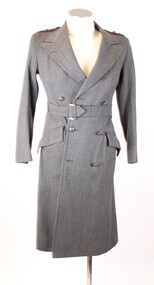
Uniform, Great Coat
... /SWANSTON ST MELBOURNE/SISTER DANSON". Buttons read "AUSTRALIAN MILITARY FORCES" Shin length grey woollen double breasted coat fastened with three buttons on front centre. ...Coat worn by Sister Danson (VFX151507) during the British presence in Japan following the end of the Second World War. About 16,000 Australians served in the British Commonwealth Occupation Forces, including 130 from the Australian General Hospital with whom Sister Danson presumably served. Sister Danson was born in Numurkah and served as Leiutentant with the Heidelberg Military Hospital before embarking for Japan in 1947.This coat is part of a complete uniform set held by the Shepparton RSL. The uniform has representative and historic significance as an example of the style of uniform worn by nursing staff of the Australian General Hospital during the 1940s and into the 1950s. The uniform set has social significance to the Shepparton area, being owned and worn by a serving community member who was born in Numurkah, enlisted in Shepparton and returned to the community in later life.Shin length grey woollen double breasted coat fastened with three buttons on front centre. Interior bakelite or plastic button fastens panels on interior. Two hip-height pockets with folded flap on exterior. Grey fabric belt fastened with a metal buckle; belt is held in place with two fabric loops on either side of the waist. "AUSTRALIA" shoulder flashes on both left and right shoulders; on left arm a blue and brown rectangular colour patch and on the right arm, a blue square patch with embroidered crown and the words "BRITISH COMMONWEALTH FORCES." Epaulettes on either shoulder carry two metal badges signifying a senior Sister and fastened with a metal button. A pin is missing from the base of the epaulette. Interior lined with purple-grey lining; pocket on interior left chest and manufacturer's label at base of neck underneath loop.Shoulder flashes read "AUSTRALIA" and "BRITISH COMMONWEALTH FORCES". Label reads "TAILORS & HABIT/MAKERS/J. RAVENSDALE/& SON/NICHOLAS BLDG./SWANSTON ST MELBOURNE/SISTER DANSON". Buttons read "AUSTRALIAN MILITARY FORCES"second world war, world war ii, medical, wwii, nurse, women -
 Shepparton RSL Sub Branch
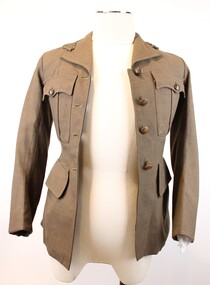
Uniform, Dress Jacket, 1943
... Rising sun badge reads "AUSTRALIAN COMMONWEALTH/MILITARY FORCES." Buttons read "AUSTRALIAN MILITARY FORCES."...Rising sun badge reads "AUSTRALIAN COMMONWEALTH/MILITARY FORCES." Buttons read "AUSTRALIAN MILITARY FORCES." ...This jacket belonged to Dorothy May Mortlock (VF518245) who was part of the Australian Womens Army Service (AWAS). Dorothy Mortlock was born in Swan Hill and enlisted with the 3rd AUST AWS REC DEPOT.Khaki-coloured woollen jacket which fastens along the centre via four metal buttons. Two hip-height pockets with external flap; two chest pockets with pleat in centre fastened via a metal button. Fabric belt around waist held in place by two fabric loops on back and fastened through metal buckle and loop. Collar carries two metal rising sun badges on the left and right side. Two epaulettes on either shoulder are held in place by a button and carries a badge reading "AWAS". Colour patch on both left and right side is square, half green and half black. Interior label on base of neck.Label reads "V 579/1943/SIZE/MADE IN/AUSTRALIA/D. MORTLOCK/VF518245". Rising sun badge reads "AUSTRALIAN COMMONWEALTH/MILITARY FORCES." Buttons read "AUSTRALIAN MILITARY FORCES."world war ii, second world war, wwii, women, australian women's army service -
 Flagstaff Hill Maritime Museum and Village
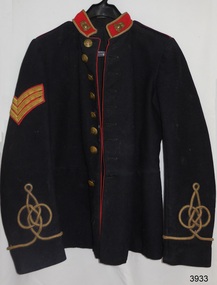
Uniform - Tunic, 1899-1903
... Shoulder epaulettes have red piping and smaller brass buttons. Closed back vent has vertical scalloped design with six brass buttons, in two columns of three, and red piping trim. ...This original tunic or jacket is part of the full dress uniform of the pre-Federation Victorian Permanent Artillery regiment. Its owner had the rank of Sergeant, as indicated by the three inverted chevrons. The Artillery design of the badges and buttons indicate the date of the tunic to be from 1893 to 1903. However the maker of the tunic, W. Moncton, began manufacture in Melbourne in 1899, so this the tunic can be dated between 1899 and 1903. The donor's grandfather was given this tunic but not the name of the original owner. It has since been suggested to the family that the tunic was worn by a local Western District Light Horse member. This could very well have been the case because mounted troops were officially referred to as the Light Horse in the late 19th to early 20th century. Several local men were involved in the Light Horse during the First World War. The donor's grandfather wore this tunic in the local district when riding a penny farthing bicycle. The donor's father also wore the tunic when dressed as a 'Captain' hosting a local disco dance. BRIEF MILITARY HISTORY- The Crimean War began In 1854 and many people in colonial Australia were afraid of a Russian attack. Volunteer forces were established to strengthen the British Imperial troops posted here. A battery of artillery was raised in Victoria as well as in other Australian states. In 1870 Australia became responsible for its own naval and military defence. The Volunteer Corps and Victorian Navy shared the responsibility of defending the existing forts, assisted by volunteer coastal and mobile field batteries. The Permanent Victorian Artillery force was established. It was disbanded in 1880 then re-formed in 1882 as the Victorian Garrison Artillery Corps. In 1895 the Geelong, Warrnambool, Port Fairy and Portland Batteries became part of the Western District Garrison Artillery. Many of the volunteers who served in the Artillery were from rural areas. They belonged to rifle clubs and were experience horsemen as well. Australia's defence at this time relied on these mounted troops, or Light Horse men. In 1899 the Victorian Garrison Artillery Corps amalgamated with the New South Wales and Queensland Permanent Artillery to become the Victorian Regiment of the Royal Australian Artillery (RAA). Then prior to Federation, the RAA and the Permanent Artillery of South Australia, Western Australia and Tasmania all combined, becoming the Royal Australian Artillery Regiment with two Batteries of Field Artillery; Battery A from Sydney and Battery B from Melbourne.This original uniform tunic of the pre-Federation Victorian Permanent Artillery is significant for its association with Australia's military defence and the fortifications of our district, state and country. The tunic is also significant, representing part of the history and evolution of uniforms in the Australian military forces. The tunic is also significant in its representation of Australia's independence in forming its own defences. The tunic has local significance in its connection with local social events.Tunic or jacket, part of the full dress uniform of the pre-Federation Victorian Permanent Artillery operating from 1893 to 1903. Original, single-breasted tunic of dark blue wool, red piping trim, black cotton lining in body. Sleeves lined with blue striped, white cotton. Front closure has eight brass buttons. Red band-style collar with hook-and-eye closure has gold bullion braid trim and a brass badge pinned each side at the front. Upper right sleeve has three inverted chevrons on red fabric with gold bullion braid trim (rank of Sergeant). Both sleeves have gold bullion braid 'Austrian knot' emblems stitched onto lower arm, with ends finishing on the inner sleeve. Shoulder epaulettes have red piping and smaller brass buttons. Closed back vent has vertical scalloped design with six brass buttons, in two columns of three, and red piping trim. Brass belt hook is attached to the left back waist, close to the seam (right side has a mark indicating a previous similar clip). Inside left breast is a concealed pocket. Tunic has both machine and hand stitching. All brass shank-style buttons have matching Artillery emblems with inscriptions on the back. The two brass collar badges have additional artillery emblems of exploding grenade and star as well as an inscription. Buttons were made for W. Moncton, of Melbourne and marked with his name. He traded from 1899, dating the tunic to between 1899 and 1903.Button front: Artillery emblem on front (field cannon facing left, in front of a muzzle-loading ram rod). Button back: engraved "W. MONCTON . MELBOURNE ." Collar badges: Artillery emblem (field cannon facing right | stars | exploding grenade | "AUSTRALIA")flagstaff hill, warrnambool, shipwrecked coast, flagstaff hill maritime museum, maritime museum, shipwreck coast, flagstaff hill maritime village, great ocean road, uniform jacket, uniform tunic, garrison volunteer uniform, fortifications in victoria, victorian permanent artillery, pre-federation military uniform, sergeant's uniform, jacket, militia, victoria, victorian volunteer forces, victorian regiment, royal australian artillery, raa, field gun, sergeant, w. moncton, garrison, dress uniform, tunic, scarlet collar, red collar, scarlet piping, red piping, gold bullion, artillery emblem, light horse, artillery, mounted troops, victorian garrison artillery corps -
 Flagstaff Hill Maritime Museum and Village
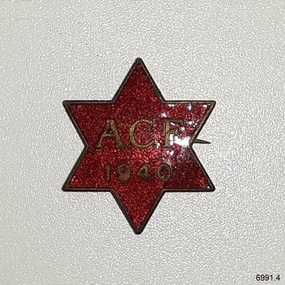
Badge - ACF Australian Comforts Fund badge, P J King Pty Ltd, 1940
... One of their fund-raising activities was 'button days' where buttons such as this one were given to those who gave donations. ...This badge is one of a set of significant badges that connects Doctor Angus with Australian organisations of the early-to-mid 20th century, including those relating to military service support. ...This Australian Comforts Fund badge is part of a set of eleven badges collected from the 1920s to the 1940s by Dr W. R. Angus. The badge was sold by the ACF in 1940 to raise funds for gifts to send to the Australian troops serving overseas. The badge is one of a set of badges that represents various organisations that he had interests in. The Australian Comforts Fund was a mostly female, volunteer-run organisation officially recognised by the Government. It began in 1916 as an amalgamation of groups of people who wanted to support the Australian troops abroad with Items of comfort to supplement the essential items provided by the Australian Military Forces. The ACF raised funds to purchase goods, pack them and send them overseas. One of their fund-raising activities was 'button days' where buttons such as this one were given to those who gave donations. The ACF closed down after World War I but was re-formed at the start of World War II. Items that the ACF sent to the troops included personal toiletry items such as toothbrushes and toothpaste, magazines, pyjamas, singlets and socks. They also provided sporting equipment, recreational music, writing materials and postcards. Special hampers were sent to the troops at Christmas time. The maker, P J King, (Percy John King), originally established his engraving and ie casting business in Russell Street, Melbourne in 1893 in partnership with Charles Walder Bridgland, continuing on his own from 1899. Percy and his son John Howard King set up a new business P J King Pty Ltd in 1928 making uniform buttons. In the late 1980s, it merged with two other companies that then became J J Cash, now known as Cash's Australia. The set of badges was donated to Flagstaff Hill Maritime Village by the family of Doctor Angus, Surgeon and Oculist. It is part of the “W.R. Angus Collection” which includes historical medical equipment, surgical instruments and material belonging to Dr Edward Ryan and Dr Thomas Francis Ryan, (both of Nhill, Victoria) and Dr Angus’ own belongings. The Collection’s history spans the medical practices of the two Doctors Ryan, from 1885-1926 plus that of Dr Angus, up until 1969. The W.R. Angus Collection: - The W.R. Angus Collection includes historical medical equipment, surgical instruments and material belonging to Dr Edward Ryan and Dr Thomas Francis Ryan, (both of Nhill, Victoria) and Dr Angus’ own belongings. The Collection’s history spans the medical practices of the two Doctors Ryan, from 1885-1926 plus that of Dr Angus, up until 1969. It includes historical medical and surgical equipment and instruments from the doctors Edward and Thomas Ryan of Nhill, Victoria. Dr Angus married Gladys in 1927 at Ballarat, the nearest big city to Nhill where he began as a Medical Assistant. He was also Acting House surgeon at the Nhill hospital where their two daughters were born. During World War II He served as a Military Doctor in the Australian Defence Force. Dr Angus and his family moved to Warrnambool in 1939, where Dr Angus operated his own medical practice. He later added the part-time Port Medical Officer responsibility and was the last person appointed to that position. Dr Angus and his wife were very involved in the local community, including the planning stages of the new Flagstaff Hill and the layout of the gardens there. Dr Angus passed away in March 1970.This badge represents the efforts of the women volunteers in Australia to support the Australian troops overseas in WWI and WWII. This badge is one of a set of significant badges that connects Doctor Angus with Australian organisations of the early-to-mid 20th century, including those relating to military service support. The W.R. Angus Collection is significant for still being located at the site it is connected with, Doctor Angus being the last Port Medical Officer in Warrnambool. The Collection includes historical medical objects that date back to the late 1800s.The ACF Badge is a star-shaped, gold, glittered red enamel and metal badge. The star has six points. The enamel surface is textured. The border and front inscription of the badge is gold. It is the badge of the Australian Comfort Fund, made by P.J. King and dated 1940. This badge is part of a set of badges collected by Dr W R Angus. the set represents organisations that he was involved in, and is part of the W.R. Angus Collection.Front: “ACF / 1940” Reverse embossed “P.J. KING”flagstaff hill, warrnambool, maritime museum, maritime village, great ocean road, shipwreck coast, metal badges, enamel badges, organisation badges, acf, presbyterian brotherhood, oikumene, w.r. angus, flagstaff hill maritime museum and village, australian comforts fund, button day, volunteer, australian military forces, christmas hamper, 1940 acf badge, fund-raising, p j king pty ltd, percy john king, donor's badge, world war ii, 1939-1945, australians at war, voluntary work, volunteers, home front, w.r. angus collection -
 Flagstaff Hill Maritime Museum and Village
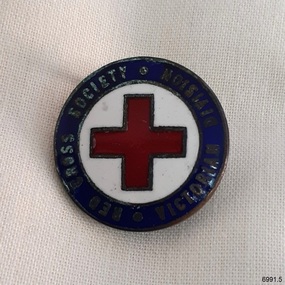
badge - Red Cross Society badge, Australian Red Cross Society, Victorian Division, 1914-1940s
... The maker, Thomas Stokes, migrated to Melbourne from Birmingham in 1854 and set up business in Mincer Lane as a die-sinker, producing medals, tokens, buttons and silverware, and offered an engraving service. ...The badge represents the Victoria Division of the Australian Red Cross Society, which was formed on 21st August 1914 at the outbreak of the First World War. Stokes & Sons of Melbourne made the button. It was made by Stokes & Sons Pty. Ltd. in Melbourne. The maker, Thomas Stokes, migrated to Melbourne from Birmingham in 1854 and set up business in Mincer Lane as a die-sinker, producing medals, tokens, buttons and silverware, and offered an engraving service. He moved to Flinders Lane in 1856. After a time, in 1894, the business became Stokes & Sons Pty. Ltd, electroplates and badge makers at Post Office Place in Melbourne. The maker's mark 'Stokes & Sons' continued to be made on badges up until 1962. This badge is one of a set of badges collected by Dr W R Angus from the organisations in which he was involved. The set of badges is now part of Flagstaff Hill’s comprehensive W.R. Angus Collection, donated by the family of Dr W R Angus, surgeon and oculist. The W.R. Angus Collection: - The W.R. Angus Collection includes historical medical equipment, surgical instruments and material belonging to Dr Edward Ryan and Dr Thomas Francis Ryan, (both of Nhill, Victoria) and Dr Angus’ own belongings. The Collection’s history spans the medical practices of the two Doctors Ryan, from 1885-1926 plus that of Dr Angus, up until 1969. It includes historical medical and surgical equipment and instruments from the doctors Edward and Thomas Ryan of Nhill, Victoria. Dr Angus married Gladys in 1927 at Ballarat, the nearest big city to Nhill where he began as a Medical Assistant. He was also Acting House surgeon at the Nhill hospital where their two daughters were born. During World War II He served as a Military Doctor in the Australian Defence Forces. Dr Angus and his family moved to Warrnambool in 1939, where Dr Angus operated his own medical practice. He later added the part-time Port Medical Officer responsibility and was the last person appointed to that position. Both Dr Angus and his wife were very involved in the local community, including the planning stages of the new Flagstaff Hill and the layout of the gardens there. Dr Angus passed away in March 1970.This badge is significant for connecting Doctor Angus with organisations that he supported. The W.R. Angus Collection is significant for still being located at the site it is connected with, Doctor Angus being the last Port Medical Officer in Warrnambool. The Collection includes historical medical objects that date back to the late 1800s.Badge; a round metal and enamel badge with a blue band around the perimeter and a silver-edged red cross on a white background in the centre. The badge has a vertical pin on the back. It is the badge of the Victorian Division of the Red Cross Society. the maker was Stokes & Sons of Melbourne. This badge is part of a set of badges collected by Dr W R Angus. the set represents organisations that he was involved in, and is part of the W.R. Angus Collection.Printed within the blue band; “RED CROSS SOCIETY” “VICTORIAN DIVISION” Embossed on the reverse; “STOKES & SONS / MELB” flagstaff hill, warrnambool, maritime village, maritime museum, shipwreck coast, great ocean road, w.r. angus, badge, organisation badge, flagstaff hill maritime museum and village, australian red cross, victorian division, charity, volunteer organisation, w.r. angus collection -
 Flagstaff Hill Maritime Museum and Village
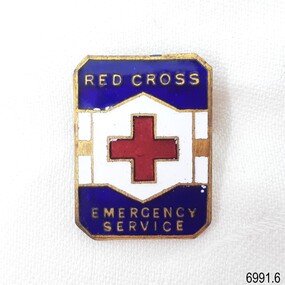
badge - Red Cross Society badge, K.G. Luke Pty. Ltd, Emergency Service, 1935-1945
... Ltd. by 1936, making buttons, badges, brooches, and heated food trolleys at his office and factory in North Fitzroy, and selling from his showroom in Elizabeth Street Melbourne. ...Ltd. by 1936, making buttons, badges, brooches, and heated food trolleys at his office and factory in North Fitzroy, and selling from his showroom in Elizabeth Street Melbourne. ...The badge represents the Emergency Services section of the Red Cross Society. The Australian Red Cross was formed on 21st August 1914 at the outbreak of the First World War. The badge was made by K.G. Luke Pty. Ltd. in Melbourne. Kenneth George Luke, began work as an apprentice in 1910 at Stokes & Sons Pty. Ltd. in Melbourne and stayed with the company for eleven years. He then became a partner in a metalworking business, wholly owning this successful Carlton business in 1925. From 1935-1945 his products included silverware and supplies for military needs. The firm was K.G. Luke Pty. Ltd. by 1936, making buttons, badges, brooches, and heated food trolleys at his office and factory in North Fitzroy, and selling from his showroom in Elizabeth Street Melbourne. His customers included the Australian Red Cross, Victoria Police, TAA Airline, and the military forces of Australia and the United States. Seventeen years later the company was K.G. Luke (A/Asia) Ltd, then twenty-three years on it was Luke Ltd. until in 1983 it was taken over by National Consolidated Ltd. Sir Kenneth George Luke was also a V.F.L. football administrator. This badge is one of a set of badges collected by Dr W R Angus from the organisations in which he was involved. The set of badges is now part of Flagstaff Hill’s comprehensive W.R. Angus Collection, donated by the family of Dr W R Angus, surgeon and oculist. The W.R. Angus Collection: - The W.R. Angus Collection includes historical medical equipment, surgical instruments and material belonging to Dr Edward Ryan and Dr Thomas Francis Ryan, (both of Nhill, Victoria) and Dr Angus’ own belongings. The Collection’s history spans the medical practices of the two Doctors Ryan, from 1885-1926 plus that of Dr Angus, up until 1969. It includes historical medical and surgical equipment and instruments from the doctors Edward and Thomas Ryan of Nhill, Victoria. Dr Angus married Gladys in 1927 at Ballarat, the nearest big city to Nhill where he began as a Medical Assistant. He was also Acting House surgeon at the Nhill hospital where their two daughters were born. During World War II He served as a Military Doctor in the Australian Defence Forces. Dr Angus and his family moved to Warrnambool in 1939, where Dr Angus operated his own medical practice. He later added the part-time Port Medical Officer responsibility and was the last person appointed to that position. Both Dr Angus and his wife were very involved in the local community, including the planning stages of the new Flagstaff Hill and the layout of the gardens there. Dr Angus passed away in March 1970.This badge is significant for connecting Doctor Angus with organisations that he supported. The W.R. Angus Collection is significant for still being located at the site it is connected with, Doctor Angus being the last Port Medical Officer in Warrnambool. The Collection includes historical medical objects that date back to the late 1800s.Badge, rectangular metal and enamel badge, with a blue band across the top and bottom, and a white and gold band in the middle similar to a belt with the buckle of a red cross. The badge has a horizontal pin on the back. Inscriptions on top and bottom bands and on the reverse. It is the badge of the Red Cross Emergency Service, made by K.G. Luke of Melbourne.This badge is part of a set of badges collected by Dr W R Angus. the set represents organisations that he was involved in, and is part of the W.R. Angus Collection.Printed on front; “RED CROSS” above “EMERGENCY / SERVICE”. Embossed on back “8029” “K.G. LUKE / MELB” flagstaff hill, warrnambool, maritime village, maritime museum, shipwreck coast, great ocean road, w.r. angus, badge, organisation badge, flagstaff hill maritime museum and village, australian red cross, charity, volunteer organisation, red cross, k.g. luke pty. ltd., kenneth george luke, north fitzroy, stokes & sons, w.r. angus collection -
 Flagstaff Hill Maritime Museum and Village
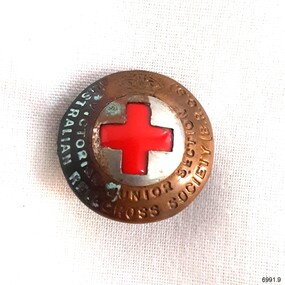
badge - Australia Red Cross Society (B.R.C.S.) badge, J R Gaunt and Son Limited, Victoria Junior Section, 1930
... badge...Flagstaff Hill Maritime Museum and Village...Australian Red Cross...charity...volunteer organisation...Red Cross...J R Gaunt & Son...Birmingham...badges...buttons...military...Angus badge organisation badge Flagstaff Hill Maritime Museum and Village Australian Red Cross charity volunteer organisation Red Cross J R Gaunt & Son Birmingham badges buttons military buttons uniform buttons lapel badge Junior Section B.R.C.S. ...The badge represents the Victorian Junior Section of the Australian Red Cross Society, which was formed in 1914 at the outbreak of World War I as a branch of the British Red Cross Society (B.R.C.S.), hence the crown on top of the red cross. It wasn't until 1941 that he Australian Branch was Incorporated by Royal Charter. The badge was made in London by J.R. Gaunt & Son Ltd. James Richard Gaunt and his son Charles Frederick Gaunt established the Birmingham firm of J R Gaunt & Son in 1884. The business operated for over a hundred years and specialised in making buttons for uniforms. This badge is one of a set of badges collected by Dr W R Angus from the organisations in which he was involved. The set of badges is now part of Flagstaff Hill’s comprehensive W.R. Angus Collection, donated by the family of Dr W R Angus, surgeon and oculist. The W.R. Angus Collection: - The W.R. Angus Collection includes historical medical equipment, surgical instruments and material belonging to Dr Edward Ryan and Dr Thomas Francis Ryan, (both of Nhill, Victoria) and Dr Angus’ own belongings. The Collection’s history spans the medical practices of the two Doctors Ryan, from 1885-1926 plus that of Dr Angus, up until 1969. It includes historical medical and surgical equipment and instruments from the doctors Edward and Thomas Ryan of Nhill, Victoria. Dr Angus married Gladys in 1927 at Ballarat, the nearest big city to Nhill where he began as a Medical Assistant. He was also Acting House surgeon at the Nhill hospital where their two daughters were born. During World War II He served as a Military Doctor in the Australian Defence Forces. Dr Angus and his family moved to Warrnambool in 1939, where Dr Angus operated his own medical practice. He later added the part-time Port Medical Officer responsibility and was the last person appointed to that position. Both Dr Angus and his wife were very involved in the local community, including the planning stages of the new Flagstaff Hill and the layout of the gardens there. Dr Angus passed away in March 1970.This badge is significant for connecting Doctor Angus with organisations that he supported. The W.R. Angus Collection is significant for still being located at the site it is connected with, Doctor Angus being the last Port Medical Officer in Warrnambool. The Collection includes historical medical objects that date back to the late 1800s.Badge; a brass dome'shaped badge with two rows of text around the outer edge and a white enamel centre behind a red enamel cross. A crown symbol is embossed above the cross. Text is embossed around the edges with remnants of white within the some of the letters. The reverse has text around the emblem of a wreath and the remnants of a catch. Inscriptions include text and emblems on front and reverse. The badge is for the Australian Red Cross Society, Victorian Junior Section. It was made by J. R. Gaunt & son, London. This badge is part of a set of badges collected by Dr W R Angus. the set represents organisations that he was involved in, and is part of the W.R. Angus Collection.FRONT; Symbol [King;s Crown], Embossed “AUSTRALIAN RED CROSS SOCIETY (B.R.C.S.)“. Inner text “VICTORIA JUNIOR SECTION” REVERSE: Symbol p[wreath] “J R GAUNT LTD, LONDON"flagstaff hill, warrnambool, maritime village, maritime museum, shipwreck coast, great ocean road, w.r. angus, badge, organisation badge, flagstaff hill maritime museum and village, australian red cross, charity, volunteer organisation, red cross, j r gaunt & son, birmingham, badges, buttons, military buttons, uniform buttons, lapel badge, junior section, b.r.c.s., british red cross society, london manufacturer -
 Flagstaff Hill Maritime Museum and Village
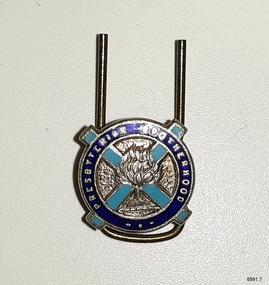
badge - Presbyterian Brotherhood badge, 1920s to 1940s
... Angus badge organisation badge Flagstaff Hill Maritime Museum and Village badges buttons lapel badge religious badge denominational badge Presbyterian church Presbyterian Brotherhood hat pin Flying Doctor Scottish heritage W.R. ...This badge is one of a set of badges collected by Dr W R Angus from the organisations in which he was involved. The set of badges is now part of Flagstaff Hill’s comprehensive W.R. Angus Collection, donated by the family of Dr W R Angus, surgeon and oculist. The badge represents the Australian Presbyterian Brotherhood. The Presbyterian church has used the burning bush logo from the 1800s. The logo describes the Biblical account of the prophet Moses, who saw the miracle of a bush on fire that did not burn and heard the voice of God giving his instructions. The light blue cross symbolises the origin of the Australian Presbyterian church, the Church of Scotland, which is Presbyterian. Its flag is blue with a white 'x' and a burning bush symbol in the centre. Dr William Roy Angus was of Scottish heritage. He sailed overseas to further his studies at Edinburgh Royal Infirmary and in 1928, was awarded FRCS (Fellow from the Royal College of Surgeons), Edinburgh, Scotland. He was e Presbyterian and treated Sunday as a Sabbath, a day of rest. He would visit three or four country patients on a Sunday, taking his children along ‘for the ride’ and visiting with him. Sunday evenings he would play the pianola and sing Scottish songs to his family. In 1928, Dr Angus was a Flying Doctor in the A.I.M. (Australian Inland Ministry) Aerial Medical Service, which was established by the Presbyterian Church in that year. The W.R. Angus Collection includes historical medical equipment, surgical instruments and material belonging to Dr Edward Ryan and Dr Thomas Francis Ryan, (both of Nhill, Victoria) and Dr Angus’ own belongings. The Collection’s history spans the medical practices of the two Doctors Ryan, from 1885-1926 plus that of Dr Angus, up until 1969. It includes historical medical and surgical equipment and instruments from the doctors Edward and Thomas Ryan of Nhill, Victoria. Dr Angus married Gladys in 1927 at Ballarat, the nearest big city to Nhill where he began as a Medical Assistant. He was also Acting House surgeon at the Nhill hospital where their two daughters were born. During World War II He served as a Military Doctor in the Australian Defence Forces. Dr Angus and his family moved to Warrnambool in 1939, where Dr Angus operated his own medical practice. He later added the part-time Port Medical Officer responsibility and was the last person appointed to that position. Both Dr Angus and his wife were very involved in the local community, including the planning stages of the new Flagstaff Hill and the layout of the gardens there. Dr Angus passed away in March 1970.This badge is significant for connecting Doctor Angus with organisations that he supported. The badge also associates Dr Angus with the history of the Presbyterian Church in Australia, showing the historic logo of the burning bush and the Scottish flag. The W.R. Angus Collection is significant for still being located at the site it is connected with, Doctor Angus being the last Port Medical Officer in Warrnambool. The Collection includes historical medical objects that date back to the late 1800s.Badge; a round badge with a blue enamel outer border in front of a light blue enamel ‘x’. A silver logo is on top of the 'X'. There is a silver inscription around the outer circle. It is the badge of the Presbyterian Brotherhood of Australia.This badge is part of a set of badges collected by Dr W R Angus. the set represents organisations that he was involved in, and is part of the W.R. Angus Collection.On the dark blue border: “PRESBYTERIAN BROTHERHOOD’ Logo [a bush on fire] a 'burning bush'flagstaff hill, warrnambool, maritime village, maritime museum, shipwreck coast, great ocean road, w.r. angus, badge, organisation badge, flagstaff hill maritime museum and village, badges, buttons, lapel badge, religious badge, denominational badge, presbyterian church, presbyterian brotherhood, hat pin, flying doctor, scottish heritage, w.r. angus collection -
 Flagstaff Hill Maritime Museum and Village
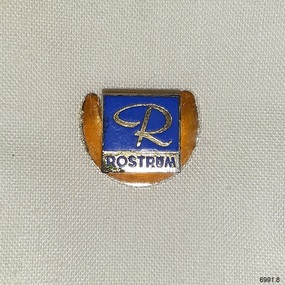
badge - Rostrum badge, Angus & Coote, 1939-1945
... Angus badge organisation badge Flagstaff Hill Maritime Museum and Village badges buttons lapel badge Rostrum Warrnambool Club 24 Angus & Coote Sydney Rostrum Club 24 public speaking club Rostrum lapel badge WWII badge 1939-1915 Front “R” above “ROSTRUM”. ...This Rostrum lapel badge is one of a set of badges collected by Dr W R Angus from the organisations in which he was involved. The set of badges is now part of Flagstaff Hill’s comprehensive W.R. Angus Collection, donated by the family of Dr W R Angus, surgeon and oculist. This badge represents the Rostrum organisation, the longest-running public speaking organisation in the world. Rostrum has a Warrnambool branch, Warrnambool Club 24, which currently meets at the rear of the South Warrnambool Presbyterian Church building at 11 MacDonald Street, Warrnambool. The original Rostrum club was formed in England in 1923 and the first Australian Rostrum meeting was in 1930. The maker, Angus & Coote, is an Australian company that was founded by Edmund James Coote in Sydney in 1895. The firm made insignia during WWII and is famous for its high-quality jewellery. The W.R. Angus Collection includes historical medical equipment, surgical instruments and material belonging to Dr Edward Ryan and Dr Thomas Francis Ryan, (both of Nhill, Victoria) and Dr Angus’ own belongings. The Collection’s history spans the medical practices of the two Doctors Ryan, from 1885-1926 plus that of Dr Angus, up until 1969. It includes historical medical and surgical equipment and instruments from the doctors Edward and Thomas Ryan of Nhill, Victoria. Dr Angus married Gladys in 1927 at Ballarat, the nearest big city to Nhill where he began as a Medical Assistant. He was also Acting House surgeon at the Nhill hospital where their two daughters were born. During World War II He served as a Military Doctor in the Australian Defence Forces. Dr Angus and his family moved to Warrnambool in 1939, where Dr Angus operated his own medical practice. He later added the part-time Port Medical Officer responsibility and was the last person appointed to that position. Both Dr Angus and his wife were very involved in the local community, including the planning stages of the new Flagstaff Hill and the layout of the gardens there. Dr Angus passed away in March 1970.This badge is significant for connecting Doctor Angus with organisations that he supported. The badge also associates Dr Angus with the Rostrum Club in Warrnambool. The badge is of interest as the maker, Angus & Coote, only made badges during WWII. The W.R. Angus Collection is significant for still being located at the site it is connected with, Doctor Angus being the last Port Medical Officer in Warrnambool. The Collection includes historical medical objects that date back to the late 1800s.Lapel badge; a square gold-coloured metal and blue enamel badge. The blue enamel covers three-quarters of the top of the square badge and has a bold 'R' embossed onto it. The remaining quarter is gold with the organisation's name in blue letters. The maker's name is embossed on the back. The Rostrum badge was made by Angus & Coote.This badge is part of a set of badges collected by Dr W R Angus. the set represents organisations that he was involved in, and is part of the W.R. Angus Collection.Front “R” above “ROSTRUM”. Reverse; “ANGUS & COOTE”flagstaff hill, warrnambool, maritime village, maritime museum, shipwreck coast, great ocean road, w.r. angus, badge, organisation badge, flagstaff hill maritime museum and village, badges, buttons, lapel badge, rostrum, warrnambool club 24, angus & coote sydney, rostrum club 24, public speaking club, rostrum lapel badge, wwii badge, 1939-1915 -
 Geelong RSL Sub Branch
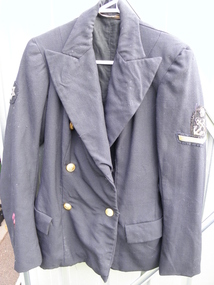
Uniform Jacket - RAN, Mid 20th Century
... military c? l taylor Inside the Jacket the name C?L Taylor. Navy Blue Cloth Jacket with buttons attached, inscribed Australia. The Jacket has badge ...Uniform Jacket belonging to C? L Taylor who served in the Royal Australian Navy.The is a uniform jacket of C? L Taylor.Navy Blue Cloth Jacket with buttons attached, inscribed Australia. The Jacket has badge of Rank on the left sleeve, badge of Trade on the right sleeve and three red markings for period of enlistment.Inside the Jacket the name C?L Taylor.ran, aif, military, c? l taylor -
 Geelong RSL Sub Branch
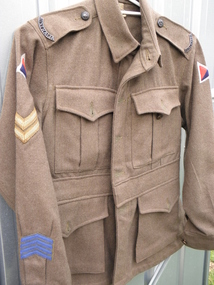
Uniform Jacket- Service Dress Ceremonial, 1941
... The Jacket has two 'Australia' shoulder titles on the epaulets, one only small (king's Crown) rising sun badge on the collar, six small buttons, four small buttons with King's Crown, map of Australia and embossed Australian Military Forces. ...The Jacket has two 'Australia' shoulder titles on the epaulets, one only small (king's Crown) rising sun badge on the collar, six small buttons, four small buttons with King's Crown, map of Australia and embossed Australian Military Forces. ...This particular Jacket was issued to VX 33678 Bdr E. O'Shea.Bdr O'Shea served during WW2Khaki Wool cloth Jacket, four patch pockets on the front of the Jacket. The Jacket has two 'Australia' shoulder titles on the epaulets, one only small (king's Crown) rising sun badge on the collar, six small buttons, four small buttons with King's Crown, map of Australia and embossed Australian Military Forces. One small button at the collar. On the right and left sleeve are the colour patch of Artillery. On the right sleeve is the badge of rank of Bombardier and four blue service chevrons. Inside the Jacket hand written OSWR. Makers Tag - Freedman & Co Pty Ltd. 1941. Size 6. Name Tag - Regimental No VX33678. Name Bdr E. O'Shea. uniform, jacket, service dress, khaki, amf -
 Geelong RSL Sub Branch
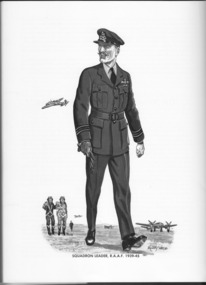
Uniform - RAAF Service Dress, 1945
... military use (Navy, Army, Air Force) 1945, M. TX, Size 22. Service Dress Blue Jacket and Trousers with buckle belt, RAAF Buttons, badges of Rank on both sleeves and Ribbons of three Decorations above the left pocket. ...This uniform belonged to 036319 F/Lt A S Cutting who served in the RAAF During WW2.This uniform was made in 1945 and was owned by F/Lt A S Cutting.Service Dress Blue Jacket and Trousers with buckle belt, RAAF Buttons, badges of Rank on both sleeves and Ribbons of three Decorations above the left pocket.Inside the jacket a small tag - A F (the I in the shape of the 'broad arrow', used to indicate military use (Navy, Army, Air Force) 1945, M. TX, Size 22.raaf, 036319 a s cutting 1945 -
 Geelong RSL Sub Branch
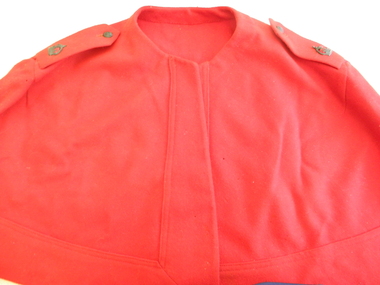
Nurses Cape V10909 Margaret A Brown, There are no makers marks, All items circa 1940
... There are two Major Badges of Rank on the epaulettes and two Australian Military Forces buttons holding the epaulettes to the shoulders. ...There are two Major Badges of Rank on the epaulettes and two Australian Military Forces buttons holding the epaulettes to the shoulders. ...The Cape belonged to V10909 Margaret Annie Brown who served with the AMF during WW2. Margaret A Brown enlisted on 17 September 1940 and was discharged with the rank of Major on 28 July 1944. Margaret Brown worked at the Heidelberg Hospital and also as Matron at Puckapunyal. Margaret Brown missed out on a posting to Hospital Ships working in the Pacific because of her age at the time - 40 - the cut off for the assignment was 40. One of Margarets co-workers at Heidelberg Vivian Bullwinkle - late 20ish at the time - gained a posting oversees.This is the original Nurses Cape that belonged to V10909 Margaret A Brown. The Soldiers Paybook and Appointment Certificate are originals belonging to V10909 Margaret A Brown.A Scarlett Nurses Cape. There are two Major Badges of Rank on the epaulettes and two Australian Military Forces buttons holding the epaulettes to the shoulders. Soldiers Pay Book, Continuation. Cardboard Cover, buff colour with paper pages. Appointment Certificate. Paper.The are no inscriptions or markings on the Cape. Pay Book No C81010, Army No. V10909, Name Brown, Christian Names Margaret Anne.nurses cape, v10909 m a brown, ww2, heidelberg, puckpunyal, pay book, appointment certificate -
 Montmorency–Eltham RSL Sub Branch
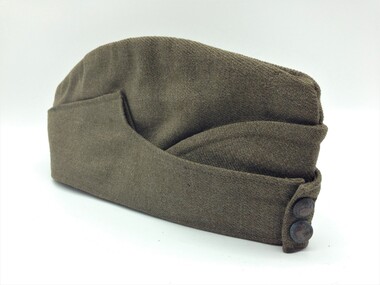
Uniform - Forage Cap, Australian Military Forces WW2
... VX21885 NAME L.C.CARROLL Stamp E 9or F, broad arrow, S Khaki serge forage cap with two 12mm diameter AMF metal buttons. No cap badge. Cotton khaki lining. ...Cap issued to WO2 Leonard Charles CARROLL VX21885 of West Heidelberg, Vic., born in Manchester UK on 01 JAN 1907. An X-ray technician, he enlisted on 07 JUN 1940 at Caulfield, Vic. and served in the Middle East, Ceylon and Australia mainly with 2/4th Aust. General Hospital. Discharged 20 MAY 1947. (Ref: NAA: B883, VX21885) The ownership of this cap is clear and the service of this local ex-serviceman can be established. The usage of this cap is unknown as there is no evidence that it has been worn with any kind of cap badge.Khaki serge forage cap with two 12mm diameter AMF metal buttons. No cap badge. Cotton khaki lining. Cotton off-white label sewn to liningRegimental No. VX21885 NAME L.C.CARROLL Stamp E 9or F, broad arrow, S headgear -
 Montmorency–Eltham RSL Sub Branch
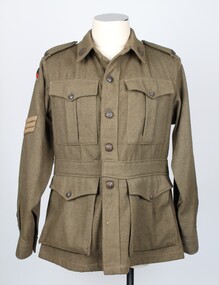
Uniform - Jacket, Service Dress WW2, WW2 Service Jacket, 1942
... Inside label: V300; 1942; Size (2 - 'faint', may be other numbers indicating size details) Brass badges: Australian Commonwealth Military Forces (both lapels); Australia (both shoulder straps) Badge of rank (Sergeant) - 3 chevrons (R upper sleeve) Colour patches on both sleeves for 2/5 Battalion, 6th Division Second AIF Years of Service insignia - 3 chevrons, indicating 3 years O/S service (R lower sleeve) Unit patches - rectangle black over red (2/5 Battalion, WW2) Khaki jacket; long sleeve 4 front buttons (attached with continuous leather strip) 4 pockets (buttons sewn on) Shoulder straps (buttons sewn on) Cuff buttons (sewn on) Badges on lapels & on shoulder straps Unit Patches on upper sleeves (Part of set with Slouch Hat, 0030.2) WW2 Service Jacket Uniform Jacket, Service Dress WW2 ...Owned by William Albert HARRISON (Service Number VX41478; above Link ["WW2 Record"] indicates that Rank on Discharge was Cpl, but other AIF documents, from National Archives Australia [including Proceedings of Discharge - see pdf Media File above], indicate that he was Sergeant, which is consistent with the rank on this jacket). Name not written on item but known to be part of set which includes slouch hat, which does contain the name, and other related items which include Service Number, verifying identity. See further service details in "Links" above. Soldier's name known. Items donated (date unknown) by brother-in-law who was living in Montmorency and was a committee member of MERSL when item donated.Khaki jacket; long sleeve 4 front buttons (attached with continuous leather strip) 4 pockets (buttons sewn on) Shoulder straps (buttons sewn on) Cuff buttons (sewn on) Badges on lapels & on shoulder straps Unit Patches on upper sleeves (Part of set with Slouch Hat, 0030.2)Inside label: V300; 1942; Size (2 - 'faint', may be other numbers indicating size details) Brass badges: Australian Commonwealth Military Forces (both lapels); Australia (both shoulder straps) Badge of rank (Sergeant) - 3 chevrons (R upper sleeve) Colour patches on both sleeves for 2/5 Battalion, 6th Division Second AIF Years of Service insignia - 3 chevrons, indicating 3 years O/S service (R lower sleeve) Unit patches - rectangle black over red (2/5 Battalion, WW2) -
 Montmorency–Eltham RSL Sub Branch
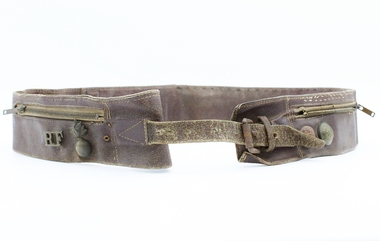
Accessory - Money Belt, AMF Money Belt
... Also affixed are 2 brass buttons. AMF Money Belt Accessory Money Belt ...Brown leather money belt with metal buckle and 3 pockets secured by metal zips. Affixed to the belt is a brass regimental shoulder badge, with the initials “ RF” ( Royal Fusiliers ) and brass flaming grenade with 7 points. Also affixed are 2 brass buttons.The inscription on the brass button nearest the buckle refers to “Australian Military Forces”; and the remaining brass button has inscription too small to decipher, with a rose imprint.harrison, ww2 -
 Bendigo Military Museum
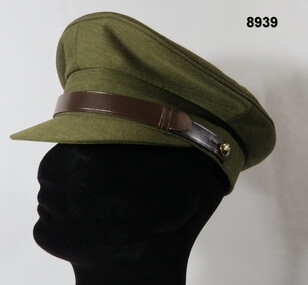
Uniform - CAP, PEAKED WW2, Unknown
... The chin strap is of brown leather and is secured above the peak by buttons with Australian Military Forces insignia. ...The chin strap is of brown leather and is secured above the peak by buttons with Australian Military Forces insignia. ...Australian Army Khaki Peaked Cap is known as the service cap and is worn by Warrant Officers, Commissioned Officers with any general duty order of dress. The chin strap is of brown leather and is secured above the peak by buttons with Australian Military Forces insignia. There is a Rising Sun Cap Badge above the peak with the wording Australian Commonwealth Forces. The inside of the cap has a brown leather sweat band and there is a plastic head lining.Inside of cap: “ADI P/L SIZE ^58 VIC 1990”passchendaele barracks trust, pbt116, uniform, peaked cap -
 Bendigo Military Museum
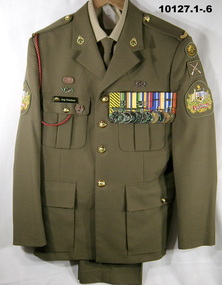
Uniform - SERVICE DRESS, ARMY, Australian Defence Industries, 2016
... Lapel Badges - gold colour plastic - Queens Crown above laurel wreath with centre crossed swords = Royal Australian Corps of Military Police. ...Lapel Badges - gold colour plastic - Queens Crown above laurel wreath with centre crossed swords = Royal Australian Corps of Military Police. ...Left side - Campaign and service medals = Left to Right. 1. Conspicuous Service Medal. 2. Australian Active Service Medal - 2 clasps - 1 RAQ 2003 - ICAT Afghanistan 2001. 3. Afghanistan Campaign Medal. 4. Iraq Campaign Medal. 5. Australian Service Medal - 2 clasps - Balkans 1997 - 2004, - Sinai - Egypt. 6. Defence Force Service Medal - 3 clasps (25 Years). 7. Australian Defence Medal. 8. North Atlantic Treaty Organisation medal (NATO) 9. British IRAQ Medal. 10. North Atlantic Treaty Organisation and clasp ISAF> 11. Multi National Force and Observers Medal - Sinai - Egypt (These are replica medals). Award badge - Crossed swords with Laurel wreath dark bronze colour = ARMY COMBAT BADGE. Right side - Top to Bottom. Award Badge = COMMANDER 2nd DIVISION COMMENDATION BRONZE 1998-99 Badge = STEYR INDIVIDUAL READINESS Badge Name Badge = Rising Sun Emblem with "GREG WESTHEAD"' Badge = RECENT INSTRUCTOR BADGE. Uniform Jacket, trousers, shirt, necktie, lanyard, medals, beret. 1. 2. & 4. Fabric outer - khaki colour wool and polyester. Lining - dark khaki polyester. 1. Jacket - Service dress style, shoulder epaulettes, four front patch pockets with button down flap. Gold colour plastic buttons with raised emblem - Rising Sun Badge. Army shoulder epaulettes - gold colour 'AUSTRALIA' badge. Cloth shoulder patches - eft sleeve top - gold, black and red. Rising Sun with Queen's Crown and lettering "THE AUSTRALIAN ARMY". Middle - silver and brown crossed rifles = Marksmanship Proficiency. Lower and right sleeves Rank Insignia Patch in colour. Australian Coat of Arms = Regimental Sergeant Major. Lapel Badges - gold colour plastic - Queens Crown above laurel wreath with centre crossed swords = Royal Australian Corps of Military Police. Front left side - Campaign and Service medals Mounted and Award badge. Right side - one award badge and three badges.(Fabric, metal and plastic). 2. Trousers - waistband, belt loops, fob pocket, two side pockets and one back pocket with button down flap. Bottom green plastic metal and nylon zipper fly. Fabric and lining as above. 3. Shirt - light khaki colour polyester/cotton fabric. Short sleeves, collar, shoulder epaulettes, two front patch pockets with button down flap. Buttons - beige plastic. Left and right shoulder and rank cloth patches as per jacket. 4. Necktie - fabric and lining as above. 'V' shape on ends. Two makers labels. 5. Lanyard - braided red and black colour cotton cord with knots. 6. Medals - mounted medals with ribbons. Metal pin on back. 7. Beret - red colour wool felt fabric with black colour polyester and plastic lining. Oval shape. Black colour vinyl trim with ribbon for size adjustment. Front - badge = Royal Australian Corps of Military Police - Queens Crown, Laurel wreath and crossed swords - gold colour plastic and metal.1. & 2. Manufacturers information on lining in black print on white colour fabric. "ADA/MADE IN CHINA/ AUG 2016/CC30BK or CC3087/ ^/ NSN 8405 66 162 6301 or 607?/ SIZE: 110R OR 85R/ NAME:/ PM KEYS NO:/ OUTER: 60% WOOL/40% POLYESTER/LINING: 100% POLYESTER/DRY CLEAN ONLY/ DO NOT WASH/ IRON UNDER DAMP CLOTH/ WARM IRON". 2. Handwritten black ink 'WESTHEAD/ 317595". 4. Tie - top label "ADAY" Lower label "ADAY"/ MADE IN CHINA/ MAY 2016/ 60% WOOL/ 40% POLYESTER/ DRY CLEAN ONLYuniform, army, military police, westhead -
 Bendigo Military Museum
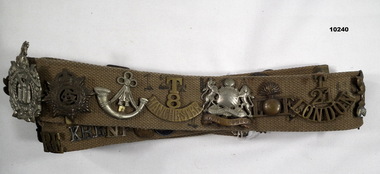
Uniform - BELT, WEBBING, KHAKI, c.1914-1920
... On that belt is affixed about 25 British Regimental Badges. It also has 11 buttons, Military. On the rear can be seen most of the badges - buttons are held on the belt with a long leather thong....On that belt is affixed about 25 British Regimental Badges. It also has 11 buttons, Military. On the rear can be seen most of the badges - buttons are held on the belt with a long leather thong. ...Believed to be from Arthur Ackers Collection WW1.Webbing Belt, 2" (50mm) wide. WW1 equipment. It has one brass buckle. On that belt is affixed about 25 British Regimental Badges. It also has 11 buttons, Military. On the rear can be seen most of the badges - buttons are held on the belt with a long leather thong.ww1, webbing belt, uniform, badges, buttons
