
Showing 37 items matching "multi-storey buildings"
-
 Melbourne Tram Museum
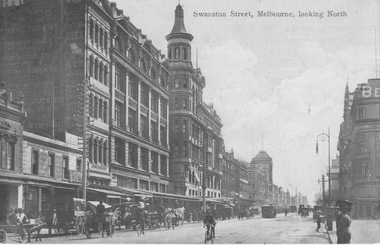
Postcard - Swanston Street, Melbourne, 1910s
... ...multi-storey buildings...Photograph looks north along Swanston Street from Flinders Lane showing a long line of substantial multi-storey buildings into the distance, numerous cable trams, horse drawn carts and carriages, pedestrians and two cyclists. ...Photograph looks north along Swanston Street from Flinders Lane showing a long line of substantial multi-storey buildings into the distance, numerous cable trams, horse drawn carts and carriages, pedestrians and two cyclists. ...Photograph looks north along Swanston Street from Flinders Lane showing a long line of substantial multi-storey buildings into the distance, numerous cable trams, horse drawn carts and carriages, pedestrians and two cyclists. Postcards were a common way of quickly communicating with others before the telephone and were cheaper than telegrams. Yields information about early Swanston Street and an early communication method.Postcard with location and greetings on front and postcard markings with personal message on rear. Printed top of photograph: 'Swanston Street, Melbourne, looking North'. On the rear are postcard markings with a handwritten personal message in ink beginning with 'To My Sweet Girl'. It asks for a meeting at the top of Brunswick Street and suggests using the tram. No address is included.cable trams, horse drawn carts, telegrams, telephone, swanston, flinders lane, multi-storey buildings -
 Victorian Interpretive Projects Inc.
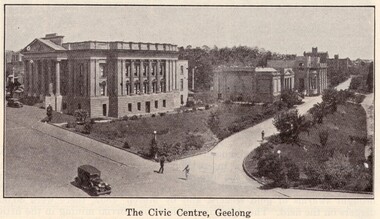
Image, Geelong, 1934, 1934
... An image of a number of multi-storey buildings that made up the Geelong Civic Precinct in 1934. ...Geelong An image of a number of multi-storey buildings that made up the Geelong Civic Precinct in 1934. ...The seaside town of Geelong is the second largest city in Victoria, Australia.An image of a number of multi-storey buildings that made up the Geelong Civic Precinct in 1934. geelong -
 Bendigo Military Museum
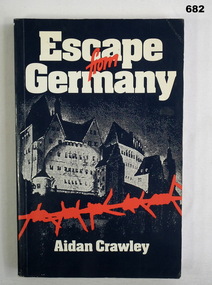
Book, Aidan Crawley, Escape from Germany, 1985
... Softcover with blue and white image of multi-storey buildings with red silhouette of barbed wire in front....books military history On title page "Donated by Bgo "Y" Men's Club" Softcover with blue and white image of multi-storey buildings with red silhouette of barbed wire in front. ...Softcover with blue and white image of multi-storey buildings with red silhouette of barbed wire in front.On title page "Donated by Bgo "Y" Men's Club"books, military history -
 Federation University Historical Collection
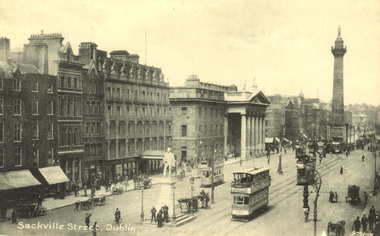
Postcard - Postcard - Black and White, Coleman & Co, Sackville Street, Dublin
... Black and white postcard showing a street in Dublin with trams, horse drawn carriages, people, monuments and multi-storey buildings...WW1 Holmes Family souvenir Australian soldier's WW1 souvenir Chatham-Holmes Family Collection Dublin Ireland World War 1 Black and white postcard showing a street in Dublin with trams, horse drawn carriages, people, monuments and multi-storey buildings Sackville Street, Dublin Postcard Postcard - Black and White Coleman & Co ...WW1 Holmes Family souvenirAustralian soldier's WW1 souvenirBlack and white postcard showing a street in Dublin with trams, horse drawn carriages, people, monuments and multi-storey buildingschatham-holmes family collection, dublin, ireland, world war 1 -
 Kiewa Valley Historical Society
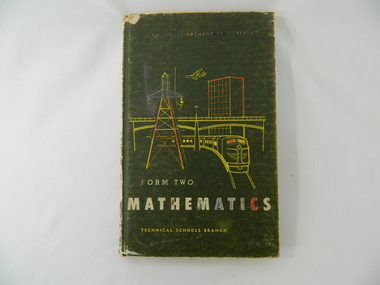
Book - Maths, Wilke and Co P/L, Form Two Mathematics, 1965
... Dark green hard covered book with sketch of power line, bridge, multi storey building and train in yellow and re. Writing in white....On first page: Kerrie Davies Dark green hard covered book with sketch of power line, bridge, multi storey building and train in yellow and re. Writing in white. ...Educational book for teaching mathematics in Form 2 in Victoria. Kerrie Davies lived in the Kiewa Valley on a dairy farm.Historical: Comparison of the teaching of Mathematics in Victorian schools. Provenance: Davies family.Dark green hard covered book with sketch of power line, bridge, multi storey building and train in yellow and re. Writing in white.Education Department of Victoria (in white but coloured in) / Form Two / Mathematics / Technical Schools Branch Inside back of cover some scribbled maths. On first page: Kerrie Davieseducation. schools. davies family. mathematics. -
 Whitehorse Historical Society Inc.
Document, Colombo Street Buildings, 1/06/2004 12:00:00 AM
... Detailed plans and drawings of proposed multi-storey buildings for Colombo Street, Mitcham. ...Detailed plans and drawings of proposed multi-storey buildings for Colombo Street, Mitcham. ...Detailed plans and drawings of proposed multi-storey buildings for Colombo Street, Mitcham.Detailed plans and drawings of proposed multi-storey buildings for Colombo Street, Mitcham. Also includes photos of Mitcham area around the buildings.Detailed plans and drawings of proposed multi-storey buildings for Colombo Street, Mitcham.colombo street, mitcham, mitcham, whitehorse road, mitcham, mitcham railway station, st johns catholic church, mitcham, station street, mitcham, high rise buildings -
 Federation University Historical Collection
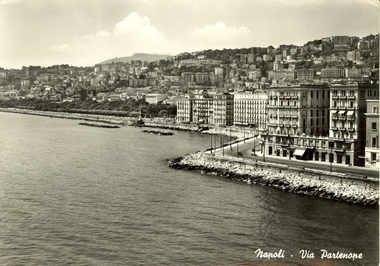
Postcard - photographic, Napoli - Via Partenope, c1910
... Black and white photorgraphic postcard showing Via Partenope, the roadway that separates Naples, Italy from the sea. Many multi-storey buildings are evident in the background....Naples is at the southern end of Italy. chatham-holmes family collection naples italy postcard coast Black and white photorgraphic postcard showing Via Partenope, the roadway that separates Naples, Italy from the sea. Many multi-storey buildings are evident in the background. ...Naples is at the southern end of Italy.Black and white photorgraphic postcard showing Via Partenope, the roadway that separates Naples, Italy from the sea. Many multi-storey buildings are evident in the background.chatham-holmes family collection, naples, italy, postcard, coast -
 Flagstaff Hill Maritime Museum and Village
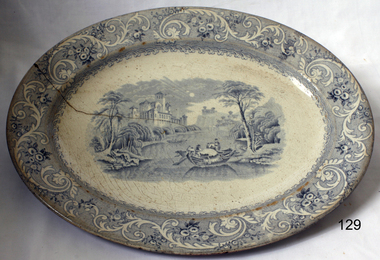
Ceramic - Serving Dish
... Serving dish, oval, faded blue transfer pattern with a row boat and persons and multi-storey buildings and wooded area near a shore over a white background. ...Also "Crownfield" and "12/77" Serving dish, oval, faded blue transfer pattern with a row boat and persons and multi-storey buildings and wooded area near a shore over a white background. ...Serving dish, oval, faded blue transfer pattern with a row boat and persons and multi-storey buildings and wooded area near a shore over a white background. Marked "Rhino" and symbol. Also "Crownfield" and "12/77" flagstaff hill, warrnambool, flagstaff hill maritime museum, maritime museum, shipwreck coast, flagstaff hill maritime village, great ocean road, oval dish, serving dish, platter, dinner ware, crockery, crownfield pottery -
Glenelg Shire Council Cultural Collection
Photograph - Photograph - Syd Cuffe, Town Crier, c. 1993
... Syd Cuffe and 2 other men in Town Crier's regalia, sitting / standing on steps outside a brick multi-storey building. All three are holding wooden trophies. ...Syd Cuffe and 2 other men in Town Crier's regalia, sitting / standing on steps outside a brick multi-storey building. All three are holding wooden trophies. ...Coloured photo. Syd Cuffe and 2 other men in Town Crier's regalia, sitting / standing on steps outside a brick multi-storey building. All three are holding wooden trophies. A fourth man is in mayoral regalia. There is a small canon in the middle of the group.Back: black stamp 'Copyrighted Strictly Photographics' -
 Bendigo Historical Society Inc.
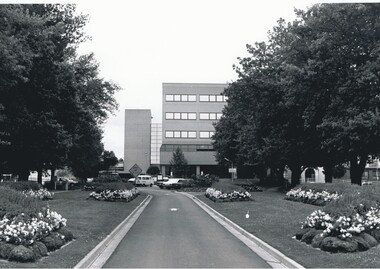
Photograph - BENDIGO HOSPITAL, 1995
... Black and white photo: driveway leading to building, Grass, garden beds, trees each side. Multi storey building at end of drive. Bendigo Hospital, main entrance from Lucan Street, Hyett Block right centre ( Noelene Wild, July 2000 )...BUILDINGS Hospital Peter Hyett, 1995 Black and white photo: driveway leading to building, Grass, garden beds, trees each side. Multi storey building at end of drive. Bendigo Hospital, main entrance from Lucan Street, Hyett Block right centre ( Noelene Wild, July 2000 ) Photograph BENDIGO HOSPITAL ...Black and white photo: driveway leading to building, Grass, garden beds, trees each side. Multi storey building at end of drive. Bendigo Hospital, main entrance from Lucan Street, Hyett Block right centre ( Noelene Wild, July 2000 )Peter Hyett, 1995buildings, hospital -
 Federation University Historical Collection
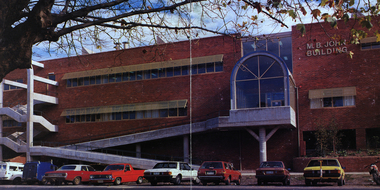
Image - Colour, Ballarat School of Mines M.B. John Building, Albert Street, Ballarat, 1987, 1987
... Image of a multi-storey brick building on the Ballarat School of Mines campus. ...(David Rowe/Wendy Jacobs) ballarat school of mines m.b. john building morgan b. john albert street m.b. john Image of a multi-storey brick building on the Ballarat School of Mines campus. ...The M.B. John Trade–Art building (Albert Street front) of SMB was officially opened by the Hon. John Cain, Premier of Victoria, in the presence of Morgan B. John. Programs include 3 Dimensional Art, Painting & Decorating, and Engineering Trades. (SMB Institutional Plan 1989) The M.B. John Building (Building K), a three storey, face red brick, restrained Late Twentieth Century International styled building with an elongated, cuboid form (defined by the parapeted facades) that is offset by projecting exposed concrete framed, round‐arched entrance and stair wells on the east (Albert Street) elevation (the centrally located entrance breaking the brick façade with glazing). The facades are also characterised by banks of aluminium framed, horizontal ribbon windows, which wrap around the building corners. Metal shades project beyond the windows, while post‐supported bullnosed verandahs and hoods and projecting concrete stairs are other features. On the west elevation, the cuboid façade is punctuated by projecting curved concrete and glazed, elongated bays at first floor level. (David Rowe/Wendy Jacobs)Image of a multi-storey brick building on the Ballarat School of Mines campus. The building is known as the M.B. John Building.ballarat school of mines, m.b. john building, morgan b. john, albert street, m.b. john -
 Melbourne Tram Museum
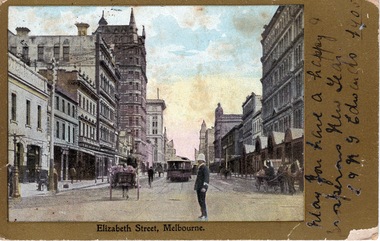
Postcard - Elizabeth Street, Melbourne, 1904
... It shows a policeman in the foreground, cable trams, horse drawn carts, pedestrians and multi-storey buildings. Postcards were a common way of quickly communicating with others before the telephones and were cheaper than telegrams. ...It shows a policeman in the foreground, cable trams, horse drawn carts, pedestrians and multi-storey buildings. Postcards were a common way of quickly communicating with others before the telephones and were cheaper than telegrams. ...Photograph looks north along Elizabeth Street. It shows a policeman in the foreground, cable trams, horse drawn carts, pedestrians and multi-storey buildings. Postcards were a common way of quickly communicating with others before the telephones and were cheaper than telegrams. Yields information about early Elizabeth Street and an early communication method.Coloured postcard with location and handwritten note on front and postcard markings, stamp and address on rear. Printed below photograph: 'Elizabeth Street, Melbourne', handwritten in ink on front: 'May you have a happy and prosperous New Year L & M G Edwards 1905''. On rear are postcard markings, no stamp, post office cancellation mark of Windsor Victoria 0 30 04 and an address: 'Mrs Nichol 25 Warranan Ave Flinders' cable trams, horse drawn carts, pedestrians, telephones, telegrams, elizabeth street -
 Melbourne Tram Museum
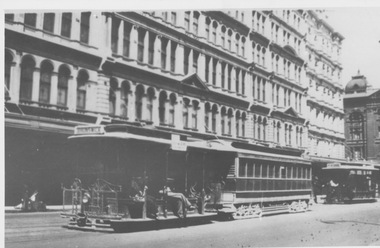
Photograph - Departing Elizabeth Street Terminus, c1928
... Photograph shows a Dummy and bogie trailer car departing Flinders Street terminus in Elizabeth Street while a North Melbourne Dummy is shunted in the background. Several multi storey buildings along Elizabeth Street and a glimpse of Flinders Street Railway Station are also shown. ...Photograph shows a Dummy and bogie trailer car departing Flinders Street terminus in Elizabeth Street while a North Melbourne Dummy is shunted in the background. Several multi storey buildings along Elizabeth Street and a glimpse of Flinders Street Railway Station are also shown. ...Photograph shows a Dummy and bogie trailer car departing Flinders Street terminus in Elizabeth Street while a North Melbourne Dummy is shunted in the background. Several multi storey buildings along Elizabeth Street and a glimpse of Flinders Street Railway Station are also shown. D O'Brien CollectionYields information about Elizabeth Street terminusBlack and white photograph with note on rearIn ink "19" and "K McC"tramways, cable trams, terminus, flinders street station, shunt, flinders st, elizabeth st, bogie cable trailers -
 Mission to Seafarers Victoria
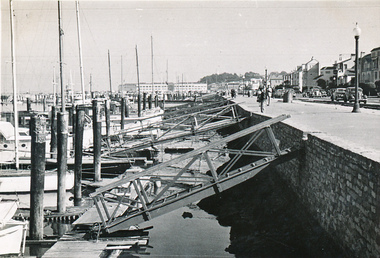
Photograph - Photograph, Black and white, Allan Charles Quinn, Landing Docks, 30 September 1949
... In the background of the photograph there is a large multi-storeyed building....In the background of the photograph there is a large multi-storeyed building. Landing Docks Photograph Photograph, Black and white Allan Charles Quinn ...Allan Charles Quinn went to sea aged 16 and photographed his work and the places he visited. His collection of photo albums provides a pictorial autobiography for a period in his life. Included in the Allan Charles Quinn Collection are a series of letters written to and from his mother.Black and white photograph of landing docks at San Francisco. To the right of the photograph is the streetscape which includes a walking track and street lighting in front of a road and row of shops or houses. To the centre of the photograph are the ramps to reach the jetty where the yachts are moored. To the left of the photograph are the bows of a long line of yachts. In the background of the photograph there is a large multi-storeyed building.Blue/green ink, handwritten on reverse: "30/9/49" Handwritten in pencil: "K9/A"san francisco, sailing boats, ramps, promenades, allan charles quinn -
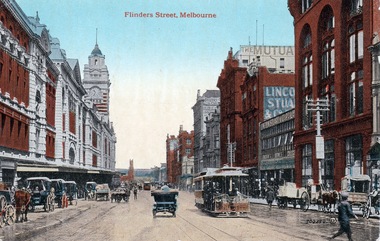 Melbourne Tram Museum
Postcard - Flinders Street, Melbourne, 1910s
... It shows an approaching cable tram, numerous horse drawn carts and carriages, a single motor car and multi-storey buildings. Postcards were a common way of quickly communicating with others before the telephone and were cheaper than telegrams. ...It shows an approaching cable tram, numerous horse drawn carts and carriages, a single motor car and multi-storey buildings. Postcards were a common way of quickly communicating with others before the telephone and were cheaper than telegrams. ...Photograph looks west along Flinders Street from Swanston Street showing Flinders Street Station with clock tower. It shows an approaching cable tram, numerous horse drawn carts and carriages, a single motor car and multi-storey buildings. Postcards were a common way of quickly communicating with others before the telephone and were cheaper than telegrams. Yields information about early Flinders Street and an early communication method.Coloured postcard with location on front and postcard markings and personal message on rear. Printed top of photograph: 'Flinders Street, Melbourne'. On rear are postcard markings, 'The Valentine and Sons' Publishing Co Ltd, Melbourne and Sydney' and handwritten message in ink: 'To dear Ivy, With love for Friday, from Josie'. cable trams, horse drawn carts, telephones, telegrams, flinders street, clock tower -
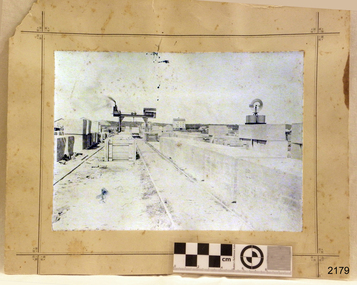 Flagstaff Hill Maritime Museum and Village
Photograph - Historical, maritime, Brookes' Photographic Union, Harbour Works, Warrnambool, 1891
... Subject is the Warrnambool Breakwater construction with the Titan steam crane on rail lines, concrete blocks, a windmill and tanks, sheds, and a multi-storey building in the background. Produced by the Brookes' Photographic Union, Western Victoria. ...Subject is the Warrnambool Breakwater construction with the Titan steam crane on rail lines, concrete blocks, a windmill and tanks, sheds, and a multi-storey building in the background. Produced by the Brookes' Photographic Union, Western Victoria. ...This photograph records the making and placing of the concrete blocks for the construction of the Warrnambool Breakwater in the Warrnambool Harbour, completed in 1890. Each block weighed 20 to 30-plus tons. The huge Titan steam powered crane in the photograph played a massive role in the construction. It was able to lift the concrete blocks with its overhanging, counterbalanced arm and roll on its wheels along the rails to the required position. It then lowered the blocks into position on the concrete foundation already laid on the seabed. There are many details in the photograph that help to tell other aspects of Warrnambool's history. It appears that the photograph was once owned by B. Fisher. The photograph is part of the Western Victoria collection produced in 1891 by Brookes' Photographic Union in Victoria. Brookes' Photographic Union was a collaboration of two brothers, Frederick Augustus Brookes and his brother Albert Edward Brookes. Frederick arrived in Victoria in the early 1880's. He and Albert formed the organisation to produce collections of photographs including the districts of Geelong, Gippsland and the Western Victoria.This photograph was taken during the construction of the Warrnambool Breakwater and published the year after it was completed. The project began with the Government of 1874 approving the plan, and was completed in 1890. The image records a snapshot of the construction of the Warrnambool Breakwater, a construction that changed the history of the Port of Warrnambool, Photograph, sepia coloured rectangular shape, mounted between two sheets of cream card. Border of photograph is decorated with pen lines and design in corners. Subject is the Warrnambool Breakwater construction with the Titan steam crane on rail lines, concrete blocks, a windmill and tanks, sheds, and a multi-storey building in the background. Produced by the Brookes' Photographic Union, Western Victoria. Inscriptions are on the reverse, on two stickers, a printed white label and a handwritten name.Stickers: "137" "F.Pn 61/2-74" Label: "WESTERN VICTORIA / BROOKES' PHOTOGRAPHIC UNION / HARBOUR WORKS, / WARRNAMBOOL." "The subject of this picture is the making of concrete blocks for the Breakwater. These blocks weigh from 20 to 30 tons each, and are lifted about by the large piece of machinery seen in the picture." Hand written: "B. Fisher"flagstaff hill, flagstaff hill maritime museum and village, warrnambool, maritime museum, maritime village, great ocean road, shipwreck coast, western district, western victoria, brookes' photographic union, frederick brookes, albert brookes, photograph, warrnambool harbour, harbour works, concrete bolcks, breakwater, warrnambool history, breakwater history, 1891, lady bay, port of warrnambool, b. fisher, titan crane, steam crane, concrete blocks -
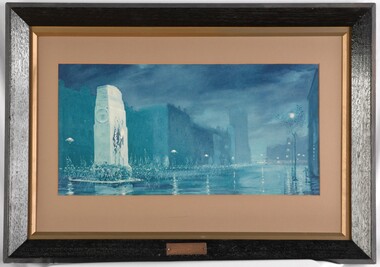 Glenelg Shire Council Cultural Collection
Print - Print (reproduction), Will Longstaff, The Immortal Shrine, n.d
... In the background are numerous multi-storey buildings with a row of light streetlights in front. ...In the background are numerous multi-storey buildings with a row of light streetlights in front. ...CEMA Art collection Previously located in History HouseThe print depicts a night view of a city street. In the foreground are ghosly figures completing a military march along a wide street. On the left side is a large white Remembrance Shrine with three flags hanging on individual flagpoles. In the background are numerous multi-storey buildings with a row of light streetlights in front. The work is completed in various shades of blue and mounted with brown card. Framed with a gold and black frame, the work has an exposed canvas.Front: Brass embossed plate: THE IMMORTAL SHRINE BY WILL LONGSTAFF COPYRIGHT REGISTERED Back: (No inscriptions) -
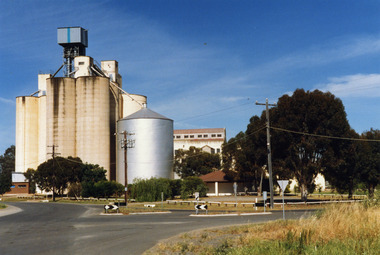 Charlton Golden Grains Museum Inc
Photograph, Charlton Shire, Charlton Flour Mill, c.1987
... There is a cream single story building to the right of the silver silo and a multi-storey building behind with eight window in the upper level. ...There is a cream single story building to the right of the silver silo and a multi-storey building behind with eight window in the upper level. ...A previous mill had operated in Charlton by Mr. W.E. Foreman on the banks of the Avoca River and was acquired in 1919 by Noske Bros. The present Flour Mill was built by Noske Bros and opened in May 1927. It was taken over by the Grain Elevator Board in the 1970s. Noske's Flour Mill, with its commanding presence and towering silos, has long **dominated the Charlton skyline** and remains a significant landmark, even though it no longer mills flour. The mill's history is deeply intertwined with the development of Charlton and the grain industry of the surrounding district. The foundation for the mill's presence was laid in 1919 when Messrs Noske Bros. Pty. Ltd., already owning mills in Horsham, Nhill, and Murray Bridge, acquired G. H. Foreman’s Mill located by the Avoca River. The founder, **T. J. Noske**, was an early pioneer of flour exporting, expanding his milling business after unexpectedly acquiring the Horsham mill. ### A State-of-the-Art Operation The original mill by the river operated until August 1926 before being closed and dismantled. Plans were well underway for a **new, state-of-the-art mill** to be located at the former Cobb and Co site. In 1927, the new mill began operation. It was one of the largest in the state, boasting a capacity of three tons of flour per hour, a 250 h.p. diesel engine, and three initial silos. The mill quickly gained a reputation for **excellence** for both its design and its flour, which was sold successfully in local and overseas markets. ### Periods of Expansion and Trial The mill continued to grow, reflecting the importance of the local agricultural industry. Between 1940 and 1941, **nine new silos** were built, adding bulk receival points. In the record-breaking 1968 season, the mill received a colossal wheat intake of **695,000 bushels**. However, the mill also faced setbacks. On January 21, 1949, disaster struck when a **large fire** erupted in the storage shed, which contained 500 tons of bagged flour ready for export and new flour bags. The blaze was so intense that smoke was visible as far away as Wycheproof, and it threatened to destroy the entire mill. Thanks to the monumental efforts of the Charlton, St. Arnaud, Wycheproof, and Wedderburn Brigades, who ran the main pump almost continuously for 26 hours, the damage was contained, though the estimated loss was a substantial £60,000. ### Transformation of the Site At its peak, the mill was a major employer, providing work for approximately 65–70 men. But after over 45 years of operation, flour production at the mill ceased on October 25, 1973. Noske Industries Ltd. sought to adapt, converting the operation to a less successful stock feed production centre. In 1977, the **Grain Elevators Board** took over the site as a grain receival depot, building a large elevator tower that surpassed the height of the original buildings. The site eventually returned to private hands and, since 2000, has been owned and operated as a primary grain receival site for **GrainCorp**, cementing its continued, vital role in Charlton's agricultural life. Colour photograph of Charlton Flour Mill and silos. Intersection of Kaye & Davies Streets in the foreground. One large silver silo and three taller greyish concrete silos to the left. Three other cream coloured silos behind. There are pipes and sheds on top of the silos. There is a cream single story building to the right of the silver silo and a multi-storey building behind with eight window in the upper level. There is a small red brick building on the far left of the photo.w.e. foreman, noske bros, flour mill charlton, business, industry -
 Ballarat Fire Brigade
Trophy
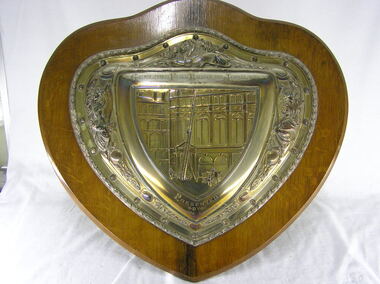
... In the centre there is a depection of 2 large multi storey buildings. The building in the front of the picture has a carraige ladder raised up against it with 2 firemen climbing the ladder. ...In the centre there is a depection of 2 large multi storey buildings. The building in the front of the picture has a carraige ladder raised up against it with 2 firemen climbing the ladder. ...Trophy was won at the Geelong Fire Brigade Jubilee in 1904. This would have been a demonstartion to celebrate the 50th Anniversary of the Geelong brigade which formed in 1854 Silver shield mounted on a wooden backing board. Trophy was won by Ballarat Fire Brigade at the Geelong Fire Brigade Jubilee in 1904. Trophy was donated by Llyods of London and presented by E. Steane Price esq. Trophy has a Lion at the top centre, angels on both the left and right sides. In the centre there is a depection of 2 large multi storey buildings. The building in the front of the picture has a carraige ladder raised up against it with 2 firemen climbing the ladder. There are 2 additional firemen either side of the ladder and an additional fireman in front of standing in front of with another standing on top of what appears to be either a mannual pump or possibly the ladders appliance. There are various other branches, leaves etc. that make up the remainder of the decorations on the sheild. Item is very similar to item 018GEELONG FIRE BRIGADES JUBILEE / 1904 / PRESENTED / BY / E.STEANE PRICE Esq. LLYODS LONDON1904, geelong fire brigade, geelong fire brigade jubilee, elkington and co, e steane price esq, llyods london -
 Royal District Nursing Service (now known as Bolton Clarke)
Photograph - Digital image, Barry Sutton, 10.08.1971
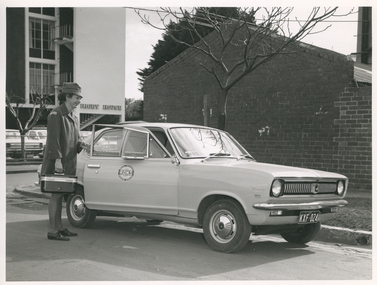
... In the background to the left is a mid size bare tree; behind this portions of several parked cars and behind them a multi storey building with the Written words "Rioby House". ...In the background to the left is a mid size bare tree; behind this portions of several parked cars and behind them a multi storey building with the Written words "Rioby House". ...The RDNS Sister is about to leave to visit patients in their homes in the community to administer nursing care as advised by a Doctor. The RDNS insignia on the door of the car is a round badge with a royal blue circle around the edge with the words "Royal District Nursing Service" in white, and the centre section is in three parts ,with the upper and lower sections white, and a royal blue centre strip with the large white capital letters "RDNS".Royal District Nursing Service (RDNS) has had various modes of transport over the last 130 plus years. At first, from 1885 as Melbourne District Nursing Society (MDNS), their Trained nurses (Nurses) walked the streets and lane ways amid the slums of central Melbourne. As the Society expanded public transport was used, and bicycles were bought by the Society in 1903 and used in inner areas until 1945. During the Spanish flu epidemic, in 1919, MDNS appealed for assistance to procure Motor vehicles so the Nurses could visit an influx of cases. Through trusts, grants and donations four 'Ford T Model' cars were procured which enabled the Nurses to triple their visits. Through constant use the cars were in such a poor state two were sold in 1922 and the others later. In 1922-23 three Peugeot cars were purchased and a woman Chauffeur, 'Miss Sword', was employed who lived in the Home and was also in charge of the garage. MDNS was expanding and a Motor Auxiliary was formed in 1929 to take the Trained nurses (Sisters) to patients, and some Sisters used their own cars; even a motorcycle was used by one Sister in 1933. All these forms of transport were intermingled and in the early 1950s, and now as Melbourne District Nursing Service, seven Ford Prefect cars were bought followed by twelve Ford Anglia cars 1955. Having received Royal patronage; the now Royal District Nursing Service (RDNS) had its own fleet of Holden vehicles by the mid 1960s and the Motor Auxiliary ceased operating in 1971 as by then all staff employed were required to have a driving licence. Seat-belts had been introduced to Victoria in 1959 and District fitted them to their cars from 1962, even though they did not become compulsory until 1970. The Holden vehicles were replaced with grey Holden Torana vehicles. After several years the fleet was changed to white Toyota Corolla vehicles. The Melways Directory of maps was introduced in 1966, which was a boon to the Sisters, though it was a few years before it went beyond Seville, so a large paper map was used by the Sisters visiting patients in the areas passed Seville. By 2009 there were 598 cars in the fleet and the Sisters travelled 9 million 200,000 kilometres – this is equivalent to 12 trips to the moon and back. Black and White Photograph of a Royal District Nursing Service (RDNS) Sister about to enter one of the new light grey 2 door Holden Torana RDNS cars. The Sister, who is smiling, is wearing her uniform grey peaked hat over her long dark hair which is drawn back. She is wearing her long grey coat with the RDNS insignia on the upper sleeve and is holding the partly opened driver side door of the car with her left hand. She is holding the handle on the top of her rectangular black nursing case with her right hand. To the right, the grill and black number plate, with the white writing displaying "KXF 024", can be seen. The round RDNS insignia is on the upper centre of the car door. The car is the same width all over, has a flat bonnet which joins a sloping windscreen adjoining a flat roof which runs along and joins a short back window running down to a boot. A black tyred wheel can be seen under wheel arches at the front and near the rear of the vehicle. In the background to the left is a mid size bare tree; behind this portions of several parked cars and behind them a multi storey building with the Written words "Rioby House". To its right and directly behind the car is a mid size bare tree and behind that the end view of a brick building with a hip roof. Barry Sutton Photographer. Quote KL 52rdns transport, rdns uniform, royal district nursing service, rdns -
 Flagstaff Hill Maritime Museum and Village
Photograph - Historical, religious, mid-20th century
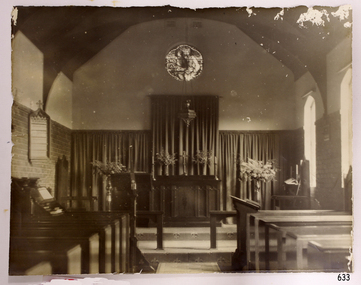
... multi-storey expansion in the late 1960s and early 1970s. The hospital’s Manager/Secretary was eager to see the historic window installed in a suitable place. The church, or chapel, was designed by a local architectural draftsman in collaboration with the Flagstaff Hill Planning Board and was constructed by Mr Leon Habel. The designers hoped that the church would be used for formal worship such as weddings, funerals, and multi-denominational special services like war commemorations. The design is inspired by the ‘Missions to Seamen’ buildings...multi-storey expansion in the late 1960s and early 1970s. The hospital’s Manager/Secretary was eager to see the historic window installed in a suitable place. The church, or chapel, was designed by a local architectural draftsman in collaboration with the Flagstaff Hill Planning Board and was constructed by Mr Leon Habel. The designers hoped that the church would be used for formal worship such as weddings, funerals, and multi-denominational special services like war commemorations. The design is inspired by the ‘Missions to Seamen’ buildings ...This photograph records the interior of St Nicholas Seamen's Church at 139 Nelson Place, Williamstown, Victoria, which was purchased and furnished around 1943. The furniture and furnishings are now part of the St. Nicholas Seamen's Church collection. HISTORY of the Missions to Seamen: - DETAILED HISTORY of the Missions to Seamen: - The Missions to Seamen is an Anglican (Church of England) charity that has served the world’s seafarers since 1856. It was inspired by the work of Rev. John Ashley, who, 20 years earlier, had pioneered a ministry to seafarers in the Bristol Channel in Great Britain. When Ashley retired, others continued the work, founding the Missions to Seamen. It adopted a Flying Angel as its symbol, inspired by a verse from the Bible in Revelation 14. Today, over 200 world ports have Missions to Seamen centres and chaplains. A Missions to Seamen’s Club warmly welcomes sailors of all colours, creeds and races and provides a wide range of facilities. The Missions to Seamen organisation changed its name to the Mission to Seafarers in 2000, continuing to include Missions to Seamen clubs in Victoria’s cities of Melbourne, Portland, Geelong and Hastings. Flagstaff Hill’s St Nicholas’ Seamen’s Church is named after its namesake from Williamstown, Victoria, which began in 1857. Bishop Perry opened the first Sailors’ Church there, known as ‘Bethel’, on an old hulk floating in Hobson’s Bay, Port of Melbourne. In 1860, a Sailors’ Rest started operating from rented premises in Williamstown. In 1878, the Sailors’ Church moved into an old Wesleyan chapel in Ann Street. By the end of that year, they managed to purchase the building, which they had already refurbished. In 1883, they affiliated with the Victorian Seamen’s Mission. A few years later, in 1906, the building had to be demolished because it was no longer safe. While they raised funds for a new building, the Sailors’ Rest temporarily moved to premises in front of Customs House in Nelson Place. Around this time, in 1906, the Ladies Harbour Lights Guild was formed in Australia to support and raise funds for the Mission to Seamen organisation in Melbourne. Two of the most significant ladies of the Guild were founding members Ethel Godfrey and Alice Sibthorpe. During the Mission's time at Siddeley Street, Melbourne, the activities of the Guild raised funds for the Mission to Seamen's Chapel at their new, and still current, premises in Flinders Street, Melbourne, opened in 1917. The Guild continued its important work until the 1960s. In 1908, the Williamstown Mission had enough money to purchase the former Mascotte skating rink on Thompson Street, Williamstown. In August of that year, they were inaugurated into the Victorian Missions to Seamen. They continued at that venue for a few decades. In 1943, the former ES&A Bank building at 139 Nelson Place, Williamstown, was purchased to become the new Mission to Seamen’s Club. On May 6th, 1944, it was officially opened, described as a ‘distinctive little building’. Funds had previously been raised for the building and furnishing of the chapel at the rear. The chapel was named St Nicholas’ Seamen’s Church, after St Nicholas, fourth-century bishop and patron saint of sailors. Services were held on Wednesdays and Sundays. The church was supported by the Williamstown Lightkeepers’ Auxiliary, newly founded by Mrs Ethel Margaret Musther in 1943, as well as the Harbour Lights Guild and the League of Soldiers’ and Sailors’ Friends. The Williamstown Mission to Seamen’s Church operated until 1966, when large international ships no longer used the Port of Williamstown. The Commonwealth Government then leased the premises. In the formative years of Flagstaff Hill Maritime Village, the Advisory Board decided to include a Missions to Seamen Chapel and Recreation Room in its village. The Missions organisation was a significant feature of ports during the late 1800s and early 1900s, the period that the Village represents. They often erected Missions to house social and worshipful activities for seamen. Flagstaff Hill’s curator, Mr Ken Marshman, approached the Melbourne Board of Management of Missions to Seamen regarding the Williamstown branch. Consequently, the Board permitted the furnishings of the Williamstown chapel to be transferred to Flagstaff Hill Maritime Village. A provision of the transfer was that the Victoria Missions to Seamen be recognised, that the items would remain as a collection, and that the chapel would be called St Nicholas Seamen’s Church and conduct Divine services. The donation was approved on 21st May 1979. Flagstaff Hill's St. Nicholas Seamen's Church: - The idea behind Flagstaff Hill’s Missions to Seamen’s Church was partly driven by the offer of Stained Glass Memorial Windows that originated from the Warrnambool and District Base Hospital, which was undergoing multi-storey expansion in the late 1960s and early 1970s. The hospital’s Manager/Secretary was eager to see the historic window installed in a suitable place. The church, or chapel, was designed by a local architectural draftsman in collaboration with the Flagstaff Hill Planning Board and was constructed by Mr Leon Habel. The designers hoped that the church would be used for formal worship such as weddings, funerals, and multi-denominational special services like war commemorations. The design is inspired by the ‘Missions to Seamen’ buildings in Portland and the Port of Melbourne. The furniture and furnishings were placed as accurately as possible according to photographs of the Williamstown St Nicholas Seamen’s Church and with assistance from local clergy. The Recreation Room was furnished and arranged on advice from experienced members of the Missions to Seamen organisation. A framed document in the building recognises the donor of the furnishings, Victoria Missions to Seamen, and includes the names of some original donors and their donated item/s. The building’s design incorporates local features such as Warrnambool sandstone, which was no longer commercially available but was procured from demolished buildings and uniformly cut to use as a veneer over the stronger Mt. Gambier stone. Also, traditional green American roofing slate was used, sourced from the 1908 local shipwreck “Falls of Halladale” by Flagstaff Hill volunteer divers. The bell tower includes a bell believed to be from a local shipwreck. Additional furnishings were acquired locally, along with several items donated by Warrnambool residents. Light fittings in both rooms were assembled to simulate 19th-century gas light fittings. The stained-glass window at the back of the church is a memorial to Dr Connell, a well-respected member of the Warrnambool community. It was originally installed in 1928 in the main building of Warrnambool Hospital. The St Nicholas’ Seamen’s Church at Flagstaff Hill was officially opened by His Worship the Mayor, Cr. John Lindsay, on Sunday, 11th October 1981. The event included a service of thanksgiving conducted by the Warrnambool Ministers Fraternal. Since then, the Chapel has been the historic venue for many weddings. This photograph is significant through its association with the St Nicholas' Mission to Seamen Church in Williamstown, Melbourne, established in 1857. The building in the photograph is the former English, Scottish and Australian Bank (ES&A bank), also known as the Mission to Seamen. It is listed on the Victorian Heritage Database for having local historic and aesthetic interest. Photograph of St Nicholas Seamen's Church, Williamstown. Sepia photograph. The photograph shows the inside of the Chapel of Mission to Seamen, including organ, pews and other furniture and furnishings. There is a circular stained glass window high on the back wall depicting a sailor at the helm of a ship and a man standing behind him and pointing the way - "Christ Showing The Helmsman The Way". A Sanctuary Light is suspended from the ceiling. The Sanctuary chars are visible. This shows the St Nicholas Seamen's Church in Williamstown, the furnishings and furniture of which is now part of the St Nicholas Seamen's Church Collection’.flagstaff hill, warrnambool, shipwrecked-coast, flagstaff-hill, flagstaff-hill-maritime-museum, maritime-museum, shipwreck-coast, flagstaff-hill-maritime-village, st nicholas mission to seamen's church williamstown, mission to seamen williamstown, mission to seamen victoria, st nicholas mission to seamen, chapel window, christ showing the helmsman the way, stained glass window, st nicholas seamen's church, religion, religious service, sailor's rest, ladies harbour light guild -
 Flagstaff Hill Maritime Museum and Village
Artwork, other - Window, circa 1928
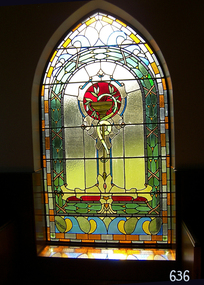
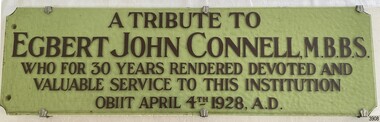
... multi-storey development in the late 1960’s and early 1970’s. The Manager/Secretary at the time was keen to see the historical windows installed in an appropriate location. The chapel was designed by a local architectural draftsman in conjunction with members of the Planning Board of Flagstaff Hill, and built by Mr Leon Habel. The vision of the designers included the hope that the church be used for formal worship such as weddings and funeral, and for multi-denominational special services such as War commemorations. The design is based on the ‘Mission to Seamen’ buildings...multi-storey development in the late 1960’s and early 1970’s. The Manager/Secretary at the time was keen to see the historical windows installed in an appropriate location. The chapel was designed by a local architectural draftsman in conjunction with members of the Planning Board of Flagstaff Hill, and built by Mr Leon Habel. The vision of the designers included the hope that the church be used for formal worship such as weddings and funeral, and for multi-denominational special services such as War commemorations. The design is based on the ‘Mission to Seamen’ buildings ...This religiously themed window is situated in the western (weather) wall of the St. Nicholas Mission to Seamen’s Church building in the Flagstaff Hill Maritime Village. It was crafted circa 1928. ABOUT THE WINDOW This window, once known as the Dr Connell Memorial Window, was a feature of an external wall adjacent to the Women’s Children’s Wards of Warrnambool Hospital. Honorary Doctors had played a significant role in the operation of the hospital between the years 1900 to 1939. One of these doctors was Dr. Connell, who passed away in 1928. The green glass plaque is also a registered object in Flagstaff Hill's Collection. Its inscription dedicates the window to Dr. Connell. The inscription reads: “A tribute to Egbert John Connell M.B.B.S. who for 30 years rendered devoted and valuable service to this institution. Obiit April 4th 1928 A.D." A paragraph in the book ‘A History of the Warrnambool Base Hospital’ by Forth and Yule describes the role of the Honorary Doctors - “At the start of the period the senior-part time medical officer was replaced by the junior resident medical officer and control of beds and the right to operate were given to the honorary medical officers...and these men dominated the Warrnambool medical world in the years before the Second World War.” Dr. Connell leased ‘Ambleside’, 192 Koroit Street, in the early 20th century, following Dr Teed who had previously run his medical practice there. In 1914 Dr Connell purchased the property and continued his private practice there until his death in 1928. He also took a prominent part in hospital work, both as physician and surgeon, and often acted as spokesmen for the Honorary Doctors. According to colleague Dr. Horace Holmes’ subsequent notes, it was after the close of the First World War, and the following years of the world-wide pneumonic influenza epidemic, that Dr. Connell himself contracted pneumonia and died. His family and friends then recognised his work by gifting the memorial window in his honour to the Hospital. By the mid-1970s the old wards at the hospital had been replaced and there was no obvious place for the window. Discussions between the previous and past Hospital managers, the Anglican Diocese, and Flagstaff Hill Planning Board, led to its installation in its present position in St Nicholas Seamen’s Church and the memorial plaque was later installed beside the window. St NICHOLAS SEAMEN’S CHURCH, Anglican Church Flagstaff Hill’s Mission to Seamen was opened in 1981. Its conception was partly motivated by the offer of Stained Glass Memorial Windows from the local Warrnambool and District Base Hospital, which was undergoing multi-storey development in the late 1960’s and early 1970’s. The Manager/Secretary at the time was keen to see the historical windows installed in an appropriate location. The chapel was designed by a local architectural draftsman in conjunction with members of the Planning Board of Flagstaff Hill, and built by Mr Leon Habel. The vision of the designers included the hope that the church be used for formal worship such as weddings and funeral, and for multi-denominational special services such as War commemorations. The design is based on the ‘Mission to Seamen’ buildings in both Portland and Port Melbourne. These types of buildings were often erected to house social and worshipful activities for seamen. The materials used in the building include sandstone recycled from nineteenth-century buildings demolished in Warrnambool and American slate tiles retrieved from the 1908 wreck of the FALLS OF HALLADALE. Most of the chapel furnishings came from the Williamstown Missions to Seamen, which was consecrated in 1946 but later decommissioned. These artefacts range from the altar cloth to the hymn board and include a visually stunning round stained glass widow called ‘Christ Guiding the Helmsman’. However the provenance of this particular artefact, large western window, is local. This stained glass memorial window is of local, historical and social significance, linking local history and heritage with one of Warrnambool's doctors, Dr. Egbert John Connell (d. 1928), who gave 30 years of dedicated, medical service to the local citizens.Stained glass leadlight window in Gothic arched metal frame with six horizontal reinforcing rods. Image depicts a golden flat-bowled baptismal font on a slender stand with foliage proceeding from it. The image is internally framed by a Roman arch of coloured glass and surrounding rectangular and breaking-wave shapes. (The window was previously known locally as the Dr. Connell Memorial Window and a plaque dedicated to Dr. Connell is catalogued separately. See Context notes for details.)flagstaff hill, warrnambool, shipwrecked coast, flagstaff hill maritime museum, maritime museum, shipwreck coast, flagstaff hill maritime village, great ocean road, chapel window, stained glass window, warrnambool and district base hospital, st nicholas mission to seamen’s church, williamstown mission to seamen, dr egbert connell, ambleside warrnambool, leon habel builder, falls of halladale slate, memorial window, commemorative window, dr connell -
 Flagstaff Hill Maritime Museum and Village
Plaque - Commemorative, circa 1928
... multi-storey development in the late 1960’s and early 1970’s. The Manager/Secretary at the time was keen to see the historical windows installed in an appropriate location. The chapel was designed by a local architectural draftsman in conjunction with members of the Planning Board of Flagstaff Hill, and built by Mr Leon Habel. The vision of the designers included the hope that the church be used for formal worship such as weddings and funeral, and for multi-denominational special services such as War commemorations. The design is based on the ‘Mission to Seamen’ buildings...multi-storey development in the late 1960’s and early 1970’s. The Manager/Secretary at the time was keen to see the historical windows installed in an appropriate location. The chapel was designed by a local architectural draftsman in conjunction with members of the Planning Board of Flagstaff Hill, and built by Mr Leon Habel. The vision of the designers included the hope that the church be used for formal worship such as weddings and funeral, and for multi-denominational special services such as War commemorations. The design is based on the ‘Mission to Seamen’ buildings ...This commemorative plaque refers to the religiously themed window situated in the western (weather) wall of the St. Nicholas Mission to Seamen’s Church building in the Flagstaff Hill Maritime Village. It was crafted circa 1928. ABOUT THE WINDOW The window, to which this plaque belongs was once known as the Dr Connell Memorial Window, which was a feature of an external wall adjacent to the Women’s Children’s Wards of Warrnambool Hospital. Honorary Doctors had played a significant role in the operation of the hospital between the years 1900 to 1939. One of these doctors was Dr. Connell, who passed away in 1928. A paragraph in the book ‘A History of the Warrnambool Base Hospital’ by Forth and Yule describes the role of the Honorary Doctors - “At the start of the period the senior-part time medical officer was replaced by the junior resident medical officer and control of beds and the right to operate were given to the honorary medical officers...and these men dominated the Warrnambool medical world in the years before the Second World War.” Dr. Connell leased ‘Ambleside’, 192 Koroit Street, in the early 20th century, following Dr Teed who had previously run his medical practice there. In 1914 Dr Connell purchased the property and continued his private practice there until his death in 1928. He also took a prominent part in hospital work, both as physician and surgeon, and often acted as spokesmen for the Honorary Doctors. According to colleague Dr. Horace Holmes’ subsequent notes, it was after the close of the First World War, and the following years of the world-wide pneumonic influenza epidemic, that Dr. Connell himself contracted pneumonia and died. His family and friends then recognised his work by gifting the memorial window in his honour to the Hospital. By the mid-1970s the old wards at the hospital had been replaced and there was no obvious place for the window. Discussions between the previous and past Hospital managers, the Anglican Diocese, and Flagstaff Hill Planning Board, led to its installation in its present position in St Nicholas Seamen’s Church. It was installed without the bottom section of stained glass, which was inscribed as a memorial to Dr. Connell. St NICHOLAS SEAMEN’S CHURCH, Anglican Church Flagstaff Hill’s Mission to Seamen was opened in 1981. Its conception was partly motivated by the offer of Stained Glass Memorial Windows from the local Warrnambool and District Base Hospital, which was undergoing multi-storey development in the late 1960’s and early 1970’s. The Manager/Secretary at the time was keen to see the historical windows installed in an appropriate location. The chapel was designed by a local architectural draftsman in conjunction with members of the Planning Board of Flagstaff Hill, and built by Mr Leon Habel. The vision of the designers included the hope that the church be used for formal worship such as weddings and funeral, and for multi-denominational special services such as War commemorations. The design is based on the ‘Mission to Seamen’ buildings in both Portland and Port Melbourne. These types of buildings were often erected to house social and worshipful activities for seamen. The materials used in the building include sandstone recycled from nineteenth-century buildings demolished in Warrnambool and American slate tiles retrieved from the 1908 wreck of the FALLS OF HALLADALE. Most of the chapel furnishings came from the Williamstown Missions to Seamen, which was consecrated in 1946 but later decommissioned. These artefacts range from the altar cloth to the hymn board and include a visually stunning round stained glass widow called ‘Christ Guiding the Helmsman’. However the provenance of this particular artefact, large western window, is local.This plaque is significant because of its association with stained glass memorial window is of local, historical and social significance, linking local history and heritage with one of Warrnambool's doctors, Dr. Egbert John Connell (d. 1928), who gave 30 years of dedicated, medical service to the local citizens.Plaque, opaque, pale green glass rectangle mounted on white timber board and held in place with six decorative silver coloured clasps. Five rows of printed, capitalised text are fixed on the top surface. The plaque is companion to the commemorative, stained glass window installed in the St. Nicholas Mission to Seamen's Church at Flagstaff Hill. (The window was previously known locally as the Dr. Connell Memorial Window.)"A TRIBUTE TO / EGBERT JOHN CONNELL, M.B.B.S. / WHO FOR 30 YEARS RENDERED DEVOTED AND / VALUABLE SERVICE TO THIS INSTITUTION / OBIIT APRIL 4th 1928, A.D."flagstaff hill, warrnambool, shipwrecked coast, flagstaff hill maritime museum, maritime museum, shipwreck coast, flagstaff hill maritime village, great ocean road, chapel window, stained glass window, warrnambool and district base hospital, st nicholas mission to seamen’s church, williamstown mission to seamen, dr egbert connell, ambleside warrnambool, leon habel builder, falls of halladale slate, memorial window, commemorative window, dr connell, commemorative plaque, plaque, edgar mcconnell -
 Flagstaff Hill Maritime Museum and Village
Textile - Seat Squabs, mid-20th century
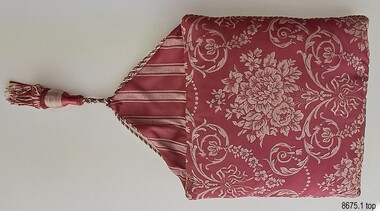
... multi-storey expansion in the late 1960s and early 1970s. The hospital’s Manager/Secretary was eager to see the historic window installed in a suitable place. The church, or chapel, was designed by a local architectural draftsman in collaboration with the Flagstaff Hill Planning Board and was constructed by Mr Leon Habel. The designers hoped the church would be used for formal worship, such as weddings, funerals, and multi-denominational special services like war commemorations. Its design was inspired by the ‘Missions to Seamen’ buildings...multi-storey expansion in the late 1960s and early 1970s. The hospital’s Manager/Secretary was eager to see the historic window installed in a suitable place. The church, or chapel, was designed by a local architectural draftsman in collaboration with the Flagstaff Hill Planning Board and was constructed by Mr Leon Habel. The designers hoped the church would be used for formal worship, such as weddings, funerals, and multi-denominational special services like war commemorations. Its design was inspired by the ‘Missions to Seamen’ buildings ...The term 'seat squabs' is no longer commonly used, but is sometimes referred to in the upholstery and motor vehicle industries. Squabs are padded cushions frequently added to wooden chairs or benches to add comfort to their hard forms. They have been made to an 18th-to-19th-century pattern using beautiful, richly coloured satin fabric and fancy cord tassels. The weighted flap at the rear of the squabs helps to keep them in place on the chair, and could be used on the top of the backrest instead of on the seat. These days, squabs are attached with fabric ties or hook-and-loop tabs. These seat squabs were once used in the St Nicholas Seamen's Church at 139 Nelson Place, Williamstown, Victoria, which was purchased and furnished around 1943. The furniture and furnishings are now part of the St. Nicholas Seamen's Church collection. DETAILED HISTORY of the Missions to Seamen: - The Missions to Seamen is an Anglican (Church of England) charity that has served the world’s seafarers since 1856. It was inspired by the work of Rev. John Ashley, who, 20 years earlier, had pioneered a ministry to seafarers in the Bristol Channel in Great Britain. When Ashley retired, others continued the work, founding the Missions to Seamen. It adopted a Flying Angel as its symbol, inspired by a verse from the Bible in Revelation 14. Today, over 200 world ports have Missions to Seamen centres and chaplains. A Missions to Seamen’s club warmly welcomes sailors of all colours, creeds and races and provides a wide range of facilities. The Missions to Seamen organisation changed its name to the Mission to Seafarers in 2000, continuing to include Missions to Seamen clubs in Victoria’s cities of Melbourne, Portland, Geelong and Hastings. Flagstaff Hill’s St Nicholas’ Seamen’s Church is named after its namesake from Williamstown, Victoria, which began in 1857. Bishop Perry opened the first Sailors’ Church, which was known as ‘Bethel’, on an old hulk floating in Hobson’s Bay, Port of Melbourne. In 1860, a Sailors’ Rest started operating from rented premises in Williamstown. In 1878, the Sailors’ Church moved into an old Wesleyan chapel in Ann Street. By the end of that year, they managed to purchase the building, which they had already refurbished. In 1883, they affiliated with the Victorian Seamen’s Mission. A few years later, in 1906, the building had to be demolished because it was no longer safe. While they raised funds for a new building, the Sailors’ Rest temporarily moved to premises in front of Customs House in Nelson Place. Around this time, in 1906, the Ladies Harbour Lights Guild was formed in Australia to support and raise funds for the Mission to Seamen organisation in Melbourne. Two of the most significant ladies of the Guild were founding members Ethel Godfrey and Alice Sibthorpe. During the Mission's time at Siddeley Street, Melbourne, the activities of the Guild raised funds for the Mission to Seamen's Chapel at their new, and still current, premises in Flinders Street, Melbourne, opened in 1917. The Guild continued its important work until the 1960s. In 1908, the Williamstown Mission had enough money to purchase the former Mascotte skating rink on Thompson Street, Williamstown. In August of that year, they were inaugurated into the Victorian Missions to Seamen. They continued at that venue for a few decades. In 1943, the former ES&A Bank building at 139 Nelson Place, Williamstown, was purchased for the new Mission to Seaman’s Club. The official opening was on May 6th, 1944. It was described as a ‘distinctive little building’. Funds had previously been raised for the building and furnishing of the chapel at the rear. The chapel was named St Nicholas’ Seamen’s Church, after St Nicholas, fourth-century bishop and patron saint of sailors. Services were held on Wednesdays and Sundays. The church was supported by the Williamstown Lightkeepers’ Auxiliary, newly founded by Mrs Ethel Margaret Musther in 1943, as well as the Harbour Lights Guild and the League of Soldiers’ and Sailors’ Friends. The Williamstown Mission to Seamen’s Church operated until 1966, when large international ships no longer used the Port of Williamstown. The Commonwealth Government then leased the premises. In the formative years of Flagstaff Hill Maritime Village, the Advisory Board decided to include a Missions to Seamen Chapel and Recreation Room in its village. The Missions organisation was a significant feature of ports during the late 1800s and early 1900s, the period that the Village represents. They often erected Missions to house social and worshipful activities for seamen. Flagstaff Hill’s curator, Mr Ken Marshman, approached the Melbourne Board of Management of Missions to Seamen regarding the Williamstown branch. Consequently, the Board permitted the furnishings of the Williamstown chapel to be transferred to Flagstaff Hill Maritime Village. A provision of the transfer was that the Victoria Missions to Seamen be recognised, that the items would remain as a collection, and that the chapel would be called St Nicholas Seamen’s Church and conduct Divine services. The donation was approved on 21st May 1979. Flagstaff Hill's St. Nicholas Seamen's Church: - The idea behind Flagstaff Hill’s Missions to Seamen’s Church was partly driven by the offer of Stained Glass Memorial Windows that originated from the Warrnambool and District Base Hospital, which was undergoing multi-storey expansion in the late 1960s and early 1970s. The hospital’s Manager/Secretary was eager to see the historic window installed in a suitable place. The church, or chapel, was designed by a local architectural draftsman in collaboration with the Flagstaff Hill Planning Board and was constructed by Mr Leon Habel. The designers hoped the church would be used for formal worship, such as weddings, funerals, and multi-denominational special services like war commemorations. Its design was inspired by the ‘Missions to Seamen’ buildings in Portland and the Port of Melbourne. The furniture and furnishings were placed as accurately as possible according to photographs of the Williamstown St Nicholas Seamen’s Church and with assistance from local clergy. The Recreation Room was furnished and arranged on advice from experienced members of the Missions to Seamen organisation. A framed document in the building recognises the donor of the furnishings, Victoria Missions to Seamen, and includes the names of some original donors and their donated item/s. The building’s design incorporates local features such as Warrnambool sandstone, which was no longer commercially available but was procured from demolished buildings and uniformly cut to use as a veneer over the stronger Mt. Gambier stone. Also, traditional green American roofing slate was used, sourced from the 1908 local shipwreck “Falls of Halladale” by Flagstaff Hill volunteer divers. The bell tower includes a bell believed to be from a local shipwreck. Additional furnishings were acquired locally, and several items were donated by Warrnambool residents. Light fittings in both rooms were assembled to simulate 19th-century gas light fittings. The stained-glass window at the back of the church is a memorial to Dr Connell, a well-respected member of the Warrnambool community. It was originally installed in 1928 in the main building of Warrnambool Hospital. The St Nicholas’ Seamen’s Church at Flagstaff Hill was officially opened by His Worship the Mayor, Cr. John Lindsay, on Sunday, 11th October 1981. The event included a service of thanksgiving conducted by the Warrnambool Ministers Fraternal. Since then, the Chapel has been the historic venue for many weddings. This pair of seat squabs is historically significant for its origin in the St Nicholas Mission to Seamen's Church in Williamstown, established in 1857 to cater for seafarers’ physical, social, and spiritual needs. The organisation originated in Bristol, England, when a Seamen's Mission was formed in 1837. The squabs are also significant for their use in the St Nicholas Missions to Seamen's chapel, Williamstown, as the original building is now listed on the Victorian Heritage Register. Squabs or padded seat cushions, a pair of two. These 18th to 19th-century design squabs have crimson and cream satin fabric on top and underneath, and weighted tassels are attached to their rear corners. They can be used for comfort on hard seats and benches. The squabs were furnishings from the Missions to Seamen chapel in Williamstown, and they are now part of the St Nicholas Seamen's Church Collection.flagstaff hill, warrnambool, shipwrecked-coast, flagstaff-hill, flagstaff-hill-maritime-museum, maritime-museum, shipwreck-coast, flagstaff-hill-maritime-village, st nicholas mission to seamen's church williamstown, mission to seamen williamstown, mission to seamen victoria, st nicholas mission to seamen, st nicholas seamen's church, religion, religious service, sailor's rest, ladies harbour light guild, squab, seat covers, cushions, squabs, religious furnishing, padded seats, seating, accessory -
Glenelg Shire Council Cultural Collection
Photograph - Photograph - Unknown double story building, c. 1970
... Image shows double storey building with pitched iron roof and fenced balcony on first floor, attached to single storey building with slate roof, 2 large multi-paned windows and partly open front door. ...Image shows double storey building with pitched iron roof and fenced balcony on first floor, attached to single storey building with slate roof, 2 large multi-paned windows and partly open front door. ...Photographic print of a rephotographed photograph. Image shows double storey building with pitched iron roof and fenced balcony on first floor, attached to single storey building with slate roof, 2 large multi-paned windows and partly open front door. Small child in open doorway, man in top hat and small boy on footpath. -
 Ringwood and District Historical Society
Book, Bryce Raworth, Heritage Impact Assessment - 1 Bedford Road, Ringwood, Victoria. Application for permit - Proposed Redevelopment - July 2021, 2021
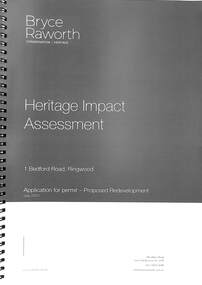
... It relates to a proposal to demolish the existing shop on the site and construct a multi-storey car park incorporating a commercial tenancy at the lower levels. It reviews the significance of the existing building on the site and the contribution it makes to the surrounding streetscapes, then comments on the heritage impacts of the proposed demolition in the context of the significance of the place and broader considerations. ...It relates to a proposal to demolish the existing shop on the site and construct a multi-storey car park incorporating a commercial tenancy at the lower levels. It reviews the significance of the existing building on the site and the contribution it makes to the surrounding streetscapes, then comments on the heritage impacts of the proposed demolition in the context of the significance of the place and broader considerations. ...A4 size wire-bound book compiled by Bryce RaworthINTRODUCTION: This heritage impact assessment (HIS) was prepared at the request of the City of Maroondah, the owner of the subject property at 1 Bedford Street (sic), Ringwood. It relates to a proposal to demolish the existing shop on the site and construct a multi-storey car park incorporating a commercial tenancy at the lower levels. It reviews the significance of the existing building on the site and the contribution it makes to the surrounding streetscapes, then comments on the heritage impacts of the proposed demolition in the context of the significance of the place and broader considerations. This office has previously provided an Historical Overview of the subject site (June 2020) and this assessment draws upon that previous research and analysis. The report has been prepared by Guy Murphy and Bryce Raworth. CONCLUSION: The proposed demolition of the former Blood Brothers Store at 1 Bedford Street (sic), Ringwood and the construction of a multi-storey car park on the enlarged site will result in the loss of some significance to the Heritage Overlay. The degree of loss is moderated by the partial intactness of the store, its modest character and the loss of its original setting, as well the proposal to implement a heritage interpretation strategy for the site. When considered in the context of the broader range of urban planning considerations and broader net community benefit, the proposed development is supported with respect to heritage impacts. -
 Greensborough Historical Society
Newspaper Clipping, Multi-storey building approved, by Caroline Gonzalez, 2003_09
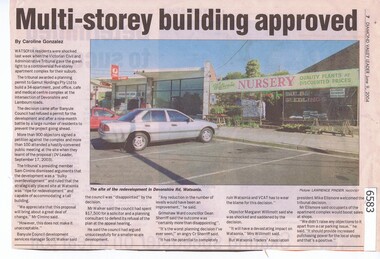
... Multi-storey building approved, by Caroline Gonzalez...In 2003, VCAT approved an application to build a 5 storey building comprising apartments, shops, medical centre and cafe on a site on the corner of Lambourn and Devonshire Roads Watsonia, despite strong local opposition. The proposal did not proceed, but a new proposal was approved in 2019. watsonia devonshire road watsonia lambourn road watsonia News clipping, text and colour image. Copy 2 has note attached. Multi ...In 2003, VCAT approved an application to build a 5 storey building comprising apartments, shops, medical centre and cafe on a site on the corner of Lambourn and Devonshire Roads Watsonia, despite strong local opposition. The proposal did not proceed, but a new proposal was approved in 2019. News clipping, text and colour image. Copy 2 has note attached.watsonia, devonshire road watsonia, lambourn road watsonia -
 Mission to Seafarers Victoria
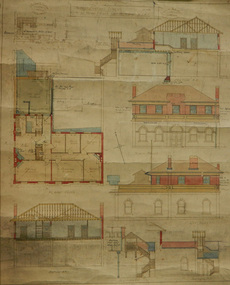
Plan - Architectural drawings, Walter Butler, 1916
... building at 717 Flinders St that is still in use today. The early Port Melbourne onshore Mission gradually transformed from a 'wooden shack' to a one storey brick building designed by architect Frederick Williams in 1888. The St Nicholas chapel was added in 1915. Walter Butler was commissioned to add a second storey in 1917. The building retained its functions until 1937 when the Art Deco Mission, designed by Morris was built. The building has survived as a structure into the 21st century, and was incorporated as part of a multi...building at 717 Flinders St that is still in use today. The early Port Melbourne onshore Mission gradually transformed from a 'wooden shack' to a one storey brick building designed by architect Frederick Williams in 1888. The St Nicholas chapel was added in 1915. Walter Butler was commissioned to add a second storey in 1917. The building retained its functions until 1937 when the Art Deco Mission, designed by Morris was built. The building has survived as a structure into the 21st century, and was incorporated as part of a multi ...An original group of plans drawn by Walter Butler who was also the architect of the Central Institute, Siddeley Street in 1906 and the Mission to Seamen building at 717 Flinders St that is still in use today. The early Port Melbourne onshore Mission gradually transformed from a 'wooden shack' to a one storey brick building designed by architect Frederick Williams in 1888. The St Nicholas chapel was added in 1915. Walter Butler was commissioned to add a second storey in 1917. The building retained its functions until 1937 when the Art Deco Mission, designed by Morris was built. The building has survived as a structure into the 21st century, and was incorporated as part of a multi-apartment development. Historical architectural record of Walter Butler's work. Walter Butler was a renowned architect and friend of the Fairfax family.Coloured architect's drawings of the proposed plans for Chaplain's Residence at Port Melbourne on heavy parchment. Including elevation drawings, floor plans and cross sections as well as architect's notes and measurements.Embossed architect's stamp in top right and left corners and bottom right corner "Walter R Butler [indecipherable] Melbourne" Printer's stamp on bottom right hand corner of rear "Printed by J. Creffield Propy. LTD. RIALTO, 493-5 Collins St. Melbourne"plans, walter richmond butler (1864–1949), mission to seafarers, chaplains residence, beach street, nott street, port melbourne, mission to seamen, frederick williams -
 Bendigo Military Museum
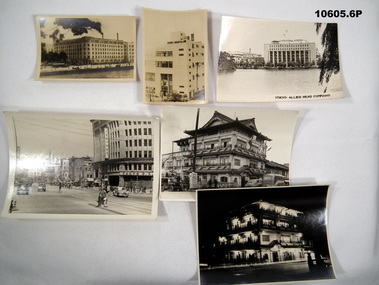
Photograph - TOKYO, JAPAN, BCOF ERA
... multi storied building located on a corner. Building has sign "UNION JACK CLUB" on top. 3. Black and white photograph of “ALLIED HEAD COMMAND, TOKYO” building. Body of water in foreground. postcard pro-forma on back. 4. Black and white photograph of a Tokyo street scene. Pedestrians & vehicles on street. Light rail tracks down middle. Buildings lining the street. One has sign “TOKYO PX” on it. 5. Black and white photograph of a Japanese style building. British and possibly Australian flags flying from second storey...multi storied building located on a corner. Building has sign "UNION JACK CLUB" on top. 3. Black and white photograph of “ALLIED HEAD COMMAND, TOKYO” building. Body of water in foreground. postcard pro-forma on back. 4. Black and white photograph of a Tokyo street scene. Pedestrians & vehicles on street. Light rail tracks down middle. Buildings lining the street. One has sign “TOKYO PX” on it. 5. Black and white photograph of a Japanese style building. British and possibly Australian flags flying from second storey ...4. Building labelled Tokyo PX was used by the United States 8th Army P.X. during post WW2 occupation. Photographs collected by Alva Bennetts during her BCOF deployment. See Cat. No. 9726P for details of service for Alva Marie Bennetts VFX128835.1. Sepia toned photograph of multi-storied building located on a street corner. Vehicle and pedestrians on street. Waterway in foreground. 2. Sepia toned photograph of a multi storied building located on a corner. Building has sign "UNION JACK CLUB" on top. 3. Black and white photograph of “ALLIED HEAD COMMAND, TOKYO” building. Body of water in foreground. postcard pro-forma on back. 4. Black and white photograph of a Tokyo street scene. Pedestrians & vehicles on street. Light rail tracks down middle. Buildings lining the street. One has sign “TOKYO PX” on it. 5. Black and white photograph of a Japanese style building. British and possibly Australian flags flying from second storey. Vehicles lining street at front and side of building. 6. Black and white photograph of the building in 5. taken at night with it lit up.1. Etched in white on bottom RH corner: ”Tokyo, British Headquarters”bcof, tokyo, union jack club, photographs, alva bennetts, bennetts collection -
 Bendigo Historical Society Inc.
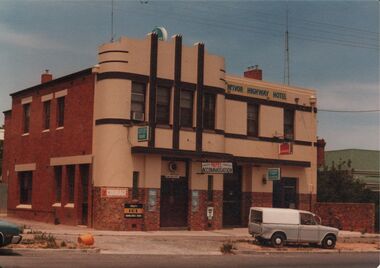
Photograph - BENDIGO HOTEL COLLECTION: MCIVOR HIGHWAY HOTEL
... Image shows 2 storey art deco hotel, cream paint on front façade , red brick building behind. Curved façade on LH side, brown horizontal and vertical trim. Multi...Image shows 2 storey art deco hotel, cream paint on front façade , red brick building behind. Curved façade on LH side, brown horizontal and vertical trim. Multi ...Colour photograph: McIvor Highway Hotel, McIvor Road, Bendigo. Image shows 2 storey art deco hotel, cream paint on front façade , red brick building behind. Curved façade on LH side, brown horizontal and vertical trim. Multi-coloured brick on bottom storey. Early 1980's?bendigo, hotel, mcivor highway hotel
