
Showing 126 items matching "museum fleet"
-
 Moorabbin Air Museum
Booklet (Item) - Museum - Fleet Air Arm Museum - the History of Naval Aviation
... Museum - Fleet Air Arm Museum - the History of Naval Aviation...Museum - Fleet Air Arm Museum - the History of Naval Aviation...Museum - Fleet Air Arm Museum - the History of Naval Aviation Booklet Museum - Fleet Air Arm Museum - the History of Naval Aviation ... -
Moorabbin Air Museum
Booklet (Item) - Museum - Fleet Air Arm Museum & Concorde
... Museum - Fleet Air Arm Museum & Concorde...Museum - Fleet Air Arm Museum & Concorde...Museum - Fleet Air Arm Museum & Concorde Booklet Museum - Fleet Air Arm Museum & Concorde ... -
 Ballarat Tramway Museum
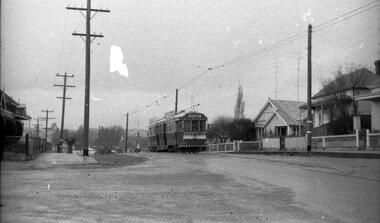
Photograph - Ballarat Tram 40, Tram in Barkly Street at the top of the rise, 10/08/1971
... ...museum fleet...The tram remained in Ballarat and became part of the Ballarat Tramway Museum fleet. It is classified as operable - used for visitors to travel on at the Museum. ...The tram remained in Ballarat and became part of the Ballarat Tramway Museum fleet. It is classified as operable - used for visitors to travel on at the Museum. ...Tram 40 was built in 1913 by Duncan and Fraser for the Prahran and Malvern Tramways Trust was given the number 35. It was sold to the State Electricity Commission of Victoria (SEC) and renumbered 40 when it came to Ballarat in 1951. This tram was the last Ballarat tram operated by the SEC to officially carry passengers in Ballarat. This was on 19 September 1971. The tram remained in Ballarat and became part of the Ballarat Tramway Museum fleet. It is classified as operable - used for visitors to travel on at the Museum. Photograph shows Ballarat Tram 40 in Barkly Street. Street to the left possibly Cameron Street. Taken 10/08/1971. Campbell Duncan, photographer Negative folder - paper, Photape Pty Ltd. containing 6 strips of 35mm negatives in clear plastic sleeve. campball duncan, photographer, ballarat, barkly street, tram 40, 1913, duncan and fraser, prahran and malvern tramways trust, state electricity commission ballarat, last tram operated 1971, museum fleet, used for visitors to museum, 10/08/2026 -
 Melbourne Tram Museum
Document - Guide Book/notes, Melbourne Tram Museum, "Information to assist Museum Guides - Vol 1 - Oct. 2019", Oct. 2019
... Gives info on Guide Roles, safety, Examples of scripts and notes on the Museum fleet at the time of writing....Gives info on Guide Roles, safety, Examples of scripts and notes on the Museum fleet at the time of writing. "Information to assist Museum Guides - Vol 1 - Oct. 2019" Document Guide Book/notes Melbourne Tram Museum ...Book - 20 pages - A5 centre stapled "Information to assist Museum Guides - Vol 1 - Oct. 2019", Edited by Geoff Brown. Gives info on Guide Roles, safety, Examples of scripts and notes on the Museum fleet at the time of writing. trams, tramways, melbourne tram museum, mtm, hawthorn tram depot, guides, tramcar preservation -
 Ballarat Tramway Museum
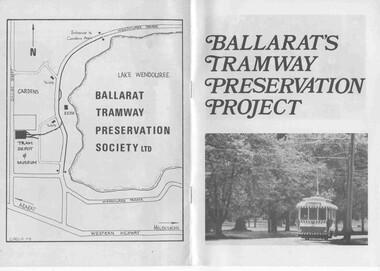
Book, Campbell Duncan, "Ballarat's Tramway Preservation Project", 1978?
... ... Museum Directory... Car Fleet...Trams tramways BTPS Museum Directory Car Fleet Map Sixteen page book or booklet printed on A4 white paper, folded to A5 with saddle bound staples, titled "Ballarat's Tramway Preservation Project". ...Sixteen page book or booklet printed on A4 white paper, folded to A5 with saddle bound staples, titled "Ballarat's Tramway Preservation Project". Written by Campbell Duncan for the BTPS c1978, giving details of the history of Ballarat's tramways, and a brief history of Geelong and Bendigo, the formation and operations of the BTPS and the tramcar fleet. Has 10 photographs, 1 sketch of the front of a maximum traction tramcar and a map of the BTPS location on the rear. Map drawn by G. Inglis 2.73. Note no credits for photographs. See image files for photos used in book. Second edition - notes tram 28 has been repaired by the BTPS and this did not occur until 1978 - only gives 6 tramcars in list - we had others stored off site at the time. second copy added 1/1/12 trams, tramways, btps, museum directory, car fleet, map -
 Ballarat Tramway Museum
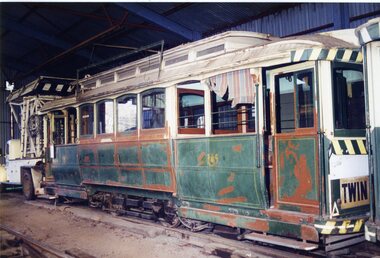
Vehicle - Tramcar, Meadowbank Manufacturing Co. Sydney, SECV Tram No. 11, 1915
... For an article on the tram see the Oct. 2018 issue of Fares Please! and the Museum Fleet page on the website. See Fares Please - Oct. 1977, Destination City, Destination Eaglehawk, BTPS Annual Reports and March 1980 Fares Please!...For an article on the tram see the Oct. 2018 issue of Fares Please! and the Museum Fleet page on the website. See Fares Please - Oct. 1977, Destination City, Destination Eaglehawk, BTPS Annual Reports and March 1980 Fares Please! ...One of a number of this type of tram still in working order in Australian tramway museums. Has no motors. Interior one of the few given a paint finish by SEC, others are varnished. Has timber panelled sides. Single truck (4 wheels), drop ends, modified open California combination to closed car, with 4 doors, 2 at either end, longitudinal seats, sliding internal doors, air brakes. - electric motors removed. Acquired from the Daylesford Historical Society. For an article on the tram see the Oct. 2018 issue of Fares Please! and the Museum Fleet page on the website. See Fares Please - Oct. 1977, Destination City, Destination Eaglehawk, BTPS Annual Reports and March 1980 Fares Please! trams, tram 11 -
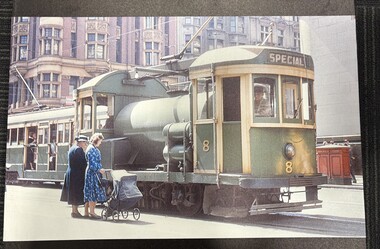 Ballarat Tramway Museum
Photograph - Framed canvas Scrubber No. 8, Hugh Ballment, 1950s
... The tram is now part of the Museum's fleet and is used for rail/track maintenance. ...The tram is now part of the Museum's fleet and is used for rail/track maintenance. ...Image of MMTB Scrubber tram No. 8 northbound in Elizaberth St at the corner with Collins St. Has a W2 in the background. The tram was strengthed during 1961 by adding bracing between the cabs. Two ladies one with a pram are waiting at the safety zone. Based on the dresses of the ladies and pram, most likely mid to late 1950s. Note the large letter box or receiving pillar with a crown behind the tram. The tram is now part of the Museum's fleet and is used for rail/track maintenance. Yields information about scrubber tram 8, later 8W working in Elizabeth St Melbourne. Framed canvas colour photograph on a wooden frame with a hanging hook on the rear. tram 8, elizabeth st, collins st, tramways, tramcars -
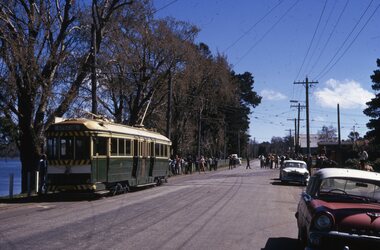 Ballarat Tramway Museum
Photograph - Ballarat Tram 40, Tram leaving the Depot for the last time, 19 September 1971
... The tram remained in Ballarat and became part of the Ballarat Tramway Museum fleet. It is classified as operable - used for visitors to travel on at the Museum. ...The tram remained in Ballarat and became part of the Ballarat Tramway Museum fleet. It is classified as operable - used for visitors to travel on at the Museum. ...Tram 40 was built in 1913 by Duncan and Fraser for the Prahran and Malvern Tramways Trust was given the number 35. It was sold to the State Electricity Commission of Victoria (SEC) and renumbered 40 when it came to Ballarat in 1951. This tram was the last Ballarat tram operated by the SEC to officially carry passengers in Ballarat. This was on 19 September 1971. The tram remained in Ballarat and became part of the Ballarat Tramway Museum fleet. It is classified as operable - used for visitors to travel on at the Museum. The photograph shows a number of people watching Tram 40 leave the Depot for the last time. Photograph taken by Campbell Duncan 19 September 1971. Colour image in C/B Kodak mount, 35 mm slide Handwritten notation in ink on mount. tram 40, 1913, duncan and fraser, prahran and malvern tramways trust, state electricity commission, sec, 19 september 1971, last tram, ballarat tramway museum -
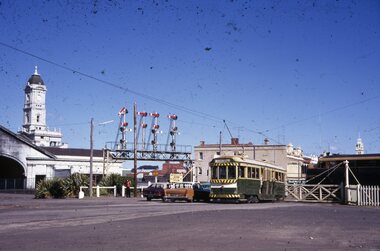 Ballarat Tramway Museum
Photograph - Ballarat Tram 40, Tram waiting at level crossing for train to pass through, 19 September 1971
... The tram remained in Ballarat and became part of the Ballarat Tramway Museum fleet. It is classified as operable - used for visitors to travel on at the Museum. ...The tram remained in Ballarat and became part of the Ballarat Tramway Museum fleet. It is classified as operable - used for visitors to travel on at the Museum. ...Tram 40 was built in 1913 by Duncan and Fraser for the Prahran and Malvern Tramways Trust was given the number 35. It was sold to the State Electricity Commission of Victoria (SEC) and renumbered 40 when it came to Ballarat in 1951. This tram was the last Ballarat tram operated by the SEC to officially carry passengers in Ballarat. This was on 19 September 1971. The tram remained in Ballarat and became part of the Ballarat Tramway Museum fleet. It is classified as operable - used for visitors to travel on at the Museum. The photograph shows Tram 40 waiting at the Lydiard Street railway crossing for a train to pass through. This is at the Ballarat Railway Station which is visible to the left of the photo. Photograph taken by Campbell Duncan 19 September 1971. Colour image in C/B Kodak mount, 35 mm slide Handwritten notation in ink on mount. tram 40, 1913, duncan and fraser, prahran and malvern tramways trust, state electricity commission, sec, 19 september 1971, last tram, ballarat tramway museum, lydiard street train crossing, ballarat railway station -
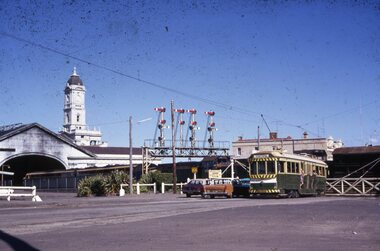 Ballarat Tramway Museum
Photograph - Ballarat Tram 40, Tram waiting at level crossing for goods train to pass through, 19 September 1971
... The tram remained in Ballarat and became part of the Ballarat Tramway Museum fleet. It is classified as operable - used for visitors to travel on at the Museum. ...The tram remained in Ballarat and became part of the Ballarat Tramway Museum fleet. It is classified as operable - used for visitors to travel on at the Museum. ...Tram 40 was built in 1913 by Duncan and Fraser for the Prahran and Malvern Tramways Trust was given the number 35. It was sold to the State Electricity Commission of Victoria (SEC) and renumbered 40 when it came to Ballarat in 1951. This tram was the last Ballarat tram operated by the SEC to officially carry passengers in Ballarat. This was on 19 September 1971. The tram remained in Ballarat and became part of the Ballarat Tramway Museum fleet. It is classified as operable - used for visitors to travel on at the Museum. The photograph shows Tram 40 waiting at the Lydiard Street railway crossing for a train to pass through. This is at the Ballarat Railway Station which is visible to the left of the photo. Photograph taken by Campbell Duncan 19 September 1971. Colour image in C/B Kodak mount, 35 mm slide Handwritten notation in ink on mount. tram 40, 1913, duncan and fraser, prahran and malvern tramways trust, state electricity commission, sec, 19 september 1971, last tram, ballarat tramway museum, lydiard street train crossing, ballarat railway station, goods train -
 Ballarat Tramway Museum
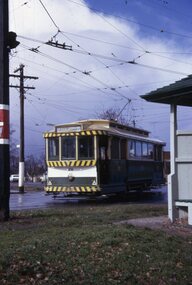
Photograph - Ballarat Tram 26, Tram 26 Turning from Macarthur Street into Wendouree Parade at View Point, 11 August 1971
... When the trams stopped operating it became part of the Ballarat Tramway Preservation Society (Ballarat Tramway Museum from 1995) fleet of trams. Photograph was taken on 11 August 1971 by Campbell Duncan, photographer....When the trams stopped operating it became part of the Ballarat Tramway Preservation Society (Ballarat Tramway Museum from 1995) fleet of trams. Photograph was taken on 11 August 1971 by Campbell Duncan, photographer. macarthur street duncan and fraser adelaide 1916 hawthorn tramway trust ballarat 1930 wendouree parade ballarat tramway preservation society ballarat tramway museum 1995 campbell duncan photographer 1972 Handwritten notation in ink on mount. ...Tram 26 was built by Duncan and Fraser, Adelaide in 1916. Originally built for the Hawthorn Tramways Trust. Came to Ballarat in 1930. The photograph show the tram turning from Macarthur Street into Wendouree Parade , known as View Point. When the trams stopped operating it became part of the Ballarat Tramway Preservation Society (Ballarat Tramway Museum from 1995) fleet of trams. Photograph was taken on 11 August 1971 by Campbell Duncan, photographer. Colour image in cardboard Kodak mount. 35mm slide Handwritten notation in ink on mount. macarthur street, duncan and fraser, adelaide, 1916, hawthorn tramway trust, ballarat, 1930, wendouree parade, ballarat tramway preservation society, ballarat tramway museum, 1995, campbell duncan, photographer, 1972 -
 Flagstaff Hill Maritime Museum and Village
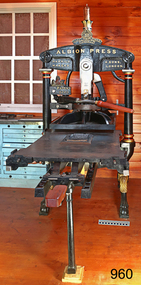
Equipment - Printing Press, Harrild and Sons, 1866
... Newspaper printers were often amongst the first businesses of a small town. flagstaff hill warrnambool shipwrecked coast flagstaff hill maritime museum maritime museum shipwreck coast flagstaff hill maritime village albion press printing press 1866 printing press printing equipment communications coleraine albion printing office coleraine newspaper albion newspaper south west victoria newspapers harrild and sons london richard whittaker cope star printing terang philprint coleraine albion hand operated press Embossed maker’s emblem [A red cross - above a double ring – square inside ring – three banners below ring]. - Inside the double rings “PRINTING MATERIALS MANUFACTURE” - Inside the square, intertwined text “H & S” [representing Harrild & Sons] - Inside the three banners ““FLEET ...This Albion printing press was manufactured by Harrild & Sons of London and exported in 1868 from London to the colonial Western Victoria town of Coleraine, population of 700 at that time. It was installed in the Colerain Albion printing office. It was used to print the first edition of the Coleraine Albion newspaper in 1868 and continued until publication ceased in 1974. The Albion Press is still being used today by a volunteer printer in the “Examiners Office” in the village at Flagstaff Hill. Amongst the items produced are printed paper bags for the Tea Rooms and posters for visitors. ALBION PRINTING PRESS The Albion press was invented and manufactured in London by Richard Whittaker Cope around 1820 and was still being produced in the 1930s. The Albion was manufactured under licence by several companies from the 1850s onwards, one of which was Harrild & Sons of Fleet Works, London. Harrild & Sons describes its business as “printing materials manufacturer”. The business was established in 1807 by Robert Harrild and named R. Harrild & Co. In 1813 he showed that rollers could be used to ink a printing plate instead of inking balls, the method in use at the time. He then established a company to make the rollers. Eventually his company would make other printing materials and equipment. Robert’s sons joined him in the 1830s, when the company was renamed Harrild & Sons, and they continued to run the company after his death in 1853 and up until the mid-1900s. COLERAINE ALBION PRINTING OFFICE The Coleraine Albion Printing Office was established by W.L. Ambler. The first issue of the Coleraine Albion was dated 4th January 1868. Arrangements had been made to receive news from Melbourne, nearby provinces, other colonies and England. The second issue on 18 January 1868 printed articles from many agencies, including the Melbourne Age and the Warrnambool Examiner. The Albion office was sold to William Hatherleigh, formerly of Portland, in October 1868. Thereafter the Albion office had many owners. The last was L. A. & E. Oliver, who took over in January 1972 and was the last to be stated as printers and publishers of the Coleraine Albion. The office was wound up in 1974. The Albion Press and other equipment was distributed to Star printing in Terang. Star Printing donated the Albion press to Flagstaff Hill Maritime Village around 1980 and Stan Philp, owner of Philprint in Warrnambool, transported it to Warrnambool, brought it up to good working order and organised the supply of appropriate printer’s type. The Albion hand operated printing press is significant for producing the first newspaper in Coleraine, Western Victoria and continuing production for over 100 years. The Albion is technologically significant as a working example of a hand operated printer from the mid-19th century. The use of the printer is demonstrated by volunteers at Flagstaff Hill, printing items such as lolly and treat bays for use in the Village. The Albion is socially significant for its role in the isolated provincial colony, providing communication with the outside world, both in Australia and overseas. Newspaper printers were often amongst the first businesses of a small town. Printing press; hand operated Albion Press, Patent 2105. The machine has an upright iron frame at the back that supports the upper press that has a wooden handled metal bar is attached. The frame and legs support a thick metal flatbed. A metal leg supports the front of the press bed. The iron work is painted black with gold highlights. The decorative legs are finished with the golden feet of an animal. The frame above the metal bed includes a crown shaped finial symbol above the maker’s emblem. The maker’s details and the name of the printer are embossed on the upright frame. A plaque with the patent number is below a Lion and Unicorn emblem. Embossed maker’s emblem [A red cross - above a double ring – square inside ring – three banners below ring]. - Inside the double rings “PRINTING MATERIALS MANUFACTURE” - Inside the square, intertwined text “H & S” [representing Harrild & Sons] - Inside the three banners ““FLEET” “WORKS.” “LONDON.E.C.” Embossed across the shoulders “ALBION PRESS / HARRILD & SONS, / MAKERS LONDON.” Emblem above plaque [Lion and Unicorn] Embossed on the plaque “PATENT / 2105” Stamped into upright machine part above the printing bed “2105 / 1866” flagstaff hill, warrnambool, shipwrecked coast, flagstaff hill maritime museum, maritime museum, shipwreck coast, flagstaff hill maritime village, albion press, printing press, 1866 printing press, printing equipment, communications, coleraine albion printing office, coleraine newspaper, albion newspaper, south west victoria newspapers, harrild and sons london, richard whittaker cope, star printing terang, philprint, coleraine albion, hand operated press -
 Flagstaff Hill Maritime Museum and Village
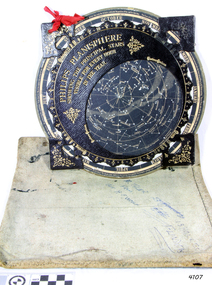
Planisphere, Early 20th Century
... A significant item of celestial mapping used by marine navigators This particular item was made and used in the first quarter to half of the 20th century flagstaff hill warrnambool shipwrecked-coast flagstaff-hill flagstaff-hill-maritime-museum maritime-museum shipwreck-coast flagstaff-hill-maritime-village planisphere star map marine navigation maps george philip & sons "Made in Germany for GEORGE PHILIP & SONS Ltd. Geographical and Educational Depot, 32 Fleet ...The word Planisphere (Latin planisphaerium) was originally used in the second century by Claudius Ptolemy to describe the representation of a spherical Earth by a map drawn in the plane. This usage continued into the Renaissance: for example Gerardus Mercator described his 1569 world map as a Planisphere. The word describes the representation of the star-filled celestial sphere on the plane. The first star chart to have the name "Planisphere" was made in 1624 by Jacob Bartsch. Bartsch was the son-in-law of Johannes Kepler, discoverer of Kepler's laws of planetary motion. A significant item of celestial mapping used by marine navigators This particular item was made and used in the first quarter to half of the 20th century Planisphere of northern hemisphere, with canvas bag. Planisphere consists of a circular star chart attached at its centre to an opaque circular overlay that has a clear elliptical window or hole so that only a portion of the sky map will be visible in the window or hole area at any given time. The chart and overlay are mounted so that they are free to rotate about a common pivot point at their centres. The star chart contains the brightest stars, constellations and (possibly) deep-sky objects visible from a particular latitude on Earth. The night sky that one sees from the Earth depends on whether the observer is in the northern or southern hemispheres and the latitude. A Planisphere window is designed for a particular latitude and will be accurate enough for a certain band either side of that. Planisphere makers will usually offer them in a number of versions for different latitudes. Planispheres only show the stars visible from the observer's latitude; stars below the horizon are not included. A complete twenty-four-hour time cycle is marked on the rim of the overlay. A full twelve months of calendar dates are marked on the rim of the starchart. The window is marked to show the direction of the eastern and western horizons. The disc and overlay are adjusted so that the observer's local time of day on the overlay corresponds to that day's date on the star chart disc. The portion of the star chart visible in the window then represents (with a distortion because it is a flat surface representing a spherical volume) the distribution of stars in the sky at that moment for the Planispheres designed location. Users hold the Planisphere above their head with the eastern and western horizons correctly aligned to match the chart to actual star positions. "Made in Germany for GEORGE PHILIP & SONS Ltd. Geographical and Educational Depot, 32 Fleet Street, London" Canvas bag has "Capt. H (Howard) Tyler from Captain H. F. Woolf" "Tyler 22 ? St East Brighton" also "13 Halls St Flinders" flagstaff hill, warrnambool, shipwrecked-coast, flagstaff-hill, flagstaff-hill-maritime-museum, maritime-museum, shipwreck-coast, flagstaff-hill-maritime-village, planisphere, star map, marine navigation, maps, george philip & sons -
 Flagstaff Hill Maritime Museum and Village
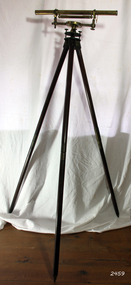
Instrument - Drainage Level, 1750-1795
... museum...shipwreck-coast...flagstaff-hill-maritime-village...george adams fleet...Having one of their early drainage levels in the collection and in extremely good condition is an asset to the Flagstaff collection. flagstaff hill warrnambool shipwrecked-coast flagstaff-hill flagstaff-hill-maritime-museum maritime-museum shipwreck-coast flagstaff-hill-maritime-village george adams fleet street london optical instrument scientific instrument technical instrument surveyors level george adams snr projection microscope "G. ...Adams jnr wrote many elementary scientific works, as well as on the use of mathematical instruments. He often combined in his written works with religious themes and scientific content, often against the prevailing thoughts of the time. According to one popular magazine of the time (Gentleman's Magazine), his works were often accused of "growing errors of materialism, infidelity, and anarchy". He started writing at a young age and developed a love for it, his main interests included math and science, these subjects he often expressed in his written essay's. Notable works from Adams are. An Essay on Electricity, and Magnetism (1784). Essays on the Microscope (1787). An Essay on Vision, briefly explaining the fabric of the eye (1789). Astronomical and Geographical Essays (1790). A Short Dissertation on the Barometer (1790). Geometrical and Graphical Essays, containing a description of the mathematical instruments used in geometry, civil and military surveying, leveling and perspective (1790). Lectures on Natural and Experimental Philosophy, in five volumes (1794). George Adams Sr and Jnr were both notable opticians and scientific instrument makers of the 18th century. Their contribution to scientific innovation and optical development cannot be underestimated. Having one of their early drainage levels in the collection and in extremely good condition is an asset to the Flagstaff collection. Drainage level or optical level. A brass surveying instrument with Achromatic telescope, bubble level and dial fitted to the Tribrach or footplate that has leveling screws. Tripod is wood and brass with adjustable and unscrewable legs (for ease of transportation). Made by "G. Adams Fleet St, London". Used in surveying and building to transfer, measure and/or set horizontal levels. "G. Adams - London". flagstaff hill, warrnambool, shipwrecked-coast, flagstaff-hill, flagstaff-hill-maritime-museum, maritime-museum, shipwreck-coast, flagstaff-hill-maritime-village, george adams fleet street london, optical instrument, scientific instrument, technical instrument, surveyors level, george adams snr, projection microscope -
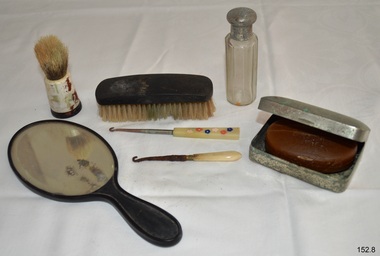 Flagstaff Hill Maritime Museum and Village
Accessory - Grooming Set, T R Cadman, ca. 1924
... The items were displayed in the Master's Quarters of the Reginald M exhibit at Flagstaff Hill Maritime Museum and Village until 2016 when the ship was decommissioned from Flagstaff Hill's fleet. flagstaff hill warrnambool shipwrecked coast flagstaff hill maritime museum maritime museum shipwreck coast flagstaff hill maritime village great ocean road grooming set men's grooming set personal grooming toiletry set personal care soap box soap container cologne bottle clothes brush shaving brush button hook hand mirror personal efects toiletries T.R. ...This men's grooming set of personal care equipment and toiletries is an example of items packaged in attractive cases and sold as gifts in Australian chemist outlets and department stores in the 1920s to 1940s. This set was originally packaged in a leather-covered, lined and fitted case, with a comb, hair brush, and razor included as well. as the items shown here. The razor, once included with the set, had the inscription "T.R. Cadman and Sons, Sheffield England". The family business began with Luke Cadman in 1748. Thomas Radley Cadmen (1833 - 1917) took over the business in 1871, by which time it was operating in Sheffield. The business became incorporated as T.R. Cadman & Sons in 1924 but shortly afterwards the straight razors manufactured by them were stamped T.R. Cadman & Sons Ltd. The company specialised in pocket knives and razors from 1933 and supplied the British Royal Navy with razors in WWII. Over 80 per cent of sales were for the overseas market including Australia. Some of their razors were sold in stores in Victoria. The business traded in 1965. This grooming set was donated for exhibit in Flagstaff Hill Maritime Museum and Village's exhibit of the vessel 'Reginald M', a two-masted coastal trading ketch built in Port Adelaide in 1922. These items are examples of personal objects sold in Victoria in the 1920s as gifts for men, cased or packaged for special occasions and sold in retail stores. The items are associated with the historic coastal trading ketch 'Reginald M', listed on the Australian Register of Historic Vessels; and active from 1922 until 1975. The items were displayed in the Master's Quarters of the Reginald M exhibit at Flagstaff Hill Maritime Museum and Village until 2016 when the ship was decommissioned from Flagstaff Hill's fleet. Men's grooming set; metal soap container with star decoration, oval soap cake, oval hand mirror in a black frame ten-sided clear glass cologne bottle with silver metal lid, yellow bristle clothes brush with brown wooden hand grip, yellow bristle shaving brush with black base and white body, and two button hooks with white handles; the larger one has floral motifs. Inscriptions were on the razor originally included in the grooming set. Soap container once had star motifs. flagstaff hill, warrnambool, shipwrecked coast, flagstaff hill maritime museum, maritime museum, shipwreck coast, flagstaff hill maritime village, great ocean road, grooming set, men's grooming set, personal grooming, toiletry set, personal care, soap box, soap container, cologne bottle, clothes brush, shaving brush, button hook, hand mirror, personal efects, toiletries, t.r. cadman & sons, reginald m, soap dish -
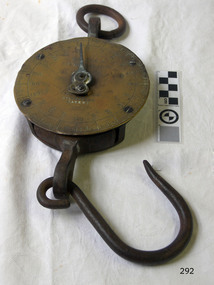 Flagstaff Hill Maritime Museum and Village
Instrument - Scale, George Salter & Co, ca. 1886
... fleet and the first prominent vessel launched by Melbourne’s shipbuilding industry. The scale is also important for its connection with the colonial navy's Custom's work, as the scale was available to weigh goods that could attract taxes and deal out goods for distribution to lighthouse keepers. The HMV Lady Loch was also important part of Victoria's maritime history for its communication and support of the lighthouse keeper's along the coast of Victoria. Warrnambool Shipwreck Coast Flagstaff Hill Flagstaff Hill Maritime Museum ...There were at least three 1880s vessels named Lady Loch, all built in Victoria; a river launch (ca 1884 to ca 1916, originally named Lady of the Lake), a steamer ferry (1884 to 1920s), and a government lighthouse tender steamer HMV Lady Loch (1886 to 1962). The spring balance scale was part of the equipment on the HMV Lady Loch. The scale was made by the renowned company Salter Weighing Machines in the United Kingdom, to Silvester's patent design. Salter Weighing Machines, Britain, began making spring scales in the 1820s. In 1908 Salter opened up an Australian branch named Salter Scales Pty. Ltd. The scale is marked HMV SS Lady Loch. It would be suspended by its top ring, a basket or other container is hung from the hook, and the items inside the basket are then pulled downwards on the hook, which stretches the springs inside the works. The pulling action moves a rack and gears a calculated distance and the gears turn the pointer on the dial to indicate the weight of the goods. This scale measures up to 200 pounds capacity. The HMV SS Lady Loch was an iron steamship built in Footscray, Melbourne, by Campbell, Sloss and McCain in 1886 for the colonial Victorian government’s Department of Trade and Customs. It was armed with a 6-inch gun and two 1-inch Nordenfelt guns. The Sydney Morning Herald of 27th January 1888 describes the vessel in detail. It even comments on the interior of the Saloon “The wood work … is on a very elaborate scale and is exceedingly neat …”. The HMV Lady Loch performed Customs duties and serviced the lighthouses along the coast. The scale could have measured goods for the Customs Tax, or for measuring out supplies for the lighthouse keepers. The vessel was named after Lady Elizabeth Loch, wife of Sir Henry Loch, Governor of Victoria from 1884 to 1889. In 1932 Lady Loch was converted to a hulk and used in Brisbane, and finally scuttled in 1962 at Moreton Bay, Queensland. The scale has importance due to its connection to the 1886 HMV Lady Loch, a vessel of great significance to Melbourne’s shipbuilding industry. It was the largest auxiliary vessel in the Victorian Colonial Government’s fleet and the first prominent vessel launched by Melbourne’s shipbuilding industry. The scale is also important for its connection with the colonial navy's Custom's work, as the scale was available to weigh goods that could attract taxes and deal out goods for distribution to lighthouse keepers. The HMV Lady Loch was also important part of Victoria's maritime history for its communication and support of the lighthouse keeper's along the coast of Victoria. Scale; Salter's spring balance mechanical hanging scale, brass and iron. Equally spaced marks around the circular dial have values from 0 to 200 in increments of 10, each increment is also divided into 10. An iron ring is attached to a fitted loop on the top of the scale, and an iron hook is attached to the fitted loop onthe bottom of the scale. A moving pointer attached to the centre of the dial has a calibration screw joined to its base. Four screws fix the brass face to the works at the back. There are stamped and embossed inscriptions. Made by Salter in Britain, to Silvester's Patent design. The scale was once equipment carried abourd the steamship HMV SS Lady Loch. Stamped: "SALTER'S / SPRING BALANCE" "SILVESTOR'S / PATENT" Embossed in script: "HMV SS / Lady Loch" warrnambool, shipwreck coast, flagstaff hill, flagstaff hill maritime museum, flagstaff hill maritime village, scale, salter, spring balance, silvester's patent, lady loch, steamship, hmv, colonial navy, victoria, lady elizabeth loch, custom's vessel, lighthouse tender, 1886, government vessel, victorian government, measuring instrument, weight, weighing instrument, mechanical scale, hanging scale, hmv lady loch, weights and measures, silvestor's patent, george salter & co. -
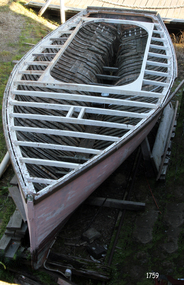 Flagstaff Hill Maritime Museum and Village
Vehicle - Vessel, Couta boat, Viator, 1890-1920
... The Viator is the most significant boat in the Flagstaff Hill's fleet, being the last remaining local 'couta boat and one of few existing examples of this craft. Viator received Heritage status with the Australian Maritime Museums Council and is listed on the Australian Register of Historical Vessels in 2006 (ARHV Number: HV000561). ...The historic Victorian ‘couta boat “Viator” was built by renowned boat builder J.R. Jones of Williamstown in Melbourne, between 1890 and 1920. He was one of the early builders of this design. The features of Viator - carvel planked, open cockpit, vertical stem and straight keel, single mast and a pivoting centreboard - are all characteristics of an early Bass Strait ‘couta boat. This has been confirmed by experienced Victorian ‘couta boat restorer Tim Phillips. Viator served as a ‘couta fishing boat in the Warrnambool area until the mid-1930s, then some say she served as a mail ferry across to Portland. Later it was used as a fishing and recreation boat for local families. For years Viator sat in a paddock in East Warrnambool until purchased in 1975 and donated to Flagstaff Hill. ‘COUTA BOATS - The ‘couta design for vessels is believed to have originated at Port Phillip, Victoria, for the purpose of the Barracouta (‘couta) fishing industry, being both fast and seaworthy. , The 'couta fish was an important food fish in Australian waters, supplying Melbourne with plenty of inexpensive fish. VIATORY’S OWNERS - Some of Viator’s history is known: - 1940, registered Port Fairy and owned by G.J. Richards. - 1941-1945, registered in Port Fairy and owned by Jens “Peter” Petersen. - 1950’s “Brusher” Richards of Warrnambool and Port Fairy used it for fishing. - Peter Watson and his son also went fishing in Viator. - Frank Ferrier, boat builder, was an owner (son of ‘La Bella’ hero, William Ferrier) - Arthur Rogers owned Viator too, then sold it to Terry Pridmore and Wayne Moorefield - The Viator was stored in a paddock, unused, in Fairmont Avenue, Warrnambool, where it was gradually deteriorating. - 1975 Viator was purchase at a very reasonable price from Pridmore, then donated to Flagstaff Hill Maritime Village. RESTORATION - Shipwright Erik Mikkelsen soon started restoration on the Viator after it arrived at Flagstaff Hill in 1975. In 2006 the Maritime Museums of Australia awarded a grant to Flagstaff Hill Maritime Village to assist with the restoration and renovation of the Viator. Its restoration continues today in the care of Flagstaff Hill’s boat builder. J R. JONES - boat builder The photograph of the EVA MYRL shows the builder J R Jones with his team of workers. The other photograph shows a vessel built by J R Jones' son, J B Jones of Footscray, and his team of boat boulders. The photograph of the EVA MYRL was taken by E. A. Dond---. The other photograph is of the Sturrock Coot, taken a Albert Park Lake in St Kilda. The Viator is the most significant boat in the Flagstaff Hill's fleet, being the last remaining local 'couta boat and one of few existing examples of this craft. Viator received Heritage status with the Australian Maritime Museums Council and is listed on the Australian Register of Historical Vessels in 2006 (ARHV Number: HV000561). Viator was built in Victoria in the early days by renowned boat builder J.R. Jones, and sailed by fishermen for many years, both local and on the coastal waters of Victoria, and was possibly used for the mail service. It is significant for being used for the fishing trade, for government service, perhaps as a mail boat, and for recreation by local families. Vessel, the ‘Viator’, an historic Victorian ‘couta boat, handmade by renowned boat builder This J.R. Jones 'couta boat, the Viator, was built in Williamstown, c.1890-1920. The single mast vessel has a Caravel hull built from New Zealand Kauri, blackwood, with a red gum keel and a jarrah stem and stern. It has a pivoting centreboard. Two photographs are included; one of the builder with his team, the other is of his son J B Jones, with his team. Marked "Viator" Photograph 1759.2: "E. A. Dond---" (indecipherable". Handwritten on back "Grandfather / J R Jones / Built" Photograph 1759.3; sign within photograph "J B JONES / BUILDER / FOOTSCRAY", stamped in the card, bottom right " ----- / MELBOURNE" and handwritten on the back "I think this is Mr Abel Sturrock Coot Albert Park Lake" flagstaff hill, warrnambool, shipwrecked coast, flagstaff hill maritime museum, maritime museum, shipwreck coast, flagstaff hill maritime village, great ocean road, arhv hv000561, arthur rogers, bass strait ‘couta boat, “brusher” richards of warrnambool and port fairy, clinker hull boat, ‘couta crafted boat c 1890-1905, ‘couta fishing boat, erik mikkelsen shipwright, g.j. richards of port fairy, jens “peter” petersen, john lindsay, old mail boat, pivoting centerboard boat, peter watson, single-masted ketch, terry prodmore and wayne moorefield, vessel viator, viator a historical vessel, victorian ‘couta boat, victorian barracoota boat, warrnambool ‘couta boat, western victoria fishing boat, western victoria mail boat, hv000561, australian register of historical vessels, erik mikkelsen, j b jones, j b jones boat builder, footscray, sturrock coot, sturrock, j r jones, j r jones boat builder, williamstown, eva myrl -
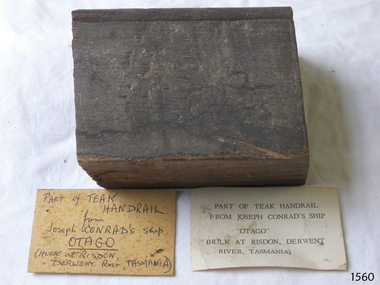 Flagstaff Hill Maritime Museum and Village
Souvenir - Wood Sample, Alexander Stephen and Sons, 1869
... There is an 1882 sailing ship named the Joseph Conrad, after the author, that is now preserved at the Mystic Seaport Maritime Museum in the USA as part of the fleet of historic ships, used as an exhibit and a training ship. ...There is an 1882 sailing ship named the Joseph Conrad, after the author, that is now preserved at the Mystic Seaport Maritime Museum in the USA as part of the fleet of historic ships, used as an exhibit and a training ship. ...This teak wood sample was part of a handrail from the wreck of the barque Otago. The barque Otago 1869-1931 - The iron-hulled 3-masted barque Otago was built in Glasgow by Alexander Stephen & Sons Ltd, Kelvinhaugh, as a merchant ship and launched in 1869. The vessel changed hands several times in the late 19th century after being sold to an Australian firm in 1871. During one of its voyages, the captain died while the ship was in port at Bangkok. Marine author Joseph Conrad was on board and, being a qualified captain, he took command and continued the journey to Sydney and Mauritius. It was the only ship he ever commanded. In 1903, the Melbourne shipping company Huddart, Parko & Co., purchased the Otago and converted it to serve as a coal hulk for use in Sydney. The Otago was later sent to Hobart, Tasmania, where it continued as a hulk until 1931. It was sold for scrap and eventually abandoned on the banks of the Derwent River at a place now known as Otago Bay, opposite Conrad Drive, Otago. The outline of the hull is still visible, and a nearby plaque tells the story. There are other vessels also named Otago, one of which was built in the same year. Joseph Conrad (1857-1927): - Polish-born Joseph Conrad became a British subject in 1886. He was a renowned marine fiction writer and, for a short time, a mariner and Captain. As a 13-year-old boy, Joseph Conrad desired to be a sailor. At 19, he joined the British merchant marine, working in several roles. He eventually qualified as a captain but only served in this role once: from 1888 to 1889, when he commanded the barque Otago, taking over from the deceased captain and completing the ship’s journey from Sydney to Mauritius. In 1889, he began writing his first novel, Almayer’s Folly. He retired from life as a mariner in 1894, aged 36. Conrad’s affection for Australia and his visits to Australia from 1878 to 1982 were later commemorated by a plaque in Circular Quay, Sydney. Conrad continued as an author; some characters in his books were said to be inspired by his maritime experiences and the people he had met. By the end of his life, he had completed 19 novels, stories, and essays, plus one incomplete novel, Suspense, which was finished and published posthumously. In 1924, Prime Minister Ramsay MacDonald offered Conrad a knighthood for his work, but he declined. There is an 1882 sailing ship named the Joseph Conrad, after the author, that is now preserved at the Mystic Seaport Maritime Museum in the USA as part of the fleet of historic ships, used as an exhibit and a training ship. The Danish square-rigged training ship was originally named Georg Stage but was renamed by marine author Alan Villiers when he bought it in 1934. The wood sample from the Otago is significant for its association with renowned marine author Joseph Conrad, who had once commanded the vessel; it was his only command as Captain and was known as Joseph Conrad's Otago. The maritime connection with Conrad extends to items in the collection, including some of his maritime novels based on his first-hand knowledge, a wooden ship model of a ship named after him, and a navigation chart of Otago Harbour. The sample of teak is significant as an example of materials used in the construction of the 1869 iron-hulled sailing ship, built in Glasgow, Scotland, specifically for use to sail across the world with cargo to trade between the colonies including Australian ports. Wood sample; a rectangular section of a teak wood handrail that has a bead planed along one side. Two cards with the sample have inscriptions, one handwritten and one typed. The sample is from the wreck of the barque Otago, once under the command of Captain Joseph Conrad. Handwritten on a card, and typed on another card: "PART OF TEAK HANDRAIL / from / Joseph CONRAD'S ship / OTAGO / (HULK at RISDON, DERWENT River, TASMANIA) flagstaff hill, flagstaff hill maritime museum and village, warrnambool, maritime museum, maritime village, great ocean road, shipwreck coast, joseph conrad, joseph conrad's ship, captain joseph conrad, otago, barque otago, merchant ship, cargo ship, hulk, 1869 ship, iron hull, sailing ship, handrail, fitting, souvenir, wood sample, teak, new zealand, sydney, newcastle, tasmania, hobart, derwent river, otago harbour, otago bay, conrad drive, 19th century, mauritius, marine author, marine novel, alex villiers, georg stage -
 Flagstaff Hill Maritime Museum and Village
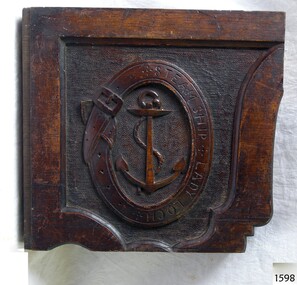
Furniture - Carved Panel, Campbell, Sloss and McCain, ca. 1886
... fleet and the first prominent vessel launched by Melbourne’s shipbuilding industry. It is significant to the history of the Victorian era and the colonial navy's steamship HMV SS Lady Loch. The vessel carried out Custom's work, and the scales were available to weigh goods that could attract taxes and goods for distribution to lighthouse keepers. The HMV Lady Loch was also important part of Victoria's maritime history, its communication with and support of the lighthouse keepers along the coast of Victoria. Warrnambool Shipwreck Coast Flagstaff Hill Flagstaff Hill Maritime Museum ...There were at least three 1880s vessels named Lady Loch, all built in Victoria; a river launch (ca 1884-ca 1916, originally named Lady of the Lake), a steamer ferry (1884-1920s) and a government lighthouse tender steamer HMV Lady Loch (1886-1962.) The carved wooden panel was removed from the HMV SS Lady Loch before the vessel was scuttled in 1962. About HMV SS Lady Loch: - The HMV SS Lady Loch was an iron steamship built in Footscray, Melbourne, by Campbell, Sloss and McCain in 1886 for the colonial Victorian government’s Department of Trade and Customs. It was armed with a 6-inch gun and two 1-inch Nordenfelt guns. The Sydney Morning Herald of 27th January 1888 describes the vessel in detail. It even comments on the interior of the Saloon “The wood work … is on a very elaborate scale and is exceedingly neat …”. The HMV Lady Loch performed Customs duties and serviced the lighthouses along the coast. The scale could have measured goods for the Customs Tax, or for measuring out supplies for the lighthouse keepers. The vessel was named after Lady Elizabeth Loch, wife of Sir Henry Loch, Governor of Victoria from 1884 to 1889. In 1932 Lady Loch was converted to a hulk and used in Brisbane, and finally scuttled in 1962 at Moreton Bay, Queensland. The carved wood panel has importance due to its connection to the 1886 HMV Lady Loch, a vessel of great significance to Melbourne’s shipbuilding industry. It was the largest auxiliary vessel in the Victorian Colonial Government’s fleet and the first prominent vessel launched by Melbourne’s shipbuilding industry. It is significant to the history of the Victorian era and the colonial navy's steamship HMV SS Lady Loch. The vessel carried out Custom's work, and the scales were available to weigh goods that could attract taxes and goods for distribution to lighthouse keepers. The HMV Lady Loch was also important part of Victoria's maritime history, its communication with and support of the lighthouse keepers along the coast of Victoria. Heavy carved wooden panel, square, representing a framed plaque. The bottom and right edges are scalloped on the outer and inner edges. A carved oval within the frame represents a wide belt with buckle and tongue, and indents for the belt holes on its left and a carved inscription runs from top centre to bottom centre on the right side of the belt. Within the belt is the maritime symbol of an upright anchor in front of a rope. It was once part of the furnishing of the steamer HMVS Lady Loch and was removed before the ship was scuttled. Carved within the belt: "STEAM SHIP LADY LOCH" warrnambool, shipwreck coast, flagstaff hill, flagstaff hill maritime museum, flagstaff hill maritime village, scale, salter, spring balance, silvester's patent, lady loch, steamship, hmv, colonial navy, victoria, lady elizabeth loch, custom's vessel, lighthouse tender, 1886, government vessel, victorian government, wood panel, timber panel, carved panel, carved log, lady loch logo, belt enclosing and anchor, anchor within belt, lady loch steam ship, wooden panel, ship's furinshing, ship's panel, ship's logo, great ocean road, government steamer, victorian colonial government, colonial vessel, public works, bass straight, hmv lady loch, hmvs lady loch, hmv ss lady loch, melbourne, melbourne shipbuilder, ship furnishings, wooden furnishings, decorative panel, carved emblem, carved logo, carved symbol, campbell stoss and mccain, government tender, victorian customs -
 Flagstaff Hill Maritime Museum and Village
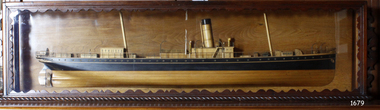
Craft - Ship Model, S.S. Nelson, 1877 - 1984
... fleet of vessels owned by the Warrnambool Steam Packet Company. The S.S. Nelson was specifically built and purchased for the Victorian coastal trade business of the late 19th century, when shipping was the cheapest and most practical means of transporting goods and passengers between Victoria’s coastal towns and the major port at Melbourne. Once the railway came to Warrnambool in 1889, the steam shipping industry began to decline. flagstaff hill warrnambool shipwrecked-coast flagstaff-hill flagstaff-hill-maritime-museum ...This beautifully made ship model is a side relief of the steam ship “S.S. Nelson”, which was launched in 1877. The model’s case stands out because of its ornately carved internal frame. Relief models of ships, sometimes called half models, were often built by the shipbuilders as an exact scale model of the finished ship. The shipbuilders would use the model to ensure that the design was balanced. They would use the model as a point of reference during building. Also, ship models were used to demonstrate the designs to prospective buyers. It is not known whether this model of the “S.S. Nelson” was made for these purposes. HISTORY of the “S.S. Nelson” During the period 1840-1890 shipping was the cheapest and most practical means of carrying produce and goods to and from coastal towns such as Warrnambool. In the 1850s regular domestic steamer services began and by 1870 the passenger trade was booming. Passengers were taken to the ship’s side in small boats called lighters, which took it to ships at anchorage in Lady Bay, then climbed aboard up ladders or gangways. Their fare covered accommodation Saloon/Cabin section (higher class and more expensive) or the Steerage section (lower class and less expensive, below deck level). Produce included livestock such as pigs and fowls, and dairy products, bales of wool, and potatoes. The goods were loaded from the Warrnambool Jetty into the lighters. The S.S. Nelson was built by Messrs Blackwood and Gordon of Port Glasgow for a cost £25,000 in 1877. She was an iron screw steamer with an overall length of 200 feet, beam 25.5 feet and a depth of hold of 19.4 feet, which gave her a gross measurement of 649 tons. Her engines gave her a best speed of 13 knots and a maintainable speed of 12 knots. She was described as a handsome, star decked, efficient steamship, fitted with accommodating for 75 first class passengers in a saloon, and 40 second class passengers in a cabin. The S.S. Nelson arrived in the colony of Victoria on March 9th, 1877. She was first registered in Warrnambool by the Warrnambool Steam Packet Company under the management of Mr William Evans, and employed in the coastal trade of south west Victoria. She was very popular in 1878, registered under the new ownership of the Western Steamship Navigation Company, trading between Melbourne, Warrnambool and Portland. Captained John Nicholson commanded the S.S. Nelson after the previous captain, Thomas Smith, was suspended in 1882 for six months by the Victorian Steam Navigation Board following the collision between the S.S. Nelson and the S.S. Julia Percy. Other Captains include S Drewet and John Thompson. The S.S. Nelson was sold to Messrs. Huddart, Parker and Co. and re-registered in Melbourne on June 23rd, 1890. The new owners intended to use her for their Bass Strait crossing between Melbourne, Victoria and Launceston, Tasmania. On the night of Friday, June 27th 1890, under the command of Captain Carrington, she was on her way to Launceston on her first crossing for her new owners. She had no passengers and very little cargo and was to return to Melbourne with passengers the following morning. She was only 21 hours out of the dock when she struck Porpoise Rock in the Tamar River. All crew of 25 were saved but the bulkheads gave way and she rapidly filled before keeling over and disappearing in approximately 130 feet of water. The new owners had fully insured the almost 14-year-old S.S. Nelson with the Australian Alliance Insurance Company and she had only been in their possession for four days. This ship model of the S.S. Nelson is significant for its connection with the steam screw ship S.S. Nelson, one of a fleet of vessels owned by the Warrnambool Steam Packet Company. The S.S. Nelson was specifically built and purchased for the Victorian coastal trade business of the late 19th century, when shipping was the cheapest and most practical means of transporting goods and passengers between Victoria’s coastal towns and the major port at Melbourne. Once the railway came to Warrnambool in 1889, the steam shipping industry began to decline. Ship model; relief of the S.S. Nelson, showing deck superstructure, ventilators and single funnel. Ship's name is painted on the bow "NELSON". Wood model, varnished finish over natural wood and black painted areas. Timber case with ornate edging and glass front and sides. "NELSON" painted on bow flagstaff hill, warrnambool, shipwrecked-coast, flagstaff-hill, flagstaff-hill-maritime-museum, maritime-museum, shipwreck-coast, flagstaff-hill-maritime-village, s.s. nelson steam ship 1877, screw steamer, 1877 vessel, ship model s.s. nelson, blackwood and gordon port glasgow, warrnambool steam packet company, western steam navigation company, south west coast trader, sea transport melbourne to portland, victorian steam navigation board, s.s. julia percey, captain john nicholson, captain thomas smith, captain s drewet, captain john thompson, captain carrington, huddart, parker and co, bass strait crossing 1890, sea transport melbourne to launceston, porpoise rock tamar river, australian alliance insurance company, ship model making, vessels, victorian coastal trader -
 Flagstaff Hill Maritime Museum and Village
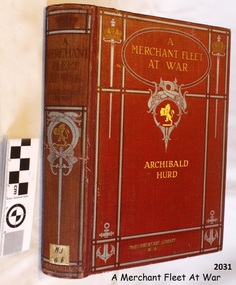
Book, A Merchant Fleet At War
... museum...shipwreck-coast...flagstaff-hill-maritime-village...a merchant fleet...flagstaff hill warrnambool shipwrecked-coast flagstaff-hill flagstaff-hill-maritime-museum maritime-museum shipwreck-coast flagstaff-hill-maritime-village a merchant fleet at war book A Merchant Fleet At War by Archibald Hurd Publisher Cassell & Company Limited A Merchant Fleet At War Book ...A Merchant Fleet At War by Archibald Hurd Publisher Cassell & Company Limited flagstaff hill, warrnambool, shipwrecked-coast, flagstaff-hill, flagstaff-hill-maritime-museum, maritime-museum, shipwreck-coast, flagstaff-hill-maritime-village, a merchant fleet at war, book -
 Flagstaff Hill Maritime Museum and Village
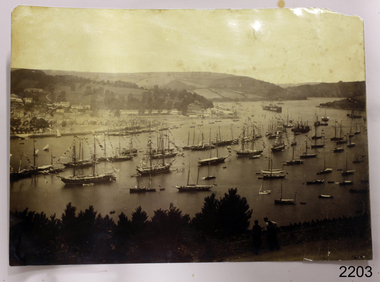
Photograph
... flagstaff hill warrnambool shipwrecked-coast flagstaff-hill flagstaff-hill-maritime-museum maritime-museum shipwreck-coast flagstaff-hill-maritime-village Photograph Plymouth Harbour Photograph of the sailing ships fleet at Plymouth Harbour. ...Photograph of the sailing ships fleet at Plymouth Harbour. flagstaff hill, warrnambool, shipwrecked-coast, flagstaff-hill, flagstaff-hill-maritime-museum, maritime-museum, shipwreck-coast, flagstaff-hill-maritime-village, photograph, plymouth harbour -
 Flagstaff Hill Maritime Museum and Village
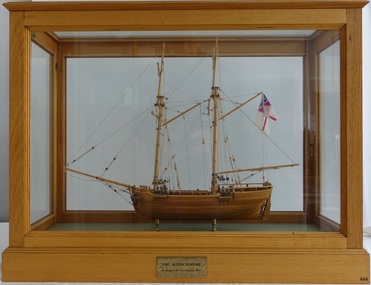
Craft - Ship Model, Port Jackson Schooner
... Museum. The model is a Ledition edition, number 2 of 5, modelled by Bill Leonard. The model is rigged and decked in the manner of David McGregor. The flag on model of Port Jackson schooner is that of the British White Ensign which was used as the flag design of the Royal Australian Navy from 1911 - 1967. In 1785 the First Fleet...Museum. The model is a Ledition edition, number 2 of 5, modelled by Bill Leonard. The model is rigged and decked in the manner of David McGregor. The flag on model of Port Jackson schooner is that of the British White Ensign which was used as the flag design of the Royal Australian Navy from 1911 - 1967. In 1785 the First Fleet ...This ship model is of a Colonial Port Jackson schooner, originally designed by the British Admiralty in 1803 as a response to the request of New South Wales' Governor Arthur Phillip. The drafts for the original plans are in Greenwich, UK, in the National Maritime Museum. The model is a Ledition edition, number 2 of 5, modelled by Bill Leonard. The model is rigged and decked in the manner of David McGregor. The flag on model of Port Jackson schooner is that of the British White Ensign which was used as the flag design of the Royal Australian Navy from 1911 - 1967. In 1785 the First Fleet arrived in the new British colony of Port Jackson (now Sydney Harbour) in New South Wales and Arthur Phillip was appointed as the first Governor. The following year Governor Phillip asked the English Royal Navy to provide drafts and materials for two ships for use in the Port Jackson colony for exploring and surveying rivers. The vessels needed a shallow draught and to be made from local cedar timber. He asked for the frames of the schooners to be provided along with shipwrights to assemble them. Many years later, in 1803, Governor Phillip’s request was fulfilled but he had already resigned from his post. The drafts titled ‘Schooner for Port Jackson’ were despatched by the Royal Navy from England to Australia. The original draft is still in the National Maritime Museum in Greenwich, UK. Meanwhile, the NSW Government had already built various other ships before 1803. In 1797 His Majesty’s Dockyard was opened at Port Jackson for building larger vessels. The Royal Navy’s 1803 design of a ‘Schooner for Port Jackson’ has been recognised on the obverse of Australia’s twenty dollar banknote since 1994. A sketch of the schooner is beside the portrait of Mrs Mary Reibey, who arrived as a convict and rose to become a respected and successful owner of a cargo shipping business. Her fleet included the Mercury, a schooner similar to the 1803 design for the Port Jackson schooner. Although the 1803 plans for a ‘Schooner for Port Jackson’ are commonly believed to be used for the first ship built in Australia, no records have been found of any ships being built according to these plans. However, it can be claimed that the plans were the ‘first Royal Navy plans made for a ship for use at Port Jackson, and to be built at Port Jackson, in Australia’. William (Bill) Leonard passed away on March 1st 1995. This ship model is significant for its representation of an early Australian colonial schooner. The 1803 Royal Navy’s plans for the colonial ‘Schooner for Port Jackson, were for the first ship specifically designed by the Royal Navy to be built and used in Port Jackson, for use in exploration and surveying of Australian ports and rivers. The plans are associated with Australia’s colonial settlement in the late 1700s. This ship model is significant for its association with the emblems of Australia’s history on the twenty dollar banknote. The colonial Port Jackson schooner is considered significant to Australian history, and represented on the 1994 twenty dollar banknote and its new version being rolled out in October 2019. Ship model of a colonial Port Jackson Schooner. Two-masted sailing ship displaying the flag named The British White Ensign. Mode of light coloured stained timberl is mounted on brass legs inside a glass case with timber frame and base. Metal engraved plaque states that the model is as designed by The Admiralty in 1803. Model is a number 2 of 5 in a limited edition, made by Bill Leonard. Engraved on metal plaque "PORT JACKSON SCHOONER / As Designed By The Admiralty. 1803" flagstaff hill, warrnambool, shipwrecked-coast, flagstaff-hill, flagstaff-hill-maritime-museum, maritime-museum, shipwreck-coast, flagstaff-hill-maritime-village, ship model port jackson schooner, sailing ship, limited edition model, model maker bill leonard, david mcgregor design, maritime trade, maritime vessel, colonial port jackson schooner, pacific island trade in early 1800s, sydney cove, governor arthur phillip, governor philip gidley king, a schooner for port jackson, national maritime museum greenwich, australian $20 banknote -
 Mission to Seafarers Victoria
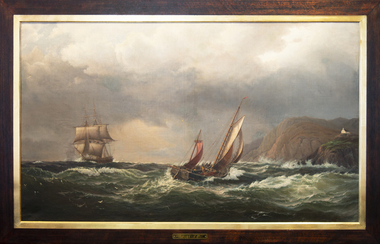
Painting - Oil painting, Madeline M.Ravenna Lewellin, Start Point Light, Devonshire, 1875
... Museum Victoria. This painting represents a tangible link with one of the ladies who interfaced with the seafarers. She had a connection with the sea thanks to her brother, Captain Herbert Gordon Hill Lewellin, who was a commander of the RMS Mongolia during WWI, and became the commodore of the P.&O. Fleet ...This painting was made after an artwork by Wilhelm Melby held at the National Gallery of Victoria. Melby is a Danish artist (1824-1882). It depicts a famous Devonshire coastal region famous now for its lighthouse and the pick up point for the pilot when entering waters approaching Dartmouth. The sailing vessels pre-date the construction of the famous lighthouse. Over the centuries the view would have been familiar to many sailors as they left or approached the English mainland and south coast ports in the English Channel. Madeline Mary Ravenna Lewellin (1854 – 24 November 1944) was born in Victoria to Dr John Henry Hill Lewellin, a physician, and Grace Elizabeth (née Danneby). She was one of five daughters, and the family lived in Prahran. Lewellin's brother, Captain Herbert Gordon Hill Lewellin, was a commander in the P. and O. fleet (apprentice on the Romanoff, Lieutenant RNR on the HMS Arethusa in 1899, RMS Mongolia in 1913 sunk in 1917, Naldera in 1920). She studied painting at the National Gallery School in 1879 under Eugene von Guerard. She's also known for collecting and painting specimens, and became a member of the Field Naturalists Club of Victoria in 1885. In 1884 she won a silver medal for her studies of fungi. She collected plants for Australian botanist Ferdinand von Mueller, and the variety of Dicrastylis lewellinii (Purple sand-sage) is named after her. Miss Lewellin, who had a love of the sea and ships as subject matter is listed in 1910 as a donor as a 10/6 member donating to the motor launch fund and in 1918 as a working member of the Ladies Harbour Lights Guild which involved regular volunteer shifts at the Mission to Seamen on canteen and other duties. The painting was donated by Miss Lewellin in 1918 and hanged above the stage in the main hall; it appears on several postcards of the time. Marine art, Maritime art This oil painting has a dark polished wood and gold leaf slip. The painting depicts two masted boats. The choppy sea takes up the lower-third of the painting, and the other two-thirds of the image of made up of stormy grey clouds. A rocky cliff face can be seen on the right-hand side of the painting. A small church can be seen on the hillside. The ship on the left third of the painting sits on the horizon line of the sea. The centre ship with two masts appears to be leaning to the right and its deck is exposed to the viewer showing four men attempting to handle the masts and rigging. The left-hand ship with three masts is surrounded by two grey distant silhouetted mast ships. There are three seagulls at the upper left-centre of the image. There are another three gulls down on the lower-left of the image. Front: ENGRAVED PLAQUE: Start Point Light. Devonshire. SIGNATURE: After W. Melby / M.M.R Lewellin. 1875. Reverse: IN BLACK MARKER PEN: * Hang from two points * WHITE STICKER WITH CONSERVATOR DETAILS: Art Conservation Frames / 118 Bridport Street, Albert Park, VIC, 3206 / 9696 9066 / artconservationframers.com.au painting, ships, mast, church, sea, storm, oil painting, seagulls, madeline r. lewellin, artwork-paintings, ngv, wilhelm melby, eugene von guerard, botanist, rms mongolia, captain herbert gordon hill lewellin (1862-1935), paddy lewellin, reproduction, seascape, danger -
 Mission to Seafarers Victoria
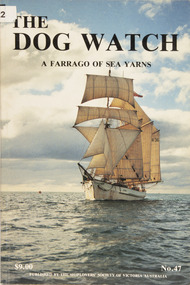
Journal (item) - Periodicals-Annual, Shiplovers' Society of Victoria, The Annual Dog Watch
... Binham - 77 The Hypnotist - Ron Wayling - 83 Museum on Course, Stemming a Slight Set; E.T.A. Delayed - - 93 Book Reviews - - 99 Paddle Wheelers Memories of a Bygone Fleet - Late H.R. ...Binham - 77 The Hypnotist - Ron Wayling - 83 Museum on Course, Stemming a Slight Set; E.T.A. Delayed - - 93 Book Reviews - - 99 Paddle Wheelers Memories of a Bygone Fleet - Late H.R. ...This journal provides the reader with glimpses of the adventures and hardships of a seaman's life. Many of the stories are of sailing ships. Contributes to our knowledge of the importance of shipping and places on record those stories of the sea which would otherwise be lost. Contents Foreword - - 5 Editorial - - 7 Sail Training in Australia - - 9 The Original Lady Nelson, Her Story - - 13 The Marine Superintendent - R.N. Thiele - 21 Pictures - Captain W.T. Howell - 23 Memories of a Master under Sail - Late Captain William Philip - 27 Sail Training in New Zealand - - 29 Living Our Dreams - Valerie K. Watts - 31 Sketch of a Sea Voyage — New York to Melbourne 1859 - Morgan Hayden - 35 Glasgow to Melbourne in the S.V. Wacousta - Harriet Louise King - 39 The Padre - A. Roland Jones - 43 The Quirks of Fate - W.S. McCutchen - 51 A Good Day’s Sailing - W.P. Shemmeld - 55 Salvage of the Zeung San - Richard J. Jolly - 61 H.M.S. Tartar — My First Destroyer - Rear Admiral Sir Brian Murray K.C.M.G., A.O., K.ST.J. - 65 They take you out to Sea and Train you for Life - R. Johnson - 71 The Rescue of the 1902 Swedish Antarctic Expedition by A.R.A. Uraguay - - 75 The Voyage of the Jane Richardson — Part 1 - Late E. Binham - 77 The Hypnotist - Ron Wayling - 83 Museum on Course, Stemming a Slight Set; E.T.A. Delayed - - 93 Book Reviews - - 99 Paddle Wheelers Memories of a Bygone Fleet - Late H.R. Watson - 101 Murphy and the Bosun - L.P. McArthur - 105 Ten Days Before the Mast - Author Name to come - 107 sailing ships, steamships, shipping, seafaring life, shiplovers' society of victoria, dog watch -
 Flagstaff Hill Maritime Museum and Village
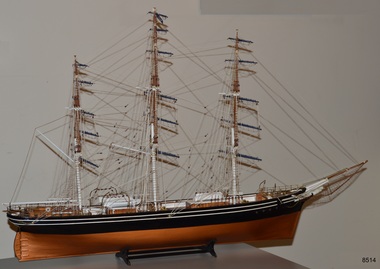
Craft - Ship Model, Billings Boats Denmark Aps, Cutty Sark, 1980s
... The ship is now a museum, preserved in a dry dock at Greenwich, England, as part of the British National Historic Fleet. ...The ship is now a museum, preserved in a dry dock at Greenwich, England, as part of the British National Historic Fleet. ...This ship model of the Cutty Sark was hand-built in the 1980s from a model kit produced by Billings, Denmark. It was on display in the Olde Maritime Motor Inn in Warrnambool until it was refurbished around 2015. The Cutty Sark was a famous clipper ship, launched in 1869 for the tea trade from China to London. The ship was designed for speed, with the ambition to be the fastest ship. In the late 1800s, it competed in the tea clipper races. It was eventually sold to a Portuguese company, Ferreria, and took on the company's name. It was sold again and renamed Maria do Amparo. Finally, the ship's name was returned to the original 'Cutty Sark' when it was purchased by Captain Dowman for use as a cadet training ship. The ship continued trading and in 1922 it became the last operating clipper ship in the world. The ship is now a museum, preserved in a dry dock at Greenwich, England, as part of the British National Historic Fleet. About Barry Williams: - The maker, Barry Williams, worked for the Australian Shipping Line, Huddart Packard Ltd., until it closed down in 1960. Williams then worked for Shaw Savill & Albion Co. Ltd., a substantial British passenger and liner company. and subsequently Furness Withy Ltd. (SS&A's parent company). In the late 1970s Williams and two friends established their own ship chartering company in Melbourne, the Harwood Shipping Co. During the early 1970s Williams and his wife lived in London, near Greenwich, and often walked along the river where the Cutty Sark Maritime Museum is located. The fascination of the Cutty Sark led Williams to build model ships of the same era. At one stage Williams lost the rigging plan for the Cutty Sark but one of his partners, on a visit to London, photographed the Cutty Sark on the river, and Williams used these to complete the rigging on the model. Williams found the making of the model a very demanding but also pleasurable exercise. The model is significant for showing a visual representation of one of the most famous tea clippers, the vessel Cutty Sark. The three-masted ship was built for speed and traded tea between England and China. In 1922 the Cutty Sark became the last operating tea clipper in the world. The craft of ship model building has been popular for centuries, especially with people associated with the sea, such as this model builder, whose career was based around the shipping industry. Ship model; clipper ship, the 'Cutty Sark', a three-masted clipper ship, bare rigging, netting below the bowspit, and fine chains hanging from the bowspit. Black hull with two parallel horizontal stripes below the rail. Lifeboats on board. The white figurehead is below the bowsprit. The model comes with a cradle stand. The ship's name is not visible on the model. flagstaff hill, warrnambool, shipwrecked coast, flagstaff hill maritime museum, maritime museum, shipwreck coast, flagstaff hill maritime village, great ocean road, cunysark, historic sailing ship, tea clipper, sail training vessel, cadet training ship, commercial trading vessel, cargo sail vessel, ship model cutty sark -
 Flagstaff Hill Maritime Museum and Village
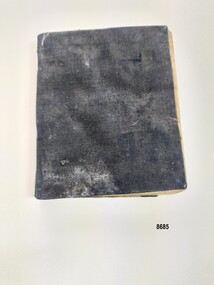
Book - Mariner's Pocket Book, Captain John Budge Murray, circa 1881 - 1887
... It is also an important object as it belonged to a Scottish Master Mariner who held the unusual position as an officer in the Chinese Naval Fleet. Flagstaff Hill Maritime Museum and Village Great Ocean Road Captain John Budge Murray Captain Murray Master Mariner navigational calculations ships log pocketbook Peninsula and Oriental Steam Navigation Company P&O S.S. ...This is a small pocketbook owned by Master Mariner John Budge Murray. It is 119 pages long and contains a mix of detailed navigational calculations and lessons, diary entries, drill commands for soldiers "On Parade" and personal jottings. The dates in the notebook span the years from 1881 to 1887 and mention trips from Hong Kong to Singapore, Galle, Colombo, the Suez Canal, Aden, Port Said, Malta, Gibraltar and London. Two of the ships mentioned include the S. S. Bangalore and the S. S. Assam - both belonged to the "Peninsula and Oriental Steam Navigation Company" (later known as the P&O Line). John Budge Murray was born in 1847 at Olrig, Caithness in Scotland. During the course of his career, he was a merchant marine employed by the Peninsula and Oriental Steam Navigation Company (better known as P&O) and also became a master mariner and Captain serving in the Chinese Naval Service. When he married in 1888, his marriage certificate listed his occupation as "Captain in the Chinese Naval Service". Family records show his sister describing him as "commanding three frigates in the South China Sea - allegedly chasing pirates!" His obituary in the "John O'Groat Journal" in 1910 said he was "one of the original contingent of Britons who served as officers in the Chinese Fleet ...it was they who cleared the Chinese seas of the pirates who infected them." It went on to say "Captain Murray was brave even to the most reckless exposure of his life and ... the Chinese crews had explicit faith in him." John Murray and his wife Jessie had four children and by 1901 were living on a farm at Aucorn in Caithness. One of his sons (also called John Budge Murray) immigrated to Australia and joined the 8th Battalion, AIF (Australia Imperial Force) in 1915 and was killed in France in August 1918. Captain Murray died at Olrig in 1910. In 1840 the Peninsula Steam Navigation Company won a contract for the mail service between the U.K. and Egypt. They expanded their operations to include mail contracts to Alexandria, from Suez to Ceylon, Madras and Calcutta and in 1845 further expanded their operations to Shanghai. Steam communication with Australia was inaugurated in 1852 and in 1854 the Bombay Mail Service passed from the East India Company to P&O. By 1884 P&O's fleet contained fifty ships including the S.S. Assam and S.S. Bangalore - both are mentioned in Captain Murray's pocketbook. In 1882 the S.S. Bangalore was operating in the Bombay / Far East mail service and had made several trips in 1876 between Bombay and Melbourne. In 1875, the Qing Dynasty began to establish a modern Imperial Navy. They ordered a series of warships from Britain and Germany. Two of these ships (the Chaoyong and the Yangwoi) were built at the Tyne shipyards and sailed to China in 1881. They also needed to improve the skills of their naval personnel, and some skilled officers were recruited from Britain. This pocketbook is a significant example of a Master Mariner's everyday working pocketbook. It is also an important object as it belonged to a Scottish Master Mariner who held the unusual position as an officer in the Chinese Naval Fleet. A Master Mariner's small pocket-sized notebook. It has a black cover, 119 pages and contains a mix of navigational records, personal addresses, diary type entries and personal jottings in ink and pencil. First page - "John Budge Murray/Aucorn /Bower/ J. B. Murray/John B/ John B Murray/ Aucorn" flagstaff hill maritime museum and village, great ocean road, captain john budge murray, captain murray, master mariner, navigational calculations, ships log, pocketbook, peninsula and oriental steam navigation company, p&o, s.s. bangalore, s.s. assam, drill commands, chinese naval service, qing dynasty, south china sea -
 Flagstaff Hill Maritime Museum and Village
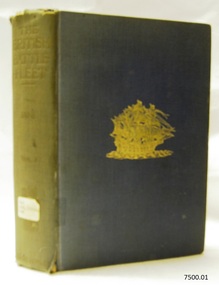
Book, The British Battle Fleet Vol 1
... museum...shipwreck-coast...flagstaff-hill-maritime-village...shipwrecked-artefact...book...warrnambool mechanics’ institute...pattison collection...warrnambool library...ralph eric pattison...warrnambool city librarian...mechanics’ institute library...victorian library board...warrnambool books and records...warrnambool children’s library...the british battle fleet...The Warrnambool Mechanics' Institute’s publication collection is of both local and state significance. warrnambool shipwrecked-coast flagstaff-hill flagstaff-hill-maritime-museum maritime-museum shipwreck-coast flagstaff-hill-maritime-village shipwrecked-artefact book warrnambool mechanics’ institute pattison collection warrnambool library ralph eric pattison warrnambool city librarian mechanics’ institute library victorian library board warrnambool books and records warrnambool children’s library the british battle fleet vol 1 fred t jane Label on spine cover with typed text PAT 359.310942 JAN Pastedown front end page has sticker from Warrnambool Mechanics Institute and Free Library Front loose endpaper has a sticker from Corangamite Regional Library Service The British Battle Fleet Vol 1 Its Inception and Growth thoughout the Centuries to the Present Day Author: Fred T Jane Publisher: Library Press Ltd Date: 1915 The British Battle Fleet Vol 1 Book ...This item is from the ‘Pattison Collection’, a collection of books and records that was originally owned by the Warrnambool Mechanics’ Institute, which was founded in Warrnambool in 1853. By 1886 the Warrnambool Mechanics’ Institute (WMI) had grown to have a Library, Museum and Fine Arts Gallery, with a collection of “… choice productions of art, and valuable specimens in almost every branch and many wonderful national curiosities are now to be seen there, including historic relics of the town and district.” It later included a School of Design. Although it was very well patronised, the lack of financial support led the WMI in 1911 to ask the City Council to take it over. In 1935 Ralph Pattison was appointed as City Librarian to establish and organise the Warrnambool Library as it was then called. When the WMI building was pulled down in 1963 a new civic building was erected on the site and the new Warrnambool Library, on behalf of the City Council, took over all the holdings of the WMI. At this time some of the items were separated and identified as the ‘Pattison Collection’, named after Ralph Pattison. Eventually the components of the WMI were distributed from the Warrnambool Library to various places, including the Art Gallery, Historical Society and Flagstaff Hill. Later some were even distributed to other regional branches of Corangamite Regional Library and passed to and fro. It is difficult now to trace just where all of the items have ended up. The books at Flagstaff Hill Maritime Village generally display stamps and markings from Pattison as well as a variety of other institutions including the Mechanics’ Institute itself. RALPH ERIC PATTISON Ralph Eric Pattison was born in Rockhampton, Queensland, in 1891. He married Maude Swan from Warrnambool in 1920 and they set up home in Warrnambool. In 1935 Pattison accepted a position as City Librarian for the Warrnambool City Council. His huge challenge was to make a functional library within two rooms of the Mechanics’ Institute. He tirelessly cleaned, cleared and sorted a disarrayed collection of old books, jars of preserved specimens and other items reserved for exhibition in the city’s museum. He developed and updated the library with a wide variety of books for all tastes, including reference books for students; a difficult task to fulfil during the years following the Depression. He converted all of the lower area of the building into a library, reference room and reading room for members and the public. The books were sorted and stored using a cataloguing and card index system that he had developed himself. He also prepared the upper floor of the building and established the Art Gallery and later the Museum, a place to exhibit the many old relics that had been stored for years for this purpose. One of the treasures he found was a beautiful ancient clock, which he repaired, restored and enjoyed using in his office during the years of his service there. Ralph Pattison was described as “a meticulous gentleman whose punctuality, floorless courtesy and distinctive neat dress were hallmarks of his character, and ‘his’ clock controlled his daily routine, and his opening and closing of the library’s large heavy doors to the minute.” Pattison took leave during 1942 to 1942 to serve in the Royal Australian Navy, Volunteer Reserve as Lieutenant. A few years later he converted one of the Museum’s rooms into a Children’s Library, stocking it with suitable books for the younger generation. This was an instant success. In the 1950’s he had the honour of being appointed to the Victorian Library Board and received more inspiration from the monthly conferences in Melbourne. He was sadly retired in 1959 after over 23 years of service, due to the fact that he had gone over the working age of council officers. However he continued to take a very keen interest in the continual development of the Library until his death in 1969. The Pattison Collection, along with other items at Flagstaff Hill Maritime Village, was originally part of the Warrnambool Mechanics' Institute’s collection. The Warrnambool Mechanics’ Institute Collection is primarily significant in its totality, rather than for the individual objects it contains. Its contents are highly representative of the development of Mechanics' Institute libraries across Australia, particularly Victoria. A diversity of publications and themes has been amassed, and these provide clues to our understanding of the nature of and changes in the reading habits of Victorians from the 1850s to the middle of the 20th century. The collection also highlights the Warrnambool community’s commitment to the Mechanics’ Institute, reading, literacy and learning in the regions, and proves that access to knowledge was not impeded by distance. These items help to provide a more complete picture of our community’s ideals and aspirations. The Warrnambool Mechanics Institute book collection has historical and social significance for its strong association with the Mechanics Institute movement and the important role it played in the intellectual, cultural and social development of people throughout the latter part of the nineteenth century and the early twentieth century. The collection of books is a rare example of an early lending library and its significance is enhanced by the survival of an original collection of many volumes. The Warrnambool Mechanics' Institute’s publication collection is of both local and state significance. The British Battle Fleet Vol 1 Its Inception and Growth thoughout the Centuries to the Present Day Author: Fred T Jane Publisher: Library Press Ltd Date: 1915 Label on spine cover with typed text PAT 359.310942 JAN Pastedown front end page has sticker from Warrnambool Mechanics Institute and Free Library Front loose endpaper has a sticker from Corangamite Regional Library Service warrnambool, shipwrecked-coast, flagstaff-hill, flagstaff-hill-maritime-museum, maritime-museum, shipwreck-coast, flagstaff-hill-maritime-village, shipwrecked-artefact, book, warrnambool mechanics’ institute, pattison collection, warrnambool library, ralph eric pattison, warrnambool city librarian, mechanics’ institute library, victorian library board, warrnambool books and records, warrnambool children’s library, the british battle fleet vol 1, fred t jane -
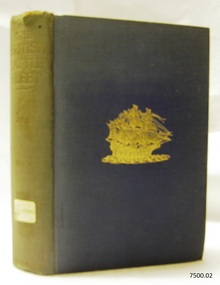 Flagstaff Hill Maritime Museum and Village
Book, The British Battle Fleet Vol 2
... Museum...Shipwreck-coast...Flagstaff-Hill-Maritime-Village...Shipwrecked-artefact...Book...Warrnambool Mechanics’ Institute...Pattison Collection...Warrnambool Library...Ralph Eric Pattison...Warrnambool City Librarian...Mechanics’ Institute Library...Victorian Library Board...Warrnambool books and records...The British Battle Fleet...Warrnambool Shipwrecked-coast Flagstaff-Hill Flagstaff-Hill-Maritime-Museum Maritime-Museum Shipwreck-coast Flagstaff-Hill-Maritime-Village Shipwrecked-artefact Book Warrnambool Mechanics’ Institute Pattison Collection Warrnambool Library Ralph Eric Pattison Warrnambool City Librarian Mechanics’ Institute Library Victorian Library Board Warrnambool books and records The British Battle Fleet Vol 2 Fred T Jane Label on spine cover with typed text PAT 359.310942 JAN Pastedown front end page has sticker from Warrnambool Mechanics Institute and Free Library Front loose endpaper has a sticker from Corangamite Regional Library Service The British Battle Fleet Vol 2 Its Inception and Growth thoughout the Centuries to the Present Day Author: Fred T Jane Publisher: Library Press Ltd Date: 1916 The British Battle Fleet Vol 2 Book ...This item is from the ‘Pattison Collection’, a collection of books and records that was originally owned by the Warrnambool Mechanics’ Institute, which was founded in Warrnambool in 1853. By 1886 the Warrnambool Mechanics’ Institute (WMI) had grown to have a Library, Museum and Fine Arts Gallery, with a collection of “… choice productions of art, and valuable specimens in almost every branch and many wonderful national curiosities are now to be seen there, including historic relics of the town and district.” It later included a School of Design. Although it was very well patronised, the lack of financial support led the WMI in 1911 to ask the City Council to take it over. In 1935 Ralph Pattison was appointed as City Librarian to establish and organise the Warrnambool Library as it was then called. When the WMI building was pulled down in 1963 a new civic building was erected on the site and the new Warrnambool Library, on behalf of the City Council, took over all the holdings of the WMI. At this time some of the items were separated and identified as the ‘Pattison Collection’, named after Ralph Pattison. Eventually the components of the WMI were distributed from the Warrnambool Library to various places, including the Art Gallery, Historical Society and Flagstaff Hill. Later some were even distributed to other regional branches of Corangamite Regional Library and passed to and fro. It is difficult now to trace just where all of the items have ended up. The books at Flagstaff Hill Maritime Village generally display stamps and markings from Pattison as well as a variety of other institutions including the Mechanics’ Institute itself. RALPH ERIC PATTISON Ralph Eric Pattison was born in Rockhampton, Queensland, in 1891. He married Maude Swan from Warrnambool in 1920 and they set up home in Warrnambool. In 1935 Pattison accepted a position as City Librarian for the Warrnambool City Council. His huge challenge was to make a functional library within two rooms of the Mechanics’ Institute. He tirelessly cleaned, cleared and sorted a disarrayed collection of old books, jars of preserved specimens and other items reserved for exhibition in the city’s museum. He developed and updated the library with a wide variety of books for all tastes, including reference books for students; a difficult task to fulfil during the years following the Depression. He converted all of the lower area of the building into a library, reference room and reading room for members and the public. The books were sorted and stored using a cataloguing and card index system that he had developed himself. He also prepared the upper floor of the building and established the Art Gallery and later the Museum, a place to exhibit the many old relics that had been stored for years for this purpose. One of the treasures he found was a beautiful ancient clock, which he repaired, restored and enjoyed using in his office during the years of his service there. Ralph Pattison was described as “a meticulous gentleman whose punctuality, floorless courtesy and distinctive neat dress were hallmarks of his character, and ‘his’ clock controlled his daily routine, and his opening and closing of the library’s large heavy doors to the minute.” Pattison took leave during 1942 to 1942 to serve in the Royal Australian Navy, Volunteer Reserve as Lieutenant. A few years later he converted one of the Museum’s rooms into a Children’s Library, stocking it with suitable books for the younger generation. This was an instant success. In the 1950’s he had the honour of being appointed to the Victorian Library Board and received more inspiration from the monthly conferences in Melbourne. He was sadly retired in 1959 after over 23 years of service, due to the fact that he had gone over the working age of council officers. However he continued to take a very keen interest in the continual development of the Library until his death in 1969. The Pattison Collection, along with other items at Flagstaff Hill Maritime Village, was originally part of the Warrnambool Mechanics' Institute’s collection. The Warrnambool Mechanics’ Institute Collection is primarily significant in its totality, rather than for the individual objects it contains. Its contents are highly representative of the development of Mechanics' Institute libraries across Australia, particularly Victoria. A diversity of publications and themes has been amassed, and these provide clues to our understanding of the nature of and changes in the reading habits of Victorians from the 1850s to the middle of the 20th century. The collection also highlights the Warrnambool community’s commitment to the Mechanics’ Institute, reading, literacy and learning in the regions, and proves that access to knowledge was not impeded by distance. These items help to provide a more complete picture of our community’s ideals and aspirations. The Warrnambool Mechanics Institute book collection has historical and social significance for its strong association with the Mechanics Institute movement and the important role it played in the intellectual, cultural and social development of people throughout the latter part of the nineteenth century and the early twentieth century. The collection of books is a rare example of an early lending library and its significance is enhanced by the survival of an original collection of many volumes. The Warrnambool Mechanics' Institute’s publication collection is of both local and state significance. The British Battle Fleet Vol 2 Its Inception and Growth thoughout the Centuries to the Present Day Author: Fred T Jane Publisher: Library Press Ltd Date: 1916 Label on spine cover with typed text PAT 359.310942 JAN Pastedown front end page has sticker from Warrnambool Mechanics Institute and Free Library Front loose endpaper has a sticker from Corangamite Regional Library Service warrnambool, shipwrecked-coast, flagstaff-hill, flagstaff-hill-maritime-museum, maritime-museum, shipwreck-coast, flagstaff-hill-maritime-village, shipwrecked-artefact, book, warrnambool mechanics’ institute, pattison collection, warrnambool library, ralph eric pattison, warrnambool city librarian, mechanics’ institute library, victorian library board, warrnambool books and records, the british battle fleet vol 2, fred t jane -
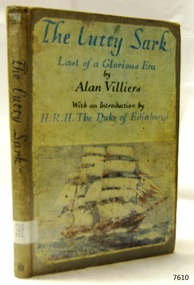 Flagstaff Hill Maritime Museum and Village
Book - Maritime Novel, Alan Villiers, maritime author, The Cutty Sark, 1953
... The Joseph Conrad is now preserved at the Mystic Seaport maritime museum in the USA as part of the fleet of historic ships, used as an exhibit and a training ship. ...The Joseph Conrad is now preserved at the Mystic Seaport maritime museum in the USA as part of the fleet of historic ships, used as an exhibit and a training ship. ...'The Cutty Sark' was written by marine-author Alan Villiers. Australian marine author, Alan Villiers (1903-1982), bought the Danish 1882 square-rigged sailing ship, the Georg Stage, in 1934. He renamed the vessel after the renowned marine-fiction author, Polish-born Joseph Conrad (1857-1927). Conrad was also a qualified sea captain, but the only ship he commanded was the barque Otago, and it was only for a short time. The Joseph Conrad is now preserved at the Mystic Seaport maritime museum in the USA as part of the fleet of historic ships, used as an exhibit and a training ship. THE PATTISON COLLECTION: This item is from the ‘Pattison Collection’, a collection of books and records that was originally owned by the Warrnambool Mechanics’ Institute, which was founded in Warrnambool in 1853. By 1886, the Warrnambool Mechanics’ Institute (WMI) had grown to have a Library, Museum and Fine Arts Gallery, with a collection of “… choice productions of art, and valuable specimens in almost every branch and many wonderful national curiosities are now to be seen there, including historic relics of the town and district.” It later included a School of Design. Although it was very well patronised, the lack of financial support led the WMI in 1911 to ask the City Council to take it over. In 1935, Ralph Pattison was appointed as City Librarian to establish and organise the Warrnambool Library, as it was then called. When the WMI building was pulled down in 1963, a new civic building was erected on the site, and the new Warrnambool Library, on behalf of the City Council, took over all the holdings of the WMI. At this time, some of the items were separated and identified as the ‘Pattison Collection’, named after Ralph Pattison. Eventually, the components of the WMI were distributed from the Warrnambool Library to various places, including the Art Gallery, Historical Society and Flagstaff Hill. Later, some were even distributed to other regional branches of Corangamite Regional Library and passed to and fro. It is difficult now to trace just where all of the items have ended up. The books at Flagstaff Hill Maritime Village generally display stamps and markings from Pattison as well as a variety of other institutions, including the Mechanics’ Institute itself. RALPH ERIC PATTISON Ralph Eric Pattison was born in Rockhampton, Queensland, in 1891. He married Maude Swan from Warrnambool in 1920, and they set up home in Warrnambool. In 1935, Pattison accepted a position as City Librarian for the Warrnambool City Council. His huge challenge was to make a functional library within two rooms of the Mechanics’ Institute. He tirelessly cleaned, cleared and sorted a disarrayed collection of old books, jars of preserved specimens and other items reserved for exhibition in the city’s museum. He developed and updated the library with a wide variety of books for all tastes, including reference books for students; a difficult task to fulfil during the years following the Depression. He converted all of the lower area of the building into a library, reference room and reading room for members and the public. The books were sorted and stored using a cataloguing and card index system that he had developed himself. He also prepared the upper floor of the building and established the Art Gallery and later the Museum, a place to exhibit the many old relics that had been stored for years for this purpose. One of the treasures he found was a beautiful ancient clock, which he repaired, restored and enjoyed using in his office during the years of his service there. Ralph Pattison was described as “a meticulous gentleman whose punctuality, floorless courtesy and distinctive neat dress were hallmarks of his character, and ‘his’ clock controlled his daily routine, and his opening and closing of the library’s large heavy doors to the minute.” Pattison took leave from 1942 to 1945 to serve in the Royal Australian Navy, Volunteer Reserve as a Lieutenant. A few years later, he converted one of the Museum’s rooms into a Children’s Library, stocking it with suitable books for the younger generation. This was an instant success. In the 1950’s, he had the honour of being appointed to the Victorian Library Board and received more inspiration from the monthly conferences in Melbourne. He was sadly retired in 1959 after over 23 years of service, because he had gone beyond the working age of council officers. However, he continued to take a very keen interest in the continual development of the Library until he died in 1969. The author is significant for his connection to the vessel, the Joseph Conrad, which he named after the renowned marine-author. Alan Villiers is also significant as a reference to maritime life, connecting us to Australia's colonial history. The Pattison Collection, along with other items at Flagstaff Hill Maritime Village, was originally part of the Warrnambool Mechanics' Institute’s collection. The Warrnambool Mechanics’ Institute Collection is primarily significant in its totality, rather than for the individual objects it contains. Its contents are highly representative of the development of Mechanics' Institute libraries across Australia, particularly Victoria. A diversity of publications and themes has been amassed, and these provide clues to our understanding of the nature of and changes in the reading habits of Victorians from the 1850s to the middle of the 20th century. The collection also highlights the Warrnambool community’s commitment to the Mechanics’ Institute, reading, literacy and learning in the regions, and proves that access to knowledge was not impeded by distance. These items help to provide a more complete picture of our community’s ideals and aspirations. The Warrnambool Mechanics Institute book collection has historical and social significance for its strong association with the Mechanics Institute movement and the important role it played in the intellectual, cultural and social development of people throughout the latter part of the nineteenth century and the early twentieth century. The collection of books is a rare example of an early lending library, and its significance is enhanced by the survival of an original collection of many volumes. The Warrnambool Mechanics' Institute’s publication collection is of both local and state significance. The Cutty Sark: Last of a glorious era Author: Alan Villiers with an Introduction by H.R.H. The Duke of Edinburgh Publisher: Holder and Stoughton Date: 1953 Label on spine cover with typed text PAT 387 VIL Pastedown front endpaper has a sticker from Warrnambool Children's Library covered by a sticker from Corangamite Regional Library Service Front loose endpaper has a stamp from the Corangamite Regional Library Service warrnambool, shipwrecked-coast, flagstaff-hill, flagstaff-hill-maritime-museum, maritime-museum, shipwreck-coast, flagstaff-hill-maritime-village, shipwrecked-artefact, book, pattison collection, warrnambool library, warrnambool mechanics’ institute, ralph eric pattison, corangamite regional library service, warrnambool city librarian, mechanics’ institute library, victorian library board, warrnambool books and records, warrnambool children’s library, the cutty sark, alan villiers, the duke of edinburgh, joseph conrad, marine author, maritime author, australian author
