
Showing 22 items matching "muskets"
-
 Ballarat Heritage Services
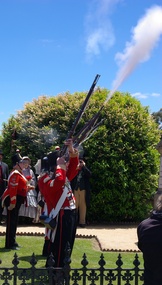
Photograph - Photograph - Colour, Muskets Firing for Eureka Sunday, 2013, 2013
... Muskets Firing for Eureka Sunday, 2013......muskets...Colour photograph of re-enactors of the 40th regiment firing muskets at the Soldiers Graves at the Ballaarat Old Cemetery. ...eureka sunday 40th regiment muskets ballaarat old cemetery eureka Commemoration British Army Eureka Stockade Colour photograph of re-enactors of the 40th regiment firing muskets at the Soldiers Graves at the Ballaarat Old Cemetery. ...Colour photograph of re-enactors of the 40th regiment firing muskets at the Soldiers Graves at the Ballaarat Old Cemetery. eureka sunday, 40th regiment, muskets, ballaarat old cemetery, eureka commemoration, british army, eureka stockade -
 Flagstaff Hill Maritime Museum and Village
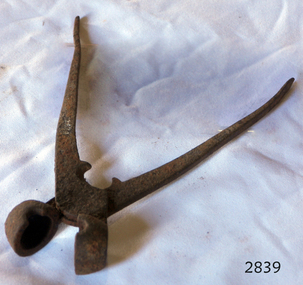
Tool - Bullet Mould, From 1600s to early 19th century
... Musket balls are the ammunition used in muskets the weapons used during the English and American Civil Wars. ...Musket rifle/ pistol bullet mold. Makes .50 -caliber- round balls with a sprew cutter to cut off excess lead....Musket balls are the ammunition used in muskets the weapons used during the English and American Civil Wars. ...Musket balls are the ammunition used in muskets the weapons used during the English and American Civil Wars. The balls could be made from any metal alloy, but many were made from lead. Lead can be melted at reasonably low temperatures and so lead musket balls could be made over a camp fire. Lead could be readily sourced from such places like church roofs or even coffins, and recast from old musket balls, so it was an easy material to work with while preparing for battle. The soldier would carry a crucible in which to melt the lead, he would put the material into it and place it over the fire until it had formed into a liquid. Musket ball moulds like the subject item, had a small hole above one of the domes where the liquid could be poured into once the two domes were closed together. The soldier would wait until it cooled then opened the mould to reveal a solid lead ball inside. Because these were cast in halves even though pressed together, there would always be a small amount of liquid lead leakage which would form a thin crust around the ball. These needed to be filed off before being used inside a musket, so some soldiers would pop a few in their mouths and roll them around, chewing off the excess until the ball was smooth. The obvious downside to this method is that lead is poisonous. A tool used to make ammunition for black powder firearms either muskets or pistols from the early part of the 18th to mid 19th century. After this time enclosed brass cartridges that held the propellent powder and bullet were starting to come into wide spread use, negating the need for a firearm to first have black powder placed in a barrel then the ball rammed on top and finally the firearm primed with powder or a percussion cap.Musket rifle/ pistol bullet mold. Makes .50 -caliber- round balls with a sprew cutter to cut off excess lead.Marked 50flagstaff hill, warrnambool, shipwrecked coast, flagstaff hill maritime museum, maritime museum, shipwreck coast, flagstaff hill maritime village, great ocean road, shot pliers, lead shot, shot, armoury, firearms, bullet, cast bullet, lead ball, lead shot, scissor mould -
 St Kilda Historical Society
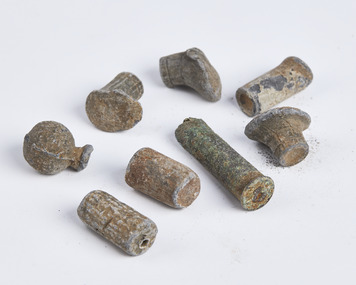
Weapon - Ammunition, St Kilda Rifle Club bullets, c.1860s
... While .600" are classic round lead balls for muskets, .450" and .500" typically denote heavier, conical big-game cartridges. ...Bullets type 450" and 500" and ball type musket 600"...While .600" are classic round lead balls for muskets, .450" and .500" typically denote heavier, conical big-game cartridges. ...Assorted lead shot bullets used by St Kilda Rifle Club around Head Street, Elwood, near Port Phillip Bay. The numbers 450, 500, and 600 refer to bullet and ball diameters measured in thousandths of an inch (i.e., 0.450", 0.500", and 0.600"). While .600" are classic round lead balls for muskets, .450" and .500" typically denote heavier, conical big-game cartridges. Both types were historically made by melting lead and shaping it, though they utilized very different manufacturing methodsBullets type 450" and 500" and ball type musket 600"st kilda rifle club -
 Frankston RSL Sub Branch
Projectile, Musket
... ...musket...Musket ball found at the site of the American Revolutionary War battle of Valley Forge. ...Projectile, Musket ...Musket ball found at the site of the American Revolutionary War battle of Valley Forge. This musket ball is typical of the weapons used in the Revolutionary War period 1775 to 1783.war, ball, projectile, musket, revolutionary, american, revolution -
 Flagstaff Hill Maritime Museum and Village
Weapon - Gunpowder Pouch, Early-to-mid 19th Century
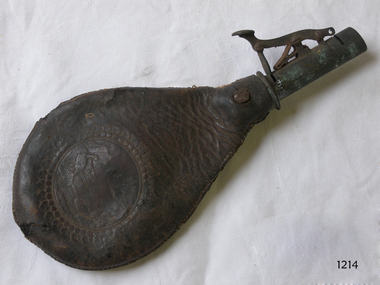
... ...musket...It stores gunpowder or gunshot for loading or charging firearms such as rifles and muskets. This one has a decorative design featuring birds, which may indicate that it was made for hunting rather than for military use....The adjustable charger mechanism releases a measured amount of gunpowder or shot for rifles or muskets. ...The adjustable charger mechanism releases a measured amount of gunpowder or shot for rifles or muskets. Weapon Gunpowder Pouch ...This type of gunpowder pouch was used in the first half of the 19th century. It stores gunpowder or gunshot for loading or charging firearms such as rifles and muskets. This one has a decorative design featuring birds, which may indicate that it was made for hunting rather than for military use.The shot pouch is an example of weaponry accessories in the early-to-mid 19th century for hunting and military purposes. It is a step in the evolution of firearms and weaponry.Gunpowder pouch or shot pouch, the two sides of the rounded leather body are hand-stitched together apart from a small opening for the fitted brass spout, which has a spring-operated mechanism. Both sides have a decorative centre medallion with a finely tooled design depicting a landscape behind two birds. The adjustable charger mechanism releases a measured amount of gunpowder or shot for rifles or muskets. flagstaff hill, flagstaff hill maritime museum and village, warrnambool, maritime museum, maritime village, great ocean road, shipwreck coast, firearms, musket, gunpowder flask, gunpowder pouch, flask pouch, arms, militaria, leather flask, gunpowder bag, ammunition accessory, weaponry, shot pouch, hunting, military, gunpowder, gun powder, hinting, shot flask -
 Flagstaff Hill Maritime Museum and Village
Leisure object - Toy Soldier, circa 1878
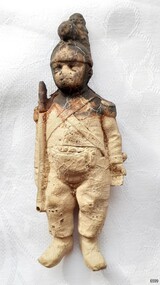
... The toy soldier is unpainted, but the style of uniform, and the weapons carried (a musket and a basket-handled cutlass), indicate it is a representation of the Napoleonic Wars period from the beginning of the nineteenth century. ...The moulded figure is in a standing posture and is bearing a musket at the slope-arms position, with a sabre or cutlass slung behind. ...There is a hole in the end of the musket. The model is detailed and sharp. It was recovered from the wreck of the Loch Ard. ...The toy soldier is a relic from the shipwreck of the LOCH ARD in 1878. It has a companion piece in the Flagstaff Hill collection. The toy soldier is unpainted, but the style of uniform, and the weapons carried (a musket and a basket-handled cutlass), indicate it is a representation of the Napoleonic Wars period from the beginning of the nineteenth century. Mass-produced toy soldiers made of cast metal (lead or tin) became popular during the 1800s. Heyde of Germany manufactured silhouette-shaped ‘flats’ early in the century; then Mignot of France released three-dimensional ‘solids’; and later (1893) Britain of England made ‘hollow cast’ figures. These innovations were designed to make sets of toy soldiers more affordable for middle and lower-class children, extending the market beyond the intricately made and hand-crafted replicas that were the preserve of the rich in the eighteenth century. Wooden military figures, specially carved and unpainted ones, were therefore not particularly common at the time when the LOCH ARD went down on Victoria’s southwest coast. Mignot was the first to sell unpainted soldiers, leaving their customers to fill in the colours according to their own patriotic preferences. If a similar attitude is assumed for the two virtually identical figures in the Flagstaff Hill collection, it is possible they were part of a new set intended for sale, rather than part of a passenger’s existing collection. A similarly light composite material of sawdust, glue and linseed oil (press-moulded onto a metal frame) was used by the German firm O & M Hausler to create toy soldiers, but this type of modelling was not commercialised until after 1912. The first heat-moulded plastic toy soldiers did not become available until after 1945.The toy soldier represents a 19th century child's interest in military history. The item is one of two toy soldiers recovered from the Loch Ard that are in Flagstaff Hill's collection. The shipwreck of the Loch Ard is of significance for Victoria and is registered on the Victorian Heritage Register ( S 417). Flagstaff Hill has a varied collection of artefacts from Loch Ard and its collection is significant for being one of the largest accumulation of artefacts from this notable Victorian shipwreck of which the subject items are a small part. The collections objects give us a snapshot of how we can interpret the story of this tragic event. The collection is also archaeologically significant as it represents aspects of Victoria's shipping history that allows us to interpret Victoria's social and historical themes of the time. Through is associated with the worst and best-known shipwreck in Victoria's history.An unpainted replica or toy soldier, presented in a Napoleonic Wars era uniform. The moulded figure is in a standing posture and is bearing a musket at the slope-arms position, with a sabre or cutlass slung behind. It wears a plumed helmet, short-fronted coat with longer buttoned tails at the back, button-fastened bib-front trousers, a pair of crossed bandoliers, and tasselled shoulder epaulettes. The figure is a creamy colour with red-brown stains on the head and shoulder. There is a hole in the end of the musket. The model is detailed and sharp. It was recovered from the wreck of the Loch Ard.Cataloguing numbers: “6599” on the rear of the left trouser leg “PWO 2308” on the sole of the left boot, (partially obscuring “R122” written in biro) “2218” on the sole of the right boot.flagstaff hill, warrnambool, loch ard, flagstaff hill maritime museum, shipwreck coast, flagstaff hill maritime village, great ocean road, loch line, napoleonic uniform, toy soldier, replica soldier -
 8th/13th Victorian Mounted Rifles Regimental Collection
Weapon - Socket bayonet
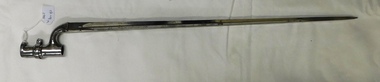
... Bayonet designed to fit the .577" calibre Enfield "3-band" rifled Infantry muskets....Bayonet designed to fit the .577" calibre Enfield "3-band" rifled Infantry muskets. Part of a collection of edged weapons relevant to Victorian Colonial and Australian Military forces. weapon colonial Victoria bayonet enfield T Preston Manchester 1 M British pattern 1853 Enfield Socket bayonet, 450mm long triangular section blade Weapon Socket bayonet ...Bayonet designed to fit the .577" calibre Enfield "3-band" rifled Infantry muskets.Part of a collection of edged weapons relevant to Victorian Colonial and Australian Military forces.British pattern 1853 Enfield Socket bayonet, 450mm long triangular section bladeT Preston Manchester 1 Mweapon, colonial, victoria, bayonet, enfield -
 Frankston RSL Sub Branch
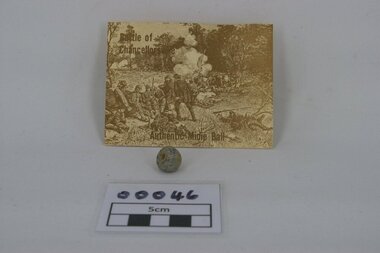
Projectile, Musket
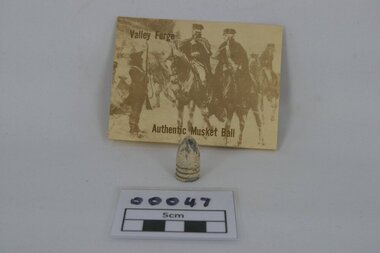
... This is a type of musket ball used in the Civil War period 1861 to 1865....Projectile, Musket ...Early smooth bore firearm projectile referred to as a 'Minie Ball' found at the site of the American Civil War battle of Chancellorsville. This is a type of musket ball used in the Civil War period 1861 to 1865.war, ball, projectile, minie, civil -
 Greensborough Historical Society
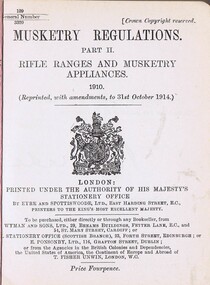
Book - Manual, Musketry Regulations. Part II. Rifle Ranges and Musketry Appliances. 1910, 1910_
... ...muskets...Military Manual. world war i muskets rifles military manuals. 89p., plus illus. ...Title: Musketry Regulations. Part II. Rifle Ranges and Musketry Appliances. 1910. (reprinted with amendments 31st October 1914). World War I. Military Manual.89p., plus illus. Hard cover. world war i, muskets, rifles, military manuals. -
 Flagstaff Hill Maritime Museum and Village
Weapon - Gun, ISAAC HOLLIS & SONS, Mid 19th Century
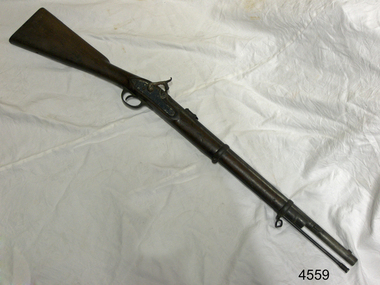
... ...musket...Muzzle-loading "Cap and Ball" musket. Wood stock and ramrod. Inscriptions are on the stock and breech. ...Muzzle-loading "Cap and Ball" musket. Wood stock and ramrod. Inscriptions are on the stock and breech. ...The Hollis Brothers were first recorded as operating from 11 Weaman Row in 1840, although evidence suggests that the business may have commenced prior to this date. Over time, the firm evolved and became known as Isaac Hollis & Sons, with claims of its establishment dating back to 1814. This earlier date is supported by records of Richard and William Hollis trading in Bath Street, Birmingham, between 1814 and 1818, which raises the possibility that Isaac and Frederick Hollis were their descendants. The principal brothers involved in the business were Isaac Hollis, born in 1815, and Frederick Hollis, whose birth date remains unknown. Frederick’s life was cut short when he died on 20 December 1839. According to the 1841 census, Isaac Hollis resided in Weaman Row and was listed as a 25-year-old gun and pistol maker. He was married to Emma, who was born in 1821, and together they had two children: Isaac, born in 1837, and Henry, born in 1839. Following Frederick’s death, Isaac continued to operate under the name Hollis Brothers until 1845, after which he renamed the business Hollis Brothers & Co. This entity remained active up to 1848. In 1844, Isaac Hollis entered a brief partnership with William Tranter at 10 & 11 Weaman Row, likely to fulfil a specific contract or to supply particular parts. This partnership continued until 1849. In 1848, Isaac Hollis formed a partnership with Isaac Brentnall Sheath, establishing the firm of Hollis & Sheath and expanding their operations into 10 Weaman Row. The partnership saw Hollis & Sheath become licensed manufacturers of percussion breech-loading guns, positioning the company as a notable presence in the industry. In 1861, Sheath left the partnership and emigrated to New Zealand, where he conducted several enterprises and was elected as a provincial councillor. He died in Christchurch on 19th May 1897. Following the departure of Isaac Sheath in 1861, the business underwent a name change to Isaac Hollis & Sons. By approximately 1870, Isaac Hollis and Henry Hollis had assumed responsibility for the daily management of the firm, with Isaac overseeing the overall management and marketing of the company's products, while Henry managed the manufacturing processes. During this period, the company became known for producing large volumes of affordable trade guns and sporting guns, catering to customers in South Africa and the British colonies. In 1870, Isaac Hollis & Sons opened a retail location at 44a Cannon Street in London, subsequently relocating to 83 Cheapside in 1871. Isaac Hollis Jnr passed away in October 1875 in Birmingham at the age of 37, having never married. In 1876/1877, Henry Hollis registered a limited liability company under the name Isaac Hollis & Sons Ltd. However, by 1879, trading resumed under the name Isaac Hollis & Sons, and the London shop moved to 6 Great Winchester Street. From 1932 to 1933, the business operated in London as Hollis, Bentley & Playfair. The final closure of Hollis, Bentley & Playfair occurred in Birmingham in 1953. This firearm serves as an exemplary representation of the type of weapon distributed to the colony’s military forces in 1861. It was specifically manufactured by Isaac Hollis & Sons, a prominent gunmaker of the period, to meet the requirements of military use. Distribution was facilitated through Hebbert & Sons, an established military supplier based in London. Before it arrived in Tasmania, Australia, around 1861, the firearm was likely issued from the Hythe Armoury, which functioned as a British military training facility. Probably, the gun was originally allocated to British troops or police before being transferred for use in the colony. Gun: Percussion Carbine, .577 Cal. Colonial Tasmanian issue Artillery carbine, Pattern 1861. Muzzle-loading "Cap and Ball" musket. Wood stock and ramrod. Inscriptions are on the stock and breech. Gun was made for Herbert & Co., London, by Isaac Hollis & Sons, Birmingham.Stamped on stock "SOLD 95", " ISAAC HOLLIS & SONS" "GUN & PISTOL MANUFACTURES" "BIRMINGHAM" "J ASTON ARMOURER HYTHE" "MANUFACTURED EXPRESSLY FOR HEBBERT & CO LONDON". Stamped on breech "25", and "25C ---05"flagstaff hill, maritime museum, maritime village, warrnambool, great ocean road, shipwreck coast, firearm, gun, percussion, carbine, .577 cal, colonial tasmanian issue, artillery carbine, military gun, pattern 1861, muzzle-loading, muzzle-loading musket, cap and ball, musket, wood stock, 1861, percussion breech-loading guns, richard and william hillis, herbert & co., herbert & co. london, hollis & sons, isaac hollis & sons, isaac hillis & sons ltd., hollis bentley & playfair., isaac hollis, frederick hollis, isaac brentnall sheath, isaac sheath, william tranter, gun manufacturer, pistol manufacturer, gun and pistol maker, birmingham, j aston armourer, hythe, hythe armoury, military supplies -
 Flagstaff Hill Maritime Museum and Village
Ceramic - Beer Stein, Reinhold Merkelbach, 1945 to 1964
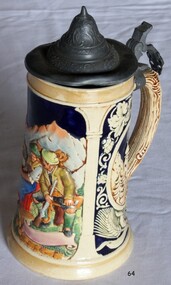
... The design on the mug includes a woman in bright colours, a man holding a musket, and buildings in mountain settings. ...The design on the mug includes a woman in bright colours, a man holding a musket, and buildings in mountain settings. ...This mug was made by Reinhold Merkelbach. Reinhold Merkelbach was founded in 1845 by Wilhelm Merkelbach, a descendent of a long line of German potters, and the company eventually took the name of his son Wilhelm Reinhold Merkelbach, who left school early to get involved with the family business. The company became a major name in German ceramics, especially in the Jugendstil style. The company produced a large number of collectable beer steins in the late 18th and early 19th centuries, including a number of so-called “character steins.” In 1882, the firm began producing art pottery, which at that time was enjoying a revival and new appreciation in Europe in general and in Germany in particular. Reinhold Merkelbach produced ceramic objects both with and without pewter hardware but rarely altered its manufacturing techniques. Many of its products were destined for use at pubs, bars, or breweries as well as in the homes of Germany’s beer-drinking populace. It had a retail location in Munich and also sold products through its factory warehouse. In 1971, half of the company’s ownership was sold to W. Goebel KG and the firm’s name changed officially to Merkelbach Manufaktur GmbH & Co. KG. Goebel ultimately purchased the other half of the business before members of the Merkelbach family, along with a handful of collectors and former staff members, repurchased the factory in 1988. In 2007, Judith Merkelbach Engelmann decided to close the firm; demand for ceramics had been decreasing and the next generation of the family had no interest in maintaining the business. Luckily, Reinhold Merkelbach transferred its moulds to Töpferei Girmscheid Höhr-Grenzhausen to ensure that its best-known pieces of Jugendstil art pottery and steins would continue to be available to interested consumers and collectors.This beer stein was made around the mid-20th century by a popular German maker. It fits in with the context of maritime village life. At this current time, there is no particular connection with people, places and events. The German beer stein is made from ceramic ironstone. It has a bell-shaped hinged pewter lid with a leaf-shaped thumb lever. The lid has a pattern stamped on it. The design on the mug includes a woman in bright colours, a man holding a musket, and buildings in mountain settings. There are inscriptions on the mug. Marked "Made in Germany" "RM" "4070" (underside of mug) "05" to the side of mug flagstaff hill, warrnambool, shipwrecked coast, flagstaff hill maritime museum, maritime museum, shipwreck coast, flagstaff hill maritime village, great ocean road, beer stein, ceramic beer stein, reinhold merkelbach, drinking vessel -
 Flagstaff Hill Maritime Museum and Village
Leisure object - Toy Soldier, circa 1878
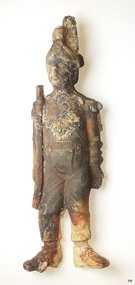
... The toy soldier is unpainted, but the style of uniform, and the weapons carried (a musket and a basket-handled cutlass), indicate it is a representation of the Napoleonic Wars period from the beginning of the nineteenth century. ...The figure is in marching posture with one foot extended forward, and is bearing a musket at the slope-arms position, with a sabre or cutlass slung behind. ...The figure is in marching posture with one foot extended forward, and is bearing a musket at the slope-arms position, with a sabre or cutlass slung behind. ...The toy soldier is a relic from the shipwreck of the LOCH ARD in 1878. It has a companion piece in the Flagstaff Hill collection. The toy soldier is unpainted, but the style of uniform, and the weapons carried (a musket and a basket-handled cutlass), indicate it is a representation of the Napoleonic Wars period from the beginning of the nineteenth century. Mass-produced toy soldiers made of cast metal (lead or tin) became popular during the 1800s. Heyde of Germany manufactured silhouette-shaped flat toy soldiers early in the century. Mignot of France released three-dimensional solid figures and later around 1893 W. Britain, a toy company became known for its die-cast lead toy soldiers. These innovations were designed to make sets of toy soldiers more affordable for middle and lower-class children, extending the market beyond the intricately made and hand-crafted replicas that were the preserve of the rich in the eighteenth century. Wooden military figures, specially carved and unpainted ones, were therefore not particularly common at the time when the Loch Ard foundered on Victoria’s southwest coast. Mignot was the first to sell unpainted soldiers, leaving their customers to fill in the colours according to their own patriotic preferences. It is, therefore, possible the two figures in the Flagstaff Hill collection were part of a new set intended for sale, rather than part of a passenger’s existing collection. Loch Ard History: The Loch Ard got its name from ”Loch Ard” a loch that lies to the west of Aberfoyle, and the east of Loch Lomond. It means "high lake" in Scottish Gaelic. The vessel belonged to the famous Loch Line which sailed many vessels from England to Australia. The Loch Ard was built in Glasgow by Barclay, Curle & Co. in 1873, the vessel was a three-masted square-rigged iron sailing ship that measured 79.87 meters in length, 11.58 m in width, and 7 m in depth with a gross tonnage of 1693 tons with a mainmast that measured a massive 45.7 m in height. Loch Ard made three trips to Australia and one trip to Calcutta before its fateful voyage. Loch Ard left England on March 2, 1878, under the command of 29-year-old Captain Gibbs, who was newly married. The ship was bound for Melbourne with a crew of 37, plus 17 passengers. The general cargo reflected the affluence of Melbourne at the time. Onboard were straw hats, umbrellas, perfumes, clay pipes, pianos, clocks, confectionery, linen and candles, as well as a heavier load of railway irons, cement, lead and copper. There were other items included that were intended for display in the Melbourne International Exhibition of 1880. The voyage to Port Phillip was long but uneventful. Then at 3 am on June 1, 1878, Captain Gibbs was expecting to see land. But the Loch Ard was running into a fog which greatly reduced visibility. Captain Gibbs was becoming anxious as there was no sign of land or the Cape Otway lighthouse. At 4 am the fog lifted and a lookout aloft announced that he could see breakers. The sheer cliffs of Victoria's west coast came into view, and Captain Gibbs realised that the ship was much closer to them than expected. He ordered as much sail to be set as time would permit and then attempted to steer the vessel out to sea. On coming head-on into the wind, the ship lost momentum, the sails fell limp and Loch Ard's bow swung back towards land. Gibbs then ordered the anchors to be released in an attempt to hold their position. The anchors sank some 50 fathoms - but did not hold. By this time the ship was among the breakers and the tall cliffs of Mutton Bird Island rose behind. Just half a mile from the coast, the ship's bow was suddenly pulled around by the anchor. The captain tried to tack out to sea, but the ship struck a reef at the base of Mutton Bird Island, near Port Campbell. Waves subsequently broke over the ship and the top deck became loosened from the hull. The masts and rigging came crashing down knocking passengers and crew overboard. When a lifeboat was finally launched, it crashed into the side of Loch Ard and capsized. Tom Pearce, who had launched the boat, managed to cling to its overturned hull and shelter beneath it. He drifted out to sea and then on the flood tide came into what is now known as Lochard Gorge. He swam to shore, bruised and dazed, and found a cave in which to shelter. Some of the crew stayed below deck to shelter from the falling rigging but drowned when the ship slipped off the reef into deeper water. Eva Carmichael a passenger had raced onto the deck to find out what was happening only to be confronted by towering cliffs looming above the stricken ship. In all the chaos, Captain Gibbs grabbed Eva and said, "If you are saved Eva, let my dear wife know that I died like a sailor". That was the last Eva Carmichael saw of the captain. She was swept off the ship by a huge wave. Eva saw Tom Pearce on a small rocky beach and yelled to attract his attention. He dived in and swam to the exhausted woman and dragged her to shore. He took her to the cave and broke the open case of brandy which had washed up on the beach. He opened a bottle to revive the unconscious woman. A few hours later Tom scaled a cliff in search of help. He followed hoof prints and came by chance upon two men from nearby Glenample Station three and a half miles away. In a complete state of exhaustion, he told the men of the tragedy. Tom then returned to the gorge while the two men rode back to the station to get help. By the time they reached Loch Ard Gorge, it was cold and dark. The two shipwreck survivors were taken to Glenample Station to recover. Eva stayed at the station for six weeks before returning to Ireland by steamship. In Melbourne, Tom Pearce received a hero's welcome. He was presented with the first gold medal of the Royal Humane Society of Victoria and a £1000 cheque from the Victorian Government. Concerts were performed to honour the young man's bravery and to raise money for those who lost family in the disaster. Of the 54 crew members and passengers on board, only two survived: the apprentice, Tom Pearce and the young woman passenger, Eva Carmichael, who lost her family in the tragedy. Ten days after the Lochard tragedy, salvage rights to the wreck were sold at auction for £2,120. Cargo valued at £3,000 was salvaged and placed on the beach, but most washed back into the sea when another storm developed. The wreck of Lochard still lies at the base of Mutton Bird Island. Much of the cargo has now been salvaged and some items were washed up into Lochard Gorge. Cargo and artefacts have also been illegally salvaged over many years before protective legislation was introduced in March 1982. One of the most unlikely pieces of cargo to have survived the shipwreck was a Minton majolica peacock- one of only nine in the world. The peacock was destined for the Melbourne 1880 International Exhibition. It had been well packed, which gave it adequate protection during the violent storm. Today the Minton peacock can be seen at the Flagstaff Hill Maritime Museum in Warrnambool. From Australia's most dramatic shipwreck, it has now become Australia's most valuable shipwreck artifact and is one of very few 'objects' on the Victorian State Heritage Register.The toy soldier represents a 19th-century child's interest in military history. The item is one of two toy soldiers recovered from the Loch Ard in Flagstaff Hill's collection. The shipwreck of the Loch Ard is of significance for Victoria and is registered on the Victorian Heritage Register ( S 417). Flagstaff Hill has a varied collection of artefacts from Loch Ard and its collection is significant for being one of the largest accumulations of artefacts from this notable Victorian shipwreck of which the subject items are a small part. The collections of objects give us a snapshot of how we can interpret the story of this tragic event. The collection is also archaeologically significant as it represents aspects of Victoria's shipping history, allowing us to interpret Victoria's social and historical themes. Through is associated with the worst and best-known shipwreck in Victoria's history.An unpainted, cream-coloured toy soldier, recovered from the Loch Ard. The figure wears a Napoleonic Wars-era uniform, a plumed helmet, a short jacket with tails, bib-front trousers with button closure, straps crossed at the front and back, and epaulettes. The figure is in marching posture with one foot extended forward, and is bearing a musket at the slope-arms position, with a sabre or cutlass slung behind. It is unable to stand on its own. There are reddish-brown and orange-brown stains on the head and body. The body has seams along both sides that are uneven at the lower leg. There is a hole in the back and the inside is hollow. The material has a rough texture.flagstaff hill, warrnambool, flagstaff hill maritime museum, shipwreck coast, flagstaff hill maritime village, great ocean road, loch ard, toy soldier, napoleonic uniforms, military toy, moulded soldier -
 Kiewa Valley Historical Society
Tin Tobacco, early to mid 1900s
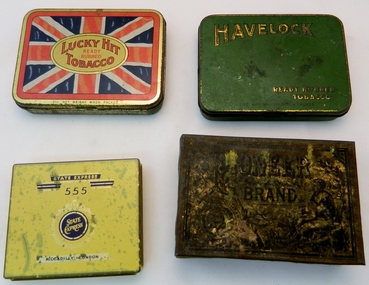
... A dark metal tobacco tin covered in a bright metallic gold fleck pattern with a black frame on the lid around a drawing of a woodsman with a musket and axe sitting on a stump overlooking a valley that reads "Pioneer Brand", next to a company seal incorporating a wreath, eagle and shield. ...A dark metal tobacco tin covered in a bright metallic gold fleck pattern with a black frame on the lid around a drawing of a woodsman with a musket and axe sitting on a stump overlooking a valley that reads "Pioneer Brand", next to a company seal incorporating a wreath, eagle and shield. ...This early tobacco tin was manufactured in England and imported to the "colony" Australia at the beginning of the 1900s. This manufacturer had won the Gold Medal at the Liverpool International Exhibition in 1884. This tobacco would have therefore been very expensive to purchase making it a must for the wealthier client of the Kiewa Valley. The Golden Flake Cavendish smells of the man of wealth and position. In this era the type of dress and the brand of tobacco smoked showed everyone at first glance where the man using it was on the social ladder and his pecking order. With the demise of tobacco smoking in the early 2000s clothes themselves do not show the pecking order in that quickly visualised manner, as at the time of manufacture of this tobacco tin. In the 21st century the level that men are in the socio economic field is realized on "the social information" available on the internet.This tobacco tin relays a long ago era, when personal contact, and not something that has been written down by some "unknown", was valued as the true appraisal of a member of the community. This was especially relevant in a small regional area such as the Kiewa Valley. Although social networking was not as fast then as the internet provides now, appearances, manners, fashion and etiquette with first impressions high on the order of evaluating someone in the community. Pointer such as the brand of tobacco smoked was part of the rural assessment method. Up until the demise of the Australian Tobacco Industry, circa 2004, the Kiewa Valley and surrounding district was part of a vibrant producer of tobacco leaves. The remnants of this industry still remain today but the drying sheds (for tobacco leaves) are now used to store hay for the valley's dairy and beef cattle industries.A dark metal tobacco tin covered in a bright metallic gold fleck pattern with a black frame on the lid around a drawing of a woodsman with a musket and axe sitting on a stump overlooking a valley that reads "Pioneer Brand", next to a company seal incorporating a wreath, eagle and shield. The front side reads "Richmond Cavendish Co./ Limited/ Liverpool." and the right and left side "Golden Flake Cavendish". The bottom has the same woodsman feature as the lid. The back side is an elongated diagram featuring tobacco leaves and plant summit. Inside lid surface has a half torn coloured (red, black and green) sketch on paper of the woodsman scene depicted on the top lid.The following inscriptions are displayed on the top and inside lid and on the bottom tobacco tin: "PIONEER BRAND" and to the left of the scene the "SEAL OF THE COMPANY TRADE MARK" Both side of the ens have the following words in large thick print "GOLDEN FLAKE CAVENDISH" and each is contained withih a black boarder.pipe tobacco, cigarette tins, smoking accessories, personal effects, tobacco containers -
 Buninyong Visitor Information Centre
Coin - Coins, Set of Twenty Coins and small Objects attached to a Board
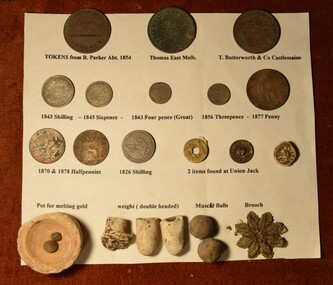
... Wien' marked upon it 096.15 Tiny Pot for melting Gold 096.16 to 096.18 Small unidentified ceramic crucibles? 096.19.2 Musket balls 096.20 Leaf patterned brooch...Wien' marked upon it 096.15 Tiny Pot for melting Gold 096.16 to 096.18 Small unidentified ceramic crucibles? 096.19.2 Musket balls 096.20 Leaf patterned brooch Set of Twenty Coins and small Objects attached to a Board Coin Coins ...Variety of coins, tokens and objects collected by the original owner. Sources not known at this point.Rectangular white card with eleven coins and ten small objects attached, all labelled. Items attached are as follows: 096.1 Token from R. Parker ABT. 1854 096.2 Token, Thomas East, Melbourne 096.3 Token, T Butterworth and Company, Castlemaine 096.4 Coin, 1843 Shilling 096.5 Coin, 1845 Sixpence 096.6 Coin, 1843 Fourpence (Groat) 096.7 Coin, 1856 Threepence 096.8 Coin, 1877 Penny 096.9 Coin, Halfpenny 096.10 Coin, 1878 Halfpenny 096.11 Coin, 1826 Shilling 096.12 Coin, Item found at Union Jack Reserve, possibly a coin with an integrated hole. On either side of hole is marked 1/2. Requires identification. 096.13 Button, T&S Extra Quality button, metal 096.14 Button, Ceramic disc with 'K K..... Wien' marked upon it 096.15 Tiny Pot for melting Gold 096.16 to 096.18 Small unidentified ceramic crucibles? 096.19.2 Musket balls 096.20 Leaf patterned broochcoins, numismatics -
 Flagstaff Hill Maritime Museum and Village
Domestic object - Corkscrew
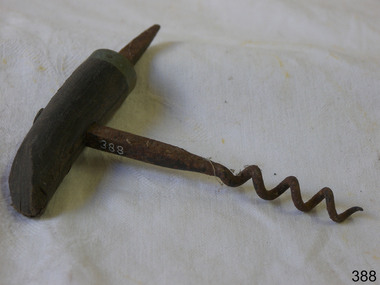
... The design of the corkscrew may have been derived from the gun worm, which was a device from at least the early 1630s, used by men to remove unspent charges from a musket's barrel in a similar fashion. The corkscrew is possibly an English invention, due to the tradition of beer and cider, and the 'Treatise on Cider' by John Worlidge in 1676 describes "binning of tightly corked cider bottles on their sides", although the earliest reference to a corkscrew is, "steel worm used for the drawing of Corks out of Bottles" from 1681. ...The design of the corkscrew may have been derived from the gun worm, which was a device from at least the early 1630s, used by men to remove unspent charges from a musket's barrel in a similar fashion. The corkscrew is possibly an English invention, due to the tradition of beer and cider, and the 'Treatise on Cider' by John Worlidge in 1676 describes "binning of tightly corked cider bottles on their sides", although the earliest reference to a corkscrew is, "steel worm used for the drawing of Corks out of Bottles" from 1681. ...The design of the corkscrew may have been derived from the gun worm, which was a device from at least the early 1630s, used by men to remove unspent charges from a musket's barrel in a similar fashion. The corkscrew is possibly an English invention, due to the tradition of beer and cider, and the 'Treatise on Cider' by John Worlidge in 1676 describes "binning of tightly corked cider bottles on their sides", although the earliest reference to a corkscrew is, "steel worm used for the drawing of Corks out of Bottles" from 1681. In 1795, the first corkscrew patent was granted to the Reverend Samuel Henshall, in England. The clergyman affixed a simple disc, now known as the Henshall Button, between the worm and the shank. The disc prevents the worm from going too deep into the cork, forces the cork to turn with the turning of the crosspiece, and thus breaks the adhesion between the cork and the neck of the bottle. The disc is designed and manufactured slightly concave on the underside, which compresses the top of the cork and helps keep it from breaking apart. In its traditional form, a corkscrew is simply a steel screw attached to a perpendicular handle, made of wood or some other material. The user grips the handle and screws the metal point into the cork, until the helix is firmly embedded, then a vertical pull on the corkscrew extracts the cork from the bottle. The handle of the corkscrew allows for a commanding grip to ease removal of the cork. https://en.wikipedia.org/wiki/CorkscrewThis object is significant as an example of an item in common use since the late 17th century.Metal corkscrew with wooden handle that is partly broken. Has metal steel spike to create a starting point for the use of the corkscrew. Very rusty. None.flagstaff hill, warrnambool, shipwrecked-coast, flagstaff-hill, flagstaff-hill-maritime-museum, maritime-museum, shipwreck-coast, flagstaff-hill-maritime-village, corkscrew, beverages, kitchen equipment, bottle opener -
 Glenelg Shire Council Cultural Collection
Domestic object - Corkscrew
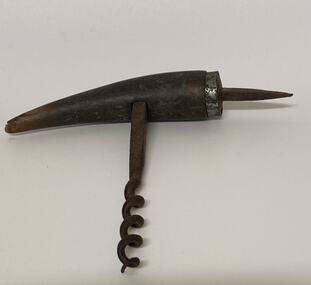
... The design of the corkscrew may have been derived from the gun worm, which was a device from at least the early 1630s, used by men to remove unspent charges from a musket's barrel in a similar fashion. The corkscrew is possibly an English invention, due to the tradition of beer and cider, and the 'Treatise on Cider' by John Worlidge in 1676 describes "binning of tightly corked cider bottles on their sides", although the earliest reference to a corkscrew is, "steel worm used for the drawing of Corks out of Bottles" from 1681. ...The design of the corkscrew may have been derived from the gun worm, which was a device from at least the early 1630s, used by men to remove unspent charges from a musket's barrel in a similar fashion. The corkscrew is possibly an English invention, due to the tradition of beer and cider, and the 'Treatise on Cider' by John Worlidge in 1676 describes "binning of tightly corked cider bottles on their sides", although the earliest reference to a corkscrew is, "steel worm used for the drawing of Corks out of Bottles" from 1681. ...The design of the corkscrew may have been derived from the gun worm, which was a device from at least the early 1630s, used by men to remove unspent charges from a musket's barrel in a similar fashion. The corkscrew is possibly an English invention, due to the tradition of beer and cider, and the 'Treatise on Cider' by John Worlidge in 1676 describes "binning of tightly corked cider bottles on their sides", although the earliest reference to a corkscrew is, "steel worm used for the drawing of Corks out of Bottles" from 1681. In 1795, the first corkscrew patent was granted to the Reverend Samuel Henshall, in England. The clergyman affixed a simple disc, now known as the Henshall Button, between the worm and the shank. The disc prevents the worm from going too deep into the cork, forces the cork to turn with the turning of the crosspiece, and thus breaks the adhesion between the cork and the neck of the bottle. The disc is designed and manufactured slightly concave on the underside, which compresses the top of the cork and helps keep it from breaking apart. In its traditional form, a corkscrew is simply a steel screw attached to a perpendicular handle, made of wood or some other material. The user grips the handle and screws the metal point into the cork, until the helix is firmly embedded, then a vertical pull on the corkscrew extracts the cork from the bottle. The handle of the corkscrew allows for a commanding grip to ease removal of the cork. https://en.wikipedia.org/wiki/CorkscrewMetal corkscrew with wooden handle. Has metal steel spike to create a starting point for the use of the corkscrew. Very rusty.corkscrew, kitchen equipment, bottle opener -
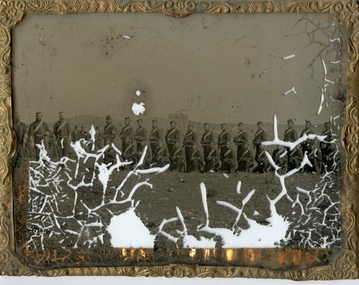 Flagstaff Hill Maritime Museum and Village
Photograph - Glass plate, circa 1866
... The firearms held appear to be 1853 pattern Lee Enfield muskets used by the British army in Crimea at this time and in Australia, rather than the later Martini Henry cartridge rifles. ...The firearms held appear to be 1853 pattern Lee Enfield muskets used by the British army in Crimea at this time and in Australia, rather than the later Martini Henry cartridge rifles. ...This glass plate photograph shows good detail of members of the Warrnambool Garrison posing for their photograph in front of a young township. There are other well-dressed citizens behind them. The three men with frogging on their sleeves were commanders were likely to be commanders. The men are facing north with Cannon Hill and the fortification area in the background. It dates from the 1860s. The firearms held appear to be 1853 pattern Lee Enfield muskets used by the British army in Crimea at this time and in Australia, rather than the later Martini Henry cartridge rifles. The uniforms match other photos of the Warrnambool Garrison Militia and Band in our Collection, taken up until the 1880s. The three storey building in the photograph is likely to be the Manifold & Bostock flour mill, built in 1854 near the ‘cutting’ in Merri Street, which was one of the main streets at the time; if one faced the building’s front from a vantage point and looked south to south-east, the hills around Flagstaff Hill and Cannon Hill would be behind that mill, and the Harbour behind the hills. This is the area of the Fortifications. The glass plate method of photography was widely used during the mid-19th to early-20th century. The donor and maker of the photograph are unknown. Around this time the citizens of Victoria were prospering from the gold rush but felt isolated and uneasy about their security in the colony. In 1854 the Volunteer Act was passed to provide some military defence. In 1858 the Warrnambool Volunteer Rifle Corps was established, disbanded in 1863, then a new Warrnambool Detachment was formed in September 1866. Legislation was passed in 1884 that replaced the volunteers’ corps with a partly paid, permanent Militia Defence Force. The batteries manning the coastal forts of Victoria were termed Garrison Artillery Companies. When the Army was federated in 1901 there were eight Militia Companies in Victoria. Warrnambool and Port Fairy together were known as 8 Coy AGA (Australian Garrison Artillery). Changes to formation and name continued into the 20th century.This photograph is a record of the very early local defence force, circa 1866. The photograph signifies the connection of the colony in Victoria to the growing need for security due to the unrest in Europe at that time. The photograph is also locally significant to the industry of the young township of Warrnambool, showing what is likely to be one of the first flour mills in the town. The photograph is also the only example of the early methods of glass plate photography in our collection. Photograph, rectangular glass plate, positive sepia image. Photograph has brass framed edges that fold over to the back, with mitred corners. The front edges are pressed with a decorative floral pattern. The photograph shows a group of thirty military men, standing or kneeling, in dark uniforms with pillbox forage caps, round-collared jackets with light buttons, light sashes worn from top left shoulder to bottom right side of waist belt, and long, straight-legged trousers. Three of these men have light braid around the buttons on the front of their jackets, light frogging on their sleeve cuffs and stripes on the outside seams of their trousers. The other twenty-seven men have plain uniforms and are holding firearms in their right hands, steadied with their left hands. Other figures are standing behind this group of soldiers, including three or four men wearing top hats, jackets and ties. In the background is a row of buildings. The central building is three stories high. Bare hills are in the far background. The foreground is uneven ground with patches of short grass. Photographer looking towards the south east and Cannon Hill, with the Warrnambool Garrison facing north, ca.1860s.flagstaff hill, warrnambool, shipwrecked coast, flagstaff hill maritime museum, maritime museum, shipwreck coast, flagstaff hill maritime village, great ocean road, glass plate, photography 19th century, colonial forces, military defence, volunteer act 1854, volunteer rifle, garrison artillery, volunteer corps, militia, militia garrison band, pillbox forage caps, helpmann, manifold and bostock, 1853 lee enfield musket, tintype, warrnambool garrison, 1860s, cannon hill, manifold & bostock, flour mill, 3-storey building -
 Flagstaff Hill Maritime Museum and Village
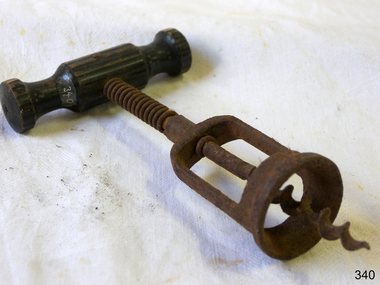
Domestic object - Corkscrew
... The design of the corkscrew may have been derived from the gun worm, which was a device from at least the early 1630s, used by men to remove unspent charges from a musket's barrel in a similar fashion. The corkscrew is possibly an English invention, due to the tradition of beer and cider, and the 'Treatise on Cider' by John Worlidge in 1676 describes "binning of tightly corked cider bottles on their sides", although the earliest reference to a corkscrew is, "steel worm used for the drawing of Corks out of Bottles" from 1681. ...The design of the corkscrew may have been derived from the gun worm, which was a device from at least the early 1630s, used by men to remove unspent charges from a musket's barrel in a similar fashion. The corkscrew is possibly an English invention, due to the tradition of beer and cider, and the 'Treatise on Cider' by John Worlidge in 1676 describes "binning of tightly corked cider bottles on their sides", although the earliest reference to a corkscrew is, "steel worm used for the drawing of Corks out of Bottles" from 1681. ...The design of the corkscrew may have been derived from the gun worm, which was a device from at least the early 1630s, used by men to remove unspent charges from a musket's barrel in a similar fashion. The corkscrew is possibly an English invention, due to the tradition of beer and cider, and the 'Treatise on Cider' by John Worlidge in 1676 describes "binning of tightly corked cider bottles on their sides", although the earliest reference to a corkscrew is, "steel worm used for the drawing of Corks out of Bottles" from 1681. In 1795, the first corkscrew patent was granted to the Reverend Samuel Henshall, in England. The clergyman affixed a simple disc, now known as the Henshall Button, between the worm and the shank. The disc prevents the worm from going too deep into the cork, forces the cork to turn with the turning of the crosspiece, and thus breaks the adhesion between the cork and the neck of the bottle. The disc is designed and manufactured slightly concave on the underside, which compresses the top of the cork and helps keep it from breaking apart. The winged corkscrew, sometimes called a cork extractor, butterfly corkscrew, owl corkscrew, Indian corkscrew, or angel corkscrew, has two levers, one on either side of the worm. As the worm is twisted into the cork, the levers are raised. Pushing down the levers draws the cork from the bottle in one smooth motion. The most common design has a rack and pinion connecting the levers to the body. The head of the central shaft is frequently modified to form a bottle opener, or foil cutter, increasing the utility of the device. Corkscrews of this design are particularly popular in household use. In 1880, William Burton Baker was issued British Patent No. 2950 for his double lever corkscrew, with both levers sliding onto the upper end of the shank. The first American patent was in 1930 granted to the Italian Domenico Rosati who emigrated to Chicago, Illinois, to work as bartender before prohibition. Rosati's design had an exposed rack and pinion mechanism. Such design was adapted by other brands as the wine-market grew in popularity. The winged owl version, with two side-plates covering the rack and pinion mechanism, was first designed and manufactured in 1932 by the Spanish industrial designer David Olañeta for his brand BOJ and was later adopted by others, such as the 1936 US Patent No. 98,968 by Richard Smythe marked HOOTCH-OWL https://en.wikipedia.org/wiki/CorkscrewThis object is significant as an example of an item in common use in the 19th and early 20th centuries, and that was developed further in the 1930s.Winged corkscrew with a T-shaped wooden handle, metal spring and worm-wheel screw section.None.flagstaff hill, flagstaff hill maritime museum and village, warrnambool, maritime museum, maritime village, great ocean road, shipwreck coast, corkscrew, beverages, kitchen equipment, bottle opener -
 Monbulk RSL Sub Branch
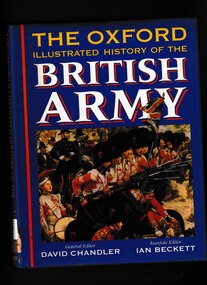
Book, David Chandler, The Oxford illustrated history of the British Army, 1994
... great britain - military history great britain - military tradition From longbow, pike, and musket to Challenger tanks, from the Napoleonic Wars to the Gulf campaign, the Duke of Marlborough to Field Marshal Montgomery, The Oxford Illustrated History of the British Army recounts the history of the British army from its medieval antecedents to the present day. ...From longbow, pike, and musket to Challenger tanks, from the Napoleonic Wars to the Gulf campaign, the Duke of Marlborough to Field Marshal Montgomery, The Oxford Illustrated History of the British Army recounts the history of the British army from its medieval antecedents to the present day. Drawing on the latest scholarship, this survey shows how British fighting forces have evolved over the last five centuries. The continuities revealed are sometimes surprising: narrow recruitment patterns, friction between soldiers and civilians, financial constraints and recurrent political pressure for economies are constant themes. Commanders, campaigns, battles, organization, and weaponry are covered in detail within the wider context of the social, economic, and political environment in which armies exist and fight. The British army has been remarkably successful in fighting terms, losing only one major war (of American Independence 1775-83). As one of the engines of empire it has been active all over the world, as well as shaping the internal destiny of the nation in civil war and revolution. Its history is charted in a sequence of chronological chapters, each containing special feature articles, beginning with the medieval, Elizabethan, and Restoration army and moving on through the eighteenth and nineteenth centuries to the two world wars of the twentieth. The book concludes with accounts of the army of British India, the amateur military tradition, the British way in warfare, and an assessment of what the future may hold in the light of the Options for Change review. Extensively illustrated in black and white and colour, and with a detailed chronology and further reading lists, this is the definitive one-volume history of the British army for specialists and non-specialists alike.Bibliography, Index, Chronology, ill (plates, col, b/w) maps. p.452.non-fictionFrom longbow, pike, and musket to Challenger tanks, from the Napoleonic Wars to the Gulf campaign, the Duke of Marlborough to Field Marshal Montgomery, The Oxford Illustrated History of the British Army recounts the history of the British army from its medieval antecedents to the present day. Drawing on the latest scholarship, this survey shows how British fighting forces have evolved over the last five centuries. The continuities revealed are sometimes surprising: narrow recruitment patterns, friction between soldiers and civilians, financial constraints and recurrent political pressure for economies are constant themes. Commanders, campaigns, battles, organization, and weaponry are covered in detail within the wider context of the social, economic, and political environment in which armies exist and fight. The British army has been remarkably successful in fighting terms, losing only one major war (of American Independence 1775-83). As one of the engines of empire it has been active all over the world, as well as shaping the internal destiny of the nation in civil war and revolution. Its history is charted in a sequence of chronological chapters, each containing special feature articles, beginning with the medieval, Elizabethan, and Restoration army and moving on through the eighteenth and nineteenth centuries to the two world wars of the twentieth. The book concludes with accounts of the army of British India, the amateur military tradition, the British way in warfare, and an assessment of what the future may hold in the light of the Options for Change review. Extensively illustrated in black and white and colour, and with a detailed chronology and further reading lists, this is the definitive one-volume history of the British army for specialists and non-specialists alike.great britain - military history, great britain - military tradition -
 Monbulk RSL Sub Branch
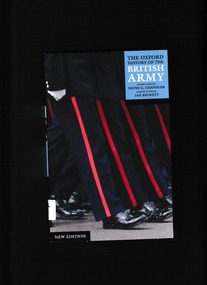
Book, David D Chandler, The Oxford history of the British Army, 1994
... British armed forces British army - History From longbow, pike, and musket to Challenger tanks, from the Napoleonic Wars to the Gulf Campaign, from the Duke of Marlborough to Field Marshal Montgomery, this stimulating and informative book recounts the history of the British army from its medieval antecedents to the present day. ...From longbow, pike, and musket to Challenger tanks, from the Napoleonic Wars to the Gulf Campaign, from the Duke of Marlborough to Field Marshal Montgomery, this stimulating and informative book recounts the history of the British army from its medieval antecedents to the present day. Commanders, campaigns, battles, organization, and weaponry are all covered in detail within the wider context of the social, economic, and political environment in which armies exist and fight, making this the definitive one-volume history of the British army for specialists and non-specialists alike.Index, maps, p.485.non-fictionFrom longbow, pike, and musket to Challenger tanks, from the Napoleonic Wars to the Gulf Campaign, from the Duke of Marlborough to Field Marshal Montgomery, this stimulating and informative book recounts the history of the British army from its medieval antecedents to the present day. Commanders, campaigns, battles, organization, and weaponry are all covered in detail within the wider context of the social, economic, and political environment in which armies exist and fight, making this the definitive one-volume history of the British army for specialists and non-specialists alike. british armed forces, british army - history -
 Narre Warren and District Family History Group
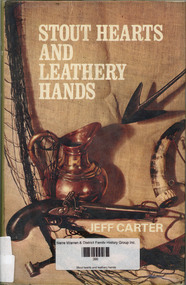
Book, Jeff Carter, Stout hearts and leathery hands, 1968
... Jeff Carter writes in his usual forthright and picturesque style about the people he met when he turned his back on the cities the true individualists such as the maker of flint-lock muskets, the bird-imitator, the builder of dry stone walls. ...Here is a robust picture of an Australia which few people know. Jeff Carter writes in his usual forthright and picturesque style about the people he met when he turned his back on the cities the true individualists such as the maker of flint-lock muskets, the bird-imitator, the builder of dry stone walls. He tells also of how he and his family took over an overgrown farm in the hills, and of their fashioning of a new and richly satisfying way of life far from traffic-lights and smog. It is a full-flavoured book of the open air, of the sturdiness and self-reliance of those to whom achievements mean more than possessions. And if, in reading it, you should wish that you could live in the same way, Jeff Carter gives some tantalizing advice on how you can build a new life for yourself in company with those of STOUT HEARTS AND LEATHERY HANDS. (cover)non-fictionHere is a robust picture of an Australia which few people know. Jeff Carter writes in his usual forthright and picturesque style about the people he met when he turned his back on the cities the true individualists such as the maker of flint-lock muskets, the bird-imitator, the builder of dry stone walls. He tells also of how he and his family took over an overgrown farm in the hills, and of their fashioning of a new and richly satisfying way of life far from traffic-lights and smog. It is a full-flavoured book of the open air, of the sturdiness and self-reliance of those to whom achievements mean more than possessions. And if, in reading it, you should wish that you could live in the same way, Jeff Carter gives some tantalizing advice on how you can build a new life for yourself in company with those of STOUT HEARTS AND LEATHERY HANDS. (cover)foxground south coast nsw, country living -
 The 5th/6th Battalion Royal Victoria Regiment Historical Collection
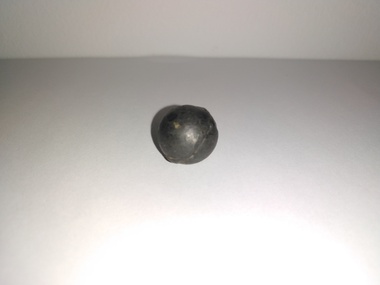
Weapon - Ammunition, Musket ball
... Musket ball......Musket...representive of early ammunition used by colonial forces Wark VC Club Colonial Musket black, led ball with imperfections and filing Musket ball Weapon Ammunition ...representive of early ammunition used by colonial forcesblack, led ball with imperfections and filingwark vc club, colonial, musket
