
Showing 29 items matching "non-alcoholic"
-
 Flagstaff Hill Maritime Museum and Village
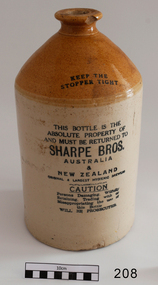
Container - Stoneware Demijohn, Bendigo Pottery , 1905-1950
... ...non alcoholic drinks...This demijohn was made by Bendigo Pottery for Sharpe Bros, brewers of non-alcoholic drinks such as Dandelion Ale, Ginger Beer and cordial. ...This demijohn was made by Bendigo Pottery for Sharpe Bros, brewers of non-alcoholic drinks such as Dandelion Ale, Ginger Beer and cordial. ...This demijohn was made by Bendigo Pottery for Sharpe Bros, brewers of non-alcoholic drinks such as Dandelion Ale, Ginger Beer and cordial. Sharpe Bros began in New Zealand and expanded to Australia in the early 20th century. The company was taken over by Cadbury Schweppes in 1972. An item made during the first half of the 20th century by a Bendigo pottery as a container made for the Sharpe's brewery in Victoria to contain their non alcoholic drinks for retail sale. Glazed stoneware bottle with dark brown glaze to top section, one gallon size, narrow neck glazed stoneware stopper and wire handle missing. SHARPE BROS. AUSTRALIA & NEW ZEALAND Text printed in black on body: 'This bottle is the absolute property of and must be returned to Sharpe Bros. Australia and New Zealand. flagstaff hill, warrnambool, flagstaff hill maritime museum, shipwreck coast, flagstaff hill maritime village, great ocean road, bottle, stoneware bottle, sharpe bros., drink, non alcoholic drinks, bendigo pottery, demihohn -
 Flagstaff Hill Maritime Museum and Village
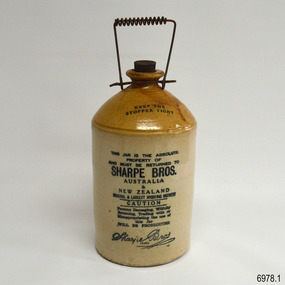
Container - Stoneware Demijohn, Bendigo Pottery , 1904-1930s
... ...non-alcoholic drink...Sharpe Bros. made ‘health’ beverages that were non-alcoholic drinks such as ginger beer, ginger ale, lime juice, soda and cordials. ...Sharpe Bros. made ‘health’ beverages that were non-alcoholic drinks such as ginger beer, ginger ale, lime juice, soda and cordials. ...This Sharpe Bros. one gallon stoneware Demijohn is in excellent condition and includes its original stopper. It was made between 1904 and 1930, the date from the patent of the handle until the time that the factory no long produced returnable items. The bottle was once part of Dr W.R. Angus' household and is part of the W.R. Angus Collection and could have been purchased from Warrnambool's Sharpe Bros. factory. SHARPE BROS. 1903-1972- The first Sharpe Bros. cordial factory was opened in Dunedin, New Zealand, in 1903 by English prohibition brothers John and Percy Sharpe. Sharpe Bros. made ‘health’ beverages that were non-alcoholic drinks such as ginger beer, ginger ale, lime juice, soda and cordials. The containers of these drinks were not sold with the drinks but were marked as returnable items, to be cleaned and re-used, until this practice ceased in the 1930s. Sharpe Bros. made a niche in the soft drink market by delivering drinks by horse and cart to its customers’ homes. John Sharpe patented the unique wire spiral handle in 1904. By 1905 the New Zealand company also had factories in Australia. By 1910 the company had over 20 factories including Wanganui, New Zealand; Adelaide, Albury, Ballarat, Bathurst, Forbes, Geelong, Goulburn, Lithgow, Melbourne, Newcastle, Orange, Sydney, Tamworth, Warrnambool and Wollongong. The Warrnambool factory was established in 1919 and existed until 1951. The company won awards at Australian exhibitions for its carbonated drinks, including First Prize for its ginger beer made in the Brisbane factory. The company was taken over in 1962 by Tarax Drinks Holdings Ltd, which was in turn taken over by Cadbury Schweppes in 1972. W.R. Angus Collection- The W R Angus Collection spans from 1885 to the mid-1900s and includes historical medical and surgical equipment and instruments from the doctors Edward and Thomas Ryan of Nhill, Victoria. Dr Angus married Gladys in 1927 at Ballarat, the nearest big city to Nhill where he began as a Medical Assistant. He was also Acting House surgeon at the Nhill hospital where their two daughters were born. He and his family moved to Warrnambool in 1939, where Dr Angus operated his own medical practice. He later added the part-time Port Medical Officer responsibility and was the last person appointed to that position. Dr Angus and his wife were very involved in the local community, including the early planning stages of the new Flagstaff Hill, where they contributed to the layout of the gardens. Dr Angus passed away in March 1970. This stoneware Demijohn is connected to the history of Warrnambool, as it was owned by the daughter of Dr W. R. Angus and his wife Gladys. It is part of the W.R. Angus Collection, which is notable for still being located at the site connected to Doctor Angus, Warrnambool’s last Port Medical Officer. It is also connected through its manufacturer Sharpe Bros. which had a branch in Warrnambool from 1919 to 1951, overlapping the time when the Angus family resided there from 1939 to the 1970s. The bottle is also significant as an example of the early-20th-century beverages found in local households and could have been purchased from the local Sharpe Bros. factory. This stoneware Demijohn is glazed, with a brown neck with internal thread and shoulders and a cylindrical cream base. The one gallon bottle has a flat, black stopper with a cork stem and a rubber, threaded tip. The ‘U’ shaped wire carry handle has a spiral of wire around the handpiece. An overhanging lip is on top of the bottle’s short neck above its rounded shoulder. The clay has been joined at the base of the neck, shoulder and body. The underneath is unglazed. The brown glazing on the shoulder has a run mark. Inscriptions are on the stopper and bottle. This container is part of the W.R. Angus Collection. Stamped in black on the shoulder: “KEEP THE / STOPPER TIGHT” Stamped in black on the body: “THIS JAR IS THE ABSOLUTE PROPERTY OF AND MUST BE RETURNED TO SHARPE BROS. AUSTRALIA / & NEW ZEALAND. ORIGINAL & LARGEST HYGIENIC BREWERY. CAUTION Persons Damaging, Willfully Retaining, Trading with or Misappropriating the Use of this Jar WILL BE PROSECUTED “ Stamped in script writing: “Sharpe Bros. TRADE - - - ED “ Embossed on the stopper: “AUSTRALIA AND NEW ZEALAND, SHARPE BROS.” flagstaff hill, warrnambool, maritime village, maritime museum, shipwreck coast, great ocean road, dr w r angus, dr roy angus, dr ryan, sharpe bros., bendigo pottery, bottle, stoneware bottle, demihohn, one gallone bottle, soft drink, non-alcoholic drink, drink container, jar, jug, warrnambool soft drink, hygienic brewery, cordial factory, new zealand, australia, john sharpe, percy sharpe, non-alcoholic, spiral wire handle, ginger beer, w.r. angus collection, demijohn -
 Kiewa Valley Historical Society
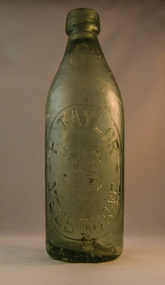
Bottle - Ginger Beer, early to late 1900's
... ...non alcoholic drink...The uneconomical "on cost" which was replaced by the "throw away" less costly plastic containers however did not provide the keen domestic brewer of the "beer" with a reusable bottle. glass bottle non alcoholic drink taylor ginger beer bottle reuseable bottles On the middle portion of this bottle is a large elongated circle within it and following the spherical line is "H. ...This glass ginger beer bottle was manufactured and used early to late 1900's, until the time that cheaper containers were invented(plastic bottles). This bottle was so constructed to be easily moved within the ginger beer processing plants from the brewing vats/holding tanks to the final corking/sealing of the bottles for eventual distribution. From 1990s the bottle slowly became phased out of production however boutique suppliers still preferred thick glass to contain any explosive action. Two major glass bottle works companies, e.g. Melbourne Glass Bottle Works Co. were the main suppliers for the Victorian State. In the period when this bottle was manufactured and used the major ginger beer brewing plants for the whole of Victoria were located in Melbourne because this was where its greatest consumer base was there and most rural areas were supplied by domestic sources (mother brewing ginger beer for the children). The Kiewa Valley and its region was one rural area which until road invrastructure was enhance covered the ginger beer thirst by local family production. As the population expanded considerably in the late 1940's (SECV Hydro Scheme) with a greater demand for "soft" drinks" being established supplies from larger towns and cities were call for. Each bottle was "branded" during manufacturing to show the contents were from a reputable supplier (H Taylor) and where it originated from. These bottles were recyled by the manufacturer as a way to cut production costs. This method of recycling the bottles back to the specific manufacturer has (except for South Australia)been overtaken by a no cost recycling collection by councils (funded by their communities). This method by passes the user cost principle as the bottles are processed as non generic. The uneconomical "on cost" which was replaced by the "throw away" less costly plastic containers however did not provide the keen domestic brewer of the "beer" with a reusable bottle. This heavy gauged glass ginger beer bottle has a rim and a distinctive head at the top. This head has been manufactured to facilitate the movement of the bottled along the filling production line. The method of pouring ginger beer into the bottle has been part of the "production line". This bottle has a one and a half pint capacity and is made from "light green" coloured glass(a protection against light penetration). This thick glass bottle, to contain ginger beer, required its thickness because of the extensive handling (man and machine) before final consumption. During this period delivery to homes in cities and towns was made initially by horse and cart and later by truck. Ginger beer was a "soft drink" of great demand. On the middle portion of this bottle is a large elongated circle within it and following the spherical line is "H. TAYLOR" ans a star separates this from "MELBOURNE" rounding out the bottom curviture. Within these words are the large initials "T H" . The "T" superimposed onto the "H". On the base and covering the whole bottom is the letter "T". At the opposite side to the manufacturers logo is "THIS BOTTLE CANNOT BE SOLD OR USED BY ANY OTHER PERSON & IS NOT COMPLETE WITHOUT STOPPER" glass bottle, non alcoholic drink, taylor ginger beer bottle, reuseable bottles -
 Mont De Lancey
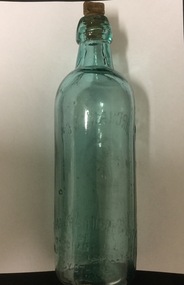
Glass bottle
... bottles, containers, beverages, non-alcoholic drinks...bottles, containers, beverages, non-alcoholic drinks Marchant & Co.and trademark. ...Green glass lemonade bottle with bakelite/wood screw top Marchant & Co.and trademark. "Registered Australia. This is the property of Marchant & Co. and cannot legally be used by others". "Taylor" inscribed on screw top. bottles, containers, beverages, non-alcoholic drinks -
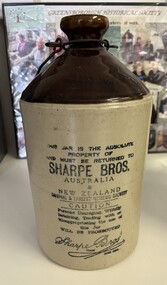 Greensborough Historical Society
Container - Jar, Hoffman Australia, Sharpe Bros demijohn, 1930s
... This demijohn was made for Sharpe Bros., brewers of non- alcoholic drinks such as Dandelion Ale, ginger beer and cordial. ...This demijohn was made for Sharpe Bros., brewers of non- alcoholic drinks such as Dandelion Ale, ginger beer and cordial. ...This demijohn was made for Sharpe Bros., brewers of non- alcoholic drinks such as Dandelion Ale, ginger beer and cordial. Sharpe Bros began in New Zealand and expanded to Australia in the early 20th century. The company was taken over by Cadbury Schweppes in 1972. The likely manufacturer of this demijohn was Hoffman's Pottery of Brunswick. This item was recovered from the abandoned barn of the Pope family in 1971, when the property was sold to the Shire of Diamond Valley. This barn was located on the northern side of Pope Place and sketched by Ron Reynolds for the book "Greensborough and Greenhills". Glazed stoneware jar with dark brown glaze to top, narrow threaded neck with wire handle. Stopper missing. Transfer text on front: "This jar is the absolute property of and must be returned to Sharpe Bros. Australia and New Zealand" sharpe bros., hoffman pottery, stoneware jars -
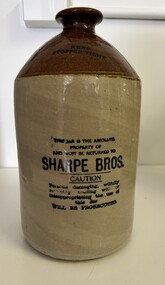 Greensborough Historical Society
Container - Jar, Hoffman Australia, Sharpe Bros demijohn, 1930s
... This demijohn was made for Sharpe Bros., brewers of non- alcoholic drinks such as Dandelion Ale, ginger beer and cordial. ...This demijohn was made for Sharpe Bros., brewers of non- alcoholic drinks such as Dandelion Ale, ginger beer and cordial. ...This demijohn was made for Sharpe Bros., brewers of non- alcoholic drinks such as Dandelion Ale, ginger beer and cordial. Sharpe Bros began in New Zealand and expanded to Australia in the early 20th century. The company was taken over by Cadbury Schweppes in 1972. The likely manufacturer of this demijohn was Hoffman's Pottery of Brunswick. Glazed stoneware jar with dark brown glaze to top, narrow threaded neck, wire handle and stopper missing. Transfer text on front: "This jar is the absolute property of and must be returned to Sharpe Bros. Australia and New Zealand" sharpe bros., hoffman pottery, stoneware jars -
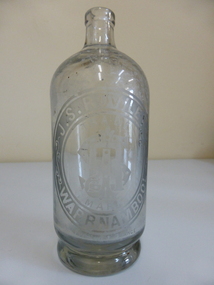 Warrnambool and District Historical Society Inc.
Bottle, J. S Rowley
... He was known for his originality in the production of soft drinks and produced 20 varieties of drinks, including his own Henneberry Wine and Lime Fruit Champagne, both non-alcoholic. In the 1870s he was producing 600 dozen bottles a day and in the 1880s his cordial factory occupied half an acre of land and employed 13 people. ...He was known for his originality in the production of soft drinks and produced 20 varieties of drinks, including his own Henneberry Wine and Lime Fruit Champagne, both non-alcoholic. In the 1870s he was producing 600 dozen bottles a day and in the 1880s his cordial factory occupied half an acre of land and employed 13 people. ...The making of cordials and aerated waters was an important industry in Warrnambool from the time of the first settlement up to the 1980s. John Rowley was a prominent producer of aerated waters and cordials from 1868 to his death in 1893 (the Warrnambool Steam Aerated Works). He was known for his originality in the production of soft drinks and produced 20 varieties of drinks, including his own Henneberry Wine and Lime Fruit Champagne, both non-alcoholic. In the 1870s he was producing 600 dozen bottles a day and in the 1880s his cordial factory occupied half an acre of land and employed 13 people. He won many awards for his products at local Agricultural Shows. Warrnambool cordial bottles are of considerable significance as examples of an important industry now gone. Rowley is a significant person in the history of 19th century Warrnambool industries and Rowley bottles are of considerable importance, especially this one, made for efferverscent drinks. This is a heavy glass bottle (no stopper) possibly used for hop bitters or ginger wine or some contents that had high efferverscent qualities. The bottle has a heavy indented base. Oval etching ‘J.S.,Rowley Warrnambool’ with ‘Trade Mark’ and monogram. ‘J.R.’ in the centre of the oval. ‘Made in France’ is at the bottom edge of the oval inscriptions. warrnambool, john rowley warrnambool, rowley softdrinks, warrnambool steam aerated works, rowley bottle -
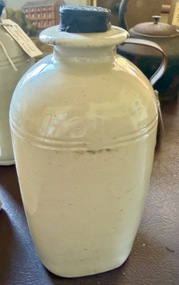 Bellarine Historical Society Museum
Domestic object - Bed Warmer with metal bung, Bendigo Potteris, Bed Warmer, early 20th century
... They manufactured non-alcoholic beverages transported in demijohn jars for home delivery. ...They manufactured non-alcoholic beverages transported in demijohn jars for home delivery. ...Sharpe Brothers were founded in Dunedin, NZ in 1903 by John Sharpe. They manufactured non-alcoholic beverages transported in demijohn jars for home delivery. They established branches in Adelaide, Sydney and Melbourne and in most larger regional cities in NSW and Victoria. After his death in 1926, his sons carried on the business. It was sold to Tarax in 1962 which was taken over by Cadbury Schwepps Australia in 1972. However, the jar shape is more consistent with a flat bottomed foot warmer than a beverage demijohn. Either this is a rare example of that product being made by Sharpe Brothers or the bung has been later added, possibly as a replacement for a lost original stopper. Sharpe Brothers were a significant metropolitan and regional beverage manufacturer in the 20th century producing home delivered cordials, ginger beer and dandelion ale throughout southern Australia. The significance of their jar stopper being attached to a bed warmer needs investigation. Cream stoneware container, circular with slightly flattened sides. Flat bottom Sharpe Brothers, Australia and New Zealand on top bung -
 Wodonga & District Historical Society Inc
Domestic object - Bottle - Murray Breweries Beechworth, 1940s
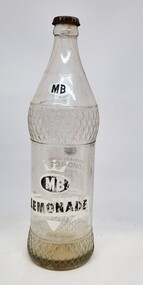
... The Temperance movement of the 1920s also pushed Murray Breweries to focus on the brewing of non-alcoholic cordials and aerated drinks. They also continued to produce the non-alcoholic herbal beer Ecks until the 1980s. ...The Temperance movement of the 1920s also pushed Murray Breweries to focus on the brewing of non-alcoholic cordials and aerated drinks. They also continued to produce the non-alcoholic herbal beer Ecks until the 1980s. ...The history of Murray Breweries Pty Ltd is intertwined with that of several northeast Victorian breweries and in particular that of the Albury Brewing and Malting Company and Billson’s Brewery which still operates in Beechworth. George Billson Jr. took over the “Albury and Wodonga Breweries" in 1879. His brother, Alfred Arthur Billson, took over the Beechworth brewery in 1882, trading as A A Billson and Co. In July 1888, George Billson combined his two breweries as the Albury Brewing and Malting Company Ltd. In 1911 the brothers combined to become Border United Co-operative Breweries Ltd. Towards the end of 1914, this company was liquidated and its operations transferred to the newly registered Murray Breweries Pty. Ltd. Murray Breweries immediately began down-sizing, closing the Tallangatta factory at the end of 1914, and selling the Albury brewery (which no longer brewed due to poor water quality) in 1920. The first half the twentieth century saw a decline in the production of alcoholic beverages, partly due to the Beer Excise tax of 1901 and competition from Melbourne breweries. The Temperance movement of the 1920s also pushed Murray Breweries to focus on the brewing of non-alcoholic cordials and aerated drinks. They also continued to produce the non-alcoholic herbal beer Ecks until the 1980s. In the closing decades of the 20th century the Brewery produced and home-delivered soft drinks, which were eventually replaced by bulk spring water sales and delivery under the name ‘Snowline mountain spring water.’ This artifact is representative of tradition manufacturing industries in Northeast Victoria. A clear glass lemonade bottle bearing the logo of Murray Breweries of Beechworth. The initials "MB" form an oval shape below a white crown. It has a diamond embossed design both above and below the logo. There is also detailed information about the ingredients on one side. The glass has a metal cap. On front: in a white oval, black initials MB. In the middle section: a white crown above a black oval with initials "MB" above "LEMONADE" in black text. On reverse side in white text: "MB/ PRESERVATIVE ADDED/ LEMONADE/ THIS BEVERAGE IS MADE/ FR.OM AUSTRALIA'S/ FINEST LEMONS BLEND-/ ED BY AN EXCLUSIVE/ PROCESS WITH PURE/ MOUNTAIN SPRING/ WATER, THIS DELIGHTFUL /FLAVOUR HAS NO EQUAL. / MANUFACTURED BY/ MURRAY BREWERIES / BEECHWORTH, VICTORIA/ Net Contents 26 Fl. Oz." murray breweries, aerated drinks, breweries northeast victoria, billsons -
 City of Greater Bendigo - Civic Collection
Artwork, other - Label, Cohns, Cohn Bros, c 1923
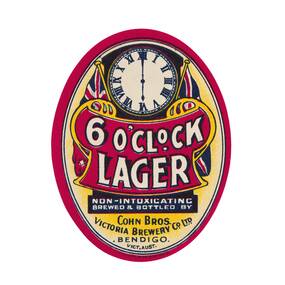
... Overtime the Cohn brothers expanded their operations adding cordials and in 1916 produced a non-alcoholic beer to satisfy the temperance activists. ...Overtime the Cohn brothers expanded their operations adding cordials and in 1916 produced a non-alcoholic beer to satisfy the temperance activists. ...Danish brothers, Moritz, Julius and Jacob Cohn arrived in Bendigo in 1853 and by 1856 started making cider and soft drinks, building a brewery 1880 to further extend their commercial enterprises and stock their hotels with their own brand of beer. Having sent Moritz's son, (also Julius) to Germany to learn to brew, the Cohn Brothers began to produce Excelsior Lager in 1882, which was traditionally served cold, the first time this had been done in Australia. Overtime the Cohn brothers expanded their operations adding cordials and in 1916 produced a non-alcoholic beer to satisfy the temperance activists. This label is associated with a non alcoholic larger originally named Tonic Ale but re-named 6 o’clock Lager after the temperance advocates succeeded in having pubs close at six o’clock. Cohn Brothers built an empire of breweries, cordial factories, hotels and liquor stores and ice works. In 1925 they sold the hotels and breweries to Carlton & United but continued to make their other products until the 1970s when the company became part of the Coca Cola Amatil Group. Jacob Isaac Cohn was born in 1830 (died 1911) in Horsens Denmark and entered the Sandhurst Borough Council in 1863 where he served as a member for three years, returning again in 1887 to serve as Mayor of the City of Bendigo from 1888-1889. Jacob Cohn was a great supporter of the Mechanics Institute, the Hospital and the Benevolent Asylum. It is believed that through his connection with the Mechanics Institute he exhibited some loaned engravings from the Dresden Art Gallery which were then donated to the City of Bendigo, forming the nuclei of the Art Gallery's collection. Jacob Cohn held the position of President of the Art Gallery for 18 years. Oval larger label. Multicoloured. 6 o'clock / Lager / non- intoxicating / Brewed & Bottled by / Cohn Bros. / Victoria Brewery Co Ltd / Bendigo / Vict. Aust mayor jacob cohn, bendigo art gallery, bendigo masonic lodge, making a nation, city of bendigo commerce, cohns, cohn brothers -
 City of Greater Bendigo - Civic Collection
Domestic object - Soft drink bottle, Tarax, c 1970
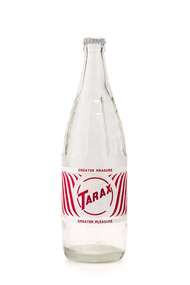
... In 1933 after a 15 years absence from manufacturing Tarax once again hit the milk bars and cafes with George Pethard Jr brewing and bottling non alcoholic ales and beers in Mildura and distributing throughout Victoria. ...In 1933 after a 15 years absence from manufacturing Tarax once again hit the milk bars and cafes with George Pethard Jr brewing and bottling non alcoholic ales and beers in Mildura and distributing throughout Victoria. ...The Tarax company was established by the Pethard family around 1898 as a way of promoting temperance and providing an alternative to beer. Derived from the latin word for dandelion (Taraxicum Officinale) George Pethard Jr took over the business from his father in 1902 and established a brewery behind the family home in Golden Square as well as operating the Tarax Cafe in Bendigo. In 1933 after a 15 years absence from manufacturing Tarax once again hit the milk bars and cafes with George Pethard Jr brewing and bottling non alcoholic ales and beers in Mildura and distributing throughout Victoria. Tarax was listed on the stock exchange in 1959 and was taken over by Cadbury Schweppes in 1972. George Pethard Jnr was Mayor of Bendigo three times 1940 - 41, 1947 - 48, 1951 - 52. Clear glass bottle with red and white Tarax label on front. Embossed on four sides of shoulder 'TARAX'. Crown seal cap. Drink Tarax Icy Cold / Greater measure / Greater Pleasure mayor pethard, city of greater bendigo commerce -
 Warrnambool and District Historical Society Inc.
13 labels, Rowley
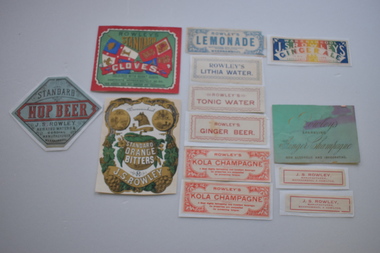
... ROWLEY AERATED WATERS & CORDIAL MANUFACTURER WARRNAMBOOL .4 Rowley's SPARKLING Ginger Champagne NON ALCOHOLIC AND INVIGORATING .5 WARRNAMBOOL J.S.ROWLEY'S GINGERALE. ...ROWLEY AERATED WATERS & CORDIAL MANUFACTURER WARRNAMBOOL .4 Rowley's SPARKLING Ginger Champagne NON ALCOHOLIC AND INVIGORATING .5 WARRNAMBOOL J.S.ROWLEY'S GINGERALE. ...In 1868 John Rowley opened a soda water manufactory attached to the Corio Brewery and this was renamed the Warrnambool Steam Aerated Works in 1872. By the 1880s his factory at the corner of Timor and Banyan Streets was occupying half an acre of land , employing 13 people and manufacturing 20 varieties of drinks. Following Rowley's death the factory and plant was sold but the cordial manufacturing business continued for some years. These labels are of great significance as John Rowley was a dominant name in the cordial making business in Warrnambool. .1 Rectangular , red, green, blue and white label featuring text, two flags with lions, a sailing ship, a sheep and a sheaf of wheat. There is a scroll with text. A white decorative border surrounds the label. It is adhered to a piece of red thin cardboard. .2 Irregular shaped label with gold and green decorations on a white background and text. The decorative pieces include grapes, vine leaves, flowers, the profile of a wolf, and two medallions with the coat of arms of Warrnambool There are two scrolls with text The label is adhered to a piece of white card. .5 Rectangular Multi coloured label with text adhered to a piece of white paper .4 Rectangular green card with text .3 Hexagonal grey/green label with black and red text and decorative black dotted curls mounted on white paper .6 White rectangular label with blue text and decorative surround of leaves and flowers. It has damage to three corners. .7 White label with blue text and decorative border adhered to white paper. .8 Pale pink rectangular card label with rose coloured text and a decorative border. .9 Cream rectangular label with red text and decorative border adhered to a piece of white paper 10.1, 10.2 Cream rectangular labels with red text. .2 is adhered to white paper. 11.1, 11.2 Cream rectangular labels with red text and borders adhered to white paper. .1 ROWLEY'S STANDARD CLOVES WARRNAMBOOL COLOURED WITH BURNT SUGAR .2 Warrnambool NULLI SECUNDUS BY THESE WE FLOURISH STANDARD ORANGE BITTERS J.S.ROWLEY .3 STANDARD HOP BEER J.S. ROWLEY AERATED WATERS & CORDIAL MANUFACTURER WARRNAMBOOL .4 Rowley's SPARKLING Ginger Champagne NON ALCOHOLIC AND INVIGORATING .5 WARRNAMBOOL J.S.ROWLEY'S GINGERALE. TO HIS EXCELLENCY LORD BRASSEY K.G.B. .6 ROWLEY'S LEMONADE MANUFACTURED WITH THOROUGHLY FILTERED RAIN WATER WARRNAMBOOL .7 ROWLEY'S LITHIA WATER .8 ROWLEY'S TONIC WATER .9 ROWLEY'S GINGER BEER .10.1 ,10.2 ROWLEY'S KOLA CHAMPAGNE A Most Highly Refreshing and Excellent Beverage. Its properties are unequalled for preventing fatigue. .11 J.S ROWLEY, MANUFACTURER WARRNAMBOOL & HAMILTON CONTENTS APPROXIMATELY 25 OZ. THIS CORDIAL DOES NOT CONTAIN ANY PRESERVATIVE .2 Warrnambool NULLI SECUNDUS BY THESE WE FLOURISH STANDARD ORANGE BITTERS J.S ROWLEY john rowley, cordial manufacture -
 Kiewa Valley Historical Society
Bottle - Ginger Beer, mid to late 1900's
... Multi -Corporations producing non alcoholic beverages at lower production costs reduced local manufacturers considerably. ...Multi -Corporations producing non alcoholic beverages at lower production costs reduced local manufacturers considerably. ...This bottle was used in a period when "soft" drink ginger beer was "brewed" not only in homes but also in specific breweries. Most rural areas had families which produced their own ginger beer. Medium to large towns and cities had ginger beer "factories". These factories had large "on bottle" advertising who the producer was. This producer advertising was firmly infused into the bottle and not on removable labels (late 1900's on wards). Regional breweries had a strong following, similar to State beer producing breweries. The competition between breweries of ginger beer was regional and not state or international. Return of bottles was not a sign of saving the environment or becoming eco- friendly but a requirement to keep production costs low. This is highlighted by "This bottle Remains the Property", in other words return when empty. Up to the end of the second World War Australian "soft drink" demand was for local produce. The American invasion of other flavours of "soft drink" came in the 1950's. Multi -Corporations producing non alcoholic beverages at lower production costs reduced local manufacturers considerably. This however had little effect on semi isolated rural areas where home brews flourished. This bottle shows the impact that small regional towns had and still have on semi isolated rural communities(Kiewsa Valley). With better communications (radio/television/newspapers) and a better transport connections specialised breweries such as the Wangaratta Brewery had an extensive customer "hinterland" to serve. The "canny" rural population would be able to reuse this bottle for their own specific purpose. Because of the long distances between Kiewa Valley residences and the major towns available to them, the issue of adaptability of any purchases made was always closely linked to their long term usefulness. This bottle is made from thick clear glass and has a capacity of one and a half pints. It has a flat top with a wooden screw stopper (internal thread). On one side "THIS BOTTLE REMAINS THE PROPERTY OF WANGARATTA BREWERY PTY LTD" On the top rim of bottle on both sides "17". On the bottom of the base are "AGM" AND "346" ginger beer bottle, soft drink bottles, cordial bottles, wangaratta drinks -
 Eltham District Historical Society Inc
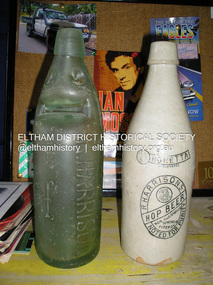
Photograph, Fay Bridge, Old bottles found at former Morrison property, Killeavey, Laughing Waters Road, Eltham, 2019
... Lemonade, Non-alcoholic Hop Beer and milk bottlkes recovered from Killeavey give an insight into the types of drinks consumed by the Morrison family. ...Lemonade, Non-alcoholic Hop Beer and milk bottlkes recovered from Killeavey give an insight into the types of drinks consumed by the Morrison family. ...Lemonade, Non-alcoholic Hop Beer and milk bottlkes recovered from Killeavey give an insight into the types of drinks consumed by the Morrison family. Beatrice Wanliss Irvine was the daughter of former Victorian Premier Sir William Irvine. From age 13 she lived at “Killeavey” off Laughing Waters Road (later accessed from Reynolds Road). In 1923 she married James Morrison and the couple received Killeavey as a wedding gift. The property supported fruit and vegetable growing as well as an impressive botanical garden. But James died in 1936 after a period of ill health, leaving Beatrice to support their six children. The Killeavey house was built atop a cliff, 40 metres above the Yarra River. The garden was designed in 1910 by William Guilfoyle who was the second director of the Royal Botanical Gardens. The house was totally destroyed in the Black Friday bushfires in 1939, but was rebuilt. Beatrice continued to live at Killeavey and became well regarded as a botanist and naturalist. She died in 1989 and is buried in Eltham Cemetery with her husband and one of their sons. The (rebuilt) house was demolished by Parks Victoria. It contains significant garden remnants. The surrounding bushland is valued for its significant plant communities. fay bridge collection, beatrice wanliss morrison (nee irvine), eltham, james morrison, killeavey, laughing waters road, william irvine, bennett lemonade, bottles, milk bottle, o'neill bros north fitzroy, r. harrison, r. harrisons hop beer -
 City of Melbourne Libraries
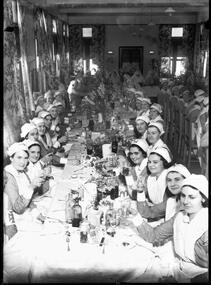
Photograph, Bull, Hugh Jones, 1897-1993, The Nurses' Christmas, Alfred Hospital
... Research by project volunteer Ernie Ward: Alfred Hospital nurses enjoy their Christmas Lunch: The hierarchical system of Nursing and Nurse Training (as indicated by the headwear, armbands and seating positions) is on full display as Alfred Hospital nurses propose a Christmas Lunch toast (strictly non-alcoholic) to The Age photographer, Hugh Bull. ...Research by project volunteer Ernie Ward: Alfred Hospital nurses enjoy their Christmas Lunch: The hierarchical system of Nursing and Nurse Training (as indicated by the headwear, armbands and seating positions) is on full display as Alfred Hospital nurses propose a Christmas Lunch toast (strictly non-alcoholic) to The Age photographer, Hugh Bull. ...Published: The Age 26 Dec 1933 page 9 Published title: "THE NURSES' CHRISTMAS." Trove article identifier: http://nla.gov.au/nla.news-article203364946 Description: Group of nurses in uniform enjoying Christmas dinner at the Alfred Hospital. Research by project volunteer Ernie Ward: Alfred Hospital nurses enjoy their Christmas Lunch: The hierarchical system of Nursing and Nurse Training (as indicated by the headwear, armbands and seating positions) is on full display as Alfred Hospital nurses propose a Christmas Lunch toast (strictly non-alcoholic) to The Age photographer, Hugh Bull. Some of the bolder nurses have decorated their headwear in a festive way that would be frowned upon the other 364 days of the year. The soft drinks are Marchants and Elliotts, the flower arrangements feature the highly fashionable gladioli, and the floral patterned curtains have been pulled aside so the summer sunshine can stream in. The sunshine would, in a couple of hours, be replaced by flooding rainstorms which caused havoc on Christmas night. This very Melbourne weather phenomenon was the focus of The Age Boxing Day edition pictorial. At the rear of the room is Matron Grace Wilson C.B.E, already a World War One heroine for setting up and working at Australian military hospitals in Greece, Egypt and France (as seen on the second episode of the 2014 television series Anzac Girls). As Australia’s most highly-ranked peacetime military nurse, Matron Wilson also appears as the only woman in any official capacity at the Dedication of the Shrine of Remembrance in 1934. She can be seen in the grand panorama documenting this occasion (also featured in this exhibition). Photographer notations on slide: "The Nurses' Christmas Alfred Hospital Age 1933 B9". nurses, christmas, 1930-1939 -
 Surrey Hills Historical Society Collection
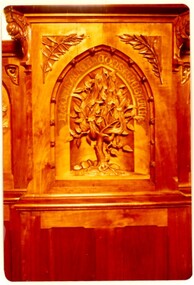
Photograph, John Kendrick Blogg carving, pulpit of St Stephen's Presbyterian Church, Surrey Hills
... In 1884 he established a successful industrial chemistry business, which included extracting perfume from Australian native trees and plants.liquid ammonia for refrigeration, acetic acid, perfumes, shoe polish, baking powder and non-alcoholic drinks. Other products were He lived at 'Balmoral' in Albany Crescent, Surrey Hills; his woodwork was produced here. ...In 1884 he established a successful industrial chemistry business, which included extracting perfume from Australian native trees and plants.liquid ammonia for refrigeration, acetic acid, perfumes, shoe polish, baking powder and non-alcoholic drinks. Other products were He lived at 'Balmoral' in Albany Crescent, Surrey Hills; his woodwork was produced here. ...John Kendrick Blogg was born in Canada and migrated to Victoria in 1877. In 1884 he established a successful industrial chemistry business, which included extracting perfume from Australian native trees and plants.liquid ammonia for refrigeration, acetic acid, perfumes, shoe polish, baking powder and non-alcoholic drinks. Other products were He lived at 'Balmoral' in Albany Crescent, Surrey Hills; his woodwork was produced here. Family oral history has that he took up woodcarving after his 1st wife, Annie, died in 1893. His earliest known piece is a music cabinet of 1901; the latest is a panel of 1932 when Blogg was 81 years of age. He was a member of the Victorian Artists Society and exhibited there between 1920 and 1924. Much of his work incorporates motifs of Australian flora, particularly gum leaves. John and his family were members of St Stephen's Presbyterian Church, Surrey Hills. The present church building was dedicated in December 1910 and J K Blogg's contribution to the new building was the Hogg Memorial pulpit which is comprised of 13 panels. Blogg carved more than 300 pieces for churches, schools, royalty, family and friends. Many of J K Blogg's pieces remain with family members, but he is represented in municipal (City of Whitehorse), state and national collections. In addition to work in the St Stephen's Presbyterian Church within the Surrey Hills area his work was produced for Surrey Hills Primary School, Surrey Hills Bowling Club and Surrey Hills Methodist Church, however perhaps his most famous local work is the honour board at the Shrine in the Surrey Gardens. Blogg was also a poet. Ref: Legacy in Sculptured Wood - An appreciation of the work of John Kendrick Blogg, 1851-1936 by Marjorie Morgan, 1993. Colour photo of the central panel of the pulpit at St Stephen's Presbyterian Church in Canterbury Road, Surrey Hills. It depicts the burning bush. hogg memorial pulpit, st stephens presbyterian church, churches, woodcarving, church furniture, john kendrick blogg, john blogg -
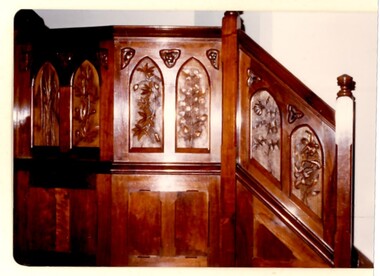 Surrey Hills Historical Society Collection
Photograph, John Kendrick Blogg carving, pulpit of St Stephen's Presbyterian Church, Surrey Hills
... In 1884 he established a successful industrial chemistry business, which included extracting perfume from Australian native trees and plants.liquid ammonia for refrigeration, acetic acid, perfumes, shoe polish, baking powder and non-alcoholic drinks. Other products were He lived at 'Balmoral' in Albany Crescent, Surrey Hills; his woodwork was produced here. ...In 1884 he established a successful industrial chemistry business, which included extracting perfume from Australian native trees and plants.liquid ammonia for refrigeration, acetic acid, perfumes, shoe polish, baking powder and non-alcoholic drinks. Other products were He lived at 'Balmoral' in Albany Crescent, Surrey Hills; his woodwork was produced here. ...John Kendrick Blogg was born in Canada and migrated to Victoria in 1877. In 1884 he established a successful industrial chemistry business, which included extracting perfume from Australian native trees and plants.liquid ammonia for refrigeration, acetic acid, perfumes, shoe polish, baking powder and non-alcoholic drinks. Other products were He lived at 'Balmoral' in Albany Crescent, Surrey Hills; his woodwork was produced here. Family oral history has that he took up woodcarving after his 1st wife, Annie, died in 1893. His earliest known piece is a music cabinet of 1901; the latest is a panel of 1932 when Blogg was 81 years of age. He was a member of the Victorian Artists Society and exhibited there between 1920 and 1924. Much of his work incorporates motifs of Australian flora, particularly gum leaves. John and his family were members of St Stephen's Presbyterian Church, Surrey Hills. The present church building was dedicated in December 1910 and J K Blogg's contribution to the new building was the Hogg Memorial pulpit which is comprised of 13 panels. Blogg carved more than 300 pieces for churches, schools, royalty, family and friends. Many of J K Blogg's pieces remain with family members, but he is represented in municipal (City of Whitehorse), state and national collections. In addition to work in the St Stephen's Presbyterian Church within the Surrey Hills area his work was produced for Surrey Hills Primary School, Surrey Hills Bowling Club and Surrey Hills Methodist Church, however perhaps his most famous local work is the honour board at the Shrine in the Surrey Gardens. Blogg was also a poet. Ref: Legacy in Sculptured Wood - An appreciation of the work of John Kendrick Blogg, 1851-1936 by Marjorie Morgan, 1993. Colour photo of the some of the 13 panels forming the pulpit at St Stephen's Presbyterian Church in Canterbury Road, Surrey Hills. st stephens presbyterian church, churches, hogg memorial pulpit, woodcarving, church furniture, john kendrick blogg, john blogg -
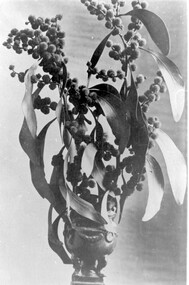 Surrey Hills Historical Society Collection
Photograph, Golden Wattle: Flower arrangement used for J K Blogg carving
... In 1884 he established a successful industrial chemistry business, which included extracting perfume from Australian native trees and plants.liquid ammonia for refrigeration, acetic acid, perfumes, shoe polish, baking powder and non-alcoholic drinks. Other products were He lived at 'Balmoral' in Albany Crescent, Surrey Hills; his woodwork was produced here. ...In 1884 he established a successful industrial chemistry business, which included extracting perfume from Australian native trees and plants.liquid ammonia for refrigeration, acetic acid, perfumes, shoe polish, baking powder and non-alcoholic drinks. Other products were He lived at 'Balmoral' in Albany Crescent, Surrey Hills; his woodwork was produced here. ...John Kendrick Blogg was born in Canada and migrated to Victoria in 1877. In 1884 he established a successful industrial chemistry business, which included extracting perfume from Australian native trees and plants.liquid ammonia for refrigeration, acetic acid, perfumes, shoe polish, baking powder and non-alcoholic drinks. Other products were He lived at 'Balmoral' in Albany Crescent, Surrey Hills; his woodwork was produced here. Family oral history has that he took up woodcarving after his 1st wife, Annie, died in 1893. His earliest known piece is a music cabinet of 1901; the latest is a panel of 1932 when Blogg was 81 years of age. He was a member of the Victorian Artists Society and exhibited there between 1920 and 1924. Much of his work incorporates motifs of Australian flora, particularly gum leaves. John and his family were members of St Stephen's Presbyterian Church, Surrey Hills. The present church building was dedicated in December 1910 and J K Blogg's contribution to the new building was the Hogg Memorial pulpit which is comprised of 13 panels. Blogg carved more than 300 pieces for churches, schools, royalty, family and friends. Many of J K Blogg's pieces remain with family members, but he is represented in municipal (City of Whitehorse), state and national collections. In addition to work in the St Stephen's Presbyterian Church within the Surrey Hills area his work was produced for Surrey Hills Primary School, Surrey Hills Bowling Club and Surrey Hills Methodist Church, however perhaps his most famous local work is the honour board at the Shrine in the Surrey Gardens. Blogg was also a poet. Ref: Legacy in Sculptured Wood - An appreciation of the work of John Kendrick Blogg, 1851-1936 by Marjorie Morgan, 1993. Black and white photo of an urn on a pedestal contianing stems of wattle with leaves and blooms. woodcarving, surrey hills shrine, monuments and memorials, john blogg, john kendrick blogg, r falconer -
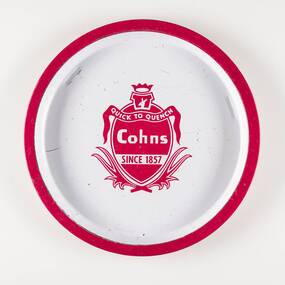 City of Greater Bendigo - Civic Collection
Functional object - Drinks Tray, Cohns
... Overtime the Cohn brothers expanded their operations adding cordials and in 1916 produced a non-alcoholic beer to satisfy the temperance activists. ...Overtime the Cohn brothers expanded their operations adding cordials and in 1916 produced a non-alcoholic beer to satisfy the temperance activists. ...Danish brothers, Moritz, Julius and Jacob Cohn arrived in Bendigo in 1853 and by 1856 started making cider and soft drinks, building a brewery 1880 to further extend their commercial enterprises and stock their hotels with their own brand of beer. Having sent Moritz's son, (also Julius) to Germany to learn to brew, the Cohn Brothers began to produce Excelsior Lager in 1882, which was traditionally served cold, the first time this had been done in Australia. Overtime the Cohn brothers expanded their operations adding cordials and in 1916 produced a non-alcoholic beer to satisfy the temperance activists. Originally named Tonic Ale but re-named 6 o’clock Lager after the temperance advocates succeeded in having pubs close at six o’clock. This drinks tray is just one example of branded bar items which would have been supplied to hotels who served Cohns beverage to further promote the company. Cohn Brothers built an empire of breweries, cordial factories, hotels and liquor stores and ice works. In 1925 they sold the hotels and breweries to Carlton & United but continued to make their other products until the 1970s when the company became part of the Coca Cola Amatil Group. Jacob Isaac Cohn was born in 1830 (died 1911) in Horsens Denmark and entered the Sandhurst Borough Council in 1863 where he served as a member for three years, returning again in 1887 to serve as Mayor of the City of Bendigo from 1888-1889. Jacob Cohn was a great supporter of the Mechanics Institute, the Hospital and the Benevolent Asylum. It is believed that through his connection with the Mechanics Institute he exhibited some loaned engravings from the Dresden Art Gallery which were then donated to the City of Bendigo, forming the nuclei of the Art Gallery's collection. Jacob Cohn held the position of President of the Art Gallery for 18 years. Circular metal drinks tray. White tray with red rim and red 'Cohns Since 1857' logo and 'Quick to Quench' slogan printed in centre. 'Quick to Quench' / Cohns / Since 1857 mayor jacob cohn, bendigo art gallery, bendigo masonic lodge, making a nation, city of bendigo commerce, cohns, cohn brothers -
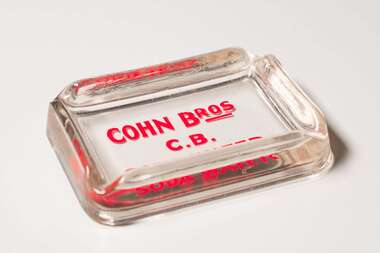 City of Greater Bendigo - Civic Collection
Functional object - Ashtray, Cohn Brothers, Cohns
... Overtime the Cohn brothers expanded their operations adding cordials and in 1916 produced a non-alcoholic beer to satisfy the temperance activists. ...Overtime the Cohn brothers expanded their operations adding cordials and in 1916 produced a non-alcoholic beer to satisfy the temperance activists. ...Danish brothers, Moritz, Julius and Jacob Cohn arrived in Bendigo in 1853 and by 1856 started making cider and soft drinks, building a brewery 1880 to further extend their commercial enterprises and stock their hotels with their own brand of beer. Having sent Moritz's son, (also Julius) to Germany to learn to brew, the Cohn Brothers began to produce Excelsior Lager in 1882, which was traditionally served cold, the first time this had been done in Australia. Overtime the Cohn brothers expanded their operations adding cordials and in 1916 produced a non-alcoholic beer to satisfy the temperance activists. Originally named Tonic Ale but re-named 6 o’clock Lager after the temperance advocates succeeded in having pubs close at six o’clock. This ashtray is just one example of branded bar items which would have been supplied to hotels who served Cohns beverage to further promote the company. Cohn Brothers built an empire of breweries, cordial factories, hotels and liquor stores and ice works. In 1925 they sold the hotels and breweries to Carlton & United but continued to make their other products until the 1970s when the company became part of the Coca Cola Amatil Group. Jacob Isaac Cohn was born in 1830 (died 1911) in Horsens Denmark and entered the Sandhurst Borough Council in 1863 where he served as a member for three years, returning again in 1887 to serve as Mayor of the City of Bendigo from 1888-1889. Jacob Cohn was a great supporter of the Mechanics Institute, the Hospital and the Benevolent Asylum. It is believed that through his connection with the Mechanics Institute he exhibited some loaned engravings from the Dresden Art Gallery which were then donated to the City of Bendigo, forming the nuclei of the Art Gallery's collection. Jacob Cohn held the position of President of the Art Gallery for 18 years. Glass rectangle ashtray with shaped corners for resting cigarettes. Text printed in reverse in red ink on bottom of ashtray. Cohn Bros / C.B. / Soda Water mayor jacob cohn, bendigo art gallery, bendigo masonic lodge, making a nation, city of bendigo commerce, cohn brothers, cohns -
 City of Greater Bendigo - Civic Collection
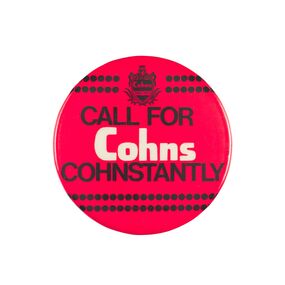
Badge, Cohn Brothers, Cohns
... Overtime the Cohn brothers expanded their operations adding cordials and in 1916 produced a non-alcoholic beer to satisfy the temperance activists. ...Overtime the Cohn brothers expanded their operations adding cordials and in 1916 produced a non-alcoholic beer to satisfy the temperance activists. ...Danish brothers, Moritz, Julius and Jacob Cohn arrived in Bendigo in 1853 and by 1856 started making cider and soft drinks, building a brewery 1880 to further extend their commercial enterprises and stock their hotels with their own brand of beer. Having sent Moritz's son, (also Julius) to Germany to learn to brew, the Cohn Brothers began to produce Excelsior Lager in 1882, which was traditionally served cold, the first time this had been done in Australia. Overtime the Cohn brothers expanded their operations adding cordials and in 1916 produced a non-alcoholic beer to satisfy the temperance activists. Originally named Tonic Ale but re-named 6 o’clock Lager after the temperance advocates succeeded in having pubs close at six o’clock. This badge is just one example of branded items which would have been used to further promote the company. Cohn Brothers built an empire of breweries, cordial factories, hotels and liquor stores and ice works. In 1925 they sold the hotels and breweries to Carlton & United but continued to make their other products until the 1970s when the company became part of the Coca Cola Amatil Group. Jacob Isaac Cohn was born in 1830 (died 1911) in Horsens Denmark and entered the Sandhurst Borough Council in 1863 where he served as a member for three years, returning again in 1887 to serve as Mayor of the City of Bendigo from 1888-1889. Jacob Cohn was a great supporter of the Mechanics Institute, the Hospital and the Benevolent Asylum. It is believed that through his connection with the Mechanics Institute he exhibited some loaned engravings from the Dresden Art Gallery which were then donated to the City of Bendigo, forming the nuclei of the Art Gallery's collection. Jacob Cohn held the position of President of the Art Gallery for 18 years. Large metal badge Call for / Cohn / Cohnstantly mayor jacob cohn, making a nation, city of bendigo commerce, cohn brothers, cohns -
 City of Greater Bendigo - Civic Collection
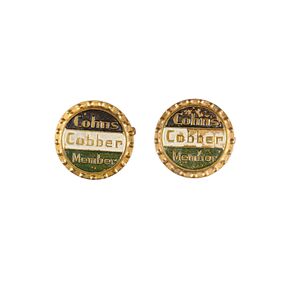
Badge - Member Pins, Cohn Brothers, Cohns
... Overtime the Cohn brothers expanded their operations adding cordials and in 1916 produced a non-alcoholic beer to satisfy the temperance activists. ...Overtime the Cohn brothers expanded their operations adding cordials and in 1916 produced a non-alcoholic beer to satisfy the temperance activists. ...Danish brothers, Moritz, Julius and Jacob Cohn arrived in Bendigo in 1853 and by 1856 started making cider and soft drinks, building a brewery 1880 to further extend their commercial enterprises and stock their hotels with their own brand of beer. Having sent Moritz's son, (also Julius) to Germany to learn to brew, the Cohn Brothers began to produce Excelsior Lager in 1882, which was traditionally served cold, the first time this had been done in Australia. Overtime the Cohn brothers expanded their operations adding cordials and in 1916 produced a non-alcoholic beer to satisfy the temperance activists. Cohn Brothers built an empire of breweries, cordial factories, hotels and liquor stores and ice works. In 1925 they sold the hotels and breweries to Carlton & United but continued to make their other products until the 1970s when the company became part of the Coca Cola Amatil Group. These Cohn's Cobber Member pins relate to the Cohn's Cobbers TV Club which was sponsored by Cohn's Soft drinks. The Cobbers TV Club was an afternoon children's variety program modelled on the Tarax Show. When local TV station BCV8 opened in Bendigo they broadcast Cobber’s teleclub in their afternoon timeslot for young viewers. Jacob Isaac Cohn was born in 1830 (died 1911) in Horsens Denmark and entered the Sandhurst Borough Council in 1863 where he served as a member for three years, returning again in 1887 to serve as Mayor of the City of Bendigo from 1888-1889. Jacob Cohn was a great supporter of the Mechanics Institute, the Hospital and the Benevolent Asylum. It is believed that through his connection with the Mechanics Institute he exhibited some loaned engravings from the Dresden Art Gallery which were then donated to the City of Bendigo, forming the nuclei of the Art Gallery's collection. Jacob Cohn held the position of President of the Art Gallery for 18 years. Two small multi coloured member pins. Gold coloured metal and fastening pin on back. Brown, white and green inner sections with gold text on front. Cohns / Cobber / Member mayor jacob cohn, city of bendigo commerce, cohn brothers, cohns -
 City of Greater Bendigo - Civic Collection
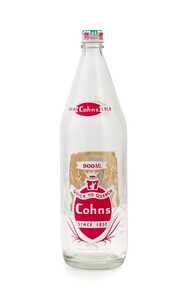
Domestic object - Soft drink bottle, Cohns
... Overtime the Cohn brothers expanded their operations adding cordials and in 1916 produced a non-alcoholic beer to satisfy the temperance activists. ...Overtime the Cohn brothers expanded their operations adding cordials and in 1916 produced a non-alcoholic beer to satisfy the temperance activists. ...Danish brothers, Moritz, Julius and Jacob Cohn arrived in Bendigo in 1853 and by 1856 started making cider and soft drinks, building a brewery 1880 to further extend their commercial enterprises and stock their hotels with their own brand of beer. Having sent Moritz's son, (also Julius) to Germany to learn to brew, the Cohn Brothers began to produce Excelsior Lager in 1882, which was traditionally served cold, the first time this had been done in Australia. Overtime the Cohn brothers expanded their operations adding cordials and in 1916 produced a non-alcoholic beer to satisfy the temperance activists. Originally named Tonic Ale but re-named 6 o’clock Lager after the temperance advocates succeeded in having pubs close at six o’clock. This drinks tray is just one example of branded bar items which would have been supplied to hotels who served Cohns beverage to further promote the company. Cohn Brothers built an empire of breweries, cordial factories, hotels and liquor stores and ice works. In 1925 they sold the hotels and breweries to Carlton & United but continued to make their other products until the 1970s when the company became part of the Coca Cola Amatil Group. Jacob Isaac Cohn was born in 1830 (died 1911) in Horsens Denmark and entered the Sandhurst Borough Council in 1863 where he served as a member for three years, returning again in 1887 to serve as Mayor of the City of Bendigo from 1888-1889. Jacob Cohn was a great supporter of the Mechanics Institute, the Hospital and the Benevolent Asylum. It is believed that through his connection with the Mechanics Institute he exhibited some loaned engravings from the Dresden Art Gallery which were then donated to the City of Bendigo, forming the nuclei of the Art Gallery's collection. Jacob Cohn held the position of President of the Art Gallery for 18 years. Clear glass bottle with iconic red and white Cohns label printed on front and back. Bottle has been rebranded and had an extra label stuck to one side for Z Cal Low Calorie Orange beverage. Screw cap is also related to Z Cal Orange drink. 'Quick to Quench' / Cohns / Since 1857 Cohns / Z-Cal / Low Calorie / Orange mayor jacob cohn, bendigo art gallery, bendigo masonic lodge, making a nation, city of bendigo commerce, cohns, cohn brothers -
 City of Greater Bendigo - Civic Collection
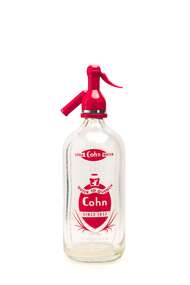
Domestic object - Soda Syphon, Cohns
... Overtime the Cohn brothers expanded their operations adding cordials and in 1916 produced a non-alcoholic beer to satisfy the temperance activists. ...Overtime the Cohn brothers expanded their operations adding cordials and in 1916 produced a non-alcoholic beer to satisfy the temperance activists. ...Danish brothers, Moritz, Julius and Jacob Cohn arrived in Bendigo in 1853 and by 1856 started making cider and soft drinks, building a brewery 1880 to further extend their commercial enterprises and stock their hotels with their own brand of beer. Having sent Moritz's son, (also Julius) to Germany to learn to brew, the Cohn Brothers began to produce Excelsior Lager in 1882, which was traditionally served cold, the first time this had been done in Australia. Overtime the Cohn brothers expanded their operations adding cordials and in 1916 produced a non-alcoholic beer to satisfy the temperance activists. Originally named Tonic Ale but re-named 6 o’clock Lager after the temperance advocates succeeded in having pubs close at six o’clock. This drinks tray is just one example of branded bar items which would have been supplied to hotels who served Cohns beverage to further promote the company. Cohn Brothers built an empire of breweries, cordial factories, hotels and liquor stores and ice works. In 1925 they sold the hotels and breweries to Carlton & United but continued to make their other products until the 1970s when the company became part of the Coca Cola Amatil Group. Jacob Isaac Cohn was born in 1830 (died 1911) in Horsens Denmark and entered the Sandhurst Borough Council in 1863 where he served as a member for three years, returning again in 1887 to serve as Mayor of the City of Bendigo from 1888-1889. Jacob Cohn was a great supporter of the Mechanics Institute, the Hospital and the Benevolent Asylum. It is believed that through his connection with the Mechanics Institute he exhibited some loaned engravings from the Dresden Art Gallery which were then donated to the City of Bendigo, forming the nuclei of the Art Gallery's collection. Jacob Cohn held the position of President of the Art Gallery for 18 years. Clear glass bottle with iconic red and white Cohns label printed on front and back. Bottle has been rebranded and had an extra label stuck to one side for Z Cal Low Calorie Orange beverage. Screw cap is also related to Z Cal Orange drink. 'Quick to Quench' / Cohns / Since 1857 Cohns / Z-Cal / Low Calorie / Orange mayor jacob cohn, bendigo art gallery, bendigo masonic lodge, making a nation, city of bendigo commerce, cohns, cohn brothers -
 Surrey Hills Historical Society Collection
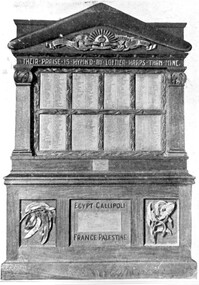
Photograph, John Kendrick Blogg, John Kendrick Blogg carving, Soldiers' Honour Board, Shrine in the Surrey Gardens
... In 1884 he established a successful industrial chemistry business, which included extracting perfume from Australian native trees and plants.liquid ammonia for refrigeration, acetic acid, perfumes, shoe polish, baking powder and non-alcoholic drinks. Other products were He lived at 'Balmoral' in Albany Crescent, Surrey Hills; his woodwork was produced here. ...In 1884 he established a successful industrial chemistry business, which included extracting perfume from Australian native trees and plants.liquid ammonia for refrigeration, acetic acid, perfumes, shoe polish, baking powder and non-alcoholic drinks. Other products were He lived at 'Balmoral' in Albany Crescent, Surrey Hills; his woodwork was produced here. ...John Kendrick Blogg was born in Canada and migrated to Victoria in 1877. In 1884 he established a successful industrial chemistry business, which included extracting perfume from Australian native trees and plants.liquid ammonia for refrigeration, acetic acid, perfumes, shoe polish, baking powder and non-alcoholic drinks. Other products were He lived at 'Balmoral' in Albany Crescent, Surrey Hills; his woodwork was produced here. Family oral history has that he took up woodcarving after his 1st wife, Annie, died in 1893. His earliest known piece is a music cabinet of 1901; the latest is a panel of 1932 when Blogg was 81 years of age. He was a member of the Victorian Artists Society and exhibited there between 1920 and 1924. Much of his work incorporates motifs of Australian flora, particularly gum leaves. John and his family were members of St Stephen's Presbyterian Church, Surrey Hills. The present church building was dedicated in December 1910 and J K Blogg's contribution to the new building was the Hogg Memorial pulpit which is comprised of 13 panels. Blogg carved more than 300 pieces for churches, schools, royalty, family and friends. Many of J K Blogg's pieces remain with family members, but he is represented in municipal (City of Whitehorse), state and national collections. In addition to work in the St Stephen's Presbyterian Church within the Surrey Hills area his work was produced for Surrey Hills Primary School, Surrey Hills Bowling Club and Surrey Hills Methodist Church, however perhaps his most famous local work is the honour board at the Shrine in the Surrey Gardens. Blogg was also a poet. Ref: Legacy in Sculptured Wood - An appreciation of the work of John Kendrick Blogg, 1851-1936 by Marjorie Morgan, 1993. The images derives from an early brochure. The number of panels has been increased having been updated on at least 2 occasions. Whereas the date 1914 is at one end of the boomerang, the other end is not dated reflecting that the dedication of The Shrine before the war ended. Black and white photo of the Soldiers' Memorial Honour Board housed in The Shrine in the Surrey Gardens. The wooden part of the board was carved by John Kendrick Blogg. A large boomerang forms part of the apex underneath which is an emblem with the rising sun. Under this are 8 panels on which are the names of service personnel. The supporting timber is carved with designs including varied flora. At the base are 2 larger carved panels; on the LHS a sprig of eucalyptus leaves and on the RHS a sprig of wattle. surrey gardens, world war, 1914-1918, woodcarving, monuments and memorials, surrey shrine, john blogg, john kendrick blogg -
 Bendigo Historical Society Inc.
Document - ROYAL PRINCESS THEATRE COLLECTION: PROGRAM OF COMING EVENTS, 1916
... Half & Half (Registered) Non-Alcoholic and Invigorating. Manufactured by C J Glover, Ph 343, Chapel Street, Bendigo. ...Half & Half (Registered) Non-Alcoholic and Invigorating. Manufactured by C J Glover, Ph 343, Chapel Street, Bendigo. ...Princess Theatre Bendigo - Program of coming events in c1917. Coming Events: Gonsalez, Italian Grand Opera Company, commencing Monday May 7, for 3 nights' season. The Brilliant and Incomparable Gonzalez, Italian Grand Opera Company. Opening Production_Verdi's Immortal Masterpiece Il Trovatore. Page 3. Monday, May 7, 1917. Il Trovatore. Opera in 4 acts. Music by G Verdi. Cast of Characters: Signorinas: De Revers, Russ, Capelli. Signors: Scamuzzi, Cacialli. Chorus of voices. Overture at 8pm sharp. Director of Orchestra: Giovanni Gonsalez. Leader of Orchestra: Mr S de Tarczynski. Cello Soloist: Mr Laurie Kennedy. Page 9 Farewell Night. Wednesday, May 9, 1917 Faust, Opera in 5 acts. Music by Gounod. Cast of Characters: Signors Balboni, Cacialli, Filippini, Cesaroni. Signorinas: Visoni, Russ, Piccolo. Overture at 7.45pm sharp. Director of Orchestra: Giovanni Gonsalez. Leader of Orchestra: Mr S de Tarczynski. Cello: Mr Laurie Kennedy. Cast members: Signors Balboni, Cacialli, Filippini and Cesaroni. Signorinas: Visoni, Russ and Piccolo. Director of Orchestra: Giovanni Gonzalez. Leader of Orchestra: Mr S de Tarczynski. Cello Soloist: Mr Laurie Kennedy. Page 11, Repertoire of Operas to be produced by the Gonsalez Opera Company to Wednesday, May 9. Monday, May 7, at 8pm. Cavalleia Rusticana, I Pagliacci. Wednesday, May 9 at 7.45pm. Faust. Between the acts. The story of 'Cavalleria Rusticana' is based on truth and reality alone. It is built up on the fact Turridu, a young peasant, has loved and wooed Lola before . . . . . . Of all the many successful productions in which Mme. Petrova, the celebrated Metro star, appeared, 'The Black Butterfly,' in which she appears in this Theatre, on Thursday, Friday and Saturday, next, is considered her greatest, In 'The Black Butterfly . . . The story of 'Rigoletto' is taken from Victor Hugo's drama 'Le roi S'amuse.' In it the Duke of Mantua a wild and unprincipled youth makes love to every . . . Programme Compiled. Wholly Set Up and Printed by The Cambridge Press, Phone 130. Market Sq., Bendigo. Many ads appear throughout the brochure: Allan's, 253 Mitchell Street Bendigo. Ph 244. W Brown, 171 Mitchell Street, 'Centerway' 105 View Street, Bendigo's Leading Pastrycook & Caterer. Hume & Iser: English and Canadian wallpapers. Timber Merchants & Iron Mongers, full range of stoves, Mantlepieces, grates, tiles, bath-heaters, bathroomware, Berger's Paints. Phones: Yard 48, Showroom 470. Cambridge Press: For artistic programmes, menus, concert tickets, At-Home Cards, and Commercial Printing. Ph 130. Delves' Café, Dainty Service. 'Class' Suppers at moderate Cost. Ph 805. Next to Royal Bank (above Hampton's). Bendigo Business College: Evening Commercial Classes, book-keeping, typewriting, shorthand. Applications to James E Holland, F.P.S.A. Pianoforte & Organ Tuning. A B Challen, Qualified Tuner Ph 319, 42 Rowan St., Bendigo. Chatfield Bros. The Motor Experts, High Street, Bendigo. Ph 609. Car repairs, New cars, hire cars, something for your car. Service Station for Ford car parts, Dunlop & Goodyear tyres. Accessories of all kinds stocked. Oxy Acetylene welding of all metals. Bartlett Bros. Photographers. Bartlett Bros' Studios, (R W Bugg, Proprietor) Williamson St, (opp Hotel Shamrock). Half & Half (Registered) Non-Alcoholic and Invigorating. Manufactured by C J Glover, Ph 343, Chapel Street, Bendigo. R D Ellis, Ladies & Gents Tailor, 241 Mitchell Street, (opposite Morley Johnson's). Nursery (Rose) at Epsom, Stock to be Sold at Half Usual Price. Mr S H Hunt, who has 33 prizes & championships, has accepted a position with Brunning's of Bendigo and has sold the of his 10,000 Roses to them. There are . . . Baker & Woods, 313 Hargreaves St, Ph 209. Electric light installed in your home. 'THE BEEHIVE' Bendigo's Famous Store. Blouses of Beauty, Coats of Comfort, Costumes of Character, Dresses of Delight, Skirts of Style, Millinery of Merit are Permantant Features of Bendigo's Famous Store 'The Beehive'. Best by Test, Leggos of Bendigo 'Progress' Tomato Sauce on the table, wether at home or in the restaurant, there should always be Leggos of Bendigo 'Progress' Tomato Sauce. It's the kind of Sauce you enjoy to the last-no bitting acidity-but a Delicious and Delicate Flavor combined with a Smoothness always agreeable to the palate,. Leggo's 'Progress' Sauce is the result of the . . . H M Leggo& Co Manufacturers, Bendigo. Est. 1881. The Cambridge Press, Market Sq. Bendigo Ph 130 program, theatre, princess theatre bendigo -
 City of Melbourne Libraries
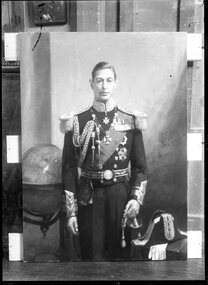
Photograph, Bull, Hugh Jones, 1897-1993, "A Royal Portrait" (Duke of York), 1933
... They toasted the King with non-alcoholic fruit punch as the Federal Capital Territory (later ACT) was a “dry” area and no speeches were made. ...They toasted the King with non-alcoholic fruit punch as the Federal Capital Territory (later ACT) was a “dry” area and no speeches were made. ...Published: The Age, Sat 14 October 1933 Published title: A Royal Portrait Published caption: "Seen at his studio, Alphington, Mr. W. B. Mclnnes's portrait of the Duke of York, which he painted recently on commission from the trustees of the Castlemaine Gallery, at St. John’s Wood, London, impresses as a vital record of one whose natural habitat is a palace, and whose place in life is one of near relationship to the throne of England. The Duke is painted in the uniform of the admiral of the fleet, a highly ornate vesture entailing much elaboration of gold and numerous medals, in dealing with which the artist has not failed to centre his attention on the head, and has succeeded in producing what is undoubtedly a soundly painted portrait and a good likeness. During the five fittings Mr. Mclnnes, apart from the ordinary social amenities, found his Royal sitter little inclined to talk, though he spoke feelingly of his trip to Australia and the pleasure it had given him: but with the Duchess the tendency to be sociable was much more clearly pronounced. She took, and expressed, a keen interest in the social and political matters of the day with a special concern for the supremacy of England and Australia in all questions relating to sport, such as cricket, tennis and golf. She spoke well of her portrait painted by Quinn, and regretted that she would not see the two hung side by side at the Castlemaine Gallery." Description: An unframed painting of a standing, middle-aged man dressed in the uniform of a Royal Navy admiral of the Fleet with medals, sash, ornate belt, cuffs and epaulettes. His left hand rests on the handle of a sword in its scabbard and his bicorn hat and white gloves are on a table beside him. To his right is a globe of the world showing Australia. Research by project volunteer, Fiona Collyer: In 1933, Castlemaine Art Gallery trustees commissioned artist W.B. McInnes (1889-1939) to paint a portrait of Prince Albert, Duke of York as a companion piece to the portrait of his wife, the Duchess of York, that the gallery had commissioned Australian official war artist James Quinn (1869-1951) to paint in 1930. During the First World War, the Duchess’s childhood home, Glamis Castle in Scotland was used as a makeshift military hospital and convalescence home for wounded soldiers. Many servicemen from the Castlemaine area recuperated there and had fond memories of the kindness of the teenage Lady Elizabeth Bowes-Lyon (1900-2002, later Duchess of York) who spent the war years running errands and aiding in the welfare and morale of the patients. In 1927, the Duke and Duchess of York (later King George VI and Queen Elizabeth) came to Australia to formally open the newly built Parliament House in Canberra and to tour the country. While visiting Victoria in April, they embarked on a whistle-stop train journey to Bendigo, stopping at Kyneton for ten minutes and Castlemaine for 15 minutes. At Kyneton, an excited crowd of 10,000 people welcomed the couple with “three cheers and three cheers for Baby Betty” before the Duchess was presented with a bouquet of locally grown roses and the Duke a bound album of photographs of noted beauty spots of the district. Next the Royal Couple stopped at Castlemaine to the cheers of 15,000 people. There the couple were presented with a basket of prime quality Harcourt apples and a pair of cot blankets, manufactured at Castlemaine Woollen Mills, a birthday gift for baby Princess Betty. The Duchess recognised Colonel W.E. James, of the Seventh Battalion, who had convalesced at Glamis Castle in 1917, and they chatted before the train departed, while the Duke shook hands with returned soldiers. Last stop was the town of Bendigo which was colourfully decorated with bunting and flags, arches and flowers. 3000 pigeons were released on their arrival and the liberated birds circled overhead for several minutes as if to welcome the Royal Couple. A crowd of 50,000 cheering people lined the streets in bright sunshine as the couple drove by. From an arch over Hargreaves Street, pretty girls showered the pair with rose petals. The Duke was presented with a gold nugget and an album, handsomely bound in morocco, of a history of the Bendigo mining industry, while the Duchess received a bouquet of prize winning white chrysanthemums. After 75 minutes in Bendigo they journeyed back to Melbourne for a State reception. While the couple were in Melbourne, the Duke often played lawn tennis at the Government House courts with three times Grand Slam champion Norman Brookes, who declared that while he considered the Duke a second class player whose serve lacked sting, he had a fine backhand and with time and practice he could become a first class player. The federal Parliament had previously been situated in Melbourne, but Canberra was chosen as the location for Australia’s capital as a compromise between fierce rival states, Victoria and NSW. It is written in the Constitution that the federal capital would be in “the State of NSW... distant not less than one hundred miles from Sydney.” The word Canberra is thought to derive from the local Ngunnawal word “Kanbarra” meaning “meeting place”. The Provisional Parliament House was a large, white, three storey building facetiously dubbed “The Wedding Cake”, plonked down in a bare, former sheep paddock. It was decorated for the event with Union Jacks and Australian red ensign flags. On 9 May, the day of the opening, the expectant crowd assembled in front of the building. Only two of the spectators were Aboriginal. One was Jimmy Clements (1847-1927, aka Nangar or Yangar, but popularly known as “King Billy”), accompanied by his three dogs. (The title “King” or “Queen” was often given by white settlers to Aborigines who were seen as allies and could maintain good relations between First Nations groups and the colonists. Some were given inscribed brass breastplates or gorgets to wear.) Jimmy was an excellent horse breaker and expert tracker for the police. He was also the nephew of “Queen” Nellie Hamilton (1842-1897) of the Canberra-Queanbeyan region, home of the Ngambri and Ngunnawal people. Nellie was the oldest surviving full-blooded Aboriginal woman in the district. The other was George John Noble (1840s-1928, aka Ooloogan, also “Marvellous” due to his regular use of the word). Both were initiated Wiradjuri walamira elders: “clever men” believed to have the ability to heal physical and spiritual ailments. They were also travelling showmen, skilled at boomerang and spear throwing and often performed at country agricultural shows and football matches. They had walked barefoot for three days from the Brungle Mission, near Gundagai. 11 May 1927, The Argus reported that “King Billy... claims sovereign rights to the Federal Territory” which the National Archives of Australia describes as “possibly the first recorded instance of Aboriginal protest at Parliament House in Canberra.” 10 May 1927, The Argus reported on Jimmy Clements: “During the wait great interest was taken in the appearance near the east stand of an aborigine, a member of the Gundagai tribe, and a well known character in the district. He was very old and grey and ruggedly picturesque. He was determined to go his own way in spite of the arguments of two inspectors and one sergeant of police. Immediately and instinctively the crowd in the stands rallied to his side. There were choruses of advice and encouragement for him to do as he pleased. A well-known clergyman stood up and called out that the aborigine had a better right than any man present to a place on the steps of the House of Parliament and in the Senate during the ceremony. The old man’s persistence and the sympathy of the crowd won him an excellent position and also a shower of small change that must have amounted to 30/ or 40/ [shillings].” At 10.30 am, Australia’s eighth Prime Minister, Mr Stanley Bruce (1923-1929) welcomed the Royal couple onto the crimson carpeted portico. Unfortunately, Dame Nellie Melba’s rendition of “God Save the King” and the greater part of the Duke’s reply was drowned out by the roar of squadrons of aeroplanes circling overhead. A brief religious service followed, conducted by leaders of the Methodist, Presbyterian and Anglican churches. Interestingly, there was no Roman Catholic representation at the ceremony even though around one quarter of Australians were Catholic at the time. The Duke unlocked the front doors with a golden key, then unveiled a statue of his father King George V by sculptor Sir Bertram Mackennal in the King’s Hall. Then the official party, Senators, members of the House of Representatives and invited guests entered the Senate chamber where the Duke read a message from the King, establishing Canberra as the seat of the Federal Government, watched on by Australia’s elite. The conclusion of the ceremony was announced by a gay fanfare of trumpets from the entrance of Parliament House and a 21 gun salute and answered by cheers from the crowd. The dignitaries then feasted on a luncheon of turtle soup, poached schnapper, fillets of beef, roast chicken and ham, straw potatoes, green peas, Canberra Pudding (a pudding made with dripping, dried fruit and jam), fruit, ices, coffee and cheese. They toasted the King with non-alcoholic fruit punch as the Federal Capital Territory (later ACT) was a “dry” area and no speeches were made. The diary entry that day of Ethel Baird, Lady Stonehaven, the wife of the Governor-General, is brief and to the point: “To P.H. & waited for Yorks. Ceremony went off without a hitch. Ghastly Banquet Lunch.” Later that day, the Duke mounted a coal black mare, police horse Number 303 which had been hastily re-named “Black Bess” for the occasion, to receive the final salute from the assembled troops and returned soldiers dressed in mufti. The RAAF squadron were flying overhead in “V” formations when suddenly, one of the planes, piloted by Flying Officer Francis Charles Ewen, left the formation, nose-diving 900 metres from Parliament House and landing behind the Y.W.C.A. refreshment marquee. Francis, aged only 28, tragically died of his wounds later that day. The Federal Capital Commission contracted Sargent’s Pies of Sydney to supply 5000 meals for the event. They supplied pies, sausage rolls, scones and sandwiches with the agreed price of 3 shillings a head. Only 1200 meals were served and the uneaten remainder dumped, with the Commission bearing the cost of the unsold food. An estimated crowd of 20,000 attended the opening, far fewer than the expected 100,000. Many visitors travelled long distances, bringing their own hampers of food and camping in tents as there was very limited accommodation available. Thousands of people around Australia listened to the ceremony broadcast on the wireless, with receiving sets installed in schools, public halls and workplaces and it was also filmed for posterity. The next morning, the Royal couple, along with Prime Minister Bruce and Mrs Bruce held an informal public reception on the steps of Parliament House where early settlers, residents and visitors to Canberra filed past them. The Press widely reported Jimmy Clements’ encounter with the Duke and Duchess. The Sun-Pictorial reported 11 May 1927: "MET THE DUKE. ABORIGINE KING HE APPROVED Sugarbag: Sports Suit. John Clements, otherwise King Billy, a full blooded aborigine king, aged 86, was among the 2000 who filed past the Duke and the Duchess at the public reception at Canberra to day. “How you likem Duke and Duchess Billy?” he was asked afterwards. “I think they are both very nice.” he replied in good English. King Billy was a very bedraggled figure, with tangled locks and a beard which almost hid his wrinkled and black face. He wore an old sports suit and carried a sugarbag. Passing the Duke and Duchess he turned full towards them. The crowd cheered, and the Duke and Duchess smiled. The Duke was particularly amused.” The Canberra Times reported 13 May 1927: "A REAL AUSTRALIAN. A quaint but pathetic figure stood in broad relief in the queue of ranks at the reception. Where his dusky forbears have gathered in native ceremonial for centuries past, a lone representative of a fast vanishing race saluted visiting Royalty. Despite the grotesque garb and untamed mane the aborigine comported himself not without dignity. With his three faithful dogs, he made an immediate target for a battery of cameras.” "The Argus reported 11 May 1927: "...an ancient aborigine who calls himself King Billy and who claims sovereign rights to the federal Territory walked slowly forward alone and saluted the Duke and Duchess. They cheerily acknowledged his greeting. The old aborigine, with his long, matted beard and nondescript clothing, is a popular identity of Canberra, and must be one of the most extraordinary figures who has received a Royal salute.” The Sun (Sydney) reported 10 May 1927: “Suddenly, in the midst of the forest of green and white colored hats of women, appeared a head with a shaggy leonine mane and a patriarchal beard. Jacky, the aboriginal, an identity of the district, who is also known as the King of Canberra, had arrived to testify to his loyalty. He saluted the Duke with an excellent dash, and shambled past with his faithful sheep dog aide-de-camp at his heels. The Duke and Duchess were highly amused at this quaint figure moving along with a sort of bodyguard of shrieking young boys and girls.” The Sydney Morning Herald 11 May 1927 mistook Jimmy for his friend “Marvellous”: “...the appearance of an aged aboriginal widely known in the district as “Marvellous, the uncrowned king of Queanbeyan." His beaming black countenance was almost hidden beneath a shock of hair and beard. Bare-footed and carrying a sugar bag in one hand and a tiny Australian flag in the other, he at first mistook a policeman at the foot of the steps for the Duke. To his great embarrassment and to the vast amusement of the onlookers, the policeman became the object of a hearty salutation. However, "Marvellous" was quickly shepherded back to a position in the procession and as he passed along brought his hand up to an approved military salute for the benefit of their Royal Highnesses. The Duke returned it with a special wave.” The Labor Daily 11 May 1927 irreverently reported on the scene: "People March Past. Some 400 people, old identities of Canberra marched past. They were mostly aged ladies with memories faithfully preserving the traditions of other days and curtsied reverently. The younger generations, who speedily joined the procession, behaved differently however. Surely it was the most motley collection that ever passed before Royalty. Men without collars jostled others well dressed. Fat women, young women, children of all heights and ages were there. The oldest inhabitants, in the persons of the abo, "Marbly", and his companion were present. The poor old fellows evidently were keen to get closer to the Duke than the procession dared go, but they were overawed by the stern glances of military men.” The Canberra Times reported 13 May 1927: "...and towards the end of the procession, a full-blooded aboriginal, bareheaded and barefooted, and carrying an old swag on his back, made a picturesque figure as he several times saluted the Royal couple, his old eyes beaming inexpressible delight.” The Register reported 11 May 1927: "PUBLIC MARCH PAST. Old “Jacky”, an aboriginal identity of the district, who has been following the proceedings of the various ceremonies with apparently great interest, appeared in the march past. He halted in front of the steps and raised his hand to his shaggy grey locks in an attempt at a salute. Smiling, the Duke returned the salute, and the Duchess bestowed a charming smile on the figure of mingled pathos and comedy.” Tweed Daily reported 12 May 1927: “King Billy” WAS THERE. Appropriately enough, the inevitable “King Billy” with his refreshing impression of possum and gum-leaves, was present at the dedication of the Federal capital at Canberra. Bare-footed, in a dingy old suit and battered felt hat, he wandered on to the empty stand after the illustrious assemblage had passed into Parliament House. A desolate figure in all that he stood for, he proved, an amiable representative of the dispossessed race. He cheerfully waved a Union Jack for the camera man, and grinned into the very eye of a movie man’s camera without flinching.” Footage of Jimmy filmed that day features in the film “The Birth Of White Australia” produced in 1928 and shows him enthusiastically waving a small Union Jack flag in front of Parliament House with his three dogs at his feet. The caption reads " "King Billy" calls for cheers for the son of the great white King across the seas. “Mine tinkit that pfellers father budgeree King liket me” supposedly says Jimmy." Jimmy told the Daily Telegraph, 13 May 1927 “I have opened your Parliament House on my own ground, now you can go and look at it." Jimmy died on 28 August 1927, aged 80. The Herald newspaper on 30 August 1927, published an illustration depicting Jimmy’s dog standing on his grave, his customary chimney pot hat leaning on his headstone. The caption reads: “The Dead King — His Only Mourner. Drawn by Will Dyson (King Billy, last of the Canberra aborigines, lived just long enough to see the Duke of York open Australia’s capital on the site where his tribe once roamed. He died in the Queanbeyan Hospital yesterday morning.)” A letter published in the Sydney Morning Herald, 19 September 1927 reported: "Old King Billy... Sir, ...I would like to mention... the passing away of one, if not the last remaining aboriginal chieftains. He may be called “Old King Billy,” and his death occurred here in Queanbeyan a few weeks ago. The removal of this well-known black has left another big gap in all that remains distinctively Australian in character. He was one of the last remaining tribe of the Monaro district, and one of the most predominant personalities throughout the Commonwealth. ...he had lived through 80 years all told. He was on many occasions sought by artists for his splendid physique and personality as a model, and many a journey he has had to make to Sydney on that account. A more striking and pronounced type could not be found. ...A very fine cast in lifelike form is to be seen in the Australian Museum, Sydney ...his last important appearance in public was at the Commonwealth celebrations at Canberra, to which territory he partly belonged. ...we have no aborigine statue chiselled to the memory of their race, a more fitting and lasting memorial could not be undertaken than to have one modelled from this fine figure and erected to the memory of his race at Canberra... It would be a fitting adornment if planted with the Australian gumtrees for any avenue or garden. [King Billy] ...a very intelligent fellow, responding readily to kindness and common sense. Hoping yet to see a befitting testimonial and a lasting memorial to a race that is rapidly and I may say, unfortunately, disappearing, I am etc., SYDNEY R.OAKLEY, Queanbeyan." The “lifelike form” referred to by the correspondent was a sculpture that Jimmy Clements had posed for: “The Wunderlich Aboriginal Group” for The Australian Museum in Sydney. In 1925, Mr Ernest Wunderlich, director of Wunderlich Limited, manufacturer of building materials and President of the Board of Trustees at The Australian Museum, commissioned renowned sculptor George Rayner Hoff (sculptor of the Anzac Memorial in Hyde Park, Sydney, National War Memorial in Adelaide, and “Lion” the original Holden Motor Company car emblem) to sculpt a life sized Aboriginal family group diorama as a gift to the Museum. There was much concern at this time that the Aboriginal population and especially the “full blooded” were fading into oblivion so fast that they may soon become extinct. Three “full blooded” Aborigines were chosen for models. An article in The Australian Museum magazine, July/September 1926 about The Wunderlich Aboriginal Group explained “...it will not be many years before the aborigine, in New South Wales and Victoria at least, will be an entity of the past. Every year sees a shrinkage in their number, and the coastal tribes that once roamed the Sydney district are, unfortunately, no longer with us. ...the man, who is hurling a boomerang, is Yangar, or “Jimmy Clements,” son of Gayan-Bleuet-Galoom, the late “King of Orange,” western New South Wales. “Jimmy” is an old man, but well preserved. He has a very retentive memory and recollects the various tribal customs and initiation ceremonies, but regarding these he is extremely reticent and will not communicate his “honoured secrets.” The female figure is “Nellie Walker,” a daughter of Geri-Bungel, and a native of Bombala, Monaro district, southern New South Wales. The boy is Harold Marsh, aged nine years, who was born at Kinchela, Macleay River, northern New South Wales. He is now living at the Brewarrina settlement... In the selection of aborigines great care had to be taken to ensure that the individuals were pure bloods, and to the Aborigines’ Protection Board and the Police Department of this State thanks are due for the valuable assistance rendered by them.” Ngarigo woman, Nellie Bungil Walker (1867-1932) had five children, two died as babies and her remaining children were taken from her. She worked as a domestic and was living at La Perouse Aboriginal Community, Sydney at the time of her sculpture’s creation. In the years after the sculpture was made, Nellie and Rayner remained friends. Yaegl boy Harold “Harry” Marsh was from the Kinchela Aboriginal Training Home for boys near Kempsey, (1924-1970), an agricultural training institution under the jurisdiction of the Aboriginal Protection Board to house Aboriginal boys forcibly removed from their families “in the interest of the moral or physical welfare” of the boys. The boys at Kinchela were aged 5-15 years old and referred to as numbers, not names and any connection to Aboriginal culture or language was forbidden. Brutal and cruel physical punishment and sexual assaults were rampant. Survivors recall being flogged and chained naked to a huge Morton Bay fig tree overnight or “sent down the line” where every boy was ordered to punch the “wrong doer” as hard as possible for fear that they would be next. The Kinchela children are acknowledged as part of the Stolen Generation. In 1925, Rayner Hoff created a terracotta bust “Harry Marsh” which is in the collection of the Art Gallery of New South Wales. The figures of the trio were modelled in clay before being cast in plaster and hand-coloured by Museum artist Miss Ethel A. King. The finished figures were completed with wigs and fur pelts and with Jimmy hurling a boomerang and Nellie holding a dilly-bag. They were placed in a glass cabinet in the Australian Ethnology Gallery. The subjects were not named. The Sydney Morning Herald 1 July 1926 critiqued the sculptures. "A GROUP OF STATUARY. MUSEUM’S ACQUISITION. Artistically the group is very fine, for the sculptor has caught his subjects in attitudes that reveal all the stalwart athletic lines of their bodies... The man, who is depicted as about 60 years of age, is bearded, immense, and savagely primitive-is throwing a boomerang, and beside him a boy, aged about 11 years is following beneath a shading hand, the flight of birds at which the hunter aims. Behind them, patient, obedient, stand(s) the woman waiting with her dilly bag to gather the spoils.” In 1996, Nellie’s daughter, Victoria Kempsey née Walker, happened to visit The Australian Museum and saw the sculpture of her mother, displayed semi-naked in a glass cabinet, alongside glass cabinets of taxidermied animals. She had last seen her mother 62 years previously when Nellie was dying from tuberculosis. Greatly distressed, Victoria wrote to the Museum requesting that they remove the sculpture, which they did. In 2023, a documentary was produced called “Her Name Is Nanny Nellie” which follows the journey of Nellie Walker’s great-granddaughter Auntie Irene Ridgeway discovering Nellie’s story, honouring her life and restoring her sculpture. Irene told Refinery29 Australia that “It was about reclaiming her life, reclaiming her history and who she really was as a real person. She was not a naked and unnamed lady standing in a museum. It's giving them back their families, they weren't just there to be looked at as flora and fauna or as 'natives'." The documentary was written and directed by Irene’s son Daniel King and premiered at the 2023 Adelaide Film Festival and broadcast on NITV. The restored sculpture of Nellie, dressed in 1920s style clothing was displayed at The Australian Museum, Sydney in The Bayala Nura Gallery in 2023. Irene wanted Nellie to be depicted in the way she actually was when she posed for the sculpture in 1925. The other two sculptures were not displayed due to ongoing conversations with family members and the fragility of the sculptures. It is anticipated that they may be displayed in the future. Melbourne born William Beckwith (Bill) McInnes (1889-1939) studied drawing at National Gallery School in Melbourne from the age of 14 under the tuition of artist Frederick McCubbin before succeeding his former teacher as Master of Drawing at the School from 1916-1934. He was acting Director of the NGV and Head of the National Gallery School from 1934. In 1927, Bill and official war artist H. Septimus Power were commissioned to paint the opening of the new federal Parliament House in Canberra. Septimus painted the general scene of the arrival of the Royal entourage in front of Parliament House, while Bill depicted the ceremony inside the Senate chamber. Bill was widely acclaimed for his landscapes and lauded as the heir to great Australian landscape artist Arthur Streeton. He won the Archibald Prize seven times (including the inaugural, a portrait of architect Desbrowe Annear) which made him a highly sought after portrait painter and he earned kudos for his commission to paint the Duke of York. During the breaks in painting the portrait, the pair chatted and Bill was surprised by the Duke’s wide knowledge of Australian affairs. The Duke was particularly interested to hear how the rabbit crisis was being handled. Bill’s work is held in major Australian galleries including the NGV, which has 12 of his paintings in their collection. Bill was married to fellow artist Violet McInnes and they lived at “The Poplars” in Alphington with their six children. Violet painted still life of flowers and portraits. In 1941, she entered her portrait of fellow artist Sybil Craig into the Archibald Prize and in 1945 Violet was appointed an official war artist. Defending his traditional style Bill said “...we in Australia have not been bitten by Cubism or Futurism or other of the “isms”...and I am glad of it”. References: THE DUCHESS OF YORK. (1931, December 7). The Argus (Melbourne, Vic. : 1848 - 1957), p. 8. Retrieved April 3, 2025, from http://nla.gov.au/nla.news-article4427568 WAR NURSE (1930, March 11). The Sun (Sydney, NSW : 1910 - 1954), p. 1. Retrieved April 3, 2025, from http://nla.gov.au/nla.news-article223714728 The Royal Visit. (1927, April 29). The Age (Melbourne, Vic. : 1854 - 1954), p. 9. Retrieved April 4, 2025, from http://nla.gov.au/nla.news-article205813465 Canberra. (1927, April 30). Advocate (Burnie, Tas. : 1890 - 1954), p. 5. Retrieved January 10, 2025, from http://nla.gov.au/nla.news-article68233606 Australian Dictionary of Biography, Nangar, https://adb.anu.edu.au/biography/nangar-33736 Australian Dictionary of Biography, Jimmy Clements, https://en.wikipedia.org/wiki/Jimmy_Clements Wikipedia, George John Noble, https://en.wikipedia.org/wiki/George_John_Noble PARLIAMENT AT CANBERRA. (1927, May 14). The Australasian (Melbourne, Vic. : 1864 - 1946), p. 37 (METROPOLITAN EDITION). Retrieved December 25, 2024, from http://nla.gov.au/nla.news-article140733921 CANBERRA CEREMONY (1927, May 10). The Argus (Melbourne, Vic. : 1848 - 1957), p. 19. Retrieved November 3, 2024, from http://nla.gov.au/nla.news-article3853643 CANBERRA. (1927, May 11). The Argus (Melbourne, Vic. : 1848 - 1957), p. 20. Retrieved November 24, 2024, from http://nla.gov.au/nla.news-article3853897 THE FINAL SCENES (1927, May 11). The Labor Daily (Sydney, NSW : 1924 - 1938), p. 5. Retrieved January 10, 2025, from http://nla.gov.au/nla.news-article236614453 TWIN SONS (1927, May 10). The Sun (Sydney, NSW : 1910 - 1954), p. 11. Retrieved April 4, 2025, from http://nla.gov.au/nla.news-article223616143 National Archives of Australia, Aboriginal [Jimmy Clements, a Wiradjuri elder] on steps of Parliament House (King Billy), https://recordsearch.naa.gov.au/SearchNRetrieve/Interface/ViewImage.aspx?B=3050026 Sydney Morning Herald, The chant of Jimmy Clements: I’ll do the honours on my ground, thanks, https://www.smh.com.au/national/the-chant-of-jimmy-clements-i-ll-do-the-honours-on-my-ground-thanks-20241023-p5kkt5.html MET THE DUKE (1927, May 11). The Sun News-Pictorial (Melbourne, Vic. : 1922 - 1954; 1956), p. 14. Retrieved November 3, 2024, from http://nla.gov.au/nla.news-article275177101 PUBLIC MARCH PAST. (1927, May 11). The Register (Adelaide, SA : 1901 - 1929), p. 11. Retrieved April 2, 2025, from http://nla.gov.au/nla.news-article54271512 A REAL AUSTRALIAN (1927, May 13). The Canberra Times (ACT : 1926 - 1995), p. 12. Retrieved December 18, 2024, from http://nla.gov.au/nla.news-article1213124 THE PEOPLE'S DAY (1927, May 13). The Canberra Times (ACT : 1926 - 1995), p. 3. Retrieved April 3, 2025, from http://nla.gov.au/nla.news-article1213105 KING BILLY" WAS THERE. (1927, May 12). Tweed Daily (Murwillumbah, NSW : 1914 - 1949), p. 2. Retrieved November 27, 2024, from http://nla.gov.au/nla.news-article190193273 A BUSY DAY. (1927, May 11). The Sydney Morning Herald (NSW : 1842 - 1954), p. 15. Retrieved November 3, 2024, from http://nla.gov.au/nla.news-article16374845 Nothing Wrong With Canberra Opening, Says "King Billy" (1927, May 13). The Daily Telegraph (Sydney, NSW : 1883 - 1930), p. 2. Retrieved November 3, 2024, from http://nla.gov.au/nla.news-article245750627 THIS IS MARVELLOUS! (1927, May 11). The Sun News-Pictorial (Melbourne, Vic. : 1922 - 1954; 1956), p. 16. Retrieved December 9, 2024, from http://nla.gov.au/nla.news-article275177155 Mildenhall's Canberra, Royal Visit, May 1927. Canberra citizens passing the Royal Party on the front steps of Parliament House at the Civic Reception 1927 [photograph], https://mildenhall.moadoph.gov.au/rephoto/62 Australian Dictionary of Biography, 1927 - Jimmy Clements, John Noble, and the Opening of Parliament House, https://adb.anu.edu.au/the-quest-for-indigenous-recognition/jimmy-clements YouTube, The Birth of White Australia (1928), amateurish racism on the big screen [Jimmy Clements at 11.12 minutes in], https://www.youtube.com/watch?v=OByX4iPsTgo YouTube, We Were Just Little Boys, https://m.youtube.com/watch?v=u4Hw9d91k2E WASTE AT CANBERRA. (1927, May 20). The South Eastern Times (Millicent, SA : 1906 - 1954), p. 1. Retrieved April 4, 2025, from http://nla.gov.au/nla.news-article200058308 YouTube, Museum of Australian Democracy at Old Parliament House, Whispers in the Corridors-An Aboriginal Presence, https://www.youtube.com/watch?v=fwifXP61M5Y History Snoop, Air Fatality in Canberra Scars an Historic Day in Australia, https://www.historysnoop.com/air-fatality-in-canberra/ YouTube, NFSA Films, The Opening Of Canberra, Australia's Capital City, https://www.youtube.com/watch?v=pOA8llA0iE0 Pauline Conolly, Pudding & Pies at Parliament House, https://paulineconolly.com/2022/pudding-and-pies-at-parliament-house/ THE MENU (1927, May 5). The Sun (Sydney, NSW : 1910 - 1954), p. 13 (FINAL EXTRA). Retrieved April 2, 2025, from http://nla.gov.au/nla.news-article223623278 PROMISING (1927, May 7). The Sun (Sydney, NSW : 1910 - 1954), p. 2. Retrieved December 15, 2024, from http://nla.gov.au/nla.news-article223616208 The Dead King -- His Only Mourner (1927, August 30). The Herald (Melbourne, Vic. : 1861 - 1954), p. 6. Retrieved November 3, 2024, from http://nla.gov.au/nla.news-article244196114 The VOICE of the CITY (1927, August 31). The Daily Telegraph (Sydney, NSW : 1883 - 1930), p. 4. Retrieved December 26, 2024, from http://nla.gov.au/nla.news-article246406061 THE LAST OF HIS TRIBE. (1927, September 2). Bairnsdale Advertiser and Tambo and Omeo Chronicle (Vic. : 1882 - 1946), p. 6. Retrieved December 24, 2024, from http://nla.gov.au/nla.news-article269318935 GONE WEST. (1927, September 17). The Irwin Index (Mingenew, WA : 1926 - 1956), p. 1. Retrieved December 23, 2024, from http://nla.gov.au/nla.news-article251554113 King Billy Dead. (1927, September 10). The Port Macquarie News and Hastings River Advocate (NSW : 1882 - 1950), p. 5. Retrieved December 1, 2024, from http://nla.gov.au/nla.news-article112534982 DEATH OF KING BILLY OF CANBERRA. (1927, September 16). Huon Times (Franklin, Tas. : 1910 - 1933), p. 5. Retrieved December 23, 2024, from http://nla.gov.au/nla.news-article136428435 OLD KING BILLY. (1927, September 19). The Sydney Morning Herald (NSW : 1842 - 1954), p. 5. Retrieved November 19, 2024, from http://nla.gov.au/nla.news-article16404722 "Marvellous" is Dead. (1928, March 30). The Gundagai Times and Tumut, Adelong and Murrumbidgee District Advertiser (NSW : 1868 - 1931), p. 2. Retrieved December 8, 2024, from http://nla.gov.au/nla.news-article122748136 LAST OF LACHLAN RIVER TRIBE (1926, May 3). Evening News (Sydney, NSW : 1869 - 1931), p. 7. Retrieved December 18, 2024, from http://nla.gov.au/nla.news-article117289515 Coal Strike Effects (1926, June 11). The Daily Telegraph (Sydney, NSW : 1883 - 1930), p. 14. Retrieved November 30, 2024, from http://nla.gov.au/nla.news-article245759732 SBS On Demand, Her name is Nanny Nellie, https://www.sbs.com.au/ondemand/movie/her-name-is-nanny-nellie/2300137539512 The Australian Museum Magazine, Vol. 2, No. 11, July-Sept 1926, The Wunderlich Aboriginal Group, https://shorturl.at/uViTe ABC News, King Billy and Marvellous were not invited to the 1927 opening of Parliament House — but that didn't stop their fight for sovereignty, https://shorturl.at/HGpjC Museum of Australian Democracy at Old Parliament House, The thieving diva: behind the scenes of the opening ceremony at Parliament House, https://www.moadoph.gov.au/explore/stories/heritage/the-thieving-diva-behind-the-scenes-of-the-opening-ceremony-at-parliament Refinery29, Beyond a museum glass case: one First Nations woman's quest to reclaim her ancestors' story, https://www.refinery29.com/en-au/my-name-is-nelly-documentary-irene-ridgeway-interview Sydney Morning Herald, Why it took 100 years to restore the dignity of Nanny Nellie, https://www.smh.com.au/national/why-it-took-100-years-to-restore-the-dignity-of-nanny-nellie-20230719-p5dpjo.html Australian Museum, Meeting Nanny Nellie, https://australian.museum/publications/explore_summer2024/nanny-nellie/ ABORIGINES. (1926, July 1). The Sydney Morning Herald (NSW : 1842 - 1954), p. 14. Retrieved November 29, 2024, from http://nla.gov.au/nla.news-article16302447 Wikipedia, Kinchela Aboriginal Boys Training Home, https://en.wikipedia.org/wiki/Kinchela_Aboriginal_Boys%27_Training_Home Art Gallery NSW, Harry Marsh by Rayner Hoff, https://www.artgallery.nsw.gov.au/collection/works/59.2000/ Art Gallery of South Australia, Lion (produced for the Holden Motor Company) by Rayner Hoff, https://www.agsa.sa.gov.au/collection-publications/collection/works/lion-produced-for-the-holden-motor-company/27253/ Wikipedia, William Beckwith McInnes, https://en.wikipedia.org/wiki/William_Beckwith_McInnes DUKE OF YORK PORTRAIT UNIVEILED IN CASTLEMAINE GALLERY (1933, December 4). The Sun News-Pictorial (Melbourne, Vic. : 1922 - 1954; 1956), p. 18. Retrieved April 4, 2025, from http://nla.gov.au/nla.news-article276125581 Castlemaine Art Museum, Portrait of His Royal Majesty the Duke of York, https://collection.castlemaineartmuseum.org.au/objects/181/portrait-of-his-royal-majesty-the-duke-of-york Photographer notations on slide: "Portrait of Duke of York by W.B. McInnes 1933 B4". 1930-1939, aboriginal culture, royal visits, openings (events), sculpture, land rights, museums, museum displays -
 Sunshine and District Historical Society Incorporated
Administrative record - City of Sunshine - Commissioner Mr Alexander "Alex" George Gillon Collection 1976 - 1982 - Minutes of the Ordinary Meeting of Council Held on 3rd October 1978, City of Sunshine, 3rd October 1978
... Minutes of the Ordinary Meeting of Council Held on 3rd October 1978 Reports on the Town Clerk's Department Report of the Town Clerk Victorian Beer Alcoholic Content Proposal for Reduction Land Transfer Adjacent to Deer Park Hotel Medway Golf Club Payment in Lieu of Rates Diamond Avenue Infant Welfare Centre Non-Availability of Subsidy Untied Grants Proposed Library Highpoint West Shopping Centre Land Transfer Discontinued Right of Way Rear of Railway Parade Deer Park Supplementary Valuations Community Youth Support Scheme Report of the Chief Health Inspector Nuisance Condition at 403 Ballarat Road Sunshine Removal of Dwelling Outside the Municipality Health Act Registrations Monsanto Application for Approval to Install Septic Tank Recirculating Sand Filter System at the Stansfield Steel Project Fairbairn Road Sunshine West Health (Tent) Regulations 1978 Draft Rubbish In and Around Flats Quarry Hole Commonwealth Land J.L. ...Albans Hotel McKechnie Street Hulett Street Pineneedle Court Mitchell Street Navigator Street Marshall Street Kevin Dennis Motors Annersley Street Balfour Avenue Sydney Street Gooding Street Ashley Street South Road Maribyrnong River Warrs Road Maidstone Hall Thomson Street Errington Reserve Robert Bruce Reserve Rosamond Bowling Club Main Road East Devonshire Road Sproul Street Oakwood Road Haven Close Norwood Street Raleigh Road Clarke Street Highpoint City Minutes of the Ordinary Meeting of Council Held on 3rd October 1978 Reports on the Town Clerk's Department Report of the Town Clerk Victorian Beer Alcoholic Content Proposal for Reduction Land Transfer Adjacent to Deer Park Hotel Medway Golf Club Payment in Lieu of Rates Diamond Avenue Infant Welfare Centre Non-Availability of Subsidy Untied Grants Proposed Library Highpoint West Shopping Centre Land Transfer Discontinued Right of Way Rear of Railway Parade Deer Park Supplementary Valuations Community Youth Support Scheme Report of the Chief Health Inspector Nuisance Condition at 403 Ballarat Road Sunshine Removal of Dwelling Outside the Municipality Health Act Registrations Monsanto Application for Approval to Install Septic Tank Recirculating Sand Filter System at the Stansfield Steel Project Fairbairn Road Sunshine West Health (Tent) Regulations 1978 Draft Rubbish In and Around Flats Quarry Hole Commonwealth Land J.L. ...Minutes of the Ordinary Meeting of Council Held on 3rd October 1978 Reports on the Town Clerk's Department Report of the Town Clerk Victorian Beer Alcoholic Content Proposal for Reduction Land Transfer Adjacent to Deer Park Hotel Medway Golf Club Payment in Lieu of Rates Diamond Avenue Infant Welfare Centre Non-Availability of Subsidy Untied Grants Proposed Library Highpoint West Shopping Centre Land Transfer Discontinued Right of Way Rear of Railway Parade Deer Park Supplementary Valuations Community Youth Support Scheme Report of the Chief Health Inspector Nuisance Condition at 403 Ballarat Road Sunshine Removal of Dwelling Outside the Municipality Health Act Registrations Monsanto Application for Approval to Install Septic Tank Recirculating Sand Filter System at the Stansfield Steel Project Fairbairn Road Sunshine West Health (Tent) Regulations 1978 Draft Rubbish In and Around Flats Quarry Hole Commonwealth Land J.L. MacTaggart (Australia) Pty Ltd Noise By-Law Application for Transfer of Proprietorship of Premises Under the Health Act Infectious Diseases Sewerage Overflow 2 Bruce Street Albion Smoking in Public Buildings Immunisation Sunshine North Institute of Weights & Measures Annual National Conference Report of the Chief By-Laws Officer Court Proceedings Parking and Traffic Infringements Prohibited Parking Links Street Prohibited Parking Princess Street Area Prohibited Parking Gould Street Report of the City Librarian Bookmobile sites Municipal library Subsidy 1978/79 Bookmobile Seminar Children's Literature seconds National Seminar September 1st to 5th 1978 Report of the Municipal Recreation Officer Municipal Recreation Service Gound Allocations School Summer Season Holiday Programmes September 1978 Report of the City Engineer Proposed Children's Reception Centre for Erection in the City of Sunshine Planning Permit Application Illuminated Sign Churchill Avenue Planning Permit Application Grazing of Horses Furlong Road Planning Permit Application Offices Main Road West Planning Permit Application Extension to Exising Car Sales Yard Rosamond Road Planning Permit Application Corner of Neale Road and Station Road Deer Park Proposed Amendment No 81 to the Melbourne Metropolitan Planning Scheme Proposed Widening of Station Road Planning Permit Application Motor Repair Station Wright Street Planning Permit Application Sky Sign Hampshire Road Planning Permit Application Extension to Existing Warehouse McIntyre Road Planning Permit Application Consulting Rooms, Pharmacy, Service Premises and Caretaker's Dwelling Corner of Tamar Drive and Billingham Road Planning Permit Application Horse Grazing Judge Street & Norman Street Planning Permit Application Signs Geelong Road Planning Permit Application Factory Extension Carrington Drive Planning Permit Application Sky Sign Ballarat Road Sunshine Planning Permit Application Factory and Office Gee Street Sunshine North Planning Permit Application Drive in Bottle Shop and Extensions to St. Albans Hotel McKechnie Street Planning Permit Application Sky Sign & Fascia Signs Ballarat Road Sunshine Planning Permit Application Store Addition to Existing Office Geelong Road Plan of Subdivision Boral Resources Ballarat Road & Hulett Street Plan of Subdivision R.D.C. Projects Evergreen Avenue and Pineneedle Court Plan of Subdivision McPhersons Mitchell Street Plan of Subdivision Navigator Street Consolidation of Title Marshall Street Consolidation of Title Kevin Dennis Motors Ballarat Road and Annersley Street Consolidation of Title Lots 37 & 38 Balfour Avenue Contract Playground Equipment Various Reserves Contract Reconstruction of Sydney Street Contract Gooding Street 40 Hour Week Victorian Sewerage and Drainage Contractors' Group Declaration of Sewered Properties General Notice Sewerage Facilities M.M.B.W. Allocation of Funds 1978/79 Joint Works Unclassified Roads Telecom Australia Modernisation of Public Telephones St. Albans Area Ashley Street / South Road Proposed Traffic Lights Maribyrnong River Flood Plan Acting Commissioner of Police Sewerage Facilities St. Albans (Albanvale) Warrs Road Northern Section Private Street Scheme Use of C.R.B. land McIntyre Road for Recreation Purposes Garaging of Meals on Wheels Vehicles at Maidstone Hall Thomson Street Maidstone Relocation of Steel Framed Steel Clad Sheds to Errington Reserve and Robert Bruce Reserve Rosamond Bowling Club Report of the Building Surveyor Building Over Easement 135 Devonshire Road Sunshine Building Over Easement 10 Sproul Street Sunshine North Building Over Easement Lot 552 Oakwood Road St. Albans Building Over Easement 6 Haven Close Sunshine West Building Over Easement 75 Norwood Street Albion Building Over Easement182 Wright Street Sunshine West Building Over Easement 176 McIntyre Road Sunshine North Installation of Underground Tanks Corner Raleigh Road and Navigator Street Maribyrnong Ruinous and Dangerous Building Lots 6 & 7 Furlong Road Sunshine North Orders of the Day Accounts for Payment as at 15th September 1978, 26th September 1978 Extraordinary Business Report of the City Engineer Planning Permit Application Medical Consulting Rooms Clarke Street Sunshine Planning Permit Application Take away Food Premises Cafe Amusement Parlour Highpoint City Rosamond Road city of sunshine, alexander "alex" george gillon, deer park hotel, ballarat road, deer park, medway golf club, omar street, maidstone, diamond avenue infant welfare centre, diamond avenue, albanvale, highpoint west shopping centre, rosamond road, maribyrnong, railway parade, sunshine, monsanto, somerville road, footscray west, fairbairn road, sunshine west, j.l. mactaggart (australia) pty ltd, bruce street, albion, links street, princess street, st. albans, gould street, churchill avenue, braybrook, main road west, furlong road, sunshine north, neale road, station road, wright street, hampshire road, mcintyre road, tamar drive, billingham road, judge street, norman street, geelong road, brooklyn, carrington drive, gee street, st. albans hotel, mckechnie street, hulett street, pineneedle court, mitchell street, navigator street, marshall street, kevin dennis motors, annersley street, balfour avenue, sydney street, gooding street, ashley street, south road, maribyrnong river, warrs road, maidstone hall, thomson street, errington reserve, robert bruce reserve, rosamond bowling club, main road east, devonshire road, sproul street, oakwood road, haven close, norwood street, raleigh road, clarke street, highpoint city -
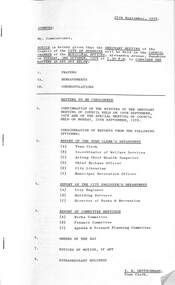 Sunshine and District Historical Society Incorporated
Administrative record - City of Sunshine - Commissioner Mr Alexander Alex George Gillon Collection 1976 - 1982 - Notice of Ordinary Meeting of The Council of The City of Sunshine on 3rd October 1978, City of Sunshine, 27th September 1978
... Notice of Ordinary Meeting of The Council of The City of Sunshine on 3rd October 1978 Reports on the Town Clerk's Department Report of the Town Clerk Victorian Beer Alcoholic Content Proposal for Reduction Land Transfer Adjacent to Deer Park Hotel Medway Golf Club Payment in Lieu of Rates Diamond Avenue Infant Welfare Centre Non-Availability of Subsidy Untied Grants Proposed Library Highpoint West Shopping Centre Land Transfer Discontinued Right of Way Rear of Railway Parade Deer Park Supplementary Valuations Report of Welfare Officer Community Youth Support Scheme Report of the Chief Health Inspector Nuisance Condition at 403 Ballarat Road Sunshine Removal of Dwelling Outside the Municipality Health Act Registrations Monsanto Application for Approval to Install Septic Tank Recirculating Sand Filter System at the Stansfield Steel Project Fairbairn Road Sunshine West Health (Tent) Regulations 1978 Draft Rubbish In and Around Flats Quarry Hole Commonwealth Land J.L. ...Albans Hotel McKechnie Street Hulett Street Evergreen Avenue Pineneedle Court Mitchell Street Navigator Street Marshall Street Kevin Dennis Motors Annersley Street Balfour Avenue Sydney Street Gooding Street Ashley Street South Road Warrs Road Maidstone Hall Thomson Street Errington Reserve Main Road East Robert Bruce Reserve Rosamond Bowling Club Devonshire Road Sproul Street Oakwood Road Haven Close Norwood Street Raleigh Road Notice of Ordinary Meeting of The Council of The City of Sunshine on 3rd October 1978 Reports on the Town Clerk's Department Report of the Town Clerk Victorian Beer Alcoholic Content Proposal for Reduction Land Transfer Adjacent to Deer Park Hotel Medway Golf Club Payment in Lieu of Rates Diamond Avenue Infant Welfare Centre Non-Availability of Subsidy Untied Grants Proposed Library Highpoint West Shopping Centre Land Transfer Discontinued Right of Way Rear of Railway Parade Deer Park Supplementary Valuations Report of Welfare Officer Community Youth Support Scheme Report of the Chief Health Inspector Nuisance Condition at 403 Ballarat Road Sunshine Removal of Dwelling Outside the Municipality Health Act Registrations Monsanto Application for Approval to Install Septic Tank Recirculating Sand Filter System at the Stansfield Steel Project Fairbairn Road Sunshine West Health (Tent) Regulations 1978 Draft Rubbish In and Around Flats Quarry Hole Commonwealth Land J.L. ...Notice of Ordinary Meeting of The Council of The City of Sunshine on 3rd October 1978 Reports on the Town Clerk's Department Report of the Town Clerk Victorian Beer Alcoholic Content Proposal for Reduction Land Transfer Adjacent to Deer Park Hotel Medway Golf Club Payment in Lieu of Rates Diamond Avenue Infant Welfare Centre Non-Availability of Subsidy Untied Grants Proposed Library Highpoint West Shopping Centre Land Transfer Discontinued Right of Way Rear of Railway Parade Deer Park Supplementary Valuations Report of Welfare Officer Community Youth Support Scheme Report of the Chief Health Inspector Nuisance Condition at 403 Ballarat Road Sunshine Removal of Dwelling Outside the Municipality Health Act Registrations Monsanto Application for Approval to Install Septic Tank Recirculating Sand Filter System at the Stansfield Steel Project Fairbairn Road Sunshine West Health (Tent) Regulations 1978 Draft Rubbish In and Around Flats Quarry Hole Commonwealth Land J.L. MacTaggart (Australia) Pty Ltd Noise By-Law Application for Transfer of Proprietorship of Premises Under the Health Act Infectious Diseases Sewerage Overflow 2 Bruce Street Albion Smoking in Public Buildings Immunisation Sunshine North Institute of Weights & Measures Annual National Conference Report of the Chief By-Laws Officer Court Proceedings Parking and Traffic Infringements Prohibited Parking Links Street Prohibited Parking Princess Street Area Prohibited Parking Gould Street Report of the City Librarian Bookmobile sites Municipal library Subsidy 1978/79 Bookmobile Seminar Children's Literature seconds National Seminar September 1st to 5th 1978 Report of the Municipal Recreation Officer Municipal Recreation Service Gound Allocations School Summer Season Holiday Programmes September 1978 Report of the City Engineer Proposed Children's Reception Centre for Erection in the City of Sunshine Planning Permit Application Illuminated Sign Churchill Avenue Planning Permit Application Grazing of Horses Furlong Road Planning Permit Application Offices Main Road West Planning Permit Application Extension to Exising Car Sales Yard Rosamond Road Planning Permit Application Corner of Neale Road and Station Road Deer Park Proposed Amendment No 81 to the Melbourne Metropolitan Planning Scheme Proposed Widening of Station Road Planning Permit Application Motor Repair Station Wright Street Planning Permit Application Sky Sign Hampshire Road Planning Permit Application Extension to Existing Warehouse McIntyre Road Planning Permit Application Consulting Rooms, Pharmacy, Service Premises and Caretaker's Dwelling Corner of Tamar Drive and Billingham Road Planning Permit Application Horse Grazing Judge Street & Norman Street Planning Permit Application Signs Geelong Road Planning Permit Application Factory Extension Carrington Drive Planning Permit Application Sky Sign Ballarat Road Sunshine Planning Permit Application Factory and Office Gee Street Sunshine North Planning Permit Application Drive in Bottle Shop and Extensions to St. Albans Hotel McKechnie Street Planning Permit Application Sky Sign & Fascia Signs Ballarat Road Sunshine Planning Permit Application Store Addition to Existing Office Geelong Road Plan of Subdivision Boral Resources Ballarat Road & Hulett Street Plan of Subdivision R.D.C. Projects Evergreen Avenue and Pineneedle Court Plan of Subdivision McPhersons Mitchell Street Plan of Subdivision Navigator Street Consolidation of Title Marshall Street Consolidation of Title Kevin Dennis Motors Ballarat Road and Annersley Street Consolidation of Title Lots 37 & 38 Balfour Avenue Contract Playground Equipment Various Reserves Contract Reconstruction of Sydney Street Contract Gooding Street 40 Hour Week Victorian Sewerage and Drainage Contractors' Group Declaration of Sewered Properties General Notice Sewerage Facilities M.M.B.W. Allocation of Funds 1978/79 Joint Works Unclassified Roads Telecom Australia Modernisation of Public Telephones St. Albans Area Ashley Street / South Road Proposed Traffic Lights Maribyrnong River Flood Plan Acting Commissioner of Police Sewerage Facilities St. Albans (Albanvale) Warrs Road Northern Section Private Street Scheme Use of C.R.B. land McIntyre Road for Recreation Purposes Garaging of Meals on Wheels Vehicles at Maidstone Hall Thomson Street Maidstone Relocation of Steel Framed Steel Clad Sheds to Errington Reserve and Robert Bruce Reserve Rosamond Bowling Club Report of the Building Surveyor Building Over Easement 135 Devonshire Road Sunshine Building Over Easement 10 Sproul Street Sunshine North Building Over Easement Lot 552 Oakwood Road St. Albans Building Over Easement 6 Haven Close Sunshine West Building Over Easement 75 Norwood Street Albion Building Over Easement182 Wright Street Sunshine West Building Over Easement 176 McIntyre Road Sunshine North Installation of Underground Tanks Corner Raleigh Road and Navigator Street Maribyrnong Ruinous and Dangerous Building Lots 6 & 7 Furlong Road Sunshine North Orders of the Day Accounts for Payment as at 15th September 1978, 26th September 1978 city of sunshine, alexander "alex" george gillon, deer park hotel, ballarat road, deer park, medway golf club, omar street, maidstone, diamond avenue infant welfare centre, diamond avenue, albanvale, highpoint west shopping centre, rosamond road, maribyrnong, railway parade, sunshine, monsanto, somerville road, footscray west, fairbairn road, sunshine west, j.l. mactaggart (australia) pty ltd, bruce street, albion, links street, princess street area, gould street, st. albans, churchill avenue, braybrook, furlong road, main road west, neale road, station road, wright street, hampshire road, mcintyre road, sunshine north, tamar drive, billingham road, judge street, norman street, geelong road, brooklyn, carrington drive, gee street, st. albans hotel, mckechnie street, hulett street, evergreen avenue, pineneedle court, mitchell street, navigator street, marshall street, kevin dennis motors, annersley street, balfour avenue, sydney street, gooding street, ashley street, south road, warrs road, maidstone hall, thomson street, errington reserve, main road east, robert bruce reserve, rosamond bowling club, devonshire road, sproul street, oakwood road, haven close, norwood street, raleigh road
