
Showing 628 items matching "nurse training - victoria"
-
 Alfred Hospital Nurses League - Nursing History Collection
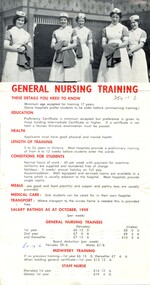
Document - Information document, Hospitals and Charities Commission, Information for General Nursing Training 1959, [ca 1960]
... ...Nurse Training-victoria...This document outlined the requirements and conditions for general nurse training in Victoria as of October. The donor of this item commenced her taining at the Alfred Hospital in 1960, graduating in 1963...This document outlined the requirements and conditions for general nurse training in Victoria as of October. The donor of this item commenced her taining at the Alfred Hospital in 1960, graduating in 1963 Of sinificance to the AHNL as includes photographs of Alfred hospital Nurses Alfred Hospital Nurse Training-victoria Nurse taining-History Nursing previous catalogue number hadwritten [black ink] at right under title on front page. ...This document outlined the requirements and conditions for general nurse training in Victoria as of October. The donor of this item commenced her taining at the Alfred Hospital in 1960, graduating in 1963Of sinificance to the AHNL as includes photographs of Alfred hospital NursesFolded document red and black print on a white background, and five black and white photographs of nursesprevious catalogue number hadwritten [black ink] at right under title on front page. Also clarification of cost of board [blue Iink]alfred hospital, nurse training-victoria, nurse taining-history, nursing -
 Northern District School of Nursing. Managed by Bendigo Historical Society Inc.
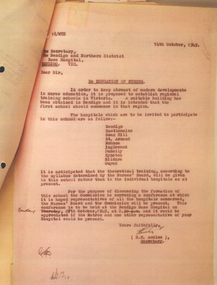
Letter - Re: Establishment of Nurse Training Schools in country Victoria
... Re: Establishment of Nurse Training Schools in country Victoria...nurse recruitment, training and education that had previously been hospital based. The residential school was to provide theoretical and in-house education and practical training over three years. The students would also receive practical hands-on training in the wards of associated hospitals. The Northern District School of Nursing operated from Lister House, Rowan Street, Bendigo. It was the first independent school of nursing in Victoria...Photocopies of a series of typed letters being correspondence between the secretary of the Nurses Board in Melbourne to the Secretary of the Hospitals and Charities Commission in Melbourne, regarding the establishment of training schools in country Victoria. ...Letter Re: Establishment of Nurse Training Schools in country Victoria ...The Northern District School of Nursing opened in 1950 in to address the issues around nurse recruitment, training and education that had previously been hospital based. The residential school was to provide theoretical and in-house education and practical training over three years. The students would also receive practical hands-on training in the wards of associated hospitals. The Northern District School of Nursing operated from Lister House, Rowan Street, Bendigo. It was the first independent school of nursing in Victoria and continued until it closed in 1989. The book "The First of its Kind" was published in 2015. Printed in Bendigo by "Bendigo Modern Press". Memories compiled by Peter Rosewall; who attended the last NDSN school PTS 108 between 1986 - 89.Photocopies of a series of typed letters being correspondence between the secretary of the Nurses Board in Melbourne to the Secretary of the Hospitals and Charities Commission in Melbourne, regarding the establishment of training schools in country Victoria. The letters are dated between September 30, 1949 and 14th October, 1949.nursing, nurse training, post-war nursing, hospitals and charities commission, the bendigo and northern district hospital base hospital, h.n.acklom -
 Alfred Hospital Nurses League - Nursing History Collection
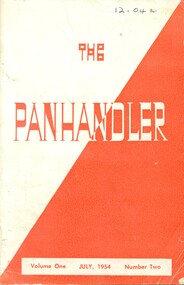
Magazine - Nursing magazine, Suzanne Tallis & Jan Dunbar, The panhandler volume one July 1954 number two, 1954
... ...Nurse training-Victoria-history...Of significance to the AHNL as it was written by Alfred Hospital student nurses AHNL Nurses Alfred Hospital Hospital Humour Lydia Mackellar (nee Shaw) Nurse training-Victoria-history Magazine, comprising factual and fictional articles, poems, quotations and advertisements. ...Published by student nurses at the Alfred Hospital in 1954.Of significance to the AHNL as it was written by Alfred Hospital student nursesmagazine with orange, white and black print. Front cover divided diagonally. one half white and the other orange. Title volume number and issue number printed on front. Back cover has two orange and white print advertisementsPrevious catalogue number hand-written at top right of front cover. At left of front cover is written Ann Clezy/ Alfred Hospital [hand written and undelined in blue ink]ahnl, nurses, alfred hospital, hospital humour, lydia mackellar (nee shaw), nurse training-victoria-history -
 Alfred Hospital Nurses League - Nursing History Collection
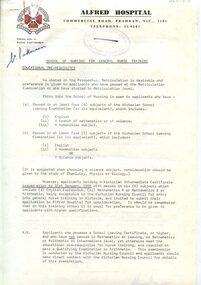
Document - Alfred Hospital School of Nursing for general nurse training document, Nancy Sewell, Educational pre-requisites, 7th October 1969, 19691007
... ...Nurse training-Victoria-history...nurse training at the Alfred hospital in 1969. Victorian matriculation Certificate was preferred, but Victorian Leaving certificate with passes in 5 subjects also accepted. A Victorian Intemediate certificate gained prior to 1968 could also be considered. People who had gained qualifications interstate or overseas were required to submit their educational certificates to the Victorian Nursing Council for approval prior to applying to the Alfred Hospital Of significance to the AHNL as it reflects the changes in educational levels required for entry into a general nurse training background Alfred Hospital Alfred Hospital School of Nursing Nurse training-Victoria-history The name Sr. ...Minimum educational requirements for entry into general nurse training at the Alfred hospital in 1969. Victorian matriculation Certificate was preferred, but Victorian Leaving certificate with passes in 5 subjects also accepted. A Victorian Intemediate certificate gained prior to 1968 could also be considered. People who had gained qualifications interstate or overseas were required to submit their educational certificates to the Victorian Nursing Council for approval prior to applying to the Alfred HospitalOf significance to the AHNL as it reflects the changes in educational levels required for entry into a general nurse training backgroundTwo page document fixed with plastic paper clip. Document has been typed [black ink] on cream paper with a printed [black ink]letter head of the Alfred Hospital. Hospital logo [red and black ink] printed at top right. The name Sr. Patterson has been written under this logo. Below the letter head is an oval stamp [purple ink] 'PRELIMINARY TRAINING SCHOOL/ALFRED HOSPITAL ' the word 'LIBRARY ' has been crossed out. Previous catalogue number has been written at top right [black ink]. On the second page the document has been signed by N Sewellalfred hospital, alfred hospital school of nursing, nurse training-victoria-history -
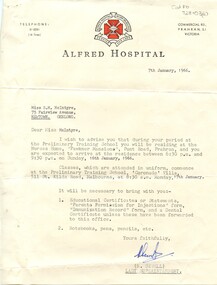 Alfred Hospital Nurses League - Nursing History Collection
Letter - Letter to S McIntyre, Nancy Sewell, Details of nursing accommodation at the Alfred Hospital, 19960107
... ...Nurse training- victoria...training at the Alfred Hopital on January 17th 1966. As well as accomodation details, letter contains information about the first day of classes Of significance to the AHNL as an example of the letter most nurses received prior to commencing their training Alfred Hospital Alfred Hospital School of nursing Nurse training- victoria N Sewell has signed her name [blue ink] Previous catalogue number hand written at top right [black ink] Single sheet of off white paper with the letterhead of the Alfred Hospital. ...Letter sent to S McIntyre prior to commencing her nursing training at the Alfred Hopital on January 17th 1966. As well as accomodation details, letter contains information about the first day of classesOf significance to the AHNL as an example of the letter most nurses received prior to commencing their trainingSingle sheet of off white paper with the letterhead of the Alfred Hospital. Letter is typed [black ink] N Sewell has signed her name [blue ink] Previous catalogue number hand written at top right [black ink]alfred hospital, alfred hospital school of nursing, nurse training- victoria -
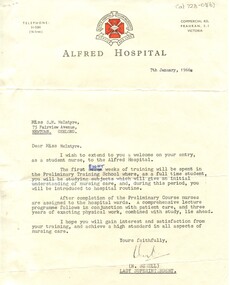 Alfred Hospital Nurses League - Nursing History Collection
Letter - Letter to S McIntyre, Nancy Sewell, Letter of welcome from N Sewell (Lady Superintendent, Alfred Hospital), 19660107
... ...Nurse training-Victoria-history...letter received by S McIntyre prior to her commencing her nursing training at the Alfred Hospital in 1966, providing more information about that training Of significance to the AHNL as an eample of a letter most nurses would have received prior to their commencing training at the Alfred Hospital Alfred Hospital Alfred Hospital School of Nursing Nurse training-Victoria-history A hand written correction 'EIGHT' has been made [blue ink] Previous catalogue number hand written at top right [black ink] Single page typed [black ink] letter on off-white paper with the Alfred Hospital letterhead Letter of welcome from N Sewell (Lady Superintendent, Alfred Hospital) Letter Letter to S McIntyre Nancy Sewell ...letter received by S McIntyre prior to her commencing her nursing training at the Alfred Hospital in 1966, providing more information about that trainingOf significance to the AHNL as an eample of a letter most nurses would have received prior to their commencing training at the Alfred HospitalSingle page typed [black ink] letter on off-white paper with the Alfred Hospital letterhead A hand written correction 'EIGHT' has been made [blue ink] Previous catalogue number hand written at top right [black ink]alfred hospital, alfred hospital school of nursing, nurse training-victoria-history -
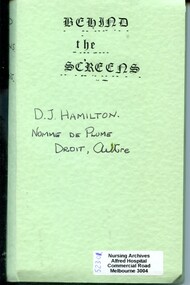 Alfred Hospital Nurses League - Nursing History Collection
Book, Doris J Hamilton, Behind the screens, 1925
... ...Nurse training-Victoria-history...Victoria Hospital and Womens' Hospital. In 1945 Hamilton was sister-in-charge at the Wonthaggi Baby Health Centre where she remained until her retirement in 1956. Under the pseudonym "Autre Droit", Doris Hamilton wrote a controversial book about conditions in hospitals. Doris had originally written the book using a nomme de plume [ Droit, Autre]. Apparently she was still working at the Alfred Hospital when her true identity was revealed and instantly dismissed 'as a warning to others [see 202605.031] Provides insight into conditions faced by student nurses in the 1920's Doris Jean Hamilton Alfred Hospital Nurse training-Victoria-history The author undertook her nursing training in the early 1920's and details the endless hard work, unduly strict discipline andd the strange hierachy faced by student nurses at that time At bottom right there is a small white rectangular sticker with black print 'Nursing Archive/Alfred Hospital/Commercial Rd/Melbourne 3004' Previous catalogue number is handwitten [black ink] on this sticker. previous catalogue number also handwritten inside front cover at top left. ...The author undertook her nursing training in the early 1920's and details the endless hard work, unduly strict discipline andd the strange hierachy faced by student nurses at that timePhotocopied book with green cover and black print. Title printed and author's name and nomme de plume handwitten [black ink] on front cover. pages have been gluednon-fictionThe author undertook her nursing training in the early 1920's and details the endless hard work, unduly strict discipline andd the strange hierachy faced by student nurses at that timedoris jean hamilton, alfred hospital, nurse training-victoria-history -
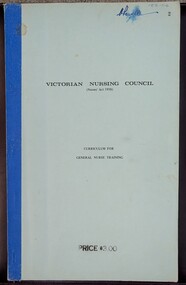 Alfred Hospital Nurses League - Nursing History Collection
Manual - Curriculum Manual, Victorian Nursing Council, Victorian Nursing Council (Nurses' Act 1958) Curriculum for General Nurse Training, 1971
... ...nurse training - Victoria...The purpose of the curriculum was to help young persons with aptitude for nursing develop that apttude to the maximum, so they are able to perform the functions of newly graduated general nurses, as members of the teh team assisting the medical proffesion in meeting the health needs of the Australian society, and to help the develop develop personally and professionally, so that they may make their maximum contribution to society as individuals, citizans and nurses Of significance to the AHNL, as this curriculum was the basis for hospital training of nurses nurses nursing nurse training - Victoria At top right, previous catalogue number [handwritten in blue ink] N Sewell [handwritten blue ink] '2' [printed in black ink]. ...The purpose of the curriculum was to help young persons with aptitude for nursing develop that apttude to the maximum, so they are able to perform the functions of newly graduated general nurses, as members of the teh team assisting the medical proffesion in meeting the health needs of the Australian society, and to help the develop develop personally and professionally, so that they may make their maximum contribution to society as individuals, citizans and nursesOf significance to the AHNL, as this curriculum was the basis for hospital training of nursesStapled manual with pale blue cover and black print. Darker blue tape covers the staples and spine At top right, previous catalogue number [handwritten in blue ink] N Sewell [handwritten blue ink] '2' [printed in black ink]. At bottom of page 'PRICE $3.00' [stamped in black ink] nurses, nursing, nurse training - victoria -
 Alfred Hospital Nurses League - Nursing History Collection
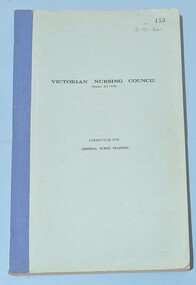
Manual - Curriculum Manual, Victorian Nursing Council, Victorian Nursing Council (Nurses' Act 1958) Curriculum for General Nurse Training, 1971
... ...nurse training - Victoria...The purpose of the curriculum was to help young persons with aptitude for nursing develop that apttude to the maximum, so they are able to perform the functions of newly graduated general nurses, as members of the teh team assisting the medical proffesion in meeting the health needs of the Australian society, and to help the develop develop personally and professionally, so that they may make their maximum contribution to society as individuals, citizans and nurses.The letter dated 19770921 was from the Victorian Nursing Council advising that this curriculum guide was no longer relevant and that Victorian schools of nursing were to develop their own curriculum content within the framework of the Nurses(geraneral nursing) Regulations 1972 Of significance to the AHNL, as this curriculum was the basis for hospital training of nurses nurses nursing nurse training - Victoria nursing education-Victoria Nursing education Victoria-History At top right of front cover the previous catalogue number and 'Box 1'is handwritten in [black ink] On title page 'Audrey Morwick' is handwritten [blue ink] Stapled manual with pale blue cover and black print. ...The purpose of the curriculum was to help young persons with aptitude for nursing develop that apttude to the maximum, so they are able to perform the functions of newly graduated general nurses, as members of the teh team assisting the medical proffesion in meeting the health needs of the Australian society, and to help the develop develop personally and professionally, so that they may make their maximum contribution to society as individuals, citizans and nurses.The letter dated 19770921 was from the Victorian Nursing Council advising that this curriculum guide was no longer relevant and that Victorian schools of nursing were to develop their own curriculum content within the framework of the Nurses(geraneral nursing) Regulations 1972Of significance to the AHNL, as this curriculum was the basis for hospital training of nursesStapled manual with pale blue cover and black print. Darker blue tape covers the staples and spine. Title is printed on front cover along with '153' at top right. A letter has been taped inside the front cover At top right of front cover the previous catalogue number and 'Box 1'is handwritten in [black ink] On title page 'Audrey Morwick' is handwritten [blue ink]nurses, nursing, nurse training - victoria, nursing education-victoria, nursing education victoria-history -
 St Vincent's Hospital Melbourne Archives
Certificate - Nurses' Acts Victoria, Certificate of General Nurse Registration in 1939 for Mary Brennan
... nurse training...Nurses Acts Victoria...training at St Vincent's Hospital Melbourne, Mary Brennan is certified as a General Nurse number 8777 under the Nurses Acts of 1928 and 1931. It is signed by the Chairman and SRN Registrar of the Nurses Board. Accompanying the certificate, there is a payment receipt from the Nurses Board of Melbourne for five shillings for registration and five shillings for the certificate. Mary Brennan St Vincent's Hospital Melbourne nurse training Nurses Acts Victoria ...Following her training at St Vincent's Hospital Melbourne, Mary Brennan is certified as a General Nurse number 8777 under the Nurses Acts of 1928 and 1931. It is signed by the Chairman and SRN Registrar of the Nurses Board. Accompanying the certificate, there is a payment receipt from the Nurses Board of Melbourne for five shillings for registration and five shillings for the certificate.mary brennan, st vincent's hospital melbourne nurse training, nurses acts victoria, nurses board melbourne -
 Northern District School of Nursing. Managed by Bendigo Historical Society Inc.
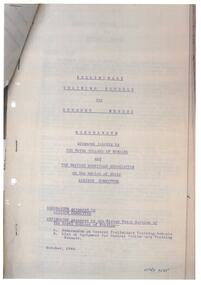
Administrative record - Preliminary Training Schools for Student Nurses Memorandum and Appendices
... nurse recruitment, training and education that had previously been hospital based. The residential school was to provide theoretical and in-house education and practical training over three years. The students would also receive practical hands-on training in the wards of associated hospitals. The Northern District School of Nursing operated from Lister House, Rowan Street, Bendigo. It was the first independent school of nursing in Victoria...The documents provide a report on the current training of nurses in Victoria, a list of equipment required by training schools and advice by The Sister Tutor Section on the establishment of Central Preliminary Training Schools. ...The documents provide a report on the current training of nurses in Victoria, a list of equipment required by training schools and advice by The Sister Tutor Section on the establishment of Central Preliminary Training Schools. ...The Northern District School of Nursing opened in 1950 in to address the issues around nurse recruitment, training and education that had previously been hospital based. The residential school was to provide theoretical and in-house education and practical training over three years. The students would also receive practical hands-on training in the wards of associated hospitals. The Northern District School of Nursing operated from Lister House, Rowan Street, Bendigo. It was the first independent school of nursing in Victoria and continued until it closed in 1989. The book "The First of its Kind" was published in 2015. Printed in Bendigo by "Bendigo Modern Press". Memories compiled by Peter Rosewall; who attended the last NDSN school PTS 108 between 1986 - 89.Four documents published in 1944 relating to the training of student nurses in Victoria based on memorandums prepared by The Royal College of Nursing and the British Hospital Association. The documents provide a report on the current training of nurses in Victoria, a list of equipment required by training schools and advice by The Sister Tutor Section on the establishment of Central Preliminary Training Schools. The documents are photocopies of the originals and are typewritten.nursing, at lister house., nurse training, sister tutor section, royal college of nursing -
Northern District School of Nursing. Managed by Bendigo Historical Society Inc.
Administrative record - Northern District School of Nursing Graduates Association - Meetings, 1966
... Northern District School of Nursing Graduates Association - Building committee Report on the classroom block This item contains the following documents: 3801.11a This document outlines significant concerns regarding the proposed basic nurse training curriculum in Victoria, intended for implementation by 1970. 3801.11b Report on the Northern District School of Nursing's student residence building project in 1966. ...Nurse Training Lister House meetings Northern District School of Nursing Graduates Association - Building committee Report on the classroom block This item contains the following documents: 3801.11a This document outlines significant concerns regarding the proposed basic nurse training curriculum in Victoria, intended for implementation by 1970. 3801.11b Report on the Northern District School of Nursing's student residence building project in 1966. ...The Northern District School of Nursing in Victoria, Australia Graduates Association: History of the School Managed by a committee including hospital administrators, medical professionals, and nursing leaders from several regional hospitals. Associated with major hospitals in the Northern District, including Bendigo Base, Mildura Base, Castlemaine, Echuca, Swan Hill, St. Arnaud, and Kyneton District Hospitals. Provide high-quality theoretical and practical nursing training. Raise the standard of nursing education in the region. Maintain the highest principles of nursing practice. Applicants must be at least 17 years old and hold a Proficiency Certificate or higher educational qualification. Application involves submitting forms, certificates, an interview, an aptitude test, and a medical examination. A three-month probationary period follows initial acceptance. Preliminary Training School: Four-week introductory course covering basic nursing, anatomy, hygiene, and practical skills. Practical experience in various hospital departments, guided by senior staff. Study Block Plan: Includes several blocks of theoretical and practical instruction throughout the three-year program. Regular school exams and two state exams (First Professional and Final State) are required for progression and graduation. Nurses work a 40-hour week with at least one or two days off per week and three weeks of annual leave. Accommodation is provided in comfortable hostels with good facilities. Uniforms are supplied free; nurses provide their own shoes and stockings. Salaries and allowances are regulated, with deductions for board and free medical care. Additional Information Post-Graduate Opportunities. Senior positions require further experience and additional certificates (e.g., Midwifery, Infant Welfare).Diploma courses available in administration, teaching, and specialized nursing fields. Bursaries are available for advanced study.Career Prospects: Graduates can pursue roles in administration, teaching, ward and departmental leadership, district and visiting nursing, industrial and school nursing, and more. Opportunities existed both within hospitals and in community or specialized settings.FAQs and Practical Details. Minimal training costs (mainly exam fees and personal items).Living out allowances and travel expenses are covered. Four training intakes per year; waiting periods are short if qualifications are met.Northern District School of Nursing Graduates Association - Building committee Report on the classroom block This item contains the following documents: 3801.11a This document outlines significant concerns regarding the proposed basic nurse training curriculum in Victoria, intended for implementation by 1970. 3801.11b Report on the Northern District School of Nursing's student residence building project in 1966. The Hospitals and Charities Commission agreed to allocate £50,000 ($100,000) annually for three years starting July 1966 for the construction of a three-storey brick student residence with two-bed units.nurse training, lister house, meetings -
 Federation University Historical Collection
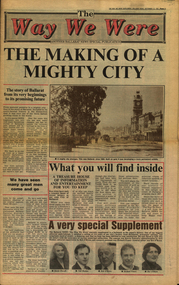
Newspaper - Ballarat News Special Publication, The Way We Were. The Making of a Mighty City, 1991, 12/09/1991
... ballarat district hospital nurse training school...bank of victoria...A Ballarat News Special Publication. supplement mighty ballarat fiskin aborigines eureka stockade james esmond bank of australasia ballarat fire brigade penyweight hotel academy of music urquhart street primary school star of the east mine ballarat observatory ballarat district hospital nurse training school bank of victoria shearers union john valves ballarat school of mines ambulance f.w. barnes phoenix foundry neil grant naval cadets australian timken robert baird ufs dispensaries arch of victory coliseum messer and opie wrld war two wags school eureka valves olympic games at ballarat bendix eureka concrete btv channel 6 sovereign hill mars confectionary ballarat bypass south street south street competitions Wireless air gunners school Sturt Street 36 page Special Ballarat News Publication The Way We Were. ...A Ballarat News Special Publication.36 page Special Ballarat News Publicationsupplement, mighty, ballarat, fiskin, aborigines, eureka stockade, james esmond, bank of australasia, ballarat fire brigade, penyweight hotel, academy of music, urquhart street primary school, star of the east mine, ballarat observatory, ballarat district hospital nurse training school, bank of victoria, shearers union, john valves, ballarat school of mines, ambulance, f.w. barnes, phoenix foundry, neil grant, naval cadets, australian timken, robert baird, ufs dispensaries, arch of victory, coliseum, messer and opie, wrld war two, wags school, eureka valves, olympic games at ballarat, bendix, eureka concrete, btv channel 6, sovereign hill, mars confectionary, ballarat bypass, south street, south street competitions, wireless air gunners school, sturt street -
 City of Moorabbin Historical Society (Operating the Box Cottage Museum)
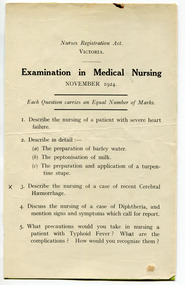
Document - Nursing Examinations, 1924 - 1925
... Five Examination papers each with 5 questions, for the Victorian Medical and Surgical Nursing Examinations 1925 Nurse Mary Maggs used these when training her staff at the Mooroopna Hospital. nursing examinations nursing hospital nurse mary maggs nurses registration act Printed by Government Printer 5 x printed sheets with questions for Surgical & Medical Nursing 1924 and 1925 Victoria Document Nursing Examinations Government Printer ...Five Examination papers each with 5 questions, for the Victorian Medical and Surgical Nursing Examinations 1925 Nurse Mary Maggs used these when training her staff at the Mooroopna Hospital.5 x printed sheets with questions for Surgical & Medical Nursing 1924 and 1925 Victoria Printed by Government Printer nursing examinations, nursing, hospital, nurse mary maggs, nurses registration act -
Bendigo Historical Society Inc.
Document - Notes of public talk given to Bendigo Historical Society by Jenny Trewartha on 7th March, 2025 relating to NDSN, 7th March, 2025
... nurses. Improved working and living conditions were needed; adequate remuneration and a career path to attract a better class of trainees, and a uniform training by means of a circular or block system. This was the basis of the establishment of the Northern District School of Nursing which oversaw nurse training in hospitals across the northwest of Victoria, including Bendigo, Castlemaine, Kyneton, Maryborough, Mildura, Ouyen, St Arnaud, Swan Hill, Dunolly, Inglewood and Echuca. ...nurses. Improved working and living conditions were needed; adequate remuneration and a career path to attract a better class of trainees, and a uniform training by means of a circular or block system. This was the basis of the establishment of the Northern District School of Nursing which oversaw nurse training in hospitals across the northwest of Victoria, including Bendigo, Castlemaine, Kyneton, Maryborough, Mildura, Ouyen, St Arnaud, Swan Hill, Dunolly, Inglewood and Echuca. ...Speech given by Jenny Trewartha to the Bendigo Historical Society on 7th March, 2025 at the la Trobe Art Institute, View Street, Bendigo. Jenny was a graduate of the NDSN at the end of 1972. The Northern District School of Nursing opened at Bendigo in 1950 and was the only regional independent School of Nursing of its kind in the southern hemisphere. There was a huge need for trained nurses in hospitals across the region as the nursing numbers were dwindling. Post World War II was a critical period with soldiers returning with wounds and conditions not seen before and needing special treatment. Medicine and medical treatments were entering a new age, and this new age needed nurses with new skills. There was a need to improve the status and prospects for nurses. Improved working and living conditions were needed; adequate remuneration and a career path to attract a better class of trainees, and a uniform training by means of a circular or block system. This was the basis of the establishment of the Northern District School of Nursing which oversaw nurse training in hospitals across the northwest of Victoria, including Bendigo, Castlemaine, Kyneton, Maryborough, Mildura, Ouyen, St Arnaud, Swan Hill, Dunolly, Inglewood and Echuca. The Northern District School of Nursing opened in 1950 and closed its doors in 1989 having overseen the training of more than 3000 nurses who are now scattered across Australia and the world.Ten pages of typed notes pertaining to training as a nurse at the Northern District School of Nursing from 1950 to 1989, and the Northern District School of Nursing Graduates Association. Document discusses different aspects of life as a trainee nurse - including financial, social and where students came from.northern district school of nursing, nursing, student -
 Royal Australian and New Zealand College of Obstetricians & Gynaecologists (RANZCOG)
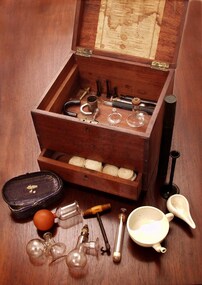
Midwifery box used by midwife Mary Howlett, c. 1866 - 1920
... Victoria. She qualified as a 'ladies monthly nurse' in 1887 and continued to practise as a nurse and midwife until 1920.She began her six months training at the Melbourne Lying-In Hospital. ...Victoria. She qualified as a 'ladies monthly nurse' in 1887 and continued to practise as a nurse and midwife until 1920.She began her six months training at the Melbourne Lying-In Hospital. ...Mary Howlett (1840-1922) began practising as a country midwife in 1866 in the western district of Victoria. She qualified as a 'ladies monthly nurse' in 1887 and continued to practise as a nurse and midwife until 1920.She began her six months training at the Melbourne Lying-In Hospital. She was known by many as 'Auntie', and her career spanned more than 50 years. Mrs Howlett's midwifery box and contents were given to Dr Frank Forster, and he donated them to the museum collection in 1993. The contents of this box are consistent with use by a midwife, but such a box would have been cumbersome and heavy to carry around. It is possible that Mary Howlett would also have had a bag for her midwifery requirements.This midwifery box is highly significant as it includes close to the original contents of one midwife's 'professional kit' up to 1920. The contents reveal something of the professional practice of a midwife in country Victoria at that time.A wooden box with hinged lift-up lid, one drawer, and an inner wooden tray. Rests at each side inside box indicate another tray may have originally sat across the top. Pasted inside the lid is a product list from Robert McDonald (chemist and druggist). There are locks for both the main chest section and the drawer. A circular section is cut out of the bottom of the drawer. The contents of the box include, enema syringe, a red rubber douche, glass breast pump, nipple shields, a thermometer in travel case. Also includes cotton bandages, a tooth extractor, and fetal stethoscope.midwifery -
 Royal Australian and New Zealand College of Obstetricians & Gynaecologists (RANZCOG)
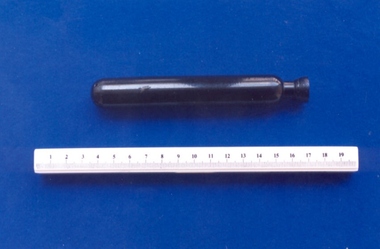
Rectal or vaginal irrigator associated with midwife Mary Howlett, c. 1866 - 1920
... Victoria. She qualified as a 'ladies monthly nurse' in 1887 and continued to practise as a nurse and midwife until 1920.She began her six months training at the Melbourne Lying-In Hospital. ...Artefact may have been used for enema or vaginal irrigation. Mary Howlett (1840-1922) began practising as a country midwife in 1866 in the western district of Victoria. She qualified as a 'ladies monthly nurse' in 1887 and continued to practise as a nurse and midwife until 1920.She began her six months training at the Melbourne Lying-In Hospital. She was known by many as 'Auntie', and her career spanned more than 50 years. Mrs Howlett's midwifery box and contents were given to Dr Frank Forster, and he donated them to the museum collection in 1993.Black bakelite irrigator, resembling a test tube in shape. The irrigator has four entries, a connecting bridge and serrated edged flange. Stopcock attachment and tubing are missing.irrigation, midwifery -
 Royal Australian and New Zealand College of Obstetricians & Gynaecologists (RANZCOG)
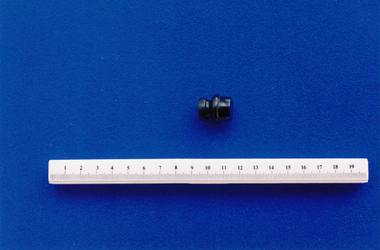
Tool - Irrigation nozzle associated with midwife Mary Howlett, c. 1866 - 1920
... Victoria. She qualified as a 'ladies monthly nurse' in 1887 and continued to practise as a nurse and midwife until 1920.She began her six months training at the Melbourne Lying-In Hospital. ...Victoria. She qualified as a 'ladies monthly nurse' in 1887 and continued to practise as a nurse and midwife until 1920.She began her six months training at the Melbourne Lying-In Hospital. ...Mary Howlett (1840-1922) began practising as a country midwife in 1866 in the western district of Victoria. She qualified as a 'ladies monthly nurse' in 1887 and continued to practise as a nurse and midwife until 1920.She began her six months training at the Melbourne Lying-In Hospital. She was known by many as 'Auntie', and her career spanned more than 50 years. Mrs Howlett's midwifery box and contents were given to Dr Frank Forster, and he donated them to the museum collection in 1993.Small black bakelite irrigator nozzle. There are 7 entries in the nozzle head. Small ridge around neck of nozzle.irrigation, midwifery -
 Royal Australian and New Zealand College of Obstetricians & Gynaecologists (RANZCOG)
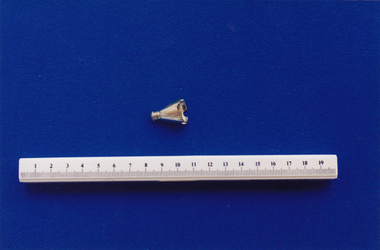
Syringe attachment associated with midwife Mary Howlett, c. 1866 to 1920, 1880 (approximate)
... Victoria. She qualified as a 'ladies monthly nurse' in 1887 and continued to practise as a nurse and midwife until 1920.She began her six months training at the Melbourne Lying-In Hospital. ...Victoria. She qualified as a 'ladies monthly nurse' in 1887 and continued to practise as a nurse and midwife until 1920.She began her six months training at the Melbourne Lying-In Hospital. ...Mary Howlett (1840-1922) began practising as a country midwife in 1866 in the western district of Victoria. She qualified as a 'ladies monthly nurse' in 1887 and continued to practise as a nurse and midwife until 1920.She began her six months training at the Melbourne Lying-In Hospital. She was known by many as 'Auntie', and her career spanned more than 50 years. Mrs Howlett's midwifery box and contents were given to Dr Frank Forster, and he donated them to the museum collection in 1993. Syringe attachment with 4 depressions of equal size around the base. Inside is a shallow rim. The inside is hollow and wider at the base rim than the top. It tapers to half the circumference size at the outlet.intravenous device, midwifery -
 Royal Australian and New Zealand College of Obstetricians & Gynaecologists (RANZCOG)
Rectal or vaginal irrigator nozzle associated with midwife Mary Howlett, c. 1866 - 1920
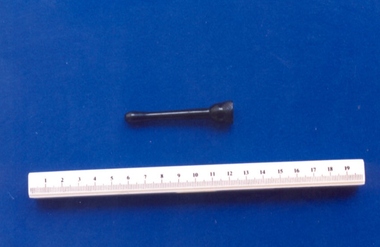
... Victoria. She qualified as a 'ladies monthly nurse' in 1887 and continued to practise as a nurse and midwife until 1920.She began her six months training at the Melbourne Lying-In Hospital. ...Victoria. She qualified as a 'ladies monthly nurse' in 1887 and continued to practise as a nurse and midwife until 1920.She began her six months training at the Melbourne Lying-In Hospital. ...This item may have been used for enema or vaginal irrigation. Mary Howlett (1840-1922) began practising as a country midwife in 1866 in the western district of Victoria. She qualified as a 'ladies monthly nurse' in 1887 and continued to practise as a nurse and midwife until 1920.She began her six months training at the Melbourne Lying-In Hospital. She was known by many as 'Auntie', and her career spanned more than 50 years. Mrs Howlett's midwifery box and contents were given to Dr Frank Forster, and he donated them to the museum collection in 1993.Black bakelite nozzle with one entry. irrigation, midwifery -
 Royal Australian and New Zealand College of Obstetricians & Gynaecologists (RANZCOG)
Introducer associated with midwife Mary Howlett, c. 1866 to 1920, c1880s
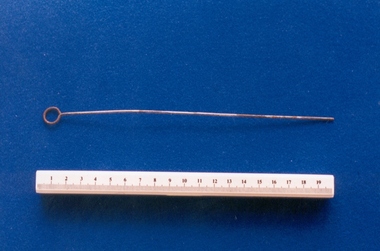
... Victoria. She qualified as a 'ladies monthly nurse' in 1887 and continued to practise as a nurse and midwife until 1920.She began her six months training at the Melbourne Lying-In Hospital. ...Victoria. She qualified as a 'ladies monthly nurse' in 1887 and continued to practise as a nurse and midwife until 1920.She began her six months training at the Melbourne Lying-In Hospital. ...This item can be used for cleaning rubber tubing or to assist with the introduction of rubber catheters and tubing. Mary Howlett (1840-1922) began practising as a country midwife in 1866 in the western district of Victoria. She qualified as a 'ladies monthly nurse' in 1887 and continued to practise as a nurse and midwife until 1920.She began her six months training at the Melbourne Lying-In Hospital. She was known by many as 'Auntie', and her career spanned more than 50 years. Mrs Howlett's midwifery box and contents were given to Dr Frank Forster, and he donated them to the museum collection in 1993.Device made of metal wire with a rounded point at one end and an eye hook the other end.surgery, midwifery -
 Royal Australian and New Zealand College of Obstetricians & Gynaecologists (RANZCOG)
Ceramic feeding cup associated with midwife Mary Howlett, c.1866-1920
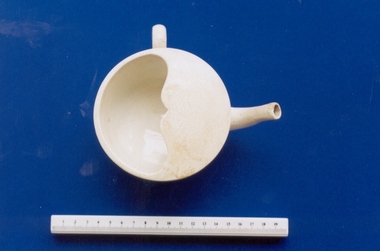
... Victoria. She qualified as a 'ladies monthly nurse' in 1887 and continued to practise as a nurse and midwife until 1920. She began her six months training ...This type of cup was designed for use by an adult and was in common usage from the early 1900s to the 1930s. Feeding cups were used both in the home and in hospitals, and were also often made of white enamel. Mary Howlett (1840-1922) began practising as a country midwife in 1866 in the western district of Victoria. She qualified as a 'ladies monthly nurse' in 1887 and continued to practise as a nurse and midwife until 1920. She began her six months training at the Melbourne Lying-In Hospital. She was known by many as 'Auntie', and her career spanned more than 50 years. Mrs Howlett's midwifery box and contents were given to Dr Frank Forster, and he donated them the museum collection in 1993. Feeding cup made out of white china, now discoloured. The cup has a curved spout (similar to a teapot spout) with a handle. There are four small holes inserted inside the cup diagonally at the proximate end of the spout. midwifery -
 Royal Australian and New Zealand College of Obstetricians & Gynaecologists (RANZCOG)
Pap boat associated with midwife Mary Howlett, c. 1866-1920, 1880 (approximate)
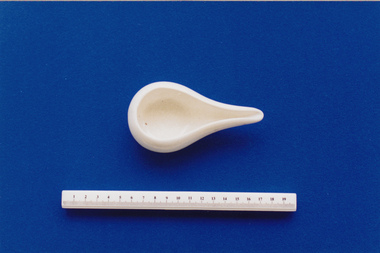
... nurses who took great delight in disregarding the advice of physicians, who they believed were usurping their position in the household. ‘Nanny knows best’.(Amgueddfa Cymru - National Museum Wales, 'Pap Boat') Mary Howlett (1840-1922) began practising as a country midwife in 1866 in the western district of Victoria. She qualified as a 'ladies monthly nurse' in 1887 and continued to practise as a nurse and midwife until 1920. She began her six months training ...Pap boats date from approximately 1710 and were in extensive use until the end of the nineteenth century. They were used to feed pap to infants or invalids. Pap was a mixture of breadcrumbs, flour, rice or barley mixed with fluids such as broth, milk (if the infant was lucky), water, wine and even beer, to aid the digestion of pap it was often pre-chewed by the nurse or nanny. Pap was a popular form of infant nutrition for almost 300 years and used in many well to do homes. For unwanted or illegitimate infants in foundling homes it was often the only form of sustenance, however, and as a result the mortality rate was appallingly high. Despite a growing number of experts advising against the use of pap, it nevertheless persisted as a major source of infant nutrition in many nurseries until the late 1800’s, largely due to the ignorance of nannies and nurses who took great delight in disregarding the advice of physicians, who they believed were usurping their position in the household. ‘Nanny knows best’.(Amgueddfa Cymru - National Museum Wales, 'Pap Boat')Mary Howlett (1840-1922) began practising as a country midwife in 1866 in the western district of Victoria. She qualified as a 'ladies monthly nurse' in 1887 and continued to practise as a nurse and midwife until 1920. She began her six months training at the Melbourne Lying-In Hospital. She was known by many as 'Auntie', and her career spanned more than 50 years. Mrs Howlett's midwifery box and contents were given to Dr Frank Forster, and he donated them to the museum collection in 1993. Small round white china container with an extended slim lip. Fluid capacity approximately 30-90ml. The boat has been made from two moulded sections. infant care, infant feeding, midwifery -
 Royal Australian and New Zealand College of Obstetricians & Gynaecologists (RANZCOG)
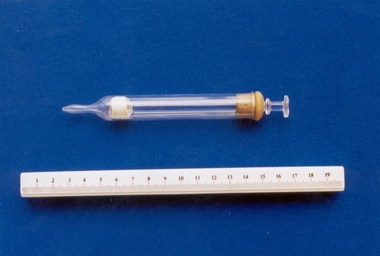
Glass wound irrigator syringe associated with midwife Mary Howlett, c. 1866 - 1920
... Victoria. She qualified as a 'ladies monthly nurse' in 1887 and continued to practise as a nurse and midwife until 1920. She began her six months training ...Glass wound irrigating syringes were in general use from approximately 1915 to the beginning of the 1940s.Mary Howlett (1840-1922) began practising as a country midwife in 1866 in the western district of Victoria. She qualified as a 'ladies monthly nurse' in 1887 and continued to practise as a nurse and midwife until 1920. She began her six months training at the Melbourne Lying-In Hospital. She was known by many as 'Auntie', and her career spanned more than 50 years. Mrs Howlett's midwifery box and contents were given to Dr Frank Forster, and he donated them to the museum collection in 1993. Glass wound syringe, with wood cap at distal end and cork bung inside a glass barrel with tapered end. irrigation, midwifery -
 Royal Australian and New Zealand College of Obstetricians & Gynaecologists (RANZCOG)
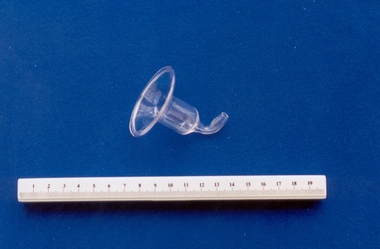
Glass nipple shield associated with midwife Mary Howlett, c. 1866 - 1920
... Victoria. She qualified as a 'ladies monthly nurse' in 1887 and continued to practise as a nurse and midwife until 1920. She began her six months training ...A rubber teat would be attached to the top of this nipple shield for breast feeding. From 1801 onwards, nipple shields were available in a variety of materials, such as pewter, horn, bone, ivory, wood, glass and silver. They varied in shape from a bell to a flatter, cap shaped appliance. With the application of the nipple shield, the baby was able to take milk from the breast without giving added trauma to the nipples. In the ante partum period the nipple shield could be worn to assist in drawing out flat nipples; or, as it was known during this period, for the formation of "new nipples". (Fildes, Valerie. 'Breasts, Bottles & Babies - A History of Infant Feeding', 1986) Mary Howlett (1840-1922) began practising as a country midwife in 1866 in the western district of Victoria. She qualified as a 'ladies monthly nurse' in 1887 and continued to practise as a nurse and midwife until 1920. She began her six months training at the Melbourne Lying-In Hospital. She was known by many as 'Auntie', and her career spanned more than 50 years. Mrs Howlett's midwifery box and contents were given to Dr Frank Forster, and he donated them to the museum collection in 1993. Glass nipple shield. Shape resembles that of a bell.infant feeding, midwifery -
 Royal Australian and New Zealand College of Obstetricians & Gynaecologists (RANZCOG)
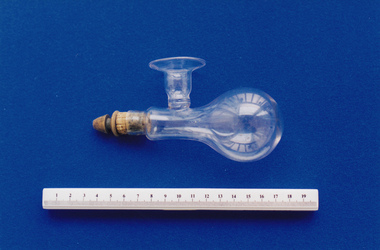
Breast reliever associated with midwife Mary Howlett, c. 1866 - 1920
... Victoria. She qualified as a 'ladies monthly nurse' in 1887 and continued to practise as a nurse and midwife until 1920. She began her six months training...Victoria. She qualified as a 'ladies monthly nurse' in 1887 and continued to practise as a nurse and midwife until 1920. She began her six months training ...Mary Howlett (1840-1922) began practising as a country midwife in 1866 in the western district of Victoria. She qualified as a 'ladies monthly nurse' in 1887 and continued to practise as a nurse and midwife until 1920. She began her six months training at the Melbourne Lying-In Hospital. She was known by many as 'Auntie', and her career spanned more than 50 years. Mrs Howlett's midwifery box and contents were given to Dr Frank Forster who donated them to the museum collection in 1993. Glass breast pump with cork stopper and wooden bung. Pump shape loosely resembles that of a light bulb, with a bell-shaped nipple shield on one side. breast feeding, midwifery -
 Royal Australian and New Zealand College of Obstetricians & Gynaecologists (RANZCOG)
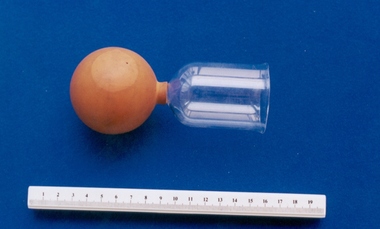
Cupping glass associated with midwife Mary Howlett, c. 1866 - 1920
... Victoria. She qualified as a 'ladies monthly nurse' in 1887 and continued to practise as a nurse and midwife until 1920. She began her six months training ...Cupping glasses were in use from the early 1700s onwards. Their purpose was to draw the nipple out from the areola in preparation for breast feeding. They were also used for expressing small quantities of breast milk. Other possible uses include drawing fluid from other parts of the body for conditions such as oedema of the limbs or abdomen.Mary Howlett (1840-1922) began practising as a country midwife in 1866 in the western district of Victoria. She qualified as a 'ladies monthly nurse' in 1887 and continued to practise as a nurse and midwife until 1920. She began her six months training at the Melbourne Lying-In Hospital. She was known by many as 'Auntie', and her career spanned more than 50 years. Mrs Howlett's midwifery box and contents were given to Dr Frank Forster, and he donated them to the museum collection in 1993. Cupping glass, consisting of a glass tube connection and red rubber hand pump.midwifery, infant feeding -
 Royal Australian and New Zealand College of Obstetricians & Gynaecologists (RANZCOG)
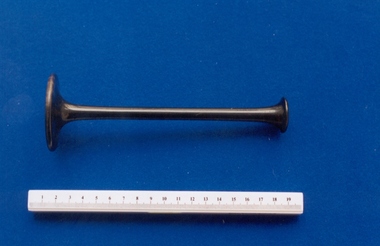
Furgusson-style fetal stethoscope associated with midwife Mary Howlett, c. 1866 - 1920
... Victoria. She qualified as a 'ladies monthly nurse' in 1887 and continued to practise as a nurse and midwife until 1920. She began her six months training ...The Furgusson stethoscope was in use from 1866. It is made all in one piece and has no attachments.Mary Howlett (1840-1922) began practising as a country midwife in 1866 in the western district of Victoria. She qualified as a 'ladies monthly nurse' in 1887 and continued to practise as a nurse and midwife until 1920. She began her six months training at the Melbourne Lying-In Hospital. She was known by many as 'Auntie', and her career spanned more than 50 years. Mrs Howlett's midwifery box and contents were given to Dr Frank Forster, and he donated them to the museum collection in 1993.Fetal stethoscope consisting of an ebony tube with flanges at each end. The large flange would be placed onto the abdomen and the small flange would be placed to the ear to hear the fetal heart beat.diagnostic instruments, midwifery -
 Royal Australian and New Zealand College of Obstetricians & Gynaecologists (RANZCOG)
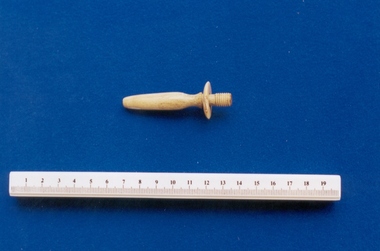
Enema syringe connection associated with midwife Mary Howlett, c. 1866 - 1920
... Victoria. She qualified as a 'ladies monthly nurse' in 1887 and continued to practise as a nurse and midwife until 1920.She began her six months training at the Melbourne Lying-In Hospital. ...This is a connection for a bone rectum pipe for a manual Indian rubber enema syringe.Mary Howlett (1840-1922) began practising as a country midwife in 1866 in the western district of Victoria. She qualified as a 'ladies monthly nurse' in 1887 and continued to practise as a nurse and midwife until 1920.She began her six months training at the Melbourne Lying-In Hospital. She was known by many as 'Auntie', and her career spanned more than 50 years. Mrs Howlett's midwifery box and contents were given to Dr Frank Forster, and he donated them to the museum collection in 1993.Small, elongated connection with openings at both ends. The connection narrows at the distal end (patient's end), and has a flange at proximal end, where the connection attaches to a rubber bulb.midwifery -
 Royal Australian and New Zealand College of Obstetricians & Gynaecologists (RANZCOG)
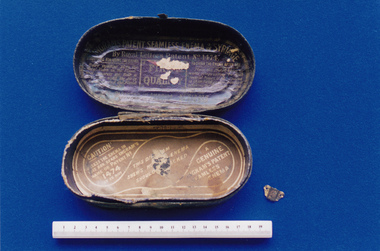
Enema syringe case associated with midwife Mary Howlett, c. 1866 - 1920, 1880 (approximate)
... Victoria. She qualified as a 'ladies monthly nurse' in 1887 and continued to practise as a nurse and midwife until 1920.She began her six months training at the Melbourne Lying-In Hospital. ...The enema box was used by midwife Mary Howlett in the 1880s on her district rounds. It was used to hold Ingram's Patent No. 1474 Seamless Enema Syringe, but the syringe is missing.Mary Howlett (1840-1922) began practising as a country midwife in 1866 in the western district of Victoria. She qualified as a 'ladies monthly nurse' in 1887 and continued to practise as a nurse and midwife until 1920.She began her six months training at the Melbourne Lying-In Hospital. She was known by many as 'Auntie', and her career spanned more than 50 years. Mrs Howlett's midwifery box and contents were given to Dr Frank Forster, and he donated them to the museum collection in 1993.Oval shaped black leather case with gold clip. Base (.1) and lid (.2) have become separated. Instructions for use, and how to clean the instrument, are pasted inside the lid and base of the box.midwifery, irrigation
