
Showing 27 items matching "nurses - living conditions"
-
 Returned Nurses RSL Sub-branch
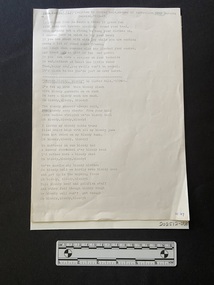
Document - Typed poem, Sister Male, [1939-1945?]
... Australian Army Nurses -- living conditions...The poems are about the food and living conditions for Nurses serving in World war II. The first is entitled 'Army Nurses' "IF" ' (an altered version of Rudyard Kipling's famous poem). ...World War 1939-1945 WW2 WWII War poety Australian Army Nursing Service Sister Male Australian Army Nurses -- living conditions 'H.89' [Handwritten in blue ink at the bottom of both pages] Two pages of white paper with black typing. ...Two poems written by Sister Male, a member of the Australian Army Nursing Service, 1939-1945. The poems are about the food and living conditions for Nurses serving in World war II. The first is entitled 'Army Nurses' "IF" ' (an altered version of Rudyard Kipling's famous poem). The second is 'Bloody, bloody, bloody'.Two pages of white paper with black typing. 'H.89' [Handwritten in blue ink at the bottom of both pages]world war 1939-1945, ww2, wwii, war poety, australian army nursing service, sister male, australian army nurses -- living conditions -
 Returned Nurses RSL Sub-branch
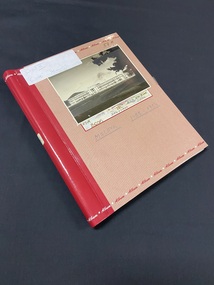
Album - Photograph album, Eileen Caterson, [unknown], [1955/6]
... ...Nurses - living conditions...The photographs depict nurses and soldiers of the British Commonwealth Occupation Force (BCOF) that served at the 130 AGH. There are public relations photographs and images of staff housing and living conditions, as well as celebration dinners, a wedding, and a mass. ...The photographs depict nurses and soldiers of the British Commonwealth Occupation Force (BCOF) that served at the 130 AGH. There are public relations photographs and images of staff housing and living conditions, as well as celebration dinners, a wedding, and a mass. ...Photographs and a news article regarding the 130th Australian General Hospital in Eta Jima, Japan. The photographs depict nurses and soldiers of the British Commonwealth Occupation Force (BCOF) that served at the 130 AGH. There are public relations photographs and images of staff housing and living conditions, as well as celebration dinners, a wedding, and a mass. The article is written about Dr. John Prior, a volunteer for the Army Medical Service who went on to become the Surgeon Officer commanding the Surgical Division of the BCOF in Kure, Japan.Light pink photograph album with feint, thin red stripes running vertically down the cover. The red spine continues an inch inwards on the left edge. The word 'Album' is repeated continuously around the top and bottom of the cover (in red text across the pink background and white text across the red spine). A black and white postcard image of a building has been taped on the front with the text 'Malaya 1955-1956' handwritten below in blue pen ink. The pages inside are spiral bound, self-adhesive card with plastic protector sheet overlaying each page. Only the first half of the album is full, it contains black and white photographs and a photocopy of a news clipping.'57A' [Handwritten in black ink on a white sticker attached to the spine] 'WWII / "Cate" Hewins ' [Handwritten in black ink on a white label attached to the front cover] '57A' [Handwritten in gold marker on the top of the front cover] '57A / BCOF. / 130th AGH ETAJIMA / JAPAN / DATE 7.7.1948' [Handwritten in a combination of gold and black ink beneath the attached photo on the front cover] 'MALAYA 1955-1956' [Handwritten and double underlined in blue ink on the front cover] 'BCOF. 130 AGH / LLOYD-WARD. via / 1948 - MRS EILEEN CATERSON' [Handwritten in black ink on the inside front cover] 'BCOF 130 AGH / Lloyd ward via / Eileen Caterson / August 1997' [Handwritten on an envelope that is attached with tape inside the front cover] [Multiple inscriptions handwritten on each page to describe the images]malaya, british commonwealth occupation forces, bcof, lloyd ward, eileen caterson, 130 australian general hospital, 1948 -malaya, japan, australian army nurses, nurses - living conditions, eta jima -
 Returned Nurses RSL Sub-branch
Document - Annotated document, Beryl Randall Trigellis-Smith (neé Sampson), 'Part 2 : History of Army Nursing - Australia' [Part of 'History of the Army Nursing Service', [1974 & 5]
... Appears to be a draft part of a history of nursing in the Australian Army, including topics such as service and living conditions, Nurses' Club, Edith Cavell, uniforms, lists, decorations, hospital ships and recreation. ...Appears to be a draft part of a history of nursing in the Australian Army, including topics such as service and living conditions, Nurses' Club, Edith Cavell, uniforms, lists, decorations, hospital ships and recreation. ...Appears to be a draft part of a history of nursing in the Australian Army, including topics such as service and living conditions, Nurses' Club, Edith Cavell, uniforms, lists, decorations, hospital ships and recreation. Former catalogue lists author as Beryl [Randall] Tregellis-Smith (neé Sampson).Bundle of papers, a mixture of typed and handwritten with some photocopied photos and hand written annotations. Front page is very dirty and torn, all pages have holes from previous binding and tears.'Amended [initialled] / 10/2/75' [red ink lower left side cover] [various annotations in ink throughout]beryl randall trigellis-smith (neé sampson), army nursing history, australian army nursing history -
Bendigo Historical Society Inc.
Document - Notes of public talk given to Bendigo Historical Society by Jenny Trewartha on 7th March, 2025 relating to NDSN, 7th March, 2025
... nurses in hospitals across the region as the nursing numbers were dwindling. Post World War II was a critical period with soldiers returning with wounds and conditions not seen before and needing special treatment. Medicine and medical treatments were entering a new age, and this new age needed nurses with new skills. There was a need to improve the status and prospects for nurses. Improved working and living...nurses in hospitals across the region as the nursing numbers were dwindling. Post World War II was a critical period with soldiers returning with wounds and conditions not seen before and needing special treatment. Medicine and medical treatments were entering a new age, and this new age needed nurses with new skills. There was a need to improve the status and prospects for nurses. Improved working and living ...Speech given by Jenny Trewartha to the Bendigo Historical Society on 7th March, 2025 at the la Trobe Art Institute, View Street, Bendigo. Jenny was a graduate of the NDSN at the end of 1972. The Northern District School of Nursing opened at Bendigo in 1950 and was the only regional independent School of Nursing of its kind in the southern hemisphere. There was a huge need for trained nurses in hospitals across the region as the nursing numbers were dwindling. Post World War II was a critical period with soldiers returning with wounds and conditions not seen before and needing special treatment. Medicine and medical treatments were entering a new age, and this new age needed nurses with new skills. There was a need to improve the status and prospects for nurses. Improved working and living conditions were needed; adequate remuneration and a career path to attract a better class of trainees, and a uniform training by means of a circular or block system. This was the basis of the establishment of the Northern District School of Nursing which oversaw nurse training in hospitals across the northwest of Victoria, including Bendigo, Castlemaine, Kyneton, Maryborough, Mildura, Ouyen, St Arnaud, Swan Hill, Dunolly, Inglewood and Echuca. The Northern District School of Nursing opened in 1950 and closed its doors in 1989 having overseen the training of more than 3000 nurses who are now scattered across Australia and the world.Ten pages of typed notes pertaining to training as a nurse at the Northern District School of Nursing from 1950 to 1989, and the Northern District School of Nursing Graduates Association. Document discusses different aspects of life as a trainee nurse - including financial, social and where students came from.northern district school of nursing, nursing, student -
 The Beechworth Burke Museum
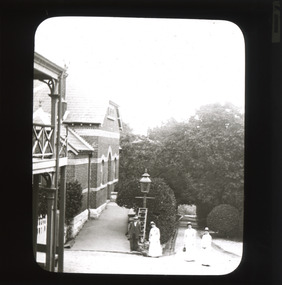
Photograph - Lantern Slide, c1900
... nurses at what is now the Mayday Hills Mental Asylum arriving for work in approximately 1900. These individuals are part of a long history of nursing in Beechworth. Three medical or social welfare facilities opened in the mid-1800s as part of a push by the township to become a regional centre for Government services. These were the Ovens District Hospital (opened in 1857), the Ovens Benevolent Asylum (opened in 1863), and the Beechworth Mental Hospital (opened in 1867 and renamed Mayday Hills Hospital at Centenary celebrations in 1967). It was recognised that the unsettled living conditions...nurses at what is now the Mayday Hills Mental Asylum arriving for work in approximately 1900. These individuals are part of a long history of nursing in Beechworth. Three medical or social welfare facilities opened in the mid-1800s as part of a push by the township to become a regional centre for Government services. These were the Ovens District Hospital (opened in 1857), the Ovens Benevolent Asylum (opened in 1863), and the Beechworth Mental Hospital (opened in 1867 and renamed Mayday Hills Hospital at Centenary celebrations in 1967). It was recognised that the unsettled living conditions ...This image appears to show nurses at what is now the Mayday Hills Mental Asylum arriving for work in approximately 1900. These individuals are part of a long history of nursing in Beechworth. Three medical or social welfare facilities opened in the mid-1800s as part of a push by the township to become a regional centre for Government services. These were the Ovens District Hospital (opened in 1857), the Ovens Benevolent Asylum (opened in 1863), and the Beechworth Mental Hospital (opened in 1867 and renamed Mayday Hills Hospital at Centenary celebrations in 1967). It was recognised that the unsettled living conditions, poverty and relative isolation of the Goldfields environment could produce 'mental disturbances' which required local treatment facilities as services in Melbourne were too far away. Carole Woods' publication 'A Titan's Field' describes activities undertaken by patients at Beechworth Mental Hospital as including monthly balls and occasional concerts as well as work to make the facility self-supporting such as farm work and making clothes. She mentions a report in 1870 that the approximately 300 patients were clean and neat with 'no-one in restraint or seclusion' but that by 1905 the organisation had 623 patients which placed strain on building infrastructure such as heating and water supplies, leading to high turnover of nurses and other issues. A program of building works to extend and improve facilities followed over subsequent decades. Lantern slides, sometimes called 'magic lantern' slides, are glass plates on which an image has been secured for the purpose of projection. Glass slides were etched or hand-painted for this purpose from the Eighteenth Century but the process became more popular and accessible to the public with the development of photographic-emulsion slides used with a 'Magic Lantern' device in the mid-Nineteenth Century. Photographic lantern slides comprise a double-negative emulsion layer (forming a positive image) between thin glass plates that are bound together. A number of processes existed to form and bind the emulsion layer to the base plate, including the albumen, wet plate collodion, gelatine dry plate and Woodburytype techniques. Lantern slides and magic lantern technologies are seen as foundational precursors to the development of modern photography and film-making techniques This glass slide is significant because it provides insight into Beechworth's social and medical amenities in the early Twentieth Century, around the time of Australia's Federation into one nation. It is also an example of an early photographic and film-making technology in use in regional Victoria in the time period.Thin translucent sheet of glass with a rectangular image printed on the front and framed in a black backing. It is held together by metals strips to secure the edges of the slide.Obverse: i /burke museum, beechworth, lantern slide, slide, glass slide, plate, burke museum collection, photograph, monochrome, magic lantern, indigo shire, north-east victoria, nineteenth century, 1900s, twentieth century, emulsion slides, nursing, nurses, mental hospitals, lunatic asylums, asylums, social services, social welfare, insane asylums, mental health, infrastructure -
 The Beechworth Burke Museum
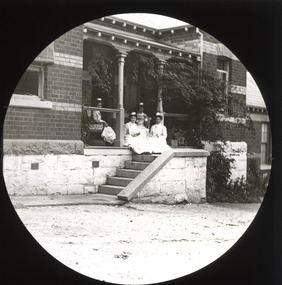
Photograph - Lantern Slide, c1900
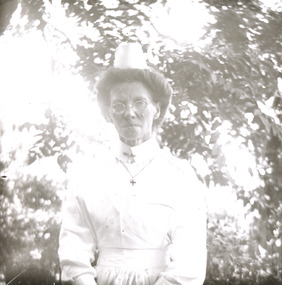
... nurses at what is now the Mayday Hills Mental Asylum in approximately 1900. These individuals are part of a long history of nursing in Beechworth. Three medical or social welfare facilities opened in the mid-1800s as part of a push by the township to become a regional centre for Government services. These were the Ovens District Hospital (opened in 1857), the Ovens Benevolent Asylum (opened in 1863), and the Beechworth Mental Hospital (opened in 1867 and renamed Mayday Hills Hospital at Centenary celebrations in 1967). It was recognised that the unsettled living conditions...nurses at what is now the Mayday Hills Mental Asylum in approximately 1900. These individuals are part of a long history of nursing in Beechworth. Three medical or social welfare facilities opened in the mid-1800s as part of a push by the township to become a regional centre for Government services. These were the Ovens District Hospital (opened in 1857), the Ovens Benevolent Asylum (opened in 1863), and the Beechworth Mental Hospital (opened in 1867 and renamed Mayday Hills Hospital at Centenary celebrations in 1967). It was recognised that the unsettled living conditions ...This image appears to show nurses at what is now the Mayday Hills Mental Asylum in approximately 1900. These individuals are part of a long history of nursing in Beechworth. Three medical or social welfare facilities opened in the mid-1800s as part of a push by the township to become a regional centre for Government services. These were the Ovens District Hospital (opened in 1857), the Ovens Benevolent Asylum (opened in 1863), and the Beechworth Mental Hospital (opened in 1867 and renamed Mayday Hills Hospital at Centenary celebrations in 1967). It was recognised that the unsettled living conditions, poverty and relative isolation of the Goldfields environment could produce 'mental disturbances' which required local treatment facilities as services in Melbourne were too far away. Carole Woods' publication 'A Titan's Field' describes activities undertaken by patients at Beechworth Mental Hospital as including monthly balls and occasional concerts as well as work to make the facility self-supporting such as farm work and making clothes. She mentions a report in 1870 that the approximately 300 patients were clean and neat with 'no-one in restraint or seclusion' but that by 1905 the organisation had 623 patients which placed strain on building infrastructure such as heating and water supplies, leading to high turnover of nurses and other issues. A program of building works to extend and improve facilities followed over subsequent decades. Lantern slides, sometimes called 'magic lantern' slides, are glass plates on which an image has been secured for the purpose of projection. Glass slides were etched or hand-painted for this purpose from the Eighteenth Century but the process became more popular and accessible to the public with the development of photographic-emulsion slides used with a 'Magic Lantern' device in the mid-Nineteenth Century. Photographic lantern slides comprise a double-negative emulsion layer (forming a positive image) between thin glass plates that are bound together. A number of processes existed to form and bind the emulsion layer to the base plate, including the albumen, wet plate collodion, gelatine dry plate and Woodburytype techniques. Lantern slides and magic lantern technologies are seen as foundational precursors to the development of modern photography and film-making techniques.This glass slide is significant because it provides insight into Beechworth's social and medical amenities in the early Twentieth Century, around the time of Australia's Federation into one nation. It is also an example of an early photographic and film-making technology in use in regional Victoria in the time period.Thin translucent sheet of glass with a circular image printed on the front and framed in a black backing. It is held together by metals strips to secure the edges of the slide.burke museum, beechworth, lantern slide, slide, glass slide, plate, burke museum collection, photograph, monochrome, magic lantern, indigo shire, north-east victoria, nineteenth century, 1900s, twentieth century, emulsion slides, nursing, nurses, mental hospitals, lunatic asylums, asylums, social services, social welfare, insane asylums, mental health, infrastructure -
 The Beechworth Burke Museum
Photograph - Lantern Slide, c1900
... nurse. Also known as the Beechworth Lunatic Asylum, Mayday Hills was officially opened on the twenty-fourth of October 1867 and was commissioned following lobbying from Beechworth Municipal Council concerning a need for better living conditions for certain individuals confined to the town's gaol. ...nurse. Also known as the Beechworth Lunatic Asylum, Mayday Hills was officially opened on the twenty-fourth of October 1867 and was commissioned following lobbying from Beechworth Municipal Council concerning a need for better living conditions for certain individuals confined to the town's gaol. ...Taken in approximately 1900, this glass slide captures an image of a Mayday Hills Mental Asylum nurse. Also known as the Beechworth Lunatic Asylum, Mayday Hills was officially opened on the twenty-fourth of October 1867 and was commissioned following lobbying from Beechworth Municipal Council concerning a need for better living conditions for certain individuals confined to the town's gaol. These individuals, as well as many others who were brought from surrounding institutions, exhibited behaviours that were deemed to be unfit for mainstream society. At its peak, the asylum consisted of sixty-seven buildings and housed over twelve-hundred patients and five-hundred staff. At the time of Australian Federation in 1901 - just a year after this photograph was taken - the patient population numbered six-hundred and seventy-four. The designated site of the institution was chosen due to its scenery and altitude. It was argued that these picturesque surroundings would assist in curing the hospital's patients of their ailments. The asylum was officially closed in 1996. It is listed on the Victorian Heritage Register as being architecturally significant. The extensive complex of buildings are examples of Italianate-style, which is strongly associated with asylums of the 1860s - the period in which construction of this particular asylum began. Today the asylum offers tours to visitors: both daytime history tours and night-time ghost tours. Lantern slides, sometimes called 'magic lantern' slides, are glass plates on which an image has been secured for the purpose of projection. Glass slides were etched or hand-painted for this purpose from the Eighteenth Century but the process became more popular and accessible to the public with the development of photographic-emulsion slides used with a 'Magic Lantern' device in the mid-Nineteenth Century. Photographic lantern slides comprise a double-negative emulsion layer (forming a positive image) between thin glass plates that are bound together. A number of processes existed to form and bind the emulsion layer to the base plate, including the albumen, wet plate collodion, gelatine dry plate and woodburytype techniques. Lantern slides and magic lantern technologies are seen as foundational precursors to the development of modern photography and film-making techniques.This glass slide is socially and historically significant as it is representative of the lives of the nurses who worked at Beechworth's Mayday Hills Asylum in the early twentieth century. Thin translucent sheet of glass with a portrait image printed on the front. It is held together by metal strips to secure the edges of the slide.burke museum, beechworth, lantern slide, slide, glass slide, plate, burke museum collection, photograph, monochrome, mayday hills, mayday hills mental asylum, beechworth asylum, beechworth asylum nurses, psychiatric nurses, psychiatric care, 1900 mayday hills, victorian heritage register, italianate style, 19th century asylums, asylums victoria -
 The Beechworth Burke Museum
Photograph - Lantern Slide, c1900
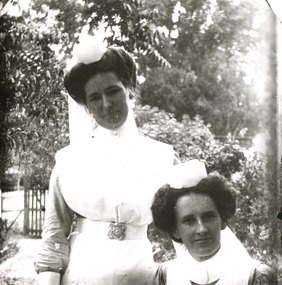
... nurses. Also known as the Beechworth Lunatic Asylum, Mayday Hills was officially opened on the twenty-fourth of October 1867 and was commissioned following lobbying from Beechworth Municipal Council concerning a need for better living conditions for certain individuals confined to the town's gaol. ...nurses. Also known as the Beechworth Lunatic Asylum, Mayday Hills was officially opened on the twenty-fourth of October 1867 and was commissioned following lobbying from Beechworth Municipal Council concerning a need for better living conditions for certain individuals confined to the town's gaol. ...Taken in approximately 1900, this glass slide captures an image of two Mayday Hills Mental Asylum nurses. Also known as the Beechworth Lunatic Asylum, Mayday Hills was officially opened on the twenty-fourth of October 1867 and was commissioned following lobbying from Beechworth Municipal Council concerning a need for better living conditions for certain individuals confined to the town's gaol. These individuals, as well as many others who were brought from surrounding institutions, exhibited behaviours that were deemed to be unfit for mainstream society. At its peak, the asylum consisted of sixty-seven buildings and housed over twelve-hundred patients and five-hundred staff. At the time of Australian Federation in 1901 - just a year after this photograph was taken - the patient population numbered six-hundred and seventy-four. The designated site of the institution was chosen due to its scenery and altitude. It was argued that these picturesque surroundings would assist in curing the hospital's patients of their ailments. The asylum was officially closed in 1996. It is listed on the Victorian Heritage Register as being architecturally significant. The extensive complex of buildings are examples of Italianate-style, which is strongly associated with asylums of the 1860s - the period in which construction of this particular asylum began. Today the asylum offers tours to visitors: both daytime history tours and night-time ghost tours. Lantern slides, sometimes called 'magic lantern' slides, are glass plates on which an image has been secured for the purpose of projection. Glass slides were etched or hand-painted for this purpose from the Eighteenth Century but the process became more popular and accessible to the public with the development of photographic-emulsion slides used with a 'Magic Lantern' device in the mid-Nineteenth Century. Photographic lantern slides comprise a double-negative emulsion layer (forming a positive image) between thin glass plates that are bound together. A number of processes existed to form and bind the emulsion layer to the base plate, including the albumen, wet plate collodion, gelatine dry plate and woodburytype techniques. Lantern slides and magic lantern technologies are seen as foundational precursors to the development of modern photography and film-making techniques.This glass slide is socially and historically significant as it is representative of the lives of the nurses who worked at Beechworth's Mayday Hills Asylum in the early twentieth century.Thin translucent sheet of glass with a portrait image printed on the front. It is held together by metal strips to secure the edges of the slide.burke museum, beechworth, lantern slide, slide, glass slide, plate, burke museum collection, photograph, monochrome, 1900 mayday hills, mayday hills, beechworth mental hospital, beechworth mental asylum, beechworth asylum nurses, psychiatric nurses, psychiatric care, victorian heritage register, italianate style, 19th century asylums, asylums victoria -
 City of Moorabbin Historical Society (Operating the Box Cottage Museum)
Booklet - Maternity and Care of the Baby c1940, L.F Johnson Commonwealth Government Printer, 1940
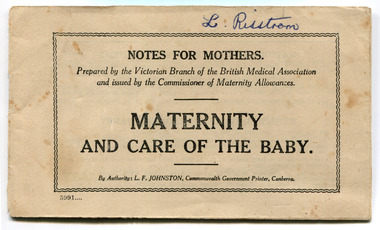
... living under very meagre conditions with very little access to medical care. Women depended on the care of a couple of District midwives and other local women who assisted with the birth and care of mother and baby. Gradually more maternal health services became available and Health Centres were established in Bentleigh, Moorabbin, Cheltenham. Post World War 11 advances in Maternal and Child Health care greatly assisted the mothers and reduced the infant mortality rate in City of Moorabbin infant care motherhood childbirth l. risstrom early settlers moorabbin shire bentleigh cheltenham dr fleming joyce dr george scantlebury nurse watts NOTES for MOTHERS / MATERNITY / and CARE OF THE BABY / L.F Johnson Commonwealth Government Printer, Canberra / 5991 Handwritten L.Risstrom 28 page booklet with information on how to care for a baby c1940 Booklet Maternity and Care of the Baby c1940 L.F Johnson Commonwealth Government Printer, ...Maternity and care of the baby / prepared by the Victorian Branch of the British Medical Association and issued by the Commissioner of Maternity Allowances. Printed by L. F. Johnston, Commonwealth Government Printer, Canberra. Early settler families in Moorabbin Shire were living under very meagre conditions with very little access to medical care. Women depended on the care of a couple of District midwives and other local women who assisted with the birth and care of mother and baby. Gradually more maternal health services became available and Health Centres were established in Bentleigh, Moorabbin, Cheltenham. Post World War 11 advances in Maternal and Child Health care greatly assisted the mothers and reduced the infant mortality rate in City of Moorabbin 28 page booklet with information on how to care for a baby c1940NOTES for MOTHERS / MATERNITY / and CARE OF THE BABY / L.F Johnson Commonwealth Government Printer, Canberra / 5991 Handwritten L.Risstrom infant care, motherhood, childbirth, l. risstrom, early settlers, moorabbin shire, bentleigh, cheltenham, dr fleming joyce, dr george scantlebury, nurse watts -
Northern District School of Nursing. Managed by Bendigo Historical Society Inc.
Newsletter - Northern District School of Nursing Graduates Association - Background Information on the School, 27 June 1988
... The Northern District School of Nursing in Victoria, Australia Graduates Association: Historical overview of the Northern District School of Nursing: After World War Two, Australian hospitals, especially in rural areas, faced a severe shortage of nurses due to low interest and challenging working conditions. Nurses endured strict discipline, poor wages, long hours, and restrictive living arrangements. ...The Northern District School of Nursing in Victoria, Australia Graduates Association: Historical overview of the Northern District School of Nursing: After World War Two, Australian hospitals, especially in rural areas, faced a severe shortage of nurses due to low interest and challenging working conditions. Nurses endured strict discipline, poor wages, long hours, and restrictive living arrangements. ...The Northern District School of Nursing in Victoria, Australia Graduates Association: Historical overview of the Northern District School of Nursing: After World War Two, Australian hospitals, especially in rural areas, faced a severe shortage of nurses due to low interest and challenging working conditions. Nurses endured strict discipline, poor wages, long hours, and restrictive living arrangements. The Hospital & Charities Commission appointed Miss Gwen Williams as the first Executive Officer of Nursing Services, who played a pivotal role in founding the regional training school at 'Lister House' in Bendigo in March 1950. Bendigo was selected for a pilot scheme to improve the correlation between theoretical and practical nurse training. The school staff worked to standardize training across regional hospitals and ensure students gained practical experience after theoretical instruction. A circular training scheme was introduced, allowing students from smaller hospitals to rotate through base hospitals for broader experience. Over time, affiliated hospitals changed as some de-registered and others joined. Founding staff, Miss Nancy Long and Miss Margot Scott, set high educational and professional standards, acting as educators, supervisors, and mentors.Training combined theory with hands-on practice, including procedures, instrument handling, and patient care. In 1973, the school began admitting students not attached to any specific hospital, allocating them to wards after study blocks to better align practice with theory. The Victorian Nursing Council later required the school to control clinical rotations. Male students were finally admitted to general nurse training in the 1960s after several failed attempts.Nurses' Week, started in 1952 by Miss Williams, aimed to promote nursing careers and community awareness. The school was instrumental in raising nursing education standards in the region for nearly forty years. Staff Nurses received additional training in administration after their basic three-year course. There were aspirations for postgraduate opportunities in rural areas, but country students continued to face challenges compared to their metropolitan counterparts.Northern District School of Nursing Graduates Association - Background Information on the School - 2 typed sheets This item contains the following document: 3792.7a Background Information on the School - 2 typed sheetsnurse training, lister house, history -
Northern District School of Nursing. Managed by Bendigo Historical Society Inc.
Administrative record - Northern District School of Nursing Graduates Association - Examination Papers, Mar 1976
... Living out allowances and travel expenses are covered. Four training intakes per year; waiting periods are short if qualifications are met. Nurse Training Lister House examinations Northern District School of Nursing Graduates Association - Examination Papers March 1976 This item contains the following documents: 3794.6a This document is a set of surgical nursing examination questions designed to assess knowledge and practical skills in patient care, treatment, and management across various clinical scenarios 3794.6b This nursing examination paper covers essential topics in medical nursing, focusing on assessment, diagnosis, and management of key conditions. ...The Northern District School of Nursing in Victoria, Australia Graduates Association: History of the School Managed by a committee including hospital administrators, medical professionals, and nursing leaders from several regional hospitals. Associated with major hospitals in the Northern District, including Bendigo Base, Mildura Base, Castlemaine, Echuca, Swan Hill, St. Arnaud, and Kyneton District Hospitals. Provide high-quality theoretical and practical nursing training. Raise the standard of nursing education in the region. Maintain the highest principles of nursing practice. Applicants must be at least 17 years old and hold a Proficiency Certificate or higher educational qualification. Application involves submitting forms, certificates, an interview, an aptitude test, and a medical examination. A three-month probationary period follows initial acceptance. Preliminary Training School: Four-week introductory course covering basic nursing, anatomy, hygiene, and practical skills. Practical experience in various hospital departments, guided by senior staff. Study Block Plan: Includes several blocks of theoretical and practical instruction throughout the three-year program. Regular school exams and two state exams (First Professional and Final State) are required for progression and graduation. Nurses work a 40-hour week with at least one or two days off per week and three weeks of annual leave. Accommodation is provided in comfortable hostels with good facilities. Uniforms are supplied free; nurses provide their own shoes and stockings. Salaries and allowances are regulated, with deductions for board and free medical care. Additional Information Post-Graduate Opportunities. Senior positions require further experience and additional certificates (e.g., Midwifery, Infant Welfare).Diploma courses available in administration, teaching, and specialized nursing fields. Bursaries are available for advanced study.Career Prospects: Graduates can pursue roles in administration, teaching, ward and departmental leadership, district and visiting nursing, industrial and school nursing, and more. Opportunities existed both within hospitals and in community or specialized settings.FAQs and Practical Details. Minimal training costs (mainly exam fees and personal items).Living out allowances and travel expenses are covered. Four training intakes per year; waiting periods are short if qualifications are met.Northern District School of Nursing Graduates Association - Examination Papers March 1976 This item contains the following documents: 3794.6a This document is a set of surgical nursing examination questions designed to assess knowledge and practical skills in patient care, treatment, and management across various clinical scenarios 3794.6b This nursing examination paper covers essential topics in medical nursing, focusing on assessment, diagnosis, and management of key conditions.nurse training, lister house, examinations -
Northern District School of Nursing. Managed by Bendigo Historical Society Inc.
Administrative record - Northern District School of Nursing Graduates Association - Examinations and Instruction Guides, Dec 1976
... Living out allowances and travel expenses are covered. Four training intakes per year; waiting periods are short if qualifications are met. Nurse Training Lister House examinations Northern District School of Nursing Graduates Association - Examinations and Instruction Guides Dec 1976 This item contains the following documents: 3794.11a This document is a nursing examination paper focused on medical and nursing care for a range of acute and chronic conditions. 3794.11b This document is an examiners' guide for a general nurse training medical nursing paper, outlining essential knowledge and expected answers for key medical and nursing topics. 3794.11c This document is a nursing examination paper from the Victorian Nursing Council, dated December 2, 1976, for general nurse training. ...The Northern District School of Nursing in Victoria, Australia Graduates Association: History of the School Managed by a committee including hospital administrators, medical professionals, and nursing leaders from several regional hospitals. Associated with major hospitals in the Northern District, including Bendigo Base, Mildura Base, Castlemaine, Echuca, Swan Hill, St. Arnaud, and Kyneton District Hospitals. Provide high-quality theoretical and practical nursing training. Raise the standard of nursing education in the region. Maintain the highest principles of nursing practice. Applicants must be at least 17 years old and hold a Proficiency Certificate or higher educational qualification. Application involves submitting forms, certificates, an interview, an aptitude test, and a medical examination. A three-month probationary period follows initial acceptance. Preliminary Training School: Four-week introductory course covering basic nursing, anatomy, hygiene, and practical skills. Practical experience in various hospital departments, guided by senior staff. Study Block Plan: Includes several blocks of theoretical and practical instruction throughout the three-year program. Regular school exams and two state exams (First Professional and Final State) are required for progression and graduation. Nurses work a 40-hour week with at least one or two days off per week and three weeks of annual leave. Accommodation is provided in comfortable hostels with good facilities. Uniforms are supplied free; nurses provide their own shoes and stockings. Salaries and allowances are regulated, with deductions for board and free medical care. Additional Information Post-Graduate Opportunities. Senior positions require further experience and additional certificates (e.g., Midwifery, Infant Welfare).Diploma courses available in administration, teaching, and specialized nursing fields. Bursaries are available for advanced study.Career Prospects: Graduates can pursue roles in administration, teaching, ward and departmental leadership, district and visiting nursing, industrial and school nursing, and more. Opportunities existed both within hospitals and in community or specialized settings.FAQs and Practical Details. Minimal training costs (mainly exam fees and personal items).Living out allowances and travel expenses are covered. Four training intakes per year; waiting periods are short if qualifications are met.Northern District School of Nursing Graduates Association - Examinations and Instruction Guides Dec 1976 This item contains the following documents: 3794.11a This document is a nursing examination paper focused on medical and nursing care for a range of acute and chronic conditions. 3794.11b This document is an examiners' guide for a general nurse training medical nursing paper, outlining essential knowledge and expected answers for key medical and nursing topics. 3794.11c This document is a nursing examination paper from the Victorian Nursing Council, dated December 2, 1976, for general nurse training. It covers a range of medical and surgical nursing topics, focusing on patient care, disease management, and clinical reasoning. 3794.11d This document serves as a guide for examiners assessing general nursing examinations, outlining the essential knowledge and skills expected from candidates. 3794.11e This document is a surgical nursing examination paper covering essential topics in post-operative care, complications, and related medical concepts. nurse training, lister house, examinations -
Northern District School of Nursing. Managed by Bendigo Historical Society Inc.
Administrative record - Northern District School of Nursing Graduates Association - Examinations and Instruction Guides, March 1977
... Living out allowances and travel expenses are covered. Four training intakes per year; waiting periods are short if qualifications are met. Nurse Training Lister House examinations Northern District School of Nursing Graduates Association - Examinations and Instruction Guides March 1977 This item contains the following documents: 3794.12a This document is a comprehensive nursing examination paper focused on pre- and post-operative care, clinical management, and complications of various surgical and medical conditions. 3794.12b This document is a comprehensive medical nursing examination paper for general nurse training, covering a wide range of acute and chronic medical conditions, their management, and related nursing care. 3794.12c Copy of 3794.12a 3794.12d Copy of 3794.12a 3794.12e This document serves as an examiners' guide for the General Nurse Training final examination, outlining expected knowledge and key management principles for various medical and nursing scenarios. 3794.12f Final Surgical Training Guide March 1977 five pages hand-written Administrative record Northern District School of Nursing Graduates Association - Examinations and Instruction Guides ...The Northern District School of Nursing in Victoria, Australia Graduates Association: History of the School Managed by a committee including hospital administrators, medical professionals, and nursing leaders from several regional hospitals. Associated with major hospitals in the Northern District, including Bendigo Base, Mildura Base, Castlemaine, Echuca, Swan Hill, St. Arnaud, and Kyneton District Hospitals. Provide high-quality theoretical and practical nursing training. Raise the standard of nursing education in the region. Maintain the highest principles of nursing practice. Applicants must be at least 17 years old and hold a Proficiency Certificate or higher educational qualification. Application involves submitting forms, certificates, an interview, an aptitude test, and a medical examination. A three-month probationary period follows initial acceptance. Preliminary Training School: Four-week introductory course covering basic nursing, anatomy, hygiene, and practical skills. Practical experience in various hospital departments, guided by senior staff. Study Block Plan: Includes several blocks of theoretical and practical instruction throughout the three-year program. Regular school exams and two state exams (First Professional and Final State) are required for progression and graduation. Nurses work a 40-hour week with at least one or two days off per week and three weeks of annual leave. Accommodation is provided in comfortable hostels with good facilities. Uniforms are supplied free; nurses provide their own shoes and stockings. Salaries and allowances are regulated, with deductions for board and free medical care. Additional Information Post-Graduate Opportunities. Senior positions require further experience and additional certificates (e.g., Midwifery, Infant Welfare).Diploma courses available in administration, teaching, and specialized nursing fields. Bursaries are available for advanced study.Career Prospects: Graduates can pursue roles in administration, teaching, ward and departmental leadership, district and visiting nursing, industrial and school nursing, and more. Opportunities existed both within hospitals and in community or specialized settings.FAQs and Practical Details. Minimal training costs (mainly exam fees and personal items).Living out allowances and travel expenses are covered. Four training intakes per year; waiting periods are short if qualifications are met.Northern District School of Nursing Graduates Association - Examinations and Instruction Guides March 1977 This item contains the following documents: 3794.12a This document is a comprehensive nursing examination paper focused on pre- and post-operative care, clinical management, and complications of various surgical and medical conditions. 3794.12b This document is a comprehensive medical nursing examination paper for general nurse training, covering a wide range of acute and chronic medical conditions, their management, and related nursing care. 3794.12c Copy of 3794.12a 3794.12d Copy of 3794.12a 3794.12e This document serves as an examiners' guide for the General Nurse Training final examination, outlining expected knowledge and key management principles for various medical and nursing scenarios. 3794.12f Final Surgical Training Guide March 1977 five pages hand-writtennurse training, lister house, examinations -
Northern District School of Nursing. Managed by Bendigo Historical Society Inc.
Administrative record - Northern District School of Nursing Graduates Association - Examinations and Guides, 1983
... Living out allowances and travel expenses are covered. Four training intakes per year; waiting periods are short if qualifications are met. Nurse Training Lister House examinations Northern District School of Nursing Graduates Association - Examinations and Guides 1983 This item contains the following documents: 3795.9a This document is a registration examination paper for general nurses, focusing on surgical nursing. 3795.9b This document is a registration examination paper for general nurses, focusing on medical nursing. 3795.9c This document is a nursing examination paper focused on medical conditions and patient care management. 3795.9d This document is a past registration examination paper for general nurses specializing in surgical nursing. ...The Northern District School of Nursing in Victoria, Australia Graduates Association: History of the School Managed by a committee including hospital administrators, medical professionals, and nursing leaders from several regional hospitals. Associated with major hospitals in the Northern District, including Bendigo Base, Mildura Base, Castlemaine, Echuca, Swan Hill, St. Arnaud, and Kyneton District Hospitals. Provide high-quality theoretical and practical nursing training. Raise the standard of nursing education in the region. Maintain the highest principles of nursing practice. Applicants must be at least 17 years old and hold a Proficiency Certificate or higher educational qualification. Application involves submitting forms, certificates, an interview, an aptitude test, and a medical examination. A three-month probationary period follows initial acceptance. Preliminary Training School: Four-week introductory course covering basic nursing, anatomy, hygiene, and practical skills. Practical experience in various hospital departments, guided by senior staff. Study Block Plan: Includes several blocks of theoretical and practical instruction throughout the three-year program. Regular school exams and two state exams (First Professional and Final State) are required for progression and graduation. Nurses work a 40-hour week with at least one or two days off per week and three weeks of annual leave. Accommodation is provided in comfortable hostels with good facilities. Uniforms are supplied free; nurses provide their own shoes and stockings. Salaries and allowances are regulated, with deductions for board and free medical care. Additional Information Post-Graduate Opportunities. Senior positions require further experience and additional certificates (e.g., Midwifery, Infant Welfare).Diploma courses available in administration, teaching, and specialized nursing fields. Bursaries are available for advanced study.Career Prospects: Graduates can pursue roles in administration, teaching, ward and departmental leadership, district and visiting nursing, industrial and school nursing, and more. Opportunities existed both within hospitals and in community or specialized settings.FAQs and Practical Details. Minimal training costs (mainly exam fees and personal items).Living out allowances and travel expenses are covered. Four training intakes per year; waiting periods are short if qualifications are met.Northern District School of Nursing Graduates Association - Examinations and Guides 1983 This item contains the following documents: 3795.9a This document is a registration examination paper for general nurses, focusing on surgical nursing. 3795.9b This document is a registration examination paper for general nurses, focusing on medical nursing. 3795.9c This document is a nursing examination paper focused on medical conditions and patient care management. 3795.9d This document is a past registration examination paper for general nurses specializing in surgical nursing. It covers essential knowledge and practical skills required for surgical nursing care. 3795.9e This document is an examiner's guide for the Victorian Nursing Council's surgical nursing registration exam, providing essential answer points and marking criteria for various questions. 3795.9f This document provides an examiners' guide for the Victorian Nursing Council's registration exam, outlining essential knowledge and expected answers for medical nursing topics. 3795.9g This document serves as an examiner's guide for surgical nursing, outlining essential knowledge and expected competencies for nurses. 3795.9h This document provides an examiner's guide for marking surgical nursing questions in the Victorian Nursing Council's registration examination. 3795.9i This document is an examiner's guide for the surgical nursing section of the Victorian Nurses Registration Examination (1983). It outlines essential information and marking criteria for exam questions, aiming to standardize grading. 3795.9j This document is an examiner's guide for the Victorian Nursing Council registration examination, summarizing essential knowledge and expected answers for general nurses.nurse training, lister house, examinations -
Northern District School of Nursing. Managed by Bendigo Historical Society Inc.
Administrative record - Northern District School of Nursing Graduates Association - Plan of Training, 1960s
... Living out allowances and travel expenses are covered. Four training intakes per year; waiting periods are short if qualifications are met. Nurse Training Lister House Northern District School of Nursing Graduates Association - Plan of Training and Conditions of Approval. ...The Northern District School of Nursing in Victoria, Australia Graduates Association: History of the School Managed by a committee including hospital administrators, medical professionals, and nursing leaders from several regional hospitals. Associated with major hospitals in the Northern District, including Bendigo Base, Mildura Base, Castlemaine, Echuca, Swan Hill, St. Arnaud, and Kyneton District Hospitals. Provide high-quality theoretical and practical nursing training. Raise the standard of nursing education in the region. Maintain the highest principles of nursing practice. Applicants must be at least 17 years old and hold a Proficiency Certificate or higher educational qualification. Application involves submitting forms, certificates, an interview, an aptitude test, and a medical examination. A three-month probationary period follows initial acceptance. Preliminary Training School: Four-week introductory course covering basic nursing, anatomy, hygiene, and practical skills. Practical experience in various hospital departments, guided by senior staff. Study Block Plan: Includes several blocks of theoretical and practical instruction throughout the three-year program. Regular school exams and two state exams (First Professional and Final State) are required for progression and graduation. Nurses work a 40-hour week with at least one or two days off per week and three weeks of annual leave. Accommodation is provided in comfortable hostels with good facilities. Uniforms are supplied free; nurses provide their own shoes and stockings. Salaries and allowances are regulated, with deductions for board and free medical care. Additional Information Post-Graduate Opportunities. Senior positions require further experience and additional certificates (e.g., Midwifery, Infant Welfare).Diploma courses available in administration, teaching, and specialized nursing fields. Bursaries are available for advanced study.Career Prospects: Graduates can pursue roles in administration, teaching, ward and departmental leadership, district and visiting nursing, industrial and school nursing, and more. Opportunities existed both within hospitals and in community or specialized settings.FAQs and Practical Details. Minimal training costs (mainly exam fees and personal items).Living out allowances and travel expenses are covered. Four training intakes per year; waiting periods are short if qualifications are met.Northern District School of Nursing Graduates Association - Plan of Training and Conditions of Approval. Four pages This item contains the following documents: 3801.4a This document details the structure, requirements, and administrative procedures for the Northern District School of Nursing's training program, including participating hospitals and conditions of approval. 3801.4b Copy of Abovenurse training, lister house -
 Royal District Nursing Service (now known as Bolton Clarke)
Photograph - Digital Image, c.1935
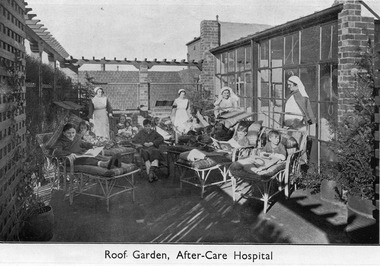
... living under unsuitable conditions. Following Government intervention, the After-Care Hospital was separated from the Melbourne District Nursing Society in 1957. The After-care Hospital continued to operate at the same address until 1985 when it became the Melbourne Geriatric Centre. mdns melbourne district nursing society after- care hospital nurses uniforms This digital Image shows two nurses and two Trained nurses (Sisters) supervising convalescing children in the roof garden of the Melbourne District Nursing Society After-Care Hospital . ...This digital image shows the sun roof on the Melbourne District Nursing Society After-Care Hospital, 45 Victoria Parade, Collingwood. It shows some of the children nursed at the home. Many children were nursed there long term during the Poliomyelitis epidemic in the 1930s. It also shows uniforms worn by nurses and Sisters in the 1930s. The Melbourne District Nursing Society After-Care Home was originally established to provide nurse-managed convalescent care to poor and underprivileged patients who could not look after themselves at home due to illness, or on release from hospital. Opening in 1926 following a public appeal for funds, at a cost of £27,000, the Home included maternity, children’s and adult wards as well as accommodation for Matron, twelve Sisters and four domestic staff. Many children were nursed there, some long term, during the Polio epidemic and the Society employed two School Teachers. The Society now ran two divisions, the After-Care with its own Sisters and nurses and the District division. The Society were the first in Melbourne, in early 1928, to recognize some patients leaving the After-Care, and many at home, needed further social care and they set up ‘Almoners’ from their committee to visit these patients and be intermediaries in getting them social assistance. It was late the following year before the first training of Almoners took place in Melbourne. In 1930 the Society employed a full time kindergarten teacher to visit poor children in their homes. That year the Society were pioneers in opening an Ante-Natal Clinic at the After-Care, setting a high standard with equipment, keeping records and providing leaflets with instructions in how to keep healthy during pregnancy, what complications to look for and what to do when labour commenced. In 1934 the Society were pioneers again when they opened the first Women’s Welfare Clinic, including at the time a very controversial Family Planning Clinic, the first of its kind in Australia which was opened to support women at risk following multiple and difficult pregnancies, giving advice on birth-control. At first the clinic was attended by their own patients, but then accepting patients from public hospitals until their own clinics were opened. . Major extensions in 1934 led to the After-Care 'Home' having a name change to 'Hospital'. A trained Almoner was employed in 1934 but she resigned after twelve months due to the work load. Unable to procure another due to a shortage of trained Almoners, a Social Service Officer was employed at the After-Care who successfully gained better housing from the Housing Commission for families living under unsuitable conditions. Following Government intervention, the After-Care Hospital was separated from the Melbourne District Nursing Society in 1957. The After-care Hospital continued to operate at the same address until 1985 when it became the Melbourne Geriatric Centre. This digital Image shows two nurses and two Trained nurses (Sisters) supervising convalescing children in the roof garden of the Melbourne District Nursing Society After-Care Hospital . The two nurses are with the rear children, one on the left and one on the right. Both are wearing long white aprons over their long sleeved dark grey uniforms, and both are wearing white caps over their dark hair. On the right rear, in front of a row of glass windows, the upper portion of a Sister can be seen wearing a white uniform and white veil. In the right front is another Sister who is wearing glasses and is wearing a white uniform and dark coloured cape. She is wearing a white veil over her short dark hair. There are three boys and four girls resting on cane lounges; some are reading books and one girl is holding a doll. Another boy, who is wearing a dressing gown, is sitting on a cane chair. There is a trellis and a wall of windows on the left of the image and some brick work and a wall of windows on the right hand side behind the Sisters.. Some pots with low and tall plants can be seen.A tiled hip roof of a building can be seen in the rear of the image.mdns, melbourne district nursing society, after- care hospital, nurses uniforms -
 Royal District Nursing Service (now known as Bolton Clarke)
Photograph - Photograph, black and white, 09.1944
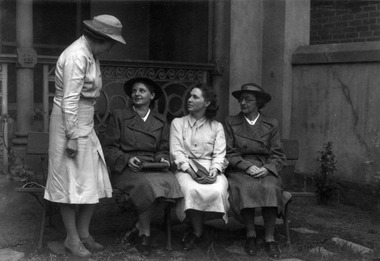
... From its foundation in 1885 the Melbourne District Nursing Society (MDNS, were instrumental in giving care to their patients, and to assist them if they had financial problems or resided in poor living conditions. Miss Dorothy Tupper, who as a Trained nurse, had undertaken a course in hospital housekeeping at London Prince of Wales Hospital, was contacted by MDNS in 1939 and, possessing both business and humanitarian qualities, was asked to organize their newly established Social Service Department. ...The 'Melbourne District Nursing Society After Care Home' was built by MDNS in 1926 and the name changed from 'Care' to 'Hospital' in 1934. It was located at 45 Victoria Parade, Collingwood. This photograph is taken three years after Miss Dorothy Tupper was appointed Matron of the District Nursing Division of the Society in 1941. The Sisters in this Division worked in the community giving nursing care to people in their own homes.From its foundation in 1885 the Melbourne District Nursing Society (MDNS, were instrumental in giving care to their patients, and to assist them if they had financial problems or resided in poor living conditions. Miss Dorothy Tupper, who as a Trained nurse, had undertaken a course in hospital housekeeping at London Prince of Wales Hospital, was contacted by MDNS in 1939 and, possessing both business and humanitarian qualities, was asked to organize their newly established Social Service Department. As the MDNS Social Service Sister, she assessed the living conditions in patient's homes. She continued in this role until being appointed Matron of the Society's District Nursing division in 1941. Matron Dorothy Tupper announced her retirement in December 1962. As Matron for 22 years she played a major role in the employment and management of an ever increasing nursing workforce as well as help oversee the expansion of the service. Matron Tupper was known for her keen sense of duty, her high professional standards and never-failing concern for patients. The photograph was taken by Sun Newspaper photographer and appeared in an article about the MDNS in September 1944Black and white photograph showing Melbourne District Nursing Society (MDNS) Matron, Dorothy Tupper, standing side on, and to the left, of three District Trained nurses (Sisters) who are seated in the grounds of the After-Care Hospital. Matron Tupper is wearing a light coloured uniform which has a belt and a centre box pleat on the lower part of the skirt; a grey brimmed hat with a darker grey hat band sits over her short dark hair. She is looking down at the first Sister on the seat who is looking up at her. The Sisters at either end of the seat are wearing dark grey double breasted coats with lapels; the collars of their light colour uniforms can be seen. Both are wearing grey brimmed hats over their short dark hair. The Sister at the far end is wearing glasses and the Sister near Matron Tupper is holding a book. The centre Sister has shoulder length dark hair and is wearing a light coloured long sleeve uniform. She is also holding a book. Both these Sisters are looking toward Matron Tupper. The seat is made of wood and is against the concrete veranda of the building behind. Scrolled metal lace work is directly behind them with a round thin concrete post to the left of Matron Tupper and the other end of the lace work is fixed to the concrete square corner columns. One turns to the right and the concrete wall of the veranda attached can be seen running in front of part of the brick wall of the building.after- care hospital, melbourne district nursing society, mdns, nurses, matron, mdns social service department, rdns, royal district nursing service, matron dorothy tupper -
 Royal District Nursing Service (now known as Bolton Clarke)
Photograph - Digital image, c.1930
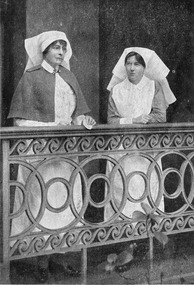
... living under unsuitable conditions. In the 1950s the Hospital and Charities Commission decided to take over the After-Care Hospital, so the Melbourne District Nursing Society and After-Care Hospital separated and the Melbourne District Nursing Service was formed, setting up Headquarters at 452 St. Kilda Road. With Royal patronage the name changed in 1966 to Royal District Nursing Service (RDNS). mdns melbourne district nursing society after- care hospital after-care home rdns royal district nursing service nurses ...This image shows two of the 'Melbourne District Nursing Society After Care Home' Sisters who worked in the After Care section of the Society during the 1930s. The image was taken on the balcony of the After Care Home at 39 Victoria Parade, Collingwood. It depicts the style of uniforms worn by trained nurses (Sisters) in that era. The Society were pioneers in recognizing the need for premises where patients too ill to be in their own home, but not ill enough to go to hospital, was needed, and the Melbourne District Nursing Society (MDNS) built, then opened, the After-Care Home in 1926, (from 1934 called After-Care Hospital), for these patients, and patients from Melbourne Hospitals who required recuperation before returning to their home. Many children were nursed there, some long term during the Polio epidemic, and the Society employed two School Teachers. The Society now ran two divisions, the After-Care with its own nursing staff and the District division. The Society were the first in Melbourne, in early 1928, to recognize some patients leaving the After-Care, and many at home, needed further social care and they set up ‘Almoners’ from their committee to visit these patients and be intermediaries in getting them social assistance. It was late the following year before the first training of Almoners took place in Melbourne. In 1930 the Society employed a full time kindergarten teacher to visit poor children in their homes. That year the Society were pioneers in opening an Ante-Natal Clinic at the After-Care, setting a high standard with equipment, keeping records and providing leaflets with instructions in how to keep healthy during pregnancy, what complications to look for and what to do when labour commenced. In 1934 the Society were pioneers again when they opened the first Women’s Welfare Clinic in Melbourne giving advice on birth-control, at first attended by their own patients, but then accepting patients from public hospitals until their own clinics were opened. A trained Almoner was employed in 1934 but only stayed twelve months due to the amount of work required. Due to shortage of trained Almoners, a Social Service Officer was employed at the After-Care who successfully gained better housing from the Housing Commission for families living under unsuitable conditions. In the 1950s the Hospital and Charities Commission decided to take over the After-Care Hospital, so the Melbourne District Nursing Society and After-Care Hospital separated and the Melbourne District Nursing Service was formed, setting up Headquarters at 452 St. Kilda Road. With Royal patronage the name changed in 1966 to Royal District Nursing Service (RDNS).Digital image of two Sisters from the Melbourne District Nursing Society (MDNS) After-Care Home standing on the balcony of their building. The Sister on the left hand side is wearing a dark cape over her white uniform; she wears a white veil over her dark hair. The Sister on the right hand side is wearing a long white apron over her grey uniform which has white cuffs on the sleeves. She is wearing a white veil over her dark hair. They are leaning on the scrolled metal rail of the balcony which runs along the grey building; part of which can be seen behind them.mdns, melbourne district nursing society, after- care hospital, after-care home, rdns, royal district nursing service, nurses uniforms -
 Royal District Nursing Service (now known as Bolton Clarke)
Photograph - Photograph, black and white:, c.1960
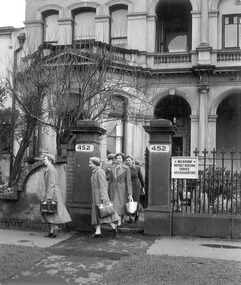
... living under unsuitable conditions. In 1957 the Hospital and Charities Commission decided to take over the After-Care Hospital, so the 'Melbourne District Nursing Society and After-Care Hospital' separated and the 'Melbourne District Nursing Service' was formed, setting up Headquarters at 452 St. Kilda Road. Royal patronage was granted in 1966, now becoming the Royal District Nursing Service, (RDNS). Liaison with public hospitals began with a District nurse ...This photograph was taken just a few years after the District division of the 'Melbourne District Nursing Society and After Care Hospital' separated in 1957. The District Division then became known as 'Melbourne District Nursing Service'. They moved into their Headquarters at 452 St. Kilda Road, Melbourne which was used as the Nurses Home as well as for Administrative purposes. The Sisters left from there each day to do their rounds and returned to do their book work before retiring at the end of the day. This photograph depicts the winter uniform worn at this time; a grey felt beret which had a red Maltese cross attached in the centre; a grey cotton frock and red cardigan, and a grey woolen coat, some with a grey belt, worn over their uniform.In 1885, 50 years after Melbourne was founded, it was recognized that nursing care was needed for the sick poor in inner Melbourne. The Melbourne District Nursing Society (MDNS), the first Society of its kind in Australia, was founded in February 1885 with one Trained nurse (Nurse), and a second employed six months later, working in the now CBD ie. from Spencer Street to Spring Street and from Victoria Parade to Flinders Street. From its inception the Society was at the forefront of health care. They provided high quality trained nursing care; educated their patients in the curing and prevention of disease; teaching the importance of cleanliness and good nutrition, both by verbal instruction and demonstration, even supplying soup and milk when needed. At that time they walked the streets and lane ways amid the slums of inner Melbourne carrying their nursing bag containing lotion and dressings, and supplying equipment on loan, such as feeding mugs, bedpans, air-cushions, splints, bed cradles feeding mugs and providing clean bed linen and nightdresses as necessary. Trained midwives began home births in August 1893 taking midwifery bundles and providing clothes for the babe and mother as needed. The Society were pioneers in recognizing the need for premises where patients too ill to be in their own home, but not ill enough to go to hospital, was needed, and the Society built, then opened, the After-Care Home, (later called After-Care Hospital), in 1926, for their patients, and patients from Hospitals. Many children were nursed there, some long term during the Polio epidemic; the Society employed two School Teachers. The Society now ran two divisions, the After-Care with its own Trained nurses (Sisters) and nurses and the District division. The Society were the first in Melbourne, in early 1928, to recognize some patients leaving the After-Care, and many at home, needed further social care and they set up ‘Almoners’ from their Committee to visit these patients and be intermediaries in getting them social assistance. It was late the following year before the first training of Almoners took place in Melbourne. In 1930 the Society employed a full time kindergarten teacher to visit poor children in their homes. That year the Society were pioneers in opening an Ante-Natal Clinic at the After-Care, setting a high standard with equipment, keeping records and providing leaflets with instructions in how to keep healthy during pregnancy, what complications to look for and what to do when labour commenced. In 1934 the Society were pioneers again when they opened the first Women’s Welfare Clinic in Melbourne giving advice on birth-control, at first attended by their own patients, but then accepting patients from public hospitals until their own clinics were opened. A Social Service Officer was employed at the After-Care who successfully gained better housing from the Housing Commission for families living under unsuitable conditions. In 1957 the Hospital and Charities Commission decided to take over the After-Care Hospital, so the 'Melbourne District Nursing Society and After-Care Hospital' separated and the 'Melbourne District Nursing Service' was formed, setting up Headquarters at 452 St. Kilda Road. Royal patronage was granted in 1966, now becoming the Royal District Nursing Service, (RDNS). Liaison with public hospitals began with a District nurse attached to a hospital visiting patients before going home. Education continued to be at the forefront of District with research by RDNS Educators and programs being implemented. Initial visits not only assessed the specific nursing situation but the situation as a whole. Their patients ranged in age from babes, children, adults to the elderly and referrals were taken from Hospitals, General Practitioners and allied Health facilities. Some of the care the Sisters provided is as follows: – Post-Natal care given to mother and babe, Wound Care following various types of surgery, accidents, burns, cancer, leg ulcers etc. Supervising and teaching Diabetic Care, including teaching and supervising people with Diabetes to administer their own Insulin, and administering Insulin to those unable to give their own injections. Administering other injections and setting up weekly medication boxes. The Sisters performed Catheterizations on adults suffering from conditions such as Quadriplegia, Paraplegia, Multiple Sclerosis (MS), Motor Neurone Disease (MND) and Guillan-Barre Syndrome, and when required at school on children for e.g. those with Spina Bifida. The Sisters visited those requiring Cystic Fibrosis support and care; those requiring Haemo-Oncology care, including visiting children at school; those requiring Home Enteral Feeding care, and those requiring IV therapy at home and home Dialysis. Palliative Care was given including pain relief with the use of syringe drivers, personal care as needed, and advice and support to both patient and family. The Sisters provided Stoma management to those needing Urostomy, Ileostomy and Colostomy care and those requiring Continence care. HIV/AIDS nursing care was provided; visits to Homeless Persons were made. Personal care was given to patients ranging in age and with varying mobility problems, such as Amputees, those with MS, MND, Guillan-Barre Syndrome, Poliomyelitis, Quadriplegia, Paraplegia, Acquired Brain Injury, to those following a Cerebrovascular Accident (Stroke), those with severe Arthritis and those with a form of Dementia. When necessary the elderly were assisted with personal care and advice given on safety factors with the use of hand rails, bath or shower seats, and hand showers. Rehabilitation with an aim towards independence remained at the forefront of the Sister’s minds and when possible using aids and instruction on safe techniques enabled the person to become fully independent. All care included giving advice and support to the patient and their Carers. The Sisters liaised with the persons Doctor, Hospital and allied Health personal when necessary.Black and White photograph of seven (some partly hidden) Melbourne District Nursing Service (MDNS) Sisters wearing full winter uniform of grey berets and grey long coats, with lapels, over their uniform which is partly seen on one Sister. Some are on a path, and others walking to the open metal gate; one Sister is between two tall, square, dark grey concrete columns. Looking at the photograph, two Sisters have turned left onto the footpath. These two Sisters are carrying oblong leather type bags in their left hand and the Sister between the columns is carrying a white soft material type bag. The Sisters seen have short dark hair under their berets. White plaques with the black numbers '452' are attached to the top 1/3 of each column and an arched grey concrete fence with brick top runs to the left. Behind this are two medium size leafless trees. A metal spiked fence runs from the column to the right of the photograph. Attached to this, near the column, is a white plaque with 'Melbourne District Nursing Service Headquarters' written in black. In the rear is a light grey two story Italian style building with a polygon shaped bay window to the left on the ground floor. It has a long window in the front and another on the side. To the right of this is a veranda with two concrete arches, separated by a roman column. A door can be seen behind the first arch. Above the bay window on the second story are three long arched windows, and to the right of that an arched opening with a roman column separating the partially seen next window. A concrete balustrade is seen at the front of the second story.melbourne district nursing service, headquarters, mdns, nurses, nurses uniforms, royal district nursing service, rdns -
 Royal District Nursing Service (now known as Bolton Clarke)
Photograph - Photograph, black and white, c.1960
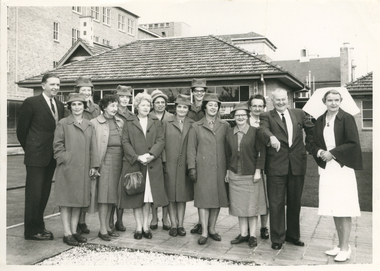
... From its foundation in 1885 the Melbourne District Nursing Society (MDNS), were instrumental in giving nursing care to patients in their own homes, and to assist them if they had financial problems or resided in poor living conditions. Miss Dorothy Tupper who, as a Trained nurse, had undertaken a course in hospital housekeeping at London Prince of Wales Hospital, was contacted by MDNS in 1939 and, possessing both business and humanitarian qualities, was asked to organize their newly established Social Service Department. ...The occasion of the photograph is unknown, but it depicts a group of Melbourne District Nursing Service (MDNS) Sisters with Matron Tupper. She is wearing the Matron uniform of a white frock and veil and a red cape. The Sisters are wearing their grey MDNS uniforms and one is wearing a uniform red cardigan. The Sisters peaked hats have a red Maltese cross applied in the centre front.From its foundation in 1885 the Melbourne District Nursing Society (MDNS), were instrumental in giving nursing care to patients in their own homes, and to assist them if they had financial problems or resided in poor living conditions. Miss Dorothy Tupper who, as a Trained nurse, had undertaken a course in hospital housekeeping at London Prince of Wales Hospital, was contacted by MDNS in 1939 and, possessing both business and humanitarian qualities, was asked to organize their newly established Social Service Department. As the MDNS Social Service Sister, she assessed the living conditions in patient's homes. She continued in this role until being appointed Matron of the Society's District Nursing division in 1941; a role she continued in until her retirement at the end of 1962.Black and white photograph of a group of seven Melbourne District Nursing Service (MDNS) Sisters and Matron Tupper with two men and four ladies standing in two rows in front of a brick house which has a tiled roof. To the left in the back row is a gentlemen with dark hair, who is wearing a dark suit, then two MDNS Sisters, next is a lady who is wearing glasses and is dressed in a light colour coat and hat. To her right is a tall MDNS Sister wearing dark rimmed glasses, then a lady with dark curly hair looking over the shoulder of a man with grey hair who is wearing a dark suit; on his right is Matron Tupper, who is wearing her white nursing uniform, her dark cape, and white veil over her short dark curled hair. In the left front is a Sister; to her right is a lady with dark curly hair and wearing a light coloured coat over a dark skirt and jumper; then a lady with blonde curly hair who is wearing a dark coat over her light dress and is carrying a handbag. Three Sisters are to her right - the end one is wearing glasses and a dark cardigan over her grey uniform frock The other MDNS Sisters in the group are wearing their grey uniform coats over their partly seen grey uniforms. All the MDNS Sisters are wearing grey uniform peaked hats. A three storey building is to the left rear of the photograph and and parts of three other buildings behind and to the right of the house.melbourne district nursing society, mdns, mdns social service department, mdns matron, matron dorothy tupper -
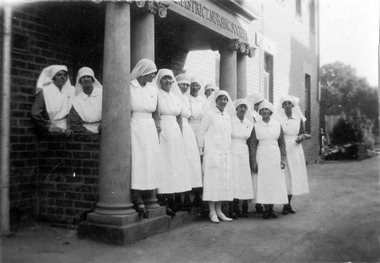 Royal District Nursing Service (now known as Bolton Clarke)
Photograph - Photograph, black and white, c.1930
... Due to a lack of trained Almoners, the Society employed a Social Service Officer at the After-Care who successfully gained better housing from the Housing Commission for families living under unsuitable conditions. nurses after care hospital uniforms after-care home melbourne district nursing society mdns rdns royal district nursing service A black and white photograph of Matron and twelve Trained nurses (Sisters) standing at the front entrance of the Melbourne District Nursing Society After Care Home, In the front of the portico is the Matron and four Sisters. ...The Matron and Sisters in this photograph worked in the Melbourne District Nursing Society After Care Home, (later called Hospital) full time and administered nursing care to patients who ranged in age from babes to adults. The Society also had a District Nursing division and these Sisters only worked in the community giving nursing care to patients in their homes.The Melbourne District Nursing Society were pioneers in recognizing the need for premises where patients too ill to be in their own home, but not ill enough to go to hospital, was needed, and the Society built, then opened, the After-Care Home in 1926, (from 1934 called After-Care Hospital), for these patients, and patients from Hospitals. Many children were nursed there, some long term during the Polio epidemic and the Society employed two School Teachers. The Society now ran two divisions, the After-Care with its own Sisters and nurses, and the District division. The Society were the first in Melbourne, in early 1928, to recognize some patients leaving the After-Care, and many at home, needed further social care and they set up ‘Almoners’ from their committee to visit these patients and be intermediaries in getting them social assistance. It was late the following year before the first training of Almoners took place in Melbourne. In 1930 the Society employed a full time kindergarten teacher to visit poor children in their homes. That year the Society were pioneers in opening an Ante-Natal Clinic at the After-Care, setting a high standard with equipment, keeping records, and providing leaflets with instructions in how to keep healthy during pregnancy, what complications to look for and what to do when labour commenced. In 1934 the Society were pioneers again when they opened the first Women’s Welfare Clinic in Melbourne giving advice on birth-control, at first attended by their own patients, but then accepting patients from public hospitals until their own clinics were opened. A trained Almoner was employed by the Society in 1934, doing a great deal of work with Midwifery patients, but she resigned after twelve months due to the amount of work. Due to a lack of trained Almoners, the Society employed a Social Service Officer at the After-Care who successfully gained better housing from the Housing Commission for families living under unsuitable conditions.A black and white photograph of Matron and twelve Trained nurses (Sisters) standing at the front entrance of the Melbourne District Nursing Society After Care Home, In the front of the portico is the Matron and four Sisters. Matron is dressed in a white long uniform dress and white veil over her short dark hair, and is wearing white stockings and white shores. To her right are four Sisters. Behind them are five Sisters, one standing between the left pair of round columns of the portico and the others to her right finishing just before the second set of columns. Two Sisters are to the left of the left hand column in front of the brick wall of the building. A short brick wall runs from the column to the building and hides the lower half of these Sisters. All the Sisters are dressed with white long aprons with white belts, which are covering their uniforms, only their dark grey sleeves and white collars can be seen. They are wearing white veils covering most of their short dark hair, grey stockings and black shoes. At the top of the portico can be seen the words 'District Nursing Society'. Part of the two story brick building can be seen behind the group; two long windows are visible on the upper and lower sections. To the right of the building some shrubs and a tree can be seen.nurses, after care hospital, uniforms, after-care home, melbourne district nursing society, mdns, rdns, royal district nursing service -
 Bendigo Historical Society Inc.
Book - "The Impact of WW1 on Bendigo Health: Our nurses, Doctors and Community.", 1914
... Unhealthy living conditions for soldiers (and sailors) included: poor diet lack of sleep exposure to cold contact with mice, rats, fleas, lice and other parasites. Soldiers World War One British Empire Doctors Nurses ...Over 4000 Bendigo residents enlisted to serve in W.W. 1. Much is known about their contributions to the war effort, but less is known about the contributions made by the medical staff who provided care at the front lines or otherwise supported care. People enlisted for many reasons - patriotism, duty and adventure being just a few. Over 416,000 persons enlisted to serve in World War One out of a population of 5 million. The Australian Government recorded 215,585 casualties during the war. Over 80% of those casualties occurred on the Western Front, in Belgium and France. The weapons used in trench warfare created horrendous injuries for both sides in the war. In the Australian Imperial Force (AIF), for example, most wounds were the result of flying metal. During their service, many of the 331,781 AIF troops and medical staff were injured more than once: over 50% were hit by shell fragments or shrapnel bullets from artillery fire 40% were hit by high-velocity bullets from rifles or machine guns 12% were affected by chlorine or mustard gas 2% were hit by bombs or grenades only 0.3% suffered bayonet wounds Many health risks also developed into large-scale problems on the front. Those who served lived and work in crowded spaces, which helped to spread bacterial, viral and parasitic infections. Unhealthy living conditions for soldiers (and sailors) included: poor diet lack of sleep exposure to cold contact with mice, rats, fleas, lice and other parasites. Soft cover. 41pp. Black and white image of nurses on front cover, along with red poppy. Tile written in white to bottom third of front cover on black background. Bendigo Health logo to bottom of front cover. Back cover has image of signage for the 'Old Mortuary' of Bendigo Hospital, with burgundy, black and white stipes above and below image. Contains black and white and color images. soldiers, world war one, british empire, doctors, nurses, bendigo hospital -
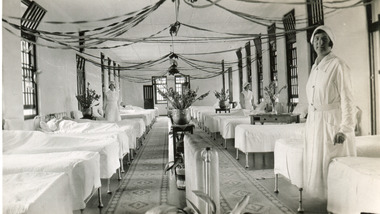 The Beechworth Burke Museum
Photograph, 1934
... nurse...social welfare...goldfields...Melbourne...mental health...living conditions...nurse in the foreground is Miss Neary. The Mayday Hills Hospital was constructed between 1864 and 1867, with buildings created in a number of periods. It formally opened on 24 October 1867 and, along with the Ovens Hospital and the Benevolent Asylum, made Beechworth a prominent social welfare centre in Victoria. The need for an institution of this kind was arisen due to the increased number of people with mental disturbances (induced by the harsh living conditions...living conditions of patients admitted to the Mayday Hills Hospital at the beginning of the 20th century. It also contributes to the understanding of the district`s development and its importance to the course of Victoria`s history. Additionally, it provides important information about the way mental health conditions were perceived at that time and how patients were treated. Mayday Hills Hospital Benevolent Asylum Ovens Hospital Ovens Lunatic Asylum Kulin Nation Beechworth patients nurse ...The photo is taken in 1934 and illustrates the internal view of a ward in the Mental Hospital at Beechworth. Some patients in beds and three nurses are in view. Beds were arranged in lines alongside the walls and there were no partitions or screens to create privacy for patients. Furniture was simple and humble; bed frames were made of metal or wood and pillowcases and covers for the attendant`s tables were sometimes made of blue-striped canvas or calico. Large windows in the walls were offering ample light and the room was well-tended, with Christmas decoration, flowers, pots and carpets on the floor. The nurse in the foreground is Miss Neary. The Mayday Hills Hospital was constructed between 1864 and 1867, with buildings created in a number of periods. It formally opened on 24 October 1867 and, along with the Ovens Hospital and the Benevolent Asylum, made Beechworth a prominent social welfare centre in Victoria. The need for an institution of this kind was arisen due to the increased number of people with mental disturbances (induced by the harsh living conditions on the goldfields) and the remoteness of the district from Melbourne. The site was chosen for its panoramic view of the countryside, the hilltop atmosphere and the native fauna, all contributing to the cure of patients. The Hospital was originally named the “Ovens Lunatic Asylum” but, during the centenary celebrations in 1967, the name was officially changed to “Mayday Hills Hospital”, showing the gradual shift in the perception and understanding of mental health conditions over the last decades. The Hospital lies on the traditional land of the Kulin Nation. This photograph is historically significant as it provides an insight into the living conditions of patients admitted to the Mayday Hills Hospital at the beginning of the 20th century. It also contributes to the understanding of the district`s development and its importance to the course of Victoria`s history. Additionally, it provides important information about the way mental health conditions were perceived at that time and how patients were treated. Black and white rectangular photograph printed on paper. Reverse: 1997.2665/ To Miss JA.Peach/ [hallmark: Printed by Harringtons]/ With best wishes/from/H.Jeanes/for 1934.mayday hills hospital, benevolent asylum, ovens hospital, ovens lunatic asylum, kulin nation, beechworth, patients, nurse, social welfare, goldfields, melbourne, mental health, living conditions, blue-striped canvas, calico, bed frames, miss neary, mental disturbances, traditional land, centenary celebrations -
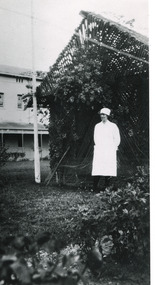 The Beechworth Burke Museum
Photograph - Photograph Reproduction, 1998
... nurses living in the hospital and in 1937 began the construction of a nurses` hostel. In 1962 the upper level of the Nurses` Home was converted into a Nurses` Training School. The Mayday Hills Hospital was constructed between 1864 and 1867, with buildings created in a number of periods. It formally opened on 24 October 1867 and, along with the Ovens Hospital and the Benevolent Asylum, made Beechworth a prominent social welfare centre in Victoria. The need for an institution of this kind was arisen due to the increased number of people with mental disturbances (induced by the harsh living conditions...nurses living in the hospital and in 1937 began the construction of a nurses` hostel. In 1962 the upper level of the Nurses` Home was converted into a Nurses` Training School. The Mayday Hills Hospital was constructed between 1864 and 1867, with buildings created in a number of periods. It formally opened on 24 October 1867 and, along with the Ovens Hospital and the Benevolent Asylum, made Beechworth a prominent social welfare centre in Victoria. The need for an institution of this kind was arisen due to the increased number of people with mental disturbances (induced by the harsh living conditions ...The photograph, created in 1998, is a copy of the original one, depicting a nurse in uniform at the Mental Hospital in Beechworth, with a fern house behind her. In the background, the two-storey building is in view, along with the covered walkway. The institution had to operate with serious shortage of female nurses for long periods of time. During the 1880s, small houses (cottages) were built to offer accommodation for the nurses living in the hospital and in 1937 began the construction of a nurses` hostel. In 1962 the upper level of the Nurses` Home was converted into a Nurses` Training School. The Mayday Hills Hospital was constructed between 1864 and 1867, with buildings created in a number of periods. It formally opened on 24 October 1867 and, along with the Ovens Hospital and the Benevolent Asylum, made Beechworth a prominent social welfare centre in Victoria. The need for an institution of this kind was arisen due to the increased number of people with mental disturbances (induced by the harsh living conditions on the goldfields) and the remoteness of the district from Melbourne. The two-storey buildings, designed in Italianate style, and the three-storey towers at the front, were influenced by the asylum at Colney Hatch in England. Large masses of granite were excavated for its foundation and around 250 workmen were employed for its construction. The building, divided into six sections, was comprised of dormitories, doctors` rooms and plenty ancillary rooms and facilities, such as laundries, reading rooms, a concert hall and cooking areas. The site was chosen for its panoramic view of the countryside, the hilltop atmosphere and the native fauna, all contributing to the cure of patients. The Hospital was originally named the “Ovens Lunatic Asylum” but, during the centenary celebrations in 1967, the name was officially changed to “Mayday Hills Hospital”, showing the gradual shift in the perception and understanding of mental health conditions over the last decades. The Hospital lies on the traditional land of the Kulin Nation.This photograph is historically significant as it provides an insight into the everyday life of staff living within the walls of the Mayday Hills Hospital. It also offers important information about the location and the exterior of the Hospital and contributes to the understanding of the district`s development and its importance to the course of Victoria`s history.Black and white rectangular photograph printed on paper unframed.Reverse: 3445/mental hospital, beechworth, fern house, female nurses, nurses` home, nurses` training school, nurses` hostel, mayday hills hospital, ovens hospital, colney hatch, two-storey buildings, italianate style, benevolent asylum, ovens lunatic asylum, kulin nation, workmen, covered walkway, granite, hilltop atmosphere, mental health -
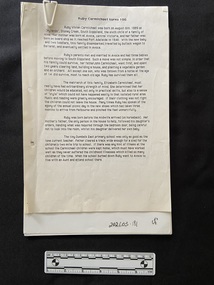 Returned Nurses RSL Sub-branch
Document - Photocopy of a collection of documents and photographs, Australian Imperial Force, base records office, Ruby Vivien Carmichael, unknown
... Australian Imperial Force (1914-1921) Australian Nurses WWI WW1 Ships - Hospital Hospitals - Camp WW1 Living conditions Wedding Ceremonies Solonika Karoola Hospital Ship A collection of black and white typed and photocopied documents and pages of photographs. ...A biographical collection of papers and photographs relating to Australian Army Nursing Service (AANS) nurse, Ruby Vivian Carmichael, who served during the First World War. It includes a copy of her army record, a short story that was published in the "Leongatha Star" newspaper and copies of ten photographs.A collection of black and white typed and photocopied documents and pages of photographs.army nurses, australian imperial forces, world war 1914-1918, australia. australian army. australian imperial force (1914-1921), australian nurses, wwi, ww1, ships - hospital, hospitals - camp, ww1 living conditions, wedding ceremonies, solonika, karoola hospital ship -
 Returned Nurses RSL Sub-branch
Document - Photocopy of a typed biographical history, Sister Laura Eleanor White A.A.N.S, unknown
... Biographical piece about Sister Laura Eleanor White who enlisted with the Australian Army Nursing Service in 1917 and served as a Staff Nurse in the military hospitals in Salonika. The piece of writing provides interesting information on living conditions in the General Hospitals....Biographical piece about Sister Laura Eleanor White who enlisted with the Australian Army Nursing Service in 1917 and served as a Staff Nurse in the military hospitals in Salonika. The piece of writing provides interesting information on living conditions in the General Hospitals. ...Biographical piece about Sister Laura Eleanor White who enlisted with the Australian Army Nursing Service in 1917 and served as a Staff Nurse in the military hospitals in Salonika. The piece of writing provides interesting information on living conditions in the General Hospitals.Cover page has a solid black line border around the full page and the heading printed in the top centre. The following two pages are a typed biography. The final page is a full page portrait image of Sister White.world war 1914-1918, australian nurses, wwi, ww1, australian army nursing serive, aans, laura eleanor white, salonika -
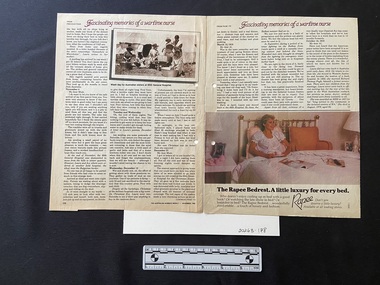 Returned Nurses RSL Sub-branch
Article - Magazine article, The Australian Women's Weekly, Fascinating memories of a wartime nurse, 1983
... Nurse in Salonika during WWI. The article includes parts taken from letters and diaries that have been donated to the Australian War Memorial in Canberra. It provides a fascinating account of living and work conditions...Nurse in Salonika during WWI. The article includes parts taken from letters and diaries that have been donated to the Australian War Memorial in Canberra. It provides a fascinating account of living and work conditions ...An account of Laura Grubb's service as an Army Nurse in Salonika during WWI. The article includes parts taken from letters and diaries that have been donated to the Australian War Memorial in Canberra. It provides a fascinating account of living and work conditions in the field hospitals, the celebrations surrounding Christmas with the patients, and the great value the wounded and sick soldiers placed on the nurses who assisted them in such terrible times.Full double-page spread magazine article that continues overleaf and on to half another page. The title is printed right across the top. There is a panorama picture of a field hospital and right below it a map of Greece. Slightly overlaying the image are a photo of Laura Grubb in uniform, and another more casual photo of her with friends and a donkey. There are three columns of text on each of the four pages.world war 1914-1918, australian nurses, wwi, ww1, australian army nursing serive, aans, salonika, laura grubb, living conditions, rations
