
Showing 29 items matching "peace foundation"
-
 National Vietnam Veterans Museum (NVVM)
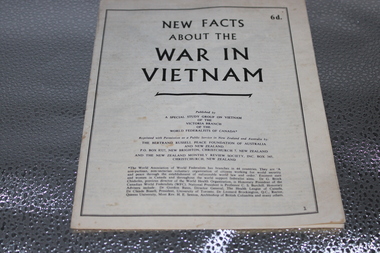
Booklet - Anti-war propaganda, New Facts About The War in Vietnam
... ...peace foundation...Bertrand Russell Peace Foundation publisher." World Federalists were active globally, with members discussing the geopolitical landscape and seeking peace solutions in Southeast Asia....Bertrand World Federalist of Canada Vietnam anti-war peace foundation Russell Bertrand Russell Peace Foundation protest propaganda Oakley New Facts/About The/War In/Vietnam A faded paper 8 paged 'magazine'. ...Anti-war political newsletter sold for sixpence, published by "A Special Study Group on Vietnam of the Victoria Branch of the World Federalists of Canada. Bertrand Russell Peace Foundation publisher." World Federalists were active globally, with members discussing the geopolitical landscape and seeking peace solutions in Southeast Asia.A faded paper 8 paged 'magazine'. Black type; front cover has border around edge. Each page is numbered. Staple bound.New Facts/About The/War In/Vietnambertrand, world federalist of canada, vietnam, anti-war, peace foundation, russell, bertrand russell peace foundation, protest, propaganda, oakley -
 Melbourne Legacy
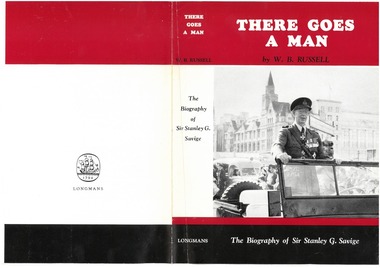
Document - Dustcover, There Goes a Man, 1958
... The dustjacket marks the publication of the book after all the Committee's efforts, noting that "Lieutenant-General Sir Stanley Savige played a leading part for Australia in both World Wars, but his greatest achievement was in times of peace - in the foundation of Legacy, of which the full story is told in this book." ...The dustjacket marks the publication of the book after all the Committee's efforts, noting that "Lieutenant-General Sir Stanley Savige played a leading part for Australia in both World Wars, but his greatest achievement was in times of peace - in the foundation of Legacy, of which the full story is told in this book." ...The dust jacket of the book by WB Russell about Legatee Stan Savige. The dustjacket marks the publication of the book after all the Committee's efforts, noting that "Lieutenant-General Sir Stanley Savige played a leading part for Australia in both World Wars, but his greatest achievement was in times of peace - in the foundation of Legacy, of which the full story is told in this book." Part of the story of how the book 'There goes a Man' came to be created. Much of the book dealing with the history of Legacy is still used today by Legatees.Original dustjacket for the biography of Sir Stanley Savige.savige book, biography, stan savige -
 Glen Eira Historical Society
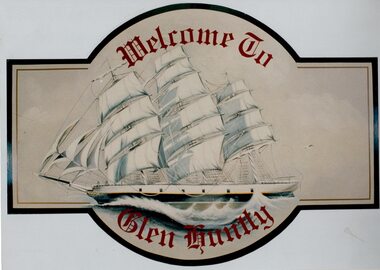
Article - GLEN HUNTLY (HISTORY OF)
... foundation stones... King F.L... Methodist Church... Trinity Congregational Church... Greek Orthodox Church... Salvation Army Temple... Wanalta Road... St Anthony’s Roman Catholic Church... St Agnes’ Anglican Church... Booran Road... St David’s Uniting Church... El Nido Grove... Manses... Royal Avenue... Munster Avenue... James Street... Rothschild Street... Neerim Road... organs... Peace...‘Glen Huntly’ Buchanan Captain fever ship emigrants Cummins Ann St Kilda Cemetery Bowman Mrs Caulfield Craig John Cameron Miss McGonagle Mrs Elsternwick Armstrong George Mathers James The Glen Huntly Pioneers Memorial Jones Alfred Ramsey St David’s Uniting Church (Grange Road) Glen Huntly Glen Huntly Road Lake Street Glen Huntly State School Glen Huntly Presbyterian Church South Caulfield Mernda Avenue Garden Avenue Grange Road Jenkin (Boss) William Wattle Avenue Chinese joss-house Smith A.W Glen Huntly Post Office foundation stones King F.L Methodist Church Trinity Congregational Church Greek Orthodox Church Salvation Army Temple Wanalta Road St Anthony’s Roman Catholic Church St Agnes’ Anglican Church Booran Road St David’s Uniting Church El Nido Grove Manses Royal Avenue Munster Avenue James Street Rothschild Street Neerim Road organs Peace Memorial Organ railways Marara Road Curraweena Road Booran Road Bambra Road Rosstown railway Murray-Ross William Leila Road Murray-Ross Leila ‘The Grange’ North Road Wild Cherry Road ‘Rosstown’ picture theatres Manchester Grove aerodrome Lord Reserve Neville Street Lyons Street Morgan Street Rosedale Avenue rifle clubs Glen Huntly Infant Welfare Centre Watson Grove Rowlands Drapery drapers Bones Plant Nursery nurseries Elsternwick railway station railway stations Kooyong Road Glen Eira Road Truganini Road Rosstown Sugar Works Ross Murray street names typhoid diseases death and dying Article GLEN HUNTLY (HISTORY OF) ...This file contains 10 items about the history of Glen Huntly: 1/6 photocopied pages from ‘The History of St Kilda’ which relates to the place name Glen Huntly, and the Quarantine graves, date unknown. 2/2 photocopied pages from the ‘Sun Pictorial’ dated 13/4/1928 and 12/4/1928; relating to the state of the graves at Point Ormond and their re-internment to St Kilda Cemetery. 3/1 pen and ink sketch of graves at Point Ormond from the State Library Victoria. 4/3 pages taken from a website on the re-internment of graves and some social history as to the reason that the new emigrants were coming to Australia. The Article also has 7 photographs. 5/2 newspaper articles on the ‘Glen Huntly’ descendants forthcoming reunion being held on 21&22/4/1990. 6/1 article reprinted from newsletter no. 22 October 1983 on the barque ‘Glen Huntly’. Also details of passengers who died and the burial of 3 at Point Ormond. 7/1 handwritten document (unattributed) taken from ‘Migrant ships for South Australia 1836-1850’ by Ronald Parsons. 8/1 pamphlet commemorating the 150th anniversary of the ‘Glen Huntly’ arriving in Melbourne. It gives information about the ship, passengers, memorial in St Kilda Cemetery and upcoming descendants’ reunion. 9/1 program of commemoration events 21&22/4/1990. 10/1 piece of art work for a ‘Welcome to Glen Huntly’ sign, featuring a ship. Undated, unattributed and source unknown.‘glen huntly’, buchanan captain, fever ship, emigrants, cummins ann, st kilda cemetery, bowman mrs, caulfield, craig john, cameron miss, mcgonagle mrs, elsternwick, armstrong george, mathers james, the glen huntly pioneers memorial, jones alfred ramsey, st david’s uniting church (grange road), glen huntly, glen huntly road, lake street, glen huntly state school, glen huntly presbyterian church, south caulfield, mernda avenue, garden avenue, grange road, jenkin (boss) william, wattle avenue, chinese joss-house, smith a.w, glen huntly post office, foundation stones, king f.l, methodist church, trinity congregational church, greek orthodox church, salvation army temple, wanalta road, st anthony’s roman catholic church, st agnes’ anglican church, booran road, st david’s uniting church, el nido grove, manses, royal avenue, munster avenue, james street, rothschild street, neerim road, organs, peace memorial organ, railways, marara road, curraweena road, booran road, bambra road, rosstown railway, murray-ross william, leila road, murray-ross leila, ‘the grange’, north road, wild cherry road, ‘rosstown’, picture theatres, manchester grove, aerodrome, lord reserve, neville street, lyons street, morgan street, rosedale avenue, rifle clubs, glen huntly infant welfare centre, watson grove, rowlands drapery, drapers, bones plant nursery, nurseries, elsternwick railway station, railway stations, kooyong road, glen eira road, truganini road, rosstown sugar works, ross murray, street names, typhoid, diseases, death and dying -
 Glen Eira Historical Society
Document - GLEN HUNTLY (HISTORY OF)
... Foundation Stones... Neerim Road... Mannix Archbishop... St. Agnes’ Anglican Church... Booran Road... Sunday Schools... Clergy Residences... ‘See’ Anglican News Magazine... Lees Archbishop... Booth Archbishop... Glen Huntly Presbyterian Church... El Nido Grove... Tennis Courts... Bollard V. W. Right Rev.... Waratah Avenue... Royal Avenue... Munster Avenue... James Street... Rothschild Street... Peace...Foundation Stones Neerim Road Mannix Archbishop St. Agnes’ Anglican Church Booran Road Sunday Schools Clergy Residences ‘See’ Anglican News Magazine Lees Archbishop Booth Archbishop Glen Huntly Presbyterian Church El Nido Grove Tennis Courts Bollard V. W. Right Rev. Waratah Avenue Royal Avenue Munster Avenue James Street Rothschild Street Peace ...This file contains one item: 1/A loose-leaf, 23-page document titled ‘The History of Glen Huntly’, by Alfred R. Jones, dated 20/06/1991, describing the history of the suburb. The author has drawn heavily from the 4 sources noted in the bibliography. Subjects covered include the ship the suburb is named after, the suburb’s State School, the suburb’s churches, the Rosstown Railway and Sugar Mill, the origin of the name of Carnegie, the suburb’s aerodrome, and the beautification of the Glen Huntly Shopping Centre. The final 12 pages consist of 9 appendices relating to the aforementioned subjects. Appendix A is a typewritten letter from Ron McLeod, secretary of the Place Names Committee, to Mr. D. R. Aylen, CEO of the City of Caulfield, notifying the latter of the alteration of the name ‘Glenhuntly’ to ‘Glen Huntly’. Appendix B is a list of the ministers of St. David’s Uniting Church from its formation in 1916 to the present. Appendix C identifies the persons portrayed in St. David’s stained glass windows. Appendix D is a poster announcing the auction of 41 blocks of land between Hawthorn and Bambra Road formerly owned by William Ross, plus a map identifying said land blocks and another for locality. Appendix E is an A4 plan of the Rosstown Railway. Appendix F is a drawing of the Rosstown Sugar Mill. Appendix G is a poem titled ‘The Swagman’s Retreat’, by Herb Arnott, about the failure of the Mill. Appendix H is a map of Caulfield’s horse tramways plus a list of opening and closing dates. Appendix J is a list of streets explaining the meanings of their names.glen huntly, glenhuntly, local history, ‘glen huntly’ (ship), ‘glen huntlely’ (ship), quarantine stations, glen huntly road, lake street, mernda avenue, glen huntly state school no. 3703, ormond francis, ormond, garden avenue, grange road, churches, congregational church, glen huntly presbyterian church, st. david’s, st. david’s uniting church, anglican church, jenkin william ‘boss’, methodist church, wattle avenue, smith a. w. mr., glen huntly post office, glen huntly road, king f. l. mr., uniting church, child care centre, presbyterian church of eastern australia, glen huntly methodist church, sun aria, miller mary, stained glass, phrenologists, trinity congregational church, primitive methodists, ‘the victorian independent’, mercy mr., greek orthodox original old calendar church, wanalta road, salvation army, halls, myrtle street, catholic church, st. anthony’s roman catholic church, foundation stones, neerim road, mannix archbishop, st. agnes’ anglican church, booran road, sunday schools, clergy residences, ‘see’ anglican news magazine, lees archbishop, booth archbishop, glen huntly presbyterian church, el nido grove, tennis courts, bollard v. w. right rev., waratah avenue, royal avenue, munster avenue, james street, rothschild street, peace memorial organ, singers, bremner marie, scotland betty, carden joan, rosstown railway, south caulfield, plants, marata road, curraweena road, bambra road, ross william murray, ross leila, ross constance, vautin constance, ‘the grange’, north road, leila road, wild cherry road, caulfield roads board, elsternwick, land sales, sugar mills, koornang road, woornack road, elsternwick railway station, riddell parade, clarence street, dover street, oakleigh road, murrumbeena crescent, carlisle crescent, railways, trains, parks and reserves, caulfield council, sussex street, caulfield city council, swamps, rosstown sugar mill, rosstown estate, ‘the swagman’s retreat’, arnott herb, rosstown, carnegie, ‘ross’s folly’, carnegie andrew, rosstown hotel, dandenong road, rosstown road, rosstown plate horse race, caulfield racecourses, ames avenue, rosstown court, hostels, murrumbeena, cinemas, innovations (cabinetry film), films, music, pianos, manchester grove, safeway store, squash courts, airports, lord reserve, aeroplanes, air navigation act 1921, neville street, larkin sopwith aviation company of australasia, lyons street, morgan street, bookmakers, nightsoil, poultry, weatherboard buildings, glen huntly railway station, rosedale avenue, rifle clubs, scout groups, 1st glen huntly troop, ana, dowding jack mr., glen huntly infant welfare and family planning clinic, vermador private hospital, watson grove, rowlands (drapers), bones plant nursery, caulfield railway station, bridges, trams, horse tramways, glen eira road, elsternwick railway station, kooyong road, aboriginal peoples, truganini road, hannan lyn mrs. (urban planning officer), glen huntly shopping centre, sculptures, street beautification scheme, “flying the yellow flag”, moore olive, “return to rosstown”, jowett d. f., weickhardt i. s., “from sand swamp and health”, murray peter r., wells john c., caulfield historical society, newsletters, place names committee, mcleod ron, aylen d. r. mr., jones hugh rev., king joseph, scarfe james, vertigan sidney, vertigan earle, rance victor, flavell cameron, denholm robin, moorhead ken, taliai siupeli, eccles james leslie, little agnes, hutchins william r., dickie may a., gordon ivey agnes, theobald a. a. mrs., brownbill lloyd norman, ash georgette, land sales, auctions, messrs. crews & arkle, street names -
 Eltham District Historical Society Inc
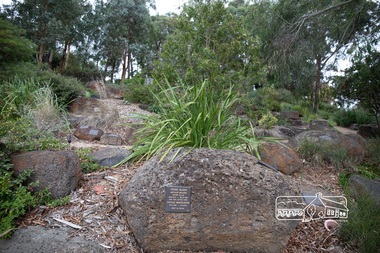
Photograph, Peter Pidgeon, Memorial to Peter Glass and Cecile Glass, Eltham Cemetery, Victoria, 5 April 2021
... foundation of the Australian Institute of Landscape Architects, and went on to design many gardens, some in partnership with Alistair Knox and Gordon Ford. He died in 1997 and is buried in Eltham Cemetery with his wife Cecile. Peter Glass (Arthur William) Artist A.I.L.A. 28.8.1917 - 28.12.1997 and his loving wife Cecile Madeleine 23.2.1927 - 6.2.2006 Rest In Peace...foundation of the Australian Institute of Landscape Architects, and went on to design many gardens, some in partnership with Alistair Knox and Gordon Ford. He died in 1997 and is buried in Eltham Cemetery with his wife Cecile. Peter Glass (Arthur William) Artist A.I.L.A. 28.8.1917 - 28.12.1997 and his loving wife Cecile Madeleine 23.2.1927 - 6.2.2006 Rest In Peace ...In 1938, Arthur William Glass (known as Peter Glass) was studying painting under Max Meldrum. Much of their inspiration came from the Eltham bush and the nearby Yarra River. With his friends jazz musicians Graeme and Roger Bell, Peter bought land at the top of John Street: enchanted by Montsalvat, he had the objective of building a mud-brick house. War intervened, but then in 1948 he began working for Alistair Knox as a carpenter and mud-brick builder. By then, Peter had married, necessitating a larger house, which he built with help from Alistair Knox. As a trained architectural draftsman, Peter later progressed to working for Alistair in that role, eventually running the drafting office during the 1960s. He was deeply involved in the foundation of the Australian Institute of Landscape Architects, and went on to design many gardens, some in partnership with Alistair Knox and Gordon Ford. He died in 1997 and is buried in Eltham Cemetery with his wife Cecile. Peter Glass (Arthur William) Artist A.I.L.A. 28.8.1917 - 28.12.1997 and his loving wife Cecile Madeleine 23.2.1927 - 6.2.2006 Rest In PeaceBorn Digitaleltham cemetery, gravestones, heritage excursion, cecile madeleine glass, peter glass -
 Port Melbourne Historical & Preservation Society
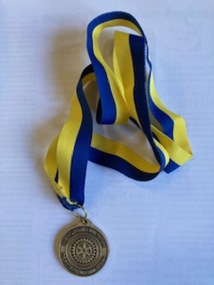
Medal - Pat Grainger's Rotary Foundation medal & lapel button, c.1990
... The Rotary Foundation's aim is to advance understanding, goodwill and peace....Port Melbourne Historical & Preservation Society Port Melbourne Town Hall 333 Bay Street Port Melbourne melbourne The Rotary Foundation's aim is to advance understanding, goodwill and peace. Pat GRAINGER Awards and Presentations The Rotary Foundation Paul Harris Fellow medal Rotary Medal & lapel button held in a black & gold box. ...The Rotary Foundation's aim is to advance understanding, goodwill and peace.Paul Harris Fellow medal Rotary Medal & lapel button held in a black & gold box. A round gold coloured medal with Rotary symbol in the centre, hanging from a yellow & blue ribbonpat grainger, awards and presentations, the rotary foundation -
 Ringwood and District Historical Society
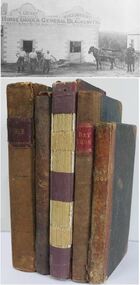
Book - Business Records, Collection of 5 Day-books and Ledgers kept by Thomas Grant, Blacksmith, Ringwood, Victoria
... foundation members of the Methodist Church. He was appointed a Trustee in 1879, and served until his death 54 years later. He was an enthusiastic member of many societies, and he held public office in civic affairs. His interests included the Progress Association, Cricket Club, and the Agricultural Society, at whose annual show, he was a regular exhibitor. He served as a Councillor in the Lilydale Shire, repres¬enting Ringwood, from 1889 to 1894, and was a Justice of the Peace...foundation members of the Methodist Church. He was appointed a Trustee in 1879, and served until his death 54 years later. He was an enthusiastic member of many societies, and he held public office in civic affairs. His interests included the Progress Association, Cricket Club, and the Agricultural Society, at whose annual show, he was a regular exhibitor. He served as a Councillor in the Lilydale Shire, repres¬enting Ringwood, from 1889 to 1894, and was a Justice of the Peace ...GRANT, Thomas (From Short Notes on Ringwood - RDHS) Born 1854, died 1933, aged 79 years. Thomas Grant, born in Burwood, Victoria, came to Ringwood in 1876. On land purchased from Mr. D. Gostick in Whitehorse Road, in the vicinity of the present Drive In Arcade, he built a blacksmith's and coach building shop. In 1880, he married Mary Ann French, of Mulgrave. There were four children, Andrew, Mary, (died in infancy) Thomas, and Margaret. Miss Margaret Grant is a well known resident of Mullum Road. With the opening of the station in 1882, activities in the growing district tended to congregate in its vicinity, and, in 1883, Mr. Grant moved his “smith" to the corner of Adelaide Street. At the same time, he planted out an orchard on his land which ran from Ringwood Street, to Warrandyte Road, and north as far as Mullum Greek. Eventually, about 1910, he sold his business to the Reed Brothers, and retired to the comparatively lighter life of orchardist and market gardener. In 1909, he sold 8 acres of his land to the Lilydale Council. This land, situated in Ringwood Street, behind the Town Hall, is known as the Ringwood Reserve. Mr. & Mrs. Grant were foundation members of the Methodist Church. He was appointed a Trustee in 1879, and served until his death 54 years later. He was an enthusiastic member of many societies, and he held public office in civic affairs. His interests included the Progress Association, Cricket Club, and the Agricultural Society, at whose annual show, he was a regular exhibitor. He served as a Councillor in the Lilydale Shire, repres¬enting Ringwood, from 1889 to 1894, and was a Justice of the Peace. 26278a Ledger belonging to First Blacksmith in Ringwood 1880s. Dark green cover with leather spine and corners. Dark coloured edges on pages. 542 pages, 320 used. 26278b Day book belonging to Thomas Grant, Blacksmith, Ringwood used 1929. Brown covered book with leather spine. First 95 pages torn out. Only two pages of remaining 76 used. 26278c Ledger with alphabetical index - Thomas Grant, Blacksmith, Ringwood - 1888. Green covered book with red spine and corners. Dark coloured edges on pages. 275 pages. Some unused. 26278d T. Grant Blacksmith Day Book. Green covered day book of T. Grant, Blacksmith and General Smithy, Ringwood 1883 . Red square on spine with Day book written on it. Day Book in ink hand written on front spine. 26278e Day book belonging to Thomas Grant, Blacksmith, Ringwood - 1879-1881. Green cover with brown spine and edges. Gold lettering on spine saying Day Book Pages all used. 26278f Collection of receipts, some blotting paper, some pages from the Journal of Architecture, a short story, and drawing with description of an Albert Sociable carriage. -
 Marysville & District Historical Society
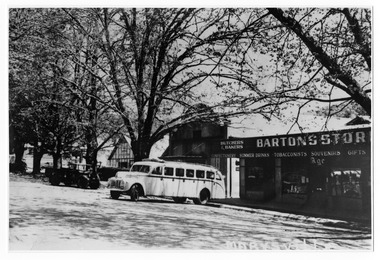
Photograph (Item) - Black and white photograph, Unknown
... Peace. Thomas died in Carlton in 1911. After their father's death, his sons Fred and Frank took over the family business, which was then known as Barton Bros Store which continued to operate until sometime in the 1970s. The photograph shows a McKenzies Tourist Bus Service bus parked out the front of the Barton's Store. McKenzie Tourist Bus Services has been operating for over 90 years after Loronza Reilly McKenzie purchased a Hudson car in Sydney. It became the foundation ...A black and white photograph taken outside at Barton's Store in Marysville in Victoria.A black and white photograph taken outside at Barton's Store in Marysville in Victoria. Thomas John Barton was born in 1836 in Gloucestershire and after his father died in 1850 arrived in Melbourne in 1852 along with his mother, adult sisters, younger brothers, his uncle, his uncle's wife Suzanna, and their family. Thomas tried gold mining at Woods Point but found it too difficult. He then partnered with Ewen Hugh Cameron to provide the miners with meat. In 1864 they purchased a plot of land in Marysville and set up a butchers/abattoirs and from there began their business of taking supplies to the miners at the nearby Woods Point and Jamieson goldfields. In 1865 the business was firmly established and Thomas married Selina Croker at Heidelberg and brought her back to Marysville. Their first home was 'The Chestnuts', which included the store and was situated on the town side next to the Steavenson River. Sadly, in 1876 Selina died of complications after giving birth to their sixth child. Thomas was in need of a nanny to care for his six children, including the newborn baby, and so he employed Emily Ada Sparke, who is the eldest daughter of the local school teacher. Thomas and Emily subsequently married in 1878 and they go on to have a further 10 children over the next several years. Thomas assisted in the establishment of the first school in Marysville in 1870 and remained a very active member of the community including as a Councillor for the Shire of Healesville, Shire President, and he was also appointed as a Justice of the Peace. Thomas died in Carlton in 1911. After their father's death, his sons Fred and Frank took over the family business, which was then known as Barton Bros Store which continued to operate until sometime in the 1970s. The photograph shows a McKenzies Tourist Bus Service bus parked out the front of the Barton's Store. McKenzie Tourist Bus Services has been operating for over 90 years after Loronza Reilly McKenzie purchased a Hudson car in Sydney. It became the foundation vehicle for what, over the next 80 years, became a fleet of modern buses carrying tourists and school children around the Yarra Valley and beyond.marysville, victoria, barton's store, thomas john barton, ewen hugh cameron, woods point, jamieson, gold mining, goldfields, selina croker, the chestnuts, emily ada sparke, shire of healesville, fred barton, frank barton, barton bros store, francis adam barton, frederick john barton, photograph, mckenzies tourist services, barton's garage -
 Nhill and District Historical Society Inc.
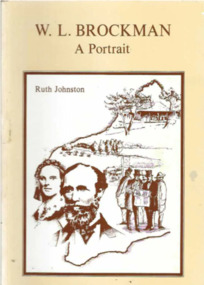
Book - W. L. Brockman, A Portrait
... He was a foundation member of the Swan Agricultural Society in 1831, and in 1833 became a justice of the peace. ...He was a foundation member of the Swan Agricultural Society in 1831, and in 1833 became a justice of the peace. ...Biography / memoir of William Locke Brockman came to the Swan River Colony in the early 1830's with his wife and son. A successful farmer and businessman, his greatest achievements were in the political sphere, where he worked to bring representative government to Western Australia.faun coloured cover with a white panel with brown border with sketched image of Western Australia containing images of a homestead and pioneers.non-fictionBiography / memoir of William Locke Brockman came to the Swan River Colony in the early 1830's with his wife and son. A successful farmer and businessman, his greatest achievements were in the political sphere, where he worked to bring representative government to Western Australia.william locke brockman, swan river colony, 1830's - history, western australia - history, farming - history, political- history, west australiana -
 Robin Boyd Foundation
Slide, Robin Boyd, 1961
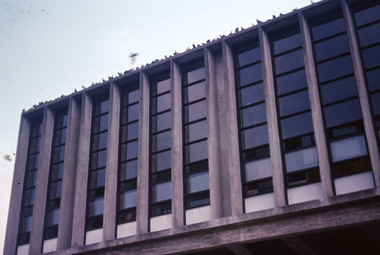
... Robin Boyd Foundation 290 Walsh Street South Yarra melbourne Robin Boyd wrote two books on Japanese architects and architecture - “Kenzo Tange” published by George Braziller in 1962 and “New Directions in Japanese Architecture” published by Studio Vista in 1968. During the 1960s he travelled several times to Japan to research these books and as part of his role as Exhibits Architect for the Australian Pavilion at Expo ‘70 in Osaka. Japan slide 12 / B (Handwritten) / Encircled 11 (Handwritten) Colour slide in a mount. Hiroshima Peace ...Robin Boyd wrote two books on Japanese architects and architecture - “Kenzo Tange” published by George Braziller in 1962 and “New Directions in Japanese Architecture” published by Studio Vista in 1968. During the 1960s he travelled several times to Japan to research these books and as part of his role as Exhibits Architect for the Australian Pavilion at Expo ‘70 in Osaka.Colour slide in a mount. Hiroshima Peace Memorial Museum 1951-3, Hiroshima, Japan. (Architect: Kenzo Tange.)12 / B (Handwritten) / Encircled 11 (Handwritten)japan, slide -
 Robin Boyd Foundation
Slide, Robin Boyd, 1961
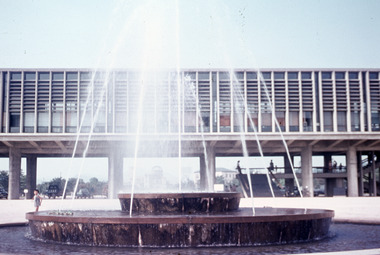
... Robin Boyd Foundation 290 Walsh Street South Yarra melbourne Robin Boyd wrote two books on Japanese architects and architecture - “Kenzo Tange” published by George Braziller in 1962 and “New Directions in Japanese Architecture” published by Studio Vista in 1968. During the 1960s he travelled several times to Japan to research these books and as part of his role as Exhibits Architect for the Australian Pavilion at Expo ‘70 in Osaka. Japan research trip slide 5 Colour slide in a mount. Hiroshima Peace ...Robin Boyd wrote two books on Japanese architects and architecture - “Kenzo Tange” published by George Braziller in 1962 and “New Directions in Japanese Architecture” published by Studio Vista in 1968. During the 1960s he travelled several times to Japan to research these books and as part of his role as Exhibits Architect for the Australian Pavilion at Expo ‘70 in Osaka.Colour slide in a mount. Hiroshima Peace Memorial Museum 1951-3, Hiroshima, Japan. (Architect: Kenzo Tange.)5japan research trip, slide -
 Robin Boyd Foundation
Document - Manuscript, Robin Boyd, Kenzo Tange, 1966, 1966
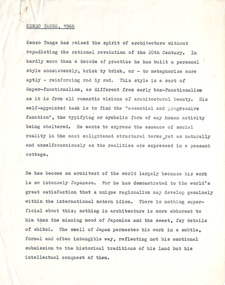
... Foundation 290 Walsh Street South Yarra melbourne Brief summary of Japanese architect, Kenzo Tange. Includes discussion of his style, themes and some of his work. Robin Boyd wrote two books on Japanese architects and architecture - 'Kenzo Tange' published by Braziller in 1962 and 'New Directions in Japanese Architecture' published by Studio Vista in 1968. Kenzo Tange Japanese architect Japanese-Australian plastic form trabeation Hiroshima Peace ...Brief summary of Japanese architect, Kenzo Tange. Includes discussion of his style, themes and some of his work. Robin Boyd wrote two books on Japanese architects and architecture - 'Kenzo Tange' published by Braziller in 1962 and 'New Directions in Japanese Architecture' published by Studio Vista in 1968.Typewritten, quarto, typewritten (carbon copy), 4 pages.kenzo tange, japanese architect, japanese-australian plastic form, trabeation, hiroshima peace hall, children's library, tokyo stadiums, robin boyd, manuscript -
 Robin Boyd Foundation
Slide, Robin Boyd, 1961
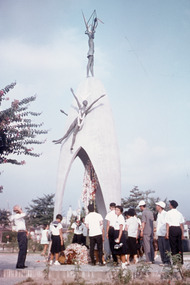
... Robin Boyd Foundation 290 Walsh Street South Yarra melbourne Robin Boyd wrote two books on Japanese architects and architecture - “Kenzo Tange” published by George Braziller in 1962 and “New Directions in Japanese Architecture” published by Studio Vista in 1968. During the 1960s he travelled several times to Japan to research these books and as part of his role as Exhibits Architect for the Australian Pavilion at Expo ‘70 in Osaka. Japan slide 9 / 12 (Handwritten) Colour slide in a mount. Children's Peace ...Robin Boyd wrote two books on Japanese architects and architecture - “Kenzo Tange” published by George Braziller in 1962 and “New Directions in Japanese Architecture” published by Studio Vista in 1968. During the 1960s he travelled several times to Japan to research these books and as part of his role as Exhibits Architect for the Australian Pavilion at Expo ‘70 in Osaka.Colour slide in a mount. Children's Peace Monument, Hiroshima, Japan. (Architects: Kazuo Kikuchi and Kiyoshi Ikebe.)9 / 12 (Handwritten)japan, slide -
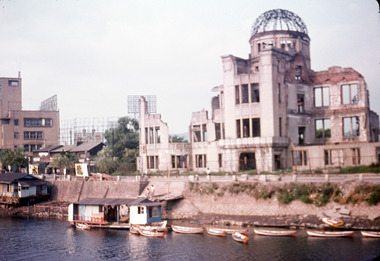 Robin Boyd Foundation
Slide, Robin Boyd, 1961
... Robin Boyd Foundation 290 Walsh Street South Yarra melbourne Robin Boyd wrote two books on Japanese architects and architecture - “Kenzo Tange” published by George Braziller in 1962 and “New Directions in Japanese Architecture” published by Studio Vista in 1968. During the 1960s he travelled several times to Japan to research these books and as part of his role as Exhibits Architect for the Australian Pavilion at Expo ‘70 in Osaka. slide robin boyd 10 Colour slide in a mount. Hiroshima Peace ...Robin Boyd wrote two books on Japanese architects and architecture - “Kenzo Tange” published by George Braziller in 1962 and “New Directions in Japanese Architecture” published by Studio Vista in 1968. During the 1960s he travelled several times to Japan to research these books and as part of his role as Exhibits Architect for the Australian Pavilion at Expo ‘70 in Osaka.Colour slide in a mount. Hiroshima Peace Dome (Atomic Bomb Dome, centopath; originally the Hiroshima Prefectural Industrial Promotion Hall), 1915, Hiroshima, Japan (Architect: Jan Letzel)10slide, robin boyd -
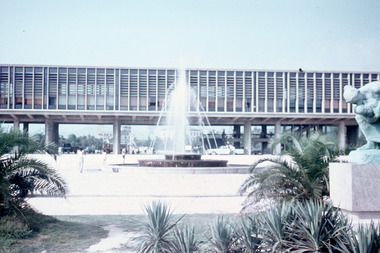 Robin Boyd Foundation
Slide, Robin Boyd, 1961
... Robin Boyd Foundation 290 Walsh Street South Yarra melbourne Robin Boyd wrote two books on Japanese architects and architecture - “Kenzo Tange” published by George Braziller in 1962 and “New Directions in Japanese Architecture” published by Studio Vista in 1968. During the 1960s he travelled several times to Japan to research these books and as part of his role as Exhibits Architect for the Australian Pavilion at Expo ‘70 in Osaka. Japan research trip slide 4 Colour slide in a mount. Hiroshima Peace ...Robin Boyd wrote two books on Japanese architects and architecture - “Kenzo Tange” published by George Braziller in 1962 and “New Directions in Japanese Architecture” published by Studio Vista in 1968. During the 1960s he travelled several times to Japan to research these books and as part of his role as Exhibits Architect for the Australian Pavilion at Expo ‘70 in Osaka.Colour slide in a mount. Hiroshima Peace Memorial Museum 1951-3, Hiroshima, Japan. (Architect: Kenzo Tange.)4japan research trip, slide -
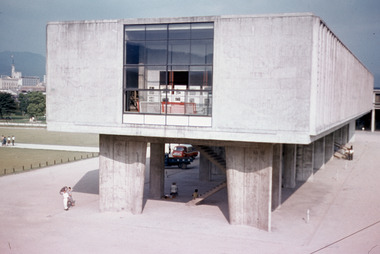 Robin Boyd Foundation
Slide, Robin Boyd, 1961
... Robin Boyd Foundation 290 Walsh Street South Yarra melbourne Robin Boyd wrote two books on Japanese architects and architecture - “Kenzo Tange” published by George Braziller in 1962 and “New Directions in Japanese Architecture” published by Studio Vista in 1968. During the 1960s he travelled several times to Japan to research these books and as part of his role as Exhibits Architect for the Australian Pavilion at Expo ‘70 in Osaka. Japan slide 3 Colour slide in a mount. Hiroshima Peace ...Robin Boyd wrote two books on Japanese architects and architecture - “Kenzo Tange” published by George Braziller in 1962 and “New Directions in Japanese Architecture” published by Studio Vista in 1968. During the 1960s he travelled several times to Japan to research these books and as part of his role as Exhibits Architect for the Australian Pavilion at Expo ‘70 in Osaka.Colour slide in a mount. Hiroshima Peace Memorial Museum 1951-3, Hiroshima, Japan. (Architect: Kenzo Tange.)3japan, slide -
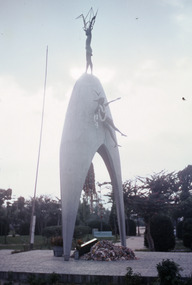 Robin Boyd Foundation
Slide, Robin Boyd, 1961
... Robin Boyd Foundation 290 Walsh Street South Yarra melbourne Robin Boyd wrote two books on Japanese architects and architecture - “Kenzo Tange” published by George Braziller in 1962 and “New Directions in Japanese Architecture” published by Studio Vista in 1968. During the 1960s he travelled several times to Japan to research these books and as part of his role as Exhibits Architect for the Australian Pavilion at Expo ‘70 in Osaka. slide robin boyd 13 Colour slide in a mount. Children's Peace ...Robin Boyd wrote two books on Japanese architects and architecture - “Kenzo Tange” published by George Braziller in 1962 and “New Directions in Japanese Architecture” published by Studio Vista in 1968. During the 1960s he travelled several times to Japan to research these books and as part of his role as Exhibits Architect for the Australian Pavilion at Expo ‘70 in Osaka.Colour slide in a mount. Children's Peace Monument, Hiroshima, Japan. (Architects: Kazuo Kikuchi and Kiyoshi Ikebe.)13slide, robin boyd -
 Robin Boyd Foundation
Slide, Robin Boyd, 1961
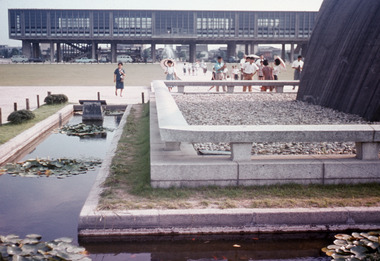
... Robin Boyd Foundation 290 Walsh Street South Yarra melbourne Robin Boyd wrote two books on Japanese architects and architecture - “Kenzo Tange” published by George Braziller in 1962 and “New Directions in Japanese Architecture” published by Studio Vista in 1968. During the 1960s he travelled several times to Japan to research these books and as part of his role as Exhibits Architect for the Australian Pavilion at Expo ‘70 in Osaka. Japan research trip slide 7 Colour slide in a mount. Hiroshima Peace ...Robin Boyd wrote two books on Japanese architects and architecture - “Kenzo Tange” published by George Braziller in 1962 and “New Directions in Japanese Architecture” published by Studio Vista in 1968. During the 1960s he travelled several times to Japan to research these books and as part of his role as Exhibits Architect for the Australian Pavilion at Expo ‘70 in Osaka.Colour slide in a mount. Hiroshima Peace Memorial Museum 1951-3, Hiroshima, Japan. (Architect: Kenzo Tange.)7japan research trip, slide -
 Wodonga & District Historical Society Inc
Photograph - Whans' Stores, Wodonga
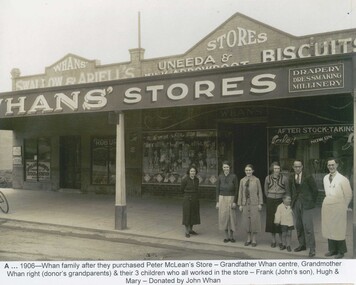
... foundation member of the Presbyterian Church in Wodonga. He died on 10 October 1933. After his death, Whan's store was operated by John's son Francis William Whan who was born in Wodonga on 1 September 1901. He also served the community as a Justice of the Peace...foundation member of the Presbyterian Church in Wodonga. He died on 10 October 1933. After his death, Whan's store was operated by John's son Francis William Whan who was born in Wodonga on 1 September 1901. He also served the community as a Justice of the Peace ...John Whan was born in Carlton of Irish parents and moved with them to Wodonga by bullock dray at the age of 12. After completing his education in Wodonga, John became manager of McLean Brothers and Rigg branch store in Sydney Street, Wodonga for a number of years after which he bought the business and operated Whan’s General Store in Sydney Road, Wodonga which at its peak employed his six children. John Whan was Wodonga Shire Councillor for 15 years, including a term as Shire President in 1904-5. He was also Chairman of the Wodonga Water Trust when it built the water tower in 1922 – 23. He had many other community involvements including the School board and the Library Committee, served as an honorary justice and Deputy Coroner. secretary of the Wodonga branch of the I.O.O.F., and the Wodonga Cemetery Trust and the Masonic Lodge. He was a foundation member of the Presbyterian Church in Wodonga. He died on 10 October 1933. After his death, Whan's store was operated by John's son Francis William Whan who was born in Wodonga on 1 September 1901. He also served the community as a Justice of the Peace and Magostrate. Frank was a caring gentleman who looked after many during the difficult times of the Depression and World War 11. He continued to provide outstanding service to the Wodonga community. Frank was a dedicated member of the Presbyterian Church. The Whan General Store was purchased by Lincoln and Butterworth in 1945 and Francis and his family moved to Queensland He passed away in Lismore, NSW on 24 December 1975.These photographs represent the business of a prominent Wodonga family and community member.3 black and white photographs showing the Whan store in Wodonga at various stages in its developmentwodonga businesses, whan's store, whan family -
 Beechworth RSL Sub-Branch
Award - Medallion
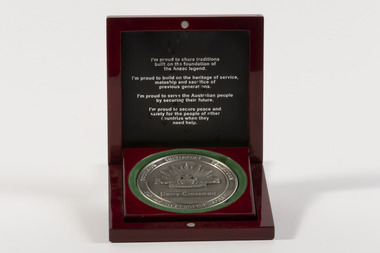
... Front - Embossed: The Australia Army / Interior - Embossed: I'm proud to share traditions built on the foundation of the Anzac legend / I'm proud to build on the heritage of service mateship and sacrifice of previous generations / I'm proud to serve the Australian people by securing their future / I'm proud to secure peace and safety for the people of other countries when they need help. ...Beechworth RSL Sub-Branch 99 Ford Street Beechworth high-country Medalian presented to Pte Terry Crossman Presented to Pte Terry Crossman of Beechworth australian army solider's medallion medallion Front - Embossed: The Australia Army / Interior - Embossed: I'm proud to share traditions built on the foundation of the Anzac legend / I'm proud to build on the heritage of service mateship and sacrifice of previous generations / I'm proud to serve the Australian people by securing their future / I'm proud to secure peace and safety for the people of other countries when they need help. ...Medalian presented to Pte Terry CrossmanPresented to Pte Terry Crossman of BeechworthSmall round metal medallion featuring an image of the Rising Sun and text engravings. Displayed in a small lacquered square box in a mahogany hue on a green felt inlay. Awarded to Terry Crossman.Front - Embossed: The Australia Army / Interior - Embossed: I'm proud to share traditions built on the foundation of the Anzac legend / I'm proud to build on the heritage of service mateship and sacrifice of previous generations / I'm proud to serve the Australian people by securing their future / I'm proud to secure peace and safety for the people of other countries when they need help. Front of Medallion - Engraved around the edge: Courage / initiative / teamwork / I'm an Australian Solider / engraved - Terry Crossman / The Australian Army / Reverse - Engraved around the edge: Mentally Prepared every solider physically tough / A leader / an expert on close combat / In the body australian army solider's medallion, medallion -
 National Wool Museum
Textile - Waistcoat, R. Collins Hocking, c.1910
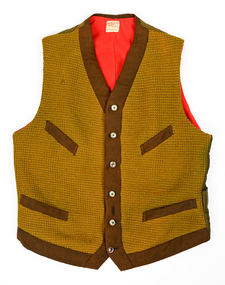
... . •1878-1886, Barrabool Shire Council, President 1882 •In 1885 he was appointed a Justice of the Peace in the Southern Bailiwick •Committee member of the Geelong Racing Club, 1890-96 •In 1892 he was appointed returning officer for the South-Western Province and the electoral district of Barwon •Foundation President of Torquay Racing Club, 1893 •Mount Duneed Cemetery Trustee, 1893 Alfred Gilbert White went to Connewarre School and then to Mt Duneed School after the family moved to Mt Duneed. .... •1878-1886, Barrabool Shire Council, President 1882 •In 1885 he was appointed a Justice of the Peace in the Southern Bailiwick •Committee member of the Geelong Racing Club, 1890-96 •In 1892 he was appointed returning officer for the South-Western Province and the electoral district of Barwon •Foundation President of Torquay Racing Club, 1893 •Mount Duneed Cemetery Trustee, 1893 Alfred Gilbert White went to Connewarre School and then to Mt Duneed School after the family moved to Mt Duneed. ...The Waistcoat’s Owners The first owner of the waistcoat was Alfred (Alf) Gilbert White, 1868 Stretton Park, Connewarre – 1946, Mt Duneed. He was the fourth child of Andrew White, 1828-1900, and Jane Roberts, 1827-1871. His father Andrew White was born at Stretton-on-Dunsmore, Warwickshire, England, the sixth child of William White and Sarah Elkington. Andrew had come to Victoria on the James L. Bogart in 1852 with his first wife, Emily Walker. From 1854, records show he was the owner of livery stables in central Geelong before he moved into land ownership. In 1862, Andrew became a landowner with 1,400 acres in Connewarre, the Salt Water Run, then re-named Stretton Park by Andrew. Thereafter he is usually noted as a Farmer or Sheep Farmer. Emily died in 1861 and Andrew remarried Jane Roberts in 1863. Jane was the daughter of Jane (Jenefer) Pearce and William Roberts in Crowan, Cornwell, England and it is thought arrived in Victoria on the British Trident in 1855. In 1878 Andrew moved to the newly purchased “Hillside” at Mt Duneed with his family including Alfred. By 1880 Andrew held 11,095 acres in South Barwon and Barrabool. As well as being a landowner, he had other business interests including Auctioneers, Stock and Station Agents Learmonth White from 1886. However farming at Hillside, particularly wool production, was an important part of his life. For example, in 1893 10,350 sheep were shorn although the highest number of bales of wool produced was in 1892 with 174 bales under AW’s wool mark and 8 under that of Stretton Park. This was the result of shearing 9,234 sheep. There were usually six or seven shearers, shearing over a two to three week period, beginning in early or mid October. Some of the shearers bore names familiar in the district such as Gogoll, Duffield, and Baensch. Andrew White held a number of local positions including: •1863-1874 Connewarre Road Board, Chairman 1871-73 •1875-1900 South Barwon Shire Council. When the Board amalgamated with South Barwon to form the Shire of South Barwon, he was an inaugural representative of Connewarre. He was a council member for 44 years and president for the following terms: 1878-1879; 1885-1887; 1889; 1894; 1895-1896; and 1898-1899. •1878-1886, Barrabool Shire Council, President 1882 •In 1885 he was appointed a Justice of the Peace in the Southern Bailiwick •Committee member of the Geelong Racing Club, 1890-96 •In 1892 he was appointed returning officer for the South-Western Province and the electoral district of Barwon •Foundation President of Torquay Racing Club, 1893 •Mount Duneed Cemetery Trustee, 1893 Alfred Gilbert White went to Connewarre School and then to Mt Duneed School after the family moved to Mt Duneed. He then went to Geelong Grammar School as a boarder from 31 July 1883. After leaving school, in 1886, he worked as a bookkeeper for the family business Learmonth-White stock and station agents and lived at home at Hillside. He and Bessie Orchard Mathews were married in 1894. Bessie was born in Geelong in 1869, the sixth child of William Matthews and Amelia Orchard. Her family lived at “Turley,” Malop Street, Geelong, named after the hamlet of Turleigh in West Wiltshire, England. Bessie’s father, William Mathews, a butcher from Winsley, Wiltshire, arrived on the Queen of the East in Sydney in 1854 and established a successful butcher’s business with his brother James in Geelong. Her mother, Amelia Orchard, also from Winsley, arrived on the Thames in Melbourne in 1857. Alfred, Bessie and their family lived at Stretton Park, Connewarre, leasing it from Andrew. They had six children including their fourth child Douglas Alfred White, the second owner of the waistcoat. His father Andrew supported Alfred’s sheep farming at Stretton Park. In 1896 “.... eight splendid 2-tooth Lincoln rams in the wool were purchased by Mr Andrew White for his son, Mr Alfred G. White….intended for Mr White’s sheep run at Connewarre.“ Alfred White bought ‘Hillside’, 640 acres, after his father’s death and moved there with his family from Stretton Park in Connewarre. (Stretton Park was bought by his half sister Emily and her family and renamed “Morangarell”.) A family partnership was formed to run the wider station. It was then Alfred who managed the new partnership, called Stretton Park. Alfred meticulously kept the financial records of the station, as might be expected from a former bookkeeper. The detail kept is exemplified in the annual shearing records, including the names of the paddocks, the number of lambs and ewes and the shearers’ tallies. In the spring of 1900, after Andrew White had died, shearing began on 7 October and was finished on 6 November. On some days well over 500 sheep were shorn. The highest tally was 616 on 11 October. That year the overall total of sheep shorn was 9,101. Alfred was an active community member including: •South Barwon Council member (46 years), president: 1903-04; 1906-07; 1921-22; and 1931-33 •Geelong Grammar School Council member, 1908-1946 (over 37 years) •Active member of St. Wilfred’s Church of England, Mt Duneed •Director of Dennys Lascelles, 1932-1946 •Mt Duneed Cemetery Trustee, 1900 •Honorary member of the Mt Duneed Rifle Club, 1900 •Mt Duneed Mutual Improvement Association •Mt Duneed Recreation Reserve Trustee •Torquay Improvement Association Trustee •Barwon Returning Officer Douglas Alfred White, 1900 Stretton Park, Connewarre-1976, Geelong. Initially Douglas and his sisters were taught at home by a governess. Then, like his father, Douglas attended Geelong Grammar. After finishing school, he studied Engineering at Melbourne University where he met Violet Fullerton, 1900-1992, who was studying Medicine. They married in 1926 and had two children including Douglas Robert Stretton (DRS) White Melbourne, 1928–Geelong, 1989, the final owner of the waistcoat. After a successful career as an engineer with the Department of Main Roads, NSW, and serving as a Major in the Royal Australian Engineers in NT, New Guinea and Borneo during the Second World War, Douglas purchased part of Stretton Park when it was sold in 1952. He farmed “South Beach Farm” until his death in 1975. (This area now includes The Sands and Stretton Estate subdivisions.) His son DRS White also attended Geelong Grammar before studying at Dookie Agricultural College. In 1955 DRS purchased land from Peter Fisher, John Fisher and Frank Walter, naming the property “Lambidgee”. (This was part of the land that had originally belonged to Andrew White that had been sold previously.) He farmed this land for the rest of his life, continuing the family tradition. After his father’s death in 1975, the waistcoat became his and so passed to a third generation of the family.Chartreuse green and red waistcoat featuring woven wool front with six buttons, silk back with metal clasp, and red lining. The buttons feature small green beads in the centre.Label [printed]: R. Collins Hocking / GEELONG Label [handwritten]: A. G. White Esqwaistcoat, vest, design, textiles, fashion, alfred white, sheep farming, mt duneed, rural life -
 Tarnagulla History Archive
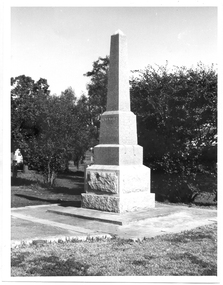
Photograph of the Soldiers' Memorial, Tarnagulla, Soldiers' Memorial, Tarnagulla, Unknown, probably between 1918 and 1970
... Foundation members were Mrs. B. Patterson, Mrs J. Bock and the Misses P. Lemin, Violet Radnell, D. Dyer and Doris and Phoebe Bock. The Committee also arranged 'Welcome Home' functions for each local soldier returning home after service in the First World War. Tarnagulla had a very large number of enlistments for its population. Angus M. Comrie is standing to the right of the Memorial with his daughter Mavis Comrie, and Nell Alexander. Mavis Comrie presented a new Union Jack flag to the Tarnagulla School on 25th July 1919 to commemorate Peace...Foundation members were Mrs. B. Patterson, Mrs J. Bock and the Misses P. Lemin, Violet Radnell, D. Dyer and Doris and Phoebe Bock. The Committee also arranged 'Welcome Home' functions for each local soldier returning home after service in the First World War. Tarnagulla had a very large number of enlistments for its population. Angus M. Comrie is standing to the right of the Memorial with his daughter Mavis Comrie, and Nell Alexander. Mavis Comrie presented a new Union Jack flag to the Tarnagulla School on 25th July 1919 to commemorate Peace ...Murray Comrie Collection. The Memorial was first unveiled at a Thanksgiving Service in 1918. It now commemorates Tarnagulla residents who served in WWI and WWII. This stone monument was created and erected by Mr. Barber of Dunolly in October 1919. It was unveiled by Brigadier General Brand C.B. C.M.G. D.S.O. at 2:30pm on Saturday November 8th, 1919. The Welcome Home Committee, formed 2nd July 1917, was largely responsible for commissioning the monument. Foundation members were Mrs. B. Patterson, Mrs J. Bock and the Misses P. Lemin, Violet Radnell, D. Dyer and Doris and Phoebe Bock. The Committee also arranged 'Welcome Home' functions for each local soldier returning home after service in the First World War. Tarnagulla had a very large number of enlistments for its population. Angus M. Comrie is standing to the right of the Memorial with his daughter Mavis Comrie, and Nell Alexander. Mavis Comrie presented a new Union Jack flag to the Tarnagulla School on 25th July 1919 to commemorate Peace. Peace Medals were also distributed to the school students. Monochrome photograph of the Soldiers Memorial monument in Tarnagulla. Unknown date. tarnagulla, war, military, service, soldiers, veterans, ww1, first world war, commemoration, school, war memorial, monument, comrie, radnell, lemin, dyer, patterson, alexander, bock, brigadier general brand -
 Tarnagulla History Archive
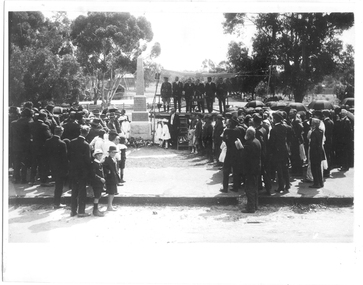
Photograph of unveiling ceremony for Soldiers' Memorial, Tarnagulla, Unveiling ceremony for Soldiers' Memorial, Tarnagulla, 8th November 1919
... Foundation members were Mrs. B. Patterson, Mrs J. Bock and the Misses P. Lemin, Violet Radnell, D. Dyer and Doris and Phoebe Bock. The Committee arranged 'Welcome Home' functions for each local soldier returning home after service in the First World War. Tarnagulla had a very large number of enlistments for its population. Angus M. Comrie is standing to the right of the Memorial with his daughter Mavis Comrie, and Nell Alexander. Mavis Comrie presented a new Union Jack flag to the Tarnagulla School on 25th July 1919 to commemorate Peace...Foundation members were Mrs. B. Patterson, Mrs J. Bock and the Misses P. Lemin, Violet Radnell, D. Dyer and Doris and Phoebe Bock. The Committee arranged 'Welcome Home' functions for each local soldier returning home after service in the First World War. Tarnagulla had a very large number of enlistments for its population. Angus M. Comrie is standing to the right of the Memorial with his daughter Mavis Comrie, and Nell Alexander. Mavis Comrie presented a new Union Jack flag to the Tarnagulla School on 25th July 1919 to commemorate Peace ...Murray Comrie Collection. The monument was created and erected by Mr. Barber of Dunolly in October 1919. It was unveiled by Brigadier General Brand C.B. C.M.G. D.S.O. at 2:30pm on Saturday November 8th, 1919. The Welcome Home Committee, formed 2nd July 1917, was largely responsible for commissioning the monument. Foundation members were Mrs. B. Patterson, Mrs J. Bock and the Misses P. Lemin, Violet Radnell, D. Dyer and Doris and Phoebe Bock. The Committee arranged 'Welcome Home' functions for each local soldier returning home after service in the First World War. Tarnagulla had a very large number of enlistments for its population. Angus M. Comrie is standing to the right of the Memorial with his daughter Mavis Comrie, and Nell Alexander. Mavis Comrie presented a new Union Jack flag to the Tarnagulla School on 25th July 1919 to commemorate Peace. Peace Medals were also distributed to the school students.Monochrome photograph depicting the unveiling ceremony for the Soldiers' Memorial monument in Tarnagulla. A large crowd is looking on, some spilling off the curb and onto the street, whilst several officials stand on a temporary platform. The obelisk monument is left of centre in the image. tarnagulla, war, military, service, soldiers, veterans, ww1, first world war, commemoration, school, war memorial, monument, comrie, radnell, lemin, dyer, patterson, alexander, bock, brigadier general brand -
 Tarnagulla History Archive
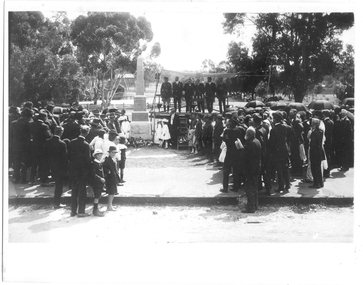
Photograph of unveiling ceremony for Soldiers' Memorial, Tarnagulla, Unveiling ceremony for Soldiers' Memorial, Tarnagulla, 8th November 1919
... Foundation members were Mrs. B. Patterson, Mrs J. Bock and the Misses P. Lemin, Violet Radnell, D. Dyer and Doris and Phoebe Bock. The Committee arranged 'Welcome Home' functions for each local soldier returning home after service in the First World War. Tarnagulla had a very large number of enlistments for its population. Angus M. Comrie is standing to the right of the Memorial with his daughter Mavis Comrie, and Nell Alexander. Mavis Comrie presented a new Union Jack flag to the Tarnagulla School on 25th July 1919 to commemorate Peace...Foundation members were Mrs. B. Patterson, Mrs J. Bock and the Misses P. Lemin, Violet Radnell, D. Dyer and Doris and Phoebe Bock. The Committee arranged 'Welcome Home' functions for each local soldier returning home after service in the First World War. Tarnagulla had a very large number of enlistments for its population. Angus M. Comrie is standing to the right of the Memorial with his daughter Mavis Comrie, and Nell Alexander. Mavis Comrie presented a new Union Jack flag to the Tarnagulla School on 25th July 1919 to commemorate Peace ...Murray Comrie Collection. The monument was created and erected by Mr. Barber of Dunolly in October 1919. It was unveiled by Brigadier General Brand C.B. C.M.G. D.S.O. at 2:30pm on Saturday November 8th, 1919. The Welcome Home Committee, formed 2nd July 1917, was largely responsible for commissioning the monument. Foundation members were Mrs. B. Patterson, Mrs J. Bock and the Misses P. Lemin, Violet Radnell, D. Dyer and Doris and Phoebe Bock. The Committee arranged 'Welcome Home' functions for each local soldier returning home after service in the First World War. Tarnagulla had a very large number of enlistments for its population. Angus M. Comrie is standing to the right of the Memorial with his daughter Mavis Comrie, and Nell Alexander. Mavis Comrie presented a new Union Jack flag to the Tarnagulla School on 25th July 1919 to commemorate Peace. Peace Medals were also distributed to the school students.Monochrome photograph depicting the unveiling ceremony for the Soldiers' Memorial monument in Tarnagulla, 1919. A large crowd is looking on, some spilling off the curb and onto the street, whilst several officials stand on a temporary platform. The obelisk monument is left of centre in the image. The Guard of Honour in uniform surrounding the forecourt are all returned soldiers from the Tarnagulla district. They were especially drawn together to form this Guard of Honour at the unveiling. Copy of an older original, Copy probably made in 1980s-90s. tarnagulla, war, military, service, soldiers, veterans, ww1, first world war, commemoration, school, war memorial, monument, comrie, radnell, lemin, dyer, patterson, alexander, bock, brigadier general brand -
Tarnagulla History Archive
Photograph - Photograph: Unveiling of Soldiers Memorial, Tarnagulla, 8th November 1919
... Foundation members were Mrs. B. Patterson, Mrs J. Bock and the Misses P. Lemin, Violet Radnell, D. Dyer and Doris and Phoebe Bock. The Committee arranged 'Welcome Home' functions for each local soldier returning home after service in the First World War. Tarnagulla had a very large number of enlistments for its population. Angus M. Comrie is standing to the right of the Memorial with his daughter Mavis Comrie, and Nell Alexander. Mavis Comrie presented a new Union Jack flag to the Tarnagulla School on 25th July 1919 to commemorate Peace...Foundation members were Mrs. B. Patterson, Mrs J. Bock and the Misses P. Lemin, Violet Radnell, D. Dyer and Doris and Phoebe Bock. The Committee arranged 'Welcome Home' functions for each local soldier returning home after service in the First World War. Tarnagulla had a very large number of enlistments for its population. Angus M. Comrie is standing to the right of the Memorial with his daughter Mavis Comrie, and Nell Alexander. Mavis Comrie presented a new Union Jack flag to the Tarnagulla School on 25th July 1919 to commemorate Peace ...Williams Family Collection. The monument was created and erected by Mr. Barber of Dunolly in October 1919. It was unveiled by Brigadier General Brand C.B. C.M.G. D.S.O. at 2:30pm on Saturday November 8th, 1919. The Welcome Home Committee, formed 2nd July 1917, was largely responsible for commissioning the monument. Foundation members were Mrs. B. Patterson, Mrs J. Bock and the Misses P. Lemin, Violet Radnell, D. Dyer and Doris and Phoebe Bock. The Committee arranged 'Welcome Home' functions for each local soldier returning home after service in the First World War. Tarnagulla had a very large number of enlistments for its population. Angus M. Comrie is standing to the right of the Memorial with his daughter Mavis Comrie, and Nell Alexander. Mavis Comrie presented a new Union Jack flag to the Tarnagulla School on 25th July 1919 to commemorate Peace. Peace Medals were also distributed to the school students. Monochrome photograph depicting a crowd during a ceremony for the unveiling of the Soldiers' Memorial monument in Tarnagulla. An original photograph, mounted on card. Handwritten on back: 'L.Williams' and 'Unveiling of War Memorial' and ' To Mother, Wishing her a Merry Xmas, from Myrtle 20.12.1919' . Photographer's stamp on front 'J. Wells Photo Inglewood'.tarnagulla -
 Uniting Church Archives - Synod of Victoria
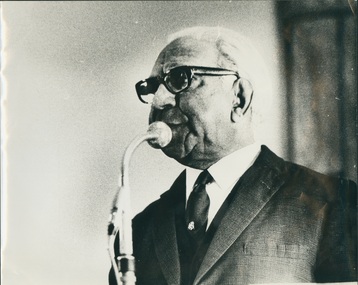
B&W photo of another photo or newspaper photograph of Pastor Sir Douglas Nicholls, Undated
... Foundation, founded in 1969. Many honours were conferred on Nicholls: he was appointed MBE (1957) and OBE (1968) and knighted (1972). In 1962 he was named Victorian ‘Father of the Year’ and the State’s second Aboriginal justice of the peace. ...Foundation, founded in 1969. Many honours were conferred on Nicholls: he was appointed MBE (1957) and OBE (1968) and knighted (1972). In 1962 he was named Victorian ‘Father of the Year’ and the State’s second Aboriginal justice of the peace. ...Sir Douglas Ralph Nicholls (1906-1988), footballer, pastor, activist and governor, was born on 9 December 1906 at Cummeragunja Aboriginal mission, New South Wales, fifth child of Herbert Nicholls, seasonal worker, and his wife Florence, née Atkinson. Doug grew up at Cummeragunja, on the Murray River near Barmah, in its golden years of Aboriginal autonomy. Thomas Shadrach James gave him and other Yorta Yorta children a sound primary education, reinforcing the pride and self-assurance gained from their parents. As Doug grew, so too did the powers of the State’s Aboriginal Protection Board. Doug’s elder sister Hilda was removed about 1915. When Doug reached 14, he was moved off under the Aborigines Protection Act (1909) to find work. He took a job with dredging teams constructing levees on the Murray. Like other youths in the region Nicholls played Australian rules football, emulating kinsmen who had won local premierships since the 1890s. Doug and his brother Herbert (‘Dowie’) played with Tongala in the mid-1920s. Melbourne football beckoned, Doug trying out unsuccessfully for Carlton in 1927. He signed with the Northcote Victorian Football Association team, despite his nervousness about his Aboriginality, and was given a job with Northcote City Council. ‘Dowie’ joined him for a season. Doug was short at 5 ft 2 ins (158 cm), but muscular and lightning fast. He competed regularly during a boom in professional running, winning many heat and place prizes. In 1929 he won the Nyah and Warracknabeal gifts, earning a sash and £100 in each, together with a case of cutlery in the latter. Using his speed on the wing for Northcote, he produced great spring and agility from his compact body. The Sporting Globe reported in 1929 that ‘he flashes through packs of big men, whisks around small men . . . and attempts marks at the back of any six-footer’. In front-on clashes he was flattened only to rise again. The sole Aborigine in the VFA, he was known affectionately as the ‘flying Abo’ but called worse by his opponents’ barrackers. He competed for five seasons, being named ‘best and fairest’ twice, appearing in three association grand finals and winning in 1929. Keen to earn more than a seasonal wage, in 1931 Nicholls accepted a three-year contract with Jimmy Sharman’s travelling boxing show. The bouts matched opposites, local against tent boxer, white against black, and sometimes men of different sizes. He faced stiff competition from those who wanted to best the noted Melbourne black footballer, the crowd adding racial abuse. A far better footballer than boxer, he copped some punishment. Fighting in the Melbourne Stadium in December 1931, he was described by Truth as ‘slow and awkward’, but packing a ‘good wallop’. In 1932 Sharman, who treated his boxers fairly, released Nicholls to join the Fitzroy Victorian Football League team, which agreed to employ him as its groundsman. He played fifty-four games for Fitzroy over six seasons until knee trouble forced him out in 1937. Winning cups in 1934 and 1935, he played alongside Haydn Bunton and Wilfred (‘Chicken’) Smallhorn. Grand finals eluded him but he represented Victoria twice. Following his mother’s death, Nicholls revisited the Church of Christ chapel in Northcote, where they had worshipped together. On 17 July 1932 he experienced a conversion. He was soon baptised and witnessed openly, leading his fellow footballers to occasional church parades. Nicholls exhibited leadership qualities. William Cooper, founder of the Australian Aborigines’ League and Nicholls’ Yorta Yorta kinsman and fellow Christian, encouraged the young footballer. In February 1935 Cooper, Nicholls and others lobbied Thomas Paterson, the Commonwealth minister for the interior, over the need for Federal control of Aboriginal affairs. Nicholls attended the Day of Mourning protest for Aborigines held in Sydney on 26 January 1938, declaring: ‘after 150 years our people are still influenced and bossed by white people. I know we can proudly hold our own with others if given the chance’. When Cooper retired in November 1940 Nicholls became secretary of the AAL. On 2 June 1941 Nicholls enlisted in the Citizen Military Forces. He trained at Seymour and Bonegilla before being posted to the 29th Battalion. As Major Frank Corr’s batman, he was popular with other soldiers who tolerated his preaching and Bible reading. His army service was brief, however, and he was discharged in Melbourne on compassionate grounds on 22 January 1942. His biographer claimed that the Fitzroy police requested his return to mediate in the racial tensions developing between servicemen and the mostly respectable Aboriginal families living in crowded and dilapidated Fitzroy housing; Aboriginal people maintain that they requested his release. Nicholls began welfare work and religious services from an Aboriginal home in Gertrude Street, Fitzroy. In April 1942, ‘Dowie’ died of road accident trauma, leaving his wife, Gladys, née Bux, and three children. On 26 December 1942 at Moama Methodist Church, New South Wales, Nicholls married her, a caring gesture which developed into a loving partnership. In January 1943 he initiated ‘Aboriginal Sunday’, featuring a gum leaf orchestra and choir. By 1955 this service had moved to July and later evolved into National Aborigines and Islanders Day Observance Committee (NAIDOC) week. Ordained a Churches of Christ pastor in 1945, Nicholls conducted a vigorous ministry from a chapel in Gore Street, Fitzroy. His work survived on donations, a small honorarium, and his employment as team coach (1947) and curator at the Northcote Football Ground. In the 1950s Gladys established grocery and opportunity shops to earn income and provide services. Their house soon overflowed with people in need or visitors to Melbourne. Nicholls also hosted inspiring African American visitors such as the pianist Winifred Attwell and the singer Harry Belafonte. His ministry extended to Aboriginal country communities. Gladys taught Sunday school, undertook endless fund-raising and welfare work beside her husband, and became his greatest supporter and financial manager. They formed an Aboriginal Girls’ Hostel in 1956, for which they acted as house parents, and bought holiday units for Aborigines at Queenscliff. Persistently advocating Aboriginal rights, Nicholls protested about the impact of the Woomera rocket range on the people of the Warburton Ranges, co-ordinated the production of a concert, Out of the Dark, scripted by Jean Campbell, to rectify the omission of Aborigines from Victoria’s Commonwealth jubilee celebrations, and criticised the Victorian Aboriginal Protection Board. In 1957 when the board was transformed into the Aborigines’ Welfare Board, he and Harold Blair were appointed as Aboriginal representatives. Maintaining the stance of a political moderate, he did not bear grudges and sought to build bridges between black and white. He co-operated with any group that aided the cause, including the Council of Aboriginal Rights, whose executive were members of the Communist Party of Australia. This association attracted the attention of the Australian Security Intelligence Organization, which in 1957 began to keep a file on Nicholls. In May 1957 Nicholls formed the Victorian Aborigines Advancement League with Doris Blackburn and Gordon Bryant, a Federal parliamentarian. As its paid field officer and spokesman, Nicholls contested assimilation policies and used film to raise awareness of issues. When the Welfare Board attempted to close Lake Tyers reserve, Gippsland, he resigned in disgust and led a protest march on parliament in May 1963. The AAL also petitioned the United Nations on land rights in June, perhaps the first indigenous body to do so. He argued for new premises at 58 Cunningham Street, Northcote, opened in 1966 as the ‘Doug Nicholls Centre’. In 1958 Nicholls was a foundation member of the Federal Council for Aboriginal Advancement (Federal Council for the Advancement of Aboriginal and Torres Strait Islanders after 1964), which he served as national field officer (1961) and Victorian secretary (1962-63). While an innovator in tactics, he was alarmed by the influence of confrontational ‘black power’ politics in the AAL and resigned as a director amid turmoil on this issue in 1969, claiming the concept was a ‘bitter word’, not needed in Australia. Similar tensions in FCAATSI led him to join with Kath Walker (Oodgeroo Noonuccal) in establishing the short-lived National Tribal Council as an alternative forum. As the AAL leadership moderated their stance, he returned as president (1969-74) of the new all-Aboriginal organisation. He was also a keen patron of the National Aboriginal Sports Foundation, founded in 1969. Many honours were conferred on Nicholls: he was appointed MBE (1957) and OBE (1968) and knighted (1972). In 1962 he was named Victorian ‘Father of the Year’ and the State’s second Aboriginal justice of the peace. Crowned Melbourne’s 1973 King of Moomba, he was declared Bapu Mamus (a Torres Strait term for ‘headman’) by the NTC. On 1 December 1976 Sir Douglas was appointed Governor of South Australia, but his health deteriorated within weeks, making it difficult for him to perform his official duties. In March 1977 he hosted Queen Elizabeth during her royal tour and was appointed KCVO. He relinquished his governorship on 30 April 1977 following a stroke. Ill health continued to dog him during retirement, but he played his Nelson Eddy records, enjoyed his expanding family, and when able, ministered to the Aboriginal Church at the League’s premises. Sir Douglas Nicholls died on 4 June 1988 at Mooroopna, predeceased (1981) by his wife and survived by his five children. He was given a state funeral and buried in tribal ground at Cummeragunja cemetery. Among the many tributes to him are an oval at Northcote, handed to the AAL in 1982, a Canberra suburb gazetted in 1991, and a fellowship for Indigenous leadership established in 2003, all in his name, and a statue of Sir Doug and Lady Nicholls by Louis Laumen, unveiled in 2007 in Parliament Gardens, Melbourne. Sir Douglas Nicholls is shown speaking at a microphone; head and shoulders; dressed in a suit.Pastor Douglas Nicholls -
 Tarnagulla History Archive
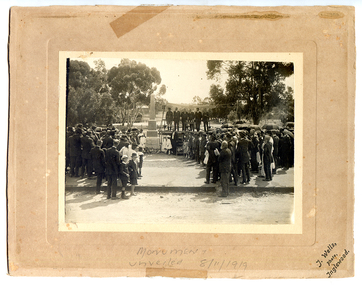
Photograph: Unveiling ceremony for Soldiers' Memorial, Tarnagulla, J. Wells, 8th November, 1919
... Foundation members were Mrs. B. Patterson, Mrs J. Bock and the Misses P. Lemin, Violet Radnell, D. Dyer and Doris and Phoebe Bock. The Committee arranged 'Welcome Home' functions for each local soldier returning home after service in the First World War. Tarnagulla had a very large number of enlistments for its population. Angus M. Comrie is standing to the right of the Memorial with his daughter Mavis Comrie, and Nell Alexander. Mavis Comrie presented a new Union Jack flag to the Tarnagulla School on 25th July 1919 to commemorate Peace...Foundation members were Mrs. B. Patterson, Mrs J. Bock and the Misses P. Lemin, Violet Radnell, D. Dyer and Doris and Phoebe Bock. The Committee arranged 'Welcome Home' functions for each local soldier returning home after service in the First World War. Tarnagulla had a very large number of enlistments for its population. Angus M. Comrie is standing to the right of the Memorial with his daughter Mavis Comrie, and Nell Alexander. Mavis Comrie presented a new Union Jack flag to the Tarnagulla School on 25th July 1919 to commemorate Peace ...David Gordon Collection. The monument was created and erected by Mr. Barber of Dunolly in October 1919. It was unveiled by Brigadier General Brand C.B. C.M.G. D.S.O. at 2:30pm on Saturday November 8th, 1919. The Welcome Home Committee, formed 2nd July 1917, was largely responsible for commissioning the monument. Foundation members were Mrs. B. Patterson, Mrs J. Bock and the Misses P. Lemin, Violet Radnell, D. Dyer and Doris and Phoebe Bock. The Committee arranged 'Welcome Home' functions for each local soldier returning home after service in the First World War. Tarnagulla had a very large number of enlistments for its population. Angus M. Comrie is standing to the right of the Memorial with his daughter Mavis Comrie, and Nell Alexander. Mavis Comrie presented a new Union Jack flag to the Tarnagulla School on 25th July 1919 to commemorate Peace. Peace Medals were also distributed to the school students. The men in uniform at ground level are making up a Guard of Honour consisting of returned soldiers drawn from around the Tarnagulla district. They formed up at the Victoria Hotel, and there is a good photograph of them elsewhere in this collection. Original sepia photograph, mounted on card, depicting the unveiling ceremony for the Soldiers' Memorial monument in Tarnagulla. A large crowd is looking on, some spilling off the curb and onto the street, whilst several officials stand on a temporary platform. The obelisk monument is left of centre in the image. -
 Musculoskeletal Health Australia (now held by the Glen Eira Historical Society)
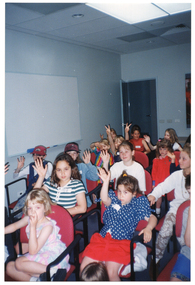
Photograph - Group photo, Circa 1990s
... This photo depicts some of the children trying out some chair-based stretching exercises. arthritis foundation of victoria afv children with arthritis juvenile arthritis family support group self-help course pain management chair-based exercise living with arthritis family support family barbeque bbq C1990s COL photo of a group of children seated on rows of chairs inside a room. Many of them are holding their hands up, some with two fingers depicting the "peace ...In the mid 1990s, a self-help course for children with arthritis was held at the Arthritis Foundation of Victoria's headquarters. Following the course was a barbeque for the children and their families. This photo depicts some of the children trying out some chair-based stretching exercises.COL photo of a group of children seated on rows of chairs inside a room. Many of them are holding their hands up, some with two fingers depicting the "peace" sign. In the background, there is a whiteboard affixed to one wall, with an open door and a display board with posters (partially obscured) on the other wall.arthritis foundation of victoria, afv, children with arthritis, juvenile arthritis, family support group, self-help course, pain management, chair-based exercise, living with arthritis, family support, family barbeque, bbq, c1990s -
 Buninyong & District Historical Society
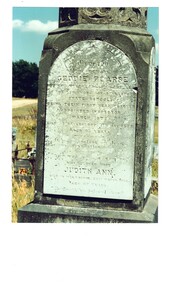
Photograph - Colour photograph Headstone Buninyong Cemetery, Geddie Pearse headstone
... Erected to the memory of Geddie Pearse by the teachers and scholars of Buninyong and Daylesford State Schools Being their first head teacher appointed Inspector March, 1878 Died at Daylesford 11th May 1878 Aged 43 Years In Peace resting on Jesus the sure foundation. His Beloved Wife Judith Anne Died in Melbourne 22nd March 1882 Aged 47 years He giveth His Beloved Sleep...One of a series of photographs taken of graves in the Buninyong Cemetery for Buninyong and District Historical Society This photograph shows the gravestone of Geddie Pearse, the first headmaster of Buninyong State School and his wife Judith Buninyong Cemetery Geddie Pearse Buninyong School Judith Pearse Monuments Memorials Erected to the memory of Geddie Pearse by the teachers and scholars of Buninyong and Daylesford State Schools Being their first head teacher appointed Inspector March, 1878 Died at Daylesford 11th May 1878 Aged 43 Years In Peace resting on Jesus the sure foundation. His Beloved Wife Judith Anne Died in Melbourne 22nd March 1882 Aged 47 years He giveth His Beloved Sleep A colour photograph of the headstone of Geddie Pearse and his wife Judith Anne Geddie Pearse headstone Photograph Colour photograph Headstone Buninyong Cemetery ...One of a series of photographs taken of graves in the Buninyong Cemetery for Buninyong and District Historical SocietyThis photograph shows the gravestone of Geddie Pearse, the first headmaster of Buninyong State School and his wife JudithA colour photograph of the headstone of Geddie Pearse and his wife Judith AnneErected to the memory of Geddie Pearse by the teachers and scholars of Buninyong and Daylesford State Schools Being their first head teacher appointed Inspector March, 1878 Died at Daylesford 11th May 1878 Aged 43 Years In Peace resting on Jesus the sure foundation. His Beloved Wife Judith Anne Died in Melbourne 22nd March 1882 Aged 47 years He giveth His Beloved Sleepbuninyong cemetery, geddie pearse, buninyong school, judith pearse, monuments, memorials
