
Showing 48 items matching "picnic races"
-
 Orbost & District Historical Society
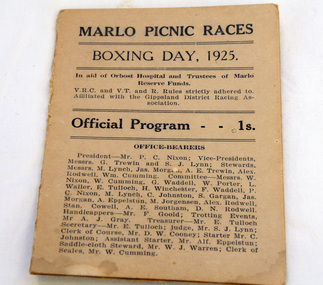
program, December 1925
... recreation horse-racing Marlo-picnic-races...Richardson of Bete Bolong at the Marlo picnic Races on Boxing Day 1925. It cost one shilling. ...A small folded card program for the Marlo Picnic Races on Boxing Day 1925. Text is in black print. ...Richardson of Bete Bolong at the Marlo picnic Races on Boxing Day 1925. It cost one shilling. ...This event - horse racing - was held to raise funds for the Orbost District Hospital and the Trustees of Marlo Reserve funds. It was used by F.E. Richardson of Bete Bolong at the Marlo picnic Races on Boxing Day 1925. It cost one shilling. Frank Richardson was the son of Mark Richardson, son of pioneer, Samuel Richardson.This program is significant in that it is a souvenir of a local event which no longer takes place. A small folded card program for the Marlo Picnic Races on Boxing Day 1925. Text is in black print. This Official Program cost 1s (one shilling)recreation horse-racing marlo-picnic-races -
 Ithacan Historical Society
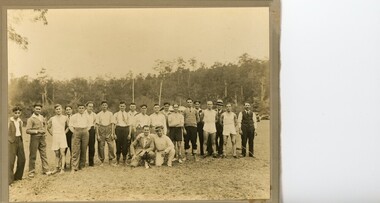
Photograph, Ithacan Picnic races, c1933
... Ithacan Picnic races...The photograph was taken at an Ithacan Philanthropic Society annual picnic sometime in the late 1920s or early 1930s. Races were always a feature at the annual picnic. ...The group are standing in a picnic ground in a valley which is surrounded by trees. Ithacan Picnic races Photograph ...The photograph was taken at an Ithacan Philanthropic Society annual picnic sometime in the late 1920s or early 1930s. Races were always a feature at the annual picnic. In those early most families travelled to the picnic ground in hired furniture vans. The annual picnic is still held today in February of each year. Pictured standing L-R: ? Kasamias; unknown; Nick Kandiliotis; Andreas Razos; unknown; unknown; unknown; Spiros Digaletos; Paizis?; Dimitri Megalogenis; unknown; Paris Gabriel; Kallinikos ?; unknown; unknown; Gerasimos Papadopoulos (Tsinis); Stratos Paizis; Cominos (Bourazanis)?; Kneeling: Nikos Stratos; Platon Varvarigos. The annual picnic gave Ithacans the chance to relax and mingle away from their work on Sunday. It was and still is an important social event in the society's calendar.A scanned black and white photograph seventeen men standing in a line and two others crouched down in the front. They are either preparing to have a race or they have completed one as four of them are wearing shorts and singlets while some of the others have rolled up their trouser legs and a lot of them are wearing running shoes. The group are standing in a picnic ground in a valley which is surrounded by trees. -
 Ithacan Historical Society
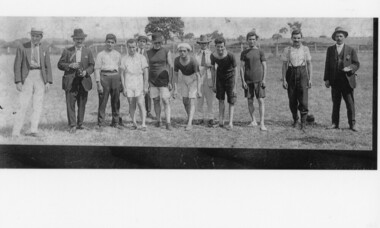
Photograph, Ithacan picnic races, c1930s
... Ithacan picnic races...The first picnic was held on 24 March 1918 at a picnic ground in South Morang. The races for all age groups are a popular feature of the day's entertainment. ...One of the open lookers is holding a camera. Ithacan picnic races Photograph ...The annual picnic has been an important social event for the Ithacan Philanthropic Society. The first picnic was held on 24 March 1918 at a picnic ground in South Morang. The races for all age groups are a popular feature of the day's entertainment. In this photograph seven young men are preparing to participate in the men's race.A black and white photograph with a white header and footer of twelve men in an open area. Seven of the men are lined up to begin a foot race while the other five looking on and deciding when to start the race. One of the open lookers is holding a camera. -
 Bendigo Historical Society Inc.
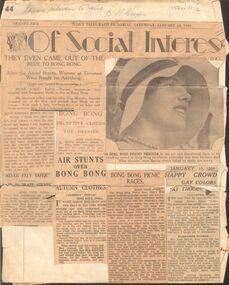
Newspaper - HOWARD AND VIOLET JOLLEY COLLECTION: NEWSPAPER ARTICLES
... ...Picnic Races...From MONDAY 11th Nov 1929, Croppa Creek picnic races, history as Messrs Jolley & Leggatt arrived by plane. ...Daily Telegraph Airplanes Picnic Races From THE DAILY TELEGRAPH items include from Jan 18 & 10, 1930 Of Social Interest. ...From THE DAILY TELEGRAPH items include from Jan 18 & 10, 1930 Of Social Interest. THEY EVEN CAME OUT OF THE BLUE TO BONG BONG, After the air-stunts, Women at Tirranna Were Ready For Anything, Racing excitement mingled with aeroplane thrills at Bong Bong; Barbara Aird as passenger, Never felt safer; LADY IN PLANE STUNTS; Gypsy Moth; Howard Jolley and pilot Guy Menzies, Dick Allen DECEPTIVE CLOUDS; THE DRESSES; AIR STUNTS OVER BONG BONG; AUTUMN CLOTHES; BONG BONG PICNIC RACES Bachelors bag won by Orwell Phillips. Alan Binnie, Lady de Chair, Lt Graham de Chair, Miss Susan Spencer, Mr & Mrs Blomfield; HAPPY CROWD GAY COLOURS AT TIRRANNA, two men wore fly nets, Mrs Alan Binnie remarked at the state of the ground. Binnie family rider Jack Melville had to borrow plumes as his riding kit had displaced from the car's running board on route to the races. From MONDAY 11th Nov 1929, Croppa Creek picnic races, history as Messrs Jolley & Leggatt arrived by plane. From Sydney Morning Herald of 18/3/1930 The Town Hall was densely packed last night for the Irish national concert held in connection with St Patrick's Day celebrations with programme numbers drawing enthusiastic applause.daily telegraph, airplanes, picnic races -
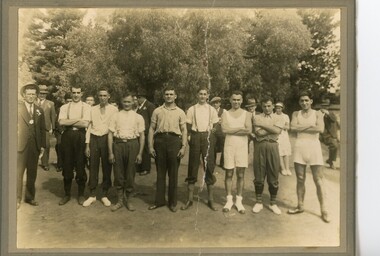 Ithacan Historical Society
Photograph, Ithacan picnic, men's races, c 1930s
... Ithacan picnic, men's races...A scanned bl;ack and white photograph of eight men and the starter lined up before the start of a race at an outdoor function with onlookers behind the group. two of the men are dressed in shorts and singlet while some others in the group have rolled up their suit trousers and are wearing running shoes. Ithacan picnic, men's races Photograph ...The photograph was taken at an annual Ithacan Philanthropic Society picnic some time in the mid to late 1930s. The men appear to be lined up for a running race, a highlight of the picnic. First on the left is Andreas Papadopoulos president at the time (president from 1934-39); man in suit in the background unknown; Diogenes Cominos, Hector Andrews (Anagnostatos); George Kouvalias (behind him is Nick Fatouros (Fisher)); Spiros Digaletos, a keen wrestler as a a young man; Peter Zavitsanos (Shanos); Peter Drakopoulos; Stratos Paizis; Nick Mavrokefalos (Black).The Ithacan Greeks who settled in Melbourne between the two world wars worked long hours in their family businesses, however, Sunday was a day set aside for socialising within their community. A much anticipated event was the annual picnic where families gathered for the day at a picnic ground on the outskirts of Melbourne, such as Bacchus Marsh, Werribee and Mount Evelyn. The picnic today is still an important event in the club's social calendar. A scanned bl;ack and white photograph of eight men and the starter lined up before the start of a race at an outdoor function with onlookers behind the group. two of the men are dressed in shorts and singlet while some others in the group have rolled up their suit trousers and are wearing running shoes. -
 Merbein District Historical Society
Photograph, Watching the Races - Settlers Picnic & VF, 1 Jan.1923
... Watching the Races - Settlers Picnic & VF...Turf Club Picnics Watching the Races - Settlers Picnic & VF Photograph ...turf club, picnics -
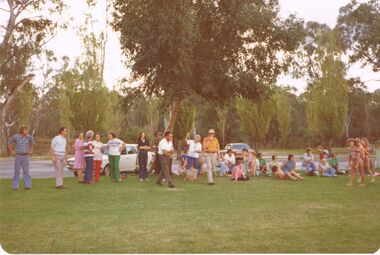 Bendigo Historical Society Inc.
Photograph - BERT GRAHAM COLLECTION: GROUP PICNIC
... Possibly members of the Bendigo East Swimming Club, enjoying 'picnic' races....Possibly members of the Bendigo East Swimming Club, enjoying 'picnic' races. Photograph BERT GRAHAM COLLECTION: GROUP PICNIC ...Colour photograph, Bert Graham Collection, A big group of people watching other young people in a piggyback race on a grassed area. Possibly members of the Bendigo East Swimming Club, enjoying 'picnic' races.bendigo, clubs, bendigo east swimming club -
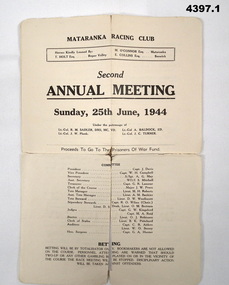 Bendigo Military Museum
Programme - MATARANKA RACES PROGRAMME 1944, June 1943
... Titled “Mataranka Picnic Races, Inaugral Meeting - Sunday 27th June 1943” .3) same as .2)...Titled “Mataranka Picnic Races, Inaugral Meeting - Sunday 27th June 1943” .3) same as .2) Programme MATARANKA RACES PROGRAMME 1944 ...These were saved by V246169 Pte Donald Rexford Speedy. POB Bendigo. Refer Cat No 4396.2P..1) Single sheet of paper folded. Titled “2nd Annual Meeting 25 June 1944. Mataranka Racing Club” .2) Single sheet of paper folded. Titled “Mataranka Picnic Races, Inaugral Meeting - Sunday 27th June 1943” .3) same as .2)Written in pencil on last page "Pte Speedy" horse race, programme, mataranka -
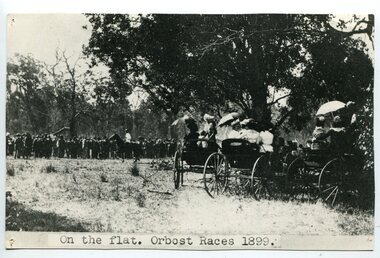 Orbost & District Historical Society
black and white photograph, 1899
... For a long time horse races were part of the Marlo Picnic Races. Bellagoogan on Majors Creek near Orbost was the site of the first race course....For a long time horse races were part of the Marlo Picnic Races. Bellagoogan on Majors Creek near Orbost was the site of the first race course. ...This photograph shows spectators watching the Orbost Races on the flat in 1899. Some of the earliest horse races were held on a course in a paddock belonging to Mr James Cowell at Jarrahmond. For a long time horse races were part of the Marlo Picnic Races. Bellagoogan on Majors Creek near Orbost was the site of the first race course.This item is a pictorial record depicting the popularity of horse racing in Orbost in the late 19th century.A black / white photograph of a large group of people in the background with three horse carriages under trees. Some ladies are sitting in the open carriages which are parked underneath tress. Some are holding open umbrellas. It is on a grey buff card.on front - " On the flat. Orbost Races 1899"equestrian orbost-horse-racing recreation -
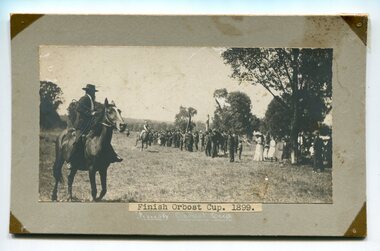 Orbost & District Historical Society
black and white photograph, 1899
... For a long time horse races were part of the Marlo Picnic Races. Bellagoogan on Majors Creek near Orbost was the site of the first race course...For a long time horse races were part of the Marlo Picnic Races. Bellagoogan on Majors Creek near Orbost was the site of the first race course This item is a pictorial record depicting the popularity of horse racing in Orbost in the late 19th century. horse-racing-orbost sport recreation on front - "Finish Orbost Cup 1899: on back - "Mr Edlington" A black / white photograph on a grey buff card. ...This photograph shows spectators watching the Orbost Races on the flat in 1899. Some of the earliest horse races were held on a course in a paddock belonging to Mr James Cowell at Jarrahmond. For a long time horse races were part of the Marlo Picnic Races. Bellagoogan on Majors Creek near Orbost was the site of the first race courseThis item is a pictorial record depicting the popularity of horse racing in Orbost in the late 19th century.A black / white photograph on a grey buff card. It is of a man on a horse holding a whip in his right hand. A horse with jockey is approaching. Spectators are standing on the right hand side under the trees.on front - "Finish Orbost Cup 1899: on back - "Mr Edlington"horse-racing-orbost sport recreation -
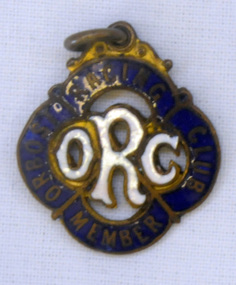 Orbost & District Historical Society
badge, 1890's
... For a long time horse races were part of the Marlo Picnic Races. Bellagoogan on Majors Creek near Orbost was the site of the first race course. ...For a long time horse races were part of the Marlo Picnic Races. Bellagoogan on Majors Creek near Orbost was the site of the first race course. ...This is a member's badge for the Orbost Racing Club and belonged to Mat Lynch. Secretary was Mr W. A. Malcolm. Some of the earliest horse races were held on a course in a paddock belonging to Mr James Cowell at Jarrahmond. For a long time horse races were part of the Marlo Picnic Races. Bellagoogan on Majors Creek near Orbost was the site of the first race course. Mat Lynch was a prominent local identity and generously donated a block of land situated on the Princes Highway, for the Brodribb Hall.Horse racing played a vital role in the history of Orbost. This item is connected to that role.A small metal badge which is a diamond shape with rounded corners. It has a small metal loop at the top. In gold print is "Member Orbost Racing Club" on a dark blue enamel around the edge. In the centre is "ORC" in white enamel.On back - 28 - LYNCH - almost indecipherable.orbost-racing-club lynch-mat recreation horse-racing -
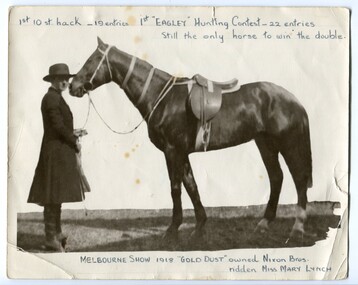 Orbost & District Historical Society
black and white photograph, 1918
... For a long time horse races were part of the Marlo Picnic Races....For a long time horse races were part of the Marlo Picnic Races. This item is connected to an activity once popular in the Orbost district. ...Mary Lynch was the daughter of Matthew and Mary (nee Loorham) Lynch. She became Mrs Ivell. she was a noted horse-woman having ridden the Nixon Bros hack, "Gold Dust" at the Melbourne Show coming first in the 10 stone hack and first in the Eagley Hunting Contest. (info. Mary Gilbert) Horse racing was a popular past-time in early Orbost. The Nixon family was involved through Keith Nixon. Some of the earliest horse races were held on a course in a paddock belonging to Mr James Cowell at Jarrahmond. For a long time horse races were part of the Marlo Picnic Races.This item is connected to an activity once popular in the Orbost district. The Nixon family were prominent early settlers in the Orbost district.A black / white photograph of a lady dressed in a a tailored hip coat, bowler hat, knee breeches and boots. She is holding the reins of a saddled horse. There is a copy.on front at top - " 1st 10st hack - 19 entries 1st "EAGLEY" Hunting Contest - 22 entries. Still the only horse to win the double." on front at bottom - " MELBOURNE SHOW 1918 "GOLD DUST" owned by Nixon Bros ridden by Miss MARY LYNCH"lynch-mary nixon-bros-horses equestrian melbourne-show gold-dust -
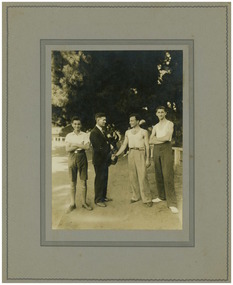 Ithacan Historical Society
Photograph, Ithacan picnic, race winners, c mid-late 1930s
... The photograph was taken at an annual Ithacan Philanthropic Society picnic. The races, organised for all age groups, were very popular and the men's race was the feature of the day. ...The photograph was taken at an annual Ithacan Philanthropic Society picnic. The races, organised for all age groups, were very popular and the men's race was the feature of the day. ...The photograph was taken at an annual Ithacan Philanthropic Society picnic. The races, organised for all age groups, were very popular and the men's race was the feature of the day. The first placegetters of the men's race is being congratulated by the president, Andreas Papadopoulos; the second and third placegetters are looking on.The annual picnic was and still is a popular event with members of the Ithacan Philanthropic Society. It is a chance for friends and families to relax and catch up.A sepia photograph mounted on board of a man, dressed in a suit, congratulating a young man dressed for a sporting event while his two team mates look on. They are standing in front of a wooden post and rail fence in a sports ground. Written on the back : AGP - 2 -
 Orbost & District Historical Society
bookmaker's bag, late 19th century
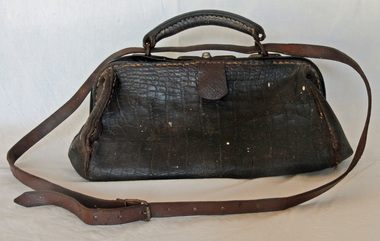
... For a long time horse races were part of the Marlo Picnic Races....For a long time horse races were part of the Marlo Picnic Races. This item is connected to an activity once popular in the Orbost district. gladstone-bag bookmaker's-bag horse-racing On the base - SOLID LEATHER A very worn leather bookmaker's bag. ...A Gladstone bag is a small portmanteau suitcase built over a rigid frame which could separate into two equal sections. Unlike a suitcase, a Gladstone bag is deeper in proportion to its length.They are typically made of stiff leather and often belted with lanyards. The bags are named after William Ewart Gladstone (1809–1898), the four-time Prime Minister of the United Kingdom. This one has been adapted to suit the needs of a bookmaker. The leather neck strap has been added. Horse racing was a popular past-time in early Orbost. The Nixon family was involved through Keith Nixon. Some of the earliest horse races were held on a course in a paddock belonging to Mr James Cowell at Jarrahmond. For a long time horse races were part of the Marlo Picnic Races.This item is connected to an activity once popular in the Orbost district. A very worn leather bookmaker's bag. It is a Gladstone style bag with a leather neck strap. It has a spring lock with a key hole. It has a curved handle at the top. The leather neck strap does not appear to be original. The inside lining is cotton and there is a metal hinged frame. On the base are four metal studs.On the base - SOLID LEATHERgladstone-bag bookmaker's-bag horse-racing -
 Ithacan Historical Society
Photograph, Ithacan picnic, late 70s - early 80s
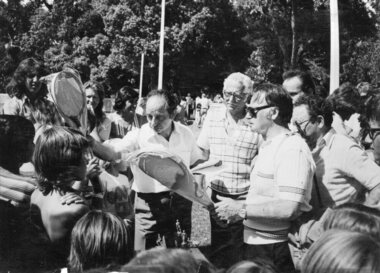
... The photograph was taken at an Ithacan picnic during the running races. IPS committee members, L-R Stathi Raftopoulos, Michael Black and Nick Varigos are presenting prizes of tennis rackets to race winners....The photograph was taken at an Ithacan picnic during the running races. IPS committee members, L-R Stathi Raftopoulos, Michael Black and Nick Varigos are presenting prizes of tennis rackets to race winners. ...The photograph was taken at an Ithacan picnic during the running races. IPS committee members, L-R Stathi Raftopoulos, Michael Black and Nick Varigos are presenting prizes of tennis rackets to race winners.The annual Ithacan picnic which is held towards the end of summer is a popular event allowing friends and families to mingle and relax. The running races are a popular feature for the young.A black and white photograph of a crowd of people outdoors. Two men are holding wrapped tennis rackets while another man is talking to a child in the group. -
 Flagstaff Hill Maritime Museum and Village
Book, Happy Dispatches
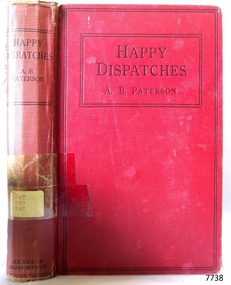
... His lifelong love of horses and horsemen was forged from the riders and their horses he saw at the picnic races and polo matches the family attended. ...His lifelong love of horses and horsemen was forged from the riders and their horses he saw at the picnic races and polo matches the family attended. ...This item is from the ‘Pattison Collection’, a collection of books and records that was originally owned by the Warrnambool Mechanics’ Institute, which was founded in Warrnambool in 1853. By 1886 the Warrnambool Mechanics’ Institute (WMI) had grown to have a Library, Museum and Fine Arts Gallery, with a collection of “… choice productions of art, and valuable specimens in almost every branch and many wonderful national curiosities are now to be seen there, including historic relics of the town and district.” It later included a School of Design. Although it was very well patronised, the lack of financial support led the WMI in 1911 to ask the City Council to take it over. In 1935 Ralph Pattison was appointed as City Librarian to establish and organise the Warrnambool Library as it was then called. When the WMI building was pulled down in 1963 a new civic building was erected on the site and the new Warrnambool Library, on behalf of the City Council, took over all the holdings of the WMI. At this time some of the items were separated and identified as the ‘Pattison Collection’, named after Ralph Pattison. Eventually the components of the WMI were distributed from the Warrnambool Library to various places, including the Art Gallery, Historical Society and Flagstaff Hill. Later some were even distributed to other regional branches of Corangamite Regional Library and passed to and fro. It is difficult now to trace just where all of the items have ended up. The books at Flagstaff Hill Maritime Village generally display stamps and markings from Pattison as well as a variety of other institutions including the Mechanics’ Institute itself. RALPH ERIC PATTISON Ralph Eric Pattison was born in Rockhampton, Queensland, in 1891. He married Maude Swan from Warrnambool in 1920 and they set up home in Warrnambool. In 1935 Pattison accepted a position as City Librarian for the Warrnambool City Council. His huge challenge was to make a functional library within two rooms of the Mechanics’ Institute. He tirelessly cleaned, cleared and sorted a disarrayed collection of old books, jars of preserved specimens and other items reserved for exhibition in the city’s museum. He developed and updated the library with a wide variety of books for all tastes, including reference books for students; a difficult task to fulfil during the years following the Depression. He converted all of the lower area of the building into a library, reference room and reading room for members and the public. The books were sorted and stored using a cataloguing and card index system that he had developed himself. He also prepared the upper floor of the building and established the Art Gallery and later the Museum, a place to exhibit the many old relics that had been stored for years for this purpose. One of the treasures he found was a beautiful ancient clock, which he repaired, restored and enjoyed using in his office during the years of his service there. Ralph Pattison was described as “a meticulous gentleman whose punctuality, floorless courtesy and distinctive neat dress were hallmarks of his character, and ‘his’ clock controlled his daily routine, and his opening and closing of the library’s large heavy doors to the minute.” Pattison took leave during 1942 to 1945 to serve in the Royal Australian Navy, Volunteer Reserve as Lieutenant. A few years later he converted one of the Museum’s rooms into a Children’s Library, stocking it with suitable books for the younger generation. This was an instant success. In the 1950’s he had the honour of being appointed to the Victorian Library Board and received more inspiration from the monthly conferences in Melbourne. He was sadly retired in 1959 after over 23 years of service, due to the fact that he had gone over the working age of council officers. However he continued to take a very keen interest in the continual development of the Library until his death in 1969. About A. B. ‘Banjo’ Paterson Andrew Barton Paterson was born at Narrambla Station in New South Wales, Australia, on 17th February 1864 and died 5th February 1941. His first seven years were spent on his father’s station, where like so many Australian children he enjoyed a bush boyhood. This property was at Obley in the Orange district of New South Wales. The family moved to the Yass district and lived near the main route from Sydney to Melbourne where he saw a great many bullock teams, drovers with herds of stock, gold escorts and Cob & Co coaches. His lifelong love of horses and horsemen was forged from the riders and their horses he saw at the picnic races and polo matches the family attended. These horses and riders where from the Murrumbidgee River and Snowy Mountain areas of New South Wales. Patterson lived most of his life in Sydney. He became a journalist, army officer, novelist, poet, solicitor and a war correspondent. He enjoyed many different sports such as tennis, rowing and, most of all, he delighted in his horsemanship. His first poem ‘El Mahdi to the Australian Troop’ was published in the Bulletin in 1885 under the pen name of “The Banjo”, which was the name of his favourite horse. In 1895 his first book was published and was sold out in the week of publication; he sold 7000 copies in a few months. This book was “The Man From Snowy River, and other Verses” and it contained such ballads as ‘Clancy of the Overflow’, ‘The Geebung Polo Club’, ‘The Man from Ironbark’, and ‘Saltbush Bill’. The tittle poem was first published in 1890. In 1895 Patterson visited his fiancé (at that time), Sarah Riley, who was staying with her friends the Macphersons at Dagworth Station in Queensland. Sarah’s old school friend Christina McPherson. Christina replayed to them an old Scottish tune called “The Craigielee March” that she had heard played by the Garrison Artillery band at the Warrnambool picnic races in Victoria, 1894. Patterson wrote words to fit the tune and it became the now famous ‘Waltzing Matilda’. He was commissioned by the Sydney Morning Herald and the Melbourne Age as they correspondent to report on the South African War. After being a roving reporter in China he went to England and spent time with Rudyard Kipling. In April 1903 Paterson married Alice Walker in Tenterfield, New South Wales, and they had two children, Grace and Hugh. At the outbreak of World War 1 Paterson sailed for England in the hope of covering the fighting in Flanders as a correspondent but finished up driving an ambulance for the Australian Voluntary Hospital, Wimereux, France. In 1915 as an honorary vet he made three voyages taking horse to Africa, China and Egypt. On 18th October 1915 he was commissioned in the 2nd Remount Unit in the Australian Imperial Force and was promoted to Captain serving in the Middle East. He was wounded in April 1916, when he re-joined his unit he was promoted to major and commanded the Australian Remount Squadron from October 1916 to his return to Australia in 1919. Once the War was over he resumed his work as a journalist until he retired in 1930 so that he could devote time to creative writing. He became a successful radio broadcaster with the Australian Broadcasting Commission using his travel experiences. He wrote the children’s book “The Animals Noah Forgot” in 1933 and then in 1934 “Happy Dispatches” in which he told of his meetings with people like Winston Churchill and Kipling. “The Shearer’s Colt was published in 1936 and in 1939 he wrote for the Sydney Morning Herald. After a short illness he passed away in Sydney on 5th February 1941. The Pattison Collection, along with other items at Flagstaff Hill Maritime Village, was originally part of the Warrnambool Mechanics' Institute’s collection. The Warrnambool Mechanics’ Institute Collection is primarily significant in its totality, rather than for the individual objects it contains. Its contents are highly representative of the development of Mechanics' Institute libraries across Australia, particularly Victoria. A diversity of publications and themes has been amassed, and these provide clues to our understanding of the nature of and changes in the reading habits of Victorians from the 1850s to the middle of the 20th century. The collection also highlights the Warrnambool community’s commitment to the Mechanics’ Institute, reading, literacy and learning in the regions, and proves that access to knowledge was not impeded by distance. These items help to provide a more complete picture of our community’s ideals and aspirations. The Warrnambool Mechanics Institute book collection has historical and social significance for its strong association with the Mechanics Institute movement and the important role it played in the intellectual, cultural and social development of people throughout the latter part of the nineteenth century and the early twentieth century. The collection of books is a rare example of an early lending library and its significance is enhanced by the survival of an original collection of many volumes. The Warrnambool Mechanics' Institute’s publication collection is of both local and state significance. Happy Dispatches Author: A B ("Banjo") Paterson Publisher: Angus & Robertson Ltd Date: 1935Label on spine cover with typed text PAT 920 PAT Pastedown front endpaper has sticker from Warrnambool Public Library covered by a sticker from Corangamite Regional Library Service Front loose endpaper has a stamp from Corangamite Regional Library Service warrnambool, shipwrecked-coast, flagstaff-hill, flagstaff-hill-maritime-museum, maritime-museum, shipwreck-coast, flagstaff-hill-maritime-village, shipwrecked-artefact, book, pattison collection, warrnambool library, warrnambool mechanics’ institute, ralph eric pattison, corangamite regional library service, warrnambool city librarian, mechanics’ institute library, victorian library board, warrnambool books and records, warrnambool children’s library, great ocean road, happy dispatches, a b paterson, banjo paterson -
 Flagstaff Hill Maritime Museum and Village
Book, Three Elephant Power
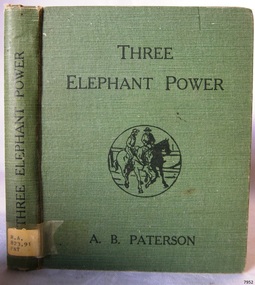
... His lifelong love of horses and horsemen was forged from the riders and their horses he saw at the picnic races and polo matches the family attended. ...His lifelong love of horses and horsemen was forged from the riders and their horses he saw at the picnic races and polo matches the family attended. ...This item is from the ‘Pattison Collection’, a collection of books and records that was originally owned by the Warrnambool Mechanics’ Institute, which was founded in Warrnambool in 1853. By 1886 the Warrnambool Mechanics’ Institute (WMI) had grown to have a Library, Museum and Fine Arts Gallery, with a collection of “… choice productions of art, and valuable specimens in almost every branch and many wonderful national curiosities are now to be seen there, including historic relics of the town and district.” It later included a School of Design. Although it was very well patronised, the lack of financial support led the WMI in 1911 to ask the City Council to take it over. In 1935 Ralph Pattison was appointed as City Librarian to establish and organise the Warrnambool Library as it was then called. When the WMI building was pulled down in 1963 a new civic building was erected on the site and the new Warrnambool Library, on behalf of the City Council, took over all the holdings of the WMI. At this time some of the items were separated and identified as the ‘Pattison Collection’, named after Ralph Pattison. Eventually the components of the WMI were distributed from the Warrnambool Library to various places, including the Art Gallery, Historical Society and Flagstaff Hill. Later some were even distributed to other regional branches of Corangamite Regional Library and passed to and fro. It is difficult now to trace just where all of the items have ended up. The books at Flagstaff Hill Maritime Village generally display stamps and markings from Pattison as well as a variety of other institutions including the Mechanics’ Institute itself. RALPH ERIC PATTISON Ralph Eric Pattison was born in Rockhampton, Queensland, in 1891. He married Maude Swan from Warrnambool in 1920 and they set up home in Warrnambool. In 1935 Pattison accepted a position as City Librarian for the Warrnambool City Council. His huge challenge was to make a functional library within two rooms of the Mechanics’ Institute. He tirelessly cleaned, cleared and sorted a disarrayed collection of old books, jars of preserved specimens and other items reserved for exhibition in the city’s museum. He developed and updated the library with a wide variety of books for all tastes, including reference books for students; a difficult task to fulfil during the years following the Depression. He converted all of the lower area of the building into a library, reference room and reading room for members and the public. The books were sorted and stored using a cataloguing and card index system that he had developed himself. He also prepared the upper floor of the building and established the Art Gallery and later the Museum, a place to exhibit the many old relics that had been stored for years for this purpose. One of the treasures he found was a beautiful ancient clock, which he repaired, restored and enjoyed using in his office during the years of his service there. Ralph Pattison was described as “a meticulous gentleman whose punctuality, floorless courtesy and distinctive neat dress were hallmarks of his character, and ‘his’ clock controlled his daily routine, and his opening and closing of the library’s large heavy doors to the minute.” Pattison took leave during 1942 to 1945 to serve in the Royal Australian Navy, Volunteer Reserve as Lieutenant. A few years later he converted one of the Museum’s rooms into a Children’s Library, stocking it with suitable books for the younger generation. This was an instant success. In the 1950’s he had the honour of being appointed to the Victorian Library Board and received more inspiration from the monthly conferences in Melbourne. He was sadly retired in 1959 after over 23 years of service, due to the fact that he had gone over the working age of council officers. However he continued to take a very keen interest in the continual development of the Library until his death in 1969. About A. B. ‘Banjo’ Paterson Andrew Barton Paterson was born at Narrambla Station in New South Wales, Australia, on 17th February 1864 and died 5th February 1941. His first seven years were spent on his father’s station, where like so many Australian children he enjoyed a bush boyhood. This property was at Obley in the Orange district of New South Wales. The family moved to the Yass district and lived near the main route from Sydney to Melbourne where he saw a great many bullock teams, drovers with herds of stock, gold escorts and Cob & Co coaches. His lifelong love of horses and horsemen was forged from the riders and their horses he saw at the picnic races and polo matches the family attended. These horses and riders where from the Murrumbidgee River and Snowy Mountain areas of New South Wales. Patterson lived most of his life in Sydney. He became a journalist, army officer, novelist, poet, solicitor and a war correspondent. He enjoyed many different sports such as tennis, rowing and, most of all, he delighted in his horsemanship. His first poem ‘El Mahdi to the Australian Troop’ was published in the Bulletin in 1885 under the pen name of “The Banjo”, which was the name of his favourite horse. In 1895 his first book was published and was sold out in the week of publication; he sold 7000 copies in a few months. This book was “The Man From Snowy River, and other Verses” and it contained such ballads as ‘Clancy of the Overflow’, ‘The Geebung Polo Club’, ‘The Man from Ironbark’, and ‘Saltbush Bill’. The tittle poem was first published in 1890. In 1895 Patterson visited his fiancé (at that time), Sarah Riley, who was staying with her friends the Macphersons at Dagworth Station in Queensland. Sarah’s old school friend Christina McPherson. Christina replayed to them an old Scottish tune called “The Craigielee March” that she had heard played by the Garrison Artillery band at the Warrnambool picnic races in Victoria, 1894. Patterson wrote words to fit the tune and it became the now famous ‘Waltzing Matilda’. He was commissioned by the Sydney Morning Herald and the Melbourne Age as they correspondent to report on the South African War. After being a roving reporter in China he went to England and spent time with Rudyard Kipling. In April 1903 Paterson married Alice Walker in Tenterfield, New South Wales, and they had two children, Grace and Hugh. At the outbreak of World War 1 Paterson sailed for England in the hope of covering the fighting in Flanders as a correspondent but finished up driving an ambulance for the Australian Voluntary Hospital, Wimereux, France. In 1915 as an honorary vet he made three voyages taking horse to Africa, China and Egypt. On 18th October 1915 he was commissioned in the 2nd Remount Unit in the Australian Imperial Force and was promoted to Captain serving in the Middle East. He was wounded in April 1916, when he re-joined his unit he was promoted to major and commanded the Australian Remount Squadron from October 1916 to his return to Australia in 1919. Once the War was over he resumed his work as a journalist until he retired in 1930 so that he could devote time to creative writing. He became a successful radio broadcaster with the Australian Broadcasting Commission using his travel experiences. He wrote the children’s book “The Animals Noah Forgot” in 1933 and then in 1934 “Happy Dispatches” in which he told of his meetings with people like Winston Churchill and Kipling. “The Shearer’s Colt was published in 1936 and in 1939 he wrote for the Sydney Morning Herald. After a short illness he passed away in Sydney on 5th February 1941. The Pattison Collection, along with other items at Flagstaff Hill Maritime Village, was originally part of the Warrnambool Mechanics' Institute’s collection. The Warrnambool Mechanics’ Institute Collection is primarily significant in its totality, rather than for the individual objects it contains. Its contents are highly representative of the development of Mechanics' Institute libraries across Australia, particularly Victoria. A diversity of publications and themes has been amassed, and these provide clues to our understanding of the nature of and changes in the reading habits of Victorians from the 1850s to the middle of the 20th century. The collection also highlights the Warrnambool community’s commitment to the Mechanics’ Institute, reading, literacy and learning in the regions, and proves that access to knowledge was not impeded by distance. These items help to provide a more complete picture of our community’s ideals and aspirations. The Warrnambool Mechanics Institute book collection has historical and social significance for its strong association with the Mechanics Institute movement and the important role it played in the intellectual, cultural and social development of people throughout the latter part of the nineteenth century and the early twentieth century. The collection of books is a rare example of an early lending library and its significance is enhanced by the survival of an original collection of many volumes. The Warrnambool Mechanics' Institute’s publication collection is of both local and state significance. Three Elephant Power Author: A B Paterson Publisher: Angus & Robertson Date: 1917Label on spine cover with typed text RA 823.91 PAT Pastedown front endpaper has sticker from Warrnambool Mechanics Institute and Free Library Front loose endpaper has a stamp from Warrnambool Mechanics Institute Fly paper has a stamp from Warrnambool Mechanics Institutewarrnambool, shipwrecked-coast, flagstaff-hill, flagstaff-hill-maritime-museum, maritime-museum, shipwreck-coast, flagstaff-hill-maritime-village, shipwrecked-artefact, book, pattison collection, warrnambool library, warrnambool mechanics’ institute, ralph eric pattison, corangamite regional library service, warrnambool city librarian, mechanics’ institute library, victorian library board, warrnambool books and records, warrnambool children’s library, great ocean road, three elephant power, a b paterson -
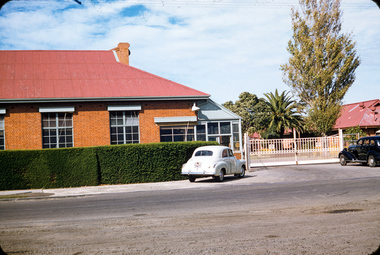 Sunshine and District Historical Society Incorporated
Slide - Darcy Worcester Photograph Collection, Darcy Worcester, C1955 & 1956
... 5893.01 - Darcy Worcester Photograph Collection - ICI Factory Station Road Entrance Deer Park.jpg 5893.02 - Darcy Worcester Photograph Collection - ICI Factory Deer Park Looking Towards Mess Room.jpg 5893.03 - Darcy Worcester Photograph Collection - ICI Factory Deer Park West Side.jpg 5893.04 - Darcy Worcester Photograph Collection - ICI Factory Deer Park West Side.jpg 5893.05 - Darcy Worcester Photograph Collection - ICI Factory Deer Park West Side.jpg 5893.06 - Darcy Worcester Photograph Collection - ICI Factory Deer Park East Side.jpg 5893.07 - Darcy Worcester Photograph Collection - ICI Oil Store And Cooling Tower From South East.jpg 5893.08 - Darcy Worcester Photograph Collection - ICI Calander Section.jpg 5893.09 - Darcy Worcester Photograph Collection - ICI Factory Witton Street From John McLeod Reserve.jpg 5893.10 - Darcy Worcester Photograph Collection - ICI Factory Picnic Races Maddingley Park Bacchus Marsh.jpg 5893.11 - Darcy Worcester Photograph Collection - ICI Housing Estate Deer Park.jpg 5893.12 - Darcy Worcester Photograph Collection - View Towards ICI Housing Estate Deer Park.jpg 5893.13 - Darcy Worcester Photograph Collection - Deer Park Kindergarten Millbank Drive Cnr Station Road.jpg This kindergarten was built by voluntary labour. 5893.14 - Darcy Worcester Photograph Collection - ICI Recreation Club Entrance Ballarat Road.jpg 5893.15 - Darcy Worcester Photograph Collection - ICI Recreation Club Rear Ballarat Road.jpg 5893.16 - Darcy Worcester Photograph Collection - Exhibition Gardens Melbourne.jpg 5893.17 - Darcy Worcester Photograph Collection - Exhibition Building Melbourne.jpg 5893.18 - Darcy Worcester Photograph Collection - Entrance To Government House Melbourne.jpg 5893.19 - Darcy Worcester Photograph Collection - Approach To Shrine Of Remembrance Melbourne.jpg 5893.20 - Darcy Worcester Photograph Collection - Shrine Of Remembrance Melbourne.jpg 5893.21 - Darcy Worcester Photograph Collection - View From Top Shrine Of Remembrance Melbourne Government House Side.jpg 5893.22 - Darcy Worcester Photograph Collection - View From Top Shrine Of Remembrance Melbourne Looking North West.jpg 5893.23 - Darcy Worcester Photograph Collection - View From Top Shrine Of Remembrance Melbourne Looking South.jpg 5893.24 - Darcy Worcester Photograph Collection - View From Top Shrine Of Remembrance Melbourne Looking West.jpg 5893.25 - Darcy Worcester Photograph Collection - View From Top Shrine Of Remembrance Melbourne Looking North.jpg 5893.26 - Darcy Worcester Photograph Collection - Flinders Street Station Flinders Street Cnr Swanston Street Melbourne.jpg 5893.27 - Darcy Worcester Photograph Collection - Old House In Melbourne East.jpg 5893.28 - Darcy Worcester Photograph Collection - Pt. ...Derriut Derrimut 5893.01 - Darcy Worcester Photograph Collection - ICI Factory Station Road Entrance Deer Park.jpg 5893.02 - Darcy Worcester Photograph Collection - ICI Factory Deer Park Looking Towards Mess Room.jpg 5893.03 - Darcy Worcester Photograph Collection - ICI Factory Deer Park West Side.jpg 5893.04 - Darcy Worcester Photograph Collection - ICI Factory Deer Park West Side.jpg 5893.05 - Darcy Worcester Photograph Collection - ICI Factory Deer Park West Side.jpg 5893.06 - Darcy Worcester Photograph Collection - ICI Factory Deer Park East Side.jpg 5893.07 - Darcy Worcester Photograph Collection - ICI Oil Store And Cooling Tower From South East.jpg 5893.08 - Darcy Worcester Photograph Collection - ICI Calander Section.jpg 5893.09 - Darcy Worcester Photograph Collection - ICI Factory Witton Street From John McLeod Reserve.jpg 5893.10 - Darcy Worcester Photograph Collection - ICI Factory Picnic Races Maddingley Park Bacchus Marsh.jpg 5893.11 - Darcy Worcester Photograph Collection - ICI Housing Estate Deer Park.jpg 5893.12 - Darcy Worcester Photograph Collection - View Towards ICI Housing Estate Deer Park.jpg 5893.13 - Darcy Worcester Photograph Collection - Deer Park Kindergarten Millbank Drive Cnr Station Road.jpg This kindergarten was built by voluntary labour. 5893.14 - Darcy Worcester Photograph Collection - ICI Recreation Club Entrance Ballarat Road.jpg 5893.15 - Darcy Worcester Photograph Collection - ICI Recreation Club Rear Ballarat Road.jpg 5893.16 - Darcy Worcester Photograph Collection - Exhibition Gardens Melbourne.jpg 5893.17 - Darcy Worcester Photograph Collection - Exhibition Building Melbourne.jpg 5893.18 - Darcy Worcester Photograph Collection - Entrance To Government House Melbourne.jpg 5893.19 - Darcy Worcester Photograph Collection - Approach To Shrine Of Remembrance Melbourne.jpg 5893.20 - Darcy Worcester Photograph Collection - Shrine Of Remembrance Melbourne.jpg 5893.21 - Darcy Worcester Photograph Collection - View From Top Shrine Of Remembrance Melbourne Government House Side.jpg 5893.22 - Darcy Worcester Photograph Collection - View From Top Shrine Of Remembrance Melbourne Looking North West.jpg 5893.23 - Darcy Worcester Photograph Collection - View From Top Shrine Of Remembrance Melbourne Looking South.jpg 5893.24 - Darcy Worcester Photograph Collection - View From Top Shrine Of Remembrance Melbourne Looking West.jpg 5893.25 - Darcy Worcester Photograph Collection - View From Top Shrine Of Remembrance Melbourne Looking North.jpg 5893.26 - Darcy Worcester Photograph Collection - Flinders Street Station Flinders Street Cnr Swanston Street Melbourne.jpg 5893.27 - Darcy Worcester Photograph Collection - Old House In Melbourne East.jpg 5893.28 - Darcy Worcester Photograph Collection - Pt. ...ICI Deer Park was one of the most important industrial sites in Victoria, the birthplace of Australia’s commercial explosives industry and later a major chemicals, plastics, and fertiliser hub. The factory operated from 1875 until the early 2000s and shaped the entire civic, employment, and suburban landscape of Deer Park, Sunshine, St Albans, and the western suburbs. Darcy Worcester, an ICI employee was a keen photographer. He took many photographs around Melbourne when he was working for ICI during 1955 and 1956. These photographs provide a rare glimpse of the ICI Factory, Deer Park and other locations in Melbourne and Victoria during the mid 1950's5893.01 - Darcy Worcester Photograph Collection - ICI Factory Station Road Entrance Deer Park.jpg 5893.02 - Darcy Worcester Photograph Collection - ICI Factory Deer Park Looking Towards Mess Room.jpg 5893.03 - Darcy Worcester Photograph Collection - ICI Factory Deer Park West Side.jpg 5893.04 - Darcy Worcester Photograph Collection - ICI Factory Deer Park West Side.jpg 5893.05 - Darcy Worcester Photograph Collection - ICI Factory Deer Park West Side.jpg 5893.06 - Darcy Worcester Photograph Collection - ICI Factory Deer Park East Side.jpg 5893.07 - Darcy Worcester Photograph Collection - ICI Oil Store And Cooling Tower From South East.jpg 5893.08 - Darcy Worcester Photograph Collection - ICI Calander Section.jpg 5893.09 - Darcy Worcester Photograph Collection - ICI Factory Witton Street From John McLeod Reserve.jpg 5893.10 - Darcy Worcester Photograph Collection - ICI Factory Picnic Races Maddingley Park Bacchus Marsh.jpg 5893.11 - Darcy Worcester Photograph Collection - ICI Housing Estate Deer Park.jpg 5893.12 - Darcy Worcester Photograph Collection - View Towards ICI Housing Estate Deer Park.jpg 5893.13 - Darcy Worcester Photograph Collection - Deer Park Kindergarten Millbank Drive Cnr Station Road.jpg This kindergarten was built by voluntary labour. 5893.14 - Darcy Worcester Photograph Collection - ICI Recreation Club Entrance Ballarat Road.jpg 5893.15 - Darcy Worcester Photograph Collection - ICI Recreation Club Rear Ballarat Road.jpg 5893.16 - Darcy Worcester Photograph Collection - Exhibition Gardens Melbourne.jpg 5893.17 - Darcy Worcester Photograph Collection - Exhibition Building Melbourne.jpg 5893.18 - Darcy Worcester Photograph Collection - Entrance To Government House Melbourne.jpg 5893.19 - Darcy Worcester Photograph Collection - Approach To Shrine Of Remembrance Melbourne.jpg 5893.20 - Darcy Worcester Photograph Collection - Shrine Of Remembrance Melbourne.jpg 5893.21 - Darcy Worcester Photograph Collection - View From Top Shrine Of Remembrance Melbourne Government House Side.jpg 5893.22 - Darcy Worcester Photograph Collection - View From Top Shrine Of Remembrance Melbourne Looking North West.jpg 5893.23 - Darcy Worcester Photograph Collection - View From Top Shrine Of Remembrance Melbourne Looking South.jpg 5893.24 - Darcy Worcester Photograph Collection - View From Top Shrine Of Remembrance Melbourne Looking West.jpg 5893.25 - Darcy Worcester Photograph Collection - View From Top Shrine Of Remembrance Melbourne Looking North.jpg 5893.26 - Darcy Worcester Photograph Collection - Flinders Street Station Flinders Street Cnr Swanston Street Melbourne.jpg 5893.27 - Darcy Worcester Photograph Collection - Old House In Melbourne East.jpg 5893.28 - Darcy Worcester Photograph Collection - Pt. Londsale.jpg 5893.29 - Darcy Worcester Photograph Collection - Unlabelled.jpg 5893.30 - Darcy Worcester Photograph Collection - Botanical Gardens Melbourne.jpg 5893.31 - Darcy Worcester Photograph Collection - Derrimut Farm.jpg 5893.32 - Darcy Worcester Photograph Collection - Derrimut Farm.jpg 5893.33 - Darcy Worcester Photograph Collection - Derrimut Farm.jpg 5893.34 - Darcy Worcester Photograph Collection - Mt. Macedon Cross.jpg 5893.35 - Darcy Worcester Photograph Collection - Moondah Mansion Mount Eliza.jpg 5893.36 - Darcy Worcester Photograph Collection - Unlabelled.jpgici, deer park kindergarten, ici recreation club, exhibition gardens, exhibition building, government house, shrine of remembrance, flinders street station, mt. derrimut farm, mt. macedon cross, station road, ballarat road, millbank road, deer park, melbourne, mt. macedon, mt. derriut, derrimut -
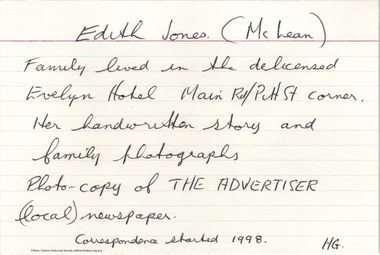 Eltham District Historical Society Inc
Document - Folder, McLean, 1984-1999
... races...Mrs Barrett...Mrs Bremner...Mrs Hurley...Olive Isabel Mclean...Parade...Phoebe Lillian Mclean...Picnic...References to picnics and motor cycle races at Bremner’s Flats (Wingrove Park) and a mention of an old cable tram lodged in the park. ...References to picnics and motor cycle races at Bremner’s Flats (Wingrove Park) and a mention of an old cable tram lodged in the park. ...References to McLean family, Hector John McLean and Louisa Frances (nee Green) and six daughters who lived in Eltham during the period 1930 to 1934 inclusive. Lived in the former Evelyn Hotel at the time it was destroyed by fire and being part of the Centenary Parade in 1934 where the family won the Group Section for their entry “Pioneers of Eltham” Reminiscences provided by Edith Jones (nee M1934 flood, ballroom, baptism, barber shop, bittern, boy scouts, bremner's flat, burgoyne's shop, cable tram, cemetery road, centenary celebrations, centenary parade, christening, coach house, collis grocery, dalton street, depression, dole, dorothy jean mclean, edith jones (nee mclean), eltham fire brigade, eltham high school, eltham higher elementary school, eltham lower park, eltham railway station, eltham state school no. 209, evelyn hotel, fire damage - buildings, flinders naval depot, fordham, gladys evelyn mclean, gold mining, gwenneth mae mclean, gwladys evelyn mclean, headmistress, hector john mclean, isherwood house and shop, louisa frances mclean (nee green), metery road, methodist church, miss finnin, miss grant cottage, motor bike races, mrs barrett, mrs bremner, mrs hurley, olive isabel mclean, parade, phoebe lillian mclean, picnic, pioneers of eltham, pitt street, research fire brigade, rev. r.g. arthur, shed, shops, st margarets church hall, st margaret's church, stables, state savings bank of victoria, susso books, todaro, vinnie willet, warrandyte bridge, warrandyte, wingrove park, yarra river -
 The Beechworth Burke Museum
Audio - Oral History, Jennifer Williams, Isabel Wells, 24th February 2000
... races and games taking place. According to her narration, the use of cars was a turning point in the town's social activities, since people were able to visit nearby places and take day trips, such as having a picnic at Lake Kerferd or Buffalo. ...races and games taking place. According to her narration, the use of cars was a turning point in the town's social activities, since people were able to visit nearby places and take day trips, such as having a picnic at Lake Kerferd or Buffalo. ...Isabel Wells was born in Beechworth in 1914. Her father, Mr. Newey, was a butcher; his shop was in Ford street and he took over from his grandfather. The family business, along with the local residents, was supplying the main government institutions in the region, like Mayday Hills Hospital and The Ovens and Murray Home, making a large percentage of his profit. Mr. Newey was also a captain of the fire brigade and Isabel mentioned that there were more fires happening in those days. The menace of a huge fire was impending in Beechworth for many years, due to the lack of adequate water supply and the absence of trained firefighters. The first fire brigade in the town was voluntary and was formed in 1858 under Superintendent Luke Reilly. A few other schemes deployed the following years, with all failing to sufficiently control the fires that occurred, until the creation of the first reliable fire brigade in the 1870s. The worst fire in the town's history happened on 23rd March 1867; it swept through many shops and the post office, leaving behind a damage cost estimated at £12,000. Isabel's mother was in a wheelchair, suffering from osteoarthritis; thus, Isabel had taken over the responsibility for looking after her mother and assisting her with daily living needs and personal care activities. She used to play golf and tennis and she was a member of the town tennis club. In terms of social life, Boxing Day was a big occasion for the town, with horse-races and games taking place. According to her narration, the use of cars was a turning point in the town's social activities, since people were able to visit nearby places and take day trips, such as having a picnic at Lake Kerferd or Buffalo. This oral history recording was part of a project conducted by Jennifer Williams in the year 2000 to capture the everyday life and struggles in Beechworth during the twentieth century. This project involved recording seventy oral histories on cassette tapes of local Beechworth residents which were then published in a book titled: Listen to what they say: voices of twentieth century Beechworth. These cassette tapes were digitised in July 2021 with funds made available by the Friends of the Burke. Isabel's account of her life in Beechworth and the local area during the 20th century is historically and socially significant as it offers valuable information about the business activity in the region and provides a deeper insight into the operation of butcher shops and meat supply during the first half of the previous century. Additionally, it offers invaluable information about the everyday life of people living in Beechworth, and highlights aspects of the overall social life and activities.This is a digital copy of a recording that was originally captured on a cassette tape. The cassette tape is black with a horizontal white strip and is currently stored in a clear flat plastic rectangular container. It holds up 40 minutes of recordings on each side.Mrs Isabel Wells/ isabel wells, beechworth, mr. newey, ford street, butcher, mayday hills hospital, the ovens and murray home, fire brigade, 23rd march 1867, fire, osteoarthritis, boxing day, horseraces, lake kerferd, buffalo, picnic, cars, firefighters, luke reilly, wheelchair -
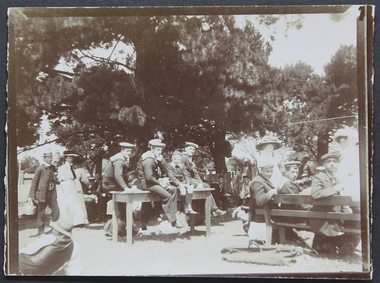 Mission to Seafarers Victoria
Photograph - Photograph, Sepia, Mr and Mrs Gurney Goldsmith, Picnic at Orchard House, Cup Day 1909, 2 Novembre 1909
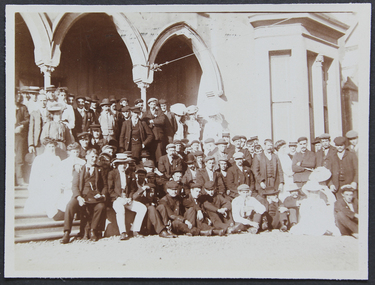
... picnic, when Mr. and Mrs. George Higgins and the Malvern members of the Ladies' Harbour Lights Guild entertained some 110 sailors from the Royal Navy and Merchant Service. A football match, sports, and "costume" races...picnic, when Mr. and Mrs. George Higgins and the Malvern members of the Ladies' Harbour Lights Guild entertained some 110 sailors from the Royal Navy and Merchant Service. A football match, sports, and "costume" races ...This photograph depicts a picnic for Cup Day (Tuesday 2 November 1909) organised by the Mission and the LHLG members at Orchard House. The property belongs to Mr George Higgins, engineer and his wife, Beatrice who was the LHLG Malvern branch secretary. Beatrice nee Shuter was the daughter of Charles Shuter. In the Punch published on 11 November 1909, we could read: "The pretty garden of "Orchard House," and the paddock adjoining (kindly lent by Mr. and Mrs. Singleton), was the scene on Cup Day of a most successful sailors' picnic, when Mr. and Mrs. George Higgins and the Malvern members of the Ladies' Harbour Lights Guild entertained some 110 sailors from the Royal Navy and Merchant Service. A football match, sports, and "costume" races were indulged in by the more active members of the party, while others enjoyed the unusual pleasure of sitting on the green grass under the trees. Mrs. MacLeod, Mrs. Knight, Mrs. Simon Fraser, Mrs. H. B. Higgins, Mrs. Albert Keep, Miss Ethel Godfrey, the Misses Wollaston, and a number of other ladies assisted to wait on the "tars." One "Jack," from H.M.S. Cambrian, voted it the "nicest day he had had since leaving the Old Country." Hearty cheers for the kind hostesses closed the proceedings. The evening was spent at the Institutes of the Missions to Seamen on the Australian Wharf and at Port Melbourne respectively, where prizes were distributed to the successful competitors. "Small monochrome photograph1909, malvern, cup day, mr george higgins, mce, beatrice elizabeth higgins (nee shuter), h.m.s. cambrian, ethel augusta godfrey, orchard house, ina higgins, rica godfrey, rita godfrey, reverend alfred gurney goldsmith, picnics, social events, frederica godfrey, entertainments, sailors, seafarers, seamen, goldsmith album -
 Mission to Seafarers Victoria
Photograph - Photograph, Sepia, Anne Treverton Goldsmith (nee Lobb), Boxing Day at Findon, Kew 1906, 26 December 1906
... Another outing at Findon was organised for Boxing Day in 1907, this time 125 men took part to the party. findon boxing day mrs audrey bowen football races seamen's institute lhlg kew sports tea ladies harbour lights guild mansion anne treverton goldsmith (nee lobb picnics Group of seamen standing and sitting in front of house. ...Wednesday 26 December 1906: Mrs Audrey Bowen received over 70 sailors on her property. According to the article published in The Standard (5 January 1907): "On Boxing Day a most enjoyable time was spent at "Findon," by the kindness of Mrs. Aubrey Bowen and the trustees. During the afternoon Mrs Bowen drove on to the ground and was received with hearty cheers by over 70 sailors. A game of football and races filled up the time only too rapidly, and the party returned to the tea a the Institute." Another outing at Findon was organised for Boxing Day in 1907, this time 125 men took part to the party.Group of seamen standing and sitting in front of house.findon, boxing day, mrs audrey bowen, football, races, seamen's institute, lhlg, kew, sports, tea, ladies harbour lights guild, mansion, anne treverton goldsmith (nee lobb, picnics -
 Orbost & District Historical Society
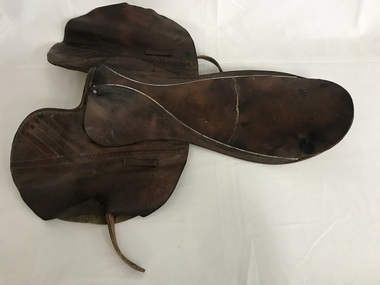
Equipment - Exercise Racing Saddle, 1900 - 1950s
... This saddle significant because it is the only saddle of this type and age in our collection. Picnic races were common events in rural areas including Orbost. saddle A small leather saddle for a horse, brown leather on top and cream leather underneath . ...Made approximately 1900 to 1950's. Exercise saddle used in training racehorses.This saddle significant because it is the only saddle of this type and age in our collection. Picnic races were common events in rural areas including Orbost.A small leather saddle for a horse, brown leather on top and cream leather underneath . It has a red tartan material insert along the spine. Small leather staps to attach a girth. Saddle has a small white piping on top as decoration.saddle -
 Warrnambool and District Historical Society Inc.
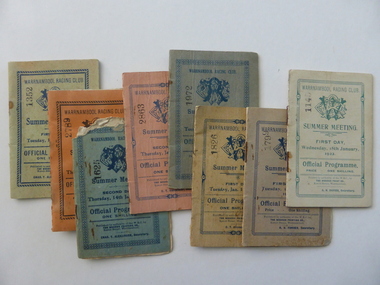
Document - Warrnambool. Woodford. Winslow. Purnim Race Books, Modern Print, W’Bool, Victoria, 1920's and 1930's
... The Winslow races were held from approximately mid-19th century to around 1946. It began as a small picnic race club in Tobin’s paddock to a splendid race course on the property, “Green Hills” owned by Mr. ...The Winslow races were held from approximately mid-19th century to around 1946. It began as a small picnic race club in Tobin’s paddock to a splendid race course on the property, “Green Hills” owned by Mr. ...The Warrnambool Amateur Turf Club was first formed in September 1859, but didn't become a properly constituted club until April 1873, when a meeting was held at the Commercial Hotel, now the Whaler's Inn, and a committee was elected.Part of the present racecourse of 100 acres was set aside as a racing and recreation reserve in August 1855. It is one of the finest racecourses in Australia, ringed by the gentle slopes of a huge basin.The first race meeting was held on the course in August 1858. The Warrnambool Racing Club has managed racing at Warrnambool since it was formed on 5 April 1873.Apart from a number of smaller meetings held throughout the year, the feature of racing in the district is the Grand Annual Steeplechase. The first steeplechase over the now famous cross-country course was run on 13th June 1872 then known as the Grand Annual Steeplechase. The paddocks now know as Brierly and Granters were first used on that date. The course, over four miles, was made up of different kinds of jumps including a stone wall, a log fence, a ditch and parapet, a paling fence and numerous post and rails. The name Grand Annual was first used for this steeplechase in May 1895. It is the longest horse race in Australia, and the thirty three fences of the course, the most of any steeplechase in the world is raced over 5,500 metres. The three day May racing carnival is the major racing event on the horseracing and social calendar. Many of these race booklets relate to those May meetings. The Warrnambool Racecourse has been the home of district racing clubs such as Woodford, Purnim and Koroit over the latter part of the 20th century. The Woodford Racing club holds their annual meeting after Christmas each year. The Winslow races were held from approximately mid-19th century to around 1946. It began as a small picnic race club in Tobin’s paddock to a splendid race course on the property, “Green Hills” owned by Mr. John O’Keefe about one mile north of the Winslow township.. The annual meetings held on New Year’s Day drew crowds of seven to eight thousand people. All of these books contains family names which in some cases are still strongly linked to horse racing in the district.These booklets are a tangible link to a great sporting and social event in the Western District. A collection of programmes for race meetings. They relate to Warrnambool, Woodford, Purnim, Winslow and Victoria Racing Club meetings in the period 1922 to 1931. All are soft card covers with approximately 16 pages in each in white paper. They are numbered as follows: 001250.1 WRC Soft green cover with blue text 01/05/1923 001250.2 WRC Mauve cover with blue text 03/05/1923 001250.3 WRC fawn cover with red text 06/05/1924 001250.4 WRC Orange cover with blue text 08/05/1924 001250.5 WRC Soft green cover with light brown text 05/05/1925 001250.6 WRC Soft green cover with red text 07/05/1925 001250.7 WRC fawn cover with brown text 04/05/1926 001250.8 Woodford racing Club soft pink cover, Blue text 01/04/1922 001250.9 Woodford racing Club green cover, Blue text 07/04/1923 001250.9 Woodford racing Club grey cover, Blue text 05/04/1924 001250.10 Woodford racing Club grey cover, Blue text 05/04/1924 001250.11 Woodford Racing Club green cover, Blue text 22/11/1924 001250.12 Woodford Racing Club green cover, brown text 04/04/1925 001250.13 Woodford Racing Club orange cover, blue text 10/04/1926 001250.14 Woodford Racing Club pink cover, green text 10/04/1926 001250.15 Warrnambool Racing Club pink cover, blue text 18/11/1922 001250.16 Warrnambool Racing Club pink cover, red text 13/11/1926 001250.17 Warrnambool Racing Club cream cover, brown text 15/11/1924 001250.18 Warrnambool Racing Club cream cover, green text 18/01/1922 001250.19 Warrnambool Racing Club grey cover, blue text 15/01/1924 001250.20 Warrnambool Racing Club cream cover, blue text 13/01/1925 001250.21 Warrnambool Racing Club pink cover, blue text 15/01/1925 001250.22 Warrnambool Racing Club olive green cover, blue text 12/01/1926 001250.23 Warrnambool Racing Club blue cover, blue text 14/01/1926 001250.24 Warrnambool Racing Club soft green cover, blue text 13/01/1931 001250.24 Warrnambool Racing Club orange cover, black text 16/01/1930 001250.25 Warrnambool Racing Club orange cover, black text 16/01/1930 001250.26 Purnim Racing Club green cover, blue text 19/05/1924 001250.27 Winslow Racing Club pink cover,black text 21/04/1923 001250.28 Winslow Racing Club green cover,black text 06/12/1924 001250.29 Victoria Racing Club cream cover,green text 11/07//1923 001250.30 Victoria Racing Club cream cover, red text 14/07//1923 Most of the booklets have markings with place getters and jockeys marked in pencil. Warrnambool Racing club books have R U Forbes, C T Alexander A H Davies and William White as secretaries. Woodford club has Thomas Gleeson as secretary, Winslow 's secretary is W Latta and Purnim is P J Kelly. The local booklets are printed by The Modern Print Co Koroit St Warrnambool.warrnambool, warrnambool racing club, winslow racing club, woodford racing club, purnim racing club, victoria racing club -
 Warrnambool and District Historical Society Inc.
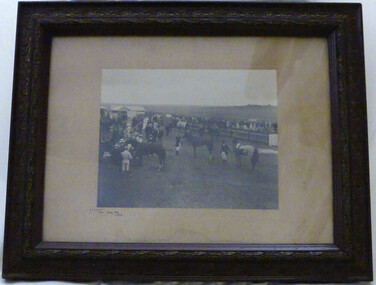
Photograph - Winslow Races 1912, Circa 1912
... The Winslow races were held from approximately mid-19th century to around 1946. It began as a small picnic race club in Tobin’s paddock to a splendid race course on the property, “Green Hills” owned by Mr. ...The Winslow races were held from approximately mid-19th century to around 1946. It began as a small picnic race club in Tobin’s paddock to a splendid race course on the property, “Green Hills” owned by Mr. ...The Winslow races were held from approximately mid-19th century to around 1946. It began as a small picnic race club in Tobin’s paddock to a splendid race course on the property, “Green Hills” owned by Mr. John O’Keefe about one mile north of the Winslow township.. The annual meetings held on New Year’s Day drew crowds of seven to eight thousand people. This photo provides a snapshot of one of the most important and well patronised events in the district. It is a very clear photo, providing evidence of racing operations and fashion of the day. Black and white photograph framed in brown engraved frame with fawn mount. Depicts a gathering of people and horses at race meeting. Winslow New Year’s Day 1912 written in black ink in bottom left corner of mount. Photographer’s name “Jordan Warrnambool,” embossed on bottom right hand corner.winslow, winslow racing club, jordan photographers -
 Bendigo Historical Society Inc.
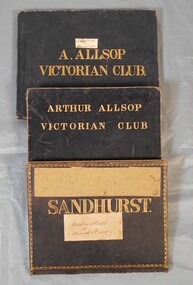
Administrative record - Arthur Allsop Collection: Race record books
... He started his athletic career at picnic sports and was a fine athlete winning many foot races. For 15 years he acted as secretary of the Sandhurst City Fire Brigade, he was captain of the Bendigo lacrosse team. ...He started his athletic career at picnic sports and was a fine athlete winning many foot races. For 15 years he acted as secretary of the Sandhurst City Fire Brigade, he was captain of the Bendigo lacrosse team. ...Arthur Allsop went into the business office at Bendigo (Vic.) of the late Mr. Alfred Joseph. He later operated as an independent bookmaker. Arthur Allsop was a partner in the firm of Kelly and Allsop and was involved in mining and speculation in Bendigo. He was elected as a member of the Bendigo Stock Exchange in 1906. He started his athletic career at picnic sports and was a fine athlete winning many foot races. For 15 years he acted as secretary of the Sandhurst City Fire Brigade, he was captain of the Bendigo lacrosse team. He was a fair cricketer, and played against the English and Australian Elevens. He played football, and acted as secretary to the Bendigo Football Club. In later years he played bowls and captained pennant teams. He was a Past District- Grandmaster in the M.U.I.O.O.F. Allsop eventually moved to Melbourne and then Sydney working as a bookmaker. He died in Sydney in 1921. His wife Belle died in Bendigo in 1914 and is buried in the Bendigo Cemetery.Three record books used by Bookmaker Arthur Allsop. Dark coloured leather covers. One has SANDHURST printed in gold lettering, one has A ALLSOP VICTORIAN CLUB and one has ARTHUR ALLSOP VICTORIAN CLUB. All books have ruled columns for record keeping. The three books cover the period January 1982 - December 1893, January 1892 - July 1894 and October 1888 to March 1889. The books contain handwritten records of races across Victoria including names of horses and betting records.horse racing, bookmaker, arthur allsop, kelly and allsop -
 Bendigo Historical Society Inc.
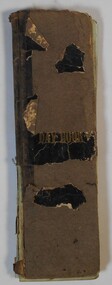
Administrative record - Arthur Allsop Collection: Day book
... He started his athletic career at picnic sports and was a fine athlete winning many foot races. For 15 years he acted as secretary of the Sandhurst City Fire Brigade, he was captain of the Bendigo lacrosse team. ...He started his athletic career at picnic sports and was a fine athlete winning many foot races. For 15 years he acted as secretary of the Sandhurst City Fire Brigade, he was captain of the Bendigo lacrosse team. ...Arthur Allsop went into the business office at Bendigo (Vic.) of the late Mr. Alfred Joseph. He later operated as an independent bookmaker. Arthur Allsop was a partner in the firm of Kelly and Allsop and was involved in mining and speculation in Bendigo. He was elected as a member of the Bendigo Stock Exchange in 1906. He started his athletic career at picnic sports and was a fine athlete winning many foot races. For 15 years he acted as secretary of the Sandhurst City Fire Brigade, he was captain of the Bendigo lacrosse team. He was a fair cricketer, and played against the English and Australian Elevens. He played football, and acted as secretary to the Bendigo Football Club. In later years he played bowls and captained pennant teams. He was a Past District- Grandmaster in the M.U.I.O.O.F. Allsop eventually moved to Melbourne and then Sydney working as a bookmaker. He died in Sydney in 1921. His wife Belle died in Bendigo in 1914 and is buried in the Bendigo Cemetery.Day book used by Bookmaker Arthur Allsop as a ledger. The paper covering of the cover has been worn off on most of the book. Pages have ruled columns. The book contains handwritten records of races across Victoria including names of horses and betting records. Handwritten entries contain names and payment records.horse racing, bookmaker, arthur allsop, kelly and allsop -
 Bendigo Historical Society Inc.
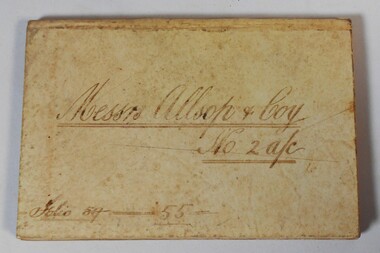
Financial record - Arthur Allsop Collection: Account book
... He started his athletic career at picnic sports and was a fine athlete winning many foot races. For 15 years he acted as secretary of the Sandhurst City Fire Brigade, he was captain of the Bendigo lacrosse team. ...He started his athletic career at picnic sports and was a fine athlete winning many foot races. For 15 years he acted as secretary of the Sandhurst City Fire Brigade, he was captain of the Bendigo lacrosse team. ...Arthur Allsop went into the business office at Bendigo (Vic.) of the late Mr. Alfred Joseph. He later operated as an independent bookmaker. Arthur Allsop was a partner in the firm of Kelly and Allsop and was involved in mining and speculation in Bendigo. He was elected as a member of the Bendigo Stock Exchange in 1906. He started his athletic career at picnic sports and was a fine athlete winning many foot races. For 15 years he acted as secretary of the Sandhurst City Fire Brigade, he was captain of the Bendigo lacrosse team. He was a fair cricketer, and played against the English and Australian Elevens. He played football, and acted as secretary to the Bendigo Football Club. In later years he played bowls and captained pennant teams. He was a Past District- Grandmaster in the M.U.I.O.O.F. Allsop eventually moved to Melbourne and then Sydney working as a bookmaker. He died in Sydney in 1921. His wife Belle died in Bendigo in 1914 and is buried in the Bendigo Cemetery.Bank account book used by Bookmaker Arthur Allsop. Cream coloured hard cover. Written on the front Messrs. Allsop & Coy. No 2 Account. Printed on the first page The Commercial Bank of Australia Limited Sandhurst Branch in Account Current with A Allsop and Coy Bookmaker. Pages have ruled columns. Records payments and withdrawals from the account. Dated from August 1889 to May 1891. Final balance £6039.9.4bookmaker, arthur allsop, bank account -
 Bendigo Historical Society Inc.
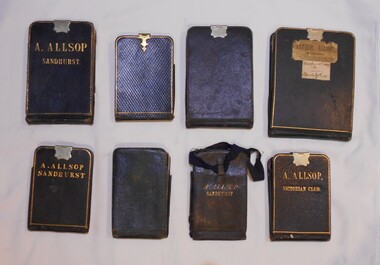
Administrative record - Arthur Allsop Collection: Record books
... He started his athletic career at picnic sports and was a fine athlete winning many foot races. For 15 years he acted as secretary of the Sandhurst City Fire Brigade, he was captain of the Bendigo lacrosse team. ...He started his athletic career at picnic sports and was a fine athlete winning many foot races. For 15 years he acted as secretary of the Sandhurst City Fire Brigade, he was captain of the Bendigo lacrosse team. ...Arthur Allsop went into the business office at Bendigo (Vic.) of the late Mr. Alfred Joseph. He later operated as an independent bookmaker. Arthur Allsop was a partner in the firm of Kelly and Allsop and was involved in mining and speculation in Bendigo. He was elected as a member of the Bendigo Stock Exchange in 1906. He started his athletic career at picnic sports and was a fine athlete winning many foot races. For 15 years he acted as secretary of the Sandhurst City Fire Brigade, he was captain of the Bendigo lacrosse team. He was a fair cricketer, and played against the English and Australian Elevens. He played football, and acted as secretary to the Bendigo Football Club. In later years he played bowls and captained pennant teams. He was a Past District- Grandmaster in the M.U.I.O.O.F. Allsop eventually moved to Melbourne and then Sydney working as a bookmaker. He died in Sydney in 1921. His wife Belle died in Bendigo in 1914 and is buried in the Bendigo Cemetery.Ten betting record books of various sizes and one card holder that belonged to Bookmaker Arthur Allsop. All books have black leather covers. Seven have gold lettering on the front covers with variations - Arthur Allsop Sandhurst: A Allsop Sandhurst: A Allsop Victorian Club: Arthur Allsop Victorian Club: Sandhurst (Name section removed): Member Victorian Club and Bowes' Tattersalls Reg. VRC and VATC. Five books have gold clasps. The record books contain hand written details of betting records for horse races in Victoria and New South Wales. The records include dates, Race names, Horse names, punters; names and wagers. Records are dated from 1886 to 1891. Manufacturers include Weaklin & Flint's; Henry Penny.horse racing, bookmaker, arthur allsop, melbourne cup, sydney cup, australian cup, kelly and allsop, weaklin & flint, henry penny -
 Bendigo Historical Society Inc.
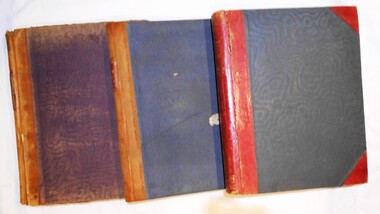
Administrative record - Arthur Allsop Collection: Letter books
... He started his athletic career at picnic sports and was a fine athlete winning many foot races. For 15 years he acted as secretary of the Sandhurst City Fire Brigade, he was captain of the Bendigo lacrosse team. ...He started his athletic career at picnic sports and was a fine athlete winning many foot races. For 15 years he acted as secretary of the Sandhurst City Fire Brigade, he was captain of the Bendigo lacrosse team. ...Arthur Allsop went into the business office at Bendigo (Vic.) of the late Mr. Alfred Joseph. He later operated as an independent bookmaker. Arthur Allsop was a partner in the firm of Kelly and Allsop and was involved in mining and speculation in Bendigo. He was elected as a member of the Bendigo Stock Exchange in 1906. He started his athletic career at picnic sports and was a fine athlete winning many foot races. For 15 years he acted as secretary of the Sandhurst City Fire Brigade, he was captain of the Bendigo lacrosse team. He was a fair cricketer, and played against the English and Australian Elevens. He played football, and acted as secretary to the Bendigo Football Club. In later years he played bowls and captained pennant teams. He was a Past District- Grandmaster in the M.U.I.O.O.F. Allsop eventually moved to Melbourne and then Sydney working as a bookmaker. He died in Sydney in 1921. His wife Belle died in Bendigo in 1914 and is buried in the Bendigo Cemetery.Three letter books used by Bookmaker Arthur Allsop. Dark coloured covers with leather spines and corners. Alphabetical indexes at the front with the bulk of each book with flimsy tissue like pages with letters written in ink. two books filled and one book partially used.horse racing, bookmaker, arthur allsop, kelly and allsop
