
Showing 101 items matching "port melbourne settlement"
-
 Port Melbourne Historical & Preservation Society
Photograph - Port Melbourne Settlement, beach party, 1930s
... Port Melbourne Settlement, beach party......Port Melbourne Settlement...Lasercopy of Port Melbourne Settlement photo: five boys at beach party for Settlement, late 1930s?...Port Melbourne Historical & Preservation Society Port Melbourne Town Hall 333 Bay Street Port Melbourne melbourne Societies Clubs Unions and other Organisations Ken TURNER Port Melbourne Settlement Lasercopy of Port Melbourne Settlement photo: five boys at beach party for Settlement, late 1930s? ...Lasercopy of Port Melbourne Settlement photo: five boys at beach party for Settlement, late 1930s?societies clubs unions and other organisations, ken turner, port melbourne settlement -
 Port Melbourne Historical & Preservation Society
Card - Member, Dot Wharrie, Port Melbourne Settlement, 1933
... Member, Dot Wharrie, Port Melbourne Settlement......Port Melbourne Settlement...Port Melbourne Settlement Members Card 1934, belonging to Dot Wharrie.. ...Card Member, Dot Wharrie, Port Melbourne Settlement ...(As Settlement was a boy's club, why was Dot WHARRIE, an 8 year old girl, a member?)Port Melbourne Settlement Members Card 1934, belonging to Dot Wharrie.. Blue covers, four page.2d monthly payments entered, February- Aprilsocieties clubs unions and other organisations, dot wharrie, port melbourne settlement -
Port Melbourne Historical & Preservation Society
Photograph - Port Melbourne Settlement, Nott Street, 1930s
... Port Melbourne Settlement, Nott Street......Port Melbourne Settlement...Lasercopy of Port Melbourne Settlement photo: six boys in back garden of Scout Settlement at 213 Nott Street, late 1930s?...Photograph Port Melbourne Settlement, Nott Street ...Lasercopy of Port Melbourne Settlement photo: six boys in back garden of Scout Settlement at 213 Nott Street, late 1930s?societies clubs unions and other organisations, ken turner, port melbourne settlement -
Port Melbourne Historical & Preservation Society
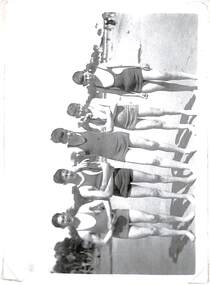
Photograph - Port Melbourne Settlement, beach party at Black Rock, 1930s
... Port Melbourne Settlement, beach party at Black Rock......Port Melbourne Settlement...Lasercopy of Port Melbourne Settlement photo: beach party for Settlement boys (treasure hunt and swimming at Black Rock) late 1930s?...Port Melbourne Historical & Preservation Society Port Melbourne Town Hall 333 Bay Street Port Melbourne melbourne Societies Clubs Unions and other Organisations Ken TURNER Port Melbourne Settlement Lasercopy of Port Melbourne Settlement photo: beach party for Settlement boys (treasure hunt and swimming at Black Rock) late 1930s? ...Lasercopy of Port Melbourne Settlement photo: beach party for Settlement boys (treasure hunt and swimming at Black Rock) late 1930s?societies clubs unions and other organisations, ken turner, port melbourne settlement -
 Port Melbourne Historical & Preservation Society
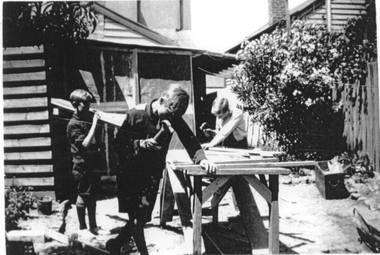
Photograph - Boys learning carpentry skills at Port Melbourne Settlement, 311 Nott Street, 1930s
... Boys learning carpentry skills at Port Melbourne Settlement, 311 Nott Street......Port Melbourne Settlement...Lasercopy of Port Melbourne Settlement photo: three boys learning carpentry skills in back garden of Scout Settlement at 311 Nott Street, late 1930s?...Port Melbourne Historical & Preservation Society Port Melbourne Town Hall 333 Bay Street Port Melbourne melbourne Societies Clubs Unions and other Organisations Ken TURNER Port Melbourne Settlement Lasercopy of Port Melbourne Settlement photo: three boys learning carpentry skills in back garden of Scout Settlement at 311 Nott Street, late 1930s? ...Lasercopy of Port Melbourne Settlement photo: three boys learning carpentry skills in back garden of Scout Settlement at 311 Nott Street, late 1930s?societies clubs unions and other organisations, ken turner, port melbourne settlement -
Port Melbourne Historical & Preservation Society
Photograph - Newspaper clipping, Governor, Sir Winston DUGAN playing billiards with Port Melbourne Settlement boys, The Sun News-Pictorial, The Sun News-Pictorial, 9 May 1940
... Newspaper clipping, Governor, Sir Winston DUGAN playing billiards with Port Melbourne Settlement boys, The Sun News-Pictorial......Port Melbourne Settlement...Showing a photograph of the Governor, Sir Winston DUGAN and Port Melbourne Settlement boys playing billiards....Showing a photograph of the Governor, Sir Winston DUGAN and Port Melbourne Settlement boys playing billiards. Photograph Newspaper clipping, Governor, Sir Winston DUGAN playing billiards with Port Melbourne Settlement boys, The Sun News-Pictorial The Sun News-Pictorial ...Found in 1940 newspapers under the lino in house in Griffin Cres, Port Melbourne.Clipping from the Sun News-Pictorial, dated Thursday, May 9, 1940. Showing a photograph of the Governor, Sir Winston DUGAN and Port Melbourne Settlement boys playing billiards.societies clubs unions and other organisations, winston dugan, port melbourne settlement, keith downard -
Port Melbourne Historical & Preservation Society
Programme, A Holborn Rover, The Port Melbourne Settlement Presents: Broadcast 1938 a musical revue in two parts, 1938
... The Port Melbourne Settlement Presents: Broadcast 1938 a musical revue in two parts.......Port Melbourne Settlement..."The Port Melbourne Settlement Presents: Broadcast 1938 a musical revue in two parts." 3 page black and white copy of a program for a musical revue put on by the "Port Melbourne Settlement" which had begun in 1932 to assist under privileged boys. ...Port Melbourne Historical & Preservation Society Port Melbourne Town Hall 333 Bay Street Port Melbourne melbourne Arts and Entertainment - Community Arts Charities and Appeals Societies Clubs Unions and other Organisations Port Melbourne Settlement "The Port Melbourne Settlement Presents: Broadcast 1938 a musical revue in two parts." 3 page black and white copy of a program for a musical revue put on by the "Port Melbourne Settlement" which had begun in 1932 to assist under privileged boys. ..."The Port Melbourne Settlement Presents: Broadcast 1938 a musical revue in two parts." 3 page black and white copy of a program for a musical revue put on by the "Port Melbourne Settlement" which had begun in 1932 to assist under privileged boys. Page one has the title; page 2 a short history of the services provided; page 3 a program of "broadcast 1938"arts and entertainment - community arts, charities and appeals, societies clubs unions and other organisations, port melbourne settlement -
 Port Melbourne Historical & Preservation Society
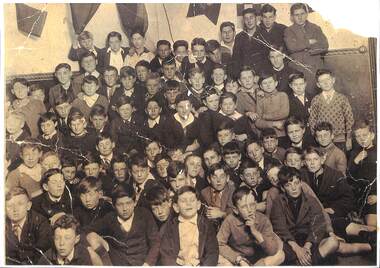
Photograph - Port Melbourne Settlement boys, possibly at Excelsior Hall, 1930s
... Port Melbourne Settlement boys, possibly at Excelsior Hall......Port Melbourne Settlement...Colour lasercopy of Port Melbourne Settlement boys club. Taken with flash 1930s, probably not at 311 Nott Street clubhouse - could be at Excelsior Hall? ...Photograph Port Melbourne Settlement boys, possibly at Excelsior Hall ...Colour lasercopy of Port Melbourne Settlement boys club. Taken with flash 1930s, probably not at 311 Nott Street clubhouse - could be at Excelsior Hall? Separate copy with most boys named (see media).societies clubs unions and other organisations, ken turner, port melbourne settlement, bob turner, ernie turner, tom anderson, bruce anderson, albie beaumont, 'titch' beaumont, barrett, george downard, keith downard, alf davenport, fred davenport, keith davenport, dixon, bert heathcote, fred heathcote, merv leyden, 'bug' mitchell, 'flea' mitchell, 'nunk' manners, sydney ross, jack ross, sweeney, jack hedley, mitchell, alf schofield, george brown, bill thackrah, 'skinny' anderson, 'nunc.' manner, andy angwin, 'fat' wadell, norm "cox", pudley, 'smiler' mcgrath, 'blood' whitford, arnie anderson, bill sweeney, 'spud' manner, jim ratchford, davies, wade, henry sweeney, 'buster' lyons, 'basher' duggan, 'ockie' prest, ern turner, kingsley jones, 'podge' barrett, alexander, bartlett, hutchinson, leyden, ratcliffe, cooper, howard swift, bill man, bill rose, lugg, hudson, davis, jack turner, sinclair, bill saville, carter, syd ross, dunn, les harcourt, lunt, ted marion, merve leydon -
Port Melbourne Historical & Preservation Society
Photograph - Port Melbourne Setttlement Football Team, 1940
... ...Port Melbourne Settlement...Lasercopy of photo of Port Melbourne Settlement Football team 1940. One of a group of settlement photos copied in 1998. ...Port Melbourne Historical & Preservation Society Port Melbourne Town Hall 333 Bay Street Port Melbourne melbourne Copied from an original loaned by Ken TURNER. Wills OLDMAN (Killed in NG). Syd ROSS (Killed in PNG). Mickey Car was a boxer. Mr Oldman was the president. Sport - Australian Rules Football Societies Clubs Unions and other Organisations Port Melbourne Settlement ...Copied from an original loaned by Ken TURNER. Wills OLDMAN (Killed in NG). Syd ROSS (Killed in PNG). Mickey Car was a boxer. Mr Oldman was the president.Lasercopy of photo of Port Melbourne Settlement Football team 1940. One of a group of settlement photos copied in 1998. (Refer #939)sport - australian rules football, societies clubs unions and other organisations, port melbourne settlement, jack phillips, ern turner, ken turner, les causland, larry tilley, wingy jackson, amos bilotti, arthur kerr, jim sinclair, mickey clearahan, mickey car, leo 'doc' wood, lionel wood, wills oldman, les stevens, fred heathcote, jim nicholls, mr oldman, sydney ross, dave matthews, john ross, len sallsbury -
Port Melbourne Historical & Preservation Society
Photograph - Port Melbourne Setttlement Football Team, c. 1941
... Small black and white photo and colour lasercopy of Port Melbourne Settlement Football team probably 1941. ...Port Melbourne Historical & Preservation Society Port Melbourne Town Hall 333 Bay Street Port Melbourne melbourne Copied from an original loaned by Ken TURNER. Wills OLDMAN (Killed in NG). Syd ROSS (Killed in PNG). Mickey CAR was a boxer. Mr OLDMAN was President. Sport - Australian Rules Football Societies Clubs Unions and other Organisations Jack PHILLIPS Ern TURNER Ken TURNER Les CAUSLAND Larry TILLEY Wingy JACKSON Amos BILOTTI Arthur KERR Jim SINCLAIR Mickey CLEARAHAN Mickey CAR Leo 'Doc' WOOD Lionel WOOD Wills OLDMAN Les STEVENS Fred HEATHCOTE Jim NICHOLLS Mr OLDMAN Small black and white photo and colour lasercopy of Port Melbourne Settlement Football team probably 1941. ...Copied from an original loaned by Ken TURNER. Wills OLDMAN (Killed in NG). Syd ROSS (Killed in PNG). Mickey CAR was a boxer. Mr OLDMAN was President.Small black and white photo and colour lasercopy of Port Melbourne Settlement Football team probably 1941. One of a group of settlement photos copied in 1998. (Refer #937)sport - australian rules football, societies clubs unions and other organisations, jack phillips, ern turner, ken turner, les causland, larry tilley, wingy jackson, amos bilotti, arthur kerr, jim sinclair, mickey clearahan, mickey car, leo 'doc' wood, lionel wood, wills oldman, les stevens, fred heathcote, jim nicholls, mr oldman -
Port Melbourne Historical & Preservation Society
Book, Ledger (Remainder of title illegible but contains the words "Boat Building"), 1910 - 1917
... three generations of his family lived at "the Bend" settlement, Port Melbourne...Port Melbourne Historical & Preservation Society Port Melbourne Town Hall 333 Bay Street Port Melbourne melbourne Found by a member of donor's family - donor is a grandson of Harry Meiers. three generations of his family lived at "the Bend" settlement, Port Melbourne Industry - Fishing Domestic Life Lilian MEIERS Henry (Harry) MEIERS Allan MEIERS Boat Building A toddler has scribbled on several pages. e.g 50-51 Small ledger containing business records of boat builder Henry/Harry Meiers 1910 to 1912; He and his wife Lilian lived at Fishermens Bend, and he rowed each day to Williamstown where his business was located. ...Found by a member of donor's family - donor is a grandson of Harry Meiers. three generations of his family lived at "the Bend" settlement, Port MelbourneSmall ledger containing business records of boat builder Henry/Harry Meiers 1910 to 1912; He and his wife Lilian lived at Fishermens Bend, and he rowed each day to Williamstown where his business was located. The book was later used by Lilian for household expenses, shopping lists and food and medication recipes. From both business and domestic standpoints a most interesting record. Vertical book with dark red tape binding.A toddler has scribbled on several pages. e.g 50-51industry - fishing, domestic life, lilian meiers, henry (harry) meiers, allan meiers, boat building -
 Warrnambool and District Historical Society Inc.
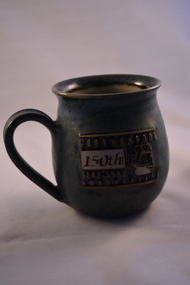
Household, Souvenir Cup (Warrnambool’s 150th ), 1997
... settlement of Warrnambool. Ken Sadler was a potter in Liebig Street, Warrnambool for many years (end of 20th century and beginning of 21st century). Warrnambool was founded as a planned town in 1847 to provide port facilities for the produce of squatters who had settled in the area. The town centre was surveyed by William Pickering at the request of Superintendent La Trobe of Melbourne...settlement of Warrnambool. Ken Sadler was a potter in Liebig Street, Warrnambool for many years (end of 20th century and beginning of 21st century). Warrnambool was founded as a planned town in 1847 to provide port facilities for the produce of squatters who had settled in the area. The town centre was surveyed by William Pickering at the request of Superintendent La Trobe of Melbourne ...This cup was produced by Ken Sadler as a souvenir of the 150th anniversary of the settlement of Warrnambool. Ken Sadler was a potter in Liebig Street, Warrnambool for many years (end of 20th century and beginning of 21st century). Warrnambool was founded as a planned town in 1847 to provide port facilities for the produce of squatters who had settled in the area. The town centre was surveyed by William Pickering at the request of Superintendent La Trobe of Melbourne and the first land sales were held in Melbourne in July 1847. The celebrations to mark the 150th anniversary of Warrnambool included concerts, race meetings, church services and the erection of an anniversary tablet on Cannon Hill. Ken Sadler, a well-known Warrnambool potter, made 500 of these cups which are now collectible souvenirs of the city’s 150th anniversary celebrations. This one retained by the Warrnambool and District Historical Society is numbered 189. The 150th anniversary of the founding of Warrnambool was an important event in the city’s history.This is a ceramic cup with a round base and larger rounded body with a round overhanging rim at the top opening. The cup is mottled green with an impressed image of a ship and lettering in white, gold and brown. There is some lettering on the bottom of the cup.‘Warrnambool 150th Anniversary 1847-1997’ ‘Sadler 97 189/500 Warrnambool’ warrnambool’s 150th anniversary, history of warrnambool, ken sadler, warrnambool potter -
 Warrnambool and District Historical Society Inc.
Memorabilia - Two articles of civic events in Warrnambool, Kaye & Son, Warrnambool Printers, mid 20th century
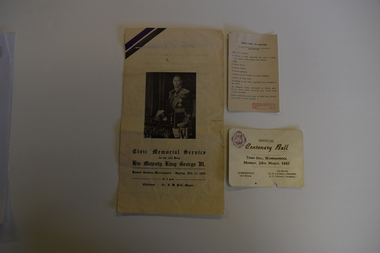
... Warrnambool was founded as a port settlement to service the farming interests in the area, with the first land sales held in Melbourne in July 1847. ...Warrnambool was founded as a port settlement to service the farming interests in the area, with the first land sales held in Melbourne in July 1847. ...The card relates to the Official Centenary Ball held in the Warrnambool Town Hall in March 1947 to celebrate the city's Centenary in 1947. Warrnambool was founded as a port settlement to service the farming interests in the area, with the first land sales held in Melbourne in July 1847. The leaflet is a programme of the Civic Memorial Service held in the Botanic Gardens in Warrnambool in February1952 on the occasion of the death of King George VI of England. Both items came from memorabilia held by the Bamford family of 8 Monash Avenue Warrnambool and it is presumed that one or more members of that family attended the events.These items are of social significance as mementos of events in Warrnambool in the mid 20th century..1 A white card with black printing and a logo .2 A sheet of white paper folded to make four pages with black printing and a photograph of King George VI of Englandwarrnambool memorabilia, warrnambool centenary, warrnambool centenary 1947, official centenary ball. -
 Warrnambool and District Historical Society Inc.
Souvenir - Souvenir Towel, Centenary of Victoria, 1934
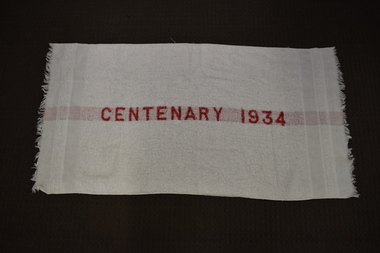
... It marks the centenary of the officially-recognized first permanent European settlement at Portland with the arrival of the Henty families in 1834 in Victoria (then known as the colony of Port Phillip). European settlement occurred at Melbourne...It marks the centenary of the officially-recognized first permanent European settlement at Portland with the arrival of the Henty families in 1834 in Victoria (then known as the colony of Port Phillip). European settlement occurred at Melbourne ...This towel is a souvenir of the Centenary of Victoria celebrated in 1934. It marks the centenary of the officially-recognized first permanent European settlement at Portland with the arrival of the Henty families in 1834 in Victoria (then known as the colony of Port Phillip). European settlement occurred at Melbourne in the following year. This towel is one of many souvenir items produced in 1934.This towel is of minor interest as a memento of the centenary of Victoria. It is a comparatively rare souvenir of that event as towels such as this would have been used and most would not have survived for nearly 90 years.This is a white cotton towel with a white fringe at both ends. There is a red strip down the centre of the back of the towel with red lettering in this strip down the front of the towel.The maker's name is stitched into one corner.Centenary 1934 Osmancentenary of victoria, souvenir towel, warrnambool, victoria 1834-1934 -
 Warrnambool and District Historical Society Inc.
Badge, Warrnambool 150th 1847-1997
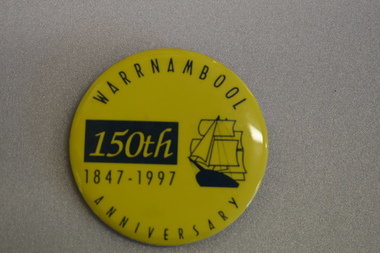
... Warrnambool was a planned town, established in 1847 as a port to service the squatters who had taken up large tracts of land in the Warrnambool area in the 1840s.The town was surveyed by the Government surveyor William Pickering at the request of Superintendent La Trobe and the first town lots of the new town were sold in Melbourne in 1847, with some settlers arriving at the new settlement soon after....Warrnambool was a planned town, established in 1847 as a port to service the squatters who had taken up large tracts of land in the Warrnambool area in the 1840s.The town was surveyed by the Government surveyor William Pickering at the request of Superintendent La Trobe and the first town lots of the new town were sold in Melbourne in 1847, with some settlers arriving at the new settlement soon after. ...This badge was produced in 1997 as a souvenir of the 150th anniversary of the founding of Warrnambool. Warrnambool was a planned town, established in 1847 as a port to service the squatters who had taken up large tracts of land in the Warrnambool area in the 1840s.The town was surveyed by the Government surveyor William Pickering at the request of Superintendent La Trobe and the first town lots of the new town were sold in Melbourne in 1847, with some settlers arriving at the new settlement soon after.This badge is one of the many souvenirs of the 1997 celebrations in Warrnambool Circular concave metal badge with blue drawing of a sailing ship and text. There is a clip pin on the reverse.WARRNAMBOOL ANNIVERSARY 150th 1847 -1997 -
 Warrnambool and District Historical Society Inc.
Audio - Audio CD, Tapestry: our Pye family history through all generations, Early 21st century
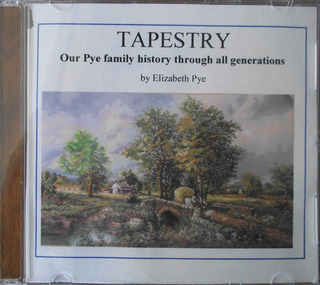
... Port Philip district with his master. Sylvester's son, Thomas, travelled to the Western District in 1844 and took Thomas and his wife. Mary with him. Thomas Browne later wrote novels under the name of Rolf Boldrewood . In his book " Old Melbourne Memories " Thomas Pye is given the name Joe Burge. Thomas Browne established the property "Squattlesea Mere" and Thomas Pye and his family settled in Port Fairy and then in Bessiebelle. Today this little settlement...Port Philip district with his master. Sylvester's son, Thomas, travelled to the Western District in 1844 and took Thomas and his wife. Mary with him. Thomas Browne later wrote novels under the name of Rolf Boldrewood . In his book " Old Melbourne Memories " Thomas Pye is given the name Joe Burge. Thomas Browne established the property "Squattlesea Mere" and Thomas Pye and his family settled in Port Fairy and then in Bessiebelle. Today this little settlement ...This DVD gives information about the Pye family. Thomas Pye came to Sydney as convict in 1837 and was assigned to work for Captain Sylvester Brown and came to the Port Philip district with his master. Sylvester's son, Thomas, travelled to the Western District in 1844 and took Thomas and his wife. Mary with him. Thomas Browne later wrote novels under the name of Rolf Boldrewood . In his book " Old Melbourne Memories " Thomas Pye is given the name Joe Burge. Thomas Browne established the property "Squattlesea Mere" and Thomas Pye and his family settled in Port Fairy and then in Bessiebelle. Today this little settlement has many Pye descendants. The other matter of interest is that Thomas Pye's son,Charles Pye, gained the Victoria Cross in India and is buried at Tower Hill. his DVD is of historical interest because it records the story of the Pye family in the Western District.This is a DVD with blue hand writing on the front and an accompanying sheet of paper showing an English country scene. It is enclosed in a plastic mesh envelope.TAPESTRY Our Pye Family history through all generations by Elizabeth Pye.pye family, warrnambool, captain sylvester brown, thomas browne, rolf boldrewood -
Federation University Historical Collection
Document, Zelda Martin, Central Victorian Goldmining towns - Boom Towns or Ghost Towns?, c1996
... Melbourne re the mode of carrying the sludge from the puddling mills in Sandhurst without interfering with the drainage of the town and the roads in the neighbourhood. [.15] Resource No.8: Camel display book titled Resource No. 8. Aborigines *Lists of book titles - +"Readings in Victorian prehistory" +"The Aborigines of Port Phillip" +Aboriginal languages and clans" +"A History of the Port Phillip District" +"Langi Ghiran 1: Aboriginal Rock...." +"Koorie History: sources for aboriginal studies in the State Library of Victoria", ed. Tom Griffiths, Melb. Friends of the State Library, 1989 +"The Public Lands of Australia Felix"; settlement...Melbourne re the mode of carrying the sludge from the puddling mills in Sandhurst without interfering with the drainage of the town and the roads in the neighbourhood. [.15] Resource No.8: Camel display book titled Resource No. 8. Aborigines *Lists of book titles - +"Readings in Victorian prehistory" +"The Aborigines of Port Phillip" +Aboriginal languages and clans" +"A History of the Port Phillip District" +"Langi Ghiran 1: Aboriginal Rock...." +"Koorie History: sources for aboriginal studies in the State Library of Victoria", ed. Tom Griffiths, Melb. Friends of the State Library, 1989 +"The Public Lands of Australia Felix"; settlement ...Zelda Martin was a PhD candidate at the University of Melbourne.[.1] 4th item in light blue display book titled Research Approach/Overview of Chapters/Confirmation of Canditure/Chapters1,2,3&4 of proposed thesis. *Twenty-seven page article on Victorian goldfields towns titled: Central Victorian Goldmining Towns - Boom Towns or Ghost Towns. The article was written during the author's PhD study. It outlines the context methodology, and resources and the chapters of the proposed thesis: (1) Central Victorian Goldmining Towns - The Context (2) Contemporary Views of the Factors Necessary for Town Growth (3) Outward Manifestations of Town Growth (4) The Trappings of Government (5-9) The Main Towns and Their Hinterland. [.2] 5th item in Light Blue display book as above item. *Chapter 1 of proposed thesis titled 'Pick, Shovel and Tin Dish Mining.' Covers in Section A: Central Victoria - Pre 1851: Aborigines in Central Victoria, Squatters, and Government. Section B: The years 1851-1854: The Early Gold Rushes, Government Reaction, Township Surveys, Legislation, Town Development, Local Government and Early Settlement. [.3] 6th item in Light Blue display book as above item. *2A of proposed thesis titled 'Contemporary Views of the Factors Necessary for Town Growth'. Similar information to Chapter 1 plus extra re towns and maps. Sections: Introduction, Context of Place - Geographical Towns Listed, The Context of Time - Pre1851 Aborigines, Governance of Port Phillip, The Squatters, The Villages of Central Victorian Highlands, Conclusion, Condensed Version of Chapter2B. [.4] 7th item in Light Blue display book as above item. *Chapter2B of proposed thesis. Sections: Area of Research, Schools, Banks, Newspapers, Progress Association, Town Development - Sandhurst (Bendigo), Ballarat, Castlemaine,, Maryborough, Ararat and Stawell. [.5] 8th item in Light Blue display book as above item. *Chapter 3 of proposed thesis titled 'Outward Manifestations of Town Growth'. Sections: Introduction, Contemporary Writing, Educationalists, The Bankers, The Townsfolk, Current Theory, General Theories of Urban Development, and Conclusion. [.6] 9th item in Light Blue display book as above item. *Chapter 4 of proposed thesis titled 'Trappings of Government' Sections: Introduction, Early Government Attitudes to Mining and Town Development, Law and Order, Township Surveys, Legislation, Local Government, Transport and Communication, The People and Lobbyists. [.7] 10th item in Light Blue display book as above item. *'The Rise and Fall of Central Victorian Goldmining Towns'. Includes a map showing main Goldfields, a table showing towns and villages at two points in time - 1857 and 1871; a Bibliography of Primary and Secondary Sources. [.8] Resource No1. Black display book titled Local Towns 1 : Alma: *Brief history *Directory *Maps Amphitheatre / Mountain Hut: *Brief History Post Office Directory Ararat: *Brief History *Post Office Directory 1869 - Alphabetical Listing by Occupation *Ararat - Prominent Citizens of 1858 *Langi-Morgala Museum Avoca: *Brief History *Excerpts from 'Avoca The Early Years', Margery and Betty Beavis; pg1 - Beginnings; pg11 - The Midas Touch; pg25 - Local Gold Escorts; pg27 - A Town is Born; pg51- The Administration of Justice; pg53 - The Ways of the Law; pg61 - News of the Day; pg65 - A Time to Play; pg72 - Land Ownership *Post Office Directory (Bailliere's) 1869 *Tourism Map and Information of area *Historic Avoca - A 5.5km Tour *Avoca & the Pyrenees Region - information pamphlet Ballarat: *Early History of Ballarat - Ballarat Historical Society, Publication No.1: origin of the name; Ballaarat - the Beginning; Fabulous Yields from the Ballaarat Goldfield; *Streetscape Lydiard Street. *Hand drawn map showing Leigh River, Old Portland Bay Road, plaque on road to Colac; etc. *Newspaper article re 'The Theatre Royal' ( which stood in the vicinity of the current Owen Williams store) - 'The News'15/04/1998 *Article - 'Ballarat's Mechanics' Institute Lives On' Ballarat Courier, 14/09/1985 *Article - Standing the Test of Time' The News 17/11/1993 re The Mechanics Institute & picture of the Reading Room *'Ballarat a Study of a City, Phyllis Reichl, pub. Nelson, 1968; no.3 place, time and people field studies series *Investigator Vol.33 No.2, 1998 Geelong Historical Society. Article on pg75 describes Ballarat in 1861 *Folded poster - 'Ballarat 100' a history of telegraph communication, pub. Telecom. Beaufort (Fiery Creek): *Brief history *Post Office Directory [.9] Resource No.2 Black Folder Titled Towns cont.No2 Bendigo (Sandhurst): *'Family & Local History at the Bendigo Library - 1851-2001 150 years of gold'. *Bendigo Government Camp in 1853 illustration; key to sketch and names of Government officers stationed there *Excerpts from 'Bendigo and Vicinity' Adolph Haman *The Bendigo Goldfield Registry - pgs 1-7 Introduction *Excerpt: 'Breaking the Grip' *Excerpt: The Most Go-Ahead Place *Excerpts from 'History of Bendigo' - anti license agitation; laying out of town; proposed railway; gold calls and dividends; the Sandhurst Municipality; journalism *Bibliography Blackwood: *Excerpts from 'Aspects of Early Blackwood - The Goldfield, the Landmarks, the Pioneers' Alan J Buckingham and Margaret F Hitchcock, JG Publishing,1980 Buninyong: *A Brief History *Investigator Vol1 No.2 Feb 1966 Geelong Historical Society. Pg3 - Article re gold escort route - Mt Alexander to Adelaide - (see a simple monument on the Western Highway a few miles out of Horsham. Pg 15 - Ballarat Excursion - re the finding of gold. *Three articles published by Buninyong and District Historical Society Inc: (Magpie Exploration; Finding Gold In The Green Hills; Magpie Exploration; Burnt Bridge to Cargarie to Mt Mercer) *Copies of newspaper articles/items *Buninyong Street Directory Carisbrook: *In the Beginning There Was Carisbrook *The History of the Carisbrook Racecourse Carngham / Snake Valley: *Brief History *Directory Castlemaine: *Directory 1865-1866 - Alphabetical and Street *Poster - Castlemaine A Contemporary Guide "The Great Centre" 1866 - A Contemporary Guide to the Fascinating Past *Pamphlet - Castlemaine District Community Hospital *Map - Castlemaine, Maldon & Surrounding Districts *Map and Information - The Dry Diggings Track - a 55kl walk among historic goldfields relics ( Castlemaine Fryerstown Vaughan Mt Franklin Hepburn Daylesford) *Postcard - Former Court House *Directory 1867 - Alphabetical, Trade [.10] Resource No.3 Grey folder Titled Towns 3 Creswick to Maryborough Creswick: *Brief History *Booklet - "Creswick Cemetery Walk" *Booklet - The Buried Rivers of Gold Heritage Trail Creswick *Creswick Historical Museum Information Sheet *Chronological History of Creswick *Alphabetical Directory of the Borough of Creswick *Creswick's Creek Directory 1856 *Historic Creswick Walking Tour *A Brief Account of the Schools of Creswick - Past and Present *100 Years of Railway Travel in Creswick *The Berry Deep Leads *The Spence Home at Jackass Gully in the Creswick State Forest ( William Guthrie Spence - Pioneer) *The New Australian Mine and the 1882 Disaster *Creswick District News, Issue 7, July August 1999 *The Creswick Miners Walk - Information and Map *Maps Chewton: *Brief History *Directory Clunes: *Brief History *Clunes Street Directory Daylesford: *Brief History *Notable Bushfires in Daylesford District Over More Than a Century - "Black Thursday" 1851; 1862; 1899; the Disastrous Hepburn Fire of 1906; 1939; 1944; 1969. *Post Office Directory -Daylesford and Hepburn Dunolly / Inkerman: *Brief History *Directory *Pamphlet - Goldfields Historical Museum *Pamphlet - Historic Dunolly - Victoria's Best Kept Secret *Map of Gold Workings at Dunolly Area - showing where the main gold rushes occurred *Brief History - Inglewood *Directory - Inglewood - Name Occupation, Dwelling Kingower: *Brief History *Directory - Name / Ocupation / Dwelling Linton / Happy Valley / Piggoreet: *Brief History *Directory - Lintons McIvor: *"A History of the Shire and the Township of Heathcote" by J.O. Randell Majorca: *Brief History *Official Post Office Directory 1869 - Name / Occupation/ Address Maldon (Tarrangower): *Brief History Part 1 *Brief History Part 2 *Post Office Directory *List - Alphabetical Order by Names plus Business and Trade (Tarrangower Times Oct/1858) *List - Alphabetical Order by Trade plus Name and Business *Directory - Name / Occupation / Dwelling Maryborough: *Worsley Cottage - built by Arthur Worsley, a contractor in stonework in 1894 [.11] Resource No. 4 Blue Display Book titled Towns 4 Moliagul to Stawell Moliagul: *Brief History *Moligul Legislative Assembly (Voting?) List - Names and Occupations *Moliagul Victorian Post Office Directory 1868 - Name / Ocupation / Address / Comments *"The Welcome Stranger" gold nugget *The Sunday School *The Welcome Stranger Discovery Walk - information and map Moonambel (Mountain Creek) Redbank *Brief History *List of names extracted from advertisments of the Pioneer and Mountain Creek Advertiser 16/02/1861. *Bailliere's Directory 1869 - Alphabetical List of Name / Occupation / Place St Arnaud: *Brief History Sebastapol: *Brief History *Directory 1869 - Alphabetical by Name; plus occupation and address. Browns and Scarsdale: *Brief History *Browns Street Directory - Name and Occupation Smythesdale: *Brief Description *Smythesdale Street Directory -Name and Occupation Stawell (Pleasant Creek) *Brief History *Victorian Official Post Office Directory - Name /Occupation / Dwelling *Chronology - 1841-1920 *Production of gold statistics - 1879 - 1900 *Big Hill *Extracts from "The Golden Years of Stawell". Chapt 1 - Stawell's Coming Out. Capt. 2 - The Gold Rush. Caapt.3 - Cradle of Democracy. Chapt.4 - The Reefs Becomes Stawell. Chapt. 5 - Rushing In. Chapt.6 - The Pioneers. Chapt 7 - The Decade of Optimism. [.12] Resource No. 5: Blue Display Book titled 'Towns Steiglitz to the The Golden Triangle. Steiglitz: Brief History Victorian Post Office Directory 1869 *Map of Steiglitz *List of maps relevant to Steiglitz history *Information 6 tables of data from "Reports of Mining Surveyors Talbot (Back Creek) Brief History Taradale: Post office Directory 1869 - Name/Occupation/Street. Also list in alphabetical order by Occupation Taradale *Chronological Reference to Taradale Mines *Water - The Coliban System of Waterworks *Joseph Brady *The Syphon Tarnagulla (Sandy Creek) *Brief History *Tarnagulla Businessmen Cameos to give depth to advertisments in 'The Tarnagulla Courier' various issues 1864-1871 *Directory - Name/Occupation /Address *List - Name/Business/Trade Wedderburn (Koorong) *Brief History *List - Name/Occupation The Golden Triangle: *The Early Rushes - Wedderburn / Moliagul / Sandy Creek - Tarnagulla / Jones Creek - Waanyarra / Kingower / Dunolly - Goldsborough / Inglweood *Census of 1857 - Population / Occupations *1858-1871 - A Time of Consolidation- Wedderburn / Moliagul / Sandy Creek- Tarnagulla / Arnold *Census 1871 - Population *Information gleaned from the census data - Demographics / Population / Occupations / marital / Birthplace / Religion / Literacy/ Occupation and Housing Cameos *Graphs - Birthplace of settlers /Male-Female Ratio / Married males / Children under 15 as Percentage of Population / Religion *Census 1857 - Statistical data *Maps *Bibliography [.13] Resource No. 6 - Black Display Book Information and Research in Central Victoria including: *Banking - Research from ANZ Bank Archives *Institutions - also includes articles listed from the Ballarat Times Newspaper *Australian mining History Association - A.M.H.A. Bibliography *Australia's Mining History * Bibliography - Land Surveys Victoria - *1853 Administration (Statistics and Other) includes: schools / ministers of religion / police / military / local administration / licences for sale of spirits / distances between various Victorian gold fields. * Victoria Government Gazette (Copy) - N0. 116, 12/12/1854 includes: Gold Felds Commission of Enquiry & No. 85, 15/09/1854 - Addresses presented to the Lieutenant Governor (Sir Charles Hotham) during his tour through the Gold Fields of Victoria,1854. Addresses on behalf of : the people of Bendigo; Members of the Church of England, Bendigo; Members of the Wesleyan Church on the Bendigo Gold Fields; Bendigo Gold District General Hospital; the Bendigo Prospecting Association; Committee of the Bendigo Local Exhibition; Bendigo District Medical Association; Coloured Americans Resident at Bendigo; German Inhabitants of Bendigo; Landowners, Inhabitants, and Miners of Castlemaine; Inhabitants of Forest Creek; Inhabitants of Heathcote and Gold Miners of McIvor; Residents and landholders of the District of Bacchus Marsh; Inhabitants of Kilmore and Vicinity. *Gold Fields Correspondence 1853: letter from Lieutenant Colonel Valiant, (Officer commanding the Troops in Victoria) to the Lieutenant Governor re threatened disturbance at Sandhurst (Bendigo) regarding the Gold License Fee. * Extracts from a book "Victoria" re Gold Fields Commission of Enquiry involving mainly Ballarat and Castlemaine and a chapter titled 'A Tour to the Victorian Gold-Fields' *Lists of central Victorian newspapers - listed by date published 1851to 1874; by first date available to State Library. *A list of cities and towns showing County, population in 1861 &1871, and municipal status. [.14] Resource no.7. Black display book. *Reference: Papers presented to Parliament Victoria - 1859-1860 4 volumes - relevant sections copied. Contains information on Branches of Government. General / Finance / Gold / Gazette / Commission and Warrant / Statistic. *Gold Fields Act. In accordance with the Act the gold fields are divided into six districts - Ballaarat, Castlemaine , Sandhurst, Avoca, Ararat, and Beechworth.. Official staff in each gold district consists of a Resident Warden, Wardens, Wardens' Clerks, Bailiffs, Chinese Protectors, Chinese Interpreters, and Mining Surveyors. *Gold Receiver *Gaols *Police magistrates and Clerks of Petty Sessions, etc. *Field Branch *Immigration and Emigration Overland - Chinese - 1859 *Population on the Goldfields *The Geological Survey - The Government Geologist is assisited by staff from four branches - the office Branch; the Publishing Branch; the Field Branch and the Museum Branch. *Commission to Enquire Into Sludge dated 10/02/1859 (Some sections copied) - Report to the Honorable Chief Commissioner of Public Works, Melbourne re the mode of carrying the sludge from the puddling mills in Sandhurst without interfering with the drainage of the town and the roads in the neighbourhood. [.15] Resource No.8: Camel display book titled Resource No. 8. Aborigines *Lists of book titles - +"Readings in Victorian prehistory" +"The Aborigines of Port Phillip" +Aboriginal languages and clans" +"A History of the Port Phillip District" +"Langi Ghiran 1: Aboriginal Rock...." +"Koorie History: sources for aboriginal studies in the State Library of Victoria", ed. Tom Griffiths, Melb. Friends of the State Library, 1989 +"The Public Lands of Australia Felix"; settlement and land appraisal in Victoria1834-91 with special reference to the Western Plains", J.M.Powell, Melb. Oxford University Press 1970 +*Bibliography of the Victorian Aborigines' from the earliest manuscripts to 31st December 1970, Massoa, Aldo, Melb. Hawthorn Press, 1971 +"Aborigines in Colonial Victoria, 1836-1886", M.F. Christie, Sydney University Press, 1979 +"Urban and Industrial Australia: readings in Human Geography" ed J.M. Powell, Melb. Sorrett Pub. 1974 *Extracts: -Processes of Pioneer Settlement - The Squatting Occupation of Victoria, 1834-60. J.M. Powell -Areal Variations in the Class Structure of the Central-Place Hierarchy. P. Scott - Volume1 and Volume 2: Notes Relating to the Habits of the Natives of Other Parts of Australia and Tasmania. Compiled from various sources for the Government of Victoria by R Brough Smyth. John Curry, O'Neil, Melb. 1st pub. Melb. 1876. p31-45 - Numbers and Distribution of the Aborigines in Victoria -Victorian Aborigines 1835-1901 - A Resource Guide to the Holdings of the Public Record Office, Victoria; published by the Government Information Centre 1984. *History of the Aboriginal Artefacts Displayed in the Daylesford Museum. F. G. Powell (4 page pamphlet) *Letter to Zelda Martin from Peter Lovett, Cultural Officer, Ballarat & District Aboriginal Co- Operative, 05/02/1997 *Map: Ian Clarke Victorian Tribunal Boundary Map - Clans of Central Victoria. *Victorian Rock Art and Mythology - Article about Mount Langhi Ghiran and myths of the Tjapwarong people. *Two Aboriginal myths relating to the Grampians - 'The Monster Emu' / 'The Aquisition of Fire', by the Aborigines in the Grampians Areas *Article titled (chapter 8) Ballarat - information re camping sites in the region. Lake Wendouree / Lake Burrumbeet (includes a myth) / Mt Bunninyong / Lal Lal / Pitfield / Mount Elephant / Mount Egerton / Meredith / Lake Goldsmith / Lake Learmonth / Ercildoune *Notes on the Aborigines of the Wider Ballarat Region plus European names=Aboriginal names. John Morris 26/07/1995 *Role of Aborigines in Town Development in Central Victoria. Mentions Native Police Force est. in Port Phillip 1842 and Central Board for Aborigines est. 1860 *The Grave of King Billy. (Frank Wilson) Pamphlet. *Camping Places in Central and Northern Victoria. Article re Lake Burrumbeet site. *Programme for the Unveiling of Memorial Cairn for Edward Stone Parker 1802-1865. Note portrait not accurate. Accurate portrait is available in the book "A Successful Failure A Trilogy The Aborigines and Early Settlers", Edgar Morrison, Graffiti Publications, 2002. * Large envelope addressed to Mr G Netherway containing newspaper cuttings regarding the life of Edward Stone Parker, the unveiling of the Memorial Cairn as mentioned above, articles titled 'Episodes from Our Early Days' (Edgar Morrison, Yandoit)- The Black's School, A School At Last and The Final years. Also a typed page titled 'Historical Background to E.S.Parker's Career. Includes an interesting tale titled 'When the cat lay doggo' re laying power leads for the unveiling ceremony at the memorial site. [.16] green display folder titled 'Research Aids' *List of references to Commissioners' & W'ardens' Reports (formerly held at La Trobe Library Archives, now at Public Records Office [PRO]). Indicates town referred to / date of report / name of camp if different to town. * Archive information re Anglican Records *Movement around the Goldfields - Miners and Storekeepers - usefulness of newspapers in providing information - areas covered - Castlemaine, Maldon, Ararat, Stawell, Tarnagulla, Dunolly. *Port Phillip /Victoria Directories 1839/1867 - Chronological list of Directories included in this series. *"Notes on the History of Local Government in Victoria" A.W. Greig Melb. University Press 1925 - Photo-copied extract p5-p40. (Source - Deakin University Library) - Introduction by W.Harrison Moore. Section 1 - Development in New South Wales Before Separation. Section 2 - Development in Victoria After Its Separation from New South Wales. Hand written notations: 'roads, markets, and local government 1855 on' ;'opportunity of squatters in parliament' and 'opportunities of matters in parliament p33' * Notes on the Establishment of Surveyor General's Department 1851and Commissioner of Crown Lands and Survey. * Newspaper articles from The Argus, 1849, re the discovery of gold in the Pyrenees region. * Excerpt - a report on schools - A.B.Orlebar, Inspector; re the need for permanent school buildings rather than tents. *Excerpt from - 'Approaches to Urban History', Sean Glynn: The Case for Caution * Except from - 'The Urban Sprinkle', Weston Bate: Country Towns and Australian Regional History *Reference- 'The History of Land Tenure in the Colony of Victoria', John Quick. References the Haines Land Bill, land tenure and Land Leagues. [.17] Light blue envelope folder titled 'Birtchnell's Ballarat, etc. Directory 1862 *Contains various directories for Smythesdale, Buninyong, Clunes, Brown's and Creswick. [.18] Red envelope folder no.2 titled Victorian Gazetteer *Selected pages from 1869 Victorian Gazetteer on A4 paper (with a handwritten note questioning if some pages are from 1868 Victorian Gazetteer as appears to be different sizes - A3 pages.) Information includes locations and descriptions of towns, hotels, banks, communications and populations. (Does not include names, residences and occupations) [.19] Red Envelope folder titled Bailliere's Official Post Office Directory 1868 (or1869 or a mixture of both?) *Preface *Contains a selection of pages of towns highlighted in yellow in the the index *Work on this directory was commenced in 1867. *Information includes: Municipalities - mayors and councilors; lists of towns naming male inhabitants and their occupations. [.20]Yellow manila folder titled Post Grad Seminar Presentation 1996 *Gives some background to Zelda Martin's proposed thesis and why she chose the topic Gold Mining Towns Boom or Bust [.21] A3 display book - No. 1A * A list of 'Relevant Newspapers collected: The Tarrangower Times and Maldon Advertiser (first published 1858) Includes dates 1858-1867. The Mount Alexander Mail. Includes dates 1854-1866 The Tarnagulla Courier. Includes dates from1864-1871 Dunolly and Burnt Creek Express. Includes dates from 1862-1871 * Selection of newspaper pages from The Mount Alexander Mail 1854 to 1856, mostly showing advertisements for businesses and services provided to that community. [.22] A3 display book - No. 1B * Selection of newspaper pages from The Mount Alexander Mail 1857 to 1866, mostly showing advertisements for businesses and services provided to that community. [.23] A3 display book -No. 2 * Selection of newspaper pages from The Tarnagulla Courier 1864 to 1871, mostly showing advertisements for businesses and services provided to that community. [.24] A3 display book - No. 3 *Selection of newspaper pages from The Tarrangower Times (and Maldon and Newstead) Advertiser 1858 to1867, mostly showing advertisements for businesses and services provided to that community. [.25] A3 display book - No.4 * Selection of newspaper pages from The Dunolly and Burnt Creek Express; and The Dunolly and Betbetshire Express 1862 to 1871, mostly showing advertisements for businesses and services provided for that community. [.26] A3 display book - No.5 Includes: * Bryce Ross's Diggings Directory. Includes instructions for using this directory. This directory was used by "all persons having connexion or desiring to communicate with 'working parties, private friends, or Stores at the Diggings." As a directory for each area wwas completed it was published in each month's issue of Bonwick's "Digger's Magazine." Years c1852/1853. This Directory commences first at the head of Forest Creek. Includes a directory for Bendigo and Ballarat. Of interest at the end of the Bendigo and Ballarat directory is a list of the number of storekeepers, butchers, doctors, smiths, eating houses, lemonade sellers and chapels. * The Castlemaine Directory and Book of General Information Comprehending Glass's Model Calendar for the Two Years 1862 and1863. "zelda martin, victorian goldfield towns, bendigo, castlemaine, ballarat, maldon, stawell, ararat, maryborough, creswick, avoca, heathcote, banks, bank of australasia, union bank of australia, government camp, sandhurst, water supply, tarnagulla, talbot, back creek, mountain creek, police court, carisbrook, dunolly, thompson's foundry, charles clacy, anthony trollope, robert cecil, mount alexander, urbanisation, national schools, education, govenrment, industry, railway, transport, settlement, land settlement in central victoria, steiglitz, joseph brady, the new australian mine, berry deep leads, william guthrie spence, creswick state forest, arthur worsley, worsley cottage, the welcome stranger, moliagul, moonambel, redbank, st arnaud, sebastapol, brown's, scarsdale, clunes, chewton, daylesford, bushfires, inkerman, inglewood, kingower, lintons, happy valley, piggoreet, mcivor, majorca, tarrangower, taradale, the coliban system, the syphon, sandy creek, wedderburn, koorong, arnold, jones creek, waanyarra, the golden triangle, census 1857, blackwood, buninyong, durham lead, magpie, carngham, snake valley, alma, amherst, daisy hill, amphitheatre, mountain hut, beaufort, fiery creek, counties, population, gold fields commission of enquiry1854, william westgarth, gold license fee, lieutenant colonel valiant, administration of the victorian gold fields, commission to enquire into sludge 1859, e.s. parker, edward stone parker, edgar morrison, mount franklin protectorate, dja dja wurrung, memorial cairn, franklinford, mt franklin memorial cairn, jajowurrong, dja dja wurung, tjaowarong, wothowurong, assistant protectors, daylesford museum, buluk, rock art - grampians, aboriginal mythology - grampians, aborigines, first nations people, mount franklin, aboriginal artifacts, lake burrumbeet, native police force, central board of aborigines, yandoit, commissioners' reports, wardens' reports, port phillip/victoria directories 1839-1867, local government - victoria 1853/1854, surveyor general's department - 1850's, victorian schools 1850's, a.b.orlebar, haines land bill, william charles haines, wilson gray, land tenure, land leagues, victorian gazetteer, the tarrangower times and maldon advertiser - 1858-1867, the mount alexander mail 1854-1866, the tarnagulla courier 1864, dunolly and burnt creek express 1862-1871, bryce rose's diggings directory, the castlemaine directory 1862-1863 -
 Orbost & District Historical Society
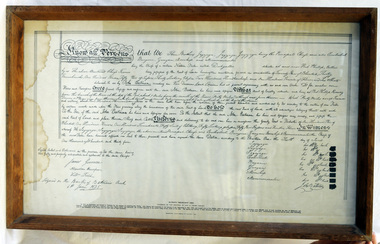
framed document, Batman's Melbourne Deed, 1966
... Port Phillip, near the present site of the city of Melbourne. The document came to be known as Batman's Treaty and is considered significant as it was the first and only documented time when Europeans negotiated their presence and occupation of Aboriginal lands directly with the traditional owners. The so-called treaty was implicitly declared void on 26 August 1835 by the Governor of New South Wales, Richard Bourke. The original Batman Deed is of enormous significance to the history of the European settlement ...The Batman Deed is sometimes called the Batman Treaty, the Dutigullar Deed, the Dutigullar Treaty or the Melbourne Deed. The deeds had been drafted by JT Gellibrand, a leading lawyer in the colony. Batman's Treaty was a document signed on 6 June 1835 by John Batman, an Australian grazier, businessman and explorer, and a group of Wurundjeri elders, for the purchase of land around Port Phillip, near the present site of the city of Melbourne. The document came to be known as Batman's Treaty and is considered significant as it was the first and only documented time when Europeans negotiated their presence and occupation of Aboriginal lands directly with the traditional owners. The so-called treaty was implicitly declared void on 26 August 1835 by the Governor of New South Wales, Richard Bourke. The original Batman Deed is of enormous significance to the history of the European settlement of Victoria. Framed print of the Batman Deed, dated 1835. This is a printed copy of the Batman Deed, made in 1966 from the 'original' by the State Library of Victoria. The frame is wood. The document consists of handwritten text in black ink with eight signatures in the lower right hand side and three signatures in the lower left hand corner. It has been signed by John Batman beneath the eight signatures.document batman-deed melbourne -
 Eltham District Historical Society Inc
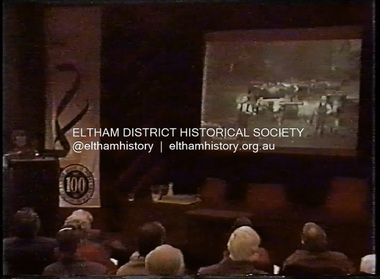
Film - Video (DVD), Melbourne and Metropolitan Board of Works, Yarra River Conference Proceedings; a Board of Works centenary event, 13-16 April 1991
... to Utility Early navigators of the Yarra River; developing the port of Melbourne; the gold rush and its effect on the new colony; punts and bridges; water supply; pollution of the Yarra; the discovery of gold and early settlement of the Yarra valley; floods of 1839 and 1863. 1863-1891 Formation of the Harbour Trust; Coode Canal; pollution of the Yarra by industry; aborigines, gold miners, timber getters in the Upper Yarra areas; bridges; the flood of 1891. ...to Utility Early navigators of the Yarra River; developing the port of Melbourne; the gold rush and its effect on the new colony; punts and bridges; water supply; pollution of the Yarra; the discovery of gold and early settlement of the Yarra valley; floods of 1839 and 1863. 1863-1891 Formation of the Harbour Trust; Coode Canal; pollution of the Yarra by industry; aborigines, gold miners, timber getters in the Upper Yarra areas; bridges; the flood of 1891. ...Yarra River Conference History Segment [Noted on VHS tape jackets "Due to unavoidable circumstances, the quality of these tapes in some setions is less than desired."] The Yarra River Conference, organised by the Board of Works as part of the Centenary Celebrations, was held in the Board's Head Office Theatrette from 13-16 April, 1991. A segment of the Conference focussed on the role that the Yarra River has played in relation to the historical development of Melbourne. Conceived and presented by a group of prominent historians as a chronological 'trip down the river in time', and profusely illustrated with slides, this segment traced the various impacts that urban and rural growth, development of marine commerce, recreational uses, and environmental problems have had on the Yarra during a century and a half of European occupation. As no formal written paper of this combined presentation is available, these two video-tapes provide a record for anyone who has an interest in tis fascinating aspect of the Yarra's history. The speakers who combined to present this segment are identified on the cover of Tape 2. Tape 1 (2 hours) 1838-1863 Deputy ?? to Utility Early navigators of the Yarra River; developing the port of Melbourne; the gold rush and its effect on the new colony; punts and bridges; water supply; pollution of the Yarra; the discovery of gold and early settlement of the Yarra valley; floods of 1839 and 1863. 1863-1891 Formation of the Harbour Trust; Coode Canal; pollution of the Yarra by industry; aborigines, gold miners, timber getters in the Upper Yarra areas; bridges; the flood of 1891. Tape 2 ( 1 1/2 hours) 1892-1934: People Begin to See Beauty and Romance to the River Henley-on-Yarra; realignment of the Yarra; MMBW is responsible for a sewerage system; new docks to cope with increased overseas trade; development of recreational parks; new reservoirs; timber production and timber tramways; bushfire; flood of 1934. 1935-1970: The River is Neglected Still, Except When it Proves Useful Bushfirs of 1939; the end of many sawmills; birth of tourism; increased interest in conservation and preservation of land for open space; further augmentation of water supply system; birth of containerisation changes the port; environmental concerns gain momentum. Speakers Dr Tony Dingle *, Department of Economic History, Monash University Dr Carolyn Rasmussen *, History Consultant Prof. Graeme Davison, History Department, Monash University Mr. Tom Griffiths, Lecturer in Public History, Monash Uiversity Mr. Patrick Miller, History Consultant Mr. Colin Jones, Author and Historian * Co-authors of the Board's history, 'Vital Connections'.video recording, yarra river, conference proceedings -
 Eltham District Historical Society Inc
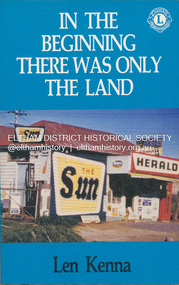
Book, Len Kenna, In the beginning there was only the land, 1988
... Local history of the outer Melbourne suburb of Bundoora, from the original Wurundjeri people through to its development as a thriving suburb in the 1980s ; section entitled "The Aborigines" (pp.14-21) discusses the traditional way of life of the Wurundjeri people prior to European settlement. Bundoora Bundoora Hall Hospitals Jane McKimmie Janefield Janefield Church john mckimmie La Trobe University Marvellous Melbourne Mont Park Mont Park Psychiatric Hospital Plenty River william shillinglaw Wurundjeri Yan Yean Reservoir Softback; 227 p. : ill., facsims., maps, ports. ; 22 cm. ...A book, published as part of the Australian Bicentenary Celebrations on the history of the suburb of Bundoora. ... Includes photographs, maps and index. Local history of the outer Melbourne suburb of Bundoora, from the original Wurundjeri people through to its development as a thriving suburb in the 1980s ; section entitled "The Aborigines" (pp.14-21) discusses the traditional way of life of the Wurundjeri people prior to European settlement.bundoora, bundoora hall, hospitals, jane mckimmie, janefield, janefield church, john mckimmie, la trobe university, marvellous melbourne, mont park, mont park psychiatric hospital, plenty river, william shillinglaw, wurundjeri, yan yean reservoir -
![Map - Maps, [John Batman in Melbourne], 1976](/media/collectors/4f729f5697f83e03086015b8/items/60965f673c71fad916b3a651/item-media/60965fc33c71fad916b3a805/item-fit-380x285.jpg?cb=6) Greensborough Historical Society
Greensborough Historical SocietyMap - Maps, [John Batman in Melbourne], 1976
... Photocopies of 4 maps showing aspects of John Batman's time in Melbourne: Map of the settlement of the Yarra 1837; Batman's map of Port Phillip and his route of exploration, 1835, drawn by Wedge; Proposed route of Batman's initial exploratiion, and Enlargement of the Geelong region of Batman's map. ...Greensborough Historical Society 34A Glenauburn Road Lower Plenty Lower Plenty melbourne Photocopies of 4 maps showing aspects of John Batman's time in Melbourne: Map of the settlement of the Yarra 1837; Batman's map of Port Phillip and his route of exploration, 1835, drawn by Wedge; Proposed route of Batman's initial exploratiion, and Enlargement of the Geelong region of Batman's map. ...Photocopies of 4 maps showing aspects of John Batman's time in Melbourne: Map of the settlement of the Yarra 1837; Batman's map of Port Phillip and his route of exploration, 1835, drawn by Wedge; Proposed route of Batman's initial exploratiion, and Enlargement of the Geelong region of Batman's map. No citations on any copy.Photocopy of maps, 4 pages.john batman, melbourne, port phillip -
Phillip Island and District Historical Society Inc.
Book, Western Port chronology 1798-1839 : exploration to settlement, 1984
... This compilation brings life to European activity at Western Port during the thirty-seven years that preceded Melbourne's founding. xiv, 110 p. : ill., facsims., maps ; 24 cm. ISBN 0959065202 Western Port chronology 1798-1839 : exploration to settlement Book book Valda Cole Shire of Hastings Historical Society ...Extracts from log books and journals of explorers and travellers from the time George Bass entered and sketched the harbour in 1798, combined with rare charts and plates. This compilation brings life to European activity at Western Port during the thirty-seven years that preceded Melbourne's founding. xiv, 110 p. : ill., facsims., maps ; 24 cm. ISBN 0959065202 -
 Bendigo Historical Society Inc.
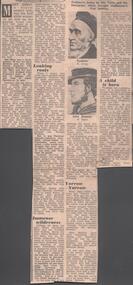
Newspaper - LYDIA CHANCELLOR COLLECTION: MELBOURNE'S FIRST CHRISTMAS
... Melbourne's First Christmas by John Lahey.' This is Lahey's account of the first year of settlement of Melbourne. Six people landed first in Melbourne - Mary Gilbert, the first white woman to land in Melbourne plus five men landed from Fawkner's boat in August 1835. Mary gave birth to the first white child born in Melbourne - John Port...History House 11 Mackenzie Street Bendigo goldfields MELBOURNE Lydia Chancellor Collection collection Melbourne Melbourne history history Mary Gilbert woman female John Batman John Pascoe Fawkner John Port Phillip Gilbert A Herald newspaper article titled 'Melbourne's First Christmas by John Lahey.' This is Lahey's account of the first year of settlement ...A Herald newspaper article titled 'Melbourne's First Christmas by John Lahey.' This is Lahey's account of the first year of settlement of Melbourne. Six people landed first in Melbourne - Mary Gilbert, the first white woman to land in Melbourne plus five men landed from Fawkner's boat in August 1835. Mary gave birth to the first white child born in Melbourne - John Port Phillip Gilbert. The trials and tribulations of the first settlers in Melbourne are outlined in this article. There are photos or illustrations of Fawkner's house by the Yarra, John Pascoe Fawkner and John Batman. 24/12/1960.melbourne, lydia chancellor collection, collection, melbourne, melbourne history, history, mary gilbert, woman, female, john batman, john pascoe fawkner, john port phillip gilbert -
Port Melbourne Historical & Preservation Society
Audio - PMHPS Meeting, pre-European settlement of Port Melbourne, Gary Presland, David Nicholas, 23 Feb 2015
... PMHPS Meeting, pre-European settlement of Port Melbourne, Gary Presland...Gary Presland talks about pre-European settlement of Port Melbourne. PMHPS meeting 23.02.2015 Duration 01:41:07 including meeting preliminaries....Port Melbourne Historical & Preservation Society Port Melbourne Town Hall 333 Bay Street Port Melbourne melbourne Societies Clubs Unions and other Organisations Port Melbourne Historical & Preservation Society PMHPS Indigenous Australians Gary PRESLAND Gary Presland talks about pre-European settlement of Port Melbourne. ...Gary Presland talks about pre-European settlement of Port Melbourne. PMHPS meeting 23.02.2015 Duration 01:41:07 including meeting preliminaries.societies clubs unions and other organisations, port melbourne historical & preservation society, pmhps, indigenous australians, gary presland -
Port Melbourne Historical & Preservation Society
Poster - Map showing ancesttral family estates of Melbourne's first people pre European Settlement, Marcus Lee Design, This once as it was - the ancestral family estates of Melbourne's first people, 2016
... Melbourne's first people. Colour map with text. Pre European settlement. Based on Colonial survey maps of Port Phillip Bay region. 1837 and 1864...Port Melbourne Historical & Preservation Society Port Melbourne Town Hall 333 Bay Street Port Melbourne melbourne Indigenous Australians Natural Environment Arweet DERRMUT Point Ormond St Kilda Yuro Yuroke Bunjil Burrarung River Queensbridge Falls This once as it was - the ancestral family estates of Melbourne's first people. Colour map with text. Pre European settlement ...This once as it was - the ancestral family estates of Melbourne's first people. Colour map with text. Pre European settlement. Based on Colonial survey maps of Port Phillip Bay region. 1837 and 1864indigenous australians, natural environment, arweet derrmut, point ormond, st kilda, yuro yuroke, bunjil, burrarung river, queensbridge falls -
Port Melbourne Historical & Preservation Society
Book, Christine Inglis in conjunction with the 40th Anniversary Committee, "Turkish Settlement in Victoria", 2011
... Port Melbourne Historical & Preservation Society Port Melbourne Town Hall 333 Bay Street Port Melbourne melbourne Immigration Turkey "Turkish Settlement in Victoria". ..."Turkish Settlement in Victoria". Large book with coloured cover and dust jacket . Pictured family with children on a bicycle. Housing Commission flats in background.immigration, turkey -
Port Melbourne Historical & Preservation Society
Article - Newspaper article, Bend worker's homes still a dream, The Herald, Bend worker's homes still a dream, 1 Feb 1940
... Port Melbourne Historical & Preservation Society Port Melbourne Town Hall 333 Bay Street Port Melbourne melbourne Built Environment - Domestic Fishermans Bend Miss Jean DALEY Labor Women's Central Organising Committee Australian Labor Party Henry Peter ZWAR "Bend worker's homes still a dream" Cutting from The Herald, February 1 1940 The building of Fishermen's Bend housing settlement not progressing. ..."Bend worker's homes still a dream" Cutting from The Herald, February 1 1940 The building of Fishermen's Bend housing settlement not progressing.built environment - domestic, fishermans bend, miss jean daley, labor women's central organising committee, australian labor party, henry peter zwar -
Port Melbourne Historical & Preservation Society
Book, Life on the bend, Jul 2017
... Port Melbourne Historical & Preservation Society Port Melbourne Town Hall 333 Bay Street Port Melbourne melbourne Built Environment - Industrial Natural Environment Fishermans Bend "Life on the bend" social history of Fishermans Bend Melbourne "Life on the bend" Oblong book. Front cover photographs on blue background. Back cover blue with context logo.. Book explores 8 themes including industry, early settlement ..."Life on the bend" Oblong book. Front cover photographs on blue background. Back cover blue with context logo.. Book explores 8 themes including industry, early settlement, identity ."Life on the bend" social history of Fishermans Bend Melbournebuilt environment - industrial, natural environment, fishermans bend -
Port Melbourne Historical & Preservation Society
Book, 321 Imagined Settlement, May 2018
... Port Melbourne Historical & Preservation Society Port Melbourne Town Hall 333 Bay Street Port Melbourne melbourne Built Environment - Domestic Families Ray Jelley Esplanade East John PHILIPSON William BASFORD Hugh TRAINOR Mathias LARKIN Joseph OVEREND Janet OVEREND John Bichard GRUT John LUMSDEN Ellen LUMSDEN William STAPLETON George BURROWS William GEDGE David KELLY Mrs E E WATKINS Robert BRYANT Emily SANDERSON Marilyn JOHNSON Lora STARLING "To the members of the PMH&PS. Thanks for all of your assistance with my book. Ray Jelley." "321 Imagined Settlement ..."321 Imagined Settlement" Book with sketch of 321 Esplanade East on bottom half and black at top with white title and authors name in red."To the members of the PMH&PS. Thanks for all of your assistance with my book. Ray Jelley."built environment - domestic, families, ray jelley, esplanade east, john philipson, william basford, hugh trainor, mathias larkin, joseph overend, janet overend, john bichard grut, john lumsden, ellen lumsden, william stapleton, george burrows, william gedge, david kelly, mrs e e watkins, robert bryant, emily sanderson, marilyn johnson, lora starling -
Port Melbourne Historical & Preservation Society
Audio - PMHPS Meeting, Adair Bunnett, Comparing settlement of South and Port Melbourne, David Nicholas, 23 Apr 2018
... PMHPS Meeting, Adair Bunnett, Comparing settlement of South and Port Melbourne...Adair Bunnett discusses the similarities and differences between the development of settlements in South and Port Melbourne PMHPS monthly meeting 26.02.2018 Duration including meeting preliminaries 1:07:24...Port Melbourne Historical & Preservation Society Port Melbourne Town Hall 333 Bay Street Port Melbourne melbourne Local Government Natural Environment South Melbourne Adair BUNNETT Adair Bunnett discusses the similarities and differences between the development of settlements in South and Port Melbourne PMHPS monthly meeting 26.02.2018 Duration including meeting preliminaries 1:07:24 Audio PMHPS Meeting, Adair Bunnett, Comparing settlement of South and Port Melbourne David Nicholas ...Adair Bunnett discusses the similarities and differences between the development of settlements in South and Port Melbourne PMHPS monthly meeting 26.02.2018 Duration including meeting preliminaries 1:07:24local government, natural environment, south melbourne, adair bunnett
