
Showing 17 items matching "president roosevelt"
-
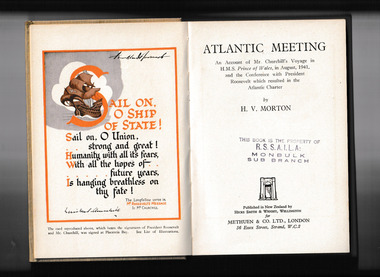 Mrs Aeneas Gunn Memorial Library
Book, Methuen, Atlantic meeting : an account of Mr. Churchill's voyage in H. M. S. Prince of Wales, in August, 1941, and the conference with President Roosevelt which resulted in the Atlantic charter, 1946
... Prince of Wales, in August, 1941, and the conference with President Roosevelt which resulted in the Atlantic charter...World War 1939- 1945 - Diplomacy Atlantic charter 1941 Commemorating the seventy-fifth anniversary of Winston Churchill’s meeting with President Roosevelt at Argentia Harbour, Placentia Bay With a new Foreword by Lord David Owen In August 1941 Winston Churchill (1874 1965) and President Roosevelt (1882 1945) met secretly on HMS Prince of Wales, moored just off the coast of Newfoundland. ...Commemorating the seventy-fifth anniversary of Winston Churchill’s meeting with President Roosevelt at Argentia Harbour, Placentia Bay With a new Foreword by Lord David Owen In August 1941 Winston Churchill (1874 1965) and President Roosevelt (1882 1945) met secretly on HMS Prince of Wales, moored just off the coast of Newfoundland.Index, ill, map, p.160.non-fictionCommemorating the seventy-fifth anniversary of Winston Churchill’s meeting with President Roosevelt at Argentia Harbour, Placentia Bay With a new Foreword by Lord David Owen In August 1941 Winston Churchill (1874 1965) and President Roosevelt (1882 1945) met secretly on HMS Prince of Wales, moored just off the coast of Newfoundland. world war 1939- 1945 - diplomacy, atlantic charter 1941 -
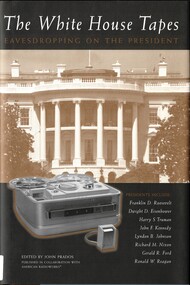 National Vietnam Veterans Museum (NVVM)
Book, Prados, John ed, The White House Tapes: Eavesdropping On The President, 2003
... ...President Roosevelt...White House (Washington Presidents -- United States -- History -- 20th century -- Sources President Roosevelt President Eisenhower President Truman President J F Kennedy President Johnson President Nixon President Ford President Reagan The White House Tapes: Eavesdropping on the President is a fascinating portrait of eight recent American presidents. ...The White House Tapes: Eavesdropping on the President is a fascinating portrait of eight recent American presidents.Box containing the book and a package of 9 Cd'sThe White House Tapes: Eavesdropping on the President is a fascinating portrait of eight recent American presidents.white house (washington, presidents -- united states -- history -- 20th century -- sources, president roosevelt, president eisenhower, president truman, president j f kennedy, president johnson, president nixon, president ford, president reagan -
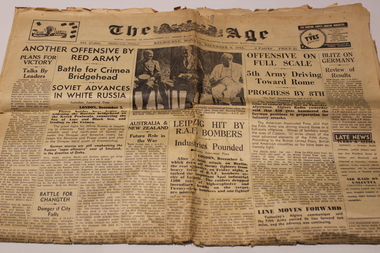 Dandenong/Cranbourne RSL Sub Branch
Memorabilia - Newspaper, The Age, The Age dated 6th Dec 1943, 6th Dec 1943
... Featuring historic conference at Cairo with Marshal Chiag Kai -Shek (China), President Roosevelt (USA), and Mr Churchill (Britain). ...The Age newspaper dated 6DEC43 Featuring historic conference at Cairo with Marshal Chiag Kai -Shek (China), President Roosevelt (USA), and Mr Churchill (Britain). ...WWII Historical significance.Original edition of the Age Newspaper dated Monday 6th December 1943.Featuring historic conference at Cairo with Marshal Chiag Kai -Shek (China), President Roosevelt (USA), and Mr Churchill (Britain). Other headlines on front page are: "Plans for Victory"; "Offence On Full Scale"; "Blitz on Germany"the age., the age newspaper dated 6dec43 -
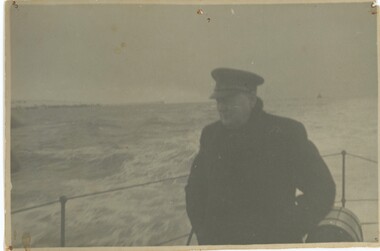 Emerald Museum & Nobelius Heritage Park
Photograph - Photograph of Winston Churchill on board S. S. Napier, c.1941
... In January 1941, Winston Churchill travelled on the Napier for transport to Scotland where Churchill was then transferring to the battleship, HMS Prince of Wales en route for an historic meeting with President Roosevelt. Dr Murphy was able to take this grainy photo of the great man on deck....In January 1941, Winston Churchill travelled on the Napier for transport to Scotland where Churchill was then transferring to the battleship, HMS Prince of Wales en route for an historic meeting with President Roosevelt. Dr Murphy was able to take this grainy photo of the great man on deck. ...This is a copy of a photograph taken by Dr Murphy when he was a naval surgeon on board the ship S. S. "Napier" during World War II. In January 1941, Winston Churchill travelled on the Napier for transport to Scotland where Churchill was then transferring to the battleship, HMS Prince of Wales en route for an historic meeting with President Roosevelt. Dr Murphy was able to take this grainy photo of the great man on deck.Dr Murphy was Emerald's first and much-loved GP. Before he retired to Emerald he was a navy surgeon during WWII. This photo was taken by him and shows one of his journeys during his time as a navy surgeon.Black and white photograph of Winston Churchill aboard the S. S. Napier taken by Dr I S MacLeod Murphy when he was a naval surgeon aboard the same boat in WWII.Back of photograph written: "Winston Churchill on board S.S. Napier Distroyer [sic] Darwin / taken by ships doctor Ian Macleod Murphy"dr ian macleod murphy, spud murphy, doctor, emerald, ss napier, winston churchill -
 Unions Ballarat
The Roosevelts (Don Woodward Collection), Churchill, Allen, 1965
... ...roosevelt, theodore...president...Theodore Roosevelt was President of the USA from 1901 to 1909. ...Theodore Roosevelt was President of the USA from 1901 to 1909. ...Biography of Theodore and Franklin Roosevelt. Theodore Roosevelt was President of the USA from 1901 to 1909. He was awarded the Nobel Peace Prize in 1906.Political (USA) and biographical interest.Book; 341 pages. Front cover: grey background; five black and white photographs; red and black lettering; author's name and title. Black hard cover - cloth and paper. Purchase price - $6 - in pencil.btlc, ballarat trades hall, ballarat trades and labour council, roosevelt, theodore, president - usa, politics and government - usa, biography, nobel peace prize -
 Queenscliffe Maritime Museum
Photograph - One original photograph and one framed and mounted copy of the United States Atlantic Fleet entering Port Phillip Bay in 1908, United States Fleet entering Port Phillip
... The ‘Great White Fleet’ was circumnavigating the globe on a tour launched by President Theodore Roosevelt. The cruise was a display of naval power and practical exercise, testing the battle-readiness of the US Navy and demonstrating its ability to patrol and protect the west coast and American interests in the Pacific including Australia....The ‘Great White Fleet’ was circumnavigating the globe on a tour launched by President Theodore Roosevelt. The cruise was a display of naval power and practical exercise, testing the battle-readiness of the US Navy and demonstrating its ability to patrol and protect the west coast and American interests in the Pacific including Australia. ...On 29 August 1908 Melbourne gaped in wonder as 16 white-hulled battleships of the United States Atlantic Fleet, carrying 14,000 naval personnel, steamed into Port Phillip Bay. The ‘Great White Fleet’ was circumnavigating the globe on a tour launched by President Theodore Roosevelt. The cruise was a display of naval power and practical exercise, testing the battle-readiness of the US Navy and demonstrating its ability to patrol and protect the west coast and American interests in the Pacific including Australia.An original unframed photograph of the United States Altantic Fleet entering Port Phillip Bay in 1908 and a copy framed and mounted under glass.Port Phillip Bay 1908; United States Atlantic Fleetthe great white fleet, us atlantic fleet, 1908, port phillip bay -
 Queenscliffe Maritime Museum
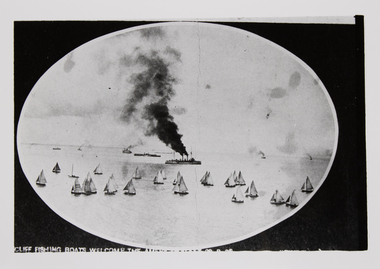
Photograph - Reproduction, Queenscliff fishing boats welcome the American Fleet
... The Fleet’s Mission, ordered by President Theodore Roosevelt, was to make friendly courtesy visits to countries while obviously displaying new U.S. naval power. ...The Fleet’s Mission, ordered by President Theodore Roosevelt, was to make friendly courtesy visits to countries while obviously displaying new U.S. naval power. ...On Saturday 29 August 1908, over 100 years ago, 16 American battleships along with 5 various escorts entered Port Phillips Bay. Thousands flocked with excitement along the coast and to Port Melbourne to see the white painted ships and their sailors disembarked. The Fleet’s Mission, ordered by President Theodore Roosevelt, was to make friendly courtesy visits to countries while obviously displaying new U.S. naval power. Invited by Alfred Deakin to the young federation, who was feeling isolated and vulnerable after the Anglo-Japanese Alliance, the visit was a first step in the shaping of the relationship between the US and Australia. And also an impetus to create the Australian Navy in 1911.A photograph of an original photograph depicting the Queenscliff fishing fleet out welcoming the incoming American fleet on Saturday 29 August 1908.Queenscliff fishing boats welcoming the American Fleetthe americcan fleet, the great white fleet, theodore roosevelt, alfred duncan, australian navy 1911 -
 Conservation Volunteers
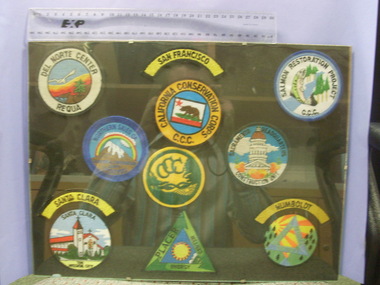
Visiting US Conservation Corps Sleeve Patch collections, US Conservation Corps Sleeve Patch collections
... Its original name had been adapted from that of the Civilian Conservation Corps launched by President Roosevelt in Depression-era USA: - "I propose to create a Civilian Conservation Corps to be used in simple work, not interfering with normal employment, and confining itself to forestry, the prevention of soil erosion, flood control and similar projects. ...Its original name had been adapted from that of the Civilian Conservation Corps launched by President Roosevelt in Depression-era USA: - "I propose to create a Civilian Conservation Corps to be used in simple work, not interfering with normal employment, and confining itself to forestry, the prevention of soil erosion, flood control and similar projects. ...Initially named the Conservation Corps, the British Trust for Conservation Volunteers (BTCV) was founded in 1959 by the Council for Nature. Today BTCV is the “largest practical conservation charity in the United Kingdom”, and celebrated its fiftieth birthday in February 2009. Its original name had been adapted from that of the Civilian Conservation Corps launched by President Roosevelt in Depression-era USA: - "I propose to create a Civilian Conservation Corps to be used in simple work, not interfering with normal employment, and confining itself to forestry, the prevention of soil erosion, flood control and similar projects. More important, however, than the material gains, will be the moral and spiritual value of such work. Roosevelt’s idea had been revived by Governor Jerry Brown of California in 1976 and exchange of ideas and personnel between the California Conservation Corps (CCC) and other US conservation corps) has flourished since. Mark Dwyer (later to play an important role in Green Corps) was leader of the first California Conservation Corps three-month exchange program to Australia in 1988. The first ATCV exchange group to California in 1987 National Director, Tim Cox and Team Leader, David Clark (group leader, in Australian military hat) Right: Members of the first CCC exchange team to Australia at the US Embassy, Canberra in 1988: from left - Merrold, Vicci and Bobby with Mark Dwyer (centre) and David Clark (ATCV, right). Exchanges have continued annually since 1988 and, in addition to environmental work done, many friendships have been made and maintained over the years. This sleeve patch symbolises strong international links in place since ATCV/CVA was founded.This cloth sleeve patch is an example of those sewn onto the uniforms of staff and volunteers of the California Conservation Corps. It is round with an orange rim with black lettering naming ther organisation and inside the rime there is a light blue circle inset with the State flag of California. This sleeve patch is part of CVA's collection of 34 sleeve patches from many States of the USA.corps, david, conservation, mark, dwyer, california, clark, sleeve, patches -
 Stawell Historical Society Inc
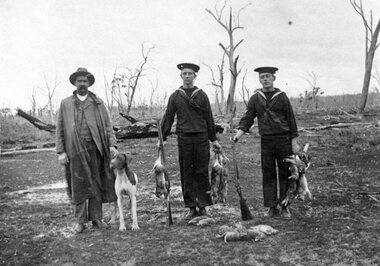
Photograph, “Yarram Park” Homestead in Willaura with Mr Kinsella hosting a visit by American Seamen c 1907
... The Great White Fleet was the popular nickname for the group of United States Navy battleships which completed a journey around the globe from December 16, 1907 to February 22, 1909 by order of President Theodore Roosevelt. Its mission was to make friendly courtesy visits to numerous countries while displaying new U.S. naval power to the world. ...The Great White Fleet was the popular nickname for the group of United States Navy battleships which completed a journey around the globe from December 16, 1907 to February 22, 1909 by order of President Theodore Roosevelt. Its mission was to make friendly courtesy visits to numerous countries while displaying new U.S. naval power to the world. ...“Yarram Park” Willaura Visited by American Seamen. Gentleman is Mr William Jennings Kinsella. The Great White Fleet was the popular nickname for the group of United States Navy battleships which completed a journey around the globe from December 16, 1907 to February 22, 1909 by order of President Theodore Roosevelt. Its mission was to make friendly courtesy visits to numerous countries while displaying new U.S. naval power to the world. One goal was to deter a threatened war with Japan since tensions were high in 1907. It familiarized the 14,500 officers and men with the logistical and planning needs for extended fleet action far from home. Hulls were painted a stark white, giving the armada its nickname. It consisted of 16 battleships divided into two squadrons, along with various small escorts.[1][2] Roosevelt sought to demonstrate growing American military power and blue-water navy capability.willaura simmons -
 Stawell Historical Society Inc
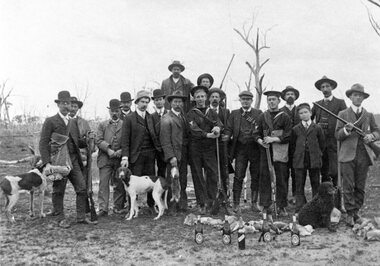
Photograph, “Yarram Park” Homestead Hunting Trip with American Seamen c 1907
... The Great White Fleet was the popular nickname for the group of United States Navy battleships which completed a journey around the globe from December 16, 1907 to February 22, 1909 by order of President Theodore Roosevelt. Its mission was to make friendly courtesy visits to numerous countries while displaying new U.S. naval power to the world. ...The Great White Fleet was the popular nickname for the group of United States Navy battleships which completed a journey around the globe from December 16, 1907 to February 22, 1909 by order of President Theodore Roosevelt. Its mission was to make friendly courtesy visits to numerous countries while displaying new U.S. naval power to the world. ...“Yarram Park” Willaura Hunting Trip with American Seamen. Gentleman at top center back is William Jennings Kinsella. The Great White Fleet was the popular nickname for the group of United States Navy battleships which completed a journey around the globe from December 16, 1907 to February 22, 1909 by order of President Theodore Roosevelt. Its mission was to make friendly courtesy visits to numerous countries while displaying new U.S. naval power to the world. One goal was to deter a threatened war with Japan since tensions were high in 1907. It familiarized the 14,500 officers and men with the logistical and planning needs for extended fleet action far from home. Hulls were painted a stark white, giving the armada its nickname. It consisted of 16 battleships divided into two squadrons, along with various small escorts.[1][2] Roosevelt sought to demonstrate growing American military power and blue-water navy capability.willaura simmons -
 City of Melbourne Libraries
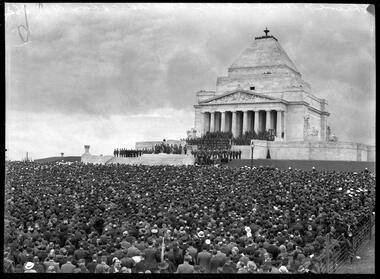
Photograph, Bull, Hugh Jones, 1897-1993, Shrine and multitude afield at opening dedication, Shrine of Remembrance
... References: President Roosevelt's Tribute (1934, November 13). ...References: President Roosevelt's Tribute (1934, November 13). ...On Armistice Day, 11 November 1934, an estimated third of Melbourne’s population, assembled for the Dedication Ceremony of the Shrine of Remembrance by Prince Henry, Duke of Gloucester. Featured in "Newsworthy: Melbourne in photographs 1933-1936" exhibition at East Melbourne Library, October to December 2023 Photographer notations on slide: "Shrine and multitude afield B62" Description: “Shrine and multitude afield” On Armistice Day, 11 November 1934, an estimated third of Melbourne’s population, assembled for the Dedication Ceremony of the Shrine of Remembrance by Prince Henry, Duke of Gloucester. The Argus reported the following day: “10,000 Pigeons Released. With whirring wings, 10,000 pigeons rose above the Shrine like a huge puff of smoke when they were released from the second balcony at 11.43am, after the ceremony of dedication. The pigeons had come from all parts of the metropolitan area and from places as far away as Shepparton, Broadford, and Trentham. They hovered above the Shrine for a moment or two, taking their bearings, and then flew away toward their homes. A boy at Burnley reported later that one of his pigeons had returned and entered its box two minutes after the liberation. The pigeons were assembled in metropolitan clubrooms of the Victorian Homing Pigeon Association on Saturday night, and transported in 75 panniers to the Shrine, carried up stairways, and placed in readiness on the balcony. A man remained in charge of them all night. In the early hours of the morning he had a busy time covering the panniers with a tarpaulin to protect the birds from the rain.” In the foreground can be seen three women standing with their backs to the Shrine, looking upwards. In the same coverage, The Argus noted: “Women, unconscious probably of the fact that they were resorting to the principle of the periscope of the days of the war which had brought this vast assemblage together, turned their backs upon the scene the better to view it by looking into mirrors held high in one hand.” FRC Featured in "Newsworthy: Melbourne in photographs 1933-1936" exhibition at East Melbourne Library, October to December 2023. Exhibition caption by project volunteer, Fiona Collyer. References: President Roosevelt's Tribute (1934, November 13). The Advertiser (Adelaide, SA : 1931 - 1954), p. 16. Retrieved November 8, 2024, from http://nla.gov.au/nla.news-article35018382 Here, There and Everywhere (1934, November 12). The Sun News-Pictorial (Melbourne, Vic. : 1922 - 1954; 1956), p. 7. Retrieved June 19, 2024, from http://nla.gov.au/nla.news-article277075769 DAY OF SOLEMNITY (1934, November 12). The Argus (Melbourne, Vic. : 1848 - 1957), p. 9. Retrieved November 8, 2024, from http://nla.gov.au/nla.news-article10992864Photographer notations on slide: "Shrine and multitude afield B62".shrine of remembrance, 1930-1939, ceremonies, world war 1, pigeons -
 Flagstaff Hill Maritime Museum and Village
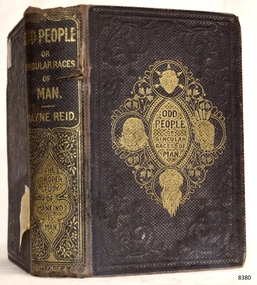
Book - Anthropological Travelogue/Fictional, Captain Mayne Reid, Odd People being A Popular Description of Singular Races of Man, 1860
... Mayne Reid's adventure and travel writings were massively influential to historical figures; President Theodore Roosevelt, Arthur Conan Doyle, and Vladimir Nabokov all explicitly credited Mayne Reid as a major childhood inspiration who sparked their love for nature, adventure, and storytelling. ...Odd People: Being a Popular Description of Singular Races of Man (1860) is an interesting piece of 19th-century literature. The book was written by Captain Thomas Mayne Reid (1818–1883), a Scots-Irish American novelist and adventurer. He was immensely popular in the mid-to-late 19th century for his boys' adventure novels, tales of the American West, and travelogues. The true first edition was published in London by Routledge, Warne & Routledge in 1860. In the United States, it was published around the same time (1860/1861) by Ticknor and Fields in Boston, and later editions were retitled The Man-Eaters and Other Odd People. The book is an early work of popular ethnology and anthropology, written for a general audience and heavily marketed toward young readers and armchair travelers of the Victorian era.Book, brown covers, embossed with borders and patterns and gilt decoration and titles. The book includes illustrations. Handwritten inscription on the front paste-down page. The opposite page has a stamped and a handwritten inscription. The book was presented as a prize to a Latin student at the National School, Warrnambool in 1861. Title: Odd People being a Popular Description of Singular Races of Man. Alternate title: Odd People or Singular Races of Man Author: Captain Mayne Reid Publisher: Routledge Warne & Routledge, London Date: 1860 Further information: additional text on the spine reads 'A Proper Study of Mankind is Man'fictionOdd People: Being a Popular Description of Singular Races of Man (1860) is an interesting piece of 19th-century literature. The book was written by Captain Thomas Mayne Reid (1818–1883), a Scots-Irish American novelist and adventurer. He was immensely popular in the mid-to-late 19th century for his boys' adventure novels, tales of the American West, and travelogues. The true first edition was published in London by Routledge, Warne & Routledge in 1860. In the United States, it was published around the same time (1860/1861) by Ticknor and Fields in Boston, and later editions were retitled The Man-Eaters and Other Odd People. The book is an early work of popular ethnology and anthropology, written for a general audience and heavily marketed toward young readers and armchair travelers of the Victorian era.shipwrecked-coast, flagstaff-hill, flagstaff-hill-maritime-museum, warrnambool, maritime-museum, shipwreck-coast, flagstaff-hill-maritime-village, shipwrecked-artefact, book, odd people, captain mayne reid, national school warrnambool., daniel b sellers, classic fiction, the proper study of mankind is man, singular races of man, , routledge warne and routledge, latin student -
 Monbulk RSL Sub Branch
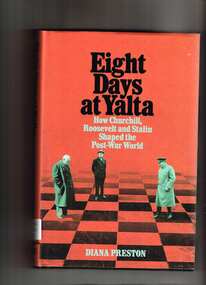
Book, Picador, Eight days at Yalta : how Churchill, Roosevelt and Stalin shaped the post-war world, 2019
... Only three months later, less than a week after the German surrender, Roosevelt was dead and Churchill was writing to the new President, Harry S. ...In the last winter of the Second World War, Winston Churchill, Franklin D. Roosevelt and Joseph Stalin arrived in the Crimean resort of Yalta. Over eight days of bargaining, bombast and intermittent bonhomie they decided on the conduct of the final stages of the war against Germany, on how a defeated and occupied Germany should be governed, on the constitution of the nascent United Nations and on spheres of influence in Eastern Europe, the Balkans and Greece. Only three months later, less than a week after the German surrender, Roosevelt was dead and Churchill was writing to the new President, Harry S. Truman, of 'an iron curtain' that was now 'drawn down upon [the Soviets'] front'. Diana Preston chronicles eight days that created the post-war world, revealing Roosevelt's determination to bring about the dissolution of the British Empire and Churchill’s conviction that he and the dying President would run rings round the Soviet premier. But Stalin monitored everything they said and made only paper concessions, while his territorial ambitions would soon result in the imposition of Communism throughout Eastern Europe.Index, bib, ill, maps, p.398.non-fictionIn the last winter of the Second World War, Winston Churchill, Franklin D. Roosevelt and Joseph Stalin arrived in the Crimean resort of Yalta. Over eight days of bargaining, bombast and intermittent bonhomie they decided on the conduct of the final stages of the war against Germany, on how a defeated and occupied Germany should be governed, on the constitution of the nascent United Nations and on spheres of influence in Eastern Europe, the Balkans and Greece. Only three months later, less than a week after the German surrender, Roosevelt was dead and Churchill was writing to the new President, Harry S. Truman, of 'an iron curtain' that was now 'drawn down upon [the Soviets'] front'. Diana Preston chronicles eight days that created the post-war world, revealing Roosevelt's determination to bring about the dissolution of the British Empire and Churchill’s conviction that he and the dying President would run rings round the Soviet premier. But Stalin monitored everything they said and made only paper concessions, while his territorial ambitions would soon result in the imposition of Communism throughout Eastern Europe.world war 1939-1945 - diplomatic history, yalta conference - crimea- 1945 -
 The Celtic Club
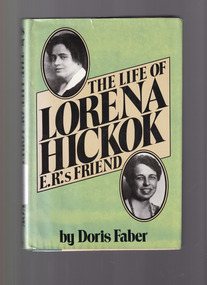
Book, Doris Faber, The life of Lorena Hickok: E.R'.s friend, 1980
... Journalists - United States - Biography Biography of a personal relationship between a journalist and Eleanor Roosevelt, wife of the American President. Index, plates, ill., p.375. ...Biography of a personal relationship between a journalist and Eleanor Roosevelt, wife of the American President.Index, plates, ill., p.375.non-fictionBiography of a personal relationship between a journalist and Eleanor Roosevelt, wife of the American President.biography - lorena hickok., journalists - united states - biography -
Unions Ballarat
Off the record : The private papers of Harry S. Truman (Don Woodward Collection), Ferrell, Robert H, 1980
... Truman was a United States Senator from Missouri (1935–1945), became USA Vice President (1945); he became President later in 1945 when Franklin D. Roosevelt passed away and then held office until 1953....Historical, political and biographical interest. btlc ballarat trades hall ballarat trades and labour council politics and government politics - united states of america autobiography truman, harry s presidents - united states roosevelt, franklin Caulfield-Malvern Regional Library: library coding, cancelled stamp. ...Harry Truman's private diaries, letters and other materials. The book covers Truman's time as president of the United States up until his death. Truman was a United States Senator from Missouri (1935–1945), became USA Vice President (1945); he became President later in 1945 when Franklin D. Roosevelt passed away and then held office until 1953.Historical, political and biographical interest.Book; 448 pages. Dustjacket: plastic covering; white background; black and white photograph of Harry S. Truman; editor's name and title. Cover: blue background; gold lettering; author's name and title. Caulfield-Malvern Regional Library: library coding, cancelled stamp.btlc, ballarat trades hall, ballarat trades and labour council, politics and government, politics - united states of america, autobiography, truman, harry s, presidents - united states, roosevelt, franklin -
Unions Ballarat
Year of decisions: Memoirs by Harry S. Truman Volume I (Don Woodward Collection), Truman, Harry S, 1955
... Truman was President of the United States from 1945–1953. He took office following the death of Franklin Roosevelt....Truman was President of the United States from 1945–1953. He took office following the death of Franklin Roosevelt. ...Memoirs of Harry S. Truman focussing upon the year 1945. 1945 was the end of World War II and the beginning of the Atomic Age. Truman was President of the United States from 1945–1953. He took office following the death of Franklin Roosevelt.Historical, political and biographical interest - United States.Book; 637 pages. Cover: white background; black and white photograph of Harry S. Truman, blue, black, grey and yellow lettering; author's name and title.Purple stamps: "COMPLIMENTARY" and "TUDOR DISTRIBUTORS PTY LTD, 54 PORTER STREET, PRAHRAN … VIC."btlc, ballarat trades hall, ballarat trades and labour council, truman, harry s., presidents - united states, military - world war ii, politics and government - usa, memoirs, history - usa -
Unions Ballarat
Herbert Hoover : engineer, humanitarian, statesman (Don Woodward Collection), McGee, Dorothy, 1959
... Hoover was a Republican president of the United States from 1929-1933. He was defeated in the 1932 election by Democrat, Franklin D. Roosevelt...Hoover was a Republican president of the United States from 1929-1933. He was defeated in the 1932 election by Democrat, Franklin D. Roosevelt ...Autobiography of Herbert Hoover from his boyhood and through his political career. Hoover was a Republican president of the United States from 1929-1933. He was defeated in the 1932 election by Democrat, Franklin D. Roosevelt.Politics and government - USA. Autobiographical interest.Book; 325 pages. Dustjacket: red and blue background; picture of Herbert Hoover; white lettering; author's name and title. Cover: red and blue background; white lettering; author's name and title.In blue ink, name, [Illegible] Barlow?, crossed out.btlc, ballarat trades hall, ballarat trades and labour council, hoover, herbert, presidents - united states, autobiography, republican party - usa, democratic party - usa, roosevelt, franklin
