
Showing 28 items matching "railway type rail"
-
 Melbourne Tram Museum
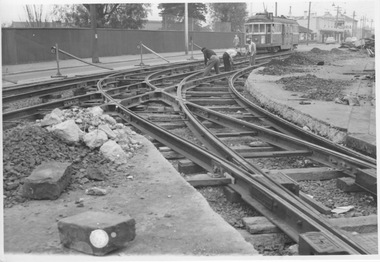
Photograph - New run out track Essendon Depot, Melbourne & Metropolitan Tramways Board MMTB or VicRail or Ministry of Transport, Sept 1960
... ...railway type rail...As tramway rail with a flangeway was no longer produced in Australia from the 1960s, railway-type rail without a flangeway was used instead and the flangeway provided by a groove in the concrete. ...As tramway rail with a flangeway was no longer produced in Australia from the 1960s, railway-type rail without a flangeway was used instead and the flangeway provided by a groove in the concrete. ...Photograph shows the laying of a new northern exit/entry road for Essendon Depot. Grooved tramway rail and turnouts are in place supported by timber sleepers. Part of the footpath and a section roadway on Mt Alexander Road are excavated for these works. Three workmen in civilian clothes are tightening tie bars; W2 class tram 552 has cleared the new works bound for Essendon Aerodrome route 59 with weather blinds down; three motor vehicles are shown in the distance, two with the distinctive shape of a Holden. The high fence and tennis court opposite the depot are part of a Catholic convent and teachers college. Records suggest the date is September 1960 when the single northern exit/entry track to the southbound line was replaced with this double track. Until this time, a separate crossover provided a connection to the northbound line. This new arrangement meant that trams running out or in from the northbound track no longer had to negotiate a crossover, thus reducing motor traffic congestion. The obsolete crossover was removed. It is likely that in the following days mass concrete was used to rebuild the roadway. As tramway rail with a flangeway was no longer produced in Australia from the 1960s, railway-type rail without a flangeway was used instead and the flangeway provided by a groove in the concrete. This photograph is likely an official M&MTB photograph.Yields information about Essendon Depot and track improvements c1960 Black and white photographs with no note on rear. official m&mtb photograph, essendon depot, exit road, mt alexander road, tie bars, w2 class, 552, weather blinds, essendon aerodrome, route 59, holden, catholic convent, teachers college, crossover, turnout, mass concrete, railway type rail, flangeway -
 Orbost & District Historical Society
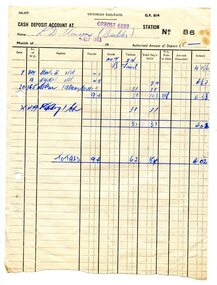
documents, 29.5.1963 - September 1963
... rail freight. Two are cash deposit accounts to Lindsay Thomson from Victorian Railways. There is correspondence and receipts referring to the rail freight. Both typed...railway line and therefore reflects the role that the rail line played in the social and economic history of Orbost. Thomson-Lindsay railway-freight accounts 2609.1 on back handwritten in pen "L D Thom(p)son Seven documents relating rail freight. Two are cash deposit accounts to Lindsay Thomson from Victorian Railways. There is correspondence and receipts referring to the rail freight. Both typed ...These documents were written and prepared for Lindsay Thomson, Scott Street, Orbost. The correspondence is for costing of freight delivered for use by Lindsay as a builder.These documents are associated with the history of the Orbost-Bairnsdale railway line and therefore reflects the role that the rail line played in the social and economic history of Orbost.Seven documents relating rail freight. Two are cash deposit accounts to Lindsay Thomson from Victorian Railways. There is correspondence and receipts referring to the rail freight. Both typed and hand-written information.2609.1 on back handwritten in pen "L D Thom(p)sonthomson-lindsay railway-freight accounts -
 Ringwood and District Historical Society
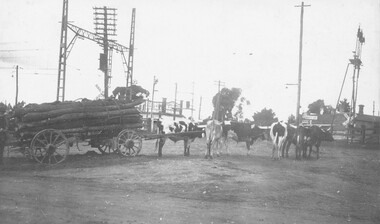
Photograph, Paul Burns' bullock team at Pitt Street/Bedford Road railway crossing, 1924
... railway crossing, 1924". Paul Burns' bullock team. Typed below one photograph: "Bullock team at old railway crossing near station, taken from Maroondah Highway. Circa 1925." Written on back of other photograph: "Rail...railway crossing, 1924". Paul Burns' bullock team. Typed below one photograph: "Bullock team at old railway crossing near station, taken from Maroondah Highway. Circa 1925." Written on back of other photograph: "Rail ...Black and white photograph. Blood Brothers store in background. +Additional Keywords: Burns, Paul / Burns, Ron / Burns, LilianWritten on back of photograph, "Bedford Road railway crossing, 1924". Paul Burns' bullock team. Typed below one photograph: "Bullock team at old railway crossing near station, taken from Maroondah Highway. Circa 1925." Written on back of other photograph: "Rail crossing 1924. Team owned by Hussey. Opposite Adelaide Street and Ringwood House. Corner of Station Street and Greenwood Avenue on right." (Note: "Hussey" ownership is dubious) -
 Orbost & District Historical Society
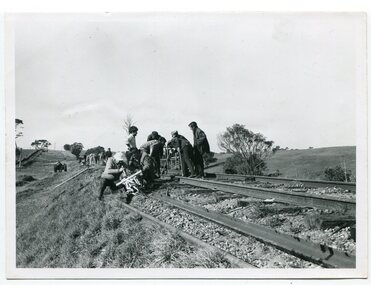
black and white photograph, mid - second half 20th century
... rail tracks on the Bairnsdale - Orbost line were working in the Bruthen area. In this photograph the men had just finished work near the Nicholson River Bridge. This photograph is associated with the Easy Gippsland Railway. East-Gippsland-Railway Nicholson-railway railway-construction on back - typed ...This photograph was taken near the Nicholson River Bridge. The gang re-laying the rail tracks on the Bairnsdale - Orbost line were working in the Bruthen area. In this photograph the men had just finished work near the Nicholson River Bridge.This photograph is associated with the Easy Gippsland Railway.A black / white photograph of a group of men working on a railway line. There is another group behind them.on back - typed information as beloweast-gippsland-railway nicholson-railway railway-construction -
 Bendigo Historical Society Inc.
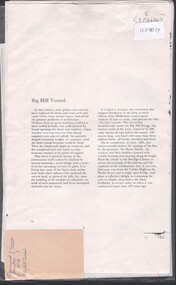
Document - Edith Perry Collection: Big Hill Tunnel, 1858-1862
... Edith Perry Collection: History in the development of the Big Hill Tunnel Two typed extracts of articles regarding the history, construction and development of the Big Hill Tunnel, which resulted from the inclusion of Castlemaine on the alignment of the Echuca/Bendigo/Melbourne railway line. Handwritten pages and a hand drawn map of the rail...Echuca/Bendigo/Castlemaine/Melbourne rail connection Big Hill Rail Tunnel Edith Perry Collection: History in the development of the Big Hill Tunnel Two typed extracts of articles regarding the history, construction and development of the Big Hill Tunnel, which resulted from the inclusion of Castlemaine on the alignment of the Echuca/Bendigo/Melbourne railway line. ...Edith Perry Collection: History in the development of the Big Hill Tunnel Two typed extracts of articles regarding the history, construction and development of the Big Hill Tunnel, which resulted from the inclusion of Castlemaine on the alignment of the Echuca/Bendigo/Melbourne railway line. Handwritten pages and a hand drawn map of the rail line connection between Ravenswood Estate and Crusoe Reservoirechuca/bendigo/castlemaine/melbourne rail connection, big hill rail tunnel -
 Port of Echuca
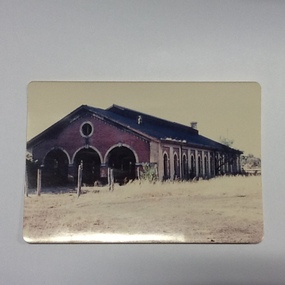
Colour photograph, 1977
... railway had a significant impact on Echuca and the transportation of produce, people and goods between Melbourne and the Riverina. The extension of the rail line from Bendigo began in 1862 and the final rail was laid in 1864. The Echuca line went into service immediately. The trains average speed was 20-25miles/hour double the pace of the Cobb & Co coaches. The locomotive shed housed and repaired the steam trains and carriages. locomotive shed, echuca railways, echuca echuca -transport On reverse printed: Dec 77-M: Print made by Kodak : Kodak P000157.1 in pencil Old Loco Shed P000157.1.2 typed ...The old Loco shed was built in 1864, as part of Echuca's rail extension, to service both passengers and goods but mainly wool, from the Riverina to Melbourne.The coming of the railway had a significant impact on Echuca and the transportation of produce, people and goods between Melbourne and the Riverina. The extension of the rail line from Bendigo began in 1862 and the final rail was laid in 1864. The Echuca line went into service immediately. The trains average speed was 20-25miles/hour double the pace of the Cobb & Co coaches. The locomotive shed housed and repaired the steam trains and carriages.Colour photograph X 2, of the old locomotive shed, showing the 3 front arches and side arches of one side wall. This photo was taken in 1977 showing the shed open but unused and surrounded by dried grass. P000157.1 & P000157.2On reverse printed: Dec 77-M: Print made by Kodak : Kodak P000157.1 in pencil Old Loco Shed P000157.1.2 typed sticker Old Loco Shed, Echuca. 1864locomotive shed, echuca, railways, echuca, echuca -transport -
 Port of Echuca
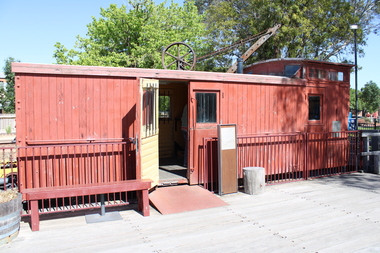
Functional object - Brake Van (Guards Van), 1914
... type of brake van used by Victorian Railways over a very long period. Brake vans would not have been a common sight at the Wharf as the line to the Wharf was operated as a siding from Echuca Station, so a brake van was not required. It is possible that a shunter walked ahead of the train to and from the wharf. This vehicle is significant. However a large number survive in operable condition around Victoria. Wharf Shire of Campaspe Newport Workshop Brake Van Grimmond & Party Butty Gang Guards Van Rollingstock Collection Steam trains Standard Vic Rail ...Standard Victorian Railways Brake Van (Guards Van) originally Z 448 built at Newport Workshops & body built by Grimmond & Party butty gang. Entered traffic on 23rd March 1914. Altered to ZL448 incorporating long travel draft gear, 28th November 1961. Off Register on 10th August 1982 & sold to Echuca City Council 3rd September 1982 This is an example of the most numerous type of brake van used by Victorian Railways over a very long period. Brake vans would not have been a common sight at the Wharf as the line to the Wharf was operated as a siding from Echuca Station, so a brake van was not required. It is possible that a shunter walked ahead of the train to and from the wharf. This vehicle is significant. However a large number survive in operable condition around Victoria. Standard Vic Rail Brake (Guards) Van. wharf, shire of campaspe, newport workshop, brake van, grimmond & party butty gang, guards van, rollingstock collection, steam trains -
 Ballarat Tramway Museum
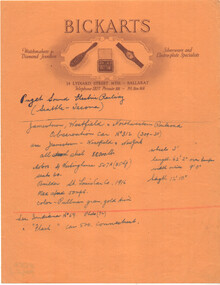
Document - Notes on USA streetcar (tram) systems, Wal Jack, c1950
... This set of notes has information on the Puget Sound Electric Railway (Seattle to Tacoma), cars of the Jamestown, Westfield and North western Railroad. closure of the Lancaster Ohio streetcar (tram) system, the McKeen Motor car company and Central Electric Rail fan's Association. (CERA) who published a detailed magazine. Bickarts were Ballarat Watchmakers and Jewellers. Yields information about type ...Wal Jack kept extensive notes on railways and tramways around the world, provided by his correspondents and research. This set of notes has information on the Puget Sound Electric Railway (Seattle to Tacoma), cars of the Jamestown, Westfield and North western Railroad. closure of the Lancaster Ohio streetcar (tram) system, the McKeen Motor car company and Central Electric Rail fan's Association. (CERA) who published a detailed magazine. Bickarts were Ballarat Watchmakers and Jewellers.Yields information about type of work undertaken by Wal Jack.Two orange coloured sheets - Bickarts of Ballarat letterhead - recording details of USA Streetcar systems.letters, wal jack, archive, usa, mckeen, cera, records, bickarts -
 Ballarat Tramway Museum
Letter - between Mr Strickland of MMTB & Mr Pringle ESCo, Electric Supply Co. of Vic (ESCo), 1928
... Rail grinder of Birmingham, wheel profiles, with reference to a report in the Electric Railway & Tramway Journal, flat or coned treads, and wheel and rail wear. Yields information about discussions between MMTB and ESCo re wheels and shows the method of communications in mid 1928. tramways Ballarat reports tramcars ESCo MMTB wheels rails grinding Set of 8 typed letters - carbon copies or originals on quarto paper. ...Set of 8 letters, between Mr Strickland Chief Engineer MMTB and Mr P J Pringle of ESCo Ballarat re meeting with each other, regarding grinding of rails, Berlin drum brakes, rail corrugations, wheel flanges, the Pontelac Tramway Rail grinder of Birmingham, wheel profiles, with reference to a report in the Electric Railway & Tramway Journal, flat or coned treads, and wheel and rail wear.Yields information about discussions between MMTB and ESCo re wheels and shows the method of communications in mid 1928.Set of 8 typed letters - carbon copies or originals on quarto paper.tramways, ballarat, reports, tramcars, esco, mmtb, wheels, rails, grinding -
 Ballarat Tramway Museum
Letter - Woods Gilbert Rail Planing Machine, Woods Gilbert, 1917
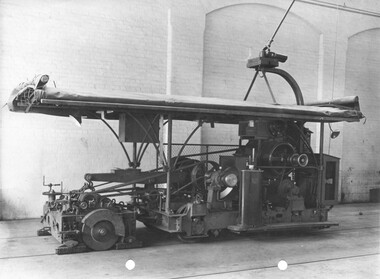
... Set of documents Edgar Allen & Co of Sheffield promoting and providing information about the Woods Gilbet Rail Planing machine. 1 - letter dated June 1917, sent from the South Australian Hotel in Adelaide to Mr Pringle, of ESCo from the travelling representative of the company, a letter on Edgar Allen & Co letterhead with a list of various articles on the machine, and a letter from Woods Gilbert of their Melbourne office, dated Jan. 1917 2 - A 30 page printed booklet contained within a green cover titled "Rail Planing Machines" with Mr Pringle's name written on it in the top right-hand corner. 3 - Photograph of the rail planing machine with "1916 type rail grinding machine" on rear in pencil along with the Company stamp. 4 - Drawing of the Milling Trolley prepared by Atlas Co of Engineers Melbourne 5 - drawing - Cardiff-rail-section Woods-Gilbert 6 - photograph - Woods-Gilbert Recording instrument on a postcard by Kodak Magazine extracts: 7 - Woods-Gilbert Tramway and Railway World-12 Oct 1916 - page 1 of 2 8 - Woods-Gilbert Tramway and Railway World 12 Oct 1916 - page 2 of 2 9 - Woods-Gilbert Tramway and Railway World Nov 1916 - page 1 of 2 10 - Woods-Gilbert Tramway and Railway World Nov 1916 - page 1 of 2 11 - Woods-Gilbert Tramway and Railway World - 12 Apr 1917 page 1 of 2 12 - WoodsGilbert Tramway and Railway World - 12 Apr 1917 page 2 of 2...Set of documents Edgar Allen & Co of Sheffield promoting and providing information about the Woods Gilbet Rail Planing machine. 1 - letter dated June 1917, sent from the South Australian Hotel in Adelaide to Mr Pringle, of ESCo from the travelling representative of the company, a letter on Edgar Allen & Co letterhead with a list of various articles on the machine, and a letter from Woods Gilbert of their Melbourne office, dated Jan. 1917 2 - A 30 page printed booklet contained within a green cover titled "Rail Planing Machines" with Mr Pringle's name written on it in the top right-hand corner. 3 - Photograph of the rail planing machine with "1916 type rail grinding machine" on rear in pencil along with the Company stamp. 4 - Drawing of the Milling Trolley prepared by Atlas Co of Engineers Melbourne 5 - drawing - Cardiff-rail-section Woods-Gilbert 6 - photograph - Woods-Gilbert Recording instrument on a postcard by Kodak Magazine extracts: 7 - Woods-Gilbert Tramway and Railway World-12 Oct 1916 - page 1 of 2 8 - Woods-Gilbert Tramway and Railway World 12 Oct 1916 - page 2 of 2 9 - Woods-Gilbert Tramway and Railway World Nov 1916 - page 1 of 2 10 - Woods-Gilbert Tramway and Railway World Nov 1916 - page 1 of 2 11 - Woods-Gilbert Tramway and Railway World - 12 Apr 1917 page 1 of 2 12 - WoodsGilbert Tramway and Railway World - 12 Apr 1917 page 2 of 2 Yields information about the Woods Gilbert Rail planing machines for repair of rails and removal of corrugations. tramways trams ESCo rail planing woods - Gilbert track rails tramway rails Maintenance Equipment Set of 12 documents with letters, pamphlet, photo, drawing and magazine cuttings. ...Set of documents Edgar Allen & Co of Sheffield promoting and providing information about the Woods Gilbet Rail Planing machine. 1 - letter dated June 1917, sent from the South Australian Hotel in Adelaide to Mr Pringle, of ESCo from the travelling representative of the company, a letter on Edgar Allen & Co letterhead with a list of various articles on the machine, and a letter from Woods Gilbert of their Melbourne office, dated Jan. 1917 2 - A 30 page printed booklet contained within a green cover titled "Rail Planing Machines" with Mr Pringle's name written on it in the top right-hand corner. 3 - Photograph of the rail planing machine with "1916 type rail grinding machine" on rear in pencil along with the Company stamp. 4 - Drawing of the Milling Trolley prepared by Atlas Co of Engineers Melbourne 5 - drawing - Cardiff-rail-section Woods-Gilbert 6 - photograph - Woods-Gilbert Recording instrument on a postcard by Kodak Magazine extracts: 7 - Woods-Gilbert Tramway and Railway World-12 Oct 1916 - page 1 of 2 8 - Woods-Gilbert Tramway and Railway World 12 Oct 1916 - page 2 of 2 9 - Woods-Gilbert Tramway and Railway World Nov 1916 - page 1 of 2 10 - Woods-Gilbert Tramway and Railway World Nov 1916 - page 1 of 2 11 - Woods-Gilbert Tramway and Railway World - 12 Apr 1917 page 1 of 2 12 - WoodsGilbert Tramway and Railway World - 12 Apr 1917 page 2 of 2Yields information about the Woods Gilbert Rail planing machines for repair of rails and removal of corrugations.Set of 12 documents with letters, pamphlet, photo, drawing and magazine cuttings.tramways, trams, esco, rail planing, woods - gilbert, track, rails, tramway rails, maintenance equipment -
 Ballarat Tramway Museum
Document - Report, Ministry of Transport, "Ministry of Transport Authority Annual Reports 1982/83", 1983
... 84 page, printed report on white art paper - titled "Ministry of Transport Authority Annual Reports 1982/83" for the: Victorian Railways Board Melbourne and Metropolitan Tramways Board Country Roads Board Transport Regulation Board Road Safety and Traffic Authority Railway Construction and Property Board Melbourne Underground Rail Loop Authority This document represented the final report of the listed authorities who were abolished on 30/6/1983 and replaced by the Metropolitan Transit Authority, State Transport Authority, the Road Traffic Authority and the Road Construction Authority. Signed by the Minister S.M. Crabb. Has on the inside cover, a stapled With Compliments slip with the name of Race Mathews MP typed...Trams tramways MMTB VR Annual Reports On front cover in pencil, "142 4 Sept 84' 84 page, printed report on white art paper - titled "Ministry of Transport Authority Annual Reports 1982/83" for the: Victorian Railways Board Melbourne and Metropolitan Tramways Board Country Roads Board Transport Regulation Board Road Safety and Traffic Authority Railway Construction and Property Board Melbourne Underground Rail Loop Authority This document represented the final report of the listed authorities who were abolished on 30/6/1983 and replaced by the Metropolitan Transit Authority, State Transport Authority, the Road Traffic Authority and the Road Construction Authority. Signed by the Minister S.M. Crabb. Has on the inside cover, a stapled With Compliments slip with the name of Race Mathews MP typed ...84 page, printed report on white art paper - titled "Ministry of Transport Authority Annual Reports 1982/83" for the: Victorian Railways Board Melbourne and Metropolitan Tramways Board Country Roads Board Transport Regulation Board Road Safety and Traffic Authority Railway Construction and Property Board Melbourne Underground Rail Loop Authority This document represented the final report of the listed authorities who were abolished on 30/6/1983 and replaced by the Metropolitan Transit Authority, State Transport Authority, the Road Traffic Authority and the Road Construction Authority. Signed by the Minister S.M. Crabb. Has on the inside cover, a stapled With Compliments slip with the name of Race Mathews MP typed in.On front cover in pencil, "142 4 Sept 84'trams, tramways, mmtb, vr, annual reports -
 Ballarat Tramway Museum
Slide - 35mm slide/s, Robert Thomson, 27/03/1964 12:00:00 AM
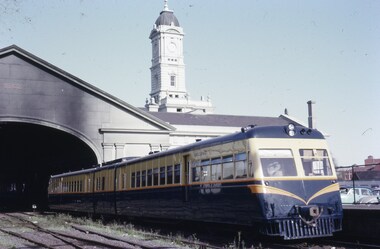
... Yields information about the type of rail motor or rail car that served Ballarat's railway stations. ...Yields information about the type of rail motor or rail car that served Ballarat's railway stations.Ilford Ilfochrome cardboard mount, colour slide of 280HP Rail motor at the Ballarat Railway Station, taken from the level crossing. Has the clock tower in the background, but no clock."Rail Motor, Ballarat Station - 37- 27/3/1964" in ink.tramways, trams, lydiard st north, railway station, railcar, ballarat station -
 Ballarat Tramway Museum
Document - Letter/s, Dave Macartney, 24/05/1980 12:00:00 AM
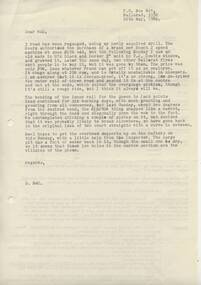
... Letter from Dave Macartney to Warren Doubleday, typed on the rear of an Association of Railway Enthusiasts foolscap size train tour booking form for the Albury to Culcairn tour for 20/5/1967. Letter dated 20 May 1980 updates Warren on progress of bending rail, track repairs, purchase of a new Second hand drill and building work....Trams tramways BTPS Trackwork Museum Letter from Dave Macartney to Warren Doubleday, typed on the rear of an Association of Railway Enthusiasts foolscap size train tour booking form for the Albury to Culcairn tour for 20/5/1967. Letter dated 20 May 1980 updates Warren on progress of bending rail, track repairs, purchase of a new Second hand drill and building work. ...Yields information about the construction of trackwork and other Museum infrastructure during 1980.Letter from Dave Macartney to Warren Doubleday, typed on the rear of an Association of Railway Enthusiasts foolscap size train tour booking form for the Albury to Culcairn tour for 20/5/1967. Letter dated 20 May 1980 updates Warren on progress of bending rail, track repairs, purchase of a new Second hand drill and building work.trams, tramways, btps, trackwork, museum -
 Sunshine and District Historical Society Incorporated
Archive - Sunshine Railway Disaster
... Railway Construction.|Typed Tender for Railway Works Report of the Professional Board appointed to examine and compare the tenders submitted for the Proposed Raiilway Works|Handwritten notes Melbourne to St Albans construction|Continuous paper Report Staff at Sunshine Railway Station Historical|Photograph of Mural at Tin Shed St Albans taken by thomastowns leading photographer Hans Jobe Roysted 20 April 2000|Typed Report Taken from the Secretary for Railways Correspondence Books Series 422|Typed Report Sunshine Rail Disaster Unveiling of the Plaque Sunshine Station 15 November 1998 10:00am|Typed Report Press Release by Tom Rigg 20 April Sunshine Historical Society placed a Wreath on the plaque on the Melbourne side of the Sunshine Railway Platform. ...Railway Construction.|Typed Tender for Railway Works Report of the Professional Board appointed to examine and compare the tenders submitted for the Proposed Raiilway Works|Handwritten notes Melbourne to St Albans construction|Continuous paper Report Staff at Sunshine Railway Station Historical|Photograph of Mural at Tin Shed St Albans taken by thomastowns leading photographer Hans Jobe Roysted 20 April 2000|Typed Report Taken from the Secretary for Railways Correspondence Books Series 422|Typed Report Sunshine Rail Disaster Unveiling of the Plaque Sunshine Station 15 November 1998 10:00am|Typed Report Press Release by Tom Rigg 20 April Sunshine Historical Society placed a Wreath on the plaque on the Melbourne side of the Sunshine Railway Platform. ...Typed Report on the Sunshine Station Smash Inquest began 4 May 1908|Typed Report The Sunshine Station Smash Easter Monday 20th April 1908|Typed Report Sunshine Railway Station Part 3 Railway Disaster by Tom Rigg|Typed Report Sunshine Railway Disaster by Tom Rigg|Typed Report Sunshine Railway Disaster 20th April 1908 Some Highlights|Typed Report The Sunshine Station Smash|Typed Report Names of People killed in the Sunshine Accident Easter Monday 20th April 1908|Photocopy of An Act to authorize the construction of certain lines of Railway by the State 29 December 1880. Fifteenth Schedule Footscray to Bacchus Marsh Railway Construction.|Typed Tender for Railway Works Report of the Professional Board appointed to examine and compare the tenders submitted for the Proposed Raiilway Works|Handwritten notes Melbourne to St Albans construction|Continuous paper Report Staff at Sunshine Railway Station Historical|Photograph of Mural at Tin Shed St Albans taken by thomastowns leading photographer Hans Jobe Roysted 20 April 2000|Typed Report Taken from the Secretary for Railways Correspondence Books Series 422|Typed Report Sunshine Rail Disaster Unveiling of the Plaque Sunshine Station 15 November 1998 10:00am|Typed Report Press Release by Tom Rigg 20 April Sunshine Historical Society placed a Wreath on the plaque on the Melbourne side of the Sunshine Railway Platform. It is now 95 years since the accident.|Typed Timetable Victorian Railways December 1865|Typed Booklet The Sunshine Railway Disaster by John Buckland Easter Monday 20 April 1908|Newspaper Article Move on disaser Advocate 27 March 2001|Typed Poem In Memory of the Sunshine Railwa Disaster composed and written by Patrick Hassett|Newspaper Article The Age 21 April 1908 Terrible Railway Disaster|Newsletter Newsrail June 1998 Sunshine Station Disaster Memorial|Newspaper Article Brimbank Messenger 8 September 1998 Technology signaling new rail era|Brochure St Albans to Sydenham Rail Electrification Project Bulletin 3 December 2001|Map Railway Map of Victoria 1908|Newspaper Article Brimbank Independent 10 November 1998 Memorial to mark rail crash disaster|Newspaper Article Brimbank Messenger 21 April 1998 Horror Smash recalled|Newspaper Article The Advocate 18 November 1998 Moving tribute|Newspaper Article The Advocate 20 March 2001 Crash tragedy haunts station|Typed Report Sunshine Rail Disaster 20 April 1908 List of Person killed and injured. Addresses included. Research by Jan Withers 1990|Typed Report Sunshine Rail Disaster Commemoration Service Monday 10:30pm 20 April 1998 90th Anniversary program Compiled by Tom Rigg|Typed Report of Names of People Killed in the Sunshine Accident Easter Monday 20 April 1908 and where they are buried|Photocopy Death certicates of the 44 people killed in the Sunshine Rail Disaster on Easter Monday 20 April 1908|Artwork of Newspaper Article Terrible Railway disaster|Flyer Official unveiling of a plaque laid in memory of 44 people who died in the Sunshine Rail Disaster Easter Monday 20 April 1908 occurring Suunday 15 November 1998|Photocopy of Report of Coroners Inquest 18 May 1908|Book The Sunshine Railway Disastersunshine railway disaster, sunshine railway station, railway, sunshine -
 Sunshine and District Historical Society Incorporated
Archive - Bridges - Local Railway Bridges
... Web Search of Victorian Heritage Database Rail Bridge Albion Viaduct Victorian Heritage Register VHR H1197 Statement of Significance 27 December 2013|Extract The Railways of Victoria 1854 to 2004 Robert Lee The maribyrnong viaduct on the independent goods line from Broadmeadows to Spencer Street uder construction in the late 1920s.|Web Search of Maribyrnong River Viaduct Wikipedia 26 December 2013|Typed...Bridge Web Search of Victorian Heritage Database Rail Bridge Albion Viaduct Victorian Heritage Register VHR H1197 Statement of Significance 27 December 2013|Extract The Railways of Victoria 1854 to 2004 Robert Lee The maribyrnong viaduct on the independent goods line from Broadmeadows to Spencer Street uder construction in the late 1920s.|Web Search of Maribyrnong River Viaduct Wikipedia 26 December 2013|Typed ...Web Search of Victorian Heritage Database Rail Bridge Albion Viaduct Victorian Heritage Register VHR H1197 Statement of Significance 27 December 2013|Extract The Railways of Victoria 1854 to 2004 Robert Lee The maribyrnong viaduct on the independent goods line from Broadmeadows to Spencer Street uder construction in the late 1920s.|Web Search of Maribyrnong River Viaduct Wikipedia 26 December 2013|Typed Report Victorian Heritage Database Report Rail Bridge Albion Viaduct|Web Search Vcitorian Railways Museum Victoria Construction of Maribyrnong River Viaduct 1928 Keilor East 27 December 2013|Web Search Rail Bridge Albion Viaduct Heritage Listed Location 26 December 2013|Web Search Brimbank City Council Post contact Cultural Heritage Study HO005 Quartermile Railway Trestle Bridge Location Sterling Drive Keilor East|Newspaper Article West Footscray Overpass opens|Extract The Victorian Railways Magazine September 1927 Bridge Building in Excelsis|Extract Construction of a new road overpass carrying Melbourne Road across the Williamstown railway line is well advanced. July 1975 $1.6M overpass Blackshaws Road|Brochure Linking the past preserving Victorias railway heritage|Extract The Victorian Railways Magazine August 1928|Typed Note West Gate Bridge information sheet No 3 Bridge statistics|Extract Newsrail July 2004 Between Two Bridges|Typed Report History behind the Project|Museum Catolgue Worksheet Photos of Trains on Bridgesbridge -
 Puffing Billy Railway
Double Headed Rail, circa 1872 - 1883
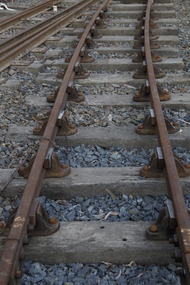
... rail with chairs on this railway compare with one surviving similar remnant on the Geelong to Ballarat railway and are representative of permanent way construction techniques applied exclusively to the two trunk railways of the 1860's. In this respect they are rare survivors and may be unique at the national level and of technical importance at the international level to the extent that they enhance contemporary understanding of early railway building technology. Surviving lengths of chaired double head rail survive at Kyneton, Ravenswood and Bendigo on this railway and include a number of different types...rail with chairs on this railway compare with one surviving similar remnant on the Geelong to Ballarat railway and are representative of permanent way construction techniques applied exclusively to the two trunk railways of the 1860's. In this respect they are rare survivors and may be unique at the national level and of technical importance at the international level to the extent that they enhance contemporary understanding of early railway building technology. Surviving lengths of chaired double head rail survive at Kyneton, Ravenswood and Bendigo on this railway and include a number of different types ...Double Headed Rail from Ravenswood Station Siding which was dismantled circa 1987 the two rails were stored for a time at Maldon before being donated to Puffing Billy Museum Bearing makers marks of Wilson & Cammell - Dronfield- Steel works Wilson & Cammell made Steel rails at their Dronfield Steel Works, in Dronfield, North East Derbyshire, England from 1872 - 1883 Double-headed rail In late 1830s Britain, railway lines had a vast range of different patterns. One of the earliest lines to use double-headed rail was the London and Birmingham Railway, which had offered a prize for the best design. This rail was supported by chairs and the head and foot of the rail had the same profile. The supposed advantage was that, when the head became worn, the rail could be turned over and re-used. In practice, this form of recycling was not very successful as the chair caused dents in the lower surface, and double-headed rail evolved into bullhead rail in which the head was more substantial than the foot. Info from Wikipedia - Rail Profile https://en.wikipedia.org/wiki/Rail_profile The first records of double headed rail being used In Victoria by Victorian Railways was in 1859, the rails, chairs, oak and trenails were imported from UK. After the 1870’s the Victorian Railways went over to using flat bottom rails, but they still needed replacement double headed rail for lines already laid and this continued up to at least 1883 Wilson & Cammell - Dronfield- Steel works Wilson & Cammell made Steel rails at their Dronfield Steel Works, in Dronfield England from 1872 - 1883 Mount Alexander & Murray River Railway The Melbourne, Mount Alexander & Murray River Railway Company received parliamentary assent in February 1853 to build Victoria's first inland railway from Melbourne to Williamstown, and Melbourne to Bendigo and Echuca. Construction commenced in January 1854 with work on a pier at Williamstown but lack of funds slowed progress, eventually prompting the company to sell out to the government. The 100-mile (162 km) section to Bendigo opened in October 1862. Its cost of £35,000 per mile made it the most expensive railway ever built in Australia. In 1864, the line was extended to Echuca, tapping into the booming Murray-Darling paddlesteamer trade. info from Museums Victoria - Victorian Railways https://museumsvictoria.com.au/railways/theme.aspx?lvl=3&IRN=450&gall=456 1863 Ravenswood Station open on the 1st Feb 1863 Victorian Railways - purchased and imported the Rail and Chairs from Raleigh, Dalgleish, White and Co. London Importation of railway plant : abstract of a return to an order of the Legislative Assembly dated 27th June 1860 for - Copies of the advertisements calling for tenders, the names of the tenderers and the accounts and correspondence with Mr Brunel relating thereto GP V 1859/60 no. C 15 http://www.parliament.vic.gov.au/papers/govpub/VPARL1859-60NoC15.pdf Report from the Select Committee upon the Importation of Railway Plant : together with proceedings of the Committee, minutes of evidence and appendix GP V 1859/60 no. D 38 (2.9 MB) http://www.parliament.vic.gov.au/papers/govpub/VPARL1859-60NoD38.pdf Ravenswood Siding When the Victorian Railways were established in 1856 they adopted one of the popular British permanent way standards - heavy 80lb (36.3kg) double-headed rail held up right in cast iron chairs attached to transverse timber sleepers by wooden pegs called trenails. The Ravenswood Railway siding was constructed in 1862 with 12 feet wrought iron double-head rail held in cast iron chairs with Ransom and May patent compressed keys. Trenails held the chairs to the sleepers and the joints were secured in joint chairs. Joints were subsequently joined using fish plates. It formed part of the Melbourne to Echuca rail line, initially known as the Melbourne, Mt Alexander and Murray River Railway. George Christian Derbyshire, the first Engineer-in-Chair of the Victorian Railways was responsible for the design and construction of the works. No new lines were built in Victoria using double-headed rail after 1870. The siding was disconnected from the main line in 1988. The Ravenswood Railway Siding demonstrates the original 1856 philosophy of the Victorian Railways to adopt British permanent way technology. The siding demonstrates significant aspects in the development of permanent way technology in England and Victoria over the period from the 1830's to the 1880's. The chairs in the Ravenswood siding are physical evidence of early railway technology rendered obsolete 120 years ago, namely joint chairs at rail joints and trenails to secure the chairs to the sleepers. The double-headed rail demonstrates an important stage in the evolution of British rail technology in the 1830s. The old fish plates, square headed bolts and square nuts demonstrate the success of fishing the rail joins. The Ravenswood siding demonstrates the earliest form of rail joint technology developed in England, and existing in Australia, the joint chair. In part of the siding the sequence of joint and intermediate chairs is consistent with the 1856 specifications, that sequence is rare with the joints secured in joint chairs. The survival of chairs in this sequence is rare and almost certainly demonstrates that they remained in continuous use at the same location from 1862 to 1988. This remnant of the Ravenswood siding has survived 126 years. The siding has proved to be the most significant of extant remnant double-headed sidings in Victoria, containing a rare combination of early permanent way technologies. Construction dates 1862, Info from Ravenswood Railway Siding Victorian Heritage Database Report http://vhd.heritagecouncil.vic.gov.au/places/4693/download-report The remaining section of this siding is significant at the State and National levels in that it demonstrates the use of chaired rail by the Victorian Railways Department for the Trunk Lines and, more particularly, the following stages in the evolution of this long obsolete method of permanent way construction: a) The use of joint chairs and intermediate chairs at regular intervals inferring that the original wrought iron rail lengths were 12 feet, as is known through documentary sources to have been the case. The survival of chairs in this sequence is unique and almost certainly demonstrates that they have remained in continuous use at the same location and in the same sequence from 1862 to 1988 . b) The use of joint chairs and intermediate chairs designed for use with trenails. c) The use of later intermediate chairs designed for use with steel pins and the use of fished joints with steel double head chaired rail, representing a second method of constructing the permanent way using chaired rail technology. info from Ravenswood Siding - Melbourne/Echuca Railway Line - Victorian Heritage Database Report http://vhd.heritagecouncil.vic.gov.au/places/70103/download-report Addition to Citation for Melbourne to EchucaRailway Line 1/10/1990 Double Head Rail The surviving lengths of double head rail with chairs on this railway compare with one surviving similar remnant on the Geelong to Ballarat railway and are representative of permanent way construction techniques applied exclusively to the two trunk railways of the 1860's. In this respect they are rare survivors and may be unique at the national level and of technical importance at the international level to the extent that they enhance contemporary understanding of early railway building technology. Surviving lengths of chaired double head rail survive at Kyneton, Ravenswood and Bendigo on this railway and include a number of different types of cast iron intermediate and joint chairs with hardwood keys and metal pins. The Ravenswood siding is of special significance for the diversity of chair types and for the sequence of chairs recalling rail lengths known to be associated with construction of the line in 1862. Construction of the Railway Tenders closed on 24 March 1858 with no less than 133 tenders being received. A contract was let to Cornish and Bruce for £3,356,937 to commence work on 1 June 1858 and complete the line by 31 July 1861. Cornish and Bruce made quick early progress with the Melbourne to Sunbury section being officially opened on 13 January 1859. The line was officially opened to Bendigo (Sandhurst) on 20 October 1862 by the Governor of Victoria, Sir Henry Barkly. A great banquet was held for 800 guests and this was followed by a grand ball. The extension of the line to Echuca was a relatively simple matter as that part of the line was across plain country without any significant engineering challenges. Tenders were called for the work in 1863 and the work was completed in 1864 by contractors Collier and Barry Apart from the line contractors, other firms directly involved were J Shire law and Co (sleepers), R Fulton, Langlands Brothers and Co, William Crossley (water supply), B Moreland, Langlands Brothers and Co (platelayers lorries), E Chambers (iron pins, traversers), Miller and McQuinstan (luggage vans and steam engines) and various contractors for building works. Info from Engineers Australia Engineering Heritage Victoria Nomination for Recognition under the Engineering Heritage Australia Heritage Recognition Program for the Goldfields Railways - Melbourne , Bendigo & Echuca Railway Page 25 - .2.9.2 Statement from National Trust of Australia (Victoria) Listing number B5323 for Mt Alexander/Murray Valley Rail Line: Page 69 - Theme 3 https://www.engineersaustralia.org.au/portal/system/files/engineering-heritage-australia/nomination-title/Melbourne_%20Bendigo_Echuca%20Railway%20Nomination.pdf The Melbourne, Mount Alexander and Murray River Railway Company was a railway company in Victoria, Australia. It was established on 8 February 1853 to build a railway from Melbourne to Echuca on the Victorian-NSW border and a branch railway to Williamstown. The company struggled to make any progress and on 23 May 1856, the colonial Government took over the Company and it became part of the newly established Department of Railways, part of the Board of Land and Works. The Department of Railways became Victorian Railways in 1859. Construction of the Bendigo line commenced in 1858, but this private consortium also met with financial difficulties when it was unable to raise sufficient funds, and was bought out by the Victorian colonial government. The design work was then taken over by Captain Andrew Clarke, R. E., Surveyor-General of Victoria, with bridge designs completed by Bryson and O'Hara The contract for the first stage of the line from Footscray to Sandhurst (now Bendigo), was let to Cornish and Bruce for £3,356,937.2s.2d ($6.714 million) with work commencing on 1 June 1858. Completion of the permanent way was to be by 31 July 1861 https://en.wikipedia.org/wiki/Melbourne,_Mount_Alexander_and_Murray_River_Railway_Company Victorian Railways - purchased and imported the Rail and Chairs from Raleigh, Dalgleish, White and Co. London Importation of railway plant : abstract of a return to an order of the Legislative Assembly dated 27th June 1860 for - Copies of the advertisements calling for tenders, the names of the tenderers and the accounts and correspondence with Mr Brunel relating thereto GP V 1859/60 no. C 15 http://www.parliament.vic.gov.au/papers/govpub/VPARL1859-60NoC15.pdf Report from the Select Committee upon the Importation of Railway Plant : together with proceedings of the Committee, minutes of evidence and appendix GP V 1859/60 no. D 38 (2.9 MB) http://www.parliament.vic.gov.au/papers/govpub/VPARL1859-60NoD38.pdf Victorian Railways : report of the Board of Land and Works November 1862 GP V 1862/63 no. 21 (2.8 MB) https://www.parliament.vic.gov.au/papers/govpub/VPARL1862-63No21.pdfHistoric - Victorian Railways - Double Headed rail Ravenswood Railway Station and Siding Victorian Heritage Database Reports Victorian Heritage Register VHR H1100 Victorian Heritage Register VHR H1786 National Trust VHR H1100 Mount Alexander and Murray River Rail way Line National Trust2 rail lengths of Double Headed Rail made of Iron makers marks : Wilson & Cammell - Dronfield - Steel and 20 joint chairs with metal rail pins Makers mark Wilson & Cammell - Dronfield - Steel (possible date 187? very hard to read ) puffing billy, double headed rail, wilson & cammell - dronfield - steel works, ravenswood station siding, melbourne to echuca rail line, initially known as the melbourne, mt alexander and murray river railway. -
 Puffing Billy Railway
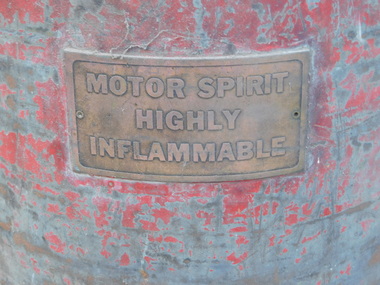
Motor Spirit, Highly Inflamable Transporting Tin Container
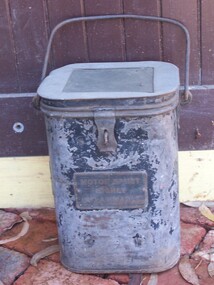
... "K" and the "KS" Kasey Trolleys were two stroke petrol motors Operation, Care and Maintenance of Track Motors Victorian Railways, 1959 http://www.geoffsrailpix.com/Documents/Motors.pdf#zoom=100 gives the following : Inspection motor type B, - straight petrol Inspection motor type V, - pre-mixed petrol Motorised tricycle type M.T., - pre-mixed petrol Gang motor type K.S., - pre-mixed petrol Gang motor type K - pre-mixed petrol Motor cars altered for rail uses (Wiki) Petrol Inspection Car This was a small car numbered '1' and named the Inspection Car. ..."K" and the "KS" Kasey Trolleys were two stroke petrol motors Operation, Care and Maintenance of Track Motors Victorian Railways, 1959 http://www.geoffsrailpix.com/Documents/Motors.pdf#zoom=100 gives the following : Inspection motor type B, - straight petrol Inspection motor type V, - pre-mixed petrol Motorised tricycle type M.T., - pre-mixed petrol Gang motor type K.S., - pre-mixed petrol Gang motor type K - pre-mixed petrol Motor cars altered for rail uses (Wiki) Petrol Inspection Car This was a small car numbered '1' and named the Inspection Car. ...Motor Spirit Highly Inflammable Transporting Tin Container "Motor Spirit" is just another name for petrol. "K" and the "KS" Kasey Trolleys were two stroke petrol motors Operation, Care and Maintenance of Track Motors Victorian Railways, 1959 http://www.geoffsrailpix.com/Documents/Motors.pdf#zoom=100 gives the following : Inspection motor type B, - straight petrol Inspection motor type V, - pre-mixed petrol Motorised tricycle type M.T., - pre-mixed petrol Gang motor type K.S., - pre-mixed petrol Gang motor type K - pre-mixed petrol Motor cars altered for rail uses (Wiki) Petrol Inspection Car This was a small car numbered '1' and named the Inspection Car. It was built in England in 1923, but was not found in the 1936 stocktake. Gang Motor The eight-horsepower Gang Motor held five people, and was built at Arden Street in late 1923. In 1950 the vehicle was removed from the rolling stock register and given to "Way and Works" as a track motor. Motor Car The Motor Car was put into service in mid 1925, after being fitted with rail wheels in lieu of tyres. In 1927 the car was named "Mr Molomby's Inspection Car", and allocated to Seymour. It was scrapped in 1952. Dodge Cars There were seven Dodge cars in rail service. The cars were numbered 1 to 6, with car 7 listed "No 7 Repair". The cars were built by the Dodge Company of Melbourne and assembled at Newport. Construction was in 1925 and they lasted until 1949. Historic - Railways Permanent Way and Works - track equipment - Motor Spirit Highly Inflamable Transporting Tin ContainerMotor Spirit Highly Inflamable Transporting Tin Container made of tin Motor Spirit Highly Inflamable puffing billy, motor spirit transporting container -
 Puffing Billy Railway
Victorian Railways Fuel Can for Trolly
... "K" and the "KS" Kasey Trolleys were two stroke petrol motors Operation, Care and Maintenance of Track Motors Victorian Railways, 1959 http://www.geoffsrailpix.com/Documents/Motors.pdf gives the following : Inspection motor type B, - straight petrol Inspection motor type V, - pre-mixed petrol Motorised tricycle type M.T., - pre-mixed petrol Gang motor type K.S., - pre-mixed petrol Gang motor type K - pre-mixed petrol Motor cars altered for rail uses (Wiki) Petrol Inspection Car This was a small car numbered '1' and named the Inspection Car. ..."K" and the "KS" Kasey Trolleys were two stroke petrol motors Operation, Care and Maintenance of Track Motors Victorian Railways, 1959 http://www.geoffsrailpix.com/Documents/Motors.pdf gives the following : Inspection motor type B, - straight petrol Inspection motor type V, - pre-mixed petrol Motorised tricycle type M.T., - pre-mixed petrol Gang motor type K.S., - pre-mixed petrol Gang motor type K - pre-mixed petrol Motor cars altered for rail uses (Wiki) Petrol Inspection Car This was a small car numbered '1' and named the Inspection Car. ...V.R Fuel Can for Trolley - Victorian Railways Fuel Can for Trolly Motor Spirit Highly Inflammable Transporting Tin Container "Motor Spirit" is just another name for petrol. "K" and the "KS" Kasey Trolleys were two stroke petrol motors Operation, Care and Maintenance of Track Motors Victorian Railways, 1959 http://www.geoffsrailpix.com/Documents/Motors.pdf gives the following : Inspection motor type B, - straight petrol Inspection motor type V, - pre-mixed petrol Motorised tricycle type M.T., - pre-mixed petrol Gang motor type K.S., - pre-mixed petrol Gang motor type K - pre-mixed petrol Motor cars altered for rail uses (Wiki) Petrol Inspection Car This was a small car numbered '1' and named the Inspection Car. It was built in England in 1923, but was not found in the 1936 stocktake. Gang Motor The eight-horsepower Gang Motor held five people, and was built at Arden Street in late 1923. In 1950 the vehicle was removed from the rolling stock register and given to "Way and Works" as a track motor. Motor Car The Motor Car was put into service in mid 1925, after being fitted with rail wheels in lieu of tyres. In 1927 the car was named "Mr Molomby's Inspection Car", and allocated to Seymour. It was scrapped in 1952. Dodge Cars There were seven Dodge cars in rail service. The cars were numbered 1 to 6, with car 7 listed "No 7 Repair". The cars were built by the Dodge Company of Melbourne and assembled at Newport. Construction was in 1925 and they lasted until 1949.Historic - Victorian Railways - Permanent Way and Works - track equipment - V.R Fuel Can for TrolleyV.R Fuel Can for Trolly - Metal Fuel TinMotor Spirit Highly Flammable V.R 8 ?puffing billy, victorian railways, fuel can, trolley, trolly -
 Melbourne Tram Museum
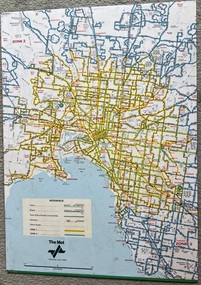
Map, The Met, "Tram and bus Routes showing destination numbers", June 1992
... Shows routes with route numbers, names of main destinations, roads, railway stations and rail lines, rivers, scales and Zones. Does not have the CBD insert. Same size as that of item 1099, a 1972 version. Type...Shows routes with route numbers, names of main destinations, roads, railway stations and rail lines, rivers, scales and Zones. Does not have the CBD insert. Same size as that of item 1099, a 1972 version. Type ...Titled "Tram Routes showing destination numbers". Map dated June 1992 and has been printed with The Met logo. Shows routes with route numbers, names of main destinations, roads, railway stations and rail lines, rivers, scales and Zones. Does not have the CBD insert. Same size as that of item 1099, a 1972 version. Type of map that was placed on the rear of the driver's doors of a W Class tramcar.Demonstrates a The Met produced map used in trramcars.Full colour map or poster printed on paper trimmed from original map and mounted on cardboard.Has some pen marks in the bottom left hand corner.trams, tramways, map, routes, the met -
 Surrey Hills Historical Society Collection
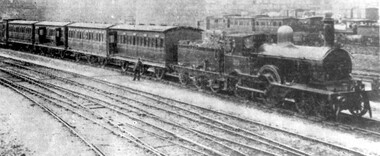
Photograph, The 'Crack Express' 204
... This type of train was used on all the rail lines in 1883 - the date when the railway came through to Surrey Hills. it is thought that the photo was taken in the Spencer Street yards. ...This type of train was used on all the rail lines in 1883 - the date when the railway came through to Surrey Hills. it is thought that the photo was taken in the Spencer Street yards. ...This photo originally appeared in the Canterbury Courier in an article by Dave Staig. This type of train was used on all the rail lines in 1883 - the date when the railway came through to Surrey Hills. it is thought that the photo was taken in the Spencer Street yards. There is a copy of the article in this collection. Black and white photo of a steam train with more than four carriages. It was taken in an unidentified railway yard. railways, canterbury courier, public transport, david staig, crack express, dave staig -
 Melton City Libraries
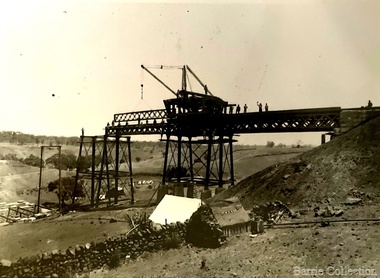
Photograph, Melton Railway Bridge, c.1884
... type double lattice trusses. It has bluestone abutments and pier bases of coursed rock-faced bluestone with drafted margins. The larger half-piers, now usually submerged in the Melton Reservoir have sharp tapered cutwaters and curved coping at the tops. While designed to carry two rail tracks it has only ever been used as a single track line. Despite several alterations to its deck structure, it remains an outstanding example of a lighter structural design employing open metal trestle supports and metal truss girders. The direct Melbourne to Ballarat railway...type double lattice trusses. It has bluestone abutments and pier bases of coursed rock-faced bluestone with drafted margins. The larger half-piers, now usually submerged in the Melton Reservoir have sharp tapered cutwaters and curved coping at the tops. While designed to carry two rail tracks it has only ever been used as a single track line. Despite several alterations to its deck structure, it remains an outstanding example of a lighter structural design employing open metal trestle supports and metal truss girders. The direct Melbourne to Ballarat railway ..."The Melton Viaduct, opened in 1886, is of State heritage significance as a very large and visually distinctive wrought iron, lattice girder trestle bridge over the Werribee River (now Melton Reservoir). It comprises 18.3 and 9.1 metre spans, in a generally alternate arrangement, of total length 375 metres, and standing 38 metres over the Werribee River. Wrought iron small section iron was used to build tension trussed trestle legs, which supported four lines of rivetted wrought-iron deck-type double lattice trusses. It has bluestone abutments and pier bases of coursed rock-faced bluestone with drafted margins. The larger half-piers, now usually submerged in the Melton Reservoir have sharp tapered cutwaters and curved coping at the tops. While designed to carry two rail tracks it has only ever been used as a single track line. Despite several alterations to its deck structure, it remains an outstanding example of a lighter structural design employing open metal trestle supports and metal truss girders. The direct Melbourne to Ballarat railway link of which the Melton viaduct was the major engineering work contributed significantly to the history and development of Victoria. This new link reflected Ballarat’s diversifying economy as well as the commercial and political influence of the metropolis. Construction of the bridge, and the associated large workers camp, were extensively photographed, documenting an important episode in local history. The railway enabled the development of new industries in the Melton area, notably the timber industry and a chaff industry of national importance, greatly facilitated the later transition of the Shire from a pastoral to a farming economy, and struck a major blow to Melton township’s era as a wayside town servicing Ballarat road (especially coach) traffic". Melton Railway Bridge being built across the Werribee Rivertransport -
 Sunbury Family History and Heritage Society Inc.
Photograph
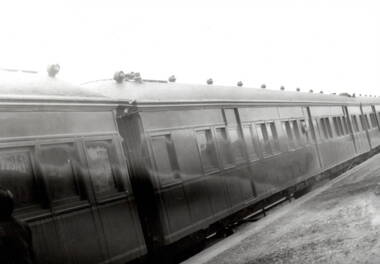
... type of red carriages that steam trains pulled on many regional rail tracks throughout Victoria. There were times also when the diesel engines pulled these carriages before the modern V Line trains were used to transport people to the regional areas. Railways ...The train pulled into Sunbury Station were the type of red carriages that steam trains pulled on many regional rail tracks throughout Victoria. There were times also when the diesel engines pulled these carriages before the modern V Line trains were used to transport people to the regional areas. A non-digital black and white photograph of 7 visible old train carriages pulled into a railway platform. railways, train carriages, sunbury station -
 Parks Victoria - Gabo Island Lightstation
Nails
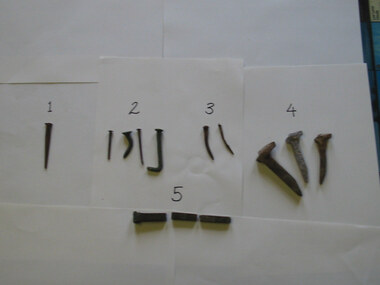
... The five types of nails include a stamped steel nail made for wooden flooring; four copper nails used for boat building found at various locations on the island; two steel nails removed from the lantern room door during restoration in 2002 which possibly came with the Chance Bros. lantern room kit delivered in 1862; three galvanised steel nails used to pin the railway track to sleepers and decking on the jetty (the rail track carried a small trolley for unloading stores from supply ships); and a square copper nail found on the rocky shore on Tullaberga Island close to the location of the Monumental City wreck of 1853. ...type of nail was used for boat building. Found at various locations around island. .3 Steel nails. Extracted from lantern room door during restoration 2002. .4 Galvanised steel nails. Used to pin railway track to timber sleepers and decking on jetty. Rail...type of nail was used for boat building. Found at various locations around island. .3 Steel nails. Extracted from lantern room door during restoration 2002. .4 Galvanised steel nails. Used to pin railway track to timber sleepers and decking on jetty. Rail ...The five types of nails include a stamped steel nail made for wooden flooring; four copper nails used for boat building found at various locations on the island; two steel nails removed from the lantern room door during restoration in 2002 which possibly came with the Chance Bros. lantern room kit delivered in 1862; three galvanised steel nails used to pin the railway track to sleepers and decking on the jetty (the rail track carried a small trolley for unloading stores from supply ships); and a square copper nail found on the rocky shore on Tullaberga Island close to the location of the Monumental City wreck of 1853. The huge American steamer, Monumental City, was wrecked on 15 May 1853. Built in 1850, the ship was the first screw-propulsion steamer to cross the Pacific and was heading back to Sydney after dropping off Californians heading for the Victorian goldfields. Thirty-seven lives were lost, including the owner of the ship, Peter Strobel. A medal was awarded by Sydney residents to Charles Plummer who swam ashore with a line from the wreck. The tragedy renewed the urgency for a lighthouse on Gabo Island, and in 1862 when this was achieved an obelisk was erected as a memorial to those who perished. That year, Victorian PWD architect and designer of the lightstation buildings, Charles Maplestone, gave the following instructions: ‘You may remove the remains of the poor unfortunate shipwrecked of the Monumental City to the site on Gabo you propose but take scrupulous care to collect all the remains and inter them decently under the monument. Pray save any relics’.246 Heritage Victoria has 39 artefacts listed under the Historic Shipwrecks Act (S473) with a clear provenance to the Monumental City. While the copper nail has no documented provenance, it still has contributory significance as part of a diverse assemblage of relics that help to interpret the history of the Gabo Island Lightstation and the numerous shipwrecks that have occurred in its vicinity since the mid nineteenth century..1 Steel nail - flat. Stamped. This type of nail was used for secret nailing of flooring. Source of this nail is unknown. .2 Copper nails. This type of nail was used for boat building. Found at various locations around island. .3 Steel nails. Extracted from lantern room door during restoration 2002. .4 Galvanised steel nails. Used to pin railway track to timber sleepers and decking on jetty. Rail track carried a small trolley used during the unloading of stores from supply ships. .5. Copper nail square. This nail was found on the rocky shore line on Tullaberga Island close to the location of the wreck of the "Monumental City" wrecked May 1853. Nail found in June 2000. -
 Wodonga & District Historical Society Inc
Photograph - Fred Rochow Railways Collection - Walker Railmotor, C. 1950
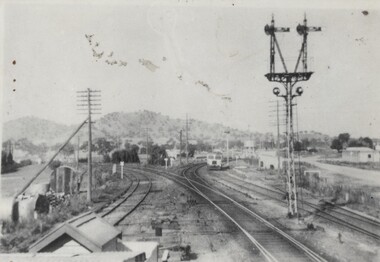
... Walker rail motors were a type of diesel railcar operated by the Victorian Railways. After World War 11, the Victorian Railways undertook a major rebuilding program known as Operation Phoenix. ...Railways Wodonga Fred Rochow Walker Rail Motor Vehicles Wodonga to Tallangatta rail service Walker rail motors were a type of diesel railcar operated by the Victorian Railways. ...The Fred Rochow Railways Collection incorporates photos related to the operation of the Wodonga Railway Station including different types of trains and railways staff C. 1930 – 1990. It was donated to the Wodonga Historical Society by Fred Rochow, a railwayman who spent many years based in Wodonga. He joined the Victorian Railways on 17th June l947 and retired in 1988. For some time, he was a member of the Australian Federated Union of Locomotive Enginemen and served a term as a member of the Trades Hall Council. He had an extensive knowledge of the struggles that took place to achieve better conditions for railway workers. Fred worked for many years as a fireman and then worked his way up the ranks to driver, experiencing many changes from the days of steam locomotives through to diesel trains, locomotives and even the modern XPT train. He worked throughout Victoria at different stages of his career, with his final working years focused on the northeast of Victoria and the Albury to Melbourne line. After his retirement, Fred continued to share his love of steam miniature trains with the community.This collection has local and statewide significance as it captures images of trains, locomotives and personnel who operated the railway services in Wodonga and throughout Northeast Victoria. The railways played a critical role in opening up Victoria and connecting Australia for trade, business, social communication and transport.Walker rail motors were a type of diesel railcar operated by the Victorian Railways. After World War 11, the Victorian Railways undertook a major rebuilding program known as Operation Phoenix. One of the first tasks was the upgrading of passenger services on country branch lines. An initial order of twelve 102 HP railcars, six 153 HP railcars with trailers, and twelve 280 HP railcars was placed with Walker Brothers, England. The power units were manufactured in England, but the units were assembled in Victoria. The first rail motors were delivered in 1948, with additions to the fleet running through to 1955. According to a Victoria Railways Memorandum issued on 24 May 1949, regarding the allocation of the new 102 HP Walker Diesel Motor Rail Vehicles, No 10 was to be allocated to the Wodonga to Tallangatta line as soon as it was available. No 10 entered service on 22 November 1949. The passenger rail motors had room for 18 First class and 22 Second class seated passengers. The last passenger service from Wodonga to Tallangatta ran on 30 September 1961 with a 102hp Walker Rail Motor.railways wodonga, fred rochow, walker rail motor vehicles, wodonga to tallangatta rail service -
 Melbourne Tram Museum
Map, Melbourne & Metropolitan Tramways Board, Del J. Chau, "Tram Routes showing destination numbers", 1972
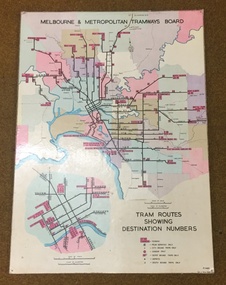
... railway stations and rail lines, municipalities, rivers, scales, city section in detail, depots and Sunday only services. In bottom right hand corner has number P.14431, Del J. Chau 1972. The original has been altered to show the Bundoora, La Trobe University and East Burwood lines and the change to Airport West. Type...railway stations and rail lines, municipalities, rivers, scales, city section in detail, depots and Sunday only services. In bottom right hand corner has number P.14431, Del J. Chau 1972. The original has been altered to show the Bundoora, La Trobe University and East Burwood lines and the change to Airport West. Type ...Titled "Tram Routes showing destination numbers". Map dated 1972, showing routes with route numbers, including short working, names of main destinations, roads, railway stations and rail lines, municipalities, rivers, scales, city section in detail, depots and Sunday only services. In bottom right hand corner has number P.14431, Del J. Chau 1972. The original has been altered to show the Bundoora, La Trobe University and East Burwood lines and the change to Airport West. Type of map that was placed on the rear of the driver's doors of a W Class tramcar.Demonstrates a MMTB produced map used in trramcars.Full colour map or poster printed on heavy cardboard.trams, tramways, mmtb, map, routes -
 Melbourne Tram Museum
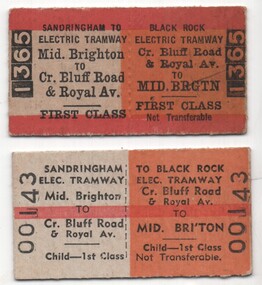
Ephemera - Tickets - Sandringham Tramway - Middle Brighton to Bluff Road and Royal Ave
... railways. They were available for use on the replacement bus service. Yields information about the type of ticket that was issued to enable rail/tram travel on the Victorian Railways and their tramways. tramways trams tickets Victorian Railways Sandringham Black Rock Tramway Bluff Road Both date stamped on rear "! ...Tickets were produced to enable first-class travel from Middle Brighton Railways station to Sandringham and then by Electric Tramway from Sandringham Railway Station to the corner of Bluff Road and Royal Ave. The ticket colours indicated to station staff, Inspectors, and conductors the nature of the ticket and its availability These tickets were purchased by the donor in 1970 long after the tramway had closed and travel classes were abolished on the suburban railways. They were available for use on the replacement bus service. Yields information about the type of ticket that was issued to enable rail/tram travel on the Victorian Railways and their tramways.Set of two Edmondson style card or pasteboard Victorian Railways return tickets for travel between Middle Brighton and Bluff Road and Royal Ave. Both date stamped 15 June 1970. .1 - Adult - 1st class - No. 1365 .2 - Child - 1st class - No. 00143Both date stamped on rear "!5 June 1970"tramways, trams, tickets, victorian railways, sandringham, black rock tramway, bluff road -
 Melbourne Tram Museum
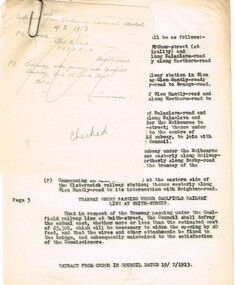
Document - Research Notes, H. S. McComb, "Orders in Council - Relating to Bridges", c1930
... Trams tramways Bridges PMTT MMTB Glenferrie Rd Camberwell HTT MBCTT FTT FNPTT Railways Type and hand written notes, on quarto or scrap paper about Orders in councils relating to Melbourne Tramway bridges - 17 sets of notes, each retained by a paper clip. 1 - Caulfield line at Smith St 2 - Church St Bridge Act 3 - Spencer St Bridge Act 4 - Melbourne to Burwood Tramways Act 5 - Footscray Tramway Act 6 - Fitzroy Northcote and Preston Tramways Act 7 - Hawthorn - Under line at Burwood and over line at Burnley 8 - Burke Road Camberwell 9 - St Kilda rail line at Kerford Road 10 - High St Deepdene - Fairfield to Deepdene line. 11 - Glenferrie - Glenferrie Road 12 - Prahran and Malvern Act 13 - Brunswick and Coburg Tramways Act 14 - PMTT - Caulfield and Sandringham rail lines 15 - Glenferrie and Wattletree road and rail lines 16 - Commercial Road and rail crossings 17 - MMTB Act 1928 - various provisions "Orders in Council - Relating to Bridges" Document Research Notes H. ...Type and hand written notes, on quarto or scrap paper about Orders in councils relating to Melbourne Tramway bridges - 17 sets of notes, each retained by a paper clip. 1 - Caulfield line at Smith St 2 - Church St Bridge Act 3 - Spencer St Bridge Act 4 - Melbourne to Burwood Tramways Act 5 - Footscray Tramway Act 6 - Fitzroy Northcote and Preston Tramways Act 7 - Hawthorn - Under line at Burwood and over line at Burnley 8 - Burke Road Camberwell 9 - St Kilda rail line at Kerford Road 10 - High St Deepdene - Fairfield to Deepdene line. 11 - Glenferrie - Glenferrie Road 12 - Prahran and Malvern Act 13 - Brunswick and Coburg Tramways Act 14 - PMTT - Caulfield and Sandringham rail lines 15 - Glenferrie and Wattletree road and rail lines 16 - Commercial Road and rail crossings 17 - MMTB Act 1928 - various provisionstrams, tramways, bridges, pmtt, mmtb, glenferrie rd, camberwell, htt, mbctt, ftt, fnptt, railways -
 Melbourne Tram Museum
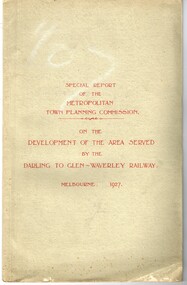
Document - Report, Metropolitan Town Planning Commission, "Metropolitan Town Planning Commission - Darling to Glen Waverley Railway - 1927", May. 1927
... Railway - 1927". Report looks the development that could be undertaken along the proposed Glen Waverley rail line, its town planning, Garden City type layouts, rail level crossings, new arterial roads, open spaces, financial arrangements, sewerage and water supply, zoning, legislation and conclusion. ...Railway - 1927". Report looks the development that could be undertaken along the proposed Glen Waverley rail line, its town planning, Garden City type layouts, rail level crossings, new arterial roads, open spaces, financial arrangements, sewerage and water supply, zoning, legislation and conclusion. ...Report - 20 pages + 5 Maps stapled and then glued bound within a light green grey light card folder titled "Metropolitan Town Planning Commission - Special Report on the Development of the area serviced by the Darling to Glen Waverley Railway - 1927". Report looks the development that could be undertaken along the proposed Glen Waverley rail line, its town planning, Garden City type layouts, rail level crossings, new arterial roads, open spaces, financial arrangements, sewerage and water supply, zoning, legislation and conclusion. Dated 6/5/1927. Plans show possible garden city type layouts, arterial roads, possibilities within existing sub-divisions. Note that Mr. Strickland was a member of the Commission undertaking this work.Has in ink on the bottom edge "17th June 1919"trams, tramways, mmtb, tramways, development, town planning, glen waverley, darling
