
Showing 19 items matching "rationing and shortages"
-
 Bendigo Historical Society Inc.
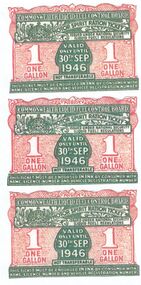
Print - Ration Cards and Tickets, 1946-48
... Rationing was introduced to manage shortages and control civilian consumption. ...Rationing was introduced to manage shortages and control civilian consumption. ...Rationing regulations for food and clothing were gazetted on 14 May 1942. Rationing was introduced to manage shortages and control civilian consumption. It aimed to curb inflation, reduce total consumer spending, and limit impending shortages of essential goods. The broad reasoning behind the introduction of rationing was to ensure the equitable distribution of food and clothing. It was also hoped that a cut on consumer spending would lead to an increase in savings, which in turn could be invested in war loans. Australians were never as short of food nor rationed as heavily as civilians in the United Kingdom. Rationing was enforced by the use of coupons and was limited to clothing, tea, sugar, butter, and meat. From time to time, eggs and milk were also rationed under a system of priority for vulnerable groups during periods of shortage.Motor Spirit Ration Tickets and Clothing Ration Cards: Three of tickets, Commonwealth Liquid Fuel Control Board, Issued under National security (Liquid Fuel) Regulations, Valid only until 30th Sep. 1946. 2 of Clothing Ration Cards, 56 tickets issued to Emily Hall, 112 Collins Street, N17 and 56 tickets issued to John Hall of the same address. Also a Clothing Ration Card for Child Under 6 Years issued to Ian Hall at the same address.history, bendigo, ration cards -
 Melton City Libraries
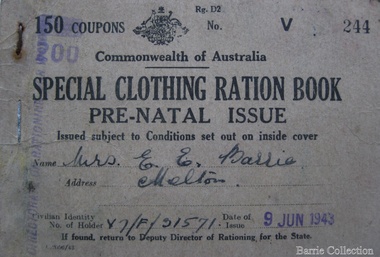
Book, Ration books and cards, 1943,1945,1947, 1948
... Rationing was introduced to manage shortages and control civilian consumption. ...Rationing was introduced to manage shortages and control civilian consumption. ...Rationing regulations for food and clothing were gazetted on 14 May 1942. Rationing was introduced to manage shortages and control civilian consumption. It aimed to curb inflation, reduce total consumer spending, and limit impending shortages of essential goods. The broad reasoning behind the introduction of rationing was to ensure the equitable distribution of food and clothing. It was also hoped that a cut on consumer spending would lead to an increase in savings, which in turn could be invested in war loans. Australians were never as short of food nor rationed as heavily as civilians in the United Kingdom. Rationing was enforced by the use of coupons and was limited to clothing, tea, sugar, butter, and meat. From time to time, eggs and milk were also rationed under a system of priority for vulnerable groups during periods of shortage. Rationing was administered by the Rationing Commission. The basis for policing food rationing was through the surrender of coupons before rationed goods could be supplied. This had to occur between traders as well as consumers. Coupons were passed back from consumers to retailers, from retailers to wholesalers, and in many cases from wholesalers to producers, who were requested to return them to the commission. Breaches of rationing regulations were punishable under the general provisions of National Security Regulations by fines of to £100 or up to six-months imprisonment. Responding to the complaint that these penalties were inadequate, the government passed the Black Marketing Act at the end of 1942. This Act was for more serious cases and could carry a minimum penalty of £1,000.The clothing ration books and coupons belonged to Edna Barrie, the food ration card belonged to Wendy Barrie and the tea and butter ration card belong to Elizabeth Daley.local identities, war -
 City of Moorabbin Historical Society (Operating the Box Cottage Museum)
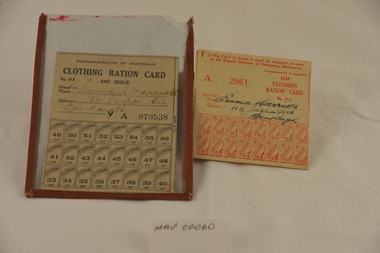
Card - World War 1939-1945, Ration Cards x 2; Identity Card 1942, 1948
... In 1942, after Japan entered the War, comprehensive rationing was introduced to manage shortages and control civilian consumption. ...In 1942, after Japan entered the War, comprehensive rationing was introduced to manage shortages and control civilian consumption. ...World War 2 commenced in 1939 in Europe. The first controls over the production and distribution of products in Australia were introduced in 1940, partly due to disruption of shipping. In 1942, after Japan entered the War, comprehensive rationing was introduced to manage shortages and control civilian consumption. After the War, rationing was gradually phased out. Clothing rationing was abolished on 24 June1948. The last rationed product was tea, which ended in July 1950.Many young men from the City of Moorabbin volunteered for active service during WW2 .The market gardeners had to manage their farms with reduced labour. Farms and businesses over the whole country were affected so rationing was introduced to control the civilian use of commodities. Pink-coloured card, printed in black with coupons to be cut off from the left side, originally 24 supplied. 2 original, partly used paper ration cards issued in Melbourne 1948. !x Identity Card for Emma Marriott 1) Meat Ration 2) Clothing Ration 3) Identity Card1)If this Card is found it must be returned at once/ to the Deputy Director of Rationing Melbourne/Commonwealth of Australia/ 1948/ B 891314 MEAT/RATION CARD/Rg,D.1/ Issued to/Name Reed G.M/Address 251 Centre Rd/SE14/ tickets -MEAT 104 - 54 2) as above / B891313/ CLOTHING/ RATION CARD/ tickets 1- 56 3) OHMS / Identity Card ...........1942ww2, melbourne, bentleigh, food rations, food supply, farming, market gardeners, city of moorabbin, cheltenham, marriott emma, reed george, william green, kenneth j blackman -
 Orbost & District Historical Society
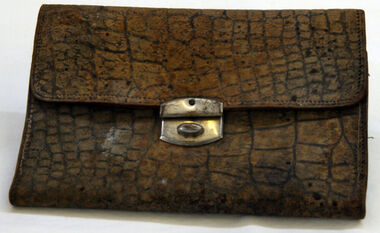
wallet, H.E. Daw, Government Printer, Melbourne, Victoria, Australia, 1945, W.W. 11
... In 1942, after Japan entered the War, comprehensive rationing was introduced to manage shortages and control civilian consumption. ...In 1942, after Japan entered the War, comprehensive rationing was introduced to manage shortages and control civilian consumption. ...Food, clothing and other products were in short supply in Australia during World War II. The first controls over the production and distribution of products were introduced in 1940, partly due to disruption of shipping. In 1942, after Japan entered the War, comprehensive rationing was introduced to manage shortages and control civilian consumption. The first product to be rationed was clothing on 12 June 1942. Each adult was allowed 112 clothing coupons per year. Tea rationing was introduced the following month, followed by sugar, butter and then meat. After the War, rationing was gradually phased out. Clothing rationing was abolished on 24 June1948. The last rationed product was tea, which ended in July 1950.A soft green/brown rectangular leather wallet with metal clasp. Wallet contains W.W.11 ration books and identity cards. Ration cards are for clothing, meat, tea and butter, motor spiritsIdentity cards - Annie Penuel Richardson Bete Bolong; John Gilbert Richardson Bete Bolong Meat Ration card - J.G. Richardson, Scotch College; Annie P. Richardson ; Frank E. Richardson Bete Bolongwallet rationing w w 11 personal-effects money -
 Mont De Lancey
Domestic object - Pot Menders, Waco, 1940's
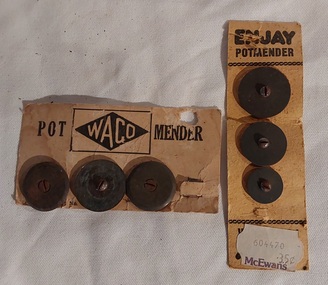
... They were particularly popular during the 1940s due to metal rationing and shortages, making home repair a patriotic duty and necessity. ...They were particularly popular during the 1940s due to metal rationing and shortages, making home repair a patriotic duty and necessity. ...These kits were designed to allow people to easily repair leaky pots, pans, and even hot water bags at home. They were particularly popular during the 1940s due to metal rationing and shortages, making home repair a patriotic duty and necessity. Two cards of old never used kitchen pot repair kits. 1. Waco brand three pot mender discs with a base, tin washer on the top screwed together with a nut on the back. 2. Enjay brand three potmenders of varying sizes. They have a cork base, tin washers on the top and are screwed together with a nut on the base. It has a McEwans price sticker - 35c.1. ' No. 1756/280' 2. 'McEwans - 604470 - 35c.'repair kits, cooking equipment, pot menders -
 Mission to Seafarers Victoria
Letter - Correspondence, 8/07/1950
... He is paying four kronor a night for a shared room in the Pension whereas he was paying $4 a week for a room in New York. There is no shortage of work although there is food rationing and fruit and meat is scarce and expensive. ...He is paying four kronor a night for a shared room in the Pension whereas he was paying $4 a week for a room in New York. There is no shortage of work although there is food rationing and fruit and meat is scarce and expensive. ...The writer says it is very difficult to get accommodation in postwar Oslo, especially during the tourist season. He is paying four kronor a night for a shared room in the Pension whereas he was paying $4 a week for a room in New York. There is no shortage of work although there is food rationing and fruit and meat is scarce and expensive. People live on fish and potatoes.Quinn CollectionFour page letter written on both sides of two sheets of unlined buff-coloured paper (0843.a1-2). Each page is stamped with the letterhead of the Hotel Campbell, Poughkeepsie, New York. The hotel coat-of-arms is displayed top centre of the page and in the left upper corner is a picture of the hotel. Written underneath is Louis W. Parsons, Owner and Manager. The letter is from William F Preston, Pensjon Lindstow, Sven Bruno Gate 9th Oslo and dated 8 July 1950. The non-matching envelope (0843.b) bears a red Norwegian stamp and is postmarked Oslo. It has been post-marked twice.Letter is addressed to Allan and signed 'Bill'.allan quinn collection, letters-from-abroad, william f. preston, oslo, louis w. parsons, new york -
 Orbost & District Historical Society
magazine, Woman and Home, September 1940
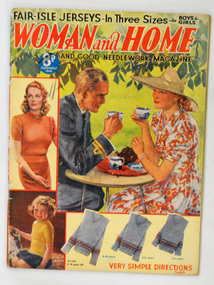
... Therefore women’s magazines centered mostly on the stresses and shortages of wartime. Articles as well as advertisements presented information on “product rationing, tips on keeping the family healthy, guidelines for thrifty shopping and advice on how to look good through it all....Therefore women’s magazines centered mostly on the stresses and shortages of wartime. Articles as well as advertisements presented information on “product rationing, tips on keeping the family healthy, guidelines for thrifty shopping and advice on how to look good through it all. ...Women’s magazines during WWII played a “reflecting role,” meaning they cooperated with government agendas while still including topics of readers’ interests Women’s employment rate skyrocketed during WWII. However, even though the number of women working outside the home grew rapidly most of them were still engaged entirely in homemaking. Therefore women’s magazines centered mostly on the stresses and shortages of wartime. Articles as well as advertisements presented information on “product rationing, tips on keeping the family healthy, guidelines for thrifty shopping and advice on how to look good through it all.This is an example of an English women's magazine published during WW11.It gives practical advice on needlework / knitting and evidences the widespread interest in contemporary fashion. In doing so it shows what were the fashionable, but broadly affordable, women's and children's clothing styles of their day. These magazines also reflect women's interests.A 64 pp magazine, titled Woman and Home and Good Needlework Magazine. The front cover has a a coloured picture of a man in a uniform and woman sitting at a round table drinking tea and photographs of knitted jumpers, the patterns of which are inside the magazine.Handwritten on front cover in pencil -Mehlert -
 Orbost & District Historical Society
magazine, Woman and Home, October 1951
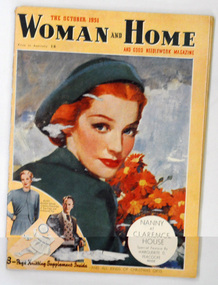
... Therefore women’s magazines centered mostly on the stresses and shortages of wartime. Articles as well as advertisements presented information on “product rationing, tips on keeping the family healthy, guidelines for thrifty shopping and advice on how to look good through it all....Therefore women’s magazines centered mostly on the stresses and shortages of wartime. Articles as well as advertisements presented information on “product rationing, tips on keeping the family healthy, guidelines for thrifty shopping and advice on how to look good through it all. ...Women’s magazines just after WWII played a “reflecting role,” meaning they cooperated with government agendas while still including topics of readers’ interests Women’s employment rate had skyrocketed during WWII. However, even though the number of women working outside the home grew rapidly most of them were still engaged entirely in homemaking. Therefore women’s magazines centered mostly on the stresses and shortages of wartime. Articles as well as advertisements presented information on “product rationing, tips on keeping the family healthy, guidelines for thrifty shopping and advice on how to look good through it all.This is an example of an English women's magazine published post WW11.It gives practical advice on needlework / knitting and evidences the widespread interest in contemporary fashion. In doing so it shows what were the fashionable, but broadly affordable, women's and children's clothing styles of their day. These magazines also reflect women's interests.A 64 pp magazine, titled Woman and Home and Good Needlework Magazine. On the front cover is a coloured drawing of a fashionably dressed and made-up woman with red hair and holding a bunch of similarly coloured flowers (gerberas?) At the bottom left are knitted baby clothes - pattern inside - as well as a man and woman wearing fashionable clothing - suggesting patterns are inside the magazine. The magazine cost 1/6 and is dated October 1951.magazine-woman-and-home -
 Wangaratta RSL Sub Branch
Booklet - Special Clothing Ration Book, A H Tucker, C1945
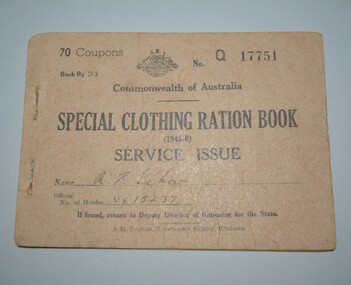
... These supplemented the standard annual coupon allowance for citizens needing extra garments World War II civilian "Service Issue" clothing ration books were special coupon booklets introduced in Australia in June 1942 to manage extreme shortages of textiles and factory labor diverted to military uniforms. ...These supplemented the standard annual coupon allowance for citizens needing extra garments World War II civilian "Service Issue" clothing ration books were special coupon booklets introduced in Australia in June 1942 to manage extreme shortages of textiles and factory labor diverted to military uniforms. ...A special clothing ration book (or supplementary clothing card) refers to extra coupon booklets issued during WWII. These supplemented the standard annual coupon allowance for citizens needing extra garments World War II civilian "Service Issue" clothing ration books were special coupon booklets introduced in Australia in June 1942 to manage extreme shortages of textiles and factory labor diverted to military uniforms. Citizens received an annual quota of coupons to ensure equitable sharing of clothes. Item belonged to Robert Francis ISKOV VX15237 served with the 59th Battalion/Hume Regiment CMF before joining the 2/14th Battalion at Caulfield in September 1940. He disembarked for the Middle East in November, 1940 and fought in the Syrian campaign in 1941. In 1942 the 2/14th Battalion returned to Australia and sent to Papua where he fought at the Battle of Isurava before the battalion was sent to Gona. On 1943 Bob returned to Australia to undertake officer training and in 1945 with the 2/23rd Battalion sailed to Morotai and served with the battalion on Tarakan. He returned to Australia in November, 1945 and discharged a month later Brown cardboard booklet with lettering in black ink on front cover containing 2 half pagesQ17751 70 coupons R F ISKOV VX15237ww2, bob iskov, special clothing ration book, service issue -
 Wangaratta RSL Sub Branch
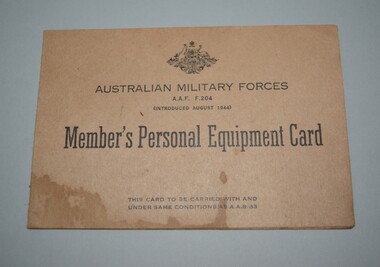
Card - Member's Personal Equipment Card, C1944
... These supplemented the standard annual coupon allowance for citizens needing extra garments World War II civilian "Service Issue" clothing ration books were special coupon booklets introduced in Australia in June 1942 to manage extreme shortages of textiles and factory labor diverted to military uniforms. ...These supplemented the standard annual coupon allowance for citizens needing extra garments World War II civilian "Service Issue" clothing ration books were special coupon booklets introduced in Australia in June 1942 to manage extreme shortages of textiles and factory labor diverted to military uniforms. ...A special clothing ration book (or supplementary clothing card) refers to extra coupon booklets issued during WWII. These supplemented the standard annual coupon allowance for citizens needing extra garments World War II civilian "Service Issue" clothing ration books were special coupon booklets introduced in Australia in June 1942 to manage extreme shortages of textiles and factory labor diverted to military uniforms. Citizens received an annual quota of coupons to ensure equitable sharing of clothes. Item belonged to Robert Francis ISKOV VX15237 served with the 59th Battalion/Hume Regiment CMF before joining the 2/14th Battalion at Caulfield in September 1940. He disembarked for the Middle East in November, 1940 and fought in the Syrian campaign in 1941. In 1942 the 2/14th Battalion returned to Australia and sent to Papua where he fought at the Battle of Isurava before the battalion was sent to Gona. On 1943 Bob returned to Australia to undertake officer training and in 1945 with the 2/23rd Battalion sailed to Morotai and served with the battalion on Tarakan. He returned to Australia in November, 1945 and discharged a month laterCream cardboard card fold in half with crest and lettering in black ink on front cover AAF F204 Introduced August 1944 ww2, bob iskov, member's personal equipment card, amf -
 Warrnambool and District Historical Society Inc.
Exercise Book (Swinton), Book, 1947-1950
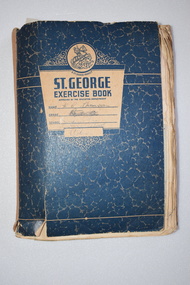
... The letters give details of the contents of the parcels, the situation with the families receiving the parcels and the effects of the food rationing and shortages in England immediately after World War Two. ...The letters give details of the contents of the parcels, the situation with the families receiving the parcels and the effects of the food rationing and shortages in England immediately after World War Two. ...This exercise book contains letters, mostly aerogrammes, sent by people in England during the years 1947 to 1950. They are letters of thanks for the food parcels sent to these people by the staff of George Swinton and Sons of Timor Street Warrnambool. The letters give details of the contents of the parcels, the situation with the families receiving the parcels and the effects of the food rationing and shortages in England immediately after World War Two. The name ‘H.C.Thomson’ on the front of the book refers to Helen Thomson, a staff member of George Swinton & Sons in charge of the food parcel distribution. William and Ann Swinton came to the Warrnambool area in 1854 and William opened a groceries, hardware, china and glassware store in Timor Street in 1865. After William Swinton’s death his son Robert became the first managing director of Swintons Pty Ltd. In 1934 the business split with Swintons Pty Ltd selling seeds, produce and hardware and George Swinton and Sons selling furnishings, clothing and glassware. Today the Swinton family still operates a furniture and bedding store in Timor Street, making it one of the oldest family businesses in Australia. This exercise book containing letters sent from England in response to the receipt of food parcels from the staff of George Swinton & Sons of Warrnambool is of considerable significance. The letters form a splendid social history of the situation in England after World War Two, especially for the elderly and the unemployed. They also are a reminder of the charity work undertaken by the staff of George Swinton & Sons 70 years ago. This was a prominent family business in Warrnambool (and continues in another form to this day). This is an exercise book with brown binding and a blue front cover with an image of St George, blue printing and a handwritten name and some other handwritten material which is not decipherable. The back cover has blue printing. Pasted on to the pages are handwritten letters and cards, mostly four to a page. Most of the letters are aerogrammes and some have stamps. Some pages contain addresses of families in England. There are some loose sheets.St. George Exercise Book Name… H.C.Thomson Grade.. School.. Swinton & Sons Timor St. W’bool Victoriageorge swinton & sons, history of warrnambool -
 Orbost & District Historical Society
magazine, Woman and Home July 1944, July 1944
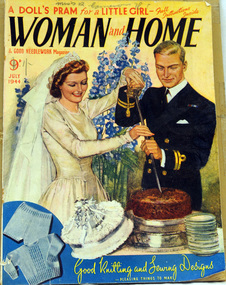
... Therefore women’s magazines centered mostly on the stresses and shortages of wartime. Articles as well as advertisements presented information on “product rationing, tips on keeping the family healthy, guidelines for thrifty shopping and advice on how to look good through it all. ...Therefore women’s magazines centered mostly on the stresses and shortages of wartime. Articles as well as advertisements presented information on “product rationing, tips on keeping the family healthy, guidelines for thrifty shopping and advice on how to look good through it all. ...This magazine belonged to Roma Cameron, who was the daughter of Harry Purchase Cameron and Lilian Gladys (nee Harding). Roma married Ronald Richard Smith in 1944 and is the mother of Lorraine (Mrs Peter Coulton) and Margaret Smith. Harry's father, James Cameron, came to Bellagoogan on Majors Creek in 1882. Bellagoogan was on Majors Creek near Orbost and was the site of the first race course. Like many others at the time, the Camerons bred race horses.Harry died in 1964 aged 75. Roma was the youngest of three siblings: Jean (Mrs John Gavin (Jack) Ralston) and James (Jim) (m. Joan Hossack). Women’s magazines during WWII played a “reflecting role,” meaning they cooperated with government agendas while still including topics of readers’ interests Women’s employment rate had skyrocketed during WWII. However, even though the number of women working outside the home grew rapidly most of them were still engaged entirely in homemaking. Therefore women’s magazines centered mostly on the stresses and shortages of wartime. Articles as well as advertisements presented information on “product rationing, tips on keeping the family healthy, guidelines for thrifty shopping and advice on how to look good through it all. This is an example of an English women's magazine published during WW11.It gives practical advice on needlework / knitting and evidences the widespread interest in contemporary fashion. In doing so it shows what were the fashionable, but broadly affordable, women's and children's clothing styles of their day. These magazines also reflect women's interests An English magazine published monthly. It is titled Woman and Home & Good Needlework Magazine, July 1944. On the front cover is a picture of a bride and groom cutting a wedding cake. The groom is dressed in military uniform. the price 9D has been crossed out and 1/- is below it. The magazine contains advertisements, stories, needlework patters and news articles.On front cover handwritten in pen : Miss R. Cameronmagazine-woman-and-home magazines-women's cameron -
 Orbost & District Historical Society
petticoat, 1930's-1940's
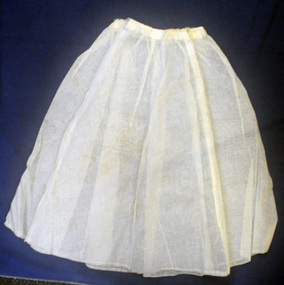
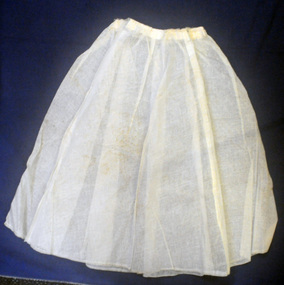
... World War II, with its rationing and general shortage of materials, brought an end to petticoats. ...World War II, with its rationing and general shortage of materials, brought an end to petticoats. ...This article of clothing is specifically an undergarment to be worn under a skirt or a dress. The petticoat is a separate garment hanging from the waist. In the late 1920s, chiffon dresses with several sheer petticoats became fashionable. With the Great Depression in the 1930s, narrow skirts returned and petticoats again were unpopular until the end of the decade when revived for some evening, prom, and wedding gowns. World War II, with its rationing and general shortage of materials, brought an end to petticoats. Petticoats were revived by Christian Dior in his full-skirted "New Look" of 1947 and tiered, ruffled, stiffened petticoats remained extremely popular during the 1950. Most of the petticoats were netlike crinoline, Worn by Marjorie Burton. It may have been worn underneath dresses with full skirts or may have been designed for a short style wedding dress. Marjorie Burton ( nee Whiteman), born 12 June, in Birmingham, England came to Orbost in 1995. In England she did office work – typing, shorthand and secretarial work - in accountants’ offices and also trained as a comptometrist with Burroughs in London. She came from a middle-class, working, church-going family. Her mother was a milliner who mademany of Marjorie’s clothes, hats and outfits. Marjorie was married in 1938 to a salesman who later became a mechanic in the R.A.F. This item is an example of ahome-made item of clothing and reflects the needlework skills of women in the first half of the twentieth century.A coarse, net, white starched petticoat. It is short and has no bodice. It is home-made, machine stitched and fastens at the waist with metal hooks and eyes. It has four panelspetticoat women's-clothing burton-marjorie -
 Orbost & District Historical Society
petticoat, 1930's - 1940's
... World War II, with its rationing and general shortage of materials, brought an end to petticoats. ...World War II, with its rationing and general shortage of materials, brought an end to petticoats. ...This article of clothing is specifically an undergarment to be worn under a skirt or a dress. The petticoat is a separate garment hanging from the waist. In the late 1920s, chiffon dresses with several sheer petticoats became fashionable. With the Great Depression in the 1930s, narrow skirts returned and petticoats again were unpopular until the end of the decade when revived for some evening, prom, and wedding gowns. World War II, with its rationing and general shortage of materials, brought an end to petticoats. Petticoats were revived by Christian Dior in his full-skirted "New Look" of 1947 and tiered, ruffled, stiffened petticoats remained extremely popular during the 1950. Most of the petticoats were netlike crinoline, Worn by Marjorie Burton. It may have been worn underneath dresses with full skirts or may have been designed for a short style wedding dress. Marjorie Burton ( nee Whiteman), born 12 June, in Birmingham, England came to Orbost in 1995. In England she did office work – typing, shorthand and secretarial work - in accountants’ offices and also trained as a comptometrist with Burroughs in London. She came from a middle-class, working, church-going family. Her mother was a milliner who mademany of Marjorie’s clothes, hats and outfits. Marjorie was married in 1938 to a salesman who later became a mechanic in the R.A.F. This item is an example of a home-made item of clothing and reflects the needlework skills of women in the first half of the twentieth century.A coarse, net, white starched petticoat. It is short and has no bodice. It is home-made, machine stitched and fastens at the waist with metal hooks and eyes. It has four panelspetticoat women's-clothing burton-marjorie -
 Eltham District Historical Society Inc
Photograph, David Potts (Latrobe University), Koornong School collection, c.1940-c.1945
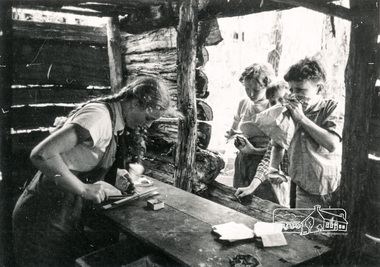
... The school could not have been started at a worse time. Food rationing and coupons, petrol shortages and men at war limiting teaching staff made difficulties. ...The school could not have been started at a worse time. Food rationing and coupons, petrol shortages and men at war limiting teaching staff made difficulties. ...Photos include: Log building which the students constructed and used as a co-operative shop, Primary Class, Science class outside their classroom, Government meeting held in the outdoor theatre, Janet and Lawrence Nield. "Koornung School, Warrandyte was established by Clive and Janet Blake Nield in 1939, after they had visited progressive schools in Europe and America. They believed children should be given freedom to grow while learning to accept responsibility; that school should be a miniature democracy and education not a preparation for life but experience of life itself. A government of children and all staff (whatever their jobs in the school) met regularly, made the rules and dealt out punishment for breaking them. The few rules set down by staff related to health and safety, for instance, no pupils were allowed to go into the river without supervision. The school could not have been started at a worse time. Food rationing and coupons, petrol shortages and men at war limiting teaching staff made difficulties. It was an expensive school to run. Financial difficulties became more serious and eventually the school had to close in 1946. Efforts by the children and a Board of Management of notable people failed to save it. Janet Nield (M.A., Dip Ed.) was an inspired teacher of history. She was one of the few women at Melbourne University at that time to gain a Masters degree in history. The Nields left Melbourne to live in Sydney, Clive to work at Sydney University in lecturing in Education and particularly interested in Colombo Plan students. Janet devoted herself to children as a Lay Analyst. She was awarded the title of Training Analyst by a meeting of international psychoanalysts in Europe. - Pat Scott (Mrs Wynne Scott), a former member of staff at Koornung School Collection of five black and white photographs a, letter and descriptive material relating to Koornong School, Warrandyte showing various teachers and students and Connie and Alec Smith's studio.schools, koornong, warrandyte, danila vassilieff, lorna carter, adrian rawlins, teachers, janet nield, clive nield -
 Royal Brighton Yacht Club
Life Ring, Vega Trophy (Mounted Wooden Life Ring)
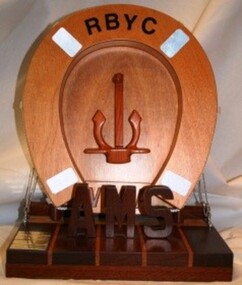
... Vega Trophy (Mounted Wooden Life Ring) Donor: Graham Noel During World War II when the Germans occupied the Channel Islands the local people went through very severe food rationing and were on the verge of starvation. ...Vega Trophy (Mounted Wooden Life Ring) Donor: Graham Noel During World War II when the Germans occupied the Channel Islands the local people went through very severe food rationing and were on the verge of starvation. ...Vega Trophy (Mounted Wooden Life Ring) Donor: Graham Noel During World War II when the Germans occupied the Channel Islands the local people went through very severe food rationing and were on the verge of starvation. Near the end of the war, the Swedish ship Vega was allowed by the Germans to deliver several shipments of food to the civilian population, easing the critical shortages of food on the islands. Further background detail can be found below. Graham Noel was born on the Islands and lived there during this harsh period. The trophy is awarded to the winner of the Combined Division AMS Aggregate Series. First Winner: Under Capricorn, P. Bedlington 2005/06 Vega – Further historical background Early in the Second World War Jersey was declared “unarmed” and the German military took over, taking quite a few lives in the process, through strafing the main harbour and a few other places which they needlessly considered threatening. A considerable number of locals evacuated to England before the Germans arrived, but more than 60% of the population remained and endured 5 years of very strict and difficult conditions. Not only was the population unable to contact relatives in the UK or elsewhere, but very quickly they found themselves subject to harsh curfews, strictly rationed foodstuffs, no fuel for vehicles, radios confiscated, and homes and hotels commandeered by the military. The military demanded first pick of all foodstuffs and kept meticulous records of all livestock forcing farmers even to show newborn calves and piglets to them, then claiming the new arrivals for their dinner tables. However there are many stories of farmers outwitting their masters when twin calves or suchlike arrived! Lawbreakers were quickly dealt with, mostly with lengthy prison terms in Jersey, but the more serious crimes were punished by being sent to some horrible French prisons, or even some of the notorious German concentration camps. All local Jews were dispatched to concentration camps, and even English born families were similarly shipped through France and on to Germany. Sadly, a considerable number of those deported did not make it back safely to Jersey. In June 1944 the locals were delighted to hear that the Allies had invaded Normandy and very soon they could hear the battles as the Allies worked their way along the French coast. Little did they know they would still have to wait another 11 months for freedom, having to put up with a very demanding German occupation force which was still determined to obey Hitler’s order to “Defend the Channel Islands to the death”. Now that France was in Allied Hands the local military commanders were unable to supplement their food supplies from France and even harsher demands were made on the local population to ensure that all branches of their still very substantial military force were reasonably well fed. As well as the military, Jersey farmers had to provide food for the Allied POWs and the many “forced labourers”, mainly of Russian, Polish and Italian backgrounds who had been directed to the island to build all the concrete bunkers. This included an underground hospital, all this complying with Hitler’s orders to ensure that the Channel Islands would never again be part of Britain. Many requests by the Jersey authorities for Red Cross assistance were rejected, but finally in December 1944 they agreed and on 30th December the Red Cross vessel “Vega” (Swedish Registry) arrived and delivered parcels to the civilian population. These parcels contained a variety of foodstuffs supplied mainly by Canadian authorities, desperately needed medical supplies, flour, oils and soaps, as well as tobacco from New Zealand. Vega made a further 3 or 4 trips and most certainly eased the desperate situation being faced by the locals. In fact, it resulted in the locals having slightly better food supplies than the military and many local farmers tell stories of having to protect their stock from marauding soldiers. Understandably Churchill was reluctant to send in an invading force to retake the Channel Islands, but by May 1945 it was clear that the Third Reich was finished and on May 9th the German Military surrendered, without a fight, to a large British landing force. On a slightly lighter note … in January 1945 Jersey stonemasons were seen in the main town square repairing flagstones … the Germans had never noticed that the name “Vega” had been formed in those flagstones! As a side note Vega is the name of the brightest star in the universe. Furthermore, throughout the occupation, despite German law that demanded confiscation of all radio sets, punishable by long prison terms or deportation to Germany, there were still many sets being listened to. The locals had a well refined news system for the dissemination of news of what was happening in the outside world. vega, graham noel, ams, combined division, aggregate -
 Orbost & District Historical Society
cake mixer, circa 1948
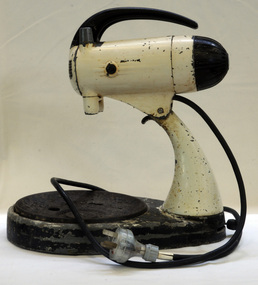
... It was designed in the USA. After years of rationing and shortages, the 1950s were a period of economic prosperity, high employment and great technological development. ...The Mixmaster 9B in 1948 was the first Sunbeam appliance to be made in Australia. It was designed in the USA.After years of rationing and shortages, the 1950s were a period of economic prosperity, high employment and great technological development. During this period, Australians enthusiastically adorned their homes with a dazzling range of new domestic appliances. Hire-purchase schemes allowed people to take products home and pay for them in instalments. The American-designed Mixmaster 9B was the first Sunbeam appliance manufactured and sold in Australia in 1948. An early Sunbeam Mixmaster. It is an electronic stand mixer with a black metal base in the shape of a rounded teardrop with two holes for the turntable. It has a cream enameled metal arm, cream coloured metal motor housing with a black plastic handle on the top. On the back of the motor housing is a black plastic knob with ten speed options for the mixer, and the "OFF" position. a black electric cord is attached under the motor housing with a black switch beneath the cord. The motor housing is able to tilt backwards on a hinge which is attached to the top of the stand arm. It is worked on AC or Dc power 240 On the bottom are the words "MODEL 9B". mixmaster sunbeam kitchen-appliance food-technology -
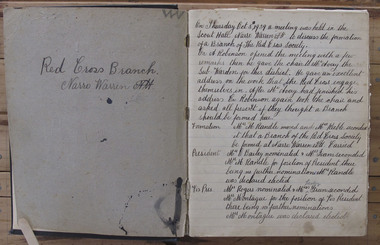 Narre Warren and District Family History Group
Book - Narre Warren North Red Cross Minute Books 1939 to 1964, Narre Warren North Red Cross, 1939-1964
... The early minutes reflect the difficulties of the war years when many of the women may have had husbands, sons and daughters in the services. Despite rationing and shortages of materials these ladies always seemed to have most of what they needed to make goods to sell at stalls, provide suppers at concerts and social afternoons and hold an annual fair. ...Narre Warren North had a population of 200 in 1933. Just a month after World War 2 began in September 1939, a meeting was held in the Narre Warren Scout Hall to discuss the formation of a branch of the Red Cross Society. Mrs Harry Randle was elected president, Mrs Montague, vice president; Mrs Brundrett, secretary and Mrs Ewart, treasurer. All financial members were deemed to constitute the committee. By 1953, just 14 years after their formation they had raised over two thousand pounds, of which one thousand, eight hundred and eighty-two pounds had been sent to headquarters.The minutes bring together the ladies of all walks of life in a small rural community. The early minutes reflect the difficulties of the war years when many of the women may have had husbands, sons and daughters in the services. Despite rationing and shortages of materials these ladies always seemed to have most of what they needed to make goods to sell at stalls, provide suppers at concerts and social afternoons and hold an annual fair. In their spare time they knitted socks and helmets and sewed pyjamas that were sent to those serving overseas. The minutes highlight the work of our local women and give us an insight into the often unrecorded contributions women made within their communities in a time when local histories were dominated by male achievements.Six exercise books bound with hard cover binding. Navy blue debossed cover.narre warren north (vic.), narre warren north (vic.) -- red cross, red cross society -
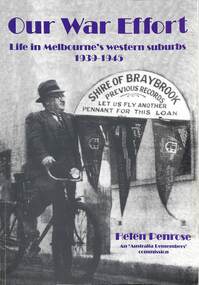 Sunshine and District Historical Society Incorporated
Book - Our War Effort - Life in Melbourne's Western Suburbs 1939 - 1945, Helen Penrose, 1997
... McKay Massey Harris World War 1919 - 1945 War work Women in non traditional roles social conditions Braybrook Shire munition and explosives factories rationing and shortages The book is an historical account of life in Melbourne's western suburbs and its community's contributions to the war effort. ...The book is an historical account of life in Melbourne's western suburbs and its community's contributions to the war effort.Soft covered book with a photograph from the Sunshine Advocate (1943) depicting President Reg Barclay surveying War Loans Appeals records achieved by the Shire of Braybrook.non-fictionThe book is an historical account of life in Melbourne's western suburbs and its community's contributions to the war effort.sunshine, h.v. mckay massey harris, world war 1919 - 1945, war work, women in non traditional roles, social conditions, braybrook shire, munition and explosives factories, rationing and shortages
