
Showing 48 items matching "remote community"
-
 National Wool Museum
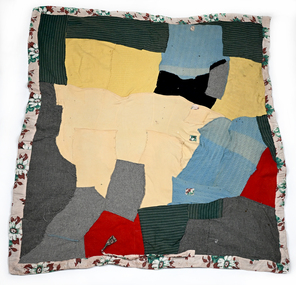
Textile - Wagga, Gwenyth Fletcher, c.1950s
... ...remote community...John was working for the Presbyterian Church and they needed an assistant sheep worker at Ernabella (now Pukatja), a remote First Nations community, in the far North West of South Australia and he had worked there prior to his marriage. ... - Donor, November 2025 wagga remote community Gwenyth Fletcher King George VI Canowindra Ernabella Pukatja Swag Blanket Sheep Rural Life Wagga blanket with base made from two different beige/light khaki blankets. ...Gwenyth Fletcher (nee Thompson) was born in 1922 in Burwood. At six months of age her family moved to Blackheath where she lived until her marriage to John Fletcher. When Gwenyth was four years old, her grandfather was the mayor of Blackheath and as such, he had to welcome the Duke and Duchess of Kent to the town. Gwenyth presented the future King George VI and his wife Elizabeth with a posy of flowers as part of the welcoming ceremony. John and Gwenyth were married in 1951 and in 1952 they moved to Canowindra. John was working for the Presbyterian Church and they needed an assistant sheep worker at Ernabella (now Pukatja), a remote First Nations community, in the far North West of South Australia and he had worked there prior to his marriage. The work involved sheep, vehicles and general handy man work, and trips to Finke (railway 200 miles east). After marriage John was again asked to work at Ernabella. He and Gwenyth left for Ernabella in 1953 and returned in November. They then bought a property in Canowindra and the family stayed for four years before returning to Ernabella. Two children were born whilst they were in Canowindra. The family stayed for eight years at Ernabella from 1958 to April 1966. During the time at Ernabella and Fregon, three more children were born. In May 1966, the family returned to the farm in Canowindra. John and Gwenyth retired from the farm in 1985 and moved to South Canowindra. The Wagga was probably made during the time at Ernabella from children's knits and other leftovers. John had to camp out from the home a lot in order to muster sheep and the desert nights are cold. There is evidence (ties) that Gwenyth made the wagga into a swag-like product that John could easily carry. There were few resources available to her in the remote region, so she used what she had. Gwenyth was known for her reuse of everything – she never threw anything out. Everything was repurposed or recycled. Gwenyth Fletcher was my mother-in-law. Because I was interested in quilts/quilting and patchwork she gave me the blanket instead of throwing it out. She gave it to me during the 1990s. - Donor, November 2025Wagga blanket with base made from two different beige/light khaki blankets. One of the blankets is lightly striped. The top is made up of random, non-geometrical pieces of cardigans and jumpers and other blankets that are machine stitched to the bottom blankets. The cardigans are different colours - light blue, red, navy, yellow and light yellow and are knitted with different patterns. The top blanket pieces are different greys. The cardigan pieces include a pocket, button holes and one of the blanket patches has some of a blanket stitched border. The top also has some green striped material patches. The whole blanket/quilt is bordered by a wide brown patterned material. Some of this material is also used as smaller patches on holes in the cardigans. There are also some hand stitched repairs.wagga, remote community, gwenyth fletcher, king george vi, canowindra, ernabella, pukatja, swag, blanket, sheep, rural life -
 Lakes Entrance Historical Society
Book, Dorothy Stein, Personalities and Stories of the Early Orbost District, 2000
... A collection of life stories of the early settlers indicating struggles resilience and triumphs of a remote community Orbost Victoria...Township Settlers Transport A collection of life stories of the early settlers indicating struggles resilience and triumphs of a remote community Orbost Victoria Personalities and Stories of the Early Orbost District Book Dorothy Stein ...A collection of life stories of the early settlers indicating struggles resilience and triumphs of a remote community Orbost Victoriatownship, settlers, transport -
Lakes Entrance Historical Society
Book, Ingrid Drysdale author, The End of Dreaming by Ingrid Drysdale, 1974
... The author tells the story of life for herself, husband and family in remote Aboriginal communities in Northern Australia from late 1920s to the 1970s...Aboriginals Settlement The author tells the story of life for herself, husband and family in remote Aboriginal communities in Northern Australia from late 1920s to the 1970s The End of Dreaming by Ingrid Drysdale Book Ingrid Drysdale author ...The author tells the story of life for herself, husband and family in remote Aboriginal communities in Northern Australia from late 1920s to the 1970saboriginals, settlement -
 Kiewa Valley Historical Society
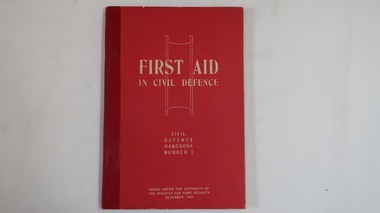
Book - Civil Defence, First Aid in Civil Defence - Handbook No.3 Dec. 1942
... First Aid during WWII was important for the civil population in case of attack or accidents especially in remote communities. This book was issued under the authority of the Minister for Home Security Dec. 1942...First Aid during WWII was important for the civil population in case of attack or accidents especially in remote communities. This book was issued under the authority of the Minister for Home Security Dec. 1942 This book informed the workforce employed by the SECV working on the construction of the Kiewa Hydro Electric Scheme in the remote Kiewa Valley. first aid wwii civil defence kiewa valley Small thick red book with title and 'author' written in white block letters on the front cover. 160 pages with some diagrams and bound by red tape. ...First Aid during WWII was important for the civil population in case of attack or accidents especially in remote communities. This book was issued under the authority of the Minister for Home Security Dec. 1942This book informed the workforce employed by the SECV working on the construction of the Kiewa Hydro Electric Scheme in the remote Kiewa Valley.Small thick red book with title and 'author' written in white block letters on the front cover. 160 pages with some diagrams and bound by red tape.first aid, wwii, civil defence, kiewa valley -
 City of Stonnington
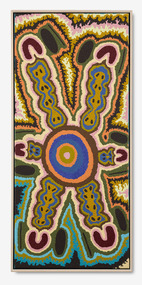
Jessie Akemarr Beasley Jr, Kwaty Ngenty (The old soakage), 2010
... Epenarra is a remote indigenous community 220kms South East of Tennant Creek, Northern Territory....Epenarra is a remote indigenous community 220kms South East of Tennant Creek, Northern Territory. ...‘This is a soakage that has been around for a long time. Four ladies are collecting their water in coolamons. They have digging sticks with them from hunting and now they are getting water.’ This artwork was acquired as part of a project between City of Stonnington and World Vision.Epenarra is a remote indigenous community 220kms South East of Tennant Creek, Northern Territory.Framed artwork. Acrylic on canvas.There is a registration label on the back. 'Kwaty Nagenty' handwritten in texta on the canvas, registration label on the back. NOTE: two works cite the same Mossgreen catalogue number.stonnington contemporary art collection, first peoples, first nations, indigenous, aboriginal torres strait islander, painting, water, jessie akemarr beasley jr. -
 City of Stonnington
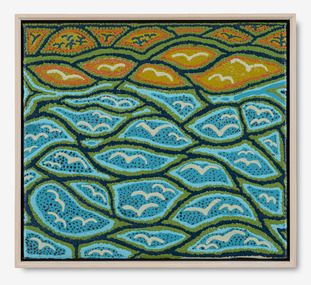
Jessie Akemarr Beasley Jr, Cockatoos at Epenarra Creek, 2010
... Epenarra is a remote indigenous community 220kms South East of Tennant Creek, Northern Territory....Epenarra is a remote indigenous community 220kms South East of Tennant Creek, Northern Territory. ...‘Cockatoos go and get food from the trees, seeds, conkaberry and bush beans. Cockatoos live near the creek.’ This artwork was acquired as part of a project between City of Stonnington and World Vision. Epenarra is a remote indigenous community 220kms South East of Tennant Creek, Northern Territory.Framed artwork. Mossgreen catalogue # 9 with certificate of authenticity World Vision. Acrylic on canvas.Canvas is titled on the back. NOTE: two works cite the same Mossgreen catalogue number.stonnington contemporary art collection, first peoples, painting, first nations, indigenous, aboriginal torres strait islander, jessie akemarr beasley jr., cockatoo -
 Victorian Aboriginal Corporation for Languages
article, Gary Johns, Aboriginal education : remote schools and the real economy, 2006
... Aboriginal children in remote communities have the lowest rates of success in school. ...school programs education policy literacy and numeracy employment outcomes Aboriginal children in remote communities have the lowest rates of success in school. ...Aboriginal children in remote communities have the lowest rates of success in school. The reasons for the lack of success are well known, and mainly lie outside of the schools and their programs. Education authorities have made some poor choices in the past. They have not enforced the necessary discipline on children to attend school, and they have placed cultural sensitivity above the needs of the child to cope in the modern economy. More recently they have begun to concentrate on programs in literacy and numeracy, but success is limited because of the perverse incentives of other government initiatives. These initiatives have been blind to the need to deal with the absence of an economy in remote areas, and the absence of a work ethic among Aborigines who are welfare dependent. The absence of the work ethic and the absence of work have severely constrained the returns on the investment in Aboriginal education. The correct policy response to failure at school will be determined not simply by additional programs at school, but by how various issues of transition to the real economy - work, individual obligation, mobility - are managed. The transition will be better managed if educators and governments understand that education is essentially an instrument in economic integration, and that many remote communities are not viable, and where they are not schools should not be used as pawns to keep them afloat. Moreover, educators and governments should understand that western education cannot and should not preserve Aboriginal culture. Most importantly, parents' behaviour needs to change and where incentives to send children to school fail, compulsion must be used.school programs, education policy, literacy and numeracy, employment outcomes -
 Orbost & District Historical Society
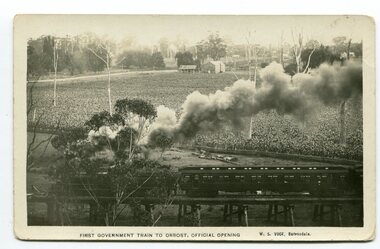
Photograph - Photographs- Orbost Railway 1916
... This was an extremely important and much anticipated event for this remote community In East Gippsland, Victoria. This railway was constructed 1912-1916, and functioned until 1987. ...This was an extremely important and much anticipated event for this remote community In East Gippsland, Victoria. This railway was constructed 1912-1916, and functioned until 1987. ...These three photos were taken at the time of the opening of the Orbost Railway (Bairnsdale-Orbost) in 1916. This was an extremely important and much anticipated event for this remote community In East Gippsland, Victoria. This railway was constructed 1912-1916, and functioned until 1987. It was a 'developmental' railway line, constructed to encourage and promote development in this region which suffered from extremely poor transport and lack of access to markets.These photographs are significant because they are a record of an extremely important event in the history of Orbost, ie. the opening of the railway line in 1916.Three b/w photos/postcards of the Orbost Railway, 1916 2713.1 An oval shaped b/w photo/postcard showing a steam engine and five train carriages on a railway line, and workers beside the line using shovels. 2713.2 A panoramic rural view taken from an elevated position, showing paddocks, a long railway bridge on the right hand side with a line of telegraph poles beside it, one house on a road, and buildings in the distance. 2713.3 A steam train on a wooden bridge in the foreground. Steam from the train covers much of the photograph. Paddocks of maize, a barn and shed, and dead trees.2713.1 NEWMERELLA RAILWAY, ORBOST STANLEY VOGT, BAIRNSDALE 2713.2 Railway Viaduct, Orbost Flats 2713.3 First Government Train to Orbost, Official Opening. W S Vogt, Bairnsdaleorbost railway, newmerella -
 City of Stonnington
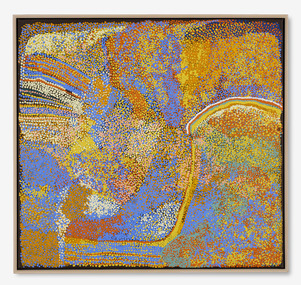
Painting, Topsy Akemarr Beasley, Ilpay Ilkwa (Big Creek), 2010
... Epenarra is a remote indigenous community 220kms South East of Tennant Creek, Northern Territory....Epenarra is a remote indigenous community 220kms South East of Tennant Creek, Northern Territory. ...‘This is a beautiful landscape in sandhills country after rain. We went hunting for echidna and goanna and looking for witchetty grubs and bush potatoes.’ Artwork acquired as part of a project between City of Stonnington and World Vision. "This shows the soakage on my country. My tucker is conkerberry which is found all over this land." Epenarra is a remote indigenous community 220kms South East of Tennant Creek, Northern Territory.Mossgreen catalogue # 2 with certificate of authenticity World Vision. Acrylic on canvas.There is a registration level on the back of the artwork.stonnington contemporary art collection, first peoples, painting, first nations, indigenous, aboriginal torres strait islander, topsy akemarr beasley, landscape -
 Kiewa Valley Historical Society
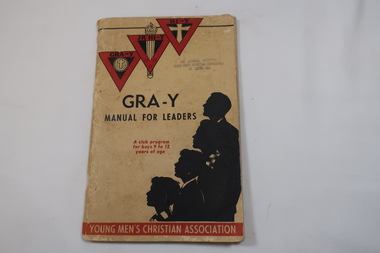
Book - Manual, GRA-Y Manual for Leaders
... With the creation of the township of Mount Beauty in 1946 the SECV made every effort to provide wholesome activities for the 3000+ people suddenly living in the remote new community. GRA-Y was an American system of Gymnastics for men and boys under the umbrella of the YMCA. ...With the creation of the township of Mount Beauty in 1946 the SECV made every effort to provide wholesome activities for the 3000+ people suddenly living in the remote new community. GRA-Y was an American system of Gymnastics for men and boys under the umbrella of the YMCA. ...With the creation of the township of Mount Beauty in 1946 the SECV made every effort to provide wholesome activities for the 3000+ people suddenly living in the remote new community. GRA-Y was an American system of Gymnastics for men and boys under the umbrella of the YMCA. The Gra-Y club continued on to the 1980s.This book is the manual used to train leaders and was used continually through the years. This copy was the property of Mr Ron White, who went on to become Engineer in Chief-Hydro.Cream coloured with black and red decals and writing on soft card cover. 142 pages held by two staples. Three red logos on top left hand side.Sub titles: 'A club program / for boys 9 to 12 / years of age' and along the bottom 'Young Men's Christian Association'Front and back stamp: The National Committee / Young Men's Christian Association / of Australiagra-y, ymca, gymnastics, boxing, wrestling, boys' club -
 Kiewa Valley Historical Society
Tin Egg Preservative, from mid 1800's to mid 1900's
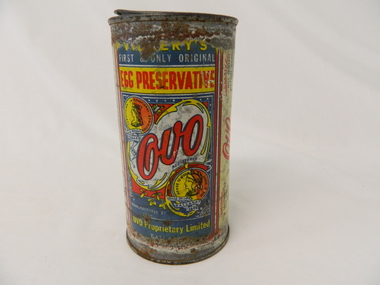
... Rural towns did rely on the "Ice Works" providing block ice for prolonging "produce shelf life" however semi remote and smaller communities did not have that facility. ...Basic foodstuff which required "special" preservation means to extend their "shelf" life were sometimes regarded as luxuries by semi remote communities. Kiewa Valley and its regions were typical of these remote communities in the time frame of this egg preservation product. ...The egg preservation material offered in this tin was during a period in Australia's history (especially in the rural areas) when the "freshness" of produce was not able to be maintained by refrigeration means. Rural towns did rely on the "Ice Works" providing block ice for prolonging "produce shelf life" however semi remote and smaller communities did not have that facility. It was products such as this egg preserving ability that enabled these smaller rural communities to maintain a constant source of healthy "short life" organic produce.This tin which contained egg preservative powder is very significant to a rural region (Kiewa Valley) in the late 1800's to early 1900's. It details the type of food preservative methods that were available to rural areas which lacked proper refrigeration means at their disposal. Basic foodstuff which required "special" preservation means to extend their "shelf" life were sometimes regarded as luxuries by semi remote communities. Kiewa Valley and its regions were typical of these remote communities in the time frame of this egg preservation product. The ability to keep products that deteriorate due to "normal" outdoor temperature (bacterior prone produce) was a factor of rural living.This round "tubular" tin has a indented lid which fits snugly into the top opening. The lid has a rolled out lip which ensures a degree of "air" tightness. The tin is pressed and folded together and has no synthetic inner cover to protect the egg preservative powder from the raw tin surface. This "raw" method was the typical application for all tins containing dry food stuffs in this period(mid 1900's) of goods manufacture. The outer tin surface has a tightly pressed laminated paper label with product and manufacturer's information (promotional, preservation "tips" and usage details - will preserve sixteen dozen eggs). On the "front" side "EGG PRESERVATIVE" underneath "OVO" ,underneath "REGISTERED" and in a double lined enclosed square "AWARDED TWO GOLD MEDALS" underneath is a sketch of a mixing dish containing fourteen visible eggs. The bottom label has within an oval boundary (white print on a blue background) "FOR HOUSEHOLD USE" underneath "OVO" and underneath "PRESERVES EGGS PERFECTLY WITHOUT MESS OR TROUBLE" On the opposite side of the tin is printed "VICKERY'S FIRST & ONLY ORIGINAL EGG PRESERVATIVE - in red print. Underneath this is a "round stamp" with the figurehead(royalty) and these encircling words" TASMANIAN INTERNATIONAL EXHIBITION" with a scrolled "GOLD MEDAL HOBART 1895" with another medal like "medallion" showing another female face with a "warrior" headdress and these encircling words "HONOR TO WHOM HONOR IS DUE". Below this within a scrollis printed "GOLD MEDAL BALLARAT 1896" underneath this is printed "MANUFACTURED BY OVO PROPRIETARY LIMITED BALLARAT"egg preservation, rural food storage, kitchen preservation facilities -
Victorian Aboriginal Corporation for Languages
DVD, Suzy Bates, Nothing rhymes with Ngapartji, 2010
... Nothing Rhymes with Ngapartji follows the journey of acclaimed Pitjantjatjara actor Trevor Jamieson, as he returns to his traditional country to perform his hit stage show Ngapartji Ngapartji to an all-Indigenous audience in the remote Australian Aboriginal community of Ernabella, South Australia. ...Pitjantjatjara theatre music performance Big hART DVD, online study guide Nothing Rhymes with Ngapartji follows the journey of acclaimed Pitjantjatjara actor Trevor Jamieson, as he returns to his traditional country to perform his hit stage show Ngapartji Ngapartji to an all-Indigenous audience in the remote Australian Aboriginal community of Ernabella, South Australia. ...Nothing Rhymes with Ngapartji follows the journey of acclaimed Pitjantjatjara actor Trevor Jamieson, as he returns to his traditional country to perform his hit stage show Ngapartji Ngapartji to an all-Indigenous audience in the remote Australian Aboriginal community of Ernabella, South Australia. Nothing Rhymes with Ngapartji is a film about performing a multi-faceted drama to audiences who speak different languages, who are of different cultures and who have varying expectations. Offers an insight into Indigenous perspectives on the consequences of white settlement for Aboriginal cultures. In presenting the material in both Pitjantjatjara and English, it raises the important issue of stories needing to be told in languages that are central to different Australians' understanding of the world. The film is part of Big hART?s Ngapartji Ngapartji project, which is a collaborative work in progress between Indigenous and white Australians that pools their skills, experiences and resources to tell an important story about Indigenous history, culture, language and the experience of several generations.DVD, online study guidepitjantjatjara, theatre, music performance, big hart -
 Victorian Aboriginal Corporation for Languages
Book, Nola Purdie, Working Together: Aboriginal and Torres Strait Islander Mental Health and Wellbeing Principles and Practice, 2010
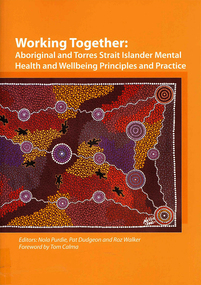
... community wellbeing 11. Indigenous family violence: pathways forward Pt 3 Mental health practice: 12. Working as a culturally competent mental health practitioner 13. Communication and engagement: urban diversity 14. Issues in mental health assessment with Indigenous Australians 15. Reviewing psychiatric assessment in remote...community wellbeing 11. Indigenous family violence: pathways forward Pt 3 Mental health practice: 12. Working as a culturally competent mental health practitioner 13. Communication and engagement: urban diversity 14. Issues in mental health assessment with Indigenous Australians 15. Reviewing psychiatric assessment in remote ...Pt 1 History and contexts: 1. Australian Aboriginal and Torres Strait Islander mental health: an overview 2. A history of psychology in Aboriginal and Torres Strait Islander mental health 3. The social, cultural and historical context of Aboriginal and Torres Strait Islander Australians 4. The policy context of Aboriginal and Torres Strait Islander mental health Pt 2 Issues of Aboriginal and Torres Strait Islander mental health and wellbeing: 5. Mental illness in Aboriginal and Torres Strait Islander peoples 6. Social determinants of Aboriginal and Torres Strait Islander social and emotional wellbeing 7. Preventing suicide among Indigenous Australians 8. Anxiety and Aboriginal and Torres Strait Islander young people 9. Substance misuse and mental health among Aboriginal Australians 10. Trauma, transgenerational transfer and effects on community wellbeing 11. Indigenous family violence: pathways forward Pt 3 Mental health practice: 12. Working as a culturally competent mental health practitioner 13. Communication and engagement: urban diversity 14. Issues in mental health assessment with Indigenous Australians 15. Reviewing psychiatric assessment in remote Aboriginal communities 16. Promoting perinatal mental health wellness in Aboriginal and Torres Strait Islander communities Pt 4 Working with specific groups: models, programs and services: 17. Ngarlu: a cultural and spiritual strengthening model 18. Principled engagement: Gelganyem youth and community well being program 19. Dealing with loss, grief and trauma: seven phases to healing 20. The Marumali program: an Aboriginal model of healing 21. Mental health programs and services.colour photographs, tablesmental health -
 Victorian Aboriginal Corporation for Languages
Periodical, Australian Institute of Aboriginal and Torres Strait Islander Studies, Australian Aboriginal studies : journal of the Australian Institute of Aboriginal and Torres Strait Islander Studies, 2009
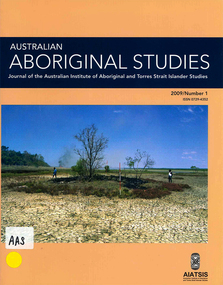
... Social Engineering and Indigenous Settlement: Policy and demography in remote Australia John Taylor In recent years neo-liberals have argued that government support for remote Aboriginal communities contributes to social pathology and that unhindered market engagement involving labour mobility provides the only solution. ...Ladjiladji social engineering Dalabon Indigenous health coronial system radiocarbon dating Social Engineering and Indigenous Settlement: Policy and demography in remote Australia John Taylor In recent years neo-liberals have argued that government support for remote Aboriginal communities contributes to social pathology and that unhindered market engagement involving labour mobility provides the only solution. ...Social Engineering and Indigenous Settlement: Policy and demography in remote Australia John Taylor In recent years neo-liberals have argued that government support for remote Aboriginal communities contributes to social pathology and that unhindered market engagement involving labour mobility provides the only solution. This has raised questions about the viability of remote Aboriginal settlements. While the extreme view is to withdraw services altogether, at the very least selective migration should be encouraged. Since the analytical tools are available, one test of the integrity of such ideas is to consider their likely demographic consequences. Accordingly, this paper provides empirically based speculation about the possible implications for Aboriginal population distribution and demographic composition in remote areas had the advice of neo-liberal commentators and initial labour market reforms of the Northern Territory Emergency Response been fully implemented. The scenarios presented are heuristic only but they reveal a potential for substantial demographic and social upheaval. Aspects of the semantics of intellectual subjectivity in Dalabon (south-western Arnhem Land) Ma�a Ponsonnet This paper explores the semantics of subjectivity (views, intentions, the self as a social construct etc.) in Dalabon, a severely endangered language of northern Australia, and in Kriol, the local creole. Considering the status of Dalabon and the importance of Kriol in the region, Dalabon cannot be observed in its original context, as the traditional methods of linguistic anthropology tend to recommend. This paper seeks to rely on this very parameter, reclaiming linguistic work and research as a legitimate conversational context. Analyses are thus based on metalinguistic statements - among which are translations in Kriol. Far from seeking to separate Dalabon from Kriol, I use interactions between them as an analytical tool. The paper concentrates on three Dalabon words: men-no (intentions, views, thoughts), kodj-no (head) and kodj-kulu-no (brain). None of these words strictly matches the concept expressed by the English word mind. On the one hand, men-no is akin to consciousness but is not treated as a container nor as a processor; on the other, kodj-no and kodj-kulu-no are treated respectively as container and processor, but they are clearly physical body parts, while what English speakers usually call the mind is essentially distinct from the body. Interestingly, the body part kodj-no (head) also represents the individual as a social construct - while the Western self does not match physical attributes. Besides, men-no can also translate as idea, but it can never be abstracted from subjectivity - while in English, potential objectivity is a crucial feature of ideas. Hence the semantics of subjectivity in Dalabon does not reproduce classic Western conceptual articulations. I show that these specificities persist in the local creole. Health, death and Indigenous Australians in the coronial system Belinda Carpenter and Gordon Tait This paper details research conducted in Queensland during the first year of operation of the new Coroners Act 2003. Information was gathered from all completed investigations between December 2003 and December 2004 across five categories of death: accidental, suicide, natural, medical and homicide. It was found that 25 percent of the total number of Indigenous deaths recorded in 2004 were reported to, and investigated by, the Coroner, in comparison to 9.4 percent of non-Indigenous deaths. Moreover, Indigenous people were found to be over-represented in each category of death, except in death in a medical setting, where they were absent. This paper discusses these findings in detail, following the insights gained from the work of Tatz (1999, 2001, 2005) and Morrissey (2003). It also discusses a further outcome of this situation - the over-representation of Indigenous people in figures for full internal autopsy. Finding your voice: Placing and sourcing an Aboriginal health organisation?s published and grey literature Clive Rosewarne It is widely recognised that Aboriginal perspectives need to be represented in historical narratives. Sourcing this material may be difficult if Aboriginal people and their organisations do not publish in formats that are widely distributed and readily accessible to library collections and research studies. Based on a search for material about a 30-year-old Aboriginal health organisation, this paper aims to (1) identify factors that influenced the distribution of written material authored by the organisation; (2) consider the implications for Aboriginal people who wish to have their viewpoints widely available to researchers; and (3) assess the implications for research practice. As part of researching an organisational history for the Central Australian Aboriginal Congress, seven national and regional collections were searched for Congress?s published and unpublished written material. It was found that, in common with other Aboriginal organisations, most written material was produced as grey literature. The study indicates that for Aboriginal people and their organisations? voices to be heard, and their views to be accessible in library collections, they need to have an active program to distribute their written material. It also highlights the need for researchers to be exhaustive in their searches, and to be aware of the limitations within collections when sourcing Aboriginal perspectives. Radiocarbon dates from the Top End: A cultural chronology for the Northern Territory coastal plains Sally Brockwell , Patrick Faulkner, Patricia Bourke, Anne Clarke, Christine Crassweller, Daryl Guse, Betty Meehan, and Robin Sim The coastal plains of northern Australia are relatively recent formations that have undergone dynamic evolution through the mid to late Holocene. The development and use of these landscapes across the Northern Territory have been widely investigated by both archaeologists and geomorphologists. Over the past 15 years, a number of research and consultancy projects have focused on the archaeology of these coastal plains, from the Reynolds River in the west to the southern coast of the Gulf of Carpentaria in the east. More than 300 radiocarbon dates are now available and these have enabled us to provide a more detailed interpretation of the pattern of human settlement. In addition to this growing body of evidence, new palaeoclimatic data that is relevant to these northern Australian contexts is becoming available. This paper provides a synthesis of the archaeological evidence, integrates it within the available palaeo-environmental frameworks and characterises the cultural chronology of human settlement of the Northern Territory coastal plains over the past 10 000 years. Ladjiladji language area: A reconstruction Ian Clark and Edward Ryan In this reconsideration of the Ladjiladji language area in northwest Victoria, we contend that while Tindale?s classical reconstruction of this language identified a fundamental error in Smyth?s earlier cartographic representation, he incorrectly corrected that error. We review what is known about Ladjiladji and through a careful analysis demonstrate not only the errors in both Smyth and Tindale but also proffer a fundamental reconstruction grounded in the primary sources.ladjiladji, social engineering, dalabon, indigenous health, coronial system, radiocarbon dating -
 Victorian Aboriginal Corporation for Languages
Periodical, Australian Institute of Aboriginal and Torres Strait Islander Studies, Australian Aboriginal studies : journal of the Australian Institute of Aboriginal and Torres Strait Islander Studies, 2013
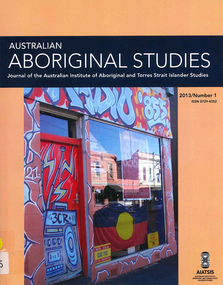
... communities? and ?real? Torres Strait Islander people live ?on islands?. Yet more than 70 percent of Australia?s Indigenous peoples live in urban locations (ABS 2007), and urban living is just as much part of a reality for Aboriginal and Torres Strait Islander people as living in remote discrete communities. ...communities? and ?real? Torres Strait Islander people live ?on islands?. Yet more than 70 percent of Australia?s Indigenous peoples live in urban locations (ABS 2007), and urban living is just as much part of a reality for Aboriginal and Torres Strait Islander people as living in remote discrete communities. ...We don?t leave our identities at the city limits: Aboriginal and Torres Strait Islander people living in urban localities Bronwyn Fredericks Aboriginal and Torres Strait Islander people who live in cities and towns are often thought of as ?less Indigenous? than those who live ?in the bush?, as though they are ?fake? Aboriginal people ? while ?real? Aboriginal people live ?on communities? and ?real? Torres Strait Islander people live ?on islands?. Yet more than 70 percent of Australia?s Indigenous peoples live in urban locations (ABS 2007), and urban living is just as much part of a reality for Aboriginal and Torres Strait Islander people as living in remote discrete communities. This paper examines the contradictions and struggles that Aboriginal and Torres Strait Islander people experience when living in urban environments. It looks at the symbols of place and space on display in the Australian cities of Melbourne and Brisbane to demonstrate how prevailing social, political and economic values are displayed. Symbols of place and space are never neutral, and this paper argues that they can either marginalise and oppress urban Aboriginal and Torres Strait Islander people, or demonstrate that they are included and engaged. Juggling with pronouns: Racist discourse in spoken interaction on the radio Di Roy While the discourse of deficit with regard to Australian Indigenous health and wellbeing has been well documented in print media and through images on film and on television, radio talk concerning this discourse remains underresearched. This paper interrogates the power of an interactive news interview, aired on the Radio National Breakfast program on ABC Radio in 2011, to maintain and reproduce the discourse of deficit, despite the best intentions of the interview participants. Using a conversation-analytical approach, and membership categorisation analysis in particular, this paper interrogates the spoken interaction between a well-known radio interviewer and a respected medical researcher into Indigenous eye health. It demonstrates the recreation of a discourse emanating from longstanding hegemonies between mainstream and Indigenous Australians. Analysis of firstperson pronoun use shows the ongoing negotiation of social category boundaries and construction of moral identities through ascriptions to category members, upon which the intelligibility of the interview for the listening audience depended. The findings from analysis support claims in a considerable body of whiteness studies literature, the main themes of which include the pervasiveness of a racist discourse in Australian media and society, the power of invisible assumptions, and the importance of naming and exposing them. Changes in Pitjantjatjara mourning and burial practices Bill Edwards, University of South Australia This paper is based on observations over a period of more than five decades of changes in Pitjantjatjara burial practices from traditional practices to the introduction of Christian services and cemeteries. Missions have been criticised for enforcing such changes. However, in this instance, the changes were implemented by the Aboriginal people themselves. Following brief outlines of Pitjantjatjara traditional life, including burial practices, and of the establishment of Ernabella Mission in 1937 and its policy of respect for Pitjantjatjara cultural practices and language, the history of these changes which commenced in 1973 are recorded. Previously, deceased bodies were interred according to traditional rites. However, as these practices were increasingly at odds with some of the features of contemporary social, economic and political life, two men who had lost close family members initiated church funeral services and established a cemetery. These practices soon spread to most Pitjantjatjara communities in a manner which illustrates the model of change outlined by Everett Rogers (1962) in Diffusion of Innovations. Reference is made to four more recent funerals to show how these events have been elaborated and have become major social occasions. The world from Malarrak: Depictions of South-east Asian and European subjects in rock art from the Wellington Range, Australia Sally K May, Paul SC Ta�on, Alistair Paterson, Meg Travers This paper investigates contact histories in northern Australia through an analysis of recent rock paintings. Around Australia Aboriginal artists have produced a unique record of their experiences of contact since the earliest encounters with South-east Asian and, later, European visitors and settlers. This rock art archive provides irreplaceable contemporary accounts of Aboriginal attitudes towards, and engagement with, foreigners on their shores. Since 2008 our team has been working to document contact period rock art in north-western and western Arnhem Land. This paper focuses on findings from a site complex known as Malarrak. It includes the most thorough analysis of contact rock art yet undertaken in this area and questions previous interpretations of subject matter and the relationship of particular paintings to historic events. Contact period rock art from Malarrak presents us with an illustrated history of international relationships in this isolated part of the world. It not only reflects the material changes brought about by outside cultural groups but also highlights the active role Aboriginal communities took in responding to these circumstances. Addressing the Arrernte: FJ Gillen?s 1896 Engwura speech Jason Gibson, Australian National University This paper analyses a speech delivered by Francis James Gillen during the opening stages of what is now regarded as one of the most significant ethnographic recording events in Australian history. Gillen?s ?speech? at the 1896 Engwura festival provides a unique insight into the complex personal relationships that early anthropologists had with Aboriginal people. This recently unearthed text, recorded by Walter Baldwin Spencer in his field notebook, demonstrates how Gillen and Spencer sought to establish the parameters of their anthropological enquiry in ways that involved both Arrernte agency and kinship while at the same time invoking the hierarchies of colonial anthropology in Australia. By examining the content of the speech, as it was written down by Spencer, we are also able to reassesses the importance of Gillen to the ethnographic ambitions of the Spencer/Gillen collaboration. The incorporation of fundamental Arrernte concepts and the use of Arrernte words to convey the purpose of their 1896 fieldwork suggest a degree of Arrernte involvement and consent not revealed before. The paper concludes with a discussion of the outcomes of the Engwura festival and the subsequent publication of The Native Tribes of Central Australia within the context of a broader set of relationships that helped to define the emergent field of Australian anthropology at the close of the nineteenth century. One size doesn?t fit all: Experiences of family members of Indigenous gamblers Louise Holdsworth, Helen Breen, Nerilee Hing and Ashley Gordon Centre for Gambling Education and Research, Southern Cross University This study explores help-seeking and help-provision by family members of Indigenous people experiencing gambling problems, a topic that previously has been ignored. Data are analysed from face-to-face interviews with 11 family members of Indigenous Australians who gamble regularly. The results confirm that substantial barriers are faced by Indigenous Australians in accessing formal help services and programs, whether for themselves or a loved one. Informal help from family and friends appears more common. In this study, this informal help includes emotional care, practical support and various forms of ?tough love?. However, these measures are mostly in vain. Participants emphasise that ?one size doesn?t fit all? when it comes to avenues of gambling help for Indigenous peoples. Efforts are needed to identify how Indigenous families and extended families can best provide social and practical support to assist their loved ones to acknowledge and address gambling problems. Western Australia?s Aboriginal heritage regime: Critiques of culture, ethnography, procedure and political economy Nicholas Herriman, La Trobe University Western Australia?s Aboriginal Heritage Act 1972 (WA) and the de facto arrangements that have arisen from it constitute a large part of the Aboriginal ?heritage regime? in that state. Although designed ostensibly to protect Aboriginal heritage, the heritage regime has been subjected to various scholarly critiques. Indeed, there is a widespread perception of a need to reform the Act. But on what basis could this proceed? Here I offer an analysis of these critiques, grouped according to their focus on political economy, procedure, ethnography and culture. I outline problems surrounding the first three criticisms and then discuss two versions of the cultural critique. I argue that an extreme version of this criticism is weak and inconsistent with the other three critiques. I conclude that there is room for optimism by pointing to ways in which the heritage regime could provide more beneficial outcomes for Aboriginal people. Read With Me Everyday: Community engagement and English literacy outcomes at Erambie Mission (research report) Lawrence Bamblett Since 2009 Lawrie Bamblett has been working with his community at Erambie Mission on a literacy project called Read With Me. The programs - three have been carried out over the past four years - encourage parents to actively engage with their children?s learning through reading workshops, social media, and the writing and publication of their own stories. Lawrie attributes much of the project?s extraordinary success to the intrinsic character of the Erambie community, not least of which is their communal approach to living and sense of shared responsibility. The forgotten Yuendumu Men?s Museum murals: Shedding new light on the progenitors of the Western Desert Art Movement (research report) Bethune Carmichael and Apolline Kohen In the history of the Western Desert Art Movement, the Papunya School murals are widely acclaimed as the movement?s progenitors. However, in another community, Yuendumu, some 150 kilometres from Papunya, a seminal museum project took place prior to the completion of the Papunya School murals and the production of the first Papunya boards. The Warlpiri men at Yuendumu undertook a ground-breaking project between 1969 and 1971 to build a men?s museum that would not only house ceremonial and traditional artefacts but would also be adorned with murals depicting the Dreamings of each of the Warlpiri groups that had recently settled at Yuendumu. While the murals at Papunya are lost, those at Yuendumu have, against all odds, survived. Having been all but forgotten, this unprecedented cultural and artistic endeavour is only now being fully appreciated. Through the story of the genesis and construction of the Yuendumu Men?s Museum and its extensive murals, this paper demonstrates that the Yuendumu murals significantly contributed to the early development of the Western Desert Art Movement. It is time to acknowledge the role of Warlpiri artists in the history of the movement.b&w photographs, colour photographsracism, media, radio, pitjantjatjara, malarrak, wellington range, rock art, arrernte, fj gillen, engwura, indigenous gambling, ethnography, literacy, erambie mission, yuendumu mens museum, western desert art movement -
 Flagstaff Hill Maritime Museum and Village
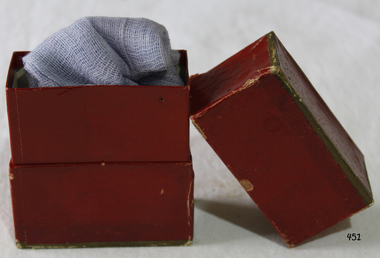
Equipment - Gauze & Box, Early - Mid 20th Century
... remote areas. From 1888 First Aid Kits and instructions became available for work sites, offices, community groups and individuals, helping to bridge the gap between the accident and the arrival of medical assistance. ...When used as a medical dressing, woven gauze is usually made of cotton. It is especially useful for dressing wounds where other fabrics might stick to the burn or laceration. Many modern medical gauzes are covered with a perforated plastic film such as Telfa or a polyblend which prevents direct contact and further minimizes wound adhesion. Also, it can be impregnated with a thick, creamy mixture of zinc oxide and calamine to promote healing, as in Unna's boot. (An Unna’s boot is a special gauze (usually 4 inches wide and 10 yards long) bandage, which can be used for the treatment of venous stasis ulcers and other venous insufficiencies of the leg. It can also be used as a supportive bandage for sprains and strains of the foot, ankle and lower leg. The gauze is impregnated with a thick, creamy mixture of zinc oxide and calamine to promote healing. It may also contain acacia, glycerin, castor oil and white petrolatum.) Gauze is also used during procedures involving accidental tooth loss; either the gauze is used to provide pressure as the tooth is moved back into its corresponding socket, or the tooth is wrapped in gauze and placed in milk or saline to keep it alive while the tooth is being transported or prepared for reinsertion. https://en.wikipedia.org/wiki/GauzeAccess to emergency medical help in early settlement days of Victoria could take quite some time, especially in remote areas. From 1888 First Aid Kits and instructions became available for work sites, offices, community groups and individuals, helping to bridge the gap between the accident and the arrival of medical assistance. Gauze was widely used in many medical conditions.Gauze and maroon box with sliding top, purple bandage (gauze) inside. Gold rim top and bottom. None.flagstaff hill, warrnambool, shipwrecked-coast, flagstaff-hill, flagstaff-hill-maritime-museum, maritime-museum, shipwreck-coast, flagstaff-hill-maritime-village, first aid bandages, dressings, medical -
 Flagstaff Hill Maritime Museum and Village
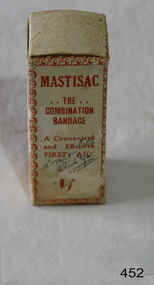
Equipment - Gauze & Box, Flexlock Products, Early - Mid 20th Century
... remote areas. From 1888 First Aid Kits and instructions became available for work sites, offices, community groups and individuals, helping to bridge the gap between the accident and the arrival of medical assistance. ...When used as a medical dressing, woven gauze is usually made of cotton. It is especially useful for dressing wounds where other fabrics might stick to the burn or laceration. Many modern medical gauzes are covered with a perforated plastic film such as Telfa or a polyblend which prevents direct contact and further minimizes wound adhesion. Also, it can be impregnated with a thick, creamy mixture of zinc oxide and calamine to promote healing, as in Unna's boot. (An Unna’s boot is a special gauze (usually 4 inches wide and 10 yards long) bandage, which can be used for the treatment of venous stasis ulcers and other venous insufficiencies of the leg. It can also be used as a supportive bandage for sprains and strains of the foot, ankle and lower leg. The gauze is impregnated with a thick, creamy mixture of zinc oxide and calamine to promote healing. It may also contain acacia, glycerin, castor oil and white petrolatum.) Gauze is also used during procedures involving accidental tooth loss; either the gauze is used to provide pressure as the tooth is moved back into its corresponding socket, or the tooth is wrapped in gauze and placed in milk or saline to keep it alive while the tooth is being transported or prepared for reinsertion. https://en.wikipedia.org/wiki/GauzeAccess to emergency medical help in early settlement days of Victoria could take quite some time, especially in remote areas. From 1888 First Aid Kits and instructions became available for work sites, offices, community groups and individuals, helping to bridge the gap between the accident and the arrival of medical assistance. Gauze was widely used in many medical conditions.Gauze and box entitled "MASTISAC?. The Combination Bandage" Bandage is complete with instructions for use inside.Mastisac ‘The combination Bandage. A convenient and effective FIRST AID. Prepared and distributed by Flexlock products, 15 Mills Street, Albert Parkflagstaff hill, warrnambool, shipwrecked-coast, flagstaff-hill, flagstaff-hill-maritime-museum, maritime-museum, shipwreck-coast, flagstaff-hill-maritime-village, first aid, bandages, dressings, medical -
 Flagstaff Hill Maritime Museum and Village
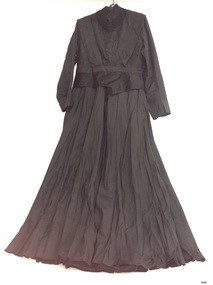
Clothing - Mourning Outfit, Late 19th to early-20th centuries
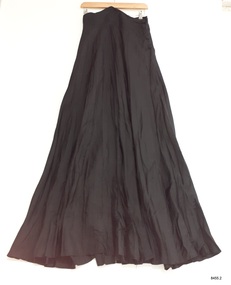
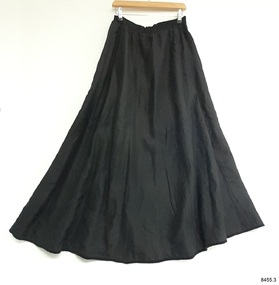
... The mourning of death was part of both family and community life, particularly in rural and remote areas. People were bonded through work, religion, disasters, tragedy and social activities, supporting one another. ...The mourning of death was part of both family and community life, particularly in rural and remote areas. People were bonded through work, religion, disasters, tragedy and social activities, supporting one another. ...This Edwardian-era mourning outfit was worn by a wealthy woman from the rural area of Willaura, southeast of the Grampians. It was inherited by the donor from his mother, who had purchased it from a clearing sale in the 1960s. The jacket has a peplum or flounce below the waistline, a fashion that was seen in the 1860s and is still around in the 1900s. The outfit represents the female mourning fashion and wardrobe from the late 19th to early 20th centuries. Such garments were a necessary inclusion as death often occurred to the young, due to illness, accidents and hard work - it was a regular part of life in rural Victoria. Mourning outfits were part of a person’s wardrobe and often passed from one generation to the next. This particular outfit appears to have been adjusted at some stage to allow for a wider waistline. The original skirt may have been replaced by the one that is now part of this outfit; the skirt is all machine-sewn, unlike the jacket and petticoat. The fabric of the skirt may be silk or it could be a synthetic fibre such as artificial silk or rayon; both were available in the 1800s,but nylon wasn’t invented until the 1930s. This skirt has sunray pleating, which was advertised on skirts for sale in the 1890s, and 1909, and was part of a fashionable bridal gown train in the 1930s. The mourning of death was part of both family and community life, particularly in rural and remote areas. People were bonded through work, religion, disasters, tragedy and social activities, supporting one another. They came together from near and far on such an occasion, giving each other the care that was needed and showing respect for the member who had passed away.This three-piece silk Edwardian mourning outfit is significant historically for its connection with rural Victoria and the social and religious customs surrounding the death of a family or community member. The high-quality outfit is also significant for representing the financial management of the times, being tailored by a dressmaker for a person of means and then adjusted to fit at least one different-sized person. Ladies’ Edwardian mourning outfit; three-piece tailored suit comprising of a black silk long sleeve, short-waist fitted and lined Jacket, a long sunray pleated skirt and long, lined petticoat. Items have been machine-sown and hand-sewn by a dressmaker. The skirt has handmade buttons of the same fabric.Handwritten in ballpoint pen “Jenny” and “Mrs Sheila Handscombe, Wallaura, Jenny”flagstaff hill maritime museum and village, warrnambool, shipwreck coast, edwardian era, tailor-made, dressmaker, mourning outfit, handmade garment, mourning dress, death mourning, sunray pleats, western district victoria -
 Flagstaff Hill Maritime Museum and Village
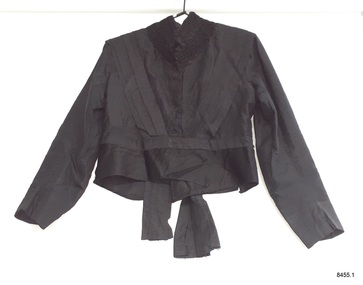
Clothing - Mourning Outfit, jacket, Late 19th to early-20th centuries
... The mourning of death was part of both family and community life, particularly in rural and remote areas. People were bonded through work, religion, disasters, tragedy and social activities, supporting one another. ...The mourning of death was part of both family and community life, particularly in rural and remote areas. People were bonded through work, religion, disasters, tragedy and social activities, supporting one another. ...This Edwardian era mourning outfit was worn by a wealthy woman from the rural area of Willaura, southeast of the Grampians. It was inherited by the donor from his mother, who had purchased it from a clearing sale in the 1960s. The jacket has a peplum or flounce below the waistline, a fashion that was seen in the 1860s and is still around in the 1900s. The outfit represents the female mourning fashion and wardrobe from the late 19th to early 20th centuries. Such garments were a necessary inclusion as death occurred often to the young, due to illness, accidents and hard work - it was a regular part of life in rural Victoria. Mourning outfits were a part of a person’s wardrobe and often passed from one generation to the next. This particular outfit appears to have been adjusted at some stage to allow for a wider waistline. The original skirt may have been replaced by the one that is now part of this outfit; the skirt is all machine-sewn, unlike the jacket and petticoat. The fabric of the skirt may be silk or it could be a synthetic fibre such as artificial silk or rayon; both were available in the 1800s,but nylon wasn’t invented until the 1930s. This skirt has sunray pleating, which was advertised on skirts for sale in the 1890s, and 1909, and was part of a fashionable bridal gown train in the 1930s. The mourning of death was part of both family and community life, particularly in rural and remote areas. People were bonded through work, religion, disasters, tragedy and social activities, supporting one another. They came together from near and far on such an occasion, giving each other the care that was needed and showing respect for the member who had passed away.This three-piece silk Edwardian mourning outfit is significant historically for its connection with rural Victoria and the social and religious customs surrounding the death of a family or community member. The high-quality outfit is also significant for representing the financial management of the times, being tailored by a dressmaker for a person of means and then adjusted to fit at least one different-sized person. The black silk tailor-made jacket is one of three pieces of a ladies’ Edwardian mourning outfit. It has long sleeves, a stand-up collar trimmed with appliqued black crochet lace, and pleated sashes on the left and right sides from front to back fastened at the shoulder and waist. The jacket has a peplum or flounce below the waistline. The front of the jacket has brass hooks and fabric eye fastenings. The back of the jacket has two tails. The jacket is lined and the shoulders are padded. It has been machine sewn and finished with hand stitching. A white card is tied with a ribbon inside and has an inscription. The poplin skirt on the jacket has been cut up to the waist at the side seams. There is an attached card with an inscription, handwritten in ballpoint pen.“Jenny” and “Mrs Sheila Handscombe, Wallaura, Jenny”flagstaff hill maritime museum and village, warrnambool, shipwreck coast, edwardian era, tailor-made, dressmaker, mourning outfit, handmade garment, mourning dress, death mourning, sunray pleats, sunburst pleats, western district victoria, mourning jacket -
 Flagstaff Hill Maritime Museum and Village
Clothing - Mourning Outfit, skirt, Late 19th to early-20th centuries
... The mourning of death was part of both family and community life, particularly in rural and remote areas. People were bonded through work, religion, disasters, tragedy and social activities, supporting one another. ...The mourning of death was part of both family and community life, particularly in rural and remote areas. People were bonded through work, religion, disasters, tragedy and social activities, supporting one another. ...This Edwardian-era mourning outfit was worn by a wealthy woman from the rural area of Willaura, southeast of the Grampians. It was inherited by the donor from his mother, who had purchased it from a clearing sale in the 1960s. The jacket has a peplum or flounce below the waistline, a fashion that was seen in the 1860s and is still around in the 1900s. The outfit represents the female mourning fashion and wardrobe from the late 19th to early 20th centuries. Such garments were a necessary inclusion as death often occurred to the young, due to illness, accidents and hard work - it was a regular part of life in rural Victoria. Mourning outfits were part of a person’s wardrobe and often passed from one generation to the next. This particular outfit appears to have been adjusted at some stage to allow for a wider waistline. The original skirt may have been replaced by the one that is now part of this outfit; the skirt is all machine-sewn, unlike the jacket and petticoat. The fabric of the skirt may be silk or it could be a synthetic fibre such as artificial silk or rayon; both were available in the 1800s, but nylon wasn’t invented until the 1930s. This skirt has sunray pleating, which was advertised on skirts for sale in the 1890s, and 1909, and was part of a fashionable bridal gown train in the 1930s. The mourning of death was part of both family and community life, particularly in rural and remote areas. People were bonded through work, religion, disasters, tragedy and social activities, supporting one another. They came together from near and far on such an occasion, giving each other the care that was needed and showing respect for the member who had passed away.This three-piece silk Edwardian mourning outfit is significant historically for its connection with rural Victoria and the social and religious customs surrounding the death of a family or community member. The high-quality outfit is also significant for representing the financial management of the times, being tailored by a dressmaker for a person of means and then adjusted to fit at least one different-sized person. The full-length black silk tailor-made skirt is one of three pieces of a ladies’ Edwardian mourning outfit. The skirt is made from black silky fabric. The garment has only two seams; at the side closure and the centre back. The whole skirt has sunray pleats; narrow pleats at the waist that fan outwards towards the hem. The top of the skirt is finished with a waistband that is shaped as an upward V shape in the centre. The side seam is closed with four self-fabric buttons with silver metal backing. The shirt has been machine sewn.flagstaff hill maritime museum and village, warrnambool, shipwreck coast, edwardian era, tailor-made, dressmaker, mourning outfit, mourning dress, death mourning, sunray pleats, western district victoria, full-length skirt -
 Flagstaff Hill Maritime Museum and Village
Clothing - Mourning Outfit, petticoat, Late 19th to early-20th centuries
... The mourning of death was part of both family and community life, particularly in rural and remote areas. People were bonded through work, religion, disasters, tragedy and social activities, supporting one another. ...The mourning of death was part of both family and community life, particularly in rural and remote areas. People were bonded through work, religion, disasters, tragedy and social activities, supporting one another. ...This Edwardian-era mourning outfit was worn by a wealthy woman from the rural area of Willaura, southeast of the Grampians. It was inherited by the donor from his mother, who had purchased it from a clearing sale in the 1960s. The jacket has a peplum or flounce below the waistline, a fashion that was seen in the 1860s and is still around in the 1900s. The outfit represents the female mourning fashion and wardrobe from the late 19th to early 20th centuries. Such garments were a necessary inclusion as death often occurred to the young, due to illness, accidents and hard work - it was a regular part of life in rural Victoria. Mourning outfits were part of a person’s wardrobe and often passed from one generation to the next. This particular outfit appears to have been adjusted at some stage to allow for a wider waistline. The original skirt may have been replaced by the one that is now part of this outfit; the skirt is all machine-sewn, unlike the jacket and petticoat. The fabric of the skirt may be silk or it could be a synthetic fibre such as artificial silk or rayon; both were available in the 1800s,but nylon wasn’t invented until the 1930s. This skirt has sunray pleating, which was advertised on skirts for sale in the 1890s, and 1909, and was part of a fashionable bridal gown train in the 1930s. The mourning of death was part of both family and community life, particularly in rural and remote areas. People were bonded through work, religion, disasters, tragedy and social activities, supporting one another. They came together from near and far on such an occasion, giving each other the care that was needed and showing respect for the member who had passed away.This three-piece silk Edwardian mourning outfit is significant historically for its connection with rural Victoria and the social and religious customs surrounding the death of a family or community member. The high-quality outfit is also significant for representing the financial management of the times, being tailored by a dressmaker for a person of means and then adjusted to fit at least one different-sized person. The full-length black silk tailor-made petticoat is one of three pieces of a ladies’ Edwardian mourning outfit. The petticoat is made from black silk lined with lightweight cotton. The petticoat and lining are constructed from eight panels each, brought together at the waist and gently gathered into the band. The back seam opening is fastened with brass hooks and fabric eyes. The lining has been reinforced with a heavier-weight hem. The hemline is finished with black velvet ribbon than encloses both the petticoat and lining. flagstaff hill maritime museum and village, warrnambool, shipwreck coast, edwardian era, tailor-made, dressmaker, mourning outfit, handmade garment, mourning dress, death mourning, sunray pleats, western district victoria, petticoat, undergarment, slip -
 City of Moorabbin Historical Society (Operating the Box Cottage Museum)
Photograph, Black & White Horse drawn scoops earthwork in Moorabbin Shire c1900, c1900
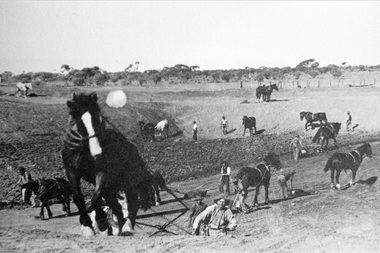
... This skill was known as "tank sinking", and tank sinkers were active in many rural and remote areas in the 1800's and early 1900's, establishing sizeable dams for important water reserves for community and farm and railway use. ...This skill was known as "tank sinking", and tank sinkers were active in many rural and remote areas in the 1800's and early 1900's, establishing sizeable dams for important water reserves for community and farm and railway use. ...The, horse drawn metal scoop ,guided by a man, was used to clear earth for road making. Well before the introduction of motorised, mechanical graders and trucks the painstaking, labour-intensive work was undertaken by large teams of sturdy men using strong horses such as the draught horse. Roads were needed by the market gardeners to transport their produce to market. Later as the heavy wagon loads continually caused ruts and general degradation of the roadways a Plateway system was installed so that the wagon wheels could roll along the rails thus protecting the roadways. August 31st 2021 Ron Nash, from WA, informs us "The men and horses pulling earth scoops in the photo are not moving earth for road making - they are excavating an "earth tank", or dam, as described in common nomenclature today. This skill was known as "tank sinking", and tank sinkers were active in many rural and remote areas in the 1800's and early 1900's, establishing sizeable dams for important water reserves for community and farm and railway use. With the advent of mechanised equipment such as bulldozers, the trade of tank sinking was still carried out, but on a faster basis. I am a former tank sinker and earth moving contractor, now long retired." Early settlers in Moorabbin Shire had to build the roads, plateways, drains, as the settlement of the land, in Dendy's Special Survey 1841 Brighton, spread and market gardeners need to transport their produce to market. Their most valuable possession was the draught horse that was used for ploughing, drawing carts and these scoops.Black & White photograph showing many horses pulling metal scoops guided by men to move earth for road making in Moorabbin Shire c 1900Back Handwritten Informationplateway, roadworks moorabbin shire, draught horses, metal scoops, paviers, box alonzo, smith j l; chaff cutter, horse drawn carts, toll gates brighton, motor cars 1900, steam engines, early settlers, bentleigh, mckinnon, parish of moorabbin, city of moorabbin, county of bourke, moorabbin roads board, shire of moorabbin, henry dendy's special survey 1841, were j.b.; bent thomas, o'shannassy john, king richard, charman stephen, highett william, ormond francis, maynard dennis, market gardeners, vineyards, orchards -
 Orbost & District Historical Society
black and white photographs, 1990s
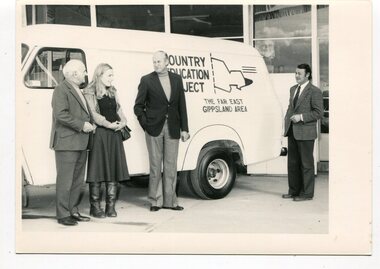
... The Country Education Project Inc was established in 1994 as a non-profit community organisation to represent and support improvements for rural and remote education....The Country Education Project Inc was established in 1994 as a non-profit community organisation to represent and support improvements for rural and remote education. ...Peter Nixon appears to be handing over keys to a van designed for the Country Education Project. Stan Morrison and Keith Knight are also in the photographs. The Country Education Project Inc was established in 1994 as a non-profit community organisation to represent and support improvements for rural and remote education.These photographs are associated with adult education i Orbost.Two black / white photographs related to Adult Learning. The photograph is of people standing in front of a van which has "Country Education Project" printed on the side.country-education-project adult-education-orbost -
 Ringwood and District Historical Society
Mixed media - Video, RDHS Guest Speaker Presentation - "Fluctuating Fortunes on the Upper Goulburn Goldfields 1870s-1880s" - Dr. Louise Blake
... remote mining region, as well as the material and emotional support provided by and to family, friends and neighbours. A rare and revealing source, these letters help to expand our understanding of the lived experience of mining families, particularly the work that women did to sustain families and communities, in this period of waged labour and tribute mining in Victoria. ...remote mining region, as well as the material and emotional support provided by and to family, friends and neighbours. A rare and revealing source, these letters help to expand our understanding of the lived experience of mining families, particularly the work that women did to sustain families and communities, in this period of waged labour and tribute mining in Victoria. ...Digitised video (2.66GB) Duration: 51 minutes. Recorded August, 2022 (Video is available for viewing at Ringwood & District Historical Society Archives by appointment)Presenter: Louise Blake is a writer and historian with an interest in the stories of women, families, and communities on the nineteenth-century goldfields in Australia and New Zealand. Inspired by her family connection to the gold mining settlement of Woods Point, Louise completed a PhD on Women and Community on the Upper Goulburn Goldfields in north-east Victoria in 2019. In this talk Louise will share her research on Lawrence and Esther Chubb, who lived and worked at Gaffneys Creek on the Upper Goulburn Goldfields in the 1870s and 80s. In a series of letters Lawrence wrote to his family in England, and now held by the State Library of Victoria, Lawrence shared his early struggles as an independent miner on the central Victorian goldfields, his protracted courtship with Esther, the ordinary intimacies of their life at Gaffneys Creek, the work that Esther did to support the family in this remote mining region, as well as the material and emotional support provided by and to family, friends and neighbours. A rare and revealing source, these letters help to expand our understanding of the lived experience of mining families, particularly the work that women did to sustain families and communities, in this period of waged labour and tribute mining in Victoria. -
 Orbost & District Historical Society
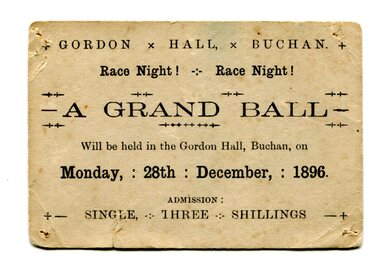
Document - ticket, 1896
... Mary Gilbert) This item reflects the recreational / social activities of a remote rural community. A public event such as a grand ball would have been a significant event on the calendar. grand ball 1896 gordon hall buchan elsie cooke + GORDON x HALL, x BUCHAN. + / Race Night! ...Gordon Hall was the first public building in Buchan. European settlement first entered the area in October 1838 and Buchan station was established in January 1839. Free selection after 1868, and a township was proclaimed in 1873 taking its name from the station. The Grand ball was held on race night, Monday 28th December 1896 in the Gordon Hall at Buchan. From the estate of Elsie Cooke. Elsie Cooke was a librarian in Orbost for many years. She was the daughter of John Cooke early Brodribb settler. Elsie Cooke lived all her life in Gippsland,. She was born at Brodribb in 1895 and died in 1970, Elsie Cooke lived at Bruthen for a short time and, in 1937, moved to live with her aunt, Miss Jean Munro. Miss Cooke was Librarian at the Mechanics Institute for many years. Kindness and consideration for other were Miss Cooke’s attributes and she endeared herself to all who knew her. She was a loyal member of the Presbyterian Church and a stalwart of the Ladies’ Guild, an energetic worker for the Municipal Auxiliary and a member of the Red Cross. (ref. Mary Gilbert)This item reflects the recreational / social activities of a remote rural community. A public event such as a grand ball would have been a significant event on the calendar.Small, cream-coloured rectangular card with rounded edges and blank ink. Evidence of pin holes in each four corners and folds/signs of wear. Card is foxing and has small vertical tear in lower left quadrant.+ GORDON x HALL, x BUCHAN. + / Race Night! - Race Night! / A GRAND BALL / Will be held in the Gordon Hall, Buchan, on / Monday, : 28th : December, : 1896. / ADMISSION : / +- SINGLE, THREE SHILLINGS -+grand ball, 1896, gordon hall, buchan, elsie cooke -
 Flagstaff Hill Maritime Museum and Village
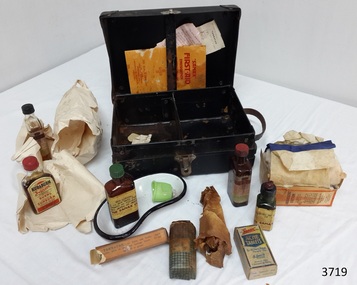
Equipment - First Aid Case, Thomas Urquhart & Son Pty Ltd (Thos. Urquhart), 1930-1939
... remote areas. A quote from Johnson’s & Johnson’s 1888 price list explains “It is a fact, which is everywhere being recognized, that many lives are lost and much suffering entailed in such accidents on account of the lack of the simple but necessary articles required to afford prompt assistance to the wounded.” One example of the value of First Aid assistance to community...remote areas. A quote from Johnson’s & Johnson’s 1888 price list explains “It is a fact, which is everywhere being recognized, that many lives are lost and much suffering entailed in such accidents on account of the lack of the simple but necessary articles required to afford prompt assistance to the wounded.” One example of the value of First Aid assistance to community ...This small, portable 1930s Sanax First Aid Case has been strongly constructed, with corners reinforced with metal to take knocks and bumps, so it could be quickly transported to the site of an emergency. Having these supplies organised into a kit made them easily accessible and reduces time to take them to the site of the accident. It was possibly designed for use in factories because the booklet in the case states that the kit complies with “Part 1, Victorian Factories Regulations”. The text of the printed brand “Sanax First Aid Case” is right-way up when the case stands vertically on its hinged side. In modern times people are well aware of the importance of quick treatment when accident and injury occur. However, before the first commercial First Aid Kit was made by Johnson & Johnson in 1888, people had little knowledge about treating injuries and lacked information about suitable supplies to keep on hand for emergencies. They were often unaware of how to help in that critical time before the doctor or other assistance arrived, a particularly important time for the many people living in remote areas. A quote from Johnson’s & Johnson’s 1888 price list explains “It is a fact, which is everywhere being recognized, that many lives are lost and much suffering entailed in such accidents on account of the lack of the simple but necessary articles required to afford prompt assistance to the wounded.” One example of the value of First Aid assistance to community groups is shown in an article from the Weekly Times, 29th November 1930. It records a report from the Annuello Branch of the Younger Set (a Country Women’s Organisation), telling that on Armistice Day their president Mrs Jamieson, presented the Annuello School with the gift of a Sanax Red Cross First Aid outfit, which was accepted as being “of great practical use to the scholars.” (Annuello is a remote wheat growing area in the Mallee region of North Western Victoria, which became a soldier settlement area after World War I. There is a strain of wheat named ‘Annuello’ due to its suitability for that area. ) The Sanax Case in our Collection contains instructions, equipment and medical items suitable for use in emergency situations. The Case was one of 42 patterns available from Sanax that conformed to ‘Part 1, Victorian Factories Regulations’. It includes items made by Sanax Company and by Burroughs Wellcome & Co. (Australia) Ltd., Sydney, NSW. A quote at the back of the First Aid Emergency Instructions booklet says: “Sanax products are made in Australia by or under the supervision of qualified chemists, from the highest quality materials. They are dependable for the purposes written on labels.” BOOKLET included in First Aid Case: “SANAX” First-Aid Emergency Instructions has orange cover and white pages, joined in the centre by two staples. Booklet contains First Aid Instructions for general events listed in alphabetical order. It also contains an indexed sections headed “Poisoning, and what to do” written by S.A. Burrows, Ph.C., Vuc and N.Z. There are instructions and diagrams on how to perform Artificial Respiration. There are advertisement for Sanax products throughout the booklet that include; - Sanax Ambulance Stretcher for timber mills, mines, ships and quarries - Saw dust masks (porous rubber) for workers in dust, paint or duco sprayers Inside cover lists Sanax’s Australian made products including - tablets and powders for headaches, neuralgia, influenza, colds - snuff for Catarrh that is “quite harmless” - First Aid Cases that come in a range of 42 patterns - sunburn preventatives and treatments - healing salve for carbuncles, pock, pimples, boils, varicose ulcers etc. - snake bite outfits and kits LEAFLETS included in First Aid Case: (1) Tannafax Tannic Acid Jelly. Tannafax should be kept at hand in every home. It should be applied direct from the tube and used with neither oil nor grease. Where a large area has to be covered the clamped end may be torn or cut off to give a wider mouth to the tube. Collapsible tubes of different sizes. Made in Australia. Burroughs Wellcome & Co. (Australia) Ltd. (Incorporated in England). Sydney, NSW. Assorted Houses, London, New York, Montreal, Cape Town, Milan, Bombay, Shanghai, Buenos Aires. Copyright A. 1817, J. 9463 (2) Tabloid. The strong thing is the just - - . Tabloid marks the wor - - Burroughs Wellcome & Comp. The use of the word is to enab – the prescriber, dispenser and patient to get the right thing with one short word, instead of the firm’s long name. If another maker apply the word to his product, the act is unlawful. Tabloid is our trade mark and brand. If a vendor disregard it in dispensing or selling, the act is unlawful for the same reason. We prosecute both offenders rigorously, in the interest of prescribers, dispensers, patients and the owners of the trade mark. Please inform us of any instance of either offence. Burroughs Wellcome & Co. (Australia) Ltd. (Incorporated in England). Telephone Number - M 4184 (4 lines) All communications to G.P.O. Box No. 1185 DD. Copyright Sy. 20. & J 9894. Medicines and Equipment included in First Aid Case: - Absorbent Cotton, Sanax, for absorbing blood or drying a wound. As a swab for washing wounds; to place above a compress to keep the heat in: or as a pad to protect wounds or fractures. The Sanax Co. Manuf. Chemists, Melbourne. Regd. Office: 5 Brunswick St, Fitzroy. N.6. - ACHE tablets, Sanax, for all aches, pains, fevers etc. Dose: 2 to 3 tablets with a draught of water, every 3 hours. Children in proportion. For influenza or colds, take the bedtime dose with a hot lemon drink or toddy. Recommended for Headaches, Colds, Influenza, Fevers, Neuralgia, Rheumatism, Nerve Pains, Sleeplessness, and Seasickness. Three Sanax Ache tablets equals one Sanax Ache powder. Each tablet contains 1.75grs. each Phenacotinum and Acety acSzilcyl, and .75grs Ammon Brom. Etc.. Sanax brand specialties are prepared by highly qualified pharmaceutical chemists and may be accepted as safe and effective for the purpose indicated on the label. The Sanax Co. Melbourne - Eye lotion, Sanax, “in eye bath full strength or diluted with equal parts of water. Sanax Co. Brunswich St, Fitzroy, Melbourne. - Iodine, Sanax, POISON, with instructions for what to do if swallowed. - Kuraburn, Sanax, Applied to the burn and allowed to dry, the pain and heat instantly disappear, and blistering is prevented. If necessary, apply again in an hours. To safeguard against burning when sunbathing, apply before exposure to the sun. If already sunburnet, use Kuraburn as directions above. Safe and harmless. Sole makers, The Sanax Co. Brunswick St. - - Vic. - Sal Volatile, Sanax, - - stimulant for - - nervous aches - - or as smelling salts Dose - - - - Solution of A- - - 5%, . The Sanax Co. Brunswick St, Melbourne. - Tannafax, Burroughs Wellcome & Co. Australia Ltd. Sydney, N.S.W., 20gm. Approx., Tannic Acid Jelly, (Tannic Acid with 0.5% Phenol in a water-soluble base) for burns and scalds. A.N. 15050, p188, logo of a unicorn. Apply lightly, allow to dry, and bandage loosely. Do not apply oil or grease. - bottle wrapped in brown paper, unknown contents, paper adhered to bottle. - dish, kidney shaped, metal, white enamel with black rim - eye bath, green, plastic or Bakelite SANAX COMPANY The Sanax Company was at the address of 5 Brunswick Street, Fitzroy [Melbourne] at least as early as November 1924, as shown by its advertisement of Ache Powder in the Weekly Times, 8th November 1924. It was still at this address in September 1951, when it advertised First Aid outfits and components in the Post Master General’s section of the Commonwealth of Australia Gazette. REFERENCES: Annuello, Victoria; Wikipedia, https://en.wikipedia.org/wiki/Annuello,_Victoria Annuello Younger Set, Branch Activities and Local Reports, Country Women’s Organisations, Weekly Times, 29 November 1930, Trove http://trove.nla.gov.au/newspaper/article/224921009?searchTerm=%22sanax%22%20and%20%22melbourne%22&searchLimits=# Commonwealth of Australia Gazette, Issue 32, 24th April 1915, https://www.legislation.gov.au/file/1915GN32 [Johnson & Johnson Price List, September 1, 1888, p. 20. From our archives], Celebrating the 125th Birthday of the First Aid Kit , The Story of Johnson & Johnson, , http://www.kilmerhouse.com/2013/06/from-1888-to-2013-celebrating-the-125th-birthday-of-the-first-aid-kit/ Post Master General’s section of the Commonwealth of Australia Gazette, Issue No. 73, Thursday 27th September 1951 http://trove.nla.gov.au/newspaper/article/232185299?searchTerm=%22sanax%22%20and%20%22fitzroy%22&searchLimits= Sanax First Aid Emergency Instructions, by S.A. Burrows, publisher Sanax Ltd. Fitzroy, Victoria, 1930-1939 English, book, Illustrated edition, Trove http://trove.nla.gov.au/version/40948895 Access to emergency medical help in early settlement days of Victoria could take quite some time, especially in remote areas. From 1888 First Aid Kits and instructions became available for work sites, offices, community groups and individuals, helping to bridge the gap between the accident and the arrival of medical assistance. This portable Sanax First Aid Case is an example of portable medical equipment made in Melbourne, Australia, in the 1930’s and available to the public. It contains a range of items plus information to be used in a variety of injuries and emergencies in in factories, households, businesses and local communities, and instructions on their use. First Aid Case, portable, Sanax First Aid Case. First Aid kit in strong black cardboard carry case with metal reinforced corners, metal hinges on lid, metal catch and leather carry handle. Inside lid is a vertical strap with narrow gap behind it. Base is divided into two compartments. Manufactured by Sanax, Fitzroy, Melbourne, C. 1930-1939 Contents include "Sanax" First Aid instructions booklet, 2 leaflets, metal kidney dish enamelled in white with black trim on edge, green plastic or Bakelite eye bath, eye lotion, Tannafax tannic acid jelly, Sal Volitile, Kuraburn, Iodine, Argyrol, ACHE tablets, absorbent cotton in cardboard box, gauze bandage, and UNKNOWN wrapped bottle. Printed in gold on lid of case “SANAX” FIRST AID CASE. Most of the contents, as well as the case, show the “SANAX” brand. Some contents are inscribed Burroughs Wellcome & Co. (Australia) Ltd., flagstaff hill, warrnambool, shipwrecked coast, flagstaff hill maritime museum, maritime museum, shipwreck coast, flagstaff hill maritime village, great ocean road, first aid items, first aid kit, emergency first aid, medical emergency kit, home emergency kit, industrial emergency kit, sanax company fitzroy melbourne, burroughs wellcome & co. (australia) ltd, thos. urquhart & son pty. ltd. melbourne, sanax first aid case, sanax first-aid emergency instructions, part 1 victorian factories regulations, tabloid medical supplies -
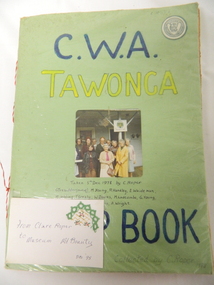 Kiewa Valley Historical Society
Scrap Book - C.W.A. Tawonga, C. W. A. Tawonga by Clare Roper, Dec. 1995
... Women in Tawonga were mostly on farms and in 1946 felt remote after WWII as it affected available workers and the well being of children. The Country Women's Association improved the living conditions and well being of members in the Kiewa Valley community. ...CWA Tawonga 1946 - 1988 collection of its written history. The C.W.A. aimed to improve the health, welfare and education of women and children in the country. The book gives examples of all activities the members were involved in over the years and their involvement with other CWA groups in the North East of Victoria. Through the photos it also gives a good example of women's fashions over the years.History of CWA Tawonga by Clare Roper, President, founding member and local resident. Women in Tawonga were mostly on farms and in 1946 felt remote after WWII as it affected available workers and the well being of children. The Country Women's Association improved the living conditions and well being of members in the Kiewa Valley community.Scrap book with block handwritten and coloured heading. Cover: Centre middle has a coloured photo of 10 ladies standing below a CWA logo. Covered with clear plastic. Consists of photos, newspaper clippings and typed sheets."CWA Tawonga from 1946 collected by C. Roper" - top of front pagecountry women's association; clare roper; tawonga; -
Kiewa Valley Historical Society
Folder - Mt Beauty Gra-y Club Senior Group Attendance Record, Mt Beauty Gra-y Club Senior Group
... Its remoteness encouraged the community to create clubs for recreation for all age groups so that those involved would be purposefully engaged. ...The Athletics Club (began April 1951) under the guidance of a committee of workers which included Mr Stan Hemmings and Mr Alex McCullough,sponsored a Junior Athletics Club which became the Gra-Y Club (in August 1951) for young boys and Hy-Y for older lads. Mr A. E. Clark (YMCA) had the idea of adopting the American Gra-Y system which was to instil in boys good principals and values similar to those of the service clubs ie. YMCA, the Masons and Buffalo Lodge. Story has it that the town was virtually crime free for many years. The Athletics Club became a very powerful force in Mt Beauty and assisted other fledging groups to get started. The committee had the bright idea that they could raise money and entertain the men who lived in the out-lying camps by running sporting exhibitions by their members and the Gra-y boys for entertainment.Mt Beauty was a SECV construction town at the end of the Kiewa valley. Its remoteness encouraged the community to create clubs for recreation for all age groups so that those involved would be purposefully engaged. The Gra-Y club achieved this for 4.5 year olds to 12 year olds and included a junior group and a senior group.Manila folder, foolscap size, with seven pages held by four staples at the spine. The pages are lined horizontally and vertically with boys names listed vertically on the left and dates, across the top, recording the boys attendance. See also KVHS 0773, KVHS 1291Pages recorded in either pencil or inkgra-y club, mt beauty gra-y club, alex mccullough, athletics, boxing, wrestling -
Kiewa Valley Historical Society
Papers - Mount Beauty Clubs, 1. Mount Beauty Schools' Band; 2) Souvenir of Mt Beauty Senior Citizens Club; 3) Gra-Y and Hi-Y Induction Ceremony
... Community clubs in Mt Beauty have always been important due to the remoteness of Mt Beauty situated at the end of the Kiewa Valley and at the bottom of the surrounding mountains....Community clubs in Mt Beauty have always been important due to the remoteness of Mt Beauty situated at the end of the Kiewa Valley and at the bottom of the surrounding mountains. ...Community clubs in Mt Beauty have always been important due to the remoteness of Mt Beauty situated at the end of the Kiewa Valley and at the bottom of the surrounding mountains.Community clubs in Mt Beauty were and still are important for the well being of members of the community of all ages. Mt Beauty began as a construction town, built by the SECV for their workers on the Kiewa Hydro Electric Scheme. Situated at the end of the Kiewa Valley and at the bottom of the surrounding mountains it has become a tourist town with a strong community spirit and many clubs.1. Mount Beauty Schools' Band End of Year Concert 2002 - 2 A4 pages folded in half with black & white photos on outside cover 2.Souvenir of Mt Beauty Senior Citizens Club - 6 pages printed on 1 side only. Enclosed: Agenda for the official opening - Dec. 1972 3. Procedure for the 'Hi-Y' Induction Ceremony (no date) - 3 foolscap pages printed in blue ink on 1 side only.mt beauty school band, mt beauty senior citizens club, mt beauty gra-y and hi-y clubs, music, athletics -
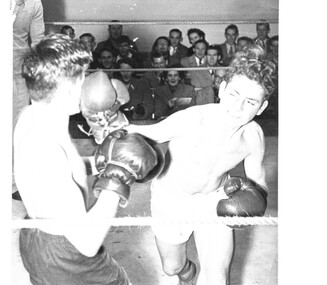 Kiewa Valley Historical Society
Photos - Athletics Club - Boxing x 18
... remote work site. The Athletics Club was one of the first clubs to organise activities and Boxing and allied disciplines, weight-lifting, wrestling and gymnastics were very popular. Regular displays and fight contests were held in the Community ...At the beginning of the KHES, a team of facilitators from the YMCA under the supervision of a Mr A. Clarke, were co-opted to organize social and sporting activities for the thousands of workers relocated to the remote work site.The Athletics Club was one of the first clubs to organise activities and Boxing and allied disciplines, weight-lifting, wrestling and gymnastics were very popular. Regular displays and fight contests were held in the Community Centre and before that the Recreation Centre.x 18 Black and white photos of various sizes. Men and boys boxing. One photo includes a group of boxers lined up. Their names are on the back.mt beauty athletics club, ymca, boxing
