
Showing 116 items matching "residents gallery"
-
 Eltham District Historical Society Inc
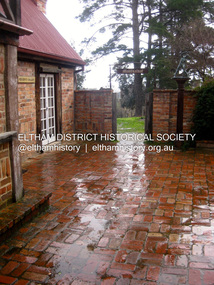
Photograph - Digital Photograph, Jim Connor, Residents Gallery, Montsalvat, 5 September 2010
... Residents Gallery, Montsalvat......Residents Gallery...Jim Connor Collection Montsalvat Residents Gallery 1 image - born digital Residents Gallery, Montsalvat Photograph Digital Photograph Jim Connor ...jim connor collection, montsalvat, residents gallery -
 Eltham District Historical Society Inc
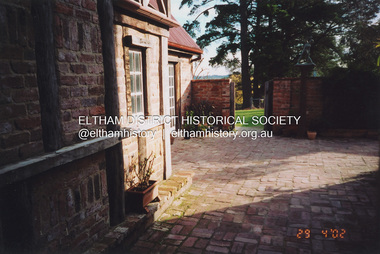
Photograph, Fay Bridge, Residents Gallery, Montsalvat, 29 April 2002
... Residents Gallery, Montsalvat......Residents Gallery...Fay Bridge Collection 2002-04-29 Montsalvat Residents Gallery 1 image - scanned from colour prints on loan Residents Gallery, Montsalvat Photograph Photograph Fay Bridge ...fay bridge collection, 2002-04-29, montsalvat, residents gallery -
 Eltham District Historical Society Inc
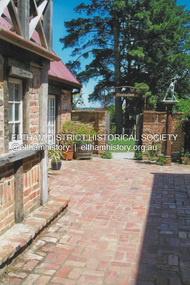
Photograph, Fay Bridge, Montsalvat, n.d
... ...Residents Gallery...Fay Bridge Collection Montsalvat Residents Gallery Gates 6 images - scanned from colour prints on loan Montsalvat Photograph Photograph Fay Bridge ...fay bridge collection, montsalvat, residents gallery, gates -
 Flagstaff Hill Maritime Museum and Village
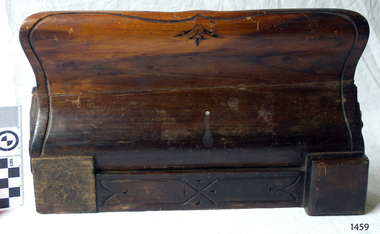
Decorative object - Pen Tray, David Hay, circa 1847
... Gallery and transferred to Flagstaff Hill Maritime Museum and Village when it was first established. The paper tag with the pen tray was inscribed "SWINBURNE". It is likely to be a reference to Charles Grant Swinburen, Mr Chas (Charles) Grant Swinburne (1864-1934), married Susan Jane Granter (1867-19 June 1935) in 1891. They were both Warrnambool residents...Gallery and transferred to Flagstaff Hill Maritime Museum and Village when it was first established. The paper tag with the pen tray was inscribed "SWINBURNE". It is likely to be a reference to Charles Grant Swinburen, Mr Chas (Charles) Grant Swinburne (1864-1934), married Susan Jane Granter (1867-19 June 1935) in 1891. They were both Warrnambool residents ...This pen tray is handmade from some of the timbers from the wreck of the schooner Enterprise. It was originally donated to the former Warrnambool Museum and Art Gallery and transferred to Flagstaff Hill Maritime Museum and Village when it was first established. The paper tag with the pen tray was inscribed "SWINBURNE". It is likely to be a reference to Charles Grant Swinburen, Mr Chas (Charles) Grant Swinburne (1864-1934), married Susan Jane Granter (1867-19 June 1935) in 1891. They were both Warrnambool residents. Swinburne was a prominent member of the Toc H. Progress Association and several other local clubs and societies. He died after a painful illness. Swinburne's wife, Susan, was the daughter of Joseph (1832-1879) and Ann Granter (nee Holley). Her father had arrived in Melbourne on the ship Marco Polo in February 1856. In 1868, he was a shareholder of the Warrnambool Steam Packet Co., His portrait is among those recognised on the historic Warrnambool Pioneers Board. The inscription on the rear of the pen holder was added at a later date. It incorrectly states that the vessel "was the first boat up the river Yarra with Fawkner", confusing this Warrnambool wreck "Enterprise" with Fawkner's vessel "Enterprize" (sometimes written "Enterprise"). THE “ENTERPRISE” 1847-1850 The wooden, two-masted schooner Enterprise was built in New Zealand in 1847 and registered in Melbourne, Australia. The Enterprise carried cargoes of agricultural produce and other commodities for trade between the ports of the Colony. On September 14, 1850, the Enterprise was at anchor in Lady Bay under its Master, James Gardiner Caughtt, loaded with a cargo of wheat and potatoes. A strong south-easterly wind caused the vessel to drag on its only anchor, and the rudder was lost. The gale-force wind blew it sideways, and it became grounded. A local indigenous man, Buckawall, braved the rough sea to take a line from the shore to the Enterprise. All five members of the crew were able to make it safely to land. The Enterprise was wrecked. The Enterprise wreck was in an area called Tramway Jetty in Lady Bay. Since then, the area became the location of the Lady Bay Hotel, and now, in 2019, it is in the grounds of the Deep Blue Apartments. In fact, with the constantly changing coastline through built-up sand, the wreck site is now apparently under the No. 2 Caravan Park on Pertobe Road, perhaps 150 metres from the high tide. Its location was found by Ian McKiggan (leader of the various searches in the 1980s for the legendary Mahogany Ship). DIFFERENTIATING the New Zealand Schooner “Enterprise” from John Fawkner’s “Enterprize“ Dr Murray Johns, Melbourne, says in his article The Mahogany Ship Story “… As I documented in 1985, the Warrnambool wreck was of an entirely different ship, also called Enterprize [with the spelling ‘Enterprise’], but built in New Zealand in 1847. Fawkner’s ship had already been sold to Captain Sullivan in 1845 and was wrecked on the Richmond Pier in northern New South Wales early in 1847. “ The pen tray is significant for its association with the wreck of the Enterprise, which is listed on the Victorian Heritage Database, VHR S238. The Enterprise is of significance as a New Zealand-built but Australian-owned coastal trader. The wreck was also significant for its association with the indigenous hero Buckawall, who saved the lives of the five crew on board. The pen tray is an example of the use of timbers salvaged from shipwrecks along the coast.Decorative pen tray; handmade and carved from timber from the vessel "Enterprise", 1847-1850. The tray is made from several pieces of wood and has a concave surface. The engraving includes a border, motifs, and decorative scrolls on the sides. The inscription on the rear was written in script. A paper tag marked 'Swinburne' was with the board."Swinburne", "from the vessel Enterprise" Writing on the back of the pen tray: "Made from / wreck of / "Enterprise" first boat / up river Yarra with / Fawkner later wrecked / at Warrnambool Vic"flagstaff hill, warrnambool, shipwrecked-coast, flagstaff-hill, flagstaff-hill-maritime-museum, maritime-museum, shipwreck-coast, flagstaff-hill-maritime-village, wood carving, carving, carving craft, 1850 wreck, john watson, james gardiner caught, tramway jetty, lady bay, rescue line, ian mckiggan, vhr s238, relic, buckawall, schooner, enterprise, coastal trader, new zealand, indigenous rescue, indigenous hero, pen holder, pen tray, wood souvenir, enterprise s ouvenir -
![Article - Newspaper Clipping - Digital Image, Protesters fill the gallery 1968 [Britnells Road street construction], 16/04/1968](/media/collectors/4f729f5697f83e03086015b8/items/5eb3a6db21ea670b94fa957d/item-media/5eb3a74221ea670b94faf661/item-fit-380x285.jpg?cb=6) Greensborough Historical Society
Greensborough Historical SocietyArticle - Newspaper Clipping - Digital Image, Protesters fill the gallery 1968 [Britnells Road street construction], 16/04/1968
... residents attended council expressing concerns over street construction, particularly over losing the rural atmosphere and preservation of trees. An example of concerns over road construction in the formerly 'bush' areas of Diamond Valley shire of diamond valley mountainview road briar hill britnells road briar hill street construction News clipping, black and white text, 2 scans. Protesters fill the gallery ...In 1968, a large number of Britnells Road residents attended council expressing concerns over street construction, particularly over losing the rural atmosphere and preservation of trees.An example of concerns over road construction in the formerly 'bush' areas of Diamond ValleyNews clipping, black and white text, 2 scans.shire of diamond valley, mountainview road briar hill, britnells road briar hill, street construction -
 Eltham District Historical Society Inc
Document - Folder, Simpkin, Heather
... Corporate Media Communications to assist Nillumbik Council with communication with staff and residents. Heather Simkin Eltham College Wiregrass Gallery Eltham Corporate Media Communications Nillumbik Council Ron Smith Don Cordell Barry Rochford Newspaper clippings, A4 photocopies, etc Simpkin, Heather Document Folder ...Research resident, Heather Simkin, is a botanical illustrator and teaches at Eltham College. Contents Newspaper article: "Artist draws on her love of plants", Diamond Valley News, 13 September 1995. Heather Simkin to exhibit at Eltham Wiregrass Callery. Newspaper article: "City bid to polish image", Diamond Valley News, 13 September 1995. Corporate Media Communications to assist Nillumbik Council with communication with staff and residents.Newspaper clippings, A4 photocopies, etcheather simkin, eltham college, wiregrass gallery eltham, corporate media communications, nillumbik council, ron smith, don cordell, barry rochford -
 Warrnambool and District Historical Society Inc.
Document - Document The family keepsake Meek family, 1865
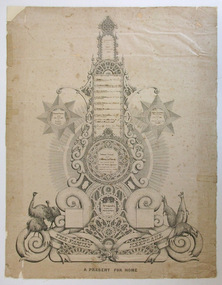
... galleries and museums today. Thomas Fidler was a Warrnambool butcher who married Fanny Cockman in 1849 in London. This certificate is of great significance as one of the calligraphy works of James Meek, a 19th century resident of Warrnambool, celebrated today as a talented calligrapher. ...This certificate has been designed and drawn by James McKain Meek, one of several produced by him to sell to local families in Warrnambool and district as a means of raising money to support his family. James Meek (1815-1899) was a fish canner, fisherman, fishmonger, storekeeper, café proprietor, explorer, gold digger, accountant, writer, librarian and above all an outstanding calligrapher. After being a pioneer settler in the Ballarat area and residing also in Port Melbourne he came to Warrnambool and lived in the area in the 1850s and 60s. He explored much of the Terang area and the Otway Ranges, speaking and writing of the great potential of the latter area. One of Meek’s calligraphy works won an award in the International Exhibition of Melbourne in 1861 and some of his works are in various art galleries and museums today. Thomas Fidler was a Warrnambool butcher who married Fanny Cockman in 1849 in London.This certificate is of great significance as one of the calligraphy works of James Meek, a 19th century resident of Warrnambool, celebrated today as a talented calligrapher. The certificate was displayed in 2015 in a James Meek exhibition at Ballarat Art Gallery. The item is also of social significance showing how the more affluent 19th century families recorded and preserved their family history. This is a certificate hand drawn by James Meek. It is a template that enables the owner to insert the details of a family tree, in this case the 19th century family of Thomas Fidler and Fanny Cockman. The certificate is in grey and black shadings with highly ornamental scrolls and patterns. The document has been produced in black ink. It has a central column with spaces for names and side tablets to include more information. The side tablets are star-shaped and the central column has attachments of various shapes – circles, rectangles etc. The base of the column has further ornamental scrolls, swirls and lacework and features sketches of three emus on one side and three kangaroos on the other side. The certificate is mounted on white cardboard. Some of the Fidler family names have been produced in printed letters and some names have been added later by a family member. ‘Th. os Fidler’s Family Register 1865’ ‘The Family Keepsake’ ‘A Present For Home’thomas fidler and fanny cockman, james meek, history of warrnambool -
 Eltham District Historical Society Inc
Photograph, Shire of Nillumbik World War One Memorials tour, 10 August 2016, 10 August 2016
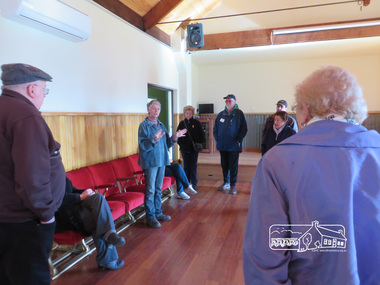
... Gallery. EDHS Members Alan and Marilyn Butler in foreground listening to short presentation about the Christmas Hills Mechanics Institute by a local resident and Hall Committee Member Veronica Holland. ...Gallery. EDHS Members Alan and Marilyn Butler in foreground listening to short presentation about the Christmas Hills Mechanics Institute by a local resident and Hall Committee Member Veronica Holland. christmas hills mechanics institute tour visitors Veronica Holland Born Digital Shire of Nillumbik World War One Memorials tour, 10 August 2016 Photograph Photograph Liz Pidgeon ...As part of a program to acknowledge the Anzac Centenary Nillumbik Shire Council partnered with Yarra Plenty Regional Library to provide a bus tour with commentary of local sites of significance. These included Eltham township, the Shire of Eltham War Memorial at Kangaroo Ground, Christmas Hills, Hurstbridge memorial recreation park and finshed at Eltham Library to view the Writing the War exhibtion at Eltham Library Community Gallery. EDHS Members Alan and Marilyn Butler in foreground listening to short presentation about the Christmas Hills Mechanics Institute by a local resident and Hall Committee Member Veronica Holland. Born Digitalchristmas hills mechanics institute, tour, visitors, veronica holland -
 Eltham District Historical Society Inc
Photograph, Fay Bridge, Local humour added to Art Gallery sign, 559 Main Road, Eltham, 5 December 2004
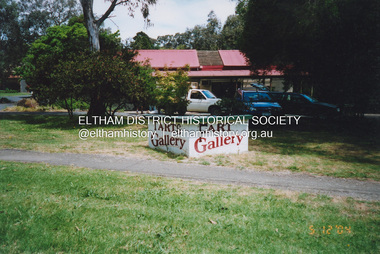
... gallery closed at the end of November. The property was purchased in October 2004 for $565,000 by a local investment company, Sentinel Equities run by local residents Jethro and Suzanne Still. ...gallery closed at the end of November. The property was purchased in October 2004 for $565,000 by a local investment company, Sentinel Equities run by local residents Jethro and Suzanne Still. ...Photo taken immediately after the Wiregrass gallery closed at the end of November. The property was purchased in October 2004 for $565,000 by a local investment company, Sentinel Equities run by local residents Jethro and Suzanne Still. Plans to redevelop the property into offices and a gallery designed by Robert Marshall and supported by a number of local artists met with opposition from Eltham Gateway Action Group in 2007 over the proposed new building size and insufficient parking provision given the proposed reliance on the VicRoads reserve on Main Road for parking. The development proposal was finally approved by VCAT in January 2008 subject to VicRoads approving the use of the road reserve for parking. That did not happen and the property remains undeveloped 15 years later (August 2023).fay bridge collection, 559 main road eltham, 2004-12-05, eltham, eltham gallery, graffiti, main road, wiregrass gallery -
 Eltham District Historical Society Inc
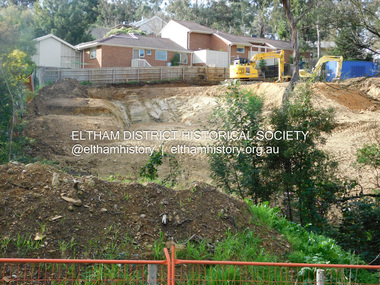
Photograph, Daryl Morrow, Redevelopment of former site of Hassall's Roadside Gallery, Main Road, Eltham, 10 July 2023
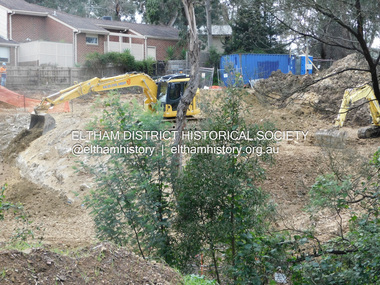
... gallery of its kind in Australia. Ian became a full-time artist and when it first opened, he exhibited paintings he had made while touring the outback with writer and fellow Eltham resident Alan Marshall. ...gallery of its kind in Australia. Ian became a full-time artist and when it first opened, he exhibited paintings he had made while touring the outback with writer and fellow Eltham resident Alan Marshall. ...This historic site of Australia’s first open-air gallery is being redeveloped in 2023 for multi-housing fronting the Research Creek. In 1955, Ian and Joan Hassall moved to Eltham. They took a property on the corner of Zig Zag Road and Main Road, Eltham, north of the township (later known as 1215 Main Road). In July 1962, they opened their open-air gallery. Hassall’s Roadside Galley, “…cradled in the fold of hills to the north of Eltham” inspired by Ian’s own experience of exhibitions along the Embankment in London. The property included remnants of a stone quarry, paintings were hung on screens and removed at night. Various pedestals, that looked like giant mushrooms displayed sculpture, pottery, and jewellery. It had a small natural amphitheatre at the foot of a little sandstone cliff that fall away to the bed of a stream. To enter the gallery, a visitor crossed a small freestone bridge of oriental design, built by Hassall from local stone. The bridge spanned the stream flowing beneath great willow trees. Near the entrance wooden figures were displayed formed from pieces of local wood, said to speak to Ian Hassall’s sense of fun. Hassall’s Gallery was the first gallery of its kind in Australia. Ian became a full-time artist and when it first opened, he exhibited paintings he had made while touring the outback with writer and fellow Eltham resident Alan Marshall. He also exhibited other Australian artists over time including locals Lindsay Edward and Peter Glass.daryl morrow collection, eltham heights luxury living, hassalls roadside gallery, housing development, real estate development, research creek, 2023-07-10 -
 Eltham District Historical Society Inc
Photograph, Daryl Morrow, Redevelopment of former site of Hassall's Roadside Gallery, Main Road, Eltham, 13 July 2023
... gallery of its kind in Australia. Ian became a full-time artist and when it first opened, he exhibited paintings he had made while touring the outback with writer and fellow Eltham resident Alan Marshall. ...gallery of its kind in Australia. Ian became a full-time artist and when it first opened, he exhibited paintings he had made while touring the outback with writer and fellow Eltham resident Alan Marshall. ...This historic site of Australia’s first open-air gallery is being redeveloped in 2023 for multi-housing fronting the Research Creek. In 1955, Ian and Joan Hassall moved to Eltham. They took a property on the corner of Zig Zag Road and Main Road, Eltham, north of the township (later known as 1215 Main Road). In July 1962, they opened their open-air gallery. Hassall’s Roadside Galley, “…cradled in the fold of hills to the north of Eltham” inspired by Ian’s own experience of exhibitions along the Embankment in London. The property included remnants of a stone quarry, paintings were hung on screens and removed at night. Various pedestals, that looked like giant mushrooms displayed sculpture, pottery, and jewellery. It had a small natural amphitheatre at the foot of a little sandstone cliff that fall away to the bed of a stream. To enter the gallery, a visitor crossed a small freestone bridge of oriental design, built by Hassall from local stone. The bridge spanned the stream flowing beneath great willow trees. Near the entrance wooden figures were displayed formed from pieces of local wood, said to speak to Ian Hassall’s sense of fun. Hassall’s Gallery was the first gallery of its kind in Australia. Ian became a full-time artist and when it first opened, he exhibited paintings he had made while touring the outback with writer and fellow Eltham resident Alan Marshall. He also exhibited other Australian artists over time including locals Lindsay Edward and Peter Glass.daryl morrow collection, eltham heights luxury living, hassalls roadside gallery, housing development, real estate development, research creek, 2023-07-13 -
 Eltham District Historical Society Inc
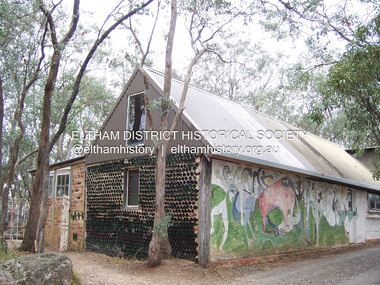
Photograph - Digital Photograph, Marguerite Marshall, Art Gallery at Clifton Pugh's Artists' Colony, Dunmoochin, Barreenong Road, Cottles Bridge, 5 February 2008
... It remains the most recent comprehenesive publication devoted to the Shire's history connecting local residents to the past. Nillumbik Now and Then (Marshall-King) Collection Art Gallery Clifton Pugh dunmoochin Cottlesbridge Cottles Bridge Barreenong Road Born digital image file Art Gallery at Clifton Pugh's Artists' Colony, Dunmoochin, Barreenong Road, Cottles Bridge Photograph Digital Photograph Marguerite Marshall Marguerite Marshall Alan King ...Art Gallery with mural painted by Clifton Pugh (1924-1990) at his Artists' Colony, Dunmoochin, Barreenong Road, Cottles Bridge. Following military service in the second world war, Clifton Pugh studied under artist Sir William Dargie at the National Gallery School in Melbourne as well as Justus Jorgensen, founder of Montsalvat. For a while he lived on the dole but also worked packing eggs for the Belot family saving sufficient to purchase six acres (2.4 ha) of land at Barreenong Road, Cottles Bridge. He accumulated more land and persuaded several other artists and friends to buy land nearby, resulting in a property of approximately 200 acres, stablishing it as one of the first artistic communes in Australia alongside Montsalvat in Eltham. It was around 1951 that Pugh felt he had '"done moochin' around" and so the name of the property evolved. He bought timber from Alistair Knox to build his house on the crest of a hill. Inspired by local goldminer's huts, it was a one room wattle-and-daub structure with dirt floor. Over the years it expanded with thick adobe walls made from local clay, high ceilings and stone floors. All materials other than the local earth were sourced from second hand materials, most found at wreckers' yards. Artists from across the nation were drawn to Dunmoochin, with several setting up houses and shacks on the property, maintaining their independence but sharing their artistic zeal. Artists who worked or resided at Dunmoochin included Mirka Mora, John Perceval, Albert Tucker, Fred Williams, Charles Blackman, Arthur Boyd and John Olsen. In 2002, Pugh's house along with its treasure trove of art and a library of some 20,000 books was destroyed by fire. Traces of Pugh's home remain with the presence of the Victorian doorframe archway with leadlight of intricate design, procured from a demolished Melbourne mansion; and two bronze life-sized female statues created by Pugh and cast by Matcham Skipper. In place of Pugh's house rose two double-storey mud-brick artists' studios topped with corrugated iron rooves curved like the wings of a bird with accommodation for seven. The original studios, gallery and other buildings survived the fire. Covered under Heritage Overlay, Nillumbik Planning Scheme. Published: Nillumbik Now and Then / Marguerite Marshall 2008; photographs Alan King with Marguerite Marshall.; p153 It’s not surprising that artist Clifton Pugh was drawn to Cottles Bridge to establish his artists’ colony Dunmoochin. Undisturbed by the clamour of modern life at Barreenong Road, Pugh was surrounded by the Australian bush he loved, and where his ashes were later scattered. The 200 acres (81ha) of bushland, broken by glimpses of rolling hills, has more than 50 species of orchids and Pugh shared his property with native animals including kangaroos, emus, phascogales, wombats, and diverse bird life. Pugh encouraged these creatures to join him in the bush by creating, with Monash University, a holding station where the animals were raised. Dunmoochin inspired Pugh for such paintings as in a book on orchids and the Death of a Wombat series.1 But his love for the bush was accompanied by the fear that Europeans were destroying it and much of his painting illustrated this fear and his plea for its conservation.2 However it was his house rather than the surrounding bush that was to be destroyed. Tragically in 2002 Pugh’s house, with its treasure of art and library of 20,000 art books, was destroyed by fire. Traces of the beauty of Pugh’s home still remain, however, in the magnificent Victorian doorframe archway with leadlight of intricate design procured from a demolished Melbourne mansion; and two bronze life-sized female statues created by Pugh and cast by Matcham Skipper. Now in place of Pugh’s house, are two double-storey mud-brick artists’ studios topped with corrugated roofs curved like birds’ wings, with accommodation for seven. The original studios, gallery and other buildings remain.3 Pugh grew up on his parents’ hobby farm at Briar Hill and attended the Briar Hill Primary School, then Eltham High School and later Ivanhoe Grammar. At 15 he became a copy boy for the Radio Times newspaper, then worked as a junior in a drafting office. Pugh was to have three wives and two sons. After serving in World War Two in New Guinea and Japan, Pugh studied under artist Sir William Dargie, at the National Gallery School in Melbourne.4 Another of his teachers was Justus Jörgensen, founder of Montsalvat the Eltham Artists’ Colony. Pugh lived on the dole for a while and paid for his first six acres (2.4ha) at Barreenong Road by working as an egg packer for the Belot family. Pugh accumulated more land and persuaded several other artists and friends to buy land nearby, resulting in the 200 acre property. They, too, purchased their land from the Belot family by working with their chickens. Around 1951 Pugh felt he had ‘Done moochin’ around’ and so the name of his property was born. Pugh bought some used timber from architect Alistair Knox to build his house on the crest of a hill. Inspired by local goldminers’ huts it was a one-room wattle-and-daub structure with a dirt floor. It was so small that the only room he could find for his telephone was on the fork of a tree nearby.5 Over the years the mud-brick house grew to 120 squares in the style now synonymous with Eltham. It had thick adobe walls (sun-dried bricks) made from local clay, high ceilings and stone floors with the entire structure made of second-hand materials – most found at wreckers’ yards. Pugh’s first major show in Melbourne in 1957, established him as a distinctive new painter, breaking away from the European tradition ‘yet not closely allied to any particular school of Australian painting’.6 Pugh became internationally known and was awarded the Order of Australia. He won the Archibald Prize for portraiture three times, although he preferred painting the bush and native animals. In 1990 not long before he died, Pugh was named the Australian War Memorial’s official artist at the 75th anniversary of the landing at Gallipoli. Today one of Pugh’s legacies is the Dunmoochin Foundation, which gives seven individual artists or couples and environmental researchers the chance to work in beautiful and peaceful surroundings, usually for a year. By November 2007, more than 80 people had taken part, and the first disabled artist had been chosen to reside in a new studio with disabled access.1 In 1989, not long before Pugh died in 1990 of a heart attack at age 65, he established the Foundation with La Trobe University and the Victorian Conservation Trust now the Trust for Nature. Pugh’s gift to the Australian people – of around 14 hectares of bushland and buildings and about 550 art works – is run by a voluntary board of directors, headed by one of his sons, Shane Pugh. La Trobe University in Victoria stores and curates the art collection and organises its exhibition around Australia.2 The Foundation aims to protect and foster the natural environment and to provide residences, studios and community art facilities at a minimal cost for artists and environmental researchers. They reside at the non-profit organisation for a year at minimal cost. The buildings, some decorated with murals painted by Pugh and including a gallery, were constructed by Pugh, family and friends, with recycled as well as new materials and mud-bricks. The Foundation is inspired by the tradition begun by the Dunmoochin Artists’ Cooperative which formed in the late 1950s as one of the first artistic communes in Australia. Members bought the land collaboratively and built the seven dwellings so that none could overlook another. But, in the late 1960s, the land was split into private land holdings, which ended the cooperative. Dunmoochin attracted visits from the famous artists of the day including guitarists John Williams and Segovia; singer and comedian Rolf Harris; comedian Barry Humphries; and artists Charles Blackman, Arthur Boyd and Mirka Mora. A potters’ community, started by Peter and Helen Laycock with Alma Shanahan, held monthly exhibitions in the 1960s, attracting local, interstate and international visitors – with up to 500 attending at a time.3 Most artists sold their properties and moved away. But two of the original artists remained into the new millennium as did relative newcomer Heja Chong who built on Pugh’s property (now owned by the Dunmoochin Foundation). In 1984 Chong brought the 1000-year-old Japanese Bizan pottery method to Dunmoochin. She helped build (with potters from all over Australia) the distinctive Bizan-style kiln, which fires pottery from eight to 14 days in pine timber, to produce the Bizan unglazed and simple subdued style. The kiln, which is rare in Australia, is very large with adjoining interconnected ovens of different sizes, providing different temperatures and firing conditions. Frank Werther, who befriended Pugh as a fellow student at the National Gallery Art School in Melbourne, built his house off Barreenong Road in 1954. Werther is a painter of the abstract and colourist style and taught art for about 30 years. Like so many in the post-war years in Eltham Shire, as it was called then, Werther built his home in stages using mud-brick and second-hand materials. The L-shaped house is single-storey but two-storey in parts with a corrugated-iron pitched roof. The waterhole used by the Werthers for their water supply is thought to be a former goldmining shaft.4 Alma Shanahan at Barreenong Road was the first to join Pugh around 1953. They also met at the National Gallery Art School and Shanahan at first visited each weekend to work, mainly making mud-bricks. She shared Pugh’s love for the bush, but when their love affair ended, she designed and built her own house a few hundred yards (metres) away. The mud-brick and timber residence, made in stages with local materials, is rectangular, single-storey with a corrugated-iron roof. As a potter, Shanahan did not originally qualify as an official Cooperative member.This collection of almost 130 photos about places and people within the Shire of Nillumbik, an urban and rural municipality in Melbourne's north, contributes to an understanding of the history of the Shire. Published in 2008 immediately prior to the Black Saturday bushfires of February 7, 2009, it documents sites that were impacted, and in some cases destroyed by the fires. It includes photographs taken especially for the publication, creating a unique time capsule representing the Shire in the early 21st century. It remains the most recent comprehenesive publication devoted to the Shire's history connecting local residents to the past. nillumbik now and then (marshall-king) collection, art gallery, clifton pugh, dunmoochin, cottlesbridge, cottles bridge, barreenong road -
 Eltham District Historical Society Inc
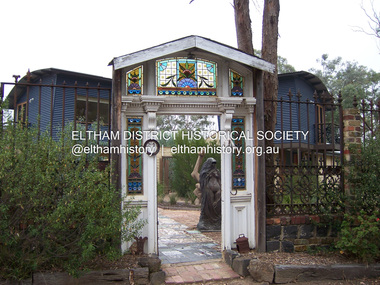
Photograph - Digital Photograph, Marguerite Marshall, Doorway of Clifton Pugh's former house at Dunmoochin, Barreenong Road, Cottles Bridge, 5 February 2008
... It remains the most recent comprehenesive publication devoted to the Shire's history connecting local residents to the past. Nillumbik Now and Then (Marshall-King) Collection Art Gallery Clifton Pugh dunmoochin Cottlesbridge Cottles Bridge Barreenong Road Born digital image file Doorway of Clifton Pugh's former house at Dunmoochin, Barreenong Road, Cottles Bridge Photograph Digital Photograph Marguerite Marshall Marguerite Marshall Alan King ...Following military service in the second world war, Clifton Pugh studied under artist Sir William Dargie at the National Gallery School in Melbourne as well as Justus Jorgensen, founder of Montsalvat. For a while he lived on the dole but also worked packing eggs for the Belot family saving sufficient to purchase six acres (2.4 ha) of land at Barreenong Road, Cottles Bridge. He accumulated more land and persuaded several other artists and friends to buy land nearby, resulting in a property of approximately 200 acres, stablishing it as one of the first artistic communes in Australia alongside Montsalvat in Eltham. It was around 1951 that Pugh felt he had '"done moochin' around" and so the name of the property evolved. He bought timber from Alistair Knox to build his house on the crest of a hill. Inspired by local goldminer's huts, it was a one room wattle-and-daub structure with dirt floor. Over the years it expanded with thick adobe walls made from local clay, high ceilings and stone floors. All materials other than the local earth were sourced from second hand materials, most found at wreckers' yards. Artists from across the nation were drawn to Dunmoochin, with several setting up houses and shacks on the property, maintaining their independence but sharing their artistic zeal. Artists who worked or resided at Dunmoochin included Mirka Mora, John Perceval, Albert Tucker, Fred Williams, Charles Blackman, Arthur Boyd and John Olsen. In 2002, Pugh's house along with its treasure trove of art and a library of some 20,000 books was destroyed by fire. Traces of Pugh's home remain with the presence of the Victorian doorframe archway with leadlight of intricate design, procured from a demolished Melbourne mansion; and two bronze life-sized female statues created by Pugh and cast by Matcham Skipper. In place of Pugh's house rose two double-storey mud-brick artists' studios topped with corrugated iron rooves curved like the wings of a bird with accommodation for seven. The original studios, gallery and other buildings survived the fire. Covered under Heritage Overlay, Nillumbik Planning Scheme. Published: Nillumbik Now and Then / Marguerite Marshall 2008; photographs Alan King with Marguerite Marshall.; p155 It’s not surprising that artist Clifton Pugh was drawn to Cottles Bridge to establish his artists’ colony Dunmoochin. Undisturbed by the clamour of modern life at Barreenong Road, Pugh was surrounded by the Australian bush he loved, and where his ashes were later scattered. The 200 acres (81ha) of bushland, broken by glimpses of rolling hills, has more than 50 species of orchids and Pugh shared his property with native animals including kangaroos, emus, phascogales, wombats, and diverse bird life. Pugh encouraged these creatures to join him in the bush by creating, with Monash University, a holding station where the animals were raised. Dunmoochin inspired Pugh for such paintings as in a book on orchids and the Death of a Wombat series.1 But his love for the bush was accompanied by the fear that Europeans were destroying it and much of his painting illustrated this fear and his plea for its conservation.2 However it was his house rather than the surrounding bush that was to be destroyed. Tragically in 2002 Pugh’s house, with its treasure of art and library of 20,000 art books, was destroyed by fire. Traces of the beauty of Pugh’s home still remain, however, in the magnificent Victorian doorframe archway with leadlight of intricate design procured from a demolished Melbourne mansion; and two bronze life-sized female statues created by Pugh and cast by Matcham Skipper. Now in place of Pugh’s house, are two double-storey mud-brick artists’ studios topped with corrugated roofs curved like birds’ wings, with accommodation for seven. The original studios, gallery and other buildings remain.3 Pugh grew up on his parents’ hobby farm at Briar Hill and attended the Briar Hill Primary School, then Eltham High School and later Ivanhoe Grammar. At 15 he became a copy boy for the Radio Times newspaper, then worked as a junior in a drafting office. Pugh was to have three wives and two sons. After serving in World War Two in New Guinea and Japan, Pugh studied under artist Sir William Dargie, at the National Gallery School in Melbourne.4 Another of his teachers was Justus Jörgensen, founder of Montsalvat the Eltham Artists’ Colony. Pugh lived on the dole for a while and paid for his first six acres (2.4ha) at Barreenong Road by working as an egg packer for the Belot family. Pugh accumulated more land and persuaded several other artists and friends to buy land nearby, resulting in the 200 acre property. They, too, purchased their land from the Belot family by working with their chickens. Around 1951 Pugh felt he had ‘Done moochin’ around’ and so the name of his property was born. Pugh bought some used timber from architect Alistair Knox to build his house on the crest of a hill. Inspired by local goldminers’ huts it was a one-room wattle-and-daub structure with a dirt floor. It was so small that the only room he could find for his telephone was on the fork of a tree nearby.5 Over the years the mud-brick house grew to 120 squares in the style now synonymous with Eltham. It had thick adobe walls (sun-dried bricks) made from local clay, high ceilings and stone floors with the entire structure made of second-hand materials – most found at wreckers’ yards. Pugh’s first major show in Melbourne in 1957, established him as a distinctive new painter, breaking away from the European tradition ‘yet not closely allied to any particular school of Australian painting’.6 Pugh became internationally known and was awarded the Order of Australia. He won the Archibald Prize for portraiture three times, although he preferred painting the bush and native animals. In 1990 not long before he died, Pugh was named the Australian War Memorial’s official artist at the 75th anniversary of the landing at Gallipoli. Today one of Pugh’s legacies is the Dunmoochin Foundation, which gives seven individual artists or couples and environmental researchers the chance to work in beautiful and peaceful surroundings, usually for a year. By November 2007, more than 80 people had taken part, and the first disabled artist had been chosen to reside in a new studio with disabled access.1 In 1989, not long before Pugh died in 1990 of a heart attack at age 65, he established the Foundation with La Trobe University and the Victorian Conservation Trust now the Trust for Nature. Pugh’s gift to the Australian people – of around 14 hectares of bushland and buildings and about 550 art works – is run by a voluntary board of directors, headed by one of his sons, Shane Pugh. La Trobe University in Victoria stores and curates the art collection and organises its exhibition around Australia.2 The Foundation aims to protect and foster the natural environment and to provide residences, studios and community art facilities at a minimal cost for artists and environmental researchers. They reside at the non-profit organisation for a year at minimal cost. The buildings, some decorated with murals painted by Pugh and including a gallery, were constructed by Pugh, family and friends, with recycled as well as new materials and mud-bricks. The Foundation is inspired by the tradition begun by the Dunmoochin Artists’ Cooperative which formed in the late 1950s as one of the first artistic communes in Australia. Members bought the land collaboratively and built the seven dwellings so that none could overlook another. But, in the late 1960s, the land was split into private land holdings, which ended the cooperative. Dunmoochin attracted visits from the famous artists of the day including guitarists John Williams and Segovia; singer and comedian Rolf Harris; comedian Barry Humphries; and artists Charles Blackman, Arthur Boyd and Mirka Mora. A potters’ community, started by Peter and Helen Laycock with Alma Shanahan, held monthly exhibitions in the 1960s, attracting local, interstate and international visitors – with up to 500 attending at a time.3 Most artists sold their properties and moved away. But two of the original artists remained into the new millennium as did relative newcomer Heja Chong who built on Pugh’s property (now owned by the Dunmoochin Foundation). In 1984 Chong brought the 1000-year-old Japanese Bizan pottery method to Dunmoochin. She helped build (with potters from all over Australia) the distinctive Bizan-style kiln, which fires pottery from eight to 14 days in pine timber, to produce the Bizan unglazed and simple subdued style. The kiln, which is rare in Australia, is very large with adjoining interconnected ovens of different sizes, providing different temperatures and firing conditions. Frank Werther, who befriended Pugh as a fellow student at the National Gallery Art School in Melbourne, built his house off Barreenong Road in 1954. Werther is a painter of the abstract and colourist style and taught art for about 30 years. Like so many in the post-war years in Eltham Shire, as it was called then, Werther built his home in stages using mud-brick and second-hand materials. The L-shaped house is single-storey but two-storey in parts with a corrugated-iron pitched roof. The waterhole used by the Werthers for their water supply is thought to be a former goldmining shaft.4 Alma Shanahan at Barreenong Road was the first to join Pugh around 1953. They also met at the National Gallery Art School and Shanahan at first visited each weekend to work, mainly making mud-bricks. She shared Pugh’s love for the bush, but when their love affair ended, she designed and built her own house a few hundred yards (metres) away. The mud-brick and timber residence, made in stages with local materials, is rectangular, single-storey with a corrugated-iron roof. As a potter, Shanahan did not originally qualify as an official Cooperative member.This collection of almost 130 photos about places and people within the Shire of Nillumbik, an urban and rural municipality in Melbourne's north, contributes to an understanding of the history of the Shire. Published in 2008 immediately prior to the Black Saturday bushfires of February 7, 2009, it documents sites that were impacted, and in some cases destroyed by the fires. It includes photographs taken especially for the publication, creating a unique time capsule representing the Shire in the early 21st century. It remains the most recent comprehenesive publication devoted to the Shire's history connecting local residents to the past. nillumbik now and then (marshall-king) collection, art gallery, clifton pugh, dunmoochin, cottlesbridge, cottles bridge, barreenong road -
![Book, Percy Leason, 1889-1959 : centenary exhibition / [organised by Castlemaine Art Gallery & Historical Museum for tour to Victorian Regional Art Galleries], 1989](/media/collectors/4f729f7b97f83e03086018a5/items/5908603ad0ce9914e8bdc25d/item-media/5bac351e21eaf7156842ad9d/item-fit-380x285.jpg?cb=6) Eltham District Historical Society Inc
Eltham District Historical Society IncBook, Percy Leason, 1889-1959 : centenary exhibition / [organised by Castlemaine Art Gallery & Historical Museum for tour to Victorian Regional Art Galleries], 1989
... residents thought they could identify with many cartoons. Leason was also an accomplished painter and an anthropologist. Leason was associated with the Montsalvat Artists’ Colony and in the mid 1930’s built “Landscape” in nearby Lavender Park Road. At the end of 1937 Leason travelled to America where he remained for the rest of his life. percy leason artists Paperback; 1 v. (unpaged) : ill. ; 22 cm. Percy Leason, 1889-1959 : centenary exhibition / [organised by Castlemaine Art Gallery ...Percy Leason (1889-1959) was born in Kaniva Victoria, Leason is best remembered as a cartoonist. His wiregrass cartoons in the Melbourne magazine “Table Talk” were based on a mythical country town. The inspiration was Kaniva but the happenings could be associated with many towns. Eltham residents thought they could identify with many cartoons. Leason was also an accomplished painter and an anthropologist. Leason was associated with the Montsalvat Artists’ Colony and in the mid 1930’s built “Landscape” in nearby Lavender Park Road. At the end of 1937 Leason travelled to America where he remained for the rest of his life. Paperback; 1 v. (unpaged) : ill. ; 22 cm.percy leason, artists -
 Ararat & District Historical Society (operating the Langi Morgala Museum)
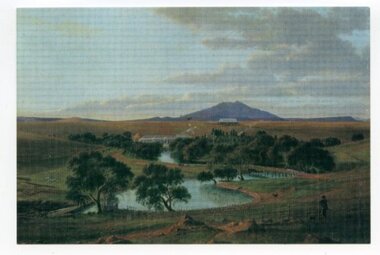
Print - Reproduction, Yalla-Y-Poora, ca2009
... The print was donated by a local resident, Joan Armstrong. https://www.ngv.vic.gov.au/explore/collection/work/75826/ The print is of a local regional homestead, Yalla-Y-Poora. eugene von guerard yalla-y-poora landscape national gallery victoria ngv Ararat "Painting by Eugene von Guerard / Yalla-Y-Poora / Copied from a diary loaned / by Judy Armstrong" on rear of item A small, laminated copy / print of an 1864 painting titled Yalla-y-Poora by artist Eugene von Guerard. ...The print was donated by a local resident, Joan Armstrong. https://www.ngv.vic.gov.au/explore/collection/work/75826/ The print is of a local regional homestead, Yalla-Y-Poora.A small, laminated copy / print of an 1864 painting titled Yalla-y-Poora by artist Eugene von Guerard."Painting by Eugene von Guerard / Yalla-Y-Poora / Copied from a diary loaned / by Judy Armstrong" on rear of itemeugene von guerard, yalla-y-poora, landscape, national gallery victoria, ngv, ararat -
Bendigo Historical Society Inc.
Document - SPECIMEN COTTAGE COLLECTION: VARIOUS DOCUMENTS
... Also, a photographs of a portrait of Joseph Panton. 4029.18 Photocopy of letter of Chinese storekeepers, miners and residents to Joseph Anderson Panton esquire, resident warden of Bendigo dated August 28th, 1858, with transcription and the reply from Esquire Panton dated 29 August, 1858. 4029.19 View street reborn, tours of inspection ''welcome to View Street'' view Street properties part of stage 1 of the project: National Trust Chambers, Temperance Hall, Art Gallery Annexe, Trades Hall, Bendigo Regional Arts Centre, Bendigo Regional Performing Arts Centre, Dudley House. 4029.20 View Street early 1900's in between and now. ...Also, a photographs of a portrait of Joseph Panton. 4029.18 Photocopy of letter of Chinese storekeepers, miners and residents to Joseph Anderson Panton esquire, resident warden of Bendigo dated August 28th, 1858, with transcription and the reply from Esquire Panton dated 29 August, 1858. 4029.19 View street reborn, tours of inspection ''welcome to View Street'' view Street properties part of stage 1 of the project: National Trust Chambers, Temperance Hall, Art Gallery Annexe, Trades Hall, Bendigo Regional Arts Centre, Bendigo Regional Performing Arts Centre, Dudley House. 4029.20 View Street early 1900's in between and now. ...In 1853, Bendigo Miners protested against the 30 shilling miners licence the had to pay the government. They wore red ribbons to show their protest and shopkeepers hung red ribbons outside their premises in support. Thousands of miners signed a petition to Governor LaTrobe to no avail. A protest gathering in Pall Mall marched to the Government camp on Camp Hill but this was a peaceful event again to no real avail.Various documents. The topics are: 4029.1 Public donations and organised charities in Bendigo (1850's to 1900's by Carol Holsworth. 4029.2 The spirit of Bendigo R711 and the loco driver on the return trip from Bendigo by Rod Giri, also several photographs of the train. 4029.3 Diary of a new chum - Johnny Greenfield Gill. 4029.4 Family history by Pat Hocking. 4029.5 The story of the Gaylards as told by Ella Gaylard. 4029.6 Journalism- History first draft by Wayne Gregson. 4029.7 List of residents of Thistle Street, Bendigo approx. 1950's compiled by Cynthia Stringer. 4029.8 Sandhurst club history by David Cotton. 4029.9 Sandhurst boys centre compiled by Brian Dillon. 4029.10 Lily Street Walk 24/04/2018 notes by Jim Evans. 4029.11 Document - All things Bendigo, wine food and music fest. 4029.12 White Hills Sandhurst copies of maps and two pages of district directory1908. 4029.13 Draft report of interview with Noel Smith of 5 Summit Drive, Kennington. 4029.14 Three brothers from Scotland by Rae Alexander Anderson. Also, seven newspaper articles by James Lerk on William, Alexander Rae and John Rae. 4029.15 St. John Presbyterian church, Bendigo. Historical record. 4029.16 Journal of Thomas Llewellyn Raston. 4029.17 Recollections of Sandhurst in the 1850's - Joseph Anderson Panton, 22 segments from Panton manuscript by Terry Davidson. Also, a photographs of a portrait of Joseph Panton. 4029.18 Photocopy of letter of Chinese storekeepers, miners and residents to Joseph Anderson Panton esquire, resident warden of Bendigo dated August 28th, 1858, with transcription and the reply from Esquire Panton dated 29 August, 1858. 4029.19 View street reborn, tours of inspection ''welcome to View Street'' view Street properties part of stage 1 of the project: National Trust Chambers, Temperance Hall, Art Gallery Annexe, Trades Hall, Bendigo Regional Arts Centre, Bendigo Regional Performing Arts Centre, Dudley House. 4029.20 View Street early 1900's in between and now. From handwritten notes by Mr. Bob Carr written in 1989. The handwriting has been transcribed by Beverly Ellis. 4029.21 Transcription of ''Diary of a voyage to the colony of Victoria and back'' June1856-September 1858 by Charles Groves. 4029.22 Adelaide Vale historic homestead built by Cr. John Harney. Tour notes prepared by the Central Victorian Branch of the National Trust. 4029.23 Four pages essay titled Spanish Tomato Growers. 2440.29. Eight pages of notes compiled by Leonard Henderson title: Trade token issuers of Bendigo district. The issuers mentioned are: Grieve, Hodgson, Stead and Williams. 4029.25 City of Bendigo tourist promotion Committee. Eight pages document describing the formation of committee for the promotion of tourism in the City of Bendigo. 4029.26 Article ''The Birdman of Bendigo'' Bendigo Advertiser 17th January 1968 detailing the life of Mr. Redvers James Eddy. 4029.27 Speech presented by Miss Margaret Brennan on the occasion of the Drechsler family reunion, Sunday 5th April 1987. 4029.28 Robert Gray Ford - A man before his time! Talk by James Lerk to the Bendigo Historical Society 3 February 2006. 4029.29 Copy of an article from The Bendigonian Annual from November 16, 1910. The demand for good music, how a Bendigo firm has met it. The article is about the life of Oscar Flight. 4029.30 Five photocopies of the Bendigonian masthead showing the changes through the years, plus the notice of the final issue on April 8th, 1920. 4029.31 The red ribbon rebellion & the Bendigo petition, a proposal to commemorate a significant event in Bendigo. Also three different sizes poster for the August 26, 2016 re-enactment and two invitations to join the red ribbon agitation memorial. 4029.32 Two handwritten pages of notes on the red ribbon rebellion. 4029.33 Three pages of typewritten notes on the Creeth and Howie families. 4029.34 An Australian Edward Medallist - Joseph Davies honoured by Paul Street. 4029.35 A. H. Chisholm obituary. 4029.36 Catalogue auction sale of the entire collection of antique furniture, objects d'art etc of Mr. and Mrs S. Cragg. 4029.37 Two coloured photographs of Cherry Tree Hotel in Melbourne Road just north of Tuckerman's lane, Big Hill. Photos taken March 2000 by Joan Paynter. bendigo, red ribbon rebellion -
 Bendigo Historical Society Inc.
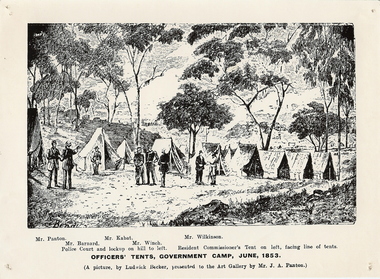
Photograph - GOVERNMENT CAMP, JUNE, 1853, June 1853
... Resident Commissioner's tent on left, facing line of tents. Officers' Tents, Government Camp, June 1853. ( A picture by Ludwick Becker, presented to the Art Gallery by Mr. ...Resident Commissioner's tent on left, facing line of tents. Officers' Tents, Government Camp, June 1853. ( A picture by Ludwick Becker, presented to the Art Gallery by Mr. ...Black and white photograph of sketch of Government Camp, June, 1853. Officers, tents and trees. Printed on bottom in margin in front ' Mr. Panton, Mr. Kabat, Mr. Wilkinson, Mr. Barnard, Mr. Winch. Police Court and lockup on hill to left Resident Commissioner's tent on left, facing line of tents. Officers' Tents, Government Camp, June 1853. ( A picture by Ludwick Becker, presented to the Art Gallery by Mr. J.A.. Panton.Ludwick Becker ???place, landscape view, government camp -
Port Melbourne Historical & Preservation Society
Flyer - Gretz Gallery Summer Arts Festival, A Community Invitation, c. 1990
... Pale green, A6 invitation to a Gretz Gallery Summer Arts Festival, 1 December c1990 - letterboxed to Port residents...in the late 1980s, later moving to Victoria Avenue, Albert Park, with the girls using the vacated St Josephs Primary as studios through the 1990s. arts and entertainment - visual arts celebrations fetes and exhibitions gretz gallery Pale green, A6 invitation to a Gretz Gallery Summer Arts Festival, 1 December c1990 - letterboxed to Port residents A Community Invitation Flyer Gretz Gallery Summer Arts Festival Gretz Gallery ...Gretz was located at Ingles/Bay/Garton Streets and run by the Stuart family (Helen, Gerry, Claire, Kristin?) in the late 1980s, later moving to Victoria Avenue, Albert Park, with the girls using the vacated St Josephs Primary as studios through the 1990s.Pale green, A6 invitation to a Gretz Gallery Summer Arts Festival, 1 December c1990 - letterboxed to Port residentsarts and entertainment - visual arts, celebrations fetes and exhibitions, gretz gallery -
 Warrnambool and District Historical Society Inc.
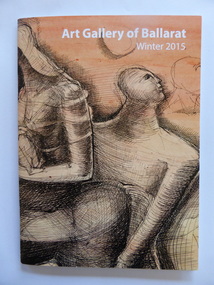
Booklet, Art Gallery Ballarat, 2015
... Gallery of Ballarat in the winter of 2015. It includes the exhibition of the works of James Meek, of particular interest to Warrnambool as Meek was resident there for a number of years in the 19th century. ...Gallery of Ballarat in the winter of 2015. It includes the exhibition of the works of James Meek, of particular interest to Warrnambool as Meek was resident there for a number of years in the 19th century. ...This is the program for the exhibitions and activities conducted by the Art Gallery of Ballarat in the winter of 2015. It includes the exhibition of the works of James Meek, of particular interest to Warrnambool as Meek was resident there for a number of years in the 19th century. The Ballarat Art Gallery is the largest and oldest regional art gallery in Australia, being established in 1884. The booklet is of interest as it shows the depth and variety of exhibitions and activities held at a regional art gallery. It includes the exhibition of the works of James Meek, a 19th resident of Warrnambool where he was well-known as a fishing company operator, a punt operator, a fisherman, a writer and lecturer and a gold prospector in the Otway Ranges. His calligraphy works are of great interest, both artistically and historically and one of his works belonging to the Warrnambool and District Historical Society was loaned to Ballarat for this exhibition. This is a booklet of 32 pages containing the program of the Art Gallery of Ballarat for Winter 2015. It contains logos of sponsors, a floor plan of the gallery, black and white and colour photographs and sketches and printed material on each exhibition. The cover has a reproduction of an image from Norma Redpath’s ‘Flight From Jerusalem’ art work. Front Cover: ‘Art Gallery of Ballarat, Winter 2015’art gallery of ballarat -
 Warrnambool and District Historical Society Inc.
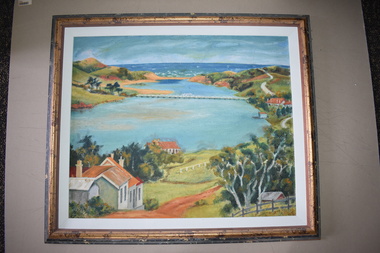
Framed Paintings, 1 The Frame Shop, Fairfield, Melbourne .2 Kardinia Picture Framing, Geelong, 1Warrnambool Botanical Gardens .2 Hopkins River, Warrnambool, 1953
... Gallery. These works of art are of interest as they were painted by Dr Don Edgar, a noted academic and author today and a former resident of Warrnambool. ...These two works of art are by Dr Don Edgar, a sociologist, educator and author. He taught sociology at Stanford University, the University of Chicago, Monash University and La Trobe University and was the founding Director of the Australian Institute of Family Studies. In the 1950s Dr Edgar was a student at Warrnambool High School and these works of art were produced at that time. For a school project he researched the early history of the Warrnambool Art Gallery and some of its collection, dating from the 19th century. In 2019 he published a book, ‘Art For the Country’, the story of Victoria’s regional art galleries and the book includes information on the founding and the later history of the Warrnambool Art Gallery.These works of art are of interest as they were painted by Dr Don Edgar, a noted academic and author today and a former resident of Warrnambool. The two works of art also have historical interest as they depict Warrnambool scenes painted over 60 years ago. .1 An art work (oil on artboard) – the Warrnambool Botanical Gardens with bridge and reflections, a gum tree and a poplar tree, all in green and orange tonings. The wooden frame has a light varnish with gold and white trim .2 An art work (oil on artboard) – multi-coloured view of the mouth of Hopkins River with the Hopkins River bridge, Lyndoch bungalow and boathouse. The frame is wooden with a mottled varnish and a white insert edging. .1 Don Edgar 1953 Don Edgar 1953 (High School Student) .2 D.E. 53 Don Edgar 1953 (High School Student) dr don edgar, sociologist, author and educator, warrnambool art gallery, history of warrnambool -
 Nillumbik Shire Council
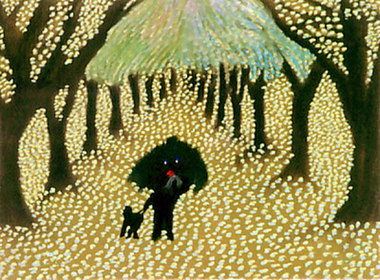
Drawing (Pastel): Nicholas Nedelkopoulos (b.1955 Melb, AUS), Nicholas Nedelkopoulos, The Sneeze, 1995
... Gallery of Victoria. He has a Diploma of Fine Arts from Victorian College of the Arts, a Master of Fine Art from the University of Melbourne (Victorian College of the Arts) and has a Doctorate from Monash University. Nedelkopoulos' work is based strongly in graphic tradition which can be seen throughout all of his media. 'The Sneeze' alludes to a feverish response, an irritation, a period of temporary discomfort, or a sign of sickness. On a visit to Eltham in 1995 Nedelkopoulos became aware of the disquiet felt by many residents ...Nicholas Nedelkopoulos is an established artist, his work is represented in the Metropolitan Museum of Art, New York, the National Gallery of Australia and in numerous International and Australian Public and Private Collections. His work has been included in major historic exhibitions: the National Gallery of Australia's Federation touring exhibition, The Australian Bicentennial Folio and Victoria's 150th Anniversary exhibition curated at The State Library of Victoria and National Gallery of Victoria. He has a Diploma of Fine Arts from Victorian College of the Arts, a Master of Fine Art from the University of Melbourne (Victorian College of the Arts) and has a Doctorate from Monash University. Nedelkopoulos' work is based strongly in graphic tradition which can be seen throughout all of his media.'The Sneeze' alludes to a feverish response, an irritation, a period of temporary discomfort, or a sign of sickness. On a visit to Eltham in 1995 Nedelkopoulos became aware of the disquiet felt by many residents because local government was not in the hands of elected representatives. 'The Sneeze' is an allegorical work, which serves as a reminder of this period in our municipal history. Nedelkopoulos has constructed an environment similar to a theatre set in which every element is a symbol to be deciphered. Whether you read the red-nosed figure as democracy being challenged by the political circumstance, as representing the unelected commissioners surrounded by the criticism of the community, or as another player in the story, to unravel the meaning of individual elements will provide direction and add weight to your interpretation. Without knowledge of the artist's intention the work can convey quite straightforward messages and responses. For example, the misery of hayfever in Spring, or how germs spread from a single sneeze. Such ideas are relevant and provide the metaphoric basis for a more in-depth analysis.Pastel drawing on paper. Image depicts a small black figure with a small monkey on a lead. The figure has a red nose to which he is holding a tissue. He is walking through what appears to be a flowering forest.nedelkopoulos, the sneeze -
 Nillumbik Shire Council
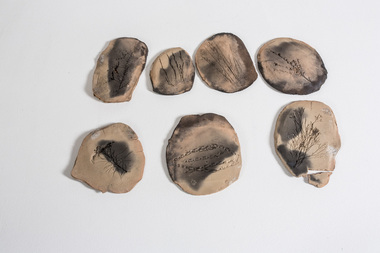
Clay: Leanne Mooney, Leanne Mooney, Tiles from the Boomerang Studio, 2002
... Resident at Laughing Waters in the Boomerang studio in 2002. Records of flora were collected in and around the Gordon Ford garden in Laughing Waters Road. The work 'Year 2052' is made up of '77' tiles and was acquired by Geelong (Regional) Art Gallery in 2003. ...Resident at Laughing Waters in the Boomerang studio in 2002. Records of flora were collected in and around the Gordon Ford garden in Laughing Waters Road. The work 'Year 2052' is made up of '77' tiles and was acquired by Geelong (Regional) Art Gallery in 2003. ...'Tiles from the Boomerang Studio' is a prototype of the work 'Year 2052', created while Mooney was an Artist in Resident at Laughing Waters in the Boomerang studio in 2002. Records of flora were collected in and around the Gordon Ford garden in Laughing Waters Road. The work 'Year 2052' is made up of '77' tiles and was acquired by Geelong (Regional) Art Gallery in 2003. Whilst working at the Boomerang studio, local based artist Mooney noticed that “a battle raged in the bush between non-indigenous plants and indigenous plants”. She also noticed how humans “invade” land, changing the surrounding environment and causing irreversible damage. This work is an interpretation of the fragility and value of Nillumbik’s indigenous flora and of its conflict with introduced species. The title of the work (Year 2052) and look of these ‘fossilised specimens’ asks viewers to cast themselves into the future and to look back at today. “These tiles have been found; an incomplete record of flora collected in and around the Gordon Ford garden in Laughing Waters Road. The tiles appear to have been made at the beginning of the millennium. The viewer is asked to contemplate which species are missing”. Mooney works with collected indigenous items to emphasis the beauty of their natural shapes, while at the same time introducing selected materials of contrast or sympathy. Her work creates a great sense of “stillness and peace, of simplicity and connection with the natural world as well at the vanishing Australian bush.”This work is made up of seven handbuilt earthenware oval/round clay 'tiles' - (eight pieces - with one tile intentionally broken), brown in colour and bisque and blackware fired, giving a matt black ash coating on each of the tiles' surface. Each tile has an imprint of a floral specimen indigenous to the Laughing Waters area in Eltham. Each tile has an imprint of the following specimens: tiles, earthenware, flora, indigenous, bisque, boomerang, ford, laughing waters -
 Williamstown Historical Society Inc
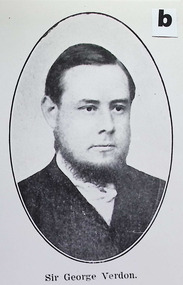
Photograph - Sir George Verdon (1834-1896) Williamstown Councillor & MLA for Williamstown
... resident of Williamstown. An avid collector of art, he became a Trustee of the Public Library, Museums, and National Gallery of Victoria in 1872, then going on to be elected Vice-President in 1880, and President in 1883. ...resident of Williamstown. An avid collector of art, he became a Trustee of the Public Library, Museums, and National Gallery of Victoria in 1872, then going on to be elected Vice-President in 1880, and President in 1883. ...Sir George Frederic Verdon (1834-1896) emigrated to Melbourne in 1851, aged 17, and obtained a position in the office of Grice Sumner and Company, a mercantile business in Flinders Street, Melbourne. He then went into business in Williamstown and began his public career as a member of the inaugural local municipal council in 1856. The same year, he was also elected to the committee to establish the first Mechanics Institute in Williamstown. In 1859, he was elected to the legislative assembly for Williamstown and became Treasurer in November 1860. He resigned in November 1861 but was reappointed Treasurer in June 1863 under the McCulloch ministry, which lasted until May 1868. During the parliamentary recess of 1866, Verdon journeyed to England to advocate for the defenses of Victoria before the British authorities. His efforts were fruitful, securing £100,000 toward the construction of the warship HMS Cerberus, while the HMS Nelson was allocated to Victoria as a training vessel. Upon his return, he suggested that the colony establish a representative in London, which ultimately led to the creation of the Agent-General of Victoria office in 1868; Verdon was appointed as its first incumbent for a term of four years. His interests spanned science, art, and literature. In his youth, he served as an honorary assistant at the Melbourne Observatory under Robert Ellery, the Government Astronomer and fellow resident of Williamstown. An avid collector of art, he became a Trustee of the Public Library, Museums, and National Gallery of Victoria in 1872, then going on to be elected Vice-President in 1880, and President in 1883. In 1872, he was honoured with the title of Knight Commander of the Order of St Michael and St George for his invaluable contributions to the political, scientific, artistic, and educational progress of the early colony. Verdon street Williamstown was named in his honour. source: www.williamstownhistsoc.org.au mla for williamstown, sir george verdon -
 Federation University Art Collection
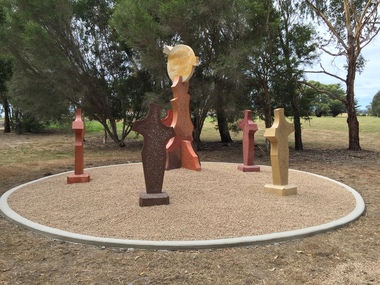
Sculpture, 'Mungo Moon' by Don Barrett, 2015
... residents and visitors will have an approximately 5km circular walking path which links up the Churchill town centre, Federation University Australia and Mathison Park. There are already art features along this route, including primary schools’ Bug Blitz totems near the Kurnai College school crossing, native vegetation and history panels near the Hare Homestead in Mathison Park, and outdoor sculptures in the pine trees near the Federation University Switchback Gallery. ...residents and visitors will have an approximately 5km circular walking path which links up the Churchill town centre, Federation University Australia and Mathison Park. There are already art features along this route, including primary schools’ Bug Blitz totems near the Kurnai College school crossing, native vegetation and history panels near the Hare Homestead in Mathison Park, and outdoor sculptures in the pine trees near the Federation University Switchback Gallery. churchill art and culture pathway barrett don barrett gippsland campus federation university churchill sculpture A large sculpture in five pieces set in an external location. ...'Mungo Moon' by Don Barrett is the first sculpture erected on the Churchill Art and Culture Pathway. It was officially unveiled by Professor David Battersby on 15 April 2015 From Churchill & District News 16 October 2014 The Churchill Art and Culture Walking Pathway will have its official public opening on Saturday October 18, with a walk finishing at Federation University Australia’s Switchback Gallery at the Federation University Gippsland Campus. ... An important link on the newly developed pathway was recently completed with a path south of the FedUni Student West Residences. The path now allows walkers to turn off the Eel Hole Creek path before reaching Glendonald Estate and to follow a picturesque, tree lined walkway to join up with the footpath on the Eastern side of Northways Road. From there the footpath joins into Federation University’s network of walking paths that proceeds past the Switchback Art Gallery, down through the pine plantation and along Lake Kretlow and the Churchill Golf Course. Project Manager Mike Answerth, said the opening of the West Residences section of the path means there is now only one short link to complete. “We’re now very close to realising the project’s objective to join up all these walking paths to provide a continuous pathway that encompasses town, campus and parkland. The next stage of the project will be the completion of Latrobe City’s East West Link and the enhancement of the walking path with artistic and cultural features.” said Mr. Answerth. Head of Federation University Australia Gippsland Campus, Dr Harry Ballis, said the project had been made possible through the contributions of the five former Gippsland Education Precinct (GEP) partners. “The Art and Culture Pathway represents another important step in joining the Churchill township and the university campus as a physical and social entity,” Dr Ballis said. “This was an initiative of the GEP and it is pleasing to see it coming to fruition.” The path now reaches as far as the golf driving range but plans are already under way to connect with the Mathison Park board walk and pathway, which surrounds Lake Hyland in Churchill. When the loop is completed, residents and visitors will have an approximately 5km circular walking path which links up the Churchill town centre, Federation University Australia and Mathison Park. There are already art features along this route, including primary schools’ Bug Blitz totems near the Kurnai College school crossing, native vegetation and history panels near the Hare Homestead in Mathison Park, and outdoor sculptures in the pine trees near the Federation University Switchback Gallery. contemporaryA large sculpture in five pieces set in an external location. It is part of the Churchill Art and Culture Walking Pathway. Don Barrett’s work is mainly in concrete with added coloured oxides to portray the feeling of the Australian landscape. Barrett focuses on concepts of Australia’s short history and indigenous history. churchill art and culture pathway, barrett, don barrett, gippsland campus, federation university, churchill, sculpture -
Canterbury History Group
Ephemera - Maling Road Mail, 2008
... residents. Includes a photograph of Dean. I Canterbury Maling Road McDonell> Family Fitzpatrick> Matthew Maling Road Gallery Musq Skin Clnic Pacault> Nicholas 1 page A4 Ephemera Maling Road Mail ...The second edition of a short-lived news -sheet describing some shopkeepers in Maling Road. This edition has a special mention of "Deano", Dean McDonell. The McDonell family have lived in the ex-stationmaster's house in Maling Road for many years. Dean was a well loved character and his recent death has saddened many residents. Includes a photograph of Dean. I1 page A4canterbury, maling road, mcdonell> family, fitzpatrick> matthew, maling road gallery, musq skin clnic, pacault> nicholas -
 Kew Historical Society Inc
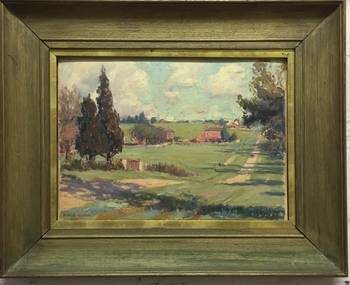
Painting, W Nicholls Anderson, Adeney Avenue, Kew, 1906
... Lucy M (Jean) Hornby, the artist’s niece and the donor of the painting was a resident of 5 and 20 Queens Street, Kew (Vic). W. Nichols Anderson (1873-1927) studied at the National Gallery of Victoria School with Frederick McCubbin in 1894-96. ...William Nichols Anderson (1873-1927) was an Australian painter, one of whose works from the 1906 series River + Rail is in the Kew Historical Society’s art collection (donated 1984). A separate archive file contains correspondence, biographical information (written by his niece), and locations in Kew where he lived. Much of the correspondence between the Society and the City of Kew relates to the painting and its location in the Mayor’s Room at the Kew Civic Offices, Charles Street, where it was on loan from the Society. Lucy M (Jean) Hornby, the artist’s niece and the donor of the painting was a resident of 5 and 20 Queens Street, Kew (Vic). Australian ImpressionismGift of Lucy Hornby, 1984Framed oil on canvas by W. Nicholls Anderson of Park Street, Kew (now Adeney Avenue) looking uphill in a southerly direction towards Cotham Road. The painting is dated to 1906. The two storey house at left was known as 'Eborensis'. The house is still extant on the corner of Adeney Avenue and Parkhill Road. On sticker on back of frame - Adeney Ave./1913/ £3.3.0/ 13th Annual/ Exhib. V.A.S [Victorian Artists Society]/1911 Aust Art Exhib/the Guidlhall/Swanston st Melb./ Adeney's Paddock/ Kew. £3.0.0.artists - kew - victoria - australia, victorian artists society, william nicholls anderson (1873-1927), adeney avenue kew, australian art exhibition 1911, victorian artists' society, w. nicholls anderson -
Kew Historical Society Inc
Archive (Sub-series) - Subject File, FIGUEROLA, Alma, 1970
... In 1953, her portrait of Professor ES Hills was entered in the Archibald Prize Competition of the Art Gallery of New South Wales. A resident of Kew from the 1930s - 51 Studley Park Road, often with her mother, her sister Carmen, or both - from c.1942 until her death she lived at 'D’Estaville', 7 Barry Street. ...In 1953, her portrait of Professor ES Hills was entered in the Archibald Prize Competition of the Art Gallery of New South Wales. A resident of Kew from the 1930s - 51 Studley Park Road, often with her mother, her sister Carmen, or both - from c.1942 until her death she lived at 'D’Estaville', 7 Barry Street. ...Various partiesReference, Research, InformationSecondary Values (KHS Imposed Order)Subject file containing materials relating to an early member of the Kew Historical Society, Alma Figuerola, a Victorian artist living in ‘D’Estaville’, Barry Street, Kew. A newspaper article with photographs, published in The Herald (1958) provides evidence for the dating of the press photographs of Alma Figuerola in the Society’s collection. The file contains dated correspondence between the Society and Alma Figuerola relating to her health and to the death of her mother. The file also contains a ‘Sincere Thanks’ card from Carmen and Silvia Figuerola to the Society following Alma Figuerola’s funeral, noting the date of her death on 8 December 1970. The card gives the address of the house, in 1970, as 4 Sir William Street. In the file there is a letter from 1971 pertaining to the return of wedding dresses and other materials stored at D’Estaville for the Society (which at that stage did not have its own archive). A solicitor’s note from 1973 to the Society contains a refutation of the information about the house contained in Dorothy Rogers’ A History of Kew.kew (vic) - history, artists - kew (vic), alma figuerola, d'estaville, 7 barry street (kew)kew (vic) - history, artists - kew (vic), alma figuerola, d'estaville, 7 barry street (kew) -
Kew Historical Society Inc
Archive (Sub-series) - Subject File, Kew Historical Society, Grip of Time, 1982
... Mrs Laurel Abercrombie, a Kew resident, donated the sculpture to the City of Kew in 1982, and it formed part of the ‘municipal collection’ of the former City of Kew (now City of Boroondara). A note in the file records that prior to its installation on its current site; it was attached to a brick wall at the side of Abercrombie Galleries, Johnson Street, Collingwood. ...Mrs Laurel Abercrombie, a Kew resident, donated the sculpture to the City of Kew in 1982, and it formed part of the ‘municipal collection’ of the former City of Kew (now City of Boroondara). A note in the file records that prior to its installation on its current site; it was attached to a brick wall at the side of Abercrombie Galleries, Johnson Street, Collingwood. ...Various partiesReference, Research, InformationSecondary Values (KHS Imposed Order)Subject file containing both primary and secondary sources relating to the sculpture by Peter Schipperheyn (b.1955) - Grip of Time (1979) - installed on the north wall of the Kew Town Hall (now the Kew Library) in 1983. Mrs Laurel Abercrombie, a Kew resident, donated the sculpture to the City of Kew in 1982, and it formed part of the ‘municipal collection’ of the former City of Kew (now City of Boroondara). A note in the file records that prior to its installation on its current site; it was attached to a brick wall at the side of Abercrombie Galleries, Johnson Street, Collingwood. It was restored by the sculptor c.1996. The file contains two colour photographs of the sculpture and newspaper articles recording controversy at the time of its installation. The file also contains correspondence between the Society and the City of Boroondara relating to the plaque that was beside the sculpture.kew historical society - archives, kew library, kew civic hall, kew town hall, grip of time, peter schipperheyn (1955-), artworks - kew (vic), city of kew - municipal collectionkew historical society - archives, kew library, kew civic hall, kew town hall, grip of time, peter schipperheyn (1955-), artworks - kew (vic), city of kew - municipal collection -
 Kew Historical Society Inc
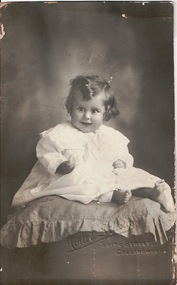
Photograph - Cousin Bert aged 12 months, Model Studios, 1920s
... In 1953, her portrait of Professor ES Hills was entered in the Archibald Prize Competition of the Art Gallery of New South Wales. A resident of Kew from the 1930s - 51 Studley Park Road, often with her mother, her sister Carmen, or both - from c.1942 until her death she lived at 'D’Estaville', 7 Barry Street. ...In 1953, her portrait of Professor ES Hills was entered in the Archibald Prize Competition of the Art Gallery of New South Wales. A resident of Kew from the 1930s - 51 Studley Park Road, often with her mother, her sister Carmen, or both - from c.1942 until her death she lived at 'D’Estaville', 7 Barry Street. ...The Melbourne artist Alma Agnes Marion Figuerola, was the daughter of Juan Pedro Narciso Figuerola (1869-1919) and Alice Lucinda Walker Hanson (1889-1969). Each of their three daughters grew up to be involved in the arts: Alma as a painter; Carmen Irene (1906-1993) as a short story writer, poet and teacher of dancing; and Sylvia (also Silvia) Lyla Alice (1911-1992) as a composer and cellist. The first art lessons Alma Figuerola received were with Oscar Binder. Later she attended the art school established by the Melbourne 'tonalist' [Duncan] Max Meldrum (1875-1955). She graduated from his school in 1920, participating in her first group exhibition in the same year. Solo exhibitions of her work were to be held in 1933 at the Meldrum Gallery in Elizabeth Street, in 1937 and 1945 at the Athenaeum Gallery at 188 Collins Street, and in 1951 at Georges Gallery in Collins Street. Throughout her extensive career she participated in group exhibitions, usually with artists of the Meldrum School, and as a member of the Twenty Melbourne Painters, of which she was invited to become an associate in 1935. In 1953, her portrait of Professor ES Hills was entered in the Archibald Prize Competition of the Art Gallery of New South Wales. A resident of Kew from the 1930s - 51 Studley Park Road, often with her mother, her sister Carmen, or both - from c.1942 until her death she lived at 'D’Estaville', 7 Barry Street. From the late 1930s she is recorded as actively contributing to the arts at a local level. In 1939 and 1940 she participated in art exhibitions at the Hawthorn Municipal Library organised by Jessie Carbines. From 1944 to 1951 she co-organised successive Kew Arts Festivals, initially in the Presbyterian Church Hall in Highbury Grove and later at the Recreation Hall in Wellington Street. A foundation member of the Kew Historical Society in 1958, Alma Figuerola remained an active member of the Society until her death on 8 December 1970. She predeceased her two sisters who both died in the 1990s and who are buried at Andersons' Creek Cemetery in Warrandyte.Studio photograph of Bert, a cousin of the Figuerola sisters. The photo was in the family photo album of the artist. "Cousin Bert age 12 mths"alma figuerola album, arists - kew (vic), artists - meldrum school, occupants - 7 barry street - kew (vic) -
 Kew Historical Society Inc
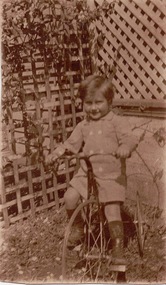
Photograph - Boy on a bike, 1930s
... In 1953, her portrait of Professor ES Hills was entered in the Archibald Prize Competition of the Art Gallery of New South Wales. A resident of Kew from the 1930s - at 'Mount Edgecombe' 51 Studley Park Road, often with her mother, her sister Carmen, or both - from 1939 until her death she lived at 'D’Estaville', 7 Barry Street. ...In 1953, her portrait of Professor ES Hills was entered in the Archibald Prize Competition of the Art Gallery of New South Wales. A resident of Kew from the 1930s - at 'Mount Edgecombe' 51 Studley Park Road, often with her mother, her sister Carmen, or both - from 1939 until her death she lived at 'D’Estaville', 7 Barry Street. ...The Melbourne artist Alma Agnes Marion Figuerola, the daughter of Juan Pedro Narciso Figuerola (1869-1919) and Alice Lucinda Walker Hanson (1889-1969) was born in Carlton in 1902. Alam and her two sisters grew up to be involved in the arts: Alma as a painter; Carmen Irene (1906-1993) as a short story writer, poet and teacher of dancing; and Sylvia (also Silvia) Lyla Alice (1911-1992) as a composer and cellist. The first art lessons Alma Figuerola received were with Oscar Binder. Later she attended the art school established by the Melbourne 'tonalist' [Duncan] Max Meldrum (1875-1955). She graduated from his school in 1920, participating in her first group exhibition in the same year. Solo exhibitions of her work were to be held in 1933 at the Meldrum Gallery in Elizabeth Street, in 1937 and 1945 at the Athenaeum Gallery at 188 Collins Street, and in 1951 at Georges Gallery in Collins Street. Throughout her extensive career she participated in group exhibitions, usually with artists of the Meldrum School, and as a member of the Twenty Melbourne Painters, of which she was invited to become an associate in 1935. In 1953, her portrait of Professor ES Hills was entered in the Archibald Prize Competition of the Art Gallery of New South Wales. A resident of Kew from the 1930s - at 'Mount Edgecombe' 51 Studley Park Road, often with her mother, her sister Carmen, or both - from 1939 until her death she lived at 'D’Estaville', 7 Barry Street. From the late 1930s she is recorded as actively contributing to the arts at a local level. In 1939 and 1940 she participated in art exhibitions at the Hawthorn Municipal Library organised by Jessie Carbines. From 1944 to 1951 she co-organised successive Kew Arts Festivals, initially in the Presbyterian Church Hall in Highbury Grove and later at the Recreation Hall in Wellington Street. A foundation member of the Kew Historical Society in 1958, Alma Figuerola remained an active member of the Society until her death on 8 December 1970. She predeceased her two sisters who both died in the 1990s and who are buried at Andersons' Creek Cemetery in Warrandyte.Undated photograph of a boy, possibly the Figuerola sisters' cousin 'Bert', astride a tricycle in a trellised yard. The photo is from the personal photo album of the artist. alma figuerola album, arists - kew (vic), artists - meldrum school, occupants - 7 barry street - kew (vic)
