
Showing 110 items matching "sailors' home"
-
 Mission to Seafarers Victoria
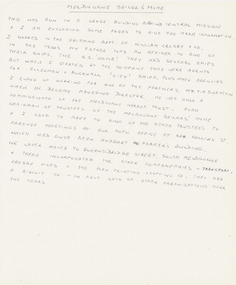
Document - Recollection, Nancy Oakley nee Dingle, Melbourne Sailors' Home, 2021
... Melbourne Sailors' Home......sailors' home...1 page one sided and handwritten in black ink in capital letters on a creamy colour paper: recollection of Nancy Oakley about the Melbourne Sailors Home located on Siddeley Street....Melbourne Sailors' Home Document Recollection Nancy Oakley nee Dingle ...1 page one sided and handwritten in black ink in capital letters on a creamy colour paper: recollection of Nancy Oakley about the Melbourne Sailors Home located on Siddeley Street.nancy oakley, betsy dingle, williamstown, sailors' home, mission to seamen, marjorie duckett nee maclennan, nancy dingle, theo h. swanton -
 Mission to Seafarers Victoria
Article - Paper, Great Circle Journal, The Melbourne Sailors’ Home 1865 - 1963, 2020
... The Melbourne Sailors’ Home 1865 - 1963......sailors' home...After the closure of the Home in 1963: "For instance, in 1985 the Minister of Community Services was authorised to make grants to organizations promoting the welfare of mariners as first priority, but with discretion to make grants for other social welfare purposes.98 Organizations that received funds include, Mission to Seamen ($45,000)" Links between the Mission and the Sailors Home existed throughout decades. great circle mark howard sailors' home The Melbourne Sailors’ Home 1865 - 1963 Article Paper Great Circle Journal ...Article by Mark Howard published in the Great Circle Journal, Volume 42, No1, in 2020. After the closure of the Home in 1963: "For instance, in 1985 the Minister of Community Services was authorised to make grants to organizations promoting the welfare of mariners as first priority, but with discretion to make grants for other social welfare purposes.98 Organizations that received funds include, Mission to Seamen ($45,000)"Links between the Mission and the Sailors Home existed throughout decades.great circle, mark howard, sailors' home -
 Mission to Seafarers Victoria
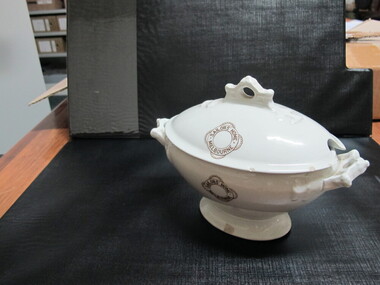
Domestic object - Condiment Tureen, 1883-1913
... ...sailors' home melbourne...The inscription "Sailors' Home" may refer to either the establishment formerly on Spencer St or later on Siddeley St built in 1903 and used until 1963. ...Lid and front of tureen have picture of a lifebuoy with a rope around it and "SAILORS' HOME MELBOURNE" written on it. Printed Inscription on the base with pottery crest....SAILORS' HOME MELBOURNE on lid on body. ROYAL IRONSTONE CHINA JOHNSON BROS ENGLAND with a picture of royal arms under base....Hugh Ronald Reid, member of the Melbourne Harbour Trust, was a founder of the Sailors' Home. The tureen is one of the rare remaining objects from the Sailors' Home. condiment ironstone china johnson bros sailors' home melbourne tureen hugh ronald reid SAILORS' HOME MELBOURNE on lid on body. ...This item was found in the Bar area of the Flying Angels Club at 717 Flinders St. The inscription "Sailors' Home" may refer to either the establishment formerly on Spencer St or later on Siddeley St built in 1903 and used until 1963. The Sailors' Home and Sailors' Rest were established in various locations in Melbourne and in Williamstown throughout the late19th century and early 20th century. It was of significance as a feature of the township that for some years was the main point of arrival in the early days before establishment and early days of Melbourne. Hugh Ronald Reid, member of the Melbourne Harbour Trust, was a founder of the Sailors' Home. The tureen is one of the rare remaining objects from the Sailors' Home.Small oval shaped condiment tureen or serving dish with lid; white glazed ironstone. Small hole in lid for spoon (missing). Lid and front of tureen have picture of a lifebuoy with a rope around it and "SAILORS' HOME MELBOURNE" written on it. Printed Inscription on the base with pottery crest.SAILORS' HOME MELBOURNE on lid on body. ROYAL IRONSTONE CHINA JOHNSON BROS ENGLAND with a picture of royal arms under base.condiment, ironstone china, johnson bros, sailors' home melbourne, tureen, hugh ronald reid -
 Mission to Seafarers Victoria
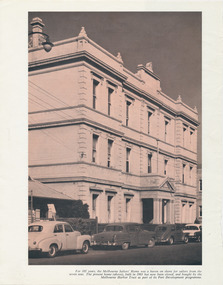
Article - Magazine article, Louis Peters, Sign of the Times by Louis Peters, July-September 1965
... ...sailors' home...The Siddely Street Sailors' Home was built in 1904 to replace the former Spencer Street building. ...3 pages (p21 to 26) of the Port Melbourne Quarterly issue July-September 1965 about the Melbourne Sailors Home located on Spencer Street....Inscription handwritten in black ink in capital letters by Nancy Oakley: Meetings of Melb. Sailors' Home held at office of Mr Theo H. Swanton Managing Dir. of William Crosby & Co., 464 Collins St. ...The Siddely Street Sailors' Home was built in 1904 to replace the former Spencer Street building. ...The Siddely Street Sailors' Home was built in 1904 to replace the former Spencer Street building. The home closed its doors on 31 January 1963. In 1965 the building was sold and it was later demolished and the site redeveloped. Ernst (Ernest) Waldemar Kaiser (1893-1968) was the last and longest serving superintendent of the home (March 1933 - March 1965). He was employed till 31 March 1965 (year of the article) when he finished up after 32 years in the position. He continued to be employed for a year or so after the home closed, probably serving as caretaker till it was sold. (see Mark Howard paper in the Great Circle (Vol.42, No1).) The plaque photographed on page 25 is to be incorporated in the Seafarers park located next to the new Seafarers residential building and at the back of the Mission.3 pages (p21 to 26) of the Port Melbourne Quarterly issue July-September 1965 about the Melbourne Sailors Home located on Spencer Street.Inscription handwritten in black ink in capital letters by Nancy Oakley: Meetings of Melb. Sailors' Home held at office of Mr Theo H. Swanton Managing Dir. of William Crosby & Co., 464 Collins St. Melb.nancy oakley, sailors' home, mission to seamen, nancy dingle, mrs v. kaiser, chinese dolls, kakariki, ernest kaiser, theo h. swanton, ernest waldemar kaiser -
 Mission to Seafarers Victoria
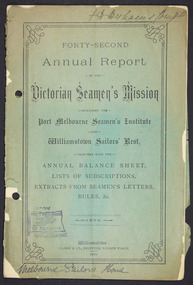
Administrative record (item) - Annual report, Clarke & Co. Printers, Forty-Second Annual Report of the Victorian Seamen's Mission, 1899, 1900
... ...sailors' home...Handwritten in ink on top right hand corner: "F T Derham [indecipherable]" Handwritten in ink on bottom left hand corner: "Melbourne Sailors' Home" Cover back page written in black ink: W. ...These reports provide an organisational overview as well as many stories of the people who populated the Mission to Seafarers. annual report 1899 victorian seamen's mission port melbourne williamstown sailors' rest seamen's mission mission to seafarers seamen's institute sailors' home f.t. derham reverend ebenezer james whc darvall Frederick sargood Hugh r. reid administrative document-annual report Handwritten in ink on top right hand corner: "F T Derham [indecipherable]" Handwritten in ink on bottom left hand corner: "Melbourne Sailors' Home" Cover back page written in black ink: W. ...The reports were produced and readily distributed annually to a number of organisational stakeholders and included reports from the Committee, Chaplain, extracts of letters, Ladies auxiliary and a list of subscribers. In the Argus (Melbourne, Vic. : 1848 - 1957), Saturday 24 February 1900, page 15: VICTORIAN SEAMEN'S MISSION The annual meeting of the Victorian Seamen's Mission was held in the institute at Port Melbourne last night. There was a fair attendance, the large proportion being ladies, and the chair was occupied by Sir Frederick Sargood MLC. Mr Hugh R Reid, the president of the institute, was also president. The annual report, which was lead and adopted, stated that the Seamen's Institute at Port Melbourne, and also the Sailors' Rest at Williamstown, had sustained their reputation for usefulness and attractiveness. The attendances had been very large at each place and 114 seamen had taken the pledge at the Port Melbourne Institute. Regreat was felt that owing to the preliminary steps having met with opposition in Parliament the building of the long contemplated additional institute near the Melbourne wharves was deferred but the project had not been abandoned. Large parcels of literature had been distributed gratuitiously among ships' crews and the concerts held for the entertainment of seamen had been very successful. The mission had been in existence for over 40 years. It aimed at promoting the temporal and spiritual welfare of seamen. It had been the means of completely eradicating "crimping" and the sailors' "boarding masters" curie, and otherwise removing many of the abuses which still exist in other ports. The Chairman, in moving the adoption of the report and balance sheet, referred to the great benefits which seamen derived from the institute. He was particularly struck by the fact that during the past year close on 2,000 letters had been written by visiting seamen from the institute namely, 1,720 at Port Melbourne, and 261 at Williamstown. It was also a very note-worthy feature, which perhaps the residents of Williamstown might be able to explain that, whilst out of 49,567 attendances at the Port Melbourne institute 114 had taken the pledge there, there was not a single instance on record of the pledge having been taken at the Sailors' Rest, Williamstown, out of 8,218 attendances. (Laughter) Referring to the projected new institute near the wharves, he was amazed to find that its construction had been, according to the report, orefused by some of the labour members. He did not know the details of the matter, but was of opinion that there was no institution more deserving of the support of labour members than the one advocated. In his opinion, the representatives of labour should disown the action of their delegates in Parliament in this matter. (Cheers ) Selections of vocal and instrumental music were given during the evening.These reports were produced annually and include a number of smaller reports from the Executive Committee, Chaplain and auxiliary. They sometimes included photographs and a list of subscribers and amounts pledged. These reports provide an organisational overview as well as many stories of the people who populated the Mission to Seafarers.Handwritten in ink on top right hand corner: "F T Derham [indecipherable]" Handwritten in ink on bottom left hand corner: "Melbourne Sailors' Home" Cover back page written in black ink: W. Siddley Esq. / 529 Collins Street / Melbourneannual report, 1899, victorian seamen's mission, port melbourne, williamstown, sailors' rest, seamen's mission, mission to seafarers, seamen's institute, sailors' home, f.t. derham, reverend ebenezer james, whc darvall, frederick sargood, hugh r. reid, administrative document-annual report -
 Bendigo Historical Society Inc.
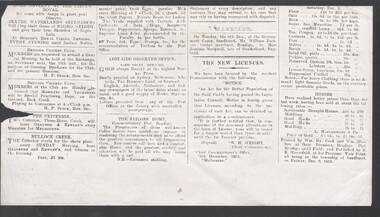
Document - NEWSPAPER 9/12/1853
... ... The Sailors' Home...Items mentioned include: the Blythe Waterland's Serenaders performing at Burton's Royal Circus, Bendigo; The Bendigo Cricket Club; The Criterion, Three-Horse Coach which left for Melbourne from Gravnor & Kewley's; Advertisement from the Adelaide Observer Office; Advertisement from The Sailors' Home, Commissioners' Flat, Bendigo. Marriage notice 6th Dec. of William Jackson, timber merchant, and Jemima Markwell; New Gold Licences, Prices of groceries; the price of draught horses and hacks, and the Price of Gold....NEWSPAPER Bendigo Newspaper 9/12/1853 Wm Hy Cook Wm Sherbon R R Haverfield The Sailors' Home William Jackson Jemima Markwell W H Wright L Macpherson & Co Blythe Waterland's Serenaders Burton's Royal Circus Bendigo Cricket Club H P Stark The Criterion Three-Horse Coach Gravnor & Kewley's Adelaide Observer Office Photocopy of part of an unknown newspaper printed by Wm. ...Photocopy of part of an unknown newspaper printed by Wm. Hy. Cook and Wm. Sherbon at their premises, Bendigo Flat, Bendigo Gold Field; and published by R. R. Haverfield, at his premises, View Point, Sandhurst on Friday, Dec. 9. 1853. Items mentioned include: the Blythe Waterland's Serenaders performing at Burton's Royal Circus, Bendigo; The Bendigo Cricket Club; The Criterion, Three-Horse Coach which left for Melbourne from Gravnor & Kewley's; Advertisement from the Adelaide Observer Office; Advertisement from The Sailors' Home, Commissioners' Flat, Bendigo. Marriage notice 6th Dec. of William Jackson, timber merchant, and Jemima Markwell; New Gold Licences, Prices of groceries; the price of draught horses and hacks, and the Price of Gold.newspaper, bendigo, newspaper 9/12/1853, wm hy cook, wm sherbon, r r haverfield, the sailors' home, william jackson, jemima markwell, w h wright, l macpherson & co, blythe waterland's serenaders, burton's royal circus, bendigo cricket club, h p stark, the criterion three-horse coach, gravnor & kewley's, adelaide observer office -
 Flagstaff Hill Maritime Museum and Village
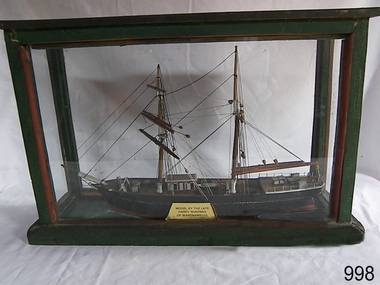
Craft - Ship Model, Mary Campbell, circa 1940
... ...melbourne sailors home...At this time, the Melbourne Sailors’ Home was about to change its location. ...At this time, the Melbourne Sailors’ Home was about to change its location. ...This ship model is of the sailing brigantine MARY CAMPBELL, which once belonged to Captain James Arthur Robilliard. The model was made by Harry McKenna, a well-known ship model maker and Warrnambool resident. CAPTAIN ROBILLIARD James Arthur Robilliard, sea captain and tent maker, was born in 19th April 1843 in St. Helier, Jersey, Channel Islands. He trained there in his father’s sail loft as a sailmaker. He later became a skipper. His first job was as a sailor in Liverpool, England. In 1875, James Robilliard migrated to Australia as a mate on the “E.M. Young”. Captain Robilliard and his family were amongst the early settlers along the Curdies River in the Heytesbury district. In 1877, he became a Captain. On 14th November 1879, Captain Robilliard married Helen Beckett. James and Helen had ten children: James Arthur (Jnr), Henry William, Nellie Jessie, Alfred Albert, Rubena Nellie, De Jersy Norman, Clifford Beckett, Olive Ida, Frances Ridley Havergal and Nellie Elvie, all born in Victoria. THE MARY CAMPBELL The ship “Mary Campbell” was built by Alexander Newton Jr. She was carvel-planked, of iron bark and blue gum timber. The family shipyard was at Pelican, on the Manning River, NSW, and “Mary Campbell” was first launched by her builder in 1869 as “The Son”. Three months later, she was renamed “Mary Campbell’ by her purchaser J. Campbell in Sydney. She was used to carry equipment for the Sydney Sugar Refinery’s Mill in Southgate, NSW. She then traded for the next 20 years between Australian ports and rivers along the east coast, as well as regular ports in New Zealand. She was “recognised as one of the best carrying little vessels in the timber trade” (Sydney Morning Herald). She had several owners over this time, the last one being Captain James A. Robilliard. On 29th April 1889, “Mary Campbell”, in the charge of her owner, Captain James A Robilliard, was on her way from Clarence River, NSW to Melbourne, Victoria with a cargo of railway girders for the Melbourne Harbour Trust. Captain Robilliard encountered a storm off Port Macquarie. He sailed the vessel south to 25 miles (about 40km) east of Cape Hawke, near Tuncurry and Forster. At 7 pm, he discovered that the cargo had shifted during the stormy seas and the heavy girders had damaged the hull, causing a leak. The pumps were inadequate to stem the fast-flowing leak, and over a meter of water filled the hull during the next 2 hours. Some of the crew began throwing the cargo overboard to lighten the vessel, hoping to keep it afloat until daylight. When the water reached over 2 meters in the hull, they realised their efforts were in vain. At 1:30 am on 30th April 1889, the crew left the vessel. They stood by in the lifeboat until 3 am. The ship was sinking fast, so they left for the shore, looking for a safe place to beach their boat. While still miles off Cape Hawke, all 7 crew members, including the Captain, were rescued by the Government Tug “Rhea” and taken to Port Macquarie hospital, then returned to Sydney in the “Wellington”. Captain Robilliard managed to rescue his ship’s compass, but no cargo was saved from the vessel. It had been under-insured, only covered for half its value, due to a lack of funds. Many years later, in 1976, an anchor was caught up in the net of a trawler south of Forster and thought to be from the “Mary Campbell”. It was donated and installed in the Great Lakes Museum, Tuncurry, NSW. (The same museum also has a half-model of the hull of “Mary Campbell”.) The name of the last ship Captain Robilliard sailed is currently unknown; however, he sailed that ship from the port of Marlborough, Queensland, carting steel railway girders for the Geelong-to-Camperdown line. On one trip, it hit a storm, the cargo shifted, and the ship was wrecked along the NSW coast. After this, Captain Robilliard exchanged sea life for farming in Peterborough. In about 1897, verging on retirement, Capt. Robiilliard superintended the Melbourne Sailors’ Home in Spencer Street, Melbourne, before being asked to leave this position in 1902 for trying to shut down the local hotel! At this time, the Melbourne Sailors’ Home was about to change its location. On 6th May 191,7, Captain James Arthur Robilliard J.P. died at Blackwood Park, in the Cobden district of Brucknell, which is now considered the first official Robilliard family homestead in Australia. He was buried in the Melbourne General Cemetery, Victoria. His wife, Helen, passed away in 1947. The Becket and Robilliard family names continue to be well known in the Western District. Flagstaff Hill Maritime Village also has a ship’s compass in the collection that was owned by Capt. J. Robilliard and used on the ship Mary Campbell.This ship model of the MARY CAMPBELL is of local significance for its association with well well-known Warrnambool resident and ship model maker. The model is also significant for its association with the brigantine MARY CAMPBELL, a trading vessel that brought railway girders to the Melbourne Harbour Trust.Ship model "Mary Campbell": a two-masted vessel with black hull, brown masts and black rigging, displayed in a glass case with a timber frame painted green. Made by Harry McKenna.Painted on the bow in white “MARY CAMPBELL” Gold label with black print attached to display case “MODEL BY THE LATE HARRY McKENNA OF WARRNAMBOOL”flagstaff hill, warrnambool, shipwrecked coast, flagstaff hill maritime museum, maritime museum, shipwreck coast, flagstaff hill maritime village, great ocean road, marine artwork, model making, captain james arthur robilliard, j.a. robilliard, vessel mary campbell, ship mary campbell, melbourne sailors home, vessels, harry mckenna, mary campbell -
 Flagstaff Hill Maritime Museum and Village
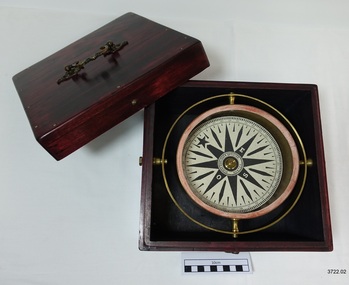
Functional object - Compass, mid-19th Century
... ...melbourne sailors home...Robilliard superintended the Melbourne Sailors’ Home in Spencer Street, Melbourne, before being asked to leave this position in 1902 for trying to shut down a local hotel. ...Robilliard superintended the Melbourne Sailors’ Home in Spencer Street, Melbourne, before being asked to leave this position in 1902 for trying to shut down a local hotel. ...Captain Robilliard: James Arthur Robilliard was a sea captain and tentmaker, born on the 19th April 1843 at Saint Helier, Jersey. He trained there in his father's sail loft as a sailmaker. His first job as a sailor was in Liverpool, England, and in 1875, James Robilliard migrated to Australia as a mate on the "E.M. Young". James Robilliard and his family were amongst the early settlers who arrived along the Curdies River in the Heytesbury district of Western Victoria. In 1877, he became a Captain and would have used his compass from ship to ship. On 28th May 1877, in that same district, a small 3-masted schooner, the "Young Australian", was wrecked. This schooner had been built in 1864 at Jervis Bay, NSW. It had been on her way from Maryborough, Queensland, to Adelaide, under the command of Captain Whitfield, when it lost its mainmast in a heavy gale. It was beached at Curdies Inlet in Peterborough, Victoria. Captain Robilliard was placed in charge of the salvaging operation and recovered a good portion of the cargo. Not long after this incident, a Warrnambool shop owner, David Evans, found employment for James Robilliard with Evan Evans, who produced tents, sails, tarpaulins and similar goods; James already had the necessary skills for this work. Evan Evans was the same sailor rescued from the “Young Australian”. Soon after his rescue, Evan recalled he had a relative in Australia in a town called Warrnambool, and while walking in Timor Street, Warrnambool, he saw a sign over a shop that said “David Evans,” and once the two men met, Evan was warmly welcomed. David then helped his relative establish a tent and tarpaulin-making business there. Evan later transferred his successful business to a shop in Elizabeth St, Melbourne, under the name Evan Evans Pty. Ltd.) James Robilliard was a committed Christian and accredited Lay Preacher with the Methodist Church. He travelled around the local district leading the settlers in worship. On 14th November 1879, Captain Robilliard married Helen Beckett. Alfred and Selina Beckett and their family all attended the church at Brucknell, where Captain Robilliard preached. He was said to have been taken by their young daughter, Helen. James and Helen had ten children: James Arthur (Jnr), Henry William, Nellie Jessie, Alfred Albert, Rubena Nellie, De Jersy Norman, Clifford Beckett, Olive Ida, Frances Ridley Havergal and Nellie Elvie, all born in Victoria. In the 1880s, James Robilliard captained the cutter "Hannah Thompson" into Port Campbell, Victoria. This vessel was the first coastal trader to operate between Melbourne and Port Campbell. At one time, Captain Robilliard had to beach the "Hannah Thompson" for repairs. In 1923, the vessel was blown ashore in a gale and wrecked at Oberon Bay, at Wilson's Promontory. In 1889, the compass was saved by Captain James Arthur Robilliard from his sinking brigantine "Mary Campbell". This vessel was used to carry equipment for the Sydney Sugar Refinery's Mill in Southgate, NSW. The ship had been built in 1869 and traded for the next 20 years between Australian ports and rivers along the east coast, as well as regular ports in New Zealand. It was recognised by the Sydney Morning Herald as one of the best "carrying vessels in the timber trade". It had several owners over this time, the last one being Captain James A. Robilliard. On 29th April 1889, the "Mary Campbell", with Captain James A Robilliard as captain and owner, was on its way from Clarence River, NSW to Melbourne, Victoria with a cargo of railway girders for the Melbourne Harbour Trust. Captain Robilliard encountered a storm off Port Macquarie. He sailed the vessel south to about 40km east of Cape Hawke, near Tuncurry. At around 7 pm, he discovered that the cargo had shifted during the storm and the heavy girders had damaged the hull, causing a leak. The pumps were inadequate to stem the fast-flowing leak, and water soon filled the hull during the next two hours. Some of the crew began throwing the cargo overboard to lighten the vessel, hoping to keep it afloat until daylight. When the water reached over 2 meters in the hull, they realised their efforts were in vain. On the 30th April 1889, the crew left the vessel the ship was sinking fast, so they made for the shore. While still miles off Cape Hawke, all seven crew members, including the Captain, were rescued by the Government Tug "Rhea" and taken to Port Macquarie Hospital and later returned to Sydney in the vessel "Wellington". No cargo had been saved, and the consignment had been under-insured, only covered for half its value. The name of the last ship Captain Robilliard sailed is currently unknown; however, he sailed that ship from the port of Marlborough, Queensland, carting steel railway girders for the Geelong-to-Camperdown railway line. On this trip, the ship hit a storm, the cargo shifted, and the ship was wrecked along the NSW coast. After this, Captain Robilliard retired from the sea and began farming in Peterborough. In about 1897, verging on retirement, Capt. Robilliard superintended the Melbourne Sailors’ Home in Spencer Street, Melbourne, before being asked to leave this position in 1902 for trying to shut down a local hotel. On 6th May 1917, Captain James Arthur Robilliard J.P. died at Blackwood Park, in the Cobden district of Brucknell, the first Robilliard family homestead in Australia. He was buried in the Melbourne General Cemetery, Victoria. His wife Helen, passed away in 1947. This compass, once belonging to Captain James Arthur Robilliard, is of local and state historical significance for its use by the Captain with his vessel, the "Mary Campbell", a trading vessel that was bringing railway girders to the Melbourne Harbour Trust. He also used this compass on the "Hannah Thompson", listed on the Victorian Heritage Register and known as being the first coastal trader to operate between Melbourne and Port Campbell. The compass is also a very fine example of maritime navigational instruments manufactured and used in the mid-19th century. Marine compass, brass, in a wooden box with a separate, fitted lid. The compass card has sixteen points. The four principal points are marked: North with a star-shape, South with an “S”, East with an “E” and West with an “O” (French word OUEST). Each quadrant of the circle is numbered from 0 – 90 degrees. The card is floating in a liquid. The compass gimbal is attached to the sides of the box and to the front and back of the compass’ cylindrical brass frame. The mahogany coloured timber storage case is joined with brass nails. The centre of the lid has a folding decorative brass handle. The lid fits over the base and closes with a brass screw and hook on both front and back. Maker: Dubas Watchmaker Optician, Nantes, France, c 1860-1870. Compass came from the ship “Mary Campbell”, which sank off the NSW coast in 1889, near Forster. The compass, as well as the ship, belonged to Captain James Arthur Robilliard and was donated by his family. “DUBAS MANTES” stamped into the side of the gimbal. “DUBAS HORLOGER OPTICIEN. NANTES.” printed around the centre of the card. flagstaff hill, warrnambool, shipwrecked coast, flagstaff hill maritime museum, maritime museum, shipwreck coast, flagstaff hill maritime village, great ocean road, marine compass, navigation instrument 19th century, marine instruments, dubas mantes, captain james arthur robilliard, j.a. robilliard, helen beckett, ship young australian, ship young australia(n), ship hannah thompson, ship mary campbell, melbourne sailors home, david evans, evan evans, curdies inlet, brucknell church, curdies railway, great lakes museum, dubas horloger opticien. nantes -
 Mission to Seafarers Victoria
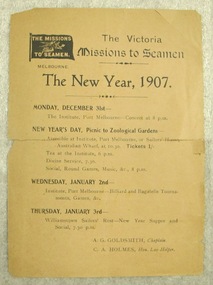
Flyer - Programme, The Victoria Missions to Seamen, The New Year 1907, 1906
... ...sailors' home...The item is of the few programme flyers left used by the Mission to advertise the events to seafarers in the building. lhlg picnic new year 1907 new nears' eve zoo zoological gardens melbourne charles arthur holmes alfred gurney goldsmith chaplain lay reader port melbourne sailors' home williamstown sailors' rest siddeley street seamen's mission mission to seamen events services tea Brown sheet of paper. top left corner has The Mission To Seamen flag. ...The item is of the few programme flyers left used by the Mission to advertise the events to seafarers in the building.Brown sheet of paper. top left corner has The Mission To Seamen flag. Leaflet lists New Years events for seamen for the year 1907.lhlg, picnic, new year, 1907, new nears' eve, zoo, zoological gardens, melbourne, charles arthur holmes, alfred gurney goldsmith, chaplain, lay reader, port melbourne, sailors' home, williamstown, sailors' rest, siddeley street, seamen's mission, mission to seamen, events, services, tea -
 Mission to Seafarers Victoria
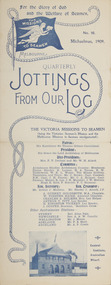
Magazine (sub-item) - Newsletter, The Victoria Missions to Seamen, Jottings From Our Log, Issue 16 - Michaelmas 1909, 1909
... ...sailors' home...It is also a source of images. newsletter victorian seamen's mission melbourne misson to seamen jottings from our log lhlg rope flying angel seagull advertising port melbourne williamstown sailors' home australian wharf seamen's institute sailors' rest services concerts events socials deaths w.h.c. darvall motor boat geelong woolies michaelmas quarterly ladies harbour lights guild reverend alfred gurney goldsmith charles arthur holmes reverend a.t. pitt harold kingston vickery boatman southern cross crotonhurst myrniong s.s. waratah Seamen's guild wendur leslie mumford matthew hummelsheim blue anchor line wilhelm lund Long two folds newsletter printed in blue ink on paper with design of a rope, the flying angel mission flag and a photograph of the Siddeley Street Mission Jottings From Our Log, Issue 16 - Michaelmas 1909 Magazine Newsletter The Victoria Missions to Seamen ...Content: Page 1: - The Missions Patron, President, Committee - Photograph of the Siddeley Street Mission Page 2: - Lost ship SS Waratah (from the Blue Anchor Line founded by Wilhelm Lund - Death of able seaman, Leslie Mumford of the ship Wendur - Death of German seaman, Matthew Hummelsheim after 3 months in hospital - Visit of Rev. Gurney Goldsmith to the Sydney Mission - News from the Newcastle Mission and Port Adelaide - News from the LHLG (drawing room meetings) - League of the Souther Cross Page 3: - 3rd Annual Seafarers Service - Thanks for gifts - Ships and Sailors Collections list - Address and timetable of activities in the 3 missions - Advertising from Inglis, SMith & Co. Page 4: - Advertising from Robur Tea, Jas. F. McKenzie & Co. , Diocesan Books Society The Mission holds a photograph of this publication being packed in calico by the members of the 'Ladies Harbour Lights Guild' for distribution to branches and supporters.Published for some 30 years by the Victorian Missions to Seamen issued to supporters the series contributes to the history of the organisation. It is a key cross reference supplying many details and dates of Chaplain and LHLG activities in both Melbourne, Port Phillip and other States where Missions were gradually established and information not able to be included in Annual Reports. It is also a source of images.newsletter, victorian seamen's mission, melbourne misson to seamen, jottings from our log, lhlg, rope, flying angel, seagull, advertising, port melbourne, williamstown, sailors' home, australian wharf, seamen's institute, sailors' rest, services, concerts, events, socials, deaths, w.h.c. darvall, motor boat, geelong, woolies, michaelmas, quarterly, ladies harbour lights guild, reverend alfred gurney goldsmith, charles arthur holmes, reverend a.t. pitt, harold kingston vickery, boatman, southern cross, crotonhurst, myrniong, s.s. waratah, seamen's guild, wendur, leslie mumford, matthew hummelsheim, blue anchor line, wilhelm lund -
 Mission to Seafarers Victoria
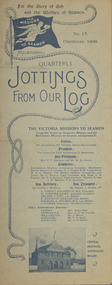
Magazine (sub-item) - Newsletter, The Victoria Missions to Seamen, Jottings From Our Log, Issue 17 - Christmas 1909, 1909
... ...sailors' home...It is also a source of images. newsletter victorian seamen's mission melbourne misson to seamen jottings from our log lhlg rope flying angel seagull advertising port melbourne williamstown sailors' home australian wharf seamen's institute sailors' rest services concerts events socials deaths w.h.c. darvall motor boat geelong woolies michaelmas quarterly ladies harbour lights guild reverend alfred gurney goldsmith charles arthur holmes reverend a.t. pitt harold kingston vickery boatman southern cross crotonhurst myrniong s.s. waratah Seamen's guild wendur leslie mumford matthew hummelsheim blue anchor line wilhelm lund Long two folds newsletter printed in blue ink on paper with design of a rope, the flying angel mission flag and a photograph of the Siddeley Street Mission Jottings From Our Log, Issue 17 - Christmas 1909 Magazine Newsletter The Victoria Missions to Seamen ...Content: Page 1: - The Missions Patron, President, Committee - Photograph of the Siddeley Street Mission Page 2: - Lost ship SS Waratah (from the Blue Anchor Line founded by Wilhelm Lund - Death of able seaman, Leslie Mumford of the ship Wendur - Death of German seaman, Matthew Hummelsheim after 3 months in hospital - Visit of Rev. Gurney Goldsmith to the Sydney Mission - News from the Newcastle Mission and Port Adelaide - News from the LHLG (drawing room meetings) - League of the Souther Cross Page 3: - 3rd Annual Seafarers Service - Thanks for gifts - Ships and Sailors Collections list - Address and timetable of activities in the 3 missions - Advertising from Inglis, SMith & Co. Page 4: - Advertising from Robur Tea, Jas. F. McKenzie & Co. , Diocesan Books Society The Mission holds a photograph of this publication being packed in calico by the members of the 'Ladies Harbour Lights Guild' for distribution to branches and supporters.Published for some 30 years by the Victorian Missions to Seamen issued to supporters the series contributes to the history of the organisation. It is a key cross reference supplying many details and dates of Chaplain and LHLG activities in both Melbourne, Port Phillip and other States where Missions were gradually established and information not able to be included in Annual Reports. It is also a source of images.newsletter, victorian seamen's mission, melbourne misson to seamen, jottings from our log, lhlg, rope, flying angel, seagull, advertising, port melbourne, williamstown, sailors' home, australian wharf, seamen's institute, sailors' rest, services, concerts, events, socials, deaths, w.h.c. darvall, motor boat, geelong, woolies, michaelmas, quarterly, ladies harbour lights guild, reverend alfred gurney goldsmith, charles arthur holmes, reverend a.t. pitt, harold kingston vickery, boatman, southern cross, crotonhurst, myrniong, s.s. waratah, seamen's guild, wendur, leslie mumford, matthew hummelsheim, blue anchor line, wilhelm lund -
 Mission to Seafarers Victoria
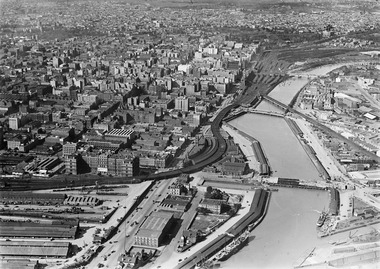
Photograph - Digital photograph, Black and white, Charles Daniel Pratt (1892-1968), c. 1927
... ...sailors' home...The Hawthorn branch of the LHLG raised the funds. tennis court sports Charles Daniel Pratt (1892-1968) fishmarket spencer street bridge sailors' home siddeley street flinders street mission to seafarers seamen's mission seamen's Institute Aerial photograph of the Yarra river depicting the Siddeley and Flinders buildings with the tennis court. ...The tennis court was built in 1924, after a suggestion from seamen. It was used until the 50s when it was too damaged and costly to keep. The Hawthorn branch of the LHLG raised the funds. Aerial photograph of the Yarra river depicting the Siddeley and Flinders buildings with the tennis court.tennis court, sports, charles daniel pratt (1892-1968), fishmarket, spencer street bridge, sailors' home, siddeley street, flinders street, mission to seafarers, seamen's mission, seamen's institute -
 Mission to Seafarers Victoria
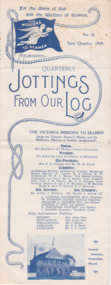
Magazine (sub-item) - Newsletter, The Victoria Missions to Seamen, Jottings From Our Log, Issue 15 - June Quarter 1909, 1909
... ...sailors' home...It is also a source of images. newsletter victorian seamen's mission melbourne misson to seamen jottings from our log lhlg rope flying angel seagull advertising port melbourne williamstown sailors' home australian wharf seamen's institute sailors' rest services concerts events socials deaths captain press w.h.c. darvall motor boat geelong boat builder manx king glenlui dovenby marion woodside ainsdale robert reid bagatelle board billiard table sir wilmot fawkes lady fawkes book bags woolies michaelmas 1906 quarterly ladies harbour lights guild captain strickland Long two folds newsletter printed in blue ink on paper with design of a rope, the flying angel mission flag and a photograph of the Siddeley Street Mission Jottings From Our Log, Issue 15 - June Quarter 1909 Magazine Newsletter The Victoria Missions to Seamen ...The earliest example of this newsletter published two to three times per year issued by the Mission to Seamen and LHLG. The Mission holds a photograph of this publication being packed in calico by the members of the 'Ladies Harbour Lights Guild' for distribution to branches and supporters.Published for some 30 years by the Victorian Missions to Seamen issued to supporters the series contributes to the history of the organisation. It is a key cross reference supplying many details and dates of Chaplain and LHLG activities in both Melbourne, Port Phillip and other States where Missions were gradually established and information not able to be included in Annual Reports. It is also a source of images.newsletter, victorian seamen's mission, melbourne misson to seamen, jottings from our log, lhlg, rope, flying angel, seagull, advertising, port melbourne, williamstown, sailors' home, australian wharf, seamen's institute, sailors' rest, services, concerts, events, socials, deaths, captain press, w.h.c. darvall, motor boat, geelong, boat builder, manx king, glenlui, dovenby, marion woodside, ainsdale, robert reid, bagatelle board, billiard table, sir wilmot fawkes, lady fawkes, book bags, woolies, michaelmas, 1906, quarterly, ladies harbour lights guild, captain strickland -
 Mission to Seafarers Victoria
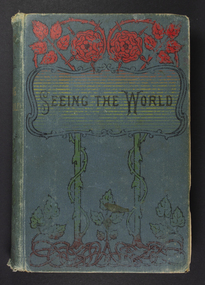
Book, Charles Nordhoff, Seeing the world: a young sailor's own story, c. 1884
... ...sailors' home...The book would have been a typical example of the books in the library of the Seamen Mission. charles nordhoff (1830-1901) travel seafaring adventure sailors' home Blue book with Art Nouveau floral decor by Charles Nordhoff (1830-1901) found in the mission's library in 2018. ...Blue book with Art Nouveau floral decor by Charles Nordhoff (1830-1901) found in the mission's library in 2018. Published by W.P. Nimmo, Hay and Mitchell, Edinburgh. The National Library of Australia has an holding mentioning 1876fictioncharles nordhoff (1830-1901), travel, seafaring, adventure, sailors' home -
 Mission to Seafarers Victoria
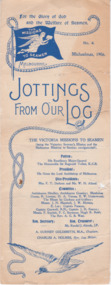
Magazine (sub-item) - Newsletter, The Victoria Missions to Seamen, Jottings From Our Log, Number 4 - Michaelmas 1906, 1906
... ...sailors' home...It is also a source of images. newsletter victorian seamen's mission melbourne misson to seamen jottings from our log lhlg rope flying angel seagull advertising port melbourne williamstown sailors' home australian wharf seamen's institute sailors' rest services concerts events socials deaths captain press w.h.c. darvall motor boat geelong boat builder manx king glenlui dovenby marion woodside ainsdale robert reid bagatelle board billiard table sir wilmot fawkes lady fawkes book bags woolies michaelmas 1906 ladies harbour lights guild captain strickland quarterly patron sir reginald talbot president archbishop of melbourne vice president f.t. derham w.h. allard frederick thomas derham (1844-1922) william henry allard (1860-1927) committee membres archdeacon hindley archdeacon crossley william george hindley owen thomas lloyd crossley mary danne mrs e.w. underwood captain parsons captain creswell captain j.h.fearon ethel augusta godfrey hugh r. reid charles blunt ditty bags donachy and sons rope manufacturers robur tea mackenzie mustard excelsior baking powder admiral wilmot fawkes bobs games Long two folds newsletter printed in blue ink on paper with design of a rope, the flying angel mission flag and a seagull. ...Content: WHC Darvall's death Mission's motor boat New central mission Institute Williamstown Rest condition LHLG and their work Thanks Opening hours AdvertisingPublished for some 30 years by the Victorian Missions to Seamen issued to supporters the series contributes to the history of the organisation. It is a key cross reference supplying many details and dates of Chaplain and LHLG activities in both Melbourne, Port Phillip and other States where Missions were gradually established and information not able to be included in Annual Reports. It is also a source of images.newsletter, victorian seamen's mission, melbourne misson to seamen, jottings from our log, lhlg, rope, flying angel, seagull, advertising, port melbourne, williamstown, sailors' home, australian wharf, seamen's institute, sailors' rest, services, concerts, events, socials, deaths, captain press, w.h.c. darvall, motor boat, geelong, boat builder, manx king, glenlui, dovenby, marion woodside, ainsdale, robert reid, bagatelle board, billiard table, sir wilmot fawkes, lady fawkes, book bags, woolies, michaelmas, 1906, ladies harbour lights guild, captain strickland, quarterly, patron, sir reginald talbot, president, archbishop of melbourne, vice president, f.t. derham, w.h. allard, frederick thomas derham (1844-1922), william henry allard (1860-1927), committee membres, archdeacon hindley, archdeacon crossley, william george hindley, owen thomas lloyd crossley, mary danne, mrs e.w. underwood, captain parsons, captain creswell, captain j.h.fearon, ethel augusta godfrey, hugh r. reid, charles blunt, ditty bags, donachy and sons, rope manufacturers, robur tea, mackenzie mustard, excelsior baking powder, admiral wilmot fawkes, bobs, games -
 Mission to Seafarers Victoria
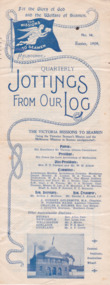
Magazine (sub-item) - Newsletter, The Victoria Missions to Seamen, Jottings From Our Log, Issue 14 - Easter 1909, 1909
... ...sailors' home...It is also a source of images. newsletter victorian seamen's mission melbourne misson to seamen jottings from our log lhlg rope flying angel seagull advertising port melbourne williamstown sailors' home australian wharf seamen's institute sailors' rest services concerts events socials deaths captain press w.h.c. darvall motor boat geelong boat builder manx king glenlui dovenby marion woodside ainsdale robert reid bagatelle board billiard table sir wilmot fawkes lady fawkes book bags woolies michaelmas 1906 quarterly ladies harbour lights guild captain strickland pulpit mr haire Long two folds newsletter printed in blue ink on paper with design of a rope, the flying angel mission flag and a photograph of the Siddeley Street Mission, the first central Institute Jottings From Our Log, Issue 14 - Easter 1909 Magazine Newsletter The Victoria Missions to Seamen ...The earliest example of this newsletter published two to three times per year issued by the Mission to Seamen and LHLG. The Mission holds a photograph of this publication being packed in calico by the members of the 'Ladies Harbour Lights Guild' for distribution to branches and supporters.Published for some 30 years by the Victorian Missions to Seamen issued to supporters the series contributes to the history of the organisation. It is a key cross reference supplying many details and dates of Chaplain and LHLG activities in both Melbourne, Port Phillip and other States where Missions were gradually established and information not able to be included in Annual Reports. It is also a source of images.newsletter, victorian seamen's mission, melbourne misson to seamen, jottings from our log, lhlg, rope, flying angel, seagull, advertising, port melbourne, williamstown, sailors' home, australian wharf, seamen's institute, sailors' rest, services, concerts, events, socials, deaths, captain press, w.h.c. darvall, motor boat, geelong, boat builder, manx king, glenlui, dovenby, marion woodside, ainsdale, robert reid, bagatelle board, billiard table, sir wilmot fawkes, lady fawkes, book bags, woolies, michaelmas, 1906, quarterly, ladies harbour lights guild, captain strickland, pulpit, mr haire -
 Glenelg Shire Council Cultural Collection
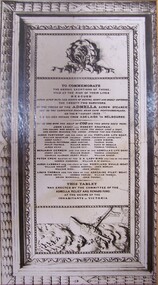
Photograph - Photograph - Memorial to those who risked their lives, n.d
... Memorial was installed at the Sailors Home, Siddeley Street, Melbourne (now demolished) (label, lwr right)...Memorial was installed at the Sailors Home, Siddeley Street, Melbourne (now demolished) (label, lwr right) Photograph Photograph - Memorial to those who risked their lives ...Memorial to those who risked their lives at the wreck of 'Admella', Cape Northumberland 1859 (label, lwr left). Memorial was installed at the Sailors Home, Siddeley Street, Melbourne (now demolished) (label, lwr right)Front: (no inscriptions) -
 Mission to Seafarers Victoria
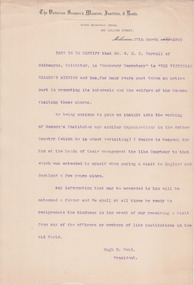
Letter, Hugh Reid, 27 March 1900
... Hugh Reid ws a member of the Harbour Trust, the Sailors' Home and the Mission....Hugh Reid ws a member of the Harbour Trust, the Sailors' Home and the Mission. This letter of recommandation shows that W.H.C. ...W.H.C. Darvall was a solicitor; ha became the Honoray Secretary of the Mission in 1895. Interested in libraires and archives, he kept a scrapbook of the events organised at the Mission during his time. He also wrote an Epitomised History. Hugh Reid ws a member of the Harbour Trust, the Sailors' Home and the Mission.This letter of recommandation shows that W.H.C. Darvall was highly respected.Typewritten letter in purple ink onto creamy colour paper with The Victorian Seamen's Mission, Institute & Rests letterhead.hugh ronald reid, william henry charles darvall (1830-1906) -
 Mission to Seafarers Victoria
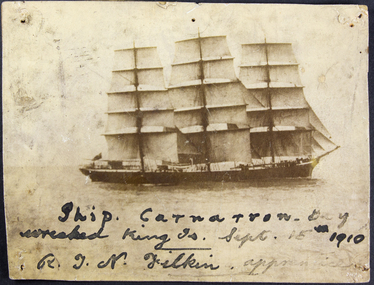
Photograph, George Schutze, Ship Carnarvon Bay wrecked King Island 15 September 1910 - R.J.N Filkin apprentice, c. 1910
... The seamen were received at the Sailors Home then welcomed at the Mission by Reverend Haire as shown on a photograph publish in the Punch (22 September 1910). ...The seamen were received at the Sailors Home then welcomed at the Mission by Reverend Haire as shown on a photograph publish in the Punch (22 September 1910). ...The ship Carnarvon Bay bound from Liverpool to Sydney with a general cargo struck rocks off Stokes Point on the coast of King Island on Thursday 15 September 1910. On the day the crew used two lifeboats but were separated. One of them with Captain W. Griffith and 17 men was rescued by the SS Taracoola and brought back to Melbourne. Apprentice, R.J.N Filkin was amongst them (his name is listed on the Argus article relating the event (Monday 19 September 1910). In the article called "Welcome Shelter" it seems it was the first sea voyage for the young Filkin. The other boat with 15 men was lost for several hours. There was no casualties but the 3000 ton cargo was lost. The seamen were received at the Sailors Home then welcomed at the Mission by Reverend Haire as shown on a photograph publish in the Punch (22 September 1910). Reverend Gurney Goldsmith was in England at the time. The crew was invited to an evening of entertainment organised by artist Violet Teague at the Masonic Hall on the 19th of September. According to the article "Welcome Shelter" she was painting the "tableaux" at the Mission when the seamen were present, interviewed by the journalist. This evening organised by the Ladies Harbour Lights Guild was planned to raise funds for the Mission.Sepia photograph depicting the ship Carnarvon Bay at sea with a written inscription in black ink.Ship Carnarvon Bay wrecked King Island 15 September 1910 - R.J.N Filkin apprenticeshipwreck, apprentice, king island, carnarvon bay, captain griffith, violet teague, masonic hall, ss taracoola, crews and ships -
 Flagstaff Hill Maritime Museum and Village
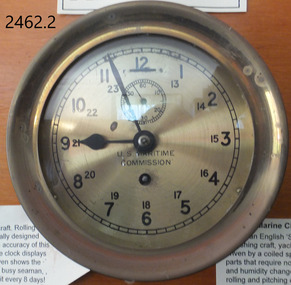
Clocks, 1939-1946
... The loses of family members, along with the trauma that many sailors had endured and had to live with for the rest of their lives once they were released from service and allowed to go home. flagstaff hill warrnambool shipwrecked-coast flagstaff-hill flagstaff-hill-maritime-museum maritime-museum shipwreck-coast flagstaff-hill-maritime-village clock us maritime commission chelsea clock company horology maratime clock The clock is an 8 day marine clock with US Maritime Commission inscribed on face in black lettering. ...Chelsea Clock Company History: The Chelsea Clock Company is an American clock manufacturing company that started before 1880 with Joseph Henry Eastman who founded the Harvard Clock Company and produced 800 clocks of marine, carriage, shelf and banjo types. He went on to change the company name to the Boston Clock Company in 1884. After several name changes in 1897, the Chelsea Clock Company was finally founded. Clocks produced by Chelsea Clock Company have been found in the White House, on US Naval Ships, and in homes and offices around the world. After the company first began life as the Harvard Clock Company, it was named the Boston Clock Company, the Eastman Clock Company before finally becoming the Chelsea Clock Company in July of 1897. The company had developed many patents and innervations over these years and between 1939 and 1946 during World War II they were awarded contracts by the U.S Maritime Commission and produced vast numbers of clocks for both merchant and naval ships. U.S Maritime Commission History: The United States Maritime Commission (MARCOM) was an independent executive agency of the U.S. federal government that was created by the Merchant Marine Act of 1936, and replaced the United States Shipping Board which had existed since World War I. It was intended to formulate a merchant shipbuilding program to design and build five hundred modern merchant cargo ships to replace the World War I vintage vessels that comprised the bulk of the United States Merchant Marine, and to administer a subsidy system authorized by the Act to offset the cost differential between building in the U.S. and operating ships under the American flag. It also formed the United States Maritime Service for the training of seagoing ship's officers to man the new fleet. The purpose of the Maritime Commission was to formulate a merchant shipbuilding program to design and then have built over a ten-year period 900 modern fast merchant cargo ships which would replace the World War I-vintage vessels Those ships were intended to be then leased to U.S. shipping companies for their use in the foreign seagoing trades the aim was to offer better and more economical freight services. The ships were also intended to serve as a reserve naval auxiliary force in the event of armed conflict which was a duty the U.S. merchant fleet had often filled throughout the years since the Revolutionary War. From 1939 through the end of World War II, the Maritime Commission funded and administered the largest and most successful merchant shipbuilding effort in world history, producing ships for both navy and merchant marine. By the end of the war, U.S. shipyards working under Maritime Commission contracts had built a total of 5,777 ocean-going merchant and naval ships. In early 1942 both the training and licensing was transferred to the U.S. Coast Guard for administration, then later to the Maritime Service final responsibility was conveyed to the newly created War Shipping Administration which was created to oversee the operation of merchant ships being built by the Emergency Program to meet the needs of the U.S. Armed Services. With the end of World War II, both the Emergency and Long Range shipbuilding programs were terminated as there were far too many merchant vessels now for the Nation's peacetime needs. In 1946, the Merchant Ship Sales Act was passed to sell off a large portion of the ships built during the war to commercial buyers, both domestic and foreign. The U.S Maritime Commission was officially disbanded on May 24th 1950. These clocks were to be found on all ships made in American for the war effort between 1939 and 1946. They are a significant reminder of the sacrifice by those who served in the merchant marine and the navy’s during the Second World War. The item is a part of our social history that reminds us of these dark times. The loses of family members, along with the trauma that many sailors had endured and had to live with for the rest of their lives once they were released from service and allowed to go home.American Clock is an 8-day marine clock made by the Chelsea clock Co for the “US Maritime Commission” . There is a second smaller dial for the seconds and 24-hour markings. Also a fast-slow adjuster to the top of the dial. The clock is an 8 day marine clock with US Maritime Commission inscribed on face in black lettering. flagstaff hill, warrnambool, shipwrecked-coast, flagstaff-hill, flagstaff-hill-maritime-museum, maritime-museum, shipwreck-coast, flagstaff-hill-maritime-village, clock, us maritime commission, chelsea clock company, horology, maratime clock -
 Flagstaff Hill Maritime Museum and Village
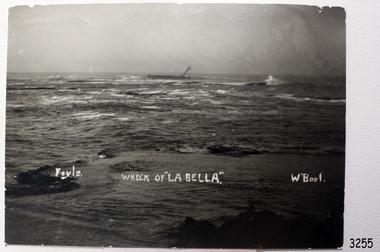
Photograph, Foyle Photographic Studio, Wreck of La Bella, about 11/11/1905
... sailor just before the ship broke up and sank. William Ferrier became a national hero as news of the daring rescue spread. He was awarded the Silver Medal for bravery by the Royal Humane Society and was honoured by the Prime Minister and the Governor. He was presented with several other awards for his daring rescue. Ferrier’s rescue efforts are one of the most heroic in Victoria’s shipwreck history. The wreck now lies in 13m of water and is home...sailor just before the ship broke up and sank. William Ferrier became a national hero as news of the daring rescue spread. He was awarded the Silver Medal for bravery by the Royal Humane Society and was honoured by the Prime Minister and the Governor. He was presented with several other awards for his daring rescue. Ferrier’s rescue efforts are one of the most heroic in Victoria’s shipwreck history. The wreck now lies in 13m of water and is home ...The photograph shows the wreck of La Bella in Lady Bay, Warrnambool, Australia. It was probably taken on 11th November 1905, the morning after she was wrecked. “Foyle” written on the photograph is the name of Foyle’s Photographic studio. At the time of the photograph the studio was owned by both Charles and Lilian Foyle (sometimes known as Lillian or Lily), either of whom could have taken this photograph. They also worked together at a later date on the photographs, sketches and paintings of the famous and historical Pioneers’ Honour Board, which is currently on view in the Warrnambool Library. Foyles Photography was the studio of James Charles Foyle. He owned “Foyle’s Photo Card Studios” in Liebig St , Warrnambool, which operated between 1889 – 1919 . A letter to the editor (by Mr Edward Vidler) in the Melbourne Argus, 3rd August, 1907, mentions that in that year Warrnambool would celebrate its 60th anniversary of its proclamation as a town, and that talented local artist Miss Lily Foyle would paint 200 portraits in watercolour of the pioneers who settled in the district prior to 1860. The Pioneer Honour Board can still be seen on display in the Warrnambool Library. In the Warrnambool Standard, Dec. 1917, “Mr Foyle’s studio was awarded contract to decorate rail cars on newly opened Trans-Continental railway, assisted by his sister, Miss Findlay.” The subject of the painting, La Bella, has its own tragic story. Read on for further details … On November 10th, 1905, the Norwegian-built barquentine La Bella approached Warrnambool at the end of her 37 day voyage. She was carrying a cargo of timber from Lyttleton, New Zealand, in heavy seas and evening mist. (On its only other visit to Warrnambool a year earlier the master had gone to shore to find a tow. He returned to the ship to find the crew drunk and unwilling to take up their posts, even though the ship was dragging its anchors and in a dangerous position.) As Captain Mylius steered La Bella to Lady Bay Channel the ship was tossed onto its side by heavy breakers and ran aground on what is now known as La Bella Reef. The sea was so rough that it wrenched a one-and-a- half ton anchor from the vessel. Several attempts were made by parties of volunteers in lifeboats to rescue the stricken sailors, but the rough conditions made this difficult for the boats to get close enough to the ship and the parties had to return to shore. The La Bella’s crew became exhausted and sailors were being washed overboard, one by one. By sunrise only five of the twelve crew still clung to the wreck. A local fisherman, 25 year old William Ferrier, rowed his small dingy through the heavy seas and managed to rescue the captain, whilst the volunteer lifeboat crew rescued a further three sailors, returning to shore. Ferrier made a final attempt at rescue and was able to reach its stern as the conditions eased slightly, saving the last remaining, terrified sailor just before the ship broke up and sank. William Ferrier became a national hero as news of the daring rescue spread. He was awarded the Silver Medal for bravery by the Royal Humane Society and was honoured by the Prime Minister and the Governor. He was presented with several other awards for his daring rescue. Ferrier’s rescue efforts are one of the most heroic in Victoria’s shipwreck history. The wreck now lies in 13m of water and is home to an abundance of marine life. Flagstaff Hill’s La Bella Collection includes a rail holder from La Bella, a photograph of William Ferrier with four of the five men rescued, a rail holder from the ship and the letter from the Prime Minister and other Members of Parliament that was sent to William Ferrier to commend him for his bravery. La Bella has been protected under the Commonwealth Historic Shipwrecks Act (1976) as a Historic Shipwreck since 23 April 1982 (VHR S401). It is archaeologically significant as the remains of an international and inter-colonial passenger and cargo ship. Flagstaff Hill’s collection of artefacts from the La Bella is of historical and archaeological significance because of its association with the La Bella, which is on the Victorian Heritage Register, and because of the relationship between the objects. The collection represents aspects of Victorian history, and the letter to William Ferrier demonstrates how important his rescue efforts were to Victoria and Australia. Black and white photograph of the wreck of the sailing ship La Bella in the bay at Warrnambool. The photograph shows the ship lying on its side in rough sea, with mast and rope rigging hanging loosely. Several large rocks are also visible. The photograph is a rectangle shape, mounted on heavy card, with slightly ragged edges. The photographer’s name, a title for the photograph and the location are hand written in white along the bottom third of the photograph. The back of the photograph is blank. Printed in white hand writing “Foyle”, “WRECK OF “LA BELLA”, “W’Bool”foyle, la bella, william ferrier, lady bay, lifeboats, lilian foyle, lillian foyle, charles foyle, james foyle, royal humane society medal, flagstaff hill, warrnambool, shipwrecked coast, flagstaff hill, flagstaff hill maritime museum, maritime museum, shipwreck coast, flagstaff hill maritime village -
 Federation University Historical Collection
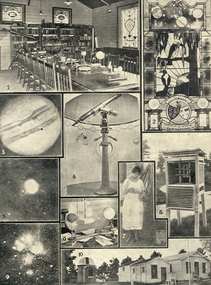
Magazine, Ballarat Courier, The Christmas Number of the Ballarat Courier Special Edition, 1921, 20/12/1921
... The 1921 edition had the theme 'Industrial Ballarat'. ballarat newspaper wf coltman ridings dentist ballarat botanical gardens lake wendouree fishing james smith pty ltd ludbrook undertaker jubilee lake daylesford hager underthaker springmount barlow motors ballarat mining exchnage south street competitions we longhurst ru nicholls lal lal falls old colonists association of ballarat clark cottage swj clark williams cottage f.j. williams ritchies grocery stores american sailors victorian methodist local preachers association ballarat police force macrobertson staff ballarat sewerage authority commons bros monumental masons fdp miller herbalist lake tyers pine plantation tonner memorial george tonner ballarat observatory ballarat north gold club tw glasgow suttons music store barnet glass road race lake burrumbeet berry anderson val purdue rowlands ballarat motor cycle club Stained Glass windows Printed magazine with many Ballarat images and advertisements. Images include: Barnet Glass Road Race (Ballarat to Melbourne, c1921); Berry Anderson and Co.; View from Springmount; Ballarat North Gold Club; Lake-Burrumbeet; Ballarat Motor Cycle Club Reliability Trial; Ballarat Observatory; Ballarat Old Colonists' Homes ...The Ballarat Courier did an annual December magazine. The 1921 edition had the theme 'Industrial Ballarat'. Printed magazine with many Ballarat images and advertisements. Images include: Barnet Glass Road Race (Ballarat to Melbourne, c1921); Berry Anderson and Co.; View from Springmount; Ballarat North Gold Club; Lake-Burrumbeet; Ballarat Motor Cycle Club Reliability Trial; Ballarat Observatory; Ballarat Old Colonists' Homes, F.W. Williams, S.W.J. Clarkballarat, newspaper, wf coltman, ridings dentist, ballarat botanical gardens, lake wendouree, fishing, james smith pty ltd, ludbrook undertaker, jubilee lake daylesford, hager underthaker, springmount, barlow motors, ballarat mining exchnage, south street competitions, we longhurst, ru nicholls, lal lal falls, old colonists association of ballarat, clark cottage, swj clark, williams cottage, f.j. williams, ritchies grocery stores, american sailors, victorian methodist local preachers association, ballarat police force, macrobertson staff, ballarat sewerage authority, commons bros monumental masons, fdp miller, herbalist, lake tyers, pine plantation, tonner memorial, george tonner, ballarat observatory, ballarat north gold club, tw glasgow, suttons music store, barnet glass road race, lake burrumbeet, berry anderson, val purdue, rowlands, ballarat motor cycle club, stained glass windows -
 Flagstaff Hill Maritime Museum and Village
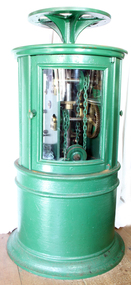
Machine - Dioptric Apparatus, mid 19th century
... The glowing lamp reminds sailors that security and home are well within reach, they also symbolize the way forward and help in navigating our way through rough waters not just on the oceans of the world but in our personal lives be it financial, personal, business or spiritual in nature. ...Before the introduction of electricity, lighthouses had a clockwork mechanism that caused the lens to rotate with a light source inside that was either powered by Kerosene or Colza oil. The mechanism consisted of a large weight attached by a cable through the centre of the lighthouse to the top where the cable wrapped around a barrel, drum or wheels that controlled the speed of the lights rotation by a clockwork mechanism. The keeper would crank the clockwork mechanism, which would lift the weight ready for the next cycle similar to an old grandfather clock mechanism. Once the weight lifted to its apex at the bottom of the first landing, the keeper would let it fall, which would pull on the cable, which would, in turn, operate a series of gears activating the rotation of the Fresnel optical lens, which would then rotate to create the lighthouse’s unique light speed of rotation characteristic. Creating a specific characteristic required a way to regulate the speed of the rotation, and was important as sailors could identify a particular light by its speed and time between flashes. The weight had to fall at a certain rate to create the proper rotation speed of the lens and a regulator within the mechanism accomplished this. History: From 1851, Chance Brothers became a major lighthouse engineering company, producing optical components, machinery, and other equipment for lighthouses around the world. James Timmins Chance pioneered placing lighthouse lamps inside a cage surrounded by Fresnel lenses to increase the available light output these cages, are known as optics and they revolutionised lighthouse design. Another important innovation from Chance Brothers was the introduction of rotating optics, allowing adjacent lighthouses to be distinguished from each other by the number of times per revolution the light flashes. The noted English physicist and engineer, John Hopkins invented this system while employed at Chance Brothers. Chance Brothers and Company was a glass works and originally based in Spon Lane, Smethwick, West Midlands England. The company became a leading glass manufacturer and a pioneer of British glass making technology. The Chance family originated in Bromsgrove as farmers and craftsmen before setting up a business in Smethwick near Birmingham in 1824. They took advantage of the skilled workers, canals and many other industrial advances taking place in the West Midlands at the time. Robert Lucas Chance (1782–1865), known as 'Lucas', bought the British Crown Glass Company's works in Spon Lane in 1824. The company specialised in making crown window glass, the company ran into difficulty and its survival was guaranteed in 1832 by investment from Chance's brother, William (1788 – 1856). William owned an iron factoring business in Great Charles Street, Birmingham. After a previous partnership that Lucas had dissolved in 1836, Lucas and William Chance became partners in the business which was renamed, Chance Brothers and Company. Chance Brothers invented many innovative processes and became known as the greatest glass manufacturer in Britain. In 1848 under the supervision of Georges Bontemps, a French glass maker from Choosy-le-Roi, a new plant was set up to manufacture crown and flint glass for lighthouse optics, telescopes and cameras. Bontemps agreed to share his processes that up to then had been secret with the Chance Brothers and stayed in England to collaborate with them for six years. In 1900 a baronetcy was created for James Timmins Chance (1814–1902), a grandson of William Chance, who had started the family business in 1771 with his brother Robert. Roberts grandson, James became head of Chance Brothers until his retirement in 1889 when the company became a public company and its name changed to Chance Brothers & Co. Ltd. Additional information: Lighthouses are equipped with unique light characteristic or flashing pattern that sailors can use to identify specific lighthouses during the night. Lighthouses can achieve distinctive light characteristics in a few different ways. A lighthouse can flash, which is when brief periods of light interrupt longer moments of darkness. The light can occult, which is when brief periods of darkness interrupt longer moments of light. The light can be fixed, which is when the light never goes dark. A lighthouse can use a combination of flashing, oscillating, or being fixed in a variety of combinations and intervals to create individual light characteristics. It is a common misconception that a lighthouse's light source changes the intensity to create a light characteristic. The light source remains constant and the rotating Fresnel lens creates the various changes in appearance. Some Fresnel lenses have "bulls-eye" panels create beams of light that, when rotated between the light and the observer, make the light appear to flash. Conversely, some lenses have metal panels that, when rotated between the light and the observer, make the light appear to go dark. This Dioptric clockwork apparatus used to turn a lighthouse optical lens is very significant as it is integral to a lighthouses operation, we can also look at the social aspect of lighthouses as being traditionally rich with symbolism and conceptual meanings. Lighthouses illustrate social concepts such as danger, risk, adversity, challenge and vigilance but they also offers guidance, salvation and safety. The glowing lamp reminds sailors that security and home are well within reach, they also symbolize the way forward and help in navigating our way through rough waters not just on the oceans of the world but in our personal lives be it financial, personal, business or spiritual in nature. Nothing else speaks of safety and security in the face of adversity and challenge quite the way a lighthouse does. Revolving dioptric clockwork apparatus used to turn a Fresnel optical lighthouse lens. A cylindrical cast metal pillar and cabinet painted green with 3 glass doors enclosing the top section. Inside the pillar/cabinet is a large clockwork mechanism used to turn and regulate a lighthouse light by means of weights and a chain attached to same. One door has the name "Adams Mare" in metallic dots similar to "Braille" to the inside edge of door frame.shipwrecked-coast, flagstaff-hill, flagstaff-hill-maritime-museum, flagstaff hill, maritime-museum, shipwreck-coast, warrnambool, flagstaff-hill-maritime-village, revolving dioptric mechanism, dioptric mechanism for lighthouse, lighthouse clockwork timing mechanism, acetylene lighthouse light mechanism, 19th century lighthouse mechanism, kerosene light, fresnel lenses, colza oil, chance brothers -
Mission to Seafarers Victoria
Booklet, Mission to Seamen, Object of the Mission: moral and spiritual well-being of our Sailors, 1920?
... home, for visiting seamen. The booklet reviews the object of the mission and in particular the role of the Ladies Harbour Light Guild which is to ensure the moral and spiritual well-being of sailors through social events, arranging and attending picnics for the men on public holidays, presiding at the Sunday teas, making gloves, woollies and other comforts and helping to collect and distribute literature (books, papers, etc) . ...home, for visiting seamen. The booklet reviews the object of the mission and in particular the role of the Ladies Harbour Light Guild which is to ensure the moral and spiritual well-being of sailors through social events, arranging and attending picnics for the men on public holidays, presiding at the Sunday teas, making gloves, woollies and other comforts and helping to collect and distribute literature (books, papers, etc) . ...Charity organisation, Ladies' Harbour Lights Guild, was formed within The Missions to Seamen Institute to provide a home away from home, for visiting seamen. The booklet reviews the object of the mission and in particular the role of the Ladies Harbour Light Guild which is to ensure the moral and spiritual well-being of sailors through social events, arranging and attending picnics for the men on public holidays, presiding at the Sunday teas, making gloves, woollies and other comforts and helping to collect and distribute literature (books, papers, etc) . This paper flyer holds historical significance at a local level because it illustrates the Ladies' Harbour Lights Guild involvement in the Mission to Seafarers.The Ladies' Harbour Lights Guild grew to become a significant charity in Melbourne raising large amounts of money which helped to establish the current MTS building, supporting seafarers as well as organizing and attending social events for the seafarers. Small booklet, Written in Blue 8 pages, back to front. The cover has a photo of the MtSV building next to the words " The Victorian Missions to Seamen" and at the bottom the title reads "OBJECT OF THE MISSION: moral and spiritual well-being of our Sailors."missions to seamen institute, ladies' harbour lights guild, purpose, social events, lhlg, australian wharf -
 Mission to Seafarers Victoria
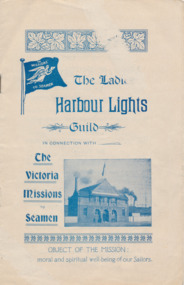
Booklet - Object, Missions to Seamen Institute, The Ladies' Harbour Lights Guild in connection with the Victoria Missions to Seamen-Object of the Mission: moral and spiritual well-being of our Sailors, 1909-1911
... home, for visiting seamen. The booklet reviews the object of the mission and in particular the role of the Ladies Harbour Light Guild which is to ensure the moral and spiritual well-being of sailors through social events, arranging and attending picnics for the men on public holidays, presiding at the Sunday teas, making gloves, woollies and other comforts and helping to collect and distribute literature (books, papers, etc) ....home, for visiting seamen. The booklet reviews the object of the mission and in particular the role of the Ladies Harbour Light Guild which is to ensure the moral and spiritual well-being of sailors through social events, arranging and attending picnics for the men on public holidays, presiding at the Sunday teas, making gloves, woollies and other comforts and helping to collect and distribute literature (books, papers, etc) . ...Charity organisation, Ladies' Harbour Lights Guild, was formed within The Missions to Seamen Institute to provide a home away from home, for visiting seamen. The booklet reviews the object of the mission and in particular the role of the Ladies Harbour Light Guild which is to ensure the moral and spiritual well-being of sailors through social events, arranging and attending picnics for the men on public holidays, presiding at the Sunday teas, making gloves, woollies and other comforts and helping to collect and distribute literature (books, papers, etc) .This paper flyer holds historical significance at a local level because it illustrates the Ladies' Harbour Lights Guild involvement in the Mission to Seafarers. The Ladies' Harbour Lights Guild grew to become a significant charity in Melbourne raising large amounts of money which helped to establish the current MTS building, supporting seafarers. Small booklet, Written in Blue 8 pages, back to front. The cover has a photo of the MtSV building next to the words " The Victorian Missions to Seamen" and at the bottom the title reads "OBJECT OF THE MISSION: moral and spiritual well-being of our Sailors."missions to seamen institute, ladies' harbour lights guild, mission to seafarers, seamen's mission, lhlg, chapel, flinders street, sir thomas david gibson carmichael (1859–1926) -
 Mission to Seafarers Victoria
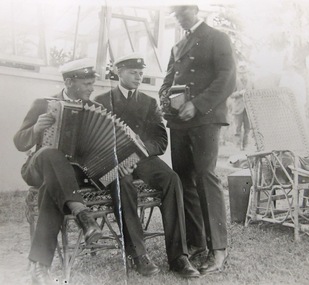
Photograph - Photograph, Black and white, Group of Swedes - Boxing Day 1920, 26 December 1920
... home Riversdale. They went there on a river excursion. A record of just one group of international sailors a long way from their home an country attending a Mission event. camera uniforms accordeon accordion picnic seamen swedish 1920 boxing day riversdale edward duckett Pencil inscription on verso in pencil handwritten :" Boxing day 1920 / Group of Swedes" ; at right angles a number "893" Black and white photograph of a trio of sailors in dress uniform – 2 seated on cane garden chairs one with piano-accordion being played. ...Supporters of the Mission often made their homes and gardens available as venue for Christmas Boxing day and Cup day events or picnics. On Boxing Day 1920 around 100 men were welcomed by Mr and Mrs Duckett on the grounds of the home Riversdale. They went there on a river excursion.A record of just one group of international sailors a long way from their home an country attending a Mission event. Black and white photograph of a trio of sailors in dress uniform – 2 seated on cane garden chairs one with piano-accordion being played. The standing sailor holds a cameraPencil inscription on verso in pencil handwritten :" Boxing day 1920 / Group of Swedes" ; at right angles a number "893"camera, uniforms, accordeon, accordion, picnic, seamen, swedish, 1920, boxing day, riversdale, edward duckett -
 Mission to Seafarers Victoria
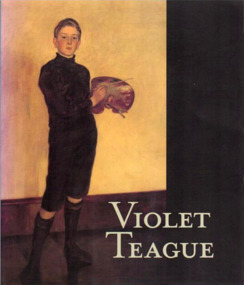
Book, Jane Clark & Felicity Druce, Violet Teague, 2000
... In 1910, the seamen of the shipwreck, Carnarvon, who were received at the Sailors Home then welcomed at the Mission by Reverend Haire as shown on a photograph publish in the Punch (22 September 1910), were invited to an evening of entertainment organised by artist Violet Teague at the Masonic Hall on the 19th of September. ...Catalogue of artworks by Australian female painter, Violet Teague.The Beagle Press, 1999.. Lge. 4to; pp. 128; frontispiece, 50 plates, bibliography; stiff illustrated wrapper, a fine copy. With contributions by Roger Butler, Anita Callaway, Jeanette Hoorn, Jacqueline Macnaughtan, Richard Neville, Juliet Peers, Kay Vernon and Liz Ward.non-fictionCatalogue of artworks by Australian female painter, Violet Teague.violet teague, windjammers, jane clark, felicity druce, artist, female artist, c.b. pedersen, carnarvon -
 Mission to Seafarers Victoria
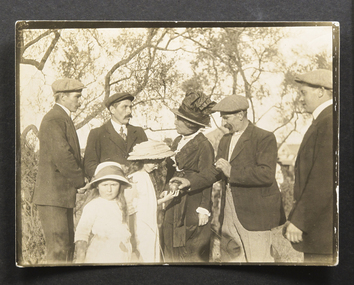
Photograph - Photograph, Sepia, French sailors in Brighton 1915, 5 April 1915
... Andrew's Church, Brighton, on Easter Monday, the Seamen's Mission held an enjoyable outing, which culminated in a tug-of-war between French and Swedish sailors, and a race in fancy costume. In the evening, at the mission house, on the Australian Wharf, a welcome home was given, after the chapel service, to Miss Ethel Godfrey, who addressed the men, and related some of her adventures at Scarborough, where she was staying when the English seaside resort was raided by German warshlps."...Andrew's Church, Brighton, on Easter Monday, the Seamen's Mission held an enjoyable outing, which culminated in a tug-of-war between French and Swedish sailors, and a race in fancy costume. In the evening, at the mission house, on the Australian Wharf, a welcome home was given, after the chapel service, to Miss Ethel Godfrey, who addressed the men, and related some of her adventures at Scarborough, where she was staying when the English seaside resort was raided by German warshlps." ...On Easter Monday, 5 April 1915, the Mission organised a picnic on the St Andrew's Church grounds in Brighton. Some French and Swedish sailors ere invited to take part in sports. In the centre is probably Ethel Godfrey, Honorary Secretary of the LHLG, who was just back from England where she visited her brother, Dr Frank Godfrey and his family in Scarborough. Along with her sisters Federica and Winifred, they saw the German attack on the English town.\ located on the North Sea. Article published in the Herald, Monday 12 April 1915, page 3: "SAILORS ENJOY OUTING In the spacious grounds of St. Andrew's Church, Brighton, on Easter Monday, the Seamen's Mission held an enjoyable outing, which culminated in a tug-of-war between French and Swedish sailors, and a race in fancy costume. In the evening, at the mission house, on the Australian Wharf, a welcome home was given, after the chapel service, to Miss Ethel Godfrey, who addressed the men, and related some of her adventures at Scarborough, where she was staying when the English seaside resort was raided by German warshlps."The Godfrey sisters and their step-mother had done the voyage to Europe to visit their brother just before the war stars. They witnessed the outbreak of the war, the attacks on Scarborough. When they came back to Australia, the voyage was dangerous as Germans were attacking vessels. Barely arrived in Australia, Ethel Godfrey who could speak French, having studied in Belgium, was already helping with the picnics, eager to share her story and support French sailors.sepia photograph depicting four sailors, a lady and two young girls standing in a park.One of the sailors is handing an apple to them.Written in Pencil on verso: French sailors in Brighton 1915french, picnic, lhlg, brighton, st andrew's church, ethel godfrey, scarborough raid, sailors, mission to seamen, seamen's mission, children, girls, apples -
 Mission to Seafarers Victoria
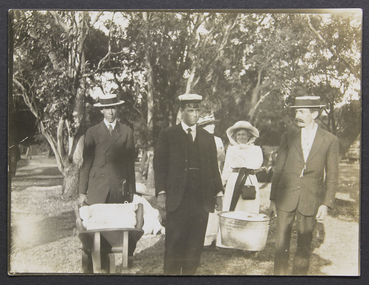
Photograph - Photograph, Sepia, 26 December 1905
... It was noticeable that the large carnivora were the favorites with the English sailors, whilst foreign seamen were immensely attracted by the kangaroos, wallabies and other Australian marsupials. After tea Mr. Le Souef delivered an interesting illustrated lecture entitled Sea Birds and Their Homes. ...It was noticeable that the large carnivora were the favorites with the English sailors, whilst foreign seamen were immensely attracted by the kangaroos, wallabies and other Australian marsupials. After tea Mr. Le Souef delivered an interesting illustrated lecture entitled Sea Birds and Their Homes. ...On Boxing Day 1905, Mr Dudley Le Souef, the director of Melbourne Zoological Gardens, offered the grounds for a picnic. The seamen of the fifteen ships anchored in the harbour were invited. In the centre wearing a white cap is Mr Charles A. Holmes, Honorary Lay Reader of the Mission and behind him is Ethel Godfrey. The following day in the Age we could read: "Yesterday the scene of festivities was the Zoological Gardens, where a number of seamen from fifteen of the ships in the harbor had a sailors' picnic. The director of the gardens, Mr. Dudley Le Souef, kindly, allowed the picnickers the free use of the picnic ground, and also provided them with milk and hot water. A lengthy programme of sports was gone through, and those who were not inclined for athletics spent their time in strolling round examining the zoo logical inmates of the gardens. It was noticeable that the large carnivora were the favorites with the English sailors, whilst foreign seamen were immensely attracted by the kangaroos, wallabies and other Australian marsupials. After tea Mr. Le Souef delivered an interesting illustrated lecture entitled Sea Birds and Their Homes. In carrying out the two days' arrangements Mr. Goldsmith was energetically assisted by voluntary helpers, both ladies and gentlemen, and also received many contributions. " The Age, Wednesday 27 December 1905, page 5.Small monochrome outdoor photograph, very clearly focussed, depicting three men delivering or collecting teacups, and two ladies watching on in backgroundMr Holmes distributing cups Zoo Miss Godfrey Centrezoo, boxing day, mr dudley le souef, ethel augusta godfrey, mr c.a. holmes, picnic, 1905, charles arthur holmes -
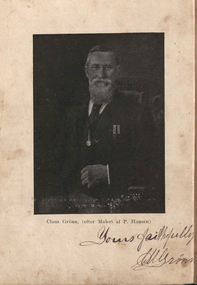 Federation University Historical Collection
Book, Claus Gronn, Erindringer fra Sö og Land (Memories from Sea and Land), 1906
... In his old age, he used his diary to compile a book, all written in Danish, for his family detailing his many adventurers as a sailor and a gold-digger and his visits to his home-town of Mels as an old man. ...From the age of 23, Claus Gronn kept a diary/account book to record his daily events and expenditures. In his old age, he used his diary to compile a book, all written in Danish, for his family detailing his many adventurers as a sailor and a gold-digger and his visits to his home-town of Mels as an old man. Eleven copies were printed, one for each of his surviving children. The book was later translated and published by Claus' grand-daughter, Cora McDougall, in the book "Gold, Gold! Diary of Claus Gronn, A Dane on the Diggings". Claus Grönn (1832-1909) was born in Mels, Oksbol Sogn, Schleswig (then still a part of Denmark), the son of blacksmith Claus Mathiesen Gronn. He married Mary Ann Priestley Horsfall at Newstead, Victoria, in 1856. Claus was sent to sea at the age of 14, returning two years later when he took part in the first Schleswig war between Prussia and Denmark as a cadet in the Danish Marine Service. He spent the next four years at sea sailing to Iceland, Russia, Spain and British Guinea. Adopting an anglicised name, Charles Edward Sinclair (which he used until his marriage in 1856 when he resumed his own names), Claus' last voyage was destined for Australia. On June 10, 1854, on board the Koh-i-noor, Claus arrived in Sandridge (now known as Port Melbourne), Victoria. Deciding to try his luck in the goldfields Claus Gronn hoped to earn enough money to be able to return to Denmark with a certain wealth. He purchased some basic tools, he walked 100 km to the Mount Alexander goldfields, trying his luck at Campbell's Creek. He went into partneship with another Dane, Peter Hansen. On 30 September 1909 Claus Gronn died aged 77, at his farm "Leavoldston" located north of Oakleigh, and is buried in the Burwood Cemetery.Green hard covered book. Plate 1 is a signed image of Claus Gronn. Another plate depicts Claus Smed, and Dr Preshaw's tent in Castlemaine. With the book is some cutting, including 'Cuttings from various journals about Claus Gronn and HIs Memoirs by Jens Lyng, as well as hair samples from Margaret Billyeald, Gladstone Procter's second wife. There is also a family tree, and a copy of the details on the Horsfall family from the family bible. non-fictionFrom the age of 23, Claus Gronn kept a diary/account book to record his daily events and expenditures. In his old age, he used his diary to compile a book, all written in Danish, for his family detailing his many adventurers as a sailor and a gold-digger and his visits to his home-town of Mels as an old man. Eleven copies were printed, one for each of his surviving children. The book was later translated and published by Claus' grand-daughter, Cora McDougall, in the book "Gold, Gold! Diary of Claus Gronn, A Dane on the Diggings". Claus Grönn (1832-1909) was born in Mels, Oksbol Sogn, Schleswig (then still a part of Denmark), the son of blacksmith Claus Mathiesen Gronn. He married Mary Ann Priestley Horsfall at Newstead, Victoria, in 1856. Claus was sent to sea at the age of 14, returning two years later when he took part in the first Schleswig war between Prussia and Denmark as a cadet in the Danish Marine Service. He spent the next four years at sea sailing to Iceland, Russia, Spain and British Guinea. Adopting an anglicised name, Charles Edward Sinclair (which he used until his marriage in 1856 when he resumed his own names), Claus' last voyage was destined for Australia. On June 10, 1854, on board the Koh-i-noor, Claus arrived in Sandridge (now known as Port Melbourne), Victoria. Deciding to try his luck in the goldfields Claus Gronn hoped to earn enough money to be able to return to Denmark with a certain wealth. He purchased some basic tools, he walked 100 km to the Mount Alexander goldfields, trying his luck at Campbell's Creek. He went into partneship with another Dane, Peter Hansen. On 30 September 1909 Claus Gronn died aged 77, at his farm "Leavoldston" located north of Oakleigh, and is buried in the Burwood Cemetery.claus grönn 1832-1909, leavoldston, claus gronn, peter hansen, campbell's creek, peter skjellerup, mary ann horsfal, sandon, dr preshaw, claus smed, ship, immigraion, family history, danish, biography
