
Showing 141 items matching "school slates"
-
 Bendigo Historical Society Inc.
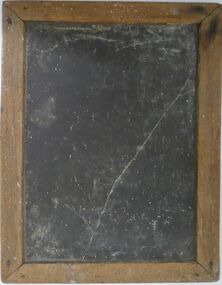
Education kit - GOLDEN SQUARE PRIMARY SCHOOL COLLECTION: SCHOOL WRITING SLATES
... GOLDEN SQUARE PRIMARY SCHOOL COLLECTION: SCHOOL WRITING SLATES...Two wooden edged school writing slates. [a] Cracked example without evidence of use. ...slate. Numerous letters inscribed into wooden edge. Education kit GOLDEN SQUARE PRIMARY SCHOOL COLLECTION: SCHOOL WRITING SLATES ...Two wooden edged school writing slates. [a] Cracked example without evidence of use. [b] R C Hadderton roughly inscribed into wooden edge of slate. Lines scratched across slate. Numerous letters inscribed into wooden edge.bendigo, institutions, golden square primary school -
 Warrnambool and District Historical Society Inc.
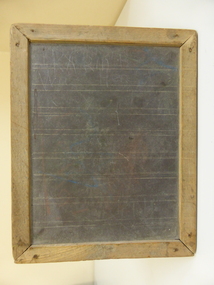
Functional object - School writing slate, Child's School Slate
... School writing slate...Child's School Slate...school slates...Slates such as this were used by all school children in Victoria (and presumably elsewhere) in the infant and younger age classes from the early days of the State until the early 1940s. ...This is a child's school writing slate made from quarry slate with permanent lines for handwriting with a wooden frame. ...The surface is much marked and scratched. Child's School Slate Functional object School writing slate ...This slate comes from the Glasgow Estate (Ellen Isabel Glasgow died in Warrnambool in 1971). It is presumed it was used by members of the Glasgow family. Slates such as this were used by all school children in Victoria (and presumably elsewhere) in the infant and younger age classes from the early days of the State until the early 1940s. It had the advantage of the work being able to be easily erased so that other work could be written. A slate pencil was used to write on this board. A more recent blackboard or chalkboard was in common use until the 1970's in junior classes. the writing with these was done with chalk.This is significant firstly as an example of past educational tools used by small children and so has important social significance as every school child of past generations would have used a slate. It is also important as it belonged to the Glasgow family. John Glasgow (c.1847-1925), at his property, Blackwood Hill, Wangoom, was a prominent cheese maker in the late 19th century and was one of the first shareholders and a member of the first Board of Directors of the Warrnambool Cheese and Butter Factory at Allansford. The dairying industry is of key importance in Warrnambool economic history.This is a child's school writing slate made from quarry slate with permanent lines for handwriting with a wooden frame. The surface is much marked and scratched. Scratch marksschool slates, educational tools of the past, warrnambool history, glasgow family wangoom -
 Greensborough Historical Society
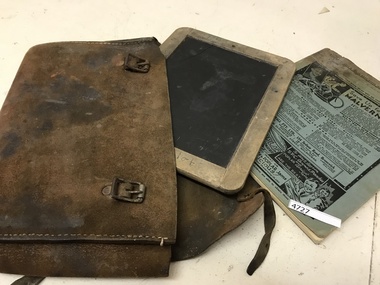
School Equipment, School satchel with exercise book and slate, 1931-1934
... School satchel with exercise book and slate...school slates...Slate and satchel commonly used in primary schools prior to World War 2; exercise book was produced by local traders in the Brunswick and Brunswick West area for free distribution to students....Leather school satchel, with slate and exercise book. Exercise book entitled "Brunswick West and North-West State Schools Homework Exercise Book", probably produced between 1926 and mid 1930s. ...Slate and satchel commonly used in primary schools prior to World War 2; exercise book was produced by local traders in the Brunswick and Brunswick West area for free distribution to students. school slates school satchels Slate and exercise book marked "Doug Elliott" Leather school satchel, with slate and exercise book. ...Slate and satchel commonly used in primary schools prior to World War 2; exercise book was produced by local traders in the Brunswick and Brunswick West area for free distribution to students.Leather school satchel, with slate and exercise book. Exercise book entitled "Brunswick West and North-West State Schools Homework Exercise Book", probably produced between 1926 and mid 1930s. The Advertised Bruce Small/Malvern Star business was located at 134 Sydney Road in the 1931-1934 period. Slate and exercise book marked "Doug Elliott"school slates, school satchels -
 Stawell Historical Society Inc
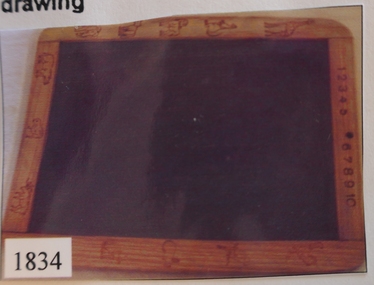
Memorabilia - Realia
... Primary School Slate with wooden edge....Stawell Education Primary School Slate with wooden edge. Memorabilia Realia ...Primary School Slate with wooden edge.stawell, education -
 Stawell Historical Society Inc
Memorabilia, Slate writing pad
... National School Slate Company Extra Special First Quality...Issued to Eileen May Eskey when she started school at Stawell Primary School No 502 On February 10th 1936 Farter recorded as of Kofoed Street National School Slate Company Extra Special First Quality Dark Grey Slate with wooden surround. ...Issued to Eileen May Eskey when she started school at Stawell Primary School No 502 On February 10th 1936 Farter recorded as of Kofoed Street Dark Grey Slate with wooden surround. Two SidedNational School Slate Company Extra Special First Quality -
Stawell Historical Society Inc
Memorabilia - Realia, Primary School Slate
... Primary School Slate....Primary School Slate. Margaret C__Man written on edge...Stawell Education Primary School Slate. Margaret C__Man written on edge Primary School Slate. ...Primary School Slate. Margaret C__Man written on edgestawell, education -
 Orbost & District Historical Society
school slate, 1930's -1940's
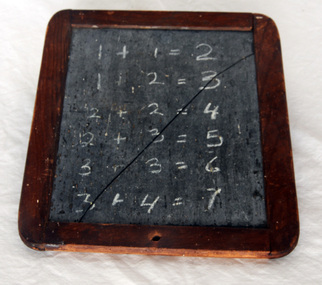
... school slate...school-slate education writing educational-equipment...A double-sided rectangular-shaped school slate with a wooden frame....On frame-Made in Portugal A double-sided rectangular-shaped school slate with a wooden frame. school slate ...Children used slates to practise writing letters and numbers. They sometimes used their slates to play games when not learning their lessons Early models of small, hand-held chalkboards were slates encased in a wood frame to keep the slate from breaking. Pencil and paper were available but paper was very expensive. Using a small, hand-held slate meant that a child could practise writing, erase and write again without having to consume expensive paper.This item is an example of early educational equipment and can be compared to modern school equipment.A double-sided rectangular-shaped school slate with a wooden frame.Chalk markings - number sentences. On frame-Made in Portugalschool-slate education writing educational-equipment -
 Mont De Lancey
School slate
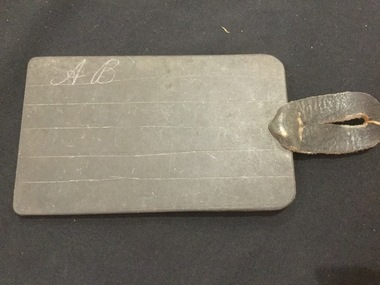
... School slate...Small school slate with leather strap. Luggage tag shape....School slate ...Small school slate with leather strap. Luggage tag shape.writing equipment, writing slates -
 Anglesea and District Historical Society
Slate and Pencil
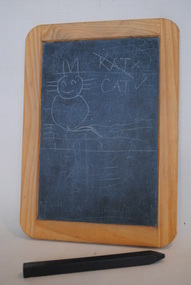
... School slate board in wooden frame as used in State Primary Schools together with pencil....slate board schools School slate board in wooden frame as used in State Primary Schools together with pencil. ...School slate board in wooden frame as used in State Primary Schools together with pencil.slate board, schools -
Lakes Entrance Historical Society
Education kit - School Slate
... School Slate...School slate with wooden frame, hole drilled in one end of frame, double sided...Timber frame is 1.8 cm wide surrounding slate, actual slate is 15 cm x 23.5 cm EDUCATION SCHOOL School slate with wooden frame, hole drilled in one end of frame, double sided Education kit School Slate ...Timber frame is 1.8 cm wide surrounding slate, actual slate is 15 cm x 23.5 cmSchool slate with wooden frame, hole drilled in one end of frame, double sidededucation, school -
 Bendigo Historical Society Inc.
Ephemera - School slate, slate bound with pine edges
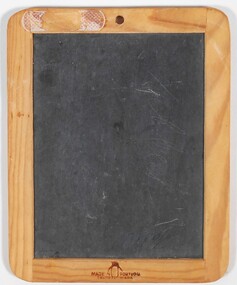
... School slate, slate bound with pine edges...School slate for writing the alphabet or sums. ...Slate has a pine border on all four edges, and is marked made in Portugal with a penguin trademark Ephemera School slate, slate bound with pine edges ...School slate for writing the alphabet or sums. Slate has a pine border on all four edges, and is marked made in Portugal with a penguin trademarkschool equipment, state school -
 Federation University Historical Collection
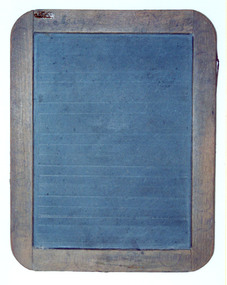
Equipment - Writing Slate, Slate Board
... school...education...teaching...slate...The National School Slate Co. was started in 1847 and was a world importer of slate. ...Two slate boards. The slate, commonly used in schools, is housed in a timber frame and was used for drawing and writing with a special slate pencil...National School Slate Co....The National School Slate Co. was started in 1847 and was a world importer of slate. ...The National School Slate Co. was started in 1847 and was a world importer of slate. They made chalk boards and pencils in Slatington, PennsylvaniaTwo slate boards. The slate, commonly used in schools, is housed in a timber frame and was used for drawing and writing with a special slate pencil. (.1) lines marked on slate. .1) has 'Mary Cook' written on top in pencilschool, education, teaching, slate, black board, mary cook, slate board -
Clunes Museum
Functional object - SLATE PENCILS
... USED IN SCHOOLS ON SLATES FOR WRITING...USED IN SCHOOLS ON SLATES FOR WRITING LOCAL HISTORY SCHOOL EQUIPMENTS SCHOOLS EQUIPMENT NIL 3 X PIECES OF SLATE PENCIL Functional object SLATE PENCILS ...USED IN SCHOOLS ON SLATES FOR WRITING3 X PIECES OF SLATE PENCILNILlocal history, school, equipments, schools, equipment -
 Bendigo Historical Society Inc.
Functional object - SLATE, Mid to late 19th C
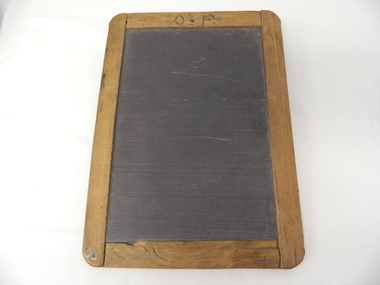
... Object. Rectangular school slate contained within wooden frame. Wooden frame has rounded edges held together by five metal hand made nails which have caused the timber to split. ...TOYS General slate Slate Object. Rectangular school slate contained within wooden frame. Wooden frame has rounded edges held together by five metal hand made nails which have caused the timber to split. ...Object. Rectangular school slate contained within wooden frame. Wooden frame has rounded edges held together by five metal hand made nails which have caused the timber to split. Unreadable writing on a long side and a short side of the wooden edging. Looks like 'Macy Ackla'. Other unreadable writing.toys, general, slate, slate -
 Kiewa Valley Historical Society
Slate - School, early 1900
... Slate - School...slate pads...chalk boards...school...Historically this school writing slate pre-dates paper and electronic writing pads. ...Writing slate used for Primary School classes. Wooden frame. Has hole in frame and string threaded through to allow it to be hung on a hook or nail....Historically this school writing slate pre-dates paper and electronic writing pads. ...Historically this school writing slate pre-dates paper and electronic writing pads. This was used for non permanent written communication within or outside the classroom. It use was mainly as a quick temporary method and could be easily erased by cloth or fingers. As it could be used repeatedly without additional cost and was therefore a very cheap method of teaching and learning outdoors as well as indoors. This was especially relevant to country schools and outdoor excursions. It was fairly robust but could shatter if allowed to fall on the ground.This item evolved from a form of communication, that of primitive engravings on stone. This tablet was a refined writing/drawing pad that did not require any electronic/battery power input. This writing slate was so useful in an era where relative isolation (Kiewa Valley Schools) from electronic and cheap writing pads was the reality and the norm. This was a time when the hand writing and hand drawing was a basic form of non spoken communication. Students used this slate pad to reinforce their skills which would come in handy when they needed to produce temporary notices on slate information boards, e.g. rail/bus-time/route alterations.Writing slate used for Primary School classes. Wooden frame. Has hole in frame and string threaded through to allow it to be hung on a hook or nail.slate pads, chalk boards, school learning utensils -
 Ballarat Heritage Services
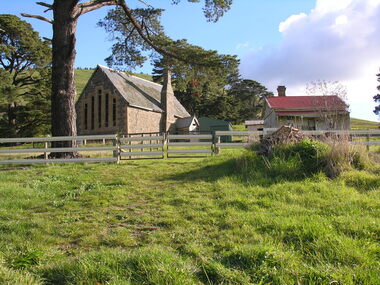
Photograph - Photograph - Colour, Clare Gervasoni, Former School at Weatherboard, Victoria, c2010
... The School, Number 656, was opened on 01 August 1862 and closed on 04 February 1948. it was also known as Weatherboard Hill Common School and Weatherboard Hill State School.The bluestone school building had a slate roofand its first head teacher was James Richmond..In 1915 Health Officer, Dr Willis, strongly condemned the old bluestone building as being damp and unsanitary. in 1948 enrolments dropped to 6 and the school closed. ...The School, Number 656, was opened on 01 August 1862 and closed on 04 February 1948. it was also known as Weatherboard Hill Common School and Weatherboard Hill State School.The bluestone school building had a slate roofand its first head teacher was James Richmond..In 1915 Health Officer, Dr Willis, strongly condemned the old bluestone building as being damp and unsanitary. in 1948 enrolments dropped to 6 and the school closed. ...Weatherboard is a small town in Western Victoria.Anecdotally the name is thought to have originated because it was the first place in the region to have a home built using weatherboard rather than corrugated iron, stone or bricks. It is in the boundaries of the City of Ballarat. The School, Number 656, was opened on 01 August 1862 and closed on 04 February 1948. it was also known as Weatherboard Hill Common School and Weatherboard Hill State School.The bluestone school building had a slate roofand its first head teacher was James Richmond..In 1915 Health Officer, Dr Willis, strongly condemned the old bluestone building as being damp and unsanitary. in 1948 enrolments dropped to 6 and the school closed. The Weatherboard State School World War One Honour Board is located at Burrumbeet Hall. An early bluestone school known as the Weatherboard School.weatherboard school, former weatherboard school, education, weatherboard hill common school, weatherboard hill state school -
 Northern District School of Nursing. Managed by Bendigo Historical Society Inc.
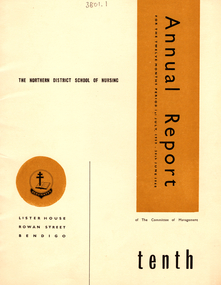
Administrative record - Northern District School of Nursing Graduates Association - 10th and 11th Annual Reports, 1959-1961
... The Committee of Management included medical, nursing, and educational leaders from regional hospitals and schools. Dr. Peter Slater, a founding member and major contributor, passed away in 1960 and was honored for his service. ...The Committee of Management included medical, nursing, and educational leaders from regional hospitals and schools. Dr. Peter Slater, a founding member and major contributor, passed away in 1960 and was honored for his service. ...The Northern District School of Nursing in Victoria, Australia Graduates Association: History of the School Managed by a committee including hospital administrators, medical professionals, and nursing leaders from several regional hospitals. Associated with major hospitals in the Northern District, including Bendigo Base, Mildura Base, Castlemaine, Echuca, Swan Hill, St. Arnaud, and Kyneton District Hospitals. Provide high-quality theoretical and practical nursing training. Raise the standard of nursing education in the region. Maintain the highest principles of nursing practice. Applicants must be at least 17 years old and hold a Proficiency Certificate or higher educational qualification. Application involves submitting forms, certificates, an interview, an aptitude test, and a medical examination. A three-month probationary period follows initial acceptance. Preliminary Training School: Four-week introductory course covering basic nursing, anatomy, hygiene, and practical skills. Practical experience in various hospital departments, guided by senior staff. Study Block Plan: Includes several blocks of theoretical and practical instruction throughout the three-year program. Regular school exams and two state exams (First Professional and Final State) are required for progression and graduation. Nurses work a 40-hour week with at least one or two days off per week and three weeks of annual leave. Accommodation is provided in comfortable hostels with good facilities. Uniforms are supplied free; nurses provide their own shoes and stockings. Salaries and allowances are regulated, with deductions for board and free medical care. Additional Information Post-Graduate Opportunities. Senior positions require further experience and additional certificates (e.g., Midwifery, Infant Welfare).Diploma courses available in administration, teaching, and specialized nursing fields. Bursaries are available for advanced study.Career Prospects: Graduates can pursue roles in administration, teaching, ward and departmental leadership, district and visiting nursing, industrial and school nursing, and more. Opportunities existed both within hospitals and in community or specialized settings.FAQs and Practical Details. Minimal training costs (mainly exam fees and personal items).Living out allowances and travel expenses are covered. Four training intakes per year; waiting periods are short if qualifications are met. 10th ANNUAL REPORT Here are the key points from the annual report of the Northern District School of Nursing for the year ending June 30, 1960:1. The Committee of Management included medical, nursing, and educational leaders from regional hospitals and schools. Dr. Peter Slater, a founding member and major contributor, passed away in 1960 and was honored for his service. The tutorial and clerical staff lists reflect several changes, with notable resignations and new appointments. The School celebrated its tenth anniversary in March 1960, marking a decade since its first intake in 1950. It was the first independent nursing school in Australia, contributing significantly to nursing education history. A new kitchen-dining block was completed, improving meal services and social spaces.Upgrades included a second demonstration classroom, improved lighting and heating, and renovations to hostels and administrative areas. Some maintenance issues remained, particularly with older hostels and the need for a new administrative block.4. A post-graduate Staff Nurse Training Course was introduced to retain and further develop graduates within the region. The study block plan was revised to distribute nurse absences more evenly, increasing the number of study blocks from 9 to 14 per year. The School faced challenges balancing educational needs with hospital staffing requirements. Certificates were awarded to several graduates who completed the new Staff Nurse Training Course. The report details causes of student attrition, including exam failures, personal reasons, health, marriage, and disciplinary actions. The School hosted significant conferences, including the Royal Victorian College of Nursing's tutors' conference, fostering professional development and networking. The School's finances were stable, with government grants as the main income source and detailed accounts of expenditures and assets provided. The report expresses gratitude to staff, the Hospitals and Charities Commission, and associated hospitals for their support and cooperation. 11th ANNUAL REPORT Here are the key points from the Eleventh Annual Report (1960-1961) of the Committee of Management for the Northern District School of Nursing, Bendigo: Ongoing issues with deteriorating retaining walls and outbuildings at school residences. Committee sought approval for a staged building program: administrative/classroom unit, hostel accommodation, and demonstration/practical classroom unit. Urgent need for improved office and classroom facilities due to inadequate current conditions. Routine repairs and upgrades (painting, new heaters, floor coverings, clothes dryers). Plans for garage repairs and replacement of retaining walls at hostels. Significant improvements with new anatomical models and demonstration equipment, enhancing teaching quality. No major changes to the basic curriculum; continued use of study block plan across all years. Ongoing challenges in teaching Invalid Cookery due to lack of facilities and qualified teachers. Concerns about overloading introductory courses and the impact of staff shortages on student preparedness. 74 students sat the First Professional Examination: 63 passed initially, 5 passed supplementary, 2 failed and terminated, 3 did not re-sit.65 students sat the Final State Examination: 2 failed whole exam, 4 failed Medical Nursing, 2 failed Surgical Nursing; all passed supplementary exams. Recommendation that students struggling by the 15th month consider Nursing Aide work.Staff Nurse CoursePostgraduate courses held for staff nurses, including visits to metropolitan and local hospitals and organizations. High standard of lectures and appreciation from students. Staff attended post-graduate courses; Miss Bannfield-Smith awarded Florence Nightingale Scholarship. Miss Long received a Rockefeller Foundation grant for study in the US and Canada.Recruitment and Student Demographics 69 new recruits from various regional hospitals.2 07 students in training as of June 30, 1961, with diverse educational backgrounds. 33 students left due to exam failure, marriage, dislike of nursing, personal or health reasons, or family needs. Several resignations and new appointments among tutorial, supervisory, and domestic staff. Total expenditure: £37,561; total income: £36,898, resulting in a deficit of £663 for the year. Main expenses: salaries, provisions, domestic costs, repairs, and administration. Dr. P. R. Slater MemorialA memorial ceremony and placement of a commemorative painting in honor of Dr. Slater, the first chairman.Hosted meetings for medical and nursing associations, and provided hospitality for visiting nurses during the International Nursing Congress.Northern District School of Nursing Graduates Association - 10th and 11th Annual Reports, 1959-1960 and 1960-61 This item contains the following documents: 3801.1a 10th Annual Report Front Cover 3801.1b The annual report of the Northern District School of Nursing for the year ending June 30, 1960 3801.1c 11th Annual Report Front Cover 3801.1d The Eleventh Annual Report (1960-1961) of the Committee of Management for the Northern District School of Nursing, Bendigo 3801.1e Copy of Above 3801.1f Copy of Above 3801.1g Copy of Abovenurse training, lister house, annual reports -
 Flagstaff Hill Maritime Museum and Village
Container - Ink bottle, MABIE TODD & Co. (Aust.) Pty. Ltd, Second half of 19th Century or first half of the 20th Century
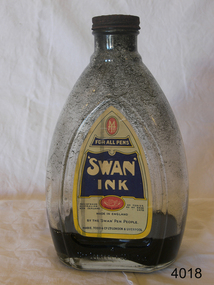
... schools. After a child was deemed old enough to progress from just using slate and board, he/she would have been supplied with a pen shaft made of wood and with a very basic metal nib. ...A Brief History Of Mabie Todd Ltd The company originated in America from the beginnings during the 1860s when a Mr. Todd and a Mr. Mabie began making pencil cases and pen holders in New York. Later they were joined by the Bard Brothers who made Gold nibs and by 1873 the company of Mabie Todd and Bard were established in New York. By 1878 the first patent was filed for the design and manufacture of a fountain pen, achieved under the design leadership of one William Washington Stewart. The first Swan fountain pen followed just 6 years later in 1884 with an over-under feed with ink delivery assisted by a twisted silver wire. This same year an office had been established in the UK with a showroom in Cheapside, London. The UK was being supplied with a steadily increasing supply of pens from New York and by 1905 new, larger showrooms were established in High Holborn. By this time the Swan pen had become synonymous with fountain pens at large. In 1906 the name of Bard was dropped in the US and the UK company subsequently adopted the title Mabie Todd & Co. New York. In 1907 British production began, using imported nibs from New York and whilst the company in the UK flourished, the business in the US started to diminish under stiff competition from new manufacturers.. By 1915 manufacturing was doing well in England from a factory in Weston Street, London and the New York company agreed to sell the rights to all European and Colonial business to Mabie Todd & Company Ltd of England. From then onwards, the development of the range mostly followed, rather than led the interests of the markets they were supplying. Even during the First World War the business continued to flourish. with factories in both London and Liverpool. At the end of 1919 a new expansion plan saw the establishment of a new Headquarters in Oxford Street, London. Throughout this period, some components were continuing to be imported from America, but gradually these diminished and during the 20s and 30s manufacturing facilities were expanded and by the end of the 1930s Mabie Todd were in full production, manufacturing pens in its London factory, gold nibs in Birmingham and ink in Liverpool. Another new headquarters grew out of this period of abundance and market domination. when in 1936 they moved into Sunderland House in Mayfair, London, a highly prized mansion building. Disaster struck early in the Second World War. Its prestigious Sunderland House headquarters was destroyed during the blitz, followed by destruction of its main factory in Harlesden, North London. Some machinery was saved and able to be used at another factory premises in the City, but like many other 'non essential' manufacturing, the main production was centred on wartime components such as rocket fuses and ammunition. After The War, in 1945 they moved out of their City premises to Park Royal and eventually in 1946 proper fountain pen production was resumed. In 1948 the company decided to go public. But at the time they had no plans to enter into the market for the now growing interest in ballpoint pens, the result was the beginning of their slide into obscurity and subsequent demise. They became Biro Swan in 1952 following a large share purchase by Biro Pens. Even though at this time they had just launched their new high profile Calligraph range to join the competition for the new market associated with a craze for italic writing, fountain pen manufacture under the new company was to suffer a lack of real support. The restyled ranges of 1956 failed to ignite market interest and with diminishing quality, the end of the Mabie Todd story was inevitable. After 80 years of Swan pens, the book was closed.This bottle of ink would have been supplied to schools. After a child was deemed old enough to progress from just using slate and board, he/she would have been supplied with a pen shaft made of wood and with a very basic metal nib. The ink bottle would be used to fill up the individual inkwells. This operation would have been conducted by the teacher him/herself, or by an older pupil under the close eye of the teacher.Ink bottle clear glass with 'Swan Ink' paper label. Has rusted screw on top & black ink inside.Label has 'Mabel Todd' manufacturer's logo at top,; 'Swan Ink' name clearly shown; 'Made in England' printed clearly; and 'Mable Todd & Co Ltd, London & Liverpool' printed at base of label.flagstaff hill, warrnambool, shipwrecked-coast, flagstaff-hill, flagstaff-hill-maritime-museum, maritime-museum, shipwreck-coast, flagstaff-hill-maritime-village, ink, bottle, mabie todd ltd -
 Flagstaff Hill Maritime Museum and Village
Container - Ink Jug, Second half of 19th Century or first half of the 20th Century
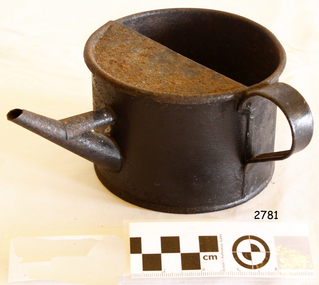
... The ink would be supplied to schools in large glass or stoneware bottles, and these would have been too unwieldy and difficult to use to pour ink into the small inkwells. Therefore it was decanted into the metal ink jugs and then poured into the inkwells. After a child was deemed old enough to progress from just using slate ...This metal ink jug or can, was used to dispense portions of ink to individual inkwells contained on the top of each pupil's desk. The jug is not unlike a small indoor watering can. The ink would be supplied to schools in large glass or stoneware bottles, and these would have been too unwieldy and difficult to use to pour ink into the small inkwells. Therefore it was decanted into the metal ink jugs and then poured into the inkwells. After a child was deemed old enough to progress from just using slate and board, he/she would have been supplied with a pen shaft made of wood and with a very basic metal nib. The ink jug would be used to fill up the individual inkwells. This operation would have been conducted by the teacher him/herself, or by an older pupil under the close eye of the teacher.Ink jug, metal, black, with long spout & metal handleNone.flagstaff hill, warrnambool, shipwrecked-coast, flagstaff-hill, flagstaff-hill-maritime-museum, maritime-museum, shipwreck-coast, flagstaff-hill-maritime-village, ink, jug -
 Flagstaff Hill Maritime Museum and Village
Container - Ink Jug, Second half of 19th Century or first half of the 20th Century
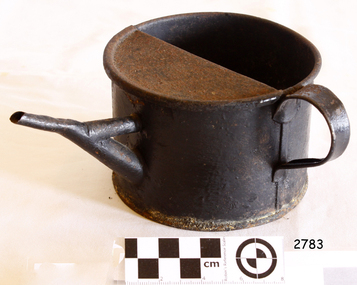
... The ink would be supplied to schools in large glass or stoneware bottles, and these would have been too unwieldy and difficult to use to pour ink into the small inkwells. Therefore it was decanted into the metal ink jugs and then poured into the inkwells. After a child was deemed old enough to progress from just using slate ...This metal ink jug or can, was used to dispense portions of ink to individual inkwells contained on the top of each pupil's desk. The jug is not unlike a small indoor watering can. The ink would be supplied to schools in large glass or stoneware bottles, and these would have been too unwieldy and difficult to use to pour ink into the small inkwells. Therefore it was decanted into the metal ink jugs and then poured into the inkwells.After a child was deemed old enough to progress from just using slate and board, he/she would have been supplied with a pen shaft made of wood and with a very basic metal nib. The ink jug would be used to fill up the individual inkwells. This operation would have been conducted by the teacher him/herself, or by an older pupil under the close eye of the teacher.Ink jug metal black with long spout & metal handle.None.flagstaff hill, warrnambool, shipwrecked-coast, flagstaff-hill, flagstaff-hill-maritime-museum, maritime-museum, shipwreck-coast, flagstaff-hill-maritime-village, ink, jug -
 Federation University Historical Collection
Booklet - Annual Review, Ballarat School of Mines Annual Review, 1986 -1991
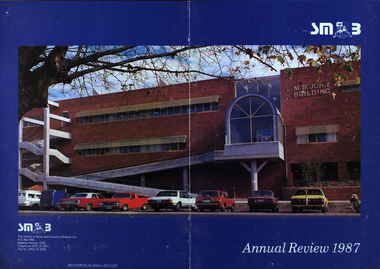
... Slater, Brian McLennan, Kerrie Cross, Albert Peart, John Cain, M.B. John, Enrollment Centre, Museum, Jo Watson, Wormalds, Brian Webber, Dianna Nikelson, Ian Aitken, Brendan B, Chez Dichiera, Heather Dixon, Julie Broadbent .4) 1993 - Brown and white soft covered annual review featuring students of the Ballarat School of Mines at work. ...Slater, Brian McLennan, Kerrie Cross, Albert Peart, John Cain, M.B. John, Enrollment Centre, Museum, Jo Watson, Wormalds, Brian Webber, Dianna Nikelson, Ian Aitken, Brendan B, Chez Dichiera, Heather Dixon, Julie Broadbent .4) 1993 - Brown and white soft covered annual review featuring students of the Ballarat School of Mines at work. ...The Ballarat School of Mines was established in 1870 through the initiatives of the Ballarat Mining Board making it the oldest site of technical education in Australia. The Board was concerned with the shortage of mine managers for the goldfields. Classes began in surveying, mathematics, and chemistry and a decade later they included metallurgy , assaying and geology. With the decline in goldmining the direction of the college changed and broadened, the art School was established and the Ballarat Junior Technical School developed. In 1976, the tertiary sector seperated from the School of Mines and Industries Ballarat to form the Ballarat College of Advanced Education. In the 1980s SMB was a Community College of Technical Education and Further Education (TAFE) offering a wide range of vocational, enrichment and preparatory programs. It is continuing the tradition of providing for the educaiton needs of people within the Central Highlands. During the 1970s and 80s it acquired and refurbished old buildings and developed new facilities to keep up with the needs of an expanding curriculum and student population. The era of these annual reports is just before the merger with the University of Ballarat.A number of soft card covered annual report for the Ballarat School of Mines. .1) 12 page black covered report featuring an image of the E.J. Tippett Library. Includes information on death of E.J. Tippett, disability policy, Peter Quinn, Patti McNulty, Bob Feary, Shane Everand, Integration, Fiona Watson, retirement of Robert Morgan, Opening of the carpentry and Joinery Facility in Davey Street, formation of the School of Business and Information Technology, Melissa Bone, opening of the E.J. T. Tippett Learning Resource Centre (Library), Refurbishment of the Administration Building, Food Service Building (Prospects), Court House Theatre, Enrolment centre, Museum, Creche, Women's Trade technical Program, Rural Education Program, Ararat Prison Program, Community Studies Section, Ararat Adult Literacy Group. Literacy Assistance for Undergraduates, Fire training, fitness, open Learning, Training & Employment Group, Awards, Filipino Visitors, oil Seed Research, Brunei, Barometer (gift) for Horticulture, Special Equipment (guillotine and brake press; programmable logic Controller; theodolite: laser lever; Universal testing Machine; Atomic Absorption Spectrophotometer)., organisational Structure. Photos include Ken Flecknoe, Peter Quinn, Patti McNulty, Bob Feary, Shane Everard, Fiona Watson,Linda Bland, Robert Morgan, David McCaughey, E.J. Tippett, Frank Sheehan, Julie Baulch, Jo Reeves, Col McCurry, Jenny Garnham .3) Blue covered book with a photograph of the M.B. John Building taken from Albert Street on the cover. Topics include: Ken Flecknoe, Peter Shiells, Ararat Campus, David Haddow, Kevin Martin, Rendle Hannah, Gary Eason, Geoff Pope, Albert Peart, M.B. John building opened, Hairdressing Salon, Community Centre, Creche, closure of Lydiard Street, Museum, Jenny Levison, Inskill, Small Business Training, Ballarat Eat free Library, Barkly Street, Wormalds Valve Group, Aboriginal Programs, Horticulture Center, Awards, Country fire Authority, tractor Donation, Women's Policy. Special purchases included surveying equipment with data recorder, test rig , CDT MIG welder, compact gas chromatograph with FID and single pen recorder, Olivetti stand-alone word processing unit. Images include Ken Flecknoe. Peter Shiells, John Crowe, Trevor Slater, Brian McLennan, Kerrie Cross, Albert Peart, John Cain, M.B. John, Enrollment Centre, Museum, Jo Watson, Wormalds, Brian Webber, Dianna Nikelson, Ian Aitken, Brendan B, Chez Dichiera, Heather Dixon, Julie Broadbent .4) 1993 - Brown and white soft covered annual review featuring students of the Ballarat School of Mines at work. Bill Gribble, Brian McLennan, Peter Shiells Retirement, Robert C. Lovett, Steven Mendelson, Max Palmer, Jenny Gough, Mary Molloy, Barrie Firth, Colin McCurry, Dora Hormann, Organisation Structure, Brewery Acquisition, Humffray Street Primary School, Grant Street Retaining Wall, Neville Bunning Plaque, VCE Plus, Ballarat Small Business centre, Ararat Prison, Ballarat Showgrounds Rotunda, .6) Green covered annual review with an aerial photograph over Albert Street, Ballarat. Content include Kerrie Cross, Peter Shiells. Kenneth Flecknoe Obituary, Ian Pimblett, Keith Boast, David Nicholson, Max Palmer, Brian Webber, Bob Lovett, Linda Bland, Prospects, Training restaurant, 3BBB, Malcolm Vallance, Aboriginal Programs, Ian Cathie, Koorie Support Unit, Caroline Hogg, 'Trained Men Make Their Own Terms' exhibition at the Gold Museum, Ricky Hains, Stephen Hughes, Jeff White, Dennis Bolster .8) Blue covered review for 1989. The contents include: Kerrie Cross, Peter Shiells, Ann McCaffrey, Kevin Alsop, Mary Molloy, Ross Furness, Robert Lovett, Victoria Street Student Hostel, Hugh Beggs, Ballarat Small Business Centre, Inskill, Ararat Campus, Hospitality and Tourism, Koorie Support Unit, Fiona Warsn, Bruce Staley, Terry Moran, Anthony Wonish, Ivan Deveson, Leo Shannon Memorial Award, Bryan Crebbin, Geoff Howard, R.C.W. Burdett, Jeff White, Ian Harris, Tom Wiseman, Bill Gribble, Allison Kay, Steven Mendelson, Keith Boast. .9) Grey covered book with a coloured photo of the Victoria Street Student Residence. Contents include: Kerry Cross, Peter Shiells, Morgan Bevan John Illuminated address. Jean Phillips, Koorie Support Unit, Andrew Sullivan, Victoria Street Student Residence, Horticulture, Inskill, Tertiary Awareness Project, Adult Education, Ivan Deveson, Brian Howe, Barry Jones, Joan Kirner, Andrew Trigg, Warren Perry, Murrell Rock Collections, Gwyn Hanssen-Piggott, Disability Awareness Day, Sebastopol Borough Logo, Phoebe Rimmer, Russell Jackson, R.J. Young Scholarship, Peter Muir, Founders Day Cake, Morgan John. .11) Black card covered booklet with five images of exteriors of the Ballarat School of Mines. the contents include: Jack Barker, Peter Shiells, Peter Ellyard, Ian Stoney, Terry Moran, Wayne Strong, David Ince, Simone Titheridge, Ian Aitken,Kevin Alsop, Bill Bridges, Clive Carmichael, Bob Feary, Rendle hannah, Roly Parfenovics, Graham Snibson, Kevin Stockdale, Len Wilson, Child Care Centre opening, Student accommodation, Victoria Street, Brewery site. naming buildings, E.J. barker. A.W. Steane K.J. Flecknow, Carpentry and joinery, Inskill, Hospitality, Pottery, ceramics, Founders' Day, Warren Perry, Agreement between Ballarat School of Mines and Ballarat university College, merger, Peter Baldwin, Awards, obituary Lindsay Hillman. Images include: Wayne Strong, David Ince, Simone Titheridge, kerrie Cross, Joan Kirner, Frank Sheehan, Bill Gribble Ros Wilkie, Judi O'Loughlin, Tony Leonard, Gemma Hearnes, Brendan Hill, Joanne Bell, Karl Moon, Stella Savy, Shirley Falkinder, Peter Baldwin, Jack Barker, Michael Ronaldson, David Kemp, Peter Shiells, Margot Healey, Sharon McLennan, Kerrie Firns, Petrena Brookers, Deb Goudappel, Claire Bond, Administration Building Lindsay Hillman. .13 ) Brown covered report with photographic images. Content includes: Pam Merrett. , Peter Shiells, Robert Lovett, Steven Mendelson, Max Palmer, Jenny Gough, Barrie Firth .14) Brown covered report with photographic images. Content includes: .15) Green covered report with photographic images. The blond woman standing on the right looking at a computer screen is Pam Merrett. Content includes: Bill Gribble, Ron Wild, Doug Sarah, Martin Hill, John Kemp, David Manterfield, Leslie Comy, Linette Penhall, Glen Martland. Virginia Fenelon. Michael Bracher, Brewery Building. Child care centre, Prospects Cafe Opening, Horticulture Training Centre, Retaining Wall, The Gordon, University of Ballarat and Ballarat School of Mines affiliation, Geoffrey Blainey, Ararat Community College Memo of understanding, Brian McLennan. Founders Day (Hadden Storey), Gwyn Hanssen-Pigott, Ken Latta, Neville Bunning Outstanding Achievement Award, Valerie Wilson, Jack Barker, John Sharpham, Jack Barker Resignation.ballarat school of mines, university of ballarat, integration, shane everard, robery morgan, linda bland, ballarat junior technical school, former court house, ken flecknoe, bruce muir, lindsay hillman, neil crouch, jack barker, keith boast, rex hollioake, m.b. john, bob lovett, brian mclennan, peter shiells, bruce tanner, jeff white, bryan crebbin, kerrie cross, ric dunlop, tom wiseman, barbara hughes, chris matheson, morgan b. john, albert street, steven mendelson, john crowe, ann mccaffrey, kevin alsop, mary molloy, ross furness, robert lovett, victoria street student hostel, student residences, hugh beggs, ballarat small business centre, inskill, ararat campus, hospitality and tourism, koorie support unit, fiona watson, bruce staley, terry moran, anthony wonish, ivan deveson, leo shannon memorial award, geoff howard, r.c.w. burdett, ian harris, bill gribble, allison kay, liz eddy, pam merrett, doug sarah, martin hill, john kemp, david manterfield, leslie comy, linette penhall, glen martland, virginia fenelon, michael bracher, brewery building, child care centre, prospects cafe, horticulture training centre, retaining wall, the gordon, university of ballarat and ballarat school of mines affiliation, geoffrey blainey, ararat community college memo of understanding, founders day, hadden storey, gwyn hanssen-pigott, ken latta, neville bunning outstanding achievement award, valerie wilson, john sharpham, kerry cross, morgan bevan john illuminated address, jean phillips, andrew sullivan, victoria street student residence, horticulture, inskill, tertiary awareness project, adult education, brian howe, barry jones, joan kirner, andrew trigg, warren perry, murrell rock collections, gwyn hanssen-piggott, disability awareness day, sebastopol borough logo, phoebe rimmer, russell jackson, r.j. young scholarship, peter muir, kenneth flecknoe obituary, ian pimblett, david nicholson, brian webber, prospects, training restaurant, 3bbb, malcolm vallance, aboriginal programs, ian cathie, caroline hogg, 'trained men make their own terms' exhibition at the gold museum, ricky hains, stephen hughes, dennis bolster, aboriginal education, e.j. tippett obituary, patti mcnulty, bob feary, equal opportunity officer, robert c. morgan, school of business and information technology, e.j. tippett library, e.j. tippett library opening, carpentry and joinery, women's trade and technical program, rural education program, ararat prison program, barometer, oil seed research, . bill gribble, peter shiells retirement, robert c. lovett, max palmer, jenny gough, barrie firth, colin mccurry, dora hormann, organisation structure, brewery acquisition, humffray street primary school, grant street retaining wall, neville bunning plaque, vce plus, ararat prison, ballarat showgrounds rotunda -
 Federation University Historical Collection
Booklet, Ballarat School of Mines Students' Magazine, Term 4, 1905, 1905
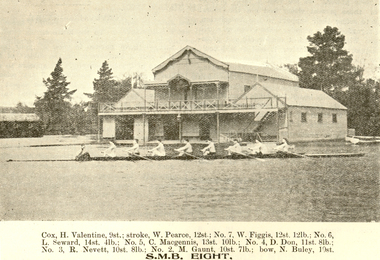
... School of Mines Annual Dinner; Crytallography Images include; Electrical Laboratory; Professor Dawbarn; James W. Hawthorne; Ballarat Rowing Eight on Lake Wendouree (H. Valentine, W. Pearce, W. Figgis, L. Seward, C. McGennis, D. Don, R. Nevett, M. Gaunt, N. Buley). Advertisements: Craig, Williamson Pty Ltd; Ballarat Baths (B. McCausland); W. Gribble & Co., H.B. Silberberg & Co; F. Jago - Ballarat Boot Palace; John Slater...School of Mines Annual Dinner; Crytallography Images include; Electrical Laboratory; Professor Dawbarn; James W. Hawthorne; Ballarat Rowing Eight on Lake Wendouree (H. Valentine, W. Pearce, W. Figgis, L. Seward, C. McGennis, D. Don, R. Nevett, M. Gaunt, N. Buley). Advertisements: Craig, Williamson Pty Ltd; Ballarat Baths (B. McCausland); W. Gribble & Co., H.B. Silberberg & Co; F. Jago - Ballarat Boot Palace; John Slater ...The Ballarat School of Mines Students' Magazine in 1905 was an unofficial journal edited by the students.Twenty-eight page booklet known as the Ballarat School of Mines Student's Magazine. Contents include: A jaunt to South Australia; Tests for the Assay Lab; Huntingdon-Heberlein Process; Slag Calculation; Electrical Laboratory; Hydrochoric Acod-Phenolph-thalein; Ballarat scientific Society; James W. Hawthorne; Maryborough Excursion; Prof Alexander Purdie; School Dirge; Compound Engines; Sister Institutions; Trafalgar, Acrobates Pymgaeus, Pigmy Flying Phalangerobituary for Alexander Purdie, Electric traction, Estimation of Fat in Milk by the Babcock Machine, first Ballarat School of Mines Annual Dinner; Crytallography Images include; Electrical Laboratory; Professor Dawbarn; James W. Hawthorne; Ballarat Rowing Eight on Lake Wendouree (H. Valentine, W. Pearce, W. Figgis, L. Seward, C. McGennis, D. Don, R. Nevett, M. Gaunt, N. Buley). Advertisements: Craig, Williamson Pty Ltd; Ballarat Baths (B. McCausland); W. Gribble & Co., H.B. Silberberg & Co; F. Jago - Ballarat Boot Palace; John Slater & Co., Kiels Motor & Cycle Stores; Alex Miller & Sons; Thomas McPherson & Son; W. Cornell; Brush Electrical Engineering Co; Ballarat School of Mines; Harry Davies & Co; Stansfield & Smith; Craig's Royal Hotel.ballarat school of mines, south australia; adelaide, valentine, pearce, figgis, seward, mcgennis, don, nevett, gaunt, buley, adelaide school of mines, kerr grant, arizona, jack adam, adam, j.a. reid, reid, jager, rowing, h. valentine, w. pearce, w. figgis, l. seward, c. mcgennis, d. don, r. nevett, m. gaunt, n. buley, cycling -
 Federation University Historical Collection
Photograph (black & white), Ballarat School of Mines Students visit the Last Chance Mine, c 1898
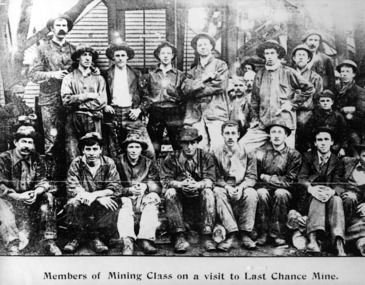
... slate; also a bootlace, the property of a much-vexed miner, whose boots Mr Hart had borrowed. Horrors! Mr Hart steal a bootlace! Impossible! However, a tragedy was averted by the miner securing a new lace, and he was at once all smiles - so were the students. Mr Campbell took a photo of the students dressed for the occasion, and some were flattered, and some looked very like the universal "Weary Willie". (Ballarat School...slate; also a bootlace, the property of a much-vexed miner, whose boots Mr Hart had borrowed. Horrors! Mr Hart steal a bootlace! Impossible! However, a tragedy was averted by the miner securing a new lace, and he was at once all smiles - so were the students. Mr Campbell took a photo of the students dressed for the occasion, and some were flattered, and some looked very like the universal "Weary Willie". (Ballarat School ...The mining class visited the Last Chance on the afternoon of Thursday, 8th June, under the guidance of Mr Kirby, the mine manager. Mr Campbell, the photographic instructor, also dared the perils of the deep in order to take some flashlight photos. As this was Mr Campbell's first visit below, several difficulties which he did not now existed prevented success. The students all ranged themselves in poetic and heroic attitudes for the first flashlight, but the development of the plate showed only the light from the candles and the moisture on the lens. The next two tries were better, but were under-exposed, and of no value, except as experience. Two gentlemen from England also went below with the students, but history repeated itself and Australia won the "test." The Englishmen left early. Mr Hart secured a fine specimen of arsenopyrite and indicator slate; also a bootlace, the property of a much-vexed miner, whose boots Mr Hart had borrowed. Horrors! Mr Hart steal a bootlace! Impossible! However, a tragedy was averted by the miner securing a new lace, and he was at once all smiles - so were the students. Mr Campbell took a photo of the students dressed for the occasion, and some were flattered, and some looked very like the universal "Weary Willie". (Ballarat School of Mines Students' Magazine, July 1899, p.2.)Over 24 men pose for a photograph outside the Last Chance mine. Some of the men are members of the visiting Ballarat School of Mines mining class. Thomas Hart (beard) stands at the back right. Verso: Copied from Annual report 1898, Thomas Hart - back Row, 2nd from right with beard.ballarat school of mines, last chance, thomas hart, john rowe, hart, mining, mining alumni, rowe, charles campbell -
 Flagstaff Hill Maritime Museum and Village
Furniture - Set of desks & benches, Unknown
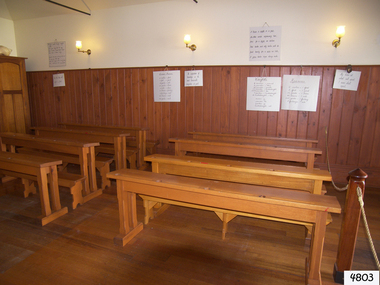
... Teachers also kept a good supply of spares, all writing materials and books being provided by the school. It is possible that the retention of slates stemmed from the political imperative that public education should be free. ...Teachers also kept a good supply of spares, all writing materials and books being provided by the school. It is possible that the retention of slates stemmed from the political imperative that public education should be free. ...The following are the recollections of John Elkins, who started school in February, 1945 at Maryborough in Queensland, Australia. 'I think in Prep 1 that we had some paper to write on with pencils, but my memory of the routine use of slates is much more vivid. Each slate was framed in wood and one side was inscribed with lines to guide the limits for the upper and lower extremities of letters. The slate "pencils" were made of some pale gray mineral softer than slate which had been milled into cylinders some one-eighth of an inch in diameter and inserted into metal holders so that about an inch protruded. Each student was equipped with a small tobacco tin in which was kept a damp sponge or cloth to erase the marks. Sharpening slate pencils was a regular task. We rubbed them on any suitable brick or concrete surface in the school yard. Teachers also kept a good supply of spares, all writing materials and books being provided by the school. It is possible that the retention of slates stemmed from the political imperative that public education should be free. I do recall being given a Copy Book for home practice of letter formation, a typical practice until Grade 6. The tables at which we used to sit in the Infant School were replaced in the primary Grades by long desks seating five or six pupils. These had slots into which the slates could be inserted vertically. When the teacher asked the class to clear their desks, the command issued was "slates away!" This was an occasion for a noisy expression of relief as we dropped the slates producing a sound not unlike a volley of rifle shots, and usually brought a request from the teacher to repeat the process with no noise by holding the frames throughout. Thus, I suspect we may still have used slates in Grade Three, though by then paper, which may have been scarce during the War, seemed to be used more routinely.' The full context of John's account of writing during his primary school days can be found at: https://www.readinghalloffame.org/sites/default/files/history_of_literacy_22slates_away22_penmanship_in_queensland_australia.pdfSchool desks and benches/chairs have been in use in schools since formal group education started.Eight long school desks (five higher three lower), each with four inkwells and groove along length. eight school benches (five higher three lower). Each desk and bench accommodates four children.None.flagstaff hill, warrnambool, shipwrecked-coast, flagstaff-hill, flagstaff-hill-maritime-museum, maritime-museum, shipwreck-coast, flagstaff-hill-maritime-village -
Federation University Historical Collection
Poster, Ballarat School of Mines Staff Photos, c1988
... ballarat school of mines ian aitken anne wood roger macfarlane des cooper malcolm vallance mal vallance lyn pitt floss stephenson shane everard lily saylor linda bland lyndall cooper don doulton julie baulch peter gunn malcolm gaunt steven medelson jan reeves trevor slater tracey cummins ray martland ann kerr kieran jones mandy rhook john gibson iam pym patti mcnulty janice shepherd lindy hamill bob feary philip dixon ron lucas glen mcgregor gordon whitefield david fithall bill bridges doug symons keith howlett bernie stevens norm howard ray barnes peter kelly garry christie paul clarke robert munt shaun tope james mddonald graeme tyrell bruce wallis tracey coleman bradley rae phillippe theatre don lawless bill whittle geoff nicholls maureen carli keith boast fiona watson sonia davis manfred hacker ian robinson jeff fletcher angela murray angela smith lyn peucker rosemary moorhouse keith hankin judy mills brian webber jan o'toole veronica black fleur haller lorelli huggins karen cook len wilson bruce staley lynne beaumont dzintra crocker faye hunt leonie hines sally smith jenny leviston heather durant barrie firth john van dreven grant curnow ron sutton lynne schepis pam merrett fran harrison Laminated black and white photographic portraits of Ballarat School of Mines staff members.x Ballarat School of Mines Staff Photos Poster ...Laminated black and white photographic portraits of Ballarat School of Mines staff members.xballarat school of mines, ian aitken, anne wood, roger macfarlane, des cooper, malcolm vallance, mal vallance, lyn pitt, floss stephenson, shane everard, lily saylor, linda bland, lyndall cooper, don doulton, julie baulch, peter gunn, malcolm gaunt, steven medelson, jan reeves, trevor slater, tracey cummins, ray martland, ann kerr, kieran jones, mandy rhook, john gibson, iam pym, patti mcnulty, janice shepherd, lindy hamill, bob feary, philip dixon, ron lucas, glen mcgregor, gordon whitefield, david fithall, bill bridges, doug symons, keith howlett, bernie stevens, norm howard, ray barnes, peter kelly, garry christie, paul clarke, robert munt, shaun tope, james mddonald, graeme tyrell, bruce wallis, tracey coleman, bradley rae, phillippe theatre, don lawless, bill whittle, geoff nicholls, maureen carli, keith boast, fiona watson, sonia davis, manfred hacker, ian robinson, jeff fletcher, angela murray, angela smith, lyn peucker, rosemary moorhouse, keith hankin, judy mills, brian webber, jan o'toole, veronica black, fleur haller, lorelli huggins, karen cook, len wilson, bruce staley, lynne beaumont, dzintra crocker, faye hunt, leonie hines, sally smith, jenny leviston, heather durant, barrie firth, john van dreven grant curnow, ron sutton, lynne schepis, pam merrett, fran harrison -
Federation University Historical Collection
Book, Historic Sites Survey: North Central Study Area, 1979, 1979
... slate quarry...harcourt granite...taradale railway viaduct...loddon united waterworks trust...gouldburn weir...carisbrook lock-up...history of tree planting in streets...history of public reserves...r.u. nicholls nurseryman...thomas lang...francis moss...ballarat botanical gardens...ballarat school...The North Central Study Area included the Shires of Avoca, Bet Bet, east Loddon, Goulburn, Untly, Kara Kara, Korong, Maldon, Marong, Metcalfe, McIvor, Newstead, Strathfieldsaye, Stawell, Talbot, Clunes, Tullaroop and Waranga. castlemaine mount alexander goldfield maldon percydale warrenmang moliagul tarnagulla stuart mill the whipstick whroo rushworth graytown ironbark forest st arnoaud new bendigo landsborough inglewood kurting wedderburn wehla kooroora langham flat mcintyre rheola diamond hill fosterville coliban water works green gully newstead muckleford forest costerfield graytown bailieston waranga irrigaiton system eucalyptus distillery mia mia bridge korokubeal township researce concegella slate quarry chewton fryerstown kingower timor talbot majorca carisbroook clunes st arnaud taradale icomos dunolly limestone castlemaine slate quarry harcourt granite taradale railway viaduct loddon united waterworks trust gouldburn weir carisbrook lock-up history of tree planting in streets history of public reserves r.u. nicholls nurseryman thomas lang francis moss ballarat botanical gardens ballarat school of mines botanical gardens lake wendouree victoria park, ballarat muont holled smith ballaarat old cemetery planting eastern oval ballarat east botanical gardens ballarat east town hall gardens eureka stockade reserve ballarat observatory plantings yarrowee creek plantings yarrowee bluestone channels ballarat woollen mill band and albion mullock heap black hill plantings yarrowee creek channels canadian creek channel specimen vale channel poverty point reserve union jack reserve buninyong imperial mine, buninyong victoria street plantings bridge mall sturt street gardens ballarat avenue of honour plantings white flat oval plantings camp street elms burnt creek 153 page book with white plastic binding. ...The North Central Study Area included the Shires of Avoca, Bet Bet, east Loddon, Goulburn, Untly, Kara Kara, Korong, Maldon, Marong, Metcalfe, McIvor, Newstead, Strathfieldsaye, Stawell, Talbot, Clunes, Tullaroop and Waranga. 153 page book with white plastic binding. It is an historic sites survey for the North Central Study Area commissioned by the Land Conservation Council, the Ministry for COnservation and the Australian Heritage Commission. castlemaine, mount alexander goldfield, maldon, percydale, warrenmang, moliagul, tarnagulla, stuart mill, the whipstick, whroo, rushworth, graytown ironbark forest, st arnoaud, new bendigo, landsborough, inglewood, kurting, wedderburn, wehla, kooroora, langham flat, mcintyre, rheola, diamond hill, fosterville, coliban water works, green gully, newstead, muckleford forest, costerfield, graytown, bailieston, waranga irrigaiton system, eucalyptus distillery, mia mia bridge, korokubeal township researce, concegella slate quarry, chewton, fryerstown, kingower, timor, talbot, majorca, carisbroook, clunes, st arnaud, taradale, icomos, dunolly, limestone, castlemaine slate quarry, harcourt granite, taradale railway viaduct, loddon united waterworks trust, gouldburn weir, carisbrook lock-up, history of tree planting in streets, history of public reserves, r.u. nicholls nurseryman, thomas lang, francis moss, ballarat botanical gardens, ballarat school of mines botanical gardens, lake wendouree, victoria park, ballarat, muont holled smith, ballaarat old cemetery planting, eastern oval, ballarat east botanical gardens, ballarat east town hall gardens, eureka stockade reserve, ballarat observatory plantings, yarrowee creek plantings, yarrowee bluestone channels, ballarat woollen mill, band and albion mullock heap, black hill plantings, yarrowee creek channels, canadian creek channel, specimen vale channel, poverty point reserve, union jack reserve buninyong, imperial mine, buninyong, victoria street plantings, bridge mall, sturt street gardens, ballarat avenue of honour plantings, white flat oval plantings, camp street, elms, burnt creek -
 Upper Yarra Museum
Writing slate
... school...wood...frame...slate...school wood frame slate writing primary erasable rock chalk Wooden framed piece of slate used for erasable writing using chalk Writing slate ...Wooden framed piece of slate used for erasable writing using chalkschool, wood, frame, slate, writing, primary, erasable, rock, chalk -
 Federation University Historical Collection
Document, List of Subjects
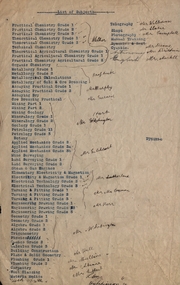
... Murphy Ore Dressing Practical Mining Mining Geology Mineralogy Geology Petrology Botany Applied Mechanics Mr Hart Mine Surveying Land Surveying Steam and Gas Engines Mr Gilchrist Elementry Electricity & Magnetism Electrical Technology Mr Sutherland Turning and Fitting Mr Connon Engineering Drawing Mr Kerr Geometry Algebra Trigonometry Physics Conics Calculus Mr Whitington Building Construction Plane and Solid Geometry Plumbing Grade Mr Hall Mr Mullins Carpentry Wool Classing Materia Medica Mr Gutheil Technical Arithmatic Mr Hutchison Telegraphy Mr Williams Sloyd Mr Slater Photography Mr Campbell Manual Training Cyanide Mr Deane Mr Brittain Mr Martell English Astronomy List of subjects 8S3S in large writng on the back Foolscap sized list of Subjects from Ballarat School of Mines with handwritten names. ...School of Mines Ballarat is predecessor of Federation University Foolscap sized list of Subjects from Ballarat School of Mines with handwritten names.8S3S in large writng on the back school of mines ballarat, practical chemistry, mr. walker, theoretical chemistry, theoretical agricultural chemistry, practical agricultural chemistry, technical chemistry, metallurgy, alfred mica smith, metallurgical calculations, metallurgy of gold and ore dressing, assaying practical, assaying dry, mr. murphy, ore dressing practical, mining, mining geology, mineralogy, geology, petrology, botany, applied mechanics, mr hart, mine surveying, land surveying, steam and gas engines, mr gilchrist, elementry electricity & magnetism, electrical technology, mr sutherland, turning and fitting, mr connon, engineering drawing, mr kerr, geometry, algebra, trigonometry, physics, conics, calculus, mr whitington, building construction, plane and solid geometry, plumbing grade, mr hall, mr mullins, carpentry, wool classing, materia medica, mr gutheil, technical arithmatic, mr hutchison, telegraphy, mr williams, sloyd, mr slater, photography, mr campbell, manual training, cyanide, mr deane, mr brittain, mr martell, english, astronomy, list of subjects -
Federation University Historical Collection
Book, The MIneral Industry its Statistics, Technology and Trade in the United States and Other Countries 1901
... Used at the Ballarat School of Mines Mining statistics technology trades metal industry minerals united states canada china france germany italy japan russia south america spain sweden united kingdom ireland coins Cuba blast furnaces Gold Lead production Manganese opals silver + alumite antinomy cobalt coke copper ore iron lead limestone flux managanese shale silver-lead tin zinc abrasives chemical industry gems precious stones quicksilver rare elements silica slate\ This volume includes Australasia, and lists each state seperately , as well as New Zealand, It also lists Bismoth, Chome iron ore, coal, copper, gold, lead, mineral industry growth, alumite, antinomy, cobalt, coke, copper ore, gold, iron, lead, limestone flux, managanese, shale, silver, silver-lead, tin and zinc. ...This volume includes Australasia, and lists each state seperately , as well as New Zealand, It also lists Bismoth, Chome iron ore, coal, copper, gold, lead, mineral industry growth, alumite, antinomy, cobalt, coke, copper ore, gold, iron, lead, limestone flux, managanese, shale, silver, silver-lead, tin and zinc. Australasian co.Red hard cloth covered book of 986 pages. Includes contents and index.non-fictionThis volume includes Australasia, and lists each state seperately , as well as New Zealand, It also lists Bismoth, Chome iron ore, coal, copper, gold, lead, mineral industry growth, alumite, antinomy, cobalt, coke, copper ore, gold, iron, lead, limestone flux, managanese, shale, silver, silver-lead, tin and zinc. Australasian co. mining, statistics, technology, trades, metal industry, minerals, united states, canada, china, france, germany, italy, japan, russia, south america, spain, sweden, united kingdom, ireland, coins, cuba, blast furnaces, gold, lead production, manganese, opals, silver, +, alumite, antinomy, cobalt, coke, copper ore, iron, lead, limestone flux, managanese, shale, silver-lead, tin, zinc, abrasives, chemical industry, gems, precious stones, quicksilver, rare elements, silica, slate\ -
Federation University Historical Collection
Photograph, Wedding Photograph of John Newton Mennie and Elsie Elizabeth Slater
... Henry Sutton taught Applied Electricity at the Ballarat School of Mines in 1883 to 1886. Henry Sutton John Newton Mennie Elsie Elizabeth Slater Wedding photograph Chief Engineer John Newton Mennie, Elsie Elizabeth Slater 19th August 1911 written on the back Black and White Wedding Photograph of John Newton Mennie and Elsie Elizabeth Slater, John Newton Mennie was the Chief Engineer for Henry Sutton. ...Henry Sutton is a talented world-wide accepted inventor with inventions relating to the telephone, photography, wireless, cars, motorcycles, and bicycles as well as many more inventions. Henry was also one of four brothers that ran the Sutton's Music Store after the death of their Father Richard Sutton. Henry Sutton taught Applied Electricity at the Ballarat School of Mines in 1883 to 1886.Black and White Wedding Photograph of John Newton Mennie and Elsie Elizabeth Slater, John Newton Mennie was the Chief Engineer for Henry Sutton.John Newton Mennie, Elsie Elizabeth Slater 19th August 1911 written on the backhenry sutton, john newton mennie, elsie elizabeth slater, wedding photograph, chief engineer
