
Showing 44 items matching "scottish soldier"
-
 Bendigo Military Museum
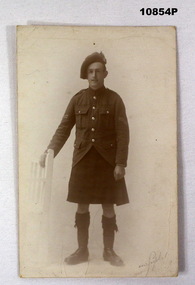
Photograph - SCOTTISH SOLDIER, WW1, c.WW1
... SCOTTISH SOLDIER, WW1......Scottish Soldier...Black and white studio photograph of a WW1 Scottish soldier standing. Soldier is in full uniform and standing with right hand on a white chair. ...Black and white studio photograph of a WW1 Scottish soldier standing. Soldier is in full uniform and standing with right hand on a white chair. ...Part of the Meade Collection. See Catalogue No. 10785P for details of service for "Ernest James Meade" (No. 2112).Black and white studio photograph of a WW1 Scottish soldier standing. Soldier is in full uniform and standing with right hand on a white chair. Blank postcard format on back. Illegible writing in pencil on bottom RH Corner of front.meade collection, ernest james meade, ww1, photograph, scottish soldier -
 The 5th/6th Battalion Royal Victoria Regiment Historical Collection
Artwork, other - Print Colour, Scottish soldier with dog
... Scottish soldier with dog...scottish soldier with dog...A wooden frame print of a scottish soldier with a dog....scottish soldier with dog 5-6 RVR BHQ A wooden frame print of a scottish soldier with a dog. ...scottish soldier with dogA wooden frame print of a scottish soldier with a dog.5-6 rvr bhq -
 Greensborough Historical Society
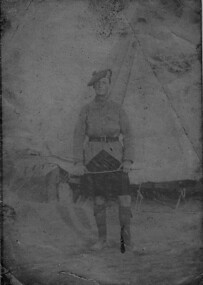
Photograph - Digital image, Charles Marshall et al, George MacDougall, Scottish soldier, 1917_
... George MacDougall, Scottish soldier...This photograph shows a Scottish soldier, George MacDougall. The caption asks Charles to send the photo to his sister....George MacDougall, Scottish soldier Photograph - Digital image Charles Marshall John Gibson ...This photograph shows a Scottish soldier, George MacDougall. The caption asks Charles to send the photo to his sister.Digital copy of black and white photograph. "You can send this one home to your sister from me, Yours Aye, Geo MacDougall"charles marshall, world war 1, george macdougall -
 Greensborough Historical Society
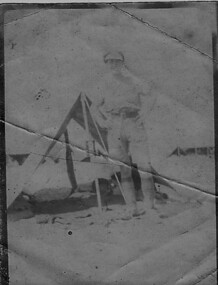
Photograph - Digital image, Charles Marshall et al, George MacDougall, Scottish soldier 2, 1917_
... George MacDougall, Scottish soldier 2...This photograph shows a Scottish soldier, George MacDougall. The caption asks Charles to send the photo to his sister....George MacDougall, Scottish soldier 2 Photograph - Digital image Charles Marshall John Gibson ...This photograph shows a Scottish soldier, George MacDougall. The caption asks Charles to send the photo to his sister.Digital copy of black and white photograph. "This is me and my little grey home in the East, Geo MacDougall"charles marshall, world war 1, george macdougall -
Thompson's Foundry Band Inc. (Castlemaine)
Sheet Music, Scottish Soldier
... Scottish Soldier...Scottish Soldier Sheet Music ... -
 Federation University Historical Collection
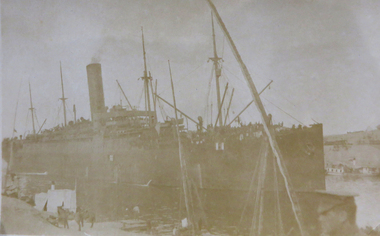
Photograph, Troopship, c1915
... "Snap taken of a fine liner packed with Scottish Soldiers taken while passing the camp."...harry holmes ship canal world war one holmes family collection chatham-holmes family collection egypt troopship "Snap taken of a fine liner packed with Scottish Soldiers taken while passing the camp." ...Original photograph of a Scottish ship taken while passing the camp."Snap taken of a fine liner packed with Scottish Soldiers taken while passing the camp."harry holmes, ship, canal, world war one, holmes family collection, chatham-holmes family collection, egypt, troopship -
 Flagstaff Hill Maritime Museum and Village
Leisure object - Toy Soldier, circa 1878
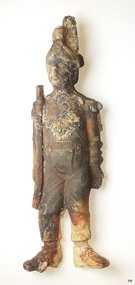
... soldiers, leaving their customers to fill in the colours according to their own patriotic preferences. It is, therefore, possible the two figures in the Flagstaff Hill collection were part of a new set intended for sale, rather than part of a passenger’s existing collection. Loch Ard History: The Loch Ard got its name from ”Loch Ard” a loch that lies to the west of Aberfoyle, and the east of Loch Lomond. It means "high lake" in Scottish...soldiers, leaving their customers to fill in the colours according to their own patriotic preferences. It is, therefore, possible the two figures in the Flagstaff Hill collection were part of a new set intended for sale, rather than part of a passenger’s existing collection. Loch Ard History: The Loch Ard got its name from ”Loch Ard” a loch that lies to the west of Aberfoyle, and the east of Loch Lomond. It means "high lake" in Scottish ...The toy soldier is a relic from the shipwreck of the LOCH ARD in 1878. It has a companion piece in the Flagstaff Hill collection. The toy soldier is unpainted, but the style of uniform, and the weapons carried (a musket and a basket-handled cutlass), indicate it is a representation of the Napoleonic Wars period from the beginning of the nineteenth century. Mass-produced toy soldiers made of cast metal (lead or tin) became popular during the 1800s. Heyde of Germany manufactured silhouette-shaped flat toy soldiers early in the century. Mignot of France released three-dimensional solid figures and later around 1893 W. Britain, a toy company became known for its die-cast lead toy soldiers. These innovations were designed to make sets of toy soldiers more affordable for middle and lower-class children, extending the market beyond the intricately made and hand-crafted replicas that were the preserve of the rich in the eighteenth century. Wooden military figures, specially carved and unpainted ones, were therefore not particularly common at the time when the Loch Ard foundered on Victoria’s southwest coast. Mignot was the first to sell unpainted soldiers, leaving their customers to fill in the colours according to their own patriotic preferences. It is, therefore, possible the two figures in the Flagstaff Hill collection were part of a new set intended for sale, rather than part of a passenger’s existing collection. Loch Ard History: The Loch Ard got its name from ”Loch Ard” a loch that lies to the west of Aberfoyle, and the east of Loch Lomond. It means "high lake" in Scottish Gaelic. The vessel belonged to the famous Loch Line which sailed many vessels from England to Australia. The Loch Ard was built in Glasgow by Barclay, Curle & Co. in 1873, the vessel was a three-masted square-rigged iron sailing ship that measured 79.87 meters in length, 11.58 m in width, and 7 m in depth with a gross tonnage of 1693 tons with a mainmast that measured a massive 45.7 m in height. Loch Ard made three trips to Australia and one trip to Calcutta before its fateful voyage. Loch Ard left England on March 2, 1878, under the command of 29-year-old Captain Gibbs, who was newly married. The ship was bound for Melbourne with a crew of 37, plus 17 passengers. The general cargo reflected the affluence of Melbourne at the time. Onboard were straw hats, umbrellas, perfumes, clay pipes, pianos, clocks, confectionery, linen and candles, as well as a heavier load of railway irons, cement, lead and copper. There were other items included that were intended for display in the Melbourne International Exhibition of 1880. The voyage to Port Phillip was long but uneventful. Then at 3 am on June 1, 1878, Captain Gibbs was expecting to see land. But the Loch Ard was running into a fog which greatly reduced visibility. Captain Gibbs was becoming anxious as there was no sign of land or the Cape Otway lighthouse. At 4 am the fog lifted and a lookout aloft announced that he could see breakers. The sheer cliffs of Victoria's west coast came into view, and Captain Gibbs realised that the ship was much closer to them than expected. He ordered as much sail to be set as time would permit and then attempted to steer the vessel out to sea. On coming head-on into the wind, the ship lost momentum, the sails fell limp and Loch Ard's bow swung back towards land. Gibbs then ordered the anchors to be released in an attempt to hold their position. The anchors sank some 50 fathoms - but did not hold. By this time the ship was among the breakers and the tall cliffs of Mutton Bird Island rose behind. Just half a mile from the coast, the ship's bow was suddenly pulled around by the anchor. The captain tried to tack out to sea, but the ship struck a reef at the base of Mutton Bird Island, near Port Campbell. Waves subsequently broke over the ship and the top deck became loosened from the hull. The masts and rigging came crashing down knocking passengers and crew overboard. When a lifeboat was finally launched, it crashed into the side of Loch Ard and capsized. Tom Pearce, who had launched the boat, managed to cling to its overturned hull and shelter beneath it. He drifted out to sea and then on the flood tide came into what is now known as Lochard Gorge. He swam to shore, bruised and dazed, and found a cave in which to shelter. Some of the crew stayed below deck to shelter from the falling rigging but drowned when the ship slipped off the reef into deeper water. Eva Carmichael a passenger had raced onto the deck to find out what was happening only to be confronted by towering cliffs looming above the stricken ship. In all the chaos, Captain Gibbs grabbed Eva and said, "If you are saved Eva, let my dear wife know that I died like a sailor". That was the last Eva Carmichael saw of the captain. She was swept off the ship by a huge wave. Eva saw Tom Pearce on a small rocky beach and yelled to attract his attention. He dived in and swam to the exhausted woman and dragged her to shore. He took her to the cave and broke the open case of brandy which had washed up on the beach. He opened a bottle to revive the unconscious woman. A few hours later Tom scaled a cliff in search of help. He followed hoof prints and came by chance upon two men from nearby Glenample Station three and a half miles away. In a complete state of exhaustion, he told the men of the tragedy. Tom then returned to the gorge while the two men rode back to the station to get help. By the time they reached Loch Ard Gorge, it was cold and dark. The two shipwreck survivors were taken to Glenample Station to recover. Eva stayed at the station for six weeks before returning to Ireland by steamship. In Melbourne, Tom Pearce received a hero's welcome. He was presented with the first gold medal of the Royal Humane Society of Victoria and a £1000 cheque from the Victorian Government. Concerts were performed to honour the young man's bravery and to raise money for those who lost family in the disaster. Of the 54 crew members and passengers on board, only two survived: the apprentice, Tom Pearce and the young woman passenger, Eva Carmichael, who lost her family in the tragedy. Ten days after the Lochard tragedy, salvage rights to the wreck were sold at auction for £2,120. Cargo valued at £3,000 was salvaged and placed on the beach, but most washed back into the sea when another storm developed. The wreck of Lochard still lies at the base of Mutton Bird Island. Much of the cargo has now been salvaged and some items were washed up into Lochard Gorge. Cargo and artefacts have also been illegally salvaged over many years before protective legislation was introduced in March 1982. One of the most unlikely pieces of cargo to have survived the shipwreck was a Minton majolica peacock- one of only nine in the world. The peacock was destined for the Melbourne 1880 International Exhibition. It had been well packed, which gave it adequate protection during the violent storm. Today the Minton peacock can be seen at the Flagstaff Hill Maritime Museum in Warrnambool. From Australia's most dramatic shipwreck, it has now become Australia's most valuable shipwreck artifact and is one of very few 'objects' on the Victorian State Heritage Register.The toy soldier represents a 19th-century child's interest in military history. The item is one of two toy soldiers recovered from the Loch Ard in Flagstaff Hill's collection. The shipwreck of the Loch Ard is of significance for Victoria and is registered on the Victorian Heritage Register ( S 417). Flagstaff Hill has a varied collection of artefacts from Loch Ard and its collection is significant for being one of the largest accumulations of artefacts from this notable Victorian shipwreck of which the subject items are a small part. The collections of objects give us a snapshot of how we can interpret the story of this tragic event. The collection is also archaeologically significant as it represents aspects of Victoria's shipping history, allowing us to interpret Victoria's social and historical themes. Through is associated with the worst and best-known shipwreck in Victoria's history.An unpainted, cream-coloured toy soldier, recovered from the Loch Ard. The figure wears a Napoleonic Wars-era uniform, a plumed helmet, a short jacket with tails, bib-front trousers with button closure, straps crossed at the front and back, and epaulettes. The figure is in marching posture with one foot extended forward, and is bearing a musket at the slope-arms position, with a sabre or cutlass slung behind. It is unable to stand on its own. There are reddish-brown and orange-brown stains on the head and body. The body has seams along both sides that are uneven at the lower leg. There is a hole in the back and the inside is hollow. The material has a rough texture.flagstaff hill, warrnambool, flagstaff hill maritime museum, shipwreck coast, flagstaff hill maritime village, great ocean road, loch ard, toy soldier, napoleonic uniforms, military toy, moulded soldier -
 Flagstaff Hill Maritime Museum and Village
Postcard - Coastal Scene, Joseph Jordan Photographic Studio, Breakwater, Warrnambool, circa 1907
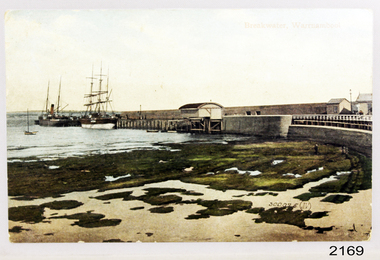
... soldier in Victoria. Joseph died in 1935 aged 95. Valentine Publishing Company Pty. Ltd. Valentine and Sons was a printing and photography business based in Dundee, Scotland and Canada. ...soldier in Victoria. Joseph died in 1935 aged 95. Valentine Publishing Company Pty. Ltd. Valentine and Sons was a printing and photography business based in Dundee, Scotland and Canada. ...The Port of Warrnambool - In the early years the Port of Warrnambool was a busy port. Steamships and sailing ships were frequent visitors to the port. Steam navigation companies were plentiful, carrying passengers and freighting cargo such as coal, timber, food, livestock, furniture, hardware and haberdashery between Melbourne and the ports along the southwest coast of Victoria, including Warrnambool. The carts would take their loads into the township for distribution. The Breakwater was built (using 32 ton blocks of concrete) between 1874 and 1890 to provide ships with greater protection from the Southern Ocean. The Lifeboat and Rocket House - The coastline of South West Victoria has had over 600 shipwrecks and many lost lives; even in Warrnambool’s Lady Bay there were around 16 known shipwrecks between 1850 and 1905, with eight lives lost. In 1859 the first Government-built lifeboat arrived at Warrnambool Harbour and a shed was soon built to house it, followed in 1864 by a rocket house to safely store the Rocket Rescue equipment. In 1878 the buildings were moved to the Breakwater area, and in 1910 the new Lifeboat Warrnambool arrived with its ‘self-righting’ design. For almost one hundred years the lifeboat and rocket crews, mostly local volunteers, trained regularly to maintain and improve their skills, summoned when needed by alarms, gunshots, ringing bells and foghorns. Some became local heroes but all served an important role. By the end of the 1950s the lifeboat and rescue equipment had become obsolete. Joseph Jordan - Joseph Jordan was born in 1841 in Leicester England. When he was 16 he joined the 7th Queen's Own Hussars and was sent to India at the outbreak of the mutiny. He took part in the relief of Lucknow and remained in India for eleven years. It was during this time, he became interested in photography. He was posted to New Zealand and later came to Victoria, becoming a sergeant major of the Mounted Rifles. In the mid 1880s he came to the Western district where he was responsible for establishing units of the Mounted Rifles in various country towns such as Dunkeld, Mortlake, Panmure, Bushfield, Koroit etc. He resigned from the army in 1889 and set up a professional photography studio in Liebig Street, Warrnambool. He became very well known in the Western District for family photographs, official photographs of local councillors and groups as well as views of local scenery. In 1891 he photographed the wrecked barque "Fiji" at "Wrecks Beach" near Princetown. His business was taken over by his son Arthur around 1917. Joseph was a keen rifle shot and in 1924 he donated the "Jordan Shield" as a prize to the Victorian Rifle Association. He was made a "Life Honorary Member" of the Warrnambool Returned Soldiers League and in 1933 he was recognised as being the oldest living soldier in Victoria. Joseph died in 1935 aged 95. Valentine Publishing Company Pty. Ltd. Valentine and Sons was a printing and photography business based in Dundee, Scotland and Canada. In the early 1900's, at the height of the postcard craze, they published large numbers of postcards in the U.K., Canada, U.S., Australia and South Africa. Valentine postcards have a 6 digit serial number on the view side with the initials "J. V." in a circle adjacent to the number. The 300,000's related to views of Australia. From around 1900 (or earlier) the firm bought many images for their postcards from local and national photographers who sold publishing rights to Valentines.This postcard is significant for its association with the Port of Warrnambool and the Warrnambool Breakwater as it shows a point in time when shipping activities were an important part of Warrnambool's commerce and social development. It is also a record of the Warrnambool Lifeboat and Rocket house which was important in aiding ordinary citizens, harbour employees and the volunteer boat and rescue crew in saving the lives of sailors and passengers due to the high number of shipwrecks that occurred along the coastline. Joseph Jordan is a significant figure in Warrnambool history as he helped to establish early units of the Mounted Rifles (G Company) in local towns during the late 1880's and later, photographed local scenes, groups and citizens of early Warrnambool. It is also a culturally significant example of the type of postcards that were very popular in the early part of the 20th century.Photograph of breakwater from beachFront of card - Breakwater, Warrnambool / 300,025 J.V [in a circle] Back of card - POSTCARD / VALENTINE'S SERIES / - This space may be used for communication / The address only to be written here - Miss Alice Griffen / Howard St / Warrnambool - How are you enjoying your holiday we are grand. / from / Dodo, Dodo, Dodo with love - Leura? / Marjory Craig? / BL006 / R99A / REG NO 2169flagstaff hill, warrnambool, shipwrecked-coast, flagstaff-hill, flagstaff-hill-maritime-museum, maritime-museum, photograph, warrnambool breakwater, breakwater, shipwreck-coast, flagstaff-hill-maritime-village, warrnambool harbour, postcard, joseph jordan, valentine and sons, valentine publishing company, lady bay, life boat house, rocket house, steam ship, barque, jordan photography -
 Merbein RSL Sub Branch
Photo
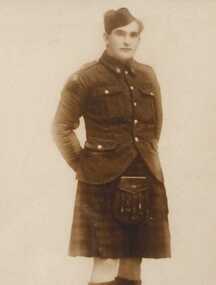
... Soldier in full Scottish uniform standing with hands clasped behind his back....world war one photo black and white scott kilt milne henry e service number 2112 Soldier in full Scottish uniform standing with hands clasped behind his back. ...Soldier in full Scottish uniform standing with hands clasped behind his back.world war one, photo black and white, scott kilt, milne henry e, service number 2112 -
 Federation University Historical Collection
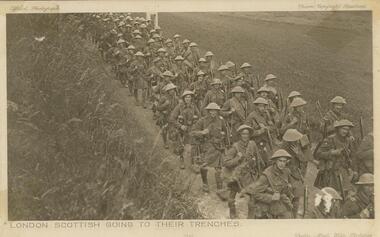
Postcard - Postcard - Black and white, London Scottish Going to Their Trenches, c1916
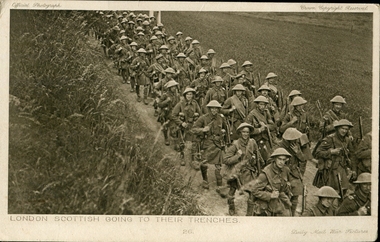
... Most probabaly purchased by Harry Holmes. world war one harry holmes soldiers western front World War One official war postcard showing a number of troops walking along a path. London Scottish ...Most probabaly purchased by Harry Holmes.World War One official war postcard showing a number of troops walking along a path.world war one, harry holmes, soldiers, western front -
 Lara RSL Sub Branch
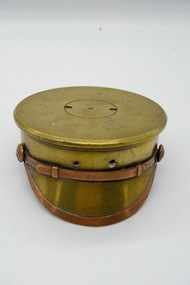
18 Pounder shell ashtray, Souvenir, 1927
... Available via the National Library of Scotland as CC BY-NC-SA In Under Fire, Henri Barbusse recounts how the incessant and diabolical din of war constantly bombarded the soldier body with the unendurable noise of bursting shells that caused pain to the ears (Barbusse 2010 [1933]: 207). ...Available via the National Library of Scotland as CC BY-NC-SA In Under Fire, Henri Barbusse recounts how the incessant and diabolical din of war constantly bombarded the soldier body with the unendurable noise of bursting shells that caused pain to the ears (Barbusse 2010 [1933]: 207). ...Artillery shells were designed to be recycled and spent shells were returned to the munitions factory for re-filling, a mark engraved upon the head-stamp at each re-filling. Millions upon millions of shells were recycled and re-fired. Relationships with ‘objects’ were forged as recycled objects of conflict were welcomed into people’s homes. Such objects were embodied with personal experiences of war, later to become objects textured with memory, remembrance, and longing – attributes that clearly go beyond an object’s form and function. 18-Pounder Artillery Shells: The Great War Recycled and Re-Circulated Categories :Material Culture Machine Subscribe Share on facebook Share on twitter The intention of war is to kill, to maim and to destroy using, for example, the agency of 18-pounder artillery shells (so-called because they weighed 18 pounds). The shells were loaded in to the 18-pounder field guns used by the Royal Artillery and targeted to destroy German batteries and trenches as well as to shoot down aeroplanes. Horse-drawn field gun, Canal du Nord, France. Taken by First World War photographer David McLellan. Available via the National Library of Scotland as CC BY-NC-SA Horse-drawn field gun, Canal du Nord, France. Taken by First World War photographer David McLellan. Available via the National Library of Scotland as CC BY-NC-SA In Under Fire, Henri Barbusse recounts how the incessant and diabolical din of war constantly bombarded the soldier body with the unendurable noise of bursting shells that caused pain to the ears (Barbusse 2010 [1933]: 207). The noise was so ‘monstrously resounding’ that one felt ‘annihilated by the mere sound of the downpour of thunder’ (Barbusse 2010 [1933]: 206). Artillery shells were designed to be recycled and spent shells were returned to the munitions factory for re-filling, a mark engraved upon the head-stamp at each re-filling. Millions upon millions of shells were recycled and re-fired. A mound of spent shell cases, Nord, Nord-pas-de-Calais, France. Taken by war photographer, Tom Aitken, 1918. Available via the National Library of Scotland as CC BY-NC-SA. A mound of spent shell cases, Nord, Nord-pas-de-Calais, France. Taken by war photographer, Tom Aitken, 1918. Available via the National Library of Scotland as CC BY-NC-SA. People’s experience of the First World War did not end with the armistice. Whilst the noise of the artillery had ceased, the noise of war was remembered. Harry Patch on arriving home injured recalled being ‘jumpy for a while’ with the least noise prompting him to dive for cover (2009: 114). Something else materialised. Relationships with ‘objects’ were forged as recycled objects of conflict were welcomed into people’s homes. Such objects were embodied with personal experiences of war, later to become objects textured with memory, remembrance, and longing – attributes that clearly go beyond an object’s form and function. The head-stamp of these particular shells displays the British broad arrow and the initials ‘EOC’ indicates that they were made at the Elswick Ordnance Company, England; the initials ‘CF’ signal that the charge was loaded with cordite, a standard propellant. Spent shells were illicitly scavenged from massive mounds by both soldiers and civilians alike to become personal souvenirs or to swap or sell. Spent artillery shells were crafted, often using a hammer and a bent nail. The crafting of trench art reflects the construction of an identity that offers momentary relief from the hell experienced in the trenches. The lid of an 18Pounder shell which has been adapted for use as an ash tray.Lot 27 1927, 18Pr, III, EOC, C/F, Defence broad arrow, -
 Lara RSL Sub Branch
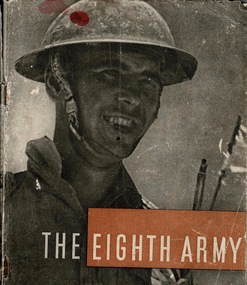
Book, The Eigth Army, Post 1943
... The army was made up of men from England, Scotland, Australia, New Zealand and India eighth army north africa alamain tobruk 1941 - 1943 106 page booklet with picture of soldier in battle gear on front and 1/6 in bottom right hand corner The Eigth Army Book ...Eighth Army September 1941 to January 1943 Prepared for the War Office by the Ministry of Information The Army at War pictorial accounts of the battles in North Africa. The army was made up of men from England, Scotland, Australia, New Zealand and India106 page booklet with picture of soldier in battle gear on front and 1/6 in bottom right hand cornereighth army, north africa, alamain, tobruk, 1941 - 1943 -
 Flagstaff Hill Maritime Museum and Village
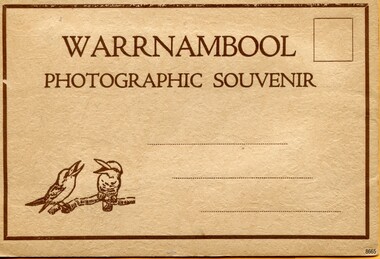
Postcard - Postcard Folder, scenes, Valentine & Sons Co. Publishing Ltd, Warrnambool Photographic Souvenir, Early-to-mod 20th century
... Scotland, and in Canada. In the early 1900s, at the height of the postcard craze, the firm published large numbers of postcards in the U.K., Canada, U.S., Australia and South Africa. From around 1900 or earlier, the firm bought many lithographic images for its postcards from local and national photographers who sold publishing rights to Valentines, and the business was famous for publishing photographs of popular sites worldwide. Postcard titles in this folder include many of those in the Rose postcard folders plus the following titles that are not duplicated. . Municipal Buildings and Post Office . Soldiers...Scotland, and in Canada. In the early 1900s, at the height of the postcard craze, the firm published large numbers of postcards in the U.K., Canada, U.S., Australia and South Africa. From around 1900 or earlier, the firm bought many lithographic images for its postcards from local and national photographers who sold publishing rights to Valentines, and the business was famous for publishing photographs of popular sites worldwide. Postcard titles in this folder include many of those in the Rose postcard folders plus the following titles that are not duplicated. . Municipal Buildings and Post Office . Soldiers ...This postcard folder is one of three in a set of postcards that were published in Victoria, Australia, and collected together. The Valentine Publishing Co. Pty. Ltd. produced this folder. Valentine and Sons was a printing and photography business based in Dundee, Scotland, and in Canada. In the early 1900s, at the height of the postcard craze, the firm published large numbers of postcards in the U.K., Canada, U.S., Australia and South Africa. From around 1900 or earlier, the firm bought many lithographic images for its postcards from local and national photographers who sold publishing rights to Valentines, and the business was famous for publishing photographs of popular sites worldwide. Postcard titles in this folder include many of those in the Rose postcard folders plus the following titles that are not duplicated. . Municipal Buildings and Post Office . Soldiers’ Memorial . Hopkins River . The Cliffs at Shelly Beach . The Road to Sandy Beach . The Breakwater and Pier This Valentine postcard folder was produced in Australia. It includes pictures from the early-to-mid 20th century. It is one of three in a set, with images of the same locations as other images in our collection but at different periods in time. Each postcard records a moment in history and is significant as a way to compare and show the changes in the local environment and community, building a story of the local history. The images record changes in the coastline, land, bay, buildings and other structures, roads, transportation and even the fashions of the times.Postcard folder, Valentine Publishing, cream cover. One of a set of three displaying images of Warrnambool and district around the mid-20th century. Print on the front and back covers is in brown ink. The front has an image of two laughing kookaburras on a branch, three address lines and an outline for a postage stamp. The back cover has the publisher’s details and a line for a return address. The cover opens like a book, and then the double-sided, Z-folded page of photographs drops downward. Titles are printed below each of the fifteen black and white photographs inside. The folder is secured on the back cover by placing a tab into a slot. The folder was produced by The Valentine Publishing Co. Pty. Ltd. Melbourne“WARRNAMBOOL / PHOTOGRAPHIC SOUVENIR” Symbol: [Two facing kookaburras standing on a branch with beaks open] “Published by The Valentine Publishing Co. Pty. Ltd. Melbourne” flagstaff hill maritime museum and village, great ocean road, shipwreck coast, warrnambool, flagstaff hill, flagstaff hill maritime museum, flagstaff hill maritime village, warramble, postcard, postcard folder, warrnambool scenes, picturesque views of warrnambool, picturesque views of warramble, lady bay, port of warrnambool, breakwater, warrnambool breakwater, viaduct, merri river footbridge, merri river suspension bridge, suspension footbridge, merri river mouth, hopkins river mouth, proudfoot's, fanny nelson, nelson's boatsheds, nelson's boathouse, boathouse, hopkins river boathouses, flett's boathouse, flett, george rose, image of a rose, rose series, rose stereograph co, rose stereographic company, lighograph, armadale victoria, lady bay beach, beach scene, lower light, concrete footbridge, 1922 footbridge, viaduct road, rose postcard, new concrete bridge, 1945, 1890, 1922, small footbridge, 1872 footbridge, 1872, merri river estuary, stingray bay, postcards, concertina fold, z fold, shipwrecked coast, maritime museum, souvenir, warrnambool local scenes, photography, local history, tourism, photographs, visitors, travel, scenes, mid-20th century, 1940s, 1950s, z-fold, 1880s, collection, correspondence, valentine publishing co. pty. ltd melbourne, valentine publishing co. pty. ltd sydney, municipal buildings and post office, soldiers’ memorial, hopkins river, the cliffs at shelly beach, the road to sandy beach, the breakwater and pier -
 Flagstaff Hill Maritime Museum and Village
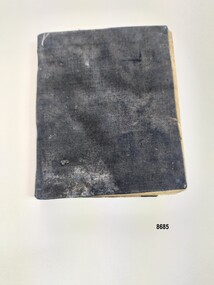
Book - Mariner's Pocket Book, Captain John Budge Murray, circa 1881 - 1887
... soldiers "On Parade" and personal jottings. The dates in the notebook span the years from 1881 to 1887 and mention trips from Hong Kong to Singapore, Galle, Colombo, the Suez Canal, Aden, Port Said, Malta, Gibraltar and London. Two of the ships mentioned include the S. S. Bangalore and the S. S. Assam - both belonged to the "Peninsula and Oriental Steam Navigation Company" (later known as the P&O Line). John Budge Murray was born in 1847 at Olrig, Caithness in Scotland...soldiers "On Parade" and personal jottings. The dates in the notebook span the years from 1881 to 1887 and mention trips from Hong Kong to Singapore, Galle, Colombo, the Suez Canal, Aden, Port Said, Malta, Gibraltar and London. Two of the ships mentioned include the S. S. Bangalore and the S. S. Assam - both belonged to the "Peninsula and Oriental Steam Navigation Company" (later known as the P&O Line). John Budge Murray was born in 1847 at Olrig, Caithness in Scotland ...This is a small pocketbook owned by Master Mariner John Budge Murray. It is 119 pages long and contains a mix of detailed navigational calculations and lessons, diary entries, drill commands for soldiers "On Parade" and personal jottings. The dates in the notebook span the years from 1881 to 1887 and mention trips from Hong Kong to Singapore, Galle, Colombo, the Suez Canal, Aden, Port Said, Malta, Gibraltar and London. Two of the ships mentioned include the S. S. Bangalore and the S. S. Assam - both belonged to the "Peninsula and Oriental Steam Navigation Company" (later known as the P&O Line). John Budge Murray was born in 1847 at Olrig, Caithness in Scotland. During the course of his career, he was a merchant marine employed by the Peninsula and Oriental Steam Navigation Company (better known as P&O) and also became a master mariner and Captain serving in the Chinese Naval Service. When he married in 1888, his marriage certificate listed his occupation as "Captain in the Chinese Naval Service". Family records show his sister describing him as "commanding three frigates in the South China Sea - allegedly chasing pirates!" His obituary in the "John O'Groat Journal" in 1910 said he was "one of the original contingent of Britons who served as officers in the Chinese Fleet ...it was they who cleared the Chinese seas of the pirates who infected them." It went on to say "Captain Murray was brave even to the most reckless exposure of his life and ... the Chinese crews had explicit faith in him." John Murray and his wife Jessie had four children and by 1901 were living on a farm at Aucorn in Caithness. One of his sons (also called John Budge Murray) immigrated to Australia and joined the 8th Battalion, AIF (Australia Imperial Force) in 1915 and was killed in France in August 1918. Captain Murray died at Olrig in 1910. In 1840 the Peninsula Steam Navigation Company won a contract for the mail service between the U.K. and Egypt. They expanded their operations to include mail contracts to Alexandria, from Suez to Ceylon, Madras and Calcutta and in 1845 further expanded their operations to Shanghai. Steam communication with Australia was inaugurated in 1852 and in 1854 the Bombay Mail Service passed from the East India Company to P&O. By 1884 P&O's fleet contained fifty ships including the S.S. Assam and S.S. Bangalore - both are mentioned in Captain Murray's pocketbook. In 1882 the S.S. Bangalore was operating in the Bombay / Far East mail service and had made several trips in 1876 between Bombay and Melbourne. In 1875, the Qing Dynasty began to establish a modern Imperial Navy. They ordered a series of warships from Britain and Germany. Two of these ships (the Chaoyong and the Yangwoi) were built at the Tyne shipyards and sailed to China in 1881. They also needed to improve the skills of their naval personnel, and some skilled officers were recruited from Britain. This pocketbook is a significant example of a Master Mariner's everyday working pocketbook. It is also an important object as it belonged to a Scottish Master Mariner who held the unusual position as an officer in the Chinese Naval Fleet.A Master Mariner's small pocket-sized notebook. It has a black cover, 119 pages and contains a mix of navigational records, personal addresses, diary type entries and personal jottings in ink and pencil.First page - "John Budge Murray/Aucorn /Bower/ J. B. Murray/John B/ John B Murray/ Aucorn"flagstaff hill maritime museum and village, great ocean road, captain john budge murray, captain murray, master mariner, navigational calculations, ships log, pocketbook, peninsula and oriental steam navigation company, p&o, s.s. bangalore, s.s. assam, drill commands, chinese naval service, qing dynasty, south china sea -
 City of Moorabbin Historical Society (Operating the Box Cottage Museum)
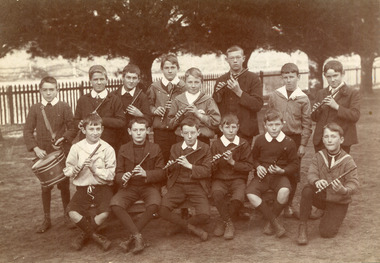
Photograph,Black & White Cheltenham State School Fife & Drum Band c1908, c1908
... Scottish heritage of many early settlers the Fife & Drum Band was established at the West Beaumaris (Cheltenham) State School . The Fife is similar to the piccolo, and usually made of wood, consisting of a tube with 6 finger holes and an embouchure hole that produces sound when blown across.The fife was used in folk music traditions to accompany dancing by all social classes. Also in the Military where drums accompanied the fife and originally these 'boy soldier...Scottish heritage of many early settlers the Fife & Drum Band was established at the West Beaumaris (Cheltenham) State School . The Fife is similar to the piccolo, and usually made of wood, consisting of a tube with 6 finger holes and an embouchure hole that produces sound when blown across.The fife was used in folk music traditions to accompany dancing by all social classes. Also in the Military where drums accompanied the fife and originally these 'boy soldier ...1855 Stephen Charman donated land to the Methodist Church so that a School could be established to educate the children of the early settler market gardeners and farmers in the Cheltenham area . Education was valued by the general community and as well as schools they established mechanics Institutes and Libraries in Moorabbin Shire. Cheltenham State School No. 84 was among the first schools in Melbourne. Stephen Charman, 1821-1906 a market gardener, donated land for the first Methodist Chapel, Cemetery and School in Charman Rd Cheltenham 1855. The enrolment was 36 pupils with Mr Frederick Meeres as Teacher. 1863 the school is called Beaumaris Common School No 84 with 70 pupils and Walter Meeres as Teacher. 1869 another 2 acres in Charman Road were granted by the Education Board and brick building built . 1872 State School 84 Beaumaris was increasing enrollments and 1878 a new brick school was built to accommodate 174 pupils and the name changed to Cheltenham State School No.84 1894 Mentone State School No.2950 amalgamated with Cheltenham SS No.84. 1910 the buildings were in disrepair, overcrowding was increasing and renovations were made 1912 with further additions in 1925 and 1937. Post WW11 extra prefabricated Classrooms were added as enrollment increased to 1038 in 1955.. Cheltenham East State School 4754 was opened as housing development spread over the City of Moorabbin . (J.Larson Sandringham HS) Probably due to the Scottish heritage of many early settlers the Fife & Drum Band was established at the West Beaumaris (Cheltenham) State School . The Fife is similar to the piccolo, and usually made of wood, consisting of a tube with 6 finger holes and an embouchure hole that produces sound when blown across.The fife was used in folk music traditions to accompany dancing by all social classes. Also in the Military where drums accompanied the fife and originally these 'boy soldier ' bands were used to signal manouevres in the field for the infantry. Later Fife & Drum bands were used for marching bands in schools and community groups, 1855 Stephen Charman donated land to the Methodist Church so that a School could be established to educate the children of the early settler market gardeners and farmers in the Cheltenham area . Education was valued by the general community and as well as schools they established mechanics Institutes and Libraries in Moorabbin Shire. Cheltenham State School No. 84 was among the first schools in Melbourne.Black & White photograph of pupils at West Beaumaris (Cheltenham) State School No.84 in the boy's Fife and Drum Band c 1908Back Handwritten Mrs Whelan / Beaumariswhelan r, marriott geoff, meeres frederick, cheltenham state school no.84, education, keys robert, holloway josiah, king brothers, smith j l; smith mary ann, stanley helen, chaff cutter, horse drawn carts, toll gates brighton, motor cars 1900, steam engines, early settlers, bentleigh, parish of moorabbin, city of moorabbin, county of bourke, moorabbin roads board, shire of moorabbin, henry dendy's special survey 1841, were j.b.; bent thomas, o'shannassy john, king richard, charman stephen, highett william, ormond francis, maynard dennis, market gardeners, vineyards, orchards -
 Bendigo Military Museum
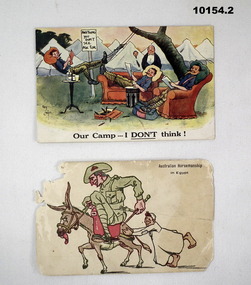
Postcard - CARTOON POSTCARDS, J. Samon, Sevenoake, c.1916
... Landscape colour postcard of soldiers relaxing on comfortable couches with a waiter and drinks. Is a drawing with caption. Message on back indicates they are in Scotland. 2. ...Landscape colour postcard of soldiers relaxing on comfortable couches with a waiter and drinks. Is a drawing with caption. Message on back indicates they are in Scotland. 2. ...Postcards sent home from Europe during WW1. Part of the collection of William (Bill) Thomason. ref Cat No. 4136P.1. Landscape colour postcard of soldiers relaxing on comfortable couches with a waiter and drinks. Is a drawing with caption. Message on back indicates they are in Scotland. 2. Comic sketch of landscape colour postcard of a large Australian soldier riding a small donkey being pushed by a local Arab. Detailed letter on back. Edge torn off.1. Caption "Our camp - I don't think!" 2. Caption "Australian Horsemanship in Egypt", “dated Dec 5”collection of william (bill) thomason, comic postcards, ww1 -
 Bendigo Military Museum
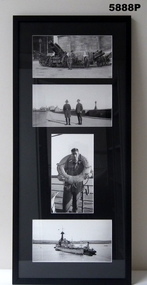
Photograph - THE GRINTON COLLECTION, FRAMED, 2008 - 2009
... soldier is a Private Knight. The first building in the rear is the "Don View Bar" suggesting that this is Scotland when on leave. ...soldier is a Private Knight. The first building in the rear is the "Don View Bar" suggesting that this is Scotland when on leave. ...Frame 9. Photo 1. Jack Grinton on leave in Paris, early 1919 with captured German guns. The place is the 'Arc de Triomphe' . Photo 2. Jack Grinton on the right. From Jack's writing the other soldier is a Private Knight. The first building in the rear is the "Don View Bar" suggesting that this is Scotland when on leave. Photo 3. Coming home, Jack on the deck of the "Karmala". They left Plymouth Harbour on 1/7/1919. Photo 4. Ships in Plymouth Harbour. Refer Cat No. 5880P for exhibition details. Refer Cat No. 1280 for Jack GRINTON Service Records.Photographs - black and white on paper. 4 photographs, top to bottom. 1. Soldier with German guns in Paris. 2. Two soldiers with buildings in the background. 3. Soldier on deck of a ship. 4. Ships in harbour. Frame - timber with black colour paint. Glass front. Mount - black colour cardboard. Backing cardboard - with handwritten notation. Backing cardboard - handwritten in blue felt tip pen "9."framed photographs, grinton collection, ww1, 38th -
 Bendigo Military Museum
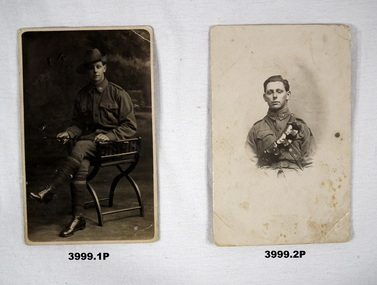
Postcard - POSTCARDS, PHOTOGRAPHIC WW1, (.1) Dec 7.12.15, (.2) 31.10.16
... Scotland 25.4.1919 prior to coming home. Refer Cat No 3996P re “Lena” and other cards, 4000.2 from “Tom”. Postcard lena 21st Thomas Henry WATT (.1) Postcard photo, B & W showing a soldier seated on a chair with a crop, studio background. ...Both letters to “Lena” are from Tom WATT. As well as his signature someone has written his name as in blue pen. One letter is just signed “Tom” the other “Gunner T H Watt”. It is believed this is "Thomas Henry WATT", born Bendigo. He had pre war service in the 67th Bn Senior Cadets, no dates given. Regt No 3670 shows he enlisted on 20th or 28th Dec 1915 in the 8th reinforcements 21st Bn age 20 years. It shows he embarked just 9 days or 1 day later on 29.12.1915. He transfers to the 60th then 57th Bn and then on 17.3.1916 5th Div Artillery. he is mustered as “Gunner” and transfers to 5th DIV DAC (Ammunition Column) on 25.5.1916. (.1) The letter is dated Dec 7.12.1915 two weeks or so prior to enlistment dates. The end of the letter talks about being sick and possibly missing going with the next draft. There are 3 other sketchy records showing enlisted 12.7.1915, 5th DAC 15.7.1915, AWL Bendigo 4.11.1915. This would fit in better than enlisting and embarking in not much more than a week. Tom married Margaret McCALL in Scotland 25.4.1919 prior to coming home. Refer Cat No 3996P re “Lena” and other cards, 4000.2 from “Tom”.(.1) Postcard photo, B & W showing a soldier seated on a chair with a crop, studio background. On rear extensive letter in black pen to “Dear Lena”. (.2) Postcard photo, B & W, portrait of a soldier, no hat, bandolier over shoulder, clear background. On rear brief letter in black pen addressed to “Dear Lena”. postcard, lena, 21st, thomas henry watt -
 Eltham District Historical Society Inc
Photograph - Digital Photograph, Alan King, Shire of Eltham War Memorial, Kangaroo Ground, 28 January 2008
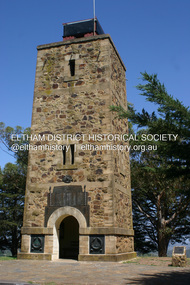
... The Eltham Shire War Memorial, a tower of remembrance, was built with public donations to commemorate the memory of the fallen soldiers from the shire who enlisted in the 1914-1918 war. The tower is reminiscent of the peel-towers or watchtowers that lined the English-Scottish border from the mid 14th century to around 1600 and is constructed from locally quarried stone. ...The Eltham Shire War Memorial, a tower of remembrance, was built with public donations to commemorate the memory of the fallen soldiers from the shire who enlisted in the 1914-1918 war. The tower is reminiscent of the peel-towers or watchtowers that lined the English-Scottish border from the mid 14th century to around 1600 and is constructed from locally quarried stone. ...The Eltham Shire War Memorial, a tower of remembrance, was built with public donations to commemorate the memory of the fallen soldiers from the shire who enlisted in the 1914-1918 war. The tower is reminiscent of the peel-towers or watchtowers that lined the English-Scottish border from the mid 14th century to around 1600 and is constructed from locally quarried stone. This uncommon and picturesque war memorial, which affords an excellent view of the surrounding district was unveiled by His Excellency the Governor-General (Lord Stonehaven) on November 11, 1926. In July 1922 a deputation of returned soldiers from Panton Hill, presumably the Panton Hill branch of the Returned Sailors and Soldiers Imperial League of Australia (RSSILA), proposed to Eltham Shire Council that the monument should be a cairn of local stone “sufficiently high to form a prominent and conspicuous landmark, and crowned with some suitable device”. Eltham Shire Councillor and President of the Panton Hill branch of the RSSILA, Basil Hall, was credited with being the first to suggest a tower, and with organising a Memorial Park committee to raise funds for the monument in the Memorial Park. A meeting for those interested in the establishing a War Memorial monument in the park was held in January 1924 and the Eltham Shire War Memorial League was formed for this purpose. It appears that the broad and rounded cairn that had been recently built was considered by the League a temporary affair, and not the substantial cairn-as-monument, sufficiently high to form the conspicuous landmark, which had been envisaged by the Panton Hill RSSILA. A design competition was held for the monument. The chairman of the League, Councillor Basil Hall, suggested that the site of the memorial in Kangaroo Ground would lend itself to something rugged, instead of polished stone. By April 1924 thirty designs for a memorial had been received from which three designs were selected and of those, the design by the shire engineer Mr McCormack, for a 70ft tower suitable for construction in rough stone, was chosen. Artist Harold Herbert suggested that a peel tower-like design reminiscent of those along the English-Scottish border would be fitting for the site. Herbert drew up a rough sketch that was approved of, and later, Melbourne architect Percy Meldrum volunteered to draw up the design from sketch to architectural drawings. By January 1925 the Soldiers’ Memorial League had adopted Meldrum’s design for a 50ft high tower. Meldrum had also offered his design and supervision of construction free of charge. The Shire provided the stone to the builders, which was a gift quarried from land owned at Kangaroo Ground by Dr Ethel and Professor William Osborne The Shire of Eltham War Memorial, a tower of remembrance, and honour board were unveiled on November 11, 1926, by the Governor General Lord Stonehaven. At this stage a temporary honour roll was painted on the panels on either side of the tower entrance. In September 1930 bronze plates were added above the portal with the names of men who fell in the 1914-18 war. On November 16, 1951, the Governor of Victoria, Sir Dallas Brooks re-dedicated the war memorial tower and unveiled the names of men who gave their lives in the 1939-45 war. Two additional bronze plaques which recognise service in the armed conflicts of Korea, Borneo, Malaya, and Vietnam were unveiled November 11, 2001, by the Governor of Victoria, John Landy, A.C., M.B.E. The tower was first used for fire spotting activities following the Black Friday bushfire in January 1939 in response to a request from Mr R.D. Ness, secretary of the Kangaroo Ground bush fire brigade, who asked Council that the tower be used as an observation tower for detecting bush fires, and asked Council to arrange a telephone to be installed. It was suggested that if the Shire were to appoint a caretaker for the Memorial Park, his duties could also include raising the alarm in the event of a fire. Later in 1939 Council applied for a radio transmitter, which the Forestry Commission planned to install at vantage places throughout the state. The first dedicated fire spotter appointed from December1948, was Mr Smith of Warrandyte. A prefabricated glazed cabin was installed in 1974, which involved the removal of the original stone structure around the rooftop exit door. A new fire spotting cabin, which included the latest technology, was installed soon after the 2009 Black Saturday fires and is manned by CFA personnel on high fire danger days. Covered under Heritage Overlay, Nillumbik Planning Scheme. Published: Nillumbik Now and Then / Marguerite Marshall 2008; photographs Alan King with Marguerite Marshall.; p123This collection of almost 130 photos about places and people within the Shire of Nillumbik, an urban and rural municipality in Melbourne's north, contributes to an understanding of the history of the Shire. Published in 2008 immediately prior to the Black Saturday bushfires of February 7, 2009, it documents sites that were impacted, and in some cases destroyed by the fires. It includes photographs taken especially for the publication, creating a unique time capsule representing the Shire in the early 21st century. It remains the most recent comprehenesive publication devoted to the Shire's history connecting local residents to the past. While published in the book in black and white, this collection features the original colour digital photographs. nillumbik now and then (marshall-king) collection, garden hill, kangaroo ground, memorial park, shire of eltham war memorial -
 Warrnambool and District Historical Society Inc.
Postcard - Greeting from the Trenches embroidered, 1914-1918
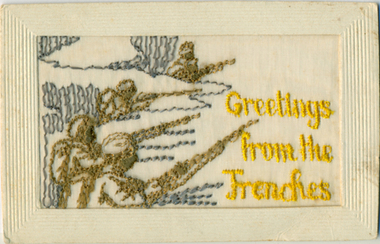
... I was treated by our own Doctor & I was not bad very long.How is Nancy & Lex & Mother & Dad.I had a good time in Scotland on leave Au Rev Daisy Love to all from Ike This is a postcard with embroidered images of four soldiers in brown and blue thread and script in yellow thread. ...This is Item 25 of 27 items in the Daisy Vickers collection of World War One memorabilia. These items were sent or given to Daisy Ogier (nee Vickers) during World War One by Corporal Arthur Anderson who enlisted from Warrnambool in 1915 at the age of 21. He served in Egypt and France and returned to Australia in 1919. Daisy Ogier (1907-1987) was a student and then a teacher at Warrnambool Technical School with her early teaching years there from 1925 to 1936 and in 1949. She became the head mistress from 1950 to 1963 and in 1968. She officially retired in 1976. Daisy Vickers was one of the best loved and dedicated teachers that the school ever had. She married the Reverend Fred Ogier and continued her association with the school after her husband's deathThis card is interesting because of its association with World War One and two local people Daisy Vickers and Arthur AndersonThis is a postcard with embroidered images of four soldiers in brown and blue thread and script in yellow thread. It is set inside a piece of rippled card.There is handwriting on the back . Greetings from the Trenches France 11th April 18 Dear Daisy I was more than pleased at receiving your letter along with Emily's. I wrote you a letter some time back and I hope you received it safely. No Daisy I did not go to Hospital at all with my wounds. I was treated by our own Doctor & I was not bad very long.How is Nancy & Lex & Mother & Dad.I had a good time in Scotland on leave Au Rev Daisy Love to all from Ike daisy vickers, arthur anderson, world war 1 embroidered postcard, embroidered postcard -
 Romsey and Lancefield RSL Sub Branch
badge, c 1919
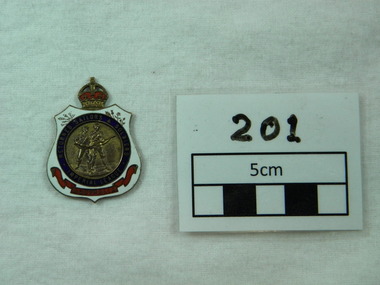
... The Leek, Rose, Thistle and Shamrock are symbolic of and represent the link with Wales, England, Scotland and Ireland. .A Crown is positioned on the top of the badge symbolizing loyalty to the Monarchy. rsl badge medallion crest rssaila Rear stamped number "96641" Bronze Metal. Centre two figures in bronze surrounded by blue circle with words Returned Sailors and Soldiers ...The Australian Returned Services League was designed in 1919 and has remained predominately the same since then. The white background stands for purity of motives, The blue indicates willingness to render service to a comrade anywhere beneath the blue sky. The red stands for the blood ties of war. The wattle is symbolic of Australia. The Leek, Rose, Thistle and Shamrock are symbolic of and represent the link with Wales, England, Scotland and Ireland. .A Crown is positioned on the top of the badge symbolizing loyalty to the Monarchy.Bronze Metal. Centre two figures in bronze surrounded by blue circle with words Returned Sailors and Soldiers Imperial League .Further surrounded by white enamel with red ribbon at base with words Australia in centre of ribbon. Edward VII Crown at top. 1919-1926.Rear stamped number "96641"rsl, badge, medallion, crest, rssaila -
4th/19th Prince of Wales's Light Horse Regiment Unit History Room
Audio - Audio Cassette, Army Tracks, abt 1996
... HQ RAA Band (WO2 G Brown) - Soldiers of the Queen, British Grenadiers 3. 1 Bn RVR (WO2 R Rooth) -The Northumbrian, Our Director Side 2: 5 Bn RVR - Pipe Major D Bail - Medley 1 : Gin I were a Baron's heir, The lady in the bottle, Glasgow Police piper, The Rohan tree, Scotland the brave, Medley 2 - Drummers introduction, Braes of Mar, Braes of Tully Met, Dalnahassaig, Piper of Drummond, High Road to Linton, Jock Wilson's Ball, The mermaid song, Donald, Willy and his dog, Ode to Joy, The Black Bear ...HQ RAA Band (WO2 G Brown) - Soldiers of the Queen, British Grenadiers 3. 1 Bn RVR (WO2 R Rooth) -The Northumbrian, Our Director Side 2: 5 Bn RVR - Pipe Major D Bail - Medley 1 : Gin I were a Baron's heir, The lady in the bottle, Glasgow Police piper, The Rohan tree, Scotland the brave, Medley 2 - Drummers introduction, Braes of Mar, Braes of Tully Met, Dalnahassaig, Piper of Drummond, High Road to Linton, Jock Wilson's Ball, The mermaid song, Donald, Willy and his dog, Ode to Joy, The Black Bear Army Tracks Audio Audio Cassette 4th/19th Prince of Wales's Light Horse Regiment Band ...Philips cassette tape. Side 1: 1. 4/19 PWLH Band (WO2 V Smith) - Australian Light Horse, Lynwood 2. HQ RAA Band (WO2 G Brown) - Soldiers of the Queen, British Grenadiers 3. 1 Bn RVR (WO2 R Rooth) -The Northumbrian, Our Director Side 2: 5 Bn RVR - Pipe Major D Bail - Medley 1 : Gin I were a Baron's heir, The lady in the bottle, Glasgow Police piper, The Rohan tree, Scotland the brave, Medley 2 - Drummers introduction, Braes of Mar, Braes of Tully Met, Dalnahassaig, Piper of Drummond, High Road to Linton, Jock Wilson's Ball, The mermaid song, Donald, Willy and his dog, Ode to Joy, The Black Bear TDK SA904/19 pwlh regiment band, audio -
 Warrnambool and District Historical Society Inc.
Medallion, Dead Man's Penny Daniel Nicol Peters, C 1919
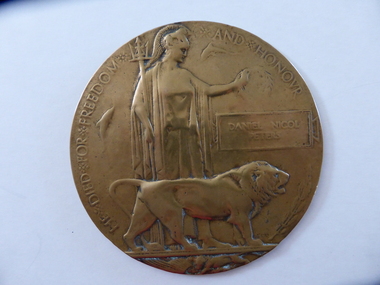
... The name of the soldier is presented without rank to signify the equality of all sacrifice. This medallion was to commemorate Daniel Nicol Peters who came from Scotland but enlisted in the AIF in Blackboy Hill Western Australia. ...Scotland. From a country with a population of approximately 5 million people, there were more than 60000 soldiers killed. ...The dead man's penny is a commemorative medallion which was presented to the family of soldier s who were killed in the First World War. The images of Brittania the dolphins and the lion represent Brittain and the eagle represents Germany. The name of the soldier is presented without rank to signify the equality of all sacrifice. This medallion was to commemorate Daniel Nicol Peters who came from Scotland but enlisted in the AIF in Blackboy Hill Western Australia. His regimental number was 3200. he was Killed in Action on 26 August 1918. His father was John Peters of Greenside Fifeshire Scotland. From a country with a population of approximately 5 million people, there were more than 60000 soldiers killed. This object represents but one of these soldiers. It therefore has historical and social significanceCircluar brass plaque with figure of Brittania and a lion in low relief. There are two dolphins around the figure of Brittania and and image of a defeated eagle below the lion.To the right of the figure is a small rectangle with the name of the soldier. Text around the edge.He died for freedom and honour. Daniel Nicol Petersdead man's penny, daniel nicol peters -
 Warrnambool RSL Sub Branch
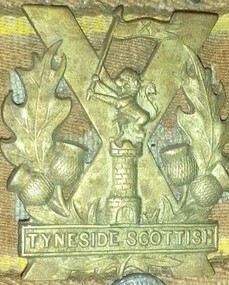
Uniform - "Tyneside Scottish" badge, Tyneside Scottish
... This badge was worn from 1916 by soldiers of the Tyneside Scottish battalions during WW1. ...This badge was worn from 1916 by soldiers of the Tyneside Scottish battalions during WW1. ...This badge was worn from 1916 by soldiers of the Tyneside Scottish battalions during WW1. Metal BadgeSt Andrews cross with thistles on either side. In the centre, a Lion rampant gardant on a tower, holding a pennant with a St Andrews cross. -
 Bendigo Historical Society Inc.
Postcard - BLANCHE SLY POSTCARD COLLECTION, 1900 - 1920
... See 1403 B&W photo of the London Scottish going to their trenches. A platoon of soldiers in battle gear marching along a country lane. ...See 1403 B&W photo of the London Scottish going to their trenches. A platoon of soldiers in battle gear marching along a country lane. ...Postcard Album of Blanche Sly. Postcards stored in Folder 81 (49 postcards). 1403.1 - 1403.28 Grey linen look cover with picture of a small sailing boat pasted centre front pf cover. Partly torn sticker on lower LH corner. Blanche Victoria SLY Born: 11 Oct 1890, daughter of William and Hannah Sly Address: 1913; Loddon Vale Address: 1980; 100 Barnard Street Bendigo Died: Bendigo 12 June 1982, buried Bendigo G3 William Sly: Born: 1856 at Smythesdale, Victoria Married in Victoria in 1887; Hannah Theilman Died: Bendigo 1937, buried Bendigo G1 Hannah Sly Nee Theilman Born: 1866 Married in Victoria in 1887; William Sly Died: Bendigo 1948, buried Bendigo G3 See additional Research .Postcard Album of Blanche Sly containing 49 postcards. See 1403 B&W photo of the London Scottish going to their trenches. A platoon of soldiers in battle gear marching along a country lane. Daily Mail war pictures no.26 Addressee - not given Sender - not given Undatedpostcard, collector, blanche sly -
 Narre Warren and District Family History Group
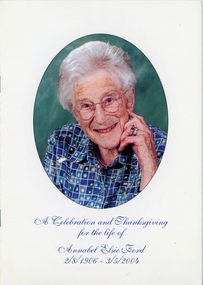
Programme - Funeral Order of Service for Annabel Elsie Ford, Funeral Order of Service for Annabel Elsie Ford (1906-2004), 2004
... They married in Scotland two years later and returned to Burma for 10 years. The family were moved to a hill station during World War 2, Frank recruiting and training soldiers, Annabel working closely with the locals and working as cipher clerk for the army. ...They married in Scotland two years later and returned to Burma for 10 years. The family were moved to a hill station during World War 2, Frank recruiting and training soldiers, Annabel working closely with the locals and working as cipher clerk for the army. ...Born and raised in Scotland, Annabel Elsie Couper was 24 when she met Captain Frank O’Neil Ford, a British army officer, in Burma (now Myanmar). They married in Scotland two years later and returned to Burma for 10 years. The family were moved to a hill station during World War 2, Frank recruiting and training soldiers, Annabel working closely with the locals and working as cipher clerk for the army. When the women and children were eventually evacuated a long journey by train, plane and ship brought Annabel and the children to Calcutta. She began working for the Red Cross. They returned to England in 1944 and in 1949 they came to Berwick. Annabel quickly joined local groups, the Red Cross, the CWA and the Berwick Hospital Auxiliary. The family moved to Upper Beaconsfield in the 1960s where Annabel joined the RSL Auxiliary, Beaconhills Golf Club and attended St. John’s Church. She returned to Berwick after Frank died in 1980, but did not lose her close connection to Upper Beaconsfield. In 2001 she received the Red Cross Laurel Wreath Service Award for 50 years of service. Centre stapled 12 page A5 booklet with colour printed covers. funeral order of service, red cross society -
 Bendigo Military Museum
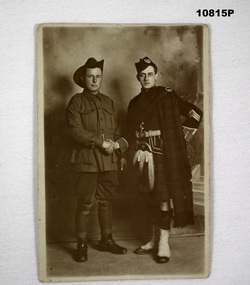
Photograph - PHOTOGRAPHIC POSTCARD WW1, "The Cosway" Studio, c.WW1
... the soldier on the right is in traditional Scottish Military dress. ...Soldier on the left is an Australian in uniform. the soldier on the right is in traditional Scottish Military dress. ...Location referred to on the back is Biesme near Mettet in Belgium. Both places are close to Namur which is the capital of the Belgian province of Namur. Part of the Meade Collection. See Cat No. 10785P for details of service for Ernest James Meade (No. 2112).Black and white photograph of two unidentified WW1 soldiers standing and shaking hands. Soldier on the left is an Australian in uniform. the soldier on the right is in traditional Scottish Military dress. Postcarde proforma on back with handwritten information.Handwritten on back in indelible pencil: “Desire Deravet, Armoible Deravet, Aime Deravet, Celine Deravet, Germoure Deravet, Maurice Deravet, Josephine Malbury. Biesme lez Mettet Provence Namur, Belgiggue. Biesme provence Namur, Belogique”meade collection, ww1, namur, photograph, ernest james meade -
 Warrnambool and District Historical Society Inc.
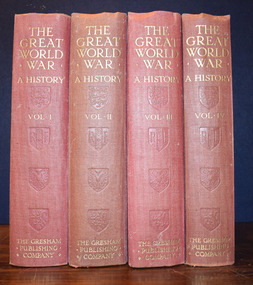
Book - War History, Frank Mumby, The Great World War- A History, 1915
... Scotland in 1885. He served in World War One and managed the shoe department in Swintons and later conducted his own footwear business. He died in 1976. These volumes are retained for their antiquarian value and their Warrnambool provenance. World War One James Low of Warrnambool A four volume set written about the history of World War 1. James Low This book has nine volumes with six of them containing three separate books inside the cover. The volumes have red hard covers with gold printing on the spines. There is an embossed image of a soldier ...A four volume set written about the history of World War 1.This book has nine volumes with six of them containing three separate books inside the cover. The volumes have red hard covers with gold printing on the spines. There is an embossed image of a soldier on the front covers and embossed shields on the spines. The pages contain printed matter, maps and photographs.non-fictionA four volume set written about the history of World War 1. world war one, james low of warrnambool -
 Ballarat Tramway Museum
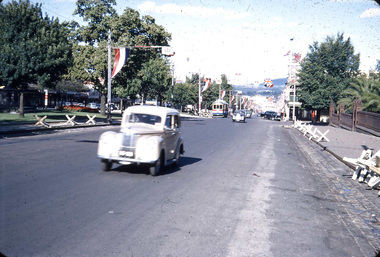
Photograph - Digital image, W. J. Llewelyn, 6/03/1954 12:00:00 AM
... Llewelyn. .1 - Street view of Sturt St looking East at St Patrick's church, with No. 38 in the background and the wooden crowd control barriers stacked by the footpath. .2 - Crowd waiting at the intersection of Sturt and Lydiard St. .3 - Crowd waiting in Sturt St, with soldier's, outside Myers Store .4 - Crowd and guard of honour waiting at the station. .5 - The Queen and Duke in the official car in Sturt St. .6 - ditto with Myer Store in the background. .7 - Scottish unit marching at the intersection of Bridge St and Grenville St with he Bucks Head Hotel in the background. ...Llewelyn. .1 - Street view of Sturt St looking East at St Patrick's church, with No. 38 in the background and the wooden crowd control barriers stacked by the footpath. .2 - Crowd waiting at the intersection of Sturt and Lydiard St. .3 - Crowd waiting in Sturt St, with soldier's, outside Myers Store .4 - Crowd and guard of honour waiting at the station. .5 - The Queen and Duke in the official car in Sturt St. .6 - ditto with Myer Store in the background. .7 - Scottish unit marching at the intersection of Bridge St and Grenville St with he Bucks Head Hotel in the background. ...Yields information about the Royal Visit to Ballarat and the tram decorated for its visit along with other arrangements.Set of three eight digital images taken of Queen Elizabeth II to Ballarat 6/3/1954 by W. J. Llewelyn. .1 - Street view of Sturt St looking East at St Patrick's church, with No. 38 in the background and the wooden crowd control barriers stacked by the footpath. .2 - Crowd waiting at the intersection of Sturt and Lydiard St. .3 - Crowd waiting in Sturt St, with soldier's, outside Myers Store .4 - Crowd and guard of honour waiting at the station. .5 - The Queen and Duke in the official car in Sturt St. .6 - ditto with Myer Store in the background. .7 - Scottish unit marching at the intersection of Bridge St and Grenville St with he Bucks Head Hotel in the background. Note the sign on the hotel pointing to the Floral Carpet at the Alfred Hall. .8 - Band at the City Oval. Date obtained from http://wiki.prov.vic.gov.au/index.php/Royal_Visit_1954,_Locations_for_Visiting_Municipalities,_Ballarat (accessed 11-6-2017)trams, tramways, civic functions, royal visit, railway station, lydiard st, sturt st, city oval, myers, tram 38 -
 Sunshine and District Historical Society Incorporated
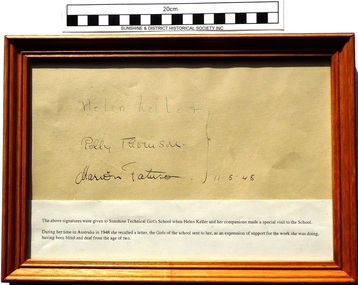
Memorabilia - Signature of Hellen Keller, Helen Keller, Polly Thomson, Marion Fatuson, 1948
... Scotland, England and Ireland. In 1931 they participated in the first World Council for the Blind. After Anne Sullivan Macy died in 1936 Helen and Polly continued to travel to several countries. In 1943 Helen visited blind, deaf, and disabled soldiers...Scotland, England and Ireland. In 1931 they participated in the first World Council for the Blind. After Anne Sullivan Macy died in 1936 Helen and Polly continued to travel to several countries. In 1943 Helen visited blind, deaf, and disabled soldiers ...In 1948 during her Australian tour Helen Keller visited the west suburban SUNSHINE GIRLS TECHNICAL SCHOOL, to express her thanks for a letter written by the students in support of her work with deaf and blind people. She and her travelling companions presented the school with their signatures. Helen Keller was born on June 27, 1880 and due to an illness at the age of 20 months lost both her sight and hearing. Helen was taught to communicate by Anne Sullivan who wrote words into her hand, and she also learned to speak by touching the throat and lips of people as they spoke. In June 28, 1904 Helen Keller graduated from Radcliffe College with a Bachelor of Arts degree, being the first deaf and blind person to do so. In October 1914 Polly Thomson joined up with Helen and Anne. Helen published an account of her religious beliefs and an autobiography, and in 1930 the three women travelled to Scotland, England and Ireland. In 1931 they participated in the first World Council for the Blind. After Anne Sullivan Macy died in 1936 Helen and Polly continued to travel to several countries. In 1943 Helen visited blind, deaf, and disabled soldiers in a USA military hospital, which she described as "the crowning experience of my life". In 1946 Helen and Polly made their first world tour for the American Foundation for the Overseas Blind and over the next 11 years visited 35 countries. In 1955 Helen became the first woman to be honoured with an honorary degree from Harvard University. In 1960 Polly Thomson died, and in 1961 Helen suffered her first stroke and so retired from public life. In 1964 President Johnson conferred the Presidential Medal of Freedom however she was unable to attend the ceremony. On June 1, 1968 Helen died in her sleep, and her ashes have been interred with those of Anne and Polly at the National Cathedral. Over 1200 mourners attended the funeral.It is significant that Helen Keller actually took the time and effort to visit the Sunshine Girls Technical School to thank the students for their supporting letter. Helen Keller's many achievements show that a severely handicapped deaf and blind person can make significant contributions to society, if they apply themselves and receive assistance from dedicated friends. Helen Keller, Polly Thomson, Marion Fatuson, 11.5.48deaf, blind, signatures, helen keller, polly thomson, marion fatuson, anne sullivan macy, radcliffe college, sunshine girls technical school
