
Showing 114 items matching "show society committee"
-
 Wodonga & District Historical Society Inc
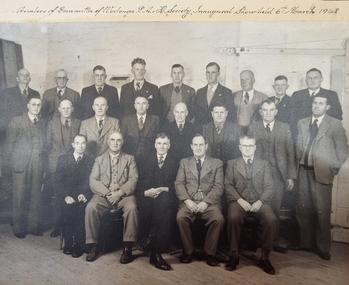
Photograph - Wodonga Show Society Inaugural Committee, 1948
... Wodonga Show Society Inaugural Committee...Wodonga Show Society Inaugural Committee...Show Society...Show Society Committee...Pollard was the inaugural President of the Wodonga Show Society and joined by seven past Shire Presidents as part of an original 25 member Wodonga Show Society Committee. ...Handwritten above photo: Members of Committee of Wodonga P.A.H. Society Inaugural Show held 6th March 1948. ...Wodonga Show Society Show Society Committee Handwritten above photo: Members of Committee of Wodonga P.A.H. ...In 1947 Shire President Cr. Charles F. Pollard called a public meeting for the purpose of discussing the forming of an Agricultural Society to raise funds for the proposed Wodonga Hospital. Cr. Pollard was the inaugural President of the Wodonga Show Society and joined by seven past Shire Presidents as part of an original 25 member Wodonga Show Society Committee. These committee members are captured in this photo. In addition to the committee, there were 150 members of the inaugural society. The first Wodonga Show was held on Saturday 6th March 1948. The catalogue for this event is included here. Forty district farmers guaranteed £400 in prize money; £321 was taken at the gate, and money from entry fees totalled £50. A profit of £50 was made for the Wodonga Hospital. This photograph is significant as it records the founding members of the first Pastoral, Agricultural and Horticultural Society in Wodonga.A framed black and white photograph of the members of the Inaugural Wodonga Show Committee. The unframed photo has a title handwritten in copperplate script at the top of the image. On the framed image, names have been typed an the left hand side.Handwritten above photo: Members of Committee of Wodonga P.A.H. Society Inaugural Show held 6th March 1948. Names typed with framed image:- Back R to L: Cliff Sheather, Charlie Ryan, Arnie Ford, Jack Hore, Bob Hall, Bill Richardson, Perc. Newbound, Peter Frawley Snr., Ernie Mann Centre Row L- R:- Sam Manning, Jack Street, Val Hempel, Arthur Arnold, Arthur Bert Winnett, Jack Turner, Tom Snowden, Des Klinge Front Row L - R:- Mel Lambourne, Bob Richardson, Charlie Pollard, Ken Watson, George Hancockwodonga show society, show society committee -
 Wodonga & District Historical Society Inc
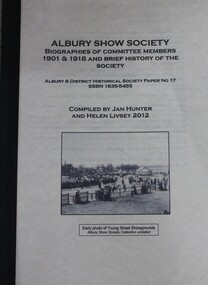
Booklet - Albury Show Society Biography of Committee Members 1901 & 1918, Jan Hunter and Helen Livsey, 2012
... Albury Show Society Biography of Committee Members 1901 & 1918...Albury Show Society Biography of Committee Members 1901 & 1918... Members 1901 & 1918 Booklet Albury Show Society Biography of Committee Members 1901 & 1918 Jan Hunter and Helen Livsey ALBURY AND DISTRICT HISTORICAL SOCIETY PAPERS ...The Albury Show Society is one of the oldest organisations in Albury, NSW. In 1857, forty people attended a meeting in Albury called by Robert Brown. From that meeting, 150 years ago, the Albury and Murray River Agricultural and Horticultural Society was born. It was eventually to evolve into the Albury Show Society through the work of many dedicated members. This publication includes a brief history of the Society and biographies of key people in its development.non-fictionThe Albury Show Society is one of the oldest organisations in Albury, NSW. In 1857, forty people attended a meeting in Albury called by Robert Brown. From that meeting, 150 years ago, the Albury and Murray River Agricultural and Horticultural Society was born. It was eventually to evolve into the Albury Show Society through the work of many dedicated members. This publication includes a brief history of the Society and biographies of key people in its development.albury show society, agricultural shows new south wales, biographies -
 Ringwood and District Historical Society
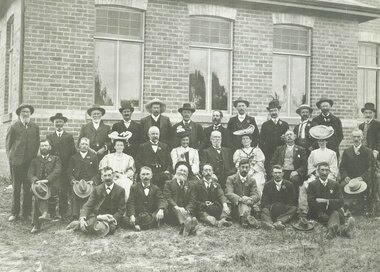
Photograph, Ringwood Horticultural Society- Show Committee outside Club Hotel,1897
... Ringwood Horticultural Society- Show Committee outside Club Hotel,1897....Show Committee outside Club Hotel 1897". Written on back of photograph- "First Rwd Horticultural Soc Show Committee and VIP's, March 1897. Photo taken outside Club Hotel." Newspaper article shows same image asking- 'Can you name them?. Black and white photograph (3 copies) Newspaper cutting from "Mail" dated 14/11/46 Ringwood Horticultural Society ...Black and white photograph (3 copies) Newspaper cutting from "Mail" dated 14/11/46Typed on front of one photograph- "Ringwood Show Committee outside Club Hotel 1897". Written on back of photograph- "First Rwd Horticultural Soc Show Committee and VIP's, March 1897. Photo taken outside Club Hotel." Newspaper article shows same image asking- 'Can you name them?. -
 Ringwood and District Historical Society
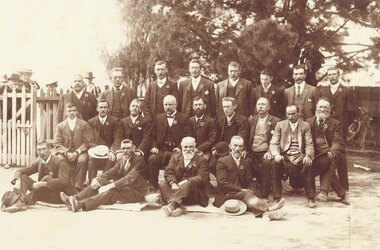
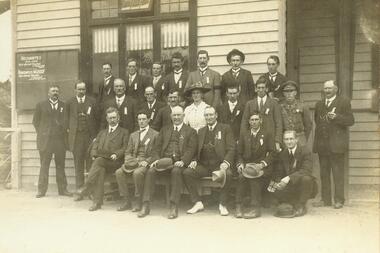
Photograph, Ringwood Horticultural Society- Show Committee 1904
... Ringwood Horticultural Society- Show Committee 1904....shows copy of photograph with the heading "Ringwood Horticultural Show Committee, 1904. Black and white photographs (3 copies), and newspaper cutting from Ringwood Mail, dated 26 November 1959. Ringwood Horticultural Society ...Black and white photographs (3 copies), and newspaper cutting from Ringwood Mail, dated 26 November 1959.Written on back of one of the photographs: "Ringwood Horticultural Show Committee 1904 listing the following names: Back Row- L to R: Ecklestin, Hembrow, A. Dickson, Stan Falconer, O.J. Pratt, Dick Kent, H. Thatcher, T.S. Falconer. Middle Row- L to R: A. Blood. H. Wilkins, Codlin, Hon. Evans M.L.C, J. Hann, J. B. McAlpin, G. Wiggins, H. Pratt, Geo Parker. Front Row- L to R: Tortice, Sam Maggs, John Parker, Broadley. An additional annotation states that the first show was in 1897. Newspaper cutting shows copy of photograph with the heading "Ringwood Horticultural Show Committee, 1904. -
 Ringwood and District Historical Society
Photograph, Ringwood Horticultural Society Show Committee - March 1919, Mar-19
... Ringwood Horticultural Society Show Committee - March 1919...Ringwood Horticultural Society Show Committee - March 1919 Photograph ...Black and white photographs- 2 large, 2 smaller copies. Photograph taken outside Mechanics Hall, later Ringwood Town Hall, 1919.Back Row (L to R) T Hamilton, - , Claude Howship, F Wright, Alf Bloom, - , Harry Brewer Middle Row Herman Pump, J Aird, AT Clarke JP, H Pratt, A Milner, Bessie Mackinlay, Tilley, Stuart C Wallace, P Laurie, Nick Madden Front Row W Everard MLA, PT Young, - , A Kennedy, L Burghard, F Pollard Photographer was Darge, The Soldier's Photographer, 176 Collins Street, Melbourne -
 City of Whittlesea
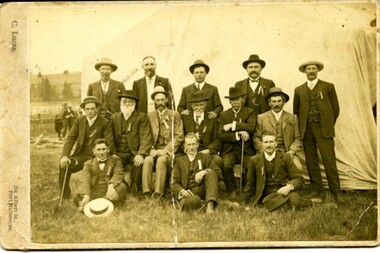
Photograph - Photographs - Whittlesea Show, C Lucas, Whittlesea Show Committee 1913, 1913
... Digital copy of photograph of the Whittlesea Agricultural Society's Show Committee 1913...Inscription on back of photograph: Mr J Thomas Whittlesea Show Committee 1913 Digital copy of photograph of the Whittlesea Agricultural Society's Show Committee 1913 Whittlesea Show Committee 1913 Photograph Photographs - Whittlesea Show C Lucas ...Digital copy of photograph of the Whittlesea Agricultural Society's Show Committee 1913Inscription on back of photograph: Mr J Thomas Whittlesea Show Committee 1913 -
 Wodonga & District Historical Society Inc
Award - Glass "Eagle Award" Wodonga Council 2010
... At that time she was Secretary and Treasurer of the Wodonga Historical Society, a member of the Wodonga Show Auxiliary and a recently retired member of the Show Society Committee. ...At that time she was Secretary and Treasurer of the Wodonga Historical Society, a member of the Wodonga Show Auxiliary and a recently retired member of the Show Society Committee. ...The Eagle Award was introduced by Wodonga City Council to recognise people within the community who volunteered in a variety of ways to support others and make Wodonga a better and positive community. The Award was granted each month for many years. Uta Wiltshire was recognised as Wodonga's August Eagle Award recipient in 2010. She worked tirelessly for her community by contributing many hours of voluntary work each week for a number of organisations and people. At that time she was Secretary and Treasurer of the Wodonga Historical Society, a member of the Wodonga Show Auxiliary and a recently retired member of the Show Society Committee. In her spare time, she visited aged people in their homes, hospitals and hostels. Uta was also an active member of Neighbourhood Watch, a teacher's assistant in remedial studies at St Augustine's Primary School and a donor to the Australian Red Cross. Uta had also been selected as Wodonga Citizen of the Year in 2018 and is a Life Member of Wodonga & District Historical Society.This item is significant because it was awarded by Wodonga City Council in recognition of the voluntary service to the Wodonga community by a valued Life Member of Wodonga & District Historical Society.A wine glass inscribed with the name of the recipient of the Wodonga Eagle Award. City of Wodonga Eagle Award Uta Wiltshire August 2010 A symbol of an eagle in goldeagle awards wodonga council, uta wiltshire, wodonga council -
 Wodonga & District Historical Society Inc
Memorabilia - Miss Wodonga Show Girl Sash 1966
... Pollard was the inaugural President of the Wodonga Show Society and was joined by seven past Shire Presidents as part of an original 25 member Wodonga Show Society committee. ...Pollard was the inaugural President of the Wodonga Show Society and was joined by seven past Shire Presidents as part of an original 25 member Wodonga Show Society committee. ...In 1947 Shire President Cr. Charles F. Pollard called a public meeting for the purpose of discussing the forming of an Agricultural Society to raise funds for the proposed Wodonga Hospital. Cr. Pollard was the inaugural President of the Wodonga Show Society and was joined by seven past Shire Presidents as part of an original 25 member Wodonga Show Society committee. In addition to the committee, there were 150 members of the inaugural Society. The first Wodonga Show was held on Saturday 6 March 1948. The first Sun-News Pictorial Miss Show Girl competition was held in Victoria in 1957, an annual tradition that lasted into the 1990s. Most country shows held heats to find a local winner before the final was judged at the Royal Melbourne Show each year. The first Miss Wodonga Show Girl competition was held in 1958. It was open to all girls between the ages of 16 and 23, born in Australia or naturalised Australians. Judging will be on the following basis of deportment, dress sense, grooming, general appearance, personality. Wodonga Show Society presented a prize to the winner who was accompanied to the final judging on People’s Day at the Melbourne Royal Show. This sash was awarded to Miss Wodonga Show Girl in 1966. The winner of the Senior Section was Ludmilla Bartosz of Wodonga. The Junior Show Girl section was won by Sue Maddison of Bandiana. First prize in the Senior section included this sash, $20 in case and a first class return rail fare to Melbourne for the final judging at the Royal Melbourne Show.A blue sash with gold trim and lettering and a fringe trim.WODONGA SHOW 1966 MISS WODONGA SHOW GIRL SASH DONATED BY PENNANT PRODUCTS MELB.wodonga agricultural society, wodonga show, miss wodonga show girl -
 Wodonga & District Historical Society Inc
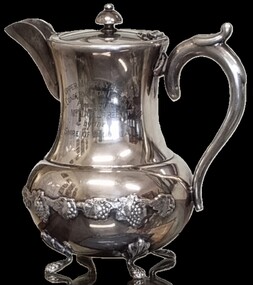
Functional object - Silver Teapot - Upper Murray Region Conservation Award
... He was a member of the provisional committee which formed to establish a Show Society and was a Foundation Member of the Wodonga Show Society s first Committee. ...He was a member of the provisional committee which formed to establish a Show Society and was a Foundation Member of the Wodonga Show Society s first Committee. ...This jug was awarded to John Albert Edward Street for his work in soil conservation at his property, Bandiana Park. John Albert Edward Street was born on the 8th November 1895 in Wodonga, Victoria to George Street and Theresa Emily Davis. He was a grandson of Frederic Street and his wife Sarah nee Kinchington, one of the earliest pioneering families in . On arrival in the Kiewa Valley, Frederic was engaged to run Gundowring Station. In 1852 Frederic took up land at Baranduda. Over the years he consolidated his holdings including land acquired by his seven sons. They established both Bandiana Park and the old Baranduda Homestead. Most of the sons stayed in the Baranduda area. The Street family continued working to farm the original property and John and his brother Clarence were pioneers in implementing soil conservation practices to improve their pastures from the mid1920s. They dissolved their partnership in 1941 but the Street family continued to farm the land until much of the property was acquired by the Albury Wodonga Development Corporation. Mr. J. A. E. Street was a community minded man. He was a member of the provisional committee which formed to establish a Show Society and was a Foundation Member of the Wodonga Show Society s first Committee. He continued to serve the Committee for 30 years. Mr Street also served on the Wodonga Shire Council. After many years of service to the Wodonga community, John Albert Edward Street passed away in Wodonga in 1976.This teapot is significant because it was presented to a prominent Wodonga and district family for their pioneering work in soil conservation.It features grape vine motifs and has lions paw feet.UPPER MURRAY REGION SOIL CONSERVATION COMPETITION Presented to MR. J.A.E. STREET by the SHIRE OF WODONGA Underneath base, in a circle - Kenson Plate EPNS A1soil conservation upper murray, wodonga shire soil conservation -
 Marysville & District Historical Society
THE TRIANGLE NEWS-VOL 39 NO 18-MAY 18 2012
... society meeting...working bee activities...notice of application for planning permit...sample wines...dalrymples guest cottages official opening...marysville & triangle community recovery committee...marysville villains lunch with lindy & bill...bill o'shea...lindy burns...australian centre for grief & bereavement...alexandra annual truck ute & rod show...marysville victoria australia string theory best upcoming young traditional group marysville golf & bowls club marysville cultural community cafe culture services 2012 what's on when in may the committee of management of the gallipoli park precinct marysville & district chamber of commerce agm creative triangle triangle bushwalkers marysville fire brigade home based child care annual conference agm advertisements mayor's chair church notices marysville lady golfers win at mansfield marysville beer & platter garden maryton park b & b cathedral ranges people & parks foundation marysville pharmacy marysville medical centre draft budget and council plan submissions reminder sesquicentenary meeting 150th anniversary local history centre councillor comment men's big breakfast b.u.i.l.t marysville & district historical society meeting working bee activities notice of application for planning permit sample wines dalrymples guest cottages official opening marysville & triangle community recovery committee marysville villains lunch with lindy & bill bill o'shea lindy burns australian centre for grief & bereavement alexandra annual truck ute & rod show real estate john bertrand gary pert terry and sharen donovon rebuild dalrymples comedy festival road show marysville community centre australian red cross acoustic concert narbethong hall planning & environmental act 1987 murrindindi planning scheme buxton hotel social club restoring sense of place pathways bushfire recovery program THE TRIANGLE NEWS-VOL 39 NO 18-MAY 18 2012 ...marysville, victoria, australia, string theory, best upcoming young traditional group, marysville golf & bowls club, marysville cultural community, cafe culture services 2012, what's on when in may, the committee of management of the gallipoli park precinct, marysville & district chamber of commerce agm, creative triangle, triangle bushwalkers, marysville fire brigade, home based child care annual conference agm, advertisements, mayor's chair, church notices, marysville lady golfers win at mansfield, marysville beer & platter garden, maryton park b & b, cathedral ranges, people & parks foundation, marysville pharmacy, marysville medical centre, draft budget and council plan submissions reminder, sesquicentenary meeting 150th anniversary, local history centre, councillor comment, men's big breakfast, b.u.i.l.t, marysville & district historical society meeting, working bee activities, notice of application for planning permit, sample wines, dalrymples guest cottages official opening, marysville & triangle community recovery committee, marysville villains lunch with lindy & bill, bill o'shea, lindy burns, australian centre for grief & bereavement, alexandra annual truck ute & rod show, real estate, john bertrand, gary pert, terry and sharen donovon, rebuild dalrymples, comedy festival road show, marysville community centre, australian red cross, acoustic concert, narbethong hall, planning & environmental act 1987, murrindindi planning scheme, buxton hotel social club, restoring sense of place, pathways bushfire recovery program -
Marysville & District Historical Society
THE TRIANGLE NEWS-VOL 40 NO 28-JULY 26 2013
... committee of management of the gallipoli park precinct...creative triangle...marysville community market...captive bred regent honeyeaters put on a show at chiltern...department of environment & primary industries...marysville & district lions club...water diving course (scuba)...church notices...new beginnings my hope for australia...paster charles & marjorie lazaro from india...councillor comment...narbethong community hall...free movie night...marysville preschool hosts annual fundraiser footy-pie night...taggerty community dinner...pioneer reserve gets a minor makeover...stolen wood...piece of history to take root in shire...murrindindi shire council...the hovell tree...school crossing safely...the marysville historical society...marysville victoria australia international delegates look to murrindindi leadership what's on when in august intrepid triangle bushwalkers the committee of management of the gallipoli park precinct creative triangle marysville community market captive bred regent honeyeaters put on a show at chiltern department of environment & primary industries marysville & district lions club water diving course (scuba) church notices new beginnings my hope for australia paster charles & marjorie lazaro from india councillor comment narbethong community hall free movie night marysville preschool hosts annual fundraiser footy-pie night taggerty community dinner pioneer reserve gets a minor makeover stolen wood piece of history to take root in shire murrindindi shire council the hovell tree school crossing safely the marysville historical society sharing community stories for historical archives real estate marysville football club reunion premiers 1973 black spur inn ugfm presents a taste of tamworth snags survey to guide work on victorian rivers mayor's chair australian grief and bereavement centre buxton fire brigade bushdance at buxton hall triangle community dance group lions-wood raffle have your say on new national parks regulations municipal public health and wellbeing plan 2013-2017 buxton recreation reserve notice of agm alexandra tennis club committee of management notice of agm THE TRIANGLE NEWS-VOL 40 NO 28-JULY 26 2013 ...marysville, victoria, australia, international delegates look to murrindindi leadership, what's on when in august, intrepid triangle bushwalkers, the committee of management of the gallipoli park precinct, creative triangle, marysville community market, captive bred regent honeyeaters put on a show at chiltern, department of environment & primary industries, marysville & district lions club, water diving course (scuba), church notices, new beginnings my hope for australia, paster charles & marjorie lazaro from india, councillor comment, narbethong community hall, free movie night, marysville preschool hosts annual fundraiser footy-pie night, taggerty community dinner, pioneer reserve gets a minor makeover, stolen wood, piece of history to take root in shire, murrindindi shire council, the hovell tree, school crossing safely, the marysville historical society, sharing community stories for historical archives, real estate, marysville football club reunion premiers 1973, black spur inn, ugfm presents a taste of tamworth, snags survey to guide work on victorian rivers, mayor's chair, australian grief and bereavement centre, buxton fire brigade, bushdance at buxton hall, triangle community dance group, lions-wood raffle, have your say on new national parks regulations, municipal public health and wellbeing plan 2013-2017, buxton recreation reserve notice of agm, alexandra tennis club committee of management notice of agm -
Marysville & District Historical Society
THE TRIANGLE NEWS-VOL 41 NO 23-JUNE 20 2014
... society...awards of merit for mary & reg kenealy...black spur open mic...marysville & triangle community men's shed...advertisements...upwey take points despite strong performance by villains...have your say on council's draft waste management and resource recovery strategy...residential & rural real estate...marysville triangle real estate...new committee members needed...marysville primary school...parent's club movie night...marysville midweek netball...marsyville preschool centre...long day care & kindergarten...black spur inn kitchen assistant...records fall at 18th annual alexandra truck ute & rod show...marysville victoria australia new ambulance community officers in training alexandra district ambulance support what's on when in june 2014 seasonal influenza vaccine available the committee of management of the gallipoli park precinct marysville community market creative triangle marysville medical clinic open 4 days a week marysville & triangle community assocn notice comedy festival after party at crossways church notices marysville golf report intrepid triangle bushwalkers mayor's chair by cr margaret rae hoffman's green grocer marysville history centre royal victorian historical society awards of merit for mary & reg kenealy black spur open mic marysville & triangle community men's shed advertisements upwey take points despite strong performance by villains have your say on council's draft waste management and resource recovery strategy residential & rural real estate marysville triangle real estate new committee members needed marysville primary school parent's club movie night marysville midweek netball marsyville preschool centre long day care & kindergarten black spur inn kitchen assistant records fall at 18th annual alexandra truck ute & rod show 2014 melbourne international comedy festival in marysville open house day highway health THE TRIANGLE NEWS-VOL 41 NO 23-JUNE 20 2014 ...marysville, victoria, australia, new ambulance community officers in training, alexandra district ambulance support, what's on when in june, 2014 seasonal influenza vaccine available, the committee of management of the gallipoli park precinct, marysville community market, creative triangle, marysville medical clinic open 4 days a week, marysville & triangle community assocn notice, comedy festival after party at crossways, church notices, marysville golf report, intrepid triangle bushwalkers, mayor's chair by cr margaret rae, hoffman's green grocer, marysville history centre, royal victorian historical society, awards of merit for mary & reg kenealy, black spur open mic, marysville & triangle community men's shed, advertisements, upwey take points despite strong performance by villains, have your say on council's draft waste management and resource recovery strategy, residential & rural real estate, marysville triangle real estate, new committee members needed, marysville primary school, parent's club movie night, marysville midweek netball, marsyville preschool centre, long day care & kindergarten, black spur inn kitchen assistant, records fall at 18th annual alexandra truck ute & rod show, 2014 melbourne international comedy festival in marysville, open house day highway health -
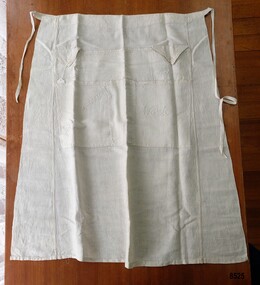 Flagstaff Hill Maritime Museum and Village
Clothing - Traveller's Apron, Eliza Towns, Circa 1915
... Charles was a jeweller and later became an accountant and for many years was involved with the Shire Council, the local show committee (A & P Society), the Hospital Committee and the Board of the local newspaper (the Nhill Free Press). ...Charles was a jeweller and later became an accountant and for many years was involved with the Shire Council, the local show committee (A & P Society), the Hospital Committee and the Board of the local newspaper (the Nhill Free Press). ...This apron is one of several linen and clothing items that were made and belonged to Mrs. Eliza Towns and donated to Flagstaff Hill Maritime Museum and Village. Eliza was born Eliza Gould in 1857 in South Melbourne (Emerald Hill) and in 1879 married Charles Towns. In the early 1880's they moved to Nhill in western Victoria and remained there for the rest of their married life. Charles was a jeweller and later became an accountant and for many years was involved with the Shire Council, the local show committee (A & P Society), the Hospital Committee and the Board of the local newspaper (the Nhill Free Press). They had three children and lived a life that would be regarded as comfortably "middle class". Eliza probably had a treadle sewing machine and would have made many of her own clothes - adding her own handmade embroidered or crocheted decorative trim. In March 1915 Eliza travelled to San Francisco to visit her son, James. She went by train to Melbourne ("a pleasant journey on the up express') and the next day caught the express train to Sydney. She noted in her letters home that a " number of young men were going to Sydney to enlist but they had to stop in the corridors most of the way as there was no room for them to sit down". She spent the night on the train and arrived in Sydney the next morning and on the following day she boarded the R.M.S. "Moana" (a steamer which took about twenty-four days to reach San Francisco). She returned from Vancouver about five months later on board the "Manuka". It is very likely Eliza took this "Travelling Apron" with her on her travels. Eliza was travelling by herself and had no one to help her with her dress or her hair. "Travelling Aprons" (also known as Toilet Aprons or Tourist Aprons) were designed with different sized pockets for holding a lady's toiletries - hairbrush, hair pins, comb and sometimes even soap and a powder puff. This allowed the owner, when travelling and getting dressed in small places such as an overnight train compartment or a ship's cabin, to have all her requirements at hand without needing to search for them or have them roll onto the floor. Some of the pockets are finished with buttoned flaps to keep the items in place and when not in use, the apron could be hung up or rolled up and put away. Articles about the "Traveller's Apron" appeared in numerous Women's columns in Australian newspapers in the early 20th century - often with instructions and sometimes a pattern. In the "Age" on Sat 5th October 1907 in a column titled "Feminine Facts and Fancies" the author wrote "No man can appreciate the difficulties of dressing in a "wobbly" train or trying to do one's hair while a ship is weathering a storm". A year earlier (Saturday 24th March 1906) in the same column, the author wrote "... you have to spend nights in a train... forever struggling to dress yourself in a wretched little lavatory. You know how your hairpins and combs jump all over the place ... a train is always at its liveliest when you're trying to do your hair. My travelling apron saved me many a rage."This item is an example of the needlework skills of women in the early 20th century - combining machine stitching with hand embroidery to personalise and embellish a practical domestic object. It is also an excellent (and rare) example of an early 20th century innovation that helped solve the difficulties of privacy and convenience that many women experienced at a time when travel was becoming more accessible to them. A half apron, made of ivory linen with two waist ties and seven pockets. Along the top are two smaller pockets with triangular, buttoned flaps labelled "Hairpins" and "Nailbrush" and one larger unlabelled pocket. Underneath are two larger pockets labelled "Brush & Comb" and "Work" and two unlabelled narrow pockets. The seams are machine stitched and the pockets are outlined with hand embroidered feather stitch. The labels on the pockets are embroidered in stem stitch."Hairpins" / "Nailbrush" / "Brush and Comb" / "Work"flagstaff hill maritime museum and village, nhill, eliza towns, apron, travelling apron, tourist apron, textiles, toilet apron, sewing, embroidery, travel, warrnambool, great ocean road, trains, ships, moana, manuka, feather stitch, stem stitch, fashion, handmade, clothing, charles towns, needlework -
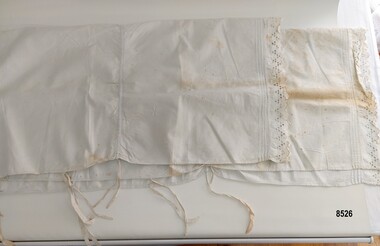 Flagstaff Hill Maritime Museum and Village
Textile - Bolster Sham, Eliza Towns, Late 19th century to early 20th century
... Charles was a jeweller and later became an accountant and for many years was involved with the Shire Council, the local show committee (A & P Society), the Hospital Committee and the Board of the local newspaper (the Nhill Free Press). ...Charles was a jeweller and later became an accountant and for many years was involved with the Shire Council, the local show committee (A & P Society), the Hospital Committee and the Board of the local newspaper (the Nhill Free Press). ...This bolster sham is one of several linen and clothing items that were made and belonged to Mrs. Eliza Towns and donated to Flagstaff Hill Maritime Museum and Village. Eliza was born Eliza Gould in 1857 in South Melbourne (Emerald Hill) and in 1879 married Charles Towns. In the early 1880's they moved to Nhill in western Victoria and remained there for the rest of their married life. Charles was a jeweller and later became an accountant and for many years was involved with the Shire Council, the local show committee (A & P Society), the Hospital Committee and the Board of the local newspaper (the Nhill Free Press). They had three children and lived a life that would be regarded as comfortably "middle class". Eliza probably had a treadle sewing machine and would have made many of her own clothes and household linens - adding her own handmade embroidered or crocheted decorative trim. Most beds during the late 19th and early 20th century had a feather, hair or spring mattress covered by a blanket and topped with an under sheet, an upper sheet, several blankets and a bedspread. A flat bolster could be placed either under the pillows or on top of the pillows with a decorative sham. Washing pillows and quilts by hand would have been a very onerous task (involving heating water and handwashing in a tub or using a copper) and so it became the practise of many housewives to cover the pillows and bolsters with an outer slip (or sham) of washable material which could be easily removed and washed when needed. If the bolster was kept under the pillows it wouldn't need to be very decorative but many shams or slips that were "on show" were often highly decorated with embroidery, pintucks, ribbons or lace. This bolster sham is machine made and quite plain with the exception of some pintucking and eyelet lace on each end which suggests that it would mostly be hidden under the top pillows with just the decorative edges on display.This item is an example of the needlework skills of women in the early 20th century - combining machine stitching with hand embroidery to personalise and embellish a practical domestic object. It is also significant as an example of an early 20th century innovation that helped make the working lives of housewives a little bit easier.A long white cotton rectangular bolster sham, machine sewn, with seven ties and two buttons (plus one missing button) to enable it to be folded over lengthwise and closed. It has two pull string ties near each end to enclose a bolster and is finished with a decorative edge of pintucks and handmade eyelet lace and embroidery.flagstaff hill maritime museum and village, eliza towns, sham, bedding, great ocean road, shipwreck coast, warrnambool, household textiles, sewing, bolster sham, housework, pillow sham, charles towns, nhill, haberdashery, needlework, manchester, handmade, household linen -
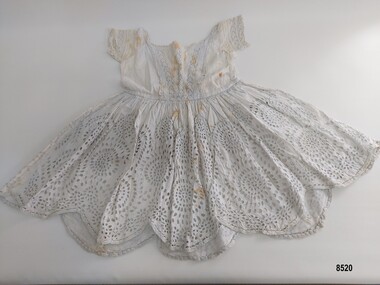 Flagstaff Hill Maritime Museum and Village
Clothing - Child's dress, Eliza Towns, Late 19th century
... Charles was a jeweller and later became an accountant and for many years was involved with the Shire Council, the local show committee (A & P Society), the Hospital Committee and the Board of the local newspaper (the Nhill Free Press). ...Charles was a jeweller and later became an accountant and for many years was involved with the Shire Council, the local show committee (A & P Society), the Hospital Committee and the Board of the local newspaper (the Nhill Free Press). ...This child's dress is one of several linen and clothing items that were made and belonged to Mrs. Eliza Towns and donated to Flagstaff Hill Maritime Museum and Village. Eliza was born Eliza Gould in 1857 in South Melbourne (Emerald Hill) and in 1879 married Charles Towns. In the early 1880's they moved to Nhill in western Victoria and remained there for the rest of their married life. Charles was a jeweller and later became an accountant and for many years was involved with the Shire Council, the local show committee (A & P Society), the Hospital Committee and the Board of the local newspaper (the Nhill Free Press). They had three children and lived a life that would be regarded as comfortably "middle class". Eliza probably had a treadle sewing machine and would have made many of her own clothes as well as clothes for her children - adding her own handmade embroidered or crocheted decorative trim. A photograph of their youngest child, Alice, taken in circa 1903 depicts her wearing the dress. The dress would have been only worn on special occasions (such as a formal family photographic portrait) as most young girls in that era would have smocks or pinafores for everyday wear. The age of the dress is in question as it may have been made by Eliza for her eldest daughter, Dorcus, who was born in 1884. This dress has some machine sewing at the neck, waistband and pintucks but much of the dress is handsewn and richly embroidered with Broderie anglaise. Broderie anglaise (also known as eyelet lace) is a form of cutwork embroidery. The foundation fabric is cut to make decorative holes which are sewn with overcast or buttonhole stitches to create a lace like effect. Designs often involve floral motives that are enhanced with simple embroidery stitches such as stem stitch and satin stitch and scalloped edges finished with buttonhole stitches. It was commonly used to trim baby clothes, dresses, nightclothes, underclothes and household linens - particularly in the Victorian and Edwardian eras. This item is an example of the needlework skills of women in the late 19th century - combining machine stitching with hand embroidery to personalise and embellish a child's special dress.Child's white dress made of cotton and lawn, with a skirt of hand embroidered circular cutwork (broderie anglaise), a scalloped hem edged in buttonhole stitch and a gathered waist. The lined bodice has three panels of hand embroidered broderie anglaise (eyelet lace) inserted in a V shape with pintucks and bordered with a broderie anglaise lace frill. The short sleeves also have an inserted broderie anglaise lace strip, three pintucks and a broderie anglaise lace frill. The skirt is semi lined with fine lawn. The dress has a back opening with one button and two ties. The neckline is decorated with two rows of hand embroidered broderie anglaise lace.flagstaff hill, flagstaff hill maritime museum & village, warrnambool, shipwreck coast, great ocean road, nhill, wimmera, eliza towns, dorcus towns, child's dress, machine sewing, hand sewing, broderie anglaise, cutwork, embroidery, eyelet lace, clothing, handmade, charles towns, alice towns -
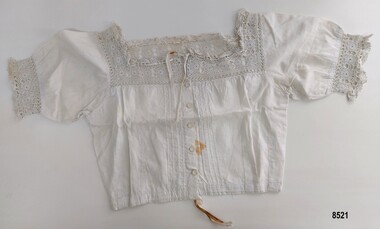 Flagstaff Hill Maritime Museum and Village
Clothing - Corset cover, Eliza Towns, Mid to late 19th century
... Charles was a jeweller and later became an accountant and for many years was involved with the Shire Council, the local show committee (A & P Society), the Hospital Committee and the Board of the local newspaper (the Nhill Free Press). ...Charles was a jeweller and later became an accountant and for many years was involved with the Shire Council, the local show committee (A & P Society), the Hospital Committee and the Board of the local newspaper (the Nhill Free Press). ...This corset cover is one of several linen and clothing items that were made and belonged to Mrs. Eliza Towns and donated to Flagstaff Hill Maritime Museum and Village. Eliza was born Eliza Gould in 1857 in South Melbourne (Emerald Hill) and in 1879 married Charles Towns. In the early 1880's they moved to Nhill in western Victoria and remained there for the rest of their married life. Charles was a jeweller and later became an accountant and for many years was involved with the Shire Council, the local show committee (A & P Society), the Hospital Committee and the Board of the local newspaper (the Nhill Free Press). They had three children and lived a life that would be regarded as comfortably "middle class". Eliza probably had a treadle sewing machine and would have made many of her own clothes as well as clothes for her children - adding her own handmade embroidered or crocheted decorative trim. This corset cover is an excellent example of an everyday clothing item with the decorative trim favoured by women in the late Victorian era. Eliza Towns has added pintucks, embroidered feather stitch and a highly decorative hand crocheted lace trim to the neckline, sleeves and front of the bodice. Corset covers (sometimes called camisoles) began to appear in women's fashion around 1840 and continued through the late Victorian decades into the Edwardian era. The long chemise was considered too bulky to cover the corset and so the corset cover was developed to be short and light and was worn over the corset and under the bodice of the outer garment. A woman would dress into her chemise and drawers first, followed by her corset and finally her corset cover as a final layer under her dress. Corset covers served several purposes. They provided protection against sweat (and the need to regularly wash the corset), helped smooth the lines of the corset and increased a woman's modesty.This item is an example of the needlework skills of women in the late 19th century - combining machine stitching with hand embroidery and crochet to embellish an item of personal underclothing. It is also significant as an example of a practical solution to the difficulty of hand washing a corset in the Victorian era.A short (waist length) corset cover of fine cotton. Short sleeves fall from a square neckline and are gathered into a wide crocheted lace trim with a band of embroidered feather stitch. The same crocheted lace design and feather stitching are also on the square neckline which is finished with a drawstring ribbon. The bodice has a front opening with five buttons and is bordered on each side with four pintucks. It has a drawstring ribbon at the waist and an extra layer of fine cotton lining has been added to strengthen the corset cover under the arms. The back has two bands of three pintucks running vertically from the neckline to the waist.flagstaff hill, flagstaff hill maritime museum & village, warrnambool, great ocean road, shipwreck coast, nhill, wimmera, eliza towns, underclothing, corset cover, camisole, machine sewing, hand sewing, crocheted lace, pintucks, feather stitch, embroidery, underwear, victorian era underclothing, victorian era corset cover -
 Flagstaff Hill Maritime Museum and Village
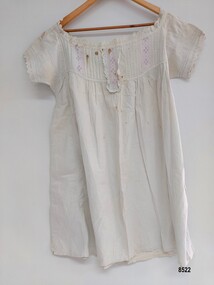
Clothing - Chemise, Eliza Towns, Late Victorian era
... Charles was a jeweller and later became an accountant and for many years was involved with the Shire Council, the local show committee (A & P Society), the Hospital Committee and the Board of the local newspaper (the Nhill Free Press). ...Charles was a jeweller and later became an accountant and for many years was involved with the Shire Council, the local show committee (A & P Society), the Hospital Committee and the Board of the local newspaper (the Nhill Free Press). ...This chemise is one of several linen and clothing items that were made and belonged to Mrs. Eliza Towns and donated to Flagstaff Hill Maritime Museum and Village. Eliza was born Eliza Gould in 1857 in South Melbourne (Emerald Hill) and in 1879 married Charles Towns. In the early 1880's they moved to Nhill in western Victoria and remained there for the rest of their married life. Charles was a jeweller and later became an accountant and for many years was involved with the Shire Council, the local show committee (A & P Society), the Hospital Committee and the Board of the local newspaper (the Nhill Free Press). They had three children and lived a life that would be regarded as comfortably "middle class". Eliza probably had a treadle sewing machine and would have made many of her own clothes as well as clothes for her children - adding her own handmade embroidered or crocheted decorative trim. This chemise is machine sewn by Eliza Towns and she has added pintucks and broderie anglaise lace as a decorative element. A chemise was usually a sleeveless garment made of linen or cotton (so they could be easily washed) and its shape was much like a modern day nightgown. The name comes from the French word for "shirt" or "shift". Women wore chemises next to the skin (under the corset) to keep stains and odors away from the less washable corset and gown.This item is an example of the needlework skills of women in the mid to late 19th century - combining machine stitching with hand embroidery to personlise and embellish an item of clothing. It is also significant as an example of a practical solution to the difficulties of needing to regularly hand wash a bulky outer garment or gown in the Victorian era.A white cotton, short sleeved, knee length chemise. The fabric at the front is gathered on a yoke which is decorated with bands of five pintucks alternating with broderie anglaise lace and embroidered strips lined with pink ribbon. A different broderie anglaise design decorates the sleeve edges, neckline and center broderie anglaise strip. The back of the chemise is gathered on to the neckline. There are two bands of pintucks on each sleeve. The fabric around each armhole has been strengthened with another layer of cotton and a length of cotton has been added (from the left shoulder to the hem) to increase the width of chemise.flagstaff hill, flagstaff hill maritime museum and village, warrnambool, great ocean road, south west victoria, victorian era, victorian era undergarments, chemise, victorian era chemise, undergarments, pintucks, victorian chemise, eliza towns, nhill, wimmera, home sewing, machine sewn, hand made -
 Flagstaff Hill Maritime Museum and Village
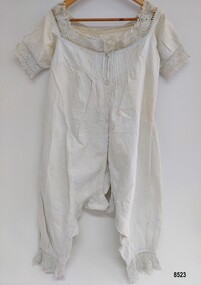
Clothing - Combination Undergarment, Eliza Towns, Late 19th century
... Charles was a jeweller and later became an accountant and for many years was involved with the Shire Council, the local show committee (A & P Society), the Hospital Committee and the Board of the local newspaper (the Nhill Free Press). ...Charles was a jeweller and later became an accountant and for many years was involved with the Shire Council, the local show committee (A & P Society), the Hospital Committee and the Board of the local newspaper (the Nhill Free Press). ...This item of underclothing, called a "combination" is one of several linen and clothing items that were made and belonged to Mrs. Eliza Towns and donated to Flagstaff Hill Maritime Museum and Village. Eliza was born Eliza Gould in 1857 in South Melbourne (Emerald Hill) and in 1879 married Charles Towns. In the early 1880's they moved to Nhill in western Victoria and remained there for the rest of their married life. Charles was a jeweller and later became an accountant and for many years was involved with the Shire Council, the local show committee (A & P Society), the Hospital Committee and the Board of the local newspaper (the Nhill Free Press). They had three children and lived a life that would be regarded as comfortably "middle class". Eliza probably had a treadle sewing machine and would have made many of her own clothes as well as clothes for her children - adding her own handmade embroidered or crocheted decorative trim. Combination undergarments combined the chemise and drawers into one garment. The combination is divided, or bifurcated, from the waist to the crutch for easier urinating. This one-piece type of underwear was worn by females from the 1860s and into the early 1900s. The 19th Century garments had front button closures like this one, and those made in the 1900s more often had back closures. Combination underwear was popular because the all-in-one design had far fewer gathers and bulk, making the other clothing look much smoother. Their primary use was to protect clothing from perspiration and because they were made with cotton or linen, were easy to wash. Although they were worn under the corset, next to the skin (and therefore not meant to be seen), they were often decorated with lace and embroidery. Although these combinations are made with a plain cotton fabric, Eliza Towns has incorporated pin tucks, hand embroidery and crocheted lace to embellish her garment. The collection of women’s late-19th-century undergarments is an example of clothing that women would include in their wardrobes. The garments add to the study of the evolution of women's fashions and practicality for the early Australian settlers. The careful needlework in these handmade garments and hand-worked lace trims reflect the maker’s dedication to making even serviceable garments beautiful to look at and wear.Women’s white cotton and lace all-In-one combination undergarment. The handmade underwear is a combined chemise and bloomers. It has three buttons in the front and a handmade drawstring cord around the square neckline. It is trimmed with crocheted lace (with a floral design) on the neckline, sleeves and pants. It had pintucks and feather stitching on the bodice and the left and right sides are divided from the waist to the crutch. The back of the garment is plain with a gathered section at the lower back.flagstaff hill maritime museum and village, maritime museum, maritime village, warrnambool, great ocean road, victorian era, combination undergarment, all-in-one underwear, combination, ‘combinations’, one-piece underwear, one-piece undergarment, chemise and bloomers, combination chemise and bloomers, divided, bifurcated, split, chemise and drawers, women’s underwear, ladies’ underwear, undergarment, women’s clothing, women’s fashion, lingerie, 19th-century undergarment, handmade clothing, handmade lace, crocheted lace, towns family, nhill, eliza towns -
 Flagstaff Hill Maritime Museum and Village
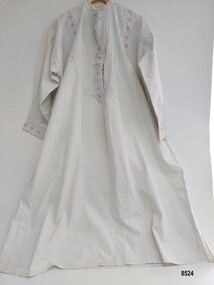
Clothing - Nightgown, Eliza Towns, circa 1890's
... Charles was a jeweller and later became an accountant and for many years was involved with the Shire Council, the local show committee (A & P Society), the Hospital Committee and the Board of the local newspaper (the Nhill Free Press). ...Charles was a jeweller and later became an accountant and for many years was involved with the Shire Council, the local show committee (A & P Society), the Hospital Committee and the Board of the local newspaper (the Nhill Free Press). ...This nightgown is one of several linen and clothing items that were made and belonged to Mrs. Eliza Towns and donated to Flagstaff Hill Maritime Museum and Village. Eliza was born Eliza Gould in 1857 in South Melbourne (Emerald Hill) and in 1879 married Charles Towns. In the early 1880's they moved to Nhill in western Victoria and remained there for the rest of their married life. Charles was a jeweller and later became an accountant and for many years was involved with the Shire Council, the local show committee (A & P Society), the Hospital Committee and the Board of the local newspaper (the Nhill Free Press). They had three children and lived a life that would be regarded as comfortably "middle class". Eliza probably had a treadle sewing machine and would have made many of her own clothes as well as clothes for her children - adding her own handmade embroidered or crocheted decorative trim. This nightgown is machine sewn by Eliza Towns and she has added a detailed design of pintucks and broderie anglaise lace to the front yoke and cuffs as a decorative element. The 1800's bought a shift in attitude towards modesty as the Victorian era progressed and by the mid to late 1800's it had become more acceptable ladies to wear simple, modest nightgowns. They tended to have a very loose fit and were usually made of linen, cotton or flannel, which had the advantage of providing warmth and also being easy to wash - a necessity for a garment worn next to the skin. Although the basic design of the nightgown was fairly simple, the wearer was free to add various types of trim e.g. lace, crochet, pintucks, embroidery etc.This item is an example of the needlework skills of women in the late 19th century - combining machine stitching with hand embroidery to personalise and embellish a practical item of clothing. It is also significant as an example of a practical solution to the difficulties that women of this era faced with regard to the washing of clothes and household linens.Lady's long, white, cotton nightgown with a V shaped bodice decorated with bands of nine pintucks alternating with strips of broderie anglaise lined with pink ribbon. The opening front placket and neckline are bordered with a simpler broderie anglaise lace. The long sleeves are gathered into cuffs with a matching V shape, pintuck and broderie anglaise design. The front placket fastens with three cream buttons although one is missing. The back of the nightgown has gathered fabric on a plain, narrow V shape yoke. A narrow gusset has been added to the both sides at the bottom of the nightgown.Noneflagstaff hill, flagstaff hill maritime museum and village, warrnambool, great ocean road, shipwreck coast, victorian era clothing, victorian era nightgown, nightgown, nightdress, eliza towns, nhill, wimmera, textiles, clothing, machine sewing, hand sewing, pintucks, broderie anglaise, sewing -
 Orbost & District Historical Society
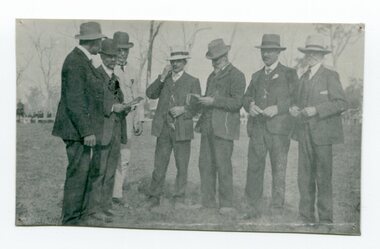
black and white photograph, S.F. Gerberg & Bulmer, C 1908u
... shows members of the Orbost Agricultural Show committee about 1908 with L to R : S. Lynn; John Russell; Mat Lynch; W. Warren; John Johnson; Will Cumming & Geo. Perry. The first meeting to form an Agricultural society...shows members of the Orbost Agricultural Show committee about 1908 with L to R : S. Lynn; John Russell; Mat Lynch; W. Warren; John Johnson; Will Cumming & Geo. Perry. The first meeting to form an Agricultural society ...This photograph shows members of the Orbost Agricultural Show committee about 1908 with L to R : S. Lynn; John Russell; Mat Lynch; W. Warren; John Johnson; Will Cumming & Geo. Perry. The first meeting to form an Agricultural society in Orbost was convened by the then Orbost Progress Association and held in the Mechanics Hall on Saturday, 10th October 1891. Its first show was held on 3rd March 1904...on a site alongside the Bonang Road where the present Golf Club stands. It is currently held at the Recreation Reserve at Newmerella. (Ref: In Times Gone By-Deborah Hall) This item is associated with the Orbost Agricultural Society 's Annual Show which has been a major event in Orbost for over a century. Agricultural shows are an important part of cultural life in small country towns and the Orbost Show is an integral part of Orbost 's agricultural history. A faded black / white photograph of seven men standing outside with trees in the background.on back - " Orbost Agricultural Show" and list of men in photograph.orbost-agricultural-society annual-show -
 Orbost & District Historical Society
black and white photograph, 1930 - 1940
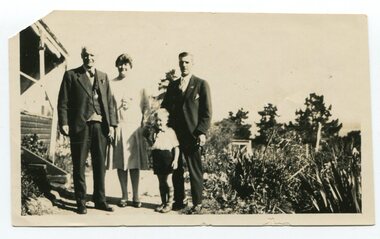
... He was chairman of the Bean Board and a well-known horse and show judge and a member of the Royal Agricultural Society. He was an elocutionist of some note and a member of the committee of management of the Orbost Hospital. ...He was chairman of the Bean Board and a well-known horse and show judge and a member of the Royal Agricultural Society. He was an elocutionist of some note and a member of the committee of management of the Orbost Hospital. ...This photograph shows three generations of the Russell family in Orbost. On the left is John Russell with his son Bill Russell and his wife Ede and their son Ian. John Russell Senior was a blacksmith, wheelwright, farmer and chairman of the Orbost Butter Factory, makers of Sunny South Butter (today part of Murray Goulburn Co Ltd). Bill was born at Orbost in 1893, the youngest son of John and Elizabeth Maud (nee Clarke). Upon his father’s retirement he took over the homestead part of the holding, 1,000 acres of river flats and hill land. He was involved in dairying and was also a successful beef cattle breeder and maize grower. He was elected to the Orbost Shire Council in 1929 and shortly afterwards was President for 18 months (from May 1930 to August 1931). He served a further term as President in 1934-35. He represented the South riding. He was chairman of the Bean Board and a well-known horse and show judge and a member of the Royal Agricultural Society. He was an elocutionist of some note and a member of the committee of management of the Orbost Hospital. He was also a prominent member and Past Master of the Masonic Lodge and a Justice of the Peace. He served as president of the Orbost Golf Club and assisted with the preparation and layout of the present Orbost Golf course. This item is associated with the Russell family, early settlers in the Orbost district.A black / white photograph of a family. A lady is in the middle with a man on each side and a young boy in front. They are standing outside a house in the garden.on back - "3 generations, Johnny Russell, Ede & Bill Russell & Ian Russell"russell-family-orbost -
 Orbost & District Historical Society
Photograph - Orbost Agricultural Society Committee, 1902
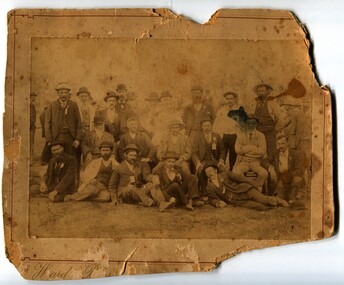
... Moves to begin an Orbost Agricultural Show was started in 1891 and a Committee was formed. The Society's first Show was held on Tuesday 15 March 1892. ...Moves to begin an Orbost Agricultural Show was started in 1891 and a Committee was formed. The Society's first Show was held on Tuesday 15 March 1892. ...Moves to begin an Orbost Agricultural Show was started in 1891 and a Committee was formed. The Society's first Show was held on Tuesday 15 March 1892. The Orbost Agricultural Show continues to the present day (2023) as an annual event held in March. The Committee shown in this photograph are known to be President: John Johnstone; Vice Presidents: F Nixon, M Lynch, A E Rodwell; Secretary: Geo Perry Committee: S Lynn, Geo Answer, C Drevermann, J Bird, J Draffin, J Cummings, R Mosley, H James, A Saunders, P Morris, G Carter, A Pardew, Jas Nixon, J Gilbert, S Grenville, W Scharleman, G Nixon, H Richardson, J Hocking, J Fisher, J Hossack This photograph shows an early Orbost Show Committee which consists entirely of men. A badly yellowed and damaged b/w photograph onto cardboard. Both the image and the cardboard are damaged. The photograph is of a group of men, some sitting on the ground, some standing behind. Written onto the back of the photograph are these words: 1902 Orbost Agricultural Society Committeeagricultural show, orbost -
Ringwood and District Historical Society
Programme, Ringwood and District Horticultural and Garden Club, Ringwood and District Horticultural and Garden Club Schedule for the Annual Autumn Show, 1971, 1971
... Society. Exhibits should be names. In a close finish this counts. No Exhibitor allowed in Hall whilst Judging is in progress. Any Protest shall be in writing accompanied with a 50 cent deposit lodged with the Secretary before 7 p.m. on day of Show. Protest must be limited to non-accordance of an Exhibit within the Schedule. The Committee...Society. Exhibits should be names. In a close finish this counts. No Exhibitor allowed in Hall whilst Judging is in progress. Any Protest shall be in writing accompanied with a 50 cent deposit lodged with the Secretary before 7 p.m. on day of Show. Protest must be limited to non-accordance of an Exhibit within the Schedule. The Committee ...Ringwood and District Horticultural and Garden Club Schedule for the Annual Autumn Show, 1971.12 page booklet- typed Schedule.Front Page Ringwood and District Horticultural and Garden Club Schedule for the Annual Autumn Show To be held in the Assembly Hall, Ringwood High School, Bedford Road, Ringwood Saturday, March 6, 1971. (Doors Open at 2 p.m.) Entries close: 9 p.m. Thursday March 4th, 1971. Admission: Adults: 30 centsChildren: 5 cents Next Page OFFICE BEARERS LIFE MEMBERS: Mrs.Lord, Mrs.W.McDowell, Mr.B.J.Hubbard, Messrs.W.Gillespie, E.Bennett, G.W.Burns, E.T.Kearsley, Les.Ingram, W.McDowell. PRESIDENT:Mr.J.Roberts 39 Warrandyte Road Ringwood, Telephone: 870-1483 VICE-PRESIDENTS: Mrs.D.Hutchinson Mr.V.H.Wilson MENS' COMMITTEE: Mr.G.W.Burns, Mr.W.McDowell, Mr.E.Frame, Mr.V.H.Wilson, MR.J.Percival LADIES COMMITTEE: Mesdames: W.McDowell, D.Hutchinson, A.Mabu, D.Wilson, Miss Isbester TREASURER: Mr.D.Puckey Summit Crescent Ringwood North SECRETARY: Mrs.V.H.Wilson 38 William Street Ringwood, Telephone: 870-7458 ENTRIES CLOSE ON THRUSDAY MARCH 4TH 1971 AT 9 P.M. NO LATE ENTRIES WILL BE ACCEPTED AT THIS SHOW. PROGRAMME Staging of Exhibits 8.30 a.m. till 12 Noon Judging Commences 12.30 p.m. Show Opens 2.30 p.m. Removal of Exhibits 9.00 p.m. Admission: Adults: 30 centsChildren: 5 cents Page One EXHIBITORS MAY MAIL OR TELEPHONE ENTRIES TO THE UNDERMENTIONED:- MRS.V.H.WILSON,38 William Street, Ringwood870-7458 MRS.D.HUTCHINSON, 48 Caroline Street, RINGWOOD 870-8577 ENTRIES CLOSE THURSDAY MARCH 4TH AT 9 P.M. RULES FOR COMPETITORS All Exhibits must be stages by 12 Noon and must not be removed before 9 p.m. Exhibitors must apply on moring of Show to the Secretary for Cards which must be placed in front of Exhibit in the allotted space. All Exhibits, except Floral Art, must be grown by the Exhibitor. Awards will be made by the Judges whose decision is final. Prize Money available at 8 p.m. and if not claimed within one month will revert to the Society. Exhibits should be names. In a close finish this counts. No Exhibitor allowed in Hall whilst Judging is in progress. Any Protest shall be in writing accompanied with a 50 cent deposit lodged with the Secretary before 7 p.m. on day of Show. Protest must be limited to non-accordance of an Exhibit within the Schedule. The Committee is empowered to determine and protest to be forfeited if it deems such to be frivolous. BOWL:- The width of the vessel must be greater than its height. VASE:- The height of the vessel must be greater than its width. Page Two Continuation of: RULES FOR COMPETITORS... The Rules of the Royal Horticultural Society of Victoria will apply. Dahlias will be judged under the Rules and Standards laid down by the National and Royal Dahlias Society of Victoria. A VASE consists of 3 to 6 stems (in Cut Flowers) unless otherwise stated. AWARDS: Bronze Medal of the National Dahlia Society for Best Dahlia Exhibit. BLUE RIBBONS MAY BE AWARDD FOR:- BEST VASE OF CUT FLOWERS BEST DAHLIA OVER 6 INCHES BEST VASE DAHLIAS UNDER 6 INCHESBST FLORAL ART EXHIBIT BEST SEEDLING DAHLIA CERTIFICATES OF MERIT:- GIANT DAHLIA OVER 8 INCHESBEST SHRUB MINIATURE CACTUS DAHLIA BETWEEN 4 1/2" TO 6" BEST POT PLANT CHARM DECORATIVE BETWEEN 6' AND 8' BEST VEGETABLE BEST SINGLE ROSE UNLESS OTHERWISE STATED ENTRY FEE PER SCHEDULE CLA CLASS - 5 CENTS PER ENTRY. PLEASE NOTE THAT ENTRY FEE FOR ITEMS NO. 1 AND 2 IS 25 CENTS IN EACH SECTION ENTRIES CLOSE: THURSDAY MARCH 4TH, 1971 AT 9 P.M. Page Three VICTORIANCHAMPIONSHIPSECTION 1 SCH.NO: FIRST 1DAHLIAS UNDER 8 INCHES 12 Vases (3 of each) Distinct Varieties TROPHY VALUED AT $5.00 29 Giant Dahlias, Distinct Varieties (SPONSORED BY AMETCO TRAVEL AGENCY, RINGWOOD) To be won Three Times - Trophy valued at $20-00 DAHLIAS OPEN SECTION 2 39 Dahlias 3 Medium Cactus, 3 Miniature Cactus, 3 Charm Cactus, Distinct Varieties, Shown separately $2-00 44 Giant Decorative, Distinct Varieties 50c. 51 Giant Decorative 30c. 63 Giant Cactus, Distinct Varieties 50c. 71 Giant Cactus 30c. 86 Medium Garden Cactus N.N.D. 50c. 93 Medium Garden Cactus, Distinct Varieties 50c. 10 3 Medium Decorative Distinct Varieties 50c. 11 1 Medium Decorative 30c. 12 6 Vases Miniature Cactus, Distinct Varieties - 3 of each - 75c 13 3 Vases Miniature Cactus, Distinct Varieties - 3 of each - 50c 14 3 Vases Miniature Decorative, Distinct Varieties - 3 of each 50c 15 1 Vase Miniature Dahlias - 3 Blooms Distinct Variety 30c 16 3 Vases Charm Cactus, Distinct Varieties - 3 of each - 50c 17 3 Vases Charm Decorative - Distinct Varieties - 3 of each 50c Page Four Continuation of: SECTION 2 - DAHLIAS OPEN. SCH.NO. FIRST 18 1 Vase Charm, 3 Blooms, Distinct Variety30c 19 Seedling Dahlia Over Six Inches30c 20 Seedling Dahlia Under Six Inches 30c 21 3 Vases Pompones, Distinct Varieties, 3 of each50c 22 1 Vase Pompones, N.N.D, 50c 23 3 Exhibition Cactus Distinct Varieties 50c 24 1 Exhibition Cactus30c 25 1 Miniature Dahlia20c 26 1 Charm Dahlia 20c 27 1 Vase Dahlias Under 8 Inches, 10 Stalks, N.N.D. 75c SECTION 3: RINGWOOD AND DISTRICT AMATEUR CHAMPIONSHIP DAHLIAS - AMATEUR 28 6 Giant Dahlias, Distinct Varieties $1.00 29 9 Dahlias Distinct Varieties (Shown Separately) 3 Medium Cactus; 3 Miniature Cactus, 3 Charm Cactus $2.00 30 3 Giant Decorative Distinct Varieties 50c 31 1 Giant Decorative30c 32 3 Giant Cactus, Distinct Varieties 30c 34 3 Medium Decoratve Distinct Varieties 50c 35 1 Medium Decorative 30c 36 3 Medium Cactus Distinct Varieties50c 37 1 Medium Cactus 30c 38 3 Vases Miniature Cactus Distinct Varieties (3 of each) 50c 39 1 Vase Miniature Cactus 3 Blooms N.N.D. 50c 40 1 Vase Miniature Decorative 3 Blooms N.N.D.50c Page Five Continuation of: SECTION 3 - AMATEUR DAHLEA CLASS SCH.NO: FIRST 413 Vases Charm Cactus, Distinct Varieties - 3 of each -50c. 421 Vase Charm Cactus, Distinct Variety - 3 Blooms - 30c 433 Vases Charm Decorative, Distinct Varieties, 3 of each50c 441 Vase Charm Decorative 5 Blooms N.N.D. 30c 451 Vase Miniature, 3 Blooms, N.N.D.20c 461 Charm 471 Vase Pompones 5 Blooms N.N.D.50c 481 Vase Show or Ball Dahlias 3 Blooms N.N.D. 50c. SECTION 4: DAHLIAS - NOVICE 491 Giant Dahlia 30c 501 Medium Dahlia 30c 511 Vase Miniature Dahlias, 3 Blooms, N.N.D.30c 521 Vase Charm Dahlias, 3 Blooms, N.N.D. 30c 531 Miniature Dahlia20c 541 Charm Dahlia 20c SECTION 5:R O S E S-O P E N 55Roses, 3 Blooms in Separate Containers, (Distinct Varieties)40c 56Roses, 3 Blooms, 1 colour shown separately 30c 57Roses, 3 Blooms, Bud to Full Bloom 30 c 58Roses, 3 Vases, Distinct Varieties 75c 59Roses, 1 Vase Full Bloom showing stamens 30c 60Roses, 1 Vase C.V.A. 20c Page Six Continuation of: SECTION 5 - R O S E S-O P E N SCH.NO:FIRST 611 Rose in Bloom20c 62Rose, 1 Vase of Floribunda or Grandiflora 30c SECTION 6 - R O S E S - A M A T E U R 63Rose, 1 Bloom20c 64Rose, 1 Vase, C.V.A. 30c 65Roses, 3 Blooms, Distinct Varieties35c 66Roses, 3 Blooms, Bud to Full Bloom 35c 67Roses, 1 Vase Floribunda or Grandiflora30c SECTION 7C U T F L O W E R S -O P E N 683 Vases Cut Flowers, Distinct Kinds, C.V.A. 50c 691 Vase Cut Flowers, Distinct Variety, C.V.A. 25c 701 Vase Cut Flowers, Red Shades, Distinct Kind 25c 711 Vase Cut Flowers, Pink Shades, Distinct Kind25c 721 Vase Cut Flowers, White Shades, Distinct Kind 25c 731 Vase Cut Flowers, Cream or Yellow Shades25c 741 Vase Cut Flowers, Blue Shades 25c 751 Head Hydrangeas25c 763 Vases Geranium or Pelargonium, N.N.D. 25c 771 Vase Asters, C.V.A.25c 781 Vase Zinnias, Distinct Variety, Dahlia Flowered25c 793 Vases Zinnias, Distinct Colours, Dahlia Flowered 25c 801 Vase Lilliput Zinnias, C.V.A. 25c 811 Vase Marigolds. C.V.A. 25c 821 Vase Cut Flowers, not shown in this Schedule 25c 831 Vase Decorative Chrysanthemum, C.V.A., A.N.S.25c Page Seven Continuation of: SECTION 7:CUT FLOWERS - OPEN - SCH.NO: FIRST: 841 Container phlox, C.V.A.25c SECTION 8C U TF L O W E R S - AMATEUR 853 Vases Cut Flowers, Distinct Kinds, C.V.A. 40c 861 Vase Cut Flowers, Distinct Variety, C.V.A. 25c 871 Vase Cut Flowers, Red Shades, Distinct Kinds25c 881 Vase Cut Flowers, Red Shades, Distinct Kinds 25c 891 Vase Cut Flowers, Blue Shades, Distinct Kinds 25c 901 Vase Cut Flowers, White Shades, Distinct Kinds 25c 913 Vases Fuchsias, C.V.A.25c 923 Vases Geraniums or Pelargoniums (N.N.D.) 25c 931 Vase Aster, C.V.A.25c. 941 Vase African Marigolds, Distinct Variety 25c 951 Vase Zinnias, Dahlia Flowered, C.V.A. 25c. 961 Vase Cut Flowers not stated in Schedule 25c 971 Flower not stated in Schedule 25c 981 Vase Geranium, Distinct Variety25c 991 Container Phlox25c Page Eight SECTION 9 - C U T F L O W E R S - N O V I C E SCH.NO:FIRST: 1001 Vase Asters 25c 1011 Vase Snap Dragons C.V.A.25c 1021 Vase Marigold C.V.A.25c 1031 Vase Zemias, Dahlia Flowered, C.V.A. 25c 1041 Vase Zemias, Lilliput, C.V.A. 25c 1051 Container Phlox 25c SECTION 10 F L O R A L A R T O P E N FIRST SECOND 106Arrangement of Flowers for the Home50c 20c 107Table Centre Piece of Mixed Flowers 50c 20c 108Bowl of Dahlias 50c 20c 109Arrangement of Autumn Tones (Any Foliage Allowed)50c 20c 110 Arrangement of Flowers (Dahlias to predominate - May include any plant material and accessories)$1-00 50c 111Dry Arrangement 50c 20c 112Church Arrangement 50c 20c 113A Basket of Fruit 50c 20c 114Line Arrangement (May include any Plant Material) 50c 20c 115"AS I LIKE IT" (May include any Plant Material and Accessories) 50c 20c 116Arrangement, Tall and Stately 50c 20c 117Bowl of Floating Flowers (FLOWERS MUST FLOAT)35c 15c Page Nine SECTION 11 F L O R A L A R T - A M A T E U R SCH.NO: FIRST:SECOND: 118Arrangement of Dahlias35c 15c 119Miniature Arrangement 50c 15c 120Harvest Arrangement of Flowers and/or Vegetables 40c20c 121Arrangement of Gladioli 35c 15c 122One Flower Spray30c 15c 123Arrangement of Five Dahlias 35c 15c 124Presentation Basket50c 20c 125Arrangement in Pink and Gray on Silver 40c 20c S P E C I A L N O T I C E PLEASE NOTE THAT SCHEDULE NUMBERS 106, 118 AND 120, TO BE EXHIBITED IN 2FT.6IN. NICHE.. SECTION 12 F L O R A L A R T - INTERMEDIATE SCH.NO: FIRST: SECOND: 126A Dry Arrangement 30c15c 127Presentation Basket40c20c 128Tall Arrangement 30c15c 129Line Arrangement Five Flowers40c20c ENTRIES CLOSE THURSDAY MARCH 4TH, 1971 AT 9 P.M. Page Ten SECTION 13 F L O R A L A R T - N O V I C E SCH.NO:FIRST: SECOND: 130"My Choice" 30c 15c 131Dry Arrangement 30c 15c 132One Flower Spray 30c 15c 133Presentation Basket 40c 20c 134Arrangement, "AS I LIKE IT"30c 15c SECTION 14V E G E T A B L E S SCH.NO:FIRST: 135Collection of not more than 8 Vegetables $1.50 136Brace (2) of Apple Cuccumbers25c. 137Brace (2) of Long Cuccumbers 25c 138Plate of 4 Tomatoes, smooth, (eith Stalks) 25c. 139Plate of 4 Onions25c 140One Vegetable Marrow25c 141One Pumpkin 25c 142One Lettuce25c 143Plate of Peas - 12 Pods - 25c 144Plate of Climbing Beans - 12 Beans25c. 145Plate of Dwarf Beans - 12 Beans - 25c 146Bunch of Three Carrots with Tops25c 147Bunch of Three Parsnips 25c 148One Head Silver Beet25c 149Plate of 4 Potatoes25c 150Bunch of 3 Red Beet with Tops 25c 1513 Sticks of Rhubarb with Leaves25c 152Vegetable not otherwise specified 25c 1533 Cobs Sweet Corn25c. Page Eleven SECTION 14 - F R U I T SCH.NO: FIRST: SECOND: 154A Dish of 4 Culinary Apples 25c 155A Dish of 4 Dessert Apples 25c 156A Dish of 4 Lemons 25c 157A Dish of 6 Passion Fruit 25c 158A Fruit not otherwise stated 25c SECTION 15 - FLORAL ART - CHILDREN 11 TO 14 YEARS 159Floral Mat 12 inches by 9 inches 75c25c 160Arrangement of 3 Flowers (Any Foliage) 20c10c 161Decorated Saucer of Flowers20c 10c 162Flower Arrangement in Egg Cup 20c10c 163Novelty of any Horticultural Material20c 10c 164Boquet of Flowers 20c 10c 165Miniature Arrangement not to Exceed Three Inches 20c 10c. 166Arranged Vase of Flowers 20c 10c 167Arranged Vase of 6 Dahlias20c 10c. SECTION 16SPECIAL FUCHSIAS SECTION 168Single, 3 Distinct Variety 169Single, 6 Distinct Variety 170Single, 3 C.V.A. 171Single, 6 C.V.A. 172Double, 3 Distinct Variety 173Double, 6 Distinct Variety 174Double, 3 Distinct Variety 175Double, 6 C.V.A. Page Twelve Fuchsias Florets to be displayed on collar in a container (Small). Containers and Collars will be supplied by the Club, PRIZE-CARDS - FIRST, SECOND, WILL BE AWARDED ALSO MERIT CARD. A TROPHY WILL BE AWARDED TO THE BEST EXHIBIT IN SPECIAL FUCHSIAS SECTION SPECIAL OPEN CLASS - POT PLANTS.... SCH.NO:FIRST: 1761 Pot Plant, Foliage30c 1771 Pot Plant, Orchid In Bloom 30c 1781 Pot Succulents 30c 1791 Pot Geranium in Bloom 30c 1801 Pot Geranium Foliage 30c 1813 Indoor Plants - Different Varieties 30c 1825 Pots, at least 3 in Bloom 30c 183Container of Mixed Plants 30c 1841 Pot Plant in Bloom 30c Back Page G A R D E N C O M P E T I T I O N G A R D E N C O M P E T I T I O N sponsored by RINGWOOD CITY COUNCIL (Entries close Thursday February18th) (JUDGING SATURDAY FEBRUARY 27TH, 1971) ENTRIES MAY BE LEFT WITH: MRS.D.HUTCHINSON MRS.V.H.WILSON 43 Caroline Streetor38 William Street RINGWOOD RINGWOOD 870-8577870-7458 JOIN THESOCIETY Our MONTHLY MEETINGS are held on the THIRD MONDAY at 8 p.m. on each month in the PUBLIC LIBRARY, Warrandyte Road, RINGWOOD. YEARLY SUBSCRIPTION: ONE DOLLAR ($1-00) C H R Y S A N T H E M U M S H O W SATURDAY, MAY 8TH, 1971 WATCH FOR FURTHER DETAILS Sunrise Secretarial Service, 12 Grey Street, Ringwood East Telephone: 870-6871 -
 Orbost & District Historical Society
black / white photograph, early 20th century
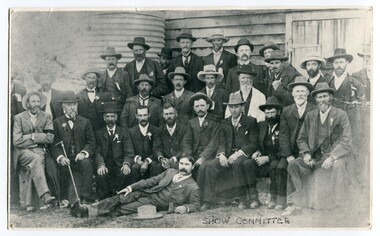
... shows an early Orbost Agricultural Show committee. Included in the photograph are: Phil Nixon; John Johnston; Percy Morris; Harry Richardson; Arthur Saunders; Archie Rodwell; Geo. Nixon; J. Warren; John Draffin; W. Fisher; D.R. Norris; Paul Hocking; Waller; JasHossack; Jim Cameron; John Cameron. The first meeting to form an Agricultural society...shows an early Orbost Agricultural Show committee. Included in the photograph are: Phil Nixon; John Johnston; Percy Morris; Harry Richardson; Arthur Saunders; Archie Rodwell; Geo. Nixon; J. Warren; John Draffin; W. Fisher; D.R. Norris; Paul Hocking; Waller; JasHossack; Jim Cameron; John Cameron. The first meeting to form an Agricultural society ...This photograph shows an early Orbost Agricultural Show committee. Included in the photograph are: Phil Nixon; John Johnston; Percy Morris; Harry Richardson; Arthur Saunders; Archie Rodwell; Geo. Nixon; J. Warren; John Draffin; W. Fisher; D.R. Norris; Paul Hocking; Waller; JasHossack; Jim Cameron; John Cameron. The first meeting to form an Agricultural society in Orbost was convened by the then Orbost Progress Association and held in the Mechanics Hall on Saturday, 10th October 1891. Its first show was held on 3rd March 1904...on a site alongside the Bonang Road where the present Golf Club stands. It is currently held at the Recreation Reserve at Newmerella. (Ref: In Times Gone By-Deborah Hall) This item is associated with the Orbost Agricultural Society 's Annual Show which has been a major event in Orbost for over a century. Agricultural shows are an important part of cultural life in small country towns and the Orbost Show is an integral part of Orbost 's agricultural history. A large black / white photograph of a large group of men outside a wooden building. There is a tank on the left side. Some men are standing, some sitting and the man if front is lying , leaning on his elbow. There is a smaller copy of same photograph.on front - "show committee"orbost-agricultural-show-committee -
 Orbost & District Historical Society
framed photograph, C 1904
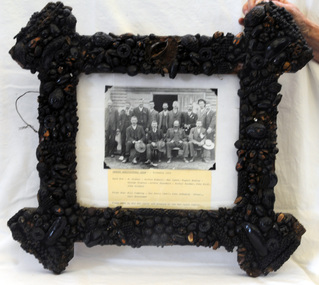
... Society 's Annual Show which has been a major event in Orbost for over a century. Agricultural shows are an important part of cultural life in small country towns and the Orbost Show is an integral part of Orbost 's agricultural history. It is also an example of the craft skills of women in the early 20th century. Orbost-Agricultural-Society Lynch-Mary Orbost-Show on front - "Orbost Agricultural Show Committee ...The first meeting to form an Agricultural society in Orbost was convened by the then Orbost Progress Association and held in the Mechanics Hall on Saturday, 10th October 1891. Its first show was held on 3rd March 1904...on a site alongside the Bonang Road where the present Golf Club stands. It is currently held at the Recreation Reserve at Newmerella. (Ref: In Times Gone By-Deborah Hall) This frame was made by Mary Lynch, wife of Matt Lynch. Pictured in the photograph are: Back: W. Fisher, Archie Rodwell, Mat Lynch, Rupert Mosley, George Granter, Arthur Saunders, Arther Pardew, John Bird, John Gilbert. Front: Bill Ginning, George Perry (secretary) John Johnston (president), Carl Dreverman.This item is associated with the Orbost Agricultural Society 's Annual Show which has been a major event in Orbost for over a century. Agricultural shows are an important part of cultural life in small country towns and the Orbost Show is an integral part of Orbost 's agricultural history. It is also an example of the craft skills of women in the early 20th century.A black / white photograph of a group of thirteen men, some standing, some sitting in front of a wooden shed. The photograph is in an ornate frame made of dried seeds.on front - "Orbost Agricultural Show Committee probably 1904"orbost-agricultural-society lynch-mary orbost-show -
 Orbost & District Historical Society
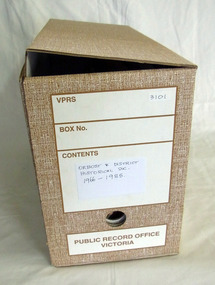
box of documents, 1966 - 1985
... These documents show the beginnings of the society with a committee in 1966 leading to the formation in 1967,...These documents show the beginnings of the society with a committee in 1966 leading to the formation in 1967, These documents record the history of the Orbost & District Historical Society. ...These documents show the beginnings of the society with a committee in 1966 leading to the formation in 1967,These documents record the history of the Orbost & District Historical Society.A cardboard box of documents of Orbost & District Historical Society, It contains minutes, correspondence, accounts, receipt and cheque books. There are also two keys. orbost-history-documents -
 Orbost & District Historical Society
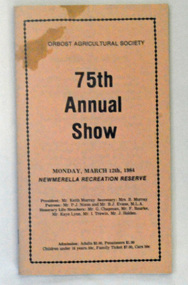
book, 75th Annual Show, prior to March 1984
... Society 's Annual Show which has been a major event in Orbost for over a century. Agricultural shows are an important part of cultural life in small country towns and the Orbost Show is an integral part of Orbost 's agricultural history. Orbost-Annual-Show A small thin 40 pp paper booklet with a buff coloured cover. On the cover is the title, "75th Annual Show in black print. It is inside a black border with "Orbost Agricultural Show" at the top. There is the date of the event, details of the committee ...This magazine was produced as a program for the 75th Annual Show at Newmerella Recreation Reserve. The first meeting to form an Agricultural society in Orbost was convened by the then Orbost Progress Association and held in the Mechanics Hall on Saturday, 10th October 1891. Its first show was held on 3rd March 1904...on a site alongside the Bonang Road where the present Golf Club stands. It is currently held at the Recreation Reserve at Newmerella. Ref: In Times Gone By-Deborah HallThis item is associated with the Orbost Agricultural Society 's Annual Show which has been a major event in Orbost for over a century. Agricultural shows are an important part of cultural life in small country towns and the Orbost Show is an integral part of Orbost 's agricultural history. A small thin 40 pp paper booklet with a buff coloured cover. On the cover is the title, "75th Annual Show in black print. It is inside a black border with "Orbost Agricultural Show" at the top. There is the date of the event, details of the committee members and costs of admission beneath the title.orbost-annual-show -
 Orbost & District Historical Society
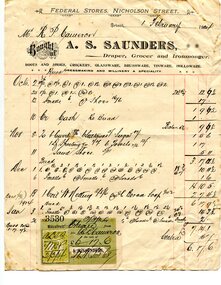
account, 1st February, 1914
... Show Committees, a Rechabite in 1893, and was a member of the Board of Guardians of the Church of England from 1894 to 1913 where he served as secretary and treasurer of the Board. He was married to Agnes Louisa Stuart Morris. She sold the business in 1919 to Mr J. H. V. Dale and left Orbost with her two daughters for East Malvern in April 1927. ( more info. on the Saunders family in In Times Gone By by Deborah Hall; Orbost & District Historical Society...Show Committees, a Rechabite in 1893, and was a member of the Board of Guardians of the Church of England from 1894 to 1913 where he served as secretary and treasurer of the Board. He was married to Agnes Louisa Stuart Morris. She sold the business in 1919 to Mr J. H. V. Dale and left Orbost with her two daughters for East Malvern in April 1927. ( more info. on the Saunders family in In Times Gone By by Deborah Hall; Orbost & District Historical Society ...Saunders General Store was opened in 1900, overlapping part of the Mensland and Coultons stores. It was called "The ―Melbourne Store" which referred to it being a branch of their Melbourne store.The shop was burnt down in the early 1930‘s. Arthur Scott Saunders was born in 1864 and died 3-12-1913 (49) in Orbost. He was the son of Thomas Frederick Saunders and Lucy Beard Scott. He was a Storekeeper at Orbost, a member of the early Show Committees, a Rechabite in 1893, and was a member of the Board of Guardians of the Church of England from 1894 to 1913 where he served as secretary and treasurer of the Board. He was married to Agnes Louisa Stuart Morris. She sold the business in 1919 to Mr J. H. V. Dale and left Orbost with her two daughters for East Malvern in April 1927. ( more info. on the Saunders family in In Times Gone By by Deborah Hall; Orbost & District Historical Society Newsletter by John Phillips) Robert Pullar Cameron was a Shire Councillor for many years. He married Penuel Hossack and had a family of James, Flora, Penuel and Alex. This item is an example of a hand-written account from an Orbost business of the early 20th century. It is a useful research tool.A white paper account with red lines, hand-written black print. There is a yellow duty stamp and a green receipt from A.S. Saunders, Drapers, Grocer and Ironmonger, to R.P. Cameron.account saunders-family cameron-r.p. book-keeping -
 Orbost & District Historical Society
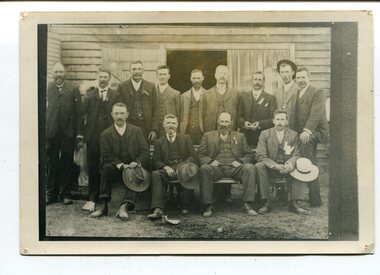
black and white photograph, early 20th century
... Show Committee. Those in the photograph are: Back L-R Archie Rodwell; Rupert Mosley; A. Pardew; John Gilbert. Front - Bill Cummings; Draffin; John Johnstone. The first meeting to form an Agricultural society...Show Committee. Those in the photograph are: Back L-R Archie Rodwell; Rupert Mosley; A. Pardew; John Gilbert. Front - Bill Cummings; Draffin; John Johnstone. The first meeting to form an Agricultural society ...This is probably a photograph of An Orbost Agricultural Show Committee. Those in the photograph are: Back L-R Archie Rodwell; Rupert Mosley; A. Pardew; John Gilbert. Front - Bill Cummings; Draffin; John Johnstone. The first meeting to form an Agricultural society in Orbost was convened by the then Orbost Progress Association and held in the Mechanics Hall on Saturday, 10th October 1891. Its first show was held on 3rd March 1904...on a site alongside the Bonang Road where the present Golf Club stands. It is currently held at the Recreation Reserve at Newmerella. (Ref: In Times Gone By-Deborah Hall)This photographs is associated with the Orbost Agricultural Society 's Annual Show which has been a major event in Orbost for over a century. Agricultural shows are an important part of cultural life in small country towns and the Orbost Show is an integral part of Orbost 's agricultural history.A black / white photograph of a group of men, dressed in suits, standing in outside a wooden building. The front row is seated and the back row standing.on back - 'Pop on N.E. Corner"orbost-agricultural-society -
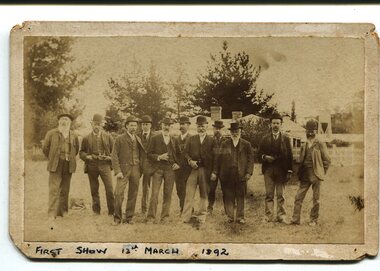 Orbost & District Historical Society
Photograph, March 13 1892
... This photograph shows members of the first Orbost Agricultural Show committee.. The first meeting to form an Agricultural society in Orbost was convened by the then Orbost Progress Association and held in the Mechanics Hall on Saturday, 10th October 1891. ...This photograph shows members of the first Orbost Agricultural Show committee.. The first meeting to form an Agricultural society in Orbost was convened by the then Orbost Progress Association and held in the Mechanics Hall on Saturday, 10th October 1891. ...This photograph shows members of the first Orbost Agricultural Show committee.. The first meeting to form an Agricultural society in Orbost was convened by the then Orbost Progress Association and held in the Mechanics Hall on Saturday, 10th October 1891. Its first show was held on 3rd March 1904...on a site alongside the Bonang Road where the present Golf Club stands. It is currently held at the Recreation Reserve at Newmerella. (Ref: In Times Gone By-Deborah Hall) This item is associated with the Orbost Agricultural Society 's Annual Show which has been a major event in Orbost for over a century. Agricultural shows are an important part of cultural life in small country towns and the Orbost Show is an integral part of Orbost 's agricultural history.A sepia photograph of eleven men, wearing suits and waistcoats, standing on a vacant block of land. In the background are houses among tress. The photograph is mounted on grey card - rectangular with rounded corners.on back -"Toby Nixon" on front - "First Show 13th March 1892"orbost-agricultural-society annual-show-orbost agriculture-orbost
