
Showing 831 items matching "signs of history"
-
 Lara RSL Sub Branch
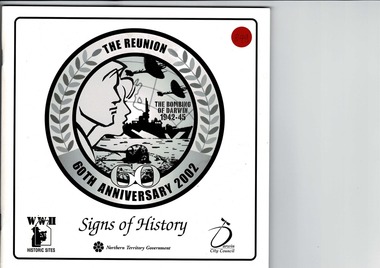
Boolet signs of History, The Reunion 60th Anniversary 2002 - The Bombing of Darwin 1942 -45 - Signs of History, Circ 1999
... Boolet signs of History ...The Reunion 60th Anniversary 2002 - The Bombing of Darwin 1942 -45 - Signs of History......signs of history...Laminated Cardboard Cover - with 56 paper pages inside. Signs of History - A Photographic Collection of World War 11 Historiic sites signs in the Northern Territory 1999. ...Cover of the booklet Title is "Signs of History" on the center lower section above is a circular artistic laurel with heading 'The Reunion - 60th Anniversary 2002" - the inner of the circle "The Bombing of Darwin 1942 - Northern Territory Government and Darwin City Council....The Reunion 60th Anniversary 2002 - The Bombing of Darwin 1942 -45 - Signs of History Boolet signs of History ...Booklet produced by Northern Territory Government and Darwin City Council.A photographic record of the Northern Territory During World War 11.Laminated Cardboard Cover - with 56 paper pages inside. Signs of History - A Photographic Collection of World War 11 Historiic sites signs in the Northern Territory 1999. Produced by Northern Territory Government 1999. Contains photographic images of areas in the Nortthern Territory specific to the operations and actions during the World War 11.Cover of the booklet Title is "Signs of History" on the center lower section above is a circular artistic laurel with heading 'The Reunion - 60th Anniversary 2002" - the inner of the circle "The Bombing of Darwin 1942 - Northern Territory Government and Darwin City Council.northern territory government, dawin city council, the reunion 60th aviversary 2002, signs of history, the bombing of darwin 1942 - 45 -
 Bendigo Historical Society Inc.
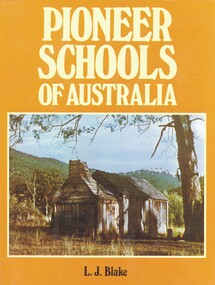
Book - PIONEER SCHOOLS OF AUSTRALIA, 1977
... Pioneer Schools of Australia. Signed Copy. History of Education including Aboriginal Schools....Blake Pioneer Schools of Australia. Signed Copy. History of Education including Aboriginal Schools. ...Pioneer Schools of Australia. Signed Copy. History of Education including Aboriginal Schools.L. J. Blakeschool, early education -
 Buninyong & District Historical Society
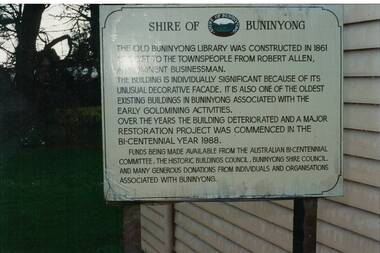
Photograph - Original Colour Photograph, Sign recording history and restoration of Buninyong Old Library, Sign recording history and restoration of Buninyong Old Library
... Original Colour Photograph, Sign recording history and restoration of Buninyong Old Library...Sign recording history and restoration of Buninyong Old Library...Original Colour Photograph, Sign recording history and restoration of Buninyong Old Library...buildings Old Library Original Colour Photograph, Sign recording history and restoration of Buninyong Old Library Sign recording history and restoration of Buninyong Old Library Photograph Original Colour Photograph, Sign recording history and restoration of Buninyong Old Library ...buildingsOriginal Colour Photograph, Sign recording history and restoration of Buninyong Old Libraryold library -
 Glenelg Shire Council Cultural Collection
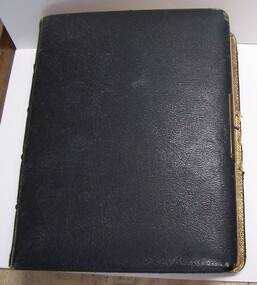
Album - Ward Family Photograph Album, 1890s
... Displayed in History House. Sign from History House reads: Donated by Miss M. ...Displayed in History House. Sign from History House reads: Donated by Miss M. ...Displayed in History House. Sign from History House reads: Donated by Miss M. Batson, PortlandDark green leather bound album. Numerous thick gold-edged pages for single photographs.Front: (inside cover, label) The Ward family photograph albumward family records, family history, family photography -
 Glenelg Shire Council Cultural Collection
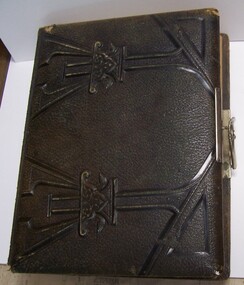
Photograph - Photograph Album - Ward Family Photograph Album, 1890s
... Displayed in History House. Sign from History House reads: "Donated by Miss M. ...Displayed in History House. Sign from History House reads: "Donated by Miss M. ...Displayed in History House. Sign from History House reads: "Donated by Miss M. Batson, Portland".Leathed-bound brown covers, padded, with decorative embossed pattern and detailed clasp. Photographs in decorative pages. -
 Bendigo Historical Society Inc.
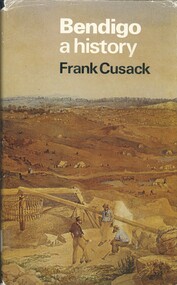
Book - BENDIGO A HISTORY, 1973
... Bendigo A History. Signed by the author. A history of gold mining in Bendigo from its earliest time and the development of the city. ...Frank Cusack Bendigo A History. Signed by the author. A history of gold mining in Bendigo from its earliest time and the development of the city. ...Bendigo A History. Signed by the author. A history of gold mining in Bendigo from its earliest time and the development of the city. Black and white illustrations. 262 pages.Frank Cusackbendigo, mining, early history., gold mining in bendigo. -
 Bendigo Historical Society Inc.
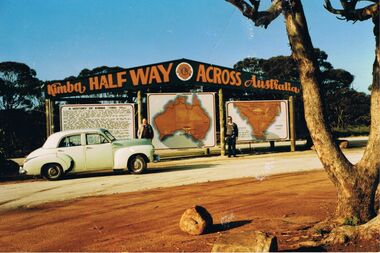
Photograph - PETER ELLIS COLLECTION: PETER ELLIS AND JOHN MEREDITH
... A green Holden car is parked in front of the History sign....There are three signs, one has the History of Kimba, one is a map of Australia and the other is a map with Spencer Gulf printed on it. ...Colour photo of Peter Ellis and John Meredith standing in front of the sign at Kimba Half Way Across Australia. There are three signs, one has the History of Kimba, one is a map of Australia and the other is a map with Spencer Gulf printed on it. A green Holden car is parked in front of the History sign.photo, group, male, peter ellis collection, peter ellis, john meredith -
 Lakes Entrance Historical Society
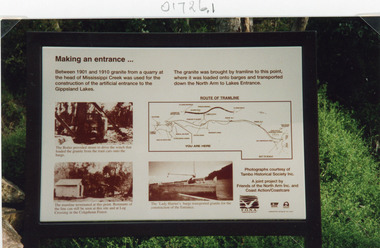
Photograph - Tramline Mississippi Creek to the North Arm. Lakes Entrance Victoria 1997
... Colour photograph of the sign depicting the history of the tramline which connected the stone quarry at the head of the Mississippi Creek to the North Arm. ...Date made 18 January 1997 Transport Historic Site Colour photograph of the sign depicting the history of the tramline which connected the stone quarry at the head of the Mississippi Creek to the North Arm. ...Date made 18 January 1997Colour photograph of the sign depicting the history of the tramline which connected the stone quarry at the head of the Mississippi Creek to the North Arm. It shows an anodised metal plaque on a metal support, during the construction of the stone piers of the entrance to the Gippsland Lakes. Lakes Entrance Victoria transport, historic site -
 Bendigo Historical Society Inc.
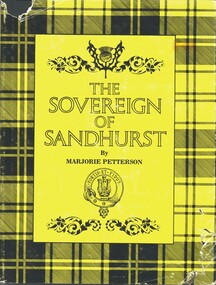
Book - THE SOVEREIGN OF SANDHURST, 1986
... The Sovereign of Sandhurst. Signed by the author. History of Bendigo and the Maclachlan connection. ...AUTOBIOGRAPHY maclachlan & clan Marjorie Petterson The Sovereign of Sandhurst. Signed by the author. History of Bendigo and the Maclachlan connection. ...The Sovereign of Sandhurst. Signed by the author. History of Bendigo and the Maclachlan connection. Bendigo Mac. With Index. 150 pages Tartan dust jacket over black hard cover.Marjorie Pettersonautobiography, maclachlan & clan -
 Bendigo Historical Society Inc.
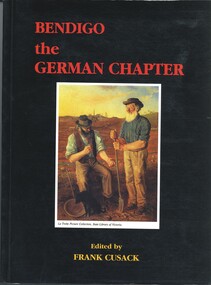
Book - BENDIGO THE GERMAN CHAPTER, 1998
... Bendigo the German Chapter. Signed by the Author. History of the contribution of the early German community to the city's development. ...BENDIGO History german contribution. Frank Cusack Bendigo the German Chapter. Signed by the Author. ...Bendigo the German Chapter. Signed by the Author. History of the contribution of the early German community to the city's development. Includes many photos of early settlers and also a list of German claim holders.Frank Cusackbendigo, history, german contribution. -
 Waverley RSL Sub Branch
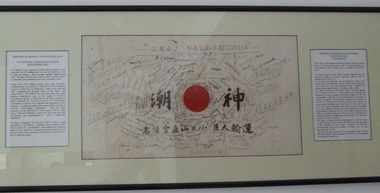
Replica Japanese Flag From H.M.A.S. Warramunga
... Warramunga and signed by ships crew with history mounted in frame under glass...Warramunga and signed by ships crew with history mounted in frame under glass Replica Japanese Flag From H.M.A.S. ...Mounted Japanese flag made from signal bunting on the H.M.A.S. Warramunga and signed by ships crew with history mounted in frame under glass -
 Bendigo Historical Society Inc.
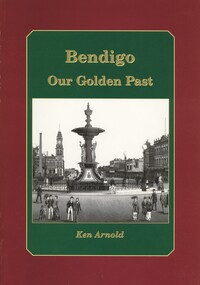
Book - BENDIGO OUR GOLDEN PAST, 2007
... Bendigo Our Golden Past. Signed by Ken Arnold 2007. History of Bendigo. Photographs: black and white. ...BENDIGO History bendigo & district history of Bendigo Ken Arnold Bendigo Our Golden Past. Signed by Ken Arnold 2007. ...Bendigo Our Golden Past. Signed by Ken Arnold 2007. History of Bendigo. Photographs: black and white. Street maps, copy opf painting. 80 pages. Signed by: Ken Arnold, December 2007. 80 pages.Ken Arnoldbendigo, history, bendigo & district, history of bendigo -
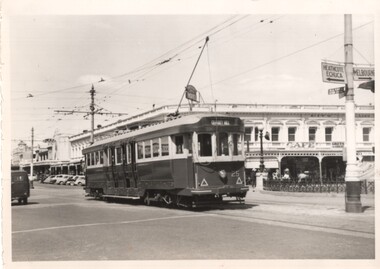 Ballarat Tramway Museum
Photograph - Black & White Photograph/s, mid to late 1950's
... On the right hand side of the photograph is a direction sign and tram stop sign. Photographer unknown - see history of object....On the right hand side of the photograph is a direction sign and tram stop sign. Photographer unknown - see history of object. Photograph Black & White Photograph/s ...Black and white photograph of Bendigo 25, late 1950's crossing the highway at Charing Cross and about to enter Mitchell St. Tram has the destination of Quarry Hill. In the background is City Club Hotel. On the right hand side of the photograph is a direction sign and tram stop sign. Photographer unknown - see history of object.In the rear in ink "Bendigo"trams, tramways, bendigo, charing cross, mitchell st, quarry hill, tram 25 -
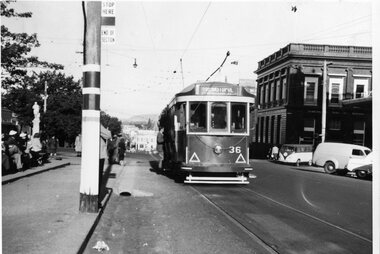 Ballarat Tramway Museum
Photograph - Black & White Photograph/s, mid to late 1950's
... Tram stop pole with stop sign and end of section sign. Photographer unknown - see history of object....Tram stop pole with stop sign and end of section sign. Photographer unknown - see history of object. Photograph Black & White Photograph/s ...Demonstrates the use of the trams in the city area of Ballarat, late 1950's and their use.Black and white photograph of Ballarat 36 at the city terminus, Sturt and Lydiard streets, south side. The tram has the destination of Sebastopol. In the background is the Commonwealth Bank. Passengers are waiting on the seats in the median strip with some boarding the tram. Tram stop pole with stop sign and end of section sign. Photographer unknown - see history of object.In the rear in pencil - "Ballarat"trams, tramways, sturt st, lydiard st, city, tram 36 -
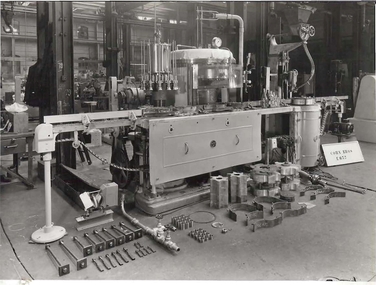 Bendigo Historical Society Inc.
Photograph - COHN BROS. MACHINE WITH PARTS DISPLAYED
... Inscriptions: in image 'Cohn Bros, E 637' on white rectangular sign. History of object: Previous Acc. No. 'MP 205'....Inscriptions: in image 'Cohn Bros, E 637' on white rectangular sign. History of object: Previous Acc. No. 'MP 205'. ...Black and white photograph. Machine with parts displayed on floor in front.'(Australia) Pty Ltd, 18-24 Allen Street, Pyrmont, Sydney' (oval rubber red stamp), 'Received 14 Sep. 1950), (rectangular rubber purple stamp). 'Royal Historical Society of Victoria, Bendigo Branch', (circular rubber blue stamp). On back - T L&R corners 'MP 205', 'B 220, 20, 2'. Inscriptions: in image 'Cohn Bros, E 637' on white rectangular sign. History of object: Previous Acc. No. 'MP 205'.topic, objects, machine -
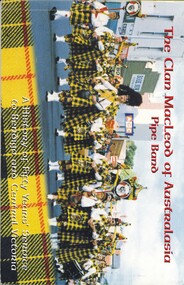 Bendigo Historical Society Inc.
Book - THE CLAN MACLEOD OF AUSTRALIA PIPE BAND, c2003
... Photographs, illustrations, some colour. Signed by Harold MacLeod. A History of fifty years Service in Bendigo and central Victoria....HISTORY Australian pipe band pipe bands Scottish bands Harold B MacLeod OLO The Clan MacLeod of Australasia Pipe Band. Publisher: The Clan MacLeod of Australasia Pipe Band, Bendigo. ISBN: 0 646 42227 8. 78 pages. Photographs, illustrations, some colour. Signed ...The Clan MacLeod of Australasia Pipe Band. Publisher: The Clan MacLeod of Australasia Pipe Band, Bendigo. ISBN: 0 646 42227 8. 78 pages. Photographs, illustrations, some colour. Signed by Harold MacLeod. A History of fifty years Service in Bendigo and central Victoria.Harold B MacLeod OLOhistory, australian, pipe band, pipe bands, scottish bands -
 Eltham District Historical Society Inc
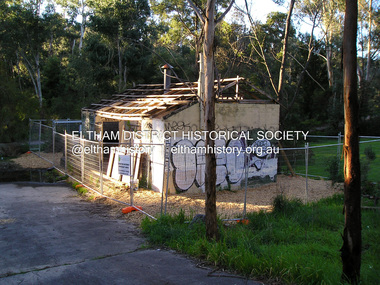
Photograph, Fay Bridge, Warrandyte cool store, 9 September 2019
... In 2017, through a partnership with Manningham City Council, Warrandyte Historical Society and the Warrandyte Community Association, Melbourne Water renovated the 73-year-old site and installed interpretive signs detailing its history for the community....In 2017, through a partnership with Manningham City Council, Warrandyte Historical Society and the Warrandyte Community Association, Melbourne Water renovated the 73-year-old site and installed interpretive signs detailing its history for the community. 2019-09-09 Fay Bridge Collection Warrandyte Cool Store Warrandyte Dairy 2 images - born digital Warrandyte cool store Photograph Photograph Fay Bridge ...Remains of the old Warrandyte Dairy — Originally constructed to store milk for delivery from Mapleoak Dairies, delivered by the Bellinger family, up until the early 1970s. The Warrandyte Dairy closed in 1987 before the land and building was purchased by Melbourne Water in 1988 to reduce flood risk to the community and preserve riverside land from development on the site which sits on the Yarra River flood plain. In 2017, through a partnership with Manningham City Council, Warrandyte Historical Society and the Warrandyte Community Association, Melbourne Water renovated the 73-year-old site and installed interpretive signs detailing its history for the community.2019-09-09, fay bridge collection, warrandyte cool store, warrandyte dairy -
 Eltham District Historical Society Inc
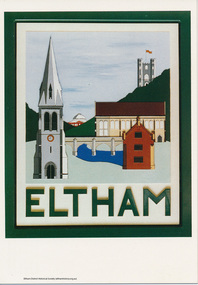
Folder, The Eltham Society, 1998
... Postcard: Eltham Town Sign, Passey Place, London Brief history of the origins of Eltham, England. ...Postcard: Eltham Town Sign, Passey Place, London Brief history of the origins of Eltham, England. ...Information about and from Eltham England. Postcard: Eltham Town Sign, Passey Place, London Brief history of the origins of Eltham, England. Description of "the gavel and stand", object which the Society donated to EDHS Newsletter No 132, May 19982 Pages. I booklet newsletter. 26 pages. I postcard HG Booklet 31eltham society (london), harry gilham collection, gavel -
 NMIT (Northern Melbourne Institute of TAFE)
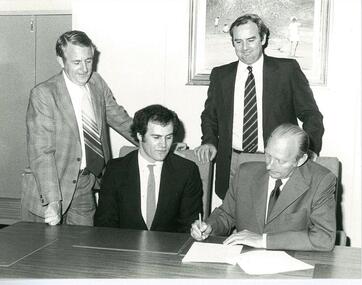
Photograph: CCOT 1982 Principal and College Council President
... Black and white photograph of a group of men at a desk signing papers. According to Scott's history p. 86 they are identified as Collingwood College of TAFE Past President of College Council, Mr. ...Collingwood College of TAFE Administrative Records NMIT Black and white photograph of a group of men at a desk signing papers. According to Scott's history p. 86 they are identified as Collingwood College of TAFE Past President of College Council, Mr. ...Black and white photograph of a group of men at a desk signing papers. According to Scott's history p. 86 they are identified as Collingwood College of TAFE Past President of College Council, Mr. A.J.Cuthbertson, signing contract for supply and maintenance of main frame computer, watched by Ian Scott (Principal) and two representatives of the suppliers, Prime Computers of Australia Ltd. 1982.collingwood college of tafe, administrative records, nmit -
 Flagstaff Hill Maritime Museum and Village
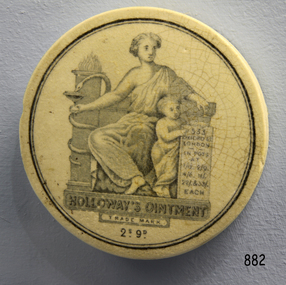
Ceramic - Lid, circa 1878
... The sign of a snake curled around a staff is a longstanding and commonly recognised symbol of the physician’s power to heal. Similar reference on this lid is also being made to an ancient goddess of healing and her healthy young offspring. History...The sign of a snake curled around a staff is a longstanding and commonly recognised symbol of the physician’s power to heal. Similar reference on this lid is also being made to an ancient goddess of healing and her healthy young offspring. History ...This ceramic lid is from a Holloway’s Ointment pot. It was retrieved from the wreckage of the LOCH ARD. The vessel was laden with an up-to-date, high-value cargo, including luxury items intended for the Melbourne International Exhibition in 1880. Britain exported her manufactures to the Australasian colonies and the Americas. Holloway’s Ointment was one nineteenth-century pharmaceutical product that was advertised in both these markets. The price of this particular jar and its contents was printed on the label as “2S 9D” (2 shillings and nine pence). This value calculated to the approximate price in 2014, would be £51.31 (UK pounds and decimal pence) or $85 AU ― quite an expensive ointment. The label also shows a picture of a stone tablet with the inscription "IN POTS AT 1/½, 2/9, 4/6,11/-, 22/- & 33/- EACH”, which is most likely the alternative prices that the ointment was available for in differently sized containers. Holloway’s claims for his “great remedy” included the cure of sores, wounds, ulcers and boils, gout, rheumatism, diphtheria, bronchitis, influenza, sore throats, coughs and colds, “all varieties of skin diseases”, scrofula, ringworm, scurvy, “dropsical swellings” and liver disease, piles, fistulas, and internal inflammation. The salve cream was said to penetrate the skin when rubbed on; purifying internal tissues and organs, cleansing all bodily fluids particularly the blood, and eradicating all disease from the body. Purchasers were assured that if Holloway’s Ointment alone did not affect immediate cure, then the combination of it and Holloway’s Pills (sold separately) most certainly would. Thomas Holloway began manufacturing and marketing his miraculous ointment from premises at 244 Strand in the 1840s, moving to the more prestigious address of 533 Oxford in the late 1860s. The London address was an important part of his promotional appeal and was displayed prominently on the packaging of his products. Holloway’s attention to marketing is also observed in the pseudo-Classical emblems that decorated his containers. The sign of a snake curled around a staff is a longstanding and commonly recognised symbol of the physician’s power to heal. Similar reference on this lid is also being made to an ancient goddess of healing and her healthy young offspring. History of the Loch Ard: The Loch Ard got its name from ”Loch Ard” a loch which lies to the west of Aberfoyle, and the east of Loch Lomond. It means "high lake" in Scottish Gaelic. The vessel belonged to the famous Loch Line which sailed many vessels from England to Australia. The Loch Ard was built in Glasgow by Barclay, Curdle and Co. in 1873, the vessel was a three-masted square-rigged iron sailing ship that measured 79.87 meters in length, 11.58 m in width, and 7 m in depth with a gross tonnage of 1693 tons with a mainmast that measured a massive 45.7 m in height. Loch Ard made three trips to Australia and one trip to Calcutta before its fateful voyage. Loch Ard left England on March 2, 1878, under the command of 29-year-old Captain Gibbs, who was newly married. The ship was bound for Melbourne with a crew of 37, plus 17 passengers. The general cargo reflected the affluence of Melbourne at the time. Onboard were straw hats, umbrella, perfumes, clay pipes, pianos, clocks, confectionery, linen and candles, as well as a heavier load of railway irons, cement, lead and copper. There were other items included that were intended for display in the Melbourne International Exhibition of 1880. The voyage to Port Phillip was long but uneventful. Then at 3 am on June 1, 1878, Captain Gibbs was expecting to see land. But the Loch Ard was running into a fog which greatly reduced visibility. Captain Gibbs was becoming anxious as there was no sign of land or the Cape Otway lighthouse. At 4 am the fog lifted and a lookout aloft announced that he could see breakers. The sheer cliffs of Victoria's west coast came into view, and Captain Gibbs realised that the ship was much closer to them than expected. He ordered as much sail to be set as time would permit and then attempted to steer the vessel out to sea. On coming head-on into the wind, the ship lost momentum, the sails fell limp and Loch Ard's bow swung back towards land. Gibbs then ordered the anchors to be released in an attempt to hold its position. The anchors sank some 50 fathoms - but did not hold. By this time the ship was among the breakers and the tall cliffs of Mutton Bird Island rose behind. Just half a mile from the coast, the ship's bow was suddenly pulled around by the anchor. The captain tried to tack out to sea, but the ship struck a reef at the base of Mutton Bird Island, near Port Campbell. Waves subsequently broke over the ship and the top deck became loosened from the hull. The masts and rigging came crashing down knocking passengers and crew overboard. When a lifeboat was finally launched, it crashed into the side of Loch Ard and capsized. Tom Pearce, who had launched the boat, managed to cling to its overturned hull and shelter beneath it. He drifted out to sea and then on the flood tide came into what is now known as Lochard Gorge. He swam to shore, bruised and dazed, and found a cave in which to shelter. Some of the crew stayed below deck to shelter from the falling rigging but drowned when the ship slipped off the reef into deeper water. Eva Carmichael a passenger had raced onto the deck to find out what was happening only to be confronted by towering cliffs looming above the stricken ship. In all the chaos, Captain Gibbs grabbed Eva and said, "If you are saved Eva, let my dear wife know that I died like a sailor". That was the last Eva Carmichael saw of the captain. She was swept off the ship by a huge wave. Eva saw Tom Pearce on a small rocky beach and yelled to attract his attention. He dived in and swam to the exhausted woman and dragged her to shore. He took her to the cave and broke the open case of brandy which had washed up on the beach. He opened a bottle to revive the unconscious woman. A few hours later Tom scaled a cliff in search of help. He followed hoof prints and came by chance upon two men from nearby Glenample Station three and a half miles away. In a complete state of exhaustion, he told the men of the tragedy. Tom then returned to the gorge while the two men rode back to the station to get help. By the time they reached Loch Ard Gorge, it was cold and dark. The two shipwreck survivors were taken to Glenample Station to recover. Eva stayed at the station for six weeks before returning to Ireland by steamship. In Melbourne, Tom Pearce received a hero's welcome. He was presented with the first gold medal of the Royal Humane Society of Victoria and a £1000 cheque from the Victorian Government. Concerts were performed to honour the young man's bravery and to raise money for those who lost family in the disaster. Of the 54 crew members and passengers on board, only two survived: the apprentice, Tom Pearce and the young woman passenger, Eva Carmichael, who lost her family in the tragedy. Ten days after the Lochard tragedy, salvage rights to the wreck were sold at auction for £2,120. Cargo valued at £3,000 was salvaged and placed on the beach, but most washed back into the sea when another storm developed. The wreck of Lochard still lies at the base of Mutton Bird Island. Much of the cargo has now been salvaged and some items were washed up into Lochard Gorge. Cargo and artefacts have also been illegally salvaged over many years before protective legislation was introduced in March 1982. One of the most unlikely pieces of cargo to have survived the shipwreck was a Minton majolica peacock- one of only nine in the world. The peacock was destined for the Melbourne 1880 International Exhibition in. It had been well packed, which gave it adequate protection during the violent storm. Today the Minton peacock can be seen at the Flagstaff Hill Maritime Museum in Warrnambool. From Australia's most dramatic shipwreck it has now become Australia's most valuable shipwreck artifact and is one of very few 'objects' on the Victorian State Heritage Register.The shipwreck of the Loch Ard is of significance for Victoria and is registered on the Victorian Heritage Register ( S 417). Flagstaff Hill has a varied collection of artefacts from Loch Ard and its collection is significant for being one of the largest accumulation of artefacts from this notable Victorian shipwreck of which the subject items are a small part. The collections objects give us a snapshot of how we can interpret the story of this tragic event. The collection is also archaeologically significant as it represents aspects of Victoria's shipping history that allows us to interpret Victoria's social and historical themes of the time. Through is associated with the worst and best-known shipwreck in Victoria's history. The ceramic lid off a Holloway’s Ointment container, retrieved from the wreckage of the LOCH ARD. The artefact is white with the pale blue image of a woman (seated) and a child (standing). The woman is draped in a soft white robe and her throne is beside a pillar that is entwined by a serpent. The child points to an inscribed stone tablet he is holding on the other side of seated woman. The front face of the lid, at the base of the woman on the throne, bears the label “HOLLOWAY’S OINTMENT”. Below this, in smaller letters, is written “TRADE MARK” and “2S.9D.” On the stone tablet pointed to by the child is inscribed “533 OXFORD ST. LONDON”, and beneath this, “IN POTS AT 1/½, 2/9, 4/6,11/-, 22/- & 33/- EACH”.flagstaff hill, warrnambool, flagstaff hill maritime museum, shipwreck coast, flagstaff hill maritime village, great ocean road, loch line, loch ard, captain gibbs, eva carmichael, tom pearce, glenample station, mutton bird island, loch ard gorge, holloway’s ointment, ceramic lid, pot lid, nineteenth-century medicines, pharmaceutical marketing -
 Flagstaff Hill Maritime Museum and Village
Functional object - Deadeye, Barclay Curle & Co shipbuilders, 1873
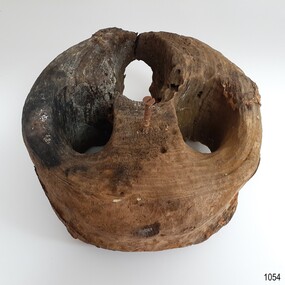
... Through is associated with the worst and best-known shipwreck in Victoria's history. flagstaff hill maritime museum shipwreck coast loch line loch ard captain gibbs eva carmichael tom pearce glenample station mutton bird island loch ard gorge deadeye rigging None A weathered ship’s rigging deadeye, showing signs of submersion and erosion in sea water. ...This example of a sailing ship’s ‘dead-eye’ is from the wreck of the Loch Ard, which sank near Port Campbell in 1878. The Loch Ard got its name from ”Loch Ard” a loch which lies to the west of Aberfoyle, and the east of Loch Lomond. It means "high lake" in Scottish Gaelic. The vessel belonged to the famous Loch Line which sailed many vessels from England to Australia. The Loch Ard was built in Glasgow by Barclay, Curle and Co. in 1873, the vessel was a three-masted square-rigged iron sailing ship that measured 79.87 meters in length, 11.58 m in width, and 7 m in depth with a gross tonnage of 1693 tons with a mainmast that measured a massive 45.7 m in height. Loch Ard made three trips to Australia and one trip to Calcutta before its fateful voyage. Loch Ard left England on March 2, 1878, under the command of 29-year-old Captain Gibbs, who was newly married. The ship was bound for Melbourne with a crew of 37, plus 17 passengers. The general cargo reflected the affluence of Melbourne at the time. Onboard were straw hats, umbrella, perfumes, clay pipes, pianos, clocks, confectionery, linen and candles, as well as a heavier load of railway irons, cement, lead and copper. There were other items included that were intended for display in the Melbourne International Exhibition of 1880. The voyage to Port Phillip was long but uneventful. Then at 3 am on June 1, 1878, Captain Gibbs was expecting to see land. But the Loch Ard was running into a fog which greatly reduced visibility. Captain Gibbs was becoming anxious as there was no sign of land or the Cape Otway lighthouse. At 4 am the fog lifted and a lookout aloft announced that he could see breakers. The sheer cliffs of Victoria's west coast came into view, and Captain Gibbs realised that the ship was much closer to them than expected. He ordered as much sail to be set as time would permit and then attempted to steer the vessel out to sea. On coming head-on into the wind, the ship lost momentum, the sails fell limp and Loch Ard's bow swung back towards land. Gibbs then ordered the anchors to be released in an attempt to hold its position. The anchors sank some 50 fathoms - but did not hold. By this time the ship was among the breakers and the tall cliffs of Mutton Bird Island rose behind. Just half a mile from the coast, the ship's bow was suddenly pulled around by the anchor. The captain tried to tack out to sea, but the ship struck a reef at the base of Mutton Bird Island, near Port Campbell. Waves subsequently broke over the ship and the top deck became loosened from the hull. The masts and rigging came crashing down knocking passengers and crew overboard. When a lifeboat was finally launched, it crashed into the side of Loch Ard and capsized. Tom Pearce, who had launched the boat, managed to cling to its overturned hull and shelter beneath it. He drifted out to sea and then on the flood tide came into what is now known as Lochard Gorge. He swam to shore, bruised and dazed, and found a cave in which to shelter. Some of the crew stayed below deck to shelter from the falling rigging but drowned when the ship slipped off the reef into deeper water. Eva Carmichael a passenger had raced onto the deck to find out what was happening only to be confronted by towering cliffs looming above the stricken ship. In all the chaos, Captain Gibbs grabbed Eva and said, "If you are saved Eva, let my dear wife know that I died like a sailor". That was the last Eva Carmichael saw of the captain. She was swept off the ship by a huge wave. Eva saw Tom Pearce on a small rocky beach and yelled to attract his attention. He dived in and swam to the exhausted woman and dragged her to shore. He took her to the cave and broke the open case of brandy which had washed up on the beach. He opened a bottle to revive the unconscious woman. A few hours later Tom scaled a cliff in search of help. He followed hoof prints and came by chance upon two men from nearby Glenample Station three and a half miles away. In a complete state of exhaustion, he told the men of the tragedy. Tom then returned to the gorge while the two men rode back to the station to get help. By the time they reached Loch Ard Gorge, it was cold and dark. The two shipwreck survivors were taken to Glenample Station to recover. Eva stayed at the station for six weeks before returning to Ireland by steamship. In Melbourne, Tom Pearce received a hero's welcome. He was presented with the first gold medal of the Royal Humane Society of Victoria and a £1000 cheque from the Victorian Government. Concerts were performed to honour the young man's bravery and to raise money for those who lost family in the disaster. Of the 54 crew members and passengers on board, only two survived: the apprentice, Tom Pearce and the young woman passenger, Eva Carmichael, who lost her family in the tragedy. Ten days after the Lochard tragedy, salvage rights to the wreck were sold at auction for £2,120. Cargo valued at £3,000 was salvaged and placed on the beach, but most washed back into the sea when another storm developed. The wreck of Lochard still lies at the base of Mutton Bird Island. Much of the cargo has now been salvaged and some items were washed up into Lochard Gorge. Cargo and artefacts have also been illegally salvaged over many years before protective legislation was introduced in March 1982. One of the most unlikely pieces of cargo to have survived the shipwreck was a Minton majolica peacock- one of only nine in the world. The peacock was destined for the Melbourne 1880 International Exhibition in. It had been well packed, which gave it adequate protection during the violent storm. Today the Minton peacock can be seen at the Flagstaff Hill Maritime Museum in Warrnambool. From Australia's most dramatic shipwreck it has now become Australia's most valuable shipwreck artifact and is one of very few 'objects' on the Victorian State Heritage Register.The shipwreck of the Loch Ard is of significance for Victoria and is registered on the Victorian Heritage Register ( S 417). Flagstaff Hill has a varied collection of artefacts from Loch Ard and its collection is significant for being one of the largest accumulation of artefacts from this notable Victorian shipwreck of which the subject items are a small part. The collections objects give us a snapshot of how we can interpret the story of this tragic event. The collection is also archaeologically significant as it represents aspects of Victoria's shipping history that allows us to interpret Victoria's social and historical themes of the time. Through is associated with the worst and best-known shipwreck in Victoria's history.A weathered ship’s rigging deadeye, showing signs of submersion and erosion in sea water. The flat sides of this thick wooden disc have three holes drilled through in a triangular configuration.Noneflagstaff hill maritime museum, shipwreck coast, loch line, loch ard, captain gibbs, eva carmichael, tom pearce, glenample station, mutton bird island, loch ard gorge, deadeye, rigging -
 Flagstaff Hill Maritime Museum and Village
Textile - Altar Cloth
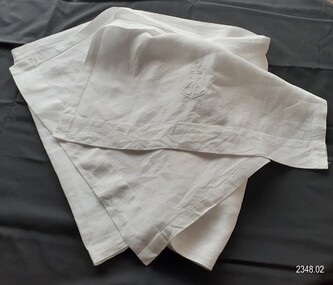
... history of the early Christian church. The cover for the cloth shows the respect the maker had for the cloth and what it stands for. The Mariner's Cross symbol also makes it appropriate as an altar cloth for the St Nicholas Seamen's Church at Flagstaff Hill Maritime Village. MARINER'S CROSS symbol: - The symbol of an anchor that also looks like a cross is called the Mariner’s Cross (also called the Anchored Cross or Cross of Hope). It looks like a ‘plus’ sign...history of the early Christian church. The cover for the cloth shows the respect the maker had for the cloth and what it stands for. The Mariner's Cross symbol also makes it appropriate as an altar cloth for the St Nicholas Seamen's Church at Flagstaff Hill Maritime Village. MARINER'S CROSS symbol: - The symbol of an anchor that also looks like a cross is called the Mariner’s Cross (also called the Anchored Cross or Cross of Hope). It looks like a ‘plus’ sign ...This altar cloth is representative of ecclesiastical linen in use in the early to mid-20th century. It is decorated with the Mariner's Cross symbol, connecting it to the history of the early Christian church. The cover for the cloth shows the respect the maker had for the cloth and what it stands for. The Mariner's Cross symbol also makes it appropriate as an altar cloth for the St Nicholas Seamen's Church at Flagstaff Hill Maritime Village. MARINER'S CROSS symbol: - The symbol of an anchor that also looks like a cross is called the Mariner’s Cross (also called the Anchored Cross or Cross of Hope). It looks like a ‘plus’ sign with anchor flukes at the base and a ring at the top. The anchor is one of the earliest symbols used in Christianity and represents faith, hope and salvation in times of trial. The Mariner’s Cross is linked to the scripture in Hebrews 6:19, which says, “Which hope we have as an anchor of the soul, both sure and steadfast, and which entereth into that within the veil”. This particular Mariner’s Cross also has the letter ‘X’ under the post of the anchor. In Greek, the language of the New Testament, the word for Christ is ‘Christos’, which begins with the Greek letter ‘X’ or ‘Chi’. Together, the elements on this Mariner’s Cross - anchor, cross and ‘X’ - symbolise to the Christian that Jesus Christ the Saviour gives security and safety, hope and salvation. Many church organisations still use various forms of the Mariner’s Cross. THE MISSIONS TO SEAMEN (Brief History): - The Missions to Seamen was an Anglican charity that has served seafarers of the world since 1856 in Great Britain. Its symbol is a Flying Angel, inspired by a Bible verse. Today, there are centres in over 200 ports worldwide where seamen of all backgrounds are offered a warm welcome and provided with a wide range of facilities. In Victoria, the organisation began in Williamstown in 1857 as a Sailors’ Church, also known as ‘Bethel’ or the ‘Floating Church’ in an old hulk floating in Hobson’s Bay, Port of Melbourne. It soon became part of the Missions to Seamen, Victoria. In the year 2000, the organisation, now named Mission to Seafarers, still operated locally in Melbourne, Portland, Geelong and Hastings. The Ladies’ Harbour Lights Guild was formed in 1906 to support the Missions to Seamen in Melbourne and other centres, such as Williamstown. Two of the most significant ladies of the Guild were founder Ethel Augusta Godfrey and foundation member Alice Sibthorpe Tracy (who established a branch of the Guild in Warrnambool in 1920). The Guild continued its work until the 1960s. In 1943, a former Williamstown bank was purchased for the Missions to Seaman Club. The chapel was named St Nicholas’ Seamen’s Church and was supported by the Ladies’ Harbour Lights Guild, the Williamstown Lightkeepers’ Auxiliary and the League of Soldiers’ and Sailors’ Friends. It ceased operation in 1966. A Missions to Seamen Chapel and Recreation Room was a significant feature of ports during the late 1800s and into the 1900s. It seemed appropriate for Flagstaff Hill to include such a representation within the new Maritime Village, so the Melbourne Board of Management of Missions to Seamen Victoria gave its permission on 21st May 1979 for the entire furnishings of the Williamstown chapel to be transferred to Flagstaff Hill. The St Nicholas Seamen’s Church was officially opened on October 11, 1981, and closely resembles the Williamstown chapel. The altar cloth is representative of the ecclesiastical linen in use in the early to mid-20th century, when the original St Nicholas Seamen's Church was opened in Williamstown, Victoria. The Mariner's Cross embroidered onto the altar cloth gives it a connection with the early Christian church and with the Missions to Seamen. The fine hand stitching and embroidery are examples of traditional handcraft skills used over the centuries and continuing in use today.Altar cloth, white linen, with custom-made white cotton cover. The long rectangular cloth has the symbol of a Mariner's Cross (anchor and cross) embroidered with white silk thread on each short end. The wide hems are hand-stitched. The cover has two white tape ties and embroidered text in blue silk thread. This cloth and cover is part of the St. Nicholas Seamen's Church Collection. On cloth: symbol of (anchor with an 'X' stitched behind the centre of it). On cover, text "FLAGSTAFF/ HILL" flagstaff hill, warrnambool, shipwrecked coast, flagstaff hill maritime museum, maritime museum, shipwreck coast, flagstaff hill maritime village, great ocean road, religion, religious service, st nicholas seamen’s church flagstaff hill, altar cloth, church linen, ecclesiastical linen, mariner’s cross, anchor cross, cross of hope, symbol of christianity, anchored cross, flagstaff hill maritime museum and village, maritime village, religious worship, worship service, st nicholas seamen’s church, williamstown, missions to seamen victoria, mission to seafarers, st nicholas missions to seamen’s church williamstown, missions to seamen, st nicholas missions to seamen’s church flagstaff hill, 139 nelson place williamstown, anglican church -
 Federation University Historical Collection
Book, Ballarat Teachers' College, Ballarat Teachers' College Graduation Record, 1955-1976
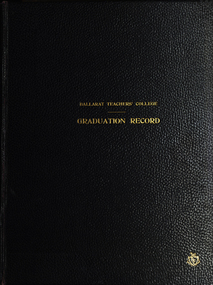
... ("Ruffians Attempted to Carry of the School Tent: A History of State Education in Ballarat", 1974, p73-4.) btc ballarat teachers college graduation record keith hamilton Large book with dark blue vinyl cover. Ballarat Teachers' College Record signed ...This book contains the names and signatures of all graduates from the Ballarat Teachers' College from 1955 to 1976. The Ballarat Teachers' College was established after the Victorian State Government and the State Education Department decided to establish two provincial teachers' colleges, at Ballarat and Bendigo. On 04 May 1926 W.H. Ellwood (Principal), Miss A. Bouchier, and Mr A.B. Jones, welcomed the first enrolment of 61 students to undertake the one year course. In 1927 the College moved to the former Ballarat East Town Hall in Barkly Street, which was remodelled for their use. It closed in December 1931 due to the Great Depression. In 1946 Ballarat Teachers' College reopened and relocated to the Dana Street State School. It was originally planned to open as a women's college, for whom the residence at 130 Victoria Street was purchased, but the decision was made to admit resident men from Ballarat. Mr T.W. Turner was appointed as Principal in 1951 and directed the introduction of a two year course for the Trained Primary Teachers' Certificate. The former one year course was terminated at the end of 1951. In 1958 the College was relocated to a custom built facility at Gillies Street, in close proximity to the Ballarat Botanical Gardens. Numbers increased with the introduction of the Trained Infant Teachers' Certificate course under the guidance of Mary Egan. With the introduction of a three year Diploma Course in 1968 accommodation became cramped. The introduction of the Diploma of Teaching (Primary) led to the Trained Infant Teachers' Certificate being discontinued in 1969, and the end of the Trained Primary Teachers' Certificate in 1969. Secondary Art and Craft students began studies at Ballarat Teachers' College in 1969 under Mr Ted Doney. In 1971 Mr D. Watson was appointed Principal. The State College of Victoria was proclaimed by Order in Council on 24 July 1973, and Ballarat Teachers' College became a constituent college of the State College of Victoria, and was known as State College of Victoria, Ballarat. By 1975 the College moved to Mount Helen as part of the Ballarat College of Advanced Education. Pre service teachers currently undertake their studies on the Mount Helen Campus of Federation University. ("Ruffians Attempted to Carry of the School Tent: A History of State Education in Ballarat", 1974, p73-4.) Large book with dark blue vinyl cover. Ballarat Teachers' College Record signed by gratuates from 1955 to 1976.btc, ballarat teachers college, graduation record, keith hamilton -
 Federation University Historical Collection
Book, Jamie Callister, The Man Who Invented Vegemite, 2012
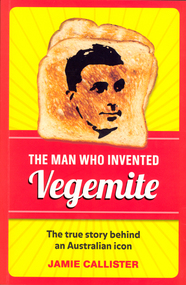
... (http://www.ballarat.edu.au/about-ub/history/art-and-historical-collection/ub-honour-roll/c/cyril-callister-1893-1949) ballarat school of mines callister cyril callister vegemite william callister On Frontispage signed "11th Oct 2012 James Callister" Red and yellow soft covered book of 208 pages relating to Cyril Callister who invented Vegemite. ...Cyril Percy Callister, a chemist by training, became a food technologist and the inventor of the well known spread 'Vegemite'. A Ballarat School of Mines (SMB) student around 1910, Callister then went to Melbourne University where he obtained his B.Sc. in 1914, M.Sc. in 1917 and D.Sc. in 1931. With Sir David Rivett in 1931 he secured the royal charter for the Royal Australian Chemical Institute, becoming president of the Society of Chemical Industry of Victoria in 1935-36. Vegemite, a yeast based spread, and perhaps one of most famous trademarks in Australia, was discovered around 1922 by Cyril Percy Callister. He was hired by the Fred Walker Company (a Melbourne based manufacturer later known as Kraft) as a laboratory assistant to develop a yeast extract spread. It took some years but by 1954 the special Vegemite song 'Happy Little Vegemites' demonstrated the popularity of the spread. Callister was also known for packing cheese in a can to preserve it and developing Kraft processed cheese. he son of a school teacher and postmaster he was born at Chute on 16 February 1893 and died on 5 October 1949. His brother Reginald Clive Callister (1889-1971) was also a student of SMB. (http://www.ballarat.edu.au/about-ub/history/art-and-historical-collection/ub-honour-roll/c/cyril-callister-1893-1949)Red and yellow soft covered book of 208 pages relating to Cyril Callister who invented Vegemite. On Frontispage signed "11th Oct 2012 James Callister"ballarat school of mines, callister, cyril callister, vegemite, william callister -
 Federation University Historical Collection
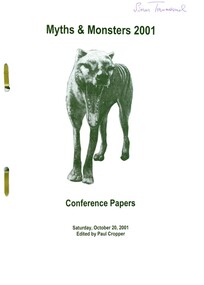
Documents - Reports, Paul Cropper, Myths & Monsters Conference Papers, 10/2001
... Australian Animal Folklore Collection Paul Cropper Ruby Lang Helmut Loofs Wissowa Bill Chalker Gary Opit Malcolm Smith Michael Hallett David McBean Tony Healy Peter Chapple bunyip blue montains yowie thylacine big cat puma panther ufo goolma woodenbong narrabeen lakes cecil mcgann dorothy middleton lee kelly brown bittern bay monster simon moir footprints blue mountains cryptid prehistoric bipedal primates gigantopithecus meganthropus homo rudolfensis homo habilis homo erectus homo ergaster hominid bigfoot psychic phenomena black panther lake monster blue labyrinth Australian Rare Fauna Research Association marsupial lion thylocoleo carnifex australian big cat tasmanian devil sarcophilus harrisi eric guiler yellingbo thylacinus cynocephalus tantanoola tiger rilla martin mundrabilla predatory animal mythical myth folklore Signed on cover "Simon Townsend" 82 page proceedings of the Myths and Monsters Conference printed onto white paper. The following topics were presented: * A brief History of Australian Cryptozoology (Paul Cropper) * Would the Real Orang-Utan Please Stand Up and be Counted? ...The Myths and Monsters conference was something of a landmark in Australian mystery animal research. It was the first cryptozoological conference held in Australia, and the first time Australia's leading researchers had been able to present their findings and meet with others working in the same field. 82 page proceedings of the Myths and Monsters Conference printed onto white paper. The following topics were presented: * A brief History of Australian Cryptozoology (Paul Cropper) * Would the Real Orang-Utan Please Stand Up and be Counted? In search of unidentified relic hominoids in Southeast Asia (Helmut Loofs-Wissowa) * Strange Creatures on the Antipodean UFO trail (Bill Chalker) * The Bunyip (Gary Opit) * Sightings of Some Anomolous Sea Creatures (Malcolm Smith) * Investigating Cryptic Hominids (Yowies) in the Blue Mountains of New South Wales (MIchael Hallett & David McBean) * "High Strangeness" in Yowie Reports (Tony Healy) * The Mystery of the Australian Big Cat: A Brief Summary (Peter Chapple) * Quest for the Thylacine (Peter Chapple) [Australian Animal Folklore Collection]Signed on cover "Simon Townsend"australian animal folklore collection, paul cropper, ruby lang, helmut loofs wissowa, bill chalker, gary opit, malcolm smith, michael hallett, david mcbean, tony healy, peter chapple, bunyip, blue montains, yowie, thylacine, big cat, puma, panther, ufo, goolma, woodenbong, narrabeen lakes, cecil mcgann, dorothy middleton, lee kelly, brown bittern, bay monster, simon moir, footprints, blue mountains cryptid, prehistoric bipedal primates, gigantopithecus, meganthropus, homo rudolfensis, homo habilis, homo erectus, homo ergaster, hominid, bigfoot, psychic phenomena, black panther, lake monster, blue labyrinth, australian rare fauna research association, marsupial lion, thylocoleo carnifex, australian big cat, tasmanian devil, sarcophilus harrisi, eric guiler, yellingbo, thylacinus cynocephalus, tantanoola tiger, rilla martin, mundrabilla, predatory animal, mythical, myth, folklore -
 Federation University Historical Collection
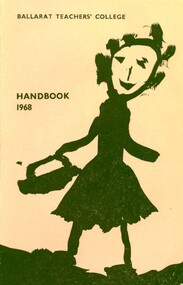
Booklet, Ballarat Teachers' College, Ballarat Teachers' College Handbook, 1968, 1968
... signed "Peter Fryar". Orange and black soft covered booklet with a childlike image of a woman on the cover. The 44 page book is the handbook of the Ballarat Teachers' College and includes: history of the college, 1968 programme, courses, teaching Practice, practising school, classification, certification, Ellwood Prize, Lord Prize, hostels, college trips Ballarat Teachers' College Handbook, 1968 Booklet Ballarat Teachers' College J.A. ...History of the Ballarat Teachers, College as outlined on page 9 of the handbook. Ballarat Teachers' College was opened on may 4th, 1926, at Dana Street State School (no 33), with an enrollment of sixty-one students, its original staff consisted of the Principal, Mr W. H. Ellwood, M.A., M.Ed. (Chairman of the Teachers' tribunal from its inception in 1946 until 1954), Miss A. Bouchier, B.A., and Mr A.B. Jones, B.A. (lecturers). In 1927 Miss P.A. Hamano joined the staff. Teaching practice and special rural school work were carried on in schools in or near Ballarat - drawing, crafts and singing were taught by local teachers. In 1927 the college moved to the former Ballarat East Town Hall (remodelled for their use) in Barkly Street. During 1927 the numbers in the College were augmented by twenty-six Manual arts students who had formerly received their training at Ballarat High School. Manual Arts students continued until 1930, when, on grounds of economy, their training was concentrated at Melbourne Teachers' College. During the four succeeding years approximately sixty students annually entered the primary course. Inclusive of Manual Arts students, and private fee-paying students, exactly 400 trainees passed through the college in its brief span of life (1926-1931) Fourteen years were to pass before they were again opened to students on February 2nd, 1946. The college was re-commenced at S.S. Dana Street under the guidance of Mr W.F. Lord, M.C., M.M., B.A., Dip.Ed., (Acting Principal 1946-1950), and a staff consisting of Miss E.B. Hughes, B.A., Dip. Ed., Mr C.B. Bryan, B.A., V.Com., Dip.Ed., Miss M.H. Miller, L.Mus.A., and Miss G. Kentish, Dip.Phys.Ed. The opening ceremony was performed by the Minister for education at that time, the Hon. F. Field, M.L.A., accompanied by the Hon. T.T. Hollway, M.L.A., and the then Director of Education, Mr J.A. Seitz. It was originally intended to cater for women students only (for whom 130 Victoria Street was purchased as a hostel) but, at the last moment, men were also accepted. A co-educational college was thus set up instead, and has continued as such. The original Staff has been considerable augmented, and the number of Students has been more than trebled. 1951 saw the introduction of the two-year course, successful students being presented with the Trained Primary Teachers' Certificate at the final College assembly each year. In December, 1855, College held its first Graduation Ceremony, with its own graduation hymn, the words of which were written by Miss C.M. (Mavis) Canty of the staff. Mr Ellwood, former Principal, delivered the occasional address and presented the Ellwood Prize to the outstanding student of the year (Mr C.P. Handreck). Students who had successfully completed the course received their certificates from Mr E.B. Pederick, Chief Inspector of Primary Schools. College accomodation having been strained for several years, it was pleasant news when tenders were called in July, 1956, for the building of the first section of the new Ballarat Teachers' College in Gillies Street, near the Botanical Gardens. At the beginning of 1958 the new College was occupied, and staff and students have appreciated greatly the appointements and cacilities of the new building. In 1968 the three-year Diploma Course began, co-existent with the other courses which will continue during the transitional period. Successful students in the course receive the Diploma of teaching (Primary). Orange and black soft covered booklet with a childlike image of a woman on the cover. The 44 page book is the handbook of the Ballarat Teachers' College and includes: history of the college, 1968 programme, courses, teaching Practice, practising school, classification, certification, Ellwood Prize, Lord Prize, hostels, college tripsInside front page signed "Peter Fryar".ballarat teachers' college, peter fryar, t.w.h. turner, tom turner, frank lord, monica miller, dana street primary school, art collection, hostels -
 Federation University Historical Collection
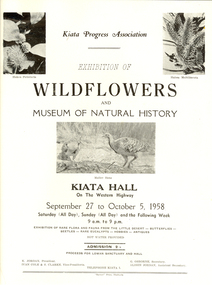
Correspondence, "Banner " Print, Dimboola, Correspondence from Kiata State School concerning an Exhibition of Wildflowers, 1958, 1958
... signed by G.B. Osborne, Honorary Secretary of the Kiata Progress Association. .3) one page typed letter (carbon copy) dated 28 August 1958 in reply to above .4) Printed flyer advertising the Kiata Progress Association Exhibition of Wildflowers and Museum of Natural History to be held in Kiata Hall on 25 September to 05 October 1958. ...signed by G.B. Osborne, Honorary Secretary of the Kiata Progress Association. .3) one page typed letter (carbon copy) dated 28 August 1958 in reply to above .4) Printed flyer advertising the Kiata Progress Association Exhibition of Wildflowers and Museum of Natural History to be held in Kiata Hall on 25 September to 05 October 1958. ...The following were office bearers of the Kiata Progress Association in 1958: K. Jordon (President) G. Osborne (Secretary) Ivan Cole & S. Clark (Vice_Presidents Alison Jordan (Assistant Secretary) It is a assumed that the Kiata Progress Association Wildflower Exhibition was the predecessor of the Little Desert Wildflower Exhibition is held each year in September-October. Kiata is a town in the Wimmera region between Nhill and Dimboola, western Victoria, Australia.Correspondence from Kiata State School to the Ballarat School of Mines concerning an Exhibition of Wildflowers, 1958 .1-2) Two page hand written letter dates 20 August 1958 and signed by G.B. Osborne, Honorary Secretary of the Kiata Progress Association. .3) one page typed letter (carbon copy) dated 28 August 1958 in reply to above .4) Printed flyer advertising the Kiata Progress Association Exhibition of Wildflowers and Museum of Natural History to be held in Kiata Hall on 25 September to 05 October 1958. The flyer includes photographic depictions of Kakea Petiolaris, Hakea multilineata and Mallee Hens.mallee hens, kiata progress association, wildflower exhibition, kiata hall, little desert, lowan sanctuary, k. jordan, ivan cole, s. clarke, g. osborne, alison jordan -
 Federation University Historical Collection
Poster - Signs, Window signs by Keith Rash
... The signs were designed to sit in shop windows to tell the history of the shop of company. ...The signs were designed to sit in shop windows to tell the history of the shop of company. ...It is thought the signs were used for Ballarat's Gold Centenary in 1851.Seven window signs by Keith Rash painted onto wallpaper. The signs were designed to sit in shop windows to tell the history of the shop of company. .1) In 1862 Eurgene Bourdet conducted the "Imperial Dining Rooms" here. Board 20/- Board & Lodging 25/- week .2) On 16th Feb. 1853 at the Government Land Sale, Mr C.N. Thorne purchased this area. In 1893, R. Ludbrook used this property as Auction Rooms. .3) McArtney & aldred first occupied these premises in 1856. There were coachbuilders. .4) From the Single Storeyed wooden building once her J.P. Clarke operated as a carrier until 1865. Welsh & Surplice took over as Estate Agents until 1870. .5) Dr James Stewart built this property H.G. Harrison, 1957. J.C. Proctor 1862, John Stokes 1865, were chemists here. In 1856 The Savings Bank commenced here. W.H. Pooley, actuary .6) Wm Moss, tinsmith, occupied this site in 1865. Thos. Freeman,a uctioneer in 1882. .7) Doig & Cant. Gasfitters & Plumbers came here from Main Road in 1866. After 38 years A. Cant removed 2 doors further north .8) In 1871, This part was the shop of Wm Moss, tinsmith & plumberballarat, doig, cant, plumber, william moss, tinsmith, thomas freeman, james stewart, h.g. harrison, j.c. proctor, john stokes, savings bank, w.h. pooley, j.p. clarke, welsh, surplice, mcartney, aldred, coachbuilders, c.n. thorne, r. ludbrook, eugene bourdet -
 Flagstaff Hill Maritime Museum and Village
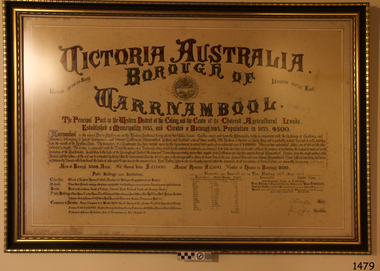
Document - Framed Poster, Borough of Warrnambool, Victoria, Australia, after 30/06/1875
... . --- Exports and Imports for the Year Ending 30th June 1875 –-- --Exports Total Tonnage 27,800 (Calculated at the Current Warrnambool Market Prices) Potatoes Wool Wheat Barley Hides Skins Fowls Butter Cheese Eggs Tallow Leather Ale Pigs Sheep Sundries --Imports 13,000 Tons Of the Estimated Value of £520,000 Total Tonnage of Exports and Imports 40m900 Tons, Value £806,627 Passenger Travels, to ad from Warrnambool during year, 10,000 persons Revenue from all sources paid through Warrnambool Sub Treasury From 1860 to June 1875 £1, 292, 300 Thomas King [signed] Mayor Henry T Read [signed] Town Clerk” - - - - - - - - - - - - - - -- - - - - - - - - - - - - - -- - - - - - - - - - - - - - -- - - - - - - - - - - - - - - The document is of historical, social, economic and local significance in that it summarises activities, business, community, trade, travel and government at a point in time in Warrnambool’s history – 30th June 1875. flagstaff hill warrnambool shipwrecked coast flagstaff hill maritime museum maritime museum shipwreck coast flagstaff hill maritime village great ocean road borough of warrnambool municipality of warrnambool document borough of warrnambool 1875 word picture of warrnambool 1875 tablet of borough of warrnambool 1875 statistics borough of warrnambool 1875 lithograph borough of warrnambool 1875 coat of arms warrnambool warrnambool city motto – in these we flourish establishment of warrnambool warrnambool history thomas king mayor of warrnambool henry t read town clerk of warrnambool warrnambool breakwater warrnambool jetty warrnambool imports and exports 1875 warrnambool agriculture 1875 warrnambool business 1875 warrnambool population 1875 centennial exhibition philadelphia 1876 framed certificate Signatures - "Thomas King" Mayor and "Henry T Read" Town Clerk. ...This document, also referred to as a word picture or Tablet, is framed in glass and timber with gilt trim, is handwritten with colour highlights. The penned letters rest on ruled guide lines, decorated where the lines intersect. The writing gives a description of the state of Borough of Warrnambool around 1875; its location, the area it covers, its population, Harbour and facilities, public buildings and institutions, imports and exports, financial worth, number of houses, connection with other areas of the Colony. A possible reason and origin for the document is found in an article ‘Link with US Exhibition’ from the Warrnambool Standard of December 19, 1981, written by local historian Bruce Morris. The writer mentions that the Warrnambool Borough Council met on 15th June 1875 and recorded a letter from G.C. Levey , secretary to the Melbourne group of commissioners representing the Colony, and Victoria in particular, for the Philadelphia Centennial Exhibition of 1876. The letter asks Council to provide “statistics as to the population, social condition and commercial and industrial state of the district in and around Warrnambool.” A sub committee was formed for the project. The Mayor, Cr. Thomas King, wrote and signed a Report, presented to the council on July 14, 1875, in which “The Committee … begs to recommend that a Tablet be prepared setting for the particulars respecting the following matters relating to the Borough”. The matters included area, population, annual income, churches, schools, other public buildings, societies and companies, general description of houses erected, and returns of exports and imports for 1874. The minutes note that the Report was adopted. The article above also notes the opinion of Warrnambool printers who have examined the document; it is almost certainly to be an old lithograph, which means there could be several copies. It is possible that there may be a copy in Melbourne and another in Philadelphia. It is interesting to note that (1) the quoted location co-ordinates are for an “Unnamed Road, Packsaddle NSW 2880, Australia”, and that the DMS co-ordinates for Warrnambool’s Council Offices differ, being 38.23.9.12 South, 142.28.52.887. (2) the date for “Exports and Imports for the Year Ending 30th June 1875” is different to the period mentioned by Cr. King in the sub committee’s Report of recommendation “returns of exports and imports for 1874”. The information required to have the figures for the end of June 1875 would need to have been compiled very quickly for the Tablet to be ready for the opening of the Philadelphia Exhibition on 10 May 1876. The document/certificate shows the following – - - - - - - - - - - - - - - -- - - - - - - - - - - - - - -- - - - - - - - - - - - - - -- - - - - - - - - - - - - - - “Victoria Australia, Borough of Warrnambool. Latitude, 30.24.50 South, Longitude 142.32 East The Principal Port in the Western District of the Colony and the Centre of its Choicest Agricultural Lands. Established a Municipality in 1855, and Created a Borough 1863. Population in 1875 4,500. Warrnambool is the nearest Port to Melbourne on the Western Seaboard, being about 160 miles distant. Coaches run to and from the Metropolis daily, in connexion [connection] with the Railway of Geelong and Steamers belonging to Local Companies sail between Melbourne, Warrnambool, Belfast [renamed Port Fairy], and Portland several times weekly. The Harbour is known as Lady Bay, and is partially protected by a reef of rocks stretching from the mouth of the Hopkins River. The formation of a Breakwater has been decided upon by the Government, to extend 600 yards, at an estimated cost of £100,000. There are two substantial Jetties, one of 800 and the other of 600 feet in length. The former is connected with the Town by means of a Tramroad, along which Goods, inwards & outwards, are conveyed, & the latter has been constructed solely for the purpose of facilitating the transit of material for the formation of the Breakwater. In addition to the trade of the Borough and District, the principal Townships up country receive their supplies from Melbourne and ship their exports through Warrnambool. Potatoes form the staple produce of the district, and the richness of the soil can be estimated by the fact that the Government Statistics for 1875 give as the average yield a return of Seven Tons to the acre. Several thousand acres between Warrnambool and Tower Hill are now being laid down in Potatoes by Tenants who have leased the lands at rates up to £5 per acre for the season 1875-6. Wool, Tallow, hides &c are also largely exported, while the shipments of all descriptions of Farm Produce are annually increasing. Area of Borough, 3362 Acres. Net Annual Value £27,000. Annual Revenue £5,500. Number of Houses in Borough 800. Public Buildings and Institutions Churches. Church of England, Roman Catholic, Presbyterian, Wesleyan, Congregational and Baptist. Schools. Three State Schools, average attendance nearly 1000. New Building in course of erection. Several private establishments. Banks. Bank of Australasia, Bank of Victoria, National Bank, Colonial Bank and Savings Bank. Public Buildings. Court house, Custom house, Post & Telegraph Offices, Survey & Land Offices, Shire £, Town Hall, Mechanics Institute, Volunteer Orderly Room, Odd Fellows Hall, Hospital & Benevolent Asylum, Temperance Hall &c. Companies & Societies. Steam Navigation Co, Woolen Mill Co, Gas Co, Racing Club, Amateur Turf Club, Agricultural Society, Farmers’ Club, Cricket Club, Anglers’ Society, Building Society, Freemasons Odd Fellows, Foresters, Druids, Hibernians. Protestant Alliance, Rechabites, Sons of Temperance, &c, Fire Brigade &c. --- Exports and Imports for the Year Ending 30th June 1875 –-- --Exports Total Tonnage 27,800 (Calculated at the Current Warrnambool Market Prices) Potatoes Wool Wheat Barley Hides Skins Fowls Butter Cheese Eggs Tallow Leather Ale Pigs Sheep Sundries --Imports 13,000 Tons Of the Estimated Value of £520,000 Total Tonnage of Exports and Imports 40m900 Tons, Value £806,627 Passenger Travels, to ad from Warrnambool during year, 10,000 persons Revenue from all sources paid through Warrnambool Sub Treasury From 1860 to June 1875 £1, 292, 300 Thomas King [signed] Mayor Henry T Read [signed] Town Clerk” - - - - - - - - - - - - - - -- - - - - - - - - - - - - - -- - - - - - - - - - - - - - -- - - - - - - - - - - - - - - The document is of historical, social, economic and local significance in that it summarises activities, business, community, trade, travel and government at a point in time in Warrnambool’s history – 30th June 1875.Document, also referred to as a ‘word picture’ or ‘tablet’. Document is framed in glass and timber with gilt trim, handwritten with colour highlights. The penned letters rest on ruled guide lines, decorated where the lines intersect. Document outlines the establishment of Warrnambool as a Municipality in 1855 and Borough in 1863, with a population of 4,500 in 1875. It states geographic location, public buildings and institutions, harbor facilities and imports and exports for the year ending 30th June 1875. Two signatures "Thomas King" Mayor and "Henry T Read" Town Clerk. It shows the Coat of Arms of the Borough of Warrnambool.Signatures - "Thomas King" Mayor and "Henry T Read" Town Clerk. Warrnambool Coat of Arms; “British Coat of Arms, above sailing vessel and sheaf of wheat in sun, motto “By these we flourish” and around circumference “Borough of Warrnambool 1855”flagstaff hill, warrnambool, shipwrecked coast, flagstaff hill maritime museum, maritime museum, shipwreck coast, flagstaff hill maritime village, great ocean road, borough of warrnambool, municipality of warrnambool, document borough of warrnambool 1875, word picture of warrnambool 1875, tablet of borough of warrnambool 1875, statistics borough of warrnambool 1875, lithograph borough of warrnambool 1875, coat of arms warrnambool, warrnambool city motto – in these we flourish, establishment of warrnambool, warrnambool history, thomas king mayor of warrnambool, henry t read town clerk of warrnambool, warrnambool breakwater, warrnambool jetty, warrnambool imports and exports 1875, warrnambool agriculture 1875, warrnambool business 1875, warrnambool population 1875, centennial exhibition philadelphia 1876, framed certificate -
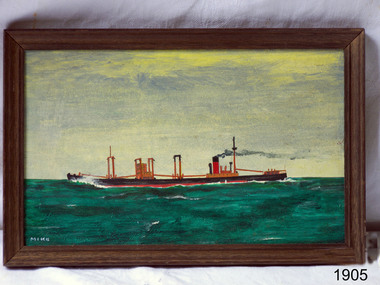 Flagstaff Hill Maritime Museum and Village
Painting - Vessel, Steamship, Mike McCrea (artist), ca 1985
... The paintings represent a time in local history when many steamships were sailing the coast and transporting passengers and goods. flagstaff hill warrnambool shipwrecked-coast flagstaff-hill flagstaff-hill-maritime-museum maritime-museum shipwreck-coast flagstaff-hill-maritime-village Painting Mike McCrea steamship Master Mariners of Australia Patana Galleries Signed; "MIKE" "J15/62 McCrea" "Red. ...This is one of a pair of paintings by artist Mike McCrea, created when he was in Warrnambool in 1985. The painting was framed and sold by Patana Galleries, Paton Place, Manly Vale, NSW. It was later purchased by athe company of Master Mariners of Australia and who donated the pair to Flagstaff Hill. The pair of paintings are significant for their association with steamships and the Master Mariners of Australia group. The paintings represent a time in local history when many steamships were sailing the coast and transporting passengers and goods.Painting, framed oil on board; cargo steamship off the coast of Warrnambool by artist Mike McCrea. Framed by Patana Galleries, Manly Vale, N.S.W. Signed by artist.Signed; "MIKE" "J15/62 McCrea" "Red. No. 390 A" Sticker with "62" "PATANA GALLERIES / PATON PLACE, MANLY VALE / PHONE 949-1535"flagstaff hill, warrnambool, shipwrecked-coast, flagstaff-hill, flagstaff-hill-maritime-museum, maritime-museum, shipwreck-coast, flagstaff-hill-maritime-village, painting, mike mccrea, steamship, master mariners of australia, patana galleries
