
Showing 118 items matching "southeast asians"
-
 National Vietnam Veterans Museum (NVVM)
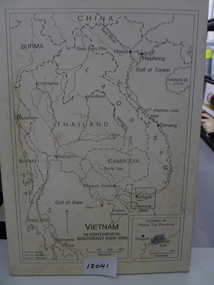
Map, Vietnam in Continental Southeast Asia 1965, 1965
... Vietnam in Continental Southeast Asia 1965...Mounted black and white map of Southeast Asia with country borders and major cities marked. ...Countries, cities and gulfs anotated map title - Vietnam in Continental Southeast Asia 1965...Map Phuc Tuy Countries, cities and gulfs anotated map title - Vietnam in Continental Southeast Asia 1965 Mounted black and white map of Southeast Asia with country borders and major cities marked. ...Mounted black and white map of Southeast Asia with country borders and major cities marked. There is a highlight of Phuc Tuy Province in the lower righthand cornerCountries, cities and gulfs anotated map title - Vietnam in Continental Southeast Asia 1965map, phuc tuy -
 National Vietnam Veterans Museum (NVVM)
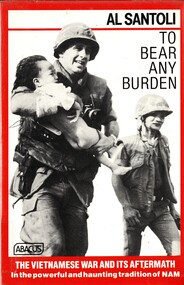
Book, Santoli, Al, To Bear Any Burden: The Vietnam War and its Aftermath - In the powerful and haunting tradition of NAM (Copy 3) ), 1985
... ...Southeast Asians...Vietnam War 1961-1975- Personal narratives Southeast Asians 25th Infantry Division Purple Heart Bronze Star Al Santoli was born in Cleveland, Ohio, and served in Vietnam with the 25th Infantry Division, Receiving three Purple Hearts and a Bronze Star for valour To Bear Any Burden: The Vietnam War and its Aftermath - In the powerful and haunting tradition of NAM (Copy 3) ) Book Santoli, Al ...Al Santoli was born in Cleveland, Ohio, and served in Vietnam with the 25th Infantry Division, Receiving three Purple Hearts and a Bronze Star for valourAl Santoli was born in Cleveland, Ohio, and served in Vietnam with the 25th Infantry Division, Receiving three Purple Hearts and a Bronze Star for valourvietnam war, 1961-1975- personal narratives, southeast asians, 25th infantry division, purple heart, bronze star -
 National Vietnam Veterans Museum (NVVM)
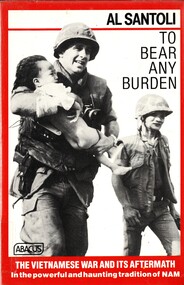
Book, Santoli, Al, To Bear Any Burden: The Vietnam War and its Aftermath - In the powerful and haunting tradition of NAM (Copy 1)
... ...Southeast Asians...Vietnam War 1961-1975- Personal narratives Southeast Asians 25th Infantry Division Purple Heart Bronze Star Al Santoli was born in Cleveland, Ohio, and served in Vietnam with the 25th Infantry Division, Receiving three Purple Hearts and a Bronze Star for valour To Bear Any Burden: The Vietnam War and its Aftermath - In the powerful and haunting tradition of NAM (Copy 1) Book Santoli, Al ...Al Santoli was born in Cleveland, Ohio, and served in Vietnam with the 25th Infantry Division, Receiving three Purple Hearts and a Bronze Star for valourAl Santoli was born in Cleveland, Ohio, and served in Vietnam with the 25th Infantry Division, Receiving three Purple Hearts and a Bronze Star for valourvietnam war, 1961-1975- personal narratives, southeast asians, 25th infantry division, purple heart, bronze star -
 National Vietnam Veterans Museum (NVVM)
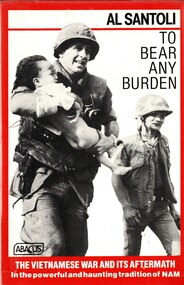
Book, Santoli, Al, To Bear Any Burden: The Vietnam War and its Aftermath - In the powerful and haunting tradition of NAM (Copy 2)
... ...Southeast Asians...Vietnam War 1961-1975- Personal narratives Southeast Asians 25th Infantry Division Purple Heart Bronze Star Al Santoli was born in Cleveland, Ohio, and served in Vietnam with the 25th Infantry Division, Receiving three Purple Hearts and a Bronze Star for valour To Bear Any Burden: The Vietnam War and its Aftermath - In the powerful and haunting tradition of NAM (Copy 2) Book Santoli, Al ...Al Santoli was born in Cleveland, Ohio, and served in Vietnam with the 25th Infantry Division, Receiving three Purple Hearts and a Bronze Star for valourAl Santoli was born in Cleveland, Ohio, and served in Vietnam with the 25th Infantry Division, Receiving three Purple Hearts and a Bronze Star for valourvietnam war, 1961-1975- personal narratives, southeast asians, 25th infantry division, purple heart, bronze star -
 National Vietnam Veterans Museum (NVVM)
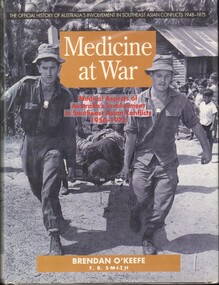
Book, O'Keefe, Brendan, Medicine at War: Medical aspects of Australia's Involvement in Southeast Asian Conflicts 1950-1972, 1994
... Medical aspects of Autralia's involvement in Southeast Asia, 1950-1972....Medical aspects of Autralia's involvement in Southeast Asia, 1950-1972. Medicine at War: Medical aspects of Australia's Involvement in Southeast Asian Conflicts 1950-1972 Book Book O'Keefe, Brendan ...This comprehensive and analytical account documents the important role of the military medical units who supported Australia's overseas forces from the time of the Malayan Emergency.Medical aspects of Autralia's involvement in Southeast Asia, 1950-1972.This comprehensive and analytical account documents the important role of the military medical units who supported Australia's overseas forces from the time of the Malayan Emergency.vietnamese conflict, 1961-1975 - medical care, agent orange - tboxicology, australia - armed forces - medical care - asia, southeastern -
 Kyneton RSL Sub Branch
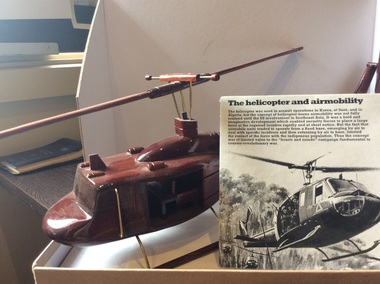
Artefact, Helicopter
... Wooden model helicopter and descriptive information relating to use of helicopters in Southeast Asia....The Iroquois helicopter was used in Vietnam by Australian Air Force as gunfire support and for medical evacuation. vietnam helicopters iroquios Wooden model helicopter and descriptive information relating to use of helicopters in Southeast Asia. Helicopter Artefact ...The Iroquois helicopter was used in Vietnam by Australian Air Force as gunfire support and for medical evacuation.Wooden model helicopter and descriptive information relating to use of helicopters in Southeast Asia.vietnam, helicopters, iroquios -
 Beechworth RSL Sub-Branch
Guide book, Department of the army, Weapons and equipment recognition guide, March 1969
... Country coverage Southeast Asia...Country coverage Southeast Asia Weapons and equipment recognition guide Guide book Department of the army ...Weapons and equipment recognition guide, log book. Department of the army pamphlet. Country coverage Southeast Asialogbook, weapons and equipment, guide -
 National Vietnam Veterans Museum (NVVM)
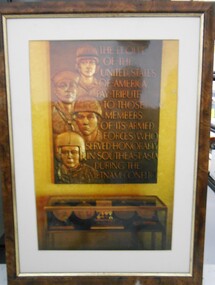
Photograph, People of USA Tribute to Armed Forces
... Framed colour Photograph of a Plaque and Display Case " THE PEOPLE OF THE UNITED STATES OF AMERICA PAY TRIBUTE TO THOSE MEMBERS OF ITS ARMED FORCES WHO SERVED HONORABLY IN SOUTHEAST ASIA DURING THE VIETNAM CONFLICT"...Photograph US Military Framed colour Photograph of a Plaque and Display Case " THE PEOPLE OF THE UNITED STATES OF AMERICA PAY TRIBUTE TO THOSE MEMBERS OF ITS ARMED FORCES WHO SERVED HONORABLY IN SOUTHEAST ASIA DURING THE VIETNAM CONFLICT" People of USA Tribute to Armed Forces Photograph Photograph ...Framed colour Photograph of a Plaque and Display Case " THE PEOPLE OF THE UNITED STATES OF AMERICA PAY TRIBUTE TO THOSE MEMBERS OF ITS ARMED FORCES WHO SERVED HONORABLY IN SOUTHEAST ASIA DURING THE VIETNAM CONFLICT"photograph, us military -
 Kew Historical Society Inc
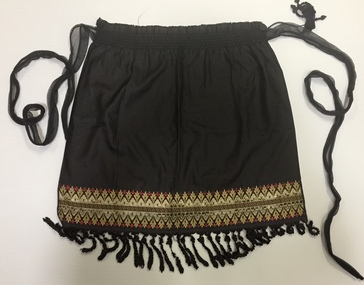
Clothing - Cotton apron embroidered with gold and red silk thread, 1960s
... Black hostess apron created from a black silk southeast asian textile featuring a stylised woven band of red, black and gold silk. ...While the collection includes some examples of international fashion, most items were handmade or purchased in Melbourne. clothing - women's aprons protective wear fashion design fashion -- 1960s Black hostess apron created from a black silk southeast asian textile featuring a stylised woven band of red, black and gold silk. ...The Fashion & Design collection of Kew Historical Society includes examples of women’s, men’s, children’s and infants' clothing from the 18th, 19th and 20th centuries. While the collection includes some examples of international fashion, most items were handmade or purchased in Melbourne.Black hostess apron created from a black silk southeast asian textile featuring a stylised woven band of red, black and gold silk. The fabric is gathered at the waist. The strap includes a black silk tassel. clothing - women's, aprons, protective wear, fashion design, fashion -- 1960s -
Creswick Campus Historical Collection - University of Melbourne
Ephemera
... Hardwood sawlog grading cards for Indian and Southeast Asian species....Hardwood sawlog grading cards for Indian and Southeast Asian species. Wood specimens Ephemera ...Hardwood sawlog grading cards for Indian and Southeast Asian species.Wood specimens -
 8th/13th Victorian Mounted Rifles Regimental Collection
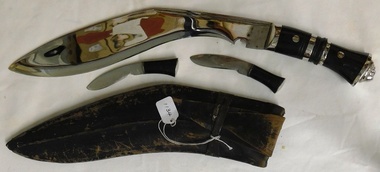
Weapon - Kukri
... Often purchased as a souvenir by returning servicemen from Southeast Asia and later donated as a Mess decoration....Often purchased as a souvenir by returning servicemen from Southeast Asia and later donated as a Mess decoration. ...A weapon issued to Ghurka servicement. Often purchased as a souvenir by returning servicemen from Southeast Asia and later donated as a Mess decoration.Representative of souvenirs from WWII.Large knife with inward turned blade traditionally carried by Gurkha soldiers. Sheath is wood covered by leather. Includes two much smaller knives which fit into the top of the sheath.Blade is engraved with decoration.kukri, gurkha -
 Lara RSL Sub Branch
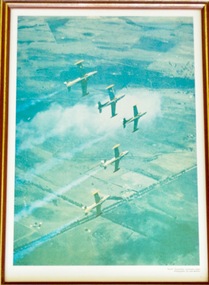
Photograph, RAAF Roulettes Aerobatics Team
... They provide about 150 flying displays a year, in Australia and in friendly countries around the Southeast Asian region. The Roulettes form part of the RAAF Central Flying School at RAAF Base East Sale, Victoria....They provide about 150 flying displays a year, in Australia and in friendly countries around the Southeast Asian region. The Roulettes form part of the RAAF Central Flying School at RAAF Base East Sale, Victoria. ...The Roulettes are the Royal Australian Air Force's formation aerobatic display team. They provide about 150 flying displays a year, in Australia and in friendly countries around the Southeast Asian region. The Roulettes form part of the RAAF Central Flying School at RAAF Base East Sale, Victoria.In 1970, the Roulettes were formed to celebrate the RAAF's 50th anniversary to be held throughout the year of 1971. The Roulettes first air show was at Point Cook in Dec 1970Rectangular shaped glass covered picture frame with photo of the Roulettes flying in formation.RAAF 'Roulettes' aerobatic team Photographer: Cpl John McKeonraaf, roulettes, aerobatic flying team, lara r.s.l. -
Federation University Historical Collection
Object, Boxed Pewter Keris Letter Opener
... The keris is a dagger unique to the Malay cultures of Southeast Asia, with renderings depicting the weapon dating to 825 CE. ...The keris is a dagger unique to the Malay cultures of Southeast Asia, with renderings depicting the weapon dating to 825 CE. ...The keris is a dagger unique to the Malay cultures of Southeast Asia, with renderings depicting the weapon dating to 825 CE. Asymmetry is this ancient weapon’s distinguishing feature and, although different styles exist, it is the wavy blade that is instantly recognisable. Today, the keris is a potent symbol of the history and culture of the Malay world.A boxed pewter letter opener, in the form of a wavy-bladed keris, in satin finish pewter. Thank you Professor Kerry O. Cox Vice-Chancellor University of Ballarat for gracing the graduation ceremony hosted by Regions College 10th October 2005international visitors, international visits, souvenirs, gifts, malaysia, keris, blade, knife -
 Returned Nurses RSL Sub-branch
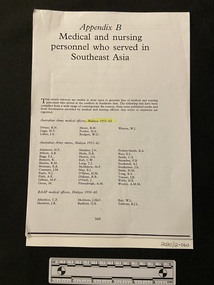
Document - Personnel list, Medical and nursing personnel who served in Southeast Asia, unknown
... Medical and nursing personnel who served in Southeast Asia....Southeast Asia...Copy of Appendix B from an unknown publication, detailing the names of the medical and nursing personnel who served in Southeast Asia (including: Malaya, Borneo and Vietnam). ...Medical and nursing personnel who served in Southeast Asia. Document Personnel list. ...Copy of Appendix B from an unknown publication, detailing the names of the medical and nursing personnel who served in Southeast Asia (including: Malaya, Borneo and Vietnam). "The following lists have been compiled from a wide range of contemporary file sources, from some published works and from information provided by medical and nursing officers" - (from the opening paragraph).Photocopy of five pages of a printed appendix listing three columns of names under each heading. The words 'Malaya 1955-63' are highlighted in yellow on the first page. 'Malaya 1955-63' [Highlighted with a bright yellow highlight marker on the first page] [Thirteen names on the third page have small pencil cross marks by them]southeast asia, australian army nurses, royal australian air force nurses, medical officers, vietnam, malaya, borneo -
 Wangaratta RSL Sub Branch
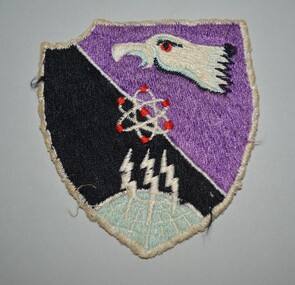
Badge - Cloth badge, c1965
... Operating out of Bien Hoa Air Base, the squadron flew the North American F-100 Super Sabre, completing over 27,200 combat missions in Southeast Asia. ...Operating out of Bien Hoa Air Base, the squadron flew the North American F-100 Super Sabre, completing over 27,200 combat missions in Southeast Asia. Unit badge patch Vietnam War 510th Tactical Fighter Squadron USAF Embroided cotton patch consisting of a shield design featuring a white buzzard's head with a red eye, set against a divided background of black and purple. ...U.S. military produced unit patch of the 510th Tactical Fighter Squadron. The design represented the squadron's global reach, striking speed, and technological tactical power. Known as the "Bien Hoa Buzzards," they flew combat missions in Vietnam from November 1965 to October 1969. Operating out of Bien Hoa Air Base, the squadron flew the North American F-100 Super Sabre, completing over 27,200 combat missions in Southeast Asia. Embroided cotton patch consisting of a shield design featuring a white buzzard's head with a red eye, set against a divided background of black and purple.unit badge, patch, vietnam war, 510th tactical fighter squadron, usaf -
 Orbost & District Historical Society
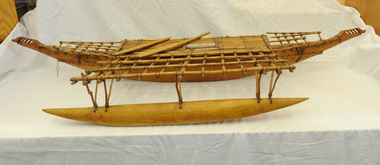
model -outrigger canoe, mid -late 19th century
... Outrigger canoes were originally developed by the peoples of the islands of Southeast Asia for sea travel, and were used to transport these peoples eastward through to Polynesia and New Zealand more than 2000 Years ago. ...Outrigger canoes were originally developed by the peoples of the islands of Southeast Asia for sea travel, and were used to transport these peoples eastward through to Polynesia and New Zealand more than 2000 Years ago. ...The outrigger gives greater stability and seaworthiness to the canoe. Outrigger canoes were originally developed by the peoples of the islands of Southeast Asia for sea travel, and were used to transport these peoples eastward through to Polynesia and New Zealand more than 2000 Years ago. Today they are still in use. This item possibly came to Orbost with Reverend Alexander Morton . Morton was the minister at the Presbyterian church about 1890. He had spent time in new Hebrides and went on to New Zealand.This item is an example of a handcrafted artefact from the New Hebrides.Detailed model of an outrigger canoe from the Polynesian islands. It isa handmade wooden (possibly breadfruit wood) model of an outrigger canoe - one outrigger attached to the main hull. Bound with string. It has two wooden paddles.handcraft morton-alexander model-outrigger-canoe -
 Wangaratta RSL Sub Branch
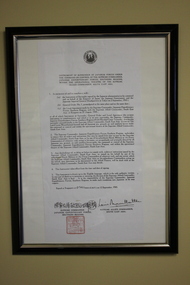
Document - Framed photocopy of Instrument of Surrender of Japanese Forces Singapore
... During his time as Supreme Allied Commander of the Southeast Asia Theatre, Lord Mountbatten's command oversaw the recapture of Burma. ...During his time as Supreme Allied Commander of the Southeast Asia Theatre, Lord Mountbatten's command oversaw the recapture of Burma. ...The Instrument of Surrender signed at Singapore by Admiral Lord Louis Mountbatten for the Allies and General Itagaki for the Japanese. During his time as Supreme Allied Commander of the Southeast Asia Theatre, Lord Mountbatten's command oversaw the recapture of Burma. A personal high point was the receipt of the Japanese surrender in Singapore when British troops returned to the island to receive the formal surrender of Japanese forces in the region led by General Itagaki on 12 September 1945, codenamed Operation Tiderace. General Itagaki was convicted of war crimes and executed inn 1948.The surrender of Imperial Japan was announced on August 15 and formally signed on September 2, 1945, bringing the hostilities of World War II to a close.Following the war, Mountbatten was known to have largely shunned the Japanese for the rest of his life out of respect for his men killed during the war, and as per his will, Japan was not invited to send diplomatic representatives to his funeral in 1979,Black frame with silver insert with glass of a photocopy of the Instrument of Surrender of the Japanese Forces. Script is in black on white paper with a red square seal at the bottom left, mounted on cream board.Instrument of surrender of Japanese Forces under the command or control of the Supreme Commander, Japanese Expeditionary forces, southern regions within the operational theatre of the Supreme Allied Commander, South East Asia. Signed at Singapore at 0341 hours (G.M.T.) on 12 September, 1945.wwii, world war 2, imperial japanese forces, surrender, singapore, japanese army -
 Federation University Historical Collection
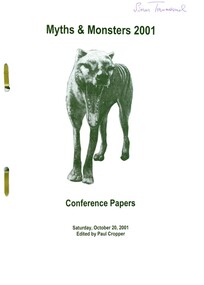
Documents - Reports, Paul Cropper, Myths & Monsters Conference Papers, 10/2001
... In search of unidentified relic hominoids in Southeast Asia (Helmut Loofs-Wissowa) * Strange Creatures on the Antipodean UFO trail (Bill Chalker) * The Bunyip (Gary Opit) * Sightings of Some Anomolous Sea Creatures (Malcolm Smith) * Investigating Cryptic Hominids (Yowies) in the Blue Mountains of New South Wales (MIchael Hallett & David McBean) * "High Strangeness" in Yowie Reports (Tony Healy) * The Mystery of the Australian Big Cat: A Brief Summary (Peter Chapple) * Quest for the Thylacine (Peter Chapple) [Australian Animal Folklore Collection]...In search of unidentified relic hominoids in Southeast Asia (Helmut Loofs-Wissowa) * Strange Creatures on the Antipodean UFO trail (Bill Chalker) * The Bunyip (Gary Opit) * Sightings of Some Anomolous Sea Creatures (Malcolm Smith) * Investigating Cryptic Hominids (Yowies) in the Blue Mountains of New South Wales (MIchael Hallett & David McBean) * "High Strangeness" in Yowie Reports (Tony Healy) * The Mystery of the Australian Big Cat: A Brief Summary (Peter Chapple) * Quest for the Thylacine (Peter Chapple) [Australian Animal Folklore Collection] Myths & Monsters Conference Papers Documents - Reports Paul Cropper ...The Myths and Monsters conference was something of a landmark in Australian mystery animal research. It was the first cryptozoological conference held in Australia, and the first time Australia's leading researchers had been able to present their findings and meet with others working in the same field. 82 page proceedings of the Myths and Monsters Conference printed onto white paper. The following topics were presented: * A brief History of Australian Cryptozoology (Paul Cropper) * Would the Real Orang-Utan Please Stand Up and be Counted? In search of unidentified relic hominoids in Southeast Asia (Helmut Loofs-Wissowa) * Strange Creatures on the Antipodean UFO trail (Bill Chalker) * The Bunyip (Gary Opit) * Sightings of Some Anomolous Sea Creatures (Malcolm Smith) * Investigating Cryptic Hominids (Yowies) in the Blue Mountains of New South Wales (MIchael Hallett & David McBean) * "High Strangeness" in Yowie Reports (Tony Healy) * The Mystery of the Australian Big Cat: A Brief Summary (Peter Chapple) * Quest for the Thylacine (Peter Chapple) [Australian Animal Folklore Collection]Signed on cover "Simon Townsend"australian animal folklore collection, paul cropper, ruby lang, helmut loofs wissowa, bill chalker, gary opit, malcolm smith, michael hallett, david mcbean, tony healy, peter chapple, bunyip, blue montains, yowie, thylacine, big cat, puma, panther, ufo, goolma, woodenbong, narrabeen lakes, cecil mcgann, dorothy middleton, lee kelly, brown bittern, bay monster, simon moir, footprints, blue mountains cryptid, prehistoric bipedal primates, gigantopithecus, meganthropus, homo rudolfensis, homo habilis, homo erectus, homo ergaster, hominid, bigfoot, psychic phenomena, black panther, lake monster, blue labyrinth, australian rare fauna research association, marsupial lion, thylocoleo carnifex, australian big cat, tasmanian devil, sarcophilus harrisi, eric guiler, yellingbo, thylacinus cynocephalus, tantanoola tiger, rilla martin, mundrabilla, predatory animal, mythical, myth, folklore -
 Embroiderers Guild, Victoria
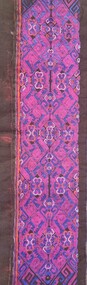
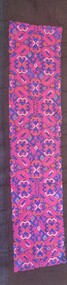
Textile - Embroidered Hmong Dress Panel
... This tradition took on a new powerful meaning in the late 1970's after the wars in Southeast Asia. Forced into refugee camps in Thailand, Hmong women began creating "story cloths". ...This tradition took on a new powerful meaning in the late 1970's after the wars in Southeast Asia. Forced into refugee camps in Thailand, Hmong women began creating "story cloths". ...During periods of harsh persecution, Hmong women developed a way to record their history by weaving it directly into their clothing. Called "pajntaub" , which means "flower cloth", and it was traditionally practiced only by the women of the community. Using a variety of complex stitching techniques, they created intricate geometric patterns. These designs were not just for decoration on clothes, collars and baby carriers. At times when their own language was suppressed, these symbols served as a form of communication and cultural documentation, with history hidden in the very pleats of their skirts. This tradition took on a new powerful meaning in the late 1970's after the wars in Southeast Asia. Forced into refugee camps in Thailand, Hmong women began creating "story cloths". These were larger tapestries that documented their lives, their traditions, and their harrowing journey from their homelands to the camps. These story cloths became a way to tell the world what had happened to them . They also became a vital source of income, sometimes selling for just one dollar, which helped families survive in the camps. Hmong Archives; Library of Congress. Hill Tribe clothing panel in fuchsia pinks and royal blue, with white, green, orange highlights. Embroidered in buttonhole stitch and satin stitch filling. Worked on black even weave linen. -
 Embroiderers Guild, Victoria
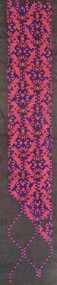
Textile - Embroidered Hmong Dress Panel
... This tradition took on a new powerful meaning in the late 1970's after the wars in Southeast Asia. Forced into refugee camps in Thailand, Hmong women began creating "story cloths". ...This tradition took on a new powerful meaning in the late 1970's after the wars in Southeast Asia. Forced into refugee camps in Thailand, Hmong women began creating "story cloths". ...During periods of harsh persecution, Hmong women developed a way to record their history by weaving it directly into their clothing. Called "pajntaub" , which means "flower cloth", and it was traditionally practiced only by the women of the community. Using a variety of complex stitching techniques, they created intricate geometric patterns. These designs were not just for decoration on clothes, collars and baby carriers. At times when their own language was suppressed, these symbols served as a form of communication and cultural documentation, with history hidden in the very pleats of their skirts. This tradition took on a new powerful meaning in the late 1970's after the wars in Southeast Asia. Forced into refugee camps in Thailand, Hmong women began creating "story cloths". These were larger tapestries that documented their lives, their traditions, and their harrowing journey from their homelands to the camps. These story cloths became a way to tell the world what had happened to them . They also became a vital source of income, sometimes selling for just one dollar, which helped families survive in the camps. Hmong Archives; Library of Congress. Hill Tribe clothing panel in fuchsia pinks and royal blue, with white, green, orange highlights. Embroidered in buttonhole stitch and satin stitch filling. Worked on black even weave linen. -
 Embroiderers Guild, Victoria
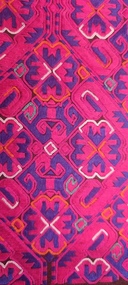
Textile - Embroidered Hmong Dress Panel
... This tradition took on a new powerful meaning in the late 1970's after the wars in Southeast Asia. Forced into refugee camps in Thailand, Hmong women began creating "story cloths". ...This tradition took on a new powerful meaning in the late 1970's after the wars in Southeast Asia. Forced into refugee camps in Thailand, Hmong women began creating "story cloths". ...During periods of harsh persecution, Hmong women developed a way to record their history by weaving it directly into their clothing. Called "pajntaub" , which means "flower cloth", and it was traditionally practiced only by the women of the community. Using a variety of complex stitching techniques, they created intricate geometric patterns. These designs were not just for decoration on clothes, collars and baby carriers. At times when their own language was suppressed, these symbols served as a form of communication and cultural documentation, with history hidden in the very pleats of their skirts. This tradition took on a new powerful meaning in the late 1970's after the wars in Southeast Asia. Forced into refugee camps in Thailand, Hmong women began creating "story cloths". These were larger tapestries that documented their lives, their traditions, and their harrowing journey from their homelands to the camps. These story cloths became a way to tell the world what had happened to them . They also became a vital source of income, sometimes selling for just one dollar, which helped families survive in the camps. Hmong Archives; Library of Congress. Hill Tribe clothing panel in progress in fuchsia pinks and royal blue, with white, green, orange highlights. Embroidered in buttonhole stitch and satin stitch filling. Worked on black even weave linen. -
 Embroiderers Guild, Victoria
Textile - Embroidered Hmong Dress Panel
... This tradition took on a new powerful meaning in the late 1970's after the wars in Southeast Asia. Forced into refugee camps in Thailand, Hmong women began creating "story cloths". ...This tradition took on a new powerful meaning in the late 1970's after the wars in Southeast Asia. Forced into refugee camps in Thailand, Hmong women began creating "story cloths". ...During periods of harsh persecution, Hmong women developed a way to record their history by weaving it directly into their clothing. Called "pajntaub" , which means "flower cloth", and it was traditionally practiced only by the women of the community. Using a variety of complex stitching techniques, they created intricate geometric patterns. These designs were not just for decoration on clothes, collars and baby carriers. At times when their own language was suppressed, these symbols served as a form of communication and cultural documentation, with history hidden in the very pleats of their skirts. This tradition took on a new powerful meaning in the late 1970's after the wars in Southeast Asia. Forced into refugee camps in Thailand, Hmong women began creating "story cloths". These were larger tapestries that documented their lives, their traditions, and their harrowing journey from their homelands to the camps. These story cloths became a way to tell the world what had happened to them . They also became a vital source of income, sometimes selling for just one dollar, which helped families survive in the camps. Hmong Archives; Library of Congress. Hill Tribe clothing panel in fuchsia pinks and royal blue, with white, green, orange highlights. Embroidered in buttonhole stitch and satin stitch filling. Worked on black even weave linen. -
 The Beechworth Burke Museum
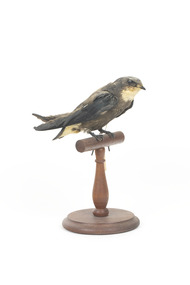
Animal specimen - White-Throated Needletail, Trustees of the Australian Museum, 1860-1880
... The white-throated Needletail is a migratory bird, breeding in Central Asia and southern Siberia, and wintering south in the Indian Subcontinent, Southeast Asia and Australia. This large swift is often mistaken in flight for a small predatory bird, but its long curved wings and white markings help to identify it. ...The white-throated Needletail is a migratory bird, breeding in Central Asia and southern Siberia, and wintering south in the Indian Subcontinent, Southeast Asia and Australia. This large swift is often mistaken in flight for a small predatory bird, but its long curved wings and white markings help to identify it. ...The white-throated Needletail is a migratory bird, breeding in Central Asia and southern Siberia, and wintering south in the Indian Subcontinent, Southeast Asia and Australia. This large swift is often mistaken in flight for a small predatory bird, but its long curved wings and white markings help to identify it. Needle-tailed Swifts get their name from the spined end of their tail, which is not forked as it is in the more common Swifts of the genus Apus. They build their nests in rock crevices in cliffs or hollow trees. These birds do not like to sit on the ground, spending spend most of their time in the air. This specimen is part of a collection of almost 200 animal specimens that were originally acquired as skins from various institutions across Australia, including the Australian Museum in Sydney and the National Museum of Victoria (known as Museums Victoria since 1983), as well as individuals such as amateur anthropologist Reynell Eveleigh Johns between 1860-1880. These skins were then mounted by members of the Burke Museum Committee and put-on display in the formal space of the Museum’s original exhibition hall where they continue to be on display. This display of taxidermy mounts initially served to instruct visitors to the Burke Museum of the natural world around them, today it serves as an insight into the collecting habits of the 19th century.This specimen is part of a significant and rare taxidermy mount collection in the Burke Museum. This collection is scientifically and culturally important for reminding us of how science continues to shape our understanding of the modern world. They demonstrate a capacity to hold evidence of how Australia’s fauna history existed in the past and are potentially important for future environmental research. This collection continues to be on display in the Museum and has become a key part to interpreting the collecting habits of the 19th century. This white-throated Needletail is predominantly grey-brown in colour. The throat and under tail of he bird are dusky-white. This specimen has a white spot on the lower rim of each of its wings. The eyes are made from glass and the specimen has been styalised standing on a wooden mount.Label: 3a/ Spine-tailed Swift / See catalogue page 7.stormbird, taxidermy mount, taxidermy, animalia, burke museum, beechworth, australian museum, skin, reynell eveleigh johns, bird, quail, migratory bird, white-throated needletail, needle-tailed swift, spine-tailed swift, hirundapus caudacutus -
 City of Melbourne Libraries
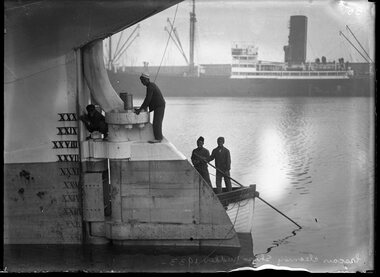
Photograph, Bull, Hugh Jones, 1897-1993, Lascars cleaning ship's rudder
... Wikipedia describes the term “Southeast Asia” as covering ” … the people of Southeast Asia from prehistory to the present in two distinct sub-regions: Mainland Southeast Asia (or Indochina) and Maritime Southeast Asia (or Insular Southeast Asia). ...Wikipedia describes the term “Southeast Asia” as covering ” … the people of Southeast Asia from prehistory to the present in two distinct sub-regions: Mainland Southeast Asia (or Indochina) and Maritime Southeast Asia (or Insular Southeast Asia). ...Published: unknown, however, on 26 June 1935 a similar, but not the exact photo in the McKenzie Collection, was published in The Age: Published title: Shipping Victorian Flour to the East Published Caption: Flour and wheat figure prominently in all cargoes carried by ships trading to Chinese, Japanese and Eastern ports. Victorian millers are eager to extend lids outlet for their produce, and every opportunity is grasped. The pictures show Australian labourers unloading from railway trucks some of the 2300 tons of flour which will go into the hold of the Burns, Philp motor ship Neptuna for shipment to Hong Kong, while Chinese seamen are busy cleaning and painting the rudder post of the ship. Hard by the Neptuna, other ships are taking on flour for the East. Research by Project Volunteer, Louise McKenzie: The image was described by Hugh Bull on the rear of the glass plate as – “Lascars cleaning ships rudder 1933”. Basically, a “lascar” is a seaman. Image No. 032 in the McKenzie Collection shows two lascars perched on the rudder of a ship, with two others standing in a rowboat along side. They are dressed in baggy trousers and jackets and wearing caps. Across a very calm dock area is a single funnel ship with on-deck derricks. The rudder of the ship being cleaned is white, with large black roman numbering denoting the depth at which the ship is sitting, depending on whether it is loaded or empty. Whilst the exact photo in the McKenzie Collection has yet to be located in The Age in 1933, the date when it was taken, there is a photo published in The Age on 25 June 1935 which appears to be one of a series of photos taken on the same day, featuring lascars cleaning a ship’s rudder. It bears a striking resemblance to MCK 032, but it is taken from a slightly different angle. The 1935 published photo is a close up of a ship’s rudder being cleaned, with same style of roman numerals in black on the white of the rudder. One lascar is standing on the rudder, one is standing in a small clinker style rowboat, with its characteristic wooden overlapping hull planks, holding a broom; two more lascars are sitting in the bow and stern of the rowboat. The ship being cleaned is in a dock, as a wharf and warehouses can be seen in the background, the water is very calm, and there are two other ships moored nearby – one across the other side of the dock with a black and white hull and derricks on its deck, and one adjacent, with its mooring lines clearly visible. The lascars are wearing caps, baggy trousers and jackets. Compelling similarities therefore exist between the two images. Whilst it is difficult to positively identify the cultural background of these particular lascars in either photo, the newspaper article dated June 1935 advises they are “Chinese”. This is possibly because the ship they are associated with, the Neptuna, is reported to have sailed from Melbourne on this date, bound for Hong Kong. However, the men are probably from South East Asia. Wikipedia describes the term “Southeast Asia” as covering ” … the people of Southeast Asia from prehistory to the present in two distinct sub-regions: Mainland Southeast Asia (or Indochina) and Maritime Southeast Asia (or Insular Southeast Asia). Mainland Southeast Asia comprises Cambodia, Laos, Myanmar (or Burma), Peninsular Malaysia, Thailand and Vietnam whereas Maritime Southeast Asia comprises Brunei, Cocos (Keeling) Islands, Christmas Island, East Malaysia, East Timor, Indonesia, Philippines and Singapore. Additionally, Wikipedia “Lascars” states that “Lascars were sailors from the Indian subcontinent, South East Asia, the Arab world, British Somaliland and lands east of the Cape of Good Hope, who were employed to work on colonial merchant ships. The practice ran from the 16th century to the mid 20th century”. Indian seamen were used as early as the 16th century by Portuguese explorer Vasgo da Gama in his successful voyage to India, and subsequently by Portuguese ships in the 16th and 17th centuries. “Through the Portuguese and Spanish maritime world empires, some Indian lascars found their way onto English merchant ships, and were among the sailors on the first English East India Company (EIC) ships to sail to India.” In the 17th Century “When the English adopted the term "lascar", they initially used it for all Asian sailors on English-flagged ships, but after 1661 and the Portuguese ceded Bombay to England, the term was used mainly to describe Indian sailors specifically. The term "topaze" was used to describe Indo-Portuguese personnel, especially those from Bombay, Thana, Diu, Dammam and Cochin. The term "sepoy" was used to describe Indian soldiers in European service. The number of lascars employed on EIC East Indiamen was so great that the Parliament of England restricted their employment via the Navigation Acts (in force from 1660 onwards) which required that 75% of the crew onboard English-flagged ships importing goods from Asia be English subjects. The restriction arose due to the high rates of illnesses and death among European sailors on East Indiamen, and their frequent desertions in Asia, which left such ships short of crew for the return voyage. Another reason was the frequent impressment of European sailors from EIC East Indiamen by the Royal Navy in times of war“. The term “impressment” colloquially refers to “the “press gang” …”a type of conscription of people into a military force, especially a naval force, via intimidation and physical coercion, conducted by an organized group (hence “gang”). .. The large size of the British Royal Navy in the Age of Sail meant impressment was most commonly associated with Great Britain.”. (Wikipedia – Impressment). By the 20th century these sailors served on British ships under "lascar agreements", which allowed shipowners more control than was the case in ordinary articles of agreement. The sailors could be transferred from one ship to another and retained in service for up to three years at one time. “Lascars served all over the world in the period leading up to the First World War. Lascars were barred from landing at some ports, such as in British Columbia. At the beginning of World War I, there were 51,616 lascars working on British merchant ships in and around the British Empire. In World War II thousands of lascars served in the war and died on vessels throughout the world, especially those of the British India Steam Navigation Company, P&O and other British shipping companies. The lack of Canadian naval manpower led to the employment of a total of 121 Catholic Goans and 530 Muslim British Indians on the Empress vessels of the Canadian Pacific Railway, such as the Empress of Asia and Empress of Japan. These ships served in the Indian Ocean both as ANZAC convoy ships and in actions at Aden. The ships were placed under the British Admiralty as part of Canada's contribution to the war effort and all of the Indian men were awarded medals by the Admiralty, though none of them were delivered. In the 1950s the use of the term "lascar" declined with the ending of the British Empire. The Indian “Lascar Act” of 1832 was finally repealed in 1963. However, "traditional" Indian deck and Pakistani engine crews continued to be used in Australia until 1986 when the last crew was discharged from the P&O and replaced by a general-purpose crew of Pakistanis. The term lascar has been widely used to engender an element of exoticism in literature eg “Sir Arthur Conan Doyle created a Lascar foil to Sherlock Holmes in "The Man with the Twisted Lip" in 1891. Lascars aboard the ship Patna figure prominently in the early chapters of Joseph Conrad's novel Lord Jim. Frances Hodgson Burnett's novel A Little Princess features a lascar named Ram Dass. Also, Caleb Carr portrays two lascars as bodyguards for a Spanish diplomat near the end of The Angel of Darkness. In Wuthering Heights, it is speculated that Heathcliff, the main character, may be of lascar origin." (Wikipedia – Lascar) And what has become of these “forgotten heroes of the World Wars”? The South Asian Heritage Trust, which seeks to commemorate, mark and celebrate South Asian cultures, stories, and communities, published an article in July 2025 entitled – The Lascars: Seafaring Roots of Modern Britain. It particularly honours the role of the 80,000 lascars who served Britain in WWI, and the over 100,000 who served in the British Merchant Navy in WWII, and concludes: “The hardships faced by Lascars were profound. They were often assigned the most dangerous tasks, lived in substandard conditions aboard ships and, even after their immense contributions to the war efforts, many veterans found it difficult to secure the recognition, pensions and rights afforded to other veterans. Many were employed under ‘Asiatic Articles’, which offered less protection and lower pay than their European counterparts. Yet, their legacy endures. The multicultural fabric of areas like East London owes much to these early seafarers and settlers. The East London Mosque, established in 1910, became an important spiritual and community hub. Today, efforts to bring their stories out of the shadows are growing. The Museum of London Docklands features exhibits on their history. Memorials, such as the P&O headstone in Dover for the 22 Lascar crew members of the SS Maloja sunk in 1916 and the careful restoration of the Lascar War Memorial in Kolkata, serve as important reminders of the sacrifices. The journey of the Lascars – from their homelands, along dangerous wartime shipping routes, to the docklands of Britain – is a story of personal courage and of a rich contribution to Britain’s history and identity.” The ship MV Neptuna, mentioned in the 1935 article, had that year been purchased from a German company by Australian-owned Burns Philp, with Australian Government assistance, and it was instrumental in ensuring the shipment of rice from Vietnam to Papua New Guinea. Rice is still a household staple in PNG. Despite it being introduced into PNG more than 100 years ago, the crop has not been sufficiently integrated into the country’s traditional agricultural production system, and today PNG imports still account for nearly 98% of rice. (Spotlight Magazine Sept. 2016) The 1935 newspaper article states that the Neptuna is involved in moving flour for the East. Australian wheat exports began in 1845, but were not regular until the 1870s. New land clearing methods in Australia allowed large tracts of land to be cleared more efficiently – this included the invention of the iconic ‘stump jump’ plough. With the success of the wheat harvests, flour mills began to spring up around the country. By the 1870s, many large country towns had their own mills, with around 500 mills producing flour across the country. Flour exports were an important part of the wheat industry until around the 1930s. After the Second World War, many of Australia’s export partners (which were mainly in the developing nations of Asia) began setting up their own flour industries and the Australian product was no longer in demand. In 1942 MV Neptuna was being utilised for the war effort, and carrying depth charges and other armaments for Australia, when on 19 February it was sunk in a bombing raid on Darwin, and where part of her hull still lies. References: SHIPPING VICTORIAN FLOUR TO THE EAST. (1935, June 25). The Age (Melbourne, Vic. : 1854 - 1954), p. 11. Retrieved July 23, 2025, from http://nla.gov.au/nla.news-article204357218 Age (Melbourne, Vic. : 1854 - 1954), Tuesday 25 June 1935, page 11 Wikipedia, Clinker (boat building), https://en.wikipedia.org/wiki/Clinker_(boat_building) Wikipedia, Lascar, https://en.wikipedia.org/wiki/Lascar Wikipedia, History of Southeast Asia, https://en.wikipedia.org/wiki/History_of_Southeast_Asia Wikipedia, Impressment, https://en.wikipedia.org/wiki/Impressment NEPTUNA LEAVES FOR CHINA WITH TOURISTS (1935, June 25). The Herald (Melbourne, Vic. : 1861 - 1954), p. 5. Retrieved July 23, 2025, from http://nla.gov.au/nla.news-article244841163 National Research Institute SPOTLIGHT paper Vol 9, Issue 7, https://pngnri.org/images/Publications/Spotlight_No_9_Vol_7_-_201609_-_Sofe__Odhuno_-_Rice_Import_Quota1.pdf South Asian Heritage Trust, The Lascars: Seafaring Roots of Modern Britain, July 11,2025 : Royal British Legion. https://southasianheritage.org.uk/royal-british-legion/the-lascars-seafaring-roots-of-modern-britain/ Photographer notations on slide: "Lascars cleaning ships rudder 1933".lascars, ships, 1930-1939, employment, ethnic communities -
 National Vietnam Veterans Museum (NVVM)
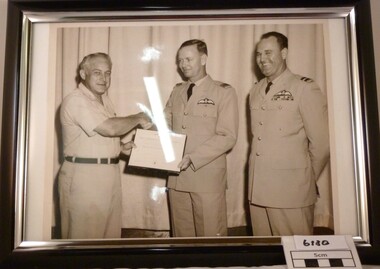
Photograph - Photograph of SQN LDR Alan Reed receiving a citation to accompany Distinguished Flying Cross, C.1968
... CITATION TO ACCOMPANY THE AWARD OF THE DISTINGUISHED FLYING CROSS (First Oak Leaf Cluster) Squadron leader Alan R Reed distinguished himself by extraordinary achievement while participating in aerial flight as and RD-4C Aircraft Commander in Southeast Asia on 24 August 1968. On that date, he flew his aircraft repeatedly through intense hostile ground fire to obtain complete photographic coverage of the target. ...CITATION TO ACCOMPANY THE AWARD OF THE DISTINGUISHED FLYING CROSS (First Oak Leaf Cluster) Squadron leader Alan R Reed distinguished himself by extraordinary achievement while participating in aerial flight as and RD-4C Aircraft Commander in Southeast Asia on 24 August 1968. On that date, he flew his aircraft repeatedly through intense hostile ground fire to obtain complete photographic coverage of the target. ...CITATION TO ACCOMPANY THE AWARD OF THE DISTINGUISHED FLYING CROSS (First Oak Leaf Cluster) Squadron leader Alan R Reed distinguished himself by extraordinary achievement while participating in aerial flight as and RD-4C Aircraft Commander in Southeast Asia on 24 August 1968. On that date, he flew his aircraft repeatedly through intense hostile ground fire to obtain complete photographic coverage of the target. In addition, he voluntarily remained in that hostile environment for as long as fuel would allow, to act as a spotter and to pass firing corrections to friendly artillery. The professional competence, aerial skill, and devotion to duty displayed by Squadron Leader Reed reflect great credit upon himself and the United States Air Force. Squadron Leader Alan Reed from the Royal Australian Air Force 052363 served in Vietnam from 26 May 1968 until 20 November 1968. He spent most of his tour detached to the 12th Tactical Reconnaissance Squadron, US Air Force. He was made an Officer of the Order of Australia (AO) in June 1989 for his service to the RAAF as Air Officer Commanding, Support Command. For his service with the USAF, Alan Reed was awarded the United States Distinguished Flying Cross with oak leaf cluster. His final rank with the Air Force was Air Vice Marshal and his last posting was with Headquarters, Australian Force Vietnam (RAAF Element) Black and White photo in black and white frame of SQN LDR Alan Reed receiving a citation to accompany Distinguished Flying Cross 21 /08 /1968. with supporting info.photograph, alan reed, squadron leader alan reed, royal australian air force, raaf, 052363, 12th tactical reconnaissance squadron, united states air force, usaf, officer of the order of australia, air vice marshall allan reed, headquarters, australian force vietnam -
![[1] Three Bears Porridge Flaked Oatmeal Bag (Front)](/media/collectors/510b3f7f023fd725b4cd51fe/items/683baf6c69688f11138d56ba/item-media/683bf711460ecdfee7105b40/item-fit-380x285.jpg?cb=6) Arapiles Historical Society
Arapiles Historical SocietyContainer - Roy SCHMIDT Collection - Cotton Flour Bags (3)
... The export reference (Bandung) underscores Australia's historical agricultural trade ties with Southeast Asia, especially in wheat and flour exports. – Roy SCHMIDT resided with his siblings Mabel and Jack at ‘Parklands’ 85 Lake Avenue Natimuk home of Heinrich Friederick ‘Heiny’ & Minna Christina SUDHOLZ nee LANGE and their children Louis, Sophie, Alma, Lena (Roy's Mother), Florence 'Florrie' and Edward ‘Ted’....The export reference (Bandung) underscores Australia's historical agricultural trade ties with Southeast Asia, especially in wheat and flour exports. – Roy SCHMIDT resided with his siblings Mabel and Jack at ‘Parklands’ 85 Lake Avenue Natimuk home of Heinrich Friederick ‘Heiny’ & Minna Christina SUDHOLZ nee LANGE and their children Louis, Sophie, Alma, Lena (Roy's Mother), Florence 'Florrie' and Edward ‘Ted’. ...[1] Three Bears Porridge Flaked Oatmeal Bag: This textile bag originates from Canadian Cereal Mills Ltd., which marketed "Three Bears" flaked oatmeal. Popular in the early 1900s to mid-century, this product combined functional packaging with a child-friendly incentive — a cut-out cloth doll. The practice of printing toys, games, or clothing patterns on flour or oat sacks was a common marketing strategy, encouraging reuse and appealing to families during times when thrift and creativity were essential, especially during the Depression and wartime years. The Three Bears brand played off the enduring popularity of children’s nursery tales, while the doll encouraged children (and parents) to reuse packaging creatively. This object captures a unique intersection of food marketing, household resourcefulness, and early 20th-century domestic life. [2] Mammy Self-Raising Flour Bag: This item is a mid-20th-century Australian flour bag, branded “Mammy Oven Puff”, produced by A. Mammy Products Pty Ltd in West Footscray, Victoria. The use of the name "Mammy" and the caricatured illustration draws on a now widely recognised and offensive racial stereotype originating from American minstrel culture, commonly used in product branding in the early-to-mid 20th century. While the bag reflects a specific period in Australian domestic and commercial packaging history, it also exemplifies racially insensitive advertising that would be considered inappropriate and harmful by today’s standards. Such items are preserved today in museum collections to help document past social attitudes, consumer culture, and the evolution of racial representation in advertising. [3] Bandung Blue Triangle Brand Flour Bag: This bag represents a mid-20th-century Australian flour export product, particularly aimed at international markets such as Indonesia (as indicated by "Bandung"). The “Blue Triangle Brand” was likely a registered trademark used by a Melbourne-based flour mill engaged in both local and overseas trade. The use of durable cloth bags for bulk flour was common prior to the widespread adoption of paper and plastic packaging. These bags were often reused domestically for household textiles, clothing patterns, or storage. The export reference (Bandung) underscores Australia's historical agricultural trade ties with Southeast Asia, especially in wheat and flour exports. – Roy SCHMIDT resided with his siblings Mabel and Jack at ‘Parklands’ 85 Lake Avenue Natimuk home of Heinrich Friederick ‘Heiny’ & Minna Christina SUDHOLZ nee LANGE and their children Louis, Sophie, Alma, Lena (Roy's Mother), Florence 'Florrie' and Edward ‘Ted’.[1] Three Bears Porridge Flaked Oatmeal Bag: A vintage cloth oatmeal bag printed with black ink on both sides. One side is branded with "Three Bears Porridge – Flaked Oatmeal", showing an image of three bears behind a gate, referencing the well-known “Goldilocks and the Three Bears” fairytale. The opposite side features a printed cut-out doll design, showing a young girl with curly hair holding a bouquet of flowers, intended to be sewn into a stuffed toy. Instructions note that the reverse side (the doll’s back) could be obtained from a second bag. The design combines product branding with a promotional activity for children, typical of early- to mid-20th-century grocery packaging aimed at reuse. [2] Mammy Self-Raising Flour Bag: A small vintage cloth flour bag with printed branding in faded red, blue, and black inks. The front of the bag features a central image of a caricatured smiling African American woman wearing a headscarf. The text is unevenly faded but legible in parts. The bag has a rectangular shape with an open top edge and signs of previous use, including creasing and some fraying at the corners. [3] Bandung Blue Triangle Brand Flour Bag: A large, rectangular vintage cloth flour bag made of cream-coloured calico or cotton. The front of the bag is printed in bold blue ink with branding and export information. It prominently features a large triangular logo reading “Blue Triangle Brand” and numerous lines of text in block and stylised fonts. The bag is open at the top with frayed edges, suggesting it was once machine-stitched shut and later opened.[1] Three Bears Porridge Flaked Oatmeal Bag: Front side (branding side): "THREE BEARS Porridge – FLAKED OATMEAL" "7 Lbs. Net." “Packed and guaranteed by Canadian Cereal Mills Ltd., Toronto” Reverse side (doll pattern): "This is the Front for Three Bears Cut-out Doll" "In order to complete this Doll it will be necessary to obtain the Back Design from another Bag of Three Bears Rolled Oats or Oatmeal." [2] Mammy Self-Raising Flour Bag: Main product name: “MAMMY OVEN PUFF SELF-RAISING FLOUR” Additional text: “The Only Creamed Flour” “Prepared with phosphate aerator” “A. MAMMY PRODUCTS PTY. LTD., Sunshine Rd., West Footscray. Phone: FW 7321” “7 LBS. NET” (near top edge, very faded) [3] Bandung Blue Triangle Brand Flour Bag: The bag is printed with the following: “10270” “G.W.C | H.L” “BANDUNG” “BEST AUSTRALIAN” “BLUE TRIANGLE BRAND” (inside the triangle logo) “GROWER & GRINDERS” (curved around the logo) “Patent Roller” “MELBOURNE” “FLOUR” “50 LBS. GROSS WHEN PACKED” These inscriptions indicate that this flour bag was manufactured in Melbourne, Australia, and was likely exported to Bandung, Indonesia.farm equipment, flour, milling, oats, mammy, bandung blue, schmidt, sudholz, parklands -
 Embroiderers Guild, Victoria
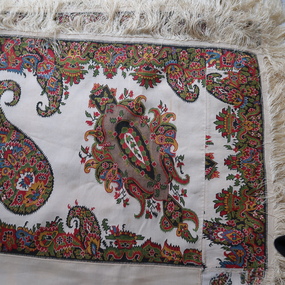
Clothing - Paisley Shawl
... The motif travelled from India to Africa, Southeast and East Asia, but in particular to Europe. ...The motif travelled from India to Africa, Southeast and East Asia, but in particular to Europe. ...Paisley shawls were a fashionable item of women's clothing in Europe during the late eighteenth and nineteenth centuries. Many were made of intricately woven and delicate wool, as well as examples being printed onto silks, wools, and cotton. These pieces were highly decorative. Although now known as the Paisley pattern, the teardrop motif originated in Persia and India. There are various theories about the early history of the paisley motif, and it would appear that it originated in Iran during the early first millennium AD. At this date it was a bulbous, almond shaped form, which was often flowery and without the prominent hook so common in later examples. This motif is specifically known as a buteh. The end of the 17th century saw the hooked buteh becoming a popular motif in neighbouring Mughal India (c. 1526-1857). It was used especially on the fine woollen shawls that were hand woven and sometimes embroidered in Kashmir in northern India. The motif travelled from India to Africa, Southeast and East Asia, but in particular to Europe. In the late eighteenth century, the buteh became even more popular as it was featured on the Kashmir shawls that were being exported in vast quantities to Europe. Joséphine de Beauharnais, wife of Napoleon Bonaparte, for example, is said to have owned over 200 of these shawls. The buteh or paisley motif is actually one of the few non-geometric design forms that can be found throughout the world. It is worn by men, women and children of all ages, literally from the cradle to the grave. Moreover, it is worn by people of many different ethnic and cultural backgrounds. Silk/cotton paisley shawl with fringe. Cream background, brightly coloured Paisley motifs on borders, pieced borders - ? recycled from another item. -
Phillip Island and District Historical Society Inc.
Book, GEO Productions, Geo Australasia, 1994
... ...southeast asia...wildlife conservation australasia periodicals description travel southeast asia hector goodall Stamped 'Phillip Island & District Historical Society'. ...GEO Magazine featuring eleven pages of Hector Goodall and his marine mammals.Stamped 'Phillip Island & District Historical Society'. Donor : Kevin Findlay 4.8.1999. Vol. 15, no. 1 (Feb./?Apr. 1993)-Vol. 23, no. 4 (Dec./?Feb. 2001/?2002)wildlife, conservation, australasia, periodicals, description, travel, southeast asia, hector goodall -
 Warrnambool RSL Sub Branch
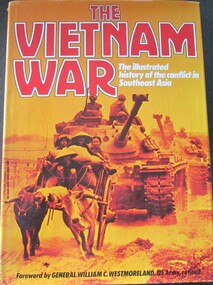
Book, BOOK: The Vietnam War - The Illustrated History of the conflict in Southeast Asia
... BOOK: The Vietnam War - The Illustrated History of the conflict in Southeast Asia...Edited by: Roy Bonds Publisher: Salamander Books, London. 1979 BOOK: The Vietnam War - The Illustrated History of the conflict in Southeast Asia Book ... -
 Warrnambool RSL Sub Branch
Book, BOOK: The Vietnam War - The Illustrated History of the conflict in Southeast Asia
... BOOK: The Vietnam War - The Illustrated History of the conflict in Southeast Asia...Edited by: Ray Bonds Publisher: salamander Books, London. 1979 BOOK: The Vietnam War - The Illustrated History of the conflict in Southeast Asia Book ...
