
Showing 50 items matching "stamped linen"
-
 Embroiderers Guild, Victoria
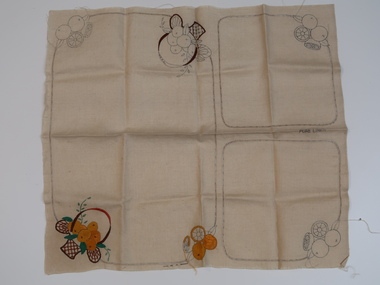
Unfinished Table Mat Set, 1937
... Stamped linen design with oranges and baskets. ...Pure Linen stamp....Paul has works in the collections of the National Library of Australia, the National Gallery of Australia, the State Library of New South Wales, and a bookplate of Sydney Long in the National Library of New Zealand. https://en.wikipedia.org/wiki/Dorothy_Ellsmore_Paul Pure Linen stamp. Stamped linen design with oranges and baskets. ..."Fruits of Your Handiwork" from the 'Woman's Needlework Feature" magazine article 26 July 1937 designed by Dorothy Ellsmore Paul.Dorothy Ellsmore Paul (née Dorothy May Ellsmore; 3 February 1902 – July 1973)[1] was an Australian artist and cartoonist. Paul was born Dorothy May Ellsmore in 1902 in Hertfordshire, England. She trained as an artist at Portsmouth Technical College. She left for Australia at just nineteen years old, arriving in Sydney on 18 March 1921. Once in Sydney she trained under Julian Ashton. She had ambitions of becoming a sculptor though this never eventuated. She was first published in The Sun with the cartoon We Do Believe in Fairies in their Sunbeams section. By 1924 she was drawing cartoons for the soldiers' magazine Aussie alongside fellow female cartoonists Mahdi McCrae, Betty and Esther Paterson, and Lillian Pedersen. The same year she exhibited her work in a black and white show at Anthony Hordern and Sons' Fine Art Gallery with such artists as Norman Lindsay, Percy Leason, and David Low. In 1926 she was illustrating short stories for The Australian Women's Mirror and the Sydney Mail. Her illustrations also featured in The Bulletin. In 1929 she edited a book The Etched Work of Sydney Long which included a sketch of hers of the artist. They were both associated with the Australian Painters-Etchers Society. Paul wrote the introduction for the Society's publication The Charm of the Etching. From 1931 to 1934 Paul wrote a feature section for The Australian Women's Mirror. She started with the technique for linocuts and also wrote on pattern printing, embroidery, crafting cuddle toys, making evening gloves, and even a frog pyjama case for children. These crafts and designs were featured in The Sun and The Mercury. She wrote and illustrated the stories Portrait of a Dark Girl and In Search of a Grandmother. She married fellow artist Oswald "Mick" Paul in 1925, son of artist and social reformer Emily Letitia Paul. His portrait of her was a finalist for the 1929 Archibald Prize. Paul has works in the collections of the National Library of Australia, the National Gallery of Australia, the State Library of New South Wales, and a bookplate of Sydney Long in the National Library of New Zealand. https://en.wikipedia.org/wiki/Dorothy_Ellsmore_Paul Stamped linen design with oranges and baskets. Partly embroidered.Pure Linen stamp. -
 Embroiderers Guild, Victoria
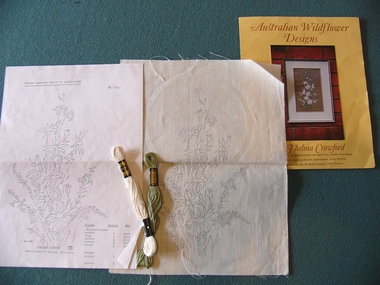
Textile - Thelma Crawford Kit, Thelma Crawford, Mid 20th C
... ...Stamped linen...Embroidery kit Kit Pattern Stamped linen Photograph Threads Embroidery Kit with pattern and threads. ...Embroidery Kit with pattern and threads. Design is of a bunch of flannel flowers and crowea.embroidery kit, kit, pattern, stamped linen, photograph, threads -
 Embroiderers Guild, Victoria
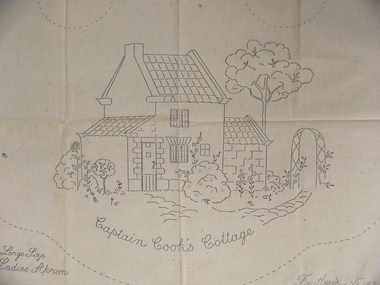
Domestic Object - Semco Apron Captain Cook's Cottage, 1930's
... Stamped linen apron pattern, with design of Captain Cook's cottage - circa 1930. ...Embroidery 1920-40 Australia Kits Aprons Fautley's No. 1423 Large size ladies apron Stamped linen apron pattern, with design of Captain Cook's cottage - circa 1930. ...Donor, Mr Graham White, found it among his grandmother's things when she died in 1973, aged in the 90's.Stamped linen apron pattern, with design of Captain Cook's cottage - circa 1930. Labelled Large Size, ladies apron, Fautley's No. 1423. Not worked.Fautley's No. 1423 Large size ladies apronembroidery, 1920-40, australia, kits, aprons -
 Embroiderers Guild, Victoria
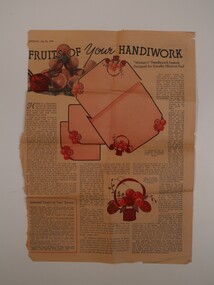
Table Mat Set Magazine Pattern, 1937
... "Fruits of Your Handiwork" from the 'Woman's Needlework Feature" magazine article 26 July 1937 designed by Dorothy Ellsmore Paul. Stamped linen design with oranges and baskets included....Paul has works in the collections of the National Library of Australia, the National Gallery of Australia, the State Library of New South Wales, and a bookplate of Sydney Long in the National Library of New Zealand. https://en.wikipedia.org/wiki/Dorothy_Ellsmore_Paul "Fruits of Your Handiwork" from the 'Woman's Needlework Feature" magazine article 26 July 1937 designed by Dorothy Ellsmore Paul. Stamped linen design with oranges and baskets included. ..."Fruits of Your Handiwork" from the 'Woman's Needlework Feature" magazine article 26 July 1937 designed by Dorothy Ellsmore Paul.Dorothy Ellsmore Paul (née Dorothy May Ellsmore; 3 February 1902 – July 1973)[1] was an Australian artist and cartoonist. Paul was born Dorothy May Ellsmore in 1902 in Hertfordshire, England. She trained as an artist at Portsmouth Technical College. She left for Australia at just nineteen years old, arriving in Sydney on 18 March 1921. Once in Sydney she trained under Julian Ashton. She had ambitions of becoming a sculptor though this never eventuated. She was first published in The Sun with the cartoon We Do Believe in Fairies in their Sunbeams section. By 1924 she was drawing cartoons for the soldiers' magazine Aussie alongside fellow female cartoonists Mahdi McCrae, Betty and Esther Paterson, and Lillian Pedersen. The same year she exhibited her work in a black and white show at Anthony Hordern and Sons' Fine Art Gallery with such artists as Norman Lindsay, Percy Leason, and David Low. In 1926 she was illustrating short stories for The Australian Women's Mirror and the Sydney Mail. Her illustrations also featured in The Bulletin. In 1929 she edited a book The Etched Work of Sydney Long which included a sketch of hers of the artist. They were both associated with the Australian Painters-Etchers Society. Paul wrote the introduction for the Society's publication The Charm of the Etching. From 1931 to 1934 Paul wrote a feature section for The Australian Women's Mirror. She started with the technique for linocuts and also wrote on pattern printing, embroidery, crafting cuddle toys, making evening gloves, and even a frog pyjama case for children. These crafts and designs were featured in The Sun and The Mercury. She wrote and illustrated the stories Portrait of a Dark Girl and In Search of a Grandmother. She married fellow artist Oswald "Mick" Paul in 1925, son of artist and social reformer Emily Letitia Paul. His portrait of her was a finalist for the 1929 Archibald Prize. Paul has works in the collections of the National Library of Australia, the National Gallery of Australia, the State Library of New South Wales, and a bookplate of Sydney Long in the National Library of New Zealand. https://en.wikipedia.org/wiki/Dorothy_Ellsmore_Paul "Fruits of Your Handiwork" from the 'Woman's Needlework Feature" magazine article 26 July 1937 designed by Dorothy Ellsmore Paul. Stamped linen design with oranges and baskets included. -
 Embroiderers Guild, Victoria
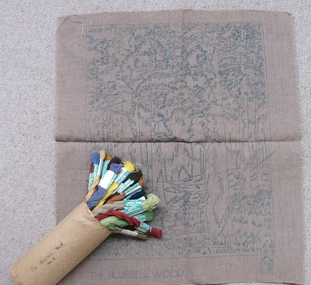
Textile - Wool Embroidery Kit, "The Bluebell Wood", 1920-40
... Dark beige linen with stamped design, working instructions, photograph and bundle of wools....Embroidery Wool Embroidery Kits Label - Patons & Baldwins Needle Painting Series No. 6 "The Bluebell Wood" Dark beige linen with stamped design, working instructions, photograph and bundle of wools. ...Dark beige linen with stamped design, working instructions, photograph and bundle of wools.Label - Patons & Baldwins Needle Painting Series No. 6 "The Bluebell Wood"embroidery, wool embroidery, kits -
 Warrnambool and District Historical Society Inc.
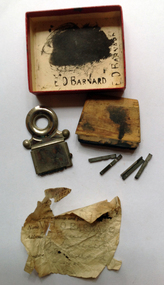
Functional object - Printing blocks Barnard, Early 20th century
... Barnard Box - stamped E.D. Barnard Paper – ‘Linen Stamp Co. 231 Elizabeth St. ...Barnard Box - stamped E.D. Barnard Paper – ‘Linen Stamp Co. 231 Elizabeth St. ...These items have no known provenance and no information has been found on the Barnards on the printing blocks, delivery paper and stamps. The stamp for ‘W.I.O. Barnard’ was sent to an address in Camberwell so it is presumed that the Barnard family members were in Melbourne and not in the Warrnambool district.The only interest in these items is in the printing blocks and stamps. They are good examples of the type of printing used in the early 20th century and the type of stamp used by individuals for letterheads, visiting cards, personal items etc. There are 5 objects in this collection:- 1. A small red cardboard box 2. A printing block with a tapered wooden base and metal type – E.D. Barnard There are three small nails holding the type to the wooden block. 3. A printing block with a metal ring handle – R. Barnard 4. Five metal type letters (G, I, K, O, W) 5. A much-tattered sheet of paper showing delivery of stamp to ‘W.I.O. Barnard’ Wooden Block – E.D. Barnard Metal Block – R. Barnard Box - stamped E.D. Barnard Paper – ‘Linen Stamp Co. 231 Elizabeth St. Melbourne, Please deliver stamp and pad at 2/6, Name: W.I.O. Barnard, Address: 29 Bowen St. Camberwell, Signature: E. Barnard’ barnard, printing blocks -
 Geoffrey Kaye Museum of Anaesthetic History
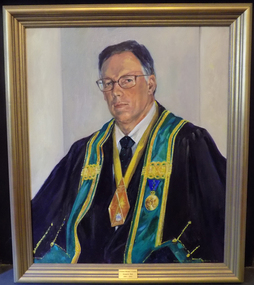
Painting - Portrait, Gary Lee-Gaston OAM, Portrait of Professor Michael J Cousins, 2003
... hand written on the reverse in black ink - 762 x 632 / VM24 OIL liNen •stamped on reverse in black ink: CENTRAL ARTISTS SUPPLIES / 45 Osmond Terrace / Norwood SA 5067 / Phone/Fax: 8364 2088 •hand written on reverse in black ink: GARY LEE-GASTON / O.A.M F.R.S.A.S.A. ...Commissioned portrait hand written on the reverse in black ink - 762 x 632 / VM24 OIL liNen •stamped on reverse in black ink: CENTRAL ARTISTS SUPPLIES / 45 Osmond Terrace / Norwood SA 5067 / Phone/Fax: 8364 2088 •hand written on reverse in black ink: GARY LEE-GASTON / O.A.M F.R.S.A.S.A. ...This is a portrait of Professor Michael Cousins in his role as Dean of the Faculty of Pain Medicine at ANZCA (1999 - 2002). The portrait was unveiled at a College ceremony/meeting on 30 July 2003. The portrait was commissioned by FPM to mark the Deanship of Prof Cousins. Gary Lee Gaston is an Australian visual artist who was born in 1938. He is a painter, teacher and sculptor. He has exhibited in Adelaide and is a fellow of the Royal South Australian Art Society.Professor Michael Cousins was instrumental in the establishment of the faculty of pain medicine and was its first Dean from 1999 - 2002.Oil on canvas painting of the Faculty of Pain Medicine Dean, Professor Michael Cousins set in a plain gold wooden frame.hand written on the reverse in black ink - 762 x 632 / VM24 OIL liNen •stamped on reverse in black ink: CENTRAL ARTISTS SUPPLIES / 45 Osmond Terrace / Norwood SA 5067 / Phone/Fax: 8364 2088 •hand written on reverse in black ink: GARY LEE-GASTON / O.A.M F.R.S.A.S.A. •hand written on reverse in balck ink: PROFESSOR COUSINS 2003 / A.M. MB BS MD (SYD.) FFPMANZCA. FANZCA. FRCA. •engraved onto brass plaque on front of frame: Professor Michael J. Cousins / Inaugural Dean / 1999 - 2002 •inscribed on lower right hand side of painting: artist's signatureprofessor michael cousins, faculty of pain medicine, gary lee gaston, royal south australian art society., commissioned portrait -
 Flagstaff Hill Maritime Museum and Village
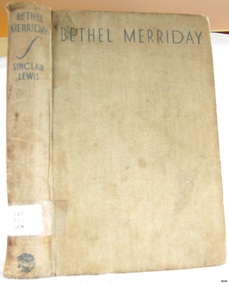
Book, Jonathan Cape, Bethel Merriday, 1940
... linen. The author’s name is printed in black on the front cover and on the spine. The spine also has the book’s title, a symbol and a white adhesive label with a typed library call number. Inside the front cover pasted down endpaper are two printed labels. On the front loose endpaper is an imprint of a stamp...Flagstaff Hill Warrnambool Shipwrecked coast Flagstaff Hill Maritime Museum Maritime Museum Shipwreck coast Flagstaff Hill Maritime Village Great Ocean Road Book Pattison Collection Warrnambool Library Warrnambool Public Library Warrnambool Mechanics’ Institute Ralph Eric Pattison Warrnambool books and records corangamite regional library service warrnambool city librarian mechanics’ institute library victorian library board warrnambool children’s library American novel Jonathan Cape Sinclair Lewis Harry Sinclair Lewis 1930 Nobel Prize for Literature Bethel Merriday Adhesive label - “PAT / FIC / LEW” Front pasted down endpaper has a printed label from Corangamite Regional Library Service Front pasted down endpaper has a printed label from the Warrnambool Public Library Front loose endpaper has a stamp from the Corangamite Regional Library Service Title: Bethel Merriday Author: Sinclair Lewis Publisher: Jonathan Cape, London Date: 1940 Hardback board book covered with cream-brown linen. ...This book “Bethel Merriday” is a novel written by Sinclair Lewis and published in 1940. It is part of Flagstaff Hill’s group of books belonging to the Pattison Collection. About SINCLAIR LEWIS (1885-1951) The author was born as Harry Sinclair Lewis in 1885 in Sauk Centre, Minnesota. He was renowned as an American novelist, playwright and short story writer. His first writings were romantic poems and short stories. Six of his novels were published by the time Lewis was 36. Lewis won the 1926 Pulitzer Prize for his book “Arrowsmith” but declined because he had been helped in the writing of it by science writer Paul de Kruif, who received 25% of royalties on the sales. However, Lewis is listed as the sole author. Lewis received the Nobel Prize for Literature in 1930 for his “vigorous and graphic art of description and his ability to create, with wit and humour, new types of characters." He was the first author from the United States to receive this award. Lewis graduated from university in 1907. He worked as a reporter and editor for several publications. He was a prolific writer, publishing dozens of works and numerous articles, and became popular for his satire. Lewis married and divorced twice and died alone from a heart attack due to advanced alcoholism) near Rome on 10th January 1951, aged 66. This book was part of a large group of books referred to as the Pattison Collection, which belonged to the Warrnambool Public Library, part of the Warrnambool Mechanics’ Institute. About RALPH ERIC PATTISON and the ‘PATTISON COLLECTION’ The ‘Pattison Collection’ is a collection of books and records that was originally owned by the Warrnambool Mechanics’ Institute, founded in Warrnambool in 1853. By 1886 the Warrnambool Mechanics’ Institute (WMI) had grown to have a Library, Museum and Fine Arts Gallery, with a collection of “… choice productions of art and valuable specimens in almost every branch and many wonderful national curiosities are now to be seen there, including historic relics of the town and district.” It later included a School of Design. Although it was very well patronised, the WMI was led to ask the City Council to take it over in 1911 due to lack of financial support. In 1935 Ralph Pattison was appointed as City Librarian to establish and organise the Warrnambool Public Library as it was then called. Ralph Eric Pattison was born in Rockhampton, Queensland, in 1891. He married Maude Swan from Warrnambool in 1920 and they set up home in Warrnambool. In 1935 when Pattison accepted the position as City Librarian for the Warrnambool City Council his huge challenge was to make a functional library within two rooms of the Mechanics’ Institute. He tirelessly cleaned, cleared and sorted a disarrayed collection of old books, jars of preserved specimens and other items reserved for exhibition in the city’s museum. He developed and updated the library with a wide variety of books for all tastes, including reference books for students; a difficult task to fulfil during the years following the Depression. He converted all of the lower areas of the building into a library, reference room and reading room for members and the public. The books were sorted and stored using a cataloguing and card index system that he had developed himself. He also prepared the upper floor of the building and established the Art Gallery and later the Museum, a place to exhibit the many old relics that had been stored for years for this purpose. One of the treasures he found was a beautiful ancient clock, which he repaired, restored and enjoyed using in his office during the years of his service there. Ralph Pattison was described as “a meticulous gentleman whose punctuality, floorless courtesy and distinctive neat dress were hallmarks of his character, and ‘his’ clock controlled his daily routine and his opening and closing of the library’s large heavy doors to the minute.” Pattison took leave from 1942 to 1945 to serve in the Royal Australian Navy, Volunteer Reserve as Lieutenant. A few years later he converted one of the Museum’s rooms into a Children’s Library, stocking it with suitable books for the younger generation. This was an instant success. In the 1950’s he had the honour of being appointed to the Victorian Library Board and received more inspiration from the monthly conferences in Melbourne. He was sadly retired in 1959 after over 23 years of service, due to the fact that he had gone over the working age of council officers. However, he continued to take a very keen interest in the continual development of the Library until his death in 1969. THE NEW WARRNAMBOOL LIBRARY When the WMI building was pulled down in 1963 a new civic building was erected on the site and the new Warrnambool Library, on behalf of the City Council, took over all the holdings of the WMI. At this time some of the items were separated and identified as the ‘Pattison Collection’, named after Pattison. Eventually, the components of the WMI were distributed from the Warrnambool Library to various places, including the Art Gallery, Historical Society and Flagstaff Hill. Later some were even distributed to other regional branches of Corangamite Regional Library and passed to and fro. It is difficult now to trace just where all of the items have ended up. The books at Flagstaff Hill Maritime Village generally display stamps and markings from Pattison as well as a variety of other institutions including the Mechanics’ Institute itself.Lewis’s book is significant for its association with the writer, who was the first American to be awarded the Nobel Prize for Literature (1930). This book is significant for its connection with the Pattison Collection which, along with other items at Flagstaff Hill Maritime Village, was originally part of the Warrnambool Mechanics' Institute’s collection. The Warrnambool Mechanics’ Institute collection is primarily significant in its totality, rather than for the individual objects it contains. Its contents are highly representative of the development of Mechanics' Institute libraries across Australia, particularly Victoria. A diversity of publications and themes has been amassed, and these provide clues to our understanding of the nature of and changes in the reading habits of Victorians from the 1850s to the middle of the 20th century. The collection also highlights the Warrnambool community’s commitment to the Mechanics’ Institute, reading, literacy and learning in the regions, and proves that access to knowledge was not impeded by distance. These items help to provide a more complete picture of our community’s ideals and aspirations. The Warrnambool Mechanics Institute book collection has historical and social significance for its strong association with the Mechanics Institute movement and the important role it played in the intellectual, cultural and social development of people throughout the latter part of the nineteenth century and the early twentieth century. The collection of books is a rare example of an early lending library and its significance is enhanced by the survival of an original collection of many volumes. The Warrnambool Mechanics' Institute’s publication collection is of both local and state significance. Title: Bethel Merriday Author: Sinclair Lewis Publisher: Jonathan Cape, London Date: 1940 Hardback board book covered with cream-brown linen. The author’s name is printed in black on the front cover and on the spine. The spine also has the book’s title, a symbol and a white adhesive label with a typed library call number. Inside the front cover pasted down endpaper are two printed labels. On the front loose endpaper is an imprint of a stamp. The book, a novel, is part of the Pattison Collection originally belonging to the Warrnambool Public Library.Adhesive label - “PAT / FIC / LEW” Front pasted down endpaper has a printed label from Corangamite Regional Library Service Front pasted down endpaper has a printed label from the Warrnambool Public Library Front loose endpaper has a stamp from the Corangamite Regional Library Serviceflagstaff hill, warrnambool, shipwrecked coast, flagstaff hill maritime museum, maritime museum, shipwreck coast, flagstaff hill maritime village, great ocean road, book, pattison collection, warrnambool library, warrnambool public library, warrnambool mechanics’ institute, ralph eric pattison, warrnambool books and records, corangamite regional library service, warrnambool city librarian, mechanics’ institute library, victorian library board, warrnambool children’s library, american novel, jonathan cape, sinclair lewis, harry sinclair lewis, 1930 nobel prize for literature, bethel merriday -
 Flagstaff Hill Maritime Museum and Village
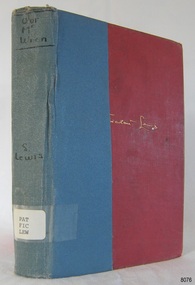
Book - Fiction, Jonathan Cape, Our Mr. Wrenn, 1930
... linen, spine reinforced with blue. The author’s name is embossed in gold on the front cover. On the spine is a handwritten title and author, and a white adhesive label with a typed library call number. Inside the front cover are pasted labels and stamps...stamp from Corangamite Regional Library Service Title: Our Mr. Wrenn: the romantic adventures of a gentle man Author: Sinclair Lewis Publisher: Jonathan Cape, London Date: 1930 Hardback board book covered with red linen, spine reinforced with blue. ...The fictional novel “Our Mr. Wrenn: The Romantic Adventures of a Gentle man” was written by Sinclair Lewis. It was originally published in America in 1914 by Harper & Brothers. It was the first of Sinclair Lewis’ novels published in his real name. His first published book, “Hike and the Aeroplane was” published in 1912 using the pseudonym of Tom Graham. Flagstaff Hill’s copy of “Our Mr. Wrenn” was published in 1930 by Jonathan Cape of London. About SINCLAIR LEWIS (1885-1951) The author was born Harry Sinclair Lewis in 1885 in Sauk Centre, Minnesota. He was renowned as an American novelist, playwright and short story writer. His first writings were romantic poems and short stories. Six of his novels were published by the time Lewis was 36. Lewis won the 1926 Pulitzer Prize for his book “Arrowsmith” but declined because he had been helped in the writing of it by science writer Paul de Kruif, who received 25% of royalties on the sales. However, Lewis is listed as the sole author. Lewis received the Nobel Prize for Literature in 1930 for his “vigorous and graphic art of description and his ability to create, with wit and humour, new types of characters." He was the first author from the United States to receive this award. Lewis graduated from university in 1907. He worked as a reporter and editor for several publications. He was a prolific writer, publishing dozens of works and numerous articles, and became popular for his satire. Lewis married and divorced twice and died alone from a heart attack due to advanced alcoholism) near Rome on 10th January 1951, aged 66. This book is part of a large group of books referred to as the Pattison Collection, which belonged to the Warrnambool Public Library, part of the Warrnambool Mechanics’ Institute. About RALPH ERIC PATTISON and the ‘PATTISON COLLECTION’ The ‘Pattison Collection’ is a collection of books and records that was originally owned by the Warrnambool Mechanics’ Institute, founded in Warrnambool in 1853. By 1886 the Warrnambool Mechanics’ Institute (WMI) had grown to have a Library, Museum and Fine Arts Gallery, with a collection of “… choice productions of art and valuable specimens in almost every branch and many wonderful national curiosities are now to be seen there, including historic relics of the town and district.” It later included a School of Design. Although it was very well patronised, the WMI was led to ask the City Council to take it over in 1911 due to a lack of financial support. In 1935 Ralph Pattison was appointed as City Librarian to establish and organise the Warrnambool Public Library as it was then called. Ralph Eric Pattison was born in Rockhampton, Queensland, in 1891. He married Maude Swan from Warrnambool in 1920 and they set up a home in Warrnambool. In 1935 when Pattison accepted the position as City Librarian for the Warrnambool City Council his huge challenge was to make a functional library within two rooms of the Mechanics’ Institute. He tirelessly cleaned, cleared and sorted a disarrayed collection of old books, jars of preserved specimens and other items reserved for exhibition in the city’s museum. He developed and updated the library with a wide variety of books for all tastes, including reference books for students; a difficult task to fulfil during the years following the Depression. He converted all of the lower areas of the building into a library, reference room and reading room for members and the public. The books were sorted and stored using a cataloguing and card index system that he had developed himself. He also prepared the upper floor of the building and established the Art Gallery and later the Museum, a place to exhibit the many old relics that had been stored for years for this purpose. One of the treasures he found was a beautiful ancient clock, which he repaired, restored and enjoyed using in his office during the years of his service there. Ralph Pattison was described as “a meticulous gentle man whose punctuality, floorless courtesy and distinctive neat dress were hallmarks of his character, and ‘his’ clock controlled his daily routine and his opening and closing of the library’s large heavy doors to the minute.” Pattison took leave from 1942 to 1945 to serve in the Royal Australian Navy, Volunteer Reserve as Lieutenant. A few years later he converted one of the Museum’s rooms into a Children’s Library, stocking it with suitable books for the younger generation. This was an instant success. In the 1950’s he had the honour of being appointed to the Victorian Library Board and received more inspiration from the monthly conferences in Melbourne. He was sadly retired in 1959 after over 23 years of service because he had gone over the working age of council officers. However, he continued to take a very keen interest in the continual development of the Library until his death in 1969. THE NEW WARRNAMBOOL LIBRARY When the WMI building was pulled down in 1963 a new civic building was erected on the site and the new Warrnambool Library, on behalf of the City Council, took over all the holdings of the WMI. At this time some of the items were separated and identified as the ‘Pattison Collection’, named after Pattison. Eventually, the components of the WMI were distributed from the Warrnambool Library to various places, including the Art Gallery, Historical Society and Flagstaff Hill. Later some were even distributed to other regional branches of Corangamite Regional Library and passed to and fro. It is difficult now to trace just where all of the items have ended up. The books at Flagstaff Hill Maritime Village generally display stamps and markings from Pattison as well as a variety of other institutions including the Mechanics’ Institute itself.Lewis’s book is significant for its association with the writer, who was the first American to be awarded the Nobel Prize for Literature (1930). This book is also significant for its connection with the Pattison Collection which, along with other items at Flagstaff Hill Maritime Village, was originally part of the Warrnambool Mechanics' Institute’s collection. The Warrnambool Mechanics’ Institute collection is primarily significant in its totality, rather than for the individual objects it contains. Its contents are highly representative of the development of Mechanics' Institute libraries across Australia, particularly Victoria. A diversity of publications and themes has been amassed, and these provide clues to our understanding of the nature of and changes in the reading habits of Victorians from the 1850s to the middle of the 20th century. The collection also highlights the Warrnambool community’s commitment to the Mechanics’ Institute, reading, literacy and learning in the regions, and proves that access to knowledge was not impeded by distance. These items help to provide a more complete picture of our community’s ideals and aspirations. The Warrnambool Mechanics Institute book collection has historical and social significance for its strong association with the Mechanics Institute movement and the important role it played in the intellectual, cultural and social development of people throughout the latter part of the nineteenth century and the early twentieth century. The collection of books is a rare example of an early lending library and its significance is enhanced by the survival of an original collection of many volumes. The Warrnambool Mechanics' Institute’s publication collection is of both local and state significance. Title: Our Mr. Wrenn: the romantic adventures of a gentle man Author: Sinclair Lewis Publisher: Jonathan Cape, London Date: 1930 Hardback board book covered with red linen, spine reinforced with blue. The author’s name is embossed in gold on the front cover. On the spine is a handwritten title and author, and a white adhesive label with a typed library call number. Inside the front cover are pasted labels and stamps. The book is part of the Pattison Collection originally belonging to the Warrnambool Public Library. It was once held by the Warrnambool Mechanics Institute and Free Library and the Corangamite Regional Library Service.Label on spine cover with typed text “PAT / FIC / LEW” Black handwriting on the spine “Our M- Wren” and “s. Lewis” Pastedown front endpaper has a label from Warrnambool Mechanics Institute and Free Library, covered by another from the Corangamite Regional Library Service Front loose endpaper has a stamp from Corangamite Regional Library Serviceflagstaff hill, warrnambool, shipwrecked coast, flagstaff hill maritime museum, maritime museum, shipwreck coast, flagstaff hill maritime village, great ocean road, book, pattison collection, warrnambool library, warrnambool public library, warrnambool mechanics’ institute, ralph eric pattison, warrnambool books and records, corangamite regional library service, warrnambool city librarian, mechanics’ institute library, victorian library board, warrnambool children’s library, american novel, jonathan cape, harry sinclair lewis, sinclair lewis, tom graham, 1930 nobel prize for literature, sinclair lewis’ debut novel, fiction, romance, our mr wrenn -
 Flagstaff Hill Maritime Museum and Village
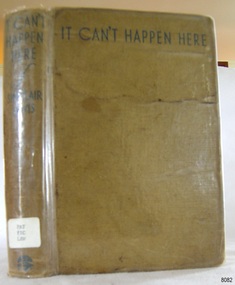
Book, Jonathan Cape, It Can't Happen Here, 1935
... linen, with a clear plastic protective cover over it. The book’s title is printed across the front cover and on the spine. Also on the spine the author’s name, a symbol, and a white adhesive label with a typed library call number. On the loose front endpaper is an oval, purple stamp...Flagstaff Hill Warrnambool Shipwrecked coast Flagstaff Hill Maritime Museum Maritime Museum Shipwreck coast Flagstaff Hill Maritime Village Great Ocean Road Book Pattison Collection Warrnambool Library Warrnambool Public Library Warrnambool Mechanics’ Institute Ralph Eric Pattison Warrnambool books and records corangamite regional library service warrnambool city librarian mechanics’ institute library victorian library board warrnambool children’s library American novel Jonathan Cape Sinclair Lewis Harry Sinclair Lewis 1930 Nobel Prize for Literature It can’t happen here Adhesive label - “PAT / FIC / LEW” Inside front loose endpaper stamped in purple “WARRNAMBOOL MECHANICS’ INSTITUTE” Front endpaper label from Warrnambool Public Library and Corangamite Regional Library Service Title: It can’t happen here Author: Sinclair Lewis Publisher: Jonathan Cape, London Date: 1935 Hardback board book covered with mustard-brown linen, with a clear plastic protective cover over it. ...This book “It can’t happen here” is a novel written by Sinclair Lewis. It was first published in 1935 in America. About SINCLAIR LEWIS (1885-1951) The author was born as Harry Sinclair Lewis in 1885 in Sauk Centre, Minnesota. He was renowned as an American novelist, playwright and short story writer. His first writings were romantic poems and short stories. Six of his novels were published by the time Lewis was 36. Lewis won the 1926 Pulitzer Prize for his book “Arrowsmith” but declined because he had been helped in the writing of it by science writer Paul de Kruif, who received 25% of royalties on the sales. However, Lewis is listed as the sole author. Lewis received the Nobel Prize for Literature in 1930 for his “vigorous and graphic art of description and his ability to create, with wit and humour, new types of characters." He was the first author from the United States to receive this award. Lewis graduated from university in 1907. He worked as a reporter and editor for several publications. He was a prolific writer, publishing dozens of works and numerous articles, and became popular for his satire. Lewis married and divorced twice and died alone from a heart attack due to advanced alcoholism) near Rome on 10th January 1951, aged 66. This book was part of a large group of books referred to as the Pattison Collection, which belonged to the Warrnambool Public Library, part of the Warrnambool Mechanics’ Institute. About RALPH ERIC PATTISON and the ‘PATTISON COLLECTION’ The ‘Pattison Collection’ is a collection of books and records that was originally owned by the Warrnambool Mechanics’ Institute, founded in Warrnambool in 1853. By 1886 the Warrnambool Mechanics’ Institute (WMI) had grown to have a Library, Museum and Fine Arts Gallery, with a collection of “… choice productions of art and valuable specimens in almost every branch and many wonderful national curiosities are now to be seen there, including historic relics of the town and district.” It later included a School of Design. Although it was very well patronised, the WMI was led to ask the City Council to take it over in 1911 due to lack of financial support. In 1935 Ralph Pattison was appointed as City Librarian to establish and organise the Warrnambool Public Library as it was then called. Ralph Eric Pattison was born in Rockhampton, Queensland, in 1891. He married Maude Swan from Warrnambool in 1920 and they set up home in Warrnambool. In 1935 when Pattison accepted the position as City Librarian for the Warrnambool City Council his huge challenge was to make a functional library within two rooms of the Mechanics’ Institute. He tirelessly cleaned, cleared and sorted a disarrayed collection of old books, jars of preserved specimens and other items reserved for exhibition in the city’s museum. He developed and updated the library with a wide variety of books for all tastes, including reference books for students; a difficult task to fulfil during the years following the Depression. He converted all of the lower areas of the building into a library, reference room and reading room for members and the public. The books were sorted and stored using a cataloguing and card index system that he had developed himself. He also prepared the upper floor of the building and established the Art Gallery and later the Museum, a place to exhibit the many old relics that had been stored for years for this purpose. One of the treasures he found was a beautiful ancient clock, which he repaired, restored and enjoyed using in his office during the years of his service there. Ralph Pattison was described as “a meticulous gentleman whose punctuality, floorless courtesy and distinctive neat dress were hallmarks of his character, and ‘his’ clock controlled his daily routine and his opening and closing of the library’s large heavy doors to the minute.” Pattison took leave from 1942 to 1945 to serve in the Royal Australian Navy, Volunteer Reserve as Lieutenant. A few years later he converted one of the Museum’s rooms into a Children’s Library, stocking it with suitable books for the younger generation. This was an instant success. In the 1950’s he had the honour of being appointed to the Victorian Library Board and received more inspiration from the monthly conferences in Melbourne. He was sadly retired in 1959 after over 23 years of service, due to the fact that he had gone over the working age of council officers. However, he continued to take a very keen interest in the continual development of the Library until his death in 1969. THE NEW WARRNAMBOOL LIBRARY When the WMI building was pulled down in 1963 a new civic building was erected on the site and the new Warrnambool Library, on behalf of the City Council, took over all the holdings of the WMI. At this time some of the items were separated and identified as the ‘Pattison Collection’, named after Pattison. Eventually, the components of the WMI were distributed from the Warrnambool Library to various places, including the Art Gallery, Historical Society and Flagstaff Hill. Later some were even distributed to other regional branches of Corangamite Regional Library and passed to and fro. It is difficult now to trace just where all of the items have ended up. The books at Flagstaff Hill Maritime Village generally display stamps and markings from Pattison as well as a variety of other institutions including the Mechanics’ Institute itself.Lewis’s book is significant for its association with the writer, who was the first American to be awarded the Nobel Prize for Literature (1930). This book is significant for its connection with the Pattison Collection which, along with other items at Flagstaff Hill Maritime Village, was originally part of the Warrnambool Mechanics' Institute’s collection. The Warrnambool Mechanics’ Institute collection is primarily significant in its totality, rather than for the individual objects it contains. Its contents are highly representative of the development of Mechanics' Institute libraries across Australia, particularly Victoria. A diversity of publications and themes has been amassed, and these provide clues to our understanding of the nature of and changes in the reading habits of Victorians from the 1850s to the middle of the 20th century. The collection also highlights the Warrnambool community’s commitment to the Mechanics’ Institute, reading, literacy and learning in the regions, and proves that access to knowledge was not impeded by distance. These items help to provide a more complete picture of our community’s ideals and aspirations. The Warrnambool Mechanics Institute book collection has historical and social significance for its strong association with the Mechanics Institute movement and the important role it played in the intellectual, cultural and social development of people throughout the latter part of the nineteenth century and the early twentieth century. The collection of books is a rare example of an early lending library and its significance is enhanced by the survival of an original collection of many volumes. The Warrnambool Mechanics' Institute’s publication collection is of both local and state significance. Title: It can’t happen here Author: Sinclair Lewis Publisher: Jonathan Cape, London Date: 1935 Hardback board book covered with mustard-brown linen, with a clear plastic protective cover over it. The book’s title is printed across the front cover and on the spine. Also on the spine the author’s name, a symbol, and a white adhesive label with a typed library call number. On the loose front endpaper is an oval, purple stamp with text. Paper labels are on the inside endpaper. The book, a novel, is part of the Pattison Collection originally belonging to the Warrnambool Mechanics’ Institute, and the Warrnambool Public Library.Adhesive label - “PAT / FIC / LEW” Inside front loose endpaper stamped in purple “WARRNAMBOOL MECHANICS’ INSTITUTE” Front endpaper label from Warrnambool Public Library and Corangamite Regional Library Serviceflagstaff hill, warrnambool, shipwrecked coast, flagstaff hill maritime museum, maritime museum, shipwreck coast, flagstaff hill maritime village, great ocean road, book, pattison collection, warrnambool library, warrnambool public library, warrnambool mechanics’ institute, ralph eric pattison, warrnambool books and records, corangamite regional library service, warrnambool city librarian, mechanics’ institute library, victorian library board, warrnambool children’s library, american novel, jonathan cape, sinclair lewis, harry sinclair lewis, 1930 nobel prize for literature, it can’t happen here -
 Flagstaff Hill Maritime Museum and Village
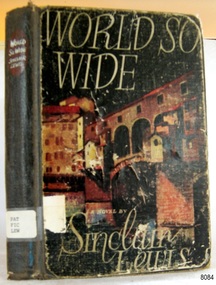
Book, William Heinemann Ltd, World So Wide, 1951
... linen, and a coloured picture pasted onto front cover. The book title and author’s name is on the coloured picture on the front cover along with a picture of buildings and a dark sky. The spine also has the title and author’s name, handwritten in white. On the spine is a white adhesive label with a typed library call number. Inside the front cover is a printed label. The front pasted down endpaper has one label covering another label. The front loose endpaper as a purple stamp...Stamp in purple ink on inside front loose endpaper of the Corangamite Regional Library Service Title: World So Wide Author: Sinclair Lewis Publisher: William Heinemann Ltd Date: 1951 Hardback board book covered with dark linen, and a coloured picture pasted onto front cover. ...This book “World So Wide” is a novel written by Sinclair Lewis. It is part of Flagstaff Hill’s historic book collection, known as the Pattison Collection. About SINCLAIR LEWIS (1885-1951) The author was born as Harry Sinclair Lewis in 1885 in Sauk Centre, Minnesota. He was renowned as an American novelist, playwright and short story writer. His first writings were romantic poems and short stories. Six of his novels were published by the time Lewis was 36. Lewis won the 1926 Pulitzer Prize for his book “Arrowsmith” but declined because he had been helped in the writing of it by science writer Paul de Kruif, who received 25% of royalties on the sales. However, Lewis is listed as the sole author. Lewis received the Nobel Prize for Literature in 1930 for his “vigorous and graphic art of description and his ability to create, with wit and humour, new types of characters." He was the first author from the United States to receive this award. Lewis graduated from university in 1907. He worked as a reporter and editor for several publications. He was a prolific writer, publishing dozens of works and numerous articles, and became popular for his satire. Lewis married and divorced twice and died alone from a heart attack due to advanced alcoholism) near Rome on 10th January 1951, aged 66. This book was part of a large group of books referred to as the Pattison Collection, which belonged to the Warrnambool Public Library, part of the Warrnambool Mechanics’ Institute. About RALPH ERIC PATTISON and the ‘PATTISON COLLECTION’ The ‘Pattison Collection’ is a collection of books and records that was originally owned by the Warrnambool Mechanics’ Institute, founded in Warrnambool in 1853. By 1886 the Warrnambool Mechanics’ Institute (WMI) had grown to have a Library, Museum and Fine Arts Gallery, with a collection of “… choice productions of art and valuable specimens in almost every branch and many wonderful national curiosities are now to be seen there, including historic relics of the town and district.” It later included a School of Design. Although it was very well patronised, the WMI was led to ask the City Council to take it over in 1911 due to lack of financial support. In 1935 Ralph Pattison was appointed as City Librarian to establish and organise the Warrnambool Public Library as it was then called. Ralph Eric Pattison was born in Rockhampton, Queensland, in 1891. He married Maude Swan from Warrnambool in 1920 and they set up home in Warrnambool. In 1935 when Pattison accepted the position as City Librarian for the Warrnambool City Council his huge challenge was to make a functional library within two rooms of the Mechanics’ Institute. He tirelessly cleaned, cleared and sorted a disarrayed collection of old books, jars of preserved specimens and other items reserved for exhibition in the city’s museum. He developed and updated the library with a wide variety of books for all tastes, including reference books for students; a difficult task to fulfil during the years following the Depression. He converted all of the lower areas of the building into a library, reference room and reading room for members and the public. The books were sorted and stored using a cataloguing and card index system that he had developed himself. He also prepared the upper floor of the building and established the Art Gallery and later the Museum, a place to exhibit the many old relics that had been stored for years for this purpose. One of the treasures he found was a beautiful ancient clock, which he repaired, restored and enjoyed using in his office during the years of his service there. Ralph Pattison was described as “a meticulous gentleman whose punctuality, floorless courtesy and distinctive neat dress were hallmarks of his character, and ‘his’ clock controlled his daily routine and his opening and closing of the library’s large heavy doors to the minute.” Pattison took leave from 1942 to 1945 to serve in the Royal Australian Navy, Volunteer Reserve as Lieutenant. A few years later he converted one of the Museum’s rooms into a Children’s Library, stocking it with suitable books for the younger generation. This was an instant success. In the 1950’s he had the honour of being appointed to the Victorian Library Board and received more inspiration from the monthly conferences in Melbourne. He was sadly retired in 1959 after over 23 years of service, due to the fact that he had gone over the working age of council officers. However, he continued to take a very keen interest in the continual development of the Library until his death in 1969. THE NEW WARRNAMBOOL LIBRARY When the WMI building was pulled down in 1963 a new civic building was erected on the site and the new Warrnambool Library, on behalf of the City Council, took over all the holdings of the WMI. At this time some of the items were separated and identified as the ‘Pattison Collection’, named after Pattison. Eventually, the components of the WMI were distributed from the Warrnambool Library to various places, including the Art Gallery, Historical Society and Flagstaff Hill. Later some were even distributed to other regional branches of Corangamite Regional Library and passed to and fro. It is difficult now to trace just where all of the items have ended up. The books at Flagstaff Hill Maritime Village generally display stamps and markings from Pattison as well as a variety of other institutions including the Mechanics’ Institute itself.Lewis’s book is significant for its association with the writer, who was the first American to be awarded the Nobel Prize for Literature (1930). This book is significant for its connection with the Pattison Collection which, along with other items at Flagstaff Hill Maritime Village, was originally part of the Warrnambool Mechanics' Institute’s collection. The Warrnambool Mechanics’ Institute collection is primarily significant in its totality, rather than for the individual objects it contains. Its contents are highly representative of the development of Mechanics' Institute libraries across Australia, particularly Victoria. A diversity of publications and themes has been amassed, and these provide clues to our understanding of the nature of and changes in the reading habits of Victorians from the 1850s to the middle of the 20th century. The collection also highlights the Warrnambool community’s commitment to the Mechanics’ Institute, reading, literacy and learning in the regions, and proves that access to knowledge was not impeded by distance. These items help to provide a more complete picture of our community’s ideals and aspirations. The Warrnambool Mechanics Institute book collection has historical and social significance for its strong association with the Mechanics Institute movement and the important role it played in the intellectual, cultural and social development of people throughout the latter part of the nineteenth century and the early twentieth century. The collection of books is a rare example of an early lending library and its significance is enhanced by the survival of an original collection of many volumes. The Warrnambool Mechanics' Institute’s publication collection is of both local and state significance. Title: World So Wide Author: Sinclair Lewis Publisher: William Heinemann Ltd Date: 1951 Hardback board book covered with dark linen, and a coloured picture pasted onto front cover. The book title and author’s name is on the coloured picture on the front cover along with a picture of buildings and a dark sky. The spine also has the title and author’s name, handwritten in white. On the spine is a white adhesive label with a typed library call number. Inside the front cover is a printed label. The front pasted down endpaper has one label covering another label. The front loose endpaper as a purple stamp impression. The book, a novel, is part of the Pattison Collection originally belonging to the Warrnambool Public Library.Adhesive label - “PAT / FIC / LEW” Handwritten on spine “WORLD SO WIDE” and “SINCLAIR LEWIS” Printed labels on front endpaper of both the Corangamite Regional Library Service and the Warrnambool Public Library. Stamp in purple ink on inside front loose endpaper of the Corangamite Regional Library Serviceflagstaff hill, warrnambool, shipwrecked coast, flagstaff hill maritime museum, maritime museum, shipwreck coast, flagstaff hill maritime village, great ocean road, book, pattison collection, warrnambool library, warrnambool public library, warrnambool mechanics’ institute, ralph eric pattison, warrnambool books and records, corangamite regional library service, warrnambool city librarian, mechanics’ institute library, victorian library board, warrnambool children’s library, american novel, jonathan cape, sinclair lewis, harry sinclair lewis, 1930 nobel prize for literature, world so wide, william heinemann ltd -
 Flagstaff Hill Maritime Museum and Village
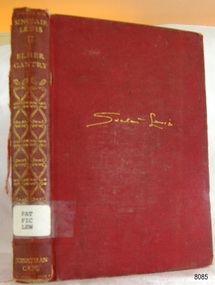
Book, Jonathan Cape, Elmer Gantry, 1930
... Flagstaff Hill Warrnambool Shipwrecked coast Flagstaff Hill Maritime Museum Maritime Museum Shipwreck coast Flagstaff Hill Maritime Village Great Ocean Road Book Pattison Collection Warrnambool Library Warrnambool Public Library Warrnambool Mechanics’ Institute Ralph Eric Pattison Warrnambool books and records corangamite regional library service warrnambool city librarian mechanics’ institute library victorian library board warrnambool children’s library American novel Jonathan Cape Sinclair Lewis Harry Sinclair Lewis 1930 Nobel Prize for Literature Elmer Gantry by Sinclair Lewis Embossed on front cover in script ‘Sinclair Lewis’ Embossed on the sping “SINCLAIR / LEWIS”, “ELMER / GANTRY” and “JONATHAN / CAPE” Adhesive label - “PAT / FIC / LEW” Printed label on front endpaper of the Corangamite Regional Library Service Printed label on front endpaper of the Warrnambool Public Library Stamp on front loose endpaper two stamps: “CORANGAMITE REGIONAL LIBRARY SERVICE” and “WARRNAMBOOL MECHANICS’ INSTITUTE” Title: Elmer Gantry: a novel Author: Sinclair Lewis Publisher: Jonathan Cape, London Date: 1930 Hardback board book covered with red linen. ...This book “Elmer Gantry” is a novel written by Sinclair Lewis. It was first published in America in 1927. It was published in various languages including French. About SINCLAIR LEWIS (1885-1951) The author was born as Harry Sinclair Lewis in 1885 in Sauk Centre, Minnesota. He was renowned as an American novelist, playwright and short story writer. His first writings were romantic poems and short stories. Six of his novels were published by the time Lewis was 36. Lewis won the 1926 Pulitzer Prize for his book “Arrowsmith” but declined because he had been helped in the writing of it by science writer Paul de Kruif, who received 25% of royalties on the sales. However, Lewis is listed as the sole author. Lewis received the Nobel Prize for Literature in 1930 for his “vigorous and graphic art of description and his ability to create, with wit and humour, new types of characters." He was the first author from the United States to receive this award. Lewis graduated from university in 1907. He worked as a reporter and editor for several publications. He was a prolific writer, publishing dozens of works and numerous articles, and became popular for his satire. Lewis married and divorced twice and died alone from a heart attack due to advanced alcoholism) near Rome on 10th January 1951, aged 66. This book was part of a large group of books referred to as the Pattison Collection, which belonged to the Warrnambool Public Library, part of the Warrnambool Mechanics’ Institute. About RALPH ERIC PATTISON and the ‘PATTISON COLLECTION’ The ‘Pattison Collection’ is a collection of books and records that was originally owned by the Warrnambool Mechanics’ Institute, founded in Warrnambool in 1853. By 1886 the Warrnambool Mechanics’ Institute (WMI) had grown to have a Library, Museum and Fine Arts Gallery, with a collection of “… choice productions of art and valuable specimens in almost every branch and many wonderful national curiosities are now to be seen there, including historic relics of the town and district.” It later included a School of Design. Although it was very well patronised, the WMI was led to ask the City Council to take it over in 1911 due to lack of financial support. In 1935 Ralph Pattison was appointed as City Librarian to establish and organise the Warrnambool Public Library as it was then called. Ralph Eric Pattison was born in Rockhampton, Queensland, in 1891. He married Maude Swan from Warrnambool in 1920 and they set up home in Warrnambool. In 1935 when Pattison accepted the position as City Librarian for the Warrnambool City Council his huge challenge was to make a functional library within two rooms of the Mechanics’ Institute. He tirelessly cleaned, cleared and sorted a disarrayed collection of old books, jars of preserved specimens and other items reserved for exhibition in the city’s museum. He developed and updated the library with a wide variety of books for all tastes, including reference books for students; a difficult task to fulfil during the years following the Depression. He converted all of the lower areas of the building into a library, reference room and reading room for members and the public. The books were sorted and stored using a cataloguing and card index system that he had developed himself. He also prepared the upper floor of the building and established the Art Gallery and later the Museum, a place to exhibit the many old relics that had been stored for years for this purpose. One of the treasures he found was a beautiful ancient clock, which he repaired, restored and enjoyed using in his office during the years of his service there. Ralph Pattison was described as “a meticulous gentleman whose punctuality, floorless courtesy and distinctive neat dress were hallmarks of his character, and ‘his’ clock controlled his daily routine and his opening and closing of the library’s large heavy doors to the minute.” Pattison took leave from 1942 to 1945 to serve in the Royal Australian Navy, Volunteer Reserve as Lieutenant. A few years later he converted one of the Museum’s rooms into a Children’s Library, stocking it with suitable books for the younger generation. This was an instant success. In the 1950’s he had the honour of being appointed to the Victorian Library Board and received more inspiration from the monthly conferences in Melbourne. He was sadly retired in 1959 after over 23 years of service, due to the fact that he had gone over the working age of council officers. However, he continued to take a very keen interest in the continual development of the Library until his death in 1969. THE NEW WARRNAMBOOL LIBRARY When the WMI building was pulled down in 1963 a new civic building was erected on the site and the new Warrnambool Library, on behalf of the City Council, took over all the holdings of the WMI. At this time some of the items were separated and identified as the ‘Pattison Collection’, named after Pattison. Eventually, the components of the WMI were distributed from the Warrnambool Library to various places, including the Art Gallery, Historical Society and Flagstaff Hill. Later some were even distributed to other regional branches of Corangamite Regional Library and passed to and fro. It is difficult now to trace just where all of the items have ended up. The books at Flagstaff Hill Maritime Village generally display stamps and markings from Pattison as well as a variety of other institutions including the Mechanics’ Institute itself.Lewis’s book is significant for its association with the writer, who was the first American to be awarded the Nobel Prize for Literature (1930). This book is significant for its connection with the Pattison Collection which, along with other items at Flagstaff Hill Maritime Village, was originally part of the Warrnambool Mechanics' Institute’s collection. The Warrnambool Mechanics’ Institute collection is primarily significant in its totality, rather than for the individual objects it contains. Its contents are highly representative of the development of Mechanics' Institute libraries across Australia, particularly Victoria. A diversity of publications and themes has been amassed, and these provide clues to our understanding of the nature of and changes in the reading habits of Victorians from the 1850s to the middle of the 20th century. The collection also highlights the Warrnambool community’s commitment to the Mechanics’ Institute, reading, literacy and learning in the regions, and proves that access to knowledge was not impeded by distance. These items help to provide a more complete picture of our community’s ideals and aspirations. The Warrnambool Mechanics Institute book collection has historical and social significance for its strong association with the Mechanics Institute movement and the important role it played in the intellectual, cultural and social development of people throughout the latter part of the nineteenth century and the early twentieth century. The collection of books is a rare example of an early lending library and its significance is enhanced by the survival of an original collection of many volumes. The Warrnambool Mechanics' Institute’s publication collection is of both local and state significance. Title: Elmer Gantry: a novel Author: Sinclair Lewis Publisher: Jonathan Cape, London Date: 1930 Hardback board book covered with red linen. The author’s name is embossed in gold on the front cover. The spine has an embossed gold pattern and text, with the author’s name, book’s title and publisher’s details on it. Also on the spine is a white adhesive label with a typed library call number. Inside the front cover is a printed label covering another label. The book, a novel, is part of the Pattison Collection originally belonging to the Warrnambool Mechanics’ Institute and the Warrnambool Public Library. Embossed on front cover in script ‘Sinclair Lewis’ Embossed on the sping “SINCLAIR / LEWIS”, “ELMER / GANTRY” and “JONATHAN / CAPE” Adhesive label - “PAT / FIC / LEW” Printed label on front endpaper of the Corangamite Regional Library Service Printed label on front endpaper of the Warrnambool Public Library Stamp on front loose endpaper two stamps: “CORANGAMITE REGIONAL LIBRARY SERVICE” and “WARRNAMBOOL MECHANICS’ INSTITUTE”flagstaff hill, warrnambool, shipwrecked coast, flagstaff hill maritime museum, maritime museum, shipwreck coast, flagstaff hill maritime village, great ocean road, book, pattison collection, warrnambool library, warrnambool public library, warrnambool mechanics’ institute, ralph eric pattison, warrnambool books and records, corangamite regional library service, warrnambool city librarian, mechanics’ institute library, victorian library board, warrnambool children’s library, american novel, jonathan cape, sinclair lewis, harry sinclair lewis, 1930 nobel prize for literature, elmer gantry by sinclair lewis -
 Flagstaff Hill Maritime Museum and Village
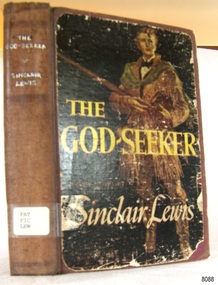
Book, William Heinemann Ltd, The God-Seeker, 1949
... linen, and a coloured picture pasted onto front cover. The book title and author’s name is on the coloured picture on the front cover along with a picture of a man standing. The spine also has the title and author’s name, handwritten in white. On the spine is a white adhesive label with a typed library call number. Inside the front cover is a printed label. The front pasted down endpaper has one label covering another label. The front loose endpaper as a purple stamp...Stamp in purple ink on inside front loose endpaper “WARRNAMBOOL PUBLIC LIBRARY” Title: The God-Seeker Author: Sinclair Lewis Publisher: William Heinemann Ltd Date: 1949 Hardback board book covered with brown linen, and a coloured picture pasted onto front cover. ...This book “The God-Seeker” is a novel written by Sinclair Lewis. It is part of Flagstaff Hill’s historic book collection, known as the Pattison Collection. About SINCLAIR LEWIS (1885-1951) The author was born as Harry Sinclair Lewis in 1885 in Sauk Centre, Minnesota. He was renowned as an American novelist, playwright and short story writer. His first writings were romantic poems and short stories. Six of his novels were published by the time Lewis was 36. Lewis won the 1926 Pulitzer Prize for his book “Arrowsmith” but declined because he had been helped in the writing of it by science writer Paul de Kruif, who received 25% of royalties on the sales. However, Lewis is listed as the sole author. Lewis received the Nobel Prize for Literature in 1930 for his “vigorous and graphic art of description and his ability to create, with wit and humour, new types of characters." He was the first author from the United States to receive this award. Lewis graduated from university in 1907. He worked as a reporter and editor for several publications. He was a prolific writer, publishing dozens of works and numerous articles, and became popular for his satire. Lewis married and divorced twice and died alone from a heart attack due to advanced alcoholism) near Rome on 10th January 1951, aged 66. This book was part of a large group of books referred to as the Pattison Collection, which belonged to the Warrnambool Public Library, part of the Warrnambool Mechanics’ Institute. About RALPH ERIC PATTISON and the ‘PATTISON COLLECTION’ The ‘Pattison Collection’ is a collection of books and records that was originally owned by the Warrnambool Mechanics’ Institute, founded in Warrnambool in 1853. By 1886 the Warrnambool Mechanics’ Institute (WMI) had grown to have a Library, Museum and Fine Arts Gallery, with a collection of “… choice productions of art and valuable specimens in almost every branch and many wonderful national curiosities are now to be seen there, including historic relics of the town and district.” It later included a School of Design. Although it was very well patronised, the WMI was led to ask the City Council to take it over in 1911 due to lack of financial support. In 1935 Ralph Pattison was appointed as City Librarian to establish and organise the Warrnambool Public Library as it was then called. Ralph Eric Pattison was born in Rockhampton, Queensland, in 1891. He married Maude Swan from Warrnambool in 1920 and they set up home in Warrnambool. In 1935 when Pattison accepted the position as City Librarian for the Warrnambool City Council his huge challenge was to make a functional library within two rooms of the Mechanics’ Institute. He tirelessly cleaned, cleared and sorted a disarrayed collection of old books, jars of preserved specimens and other items reserved for exhibition in the city’s museum. He developed and updated the library with a wide variety of books for all tastes, including reference books for students; a difficult task to fulfil during the years following the Depression. He converted all of the lower areas of the building into a library, reference room and reading room for members and the public. The books were sorted and stored using a cataloguing and card index system that he had developed himself. He also prepared the upper floor of the building and established the Art Gallery and later the Museum, a place to exhibit the many old relics that had been stored for years for this purpose. One of the treasures he found was a beautiful ancient clock, which he repaired, restored and enjoyed using in his office during the years of his service there. Ralph Pattison was described as “a meticulous gentleman whose punctuality, floorless courtesy and distinctive neat dress were hallmarks of his character, and ‘his’ clock controlled his daily routine and his opening and closing of the library’s large heavy doors to the minute.” Pattison took leave from 1942 to 1945 to serve in the Royal Australian Navy, Volunteer Reserve as Lieutenant. A few years later he converted one of the Museum’s rooms into a Children’s Library, stocking it with suitable books for the younger generation. This was an instant success. In the 1950’s he had the honour of being appointed to the Victorian Library Board and received more inspiration from the monthly conferences in Melbourne. He was sadly retired in 1959 after over 23 years of service, due to the fact that he had gone over the working age of council officers. However, he continued to take a very keen interest in the continual development of the Library until his death in 1969. THE NEW WARRNAMBOOL LIBRARY When the WMI building was pulled down in 1963 a new civic building was erected on the site and the new Warrnambool Library, on behalf of the City Council, took over all the holdings of the WMI. At this time some of the items were separated and identified as the ‘Pattison Collection’, named after Pattison. Eventually, the components of the WMI were distributed from the Warrnambool Library to various places, including the Art Gallery, Historical Society and Flagstaff Hill. Later some were even distributed to other regional branches of Corangamite Regional Library and passed to and fro. It is difficult now to trace just where all of the items have ended up. The books at Flagstaff Hill Maritime Village generally display stamps and markings from Pattison as well as a variety of other institutions including the Mechanics’ Institute itself.Lewis’s book is significant for its association with the writer, who was the first American to be awarded the Nobel Prize for Literature (1930). This book is significant for its connection with the Pattison Collection which, along with other items at Flagstaff Hill Maritime Village, was originally part of the Warrnambool Mechanics' Institute’s collection. The Warrnambool Mechanics’ Institute collection is primarily significant in its totality, rather than for the individual objects it contains. Its contents are highly representative of the development of Mechanics' Institute libraries across Australia, particularly Victoria. A diversity of publications and themes has been amassed, and these provide clues to our understanding of the nature of and changes in the reading habits of Victorians from the 1850s to the middle of the 20th century. The collection also highlights the Warrnambool community’s commitment to the Mechanics’ Institute, reading, literacy and learning in the regions, and proves that access to knowledge was not impeded by distance. These items help to provide a more complete picture of our community’s ideals and aspirations. The Warrnambool Mechanics Institute book collection has historical and social significance for its strong association with the Mechanics Institute movement and the important role it played in the intellectual, cultural and social development of people throughout the latter part of the nineteenth century and the early twentieth century. The collection of books is a rare example of an early lending library and its significance is enhanced by the survival of an original collection of many volumes. The Warrnambool Mechanics' Institute’s publication collection is of both local and state significance. Title: The God-Seeker Author: Sinclair Lewis Publisher: William Heinemann Ltd Date: 1949 Hardback board book covered with brown linen, and a coloured picture pasted onto front cover. The book title and author’s name is on the coloured picture on the front cover along with a picture of a man standing. The spine also has the title and author’s name, handwritten in white. On the spine is a white adhesive label with a typed library call number. Inside the front cover is a printed label. The front pasted down endpaper has one label covering another label. The front loose endpaper as a purple stamp impression. The book, a novel, is part of the Pattison Collection originally belonging to the Warrnambool Public Library.Adhesive label - “PAT / FIC / LEW” Printed labels on front endpaper of both the Corangamite Regional Library Service and the Warrnambool Public Library. Stamp in purple ink on inside front loose endpaper “WARRNAMBOOL PUBLIC LIBRARY”flagstaff hill, warrnambool, shipwrecked coast, flagstaff hill maritime museum, maritime museum, shipwreck coast, flagstaff hill maritime village, great ocean road, book, pattison collection, warrnambool library, warrnambool public library, warrnambool mechanics’ institute, ralph eric pattison, warrnambool books and records, corangamite regional library service, warrnambool city librarian, mechanics’ institute library, victorian library board, warrnambool children’s library, american novel, jonathan cape, sinclair lewis, harry sinclair lewis, 1930 nobel prize for literature, the god-seeker, william heinemann ltd -
 Flagstaff Hill Maritime Museum and Village
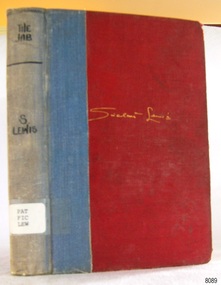
Book, Jonathan Cape, The Job, 1929
... linen, spine reinforced with blue. The author’s name is embossed in gold on the front cover. There is a logo impressed into the centre of the back cover with the printer’s initials “J C”. On the spine is a white adhesive label with a typed library call number. Inside the front cover is a printed label. Inside front and back covers are a black stamp...The Warrnambool Mechanics' Institute’s publication collection is of both local and state significance. flagstaff hill warrnambool shipwrecked coast flagstaff hill maritime museum maritime museum shipwreck coast flagstaff hill maritime village great ocean road book pattison collection warrnambool library warrnambool public library warrnambool mechanics’ institute ralph eric pattison warrnambool books and records corangamite regional library service warrnambool city librarian mechanics’ institute library victorian library board warrnambool children’s library the job by sinclair lewis collection edition sinclair lewis american novel 1929 jonathan cape sinclair lewis harry sinclair lewis 1930 nobel prize for literature Logo “J” over “C” Adhesive label - “PAT / FIC / LEW” Printed label “Corangamite Regional Library Service / Warrnambool City Library / Pattison Collection” Stamp on inside front page and inside back page “CORANGAMITE REGIONAL LIBRARY SERVICE / WARRNAMBOOL LIBRARY” Handwritten on the inside page facing cover “1083” and “M 73” Handwritten on inside page facing back cover “1083” Date stamps facing back cover “1958” – “1963”, and on inside back cover “1942” – “195-“ Remnants of a torn out paper “ - - - - - - PU - - - C LIBRAR- / ……” Title: The Job Author: Sinclair Lewis Publisher: Jonathan Cape, London Date: 1929 Hardback board book covered with red linen, spine reinforced with blue. ...This book “The Job” is a novel written by Sinclair Lewis. It was first published in America in 1916 and in England in 1926. It is Lewis’ third book. There are 320 numbered pages, divided into three parts, each part is divided into chapters, which are in turn divided into sections. This particular book is one of a Collected Edition published in 1929. A note from the publisher included within the book states “It has been corrected in some small details but no revision or rewriting has been attempted by the author who wishes it to be made clear that it is an early and not a new work.” About SINCLAIR LEWIS (1885-1951) The author was born as Harry Sinclair Lewis in 1885 in Sauk Centre, Minnesota. He was renowned as an American novelist, playwright and short story writer. His first writings were romantic poems and short stories. Six of his novels were published by the time Lewis was 36. Lewis received the Nobel Prize for Literature in 1930 for his “vigorous and graphic art of description and his ability to create, with wit and humour, new types of characters." He was the first author from the United States to receive this award. Lewis graduated from university in 1907. He worked as a reporter and editor for several publications. He was a prolific writer, publishing dozens of works and numerous articles, and became popular for his satire. Lewis married and divorced twice and died alone from a heart attack due to advanced alcoholism) near Rome on 10th January 1951, aged 66. This book was part of a large group of books referred to as the Pattison Collection, which belonged to the Warrnambool Public Library, part of the Warrnambool Mechanics’ Institute. There is a remnant of the library’s label inside the back page of the book. About RALPH ERIC PATTISON and the ‘PATTISON COLLECTION’ The ‘Pattison Collection’ is a collection of books and records that was originally owned by the Warrnambool Mechanics’ Institute, founded in Warrnambool in 1853. By 1886 the Warrnambool Mechanics’ Institute (WMI) had grown to have a Library, Museum and Fine Arts Gallery, with a collection of “… choice productions of art, and valuable specimens in almost every branch and many wonderful national curiosities are now to be seen there, including historic relics of the town and district.” It later included a School of Design. Although it was very well patronised, the WMI was led to ask the City Council to take it over in 1911 due to lack of financial support. In 1935 Ralph Pattison was appointed as City Librarian to establish and organise the Warrnambool Public Library as it was then called. Ralph Eric Pattison was born in Rockhampton, Queensland, in 1891. He married Maude Swan from Warrnambool in 1920 and they set up home in Warrnambool. In 1935 when Pattison accepted the position as City Librarian for the Warrnambool City Council his huge challenge was to make a functional library within two rooms of the Mechanics’ Institute. He tirelessly cleaned, cleared and sorted a disarrayed collection of old books, jars of preserved specimens and other items reserved for exhibition in the city’s museum. He developed and updated the library with a wide variety of books for all tastes, including reference books for students; a difficult task to fulfil during the years following the Depression. He converted all of the lower areas of the building into a library, reference room and reading room for members and the public. The books were sorted and stored using a cataloguing and card index system that he had developed himself. He also prepared the upper floor of the building and established the Art Gallery and later the Museum, a place to exhibit the many old relics that had been stored for years for this purpose. One of the treasures he found was a beautiful ancient clock, which he repaired, restored and enjoyed using in his office during the years of his service there. Ralph Pattison was described as “a meticulous gentleman whose punctuality, floorless courtesy and distinctive neat dress were hallmarks of his character, and ‘his’ clock controlled his daily routine, and his opening and closing of the library’s large heavy doors to the minute.” Pattison took leave from 1942 to 1945 to serve in the Royal Australian Navy, Volunteer Reserve as Lieutenant. A few years later he converted one of the Museum’s rooms into a Children’s Library, stocking it with suitable books for the younger generation. This was an instant success. In the 1950’s he had the honour of being appointed to the Victorian Library Board and received more inspiration from the monthly conferences in Melbourne. He was sadly retired in 1959 after over 23 years of service, due to the fact that he had gone over the working age of council officers. However he continued to take a very keen interest in the continual development of the Library until his death in 1969. THE NEW WARRNAMBOOL LIBRARY When the WMI building was pulled down in 1963 a new civic building was erected on the site and the new Warrnambool Library, on behalf of the City Council, took over all the holdings of the WMI. At this time some of the items were separated and identified as the ‘Pattison Collection’, named after Pattison. Eventually the components of the WMI were distributed from the Warrnambool Library to various places, including the Art Gallery, Historical Society and Flagstaff Hill. Later some were even distributed to other regional branches of Corangamite Regional Library and passed to and fro. It is difficult now to trace just where all of the items have ended up. The books at Flagstaff Hill Maritime Village generally display stamps and markings from Pattison as well as a variety of other institutions including the Mechanics’ Institute itself. Lewis’s book is significant for its association with the writer, who was the first American to be awarded the Nobel Prize for Literature (1930). This book is significant for its connection with the Pattison Collection which, along with other items at Flagstaff Hill Maritime Village, was originally part of the Warrnambool Mechanics' Institute’s collection. The Warrnambool Mechanics’ Institute collection is primarily significant in its totality, rather than for the individual objects it contains. Its contents are highly representative of the development of Mechanics' Institute libraries across Australia, particularly Victoria. A diversity of publications and themes has been amassed, and these provide clues to our understanding of the nature of and changes in the reading habits of Victorians from the 1850s to the middle of the 20th century. The collection also highlights the Warrnambool community’s commitment to the Mechanics’ Institute, reading, literacy and learning in the regions, and proves that access to knowledge was not impeded by distance. These items help to provide a more complete picture of our community’s ideals and aspirations. The Warrnambool Mechanics Institute book collection has historical and social significance for its strong association with the Mechanics Institute movement and the important role it played in the intellectual, cultural and social development of people throughout the latter part of the nineteenth century and the early twentieth century. The collection of books is a rare example of an early lending library and its significance is enhanced by the survival of an original collection of many volumes. The Warrnambool Mechanics' Institute’s publication collection is of both local and state significance. Title: The Job Author: Sinclair Lewis Publisher: Jonathan Cape, London Date: 1929 Hardback board book covered with red linen, spine reinforced with blue. The author’s name is embossed in gold on the front cover. There is a logo impressed into the centre of the back cover with the printer’s initials “J C”. On the spine is a white adhesive label with a typed library call number. Inside the front cover is a printed label. Inside front and back covers are a black stamp and handwritten characters in pen and pencil. Inside the back cover and facing page are various date stamps dating from 1942 to 1963. The book, a novel, is one of a Collected Edition published in 1929. It also belongs to the Pattison Collection originally belonging to the Warrnambool Public Library.Logo “J” over “C” Adhesive label - “PAT / FIC / LEW” Printed label “Corangamite Regional Library Service / Warrnambool City Library / Pattison Collection” Stamp on inside front page and inside back page “CORANGAMITE REGIONAL LIBRARY SERVICE / WARRNAMBOOL LIBRARY” Handwritten on the inside page facing cover “1083” and “M 73” Handwritten on inside page facing back cover “1083” Date stamps facing back cover “1958” – “1963”, and on inside back cover “1942” – “195-“ Remnants of a torn out paper “ - - - - - - PU - - - C LIBRAR- / ……” flagstaff hill, warrnambool, shipwrecked coast, flagstaff hill maritime museum, maritime museum, shipwreck coast, flagstaff hill maritime village, great ocean road, book, pattison collection, warrnambool library, warrnambool public library, warrnambool mechanics’ institute, ralph eric pattison, warrnambool books and records, corangamite regional library service, warrnambool city librarian, mechanics’ institute library, victorian library board, warrnambool children’s library, the job by sinclair lewis, collection edition sinclair lewis, american novel 1929, jonathan cape, sinclair lewis, harry sinclair lewis, 1930 nobel prize for literature -
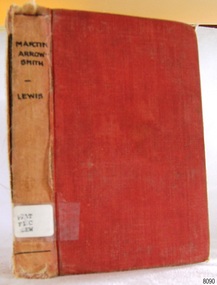 Flagstaff Hill Maritime Museum and Village
Book, Jonathan Cape, Martin Arrowsmith, 1930
... Linen on the spine has faded to orange-brown. On the spine is a hand printed title and author, and a white adhesive label with a typed library call number. Inside the front cover is a printed label. On the book’s fly page is an oval stamp...Linen on the spine has faded to orange-brown. On the spine is a hand printed title and author, and a white adhesive label with a typed library call number. Inside the front cover is a printed label. On the book’s fly page is an oval stamp ...This book “Martin Arrowsmith” is a novel written by Sinclair Lewis. It was first published in 1925. Lewis won the 1926 Pulitzer Prize for this book but he declined the Prize. He had been helped in the writing of it by science writer Paul de Kruif, who received 25% of royalties on the sales. However, Lewis is listed as the sole author. About SINCLAIR LEWIS (1885-1951) The author was born as Harry Sinclair Lewis in 1885 in Sauk Centre, Minnesota. He was renowned as an American novelist, playwright and short story writer. His first writings were romantic poems and short stories. Six of his novels were published by the time Lewis was 36. Lewis received the Nobel Prize for Literature in 1930 for his “vigorous and graphic art of description and his ability to create, with wit and humour, new types of characters." He was the first author from the United States to receive this award. Lewis graduated from university in 1907. He worked as a reporter and editor for several publications. He was a prolific writer, publishing dozens of works and numerous articles, and became popular for his satire. Lewis married and divorced twice and died alone from a heart attack due to advanced alcoholism) near Rome on 10th January 1951, aged 66. This book was part of a large group of books referred to as the Pattison Collection, which belonged to the Warrnambool Public Library, part of the Warrnambool Mechanics’ Institute. About RALPH ERIC PATTISON and the ‘PATTISON COLLECTION’ The ‘Pattison Collection’ is a collection of books and records that was originally owned by the Warrnambool Mechanics’ Institute, founded in Warrnambool in 1853. By 1886 the Warrnambool Mechanics’ Institute (WMI) had grown to have a Library, Museum and Fine Arts Gallery, with a collection of “… choice productions of art and valuable specimens in almost every branch and many wonderful national curiosities are now to be seen there, including historic relics of the town and district.” It later included a School of Design. Although it was very well patronised, the WMI was led to ask the City Council to take it over in 1911 due to lack of financial support. In 1935 Ralph Pattison was appointed as City Librarian to establish and organise the Warrnambool Public Library as it was then called. Ralph Eric Pattison was born in Rockhampton, Queensland, in 1891. He married Maude Swan from Warrnambool in 1920 and they set up home in Warrnambool. In 1935 when Pattison accepted the position as City Librarian for the Warrnambool City Council his huge challenge was to make a functional library within two rooms of the Mechanics’ Institute. He tirelessly cleaned, cleared and sorted a disarrayed collection of old books, jars of preserved specimens and other items reserved for exhibition in the city’s museum. He developed and updated the library with a wide variety of books for all tastes, including reference books for students; a difficult task to fulfil during the years following the Depression. He converted all of the lower areas of the building into a library, reference room and reading room for members and the public. The books were sorted and stored using a cataloguing and card index system that he had developed himself. He also prepared the upper floor of the building and established the Art Gallery and later the Museum, a place to exhibit the many old relics that had been stored for years for this purpose. One of the treasures he found was a beautiful ancient clock, which he repaired, restored and enjoyed using in his office during the years of his service there. Ralph Pattison was described as “a meticulous gentleman whose punctuality, floorless courtesy and distinctive neat dress were hallmarks of his character, and ‘his’ clock controlled his daily routine and his opening and closing of the library’s large heavy doors to the minute.” Pattison took leave from 1942 to 1945 to serve in the Royal Australian Navy, Volunteer Reserve as Lieutenant. A few years later he converted one of the Museum’s rooms into a Children’s Library, stocking it with suitable books for the younger generation. This was an instant success. In the 1950’s he had the honour of being appointed to the Victorian Library Board and received more inspiration from the monthly conferences in Melbourne. He was sadly retired in 1959 after over 23 years of service, due to the fact that he had gone over the working age of council officers. However, he continued to take a very keen interest in the continual development of the Library until his death in 1969. THE NEW WARRNAMBOOL LIBRARY When the WMI building was pulled down in 1963 a new civic building was erected on the site and the new Warrnambool Library, on behalf of the City Council, took over all the holdings of the WMI. At this time some of the items were separated and identified as the ‘Pattison Collection’, named after Pattison. Eventually, the components of the WMI were distributed from the Warrnambool Library to various places, including the Art Gallery, Historical Society and Flagstaff Hill. Later some were even distributed to other regional branches of Corangamite Regional Library and passed to and fro. It is difficult now to trace just where all of the items have ended up. The books at Flagstaff Hill Maritime Village generally display stamps and markings from Pattison as well as a variety of other institutions including the Mechanics’ Institute itself. About BUTLER & TANNER LTD, Printers The company Butler & Tanner Ltd, of Great Britain, was established in France in 1845 as W.T. Butler, and in 1857 ran a steam printing works. The company was also known as B&T, and Butler, Tanner and Dennis. They continued in business for almost 170 years, sadly going into liquidation in 2014. The company was Britains ‘oldest and foremost colour printer’. Lewis’s book is significant for its association with the writer, who was the first American to be awarded the Nobel Prize for Literature (1930). This book is significant for its connection with the Pattison Collection which, along with other items at Flagstaff Hill Maritime Village, was originally part of the Warrnambool Mechanics' Institute’s collection. The Warrnambool Mechanics’ Institute collection is primarily significant in its totality, rather than for the individual objects it contains. Its contents are highly representative of the development of Mechanics' Institute libraries across Australia, particularly Victoria. A diversity of publications and themes has been amassed, and these provide clues to our understanding of the nature of and changes in the reading habits of Victorians from the 1850s to the middle of the 20th century. The collection also highlights the Warrnambool community’s commitment to the Mechanics’ Institute, reading, literacy and learning in the regions, and proves that access to knowledge was not impeded by distance. These items help to provide a more complete picture of our community’s ideals and aspirations. The Warrnambool Mechanics Institute book collection has historical and social significance for its strong association with the Mechanics Institute movement and the important role it played in the intellectual, cultural and social development of people throughout the latter part of the nineteenth century and the early twentieth century. The collection of books is a rare example of an early lending library and its significance is enhanced by the survival of an original collection of many volumes. The Warrnambool Mechanics' Institute’s publication collection is of both local and state significance. Title: Martin Arrowsmith Author: Sinclair Lewis Publisher: Jonathan Cape, London Date: 1930 Edition: Hardback board book covered with red linen. Linen on the spine has faded to orange-brown. On the spine is a hand printed title and author, and a white adhesive label with a typed library call number. Inside the front cover is a printed label. On the book’s fly page is an oval stamp impression in purple ink, and handwritten pencilled numbers and letters. The book, a novel, is one of a Collected Edition published in 1929. It also belongs to the Pattison Collection originally belonging to the Warrnambool Mechanics’ Institute, and the Warrnambool Public Library.Adhesive label on the spine - “PAT / FIC / LEW” Hand printed on the spine in black “MARTIN / ARROW - / SMITH” and “LEWIS” Purple stamp on fly page “WARRNAMBOOL / MECHANICS’ / INSTITUTE” Pencil text on fly page “PL (underlined) / W / 14217A” Printed label inside front cover from the Warrnambool Public Libraryflagstaff hill, warrnambool, shipwrecked coast, flagstaff hill maritime museum, maritime museum, shipwreck coast, flagstaff hill maritime village, great ocean road, book, pattison collection, warrnambool library, warrnambool public library, warrnambool mechanics’ institute, ralph eric pattison, warrnambool books and records, corangamite regional library service, warrnambool city librarian, mechanics’ institute library, victorian library board, warrnambool children’s library, american novel, jonathan cape, sinclair lewis, harry sinclair lewis, 1930 nobel prize for literature, pulitzer prize, bitler & tanner ltd, b & t -
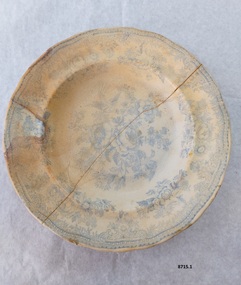 Flagstaff Hill Maritime Museum and Village
Domestic object - Dinner plate, circa 1878
... stamp, confusing the matter. Over time the body shape of the pieces changed, the feathered, curved and fluted edges giving way to simpler, cheaper oblong shapes The ship Loch Ard was built on the River Clyde in Scotland in 1873 for the prestigious Loch Line of colonial clipper ships, designed for the Australian run. It sailed from England on 1st March 1878 carrying 37 crew, 17 passengers and a load of cargo. The general cargo reflected the affluence of Melbourne at the time. On board were straw hats, umbrellas, perfumes, clay pipes, pianos, clocks, confectionary, linen...stamp, confusing the matter. Over time the body shape of the pieces changed, the feathered, curved and fluted edges giving way to simpler, cheaper oblong shapes The ship Loch Ard was built on the River Clyde in Scotland in 1873 for the prestigious Loch Line of colonial clipper ships, designed for the Australian run. It sailed from England on 1st March 1878 carrying 37 crew, 17 passengers and a load of cargo. The general cargo reflected the affluence of Melbourne at the time. On board were straw hats, umbrellas, perfumes, clay pipes, pianos, clocks, confectionary, linen ...These earthenware dinner plates were recovered from the wreck of the Loch Ard, on the southwest coast of Victoria and donated by a friend of the diver. The plates are very similar to other plates recovered from the wreck of the Loch Ard - some of which are already on display at Flagstaff Hill Museum and Village in Warrnambool. It is uncertain whether the plates were personal belongings or part of the cargo. The Asiatic Pheasant pattern is a transfer design and was the most popular design of the 19th-century Victorian era. It is still being produced today. The design was produced as high-quality, decorative dinnerware by the potters in the Staffordshire, England, area from the late 1830s, but no one is sure exactly who the original designer was. The industrial age made the production of this design more affordable to the ordinary person who purchased and proudly displayed settings in their homes. The high demand for production resulted in the loss of quality in both potting and design, particularly between 1860-1914 when the design reached its height of popularity, and the results were often a poor match for the earlier pieces’ quality and detail. Some engravers would make copies of the Asiatic Pheasant design (and other designs) onto copper plates and sell them to more than one pottery producer (the Copyright Act of 1842 was intended to control this very thing). Consequently, the list of Makers’ Marks associated with the Asiatic Pheasant is well over 100. A single pottery factory could have several owners, all with their own Marks. The makers mark on these two plates are also difficult to read but appear to include the letters "O H E ?' over "L". These factors all make the dating of pieces difficult. Also, after 1891, pieces produced for export were required to be stamped with “ENGLAND”, but pieces produced for the domestic market in England did not need this stamp, so early pieces and pieces produced for the domestic market would all be without the “ENGLAND” stamp, confusing the matter. Over time the body shape of the pieces changed, the feathered, curved and fluted edges giving way to simpler, cheaper oblong shapes The ship Loch Ard was built on the River Clyde in Scotland in 1873 for the prestigious Loch Line of colonial clipper ships, designed for the Australian run. It sailed from England on 1st March 1878 carrying 37 crew, 17 passengers and a load of cargo. The general cargo reflected the affluence of Melbourne at the time. On board were straw hats, umbrellas, perfumes, clay pipes, pianos, clocks, confectionary, linen and candles, as well as a heavier load of railway irons, cement, lead and copper. There were items included that were intended for display in the Melbourne International Exhibition in 1880 - a diverse general cargo ranging from luxury items to bulk railway iron. On 1 June 1878, emerging from fog and hearing too late the sound of breakers against the tall limestone cliffs, the vessel struck the southern foot of Mutton Bird Island and sank in 23 metres of water. Of the fifty-four people on board only two survived, one young male crewman, Tom Pearce, and one young female passenger, Eva Carmichael. Ten days after the Loch Ard tragedy, salvage rights to the wreck were sold at auction for £2,120. Cargo valued at £3,000 was salvaged and placed on the beach, but most washed back into the sea when another storm developed. The wreck of Loch Ard still lies at the base of Mutton Bird Island. Much of the cargo has now been salvaged and some was washed up into what is now known as Loch Ard Gorge. Cargo and artefacts have also been illegally salvaged over many years before protective legislation was introduced. One of the most unlikely pieces of cargo to have survived the shipwreck was a Minton porcelain peacock - one of only seven in the world. The peacock was destined for the Melbourne International Exhibition in 1880. It had been well packed, which gave it adequate protection during the violent storm. Today, the Minton peacock can be seen at the Flagstaff Hill Maritime Museum in Warrnambool. From Australia's most dramatic shipwreck it has now become Australia's most valuable shipwreck artefact and is one of very few 'objects' on the Victorian State Heritage Register.Flagstaff Hill’s collection of artefacts from LOCH ARD is significant for being one of the largest collections of artefacts from this shipwreck in Victoria. It is significant for its association with the shipwreck, which is on the Victorian Heritage Register (VHR S417). The collection is significant because of the relationship between the objects, as together they have a high potential to interpret the story of the LOCH ARD. The LOCH ARD collection is archaeologically significant as the remains of a large international passenger and cargo ship. The LOCH ARD collection is historically significant for representing aspects of Victoria’s shipping history and its potential to interpret sub-theme 1.5 of Victoria’s Framework of Historical Themes (living with natural processes). The collection is also historically significant for its association with the LOCH ARD, which was one of the worst and best known shipwrecks in Victoria’s history.Two plates recovered from the wreck of the Loch Ard. Earthenware dinner plates with blue and white transfer design (Asiatic Pheasant) with a clear over-glaze. The outer rim is scalloped. Plate 8715.1 has substantial brown stain over a large part of it and a large crack across the plate from rim to rim. The back of the plate shows evidence of the glue used to repair it. Plate 8715.2 has minor brown staining and is in better condition.Floral makers mark on the back featuring a scroll inscribed with "Asiatic Pheasant" and underneath the letters "O H E ?" over "L".flagstaff hill maritime museum and village, great ocean road, shipwreck coast, warrnambool, loch ard, lock ard wreck, plates, crockery, asiatic pheasant design, salvage, loch ard gorge, dinner plates -
 Glenelg Shire Council Cultural Collection
Souvenir - Tea Towel, n.d
... Hand embroidered linen tea towel, crayfish motif 'Greetings from Portland' - stamped on tea towel....Hand embroidered linen tea towel, crayfish motif 'Greetings from Portland' - stamped on tea towel. ...Hand embroidered linen tea towel, crayfish motif 'Greetings from Portland' - stamped on tea towel. -
 Flagstaff Hill Maritime Museum and Village
Book - Reference, John Perry, The Steam Engine and Gas and Oil Engines, 1899
... Stamped in purple , front endsheet "F. ST. G. D. HOLYMAN" "L.4." Handwritten in ink "Richard G ---- / Liverpool --- P---ye" The Steam Engine and Gas and Oil Engines: a book for the use of students who have time to make experiments and calculations Author: John Perry D.Sc., F.R.S. Publisher: Macmillan & Co Ltd, London Printed by Richard Clay and Sons, Limited, London and Bungay This is the First Edition of the book, printed in 1899 A hard cover book, red linen ...This is the first edition of the book, printed in 1899. It has since been reprinted with slight corrections in January 1900 and with correction in 1902. It is a textbook and reference book based on the study of steam, gas and oil driven machinery of the late 19th and early 20th century. The author, John Perry D. Sc., F.R.S., was born in 1850 and passed away in 1920. He was a Professor of Mechanics and Mathematics in the Royal College of Science, Vice-President of the Institution of Electrical Engineers, and Vice-President of the Physical Society. This book has significance as the First Edition of the book, published in 1899. The book is significant to the history, understanding and evolution of power driven machines. The principles apply to the machinery of the late 19th to early 20th centuries. The Steam Engine and Gas and Oil Engines: a book for the use of students who have time to make experiments and calculations Author: John Perry D.Sc., F.R.S. Publisher: Macmillan & Co Ltd, London Printed by Richard Clay and Sons, Limited, London and Bungay This is the First Edition of the book, printed in 1899 A hard cover book, red linen with black print. The Preface is written by the aughor on 22nd February 1899. The book contains many diagrams and tables as well as having reference numbers on many paragraphs in the chapters.Pencil on front endsheets "SJ 9""Rec. 371 a" Stamped in purple , front endsheet "F. ST. G. D. HOLYMAN" "L.4." Handwritten in ink "Richard G ---- / Liverpool --- P---ye"warrnambool, shipwrecked-coast, flagstaff-hill, maritime-museum, shipwreck-coast, book, the steam engine and gas and oil engines, john perry, reference book, scientific book, steam engines, gas engines, oil engines, combustion engines -
 Mission to Seafarers Victoria
Book, Her Majesty's Stationery Office, Admiralty Manual of Navigation Vol.1 1979, 1979
... Howard's involvement with the Mission was through with the First Fleet Fellowship Victoria Inc. and their meetings held at the Mission over many years. howard timbury first fleet fellowship victoria interest group education navigation Stamp in blue ink: Howard Timbury. Golden sticker: Boat Books 509 pages, illustrated , navy linen cover with light blue dust jacket. ...509 pages, illustrated , navy linen cover with light blue dust jacket.non-fictionhoward timbury, first fleet fellowship victoria, interest group, education, navigation -
 Mission to Seafarers Victoria
Book, Her Majesty's Stationery Office, Admiralty Manual of Navigation Vol.2, 1973
... Stamp in blue ink: Howard Timbury Golden sticker: Boat Books 329 pages, illustrated, navy blue linen cover and red paper dust jacket. ...This volume of the Admiralty Manual of Navigation describes off-shore navigation - the safe conduct of a ship across the open sea where, in general, hearings of objects on land cannot be obtained except by means of radio waves (i.e. using radio fixing aids). The first chapters are mainly concerned with distances, courses, tracks and charts; then various methods of obtaining position lines and positions from astronomical observations are explained, including a rapid. method in the last chapter. The volume also contains an outline of meteorrology and weather forecasting.329 pages, illustrated, navy blue linen cover and red paper dust jacket.non-fictionThis volume of the Admiralty Manual of Navigation describes off-shore navigation - the safe conduct of a ship across the open sea where, in general, hearings of objects on land cannot be obtained except by means of radio waves (i.e. using radio fixing aids). The first chapters are mainly concerned with distances, courses, tracks and charts; then various methods of obtaining position lines and positions from astronomical observations are explained, including a rapid. method in the last chapter. The volume also contains an outline of meteorrology and weather forecasting.howard timbury, first fleet fellowship victoria, interest group, navigation, education -
 Mission to Seafarers Victoria
Book, Her Majesty's Stationery Office, Admiralty Manual of Navigation Vol.1, 1977
... Stamp in blue ink: Howard Timbury Golden sticker from Boat Books 544 pages, illustrated, navy blue linen cover and red paper dust jacket. ...This revised edition follows the previous editions in giving a practical guide to navigation and pilotage which, although written primarily for naval officers, will be suitable for all students of navigation. Astronomical navigation and meteorology can be read in Volume II of this manual. The quality of detailed thoroughness that has always distinguished this book is retained, and it has been brought up to date, particularly in the chapters on radio aids to navigation and navigational instruments.544 pages, illustrated, navy blue linen cover and red paper dust jacket.non-fictionThis revised edition follows the previous editions in giving a practical guide to navigation and pilotage which, although written primarily for naval officers, will be suitable for all students of navigation. Astronomical navigation and meteorology can be read in Volume II of this manual. The quality of detailed thoroughness that has always distinguished this book is retained, and it has been brought up to date, particularly in the chapters on radio aids to navigation and navigational instruments.howard timbury, first fleet fellowship victoria, interest group, navigation, education -
 Mission to Seafarers Victoria
Book, Naval Institute Press, The Naval Officer's Guide, 1970
... Howard's involvement with the Mission was through with the First Fleet Fellowship Victoria Inc. and their meetings held at the Mission over many years. howard timbury first fleet fellowship victoria interest group education navigation Stamp in blue ink: Howard Timbury. Golden sticker: Boat Books 509 pages, illustrated , navy linen cover with light blue dust jacket. ...509 pages, illustrated , navy linen cover with light blue dust jacket.non-fictionhoward timbury, first fleet fellowship victoria, interest group, education, navigation -
 Mission to Seafarers Victoria
Book, Naval Institute Press, Standard Seamanship for the Merchant navy, 1970
... Howard's involvement with the Mission was through with the First Fleet Fellowship Victoria Inc. and their meetings held at the Mission over many years. howard timbury first fleet fellowship victoria interest group education navigation Stamp in blue ink: Howard Timbury. Golden sticker: Boat Books 509 pages, illustrated , navy linen cover with light blue dust jacket. ...509 pages, illustrated , navy linen cover with light blue dust jacket.non-fictionhoward timbury, first fleet fellowship victoria, interest group, education, navigation -
 Mission to Seafarers Victoria
Book, Joshua Slocum, Sailing Alone Around the World, 1970
... Howard's involvement with the Mission was through with the First Fleet Fellowship Victoria Inc. and their meetings held at the Mission over many years. howard timbury first fleet fellowship victoria interest group education navigation joshua slocum Stamp in blue ink: Howard Timbury. Golden sticker: Boat Books 509 pages, illustrated , navy linen cover with light blue dust jacket. ...509 pages, illustrated , navy linen cover with light blue dust jacket.non-fictionhoward timbury, first fleet fellowship victoria, interest group, education, navigation, joshua slocum -
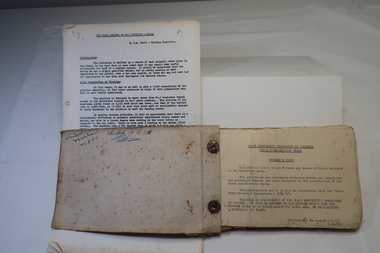 Kiewa Valley Historical Society
A) Document - The Field Welding of No. 1 Pipeline - Kiewa. B) Book - SECV, Kiewa Hydro Electric Works, Foreman's Guide, A) by J. M. Scott, Welding Inspector B) by State Electricity Commission of Victoria
... stamp. Inside cover: "checked ... 22-8-55" and "checked 18-11-55" A) 10 pages of a 'field record' all pages typed on one side. Stapled on top left corner B) Small, fat book c190 pages plus appendix. Thick and 'tattered looking'. Bound by flexible 'cloth?'(linen ...No. 1 Pipeline heads down the mountain from McKay Power Station (the Kiewa Hydro Electric Scheme) and can be seen from the Falls Creek Rd.. The pipeline is 1635m long. It was built on the mountain rather than as a tunnel inside the mountain - "It was argued that a pressure pipeline on the surface, while not actually cheaper than the tunnel could possibly save one year in construction time.'The document is a report on the welding involved on the No. 1 pipeline. J. M. Scott was the welding inspector for the SECV on the Kiewa Hydro Electric Scheme. The book is produced by the SECV and is the 'Foremen's Guide' and includes rules and regulations across all areas.A) 10 pages of a 'field record' all pages typed on one side. Stapled on top left corner B) Small, fat book c190 pages plus appendix. Thick and 'tattered looking'. Bound by flexible 'cloth?'(linen?) and fastened with 2 rusty fasteners.B) Cover - F/M J. Scott and red SEC stamp. Inside cover: "checked ... 22-8-55" and "checked 18-11-55"j.m. scott welding inspector, no 1 pipeline mckay power station, kiewa hydro electric scheme -
 Bendigo Military Museum
Equipment - SADDLE, c. 1915 to 1930
... Stamped on the rear of the seat: 'S (broad up arrow)' 1912 Universal Pattern steel arch brown leather saddle. Tree is made of wood with shredded cotton waste padding attached. Various brass rings are located on the saddle for attaching sundry equipment. No stirrups, stirrup leathers or girth. The leather seat covers the frame between the front and rear metal arches and is attached to them using linen ...Standard issue saddle used by the Australian Light Horse, artillery and transport units during WW1 and after (between the wars). The Universal Pattern saddles were designed to have interchangeable parts, making them easy to repair.1912 Universal Pattern steel arch brown leather saddle. Tree is made of wood with shredded cotton waste padding attached. Various brass rings are located on the saddle for attaching sundry equipment. No stirrups, stirrup leathers or girth. The leather seat covers the frame between the front and rear metal arches and is attached to them using linen webbing slings. Leather sweat flaps on each side.Stamped on the rear of the seat: 'S (broad up arrow)'australian light horse, military equipment, saddle, transport -
 Warrnambool and District Historical Society Inc.
Memorabilia - Button Collection, Framed collection of Warrnambool tailors’ Buttons, Late 19th Century and early part of 20th century
... stamped or have raised lettering or symbols. Names on buttons as follows: Cramond & Dickson, Youngers, Warrnambool, W. J. Taggart, S Taggart, Fletcher Jones, W. A Burnett, W McDonald, Thompson Terang, R Carey, J Torrance Camperdown, F Williamson, Salvation Army. Types of buttons : Military, Navy, coat, vest, boot and shoe,shirt, trouser, coat, Pearl shell, linen...stamped or have raised lettering or symbols. Names on buttons as follows: Cramond & Dickson, Youngers, Warrnambool, W. J. Taggart, S Taggart, Fletcher Jones, W. A Burnett, W McDonald, Thompson Terang, R Carey, J Torrance Camperdown, F Williamson, Salvation Army. Types of buttons : Military, Navy, coat, vest, boot and shoe,shirt, trouser, coat, Pearl shell, linen ...The buttons relate to tailors in Warrnambool and District and some are stamped with relevant names. The collection provides a good sample of buttons and the types of materials and uses which were prevalent in the period. Rows of buttons in colours black, brown, fawn, silver, white, and Mother of Pearl. Mounted on cream card and framed with cream mount. Rows are labelled with small card inserts with names of local tailors and/or application and uses. Materials used are metal, bakelite, shell and fabric.The metal buttons have names of tailors stamped into them and bakelite buttons are either stamped or have raised lettering or symbols. Names on buttons as follows: Cramond & Dickson, Youngers, Warrnambool, W. J. Taggart, S Taggart, Fletcher Jones, W. A Burnett, W McDonald, Thompson Terang, R Carey, J Torrance Camperdown, F Williamson, Salvation Army. Types of buttons : Military, Navy, coat, vest, boot and shoe,shirt, trouser, coat, Pearl shell, linen, and fabric covered.warrnambool, buttons, cramond and dickson, youngers, w.j. taggart, burnett mcdonald thompson, terang williamson, j. torrance, fletcher jones, warrnambool military -
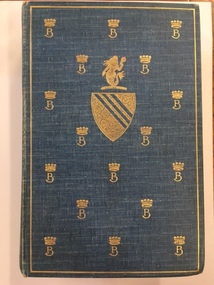 Warrnambool and District Historical Society Inc.
Book, Byron’s Works by Lord Byron, 1903
... Stamped C O’Mahony Solicitors Warrnambool in purple ink. Dedication: to Algernon Charles Swinburne. MDCCCC11(1902)Printed by William Clowes and sons Limited London and Beccles. Blue linen ...This book containing the 17 cantos of Don Juan, was owned by Con O’Mahony, a lawyer who lived in Warrnambool at the turn of the 20th century He won the Bowen prize for essay writing in 1883. O’Mahony had a legal practice in Warrnambool in the Royal Chambers in Kepler Street at the end of the 19th century and the beginning of the 20th century. He was initially in a partnership with Messrs E.W. Klingender and Murray, then ,when this partnership was dissolved, he continued the business under the name of O’Mahony and later O’Mahony and Murray. He was actively involved in the management of the Warrnambool Mechanics’ Institute and was a member of the Warrnambool Hospital committee.An item which belonged to one of Warrnambool’s most prominent citizens at the time.Blue linen over card embossed in gold with crest and mermaid on front cover with overall pattern of crowns and the letter “B” Title Poet and publisher’s name in gold on spine of book. Back cover plain. 612 pages with 4 black and white plates included.Stamped C O’Mahony Solicitors Warrnambool in purple ink. Dedication: to Algernon Charles Swinburne. MDCCCC11(1902)Printed by William Clowes and sons Limited London and Beccles.con o'mahony, warrnambool, byron's works -
Frankston RSL Sub Branch
Book, New Testament
... linen hardcover imprinted with black lettering. Example of the New Testament that was presented to members of the Victorian Contingent of the Australian Imperial Force during World War 1. The inside front cover has a label insert with a printed message "Printed by the British and Foreign Bible Society and signed Fred G Barley, Gen Sec. Melbourne 1916". The opening pages have a blue stamped...linen hardcover imprinted with black lettering. Example of the New Testament that was presented to members of the Victorian Contingent of the Australian Imperial Force during World War 1. The inside front cover has a label insert with a printed message "Printed by the British and Foreign Bible Society and signed Fred G Barley, Gen Sec. Melbourne 1916". The opening pages have a blue stamped ...Pocket book size with buff grey linen hardcover imprinted with black lettering. Example of the New Testament that was presented to members of the Victorian Contingent of the Australian Imperial Force during World War 1. The inside front cover has a label insert with a printed message "Printed by the British and Foreign Bible Society and signed Fred G Barley, Gen Sec. Melbourne 1916". The opening pages have a blue stamped imprint with the following inscription "Presbyterian Soldiers' Institute Royal Park Camp" in an oval shaped border. Book published by the British and Foreign Bible Society, 146 Queen Victoria Street, London. The front cover has the following inscription in black print, "NEW TESTAMENT". -
 Geoffrey Kaye Museum of Anaesthetic History
Equipment - Case, Mayer & Meltzer et al, c. 1903
... Printed in gold leaf on inside lid of box: MAYER & MELTZER / LONDON / MELBOURNE & CAPE TOWN Stamped on underside of metal pourer: BARTH & CO / LONDON Handwritten on inside of lifting linen-covered paper: [indecipherable] d as described on Pawn-Ticket / January 1903 / Jacket / Boots [cont...]...mayer & meltzer barth & co Printed in gold leaf on inside lid of box: MAYER & MELTZER / LONDON / MELBOURNE & CAPE TOWN Stamped on underside of metal pourer: BARTH & CO / LONDON Handwritten on inside of lifting linen-covered paper: [indecipherable] d as described on Pawn-Ticket / January 1903 / Jacket / Boots [cont...] ...Black round topped box with brass hooks at front and brass hinges at rear. There is a black fabric handle on the top (broken). Inside the box is black padding with the manufacturer's logo printed in gold leaf. There is a square section in the base of the box, usually for a glass bottle but which is holding a metal pourer. The rest of the kit is missing.Printed in gold leaf on inside lid of box: MAYER & MELTZER / LONDON / MELBOURNE & CAPE TOWN Stamped on underside of metal pourer: BARTH & CO / LONDON Handwritten on inside of lifting linen-covered paper: [indecipherable] d as described on Pawn-Ticket / January 1903 / Jacket / Boots [cont...]mayer & meltzer, barth & co
