
Showing 23 items matching "t foot"
-
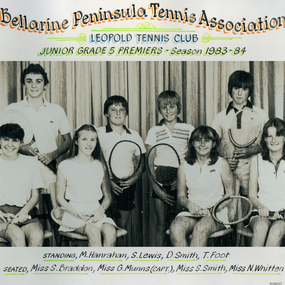 Leopold Tennis Club
Photograph, Robert Pockley Studios, Bellarine Peninsula Tennis Association Leopold Tennis Club Junior Grade 5 Premiers - Season 1983-84, 1984
... ...T Foot...Lewis, D. Smith, T. Foot Seated, Miss S. Braddon, Miss G. Munns (Capt.), Miss S. ...Lewis, D. Smith, T. Foot Seated, Miss S. Braddon, Miss G. Munns (Capt.), Miss S. ...Image taken of the Bellarine Peninsula Tennis Association Junior Grade 5 Premiers for Season 1983-84.1 photograph of Premiership tennis teamStanding, M. Hanrahan, S. Lewis, D. Smith, T. Foot Seated, Miss S. Braddon, Miss G. Munns (Capt.), Miss S. Smith, Miss N. Whittenleopold tennis club, bellarine peninsula tennis association, m hanrahan, s lewis, s smith, d smith, t foot, s braddon, g munns, n whitten -
 Mission to Seafarers Victoria
Document - Media release, Podcast reveals unique Melbourne experiences, April 2022
... foot. From their website: "Told by locals Discover Australia through the voices of its locals! Storytowns collaborates with communities to craft immersive audio guides, offering authentic travel tales from the heart of each neighborhood. Simply grab your headphones, download our app and explore Melbourne’s suburbs with with our fresh-out-the-oven “Railway Stories” audio guides! And if you’re feeling adventurous this weekend, take a road trip through regional Australia and let us jazz up your adventure, where the local folks are the true stars of the story. Sue Dight was interviewed to add to t...foot. From their website: "Told by locals Discover Australia through the voices of its locals! Storytowns collaborates with communities to craft immersive audio guides, offering authentic travel tales from the heart of each neighborhood. Simply grab your headphones, download our app and explore Melbourne’s suburbs with with our fresh-out-the-oven “Railway Stories” audio guides! And if you’re feeling adventurous this weekend, take a road trip through regional Australia and let us jazz up your adventure, where the local folks are the true stars of the story. Sue Dight was interviewed to add to t ...In April 2022, the City of Melbourne partnering Storytown, with launched the "Melbourne Podcast Tour". Storytown, an application created by Jarrod Pickford offering audio guides. This self-guided tour takes you along the Yarra River, from Southbank to Docklands, taking around 1.5 hours to complete by bike or 2 hours by foot. From their website: "Told by locals Discover Australia through the voices of its locals! Storytowns collaborates with communities to craft immersive audio guides, offering authentic travel tales from the heart of each neighborhood. Simply grab your headphones, download our app and explore Melbourne’s suburbs with with our fresh-out-the-oven “Railway Stories” audio guides! And if you’re feeling adventurous this weekend, take a road trip through regional Australia and let us jazz up your adventure, where the local folks are the true stars of the story. Sue Dight was interviewed to add to tThe interview was a to way to put the Mission to Seafarers on the map and increase its visitation. Unfortunately the tour is not avalaible anymore (as from 2023).Digital copy of a media releasecom, city of melbourne, app, storytown, sue dight, on the map, marketing, audioguide, jarrod pickford, audio guides, self-guides tour, podcast, radio interview -
 Camperdown & District Historical Society
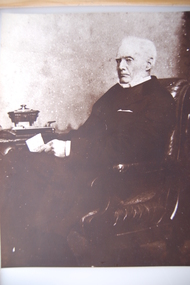
Photograph - James Dawson, Thomas Rodger, c1881
... His friend's remains were reburied at the foot of the obelisk and the two dates, 1840-1883, mark the 43 years it took for European settlement to displace the Djargurd Wurrung from the Camperdown District. CDHS Isabella Dawson Camperdown Cemetery Djargurdwurrung CDHSFirstNations Front: T ...James Dawson (1806-1900), pastoralist, friend to First Nations people, environmentalist, patron of the Arts and author of "Australian Aborigines" (1881). Dawson came from Bonnytoun, near Linlithgow, Scotland and arrived in Melbourne with his wife, Joan Alexander Park, on 2 May 1840. They made their first home in the colony farming in Port Phillip, near Anderson's Creek on the Yarra River, where their daughter, Isabella was born in 1842, then from 1844, moved to 'Kangatong' station on the Moyne River, east of Macarthur. In 1866 the Dawsons left the Port Fairy district and lived in various residences in Melbourne. By 1868 the family had settled in Camperdown at 'Wuurong', on the banks of Lake Bullen Merri. Unlike most people at the time, Dawson and his daughter shared a deep interest in, and respect for First Nations people. In 1876 James Dawson was appointed local Guardian of the Aborigines in the Camperdown district. He was a prolific letter writer and an early advocate for indigenous rights and was dedicated to exposing injustice and the maltreatment of First Nations people. He had befriended Wombeetch Puyuun (Camperdown George) who was the last of the local Djargurd Wurrung living on Country when he died in February 1883. In 1885 James Dawson erected the Wombeetch Puyuun Monument at Camperdown Cemetery in his memory. His friend's remains were reburied at the foot of the obelisk and the two dates, 1840-1883, mark the 43 years it took for European settlement to displace the Djargurd Wurrung from the Camperdown District.Sepia photograph of an elderly James Dawson taken in Scotland. Front: T. Rodger St. ANDREWS N.B. Back: THOMAS RODGER Photographer ST. ANDREWS ETABLISHED 1849cdhs, isabella dawson, camperdown cemetery, djargurdwurrung, cdhsfirstnations -
 Flagstaff Hill Maritime Museum and Village
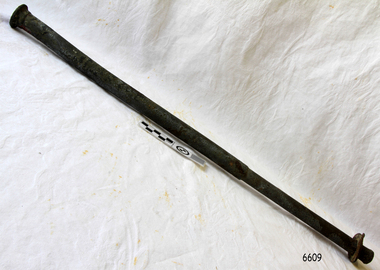
Functional object - Rod, Approx. 1871
... T S and Co Melbourne A. Field and Son Taunton Massachusetts ketch Apollo ship nail Iron rod with flat lugged washer. The rod is made of a heavy metal with encrustations and signs of rusting on the surface. It is stepped down in diameter mid-shaft and is slightly bowed on the narrower end. The narrow end flares out slightly in the last few centimetres with a burred foot ...This rod was salvaged from the American three-masted wooden clipper ship, Eric the Red, named after the Viking discoverer, Eric the Red. The ship first traded in coal between America and Britain and later traded in guano nitrates from South America. In 1879 its hull was re-metalled and the vessel was in first class condition. On 10th June 1880 Eric the Red departed New York under the command of Captain Z Allen, with 24 crew plus two passengers. It was heading for Melbourne and then Sydney. The ship was commissioned by American trade representatives to carry a special cargo of 500 American exhibits for the U.S.A. pavilion at Melbourne’s first International Exhibition. The items included furniture, ironmongery, wines, chemicals, dental and surgical instruments, paper, cages, bronze lamp trimmings, axles, stamped ware, astronomical and time globes, and samples of corn and the choicest of leaf tobacco. Also on board was general merchandise such as cases of kerosene and turpentine, brooms, Bristol's Sarsaparilla, Wheeler and Wilson sewing machines, Wheeler’s thresher machine, axe handles and tools, cases of silver plate, toys, pianos and organs, carriages and Yankee notions. The ship had been at sea for 85 days when, on 4th September 1880, it hit the Otway Reef on the southwest coast of Victoria and was quickly wrecked. Captain and crew ended up on floating parts, or in the long boat or the sea. He was amongst the 23 battered and injured men who were rescued by the steamer Dawn and later taken to Warrnambool, where they received great hospitality and care. Four men lost their lives; three crew and one passenger. Captain Allen took the train back to Melbourne and then returned to America. The captain and crew of the Dawn were recognised by the United States Government in July 1881 for their humane efforts, being thanked and presented with substantial monetary rewards, medals and gifts. The salvaging ship Pharos collected Wheeler and Wilson sewing machines, nests of boxes, bottles of Bristol’s sarsaparilla, pieces of common American chairs, axe handles, a Wheelers’ Patent thresher and a sailor’s trunk with the words “A. James” on the front. A ship’s flag board bearing the words “Eric the Red” was found on the deckhouse; finally, those on board the Pharos had found the name of the wrecked vessel. The government steamer Victoria and a steamer S.S. Otway picked up flotsam and wreckage. A whole side of the hull and three large pieces of the other side of the hull, with some of the copper sheathing stripped off, had floated onto Point Franklin. Some of the vessel's yards and portions of its masts were on shore with pieces of canvas attached, confirming that the vessel had been under sail. On shore were many cases of Diamond Oil kerosene labelled R. W. Cameron and Company, New York. large planks of red pine, portions of a small white boat and a large, well-used oar. There were sewing machines, some consigned to ‘Long and Co.”, and notions, axe and scythe handles, hay forks, wooden pegs, rolls of wire, some branded “T.S” and Co, Melbourne”, and kegs of nails branded “A.T. and Co.” from the factory of A. Field and Son, Taunton, Massachusetts. Other cargo remains included croquet balls and mallets, buggy fittings, rat traps, perfumery, cutlery and Douay Bibles, clocks, bicycles, chairs, a flywheel, a cooking stove, timber, boxes, pianos, organs, wooden clothes pegs and a ladder. There were three cases of goods meant for the Exhibition Other items salvaged from amongst the debris floating in the sea were chairs, doors, musical instruments, washing boards, nests of trunks and flycatchers. Most of the goods were saturated and smelt of kerosene. A section of the hull lies buried in the sand at Parker River Beach. An anchor with a chain is embedded in the rocks east of Point Franklin and a second anchor, thought to be from Eric the Red, is on display at the Cape Otway light station. A life belt was once on the veranda of Rivernook Guest House in Princetown with the words “ERIC THE RED / BOSTON”. Parts of the ship are on display at Bimbi Park Caravan Park and Apollo Bay Museum. Flagstaff Hill Maritime Village also has several artefacts from the wreck. There seemed to be no personal luggage or clothing. “The Eric the Red is historically significant as one of Victoria's major 19th century shipwrecks. (Heritage Victoria Eric the Red; HV ID 239) The wreck led to the provision of an additional warning light placed below the Cape Otway lighthouse to alert mariners to the location of Otway Reef. The site is archaeologically significant for its remains of a large and varied cargo and ship's fittings being scattered over a wide area. The site is recreationally and aesthetically significant as it is one of the few sites along this coast where tourists can visit identifiable remains of a large wooden shipwreck, and for its location set against the background of Cape Otway, Bass Strait, and the Cape Otway lighthouse.“ (Victorian Heritage Database Registration Number S239, Official Number 8745 USA)Iron rod with flat lugged washer. The rod is made of a heavy metal with encrustations and signs of rusting on the surface. It is stepped down in diameter mid-shaft and is slightly bowed on the narrower end. The narrow end flares out slightly in the last few centimetres with a burred foot and has a circular head on the wider end. The washer on the narrower end cannot move past the centre or the narrow end of the rod. The washer is a different metal from the rod and has a small lug jutting out along the circumference in one position. The rod was recovered from the wreck of the ship the Eric the Red.flagstaff hill, warrnambool, shipwrecked-coast, flagstaff-hill, flagstaff-hill-maritime-museum, maritime-museum, shipwreck-coast, flagstaff-hill-maritime-village, rod, iron-rod, eric the red, steamer dawn, cape otway reef, 1880, captain allen, usa pavillion, melbourne exhibition, melbourne international exhibition, captain jones, medal, united states government, pharos, a. james, flag board, steamer victoria, steamer otway, diamond oil, r w cameron and company, long and co., t s and co melbourne, a. field and son, taunton, massachusetts, ketch apollo, ship nail -
 City of Moorabbin Historical Society (Operating the Box Cottage Museum)
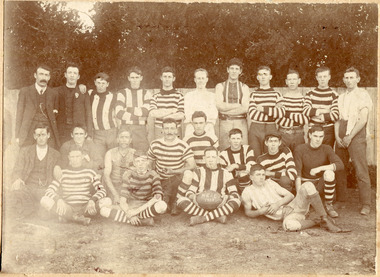
Photograph, 1903 or 1908 Moorabbin Football Club, 1903 or 1908 Moorabbin Football Club, 1903 or 1908
... foot-ball club" with a "code of laws" to keep cricketers fit during winter. The Melbourne Football Club's rules of 1859 are the oldest surviving set of laws for Australian football. The ten simple rules were drawn up on 17 May at a meeting chaired by Tom Wills and in attendance were journalists W. J. Hammersley and J. B. Thompson, and Thomas H. Smith. The rules were signed by Tom Wills, William Hammersley, J. Sewell, J. B. Thompson, Alex Bruce, T...foot-ball club" with a "code of laws" to keep cricketers fit during winter. The Melbourne Football Club's rules of 1859 are the oldest surviving set of laws for Australian football. The ten simple rules were drawn up on 17 May at a meeting chaired by Tom Wills and in attendance were journalists W. J. Hammersley and J. B. Thompson, and Thomas H. Smith. The rules were signed by Tom Wills, William Hammersley, J. Sewell, J. B. Thompson, Alex Bruce, T ...1903 or 1908 Moorabbin Australian Rules Football Club. Philip Jones, a relative of James Jones who was a pioneer settler in Moorabbin Shire, is holding the football. In the late 1850s Melbourne's schools are first recorded organising football games modeled on precedents at English schools The earliest known such match was played on 15 June 1858 between Scotch College and Melbourne Grammar School on the St Kilda foreshore. On 10 July 1858, the Melbourne-based Bell's Life in Victoria and Sporting Chronicle published a letter by prominent Victorian cricketer Tom Wills, calling for the formation of a "foot-ball club" with a "code of laws" to keep cricketers fit during winter. The Melbourne Football Club's rules of 1859 are the oldest surviving set of laws for Australian football. The ten simple rules were drawn up on 17 May at a meeting chaired by Tom Wills and in attendance were journalists W. J. Hammersley and J. B. Thompson, and Thomas H. Smith. The rules were signed by Tom Wills, William Hammersley, J. Sewell, J. B. Thompson, Alex Bruce, T. Butterworth and Thomas H. Smith. Importantly, the rules were widely publicised and distributed. Having been codified in 1859, this means that Australian football is an older sport than most other football codes in the world, including soccer. As Geoffrey Blainey states, "soccer has no club that matches the antiquity of the early Victorian clubs." In 1859 several new football clubs formed including the Castlemaine Football Club, Geelong Football Club and the Melbourne University Football Club. The first football match played at the Melbourne Cricket Ground (MCG) was not until 1876. Cricket authorities soon saw the opportunity to capitalise on the rapid growth of Australian football, however, and soon most grounds in Victoria were expanded to accommodate the dual purpose, a situation that continues to this day. Football matches between 1859 and 1899 were played in a 20-per-side format. n 1896, delegates from the stronger and wealthier Victorian Football Association clubs—Carlton, Collingwood, Essendon, Fitzroy, Geelong, Melbourne, St Kilda and South Melbourne—met to form a breakaway competition and in 1897, the Victorian Football League (VFL), was born as an eight-team competition. Popularity of the VFL grew rapidly and by 1925 with 12 teams, had become the most prominent league in the game and would dominate so many aspects of the sport from that point on. Moorabbin Football Club, nicknamed the Kangaroos, was the name of two distinct Australian rules football clubs which played in the Victorian Football Association (VFA). The first club, founded in the early 20th century, joined the VFA in 1951 and played there until 1963 with great success; they played home matches at Moorabbin Oval and wore royal blue and white hooped jerseys. The second club played in the VFA from 1983 to 1987. Moorabbin played initially in the Federal Football League, making their debut in 1909 and competing until 1950. During this time the club won 12 premierships, including winning all six premierships staged over the nine years between 1940 and 1948 (the competition was in recess from 1942 until 1944). The club entered the VFA in 1951. Its Federal League home ground, the Dane Road Reserve, was not up to VFA standards; so, in 1951 the club played at Cheltenham, and in 1952 moved into the Moorabbin Oval, which the Moorabbin Council had developed during 1951. The Kangaroos made the 1954 and 1955 finals series without success but in 1957 they helped eliminate premiership favourite Williamstown after defeating them by two points in the Semi Final. Moorabbin, who were coached by Bill Faul, took on Port Melbourne in the Grand Final, whom they had not once beaten since joining the league. In another upset, Moorabbin won comfortably to claim their maiden VFA premiership. In the early 1960s, the Moorabbin Council was very keen to bring a Victorian Football League team to Moorabbin Oval. 1964, the Moorabbin City Council secured a deal with St Kilda, who moved to Moorabbin Oval starting in 1965. The club originally intended to seek readmission for the 1965 season, but in July the club committee decided to withdraw permanently from the Association,and disbanded.Photograph is Black and White. Three rows of Australian Rules Football players in a typical team photograph. Some are wearing striped jumpers, either the stripes are going horizontal or parallel. There is a known man in this photo, named Philip Jones, who is holding the football in front row. There are two men wearing suits at the left, on the end of the third row. Hewitt, Photographer, 92 Regent St. North Richmond.moorabbin, football club, 1903, 1908, philip jones, james jones, early settlers, market gardeners, pioneers, herron john, australian rules foorball, victorian footbal league, victorian football association, moorabbin city council, moorabbin shire, city of moorabbin, st kilda football club, -
 Seaworks Maritime Museum
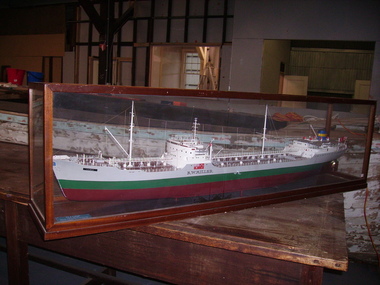
Shipbuilders model, R W Miller
... Plaque at foot of model: M/T R.W. MIILRT/ BUILT GOT. 1951/ OWNERS R.W. ...Build date 1951-1979. Plaque at foot of model: M/T R.W. MIILRT/ BUILT GOT. 1951/ OWNERS R.W. ...Original ship - 11,741 gross tons. 589' x 70' x 30' (179.5 x 21.34 x 9.14m). Oil tanker built by Eriksberg Motor Vessels at Gottenburg, Sweden in 1951 for Hjalmar Bjorge of Norway as the Storheim. Purchased November 1964 and renamed R W MILLER. Had a crew of 39 seamen, including the officers. 1973 sold to Independent Shipping Company Pty Ltd of Singapore. Renamed Cherry Victor. Scrapped 1979. Robert Miller traded under the name R W Miller and Company from early 1912. One of Miller's first contracts was to pick up overburden and spoil from the sinking of the Balmain Colliery shaft and dump it at sea. Miller saw the opportunity to sell this material and he ended up getting a sixpence a ton from a local council and other contractors for use as road bases and building foundations. This close association with coal led to Robert W Miller on 15th January 1913 being given the contract for coal distribution from Sydney Harbour Colliery (Balmain mine). So began a long association with coal. Miller built a fleet of lighters that were used to transport blue metal, sand and coal around Sydney Harbour. This introduction into coal transport opened a prospect for him to enter the larger coal shipping transport. During 1917 Miller purchased a vessel, the taking over 1985 by Howard Smith Industries Pty Ltd, Melbourne. Build date 1951-1979. Ship builders model of the tanker R W Miller in a glass case. The body is painted in colours of maroon, green and grey, the deck with detailed fittings and superstructure, an Australian merchant flag flying from the stern, within a mahogany framed glazed display casePlaque at foot of model: M/T R.W. MIILRT/ BUILT GOT. 1951/ OWNERS R.W. MILLER & CO. PTY. LTD/ LENGTH OVERALL 559.04"/ LENGTH BETWEEN P.P 526.06"/ EXTREME BREADTH 70.00"/ MOULDED DEPTH 39.03"/ DEADWEIGHT TONNAGE 18,500/ MACHINERY B & W TYPE A I.H.P 7, 600" on model: "R.W Miller" painted in black -
 Ringwood and District Historical Society
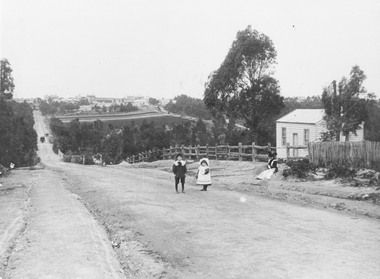
Photograph, Warrandyte Rd looking south from near Mullum Rd. 1902
... T. Grant's land ploughed - now Eastland. Adelaide St. seen on right of it. Mullum Creek Bridge at foot of hill." ...T. Grant's land ploughed - now Eastland. Adelaide St. seen on right of it. Mullum Creek Bridge at foot of hill." ...Black and white photograph (2 images. V0065- 2copies, 1 large, 1 postcard size. V0065A- 1 postcard size)Image V0065- Typed below photograph: Warrandyte Rd. Ringwood, looking south from near Mullum Rd. Ringwood in background. Maroondah Highway at top of hill with Mullum Creek bridge seen in dip." Written on back of photograph: "Mrs. Addison (Annie Kennedy) and family - Annie, born 1897 and William born 1894. Their home at right was on a 5 acre block burned down by pet magpie. Ringwood in background. T. Grant's land ploughed - now Eastland. Adelaide St. seen on right of it. Mullum Creek Bridge at foot of hill." Image V0065A- Similar view of Warrandyte Rd looking south but different year. -
 Bendigo Historical Society Inc.
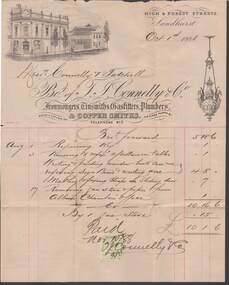
Document - CONNELLY, TATCHELL, DUNLOP COLLECTION: ACCOUNT T.J. CONNELLY & CO
... Letterhead contains image of building corner of Forest/High Street, Bendigo and ornate hanging lamp fitting.The top of the corner building has signs -T J Connelly Established 1853 .Green one penny stamp at the foot of the document...Letterhead contains image of building corner of Forest/High Street, Bendigo and ornate hanging lamp fitting.The top of the corner building has signs -T J Connelly Established 1853 .Green one penny stamp at the foot of the document Document CONNELLY, TATCHELL, DUNLOP COLLECTION: ACCOUNT T.J. ...Account for 5/18/6 dated Oct 1st. 1888 from T.J. Connelly & co., Ironmongers, tinsmiths, gasfitters, plumbers and copper smiths. For various work done for Connelly, Tatchell & Dunlop, including repair of safe, fitting locks and various hardware items. Letterhead contains image of building corner of Forest/High Street, Bendigo and ornate hanging lamp fitting.The top of the corner building has signs -T J Connelly Established 1853 .Green one penny stamp at the foot of the document -
 Bendigo Historical Society Inc.
Document - Arthur T. Pattinson, 1962
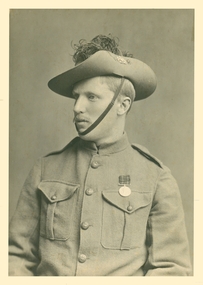
... The statue, which is in bronze, is mounted on a massive granite base, on the foot of which is the following inscription: — "Bendigo's tribute to the memory of the Australian soldiers who, in the South African war of 1899 - 1902 gave their lives for Queen and Empire. The statue was modelled by Mr. J. Walker, a young Bendigonian, who has been studying for two or three years under Mr. A. T...The statue, which is in bronze, is mounted on a massive granite base, on the foot of which is the following inscription: — "Bendigo's tribute to the memory of the Australian soldiers who, in the South African war of 1899 - 1902 gave their lives for Queen and Empire. The statue was modelled by Mr. J. Walker, a young Bendigonian, who has been studying for two or three years under Mr. A. T ...10570 South African (Boer) War Memorial Bendigo. The monument commemorates those who died in service or were killed in action while serving in the South African (Boer) War. It is a bronze statue of a soldier on a granite base. Leader (Melbourne), 19 November 1904. “There was a large assemblage on the afternoon of 11th November, when the ceremony of unveiling the soldiers' memorial statue was performed by Brigadier-General Gordon in the presence of a muster of branches of the defence forces. The statue, which is in bronze, is mounted on a massive granite base, on the foot of which is the following inscription: — "Bendigo's tribute to the memory of the Australian soldiers who, in the South African war of 1899 - 1902 gave their lives for Queen and Empire. The statue was modelled by Mr. J. Walker, a young Bendigonian, who has been studying for two or three years under Mr. A. T. Woodward art instructor at the local school of mines.“ Ola Cohn recalled in her autobiography meeting John Walker as a sculpture student at the Bendigo School of Mines and that he had later received the commission for the Boer War Memorial although she neglects to mention its location. John Walker was born in Bendigo and first studied sculpture at the Bendigo School of Art. Walker, then went to England to study at the Royal College of Art London, and in Paris at the Académie Colarossi and Julian Academy. John Walker worked as a sculptor in both Bendigo and West Brunswick before turning to chicken farming in the Bendigo suburb of White Hills. The photo of A. T. Pattinson was taken by George Leake Massingham, a professional photographer, who had seven children, one of whom died at birth. After arriving in Australia from England, he established himself as a travelling photographer, an occupation he continued after his marriage. He travelled throughout country Queensland, Victoria and New South Wales, setting up studios along the way. The family ended up moving with him, travelling to Sydney, Narrandera, Bendigo, Newtown, Geelong and Deniliquin. Correspondence re Boer War Memorial Bendigo Boer War Memorial Bendigo. Letters and photo from and to Mrs Wilson, eldest daughter of Mr Arthur T. Pattinson who was a model for the Boer War sculpture. 10570a A black and white photo of Trooper Arthur T. Pattinson restored by BHS Volunteers. 10570b The original photo as sent by Mrs Wilson to Harold Curnow (Bendigo Historical Society) in 1962. The photo is mounted on heavy brown cardboard and has an old catalogue number of "P680" inscribed on it. The cardboard is torn and held together with sticky tape. On the front in italics is printed G.L. Massingham, Bendigo. 10570c Notes on the rear of the photo from Mrs Wilson state that "the photo is of Arthur T. Pattinson (Rusty), an Australian Light Horse trooper who served in the Boer War. The Boer War Memorial in Pall Mall Bendigo represents a trooper on guard. The sculptor was Jack Walker who used Pattinson as a model, and it is regarded as an excellent likeness." 10570d A letter from Harold Curnow back to Mrs Wilson on Jan 4th, 1963, acknowledging receipt of the photo and a letter received, noting the significance of the historical information. 10570e Handwritten letter 29/11/1962 from Mrs Wilson to Mr Curnow introducing herself as Mr. Pattinson's eldest daughter and answering the letter he wrote to her father. She mentions the bad health of her parents. Arthur modelled for the statue at least two to three times per week in a studio on the top floor of a building in Bull St. He was the original model to the best of her knowledge. Another model possibly Mr P. Handmear may have sat as a model for renovations (*). The rifle was a light horse rifle issued to Pattinson as he was still serving in 1904. Arthur and Handmear were boys together and very close. * Note - the plaster model was repaired prior to casting in metal. 10570f An obituary notice: 18/11/64 "On Nov. 17 at Frankston, Emma, wife of the late A. T. Pattinson (Rusty), late of Bendigo. 10570g Letter Nov. 20th, 1962, from Harold Curnow to Mr Arthur T. Pattinson, Kent St., Mornington, Vic. "Dear Mr Pattinson, Last week your brother, Brit., whom I have known for many years, supplied the Bendigo Advertiser with some interesting information regarding your role as the model for the late Jack Walker when he was making the statue for the Boer War Memorial here. Yesterday however, another claimant to the distinction of being the model was advanced in the Bendigo Advertiser by Mr Richard Marshall, of Moran Street, Bendigo who said that the soldier's model was Phillip Handmear. I understand that your brother has sent the newspaper cuttings on to you. When he called to see me yesterday, he suggested that I write to you for further particulars. Can you recall the discussion you had with Jack Walker when he approached you about acting as the model and do you remember how many times you posed for him, and whether the work was done in the house, in the yard, or in one of the outbuildings at Moran Street? In short, any details at all. At this point in time we are considering an interesting facet in Bendigo's history, so any seemingly unimportant incidents could really be useful if we knew about them. Have you any old newspaper cuttings mentioning your name in connection with the memorial? Do you remember any remarks that passed between you and Jack Walker during the long sessions you must have put in on this work? This could be very important. And do you recall where the rifle came from? Did you or Jack Walker borrow it from the military authorities? Back in 1934 Jack Walker recalled having had to pull the plaster model down and remake it when he discovered it was slightly off-balance and was slowly toppling forward. He told me he had to get his model to pose again. Do you know anything about this? Could it have been that he got Mr. Handmear in for the final stage of the work? That, of course, would apply only if you were not available. Incidentally, I never heard of Mr Handmear until I saw his name in yesterday's "Advertiser". In any case I intended contacting your brother or you to enquire whether any member of your family has an old photograph of you in your Boer War uniform, that is, one taken about the time of or just after the Boer War. I am sure that members of the Bendigo Branch of the Royal Historical Society would be most interested to see it. I hope you will have the time and inclination to consider the many points I have raised in this letter because the subject has aroused a lot of interest in Bendigo. Hoping you are well and quite as active as you wish, I remain, with all good wishes, Yours sincerely, Harold Curnow". john walker, jack walker, boer war memorial bendigo, arthur pattinson, soldiers' memorial bendigo -
 Bendigo Historical Society Inc.
Document - BARBARA MAMOUNEY COLLECTION: COPY OF PRINTED PAGE
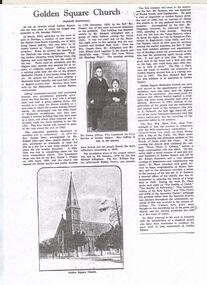
... T Raston... Richard Hart... Wm Shaw. G A Pethard... Robert Saunders. Reverse side a sketch of the Church circa 1853 by Aswel Aptel. James Cox (Sec) Mrs Foot...T Raston Richard Hart Wm Shaw. G A Pethard Robert Saunders. Reverse side a sketch of the Church circa 1853 by Aswel Aptel. James Cox (Sec) Mrs Foot ...Photocopy of a published page, marked as Eightieth Anniversary, relating to records as showing Golden Square as the first place in the Bendigo area at which the gospel was preached. On arriving from South Australia in 1852, attracted by the news of gold in the area James Jeffrey widely known later as Jimmy Jeffrey, a preacher who noticed that the sanctity of the Sabbath was being ignored, with normal chores and entertainment being the order of everyday. In short, little regard was shown for religion and there were no ministers. With a tree stump as his pulpit Jimmy began service by singing a Methodist hymn heartily, attracting a band of diggers to listen, with continuous services in Golden Square taking place ever since. Jeffrey continued with similar activities with increasing interest and attendances. Beginning with a tent surrounded by a fence a disused shed was bought and relocated to the site and was the finest building in the district. Late in 1852 the first real Church was erected in place of the shed and the tent. Enthusiasm and numbers of attendees swelled and in 1859 Reverend Joseph Dare and Robert Lisle and other church leaders purchased land (for 30 pounds) and had the foundation stone for a new Church building was laid by Reverend Daniel J.Draper on19th of April 1859 with Divine Service and Public Worship conducted from 11th December that year by Reverend Mr Draper. A collection on the day raised 262 pounds. The foundation stone for the present Church was financed by Richard Allingham laid on 5th January 1870. The first minister who went to the district was Reverend Mr Symonds who was stationed at Forest Creek near Castlemaine. Reverend Richard Hart was the first minister stationed at Golden Square. Embedded in the article is an image of Jimmy and Mrs Jeffrey. On the reverse of the article is a copy of a drawing by Reverend Aswel Aptel circa 1853.fra margolden square methodist church, wesleyan church, mamouney, church, richard allingham reverends jimmy jeffrey, william robert lisle robert draper, william taylor, symonds, j dare, chapman, hilson t raston, richard hart, wm shaw. g a pethard, robert saunders. reverse side a sketch of the church circa 1853 by aswel aptel. james cox (sec) mrs foot (teacher). -
 Bendigo Historical Society Inc.
Souvenir - Views of Bendigo, 1902
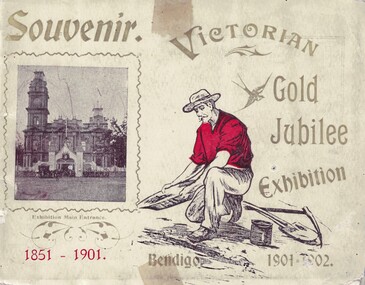
... T. Cambridge, Market Square Bendigo. * 8662.1c Victorian Gold Jubilee Exhibition - Page 1 of 29 The Governor General at the Exhibition. Photo of the crowd, police, trooper and horse drawn vehicles. * 8662.1d Victorian Gold Jubilee Exhibition - Page 2 of 29 Procession Passing the Fountain, Pall Mall. The crowd and horse drawn vehicles. *8662.1e Victorian Gold Jubilee Exhibition - Page 3 of 29 James Martin and Co's Exhibit. James Martin & Co was an Australian engineering company which progressed from making agricultural equipment to making railway locomotives. * 8662.1f Victorian Gold Jubilee Exhibition - Page 4 of 29 Old Pioneers. Elderly gentlemen on foot...T. Cambridge, Market Square Bendigo. * 8662.1c Victorian Gold Jubilee Exhibition - Page 1 of 29 The Governor General at the Exhibition. Photo of the crowd, police, trooper and horse drawn vehicles. * 8662.1d Victorian Gold Jubilee Exhibition - Page 2 of 29 Procession Passing the Fountain, Pall Mall. The crowd and horse drawn vehicles. *8662.1e Victorian Gold Jubilee Exhibition - Page 3 of 29 James Martin and Co's Exhibit. James Martin & Co was an Australian engineering company which progressed from making agricultural equipment to making railway locomotives. * 8662.1f Victorian Gold Jubilee Exhibition - Page 4 of 29 Old Pioneers. Elderly gentlemen on foot ...The Victorian Gold Jubilee Exhibition, held at Bendigo from 13 November 1901 to 14 May 1902. The courts were numbered from one, or had titles like “Machinery”, “Agricultural”, “Naval & Military Court” and “Art”. The female visitors to the Exhibition were able to view exhibits deemed suitable for the fairer sex and located within their own “Women’s Court”. There were exhibits such as “Parasols & Umbrellas”, cotton and haberdashery from Manchester and Staffordshire, “Corsets & Embroideries” from Paris. The most valuable exhibits were mining machinery such as Taylor Horsfield’s £850 “Air Compressor & Rock Borer”. “Bohemian Glassware” brought down from Sydney was valued at £600. The profits from this Exhibition were used to fund the sculpture known as the Gold Monument, which still gazes along Pall Mall (from the McCrae Street end). The Exhibition’s Cash Book shows payments, which totalled £1160, were made to then up and coming sculptor C.D.Richardson. Recently a City of Greater Bendigo staff member used both these volumes to write a detailed report about this monument, for Heritage Victoria.Carol Holsworth Collection: Small book Souvenir, 29 pages plus cover; each page. has a photo of the exhibit. Exhibition was held on the site of the present Bendigo Library between Hargreaves St and Lyttleton Terrace. * 8662.1a Victorian Gold Jubilee Exhibition - Front Cover: Printed 'Souvenir', 'Bendigo 1901-1902'; a photo of the Entrance to the exhibition beside the Town Hall. * 8662.1b Victorian Gold Jubilee Exhibition - Inside Front Cover - Page 1 of 29. Portraits of Exhibition President S.H. Cowen esq.; and G.V. Allen esc., General Secretary. Photos by W.H. Robinson publisher. Printed by T. Cambridge, Market Square Bendigo. * 8662.1c Victorian Gold Jubilee Exhibition - Page 1 of 29 The Governor General at the Exhibition. Photo of the crowd, police, trooper and horse drawn vehicles. * 8662.1d Victorian Gold Jubilee Exhibition - Page 2 of 29 Procession Passing the Fountain, Pall Mall. The crowd and horse drawn vehicles. *8662.1e Victorian Gold Jubilee Exhibition - Page 3 of 29 James Martin and Co's Exhibit. James Martin & Co was an Australian engineering company which progressed from making agricultural equipment to making railway locomotives. * 8662.1f Victorian Gold Jubilee Exhibition - Page 4 of 29 Old Pioneers. Elderly gentlemen on foot and carriage - at the Bendigo Railway Station. * 8662.1g Victorian Gold Jubilee Exhibition - Page 5 of 29 Robert Harper and Company's Exhibit. From Trove - The Brisbane Courier 25 Aug 1891: One of the best known firms in the Southern hemisphere is Messrs. Robert Harper and Co , tea importers, coffee, rice, and spice merchants and manufacturers Then productions circle this continent, and every thrifty housewife is familiar with their Empire tens, their Star' brand of goods, then oatmeal, wheatmeal, and other breakfast table luxuries The headquarters of the firm are placed at Port Melbourne, and the manufactory there occupies over an acre of ground, while the mills at Sydney and Adelaide are as great in proportion It is eight cars since the firm opened business in this colony. The step was taken with much confidence, the principals the firm being quite attracted. * 8662.1h Victorian Gold Jubilee Exhibition - Page 6 of 29 The Electric Tram * 8662.1i Victorian Gold Jubilee Exhibition - Page 7 of 29 G. Weymouth Proprietary Ltd. The business of G. Weymouth & Co was founded in 1898 by George Andrew Philip Weymouth, who began operating from a small workshop on City Road, South Melbourne (opposite Princes Bridge). An early advertisement describes the firm's activities at this time as being 'makers of dynamos, (electric) motors, x-ray apparatus and electrical instruments, &c' together with 'repairs to every class of electrical work'. * 8662.1j Victorian Gold Jubilee Exhibition - Page 8 of 29 The Exhibition Fernery * 8662.1k Victorian Gold Jubilee Exhibition - Page 9 of 29 Cohn Bros'. Exhibit. In 1857 at the height of the gold rush, with people pouring into Central Victoria from all over the world, three brothers from Denmark – Moritz, Julius and Jacob Cohn – founded a small cordial factory in the booming town of Bendigo. They went on to build an empire and, through introducing lager, which is served cold, to the country, changed the drinking preferences of Australians. * 8662.1l Victorian Gold Jubilee Exhibition - Page 10 of 29 Ornamental Lake in the Exhibition Grounds * 8662.1m Victorian Gold Jubilee Exhibition - Page 11 of 29 Australian Explosives and Chemical Co.'s Exhibit. The Australian Explosives and Chemical Company began manufacturing explosives in Melbourne's outskirts (the area now known as Deer Park) in 1875. In 1897 the Company was purchased by Nobel, forming Nobel (Australasia) Ltd. * 8662.1n Victorian Gold Jubilee Exhibition - Page 12 of 29 Tasmanian Court * 8662.1o Victorian Gold Jubilee Exhibition - Page 13 of 29 N. Guthridge's Limited Exhibit. Guthridge sold a variety of mining supplies and equipment; also 'Rackarock' which was used to fill the mining drill holes before blasting. * 8662.1p Victorian Gold Jubilee Exhibition - Page 14 of 29 Navel and Military Court (LARGE File) * 8662.1q Victorian Gold Jubilee Exhibition - Page 15 of 29 Women's Court * 8662.1r Victorian Gold Jubilee Exhibition - Page 16 of 29 T. J. Connelly and Co's Exhibit. T.J. Connelly an American immigrant came to the Bendigo goldfields where he later established Connelly’s Tin Shop on the corner of High and Forest Streets 1853. Connelly was named after Thomas Jefferson the famous statesman who wrote much of the American Declaration of Independence in 1776 and became the third United States President. Connelly, along with other prominent citizens of the time established Bendigo’s first Fire Brigade, Mechanics Institute. * 8662.1s Victorian Gold Jubilee Exhibition - Page 17 of 29 The Potter's Wheel * 8662.1t Victorian Gold Jubilee Exhibition - Page 18 of 29 G. D. Guthrie and Co.'s Exhibit. In 1863 the Bendigo Pottery was set up by Guthrie. * 8662.1u Victorian Gold Jubilee Exhibition - Page 19 of 29 The Ladies' Committee * 8662.1v Victorian Gold Jubilee Exhibition - Page 20 of 29 J. Kitchen and Sons Exhibit. In Port Melbourne since the 1850s they made such products as Velvet Soap and Electrine Candles from the tallow and other animal fats from the nearby slaughter yards. In recent decades the company has become Kitchen & Lever then Unilever and most recently Unichema. * 8662.1w Victorian Gold Jubilee Exhibition - Page 21 1of 29 The Executive Committee * 8662.1x Victorian Gold Jubilee Exhibition - Page 22 of 29 Taylor Horsfield Exhibit. The most valuable exhibits were mining machinery such as Taylor Horsfield’s £850 “Air Compressor & Rock Borer” * 8662.1y Victorian Gold Jubilee Exhibition - Page 23 of 29 A Peep at the Education Department 8662.1z Victorian Gold Jubilee Exhibition - Page 24 of 29 John Danks and Co's Exhibit. John Danks & Son was a major manufacturing company in Melbourne, Victoria and Sydney, New South Wales. * 8662.1aa Victorian Gold Jubilee Exhibition - Page 25 of 29 Glance at the Agricultural Department's Court * 8662.1bb Victorian Gold Jubilee Exhibition - Page 26 of 29 T. York's Exhibit. Thomas York was an instrument repairer and brass instrument maker that resided in Melbourne in the late 19th to the early 20th century. While old newspaper advertisements suggested he repaired all instruments, it appears the focus of his business were military and brass band instruments. (BrassandWoodWind.com) * 8662.1cc Victorian Gold Jubilee Exhibition - Page 27 of 29 T. McPherson and Son's Exhibit. Possibly monumental masons. * 8662.1dd Victorian Gold Jubilee Exhibition - Page 28 of 29 T. Lewis and Whitty's Exhibit - Inside Back Cover. Lewis & Whitty were prominent boot blacking manufacturers as well as a number of other chemical products such as “Odourbane" disinfectant. * 8662.1ee Victorian Gold Jubilee Exhibition - Page 29 of 29 Singer Manufacturing Coy's Exhibithistory, bendigo, victorian gold jubilee exhibition bendigo, carol holsworth collection -
 Bendigo Historical Society Inc.
Photograph - LONG GULLY HISTORY GROUP COLLECTION: LONG GULLY FIRE BRIGADE TEAM 1929
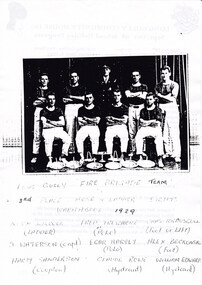
... t shirts and boots. Some trophies are on the floor in front of them. Parts of the photo are very dark. Written under the photo is - Long Gully Fire Brigade Team 3rd Place Hose & Ladder Eights Warrnambool 1929. Norm Wilcock (Ladder), Fred Trewarne (Polo), Chas Krausgull (Foot...t shirts and boots. Some trophies are on the floor in front of them. Parts of the photo are very dark. Written under the photo is - Long Gully Fire Brigade Team 3rd Place Hose & Ladder Eights Warrnambool 1929. Norm Wilcock (Ladder), Fred Trewarne (Polo), Chas Krausgull (Foot ...Copy of a black and white photo of the Long Gully Fire Brigade Team. The men are wearing white trousers, dark t shirts and boots. Some trophies are on the floor in front of them. Parts of the photo are very dark. Written under the photo is - Long Gully Fire Brigade Team 3rd Place Hose & Ladder Eights Warrnambool 1929. Norm Wilcock (Ladder), Fred Trewarne (Polo), Chas Krausgull (Foot or Lift), J Waterson (Capt), Edgar Harvey (polo), Alex Beckonsal (Foot), Harry Sanderson (Coupler), Claude Rowe (Hydrant), William Edwards (Hydrant).bendigo, history, long gully history group, the long gully history group - long gully fire brigade team 1929, norm wilcock, fred trewarne, chas krausgull, j waterson, edgar harvey, alex beckonsal, harry sanderson, claude rowe, william edwards -
 Bendigo Historical Society Inc.
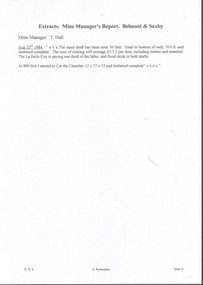
Document - MINING REPORTS - BELMONT & SAXBY MINE MANAGER'S REPORT
... T. Hall's Report, dated Aug. 23rd, 1884. Report mentions sinking and timbering the shaft, the average cost per foot, The La Belle Coy paying one third of the labor and fixed skids in both shafts and starting to cut the Chamber and timbered complete....T. Hall's Report, dated Aug. 23rd, 1884. Report mentions sinking and timbering the shaft, the average cost per foot, The La Belle Coy paying one third of the labor and fixed skids in both shafts and starting to cut the Chamber and timbered complete. ...Handwritten extract from the Belmont & Saxby Mine Manager, T. Hall's Report, dated Aug. 23rd, 1884. Report mentions sinking and timbering the shaft, the average cost per foot, The La Belle Coy paying one third of the labor and fixed skids in both shafts and starting to cut the Chamber and timbered complete.document, gold, mining reports, belmont & saxby mine manager's report, t hall, the la belle company -
 Bendigo Military Museum
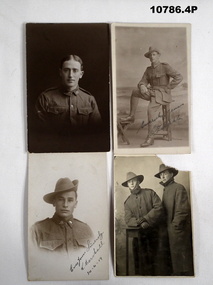
Photograph - PORTRAIT PHOTOGRAPH, WW1 SOLDIERS, Wykeham Studios, c.1919
... T (?) R. Collins, C.A. Edhouse” 1. Black and white portrait photograph of a WW1 soldier in uniform. Soldier is bare headed. 2. Black and white photograph of an Australian WW1 soldier in uniform. Soldier is sitting on a stool with right foot ...1. Junior Arthur Joseph NATHAN, No. 33159. Born Sydney, enlisted Melbourne on 31 Oct 1916, aged 25. In Field Artillery Brigade, 25th Reinforcements, embarked ex Melbourne on HMAT A9 "Shropshire" on 11 May 1917. Served on Western Front. Last posting 1st Divisional Ammunition Column as Bombadier. R.T.A. 28 February 1919. Discharged 3rd M.D. 29 June 1919. 2. Unable to identify soldier from writing on photograph. 3. Unable to identify exactly which soldier named Marshall due to illegible initial - K(?). 4. Unable to accurately identify ? R. Collins. Clarence Amber Edhouse (No. 25808), Born Echuca, enlisted Prahran, 25 March 1916, aged 19 in Field Artillery Brigade, 18th Reinforcement. Embarked 1 August 1916 from Melbourne aboard HMAT A67 "Orsova". KIA 1 August 1918. Unable to determine which of the two in the photograph is C.A. EDHOUSE. Part of the Meade Collection. See Catalogue No. 10785P for details of Ernest James Meade's (No. 2112) service. 1. Black and white portrait photograph of a WW1 soldier in uniform. Soldier is bare headed. 2. Black and white photograph of an Australian WW1 soldier in uniform. Soldier is sitting on a stool with right foot resting on small wooden stand. 3. Black and white portrait photograph of an Australian WW1 soldier in uniform. 4. Black and white photograph of two Australian WW1 soldiers both wearing great coats. Soldier on left is leaning on a wooden stand.1. Handwritten in black ink: “To Vicky so Tricky, Hoping we have as many a happy run with the ball in Aussie as when we proved S.A.A. were invincible, from Bob Nathan. Belgium 1919, 45 Spencer St. St Kilda, Vic. From the slip on 1 Aust D.A.C.” 2. Handwritten on front in black ink: “Sincerely yours?” 3. Handwritten in black ink on front: “Ever Yours Sincerely, K (?) Marshall 24.4.19’ Handwritten in black ink on back: “With all best wishes from Yours Very Sincerely on the other side, 24.4.19” Stamped on back in purple ink: 'TAYLOR BROS., 1 Lancashire Hill, Stockport” 4. Handwritten on back in black ink: “From Your Old Cobber T (?) R. Collins, C.A. Edhouse” meade collection, ww1, photograph, ernest james meade -
 Bayside Gallery - Bayside City Council Art & Heritage Collection
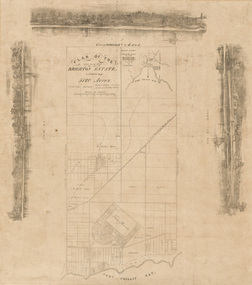
Map, H.B. Foot, Plan of the Brighton Estate containing 5120 acres, first special survey at Port Phillip, c. 1842
... T. S. Townsend in May 1841 and was re-surveyed by Robert Hoddle. Dendy and Were were making plans to sell the land and advertised a 30-guinea prize for the best subdivision which was to be divided into a village, marine residences, suburban and cultivation allotments, with the remainder being divided into country sections. The competition was won by H.B. Foot...T. S. Townsend in May 1841 and was re-surveyed by Robert Hoddle. Dendy and Were were making plans to sell the land and advertised a 30-guinea prize for the best subdivision which was to be divided into a village, marine residences, suburban and cultivation allotments, with the remainder being divided into country sections. The competition was won by H.B. Foot ...This plan records the Brighton Estate, also known as Dendy's Special Survey. In 1840 Henry Dendy, a farmer in Surrey, England acquired a "Special Survey" from the Commissioners for Land and Emigration which gave him the right to choose land in Port Phillip for the low price of £1 per acre for 5120 acres. Dendy appointed Jonathan Binns Were, as his agent, who later became a partner. Together, Dendy and Were decided on an area 5 miles south from Melbourne, bounded by North Road, East Boundary Road, South Road and to the west by Port Phillip Bay. Their Brighton Estate was first surveyed by T. S. Townsend in May 1841 and was re-surveyed by Robert Hoddle. Dendy and Were were making plans to sell the land and advertised a 30-guinea prize for the best subdivision which was to be divided into a village, marine residences, suburban and cultivation allotments, with the remainder being divided into country sections. The competition was won by H.B. Foot, who planned the village around a reserve and crescents and a 'green belt' forming the town boundary. brighton estate, dendy's special survey, special survey, henry dendy, jonathan binns were, w.b. were, survey, plan, map, brighton, george ward cole, baker's lithographer, hibernian, subdivision, town planning, cartographic material, h.b. foot -
 Wangaratta RSL Sub Branch
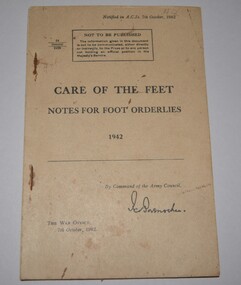
Booklet, J T Picken and Sons, Care of the Feet - Notes for Foot Orderlies, c1942
... Care of the Feet - Notes for Foot Orderlies Booklet Booklet J T Picken and Sons ...The 1942 "Care of the Feet" booklet refers to a restricted military pamphlet published by the British War Office on October 7, 1942, titled "Care of the Feet - Notes for Foot Orderlies". It was marked as a restricted document ("Not to be published") and issued by the Army Council. Booklet belonged to Robert Francis ISKOV VX15237 born at Glenrowan served with the 59th Battalion CMF before joining the 2/14th Battalion at Caulfield in September 1940. He disembarked for the Middle East in November, 1940 and fought in the Syrian campaign in 1941. In 1942 the 2/14th Battalion returned to Australia and sent to Papua where he fought at the Battle of Isurava before the battalion was sent to Gona. On 1943 Bob returned to Australia to undertake officer training and in 1945 with the 2/23rd Battalion sailed to Morotai and served with the battalion on Tarakan. He returned to Australia in November, 1945 and discharged a month later.Cream cardboard covered booklet containing 48 pages including diagrams. Not to be Publishedww2, new guinea, booklet, care of the feet - notes for foot orderlies, 1942 -
 City of Ballarat
Artwork, other - Public Artwork, Eight Hour Day Memorial (James Galloway Memorial), 1880
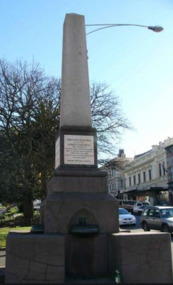
... The campaign for the Galloway monument was so successful that one year later on 21 April 1881, and after the longest 8hrs day procession to that date, the Mayor of the City, Councillor A T Morrison, imbarred the monument at the foot of Sturt Street, Ballarat. ...The campaign for the Galloway monument was so successful that one year later on 21 April 1881, and after the longest 8hrs day procession to that date, the Mayor of the City, Councillor A T Morrison, imbarred the monument at the foot of Sturt Street, Ballarat. ...This quartz and bluestone monument pays tribute to James Galloway the founder of the the eight-hour day system that gave workers the right to stop work after 8 hours without any penalty. The system was widely celebrated as a world first and Australia became known as a workingman’s paradise. Eight hour day is translated as: Eight hours of work, eight hours of leisure and eight hours of rest. In 1880, the 8hr day Anniversary Committee decided to mark the establishment of the 8hrs day by erecting a monument to the memory of the pioneer of the 8hr movement in the colony, James Galloway. The campaign for the Galloway monument was so successful that one year later on 21 April 1881, and after the longest 8hrs day procession to that date, the Mayor of the City, Councillor A T Morrison, imbarred the monument at the foot of Sturt Street, Ballarat. The monument is of historic significance to the people of BallaratGranite spire with four cast iron drinking fountains and marble tablets. Inscriptionplaques are attached to the sides of the spire.Erected in honor of the late James Galloway the founder of the Eight Hour System in Victoria/ Born at Springfield Fifeshire 28th February 1828 Died at Collingwood Melbourne 3rd June 1860/ Amicus Humani Generis/ This Monument is tendered in trust to the City Council for the working men of Ballarat April 21st 1880/ Eight Hours Labor Eight Hours Recreation Eight Hours Restjames galloway, eight-hour day, 8 hour, workers rights, ballarat, trades hall -
 Whitehorse Historical Society Inc.
Domestic object - Bucket
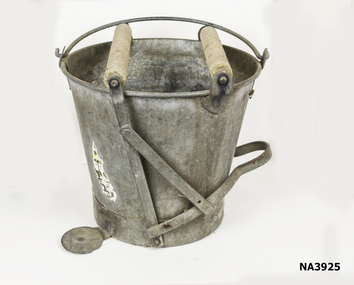
... Galvanised bucket with two wooden collars which are controlled by foot lever s-t-r-e-t-c-ho squeeze the water from a mop. ...Purchased for the Society's collection from Christopher Bragg Auctions DOMESTIC ITEMS Cleaning Galvanised bucket with two wooden collars which are controlled by foot lever s-t-r-e-t-c-ho squeeze the water from a mop. ...Purchased for the Society's collection from Christopher Bragg AuctionsGalvanised bucket with two wooden collars which are controlled by foot lever s-t-r-e-t-c-ho squeeze the water from a mop. The bucket has a handle attached either side of the collardomestic items, cleaning -
 Mont De Lancey
Domestic object - Toaster, Speedie Manufacturing Co, 1930's - 1960's
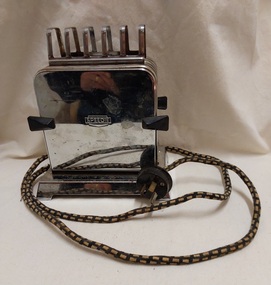
... Kitchen appliances Toasters Kitchenware kitchen equipment On the base of the toaster: 'V/Ac/T 5 F 240 volts 550 watts Cat No T 5F B' On the plug: 'ELMACO Made in Australia 24V 10 Amp' A vintage Art Deco silhouette style Speedie chrome plated steel two slice electric toaster on a footed base. ...The vintage Speedie toaster is an iconic piece of Australian mid-century kitchenware. Manufactured by the Speedie Manufacturing Co. in Melbourne, these chrome-plated steel toasters were produced from the 1940s through the 1960s. They are renowned for their Art Deco design, "side-loading" flip-down doors, and lasting durability.design, "side-loading" flip-down doors, and lasting durability. Elmaco was an established Australian manufacturer of bakelite plugs, sockets, and electrical accessories. It has an authentic brown bakelite ELMACO plug (rated typically for 10A at 250V) Made in Australia.A vintage Art Deco silhouette style Speedie chrome plated steel two slice electric toaster on a footed base. It has two side-loading flip-down doors on either side with small black plastic or bakelite handles. The bread is placed inside the door, then closed to toast. When it is toasted, the door is opened and the toast flips to toast the other side. It has attached, a black and tan patterned cotton thread covered electrical cord which has three prongs on a black plug. On the top is a five rack stand to hold the cooked toast to keep it warm. There are four vents on each side of the body. The glowing heating element inside is called the nichrome wire which is typically wrapped back and forth across thin, flat sheets of mica, a naturally occurring heat-resistant mineral that serves as an electrical insulator.On the base of the toaster: 'V/Ac/T 5 F 240 volts 550 watts Cat No T 5F B' On the plug: 'ELMACO Made in Australia 24V 10 Amp'kitchen appliances, toasters, kitchenware, kitchen equipment -
 Bacchus Marsh & District Historical Society
Photograph, The Prince's Show May 1920 Bacchus Marsh District Exhibit
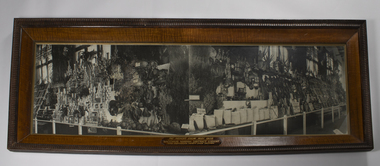
... T. Stewart. This photograph is notable for its size and high quality framing. This signifies the importance the local community placed upon being chosen to participate in a major royal event and the desire to record this in a grand and elaborate way for posterity. Royal Visits Shows and Exhibitions A caption in gold lettering at the foot ...During May through to July 1920 Prince Edward, later to become King Edward VIII of England toured Australia to thank the country for its support during World War One and to strengthen ties between Australia and the United Kingdom. He arrived in Victoria on the 26 May 1920 and on the 29 May attended a special agricultural show at the Royal Agricultural Showgrounds at Flemington. Bacchus Marsh district was invited to contribute to a display of agricultural produce and products which was displayed in the Government Pavilion at the Showgrounds. The display according to a newspaper report in the Bacchus Marsh Express on 5 June 1920 included 33 trays of fresh fruit, preserved fruit, pickles, sauces, bacon and other small goods, vegetables, hay grasses, grain, turned wood, wines and other drinks', &c., aided by pot plants, flags, draping of maroon and gold (official Exhibit colors) made up a color scheme and general effect worthy of the occasion. The Prince inspected the exhibit and expressed his admiration of it, his only regret was that he could not give more time to its examination. There was also 'an improvised "pheasant" nestling in one corner, and what "amazing" eyes it had!'. The organiser of the display was F. C. Minns, and the decorator was T. Stewart. This photograph is notable for its size and high quality framing. This signifies the importance the local community placed upon being chosen to participate in a major royal event and the desire to record this in a grand and elaborate way for posterity. Very large framed photograph of the agricultural produce and products from the Bacchus Marsh district displayed as part of a special exhibition for Prince Edward, the heir to the British throne when he visited Melbourne in May 1920. The display comprised a wide variety of produce such as fresh and preserved fruit, meats, vegetables, hay, grasses, grain, turned wood, wines and other drinks. The image is divided in the middle into two different angles of the display.A caption in gold lettering at the foot of the image reads 'The Prince's Show May 1920 Bacchus Marsh District Exhibit Royal Agricultural Society Showgrounds'royal visits, shows and exhibitions -
 Falls Creek Historical Society
Photograph - Big River Survey Camp, c1949
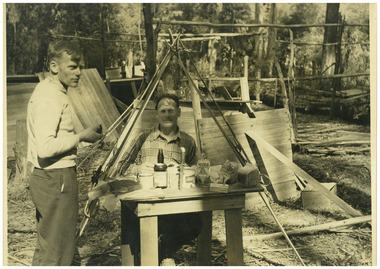
... Photo 1 - Breakfast at Big River Left to RIght Ray Meyer, Wal Johnson Photo 2 - Big River Survey Camp at foot of T Spur C 1949, Kiewa RIver Survey Team....Kiewa Hydroelectric Scheme Ray Meyer Wal Johnson Photo 1 - Breakfast at Big River Left to RIght Ray Meyer, Wal Johnson Photo 2 - Big River Survey Camp at foot of T Spur C 1949, Kiewa RIver Survey Team. ...MEYER COLLECTION - FALLS CREEK PHOTOS In 1947 a determined group of like-minded State Electricity Commission (SEC) staff including Ray Meyer, the chief surveyor of the Kiewa Hydro-Electric Scheme, had a common interest that revolved around the skiing potential of the snow-covered high plains which included what is now the resort of Falls Creek. The six SEC employees, Toni St Elmo, Ray Meyer, Jack Minogue, Lloyd Dunn, Adrian Ruffenacht and Dave Gibson (together with their families) banded together to secretly build a 'hut' that was the first ski lodge at Falls Creek. Using a road built in 1930s to gain access to Falls Creek, their hut project was carried out in secret as efforts by other skiers were blocked by H.H.C. Williams – the engineer in charge of the Hydro Scheme. In 1946 Ray Meyer made a trip to the Lands Office in Melbourne. He came away with a 99-year lease on three acres that was ideally suited for a hut designed by Lloyd Dunn. Adrian Ruffenacht (Design Engineer for the KHS) had suggested where the group should build because of easy access to a spring for water. Much of the building material required was scavenged from derelict huts on the high plains. Due to the need for secrecy, the determined group worked on the hut in the evenings and weekends to avoid detection. During the building period the group had met at Echidna Rock (now known as Eagle Rock) where Skippy St Elmo announced, "This is my favourite ‘Skyline’.” And so the first lodge in the area at Falls Creek Ski Resort came into existence. With the development of the International Poma in the 1970s, the Skyline Lodge, which was sited between the ski-lift’s pole one and pole two, was demolished. However, the legacy of Ray Meyer, Toni St Elmo, Jack Minogue, Lloyd Dunn, Adrian Ruffenacht and Dave Gibson and Skyline lives on in the vibrant atmosphere of Falls Creek Resort. The MEYER COLLECTION documents developments on the Kiewa Hydro Scheme and their life at Falls Creek from the mid 1930s to 1960s.This image is significant because it documents development of the Kiewa Hydroelectric Scheme.Two black and white images at the Big River Old Survey Camp.Photo 1 - Breakfast at Big River Left to RIght Ray Meyer, Wal Johnson Photo 2 - Big River Survey Camp at foot of T Spur C 1949, Kiewa RIver Survey Team.kiewa hydroelectric scheme, ray meyer, wal johnson -
 Melbourne Tram Museum
Photograph - Z class tram ASEA controller - set of 3, Melbourne & Metropolitan Tramways Board (MMTB), 1975
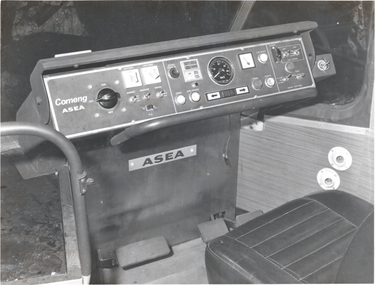
... Photographs show the ASEA built control equipment of a Z class tram. 1 - Drivers control stand showing the foot pedals and switches with the ASEA and Comeng names on the panel. 2 - the driver's controller with the cover removed showing the various parts and linkages - photographed at the factory. 3 - Tramiac control cabinet with a technician showing one of the components or cards - see item 6140 for more details. Provides information and detail about the Z class driver's control equipment. trams tramways new trams comeng Z class ASEA controllers MMTB Has MMTB stamp and stamp of R T ...Photographs show the ASEA built control equipment of a Z class tram. 1 - Drivers control stand showing the foot pedals and switches with the ASEA and Comeng names on the panel. 2 - the driver's controller with the cover removed showing the various parts and linkages - photographed at the factory. 3 - Tramiac control cabinet with a technician showing one of the components or cards - see item 6140 for more details.Provides information and detail about the Z class driver's control equipment.Set of three black and white photographsHas MMTB stamp and stamp of R T Grigg of NZ. on rear.trams, tramways, new trams, comeng, z class, asea, controllers, mmtb -
 Bendigo Historical Society Inc.
Photograph - HARRY BIGGS COLLECTION: HIGH ST. BENDIGO, 1857
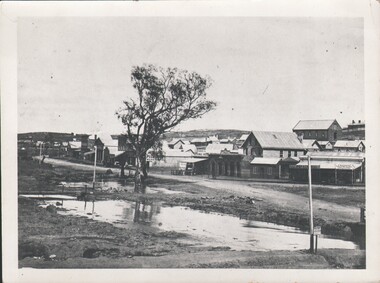
... T. Baldwin Hair Cutting, shaving shampooing; Burston's Colonial Boot Store, Royal Hotel, Britannia House. A sign post: 'Eadie & McIntyre Gold Office'. In foreground, Bendigo Creek with a foot...T. Baldwin Hair Cutting, shaving shampooing; Burston's Colonial Boot Store, Royal Hotel, Britannia House. A sign post: 'Eadie & McIntyre Gold Office'. In foreground, Bendigo Creek with a foot ...Harry Biggs Collection. Black and white photo of High St. Bendigo. Shop signs visible - T. Baldwin Hair Cutting, shaving shampooing; Burston's Colonial Boot Store, Royal Hotel, Britannia House. A sign post: 'Eadie & McIntyre Gold Office'. In foreground, Bendigo Creek with a foot bridge to the left. Two gnarled trees in centre of photo. Photo taken near View Point. Image taken in 1850's.place, building, commercial, harry biggs collection, high st. bendigo
