
Showing 132 items matching "tank day"
-
 Wodonga & District Historical Society Inc
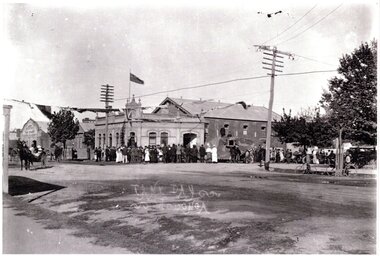
Photograph - Wodonga "Tank Day" War Loan day Wodonga
... Wodonga "Tank Day" War Loan day Wodonga ...Wodonga "Tank Day" War Loan day Wodonga ...TANK DAY WODONGA has been hand written on the middle of the image....People are looking at a war tank on display towards the right hand side of the image. Wodonga "Tank Day" War Loan day Wodonga Photograph Wodonga "Tank Day" War Loan day Wodonga ...During World War 1, to finance the war the Commonwealth Government had a series of war loans, and then peace loans. To recover the cost of the war and fund soldier pensions the government launched 'Peace Loan' campaigns after the war. The various Shires in each State were given quotas that they were expected to raise. As part of the efforts to gain support for the Seventh War Loans for the Commonwealth, an Australian military tank launched an "offensive" throughout Northeast of Victoria, visiting several towns finishing at Wodonga on Saturday 5th Wodonga and staying on the Sunday before continuing on its tour. In response to this and other fund-raising efforts, the Wodonga community subscribed more than £12,845 to the Peace Loans which was acknowledged with the presentation of the brass plaque.This image captures an important event in Wodonga in response to World War 1.A black and white photograph depicting crowds gathered outside the Shire Hall in Wodonga. Flags are flying in the street. People are looking at a war tank on display towards the right hand side of the image.TANK DAY WODONGA has been hand written on the middle of the image.peace loans australia, world war 1, social response world war 1 -
 National Vietnam Veterans Museum (NVVM)
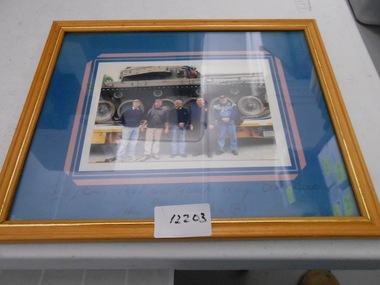
Photograph
... ...tank day...Tank you Vets on Tank Day Oct 2000 By John Alexander (R)...This item contributes to an understanding of the impact that involvement in the war in Vietnam (1962-1972) had on Australian servicemen. Centurion tank tank day John Alexander Jordan tony Oct 2000 Tank you Vets on Tank Day Oct 2000 By John Alexander (R) Four men in Civilian clothes stand in front of a Centurion Tank which is on a lowloader. ...This item contributes to an understanding of the impact that involvement in the war in Vietnam (1962-1972) had on Australian servicemen.Four men in Civilian clothes stand in front of a Centurion Tank which is on a lowloader.Tank you Vets on Tank Day Oct 2000 By John Alexander (R)centurion tank, tank day, john alexander, jordan tony, oct 2000 -
 Federation University Historical Collection
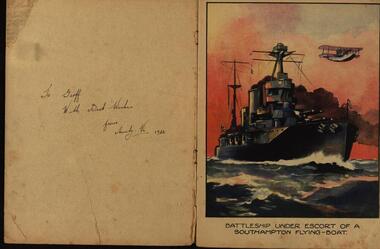
Booklet, United Services: A Story Book with Eighteen Coloured Plates, c1932
... tank...airmen...armstrong whitworth atlas machine...hawlker fury aeroplance...super-marine napier...schneider racing aeroplane...fairet iiif sea-plane...hawker hart day...The Geoff mentioned in the inscription is Geoff Biddington. army airforce navy armed service royal marines sailors naval aircraft carrier signalling submarine royal horse guards military band drum major argyll and sutherland highlanders royal artillery machine gunners tanks bridge building the piper whippet tank airmen armstrong whitworth atlas machine hawlker fury aeroplance super-marine napier schneider racing aeroplane fairet iiif sea-plane hawker hart day bomber parachute jumping schneifer trophy sea-plane bristol bulldogs iris flying-boat geoff biddington uniforms Inside front cover "To Geoff With Best Wishes From Aunty Vi 1932 Children's book with colour and black and white illustrations. ...The Geoff mentioned in the inscription is Geoff Biddington.Children's book with colour and black and white illustrations.Inside front cover "To Geoff With Best Wishes From Aunty Vi 1932army, airforce, navy, armed service, royal marines, sailors, naval aircraft carrier, signalling, submarine, royal horse guards, military band, drum major, argyll and sutherland highlanders, royal artillery, machine gunners, tanks, bridge building, the piper, whippet tank, airmen, armstrong whitworth atlas machine, hawlker fury aeroplance, super-marine napier, schneider racing aeroplane, fairet iiif sea-plane, hawker hart day bomber, parachute jumping, schneifer trophy sea-plane, bristol bulldogs, iris flying-boat, geoff biddington, uniforms -
 City of Moorabbin Historical Society (Operating the Box Cottage Museum)
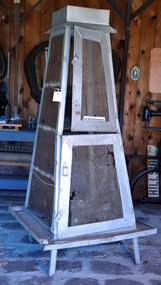
Functional object - Kitchen Equipment, Coolgardie Safe, c1900
... Heating salt water in tanks produced steam that was condensed in tall cylinders, cooled and then collected in catchment trays. By 1898 there were six companies supplying condensed water to the goldfields, the largest company producing 100,000 gallons of water a day. ...Heating salt water in tanks produced steam that was condensed in tall cylinders, cooled and then collected in catchment trays. By 1898 there were six companies supplying condensed water to the goldfields, the largest company producing 100,000 gallons of water a day. ...The invention of the Coolgardie Safe is credited to Arthur Patrick McCormick, a contractor in Coolgardie, and later the Mayor of Narrogin. Coolgardie is in the Eastern Goldfields region of Western Australia. Gold was first discovered there in 1892; the townsite became a municipality in 1894, and by 1898 its population of 15,000 made it the third largest town in Western Australia after Perth and Fremantle. In the last decade of the 19th century, Coolgardie was the capital of the West Australian goldfields. Being 180 kilometres from the nearest civilisation, food supplies were initially scarce and expensive. As fresh food was a valuable commodity there was incentive to preserve it, and keep it out of reach of scavengers such as birds, dingos, dogs, ants, and flies. It was in an effort to do this, in the extreme heat of the Australian Interior, that McCormick came up with his design for the Coolgardie Safe. McCormick noticed that a wet bag placed over a bottle cooled its contents. He further noted that if this bottle was placed in a breeze, the bag would dry out more quickly, but the bottle would get colder. What McCormick had discovered was the principle of evaporation: ‘to change any liquid into a gaseous state requires energy. This energy is taken in the form of heat from its surroundings.’ Employing this principle, McCormick made a box for his provisions which he covered with a wet hessian bag. He then placed a tray on top, into which he poured water twice daily. He hung strips of flannel from the tray so that water would drip down onto the hessian bag, keeping it damp. As the water evaporated, the heat dissipated, keeping the food stored inside cool and fresh. The success of McCormick’s invention would not have worked without a steady supply of water. Fresh water was scarce in the eastern goldfields at this time but the demand for water from a steadily growing population encouraged innovation. The solution was to condense salt water. Heating salt water in tanks produced steam that was condensed in tall cylinders, cooled and then collected in catchment trays. By 1898 there were six companies supplying condensed water to the goldfields, the largest company producing 100,000 gallons of water a day. In the early 20th century, Coolgardie Safes were also manufactured commercially. These safes incorporated shelving and a door, had metal or wooden frames and hessian bodies. The feet of the safe were usually placed in a tray of water to keep ants away. (MAV website) The early settlers of Moorabbin Shire depended on this type of Food Safe to protect their food from flies and vermin as they established market gardens in the fertile area around the notorious Elster Creek A metal framed, 4 sided structure standing on 4 legs with 2 hinged doors on one side, a metal tray at base of food safe and a metal cover over top. Ridges on which to rest trays carrying food are inside safe. The Safe is enclosed by fly-wire mesh.'...IN.....GEELONG' A manufacturer's oval metal plate is embossed on one side of Safe but it is illegible.elster creek, moorabbin, brighton, dendy's special survey 1841, market gardens, infant mortality, disease, cemeteries, fruit, vegetables, pioneers, coolgardie safe, mccormick arthur patrick, dendy henry, vaccination, jones martha, jones ethel may -
 Glenelg Shire Council Cultural Collection
Photograph - Photograph - Vacuum Oil Co., Portland, n.d
... Round purple stamp 'Hunter's same day service' Black and white photograph. vacuum Oil Co. Portland. Man standing at front gate; brick building, fuel tanks. ...Black and white photograph. vacuum Oil Co. Portland. Man standing at front gate; brick building, fuel tanks.Back: '84' pencil. Round purple stamp 'Hunter's same day service' -
Glenelg Shire Council Cultural Collection
Photograph - Photograph - Vacuum Oil Co., Portland, n.d
... Round purple stamp 'Hunter's Same day service' Black and white photograph. Vacuum Oil Co Portland. Taken from elevated position. Fuel tanks ...Black and white photograph. Vacuum Oil Co Portland. Taken from elevated position. Fuel tanks, brick 3 bay shed, tower and pond, pumps and shelter, section of oval shaped lawn in centre. same premises as 8416, 8417Back: '89' in pencil. Round purple stamp 'Hunter's Same day service'portland harbour, industry -
Glenelg Shire Council Cultural Collection
Photograph - Photograph - Vacuum Oil Co., Portland, n.d
... Round purple stamp 'Hunter's same day service' Black and white photo. Vacuum Oil Co. Portland. Oil tanks, brick shed, pumps and shelter, galvanised iron roof. ...Black and white photo. Vacuum Oil Co. Portland. Oil tanks, brick shed, pumps and shelter, galvanised iron roof.Back: '89' - pencil. Round purple stamp 'Hunter's same day service'portland harbour, industry, trade -
Glenelg Shire Council Cultural Collection
Photograph - Photograph - Vacuum Oil Co. Portland, n.d
... Round purple stamp 'Hunter's Same day Service' Black and white photograph. Vacuum Oil Co. Portland. Motor spirit and oil tank. ...Black and white photograph. Vacuum Oil Co. Portland. Motor spirit and oil tank. Same premises as Items numbered 8416, 17, 18, 19Back: '89' - pencil. Round purple stamp 'Hunter's Same day Service' -
City of Moorabbin Historical Society (Operating the Box Cottage Museum)
Newsletter - CMHS Moorabbin Mirror Issue 14 April 2018, CMHS Moorabbin Mirror Newsletter Issue 14 April 2018, 2018
... Topics : ANZAC display, Alonzo Box, 1914 HMAT A20 HORORATA, B Company 6th Battalion 2nd Brigade; Box Cottage grounds flooded by leaking tank Bowls Club 26th Dec ; Barn repairs, Barn storage; Filing Cabinets Inventory; GECC International Women's Day Biographies of 3 local women; GECC Alnutt Park March 18th promotion BCM; Welcome new BCM Volunteer Guides; KCC Network HS meeting; KCC Award Dr G Whitehead; KCC farm machinery preservation; FAHS funding; CMHS meeting dates ...Topics : ANZAC display, Alonzo Box, 1914 HMAT A20 HORORATA, B Company 6th Battalion 2nd Brigade; Box Cottage grounds flooded by leaking tank Bowls Club 26th Dec ; Barn repairs, Barn storage; Filing Cabinets Inventory; GECC International Women's Day Biographies of 3 local women; GECC Alnutt Park March 18th promotion BCM; Welcome new BCM Volunteer Guides; KCC Network HS meeting; KCC Award Dr G Whitehead; KCC farm machinery preservation; FAHS funding; CMHS meeting dates This is Issue 14 of the Moorabbin Mirror, Newsletter of CMHS April 2018 moorabbin mirror, bader fran, bader holger, patterson geoffrey, box alonzo, 1914 hmat a20 hororata; b company 6th battalion; gallipoli landings 1915; glen eira historical society, glen eira city council, kingston city council, whitehead dr g. farm machinery, international women's day; Moorabbin / Mirror / Newsletter City of Moorabbin Historical Society Inc. ...This is Issue 14 of the Moorabbin Mirror produced by CMHS members Fran & Holger Bader , Geoffrey Paterson, April 2018 The Moorabbin Mirror reflects the history and heritage of the former City of Moorabbin — derived from Mooroobin, ‘a resting place’ in the Bunurrung spoken language. In 1994, the City of Moorabbin was integrated into the Cities of Bayside, Glen Eira, Kingston and Monash. Topics : ANZAC display, Alonzo Box, 1914 HMAT A20 HORORATA, B Company 6th Battalion 2nd Brigade; Box Cottage grounds flooded by leaking tank Bowls Club 26th Dec ; Barn repairs, Barn storage; Filing Cabinets Inventory; GECC International Women's Day Biographies of 3 local women; GECC Alnutt Park March 18th promotion BCM; Welcome new BCM Volunteer Guides; KCC Network HS meeting; KCC Award Dr G Whitehead; KCC farm machinery preservation; FAHS funding; CMHS meeting dates This is Issue 14 of the Moorabbin Mirror, Newsletter of CMHS April 2018A4 x 1 paper folded to A5 x 4pp printed both sides Moorabbin / Mirror / Newsletter City of Moorabbin Historical Society Inc. A0020543 (CMHS) / operating Box Cottage Museum (BCM) / April 2018 Issue 14moorabbin mirror, bader fran, bader holger, patterson geoffrey, box alonzo, 1914 hmat a20 hororata; b company 6th battalion; gallipoli landings 1915; glen eira historical society, glen eira city council, kingston city council, whitehead dr g. farm machinery, international women's day; -
 Phillip Island and District Historical Society Inc.
Photograph, Picnic at Nobbies, 1917
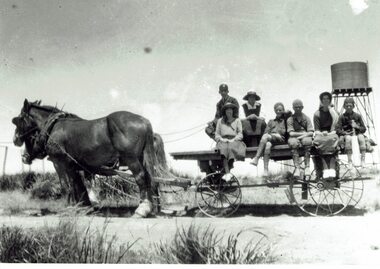
... day's picnic - 1917 from "Trenavin Park". Keaston Sambell driving. Sitting behind him - Betty Parker and on side of vehicle from left.-May Lambert, Jim Patterson, Jim Blake, Carmen Sambell, Bill Sambell. Large black and white photograph of a flat topped cart with no sides, pulled by 2 draught horses. Water tank ...The double-storey homestead with 1920s Arts and Crafts styling was built by A.K.T. (Albert Keaston Trenavin) Sambell, the the island’s first shire president. It sits just above the original site of the homestead of the pioneering McHaffie brothers, the Island’s first settlers.HistoricalLarge black and white photograph of a flat topped cart with no sides, pulled by 2 draught horses. Water tank on stand in rural background & people sitting on the cart. 3 women wearing hats and 4 boys, one holding a cricket bat.Off to the Nobbies for a day's picnic - 1917 from "Trenavin Park". Keaston Sambell driving. Sitting behind him - Betty Parker and on side of vehicle from left.-May Lambert, Jim Patterson, Jim Blake, Carmen Sambell, Bill Sambell.trenavin park phillip island, a.k. t. sampbell, betty parker, jim patterson, jim blake, carmen sambell, bill sambell, may lambert -
 Phillip Island and District Historical Society Inc.
Photograph, John Cook, 1978-79
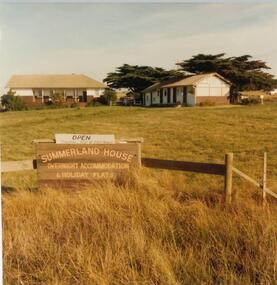
... day on the course, could relax. Summerland House was built by local builder Mr Vic McRae. It attracted large numbers of professional people from Melbourne. coloured photograph Summerland Guesthouse Phillip Island AKT Sambell Three photographs of Summerland Guesthouse, one of the first Guesthouses on the Island, situated above the site of the Penguin Parade. 81-87 Note sign: Open - overnight accommodation and holiday flats. 81-88 View of Summerland Guesthouse. Probably back view. Note elevated water tank ...In 1927 Mr A. K. T. Sambell built a pier, planned and subdivided a residential estate, designed and built Summerland House, where ardent golfers after an enjoyable day on the course, could relax. Summerland House was built by local builder Mr Vic McRae. It attracted large numbers of professional people from Melbourne.Three photographs of Summerland Guesthouse, one of the first Guesthouses on the Island, situated above the site of the Penguin Parade. 81-87 Note sign: Open - overnight accommodation and holiday flats. 81-88 View of Summerland Guesthouse. Probably back view. Note elevated water tank. Car parked behind. 81-89 Another view of Summerland Guesthouse.coloured photograph, summerland guesthouse phillip island, akt sambell -
 Eltham District Historical Society Inc
Photograph, Steam locomotive K-158 at the coal hopper, Echuca Railway Station, November 1963, 1963
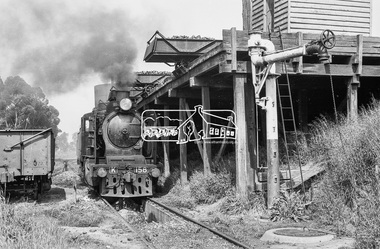
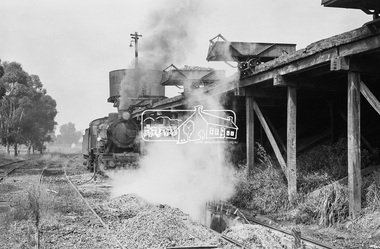
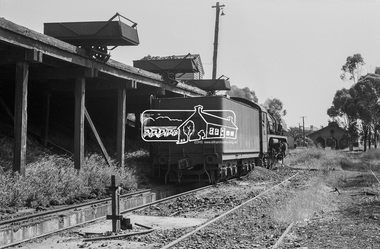
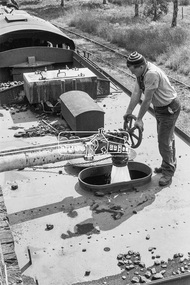
... tank at one end or the connected standpipe at the opposite end. Locomotive firebox contents could be dumped into pits between the rails from locomotives once they were carefully positioned above them. Such locomotives then could move onto the Engine Shed area for overnight parking. Firebox fires would be re-lit when the locomotive was next needed in a day...tank at one end or the connected standpipe at the opposite end. Locomotive firebox contents could be dumped into pits between the rails from locomotives once they were carefully positioned above them. Such locomotives then could move onto the Engine Shed area for overnight parking. Firebox fires would be re-lit when the locomotive was next needed in a day ...THE ECHUCA COALING STAGE. Locomotives would stop alongside to receive coal dropped into their tenders from small overhead rail mounted tipping trays. Water could be obtained from either the elevated tank at one end or the connected standpipe at the opposite end. Locomotive firebox contents could be dumped into pits between the rails from locomotives once they were carefully positioned above them. Such locomotives then could move onto the Engine Shed area for overnight parking. Firebox fires would be re-lit when the locomotive was next needed in a day or so. Image dated as November 1963 based on same image in Port of Echuca collection (possibly frame 32 of film) (print 19.5 x 24.5cm) On reverse in pencil: " K Class at Echuca" Echuca K Class. 1940-1968". In blue pen:" Photo by: George L. Coop Nov 1963" https://victoriancollections.net.au/items/59de9cc421ea6b12dc3f7597Digital TIFF file Scan of 35mm Ilford FP3 black and white negative transparencycoal hopper, echuca railway station, george coop collection, k-158, k-class steam locomotive (vr newport workshops) -
 Eltham District Historical Society Inc
Photograph, Steam locomotive K-158 filling up with water at the coal hopper, Echuca Railway Station, November 1963, 1963
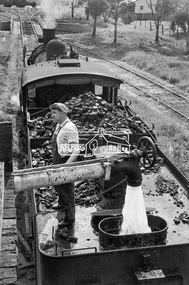
... tank at one end or the connected standpipe at the opposite end. Locomotive firebox contents could be dumped into pits between the rails from locomotives once they were carefully positioned above them. Such locomotives then could move onto the Engine Shed area for overnight parking. Firebox fires would be re-lit when the locomotive was next needed in a day...tank at one end or the connected standpipe at the opposite end. Locomotive firebox contents could be dumped into pits between the rails from locomotives once they were carefully positioned above them. Such locomotives then could move onto the Engine Shed area for overnight parking. Firebox fires would be re-lit when the locomotive was next needed in a day ...THE ECHUCA COALING STAGE. Locomotives would stop alongside to receive coal dropped into their tenders from small overhead rail mounted tipping trays. Water could be obtained from either the elevated tank at one end or the connected standpipe at the opposite end. Locomotive firebox contents could be dumped into pits between the rails from locomotives once they were carefully positioned above them. Such locomotives then could move onto the Engine Shed area for overnight parking. Firebox fires would be re-lit when the locomotive was next needed in a day or so.Digital TIFF file Scan of 35mm Ilford FP3 black and white negative transparencycoal hopper, echuca railway station, george coop collection, k-158, k-class steam locomotive (vr newport workshops) -
 Eltham District Historical Society Inc
Photograph, Steam locomotive J-500 at the coal hopper, Echuca Railway Station, November 1963, 1963
... tank at one end or the connected standpipe at the opposite end. Locomotive firebox contents could be dumped into pits between the rails from locomotives once they were carefully positioned above them. Such locomotives then could move onto the Engine Shed area for overnight parking. Firebox fires would be re-lit when the locomotive was next needed in a day...tank at one end or the connected standpipe at the opposite end. Locomotive firebox contents could be dumped into pits between the rails from locomotives once they were carefully positioned above them. Such locomotives then could move onto the Engine Shed area for overnight parking. Firebox fires would be re-lit when the locomotive was next needed in a day ...THE ECHUCA COALING STAGE. Locomotives would stop alongside to receive coal dropped into their tenders from small overhead rail mounted tipping trays. Water could be obtained from either the elevated tank at one end or the connected standpipe at the opposite end. Locomotive firebox contents could be dumped into pits between the rails from locomotives once they were carefully positioned above them. Such locomotives then could move onto the Engine Shed area for overnight parking. Firebox fires would be re-lit when the locomotive was next needed in a day or so.Digital TIFF file Scan of 35mm Ilford FP3 black and white negative transparencyechuca railway station, george coop collection, j-500, j-class steam locomotive (vulcan foundry) -
 Eltham District Historical Society Inc
Photograph, Steam locomotive R-727 at the coal hopper, Echuca Railway Station, November 1963, 1963
... tank at one end or the connected standpipe at the opposite end. Locomotive firebox contents could be dumped into pits between the rails from locomotives once they were carefully positioned above them. Such locomotives then could move onto the Engine Shed area for overnight parking. Firebox fires would be re-lit when the locomotive was next needed in a day...tank at one end or the connected standpipe at the opposite end. Locomotive firebox contents could be dumped into pits between the rails from locomotives once they were carefully positioned above them. Such locomotives then could move onto the Engine Shed area for overnight parking. Firebox fires would be re-lit when the locomotive was next needed in a day ...THE ECHUCA COALING STAGE. Locomotives would stop alongside to receive coal dropped into their tenders from small overhead rail mounted tipping trays. Water could be obtained from either the elevated tank at one end or the connected standpipe at the opposite end. Locomotive firebox contents could be dumped into pits between the rails from locomotives once they were carefully positioned above them. Such locomotives then could move onto the Engine Shed area for overnight parking. Firebox fires would be re-lit when the locomotive was next needed in a day or so.Digital TIFF file Scan of 35mm Ilford FP3 black and white negative transparencycoal hopper, echuca, echuca railway station, george coop collection, r-727, r-class steam locomotive -
 Eltham District Historical Society Inc
Photograph, Steam locomotive R-727 being filled with water at the coal hopper, Echuca Railway Station, November 1963, 1963
... tank at one end or the connected standpipe at the opposite end. Locomotive firebox contents could be dumped into pits between the rails from locomotives once they were carefully positioned above them. Such locomotives then could move onto the Engine Shed area for overnight parking. Firebox fires would be re-lit when the locomotive was next needed in a day...tank at one end or the connected standpipe at the opposite end. Locomotive firebox contents could be dumped into pits between the rails from locomotives once they were carefully positioned above them. Such locomotives then could move onto the Engine Shed area for overnight parking. Firebox fires would be re-lit when the locomotive was next needed in a day ...THE ECHUCA COALING STAGE. Locomotives would stop alongside to receive coal dropped into their tenders from small overhead rail mounted tipping trays. Water could be obtained from either the elevated tank at one end or the connected standpipe at the opposite end. Locomotive firebox contents could be dumped into pits between the rails from locomotives once they were carefully positioned above them. Such locomotives then could move onto the Engine Shed area for overnight parking. Firebox fires would be re-lit when the locomotive was next needed in a day or so.Digital TIFF file Scan of 35mm Ilford FP3 black and white negative transparencycoal hopper, echuca, echuca railway station, george coop collection, r-727, r-class steam locomotive -
 Eltham District Historical Society Inc
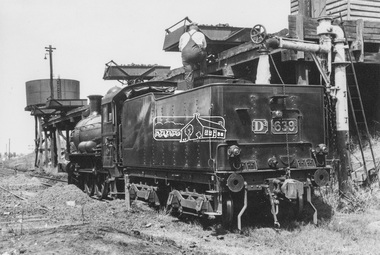
Photograph, VR Commissioner's Special train, steam locomotive D3-639 at Echuca Railway Station, 1962
... tank at one end or the connected standpipe at the opposite end. Locomotive firebox contents could be dumped into pits between the rails from locomotives once they were carefully positioned above them. Such locomotives then could move onto the Engine Shed area for overnight parking. Firebox fires would be re-lit when the locomotive was next needed in a day...tank at one end or the connected standpipe at the opposite end. Locomotive firebox contents could be dumped into pits between the rails from locomotives once they were carefully positioned above them. Such locomotives then could move onto the Engine Shed area for overnight parking. Firebox fires would be re-lit when the locomotive was next needed in a day ...VR Commissioner's Special train, steam locomotive D3-639 filling up with water at the coal hopper, Echuca Railway Station, 1962. The tender has been all polished up. THE ECHUCA COALING STAGE. Locomotives would stop alongside to receive coal dropped into their tenders from small overhead rail mounted tipping trays. Water could be obtained from either the elevated tank at one end or the connected standpipe at the opposite end. Locomotive firebox contents could be dumped into pits between the rails from locomotives once they were carefully positioned above them. Such locomotives then could move onto the Engine Shed area for overnight parking. Firebox fires would be re-lit when the locomotive was next needed in a day or so.Digital TIFF file Scan of black and white print enlargement on textured paper (14.5 x 21 cm)coal hopper, d3-639, d3-class steam locomotive, echuca railway station, george coop collection, vr commissioner's special train -
 Eltham District Historical Society Inc
Photograph, Steam locomotive K-185 at the coal hopper, Echuca Railway Station, c.Aug. 1963
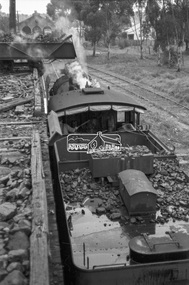
... tank at one end or the connected standpipe at the opposite end. Locomotive firebox contents could be dumped into pits between the rails from locomotives once they were carefully positioned above them. Such locomotives then could move onto the Engine Shed area for overnight parking. Firebox fires would be re-lit when the locomotive was next needed in a day...tank at one end or the connected standpipe at the opposite end. Locomotive firebox contents could be dumped into pits between the rails from locomotives once they were carefully positioned above them. Such locomotives then could move onto the Engine Shed area for overnight parking. Firebox fires would be re-lit when the locomotive was next needed in a day ...THE ECHUCA COALING STAGE. Locomotives would stop alongside to receive coal dropped into their tenders from small overhead rail mounted tipping trays. Water could be obtained from either the elevated tank at one end or the connected standpipe at the opposite end. Locomotive firebox contents could be dumped into pits between the rails from locomotives once they were carefully positioned above them. Such locomotives then could move onto the Engine Shed area for overnight parking. Firebox fires would be re-lit when the locomotive was next needed in a day or so.Digital TIFF file Scan of 35mm Ilford FP3 black and white negative transparencygeorge coop collection, echuca railway station, k-185, k-class steam locomotive (vr newport workshops), railway workshop -
 Waverley RSL Sub Branch
Minefield Warning Flag
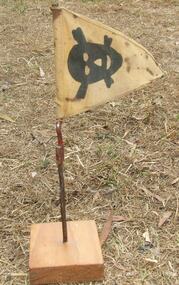
... On the third day, the 19th Infantry Brigade advanced south from Bardia, supported by artillery and the Matilda tanks, now reduced in number to just six. ...German Luftwaffe (Land Forces) minefield warning flag from WWII.originally intended to be gas markers, rather than mines, but as it turned out, the use changed .they were mounted on a red metal pole & there were 12 to a set in a leather pack. This Flag was presented to the Treasurer of Waverley RSL. It is a souvenir from Bardia in Libya The Battle of Bardia was fought over three days between 3 and 5 January 1941, as part of Operation Compass, the first military operation of the Western Desert Campaign of the Second World War. It was the first battle of the war in which an Australian Army formation took part, the first to be commanded by an Australian general and the first to be planned by an Australian staff. Major General Iven Mackay's 6th Division assaulted the strongly held Italian fortress of Bardia, Libya, assisted by air support and naval gunfire, and under the cover of an artillery barrage. The 16th Infantry Brigade attacked at dawn from the west, where the defences were known to be weak. Sappers blew gaps in the barbed wire with Bangalore torpedoes and filled in and broke down the sides of the anti-tank ditch with picks and shovels. This allowed the infantry and 23 Matilda II tanks of the 7th Royal Tank Regiment to enter the fortress and capture all their objectives, along with 8,000 prisoners. In the second phase of the operation, the 17th Infantry Brigade exploited the breach made in the perimeter, and pressed south as far as a secondary line of defences known as the Switch Line. On the second day, the 16th Infantry Brigade captured the township of Bardia, cutting the fortress in two. Thousands of prisoners were taken, and the Italian garrison now held out only in the northern and southernmost parts of the fortress. On the third day, the 19th Infantry Brigade advanced south from Bardia, supported by artillery and the Matilda tanks, now reduced in number to just six. Its advance allowed the 17th Infantry Brigade to make progress as well, and the two brigades reduced the southern sector of the fortress. Meanwhile, the Italian garrisons in the north surrendered to the 16th Infantry Brigade and the Support Group of the British 7th Armoured Division outside the fortress. In all, some 36,000 Italian prisoners were taken. The victory at Bardia enabled the Allied forces to continue the advance into Libya and ultimately capture almost all of Cyrenaica. In turn this would lead to German intervention in the fighting in North Africa, changing the nature of the war in that theatre. Bardia boosted the competence and reputation of the Australian Army. Perhaps most important of all, it raised confidence in the possibility of an ultimate Allied victory around the world, which would lead to the Lend-Lease Act being passed in the United States http://en.wikipedia.org/wiki/Battle_of_BardiaCloth Flag bearing a skull and cross Bones on a metal spike mounted on a square varnished wooden basebardia, land mine, marker flag, minefield, mustard gas -
4th/19th Prince of Wales's Light Horse Regiment Unit History Room
Envelopes, Commemorative, Australia - 7 July 1982, NZ - ?
... Day. Envelopes, Commemorative Military Covers RAAC Tank Museum ...Sets of Australian and New Zealand stamped commemorative envelopes. Australia: 1AR, RAAC- Cambrai, 1 AR Standard, Armoured Centre, 2 Cav, 3 Cav, 4 Cav, 1/15 RNSWL, 2/14 LH (QMI), 3/9 SAMR, 4/19 PWLH, 8/13 VMR, 10 LH, 12/16 HRL, Beersheba. New Zealand: Otago University Medical Corps, RNZ Education Corps, Home Guard, Ordnance, Start of War, Disbanding of RNZ Service Corps, Anniversary of South Africa, NZ Army Day. -
 4th/19th Prince of Wales's Light Horse Regiment Unit History Room
Film - DVD, The War Files
... Tank Battles El Alamein to the Volga, D-Day, Battle of Britain, The Great War, Dunkirk, Great Sea Battles of WW2, History of WW2, Battleships at War...Tank Battles El Alamein to the Volga, D-Day, Battle of Britain, The Great War, Dunkirk, Great Sea Battles of WW2, History of WW2, Battleships at War WW2 WW1 10 DVD BOX SET - THE WARE FILES FEARURING - OVER 10 HOURS OF WAR DOCUMENTARIES 10 DVDs in cases - contained in a cardboard box/sleeve The War Files Film DVD ...Tank Battles El Alamein to the Volga, D-Day, Battle of Britain, The Great War, Dunkirk, Great Sea Battles of WW2, History of WW2, Battleships at War10 DVDs in cases - contained in a cardboard box/sleeve10 DVD BOX SET - THE WARE FILES FEARURING - OVER 10 HOURS OF WAR DOCUMENTARIESww2, ww1 -
 Monbulk RSL Sub Branch
Book, David Chandler, The Oxford illustrated history of the British Army, 1994
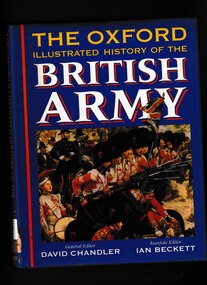
... great britain - military history great britain - military tradition From longbow, pike, and musket to Challenger tanks, from the Napoleonic Wars to the Gulf campaign, the Duke of Marlborough to Field Marshal Montgomery, The Oxford Illustrated History of the British Army recounts the history of the British army from its medieval antecedents to the present day. ...From longbow, pike, and musket to Challenger tanks, from the Napoleonic Wars to the Gulf campaign, the Duke of Marlborough to Field Marshal Montgomery, The Oxford Illustrated History of the British Army recounts the history of the British army from its medieval antecedents to the present day. Drawing on the latest scholarship, this survey shows how British fighting forces have evolved over the last five centuries. The continuities revealed are sometimes surprising: narrow recruitment patterns, friction between soldiers and civilians, financial constraints and recurrent political pressure for economies are constant themes. Commanders, campaigns, battles, organization, and weaponry are covered in detail within the wider context of the social, economic, and political environment in which armies exist and fight. The British army has been remarkably successful in fighting terms, losing only one major war (of American Independence 1775-83). As one of the engines of empire it has been active all over the world, as well as shaping the internal destiny of the nation in civil war and revolution. Its history is charted in a sequence of chronological chapters, each containing special feature articles, beginning with the medieval, Elizabethan, and Restoration army and moving on through the eighteenth and nineteenth centuries to the two world wars of the twentieth. The book concludes with accounts of the army of British India, the amateur military tradition, the British way in warfare, and an assessment of what the future may hold in the light of the Options for Change review. Extensively illustrated in black and white and colour, and with a detailed chronology and further reading lists, this is the definitive one-volume history of the British army for specialists and non-specialists alike.Bibliography, Index, Chronology, ill (plates, col, b/w) maps. p.452.non-fictionFrom longbow, pike, and musket to Challenger tanks, from the Napoleonic Wars to the Gulf campaign, the Duke of Marlborough to Field Marshal Montgomery, The Oxford Illustrated History of the British Army recounts the history of the British army from its medieval antecedents to the present day. Drawing on the latest scholarship, this survey shows how British fighting forces have evolved over the last five centuries. The continuities revealed are sometimes surprising: narrow recruitment patterns, friction between soldiers and civilians, financial constraints and recurrent political pressure for economies are constant themes. Commanders, campaigns, battles, organization, and weaponry are covered in detail within the wider context of the social, economic, and political environment in which armies exist and fight. The British army has been remarkably successful in fighting terms, losing only one major war (of American Independence 1775-83). As one of the engines of empire it has been active all over the world, as well as shaping the internal destiny of the nation in civil war and revolution. Its history is charted in a sequence of chronological chapters, each containing special feature articles, beginning with the medieval, Elizabethan, and Restoration army and moving on through the eighteenth and nineteenth centuries to the two world wars of the twentieth. The book concludes with accounts of the army of British India, the amateur military tradition, the British way in warfare, and an assessment of what the future may hold in the light of the Options for Change review. Extensively illustrated in black and white and colour, and with a detailed chronology and further reading lists, this is the definitive one-volume history of the British army for specialists and non-specialists alike.great britain - military history, great britain - military tradition -
 Monbulk RSL Sub Branch
Book, Hinkler Books, Tanks : from World War I to the present day, 2010
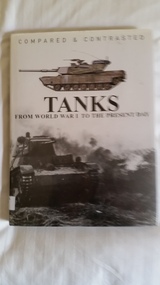
... Tanks : from World War I to the present day Book Hinkler Books Chris Dougherty ...Fascinating comparisons of military hardware through history. Featuring accurate detailed illustrations and comprehensive text.Index, ill, p.224.non-fictionFascinating comparisons of military hardware through history. Featuring accurate detailed illustrations and comprehensive text.tank warfare, tanks - military science -
 Bendigo Historical Society Inc.
Document - R.S.L. BENDIGO COLLECTION: ANZAC SERVICE 1959, 25th April, 1959
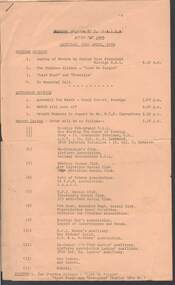
... Day Service on Saturday, 25th April, 1959. Mentioned are: Mr W E P Carruthers, Lt Commander Herniman RN, Col L J Lockwood, 38 Infantry Battalion, Lt Col D Scholes, Ex-Navalmen's Club, Airforce Association, Railway Sub-section R.S.L., Bendigo Legacy Club, 6th Battalion Social Club, 38th Battalion Social Club, Rats of Tobruk Association, Ex P.O.W. Association, R.A.A.O.C., T.P.I. Social Club, Interunits Social Club, 105 Anti-Tank...Tank Social Club 4th Aust. Armoured Regt. Social Club Repatriation Local Committee Catholic War Veterans Association Bendigo Dad's Association Legion of Exservicemen and Women R.S.L. Women's Auxiliary War Widows' Guild S.S. & A. Mothers' Association Ex-Navalmen's Club Ladies' Auxiliary Airforce Association Ladies' Auxiliary 38th Inf. Bn Ladies' Auxiliary Sea Cadets Air Cadets Major T Martin Mr G Styles Court House Hotel Sound Shell G F Osborne Paper detailing the Morning and Afternoon Service, Wreath Laying, Order of March, Assembly Points and Movement for the Anzac Day ...Paper detailing the Morning and Afternoon Service, Wreath Laying, Order of March, Assembly Points and Movement for the Anzac Day Service on Saturday, 25th April, 1959. Mentioned are: Mr W E P Carruthers, Lt Commander Herniman RN, Col L J Lockwood, 38 Infantry Battalion, Lt Col D Scholes, Ex-Navalmen's Club, Airforce Association, Railway Sub-section R.S.L., Bendigo Legacy Club, 6th Battalion Social Club, 38th Battalion Social Club, Rats of Tobruk Association, Ex P.O.W. Association, R.A.A.O.C., T.P.I. Social Club, Interunits Social Club, 105 Anti-Tank Social Club, 4th Aust. Armoured Regt. Social Club, Repatriation Local Committee, Catholic War Veterans Association, Bendigo Dad's Association, Legion of Exservicemen and Women, R.S.L. Women's Auxiliary, War Widows' Guild, S.S. & A. Mothers' Association, Ex-Navalmen's Club Ladies' Auxiliary, Airforce Association Ladies' Auxiliary, 38th Inf. Bn Ladies' Auxiliary, Sea Cadets, Air Cadets, Major T Martin, Mr G Styles, Court House Hotel, Sound Shell, and G F Osborne.event, official, anzac memorial service, r.s.l. bendigo collection - anzac service 1959, mr w e p carruthers, lt commander herniman rn, col l j lockwood, 38 infantry battalion, lt col d scholes, ex-navalmen's club, airforce association, railway sub-section r.s.l., bendigo legacy club, 6th battalion social club, 38th battalion social club, rats of tobruk association, ex p.o.w. association, r.a.a.o.c., t.p.i. social club, interunits social club, 105 anti-tank social club, 4th aust. armoured regt. social club, repatriation local committee, catholic war veterans association, bendigo dad's association, legion of exservicemen and women, r.s.l. women's auxiliary, war widows' guild, s.s. & a. mothers' association, ex-navalmen's club ladies' auxiliary, airforce association ladies' auxiliary, 38th inf. bn ladies' auxiliary, sea cadets, air cadets, major t martin, mr g styles, court house hotel, sound shell, g f osborne -
 Monbulk RSL Sub Branch
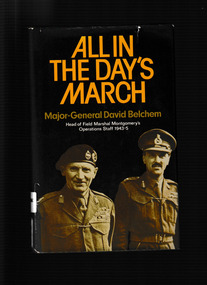
Book, David Belchem, All in the Day's March, 1978
... Tank Regiment and served in Egypt and Palestine prior to WW2. After the disaster of Greece was posted to General Montgomery's Staff prior to El Alamein and remained with him during the North African campaign. Planning for Invasion of Sicily, Sicily campaign, Italy and then returns to the UK to work with Monty planning Overlord. Was on Montys Staff during the invasion and until the surrender. Index, ill, maps, p.320. All in the Day's ...Covers Major-General David Belchem career from joining the British Army in 1930 to 1950. He started his career in the Royal Tank Regiment and served in Egypt and Palestine prior to WW2. After the disaster of Greece was posted to General Montgomery's Staff prior to El Alamein and remained with him during the North African campaign. Planning for Invasion of Sicily, Sicily campaign, Italy and then returns to the UK to work with Monty planning Overlord. Was on Montys Staff during the invasion and until the surrender.Index, ill, maps, p.320.non-fictionCovers Major-General David Belchem career from joining the British Army in 1930 to 1950. He started his career in the Royal Tank Regiment and served in Egypt and Palestine prior to WW2. After the disaster of Greece was posted to General Montgomery's Staff prior to El Alamein and remained with him during the North African campaign. Planning for Invasion of Sicily, Sicily campaign, Italy and then returns to the UK to work with Monty planning Overlord. Was on Montys Staff during the invasion and until the surrender. generals - great britain - biography, david belchem - biography -
 Monbulk RSL Sub Branch
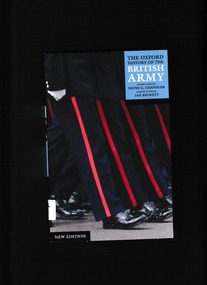
Book, David D Chandler, The Oxford history of the British Army, 1994
... British armed forces British army - History From longbow, pike, and musket to Challenger tanks, from the Napoleonic Wars to the Gulf Campaign, from the Duke of Marlborough to Field Marshal Montgomery, this stimulating and informative book recounts the history of the British army from its medieval antecedents to the present day. ...From longbow, pike, and musket to Challenger tanks, from the Napoleonic Wars to the Gulf Campaign, from the Duke of Marlborough to Field Marshal Montgomery, this stimulating and informative book recounts the history of the British army from its medieval antecedents to the present day. Commanders, campaigns, battles, organization, and weaponry are all covered in detail within the wider context of the social, economic, and political environment in which armies exist and fight, making this the definitive one-volume history of the British army for specialists and non-specialists alike.Index, maps, p.485.non-fictionFrom longbow, pike, and musket to Challenger tanks, from the Napoleonic Wars to the Gulf Campaign, from the Duke of Marlborough to Field Marshal Montgomery, this stimulating and informative book recounts the history of the British army from its medieval antecedents to the present day. Commanders, campaigns, battles, organization, and weaponry are all covered in detail within the wider context of the social, economic, and political environment in which armies exist and fight, making this the definitive one-volume history of the British army for specialists and non-specialists alike. british armed forces, british army - history -
 National Vietnam Veterans Museum (NVVM)
Photograph
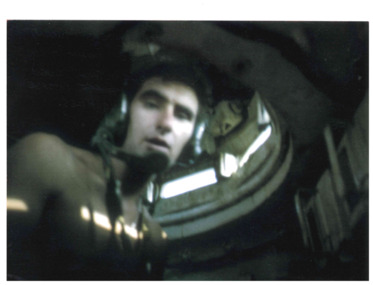
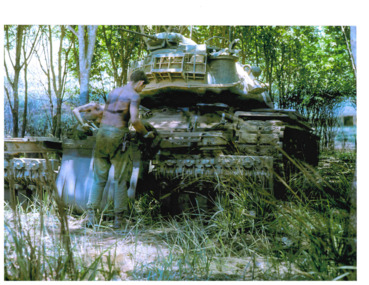
... Sgt McCole Royal Australian Engineers ready for the day clearing bush tracks to make safer passage for other support vehicles in Vietnam. McCole 7th Sqadron Engineers Mine clearing Vietnam A photograph of soldier Jeff McCole in a mine clearing tank clearing bush for other support vehicles in Vietnam. ...Sgt McCole Royal Australian Engineers ready for the day clearing bush tracks to make safer passage for other support vehicles in Vietnam. A photograph of soldier Jeff McCole in a mine clearing tank clearing bush for other support vehicles in Vietnam.mccole, 7th sqadron, engineers, mine clearing, vietnam -
 National Vietnam Veterans Museum (NVVM)
Photograph
... day on the road. McCole Commander Mine clearing Vietnam Colour image of a mine clearing tank with soldier checking for damage. ...Sgt McCole Commander with Arthur Baker checking for maamge after a day on the road.Colour image of a mine clearing tank with soldier checking for damage.mccole, commander, mine clearing, vietnam -
 National Vietnam Veterans Museum (NVVM)
Poster - Information Board - 5 RAR 2nd Tour 1969 to 1970, 5 RAR 2nd Tour 1969 to 1970
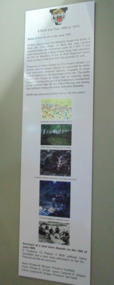
... Following an initial assault by D Company (phase 1) a further infantry sweep (phase 2) supported by tanks and armoured personal carriers, engaged in close quarter fighting for the remainder of the day. ...Following an initial assault by D Company (phase 1) a further infantry sweep (phase 2) supported by tanks and armoured personal carriers, engaged in close quarter fighting for the remainder of the day. ...6 RAR 2nd Tour 1969 to 1970. Battle of Binh Ba 6th to 8th June 169. In their second tour, the Battalion fought the Battle of Binh Ba. The village of Binh Ba was located approximately six kilometres north of 1 ATF. It had been occupied by a large enemy force, later identified as the 1st Battalion of the 33 NVA Regiment which was guided by the local Binh Ba guerrilla VC unit. Following an initial assault by D Company (phase 1) a further infantry sweep (phase 2) supported by tanks and armoured personal carriers, engaged in close quarter fighting for the remainder of the day. The battle raged from house to house with an intensity rarely equalled during any period of Australia's involvement in the Vietnam War. By the end of the day, the enemy had suffered heavy causalities and were defeated. 5RAR was awarded a Battle Honour for this action. An Information Board of a Schematic drawing and two colour photos with description of Battle of Binh Ba 6th to 8th June 1969. Two other photos of other actions of 2nd tour. Tiger emblem on black V. Black text on white background Under the bottom black and white photograph reads: Survivors of a land mine disaster on the 15th of June 1969. D Company 12 Platoon 5 RAR suffered heavy casualties due a land mine detonation at Dat Do. Pictured are the six survivors. Rear Private W Morgan, Private A Tuckfield, Front B Savige, Lance Corporal R Chaplin, Lance Corporal R Knapp, Private A Van Hulst.dat do, 5 rar, pte w.morgan, pte a. tuckfield, pte b. savage, pte a van hulet, l/cpl r. chaplin, l/cpl r knapp, poster, information board, battle of binh ba, 12 platoon, 33 nva regiment, viet cong, battle honour, 1 atf, pte william morgan, 1201663, royal australian infantry corps, 8th battalion, pte allan david tuckfield, 4720252, 1 australian reinforcement unit, australian national serviceman, 5th battalion, pte bruce ronald savige, 3793395, l/cpl raymond michael chaplin, 2789408, cpl (temp) raymond michael chaplin, l/cpl raymond john knapp, 2789701, pte arnoldus johanus van hulst, 2790009 -
 National Vietnam Veterans Museum (NVVM)
Book - Ten Years After Vietnam Today, Page, Tim, 1987
... Vietnam Saigon Long after the last spasm of the Vietnam War, the day tank no. 844 trundled through the Presidential gates in Saigon after a journey of over two throusand miles, the memories and experiences of this ferocious conflict continue to haunt a whole generation, East and West. ...Long after the last spasm of the Vietnam War, the day tank no. 844 trundled through the Presidential gates in Saigon after a journey of over two throusand miles, the memories and experiences of this ferocious conflict continue to haunt a whole generation, East and West.non-fictionLong after the last spasm of the Vietnam War, the day tank no. 844 trundled through the Presidential gates in Saigon after a journey of over two throusand miles, the memories and experiences of this ferocious conflict continue to haunt a whole generation, East and West.vietnam, saigon
