
Showing 416 items matching "train world"
-
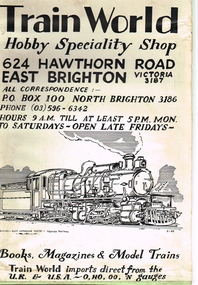 Ballarat Tramway Museum
Poster, David Frost, Train World, 1982
... Train World...... Train World...Train world poster for use in roof ad rack of Ballarat trams. ...Trams tramways Train World Posters Roof Ads Train world poster for use in roof ad rack of Ballarat trams. ...Train world poster for use in roof ad rack of Ballarat trams. A3 size poster of a Uganda Railway Steam Locomotive (Mallet) drawn by David Frost and details of "Train World" hobby shop. Poster photocopied and glued onto a cardboard cut from another poster. Image added 20-12-2016.trams, tramways, train world, posters, roof ads -
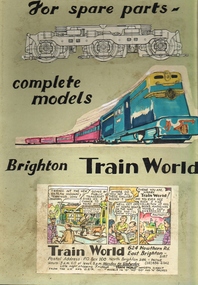 Ballarat Tramway Museum
Poster, David Frost, Train World, c1985
... Train World...... Train World...Train World poster for use in roof ad of a Ballarat tram, consisting of wording and three cut out (Diesel locomotive power bogie, a VR train and a cartoon by David Frost and colour in water coloured wash, and colour pencil, mounted onto a sheet of cardboard. ...Image added 20-12-2016. Train World Poster David Frost ...Train World poster for use in roof ad of a Ballarat tram, consisting of wording and three cut out (Diesel locomotive power bogie, a VR train and a cartoon by David Frost and colour in water coloured wash, and colour pencil, mounted onto a sheet of cardboard. Image added 20-12-2016.trams, tramways, posters, train world, roof ads -
 Ballarat Tramway Museum
Ephemera - Miscellaneous tickets - set of 5, 1980s
... ...Train World...Set of five tickets collected by Dave O'Neil: 1 - Brisbane Tramway Museum Society pink ticket - No. 3797 - punched for Sept. 2 - Two different Edmondson style tickets for Train World - 624 Hawthorn Road, East Brighton - railway models and other rail items seller 3 - Off the Rails Collectables, Camperdown, Sydney - gives address and telephone numbers. 4 - Victorian Railways style first class ticket "Manuka to Corio" - No. 0140. ...Yields information about the different style of tickets used for promotion or as souvenirs. tramways tickets railways btms Train World Souvenirs Four Edmondson size card tickets and one printed light card ticket. ...Set of five tickets collected by Dave O'Neil: 1 - Brisbane Tramway Museum Society pink ticket - No. 3797 - punched for Sept. 2 - Two different Edmondson style tickets for Train World - 624 Hawthorn Road, East Brighton - railway models and other rail items seller 3 - Off the Rails Collectables, Camperdown, Sydney - gives address and telephone numbers. 4 - Victorian Railways style first class ticket "Manuka to Corio" - No. 0140. The only Australian location with that name is in Canberra. Yields information about the different style of tickets used for promotion or as souvenirs.Four Edmondson size card tickets and one printed light card ticket.tramways, tickets, railways, btms, train world, souvenirs -
 Melbourne Tram Museum
Album - Public Transport Tickets, David Frost
... ...Train World...Tickets collected by the donor contains: Sheet 1 - Victorian Railways combined rail / tram St Kilda Brighton line 2 - ditto - most used with part tickets 3 - mainly rail and bus 4 - rail and bus 5 - ditto with some rail only 6 - ditto - with tickets torn in half 7 - rail and bus weekly 8 - Single and return tickets for Sandringham to Black Rock 9 - ditto with tickets torn to cancel them 10 - various rail tickets - mixed including some country and weekly tickets 11 - combined train and bus tickets post 1956 12 - Mixed railway tickets - including first and second class suburban 13 - General railway tickets 14 - Rail tickets just prior to Neighbourhood tickets. 15 - ditto with some NSW tickets 16 - MMTB Section tickets and others systems. 17 - Miscellaneous tickets 18 - Miscellaneous tourist operator tickets 19 - ditto 20 - Train world examples 21 - Metcards 22 - Metcards 23 - Metcards - printed for events etc. 24 - Metcards 25 - Frankston line Connex timetable, V/Line ticket folder and Ganga phone card. ...Tickets St Kilda Brighton Electric tramway Victorian Railways Metcard Sandringham to Black Rock buses VR railways tramways MMTB Train World Album - red plastic cover two ring spring binder, with gold block "Swap Card Album" - with a $14.50 price label in the top right hand corner. ...Tickets collected by the donor contains: Sheet 1 - Victorian Railways combined rail / tram St Kilda Brighton line 2 - ditto - most used with part tickets 3 - mainly rail and bus 4 - rail and bus 5 - ditto with some rail only 6 - ditto - with tickets torn in half 7 - rail and bus weekly 8 - Single and return tickets for Sandringham to Black Rock 9 - ditto with tickets torn to cancel them 10 - various rail tickets - mixed including some country and weekly tickets 11 - combined train and bus tickets post 1956 12 - Mixed railway tickets - including first and second class suburban 13 - General railway tickets 14 - Rail tickets just prior to Neighbourhood tickets. 15 - ditto with some NSW tickets 16 - MMTB Section tickets and others systems. 17 - Miscellaneous tickets 18 - Miscellaneous tourist operator tickets 19 - ditto 20 - Train world examples 21 - Metcards 22 - Metcards 23 - Metcards - printed for events etc. 24 - Metcards 25 - Frankston line Connex timetable, V/Line ticket folder and Ganga phone card. Yields information about the Victorian Railways rail and tram ticketing systems.Album - red plastic cover two ring spring binder, with gold block "Swap Card Album" - with a $14.50 price label in the top right hand corner. Contains 25 used or partly used card plastic sleeves and four unused sleves. tickets, st kilda brighton electric tramway, victorian railways, metcard, sandringham to black rock, buses, vr, railways, tramways, mmtb, train world -
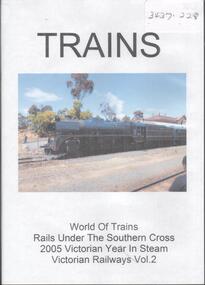 Bendigo Historical Society Inc.
Photograph - TRAINS 4 DISCS
... Trains 4 Discs. a. Rails Under the Southern Cross. b. World of Trains. ...Trains 4 Discs. a. Rails Under the Southern Cross. b. World of Trains. c. ...DVD. Trains 4 Discs. a. Rails Under the Southern Cross. b. World of Trains. c. Victorian Railways. d. 2005 Victorian Year in Steam.photographs, trains -
Unions Ballarat
Transcontinental train odyssey: The Ghan, the Khyber, the Globe (Don Woodward Collection), Fischer, Tim, 2004
... Stories from Tim Fischer's train journeys around the world. Fischer was an Australian politician (National Party), deputy prime minister and diplomat....Stories from Tim Fischer's train journeys around the world. Fischer was an Australian politician (National Party), deputy prime minister and diplomat. ...Stories from Tim Fischer's train journeys around the world. Fischer was an Australian politician (National Party), deputy prime minister and diplomat.Global history - railways. Book; 217 pages. Cover: brown and blue background; colour photograph of The Ghan and Tim Fischer; white and black lettering; author's name and title. btlc, ballarat trades hall, ballarat trades and labour council, fischer, tim, politicians, railways - history, railways - anecdotes -
Whitehorse Historical Society Inc.
Audio - Oral History, Johanna van Hoek, 21/04/2006
... The family returned to Netherlands after being interned during the Second World War. Johanna trained as a medical analyst and in 1954 migrated to Australia with her husband. ...Cassette recording of an interview with Johanna van Hoek, who was born in Borneo, returned to Netherlands after the Second World War, trained as a medical analyst and in 1954 migrated to Australia with her husband. ...Cassette recording of an interview with Johanna van Hoek, who was born in Borneo, returned to Netherlands after the Second World War, trained as a medical analyst and in 1954 migrated to Australia with her husband. ...Johanna van Hoek, who was born in Borneo, where her father was stationed for his work with the Dutch oil company, Shell. The family returned to Netherlands after being interned during the Second World War. Johanna trained as a medical analyst and in 1954 migrated to Australia with her husband. The family settled near Blackburn Lake. Cassette recording of an interview with Johanna van Hoek, who was born in Borneo, returned to Netherlands after the Second World War, trained as a medical analyst and in 1954 migrated to Australia with her husband. The family settled near Blackburn Lake. The interview was conducted by Melanie Farrow on 21 April 2006. emigration, oral history migration program, dutch in australia, van hoek, johanna, migrant skills -
 Flagstaff Hill Maritime Museum and Village
Equipment - Platform Scales
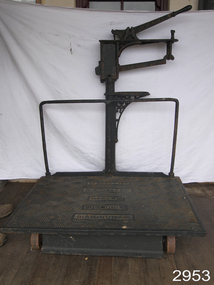
... world. Following the highly successful introduction of the first digital retail scale in 1971, the company was taken over by the GEC Group in 1979. The business was subsequently acquired by the American company, Weigh-Tronix, in 2000 which had already acquired a competitor, Salter. The Avery name continues today in the company known as Avery Weigh-Tronix. An item that was used at the turn of the century as train ...Large platform scales such as these ones made by W. & T. Avery were used for weighing goods for trading and passengers' luggage. They would be used in places such as railway stations, shipping ports, customs offices and ticketing offices. Often fees would be charged to customers according to the weight of their goods and luggage. Items would be placed onto the large horizontal platform then weights would be added to the weighing bar until the bar leveled to being horizontal. The weights would be added together and the total of the weights would be used for the final figure. These scales were made in Birmingham, England, by the British company, W and T Avery. The company had its origins in the early 1700s but only became known as W and T Avery when the brothers William and Thomas Avery inherited the scale-making business from a relative, Joseph Balden, on his death in 1813. By 1885 they had three factories and In 1895, the company acquired James Watt & Co and two years later had moved to the 25-acre Soho Foundry site in Smethwick, Birmingham where James Watt had manufactured steam engines. When the last Avery family member died in 1918, the company employed over 3,000 people and had businesses all over the world. Following the highly successful introduction of the first digital retail scale in 1971, the company was taken over by the GEC Group in 1979. The business was subsequently acquired by the American company, Weigh-Tronix, in 2000 which had already acquired a competitor, Salter. The Avery name continues today in the company known as Avery Weigh-Tronix.An item that was used at the turn of the century as train platform scales or for weighing agricultural products. Made by a company that pioneered weighing equipment with offices all over the world. With many examples of this scale in museums throughout the world. Platform scales with wheels. Large cast iron, scales painted black, weight capacity to 7 CWT (hundred weight). Weight beam has markers "0. 5. 10. 15. 20. 25". Platform scale loose weight type with relieving handle; cast iron construction, fluted columns with integral weight stand, the two wheels are fitted to base at front of platform; there is a graduated steelyard 0-14bs with pear-shaped poise. Weight carrier is missing.Pressed into cast iron arm on scale, one side "W. & T. AVERY", opposite side "BIRMINGHAM", and into the platform "TO WEIGH 7 CWT, W. & T. AVERY, MAKERS, LONDON & BIRMINGHAM" flagstaff hill, warrnambool, shipwrecked-coast, flagstaff-hill, flagstaff-hill-maritime-museum, maritime-museum, shipwreck-coast, flagstaff-hill-maritime-village, measuring scales, weighing scales, weighing instrument, fees for goods, fees for luggage, ticket office -
 Federation University Historical Collection
Book, Standardization of Australia's Railway Gauges, 1945, 1945
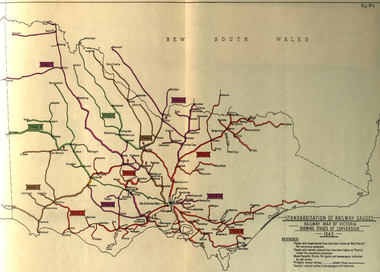
... In two decades as its Chairman of Commissioners, he revolutionised Victorian Railways, with unprecedented attention to customer service and innovations such as more powerful locomotives, air-conditioned carriages, and faster services culminating in the introduction of the flagship Spirit of Progress express train. Seconded to the Federal Government in World War II, he played a pivotal role in the manufacture of fighter aircraft in the defence of Australia. ...In two decades as its Chairman of Commissioners, he revolutionised Victorian Railways, with unprecedented attention to customer service and innovations such as more powerful locomotives, air-conditioned carriages, and faster services culminating in the introduction of the flagship Spirit of Progress express train. Seconded to the Federal Government in World War II, he played a pivotal role in the manufacture of fighter aircraft in the defence of Australia. ...Sir Harold Winthrop Clapp KBE (7 May 1875 – 21 October 1952) was a transport administrator who over the course of thirty years had a profound effect on Australia's railway network. In two decades as its Chairman of Commissioners, he revolutionised Victorian Railways, with unprecedented attention to customer service and innovations such as more powerful locomotives, air-conditioned carriages, and faster services culminating in the introduction of the flagship Spirit of Progress express train. Seconded to the Federal Government in World War II, he played a pivotal role in the manufacture of fighter aircraft in the defence of Australia. As Director-General of Australia's Land Transport Board, he presented a report on railway gauge standardisation that ultimately led to the eventual linking of all Australian mainland capital cities by a uniform rail gauge. (http://en.wikipedia.org/wiki/Harold_Winthrop_Clapp, accessed 02/10/2013)Grey, soft covered, stapled report of 89 pages. "Standardization of Australia's Railway Gauges" by Harold Clapp is a report and recommendation regarding the standarization of Australia's railway gauges. The contents include: * Lines suggested for conversion or new lines to be constructed * scheme of conversion of tracks and structures * scheme of conversion of locomotives and rolling stock * Estimated costs * Associated works * Estimated manpower which the project will absorb in its various phases *Standardization of rolling stock * Other considerations associated with the project * Estimated time involved in the various phases of the work. The report includes 8 maps: * Map of Australia showing the various proposals referred to *Map of Australian railways showing extent of standard gauge if proposals are carried out * Map of Australian railways as of 30 June 1944 *Map of Australia showing principal mileages referred to in the report * Railway Map of Western Australia, 1945 * Railway Map of South Australia, 1945 * Railway Map of Victoria, 1945 * Railway Map of Melbourne Suburbs, 1945 railway, guage, standardization, standardisation, fremantle, perth, kalgoorlie, peterborough, silverton, tramway, tram, train, townsville, dajarra, bourke, cunnamulla, charleville, blackall, longreach, winton, hughenden, townsville, gajarra, birdum, darwin, narrow gauge -
 Federation University Historical Collection
Photograph, VADs, a Nurse, and Soldiers at Highton, c1917
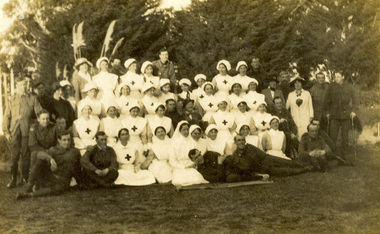
... They were not employed in military hospitals, except as ward and pantry maids; rather, they worked in Red Cross convalescent and rest homes, canteens, and on troop trains. At the start of the First World War, Australian VADs were restricted from travelling overseas by the Defence Council. ...They were not employed in military hospitals, except as ward and pantry maids; rather, they worked in Red Cross convalescent and rest homes, canteens, and on troop trains. At the start of the First World War, Australian VADs were restricted from travelling overseas by the Defence Council. ...The primary role of a Voluntary Aid Detachment (VAD) member was that of nursing orderly in hospitals, carrying out menial but essential tasks - scrubbing floors, sweeping, dusting and cleaning bathrooms and other areas, dealing with bedpans, and washing patients. They were not employed in military hospitals, except as ward and pantry maids; rather, they worked in Red Cross convalescent and rest homes, canteens, and on troop trains. At the start of the First World War, Australian VADs were restricted from travelling overseas by the Defence Council. As a result, many chose to travel on their own initiative and join British detachments, often in Australian Hospitals. It is reported that the 1st Australian Auxiliary Hospital included in their nursing staff some 120 VADs, chiefly Australians in the British service, employed through the Australian Red Cross Society. This policy was changed in 1916 after a request from Great Britain, and the first detachment of thirty official Australian VADs to serve overseas left Australia in September 1916.(http://www.awm.gov.au/encyclopedia/vad/, accessed 13 August 2014)A group of VADs, a nurse, and some men from the Australian Imperial Forces. Verso: 'group of nurses and some of the men at Highton - taken at an afternoon we had. Can you find me [Harold Holmes] it is not very clear. The 2nd in uniform from the right hand side.chatham family archive, chatham, holmes, world war, world war 1, world war i, world war one, highton, red cross, vad, voluntary aid detachment, nurse, nursing -
 Federation University Historical Collection
Booklet - Programme, 'Chu Chin Chow' Theatre Programme, c 1917
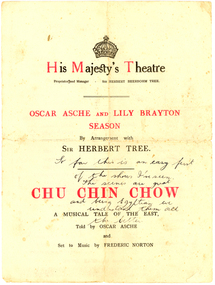
... World War One. Around this time he had been serving in the Australian Imperial Forces in Egypt. Henry 'Harry' Holmes was the son of Violet Holmes. He enlisted under the name Harry Smerdon Holmes and was put into the 18th A.A.S.C., then later transferred into the 5th Division Train A.S.C. ...World War One. Around this time he had been serving in the Australian Imperial Forces in Egypt. Henry 'Harry' Holmes was the son of Violet Holmes. He enlisted under the name Harry Smerdon Holmes and was put into the 18th A.A.S.C., then later transferred into the 5th Division Train A.S.C. ...Chu Chin Chow is a musical comedy written, produced and directed by Oscar Asche, with music by Frederic Norton, based (with minor embellishments) on the story of Ali Baba and the 40 Thieves. Tickets to see Chu Chin Chow were particularly eagerly sought by troops on leave from the Western Front. One of the attractions for the on-leave soldiers was the chorus of pretty slave girls who, for the period, were very scantily dressed. The cast was large and included a camel, a donkey, poultry and snakes. A total of 2,800,000 people saw the show. (http://en.wikipedia.org/wiki/Chu_Chin_Chow) It is thought that Harry Holmes attended 'Chu Chin Chow' while on leave in London during World War One. Around this time he had been serving in the Australian Imperial Forces in Egypt. Henry 'Harry' Holmes was the son of Violet Holmes. He enlisted under the name Harry Smerdon Holmes and was put into the 18th A.A.S.C., then later transferred into the 5th Division Train A.S.C. According to his Soldier's Pay Books (Cat. No. 20112) Holmes Registration number was 7983. He was Catholic and enlisted in the Third Military District on 17 September 1915, and embarked on 8 November 1915. Holmes was in the 18th AASC Unit with the rank of Driver at that time. On 15 November 1918 Holmes was promoted to Lance Corporal. He received leave on: * 3 August 1917 - London (10 days) * 19 February 1918 - Paris (10 days) * 27 August 1918 - London (14 days) Research: Henry Holmes' grandaughter, Jane Dyer (nee Chatham) White paper theatre programme with red and black writing. It is a publicity brochure from the play 'Chu Chin Chow' by Oscar Asche set to music by Frederic Norton. In black ink in front 'So far this is an easy first of the shows I've seen, The scenes are great and being Egyptian we understand them all the better'. chatham family collection, holmes, theatre, world war 1, world war, world war i, herbert tree, entertainment, music, musical, oscar asche, fred norton -
 Flagstaff Hill Maritime Museum and Village
Instrument - Chronometer
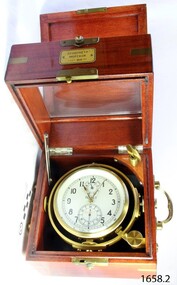
... train the Russian workers in the art of watchmaking as part of the Soviet's first five-year plan. The movements of very-early products were still stamped "Dueber-Hampden, Canton, Ohio, USA" (examples of these watches are very collectible today). In 1935 the factory was named after the murdered Soviet official Sergei Kirov. During the second world...train the Russian workers in the art of watchmaking as part of the Soviet's first five-year plan. The movements of very-early products were still stamped "Dueber-Hampden, Canton, Ohio, USA" (examples of these watches are very collectible today). In 1935 the factory was named after the murdered Soviet official Sergei Kirov. During the second world ...First State Watch Factory: This factory was founded in 1930 under orders from Joseph Stalin, the "First State Watch Factory" was the first large-scale Soviet watch and mechanical movement manufacturer in the USSR. Via its USA-based trading company (Amtorg), the Soviet government bought the defunct Ansonia Clock Company of Brooklyn, New York in 1929, and the "Dueber-Hampden Watch Company of Canton", based in Ohio. The soviets moved twenty-eight freight cars full of machinery and parts from the USA to Moscow in order to establish the factory. Twenty-one former "Dueber-Hampden" watchmakers, engravers and various other technicians helped to train the Russian workers in the art of watchmaking as part of the Soviet's first five-year plan. The movements of very-early products were still stamped "Dueber-Hampden, Canton, Ohio, USA" (examples of these watches are very collectible today). In 1935 the factory was named after the murdered Soviet official Sergei Kirov. During the second world war, as the Germans closed in on Moscow in 1941, the factory was hurriedly evacuated to (Zlatoust USSR). By 1943 the Germans were in retreat, and the factory was moved back to Moscow, adopting the "First Moscow Watch Factory" name. In 1947 the first wristwatches under the brand name "Pobeda" and the first Marine Chronometers and Deck watches were produced. By 1951 the production of wristwatches had increased to 1.1 million. In 1975 new machinery and equipment for manufacturing complex watches were imported from Switzerland. The first chronograph called "Okean" (3133) was produced for the space station "Soyuz-23."The Chronometer is of recent manufacture and an excellent example of the type of instrument used to navigate the seas in the 19th century. It is of good quality and of a type regarded as very accurate and well made. The maker, First Watch Factory, has a dept that is still producing the "8916" standard Chronometer for horologists and collectors. Marine chronometer of Russian make in wooden case, metal handles on sides, inscription on a metal plaque on the front of the case. Polished square wooden outer case with green felt lining and, a leather carrying strap and buckle. Outer case is hinged and has a metal latch on the front. Outer case has a red velvet covering with a button and loop closure. Inscription on box are in Russian & translate as follows: ХРОНОМЕТР, = CHRONOMETER МОРСКОЙ, = NAUTICAL ГОСТ, 8916-77 = Gost ЛОЛ ЕТ, on dial face = LOL ETflagstaff hill, warrnambool, shipwrecked-coast, flagstaff-hill, flagstaff-hill-maritime-museum, maritime-museum, shipwreck-coast, flagstaff-hill-maritime-village, chonometer, russian, watch factory, marine, navigational instrument -
 The Beechworth Burke Museum
Audio - Oral History, Jennifer Williams, Mr Albert (Bert) Nankervis, 15th March 2000
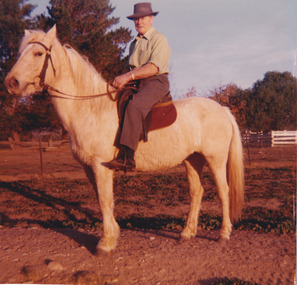
... He details his life as a farmer and milkman in the early 20th century, particularly the interwar period (1918-1939), but also discusses life after the Second World War, including employing young migrant men to train them as farmers through the Young Farmer’s Association. ...Mr Albert (Bert) Nankervis was born at Thougla, in the Upper Murray, in 1903. He had a large family and was one of eight children, four boys and four girls. He and his family moved to a farm in Wooragee named ‘Wattle Grove’ in 1918 after his father returned from serving as a soldier in World War One. The family established ‘Wattle Grove’ as a dairy farm as Beechworth has a high demand for milk and little supply. They had 25 milk cows that were hand milked every morning in order to provide milk for approximately 100 customers in the town, with any extra going to the butter factory at Springhurst. Albert married Floré Lilias Hardy in 1930 and they had two sons, Phillip and Barry. In this oral history, Albert discusses his life as a farmer in Wooragee, including his role in getting electricity to Beechworth, as well as his participation in the Young Farmer’s Association Immigration Scheme, which provided work experience to migrants in order for them to learn how to farm. This oral history recording was part of a project conducted by Jennifer Williams in the year 2000 to capture the everyday life and struggles in Beechworth during the twentieth century. This project involved recording seventy oral histories on cassette tapes of local Beechworth residents which were then published in a book titled: Listen to what they say: voices of twentieth century Beechworth. These cassette tapes were digitised in July 2021 with funds made available by the Friends of the Burke. Mr Albert (Bert) Nankervis’s account of his life in Wooragee and the local area, including Beechworth, during the early 20th century is historically and socially significant to the cultural heritage of the region. He details his life as a farmer and milkman in the early 20th century, particularly the interwar period (1918-1939), but also discusses life after the Second World War, including employing young migrant men to train them as farmers through the Young Farmer’s Association. This oral history account is socially and historically significant as it is a part of a broader collection of interviews conducted by Jennifer Williams which were published in the book 'Listen to what they say: voices of twentieth-century Beechworth.' While the township of Beechworth is known for its history as a gold rush town, these accounts provide a unique insight into the day-to-day life of the town's residents during the 20th century, many of which will have now been lost if they had not been preserved. This is a digital copy of a recording that was originally captured on a cassette tape. The cassette tape is black with a horizontal white strip and is currently stored in a clear flat plastic rectangular container. It holds up 45 minutes of recordings on each side.Mr Albert (Bert) Nankervis / albert nankervis, bert nankervis, nankervis, wattle grove, wooragee, dairy farm beechworth, dairy farm, dairy factories beechworth, dairying, milkman, oral history, springhurst, butter factory, electricity, rural life, farming and agriculture, farm, farm work, cow, cattle, jersey cattle, interwar period, first world war, second world war, wwi, wwii, greatest generation, centenarian, nonagenarian, 1920s, 1930s beechworth, thougla, upper murray, murray, lucyvale, benalla -
 The Beechworth Burke Museum
Audio - Oral History, Jennifer Williams, Mrs Sheila Parkinson, 3 January 2000
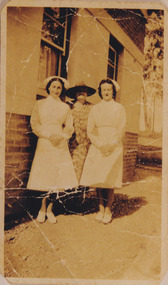
... Sheila trained as a psychiatric nurse at Mayday Hills hospital prior to the second World War. ...Sheila trained as a psychiatric nurse at Mayday Hills hospital prior to the second World War. ...Mrs Sheila Parkinson was born in Wagga in 1916 and came to Beechworth as a young woman around 1938. Sheila trained as a psychiatric nurse at Mayday Hills hospital prior to the second World War. At that time, unmarried women were accommodated and received nursing training on-site. Shiela was obliged to cease professional training and employment when she married in 1941, which disrupted completion of her final nursing examinations. Following post-war changes to the law that allowed married women to work, Sheila returned to Mayday Hills. Sheila's husband, Don, returned to Beechworth after four years abroad as a serviceman in the Australian Air Force. Beechworth's institutions were a major source of local employment throughout the twentieth century. As well as providing limited employment opportunities to young women like Shiela, post-war European migrants from Bonegilla Migrant camp found at Mayday Hills, encouraging European migrant settlement in the district. Mayday Hills was renamed several times since its establishment in 1867. At the peak of operations, it comprised sixty-seven buildings housing over twelve hundred patients patients and five hundred staff. The hospital officially closed in 1998. Today, the decommissioned two-storey Italianate style main building stands on eleven hectares of botanical gardens under National Trust protection. The site remains a popular cultural heritage destination for visitors. This oral history recording was part of a project conducted by Jennifer Williams in the year 2000 to capture the everyday life and struggles in Beechworth during the twentieth century. This project involved recording seventy oral histories on cassette tapes of local Beechworth residents which were then published in a book titled: Listen to what they say: voices of twentieth century Beechworth. The cassette tapes were digitised in July 2021 with funds made available by the Friends of the Burke.Employed as a psychiatric nurse at one of Beechworth's large welfare institutions, Mayday Hills, Mrs Sheila Parkinson recalls the conditions faced by staff and patients at the hospital, which cared for chronically ill people from the Ovens region and patients from the Yarra Bend Asylum, Melbourne, which closed in 1925. When Sheila first began her nurse training, Mayday Hills suffered from a lack of resources and rudimentary facilities and patients frequently suffered from the cold due to poor heating and inadequate clothing and bedding. However, as the twentieth century progressed, Sheila recalls how conditions and treatments improved as a result of increased government funding of services and advances in psychiatry and pharmaceutical medicine. Mrs Sheila Parkinson's oral history recording is historically and socially significant for its witness to life in Beechworth in the pre- and post-WWII period. Sheila's story enriches our understanding of processes of modernisation with regard to psychiatric and welfare services, while the course of Sheila's professional training and employment brings attention to systemic and socio-economic barriers faced by women, as well as the valuable contribution women and migrants make in the delivery of care and ancillary services. This oral history account is socially and historically significant as it is a part of a broader collection of interviews conducted by Jennifer Williams which were published in the book 'Listen to what they say: voices of twentieth-century Beechworth.' While the township of Beechworth is known for its history as a gold rush town, these accounts provide a unique insight into the day-to-day life of the town's residents during the twentieth century, many of which would have been lost if they had not been preserved.This is a digital copy of a recording that was originally captured on a cassette tape. The cassette tape is black with a horizontal white strip and is currently stored in a clear flat plastic rectangular container. It holds up 40 minutes of recordings on each side.Mrs Sheila Parkinson /twentieth century beechworth, mayday hills, psychiatric care, benevolent asylums, nursing, wwii, psychiatric treatment, country women, psychiatric hostpital, beechworth's institutions, local employment, government institutions, listen to what they say, oral history, burke museum, sheila parkinson, beechworth lunatic asylum, beechworth mental hospital, beechworth hospital for the insane, the kerferd clinic, bonegilla migrant camp, working women, white australia policy -
The Beechworth Burke Museum
Audio - Oral History, Jennifer Williams, Gwen and Jack Scott, 24th February 2000
... train station via horse and cart. Jack’s father and uncle carried on the family business, before Jack and his brother eventually joined after the Second World War. ...train station via horse and cart. Jack’s father and uncle carried on the family business, before Jack and his brother eventually joined after the Second World War. ...Jack Scott was born in Beechworth on the 24th January 1919 into a third generation Beechworth family who had migrated from Scotland, Cornwall and Ireland during the 1860s. Also present during the oral history recording is Jack’s wife, Gwen Scott. In 1878 Jack’s grandfather established the carrier business - R. Scott Carriers. Jack’s grandfather secured a contract with the Zwar Brothers' Beechworth Tannery to transport all goods between the tannery and train station via horse and cart. Jack’s father and uncle carried on the family business, before Jack and his brother eventually joined after the Second World War. The company expanded from a single horse and cart short route to multiple trucks operating interstate routes. Prior to joining the family carrier business, Jack on leaving school started work at the tannery and served in the air force during the Second World War. When asked about the working conditions at the tannery, Jack recalls while they did have union representatives, it was not particularly effectual. The union representatives were often placated by sharing multiple whiskies with the Zwar brothers when in their offices to discuss workers’ issues. Gwen’s father also worked for the tannery for a period of time, and she enjoyed the annual picnics the tannery provided for employee families. Both Jack and Gwen’s connections to the tannery reinforces the tannery’s role as a major employer and presence in the Beechworth community. Prior to marrying Jack, Gwen worked in a range of roles including at the Ovens and Murray Hospital for the Aged, managing the family home when her parents both worked during the Second World War, and apprenticed with her sister as a hairdresser. Jack and Gwen provide some insight into maternal health issues in brief discussions of hospital birthing trends and awareness of contraception and family planning. Both Jack and Gwen recalled attending the open-air cinema at ‘The Rock’ in their childhoods. Gwen remembers that the ‘elites’ would sit on chairs at the front, and Gwen’s family sat on a rug at the back, while Jack would jump the fence and get in for nothing. Jack and Gwen discuss attitudes towards both Chinese Australians and Italian migrants in Beechworth. They did not notice any racism and from their perspective felt they were accepted in the town. Jack did note that Italian employees lost their jobs at the tannery during the Second World War, but believed they all stayed within the area and found stonemason and concrete work in the interim. Jack socialised with members of the Italian community and joyfully recalled attending their homes for music nights with lots of drinking and instruments being played. This oral history recording was part of a project conducted by Jennifer Williams in the year 2000 to capture the everyday life and struggles in Beechworth during the twentieth century. This project involved recording seventy oral histories on cassette tapes of local Beechworth residents which were then published in a book titled: Listen to what they say: voices of twentieth century Beechworth. These cassette tapes were digitised in July 2021 with funds made available by the Friends of the Burke. Gwen and Jack Scott’s account of their lives in Beechworth is historically and socially significant to the cultural heritage of the region. Gwen and Jack in reflecting on their everyday experiences of operating a family business, availability of work, leisure opportunities, interaction with migrants, and access to maternal health care provide essential economic, social, and healthcare insights. Gwen and Jack Scott’s oral history recording is part of a larger collection of oral histories recorded by Jennifer Williams in 2000, collectively they provide invaluable insights into Beechworth during the 20th century, much of the information in these oral histories would be lost if not documented and missed in the interpretation of tangible objects. This is a digital copy of a recording that was originally captured on a cassette tape. The cassette tape is black with a horizontal white strip and is currently stored in a clear flat plastic rectangular container. It holds up 40 minutes of recordings on each side.Mrs Gwen and Mr Jack Scott jack scott, gwen scott, r. scott carriers, scott brothers, zwar brother's beechworth tannery, zwar tannery, beechworth tannery, ovens and murray hospital for the aged, benevolent asylum, open-air cinema, the rock cinema, italians beechworth, hospital births 1920s, wang tech, wangaratta tech, nell scott, jennifer williams, oral history, listen to what they say: voices of twentieth century beechworth, tannery union -
The Beechworth Burke Museum
Audio - Oral History, Jennifer Williams, Mr and Mrs Don Hayes, 20th May 2000
... By the end of his time working at the hospital, Don was in charge of the patient training centre where those destined for discharge would be trained on how to cope in the world outside of the hospital grounds they were so used to. ...By the end of his time working at the hospital, Don was in charge of the patient training centre where those destined for discharge would be trained on how to cope in the world outside of the hospital grounds they were so used to. ...In this interview we hear from Don and Bobbie Hayes who met and were married in Beechworth. Mrs Hayes was born in Beechworth to a blacksmith and a teacher who had moved to the area not long before she was born in 1925. She discusses her family and the struggle her mother had being a city woman relocated to the bush and into a family who didn't accept her for her Methodist religious beliefs as they were a staunch Catholic family. After working in the Tannery when they first moved to Beechworth from Melbourne, Don got a job in the 1950's at the Beechworth Mental hospital known as Mayday Hills (est. 1862) and continued working there for the next thirty six years. Starting as a nurse Don would be one of three or four staff known then as attendants, who would oversee up to forty patients in a ward taking them out to work the land and gardens or chop wood on the grounds. Mrs Hayes also worked in the Hospital and discusses the need at the time to be earning to pay for large medical bills that came from two of their children, one having a congenital heart problem which was not covered by hospital benefits and the other displaced hips that required surgery. By the end of his time working at the hospital, Don was in charge of the patient training centre where those destined for discharge would be trained on how to cope in the world outside of the hospital grounds they were so used to. Both talk openly and with heartfelt candour, recalling their years spent among the patients of the hospital community, their sense of humour and compassion are evident and although the times and the jobs were definitely hard and the wages low, this couple cared deeply about the people they worked with and sit among those people from the local area who established Beechworth as a significant social welfare region. This oral history recording was part of a project conducted by Jennifer Williams in the year 2000 to capture the everyday life and struggles in Beechworth during the twentieth century. This project involved recording seventy oral histories on cassette tapes of local Beechworth residents which were then published in a book titled: Listen to what they say: voices of twentieth century Beechworth. These cassette tapes were digitised in July 2021 with funds made available by the Friends of the Burke.The significance of this oral history lies in the firsthand accounts from two people who were directly involved in the significant nursing work undertaken at Mayday Hills Mental hospital from the 1950's. Hearing the stories from those who were there and had lived experience, adds depth and we gain valuable insight into how and what the asylum was like for those who worked there and colourful details about the kinds of patients they encountered too, it adds human and personal context to what could otherwise become statistic and abstract information about a historic site. This oral history account is socially and historically significant as it is a part of a broader collection of interviews conducted by Jennifer Williams which were published in the book 'Listen to what they say: voices of twentieth-century Beechworth.' While the township of Beechworth is known for its history as a gold rush town, these accounts provide a unique insight into the day-to-day life of the town's residents during the 20th century, many of which will have now been lost if they had not been preserved.This is a digital copy of a recording that was originally captured on a cassette tape. The cassette tape is black with a horizontal white strip and is currently stored in a clear flat plastic rectangular container. It holds up 40 minutes of recordings on each side.listen to what they say, beechworth, oral history, burke museum, mayday hills hospital, may day hills, beechworth mental asylum, mental hospital, asylum, nursing, hospital, patient training centre, patients, social welfare -
 The Beechworth Burke Museum
Audio - Oral History, Joyce Snow
... train in Wangaratta. She had been a nurse in Beechworth for more than seven years. She got married in Beechworth and had three children, two girls and one boy. By the time of her third child, she studied a one year supplementary course on Psychy at May Day. Joyce had nursed prisoners of the First World...train in Wangaratta. She had been a nurse in Beechworth for more than seven years. She got married in Beechworth and had three children, two girls and one boy. By the time of her third child, she studied a one year supplementary course on Psychy at May Day. Joyce had nursed prisoners of the First World ...Joyce Snow was born in Avenel and came to Beechworth at the age of twenty-three. She grew up at Bundarta, a place just out of Shepparton. Her father was a soldier who was part of the 37th Battallion while her mother's family were some of the pioneers of Beechworth--the Duracks. She finished school at about thirteen years old, did a correspondence course, and when she was old enough, she went training for nursing. Joyce was a trained nurse at the old Mooroopna Base, Hospital. She working at a Hospital in Shepparton when Manpower sent her to Beechworth. She arrived at Beechworth in 1943 at a train in Wangaratta. She had been a nurse in Beechworth for more than seven years. She got married in Beechworth and had three children, two girls and one boy. By the time of her third child, she studied a one year supplementary course on Psychy at May Day. Joyce had nursed prisoners of the First World War. She shared about the differences of medical practice back then in comparison to now. This oral history recording was part of a project conducted by Jennifer Williams in the year 2000 to capture the everyday life and struggles in Beechworth during the twentieth century. This project involved recording seventy oral histories on cassette tapes of local Beechworth residents which were then published in a book titled: Listen to what they say: voices of twentieth century Beechworth. These cassette tapes were digitised in July 2021 with funds made available by the Friends of the Burke.Joyce Snow's account of her life in the early 20th century is historically and socially significant to the cultural heritage of the region. She gave information about the settlements and life of the prisoners of First World War, the early forms of entertainment, education system and societal roles. She also mentioned changes in employment and migrant communities. This oral history account is socially and historically significant as these accounts provide a unique insight into the day-to-day life of the town's residents during the 20th century, many of which will have now been lost if they had not been preserved.This is a digital copy of a recording that was originally captured on a cassette tape. The cassette tape is black with a horizontal white strip and is currently stored in a clear flat plastic rectangular container. It holds up 40 minutes of recordings on each side.Joyce Snowburke museum, beechworth, hospital, oral history, nursing, nurse, first world war, prisoners of war, tatatura, moonrapna, peritontitis, doctors, tuck shops, largactil, rock films, victoria park, kings in grass castle, durack, duracks, glory box, d'oylies -
 Federation University Historical Collection
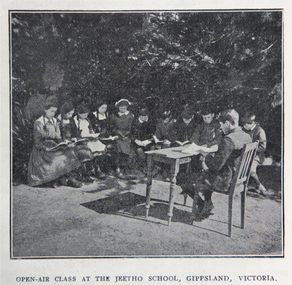
Book, Victoria Education Gazette and Teachers' Aid, 1911-1919, 1910-1919
... Black hard covered book with red spine, holding Victorian Education Gazettes for one calendar year. .1) 1910 .2) 1912 .3) 1911 .4) 1914 .5) 1918 Images: Open Air Classroom Black Rock; Open Air Classroom, Jeetho, Gippsland; Open Air Nurses bedroom, Mildura; Gym at Canterbury School ; Babies and Nurses at Melbourne Foundling Hospital; Camp at Portland; Alexander Peacock Opens a Melbourne School; Unveiling Major Mitchell Memorial at Mt Arapiles; Agricultural Plot; School Interior; Swimming Drill; Graham Dux Prize Board; Bathing Place; Classroom with blackboard and pictures; Major Mitchell's Map; Melbourne, Derbyshire; Market Place Melbourne; The Blackwood; World War One Send-off at The Athenaeum; Scarsdale Old Boy's logo; Sloyd articles for the Field Hospital; World War One; Gifts for Transport to the Wharf; soldiers; ANZAC Day; ANZAC Day Medalion .5) 1915: Education Department's War Relief Fund, William Park obituary, Closer Settlement Act 1912, Agriculture, needlework, Swimming and Life Saving, explorers, Gregory Blaxland, Matthew Flinders, Composition, Geography, potatoes, onions, gardens, Needlework for Infants, Iona and Staffa, Trained Primary Teacher's Course, Electricity, Electrical Technology, hygiene, Arbour Day, Horticulture, Wattle Day, Bird Day, Technical Schools, Landing at Gaba Tepe, Evils of Alcohol, Old Boys of Scarsdale, Belgium, Teachers' College Images: The British at War, The Sonnet, History and Patriotism, Male Swimming Teachers Summer School at Geelong, Women Swimming Teachers at Port Fairy, Buln Buln State School, Burwood East State School, needlework plans, methods of Rescue and Resucitation. plan of the journey of Gregory Blaxland, Macquarie House, teachers killed (William Ross Hoggart, Stanley Robert Close, William Roy Hodgson, Campbell McDiarmid Peter, William Henry Dawkins, William Hugh Hamilton, Frederick McRae Neal, Vernon Brookes, Frank J. ...Bailey Black hard covered book with red spine, holding Victorian Education Gazettes for one calendar year. .1) 1910 .2) 1912 .3) 1911 .4) 1914 .5) 1918 Images: Open Air Classroom Black Rock; Open Air Classroom, Jeetho, Gippsland; Open Air Nurses bedroom, Mildura; Gym at Canterbury School ; Babies and Nurses at Melbourne Foundling Hospital; Camp at Portland; Alexander Peacock Opens a Melbourne School; Unveiling Major Mitchell Memorial at Mt Arapiles; Agricultural Plot; School Interior; Swimming Drill; Graham Dux Prize Board; Bathing Place; Classroom with blackboard and pictures; Major Mitchell's Map; Melbourne, Derbyshire; Market Place Melbourne; The Blackwood; World War One Send-off at The Athenaeum; Scarsdale Old Boy's logo; Sloyd articles for the Field Hospital; World War One; Gifts for Transport to the Wharf; soldiers; ANZAC Day; ANZAC Day Medalion .5) 1915: Education Department's War Relief Fund, William Park obituary, Closer Settlement Act 1912, Agriculture, needlework, Swimming and Life Saving, explorers, Gregory Blaxland, Matthew Flinders, Composition, Geography, potatoes, onions, gardens, Needlework for Infants, Iona and Staffa, Trained Primary Teacher's Course, Electricity, Electrical Technology, hygiene, Arbour Day, Horticulture, Wattle Day, Bird Day, Technical Schools, Landing at Gaba Tepe, Evils of Alcohol, Old Boys of Scarsdale, Belgium, Teachers' College Images: The British at War, The Sonnet, History and Patriotism, Male Swimming Teachers Summer School at Geelong, Women Swimming Teachers at Port Fairy, Buln Buln State School, Burwood East State School, needlework plans, methods of Rescue and Resucitation. plan of the journey of Gregory Blaxland, Macquarie House, teachers killed (William Ross Hoggart, Stanley Robert Close, William Roy Hodgson, Campbell McDiarmid Peter, William Henry Dawkins, William Hugh Hamilton, Frederick McRae Neal, Vernon Brookes, Frank J. ...Black hard covered book with red spine, holding Victorian Education Gazettes for one calendar year. .1) 1910 .2) 1912 .3) 1911 .4) 1914 .5) 1918 Images: Open Air Classroom Black Rock; Open Air Classroom, Jeetho, Gippsland; Open Air Nurses bedroom, Mildura; Gym at Canterbury School ; Babies and Nurses at Melbourne Foundling Hospital; Camp at Portland; Alexander Peacock Opens a Melbourne School; Unveiling Major Mitchell Memorial at Mt Arapiles; Agricultural Plot; School Interior; Swimming Drill; Graham Dux Prize Board; Bathing Place; Classroom with blackboard and pictures; Major Mitchell's Map; Melbourne, Derbyshire; Market Place Melbourne; The Blackwood; World War One Send-off at The Athenaeum; Scarsdale Old Boy's logo; Sloyd articles for the Field Hospital; World War One; Gifts for Transport to the Wharf; soldiers; ANZAC Day; ANZAC Day Medalion .5) 1915: Education Department's War Relief Fund, William Park obituary, Closer Settlement Act 1912, Agriculture, needlework, Swimming and Life Saving, explorers, Gregory Blaxland, Matthew Flinders, Composition, Geography, potatoes, onions, gardens, Needlework for Infants, Iona and Staffa, Trained Primary Teacher's Course, Electricity, Electrical Technology, hygiene, Arbour Day, Horticulture, Wattle Day, Bird Day, Technical Schools, Landing at Gaba Tepe, Evils of Alcohol, Old Boys of Scarsdale, Belgium, Teachers' College Images: The British at War, The Sonnet, History and Patriotism, Male Swimming Teachers Summer School at Geelong, Women Swimming Teachers at Port Fairy, Buln Buln State School, Burwood East State School, needlework plans, methods of Rescue and Resucitation. plan of the journey of Gregory Blaxland, Macquarie House, teachers killed (William Ross Hoggart, Stanley Robert Close, William Roy Hodgson, Campbell McDiarmid Peter, William Henry Dawkins, William Hugh Hamilton, Frederick McRae Neal, Vernon Brookes, Frank J. Olle, Alfred J. Collins, Ernest R. Fairlie, William J. McLaren, A.E. Smith, Thomas Patton, Francis W. Kemp, Frederick G. Hall, Rupert O. Hepburn, Woolston J. Govan), Frederick Harold Tubb VC, Botanic Gardens Red Gum, Shelter Pavillions, Head of Wheat, Australian Commonwealth Flag, Iona Cathedral, Drawing exercises, ANZAC Madallion, School Rolls of Honor .6) 1916 - Nature Study, war relief, school gardening, horticulture, singing class, geography of the war, School Rolls of Honour, Ponsonby Carew-Smyth, Astronomy, ANZAC Day, Empire Day, Arbor Day, "Some Suul of Goodness in Things Evil" by Frank Tate, War Relief Gardeners' League, ANZAC Day medallion, Solar System, Abolition of German Schools in Victoria, ANZAC Avenues, avenues of honour, Geography of the War: The West, War relief and handwork, Victorian State Schools Horticultural Society, Patrick Maloney obituary, formalin lamps, Victoria League of Victoria, Wonwondah East Roll of Honor Images - Teachers killed (John Clarke, A.C.H. Jackson, Alexander Robertson, Noel Gambetta, Ralp E. Leyland, Laurance J. Woodruff, Walter E. Cass, Percy D. Moncur, Thomas M. Carmichael, Edward G. Brain, Reginald N.F. Woods, George E. James, William Colvin, David Dobson, Stanley L. Robinson, Charles Allen, G.E. James, H.F. Curnow, Franl L. Cousins, James R. Thompson, Henry H. Campbell, George E. Read, Ernest D. Morshead, Wilfred S. Merlin, Henry R. Wright, George B. Webb, Noel Nicholas, David H. Thomas, Charles A. Levens, Thomas R. Fenner, John M. Daniell, P.J. Larkin, Ralph Smith, Philip Ormsby), school rolls of honour, Swimming Instructors at Queenscliff, The Southern Sky, Map of the North Sea and its Littorals, Easter School of Horticulture at Oakleigh, Map of the Eastern Front, Map of Mesopotamia, Map of the War Area in the Egyptian Campaign, leeches for the Melbourne Hospital .7) 1917 - Swimming and Life-Saving, Childre's FLower Day, Education Department's War Relief Fund, State War Council, Horticulture, Bird Day, Swimming, Growing Chicory at Cowes Images - Teachers killed during World War One (G.M. Nicholas, William C.W. Spencer, J.W.C. Profitt, Ivon C. Bromilow, John Colwell, Robert W. Campbell, Arthur P. Bourchier, Francid G. Houston, Claude N. Harrison, Edgar Williams, Leslie A. Stevens, Charles E. W. Chester, Stanley R. Green, Walter Baker, Arthur G. Scott, Harry L. Swinburne, Horace W. Brown, Arnold Bretherton, Edward W. Jenkins Aubrey Liddelow, Ewen A. Cameron, Edmund R. Lyall, John H. Martin, Harry Bell, Frank L. Nicholls, Melville R. Hughes, Edwin W. Hauser, Walter S. Filmer, Walter G. Barlow, Henry A. Donaldson, Edward H. Jones, Walter W. Raw, Alfred W. Dean, Wiliam Lea, Frederick G. Drury, J.T. Richards, Norman G. Pelton, Lance-Corporal Doran, Kenneth F. McKenzie, William F. Robertson, Wiliam Jarrott, Norman Graham, George G. Paul, Victor Green, Arthur William Rennie, Alfred J. Glendinning, Robert B. Liston, Eward P. Toll, George Jones, Errol E. Rodda, Christian P. Christensen, Charles F. Sydes, H.G. Clements, Norman C. Fricker, J.M. Romeo. Eric N. Lear, Thomas J. Bartley, Norval Birrell, Frederick H. Tubb. J.T. Hamilton Aram, Arthur Wilcock, William M. Conroy, Alex. H. Miller, Patrick J. Cunningham, Charles S. Mitchell, John R. Maddern, James Roadknight, Harry Arundel, Jack C. McKellar, duncan M. McKellar, George S. Manfield, Edgar C. Holmes, George A. Young, Raymond A. Gardiner, William B. Bell, William Opie, George R. Scott, Richard V.B. Vine, Herbery S. Marshall, Hugh St Omer Dentry, George B. Fullerton, Harry Oulton, Iva F. Morieson), School Honor Books, Drawing, Presentation of 30,000 pounds to the British Red Cross at Melbourne Town Hall .8) 1918 .9) 1919 - Photographs of World War One soldiers from the Education Department, Margaret Montgomery Memorial, 1918 Act relating to State School Teachers, State Scolarships, Victorian State Schools' Horticultural Society, Pneumonic Influenza, Spanish Flu, epedemic, swimming and life savinfJunior cadet training, vacancies in Fiji, School Committees, Arbor Day, Arbour Day, Henry Harding of Yinnar, Planting Trees and Shrubs, Juvenile Crime, The use of 'Get', Soldier-Teachers from Overseas in Congress London, Australia's Effort in the War, Military, Working Bees, Tree Planting, fence building, Welcoming Home a Returned Soldier, Avenue of Honour planting, Discipline, Unveiling an Honor Board, School gymnasium, school tennis court, E. E. Crogger grave at Aldershot, The School Honor Book. War Relief Fund, Commonwealth War Record, Caulfield Military Hosptial, ANZAC Day Pilgrimage, Jimmie Panikin, Donald Fraser, Arthur Mee, Card Sun Dial, Balboa Day in Honolulu, William Hamilton, Alfred Jackson, The Backward Child, Flies, Language Teaching and Learning, Spelling, The Education of the Adolescent, victorian education gazette, education gazette and teachers' aid, sloyd, william a. cavanagh, james i froebel, school, education, world war one, memorials, alfred williams, exploration and settlement, cadets, australian naval college, bernard o;dowd, birds, swimming, drawingempire league, eucalypts, paper in history, forestry, arbor day, identification of trees, forestrey museums, fiji, gravel hill school band, horticulture, hygiene, gould league of bird lovers, life saving, la perouse, bandin, j. holland, w. hamilton, charles sturt, principles of archimedes, james holland, william hamilton, scarsdale old boys' reunion, foundling home melbourne, montessori education, open air schools, james hughes, marie corelli, flinders sydney harbour, major mitchell's map, tooth brushing, r.h.s. bailey -
 Marysville & District Historical Society
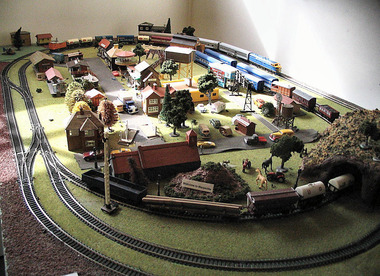
Photograph (Item) - Colour photograph, Unknown
... world all made from Meccano. There was also a selection of models, toys and other items that all moved. The Meccano models were all built by Doug Wilson who lived in Wangaratta in Victoria. In 1937, when he was 12, Doug won first prize at Brunswick Technical School for making a Meccano model aeroplane with three rotating propellers. Manical Mechanicals was destroyed in the 2009 Black Saturday bushfires. manical mechanicals marysville victoria meccano doug wilson brunswick technical school 2009 black saturday bushfires A colour photograph of a display in Manical Mechanicals in Marysville in Victoria. Shows a train ...A colour photograph of a display in Manical Mechanicals in Marysville in Victoria.A colour photograph of a display in Manical Mechanicals in Marysville in Victoria. Manical Mechanicals was owned and operated by Marg and Alistair Mackie in Murchison Street in Marysville in Victoria. It offered a display of various engineering wonders of the world all made from Meccano. There was also a selection of models, toys and other items that all moved. The Meccano models were all built by Doug Wilson who lived in Wangaratta in Victoria. In 1937, when he was 12, Doug won first prize at Brunswick Technical School for making a Meccano model aeroplane with three rotating propellers. Manical Mechanicals was destroyed in the 2009 Black Saturday bushfires.manical mechanicals, marysville, victoria, meccano, doug wilson, brunswick technical school, 2009 black saturday bushfires -
 Federation University Historical Collection
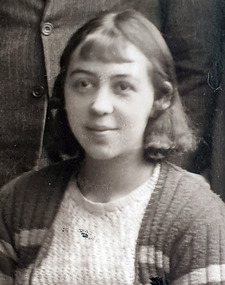
Article - Article - Women, Ballarat Technical Art School: Women of Note; Nornie Gude, Artist, (1915 - 2002)
... World War II. She was accepted into the Ballarat Technical Art School at 15 because of her advanced skill in painting, and trained there from 1931-1936. ...World War II. She was accepted into the Ballarat Technical Art School at 15 because of her advanced skill in painting, and trained there from 1931-1936. ...Eleanor Constance (Nornie) Gude was born in 1915 in Ballarat, Victoria to Stella Rehfisch and Walter Gude, musician and violin teacher, and conductor of the St Patrick's Cathedral orchestra and choir in Ballarat. Her parents met when Stella was 27 and the 42-year old Walter was teaching her the violin. Nornie and her sister Gilda were both raised in Ballarat before moving to Melbourne on the eve of World War II. She was accepted into the Ballarat Technical Art School at 15 because of her advanced skill in painting, and trained there from 1931-1936. She won the esteemed MacRobertson Scholarship in art worth £100 a year. She later went on to the National Gallery School from 1936-1939, studying with Sidney Nolan and Charles Bush, and became the first woman to win the National Gallery Students Travelling Scholarship. Gude won many awards for her painting both while at school and throughout her career. Her work is represented in collections at the National Gallery of Victoria, Parliament House, and the Art Gallery of Western Australia, as well as regional collections in Ballarat, Geelong, Castlemaine Art Museum, and Bendigo.Portrait of Nornie Gude while a student at the Ballarat Technical Art Schoolnornie gude, ballarat technical art school, 1931-1936, women of note, artist, macrobertson scholarship, 100 pound per year, national gallery school, 1936-1939, sidney nolan, charles bush, first woman national gallery students travelling scholarship, parliament house, regional collections, ballarat, geelong, castlemaine, bendigo, national gallery victoria, eleanor constance gude -
 Federation University Historical Collection
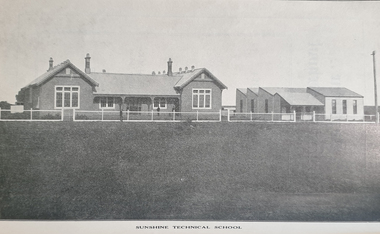
Booklet - Booklet - Prospectus, Exchange Press Pty Ltd, Sunshine Technical School, Prospectus, 1914, 1914
... train the company's apprentices. In 1911, H.V. McKay wrote to the Victoria Cabinet offering 2,000 pounds and 4 1/2 acres of land in Derby Rd for a technical school, On the 7th July 1913, the new Sunshine Technical School opened with a wooded administration building with six class rooms and a large galvanised iron workshop for the trade apprentices. Mr George Baxter was appointed principal with assistant teachers, A.J. Dunlop (Maths & English), W.W. Anderson (Art) & H.B. Ernest (Maths & Science). Seventy students were enrolled in the first year of which 44 were apprentices from the Harvester Works. During the First World...train the company's apprentices. In 1911, H.V. McKay wrote to the Victoria Cabinet offering 2,000 pounds and 4 1/2 acres of land in Derby Rd for a technical school, On the 7th July 1913, the new Sunshine Technical School opened with a wooded administration building with six class rooms and a large galvanised iron workshop for the trade apprentices. Mr George Baxter was appointed principal with assistant teachers, A.J. Dunlop (Maths & English), W.W. Anderson (Art) & H.B. Ernest (Maths & Science). Seventy students were enrolled in the first year of which 44 were apprentices from the Harvester Works. During the First World ...Used at School of mines and industries Ballarat As H.V. McKay's Sunshine Harvester business expanded there was a requirement for a school to train the company's apprentices. In 1911, H.V. McKay wrote to the Victoria Cabinet offering 2,000 pounds and 4 1/2 acres of land in Derby Rd for a technical school, On the 7th July 1913, the new Sunshine Technical School opened with a wooded administration building with six class rooms and a large galvanised iron workshop for the trade apprentices. Mr George Baxter was appointed principal with assistant teachers, A.J. Dunlop (Maths & English), W.W. Anderson (Art) & H.B. Ernest (Maths & Science). Seventy students were enrolled in the first year of which 44 were apprentices from the Harvester Works. During the First World War Years (1914 - 1918) there was a difficulties with staffing and enrollments. The school was also used to provide vocational training for wounded returned soldiers. In 1919 during the great influenza epidemic the school was used as a hospital. Light blue soft covered booklet of 60 pages with information about office bearers, staff, objects of the school, prizes and scholarships, examinations, time tables, courses, and subjects. It has photographs and advertising.sunshine, technical school, sunshine technical school, prospectus, hugh victor mckay, r.m. lambert, george mckay, d.b. ferguson, samuel mckay, george bult, ralph mckay, george butlin, george baxter, f.s. midgley, j.b. gray, w. kerr, a.j. dunlop, h. ernst, w.w. anderson, f. cleary, school councillors, staff, blacksmithing, carpentry, fitting and turning, moulding, sheet metal, mathematis, english, science, art, 1914, h v mckay, sunshine harvester, 2000 pounds and land donated, wounded returned soldiers, 1919 ued as hospital, influenza epidemic -
Marysville & District Historical Society
THE TRIANGLE NEWS-VOL 42 NO 8-FEBRUARY 27 2015
... world day of prayer...mayor's chair by margaret rae...murrindindi shire council...bushfire rebuilding sessions...adventurous cooks...board games at community centre...buxton bushy night...public notice proposed castella-toolangi locality boundary change...marysville primary school parents club agm...marysville jazz & blues weekend...el kanah garden news history...buxton bootcamp...triangle garden club...residential & rural real estate...advertisements...marsysville triangle real estate...shinboners train...marysville victoria australia foundation congratulates successful projects funded by first grant round marysville triangle community foundation what's on when in february triangle community dinner the committee of management of the gallipoli park precinct creative triangle marysville community golf & bowls club social membership 2015/2016 marysville golf report church notices world day of prayer mayor's chair by margaret rae murrindindi shire council bushfire rebuilding sessions adventurous cooks board games at community centre buxton bushy night public notice proposed castella-toolangi locality boundary change marysville primary school parents club agm marysville jazz & blues weekend el kanah garden news history buxton bootcamp triangle garden club residential & rural real estate advertisements marsysville triangle real estate shinboners train at gallipoli park buxton ridge winery change of opening hours family funday in marysville for evie madrats r us black spur inn intrepid triangle bushwalkers evie gleeson donations question evolution dr don batten mt cathedral community baptist church emotions anonymous international meeting sponsor a post trevor harrow oval gallipoli park lake mountain alpine resort sounds of silent buster keaton silent movie with live sound el kanah conference room south cathedral landcare group isaac sims performs at tower motel marysville lake mountain visitor information centre buxton progress assocn lily morrow makes it into top 10 k pop star THE TRIANGLE NEWS-VOL 42 NO 8-FEBRUARY 27 2015 ...marysville, victoria, australia, foundation congratulates successful projects funded by first grant round, marysville triangle community foundation, what's on when in february, triangle community dinner, the committee of management of the gallipoli park precinct, creative triangle, marysville community golf & bowls club, social membership 2015/2016, marysville golf report, church notices, world day of prayer, mayor's chair by margaret rae, murrindindi shire council, bushfire rebuilding sessions, adventurous cooks, board games at community centre, buxton bushy night, public notice proposed castella-toolangi locality boundary change, marysville primary school parents club agm, marysville jazz & blues weekend, el kanah garden news history, buxton bootcamp, triangle garden club, residential & rural real estate, advertisements, marsysville triangle real estate, shinboners train at gallipoli park, buxton ridge winery change of opening hours, family funday in marysville for evie, madrats r us, black spur inn, intrepid triangle bushwalkers, evie gleeson donations, question evolution, dr don batten, mt cathedral community baptist church, emotions anonymous international meeting, sponsor a post trevor harrow oval, gallipoli park, lake mountain alpine resort, sounds of silent, buster keaton silent movie with live sound, el kanah conference room, south cathedral landcare group, isaac sims performs at tower motel, marysville lake mountain visitor information centre, buxton progress assocn, lily morrow makes it into top 10 k pop star -
Federation University Historical Collection
Article - Article - Women, Ballarat School of Mines, Girls' School: Women of Note; Valda D'Angri, Teacher, (1930 - )
... World War II. Her mother was a teacher and her father worked in Melbourne on war-related business. She attended kindergarten, which she recalled was unusual for the time. She attended Humphrey Street State School and her secondary schooling was at Ballarat Girls' School. Val completed her secondary school education at 15 years of age and went on to tertiary study at The School of Mines, where she trained...World War II. Her mother was a teacher and her father worked in Melbourne on war-related business. She attended kindergarten, which she recalled was unusual for the time. She attended Humphrey Street State School and her secondary schooling was at Ballarat Girls' School. Val completed her secondary school education at 15 years of age and went on to tertiary study at The School of Mines, where she trained ...Val grew up in Ballarat and started school in the early 1940s, during World War II. Her mother was a teacher and her father worked in Melbourne on war-related business. She attended kindergarten, which she recalled was unusual for the time. She attended Humphrey Street State School and her secondary schooling was at Ballarat Girls' School. Val completed her secondary school education at 15 years of age and went on to tertiary study at The School of Mines, where she trained in art and dressmaking. After completing her education, she worked as draughtswoman before becoming a teacher. The remainder of her career was spent teaching art and textiles at both secondary and tertiary levels. She taught at the secondary school that she had attended.women of note, valda d'angri, teacher, kindergarten, humphrey street state school, ballarat girls' school, ballarat school of mines, art, dressmaking, draughtswoman -
 Federation University Historical Collection
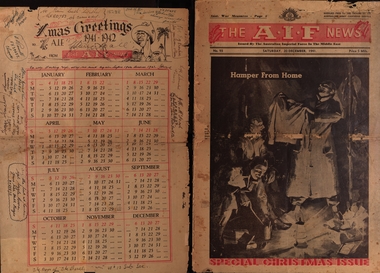
Newspaper - Twenty page issue December 1941 No. 93, Societe Orientale de Publicite, The A.I.F. News Special Christmas Issue 1941, December 1941
... trained by L/Cpl Jack Kneeshaw which he named "Goebbels"; poems and cartoons. Page 19 "Women of War" - photos of women at work filling in for men who have gone to war. Page 20 Xmas Greetings 1942-1942 - a 1942 Calendar signed by 14 members of the AIF, some with messages and including their Army Number. The A.I.F. News Christmas Edition 1941 Australian Imperial Force World ...The A.I.F.= The Australian Imperial Force and this newspaper was supplied free to the troops of the Australian Army Canteens Service. This issue is dated Saturday 22nd December 1941. It includes advertisments for businesses in Cairo and Alexandria; Egypt, Palestine and Syria. Page 2 includes a poem titled "This Holy Night" by Pte C.M. Walker; two sonnets by Rupert Brooke; a poem, "Waiting Dreams" by Pilot Officer J.A. Henderson RAAF and a poem by Lieut. David McNicoll AIF Abroad Air Mail - Palestine. Page 3 includes a message from General Sir Thomas Blamey, an article on the part women would increasingly play as a consequence of the emergency war policy; an advertisment for tobacco specially packed for overseas forces. Page 4 includes an article on Australian coastal cities being ready for raids. Page 5 includes an article about the Commonwealth of the Philippines and their defense which until 1946 lay with America. General D Macarthur was the Commander In Chief in the Philippines. Germany's "secret Weapon" legend. Page 6 includes "Dancing Dan's Christmas"; "Bluey and Curley" comic strip. Page 7 includes article "Rommel's Armoured Might Lies Strewn Over Libyan Sands" Page 8 includes an article: "All In Fun" - a revue - has begun a tour of Australian camps in Palestine and Syria. Page 9 includes articles "War Will Revolutionise Air Services In Australia"; a list - Greek Awards To AIF Officers and a cartoon by George Aria titled 'Jonah '. Pages 10&11 "Christmas 1941" - messages from prominent people: Mr Winston Churchill; The Govenor General (Lord Gorrie); The Prime Minister (Mr Curtin); Mininster for the Army (Mr Forde). Also photos of army operations and traditional family Christmas time. Page 12 &13 Articles regarding sport under the heading 'Australian Sporting Digest'. Page 14 A story - "The Gift of the Magi" - an O Henry Christmas Story. Also a greeting from Myer's of Melbourne and Adelaide to all Myer Men in the AIF Page 15 An article where General Blamey reassures Australia about its capability of defence. Page 16 A description of a battle by Australian sloop "Parramatta" with HMAS "Auckland" against enemy planes whilst they were escorting a merchant ship with a cargo of petrol during the Battle of Tobruk Page 17 & 18 Pages under the title 'ACK-I-FOOFS' (Articles submitted by soldiers: The real Rat of Tobruk - a rat trained by L/Cpl Jack Kneeshaw which he named "Goebbels"; poems and cartoons. Page 19 "Women of War" - photos of women at work filling in for men who have gone to war. Page 20 Xmas Greetings 1942-1942 - a 1942 Calendar signed by 14 members of the AIF, some with messages and including their Army Number. Twenty pages of news supplied free to the troops by the Australian Army Canteens Service.The last page is a calendar for 1942 with personal inscriptions and greetings of servicemen. Some inscriptions have I.D. Numbers ( VX35435 W. Johnston; QX20753 of Carmody ; VX40449 ; VX39637 N. Powell; VX32054 Blue Ernistson?; N?X23234 W.Cummins; VXthe a.i.f. news christmas edition 1941, australian imperial force, world war 2, australian army canteens service, general blamey, world war 2 - pacific war, world war 2 - phillipine islands, general d macarthur, emergency plans ww2 australia, secret weapons ww2, western desert ww2, australian imperial force - western desert ww2, civil aviation post ww2, air services australia, lord gowrie, governor general lord gowrie, prime minister john curtain, minister for the army - mr forde, cartoons 1941, women-in ww2, xmas greetings calendar 1941-1942, cairo 1941, palestine 1941, western desert 1941, advertisements 1941, middle east 1941 -
 Lara RSL Sub Branch
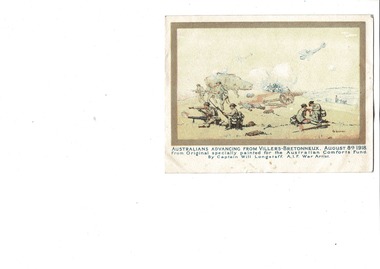
greeting Card 8/8/1918, Advance from Villers-Bretonneux 8/8/1918 & Capture of Hamel 4/7/1918 & Captured German Tank
... world war 1 greeting card Page 1: Australian Advancing from Villlers - Bretonneux 8/8/1918 drawing of soldiers in action. Page 2 : Villlers - Bretonneux Start of the German attack 8/8/1918 Picture of captured German tank by Australians. Page 3 : Capture of Hamel Village 4/4/1918 by Australian. From color Paiinting Australian Comfort Fund by A. Pearse War Artist. Pages 4 : Australian capture A 14 C.M. German Naval Gun intact with its Train ...Four color pages card Advance from Villers-Bretonneux 8/8/1918 & Capture of Hamel 4/7/1918 & Captured German Tank .Page 1: Australian Advancing from Villlers - Bretonneux 8/8/1918 drawing of soldiers in action. Page 2 : Villlers - Bretonneux Start of the German attack 8/8/1918 Picture of captured German tank by Australians. Page 3 : Capture of Hamel Village 4/4/1918 by Australian. From color Paiinting Australian Comfort Fund by A. Pearse War Artist. Pages 4 : Australian capture A 14 C.M. German Naval Gun intact with its Train and Equipment. Greeting from.................cardboard card, world war 1, greeting card -
 Lara RSL Sub Branch
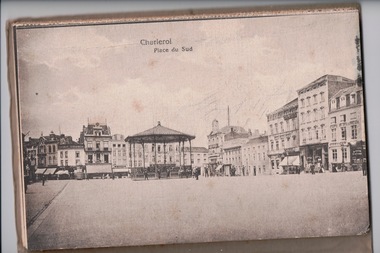
Postcards, France
... world war one belgium lara Envelope: O.A.S. Tower of London. Miss J McIntyre. Elcho Lara lake, Australia, Victoria. Rear of postcard pack: London December 27th 18 Dear Mother, I arrived here yesterday. Spent Xmas day travelling across France. The trip took the best part of four days. We are up near Belgium. Had to go into Belgium to get a train ...John Lachlan McIntyre was born at Beeac, Victoria in December 1890. He enlisted in the 1st AIF in July 1915. John fought on the Western Front, taking part in the battles of Fromelles and the 2nd Battle of the Somme. He was severely wounded at Fromelles and spent 12 months in hospital in England before returning to the front. John returned home in 1919 and was granted a soldier settlement block in Lara in 1937. He was a founding member of Lara RSL and is its longest serving member. John died in 1990. This letter was written by John and sent to his mother in 1918 on his journey through Belgium. The McIntyre family were early pioneers in the Lara district, and the brothers were founding members of the Lara RSL. This letter represents a significant link to the history of the town and sub-branch.A brown envelope addressed to Miss J McIntyre. Within the envelope is a pack of 12 illustrated souvenir post cards. Envelope: O.A.S. Tower of London. Miss J McIntyre. Elcho Lara lake, Australia, Victoria. Rear of postcard pack: London December 27th 18 Dear Mother, I arrived here yesterday. Spent Xmas day travelling across France. The trip took the best part of four days. We are up near Belgium. Had to go into Belgium to get a train. Will write when I get settled. Hoping you are all well. With best wishes for a happy new year. Jack. Edition Martinetty Charleroi Front of pack: J. L. McIntyre Xmas 1918 Souvenir de Charleroi-Belgium 12 cartes postales 12 En Photochrommother, letter, postcard, first world war, wwi, world war one, belgium, lara -
 Lara RSL Sub Branch
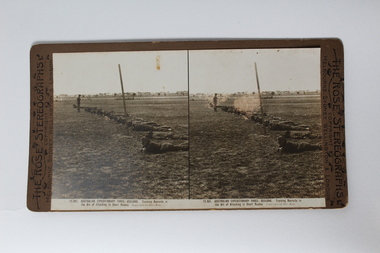
Stereograph, The Rose Stereographs
... This sterograph shows recruits training at Geelong during the First World War. Soldiers were trained to attack in short rushes rather than advancing in line due to the lethal power of the machine gun. ...This sterograph shows recruits training at Geelong during the First World War. Soldiers were trained to attack in short rushes rather than advancing in line due to the lethal power of the machine gun. ...George Rose was well known Australian photographer and postcard maker in the first half of the 20th century. This sterograph shows recruits training at Geelong during the First World War. Soldiers were trained to attack in short rushes rather than advancing in line due to the lethal power of the machine gun. The stereograph was an early technology that used double images to achieve a three dimensional image. Rectangular piece of cardboard with a stereograph image attached to the front. The image is a double reproduction of a black and white photograph. the photograph depicts a line of soldiers lying on the ground. AUSTRALIAN EXPERDITIONARY FORCE, GEELONG. Training Recruits in the Art of Attacking in Short Rushes. Copyright by Geo. Rose.wwi, rose series, postcard, lara, geelong, rsl, training, stereograph -
 Lara RSL Sub Branch
Booklet, Practical Calculations for the A.T.C, first edition 1942
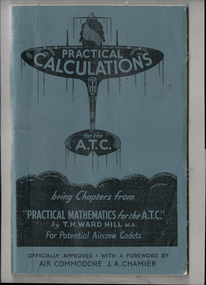
... Used for training pilots during World War 2 Used by Air Training Corps to train Aircrew Cadets in Geometry during World War 2 pratical calculations atc air training corps world war 2 ww2 pratical mathematics t.h. ward hill air commodore j.a. chamier air force australian air force royal australian air force geometry 1942 george g. harrap & co. ltd Front cover of an aeroplane flying above clouds with following words: Practical Calculations for the A.T.C. being Chapters from "Practical Mathematics for the A.T.C." by T.H. ...Used for training pilots during World War 2Used by Air Training Corps to train Aircrew Cadets in Geometry during World War 2Blue cloth covered book of 80 pagesFront cover of an aeroplane flying above clouds with following words: Practical Calculations for the A.T.C. being Chapters from "Practical Mathematics for the A.T.C." by T.H. Ward Hill M.A. for potential Aircrew Cadets. Officially approved with a foreward by Air Commodore J.A.Chamier On inside cover is written in pencil: A.T.C. 1942-43 R. Ellis 69 Rennie Street Lara.pratical calculations, atc, air training corps, world war 2, ww2, pratical mathematics, t.h. ward hill, air commodore j.a. chamier, air force, australian air force, royal australian air force, geometry, 1942, george g. harrap & co. ltd -
 Lara RSL Sub Branch
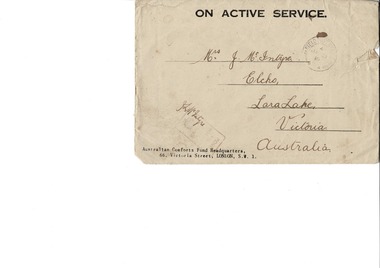
Card & Envelope, Raphael Tuck & Sons,Ltd.Publishers to the King and Queen, Australian Comforts Fund Xmas & New Years Greeting Card 1918-19, Circa 1918-19
... The card depicts four scenes from the First World War: Australians Advancing from Villers-Brettonneux August 8th 1918, A German tank captured by the Australians near Villers-Brettonneux, Capture of Hamel Village July 4th 1918 by Australians assisted by a detachment of Americans, Captured by The Australians a 14 C.M. German Naval Gun intact with its Train...The card depicts four scenes from the First World War: Australians Advancing from Villers-Brettonneux August 8th 1918, A German tank captured by the Australians near Villers-Brettonneux, Capture of Hamel Village July 4th 1918 by Australians assisted by a detachment of Americans, Captured by The Australians a 14 C.M. German Naval Gun intact with its Train ...Small Christmas card produced for the Australian Comforts Fund, Christmas 1918. Christmas & New Years Greetings, 1918-19, with scenes of battles at Villers-Brettonneux and Hamel, and views of a captured tank and a 14cm. gun. Produced by Raphael Tuck & Sons, Publishers to the King and Queen.These cards were sent by service personal serving overseas to family members back home.l Sent by J.L.Mcintre while on active service in France to his loved ones back home.Christmas card with blue and black lettering Australian Comforts Fund Christmas & New Years Greetings, 1918-19, Produced by Raphael Tuck & Sons, Publishers to the King and Queen. The card depicts four scenes from the First World War: Australians Advancing from Villers-Brettonneux August 8th 1918, A German tank captured by the Australians near Villers-Brettonneux, Capture of Hamel Village July 4th 1918 by Australians assisted by a detachment of Americans, Captured by The Australians a 14 C.M. German Naval Gun intact with its Train & Equipment.Australian Advancing from Vlllers-Brettonneux.August 8th 1918. From Original specially painted for the Australian Comforts Fund by Captain Will Longstaff.A.I.F.War Artist. -
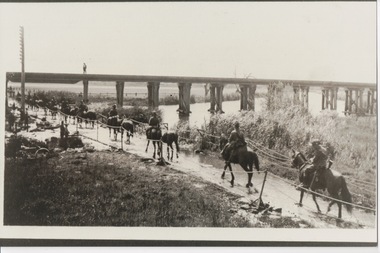 Lara RSL Sub Branch
Photograph, Set 4 photographs. and others for Torquay Light Horse camp, 1940
... References: Australian Light Horse Association www.lighthorse.org.au National Australia Archives Australian War Memorial Surf Coast Shire WW1 memorials www.togethertheyserved.com The Light horse- a Cavalry under Canvas Light Horse, Training Camp, Torquay, WW2 Late in 1939 it was decided to set up a Lighthorse training camp in Torquay to train both men and horses for the battles of the Second World War. Horses, men and equipment came on special trains from all over Victoria and NSW, and as you would expect horseman came from areas such as Omeo and Sale, the Wimmera and the Western District. ...References: Australian Light Horse Association www.lighthorse.org.au National Australia Archives Australian War Memorial Surf Coast Shire WW1 memorials www.togethertheyserved.com The Light horse- a Cavalry under Canvas Light Horse, Training Camp, Torquay, WW2 Late in 1939 it was decided to set up a Lighthorse training camp in Torquay to train both men and horses for the battles of the Second World War. Horses, men and equipment came on special trains from all over Victoria and NSW, and as you would expect horseman came from areas such as Omeo and Sale, the Wimmera and the Western District. ...These images capture for all time Light Horsemen travelling through Geelong on their way to camp at Torquay for the last Group meeting in Australia . information following - details obtained from .........https://torquayhistory.com/light-horse-brigade/ On Australia Day, 1997, Sir John Young unveiled this plaque on Point Danger, Torquay. Torquay history, Light Horse Training Camp, WW2 Plaque at Pt. Danger Note----- (See images to view plaque) The plaque identifies a significant event in Torquay’s history and the sentiments of ‘change’ for the Light Horse Brigade – from horses to machines. In 1940 the four Light Horse Regiments (4th, 8th, 13th and 20th), some 5000 Light Horse and 2000 horses camped and trained at Torquay. Three other regiments, formerly mounted on horses, were also at Torquay ‘mounted’ on privately owned trucks and cars. Division troops included Artillery, Engineers, Signals, Field Ambulance and other branches of the Army necessary to enable a Division to function. It wasn’t just the sheer numbers of men coming to this little town that made the event significant, it was also the fact that the men of the Light Horse were dramatic, almost glamorous figures and it is easy to see their exploits as some splendid adventure. Horses have played a special role in the story of Australia. They were the only means of transport across this huge country, so it was necessary for everyone to have the ability to ride a horse. When war broke out in 1899 between Britain and the Boers of South Africa (“Boer” was Dutch for “farmer”) Australia sent troops to fight. At first Britain was wary of using untried, unprofessional colonial cavalrymen but soon saw that the slouch-hatted Australian “bushmen” were a match for the fast-moving and unconventional mounted commandos of the Boers. The Australians proved themselves to be expert rough-riding horsemen and good shots. Bush life had hardened them to go for long periods with little food and water. They also showed remarkable ability to find their way in a strange country and use its features for cover, in both attack and defence. By 1914, when Australia joined the war against Germany, there were 23 Light Horse regiments of militia volunteers. Many men from these units joined the Light Horse regiments of the Australian Imperial Force (AIF). Men were given remounts (if not using their own horses) – army horses bought by Commonwealth purchasing officers from graziers and breeders. These were called “walers” because they were a New South Wales stockhorse type – strong, great-hearted animals with the strains of the thoroughbred and semi-draught to give them speed, strength and stamina. On 1st November, 1914, Australia’s First Infantry Division and the first four Light Horse regiments sailed for England in a fleet of transport ships. The first of the Light Horse arrived at Gallipoli in May without their horses. Back with their horses after Gallipoli, they were formidable combatants across the Sinai and Palestine. Some British commanders observed that the light horseman moved with a “lazy, slouching gait, like that of a sleepy tiger” but described how the promise of battle “changes that careless gait, into a live athletic swing that takes him over the ground much quicker than other troops”. They had Light Horse, Torquay, training campdeveloped a reputation as formidable infantrymen. The Turks called them “the White Ghurkas” – a reference to their deadly skill with the bayonet. The Arabs called them “The Kings of the Feathers”. The plume had originally been a battle honour of the Queensland Mounted Infantry for their work in the shearer’s strike of 1891. During WW1 it was adopted by almost all the Light Horse Regiments. It was the proud badge of the light horseman. The most famous of their battles was the attack on Beersheba- the charge of the 4th Light Horse Brigade. Mounted infantrymen and their superb walers had carried out one of the most successful cavalry charges in history – against what seemed impossible odds. They surprised the Turks by charging cavalry-style, when they would normally have ridden close to an objective then dismounted to fight. The fall of Beersheba swung the battle tide against the Turks in Palestine; and changed the history of the Middle East. While 19 men from the Surf Coast Shire served with the 4th Light Horse over the course of WW1, only four were involved in the charge of Beersheba- John GAYLARD, Philip QUINN.(Winchelsea); Wallace FINDLAY (Anglesea); Harry TRIGG (Bambra). After the war, Light Horse units played a key role in the Australian Government’s compulsory military training programme. The Citizen Military Forces (C.M.F.) thrived on the glamour of the wartime Light Horse tradition, ignoring the possibility that motor vehicles would soon replace the horses. When training was no longer compulsory, the C.M.F. regiments declined and horses became more of a luxury during the 1930s depression years of poverty and unemployment. Some regiments were motorised. Then, in 1939, Australia joined Britain in another world war. Training was increased for the militia at both home bases and regional training camps. The camp at Torquay in 1940, commanded by Major General Rankin, was at Divisional strength. By the end of the camp some felt that the Division was ready for active service. Gradually, over the next four years, the Australian Light Horse units were mounted on wheels and tracks and the horses were retired. Six men enlisted at the Torquay camp and another 57 men and women enlisted at Torquay for service in WW2. Those who served in the Militia provided valuable Officers and NCOs and men for the armed services during the war. Each infantry division of the 2nd AIF had a Light Horse regiment attached to it. But the day of the Australian mounted soldier hadn’t quite passed. During World War II, Australia’s 6th Cavalry Regiment formed a mounted unit they called “The Kelly Gang” which did valuable scouting work. In New Guinea, a mounted Light Horse Troop did patrol duty and helped carry supplies. Some fully equipped walers were flown into Borneo for reconnaissance in rugged mountain country. But by the end of the war, in 1945, the horse had disappeared from the Australian Army. References: Australian Light Horse Association www.lighthorse.org.au National Australia Archives Australian War Memorial Surf Coast Shire WW1 memorials www.togethertheyserved.com The Light horse- a Cavalry under Canvas Light Horse, Training Camp, Torquay, WW2 Late in 1939 it was decided to set up a Lighthorse training camp in Torquay to train both men and horses for the battles of the Second World War. Horses, men and equipment came on special trains from all over Victoria and NSW, and as you would expect horseman came from areas such as Omeo and Sale, the Wimmera and the Western District. They arrived at the Geelong racecourse for watering in the Barwon River and then were ridden across the ford at the breakwater and began their 11 mile trek to Torquay. Light Horse, Training Camp, Torquay, WW2 Tent city By the end of January 1940 the camp at Torquay accommodated some 5000 men and 2500 horses of the Second Cavalry Division. The rows of horses, tents and huts near Blackgate Road were quite a sight. While the cavalrymen engaged in exercises on the land and on the beaches, many of the troops took over the Torquay School for special training of men and officers. Mr Bob Pettit local farmer and Councillor for the Barrabool Shire, wrote about the Light horse in the Surf Coast Community News in 1985 saying “They used to travel about the district riding four abreast in one long convoy. To my annoyance they went through my property and shut all the gates behind them. I had certain gates open to let stock in to the water holes and it would take me three -quarters of an hour to follow the horsemen up and put all the gates right again” he continued “the men from the Light Horse were here when the fire went through in March 1940. He recalled an incident when early one morning, as some one blew the bugle, a soldier putting a white sheet on the line frightened the horses. They panicked and ran off in all directions. Six went over the cliff near Bird Rock, five were never found, and the rest were gathered up after nearly a fortnight in the bush around Addiscott and Anglesea" Light Horse, Training Camp, Torquay, WW2, Geelong Parade Geelong parade The training camp culminated in a parade through the streets of Geelong on March 12th 1940. The salute was given at the Town Hall and the troops continued on a route to the You Yang’s for a training exercise. Note-----(see media section for photograph) The Camp was abandoned in mid 1940 as it was deemed unsuitable for training during winter and the cost of a permanent camp could not be justified if it could not be used all year. Historic.......Rare,,,Interpretive.Sepia photographs.set of four ....post card size ....Horses &LighthorsemenNo 1, Lighthorsemen Regiment Geelong 1940......No 2 Light Horse at Breakwater Geelong 1938 to 1940....No 3 Light Horse at Breakwater Geelong 1938 to 1940.....No 4 Light Horse crossing Breakwater camped at Geelong Showgrounds. These markings are on reverse of photographs.light horsemengeelong 1940., world war 2
